
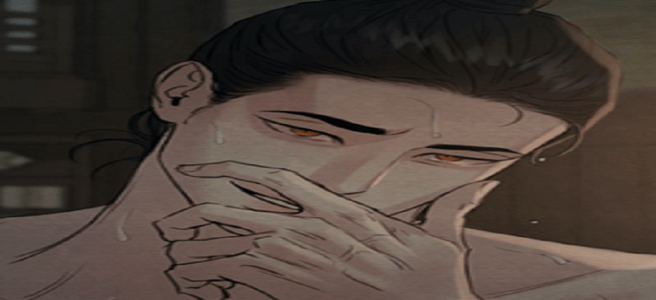
This is where you can read the manhwa. https://www.lezhinus.com/en/comic/painter But be aware that this manhwa is a mature Yaoi, which means, it is about homosexuality with explicit scenes. If you want to read more essays, here is the link to the table of contents: https://bebebisous33analyses.wordpress.com/2020/07/04/table-of-contents-painter-of-the-night/
It would be great if you could make some donations/sponsoring: Ko-fi.com/bebebisous33 That way, you can support me with “coffee” so that I have the energy to keep examining manhwas. Besides, I need to cover up the expenses for this blog.
In my last analysis entitled “The Light in the Heart”, I had portrayed Baek Na-Kyum as someone whose recovery and transformation were completed due to the number of white candles next to the painter’s head. 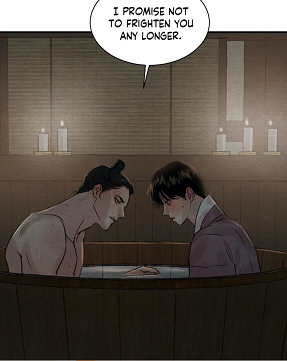 (chapter 70) 3 symbolizes perfection and completion. But I have not entirely explained how the artist could overcome his traumatic past and even find closure. So far, I elaborated that the missing farewells played a huge role in the painter’s trauma, as they triggered his abandonment issues. Thanks to Yoon Seungho’s decision, the artist was allowed for the first time to bid farewell to his noona properly.
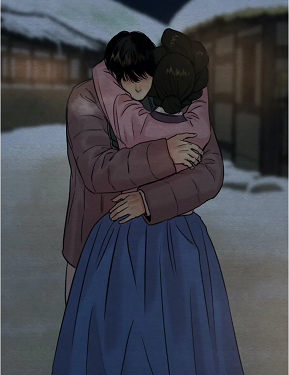 (chapter 69) But there’s more to it. In my opinion, the physical touch, in the form of caress and embrace, played a huge role in the painter’s traumatic past too. However, before starting to explain this element, I need to elaborate how it came to this.
First, I have to admit that I had problem to discern the true nature of the relationship between the painter and Heena. She is acting like a mother, although the protagonist describes her as his older sister.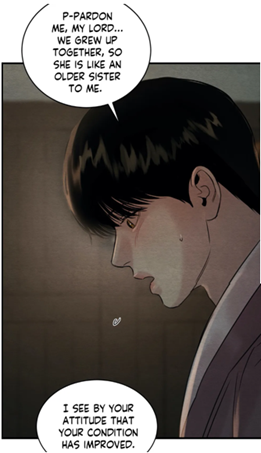 (chapter 70) Then thanks to my readers @_Winnie_L_ and @AkaiHikariChan who pointed out, the kisaeng is definitely too young to be the mother, I got a new revelation. Since Baek Na-Kyum is a reflection of Lee Jihwa, it means that the commoner was raised by an absent parent too. That’s why we don’t see the head-kisaeng at all. She is also like a ghost, the female version of father Lee.
  (chapter 67) Thus we have two possibilities. Either the head-kisaeng is someone else and Heena noona took over her role, or Heena noona became the head-kisaeng, but she never claimed Baek Na-Kyum as her son. Thus the painter ended up with a ghost mother. On the one hand, Heena noona acted like a sister in front of him and she requested from him to be called “noona”, on the other hand, she behaved like a mother towards Baek Na-Kyum. Observe that Heena is the only one with a name. The only difference is that the head-kisaeng relied on the kisaengs to raise the low-born, whereas the noble Lee employed his domestics. This explicates why Heena noona started acting like a mother. But this caused her to struggle due to her young age. She was so overwhelmed with this task, that she had to rely on the scholar. And there is a reason why the kisaeng trusted the low noble so much. She was not just blinded by her own feelings
 (chapter 68). Her decision was influenced by her past experiences and fears. The head-kisaeng judged the learned sir as a good and responsible man. And how could he win her trust? Since the story is constructed like a kaleidoscope, this means, we must have a new version of this during the first season. In my opinion, the scene with the worker is the repetition from the past.
 (chapter 29) First, observe that the young girl is sitting on the teacher’s lap and the learned sir is holding a book. So if someone saw this from far away, the beholder would think that the scholar is reading the book to the child. It even gives the impression that he is actually teaching the young girl to read. But note that in this scene, the low noble is in reality talking to the commoner. For the young girl, it means that she is forced to sit and do nothing. That’s why she turns her her head to the learned sir wondering what he is expecting from her.
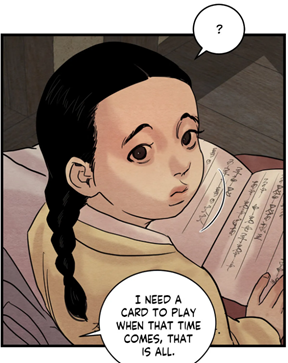 (chapter 29) What is she supposed to do? Observe that he replies to her interrogating expression with a smile, yet he doesn’t give her any instruction. I would say, he treats her like a doll. And now, replace the young girl with Baek Na-Kyum, and the latter has to sit there for a while. You can easily grasp why the painter could only fall asleep.
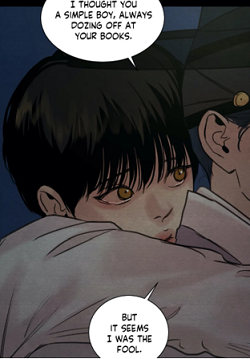 (chapter 70) In front of the kisaengs, the scholar created the illusion that he was teaching, while in truth he just saw it as a diversion. This explicates why he utilized this idiom to Yoon Seungho.
 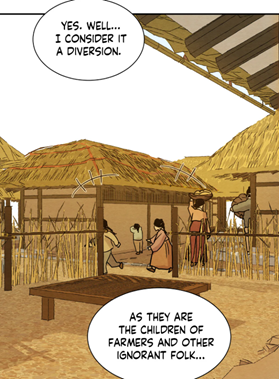 (chapter 6) Diversion has two meanings:
- something that takes your attention away from something else: Shoplifters often work in pairs, with one creating a diversion to distract the staff while the other steals the goods.
- an activity you do for entertainment: Reading is a pleasant diversion. quoted from https://dictionary.cambridge.org/dictionary/english/diversion
This outlines that this expression is far from anodyne. While we all associated “diversion” to the second significance, the low noble meant the first meaning. In the past, I used to think that the scholar was hoping for the artist to doze off so that he would spy on the guests at the kisaeng house. He was talking to the noonas with the boy on his lap in the hope to discover “secrets”. However, since I realized that Jung In-Hun was the one who brought the baby to the gibang, he had many reasons to go to the kisaeng house. He could hope to get connection to powerful nobles and even get information. However, from my point of view, since he had entrusted the artist to the noonas, he knew that the gibang was the perfect place to hide secrets as well. Remember that the conversation in this precise chapter was about “secret and protection”. 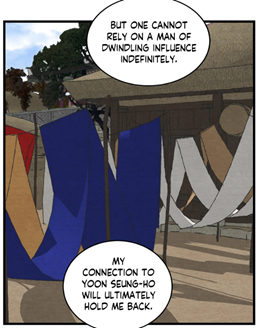 (chapter 29) And now the scene at the kisaeng house can only be perceived in a new light.
 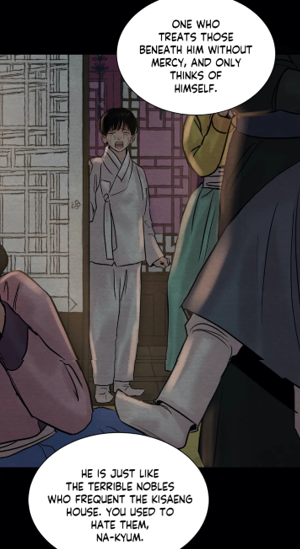 (chapter 68) Jung In-Hun must have come to an agreement with a rich noble and made a deal with him. The presence of the painter was no coincidence, and it diverted attention from the real target of abuse: Yoon Seungho, who got dragged away. The painter and the other noona thought that Heena had been the victim of violence from a noble, but she was not. She served as diversion. Too blinded by her prejudices and own fears, the young woman wasn’t able to perceive the true nature of the learned sir. While she saw the scholar as a hero, because he hugged the painter and took him away from this terrible place, she never questioned the scholar’s attitude. If he had been a true hero, he would have rescued her and not abandoned her. She never got aware of his betrayal. In other words, the scholar helped to create a secret. This explicates why the learned sir is well aware of the nobles’ fear. In his eyes, they all have something to hide.
But let’s return to our first observation: the head-kisaeng neglected her adopted son, for she was too overwhelmed with the huge responsibility. The manhwaphiles should remember that neglect is a form of abuse and it can lead to the loss of senses. That’s why I described Lee Jihwa as blind and deaf. With this new interpretation, I come to the conclusion that Baek Na-Kyum had the same fate. Moreover, his mind’s eye couldn’t get developed. Due to his abandonment issues, he desired to grant Heena’s wishes. That way, he wouldn’t be rejected. However, this couldn’t fill the void. That’s the reason why Baek Na-Kyum drew a lot of paintings as a child.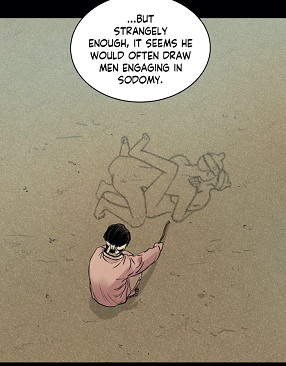 (chapter 1) Here, the witness was lying, as he was distorting the past, the painter wouldn’t draw erotic pictures constantly. The head-kisaeng didn’t take care of her son and during the day, the noonas were all resting so that the painter was on his own. This panel illustrates the painter’s isolation and loneliness. At the same time, I envision that the scholar visited the kisaeng house during the night so that he could approach the noonas, explicating why the boy would doze off too. Moreover, painting was a way for the painter to cope his loneliness and his loss of senses. As a conclusion, the painter was not only suffering from abandonment issues, but also from neglect which made him more and more dependable on Heena noona and the learned sir.
Yet, this doesn’t end here. Each time, Heena noona was confronted to violence, she sent away the painter. He was not just forced to leave his noona’s side, he had to leave the house as well. He ended up in the countryside (chapter 70) , in the middle of nowhere, surrounded by water and rice fields. While some might view these panels as quite idyllic, I interpret these as the opposite: Baek Na-Kyum had no roots and no roof over his head. He couldn’t even find a refuge, which reminds us of the scene in the first chapter:
 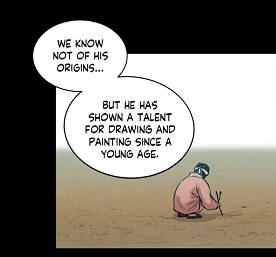 (chapter 1) This picture exposes the painter’s lack of attachment. He has no home, no wall to protect him… there’s only emptiness surrounding him, which contrasts so much to Yoon Seungho’s situation, who lived in a prison. Hence I understand now why Baek Na-Kyum is determined to remain by Yoon Seungho’s side.
  (chapter 68) For the first time, he has a room for himself, and even if he is pushed away, he can express his sadness and seek comfort in his room:
  (chapter 41) and
  (chapter 52). Note that each time, he was unhappy, he was requested not to cry
  (chapter 26)
 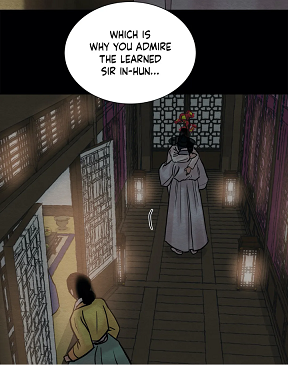 (chapter 68: he is sent away due to his tears)
  (chapter 70) If you pay attention, you’ll notice the only one allowing the painter to voice his wound and to shed his tears is indeed Yoon Seungho. Each time, he desires to know the cause for Baek Na-Kyum’s tears.
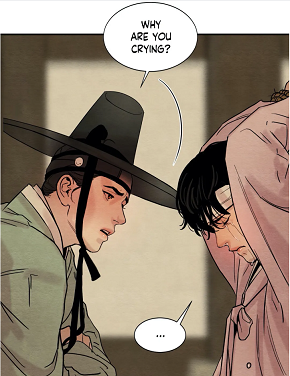 (chapter 1) The difference is even palpable in chapter 26:
 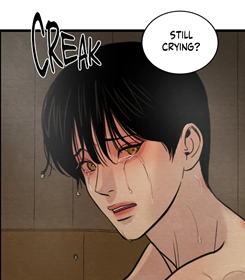 He left him some space and time to cry, hence when he returned, he didn’t say: don’t cry. He just makes this comment
 (chapter 26). And like I underlined it before, the lord is always focused on the reason for the artist’s tears. This led to the confrontation: who is responsible for his heartache?
  (chapter 26) Sure, in the bathroom, Yoon Seungho is still very rude, however he never employs the negation. Nonetheless, the low-born could never perceive this divergence, as the nuance is not so obvious. This explicates why in chapter 41, the artist misjudged the noble’s intervention. When the latter wanted to see his face and as such his tears
 , (chapter 41) the former refused to do so, because he anticipated that the lord would ask the same thing: stop crying. However, the master wanted to know the cause for his agony, which is totally different. This scene is really important, because it shows another issue. Baek Na-Kyum was never allowed to cry. His tears were associated to annoyance and burden. That’s why he desired to be left alone in the end. He feared that if the lord saw his tears, he would be requested to stop crying. And this fear of letting his tears coming up explains why the painter hid his eyes with his arm during the physical abuse.
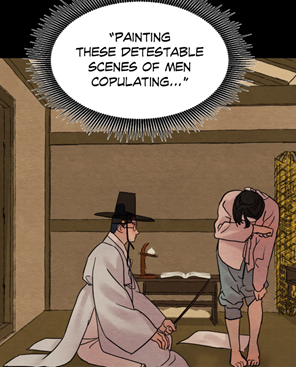 (chapter 34) Under this new approach, we understand better
  (chapter 68) why the lord chose to retreat. Here, the master saw the commoner’s tears with his mind’s eye and realized that he needed to give him some space and time again. But more importantly, he never entered the room, giving him some privacy. He learnt an important lesson here: solitude doesn’t stand in opposition to distance and abandonment. In this scene, Heena noona never requests from the painter to stop crying, she just wipes his tears with her hand and caresses her brother’s cheeks.
 (chapter 68) In my opinion, she hoped that if he voiced his emotions, he would follow her. She had an interest in this, that way she could express her disapproval and use her authority to force the painter to obey her.
 (chapter 68) What the noona didn’t realize is that the main lead’s decision to respect the low-born’s needs (crying and not entering his room) was the reason why Baek Na-Kyum selected him in the end. There’s no doubt that the lord was associated to home for good, because he is the first one who allowed him to cry and to have a room, where he could seek refuge after getting hurt. Under this new light, the readers can better grasp why Baek Na-Kyum is healed now.
However, my examination is still not finished. I had portrayed the commoner as suffering from the loss of sight and hearing due to his neglecting mother/noona. But this doesn’t mean that he had lost his body too. Since he was deprived of these two senses, he had to rely on the physical touch in order to compensate his isolation. And now, you understand why the learned sir and Heena noona had such power over him and why the young boy was so submissive. They used the caress and the embrace as a way to impose their will. That’s how they got so close to Baek Na-Kyum, explaining why the commoner would lose his voice after all (speech ability). He became submissive in his desire to please his loved ones. He saw in their caresses and embraces a sign of affection. He was not wrong, but their attachment was linked to their own interests. Thus their love was rather superficial.
What caught my attention is that the kisaeng stroke the painter’s cheeks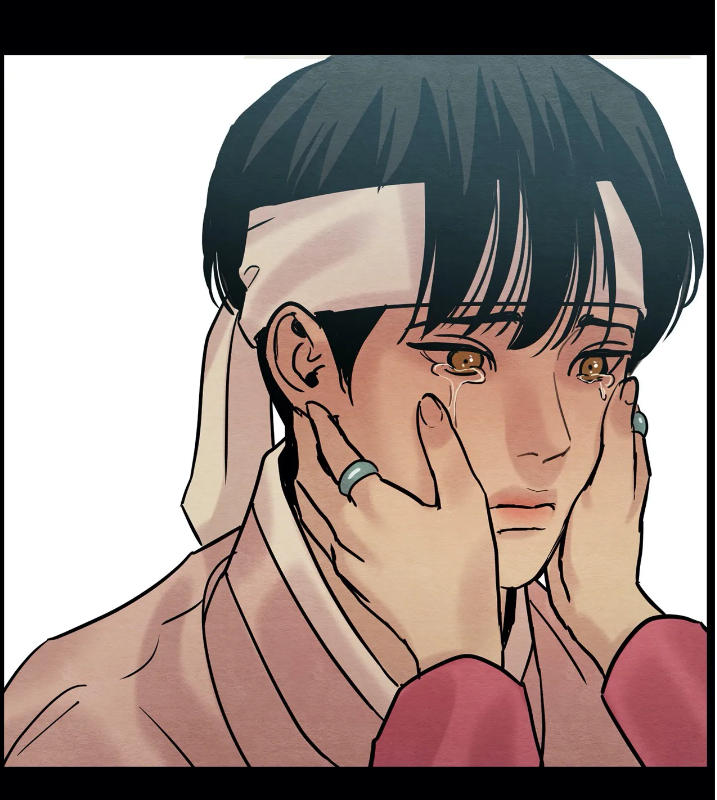 , (chapter 46) when the latter was sent away, But she didn’t hug her brother. Why? It was to stop him from protesting.
 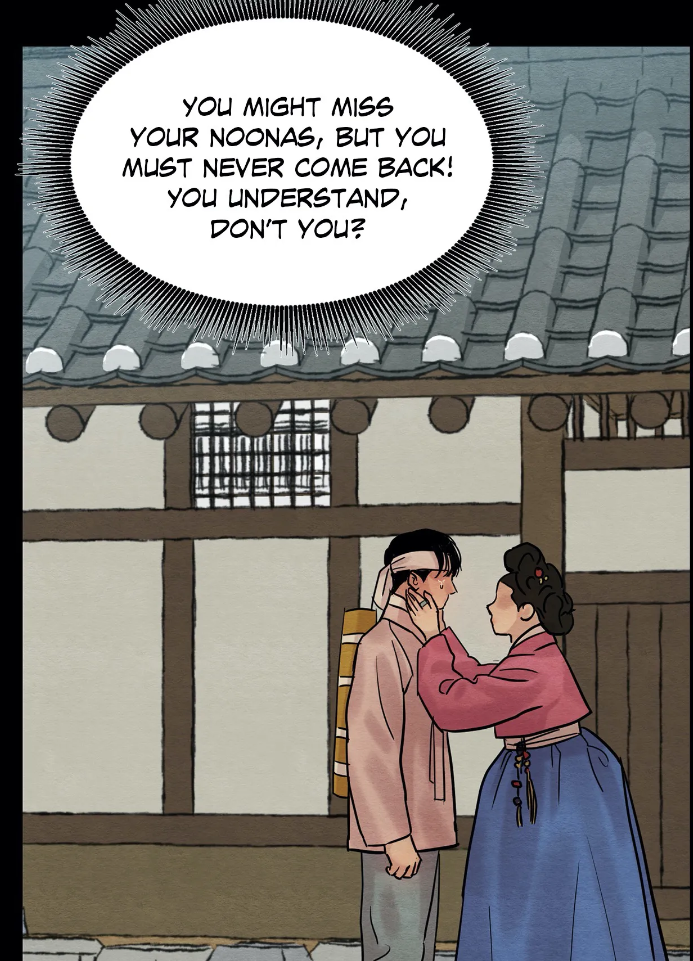 (chapter 46) But I would even go further. I don’t think that Heena noona used to embrace her brother. This perception was somehow confirmed in season 3.
 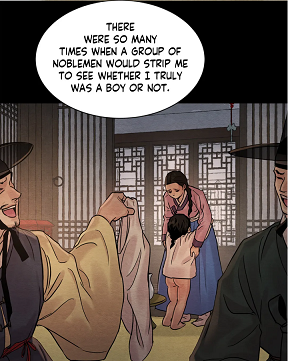 (chapter 94) Here, the infant hugged his noona, but she didn’t return his gesture. Moreover, she hadn’t stopped the laughing nobles as well. Furthermore, (chapter 66) note the huge distance between the two characters in the last panel. This is no coincidence, therefore I perceive the embrace in chapter 66 in a new light.
 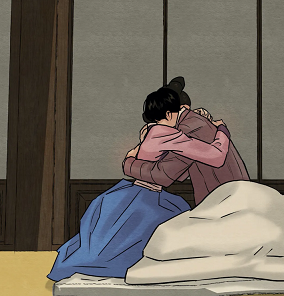 (chapter 66) It was the first time that Baek Na-Kyum got embraced by his noona. And all this, thanks to Yoon Seungho. In my opinion, the kisaeng got really scared and concerned for her brother. And there’s a reason for this lack of worry. She relied too much on Jung In-Hun. Her false perception is particularly visible, when she claims
 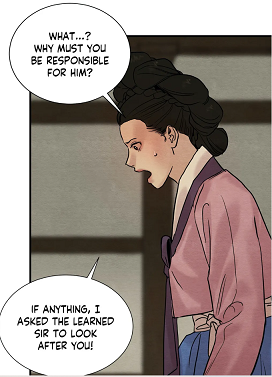 . (chapter 68) Why does she expect this? From my point of view, her words imply, she must have helped the learned sir in the past: one thing is sure. She was not entirely honest with her donsaeng here, as the manhwaphiles can detect the drop of sweat. But more importantly, we have to question ourselves if the gibang was not used in the past to spread rumors about the Yoons again, and Jung In-Hun could heard something. I am even envisioning that she must have reported conversations to him, a new version of chapter 24:
 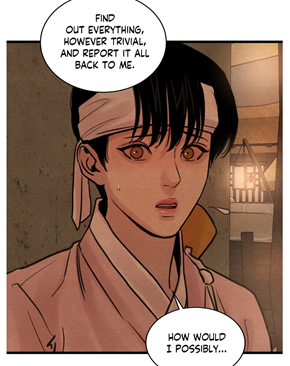 Remember that in that scene the painter doesn’t comprehend the meaning behind this order. If this theory is true, then she never saw the consequences of her action, similar to her brother in chapter 24. If she truly did it, she must have justified this, because the learned sir needed it, she was responsible for him. This would explicate why she is surprised that the artist is responsible for the learned sir. Anyway, due to her assistance, she expected from Jung In-Hun that he would take care of the painter. There’s no doubt that she loved the scholar, and since the boy had entered the kisaeng house due to the learned sir, there is a high possibility that Heena noona got close to Baek Na-Kyum for that reason too. That way, she hoped to earn the scholar’s acceptance and admiration. Since the painter was left alone and longed for love, the latter could only rely more and more on Heena noona, especially due to the incidents where Baek Na-Kyum was wounded. (chapter 94) She created a dependency, while simultaneously, she would delegate her responsibilities on the other noonas. Heena noona became the painter’s mother, yet she was never one officially. Consequently, I believe that her bond was not entirely selfless, which became truly visible in season 3. Let’s not forget that the kisaeng was portrayed as quite rude and selfish in certain scenes. The way she hugged her brother was not tender in my eyes.
 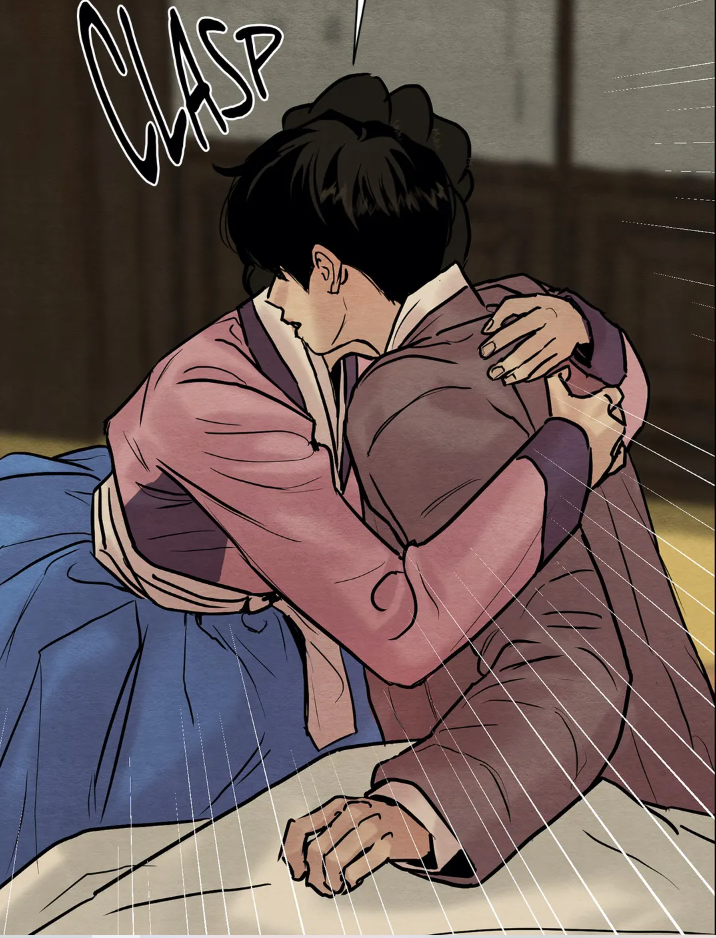 (chapter 68) For me, her real “admiration” was for the learned sir, therefore it becomes understandable why she wasn’t bothered, if Jung In-Hun asked for her help in exchange for taking care of Baek Na-Kyum. According to my theory, the learned sir had brought himself the baby to the gibang, this means that in chapter 46, he could only accept the kisaeng’s request. He had no other choice, for in Heena’s eyes, they were somehow related. From my point of view, Heena noona hoped that Jung In-Hun would even assist her and help her to leave the gibang. But this never happened. In my opinion, there exists another reason why the painter was sent to the learned sir. And it is related to Yoon Seungho, the erotic paintings and the pedophile.
The kisaeng helped the scholar, while the latter assisted her with her burden: raising a boy. From that moment, a toxic relationship started, which could only affect the young boy. This would explicate why she accepted that Jung In-Hun would leave her behind while getting beaten. For this kind of incident recurred, we have to imagine that the low noble and the kisaeng contributed to add another artist’s trauma: the abandonment issues and the loss of home.
From that moment, he was forced to roam around with the scholar during the night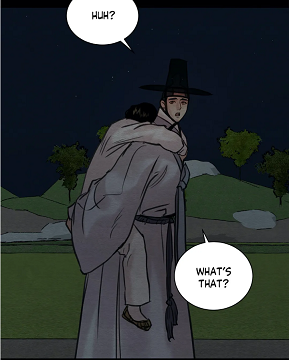 . (chapter 70) And now, we have to question ourselves why the kisaeng chose to send away the painter in the end. From my point of view, it wasn’t really to protect him… since Baek Na-Kyum was now an adult, the role of the scholar was no longer necessary. First, the artist was supposed to be literate. At the same time, the low noble couldn’t take him any longer, when the kisaeng got hurt again. This kind of diversion was no longer possible. The man was old enough to intervene, hence not only he could have defended his sister, but also he could have investigated what was happening in the gibang. That’s why Heena sent him away to the scholar and observe that the noonas were not even informed. (chapter 46) Why? Because she knew that they would have questioned her. Moreover, the noonas might have convinced the donsaeng to stay in the gibang. In my eyes, the noona thought that she was doing it for her son’s best interest, while in reality she had other motives to ask the painter to leave the gibang. Unconsciously, she desired to leave that place too. From my point of view, she dreamed that the learned sir would take her away at some point. This interpretation was proven correct in season 3.
  (chapter 97) In exchange for her services, she had to bring Baek Na-Kyum to Min, the noona would be able to escape the gibang.
Therefore it is time to focus on the learned sir again. Exactly like I had anticipated, the low noble blamed the painter for his inability to read: he would doze off , while in reality the low noble made sure that the artist would fall asleep. Besides, if the painter was awake during the night, this signifies that he had to sleep during the day. And in order to obtain the painter’s assistance, he noticed that the low-born was sensitive to physical touch: the scholar chose the hug. That’s why we see him embracing the young boy in chapter 68 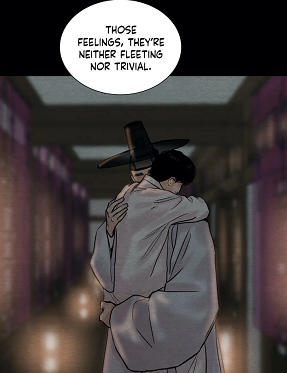 or piggybacking in chapter 70. We have to envision that first he embraced him in front of the kisaeng, then once they had left the town, the noble would change the position. Yet, I believe that Heena had here romanticized this embrace. It represents a distorted memory mixed with fantasy. What caught my attention is that in both hugs, the noble could hide his face and in particular his eyes. At the same time, the learned sir wasn’t faced with the commoner’s tears and sadness. He could feign ignorance. (chapter 70) But this could only work, until the painter entered adulthood. After that, he could no longer use the boy as tool and diversion. Even if the learned sir’s affection was genuine in the beginning, the nature of their relationship could only change, for the learned sir had kept using him in the past. It had become a habit.
Envision this: his ties with the kisaeng house were cut off. And since he had never taught the painter to write and read properly, Jung In-Hun was cornered. Moreover, there is no ambiguity that the learned sir started viewing Baek Na-Kyum as a burden, this means that at some point Jung In-Hun must have felt the exact opposite of this: (chapter 44)
And since the scholar has always disdained the commoners, he could only abhor the idea to keep hugging the artist. The latter was now a grown-up. Hence he used the erotic painting as an excuse to abuse Baek Na-Kyum physically. That way, the noble was no longer obliged to caress or embrace the painter. However, because of this method, he destroyed the painter’s body symbolically. (chapter 34) And this leads me to the following conclusion: the painter ended up in the same state than Yoon Seungho’s. Both lost their senses and their own body. And now, you can comprehend why the main lead can’t cry yet. The return of his tears will mark the end of the transformation and his recovery.
Nonetheless, let’s return our attention to the scholar and his relationship with the painter. If the manhwaphiles pay attention to the progression of the first season, they will notice the increasing intimacy between Baek Na-Kyum and Jung In-Hun. First, it started with a stroke 
 (chapter 10), then in chapter 24 he touches his shoulder and kisses his hands.
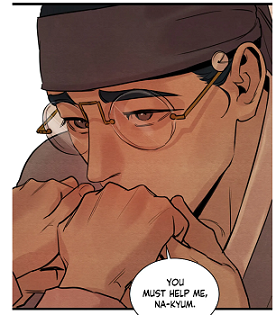 (chapter 24) With my new interpretation, you can comprehend why he did this. He tried to use the same method from the past: he knew that physical touch would make the artist submissive. And the climax was reached in chapter 29 with the fake embrace and the betrayal:
  (chapter 29) From that moment, it went down again. We returned to patting
 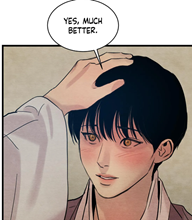 (chapter 35) and strokes
  (chapter 35) and finish with this final touch of the painter’s cheek:
 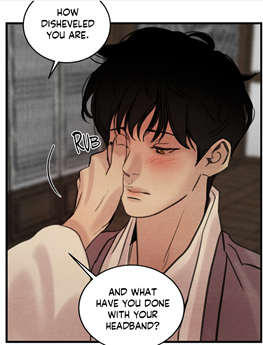 (chapter 38) And the physical interaction reflects the learned sir’s loss of power. Despite his attempts, he was not able to obtain the artist’s submission like in the past. That’s the reason why he could only resent the artist. We have to remember that the low noble really detested this physical intimacy, hence he would tighten his jaw or grind his teeth.
  (chapter 24) Note that in many panels, we never see the scholar’s facial expressions, but there is no ambiguity that he could never truly hide his disdain. But the painter was still blinded by his “admiration” for Jung In-Hun. However, after the argument at the library, the painter lost his sight and hearing again. He was too wounded by the final blow.
And now, you understand why Yoon Seungho’s actions (seeking intimacy) could only help the painter to recover. First, he had been able to remove the poison from the artist’s mind before the backstab in the library. The lord had encouraged Baek Na-Kyum’s critical thinking. This explicates why after the scholar’s betrayal, the painter’s independent mind resurfaced first.  (chapter 46) Then the readers witness the return of the artist’s 5th sense (touching) in chapter 49.
  That’s the reason why the noble could finally get the painter’s attention afterwards. For me, the touching has always been the most important sense in his life, which explains why Heena and Jung In-Hun had such control over the low-born. Then in chapter 52, we assist to the revival of the artist’s sight:
  (chapter 52) And now you comprehend why Heena and Jung In-Hun were defeated. The hug in chapter 66 helped him to satisfy an important need: he was truly embraced while getting comforted. Simultaneously, the hug is not entirely related to the kisaeng, but to the study. Remember that we never saw her hugging him before. At the kisaeng house, he didn’t feel like he truly belonged there, and Heena would always send him away due to his cry. While Heena anticipated with this embrace, the painter would follow her like in the past, she experienced a shock. Now, the painter was no longer blindly listening to her suggestion. And now, you understand why she kept touching the artist. She was trying to influence the painter through the physical touch. Under this new light, I understand why she said this after all: (chapter 68) Yoon Seungho is famous for intimacy, then this would signify that she would lose control over the painter forever. This explicates why Heena noona is not respecting her brother’s wish in the end. And if you compare the two farewells between the kisaeng and the main lead, you will detect a huge progression: (chapter 69) They hug each other here, the painter can get closure, because this is just a goodbye. The noona asks him to send letters, this means that she is telling him that he is not abandoned. This night was important, because the painter’s abandonment issues got treated. Hence it is no wonder why the painter could move on from the past during the same night.
And now, it is time to come to the final part, the significance of the painter’s memory in chapter 70. From my point of view, we should perceive as a new version of chapter 34: 
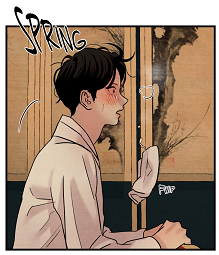 Back then, he recalled the repressed physical abuse. However, his conscious dismissed it again. However, this time it is different. The painter in possession of his whole body is reminded of the scholar due to Heena noona’s farewell. The closure he got by bidding her farewell triggered a long repressed memory too. The learned sir was the one who consoled him in the past. And while he recalls that night, the adult Baek Na-Kyum realizes that the scholar’s care was not fake in the past. He would keep him company and talk to him, he was his companion of the night. However, for me, this scene outlines his superficiality and indifference. He diverts his attention so that he wouldn’t feel sad any longer. But it was, as if he was ignoring his sadness, for he wouldn’t talk about the incident. (chapter 70), He would even smile making him look indifferent.
  (chapter 70 Then he makes the following reproach: he was lazy. (chapter 70). For me, during that night the artist realizes that despite the huge blow in the library, Jung In-Hun had not been bad to him all this time. He had good memories. This means that he was able to take his distance and look back at his childhood under a new perspective. The learned sir had been there for him in the past. In this moment, when he saw the moon, he was reminded of the learned sir. It might not follow him specially, but it is always there.
 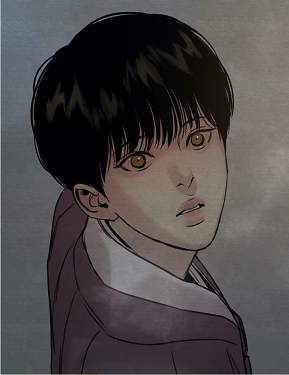 (chapter 70) The learned sir will always be a part of his life, as he belongs to the past. As you can see, in this scene, Baek Na-Kyum was moving on. Therefore I interpret this scene as a real breakthrough. The painter is no longer under the influence of the scholar. The latter can not longer manipulate him like in the past [though now I believe that he is dead], and this revelation was triggered by Heena noona and her embraces. But at the same time, he is not rejecting or resenting the man. And this interpretation becomes even more visible in season 3:
 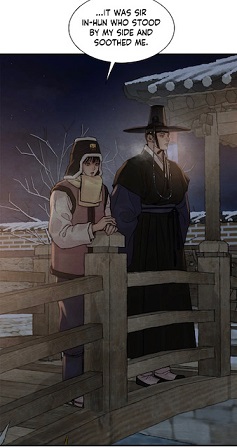 (chapter 94) His heart and mind are now in peace. He is no longer suffering from a guilty conscience. And this truly exposes that the artist’s abandonment issues were created by Heena.
Under this new interpretation, the scene at the bathroom becomes another significance. The lord decided to let the painter feel and see his affection. He chose a different approach: caressing the finger and the hand tenderly , then the chin
 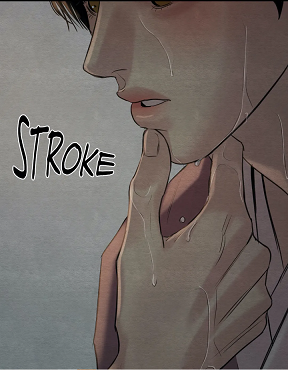 before kissing him.
 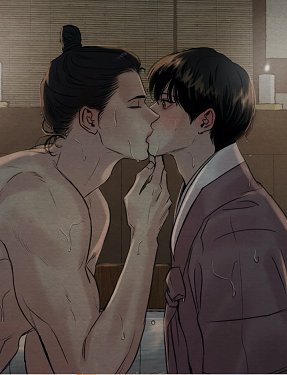 (chapter 70) However, what caught my attention is that his touch is never to shut the artist’s mouth. Observe that he lets the mouth open, while he caresses the hands, the chin and even after kissing the painter.
  (chapter 70) He has the right to speak, while Heena noona and Jung In-Hun used the embrace and caress as a way to render Baek Na-Kyum mute. And since the affection through physical touch was a way to win the painter’s heart, there is no doubt that Yoon Seungho is on his way to win his heart. Now, the painter is finally looking at him and the scholar’s influence has been finally erased. Baek Na-Kyum is now totally over Jung In-Hun, as he has now only view him as a companion and friend, and nothing more. He is no longer his idol. In other words, the low-born has finally found closure. In episode 70, his heart is free.
Feel free to comment. If you have any suggestion for topics or manhwas, feel free to ask. If you enjoyed reading it, retweet it or push the button like. My reddit-instagram-tumblr-twitter account is: @bebebisous33. Thanks for reading and for the support, particularly, I would like to thank all the new followers and people recommending my blog.
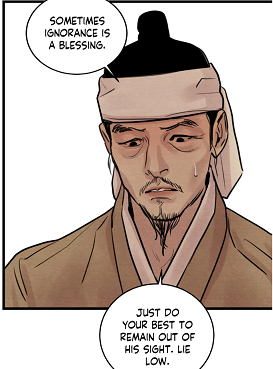 (chapter 23) Ignorance is a blessing for him, because it allows him to let his master to be in the dark. That’s why the master relied on the valet all this time. Kim was his eyes and ears, therefore certain rumors didn’t reach the noble’s ears.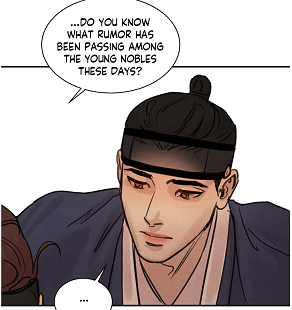

 (chapter 18) On the other hand, the butler let him know about this gossip.
  (chapter 22) Since Yoon Seungho perceives himself as cultured, because he reads so much, he could only laugh about this rumor. However, he never realized the origin of these gossips. The valet utilized the rumors in order to deceive everyone, including the main lead. That’s why Kim could only judge “ignorance as a blessing”, because it helped him to manipulate the staff, the town folks and the nobles. He had an interest to create a bad image about Yoon Seungho. This helped him to keep the main character in isolation and in the dark. Moreover, it reinforced the lord’s dependency on his assistant. In order to corroborate my interpretation, I will use a panel reflecting the true nature of their relationship:
 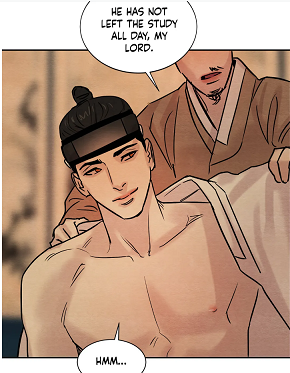 (chapter 11) Observe that the valet is not portrayed with eyes. This is not just an indication of the butler’s lie. The valet’s eyes became the master’s. This signifies that the words and the vision of the valet became the noble’s reality. At the same time, the noble’s mouth is closed and his hands are not present either. Note, he is getting dressed by his own valet. As a conclusion, he is entirely relying on Kim. He has no mouth, no hand, no ear and no eye. Everything belongs to the butler. This single picture exposes the butler’s true powers. The lord was totally deprived of all his senses and his own body, a real puppet. And this interpretation leads me to the following question: Who killed the servant in chapter 1? In my eyes, the noble was just the executioner, while the butler was the judge. Why do I see it like that? First, note that in the scene, the main lead has no eye
  (chapter 1) and he doesn’t want to know about the painter’s reasons for not painting any longer. I know, some readers might reject this idea, but I would like them to remember that we see the butler acting like a judge in front of the doctor, that’s why the commoner begs the valet (“Are you trying to have me killed”).
 (chapter 65) He uses Yoon Seungho’s power, yet the latter is described as a killer. In chapter 1, Yoon Seungho was the epitome of ignorance (narrow-minded, blind and deaf)
  (chapter 1) and the butler didn’t need to be by his side, as he had a real control over the lord’s hands, eyes and ears. Now you understand why Kim really treasures ignorance. Simultaneously, the valet values knowledge, as it procures him power.
  (chapter 50) This idiom doesn’t only imply to ignore your feelings, but also to deny the existence of your heart. If the noble has no emotions, then he can be the perfect puppet. This explicates why Yoon Seungho had a relapse after this conversation. Despite his warning, the master did listen to the butler’s advice.
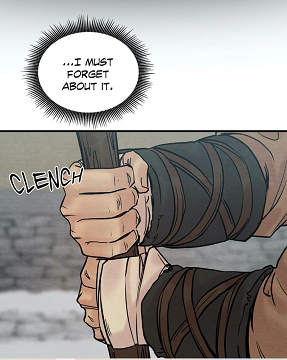 (chapter 65) That’s why there is no sincere apology.
  (chapter 65)
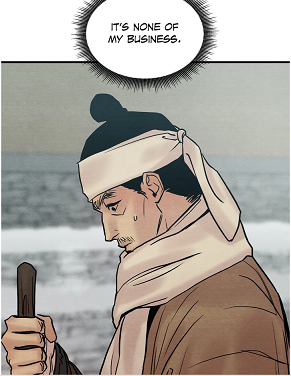 (chapter 65). He prioritizes his own life. He is not interested in people’s passion and well-being. He doesn’t care about people’s motivations. The latter just become relevant, the moment they affect his life. He needs to know about people’s behavior and thoughts for his manipulations in order to protect his quiet life.
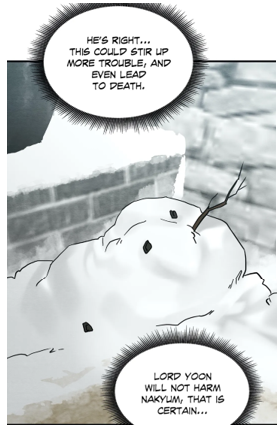 (chapter 65) therefore any incident must be covered up. At the same time, it implies as well that everything must be done in the shadow. That’s why without any spectator, he removes the snowman embodying the painter. The final panel contain all the butler’s doctrines. He will erase everything related to the past, acting as if nothing happened. It doesn’t matter, if someone gets destroyed in the end, because on the surface, it will look like he just cleared a way. He gives the impression that he helped the persons concerned, not taking into consideration how his actions and decisions will affect others. If someone has to pay the price for this, then so be it, as long as it doesn’t disturb his life. From my point of view, this scene is full of symbolism. From my perspective, he is ruthless and even willing to dirty his hand to a certain extent, since he is using a broom. However, this gesture exposes too that he is not directly soiling his hands. This is the reason why he is never directly involved with people’s wrongdoings. He will just push others to commit wrongdoings with remarks. They have to act according to his own thoughts and benefit. This interpretation is not exaggerated, if you compare this scene with Deok-Jae’s misdeed in chapter 46. The vicious servant used his own feet to ruin the artist’s creation
  or he pushed the painter with his own shoulder.
 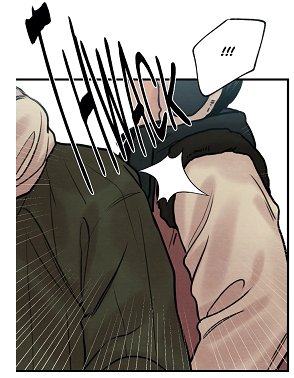 (chapter 46) At the same time, with this new approach, it helps to understand why the butler’s evilness was never caught. He could always feign ignorance with such a behavior and was never directly involved.
 , 17, 59). He also allowed the vicious servant Deok-Jae to betray Yoon Seungho and plan a murder
 (chapter 51). He hoped that Heena noona would take the painter away
  (chapter 68) and he is now expecting that Min organizes a second abduction while framing others: Nameless, Heena noona and Jihwa.
  (chapter 62) Here, the noble stated that he adored the painter). This means that the light and warmth had finally reached the lord’s heart, which is also mirrored by the light in the panel. But the problem is that after the low-born’s disappearance, the master had the impression, he had been betrayed and abandoned. Hence he became enraged and blinded by his own wound. This is a sign that he definitely took it to heart. Moreover, we shouldn’t forget that despite the incident at the barn, the noble was not even able to stick to the rule, treating the artist like a sex toy. In the end, Yoon Seungho brought him to his own bed, indicating that he considered him as his partner. To sum up, the noble was still not honest to himself exposing the valet’s influence.
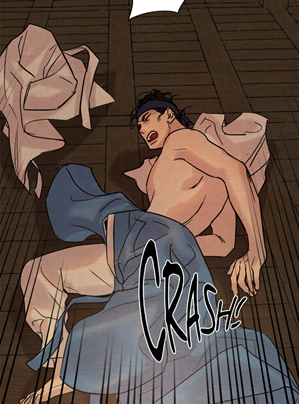 . Then another scandal appeared, when the lord punished the staff for not following his order (chapter 30).
 As you can see, the uproar remained within the mansion in season 1. This is the reason why the noble retreated in chapter 30, when he was pressured by the other aristocrats.
  (chapter 33) Here, he was definitely avoiding any scandal. He was running away, although he tried to deceive the nobles by declaring that the painter would belong to him. And during the second season, the readers can observe a progression, the scandal and uproar is now reaching the town (chapter 64)
  . Thereby the climax was reached in chapter 67, when Yoon Seungho visited the Lees’ mansion. For the first time, he was confronting a noble and didn’t fear to cause a scandal, when he showed up with a sword and didn’t even remove his shoes.
 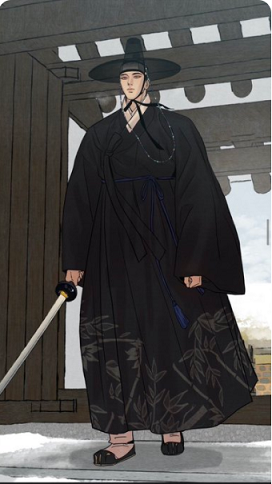 (chapter 67)
 (chapter 70) And this confession could be used against the lord later, hence after that night, Yoon Seungho kept his distance from his lover. Thus he said this to his lover in chapter 75
 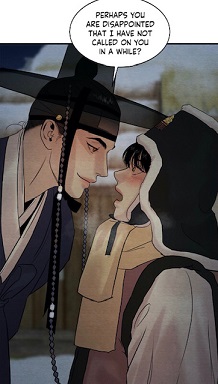 and later asked if the painter was truly resisting. Slowly, he had internalized that consent was central:
  (chapter 79) But this doesn’t signify that this doctrine had completely vanished. For me, it has been gradually weakened, the moment the lord started feeling remorse. The problem is that he still relied on the butler to correct his wrongdoings. That’s why he sent the valet to the artist in chapter 12 or left the artist behind in chapter 33. He ran away from his responsibility
 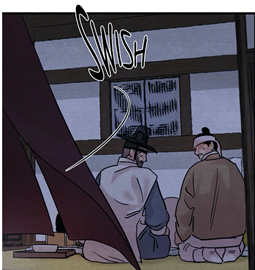 (chapter 33) and let Kim take the burden. Yet the more time passed on, the more the noble took his responsibility. He protected him from the maids and decided to buy him better clothes. This is no coincidence that in chapter 40, he implied to the painter that the latter could now rely on him. This progression is visible, when he took care of the painter in chapter 55. He covered him
 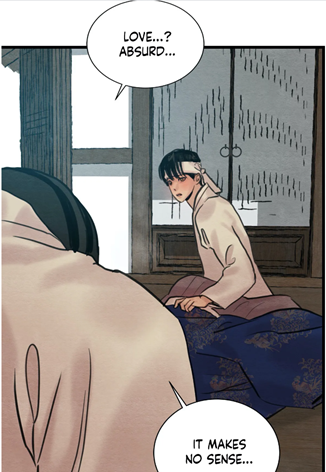 (chapter 55) and watched over him during the night. But this principle will be truly abandoned, the moment the lord apologizes properly, and this expectation was proven correct, as the real apology took place in season 3.
  (chapter 102) Nevertheless, for me, he truly changed a lot from episode 70, because there he expressed regrets for the first time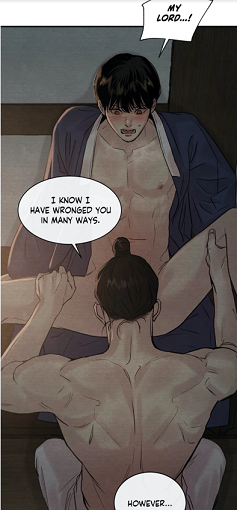
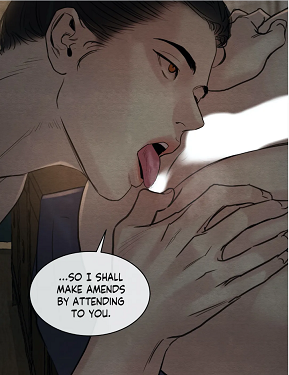 (chapter 71) The problem is that in the bathroom, he chose the wrong words. Hence the painter could only misunderstand him and pushed his hand away. While the manhwaphiles could witness his huge pangs of conscience, the painter never did. He was either unconscious (chapter 32)
 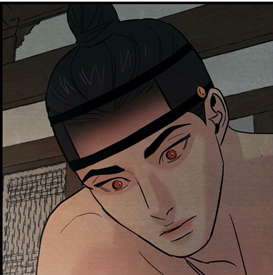 or asleep
  (chapter 50) or blind or deaf
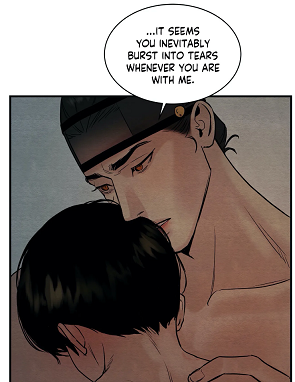 (chapter 49). And little by little, the lord learned how to apologize to his lover. In season 3, he admitted his wrongdoing right away.
  (chapter 82) Then later he tried to redeem himself.
  (chapter 84) Note that here, he was doing everything himself. He was no longer relying on Kim. Hence in the first version, I had voiced that the lord would apologize to Baek Na-Kyum, after the second abduction had been solved. And this expectation became a reality. The lord felt definitely huge pangs of conscience.
  (chapter 102) He is tasked to investigate how this tragedy could take place. Why did they get separated for so long.
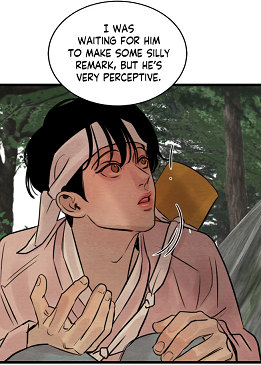 (chapter 23), because he liked keeping people in the dark as well. We had a perfect example with the deal between Jung In-Hun, the painter and the protagonist. First, Yoon Seungho gave the scholar the impression that the former was just an uncultured fool, whereas in truth the low noble was the one deceived, because Yoon Seungho was giving him just an empty promise. At the same time, the rich noble lied to the painter, when he claimed that Jung In-Hun had come to see him.
 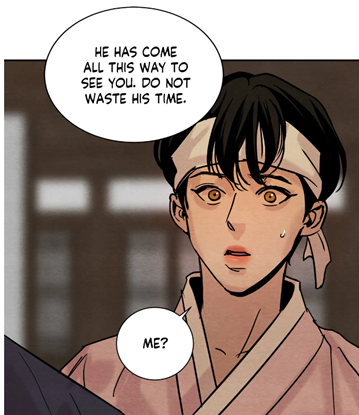 (chapter 7) However, it backfired on Yoon Seungho the moment the latter saw the painter’s reactions. He would run to his former teacher immediately, leaving the main character behind. Then he smiled to Jung In-Hun
  (chapter 7) and blushed in his presence. That’s the moment Yoon Seungho’s heart was moved, justifying the words in chapter 63:
  (chapter 63) No one has ever questioned how the master could treasure the artist’s smile so much? One might say that the first smile occurred in chapter 40
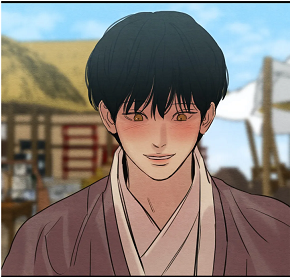 (chapter 40), but as you know, each event happens twice during the same season. So the lord experienced it much earlier. That’s why I believe that the first smile in chapter 7 played a huge role. The incident marked the return of the aristocrat’s jealousy, which had been buried for a long time. That’s why Yoon Seungho decided to reveal his plan. He hoped that with this new approach, Baek Na-Kyum would perceive him as a benevolent lord and look at him differently. He hoped that Baek Na-Kyum would smile for him. This explicates why the lord underlined the importance of connections and wealth.
 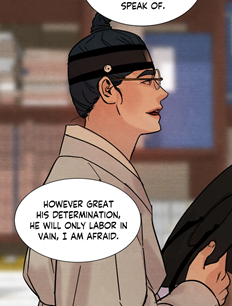 (chapter 7) Note that at the end of the chapter, he treated the painter as a real guest. He invited him to his bedchamber officially.
  (chapter 8) And observe that the noble was here smiling, he was already imitating the artist. This explicated too why not only his moves in this chapter were contradicting each other, but also Kim was introduced here for the first time. And note that from that moment, the lord never tried to trick the painter afterwards. Like I have already pointed out, the incident at the pavilion was definitely organized by the butler. And with this example, the manhwaphiles can see that the lord was applying the 6th rule as well, but dropped it due to the low-born’s reaction. This is not surprising why this manipulation ended up causing more and more pain. Yoon Seungho had brought him upon himself, revealing how the first doctrine “ignorance is not a blessing“. With this new observation, I perceive the episode 7 as a first major turning point. The lord was dropping the 6th rule (to utilize others in order to achieve his goal). However, this doesn’t mean that he abandoned the first doctrine. Quite the opposite… it took him a long time to realize why he couldn’t achieve his goal. In my opinion, the master started changing in chapter 67. Contrary to chapter 33
 , Yoon Seungho couldn’t bear to hear how people would talk behind his back: a sodomizer and a beast who corrupted Lee Jihwa and others.
 (chapter 67). Note that for the first time, the lord decided to defend himself
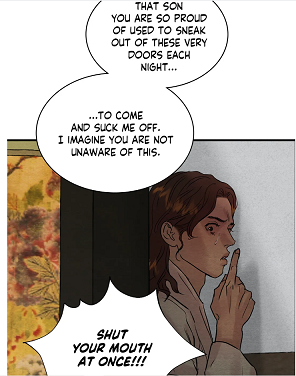 , correct people’s perception about him, which he never did before (chapter 18, 22, 57
 ). This coincides the return of the lord’s hearing and speech abilities. In chapter 67, he is using his own ears and mouth, he is no longer relying on the butler’s help. What the lord imagined to perceive as help was just an illusion. However, I believe that the lord decided to drop the first principle in chapter 68
 (chapter 70). And note that when the painter confessed, he externalized his fear.
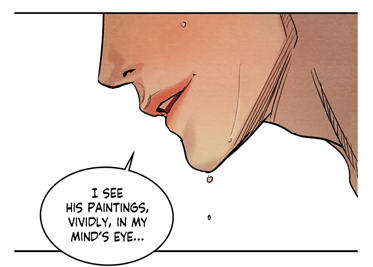 . However, the huge difference is that Yoon Seungho’s mind’s eye is no longer focused on himself, but on the painter. This explicates, why the master decided to retrieve and to give him space. Without seeing his face, he could sense that there was affection, because the painter was crying. The readers should recall that the painter’s tears have always had a huge impact on the noble, because they healed his eyes, hand and heart. The manhwaworms can comprehend why the lord chose to let the painter determine his own fate. The presence of tears and the painter’s voice were able to remove the lord’s veil on his eyes and ears for good. I would like to remind the manhwaphiles that in chapter 68, Kim tried to destroy the lord’s own judgement by recurring to gaslighting and distorting the past. [For more explications, read this essay:
  (chapter 69) although he is sitting in his bedchamber. Imagine, he is no longer relying on the butler’s information contrary to chapter 56:
  (chapter 56) With this new approach, the readers can understand why the aristocrat can make such a comment in chapter 70:
  . Therefore I deduce that the butler can no longer control the lord’s body, since he is no longer required to be his eyes, ears and hands. However, this doesn’t mean that Kim is truly defeated. He still controls the staff, especially the male domestics. Here, I would like to make a little disgression. In my opinion, the butler played a huge role in the first abduction. How come that the servants were so sure that the painter had run away?
 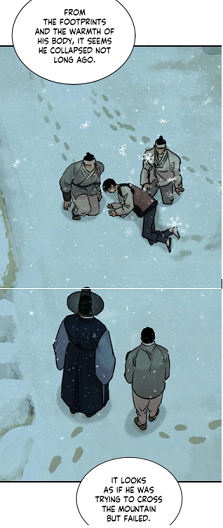 (chapter 61) They were not present, since both protagonists were at the physician’s. From my point of view, Kim must have manipulated the servants… he just needed to imply that Baek Na-Kyum had escaped, while in front of Yoon Seungho, he would say the opposite later due to the commoner’s return:
 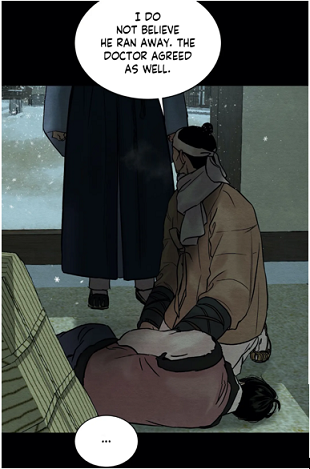 (chapter 62) There’s no doubt that with the painter’s appearance, he could use the incident to obtain more support from the servants. The painter had caused trouble again, he was responsible for their misery. But since he truly exposed his true nature to the main lead (abusing his authority, criticizing and judging his master), he can no longer appear in front of him. Right now, he has to lie low, hence he needs other people to be his eyes and ears. This explains why the servant is portrayed without eyes either
 (chapter 70). The absence of the eyes is an indication that they belong to Kim, just like the lantern indicates that the domestic is acting on the valet’s order. And in season 3, we can observe a similar situation. This time, they faked obedience
 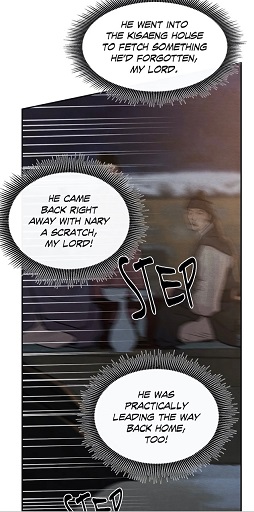 (chapter 99), while they badmouthed their master.
  (chapter 98) Because the lord feared to lose his lover, he didn’t pay attention to the domestic’s insult:
  (chapter 98) But the insult was the proof that they never treated the painter as a part of the household. He was just a spoiled brat.
  and gives orders
 . He is truly rude. We could say that he treats the low-born like a servant, as though he wanted him to feel so little. Kim’s strategy was to remind the painter of his position: he is just a servant, a new version of chapter 52. Remember that Kim’s intention from the start of the second season was always to diminish the artist’s status: he is just a temporally favored servant, nothing more. Striking is that the domestic never says that the lord gave him the order to bring the painter. He uses here a passive sentence “you are to attend to him” which is important. That way, the servant can hide the identity of the person who requested this. And since the lord was looking at the intruder in a rather cold way, I believe that he didn’t expect Baek Na-Kyum.
 However, when the door was closed loudly, the lord must have realized that this must have been Kim’s action. The lord didn’t mind, for it looked like the butler was helping him to improve his relationship with the painter. This interpretation was also confirmed in season 3. Yoon Seungho showed no desire to investigate the matter of “Jung In-Hun” or Deok-Jae’s death, for he was too much focusing on his lover. He kept saying that this was not of his concern.
 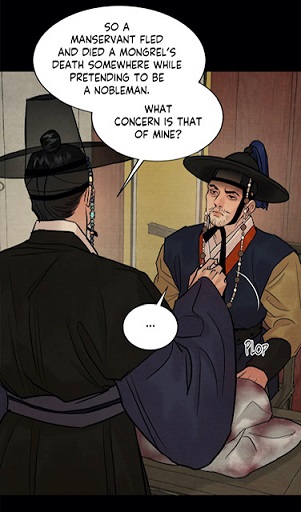 (chapter 98) However, he was totally wrong here. That’s the reason why the abduction could even take place. Because of the last incident, the main lead is forced to recognize that he needs to investigate the matter, as everything or everyone can affect his life. This is important, because that’s the only way for Yoon Seungho to recognize the butler’s wrongdoings. He encouraged him not to pay attention on others so that he wouldn’t detect his wrongdoings. Thanks this rule, Kim could live freely.
 (chapter 70) Under this new light, it becomes understandable why Kim decided to betray his master and rekindle with Yoon Chang-Hyeon. The punishment was the signal for the valet to switch the alliance.
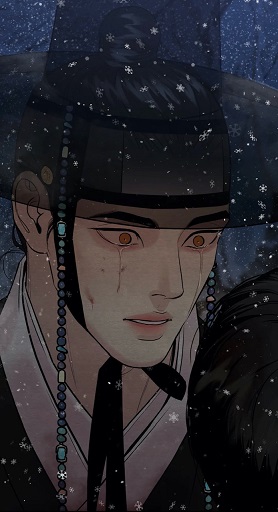 (chapter 102) From that moment on, the light had now reached the mind. He could drop his self-loathing finally which was the foundation of Kim’s principle. It was okay to cry. These were tears of happiness and relief… He had been able to rescue his lover. This means that Yoon Seungho did everything what the butler rejects: the embrace as a way to console and apologize and the tears as a sign of regret and happiness. But why does the valet abhor them? It is because he could never admit his own mistakes and as such he could never beg for forgiveness.
 (doctor Frost, chapter 211)
  (chapter 50) Here, the butler never cried, he just showed pity and sympathy towards Baek Na-Kyum, however he was not speaking from the heart.
  ). Optimism is a choice (chapter 68/69: the lord recognized that he still had some chance, though he was very scared). Kindness is a choice. Giving is a choice. Respect is a choice (chapter 69
 ). Whatever choice you make makes you. Choose wisely.”
 This would announce the butler’s complete loss of power. At the same time, it would signify that the lord is showing that he trusts Baek Na-Kyum and is using his hair to woo the painter. And this could definitely correspond to the master’s attitude: his will to open up. Simultaneously, he could express the following wish: he would like to comb his lover’s hair himself encouraging him to have a topknot.
 caught my attention. Striking is that neither the noble nor the painter cared too much about that gesture. The artist was too shocked due to the huge scandal, and the main lead had the impression, he just wanted to taste the artist out of curiosity and interest. So there was no deep meaning in the caress, yet this gesture was witnessed by the scholar Jung In-Hun.
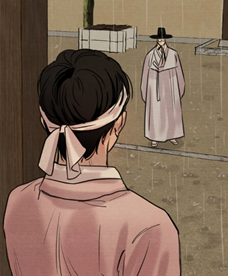 (Chapter 18) And this not only shocked him, but more importantly, it really made him jealous.
  Imagine, he was upset, because the painter had been the recipient of a caress from the powerful noble. Yet, he didn’t feel repulsed, just displeased and resentful But if he was jealous, then it signifies that he desired to have received this mark of attention. That’s the reason why I come to the conclusion, Jung In-Hun would have even accepted the noble’s advances, if it meant that he would get some benefit from it. And this interpretation is even confirmed, when you compare it with its reflection in chapter 35.
 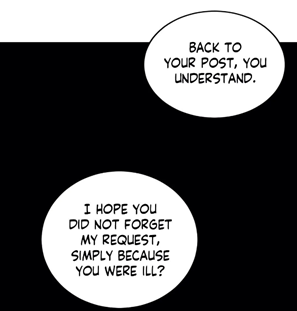 (Chapter 35) In other words, although the caress from Yoon Seungho was anodyne, his gentleness was genuine, whereas it is the opposite with the teacher’s stroke. Moreover, if you compare the vocabulary field, you’ll notice the contrast: duty/work versus entertainment. And although the low noble is aware that Baek Na-Kyum has been very ill, he just sends him back to his “work”. He makes sure that the artist doesn’t fall for the lord’s generosity. He should remember that this is just work, and not entertainment. Moreover, the teacher reminds the painter of his promise: he is his servant. As the manhwaphiles can detect, in chapter 19, Jung In-Hun was already jealous of the painter, because he was receiving the lord’s attention and affection. But this was just a caress, therefore envision how he must have felt, when he heard this from the painter:
  (chapter 35) He must have realized that he was on the verge of losing the artist’s favors. That’s why he reminded the painter of his “loyalty” and “promise”. In chapter 35, Yoon Seungho was the one jealous, hence imagine the resent and jealousy Jung In-Hun must have felt in chapter 19. Yoon Seungho had even cut ties with another aristocrat due to the low-born. But unlike the scholar, Yoon Seungho’s jealousy was much more intensive to the point he would have killed the artist, if he had set a foot outside the mansion, though I doubt that he would have done it for real.
  But why are these characters jealous?
 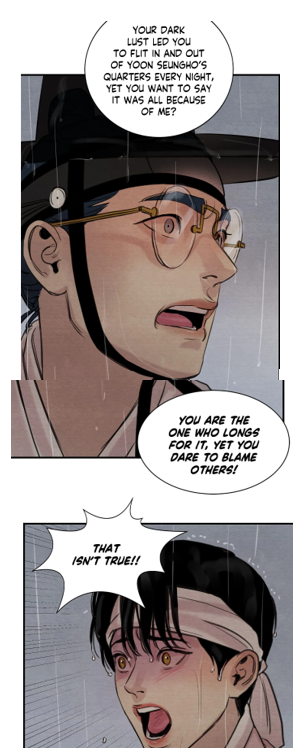 (Chapter 19) In truth, he projected his own thoughts onto the painter. He wanted to be the one getting closer to the powerful aristocrat, and would do anything in exchange for his own interests. Simultaneously, he needed the artist to remain obedient and loyal, so that he wouldn’t become a rival. And now, if we examine the protagonist’s jealousy in chapter 35 with this definition, we recognize that it is related to the sex marathon. Yoon Seungho had envisaged that after that event, the painter had finally accepted him as his partner, and their relationship had changed. Besides, after his return, Baek Na-Kyum had been in his bed and had never reproached the sexual encounter leading to his illness. Therefore, he had envisaged that the commoner was slowly accepting him.
 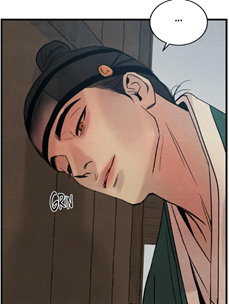 (Chapter 35) Moreover, he caresses his head
  (chapter 35) after finally asking him about his interest. This scene made him realize that he needed to get to know Baek Na-Kyum better, and their relationship shouldn’t only be limited to sex. Hence he invited the painter to his bedchamber that night. In my opinion, he really hoped to initiate a conversation. That’s the reason why he was writing something, he hoped that Baek Na-Kyum would ask, but due to the aphrodisiac and the “warning” from Kim, the artist didn’t dare to speak. As a conclusion, we could say, Kim would have totally succeeded to ruin Yoon Seungho’s plan, if the brother hadn’t appeared that night. At the end, Baek Na-Kyum did earn the lord’s trust, he was able to sleep by the lord’s side.
 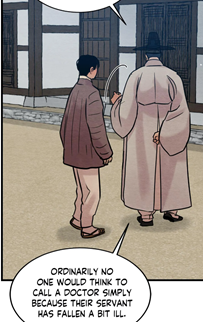 (chapter 35)
  Not only he is no longer listening to his parents, but also he becomes proactive. He gives his noona his own scarf, a sign that he is now old enough to take care of her.
 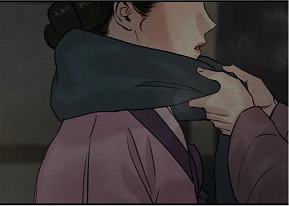 (Chapter 69) He is no longer a child. In reality, this gesture has so much meaning. With this tender gesture, he desires to end the discussion. Notice that she keeps pressuring him
 (chapter 68) and pushed her hand away, a huge shock for the kisaeng.
  (Chapter 68) For her, the only explanation can be the negative influence of Yoon Seungho. And because she attempts to change the painter’s mind just before leaving, Baek Na-Kyum stops her by smiling. He is trying to reassure her that he is fine.
  (Chapter 69) But she doesn’t trust her son’s judgement. She believes, she knows what is right for her son. Therefore, her last words exposes her true intentions. She won’t respect the artist’s choice.
 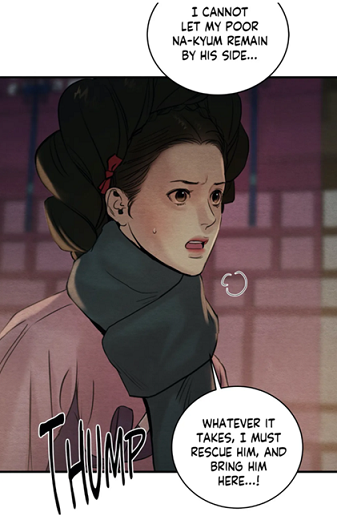 (Chapter 69) She thinks of herself as her son’s savior, whereas in reality, she will jeopardize Baek Na-Kyum’s safety. There’s no doubt that she will be manipulated by Min and Kim. Due to his kind words, she has already judged him as a good man
 (chapter 67), unaware that she is trusting a terrible servant who is determined to hurt her son. This reminds us of the chapter 35, where Jung In-Hun risked the painter’s life. I have to admit that after comparing the scene from episode 19 with 35, I had the impression that Jung In-Hun could have been demonstrating his affection in order to show off to the lord that the painter would only listen to him. Let’s not forget that in chapter 30, the teacher tried to sell off Baek Na-Kyum by telling Yoon Seungho that the artist would only obey to him. And in both cases, Jung In-Hun never recognized the real situation: he was putting his life in danger. And observe that we have many parallels in chapter 69 with chapter 30 as well. We have the painter’s intervention
 (chapter 69), when he senses that Heena noona keeps challenging Yoon Seungho by refusing to recognize his benevolence and her wrongdoing. Here again, he speaks to the main lead in order to deescalate the situation. While in chapter 30, he feared the main lead,
  (chapter 30) yet he desired to protect his learned sir, in episode 69 we have a reversed situation. The one menacing is the kisaeng, and not the lord. The latter steps back
 , as he knows that he did something wrong to his lover. Baek Na-Kyum could have exposed his brutality. However, due to Yoon Seungho’s past action, Baek Na-Kyum has learned to fear the noble’s power and strength. Hence he intervenes, because he wishes to protect his noona.
 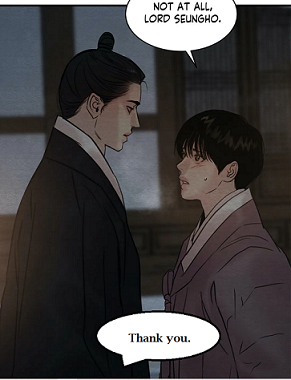 (Chapter 69) Another similarity is the constant blushing of the painter, the lord’s action and words surprise him. Therefore there is this awkward moment, for both protagonists are trying to figure out the situation. The lord never expected a thank you from the low-born, especially after receiving such a mistreatment.
  (chapter 69)
  (chapter 69) He is not just affected by the main lead’s appearance, but also by his gestures. Baek Na-Kyum is finally able to see the kindness in Yoon Seungho. First, he did keep his promise to the artist. He restrained himself to punish the kisaeng. Secondly, he put himself the scarf around the low-born’s neck, which is quite extraordinary. The manhwaphiles shouldn’t forget that Yoon Seungho is actually lowering himself by acting so, he prioritizes the commoner. This is not surprising that at the end, Baek Na-Kyum can’t help himself blushing.
 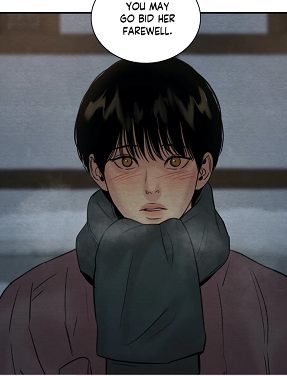 (Chapter 69) Unlike in the past, Yoon Seungho is willing to trust the painter by his actions and words. Therefore he emphasizes this:
  (Chapter 69) He notices the artist’s concern and attention towards his mother. This explicates why he allows the painter to follow the kisaeng to the front gate. However, as you can observe it, the painter is not realizing that the lord is paying attention to his facial expressions. In my opinion, Yoon Seungho is trying to make the painter smile, when he gives his consent.
  (chapter 69) This explains why he asks him to follow his mother only to the front gate. That’s the limit of his trust. I would even add, he can’t bear Baek Na-Kyum out of sight. That’s how much he loves him. He needs to feel his presence close to him. And exactly like in chapter 35, the readers sense the importance of the door. While in episode 35, the gate was associated to life or death, now the door symbolizes trust. Within the building, he will put his faith in the artist’s words. Finally, we have another allusion to chapter 35: the reference to coldness.
  (chapter 35)
  And this parallel reinforces my perception about the valet. He is a hypocrite, because he incited the lord to go to the window, while claiming that it was cold. That’s why I perceive the chapter 69 as a good sign. Yoon Seungho is definitely willing to trust the painter. He let him make his own choice, and the moment Baek Na-Kyum expressed that he was not leaving the mansion
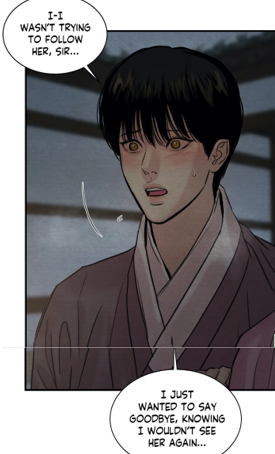 (chapter 69), the lord could only feel relieved. That’s why he had a softer gaze right after.
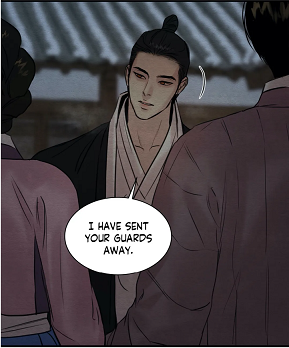 (Chapter 69) He was definitely happy that the commoner had chosen him. However, there’s still awkwardness between them, hence the noble can’t entirely trust him. And this lack of trust becomes a reality, when in chapter 80, the manhwaphiles witness that Yoon Seungho had threatened the kisaeng behind the painter’s back.
  (Chapter 80) He had once again listened to the butler’s advice… How can I be so sure? It is because the real author of the threat was the butler and not the lord.
 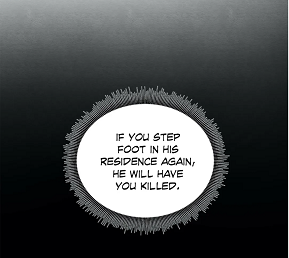 (chapter 69) Yoon Seungho will never order someone to eliminate a person. He will always use his own hands. We have many evidences for this: the hunt and the scenes with the sword.
  (chapter 77) The young boy was looking at someone else. He would stop looking at him like that.
 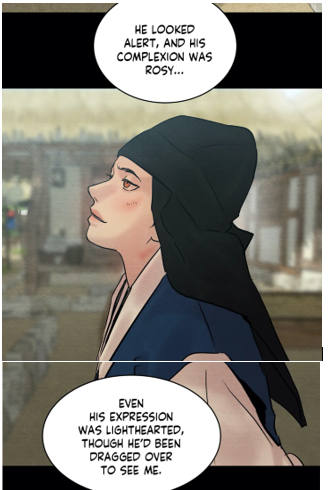 (chapter 57) The butler would lose his influence over the boy. Under this new light, you comprehend why he decided to betray father Yoon after the straw mat beating. The young boy was rejecting him and despising him.
  (chapter 77) Yoon Seungho’s gaze was telling all his emotions and thoughts. That’s the reason why the butler isolated his master for so many years. And note that in chapter 69, he projected his own thoughts onto the painter again. Since the butler has always backstabbed, betrayed and abandoned Yoon Seungho, he imagined that the artist would have a change of heart too… like Kim always did in the past. Naturally, this is the negative version of a change of heart: not compassion and remorse, but resent and jealousy!!
 (chapter 77) If the painter leaves the mansion, the butler will make sure to portray the painter in a negative light. But there’s one thing that Kim overlooked: Yoon Seungho’s ability to learn!! Remember that jealousy is there to make the partner realize that he needs to improve his behavior. Since he mistrusted the painter’s choice, he realized later that he needed to earn the artist’s trust first. Therefore he made the following promises:
  (chapter 71). Furthermore, the artist’s reproach in the tavern
 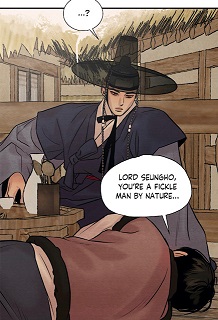 (chapter 75) must have been an eye-opener for the wealthy aristocrat as well. How can he expect “loyalty and trust” from Baek Na-Kyum, if he is himself a fickle man by nature? With such words, the artist encouraged the lord to stop wavering and doubting his lover. He needed to show his love and trust first, before expecting it right away from the low-born. And now, you comprehend why Yoon Seungho started courting Baek Na-Kyum. He needed to show his trust and love in order to obtain it. And in chapter 80, he finally succeeded it. Therefore the bride’s abduction is doomed to failure. Kim won’t be able to achieve his goal. However, there’s one thing that this incident will make the lord recognize that he trusted the wrong person. He should never have listened to the butler’s advice and threatened the kisaeng, because this meant that he was mistrusting his lover!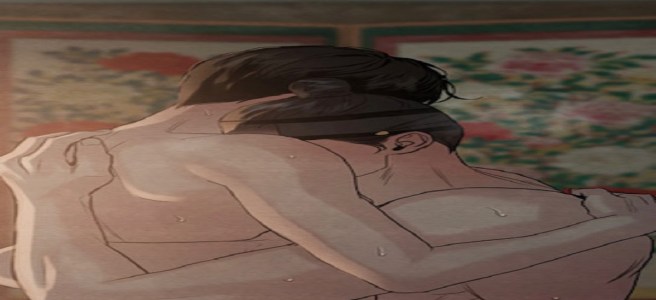
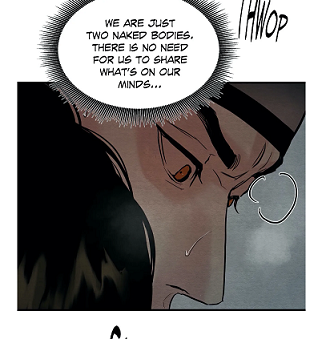 He wanted to communicate (“share what’s on our mind”) with the low-born, but the latter refused, because he just considered the noble as a sex toy to procure him pleasure out of fear to get hurt and deceived again.
  (Chapter 1) He expressed his genuine admiration for Baek Na-Kyum’s talent and creations. Yet, at no moment the painter noticed the compliments. He had been forced to touch the loins, which shocked him, and then he remembered the lord’s bad notoriety. Therefore all the lord’s good words fell on deaf ears. The painter was more concerned with appearances and rumors than anything else. That’s why the conversation failed. Since Baek Na-Kyum was not interested in the main lead’s feelings, he feigned ignorance first, and lied at the end.
  Striking is that their first conversation was connected to books and sex, therefore this already limited their exchange. Moreover, this first chapter clearly reveals the lord’s interest in the low-born. He not only sent a domestic for the investigation about the mysterious creator, but also asked about his recent whereabouts. And curiosity usually initiates a conversation. But there’s more to it. From my perspective, the main lead felt no longer satisfied with the erotic pictures. He wanted to share his emotions and thoughts, when he looked at them. However, he had no one to talk to, so in his mind, if he met the artist, he could come into a conversation with the creator. That’s why he wanted to invite him in the end. The painting of sex sessions would give him the perfect occasion to discuss with someone.
 (Chapter 8) Observe the contrast. The main lead doesn’t reveal his anger towards the noble with the mole, it is not worthy for Yoon Seungho of giving him an explanation for the humiliation. He just smiles
 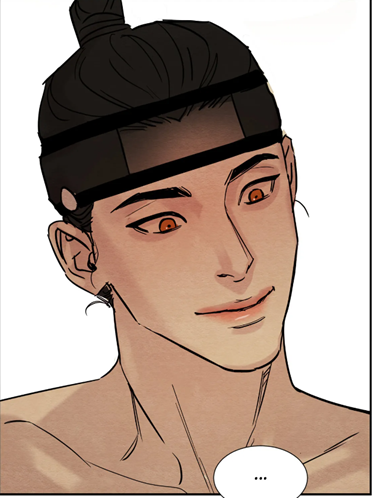 (Chapter 8) before grabbing him by the topknot. His words and behavior truly display a huge respect and a desire to exchange thoughts and observation.
 (Chapter 8) This mirrors the noble’s need to talk and now, you understand why the main lead had to evict the aristocrat with the mole in the end. By requesting to send away the commoner,
 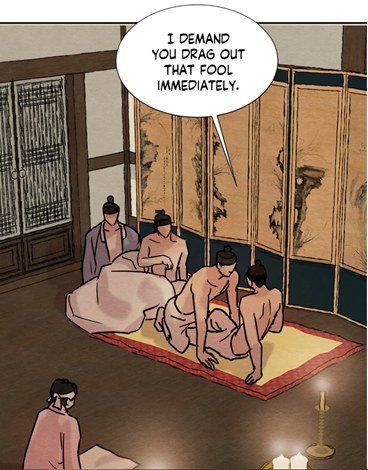 (Chapter 8) he was more or less asking from the host to remain silent.
 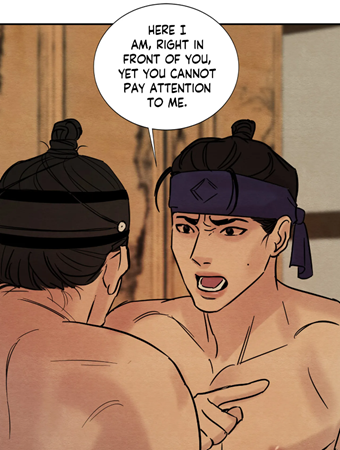 (Chapter 8) The latter just had to focus on the guest’s sexual desires which confirms my interpretation that the main lead is treated like a head-kisaeng. Since the noble showed him no respect, then the main character didn’t need to respect him either. But more importantly, the protagonist made sure that he would be treated the same way. He also wouldn’t listen to his words, because the noble with the mole didn’t want to hear him speaking either. Therefore the door is closed, before the man can protest. As a conclusion, the aristocrats only visited him for sex or other pleasures and nothing more, while the noble had to remain quiet. Hence we have a silent main lead in his relapse:
  (chapter 52) However, even here the manhwaphiles can notice the transformation. The guests are no longer here for sex, just for smoking opium and drink wine. That way, the noble doesn’t feel lonely.
 and 12
  ). And now, you comprehend why the lord questioned his presence in the morning and why he assumed that his visit was related to sex in the end. It looks like Jihwa never showed an interest in the lord’s thoughts and emotions too. And there exist two reasons for that. First, he had the impression he knew everything about his lover.
 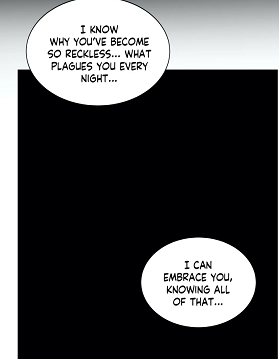 (Chapter 57) Secondly, there was a risk that the main character could talk about the past and as such mention Jihwa’s betrayal. The lord’s emotions (sadness, anger, pain) represented a huge burden to the red-haired master.
 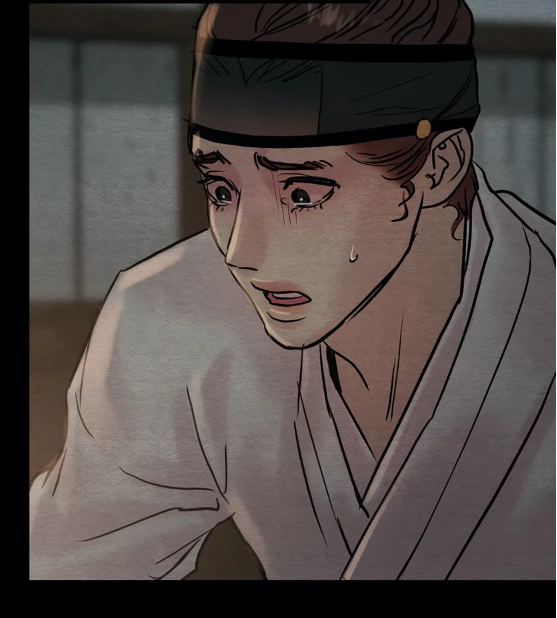 (Chapter 59)
 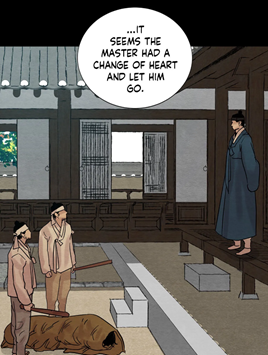 (Chapter 13) No wonder, why he thanked the painter in chapter 18. He could only be happy, when he confronted his childhood friend, as there was a real exchange for the first time.
  (Chapter 13) Argument is also a form of communication, and it happens between people in a relationship. Not only his words were finally noticed, but also he was able to draw lines to Jihwa.
  By influencing the host with the hope, Yoon Seungho would send away the painter, the childhood friend didn’t recognize that he was attempting to turn the protagonist into a puppet, therefore he could only fail. Moreover, Jihwa had no idea that Yoon Seungho’s true desire was to get close to someone, to engage a honest conversation. Therefore the main lead could only reject the friend’s words and proposition. As a conclusion, with the painter’s arrival, the lord’s words were little by little listened, he was able to communicate more with others: Jihwa, the nobles and the staff. After scolding the maids in the kitchen
  (chapter 38), the head-maid started showing her respect to her lord. But more importantly, he gave her the order personally to bring the painter’s lunch to his study.
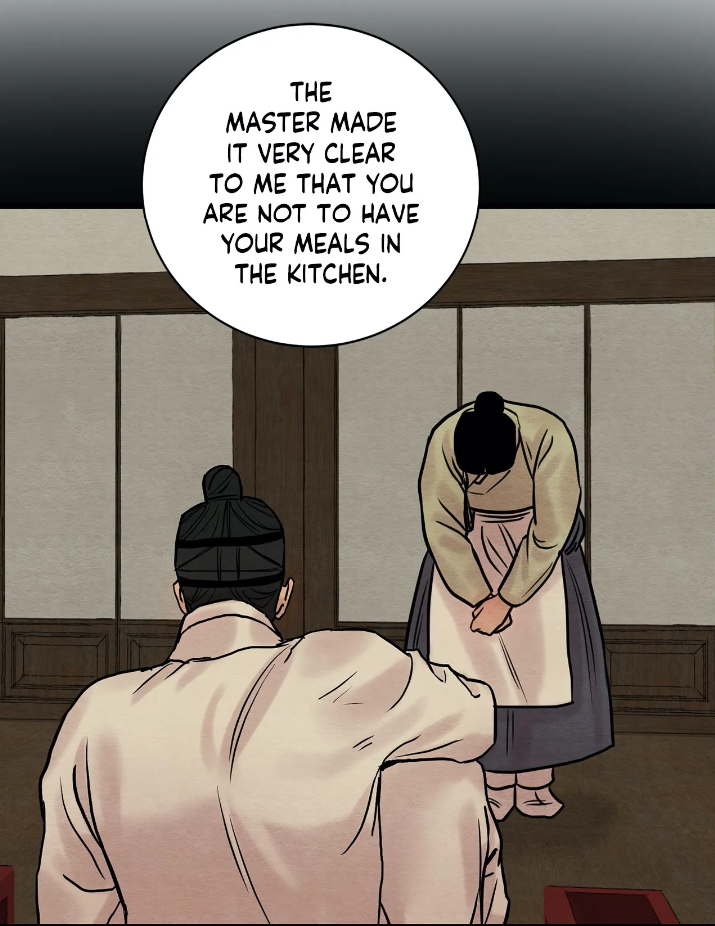 (Chapter 46) He could finally voice his thoughts, everything happened thanks to the painter. This explicates why Yoon Seungho kept seeking the artist’s proximity, although the latter kept rejecting him (his escape, his lies, his refusal to paint for him etc…). He had realized that his living conditions had improved despite the struggling with the low-born.
 (Chapter 5) This outlines the main lead’s isolation and loneliness. Simultaneously, with this new approach, the readers grasp why Yoon Seungho couldn’t anticipate to become Min’s target in the end. He noticed Black Heart’s envious gaze
 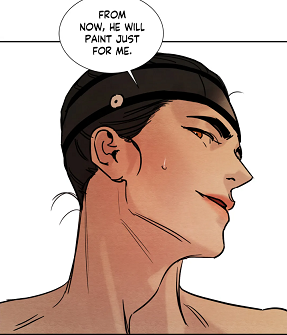 , (chapter 8) but he didn’t envision what jealousy and greed would provoke. In my eyes, he couldn‘t identify these emotions properly.
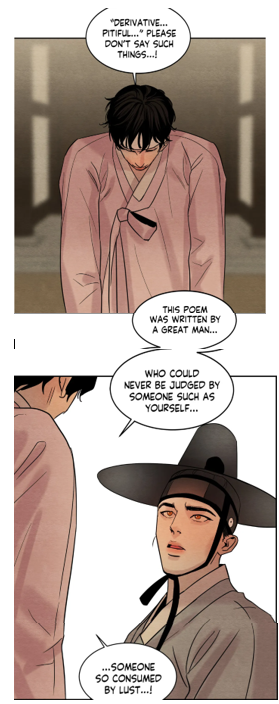 (Chapter 4) He was not worthy to comment this poetry, as he was just a man consumed by lust. However, the commoner never asked why the noble would judge the poem so poorly. He already assumed that he was just making fun in order to humiliate the scholar, while in reality the noble wanted to reveal the author’s true personality: Jung In-Hun was just a deceiver. And since he had been hurt by the painter’s comment, he retaliated too: since he was just a commoner, he had no right to criticize the lord.
  (Chapter 2) Baek Na-Kyum was the first who made the main lead realize the existence of his body. For the first time, he felt attraction through the gaze and saw something beautiful in himself. And what was the lord‘s immediate reaction? He started talking about his thoughts, though this was more a monologue than a discussion.
  (chapter 3) Exactly like the painter, Yoon Seungho began talking while having sex. He even formulated his first desire in front of his childhood friend:
  (chapter 3) And now, you comprehend why his relationship with Lee Jihwa was doomed to fail. The red-haired master was more focused on sex and his own sexual emancipation than his lover‘s well-being.
 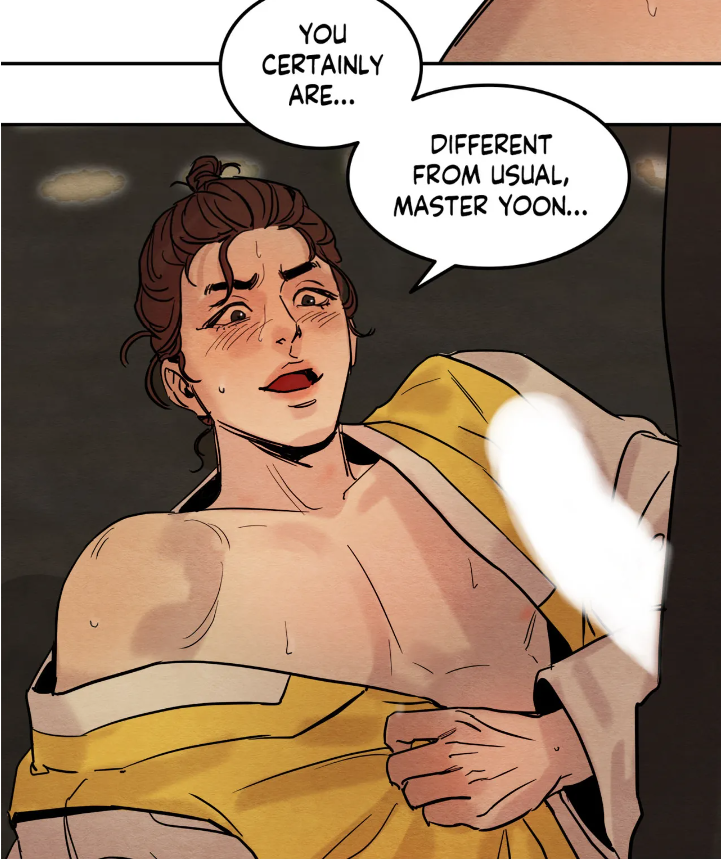 (Chapter 3) He never asked him why he was behaving so differently. He didn‘t notice that the lord was more communicative.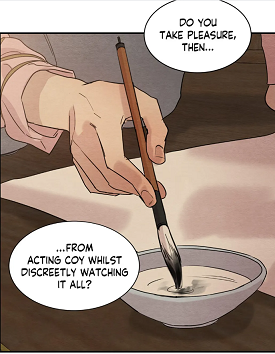
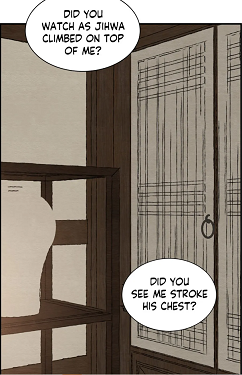

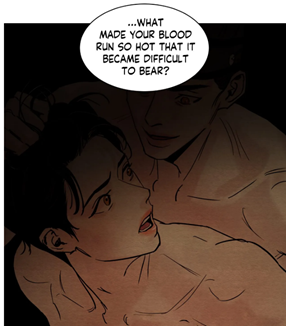
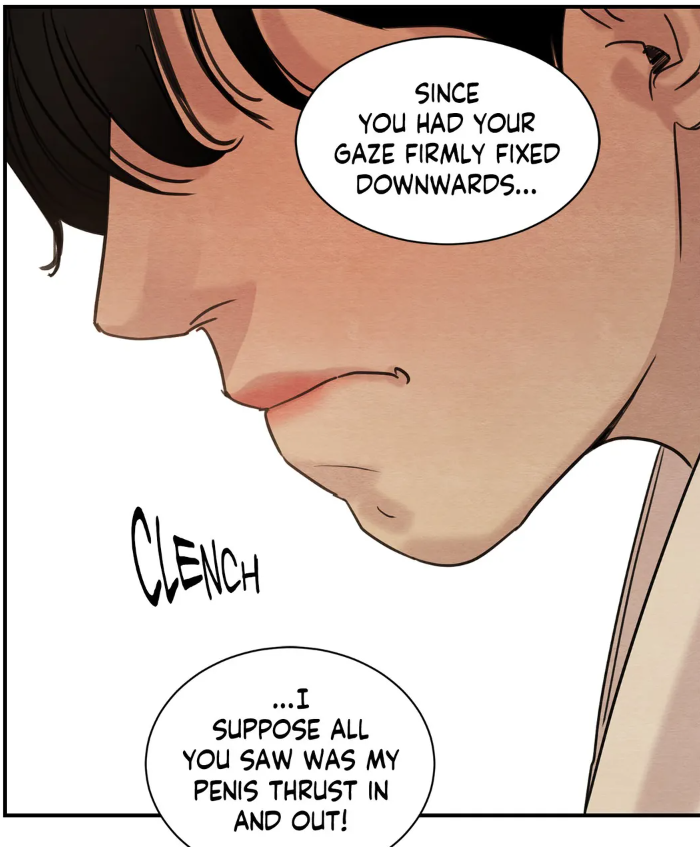 (chapter 16) On the surface, it looks like he is sulking, the reality is that he is already fighting against his urges. The hand is trembling due the arousal.
 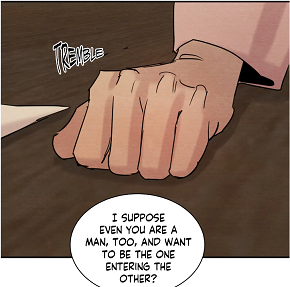 While you have the impression, he is bothered by Yoon Seungho, the truth is that the artist is getting more and more excited due the lord’s picturesque questions. Funny is that in this scene, the aristocrat is the more innocent one. He plays with the head-band
 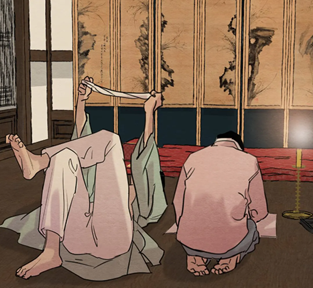 and his “innocence” is truly visible through his facial expressions too:
 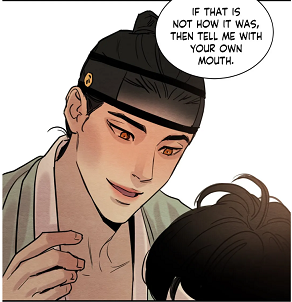 . What is the painter’s real sexual desire? We have the answer in this panel:
 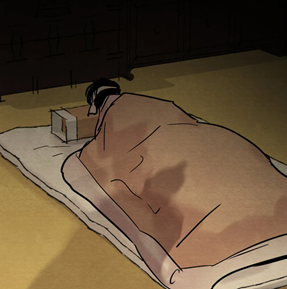 (chapter 6) a stranger in form of a shadow enters the artist’s room. The lord’s identity is only discovered at the end. But in his fantasy, the main lead was even grabbing him by the hair. It was definitely not a tender gesture.
 He was even caressing him against his will. And note that when Yoon Seungho questions when he got the most excited to the point that he had difficulties to breath, the commoner remembers this image and not the strokes.
 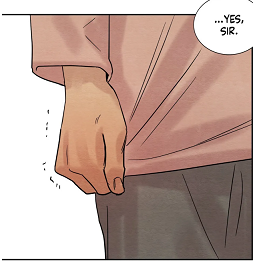 (chapter 12) triggered by fear. This new interpretation explains why the artist painted the sex at the pavilion in the end.
  (Chapter 41) If the forced sex had truly traumatized him, he wouldn’t have been able to do so. Furthermore, he questioned the authenticity of the lord’s affection, when he recalled the moment, he was offered to the other nobles. He was upset and offended.
  (Chapter 55) Yet he didn’t even think about the scene at the pavilion for one minute. This means that Baek Na-Kyum only accepts the main lead as his lover. Fear and pain are not perceived as something negative, they can evoke pleasure.
  (Chapter 16) Moreover, he didn’t get angry at Yoon Seungho for touching his phallus. He got more scared that someone had seen him enjoying the masturbation and I would even say, getting grabbed by force. Therefore the lord got an erection and was so happy at the kisaeng house. Finally, he had been able to talk to the painter. He even got to receive a honest answer for the first time, where he was even called “my lord”:
  (chapter 16) To sum up, Baek Na-Kyum showed a certain respect to the main lead in this chapter. But more importantly, the master was in a good mood, because he kept thinking how he could procure pleasure to the commoner.
 (Chapter 21) The painter reveals the truth by replying that he enjoyed it very much, it felt like a dream. As you can see, chapter 21 was a reflection of the episode 16: we had a discussion, where the lord tried to initiate a conversation, tears of joy connected with pleasure, the lord asking to be called “my lord” and the realization of a dream. But we have another evidence that despite his words, he wanted the main lead to continue:
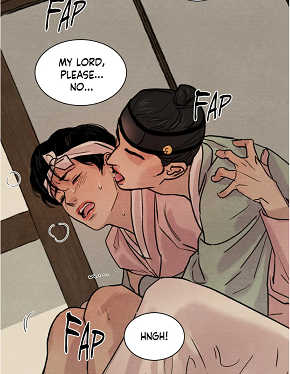 (chapter 16) The commoner’s hand is placed on the shoulder indicating that he is pushing Yoon Seungho to his side. He could have tried to remove the lord’s hand on his phallus, but he didn’t. The hand was even trembling from pleasure. That’s why the second sex marathon shouldn’t be judged as a rape in my opinion, although the painter kept saying no too. First, the painter makes the exact same expression than in chapter 16:
 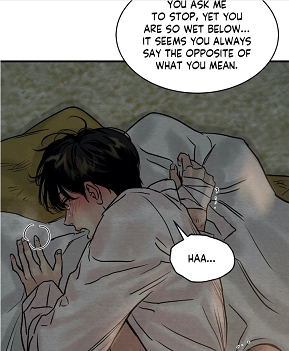 (Chapter 63) And even the lord notices that the painter is getting more and more excited by the roughness. He keeps describing how the painter is reacting below
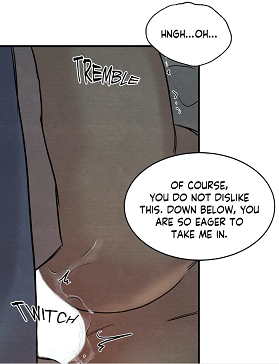 (chapter 63) which can only increase Baek Na-Kyum’s arousal, as his words are again very graphic. Note that the lord’s pictorial “filthy” expressions affect the painter deeply, exactly like in his second wet dream:
  (Chapter 63) Therefore I come to the conclusion that in chapter 63, the painter is not crying, because he is really hurt and angry at the main lead. These are tears of pleasure mixed with pain, which is linked to BDSM. That’s why he keeps blushing the whole time.
  (Chapter 63) This explicates why he kept ejaculating, despite saying “no” or recognizing that there was a witness. He felt no longer scared or embarrassed, like in chapter 16, where he ran away to hide. With this new version of the sex marathon, the painter truly discovered his sexual preferences. Therefore, when we see this
 (chapter 63), we shouldn’t project our own emotions into the artist: pain and disgust. Remember this: the painter felt his blood running hot, when the lord grabbed his hair violently in his wet dream.
 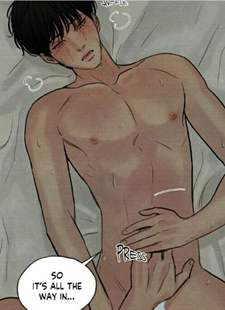 (Chapter 42) Yet, the noble couldn’t help himself showing tenderness and affection at the end with the passionate kiss. As a conclusion, the second sex marathon contains all these elements: sadness, pain, pleasure, anger and happiness.
 (chapter 16), and in chapter 35 he accepts to be a servant or in chapter 49 a sex toy. Due their different sex sessions, he discovered that he likes being rough too. Therefore he couldn’t enjoy, when the painter was so passive. He recognized that he took pleasure, when the painter was showing resistance too.
 (Chapter 63) This explicates why he couldn’t stand the expression “I like it”. This was too insipid. So when he became rough in chapter 48, he truly hoped to provoke tears of happiness caused by the sensation of pleasure.
 (Chapter 48) However, since the painter ended up crying and criticizing the lord, he had the impression, he had failed. As you can see, the lord might have had a lot of sexual experiences, yet with the painter, he entered a totally new world: full of warmth and love, yet there was pain connected to pleasure as well. This explicates why he could open up and reveal that his real dream was to make the painter smile
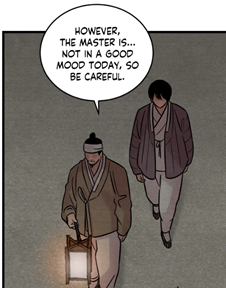 (Chapter 36) While, it looked like he was protecting the painter, he was undermining their relationship. He was actually using triangulation.
  (chapter 50) Then he utilized the lord’s misconduct in the storage room. He should wait for the painter’s visit in his bedchamber.
 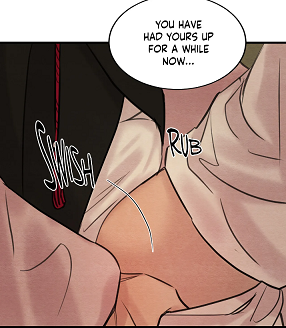 (Chapter 39) Once again, the lord had a teasing attitude, yet he was gentle and considerate. This is not surprising that due to their interaction, Baek Na-Kyum started listening to the lord. He took his questions and advices very seriously (chapter 40). Thus he confronted the learned sir about his future. As the painterofthenightphiles can detect, by communicating they began trusting each other more, and as such showing more curiosity and understanding to their counterpart.
  (Chapter 68) With these words, he was implying that the low-born suffered the same fate than Yoon Seungho, because it looks like that on the surface. He imagined that he would achieve his goal (sending away Baek Na-Kyum) by using his knowledge, but in my opinion the opposite happened, like I had expected. What caught my attention is that the butler only mentioned Yoon Chang-Hyeon
  (chapter 68), as he had sent the painter to the storage room like his father. Yet, at no moment he made an allusion about lord Song, though he saw the sex in the barn as sexual abuse. He was thinking of the pedophile’s crime. He couldn‘t bring up the pedophile for two reasons: As a domestic, he can‘t badmouth the king. Secondly, he has to blame the father, as his own responsibility in Yoon Seungho‘s suffering would come to the surface. Remember my theory: Kim was the one brought the young master to the king thinking that the latter would protect Yoon Seungho.
  (Chapter 88) Furthermore, the chronology is important. The painter communicated first his thoughts and wishes, before they initiated the love session.
 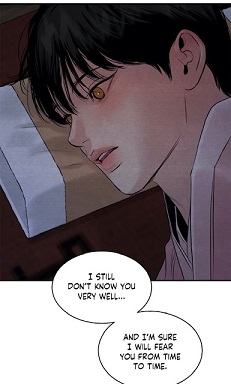 (Chapter 88) This contrasts to the sex session in chapter 48/49. The lord had used sex in order to force the painter to share what was on his mind. Finally, in the gibang, the painter had talked a lot about his childhood to his lover before kissing his lover.
  (Chapter 94) They had a long conversation, where the lord could ask questions. This conversation ended with a love confession.
  (Chapter 94) This is important, because sex had now a different function. Sex was now a real form of communication, they would share what was on their heart. With their bodies, they would convey emotions. They would use the hand
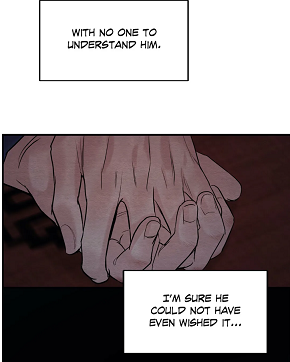 (chapter 88) or the kiss
  (Chapter 95) so that no misunderstanding would be created. Therefore it is not surprising that even during their love session, they would keep talking, and even express their desires: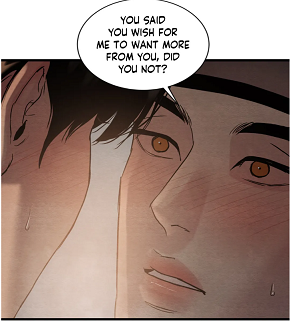
 (Chapter 96) And observe that even after the love session, they continued sharing what was on their mind and heart:
 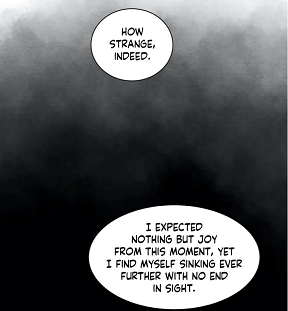 (chapter 97) And now, you comprehend why the schemers had to separate the couple! From this moment on, they would communicate constantly, and this outside sex. Thus when they are in the mountain, they can speak freely.
  (Chapter 97) As you can see, the topics of their conversation will diverge more and more. I do think that he was incited to let the painter sleep in order to „protect“ him. Yoon Seungho needs to recognize that warning and drawing lines are not enough to protect the loved one. He will have to take real measures to turn his statement (taking responsibility for the painter) into a reality: he will have to fight for his right to happiness.
  Taking the civil service examination only represents one step. Furthermore, appearances can be deceiving. The pure artist is not so “innocent” in the end. He has definitely met his match in Yoon Seungho, though I believe that his role is to heal Yoon Seungho from his PTSD and give him closure. And this can only happen, when the victim of sexual abuse confronts his perpetrators, the old bearded men!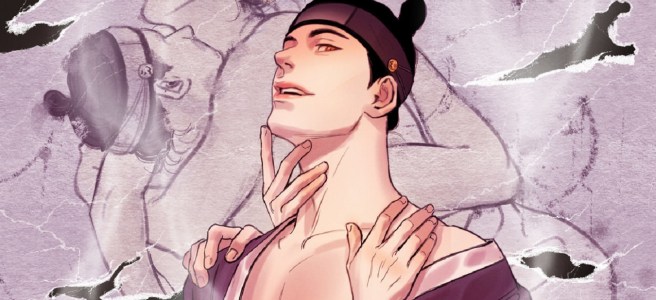
 (chapter 48) But strangely, the main lead never realized it, until each time the commoner had to externalize it. How did he not see it before, and how didn’t the noble recognize that the artist hadn’t changed his perception about him in the second season? Thus I will try to answer these two questions in this essay.
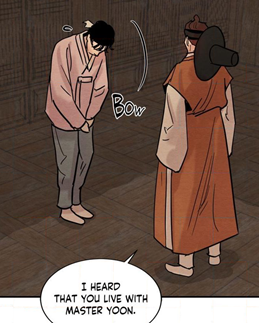 here, no servant is sent to announce the noble’s arrival, which is quite rude; chapter 10
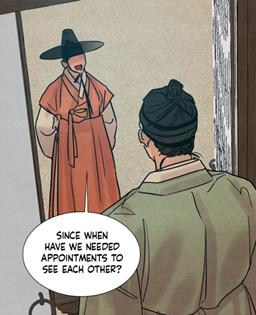 , 17, 43). He acts, as if he owns the place. Moreover, the noble with the mole requests from the host to send away the artist (chapter 8).
  (Chapter 8) For the first time, the protagonist didn’t allow his peers to look down on him and requested more respect.
 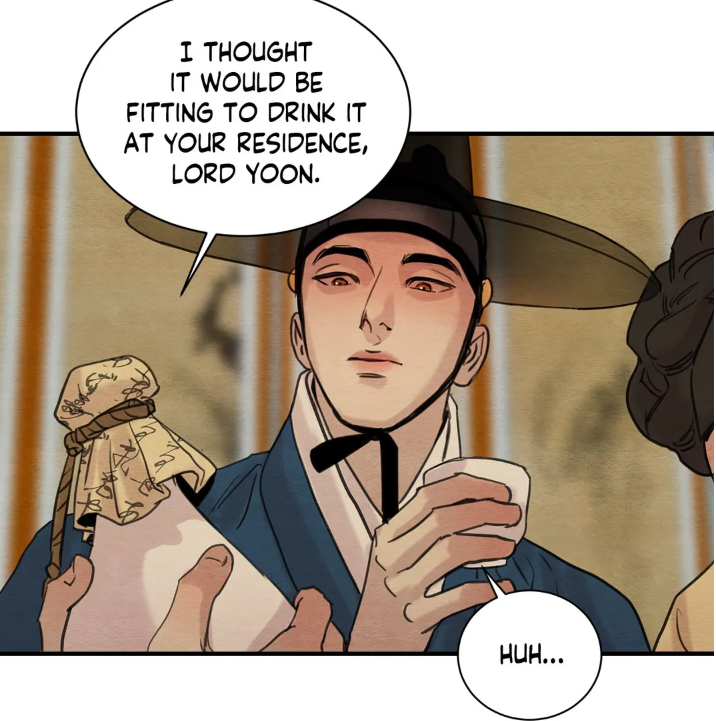 (Chapter 19) He imposed himself upon the main character, yet Yoon Seungho didn’t feel upset. In fact, he just accepted the suggestion by a silence. It was, as if the protagonist was not allowed to refuse the invitation. More surprising is the place where The Joker suggested this: the brothel, an indication that the Yoon residence is considered as the noble kisaeng-house. I would even say, his mansion is the real place for pleasure and vices. And now, you comprehend why Yoon Seungho was pressured by the nobles in chapter 33. In the past, he would have given in, yet this time he showed them that there was a line not to cross.
 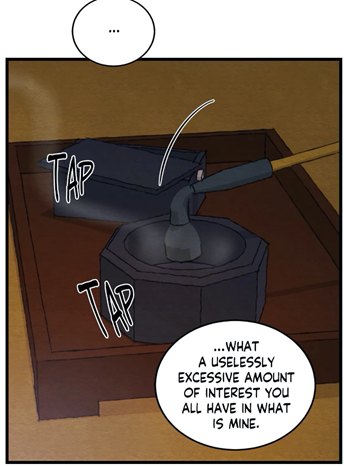 (Chapter 33) Imagine what would have happened, if the noble had followed their suggestion. The artist would have indeed turned into a prostitute.
 (Chapter 52) In Yoon’s residence, there was no parent or authority to interfere. This explicates why father Lee blames the main lead for his son’s sodomy. He corrupted Jihwa, while in reality Jihwa treated Yoon Seungho like his possession and his personal concubine. He was the one visiting his place and not the other way around, like a husband visiting his “wife”
 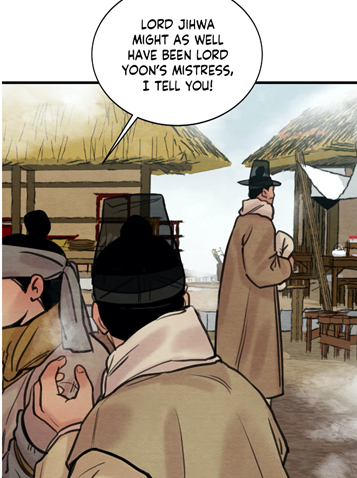 (chapter 45), in other words the mistress of the house (the second definition: a mistress is a person of authority and power). This explains why he could trespass the mansion, like he desired. He considered Yoon Seungho’s mansion as his property, where he could enter at any time.
  (chapter 33)
  (chapter 52) Everyone among the aristocrats did see the main lead as a head-kisaeng, who had to please her guests. Thus Byeonduck created such panels indicating that the nobles had always taken advantage of Yoon Seungho.
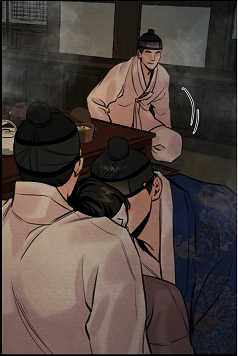 (Chapter 54) They look like conniving creatures. Their wish would get granted in the detriment of the host. And now you comprehend why the lord got so angry, when he saw this.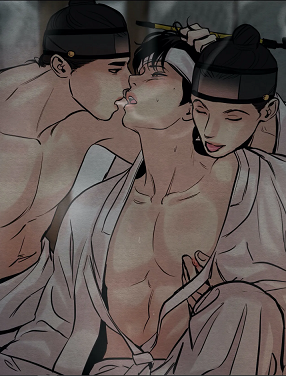
 (Chapter 54) It was not just a reflection of his own past as an uke, but he saw his actual reflection. His house was a brothel and nothing more, and his guests were taking advantage of him. That’s why he got so infuriated and evicted the aristocrats. They truly showed no respect to him. It took many months for the lord to recognize this. And now you comprehend why he abhorred the idea of prostitution. He wasn’t even realizing that he was still doing it. Therefore Yoon Seungho could only come to the conclusion in chapter 55 that he needed to confess. First, this night made him realize that all this attempts in the past were to win the painter’s heart. Yet he was well aware that with his last action, he had almost sold his loved one to nobles, thereby the painter could only reject him. Besides, he had another reason to expect this outcome: his self-hatred.
 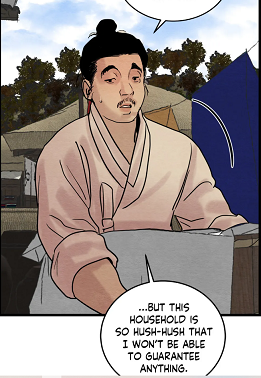 (Chapter 29) Since a kisaeng belongs to the lowest class in Joseon society, the servants could look down on their master. Despite his title, he was living like a head-kisaeng, therefore the staff showed no respect towards their lord.
  (Chapter 32) This explicates why they didn’t follow his order, when he asked them to keep an eye on the artist. Nevertheless, as time passed on, the noble started acting more like a lord, hence the head-maid accepted his reprimand and decided to treat him differently. That’s why she bowed to Yoon Seungho in chapter 46.
  (Chapter 33) The lord fell for this illusion, and he would have never realized it, if the painter had not entered his mansion. I also fell for this illusion myself for a while, calling him an alpha, while he was disrespected the whole time. However, this doesn’t mean that the main lead is powerless. He has indeed connections to the government (exactly like the kisaeng-house) and he is definitely rich, because he is a trendsetter. Min keeps copying his clothing and the master’s windscreen is the same at Min’s pavilion and the noble with the mole. That’s why Yoon Seungho never got to see his true reflection. In his mind, he was either busy reading or fighting with nobles, while in reality he was having sex for the most part of the time. Moreover, no one truly gave him a true reflection, since they had no interest to switch the situation.
 (Chapter 2) Therefore the main lead’s gaze in the picture mirrored the image of a man showing true interest, warmth and beauty. Later, he only got to see the ruined painting, which triggered a huge anger, hence he didn’t pay attention to the image. Then in the third picture,
 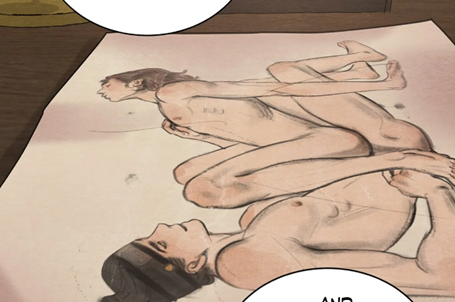 (chapter 16) he was no longer interested in the creation, since Yoon Seungho had already started wooing the commoner.
 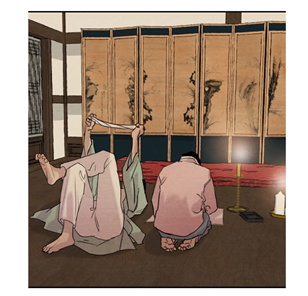 (Chapter 16) Here the second lead was exploring an unusual position. Although the protagonist could have noticed this reflection “man consumed by lust”, because Black Heart commented it as lewd
 , he still didn’t observe it. His gaze and mind were all focused on the painter and his face. Then in chapter 41, he never saw the multitude pictures of him having sex with the low-born
 (Chapter 41) And the moment the painter accepted him as his sex partner, he showed no interest in the paintings. However, he got annoyed, when he saw the first new creation.
 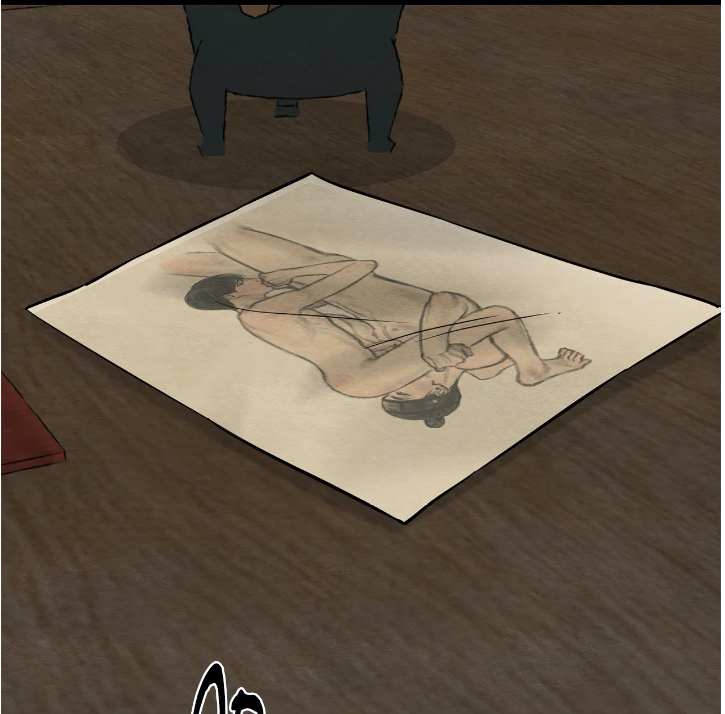 (Chapter 47) It was unfinished, and it gave the impression that both of them were acting like whores. That’s why the lord was indeed a little annoyed and made the following remark:
 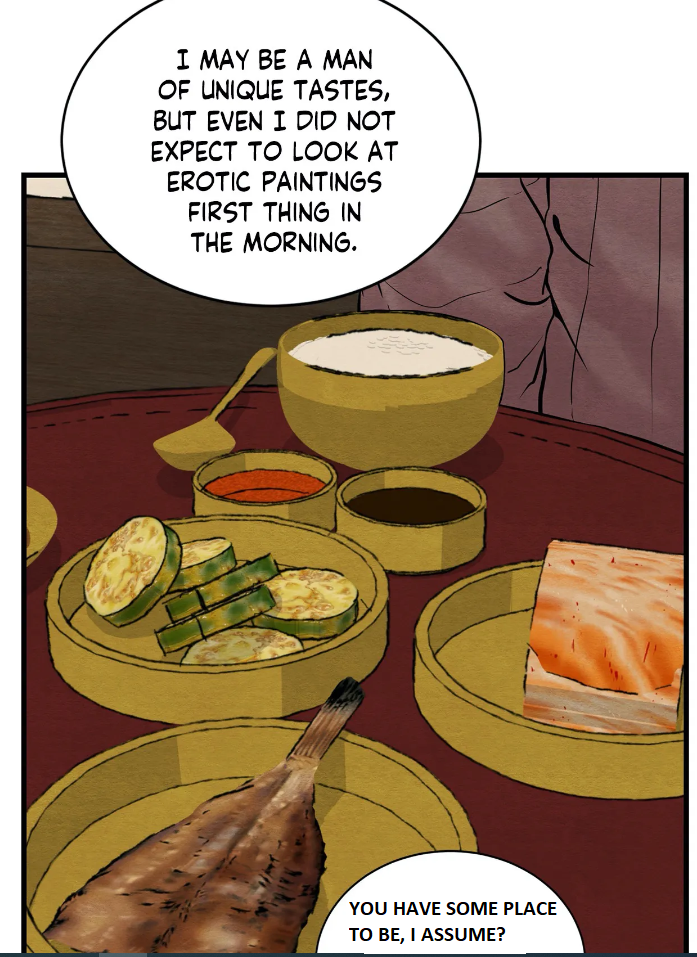 (chapter 47) And it is in this chapter that he gets to discover his reflection… or better said, Baek Na-Kyum hadn’t changed his judgement about him, which provoked the next crisis. With the last painting, Baek Na-Kyum reproduced the situation, where the master was focused on provoking reactions in his partner in order to force him to abandon his torpor.
  (Chapter 52) Therefore the beholder couldn’t detect any love and affection in this drawing, only the attempt to incite pleasure. This explicates why Min described this as salacious, and had the feeling that the commoner was only interested in sex either.
  (Chapter 2) Simultaneously, Baek Na-Kyum destroyed it because of his jealousy (under the influence of his unconscious). The manhwalovers shouldn’t forget that in that wet dream, he wanted to take Jihwa’s place, attracted by the lord’s huge penis. Yet, he justified it with his doctrine. Furthermore, the second painting with Jihwa is created on a small sheet of paper reflecting the loss of the red-haired noble’s influence.
 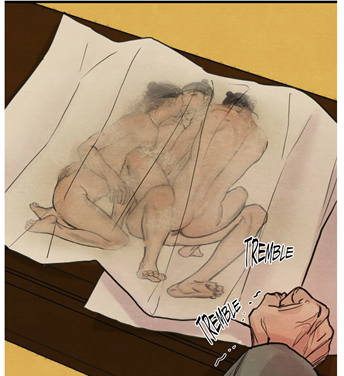 (Chapter 44) from that moment, the protagonist was no longer hosting any sex orgy which led Min to take over this role. Jihwa’s gesture symbolized that the childhood friend was not allowed to fool around with other men. However, he was quickly replaced by the painter. Let’s not forget that in the noble’s mind, Jihwa was just visiting him for his own sexual desires. He never recognized the childhood friend’s feelings. He had no reason to see otherwise, since the second lead treated him poorly.
  (Chapter 59) That’s why, after having sex with Jihwa, the “head-kisaeng” neglected his guest and went directly to Baek Na-Kyum for the painting in chapter 15, because the noble is already interested to taste the artist. At the same time, the low-born got his first sexual experience with the main lead.
 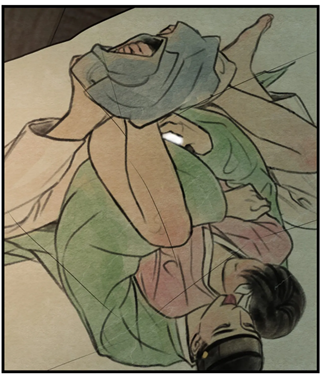 (Chapter 25) And here, the lord couldn’t perceive his own image as man consumed by lust, because his gaze was looking at the painter’s expression. This exposed the lord’s desire to see the attraction for Yoon Seungho in the painter’s eyes. His eyes were always focused on the painter the entire time, revealing that he was longing for more than sex. He wanted to see a mutual attraction… in reality, he wished to see a painting oozing warmth and love, exactly like in the publications he bought. And note that Yoon Seungho never got to see the last drawing, because his heart was too wounded by the distance. He hated so much the idea that the artist considered himself as a prostitute, while all this time, Yoon Seungho was just longing for love. Striking is that the ultimate picture is a blank sheet of paper mirroring the transition.
 (Chapter 65) Here, the lord has finally cut ties with his past. This marks the start of a new life and the painter will reflect his rebirth. But as you can see, the multitude of pictures
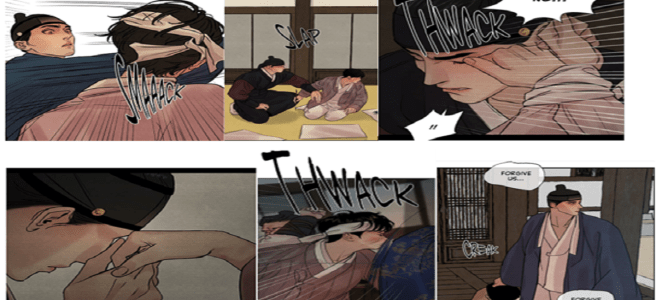

 (chapter 68) In their eyes, valet Kim had turned into a hero not fearing his death. But we had another hero in this chapter, the scholar Jung In-Hun. The latter took the crying Baek Na-Kyum in his arm and brought him away from the scene, where Heena noona was getting beaten by a rich noble.
 (chapter 68) As you can detect, the absence of her eyes reflect her blindness. The feelings she is projecting onto the painter’s are actually her own.
 (chapter 18) Hence I come to the conclusion, the teacher used the school in order to manipulate the commoners and the gisaengs. While he portrayed himself as righteous and kind, he described the powerful nobles as violent and arrogant, so that he would get the admiration from the commoners. In truth, he was deceiving them, since he looked down on them. Yet he needed them in order to get some connections to the powerful and rich nobles visiting the gisaeng house. On the other hand, since he didn’t want to get too close to the gisaengs, he employed the innocent boy as a shield, misleading Heena noona to think that Jung In-Hun had feelings for her brother. That’s why he hugs the protagonist so tightly.
  (chapter 65) He had two reasons for allowing her to meet the painter. First, Kim feared that she would cause more chaos in the future. Secondly, Kim realized that Baek Na-Kyum had become a huge source of trouble. He knew that the artist had been abducted, hence he got aware that Baek Na-Kyum had become a target of nobles. Furthermore, as soon as he had been returned, his sister made such a ruckus that she had turned the mansion upside down. Besides, like I had mentioned before, due to her behavior, she had put Kim in a difficult spot. Finally, he had another ground for giving his help:
  (chapter 67) He had never received the authorization from his master. However, the manhwalovers should recognize that he painted his master in a rather negative light, while leaving a good impression on her.
  (chapter 67) In my opinion, we have here a new version of the painter’s escape from the first season: Kim acting as a shadow helped the artist to run away (chapter 29-30). However, the problem is that he got caught by Yoon Seungho.
  (chapter 68) What should he do now? I would like to remind the manhwaphiles that Kim had not only disobeyed his master’s order, but he had acted, as if he was a lord. He had given the permission without Yoon Seungho’s consent.
 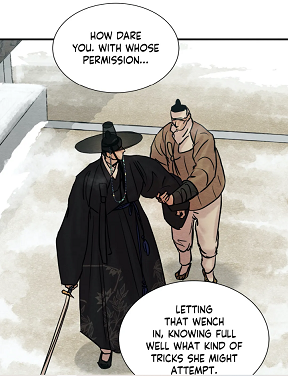 (chapter 68 It is important to recall that this story takes place in Joseon, therefore Kim’s action can definitely be judged as a betrayal and usurpation of power. One might argue that he desired to help Heena, yet like I exposed above, he did out of selfishness and not because he felt concerned for the painter and for her. As such, Yoon Seungho has the right to be upset. He is the master and someone is acting behind his back, overlooking his orders. Under this perspective, the head-maid appears more loyal to her lord than Kim himself. In this scene, he was only serving his own interest.
  (chapter 68). Note that the protagonist doesn’t menace to kill the gisaeng. He just desires to send her away, but he is now determined to punish his butler for his disobedience. He usurped his position, and as a lord he is allowed to do so. And that’s the moment, when Kim starts speaking the truth, which many readers associate to something positive.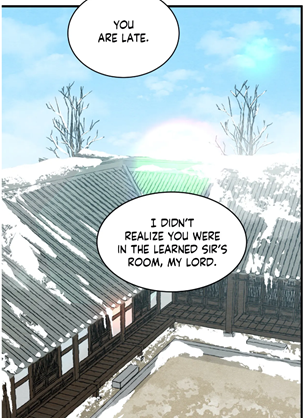
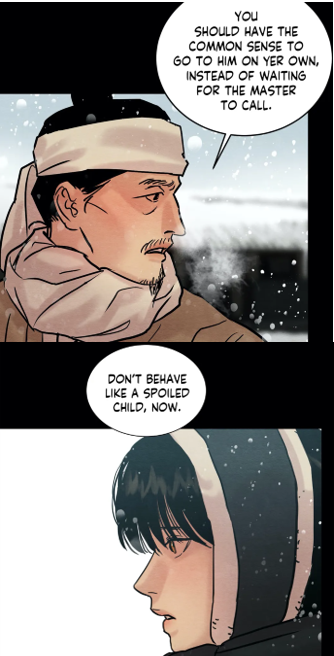 (chapter 52)
 (chapter 68) Initially, it looks like he is appealing to the lord’s heart, but in reality the main point is the noble’s judgement. The valet is reprimanding his master for his lack of discernment. He misjudged the painter’s behavior. This is relevant because in this panel, I view a first emotional manipulation. His real intent is to make the lord doubt his own judgement, like “look, back then you made the wrong decision… therefore you could be wrong here”. But the readers know that Yoon Seungho is right. Heena is determined to take away his lover, so his initial judgement about Heena is indeed correct. In his eyes, she represents a source of thread, he might lose the artist. One might argue that Yoon Seungho is sequestring the painter which is also correct, yet like my reader Luzy pointed out, this is the painter’s decision. Neither Kim nor Heena nor Yoon Seungho have to make the decision for him. And here, Kim and Heena are trying to do so. The problem is that Kim got caught. But let’s go back to my initial thought. Kim used his knowledge (the lord’s misjudgment) in order to make his lord doubt himself. and he appealed to his emotions for that. This type of manipulation is called gaslighting:
 (chapter 65) Kim is destroying the lord’s confidence, so that Yoon Seungho will rely on Kim’s judgement.
  (chapter 64) He literally looked away, because truth wasn’t helpful in this case. Feigning innocence and ignorance was more appropriate.
  (chapter 68) Here, Kim is mentioning the past, where he played an active role between the father and son. In other words, he is reminding the master that he is acting like a mediator. However, this revelation exposes the servant’s manipulation. He was one of the causes for the falling apart between father Yoon and the eldest son. We have to imagine that he never revealed the real reason for Yoon Seungho’s rebellious nature to father Yoon. And here, he is behaving like in the past. He tries to intervene between Baek Na-Kyum, Heena noona and Yoon Seungho, as if he had the right to.
 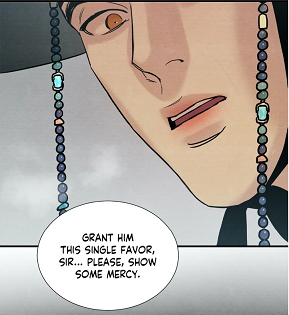 (chapter 68)
 (chapter 68) He had heard, how Heena noona was comparing him to misfortune, reinforcing his negative opinion about himself.
  He had been already prepared mentally by his butler. He was as wounded as Baek Na-Kyum, when the scholar had voiced his true thoughts about the painter.
  (chapter 40) While the artist’s fate is to become a prostitute, the other is destined to bring misery. He already externalized this perception about himself in chapter 49:
 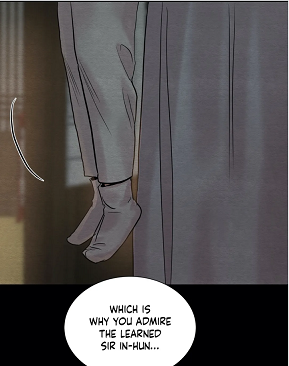 (chapter 68) He slowly takes the artist in his arms. He doesn’t rush to her side, remains silent and immobile. His passivity reflects his true personality, but Heena is too focused on her young brother to grasp the situation.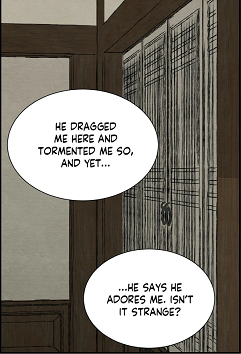
 (chapter 68), but also his quality: his honesty
 (chapter 58). Let’s not forget that the artist realized his dedication in chapter 58. Note the huge difference. The artist never uses others in order to judge the lord. Kim will realize soon enough the consequences of opening Pandora’s box. He might have achieved his goal (the lord won’t punish him for his disobedience), yet he lost his lord’s trust. Notice that right after this quarrel, Yoon Seungho started treating Baek Na-Kyum like a noble.
 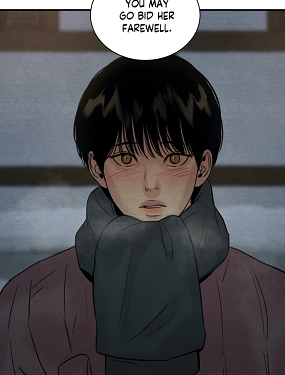 (chapter 69)
 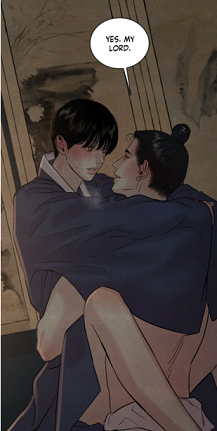 (chapter 72) From that moment on, Yoon Seungho was no longer viewing the valet as the unofficial lord. We could say that he had lost his status as “hero” in the main lead’s eyes.
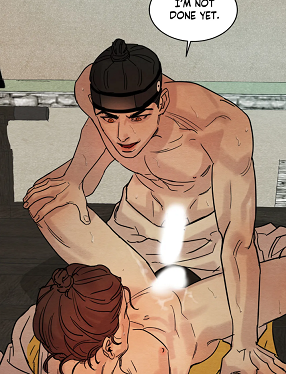 (chapter 3) and had sex with Jihwa at the pavilion, where both were not quiet at all. The red-haired noble kept even moaning.
  (chapter 3) Their intercourse was noticeable, but at no moment father Lee interrupted them. And now, the erected phallus was switched to a sword, and unlike in chapter 3, where the second lead was eager to meet his sex partner
 , the master chose to hide behind a windscreen.
 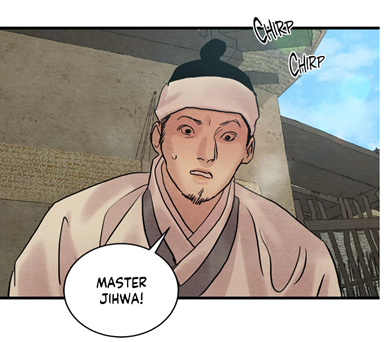 (chapter 41) He spent the whole night drinking and his father never asked about his whereabouts. He never showed any concern, as he has his staff to take care of him. In other words, he put the whole responsibility on the domestics. After confessing to Yoon Seungho in public, no servant shows up and takes care of him indicating that neither father Lee nor the staff heard about the scandal. Nameless was the one who was asked by the inn owner, if he could take care of the young noble.
  (chapter 59) He even gave him a dry robe and a home for the night. Since the servant only showed up the next morning in chapter 41 and he didn’t even appear during the night in chapter 59, it illustrates that the staff is more attached to the mansion than to the impulsive noble himself in truth.
 (chapter 50), he is even willing to risk his life
 . (chapter 67) He simply follows his master’s request, as he feels, that’s his duty and lord Lee could ask for his accountability.
  (chapter 45) That’s how isolated the father is cut off from reality and world. This is not surprising that his son resembles him, he also lives in his own world.
  , which corresponds to the expression “sensory isolation”. Back then, I had imagined that he had been abused as well. I was wrong, since it was just neglect which I had already detected. However, the consequences of such a severe neglect are as terrible as abuse. Consequently, abuse and neglect are often considered the same.
 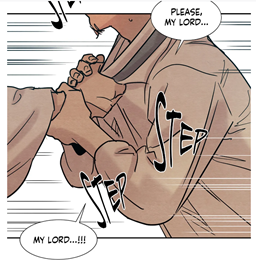 (chapter 13)
 (chapter 13); aggression
 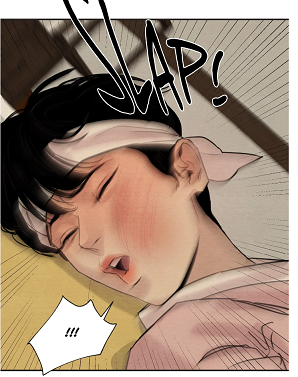 (chapter 17)
 (chapter 51)
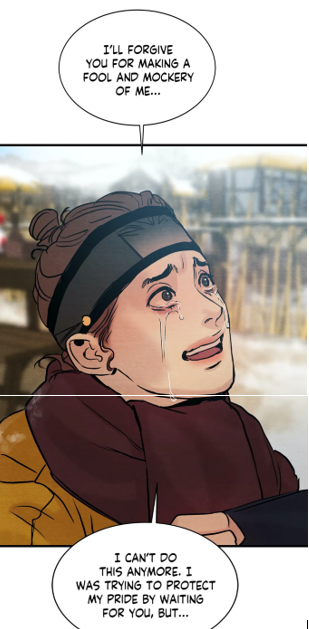 (chapter 59) In chapter 56, Jihwa sent a fake letter reminding Yoon Seungho of his trauma, yet he acts as if the other is to blame and shows no remorse. That’s why many children suffering from emotional neglect have problems with rules and laws.
  (chapter 9)
 (chapter 57)
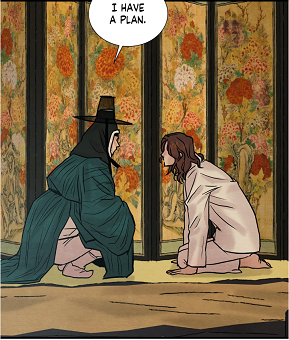 (chapter 67), although he had lied to him in the past.
 (chapter 67)
 (chapter 50)
 (red circle). Because of the character’s previous deafness and blindness, I immediately connected it to the wise 3 monkeys:
 (chapter 67) This is is visible in this panel. The character can’t even stand. Min, the Joker and surrogate father, treats Jihwa as his servant and punishes him, because he had not followed his order. Jihwa has not entirely developed his identity, since he has always lived in his own limited world. A father has not only to provide security and comfort, he helps the child to learn self-control and boundaries. A father is associated to rules and should teach his child how to channel aggressivity. In other words, he serves as a role model for the child. But with the absence of a father, this is impossible. And since the domestics belong to the lower social class, Lee Jihwa always had the upper hand and could do anything: his father never appeared, when Jihwa was destroying his room with his sword in chapter 21. Besides, father Lee never paid attention to the friends his son had. He blames Yoon Seungho for his son’s debauchery, yet at no moment he intervened in the past. The main lead is correct to blame the father and put his son in a different light.
 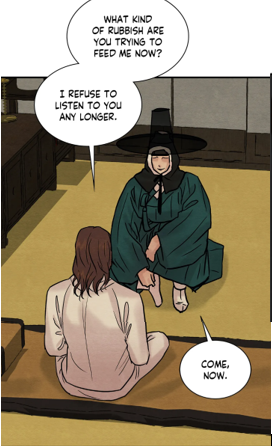 (chapter 67), but it was short-lived due to Yoon Seungho’s appearance. We have to assume that Yoon Seungho played the role of the father after the former had been abandoned by his own father. However, he could never assume this function properly, as he was suffering himself and couldn’t give him the emotional and educational comfort Jihwa needed. Let’s not forget that the protagonist chose to ignore his own feelings, to even numb them. Hence it was impossible for them to connect emotionally.
  (chapter 57) “wayward” is a synonym for rebellious indicating that Yoon Seungho had started questioning his father’s behavior and words. Simultaneously, I believe that the father judged his son’s behavior as too childish, thus he said that he had been suffering from an illness for a long time. The adolescence represents an important step in the child’s development. That’s the moment when a teenager decides to take his distance from his father in order to find his own identity. Since the main lead was described as intelligent, it was normal that the main character would decide to make his own decision and could sense his father’s flaws. Consequently father Yoon could only see the critical remarks as a sign of insubordination. This is not surprising that he blamed his son, when something happened due to Jihwa.
 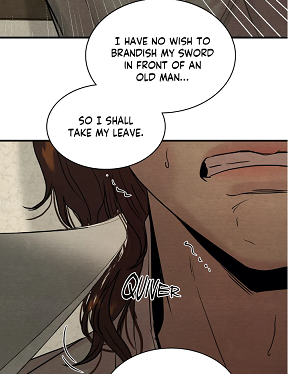 (chapter 67) and it is even possible that he gets a scar or a tattoo.
  (chapter 67) This scene was important as it represented a new version of chapter 18. This time, the lord aimed at Jihwa’s face and the servant was not harmed. The main lead put the whole responsibility on the former friend.
 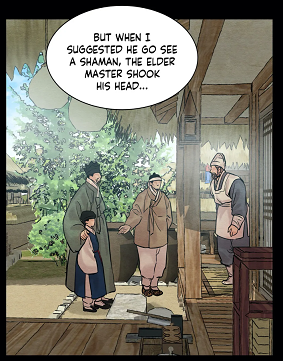 (chapter 57) There’s no doubt that father Yoon put all his trust in Kim. This explicates why Kim acts, as if he had the authority to give orders.
 (chapter 57) due to the hat and the robe. What caught my attention is that he acts behind his lord’s back, when the latter is absent.
 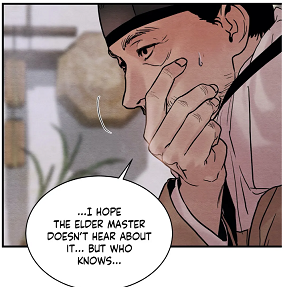 (chapter 57) By examining Kim again, I have to admit that I suddenly had this question: who gave the painting to Yoon Seung-Won? Did the valet act on the lord’s order?
  (chapter 37) Or did he decide to act on his own? Let’s not forget that during that evening, the valet had been reprimanded by Yoon Seung-Won for lying to him. It is possible that the valet chose to give the painting in order to put the blame on Yoon Seungho, as he feared that the young master could report his lie and behavior to father Yoon. The latter might not be present at the mansion, but there’s no doubt that he asked his trusted servant to keep an eye on his eldest son, whom he considered as a troublemaker. This would explain why the main lead keeps taking the medicine. And now, you can grasp why Kim is more loyal to father Yoon than his actual master. The latter gives him more freedom, yet he expects from him more responsibility. Under the ruling of father Yoon, the butler could avoid any trouble by tattling on the young master Yoon Seungho or by faking ignorance, when it was necessary. Since father Yoon put all his trust in the valet, he was not able to see evil or hear evil in the end. Kim framed innocents or he feigned ignorance. As a conclusion, Father Yoon was put in the same situation than father Lee due to Kim’s actions.

 Bebebisous33s' analyses in K-Dramaland and Manhwas