

Please support the authors by reading Manhwas on the official websites. This is where you can read the Manhwa: Jinx But be aware that the Manhwa is a mature Yaoi, which means, it is about homosexuality with explicit scenes. Here is the link of the table of contents about Jinx. Here is the link where you can find the table of contents of analyzed Manhwas. Here are the links, if you are interested in the first work from Mingwa, BJ Alex, and the 2 previous essays about Jinx The Birth of The Shotgun – part 1 and The Night-Cursed Emperor
It would be great if you could make some donations/sponsoring: Ko-fi.com/bebebisous33 That way, you can support me with “coffee” so that I have the energy to keep examining Manhwas. Besides, I need to cover up the expenses for this blog.

My avid readers might have been wondering why I haven’t released any new analysis yet. The reason is simple. I am back at school, and preparing lessons for my students had to come first. But when episode 74 was released, one detail immediately caught my attention. It was small, almost easy to overlook, yet the more I thought about it, the more it seemed to hold the key to understanding not only this chapter, but Joo Jaekyung’s entire story. 😮
So let me turn the question over to you. What is the common denominator between these three panels?
 (chapter 73)
  (chapter 74)
  (chapter 74) What do they share? You might already have noticed it. At first glance, the answer seems obvious: each sentence turns around the word after. But if we pay closer attention, it is not just after that repeats, but after all. And here, the “all” quietly carries the weight of everything. A slight shift, but one that feels significant. But why this expression, and why here? Why does it resurface precisely in the context of Jaekyung’s family and past?
At first glance, after is nothing more than a temporal marker, a word of sequence. But in these sentences it feels heavier, almost final. It does not look forward — it looks backward. In other words, it doesn’t open a path; it shuts a door. And in episode 74 especially, it echoes like a refrain that has been defining the champion’s life. His world has always been framed in terms of after all. And this immediately raises another question: why did these people, so different in role and attitude, all use this idiom when addressing or describing the young champion?
But then—observe the contrast. When Joo Jaekyung embraced his fated partner, the words that rose within him were not about “after” but about “before.” 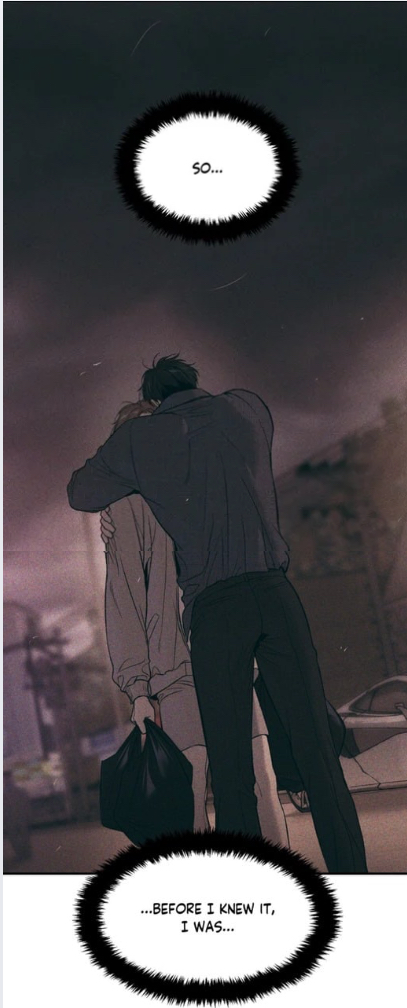 (chapter 70) For the first time, the flow of time shifted. Besides, no explanation, no certainty—just an admission that something happened beyond his planning or reasoning. Where the earlier lines spoke with closure, this one arrived without a verdict. But what does this “confession” signify for the athlete now?
This is the mystery I want to unravel. What does “after all” truly embody in his life? Why has it shaped him so deeply, and why is the “before” so revolutionary when it finally appears? To answer these questions, I will proceed step by step: first examining the parents’ words, and finally the director’s cold repetition in episode 74. From there, I will turn to the symbolic role of the phone and its destruction, before concluding with the comparison between the manager and the grandmother—two figures who, each in their own way, perpetuate or challenge the cycle of “after.” And at the very end, I will return to the sentence that changes everything: (chapter 70)
The Parents’ After All
Joo Jaewoong’s Verdict
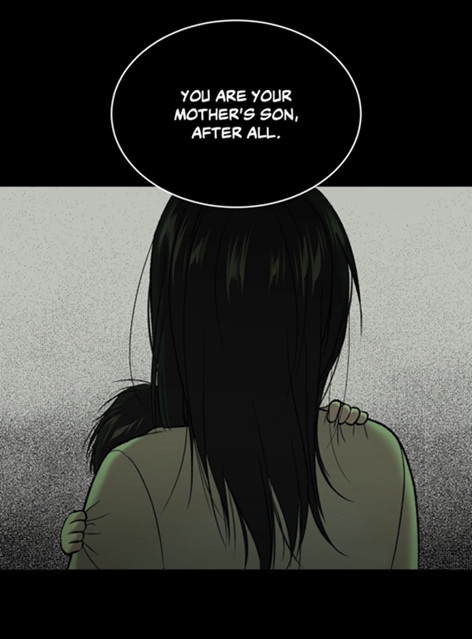
The first “after all” comes from the father: (ch. 73) At first glance, this might sound like a simple insult, a way to degrade the boy by comparing him to the woman who abandoned him. Yes, I wrote “him” and not them on purpose. Joo Jaewoong brought her up in direct response to his son, because the teenager had voiced his first wish in front of his “legal guardian”:  (chapter 73) He was announcing his desire to leave this place, as if he wanted to abandon his father. Nevertheless, he just said it out of anger and frustration. Yet, those words pierced Joo Jaewoong, for they reminded him of his wife’s betrayal. Unable to face his own failures, he retaliated by thrusting her image back onto the boy. (chapter 73)
The staging is crucial. Father and son stand facing each other, 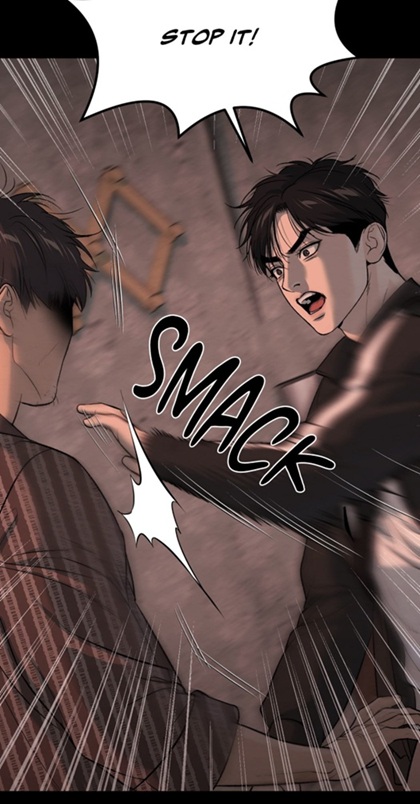 (chapter 73) locked in confrontation, while in the past, the woman had already shown her back — a gesture of refusal that foreshadowed her desertion. She had withdrawn in silence; the man, however, lashed out in noise. Both abandon, but in different registers: hers in silence and absence, his in noise and abuse. But the father’s gaze was selective. (chapter 73) While he saw a mother holding a boy, he overlooked that the protagonist was actually clinching onto his own mother, who had already distanced herself from the child. In other words, he mistook rejection for embrace. What he perceived as proof of her influence was in fact the trace of her withdrawal.
Thus the father’s “after all” is more than a mere insult. It is an erasure. By shifting all blame to the absent mother, he buried his own wrongdoings. The bruises, the insults, the nights of terror 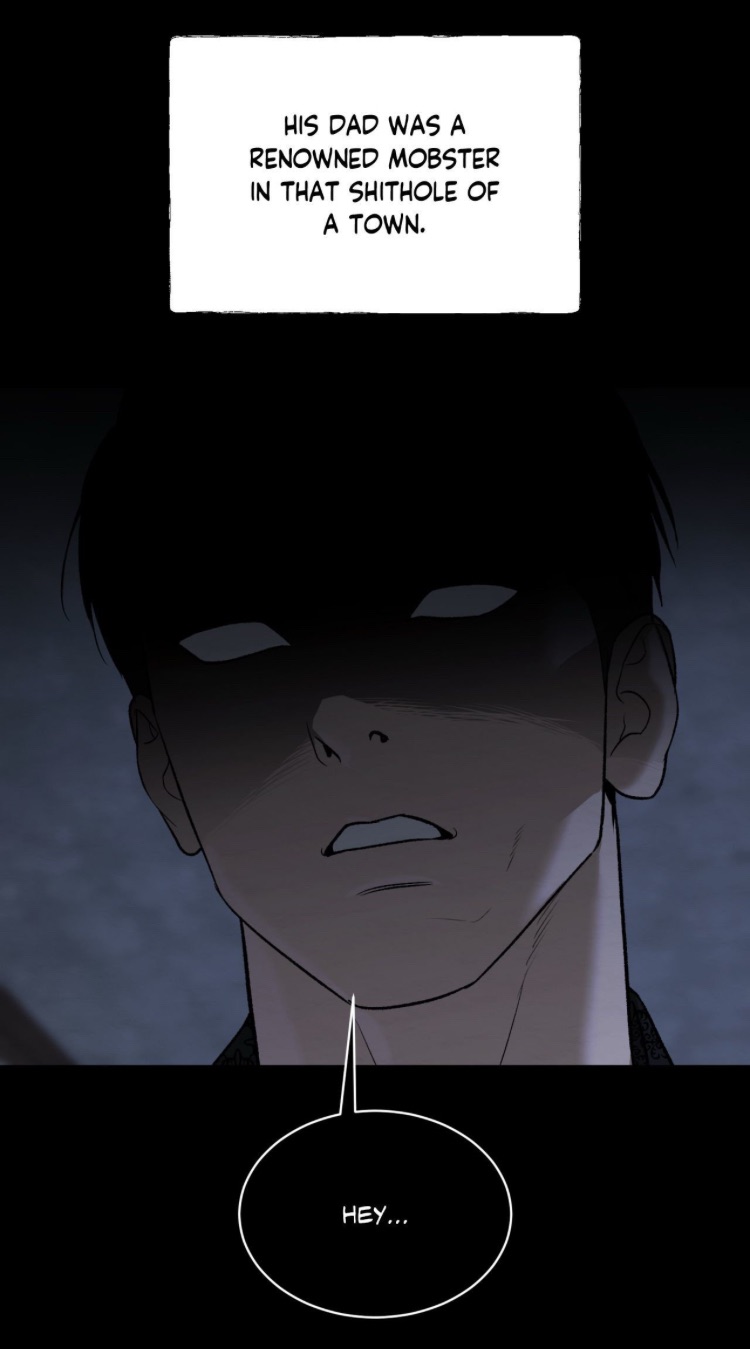 (chapter 73) — all were rewritten into a story where the woman was the sole traitor, and the child nothing more than her extension. In this way, the boy was denied recognition as a victim in his own right. He had been abandoned too. He had been abused either. He became instead a mirror in which his father projects the wound of being left behind.
The tragedy is that this was Jaekyung’s first attempt at self-assertion in front of his father, his first voiced wish as a child. (chapter 73) And yet it was met not with listening and understanding, but with condemnation and mockery! 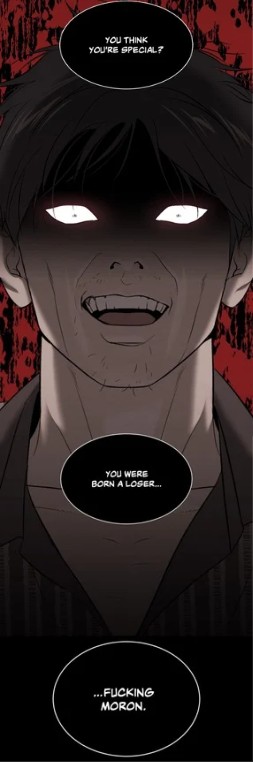 (chapter 73) Why? It is because the father didn’t trust him, as he didn’t trust himself either! Because the father attacked him verbally, the boy replied in kind — escalating words he would later regret.
  (chapter 73) The cycle of reproach was sealed. From that moment on, he understood the danger and the destructive weight of words.
 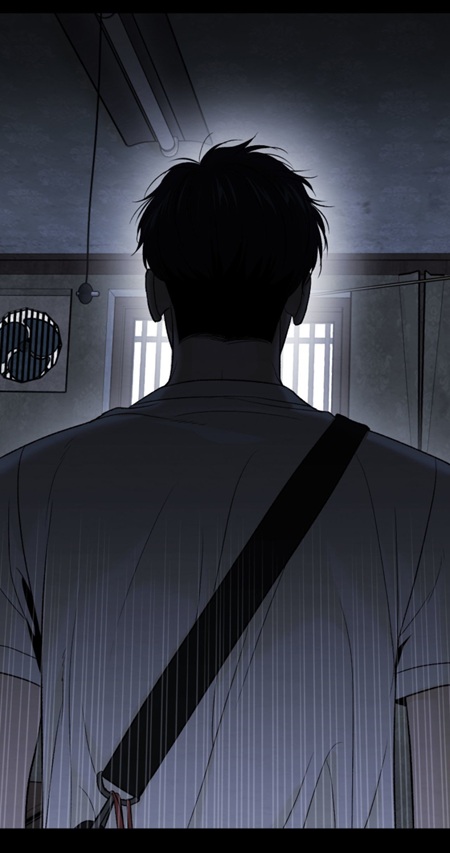 (chapter 73) To speak was to wound, to be wounded in return. Besides, the boy could never speak of this truth. He carried the memory of that last conversation in silence, crushed by the belief that he bore guilt for his father’s death. Shame and responsibility bound his tongue. That is how words, once used against him as weapons, became impossible for him to wield in his own defense. However, this was only the beginning of his withdrawal into silence. His fists would become his language, his body the only safe instrument of reply.
In the end, the father was betrayed — not only by his wife, but by himself. (chapter 73) For in his world, there was no place for we, no place for a family. By reducing every bond to reproach and violence, he erased the very possibility of belonging. His after all thus becomes the verdict on his own life: a man left alone, responsible for his own misery. He complained the absence of gratitude from his son, while he had done nothing for him. 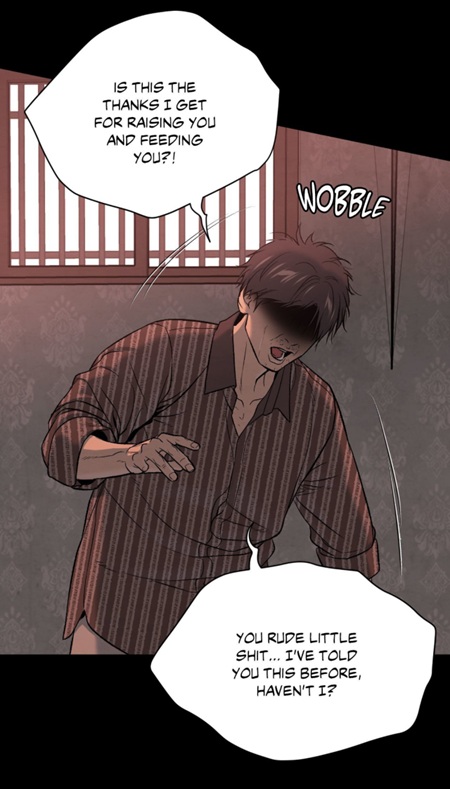 (chapter 73) The betrayal he lamented was nothing more than the logical outcome of his own principle. There had never been a we — only a man clinging to his pride, a woman turning her back, and a child caught in between. His after all (chapter 73) exposes this rupture: instead of binding father and son, it isolates them, placing Jaekyung outside of any shared identity. By calling him “your mother’s son”, he does not recognize the boy as his own. The word becomes a substitute for “we,” a marker of distance rather than union. He also denies the very identity of his son: the boy is reduced to a reflection of the mother, and nothing more. In this moment, the child is stripped of individuality, framed only as an echo of the parent who had already left. For years afterward, this wound silenced him — until much later, when a reversal finally emerged. When Jaekyung embraced his fated partner, the words that rose within him began not with after all but with before I (chapter 70). Only then did he speak again as a person in his own right, expressing a wish unshaped by the verdicts of adults or the weight of guardianship. Thus he expressed his thoughts and emotions through the body.
The Mother’s Excuse
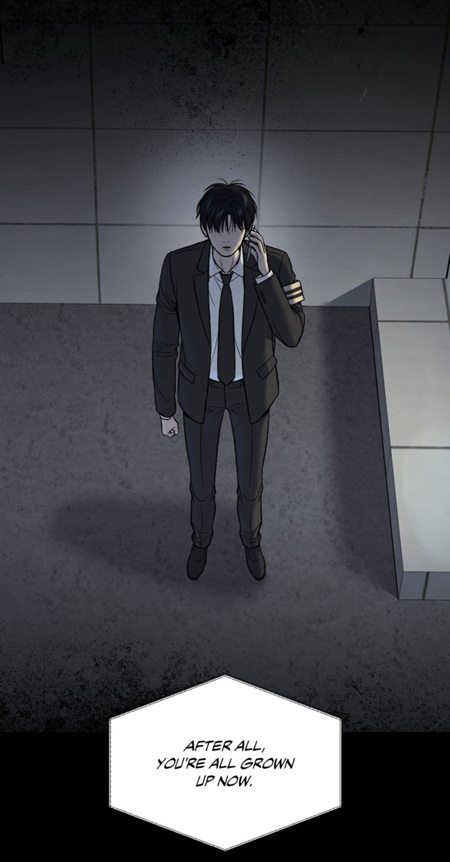
And it is precisely here that the mother enters the stage. If the father used after all to erase his own guilt and deny the possibility of togetherness, the mother confirms that distance with a final gesture (chapter 74) — not by facing her son, but by cutting him off, hiding behind a phone call and a single merciless click. 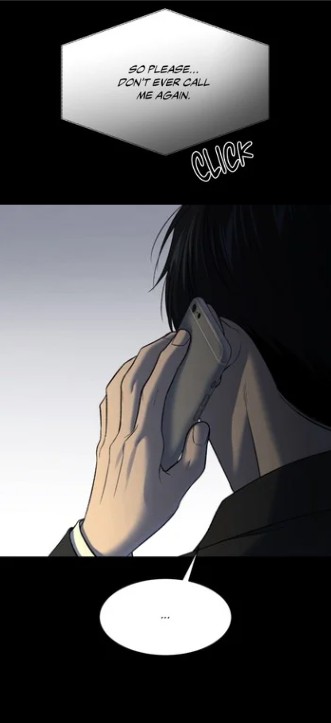 (chapter 74)
The scene is loaded with irony.  (chapter 74) In the past, the boy had dialed her number from the same public booth
 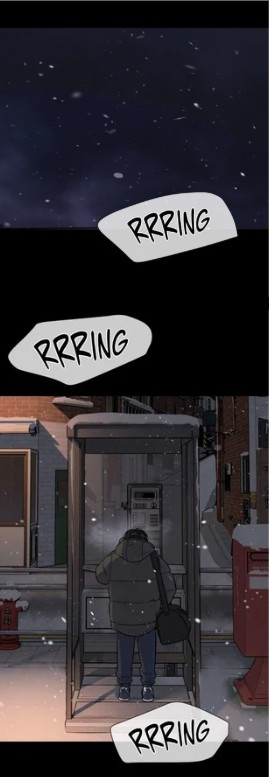 (chapter 72), clinging to the hope that she might answer one day. Eventually, those attempts ceased — but not the attachment. What remained was the number itself, saved under “Mom” on his phone
  (chapter 74) Here, he was old and rich enough to buy his own cellphone. The phone number was no longer a channel of communication, only a relic: a fragile thread he could not sever, because the fact that she never changed her number sustained the illusion that reunion was still possible. That dormant hope was shattered only when she finally picked up — not out of recognition, but by mistake, assuming the unfamiliar call must be important.
 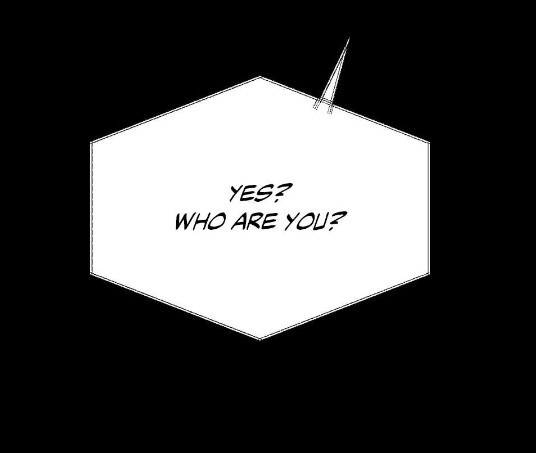 (chapter 74) And so, after years of silence, his voice reached her at last.
What followed crushed him. She did not yell like the father; instead, she cloaked her rejection in polite detachment: “ (chapter 74) repeating “please” twice — not out of kindness, but because he had become a source of threat to her new life. (chapter 74) Her words, “please never call me again,” sealed the door he had long believed ajar.
What once seemed like a lifeline is revealed as evidence of her selfishness and cowardice (something I had already outlined before in The Loser’s Mother: Fragments of a Mother), and the unchanged number, which kept him hoping, now exposes her duplicity. This is why remembering his past will not only free the champion, but also help him to move on. At the same time, it also set in motions a quiet karmic reckoning for the “mother,” whose very act of leaving the number unchanged betrays her. Interesting is that Joo Jaekyung is exactly like his mother: he has not changed his damaged cellphone and number either!!  (chapter 66)
Her words presented abandonment as if it were a mutual choice (chapter 74), an agreement between equals. Yet, nothing could be further from the truth: the child had no choice, no power. Worse still, she used his own earlier words against him — the part-time jobs, the savings he had scraped together in order to welcome her back. Since he had money, he could keep living on his own. What for him had been a desperate declaration of love, for her became justification to let go: he was, in her eyes, already independent, already “grown-up.” (chapter 74) Only then comes her final blow: “After all, you’re all grown up now.” The position of after all here is crucial. (chapter 73) Unlike the father, who spat it at the end of his sentence as a weapon, the mother puts it first, as if it were the very foundation of her reasoning. Placed at the front, it functions like a gatekeeper — a barrier the son cannot pass through, because everything that matters has already happened before him.
In other words, she uses time itself as her excuse. (chapter 74) By saying after all, she makes his age and the passing years the justification for her betrayal. She turns maturity — the result of neglect and abandonment — into a pretext to abandon him further. In her mouth, time is not a healer but an alibi. For him, however, time is the enemy. Every night of waiting, every unanswered call accumulates into a debt that cannot be repaid. This is why, years later, Joo Jaekyung has been racing against time — as if by moving fast enough, by piling victory upon victory, he could undo the stillness of those years when nothing came back to him. His obsession with routine, with never stopping, mirrors the silent cruelty of her after all: if she made time the reason to let go, he would make time the proof that he never let go.
Here, the phrase does not simply refer to his age. All encompasses the totality of what she has built without him: her remarriage, her new family (her second child whom she calls “dear”), her wealth, (chapter 74) her present comfort. He stands after all of this — chronologically, emotionally, socially. In her reordered life, the child who once clung to her is relegated to the back of the line, behind every new bond she has chosen to recognize.
And yet, before uttering after all, she cloaks her rejection in seemingly gentle words: “Please understand… let’s just go our separate ways.” (chapter 74) At first glance, the sentence suggests civility, as if both parties had been walking the same road until now. But this is the deception. In truth, she had abandoned him long ago. This “family” (“our”) only existed in the boy’s mind, a dream born from her lies. For the mother, this “family” was already dismantled and replaced; for him, it was the one thing keeping hope alive. By phrasing it this way, she rewrites history, disguising her betrayal as a fresh, mutual decision rather than an old wound that never healed. The implication is that nothing was broken before — that only now, as adults, they might choose to part.
In doing so, she not only denies the rupture of the past, she also erases the promise that once tethered him to her. Why else would he plead,  (chapter 74) unless she had once suggested that possibility? His words reveal that he had been clinging to a seed she planted long ago, a future she quietly abandoned while building a new life elsewhere. And what was that seed? Not just her vague suggestion that “once they have money”, or
 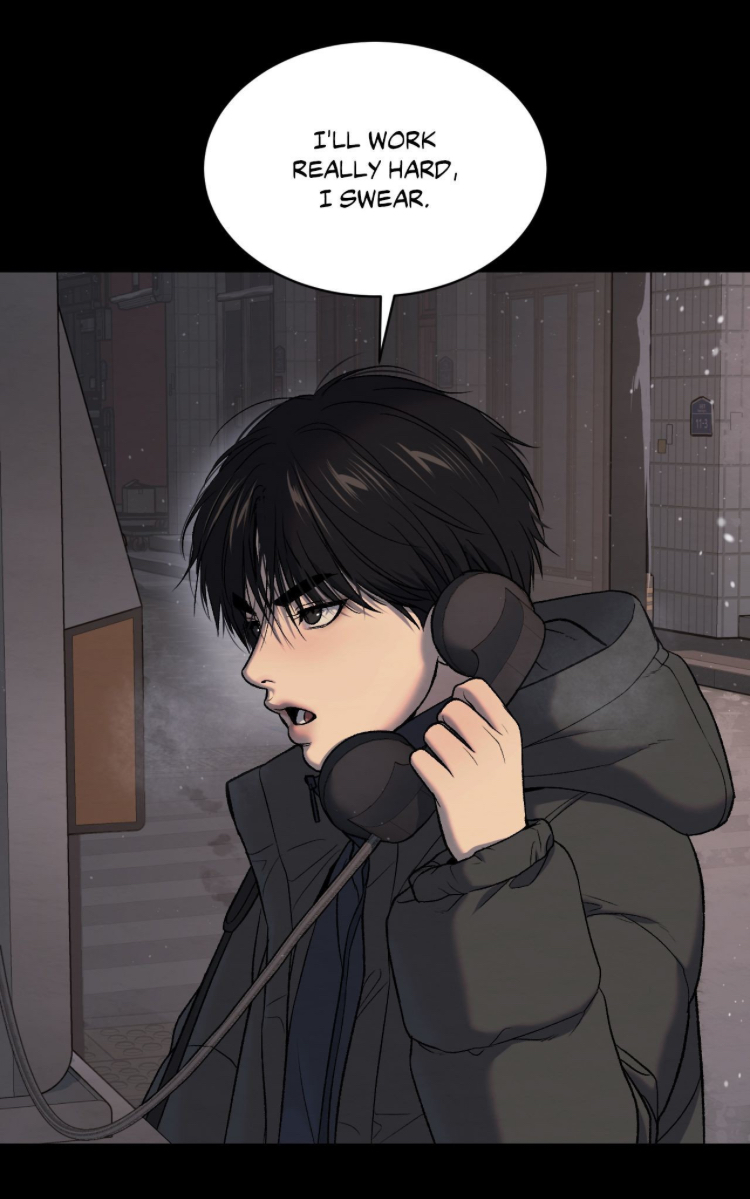 (chapter 72) “the father no longer represents a menace to her” but the very fact that she gave him her phone number. To a child, that number was more than digits on a page — it was proof of connection, a lifeline, an assurance that she could be reached, that she might one day answer.
But in reality, the number was a cruel illusion. She never changed it, which prolonged the fantasy that she still cared, that reunion was only a call away. Yet when the call was finally answered, it revealed not hope but finality. The “click” of her rejection was as violent as any blow from his father — the sound of a door closing forever.
Thus, her rejection is doubly violent: it crushes his final hope, that’s why the boy cried for the last time. 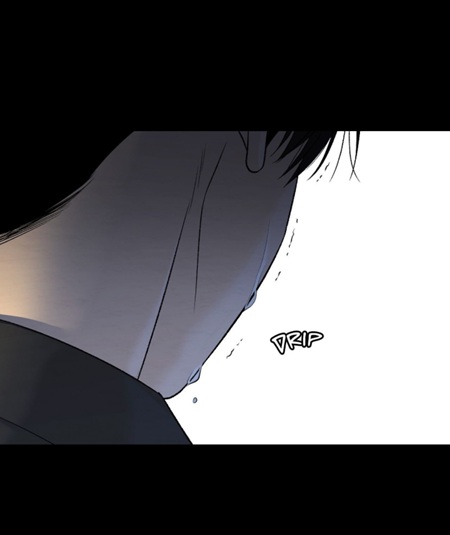 (chapter 74) Furthermore, it gaslights him into believing that the abandonment never occurred — that the break is only beginning now. (chapter 74) The repeated please underlines her fear: he is not a son to welcome back, but a threat to the fragile world she has constructed without him. She has a lot to lose!
The irony (chapter 73) (chapter 74) is merciless: in just three letters, all hides the immensity of his suffering —  (chapter 72) neglect, starvation, abuse, loneliness, betrayal — and yet the parents invoke it not to acknowledge his pain, but to hide their wrongdoings (justify their betrayal) and as such their failure! By placing after all at the front of her sentence, (chapter 74) the mother tries to turn the page unilaterally, as though this single phrase could close the chapter for good. It is not dialogue but dismissal, a way of shutting down the past before her son can reopen it. In other words, it’s a verdict too disguised as an excuse!
Placed at the end of the father’s sentence (chapter 73), after all erupted in the heat of reproach — spontaneous, yes, but no less destructive. It was triggered by his wounds, by the memory of betrayal he could not bear. Yet even in its impulsiveness, it carried no apology, no trace of self-reflection. Like the mother, he used the phrase as a verdict, not an opening — a way to wound, not to reconcile.
By contrast, the mother’s after all sits at the beginning of her sentence, cloaked in calm reasoning, stripped of any trace of spontaneity. Where the father lashed out, she closes off. Joo Jaekyung is now trapped between these two “after all”: one erupting in rage, the other draped in reason. Together they form a prison of words where apology has no place and the child’s voice is nowhere to be found. No wonder why the celebrity has never apologized to doc Dan in the end. At the same time, it explains why after this phone call, Joo Jaekyung had nothing to “lose”. The adults had destroyed the child’s soul and heart.
For Joo Jaekyung, there is no way back from this sentence. With ‘after all, you’re all grown-up now,’ his mother denies him the right to still be a child in need of care. ”After all”, he can also not deny his ties to her. His origins and even time itself become his enemies — he can never rewind, never reclaim the place of the baby who once clung to her. Her words brand him as someone beyond help, beyond nurture, beyond belonging. What she frames as maturity is, in fact, abandonment dressed as inevitability. The problem is that she is still alive. Unlike the father (dead) or the director (dying), she cannot escape judgment — not from her son, nor from others. By keeping the same phone number for years, she left behind proof of her continued existence. She could have fetched the boy at any moment, but she never did. Her responsibility doesn’t end simply because she decided to draw a line. (Chapter 74) Motherhood is not dissolved by a polite “please” or by a remarriage. She cannot erase this fact, however much she hides behind a new family or a change of circumstances. In this sense, the father’s words return as a curse for her: the truth of origin cannot be undone. The author is already implying this notion through narrative details.
The story itself shows us how enduring such responsibility is. 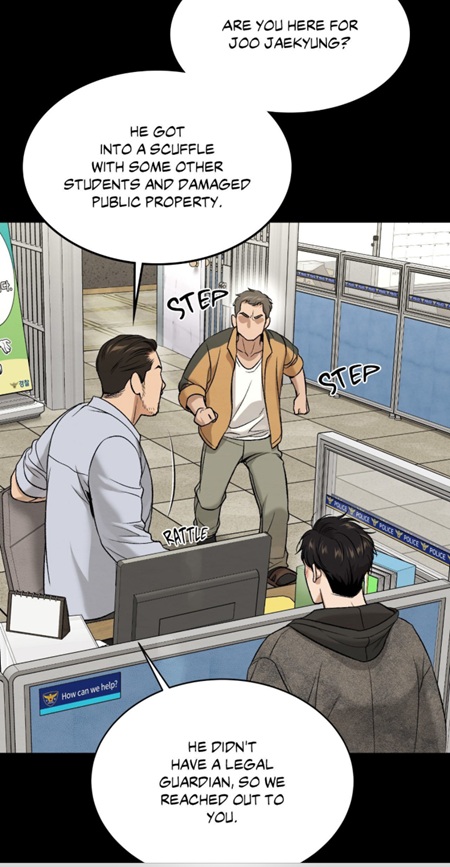 (chapter 74) When the boy once caused trouble, the police looked for Joo Jaekyung’s guardian. In the cutthroat town, they reached out to Hwang Byungchul — not because he was legally responsible, but because everyone knew the boy was close to him (“we”). Guardianship, then, is never erased by silence. Even if you abandon the child, others will still hold you accountable.
And here lies the deeper irony: once Joo Jaekyung left for Seoul, he knew no one there.  (chapter 74) In a city of anonymity, hearsay cannot replace documents. She left a paper trail — a legal identity that binds them together. Should the champion cause trouble in Seoul, or even become the victim of a crime, the police would have to turn to his legal guardian. And that can only be her.
The narrative already dramatizes this irony through the arcade incident  (chapter 26). Oh Daehyun mentions that the young fighter broke the punching machine so many times he was blacklisted. Such destruction could easily have brought police intervention — and if it had, they would have been forced to search for his legal guardian. That guardian is none other than the mother who abandoned him and her new family. In other words, her erasure was never complete: every act of the boy risked pulling her shadow back into the open. Furthermore, this is what Kim Changmin revealed to his friend and colleague:
  (chapter 26) But Joo Jaekyung had long discovered sports and MMA, when he arrived in Seoul and met Park Namwook for the first time.
  (chapter 74) He had left his hometown because of the director’s suggestion.
Chapter 74 exposes the cracks in the narrative first built in episode 26. Back then, Kim Changmin and Oh Daehyun repeated what they had heard: that Joo Jaekyung had once been a troublemaker, a rich, spoiled brat who smashed arcade machines and got into fights — but that in the end, he was “saved” by sports, and especially by MMA and MFC. That’s why he didn’t recognize himself in the introduction: (chapter 26) This story clearly originates with Park Namwook, the manager, who positioned himself and the sport as Jaekyung’s saviors.
But episode 74 reveals the reality behind the myth. The boy wasn’t saved by MFC, nor by Namwook. It was the director, Hwang Byungchul, who intervened, who sent him to Seoul,  (chapter 74) who redirected him before he was swallowed by the wrong path. The discrepancy between these accounts exposes more than just the manager’s manipulation: it points to the shadow of another intervention. How could he afford to destroy machine after machine without consequence? The only plausible answer is the “mother” and her new family, whose money and silence allowed him to pass as the “self-made” Emperor while erasing their own responsibility from the tale. And now, you comprehend why The Emperor was made voiceless. [For more read The Night-Cursed Emperor] Both MFC and the mother had a vested interest in silencing his true origins. For MFC, the myth of the “self-made champion” polished their image, free from any stain of thuggery — no whispers of money laundering, drugs, illegal gambling, or rigged games. For the mother, erasing the child meant erasing her own betrayal. The champion’s past was not only a personal wound but also a liability for others — a truth that had to be buried so that the façade of the Emperor could stand unchallenged. His silence, then, was never a choice; it was imposed, enforced by all those who profited from keeping his story untold. Should he ever speak up, he would expose not only the mother, but also MFC!
Because of episode 74, I came to resent the mother even more than before. She not only abandoned him twice, but toyed with his feelings. By answering once, she allowed his hope to flare up — only to extinguish it immediately. The phone that symbolized connection became the very tool of execution, its click as violent as the father’s punch. And just like her husband, she deceives herself. She imagines she can cut off ties completely with a single sentence, but until her death she remains legally and symbolically his mother.
The two after alls function like iron bars: one forged in the father’s rage, the other in the mother’s reason. Together, they create what you called a prison of words — a place where the boy cannot speak, cannot be heard, cannot be recognized. From that moment, he is not only abandoned but linguistically erased. His origins are denied, his childhood revoked, his future disowned.
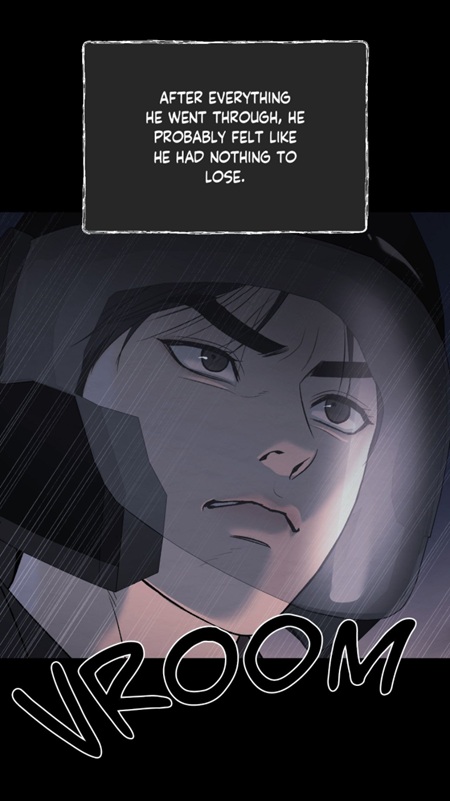
And so, after the phone call, it is no wonder that Joo Jaekyung believed he had nothing left to lose. The boy’s heart had already been gutted; the rest of his path was merely survival. If he “went the wrong way,” it was because the adults had already led him there, sealing off every other route. They had destroyed the child before the teenager even had a chance to build himself.
This prepares the ground for the transition to the director: if his parents’ after alls built the prison, then Hwang Byungchul is the figure who becomes the witness of that imprisonment. Unlike them, he doesn’t openly wound with words — but his silence, his blindness, and his refusal to protect the boy make him complicit. He becomes the guard outside the prison walls.
The Director’s After Everything
When Hwang Byungchul says (chapter 74), the breadth of everything seems, on the surface, to acknowledge the sheer weight of Joo Jaekyung’s suffering. The word is heavy, expansive, suggesting years of accumulated pain, betrayal, and neglect. Yet, paradoxically, this very expansiveness is also a way of avoiding precision. By collapsing starvation, countless humiliations, abandonments, and traumas into a vague everything, the director sidesteps naming the concrete betrayals he himself witnessed. His silence here is telling: he cannot bring himself to articulate the parents’ cruelty, nor his own passivity in letting it happen. In front of the doctor, he had admitted himself that he had not raised him: 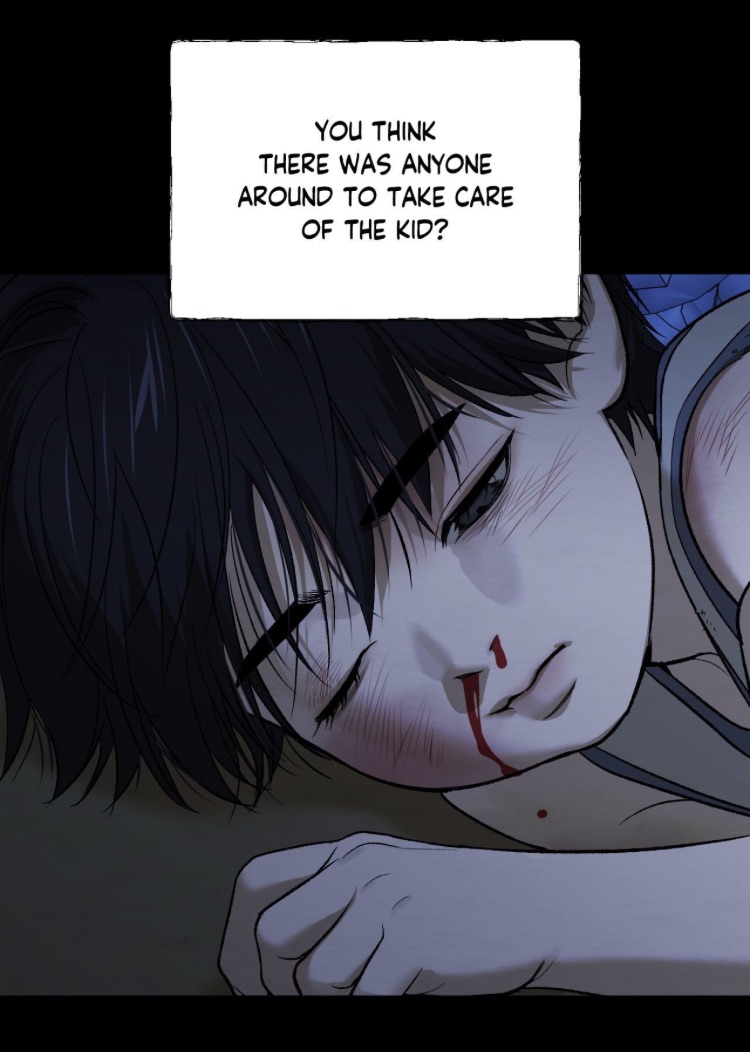 (chapter 74) For doc Dan who embodies the present, such a statement can only become the ultimate truth: the star had been an orphan like him.
Moreover, his next word — probably — betrays another form of distance. If he truly knew how the boy felt, if he had ever asked or listened, there would be no need for such hedging. Probably admits that he never entered the boy’s inner world, never gave him the space to voice his despair. It is the language of a bystander, not of a guardian. In fact, this hesitation exposes his complicity: Joo Jaekyung “went down the wrong path” not only because of the parents’ abandonment, but also because the one adult who remained nearby chose observation over intervention. 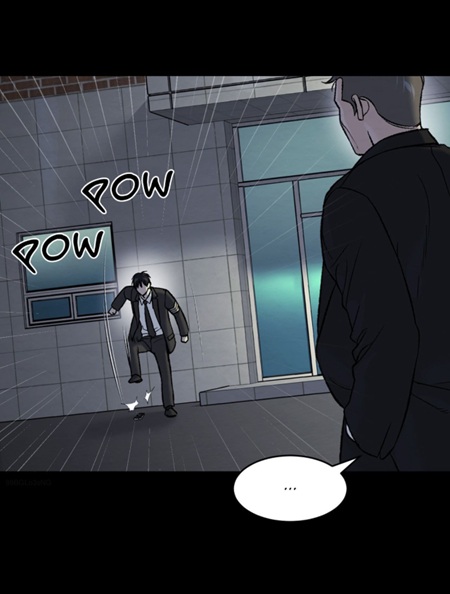 (chapter 74) At the moment when Joo Jaekyung shattered the cellphone, Hwang Byungchul was not by his side but standing at a distance, directly in front of him. This means he must have seen the boy’s face — the tears, (chapter 74) the trembling hands, the rage that barely concealed heartbreak. He did not need to overhear the mother’s words; the child’s body language told the story with brutal clarity. (chapter 74) In that instant, the director could have stepped closer, offered consolation, or simply acknowledged the wound he was witnessing. Instead, he kept his distance, both physically and emotionally. He refused to assume a role as legal guardian.
The same pattern repeats at the father’s funeral. 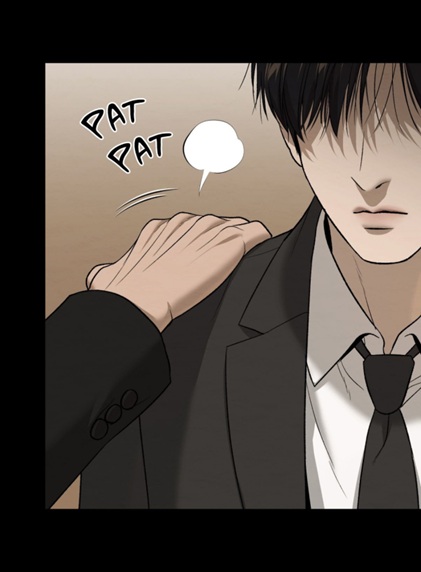 (chapter 74) Once again, the director was there — but his presence was mute. He placed a hand on the boy’s shoulder, yet he never lent him an ear. He never invited the boy to speak, never created a space where grief, anger, or longing could be put into words. In other words, he was present in body but absent in voice and heart. Thus the director’s pat was a gesture of pity. It was a substitute for words, a way of saying “poor boy” while protecting himself from deeper involvement. But precisely because he withheld speech and listening, it denied Jaekyung the chance to articulate his own grief. It comforted without connecting.
This silence is not neutral. By withholding words, he deprived Jaekyung of language at the very moment he most needed it. A child learns to process suffering by speaking it into existence and having someone else respond. Denied this, Jaekyung internalized the pain wordlessly — forced to embody it through his fists, through destruction (chapter 74), through fighting. Thus the director’s quietness, his refusal to engage, became a formative wound in itself. He chose the safety of distance over the risk of involvement, and in doing so, left the boy’s cries unanswered.
Thus, the director’s after everything is double-edged: it gestures at recognition, but functions as concealment. He names the boy’s burden while sidestepping his own. What sounds like empathy is, in truth, pity — a way of acknowledging suffering without engaging it. It allows him to speak about Jaekyung’s pain while avoiding both the betrayal he witnessed and the silence he himself maintained. In this sense, after everything is less an opening than a shield: a phrase that distances him from responsibility under the guise of compassion.
And because the boy had no one by his side that night, he concluded he had nothing to lose. Stripped of home, voice, and care, he stood in a void where even those who should have protected him kept their distance. The director’s silence, his refusal to step in or give the boy an ear, reinforced the sense of abandonment. Far from steering him away, this absence of guidance nudged him toward the wrong path. In this way, the man who might have been a safeguard became instead a silent accomplice to the boy’s fall. Hence he put the blame on the main lead.  (chapter 74)
Hwang Byungchul was called to the police station in order to correct his past wrongdoing.  (chapter 74) He was given a chance to step in, to finally become the guardian he had failed to be on the night of the boy’s deepest collapse. Therefore it is no coincidence that he claims to have raised him, while the readers are well aware of the truth.
  (chapter 74) Yet the way he handled the moment revealed the full extent of his contradictions.
The director was never one to turn his back on Joo Jaekyung. (chapter 74) He always faced him, 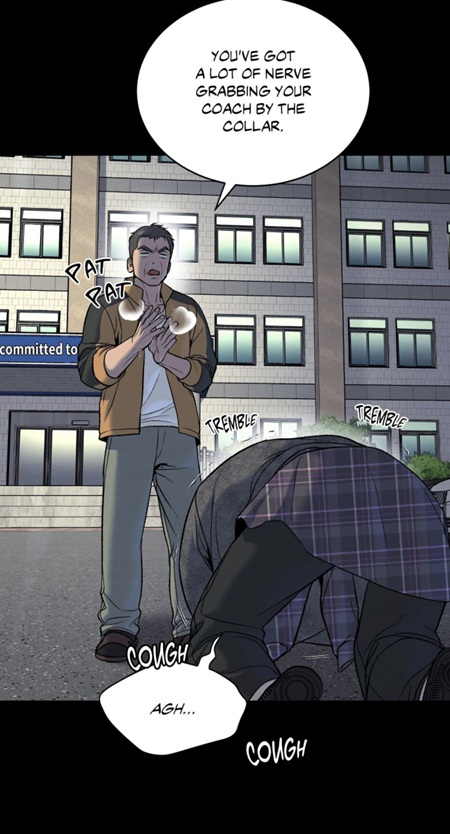 (chapter 74) or sometimes stood beside him, kept him in sight. On the surface, this could seem like loyalty, but in truth it was another form of failure. Facing him head-on meant constant confrontation, constant judgment. His presence was physical, but never protective; it was discipline, surveillance, not refuge. He never had his back!!
Instead of offering himself as support, he wielded the parents as weapons.  (chapter 74) The father was dragged into memory as a warning: “Do you want to end up like him?” The mother, already gone, was turned into a conditional model: “Would she even want to live with you if she could see you now?” In both cases, the boy was denied his right to grieve. His parents were not mourned, but transformed into instruments of discipline. He was forced to run from one shadow and to chase another, leaving him no space to simply exist. The director maintained the future champion trapped in the chains of the past.
This strategy erased the present. Jaekyung’s worth was always defined against the dead or the vanished, never in who he was here and now. It was never about him!! Happiness, stillness, or pride in the moment were impossible; only punishment and striving remained.
When the director invoked the mother again that night, it exposed his blindness.  (chapter 74) For him, she was a symbol — fuel for perseverance, as he was projecting his own mother onto the boy’s! For the teenager, the mother was the deepest wound. By naming her, the director imagined he was motivating; in reality, he was tearing it open once more. But how could Jaekyung reveal the truth — that his own mother had rejected him, not just once, but twice? To admit this would have been to confess that the hope she dangled before him, the dream of reunion, had been nothing but a cruel game. His silence was not pride but a shield, for voicing it would mean exposing that even his mother’s love had been counterfeit.
 (chapter 74) Thus his silence was not indifference but defense: he was protecting her name, even when it burned him to do so. In shielding her, he also buried himself.
And the director used this hesitation to his own advantage. This shows that Hwang Byungchuld had no intention to listen. He answered with his fist right away. The punch to the chest crystallized his stance: discipline over empathy, control over dialogue. What he offered was not guidance but force, unwittingly echoing the very violence of the father he condemned.  (chapter 74) That is how another pattern emerges: every exchange the boy endured was never true conversation, but always structured as an argument or a challenge. Even here:
 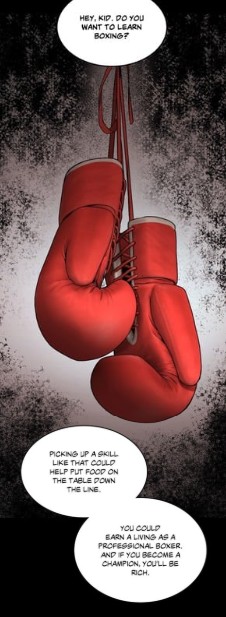 (chapter 72) At home, his father turned dialogue into a bet — a contest of strength where affection was absent and only victory mattered. Later, in front of the police station, the director reproduced the same pattern: invoking the mother not to console, but to provoke, to test, to challenge. In both cases, words became weapons. They did not open space for Jaekyung to speak; they cornered him, forcing him either to resist or to submit. This explains why in season 1, the two protagonists had similar interactions.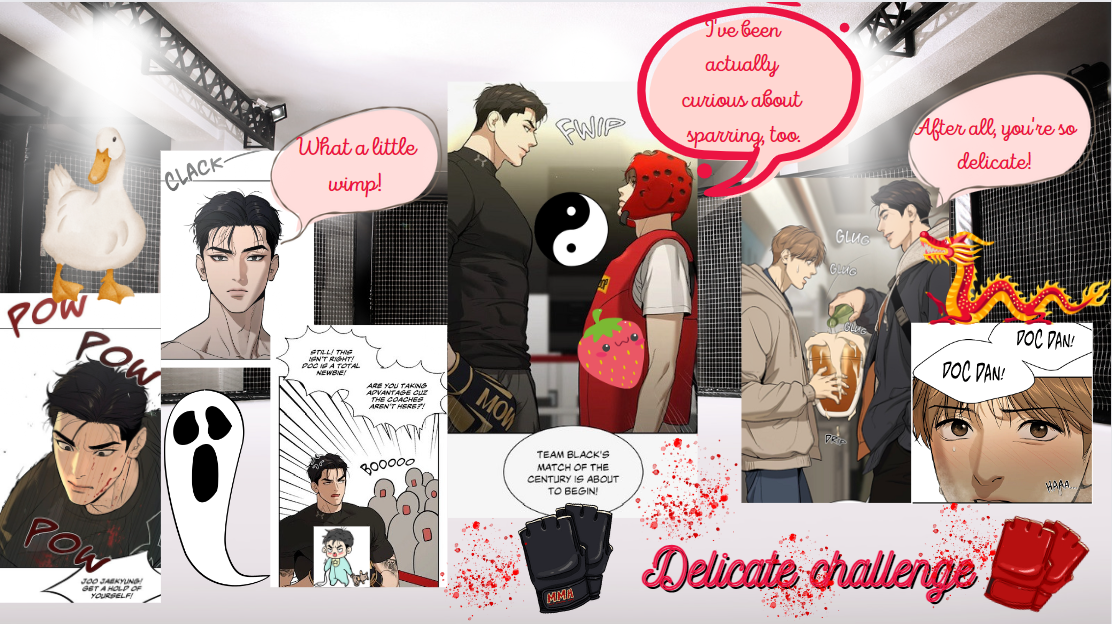
Thus when the boy lashed out and the director struck him, the failure was complete. He had been given a chance to correct the past — to be a guardian rather than a spectator — but instead he repeated the cycle. His discipline came without empathy, his presence without listening. In the end, he did not save the boy from the wrong path; he helped push him further along it, for MFC is strongly intertwined with crimes.
However, the argument followed by the punch seems to have functioned as a wake-up call for the director as well.  (chapter 74) For the first time, he shifted ground and no longer invoked Jaekyung’s parents as warnings; instead, he summoned the memory of his own mother. After everything she had done for him, he insisted, the boy should repay her sacrifice by leading a better life. Yet here again the same logic returns: time weaponized, gratitude demanded, obligation imposed. What might have been a tender remembrance of maternal care was turned into a debt-ledger pressed onto Jaekyung’s shoulders.
  (chapter 74) For him, discipline was always bound to her presence, her food, her care, her silent labor that sustained the gym. By invoking “the mother” as a motivator, he was, in truth, repeating the only model of loyalty and endurance he had ever known. But this was borrowed authority, not Jaekyung’s. What may have given the boy a flicker of purpose in the moment — to endure, to fight “for her sake” —
  (chapter 74) could not last. It was never his voice, never his wound being acknowledged. It was an external script imposed upon him. And so, over time, that imposed motivation faded, eclipsed by the title and the money.
  (chapter 54) The director’s form of guidance could not sustain him; it was external, borrowed, conditional. Therefore, it is not surprising that he was never contacted after the main lead’s departure for Seoul. By then, the director had already become like his own mother — reduced to a memory
  (chapter 70) and nothing more. He neither possessed the boy’s number nor showed the desire to stay connected; worse, he had told him explicitly never to return.
  (chapter 74) Through both words and attitude, he conveyed that their paths were to diverge for good. Yet, this was never truly his intentions. In cutting him off so decisively, he enacted the very separation he condemned later. The boy had taken his words too seriously.
Park Namwook’s Lately
If Hwang Byungchul cloaked his failure under the phrase after everything, Park Namwook disguises his own negligence in the word lately.  (chapter 56)
  (chapter 66) His care always comes after, never before. The word itself reveals his stance: he notices change, but belatedly, when damage is already done. The main lead is now escaping his control. And now, you comprehend why PArk Namwook blamed Joo Jaekyung and slapped him at the hospital.
 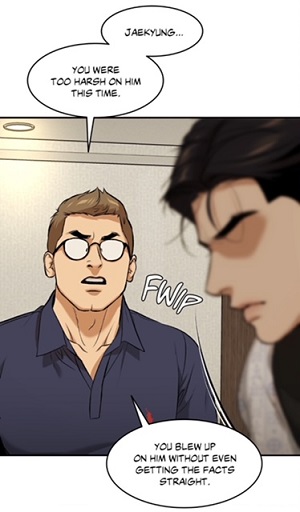 (chapter 52) That way, he could divert attention from the “before and circumstances”. And in season 2, the man hasn’t changed at all. Instead of asking what caused Jaekyung’s crisis, he chides him for straying from the routine — for not showing up at the gym, for being absent.
This exposes the essence of Namwook’s guardianship: reactive, not proactive. He does not anticipate storms; he waits until they break and then demands the champion hold himself together. In this way, his “lately” becomes the twin of “after everything.” Both phrases externalize responsibility. Both erase the speaker’s complicity in the boy’s suffering and downfall. Both subtly suggest that the fault lies with Jaekyung himself  (chapter 52), either for not rising above (after everything) or for drifting from his prescribed path (lately).
But the crucial difference is that the boy no longer remains silent. With Namwook, for the first time, Jaekyung voiced his emotions.  (chapter 52) The slap at the hospital was more than a physical outburst; it was the eruption of long-repressed truth. Where he once swallowed pain in silence for his mother, and later endured fists in silence for his coach, here he answers back. Lately thus marks not only Namwook’s delay but also Jaekyung’s refusal to bear the weight alone anymore.
 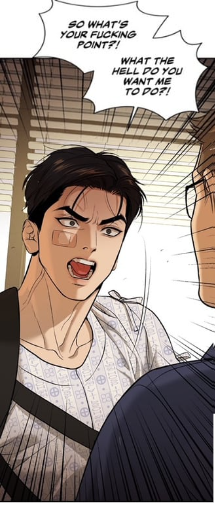 (chapter 52)
The paradox is sharp: Namwook embodies all three guardians at once — the father’s abuse  (chapter 73), the mother’s silence through the cellphone (chapter 74), the director’s passivity. He is their synthesis, a distorted heir to their failures. Like the mother, he has his own family on the side,
 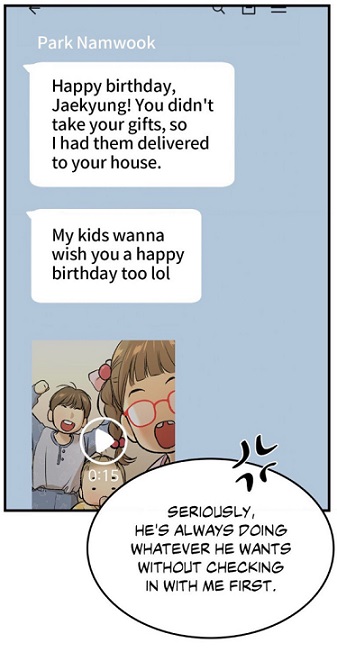 (chapter 45) his true life hidden elsewhere. Like her, he conceals his absence behind a phone call, creating the illusion of presence without truly standing by the boy.
  (chapter 45)
Hwang Byungchul and Park Namwook echo the same blind pattern: they fault the fighter for straying (chapter 52) 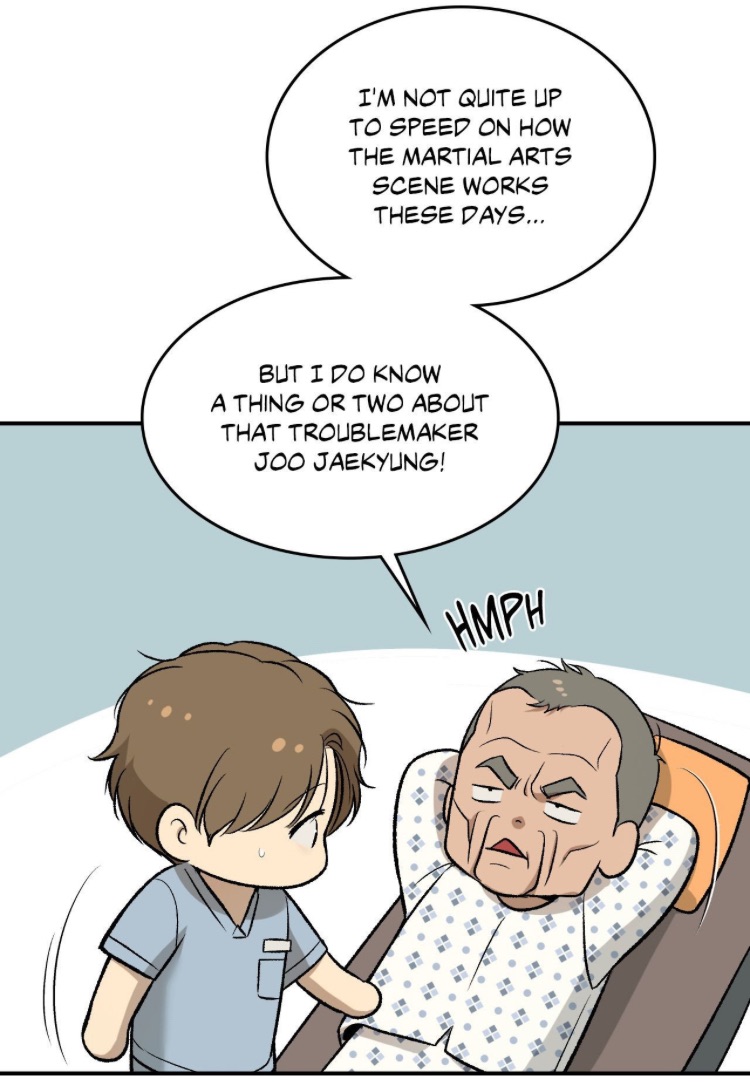 , (chapter 70), while remaining oblivious to the rot within their own world and the medical world. The director accused Joo Jaewoong of “choosing the wrong path,”
  (chapter 74) never admitting that boxing itself was already entangled with the underworld. Likewise, Park Namwook reproached Joo Jaekyung for the mess, while in reality he had been a victim. The incident with the switched spray was reduced to two people: doc Dan and Joo Jaekyung. Funny is that by invoking lately and after all , they have the impression that delayed blame could substitute for real support. Both stand as authorities who issue reprimands only once the harm is irreversible—always too late, always at a remove. In doing so, they preserve the illusion of responsibility while avoiding the real corruption at the core of their institutions. They deny the existence of “victims”. By doing so, both Hwang Byungchul and Park Namwook sustain the illusion that the system itself is clean, and that all fault lies with the individual fighter. In their eyes, there is no exploitation, only bad choices. This explains why the CEO’s fabricated apology disturbed Namwook
  (chapter 69): for the first time, a figure of authority assumed responsibility, however insincerely. What to others looked like shallow PR, to Namwook appeared as a dangerous break with the rule of denial. It highlighted the emptiness of his own guardianship, where reproach replaces protection and victims are erased from the narrative.
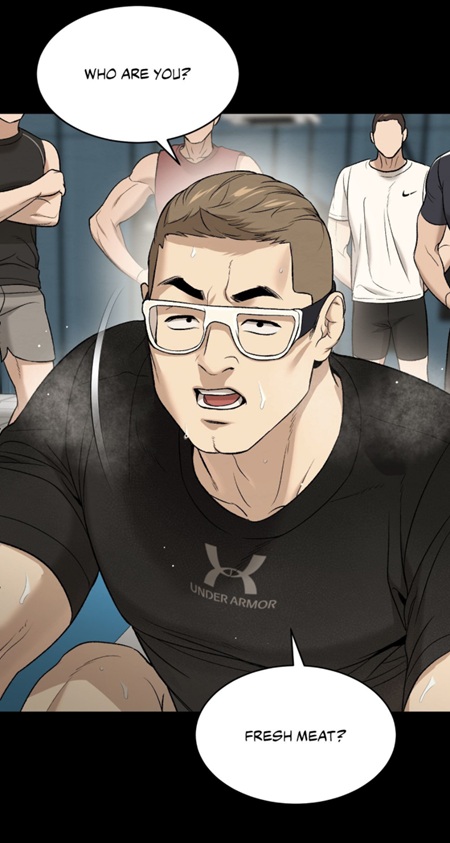
This is why the expression lately becomes so important. With it, the manager pretends to care but really reveals distance. He notices changes but reacts belatedly, hoping the boy will revert to the old champion who endured everything. “Lately” is less concern than crisis delayed, a signal of his failure to respond in time. Instead of seeing the broader corruption of MFC, the scheming of rivals, or the weight of past trauma, Namwook shifts the blame onto the champion himself. The reproach he delivered in the hospital — his version of a slap — confirms this change. For the first time, Joo Jaekyung answered back, voicing emotions rather than swallowing them.Yet unlike them, he faces a Jaekyung who has begun to change. The boy he could once manipulate through reproach and delay now resists, signaling that the cycle of belated guardianship may finally fracture. This means that the very first meeting between Joo Jaekyung and Park Namwook in episode 74 is already announcing the end of their “collaboration.” 8chapter 74) His first words expose his true nature: ruthless and blindness. For him, Joo Jaekyung was just a fresh meat. The latter is not recognized as an individual and human. And if he remained by the manager’s side for many years, by recollecting their past, the main lead should recognize how the “wrestler” started distancing himself from the “boy”. At some point, he got married and got three kids…
Moreover, from the beginning, the manager could never be more than a placeholder, because Jaekyung would not remain his “boy” forever. By recalling their past interaction, the champion can now recognize that Namwook was never truly part of his life. Why? Because after all — the language of the “guardians/adults”— is tied to the night, the moment of deepest loneliness and loss. (chapter 73) (chapter 74) (chapter 74) The night represents what Jaekyung has always been missing: not training, not discipline, but a home where warmth endures after dark. A place where he can expose his vulnerability and be himself! 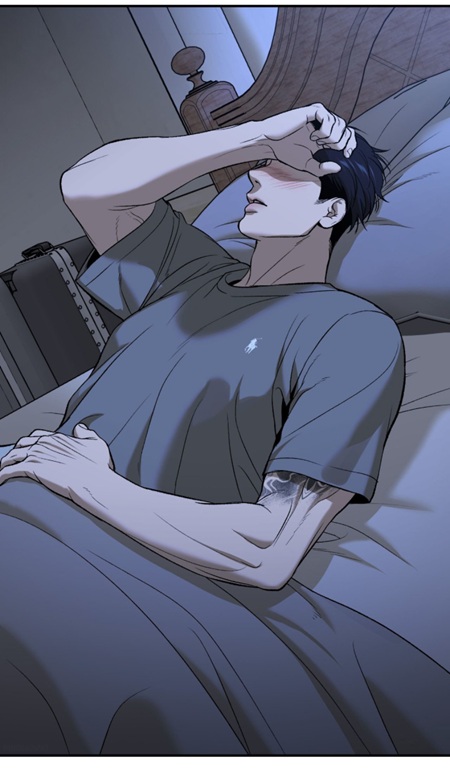 (chapter 74) Honestly, it would be funny, if the champion used the same words than his own mother against the manager (chapter 74) and this would take place because of a cold!! Another possibility is blocking his number. It would close the circle of abandonment, but this time he would be the one in control. The irony is sharp: what once marked him as powerless and discarded becomes a tool of emancipation. Instead of being silenced, Jaekyung would be the one drawing the boundary, declaring that the “family” Namwook pretended to provide was nothing but an illusion.
And if this scene were triggered by something as simple as a cold, the irony deepens. A cold is usually dismissed as trivial, but for Jaekyung it would symbolize care denied. Nobody in his childhood noticed his fevers or his wounds — and Namwook, too, is too far away to notice that he is sick. He has always treated sickness as weakness to be hidden or endured, not as a moment to express love and care.  (chapter 70) Thus the manager is confident that the star can return to the ring. By cutting the manager off in such a moment, Jaekyung would be affirming that he no longer accepts neglect disguised as toughness. Both “directors” are trapping the champion in the chains of the past and the future. For them, there’s no present and as such no happiness or fulfillment. Hence Hwang Byungchul is even bored, when he watched the MFC match.
 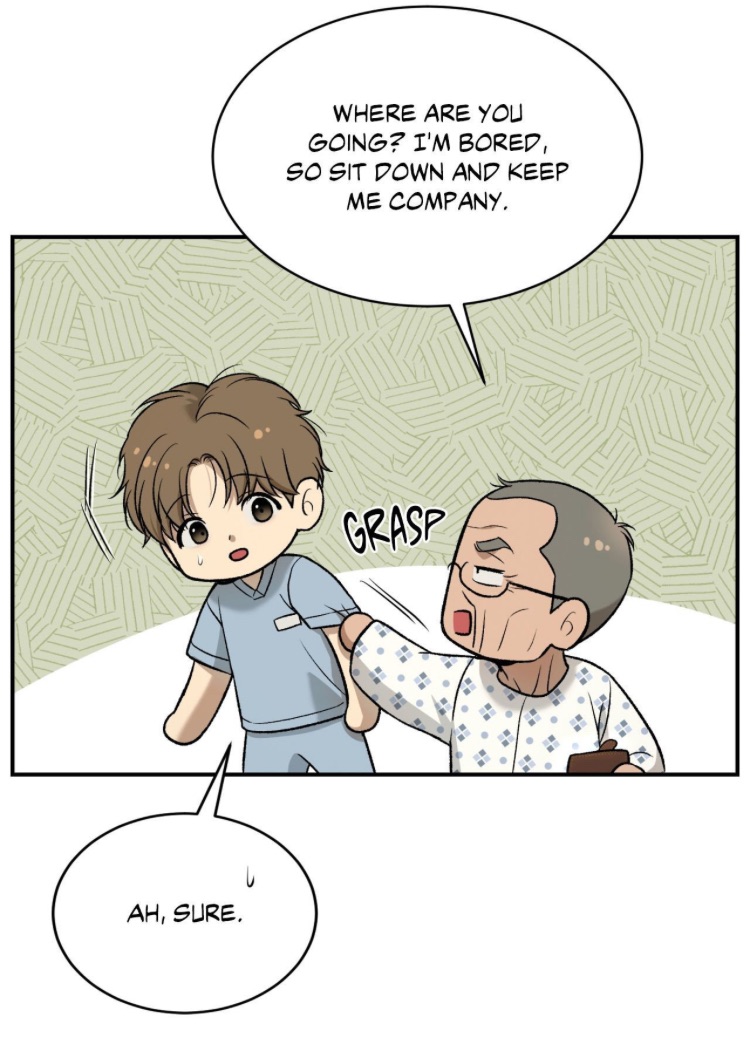 (chapter 71) Deep down, he has been longing for company too. Now, he is finally talking….
 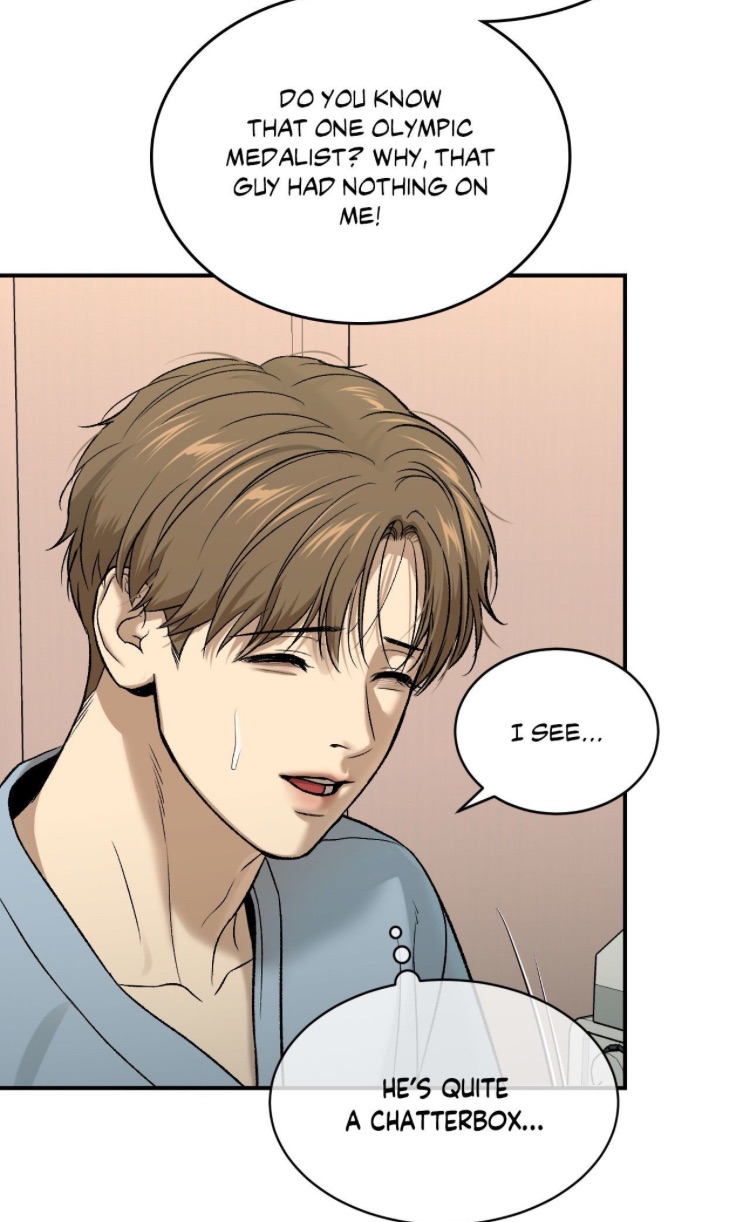 (chapter 70) As you can see, it is never too late… Thus we saw this on the roof of the hospital: a real and intimate conversation between the “guardian” and his pupil:
  (chapter 71) The director has changed!
Shin Okja’s before
And now, you are wondering how the halmoni has been affecting the champion’s life, for the former met the celebrity rather late in her life. If the director’s vocabulary circled around “after everything” and the manager’s around “lately”, the halmoni’s word is “before.” It is the most deceptive of the three, because it does not point to a rupture or a change, but instead dissolves them. Keep in mind what she confided to the main lead on the beach: She presented her grandson as an orphan, right from the start.  (chapter 65) So for someone like Joo JAekyung who suffered from constant betrayals and abandonment, his lover’s childhood must have sounded like a “blessing”. She tells the story of Dan’s life as if he had simply always been without parents. When she recalls, “He grew up without a mom and dad… my heart just breaks for him,” the formulation makes it sound as though nothing was ever lost, nothing was ever taken away — it was simply his condition from the start. Doc Dan didn’t get hurt by his parents through their words or actions.
This is the function of her “before”: to erase abandonment itself. Instead of admitting there was a moment after which Dan was alone, she rewrites the narrative so that he never had parents at all. By doing so, she transforms tragedy into fate. The parents vanish not as agents of betrayal, but as if they never existed. This absolves not only them but also herself: there is no wound to confront, no injustice to name.
This is why her “before” is so insidious. In her version of events, Kim Dan was never abandoned — he was “lucky” to always have her. She erased the loss of his parents by rewriting the story: no trauma, no wound, no victim. Just a boy who had someone by his side. And contrary to Joo JAewoong, the champion’s mother and Hwang Byungchul, she had been gentle and attentive. She had seen him drinking, smoking… she had nagged, but the physical therapist had never listened to her.  (chapter 65) She can appear as the perfect role model in the athlete’s eyes. No wonder why he listened to her and brought doc Dan to a huge hospital in Seoul. But here is the thing….
 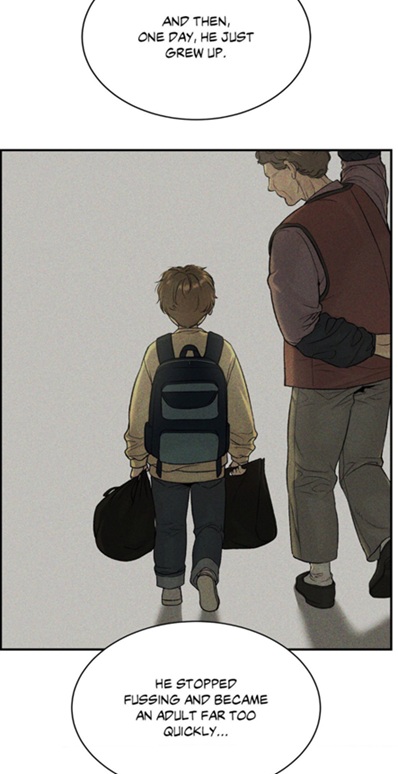 (chapter 65) The grandmother’s narrative culminates in a deceptively simple phrase: “And then, one day, he just grew up.” Unlike after all, which implies endurance, patience, and a long lapse of time, her then one day compresses everything into a brief, almost casual instant. In her telling, there is no slow accumulation of wounds, no process of wear, no history of pain to be endured. The transformation is presented as sudden and natural, as if nothing of significance had preceded it.
This brevity is precisely what makes her before so insidious. She denies the child the depth of his suffering by reducing the entire loss of his parents, his struggles (bullying)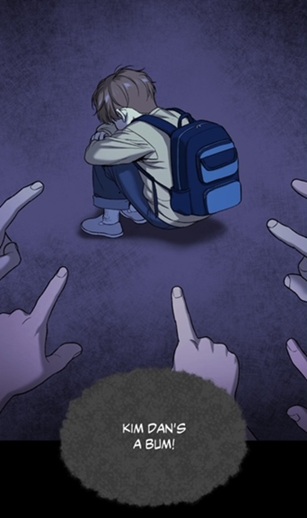 (chapter 57), and his forced maturity to a single, fleeting day. No trauma, no endurance — just inevitability. By collapsing years of hardship into a harmless “day,” she erases both the past and the victim. And now, you can understand why doc Dan is trapped in the present! By erasing the “before” (abandonment, trauma) and trivializing the process of “becoming an adult,” she collapses time into a single, static present. Kim Dan is not allowed a past that hurts (because she erased it), nor a future that could unfold differently (because “he just grew up” is presented as inevitable).
All that remains for him is the present moment of survival — working, enduring, fulfilling duties, without a sense of continuity. He cannot look back with clarity (since the story of his childhood has been rewritten), nor forward with hope (since his adulthood was framed as an instant fait accompli).
That’s why, compared to Joo Jaekyung — who is bound to the past (after all, memory, endurance) — Kim Dan is bound to the present: caught in an eternal now, where nothing really changes. Under this new light, my avid readers can grasp why doc Dan has not confided to his halmoni about the incident with the switched spray. First, the grandmother would remain passive and secondly, this would be erased and even diminished to a single and insignificant moment.
Before I knew it, I was…
With this simple phrase, (chapter 70) Joo Jaekyung crosses the invisible threshold that has defined his entire life. For years, he had existed only under others’ names and authorities: the son of a failed boxer, the mother’s son, the pupil of a coach, the protégé of a manager, the champion of a league. His identity was always tethered to someone else’s frame of reference, never to his own. But this line signals the birth of the I—a voice no longer spoken for, but speaking.
What makes this moment decisive is its anchoring in the present. In the past, the present was unbearable: nights of insomnia, rooms filled with silence, the sense of living only for the next fight or the next insult. The after all had become a synonym for “painful nights”. The guardians around him distorted time itself—“after all” became an endless call for endurance, “then one day” reduced years of suffering into nothing but a passing moment. In reclaiming the present, Jaekyung finally escapes those distortions. The present no longer equals absence, fear, or punishment; it becomes the ground of tenderness, heartbeat, and authentic feeling.
Yet feelings, as Kim Dan reminded him before (ch. 62)— (chapter 62) cannot, by themselves, sustain love. Emotions flare and fade, tied to the immediacy of the present. Thus the mother could break her promise and even lie to him later. What endures is not emotion alone, but the principles that Fromm identified as the essence of love: care, responsibility, knowledge, and respect. These qualities stabilize the fleeting nature of feeling and transform the present into something continuous, something that can grow. In this sense, the teddy bear bridges the gap between “present” and “future”:
 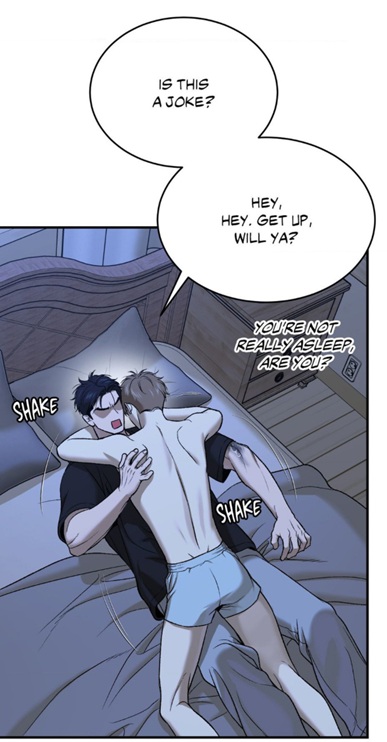 (chapter 65) it transforms the fleeting moment of emotion into a promise of constancy. After all, before it’s too late, what both men longed for was never glory or escape, but a home where they could rest — not alone, but in each other’s arms. By discovering emotions and learning to live in the present, the champion also rediscovers his inner child. His line — “Is this a joke?” — marks that shift, since jokes, like emotions, only exist in the immediacy of the moment. It is only a matter of time, until he laughs because of a joke. By embracing doc Dan like a teddy bear, he allows himself to cling and regress, no longer the wolf or the Emperor but simply a boy seeking warmth. Even his cold becomes symbolic:
 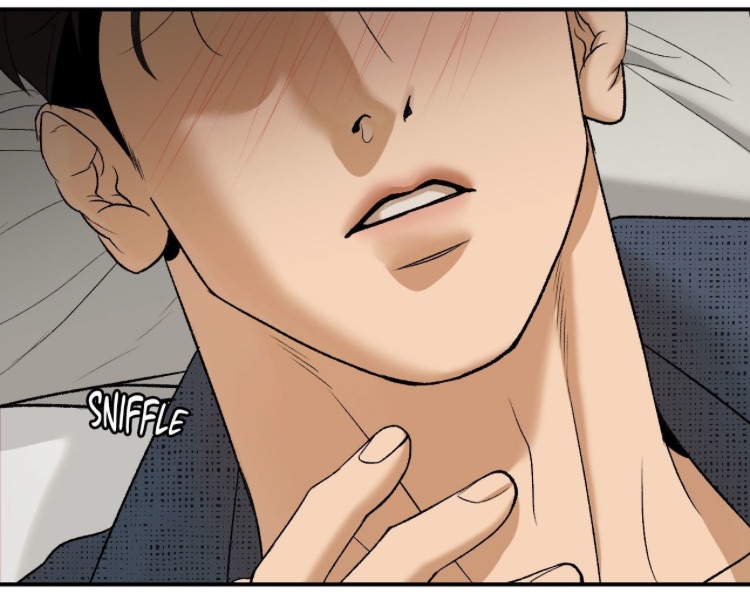 (chapter 70) illness forces him to slow down, to be vulnerable, and to receive care — something denied to him in childhood. In this way, love turns the regression into healing, transforming weakness into the possibility of renewal.
Thus Jaekyung’s story closes the circle: once trapped in the timelines of others, he now inhabits his own time. The “I” he has found is not just the voice of desire, but of choice. Love is no longer an illusion or a prison—no longer tied to debt, silence, or obligation—but a deliberate act that carries him into the future.
PS: I am suspecting that the mother is hiding behind this name: Seo Gichan,  (chapter 5) and if it’s true, then this person would be the second husband.
Feel free to comment. If you have any suggestion for topics or Manhwa, feel free to ask. If you enjoyed reading it, retweet it or push the button like. My Reddit-Instagram-Twitter-Tumblr account is: @bebebisous33. Thanks for reading and for the support, particularly, I would like to thank all the new followers and people recommending my blog.


 (chapter 23), memorized his moves and titles, and repeated the anecdotes told in gyms and on TV. They’ve heard how he was “saved” by sports from a darker path, and cheered for him as the “Emperor” — the handsomest fighter, the man who broke the arcade’s punching machine
 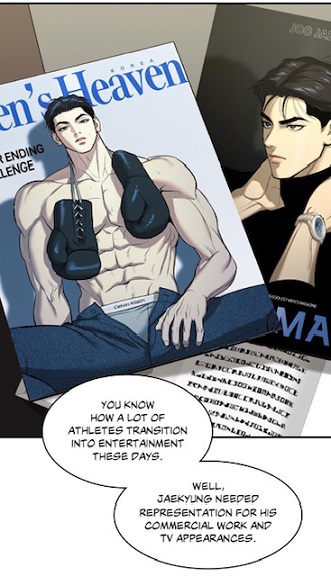 (chapter 30) lies a past left unspoken, a silence so complete that his own history became an empty space others could fill as they wished. This essay brings these two “stories” together — the Emperor and the boy. And now, you may be wondering how I came to connect the champion’s trauma to his future career as an MMA fighter. The answer lies in Joo Jaekyung’s own voice. 😮
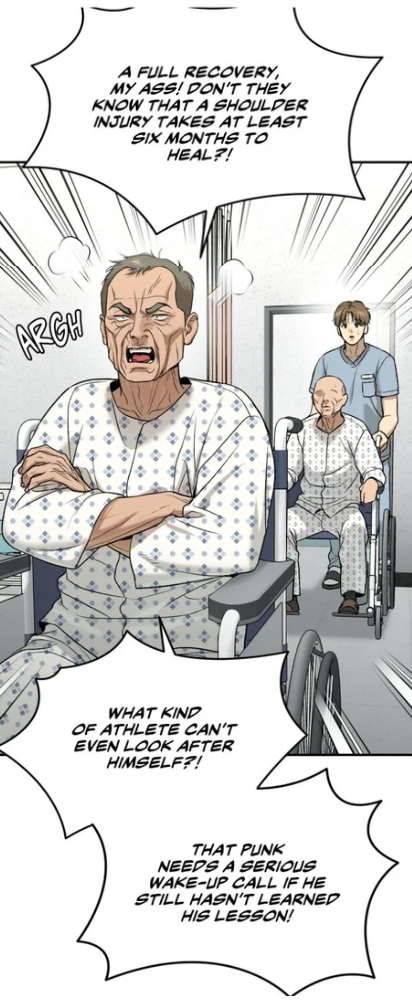 (chapter 70) To him, it looked as though Jaekyung had made the reckless choice to return to the ring so soon. That was the trap: the headline and phrasing were designed to make it appear that the decision was the fighter’s own. The opening line alone
  (Chapter 70) created the illusion that this break had been perceived as a punishment, and that Jaekyung was eager to prove himself once again. No wonder the director assumed he had given his consent.
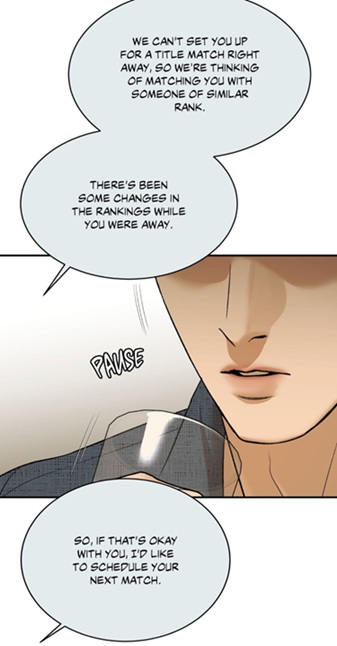 (chapter 69) By erasing these details, the public sees only two players: the Emperor and his anonymous “team.”
 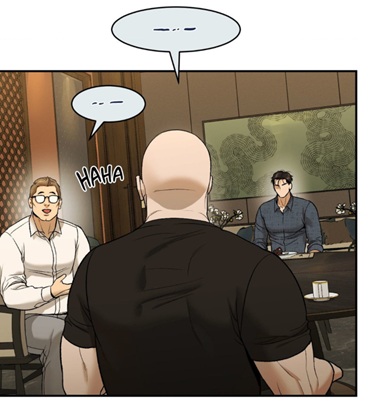 (chapter 69) It was as if the main lead, backed by his team, had personally approached MFC to request the match — an illusion strengthened by the opening line, “MFC’s former champion Joo Jaekyung will be returning to the ring this fall after serving his suspension.” This way, if the decision draws criticism, the CEO can retreat behind the fighter and his team, like they did in the past.
  (Chapter 54) Back then, the champion had not reacted to this comment. Even in the worst case, the CEO can hide behind one of the MFC match managers or doctors.
  (chapter 41) But that excuse would be a fiction: Jaekyung hasn’t even met those doctors or talked to the MFC match manager
  (chapter 67) That’s the reason why this suggestion from the CEO appeared the very next day.
  (chapter 69)
  (chapter 61), it was paired with a recommendation for rehabilitation — not an immediate return to competition. This was actually a condition for his total recovery. On the other hand, the doctor imagined or suggested that his patient wished to return to the ring so soon. No medical professional ever signed off on an autumn fight. Yet the date is already set, and the headlines frames it as a confident comeback without any medical backup. The Emperor’s name is splashed everywhere, but none of the words belong to him.
 (chapter 57) with one of his close associates — a man whose face was hidden, speaking as though he were the athlete’s voice. That interview was accompanied by a familiar victory image
 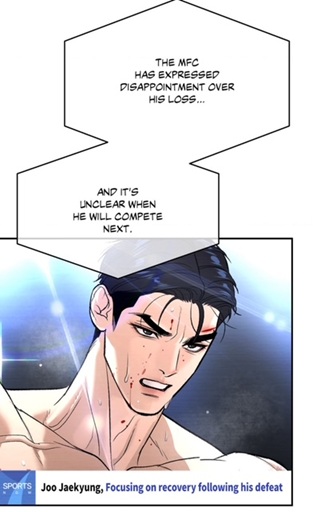 (chapter 57), a stock photo already used in other press pieces. This picture comes from after the fight in the States:
  (chapter 41), while the image released with the fall match announcement was the one from when he first won his champion title.
 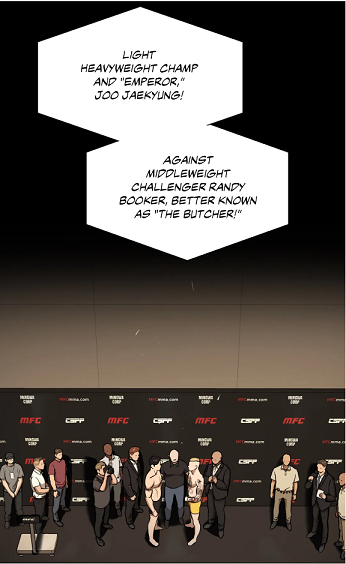 (chapter 14) seems to radiate absolute power — the kind of authority that commands armies, bends laws, and answers to no one. It is meant to ooze charisma and control, a name that suggests the bearer acts on his own will. Yet, in truth, emperors have rarely ruled alone. Behind every throne stand ministers, advisors, generals, and family factions, each shaping decisions from the shadows. An emperor who ignores these forces risks losing his crown.
 (chapter 17) He was blamed for his popularity. The man inside the crown does not act or speak freely; his words are filtered, scripted, or replaced entirely.
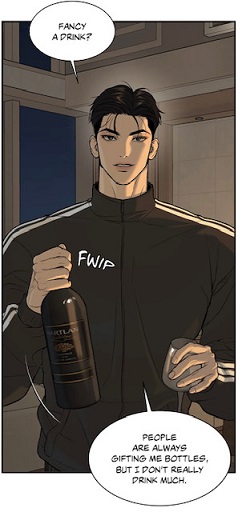 (chapter 12), never mind that he hardly drinks. The gesture fits the fantasy they’ve built around him, not the reality of a man who rejects alcohol due to his addicted father, a reminder that even the tokens of admiration are shaped by the image, not the truth. So who is this so-called close associate or “Joo Jaekyung’s team” exactly that decides for him, speaks for him, and hides behind his title? Besides, why did the journalist change from “one of his close associates” to “Joo Jaekyung’s team”?
 (chapter 57) The nickname, played for entertainment value, was another way of turning the champion into a caricature — a marketable, amusing persona instead of a man with a past and agency. It is quite telling that Park Namwook’s interview aired immediately after the anchor referred to Jaekyung as “Mama Joo Jaekyung Fighter.” This was not the lofty “Emperor” title repeated in gyms and ring intros — it was more a mocking nickname, a deliberate jab meant to provoke. In that moment, the Emperor was verbally pulled down from his pedestal, yet the images shown alongside the segment told a different story: carefully chosen shots of him as a champion, a visual echo of his marketable persona. The dissonance was striking.
 . (chapter 54) In my opinion, the man is trying to return to the past, thinking that his “popularity” can come back, not realizing that he is being manipulated himself. On the contrary, he stepped into the role of spokesperson without hesitation, speaking as if he were Jaekyung’s voice while keeping his own face and name hidden. He only speaks, when he feels safe. He can not be responsible for the champion’s recovery.
  (Chapter 52) This framing lets him claim the prestige of leadership while leaving himself room to withdraw if things go wrong. Yosep was the one notifying MFC and reporting the incident to the police, Potato explaining his discovery to Joo Jaekyung and blaming the star.
 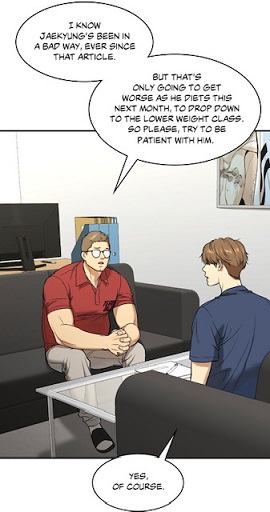 (Chapter 36) He should tolerate the celebrity’s moods and put up with everything. The manager didn’t mind, as long as he didn’t get affected. But what is the consequence of such a passive tolerance? An individual’s self-esteem can slowly erode, leading to a gradual loss of their sense of self. They may stop recognizing their own desires, needs, and rights, often without even realizing this is happening. This is because emotional exhaustion often develops subtly over time, rather than appearing as a sudden, dramatic event.
 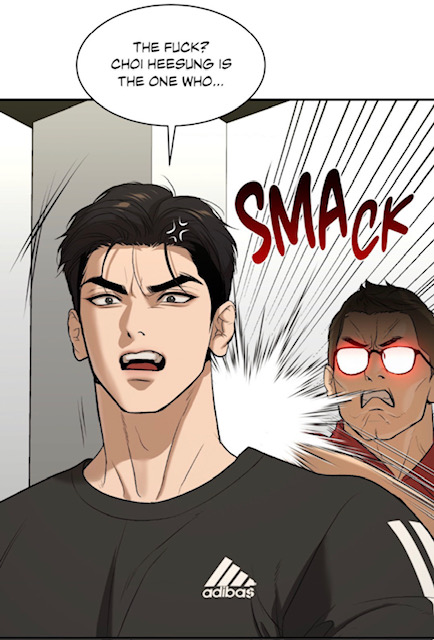 (chapter 31) when punished. In this light, Park Namwook embodies the very dynamic the article warns against: a figure who benefits from another’s compliance, maintaining control not through open dialogue, but through unspoken rules and the threat of exclusion.
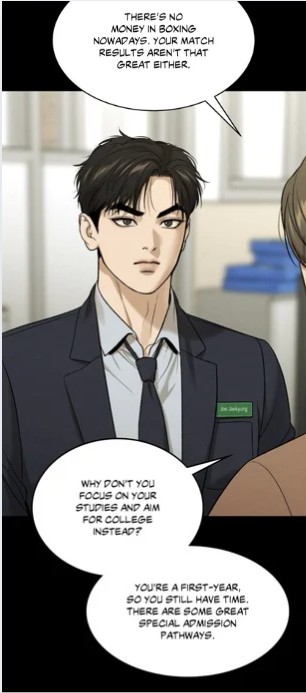 (chapter 73), by becoming a boxer, the champion wouldn’t make a lot of money. With this comment, he implied that boxing in South Korea had been losing popularity 10 years ago. This explicates why gradually, the members from Hwang Byungchul left the studio. And it was likely the same in the illegal fighting circuit.
  (chapter 73) The popularity of MMA in the States gave them the opportunity to revive fighting sports, a figure who could draw crowds and sponsors, making such events fashionable again.
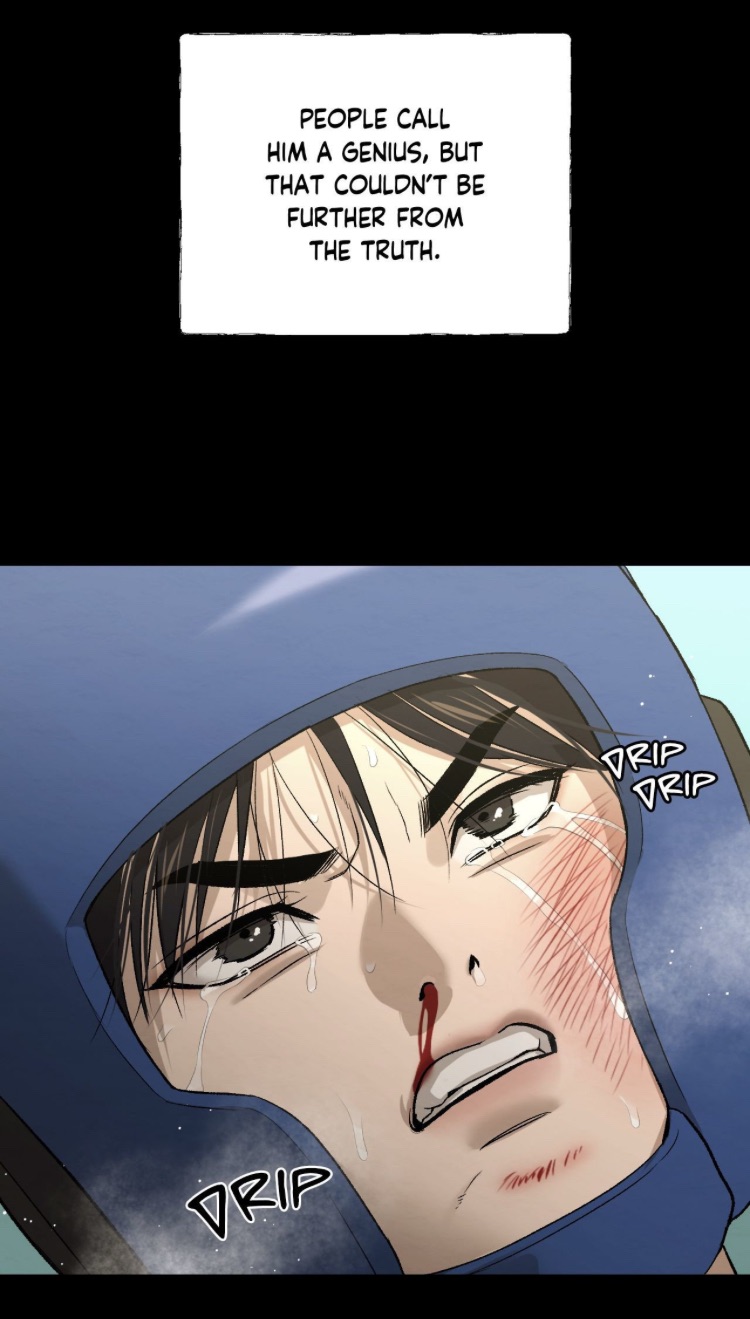 (chapter 72) instead of “hard-working,” a man who “chose sports over a dark path.” Yet if you look closely, this celebrated “ascension”
 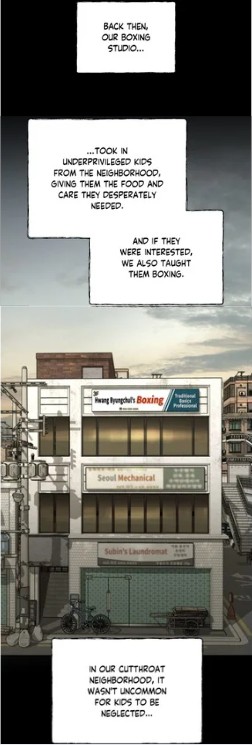 (chapter 72) isn’t tied to the director’s boxing studio at all — it’s linked to the arcade’s punching machine incident.
  (chapter 72), the scars of his family history, and the years of survival before the cage. This is history rewritten, his boxing past and family erased. Why? His origins could expose the ugly verity: the link between criminality and boxing (as such fighting sports). Secondly, because his real story, though moving, lacked the glamorous allure needed to market him. His real story would have revealed that to rise to the top, you need relentless work, not a miraculous moment. That version was never going to sell as well as the “genius” myth.
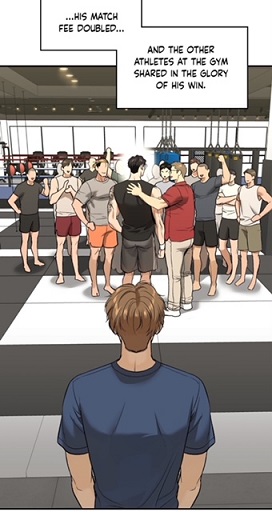
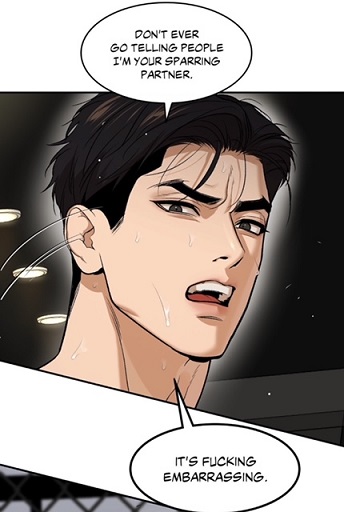 (chapter 46) Most of them thought that by staying close to him, they could benefit from his popularity. To conclude, for many of them proximity to the Emperor wasn’t about learning discipline or technique; it was about absorbing his fame by osmosis. Hence they complained and accepted the gifts and money so easily.
  (chapter 41) Observe how the manager is acting here. He is speaking, touching the star like his prize and possession. The Emperor became the merchandise, the illusion, the bait to draw both viewers and fighters. However, being “labeled as genius” can only push desperate fighters to take a short-cut: bribes and drugs. Hence Seonho couldn’t last a whole round.
  (chapter 46) And, like any product, once it was seen as damaged, its value plummeted. The moment he “lost” his title and suffered injury (chapter 52), the dream began to unravel.
  (chapter 52) This panel captures this shift perfectly: two fighters casually dismiss him over dinner. In those words, the Emperor isn’t a mentor, a champion, or even a man — he’s a broken commodity, no longer worth the investment. The same people who once fed off his popularity are the first to abandon him when the promise of easy gain disappears.
 (chapter 22) He is even disposable. He is gradually giving more rights to his “boy”, the real director of Team Black. And the moment you perceive the manager as the main lead’s voice, you can grasp the true significance of the slap at the hospital:
 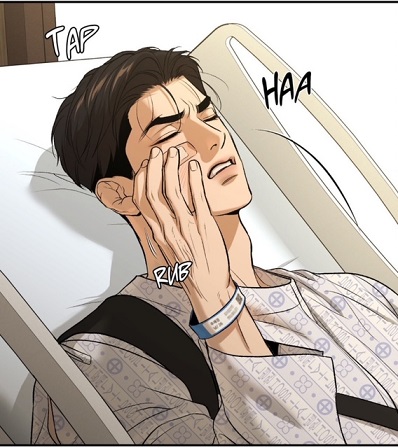 (chapter 52) He chose silence, and later avoidance, staying away from the gym. That silence was not weakness, but choice: he would listen less and less to his hyung.
 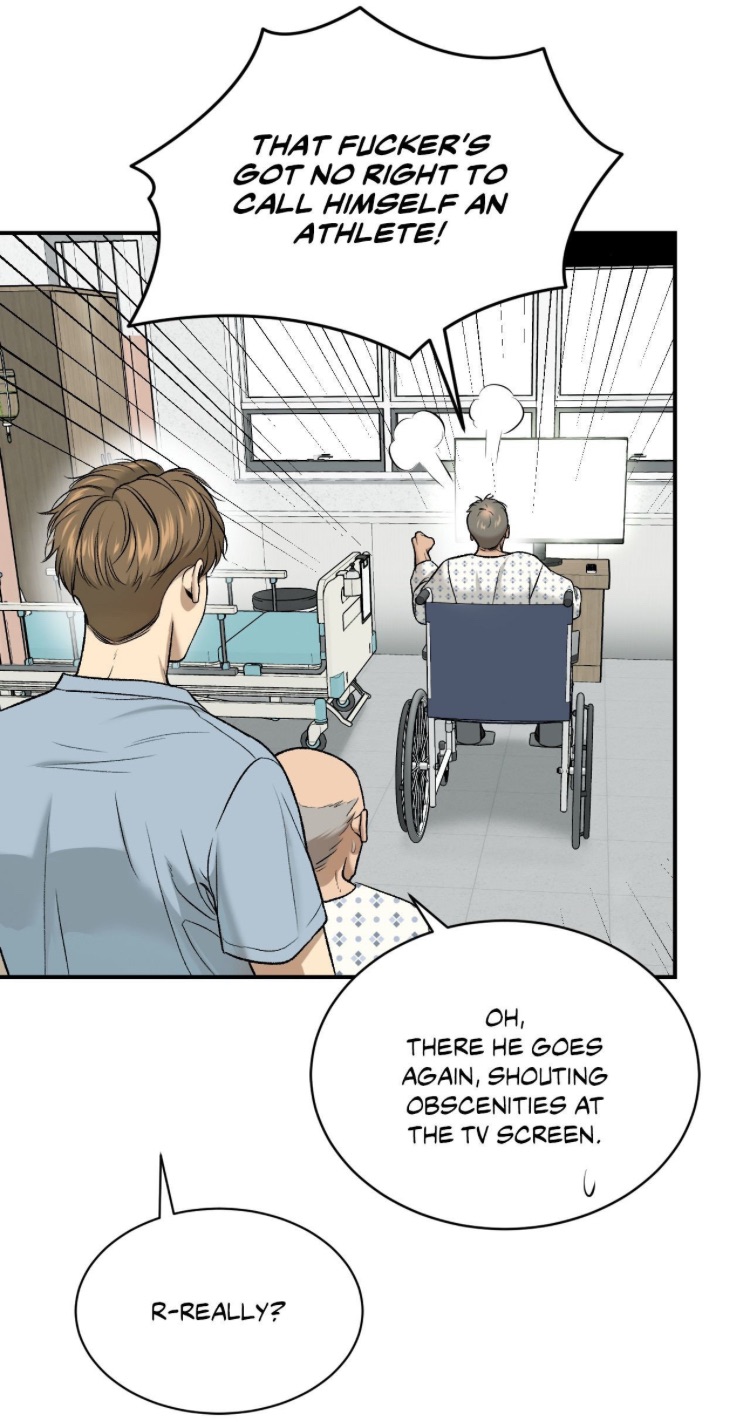 (chapter 70) and more like a product: something to be displayed, sold, and, when necessary, handled roughly to keep in line. The shift in labels is just another layer of that merchandising process — a packaging change to suit the current market, not a recognition of the man inside. To conclude, the champion has always been voiceless all this time, even here:
 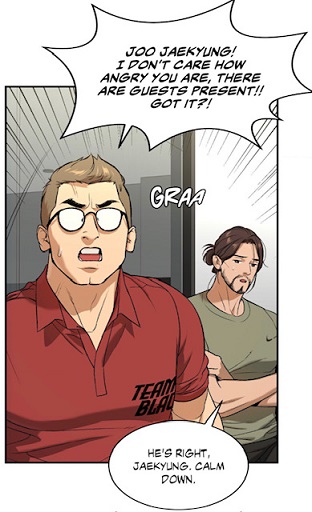 (chapter 36) All he needed to do was to fight:
 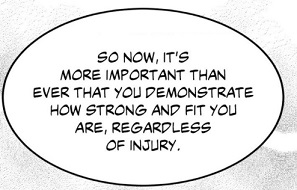 (chapter 36)
 (chapter 72) We don’t know how many times he called, but each time we see him do it, his face is injured.
  (chapter 72) The phone calls are therefore intertwined with the boxing studio, as though pain itself pushed him toward her. At ten, he picked up the receiver and let it ring only a few times before hanging up. The next time, in the dead of winter, he finally spoke, promising that if she returned, he would protect her from his father and make enough money to keep her safe.
  (chapter 72) Each time what answered him was not her voice, but a machine: “
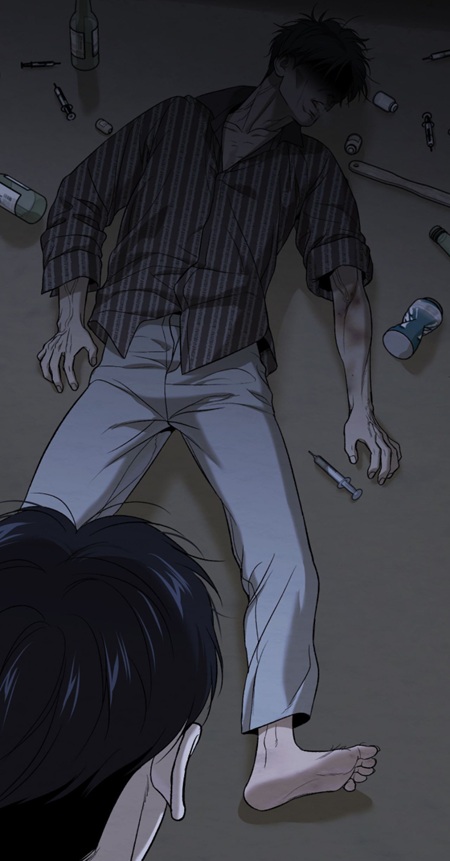 (chapter 73) and with it, another layer of his voice disappeared. He had the impression, he had killed his father. His words had been more dangerous than his punches. Hence he could only come to resent his own voice and words. And now, you comprehend why the Emperor allowed the hyung to become his voice. To conclude, the silence of those nights became the silence of the man. As you can see, the curse did not fall on Joo Jaekyung’s voice in one night — it was built, in stages, over years. But the death of his father linked to the argument represented the final straw that broke the camel’s back.
 (chapter 55)
 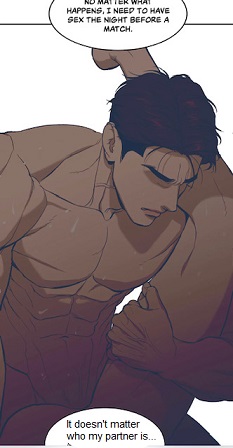 (chapter 2) — a space where he could act without having to speak. In the bedroom, as in the ring, the body could carry the conversation. Here, he could dominate, control, and release tension without the risk of verbal damage. His partners became surrogate opponents: sparring substitutes in a non-lethal match. Treating them as “toys” wasn’t only objectification; it was a form of control that, in his mind, protected both sides. Toys don’t demand answers, don’t talk back, and don’t leave you cursed with regret. They remain safely outside the territory where his voice had once done harm.
 (chapter 1) He embodies innocence and as such lack of experiences. Moreover, he talks, makes suggestions for the champion’s sake
  (chapter 27), spent time with him, asks questions, confronts, and refuses to be reduced to a body in the room. He breaks the rule of silence. With him, Jaekyung can no longer hide behind the physical alone; he is forced to speak, to explain, to voice desires and fears. He pushes Jaekyung to engage in ways he’s spent years avoiding. In this way, Kim Dan becomes the first real threat to the system the champion built after those two curses — and possibly the first person who could prove that words can be safe again. And now, you comprehend why Joo Jaekyung was moved by the birthday card
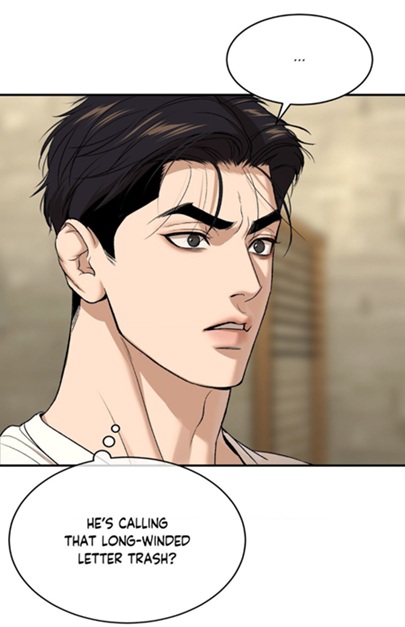 (chapter 62) To most, it might look like a simple gesture, but for him, it was a rare and precious thing — a voice that had taken the time to shape itself into words just for him.
 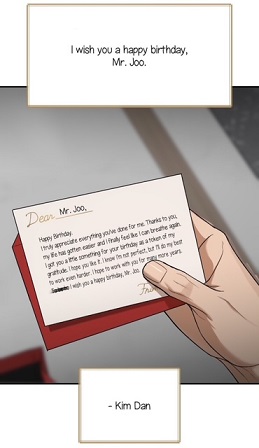 (chapter 55) After years of associating speech with either silence or harm, receiving a long-winded, carefully written message felt almost unreal. He saw the effort behind it, the deliberate choice to put thoughts and emotions into language instead of letting them fade away or turn into weapons. In that card, Kim Dan offered something neither of his parents had managed: a voice that reached him without wounding. No silence, no insult. For the champion, it wasn’t just a card — it was proof that words could be built into a gift, not a curse. The latter expressed his dreams and gratitude. Thus I deduce that the Emperor’s curse will be broken by a spell: words!
 (chapter 55) The “spell” to break it is not some grand external event, but the simple, sustained act of honest communication — something that has been denied to him since childhood.
 (chapter 68), a kiss, a pat, a caress or by simply holding hands
 . In this way, the curse that began when his voice was silenced and his hands were weaponized will only be broken when those same hands learn to speak tenderness. Look how doc Dan reacted to his public embrace:
  (chapter 71) He saw affection in the hug, but he still doubted the champion’s action.
  Until now, the design’s images have played a secondary role, yet the answer lies in a single scene from chapter 41.
  (chapter 41) Under the bright sunlight, Kim Dan reached out toward the leaves, his hand open and unguarded, as he silently thought of the man he loved. This gesture, so simple yet so revealing, became the unspoken confession that marked the start of a different kind of freedom—the freedom to feel.
 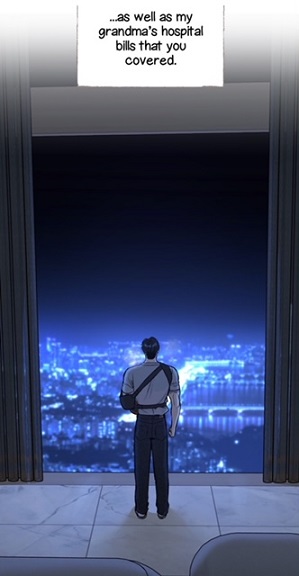 (chapter 53) The glass was an invisible barrier, offering the illusion of freedom while keeping him trapped in the moment of his unresolved trauma. The closer he stood to it, the further he was from true release, his gaze fixed outward to avoid looking inward. That’s why he had no eye in that scene:
  (chapter 55)
 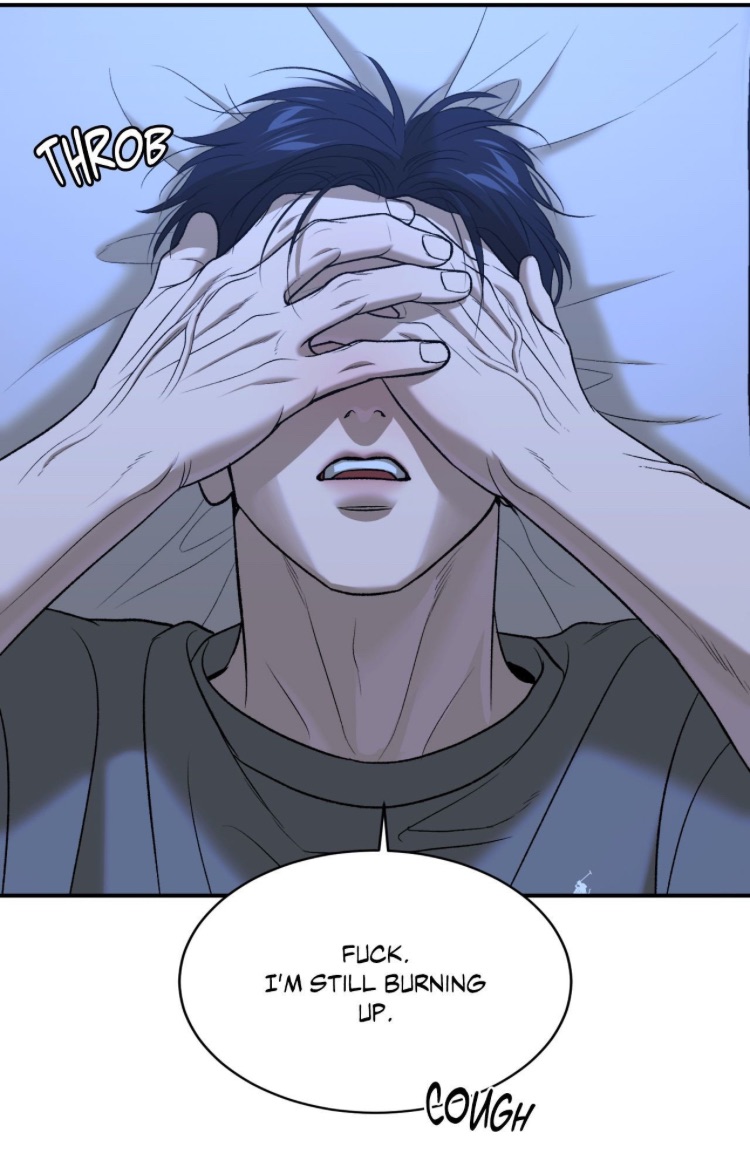 (chapter 71)
 (chapter 70) the night can also be alive, communicative, protective. In that moment, the moon becomes more than a distant light in the sky: it is a patient witness, a calm listener in the stillness, reflecting the truth he has yet to voice.
 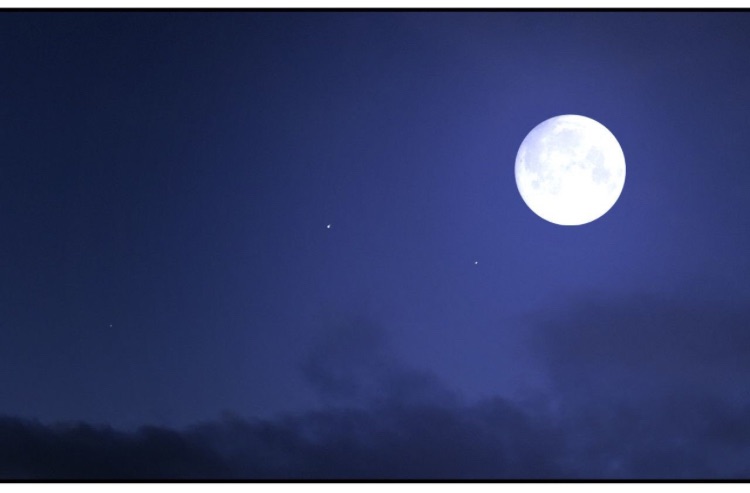 (chapter 70) Its soft glow contrasts with the blinding glare of the cage lights, suggesting that under the moon, there is space for gentleness, for hearing one’s own heartbeat and another’s words. Just as the moon guides travelers through darkness, it can guide him toward a night that does not suffocate him with loss, but offers orientation and connection.
 (chapter 60) they were his own form of therapy. In saving someone else in the night,
 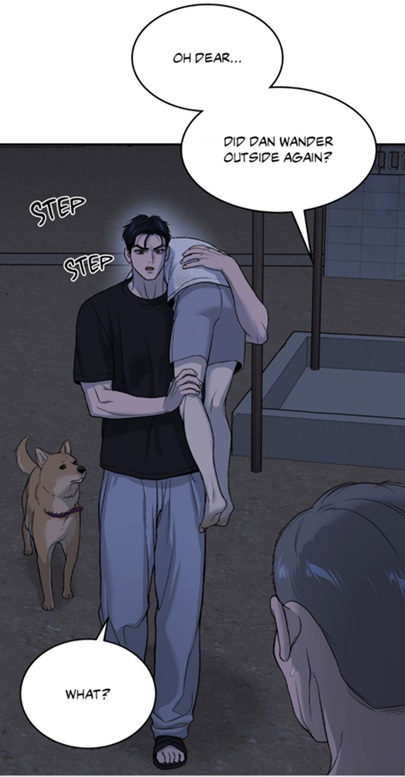 (chapter 65) he could prove to himself he was not powerless, he was valuable, capable of protecting what mattered.
 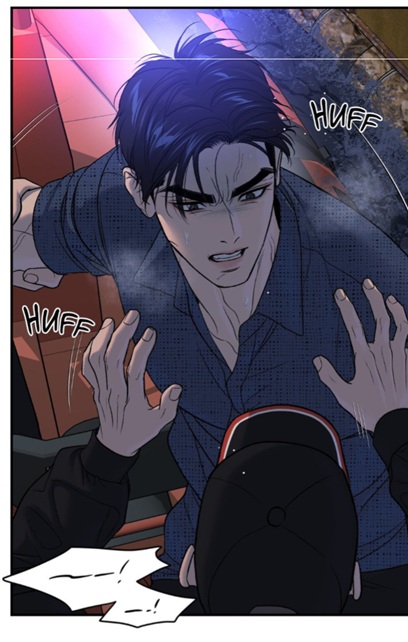 (chapter 69) He was not too late either. And the moment doc Dan discovers what the silent hero has done for him so many times, the former will realize that he has always been special to the Emperor. Moreover, the latter had never abandoned him in the end.
 , (chapter 9) as if the champion’s volatility were a quirk (the actions of a spoiled child) to be managed rather than a wound to be healed. It is because he never talked to the champion or investigated his past. It was only about money and glory. The manufactured image of the erratic, temperamental fighter served Namwook well; it excused rough handling, justified bad press, and kept Joo Jaekyung dependent. Once the Emperor can name the truth of that night, the fiction collapses — and with it, Namwook’s control. He can only be judged as a liar and even a traitor, but we know that Joo Jaekyung has a big heart. He could love his father despite the abuse. Now, the missing link is Cheolmin!
  (chapter 13) Observe that this name is a combination between Hwang Byungchul and Baek Junmin! Under this light, my avid readers can grasp why the athlete kept his existence in the dark for so long! It is because the latter belongs to his past and knows the truth behind the Emperor! He was aware of his suffering. For him, he is not just a fighter, but someone who needed FUN in his life!

 51, 52, and 73 [I am excluding the match]—his role is far from minor. He is, in fact, one of the main invisible architects of the champion’s trauma and jinx, the one who once stood across from him on a night that would shape the course of both their lives. Long before he was known as the Shotgun, Baek Junmin might have pulled the trigger on something else entirely: the last remnant of Jaekyung’s innocence.
 (chapter 73) Their violent encounter may have led to the vanishing of the young boy’s smile, replacing it with the hardened scowl of the Emperor, the tyrant in the ring.
  (chapter 1) If Hwang Byungchul gave Jaekyung the tools to fight, Baek Junmin gave him the reason to fight like a bloodthirsty tyrant. He did not simply scar the soul — he engraved rage into the champion’s core. The tragedy is that Joo Jaekyung never even learned his name. Thus he didn’t react to his name, only to his face and his smile.
 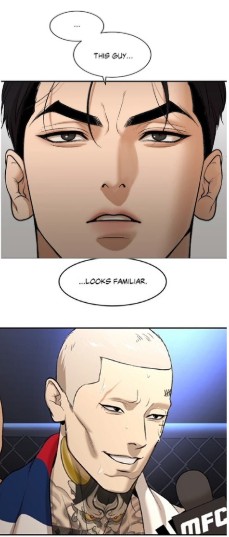 (chapter 47) And yet, Baek Junmin reappears, not as a stranger, but as the remnant of a past that refuses to stay buried. Additionally, he appears only through the narration of others (fighter)
 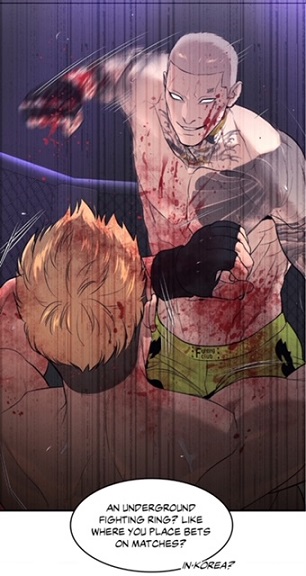 (chapter 47) or in flashes
 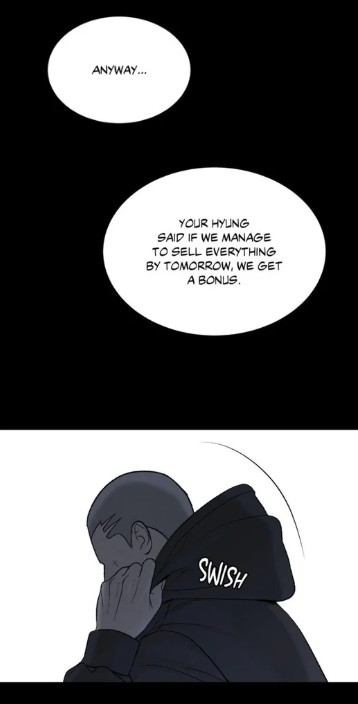 (chapter 73) — a gesture here, a line there
  (chapter 73) — before vanishing again. To understand him, we have to read between the panels, compare the boy we meet in episode 73
 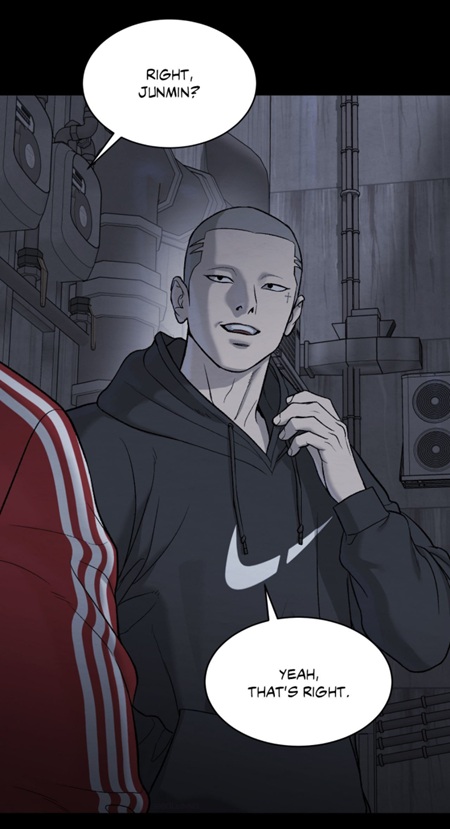 (chapter 73) to the man who resurfaces much later.
 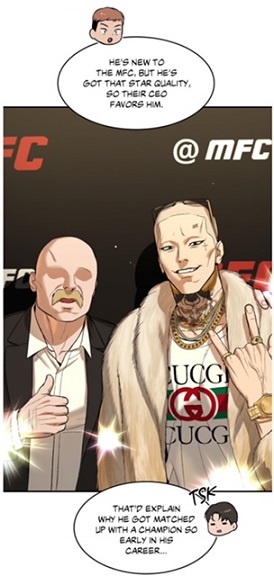 (chapter 47) This is how we catch glimpses of him — by holding the present up against the past, by noticing what has changed and what has stayed the same.
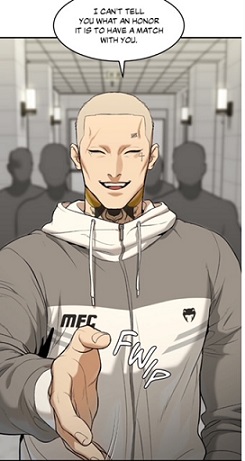 (chapter 49) Jaekyung’s ears mark him as a champion who faced real opponents in real matches, many of them brutal. His injuries are the price of transparency, visibility, and legitimacy. They are scars earned in the light, while Baek Junmin is supposed to be a novice.
 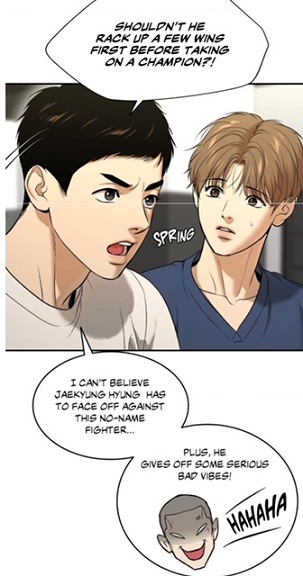 (chapter 47)
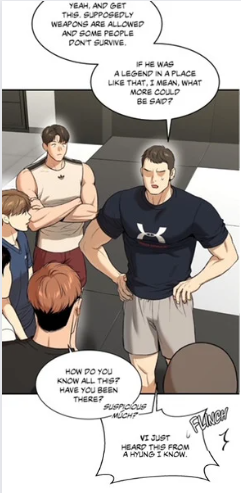 (chapter 47) His damage was earned in the shadows and in staged fights manipulated by higher powers.
  (chapter 47)
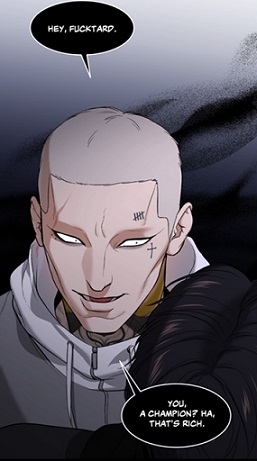 (chapter 49) His cheeks have sunk, his jaw stands out more sharply, and his features seem carved by something deeper than age. This is not the look of someone forced to cut weight for competition,
 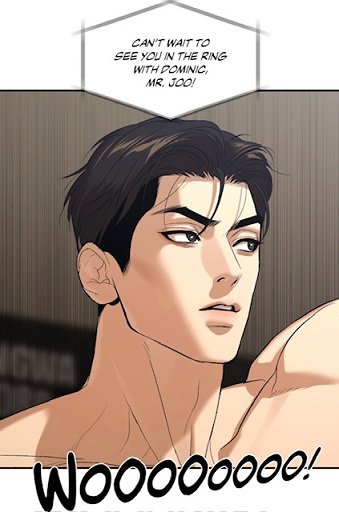 (chapter 37), for the new rising star is already much smaller and thinner than the protagonist.
  (chapter 49) It’s more likely the result of long-term stress, emotional corrosion, or drug use.
 (chapter 73) This line is telling. It reveals not only the normalization of drug use among these teenagers, but also how intimately it’s tied to fighting. Juho isn’t offering an escape—he’s offering a tool. For him, drugs aren’t about rebellion or recreation; they are a performance enhancer. They’re marketed as part of the fighter’s toolkit.
 (chapter 44) His skin is clearer, his features softer, and his face shows fewer signs of internal collapse. This is the effect of healthy food, structured discipline, clean training, and perhaps even emotional restraint. While Junmin’s face has been thinned by chaos, Jaekyung’s has been preserved by control. Under this light, it becomes comprehensible why the athlete fell in love with doc Dan at first sight. Despite being older,
  (chapter 7) the “hamster” still carries a baby face: a visual marker of youth, innocence, and gentleness. He embodies everything the Shotgun does not: vulnerability without corruption, softness without vice. If Baek Junmin stands for a corrupted adulthood — weapons (The Shotgun), shadows, and counterfeit gold — then Kim Dan, by contrast, becomes the sanctuary of all that was lost: the child, the smile, the safe bed.
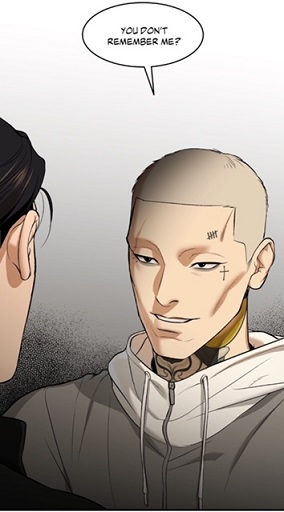 (chapter 49) reveals that anonymity was never his desire. It was his sentence.
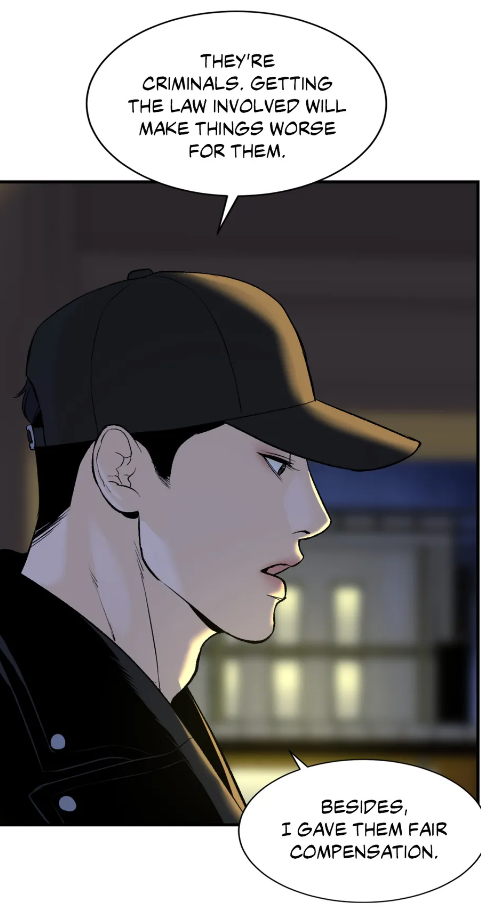 (chapter 18) criminals don’t want attention. They avoid the law. They train their subordinates to vanish, to move through shadows, to speak only when spoken to. Baek Junmin wasn’t just playing a role —he was surviving a system that required him to erase himself. His hoodie was not simply clothing; it was a muzzle, a shadow he had to wear. That’s why the protagonist has not made a connection between his nemesis Baek Junmin and a Korean gang yet.
 (chapter 69) How is this possible, when it is clear that the antagonist is already a thug? It is because Joo Jaekyung has no idea about his true identity. He only knows him as a cheater and liar!!
  (chapter 73) he blends in by choice. Black is not a neutral here; it is a decision to recede, to be part of the backdrop. The fabric pools around his hands, hiding the skin, while the hood hangs like an unspoken “no comment.” Even when he speaks, it is without volume or force.
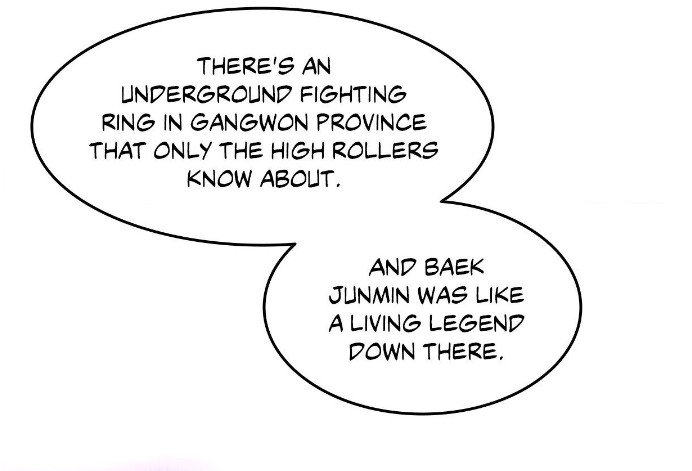
  (chapter 73) And notice that the legend is trapped to a province, indicating that he could never make it out of there like the champion! Therefore it already implies that the future “Shotgun”‘s association with the hyung is not based on loyalty or mutual respect—it is circumstantial, even transactional. It is about money and usefulness. And now, you comprehend why Baek Junmin’s position in this gang is quite precarious.
 (chapter 73) That’s the same number of persons in the dark alley, when you exclude Joo Jaekyung and Baek Junmin
 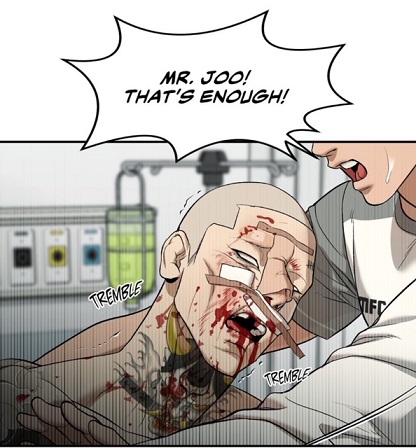 (chapter 52) Note that Director Choi Gilseok doesn’t express concern for Baek Junmin, his attention is on the Emperor!
 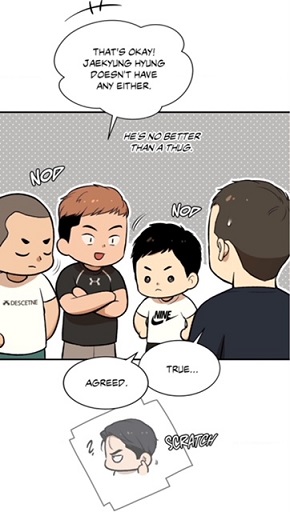 (chapter 47),he doesn’t take pride in killing someone.
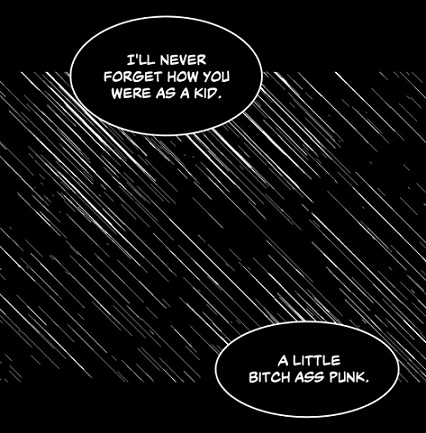 (chapter 49) and there was no direct interaction between them in the street, I come to the conclusion that their past must have crossed a second time between these two meetings. If we take the hallway encounter as their third meeting
  (chapter 49), there must have been at least a second — brief, sharp, and wounding enough to carve itself into Baek Junmin’s memory while leaving no conscious trace in Joo Jaekyung’s. The difference is telling: what the champion repressed, the Shotgun carried it like a scar. It means Baek Junmin knows more about him than the reverse, and every glare, every barb he throws later is sharpened by a history Joo Jaekyung couldn’t anticipate they share
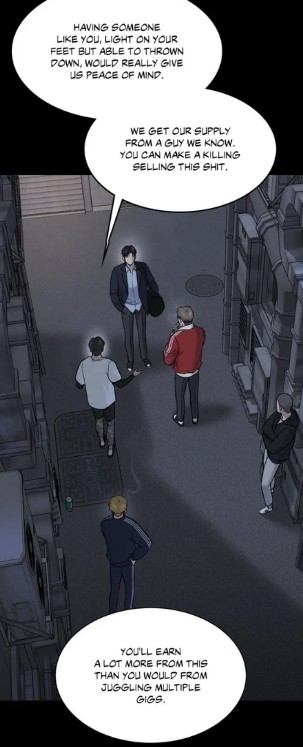 (chapter 73) lit only in patches, with more shadow than clarity. In this kind of setting, the black hoodie becomes something more than clothing — it is camouflage. He is not merely wearing the dark; he is using it, letting the folds of fabric and the absence of light blur his edges. It is as if he intends to merge with the scenery, to be just another shadow leaning against the wall. This double concealment — in time and in space — ensures that, for now, he remains invisible to the one person whose attention he will one day crave. He began in the shadows not just by circumstance but by mandate. Yet as the boy in the hoodie fades into memory, a new figure will eventually emerge from those shadows—not to hide, but to strike. And he will no longer wear a hood. He will wear scars.
 (chapter 73) in the present timeline, but an assault there can happen any time.
 (chapter 17) And what did the loan shark tell him before provoking him?
 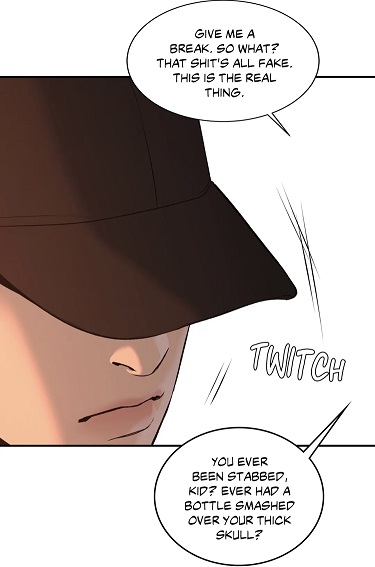 (chapter 17) Based on the champion’s facial expression after hearing Heo Manwook’s questions, it becomes clear that Joo Jaekyung experienced in the past a scene where he faced a knife and his head was smashed with a bottle of soju. The criminals are recognizable due to their tattoos and their weapons, the knife! And the logic of the knife in this world is telling: as Heo Manwook showed
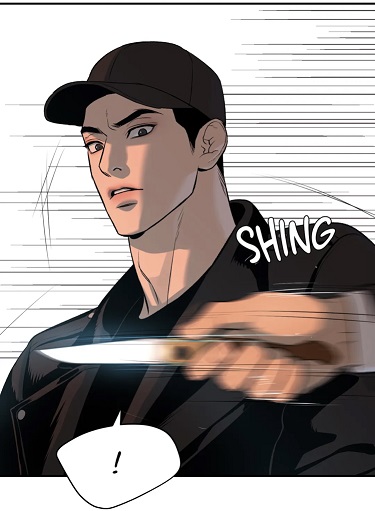 (chapter 17), it appears when a fight is already lost. It is not a weapon of open combat, but of pride and desperation — a way to cheat fate when skill is not enough. Moreover, he was particularly vicious here. He attacked the champion from behind, a treacherous move. As you can see, the knife is strongly intertwined with the underworld, deception and cowardice.
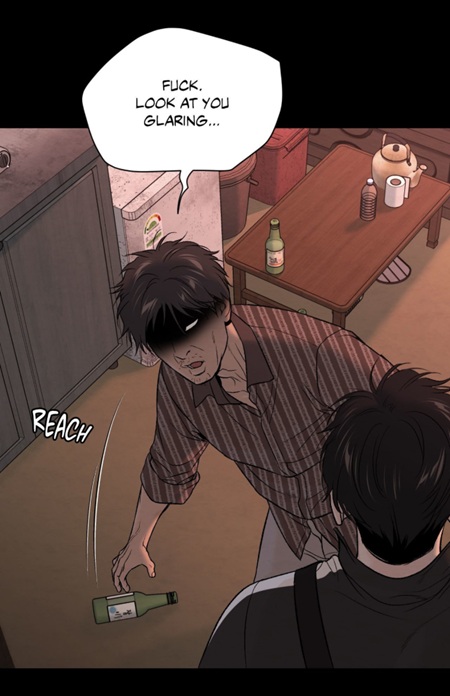 (chapter 73)
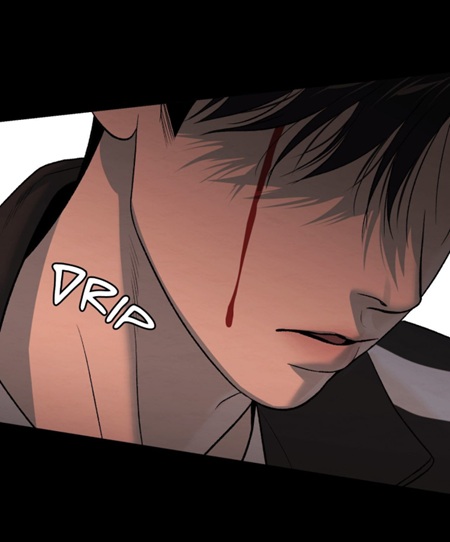
  (chapter 17), a head injury
  (chapter 73), insults and provocations
  (chapter 17) and finally an allusion to the “maker”, god versus father.
  (chapter 73) Over time, the champion chose protective symbols— clouds and a dragon-like mask—tattoos designed not to intimidate but to shield.
  (chapter 1)
  (chapter 17) They represent protection, not aggression. Where Baek Junmin’s tattoos speak of death and destruction, Jaekyung’s express escape, survival and resilience. Even in their body art, the two boys tell opposing stories: one driven by resentment and darkness, the other by endurance and self-preservation.
 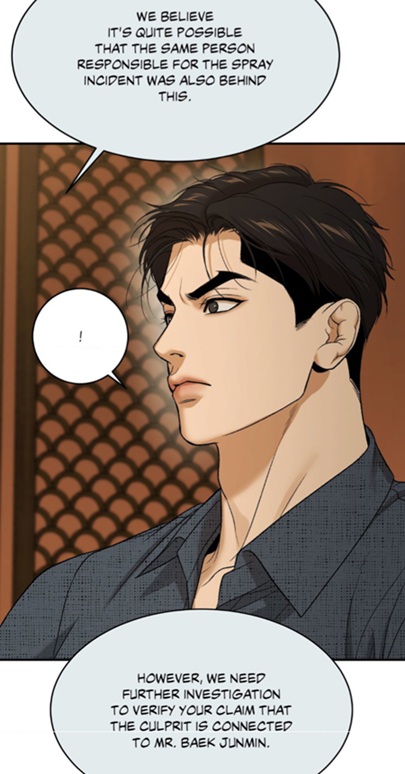 (chapter 69) Nevertheless, they are here buying time. How so? If the champion were to fight again and even lose, they could bury the investigations. They were also biding time in order to stop investigations and the involvement of the media.
  (chapter 73) No… he is copying others and in particular Joo Jaekyung whom he resents. Thus their attitude in the ring is similar (ruthless), yet both act that way for different reasons: pain and seriousness
 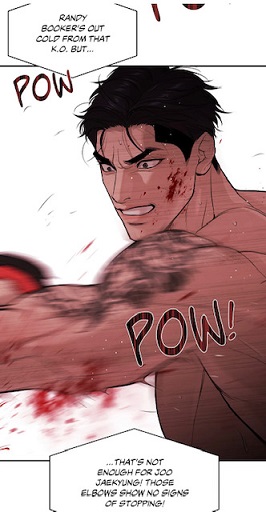 (chapter 15) versus fun and schadenfreude
  (chapter 47). His new persona feels exaggerated, theatrical, hollow. He wanted to become unforgettable, but ended up being another disposable fighter in a system that only remembers champions. Now, his face is ruined: he lost teeth and has a broken nose.
  (chapter 57) Hence the nurse felt sympathy for him. At the health center, he received his long due punishment. Baek Junmin learned through the hard way what it means fighting without rules. He got deceived himself, thinking that his “hyung” would have his back.
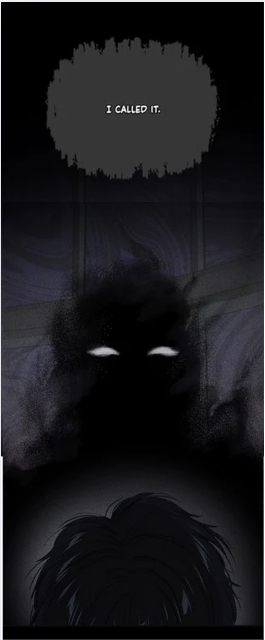 (chapter 54) These words imply that the outcome was predicted… That’s the reason why Joo Jaekyung needs to remember the past. There lies the truth: they are “rigging the games because of bets!
  (chapter 54) and Joo Jaekyung’s father, Joo Jaewoong.
  (chapter 47)
 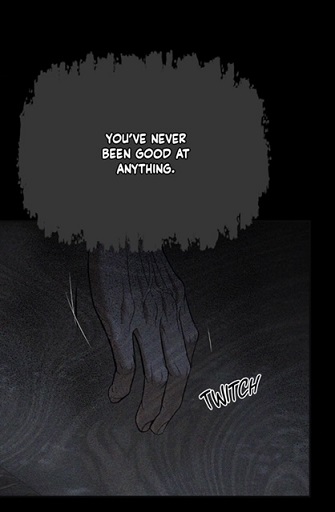 (chapter 54), the father with his fading trophy, Baek Junmin with his own unspoken history in the underground ring and the ghost’s words linked to the champion’s hands. Together, they symbolize the toxic underbelly of combat sports, the place where dreams are sold and consumed.
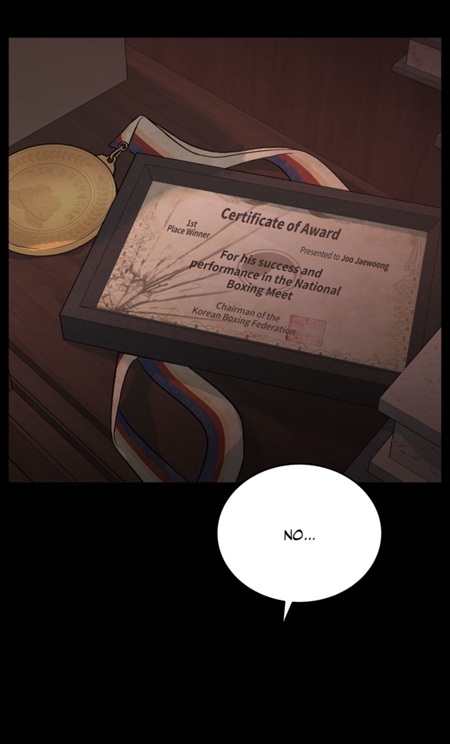 (chapter 73) He had a past worth remembering—something he even clung to in his ruined apartment, preserving his medal and document like a relic. Baek Junmin, by contrast, never belonged to the gym. He wasn’t trained. He never received formal recognition. He fought in shadows, kept to the margins, and remained a “legend” only in the backrooms of Gangwon’s illegal rings because he trusted his “hyung”.
 (chapter 49). he desired to have a real title and admiration.
  (chapter 51) all along—a spectacle, not a coronation. Hence director Choi was overjoyed when he heard the verdict.
 (chapter 52) That’s why he earned a lot of money. They used this fight to remove the Emperor from the stage quietly. It was time for him to give up on his throne. If they had let Baek Junmin win the fight, people would have questioned the referees. The Shotgun was there to prepare the coup d’Etat, hence the new champion is someone else. Joo Jaekyung wouldn’t remain so calm hearing this:
  (chapter 69) They knew the Shotgun wasn’t strong enough. But he didn’t. He mistook cheating for skill. He mistook chaos for greatness. He believed he had earned what was scripted all along.
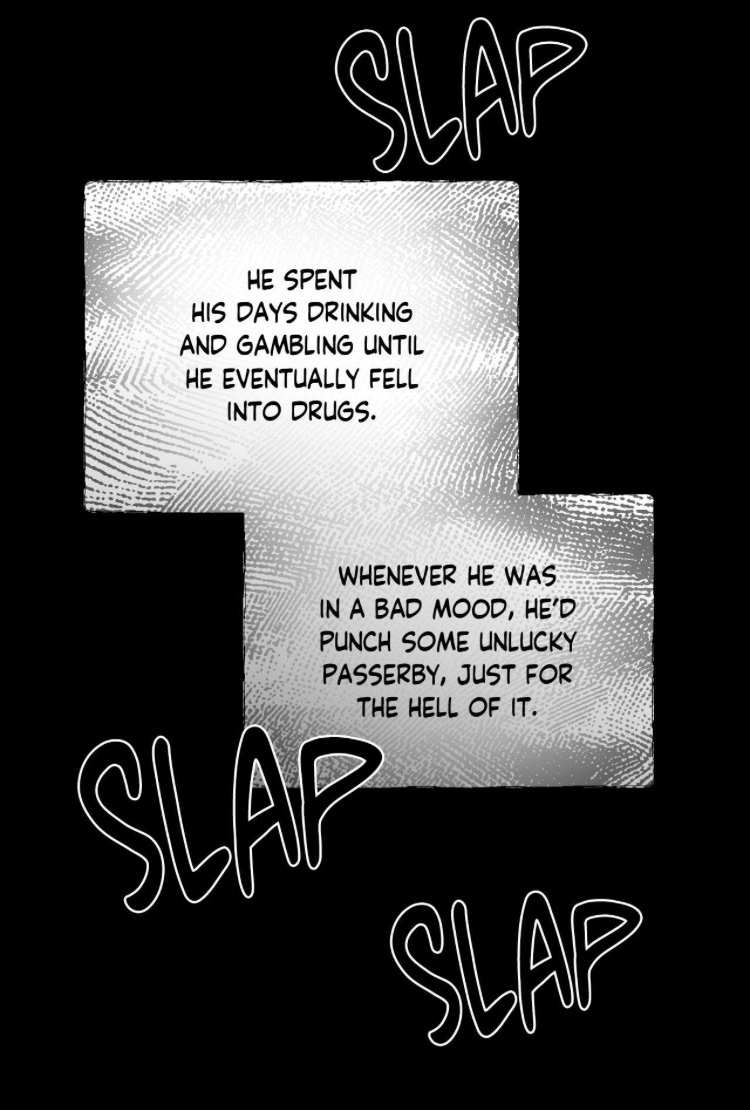 (chapter 72) This explicates why Hwang Byungchul condemned the man and sided with the mother. But while Joo Jaewoong and Baek Junmin tried to escape through the sport, they both ended up in the criminal network. And neither made it out.

 (chapter 73) In chapter 73, Joo Jaekyung is shown as a first-year high school student—meaning he was sixteen. I suspect this turning point occurred in May, since the earlier fight happened on May 16th.
  (chapter 72) Additionally, the tournament he won was the 17th boxing competition
 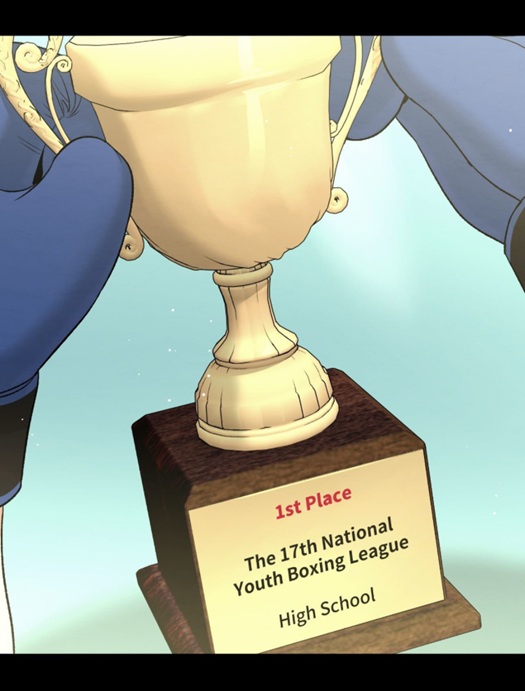 (chapter 73), suggesting he had likely participated from the very beginning of the event’s history. This places his debut—and symbolic birth as a fighter—at the very origin of the tournament itself.
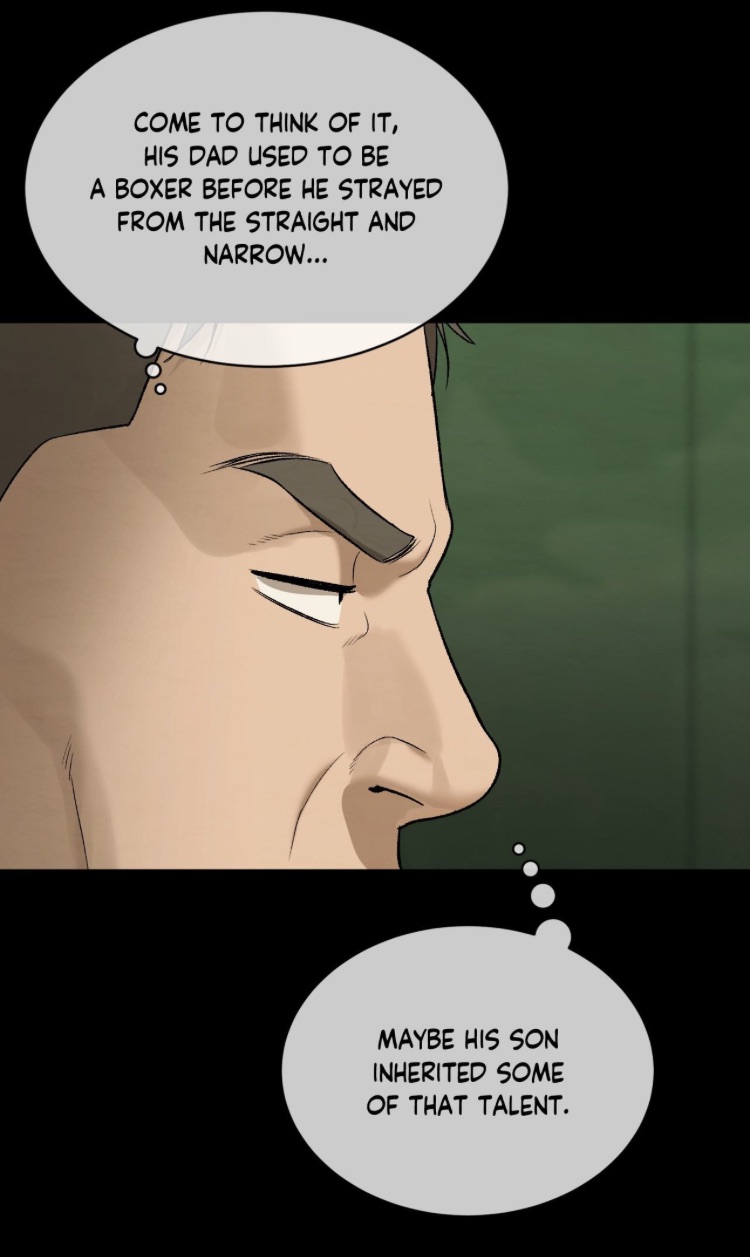 (chapter 72) This becomes painfully clear in the call to his mother, when young Joo Jaekyung promises to become strong,
  (chapter 65) Unlike Kim Dan’s grandmother—who is shown gazing downward at the baby she holds, visibly burdened yet emotionally present—the champion’s mother stares straight ahead.
 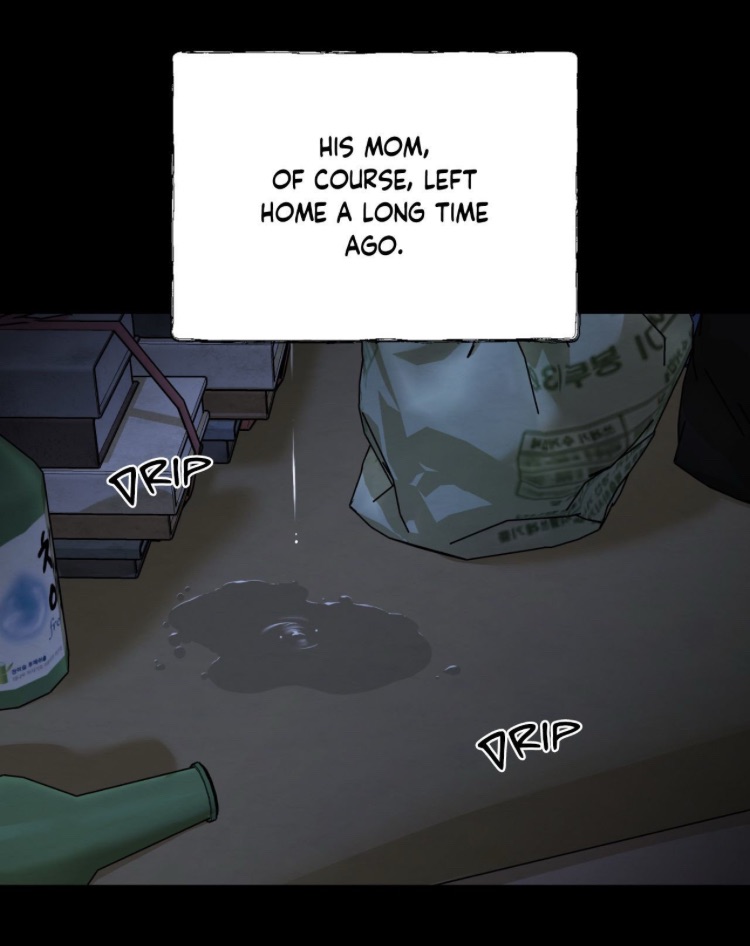 (chapter 72) The use of “of course” suggests inevitability, even justification. He is siding with the mother. His explanation for her departure is the father’s behavior: his abusive attitude.
 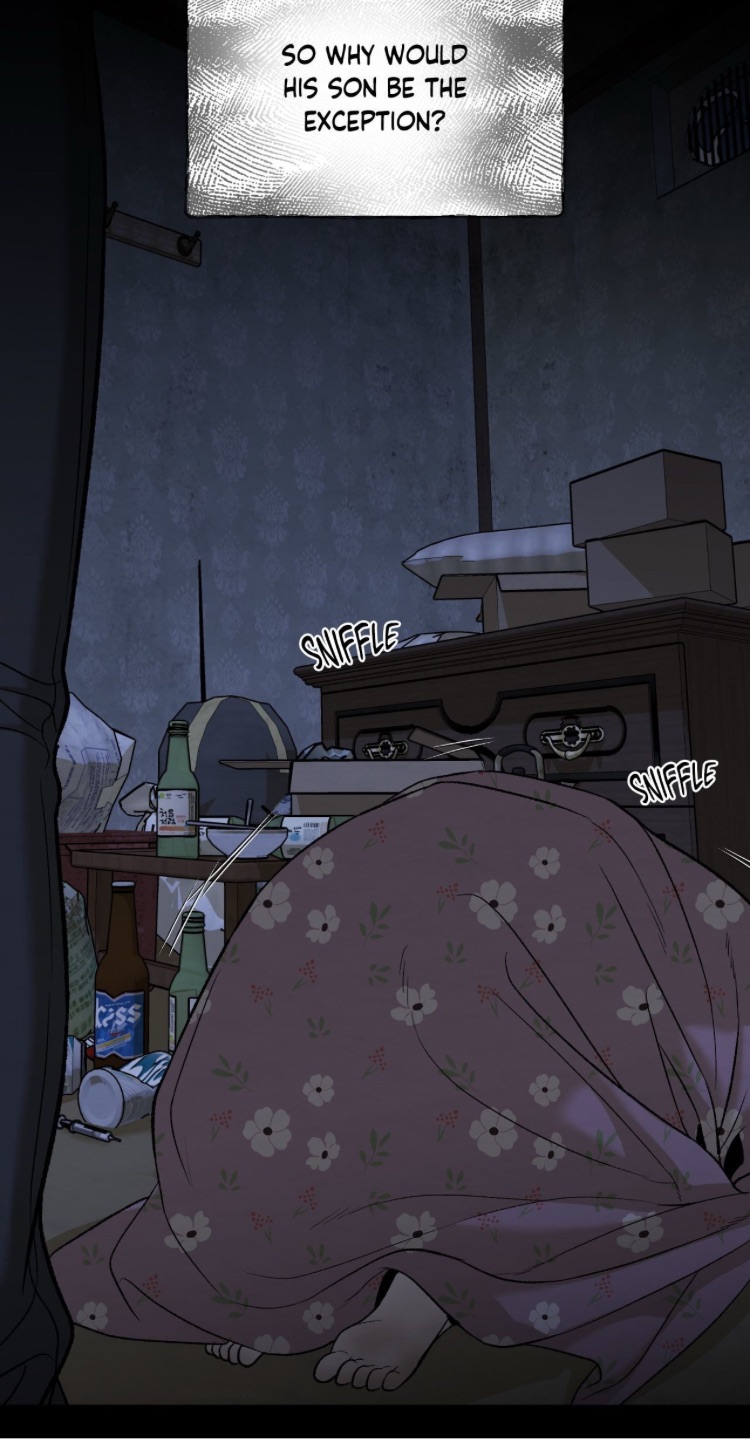 (chapter 73) However, what remains unspoken in this sentence is that she did not just leave her husband—she left her son too. Hwang Byungchul fails to mention this because he, too, is a man who has lived alongside a woman without truly giving her an official recognition. His own mother lived in his shadow, cooking for fighters, breathing life and love into the studio, yet she remained unnamed. Like Jaekyung’s mother, she was reduced to a supportive function. The crucial difference is that Hwang’s mother lived through her son, and stayed until her death.
 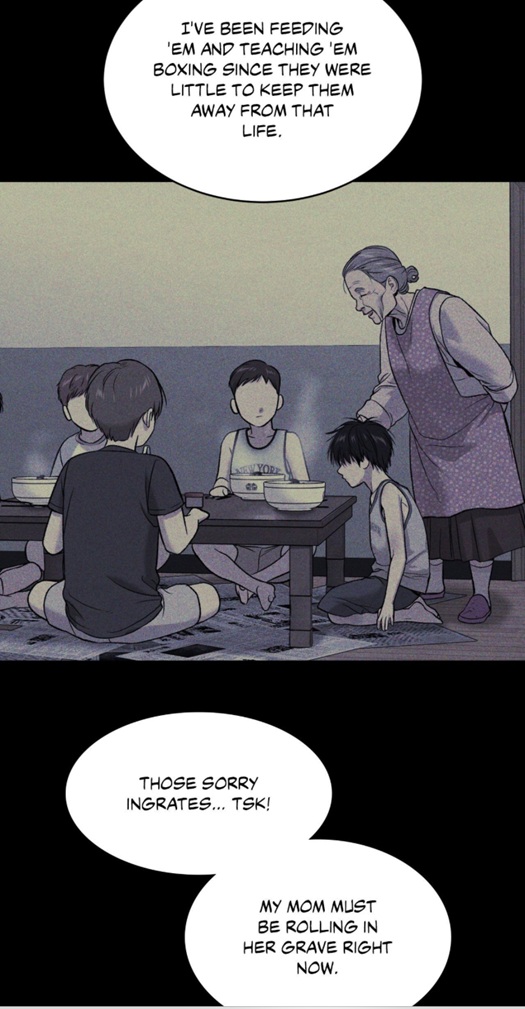 (chapter 73) Thus I deduce that the champion’s mother had a different mind-set. Either she had to give up on her dreams because of her husband and the birth of her son or she desired to live through her husband’s success, though I am more opting for the first possibility. However, both ideas have one common denominator: the mother was dependent on the “husband”.
  (chapter 73) Under this light, it becomes comprehensible why the man would avoid to meet his wife’s gaze and why the author hid Joo Jaekyung and his mother’s gaze in the last memory from Joo Jaewoong. Her gaze was for him painful, full of rejection. Consequently, I think that when Mingwa created this image for the champion’s birthday
  , she was revealing the arrival of the mother and her traits in her son: humbleness, water, darkness, a daring gaze and uncombed! But let’s return our attention to Joo Jaewoong and his vision:
 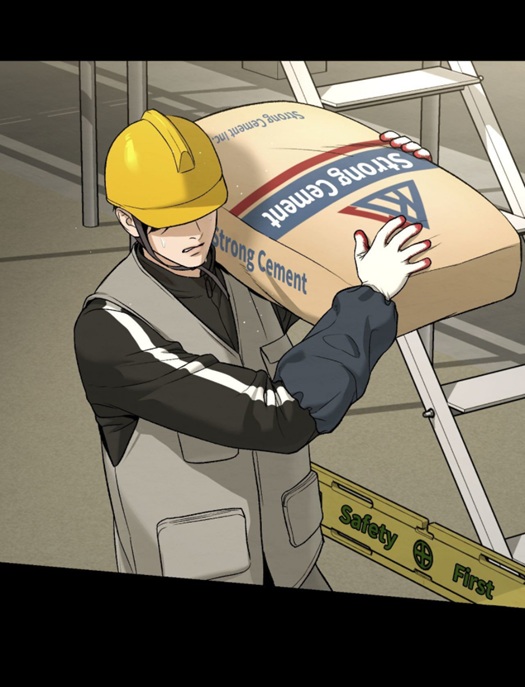 (chapter 73), cleaning the house. He felt like a kept man, emasculated by the very woman he expected to serve him. That’s why he says this to his son:
  (chapter 72) He desired to be greeted properly, to be recognized as the head of the family. However, this is how the loser’s mother acted, when he returned home.
  (chapter 73) He didn’t greet him either and avoided to talk to him (points of suspension). This could only infuriate Joo Jaewoong, as the latter felt as a failure and denial of being a husband and father. And now, you comprehend why I see this picture as the evidence
 It is no coincidence that the main lead has a similar vision than his own father about the mother.
 (chapter 51) Lack of trust and faith from the champion and the doctor! Both didn’t truly talk to each other. Their relationship was based on silence, power and mistrust, thus both chose not to talk about the meeting with director Choi Gilseok. But since reality is complex, we have to envision that absence of recognition and gratitude played a huge role in their failure as well. Why did the director’s mother remain by her son’s side and support his dream? It is because she believed in him. She loved him unconditionally. Hence I am inclined to think that one of the causes for their marriage was the lack of trust in each other, for the affection was rather conditional. I am also suspecting that the woman was always excluded from important decisions as well.
  (chapter 55), but she gave him the necessary push to reconnect with doc Dan.
  (chapter 55) In this scene,
  (chapter 55) we can detect similarities with the former home from the main lead:
  (chapter 1) . And now, compare this to the 26-year-old champion standing beside his father. His face mirrors the father’s almost exactly (jaw,nose), except for the eyes.
 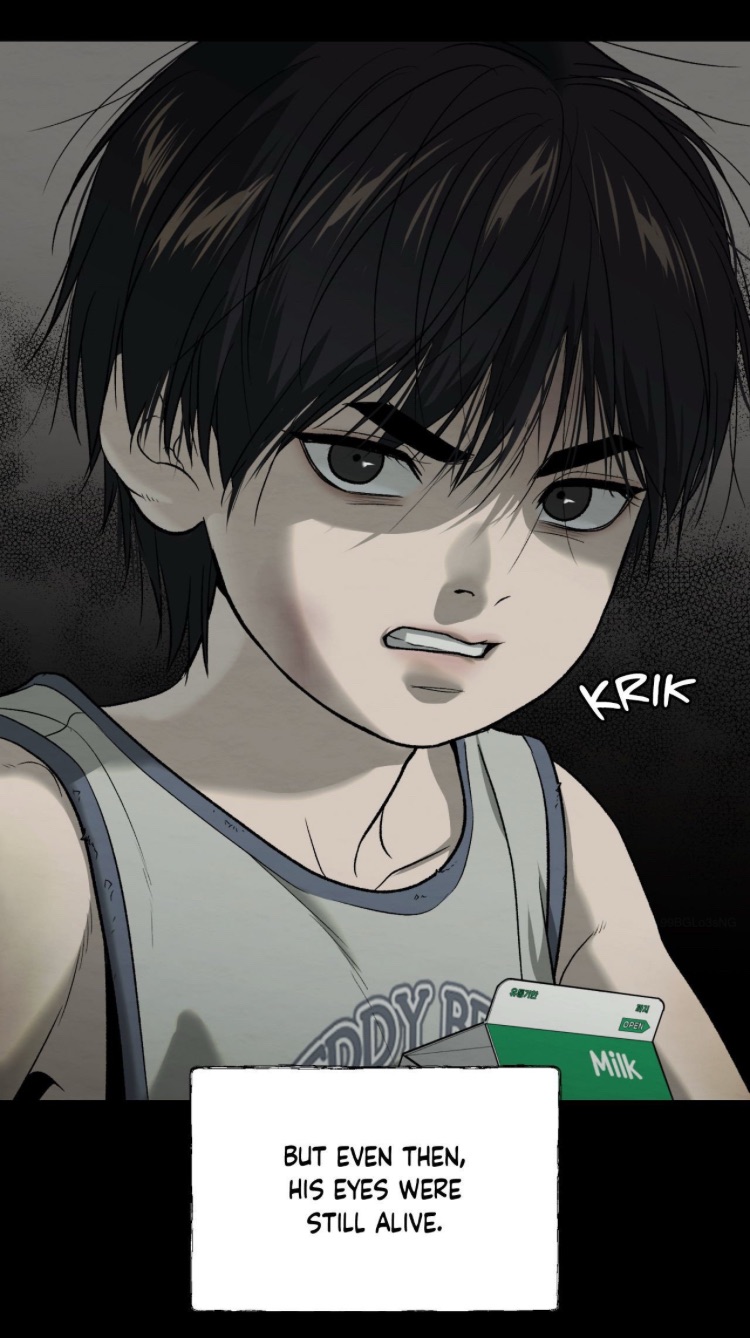 (chapter 72)
 (chapter 73) However, like mentioned above, their toxic relationship played a role. Another is money. Observe how the the 10 years old boy added right after:
  (chapter 73) became his curse, as his dream had become a reality.
  (chapter 7) and possessiveness.
 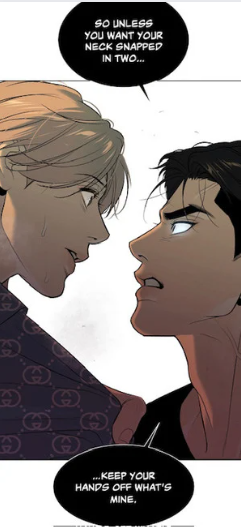 (chapter 34) I had already portrayed the ghost as a person suffering from narcissistic personality disorder, and since the ghost shares common traits with the father, I am assuming that the father is the ghost. Jaewoong’s narcissism was not simply paternal in my opinion.
  (chapter 31) He didn’t support him to become independent professionally. That’s why I feel like the insecure boxer must have acted the same way, not allowing his wife to become successful in the end.
  (chapter 54) Is it a coincidence that in his nightmare, his loved one was looking back at him? No, the doctor was acting the opposite from the champion’s mother:
  (chapter 42) the jealous and regretful ex-lover told him otherwise. How did the father describe his son?
 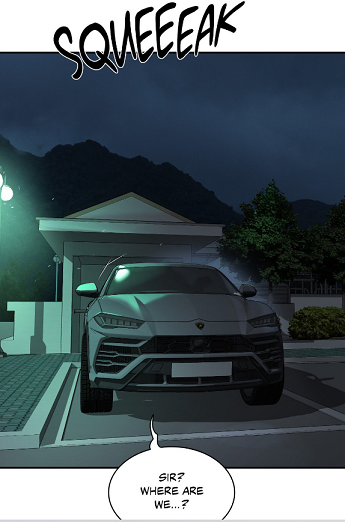 (chapter 33) This chapter stands not only under the sign of jealousy, but also of motherhood due to the number 6. If this theory is correct, then it signifies that he kept his promise. He gave her a place, but he didn’t want to return to her side for two reasons: her abandonment and his guilt concerning the death of his father. As for the mother, I would say… out of guilt and shame due to her “pride”. She knows that she did hurt her son. Naturally, I could be wrong… but I hope if she is alive so that the champion can talk with his “mother”. This will help him to move on. Breaking the silence between them would put an end to his self-loathing and misery
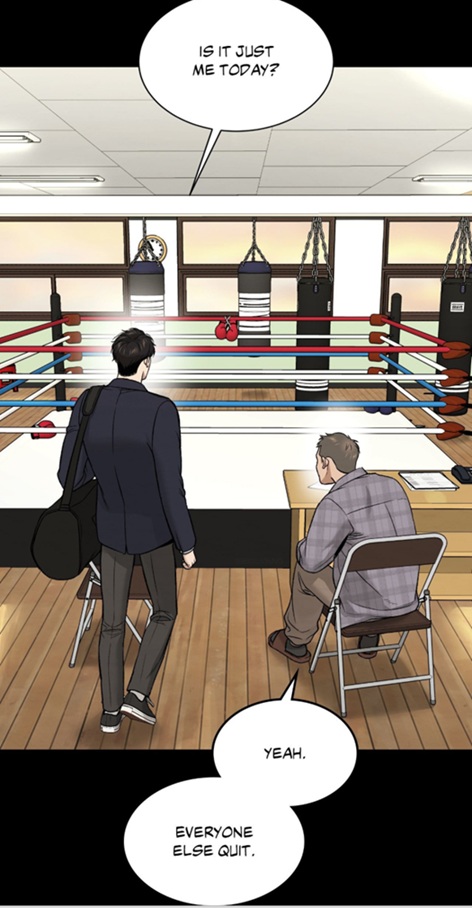 (chapter 73), gradually fell into decline after the death of his mother. She had been its soul, offering invisible support, care, and emotional warmth to the fighters.
  (chapter 72) onto Shin Okja
  (chapter 61) due to her similarities in age, gender, gestures and words. However, he failed to detect her flaws, as he trusts seniors too much. I guess, it is related to Jaewoong’s death. Nevertheless, it becomes clear that doc Dan had become the soul of the gym:
  (chapter 26), but the latter was not recognized as a real member of Team Black. Besides, let’s not forget that he was only working for the champion and not Team Black!
 (chapter 26)
  (chapter 73) They became heavy with grief. Yet in Kim Dan’s presence—through his care, his quiet resistance, and even his occasional clumsiness—Joo Jaekyung glimpsed something forgotten. He was able to laugh
  (chapter 26), to play, even to feel embarrassment—emotions far removed from the sterile discipline of professional sport. Through Doc Dan, the athlete briefly recovered his lost passion. Not just for boxing, but for being human.
 (chapter 62) So far, doc Dan hasn’t heard what his fated partner did while waiting for his “return from work”.
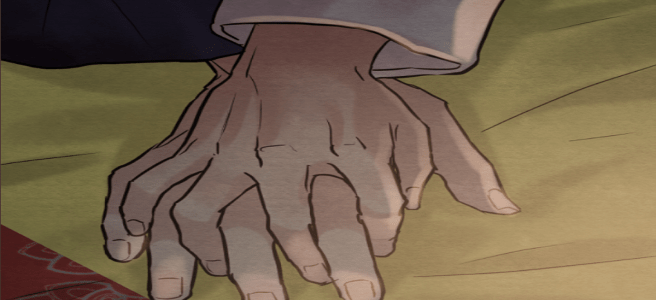
 Yes, when people read juicy deeds, they were already imagining that I would describe a love session like this one
  (chapter 96), because of the expression „to do the deed“:
  (chapter 87) However, the deed is not just related to intercourse, like the manhwaphiles could discover it in chapter 51.
  With „deed“, Deok-Jae was referring to murder and assassination. As you can see, deed has other meanings than sex. Thus it has for synonyms action, accomplishment and reality!! So when I selected this name for the essay, I was thinking of the relationship between action and word. And this connection came to my mind, when Byeonduck released the last picture, because the painter’s action symbolizes a conversation and as such words.
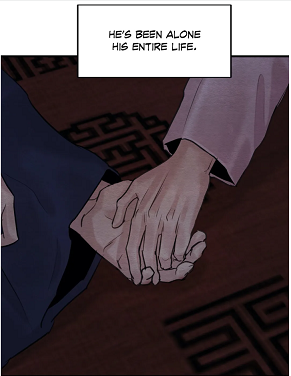 (Chapter 88) By reaching his hand, the painter was letting him know that he was no longer alone in this world. He was not only joining his side, but he was willing to try to understand the main lead.
 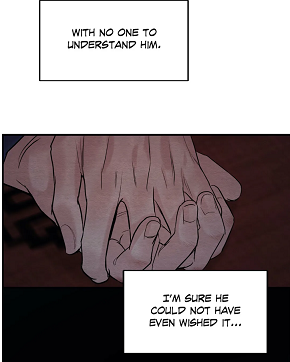 (Chapter 88) This gesture stands in opposition to the situation with Yoon Chang-Hyeon.
 (Chapter 86) During that fateful night, the father neither talked to his son nor looked at him. He even turned his back to him, when the young master attempted to grab his father‘s hanbok. Both scenes from chapter 88 and 86 have two common denominators: an action accompanied with silence!! Yet, what distinguishes them from each other is the nature of the deed, the action. Alliance and empathy versus abandonment and estrangement! This is no coincidence that after reaching his hand, Baek Na-Kyum started confessing his thoughts and emotions to his lover:
 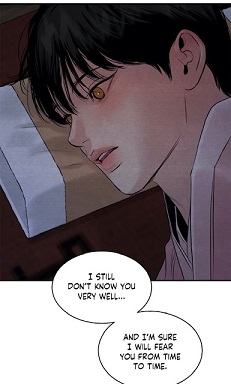 (Chapter 88) As you can sense, the hand gesture delivered a message, but the painter still felt the need to clarify the meaning of his hand. He was willing to remain by his side, but he was still afraid of him. He didn’t want to create a misunderstanding, like for example that he wouldn’t argue with him or that his loyalty was now unconditional or total. That way, Yoon Seungho wouldn’t come to view him as a hypocrite or as dishonest, if an argument would appear. Thus he needed words to explain his position. He would remain by his side and attempt to sympathize with him, but he still felt insecure and had doubts. In other words, his action (his hand gesture) was not truly reflecting his mind and heart.
  (Chapter 88) Later he even asked his lover not to leave his side no matter what.
  (Chapter 88) To conclude, the hand gesture in episode 88 was connected to insecurities and as such fear, yet the painter had shown no hesitation to take his hand. The anxiety was not visible.
 (Chapter 30) His fingers barely grabbed his hand, so when he made the following vow, he was not entirely sincere or better said, truly determined to keep his promise.
  (Chapter 30) The words were not truly in unison with the gesture either. Therefore he once tried to leave the mansion in season 2. When he pledged loyalty, his intention was to protect his teacher. To conclude, fear has always been present, when the painter took Yoon Seungho’s hand. Even in chapter 88, but contrary to the scene in the courtyard, his hand was not shaking.
  (Chapter 82) This explicates why the artist chose to remain by his side, though the lord had broken his promise.
 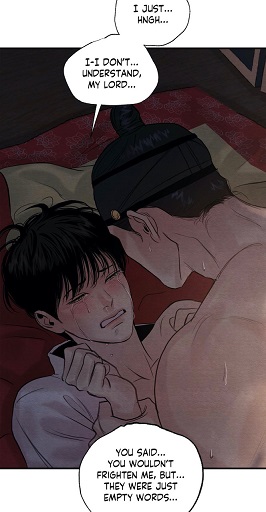 (Chapter 82) On the other hand, in this scene
  (chapter 82), the lord was grabbing his lover’s hand out of fear. He was recognizing his mistake and was trying to beg for his forgiveness, though he couldn’t express it directly. Striking is that during the lord’s flashback, his hand was trembling as well, grabbing onto his partner’s body.
  (Chapter 81) It was, as if Baek Na-Kyum was his rescue buoy, helping him not to be swallowed by the darkness. Thus I came to the conclusion that the protagonists’ hand gestures are all connected to anxiety and pain. 😲 Hence I am deducing that in this scene, Baek Na-Kyum is holding his lover’s hand,
  (Chapter 102). This would have definitely scared Baek Na-Kyum, especially Yoon Seungho’s haunted gaze. On the other hand, since the painter had been himself the victim of physical and sexual abuse, the artist can only grasp why the noble reacted that way: fear, anger, despair and heartache. The artist had also been desperate, in pain and scared in the shrine, though this time, he had not screamed for his help. Since the lord had not returned to the mansion, how could he expect him to come to his rescue?
 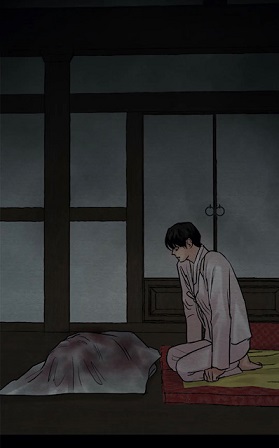 (Chapter 98) Back then, he had been waiting for his lover‘s return and explanations. He wanted to hear him and get his reassurance and comfort. .
 (Chapter 98) The latter couldn’t reassure the painter with his hand contrary to the previous night.
  (chapter 97) Exactly like mentioned above, the painter’s hand gesture is connected to fear and conversation.
 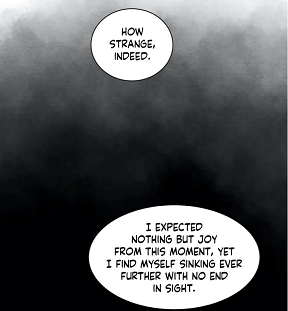 (chapter 97) Striking is that in the gibang, the lord confessed his biggest fear to his future “spouse”. He feared to lose him, though one of his biggest desires had been finally fulfilled. This means that Yoon Seungho felt even more insecure and frightened than before after receiving the artist’s love confession. That’s the reason why I believe that the new picture is standing in opposition to the scene in the gibang. The lord will feel relief after his admission. As a conclusion, the image is announcing
  (Chapter 89) While the painter was sitting on his partner’s lap
 (chapter 89), he was massaging the wounded fingers. It was, as if he was treating his companion’s wound. Note that after his terrible flashback, the painter had avoided to grab his hand out of fear that he might hurt Yoon Seungho even more.
  (Chapter 84) Therefore I conclude that the new panel is an allusion to treatment. While in episode 89, the painter was acting as a doctor, in the new image, the young man is working more like a counselor or psychologist. The aristocrat’s hand might not be wounded in that scene, but this is not the case for his heart and mind. So for me, this scene is connected to mental treatment.
  (Chapter 84) However, the lord had refused to open up. This is no coincidence that the author had not created such a picture during that chapter. As the manhwalovers can detect, I believe that in that scene,
  (chapter 88), and this, although the lord is indeed a murderer. For Baek Na-Kyum, his gesture will have a different meaning: he saved his life and freed him from his torment. Secondly, if the lord reveals the circumstances of his mother’s death, the artist will definitely deny his responsibility in her death, a new version of this scene.
  (chapter 75) And because I detected a discrepancy between words and gestures, I recognized the presence of another trick from Byeonduck.✨
 (chapter 91), the latter denied this with the following statement.
  (chapter 91) But when did the painter admit that he liked embracing him? In this panel!
  (chapter 88) That’s the reason why the lord got surprised and moved. As you can see, the author never revealed this whispering to the manhwalovers! The latter had the impression that the lord’s reaction was related to the loving embrace, but it was only partially correct.
  (chapter 62), when the lord had confessed to adore him.
  (chapter 62) This explicates why Yoon Seungho was so pained in season 2. He got embraced, but there were no words. Consequently, when the painter vanished during that night, the lord could only perceive the embrace as hypocrisy and fakeness. That’s how I realized that the story is developed on the contradiction between words and actions. But not only that, there exists a strong link between silence and passivity. Thus after the abduction in season 2, Baek Na-Kyum remained more or less silent
 (chapter 62), and as such he was totally passive. He never stood up and begged the lord for his leniency. He stayed there on the bed giving the impression that he was indifferent. That’s the reason why Yoon Seungho got more enraged, for he felt fooled. This means that the absence of words represent inaction… This explains why Yoon Seungho had to corner the main lead in chapter 48
  (chapter 48) to say something, as he had sensed his passivity behind his „submissive attitude“. This is no coincidence that during this night, the painter felt extreme pleasure to the point that he peed. Therefore he could voice his wish to Yoon Seungho during the love session from season 2.
  (chapter 73) That’s how the lord concluded that the painter liked riding him, while in reality such a climax had appeared for the first time, when both were facing each other!
  (chapter 49)
  (chapter 4) than season 2. He was encouraged by his future partner to speak up, yet the moment he got heartbroken, he was left speechless. And note that when the lord played his prank in the bedchamber, he never said anything to his father.
  (chapter 83) He didn’t move as well. Why? It is because he knew that talking to his father was pointless. However, Yoon Seungho had hoped that with his prank his father would finally see the truth. He had been fooled by Lee Jihwa and father Lee!! But the stupid father never realized it. As you can see, the lord had in that scene long given up to use words, he hoped that his father would see the truth with the prank. Don’t forget that deed stands for truth and reality. He thought that “actions would speak louder than words”, but he was proven wrong. This signifies that in this scene,
  (chapter 86) Yoon Seungho had acted the opposite, he had tried to speak up, but he had been muted. I am also thinking that the young master must have attempted to converse to his father
  (chapter 77) here as well, but the lord had not listened to him. Why? It is because Kim had said nothing!!
  (chapter 77) Silence was considered as an admission. This is no hazard that the butler didn’t take care of his young master. This scene symbolizes the quote “Actions speak louder than words”
  (chapter 77) The butler had betrayed the young master’s trust, for he had not intervened. He should have defended Yoon Seungho, but no in fact he had sided with the elder master Yoon once again. Not only he had not reminded Yoon Chang-Hyeon of his promise, but also he had assisted the ruthless father by giving himself the straw mat beating!
  (chapter 98) Here, he examined the robe and questioned the officer. The problem is that he was still relying on his staff and as such Kim. Therefore it is not surprising that he could still be manipulated by the schemers. Hence I am anticipating a total change in season 4. By conversing with the painter, the lord can only become more proactive to the point that he will be able to ruin the next schemes. I am even expecting a prank from the protagonists in season 4!! But this doesn’t end here. I am deducing that in the past, Yoon Seungho suffered because one tormentor would do things and say nothing, while the other would talk a lot, but act the opposite!! For me, these descriptions fit to Kim and the pedophile. I have the impression as well, that both characters came to switch their behavior. In one circle, Kim did many things, but remained mute, but later he did the exact opposite. I would like to point out that in season 3, he acted this way. He would promise loyalty to the lord,
  (chapter 77), but backstabbed him in the shadow. Besides, we shouldn’t forget that a narcissist’s words don’t match their action, because they are pathological liars. And so far, I had portrayed father Yoon (overt), Kim (covert) and even Jung In-Hun (overt) as people suffering from NPD. And I am assuming that the mysterious lord Song is not different from them, though I am suspecting that he must be a covert type.
  (chapter 77) Besides, it also snowed, when the painter got abducted twice, a sign that actually a promise had been broken.
  (chapter 102) He is no longer following social norms. This could only happen, because the lord had just committed a huge crime. What is the point to respect laws and tradition, when he became a murderer? Any other transgression can only appear as harmless. That’s the reason why I am expecting that Yoon Seungho decides to disregard social norms from that moment on and play a prank on the “villains” of this story.
  (chapter 76)
  (chapter 53)
  (chapter 87), while the same extremity symbolizes the opposite with the villains and antagonists: violence, silence, submission
  (chapter 83), hatred and resent
  (chapter 97) Here, Heena was hurting her brother, because she wanted him to face “reality”. What caught my attention is that we never saw the father’s hand in chapter 86!
  (chapter 86) Why? It is because it reveals his powerlessness. And this leads me to the following conclusion: the deed stands for reality and honesty, while the words symbolize emptiness, illusion and deception. And now, you comprehend why this work is composed by the dichotomies: dream, words and mouth versus reality., action and the hand. This means that in season 4, the manhwaphiles should try to analyze the thoughts and emotions of the characters behind the hand gestures. At the same time, they can also verify if my interpretation is correct. Is the zoom of the protagonists’ hand connected to fear, confession, empathy and assistance?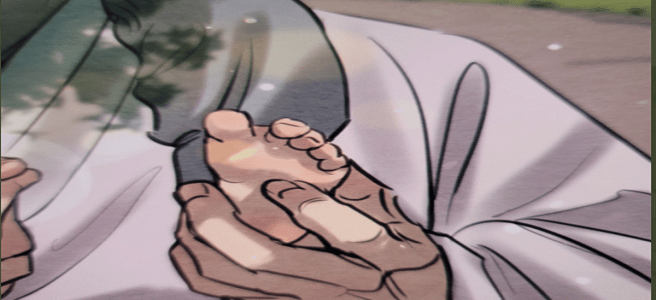
 on Twitter yesterday, and naturally this made many people happy, for Jung In-Hun was stroking Baek Na-Kyum’s foot gently. How could people identify the characters, though we don’t see their faces? Simply by the clothes! The manhwaphiles remember the painter’s grey pants and the learned sir’s favorite color, lavender,
 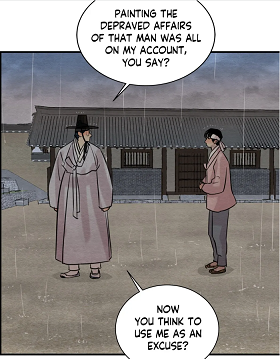 (chapter 19)
 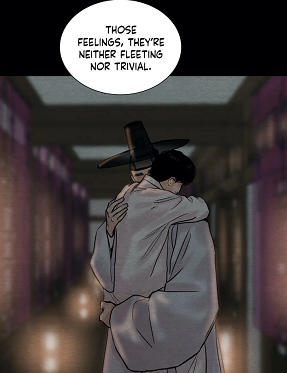 (chapter 68). While many manhwalovers found this image cute
  (chapter 70) The manhwalovers can immediately detect the contrasts: the visages of the protagonists versus the hand and the foot, day versus night, sun versus moon. That’s the reason why I came to the deduction that this image embodies a happy memory of the painter: sadness versus happiness.
 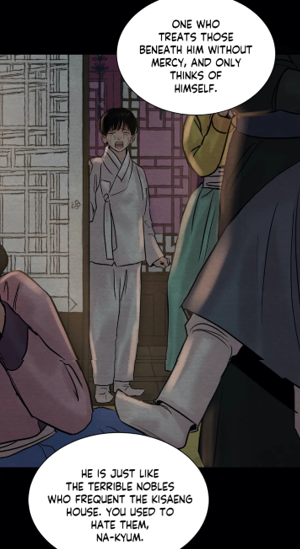 . (chapter 68) This means that Baek Na-Kyum was removed, because he was a witness and could generate a scandal. He is beloved by the kisaengs. However, back then, he got misled due to Heena’s indoctrination and false impressions. When he saw this, he was only looking at his noona, hence he didn’t pay attention to the actions of the black guard. Moreover, he had no idea why Heena and Yoon Seungho were behaving like that. So when the painter recalled Jung In-Hun from that night, he was no longer heartbroken, because the stroll with the scholar came to his mind.
  (chapter 70). The trigger for this recollection was his farewell to Heena. This time, he could say goodbye to Heena properly by embracing her and giving her a scarf so that she would remember him. In the painter’s mind, after that night, he would never see her again.
 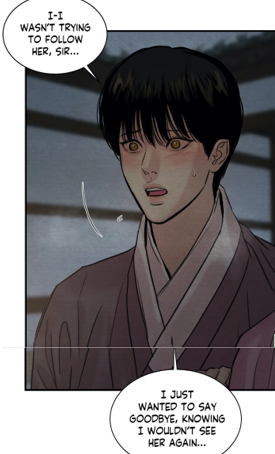 (chapter 69) In other words, this night represented a closure for Baek Na-Kyum, the end of his abandonment issues. In episode 70, Jung In-Hun had consoled him, he had tried to cheer him up. Thus the learned sir was smiling. Yet, this couldn’t cover the painter’s scar. He felt that he had betrayed Heena, for he had not been able to protect her. It was, as if he had run away. Nevertheless, when this incident occurred, the learned sir had not run away from the gibang, because you could see that Baek Na-Kyum was wearing socks and shoes.
 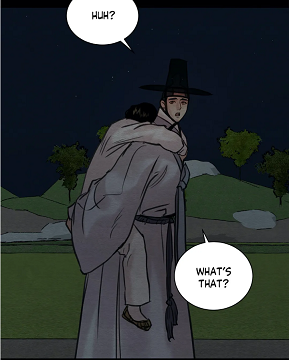 (chapter 70) The man had put the shoes on the child, as in the building, the painter only had his socks on. Because of the presence of the socks,
  (chapter 68), I deduce that this walk must have taken place in a colder season (fall)
  while in this picture, Jung In-Hun was carrying the painter on his shoulders in the summer.
  (chapter 102) In both scenes, the main lead is seen with bare feet. He is also carried by his loved one. But here, it is snowing, hence this signifies that it is winter. On the other hand, the manhwalovers can detect the presence of a purple flower on the right side. This signifies that Spring is on its way. That’s how I came to realize why Baek Na-Kyum is now recalling the learned sir’s gesture from the past.
  (chapter 94) His presence was to divert the attention from these men so that she wouldn’t be asked to have sex with them. And since I have already detected that each time, the painter suffered, karma would retaliate, the logical consequence is that Heena got punished for her wrong action. This signifies that while the painter was following the learned sir, his noona was abused in the kisaeng house. This would explicate why later she had no remorse to turn Yoon Seungho into a victim. And don’t forget that the painter was much younger than in this scene.
  (chapter 45)
  (chapter 75) The latter would let his partner walk through town in order to please him. He would even follow the painter. In other words, it was always for the painter’s sake, and in the mountain, it was the same. But it was not the same for Jung In-Hun, it was for his own benefit. We have the best example in chapter 10:
  (chapter 10) Here, he desired to separate the couple. Baek Na-Kyum should refuse to paint erotic pictures.
  (chapter 29)
  (chapter 70): The artist is dressed with good clothes, he looks more like a young master than a commoner, only the shoes are indicating that he is a commoner. That’s the reason why I believe that during that night, the learned sir was avoiding people. They could have wondered why the young boy was carried in his night clothes outside. From my point of view, this scene
  (chapter 29) He had already been seen with a girl before who seems to like him either.
  (chapter 6) Thus I couldn’t help myself wondering if the learned sir was not directly involved in prostitution, bringing girls to the gibang and even covering up for the sexual child abuse. We shouldn’t forget that the pedophile was portrayed as a man consumed by lust who would never pay attention to the time and the hour.
  (chapter 1) Hence the painter had to leave the gibang during the day as well.
 (chapter 6)
 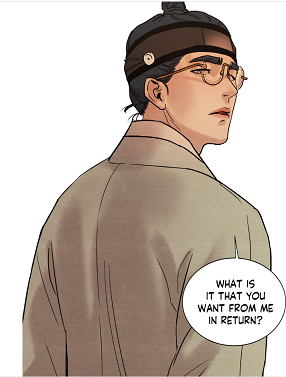 (chapter 7)
  (chapter 7) This change is not random in my eyes. I had already associated the learned sir to a chameleon. This change of color seems to validate my theory that Jung In-Hun had been sponsored by Min, hence we have the light green. Black Heart is symbolized by green. However, the light pigment reflects that he had been abandoned and betrayed. Nonetheless, when he encountered Yoon Seungho, the latter was wearing a purple hanbok.
 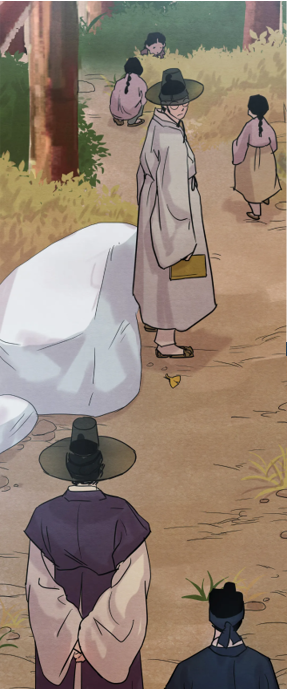 (chapter 6) That’s how the man got influenced and chose to wear his lavender hanboks again. But he never realized that behind the young noble, there was standing the pedophile, someone he had helped in the past. From my point of view, the change of the learned sir’s hanbok was the indication of his betrayal. According to me, the old bearded man
  (chapter 37) was not a former servant, but the pedophile. So he could have recognized the learned sir thanks to his hanbok… just like the readers did with this picture:
  (chapter 83), the topknot incident
  (chapter 83) According to me, in the painter’s vision from episode 1, the braided man is Yoon Seungho. The absence of shoes and socks was in truth an indication of neglect and abuse, but the warmth and gentleness from that scene deceived the painter:
  (chapter 73) From my point of view, the intimacy in the bedchamber stands in opposition to the teacher’s gesture in the countryside. His caress was just a casual gesture with no real deep meaning in the end. This explicates why he could betray and abandon the artist on so many occasions in season 1 (chapter 11, 24, 25, 29, 35, 40). The learned sir had always prioritized his own interests.
  (chapter 102), the painter should realize the difference.
  (chapter 70) talk and ask questions before apologizing and hugging him. The lord never acted, as if nothing had happened,
 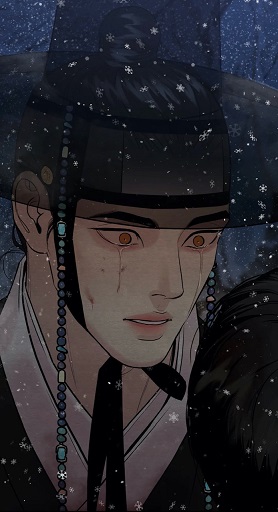 (chapter 102) This was true love and Baek Na-Kyum’s feet always reflect his emotions:
  (chapter 58)
  (chapter 80) So now, imagine how the painter must feel if the lord took his feet in his hands! This is no coincidence that there is this saying:
  (chapter 100)
 (chapter 102) and the zooms on the feet:
  (chapter 53)
  The couple was following their heart!! But this was not the case with the scholar. Baek Na-Kyum had no other choice than to follow Jung In-Hun.


 (Chapter 73)
 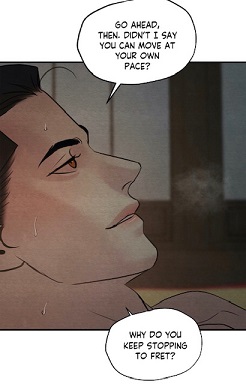 (chapter 73) This is important, because the manhwalovers can sense a connection between sex and hunt. This means that the love session in the bedchamber from season 2 should be perceived as a new version of a hunt. And this link between sex and hunting was also present, when Yoon Seungho and Min were in the woods in chapter 41:
 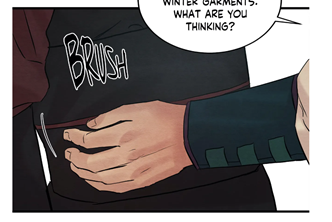 (chapter 41) In this scene, it looked like Black Heart was trying to make a move on Yoon Seungho, while in truth Min was more obsessed with the painter.
  (Chapter 41) The expression „spot“ belongs also to the semantic field of chase.
 (Chapter 11) A murder disguised as an accident, the scholar would have been eaten by a tiger. What caught my attention is that No-Name requested from Deok-Jae that he should make the painter leave the mansion.
  (Chapter 99) First, he was rushing, but the moment he received the crucial tip from his childhood friend, he approached the den silently, just like a tiger. That‘s the reason why neither Black Heart nor lord Jang nor lord Park detected his presence.
  (Chapter 101)
 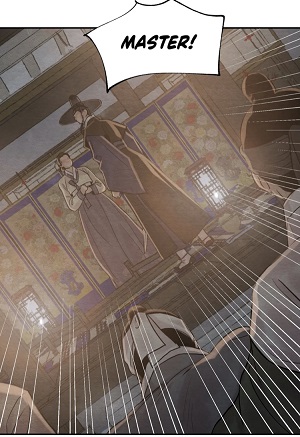 (chapter 99) and Lee Jihwa
 (chapter 100), hence he had not the time to question the veracity of their claims or sense their manipulations. On the other hand, he could detect the difference between the blood in front of the scholar’s house and inside the building.
 (Chapter 100). He was following his instincts. Tigers cautiously stalk their target from the rear in attempt to get as close as possible to their unsuspecting prey.
  (chapter 102)
 (chapter 48) or the chin
  (chapter 83)
  (chapter 102) Even in this panel, the sword resembles a lot to the tiger‘s fang:
  (chapter 102) Another important element is that this predator usually targets large-bodied preys like boar, deer, humans and not rabbit or pheasant. Under this new light, it becomes comprehensible why the main lead went after a boar or the aristocrats in season 3.
 (chapter 22)
 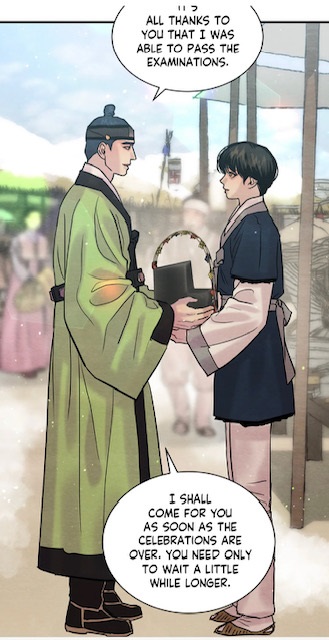 (chapter 111) than the killer in the woods
  (chapter 103), it looks like the learned sir chose to drop his own principle. And if this theory is true, then I come to the conclusion that the learned sir chose to copy the protagonist thinking that he could get away with it.
  (chapter 60) The latter belonged to the lowest ranks of Joseon’s society, because killing an animal was a disgraceful job. On the other hand, the butcher No-Name and the tiger Yoon Seungho have something in common: killing is viewed as a necessity. It is either to survive or to end the animal’s suffering or to punish the criminals.
  (Chapter 22). And when Black Heart suggested the artist’s assassination, he always kept laughing, making it sound like a game without any terrible consequence.
 (Chapter 43) Lee Jihwa would remove a witch, and not a human.
  (chapter 43) Only Nameless painted it in all its cruelty and brutality. Not only the person would lose his life, but he would lose his identity.
  (Chapter 60) By removing his eyes and tongue, the victim’s face would change making him impossible to be recognized. And note that his scarf and headgear had been removed as well. It was not a game, but a deadly matter. Why would he do such a thing? The reason is simple. If no one could identify the victim, there would be no investigation. Astonishing is that hunt is a synonym for investigation and prosecution. Hence I am deducing that in season 4, the investigation should be perceived a new version of the hunt, a new version of this scene.
  (chapter 37) Because of Jung In-Hun and Min, someone will be put on the wanted list. On the other side, Mumyeong’s other job is to entertain people. To conclude, there is a strong connection between killing and entertaining which the main lead destroyed during that night. He reminded the nobles that hunting means taking away a life.
  (chapter 83) Thus I am deducing that this chase had been suggested to the main lead in order to release his tension and as such in order to divert his attention from the painter. Naturally, Kim was behind this idea faking his concern for his master. The hunt was supposed to procure pleasure to Yoon Seungho, but it couldn’t, because he was afraid of losing the painter. This explains why he selected the boar as his prey. He was fearless in front of that dangerous animal, for it meant nothing to him. He didn’t mind losing his life… revealing his suicidal disposition which resurfaced later, when the father mentioned the authorities.
  (chapter 86)
  (chapter 86) But the moment the servant reminded him to pay more attention to himself
 (chapter 83), he abandoned the boar immediately. This shows that all this time, Baek Na-Kyum had been on his mind. Therefore it is no coincidence that he rushed home on his horse and looked for Baek Na-Kyum.
  (Chapter 83) He couldn’t forget that he had scared and wounded the painter in his dissociative state. This shows that the chase had not served its true purpose: entertainment. In reality, the domestics had been the ones suffering the most, for them it was definitely more work
  (Chapter 84) compared to the past.
  (chapter 23)
 (chapter 41) First, I had feared that he might lose his life, then later I had realized that this death was purely symbolic. He would lose his title and family, therefore he would become a commoner. But I had also expressed my doubts that this scene could be a reference to Black Heart, as from chapter 52 on, I had sensed that he would die. Moreover, observe that during that hunt, Min had wounded the animal himself. This mirrors his own death. He became a victim of his own trick. But if the pheasant is representing two characters, The Joker and Lee Jihwa, then this means that the deer in chapter 22
  (chapter 22) embodies not only the painter, but also someone else. While in the past, I used to believe that it was Kim, now I come to the deduction that it was Jung In-Hun. Note that in this scene, the main lead left the prey and the scholar behind. Both got defeated. This means that by targeting Yoon Seungho, the scholar is not realizing that he is actually endangering his own life. Besides, by hunting the deer, the learned sir offered this prey to the tiger Yoon Seungho, and this was the painter’s case. Furthermore, the deer was carried back home on a horse
 (chapter 24) reflecting the painter’s fate.
  (chapter 25) Who brought the horse to the pavilion? Kim and Deok-Jae! And when the learned sir departed from the mansion, he was followed by the vicious servant and the horse.
 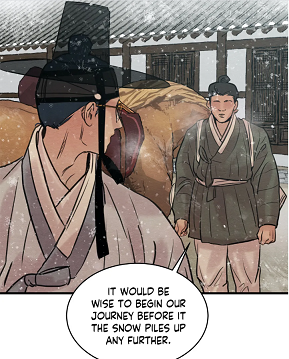 (chapter 44) As you can see, Jung In-Hun is connected to the horse. This observation was even confirmed in season 4.
  (Chapter 111) Thanks to episode 111, I detected another progression. First, Jung In-Hun was walking behind the horse
 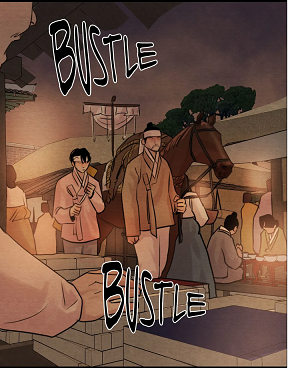 (chapter 24) Thus he could take the artist away unnoticed. Then in episode 44, the learned sir is shown standing in front of the horse. Finally, the manhwaphiles can see the man riding. This reflects his social ascension.
 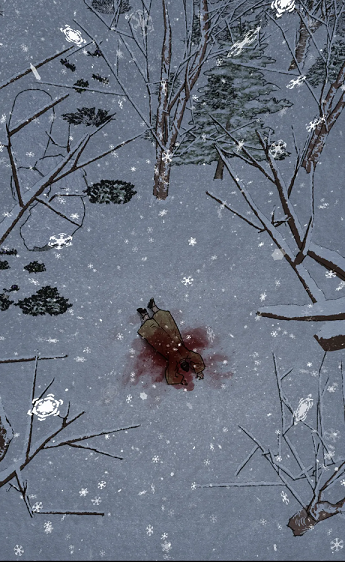 (Chapter 111) Like mentioned above, the shoes could be perceived as the evidence for Jung In-Hun’s crime.
  (chapter 83) The boar symbolizes not only the nobles like Jihwa, Min, Jang or Park, but also the elders Kim, Lee, Yoon Chang-Hyeon, and as such the king. And if you consider the boar as the personification of the pedophile, the ruler, this means that the moment Yoon Seungho hunted down the nobles, he defeated the ruler in a figurative way. I would even say that the nobles like Min or lord Haseon are pushing the main lead to “hunt” the monarch, for the shadows are standing behind the main lead. Due to their tricks, the “schemers” are realizing that they are contributing to give justice to the protagonists. Thus I was wondering if in the end, the main lead would hunt down a human in season 4, Kim or the king. Don’t forget the main lead’s words to the painter:
  (Chapter 103) However, since the manhunt appeared in the first episode from season 4, I deduce that we will have many manhunts in the final season, like here
 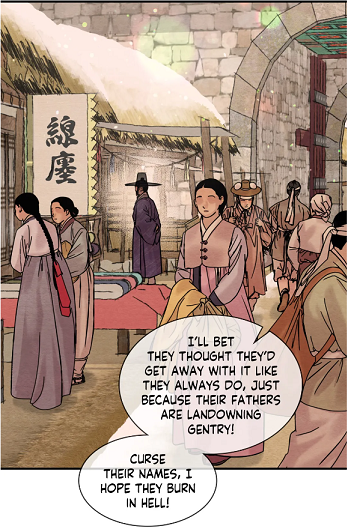 (Chapter 106)
  (chapter 106)
 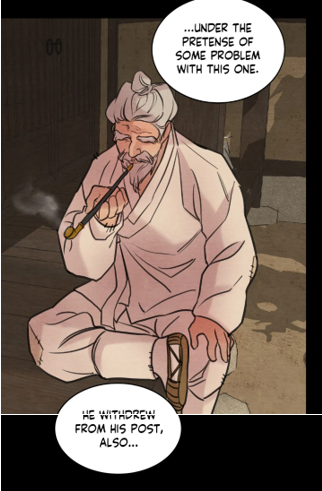 (chapter 37)
 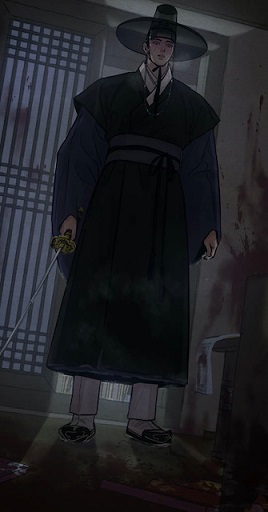 (chapter 100), the place could be interpreted differently. The inhabitant had been attacked by a tiger during the night.
  (chapter 45) the cobweb behind Deok-Jae. Imagine that this scene took place in the middle of winter, thus the spider’s web got covered by frost. However, this indicates that this room had been abandoned for quite some time. But it is close to the gate. So it should have been the place where the doorkeeper is living. Secondly, I had demonstrated that the shrine had been neglected, for the altar had been removed.
  (chapter 18) Because of the presence of the cobweb, I started wondering why the author drew it behind Deok-Jae. In my eyes, it is because he was part of the spider’s web.
  (chapter 18) That’s the reason why Yoon Seungho was not dressed properly.
  (chapter 83) If he lived in a shed and had such a simple attire, no one would ever think that he was a noble in the first place. I believe that neither the patriarch nor the ruler had an interest to reveal his true identity. However, the protagonist had to be monitored, for he could try to escape at any moment. That’s the reason why the butler was still tasked to “take care of him”. But by becoming a male night servant for the king, this meant that the other nobles could claim him as well. He had no right. However, since the main lead was a butterfly, he couldn’t get tamed. Hence violence, manipulations and drugs were used to tame the young master. And remember how the spider kills its target: he empties it of its blood. In other word, he sucks all his energy. Therefore it is not surprising that at the end the main lead had become a wreck, and had no light in his eyes.
 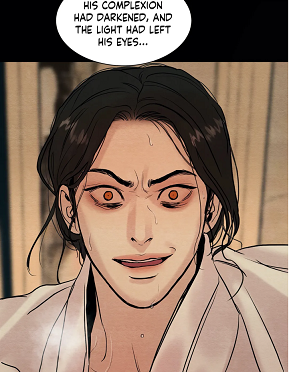 (chapter 57) Naturally, the purge played a huge role in the lord’s suffering reinforcing the huge rift between the pedophile and Yoon Seungho.
 (chapter 57)
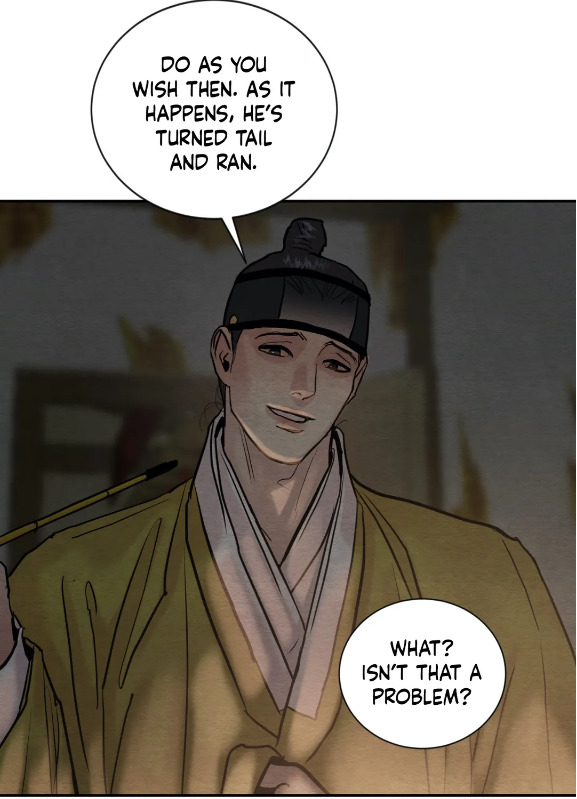 (chapter 101). It was not Min’s task to carry a friend… he was just a fellow puppet brought to the shaman’s house in order to entertain Black Heart. This truly exposes that Black Heart never saw in the aristocrats humans. As the red-haired master, he had been considered as the hunting dog, he had fulfilled his function. That’s why he was abandoned. He had helped Min to corner the painter and brought the kisaeng to the scholar’s home. Moreover, a hunting dog disobeying his master will be killed. Hence it is not surprising that the wild dogs ended up all dead. They were totally defenseless in front of a huge tiger. This feline is difficult to tame.
 (chapter 101) They saw in the sexual violence a new form of hunting. I would even go so far to say that they desired to turn the artist into their pet fulfilling all their desires:
  (chapter 101) Thus it is not surprising that Yoon Seungho was compared to an animal by his own father in the past.
  (chapter 101) As a punishment, he was given to lord Jang and his friend. Since Min had captured the artist, he viewed himself as his owner who would give order to his pet. Yet, a deer is a shy, but wild animal, difficult to control making it difficult to be tamed.
  (chapter 99) But this was impossible, for Black Heart never treated Baek Na-Kyum as a man. Hence I come to the conclusion that by meeting the painter, Yoon Seungho rediscovered his true nature: he was a free spirit, a tiger! And guess what… In Joseon, the tiger was perceived as a good talisman to chase away the evil spirit!!
 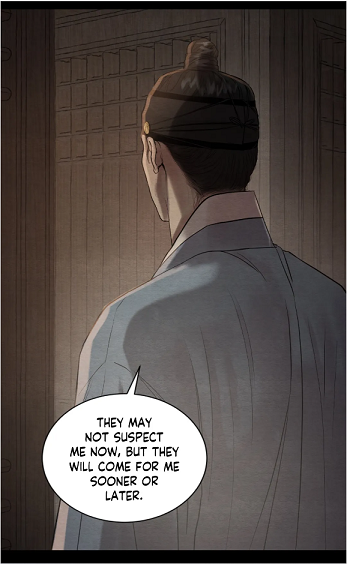 Yoon Seungho has the impression that he could get hunted down, for he killed the nobles. The tiger is now the target of “humans”, and Jung In-Hun will play a crucial role in his prosecution
 (Chapter 10)


 (chapter 12) The mention of a new toy implied the existence of an old plaything. But we know for sure that Yoon Seungho has never possessed anything. He was treated like a male kisaeng himself, for he was not allowed to refuse advances from anyone.
  (chapter 52) Finally, he was forced to share anything he owned to others.
  (chapter 52) That’s how I realized that the inner thought from Lee Jihwa was exposing his knowledge. The latter knew about Yoon Seungho’s true conditions. The latter had been treated like a plaything by the pedophile. As the red-haired noble had been raised as an filial son respecting elders, Lee Jihwa saw no reason to change the way Yoon Seungho was “trained”.
  (chapter 57) Besides, he could only benefit from it. Now, he could have sex to his heart content. He only started playing tricks, the moment he felt that his childhood friend was escaping from his claws.
 (chapter 59) However, don’t get me wrong. I believe that the change occurred thanks to Baek Na-Kyum’s intervention, the new version of this scene.
  (chapter 57)
 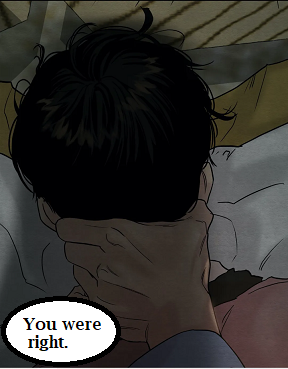 (chapter 62) This explicates why after reading episode 62 for the first time, I had suspected the father to have raped his own son. Yet this thought was dropped shortly after. Then when episode 77 was released, I realized that in the shed the lord was also reminded of Kim’s betrayal, for the latter would always drag him to the shed. Observe the way he was “carried away“. It was like an “embrace“.
 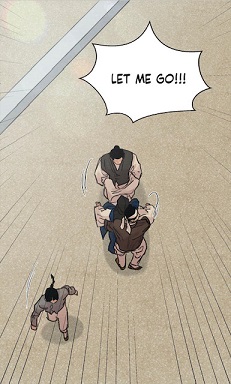 (Chapter 77) In episode 77, the readers can witness 2 incidents how the lord was brought to the storage house.
 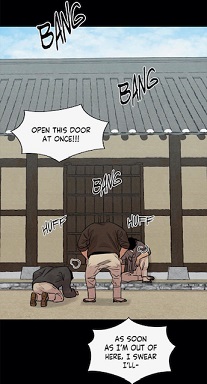 (Chapter 77, this is a different situation, for we have different servants except Kim) Therefore in the barn, Yoon Seungho behaved like his surrogate father Kim as well. This explicates why we have the fake embrace and the insincere apology.
 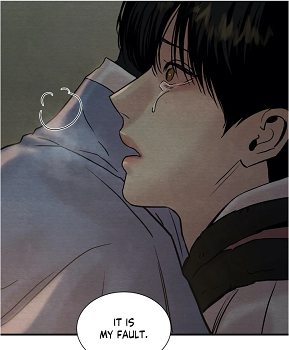 (chapter 62)
  (chapter 62) As you can see, the hug from the past was the symbol of violence and hypocrisy. It served to drag the lord to the storage room. And this new observation led me to the following conclusion: Yoon Seungho was copying the behavior from all his abusers from the past: his brutal father, the hypocrite butler and naturally the pedophile.
  (chapter 62) Hence the protagonist grabbed the painter by the hair. For me, the “mysterious lord Song“ used to hurt the main lead by the hair, when he got angry. How did I come to this interpretation? Note that at no moment we never saw Yoon Chang-Hyeon taking his son’s hair. First, the lord’s head was covered with a hat.
  (Chapter 83)
  (chapter 8) For a long time, I have demonstrated that this gesture represented one of Yoon Seungho’s biggest traumas. But why would the pedophile do that? One might say that it is because of Yoon Seungho’s resistance and struggling. He needed to punish him for his disobedience. Note that the noble with the mole and Lee Jihwa got humiliated as sanctions.
 (Chapter 18) However, in my eyes there exists another explanation which I will elaborate in this analysis either. From my point of view, the shed and the humiliation are strongly intertwined. This was particularly visible, when the lord forced Baek Na-Kyum to have sex in the courtyard.
  (Chapter 64) But why would he do that in the end? It was to train him, to make him obedient.
  (Chapter 64) Remember how he had declared that the painter was now his sex toy. He should listen to his master or owner. That’s how I came to this deduction. The infamous lord Song is a sadomasochist. In the worse case, he is simply a pure sadist. I am inclined to believe more in the first view. With this, we would have the link between sex and torment. And the picture from the erotic book where you see the bearded man having a braided man on his lap outside indicates that Yoon Seungho was here getting punished. The pedophile loved seeing Yoon Seungho humiliated and in tears.
  (chapter 01) And now, we have the explanation why the lord could no longer cry and how he came to hate “fake apology”. This was the result of the exposure to the sexual assaults under the form of BDSM.
 (chapter 96) They ended up in the hallway, anyone could see them. Then in another website, I found the following principles:
  (chapter 25) He even brought the hanbok himself.
  (chapter 26) The lord went so far to take his bath with his lover to clean him.
  (chapter 59) He made sure that his partner wouldn’t suffer.
 (chapter 89) Yoon Seungho knew by experience that the rest of semen in the stomach would cause him ailing.
  (Chapter 101) He blushed, though he could see that Baek Na-Kyum was in pain, the face covered with blood. Remember what the painter did in the pavilion to the main lead: he scratched his face.
  (Chapter 25) Thus we have to envision that the lord must have reacted the same way and wounded his abuser. And imagine the consequence if he had wounded the king on the face. This could be seen as a reason for a punishment.
  (chapter 102)
  (chapter 33) This is an euphemism for aphrodisiac. Thus we had this confession from the physician.
  (chapter 57) Why did the butler visit the doctor without Yoon Chang-Hyeon? It is because he had been ordered to fetch the aphrodisiac. By feeding him with the drug, they wanted to force Yoon Seungho to accept the advances from the king, and as such to admit his sexual orientation. He was a sodomite.
  (chapter 65) They faked his “pleasure“ making him feel guity and dirty. That’s how he got tricked. This explicates why the main lead still has no idea of the use of the aphrodisiac.
  (chapter 71) As a king, he couldn’t bow down to a noble. Observe that the roles of “dominant” and “submissive” are not clearly defined between Yoon Seungho and Baek Na-Kyum. The lord is the dominant sexually speaking, but note the vocabulary:
  (chapter 72)
  (chapter 89) If you pay attention to their interaction, the lord acts like the servant. The reason is simple. If you take into consideration the second list of recommendations, you will recognize that the roles are switched. Outside a sex session, the submissive becomes the “king“, and the dominant has to act like his servant. That way, a certain balance is created. But this was never the case between the pedophile and the teenager. The latter was always reduced to a plaything and at the end to an animal. The pedophile never called the protagonist by his name.
  (Chapter 1) He was just called “my boy“. And that was it. He never created a real bound with the main lead. Therefore trust was totally inexistent. And because the young noble could only fear the man, he came to hate him to the point he could die. The latter made promises which he never kept!!
  (Chapter 101) How could he vow to “protect or help“ Yoon Seungho, when the latter was tormented constantly and exposed to violence against his will? And this could only escalate to Yoon Seungho‘s attempt to commit suicide.
  (Chapter 55) I had this idea, for the story is going in circle, meaning that the lord must have done it before, just like he did in season 3. The possible death from the main lead and probably his own pain must have brought the mysterious lord Song back to reality. That‘s the reason why he sent for the physician‘s assistance. He was encouraged to keep his distance from the young man, just like the latter was incited to stay away from the painter in season 1 (sickness, Min), in season 2 (the scholar‘s insult) and in season 3 (the rough sex session in chapter 81-82). Thus I deduce that the pedophile has always kept an eye on Yoon Seungho and his recovery. In my opinion, the man has not forgotten the main lead at all. Why do I think so? It is because he kept the painting…
  (chapter 82) a souvenir from their time together, just like Min who stole the painting in the study.
  (chapter 74) Thus I am deducing that Seungho-Ya will become the safe word between the two protagonists.
  (Chapter 72)
  The noble with the mole is trapped in a shed, and the color purple, a symbol for royalty, is dominant. From my point of view, the author revealed everything in this tweet. On the other hand, I would like to point out that here the man doesn’t look scared or rejecting the use of the bondage or the dildo.
  (Chapter 63) He was reliving his biggest trauma. Yet, he never went overboard in the shed. Note that the moment the painter called his lover “lord Seungho”, there was a switch.
  (chapter 63) That’s the reason why the lord changed the painter’s position and faced him.
  (chapter 63) The lord communicated his feelings and thoughts, and he even made a promise.
  (Chapter 63) This new perception reinforces my impression that there was no rape in the storage room. The painter kept saying “no“, because he was actually scared about his own reactions. Strangely he felt pleasure, thus he kept having climaxes. He was simply in denial. The irony is that the noble attempted himself to be cruel during the night of the revelation (episode 62, 63, 64), but he failed, because the night at the doctor’s house was still fresh in his memory. He couldn‘t forget the tender embrace from the painter.
  (Chapter 63) He had internalized the marks left by the bondage. This is no coincidence that the artist‘s wrist was covered by the bandage, the reflection from the torment in his youth. Under this new aspect, the presence of the bed in the shed was like a magical tool, which helped the lord to not turn into his tormentor. He was just a ghost from the past, and the word “lord Seungho“ worked like a magic spell, which stopped Yoon Seungho from becoming as vicious and cruel as lord Song. Moreover Lord Song sounds very similar to lord Seungho. And this new discovery confirms my interpretation that Kim was the helping hand of the king. He had to provide him with the white bands for the bondage, just like he had helped for the young master’s kidnapping in the gibang.
  (chapter 86) But don‘t get me wrong. The king sent the main lead to the shed, when he wished to punish him. Yes, he repeated the same actions than Yoon Chang-Hyeon. And what is the common denominator between these two circles? The valet…
 Under this new light, I see it as another evidence that the infamous lord Song could only be the king! He is the only person who has absolute power in Joseon, and as such knows no “real boundaries“. Furthermore, as the ruler, he is expecting no rejection from his subjects. Anyone watching sageuks (historical Korean dramas), is aware that the Joseon king was never an absolute monarch, for he was always controlled by the officials, ministers, the Queen dowager and the Queen. There were also protocols which he was forced to follow. And we have an indication about the king‘s lack of power and wealth.
  (Chapter 76) Thus I am assuming that the lord Song must have been frustrated about this contradiction. On the one hand, he was supposed to be the most powerful man in Joseon, on the other hand, he had to rely on the aristocracy. Hence I have the impression that the ruler vented his anger and frustration on Yoon Seungho unconsciously. That way, he could outlive his sexual fantasies, where he was powerful. But because of these terrible sexual habits, the young master could never get treated by a physician. Anyone would have recognized the sign of abuse.
  (chapter 92)
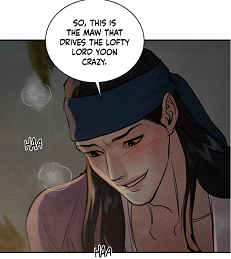 (Chapter 101) are a proof that they never discovered the importance of kisses, embraces, caresses and words during sex. They never recognized that they were denying the existence of love, too obsessed with their heritage and their reputation. The manhwalovers will remember my previous observation. The pedophile had never kissed the main lead. The king like all the nobles had disconnected sex from love. Why? It is because sex was a duty… to continue the lineage. And now, you have the explanation why the pedophile and all the others reduced sex to penetration.
  (Chapter 96) When she heard the noise (PLOP), she was brought back to the past, when she had witnessed a scene of BDSM, though the violence was real. A similar situation to this scene:
 (chapter 73) The pictures from the erotic publication are the evidence for this theory. After hearing the description from the butler about the events in the shed, the noona Heena believed to know what had happened in the shed.
 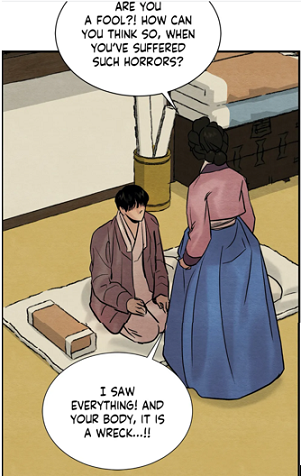 (Chapter 68) She could see the traces on the painter’s body, and conclude that the valet was telling the truth. However, the butler had been misled himself, for his perception was biased by his past experience.
 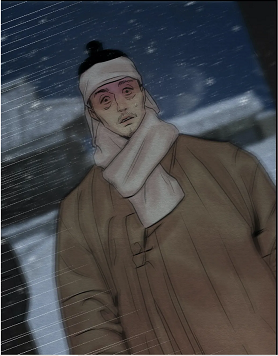 (Chapter 64) The butler thought that the “no“ from the painter was truly real, while the latter was just dishonest. It was the result from the “indoctrination“ from Heena and Jung In-Hun. The valet had been deceived in the end. The humiliation and punishment were not real, for the painter did ejaculate, and back then he was not under the influence of the aphrodisiac.
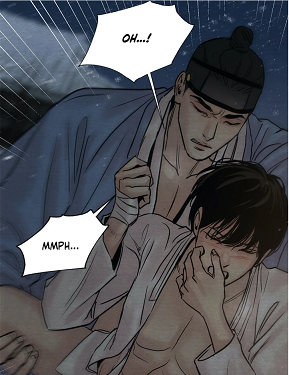 (Chapter 64) This was not like in the past, when the brutality was real. And now, you comprehend why Heena‘s resent towards her brother became more visible after witnessing the love session between the noble and Baek Na-Kyum.
  (Chapter 97) From my point of view, she had already internalized that the painter would never change, he was already too “damaged“ to change. However, since he was close to Yoon Seungho, he could become in danger, for she knew the connection between the ruler and the main lead.
  (Chapter 72) He was copying the habit from the pedophile in my eyes. The latter would never remove all his clothes on his own. As the king, he was used to get undressed by his own staff. Only the teenager as the uke was undressed, unless the lord was accompanied by the other nobles, like in this scene.
  (Chapter 54) And because the ruler was too focused on his own pleasure, he never got to know the young noble. He only realized too late that he had made huge mistakes.
  (Chapter 72) Yoon Seungho was his prey.
 (Chapter 59) The main lead was supposed to meet his tormentor in a public place. Yet their relationship was based on “humiliation“! The “king“ loved to punish Yoon Seungho through humiliation and violence. This explicates why Yoon Seungho reacted that way.
  (Chapter 56)
  (chapter 57) This is what he experienced himself in the past. And observe that the childhood friend’s biggest punishment was actually his public humiliation, when he confessed and got rejected.
  (Chapter 59) In my eyes, the king sought to obtain Yoon Seungho’s affection, but he never realized this. He definitely confused it with submission. He definitely imagined that once the teenager would become submissive, he would have achieved his goal. But he was doomed to fail. In his mind, as the ruler no one could ever reject him. Besides, as the ruler, he was allowed to use his power and as such his strength to obtain what he desires. Don’t forget that in Joseon, people viewed all the monarchs als representatives of the gods. The latter would support them. However, since his youth Yoon Seungho had a strong opinion and mind. Therefore he had caused trouble to his father, as the latter viewed his critical thinking as a synonym for a lack of respect for traditions and the elders, the so-called illness from his childhood. Besides, I am suspecting that the lord must have had visions as well, which would contradict the father‘s dreams and expectations.
  (Chapter 57) Yoon Chang-Hyeon looked down on his son’s critical thinking and came to doubt his words. The author left many clues for this interpretation:
  (Chapter 101) The item was huge, therefore it could only injure the artist’s anus.
  (Chapter 100)
  (chapter 101) Even the noble said that this must have hurt. The painter disliked being bitten in the neck.
  (Chapter 88) Furthermore, the lord said this to the painter in the study:
  (chapter 85) These were the words from the pedophile. He was repeating his sexual abuser‘s words. And this proves to me again that the lord was abused in the study, but if he rejected the man, he would be sent to the shed where he would receive his punishment. In other words, Yoon Seungho was punished with sex and violence. And now, you have the explanation why he got gangraped in the end. But the readers should keep in their mind that this was no real BDSM, for the brutality was real. The king couldn’t distinguish between reality and illusion. And this coincides with all my previous interpretations.
 (Chapter 65) Kim had brought him to the barn, because Yoon Seungho was punished there. This could only be suggested by the butler, as I don’t think that the king would ask for the owner of the mansion for permission. This room was definitely taboo, no one was allowed to approach the study or the shed. Yoon Seungho was exposed to rough sex, and Kim knew this, like mentioned above. But he never witnessed it himself, he only discovered the aftermath. From my point of view, this scene occurred after the lord’s loss of virginity.
  (chapter 94). Notice that violence was used against the painter to mask attraction. The “girly features“ were definitely perceived as something tantalizing. Thus I perceive this incident as a reflection from the BDSM. It was to push the artist away, to incite him to leave the gibang. Heena feared that he might catch the attention of the pedophile, and it is very likely that she was manipulated by the scholar, her idol.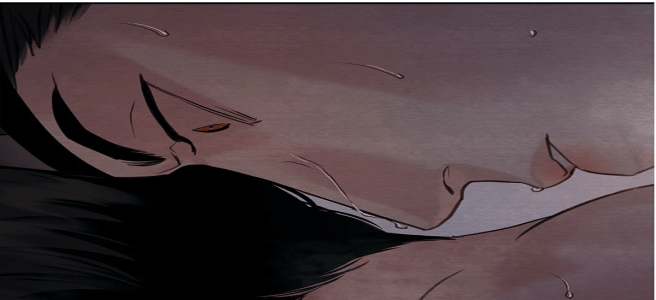




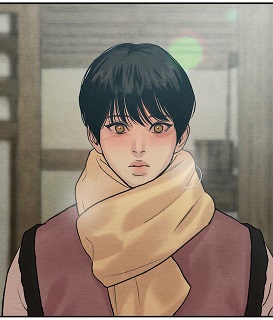
 Yes, the presence of the colorful bubbles are a sign of refraction.
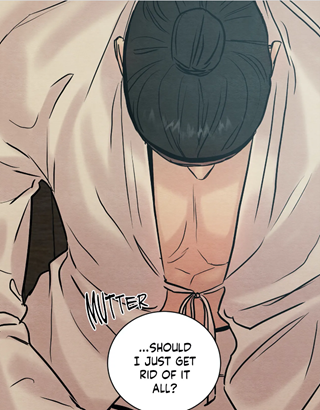 (chapter 55), therefore he imagined that the painter would run away, too shocked by the obscurity of his inner world. And this signifies that until chapter 55, the lord’s soul and body were trapped in the darkness. Now, you might come to the conclusion that he was in a similar situation than Jihwa. Because the latter was figuratively deaf and blind, he had the impression to live trapped in a dark room, separated from the outside world.
  However, this is just a false perception. Jihwa was still in possession of his body, he could feel through his hands. Consequently, he could detect the presence of others. There’s no doubt that he felt lonely and was also lacking for warmth, however the protagonist was in the worst possible situation. He had been literally swallowed by the darkness.
  (chapter 74) He could feel nothing at all. Even his own mind was trapped in the darkness reinforced by his huge guilt triggered by father Yoon. Remember when I wrote that his body was covered by an armor, this referred to his loss of sensation. Imagine yourself in this situation: everything around you is dark and cold and you can feel nothing at all. No wonder why the lord came to believe that he was just a ghost. This is definitely the negative version of Blaise Pascal’s philosophy: cogito ergo sum (I think, therefore I am). Yoon Seungho could only recognize his existence through his thoughts. And the chapter 74 was terrible for two reasons: it unveils to the manwhaphiles how the lord became a ghost. We see him disappearing in this blackness step by step:
 (chapter 74) He can no longer yell for help and use his leg in order to defend himself, which contrasts to the beginning of his nightmare.
 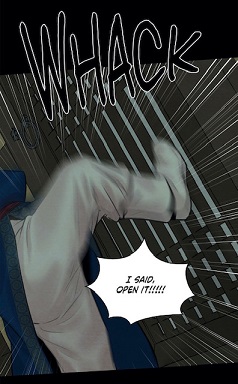 (chapter 74)
 (chapter 74), this displays that the noble is losing the control of his body which can be explained with the usage of drugs. But he is still feeling the touch.
  (chapter 74), but at the same time, it indicates the loss of sensation. This panel symbolizes that he is no longer possessing his body at all. All he has left are his eyes.
  (chapter 1)
 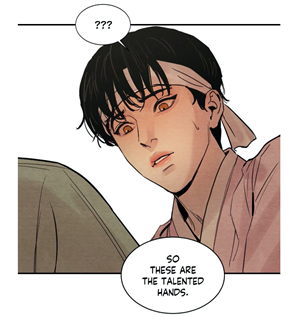 They were the reason why he could see glimpses of light in the darkness of his world. And since he became trapped in the blackness due to hands of scholars and officials, it is not surprising why Baek Na-Kyum’s hands are healing him. Therefore, when the painter touched his chest with his hand
 (chapter 73), he purified his heart. This explicates why in chapter 74, the noble is no longer interested in sex. The hand liberated his heart and allowed him to express his affection differently. At the same time, the loving gaze in the painter is the reason why the lord feels warmth in the end. All he ever wanted was to see light, but he truly discovered it through the painter’s embrace.
  (chapter 21) That’s why even in the darkness of the room, he could only be moved. Therefore he was focused on the painter’s body in the first place. The warmth made him realize the existence of light next to his body.
  (chapter 2) that he was handsome and attractive. That’s why he could experience his sexual emancipation afterwards. A part of his self-hatred disappeared. However, in order to liberate the lord entirely from his darkness, he needed to drop his fathers’ doctrines, which represented the biggest problem. His healing process got delayed due to Kim’s interventions and the painter’s own indoctrination. Striking is that Baek Na-Kyum was entirely healed by the lord, even before the latter has properly recovered from his own traumas. This clearly outlines his selflessness in the end.
 (chapter 38) I doubt that in chapter 38 and 59, he saw images. Due to the darkness of his inner world, he came to repress the horror he was exposed to. Thus it is not surprising that Yoon Seungho is not sleeping next to the painter, even after that night.
  (chapter 74) He still has this fear that Baek Na-Kyum might get affected by the blackness of his unconscious. At the same time, when he is facing the sleeping artist, it gives him comfort. Remember that the low-born is the glass prism of Yoon Seungho, hence his peaceful sleep helps the lord to relax. Note that he is lying in a fetal position, an indication of the return of his innocence. There’s no doubt that the visits in the painter’s study during the night
 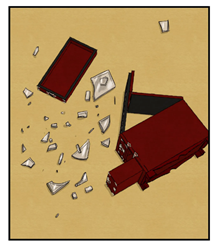 (chapter 28) And in this panel
 (chapter 74) He can only be smitten. But since the lord is also the glass prism for the painter, you can observe the refraction in this panel:
  (chapter 74) He is now even longing for Yoon Seungho’s warmth, hence he stands up during the night and looks at the light in the lord’s chamber.
  (chapter 74) However, the lord is keeping his distance due to the darkness still existing in his unconscious. He fears that this could represent a nuisance to the painter’s peaceful sleep. Moreover, he still perceives himself as impure contrary to Baek Na-Kyum. What the lord fails to recognize is that the artist seems to have sleeping trouble now, because he is longing for his lover’s warmth too, another clue for the painter’s thirst for love and strong libido. There’s no doubt that as long as the commoner doesn’t claim the lord’s bed as his own and expresses the wish to share the bed with his lover, the latter will never suggest this to Baek Na-Kyum.
  (chapter 74) Slowly, the lord is getting rid of the blackness. He is turning his light to the Earth, the painter, mistaking his lover for a sun. Their blossoming love will definitely bring the artist to improve his talent and creativity. But it will have the same effect on the noble. The longer Yoon Seungho is spending his time with Baek Na-Kyum, the better the lord can perceive the colors and light. Through art, the noble will rediscover his lost passion: painting and even poetry. And in my opinion, in order to reconnect to painting, the lord needs to sense the colors for real. The painting in his nightmare was made of black ink and nothing more.
  (chapter 74)
 (chapter 74) In their innocence, they are not realizing that if there’s light, there exists darkness too. Consequently, they don’t detect that darkness is already gathering around them, preparing for the next attack. From my point of view, the darkness should be perceived either as an eclipse or as clouds. Imagine the lord’s reaction, when he loses his prism glass, he will feel definitely devastated. However, there is one thing that even darkness couldn’t destroy after all these years: the lord’s intelligence. He might have acted stupidly during the second season, but his mind was clouded by his emotions. Now that he knows that the painter chose him and is no longer pushing him away, he will be able to use his brain properly. He has more evidences for that. Baek Na-Kyum allowed him to put the scarf properly. Observe the difference between the first
  (chapter 74) The knot is different and he has now a hat. The noble put the scarf exactly like in chapter 69.
  (chapter 69) Moreover, the new headgear, reserved for women, is a sign that Baek Na-Kyum is accepting his marriage officially.
  (chapter 71) He was as strong as a god, when he entered his obscure world. No wonder why the noble is so humble and thankful towards his lover. He brought him back to life, hence his life can only revolve around the painter from now on. The sun will never sense his own light and warmth, unless it witnesses how the nature on Earth is blossoming. It needs the existence of another planet to realize the existence of its own heat.
 (chapter 73) Here, the relevant word is “enter”, an equivalent for invade.
  (chapter 73) Mess is a synonym for chaos and wreck.
  (chapter 73) In the third panel, Yoon Seungho is implying that the painter just has to call him Seungho-Ya, and he will stop immediately. Strictly speaking, he is referring to the saying: your wish is my command.
  (chapter 73) In the fifth image, Yoon Seungho actually means seduction, yet he utilized the idiom “provocation”. Finally, we have Yoon Seungho’s favorite expression “fret”. During this night, he keeps mentioning it in connection to the painter:
  (chapter 73) the target is wounded (“it hurts”) and tied up. Even Yoon Seungho’s words are referring to a wound, as if the animal was bleeding to death
  (chapter 73) , as it keeps leaking
 (chapter 73) But the lord is known as an impatient man, which seems to be confirmed here. However, in reality it took him many months to be gazed and even accepted. Now that Yoon Seungho is seeing how affected the artist is with his words, caresses and kisses, he is so happy that he calls his lover
  (chapter 73) His actions prove that he is definitely in a hurry.
 where I had already pointed out that the noble was deluding himself by calling the artist an easy conquest. Back then, this comment made me so laugh, because chapter 42 clearly outlined that it wasn’t even easy due to the lord’s grimace during the intercourse.
  (chapter 42) And observe that this chapter confirms my interpretation. First, the noble has a similar facial expression
  exposing that he has to work hard in order to please his lover. He is still clinching his jaw, however the manhwaphiles can detect two huge differences: the mouth is more open and he is now blushing. This shows how much this hunt is touching his heart. And the comparison makes me realize that Yoon Seungho’s final sexual emancipation could be symbolized, when he moans his lover’s name while having an orgasm. That’s why we have the lord calling the painter so affectionately (Na-Kyum-Ah) before the second round.
  (chapter 73) showing that he was serious with his saying: Your wish is my command. In addition, he wanted to demonstrate that he hadn’t forgotten his promise: not to scare him.
  and a breather.
 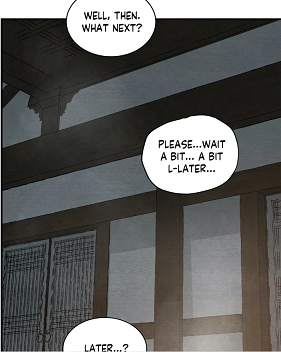 (chapter 73) The noble and Baek Na-Kyum’s desires stand in opposition to the artist’s weakened physical condition. The latter can’t physically keep up, hence he faints at the end.
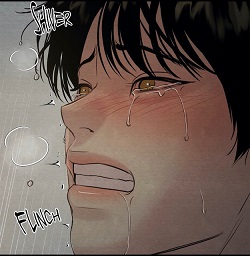 (chapter 73) Yet, I doubt that this will be noticed by the aristocrat. He is definitely too shocked by the incident. His lover fainted. In my eyes, there is no ambiguity that Yoon Seungho will panic again. He has three reasons for that:
 (chapter 32) He felt so remorseful and was so worried that he ran away, too scared to face the painter and assume his responsibilities. However, he made sure that a physician was fetched. This terrible experience explicates why the lord panicked in chapter 50. He envisioned for one moment that he had overdone it again.
 The noble had such huge pangs of conscience that he couldn’t forget the painter’s poor condition. Hence he desired to verify if he had recovered in the bathroom.
 (chapter 72) He was worried, but the painter reassured him. In truth, the heavy breathing was caused by a climax, which the artist tried to hide from his lover. Therefore, there’s no doubt that after this chapter, the noble will question his behavior again. As a hunter, he overestimated the strength of his “prey”. Moreover he will realize that Baek Na-Kyum’s words contributed to this incident. Let’s not forget that Yoon Seungho was following the artist’s request.
  (chapter 73) This time, the painter’s exhaustion occurred due to both protagonists. That’s why Yoon Seungho will realize that he has to become more responsible and can’t just give the whole responsibility to Baek Na-Kyum. He should have paid more attention to the artist’s health and physical condition. And Kim took advantage of the situation. Thus from that night on, the lord kept his distance from his lover. From my point of view, the valet used these expressions against the main lead. He had been targeting the artist, turning him into a prey, hence the painter could not refused. Kim’s MO has always been to mix cause and consequences. Besides, since he heard such words, he could only have a negative impression. The manhwaphiles shouldn’t forget that the valet is a pessimistic person due to “fortunetelling”. [For more read the essay “Fortunetelling”] As you can see, due to this incident the main lead learned another important lesson: consent. Therefore the lord said this later
 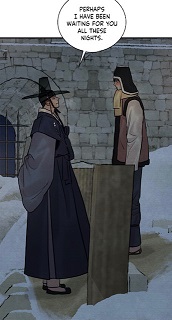 (chapter 75)
  (chapter 79) In the second case, he made sure that both were on the same page. He had felt coerced. Through this fainting, the main lead became more careful and responsible for both of them. The problem is that he was still influenced by his past experience: sex is like a battle… which was now transformed into a hunt.
  . (chapter 15) Secondly, Yoon Seungho repeats similar expressions:
  (chapter 14) And this is how I made the connection with this love session, as I was paying attention to the words.
  (chapter 14) It didn’t happen, because he was selfless… no, this was the consequence of Jihwa’s attitude who did nothing to “seduce” his friend. He refused to kiss him
 (chapter 14), but like he explained, his visit was because he was giving in to Yoon Seungho’s ways. But we have to question ourselves: who wanted whom here? The second lead did visit his friend, as he was seeking his company for sex. He could have refused, as his friend never forced him, but he did not. Moreover, the lord made it clear that Jihwa was just coming for sex and nothing more, yet the childhood friend never denied it.
  , he never allowed him to see his weak side. In addition, Jihwa’s words were full of criticisms.
 This is not surprising that Yoon Seungho was behaving in a similar way. He was reflecting the second lead’s behavior. In my eyes, Jihwa treated his friend like a real sex toy who was there to pleasure him, hence the fellatio is done to prepare the penetration. That’s why there’s no real exchange, the lord is very passive as well during the blowjob. He feels nothing at all
  . When the sex session started, he seemed to be in a hurry too
 (chapter 15) However, Jihwa never truly invested his energy and effort to woo his childhood friend’s heart. This is no longer surprising why the second lead felt so lonely, even during their intimate time. Yet the irony was that the head-kisaeng was treated like a tool for Jihwa’s pleasure, and the latter never realized that.
  , he even recognizes that praising him too much could encourage Yoon Seungho to become more passionate, hence he diminishes his praise afterwards.
  (chapter 72) Baek Na-Kyum’s words and reactions are the reason why the lord is so affected. But unlike in chapter 14, the painter asks for his lover’s help showing that making love implies the involvement of two persons and not just one. Like I had written in a previous analysis, the lord is discovering that giving pleasure to his lover is also receiving. Hence he blushes and becomes more passionate.
