

This is where you can read the manhwa. https://www.lezhin.com/en/comic/painter But be aware that this manhwa is a mature Yaoi, which means, it is about homosexuality with explicit scenes.
This is going to be the last analysis about the chapter 49, where I’ll examine the painter’s confessions and their evolution. Like I had mentioned it before, we had confessions in the chapters 20, 40, 42 and 49. I am excluding the one in the chapter 25 because the person who should have received the declaration wasn’t present.
In the chapter 20, the artist declares his love for the teacher Jung In-Hun in front of Yoon Seungho, mistaking the latter for his teacher: 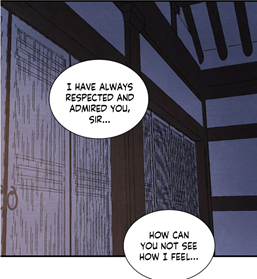 If the manhwaphiles pay attention to the words used by Baek Na-Kyum, they notice in reality the vocabulary field is not love but worship. There is respect, admiration and longing (“pine for”). So it becomes really obvious that the commoner is not really loving the man. He is acting more like a member of a cult. Baek Na-Kyum venerates his teacher. It was, as if Jung In-Hun had become a deity in the painter’s eyes. However in fact he is not a god, just an idol, signifying he is only a fake god. The idolization is first truly visible, when the painter creates the painting:
 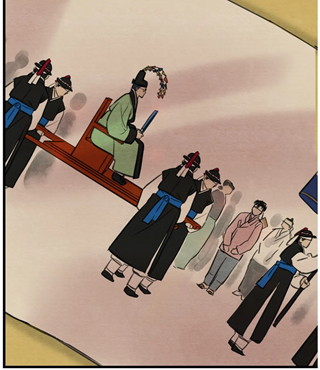 The scholar has become a high official in the drawing. He sits above all the people surrounding him, as if he was different and superior. His inauguration reminds me of a religious ceremony. Let’s not forget that this event is indeed linked to religion, as the new official has to thank the king and the gods in order to get good fortune. In other words, this picture is indeed linked to religion. The usual form of idolatry in the Bible is the worship of images or statues that are thought to embody the various pagan deities, like for example the golden calf. [For more explanations about the golden calf https://www.britannica.com/topic/golden-calf%5D
This shows, how delusional and arrogant Jung In-Hun is. He created a cult, where he appears powerful due to his intelligence and knowledge and turned the painter into his first believer. We shouldn’t forget why idols are considered as fake gods. Their power exists only in the mind of the worshipers, in reality they are just ineffective pieces of stone or wood or in this case an impotent piece of painting. Take notice that I relate idolization to the mind and not to the heart embodying emotions. Therefore the incapable idols can never achieve greatness. This scene is really important, as the strong seme demonstrates his power over the low noble. He shows him his powerlessness, he confronts him with the reality. He is not a god. He has no real authority, hence he can’t change the world like he would like. In this scene, the scholar has to recognize that Yoon Seungho stands above him. Moreover, the former makes him realize that the protagonist was never a new member of his cult. He never fell for his deceptions, he perceived his true abilities (the plagiarism and his poor poetry). That’s why Jung In-Hun got upset. For the first time, he met someone who was superior to him in all aspects (financially, physically and mentally) and couldn’t be manipulated, as he had wished. As a conclusion, the creation of the new cult was born out of the scholar’s arrogance and blindness. He thought, he was like a god due to the painter’s admiration. By the way, this explains why the intellectual asked the powerful main lead to follow him to the capital, he imagined that if Yoon Seungho accompanied him to Hanyang, then he would receive people’s attention due to the presence of the “famous” noble next to him. He wanted to use the main character’s reputation and attraction. He desired to create a situation where he could get the impression that he was also admired. Despite the scene at the hunt, the low noble hasn’t given up on his “dream”. He still wants to be regarded as a new god, receiving respect and admiration.
Now, you might argue with me that the interpretation where Jung In-Hun is judged as a fake god, contradicts my earlier statement, where I associated the scholar to a dictator, like Hitler. Dictatorship and idolatry don’t seem to fit together, yet this is just a misconception. Hitler’s true wish was to replace Christian religions (Protestantism and Catholicism), which were deeply rooted in Germany, with National-socialism as ideology. According to the German dictator, National-socialism should become the new religion of The Third Reich. That’s why the Christian cross should be supplanted by the swastika, the new rallying sign for Aryans. His work “Mein Kampf” (My fight) should be perceived as a new version of the Bible, hence this book was given to newlyweds, after Hitler had entered the government as Reichskanzler (the name for the Prime Minister). In many publications (especially history books) under the control of the Nazis, Adolf Hitler was even presented as the new messiah. According to these books, his arrival was predestined, as all the great German historical figures had failed before. Luther, Frederick The Great or Bismarck or Hindenburg as his predecessors contributed to the construction of the future Germany preparing the Nazi’s coming. Hitler embodies the climax.
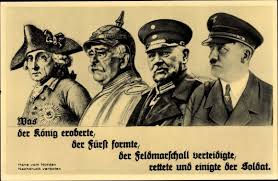
Only he will be able to transform Germany and create an Empire that will last 1000 years. That’s why it is called the Third Reich, the dictator tried to connect this new Germany to the past. The first Empire was “Holy Roman Empire” (1254-1806), the second one “German Empire” (1871-1918) founded by Bismarck. As you can observe, they never lasted 1000 years so Hitler wanted to surpass them. He was definitely delusional, since he thought of himself as better and stronger than any other historical figures. To summarize, the German dictator tried to install a new cult and used propaganda and festivities in order to manipulate people, to get more and more worshipers. Remember what I wrote in the first part, there exists a ruler’s cult in a dictatorship. “My Führer” becomes a surrogate father figure, a guide for all the members, just like the scholar is an adoptive father, a guide for the painter. This proves the interpretation that Jung In-Hun is indeed similar to Hitler, who can be compared to an idol. Jung In-Hun hoped to experience the same, thinking that he will move the masses with his skills and aura but his “dream” got ruined during the hunt. Let’s not forget that Hitler was a politician and official in the first place, while he wished to be worshiped like a messiah too. We find the combination of religion and politics in Jung In-Hun’s life too. The latter wants to use his new position as high official to impose his cult, the new version of the Ten Commandments, which I called the 7 rules:
- The artist can’t be associated to sodomy.
- He is not allowed to paint erotic paintings.
- He can’t admit to be a homosexual.
- He isn’t permitted to have sex with a man.
- He is not allowed to concede that he feels pleasure, when he has an intercourse with a man.
- He is not authorized to question the teacher’s words and actions. He has to obey him blindly.
- He is not permitted to fall in love with another man.
Now, the manhwalovers might wonder why I keep talking about the German dictator, while my essay is about the painter’s confession. My reason is quite simple. We needed to determine the nature of Baek Na-Kyum’s confession and for that, it was important to define the object of his admiration. Since he is a worshiper, a member of a new cult, readers should judge Baek Na-Kyum’s declaration as a sign of fanaticism and not love. What is exactly fanaticism?
“Fanaticism is an extreme and often unquestioning enthusiasm, devotion, or zeal for something, such as a religion, political stance, or cause. It can also refer to behavior motivated by such enthusiasm or devotion.” https://www.dictionary.com/browse/fanaticism
Striking is the idiom “unquestioning” which is palpable in the painter’s previous behavior. Initially he never questioned his learned sir, nonetheless only under the protagonist’s influence, we could witness how the painter used more and more his own mind and started criticizing his admired sir.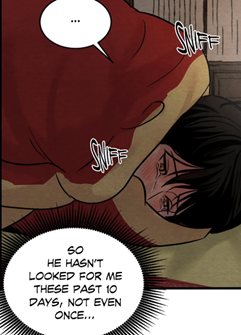 As a conclusion, the painter was more a fanatic than a man in love. It was the painter’s mind which was focused on the scholar and not the heart. From my perspective, the low noble had achieved to transform the painter’s love for him into an idolization or better said to fanaticism. That’s why in the artist’s first confession, the low-born voices yearning, aching and not just respect and admiration. The “I pine for you” reveals a certain pain. It can’t be simply explained by the coercive persuasion, since the latter had repressed it. The low-born had sensed that a distance had been created. Since Jung In-Hun was like a god, the painter could only watch him from far away, since he was just a commoner. There is another reason why I associate the first confession to fanaticism, it is the significance of the mind compared to the heart.
Many people perceive the Nazism as an ideology where people gave up on reasoning and let their emotions take over their life. This is also another misconception. In reality, Hitler used reason and the mind to the extreme. In his doctrine, he described Jews as parasites and as such undesirable elements that needed to be eliminated. The Holocaust is the logical application of this doctrine. Since Jews were no human beings, they could be killed like bugs. This was just cold reasoning and it did work. Many people contributed to the Shoah, they just wanted to make Hitler’s plan into a reality. Hitler didn’t develop himself the idea of gas chambers… his willing helpers did. Everything was done under the premise: we should materialize what he wrote in “Mein Kampf” (My fight). The impression that emotions were central in the Third Reichh comes from the events where people yelled their enthusiasm and made the Hitler greeting. The beholder feel that the masses are very emotional.
https://www.youtube.com/watch?v=qsaMsMHJs7Q
But this is only partially correct as only negative emotions like hatred, resent and jealousy were encouraged. Furthermore the spectators’ mind were the real target. They were influenced through the eyes and the ears. Hatred and cold reasoning (“the enemy must be destroyed”, “Aryans must fight till the end to protect their race”), used in the speeches, were the source of manipulation of the spectators. Empathy was non-existent, as it was literally killed with words. Goebbels and Hitler’s speeches are important as through the language and the visuals, they led to the loss of millions of people. Germans were willing to keep the war, because they should show no mercy and remain ruthless. Notice that at the end of the video, the moderator points out that German became the real victims of this ideology. And now you can perceive the similarities. The painter also became a victim due to the idolization resulting from the indoctrination. Another parallel is the importance of the scholar’s voice hence the low-born could only recall the low aristocrat’s voice and mouth. Baek Na-Kyum was indeed indoctrinated, influenced by the learned sir’s speeches, therefore he used the same words. He also looked down on others (sodomite here). This explains why he became a victim at the end, since he was confronted with internal and external fights. Yoon Seungho wanted to get erotic paintings and later to have him as his true partner. In order to keep following the 7 rules, the low-born always used his brainwashed mind, cold reasoning, like f. ex. “I am painting it for the teacher’s sake” or “Seungho is just a man consumed by lust” and struggled against his sexual desires, his own heart. The painter’s mind was full of rules and “despise” hence he couldn’t judge Yoon Seungho differently. By connecting the doctrine or the new religion to rules and disdain, the scholar wanted to kill the painter’s empathy and as such his heart. Consequently Baek Na-Kyum always repressed his sexual desires as they are connected to the heart.
The moment he tried to renew his confession, he was rejected as he had been questioning his teacher’s authority. He, as a low-born, was asking his “idol” to take his responsibility. The low noble should take care of him, especially after the latter had supported him. Yet the scholar refused for many reasons. First, a god is not supposed to take care of their believers personally. The latter can just pray but never request it from their “god” directly and make them responsible. Then Jung In-Hun was under pressure, for he wasn’t sure if he would be able to succeed. Besides, he was jealous and resentful as the painter was treated better than him, a noble. Moreover, the artist had disobeyed him as he had lied to him. But like I mentioned it above, he had detected that his influence over the painter had seriously decreased. He was distancing from him, he no longer worshiped him like in the past. His questioning and his lies pushed the noble to hurt the low-born in order to remind him of his social status. As a person raised at the brothel, he was filthy, in particular as he had violated the 7 rules. The artist had succumbed to sodomy, the greatest sin in the scholar’s eyes. He needed to punish him. He was a nobody, whereas he stood far above him. His words and gaze were vicious and cruel for that reason: he is a god and Baek Na-Kyum committed blasphemy. He needed to destroy the man.
The heart symbolizes love and not hatred. And this is no coincidence that the moment, Baek Na-Kyum starts confessing to Yoon Seungho, he speaks about his heart. However, the first real confession to Yoon Seungho is not complete. 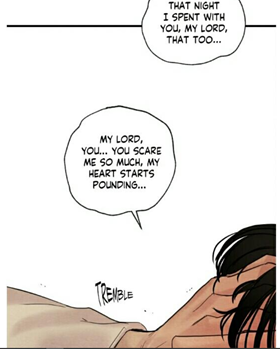 His sentences are broken, he voices fear because it feels so different from before, where he only used his eyes and brainwashed mind for the learned sir. Observe that in this picture he is covering his eyes, he fears the noble’s gaze. Let’s not forget that Jung In-Hun’s gaze was the weapon that killed the painter’s identity.
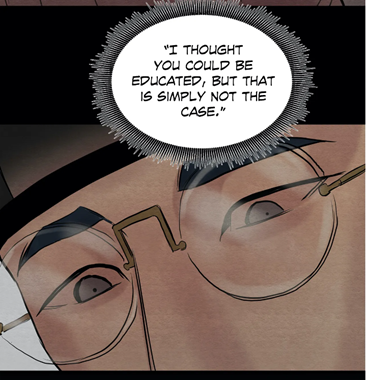 In the scholar’s gaze, he saw his own reflection: he was filthy, he was just a whore. Hence he is afraid of Yoon Seungho’s gaze. How does he perceive me, that’s why he is thinking. During that night, he becomes blind and deaf due to the injury caused by the teacher’s reproaches and abandonment. This is no surprise that his ears and eyes were destroyed. Like I had pointed out before, these organs are essential for indoctrination and for idolization [Remember the comparison to the Nazi event]. So during that night, the sex didn’t succeed to comfort the painter, because the latter was not looking for sex but for comfort and love. We shouldn’t forget that he asked for embrace. He wished to be hold. The problem was that the painter was confused, he didn’t know what he wanted. Besides, the noble had no idea how to show love.
 It definitely came too late, when Yoon Seungho finally embraced and kissed him passionately. That’s why we could say that the scholar did win the fight against the powerful noble during that night. The main lead might have been able to get the painter, however he only found an empty shell. Baek Na-Kyum had lost his identity and confidence for real. However, the painter had recognized the beating of his heart, before his vital organ froze completely in the figurative sense.
Now, it is time to dedicate to the last confession. Unlike the declaration in the chapter 42, the painter is now able to speak more freely. The sentences are much longer.
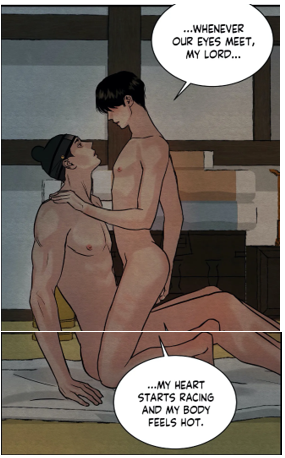
What caught my attention were the words “eyes” and “heart”. First, the painter no longer fears the reaction of his heart this time. Secondly his vital organ is influenced by his eyes, contrasting to the past, when he idolized the low scholar. Back then, the voice, the teacher’s words in the form of the poem and his speeches were affecting his mind. Observe the opposition: ears/mind versus eyes/heart. That’s why there is a huge progression. Not only the low-born liberated himself from the false cult, but also he got closer to the noble. He is finally expressing that the noble is affecting him. He might say that this is just physically. Yet what really matters for me is that he is speaking about his heart, the symbol of love. He is acknowledging the importance of his heart. The other contrast to the first confession is that there is no aching in this confession. “I feel good” responds to “I pine for you”. So pleasure stands in opposition to longing. Moreover although in this confession, he admits his homosexuality and his acceptance of pleasure while having sex with the noble, I sense that the painter is one step closer to realize why he is moved by Yoon Seungho. He has already fallen in love with the man. The way to his heart are the eyes. So maybe the protagonist realized it too. Don’t you find it weird that during the chapter 51, Baek Na-Kyum was no longer able to see the noble? And in the chapter 52, when he finally decides to see the noble, he witnesses something terrible: Yoon Seungho kisses Min. Now, he is affected, unlike in the past.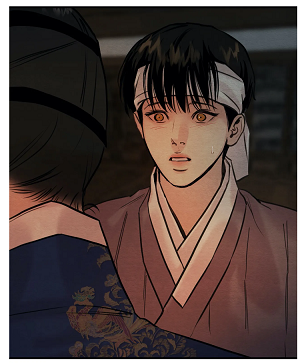 Notice on his way back to his study, he wondered why he feels bothered, I would even say, hurt. So the visual confrontation (his eyes) is making the painter realize his affection for Yoon Seungho. He is questioning himself and even before he listened to the valet Kim. We have here again the question:
 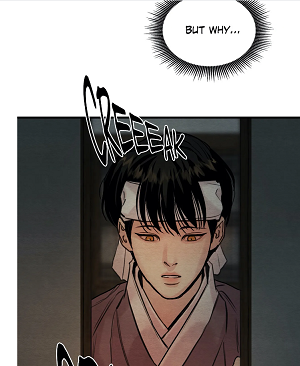 The question mark “why” is related to critical thinking.
As a conclusion, the painter is no longer under the scholar’s influence. There is no longer any adoration or idolization for his former teacher. On the other hand, he experiences pain due to the neglect. Seungho didn’t pay attention to his drawing and he even kissed someone else.
This will be my conclusion: The painter has changed so much during that night. He has returned back to life, he is using his own mind and is also paying attention to his own heart. Even before, he looked at the noble’s gaze, although the latter was upset. He was trying to perceive Yoon Seungho’s thoughts.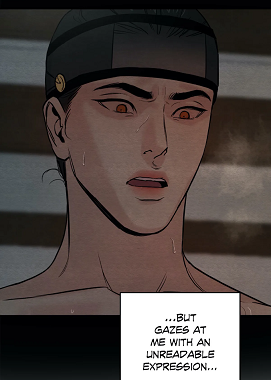 That’s why we should perceive a positive development in the painter. He is no longer fearing the gaze of others. He is thinking on his own, hence he can no longer become a victim due to fanaticism again. I perceive that Baek Na-Kyum has reached a turning point in his life. He could definitely confront Yoon Seungho, like he did in the past. Remember when he yelled at him this:
He could refuse the lord’s proposition, a sex orgy, as he doesn’t see himself as a servant, although he dressed like one. I can’t help myself connecting to the scene in the kitchen (chapter 38), where he claimed that he was no servant. Let’s hope for this situation!
Feel free to comment. If you have any suggestion for topics or manhwas, feel free to ask. If you enjoyed reading it, retweet it or push the button like. My tumblr-twitter account is: @bebebisous33. Thanks for reading and the support.


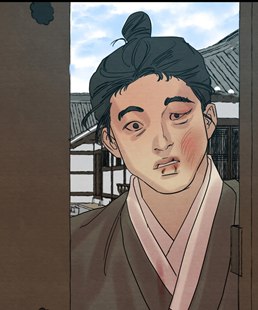 Due to this comment “If that bastard Yoon Seungho hadn’t beat me”, I had some doubt. However now I believe that in reality, the servant Deok Jae was punished a second time.
  Unfortunately, I forgot that the bandages are there because of the cold, like my reader @Sh pointed out.
  Even Kim had such bandages. So the bandages can’t served as evidence for this theory.
  which is much smaller than a wall? He could identify the persons painted in the drawing. So his sight was good enough back then. I distrust that within a week, the servant’s eyes could become so bad without any cause. The first beating occurred months ago, at the end of the summer. Now, we have winter. If so, his sight would have deteriorated more progressively.
 He could have used the excuse with his poor sight to escape suspicion, yet he didn’t. But we shouldn’t forget that he wasn’t the only one with a bruised eye.
 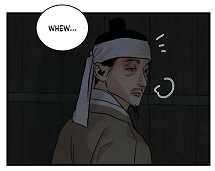 Even the valet Kim didn’t get spared, his battered eye was on the left side. However, the latter is not suffering from a loss of sight.
  Then he pushed him hard with his shoulder.
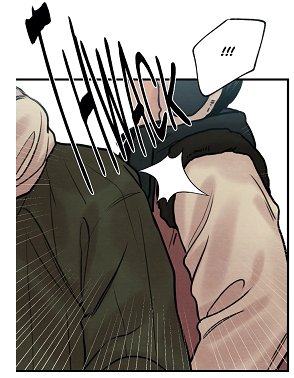 His intentions were to insult and hurt the painter. If he had such a poor sight, then he could have used this as an excuse in order to hide his true objectives. He never did it.
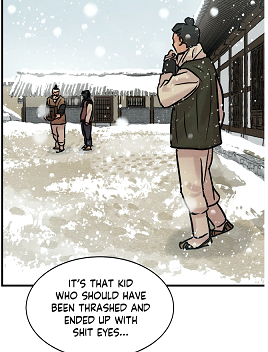 Thrashed is a synonym for flogged. In other words, the domestic wished that the painter had been flogged hence he is definitely referring to the straw mat beating. Back then, the painter escaped the punishment because the lord intervened personally.
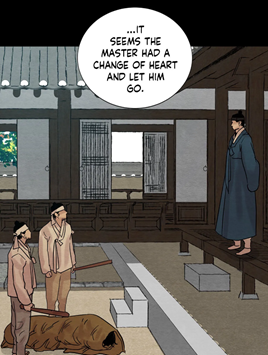 That’s why Deok Jae says that Baek Na-Kyum should have received the punishment. Imagine, the artist never really suffered from the straw mat beating,
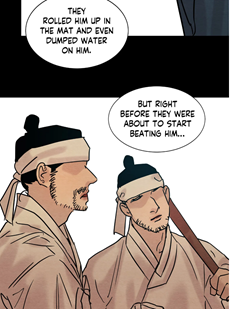 yet it took a few days for him to recover.
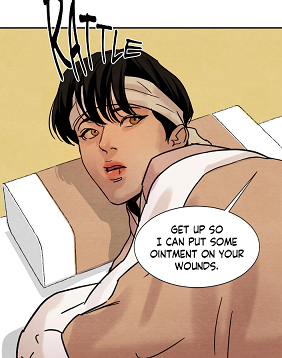 In the chapter 12, Baek Na-Kyum leaves his room for the first time before meeting Yoon Seungho indicating that he was indeed wounded, although he didn’t get really flogged. Jihwa even expected Baek Na-Kyum to be more injured after hearing the news that he had received the straw mat beating.
  This outlines the severity of that kind of punishment. This sentence can definitely cause disability or even death. Loss of sight is a disability.
  Deok Jae hates him so much for two reasons. While the artist was spared by Yoon Seungho, Deok Jae never received the same care. The lord never went personally there to stop the punishment. The opposite happened, my assumption is that the master was present, when he ordered the flogging. This would explain why Deok Jae expressed it that way: “If that bastard Yoon Seungho hadn’t beat me”. Since he was present during the punishment, it was as if he had beat him personally. This would stand in opposition to the painter’s fate. The latter was saved by Yoon Seungho personally.
  He must have heard the insult. Furthermore, Deok Jae admitted in front of valet Kim that he was the author of the “spoiled rice”. Fact is that the domestic made a terrible mistake, it was as if he was poisoning the food. Like the butler expressed it, with his action he disregarded the master’s authority. Yoon Seungho had to do something. Either valet Kim told him personally or the noble understood the valet’s message, when the butler sent Deok Jae alone to clean up the mess. Don’t forget that if people think that Deok Jae wasn’t disciplined for his evil actions, this makes Yoon Seungho appear as a lord lacking harshness and stringency.
  (Chapter 51)
 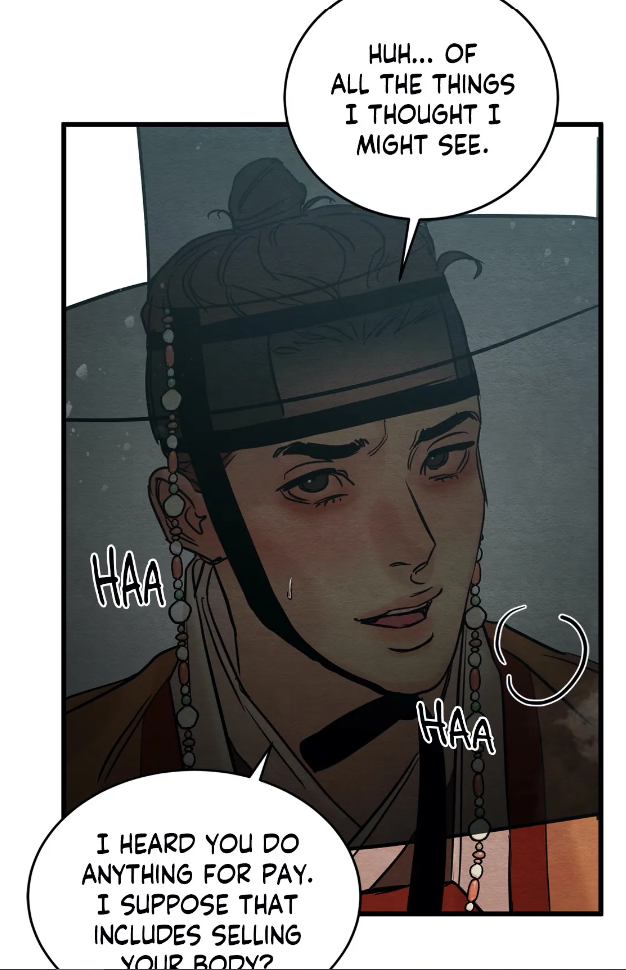 (Chapter 51) And now, if we look back at his first appearance, he was indeed recommended by hearsay. Min was the first one mentioning him to Jihwa. So in the following panel, the speech bubble represents Min’s voice. He is the one describing Nameless to Jihwa.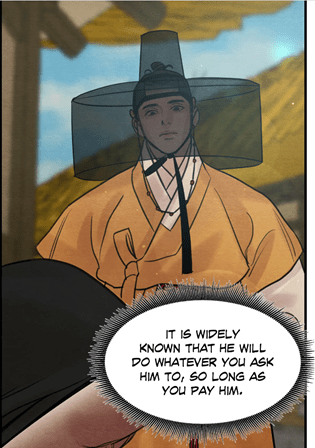

 (chapter 51) The minions must be the musicians and the dancer. As you can observe, the man is not just some criminal driven by greed and brutality, he has abilities for he was able to impose himself as the leader of this band. I detect that he is methodical and quite decisive. Remember that he gave instructions to Jihwa in the chapter 50.
  (chapter 50) Strictly speaking, he is a strategist which is visible when he tells Jihwa that he has other channels.
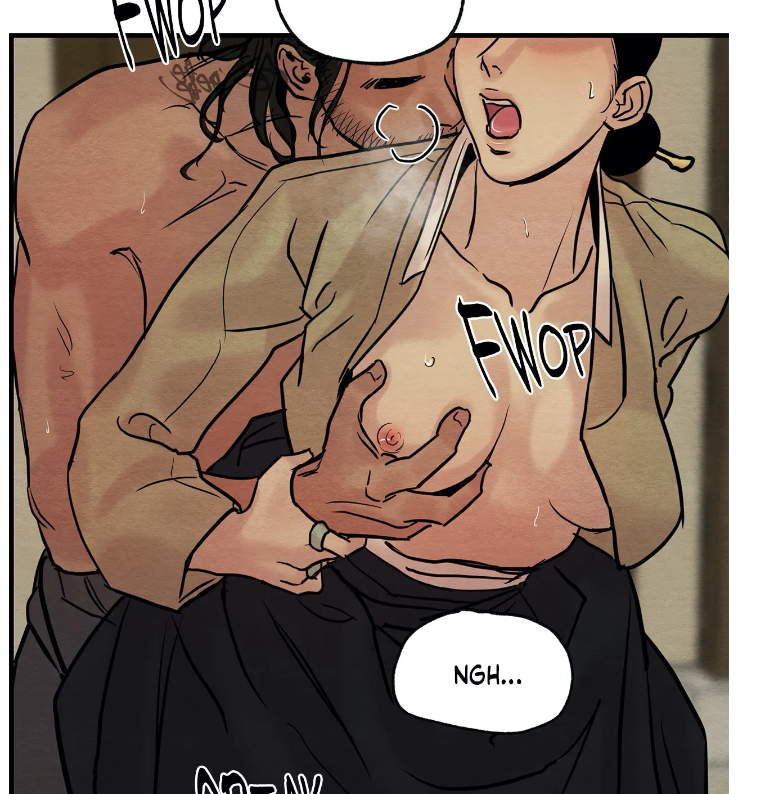 (Chapter 51) If you regard her clothes, you’ll note that her appearance resembles the one belonging to maids.
 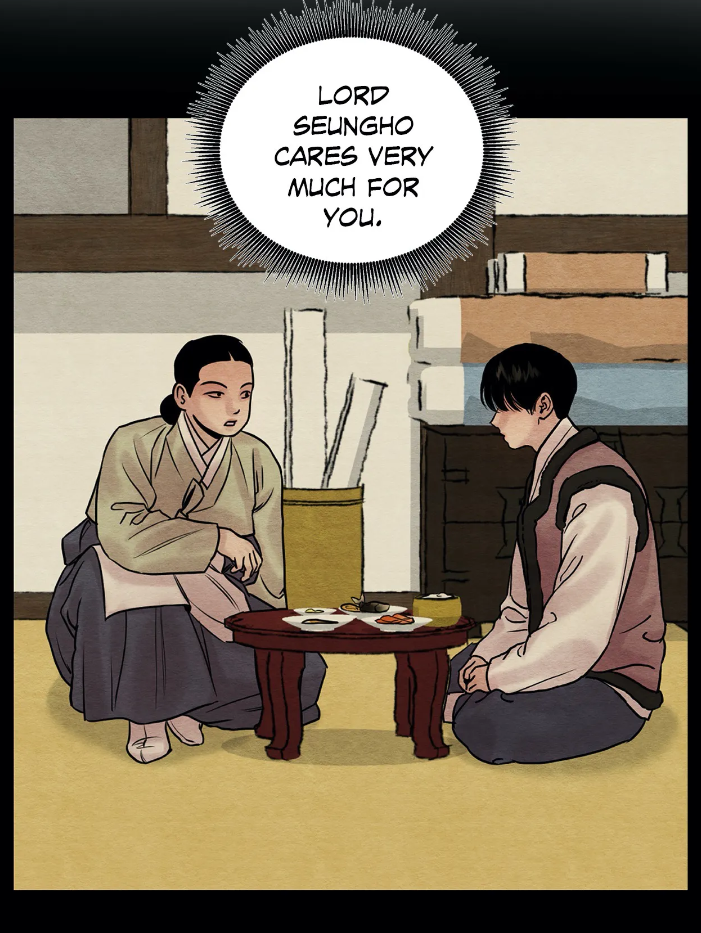 (Chapter 47) The colors of the jacket and skirt are quite similar. However, there is a huge difference between the two maids. Although the servant in the picture above is the head-maid at the kitchen, she doesn’t own any expensive hair pin or ring, while it is different with the woman sleeping with Nameless. She possesses two jade rings and a golden hair pin. This is not something a maid would own. We have 2 possibilities. Either the woman disguised herself as maid by wearing such clothes and hid her real identity or she is a maid close to a lord and the latter gave her jewels for her sexual services. The third possibility is that she works as a gisaeng which would explain the contrast between the jewels and the clothes. She belongs to the lowest social class, yet she has to distinguish herself through her hair dress and jewels. This idea was proposed by one of my readers Anyway, in my opinion, Nameless approached her for a reason. He is digging for information. We have two possibilities: either he is spying on nobles (the clients of the gisaeng house) or he wants to know more about the painter. Let’s not forget that the latter was raised in a brothel. While Jihwa believes that Nameless is doing it for money, I think that he is using his body for information. Why do I come to this conclusion? It is quite simple. Since I sensed so many parallels between Yoon Seungho and Nameless, I am using the protagonist as role model. Because the noble used his body in order to defeat nobles and to hide his own self from others, I believe that the commoner is acting the same way. Both have a negative reputation through gossips and hearsay.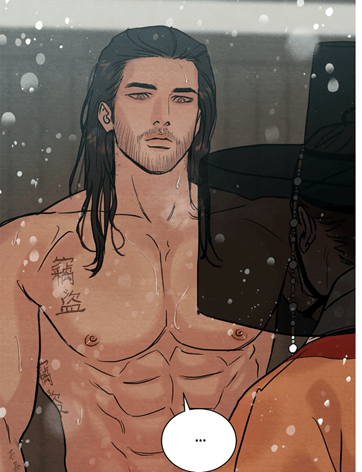
 (Chapter 51)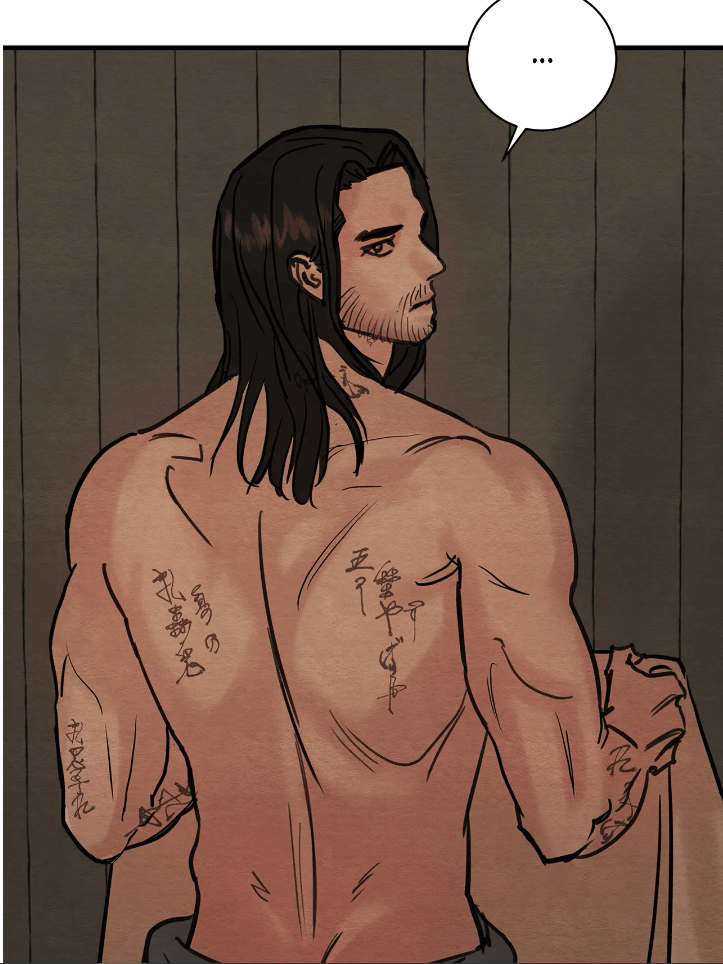
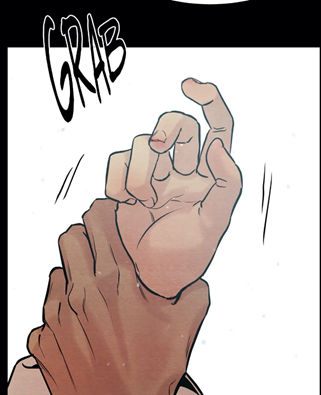 (chapter 50) that’s why he ordered him to stay home in the chapter 50 and here asks if he has been drinking. He can perceive people’s personality very well. I would even add that Nameless’ heart must have been touched, when he noticed Jihwa’s bad habit: biting his finger nails. He must have sensed that this noble had still an innocent soul. Striking is that although the red-haired noble is just a wreck and even insults the “criminal”,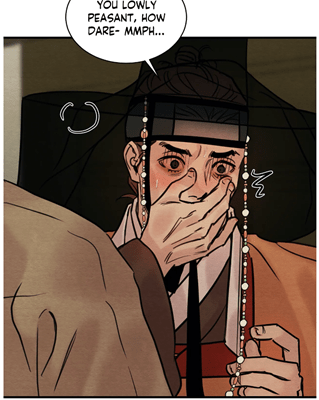
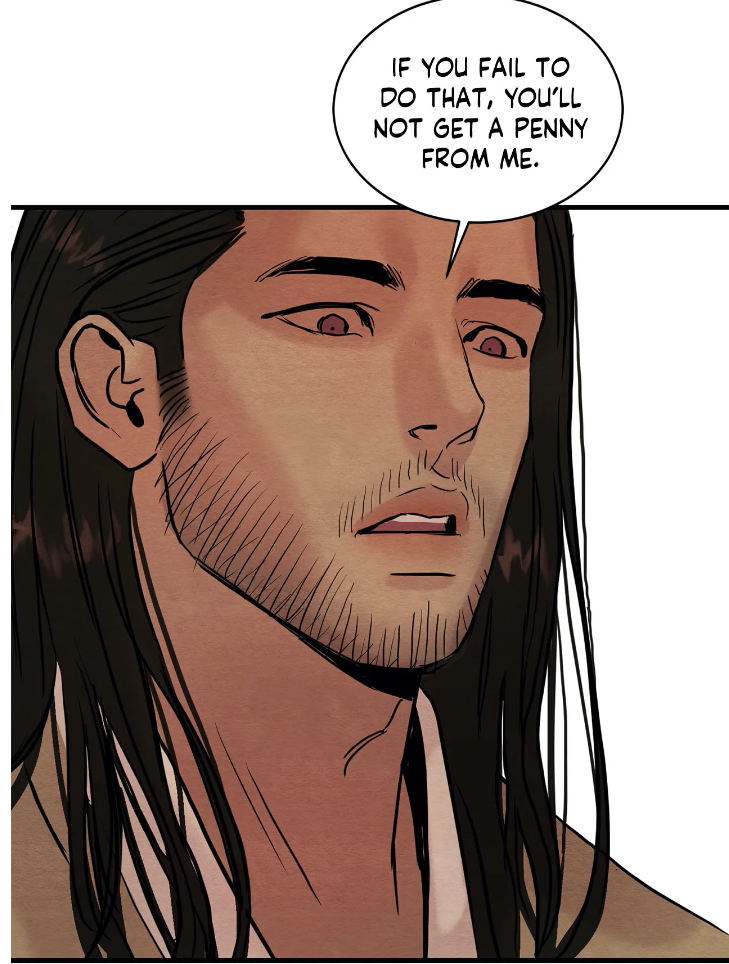 (Chapter 51) Even the evil domestic got scared, when he experienced this gaze.
 (Chapter 51) That’s the reason why this zoom on his chin covered with tears was preceded with the drawing of Nameless’ face.
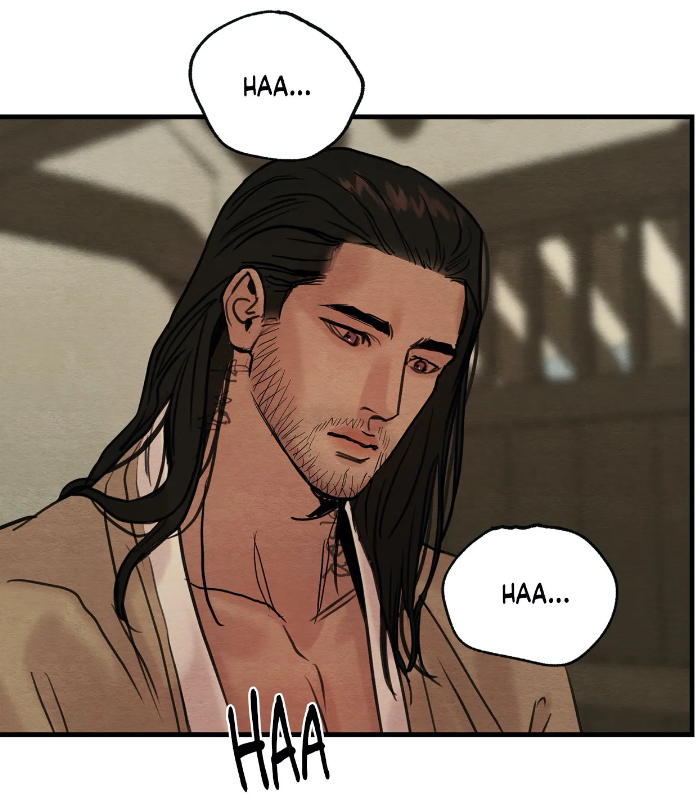 The latter looked at Jihwa’s mouth and tears, while the commoner allowed the noble to voice his worries and anxiety. His eyes don’t express any disdain or arrogance in the last painting. Here, we could say that Nameless is not cold-hearted, quite the opposite, he is sensitive. Sure, he doesn’t allow the red-haired aristocrat to mistreat him, yet he shows a certain curiosity and concern towards his client. In fact, this reflects the purity of his heart. He senses the noble’s sinlessness which stands so much in opposition to the criminal’s reputation. In this scene, the manhwaphiles can detect another similarity with Yoon Seungho again. The gaze and action reveal more than any word. And here is the next question: why would No-Name be quite nice to Jihwa?
  symbolizes perfectly the main characters’ personality. While Yoon Seungho has still a pure mind (White), his heart has been corrupted due to his tragic past (black) that’s why he keeps hurting the painter over and over again. On the other hand, Nameless has a pure heart, yet he has a corrupted mind due to a traumatic experience. His “vicious” mind could be the reason why he is able to perceive a conspiracy and even plot a crime. He doesn’t lose his temper, when he is threatened.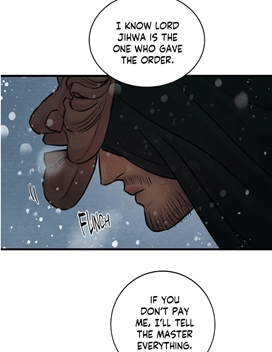

 (Chapter 54) reminded me of Jung In-Hun’s behavior in the first season. He used commoners in order to dig up some secret so that he could blackmail Yoon Seungho.
 (Chapter 29) Therefore I have the impression that the commoner is behaving like him, yet this time it is in order to unveil the identity of the mastermind. That way, he could protect Jihwa and at the same time, he would be able to get rid of a heinous person. On the other hand, since Min has become aware that his plot failed because the assassination didn’t take place, Black Heart can only condemn the red-haired aristocrat and Nameless. It is definitely possible that Min chooses to hurt Jihwa as retaliation which can only push the criminal to become very hostile to Min. From my point of view, Nameless will become a great helping hand for Yoon Seungho in the future. With his Black mind, he can even predict what villains will do. The protagonist’s mind is too pure to recognize the viciousness in the scholar. He might have perceived his hypocrisy and stupidity, nonetheless he still doesn’t know what Jung In-Hun afflicted to the painter. From my point of view, this explains why Yoon Seungho couldn’t defeat the scholar so quickly. He was too naive in this aspect. However, the main character needs to have someone with a black mind so that they can anticipate the scholar and father Yoon’s moves.
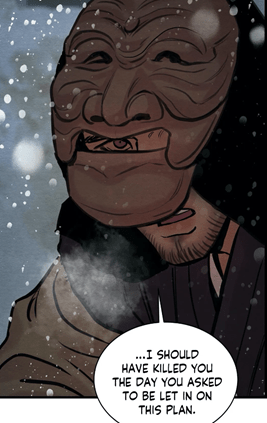
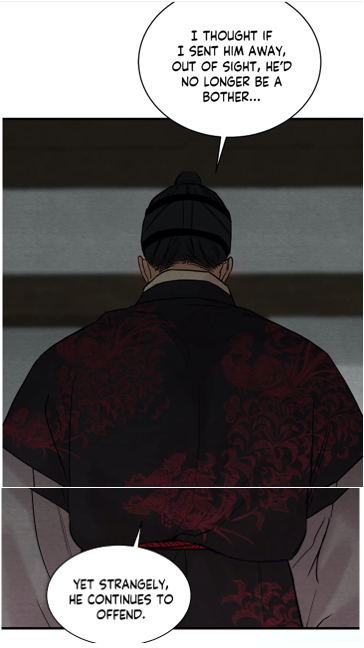 What caught my attention is the following expression: “sent him away”. Here, he imagined that putting some distance between the painter and the teacher would help him. His relationship with Baek Na-Kyum would improve, as you know the saying “out of sight, out of mind”. Nonetheless it didn’t happen like he had anticipated. Because Jung In-Hun had hurt the painter so deeply, the latter couldn’t forget his learned sir due to the agony. In other words, although the lord was physically closer to the low-born, the latter couldn’t perceive him at all, for his mind and heart were elsewhere. They were too focused on his own heartache and negative image. As you can observe, distance and closeness were in the center of the noble’s thoughts. He realized that the saying “out of sight, out of mind” is not true.
 The latter felt comfortable and trusting enough to relax and fall asleep confirming what he had sensed before, when Baek Na-Kyum kissed and hugged him.
 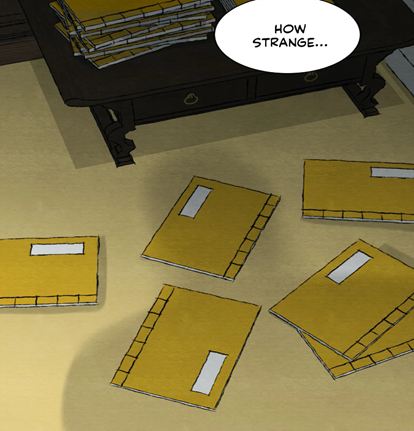 The last panel is interesting because of the ambiguity of Yoon Seungho’s words: “How strange…”. The sentence is incomplete hence we have no idea what he is exactly thinking. First, we think that his memory could be the reason for this statement. This remembrance made him realize that he no longer had any reason to be jealous of the teacher. He knows, with the way Baek Na-Kyum behaved that his “love” for his learned sir has been destroyed for good. However, I have the feeling that this is only partially correct. I believe that in the last drawing, he made another huge revelation that’s why he decided to change his tactic in order to get the painter’s attention and affection. Striking is that the lord is starring at the books. From my point of view, one of the books must have stood out, which triggered the lord’s memory (not the flashback we saw, but another one) and led him to another epiphany.

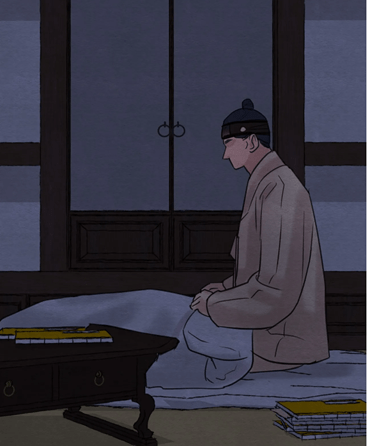
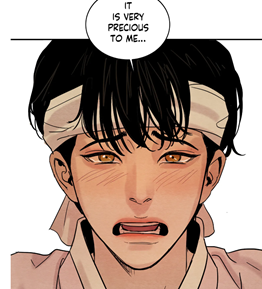 So he needs to distance himself from the painter, creating a separation. Only then, the painter’s mind and heart will sense the emptiness left by the noble’s absence. On the other hand, Yoon Seungho will suffer for a while, he will be the one who can’t sleep and cry, hiding his pain in front of his servants, his acquaintances and the painter himself. We shouldn’t forget that we never saw the lord crying, it is something he has never been able to do, but he needs to in my opinion in order to overcome his traumatic past. Yoon Seungho will recreate the same situation, he will become the lover forced to be separated but who longs to return to his love. The noble is really a romantic one in the end. He is willing to be in agony, until Baek Na-Kyum gets aware of his own feelings but also of the protagonist’s affection.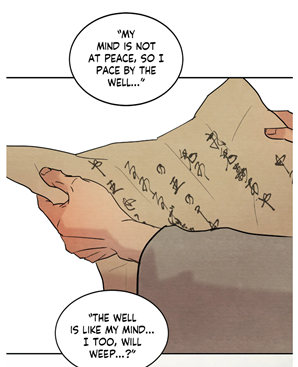
 The master wanted the artist to discover the fraud and at the same time, he wished to correct the painter’s opinion about him. He was determined to prove to the low-born that he wasn’t a “man consumed by lust” but also a learned sir. This negative image had truly bothered him in the chapter 5
 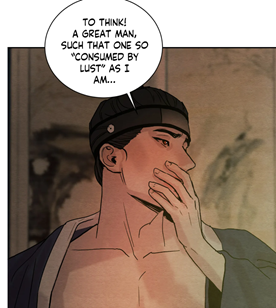 to the point that he couldn’t have sex with Jihwa. However, the low-born didn’t realize the switch, too happy that his learned sir had come to the mansion (chapter 7). The poem had lost his purpose, since Jung In-Hun was close to him. He had his learned sir by his side, there was no separation any longer so that the artist didn’t feel the need to read it. This explicates why Baek Na-Kyum never changed the negative perception he had about Yoon Seungho, as he never looked at the poem again. On the other hand, that’s how the noble discovered that the painter couldn’t read. The sex sessions with different sex partners contributed to this negative reputation, the stigma “man consumed by lust” got reinforced. The painter saw it with his own eyes and even seemed to experience it.
 , the lord recognized that he was still associated to sex and depravity, although he had cut ties with other nobles and never organized or visited any sex orgy. As he couldn’t help himself from making love to the painter, the latter had the impression that Yoon Seungho was just obsessed with sex and his paintings. Consequently the aristocrat got mad. Yet this made him realize the significance of his own image. He needed to change his behavior in order to attract the painter’s attention, to get him aware that he was with him for other reasons than lust.
 Both are very similar because of the weather and the situation. Nonetheless the changes are quite telling. In the second drawing, the commoner is walking on his own underlining his loneliness. He has not been accepted by the servants at the mansion, while in the chapter 51 it is clear that now the staff recognizes him as a member of the mansion. Pay attention that in the chapter 51 Baek Na-Kyum is following the head-maid from the kitchen and later the valet Kim. He is no longer isolated and rejected. Secondly, in the picture above Baek Na-Kyum is just walking to the mansion but he is not paying attention to the lord smoking by the window. Only on his way to his room, he spots Yoon Seungho sitting at the window, therefore he stops walking for a brief moment.
  This happens very quickly, then he starts walking again in the direction to his study. This action is interesting because it reveals that the painter only remains there as he has no other home. Yoon Seungho as such was never the reason why he decided to remain by his side, just the notion “home” was good enough for the artist. We shouldn’t forget that the mansion is big contrasting so much to the tiny appearance of the master. The difference of size underlines the significance of the artist’s motivation: he is walking towards the mansion. His gaze just gets distracted by the lord’s appearance at the window but that’s it. This interpretation is confirmed later with the chapter 46.
  The commoner is following the head-maid, yet his body and head are turned to the lord. In this episode, he doesn’t make a pause to look at him, he keeps starring at the opened window, where he can observe his “lover” laugh. The other huge divergence is the wealthy protagonist’s attitude. He is no longer passive, sitting alone while smoking. He is drinking with another aristocrat, making jokes and laughing.


 he recognized that watching his lover resting could be satisfying. He also noticed the painter’s habit: he is a deep sleeper, hence he won’t wake up due to the noble’s presence. He didn’t even sense the kiss during that night. I can also imagining that drinking is a way to relieve the agony the rich protagonist is actually going through. He needs to numb his sexual desires since his feelings for the painter are so strong. He is now waiting that his lover recognizes his own emotions and questions the lord’s behavior so that they can finally have a frank conversation, where the lord can finally confess his affection to the commoner. A poem as love confession does fit our character as he is not someone talking much. He has always had difficulties to voice hie emotions and thoughts. The poem will serve as support. So please have faith in the master of deception! He can’t help himself hiding behind gossips but this time, the hearsay has a different function: trigger the painter to think on his own and question everything.
  becomes a disaster. His dream turns into a nightmare. Therefore I will come back to this confession in this essay, although my main focus is a comparison of the painter’s confessions in the presence of Yoon Seungho.
 So there was a mixture of concern and lust. The reason why I adjoin care is that we have the same motivation in the chapter 41 and in the chapter 48/49. In both scenes, he is troubled by the painter’s behavior. In the chapter 41, he heard from the servants that the low-born had been working non-stop to the point that he was even skipping his meals.

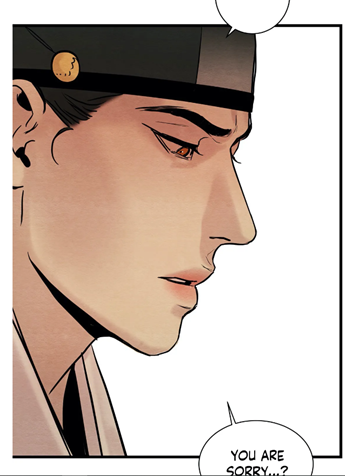 As you can see, care was always the trigger for his visit to the painter’s study. In the chapter 48, he wasn’t just angry. If fury had been his only motivation in the chapter 48, then he wouldn’t have contained his anger. Yet during the chapter 48, the master remained quite calm.
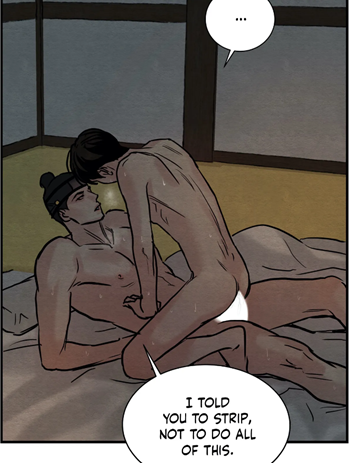 He acted like a master or a client at a gisaeng house, yet he kept talking to the artist, pointing out the weirdness of his attitude. He kept asking why, just like in the chapter 41/42. Therefore I come to the conclusion that care and concern were the biggest motivations for the lord to visit the painter’s chamber. In other words, Seungho has never been cold-hearted, like some readers are still judging him.
 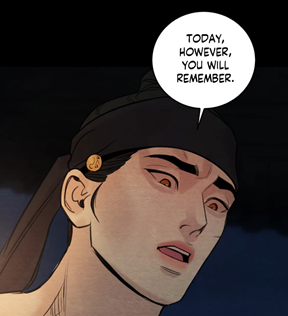 As you can see, the more the lord spent time at the pavilion, the more he became troubled. His despair and worry pushed him to make the wrong decision: force the painter to remember their wedding night so that he could claim Baek Na-Kyum as his “wife” and partner.
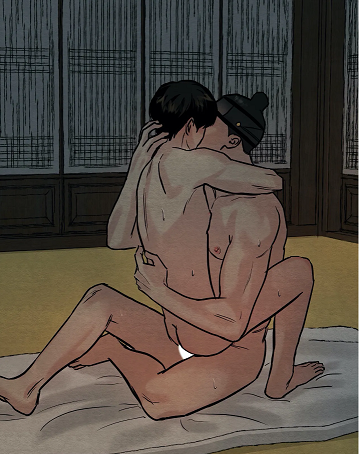 Here, the kisses and the hug are a sign that the relationship between Yoon Seungho and Baek Na-Kyum has improved, even deepened. They already had sex before, hence the kisses have another signification.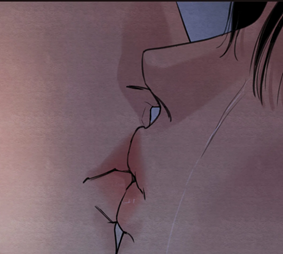

 In the chapter 20, Baek Na-Kyum was the only one hugging his partner while kissing. He wanted to make love, while the master was following his sexual desires or better said, that’s what he believed. I would like to remind that from my perspective, the noble was already in love with Baek Na-Kyum but didn’t recognize his own feelings as he had never introspected his emotions before. I even have the impression that he is still unaware of the depth of his feelings for the painter. In other words, in the episode 49, both main leads start making love. From my point of view, Yoon Seungho is making love to the artist, while the latter just perceives it as a sex session, as he doesn’t want to get hurt emotionally again. He prefers following his physical reactions, he is no longer repressing his unconscious. Yet, there is affection coming from the artist as he is someone with a big heart, like his erotic publications suggested. That’s why we have here again a combination of sex and love. This is understandable as the low-born doesn’t even grasp the true motivation behind his actions. His gestures are exuding love and affection and not just pure lust but since the painter doesn’t see his own actions in a mirror, he has the impression, he is only following his sexual desires. As a conclusion, the kisses in the chapter 49 mark the second phase of their intercourse, the love session.
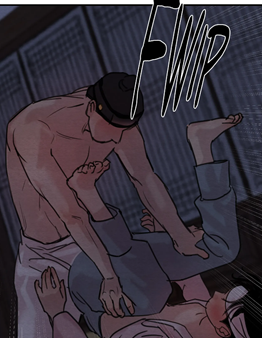 He was just following his own interests and never paid any consideration for the painter. He was just looking for sex in his mind, but the moment he was told that his partner was a virgin, he was surprised. Nonetheless he was willing to change his behavior and became more gentle.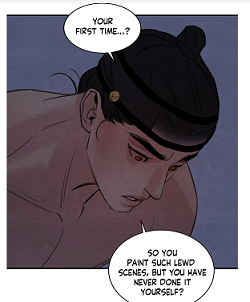


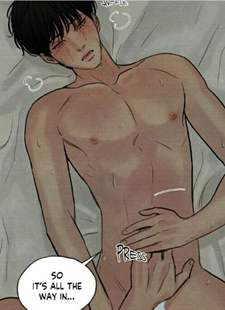
 Let’s not forget that the master did follow all the painter’s requests in that scene. That’s why he kissed and hugged his lover so passionately, he wanted to comfort him so much but he failed to stop the painter’s heart from freezing. That’s why Baek Na-Kyum still judged himself as a whore after that night. And in the chapter 48/49, this time the manhwaphiles behold the lord acting like a real client at a brothel.
 He wants to provoke a physical and emotional reaction in the painter so that the latter finally leaves his state of shock. By playing this role, he wanted to make the commoner realize the harsh reality of a brothel and the real fate of prostitutes. He frightened the painter so much that the latter begged the lord to stop, to listen to his requests.
 However, this time he did succeed but still didn’t achieve his original goal: winning the painter’s heart. I am well aware that some readers are still thinking that Baek Na-Kyum hasn’t changed his view about himself. I have a different opinion because he is now the master of his own fate. For me, he has become a libertine, sure his negative opinion about himself is not entirely removed, yet he is now able to differentiate between his own interests and the ones from his partner, which he never did in the past. He imagined that Jung In-Hun’s interests were the same than his own hence he was willing to do anything for the scholar. He has finally realized his own existence so he is no longer the same person, a whore with no identity and desire. He is now creating his new life, making new rules.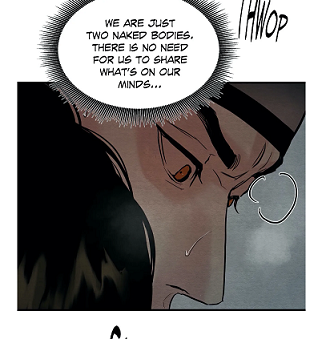


 So my thinking is that now Baek Na-Kyum has adopted Yoon Seungho’s way of life, the one of a libertine, unaware that his lover is no longer one, sexually speaking. That’s why people still think the painter is a prostitute as libertines are usually judged like ones. However all this is influenced by moral standards, yet their motivation for sex is different as it is connected to freedom and not money.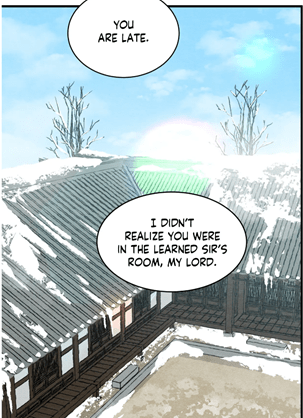
 Another example is when the butler asked for an aphrodisiac from the physician so that the painter would get an erection. He used Yoon Seungho’s trick in order to improve the relationship between Baek Na-Kyum and his master.
 Then in the chapter 29, the master went to the low noble’s room again, once he discovered the painter’s escape.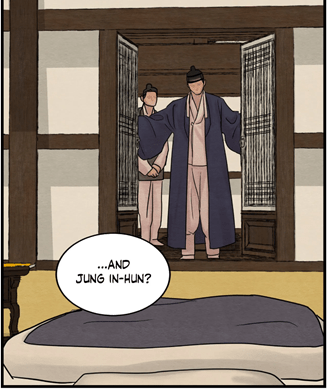
 He wasn’t just infuriated, he was totally eaten by jealousy. Imagine, he belongs to the high nobility and the painter chose a low aristocrat with no huge income and connection over him. He, used to be surrounded by many nobles due to his wealth and power, kept experiencing rejections. Not only he was turned down multiple times but the person even preferred running away from him. The aristocrat made terrible experiences for the first time: not only jealousy but also he started feeling insecure. His reaction towards his servants (the beating) demonstrates that he was not just mad but also panicking, trying to vent all his negative emotions onto the staff. The one he chose because of his feelings for him had no consideration for him, a high noble. Neither wealth nor power nor force could make the painter submit to him. Only the butler could read his master’s expressions and behavior as an open book.
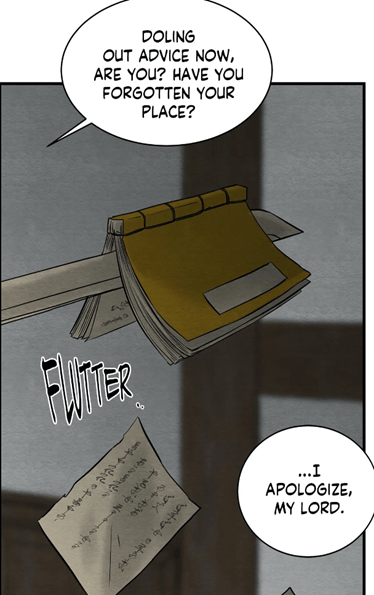
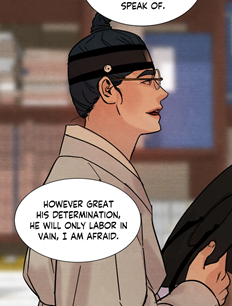 In the second picture above, he is so furious that he can’t restrain himself from destroying the book. If the learned sir had been present, Yoon Seungho would have definitely killed him. To summarize, the master went there because of his jealousy and his urge to “kill” the scholar, well aware that this was not possible.
 He is not the recipient of the painter’s love, the artist feels only attracted to him physically. He is the one who can make the painter feel good but that’s it. Who wouldn’t feel envious of Jung In-Hun who was literally worshiped by the painter? Since the chapter 20, the noble has been waiting for the same confession but this time addressed to him for real. He wants to feel admired and loved by the commoner, yet the latter still refuses to give in in this aspect. In other words, he got rejected again, yet the kiss and the caress stopped him from getting angry again.
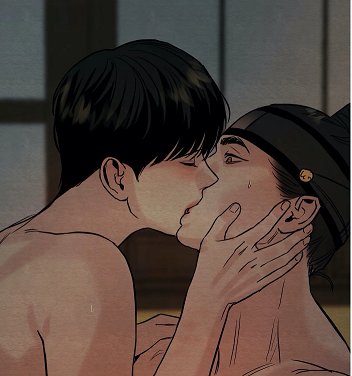 In that moment, he felt that the gestures let transpire more than the commoner had conceded. But we shouldn’t forget that despite this, the noble couldn’t forget the rejection and saw the huge contrast between the two confessions. No wonder why he still felt resentful and jealous. On the other hand, the valet Kim never got to witness the second confession therefore he can’t comprehend the master’s motivation. Because of this weird confession, the noble made up his mind: he accepts the painter’s confession, hence they are just sex partners and nothing more.
 He thought that if he kept putting new brushes and an ink stone next to Baek Na-Kyum, the latter would realize that he was a painter in reality and no prostitute. However, his actions didn’t help neither his master nor the painter. Remember the saying: “The road to hell is paved with good intentions”. And this is exactly what is happening. The valet caused more agony to both protagonists with his actions. First, he asked the tailor to hide the true identity of his master’s lover to the folks, then he never confirmed the real status of Baek Na-Kyum to Deok Jae (he is just favored) so that he kept the painter in a very ambiguous status, which his lord didn’t catch. The painter had been literally destroyed by these poisonous words and the butler didn’t even comfort the man because he couldn’t. Due to Kim’s neutrality/passivity, the lord’s behavior could only reinforce the negative reflection the painter had about himself and his sex partner. We shouldn’t forget that Yoon Seungho was described in the first chapter of the second season as someone obsessed with his new lover.
 The lord initially imagined that he had finally won and enjoyed his time with the painter, only to slowly realize that he was still missing something: the lack of passion and warmth. But the valet Kim kept this important detail from him. That’s why the master is so angry with his loyal domestic and with the low noble. The former acted on his own accord, although he is just a servant and Jung In-Hun, despise his absence, was still able to cause trouble in his relationship with the painter. Therefore Yoon Seungho feels the urge to kill the scholar symbolically, once he discovers the truth. He comprehends the painter much better, why he behaved like a prostitute, why he had lost his strength and strong will.


 Here, in this drawing, the noble is definitely pushing the artist to interrogate the true nature of his relationship with his learned sir, while at the same time he shows that he’ll assume the responsibility for him. But in this scene, the manhwalovers could never see Kim as he had been left behind at the tailor shop, taking care of the order for the new clothes. If the lord had known about the existence of this conversation, he would have been happy and not hurt, since he would have noticed that his words and actions had affected the artist. Yoon Seungho is well aware of the true meaning of this exchange, while the valet Kim wasn’t.

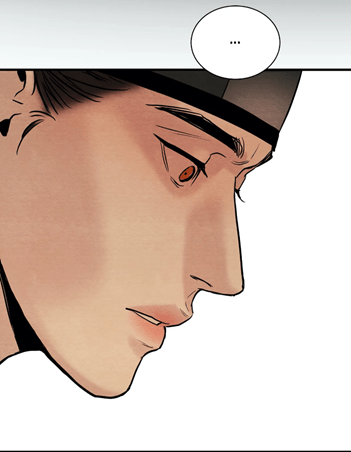


 Now, you understand why it is important to know this manhwa very well. The previous chapters help me a lot to perceive the thoughts and emotions of the main characters. Byeonduck uses the episodes from the first season to enlighten the development of her characters, underlining their transformation. In the beginning of the chapter 50, the manhwaphiles witness how much the main lead has changed. He has become very gentle, selfless and making sure that his lover is feeling well. But he is still ignorant of his own feelings. For him, reasoning is the cause of his behavior. Let’s not forget that during the first season, the main lead had to ponder a lot and even suffer due to remorse. So the painter did occupy a big place in his thoughts that’s why the lord is still making the mistake. On the other hand, he is now capable of expressing his love much better, although the artist couldn’t see it with his own eyes. However, his body has already sensed it.
 Since Baek Na-Kyum has now adopted the doctrine of a libertine, then he is already open to this idea of receiving lessons from Yoon Seungho. The latter will show him what a real libertine is, it is not just about living his sexuality freely, it is also thinking freely, see beyond the facade and recognize the true nature of people. He still needs to perceive Jung In-Hun’s vicious and cruel personality. However, there is still a long way to go because the lord is now hurting. He knows now why the painter remained by his side. He never won his heart and he discovered it due to the valet’s revelation.


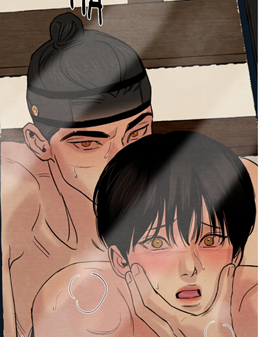 and at some point, they stopped for a moment, only to do it again for a while
  . The hug in the chapter 32 contrasts so much to the hug in the chapter 49. In the former, they weren’t facing each other indicating the gap between them. In the latest episode, the noble is truly comforting the painter, he wants him to rely on him, to trust him, whereas in the past, the noble was determined to have the painter recognized his own sexual orientation.
 As much as he wanted the painter to feel pleasure with him, Yoon Seungho’s other motivation was to satisfy his own sexual appetite hence he paid no attention to the artist’s health condition. The other difference is that in the chapter 49, the painter was the one initiating the second part of their love session and not the lord this time. By comparing both scenes, it makes the manhwalover realize Yoon Seungho’s huge metamorphosis. He is no longer selfish and inconsiderate. He definitely prioritizes his lover over himself.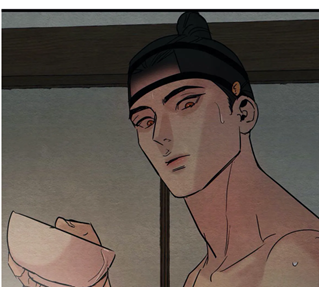
 In the latest chapter, he sensed it right away.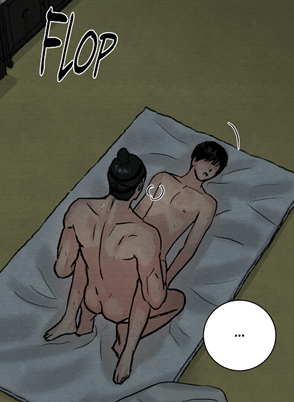
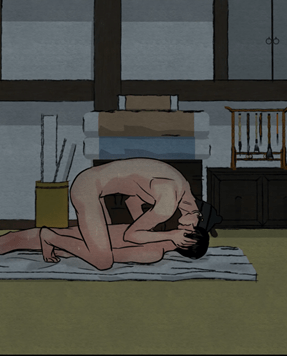
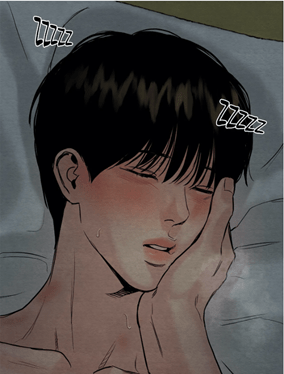
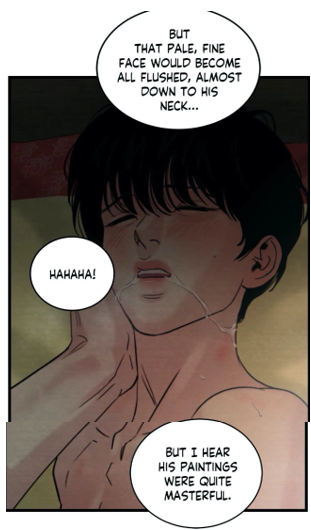
 Here, there was an emergency, while in the chapter 50, the main lead has no reason to be so gentle and affectionate except to feel the need to express his love for the painter. At no moment, his gaze diverts from Baek Na-Kyum’s face, his eyes are always focused on his lover during that night.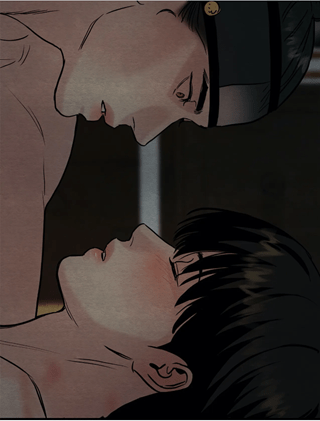
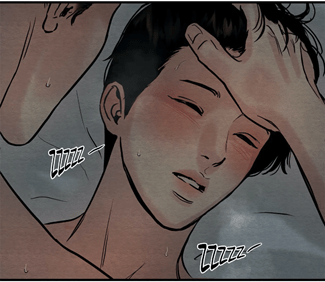
 He felt the noble’s presence due to the tight hug. He wasn’t able to repose at all. He could only doze after witnessing, how vulnerable the noble was. He realized that the aristocrat needed him for real and there was no danger coming from him. (chapter 37/38) Notice in the chapter 50 that he fell asleep while fully embraced,
  (“let my body take the lead”) has come true. His body is already telling him that he can trust the noble, while his mind still fears to depend on him. His heart and mind have been scarred due to Jung In-Hun’s hypocrisy therefore the commoner is consciously convincing himself that he should keep a certain distance from his sex partner. Yet his soul is doing the opposite. In his doze, he lets his head rest on the noble’s hand. He doesn’t wake up from the kiss either. As a first conclusion, the choice, the artist made consciously, comes true. He allows his body to follow his instinct. His body already relies on Yoon Seungho and this is only a matter of time, until his mind comes to the same realization: he loves the noble and he can rely on his warmth and love because his emotions are profound and genuine. So the first scene is important for two aspects: the readers can perceive the real transformation of the rich protagonist’s personality (from a selfish and rude to a gentle and selfless man) and the painter’s realization helps him to connect to Yoon Seungho, although it is just his unconscious.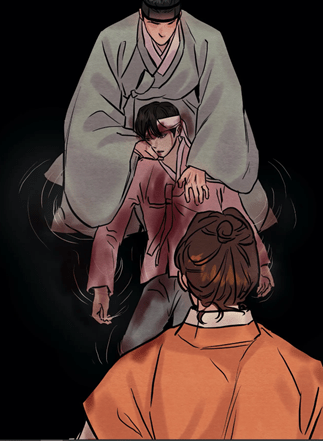
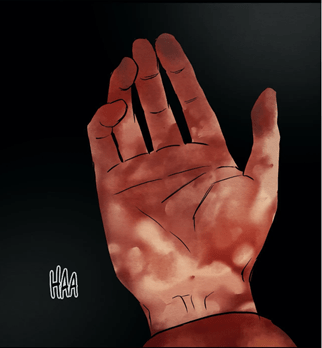
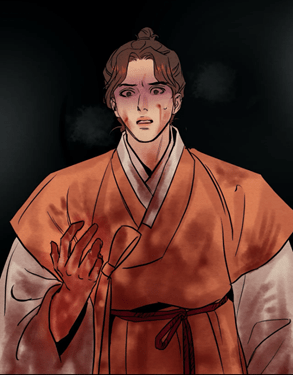


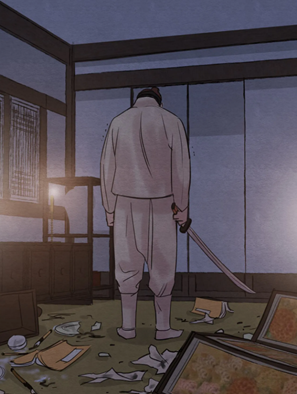 In the previous chapter, he is angry and due to his fury, he destroyed his room. However, he could stand on his own feet, was able to sway the sword and he had his hair tied with a topknot. So his appearance was still intact. In the chapter 50, he is on his knees, unable to grab anything, even hiding his face from the world. It was, as if he couldn’t even face people due to the bad decision he made, accompanied with huge pangs of conscience.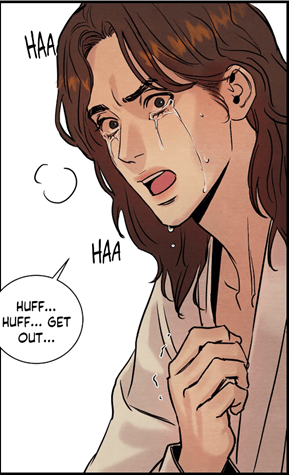
 Later he didn’t even pay attention to his clothes and image (chapter 41)
  and after hiring the assassin, he looks even worse than in the chapter 41. Neither alcohol nor sleep can help him to relieve his anxiety.
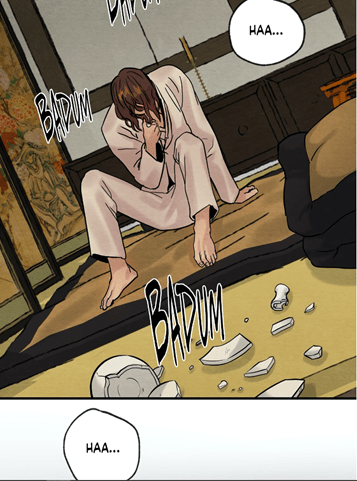

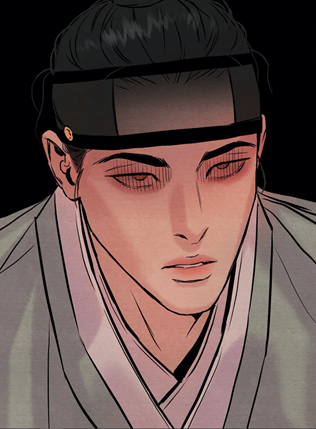
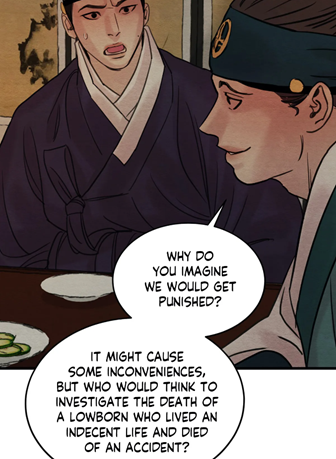 . First, he didn’t notice Min’s perversion as he was too overwhelmed with his recent discovery. His childhood friend was having sex with the low-born for real. Besides, he witnessed the tender hug so his only explication was he had been bewitched. Anyway, under the influence of his emotions, he only started worrying the moment the killer looked at the mansion and his target. The irony is that whereas the painter was just acting like a prostitute and showed no real and deep feelings, Jihwa behaved the exact opposite. His huge amount of guilt and tension makes him so nervous and unstable. He can’t calm down at all.
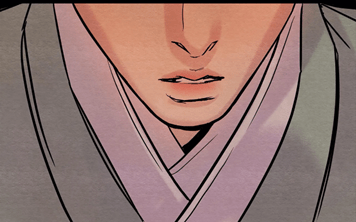


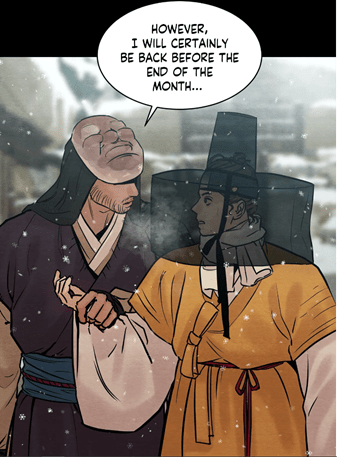

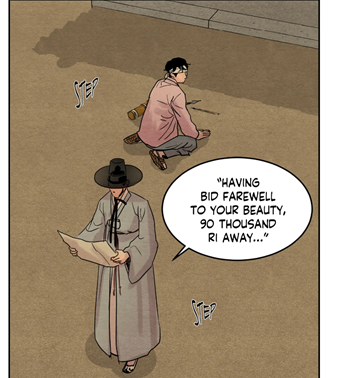
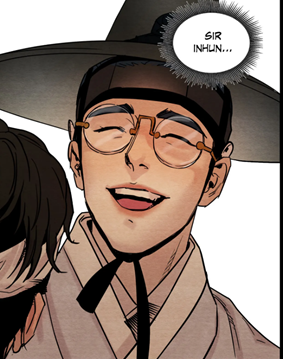 Let’s not forget that the teacher never showed his true gaze to the painter until the chapter 40. Besides, we should remember that I already associated Jung In-Hun to the day and the sun (a fake one), therefore he couldn’t choose the moon as a metaphor for himself. Usually, kings are associated to the sun (see Louis XIV, the sun king or the pharaon in Egypt) and not the moon.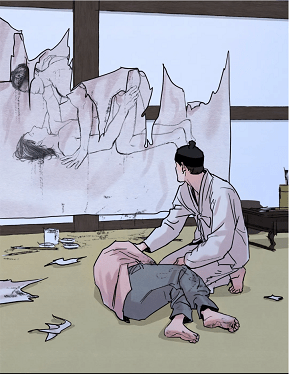
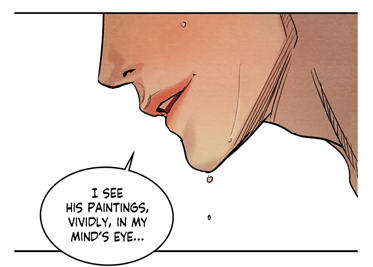 (chapter 3) He finally came to love himself. However, he never realized that the gaze reflected his affection and fascination for the artist, as his eyes were directed at the creator and not at his sex partner Jihwa.
  (chapter 2) Moreover, the noble showed his true self, the moment he met Baek Na-Kyum for the first time. He was acting like a fan meeting his idol which is a sort of love.
  (chapter 1) He was smiling and happy, he was very genuine. All his actions in the beginning prove to me that he fell for the artist at first sight. His admiration for the painter’s work served as a good preparation and when he saw the painter’s face, he was already gone. Consequently I wrote the essay about Yoon Seungho’s weaknesses. He fell very hard for him, but never realized that, because he had lived for a long time without his heart. He had forgotten how to interpret emotions. This is the reason why he had a low EQ. And now, I can bring an evidence that this interpretation was correct. In the third season, the lord admits that his affection existed very early on.
  (chapter 91) Another reason why the lord couldn’t recognize his affection for Baek Na-Kyum was that the painter kept pushing him away. Thus he had no time to introspect himself and question his feelings. He was busy pondering how to convince the artist to work for him or to think about the image the commoner had about him: “a man consumed by lust” (chapter 5). Then from the beginning, he felt the need to touch him
  (chapter 1) (his talented hands, then his tears and eyes, his hair, etc.).
  (chapter 2) He also liked his ears, because he often whispered to the painter’s ears, although he first threatened him. The whispering is important, as it shows his need for closeness. This is not surprising why he whispered and licked his ears during the masturbation scene.
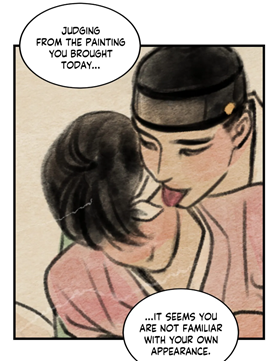 Thus in the third season, we witness how the lord keep whispering to his lover in private
  (chapter 91) and in public
  (chapter 92) This truly exposes the protagonist’s true nature: he is delicate and sensitive.
 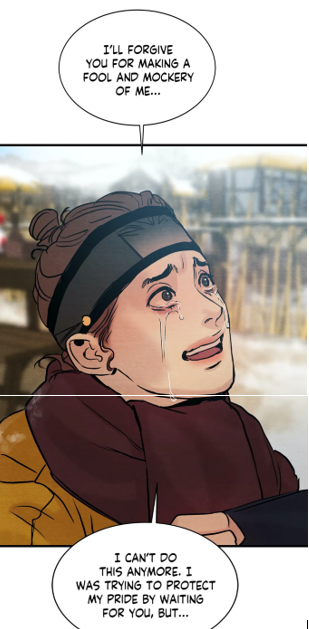 (chapter 57) Now, you can sense why I am writing this. The love Seungho had in the beginning has changed a lot, has deepened so much that he considers the painter as his wife, that he became monogamous and is even willing to get hurt, if it means that in the end, he can get closer to Baek Na-Kyum. His love for the low-born has transformed the man,
 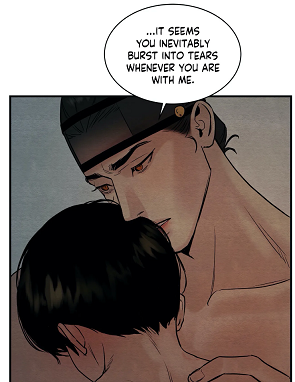 (chapter 47) He is much more gentle and selfless compared to the way he behaved in the first season. I believe this long explication was necessary for the comparison.
  (chapter 48) He is actually upset, because Baek Na-Kyum still views him as a man consumed by lust and the former acts as a prostitute. the aristocrat did so many things for him (lowering himself in order to pleasure him, becoming monogamous, buying him expensive and warm clothes, treating him with respect, going to town with him etc.). But with the painter’s remark, it was as if the lord had done it, as he was expecting something in return!! Yes, the existence of a new deal, but contrary to the past, Yoon Seungho had never mentioned it explicitely. The reality was that Yoon Seungho had acted generously out of selflessness. He didn’t expect anything in return, maybe just his presence. Because of the silence between them, a misunderstanding occurred. Thus the lord felt so upset. It was, as if all his benevolence had never existed, as if the aristocrat had paid him like a whore.
  (chapter 46), the painter felt somehow obliged to paint something… as you can see, he was trying to change the nature of their relationship.
  (chapter 47) He had been hired as a painter, but the lord had showed no real interest in the picture, it remained on the floor. Furthermore, he kept commenting about Baek Na-Kyum’s body
 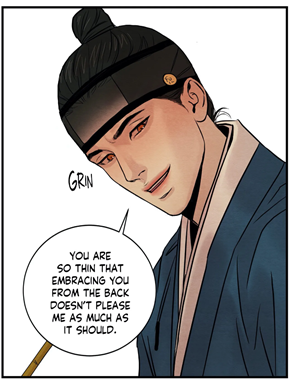 (chapter 47) (his blushing and how thin he was). Thus the noble contributed to reinforce the painter’s prejudice. He was only interested in his body. Thus the artist jumped to the wrong conclusion: he was only a man consumed by lust.
 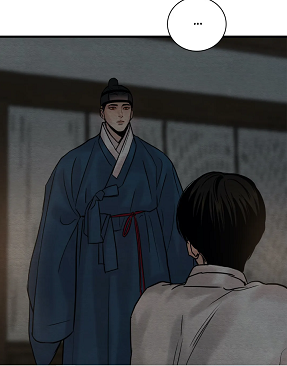 (chapter 48) His appearance is linked to his resolution to solve the issue. Since the painter didn’t understand the aristocrat’s pranks
 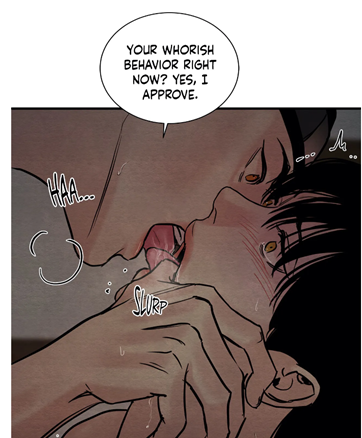 (chapter 48) His true goal is to provoke a reaction in the artist. However, in the chapter 20, he hesitated before deciding to slip into the role, as he didn’t respond to the kiss immediately.
 (chapter 21) I interpret the way Byeonduck drew the glasses as if they are vanishing. That’s the reason why I state that the commoner was able to distinguish the disappearing of the glasses. The expensive wine had lowered the painter’s control body (conscious mind) so that the unconscious could finally be released. Here, the painter was expressing his inner deepest wish: making love to the person he was attracted to. Furthermore I consider the drawing above as a proof that the painter became aware of Yoon Seungho’s real presence. The artist could recognize Yoon Seungho by his lips and chin, let’s not forget that he is a detail-oriented painter who had both nobles as source of inspiration. Since the powerful lord was dishonest, then Baek Na-Kyum could also be insincere. The black in the pictures, corresponding to the artist’s eyelids, kept increasing symbolizing his denial of the reality.
  (chapter 21) It was, as if he was closing his eyes to his sex partner’s identity, choosing to follow his sexual desires which had been repressed for so long. Hence I come to the conclusion that during that night, the painter wasn’t entirely innocent and used the noble. Until the chapter 16, he had to fight against his sexual desires for Yoon Seungho. But he had to deny them and as time passed on, he was forced to hide them (see the masturbation in the chapter 9). So the scholar’s rejection and abandonment
  (chapter 19) not only pushed the painter to drink, but also to disregard the doctrine that had been imposed on him. I am not saying that Baek Na-Kyum had already realized the subterfuge right from the beginning. Yet it dawned on him as their sex session progressed. Once confronted in the pavilion, he could perfectly recall his love confession. Both main leads sinned during that night, hence they had to pay the price for their dishonesty: the rape and the rejection. But since in the study, the lord was selfless and even took the risk to jeopardize his relationship with the low-born, he got rewarded. The painter was finally accepting him as his sexual partner.
 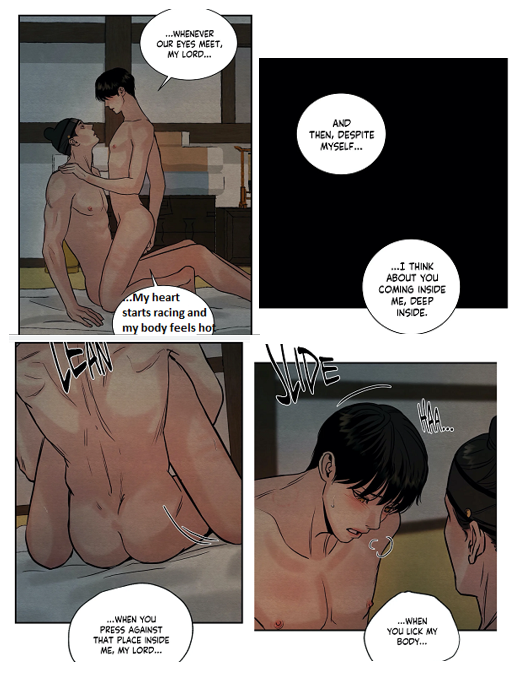 (chapter 49) He was no longer a prostitute. This explicates why Kim had to intervene himself and reveal the incident in the library.
  (chapter 50) He needed to separate the couple. From my point of view, it is related to Deok-Jae’s insult.
  (chapter 47) Kim must have tattled on Deok-Jae to his master, faking that he was defending the painter’s best interests.
  (chapter 29) Notice the parallels. In the chapter 49, Baek Na-Kyum is associating the gentle lord with the double-faced teacher, just like during their Wedding night. One more time, the scholar becomes a hindrance and is the reason why the painter refuses to open up to the main lead entirely. He won’t make the same mistake: sensing the warmth coming the main lead as something genuine and real.
 (chapter 51) If he was no longer his sexual partner, why didn’t the lord chase him away? Why was he allowed to stay in the mansion? Remember the head-maid’s words:
  (chapter 38) Maybe he is expecting him to paint for him. Thus he created a new erotic picture. From my point of view, the artist was slowly realizing that Yoon Seungho was indeed favoring him.
 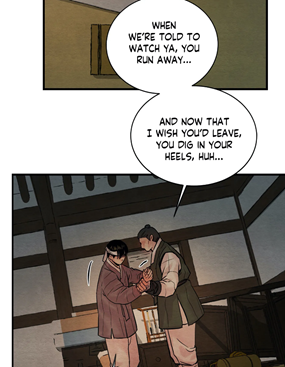 (chapter 53) He knew that this was not the main lead’s wish. And now, you comprehend why the artist didn’t paint so much in the second season. It was related to the lord’s interests.
 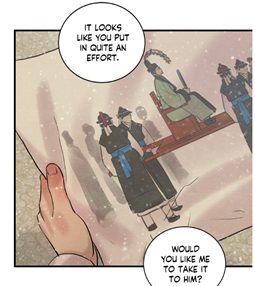 (chapter 44) He saw it as a confirmation that the teacher had truly abandoned him, for he never bid goodbye to him. However, now I believe that Kim never informed the artist of the scholar’s departure.
 (chapter 44) He just delivered it in delay so that the artist would feel even worse than before. Without the farewell, he could only come to the conclusion that he had been truly abandoned by Jung In-Hun. Yes, the artist didn’t react like the butler had expected. He remained in the mansion despite the gate had been left wide opened. By getting rid of the painting, he was cutting ties with the learned sir. Yet this was a baby step compared to the scene in the chapter 49. Here, he has finally become the master of his own life and fate therefore he’ll live his life the way he wants. He is accepting his homosexuality and as such his sensuality. He views sex as a part of his life. He rejects abstinence and doesn’t view sex as an addiction.
 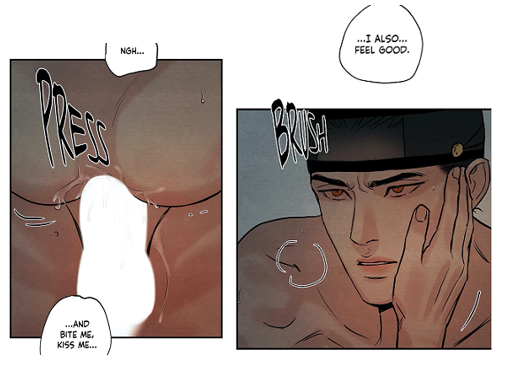 (chapter 49)
 In fact, in this image, he was acknowledging his other part: he was a painter.
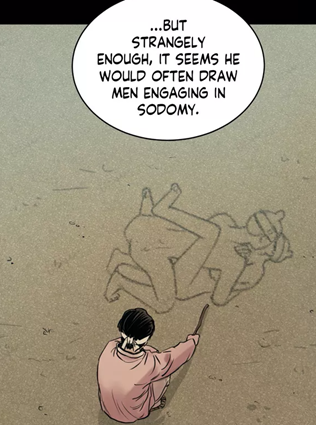 (chapter 1) I perceive this image as an indication that the artist had dreamed about this love session. Note that all dreams about the painter were linked to sex and love. For me, this picture is a proof that the brothel had nothing to do with it. He was drawing outside and he had no model for such a scene right in front of him. In other words, the child allowed his body (his arm, hand, eye and brain) to take the lead, hence he was able to create such a sensual picture. Even Yoon Seungho wondered how a virgin could produce such beautiful drawings.
 (chapter 87) He saw no crime in it, rather as something lovely and beautiful, hence he never felt the need to hide it. Notice that in this picture, he was creating such a lewd painting
  (chapter 1) where people can behold it, he feels neither shame nor embarrassment. He had no idea that he was violating social norms. That’s why I came to the following interpretation, when the painter said
 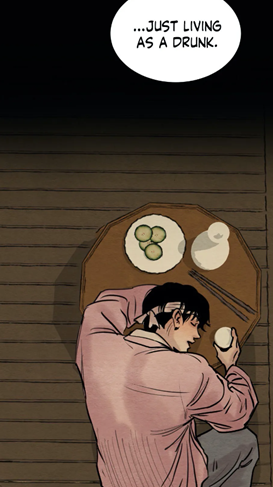 By forcing him to drop painting, Jung In-Hun had already ruined the low-born’s life, as painting was a part of his soul. We could say that the low-born was already withering. However, back then Yoon Seungho was not interested in why the painter suddenly dropped his true vocation and why he lied to him too. The lord was more obsessed with the erotic drawings. The cause for this long explication is necessary as with this interpretation, I am predicting what is going to happen in the future.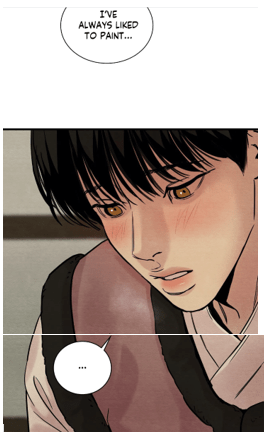
 Here again, he allowed his body to take the lead, but it was once again behind closed doors and nobody was present. He was hiding again, indicating that he still wouldn’t admit his own sexual desires and his homosexuality. Until now, he had only asked for comfort and love from his counterpart (chapter 20/21 and 41/42). Remember that in the chapter 41, he just asked to be hold and as such, he only wanted to be embraced initially. However, due to his inexperience and pain, he confused love with sex. As you can see, the belief “the body taking the lead” had resurfaced indicating that little by little, the painter was changing. More importantly is that he hadn’t been triggered by an immediate sex session, unlike in the past (chapter 8/9). For the first time, Baek Na-Kyum’s sexual desires had come back to life. Unlike in the past, he didn’t judge the cum as something dirty and filthy. Moreover, Baek Na-Kyum could only ejaculate due to Yoon Seungho’s warmth and love. He had these flashbacks where the lord made love to him.
 That’s why his paintings lacked passion and warmth. He was working like a robot. As a conclusion, until the chapter 46, Baek Na-Kyum never considered his “husband” (I am well aware this is not how Baek Na-Kyum perceives Seungho) as his muse. He just used him as his model as he had been forced to or he wanted to smooth his agony.
  (chapter 1) He had no choice. He had to paint erotic paintings. Thus I conclude that the artist couldn’t fully show his true talent and express his passion for painting totally. Yet, his publications were still beautiful, since the lord’s heart and gaze were moved. On the other hand, the noona Heena sent her adopted son to Jung In-Hun, because she feared for her brother.
 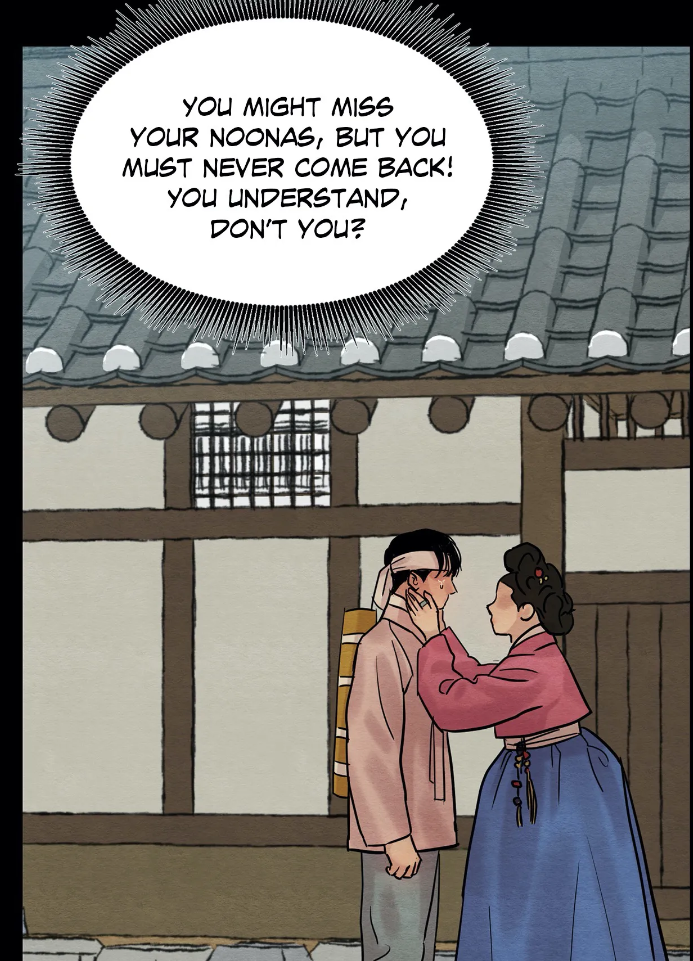 (chapter 46) However, I believe that she was acting on the learned sir’s request. She justified her decision to send him away to the teacher, because she knew that by the learned sir’s side, the artist would never outlive his homosexuality. She imagined that the low noble was her son’s source of inspiration
 (chapter 46), whereas the artist had other motivation. Therefore she thought that it was for the best, if he was by the teacher’s side. I assume that the teacher wished the low-born by his side for two reasons: money and the prospect to benefit from Baek Na-Kyum’s talent. It is very likely that out of greed, the learned sir desired to sell the painter’s works for his own benefit. But for the artist had been requested to paint these erotic paintings for survival, I come to the conclusion that he had been asked twice to paint erotic pictures. The first time, it was for a precise client, and the second time it got sold among the commoners, which explains why the tailor knew about the identity of the painter.
  (chapter 64) There’s no ambiguity that the scholar’s prospect got ruined, hence he unleashed his jealousy and resent onto the painter, until the man vowed to follow the scholar’s doctrine. The poor man could never tell Heena about the physical and mental abuse, as he had already been abandoned.
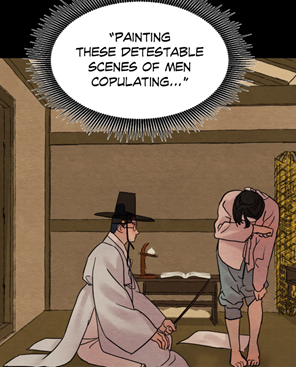 (chapter 34) He had to keep his promise to never return to the kisaeng house. I believe that the kisaeng must have used this incident
 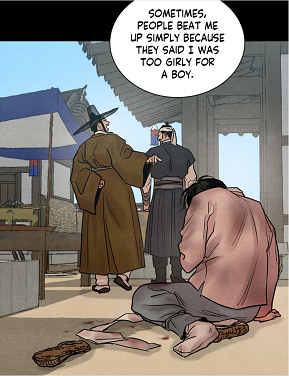 (chapter 94) to send her brother away and exactly like in chapter 44, she made sure that the noonas wouldn’t be informed. That way, she could deceive her colleagues. It had been the painter’s choice.
  (chapter 93) For the man was his guardian, the low-born had to accept his situation. But since he was just a low-born, I doubt that he could sleep in the same room than the scholar. From my point of view, he had to sleep outside on the wooden planks, the older version of this scene.
  (chapter 1) Therefore it is not surprising why he didn’t leave the mansion in the end and why he said this to the head-maid.
 (chapter 75) Painting was his passion, and the childhood drawings kept by the noonas clearly indicate that he didn’t paint erotic paintings, since he was a child.
 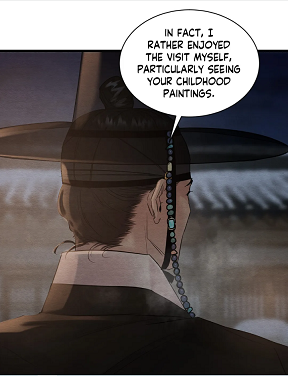 (chapter 94) He painted animals and as such nature.
  (chapter 1) Sure, the painter’s mind was reminding him that this is filthy and vulgar, yet I sense that this affected the artist’s unconscious a lot. All the wet dreams Baek Na-Kyum had, the seme’s phallus played a huge part. Thus we have such drawings in the fantasies, where the protagonist’s sex is in the center of the painter’s imagination: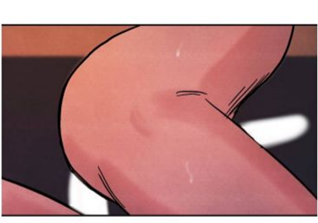
 (chapter 2)
 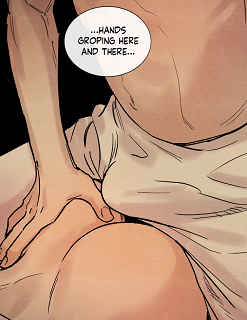 (chapter 6)
 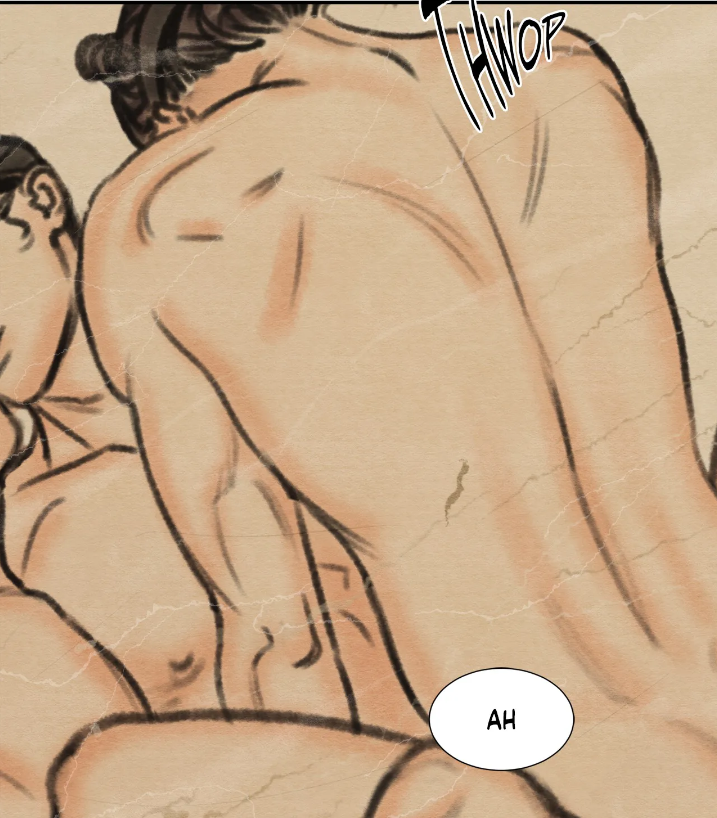 (chapter 8)
 (chapter 94) The painter followed his heart. Observe that the numbers have been switched: 49-94. The mirror effect and in the study we had a reflection too. Both main leads reflected each other’s minds: acceptance of a sexual relationship, but rejection at the same time, no strings attached.
  (chapter 94)
  (chapter 94) So the lord is now associated to the moon and as such to nature. Thus I conclude that the noble will discover the painter’s true talent. From my point of view, his new paintings won’t be just erotic pictures about himself with the uke, but also about nature (animals, plants). The diversity of the topics will increase, yet I am sensing that the pictures will definitely reflect the painter’s love and admiration for the seme.
  (chapter 92) Yes, it is very likely that Baek Na-Kyum decides to recreate this scene, because we could see that Baek Na-Kyum’s heart and soul was moved. A new version of this scene:
 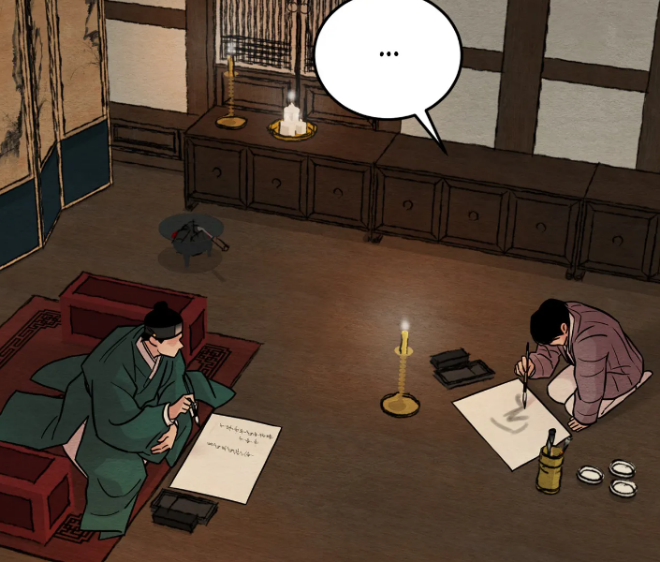 (chapter 36) Besides, the painter’s works will reveal what the protagonists feel and think about each other: love.
 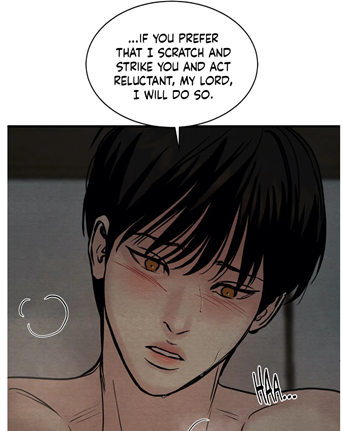 (chapter 48) The noble had noticed that the artist was blind and deaf hence he needed to use the low-born’s body to awake his senses and arouse the painter’s instincts. That’s why he licked the painter’s ears while whispering,
 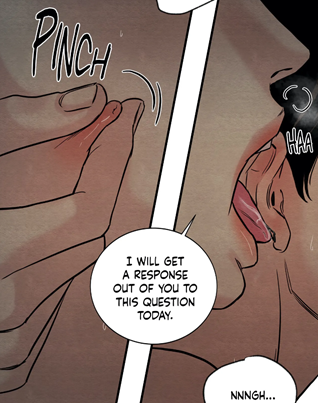 (chapter 49) or pinched his nipples. At no moment, the protagonist let his emotions (anger, frustration) take control over the situation. That’s why we definitely can’t say that we have another rape in the chamber. First, since “Baek Na-Kyum is a whore” (in the painter’s mind), then the lord can do anything he wants. The noble’s reasoning is quite simple: “Because the commoner is acting, then I should act too”. Secondly, the noble is trying to discover the root of the problem
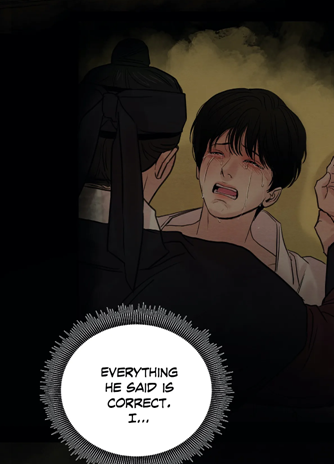 (chapter 48) Did the scholar request the painter to sleep with him in order to discover a weakness? Sure, Baek Na-Kyum said that he was doing it on his own free will, yet his reactions led the lord think otherwise hence he couldn’t lower his guard entirely.
 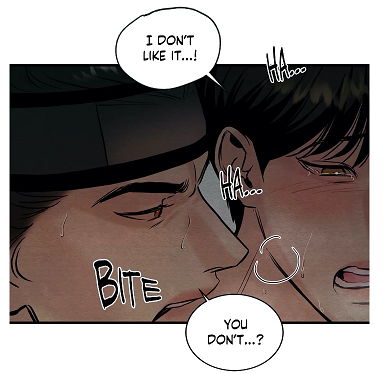 (chapter 49), until Baek Na-Kyum yells to his lover and starts crying for real. Notice that in the drawing above, the artist expresses his own thoughts and desires for the first time. What caught my attention is that in this drawing, Baek Na-Kyum is speaking without a pause, unlike in the past where he is not even using the pronoun “I” or “me”:
  (chapter 45). My interpretation is that in that situation, the painter was only perceiving himself as an object. Sure, right after he admitted that he was feeling something.
  (chapter 45) But the emotions were quite superficial, he had great difficulties to externalize these. While the pronoun “I” was only used for the first time for a short moment, there was still the presence of an object in his confession. In other words, he was still denying the existence of two naked bodies till the chapter 49. Either he was an object (“it feels nice”) or the lord was one (“I like it”). Hence the lord’s remark was so point on:
 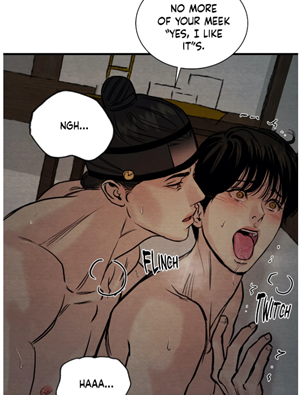 (chapter 48) First, he had misunderstood the confession, yet at some point he perceived his “confessions” for its real value: the presence of an object in his expressions.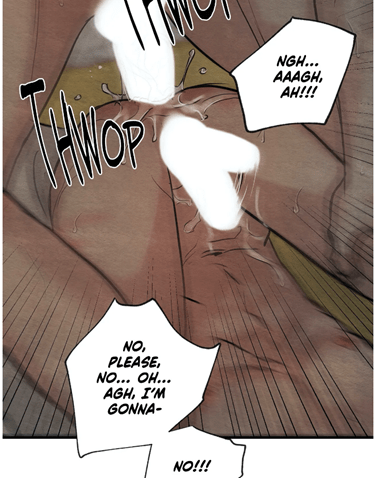
 (chapter 49)
 (chapter 49)
 (chapter 42)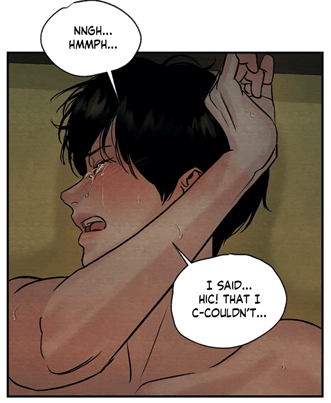

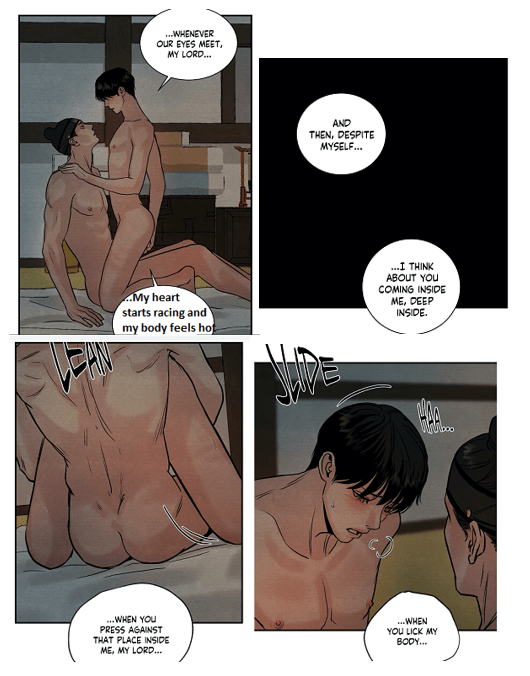

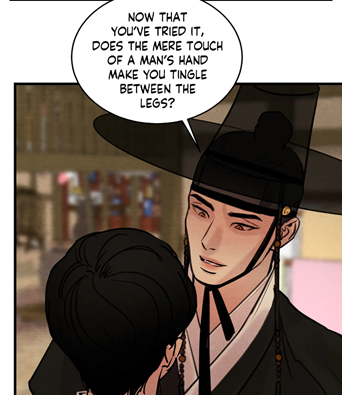
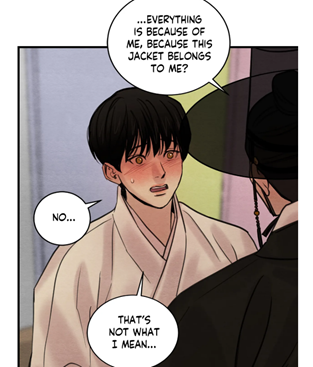 (chapter 39) So he won’t react like in the past, hide his special relationship with the lord. He won’t show any fear, when it comes to gossip or judgement from others. Why should he feel ashamed? This is something natural, which means that the next time Deok Jae calls him
 That’s the reason why Baek Na-Kyum blames the noble for this. By doing so, he can keep denying his homosexuality and he would have kept following the teacher’s regulations. However, like I explained in the first part, Baek Na-Kyum wasn’t innocent either, he did know what was happening. By acting as if he was seeing the scholar, he had the excuse to forget this night. Besides, the painter was the one confessing first and not the other way around. We shouldn’t forget that the aristocrat didn’t respond to the kiss immediately. He still hesitated for a few seconds.
 Imagine that with only one hand, the low aristocrat was able to create some distance with the artist. The latter stopped approaching his learned sir after this gesture. Then, the teacher argued with Baek Na-Kyum that with his explanation, he was questioning his abilities.


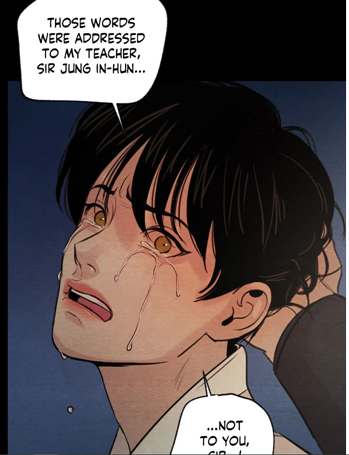 so he violated the rule 3. The artist still whispered the low aristocrat’s name so that we can say, the painter remained faithful to his “learned sir” so he ensured that the law 6 wasn’t broken.
 (Thank you @Slam_ for this observation) Therefore he views the painter as his “wife”. Only his love for Baek Na-Kyum could give the main character the strength to keep struggling. That’s why he doesn’t admit defeat, although the low-born hurt him over and over again, although he was once on the verge of giving up on him (chapter 35). Let’s not forget that back then, he saw how Jung In-Hun was flirting with his “wife” who kept blushing due to the scholar’s caresses. However, he didn’t do it because he saw the painter not following the double-faced man. That’s why I would like to examine the following chapters under the following aspect: Baek Na-Kyum’s attitude towards the rule 6 because Yoon Seungho’s struggle is strongly connected to this doctrine.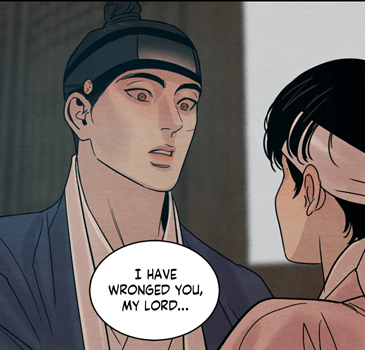

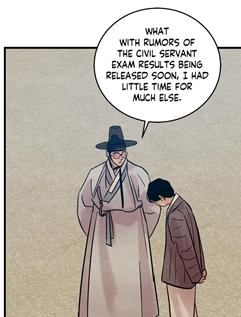 He is perceiving the low noble more and more in a different light in the chapter 35, especially when he hears the noble declaring that he would have never spent money for him.
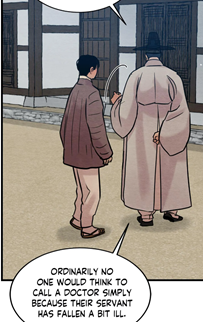 Baek Na-Kyum even replies that he was seriously ill, however Jung In-Hun shows no real concern. He still thinks that a few caresses will be enough to get what he wants.
  He is so used to the painter’s submission. He abandoned him twice, nevertheless the artist always viewed him as his master and never questioned his past actions (chapter 1, 19: the several abandonments). That’s why he doesn’t feel the need to put much effort in his deception. In the scholar’s mind, the painter is still his servant. He just needs to remind him of his task and the low-born will obey him.
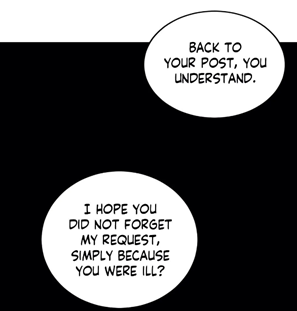 That’s what he is expecting. However during this scene, the intellectual didn’t pay attention to the change in the artist’s attitude. The fact that the latter asked him why he never visited him and the commoner even replied that he was seriously ill, these were clues of Baek Na-Kyum’s transformation. But since Jung In-Hun is too selfish and was himself under pressure because he realized that he might end up with nothing, he didn’t catch these details. The picture of painter standing in front of the door with his head down reflected his second pain and disappointment.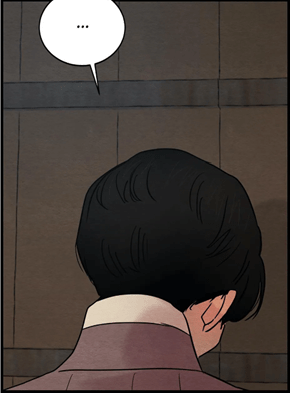
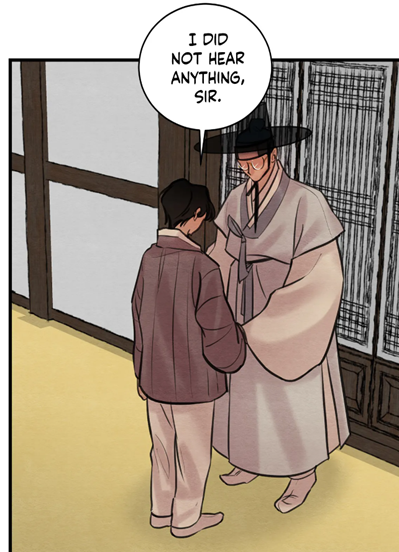 Since he has already vowed to treat Yoon Seungho as his master, he can’t betray his second lord, the famous sodomite. The second reason for his dishonesty is that the seme’s vulnerability did move his heart, hence he could only hide the truth. Moreover, I would like to add another cause for the artist’s lie.
  Since Jung In-Hun had been acting as if he knew nothing of the real relationship between Baek Na-Kyum and Yoon Seungho, he couldn’t accuse the painter of lying. As he was the man who developed this doctrine where homosexuality is considered filthy and vulgar, the low noble couldn’t mention it because this would signify that he had been manipulating the painter and the latter would have got aware of it. So the regulations set by the teacher became the reason why neither Jung In-Hun nor Baek Na-Kyum could be honest. If they had been frank to each other, then this would have meant that the scholar had been violating himself his own laws and his authority would have not only been tarnished but also doubted. This would have displayed that the scholar has been acting as a pimp. I hope, this is understandable.
 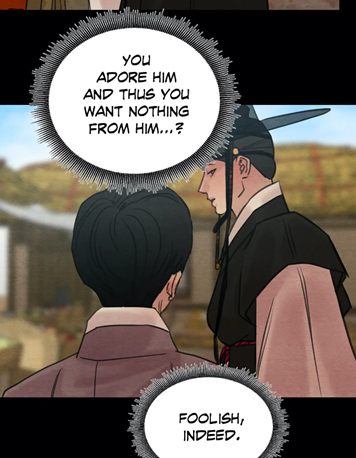 He did hope that the teacher liked him. So he was indeed bothered until he felt the need to interrogate the scholar himself. Since I listed the teacher’s doctrine, now the manhwalovers can judge this episode differently.
 I have to admit that in the past I only examined the chapter 40 under the aspect “fate” and “prostitute”, hence I wrote before that Jung In-Hun revealed his true personality because he was pressured, angry and jealous. First, he realized that the promise made by Yoon Seungho is fake. Moreover, he resented the artist because the wealthy noble favored the latter so much (new clothes, the room next to the master, the right to spend the night with the lord, invitation to the pavilion and to the hunt etc), while the rich aristocrat somehow neglected him, a noble too. Furthermore the hypocrite was asked by a commoner to take his responsibility.
  And the final words said by the low aristocrat cause the artist to become deaf as well. He is so traumatized that he is like paralyzed and let the noble leave the library without being able to argue. That’s why he has this negative perception of himself.
  In his mind, his last trick must have turned Baek Na-Kyum into a submissive person again and he knows it that’s why he still thinks, he can use the commoner as his pawn. He might have abandoned the artist for a third time, he has the impression that the low-born will always follow his orders like in the past. Despite each rejection, Baek Na-Kyum welcome him with open arms (chapter 7 and 24) so he still believes that he has the upper hand and he is still controlling the low-born. That’s why he leaves the artist without biding goodbye. He doesn’t need to keep the pretense but knows very well that the painter has stopped rebelling after destroying his identity and personality for good. With this new interpretation, I come to a different judgement about Jung In-Hun.
 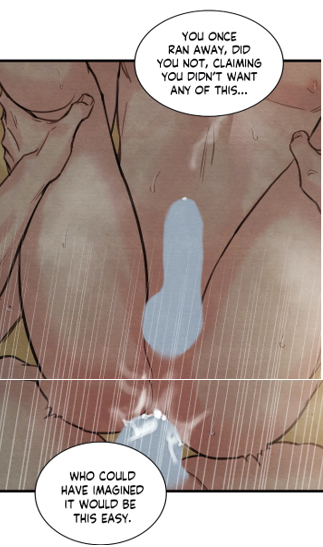 He can’t escape from this new prison, a hell created by the gaze from others.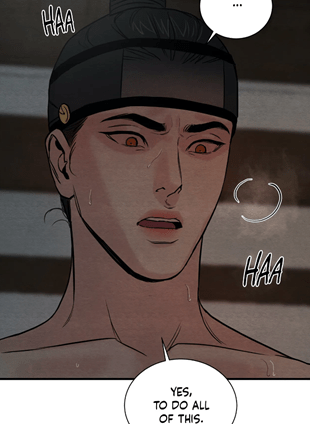
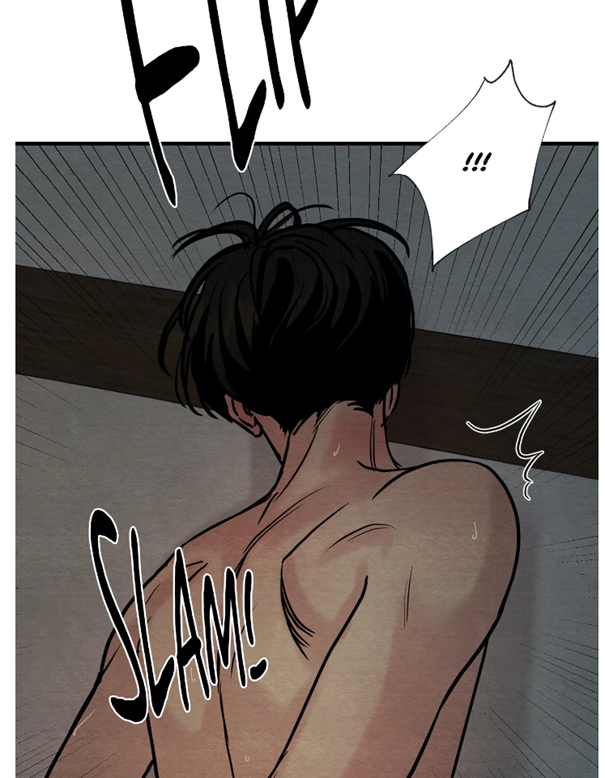 It is pointless because the low-born is no longer using his eyes and ears to perceive the reality. He relies too much on others (Yoon Seungho, the head-maid, the servant Deok-Jae, Jung In-Hun). Through pain and pleasure, he might realize that he is a person on his own, he has an identity but for that, he needs to exist and express his wish, emotions and thoughts.
  . He believes that through pain inducing his tears, the painter could finally reveal what happened back then. He witnessed it with the rape and the fellatio.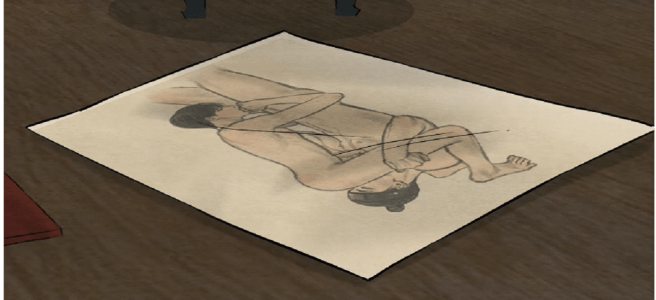
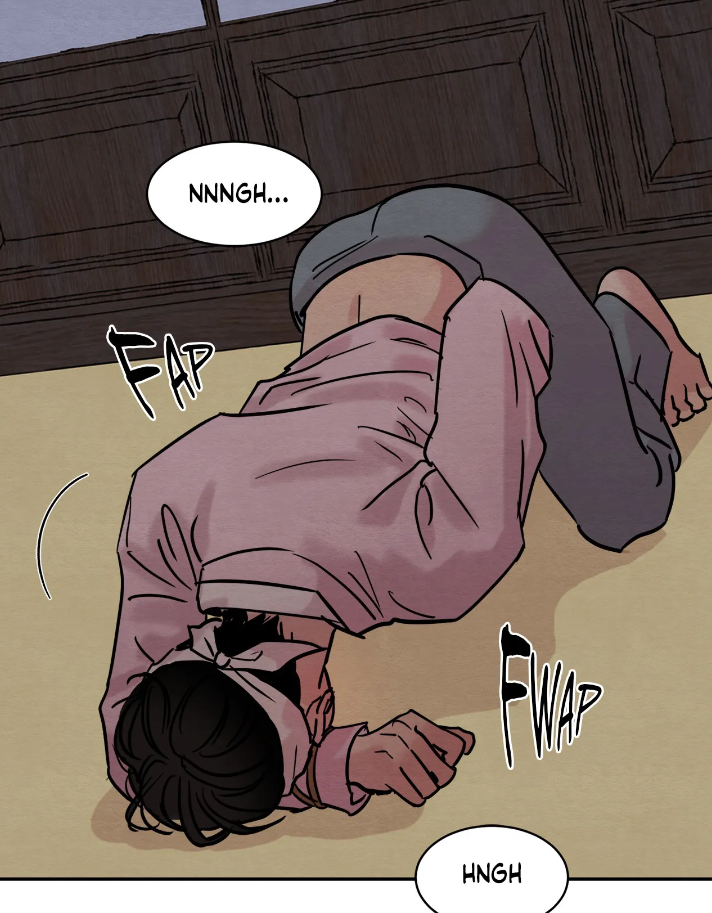 (Chapter 9)
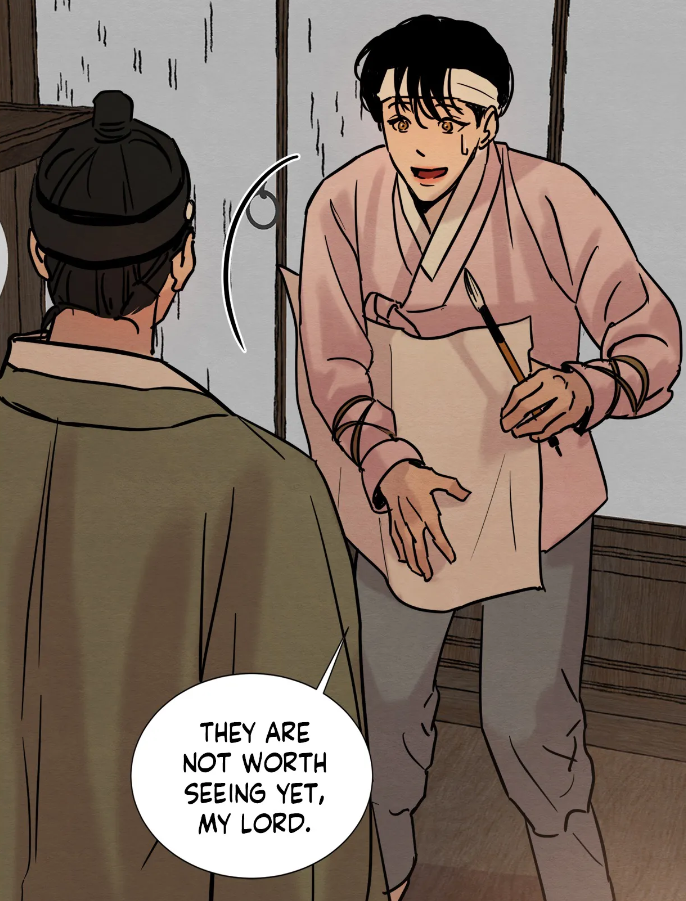 (Chapter 9) Baek Na-Kyum excused himself with a lie, he would show him when the work would be finished. However, the true reason for his departure was his erection. Notice that he is using the paper to hide his erected phallus. He was also on his knees before, when Yoon Seungho approached him. The cause of his sexual urges is revealed with the following drawing.
 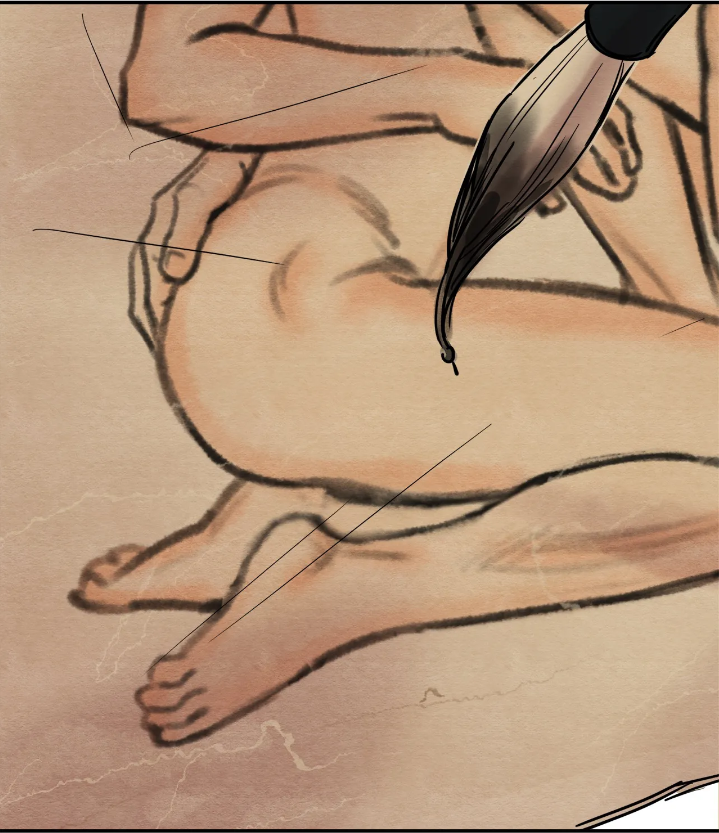 (Chapter 9) This drawing represents the painter’s perspective. As you can see, the painter’s eyes are focused on the lord’s hand touching the butt and anus. From my point of view, he is imaging the lord’s touching him. This time, the artist is conscious and can no longer repressed his sexual desires. Later, his gaze focuses on the other uke, the one penetrated by our main lead. Here, it is quite clear that the artist wishes that he had replaced Min.
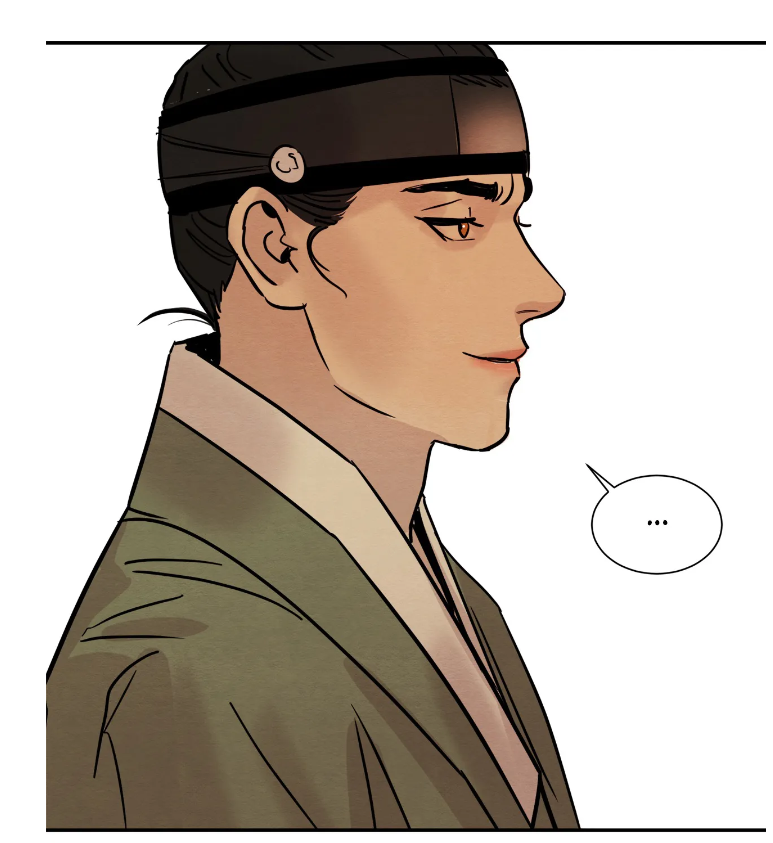 (Chapter 9) Although the painter had been quite rude and left him behind, the lord wasn’t bothered. In fact, he was pleased that he had indeed affected the artist.
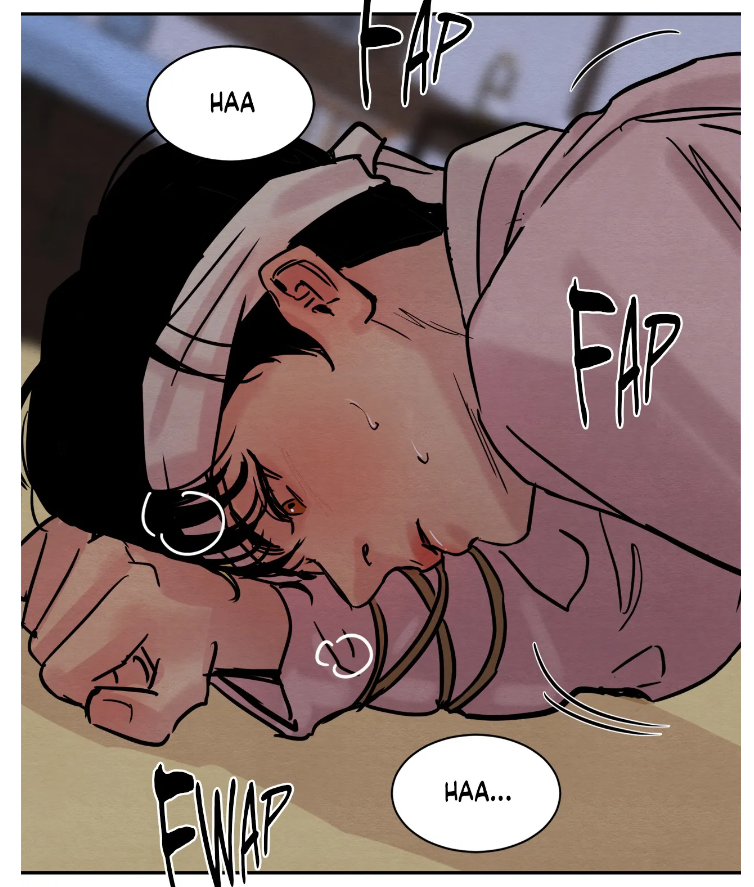 (Chapter 9) His eyes might be open but his spirit seems to be elsewhere. He is not really looking.
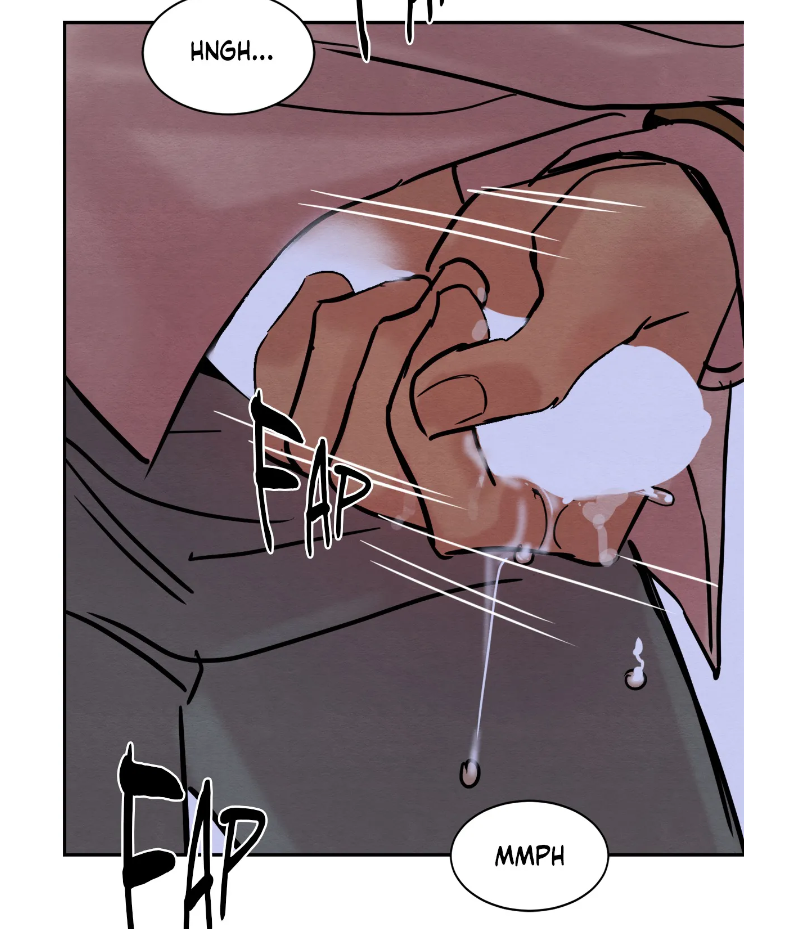 Because the readers never see his gesture, they can not be certain. Hence Byeonduck had to draw a picture with his erected phallus showing his masturbation.
  Striking is that the moment he feels that he is about to climax, he closes his eyes. Here again, this reinforces the statement that Baek Na-Kyum is determined to refuse to face reality and deny his attraction for a man, for the noble.
 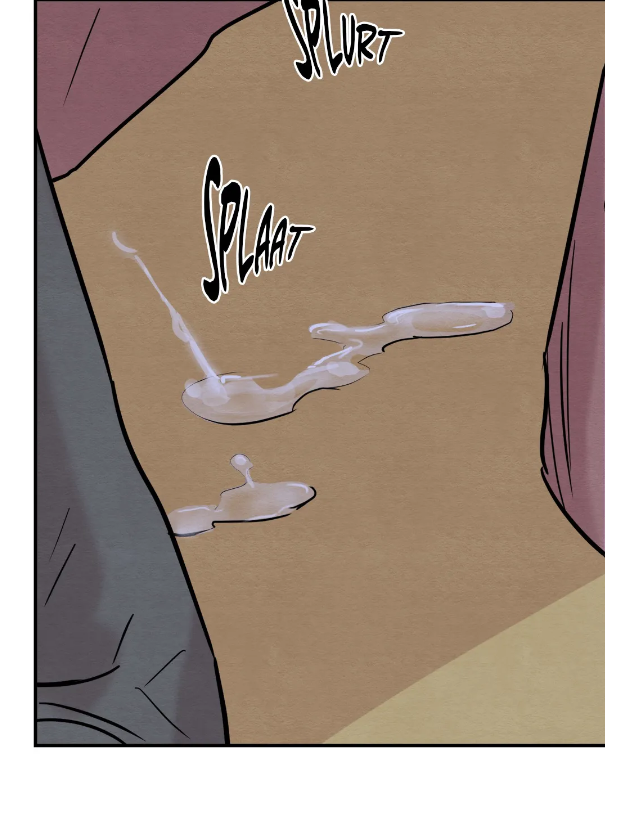 (Chapter 9) When the sperm comes out, it lands on the floor. This is quite important as it illustrates the artist’s attitude towards the semen. He considers it dirty and filthy hence he makes sure that his hand doesn’t get soiled. That’s how much he despises himself and his needs but he can no longer repress these urges. He prefers closing his eyes, masturbating behind a door and using his body to cover his filthy gesture so that no one can ever witness it. But he is too focused on his needs that he forgets that he is making noise so that Yoon Seungho knows what he is doing. At the end, you sense the low-born’s despair and disgusted attitude with his final position.
 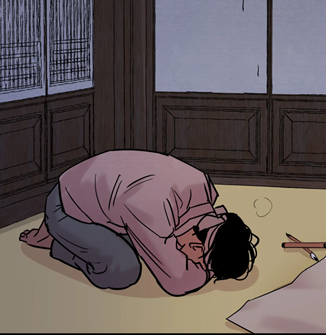 (Chapter 9) The manhwaworms feel his strong refusal to admit his attraction towards the noble, his sexual arousal and his sexual desires towards Yoon Seungho. The painting had such an effect on him, it awoke his repressed sexual desires.
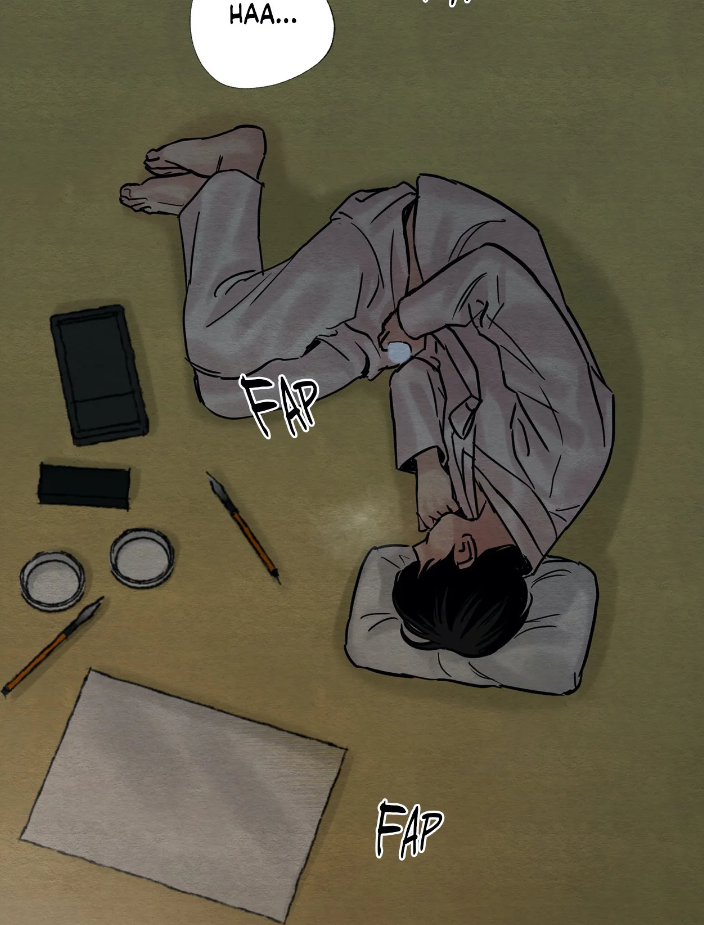 (Chapter 46) However, he has still a position where it is still protected. If someone came from the side, they wouldn’t detect immediately what the low-born is doing. This can be explained that there is still some shame left but it is now related to his perception that homosexuality is a synonym for prostitution. That’s why he is still reserved. On the other hand, the semen doesn’t land on the floor but on his hand which shows that he no longer feels disgusted.
 (chapter 46) Some readers complained that he didn’t wash his hand before falling asleep. Yet what they failed to realize is that this proves that Baek Na-Kyum no longer perceives sperm as dirty and filthy. This symbolizes a huge step forwards. Now, if we compare the two masturbations, the readers will notice another huge divergence: the chronology of the drawings of Baek Na-Kyum with closed or opened eyes. In the chapter 9, we had first the painter with opened eyes as he was lost in his thoughts and the moment the ejaculation was about to come, he closed his eyes. Here, we have the opposite, first the closed eyes.
 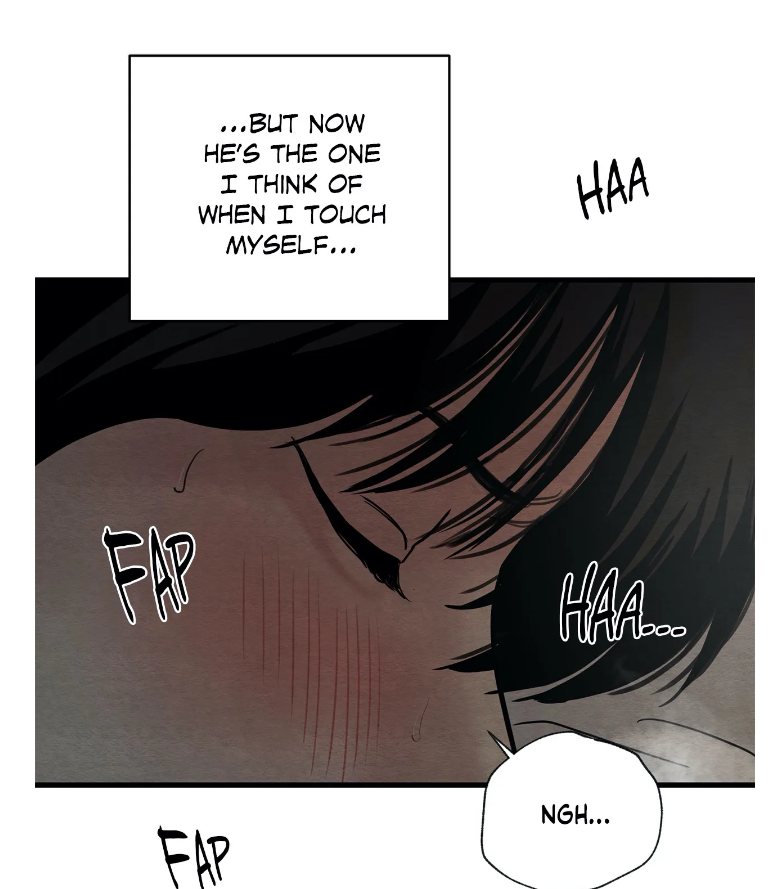 (Chapter 46) The reason is simple: he is not lost in his thoughts, quite the contrary. All his thoughts are revolving around the master confirming the change of his attitude. He is no longer denying his attraction towards the noble. That’s why the author lets the manhwaphiles see the images he has in his mind. What caught my attention here is that the painter had visions of the moments, the lord made love to him.
 (chapter 42)
  (Chapter 46) The kiss triggered the climax indicating that the kiss, full of love and passion, moved him so much. He sensed the lord’s love stronger here. Since his eyes are wide-opened, it clearly shows that the man is actually facing reality. He is no longer hiding, running away from his sexual desires and admitting that his feelings towards Seungho have changed. Notice that this time, he even questioned himself for this reason. Why could such a kiss provoke such a reaction? He is now looking for an answer, he is no longer running away. He wants to discover the truth.
 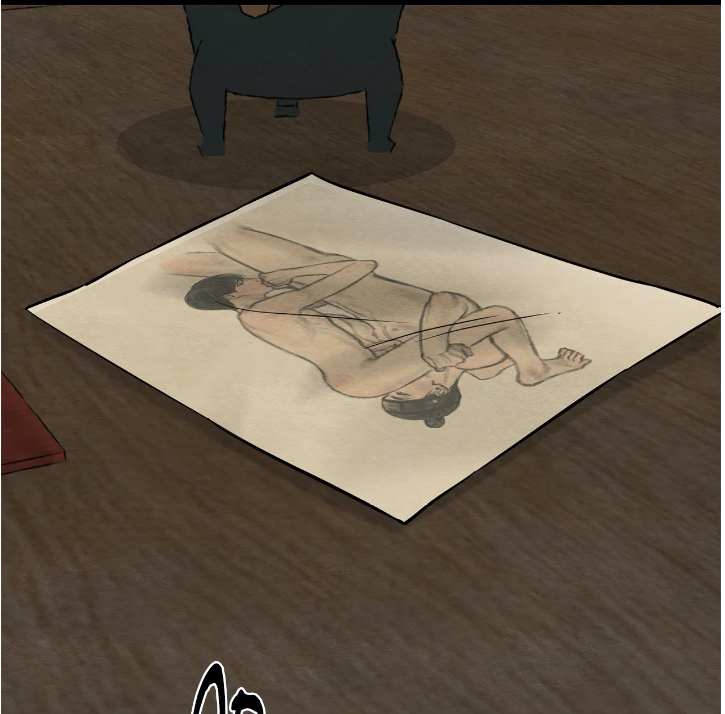 (Chapter 47) What caught my attention in the new drawing is that he didn’t select the memory we saw:
 Here, the full moon seems so far away, Yoon Seungho’s mansion is almost illustrated in its entity. My first thought was that the full moon personified Baek Na-Kyum and the latter is so far away from the powerful noble as they have not met yet. The sky is so dark (almost black) due to the light glowing of the moon. It was as if the noble’s world was full of darkness and his future meeting with the painter represents his only joy and hope in life. He is so eager to have the painter by his side and to have the artist painted for him. The mansion is so big, indicating his wealth and power, however it feels so big and empty at the same time. It was as if his domain was not a real home. The light coming through the windows doesn’t exude warmth, the beholder feels a certain coldness as there is nobody outside the building. So this image could be judged as an illustration of the main lead’s world: dark, cold, empty, lonely and lifeless.
  First, why is this a crescent moon unlike in the first image? Did the painter lose something hence he is no longer complete? Secondly, there is no building and the moon seems to glow stronger as the sky is lighter. If the moon is the painter and the sky Seungho’s world, how come that the moon is glowing stronger because even if the painter had felt excited before, he was still resisting the noble’s advances and attraction? Furthermore, in this chapter he is threatened by the master. Then we see no mansion, while we saw the roof in the image from the chapter 4. Why is there no building portrayed here? That’s why I saw it as a necessity to find an explanation that would fit to all the pictures. Hence I would like to show all the images in their chronology so that we can figure out if the drawings with the moon have a deeper meaning like the weather and the season.



 We never saw the moon during that night and the sky looked so bright. It was as if the moon was looking down on the building, while the noble is embracing and kissing the painter. This night was particular because it never looked like a real night… a mixture of day and night, giving the illusion of a different time. That represents the “dream”, something special is happening right now. The lord has discovered love and warmth hence the light of the moon seems warmer and closer. This was just an illusion and the reality came back in the chapter 25.
 Jung In-Hun had become his guardian because he had been bribed by the head-gisaeng. Only yesterday I came to realize why the painter could repress the bad memories about his physical abuse: The Stockholm Syndrome. And this is relevant as it explains why the artist adopted such a fear of homosexuality and even talked like the scholar. Furthermore I can even envision that this Stockholm Syndrome must have affected his hands and talent. This even reinforces my opinion about the huge impact of Yoon Seungho on our low-born. Due to his attraction to the lord and the sex session, the repressed sexual desires were unleashed so that his talent was triggered. That’s why he impressed the lord so much in the chapter 2.
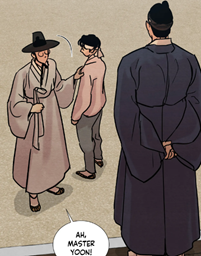 Nevertheless it started to rain the moment the teacher discovered the existence of the deal between the powerful noble and his former pupil.
 Imagine the rain followed with thunder represented Baek Na-Kyum’s tears and heartache because of the teacher’s rejection symbolized by the hand.
 It was as if the snow embodied the artist’s tears once again, yet this time the real pain is no longer existing because his heart has turned cold. He feels nothing at all hence he has no problem to ask the butler Kim to throw away the painting. The more fall and winter are approaching, the more the painter’s relationship with Jung In-Hun deteriorates. In the chapter 35, the painter is definitely hurt by the low noble’s gesture, when the latter closes the mansion door right in front of him. This coincides with the fire where the fallen leaves are burnt.
 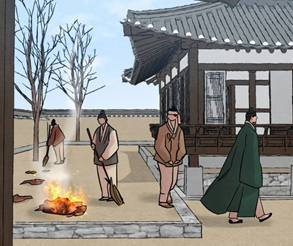 The caress on the cheek equivocates to the fire, the last real warm gesture the painter received from his teacher.
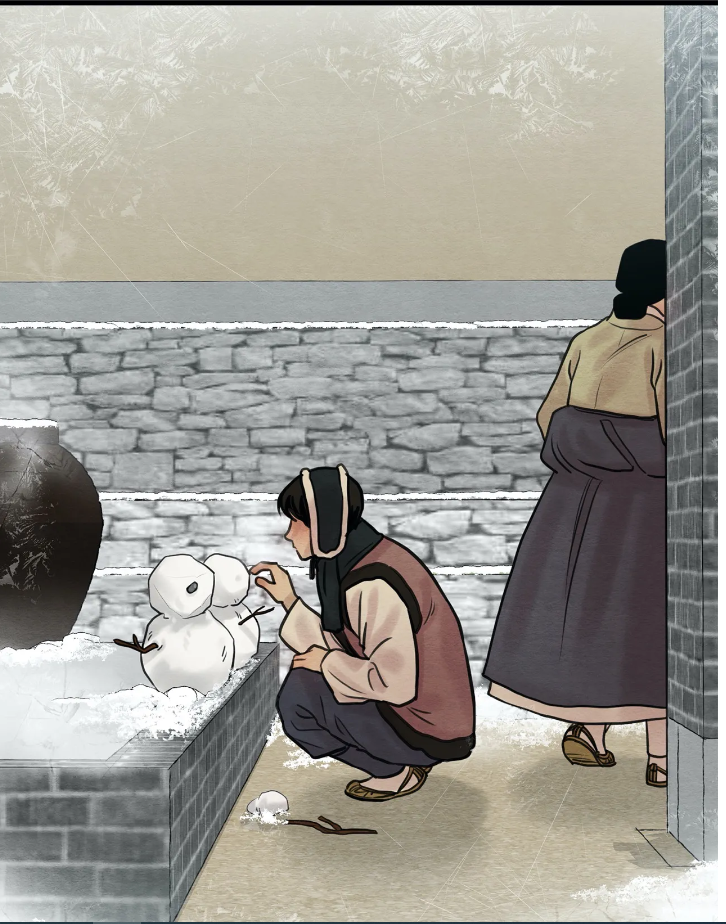 It was as if his heart was frozen consequently he feels nothing. However, the presence of the snowmen illustrates his innocence and his longing for companionship. He wished deep down that he wasn’t alone and had someone by his side. Yet, the painter has no idea about it. Now, you can understand why I connected Byeonduck’s drawings to the Surrealism. Sure, this is my own interpretation and nothing more. The weather and the seasons are following the same evolution than the painter’s transformation. Little by little, he starts losing his admiration for the scholar which ends with the real separation. He has been so hurt that he is like an empty shell. But there is one difference from the past. This time, Baek Na-Kyum was the one who cut definitely ties with the scholar hence the double-faced man has no idea that he can no longer use the painter as his tool.In the past, the jealous aristocrat could push him away but the painter never resented his admired sir and accepted that the teacher would return to his side without questioning his motivation behind his smiles and strokes. He had been abandoned once, hence he became a drunk. However, the painter had no grudge hence he fell for Yoon Seungho’s lie in the chapter 7.
 It was the same in the chapter 24, when the scholar took him and pushed him against the wall.So far he had avoided the painter, yet he needed him again. At no moment, the artist rejected the man’s advances (kiss on the hand, his head on his shoulder). The low-born always forgave the low noble.
 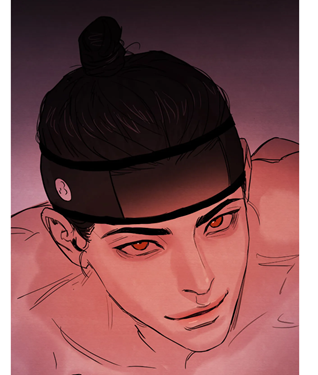 Furthermore the huge distance between Jihwa and Yoon Seungho could be explained that the artist wished, he had joined the lord and put himself between the main lead and the red-haired man. Remember that he wanted to take the sex partner’s place. As you can see, the first painting displayed a lot the painter’s unconscious, his sexual desires that’s why he had to destroy it. The image represented a proof of his homosexuality. In other words, the first drawing let the noble perceive the painter’s emotions and feelings hence he felt his own attraction. Therefore he could liberate himself from his negative image he had of himself.
![ANALYSE] Le Cri, Edvard Munch](https://alheuredelart.files.wordpress.com/2018/01/3-3_le_cri2.jpg)
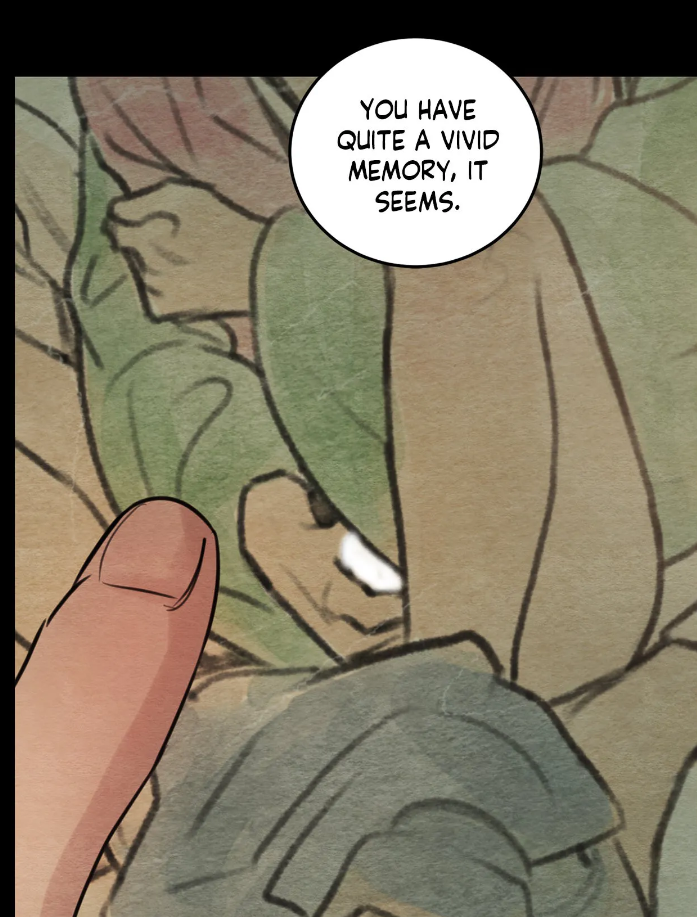 The word “vivid” is definitely characteristic for Expressionism. That’s why I connected the artist’s work with the Expressionism. Sure, the low-born lives in a different period, the industrialization had not reached Joseon yet. However, it is pretty obvious that the painter’s creations are strongly influenced by his emotions and state of mind.
 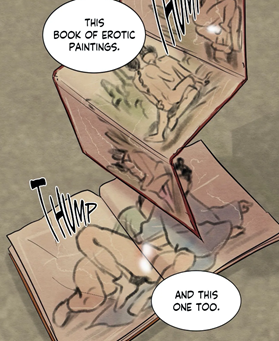 Since all the books were motivated by his love for the learned sir, the nobles could already sense the painter’s emotions and desires in these erotic pictures. Sodomy was portrayed as something natural and lovely. This explains the painter’s popularity and why the main lead became addicted. Because of this observation, I couldn’t help myself connecting this to another Art movement from the 20th Century called Surrealism.

 The readers can detect that he is starting to think on his own, showing that he is no longer under the teacher’s influence: this is the evidence of critical thinking, something the seme tried to initiate in the artist.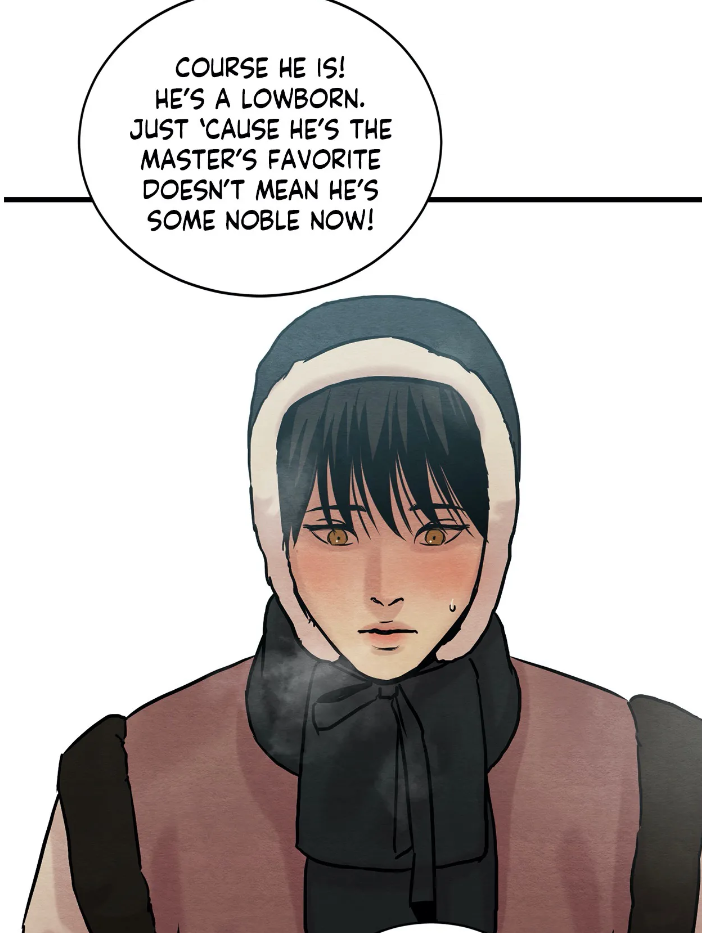
 From my point of view, the servant will serve as a tool in Baek Na-Kyum’s growth. Through Deok-Jae’s betrayal the painter will realize that the teacher’s harsh words and abandonment were caused by jealousy and were not reflecting the truth. That’s the moment the scholar will have no influence any longer on the artist.
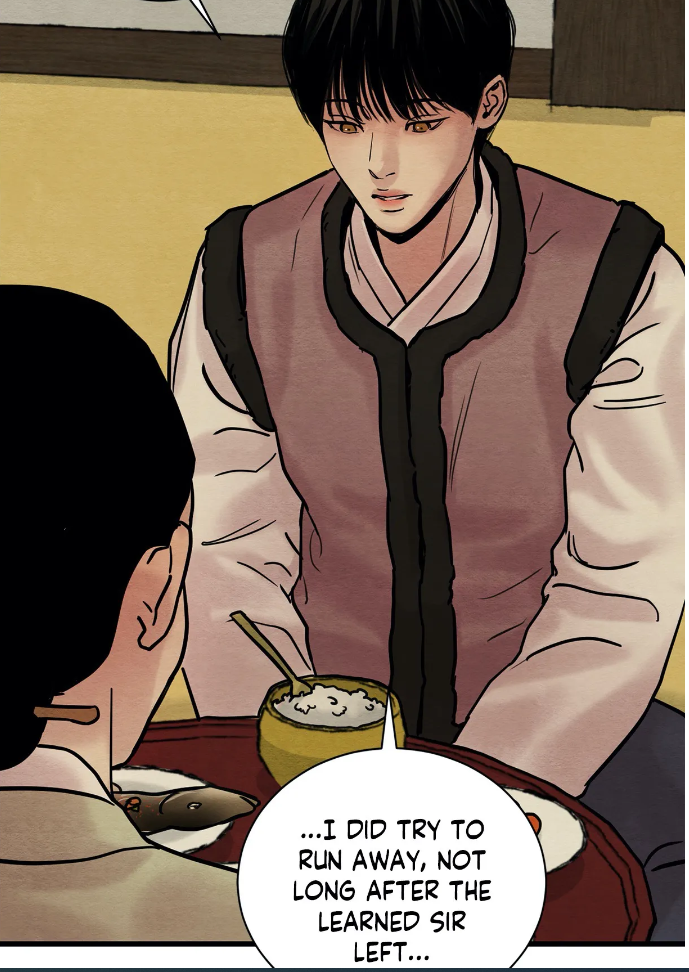 Little by little, he’s expressing himself better. The sentences might still contain some pause, yet his sentences are much longer. Besides he is able to explain why he is no longer trying to run away. The fact that he confided to her about his final attempt and his change of mind indicates a certain emancipation from the terrible surrogate father.
 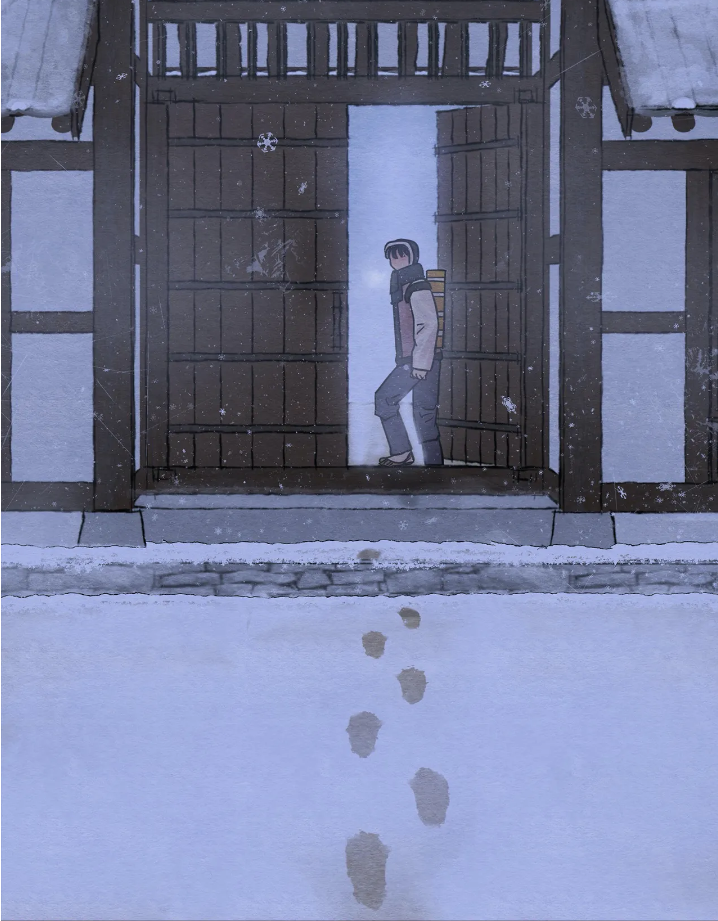 We have Baek Na-Kyum standing in front of the mansion door. Yes, this image confirms my interpretation about the symbolism of the door. The painter’s situation is always reflected through the door. First, the foot print on the snow left by him outlines his loneliness. Now he’s on his own. The teacher is no longer by his side. Nonetheless his foot print is regular hence we can say that Baek Na-Kyum was resolute in his decision. There is no hesitation based on the foot print.
  ; chapter 19: Seungho
 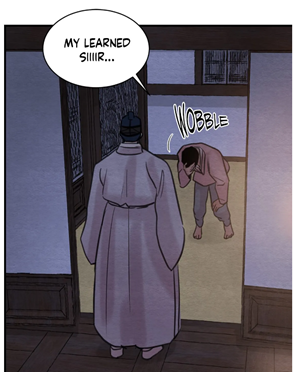 , although here the low-born hallucinated that it was the scholar; episode 29: Jung In-Hun led him back
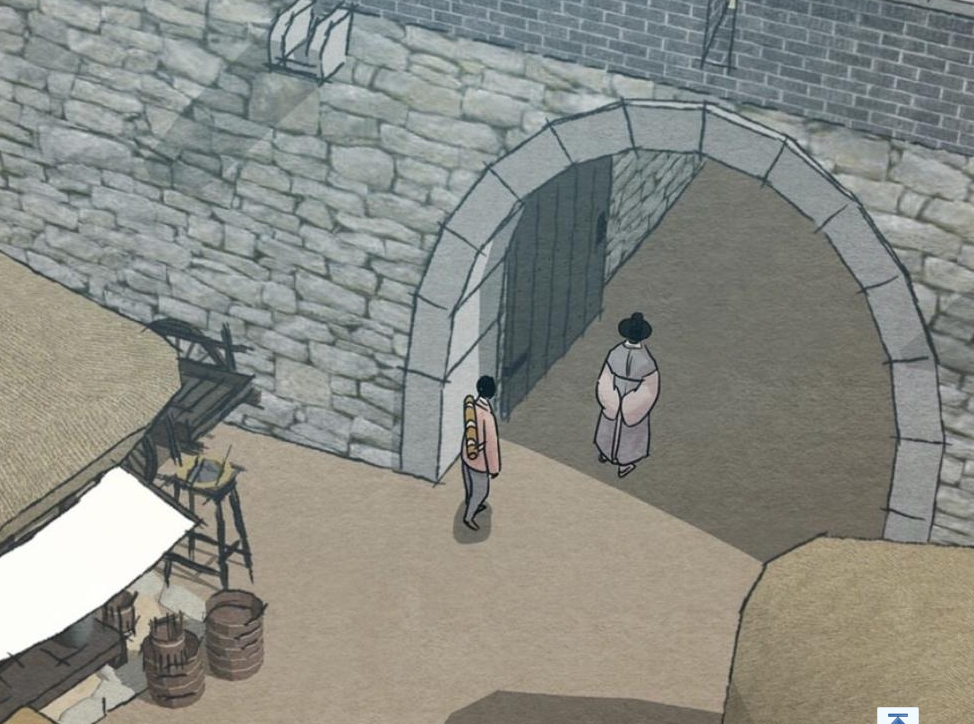 ; chapter 34: Seungho
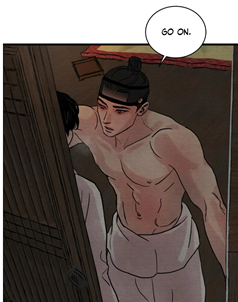 ; chapter 35 the teacher closed the door in front of the commoner
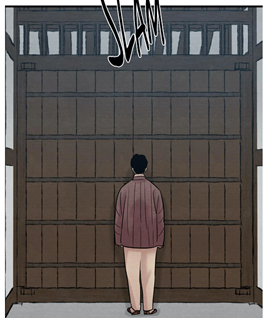 , chapter 41 Seungho again but this time the door is left open
 ). In only one case, we witnessed him opening the door but here he had been forced to enter the lord’s chamber
 due to the protagonist’s thread. At no moment Byeonduck showed us the painter opening himself the door because he really wanted it. When he escaped in the chapter 29, he only appears in the street meeting the teacher. Moreover, Baek Na-Kyum stood either in front of the door or behind it. I would say that this characterizes the painter’s lack of freedom and passivity. He was never master of his own destiny. This is important because the image from the chapter 46 illustrates the artist’s determination to escape but simultaneously the acceptance of his own sexual orientation. He is no longer hiding it but the fact that the man just opens the door slightly indicates a certain discomfort and embarrassment. For me the positive aspect is that he acts on his own, he is no longer forced to hide or admit his homosexuality or to stay at the mansion. He chose to leave and this was his first true choice for a very long time. In the beginning he was dragged to the mansion, then he was stopped by Yoon Seungho in the chapter 4. Later he was persuaded to return by the fake scholar. He never had the freedom to choose for himself therefore we never saw him opening the door himself willingly. Therefore you can understand why I am not so sad despite the sorrow exuding from the chapter 46. Here he shows a strong will like he did in the past, when he was courageous enough to defy and even criticize the lord.
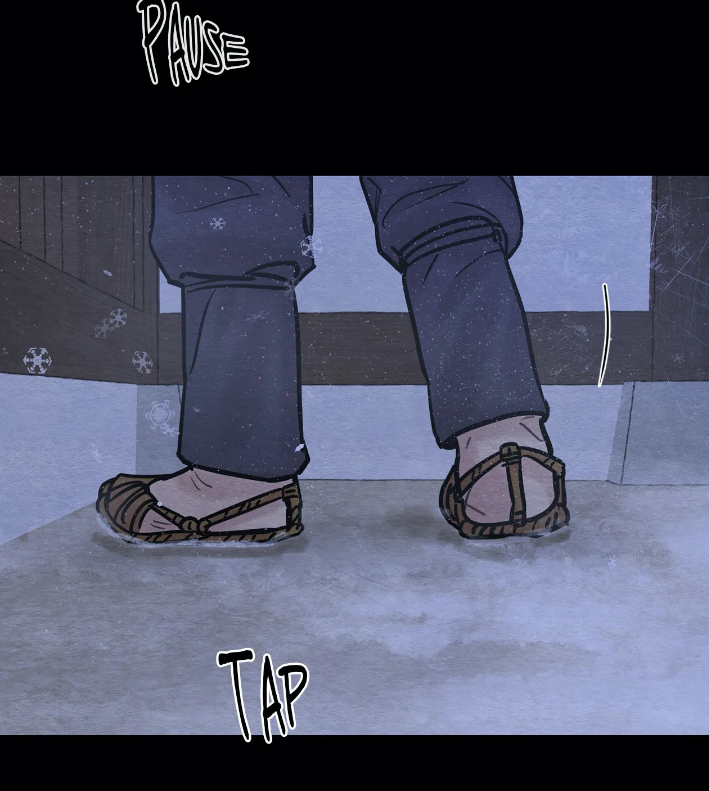 We had images focusing on the hand or the gaze but never on the feet. This is no random, Byeonduck wanted to tell us something through the zoom on the feet.
 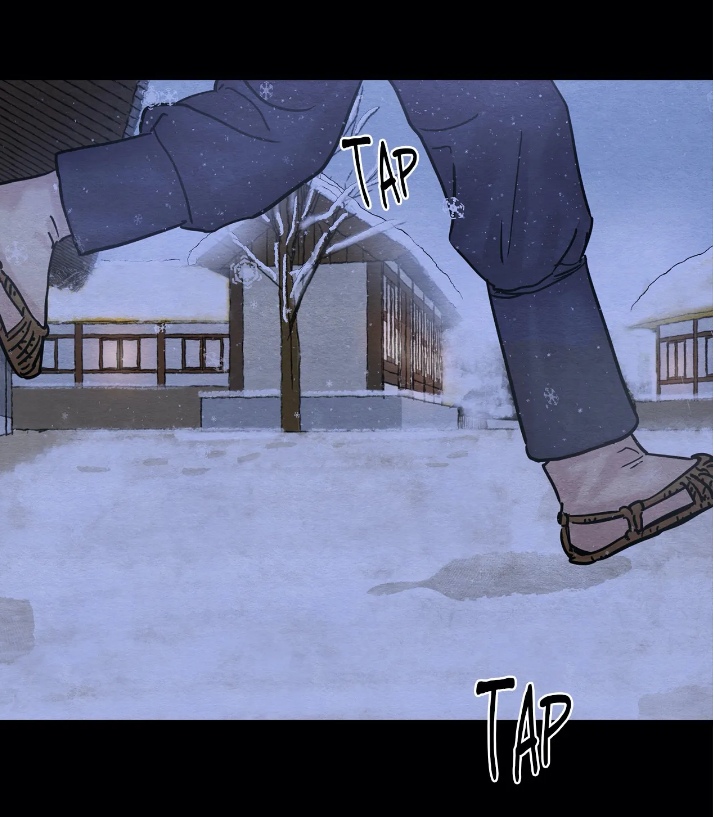 The second relevant detail is the chronology of the drawings. First, she pays attention to the painer’s feet, then to his head with his thoughts.
  The alternation between images of the feet and the artist’s thoughts exhibits the instinctive decision of the painter. He might be resolute, yet his feet are guiding him. He is just following his intuition and this is something more spontaneous than a well planned escape. It was as if his feet were carrying him somewhere else. Notice that first his mind is associated to black insinuating that his mind was blank. He couldn’t really ponder about this decision. This sudden and instinctive decision lets him run away. However, while his feet are leading him away from Yoon Seungho’s home, he realizes that he needs to find a shelter. Only then he starts thinking deeply about his destination.
 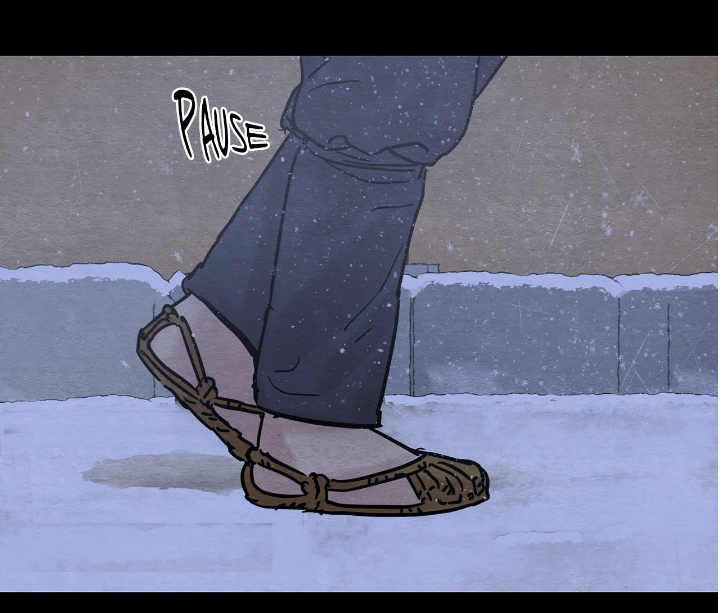 That’s the reason why he slows down as the more he ponders, the more he gets aware that he has no place where he could find a shelter. He is truly alone. That’s why he stops in the street. This represents his ultimate escape and his resignation.
  He feels abandoned without a home. Striking is that there is no door stopping him. Although he is free, he has the impression that he is still “imprisoned” as he has no home where he can seek refuge. The author revealed through the choice of the images that Baek Na-Kyum made the decision to leave because of his instincts. Nevertheless, this flee ended with the heartbreaking realization that either his mother or the teacher had abandoned him for good.
 Then the last words spoken by the head-gisaeng resurface which triggers in him the memory of his adoptive mother’s gesture, the caress on his cheek, while he is crying.
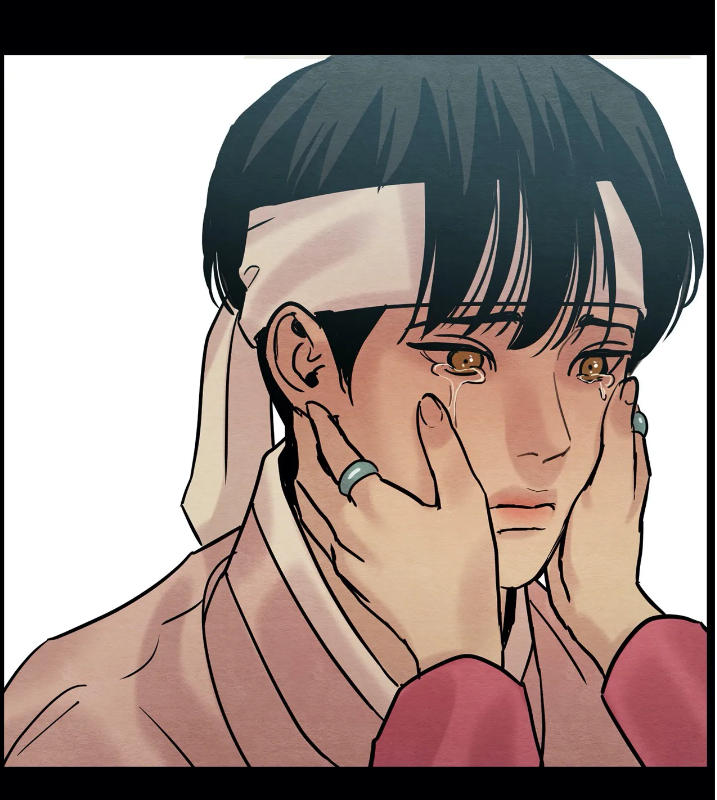 This is quite important because it is the pain that Baek Na-Kyum remembers the most.
  Bebebisous33s' analyses in K-Dramaland and Manhwas