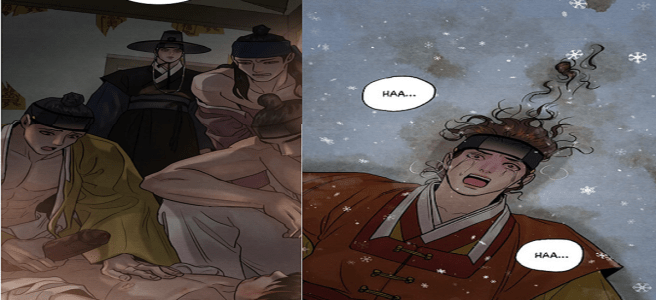
This is where you can read the manhwa. https://www.lezhinus.com/en/comic/painter But be aware that this manhwa is a mature Yaoi, which means, it is about homosexuality with explicit scenes. If you want to read more essays, here is the link to the table of contents: https://bebebisous33analyses.wordpress.com/2020/07/04/table-of-contents-painter-of-the-night/
It would be great if you could make some donations/sponsoring: Ko-fi.com/bebebisous33 That way, you can support me with “coffee” so that I have the energy to keep examining manhwas. Besides, I need to cover up the expenses for this blog.
The first reaction many readers had was to celebrate the butler’s courage, because he chose to tell his lord the truth and confront him with his true reflection. And unlike all the other characters, he mentioned one positive aspect: the lord’s good heart. 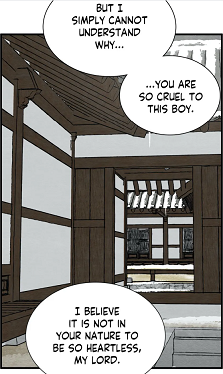 (chapter 68) In their eyes, valet Kim had turned into a hero not fearing his death. But we had another hero in this chapter, the scholar Jung In-Hun. The latter took the crying Baek Na-Kyum in his arm and brought him away from the scene, where Heena noona was getting beaten by a rich noble.
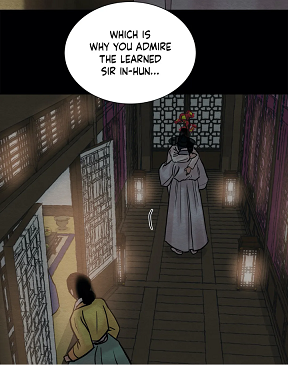 (chapter 68) In her eyes, he was a hero, because he showed concern and care towards her tenderhearted brother.
 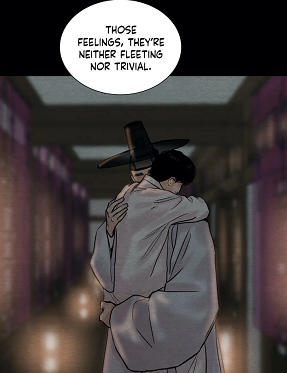 (chapter 68) Yet, only a few applauded Jung In-Hun for his behavior. Why? It is because many readers have already perceived his true nature: his hypocrisy and coldness hidden behind his calm demeanor and huge smiles. That’s why we need to examine more closely the behavior of these two father figures. Are they truly heroes? In order to answer this question, it is important to look at the definition of heroism and at the characteristics of a hero.
Heroism is characterized by:2
- Acting voluntarily for the service of others who are in need, whether it is for an individual, a group, or a community
- Performing actions without any expectation of reward or external gain
- Recognition and acceptance of the potential risk or sacrifice made by taking heroic actions https://www.verywellmind.com/characteristics-of-heroism-2795943
So let’s start with the scholar’s heroism. I would like to remind the reader that this scene is told from Heena noona’s perspective. If the manhwalovers observe Jung In-Hun’s action, they have the impression that the scholar is indeed helping someone in need. He is comforting the upset boy. (chapter 68) So the first condition is met. However, neither the second condition or third component are present in the teacher’s gesture. Jung In-Hun is not exposing himself to danger, risking his own life as he doesn’t come to help the real person in danger: Heena noona. Actually, the real person who needed to be rescued was the gisaeng, and not the artist. 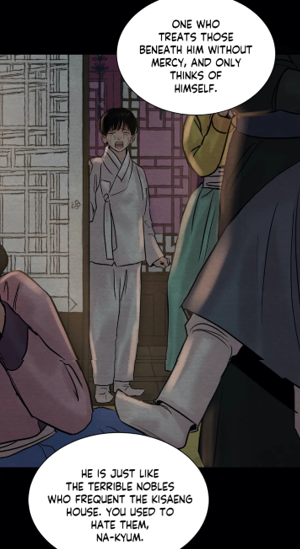 (chapter 68) Yet, the so-called hero abandoned her to her misery, as he walked away from the room. (chapter 68) This shows that he wasn’t willing to risk his life or position. There are no selflessness and sacrifice. Secondly, he did hope something in return: while consoling the kind boy, he hoped to get recognition from the gisaengs. They would see him in a positive light, hence if he came to visit the brothel again, they wouldn’t ask him for money, and I can even envision that they would give him some wine or food. Furthermore, they would allow him to roam around. No one would question, why he would come to the gisaengs. His reason was simple: he liked the tenderhearted boy. Finally, we have to question about the scholar’s appearance at the brothel. Why was he there, so dressed up? This scene is relevant, because it displays how Heena noona got manipulated in the end. The teacher used Baek Na-Kyum as tool in order to save his own skin. In reality, Jung In-Hun was there in order to get noticed by rich and powerful nobles. He hoped to find some connections, as he knew that the brothel was the place, where influential aristocrats would like to spend their time. In my opinion, this is what happened. Jung In-Hun knew the importance of Baek Na-Kyum at the brothel. From my point of view, he used this knowledge to achieve his goal. He must have approached the guest at the gisaeng, while Heena noona was serving him. But the rich aristocrat got upset that a scholar was bothering him and started beating the poor woman. Seeing this, Baek Na-Kyum cried which gave Jung In-Hun the excuse to leave the place. He needed to console the boy. While reading this, the manhwalovers sense the origin of Heena noona’s prejudices towards rich aristocrats. The latter would disregard her, because the teacher was around, as the latter was hoping to get some benefit from it. With this scene, Byeonduck exposes the origin of Heena’s blindness, which is also visible in different panels, like this one:
  (chapter 68) As you can detect, the absence of her eyes reflect her blindness. The feelings she is projecting onto the painter’s are actually her own.
  (chapter 68) Now, we know why Baek Na-Kyum was so indoctrinated in the end. His own sister was also a victim of the manipulator, whom I had already diagnosed as a person suffering from a narcissistic personality disorder. Note that she uses the same vocabular than the scholar.
 (chapter 18) Hence I come to the conclusion, the teacher used the school in order to manipulate the commoners and the gisaengs. While he portrayed himself as righteous and kind, he described the powerful nobles as violent and arrogant, so that he would get the admiration from the commoners. In truth, he was deceiving them, since he looked down on them. Yet he needed them in order to get some connections to the powerful and rich nobles visiting the gisaeng house. On the other hand, since he didn’t want to get too close to the gisaengs, he employed the innocent boy as a shield, misleading Heena noona to think that Jung In-Hun had feelings for her brother. That’s why he hugs the protagonist so tightly. (chapter 68) For Heena, he was a hero, because he gave the impression that he cared for them, whereas it was the total opposite.
If we pay now attention to the butler’s behavior, it looks like the first aspect (“Acting voluntarily for the service of others who are in need“) is present in his action. He wanted to help Heena.  (chapter 67) However, the second component (“Performing actions without any expectation of reward or external gain“) doesn’t apply, because he is not doing it for free. Let’s not forget Kim’s philosophy, which was exposed in chapter 65:
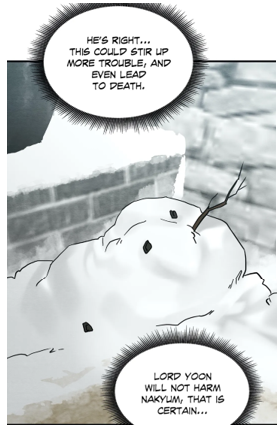 (chapter 65) He hates scandal and trouble. The gisaeng created such a uproar that Kim almost lost his credibility in front of his master.
  (chapter 65) He had two reasons for allowing her to meet the painter. First, Kim feared that she would cause more chaos in the future. Secondly, Kim realized that Baek Na-Kyum had become a huge source of trouble. He knew that the artist had been abducted, hence he got aware that Baek Na-Kyum had become a target of nobles. Furthermore, as soon as he had been returned, his sister made such a ruckus that she had turned the mansion upside down. Besides, like I had mentioned before, due to her behavior, she had put Kim in a difficult spot. Finally, he had another ground for giving his help: (chapter 65) He had seen the painter hurt in the bedchamber, so his words “Lord Yoon will not harm Nakyum” were proven wrong. Therefore I conclude, he had something to gain from his intervention. But what exactly? In my perspective, Kim wanted to get rid of the painter. The valet had already anticipated that Heena noona would ask her brother to leave the mansion. That’s why he said her this: (chapter 67) The butler anticipated her words and actions, as he is very perceptive (see chapter 23). At the same time, he told her the truth:
  (chapter 67) He had never received the authorization from his master. However, the manhwalovers should recognize that he painted his master in a rather negative light, while leaving a good impression on her.
  (chapter 67) In his mind, the butler thought that Baek Na-Kyum would leave the place right away after the harsh treatment he had received. For him, there was no doubt that no one in his right mind would stay at such a place. He knew that Yoon Seungho would come back soon. In other words, he was not helping Heena or Baek Na-Kyum here. He was doing himself a favor: his desire was to lead a peaceful life. Therefore, this explanation contradicts the first point.
As for the third point (“Recognition and acceptance of the potential risk or sacrifice made by taking heroic actions“), the manhwalovers should question this: When he granted the favor, was he putting his life at risk or was he willing to sacrifice himself? In my opinion, he was not, as he was acting behind his master’s back. He waited for the lord’s departure, then he allowed her to enter the mansion with the hope that Baek Na-Kyum would follow her right away. That’s why he was waiting outside next to the door. At the same time, he couldn’t tell her to hurry. At no moment, he was risking his life. He was using his position as the loyal valet to make decisions on his own, and even lied to the head-maid, when she questioned his behavior. (chapter 67) In my opinion, we have here a new version of the painter’s escape from the first season: Kim acting as a shadow helped the artist to run away (chapter 29-30). However, the problem is that he got caught by Yoon Seungho.
 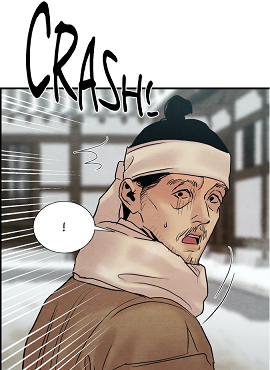 (chapter 68) What should he do now? I would like to remind the manhwaphiles that Kim had not only disobeyed his master’s order, but he had acted, as if he was a lord. He had given the permission without Yoon Seungho’s consent.
 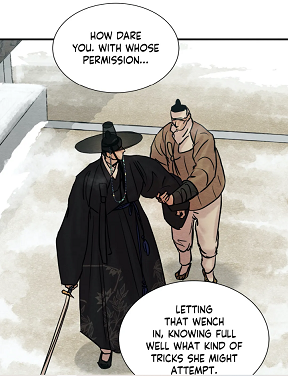 (chapter 68 It is important to recall that this story takes place in Joseon, therefore Kim’s action can definitely be judged as a betrayal and usurpation of power. One might argue that he desired to help Heena, yet like I exposed above, he did out of selfishness and not because he felt concerned for the painter and for her. As such, Yoon Seungho has the right to be upset. He is the master and someone is acting behind his back, overlooking his orders. Under this perspective, the head-maid appears more loyal to her lord than Kim himself. In this scene, he was only serving his own interest.
People were rejoicing that Kim became brave, because he criticized his master for his behavior. But what they failed to realize is the importance of the timing. Why now? Observe that Kim only starts confronting the main lead after Yoon Seungho threatens him with consequences:  (chapter 68). Note that the protagonist doesn’t menace to kill the gisaeng. He just desires to send her away, but he is now determined to punish his butler for his disobedience. He usurped his position, and as a lord he is allowed to do so. And that’s the moment, when Kim starts speaking the truth, which many readers associate to something positive.
However, this is important to realize that truth can also be used as manipulation. This is called paltering. Psychologists discern 3 types of lie: lie by commission, lie by omission and paltering.
“Like lying by omission, paltering can involve failing to disclose relevant information, but unlike lying by omission, paltering involves the active disclosure of true but misleading information: paltering enables would-be deceivers to actively influence a target’s beliefs” (Rogers, Zeckhauser, Gino, Norton, & Schweitzer, 2016). quoted from https://workplacepsychology.net/2016/12/18/to-deceive-using-truthful-statements-is-called-paltering/
This type of lie and manipulation is often used by politicians and even traders. They try to divert attention from the real main issue, and in our case: the butler’s disobedience and abuse of power. The other advantage is that since the paltering person is using truth as his tool, it is easier to remember and not get caught by the target. Moreover, the manipulator doesn’t have to feel guilty, as it looks like ethically more correct than lies.
That’s why it is important to look at the timing, when Kim reveals the truth. Here, I would like to bring another scene, where Kim’s first paltering was visible: chapter 50 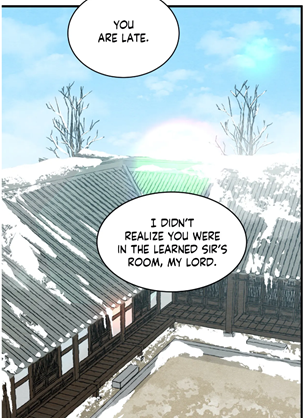
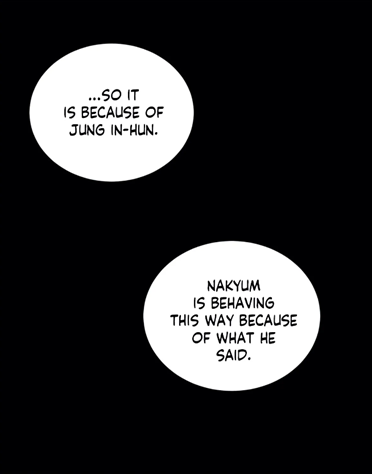
 Note, that in that chapter, the lord had the sword in his hand, and strangely the valet came late. As you can imagine, this is no coincidence. In my opinion, butler knew that something bad had happened and in order to escape his lord’s bad mood, he arrived late on purpose (lie by commission), but at the same time he revealed his knowledge about the cause for Baek Na-Kyum’s depressed mood in order to divert his master’s attention. That way, he could put the blame on the absent noble, but also on the painter. The latter had disregarded him due to the scholar’s words. At the same time, he made the lord feel insecure, because it showed him that he had behaved exactly like a client, a man obsessed with sex. That’s why with the butler’s intervention, the master had a relapse. What mattered for Kim was a peaceful life, the rest is
 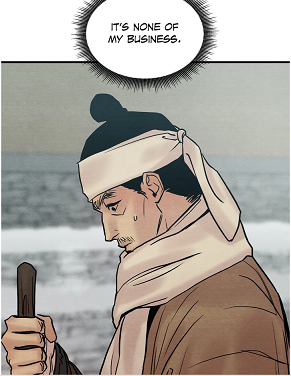 (chapter 65) Yet, he never expected such a change of behavior in the main lead, that’s why he blamed the painter afterwards.
 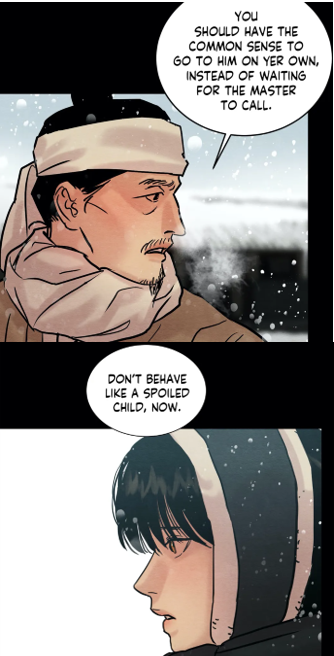 (chapter 52)
Hence I come to the conclusion that Kim’s MO is mostly paltering. And now, it is time to return our attention to the conversation between Yoon Seungho and his valet. It is important to examine each argument Kim brought up:  (chapter 68) Initially, it looks like he is appealing to the lord’s heart, but in reality the main point is the noble’s judgement. The valet is reprimanding his master for his lack of discernment. He misjudged the painter’s behavior. This is relevant because in this panel, I view a first emotional manipulation. His real intent is to make the lord doubt his own judgement, like “look, back then you made the wrong decision… therefore you could be wrong here”. But the readers know that Yoon Seungho is right. Heena is determined to take away his lover, so his initial judgement about Heena is indeed correct. In his eyes, she represents a source of thread, he might lose the artist. One might argue that Yoon Seungho is sequestring the painter which is also correct, yet like my reader Luzy pointed out, this is the painter’s decision. Neither Kim nor Heena nor Yoon Seungho have to make the decision for him. And here, Kim and Heena are trying to do so. The problem is that Kim got caught. But let’s go back to my initial thought. Kim used his knowledge (the lord’s misjudgment) in order to make his lord doubt himself. and he appealed to his emotions for that. This type of manipulation is called gaslighting:
“Gaslighting is a form of emotional abuse that’s seen in abusive relationships. It’s the act of manipulating a person by forcing them to question their thoughts, memories, and the events occurring around them. A victim of gaslighting can be pushed so far that they question their own sanity.” https://www.healthline.com/health/gaslighting#:~:text=Gaslighting%20is%20a%20form%20of,they%20question%20their%20own%20sanity.
As a conclusion, Kim made the lord feel insecure and doubt his own judgment and used facts in order to achieve his goal. The lord should rely on his butler’s discernment. But the mercy and favor for the painter are just a subterfuge, he is trying to mask his wrongdoing.
I could bring up another panel as illustration: 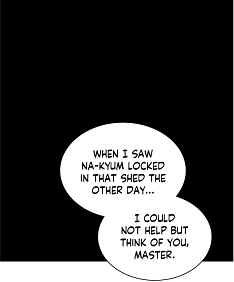 (chapter 68) Here, he is using the past in order to distort reality and memories while speaking truth. What Kim doesn’t mention here is his involvement in that incident.
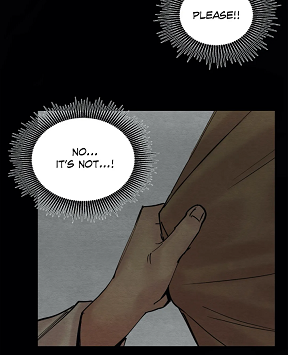 (chapter 65) Kim is destroying the lord’s confidence, so that Yoon Seungho will rely on Kim’s judgement.
If you pay attention to Kim’s words during that confrontation, Kim is actually utilizing many psychological and emotional manipulations:
- Guilty trip (chapter 68) “You are so cruel to this boy”. He might be right, yet why didn’t he say anything in chapter 64?
 (chapter 64) He literally looked away, because truth wasn’t helpful in this case. Feigning innocence and ignorance was more appropriate.
 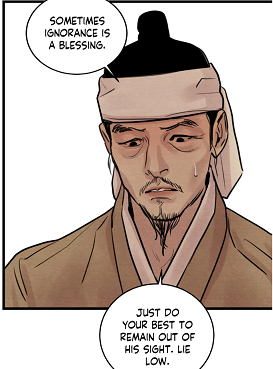 (chapter 23)
 - Shaming and vilifying the target:
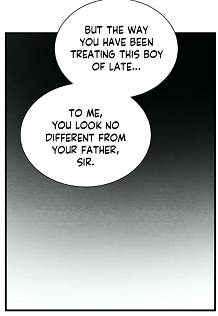 (chapter 68)
 - Projection: it is a defense mechanism used to displace responsibility. Here, Kim decided to use Baek Na-Kyum as justification for his infraction: (chapter 68)
- Triangulation: “Triangulation is a tactic used to manipulate an interaction between two people who are not communicating directly with one another. It is problematic because a third person becomes involved in a situation that should be between the two individuals involved in the conflict.” https://www.e-counseling.com/mental-health/what-is-triangulation-psychology/
 (chapter 68) Here, Kim is mentioning the past, where he played an active role between the father and son. In other words, he is reminding the master that he is acting like a mediator. However, this revelation exposes the servant’s manipulation. He was one of the causes for the falling apart between father Yoon and the eldest son. We have to imagine that he never revealed the real reason for Yoon Seungho’s rebellious nature to father Yoon. And here, he is behaving like in the past. He tries to intervene between Baek Na-Kyum, Heena noona and Yoon Seungho, as if he had the right to.
 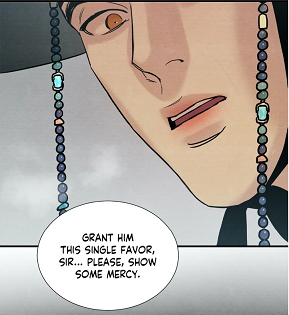 (chapter 68)
 - Diversion: (chapter 68) he is bringing up the past to divert Yoon Seungho from the main problem: Kim abused his position.
- Negging: (chapter 68) making a person feel bad about herself, by giving backhanded compliments or comparing to another person. On the surface, it looks like constructive criticism, while in reality the victim is supposed to feel terrible and doubt his personality. https://www.healthline.com/health/mental-health/negging
I have to admit that I can’t give you an illustration of all psychological tricks Kim used in this confrontation. On wikipedia, there is a whole list of different psychological manipulations, which served me as orientation. https://en.wikipedia.org/wiki/Psychological_manipulation Nonetheless, as the readers can detect, I tried to look for more info for this analysis.
After portraying Kim as a manipulator, I would like to remind my reader of two aspects: I described the butler as the gatekeeper, the one who opens the door. And now, if the manhwaphiles pay attention to this picture, (chapter 68) they will detect that the door is now open. The valet opened Pandora’s box in my opinion. That’s why Yoon Seungho was hurt and at the end ran away.  (chapter 68) He had heard, how Heena noona was comparing him to misfortune, reinforcing his negative opinion about himself.
  He had been already prepared mentally by his butler. He was as wounded as Baek Na-Kyum, when the scholar had voiced his true thoughts about the painter.
  (chapter 40) While the artist’s fate is to become a prostitute, the other is destined to bring misery. He already externalized this perception about himself in chapter 49:
 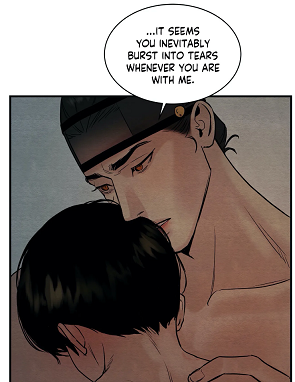 (chapter 68) For me, chapter 68 is the new version of chapter 40. That’s why I wasn’t rejoicing at all about Kim’s behavior. He was far from being honest with his truth. In reality, he used truth mixed with emotions as his ultimate tool in order to save his own skin. In other words, he functioned as the noble’s mirror.
This scene made me think of “Snow White and the 7 dwarfs”, where the mirror of truth tells the jealous queen that Snow White is far more beautiful than her. With this truth, the queen is led to take actions against the heroine and torment her. And here, we have another allusion how truth can be used as a weapon. The mirror never told the queen how to become the most beautiful woman. He never gave her any advice, it retained information: beauty can be different. It is not just the physical aspect, but it is about the personality. Therefore we could say that the mirror of Truth manipulated the queen leading her to her own demise. However, at no moment the queen never questioned the mirror of Truth and its ulterior motive. That’s exactly how Kim behaved the whole time explaining why Yoon Seungho never suspect his words. They reflected the truth. Yet the valet never intervened for his sake and for the painter’s sake. He only did, when he noticed that his lord was angry and let others take the blame, like here the father or Yoon Seungho himself. However, the readers should remember that in this scene, Kim had abused his authority. That’s also a fact.
Therefore I don’t consider Kim as a hero, quite the opposite. He is the worst manipulator, the reason why Yoon Seungho ended up with self-hatred and became violent with his swing moods. Kim isolated him, eroded his sense of reality, making him fear his own image. Besides, he didn’t even help him, when he got raped. Since Yoon Seungho has been manipulated psychologically and emotionally for years, he ended up hating himself.
“Long term effects of emotional manipulation:
- Isolation and numbness
- Requiring approval
- Feeling resentful
- excessive judging
- depressive disorder and anxiety” https://peaksrecovery.com/blog/effects-of-psychological-emotional-manipulation
- insomnia
- chronic pain
- guilt
- eventual feelings that their partner or parent is correct, and that they are “no good” or ugly, for example https://www.medicalnewstoday.com/articles/327080#long-term-effects
That’s the reflection Kim wanted him to have, so that the latter would never question his servant’s actions. And now, this picture has another meaning for me: 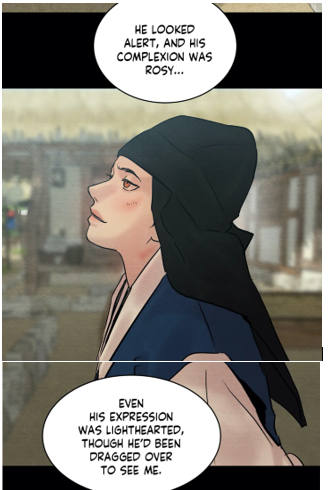 (chapter 57) His gaze is only focused on his valet, not realizing that the latter is not honest with him. From my point of view, there’s a reason why Byeonduck put Jung In-Hun’s so-called heroism (chapter 68) next to the valet’s . (chapter 68) For me, she put the readers in the same situation than Heena noona’s. Just like the kisaeng, many readers expressed their admiration for the butler, because he had told the truth. They associated truth to goodness. Heena noona also watched the kindness in the scholar’s gesture leading her to think that the teacher was a honest and caring person, yet she overlooked that the teacher had in reality abandoned her. He never protected her and let her suffer. This picture truly reflects his cowardice and treachery
 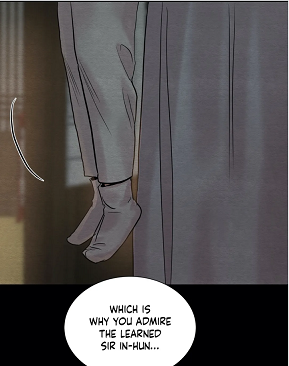 (chapter 68) He slowly takes the artist in his arms. He doesn’t rush to her side, remains silent and immobile. His passivity reflects his true personality, but Heena is too focused on her young brother to grasp the situation. (chapter 68) The crying boy is used as a diversion. Besides, I am quite certain that Jung In-Hun was actually the source of her misery by trying to get attention from powerful nobles. Note that the scholar and Kim utilize both the painter’s to hide behind their misdeed. He serves as a justification why the scholar left the gisaeng behind and why Kim defied his master’s order. The domestic used kindness and pity as legitimations (chapter 68), while it was the opposite. He desired to get rid of them.
But there’s hope in my opinion. Baek Na-Kyum refused to listen to his sister’s words, which Kim hadn’t expected. Therefore he got caught, he anticipated Baek Nakyum’s eagerness to leave. (chapter 67) Secondly, by giving his master a reflection of his behavior, the valet lost his influence on the main lead. Remember that I wrote that Baek Na-Kyum served as the lord’s mirror, therefore he will take over the valet’s role. He will reveal his true reflections: his flaws and wrongdoings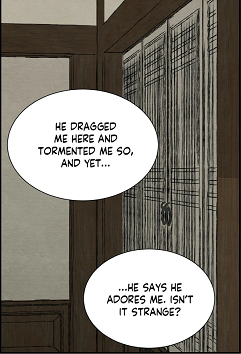

 (chapter 68), but also his quality: his honesty
 (chapter 58). Let’s not forget that the artist realized his dedication in chapter 58. Note the huge difference. The artist never uses others in order to judge the lord. Kim will realize soon enough the consequences of opening Pandora’s box. He might have achieved his goal (the lord won’t punish him for his disobedience), yet he lost his lord’s trust. Notice that right after this quarrel, Yoon Seungho started treating Baek Na-Kyum like a noble.
 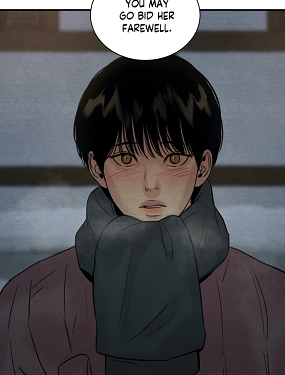 (chapter 69)
 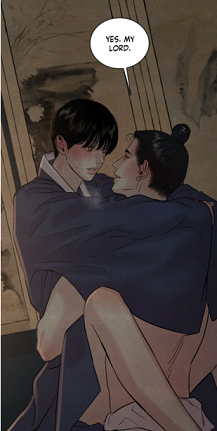 (chapter 72) From that moment on, Yoon Seungho was no longer viewing the valet as the unofficial lord. We could say that he had lost his status as “hero” in the main lead’s eyes.
Feel free to comment. If you have any suggestion for topics or manhwas, feel free to ask. If you enjoyed reading it, retweet it or push the button like. My Reddit-Instagram-Tumblr-Twitter account is: @bebebisous33. Thanks for reading and for the support, particularly, I would like to thank all the new followers and people recommending my blog.

 (chapter 67) My first thought was: “Where were you all this time?”
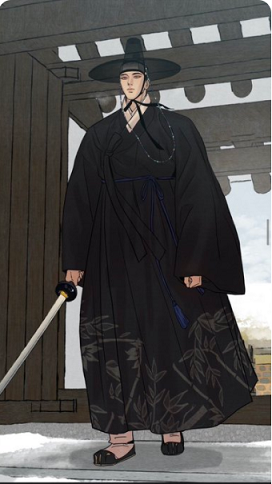 , because I immediately connected it to chapter 3, when the protagonist visited his childhood friend early in the morning. Back then, he barged with an erected phallus
  (chapter 3) and had sex with Jihwa at the pavilion, where both were not quiet at all. The red-haired noble kept even moaning.
  (chapter 3) Their intercourse was noticeable, but at no moment father Lee interrupted them. And now, the erected phallus was switched to a sword, and unlike in chapter 3, where the second lead was eager to meet his sex partner
 , the master chose to hide behind a windscreen.
 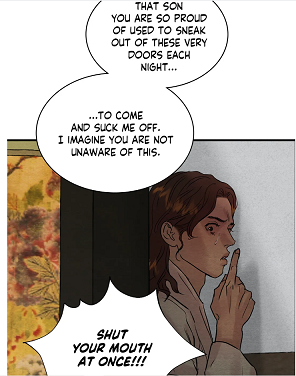 (chapter 67) However, this time father Lee intervened. Why all of the sudden? For the first time, his son caused a real trouble, because someone entered his house with a sword: a huge scandal! Furthermore, he must have realized that his son’s life was in danger, hence he had to intervene. The domestics couldn’t deal with such a powerful noble. And now, you understand why I couldn’t restrain myself from smiling, because the father Lee’s reproach sounded so hypocrite.
 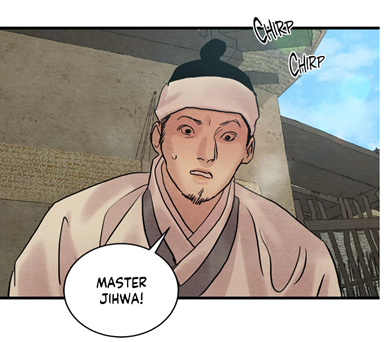 (chapter 41) He spent the whole night drinking and his father never asked about his whereabouts. He never showed any concern, as he has his staff to take care of him. In other words, he put the whole responsibility on the domestics. After confessing to Yoon Seungho in public, no servant shows up and takes care of him indicating that neither father Lee nor the staff heard about the scandal. Nameless was the one who was asked by the inn owner, if he could take care of the young noble.
  (chapter 59) He even gave him a dry robe and a home for the night. Since the servant only showed up the next morning in chapter 41 and he didn’t even appear during the night in chapter 59, it illustrates that the staff is more attached to the mansion than to the impulsive noble himself in truth.
 (chapter 50), he is even willing to risk his life
 . (chapter 67) He simply follows his master’s request, as he feels, that’s his duty and lord Lee could ask for his accountability.
  (chapter 45) That’s how isolated the father is cut off from reality and world. This is not surprising that his son resembles him, he also lives in his own world.
  , which corresponds to the expression “sensory isolation”. Back then, I had imagined that he had been abused as well. I was wrong, since it was just neglect which I had already detected. However, the consequences of such a severe neglect are as terrible as abuse. Consequently, abuse and neglect are often considered the same.
 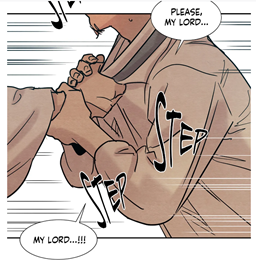 (chapter 13)
 (chapter 13); aggression
 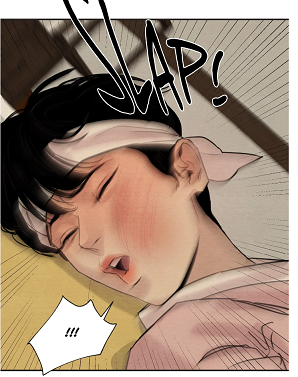 (chapter 17)
 (chapter 51)
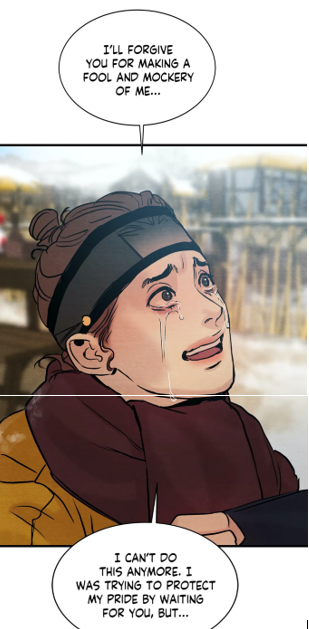 (chapter 59) In chapter 56, Jihwa sent a fake letter reminding Yoon Seungho of his trauma, yet he acts as if the other is to blame and shows no remorse. That’s why many children suffering from emotional neglect have problems with rules and laws.
  (chapter 9)
 (chapter 57)
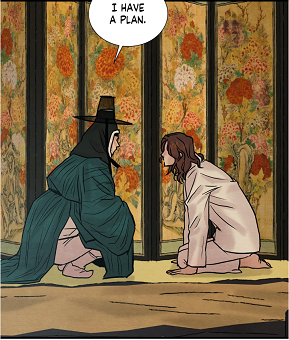 (chapter 67), although he had lied to him in the past.
 (chapter 67)
 (chapter 50)
 (red circle). Because of the character’s previous deafness and blindness, I immediately connected it to the wise 3 monkeys: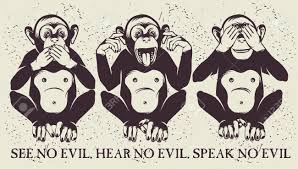
 (chapter 67) This is is visible in this panel. The character can’t even stand. Min, the Joker and surrogate father, treats Jihwa as his servant and punishes him, because he had not followed his order. Jihwa has not entirely developed his identity, since he has always lived in his own limited world. A father has not only to provide security and comfort, he helps the child to learn self-control and boundaries. A father is associated to rules and should teach his child how to channel aggressivity. In other words, he serves as a role model for the child. But with the absence of a father, this is impossible. And since the domestics belong to the lower social class, Lee Jihwa always had the upper hand and could do anything: his father never appeared, when Jihwa was destroying his room with his sword in chapter 21. Besides, father Lee never paid attention to the friends his son had. He blames Yoon Seungho for his son’s debauchery, yet at no moment he intervened in the past. The main lead is correct to blame the father and put his son in a different light.
 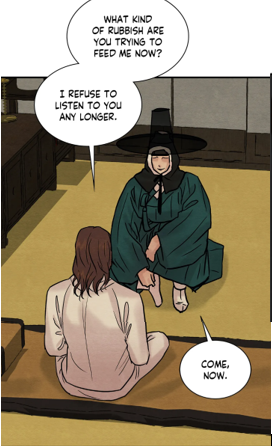 (chapter 67), but it was short-lived due to Yoon Seungho’s appearance. We have to assume that Yoon Seungho played the role of the father after the former had been abandoned by his own father. However, he could never assume this function properly, as he was suffering himself and couldn’t give him the emotional and educational comfort Jihwa needed. Let’s not forget that the protagonist chose to ignore his own feelings, to even numb them. Hence it was impossible for them to connect emotionally.
  (chapter 57) “wayward” is a synonym for rebellious indicating that Yoon Seungho had started questioning his father’s behavior and words. Simultaneously, I believe that the father judged his son’s behavior as too childish, thus he said that he had been suffering from an illness for a long time. The adolescence represents an important step in the child’s development. That’s the moment when a teenager decides to take his distance from his father in order to find his own identity. Since the main lead was described as intelligent, it was normal that the main character would decide to make his own decision and could sense his father’s flaws. Consequently father Yoon could only see the critical remarks as a sign of insubordination. This is not surprising that he blamed his son, when something happened due to Jihwa.
 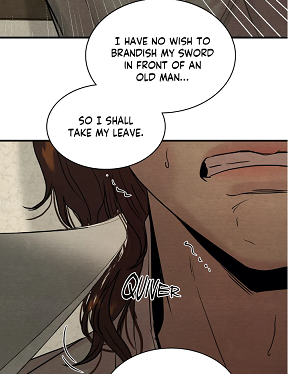 (chapter 67) and it is even possible that he gets a scar or a tattoo.
  (chapter 67) This scene was important as it represented a new version of chapter 18. This time, the lord aimed at Jihwa’s face and the servant was not harmed. The main lead put the whole responsibility on the former friend.
 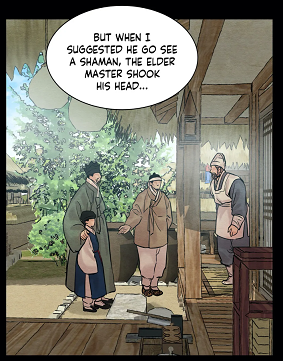 (chapter 57) There’s no doubt that father Yoon put all his trust in Kim. This explicates why Kim acts, as if he had the authority to give orders.
 (chapter 57) due to the hat and the robe. What caught my attention is that he acts behind his lord’s back, when the latter is absent.
 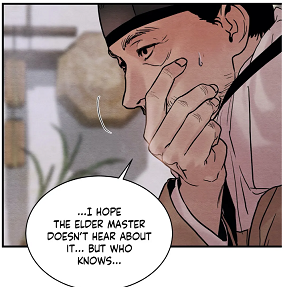 (chapter 57) By examining Kim again, I have to admit that I suddenly had this question: who gave the painting to Yoon Seung-Won? Did the valet act on the lord’s order?
 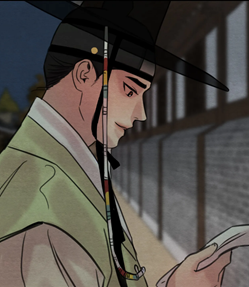 (chapter 37) Or did he decide to act on his own? Let’s not forget that during that evening, the valet had been reprimanded by Yoon Seung-Won for lying to him. It is possible that the valet chose to give the painting in order to put the blame on Yoon Seungho, as he feared that the young master could report his lie and behavior to father Yoon. The latter might not be present at the mansion, but there’s no doubt that he asked his trusted servant to keep an eye on his eldest son, whom he considered as a troublemaker. This would explain why the main lead keeps taking the medicine. And now, you can grasp why Kim is more loyal to father Yoon than his actual master. The latter gives him more freedom, yet he expects from him more responsibility. Under the ruling of father Yoon, the butler could avoid any trouble by tattling on the young master Yoon Seungho or by faking ignorance, when it was necessary. Since father Yoon put all his trust in the valet, he was not able to see evil or hear evil in the end. Kim framed innocents or he feigned ignorance. As a conclusion, Father Yoon was put in the same situation than father Lee due to Kim’s actions.
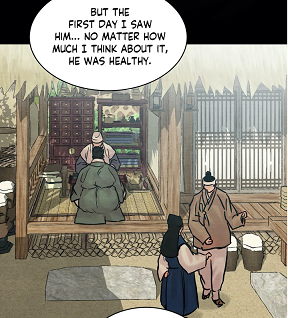 (chapter 57) And if we look at the picture, the manhwaphiles can detect that Kim seemed to have the teenager’s trust. This is visible thanks to the domestic and Yoon Seungho’s gestures. They are talking to each other in a very natural way. We can conclude that they were close, especially if I include this panel in my examination.
  (chapter 57) But more importantly, the manhwaphiles should question themselves about the nature of this medicine. It is a drug to mess up with the main lead’s health? And this clue reveals that Kim is not working for Yoon Seungho. One might argue that Kim is just following father Yoon’s orders, but the latter lives so far away, hence the eldest master has no control to threaten the butler. Hence Kim could have stopped feeding the medicine, especially after knowing how father Yoon treated the son. In other words, it looks like his loyalty to father Yoon is still intact. This is palpable in two occasions.
 (chapter 35) In this scene, the valet gives an order to his master and not an advice, since he employs the verb “must”. Why? Because he thinks, the letter was sent by the elder master. And Yoon Seung-Won knew that Kim was loyal to their father. Hence when he sent the letter, he used his father’s name and authority, but in order to maintain the illusion that father Yoon was the author, the brother also requested that valet Kim would bring back himself the reply. The deceitful brother used not only the butler’s fidelity to his advantage, but also gave the impression that father Yoon cared somehow for the black sheep. It was, as if the elder master was trying to rekindle with his older son. The readers can sense more his loyalty to the elder master, if they compare his reaction, when Yoon Seungho received the fake letter from lord Song.
 (chapter 56) Here, the domestic got scared, by just hearing the name. Nevertheless, he gave his master the advice to postpone the meeting due to his health.
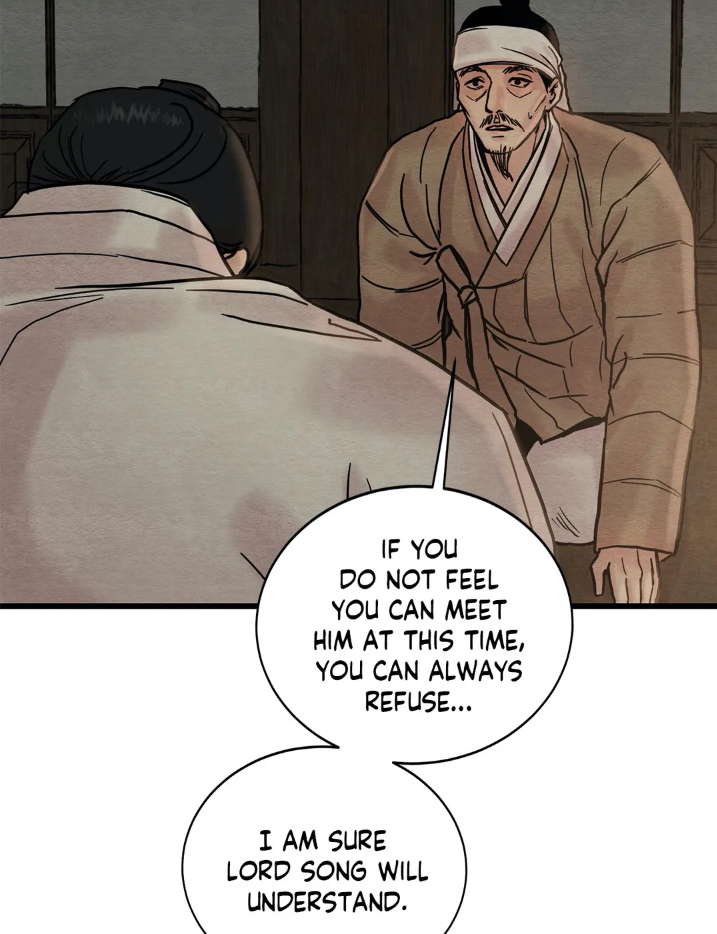 Yet, observe how he hides his discomfort and fear to his master by suggesting to postpone the meeting which exposes that he is hiding his true emotions. He justifies his advice by faking concern for his lord. Hence the lord can only have the impression, he is protecting his interest. Striking is that since we saw him scared, we have the impression that he is brave enough to propose not to the follow the invitation. My initial impression was to think that he got afraid of the name lord Song due to the lord’s traumatic past and he feared for his master’s mental health condition. However, the moment the valet realizes that the noble is on his way to meet this aristocrat, he gets so scared that he leaves the mansion immediately. So he doesn’t want them to meet.
 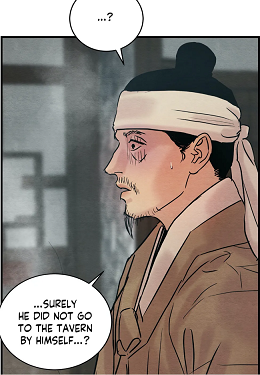 (chapter 56) Then in chapter 57,
  the butler expresses his worries concerning father Yoon. He doesn’t want the elder master to hear the news about Jihwa’s public confession, as the servant is well aware of father Yoon’s mentality.
  (chapter 57) One might question his loyalty to father Yoon, since the butler chose to remain by Yoon Seungho’s side after the topknot incident. However, I could respond that the valet saw it as his duty to keep an eye on the elder son on behalf of the head of the family. From my point of view, valet Kim decided to follow Yoon Seungho for other reasons than true loyalty to the protagonist. In the past, I used to think that he felt guilty for the main lead’s suffering. But I had to review my judgement. If he truly felt remorse, then he should have treated the eldest son differently in the mansion. Yet, he let him become a head-kisaeng. Moreover, the guilty conscience only resurfaces the moment he is confronted with a situation reminding him of his wrongdoing.
 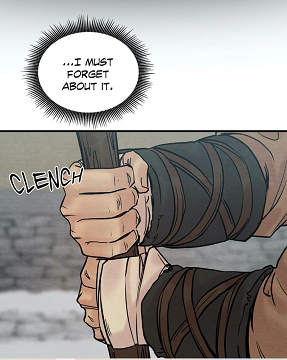 (chapter 65) This shows that he has been successfully repressing it. In truth, he did it out of selfishness, while faking affection and loyalty to the Yoons. The readers shouldn’t forget that the head of the family decided to leave the main domain and live in the countryside. Therefore he abandoned the mansion to his eldest son. By remaining by Yoon Seungho’s side, butler Kim was ensured to have a quiet life. The man was a wreck, hence he couldn’t manage the mansion.
 (chapter 57) Furthermore, as an infamous hell-raiser, no powerful noble would be interested in him. When the purge occurred, the son had become the sacrifice and scapegoat, hence he was forced to remain at the property. And now, you can grasp where the butler’s loyalty lies. He is faithful to the mansion and property, and not to Yoon Seungho or father Yoon in reality. This explicates why he lies to Seung-Won and tries to stop him from entering the lord’s chamber. As Seung-Won is only the second son, he is not considered as the lord of mansion, while father Yoon is the senior and is supposed to be the head of the family. Because he is bound to the domain Yoon, he is definitely acting more like a dog than like a matchmaker or a father. He is able to find his owner very quickly, as if he was following his scent.
 (chapter 57) He barks like one, when he yells at Deok-Jae.
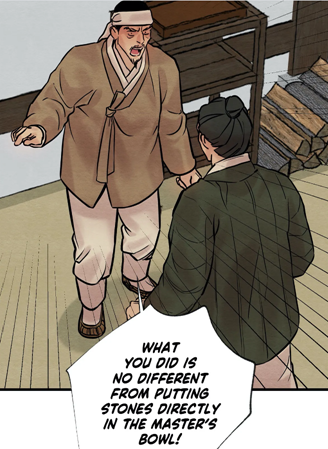 (chapter 47) He is also sent to fetch the painter, when the latter is somehow “abducted” by the scholar.
  (chapter 24) But the most conclusive evidence for this association is his rapport to the door. He is always shown next to an opened door or even often stands on the door threshold.
 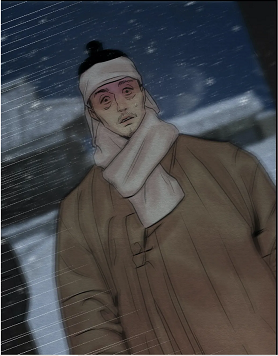 (chapter 64)
  (chapter 45) Since dog owners often put the sign “beware of the dog” on their door, you understand why I see it as an evidence that the valet is more as a dog than anything else. The butler is the guardian of the mansion, watching out for the owner’s safety. However, here we should comprehend it in a figurative sense. On the surface, the butler is looking out for the reputation of the Yoons, while in truth he is just focused on living a peaceful life far from trouble.
 (chapter 64) The dog is not only a symbol for loyalty, but also it represents obedience and secrecy. He knows what is happening in the mansion, but he won’t let it transpire to the outside world. Therefore I deduce that valet Kim is quite similar to Jihwa. He knows the main lead’s whole past and tragedy, but he doesn’t truly feel sorry for the main character, for if he revealed the truth, because it would expose his culpability.
 (chapter 12) Simultaneously, he uses his knowledge to his own advantage, similar to Jihwa, although the latter was manipulated by Kim’s lies. And if you take into consideration the role played by the dog in different mythologies, you’ll note that they all have something in common: they are guardians of the realm of death, like for example Anubis (Egyptian) or Cerberus (Greek). And since I interpreted the mansion as Yoon Seungho’s prison and compared the master to a zombie, until he met the painter, the manhwalovers can now understand the butler’s real function. He is actually the guardian of the realm of death for the lord. To sum up, he is contributing to the lord’s misery and loneliness, as he keeps him bound to the domain and family. Moreover, the gentle valet is aware of his true role, as he has internalized the social norms. As a domestic, he is supposed to serve his master with respect and obedience, which he does on the surface. However, the reality is different, as he lies to him on multiple occasions. Hence he needs to act in the shadow. Why? The real goal of the butler is to live a peaceful life without any big responsibility. As a guardian of the kingdom of death, Kim is the one who allows people to remain by Yoon Seungho’s side or not, but since the painter is affecting the noble’s life, Kim can only perceive the painter as his enemy and source of danger. Yoon Seungho might decide one day that he would like to leave the property and join the capital.
  (chapter 64) This is not the first time that the butler had a similar reaction. In chapter 26, he tries to calm down the painter asking him to stop crying, and when the latter criticizes him, the domestic decides to leave the bathroom with the excuse that he needs to fetch him new clothes.
 (chapter 26)
 (chapter 26) He is leaving the artist behind, as he doesn’t want to be confronted with his wrongdoing: his passivity and cowardice. Then when he meets the protagonist in the main way, he sees his cold and distant gaze. So he knows that his master is in a bad mental condition, yet out of fear, he still leaves the artist behind, well aware that something bad could happen. That’s why he chose to intervene in the shadow (like for example, sending a servant to the scholar) so that I am now convinced that he even witnessed what happened to Yoon Seungho, but chose to close the door. There’s a reason for this assumption. First, he is connected to an opened door. Secondly, there’s this incident with the door in chapter 16.
 (chapter 16) The butler chose to open it in secret, because he desired to remain anonymous, so that his loyalty wouldn’t be questioned. As soon as it was opened, he ran away without looking back, fearing to see what was happening. That’s the butler’s trauma in the end. Back then, he chose to remain passive and close the door leaving his young master behind. But Yoon Seungho caught his terrified expression, which he can never forget, that’s why he pointed it out to the painter.
 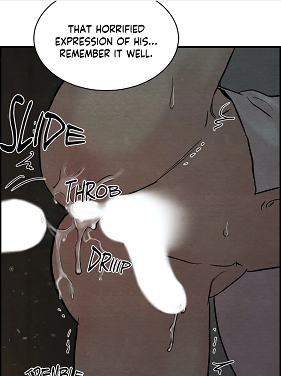 (chapter 64) He resented valet Kim for his betrayal and abandonment. That’s why I believe, in that scene, Yoon Seungho is using the same words than his rapist from back then.
  (chapter 64) In this scene he is reliving his own traumatic past, the first rape. And after it had occurred the first time, the valet must have told him this:
 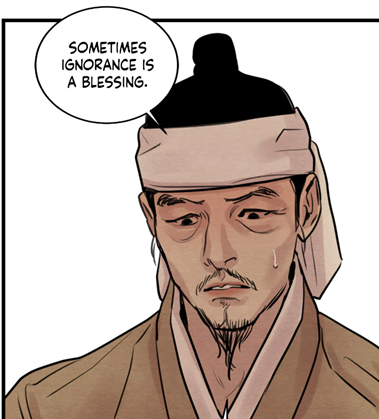 (chapter 23) This idiom exposes his attitude, he will act, as if he knew nothing. And since I revealed that father Yoon trusted Kim and the latter was loyal to him, I am now quite persuaded that father Yoon is responsible for the sexual abuse of his son first. Striking is that my theory was confirmed in chapter 65 and 74. However, the valet acted, as if nothing happened, while the teenager was blamed for letting the servant see the rape.
 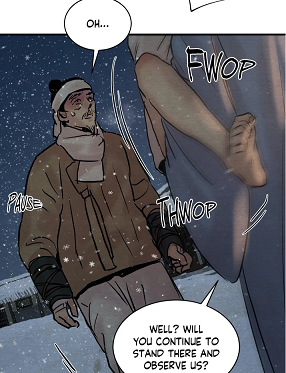 (chapter 64) Now, I can understand why Yoon Seungho has such abandonment issues. For him, valet Kim was his father, as the latter was nice and caring for him. Yet during the rape, he did nothing, as he was just a servant. And now, you understand why he feels that he has been backstabbed by his two fathers, why the main lead is using his position to keep a boundary between himself and Kim and why he is using his right as lord to keep the painter by his side. He has internalized that being a lord can protect him from pain and vulnerability. In his delirious fit, he believes that he can get what he wants. Back then, he was just a young master and not the lord of the mansion, and Kim was just a domestic. After coming to this perception, I see the chapter 64 in a different way. The chapter 64 exposes the valet’s cowardice, culpability and selfishness, hence I judge the lord’s behavior in a different light. The monster is the result of the betrayal and abandonment from two fathers, and both decided to avoid reality and see the consequences of their choices. Notice that father Yoon ran away just like the valet. But the chapter 64 could mark a turning point in Kim’s life in my opinion, as he sees the consequences of his silence. That’s why the valet decides to accept the new situation:
 (chapter 65) Baek Na-Kyum is now the lord’s companion, while in the past he used to plot against him. In that moment, the valet recognized that ignorance is not a blessing, because this doesn’t erase the event. Observe that Kim has a similar approach than Jihwa again. Since the painter returned to Yoon Seungho’s side, the noble has now the feeling that nothing happened. For the first time, Kim sees the true face of his master
  Kim hates uproars, as they represent a source of danger for his life. As you can detect, the butler is determined to protect the Yoons’ notoriety, but out of selfish reasons. The manhwaphiles should remember that in chapter 17, he asks the maids not to approach the study like that. He is determined to keep everything under cover. He disapproves the master’s actions, as they are going against social norms. As a noble, he shouldn’t have a sexual intercourse with a low-born. That’s why he let the boy desert the mansion after the rape. He didn’t do it for the artist, but for his master’s respectability, because if this was known, then the valet’s good life would be in danger. Kim has deeply internalized social norms, any deviation represent a threat to his peaceful live. Moreover, he would attract attention again. But when he witnessed the master’s despair and fury after the escape, where all the servants had to suffer the result of his decision, he chose a different strategy. Back then, I described him as his matchmaker. He tried to present his master in a better light so that the artist would have a change of heart and accept Yoon Seungho’s advances. However, now I have to admit that I have a different judgement. He was not a real matchmaker, he was trying to turn the painter into a favored servant so that the appearances would be maintained. He decided to use a similar strategy, the aphrodisiac as a first step. And with all these new discoveries, I come to the deduction that the butler was a real accomplice of father Yoon’s schemes. If they became close sexually, the painter would become a servant and take over his role as close assistant. That way, his presence in the lord’s bedchamber could be explained. That’s why he lets the painter attend the noble during his illness and even allows his presence, when the doctor is here. In other words, he would like to hide the scandalous relationship with the low-born under the pretense that he is just a favored servant.
  . (chapter 45) First, it symbolized that the painter was more than just a favored favor. But more importantly, he never cared about the item, since
  (chapter 32) Kim has no real control over the staff, although he is the right-hand of the master. His indifference and his fear for responsibility explains his lack of authority. That’s why in chapter 63, he doesn’t even attempt to correct the maids talking badly about Baek Na-Kyum, although he already knows that there’s more to it. His silence should be considered as a sign of admission, reinforcing the servants to think badly of the painter. The painter is a liar and betrayer. I have to admit that Kim’s passivity really annoyed me in that scene.
 (chapter 63) He is indeed a hypocrite, a selfish person,
 (chapter 56) He trusts him to a certain extent, because the valet took care of him, while he was delirious. The domestic even stopped him from committing suicide.
 (chapter 50) This explicates why Yoon Seungho can’t trust Kim’s words in the end.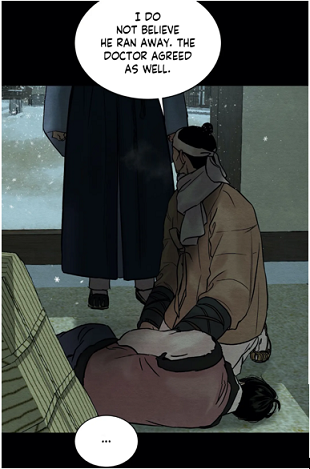
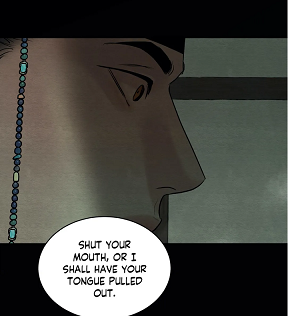 (chapter 62) In his eyes, he betrayed and abandoned him once, therefore it is definitely possible that he is lying. The longer the lord lives with the artist, the more he senses that Kim shouldn’t be trusted. This explicates why the lord’s relationship with the valet is deteriorating. In season 1, he never doubted Kim’s words, but now it has changed. The painter’s genuineness makes Yoon Seungho detect the butler’s fakeness and hypocrisy. And since the lord threatened him with the sword, I am envisaging that he will do it, the moment he feels that his loyal butler betrayed him.
  (chapter 45) The purpose of this action is simple. On the one hand, he gave the impression that he was protecting Yoon Seungho’s interest, on the other hand he was pushing the jealous servant to plot something so that Baek Na-Kyum would disappear. Kim was well aware of Jihwa’s visit in chapter 43. He knew that the second lead would do something out of jealousy. Kim needed the painter’s submissive attitude, as this could only affect his lord positively, turning the mansion into a golden cage. And while I envisaged that the shock Kim experienced during that night would make change his mind,
 (chapter 55) Many readers were able to recognize the younger master trying to walk into Yoon Seungho’s direction, while the latter was lying on the ground. Why? It was, because of the brother and father’s gestures. Father Yoon stopped his younger son to join his brother’s side with his hand, while Yoon Seung-Won’s foot is moving. Due to these actions, the manhwalovers saw it as a good sign from Yoon Seung-Won’s part. The latter desired to help his brother, yet their mean and strict father requested him not to. It looks like Yoon Seung-Won had some affection for his older brother in the past, yet the father ruined their bound. However, what the manhwaworms shouldn’t forget in this panel are the two following aspects:
 (chapter 37) The younger brother was taught his father’s principles too, but unlike Yoon Seungho, the younger brother is NOT living according to their father’s rules. This means that he is living differently. And now we have to question this: how is his life different?
  And notice the brother’s embarrassment. He avoids his brother’s gaze. He can not deny it, for if he did, he would have to reveal the true identity of the “pedophile”. Hence the younger master is humiliated. The younger master can not argue with this point. That’s the reason why I come to the conclusion that the brother has already internalized his father’s values: Yoon Seungho should keep working for the family, like he did in the past. He should use his connection. He is truly viewing his brother as an accessory for the family’s benefit. And it is time to examine the chapter 37 one more time. In the first composition, I had demonstrated that the brother was selfish, insensitive and quite arrogant, since he never asked his brother about his well-being. All his business mattered. But I can add more layers to his description and it starts with the way he was introduced.
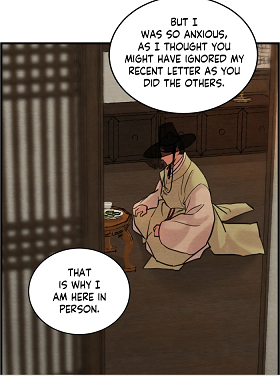 (chapter 37) However, I can bring up another evidence for this conclusion: the fake letter from lord Song.
 (chapter 56) The forged message was a new version of the letter in chapter 35. And under this light, we can judge the character in a rather negative way. He is acting like Jihwa, using his knowledge of the past to his advantage. He desires to use his father’s power over his elder brother to achieve his goal: getting the support from his older brother so that he can please his father.
  (chapter 13), Yoon Seung-Won was asked by the father to restore the family’s influence. But since he had witnessed how his father obtained his support, he thought, he could employ the same method: using Yoon Seungho. One might argue that the poor boy is pressured now by father Yoon and the weight of the expectations can be extremely burdensome. However, here I would like to point out that unlike the main lead, Yoon Seung-Won was never trapped in the mansion and not hindered to participate in the service civil examination. Furthermore, he was never exposed to any kind of violence. He was allowed to roam freely, yet in my opinion, all this time the younger master relied on his father’s power and influence. Seeing that the letters didn’t provoke any reaction, the young noble paid the lord a visit, as he was pressured by the time. And what caught my attention is that once asked about the motive of his visit, he replied to the main character:
  (chapter 37) He mentioned his father directly, but he never answered to the question properly, since he didn’t announce the true reason for his visit. Why? Since he used the name of his father in the letters and in the conversation, I can only deduce that the brother knows the true power of father Yoon over the main character. He is actually playing with the protagonist’s fear and he knows it too well. Notice his hands: they show a certain discomfort, indicating that he is well aware of the signification of his words. One might argue that he has been pressured by the father and he is just a pawn. To this, I can only retort that he is doing the same to his brother. By asking him to visit their father, he is not just requesting from his brother to reconnect with their family, but also to submit himself to father Yoon. In other words, the elder master could utilize Yoon Seungho’s connections and wealth for their family’s interest. Besides, this would signify that the father would become the main lead’s pimp again. As the new head of the family, father Yoon could decide to treat his eldest son like in the past. And if my theory of the incest is correct, then this means that Yoon Seung-Won is asking his brother to relive a hell again. This is not surprising that the lord gets upset and becomes cynical:
 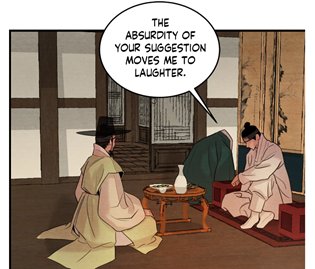 (chapter 37) Who would accept such a suggestion after getting treated like an sex toy, a prisoner and as a pariah at the end? And now envision that Yoon Seungho has been exposed to physical and sexual abuse because of his father. This scene reveals the selfishness and cowardice of the brother. This is not surprising that the lord clenches his fist, and his hand is shaking: there’s definitely fear due to the father and anger towards his brother. Yoon Seung-Won knows his father’s rules, but he doesn’t desire to apply them, as he is well aware of the meaning. And now the following panel gets another significance:
 He desires to have a private conversation and suggests his brother to send away the painter. His reason is simple: he would like to appeal to his brother’s compassion, he must be in a rather difficult situation. His father is now relying on him. But since the master of the mansion is not following this suggestion, the brother chooses to mention the father. The illness is an excuse, but Yoon Seung-Won is determined to maintain his image as a loyal and honorable son. Yet, like I pointed out earlier, the true intention with the father’s evocation is to put Yoon Seungho under pressure. And now, I would like to bring another evidence that the younger master is well aware of his brother’s fear in front of their father. He witnessed the constant abuse, and as such he noticed and internalized the brother’s anxieties. Remember that the moment Jihwa heard that the brother had visited Yoon Seungho, Jihwa chose to rush to his childhood friend’s mansion. Why? He knew that Yoon Seung-Won’s visitation would torment the main lead and provoke nightmares, indicating that this must have happened in the past well. And since the main lead is connecting his brother to his past trauma, then this reveals that the younger master is related to the protagonist’s suffering. Why? In my opinion, Yoon Seung-Won must have been favored all this time, whereas the powerful noble was just treated like a servant. In other words, even if the younger brother was weak as well, he never tried to help his brother behind his father’s back. This explains the resent from the protagonist. He can never consider him as a relative. Let’s not forget that when the elder master moved from the house, only valet Kim remained by the main lead’s side, showing that all the other servants sided with Yoon Seung-Won and the father.
 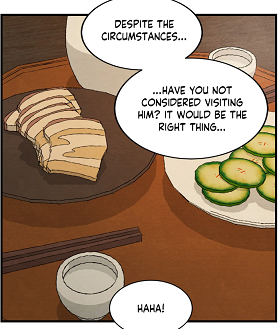 (chapter 37), while in reality he is just a hypocrite. I would even add, he is quite immoral. He lies about the illness, fakes letters in the sense that he uses his father’s name and authority. Then he utilizes social norms (“the right thing”), though he is well aware what the visit would mean for his brother. I also perceive an evidence of father Yoon’s influence in the younger master’s behavior: his words and behavior. Remember that I connected the lies to the protagonist’s dissociative episodes, indicating that the elder master must have punished his eldest son, when he imagined that he had been lied to. Observe the reaction Yoon Seung-Won has, when he realizes that Kim has been lying to him:
  (chapter 37)He gets outraged and yelled to the butler, although he is not the lord of the mansion. Striking is that he would have opened the door
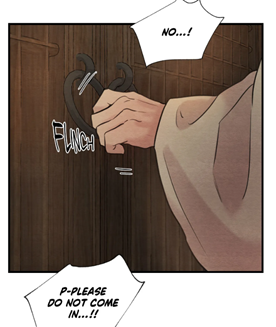 (chapter 37), if the painter hadn’t screamed through the door. Not recognizing the voice from the inside, the young man got surprised and stopped. And this single gesture outlines his disrespect towards his elder brother in reality. I had already observed his selfishness and lack of sensitivity, but with the new elements, I can definitely determine that the younger brother has indeed internalized father Yoon’s values. He treats servants and commoners like people with no right. His tone is quite strict, authoritative and rude.
 (chapter 37) This is not surprising that he requests his brother’s assistance in the end. He has experienced it first hand, has envisioned that through his father’s influence, he could manipulate the brother and get benefit from his increased fortune and influence. However, this time the lord didn’t follow his suggestion, since he has already started moving on. In fact, the younger lord was mocked through the main character’s following suggestion: Yoon Seung-Won should also live according to their father’s principles.
  (chapter 38) This reinforces the immorality and ruthlessness of the brother’s suggestion. With the letter, Yoon Seung-Won has the impression that in the end, the main lead bent to his will. This means that he is ignoring his brother’s reproach and rejection. But since the brother used their father’s name in order to approach his brother, it looks like, it was Yoon Seung-Won’s decision to utilize the brother. Even if this idea is not correct, and the father did use the younger son as a pawn to approach Yoon Seungho, this doesn’t diminish the atrocity of the younger master’s gesture. He is not just a pawn, but a real accomplice, because he knows his past but prefers his own comfort over his brother’s life. However, let’s not forget that during their conversation, the younger brother never spoke in the father’s name, like for example: “Father Yoon desires to reconnect with you and asks for a visit from you”. Even that way, the father’s honor would have been maintained, since the main lead was asked to pay a visit to their father unofficially. My final point for this interpretation is the importance of reputation in father Yoon’s eyes. The latter chose to act behind closed doors and maintain his image as a respectable aristocrat. By sending letters to his eldest son who is well-known in the mansion as an infamous sodomite, his image as strong lord is kind of tarnished. He is the one asking for help from his son… a humiliation in his eyes. Now, you can better comprehend why I believe that Yoon Seung-Won is not just a pawn in reality.
  That’s why he said this to the servant. By putting the blame on his older brother, he excuses his father’s behavior for not showing more concern for him. He didn’t leave the bedchamber in order to bid farewell, because the lord had been troubled due to Yoon Seungho. The latter serves again as an excuse to save the appearances. By giving the ruined painting, Yoon Seungho was indeed determined to provoke his father. He shows him his hypocrisy and the consequences of his principles. At the same time, the ruined painting illustrates his message: the Yoon family will never get a benefit from his sexual performances (“damaged image”).
  (chapter 37) Here, he envisioned that the lord’s companion was a noble due to the green hanbok. He is definitely more than just a pawn, in my eyes he has become a willing helper of father Yoon’s dictatorship, since he could profit from his situation. He is like an indoctrinated child, since he behaves like his father in a certain way. On the other hand, he has not completely lost a certain sense of morality. Since he is showing a certain discomfort during the conversation in chapter 37, it displays that he recognizes the wrongness of his request. But his interests are prioritized over his brother’s well-being. Another aspect is that he is not so brutal compared to his model, Father Yoon. But he has a common denominator with the elder master. He is also quite naïve. Hence Yoon Seungho could see right through his brother and his lies, just like the father. The master of the domain was well aware of the true purpose of his younger brother’s visitation: sponsoring. In the end, the younger master is forced to take the exam, like the scholar Jung In-Hun. I had imagined that their paths would cross, unaware that the learned sir would die before. There’s no ambiguity that Yoon Seung-Won would get annoyed and humiliated to hear that his brother chose a scholar with no connection and wealth over him.
 (chapter 58) Finally, Baek Na-Kyum’s deeply repressed desire and dream becomes a reality, his lord is in love with him. But since this wonderful chapter should be considered as a new version of the events related to the tailor shop, we need to examine chapter 58 under a different aspect: responsibility which was the main topic of chapter 39-40. [Here, this is my analysis about these chapters
  (chapter 40)
 (chapter 40) However, we have now to understand that this gesture was under the influence of his unconscious and the lord had not recognized his own feelings for the painter so far. He was more under the impression that he was making decisions rationally. Furthermore, he was not taking the painter’s feelings into consideration, since he was well aware of Baek Na-Kyum’s “adoration” for Jung In-Hun. In other words, this gesture signified that Yoon Seungho would become Baek Na-Kyum’s husband and companion, even if the artist was not in love with him. Now, you might be wondering why I focus first on the red dot than the event at the tailor shop. There’s a reason for that. Here, the topic “reliability” is more developed and plays a huge role in their relationship.
 (chapter 39) Here, he accepts the blame, because he has now a reason to have some sexual interactions with the painter. Consequently, he proposes another fellatio
  (chapter 39) under the pretense of forgiveness, which the artist refuses by objecting that he is not blaming the noble at all.
  Notice that the painter is forced to become the accountable one and take the blame for the whole situation. And this shows that in that scene the lord is actually the one with the upper hand as he uses Baek Na-Kyum’s shyness and embarrassment in order to tease him and actually obtain what he has been longing: intimacy with Baek Na-Kyum.
 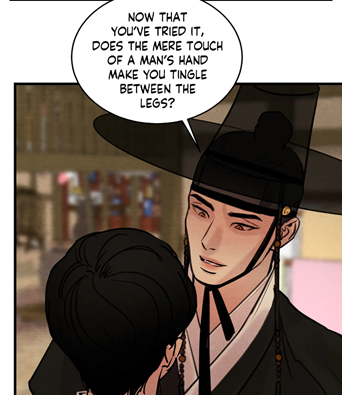 (chapter 39) However, when the boy apologized to the lord and claimed that he was responsible for everything
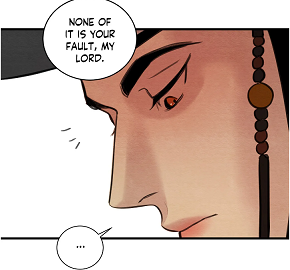 (chapter 39) In my opinion, the painter’s reaction must have been triggered by Seungho’s offer for a fellatio. Observe that, while he’s whispering to the painter, the latter’s face blushes again, but more importantly, there’s a sudden light in the artist’s eye.
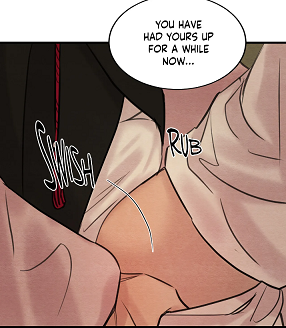 (chapter 39) He needs to satisfy him as he is now excited too. As you can observe, there was a shift of responsibility at the tailor shop. However, the lord shows a certain reliability as he just asks for a foreplay because of his concern that the painter could feel uncomfortable afterwards.
 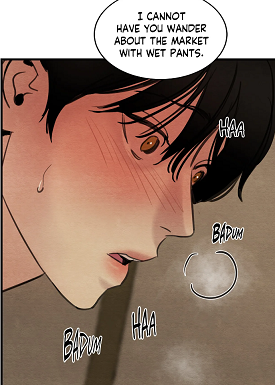 (chapter 39) As a conclusion, the lord showed signs that he was willing to be responsible for the low-born, although at the end, the artist ended up as the one who had to become the accountable one. In order to compare both scenes (39-58), it is necessary to list all the important elements present in the chapters 39-40 again: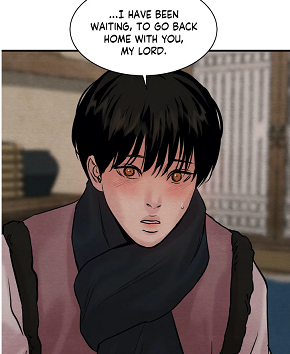

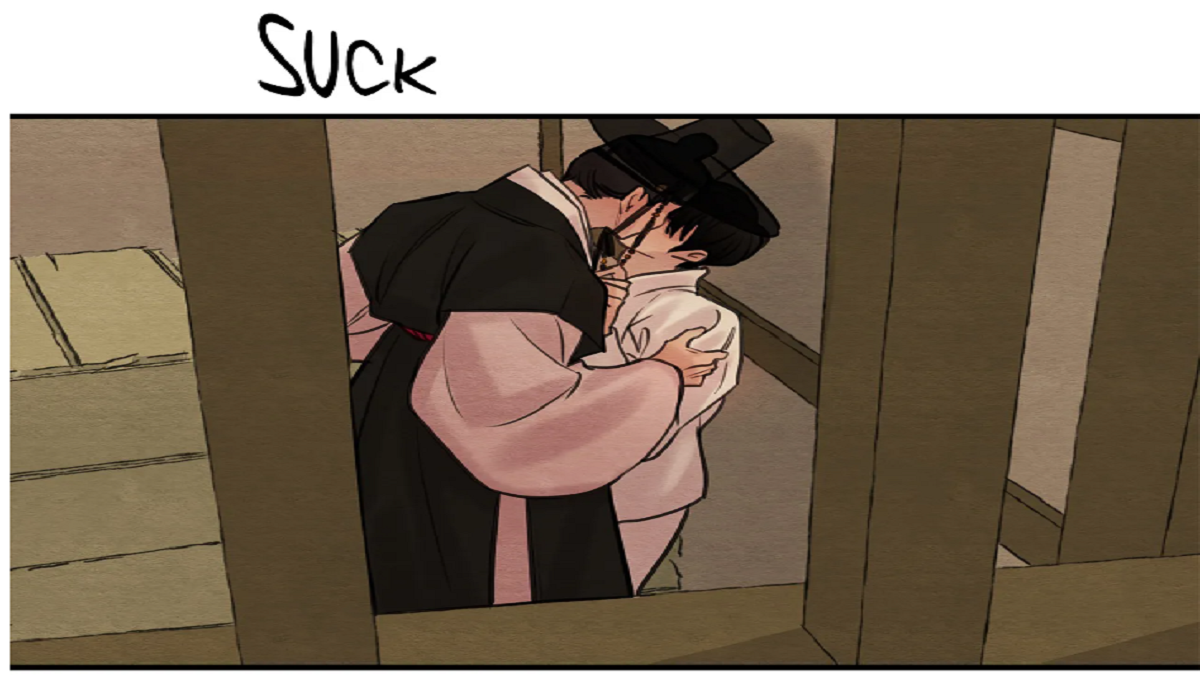 (chapter 39) And now, it’s the opposite: Seungho is against the wall as he can no longer deny his feelings for Baek Na-Kyum.
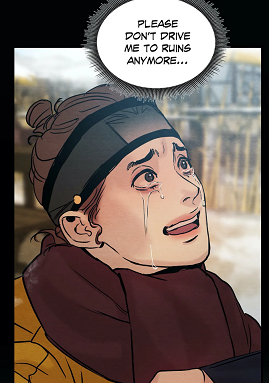
 (chapter 58) Note that both idioms have a similar connotation: destruction (ruins, wreck) and blame (you/don’t). However, Jihwa’s words contain reproach and resent indicating that he is not enjoying his situation. Since the main lead is to blame for Jihwa’s misery, the former should become responsible for him. As the manhwalovers can detect, Jihwa’s confession has a different signification. Jihwa is recognizing his defeat, which indicates that he indeed associates affection for weakness and a sex/love session as a fight. He never confessed before, because he didn’t want to surrender but preferred his childhood friend being the one. Jihwa was hoping that due to his loneliness, the main character would seek comfort by him as the only one remaining loyal by his side. That’s why he pushed away any possible rival before.
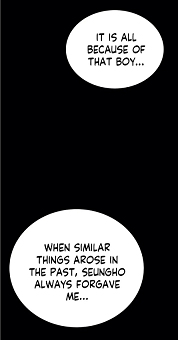 (chapter 59) Consequently, Seungho would come to develop an affection for him and confess to him. This is the other reason why Jihwa was thinking, time would work for him and kept waiting, but got only frustrated, as his situation never changed until chapter 3-4. That sex session at the pavilion gave him hope
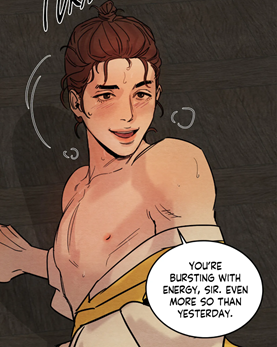 (chapter 3), which explains why he treated the painter so arrogantly and even barged later at Seungho’s house in the chapter 12, a behavior which Seungho disapproved. The red-haired noble had imagined, his status had improved and he was on the verge of becoming his official lover. This analogy between love and demise/defeat is important, because it truly shows how much Jihwa and Yoon Seungho had internalized these values and why it took the lord a long time to confess to the painter properly. Therefore, when the red-haired noble admits his attachment to his childhood friend, he knees in front of his childhood friend, a symbol for defeat and submission.
 (chapter 58) Simultaneously, this explains why Jihwa’s words reflect resent and selfishness
  (chapter 58) And now, if we contrast it with the main lead’s confession, we discover a different state of mind. The lord is definitely admitting his defeat as well, yet he is not blaming Baek Na-Kyum, in fact he is enjoying his actual situation. There’s a certain admiration for the “you” who has turned him into a wreck. The word responsibility has a different signification here. It’s no longer blame or accountability but maturity and trustworthiness. He’s no longer paying attention to his pride, there’s no resent. His only joy is to be able to show his love for the artist, since the latter is allowing him to express his feelings through words and actions.
 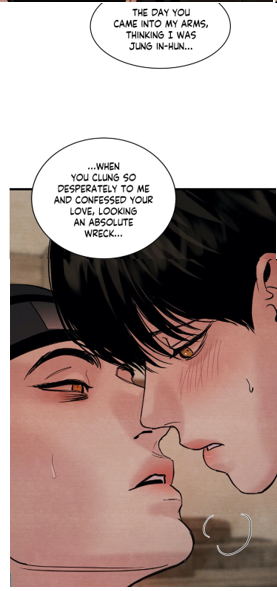 (chapter 58) After reading it for the first time, the reader would judge “wreck” in a rather pejorative light. On the surface, it seems that the lord is referring to the painter’s drunkenness, yet it gets a different meaning after reading the whole chapter. Moreover, it becomes more obvious that the noble judges “wreck” as something admirable, since “wreck” is combined with absolute. Despite his terrible state and his first rejection, the artist was determined to confess no matter what. He was brave and strong, although he looked terrible at the same time: drunk, desperate and full of tears. Yet, at no moment he blamed his “learned sir” for succumbing to his feelings or saw his love as something terrible. Unlike Jihwa and Seungho so far, he was true to them. It was so pure that the lord could only be impressed. That’s the reason why he wanted to mock him in the first place, as he had been taught that love is a synonym for weakness and surrendering to feelings was like admitting his inferiority and his defeat. This explicates why the lord was haunted by the pure and genuine kiss in the first place, it was something new.
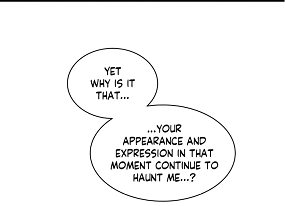 (chapter 58)
 (chapter 58) He expresses his thoughts and emotions hoping that this would move the painter. As you can observe, responsibility is in the center of this chapter but unlike in the past, the meaning has changed. The protagonist finds the artist trustworthy. Here, feelings are important and unlike in the past, the lord is now decided to succumb to his feelings without feeling any humiliation or resent. He is actually rejoicing his situation, as the painter has acknowledged and accepted his love for him, when they make love. He is now allowed to love him without any expectation, but at the same time he is asking the painter to take responsibility for him:
  (chapter 59) For the aristocrat, Baek Na-Kyum embodies trustworthiness, therefore he can rely on him now and unveil his true self, full of vulnerabilities. In my opinion, the lord was a wreck in the past but now, he embodies the opposite. He has found his true self again, a very sensitive and gentle person, who likes to be honest and is able to open up and trust someone. In my opinion, the wreck is an allusion to the rebirth of the phoenix.