This is where you can read the manhwa. https://www.lezhin.com/en/comic/painter But be aware that this manhwa is a mature Yaoi, which means, it is about homosexuality with explicit scenes.
I bet, you must be surprised that I am writing a second part about Jihwa’s confession, when the first part was so long and it really looked like I had exhausted the topic. However, while rereading the manhwa again in order to discover new details, I found another scene that was very similar to Jihwa’s confession.
It’s actually the scene in the chapter 5, where Baek Na-Kyum approaches the lord asking for his forgiveness with the hope that the latter will be willing to return the poem from Jung In-Hun. Observe the parallels between the two scenes:
We have a piece of paper which forces one of the main leads to meet the other character.
The color of Yoon Seungho’s robes is very similar: he is wearing dark blue in both scenes. And you know that there’s no coincidence in this manhwa. Blue is associated to care, trust, loyalty, and peace of mind.
Besides, we have two persons speaking about forgiveness
The two conversations deal with Yoon Seungho’s image as man consumed by lust
Their positions are very similar. While in the chapter 5, the main lead sits smoking and looking out of the window, the painter is begging on his knees. Then in the chapter 57, Jihwa is also on his knees, while the lord is sitting too as he can no longer stand due to his illness. Both beg the lord in the end. Striking is that everything is indeed related to love. The manhwaphiles should remember that the plagiarized poem deals with love. The scholar faked his affection for the painter with his poetry.
Both scenes are involving Yoon Seungho’s childhood friend. In the first season, Jihwa had to suffer from the painter’s lip service, in the episode 57 the second lead plays now an active role because he is at the forefront. This time, he confesses. However, the real similarity is the following. Jihwa used the letter in order to get his friend’s attention. As a conclusion, in both scenes, the lord’s attention on his sex partner plays a huge role.
Another parallel is the rejection. Because of the low-born’s indirect reproach, the lord can’t stop thinking about Baek Na-Kyum’s words hence he is unable to focus on Jihwa who is sent away at the end. In other words, the ex-lover’s advances are jilted which really upsets the red-haired aristocrat. In the chapter 57, the manhwaphiles don’t witness the rejection personally, we hear about this through the butler’s testimony. And this occurs again, when the aristocrat confesses to his friend. The latter’s mind is focused on the painter again.
This leads to the next analogy. In both cases, Jihwa is left behind after the rejection. In the chapter 5, the lord leaves his bedchamber and in the newest episode, he leaves with his loyal assistant to go to the doctor’s office.
After listing many parallels between these two episodes, the readers can detect that the author could only have done it on purpose. For me, this analogy gives another explication why Jihwa ends up rejected. And now, I’ll elaborate this reasoning.
Notice in the chapter 5 that although Yoon Seungho forgives the painter, he doesn’t return the poem. Why? Let’s not forget the painter’s real intention behind his concession. The low-born desired the noble to change his mind. He imagined that if he expressed his apology, then this would move Seungho’s heart so that the latter would give back the poem. We could say, we have another allusion of “change of heart”. However, his apology was just a lip service which the noble could sense. The irony in this scene is that while the low-born denies that he views the master as a man consumed by lust, he is actually saying the opposite which triggers something in the aristocrat. He’s hurt and annoyed due to the artist’s words. Now, you might wonder about the reason for his annoyance as the day before, the painter had reproached him to be a man obsessed with sex. In my opinion, there are two reasons for the change of attitude. The painter had disqualified him for judging the quality of the poem as he was not educated, due to his busy sex life. And notice that in the chapter 5, he only repeats the part “consumed by lust” but the allusion to his education is reduced to “what not”. Therefore this leads me to the observation that Baek Na-Kyum’s lip service did cause a change of heart but not a change of mind!! For the first time, Yoon Seungho is confronted with his negative image by someone so honest and direct. This reveals that no one has an idea how literate he is. The day before, he was upset when he heard these words but he just dismissed it, thinking that the painter had no idea about his true personality. But the moment the painter refers to the incident, he is omitting the part about his intelligence and education. And this is important because the artist is the only one who gives a true reflection to the protagonist, while Jihwa is not complaining at all.
Let’s not forget that till the chapter 49, he only views himself as a spirit. So in his mind, he was only a mind full of knowledge hence he didn’t need to show himself entirely. However, it is a different story, when someone so genuine reminds him that he has been fooling around with men and has never revealed his brilliance. And this is very important because despite his lip service, Baek Na-Kyum forces the lord to change, to confront himself with his own image. So despite the painter’s selfishness in his apology and lie (he wants to receive his treasure), there’s genuineness which is also visible later. He argues, when the lord refuses to return the poem with the justification that he won’t change his mind. He needs to paint for him in exchange for the poem. While the red-haired noble complained about Seungho’s change of heart, in the past he actually desired a change of heart as well. He couldn’t bear the thought, his lover was having sex with other men. As you can detect, the change of heart occurred back then which affected Jihwa so much. At the same time, it also outlines Jihwa’s lack of sincerity. He might long for the lord yet he was never satisfied with the lord. First, he was fooling around and now he is focusing his attention and care on the artist. Both were confronting the protagonist with his bad reflection, yet their intentions and approach were different. First, the painter never intended to hurt the noble with his lip service. Secondly, he somehow admitted his wrongdoing hence he expressed his apology. Striking is that he’s not blaming the counterpart. There are no reproach expressed here. His apology might be insincere, yet he admits to be in the wrong, whereas the red-haired noble is reprimanding his friend and never questioning his actions. That’s why he is the one forgiving and not apologizing. Now, you understand why he’s blaming his childhood friend. He had to hurt him because he had changed, because he had neglected him, because he was a man consumed by sex etc. Despite a certain selfishness and insincerity visible in the painter (chapter 5), the later is still showing a certain respect towards Yoon Seungho and is even willing to take responsibility for his behavior. But at no moment, we can observe this with Jihwa. In my opinion, that’s the reason why Baek Na-Kyum could provoke a change of heart in the lord so that the latter could no longer focus on sex.
What caught my attention is that although Jihwa is always physically close to his childhood friend (see above and here ), he is so far away from him mentally. And this stands in opposition to Baek Na-Kyum who was physically far away from the lord, yet there’s a certain closeness due to their exchange of words. As you can perceive, Jihwa didn’t pay attention to the lord’s words in the chapter 5. When the latter revealed that he had been described as a man consumed by lust, the sex partner got upset because the noble was not focusing on him and he was left behind. During that night, Jihwa could have talked to Yoon Seungho but he didn’t deny anything, he just complained that Yoon Seungho wasn’t paying attention to him. And this distance between Jihwa and Seungho becomes more visible in the chapter 57, when you compare the drawings between Baek Na-Kyum and Yoon Seungho in the chapter 5. Notice that Byeonduck always zoomed on both faces, underlining that there was a real conversation, while it’s not the case with Jihwa. It’s a very long monologue. All the panels represent the red-haired aristocrat’s perspective and thoughts and the zoom on his face symbolizes the climax of his speech. Everything revolves around him that’s why we don’t see Yoon Seungho all this time. In my opinion, the mind’s eye of Jihwa is not looking at the friend at all. He might star at him at the end, yet for me he is more speaking about himself and his feelings than exchanging thoughts with his ex-lover. And that’s the reason why Yoon Seungho could only reject his friend. He has never really tried to open up to his childhood friend. There is no real conversation. Observe that when the lord refused to return the poem, Baek Na-Kyum started to argue with him but accepted the lord’s words at the end. In the chapter 57, Jihwa is not giving a chance to Yoon Seungho to give an explanation to his bad behavior, since he states that he knows everything.
Since in the chapter 5, Jihwa was sent away, we could say that the outcome in the chapter 57 is not a surprise. The weirdest thing is that the chapter 58 actually confirms my observation. The same question, yet there is no longer a physical gap between them. Now, the lord is even holding the painter’s hand, instead of holding the pipe. And observe that they talk to each other in this scene again. There’s another real conversation. And this is the other reason why the protagonist could only fall in love with the artist. The latter was the only one talking to him, even when he hated himand he expressed his feelings. He argued with him showing that he was noting his presence as a spirit, a mind and he wasn’t just a man obsessed with sex. Consequently, Jihwa could only fail as he never exchange his true thoughts and feelings. Even when they had sex, they would talk to each other with a certain honesty. And this was not the case with Jihwa. Besides, by only having sex with him and not sharing his mind, he contributed to Seungho’s mental isolation and loneliness. Seungho was first attracted by the painter’s works, hence there was a mental connection between them before their first meeting. And from the moment they were together, they kept talking to each other, while it was never the case with Jihwa. He was not listening to his friend’s words, even when the latter warned him or reminded him that he didn’t know him that well. It was, as if his words meant nothing. This is not surprising that Yoon Seungho could only consider himself as a spirit using his body to get revenge on the double-faced nobles. This explains why the main lead can’t distinguish Jihwa from Min in the end. Both are treating him the same way. Both assume, they know him so welland can do anything to him, justifying their actions with this excuse. As a conclusion, this manhwa reveals that love can only work if there’s a real communication and attraction is not the main component.
Feel free to comment. If you have any suggestion for topics or manhwas, feel free to ask. If you enjoyed reading it, retweet it or push the button like. My tumblr-twitter account is: @bebebisous33. Thanks for reading and the support.
This is where you can read the manhwa. https://www.lezhin.com/en/comic/painter But be aware that this manhwa is a mature Yaoi, which means, it is about homosexuality with explicit scenes.
Finally, Jihwa confesses his love to Yoon Seungho but unfortunately for him he gets rejected. The readers don’t witness it personally but it is insinuated through Valet Kim’s testimony to the doctor. He describes the red-haired noble shedding tears on the ground, a sign that the lord didn’t obtain what he had been longing for a long time. Furthermore, he adds that the owner asked them to leave her inn reinforcing the impression that the young man must have cried a lot. The lady criticized the aristocrats for ruining her business.
But why did the lord reject his friend in the end? Sure, the manhwalovers would reply to this question that Yoon Seungho has never loved his childhood friend the same way Jihwa did hence the former could only push his ex-sex partner away. However, I believe that there are other explanations for this outcome too. That’s why in this essay, I’ll examine the noble’s confession more closely.
First, if we look at the way the lord admitted his affection to his friend, we can notice one huge analogy between Jihwa’s declaration and Seungho’s in the chapter 55. Both are blaming the loved one for feeling miserable.
While the red-haired aristocrat describes his ex-lover as a man consumed by lust which has always been affecting him, Baek Na-Kyum is responsible for Yoon Seungho’s strong negative emotions (jealousy, rage). At no moment, Yoon Seungho didn’t dare to look at the painter, while confessing as he recognized his bad actions. He had no hope and was actually expecting to get rejected. However, Jihwa looked at the friend’s face on his knees, searching his closeness in order to convey his feelings properly. . Therefore while the master Yoon blamed the painter in order to push him away, Jihwa is actually hoping the opposite. He wants to be accepted. Whereas in Seungho’s mind he didn’t deserve his affection, the red-haired noble believes that the friend should be happy to receive such a dedication. We can conclude that the main lead was definitely selfless in his confession. By comparing this to Jihwa’s, the readers can sense the huge improvement in the main lead, while Jihwa is still selfish which I’ll explain further below.
Another parallel is the importance of pride. While the main lead never mentioned it directly unlike Jihwa, he implied it with his behavior. The two nobles tried to protect their pride by waiting. Sure, Yoon Seungho wasn’t even recognizing his own feelings, yet he knew exactly what he wanted from the painter, although he is saying the opposite with this rhetorical question: He wanted to see admiration in the painter’s eyes, in other words to obtain spiritual love, like he finally admits it at the end. But the low-born kept rejecting him which made the aristocrat suffer. Consequently the loved one had to suffer due to their “rejections”. And we have the same case here. Yoon Seungho became the real victim of Jihwa’s pranks.
Moreover, the protagonist was so unsure about his feelings and expectations revealing his vulnerability and insecurities. Here, Jihwa is also showing a certain vulnerability in his confession with his tears and his position. Let’s not forget that he is on his knees. While he blames his friend for his bad actions, he can’t help himself longing for him and wanting to embrace him. However, there’s another huge divergence. The red-haired lord is very sure about his feelings, because Yoon Seungho has been his first and only love. His love started in his childhood. That’s why I can’t help myself connecting this love confession to the artist’s first’s in the chapter 20. Notice that the painter is hoping that the low noble would see his affection and respect. Remember what I wrote about Jihwa’s doomed love with Yoon Seungho. He was deep down hoping the same, seeing admiration in his friend’s gaze but he could never get it as the former was too wounded. Therefore I come to the conclusion that Yoon Seungho is playing the same role than Jung In-Hun had with the painter. Let’s not forget that the scholar was also Baek Na-Kyum’s first love. Jihwa has been also longing that his feelings would been perceived by his childhood friend. Another analogy is that the red-haired master has a false perception of Yoon Seungho. He’s a man consumed by lust, but his love started in his childhood, hence the source of his affection comes from a certain idealization. Jihwa has the impression, he knows the friend the best because he knows his past. But the reality is that he has no idea. He might know certain facts (nightmares, the terrible incident with lord Song) but he is not aware of all the torments Yoon Seungho went through. He might know about the wound caused by lord Song, yet I am quite sure that he doesn’t know about the prostitution. There’s no ambiguity for me that father Yoon acted as a pimp in the past despite his disdain for homosexuality. That’s why I think Jihwa’s love for Yoon Seungho is very similar to Baek Na-Kyum’s affection for the scholar: a “pure” love based on a false image. The painter had no idea that his surrogate father was jealous and double-faced. Consequently, I am expecting a real fallout between the two childhood friends first. Since he has been rejected, Jihwa will drink again in order to ease his pain and my prediction is that he will meet Nameless so that we would have another “Wedding night” which will affect the second lead. The latter will deny the existence of their intercourse. Yet I still believe that after Jihwa’s long suffering and redemption, the noble and Seungho will become true friends again. However, I sense that they will go separated ways for a while.
Another similarity is that Jihwa and Yoon Seungho are under the influence of alcohol, when they confess. However, this resemblance ends here because unlike the red-haired noble, the protagonist had planned to confess, he even opened the door so that the cold would wake up the painter, he sensed that his health condition was worsening but he needed to express his thoughts. Nevertheless, I don’t believe that Jihwa had planned to confess in the first place. In my opinion, he was triggered by his friend’s words. Notice that he puts Jihwa in the same category than Min, revealing that he is no different from all the nobles the main character meets. This could only upset Jihwa because he considered himself different from all the others as he was his childhood friend. I guess, the words forced Jihwa to show his friend that he was in no way similar to Min. This explains why he portrays himself in such a positive light. He excuses his action by saying that Yoon Seungho forced him that way. As a conclusion, Jihwa felt that he had to confess. Besides, he sensed that his friend was getting even further away from him.
By comparing both confessions, I still judge Jihwa as someone egocentric. Why do I perceive the latter like that? It’s because his words are very similar to Baek Na-Kyum’s confession from the chapter 49. Here, the painter was using a lot the personal pronoun “I, me” and was telling his lover that he was finally willing to accept Yoon Seungho as lover but he would never give him his heart. Since Seungho was the one who had to lick and to kiss him in order to make the artist feel good, the painter was not hiding that he was using Yoon Seungho as a tool for his own enjoyment. The artist had put himself on a pedestal, which was also reflected in his position. Notice that the noble had to look up. The powerful master should treasure him and their physical relationship. Since in that confession, he was admitting that he was using the lord, this signifies the artist didn’t pay attention to Yoon Seungho’s feelings and desires. Baek Na-Kyum was indeed inconsiderate, yet here he wasn’t even hiding his thoughts. He was once again brutally honest. There’s reason why I continue associating brutality with honesty. It’s because each time the painter was sincere, his words wounded the lord very much. For Yoon Seungho, each word must have felt like a stab in his heart, hence he was not happy at all, after hearing this confession. Remember that he wanted to get angry but was stopped by a tender kiss. Besides, I am not the only one who criticizes the painter for his selfishness. Even valet Kim reminded him in the chapter 52 that he was acting like a spoiled child.
But let’s go back to Jihwa’s love declaration. His words are very similar. One might argue that the situation is different because Jihwa’s the one who desires to forgive and embrace Yoon Seungho, who stayed by his side, while the lord was fooling around with other men. Hence he’s selfless. However, he might be the subject and Yoon Seungho is the object of his affection, yet since each sentence begins with the personal pronoun “I” (“I know”, “I can embrace”, “I’ll forgive you”) this is a good indication that he values himself very much. That’s why I came to this observation: he’s selfish. He’s also not considerate towards the lord’s feelings and thoughts. He doesn’t let the counterpart speak. Strangely, his position contrasts so much to the low-born’s in the chapter 49. Jihwa is on his knees and has to look up at Yoon Seungho giving the impression that he’s worshipping the young master. However, his words are contradicting his position. He’s rather looking down on the former sex partner than adoring him. The beholder would interpret from Jihwa’s posture that Jihwa is humble and devoted, yet his speech is actually contradicting his attitude. Despite on his knees, he is the one who forgives, while in reality a witness would think, the opposite is happening as Jihwa looks as if he was begging. Yet his stance reveals the red-haired master’s despair, he’s indeed pleading his friend to acknowledge his feelings. Simultaneously, he appears as arrogant as he judges his friend as man consumed by lust and blames him for his reckless behavior. In my opinion, he’s a little pretentious because he thinks that he knows everything about the noble’s past. But since he’s still acting like a child, there is no ambiguity that he is actually naive. That’s why I believe that when he sent the letter, he didn’t grasp the scope of his action. He knew that he would get hurt, yet I don’t believe that Jihwa is exactly aware of the true event with lord Song. Furthermore let’s not forget that I link this declaration with the painter’s first confession too. Here, the commoner had put the scholar on a pedestal, hence he had to stand on tiptoes reflecting his “admiration”. Back then, the low-born had put the scholar on a pedestal indeed. He had confessed that he pined on him and would respect him so much and as you can detect, Jihwa is actually saying the opposite. Yoon Seungho is far from being admirable that’s why the protagonist’s heart can never be moved.
Since I see so many connections between the confession in the chapter 20 and 55, it is logical that Yoon Seungho can only reject his friend. Baek Na-Kyum was never destined to receive the low noble’s love (impossible love) and Yoon Seungho blamed his loved one while confessing in order to get rejected! And since the noble is quite selfish in his love and Yoon Seungho has been longing for a pure and selfless admiration, the friend can only be pushed away.
If Yoon Seungho used the reproach and doubts to push away the painter, then why is the red-haired master using the same tactic? Does he hope to be rejected too? The answer is quite simple. Jihwa has a different purpose by blaming his friend. When Jihwa declares that he is willing to accept his ex-lover with his flaws which could be perceived as a positive aspect, he is trying to create a good image of himself: he is selfless by accepting Yoon Seungho with all his flaws. Who would be willing to accept such a man? With these words, he’s implying that no one would ever come to love him. He’s the only one who knows him so well insinuating that he has no one left by his side, except him. As you can observe, the noble is turning himself into a good Samaritan, while he is portraying the main lead as someone terrible. He’s selfless and tolerant. And that’s how he portrays himself through his speech and that’s how he also perceives himself. Yet the red-haired aristocrat is not realizing the contradiction in his own words. He criticized his friend for changing, but he never liked the man sleeping around. Deep down, he wished, the man would have loved him. That’s why there’s certain dishonesty in his confession which was the case in the painter’s first love declaration too. While the low-born claimed that he was longing for his spiritual love, deep down he wanted to be desired and experience sensual love. We shouldn’t forget that he had been struggling with his increasing libido and repressed his sexual desires. Since the upset lord has noticed the change of his friend’s behavior, he should have been happy, since he became monogamous. So the sleeping around stopped, yet Jihwa is not satisfied because he is not the loved one. Everything is related to the painter, a low-born. According to him, he shouldn’t have changed implying that he prefers him fooling around with other men than having sex with a low-born. This reveals his jealousy. Deep down, he wished to be the one to be loved. Yoon Seungho actually changed for the better which was even noticed by the town folks but Jihwa chooses denying it. He has every reason to deny it, since the lord is intimate with a low-born, which Jihwa condemns. This illustrates that Jihwa is actually lying to himself, when he confesses to his friend. With this picture, the manhwalovers can realize that Jihwa was actually bothered that the noble with the mole wanted to have sex with Yoon Seungho. Notice that he considers his acquaintance the same like “with all those other men” hence I believe that the prank played against the painter was actually an action in order to get rid of another potential lover. After listening to his friend’s narration, he sensed that Baek Na-Kyum represented a source of danger, especially after hearing from his “friend” that Yoon Seungho would keep starring at the commoner. Jihwa could only get jealous of their locked gaze as this was exactly what Jihwa wanted to share with his childhood friend: his feelings should be seen and as the same time, the lord’s gaze would reveal respect and admiration. Therefore I come to the observation. He used his friend as legitimation claiming that he had been avenging him, while in reality he was protecting his own interest. He wanted to claim the lord as his lover. But why is the red-haired noble determined to portray his friend in such a pejorative way? It’s because he wants to be admired by his friend, an admiration which he never received. He thought, waiting would solve the problem but he was totally wrong. By describing the main lead as a man consumed by lust, he is actually achieving the opposite of what he intended to get. The former lover has never comprehended that Yoon Seungho hates the image of a man consumed by lust which he has been implying with his confession, although Yoon Seungho revealed it to him in the chapter 5. Back then, the guest didn’t pay attention to his words, he was more upset that his friend was not focusing on him. And this shows that the friend was too focused on his own feelings and pride to understand Yoon Seungho. Hence this is the other cause for the failure of his confession. Jihwa could never obtain what he wanted, the admiration in Yoon Seungho’s eyes as the red-haired master never reflected real admiration in his eyes. As a conclusion, he couldn’t get past the image of a man obsessed with sex. How can Yoon Seungho love him back, if the noble judges him like all the others? In order to love someone, the main lead needed to perceive himself differently, as he already hated himself so much.
Why could the painter succeed, where Jihwa was destined to failure? The difference between the painter and the noble is the following. First, Baek Na-Kyum and the other main lead had a spiritual connection even before their first encounter. Secondly, through the paintings, the artist was able to give Yoon Seungho a different image about himself. Each time the painter was able to make him smile, while it was not really the case with Jihwa (chapter 1, 2, 3).He showed him an attractive man, worthy to be desired. Besides, he was indeed physically attracted to him. Sure, now he is not admiring the lord spiritually but once he accepts the noble, the latter will reveal his qualities which he could never reveal as he never felt loved. Baek Na-Kyum will discover a new side of Yoon Seungho: educated, intelligent and even patient. Jihwa says that he knows the reason for this reckless behavior, however I believe that Jihwa doesn’t grasp the whole dimension of the main lead’s suffering.
As you can observe, by comparing the different confessions and even examining Jihwa’s love declaration in its details, it becomes very clear that Yoon Seungho could only reject him. Nonetheless, there are more reasons why Jihwa was doomed to fail.
I have to confess that when I read this scene for the first time, an event from the season 1 came to my mind, the straw mat beating and in particular this picture: The lord came personally later and stood there, like he was on a podium, while the painter was lying on the ground. Just before, he had been rolled up in a mat. And observe, the scene at the tavern is really similar, although the perspective diverges. The lord kicked the friend so that the latter fell down. The main lead is standing, while the other is lying on the floor, hurt, exactly like the painter. Let’s not forget my theory that Jihwa is the noble version of the painter. But there are actually more parallels between these two incidents hence it is necessary that I outline all the similarities by listing all the elements contained in both incidents:
We have a ruined painting in the first season, whereas we have a letter reminding the lord of his terrible past. Both are just pieces of paper, yet they have such an impact on the main lead. Both causes immense pain in the main character’s heart. In the first case, it was as if his identity had been erased. Let’s not forget that the protagonist perceived himself as a ghost but thanks to the erotic pictures, he could feel alive. And the moment the painter portrayed him, he saw a different reflection about himself, like I mentioned above. It could liberate him from his self-hatred, he saw that he was desirable. Simultaneously, the drawings were a proof that he was actually a man defeating his enemies, the double-faced and treacherous nobles, as a part of his “revenge”. As for the letter, it was a reminder of his terrible past. It’s clear that Lord Song is someone terrible based on Kim’s reaction. I have to admit that after giving some thoughts, I have come to the conclusion, the mysterious lord must be an older version of lord Min. But let’s get back to the comparison. Both pieces of paper caused a scene: a punishment. While Jihwa received a kick, the painter was condemned to the straw mat beating. One might say that the last punishment is worst as Baek Na-Kyum could have become handicapped or even worse, he could have lost his life. However, the kick in a public place for a noble is already a big humiliation. Not only he appears as a weak person but a kick is a treatment rather reserved to commoners. His reputation can only be affected (rumors). Let’s not forget the importance of honor for an aristocrat. Having a title is a synonym for respect and privileges, yet the boot on his arm gives the impression to the folks that Jihwa’s lacking of honor. It was as if he was a low-born despite his nice appearance.
Then we have Jihwa drinking at the tavern rejoicing about the success of his prank whereas in the chapter 57, he is there to drown his sorrow. This is no coincidence that it’s the same place.
The words and the reactions of the characters are very similar. Yoon Seungho is saying that he has been really patient and he can no longer accept such a behavior. (chapter 12) Then the reaction of the ukes is very similar. Notice how the painter cries begging the lord for his leniency, whereas the red-haired noble weeps telling the lord that he will forgive him for his rude behavior. Although the red-haired is speaking about forgiveness, he is in reality begging his friend to look at him and consider his feelings. He’s asking his friend for his heart and to become his official lover. And strangely, we should remember that the servant relating the incident to his master told him (chapter 13) that the lord had a change of heart. As a conclusion, both incidents are revolving around Yoon Seungho’s change of heart.
Finally, while the painter was rolled up in a mat and got water on his face, Jihwa has to feel the former friend’s foot on his throat. Then later both ukes’ position is almost the same again. It looks like Baek Na-Kyum is also on his knees after his release.
As you can detect, in both terrible events, we have a prank leading to a punishment which is connected to a change of heart. Yet there’s a huge difference. While the powerful protagonist had a change of heart for the painter, Jihwa is actually complaining about this change and would like the lord to have a change of heart as well. Therefore he confesses his love to the noble at the inn in front of commoners, creating a real scandal. Jihwa really hopes that his tears and love confession will evoke feelings in his counterpart. However, this is the opposite. Yoon Seungho rejects him. And you might wonder why we have all the analogies between these two incidents. In my opinion, we should perceive the lord’s confession and rejection as his punishments. He is paying now the price for his prank with the ruined painting and the letter in reality. One might argue that the second lead was already punished for his misdeeds in the chapter 18. On the surface, it really looks like it. For each misdeed, he had to pay for his wrongdoings : he slapped the painter, therefore he got grabbed by the topknot and dragged to the courtyard in front of the staff. Furthermore he had planted a spy in his friend’s household, consequently the domestic got stabbed. He ruined the painting hence the young lord cut ties with him. However, we shouldn’t forget that the aristocrat expressed schadenfreude, when he heard the news about the sanction. He even celebrated it and asked his friend to pay the bill for this “party”. Therefore this is not surprising that his humiliation happens at the place where he rejoiced, when his prank had been successful.
Furthermore, he had treated his amateur spy very roughly in the chapter 13 by pushing him very hard onto the floor hence we could say the kick Jihwa receives in the chapter 56 is the punishment for his gesture towards the servant and the foot on his throat is the sanction for the prank with the letter. Jihwa is indeed treated like a commoner. People might say that Jihwa is acting according to his status, as a noble is entitled to mistreat commoners. Nonetheless, my impression is that one of the main messages from this manhwa is that “prejudices” will only lead to suffering: karma. Baek Na-Kyum got sanctioned for rejecting and denying his own homosexuality, whereas one of Jihwa’s prejudice is about the commoners. This is not surprising that his suffering keeps increasing as he is never questioning this doctrine that low-borns are no real humans, not worthy of any respect. My readers are well aware that Baek Na-Kyum was living according to the scholar’s doctrines, therefore we have to imagine that Jihwa has also been living following the social norms of the nobility: commoners are low lives.
First, I would like to examine Jihwa’s prejudice. The latter was humiliated in front of Yoon Seungho’s staff but this didn’t change the noble’s mind. In fact, the loss of his friend didn’t really force the red-haired aristocrat to reflect on his misdeeds. In fact, he insulted Yoon Seungho “old bastard”, while admitting at the same time, he would understand the protagonist the best (chapter 36). Yet at no moment he never questioned his actions nor his prejudices. Notice that in the chapter 57, he’s again humiliated but this time in front of town folks, the people he looks down.
As you can observe, the humiliation and the mistreatment at the inn are increasing. First, his disgrace occurred at the mansion but Jihwa tried to maintain his honor by announcing to Seungho that he had been using him. Now, he’s kicked in front of commoners creating a rumor. And this is no coincidence in my opinion. For me, these humiliations are just the consequences of his misbehavior and false conceptions. He looks down on commoners therefore he constantly gets disgraced in front of them (chapter 18, 36, 43, 57). This is his karma for defending such unjust norms. That might be the common norm for back then, but since Baek Na-Kyum has suffered because he defended doctrines condemning sodomy, it becomes clear that Jihwa’s role as a character has another purpose: the lack of respect for low-borns.
Moreover, I believe that Lee Jihwa has another prejudice, just like Baek Na-Kyum had another prejudice as well: the negative image of nobles. But this one is less obvious because he loved his teacher, a low noble. Since I sense that Jihwa is very similar to the painter, then we have to conclude that Jihwa has two prejudices. The artist denied his homosexuality and he saw the nobles as nobles only good in appearance. That’s why I believe that Jihwa is more prejudiced towards commoners, yet he isn’t truly admitting his homosexuality. I am well aware that some might doubt this interpretation. First, the manhwalovers should remember that Baek Na-Kyum came to deny his sexual orientation due to the intervention of the low noble. So his natural homosexuality was repressed. Since Jihwa has been in love with Yoon Seungho, he’s also a natural homosexual. And it looks like Jihwa’s sexual orientation has also been repressed somehow. Remember that we have this: and it becomes obvious that Jihwa was separated from the protagonist. So he did suffer from getting separated from his first love. This would explain why he hid his true emotions behind his smiles and cheerful comments too and wasn’t honest any longer.
At the same time, this explains why he only slept with Yoon Seungho and never confessed his love to him. He hoped to get his love by having sex and he tried his best to seduce him. However, he could only fail as Yoon Seungho never felt any pleasure during the sexual intercourses. He only considered them as fights. Simultaneously it was the reason why the other nobles and even the commoners were aware of Jihwa’s love for his friend. He never went to sex orgies. Hence I believe that Jihwa has been influenced by the social standard among nobles as well. Maybe being separated from his friend made him realize that he needed to hide his feelings. The other evidences for this interpretation are the following:
For me, here he is not admiring the hickeys as his words don’t express any admiration, sound more like a complaint. Besides his mouth is not smiling as the upper lip goes up. This is Jihwa smiling 10 minutes later, once he hears about his friend’s early visit. Observe, this time the lower lip is going down. Therefore I come to the conclusion that he is actually reproaching his friend for living marks on his body, a proof of his hidden homosexuality. Besides, if he was rejoicing, we should see the exclamation mark and not the suspension point. Another evidence of his not truly outlived homosexuality is the following: he hides the hickeys the moment the servant barges in his room. Yet, the moment he hears about the visit, he doesn’t pay attention that the hickeys are still visible. Then at the pavilion, he tries to suggest to move to his bedchamber. He is definitely trying to influence Yoon Seungho with this rhetorical question. He doesn’t want to be seen by his staff. But for me, the biggest clue that he is not truly admitting his sexual orientation is in the chapter 18: Notice that sodomy has a certain pejorative connotation. According to the nobility, homosexual intercourse is tolerated, yet the red-haired master insinuates with so deep that there’s a limit. Hence homosexuality with commoners is not allowed. For me, this limitation is actually an allusion that feelings between two men are not allowed, that’s why it’s not allowed to do it with commoners. Why? Because among nobles, they can hide their love behind business and exchange of favors and this is exactly what Jihwa did. This explains why Jihwa defended his honor that he had been using Yoon Seungho while being with him. He could legitimate his sodomy by saying that he had some favor to ask. Yet, this was just a cover and everyone was well aware that Jihwa was in love with the noble. So there’s a certain hypocrisy, which is quite similar to Baek Na-Kyum’s who accepted to work for the main lead for his scholar’s sake.
This explicates why the red-haired master was so determined to be with his childhood friend. If he was with him, he would be able to live his homosexuality to the fullest, as he would be able to love and be loved. For me, that’s the other reason why he didn’t confess to his friend in the end. He imagined that by sleeping with his friend, the latter would fall in love with him. That’s the reason why he was so determined that the painter must have been seducing Yoon Seungho. He can’t envisage that the painter would be bold to confess to another man, this is not tolerated. Remember that their wedding night started with a confession. The last evidence appears in the chapter 52. What caught my attention is lord Min’s insult, when he stands in front of the painter. He actually insults Jihwa as sodomite which is quite strange, since Min had also sex with other men. He even slept with Yoon Seungho as uke. The only difference is that Jihwa is in love with his childhood friend. Because he tried to hide his love for his childhood friend, we could say that he hasn’t truly admitted his own homosexuality.
My explanation is the following. Having sex with another noble is not considered as abnormal because it is not related to love. These are just fights and a form of exchanging favors. He has been attempting to hide his intimate relationship with Yoon Seungho, while in reality all the town folks are well aware of their special bounding. He didn’t confess to his friend, hoping that the latter would fall in love with him through seduction but at the same time, he hoped to be admired and loved by Yoon Seungho. I know that some might be skeptical, yet I have different reasons for thinking like that which I illustrated above. For me, Jihwa’s biggest fear is to reveal his homosexuality and especially in front of commoners as he has internalized this rule: love is not allowed among men. Remember that father Yoon condemned him, describing as ill.
That’s why when he confesses could be considered as the same suffering the painter experienced at the pavilion. Revealing his homosexuality in front of town folks was indeed a huge humiliation as he had always tried to hide his feelings from the others. It is definitely possible that Nameless even witnesses this scene from afar, as it was implied Jung In-Hun saw the rape at the pavilion. We shouldn’t forget that at the pavilion, he admitted to have loved the scholar. And this is another reason why Jihwa could only fail with his attempt.
Jihwa was well aware that with this letter he would hurt Yoon Seungho, the man he claims to love. Sure, one might say that since he got kicked and humiliated, then the sanction was already enough. But we shouldn’t forget that in the chapter 18, Jihwa had actually decided to cut ties with Yoon Seungho in order to save his face. Here, we can definitely perceive how much he values his reputation and honor. That’s why he couldn’t go to his friend and beg to take him back, after witnessing the love session between Seungho and the painter. Jihwa was well aware that he could no longer approach the friend, because this would mean, he would go back on his word. Hence he knew that he had to initiate something so that Yoon Seungho would come to see him. So the painful reminder was the only way to force the noble to encounter him. That’s why the noble laughed, when he saw his former friend. His trick had worked. Yet the moment, his friend put him together with Min, he could only get hurt. He was treated like all the others, while he saw himself as different, since he had feelings for him. Hence he tries to legitimate his action with the letter, he was trying to explain that he was only one who knew his dark past.
With these words, it becomes clear that the red-haired master is attempting to differentiate himself from all the other men Yoon Seungho fooled around confirming that the lord only confessed as he disliked the idea to be similar with Min. The confession was not planned and it happened at a place, where many commoners would observe him. And this was a huge punishment for the character. We could say that he was brave to do it but the question is how he will react after the rejection. Will he yell at Nameless and ask him to do the deed much sooner? Or will he accept Min’s involvment? If he does that, then this means that his downfall won’t stop here and there will be another retribution. Sure, one might say that the attempted assassination has been incited by Min, yet he is no child as such. He’s an adult and he will realize the consequences of his decisions if something bad happens. It’s definitely possible that the aristocrat might ask Min to take his responsibilities as he was involved and he was the one who proposed the idea. However, since Min is such a huge hypocrite, it is quite certain that Min will wash off his hands from this.
Some people might criticize me for stating that Jihwa’s fate will get even worse before getting redemption but the thing is that since he’s the mirror of Baek Na-Kyum and the latter suffered a lot during the first season and even in the second season, the readers should prepare their heart as Jihwa’s destined to have a similar fate. It took 49 chapters before the artist dropped the scholar’s doctrine and we should expect the same for the noble to admit that low-borns are humans too. Now, he has finally admitted to have feelings for his childhood friend but this didn’t represent the biggest prejudice. He will realize the absurdity of his belief that commoners don’t deserve any respect. And after the rejection, I sense that he might resent Yoon Seungho even more than before because of the following words: Notice that he is blaming the main lead for ruining him, while his downfall is more related to his naivety and selfishness. So far, he has never questioned his own wrongdoings.
As a conclusion, there were many reasons why Jihwa was doomed to be rejected. The confession could never move the protagonist’s heart. Besides, he doesn’t realize his own flaws as he never questioned his own actions. He is indeed similar to Baek Na-Kyum who never questioned the teacher’s words and doctrines. Furthermore, this was part of his punishment.
Feel free to comment. If you have any suggestion for topics or manhwas, feel free to ask. If you enjoyed reading it, retweet it or push the button like. My tumblr-twitter account is: @bebebisous33. Thanks for reading and the support.
This is where you can read the manhwa. https://www.lezhin.com/en/comic/painter But be aware that this manhwa is a mature Yaoi, which means, it is about homosexuality with explicit scenes.
This is not an analysis but again a new prediction. There’s a reason why I suddenly came up with this idea. It all started with a tweet created by @YourMorbidMoot where the wolf symbolizing Yoon Seungho is tamed by Baek Na-Kyum, the innocent rabbit. When I saw this very cute story, it made me smile because it illustrates the taming of the main protagonist.
Simultaneously, I couldn’t help myself thinking about my essay called “Yoon Seungho and Baek Na-Kyum as animals” [https://bebebisous33analyses.wordpress.com/2020/06/09/painter-of-the-night-yoon-seungho-and-baek-na-kyum-as-animals/] where I had explained that for me, the eagle and the lamb would represent much better Yoon Seungho and Baek Na-Kyum respectively. The readers must know that as soon as I wrote the essay mentioned above, I started associating the characters with animals. The weirdest thing is that I couldn’t restrain myself noticing that the nobles were always represented by birds (or flying animals), while the commoners like Baek Na-Kyum, Deok-Jae or valet Kim were rather domestic animals. With this expression, I mean these animals are part of a mansion. This is what I had found so far:
Yoon Seungho
Eagle
Jung In-Hun
Peacock (snake-chameleon)
Min
Magpie – crow (snake)
Father Yoon
„Dragon“ (snake)
Lee Jihwa
Pheasant – crane
Yoon Seung-Won
Duck
Baek Na-Kyum
Lamb
Valet Kim
Dog
Deok-Jae
Rat (greedy, materialistic, rats out his master)
This is not surprising that the dog symbolizes valet Kim, as he is loyal, strong, caring but also protective and defensive. He follows his master everywhere and is able to find him very quickly, like in the chapter 57. Let’s not forget how he yelled at Deok-Jae for his so-called prank. It was as if he was barking at the vicious domestic.
But then, I realized that I had actually made a mistake. Yoon Seungho was indeed a bird, not an eagle. In fact, he was a phoenix, hence we see him wearing this robe during that fateful night. The next morning, he is no longer wearing it. He gave his robe to the painter as cover. It definitely marks the moment of his “death” and announces his rebirth. It has not occurred yet, since he is still feverish but we should consider it as a part of his rebirth: he rises from the ashes. It becomes clear that the rebirth of a phoenix is related to fire and you all know the expressions “to burn a fever” or “to burn out a fever”. As you can observe, fever is indeed linked to fire. That’s why I came to the realization that Yoon Seungho is in reality a phoenix which would explain why father Yoon was so jealous of his son. How can a dragon exist next to a phoenix? Both are mystical animals, yet let me remind my readers that father Yoon has only the eyes of a dragon, he’s not a real dragon. Nonetheless, my association to a bird for Yoon Seungho was actually correct , it’s just the choice of the bird was wrong.
Then I had explained that Jihwa considered himself as a crane and thought, he would bring good fortune to Yoon Seungho, hence he dressed up with such beautiful clothes. However, my perception was that he was misjudging himself, he was just a gold pheasant. That’s why I feared for his life after reading the first season. Since the start of the new season, I had to review my prediction and now I believe that he will get terribly hurt. My thoughts were that he would either lose his title or get a scar… due to a big injury. I came to this belief after recognizing that this character is very similar to Baek Na-Kyum. Since the latter got raped in the first season, I am anticipating that the noble will suffer a lot as well. It will take him a while before he becomes a true crane and that’s only because of his fateful encounter with Nameless. But as Jihwa is the mirror of Baek Na-Kyum, this means that the painter is actually a crane too. And this is definitely no coincidence that in the chapter 45, Baek Na-Kyum is covered with a cloth where the pattern contains cranes. That’s why I came to the conclusion, Baek Na-Kyum is actually a crane but due to his social status, he was a lamb. I have to admit that in the manhwa “Serene Bird” which is very similar to “Painter Of The night”, the pure and innocent Yoo Chung is called a crane by the seme which can only reinforce my interpretation. Baek Na-Kyum is the one who will bring good fortune, freedom, honor, royalty, happiness, balance, grace, prestige and love to our protagonist Yoon Seungho.
But based on my observations, if the painter is a crane, this means that he has to become a noble. For me, Baek Na-Kyum will turn into a crane thanks to Yoon Seungho’s aura and support. Therefore I came up with this idea. What if Yoon Seungho decides to ennoble the painter after the first attempted assassination? You might ask why. The reason is simple. There’s a first attempted assassination and the valet Kim becomes the victim, while he protects the artist. Let’s not forget that he is a dog, very protective and determined. But since he ‘s a low-born, no one can get punished. Yoon Seungho might have power but since this is a norm among nobles not to go after the nobles responsible for a commoner’s death, the protagonist can’t use officials in order to get justice. They might suffer some inconveniences but they won’t be punished harshly, like losing their title. However, this incident makes the main character realize that in order to protect his lover, he needs to elevate his social status.
But in order to make its possible, he uses Jung In-Hun, the noble he sponsored. Let’s not forget that he promised him a position in exchange for a favor. Imagine the humiliation for Jung In-Hun. He is indeed used by the powerful seme and has to confirm that Baek Na-Kyum is a noble in exchange for the sponsorship. We shouldn’t forget that the painter’s origins are unknown and the head gisaeng handed over the artist to the low noble, implying that the latter had become his official guardian. In other words, Jung In-Hun is forced to admit that the artist is a noble, even worse, he might be even related to him. The manhwalovers are well aware that no one knows about the painter’s origins, except the scholar. The servant who investigated the identity of the unknown creator has been killed. As for the women from the brothel, they would never reveal his true origins since they are well aware of the negative repercussions.
And that’s how the painter becomes a noble. But in order to appear and act like a noble, he needs to be educated, hence the seme becomes his real teacher. The artist starts wearing a topknot and is now treated like a real noble. Let’s not forget that in the chapter 38, the painter claimed in front of the staff, he was not a servant. Secondly, the scholar arrived at the mansion shortly after the painter’s occurrence. Third, when his study was always next to the lord’s chamber and he was sleeping in a bed reserved for a master. Even the doctor got confused because the painter was dressed like a low-born but he was sleeping in a nice bed, when he examined him for the first time.
Imagine how Jung In-Hun must feel, when he witnesses Baek Na-Kyum’s elevation of status and he becomes the helping hand. He must be infuriated. The question is if Jung In-Hun really gets his position like Yoon Seungho had once told him. It’s definitely possible that the lord decides to keep his promise under the condition that Jung In-Hun admits to be related or be a witness that Baek Na-Kyum is a noble. The jealous man can only resent the protagonist even more than before and decides to join hands with father Yoon. Both want to get revenge on the main lead for not acknowledging them as superior. That’s why they start working together and since the father used prostitution to have connections, he might use the same strategy but this time, Jung In-Hun is the pawn. I still maintain this idea that the low noble will experience a downfall (total loss of integrity), too blinded by his arrogance, desire of revenge and his worldview.
By turning the painter into a noble, Yoon Seungho ensures that his lover is protected, however I doubt that Min decides to give up on him. Besides, it’s definitely possible that this ennobling happens afterwards so that Min can’t escape a punishment. I think, everything will be more difficult for Min to get his hands on the painter after the attempted assassination. And this leads me to think that Min might join forces with father Yoon and Jung In-Hun.
Since we have a transformation of the main lead, the rebirth of a phoenix, it is definitely possible that the painter metamorphoses into a crane. He was a lamb and becomes a crane. With a title, the artist is now allowed to visit the Royal Academy. I also believe that we could also witness a transformation with Jihwa but first he will have to suffer a lot before losing completely his innocence and changing into a real man with a good heart.
Let’s take a look at the table again but this time, with the new discoveries:
Yoon Seungho
Phoenix
Jung In-Hun
Peacock
Min
Magpie – crow
Father Yoon
„Dragon“
Lee Jihwa
Pheasant – crane
Baek Na-Kyum
Crane
Valet Kim
Dog
Nameless
Wolf
As you can observe, I added Nameless and connected him to the wolf. This animal lives in a pack, where there’s a leader, the alpha. We know for sure that Nameless is not acting on his own, he has minions. The wolf has a very fearsome reputation, can be ruthless and brutal, just like Nameless. Simultaneously, a wolf can leave the pack for a while and act on his own. At the same time, a wolf is very loyal and protective which the criminal does, when it comes to Jihwa. A wolf can definitely be tamed too, yet it still keeps his dangerous aura.
Feel free to comment. If you have any suggestion for topics or manhwas, feel free to ask. If you enjoyed reading it, retweet it or push the button like. My tumblr-twitter account is: @bebebisous33. Thanks for reading and the support.
This is where you can read the manhwa. https://www.lezhin.com/en/comic/painter But be aware that this manhwa is a mature Yaoi, which means, it is about homosexuality with explicit scenes.
In the first part, we demonstrated the significance of the candles in the manhwa. They reflect the protagonists’ feelings and state of mind. While a yellow candle on a chandelier mirrors a certain frigidity and selfishness, the white candles symbolizes selflessness and purity. We also explained the importance of the fire. A burning bougie mirrored hope, desires and affection, while the darkness of a room with the lack of candle reflected the opposite. Now, it is time to focus on the chapter 55 and 56, where the candles play another important role. Observe that during the eventful night (chapter 52, 53, 54), we never got to see any bougie or candle. And this is no coincidence as the lord was acting like a ghost again.
Now let’s start with the chapter 55.
In the first panel, the candle is not burning because the main lead is unconscious due to his illness. However, this shows as well that the lord has given up his hope to get the admiration he desired to see in the painter’s gaze. Besides, the noble thinks that the painter must have run away after what had happened during the night in chapter 53 and 54. Therefore, the candle is not burning for 2 reasons: the lord is unconscious and the loss of hope to win the painter’s heart. And remember that during the confession in the morning, he acted rather selfishly in order to make sure that the artist would run away from him. Hence we have again a yellow candle on a chandelier. His confession was full of doubts, fears and even blames. He didn’t pay attention to the painter’s feelings and emotions as he had already anticipated that the artist would hate him for his misdeed.
Striking is that when the painter returns with a bucket of water, he sits down next to Kim. Observe that the yellow bougie stands exactly in front of the painter. That’s the moment where there is a switch. From that moment, the yellow candle will represent the low-born. He has neither affection nor hope nor desire for Yoon Seungho right now. However, I believe that the doctor’s words must have surprised and affected him. For the first time, he discovers that the noble has been ill for quite some time and needs to take medicine regularly. Until now, he had always thought, the protagonist was just a strong and healthy man, especially after witnessing and experiencing so many sex sessions.
Striking is that when the night comes, Byeonduck drew a picture with a bougie in the center. In our opinion, this image announces the return of intimacy between the characters, the return of warmth and care contrasting to the coldness and brightness of the room in the morning, when the lord confessed to the painter. In that picture, there were two people facing each other, yet there was such a distance and loneliness exuding from this scene. With the nightfall, the atmosphere in the room changes. Let’s not forget that the rich protagonist is associated to the moon, hence he is more himself during that time.
And this is now not surprising that the yellow bougie is burning, though Seungho is unconscious. The burning bougie represents the painter. Remember that the switch occurred during the day. Sure, one might say that the burning candle is related to the night. Yet, let’s not forget that neither in the chapter 52, 53 and 54, the manhwalovers could see any candle. We shouldn’t forget that the position of the candle plays a huge role. Hence it is always important to consider the camera angle. Here, the candle stands between the painter and the aristocrat exposing a certain distance. Yet, the gap between them has considerably diminished compared to the morning’s. This displays the artist’s wish to get closer to the noble. But first there is a certain shyness and hesitation as his hands are on his knees.
What caught our attention is the change in the painter’s behavior which is reflected with the candle. If you compare both drawings, you’ll notice one huge difference.
As you can see, in the second drawing the candle stands in front of Baek Na-Kyum’s legs proving our theory one more time, a candle embodies a person and reflect their emotions and thoughts. Therefore we believe that the burning candle displays the painter’s affection and care for the lord. Observe the divergence of the intensity of the light. The light is brighter compared to the one from the first panel. This displays the increasing care and warmth of the commoner for Yoon Seungho. Furthermore, it also reflects the artist’s desire to get closer to the noble that’s why the low-born’s feet are touching Yoon Seungho’s bed.
Yet, if you pay attention, the room remains quite dark indicating that this light is not strong and bright compared to the candle light in the chapter 2 for example. This reflects the humbleness and the absence of sexual desires for Yoon Seungho. The commoner just provides comfort and warmth, exactly what the lord needs right now. Let’s not forget that he is trying to understand the lord’s actions, while taking care of him. That’s why we would say that the candle seems to provide more warmth than light.
On the other hand, there are three white candles in the background and these are not burning. Note that they stand exactly in the position of Yoon Seungho’s body. Since there is no fire, we could say that this reflects the lord’s unconsciousness due to his illness. Moreover, the candles stand far away and there is a certain reason for that: Seungho has decided to stay away from the painter reinforcing the idea that he has lost his hope to get what he truly desires. This contrasts with the position of the one candle as now Baek Na-Kyum wishes the opposite, getting closer to him. Yoon Seungho has given up on the painter for real after his brutal confession in the morning. Since he is unconscious, he can not detect the painter’s gentle gestures. He has no idea that Baek Na-Kyum is not resenting him, actually he is forgiving him. He is actually doing the opposite of what the lord had anticipated. This proves one more time that the artist is a real puzzle for Yoon Seungho.
As a conclusion, Baek Na-Kyum steps on the lord´s bed because he wants to be closer to Yoon Seungho and wishes to take care of him. That’s why the angle sort of merges the painter´s legs and the candle: his desire has taken control over the legs and, thus, the painter is moving closer. Overall, in this case, the candle represents Na-Kyum’s interest in the lord and his desire to take care of him, whereas Yoon Seungho has distanced himself from the painter. He has resigned to the idea that he will never be gazed like he wished.
Since this candle stands close to the painter and the lord, the light coming from the candle helps Na-Kyum to observe the man:
The gaze of the painter has clearly changed in this chapter: it reflects warmth. The light Also, it is seen that the painter has the desire not only to be closer to the lord but to touch him since he is moving his hand toward the noble. Yet, his fingers are bent exposing that the painter has stopped his hand from touching the lord. The light illuminates the lord’s face, a metaphor for the painter’s care and warmth.
Moreover, in these particular panels, the candle is not only associated to warmth and desire but to hope as well. Why? Before answering this question, we need to analyze the following picture:
Here, the bubbles are white whereas the overall panels are black. The content of the panels is important since Nakyum refuses to believe that the lord is in love with him. However, the painter’s words reflect the hope as well with the following expression “and yet”. Let’s not forget that Yoon Seungho used the same idiom to confess showing that this “antiphrasis” caught the painter’s notice. While the lord expressed his resignation and despair during that morning, Baek Na-Kyum voices the exact opposite. Combining all the ideas above, it leads to the following conclusion: the white bubbles represent the hope and light, whereas the dark color of the panels mirror the painter’s denial of Seungho’s feelings. Overall, both the candles and the speech bubbles are the symbols of “light in the darkness”.
Moving on to the next chapter, the same candles are present, but their position has changed. Notice that the candlestick stands now next to the white bougies. Why, especially when the painter is not present? One might now argue that our theory is wrong, since the painter is not next to the lord and the candlestick is actually associated to him. However, the manhwalovers shouldn’t remember that in this chapter, the painter is actually dreaming about Yoon Seungho. So he is present through his thoughts. Furthermore, while talking about the letter and Song, Yoon Seungho can’t help himself asking about the whereabouts of Baek Na-Kyum. So the painter is also present in the noble’s mind. This mirrors their closeness, the night spent together brought them closer. The lord nodded to his question if he had feelings for him and his answer moved the painter’s heart hence he blushed.
Strangely, all of the candles are burning. One might say that the lord is conscious now. But this is not entirely correct, since we had a picture, (chapter 35) where Yoon Seungho had blown out the candles and we had explained that this represented his despair and his resignation. So why are the white candles burning, especially if he had decided the day before to give up on the painter? For this explanation, we have two possible interpretations:
Before explaining the first possible explication, we would like to remind you of the symbolism of fire: “Fire symbolizes many things, including passion, desire, rebirth, resurrection, eternity, destruction, hope, hell and purification”.
As you can see, distraction fits here because Seungho is obviously irritated: the lord has recognized Jihwa’s handwriting therefore he’s furious as he had already warned the red-haired noble not to cross the line. If we look again at the signification of fire, we discover this: Fire consumes, warms, and illuminates, but can also bring pain and death. Therefore, the fire coming from the white candles symbolizes Seungho’s anger but also the pain the protagonist is willing to inflict on Jihwa since the latter hurt his former friend by bringing up the past. Jihwa knew very well that he would wound the protagonist by mentioning the name Song. Yoon Seungho’s desire to beat the noble is proved when the main lead punches Jihwa with his leg right after seeing him:
The other possible explication (but without any concrete proof) is that the lord is now hoping again. Let’s not forget that the chapter 55 resembled a lot to the chapter 35, where the noble was on the verge of giving up on the painter, until he saw him blushing. The fact that the painter had reacted to his presence had such a positive effect on the main lead that he started smiling a little and couldn’t restrain himself from stroking the artist’s hair. With the low-born’s little reaction, it was enough for the lord to regain hope and attempt to get closer to him through the paintings. And we have a blushing Baek Na-Kyum in the chapter 55. The latter is so surprised and moved by the lord’s nodding that he can’t help himself reddening. That’s why we have to wonder if during that night, the lord heard the painter’s question and witnessed his lover’s reaction giving him hope that he had been accepted and forgiven. The lord might have closed eyes but this doesn’t mean that he wasn’t truly unconscious. Remember that he couldn’t face the painter’s gaze in the morning, hence he looked down but since he is lying in bed, it is impossible for him to avoid the artist’s gaze. So with closed eyes, he could face the painter without looking at him. He could detect the commoner’s reaction, as the latter cleaned his body, even stroked his face. The moment the lord’s head nods a little, observe that the painter’s gaze gets more intense and then removes his hand from the main lead’s face. So during that night, Yoon Seungho could have sensed the painter’s attitude (his care and his question) making him realize that his desire could still come true. This is just a theory based on the observation made that the second season is inspired by the events of the first season. So it is definitely possible that we might get a flashback of that night. Furthermore, this would also outline the effect of Baek Na-Kyum’s actions. During his recovery, Yoon Seungho sensed the artist’s warmth and care hence this gave him hope.
As a conclusion to this essay, you can sense the huge meaning behind the candles. Therefore in the future chapters, play attention to these candles and what they might reflect.
Feel free to comment. If you have any suggestion for topics or manhwas, feel free to ask. If you enjoyed reading it, retweet it or push the button like. My tumblr-twitter account is: @bebebisous33. Thanks for reading and the support.
This is where you can read the manhwa. https://www.lezhin.com/en/comic/painter But be aware that this manhwa is a mature Yaoi, which means, it is about homosexuality with explicit scenes.
The idea from this essay comes from @user4792569. After reading all my analyses, a detail caught her attention so that she started researching on the subject and made new discoveries. In order to make sure that her ideas would reach more people, I proposed her to post her thoughts on my blog. But since it was her first essay, I offered to complete her work so that it would be much more detailed. Therefore, this essay is the result of two persons. Now, you are surely wondering about the nature of the detail. In this essay, we will present how Byeonduck used the candles in order to convey different thoughts and emotions, all related to the two protagonists: Yoon Seungho and Baek Na-Kyum.
Before starting with their utilization in the manhwa, it is important to explain the symbolism of the candles. First, a candle is associated to life that’s the reason why it is often used in literature and in religions as a metaphor for a human life. Let me give you two examples. In the fairy tale “Der Gevatter Tod” (Godfather Death) from the brothers Grimm, the doctor who has as Godfather Death dies the moment the light of his bougie disappears. Death kills him because he disobeyed his order. Striking is that just before the light from the doctor’s candle is extinguished, Death explains that the length of the bougie represents the length of people’s life. When the doctor asks Death to show him the light of his life, he discovers to his horror that he is about to die. As you can observe, the candle’s length and its light symbolizes life. At the same time, it is also related to hope. In many religions, when people pray, they often enlighten a candle.
Therefore this is not surprising if we find the following quote in Christian congregations: “The candle symbolizes light in the darkness of life especially individual life, illumination; it is the symbol of holy illumination of the spirit of truth.”https://findanyanswer.com/what-does-an-extinguished-candle-symbolize
This quote is influenced by the bible, where the candle is often mentioned, like for example “The spirit of man is the candle of the Lord.An unlighted candle is standing in the darkness, and some one comes to light it.” (proverbs 20:27)
The expression “light in the darkness” can be interpreted as hope since: “Hope is being able to see that there is light despite all of the darkness.” And “In the light, there is always hope. In hope there is always love.” As you can observe, light, hope and love are strongly intertwined. Let’s not forget that Christianism advocates charity which is a synonym for brotherly love (“l’amour du prochain” (French), Nächstenliebe (German), amor al projímo (Spanish). In other words, bougies symbolize life, hope and love.
Besides, it is important to note that candles can’t be separated from fire. Therefore, we need to explain the symbolism of the fire.
“Fire symbolizes many things, including passion, desire, rebirth, resurrection, eternity, destruction, hope, hell and purification…We used fire to cook food, forge tools, and stay warm at night.” https://firefightergarage.com/symbolism-of-fire/
Since in the second quote, the keywords are “desire” and “stay warm at night”, we can definitely relate the candle to passion and desires as well. As you can observe, the candle can represent different types of love: the passionate and sensual one as the brotherly and caring one. What caught our attention was the different kind of candles Byeonduck used in her story. And since each drawing and even detail has its signification, we will also focus on the form and the position of these candles as they not only reflect the characters’ thoughts and emotions but their relationship as well. Now, you can better understand why we came with the title “light, hope and desires”.
The readers are wondering in this moment why we associated the candles to Yoon Seungho and Baek Na-Kyum. It is quite simple. After reading the manhwa closely, we detected that the bougies were always positioned parallelly to the characters, like for example in the chapter 2 or chapter 16 As you can observe, the yellow bougie on the candlestick symbolizes the lord, while the white ones embody the painter. But later, it has changed. The one on the candlestick symbolizes the painter, and the white ones the lord. The switch occurred in the chapter 32. (chapter 35) This explains why in the chapter 55 and 56 we have the following pictures:
But now it is time to start with the examination of the first appearance of a candle in the manhwa. In the first chapter, the servant is telling Seungho all the information he has found about Baek Na-Kyum Since Yoon Seungho is right next to the candle it represents his conscious. It indicates that all his thoughts are focused on Baek Na-Kyum. In this case, the fire of the candle symbolizes his desire and hope to meet the painter soon, since the young master has been really curious about his hidden identity. Furthermore, it also announces the role played by the artist in the future. The commoner is the “light in the lord’s dark life”. In other words, the moment the lord encounters Baek Na-Kyum, a honest and pure person, his life changes forever. However, observe that there is only one candle illustrating that the affection hasn’t grown that much yet. Moreover, the candlestick stands quite far away from the lord, which seems to indicate that the lord is controlling his emotions and thoughts. Finally, the candle is on a chandelier mirroring the frozen state of our main lead. He hasn’t been living like a man, rather like a ghost as he was most active during the night.
Then in the chapter 5, we have the following situation. Jihwa is in his friend’s bedroom trying to arouse him, while the lord keeps thinking about the painter. The proximity of the candle reflects the lord’s thoughts. He keeps thinking about the painter’s criticism. It gives the impression that the light is almost coming from the protagonist’s head. It truly shows how important the commoner has already become in Yoon Seungho’s life. It was as if the noble had an illumination, had now a reason to ponder about himself and his own image. Notice the contrast to the picture from the chapter 2. Here, there’s no candle for the painter, yet his aura illuminates the room hence it looks brighter and warmer than in the chapter 5. You can imagine, why there is no candle for the artist in the second chapter. He fears his powerful host, he doesn’t have any feeling for him, yet the painter’s presence was enough to illuminate the room as the lord’s hope and desires were much stronger than in the first chapter and the chapter 5.
Then in the chapter 8, we have for the second time a zoom on candles and this twice. Why do the bougies have different colors? In my opinion, they mirror the protagonists’ purity. Yellow is linked to selfishness and white to innocence and selflessness. The lord is definitely attracted to the painter but his affection is more linked to sensuality and sexuality than real and deep love. He’s definitely selfish as he doesn’t pay attention to the artist’s emotions and state of mind. On the other hand, the two candles for the painter symbolize the innocence of his soul but simultaneously, his increasing and strong libido. On the one hand, he paints for the main lead as he has been forced to for his teacher’s sake. So his exposure to sex is not voluntary. Let’s not forget that during this sex session, he gets so aroused that he can barely control his libido. While he’s painting, he imagines himself replacing the two ukes. At the end, his urges are so strong that he leaves the chamber in a hurry in order to masturbate. Striking is that in the second picture, the candle burns differently compared to the one in the chapter 5. The light has not only increased but also the warmth as well reflecting Yoon Seungho’s growing attraction for the commoner. As you can observe, the candles illustrate the noble’s increasing desires. Not only he thinks more and more about Baek Na-Kyum but also he wants to touch him. Since there is warmth, this means that his feelings are much deeper as well.
And it is time to focus on their Wedding night. Strangely, there are candles in the room but there is no fire. Does it signify that there’s no love or no desire? No, but the lack of light reinforces the idea that this event is like an illusion, a dream. However, what caught my attention is that during that night, the moon is shining very brightly so that we could say that the lord’s wishes are reflected by the moonlight. It was as if his wishes had been answered. He has found someone who would admire him. As for the painter, he expresses his admiration for his teacher and not for the main character hence there can be no candle with a light. Moreover, deep down he is also longing for sensuality so he is not entirely honest here either. He knows that this should remain a dream because his doctrine makes it impossible to have sex with another man. The lack of light is a signal that this event is an illusion.
Strangely, the last time the yellow bougie is associated with the noble is in the chapter 32, when the sex marathon occurs. This represents the climax of his selfishness but strong libido. He pays no attention to the artist’s health condition so that at the end, the latter faints. Note the contrast to before. The bougie is shorter, there is no warm and the light is not so strong compared to the one from the chapter 8. This fits the situation. The lord is only obsessed with sex and his own natural needs, the climax of his selfishness. So when he finally notices that the artist is sick, he starts acting differently. Hence the kiss marks the turning point in the noble’s mentality. With this kiss, he is gentle and tender, he wants to take care of the artist but it is already too late as the commoner is seriously ill. From that moment, we no longer see the candlestick associated to the rich protagonist. He has learnt his lesson, he needs to be more caring and pay attention to the painter’s feelings. That’s why we have the following picture in the chapter 35. The lord has discovered how to love more properly but he’s desperate. Notice that the light has been switched off hence it gives the impression, he has lost hope. This is not surprising that in this chapter, he is on the verge of giving up on the painter. He has even suicidal and murder thoughts as he has no idea how to obtain the painter’s love. The latter is truly a real puzzle which he can’t solve so easily.
On the other hand, we observe a reversal of situation. The painter is now associated to the candlestick and no longer to the white bougies. There’s a reason for this. Little by little, the painter is discovering the scholar’s true personality and losing his innocence. Strictly speaking his heart is suffering. We could say, he is little by little losing his warmth and getting more and more frigid. At the same time, the candlestick stands closer to the master so that we could say that their relationship has somehow improved. While the lord becomes more and more selfless, the painter is too focused on his discoveries and pain to perceive the kindness in the lord’s gestures. Observe that during the chapter 42, when they have sex, the room is totally dark and there’s no candle. This symbolizes the painter’s loss of hope and love. That’s the moment his heart gets frozen hence there can be no fire. Their sex session is full of sadness and the lord’s attempt to warm up the painter with his embrace and passionate kiss can not stop the transformation.
Another presence of the candles is also significant in the chapter 49:
On the first panel, there’s one candle separated from the other 3. From our perspective, these candles represent the noble as they are seen parallel to his head in the next picture. He’s not entirely himself. Let’s not forget that until that night, he still saw himself as a spirit. Therefore the lord’s transformation is not completed. He’s not been reunited with his heart. His mind is so focused on the painter that he has not realized that his heart was the real trigger. Since the candles are burning, it illustrates the love and affection the main lead is oozing. Striking is that the noble is conscious of his own actions, as his words reflect his intention and care. The increasing number of candles reflect the depth and power of his love. Yet, since they are closer to his head, it is now more understandable why the master has not realized his feelings for the painter. His mind was under the influence of his unconscious as his thoughts kept evolving around his lover. And since he was just a spirit, he couldn’t sense his heart beating for the low-born. As the fire symbolizes “warmth”, the bigger the fire is, the stronger the desires and the affections are. Therefore, it leads to the conclusion that those candles represent not only Seungho but the strong love coming from him. Therefore it is not astonishing that the aristocrat is the one hugging the painter and even caressing his back. Simultaneously, the former is longing for affection as well, he is hoping to have his desires fulfilled. He wants to be seen and admired, to be embraced and loved for his spirituality. We shouldn’t forget that he has been waiting for that moment for a long time. Even the painter can sense the warmth exuded from his lover, yet since the former had a bad experience with his first “love”, the scholar Jung In-Hun, he is rejecting the noble’s affection thinking that this is not real warmth.
This is not surprising that the candle on the bottom shelf symbolizes the painter. It is located next to his heart but note that it is still on a candlestick, showing that the painter has not abandoned his frozen state completely. Furthermore, it accentuates a certain selfishness as he is not paying attention to the lord’s words and feelings. As you could observe, the candlestick in this manhwa have only room for just one bougie.
Since the bougie stands behind his back, we could say that he is not showing his affection for the noble. And there’s a reason for this. His mind has chosen to perceive Yoon Seungho’s warmth as fake and artificial. That’s why his love is not visible to the noble. His feelings are not so deep compared to the other main character. He’s not letting his heart beat for the lord. That’s why later the painter only accepts to recognize the master as his sexual partner but refuses to give him his heart. And the moment, the painter makes this confession, observe how the room gets darker. As the light vanishes slowly, Yoon Seungho’s hope for love and admiration disappears as well. And this is no coincidence that when he has this realization, to accept his body to take the lead, the room is quite dark. He has lowered his expectations and he has the impression, he is slowly losing the fight.
This marks the end of the first part as the candles play another huge role in the next two chapters.
Feel free to comment. If you have any suggestion for topics or manhwas, feel free to ask. If you enjoyed reading it, retweet it or push the button like. My tumblr-twitter account is: @bebebisous33. Thanks for reading and the support.
This is where you can read the manhwa. https://www.lezhin.com/en/comic/painter But be aware that this manhwa is a mature Yaoi, which means, it is about homosexuality with explicit scenes.
Now, you are thinking that I’m going to talk about the relationship between Yoon Seungho and Baek Na-Kyum and question if they will have a happy ending. But no, you guessed it wrong. In reality, my main purpose is to examine the protagonist’s relationship with his childhood friend Lee Jihwa. Why could Jihwa never become the lord’s true love, although the folks in the town knew about their close relationship, even considering him as the lord’s mistress? Therefore my main topic will be to explain why Jihwa’s love for his friend was doomed. But before examining their relationship, we need to elaborate Yoon Seungho’s thinking as it played a role in their doomed love.
First, it is important to explain the lord’s deepest wish which is unveiled in the chapter 55. Here, the noble admits two things. First, he wants to be admired. Secondly, he would like to see the admiration in the painter’s eyes. This signifies that he desires to see a very positive image of himself in the painter’s gaze. He would like to be seen as worthy to be adored. This observation is important as it confirms the very pessimistic image the lord has about himself. Remember what I wrote about the main lead. He fears his own reflection and as such mirrors that’s why he needs Kim to dress him properly. As you can detect, for the main lead, the reflection is central and I would even say, it is vital. No wonder, if his gaze is also the mirror of his soul either. To him, the eyes are the only proof of his own existence, since he has been viewing himself as a spirit. A ghost can see but never feel or touch. They are supposed to be invisible, yet they observe the livings silently.
But the eyes are also important for another reason. The gaze can serve as a mirror of his own reflection that’s why the lord has always shown an interest for eyes and paintings. In the pictures, the figures have eyes and reflect emotions. This explicates why the protagonist was aroused the moment he viewed the painter’s first publication. The drawings oozed warmth and love which could only moved the main lead’s heart. And when he met Baek Na-Kyum for the first time, he could recognize the artist’s personality: honesty and genuineness. He was so transparent despite his lie. We shouldn’t forget that transparency is related to reflection. Glass and water are transparent but also possess reflective features. This is no coincidence that eyes are quite similar to glass and water (tears). Strictly speaking, the painter’s eyes and face were so transparent that the lord could see the artist’s pure soul. At the same time, they were able to mirror admiration. In other words, the painter’s gaze reflected innocence and adoration, something the lord had been longing. That’s why the aristocrat could only become more and more attracted to the painter. In two occasions before their wedding night, he saw in the painter’s face love and admiration, in the chapter 4, where the painter cries for the scholar’s poem and accuses Seungho of being a man consumed by lust and in the chapter 7, when Jung In-Hun arrives at the mansion. From my perspective, the low-born’s words, facial expressions and eyes made Yoon Seungho realize that the admiration and love he was seeking truly existed and was even possible. And he wished to be the recipient of that admiration.
Since he had such a negative image about himself, it is not surprising why he could only be attracted by the painter’s gaze. This adoration could make him feel worthy and alive, this would erase the bad image he had about himself. The artist’s purity and abnegation are the reasons why Seungho couldn’t take off his eyes from the painter. He sensed attraction in Baek Na-Kyum’s eyes and saw himself as handsome and charismatic. This is not astonishing that the man fell more and more in love with the painter and couldn’t push away the artist the moment the latter confessed to him during their first night. He knew, this confession was addressed to the teacher, yet he had heard exactly what he had always wished to experience himself. The love declaration implies not only the gaze and the reflection but also the purity and selflessness. Moreover, the love here is spiritual and has nothing to do with beauty and superficiality. He adores the man for his talent, intelligence and education.
And now, if you look at all the drawings Byeonduck created for the fans, [I would like to thanks @masteryoonsimp and @shin_chan332 for their help to gather these] you’ll notice one common denominator. Yoon Seungho gazes at Baek Na-Kyum every time. For me, it truly shows the noble’s thinking. He has to see the painter’s gaze in order to seek approval and love, through the reflection of his eyes, he feels alive and loved. Without the painter’s eyes, he would remain a spirit with a terrible image of himself. It helps him to accept himself and since his eyes are always directed at the low-born, he will make sure that the painter feels secure and happy. As a conclusion, the lord’s leitmotiv is: “I see love and acceptance in the painter’s eyes, hence I am a man worthy of affection and adoration. I am neither a man consumed by lust nor a spirit”.
This explicates why in the chapter 55, he doesn’t even dare to look at the painter’s gaze. He fears to see hatred and rejection because he has made a huge mistake. He almost destroyed the artist’s purity hence his eyes were void of any real and genuine emotion due to the wine and the drug. It was as if he had soiled the man. No wonder why the lord got shocked and pained after seeing this gaze. He felt so guilty and since he has such a self-hatred, he could only blame himself for this terrible situation. Therefore he had already imagined the artist’s reaction. He would hear the same words than in the bathroom. As a first conclusion, the painter’s purity, spirituality, honesty and abnegation reflected in the painter’s face are the reasons why Yoon Seungho was bewitched. It gave him hope to judge himself in a better light.
And now, it is time to focus on Lee Jihwa. The red-haired noble has always loved his friend and imagined that with time, he would be able to get the lord’s affection. But the problem is that Jihwa is a vain and selfish person which is reflected in many occasions. He keeps looking at his reflection (chapter 3 chapter 41). He visits his friend without making an appointment and buys a spy in order to observe the lord’s moves. Finally he plays tricks in order to get rid of a possible rival. So he is very different from Baek Na-Kyum embodying spirituality, honesty and abnegation. And since he keeps looking at his own reflection, I come to the conclusion that he was actually waiting to see admiration in the lord’s gaze. The moment Jihwa would have sensed that adoration was reflected in Seungho’s eyes, the red-haired aristocrat would have become more honest and expressed his love for his friend. As you can observe, it was impossible right from the start as the lord’s low self-esteem and even self-hatred could never give such a reflection. The protagonist was looking exactly for the same admiration. Since Jihwa was scared to unveil his feelings, his gaze and facial expressions were never genuine. That’s why for example, in the chapter 12, behind his smiles, he was actually upset to see how the incident with the ruined painting hadn’t ruined the relationship between his friend and the low-born. He tried to influence his friend by disgracing the painter but the main lead was no fool. He could perceive the intentions behind his words. Therefore the lord could never fall in love with his friend. The latter was never honest, hence his face was in reality a mask of deception.
But let’s not forget that in order to get noticed by Yoon Seungho, Lee Jihwa had decided to become Yoon Seungho’s regular lover hoping that through their intimacy, the friend would feel the love he needed and would fall in love with him. As you can see, Jihwa envisaged to use sex as a way to get closer to his friend. He thought that not revealing his true feelings was better, since he wanted to see adoration in the lord’s gaze. In other words, they were looking precisely for what the other wanted to get: admiration and affection in the counterpart’s gaze. Yet both were not willing to make the first step, hence Jihwa’s love for his friend was doomed. Moreover, he made a huge mistake. He thought, sex would bring him closer to Yoon Seungho, while the latter saw in it a way to show his power and strength. For the lord, sex was always like a fight and was not associated to love. Hence according to his philosophy, Jihwa was just an enemy he always defeated and in no way a lover. As you can see, their relationship was like a vicious circle. Jihwa’s love would have never come true as he wasn’t really aware of Seungho’s true needs and thoughts. He has no idea about his self-hatred and his real vulnerability. He knows about his past but that doesn’t mean that he knows his secrets: his PTSD, his suicidal thoughts, his guilt, his shame. Besides, Jihwa would like to be admired hence we can say, his selfishness stands in the way to fully grasp Seungho’s personality. Besides, Jihwa can not expect from his friend to make the first step, since Yoon Seungho is so insecure and weak. We could say, both are selfish therefore it is not possible to give what the other needs.
As you can detect, the lord’s personality plays a huge importance in their doomed love. He is terribly sick and needs a responsible and strong person. Like my follower @Thakhesiz pointed out, Yoon Seungho, might be even suffering from Borderline personality disorder as he shows many symptoms from this mental health disorder:
emotional instability – the psychological term for this is “affective dysregulation”: An intense fear of abandonment, even going to extreme measures to avoid real or imagined separation or rejection; rage sorrow, terror, panic, long-term feelings of emptiness and loneliness
disturbed patterns of thinking or perception – “cognitive distortions” or “perceptual distortions” : upsetting thoughts – such as thinking you’re a terrible person or feeling you do not exist. You may not be sure of these thoughts and may seek reassurance that they’re not true
impulsive behaviour: Suicidal threats or behavior or self-injury, often in response to fear of separation or rejection; a strong impulse to engage in reckless and irresponsible activities – such as binge drinking, drug misuse, going on a spending or gambling spree, or having unprotected sex with strangers
I have to admit that I am no psychologist but after reading this list, you can sense the similarities. As for the causes, many patients suffering from this disorder were exposed to abuse or abandonment or neglect.
being a victim of emotional, physical or sexual abuse
being exposed to long-term fear or distress as a child
Sure, the scientists explain that there are other causes as well (genetics, problems with the brain). But like I mentioned above, the abuse and abandonment play a huge role and we know for sure that the castration (the incident with the top-knot) affected the noble so much that he felt rejected and abandoned because he saw a disapproving gaze in his father’s eyes. The image reflected in his father’s eye gave him such a negative image about himself, that he could only hate himself. And this image made me think of a famous monster, Medusa. In Greek mythology, Medusa was a beautiful person before she turned into the monster. One of the legends says that she got raped by Poseidon in a temple dedicated to Athena. The goddess got so angry that she punished the victim and cursed her to have a head full of snakes and a gaze that turns men to stone. A victim turned into a monster… it really sounds similar to our story. We could say that the father’s gaze turned the protagonist into a Medusa. Only the painter is able to face the main lead’s eyes and not to turn into a stone. To summarize, our main lead is a person with huge psychological issues and the gaze plays a huge role in his life. It helped him to survive but at the same time, it was a curse as well because he never saw any positive reflection in people’s eyes. And deep down, Jihwa’s conscious has always known that his friend’s eyes were the mirror of his soul therefore in his nightmare, he sees his friend’s gaze empty of any expression. He knows that if the painter is killed, the lord will lose his will to live. He will turn into a spirit for real. Deep down, Jihwa has always sensed it but ignored it because his desire to be admired was stronger than to give admiration and affection to his friend.
Since we described Jihwa as a spoiled child, how can he give comfort to such a person who is already suffering from PTSD but could also have a Borderline personality disorder? The protagonist needs to find a person with a big heart, strong determination and courage, someone who is willing to show understanding but at the same time, show certain limits. As you can imagine, Baek Na-Kyum fits the profile. And the painter’s honesty was the other reason why Yoon Seungho felt comfortable with him because the commoner never faked anything. The fact that in their confrontation, the artist was brutally sincere and direct made the lord realize that he was seen and he was feeling something, even if the words and gaze were not what he wanted. At least, he was perceived as a person, while the others only interacted with the master of deception, who was a spirit in reality. Besides, Baek Na-Kyum who has already experienced abandonment and rejection can understand the noble’s fear better. Besides, the painter possesses another quality. Let’s not forget that Jung In-Hun has pushed the painter 3 times and the latter never gave up on his affection. It chnaged, the moment the low noble showed his true thoughts. The painter saw a very negative image about himself. So he has been put through something similar.
As for Jihwa, he needs to find someone selfless too, who will perceive his purity. From my point of view, the red-haired noble got his heart corrupted (jealousy, his need for admiration, vanity) because of the bad influence from the other nobles. He had met the wrong people and had adopted their way of thinking.
Feel free to comment. If you have any suggestion for topics or manhwas, feel free to ask. If you enjoyed reading it, retweet it or push the button like. My tumblr-twitter account is: @bebebisous33. Thanks for reading and the support.
This is where you can read the manhwa. https://www.lezhin.com/en/comic/painter But be aware that this manhwa is a mature Yaoi, which means, it is about homosexuality with explicit scenes.
Based on the number of texts I composed, you can imagine, this manhwa is constantly on my mind. Why? First, the story is so good that I can really relate to the characters and feel their struggles and pain. Secondly the pace of the story is really so slow, like for example 3 chapters for a single night, therefore I feel the need to anticipate the future. Finally, Byeonduck create so much mystery surrounding Yoon Seungho that I can’t help being intrigued and attempt to unveil the truth. Even Baek Na-Kyum has finally noticed this and is interested to know his lord better! As you can sense, I desire to understand the powerful protagonist as he represents the biggest puzzle and attraction in this manhwa. That’s why I keep making so many theories. Some of them came true, others didn’t and others are still not confirmed (drug-facilitated gangrape and Yoon Seungho wasn’t a homosexual right from the start).
However, each theory was based on observations made through my analyses. In this essay, I’ll imagine how the story could evolve. Yes, another theory!! But for that, I need to explain how I came up with these ideas. Initially, I discovered through my examinations that the second season is developed according to the first season, meaning that every important event in the first season will appear in the second season but the chronology and details will be changed. Besides, by switching a few elements, the author can develop a different outcome, yet the characters’ progression will be still very similar. So what did our two protagonists experience during the first season? I am quite sure that the manhwalovers already have a list of all the important incidents. This is my summary of the principal events:
A servant’s death because of Baek Na-Kyum (1)
2 escapes (4-29),
The poem (4)
two ruined paintings (2-11-12),
a sex session with different sex partners and the painter is present (8),
Baek Na-Kyum’s masturbation (9)
a huge slap (11),
a masturbation (16),
the humiliation of nobles (8-18-22),
a love confession and a love session (20-21),
a rape (25),
a bath, where the main characters are taking their bath separately (25-26)
two fellatios (27-36)
Jung In-Hun brings back to the mansion (29) after Baek Na-Kyum’s escape
Baek Na-Kyum stops the lord from killing Jung In-Hun (30), indirectly he pleads for his leniency (30)
the lord dragging the painter to his chamber (30),
a sex marathon (31-32),
a sex orgy (33),
The lord starts living in debauchery again (33-34). The lord’s despair (35) on the verge of giving up,
the lord protecting Baek Na-Kyum from his servants mocking him (38),
the visit at the tailor shop (39),
a bath (25-26),
an evening spent writing and painting (36),
The brother’s visit (37)
2 hunts (22-41),
the interference of a villain (Jung In-Hun) in their relationship (10-24-29-38-40),
the talk about responsibility (40)
A sex session full of pain and sadness (41-42), although at the end, the lord shows his love (42)
the valet’s interventions in order to help his master and the painter (12-23-25-30-33-34-35-44).
Now, let’s compare this list with the second season which has just started. We only have 10 episodes so far. Yet I could already connect many events, like for example, I determined that we have a new version of the two ruined paintings with the unfinished image and the other neglected by Yoon Seungho.
A servant’s death because of Baek Na-Kyum (54)
2 escapes (46-),only one has taken place
The poem
two paintings (47-52),
a sex session with different sex partners and the painter is present (54),
Baek Na-Kyum’s masturbation (46)
a huge slap (53),
a masturbation,
the humiliation of nobles (54): Seungho sends the nobles away and has even beaten Min so that the latter’s face is bruised and bleeding.
a love confession and a love session (49: he confesses that their relationship is just physical)
a rape (54) which was about to occur but the lord stopped it, I even consider the chapter 48 as a softer version of the “rape”. Here, the lord turned the painter around just like at the pavilion, his hug from behind is repeated too.
a bath, (-)
one fellatio (45-), so one is missing
Someone brings back to the mansion after Baek Na-Kyum’s escape
Baek Na-Kyum stops the lord from killing Deok-Jae (53), indirectly he pleads for his leniency (53)
the lord dragging the painter to his chamber (54),
a sex marathon (54). Here, in my opinion, the lord had been missing the painter’s warmth so much that he actually wanted to make love to him but when he realized that he would have to share the artist with the nobles, he stopped. That’s why he gave alcohol to the painter as he imagined that once drunk, he would react like during their wedding night.
a sex orgy (54),
the lord’s despair, on the verge of giving up (49) but in the chapter 50, he really gives up, when he hears about the incident at the library. He starts living in debauchery (51)
the lord protecting Baek Na-Kyum from Deok-Jae mocking him (53),
the visit at the tailor shop, This time, only the servant Kim was present, yet the lord and painter were indirectly there as they were mentioned in the tailor’s presence.
a bath
an evening spent writing and painting,
The brother’s visit
2 hunts (22-41),
the interference of a villain (Min) in their relationship (52-53-54). If we compare this, then we’ll notice that we have two interventions missing.
the talk about responsibility
A sex session full of pain and sadness (48-49), although at the end, the lord shows his love (49)
the valet’s interventions in order to help his master and the painter (45-47-50-52). Here, we are still missing 4 interferences.
By contrasting both seasons, I notice that within 10 episodes, a lot of events have already occurred (20 out of 29), while Byeonduck used 44 episodes to expose all these incidents. Like I have already pointed out, there’s a concentration of the events so that we can say, not only the space has increased but also it implies that the relationship between Yoon Seungho and Baek Na-Kyum will indeed improve soon. It was, as if we had already reached the second part of the first season, when after the sex marathon and his distance, the lord approaches the painter carefully again and asks him about the painting. However, this time the debauchery and distance occurred first and not after the sex marathon. I see the planned sex session in the chapter 54 as a new version of the sex marathon because if it had really happened, the artist would have been forced to satisfy 4 aristocrats: Seungho, Min and the two others and it would have become a sex marathon in the end. I could even add the kiss in the chapter 50 is a new repetition of the kiss in the chapter 33 as the painter is not awake. Back then, he did it in order to have the painter drunk some water, in the second season, he just feels the desire to be tender, show his affection. He is no longer pressured, he is just following his heart. I could keep comparing like that but since the main goal of this essay is to elaborate my conjectures, I would like to stop here. However, this explication is important as it was the reason why I came up with the ideas.
Furthermore the repetition of similar events helps the manhwaphiles to mirror the growing affection between the two main leads. While in the chapter 30, the artist only grabbed the master’s hand with a certain reluctance and his shaking hands were betraying fear , in the chapter 53 the artist embraces the lord entirely. The painter is not hesitating unlike in the past. He is strong-willed with his hug, however the hands are trembling too. I have the feeling that this shaking is not really the result of fear. For me, it looks like Baek Na-Kyum is rather more emotional and agitated by the commotion. The hug illustrates his growing influence on Yoon Seungho. Now, he is able to calm down the protagonist, while in the chapter 30 he couldn’t at all. The scene in the chapter 54 displayed how much power the low-born has over Yoon Seungho therefore this is not surprising that Min is now eyeing him. The commoner has indeed become the lord’s weakness in the enemy’s opinion and the best weapon to harm his opponent. By contrasting the two gestures, it becomes clear that love is in the center of the second season, while in the first one, it was more to separate the painter from the scholar’s influence.
Besides, Min has replaced Jung In-Hun and has become the villain of the second season, just like I had envisioned. On the other hand, Min was also present in the first season (8-33- 37-41-43) that’s why we have to expect the scholar’s return happening much later. In the second season, the former teacher made a brief appearance (52 corresponding to the chapter 8) as he was mentioned by the nobles accompanying lord Min. In other words, Min has switched his place with Jung In-Hun’s. That’s why I perceive Min’s kiss as a new version of the scholar’s kiss. But since Min has no problem to have sex with men, he doesn’t feel any shame to kiss the painter’s lips. Since Min is called Black Heart, it confirms my conclusion that love is in the center of the second season, since the heart is the symbol for love.
One difference is that this time, Jihwa has hired Nameless to kill the painter and we have no murder assassination during the first season. However, I don’t see it as a contradiction as my interpretation is the following. The assassination could be a new version of the hunt. Back then, some readers thought that Baek Na-Kyum was the deer wounded by Jung In-Hun. Therefore my prediction is that there will be a first attempted assassination and someone will get hurt. Either it is valet Kim or the painter. The latter would get gravely injured that he has to spend days before recovering. Then we would have the same idea from the first season (33-34), where the artist is so ill that he’s on the verge of death. Besides, I have the impression that valet Kim could be the one persuading the painter not to run away and to remain by the lord’s side (a new version of the chapter 29). Yet, this would happen in the next episode, where the painter is on the verge of giving up, hence Byeonduck released this pic which we haven’t seen so far.Observe that she didn’t show the mouth or the cheek, which would have been a clue that the painter had been hurt and now we would be able to place the picture in the evolution of the story.
Since we have two hunts, then the second would be organized by Min, especially if you remember that Min was the one hunting with Yoon Seungho. Let’s not forget that Min is now well aware that his plan with Jihwa’s failed. Hence I believe that he will do something on his own. He has two reasons to remove the painter from Yoon Seungho’s side. First, he knows that once Baek Na-Kyum disappears from the protagonist’s side, the latter will collapse. Secondly, he envies Yoon Seungho hence he can only get even more curious about Baek Na-Kyum, his greed will lead him to organize a kidnapping. In other words, one might come to the conclusion that Nameless will do something against the painter first. And let’s not forget that based on my examinations, Jihwa is similar to the painter. He is an innocent man whose soul has been tainted by the negative influence coming from Min and his minions. Since the painter caused a servant’s death in the first chapter, I can imagine that something might occur due to Jihwa’s decision to hire Nameless. He might become responsible for valet Kim’s or the painter’s injury. Another possibility is that the vicious noble tries to organize something huge twice in order to get the artist. Let’s not forget that Jung In-Hun did try to use the painter 5 times (10-24-30-35-38) and only succeeded once (10). The same occurred with Min. The latter created a situation where the innocent painter hurt the main lead with his words And my idea is that after these incidents, the painter decides to take his responsibility for the lord (a new version of the chapter 40).
Now, you might wonder why I called this essay “the discovery of spiritual love”, when until now, I mostly compared the first season with the second and just stated that love was the focus of this season. Thanks to the chapter 53, I discovered how Yoon Seungho viewed himself until the chapter 49. In his eyes, he was just a spirit hence when he heard Baek Na-Kyum’s first love confession, he was moved for two reasons. The painter’s love was spiritual and secondly, the commoner was so pure thereby the lord had the impression, he had found his kindred spirit. However, the painter was longing for sensuality in reality so that during their first night, the confusion between sensuality and spirituality started and could only increase as time passed on. From that moment, both were unable to distinguish what they were really longing. The lord thought that if he became physically closer to the painter, the latter would come to see his spirit and fall in love with him spiritually but it never happened. Why? The reason is that the sex experiences somehow reinforced the image the artist had about Yoon Seungho: a man consumed by lust. In other words, the sexual intercourses hindered more Yoon Seungho than helped him. And if we remember the scene in the chapter 35 where both are sitting next to each other without becoming intimate first, then we realize that the aphrodisiac, organized by Kim, didn’t help the noble in the long term. During that evening, the painter could have observed Yoon Seungho reading and writing and become curious, but it never came to this, for the low-born was fighting against the effect of the drug. However, now the young man is no longer in need of the drug, he has already accepted the noble physically. That’s why I am expecting a second invitation from Yoon Seungho asking the artist to paint in his chamber. Yet, this time, I believe that there will be a real exchange. Remember that I told you that the noble will become the commoner’s teacher and from my point of view, it will come soon. From that moment, the painter will see the lord in a different light so that he will become more and more attracted to Yoon Seungho spiritually. It had already started at the end of the first season, because Baek Na-Kyum was already acting as Seungho’s student (he used critical thinking). He questioned Jung In-Hun’s words and actions. Yet the sensual love was masking the spiritual influence and undetected admiration. As for the lord, who has been longing for spiritual love, he will realize that he has always desired physical love too but thought, he just wanted to be accepted as a spirit. But now, he is no longer a spirit but a man with a heart hence he needs to recognize that physical and spiritual love can coexist. In reality, spirituality and sensuality don’t stand in opposition but complete each other that’s what both need to recognize. The painter admired Jung In-Hun so much that he wanted to make love to him, however the influential noble could never grasp it because he was too obsessed with the idea to replace Jung In-hun with himself. Moreover, he still has no idea about the coercive persuasion. As you can observe, the second season is about the discovery of spiritual love. The painter is on his way to perceive a new side of Yoon Seungho and the latter will not only get what he desired the most but will realize that he has always wished something else too: real intimacy. What Seungho meant with was in reality sharing their hearts and opening up. But in order to realize this, Yoon Seungho and Baek Na-Kyum will have to face danger. Yoon Seungho has to get aware that due to their relationship, the painter has become a target. So far, the lord has been more concerned with the artist’s health hence he has not anticipated that someone might decide to harm his loved one. That’s why I believe that the painter could get really injured. And in my opinion, the same could occur to the powerful aristocrat as well. So far, he was physically strong, yet he is not a god. In other words, he is not invincible and the chapter 54 proved it. The main character was hurt emotionally and mentally during that night. I consider this chapter as very important because it shows the lord’s vulnerability at its best. I know, some of my readers have already anticipated that Yoon Seungho would get hurt by protecting his lover and based on my observations, it could indeed become true. Or he becomes literally devastated, when he loses his valet Kim hence the painter will witness his vulnerability. Besides, Byeonduck has the tendency to use pain as a way for the characters to grow mentally and emotionally. Let’s not forget that the rejection of the scholar’s doctrine was a very painful process, therefore I am already envisioning more heartache in the future. The fear of losing the loved one will hit them hard, only then they will realize their true feelings for each other. Both will feel the same pain, when the other is physically or mentally hurt. That’s how they will realize that there is more between them than just sex.
What caught my attention is that we have two escapes and so far, only one happened (46). This one corresponds to the one in the chapter 4 where the noble himself stopped the painter from leaving physically. In the second season, the house was the reason for his return. Yet both departures are strongly connected as the mansion embodies the lord at the end. However, we have another desertion. Because this appears in the chapter 29, I couldn’t help myself associating the painter’s departure with the scholar. Let’s not forget that in the chapter 29, the low noble convinces the commoner to return to the mansion as the former needs him so that he can still be sponsored by the lord. Besides the vicious man hopes that the low-born can discover secrets about Yoon Seungho. With “second desertion” and “Jung In-Hun”, I had this idea. What if the painter decides to leave the mansion due to the return of the scholar? We shouldn’t forget that now the teacher is aware of the lord’s feelings for the painter and he has already decided to use this info for his benefit. He plans to use the painter again and this time, he won’t hide his true thoughts. Since in his eyes, Baek Na-Kyum is a prostitute, he will ask the painter, that the latter should behave like one and serve him. While in the chapter 40, the low noble rejected the painter and refused to take his responsibility for him, I imagine that the scholar will do the exact opposite in the second season. He will ask the painter to take responsibility for him and spy on the lord. Because the painter refuses to betray Yoon Seungho, he has become attached to him, he prefers leaving the mansion so that he is no longer forced to act against him. Let’s not forget that in the first season, Baek Na-Kyum decided to lie to the scholar and protected Yoon Seungho. With this idea, we would have a new version of the chapter 38, 40 and 44. This time, the artist is escaping because he thinks that’s the best way to help Yoon Seungho. And just after his desertion, the second assassination or kidnap takes place. On the other hand, once the flee is discovered, unlike in the past, Yoon Seungho doesn’t beat his servants but instead run after his loved one which would contrast to his passivity in the chapter 44. Once he catches the painter, he has to fight against Min. This is where I imagine that the lord gets hurt or the valet. So what do you think about this theory of Jung In-hun being the cause for the second escape? First, this would mean that with this action, the scholar ruins all his chances with Yoon Seungho so that the teacher can only seek support elsewhere and ends up meeting father Yoon. Because of these terrible experiences, both main leads would be able to see beyond their intimacy and sense their spiritual attachment. On the other hand, I have to admit that for me, the lord was already spiritually attracted by the painter through the paintings and once he met him for the first time, his heart started racing. He became physically attracted by him hence he grabbed his hands and let him touch his loins. This gesture indicates that his body was already reacting to the painter’s presence, yet the lord never realized it.
I am also still expecting the resurface of the poem , yet I believe that the painter will only discover it at the end. We should remember that the poem started the whole drama. Without this miserable copy, the main lead would have never invited the low born to his mansion and decided to sponsor him. Then the artist would realize what the separation truly meant at the beginning of the second season.
Finally, I didn’t mention the bath, yet you can envisage what I am expecting. I am quite sure that this time, they will take the bath together and this time, the lord might even show his long hair to the painter so that the drawings from certain fans would become true. This would be a combination of the chapter 11, 25 and 26. If this happens, then it confirms that the author put different scenes from the first season together. Now, it is your turn to imagine different scripts by combining the different scenes together. If you have other ideas, just leave here a comment. This essay is to incite imagination and you are actually welcome to share your thoughts.
Feel free to comment. If you have any suggestion for topics or manhwas, feel free to ask. If you enjoyed reading it, retweet it or push the button like. My tumblr-twitter account is: @bebebisous33. Thanks for reading and the support.
In this analysis, I’ll study the portraits of two important characters from the chapter 52: Min and Yoon Seungho. This time, the drawings will be in the center of the study. Yet, in order to be able to describe these two figures correctly, I have to include other chapters and their relationship to Jihwa and Baek Na-Kyum too.
What caught my attention is the way Byeonduck chose to introduce Black Heart’s return.
We only witness a man’s mouth from which smoke is coming out. Since the author didn’t draw the eyes, the readers are unable to recognize the person. As you know, eyes are relevant in order to determine a person’s identity. From this single picture, we could already gather a few info about the figure’s personality. His mouth is wide open and even without seeing his gaze, we can clearly determine that he is looking at the sky due to the orientation of his head and mouth. Due to the comment and the way the mouth is open, I can clearly sense that the man is enjoying smoking. He is not really paying attention to his surrounding, as his face is turned towards the sky. He is taking his time because of the pleasure he takes from that smoke.
Because we all know now, this person is Min, I detect that this drawing reflects his personality so well. Therefore the author chose to introduce him like that. As you are well aware, in this manhwa each drawing has a special meaning. Now, if the manhwalovers take a closer look at the image, they can imagine that the head’s position and the mouth have an important signification. His mouth wide open makes me think of all the disguised insults he said to Yoon Seungho and Baek Na-Kyum. The smoke of opium in the first drawing reminds us of the poisonous words Min voices in that chamber. Observe that during the scene in Yoon Seungho’s chamber, he keeps talking all the time. He is not even waiting for Yoon Seungho’s answer. There is a reason to this. His words resemble the arrows he used during the hunt. He had to use many arrows in order to really hurt the pheasant. However the protagonist was the one ending the suffering of the wild bird, by killing him with his own hands. That’s why I conclude that Min’s mouth is full of poison, just like the opium, and his words are like arrowheads. Consequently he keeps stabbing from a certain distance, thinking himself safe. Because of the connection with the chapter 41, I have the feeling that Min considers the main lead as an easy target, for he views him as a pheasant. In an earlier analysis, I had imagined, the pheasant was Jihwa. And this interpretation was confirmed with the chapter 43 and 67 In both episodes, he used his words to poison the second lead’s heart and mind, so that the latter would suffer so much. Remember after each suggestion, the noble felt so tormented: chapter 51 and chapter 76 . He is so plagued by his existential fear and remorse that he feels like dying. But as you can imagine, due to my previous analyses and the evolution of the story, I would like to add another signification. From my perspective, we should consider Baek Na-Kyum as the pheasant too, for both ukes are mirroring each other. By living next to Yoon Seungho, the painter was slowly metamorphosing. Therefore I come to the conclusion that Baek Na-Kyum was indeed the deer in the first hunt. The scholar’s words were represented by the arrowheads and the lord’s sword symbolized his phallus. In other words, the first hunt announced the rape and the painter’s loss of innocence in episode 25 and the lord’s abandonment in chapter 40. As you can observe, the chronology of the hunt was not respected. But this interpretation allows us to be able to predict the future season and Black Heart’s personality. Since the two main leads are going through a metamorphosis, it signifies that this phenomenon will occur to Jihwa and Min as well. Since Min believes that the main lead is an easy prey, this signifies that he considers the host as a pheasant too. Moreover, I think that the vicious noble has the impression that he is similar to Yoon Seungho, that’s why he can understand him so well. Therefore he views himself as a pheasant, but in this battle for the painter, he attacks his rival with his beak, similar to the arrow points, unaware of the main lead’s true nature. The latter is a phoenix, based on different essays. This mystical bird embodies fire and passion – the flames of true inspiration. Moreover, it brings good luck, harmony, peace, balance, and prosperity. This signifies that by defying the phoenix, Min’s fate is doomed. His fight against him will bring only misfortune and destruction. Hence Heena’s words (chapter 68) seem to be true: Yoon Seungho will ruin misery to his adversaries. But in chapter 52, the noble had not gone through his spiritual death. That’s why the Joker had the upper hand in episode 52 and could hurt the main lead’s heart. As you can observe, I felt this chapter was announcing Min’s chronicle of a death foretold. And this perception was confirmed with chapter 76. His addiction to opium is already destroying The Joker, therefore he vomits and he loses his temper in front of Nameless. Observe the contrast with chapter 52, where the vicious noble controlled the situation and cornered Yoon Seungho. Black Heart was calm and vicious, he had the upper hand, whereas the opposite happened in chapter 76. But let’s return our attention to chapter 52. Yoon Seungho was put under pressure, thus the latter avoided Min’s gaze and remained silent, until the main lead gave in:
Since Min’s head is turned to the sky and not to the surroundings, it reinforces my impression that the aristocrat is actually blind. Besides, we don’t even see his eyes, reinforcing this interpretation. Although he noticed the lord’s beautiful hanbok, and tried to imitate the noble’s style the next morning (chapter 56), he wasn’t able to copy him entirely. This was a poor imitation. In other words, the Joker is short-sighted. He was able to defeat the protagonist in chapter 52, yet the one who definitely put the final blow to Yoon Seungho was not Black Heart, but the painter. His words in chapter 54 definitely wounded Yoon Seungho’s heart: (chapter 54). That’s why we could say that chapter 54 was a new version of the rape scene. Yet Min was not able to achieve his goal, for the main lead was confronted with his own reflection and his traumatic past: (chapter 54). Contrary to the first season, Yoon Seungho was able to stop before repeating the same mistake. And this is not surprising that the next morning, the noble confessed to the artist. He had been in truth defeated by the artist. The roles had been switched. And now, you comprehend, why we have two painful nights (52-53-54/62-63-64)) in the second season. They both represented the hunts from the first season, yet the roles had been reversed and the actors were different: Kim and The Joker. In chapter 68, valet Kim wounded his master with his words in order to undermine his judgement and as such destroy him.
The final observation on this picture about Min is the following: the absence of his head. To me, it was as if the aristocrat was brainless. He uses his mouth and doesn’t think very deeply about his words. He knows the power of words, yet he is overlooking his surrounding and as such his opponent. In other words, this image reflects Min’s arrogance, thoughtlessness and blindness. In my opinion, he is making the same mistake than Yoon Seungho. He is confusing the heart with the mind. While he has the impression, his decisions are consciously made, they are in reality influenced by his heart and unconscious. This explicates why he will be defeated in the end. On the other hand, I believe that neither Yoon Seungho nor Baek Na-Kyum will be the one killing him or giving him the final blow. Remember this scene in chapter 60. Nameless proposed to Jihwa to become his hands (chapter 60), therefore I deduce that Nameless will become Yoon Seungho’s hands. The final episode already exposed the animosity between Black Heart and Nameless. Besides, the latter had to threaten the commoner: (chapter 60). But in order to get rid of Min, Nameless will have to get the support from Yoon Seungho. In other words, the latter could be the one giving the execution order. I would like the readers to keep in mind the protagonist’s words from chapter 11: . And the criminal behaved exactly like in chapter 54. He killed Deok-Jae and no one dared to suspect him. (chapter 54) That’s why I am expecting a new version of this scene in the third season, and in my opinion The Joker will be the victim… let’s not forget that in Yoon Seungho’s words (chapter 11), the scholar’s life was threatened. This means, a noble will be targeted in the future. As a conclusion, I am predicting Black Heart’s slow destruction and final death. But he doesn’t turn into a beautiful bird like Yoon Seungho (phoenix) or Baek Na-Kyum (from a deer, he metamorphosed into a pheasant before becoming a crane!). Min has already transformed into a crow, consequently he wears a black hanbok in the final chapter 76!
Now, I would like to compare this picture to Yoon Seungho’s images shown in the chapter 52. Since we had three important gestures in Min’s drawing (smoking, the expression “huu” and the zoom on the noble’s mouth), I chose similar drawings.
In the first selected picture, the manhwaphiles observe the powerful noble smoking with his head up, he is looking at the ceiling. However, you’ll notice a huge difference with Min’s, he moves his gaze to the ceiling after looking at Min (the gesture of the hand). We had the following pictures before: This is important, as it contrasts to Min’s gesture. The lord decided to look up, because he was wounded. He acted, as if he chose to ignore Min’s attacks. This stare at the ceiling was not connected to fun, rather to faked indifference and pain. His heart was wounded and he was trying to hide his vulnerability. At the same time, I also believe that he was also pondering, wondering why the artist came to visit him, although he had never asked for him. From my point of view, Black Heart’s poisonous words created a certain insecurity in him. Let’s not forget that in that scene, Min was describing the artist as a man consumed by lust. Besides, his butler had revealed to him that Baek Na-Kyum had become so easy, as he was now viewing himself as a prostitute. In other words, Yoon Seungho felt insecure and doubted the artist’s innocence. The position of his head symbolized the opposite, deep thinking, while it represented Black Heart’s carelessness and confidence, contrasting to Yoon Seungho’s doubts and mistrust. Min was not noticing his surrounding, as he was too focused on his own pleasure, while Yoon Seungho was looking up on purpose. The host was actually attempting to avoid Min’s arrows hurting him. Min was criticizing the main lead, insinuating that he was a killjoy. If he hadn’t sent away the boy, they could have fun. But the lord’s gaze remained cold and indifferent, because his mind and heart were elsewhere. He kept thinking about the motive of the painter’s visit. That’s why he couldn’t react to the fellatio imagining the possibility that Baek Na-Kyum might be after pure sex. Let’s not forget that in their last encounter, the artist had stated that he loved having sex with Yoon Seungho, leaving the impression that only sex mattered. As you can sense, the painter’s words combined with the butler and Min’s comments could only portray the artist as a “prostitute” or a man consumed by sex. Since the whole head of the lord is shown looking up, this was not a sign of brainlessness, quite the opposite. That’s why his mouth was closed and the reader also viewed his whole face. This picture showed that Seungho is smart and thoughtful, but also very emotional, as we could also see his chest, where the heart is. Furthermore this is no coincidence that there was no smoke coming from the lord’s mouth. Here, he was not smoking for fun, it seems to help him to ponder. During the petty attacks, Seungho didn’t say a single word. It was, as if he considered, he shouldn’t spend too much energy and words for Min. However, deep down he was getting more and more wounded. I remembered, when I read this chapter 52 for the first time, I couldn’t help myself getting upset about the lord’s final reaction. He chose to follow Black Heart’s suggestion. However, now I am realizing that I didn’t take into account Yoon Seungho’s wounds and insecurities. Due to the past incidents, he had got a false image of Baek Na-Kyum as well. In other words, Min didn’t get a reply, for the noble was trying to hide his vulnerability. That’s why we have only suspension point (…) in three pictures before there is a real sound coming from the protagonist’s mouth: The sound of a pain. Therefore the “ha” had a different meaning contrasting to Min’s “huu”. This was not a sign of excitement, rather a certain despair and heartache: “Why did the painter come to my chamber, when he must have heard, I had returned to my older self, a man consumed by lust?” The irony is that Min believed that this response was addressed to him. Therefore he increased his assault, he continued insulting his host. He was targeting the noble’s pride. Let’s not forget that despite his bad reputation, the aristocrat never cared about his own image so far, as he always considered him as a ghost. But now, Min was confronting him with his reflection directly. He was not acting like in the past. Does this mean that Baek Na-Kyum had become his weakness? Let’s not forget the long coercive persuasion Yoon Seungho was exposed for a long time. If he admitted that Baek Na-Kyum was his weakness, then this meant that he had been defeated… but more importantly, he could become the aristocrats’ target in the future. The readers will also recall Nameless’ words to the painter: (chapter 66). the nobles would always fight against each other. This explicates why Black Heart had the upper hand in chapter 52 and why the main lead remained passive and silent for a while. He was applying what he had been taught: hide any weakness…. yet in this scene, the lord was definitely in pain. Then the author zoomed on the lord’s mouth, like she often does. Like before, this picture stood in opposition to Min’s. While the latter’s mouth was wide open and expressed joy and poison too, Seungho’s mouth was close because he can’t reveal his true thoughts and emotions. Furthermore, I sense, that the taking on the mouth is associated to pain, contrasting to Min’s fun. “Precious treasure” hurt the lord, as it revealed his weakness. And now, you comprehend why the lord was in denial in the next chapter 53. The reality is that Baek Na-Kyum was already his precious treasure, but he was in denial. He was behaving like the painter in the end. While the latter was raised to deny his sexuality, the aristocrat was taught to deny any affection, a symbol for exposure. He could lose a war. Hence he couldn’t treat the painter like that, since he was a low-born, according to Min. That’s why Black Heart used the idiom “as if”. The arrogant aristocrat was actually reminding his host that he was a noble, he had to maintain dignity. The low-born could only be a toy for fun and nothing more. By having sex with the low-born, he reminded Yoon Seungho of his position and the social norms. Notice how The Joker used social norms to achieve his goal. His true purpose was to taste the painter and Yoon Seungho was able to see through him. In other words, the protagonist had the impression that he got the upper hand in the end. Black Heart had revealed his own “desire” and as such “exposure”. By giving in, Yoon Seungho was deceiving himself. His mind was telling him that he had found the perfect tool to control Min, while in reality he was playing into Black Heart’s hands. And now, you can understand why Yoon Seungho was infuriated, although he was smiling. His fury was already palpable, the moment he stood up so suddenly and opened the door violently, although we didn’t see his body. He was definitely telling himself that he was just a ghost and had no heart. Striking is that Byeonduck chose not to reveal his pain and anger with his gaze, because she knows that his gaze betrays his emotions. She wanted him to remain a mystery to the readers. They have to decipher his actions. We could only feel it with the close mouth and the following drawing: I believe, there was another reason why he didn’t reply to Min’s last reminder. His contained emotions made him speechless, therefore he could only unleash his negative thoughts and emotions by opening the door with such force. During that instant, he has the time to control his fury and could start acting again: That’s why the chapter ended like this. He was acting. His mind was controlling his behavior and facial expressions. His words and smile were just part of his deception. However, the gaze revealed his true thoughts. The eyes and the frowning eyebrow exuded ferocity and revenge in my opinion. There’s no ambiguity that Min will pay for this reminder in the future. The positions will be switched. I am expecting this, since Yoon Seungho is no longer caring for traditions and standard, Yoon Seungho won’t deny in front of The Joker that Baek Na-Kyum is indeed his precious treasure, even if he is a low-born. In chapter 52, Seungho was defeated, because he felt insecure and had a false perception of the painter. However, the chapter 76 put an end to this uncertain situation. Baek Na-Kyum was seeking his closeness and was no longer treating him as a sex toy, but as a family member. Both have become each other’s home.
Feel free to comment. If you have any suggestion for topics or manhwas, feel free to ask. If you enjoyed reading it, retweet it or push the button like. My instagram-tumblr-twitter account is: @bebebisous33. Thanks for reading and for the support, particularly, I would like to thank all the new followers and people recommending my blog.
This is where you can read the manhwa. https://www.lezhin.com/en/comic/painter But be aware that this manhwa is a mature Yaoi, which means, it is about homosexuality with explicit scenes.
There is a reason why I chose this title for the chapter 50. First, I noticed many parallels between Jihwa, Baek Na-Kyum and Yoon Seungho. The three of them come to a realization in this chapter. To sum up, the painter wants to listen to his body from that night on and is no longer repressing his sexual desires, while Jihwa’s unconscious is telling him about the real consequences of his decision to have the painter killed. Finally, Yoon Seungho gets to know what Jung In-Hun told his lover Baek Na-Kyum at the library and realizes in the retrospective why the painter behaved like that. Furthermore, the word “realization” appears twice in this chapter.
Kim is the one talking to Yoon Seungho. He had no idea that he was in the former scholar’s room.
Sure, one might say that the first picture appeared in the former chapter, yet Byeonduck chose to utilize this picture again and this is no coincidence, it actually announces the topic of the chapter 50. Furthermore, this also underlines the painter’s huge transformation. Just like Jihwa and Yoon Seungho in the chapter 50, Baek Na-Kyum has a revelation too. He won’t live based on Jung In-Hun’s doctrines, he will let his body lead him and he will no longer feel any shame. He will live the way he wants. Let me repeat myself: here Baek Na-Kyum is no longer perceiving himself as a prostitute, when he says this because as a prostitute, he had no identity. Now, the repetition of the personal pronoun “I” indicates the return of the painter’s confidence. He is a person of his own after all. He will no longer fight against his own sexual desires like in the first season.
In other words, all the major characters have a revelation. The first important event in the chapter 50 is the painter’s nap.
He actually felt comfortable enough in the noble’s embrace to doze. Incredible, if you observe the way the noble held him (second picture above). What caught my attention is the lord’s reaction, when he notes the artist’s lack of reaction. The main character gets shocked and even panics.
“What if the artist got sick once again?!”, this is what the noble must have thought. This scene is really important because the manhwaphiles are here reminded of the sex marathon. The similarities with the sex marathon are not random. We had some rough sex in the beginning and at some point, they stopped for a moment, only to do it again for a while . The hug in the chapter 32 contrasts so much to the hug in the chapter 49. In the former, they weren’t facing each other indicating the gap between them. In the latest episode, the noble is truly comforting the painter, he wants him to rely on him, to trust him, whereas in the past, the noble was determined to have the painter recognized his own sexual orientation. As much as he wanted the painter to feel pleasure with him, Yoon Seungho’s other motivation was to satisfy his own sexual appetite hence he paid no attention to the artist’s health condition. The other difference is that in the chapter 49, the painter was the one initiating the second part of their love session and not the lord this time. By comparing both scenes, it makes the manhwalover realize Yoon Seungho’s huge metamorphosis. He is no longer selfish and inconsiderate. He definitely prioritizes his lover over himself.
He actually allowed the painter to use him so that he would feel good. Sure, he was annoyed by his admission. But once kissed, he sensed that the painter’s words were contradicted by his gestures (the caress and the tender kiss). The other divergence from the sex marathon is that he didn’t notice Baek Na-Kyum’s sickness right away. He was drinking, when he detected the artist’s lack of move. He didn’t try to drink. In the latest chapter, he sensed it right away.
His response was immediate, he touched the painter’s forehead and looked at his facial expression. The other contrast is the kiss. While in the chapter 33, he kissed him in order to have him drunk some water, here his kiss was an expression of deep love and not despair mixed with affection.
Furthermore when he caresses the low-born’s cheek, it was as if his hand was serving as support for the artist’s head.
There is so much tenderness and affection oozing from his gestures, which was only briefly perceptible in the chapter 33. Here, there was an emergency, while in the chapter 50, the main lead has no reason to be so gentle and affectionate except to feel the need to express his love for the painter. At no moment, his gaze diverts from Baek Na-Kyum’s face, his eyes are always focused on his lover during that night.
By the way, in the drawing above, we can clearly observe the presence of a hickey, so the noble is definitely marking the commoner as his “lover”, as his “wife”. He did it before but back then, the painter had no idea about it. Striking in the last picture is the lord’s gaze. He says nothing but his eyes are showing surprise and a certain fascination for the painter. The latter is resting without revealing any pain, tear or worry. His calm face exhibits a certain tranquility. It was, as if he had found some peace. And this leads me to the next observation: Baek Na-Kyum’s sleep exudes a certain trust towards Yoon Seungho. When he shared the aristocrat’s bed for the first time, he couldn’t relax and fall asleep, unlike his partner. He felt the noble’s presence due to the tight hug. He wasn’t able to repose at all. He could only doze after witnessing, how vulnerable the noble was. He realized that the aristocrat needed him for real and there was no danger coming from him. (chapter 37/38) Notice in the chapter 50 that he fell asleep while fully embraced, although his position was even less comfortable than when he was in the master’s bed. So through his sleep, the manhwalover can detect that the new rule set by the painter (“let my body take the lead”) has come true. His body is already telling him that he can trust the noble, while his mind still fears to depend on him. His heart and mind have been scarred due to Jung In-Hun’s hypocrisy therefore the commoner is consciously convincing himself that he should keep a certain distance from his sex partner. Yet his soul is doing the opposite. In his doze, he lets his head rest on the noble’s hand. He doesn’t wake up from the kiss either. As a first conclusion, the choice, the artist made consciously, comes true. He allows his body to follow his instinct. His body already relies on Yoon Seungho and this is only a matter of time, until his mind comes to the same realization: he loves the noble and he can rely on his warmth and love because his emotions are profound and genuine. So the first scene is important for two aspects: the readers can perceive the real transformation of the rich protagonist’s personality (from a selfish and rude to a gentle and selfless man) and the painter’s realization helps him to connect to Yoon Seungho, although it is just his unconscious.
Now, let’s take a closer look to the third realization, Jihwa’s.
chapter 50
The red-haired noble is having a nightmare. Interesting is that due to this scene I detected some parallels between this young master and Baek Na-Kyum which I didn’t catch before. In fact, both characters have much more in common than I had even imagined, which I will explain all along. First, both have a dream, where the repressed desires and thoughts are revealed. In other words, Jihwa’s nightmare is also the expression of the aristocrat’s unconscious contrasting so much to his conscious mind. He made the decision to get rid of the artist due to his resent and jealousy, while the unconscious is telling him the truth about the repercussion of his resolve: it displays what will happen if his decision consciously made comes to the realization.
His nightmare reveals a lot about our second character. He might act like a spoiled and selfish child, yet his true personality is not so corrupted as his unconscious embodies rightfulness. He knows that if the assassination takes place, he will regret it forever. Striking is that while the painter’s unconscious was influenced by his repressed sexual desires, here the noble’s unconscious is under the power of the mind. His mind is telling him to distinguish right from wrong.
Striking is how the author introduces the aristocrat’s nightmare. It begins with the bloody hand.
This drawing made me smile because I couldn’t help myself connecting this image to my analysis entitled “the helping hand”. Here, I had described Jihwa as Min’s helping hand. Through him, Min can get rid of a rival without being involved directly so that he can take his place as the new alpha in the sodomite community. This drawing represents the visualization of my explanation. The aristocrat’s unconscious is showing him that he will have blood on his hand, although he won’t be the one killing the low-born. Once he has dirtied his hand through his order, his soul will get wounded and will lose his purity forever.
That’s why his face and body are covered with the low-born’s blood. So my other interpretation about Jihwa as spoiled and selfish child is confirmed with this nightmare. As a child, Jihwa’s soul is still innocent. In the past, I used to condemn him because I was focused more on the aspect “spoil” and less on the aspect “child”. Yet he is less pure and innocent than the painter as he is a noble. And this seems to corroborate my other perception about Joseon nobility as well. The aristocracy is the cause for depravity, for Jihwa’s corruption, just like the main lead judged it correctly. While Baek Na-Kyum’s soul was tainted by the low noble Jung In-Hun, the red-haired noble’s innocence was soiled due to his connection to the noble with the mole and Min. Both characters were manipulated, the low-born by a black mind (Jung In-Hun) and the noble by a black heart (Min). This explicates why Jihwa chose to ignore his “mind” as his own heart was influenced by Min and Baek Na-Kyum chose to ignore his body as his mind was molded by the teacher. Consequently he chose to ignore his sexual desires, in other words, not to listen to his body. As a first conclusion, this nightmare points out that unlike the other nobles, Jihwa’s soul contains some purity which would explain why Yoon Seungho tolerated his childhood friend for so long. He knew that his friend had no bad core that’s why he didn’t hurt him physically in the chapter 18, he just scared him. Notice that he was never present during the sex sessions (chapter 8) or orgies (33/34).
Jihwa’s behavior seems to reinforce my description of him as a child. He is biting his nails. He already started with this bad habit, when he accompanied the killer to Yoon Seungho’s mansion.
This was just one finger nail so after waking up from his nightmare, the beholder can observe that all his nails are bitten.
All his finger nails are red illustrating his anxiety and remorse. He has definitely huge pangs of conscience. He can’t fall asleep hence he drinks a lot in order to numb his mind and soul.
The chaos of his room mirrors the chaos in his mind and heart. I can even envisage that his rest must be always tormented by nightmares as he speaks about his possible death due to his anxiety. From my point of view, not much time has passed, since he gave the order based on the killer’s words and his bitten finger nails. The maximum can only be one month. If we pay attention to the lord’s room, we will notice a huge contrast with his room in the chapter 21, despite the same chaos.
In the previous chapter, he is angry and due to his fury, he destroyed his room. However, he could stand on his own feet, was able to sway the sword and he had his hair tied with a topknot. So his appearance was still intact. In the chapter 50, he is on his knees, unable to grab anything, even hiding his face from the world. It was, as if he couldn’t even face people due to the bad decision he made, accompanied with huge pangs of conscience.
His fashion is neglected, his hair is loose revealing that he no longer cares for his image at all. He doesn’t even hide his torment and tears from the servant. The pressure due to his huge pangs of conscience made him collapse. He is literally gnawed by remorse, it is even worse than in the first season after the quarrel. I would even say that the readers witness his slow break down. First, he was enraged, then he started drinking. Later he didn’t even pay attention to his clothes and image (chapter 41) and after hiring the assassin, he looks even worse than in the chapter 41. Neither alcohol nor sleep can help him to relieve his anxiety.
His gestures in the drawings above display his despair and agony. We could say that the man is slowly dying due to his guilty conscience. The nightmare is the proof of his anguish. As a conclusion, the more Jihwa resented and hurt the painter, the more he crumbled down. At the end, he can’t even stand, he is lying on the ground on his knees, too ashamed of his own decision.
Like I wrote above, the bad dream is the proof of his guilty conscience and the realization of the terrible decision he made. But now, it is time to examine the other images from the nightmare as they unveil many other details that Jihwa hadn’t recognized yet or better said, he chose to ignore in the past, yet his unconscious is notifying him otherwise.
The third illustration of the nightmare is showing the painter’s corpse covered in blood. I judge this picture as a proof that Jihwa is even less evil than he seemed to be. This drawing indicates, when he sees the low-born’s corpse, he already feels guilty. As you can see, although the noble despised the painter because of his social status and called him a “vermin”, he still perceived him as a human being. So his unconscious is revealing that killing Baek Na-Kyum is wrong, as he is killing a person with this planned assassination. In fact, the more the nightmare progresses, the bigger the remorse is and it increases to reach its climax with the following drawing:
The growing of Jihwa’s anguish is related to his relationship with Yoon Seungho. His unconscious is actually showing him that with this assassination, he won’t just kill the low-born but also his friend and loved one Yoon Seungho. Pay attention to the noble’s gaze: there is some shadow covering the red eyes, even his eyes are expressionless. By assassinating Baek Na-Kyum, he will wound his friend terribly to the point that he will become an empty shell, like a zombie. This illustration is interesting because it also displays that Jihwa’s unconscious knew that the main lead’s gaze was the mirror of his soul. Secondly, his repressed mind is whispering him that he knew all along the love the protagonist had for the the painter but he chose not to listen to his unconscious/mind and let his emotions get the better of him. He didn’t want to accept the truth: his friend had already fallen for the artist, although his mind had perceived it.
What caught my attention in the bad dream is the importance of the gaze. The main character’s eyes reveal his emptiness and mental death, just like
the artist’s dead gaze serves as a proof to confirm his death. However, in the illustration above, I detect another aspect, the significance of the painter’s gaze. I interpret this image as an evidence that the red-haired noble knew about the meaning of the locked gaze between the two protagonists. His unconscious caught the attraction the painter had for the noble, yet Jihwa was determined to ignore his mind, his jealousy and resent clouded his judgement. He preferred to follow his body (his heart): he allowed his emotions to take control of his mind. As the manhwaphiles can note, I perceive some similarities in the red-haired noble’s behavior and Baek Na-Kyum’s. Both chose to ignore what their unconscious were telling them. Baek Na-Kyum used the mind to control his body, whereas Jihwa did the opposite. He let his body take the lead which is now tormenting him. Jihwa’s action mirrors the painter’s decision, only it is the reverse.
By ignoring his mind, the lord is now living in hell. While the painter was destroyed by the low noble’s words (“you were born to be a prostitute”), the red-haired master was also destroyed by Min’s suggestion
. First, he didn’t notice Min’s perversion as he was too overwhelmed with his recent discovery. His childhood friend was having sex with the low-born for real. Besides, he witnessed the tender hug so his only explication was he had been bewitched. Anyway, under the influence of his emotions, he only started worrying the moment the killer looked at the mansion and his target. The irony is that whereas the painter was just acting like a prostitute and showed no real and deep feelings, Jihwa behaved the exact opposite. His huge amount of guilt and tension makes him so nervous and unstable. He can’t calm down at all.
While looking at the painter’s gaze, the childhood friend appears holding the deceased’s face indicating that the red-haired noble is well aware that this plan of assassination will affect Yoon Seungho.
Notice that Jihwa opens his mouth and calls his friend. It was as if he wanted to justify his action but he can only say Yoon Seungho as he is not able to find his words. After, the remorseful man focuses his gaze on the lord’s mouth waiting for the friend to speak.
This image represents Jihwa’s perspective, he is hoping that the main character will forgive him or say something that can remove his pangs of conscience. But no sound comes from his mouth therefore Jihwa decides to confront his fear and look at his friend’s face.
The fact that the noble replies nothing to his friend illustrates the devastation caused by the painter’s death. His friend is literally left speechless as he still remains silence. It was, as if he had lost his mind and we all know that Yoon Seungho is someone who usually masters words and is capable of quick thinking. His eyes and his mouth are dead, this image displays the protagonist’s destruction. Jihwa killed his friend’s heart and mind.
The latter is so shocked by this revelation that he wakes up from this bad dream. He’s still ignoring his unconscious, his conscience is telling him that this murder will have terrible consequences. He won’t just lose his friend but also his own soul, tarnished by this murder as he is the one who ordered it. His hand is covered by the painter’s blood. His mind is blaming him, while he fails to realize that Min is the real responsible, which actually shows the red-haired noble’s innocence again. He hasn’t got aware that he has been manipulated by Min’s black heart.
Since through this analysis, I realized how similar the painter and the red-haired noble are due to their innocence, it becomes now even more obvious that Jihwa can only remain pure, if he stays away from Min and his friends. In other words, he should distance himself from the nobility and meet other people. And now, I would like to say that the killer seems to be the more adequate person for Jihwa. First, just like Yoon Seungho, he has experienced so many bad things that he is not afraid of dirtying his own hands. Since Baek Na-Kyum is a low-born, pure and emotional, and Yoon Seungho is the man with more knowledge and experiences personifying the mind, the other OTP represents the reverse: the noble Jihwa is pure, while the commoner is the strategist and the mind. Although we don’t know him well, he seems to quite perceptive, as he can judge people’s true personality. He is able to discern Jihwa’s anxiety hence he stops him from biting his nails.
He is well aware that this aristocrat is quite a novice and won’t feel well. Consequently he gives him the order without disrespecting him
I am now wondering why he asked the noble to wait. Maybe he is looking into the circumstances of the ordered hit. In the chapter 43, I felt no real connection between the killer and Jihwa, as I was definitely too focused on Jihwa’s childish behavior and selfishness to feel any admiration for him. Now, it seems that the author decided to listen to her readers and followers shipping Jihwa with the killer, as this chapter represents the realization of their wish. Notice that Jihwa doesn’t reject the killer’s hand, although he knows that he is a commoner, even an assassin.
This is quite telling about the evolution of their relationship. The question is: will the killer do as he has already been paid? Now, I think that the attempted assassination could turn out differently. Envisage, if the killer decides not to follow Jihwa’s order, I doubt that Min will let the problem remain. He will use someone else and it could be Deok Jae.
As a conclusion for the first part, it is slowly dawning on Jihwa that he could lose more than he gains with the painter’s death. His nightmare displayed him the consequences of his immature decision: he will lose his childhood friend for good as he will become an empty shell. This illusion reinforced the statement that Jihwa does love Yoon Seungho despite his selfishness, he showed concern for him in his bad dream. Jihwa is indeed more innocent than I had realized it in the first place. As you can see, this chapter 50 revolves around realization. The characters and the readers, including myself, had all a revelation. In the second part, I’ll examine the final scene with Yoon Seungho.
Feel free to comment. If you have any suggestion for topics or manhwas, feel free to ask. If you enjoyed reading it, retweet it or push the button like. My tumblr-twitter account is: @bebebisous33. Thanks for reading and the support.
This is where you can read the manhwa. https://www.lezhin.com/en/comic/painter But be aware that this manhwa is a mature Yaoi, which means, it is about homosexuality with explicit scenes.
In the first part I explained the role played by the painter’s emotions and unconscious in his inspiration and creativity. Moreover I also outlined the significance of Yoon Seungho in the artist’s work after their first meeting. Due to their mutual attraction, Baek Na-Kyum was able to paint again and demonstrate his talent. We have to imagine that Baek Na-Kyum was totally exposed to physical and emotional abuse for a while as he was supposed to live with the teacher.Jung In-Hun had become his guardian because he had been bribed by the head-gisaeng. Only yesterday I came to realize why the painter could repress the bad memories about his physical abuse: The Stockholm Syndrome. And this is relevant as it explains why the artist adopted such a fear of homosexuality and even talked like the scholar. Furthermore I can even envision that this Stockholm Syndrome must have affected his hands and talent. This even reinforces my opinion about the huge impact of Yoon Seungho on our low-born. Due to his attraction to the lord and the sex session, the repressed sexual desires were unleashed so that his talent was triggered. That’s why he impressed the lord so much in the chapter 2.
However in my introduction from the first part, I had explicated that this manhwa and Art shared two points. I would like to remind that Painter Of The Night has another common denominator with drawings. The story itself is made of pictures hence they also have a huge importance. Now, this will be in the center of the analysis. I actually had this idea for a long time but wasn’t sure until the chapter 46. I saw a confirmation of my theory with the latest episode. The weather and the season correspond to the artist’s state of mind.
When the teacher arrived at the mansion, it was sunny and warm. Nevertheless it started to rain the moment the teacher discovered the existence of the deal between the powerful noble and his former pupil. Imagine the rain followed with thunder represented Baek Na-Kyum’s tears and heartache because of the teacher’s rejection symbolized by the hand. This simple gesture, where the low noble used no strength, was so powerful because of the Stockholm Syndrome. Since the rain embodies the tears and the agony the thunder, I couldn’t restrain myself connecting it to the Surrealism once again as nature is often used as a representative of the unconscious and the state of mind.
“Surrealist imagery is probably the most recognizable element of the movement, yet it is also the most elusive to categorize and define. Each artist relied on their own recurring motifs arisen through their dreams or/and unconscious mind. At its basic, the imagery is outlandish, perplexing, and even uncanny, as it is meant to jolt the viewer out of their comforting assumptions. Nature, however, is the most frequent imagery: Max Ernst was obsessed with birds and had a bird alter ego, Salvador Dalí’s works often include ants or eggs, and Joan Miró relied strongly on vague biomorphic imagery.”https://www.theartstory.org/movement/surrealism/
The weather is a representation of the painter’s emotions and unconscious, however Byeonduck is the creator of these drawings and not the painter himself like in the Surrealism. In this Art movement, the painter attempted to unlock their own unconscious and reveal their dreams and fears unpolluted by society and their conscious mind.
But let’s go back to the season and weather. Then in the chapter 44, we witness a snow fall. It was as if the snow embodied the artist’s tears once again, yet this time the real pain is no longer existing because his heart has turned cold. He feels nothing at all hence he has no problem to ask the butler Kim to throw away the painting. The more fall and winter are approaching, the more the painter’s relationship with Jung In-Hun deteriorates. In the chapter 35, the painter is definitely hurt by the low noble’s gesture, when the latter closes the mansion door right in front of him. This coincides with the fire where the fallen leaves are burnt. The caress on the cheek equivocates to the fire, the last real warm gesture the painter received from his teacher. In the chapter 38, the artist no longer falls for the teacher’s fake stroke thereby he is able to lie to Jung In-Hun. Because of this, I came to the following interpretation. The landscape with the snow embodies Baek Na-Kyum’s actual state of mind and emotions. It was as if his heart was frozen consequently he feels nothing. However, the presence of the snowmen illustrates his innocence and his longing for companionship. He wished deep down that he wasn’t alone and had someone by his side. Yet, the painter has no idea about it. Now, you can understand why I connected Byeonduck’s drawings to the Surrealism. Sure, this is my own interpretation and nothing more. The weather and the seasons are following the same evolution than the painter’s transformation. Little by little, he starts losing his admiration for the scholar which ends with the real separation. He has been so hurt that he is like an empty shell. But there is one difference from the past. This time, Baek Na-Kyum was the one who cut definitely ties with the scholar hence the double-faced man has no idea that he can no longer use the painter as his tool.In the past, the jealous aristocrat could push him away but the painter never resented his admired sir and accepted that the teacher would return to his side without questioning his motivation behind his smiles and strokes. He had been abandoned once, hence he became a drunk. However, the painter had no grudge hence he fell for Yoon Seungho’s lie in the chapter 7. It was the same in the chapter 24, when the scholar took him and pushed him against the wall.So far he had avoided the painter, yet he needed him again. At no moment, the artist rejected the man’s advances (kiss on the hand, his head on his shoulder). The low-born always forgave the low noble.
Yet, after the chapter 44, the artist will refuse to acknowledge his relationship with Jung In-Hun, since he is just a whore and the scholar doesn’t want to be associated with him. Now, the manhwaphiles can comprehend why once I saw the landscape with snow and the snowmen, I recognized it as a confirmation for linking the weather to the painter’s emotions and state of mind. With just the rain, it wasn’t enough.
Since Baek Na-Kyum’s heart is cold and lifeless, his words said to the lord in the chapter 46 have a huge significance now. It was as if the painter was coming back to life, the noble’s warmth has finally reached his heart through his body. Consequently, the spring will announce the beginning of their real relationship, the growing love between our two protagonists.
But the rain and the snow play another role, influenced by Asian and Korean belief. The rain falling on a wedding day is perceived as a good sign for married couples, their relationship will last which coincides with our protagonists’ “Wedding night” hence Byeonduck chose to show the rain falling on the room where the couple was as the final image of the episode 21. Then we have the first falling snow witnessed by Baek Na-Kyum and Yoon Seungho. This is quite important as the Korean tradition says that if you watch the first falling snow with your loved one, this is your true love.
That’s it for today. Tomorrow the essay will be a continuation of this analysis. I’ll keep examining Byeonduck’s drawings under a different aspect. Just to let you know: this is the work of 3 hours. Gathering the pictures as illustration takes a long time as much as writing.
Feel free to comment. If you have any suggestion for topics or manhwas, feel free to ask. If you enjoyed reading it, retweet it or push the button like. My twitter account is: @bebebisous33. Thanks for reading and the support.
This is where you can read the manhwa. https://www.lezhin.com/en/comic/painter But be aware that this manhwa is a mature Yaoi, which means, it is about homosexuality with explicit scenes.
What have paintings and manhwas in common? Both are images drawn by creators. However, in this manhwa, paintings are in the center of the story too thereby we could say that we have two art of drawings in Painter Of The Night: the work created by the protagonist Baek Na-Kyum and the drawings made by Byeonduck.
In one of my former analyses, I had explained that each painting made by the low-born reflected his state of mind and emotions.I could mention for example the first image that the innocent man did.
Here the painter revealed how attracted he was to Yoon Seungho so that the noble was painted looking at him. This gaze turned towards the artist unveiled how the painter wished to be desired by the powerful aristocrat. Simultaneously he was revealing the lord’s fascination for him. The reason why I write that this represented the commoner’s unconscious is based on the wet dream we saw while Baek Na-Kyum was drawing. Furthermore the huge distance between Jihwa and Yoon Seungho could be explained that the artist wished, he had joined the lord and put himself between the main lead and the red-haired man. Remember that he wanted to take the sex partner’s place. As you can see, the first painting displayed a lot the painter’s unconscious, his sexual desires that’s why he had to destroy it. The image represented a proof of his homosexuality. In other words, the first drawing let the noble perceive the painter’s emotions and feelings hence he felt his own attraction. Therefore he could liberate himself from his negative image he had of himself.
In Art history, there is a movement called Expressionism where the painters wanted to exteriorize their emotions and their thoughts. This Art movement, inspired by the Impressionism (for more info, read my analysis about the difficult life of painters). This Art movement started in Germany at the beginning of the 20th Century. The artists used vivid and shocking colors and even abstract forms to illustrate their thoughts and emotions, as they were not interested in representing the reality. I chose this one as illustration.
The Nun, by Otto Dix 1914
As you can observe, the black is the dominant color, combined with red and green. It exudes a very pessimistic atmosphere. The common denominator of Expressionistic pictures is the rather dark and angsty attitude. It indicates Otto Dix’s negative attitude towards Church and religion. First, the Church forces the nun to deny her own femininity (see the woman on the side stroking her belly), as she is not allowed to have a child. My interpretation is the following: It was as if the veil was the cause of the woman’s decay. She was somehow rotting because she can’t live like a normal human being. We have to remember that in this period, the painters sensed that something terrible would happen and they were not wrong as 1914 marked the beginning of World War I. Because of industrialization and imperialism, there was a lot of tension between European countries. The new inventions didn’t just bring progress, the scientists were also asked to develop new weapons. From cars, German invented the first tanks, submarines and even gaz bombs which would be used during World War I. I could also add another image as illustration, the famous painting from Edvard Munch, called the Scream that is often chosen as the representative of Expressionism:
Here, again the beholder can sense the despair, the fear and negative attitude. The painter’s emotions and thoughts were influenced by their society. My point is that the paintings created by Baek Na-Kyum are somehow reflecting his emotions too. Even Seungho used a similar expression to describe the following picture: The word “vivid” is definitely characteristic for Expressionism. That’s why I connected the artist’s work with the Expressionism. Sure, the low-born lives in a different period, the industrialization had not reached Joseon yet. However, it is pretty obvious that the painter’s creations are strongly influenced by his emotions and state of mind.
But I would even go further. The painter’s inspiration is also related to his unconscious, his dreams and desires. In my analysis about the chapter 46, I explicated that the painter wished to be the teacher’s lover hence his mother sent him away and asked his admired sir to take care of him. Since all the books were motivated by his love for the learned sir, the nobles could already sense the painter’s emotions and desires in these erotic pictures. Sodomy was portrayed as something natural and lovely. This explains the painter’s popularity and why the main lead became addicted. Because of this observation, I couldn’t help myself connecting this to another Art movement from the 20th Century called Surrealism.
“The Surrealists sought to channel the unconscious as a means to unlock the power of the imagination. Disdaining rationalism and literary realism, and powerfully influenced by psychoanalysis, the Surrealists believed the rational mind repressed the power of the imagination, weighing it down with taboos.” https://www.theartstory.org/movement/surrealism/
Salvador Dali: The persistence of Memory 1931
As you can detect, Baek Na-Kyum’s work and the surrealism share something in common: the fight against taboos, the influence of the unconscious as a source of inspiration.
We saw how the painter had wet dreams and I used the psychoanalysis to interpret the painter’s dreams. His unconscious played a huge role in his creations, especially the first one. In my opinion, the artist had also stopped painting because the teacher had destroyed so many emotions and repressed so much his sexual desires that he could no longer produce anything. Even Yoon Seungho wondered if the painter could produce something right away and imagined that he must have lost his talents as he didn’t work for a long time. Nevertheless, the artist was able to create a really good painting right after his first sex session because the noble’s charisma did trigger his unconscious. Now, the manhwaphiles can comprehend the huge significance of the noble in the painter’s creativity.
However, the painter is facing an identity crisis. He has the impression that he is just a whore, at the same time his status is very ambiguous. He is no servant since he is wearing expensive clothes and eats fine dishes. Furthermore he is no longer allowed to work and eat in the kitchen with the staff. He has a bed reserved for a master, his study is next to the lord’s chamber. But he is not wearing any topknot, therefore he can not be considered as a master after all. Furthermore, the abandonment caused by Jung In-Hun ruined the painter’s inspiration and creativity, although the low-born already has slept with Yoon Seungho many times. Yet, what we saw was just a blank paper. I believe that the painter needs to realize the lord’s affection for him, just like he needs to realize his feelings for the main lead. The ending of the last chapter insinuated that the painter was on his way to grasp his own feelings. Notice that he is questioning himself, wondering why he keeps thinking about the lord and why he reacted like that The readers can detect that he is starting to think on his own, showing that he is no longer under the teacher’s influence: this is the evidence of critical thinking, something the seme tried to initiate in the artist. For the first time, we see him reflecting on himself. As a conclusion, we see the importance and growing influence of Yoon Seungho in the painter’s life. He was the source of his inspiration and creativity right from the start, he freed him from the scholar’s brainwashing so that Baek Na-Kyum could exercise his talent right away. That’s the reason why I was not so sad and pessimistic after reading this chapter. The main lead didn’t appear directly but through the conversation and the thoughts, he was always present. Baek Na-Kyum is a strong-willed person so that the moment he recognizes their mutual love for each other, he won’t waver due to the pressure caused by his scandalous relationship with the powerful noble. The publications showed his determination to show homosexuality as something natural and beautiful. Finally, I could reveal the importance of the painter’s emotions and unconscious in the artist’s creations.
That’s it for today. I still have more to say.
Feel free to comment. If you have any suggestion for topics or manhwas, feel free to ask. If you enjoyed reading it, retweet it or push the button like. My twitter account is: @bebebisous33. Thanks for reading and the support.
Dreams play a huge role in people’s life since they serve as motivation and goal in order to become happy like for example The American dream. As you can observe, dreams have a strong connection to happiness, yet simultaneously to illusion too. When we sleep, dreams appear in our mind revealing our unconscious. Dreams allows us to escape from reality, because in dreams, there are no rule and no limit. This explains why dream has for synonyms goal and illusion.
In other words, dreams can become a source of beatitude, especially when it becomes a reality. On the other hands, they can be a source of misery, when the person realizes that everything was just an phantasm, and it can never turn into a reality, because in real world there exists limits and rules. Therefore it’s important in order to achieve a dream and as such to become happy to take into consideration facts and limits. I had already analyzed Baek Na-Kyum’s dreams, the daydream in the chapter 2 and the wet dream in the chapter 6, in another essay. However both were influenced by the perception he had about Yoon Seungho and his attraction for that noble. In the analysis, I had pointed out that they reveal his repressed sexual desires. Nonetheless, the manhwaworms are well aware that Baek Na-Kyum felt that the lord was attracted to him, and he sensed the lord’s desires. Interesting is that these “illusions” became a reality, since the master became the painter’s sex partner and “husband”. Striking is that our artist is far from happy because his dream was to become the teacher’s bride.
Baek Na-Kyum
The existence of these contradicting visions reflects the huge impact the coercive persuasion had on the low-born. Since the latter was no longer allowed to be attracted by men, he projected all his feelings on the scholar, as the latter was the only one Baek Na-Kyum was authorized to admire. This idea was even encouraged by his noona Heena. Thereby he was able not to lose his true self completely. That’s why the commoner could only dream of the teacher as a pure and untainted love which would never be fulfilled. (chapter 19) In other words, being the scholar’s lover could only be a chimera. So the wet dreams came true, because real facts played a role: the mutual attraction between Yoon Seungho and Baek Na-Kyum, their sexual orientation as the lord never condemned sodomy per se, while his dreams with Jung In-Hun was just a chimera, because they had nothing in common. The scholar looked down on the painter initially, but his homosexuality and his success as anonyme author of erotic paintings reinforced his jealousy and resent. The low-born embodied everything the teacher hated hence he could never fall in love with the artist.
2. Jung In-Hun
In fact, the artist represented something Jung In-Hun wished to have himself: get recognition and fame among the high nobility. Let’s not forget that Yoon Seungho wasn’t the only buyer of these erotic publications, even Min showed an interest indicating the painter’s popularity. Hence the teacher had to destroy Baek Na-Kyum, because he saw in him a hindrance to realize his own dream. This is visible in episode 10, when the learned sire incites the low-born to stop painting. In the chapter 19, Jung In-Hun expresses his dream. He would like to become rich and powerful like Yoon Seungho, the latter serves as example. Since he considers himself as morally upright and more educated, he has the impression that his dream will come true soon. He received such a good offer from the famous hell-raiser after all, even without working hard and using his knowledge.
Notice that the low aristocrat even admitted to the powerful protagonist that he was waiting for the right time (chapter 6). Nonetheless, we know that in order to live The American dream, efforts, skills and work are necessary. This illustrates that Jung In-Hun’s dream belongs to the second category, an illusion. The antagonist doesn’t take into consideration his own skills, his intelligence and his life conditions. He has no real talents (see his poor poetry skills) and his knowledge is quite shallow, as he could only become a teacher for commoners. Moreover, he’s quite lazy which was noticed by the lord. Even as a teacher, he didn’t put any effort, it was just a diversion after all. He justified his own laziness and lack of conscience that the commoners didn’t need to become literate, as they were destined to work on the fields.
Interesting is that Jung In-Hun’s vision about his future is strongly associated to fate. He has already envisaged that he’s destined to have a great career, to achieve greatness. That’s the reason why he is lazy in the end. The scholar’s entitlement is the foundation of his chimera. This explicates why he saw the artist as a threat to his own vision, for the rise of a low-born would contradict his fancy and his worldview. Through the commoner, he detected that his vision of a big career could be an illusion. Yet instead of changing his ways and his thinking, he chose to destroy the painter’s career, rather than change his own goal in life. Let’s face it: the teacher could have achieved greatness by becoming a good and exemplary teacher so that the commoners would have come to admire him. This kind of fame could have reached the ears of an influential official. But the scholar never considered it as an option, because he disdains the commoners. As he feels superior to them due to his title, he didn’t want to rely on them for his career. For the low noble, it’s important that on the surface he achieves greatness on his own. What I mean with it is that he doesn’t want to share his fame and admiration. So on the one hand he imagined that he needed the help of an influential noble, on the other side he envisaged that once he got a high position in the government, he would be able to cut ties with Yoon Seungho so that only his name would get connected to that powerful government post. Once in position, Jung In-Hun could threaten his sponsor in case the latter refused to follow his request. He thinks so highly of himself that he doesn’t realize his own shortcomings. He’s not intelligent and cunning enough to perceive the protagonist’s raillery and empty promises (chapter 7). He never anticipated that the lord would do something like that, while he had already imagined that his promise to support the lord would be just an empty promise. As a conclusion, fate and entitlement explicate why the teacher didn’t get famous in the past and why he is destined to fail.
He’s not trying to become happy in reality, his true goal is to obtain admiration, power and wealth. But with his disposition, he can never get it as he’s too weary and too self-centered. Furthermore, he’s overestimating his own abilities. His ream is just an illusion that will get destroyed the moment he lives at the capital. We could say, the low noble has been living in a soap bubble that’s about to explode. Consequently, the painting of the teacher’s inauguration will be a constant reminder of Jung In-Hun’s chimera and false hope.
3. Lee Jihwa
Now if we compare Jung In-Hun’s vision with the one from Lee Jihwa, we can sense some similarities. Just like the scholar, the red-haired noble waited for Yoon Seungho’s love, hoping that with time the latter would fall in love with him. The cheerful aristocrat dressed up and smiled in order to impress him. He was also his only sex partner, hence the young noble thought that Yoon Seungho would realize that he was privileged because of his affection. Yet at no moment Jihwa put a real effort to understand the noble. He prefers installing spies to get updated. This explains why Jihwa even cursed his sex partner after being humiliated.
This expression « filthy libertine » and Jihwa’s facial mine indicate that his love for the main lead is too superficial. He never got to know what Seungho wished and needed, as he relied on rumors and observations through others. So for the red-haired lord, time, his special position as a long friend and his title were the reasons why Jihwa never worked hard to win Seungho’s heart. In other words, Jihwa’s dream was just a fantasy just like with the scholar. The only difference is that since the main character belongs to Joseon nobility, Jihwa thought that he and his friend had something in common, too stupid to realize that Seungho resented aristocrats and used sodomy to get revenge on them. His true purpose was to humiliate them.
Just because Jihwa knew about the protagonist’s past (chapter 36), he had the impression that he understood him. He imagined, his childhood friend would only hate and resent his own family due the father’s abandonment and betrayal. He wasn’t sharp enough to perceive that Yoon Seungho saw beyond his family’s wrongdoings. Besides, he never got to know what truly happened to his childhood friend, as he was informed through Kim. For him, nobility was the real cause of his own suffering. First he got betrayed by his own family, sold as a concubine to the king, and when one of the aristocrats betrayed his family for his own benefit, the main lead’s father chose to backstab his own son and blame him for everything. Consequently, in Seungho’s eyes, nobility is a synonym for treachery, cowardice and selfishness. What Jihwa judged as common denominator represented in reality the barrier between him and his childhood friend. Yoon Seungho could never love someone from the aristocracy, though the main character has no idea about it.
This explains Jihwa’s delusion. He was too self-centered and too shallow to grasp the impossibility of his dream. Besides his passivity proves that his love for the main lead was never his true goal in life. He wasn’t motivated enough to work hard so that he could obtain the protagonist’s heart. Now the manhwaphiles are able to recognize the parallels with Jung In-Hun’s dream and illusion. Jihwa believes that if he gets rid of his rival, he will still be capable to turn his dream into a reality. He is acting exactly like the scholar, but we know that Jung In-Hun’s actions didn’t work out like he hoped. Seungho made the effort to discover the painter’s identity and to force him to paint again. The artist’s fame didn’t disappear just, because Baek Na-Kyum stopped painting. It’s the same for the lord’s feelings for the low-born. Hence there’s no doubt that Jihwa’s plan is doomed to failure. And this interpretation was confirmed in season 2. In chapter 61, the childhood friend admitted that he was responsible for his failure.
Yoon Seungho isn’t just a filthy sodomite, he’s strong and smart. He’ll retaliate against his childhood friend, and the former will judge Jihwa’s actions as a confirmation that nobles shouldn’t be trusted. This will bring the powerful noble closer to the low-born. I’m actually expecting that the attempted assassination will force the lord to open up and drop completely his mask in front of the artist.
4. Yoon Seungho
Now, we’ve already analyzed Baek Na-Kyum, Jung In-Hun and Jihwa’s dreams. What about Yoon Seungho? Did he have one? In my opinion, not really in the beginning because he was living like a zombie trying to bypass time. He just used his sex sessions to humiliate the nobles but this wasn’t a dream as such, just an occupation. For me, the main lead started dreaming the moment he discovered the erotic publications and the sudden end of these. Since Baek Na-Kyum stopped painting and Seungho was already addicted to his drawings, he made sure to get the painter and have him painted for him. Such a simple goal and yet with deep consequences.
From that moment, the master’s goal shifted little by little. At some point, he intended to taste the low-born. All these dreams or goals share the same aspect: they’re all short-term, he is not fancying something big in the distanced future, unlike his fellows Jihwa and Jung In-Hun. The explication is simple: he’s a disillusioned man, he thinks that he knows everything about life. In other words, he is not dreaming big due to his bad experiences. But he’s not prepared for the huge revelation that awaits him, when he opens the door of Baek Na-Kyum’s study. He anticipates that his short-term goal might come true, while in reality this moment foreshadows a huge change in Seungho’s mindset. He’ll start dreaming of getting love and getting married.
The real turning point in Seungho’s life is the wedding night. What the painter expressed resonated in the lord. (“I’m so happy, my heart is so full”) Although the latter said nothing, he felt the same hence he kissed the painter’s eyes so tenderly. Consequently this night symbolizes the moment where the main lead realized that love did exist and he could obtain happiness too. Since he was well aware that the love confession was addressed to the intellectual, he decided to work hard for his own dream and happiness.
His dream was to marry the uke and get his love, yet this was just a decision of his heart. This signifies that his “marriage” was not consciously done. In his unconscious, he imagined that by making the painter his official partner, he would get the artist’s heart and love. He had to struggle a lot and work hard to achieve this. Yet his goal is not reached, since he hasn’t gained Baek Na-Kyum’s love yet. So his happiness isn’t complete, which the manhwaworms could sense in the chapter 76. They are both not entirely open to each other. In chapter 45, the lord’s joy was not total, for he was not entirely satisfied. He smoked, he complained and talked a lot indicating a certain nervousness and insecurity. Their sexual encounters didn’t feeel like the one during the Wedding night. And there’s a reason for that. It was a chimera. Both protagonists were not honest to themselves.
Nevertheless imagine the effect Baek Na-Kyum’s words had on the lord, when he said “I like-My lord”. He must have felt that he got closer to his goal. He was definitely surprised but it moved him that’s why he ejaculates soon after.
What distinguishes the main character to the other nobles is that he doesn’t believe in fate or even thinks that time will come to help him. He knows that effort and work are the conditions in order to obtain happiness. That’s why the protagonist never admitted defeat, even when he was too exhausted and desperate. Even when he envisioned that the painter had betrayed him, he refused to drop his dream. The noble made the decision to never let him go. In my first version, I had expressed the idea that Yoon Seungho still had to learn that his own happiness was also dependent on his partner’s beatitude and he needed to discover what Baek Na-Kyum really wanted in the past before the latter met the fake and jealous teacher: education and climbing the social ladder through hard work thanks to his talented hands. And this observation was confirmed, for the noble realized after the abduction that he needed to treat his lover much better. He had to show true respect to the painter and not just give him food and a refuge. The abduction made him recognize his own hypocrisy. But he is still unaware of the painter’s dream and desires, that’s why he still has to improve his personality. The fact that Baek Na-Kyum wanted to learn how to read and write reveals his desire to change his social situation.
Let’s not forget that Yoon Seungho has never discovered the true reason why the painter vowed not to paint any longer. He knows now that the scholar is responsible (chapter 75), but he has no idea what the learned sir did to the artist. I’m waiting for that moment, when the master realizes what happened to his lover. He’ll comprehend Jung In-Hun’s real intentions behind the coercive persuasion. The lord will support the painter in his career to humiliate the low noble, but also get revenge for his “wife”‘s sake.
I have the feeling that sex will become a weapon, and the scholar will use it against the two protagonists. Let’s not forget that the learned sir is lazy and not smart, hence in his eyes, his goal will justify the means. Once the painter is no longer attached to the scholar, the latter can in the best case use Heena noona and send her to Yoon Seungwon. Yet, at some point, he will be on his own. Consequently, I am expecting that the scholar sells his body in exchange for favors.
“The mere sight of old, bearded men makes me shudder” (chapter 44)
Remember the warning Yoon Seungho expressed in front of the low-noble, this will come true, and the irony will be that the learned sir becomes the image he has always abhorred: a prostitute. By achieving his dream (a high position), he is forced to give up on all his principles. could be that the main lead is the one who used this for revenge.
Feel free to comment. If you have any suggestion for topics or manhwas, feel free to ask. If you enjoyed reading it, retweet it or push the button like. My instagram/tumblr/twitter account is: @bebebisous33. Thanks for reading and the support.
This is where you can read the manhwa. https://www.lezhin.com/en/comic/painter But be aware that this manhwa is a mature Yaoi, which means, it is about homosexuality with explicit scenes.
This is my last daily analysis about Painter Of The Night. My goal was to write one essay a day until the release of the second season and I really did it. I have still some new ideas about this manhwa, so don’t worry. I’ll still post something about this terrific manhwa. Since I was able to compare this story to many classic novels (French, Russian, British, German) from the 18th Century and the 19th Century it shows how good Byeonduck is. She has not only talented hands but also a brilliant creativity and mind. But let’s stop there and start with the new essay.
In many different analyses, I was able to compare the characters with animals. Baek Na-Kyum was a lamb due to his innocence and purity, Yoon Seungho an eagle because of his behavior: he is a loner with very sharp eyes, ruthless but majestic. On the other hand, an eagle is very loyal once tamed, this explains why he got calmer and more docile later. Then we had Jung In-Hun embodied by a peacock, a snake and chameleon, Jihwa was associated to a crane (that’s how he perceived himself) and a pheasant and Min reminded me of a snake, a magpie and a crow. The manhwaphiles could observe how I always connected birds to the nobles. Since Seung-Won appeared so little, just like his father, I had a hard time to find a bird corresponding to his personality. I simply had too few elements.
Yet because of my “sexy” brain based on @inoosyub, I think, I have found the right solution. You are more than welcome to disagree or discuss it. However, the fun will be to see if my association will be confirmed in the second season. Now, I am quite sure that you’re dying to know what kind of bird symbolizes Seung-Won.
From my perspective, it is the duck. First, I had to find a bird that is associated to beauty and vanity. Remember that I described that Seung-Won pays a lot of attention to his apparel and appearances. A duck is not considered as beautiful per se but we have the fairy tale of the ugly Duckling. Here, in this story, the ducks are conceited and perceived themselves as pretty compared to the baby swan (vanity). Furthermore, in this fairy tale the ducks are excluding a family member because of his different appearance, just like in the manhwa. Yoon Seungho got abandoned by his father and his brother. In the ugly Duckling, the duck represents the family and their intolerant behavior outlines the strong bond between the ducks and their babies resembling them. Seung-Won is indeed supported by his father, the former even speaks for the family. The duck symbolizes the family and this isn’t surprising, when in Korea, couple of ducks are offered for a wedding. One of the purpose of marriage is to continue the family heritage.
The fairy tale contains so many parallels with Painter Of The Night. We have to imagine that our poor Seungho is the swan who has to grow up on his own despite the isolation and harshness of life but thanks to his love for the painter, he is able to transform himself into a beautiful swan and get the admiration he never received in the beginning therefore I predict that Yoon Seungho’s reputation could change in the future. Sure, not right now because of his scandalous relationship with a low-born. Yet, I believe that the moment the servants witness how their master becomes a teacher and even changes his attitude, the commoners will judge him less harshly than the nobles.
But let’s return our attention to the ugly Duckling. In this fairy tale, the other animals made fun of the ugly Duckling. They must have talked behind his back too so the bad reputation Yoon Seungho has right now corresponds to the time, when the ugly Duckling hasn’t metamorphosed yet. This fits our story because like I mentioned it yesterday, the lord’s transformation is not completed yet. The lack of consideration of the duck resembles the selfishness of the younger brother who never cared for the protagonist, until he realized that he needed his brother’s support for his own career.
But there are other reasons why I believe Seung-Won has the features of a duck. When the bird waddles, it definitely attracts the attention of bystanders and we know that Seung-Won likes getting attention due to the bright colors of his robes and belt. At the same time, this bird is awkward. The younger brother is characterized by a certain clumsiness because he can’t lie very well so that his intentions are immediately perceived. He is sweating and avoiding his older brother’s gaze. Then his hands are on his knees showing his discomfort. Yet he has no problem to lie about the father’s illness and to suggest Yoon Seungho to visit his parent, well aware of the significance of this visit. He is quite arrogant to think that his brother wouldn’t catch the meaning behind this visitation. He is underestimating the protagonist because he believes in the rumors that Yoon Seungho lives in debauchery. He has the impression that his older brother is not so smart, however the way his suggestion is rejected reveals that Yoon Seung-Won knows very well how his brother became a famous sodomite. This shows that the brother is neither cunning nor smart. The duck is not considered as a smart bird, compared to the magpie or the eagle.
The other reason for associating the noble with this bird is his lack of courage. There are many expressions in English illustrating avoidance and cowardice. To duck means lower the head or the body to avoid a blow or missile. Then to duck out signifies to evade responsibility. As you can observe, “duck” is definitely linked to gutlessness which fits our second character. Let’s not forget that the brother thought that sending letters would be enough to move his brother. We have to envision that he even avoided to meet Yoon Seungho personally, until it became absolutely necessary due to the urgency of the matter. We should remember that the latter didn’t support his brother the moment he was abandoned by the father, he preferred following the father.
Furthermore, we have the expression “to water of a duck’s back” meaning that this has little or no effect. The brother’s actions had no effect on the protagonist in reality. The moment Yoon Seung-Won is about to leave, he receives a paper hand-delivered by the valet Kim. Look at the figure’s smile, he thinks that his move did succeed, whereas there is only raillery coming from Yoon Seungho. The latter remembered the words expressed by his loyal assistant the same morning.
“The younger master specifically requested that I bring back a response.”
Imagine, the brother was there but the protagonist never handed-over himself the paper, he let the servant do it. Seung-Won doesn’t even grasp the meaning behind the way the paper was delivered thereby he doesn’t realize the mockery coming from his brother. That’s why we could say that the protagonist and his brother were playing ducks and drakes with each other.
If someone plays ducks and drakes with people, they treat them badly by being dishonest with them or not taking them seriously.
The smile illustrates Seung-Won’s naivety, lack of intelligence and foresight. His call had no effect, in fact it did the opposite. It even infuriated more the seme, despite the hidden pain. What caught my attention is that Seung-Won didn’t even look at the content of the paper because in the chapter 44, he has no idea why his father is not coming out to bid farewell. The son is so filial, like a duckling following the mother obediently.
Moreover, a duck is defenseless, that’s why there is this saying a “sitting duck”.
“sitting duck”: something or someone is unprotected and vulnerable to an easy attack.
We have to remember that this kind of bird only has a small beak that is not sharp therefore it is not so dangerous like an eagle or even a swan. The latter can be aggressive and even attack people. Actually, the duck behaves the opposite. The small bird flies away or enters the pond in order to avoid the danger. In other words, the duck is not ruthless, violent and dangerous which the manhwaphiles could observe in the younger master’s behavior. Seung-Won is not really attacking his brother, he just hopes that the latter will help him. The younger master might have disturbed his brother, yet he didn’t dare to open the door, when he heard someone yelling. He might make its plumage swell through his robes in order to impress people and create the illusion that he is stronger and more resilient, yet there is nothing concrete behind the appearances. Seung-Won is not a fighter that’s why he chose the path to become an official. He imagines that once he has a position he can increase his influence and power. Yet I doubt that he will be acting on his own, he will be like the duckling following the father’s orders. We can already anticipate that he will become a lame duck.
If a politician or a government is a lame duck, they have little real power, for example because their period of office is coming to an end. I couldn’t help myself connecting him to the following
So when Jung In-Hun meets the younger master at the capital, does it mean that the teacher won’t be able to get what he wants through the naive and rather simple-minded lord? Let’s not forget that there is the following idiom: “milking a duck”.
milking a duck: An impossible task. Used in comparisons to tasks or activities that are or seem to be impossible.Trying to get a straight answer out of this candidate is proving harder than milking a duck.
In my opinion, Jung In-Hun will be become the tool of the Yoon family to a certain extent. That’s how I perceive it right now. The father Yoon can’t turn his second son into another sodomite but he needs a helper and pawn for sure. Therefore, the saying “milking a duck” could come true in some way. On the other hand, I sense that Jung In-Hun’s investigations will lead him to the father because the dirty secret is more threatening for the elder master Yoon than Yoon Seungho in reality. In other words, I have the impression that at the end, Jung In-Hun and Eldest Master Yoon will rely on each other.
As a conclusion, the duck shows many similarities to the character Seung-Won. He is coward, vain, selfish and conceited because he can not imagine how smart his brother is. I have the impression that his career won’t be so brilliant hence he needed Yoon Seungho’s support. Yet, the brother refused and when the younger master meets Jung In-hun for the civil service examination, I sense that the scholar might be able to manipulate Seung-Won letting him thinking that he has impressed his own brother. But the results of the exam will affect their relationship and their position could be switched. Seung-Won will have the upper-hand. But these are just speculations so far.
Tomorrow, I’ll post something about the new episode. Happy reading.
Feel free to comment. If you have any suggestion for topics or manhwas, feel free to ask. If you enjoyed reading it, retweet it or push the button like. My twitter account is: @bebebisous33. Thanks for reading and the support.
This is where you can read the manhwa. https://www.lezhin.com/en/comic/painter But be aware that this manhwa is a mature Yaoi, which means, it is about homosexuality with explicit scenes.
Now, you might be wondering if the scar mentioned in the title is related to Yoon Seungho’s tragic past. It could be interpreted so, yet I had something else in my mind. I wanted to focus on the scratch Yoon Seungho got from Baek Na-Kyum before raping him. The scar or wound is visible from the chapter 25 to the chapter 32.
It is just a small wound, nevertheless this scuff has so much meaning. First, remember my statement that sex sessions should be comprehended as fights. Until the chapter 25, the main lead came out victorious. It is also the same, when he had an altercation with the nobles. He was even able to drag two aristocrats by the topknot and another was forced to kneel down in front of him. All the three lords were not even able to retaliate or defend themselves.
All of them were put on the ground, while he stood. When they tried to hurt him with their words by mocking him about his infamous reputation, the lord wasn’t even battered for one second. He remained calm and sovereign, since he is totally immune concerning his bad notoriety. My explanation for this indifference and calmness is quite simple: his bad fame is just a cover hence the master can’t take these attacks personally. It was as if their poisonous words were targeting a different person. The infamous hell-raiser is not him, he is not a man consumed by lust and uneducated.
Furthermore notice that there is also a certain MO, when his counterparts try to injure and defeat him with their arguments. The powerful lord stabs back with a real weapon. In the chapter 18, he injured the amateur spy instead of his friend and during the hunt, the wealthy noble stabbed the deer, showing his counterpart that such words don’t affect him at all. In fact, they have the opposite effect. Instead of retreating, he retaliates immediately with composure. Striking is that the person involved in the dispute is never hurt personally illustrating that the protagonist is always in control of the situation. He shows no emotion at all, he is quite levelheaded. This outlines that during all these altercations, he was not harmed once.
However, after the slap and rejection, the main character receives for the first time a wound. This signifies that he is battered, physically and emotionally. This scratch mirrors the protagonist’s agony. That’s why he becomes more aggressive and he starts losing his temper.
He is no longer controlling the situation contrasting so much with the quarrels with the other nobles. In his dispute with the aristocrats, he was always two steps ahead of them, here he can’t predict the artist’s reaction. If we compare the scene at the pavilion with the others, we’ll note that this time, their respective position doesn’t diverge much. The lord is not standing unlike in the past, he is on his knees underlining that here the master’s superiority has diminished.
The gap has been reduced significantly, Yoon Seungho’s physical strength is the only explanation for the small divergence. The painter’s body is just weaker hence he is below the lord. He might be submitted physically but not mentally. Besides, notice that despite being grabbed by the hair, the artist doesn’t admit defeat and retaliates by criticizing him for his bad actions.
This time, the reproach is so personal hence the main character’s heartache can only increase. At the pavilion, the aristocrat is never detached and levelheaded. After hearing the admonishment, he is so enraged and emotional because in this instant, the argument truly bruises him that’s why the author zooms on the noble’s face. Baek Na-Kyum is not attacking the man with a bad reputation but the person in front of him: “you, sir!” The seme is literally left speechless as the reproach is correct. The aristocrat can’t deny the truth, he knew that the love confession was addressed to Jung In-Hun. Since he can’t refute this point, he needs to hurt the man physically. He pushes his head to the floor in order to shut his mouth. These are definitely the words he didn’t want to hear, since he wanted to become the loved one. He doesn’t want to admit defeat and keeps fighting. He is determined to win this fight that’s why he chooses to force himself on the painter. He is definitely not thinking clearly revealing that in this moment he is not two steps ahead like in the past. Observe the difference in his reactions. The low-born is the only one who is able to batter Yoon Seungho. That’s why the scar on the face is so significant. It embodies the master’s injuries.
We could even say that the presence of the wound on the lord’s face foreshadows his first defeat. Even if he rapes him afterwards, the main character has never the last words because at the end, he can only hear the painter whispering the scholar’s name. As a conclusion, even when he forced himself on the low-born, he didn’t win the fight. The painter kept thinking about another man in his presence. Yoon Seungho acted more on his instincts, he had the habit to perceive sex as a fight, hence he chose to treat this like in the past. Yet, it ended in a disaster. Therefore we can clearly understand why later the protagonist reflected on his behavior at the pavilion. He had never behaved like that during an altercation: losing his temper, letting his emotions taking control of his mind.
There is a reason why this wound caught my attention. First, this was due to the scene in the bathroom. The lord is showing more concern towards the painter’s face and eyes than to his own face. He even prefers wiping the tears on Baek Na-Kyum’s face. I interpret this scene the following. The master’s own injury and pain signify so little compared to the artist’s pain mirroring the deepness of his feelings for Baek Na-Kyum. Furthermore, I sense that he could have viewed the scratch as a sign of a small loss, as a reminder that he had been battered for the first time.
Besides at no moment the readers see him putting ointment on his wound, yet he acted differently, when it came to the painter’s cut in the chapter 12. The protagonist sent his own valet to treat the painter’s injury. On the other hand, when the valet Kim mentions the graze on his master’s face, he looks like lost and later the servant even receives a deadly gaze. So this shows that the noble is well aware of the existence of this wound but prefers not treating it. While he is taking his bath, he even remembers the events at the pavilion revealing his pangs of conscience. This underlines that he doesn’t care about his appearance and his own pain. Hence I conclude that he never treated his wound. Why? Like I mentioned above, he could have perceived this as a reminder of his first loss. Another possible interpretation could be that the lord was not admitting defeat. Treating the graze could be judged as a sign of retreat. Just like in a real fight, the aristocrat considered it as a small injury so that the battle was not lost in his eyes. Despite the terrible agony, Yoon Seungho was still fighting for the painter’s acceptance and love. He wanted to become his lover. Notice that the last time the readers can observe the scratch is in this picture. (chapter 32)
So the scratch on his face wasn’t that deep because in about two days, it was no longer visible. At the end of the sex marathon, Seungho’s face is back to normal. We could say that the disappearance of the graze mirrors the saying: time heals wound. But there is more to it. The first defeat did affect the lord but not for so long because he fought back. The sex marathon is the proof of his refusal to admit defeat. However, this struggle has other consequences. The physical and emotional pain caused by the dispute might have lessened overtime, as he was able to get the painter to pledge alliance and submission (chapter 30). But the outcome of this battle are the deep pangs of conscience which is far worse. These were much bigger than in the bathroom. Therefore the lord’s gaze reveals his shock and negative inner emotions. He finally grasps that he might have been able to defeat the painter physically but this struggle could cost the artist’s life. All this coincides with the disappearance of the scar. The self-reproaches symbolize that the nature of the wound has changed, the scar was just the beginning of the lord’s transformation. Now, he is forced to pond and reflect on his bad actions. He tried to bury his remorse by having sex with others (chapter 33/34) but simultaneously he did think deeply about the reasons why he had acted so differently from all the previous quarrels and why he was so obsessed with the painter. The challenge with Min was the trigger for the lord to return to Baek Na-Kyum’s side, he preferred facing an infuriated man than losing his “possession” to another.
As a conclusion, the small scar is full of significance. It disappeared because this wound means nothing to the trauma experienced in his past. Here, the scar is much deeper. Moreover Baek Na-Kyum might have rejected and hurt him but his words were true and honest hence the pain was different compared to the actions caused by betrayal. His own father backstabbed and abandoned him, whereas the painter confronted the lord directly with the truth. That’s why the master could never win this dispute as truth and honesty were always present. Through their quarrel, the lord learnt his lesson and was forced to change in the end, whereas this won’t be the same with his father. The eldest son will never forgive his father, just like the lord forgave the artist for the wound. He never reproached it to the painter as he was well aware that he was responsible for the grasp.
Feel free to comment. If you have any suggestion for topics or manhwas, feel free to ask. If you enjoy reading it, retweet it or push the button like (twitter account: @bebebisous33). Thanks for reading and the support.
This is where you can read the manhwa. https://www.lezhin.com/en/comic/painter But be aware that this manhwa is a mature Yaoi, which means, it is about homosexuality with explicit scenes.
In this essay, I’ll examine the issues and preoccupations the learned sir has during his stay at Yoon Seungho’s mansion. Yet before starting with the topic, it is important to remember how the protagonist convinced him to accept his sponsorship. During the chapter 6, Yoon Seungho ensured to stroke the arrogant man’s ego by letting him believe that he was a talented man full of potentials. The powerful noble even faked his admiration for the poem discovered through the low-born Baek Na-Kyum. Because of these words, Jung In-Hun even came to the belief that the compliments coming from the main lead were genuine and the latter was not aware that the low noble had in fact plagiarized the poem from a famous author.
Therefore he couldn’t help himself smirking because his cheap trick was even able to impress a rich but frivolous aristocrat. At the end of their conversation, the latter even emphasized the importance of a wealthy and powerful support. Without any sponsorship, Jung In-Hun wouldn’t be able to advance his career.
These words are quite important because it outlines that intelligence and skills mean nothing compared to fortune and connection. So for the teacher, this means that as long as the aristocrat supports him, then he has nothing to fear. He doesn’t even need to use his “great character” and his “wisdom” because he has now the help of a rich backer who is on the other hand convinced of the low noble’s talents and intelligence. Besides, encouraged by the constant compliments, the low noble is even more persuaded that with his knowledge and brain he will be able to get a higher position. Since he has the aptitude and now a backer, he can only become successful. He is so blinded by his conceit that he doesn’t even grasp that he is walking into his own trap. The plagiarism truly reveals the teacher’s lack of knowledge and smartness, yet blinded by Yoon Seungho’s false admiration, he is convinced of his own brilliance, unaware that capacity is in reality more significant than a backer because of the exam. In other words, the words in the image above illustrates the power of Yoon Seungho’s manipulation. He is capable to deceive the teacher by making him believe that the sponsorship has more importance than skills.
Therefore the teacher fails to grasp that he is played by the so-called frivolous noble. For the teacher, there is no reason to refuse such a tempting offer. He thinks that the right time has finally arrived like he always dreamed of. Imagine what this scene represents to him. He has finally caught the attention of a strong backer through a trick and now he can to leave the shady place he was living in and live like a real noble. He can finally distinguish himself from the commoners he despises so much. Yet, he judges himself as smart enough to think that this proposition isn’t for free. So the offer sounds so good because the only request Yoon Seungho has is that the poor noble returns the favor, once he has become an official.
chapter 7
This is perfect for an upstart, however if you pay attention to the noble’s words, you’ll note that his words “some government post” are quite ambiguous. The main character’s dangling the low noble the idea that he’s going to get a high function as official, yet the expression “some” makes it sound like an empty promise because for that, he needs to pass the civil service examination. This is implied by the expression “when you begin working”. If the readers are on guard, they will note that at no moment Yoon Seungho promises the teacher that he will get him a position as official, he just says that he will support him because he has a bright future.
Notice that in all these pictures, Yoon Seungho never appears as subject displaying that in reality he is only supporting him financially and nothing more. Everything is revolving around the low noble: “when you begin”; “a scholar with a bright future”. In order to create the illusion that Jung In-Hun has nothing to lose with this offer, Seungho asks for a favor, the moment the low noble has become an important official. On the surface, it looks like the wealthy noble will become dependent of Jung In-Hun’s good will once in position, hence Jung In-Hun can not refuse. He is already anticipating that once an official, he can even use his function in order to get more advantages from Yoon Seungho. Moreover, this return of favor sounds so vague and distant that it looks like the teacher can act later as if he wasn’t bound by this promise.
There is no specific request expressed by the lord therefore this looks so promising for the low noble. The deal is in fact based on two empty promises. Yoon Seungho was never concrete with the support, he never said that he would give him a specific government post. The main character just insinuated to the counterpart that he considered himself not talented enough to follow in his grandfather’s footsteps.
While the one was downplaying his own brilliance, the other was so comforted in his delusion of his own brightness. This validates the judgement I made about our main lead: he is the master of deception. Jung In-Hun is more than willing to take the bait because on the surface, it looks like he has already won the lottery jackpot without doing anything. This outlines the teacher’s laziness since he never really worked hard in his life. He considered his job as teacher a diversion and we can clearly see how bad he was as a teacher. Baek Na-Kyum still can’t read. This reinforces his preconception that he doesn’t need to work hard in the future thanks to the wealthy noble’s help. As a conclusion, the tempting offer was just a bait and Jung In-Hun falls into the trap. He is already imaging himself living in luxury while being powerful.
Now, we need to analyse his arrival (chapter 7) at the mansion in order to understand how he could start having worries. Striking is that he arrives on his own following the loyal valet Kim. He is dressed simply, he actually wears the same robe than the day where Yoon Seungho visited him.
Like I mentioned in another analysis, he wants to maintain the image of a humble but poor scholar hoping that the lord would even give him new clothes. He has already anticipated that he has impressed Yoon Seungho so much that he can get any favor. When the valet announces his arrival to Yoon Seungho in the presence of Baek Na-Kyum, the powerful noble lies to the painter declaring that the teacher came to visit him personally.
This catches the artist by surprise because he never expected this. The seme knew the artist’s admiration for the low noble and decided to use for his own benefit. We are all well aware that he wants to pressure the painter to paint for him by using Jung In-Hun as a leverage, yet the main character is unaware that the teacher was the reason why Baek Na-Kyum quit his job so that he is putting the artist into a dilemma. Therefore this won’t work entirely like he had envisaged.
But why does the main character lie to the painter in the first place? In my opinion, I speculate that Yoon Seungho does this for two reasons. First he wants to humiliate the teacher by reminding him that he could only get his attention thanks to Baek Na-Kyum, a commoner, whom he despises so much. He likes making fun of people. The poem might have triggered something in the noble, yet it only happened because the artist had kept his poem. The second reason is that he can’t propose the deal to Baek Na-Kyum right away because the latter could refuse. He has already anticipated the low noble’s reactions towards the low-born. He would express his gratitude and tell him that he can now achieve his goal and advance in his career. In other words, the protagonist needed to set up a trap and the lie was the bait for the trap.
Due to his naivety, Baek Na-Kyum believes the deception quite easily hence he runs outside to meet his former teacher. He is so happy that the low noble decided to call on him and can’t restrain himself to ask for a confirmation.
The teacher can not tell the truth because this would expose the master’s lie. He can’t offend his benefactor. Striking is that his initial reaction reveals the contempt for the low-born. There is no mutual admiration and respect. The poor aristocrat abhors the idea of being touched by a commoner. Besides, we shouldn’t forget that his ego has been so amplified by the aristocrat’s fake praises the day before so that his arrogance and his disdain for low-borns has deeply increased. At the same time, he is reminded through the hard way that this is all thanks to the low-born that he could get such a good offer. So his self-pride takes a hit. Fact is that Yoon Seungho is toying with the poor aristocrat’s feelings. The other reason to send the painter first is to let the teacher know that Baek Na-Kyum is also favored. In the chapter 6, he just told him that the low-born was a servant, yet the artist comes from the mansion and the master only joins him after. So the order of appearance reflects that the artist is more than just a servant. Kim was the one who welcome him first. Baek Na-Kyum could even run without being criticized. The powerful protagonist is rubbing under the teacher’s nose that the commoner is also sponsored, just like him. The irony is that he, a noble, is put on the same than the commoner. Moreover, notice the noble’s gesture towards Baek Na-Kyum in the drawing above, it was as if the painter was pushed away and is already considered as a rival. His arrival represents a huge letdown for the upstart, he thought that he had already won the jackpot only to discover that he is not the only one sponsored. Furthermore, he observes that the master doesn’t follow him to the library but remains by the painter’s side. The loyal valet Kim is the one who leads him to his quarter and to the library. Right from the start, the teacher understands that Baek Na-Kyum is a hindrance for his own interest as he knows about the painter’s talent. If he remains at the mansion, then the other will be forced to work hard too. And he had thought, he just needed to rely on the noble’s generosity without working hard. However, he can’t expose his true thoughts right away, he needs to play the game, hence he stays courteous and even thanks the painter personally for the great opportunity.
Yet from my perspective his little speech to the painter must be infuriating for the low noble. He has to lower himself, to do lip service because he can’t offend the artist right away. This would mean like insulting the lord of the mansion. He has a competitor and it is all about to get to win the noble’s favor.
The first lie engenders another lie.
That’s how Baek Na-Kyum realizes the main character’s deception but can not expose him because this would hurt the teacher’s pride. The reality is that the artist never spoke about the learned sir so highly. Truth is that Yoon Seungho criticized the value of the poem and as such the author. The contradiction signalizes that he has been deceived by the lord. The low noble didn’t come for him but for his own career and benefit. Striking is that here Yoon Seungho is misleading the painter.
He offers a fake deal to the artist too, making him believe that the teacher needs a strong backer if he wants to realize his ambition and propel his progress. In other words, the protagonist is misleading both people. Admittedly he claims that he will help the low noble directly by giving him a post, yet the condition for the low noble’s promotion is his success at the civil service examination which the low-born is well aware of. However, the protagonist is deceiving the poor painter turning the low noble into a hard working man which is definitely not the case. He manipulates the painter to think that money and power are necessary in order to become successful. Sure, now the manipulative man has an access to a bigger library but no matter what he needs to work in order to achieve greatness. That’s why the painter accepts the deal. Furthermore thanks to this situation, he gets to meet his admired sir.
Now, it becomes quite clear why Jung In-Hun will worry and have issues. First, it looks like he has a rival who represents a thread to his own career because he knows that the painter is a hard worker. The second problem is that Jung In-Hun did believe in Yoon Seungho’s deceit:
Jung In-Hun is a talented and bright man
Wealth and connection matter more than skills
Therefore he really thinks that his success and fortune are guaranteed, if he gets rid of the competitor. That’s why in the chapter 10, the teacher meets the painter and convinces him to stop painting. He uses his dogma in order to appeal to the artist’s guilt. If he is able to persuade the artist one more time to give up on painting, then his problem is solved. The powerful noble will only focus on him and he can enjoy the privileges linked to the favoritism.
Pay attention that we never see the low noble appearing from the chapter 11 to 19. Why? Because the punishment served his cause. When the painter is submitted to the straw mat beating, his hands can get injured so that he can no longer paint. The scholar never showed any care for the low-born during that time as he thought that he had achieved his goal. For him, the painter had lost the noble’s favor. So the manhwaphiles have to envision him gloating over the artist’s misfortune. That’s why we see him admiring the mansion in the chapter 19. This scene illustrates that the low noble is already thinking that he has won the lord’s favor for good. I don’t think, he ever paid attention to the fact that the lord had personally stopped the straw mat beating or he even sent Kim to treat the wound. He is already too self-centered and too haughty. Moreover let’s not forget that he is literally too short-sighted (see my explanation in the analysis The significance of clothes, part 4).
The other important observation is that he is never shown at the library after the chapter 7. He walks in the courtyard, when he meets the painter in the chapter 10. In the chapter 19, we see him strolling through Yoon Seungho’s property full of jealousy and envy. He is not learning and preparing for the future exam because he envisions himself to have already succeeded. He is full of envy because he has the impression that he will get what the powerful noble has once he gets his function. He bought the master’s lie that he is enough talented to achieve greatness. This scene is quite important since it unveils the huge delusion the low noble has about himself. His laziness and his ego are the reasons why he could never become successful before, he was just too passive thinking that he was entitled to get admiration because of his title. The higher his spirits were, the harder the fall is.
While dreaming, he is confronted by reality so suddenly. The painter never lost the master’s favor, quite the opposite. In fact, Yoon Seungho is even willing to cut ties with another aristocrat because of him. This shows the real value Baek Na-Kyum has in the lord’s mind. Furthermore, the learned sir witnesses how Yoon Seungho even caresses the painter’s cheek while complimenting him. He discovers that the painter disobeyed his order and kept painting for Yoon Seungho. But for that, Baek Na-Kyum has to justify his disobedience. The low-born defends his action that he did it for the low noble’s sake.
Jung In-Hun can’t accept this argument for two reasons. First, this would be too much for the self-conceited man. He, as a noble, has to receive the help from a commoner. Secondly, this would mean that Yoon Seungho’s words were all lies which Jung In-Hun can’t really digest. He thought, he had fooled the man and here, he glimpses that he might have been the one manipulated. Consequently, he replies this: He implies that the painter earned the lord’s favor through immoral means (seduction, sex). He describes the artist as a man consumed by lust, whereas the former embodies honesty and purity. That way, he can reject the painter’s words. Based on his words, he is a honorable man, as he belongs to the nobility, while Baek Na-Kyum as a low-born is so perverted that he will do anything in order to get what he wants and to improve his situation. What the low noble is doing here is called projection. He is projecting his own mindset into the commoner’s. His criticism displays his true self: he is dishonest, lazy, corrupted and ruthless. Through his accusations, it becomes clear that for him and the readers, the end justifies the means. We already witnessed his scheming nature in the chapter 10. However, he failed and he is now attempting to put the blame on Baek Na-Kyum. He gained the lord’s benevolence through dishonesty and not hard work. Imagine the irony. Jung In-Hun wasn’t even working really hard until now which was shown in the beginning of the chapter 19.
But for the first time Baek Na-Kyum has to refute the learned sir’s accusations and that’s how the existence of the deal is unveiled. Due to his arrogance, the teacher can’t accept the truth. He doubts the words from the low-born. He is skilled and intelligent in his eyes hence he doesn’t need the help from a commoner. Therefore he pushes the painter away. He doesn’t want to be associated with such a person, he needs to think things through. Now, he has some doubt about the frivolous and uneducated Yoon Seungho. He might have discovered the plagiarism, fact is that he needs to confront the lord in order to show him his superiority, if necessary. Since he is a scholar, he has more knowledge and skills than the hell-raiser and sodomite noble.
To summarize: Until that moment in the chapter 19 the scholar had always believed he had won the jackpot with his plot and now, his dream to be able to grasp power and fortune seems to be in danger. If the noble knew right from the start that he had copied the poem, then he was never admired and favored. The proposition was fake and the sponsorship is actually limited in time because there is the civil service examination. Moreover, the lord never promised him that he would give him a high position directly. The learned sir starts worrying again. He thought that once the rival loses the lord’s privileges, he is safe and can enjoy the master’s favors. Now with the new revelation, he is uncertain. That’s why he needs to investigate the matter and wants to discern the noble’s personality and intentions during the hunt.
First, he observes the favoritism shown to Baek Na-Kyum by the master. The latter invited the low-born to the hunt and even prevents him from falling. So Jung In-Hun’s jealousy is growing and making him even more suspicious of the commoner’s words. He might have told the truth. Hence the moment the low noble hears praises about his hunting skills from Yoon Seungho, the scholar detects the sarcasm in his words for the first time.
Furthermore, the question from the master if he is preparing well for the exam increases his wariness. We have to understand that this is in fact a rhetorical question. The powerful aristocrat is well aware that the learned sir didn’t work hard during his stay at the mansion or he might have heard that the learned sir did some digging at the library. Remember that he witnessed the quarrel between the painter and his admired sir. So he has already figured out that the existence of the deal has been revealed to the low noble. That’s why he is no longer determined to keep his pretense.
Since Jung In-Hun is getting warier, he has to confirm the painter’s words. Therefore he needs to discover if the lord has already perceived his mischief, the plagiarism. The readers have to imagine that after the scholar heard about the existence of the deal, he had to find out if the book published by that famous Joseon poet was at the lord’s library. He must have discovered it there but he could never be 100% certain if the lord had ever opened the book. Therefore he has to know if the lord has ever read the poem he copied.
Note the MO of Jung In-Hun. Each time he wants to get something, he praises the person thinking that the counterpart won’t notice his lip service and the true purpose of the compliments. From my point of view, the chapter 22 emphasizes the scholar’s conceit. He still believes that he is a great manipulator and schemer in order to dig info.
But the main character is already 2 steps ahead of him that’s why he is entirely honest. He doesn’t hide the fact that he has already read all the books at his library. He has already perceived the intention behind this innocent question but he acts as if there is nothing wrong and keeps praising the scholar for his shooting practice. But this is too much for the low noble and he needs to confront the lord with the deal between him and the painter. By accusing Yoon Seungho of dishonesty, the learned sir wants to prove his purity but the master is no fool and shows him his pettiness and scheming nature. He tried to impress him with a plagiarism but he never fell for it. The scholar doesn’t want to admit defeat and implies that because of the bad rumor about his reputation, he is not skilled and talented enough to judge his true talents. He refuses to acknowledge that such an aristocrat can judge him so poorly. He needs to prove his superiority in front of the lord, his ego can’t accept to be damaged like that by such a ruffian. However, the lord forces him to kneel in front of him proving him his strength and supremacy. He is not only educated but also athletic. He is much more than what the rumors describe him. And now compare this scene to the one in the chapter 7.
Notice that Yoon Seungho is actually demonstrating that the scholar is not full of wisdom and character like in the chapter 7. He even predicts the opposite, he can never achieve greatness. I feel that these words could foreshadow the scholar’s future. Besides, it was as if he was crushing the learned sir’s dream. The latter is reminded that as a person sponsored by a powerful noble, he should be careful with his words and thoughts. He can’t act as if he was superior and he should know his place. Just due to Yoon Seungho’s bad reputation, the scholar shouldn’t look down on him. First, the low noble is humiliated with the forced kneeling. Secondly, his dream of getting a high position as official seems to be much further than before. Yoon Seungho never admired him for his brilliance, quite the opposite. So the teacher’s future has become really uncertain. Furthermore, what did he get from this deal? Nothing real in reality because for that he needs to succeed with the civil service examination. I detect that in this scene, the low noble gets aware of the precariousness of his situation.
That’s why he is so desperate in the chapter 24 and starts acting like a prostitute towards the painter. He needs the latter to spy on the strong noble in order to blackmail him. Little by little, he is giving up on his dogma “sodomy is dirty and filthy” since he perceives that in such a short time, he has to use extreme measures. From my point of view, this is not just a matter of pride and humiliation. There is this sudden realization that he has been manipulated by Yoon Seungho and that if he fails the exam, the noble’s sponsor could end anyway. For the first time, he gets aware that he has to rely on his skills but the problem is that he never really worked hard in the first place. He thought that Yoon Seungho would deliver everything to him on a silver plate. This truly demonstrates that Jung In-Hun has somehow grasped that he might not be so smart and talented like he imagined, especially after getting a wake up call from the protagonist. So if the scholar fails, then the seme can decide to stop sponsoring him. That’s why the learned sir needs to dig some dirty secret so that he can blackmail the lord. Once he has found some info, he is sure that he has some leverage and can still benefit some privileges from Yoon Seungho.
That’s why from the chapter 24 to 38, we can observe a certain change in Jung In-Hun’s behavior. Notice that the events occurring from the chapters 24 to 29 are all happening during the same night and the following day. He becomes really proactive and explores every possibility as he is running out of time. That displays how worried and insecure he is about his future. First, he starts acting like a pimp and a prostitute because now he needs the painter’s help. Furthermore he even asked for some info about the library
We witness him how he can’t fall asleep due to worries. The very next morning, he pays a visit to the craftsman and even gives him some money so that the latter can ask around. Let us not forget that the man doesn’t possess much money and this proves how desperate and worried he is. He needs to discover some dirty secret about Yoon Seungho at any mean and as soon as possible to force the main lead to support him. In the best case, he could use it later against the wealthy aristocrat. Besides, he can not just rely on the painter’s trust. He even believes that if he uses Baek Na-Kyum as his whore, then he will get some info. That’s why he attempts to sell off the artist to the infamous sodomite. He witnessed the rape hence he knows that the lord is interested in the artist. Nevertheless he thinks that Baek Na-Kyum is just a plaything for the lord. So by telling him (chapter 30) that the painter only obeys the scholar, he finally believes that he has found a way to gain the noble’s support for real. Yet, due the painter’s intervention, this deal falls through. What the short-sighted noble fails to realize is that he would have been killed. He hadn’t internalized the warning during the hunt, he should know his place and never act as if he was on the same level than Yoon Seungho. We can feel the urgency of the low noble, he needs to find some leverage in order to get some privileges. That’s the reason why he resents the painter so much. For him, it seems like the artist has it easy. He just needs to sleep with the lord and that’s it.
Then I would like to add that there is an explication why the low noble never showed any concern for the painter during his illness. Sure, now he had to learn for the examination hence we see him twice in company of books, in his chamber in the chapter 27 (see the picture above) and at the library in the chapter 40. Now, he has not much time left before the day of the civil service examination. However, I sense another explanation. The scholar actually expected and hoped for the artist’s death. For him, this was even better because there would have been no more competition. I sense that in his mind, with the disappearance of the painter, the lord might avert his attention to him. That’s why he resents the painter so much and lashes out to him in the chapter 40. He has to witness the accumulation of privileges, whereas he only gets free lodging and free access to the huge library. He has to pass an exam, while the artist has no constrain. But since Baek Na-Kyum has recovered, the scholar reminds him of his request. He needs to pry into the master’s life. During this scene we can even feel the urgency of the teacher because he walks towards the door while talking to Baek Na-Kyum. He needs to meet the washer in order to know if he had found something. The caress on the cheek before closing the door illustrates that Jung In-Hun even values more the info coming from the washer and informer than the painter. First, he is jealous of him and secondly, he has never been helpful before.
The time pressure and the worries of the scholar are more obvious in the chapter 38. He can’t even wait for the appearance of the painter.For the first time, he looks for the artist and even visits his chamber. He needs to know what transpired between the two brothers. Maybe he can get some juicy info. And let’s not forget that the day before, he was finally able to discover some elements from Yoon Seungho’s past but this was not enough to blackmail the powerful aristocrat. But here he has to hear two lies. The low-born refuses to divulge anything.
The artist’s lies confirm the scholar that Baek Na-Kyum was always more a hindrance and a thread to his own interest. Besides, he is just a low-born hence he can never be trusted. In other words, the learned sir leaves the room empty-handed. He couldn’t gather any important info or secret about the lord so that he could blackmail him.
Now, you can better understand why the scholar vents all his negative feelings on the painter in the chapter 40. He is not just jealous and envious. Imagine that he is asked by the painter if he will be responsible for him in the future. Yet the teacher is not even sure if he can succeed with the examination. He was put under pressure the whole time. He is so uncertain about his own future and now he needs to be responsible for a low-born. That’s quite daring and insulting for the scholar. Simultaneously he had to witness how the commoner, whom he considers inferior to him, was able to gain the favor of the lord. So he acts on the moment, he feels that his big dream has more or less escaped from his hands so he abandons the painter. What he fails to realize is that the moment he abandons the painter, he will never be able to gain anything from Yoon Seungho.
The irony is that at the end of the first season, Jung In-Hun believes that he can still use Baek Na-Kyum as his tool because he gets aware of the lord’s affection for the painter. Yet he has just cut ties with him. But for him, this was nothing important. He is not even aware of the consequences of his past behavior. What caught my attention is that we only see two flashbacks from the second character in the first season. Jung In-Hun’s first flashback happens in the chapter 7 and the second in the final chapter of the first season. Striking is that all the flashbacks are revolving around him. First, he is thinking about the proposed deal and in the chapter 44, he is recalling the protagonist’s behavior towards the painter because he is so jealous. He even comments that Yoon Seungho only talks about Baek Na-Kyum. The flashbacks indicates the lack of conscience and remorse, the egoism of the scholar. He can’t see beyond his own interest and horizon.
And now observe the parallels between the arrival and the departure of the scholar. First, the master is with the learned sir but he doesn’t follow him outside, whereas he welcome in the courtyard in the chapter 7. Now, there is no pretense and hypocrisy. The powerful master just sends him away with a servant. In the final chapter, we sense a certain despair in the scholar that’s why he asked the lord to accompany him to the capital. He wants him to pass the exam too so that he can be his companion or assistant, if the infamous hell-raiser succeeds. Notice that now Jung In-Hun is finally admitting that Yoon Seungho could be more smart than him. He even hopes that if the lord accompanies him, the scholar can attract the attention of other aristocrats and officials. However, the main lead refuses any suggestion from the teacher showing that the rich noble doesn’t care about him at all. Till the end, the low noble hopes that he can get some favor, yet he fails. Furthermore, he is warned that the officials might not be what the naive and scheming scholar imagines. Then when he is about to leave, he is reminded to take his leave from the artist.Nonetheless Jung In-Hun refuses to do so because he is just a low-born. So the scholar’s disdain for commoners from the chapter 7 is still intact, yet this time he doesn’t want to fake his admiration for the painter. He leaves without saying goodbye, although he realizes the master’s love for the artist. This outlines his arrogance and stupidity. He has the impression, he can still utilize the low-born, since the latter has always been loyal towards him despite the harsh beating and several betrayals. The scholar hasn’t comprehended yet that without biding goodbye and with his behavior at the library, Baek Na-Kyum can no longer be his tool in the long run. The moment he refused to assume responsibility for him, the painter is no longer obliged to listen to his requests. Jung In-Hun might come later to him asking for a request, and the low-born will reject him. He could even reply that as a prostitute, he has no power.
That’s why I believe that the scholar will have to find new ways in order to advance in his career because in the end, the offer proposed by Yoon Seungho, was just an empty promise. However, he had already dreamed that he would achieve greatness and he had to witness how everything he imagined fell apart.
Feel free to comment. If you have any suggestion for topics or manhwas, feel free to ask. If you enjoy reading it, retweet it or push the button like. Thanks for reading and the support.
This is the final essay about the clothes, where I’ll examine Jung In-Hun’s clothes and the changes occurring during the first season.
The first time we meet the learned sir, he is actually wearing a simple robe with long sleeves, just like our protagonist.
chapter 6
However, I doubt that this simplicity reflects his true personality. Remember that I mentioned that Jung In-Hun would wear an exterior robe with short sleeves, it shows that he switched his style at some point. Here, we have to imagine that the learned sir is just a poor teacher, a low noble with no wealth and connection, hence he can’t have expensive clothes. I would even say that he doesn’t own many clothes too and the fabric looks quite cheap. Strictly speaking, he has to wear such a robe, while Yoon Seungho prefers robes with long sleeves because of his naturalness. The intensity of the color reflects the luxury that’s the reason why the colors of Yoon Seungho’s clothes are more vivid than the ones from the low noble. In other words, the choice of the color mirrors his poor financial situation.
Honestly, I had a hard time to determinate his color. It is a mixture of grey with a slight glint of lavender (light purple) in it: it’s called gris de lin. “gris” in French means grey, however this color belongs to purple because “lin” (linen) is a plant with a purple blossom. In the episode 6, it looks more grey but I believe that it is due to the poor quality of the fabric. But I’ll explain the meaning of gris de lin later.
Anyway, the color of Jung In-Hun’s robe in the chapter 6 is quite similar to the ones of the children’s clothes which can only reinforce the disdain and resent Jung In-Hun has for the commoners. He abhors the idea to get associated with the low-born. What just distinguishes him from the people surrounding him is his hairdressing. He is wearing a black hat with a topknot. Even in the woods, he makes sure that his appearance diverges from the others. He doesn’t want to get mixed up with low-born.
Striking is that once he is home, the low noble takes off his hat, even his robe in front of his rich and powerful guest. You might wonder why, in particular when you know about the teacher’s pride and arrogance. You are correct to assume that this action is deliberate, he wants to reveal his true financial condition to Yoon Seungho, showing him that as a noble he is not well enough and needs the support of a sponsor. At the same time, we shouldn’t forget that the lord chose a dark purple robe with short sleeves in order to deceive the teacher too. Just a reminder about the meaning of dark purple:
Deep Purple: Dark purple is related to higher spiritual attainment. A powerful color, it can also indicate arrogance and ruthlessness.
Whereas the main lead had the intention to ooze wealth but also frivolity, the other wanted to do the opposite. He wanted to make the lord believe that he was a poor but humble man full of potential. Showing himself without his exterior robe and hat signalized that he felt comfortable around the lord and he had so little means hence he had to take off his exterior robe so that the latter wouldn’t get damaged. He doesn’t have a lot of clothes. However, the modesty the learned sir is faking is unveiled, the moment he speaks about the commoners and their education. His speech only illustrates arrogance, entitlement and disdain for commoners contradicting his attitude. The protagonist is no fool, in fact he misled the low noble on purpose. The seme forced the teacher to make lip service in order to obtain a sponsorship, yet simultaneously it actually served to reveal his true thoughts and his true personality: a hypocrite and obsequious (greasy) noble.
Now, I would like to analyse this picture which caught my attention. First, the readers notice that Jung In-Hun is the only character wearing glasses. This is no coincidence since they have two purposes. On the one hand, the manhwaphiles should consider the item as a tool to mask his true face which is actually reflected in the drawing above. Here, we only sees one eye, the other is hidden by the reflection of the sun. We should interpret the missing eye this way. The “learned sir” has an hidden agenda, he is hiding his true intentions and thoughts to his future sponsor therefore he grins. He truly believes that he hasn’t been caught with his lies. He is far from humble and his poem was a plagiarism.
This explains why in the chapter 40, he takes off his glasses in front of the painter. Here, he can no longer hide his true thoughts towards the artist: he is full of arrogance, jealousy and resent. Sure, he immediately puts these back but the fact that in that particular scene he reveals his true self in front of his “fan” just after removing his glasses is significant. This gesture symbolizes and announces what is about to occur. He displays his true emotions and expresses his arrogance and contempt towards the painter. In his eyes, the artist is just a man consumed by lust hence he is a prostitute. He was raised in a brothel therefore he can only live like a whore. This signifies that if the noble takes away his glasses in the second season, we have to observe his future comments and attitude.
Nevertheless, I sense another interpretation of the glasses. People wearing glasses need this object because of their poor sight. Since Jung In-Hun can’t see well, the readers should take the meaning literally. The low noble can’t judge people very well that’s why he is so easily fooled and manipulated by the main character. He is too blinded by his entitlement and pride that he keeps misjudging people and situations. What he mistakes for lust (chapter 40), has been pure love as he is not aware of the painter’s innocence and purity. Moreover he has no idea that he has to thank the low-born for saving his life in the chapter 30. He thinks that as a noble, he can touch the powerful lord so easily. He even comes to the belief that since he is controlling the artist, he stands on the same level than the main character. He doesn’t even notice the killing gaze Seungho is oozing. The learned sir has definitely a poor sight, when it comes to people and situations. He believes that his “intelligence” and knowledge gained through the books is enough for his career, but the man is definitely lacking experiences. He has no knowledge of the world and people, he has never meddled with other dirty, scheming and treacherous nobles before. And this is exactly what Yoon Seungho is telling him before his departure. He is warning him about what could happen to him in the future. Remember that I associated him to the library where he is buried by the books. Even the books are following him in his bedroom. So we could say that Jung In-Hun is naive in a certain sense. He needs to learn through bad experiences in order to understand the harshness of life and to comprehend his own delusions.
But now let’s return to the chapter 6/7.
When the rich and deceptive noble takes his leave, the low noble stands up, even without putting his exterior robe. He still wants to maintain this image of modesty and dependency till the end. He needs a strong financial backer so that he can advance in his career.
When he arrives at the mansion, he is still dressed simply. The robe hasn’t changed at all reinforcing the idea of his poor financial situation. He doesn’t own many clothes. Simultaneously, he wants to keep this appearance as simple and humble as possible hoping that the lord would decide to buy him some clothes. But nothing happens here. On the other hand, he has to witness how the painter gets so many special treatments. He is hired to paint erotic pictures signalizing that he is talented. Then the artist is invited to the hunt, although he is just a low-born. Moreover the master pays attention to his moves (prevent him from falling) and he is even invited by the lord to join him at the pavilion. A doctor is called for him, the main lead even accepts to buy expensive medicine for his painter. The latter has the right to sleep in the master’s chamber, to spend the night with him, to wear the noble’s clothes and to get new winter clothes at the same tailor shop than the master’s. All along, Jung In-Hun listed all the favors the commoner received, while the teacher got nothing in return, only free lodging and a free access to the noble’s huge library. That’s why he loathed Baek Na-Kyum so much and lashed out to him in the chapter 40. The glasses could no longer contain his negative emotions towards the commoner.
Till the chapter 21, the low noble is always dressed with a robe with long sleeves. However, the color starts changing a little. The grey undertone is still present but little by little the pigment of purple increases.
chapter 19
Here, the color looks more mauve. That’s why I said that his color is very hard to determine and came to choose “gris de lin” as Jung In-Hun’s color. The explication for this inaccuracy is that this undefined coloration displays the dirtiness and ambiguity of this character. The dye is never clear and pure, so different from Yoon Seungho. On the other hand, there is one scene where the pigment is very clear. It is in his bedroom, here he is seen wearing white undergarments. This could be judged as a clue that he is a virgin. His shady personality is mirrored by the unclear dye, yet he is pure, when it comes to sex. However, I had written in the analysis entitled “Jung In-Hun’s secrets” that he gave me the vibe of a pedophile. With this observation, I would contradict my own statement. However, we could imagine that the low noble does have phantasms about little girls which he tries to hide. The question is, if the moment he has to prostitute himself for his career, he could decide to outlive his hidden perversity, especially to compensate his frustration. With children, he could show his superiority and arrogance, while he has to lower himself and sacrifice his own butt for his career and benefit.
Now, let’s go back to the pigment “gris de lin”. You might wonder what “gris de lin” is. Here you can see what “gris de lin” is.
There are two reasons why I chose a French website. First this coloration resembles to the one Jung In-Hun is wearing. The irony is that the owner of this website comments that this color suits perfectly to girls’ room. Now, you understand why I chose this. Since I have already anticipated that Jung In-Hun will prostitute himself for his own career [read the analysis about “Bel-Ami”], it becomes clear which part he will play during the future lip services. That’s why his color is close to the pink of Baek Na-Kyum.
Based on my observations, the percentage of purple grows little by little until it reaches its peak in the chapter 29, that’s why we have the following robes:
(here the belt looks purple)
chapter 29
chapter 35
Chapter 40:
So here is the question: why do his clothes look more and more purple, especially in the chapter 40, where it looks more like lavender?
In my opinion, this has to do with the color Yoon Seungho chose, when they met for the first time. Remember that his apparel was dark purple, he exuded charisma, power and high nobility. And this is what Jung In-Hun would like to become and it would totally reflect his personality: arrogant and ruthless. If he had the means, he would choose dark purple. But he can’t hence he is forced to choose pastel colors resembling purple. The reason why I chose “gris de lin” was influenced by this observation. In the latest episodes, he had clothes reflecting pastel purple and when you look at his robe in the last chapter, the collar is definitely purple/lilac, however the color in the robe as such is much more diluted. From my point of view, the last cloth mirrors the protagonist’s evolution. Thanks to Yoon Seungho, he was able to buy clothes that were more expensive, the fabric no longer looks cheap as it shines a little. Moreover, the robe looks thicker and softer, unlike in the beginning where it was straight and less flexible. However, the color of the robe symbolizes his failure. The more he tried to get closer to Yoon Seungho through little tricks (like f. ex. asking the painter not to paint or searching for little dirty secrets), the more the lilac/purple came to the surface, yet at the end the pigment is similar to the one from the beginning. So now, what does purple or gris de lin mean?
Here, I am only quoting the negative aspects related to purple because Jung In-Hun is an antagonist therefore he has no positive features in the story. He embodies hypocrisy that’s why his gentle gestures like a caress or an advice are just an illusion.
Negative keywords include:immaturity, being impractical, cynical and aloof, pompous and arrogant, fraudulent and corrupt, delusions of grandeur and the social climber.
And this fits our character so perfectly. He is corrupt as he wants to advance his own career through illegal means (using Baek Na-Kyum as a spy, acting like a pimp and a prostitute, bribing a commoner in order to blackmail the powerful lord etc.). He is delusional like I explained above and he embodies the perfect arrivist. He shows no empathy for the artist, when the latter was raped.
Then if we read the comment about mauve which comes close to “gris de lin”,
Mauve: Mauve fits somewhere between lavender and lilac. helps us to make the best choices and decisions; it is concerned for justice to be done and always does the right thing. On the other hand it can indicate a degree of commonness, the social climber aspiring to higher ideals.
it confirms that Jung In-hun is just an average man thinking too highly of himself and of his own importance. He is definitely a social climber with no conscience, not afraid of using sex for his own benefit. If he has to kiss the painter’s hand in order to incite him to work for him, then he will do it. He doesn’t realize the whole time that he is contradicting himself. He loathes sodomy but in fact, he is using the lord’s homosexuality for his own interest. He is even forcing the painter to sell his body so that he can discover secrets from the powerful master. He is living in his own world in the end, unaware that he has already entered the world of a brothel acting like a pimp and a whore.
If you pay attention to the kind of robes the former teacher is wearing, you’ll notice that he switches between long sleeves and short sleeves. Jung In-Hun is wearing an exterior robe with short sleeves on different occasions. First, he has one during the hunt, then when he visits the craftsman (either a dyer or a washer) and when he is reading at the library. Why did he change the style? My interpretations of his motivation are the following.
During the hunt, he had chosen to confront the powerful lord and humiliate him by accusing him of hypocrisy and telling him that he was a talented man full of potential. It ended up in a disaster as he never expected the lord to know the origin of the poem he gave to Baek Na-Kyum. Furthermore he has to hear that he is far from being skillful, a terrible statement for the arrogant man.
Then when he visits the artisan, he wants to impress him because he needs his help. He has to dress like a quite rich noble so that the craftsman will be willing to help him for the investigation in Yoon Seungho’s past. Remember that he even gave money to the man, yet we truly know his own financial situation. He has no real fortune and only his title that distinguishes him from the commoners.
Then in the chapter 40, we have to imagine that he must have heard about Baek Na-Kyum’s visit to the tailor shop, where Yoon seungho usually buys his own clothes. I detect that this must have hurt his pride hence he felt the need to dress up so that if the painter came to see him, he wouldn’t get aware that Yoon seungho was treating him so differently. He had to maintain his image that he was sponsored by the lord too. You can now imagine why Jung In-Hun exploded, the moment the painter asked him if he would take responsibility for him. For him, it sounded like a farce. The painter was favored by the rich noble and now he is asking from an impoverished noble to take his responsibility.
At the end, the quality of his clothes has improved but not his situation. He is still dependent of the sponsoring from Yoon Seungho. However, the problem is that he needs to succeed at the civil service examination and if he fails, his future is really uncertain. Only at the end he realizes that the wealthy noble is in love with the painter but it is too late for him. He lost his temper and revealed his true personality to the artist hence he can no longer use the artist. The latter is no longer his tool. Therefore Jung In-Hun will have to find another sponsor in the long run and it is definitely possible that he becomes The Yoons’ (Seung-Won and his father) or the King’s puppet.
We come now to the last part where the low noble’s dye doesn’t appear unclear, quite the opposite: it looks accurate, even softer. In the chapter 19, Baek Na-Kyum has the impression that the teacher visits his room after their quarrel. Here, he is under the influence of alcohol but the change of brightness illustrates the false perception the painter has of his teacher. He only judges him as someone pure and dignified. This scene is just a dream, the expression of the artist’s unconscious and own delusions. He couldn’t bear to be left alone and rejected. The reality is so different, his admired learned sir is just corrupt and vicious what Baek Na-Kyum fails to recognize for a long time. The “gris de lin” in the manhwa never looked so clean like the pigment from the French Website.
As a conclusion, I perceive another clue about Jung In-Hun’s future. He will be a social climber through illegal means, blinded by his own arrogance and naivety. He might be able to deceive commoners but it is different among the nobles as they are truly selfish, ruthless and treacherous, just like him. He was a snake towards Baek Na-Kyum but he will turn into a peacock, an admired bird that is unable to flight. Does it mean that his career will never take off, since the peacock can’t fly? Will the teacher really be able to climb the social ladders and become a high official? I doubt it due to my association with the peacock. Moreover, the painting about his inauguration could be perceived as a bad omen. This was just an illusion, a dream inspired by the painter’s admiration and love for the low noble based on a false judgement. The peacock is the animal privileged by royalty, however it is just there for admiration and nothing more. The peacock will never be powerful like Jung In-Hun hopes. These are my predictions.
Feel free to comment or to give any suggestion for an analysis (topic, manhwas). If you enjoyed reading it, retweet it and push the button “like” so that this writing doesn’t become pointless. My twitter/instagram/tumblr account: @bebebisous33 Thanks for the support.
This is where you can read the manhwa. https://www.lezhin.com/en/comic/painterut be aware that this manhwa is a mature Yaoi, which means, it is about homosexuality with explicit scenes.
This time, I’m just going to make a list of all important elements I could dig up through my analyses so that when the second season starts, the readers can start interpreting on their own by using this handbook. Furthermore if you go through the list and pay attention to all the small details, then you’ll be able to savor each episode even more, since one chapter a week is not enough. They always seem to be too short, as Painter Of The Night is so addictive. So what did we discover? Based on my observations, I’ll give tips but at the same time develop theories for the second season.
The characters and their clothes
First, if there is a new character, it is important to observe his clothes and manners. We still have to see the face of Yoon Seungho’s father and his favorite color. Based on one cloth, it is not enough, furthermore the color is difficult to discern: grey or khaki. We discovered that Byeonduck is very particular about the colors and the kind of clothes her figures are wearing. We already know what yellow, orange, black, red, burgundy, pink, green and blue mean. The clothing can give us clues about the person’s true personality. Besides, we have to observe if the headband will resurface again or not and if yes, under which condition, though I doubt it. Furthermore, I was always able to associate the figures to animals (Baek Na-Kyum as a lamb, Yoon Seungho as eagle, Min as magpie/crow and snake, Jung In-Hun as a chameleon, a peacock and a snake, Jihwa as pheasant). Since we will see the younger brother and his father more often, we should try to find the fitting animals. We should do the same for any new character. It helps to discern the person more correctly.
2. The behavior of the characters and their interactions with others
We noticed Yoon Seungho’s passivity as recurrent behavior because even in the final episode, he continues smoking in front of the window at the end of the first season. His inaction was reflected in his refusal to meddle in politics as well therefore he refused to follow Jung In-Hun to the capital. However, I anticipate that Jung In-Hun’s “career”, his brother’s decision to take the civil service examination and the failed attempt of assassination on Baek Na-Kyum will provoke a change. He will be forced to take matters into his own hands. This means that at some point, we won’t view the protagonist smoking like before. My theory is that the lord will become Baek Na-Kyum’s teacher and he could become a real sponsor for the painter encouraging to paint something else too. As for Baek Na-Kyum, we could see a change in his behavior through his hands. First, he touched the main lead on the shoulder with his hand
on his own volition (chapter 16). Remember the protagonist’s reaction, when Jung In-Hun attempted to do the same, he would have been killed if the painter had not intervened hence the latter grabbed the noble’s hand to pledge allegiance. Then during the sex marathon, he brushed the man’s stomach.
chapter 31
Each time, the painter’s hand was used to stop or restrain the master. However, the level of intimacy kept growing. First, the robe separated the physical contact. Then it was just the hand where the uke’s skin could rub the noble’s skin. Finally, it was the aristocrat’s body. However, in the chapter 42,
chapter 42: Note that the low-born is using his two hands this time
the artist finally grabs the master’s hand to put it on his stomach in order to encourage the lord to thrust even harder. In other words, while the level of intimacy increased all along, the nature of the gesture has changed. He is taking the initiative, encouraging more intimacy and physical contact. Will the painter take the initiative again at some point? I believe so, then we could compare this scene to the one from the chapter 41-42, where he perceived himself as a prostitute and observe the progression. This will reflect how the painter’s feelings for the master have deepened.
I have to say that their positions during their sexual encounters always reflected the nature of their relationship. When it was from behind, sex mattered more than love or feelings, however during their last sexual encounter, they are facing each other indicating that they have come closer. This represents the climax of their relationship: But here, the noble is taking the initiative again, attempting to show his feelings for the painter.
Concerning Jung In-Hun, I also observed homosexuality had entered his world. First he acted like a pimp and a whore at the same time. Striking is that he not only leads the painter to return to the mansion and as such allows him to become a sodomite officially, but also passes through the door himself. So does this mean that this door marks a turning point in Jung In-Hun’s life as well? Will the readers see him selling himself to an official for his own interests? I am inclined to believe so. Therefore pay attention to his gestures and his “lip service”. Will we see another progression where the teacher’s first sexual encounter symbolizes the climax of this evolution?
Then the readers should pay attention to the behavior of the servants. Will their relationship to the painter improve? We saw that thanks to the lord’s intervention, the domestics stopped gossiping about the artist and their master. Baek Na-Kyum could play a huge role as mediator so that the relationship between Yoon Seungho and the other servants improves. They finally accept him as their true master. Before they showed no respect and loyalty towards their lord (gossiping, the opening of the door of his bedroom, the expressed criticism from the maid in front of his loyal valet). Right now, they just fear him hence they are no longer talking about him behind his back.
3. The locations and their meaning
The locations play a huge role. I pointed out that Baek Na-Kyum and Yoon Seungho always had consensual intercourse in Baek Na-Kyum’s chamber. The first time, both had the impression that it was like a dream had come true. The second time the painter was finally admitting his true sexual orientation but perceived himself as a prostitute. When they have sex again, where does it take place? In his chamber or in the master’s room? I am inclined to think that it will be in the commoner’s chamber. On the other hand, we know that Yoon Seungho would like to share his bed with the painter permanently, hence the appearance of the yellow and red bed is an indicator to see if their relationship has improved or not. My theory is that the place will change… at some point, the artist will be willing to do it in the master’s chamber. Besides, I am expecting that they will share a bed together again. Nevertheless, their position will be different. The climax would be that Yoon Seungho lays under the cover just like the painter so that there is no longer a master-servant relationship. In the picture above, there is still a gap between our protagonists. Consequently the cover as wall will disappear. Strictly speaking, look at the position of the cover.
Then the library became a terrible place for the artist who not only had to hear harsh words but also was abandoned there. I can imagine that the artist won’t connect this place with good memories. Besides, he was beaten and brainwashed in a similar place by the low noble Jung In-Hun hence I am quite sure that the low-born doesn’t connect books with good memories. This would explain why he dropped his lessons. However, I have already anticipated that Yoon Seungho will be the one who teaches the low-born how to read and write. So where will this happen? At the library or somewhere else?
The pavilion was important, because this is the location where Yoon Seungho liberated himself from his self-hatred and accepted his sexual orientation. There he saw himself in a different light that’s the reason why he asked the artist to meet him there after the hunt. Therefore the pavilion is linked to a bad memory for Baek Na-Kyum. Will this place appear again and have another symbolic meaning? I have the feeling that the pavilion could become the place where the master will teach the commoner. This would erase the event of the rape but at the same time, become the location of Baek Na-Kyum’s emancipation, just like it occurred to Yoon Seungho. The pavilion could symbolize the protagonists’ liberation in the end. And this would also help the servants to perceive their lord differently and even accept his relationship with the low-born. They would no longer judge him as a sodomite but as an open-minded and caring lord. Remember that he is a supporter for the education of commoners (chapter 6). This could be what he defends later, when he has to go to the capital…
Finally, we have to pay attention to the door and the window too because they are deeply connected to our main characters.
4. The drawings
Then the readers should analyze the images as they are quite important. Why do we see only Seungho’s mouth? If such a drawing appears more often, this indicates the opening up of our beloved seme. He is exteriorizing more and more his thoughts and feelings towards the artist. It is the same when Byeonduck focuses on the hand or Seungho’s gaze. What is the purpose of such images? By each zoom, the “manhwaphiles” should try to think about the meaning.
Then the “manhwaworms” have to pay attention to the chronology of the pictures. I can mention an example from the first season as illustration. At the tailor shop, we have the following sequence:
The author wanted to let the bibliophiles recognize the jealousy of the main lead. He doesn’t say anything but the zoom on the hand represented the lord’s vision. Hence for the second season, we have to question the chronology. Why is there a zoom on the hand in this moment? How about the gaze? Or will the focus on Baek Na-Kyum’s hand reveal another progression, like f. ex. he finally caresses the lord’s face or chest? So far, we never saw him caressing his face or his arms with such a tenderness, while we could observe the main lead kissing the low-born tenderly twice.
Let us not forget that Byeonduck paid attention to the perspective. That’s why we become a sort of voyeur in the chapter 28. We sometimes had the impression we had entered the character’s mind and were witnessing things through the character’s eyes. I could name the fellatio as example. Here we can understand the seme’s fascination for the painter’s gaze. He saw the acceptance in his eyes. But we also entered Jihwa’s mind too.
chapter 41
This is what Jihwa sees when he is awakened by his servant. This outlines how low Jihwa has become. The domestic has to look down on his master. The red-haired man is no longer acting like a noble, he is just a wreck and this could be another foreshadowing for Jihwa’s tragic outcome, the loss of his title as noble.
The use of flashbacks was also relevant. It indicated for example Seungho’s pangs of conscience and Baek Na-Kyum’s repressed memories (the physical abuse) and sexual desires. The painter’s flashback in the chapter 40 mirrored the progression of his critical thinking and the increasing influence of Yoon Seungho. Here, he did listen to the lord’s remark and questions.
Byeonduck uses colors like pink to show the sexual desires and phantasms. Will we see it again and what does it mean?
5. The presence of the mirror
In the first season, the mirror had different functions. It served to reveal Jihwa’s personality (his vanity, superficiality), to foreshadow the future of our protagonists or reflect the painter’s natural desires or to liberate the uke from the coercive persuasion done by the vicious teacher.
Remember that I described the lord as someone who feared people’s gaze until he saw the artist’s first painting. However, we never saw the noble looking at his own image in the mirror alone. Even during the sex marathon, he could only see his gaze but the uke was in the middle, as if he was used as a shield. It would be interesting to witness this because this would mean that Seungho is finally able to accept his own identity and he no longer needs to perceive his own reflection in the painter’s gaze, he is longing for love and acceptance there.
Notice that till the end, the master is looking at the painter’s eyes. Sure, he would like to recognize the satisfaction and desire in the painter’s gaze, yet I feel that our aristocrat is still looking at his own reflection in the artist’s eyes. It is important for him to see acceptance and love in the partner’s gaze.
6. Baek Na-Kyum’s paintings
They revealed a lot about the low-born’s state of mind and his relationship with the lord. The last drawings we saw in the chapter 41 revealed that there was no deep feelings for the lord, he only painted automatically, like a machine. They were not detail-oriented, especially the artist’s facial expressions were still missing. So we have to pay attention to his future creations. They will serve as an indicator of his feelings for the lord. Simultaneously, the drawings will reflect an improvement in his self-esteem. So far, Baek Na-Kyum has a low self-esteem created by the teacher. That’s why there is no facial expression on his face and he stands far away from Jung In-Hun in the painting of his inauguration. His erotic paintings should ooze love and warmth as time passes on and maybe the artist will be encouraged by Seungho to draw something else. In other words, the readers should look carefully to the future paintings.
7. The languageand names
The manhwaphiles should pay attention to the choice of words of the characters, especially concerning Jung In-Hun and Yoon Seungho. Although both are masters of deception, the powerful noble distinguishes himself from the low noble by his expertise, when it comes to words. He can be sarcastic (chapter 6/37) but behind the irony, we can detect his true thoughts. Through his ironical remarks, we might even discover more clues about his traumatic past. Moreover he often uses metaphors, like when he compares Min to a mouse and in the final chapter he spoke about “lip service” which was quite ambiguous. He loves teasing the painter. Savor the noble’s intelligence, sarcasm and his jokes.
Besides, remember how Baek Na-Kyum is called by the other characters: a charlatan, an ill-bred curs, a vermin, etc. Only the main lead called him in a positive way, either “Na-Kyum” or “boy” (chapter 31). Even there he didn’t insult the low-born despite his jealousy and anger.
The manhwaworms have to pay attention to the way the lord addresses to our painter. This will reflect if their relationship has progressed. It is the same for the artist. Till the end, he calls Yoon Seungho “my lord”, even when he moans. It would be really great to witness how the lord asks Baek Na-Kyum to call him by his name or a “nickname”. At some point, I had even envisaged that Baek Na-Kyum would call him “learned sir”, yet I have some doubt about it because it would be a constant reminder of the former teacher. Calling him by a nickname or his name would represent another step in the transformation of their relationship. They would no longer be master and servant.
I hope, I didn’t forget anything. If I did, then you are more than welcome to point out the missing elements so that I have to update the manual. I hope that my readers and followers will appreciate this manual and help them to have a better understanding of the story. Just like the main lead, I am encouraging my readers to critical thinking. Remember that Yoon Seungho triggered the painter’s critical thinking through questions, he never told him what to think.
As you can observe, I’m still acting like a teacher, even if I am writing these analyses. That’s why I described myself on twitter “teacher till the end”.
Feel free to comment or to give any suggestion for an analysis (topic, manhwas). If you enjoyed reading it, either retweet it or push the button “like” so that this writing doesn’t become pointless. My twitter/tumblr/instagram account is @bebebisous33. Thanks for the support.

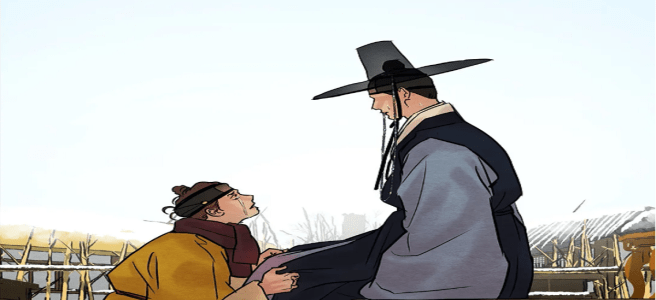
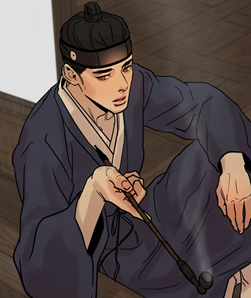 where Baek Na-Kyum approaches the lord asking for his forgiveness with the hope that the latter will be willing to return the poem from Jung In-Hun. Observe the parallels between the two scenes:

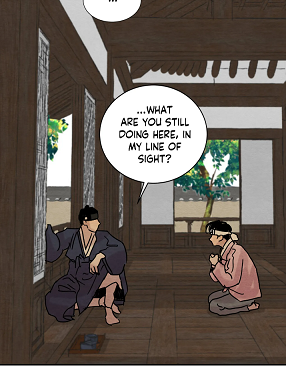
 And you know that there’s no coincidence in this manhwa. Blue is associated to care, trust, loyalty, and peace of mind.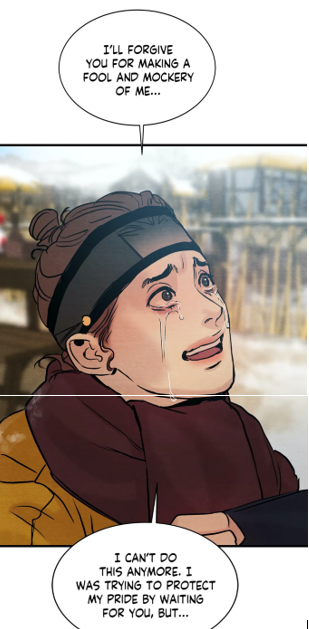


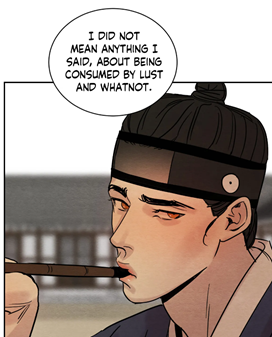
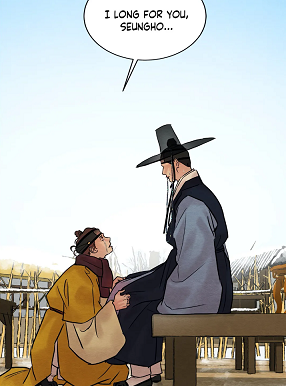 Then in the chapter 57, Jihwa is also on his knees, while the lord is sitting too as he can no longer stand due to his illness. Both beg the lord in the end.
 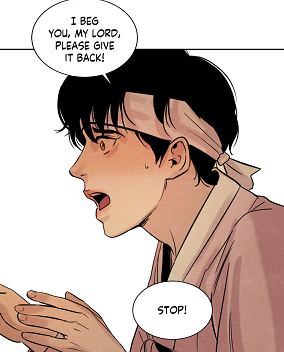 Striking is that everything is indeed related to love. The manhwaphiles should remember that the plagiarized poem deals with love. The scholar faked his affection for the painter with his poetry.
  , in the episode 57 the second lead plays now an active role because he is at the forefront. This time, he confesses. However, the real similarity is the following. Jihwa used the letter in order to get his friend’s attention.
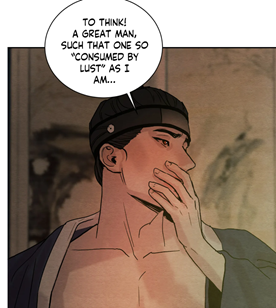 hence he is unable to focus on Jihwa who is sent away at the end.
  In other words, the ex-lover’s advances are jilted which really upsets the red-haired aristocrat. In the chapter 57, the manhwaphiles don’t witness the rejection personally, we hear about this through the butler’s testimony.
 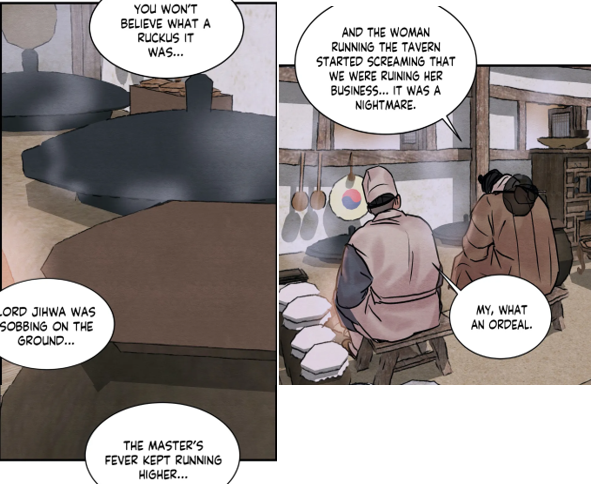 And this occurs again, when the aristocrat confesses to his friend. The latter’s mind is focused on the painter again.
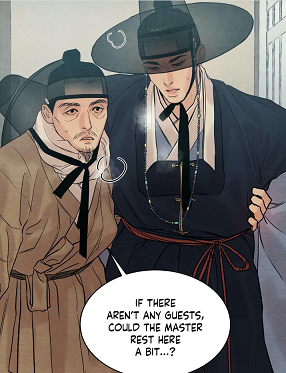
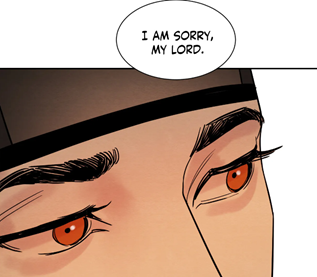 was just a lip service which the noble could sense. The irony in this scene is that while the low-born denies that he views the master as a man consumed by lust,
 , due to his busy sex life. And notice that in the chapter 5, he only repeats the part “consumed by lust” but the allusion to his education is reduced to “what not”. Therefore this leads me to the observation that Baek Na-Kyum’s lip service did cause a change of heart but not a change of mind!! For the first time, Yoon Seungho is confronted with his negative image by someone so honest and direct. This reveals that no one has an idea how literate he is. The day before, he was upset when he heard these words but he just dismissed it, thinking that the painter had no idea about his true personality. But the moment the painter refers to the incident, he is omitting the part about his intelligence and education. And this is important because the artist is the only one who gives a true reflection to the protagonist, while Jihwa is not complaining at all.
  Both were confronting the protagonist with his bad reflection, yet their intentions and approach were different. First, the painter never intended to hurt the noble with his lip service. Secondly, he somehow admitted his wrongdoing
  hence he expressed his apology. Striking is that he’s not blaming the counterpart. There are no reproach expressed here. His apology might be insincere, yet he admits to be in the wrong, whereas the red-haired noble is reprimanding his friend and never questioning his actions. That’s why he is the one forgiving and not apologizing. Now, you understand why he’s blaming his childhood friend. He had to hurt him because he had changed
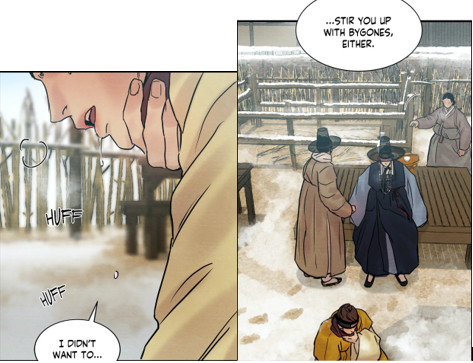
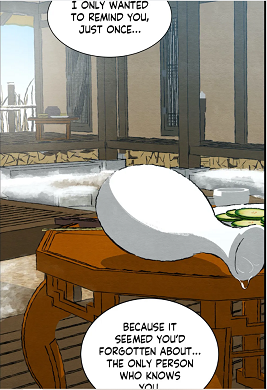
 The same question, yet there is no longer a physical gap between them.
  Now, the lord is even holding the painter’s hand, instead of holding the pipe. And observe that they talk to each other in this scene again. There’s another real conversation.
 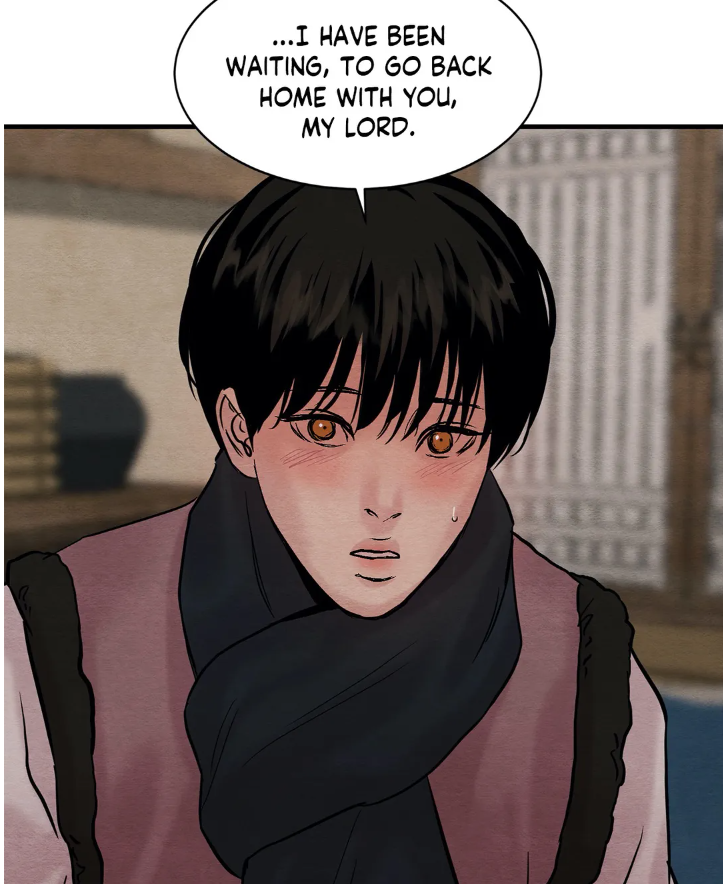 And this is the other reason why the protagonist could only fall in love with the artist. The latter was the only one talking to him, even when he hated him
 and he expressed his feelings
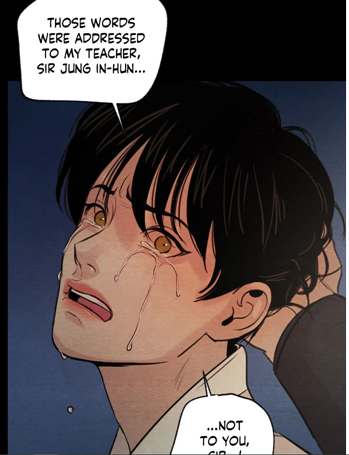 . He argued with him showing that he was noting his presence as a spirit, a mind and he wasn’t just a man obsessed with sex. Consequently, Jihwa could only fail as he never exchange his true thoughts and feelings. Even when they had sex
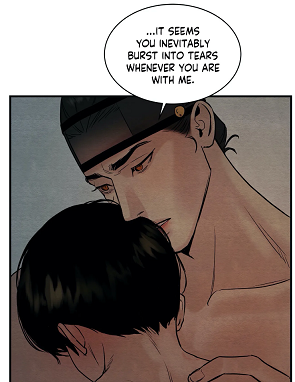 , they would talk to each other with a certain honesty. And this was not the case with Jihwa. Besides, by only having sex with him and not sharing his mind, he contributed to Seungho’s mental isolation and loneliness. Seungho was first attracted by the painter’s works, hence there was a mental connection between them before their first meeting. And from the moment they were together, they kept talking to each other, while it was never the case with Jihwa. He was not listening to his friend’s words, even when the latter warned him or reminded him that he didn’t know him that well.
 It was, as if his words meant nothing. This is not surprising that Yoon Seungho could only consider himself as a spirit using his body to get revenge on the double-faced nobles. This explains why the main lead can’t distinguish Jihwa from Min in the end. Both are treating him the same way. Both assume, they know him so well
 and can do anything to him, justifying their actions with this excuse. As a conclusion, this manhwa reveals that love can only work if there’s a real communication and attraction is not the main component.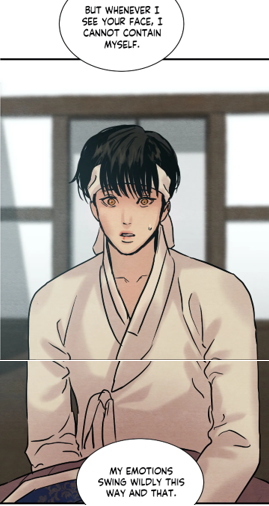
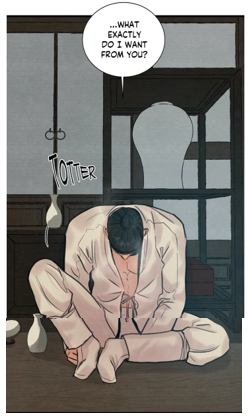 , while confessing as he recognized his bad actions. He had no hope and was actually expecting to get rejected. However, Jihwa looked at the friend’s face on his knees, searching his closeness in order to convey his feelings properly.
  But the low-born kept rejecting him which made the aristocrat suffer. Consequently the loved one had to suffer due to their “rejections”. And we have the same case here. Yoon Seungho became the real victim of Jihwa’s pranks.
 That’s why I can’t help myself connecting this love confession to the artist’s first’s in the chapter 20.
 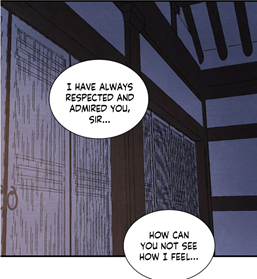 Notice that the painter is hoping that the low noble would see his affection and respect. Remember what I wrote about Jihwa’s doomed love with Yoon Seungho. He was deep down hoping the same, seeing admiration in his friend’s gaze but he could never get it as the former was too wounded. Therefore I come to the conclusion that Yoon Seungho is playing the same role than Jung In-Hun had with the painter. Let’s not forget that the scholar was also Baek Na-Kyum’s first love. Jihwa has been also longing that his feelings would been perceived by his childhood friend. Another analogy is that the red-haired master has a false perception of Yoon Seungho. He’s a man consumed by lust, but his love started in his childhood, hence the source of his affection comes from a certain idealization. Jihwa has the impression, he knows the friend the best because he knows his past.
 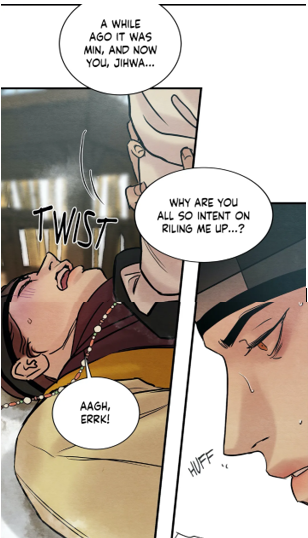 Notice that he puts Jihwa in the same category than Min, revealing that he is no different from all the nobles the main character meets. This could only upset Jihwa because he considered himself different from all the others as he was his childhood friend. I guess, the words forced Jihwa to show his friend that he was in no way similar to Min. This explains why he portrays himself in such a positive light. He excuses his action by saying that Yoon Seungho forced him that way. As a conclusion, Jihwa felt that he had to confess. Besides, he sensed that his friend was getting even further away from him.
 Here, the painter was using a lot the personal pronoun “I, me” and was telling his lover that he was finally willing to accept Yoon Seungho as lover but he would never give him his heart. Since Seungho was the one who had to lick and to kiss him in order to make the artist feel good, the painter was not hiding that he was using Yoon Seungho as a tool for his own enjoyment. The artist had put himself on a pedestal,
 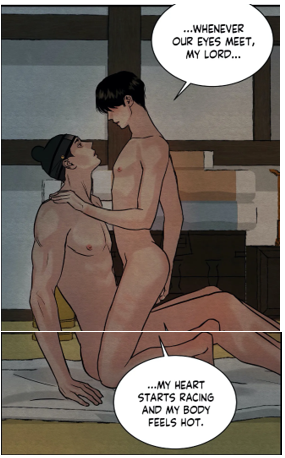 which was also reflected in his position. Notice that the noble had to look up. The powerful master should treasure him and their physical relationship. Since in that confession, he was admitting that he was using the lord, this signifies the artist didn’t pay attention to Yoon Seungho’s feelings and desires. Baek Na-Kyum was indeed inconsiderate, yet here he wasn’t even hiding his thoughts. He was once again brutally honest. There’s reason why I continue associating brutality with honesty. It’s because each time the painter was sincere, his words wounded the lord very much. For Yoon Seungho, each word must have felt like a stab in his heart, hence he was not happy at all, after hearing this confession. Remember that he wanted to get angry but was stopped by a tender kiss. Besides, I am not the only one who criticizes the painter for his selfishness. Even valet Kim reminded him in the chapter 52 that he was acting like a spoiled child.
 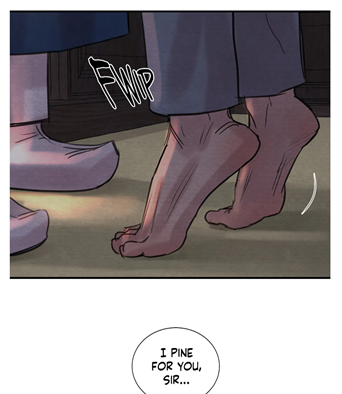 Back then, the low-born had put the scholar on a pedestal indeed. He had confessed that he pined on him and would respect him so much and as you can detect, Jihwa is actually saying the opposite. Yoon Seungho is far from being admirable that’s why the protagonist’s heart can never be moved.
  Hence this is the other cause for the failure of his confession. Jihwa could never obtain what he wanted, the admiration in Yoon Seungho’s eyes as the red-haired master never reflected real admiration in his eyes. As a conclusion, he couldn’t get past the image of a man obsessed with sex. How can Yoon Seungho love him back, if the noble judges him like all the others? In order to love someone, the main lead needed to perceive himself differently, as he already hated himself so much.
 He showed him an attractive man, worthy to be desired. Besides, he was indeed physically attracted to him. Sure, now he is not admiring the lord spiritually but once he accepts the noble, the latter will reveal his qualities which he could never reveal as he never felt loved. Baek Na-Kyum will discover a new side of Yoon Seungho: educated, intelligent and even patient. Jihwa says that he knows the reason for this reckless behavior, however I believe that Jihwa doesn’t grasp the whole dimension of the main lead’s suffering.
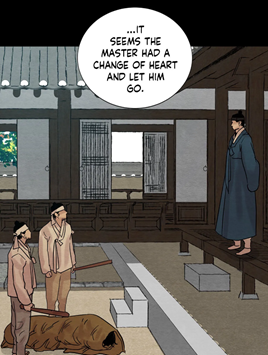 The lord came personally later and stood there, like he was on a podium, while the painter was lying on the ground. Just before, he had been rolled up in a mat. And observe, the scene at the tavern is really similar, although the perspective diverges. The lord kicked the friend so that the latter fell down.
 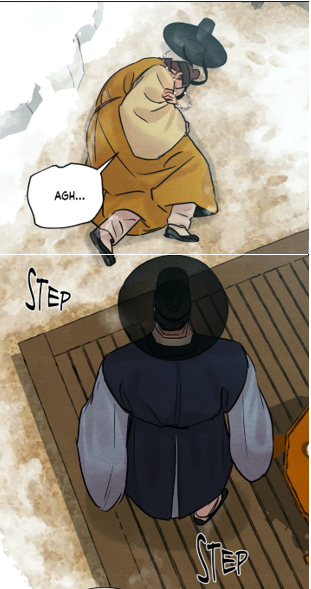 The main lead is standing, while the other is lying on the floor, hurt, exactly like the painter. Let’s not forget my theory that Jihwa is the noble version of the painter. But there are actually more parallels between these two incidents hence it is necessary that I outline all the similarities by listing all the elements contained in both incidents:
 , whereas we have a letter reminding the lord of his terrible past.
 Both are just pieces of paper, yet they have such an impact on the main lead. Both causes immense pain in the main character’s heart. In the first case, it was as if his identity had been erased. Let’s not forget that the protagonist perceived himself as a ghost but thanks to the erotic pictures, he could feel alive. And the moment the painter portrayed him, he saw a different reflection about himself, like I mentioned above. It could liberate him from his self-hatred, he saw that he was desirable. Simultaneously, the drawings were a proof that he was actually a man defeating his enemies, the double-faced and treacherous nobles, as a part of his “revenge”. As for the letter, it was a reminder of his terrible past. It’s clear that Lord Song is someone terrible based on Kim’s reaction. I have to admit that after giving some thoughts, I have come to the conclusion, the mysterious lord must be an older version of lord Min. But let’s get back to the comparison. Both pieces of paper caused a scene: a punishment. While Jihwa received a kick,
  the painter was condemned to the straw mat beating. One might say that the last punishment is worst as Baek Na-Kyum could have become handicapped or even worse, he could have lost his life. However, the kick in a public place for a noble is already a big humiliation. Not only he appears as a weak person but a kick is a treatment rather reserved to commoners. His reputation can only be affected (rumors). Let’s not forget the importance of honor for an aristocrat. Having a title is a synonym for respect and privileges, yet the boot on his arm gives the impression to the folks that Jihwa’s lacking of honor. It was as if he was a low-born despite his nice appearance.
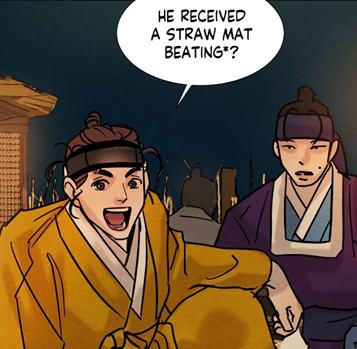 whereas in the chapter 57, he is there to drown his sorrow. This is no coincidence that it’s the same place.
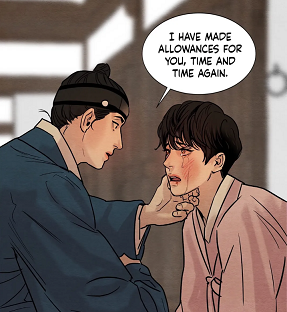 (chapter 12)
 Notice how the painter cries begging the lord for his leniency, whereas the red-haired noble weeps telling the lord that he will forgive him for his rude behavior.
 after his release.
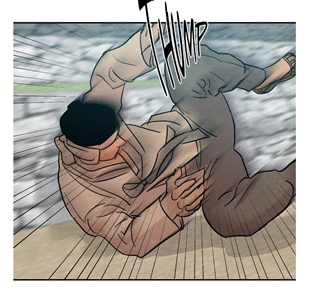 in the chapter 13 by pushing him very hard onto the floor hence we could say the kick Jihwa receives in the chapter 56 is the punishment for his gesture towards the servant and the foot on his throat is the sanction for the prank with the letter. Jihwa is indeed treated like a commoner. People might say that Jihwa is acting according to his status, as a noble is entitled to mistreat commoners. Nonetheless, my impression is that one of the main messages from this manhwa is that “prejudices” will only lead to suffering: karma. Baek Na-Kyum got sanctioned for rejecting and denying his own homosexuality, whereas one of Jihwa’s prejudice is about the commoners. This is not surprising that his suffering keeps increasing as he is never questioning this doctrine that low-borns are no real humans, not worthy of any respect. My readers are well aware that Baek Na-Kyum was living according to the scholar’s doctrines, therefore we have to imagine that Jihwa has also been living following the social norms of the nobility: commoners are low lives.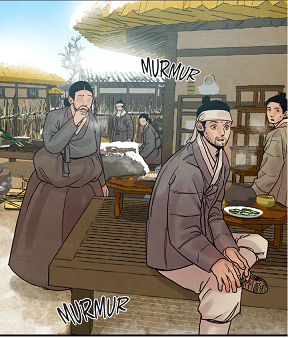
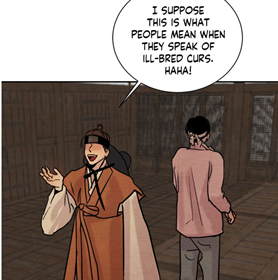 therefore he constantly gets disgraced in front of them (chapter 18, 36, 43, 57). This is his karma for defending such unjust norms. That might be the common norm for back then, but since Baek Na-Kyum has suffered because he defended doctrines condemning sodomy, it becomes clear that Jihwa’s role as a character has another purpose: the lack of respect for low-borns.
  But this one is less obvious because he loved his teacher, a low noble. Since I sense that Jihwa is very similar to the painter, then we have to conclude that Jihwa has two prejudices. The artist denied his homosexuality and he saw the nobles as nobles only good in appearance. That’s why I believe that Jihwa is more prejudiced towards commoners, yet he isn’t truly admitting his homosexuality. I am well aware that some might doubt this interpretation. First, the manhwalovers should remember that Baek Na-Kyum came to deny his sexual orientation due to the intervention of the low noble. So his natural homosexuality was repressed. Since Jihwa has been in love with Yoon Seungho, he’s also a natural homosexual. And it looks like Jihwa’s sexual orientation has also been repressed somehow. Remember that we have this:
 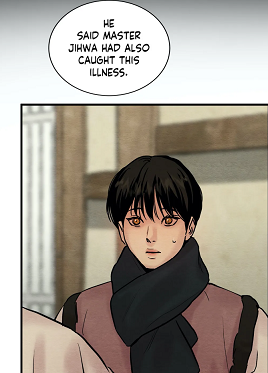 and it becomes obvious that Jihwa was separated from the protagonist. So he did suffer from getting separated from his first love. This would explain why he hid his true emotions behind his smiles and cheerful comments too and wasn’t honest any longer.
  The other evidences for this interpretation are the following:
 For me, here he is not admiring the hickeys as his words don’t express any admiration, sound more like a complaint. Besides his mouth is not smiling as the upper lip goes up. This is Jihwa smiling 10 minutes later, once he hears about his friend’s early visit.
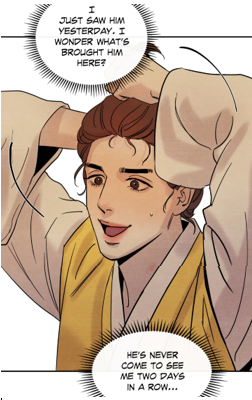 Observe, this time the lower lip is going down. Therefore I come to the conclusion that he is actually reproaching his friend for living marks on his body, a proof of his hidden homosexuality. Besides, if he was rejoicing, we should see the exclamation mark and not the suspension point. Another evidence of his not truly outlived homosexuality is the following: he hides the hickeys the moment the servant barges in his room.
  Yet, the moment he hears about the visit, he doesn’t pay attention that the hickeys are still visible. Then at the pavilion, he tries to suggest to move to his bedchamber.
  He is definitely trying to influence Yoon Seungho with this rhetorical question. He doesn’t want to be seen by his staff. But for me, the biggest clue that he is not truly admitting his sexual orientation is in the chapter 18:
  Notice that sodomy has a certain pejorative connotation. According to the nobility, homosexual intercourse is tolerated, yet the red-haired master insinuates with so deep that there’s a limit. Hence homosexuality with commoners is not allowed. For me, this limitation is actually an allusion that feelings between two men are not allowed, that’s why it’s not allowed to do it with commoners. Why? Because among nobles, they can hide their love behind business and exchange of favors and this is exactly what Jihwa did. This explains why Jihwa defended his honor that he had been using Yoon Seungho while being with him.
 He could legitimate his sodomy by saying that he had some favor to ask. Yet, this was just a cover and everyone was well aware that Jihwa was in love with the noble. So there’s a certain hypocrisy, which is quite similar to Baek Na-Kyum’s who accepted to work for the main lead for his scholar’s sake.
  The only difference is that Jihwa is in love with his childhood friend. Because he tried to hide his love for his childhood friend, we could say that he hasn’t truly admitted his own homosexuality.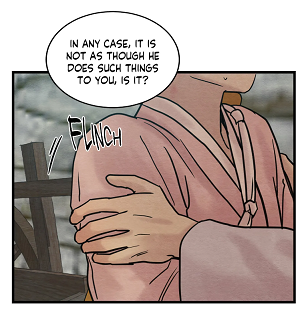
 We shouldn’t forget that at the pavilion, he admitted to have loved the scholar. And this is another reason why Jihwa could only fail with his attempt.
 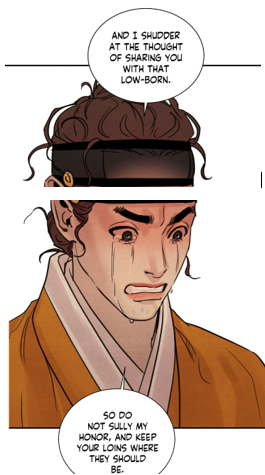 in order to save his face. Here, we can definitely perceive how much he values his reputation and honor. That’s why he couldn’t go to his friend and beg to take him back, after witnessing the love session between Seungho and the painter. Jihwa was well aware that he could no longer approach the friend, because this would mean, he would go back on his word. Hence he knew that he had to initiate something so that Yoon Seungho would come to see him. So the painful reminder was the only way to force the noble to encounter him. That’s why the noble laughed, when he saw his former friend. His trick had worked. Yet the moment, his friend put him together with Min, he could only get hurt. He was treated like all the others, while he saw himself as different, since he had feelings for him. Hence he tries to legitimate his action with the letter, he was trying to explain that he was only one who knew his dark past.
  Notice that he is blaming the main lead for ruining him, while his downfall is more related to his naivety and selfishness. So far, he has never questioned his own wrongdoings.
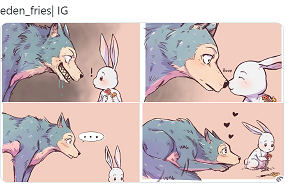 where the wolf symbolizing Yoon Seungho is tamed by Baek Na-Kyum, the innocent rabbit. When I saw this very cute story, it made me smile because it illustrates the taming of the main protagonist.
  quickly, like in the chapter 57. Let’s not forget how he yelled at Deok-Jae for his so-called prank.
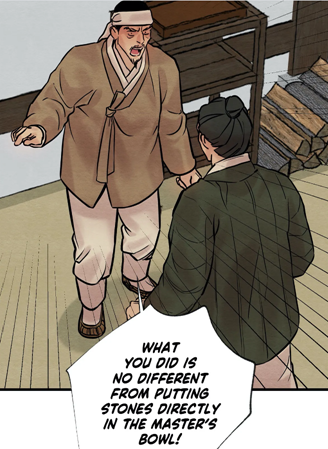 It was as if he was barking at the vicious domestic.
  The next morning, he is no longer wearing it. He gave his robe to the painter as cover.
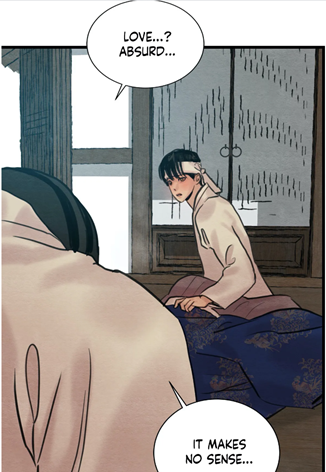 It definitely marks the moment of his “death” and announces his rebirth. It has not occurred yet, since he is still feverish but we should consider it as a part of his rebirth: he rises from the ashes. It becomes clear that the rebirth of a phoenix is related to fire and you all know the expressions “to burn a fever” or “to burn out a fever”. As you can observe, fever is indeed linked to fire. That’s why I came to the realization that Yoon Seungho is in reality a phoenix which would explain why father Yoon was so jealous of his son. How can a dragon exist next to a phoenix? Both are mystical animals, yet let me remind my readers that father Yoon has only the eyes of a dragon, he’s not a real dragon. Nonetheless, my association to a bird for Yoon Seungho was actually correct , it’s just the choice of the bird was wrong.
  However, my perception was that he was misjudging himself, he was just a gold pheasant.
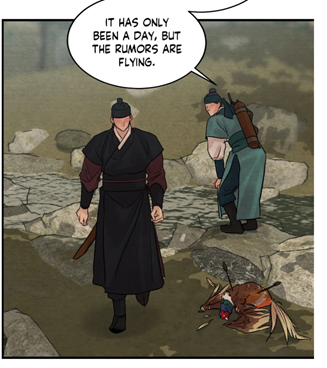 That’s why I feared for his life after reading the first season. Since the start of the new season, I had to review my prediction and now I believe that he will get terribly hurt. My thoughts were that he would either lose his title or get a scar… due to a big injury. I came to this belief after recognizing that this character is very similar to Baek Na-Kyum. Since the latter got raped in the first season, I am anticipating that the noble will suffer a lot as well. It will take him a while before he becomes a true crane and that’s only because of his fateful encounter with Nameless. But as Jihwa is the mirror of Baek Na-Kyum, this means that the painter is actually a crane too. And this is definitely no coincidence that in the chapter 45, Baek Na-Kyum is covered with a cloth where the pattern contains cranes.
  That’s why I came to the conclusion, Baek Na-Kyum is actually a crane but due to his social status, he was a lamb. I have to admit that in the manhwa “Serene Bird” which is very similar to “Painter Of The night”, the pure and innocent Yoo Chung is called a crane by the seme
 which can only reinforce my interpretation. Baek Na-Kyum is the one who will bring good fortune, freedom, honor, royalty, happiness, balance, grace, prestige and love to our protagonist Yoon Seungho.
 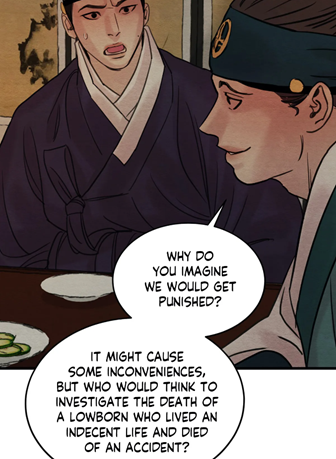 Yoon Seungho might have power but since this is a norm among nobles not to go after the nobles responsible for a commoner’s death, the protagonist can’t use officials in order to get justice. They might suffer some inconveniences but they won’t be punished harshly, like losing their title. However, this incident makes the main character realize that in order to protect his lover, he needs to elevate his social status.
 Imagine the humiliation for Jung In-Hun. He is indeed used by the powerful seme and has to confirm that Baek Na-Kyum is a noble in exchange for the sponsorship. We shouldn’t forget that the painter’s origins are unknown and the head gisaeng handed over the artist to the low noble, implying that the latter had become his official guardian.
 In other words, Jung In-Hun is forced to admit that the artist is a noble, even worse, he might be even related to him. The manhwalovers are well aware that no one knows about the painter’s origins, except the scholar. The servant who investigated the identity of the unknown creator has been killed.
  As for the women from the brothel, they would never reveal his true origins since they are well aware of the negative repercussions.
 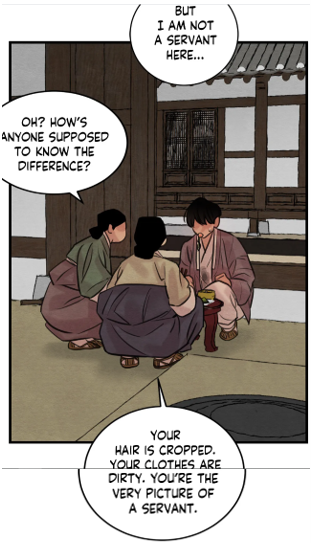 Secondly, the scholar arrived at the mansion shortly after the painter’s occurrence. Third, when his study was always next to the lord’s chamber and he was sleeping in a bed reserved for a master. Even the doctor got confused because the painter was dressed like a low-born but he was sleeping in a nice bed, when he examined him for the first time.
 The wolf has a very fearsome reputation, can be ruthless and brutal, just like Nameless. Simultaneously, a wolf can leave the pack for a while and act on his own.
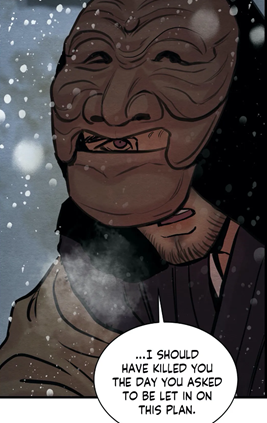 At the same time, a wolf is very loyal and protective which the criminal does, when it comes to Jihwa. A wolf can definitely be tamed too, yet it still keeps his dangerous aura.
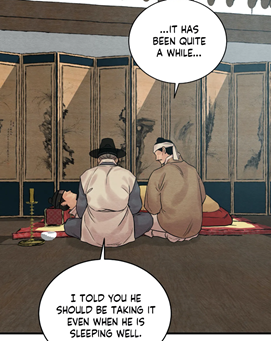
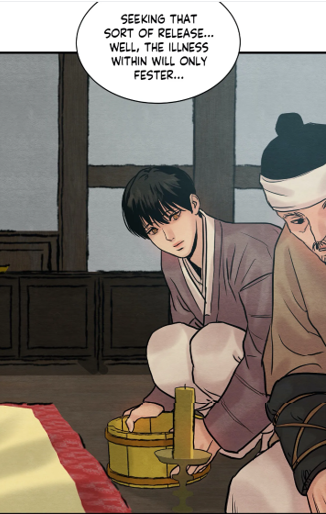 That’s the moment where there is a switch. From that moment, the yellow candle will represent the low-born. He has neither affection nor hope nor desire for Yoon Seungho right now. However, I believe that the doctor’s words must have surprised and affected him. For the first time, he discovers that the noble has been ill for quite some time and needs to take medicine regularly. Until now, he had always thought, the protagonist was just a strong and healthy man, especially after witnessing and experiencing so many sex sessions.
 In our opinion, this image announces the return of intimacy between the characters, the return of warmth and care contrasting to the coldness and brightness of the room in the morning, when the lord confessed to the painter.
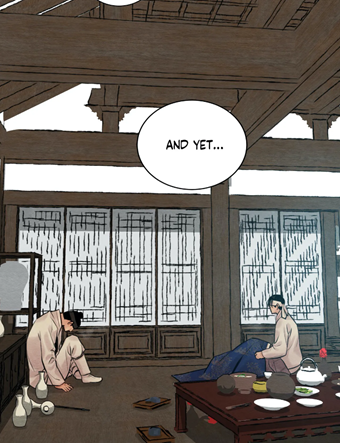 In that picture, there were two people facing each other, yet there was such a distance and loneliness exuding from this scene. With the nightfall, the atmosphere in the room changes. Let’s not forget that the rich protagonist is associated to the moon, hence he is more himself during that time.
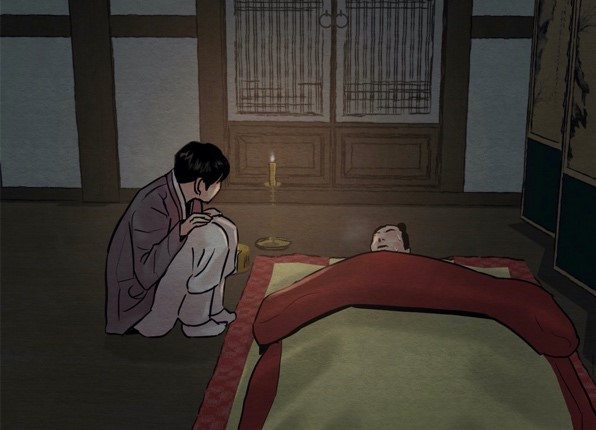 The burning bougie represents the painter. Remember that the switch occurred during the day. Sure, one might say that the burning candle is related to the night. Yet, let’s not forget that neither in the chapter 52, 53 and 54, the manhwalovers could see any candle. We shouldn’t forget that the position of the candle plays a huge role. Hence it is always important to consider the camera angle. Here, the candle stands between the painter and the aristocrat exposing a certain distance. Yet, the gap between them has considerably diminished compared to the morning’s. This displays the artist’s wish to get closer to the noble. But first there is a certain shyness and hesitation as his hands are on his knees.
  As you can see, in the second drawing the candle stands in front of Baek Na-Kyum’s legs proving our theory one more time, a candle embodies a person and reflect their emotions and thoughts. Therefore we believe that the burning candle displays the painter’s affection and care for the lord. Observe the divergence of the intensity of the light. The light is brighter compared to the one from the first panel. This displays the increasing care and warmth of the commoner for Yoon Seungho. Furthermore, it also reflects the artist’s desire to get closer to the noble that’s why the low-born’s feet are touching Yoon Seungho’s bed.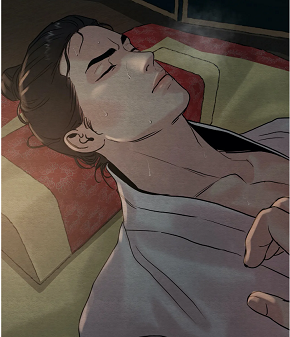
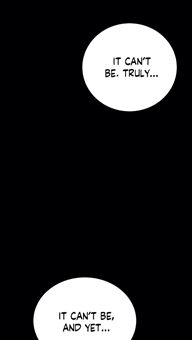
 Why, especially when the painter is not present? One might now argue that our theory is wrong, since the painter is not next to the lord and the candlestick is actually associated to him. However, the manhwalovers shouldn’t remember that in this chapter, the painter is actually dreaming about Yoon Seungho.
 So he is present through his thoughts. Furthermore, while talking about the letter and Song, Yoon Seungho can’t help himself asking about the whereabouts of Baek Na-Kyum.
 So the painter is also present in the noble’s mind. This mirrors their closeness, the night spent together brought them closer. The lord nodded to his question if he had feelings for him and his answer moved the painter’s heart hence he blushed.
  (chapter 35) where Yoon Seungho had blown out the candles and we had explained that this represented his despair and his resignation. So why are the white candles burning, especially if he had decided the day before to give up on the painter? For this explanation, we have two possible interpretations:
  The fact that the painter had reacted to his presence had such a positive effect on the main lead that he started smiling a little
  and couldn’t restrain himself from stroking the artist’s hair.
  With the low-born’s little reaction, it was enough for the lord to regain hope and attempt to get closer to him through the paintings.
  And we have a blushing Baek Na-Kyum in the chapter 55. The latter is so surprised and moved by the lord’s nodding that he can’t help himself reddening.
  That’s why we have to wonder if during that night, the lord heard the painter’s question and witnessed his lover’s reaction giving him hope that he had been accepted and forgiven. The lord might have closed eyes but this doesn’t mean that he wasn’t truly unconscious. Remember that he couldn’t face the painter’s gaze in the morning, hence he looked down but since he is lying in bed, it is impossible for him to avoid the artist’s gaze. So with closed eyes, he could face the painter without looking at him. He could detect the commoner’s reaction, as the latter cleaned his body, even stroked his face. The moment the lord’s head nods a little, observe that the painter’s gaze gets more intense and then removes his hand from the main lead’s face. So during that night, Yoon Seungho could have sensed the painter’s attitude (his care and his question) making him realize that his desire could still come true. This is just a theory based on the observation made that the second season is inspired by the events of the first season. So it is definitely possible that we might get a flashback of that night. Furthermore, this would also outline the effect of Baek Na-Kyum’s actions. During his recovery, Yoon Seungho sensed the artist’s warmth and care hence this gave him hope.
  or chapter 16
 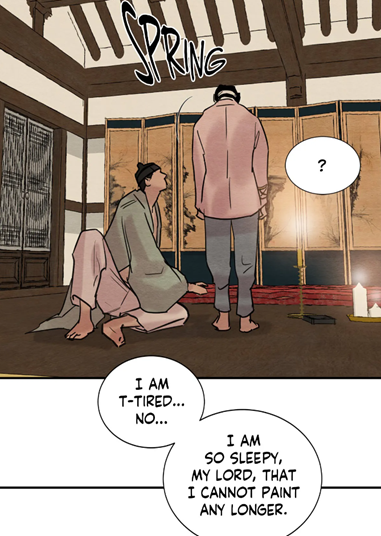 As you can observe, the yellow bougie on the candlestick symbolizes the lord, while the white ones embody the painter.
  But later, it has changed. The one on the candlestick symbolizes the painter, and the white ones the lord. The switch occurred in the chapter 32.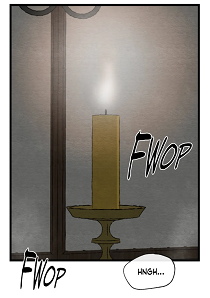
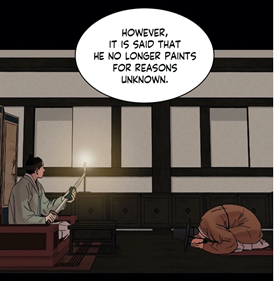 Since Yoon Seungho is right next to the candle it represents his conscious. It indicates that all his thoughts are focused on Baek Na-Kyum. In this case, the fire of the candle symbolizes his desire and hope to meet the painter soon, since the young master has been really curious about his hidden identity. Furthermore, it also announces the role played by the artist in the future. The commoner is the “light in the lord’s dark life”. In other words, the moment the lord encounters Baek Na-Kyum, a honest and pure person, his life changes forever. However, observe that there is only one candle illustrating that the affection hasn’t grown that much yet. Moreover, the candlestick stands quite far away from the lord, which seems to indicate that the lord is controlling his emotions and thoughts. Finally, the candle is on a chandelier mirroring the frozen state of our main lead. He hasn’t been living like a man, rather like a ghost as he was most active during the night.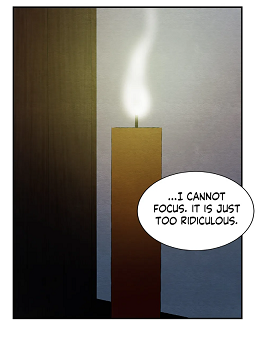
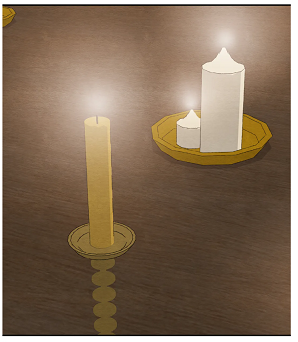
 Why do the bougies have different colors? In my opinion, they mirror the protagonists’ purity. Yellow is linked to selfishness and white to innocence and selflessness. The lord is definitely attracted to the painter but his affection is more linked to sensuality and sexuality than real and deep love. He’s definitely selfish as he doesn’t pay attention to the artist’s emotions and state of mind. On the other hand, the two candles for the painter symbolize the innocence of his soul but simultaneously, his increasing and strong libido. On the one hand, he paints for the main lead as he has been forced to for his teacher’s sake. So his exposure to sex is not voluntary. Let’s not forget that during this sex session, he gets so aroused that he can barely control his libido. While he’s painting, he imagines himself replacing the two ukes. At the end, his urges are so strong that he leaves the chamber in a hurry in order to masturbate. Striking is that in the second picture, the candle burns differently compared to the one in the chapter 5. The light has not only increased but also the warmth as well reflecting Yoon Seungho’s growing attraction for the commoner. As you can observe, the candles illustrate the noble’s increasing desires. Not only he thinks more and more about Baek Na-Kyum but also he wants to touch him. Since there is warmth, this means that his feelings are much deeper as well.
  there is no fire. Does it signify that there’s no love or no desire? No, but the lack of light reinforces the idea that this event is like an illusion, a dream. However, what caught my attention is that during that night, the moon is shining very brightly so that we could say that the lord’s wishes are reflected by the moonlight.
 It was as if his wishes had been answered. He has found someone who would admire him. As for the painter, he expresses his admiration for his teacher and not for the main character hence there can be no candle with a light. Moreover, deep down he is also longing for sensuality so he is not entirely honest here either. He knows that this should remain a dream because his doctrine makes it impossible to have sex with another man. The lack of light is a signal that this event is an illusion.
  With this kiss, he is gentle and tender, he wants to take care of the artist but it is already too late as the commoner is seriously ill. From that moment, we no longer see the candlestick associated to the rich protagonist. He has learnt his lesson, he needs to be more caring and pay attention to the painter’s feelings. That’s why we have the following picture in the chapter 35.
 when they have sex, the room is totally dark and there’s no candle. This symbolizes the painter’s loss of hope and love. That’s the moment his heart gets frozen hence there can be no fire. Their sex session is full of sadness and the lord’s attempt to warm up the painter with his embrace and passionate kiss can not stop the transformation.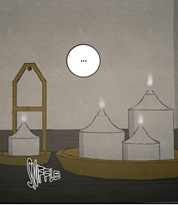
 On the first panel, there’s one candle separated from the other 3. From our perspective, these candles represent the noble as they are seen parallel to his head in the next picture. He’s not entirely himself. Let’s not forget that until that night, he still saw himself as a spirit. Therefore the lord’s transformation is not completed. He’s not been reunited with his heart. His mind is so focused on the painter that he has not realized that his heart was the real trigger. Since the candles are burning, it illustrates the love and affection the main lead is oozing. Striking is that the noble is conscious of his own actions, as his words reflect his intention and care. The increasing number of candles reflect the depth and power of his love. Yet, since they are closer to his head, it is now more understandable why the master has not realized his feelings for the painter. His mind was under the influence of his unconscious as his thoughts kept evolving around his lover. And since he was just a spirit, he couldn’t sense his heart beating for the low-born. As the fire symbolizes “warmth”, the bigger the fire is, the stronger the desires and the affections are. Therefore, it leads to the conclusion that those candles represent not only Seungho but the strong love coming from him. Therefore it is not astonishing that the aristocrat is the one hugging the painter and even caressing his back. Simultaneously, the former is longing for affection as well, he is hoping to have his desires fulfilled. He wants to be seen and admired, to be embraced and loved for his spirituality. We shouldn’t forget that he has been waiting for that moment for a long time.
  Even the painter can sense the warmth exuded from his lover, yet since the former had a bad experience with his first “love”, the scholar Jung In-Hun, he is rejecting the noble’s affection thinking that this is not real warmth.
  observe how the room gets darker. As the light vanishes slowly, Yoon Seungho’s hope for love and admiration disappears as well. And this is no coincidence that when he has this realization, to accept his body to take the lead, the room is quite dark. He has lowered his expectations and he has the impression, he is slowly losing the fight.
 We shouldn’t forget that transparency is related to reflection. Glass and water are transparent but also possess reflective features. This is no coincidence that eyes are quite similar to glass and water (tears). Strictly speaking, the painter’s eyes and face were so transparent that the lord could see the artist’s pure soul. At the same time, they were able to mirror admiration. In other words, the painter’s gaze reflected innocence and adoration, something the lord had been longing. That’s why the aristocrat could only become more and more attracted to the painter. In two occasions before their wedding night, he saw in the painter’s face love and admiration, in the chapter 4, where the painter cries
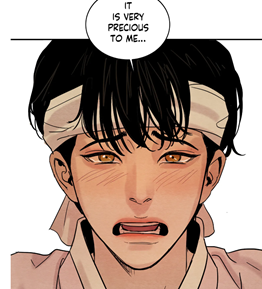 for the scholar’s poem and accuses Seungho of being a man consumed by lust and in the chapter 7, when Jung In-Hun arrives at the mansion. From my perspective, the low-born’s words, facial expressions and eyes made Yoon Seungho realize that the admiration and love he was seeking truly existed and was even possible. And he wished to be the recipient of that admiration.
 [I would like to thanks @masteryoonsimp and @shin_chan332 for their help to gather these] you’ll notice one common denominator. Yoon Seungho gazes at Baek Na-Kyum every time. For me, it truly shows the noble’s thinking. He has to see the painter’s gaze in order to seek approval and love, through the reflection of his eyes, he feels alive and loved. Without the painter’s eyes, he would remain a spirit with a terrible image of himself. It helps him to accept himself and since his eyes are always directed at the low-born, he will make sure that the painter feels secure and happy. As a conclusion, the lord’s leitmotiv is: “I see love and acceptance in the painter’s eyes, hence I am a man worthy of affection and adoration. I am neither a man consumed by lust nor a spirit”.
 It was as if he had soiled the man. No wonder why the lord got shocked and pained after seeing this gaze. He felt so guilty and since he has such a self-hatred, he could only blame himself for this terrible situation. Therefore he had already imagined the artist’s reaction. He would hear the same words than in the bathroom.
  ). He visits his friend without making an appointment and buys a spy in order to observe the lord’s moves. Finally he plays tricks in order to get rid of a possible rival. So he is very different from Baek Na-Kyum embodying spirituality, honesty and abnegation. And since he keeps looking at his own reflection, I come to the conclusion that he was actually waiting to see admiration in the lord’s gaze. The moment Jihwa would have sensed that adoration was reflected in Seungho’s eyes, the red-haired aristocrat would have become more honest and expressed his love for his friend. As you can observe, it was impossible right from the start as the lord’s low self-esteem and even self-hatred could never give such a reflection. The protagonist was looking exactly for the same admiration. Since Jihwa was scared to unveil his feelings, his gaze and facial expressions were never genuine. That’s why for example, in the chapter 12, behind his smiles,
 he was actually upset to see how the incident with the ruined painting hadn’t ruined the relationship between his friend and the low-born. He tried to influence his friend by disgracing the painter but the main lead was no fool. He could perceive the intentions behind his words. Therefore the lord could never fall in love with his friend. The latter was never honest, hence his face was in reality a mask of deception.
  and not to turn into a stone. To summarize, our main lead is a person with huge psychological issues and the gaze plays a huge role in his life. It helped him to survive but at the same time, it was a curse as well because he never saw any positive reflection in people’s eyes. And deep down, Jihwa’s conscious has always known that his friend’s eyes were the mirror of his soul therefore in his nightmare, he sees his friend’s gaze empty of any expression.
 He knows that if the painter is killed, the lord will lose his will to live. He will turn into a spirit for real. Deep down, Jihwa has always sensed it but ignored it because his desire to be admired was stronger than to give admiration and affection to his friend.
  even if the words and gaze were not what he wanted. At least, he was perceived as a person, while the others only interacted with the master of deception, who was a spirit in reality. Besides, Baek Na-Kyum who has already experienced abandonment and rejection can understand the noble’s fear better. Besides, the painter possesses another quality. Let’s not forget that Jung In-Hun has pushed the painter 3 times and the latter never gave up on his affection. It chnaged, the moment the low noble showed his true thoughts. The painter saw a very negative image about himself. So he has been put through something similar.
 As you can sense, I desire to understand the powerful protagonist as he represents the biggest puzzle and attraction in this manhwa. That’s why I keep making so many theories. Some of them came true, others didn’t and others are still not confirmed (drug-facilitated gangrape and Yoon Seungho wasn’t a homosexual right from the start).
  in the chapter 54 as a new version of the sex marathon
  because if it had really happened, the artist would have been forced to satisfy 4 aristocrats: Seungho, Min and the two others and it would have become a sex marathon in the end. I could even add the kiss in the chapter 50
  is a new repetition of the kiss in the chapter 33
  as the painter is not awake. Back then, he did it in order to have the painter drunk some water, in the second season, he just feels the desire to be tender, show his affection. He is no longer pressured, he is just following his heart. I could keep comparing like that but since the main goal of this essay is to elaborate my conjectures, I would like to stop here. However, this explication is important as it was the reason why I came up with the ideas.
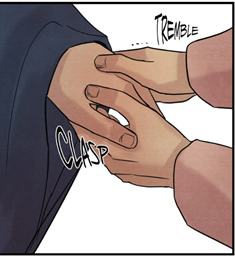 , in the chapter 53 the artist embraces the lord entirely.
 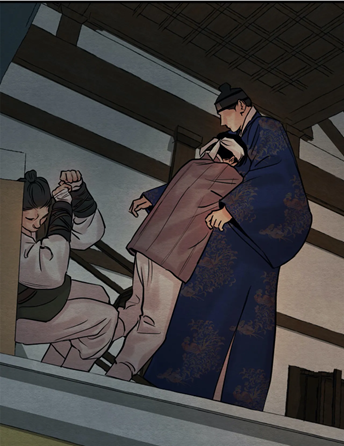 The painter is not hesitating unlike in the past. He is strong-willed with his hug, however the hands are trembling too.
 as a new version of the scholar’s kiss.
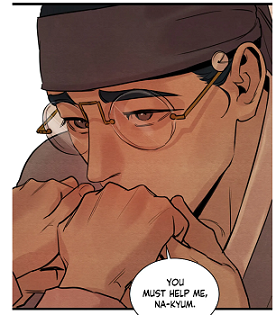 But since Min has no problem to have sex with men, he doesn’t feel any shame to kiss the painter’s lips. Since Min is called Black Heart, it confirms my conclusion that love is in the center of the second season, since the heart is the symbol for love.
 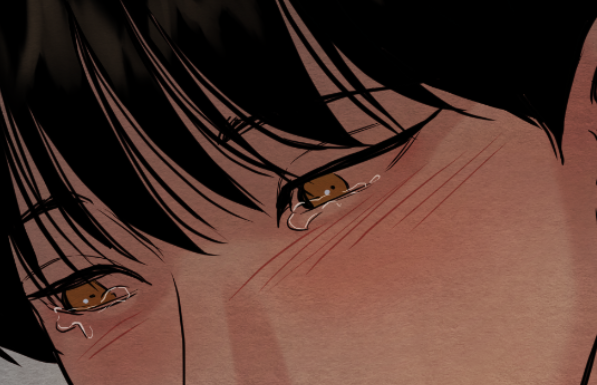 Observe that she didn’t show the mouth or the cheek, which would have been a clue that the painter had been hurt and now we would be able to place the picture in the evolution of the story.
 And my idea is that after these incidents, the painter decides to take his responsibility for the lord (a new version of the chapter 40).
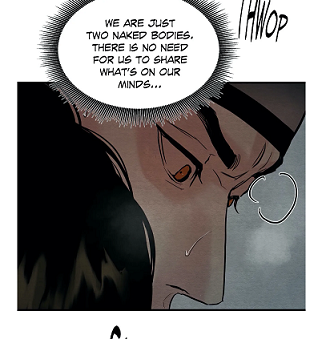 was in reality sharing their hearts and opening up. But in order to realize this, Yoon Seungho and Baek Na-Kyum will have to face danger. Yoon Seungho has to get aware that due to their relationship, the painter has become a target. So far, the lord has been more concerned with the artist’s health hence he has not anticipated that someone might decide to harm his loved one. That’s why I believe that the painter could get really injured. And in my opinion, the same could occur to the powerful aristocrat as well. So far, he was physically strong, yet he is not a god. In other words, he is not invincible and the chapter 54 proved it. The main character was hurt emotionally
 and mentally
  during that night. I consider this chapter as very important because it shows the lord’s vulnerability at its best. I know, some of my readers have already anticipated that Yoon Seungho would get hurt by protecting his lover and based on my observations, it could indeed become true. Or he becomes literally devastated, when he loses his valet Kim hence the painter will witness his vulnerability. Besides, Byeonduck has the tendency to use pain as a way for the characters to grow mentally and emotionally. Let’s not forget that the rejection of the scholar’s doctrine was a very painful process, therefore I am already envisioning more heartache in the future. The fear of losing the loved one will hit them hard, only then they will realize their true feelings for each other. Both will feel the same pain, when the other is physically or mentally hurt. That’s how they will realize that there is more between them than just sex.
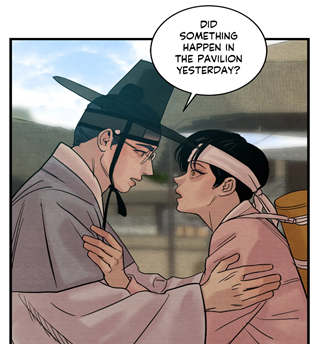 I couldn’t help myself associating the painter’s departure with the scholar. Let’s not forget that in the chapter 29, the low noble convinces the commoner to return to the mansion as the former needs him so that he can still be sponsored by the lord. Besides the vicious man hopes that the low-born can discover secrets about Yoon Seungho. With “second desertion” and “Jung In-Hun”, I had this idea. What if the painter decides to leave the mansion due to the return of the scholar? We shouldn’t forget that now the teacher is aware of the lord’s feelings for the painter and he has already decided to use this info for his benefit.
  He plans to use the painter again and this time, he won’t hide his true thoughts. Since in his eyes, Baek Na-Kyum is a prostitute, he will ask the painter, that the latter should behave like one and serve him. While in the chapter 40, the low noble rejected the painter and refused to take his responsibility for him, I imagine that the scholar will do the exact opposite in the second season. He will ask the painter to take responsibility for him and spy on the lord. Because the painter refuses to betray Yoon Seungho, he has become attached to him, he prefers leaving the mansion so that he is no longer forced to act against him. Let’s not forget that in the first season, Baek Na-Kyum decided to lie to the scholar and protected Yoon Seungho. With this idea, we would have a new version of the chapter 38, 40 and 44. This time, the artist is escaping because he thinks that’s the best way to help Yoon Seungho. And just after his desertion, the second assassination or kidnap takes place. On the other hand, once the flee is discovered, unlike in the past, Yoon Seungho doesn’t beat his servants but instead run after his loved one which would contrast to his passivity in the chapter 44. Once he catches the painter, he has to fight against Min. This is where I imagine that the lord gets hurt or the valet. So what do you think about this theory of Jung In-hun being the cause for the second escape? First, this would mean that with this action, the scholar ruins all his chances with Yoon Seungho so that the teacher can only seek support elsewhere and ends up meeting father Yoon. Because of these terrible experiences, both main leads would be able to see beyond their intimacy and sense their spiritual attachment. On the other hand, I have to admit that for me, the lord was already spiritually attracted by the painter through the paintings and once he met him for the first time, his heart started racing. He became physically attracted by him hence he grabbed his hands and let him touch his loins.
 This gesture indicates that his body was already reacting to the painter’s presence, yet the lord never realized it.
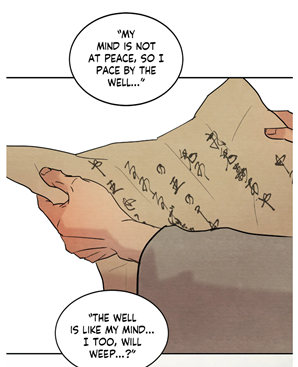 , yet I believe that the painter will only discover it at the end. We should remember that the poem started the whole drama. Without this miserable copy, the main lead would have never invited the low born to his mansion and decided to sponsor him. Then the artist would realize what the separation truly meant at the beginning of the second season.
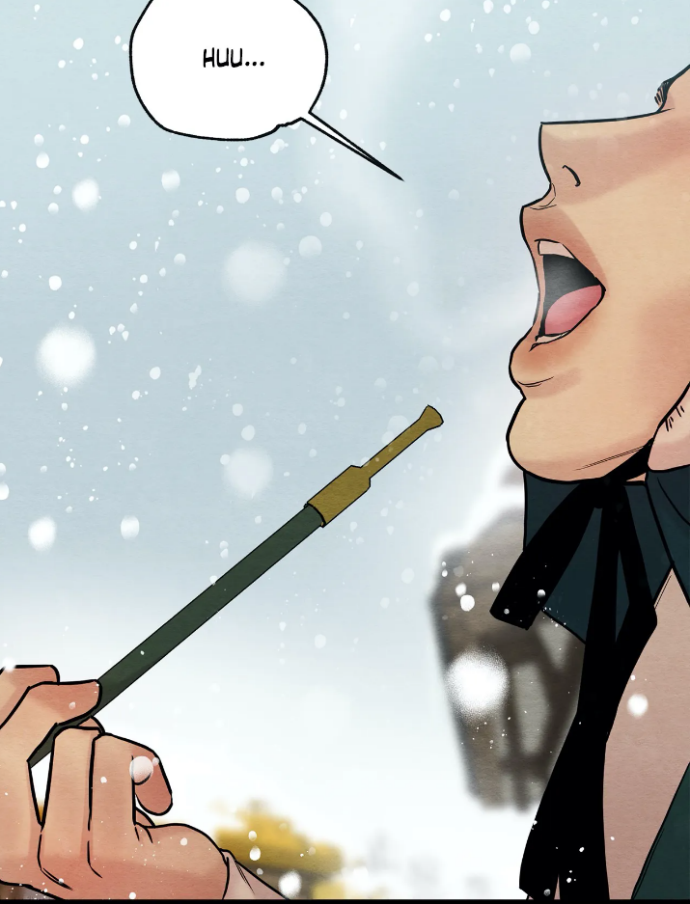
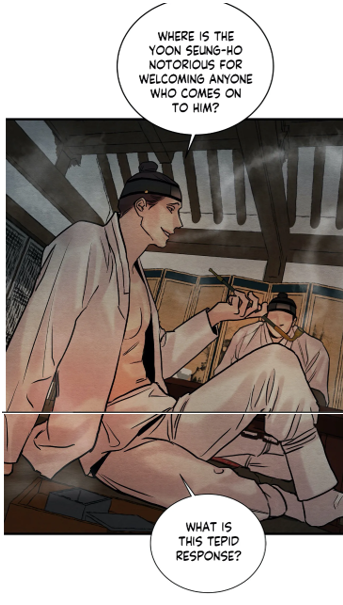
 The smoke of opium in the first drawing reminds us of the poisonous words Min voices in that chamber. Observe that during the scene in Yoon Seungho’s chamber, he keeps talking all the time. He is not even waiting for Yoon Seungho’s answer. There is a reason to this. His words resemble the arrows he used during the hunt.
 Because of the connection with the chapter 41, I have the feeling that Min considers the main lead as an easy target, for he views him as a pheasant. In an earlier analysis, I had imagined, the pheasant was Jihwa. And this interpretation was confirmed with the chapter 43
  and 67
 In both episodes, he used his words to poison the second lead’s heart and mind, so that the latter would suffer so much. Remember after each suggestion, the noble felt so tormented: chapter 51
  and chapter 76
  . He is so plagued by his existential fear and remorse that he feels like dying. But as you can imagine, due to my previous analyses and the evolution of the story, I would like to add another signification. From my perspective, we should consider Baek Na-Kyum as the pheasant too, for both ukes are mirroring each other. By living next to Yoon Seungho, the painter was slowly metamorphosing. Therefore I come to the conclusion that Baek Na-Kyum was indeed the deer in the first hunt. The scholar’s words were represented by the arrowheads and the lord’s sword symbolized his phallus.
  In other words, the first hunt announced the rape and the painter’s loss of innocence in episode 25 and the lord’s abandonment in chapter 40.
 As you can observe, the chronology of the hunt was not respected. But this interpretation allows us to be able to predict the future season and Black Heart’s personality. Since the two main leads are going through a metamorphosis, it signifies that this phenomenon will occur to Jihwa and Min as well. Since Min believes that the main lead is an easy prey, this signifies that he considers the host as a pheasant too. Moreover, I think that the vicious noble has the impression that he is similar to Yoon Seungho, that’s why he can understand him so well. Therefore he views himself as a pheasant, but in this battle for the painter, he attacks his rival with his beak, similar to the arrow points, unaware of the main lead’s true nature. The latter is a phoenix, based on different essays. This mystical bird embodies fire and passion – the flames of true inspiration. Moreover, it brings good luck, harmony, peace, balance, and prosperity. This signifies that by defying the phoenix, Min’s fate is doomed. His fight against him will bring only misfortune and destruction. Hence Heena’s words
  (chapter 68) seem to be true: Yoon Seungho will ruin misery to his adversaries. But in chapter 52, the noble had not gone through his spiritual death. That’s why the Joker had the upper hand in episode 52 and could hurt the main lead’s heart. As you can observe, I felt this chapter was announcing Min’s chronicle of a death foretold. And this perception was confirmed with chapter 76. His addiction to opium is already destroying The Joker, therefore he vomits and he loses his temper in front of Nameless.
  Observe the contrast with chapter 52, where the vicious noble controlled the situation and cornered Yoon Seungho. Black Heart was calm and vicious, he had the upper hand, whereas the opposite happened in chapter 76. But let’s return our attention to chapter 52. Yoon Seungho was put under pressure, thus the latter avoided Min’s gaze and remained silent, until the main lead gave in:
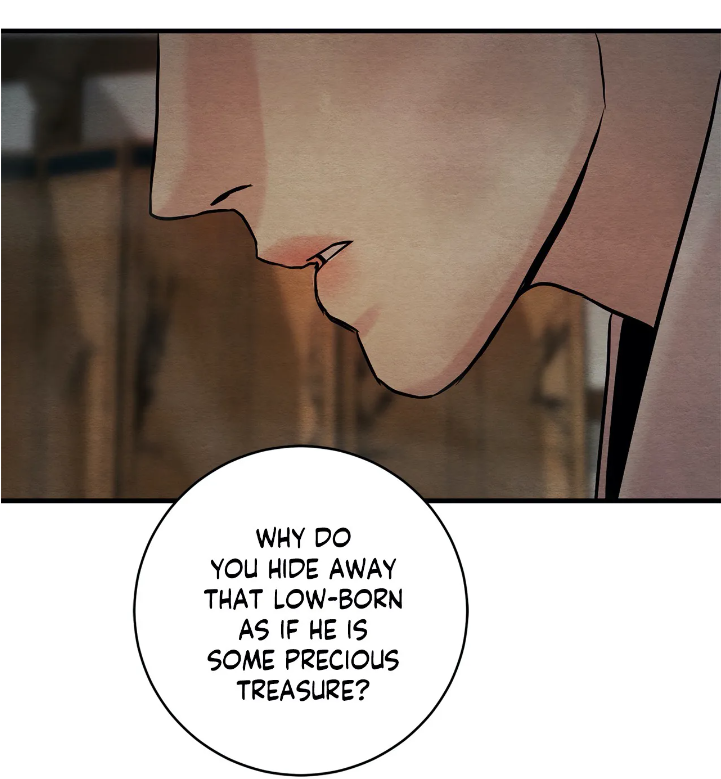
 (chapter 56), he wasn’t able to copy him entirely. This was a poor imitation. In other words, the Joker is short-sighted. He was able to defeat the protagonist in chapter 52, yet the one who definitely put the final blow to Yoon Seungho was not Black Heart, but the painter. His words in chapter 54 definitely wounded Yoon Seungho’s heart:
 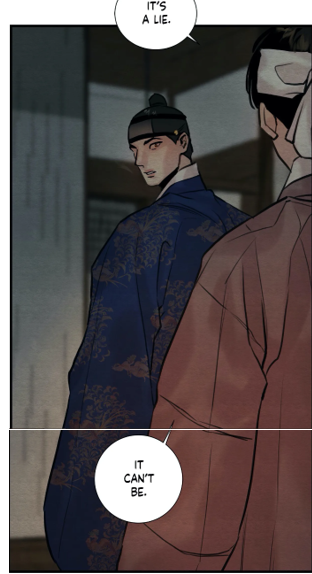 (chapter 54). That’s why we could say that chapter 54 was a new version of the rape scene. Yet Min was not able to achieve his goal, for the main lead was confronted with his own reflection and his traumatic past:
  with his words in order to undermine his judgement and as such destroy him.
 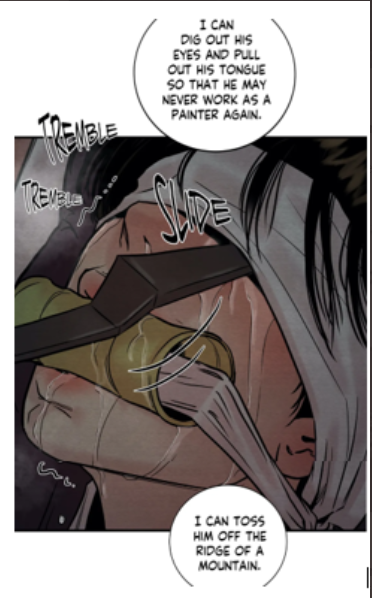 (chapter 60), therefore I deduce that Nameless will become Yoon Seungho’s hands. The final episode already exposed the animosity between Black Heart and Nameless. Besides, the latter had to threaten the commoner:
 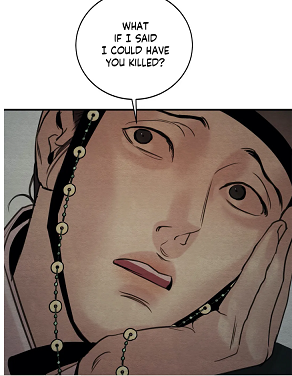 (chapter 60). But in order to get rid of Min, Nameless will have to get the support from Yoon Seungho. In other words, the latter could be the one giving the execution order. I would like the readers to keep in mind the protagonist’s words from chapter 11:
 . And the criminal behaved exactly like in chapter 54. He killed Deok-Jae and no one dared to suspect him.
 (chapter 54) That’s why I am expecting a new version of this scene in the third season, and in my opinion The Joker will be the victim… let’s not forget that in Yoon Seungho’s words (chapter 11), the scholar’s life was threatened. This means, a noble will be targeted in the future. As a conclusion, I am predicting Black Heart’s slow destruction and final death. But he doesn’t turn into a beautiful bird like Yoon Seungho (phoenix) or Baek Na-Kyum (from a deer, he metamorphosed into a pheasant before becoming a crane!). Min has already transformed into a crow, consequently he wears a black hanbok in the final chapter 76!

 This is important, as it contrasts to Min’s gesture. The lord decided to look up, because he was wounded. He acted, as if he chose to ignore Min’s attacks. This stare at the ceiling was not connected to fun, rather to faked indifference and pain. His heart was wounded and he was trying to hide his vulnerability. At the same time, I also believe that he was also pondering, wondering why the artist came to visit him, although he had never asked for him. From my point of view, Black Heart’s poisonous words created a certain insecurity in him. Let’s not forget that in that scene, Min was describing the artist as a man consumed by lust. Besides, his butler had revealed to him that Baek Na-Kyum had become so easy, as he was now viewing himself as a prostitute. In other words, Yoon Seungho felt insecure and doubted the artist’s innocence. The position of his head symbolized the opposite, deep thinking, while it represented Black Heart’s carelessness and confidence, contrasting to Yoon Seungho’s doubts and mistrust. Min was not noticing his surrounding, as he was too focused on his own pleasure, while Yoon Seungho was looking up on purpose. The host was actually attempting to avoid Min’s arrows hurting him. Min was criticizing the main lead, insinuating that he was a killjoy. If he hadn’t sent away the boy, they could have fun.
 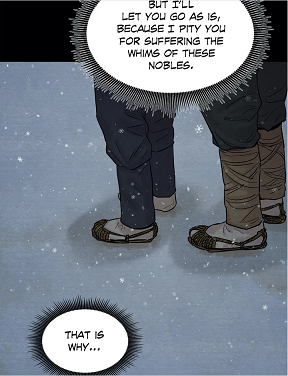 (chapter 66). the nobles would always fight against each other. This explicates why Black Heart had the upper hand in chapter 52 and why the main lead remained passive and silent for a while. He was applying what he had been taught: hide any weakness…. yet in this scene, the lord was definitely in pain. Then the author zoomed on the lord’s mouth, like she often does.
  The reality is that Baek Na-Kyum was already his precious treasure, but he was in denial. He was behaving like the painter in the end. While the latter was raised to deny his sexuality, the aristocrat was taught to deny any affection, a symbol for exposure. He could lose a war. Hence he couldn’t treat the painter like that, since he was a low-born, according to Min. That’s why Black Heart used the idiom “as if”. The arrogant aristocrat was actually reminding his host that he was a noble, he had to maintain dignity. The low-born could only be a toy for fun and nothing more. By having sex with the low-born, he reminded Yoon Seungho of his position and the social norms. Notice how The Joker used social norms to achieve his goal. His true purpose was to taste the painter and Yoon Seungho was able to see through him.
 In other words, the protagonist had the impression that he got the upper hand in the end. Black Heart had revealed his own “desire” and as such “exposure”. By giving in, Yoon Seungho was deceiving himself. His mind was telling him that he had found the perfect tool to control Min, while in reality he was playing into Black Heart’s hands. And now, you can understand why Yoon Seungho was infuriated, although he was smiling.
  His fury was already palpable, the moment he stood up so suddenly and opened the door violently, although we didn’t see his body.
  He was definitely telling himself that he was just a ghost and had no heart.


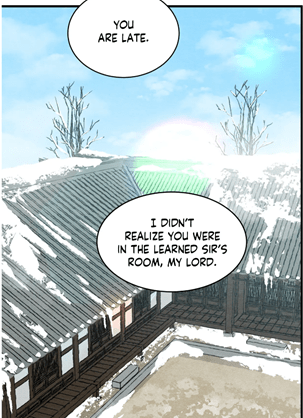


 and at some point, they stopped for a moment, only to do it again for a while
 . The hug in the chapter 32 contrasts so much to the hug in the chapter 49. In the former, they weren’t facing each other indicating the gap between them. In the latest episode, the noble is truly comforting the painter, he wants him to rely on him, to trust him, whereas in the past, the noble was determined to have the painter recognized his own sexual orientation.
 In the latest chapter, he sensed it right away.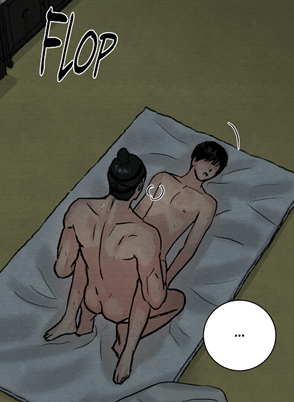
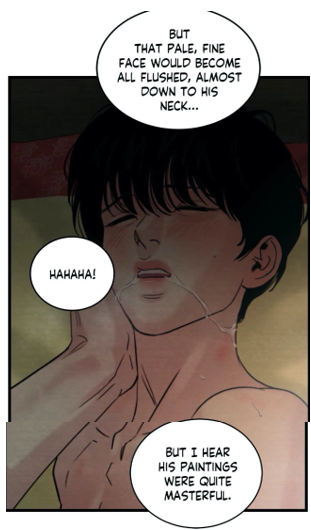
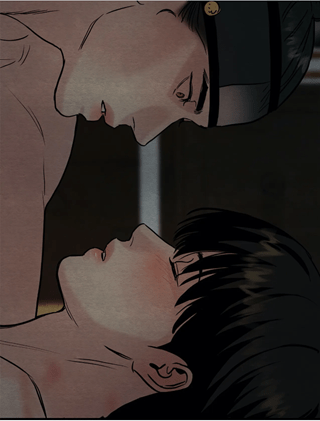
 He felt the noble’s presence due to the tight hug. He wasn’t able to repose at all. He could only doze after witnessing, how vulnerable the noble was. He realized that the aristocrat needed him for real and there was no danger coming from him. (chapter 37/38) Notice in the chapter 50 that he fell asleep while fully embraced,
  (“let my body take the lead”) has come true. His body is already telling him that he can trust the noble, while his mind still fears to depend on him. His heart and mind have been scarred due to Jung In-Hun’s hypocrisy therefore the commoner is consciously convincing himself that he should keep a certain distance from his sex partner. Yet his soul is doing the opposite. In his doze, he lets his head rest on the noble’s hand. He doesn’t wake up from the kiss either. As a first conclusion, the choice, the artist made consciously, comes true. He allows his body to follow his instinct. His body already relies on Yoon Seungho and this is only a matter of time, until his mind comes to the same realization: he loves the noble and he can rely on his warmth and love because his emotions are profound and genuine. So the first scene is important for two aspects: the readers can perceive the real transformation of the rich protagonist’s personality (from a selfish and rude to a gentle and selfless man) and the painter’s realization helps him to connect to Yoon Seungho, although it is just his unconscious.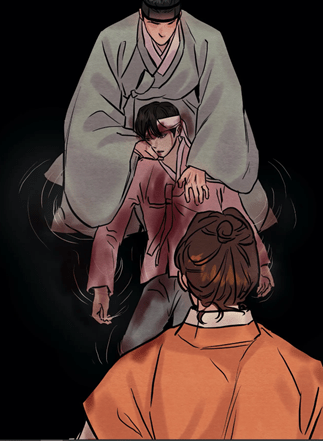
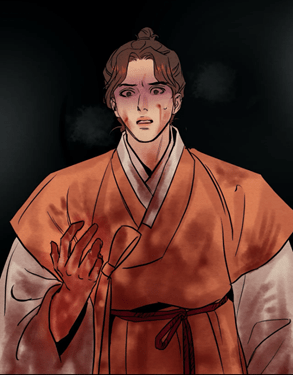
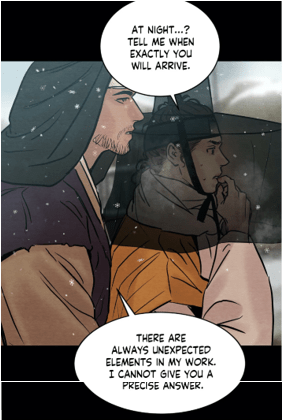


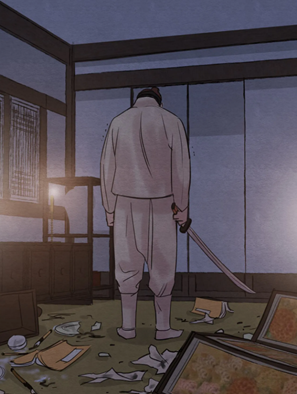 In the previous chapter, he is angry and due to his fury, he destroyed his room. However, he could stand on his own feet, was able to sway the sword and he had his hair tied with a topknot. So his appearance was still intact. In the chapter 50, he is on his knees, unable to grab anything, even hiding his face from the world. It was, as if he couldn’t even face people due to the bad decision he made, accompanied with huge pangs of conscience.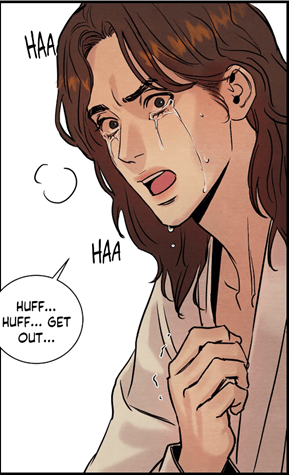
 Later he didn’t even pay attention to his clothes and image (chapter 41)
  and after hiring the assassin, he looks even worse than in the chapter 41. Neither alcohol nor sleep can help him to relieve his anxiety.
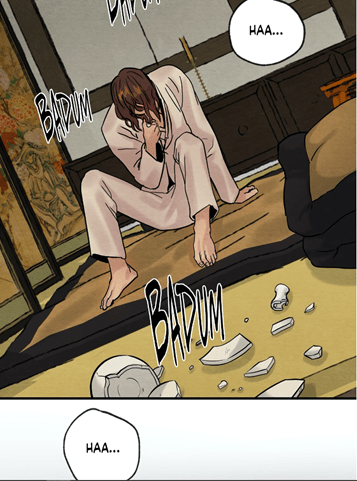

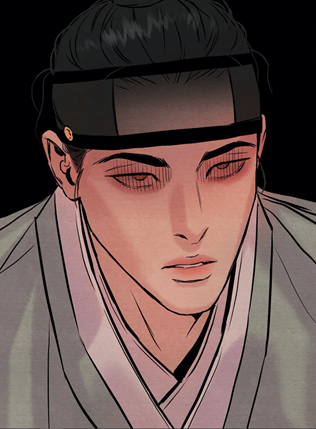
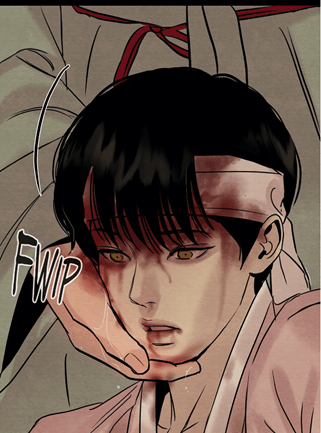



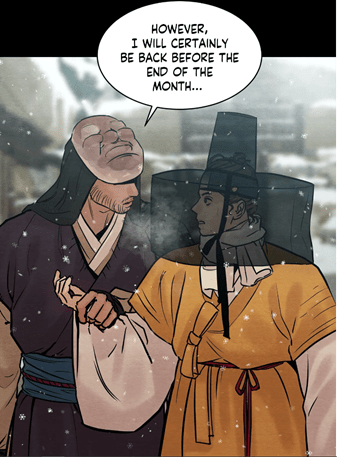
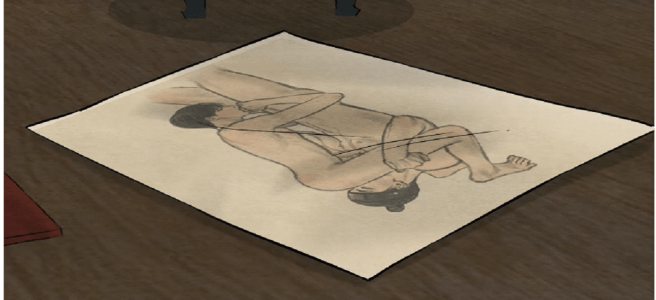

 Jung In-Hun had become his guardian because he had been bribed by the head-gisaeng. Only yesterday I came to realize why the painter could repress the bad memories about his physical abuse: The Stockholm Syndrome. And this is relevant as it explains why the artist adopted such a fear of homosexuality and even talked like the scholar. Furthermore I can even envision that this Stockholm Syndrome must have affected his hands and talent. This even reinforces my opinion about the huge impact of Yoon Seungho on our low-born. Due to his attraction to the lord and the sex session, the repressed sexual desires were unleashed so that his talent was triggered. That’s why he impressed the lord so much in the chapter 2.
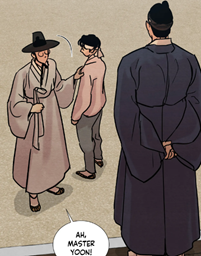 Nevertheless it started to rain the moment the teacher discovered the existence of the deal between the powerful noble and his former pupil.
 Imagine the rain followed with thunder represented Baek Na-Kyum’s tears and heartache because of the teacher’s rejection symbolized by the hand.
 This simple gesture, where the low noble used no strength, was so powerful because of the Stockholm Syndrome. Since the rain embodies the tears and the agony the thunder, I couldn’t restrain myself connecting it to the Surrealism once again as nature is often used as a representative of the unconscious and the state of mind.
 It was as if the snow embodied the artist’s tears once again, yet this time the real pain is no longer existing because his heart has turned cold. He feels nothing at all hence he has no problem to ask the butler Kim to throw away the painting. The more fall and winter are approaching, the more the painter’s relationship with Jung In-Hun deteriorates. In the chapter 35, the painter is definitely hurt by the low noble’s gesture, when the latter closes the mansion door right in front of him. This coincides with the fire where the fallen leaves are burnt.
  The caress on the cheek equivocates to the fire, the last real warm gesture the painter received from his teacher.
 In the chapter 38, the artist no longer falls for the teacher’s fake stroke thereby he is able to lie to Jung In-Hun. Because of this, I came to the following interpretation. The landscape with the snow embodies Baek Na-Kyum’s actual state of mind and emotions.
  It was as if his heart was frozen consequently he feels nothing. However, the presence of the snowmen illustrates his innocence and his longing for companionship. He wished deep down that he wasn’t alone and had someone by his side. Yet, the painter has no idea about it. Now, you can understand why I connected Byeonduck’s drawings to the Surrealism. Sure, this is my own interpretation and nothing more. The weather and the seasons are following the same evolution than the painter’s transformation. Little by little, he starts losing his admiration for the scholar which ends with the real separation. He has been so hurt that he is like an empty shell. But there is one difference from the past. This time, Baek Na-Kyum was the one who cut definitely ties with the scholar hence the double-faced man has no idea that he can no longer use the painter as his tool.In the past, the jealous aristocrat could push him away but the painter never resented his admired sir and accepted that the teacher would return to his side without questioning his motivation behind his smiles and strokes. He had been abandoned once, hence he became a drunk. However, the painter had no grudge hence he fell for Yoon Seungho’s lie in the chapter 7.
 It was the same in the chapter 24, when the scholar took him and pushed him against the wall.So far he had avoided the painter, yet he needed him again. At no moment, the artist rejected the man’s advances (kiss on the hand, his head on his shoulder). The low-born always forgave the low noble.
  It was as if the painter was coming back to life, the noble’s warmth has finally reached his heart through his body. Consequently, the spring will announce the beginning of their real relationship, the growing love between our two protagonists.

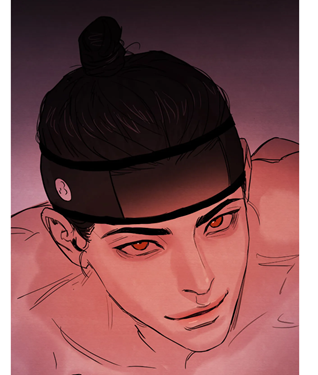 Furthermore the huge distance between Jihwa and Yoon Seungho could be explained that the artist wished, he had joined the lord and put himself between the main lead and the red-haired man. Remember that he wanted to take the sex partner’s place. As you can see, the first painting displayed a lot the painter’s unconscious, his sexual desires that’s why he had to destroy it. The image represented a proof of his homosexuality. In other words, the first drawing let the noble perceive the painter’s emotions and feelings hence he felt his own attraction. Therefore he could liberate himself from his negative image he had of himself.
![ANALYSE] Le Cri, Edvard Munch](https://alheuredelart.files.wordpress.com/2018/01/3-3_le_cri2.jpg)
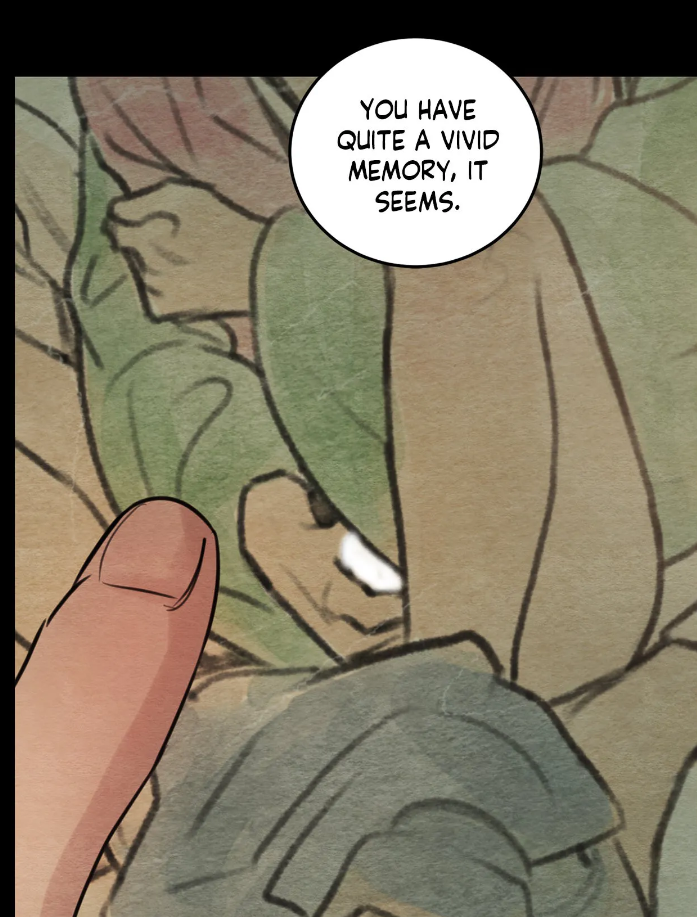 The word “vivid” is definitely characteristic for Expressionism. That’s why I connected the artist’s work with the Expressionism. Sure, the low-born lives in a different period, the industrialization had not reached Joseon yet. However, it is pretty obvious that the painter’s creations are strongly influenced by his emotions and state of mind.
  Since all the books were motivated by his love for the learned sir, the nobles could already sense the painter’s emotions and desires in these erotic pictures. Sodomy was portrayed as something natural and lovely. This explains the painter’s popularity and why the main lead became addicted. Because of this observation, I couldn’t help myself connecting this to another Art movement from the 20th Century called Surrealism.
 I believe that the painter needs to realize the lord’s affection for him, just like he needs to realize his feelings for the main lead. The ending of the last chapter insinuated that the painter was on his way to grasp his own feelings. Notice that he is questioning himself, wondering why he keeps thinking about the lord and why he reacted like that
 The readers can detect that he is starting to think on his own, showing that he is no longer under the teacher’s influence: this is the evidence of critical thinking, something the seme tried to initiate in the artist.
 For the first time, we see him reflecting on himself. As a conclusion, we see the importance and growing influence of Yoon Seungho in the painter’s life. He was the source of his inspiration and creativity right from the start, he freed him from the scholar’s brainwashing so that Baek Na-Kyum could exercise his talent right away. That’s the reason why I was not so sad and pessimistic after reading this chapter. The main lead didn’t appear directly but through the conversation and the thoughts, he was always present. Baek Na-Kyum is a strong-willed person so that the moment he recognizes their mutual love for each other, he won’t waver due to the pressure caused by his scandalous relationship with the powerful noble. The publications showed his determination to show homosexuality as something natural and beautiful. Finally, I could reveal the importance of the painter’s emotions and unconscious in the artist’s creations.
 in another essay. However both were influenced by the perception he had about Yoon Seungho and his attraction for that noble. In the analysis, I had pointed out that they reveal his repressed sexual desires. Nonetheless, the manhwaworms are well aware that Baek Na-Kyum felt that the lord was attracted to him, and he sensed the lord’s desires. Interesting is that these “illusions” became a reality, since the master became the painter’s sex partner and “husband”. Striking is that our artist is far from happy because his dream was to become the teacher’s bride.
  (chapter 19) In other words, being the scholar’s lover could only be a chimera. So the wet dreams came true, because real facts played a role: the mutual attraction between Yoon Seungho and Baek Na-Kyum, their sexual orientation as the lord never condemned sodomy per se, while his dreams with Jung In-Hun was just a chimera, because they had nothing in common. The scholar looked down on the painter initially, but his homosexuality and his success as anonyme author of erotic paintings reinforced his jealousy and resent. The low-born embodied everything the teacher hated hence he could never fall in love with the artist.
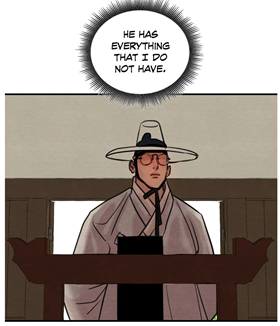 He would like to become rich and powerful like Yoon Seungho, the latter serves as example. Since he considers himself as morally upright and more educated, he has the impression that his dream will come true soon. He received such a good offer from the famous hell-raiser after all, even without working hard and using his knowledge.
 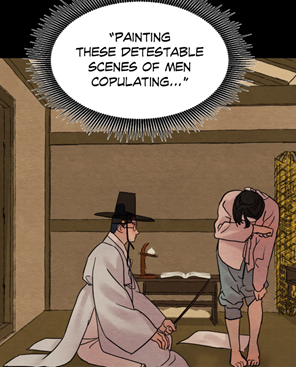 Let’s face it: the teacher could have achieved greatness by becoming a good and exemplary teacher so that the commoners would have come to admire him. This kind of fame could have reached the ears of an influential official. But the scholar never considered it as an option, because he disdains the commoners. As he feels superior to them due to his title, he didn’t want to rely on them for his career. For the low noble, it’s important that on the surface he achieves greatness on his own. What I mean with it is that he doesn’t want to share his fame and admiration. So on the one hand he imagined that he needed the help of an influential noble, on the other side he envisaged that once he got a high position in the government, he would be able to cut ties with Yoon Seungho so that only his name would get connected to that powerful government post. Once in position, Jung In-Hun could threaten his sponsor in case the latter refused to follow his request. He thinks so highly of himself that he doesn’t realize his own shortcomings. He’s not intelligent and cunning enough to perceive the protagonist’s raillery and empty promises
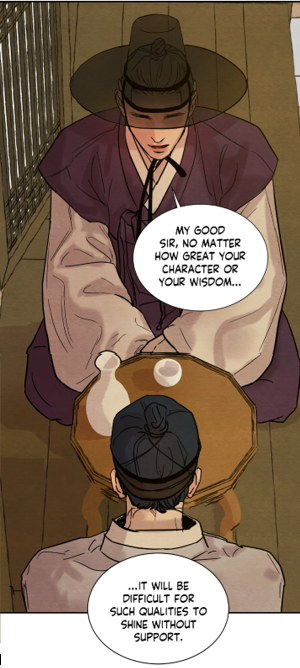 (chapter 7). He never anticipated that the lord would do something like that, while he had already imagined that his promise to support the lord would be just an empty promise. As a conclusion, fate and entitlement explicate why the teacher didn’t get famous in the past and why he is destined to fail.
 , he had the impression that he understood him. He imagined, his childhood friend would only hate and resent his own family due the father’s abandonment and betrayal. He wasn’t sharp enough to perceive that Yoon Seungho saw beyond his family’s wrongdoings. Besides, he never got to know what truly happened to his childhood friend, as he was informed through Kim. For him, nobility was the real cause of his own suffering. First he got betrayed by his own family, sold as a concubine to the king, and when one of the aristocrats betrayed his family for his own benefit, the main lead’s father chose to backstab his own son and blame him for everything. Consequently, in Seungho’s eyes, nobility is a synonym for treachery, cowardice and selfishness. What Jihwa judged as common denominator represented in reality the barrier between him and his childhood friend. Yoon Seungho could never love someone from the aristocracy, though the main character has no idea about it.
 (“I’m so happy, my heart is so full”) Although the latter said nothing, he felt the same hence he kissed the painter’s eyes so tenderly. Consequently this night symbolizes the moment where the main lead realized that love did exist and he could obtain happiness too. Since he was well aware that the love confession was addressed to the intellectual, he decided to work hard for his own dream and happiness.
  “I like-My lord”. He must have felt that he got closer to his goal. He was definitely surprised but it moved him that’s why he ejaculates soon after.
 A duck is not considered as beautiful per se but we have the fairy tale of the ugly Duckling. Here, in this story, the ducks are conceited and perceived themselves as pretty compared to the baby swan (vanity). Furthermore, in this fairy tale the ducks are excluding a family member because of his different appearance, just like in the manhwa. Yoon Seungho got abandoned by his father and his brother. In the ugly Duckling, the duck represents the family and their intolerant behavior outlines the strong bond between the ducks and their babies resembling them. Seung-Won is indeed supported by his father, the former even speaks for the family.
  The duck symbolizes the family and this isn’t surprising, when in Korea, couple of ducks are offered for a wedding. One of the purpose of marriage is to continue the family heritage.
  He is sweating and avoiding his older brother’s gaze. Then his hands are on his knees showing his discomfort. Yet he has no problem to lie about the father’s illness and to suggest Yoon Seungho to visit his parent, well aware of the significance of this visit. He is quite arrogant to think that his brother wouldn’t catch the meaning behind this visitation. He is underestimating the protagonist because he believes in the rumors that Yoon Seungho lives in debauchery. He has the impression that his older brother is not so smart, however the way his suggestion is rejected reveals that Yoon Seung-Won knows very well how his brother became a famous sodomite.
  This shows that the brother is neither cunning nor smart. The duck is not considered as a smart bird, compared to the magpie or the eagle.
  We have to envision that he even avoided to meet Yoon Seungho personally, until it became absolutely necessary due to the urgency of the matter. We should remember that the latter didn’t support his brother the moment he was abandoned by the father, he preferred following the father.
 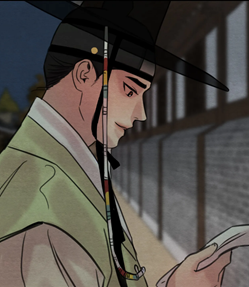 Look at the figure’s smile, he thinks that his move did succeed, whereas there is only raillery coming from Yoon Seungho. The latter remembered the words expressed by his loyal assistant the same morning.
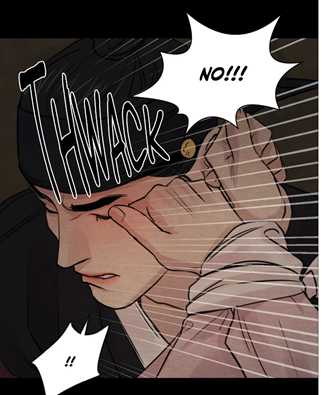 The scar or wound is visible from the chapter 25 to the chapter 32.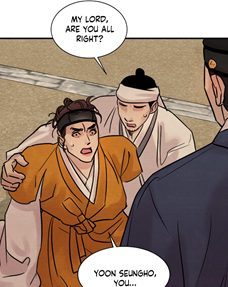

 In fact, they have the opposite effect. Instead of retreating, he retaliates immediately with composure. Striking is that the person involved in the dispute is never hurt personally illustrating that the protagonist is always in control of the situation. He shows no emotion at all, he is quite levelheaded. This outlines that during all these altercations, he was not harmed once.
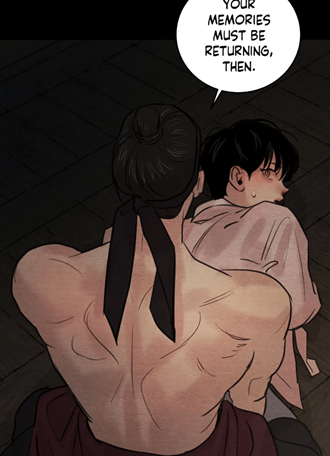

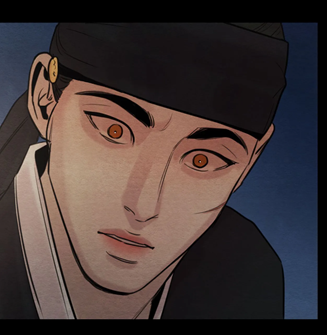 Baek Na-Kyum is not attacking the man with a bad reputation but the person in front of him: “you, sir!” The seme is literally left speechless as the reproach is correct. The aristocrat can’t deny the truth, he knew that the love confession was addressed to Jung In-Hun. Since he can’t refute this point, he needs to hurt the man physically.
  He pushes his head to the floor in order to shut his mouth. These are definitely the words he didn’t want to hear, since he wanted to become the loved one. He doesn’t want to admit defeat and keeps fighting. He is determined to win this fight that’s why he chooses to force himself on the painter. He is definitely not thinking clearly revealing that in this moment he is not two steps ahead like in the past. Observe the difference in his reactions. The low-born is the only one who is able to batter Yoon Seungho. That’s why the scar on the face is so significant. It embodies the master’s injuries.
  As a conclusion, even when he forced himself on the low-born, he didn’t win the fight. The painter kept thinking about another man in his presence. Yoon Seungho acted more on his instincts, he had the habit to perceive sex as a fight, hence he chose to treat this like in the past. Yet, it ended in a disaster. Therefore we can clearly understand why later the protagonist reflected on his behavior at the pavilion. He had never behaved like that during an altercation: losing his temper, letting his emotions taking control of his mind.
  The lord is showing more concern towards the painter’s face and eyes than to his own face. He even prefers wiping the tears on Baek Na-Kyum’s face.
  I interpret this scene the following. The master’s own injury and pain signify so little compared to the artist’s pain mirroring the deepness of his feelings for Baek Na-Kyum. Furthermore, I sense that he could have viewed the scratch as a sign of a small loss, as a reminder that he had been battered for the first time.
  The protagonist sent his own valet to treat the painter’s injury.
  On the other hand, when the valet Kim mentions the graze on his master’s face, he looks like lost and later the servant even receives a deadly gaze. So this shows that the noble is well aware of the existence of this wound but prefers not treating it.
 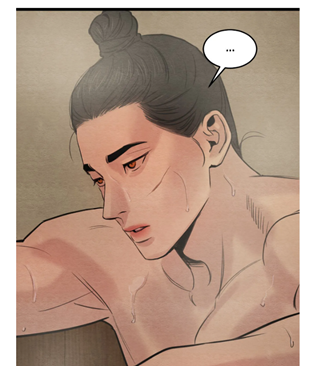 While he is taking his bath, he even remembers the events at the pavilion revealing his pangs of conscience. This underlines that he doesn’t care about his appearance and his own pain. Hence I conclude that he never treated his wound. Why? Like I mentioned above, he could have perceived this as a reminder of his first loss. Another possible interpretation could be that the lord was not admitting defeat. Treating the graze could be judged as a sign of retreat. Just like in a real fight, the aristocrat considered it as a small injury so that the battle was not lost in his eyes. Despite the terrible agony, Yoon Seungho was still fighting for the painter’s acceptance and love. He wanted to become his lover. Notice that the last time the readers can observe the scratch is in this picture. (chapter 32)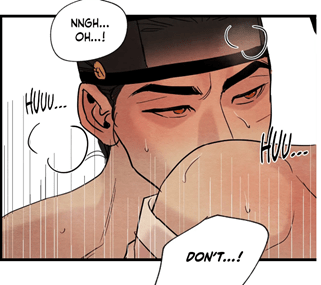
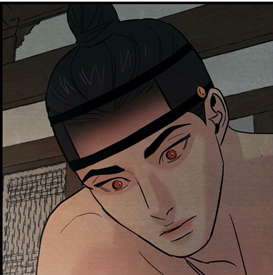 Therefore the lord’s gaze reveals his shock and negative inner emotions. He finally grasps that he might have been able to defeat the painter physically but this struggle could cost the artist’s life. All this coincides with the disappearance of the scar. The self-reproaches symbolize that the nature of the wound has changed, the scar was just the beginning of the lord’s transformation. Now, he is forced to pond and reflect on his bad actions. He tried to bury his remorse by having sex with others (chapter 33/34) but simultaneously he did think deeply about the reasons why he had acted so differently from all the previous quarrels and why he was so obsessed with the painter. The challenge with Min was the trigger for the lord to return to Baek Na-Kyum’s side, he preferred facing an infuriated man than losing his “possession” to another.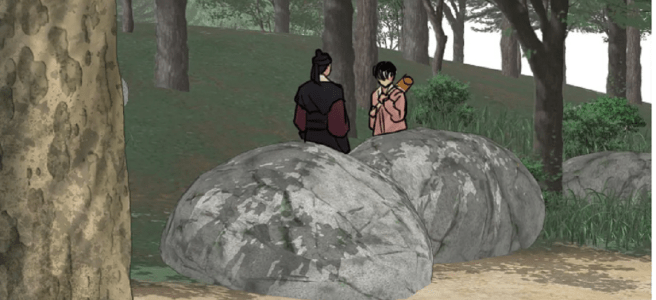
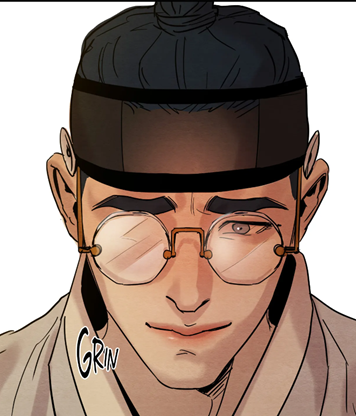

 Imagine what this scene represents to him. He has finally caught the attention of a strong backer through a trick and now he can to leave the shady place he was living in and live like a real noble. He can finally distinguish himself from the commoners he despises so much. Yet, he judges himself as smart enough to think that this proposition isn’t for free. So the offer sounds so good because the only request Yoon Seungho has is that the poor noble returns the favor, once he has become an official.


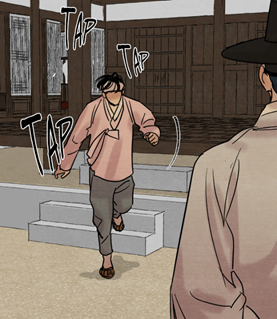 He is so happy that the low noble decided to call on him and can’t restrain himself to ask for a confirmation.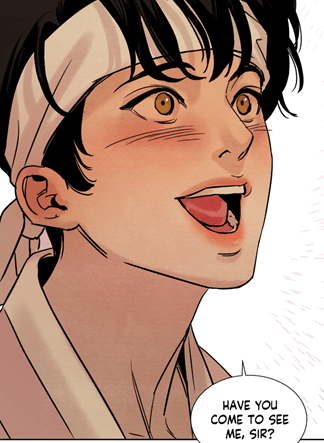
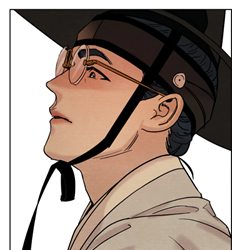 There is no mutual admiration and respect. The poor aristocrat abhors the idea of being touched by a commoner. Besides, we shouldn’t forget that his ego has been so amplified by the aristocrat’s fake praises the day before so that his arrogance and his disdain for low-borns has deeply increased. At the same time, he is reminded through the hard way that this is all thanks to the low-born that he could get such a good offer. So his self-pride takes a hit. Fact is that Yoon Seungho is toying with the poor aristocrat’s feelings. The other reason to send the painter first is to let the teacher know that Baek Na-Kyum is also favored. In the chapter 6, he just told him that the low-born was a servant, yet the artist comes from the mansion and the master only joins him after.
 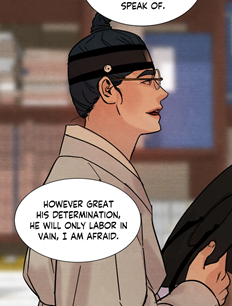 The loyal valet Kim is the one who leads him to his quarter and to the library. Right from the start, the teacher understands that Baek Na-Kyum is a hindrance for his own interest as he knows about the painter’s talent. If he remains at the mansion, then the other will be forced to work hard too. And he had thought, he just needed to rely on the noble’s generosity without working hard. However, he can’t expose his true thoughts right away, he needs to play the game, hence he stays courteous and even thanks the painter personally for the great opportunity.


 That’s why in the chapter 10, the teacher meets the painter and convinces him to stop painting. He uses his dogma in order to appeal to the artist’s guilt. If he is able to persuade the artist one more time to give up on painting, then his problem is solved. The powerful noble will only focus on him and he can enjoy the privileges linked to the favoritism.
  This shows the real value Baek Na-Kyum has in the lord’s mind. Furthermore, the learned sir witnesses how Yoon Seungho even caresses the painter’s cheek while complimenting him.
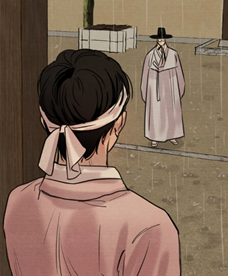 He discovers that the painter disobeyed his order and kept painting for Yoon Seungho. But for that, Baek Na-Kyum has to justify his disobedience. The low-born defends his action that he did it for the low noble’s sake.
 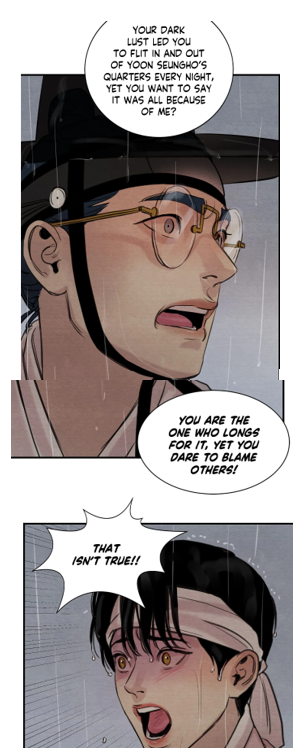 He implies that the painter earned the lord’s favor through immoral means (seduction, sex). He describes the artist as a man consumed by lust, whereas the former embodies honesty and purity. That way, he can reject the painter’s words. Based on his words, he is a honorable man, as he belongs to the nobility, while Baek Na-Kyum as a low-born is so perverted that he will do anything in order to get what he wants and to improve his situation. What the low noble is doing here is called projection. He is projecting his own mindset into the commoner’s. His criticism displays his true self: he is dishonest, lazy, corrupted and ruthless. Through his accusations, it becomes clear that for him and the readers, the end justifies the means. We already witnessed his scheming nature in the chapter 10. However, he failed and he is now attempting to put the blame on Baek Na-Kyum. He gained the lord’s benevolence through dishonesty and not hard work. Imagine the irony. Jung In-Hun wasn’t even working really hard until now which was shown in the beginning of the chapter 19.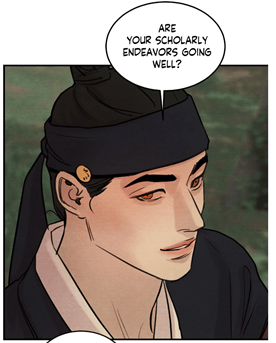


 He tried to impress him with a plagiarism but he never fell for it. The scholar doesn’t want to admit defeat and implies that because of the bad rumor about his reputation, he is not skilled and talented enough to judge his true talents. He refuses to acknowledge that such an aristocrat can judge him so poorly. He needs to prove his superiority in front of the lord, his ego can’t accept to be damaged like that by such a ruffian. However, the lord forces him to kneel in front of him proving him his strength and supremacy. He is not only educated but also athletic. He is much more than what the rumors describe him. And now compare this scene to the one in the chapter 7.
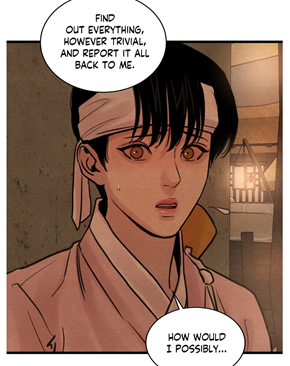
 He needs the latter to spy on the strong noble in order to blackmail him. Little by little, he is giving up on his dogma “sodomy is dirty and filthy” since he perceives that in such a short time, he has to use extreme measures. From my point of view, this is not just a matter of pride and humiliation. There is this sudden realization that he has been manipulated by Yoon Seungho and that if he fails the exam, the noble’s sponsor could end anyway. For the first time, he gets aware that he has to rely on his skills but the problem is that he never really worked hard in the first place. He thought that Yoon Seungho would deliver everything to him on a silver plate. This truly demonstrates that Jung In-Hun has somehow grasped that he might not be so smart and talented like he imagined, especially after getting a wake up call from the protagonist. So if the scholar fails, then the seme can decide to stop sponsoring him. That’s why the learned sir needs to dig some dirty secret so that he can blackmail the lord. Once he has found some info, he is sure that he has some leverage and can still benefit some privileges from Yoon Seungho.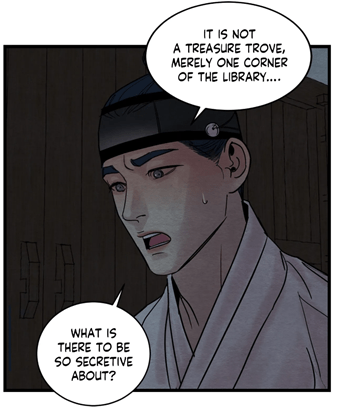

 The very next morning, he pays a visit to the craftsman and even gives him some money so that the latter can ask around.
 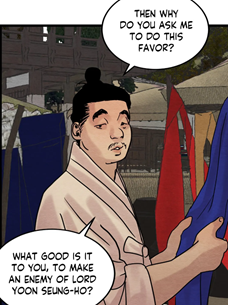 Let us not forget that the man doesn’t possess much money and this proves how desperate and worried he is. He needs to discover some dirty secret about Yoon Seungho at any mean and as soon as possible to force the main lead to support him. In the best case, he could use it later against the wealthy aristocrat. Besides, he can not just rely on the painter’s trust. He even believes that if he uses Baek Na-Kyum as his whore, then he will get some info. That’s why he attempts to sell off the artist to the infamous sodomite. He witnessed the rape hence he knows that the lord is interested in the artist. Nevertheless he thinks that Baek Na-Kyum is just a plaything for the lord. So by telling him (chapter 30) that the painter only obeys the scholar, he finally believes that he has found a way to gain the noble’s support for real.
  Yet, due the painter’s intervention, this deal falls through. What the short-sighted noble fails to realize is that he would have been killed. He hadn’t internalized the warning during the hunt, he should know his place and never act as if he was on the same level than Yoon Seungho. We can feel the urgency of the low noble, he needs to find some leverage in order to get some privileges. That’s the reason why he resents the painter so much. For him, it seems like the artist has it easy. He just needs to sleep with the lord and that’s it.
  Sure, now he had to learn for the examination hence we see him twice in company of books, in his chamber in the chapter 27 (see the picture above) and at the library in the chapter 40. Now, he has not much time left before the day of the civil service examination. However, I sense another explanation. The scholar actually expected and hoped for the artist’s death. For him, this was even better because there would have been no more competition. I sense that in his mind, with the disappearance of the painter, the lord might avert his attention to him. That’s why he resents the painter so much and lashes out to him in the chapter 40. He has to witness the accumulation of privileges, whereas he only gets free lodging and free access to the huge library. He has to pass an exam, while the artist has no constrain. But since Baek Na-Kyum has recovered, the scholar reminds him of his request. He needs to pry into the master’s life.
  During this scene we can even feel the urgency of the teacher because he walks towards the door while talking to Baek Na-Kyum. He needs to meet the washer in order to know if he had found something. The caress on the cheek before closing the door illustrates that Jung In-Hun even values more the info coming from the washer and informer than the painter. First, he is jealous of him and secondly, he has never been helpful before.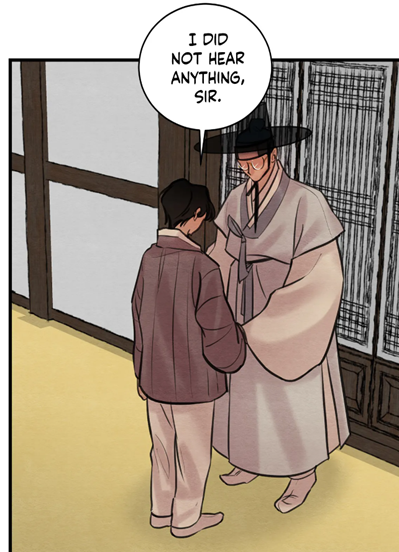
 He is not just jealous and envious. Imagine that he is asked by the painter if he will be responsible for him in the future. Yet the teacher is not even sure if he can succeed with the examination. He was put under pressure the whole time. He is so uncertain about his own future and now he needs to be responsible for a low-born. That’s quite daring and insulting for the scholar. Simultaneously he had to witness how the commoner, whom he considers inferior to him, was able to gain the favor of the lord. So he acts on the moment, he feels that his big dream has more or less escaped from his hands so he abandons the painter. What he fails to realize is that the moment he abandons the painter, he will never be able to gain anything from Yoon Seungho.
 First, the master is with the learned sir but he doesn’t follow him outside, whereas he welcome in the courtyard in the chapter 7. Now, there is no pretense and hypocrisy. The powerful master just sends him away with a servant. In the final chapter, we sense a certain despair in the scholar that’s why he asked the lord to accompany him to the capital.
 He wants him to pass the exam too so that he can be his companion or assistant, if the infamous hell-raiser succeeds. Notice that now Jung In-Hun is finally admitting that Yoon Seungho could be more smart than him. He even hopes that if the lord accompanies him, the scholar can attract the attention of other aristocrats and officials.
  However, the main lead refuses any suggestion from the teacher showing that the rich noble doesn’t care about him at all. Till the end, the low noble hopes that he can get some favor, yet he fails. Furthermore, he is warned that the officials might not be what the naive and scheming scholar imagines. Then when he is about to leave, he is reminded to take his leave from the artist.
 Nonetheless Jung In-Hun refuses to do so because he is just a low-born.
  So the scholar’s disdain for commoners from the chapter 7 is still intact, yet this time he doesn’t want to fake his admiration for the painter. He leaves without saying goodbye, although he realizes the master’s love for the artist. This outlines his arrogance and stupidity.


 Striking is that once he is home, the low noble takes off his hat, even his robe in front of his rich and powerful guest. You might wonder why, in particular when you know about the teacher’s pride and arrogance. You are correct to assume that this action is deliberate, he wants to reveal his true financial condition to Yoon Seungho, showing him that as a noble he is not well enough and needs the support of a sponsor. At the same time, we shouldn’t forget that the lord chose a dark purple robe with short sleeves in order to deceive the teacher too. Just a reminder about the meaning of dark purple:
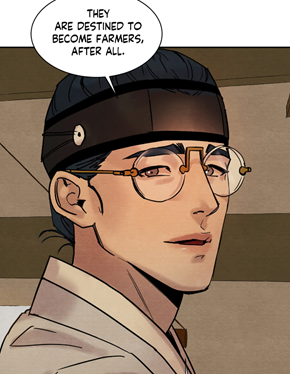 His speech only illustrates arrogance, entitlement and disdain for commoners contradicting his attitude. The protagonist is no fool, in fact he misled the low noble on purpose. The seme forced the teacher to make lip service in order to obtain a sponsorship, yet simultaneously it actually served to reveal his true thoughts and his true personality: a hypocrite and obsequious (greasy) noble.

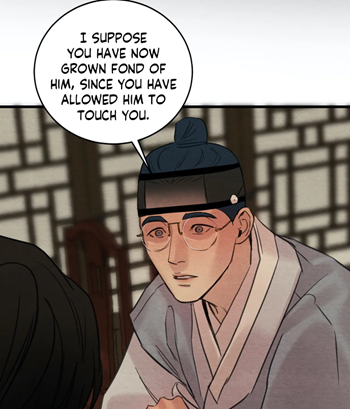 Sure, he immediately puts these back but the fact that in that particular scene he reveals his true self in front of his “fan” just after removing his glasses is significant. This gesture symbolizes and announces what is about to occur. He displays his true emotions and expresses his arrogance and contempt towards the painter. In his eyes, the artist is just a man consumed by lust hence he is a prostitute. He was raised in a brothel therefore he can only live like a whore. This signifies that if the noble takes away his glasses in the second season, we have to observe his future comments and attitude.
 He thinks that as a noble, he can touch the powerful lord so easily. He even comes to the belief that since he is controlling the artist, he stands on the same level than the main character. He doesn’t even notice the killing gaze Seungho is oozing. The learned sir has definitely a poor sight, when it comes to people and situations. He believes that his “intelligence” and knowledge gained through the books is enough for his career, but the man is definitely lacking experiences. He has no knowledge of the world and people, he has never meddled with other dirty, scheming and treacherous nobles before.
  And this is exactly what Yoon Seungho is telling him before his departure. He is warning him about what could happen to him in the future. Remember that I associated him to the library where he is buried by the books. Even the books are following him in his bedroom.


 During the hunt, he had chosen to confront the powerful lord and humiliate him by accusing him of hypocrisy and telling him that he was a talented man full of potential. It ended up in a disaster as he never expected the lord to know the origin of the poem he gave to Baek Na-Kyum. Furthermore he has to hear that he is far from being skillful, a terrible statement for the arrogant man.
 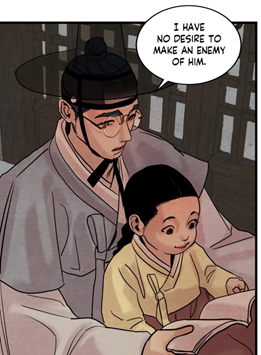 Then when he visits the artisan, he wants to impress him because he needs his help. He has to dress like a quite rich noble so that the craftsman will be willing to help him for the investigation in Yoon Seungho’s past. Remember that he even gave money to the man, yet we truly know his own financial situation. He has no real fortune and only his title that distinguishes him from the commoners.
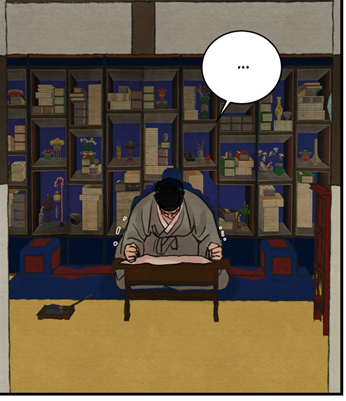 Based on one cloth, it is not enough, furthermore the color is difficult to discern: grey or khaki. We discovered that Byeonduck is very particular about the colors and the kind of clothes her figures are wearing. We already know what yellow, orange, black, red, burgundy, pink, green and blue mean. The clothing can give us clues about the person’s true personality. Besides, we have to observe if the headband will resurface again or not and if yes, under which condition, though I doubt it. Furthermore, I was always able to associate the figures to animals (Baek Na-Kyum as a lamb, Yoon Seungho as eagle, Min as magpie/crow and snake, Jung In-Hun as a chameleon, a peacock and a snake, Jihwa as pheasant). Since we will see the younger brother and his father more often, we should try to find the fitting animals. We should do the same for any new character. It helps to discern the person more correctly.
  His inaction was reflected in his refusal to meddle in politics as well therefore he refused to follow Jung In-Hun to the capital. However, I anticipate that Jung In-Hun’s “career”, his brother’s decision to take the civil service examination and the failed attempt of assassination on Baek Na-Kyum will provoke a change. He will be forced to take matters into his own hands. This means that at some point, we won’t view the protagonist smoking like before. My theory is that the lord will become Baek Na-Kyum’s teacher and he could become a real sponsor for the painter encouraging to paint something else too. As for Baek Na-Kyum, we could see a change in his behavior through his hands. First, he touched the main lead on the shoulder with his hand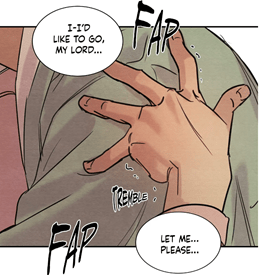


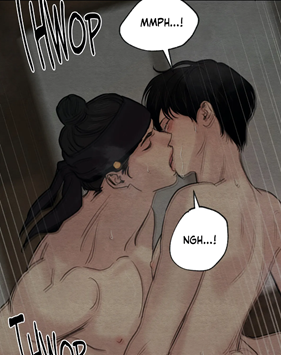 But here, the noble is taking the initiative again, attempting to show his feelings for the painter.
 Striking is that he not only leads the painter to return to the mansion and as such allows him to become a sodomite officially, but also passes through the door himself. So does this mean that this door marks a turning point in Jung In-Hun’s life as well? Will the readers see him selling himself to an official for his own interests? I am inclined to believe so. Therefore pay attention to his gestures and his “lip service”. Will we see another progression where the teacher’s first sexual encounter symbolizes the climax of this evolution?
  Baek Na-Kyum could play a huge role as mediator so that the relationship between Yoon Seungho and the other servants improves. They finally accept him as their true master. Before they showed no respect and loyalty towards their lord (gossiping, the opening of the door of his bedroom, the expressed criticism from the maid in front of his loyal valet). Right now, they just fear him hence they are no longer talking about him behind his back.
  The pavilion was important, because this is the location where Yoon Seungho liberated himself from his self-hatred and accepted his sexual orientation.
  There he saw himself in a different light that’s the reason why he asked the artist to meet him there after the hunt. Therefore the pavilion is linked to a bad memory for Baek Na-Kyum. Will this place appear again and have another symbolic meaning? I have the feeling that the pavilion could become the place where the master will teach the commoner. This would erase the event of the rape but at the same time, become the location of Baek Na-Kyum’s emancipation, just like it occurred to Yoon Seungho. The pavilion could symbolize the protagonists’ liberation in the end. And this would also help the servants to perceive their lord differently and even accept his relationship with the low-born. They would no longer judge him as a sodomite but as an open-minded and caring lord. Remember that he is a supporter for the education of commoners (chapter 6). This could be what he defends later, when he has to go to the capital…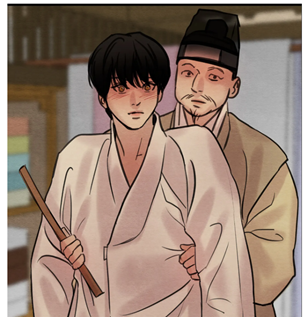
 The author wanted to let the bibliophiles recognize the jealousy of the main lead. He doesn’t say anything but the zoom on the hand represented the lord’s vision. Hence for the second season, we have to question the chronology. Why is there a zoom on the hand in this moment? How about the gaze? Or will the focus on Baek Na-Kyum’s hand reveal another progression, like f. ex. he finally caresses the lord’s face or chest? So far, we never saw him caressing his face or his arms with such a tenderness, while we could observe the main lead kissing the low-born tenderly twice.
 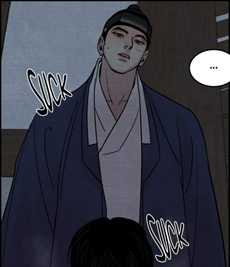 We sometimes had the impression we had entered the character’s mind and were witnessing things through the character’s eyes. I could name the fellatio as example. Here we can understand the seme’s fascination for the painter’s gaze. He saw the acceptance in his eyes.
  But we also entered Jihwa’s mind too.
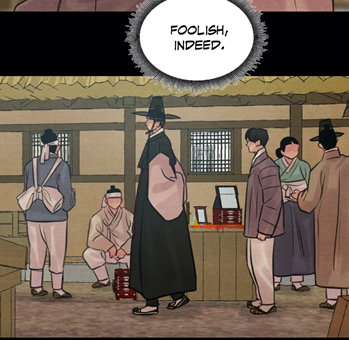 . Here, he did listen to the lord’s remark and questions.
  to foreshadow the future of our protagonists or reflect the painter’s natural desires or to liberate the uke from the coercive persuasion done by the vicious teacher.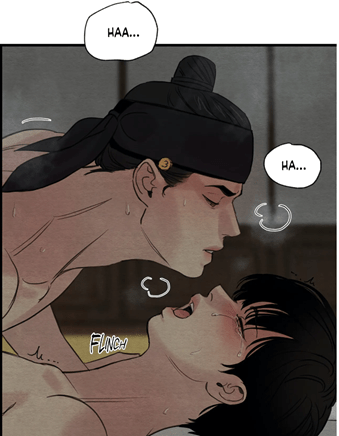
 They were not detail-oriented, especially the artist’s facial expressions were still missing. So we have to pay attention to his future creations. They will serve as an indicator of his feelings for the lord. Simultaneously, the drawings will reflect an improvement in his self-esteem. So far, Baek Na-Kyum has a low self-esteem created by the teacher.
  That’s why there is no facial expression on his face and he stands far away from Jung In-Hun in the painting of his inauguration. His erotic paintings should ooze love and warmth as time passes on and maybe the artist will be encouraged by Seungho to draw something else. In other words, the readers should look carefully to the future paintings.
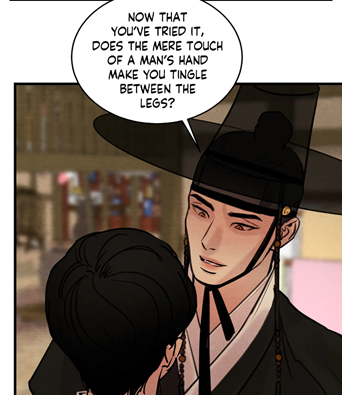 Savor the noble’s intelligence, sarcasm and his jokes.
  or “boy” (chapter 31). Even there he didn’t insult the low-born despite his jealousy and anger.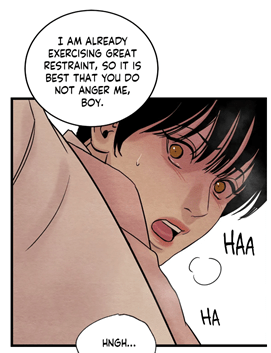

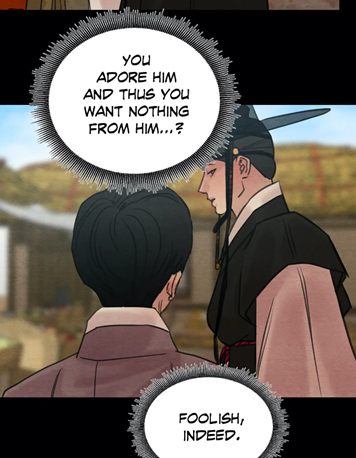
 Bebebisous33s' analyses in K-Dramaland and Manhwas