
This is where you can read the manhwa. https://www.lezhinus.com/en/comic/painter But be aware that this manhwa is a mature Yaoi, which means, it is about homosexuality with explicit scenes. If you want to read more essays, here is the link to the table of contents: https://bebebisous33analyses.wordpress.com/2020/07/04/table-of-contents-painter-of-the-night/
It would be great if you could make some donations/sponsoring: Ko-fi.com/bebebisous33 That way, you can support me with “coffee” so that I have the energy to keep examining manhwas. Besides, I need to cover up the expenses for this blog.

1. Laziness or not?
When the final episode of the main story was released, many Manhwa-philes were laughing about Yoon Seungho’s work attitude as governor. The latter had left his seat in order to return to his lover’s side.  (chapter 131) Hence the police officers found the governor’s seat deserted.
 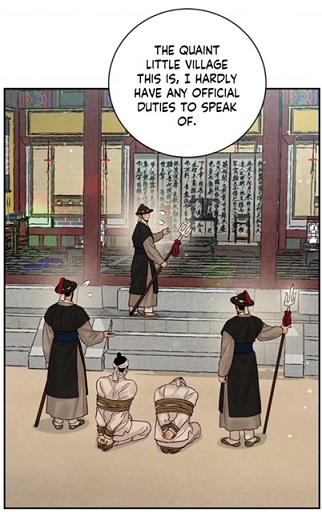 (chapter 131) By contrasting the statement from the governor and the panel, the readers could easily catch his lie. He was a lazy governor, preferring to keep his lover company rather than attend to his official duties. On the one hand, it exposes the main lead’s true mind-set. He is not longing for power or glory. To conclude, he has no ambition. This implies that he is not determined to gain attention either. One might add that he selected this region on purpose. No one would willingly go to that place. The norm was that officials would go there, because they were demoted.
 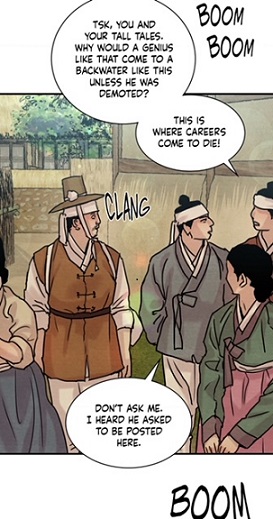 (episode 129) Thus I deduce that Yoon Seungho made the opposite choice to his father. The latter longed for a high position at the government so that the family’s reputation would become famous and powerful again.
  (chapter 86) It is because Yoon Chang-Hyeon was thinking of getting the attention or support from noble families. What he truly wanted was to get recognition from people among his own social class. But with such a decision (join the painter’s side), Yoon Seungho seems to have turned the former patriarch’s nightmare into a reality. Yoon Seungho is about to ruin the family. The name “Yoon” is destined to become forgotten, right? However, I believe that this interpretation is not correct. How so? Let me ask you this.
Why is this region regarded as “backwater”? It is because there are no powerful families like in the town, where the Yoons used to live. There are no huge store or doctor either. The new governor is surrounded by “peasants”, commoners. In other words, it is not a place you can earn a lot of money or gain power, especially for an official. This signifies that buying the governor, like Yoon Chang-Hyeon did, won’t happen.  (chapter 127) No one has such a wealth! That’s the reason why no official would select such a place. Yes, Jung In-Hun’s words from chapter 6
  (chapter 6) (chapter 131) are reflected in the final episode. Peasants are poor und uneducated, and this will not change overnight. Hence they represent ignorance and naivety. This raises the following question. Why did the officers bring these two men? What was their crime? One might reply that it is impossible to figure it out. Nevertheless, I think, Byeonduck left clues in her story. Painter Of The Night is composed of reflections. In each season, certain scenes or elements resurface with slight changes.. Thus I developed the following theory concerning these two commoners.
My hypothesis is that these two men were innocent. In season 1, we have a similar scene:  (chapter 37). It is about a crime, treason. In season 4, we know that the plot was true and there was an evidence, the paper with the signatures from lord Yoon and lord Song. Since in season 1 the wrongdoing was true and heavy, I deduce that it is not the case in the final chapter. Because there is an evidence of the crime in the past, I can’t help myself thinking that in the final chapter, there was no evidence. Additionally, I feel the need to expose my other interpretation about this man:
 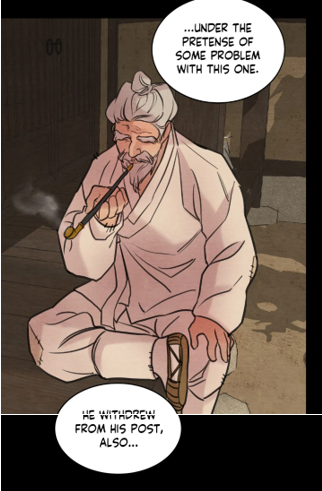 (chapter 37) I have always stated that this man couldn’t be a servant, for he was smoking a pipe and we saw a glimpse of his memory. No commoner would be allowed to enter the courtyard, when three noblemen are tortured and interrogated. Moreover, notice that in both scenes (37 and 131), the magistrate is absent. That’s how it dawned on me that this nameless man could have been a former “governor” who lost his position.
But if the two commoners are rather innocent, why did the officers bring them to Yoon Seungho then? My idea is that they imagined that the new governor wanted to make a statement so that he wouldn’t be looked down by the locals. Or even worse. The guards desired to get protection money from them!! Yes, because this region is not well perceived, the guards thought that the governor would act like his predecessor. Since it is a poor region, it signifies that the officials are not well recognized and well paid. (chapter 131) First evidence that the last image is not symbolizing justice, but corruption, is the behavior from the guards. They are caught by surprise, when they arrive in front of the empty stool. Yet, they are not gesticulating or panicked. If a real crime had taken place, they would be looking for their superior. And this observation leads me to this image. (chapter 131) In this picture, we can detect the governor’s office in the background. It is the yellow building with the multicolor decorations. That’s where the empty stool is!! In other words, if they truly needed him, they just had to go to the other side of the wall. Third evidence for this hypothesis was left in season 3:  (chapter 94) Here, the officers went to the mansion before visiting him at the gibang.
  (chapter 97) Back then, it was about the death of a commoner, a servant. If there’s an urgency, they would look for him. The comparison exposes that the “wrongdoing” from the peasants in the final chapter was no huge deal. Yet, many readers already condemned them due to the guards and the protagonist’s behavior. Funny is that the lord was portrayed as a huge liar, but not “the officers”. (chapter 131) But it could have been the reverse. Officers could have abused their authority. Furthermore, let’s not forget that Min indicated that guards could be bribed easily.
  (chapter 101) His statement displays another aspect: the governor and the guards are not working together. Jihwa would have been sent to jail without being able to talk to the superior, similar to this scene:
  (chapter 126) The guards’ own interests are not necessarily aligned with the governor’s. And now, take a closer look at this scene:
 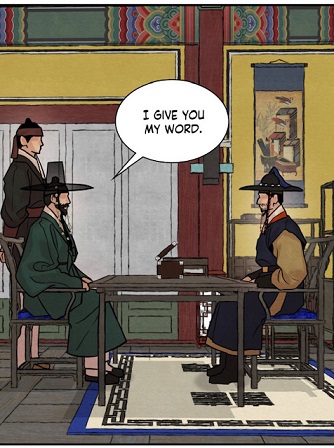 (chapter 127) The official received the patriarch in his office alone. The reason is simple. That way, he wouldn’t have to share the money with others.
But since the guards never went to the lord’s mansion, they must have realized that this man was not like his predecessor. He was not frustrated or demoted. He was indeed not after power or money. They couldn’t rely on his protection either. In fact, they could get blamed for disturbing his privacy. I would even add that since Yoon Seungho comes from a wealthy family, he doesn’t need to rely on bribe at all. In other words, the guards can only come to the conclusion that treating him well can only benefit them. His wealth was already implied with his arrival: 
 (chapter 129). He was not sitting on a horse with a few musicians contrary to Jung In-Hun. He was carried by four men, and other people were announcing his arrival with flags and music.
  (chapter 111) Moreover, Yoon Seungho had a inauguration banquet organized, where the local inhabitants could join.
 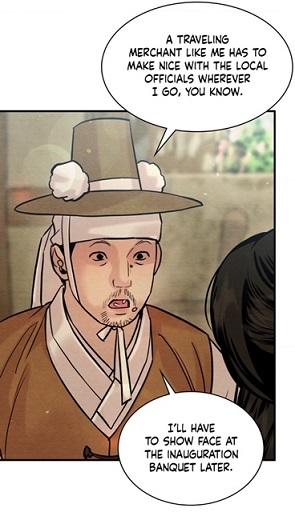 (chapter 129) There was no social exclusion at all. This stands in such opposition to the lord’s statement in season 1, where he distinguished between nobles and commoners.
But let’s return our attention to the two suspects. What happened to them then? (chapter 131) In my opinion, they were released. Why? For the simple reason that in this place, Yoon Seungho expected no huge duty! Yes, his words were not just exposing a lie, but also the truth. Nothing was supposed to happen. People are peaceful and helpful to each other.  (chapter 129) This signifies that the arrest could lead to trouble to the guards too. So was the lord lazy in the end?
  (chapter 131) Yes and no… By acting that way, he put an end to the abuse of authority in that place!! Thus I deduce that the governor is destined to gain recognition and admiration from the local inhabitants. He is generous (inauguration banquet where anyone could join), humble, loyal (he is not forgetting his lover)
  (chapter 131), but also well organized! He had planned to join this place a long time ago. The peach trees were planted about 3 years ago. He is no longer making any distinction between nobles and commoners, and that’s how he will get the respect from the peasants. As a conclusion, we should envision that the lord will become famous. Therefore the son didn’t turn the father’s nightmare into a reality. He didn’t contribute to the family’s ruin at all. Yet, there exists a huge divergence. Yoon Seungho is about to make a name on his own. It is not about the Yoons. On the one hand, the father’s dream was illusory and superficial, especially due to the treason
 (chapter 86). Since Lord Song had been forced to resign, there’s no doubt that the man would resent the Yoons to become successful again. This explicates why lord Song saw Yoon Seungwon as a problem
  (chapter 107) and tried to tarnish the younger son’s reputation. But let’s return our attention to the patriarch. His vision was based on Confucianism. However, he had a very narrow-minded perception of it.
“There is government, when the prince is prince, and the minister is minister; when the father is father, and the son is son.”- The Analects, Book XII, Yen Yuan, Chapt XI Quoted from https://www.chinausfocus.com/society-culture/confucius-more-individualistic-than-you-think
He expected not only blind obedience from his son, but also absolute devotion for the family. The individual steps aside for the community, and as such for the Yoons. This explicates why the main lead’s relative has no name in episode 6, he is simply reduced to a grandfather. 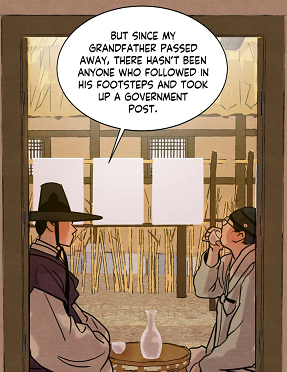 (chapter 7) This shows that the tradition was to “vanish behind the family name, the Yoons”. Under this new light, my avid readers can grasp why the main lead was destined to suffer immensely
 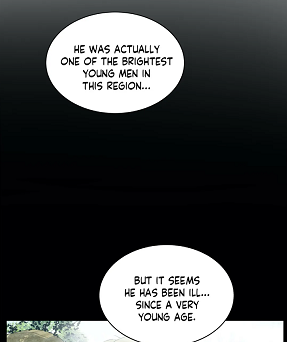 (chapter 57). His reputation was already outshining his father’s. Secondly, by being stigmatized as a homosexual, he was endangering this principle. His role was to continue the lineage and as such produce a heir.
As you can see, Yoon Seungho is breaking the tradition and even dropping Confucianism, as the latter rejects homosexuality. The main lead embodies other values: Modernity, Individualism, true Love and Humbleness. Yoon Seungho is no longer judging people based on their social status and relationship. This signifies that at the end of the story, the new governor symbolizes true justice. He put an end to corruption and malpractice. He is not influenced by people’s opinions and prejudices either. He is only listening to his heart and conscious. He makes sure to keep all his promises and not to say any empty words. He is a reformed man through and through.
However, we shouldn’t forget that the protagonist did kill many people before. Hence my other interpretation is that Yoon Seungho as a sinner is not “allowed” to become a judge himself. (chapter 131) How could he condemn others, when his hands had been soiled with blood? Thus I deduce that through her work, Byeonduck exposed the corruption of human justice in Joseon. It was impossible to get true and fair justice from anyone, let alone from the authorities. The latter were ruled by greedy and arrogant nobles who used law enforcements for their own needs. That’s why the patriarch  (chapter 116) or even Min could commit crimes in the open. They felt safe, for they knew that the authorities belonged to the same social class than them. However, this could only work, as long as the nobles would cover for each other. Should a yanbang denunciate a noble family, it was a different story. Therefore I assume that lord Lee was the one who reported the treason to the authorities (the painting in the bedroom was the evidence). But such a painting couldn’t represent a proof. However, since human justice was corrupted, the gods decided to give justice to the protagonists. That’s how Yoon Seungho became the hand of justice. Everyone involved in the protagonists’ suffering had to pay for their crimes.
  (chapter 102) That’s the reason why Baek Na-Kyum’s martyrdom was strongly intertwined with the young master’s. Yoon Seungho only received this power through Baek Na-Kyum, the character embodying fairness, sincerity, hard work, home and equity. This was particularly perceptible in this scene:
  (chapter 27) The lord couldn’t kill anyone randomly.
Yet, considering the scene in the shrine as a trial from the “gods”, can appear weird, for the main lead attacked Min and his friend under the influence of his unconscious past. 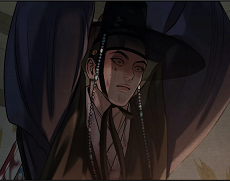 (chapter 102) However, I consider it as a first step to the lord’s emancipation and life lesson. The latter is indirectly learning not to pay attention to status and power. That’s why the author portrayed him as blind and deaf to their plea and special status. While his behavior in the shrine was rather impulsive and influenced by deeply rooted fears, we should consider lord Song’s execution as a true act of justice.
  (chapter 123)
  (chapter 123) The latter had confessed all his crimes: the ones from the past (the lies in order to fool the father)
 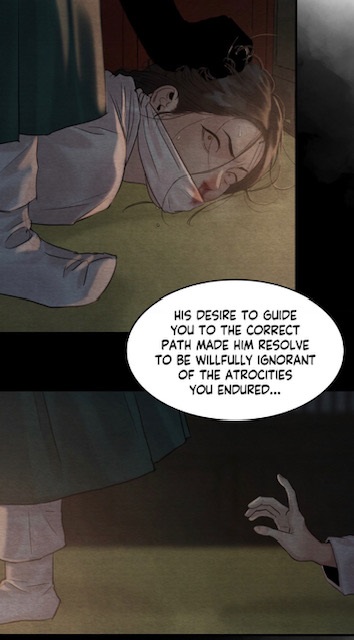 (chapter 123) and the painter’s murder. Funny is that lord Song didn’t feel threatened by the young master at all despite the sword.
 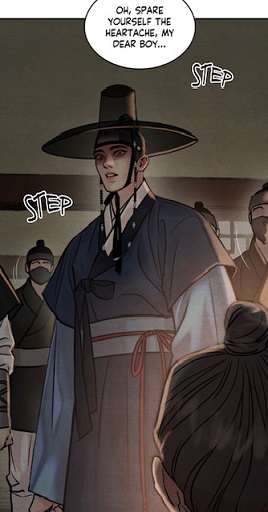 (chapter 123) Why? It is because he feels, he is the one with the upper hand. First, he has the petition, hence he is already projecting himself in the future (he can get a high position again). Secondly, he thinks, Yoon Seungho is outnumbered. He is surrounded by 4 guards. But more importantly, he views himself superior to the main character due to his age. He is an elder. That’s the reason why he calls “my dear boy”. This implies that he is underestimating the main figure. The latter would never dare to raise his hand against a senior!! However, true justice is also blind to age.
 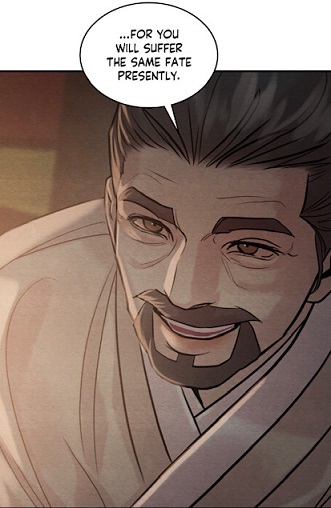 (chapter 123) His smile at the end of the episode should be perceived as a reflection from Min’s vanishing.
  (chapter 103) One might even add that the lord’s action could have been seen as self-defense. However, don’t forget that we are here in Joseon, where a commoner’s life means nothing. Because of this new association, I came to the following deduction: lord Song was the one behind lord Shin’s death.
  (chapter 103) The latter couldn’t imagine that an elderly yanbang, an official, would raise the sword against another noble. After this new realization, it dawned on me why Yoon Seungho had to get separated from his loved one.
 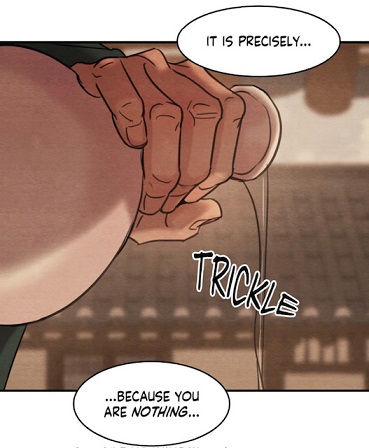 (chapter 126) This humiliation made Yoon Seungho realize that he needed to have his power on his own. He learned through the hard way that he was not just a Yoon, but Seungho. Yes, this helped him to differentiate himself from his father and to become stronger mentally. His religion was now his lover, Baek Na-Kyum, whom he needed to protect. But he could only do it, if he had himself a powerful position. But he needed to witness the corruption of the authorities to realize that in Joseon, there exists no justice. (chapter 127) That’s the reason why I deduce that Yoon Seungho is not destined to become a lazy or unfair governor. He learned through the hard way how important it is to give proper justice. (chapter 131) Should these two men know the artist, the latter could encourage his lover to listen to their testimonies and not judge them based on their status.
Under this new light, it becomes comprehensible why I don’t perceive the main lead as a lazy governor. Just because he appears as one in this scene (chapter 131), we shouldn’t generalize such a behavior. By paying no attention to power and fame, the protagonist learned what true justice is. Moreover, he realized the true source of happiness: love and simplicity. He made sure to keep all his promises to his loved one. Moreover, the artist is there to remind Yoon Seungho of his duties: (chapter 131) Hence I can’t help myself imagining the couple strolling through the village and listening to the people. Thanks to the artist, Yoon Seungho can only get recognition and acceptance from the autochtones. Besides, Baek Na-Kyum is even giving painting lessons to children, so I doubt that he will drop everything for his lover’s sake. We should envision the opposite behavior from the scholar:  (chapter 6): neglect and indifference towards the commoners. And this new observation brings me to my other topic, Jung In-Hun.
2. The real sinners: the hidden hustlers and workhorses
In the first part of this essay, I compared the arrival of the lord in his new jurisdiction with the scholar’s Jung In-Hun.
| YoOn Seungho | Jung In-Hun |
|---|---|
| |
Through this comparison. I had a huge revelation. Manhwaphiles can notice not only the absence of flags and the palaquin, but also the absence of uniforms. The two men in black leading the horse were simply wearing black hanboks and not blue and white costumes. Then it dawned on me that after this cortege on the street, there was no banquet after his success. Hence I deduce that he had not really succeeded at the civil service examination. First, he had not finished top place  (chapter 129), therefore he couldn’t select one position contrary to the main lead. This means that when he celebrated his “victory” in episode 111, it was not official. He had no post. I would even add, his name had not been announced on the official board, like we could witness it in this scene.
 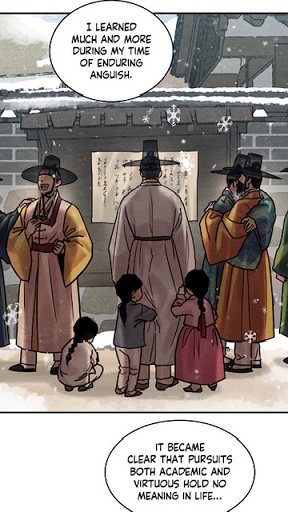 (chapter 121) Here, he is informed that he didn’t pass the exam, for his name was not written there. We can detect this, because people are congratulating each other. His name was left out due to the intervention from lord Song. This means that when Yoon Seungho made him this offer
 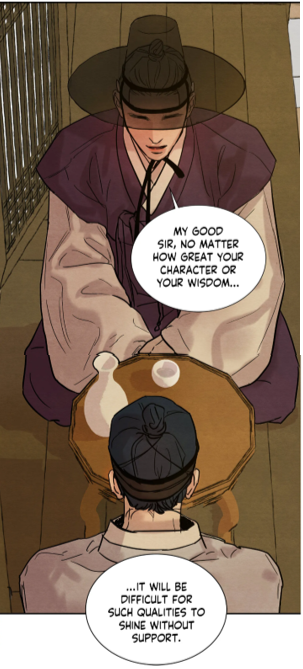 (chapter 7), these were not empty words. He did help the learned sir to pass the civil service exam. But the scholar didn’t succeed like anticipated. The absence of his success explicates why Jung In-Hun received such an offer from lord Song later.
 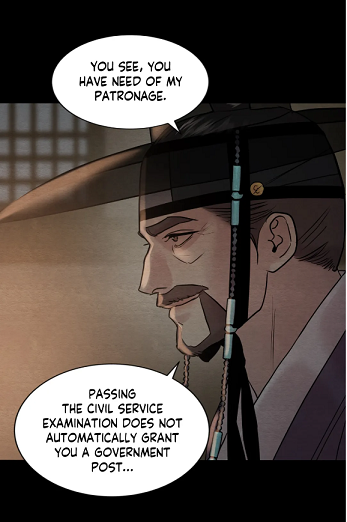 (chapter 117) He had no post, he couldn’t choose it, for he was not the best. Thus I deduce that the scholar had just proven his mediocrity. He was just an average man. That’s how it dawned on me that the ceremony in the street was more a simulacre! (chapter 111) Yes, it was fake, for there was no banquet, no sedan chair, no flag and just civilians were surrounding the former teacher. The painting from Baek Na-Kyum can even serve as another evidence that a palanquin and flags are attributes to a ceremony of inauguration.
 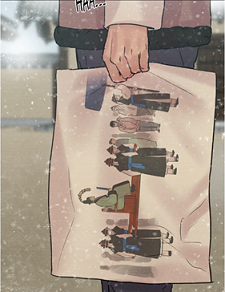 (chapter 44) Only one thing was real: Jung In-Hun was wearing an official uniform, that way no one would doubt his “victory”. Moreover, observe that lord Song only approached the learned sir after the parade. So he was not behind the parade. Besides, keep in mind that the main couple was informed about the parade through the tailor
 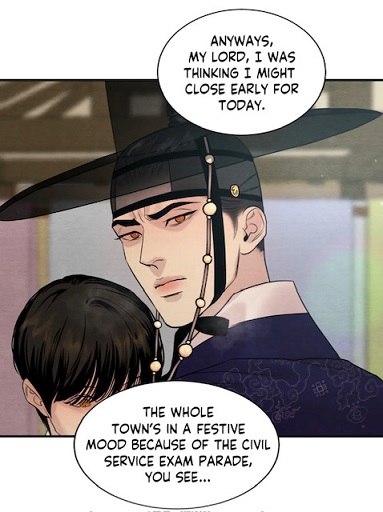 (chapter 111) and not from the official board. His reaction shows not only his displeasure, but also his ignorance. If he had known about the cortege, he would have avoided the place in the first place. Thus I suspect that the tailor had been encouraged to leak this information in front of the couple. Let’s not forget, as a tailor, he was definitely involved in the cortege. It is no coincidence that he informed Yoon Seungho about this “sudden parade”. At the same time, I come to the following deduction: someone must have paid for this spectacle, and it was not Yoon Seungho, for he had been kept in the dark until the last moment. I doubt that the learned sir had the connections and money for this. This new perception corroborates my previous interpretation: the show was sponsored by someone, and it was definitely inspired by the drawing (the hat and the green uniform).
  (chapter 111). Yet this was just a cheap trick, for the person didn’t send a sedan chair with carriers. Under this new light, I realized why Jung In-Hun ended up stigmatized as a criminal.
 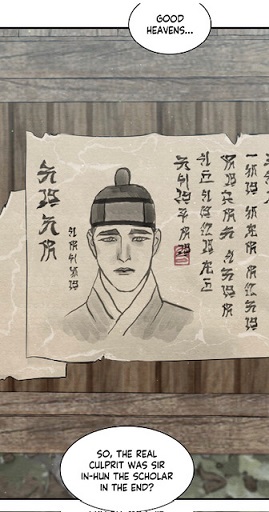 (chapter 127) It was his karma, for he had deceived the painter with his lies. His success was not his own.
 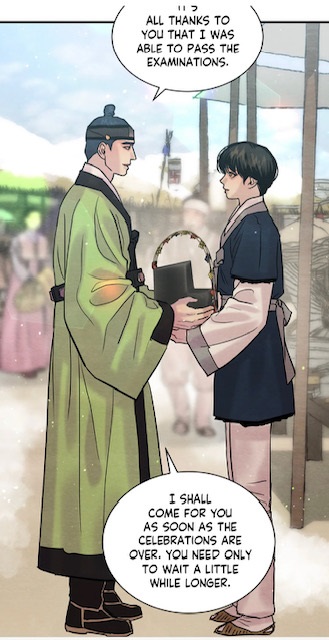 (chapter 111) He realized that even after passing the exam, he needed the assistance of people, a sponsor for the spectacle, a noble with connections. Besides, when in season 1, the painter was accused of a crime (ruining the picture), the learned sir did nothing at all. He didn’t protect his student, for he desired to keep his sponsor. When the latter was sick, he neglected him as well. He wouldn’t have sent a doctor for him. Hence in season 4, the sponsor Na-Kyum decides to end his “sponsorship” for the learned sir. We could say that the former teacher is confronted with a similar situation. He ends up being abandoned and framed for a crime, which he didn’t commit. Yet, contrary to his pupil, he is not entirely blameless, for he played a huge role in the death of the nobles lord Song, lord Shin, lord Min and others. Because Baek Na-Kyum embodies hard work, justice, equity, love and honesty, I deduce that his surrogate father embodies the negative notions: laziness, corruption, partiality, hierarchy, ambition and hypocrisy. That’s why his face ended up on the official board, while the painter’s accusation just remained rumors.
  : (chapter 125) versus (chapter 127) His fate reflects Joseon’ society and authorities, especially when the latter are closer to the capitale.
At the same time, the poster of the scholar exposes that the scholar’s dream had always been to see his name on the official board. (chapter 121) However, the notice was not associated with glory and honor, but with the opposite value. He was an immoral and brutal man. (chapter 127) which was actually reflecting his true personality. We should see the parade in episode 111 as an illusion due to the absence of an official document. And who had paid for this charade? One might think lord Song. However, don’t forget that he approached the man much later. I feel like someone else was involved as well. For me, it was Heena. She was seen with the tailor in season 2, and she had seen the painting from her brother. Finally, she had tried in season 2 and 3 to separate the couple. So she should have repeated the same action, because her resent towards nobles runs deeply, just like her admiration for Jung In-Hun is strong. She knew that her donsaeng was no longer listening to her and his new lover. He was determined to remain by his lover’s side. Thus she didn’t intervene here. 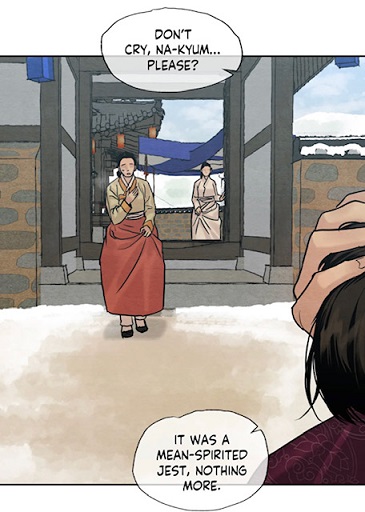 (chapter 105) IMO, she had to use another mean in order to achieve her goal: the scholar. Let’s not forget that the artist had confided to her this:
  (chapter 68) He was simply waiting for the learned sir’s return. And she was present during the cortege.
  (chapter 111)
Naturally, Jung In-Hun ended up being accused of murder, because not only he had lied, but also he had contributed to the death of lord Min and the others. By giving the spectacles, he was also responsible for their death. Finally, by hurting Baek Na-Kyum and giving him to lord Song 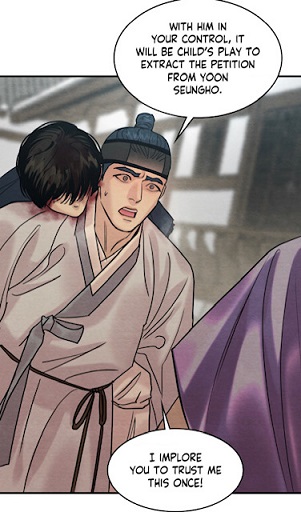 (chapter 121), he put the painter in a position which led him to take for the fall for his loved one. It was like framing an innocent. Exactly like in season 3
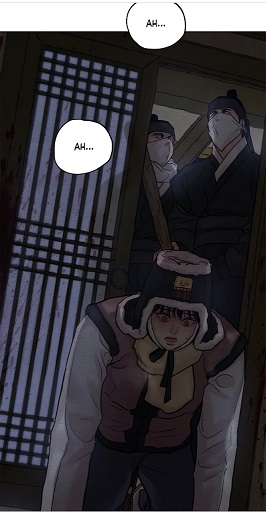 (chapter 99), Yoon Seungho had been forced to take the sword because of the scholar. And the trigger for the massacre
 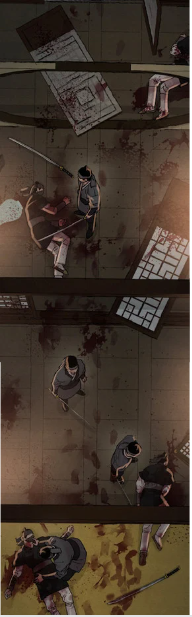 (chapter 124) was always Jung In-Hun. And now, you comprehend why Jung In-Hun became the scapegoat for the last incident. But there’s more to it.
The sexual and physical assault, playing a trick on multiple occasions and the lies are the reasons why the learned sir ended being labelled as a dangerous bandit. (chapter 127) The paper reflects the transformation of the former teacher. He is no longer a honest man. He lost everything: his home, his name and even his life, killed by lord Song’s minions. 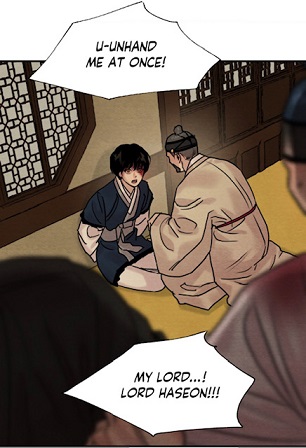 (chapter 121) His final lesson was to learn that he was exactly like the others: he is just a human despite his education. All humans are equal in front of death. In fact, during his confrontation with lord Song, he came to give up on his integrity. His true face came to the surface: he was just an opportunist, a lazy scholar who relied on fate and his arrogance.
  (chapter 6) This brings me to my next interpretation. Jung In-Hun learned through the hard way that there is nothing like fate (“right time”), but life is the result of decisions. However, because the scholar always regretted all his past choices, he decided to blame others for his wrong choices. That’s the reason why he ends up to take the whole crime. We should see this paper (chapter 127) as a reflection from the poem in episode 4:
 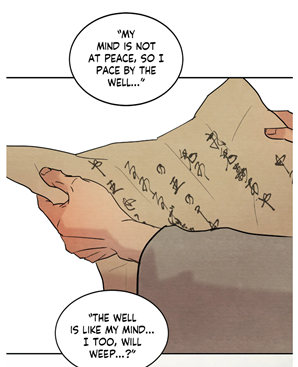 The author from this sijo was the poet and official Wang Bang-Yeon who is said to have lived in the time of Joseon’s sixth king Danjong (1441-1457) and his successor king Sejo (1417-1468). As the official of the state tribunal, he followed the young king Danjong into his exile and gave him poison to drink by royal command. Yes, both are symbols of power, corruption, partiality and injustice. Yet, there exists one divergence. While Wang Bang-Yeon left a poem revealing his yearning for the king, the learned sir had no deep attachment towards the artist. Hence it is no wonder why the paper “Wanted” is not connected to affection. It really reflects the emotions and thoughts of Baek Na-Kyum. Due to the last incident, the latter no longer cares for this man.
Jung In-Hun should have realized much sooner that happiness is not a synonym for power and admiration. In reality, he was living quite well in the small village. (chapter 6) He had a roof over his head, and he was surrounded by children, who liked him. (chapter 121) But the problem is that he was consumed by entitlement and greed. How so? It is because of his education. He saw himself superior to others morally and mentally. Hence he didn’t feel the genuine admiration from the children.  (chapter 6) He couldn’t enjoy it at all. It is no coincidence that the synonyms for ambitious person are “busy person” and “workhorse”. Yes, this mirrors the expression “laziness”. A true ambitious person is actually proactive and not really relying on sponsors and bribes. So when we see the learned sir on the horse (chapter 111), he is acting like a workhorse. The reality is that he is lazy, as he saw himself destined to achieve greatness. He had the impression that no one had recognized his true value. On the horse, he is just waving his hand and smiling. Later, he confesses this to the artist: (chapter 111) As you can see, his success is not the result of his hard work, but rather of his connections!! Though he didn’t kill lord Song himself, Jung In-Hun had to receive his due punishment for all his lies and sins.
3. The brother’s punishment
This brings me to the next interpretation: Yoon Seungwon and his success. (chapter 107) Though he passed the civil service exam too, he is not able to fulfil his father’s wish either. (chapter 86) They lack support now because of the treason. The families close to the Yoons got executed. But there’s more to it. The youngest son had first betrayed his father by giving the petition to Yoon Seungho,
 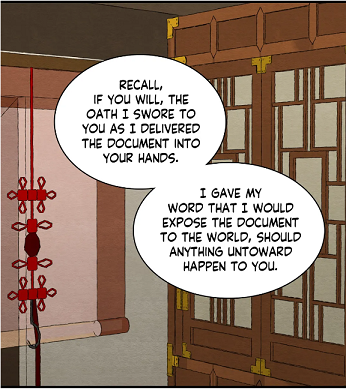 (chapter 118) His intention was to protect not only his brother, but also their family. It was to ensure that lord Song would get blackmailed. That’s how this investigation (chapter 37) got stopped in the end, and the Yoons escaped any punishment. However, by doing so, Yoon Seungwon turned his brother into a blackmailer. Thanks to him, Yoon Seungwon could keep his reputation intact. In fact he never lost his father’s trust. However, in season 4, we can witness a change of heart in the brother.
  (chapter 118) It is because he knows that with the petition in his brother’s hands, lord Song represents a hindrance to his own career. The latter can only see the Yoons as a threat. Besides, he can only resent the family, if they are able to gain reputation and power, while he can not return to Hanyang and occupy a high position. As you can see, the young master’s success can only irritate lord Song. You can sense a rivalry between Seungwon and lord Song Haseon
  (chapter 116) in this scene:
  (chapter 116) The latter has already sensed that the traitor is sitting next to them, thus he raised this question. That’s why I come to the following conclusion that the young master must have realized that he also needed his brother’s assistance. First, if Yoon Seungho returns the petition to the father, the investigation about the traitor in the mansion would be no longer necessary. Secondly, Yoon Seungwon needs to create new connections in Hanyang, but he can only achieve it with his elder brother. Under this new light, you comprehend why Seungwon asked his relative to move on from the past and as such “forgive their father”
 . (chapter 118) In other words, the young man embodies the notion of “fake forgiveness, fake promise, fake understanding”. He is an opportunist, exactly like the scholar. Yet, there exists a huge divergence between them. His affection for Yoon Seungho was not fake. He is feeling sympathy for his brother. But that’s it. This explains why he didn’t help his brother before. In my eyes, Seungwon represents a different notion of family: bloodline. In my eyes, he embodies traditions and Confucianism. His goal is to turn his father’s dream and life motto into a reality: glory and power for the Yoons. Besides, he must have experienced himself the downfall for the family. And this observation leads to my next interpretation. This means that Yoon Seungwon must have lied to his father by omission as well. (chapter 86) In my opinion, he must have promised to fulfil the patriarch’s wish, but reality made him realize that this was not possible. He couldn’t do it alone. However, I doubt that he confronted the elder with reality.
Let’s not forget that he is only the second son. So he can not inherit the family’s properties. Remember that once the main lead succeeded the civil service exam, he received many marriage proposals.  (chapter 128) What about Yoon Seungwon then? Though he succeeded too, there is no mention about engagement or marriage proposals. However, it is clear that this achievement is connected with adulthood and marriage, therefore the elder Song Haseon brought up the topic sex!
 (chapter 107) It is because Yoon Seungho is the first son who will inherit the title and properties. Yoon Seungwon’s success can only work with his brother’s presence. This means that thanks to the last episode, I could finally find the answer from Byeonduck’s question:
  What was the reason for Yoon Seungwon’s embarrassment? First, it is because his brother selected the backward place, though he had passed the exam with flying colors. Yoon Seungwon imagined that once his brother had passed the exam, he would get married and establish new connections. That way, Seungwon would be able to get married with a properous and famous family. In other words, Yoon Seungho would turn the father’s dream into a reality: the return of the Yoons’ glory and power. And Seungwon would benefit a lot from this. So in the gibang, his advices might have sounded well meant, (chapter 118), in verity he was also motivated by his own desires. He wanted to get the help from his older brother. This means that the moment the main lead lost his father, Seungwon’s words became true. Yoon Seungho followed his advice: he cut off ties with his past and as such with his family. He was no longer obliged to fulfil the family traditions and the father’s dream. This means that Yoon Seungwon is now on his own. I find it funny that he blamed his brother for his debauchery, but what did he do during this time? Nothing… he waited, until he received pressure from his own father. Moreover, since Yoon Seungwon didn’t help the artist and allowed him to take the fall for the massacre
  (chapter 126), his karma is not only to end up alone, but also not to receive any support from his brother.
To conclude, Yoon Seungwon tried to convince his brother to change his behavior  (chapter 117), because his career was still insecure due to lord Song’s influence. He needed his brother’s help in the end. At the same time, Seungwon had already long internalized the values from his father: Yoons’ honor and reputation were top priorities. In other words, the younger brother stands for social norms and fake righteousness. He desires to maintain his perfect image (loyalty, filial piety),
 (chapter 118), hence he left the document at the mansion. He wanted his brother to return the papers on his own so that his past action would remain undetected. Returning the paper was like an admission that he had stolen it in the first place. Yet he still barged in his brother’s house twice.
 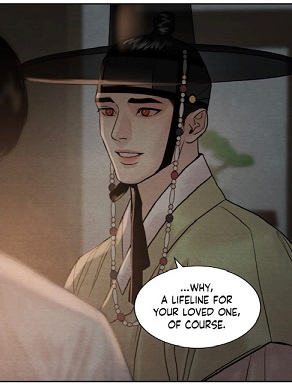 (chapter 117) Here, he exposed the existence of the “petition” to Baek Na-Kyum for one reason. The latter should be used as a way to pressure the main lead to give up on the paper. Notice that this topic was brought up in the gibang:
 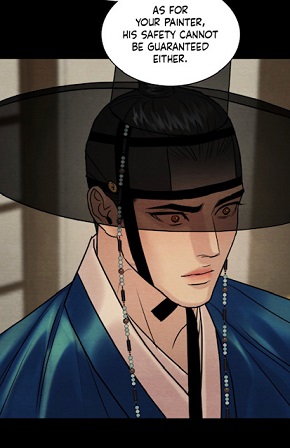 (chapter 119) However, the reality is that Seungwon is not just trying to fulfil his father’s dream, but also he has his own ambition. He wants to make a name on his own. That’s why he confessed this to his brother:
  (chapter 119) He doesn’t associate himself with the father and his sins. In his eyes, he is blameless. The reality is that he is guilty like his father, for he failed to care for Yoon Seungho. He failed to listen to him and his suffering. He didn’t try to understand him. Like mentioned above, he only sympathized with him and that’s it. Thus he condemned him for his debauchery in the gibang, but this was no longer the case.
When the father confronted his own son with reality (he had no power without him), Yoon Seungwon was once again absent!! The latter is the evidence of his “neglect”. It is important, because when the main lead bowed in front of the patriarch,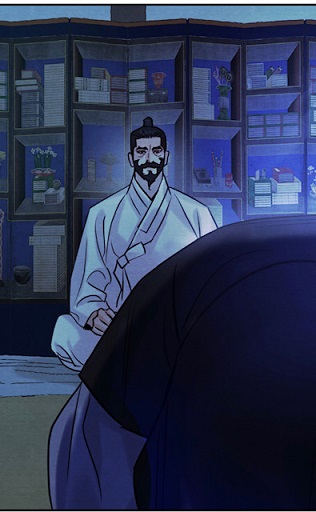 (chapter 127)
 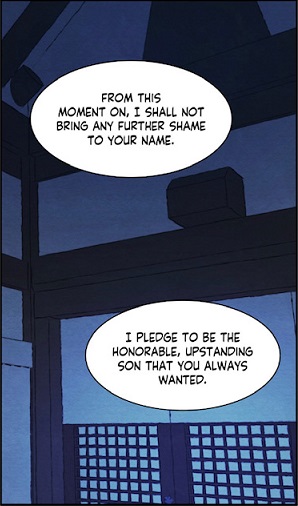 (chapter 127) the former only made a promise to his father and not to the brother. With his death, Yoon Seungho is no longer bound by a promise. Since the main lead had been living properly for 3 years and even passed the civil service exam, it is clear that for the brother, Yoon Seungho must have forgotten his past lover. He must have judged his brother based on appearances, just like he was behaving himself. However, this was just a subterfuge. He was waiting for the right time too. He had no change of heart, he had just been copying his brother’s behavior.
To conclude, the main lead abandoned Yoon Seungwon in the end for his loved one. It happened, when he not only rejected the marriage proposals, but also moved to that “poor region”. The sibling received his punishment for his lack of loyalty and his dishonesty. Funny is that the main lead actually followed his brother’s advices: 8chapter 118) He cut off ties with the past and the family!! This means that his words in the lord’s bedchamber came true:  (chapter 78) Let’s not forget that at the gibang, Yoon Seungwon never revealed his true intentions towards his brother. The latter always said that his advices were for his best interests. He should become involved in the government. But everything was for the Yoons, or better said, for Yoon Seungwon’s sake. And there exists another reason why the sibling must have been embarrassed: This marriage!
 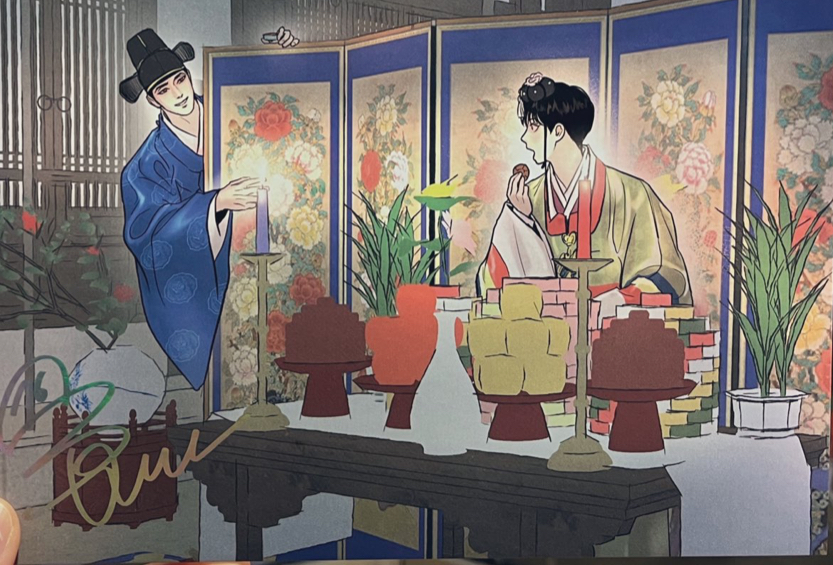 To conclude, Yoon Seungwon embodies the opposite values of Baek Na-Kyum and Yoon Seungho: ambition, corruption, forgetfulness, hierarchy/social norms, traditions and reality versus understanding, forgiveness, simplicity, closeness, modern family and happiness. Selfishness versus Selflessness. This explicates why the main lead gave up his success for the artist. However, though it looks like an exile, the reality is that he will gain popularity and admiration among the inhabitants. Why? It is because he is no longer making distinctions between nobles and commoners, he doesn’t see this place as a punishment, but as a heaven and as such he has a better perception of humans in general. In my eyes, he is bringing progress and change in the region. Baek Na-Kyum is already teaching the kids how to draw… so it is only a matter of time, until his lover takes care of the education for these children. This means that these words will become a reality:
  (chapter 6) He will think of the futures of those children because of his lover.
PS: Tell me, if you are interested in another essay. The question would be: how did lord Yoon die? Was he poisoned or not?
Feel free to comment. If you have any suggestion for topics or manhwas, feel free to ask. If you enjoyed reading it, retweet it or push the button like. My Reddit-Instagram-Tumblr-Twitter account is: @bebebisous33. Thanks for reading and for the support, particularly, I would like to thank all the new followers and people recommending my blog.
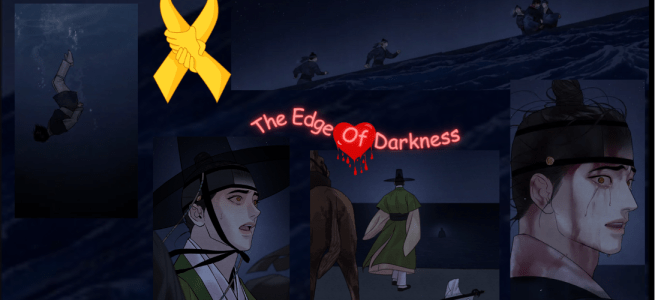
 (chapter 122) represents their future, their reunion. Since I saw chapter 124 had references to episode 116
  (chapter 116), I am expecting that the painter will be given new clothes, for the assassin switched clothes too and we should have a new scene near a pavilion
 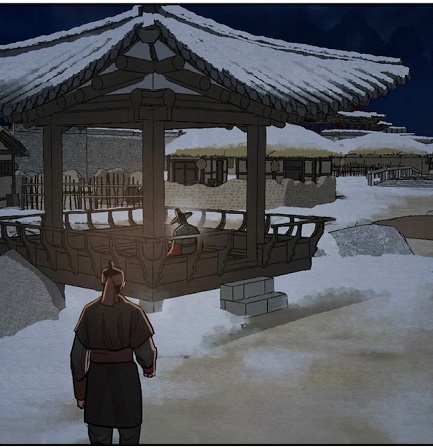 (chapter 116). Besides, don‘t forget that Yoon Seungho had ordered clothes for the painter which should have been delivered to the gibang.
 (Chapter 106)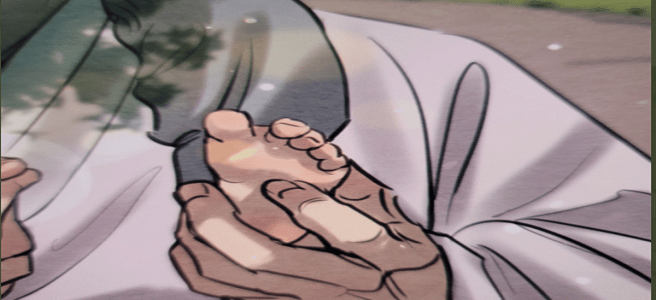
 on Twitter yesterday, and naturally this made many people happy, for Jung In-Hun was stroking Baek Na-Kyum’s foot gently. How could people identify the characters, though we don’t see their faces? Simply by the clothes! The manhwaphiles remember the painter’s grey pants and the learned sir’s favorite color, lavender,
 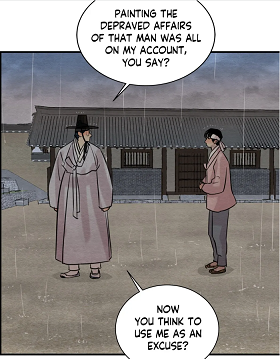 (chapter 19)
 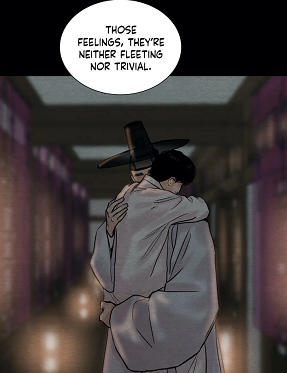 (chapter 68). While many manhwalovers found this image cute
  (chapter 70) The manhwalovers can immediately detect the contrasts: the visages of the protagonists versus the hand and the foot, day versus night, sun versus moon. That’s the reason why I came to the deduction that this image embodies a happy memory of the painter: sadness versus happiness.
 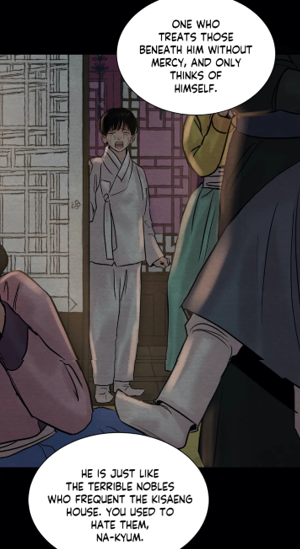 . (chapter 68) This means that Baek Na-Kyum was removed, because he was a witness and could generate a scandal. He is beloved by the kisaengs. However, back then, he got misled due to Heena’s indoctrination and false impressions. When he saw this, he was only looking at his noona, hence he didn’t pay attention to the actions of the black guard. Moreover, he had no idea why Heena and Yoon Seungho were behaving like that. So when the painter recalled Jung In-Hun from that night, he was no longer heartbroken, because the stroll with the scholar came to his mind.
  (chapter 70). The trigger for this recollection was his farewell to Heena. This time, he could say goodbye to Heena properly by embracing her and giving her a scarf so that she would remember him. In the painter’s mind, after that night, he would never see her again.
 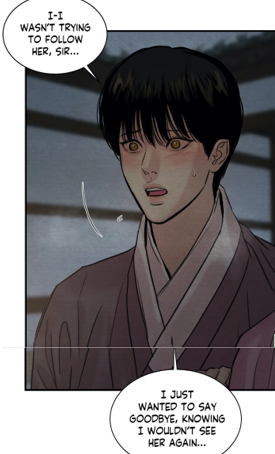 (chapter 69) In other words, this night represented a closure for Baek Na-Kyum, the end of his abandonment issues. In episode 70, Jung In-Hun had consoled him, he had tried to cheer him up. Thus the learned sir was smiling. Yet, this couldn’t cover the painter’s scar. He felt that he had betrayed Heena, for he had not been able to protect her. It was, as if he had run away. Nevertheless, when this incident occurred, the learned sir had not run away from the gibang, because you could see that Baek Na-Kyum was wearing socks and shoes.
 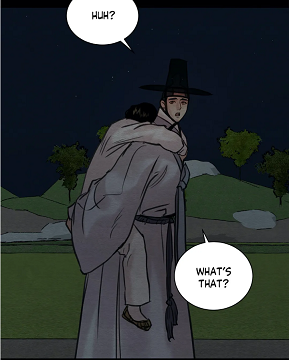 (chapter 70) The man had put the shoes on the child, as in the building, the painter only had his socks on. Because of the presence of the socks,
 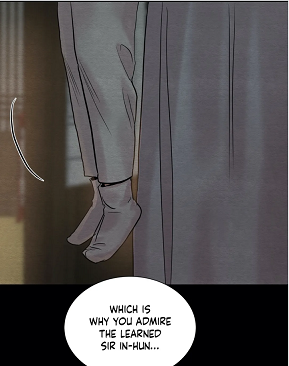 (chapter 68), I deduce that this walk must have taken place in a colder season (fall)
  while in this picture, Jung In-Hun was carrying the painter on his shoulders in the summer.
 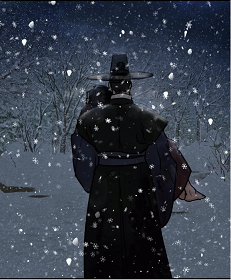 (chapter 102) In both scenes, the main lead is seen with bare feet. He is also carried by his loved one. But here, it is snowing, hence this signifies that it is winter. On the other hand, the manhwalovers can detect the presence of a purple flower on the right side. This signifies that Spring is on its way. That’s how I came to realize why Baek Na-Kyum is now recalling the learned sir’s gesture from the past.
  (chapter 102) where it is even colder than in the valley, secondly it is snowing and there is no sun, only the moonlight. So the moment Yoon Seungho witnessed that Baek Na-Kyum was alive, he must have recognized the seriousness of the situation. Since Baek Na-Kyum had only a hanbok on, he could die of hypothermia. What he had imagined for himself, death, had terrible consequences. He could be the reason for the painter’s curtains. So in my opinion, he must have warmed the painter’s feet with his hands, a new version of this scene:
 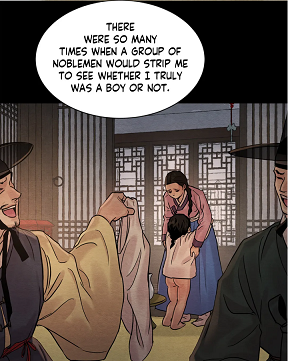 (chapter 94) His presence was to divert the attention from these men so that she wouldn’t be asked to have sex with them. And since I have already detected that each time, the painter suffered, karma would retaliate, the logical consequence is that Heena got punished for her wrong action. This signifies that while the painter was following the learned sir, his noona was abused in the kisaeng house. This would explicate why later she had no remorse to turn Yoon Seungho into a victim. And don’t forget that the painter was much younger than in this scene.
 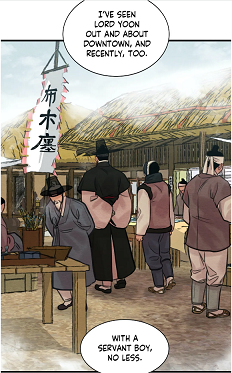 (chapter 45)
  (chapter 75) The latter would let his partner walk through town in order to please him. He would even follow the painter. In other words, it was always for the painter’s sake, and in the mountain, it was the same. But it was not the same for Jung In-Hun, it was for his own benefit. We have the best example in chapter 10:
  (chapter 10) Here, he desired to separate the couple. Baek Na-Kyum should refuse to paint erotic pictures.
  (chapter 29)
 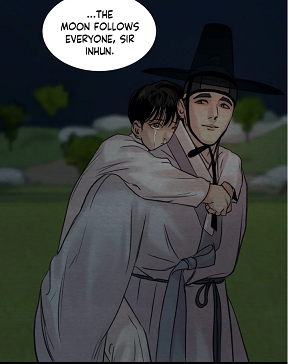 (chapter 70): The artist is dressed with good clothes, he looks more like a young master than a commoner, only the shoes are indicating that he is a commoner. That’s the reason why I believe that during that night, the learned sir was avoiding people. They could have wondered why the young boy was carried in his night clothes outside. From my point of view, this scene
 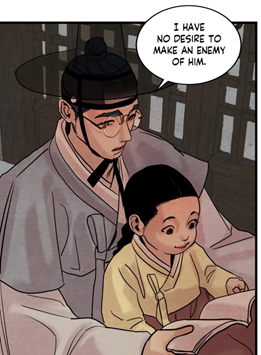 (chapter 29) He had already been seen with a girl before who seems to like him either.
  (chapter 1) Hence the painter had to leave the gibang during the day as well.
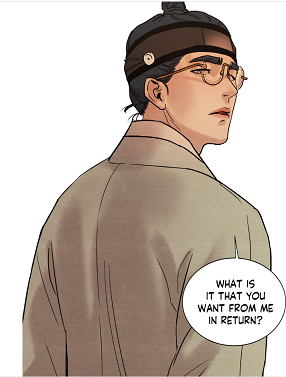 (chapter 7)
 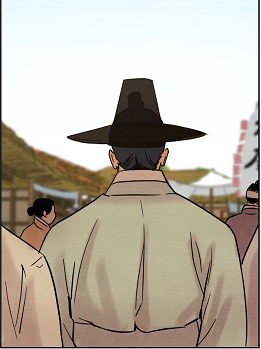 (chapter 7) This change is not random in my eyes. I had already associated the learned sir to a chameleon. This change of color seems to validate my theory that Jung In-Hun had been sponsored by Min, hence we have the light green. Black Heart is symbolized by green. However, the light pigment reflects that he had been abandoned and betrayed. Nonetheless, when he encountered Yoon Seungho, the latter was wearing a purple hanbok.
 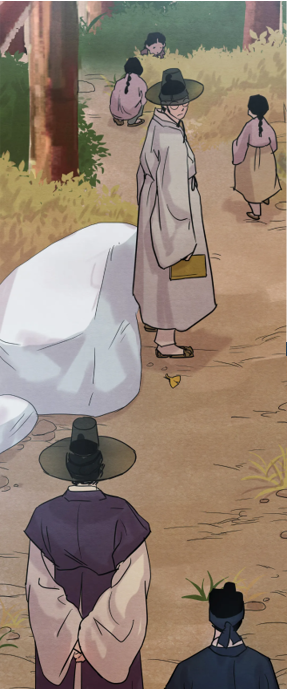 (chapter 6) That’s how the man got influenced and chose to wear his lavender hanboks again. But he never realized that behind the young noble, there was standing the pedophile, someone he had helped in the past. From my point of view, the change of the learned sir’s hanbok was the indication of his betrayal. According to me, the old bearded man
  (chapter 37) was not a former servant, but the pedophile. So he could have recognized the learned sir thanks to his hanbok… just like the readers did with this picture:
  (chapter 83), the topknot incident
  (chapter 83) According to me, in the painter’s vision from episode 1, the braided man is Yoon Seungho. The absence of shoes and socks was in truth an indication of neglect and abuse, but the warmth and gentleness from that scene deceived the painter:
  (chapter 73) From my point of view, the intimacy in the bedchamber stands in opposition to the teacher’s gesture in the countryside. His caress was just a casual gesture with no real deep meaning in the end. This explicates why he could betray and abandon the artist on so many occasions in season 1 (chapter 11, 24, 25, 29, 35, 40). The learned sir had always prioritized his own interests.
  (chapter 102), the painter should realize the difference.
  (chapter 70) talk and ask questions before apologizing and hugging him. The lord never acted, as if nothing had happened,
 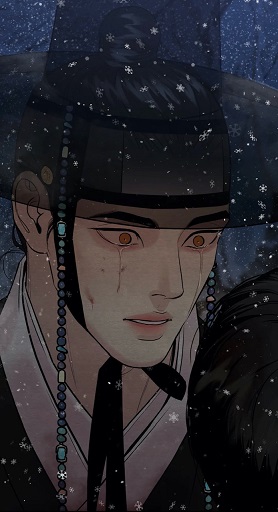 (chapter 102) This was true love and Baek Na-Kyum’s feet always reflect his emotions:
 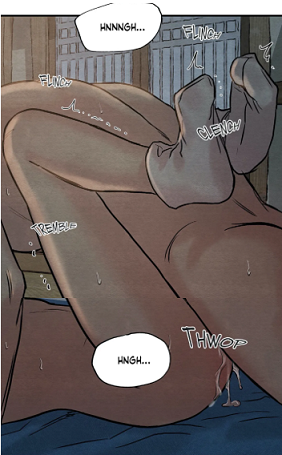 (chapter 58)
  (chapter 80) So now, imagine how the painter must feel if the lord took his feet in his hands! This is no coincidence that there is this saying:
  (chapter 100)
 (chapter 102) and the zooms on the feet:
  (chapter 53)
  The couple was following their heart!! But this was not the case with the scholar. Baek Na-Kyum had no other choice than to follow Jung In-Hun.



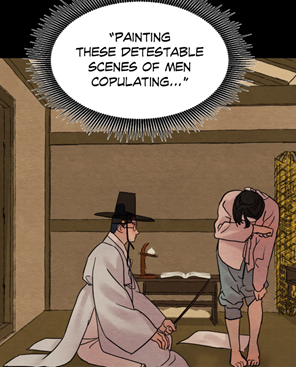 (chapter 34), only spiritual love was allowed
 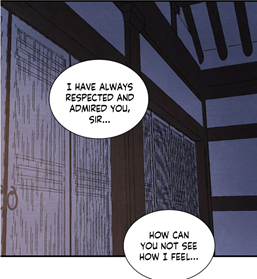 (chapter 19)
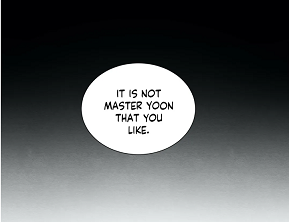 (chapter 68). This signified that in his education, not only sex was prohibited, but also sexual desires were denied. Although love was expressed through hugs
 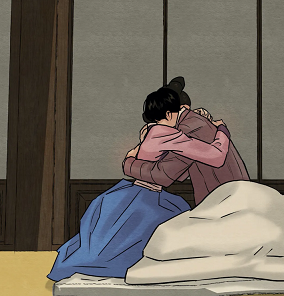 (chapter 66)
 (chapter 10)
  (chapter 68), they were devoid of sexuality. The painter experienced love, but was not allowed to experience sexuality. He was only authorized to paint it for the scholar’s sake. On the other side, Yoon Seungho was raised the opposite: love was not allowed, as it was a sign of submission and weakness. Sex was permitted, because it was considered as a fight in order to defeat his opponent. These were the butler’s doctrines. That way, he could still have a connection to the main lead. If he came to love someone (the pedophile), the lord could definitely abandon the valet and reveal his betrayals. In other words, he used pity as a way to tame the lord. At the same time, sex also served to gain some benefit, as it was an exchange of favors (giving versus receiving),
  (Chapter 71). I connect this philosophy to the king and indirectly to the butler. With sex, the nobles could exchange some favors. These huge divergences in the mindset explicate why there were so many misunderstandings between Yoon Seungho and Baek Na-Kyum, as their education diverged so much.
 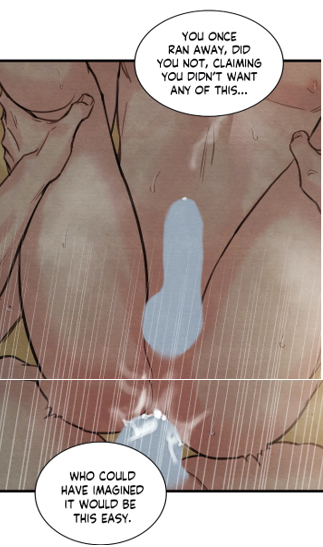 (chapt45), as the painter had accepted him as his sexual partner, he had to realize slowly that he was wrong. He imagined that since the artist had remained by his side and was accepting to have sex with him, he had achieved what he wanted: in his unconscious it was to be loved. Yet, it was just an illusion. The painter saw himself as a whore and the master as a man consumed by lust. As you can see, the noble was forced to judge the nature of the sexual encounters differently. He had associated sex to love due to their Wedding night, therefore he imagined that the moment the painter was accepting him, the problem was solved. He would be able to relive this wonderful moment, but however nothing like that happened. He felt never satisfied, as there were no feelings at all. Hence he even had sex during the day
 , believing that the artist’s lack of experience was the problem.
  (Chapter 45) While the lord became Baek Na-Kyum’s sexual emancipator, the painter became the lord’s teacher for love. This explicates why the low-born forced the lord to question his own identity and feelings.
  than a master- servant relationship, because the commoner was never treated like a domestic. He only had sex with the lord and had some privileges.
  (chapter 46) He was never asked to do other work, although the artist tried to change his situation. Since he was behaving like a whore, he felt that he had no right to express any thought and emotion. He couldn’t show any pleasure. That’s why there were no feelings in their sex encounters, and the lord could sense the difference. Consequently, when the lord realized that he was still perceived as a man consumed by sex
 (chapter 48), he changed his behavior. He acted like a real client at the brothel
 (chapter 48), but at the same time he cornered the painter to have multiple climaxes in order to let him experience that he liked having sex with him.
 (chapter 49) As you can observe, the lord linked sensuality to love. If he could provoke ejaculations, then it meant that the artist was definitely feeling something for him. However, the moment the lord liberated the painter from his pejorative perception about himself (he is a prostitute), the painter reacted the exact opposite. Now, he was the one using Yoon Seungho, the latter was his plaything.
 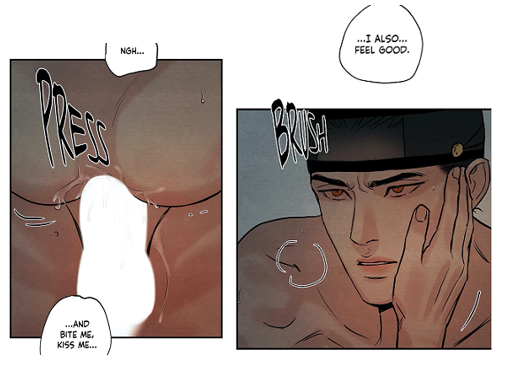 (Chapter 49), his prostitute, for he was the one procuring pleasure to Yoon Seungho. As you can see, the roles had been switched. This means that now the painter had the upper-hand in their relationship. We could even say that the noble was willing to accept his fate.
  (Chapter 49) Yet there was a difference from the past. Yoon Seungho would feel pleasure as well. This is not surprising that Kim chose to intervene and separate the couple right after. Without sex, the painter had no power over the master. That’s the reason why the butler revealed his knowledge the morning after. The protagonist had to hear from his butler the real cause for Baek Na-Kyum’s passivity and torpor:
  (chapter 50). Through this revelation, the lord was indirectly confronted by his own reflection: he was indeed asking from Baek Na-Kyum sexual favors in exchange for his stay at the mansion. That’s the reason why the lord had a “relapse“ and kept his distance from the painter.
  (chapter 52). This was important, because for the noble, it meant that he could no longer have sex with other partners. Without sex, the lord was forced to question himself and ponder on the true nature of his relationship with Baek Na-Kyum. He felt jealousy during that night, he was very protective as well.
  (Chapter 52) His sexuality had already become an expression of his love, although the main lead was still unaware of his own feelings. That’s why I come to the conclusion, chapter 52 was actually revealing Yoon Seungho’s monogamy, although it looked the opposite. And this becomes truly visible, when the gangrape was about to occur. He felt no urge, when he was with the guests, yet the moment he brought the artist to the bedchamber, he couldn’t stop himself from kissing his loved one.
  (chapter 54) He was definitely longing for his warmth. This explicates why the noble got so infuriated, when he was confronted with the consequence of his bad decision:
 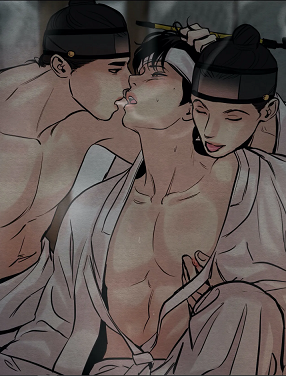 (chapter 54) the artist was on the verge to be no longer monogamous, as he would be tasted by other aristocrats. In this scene, the lord would have indeed become a client and pimp, if he hadn’t chased away his guests. Although the painter was indeed upset afterwards about this incident
 (chapter 55), deep down he sensed that his master had protected him. This night was important for the main lead: he was forced to admit his own feelings for the painter. Therefore, we could say that the issue with the prostitution was solved after chapter 54. Yoon Seungho thought that the moment he confessed, the painter would get scared and run away, but it didn’t happen. Why? Love among men and especially between a brutal noble and a commoner, was a taboo, like Min had underlined. Secondly, if the lord had indeed feelings for him, he had behaved like a beast during that night. He had mistreated Baek Na-Kyum. In his mind, the artist would never accept him.Besides, the painter had clearly denied the affection from the main lead. In his eyes, the painter’s words were indicating a rejection.
 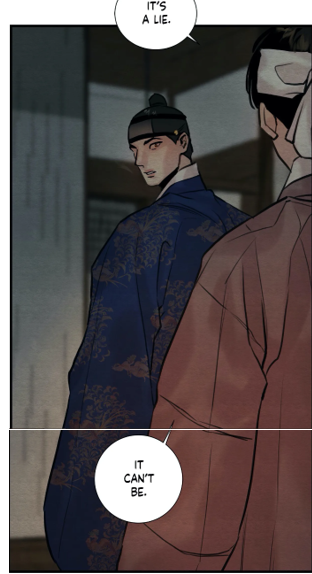 (chapter 54) Thus I conclude that Yoon Seungho and Baek Na-Kyum had come to an implicit agreement: they had a master-servant relationship
 (chapter 56), although Baek Na-Kyum started perceiving himself as a domestic from chapter 51 on again. He kept following the head-maid
  and Kim
 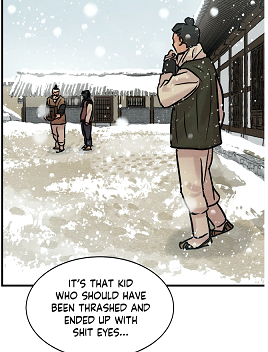 (chapter 51) in order to help them. Therefore the readers could witness the return of the white headband in chapter 52: his task was to paint for his master.
 (Chapter 52)
  (chapter 62) here, he whispered to Baek Na-Kyum that he adored him), he would bind the artist to himself.
  (chapter 63), exactly like he had wished in chapter 49. The only difference is that this time, the painter was here for the lord’s pleasure. The roles had been switched again. As the manhwaphiles can perceive, the noble and painter had a similar reaction: they both tried to deny the existence of love in their relationship. That’s the reason why the noble stopped the artist from confessing:
 (chapter 63) They just had a sexual relationship which could provoke pleasure, but that was it. But in order to ensure that the artist wouldn’t run away again, he used sex to “tame“ Baek Na-Kyum. If the main lead could procure multiple climaxes to the artist, then the latter was forced to admit that only Yoon Seungho could be his “partner“. This explicates why the noble kept pointing out how the artist would react to his lover’s body.
 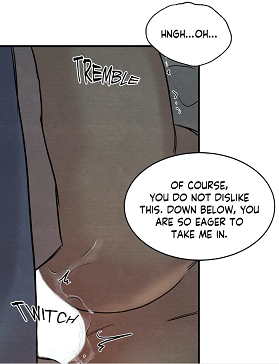 (Chapter 63)
 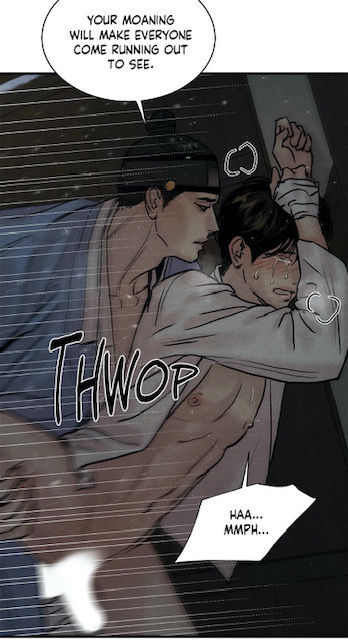 (chapter 64) He was moaning and would ejaculate constantly thanks to the main lead. Yet, during this second marathon, the noble was actually deceiving himself.
  (Chapter 62)
 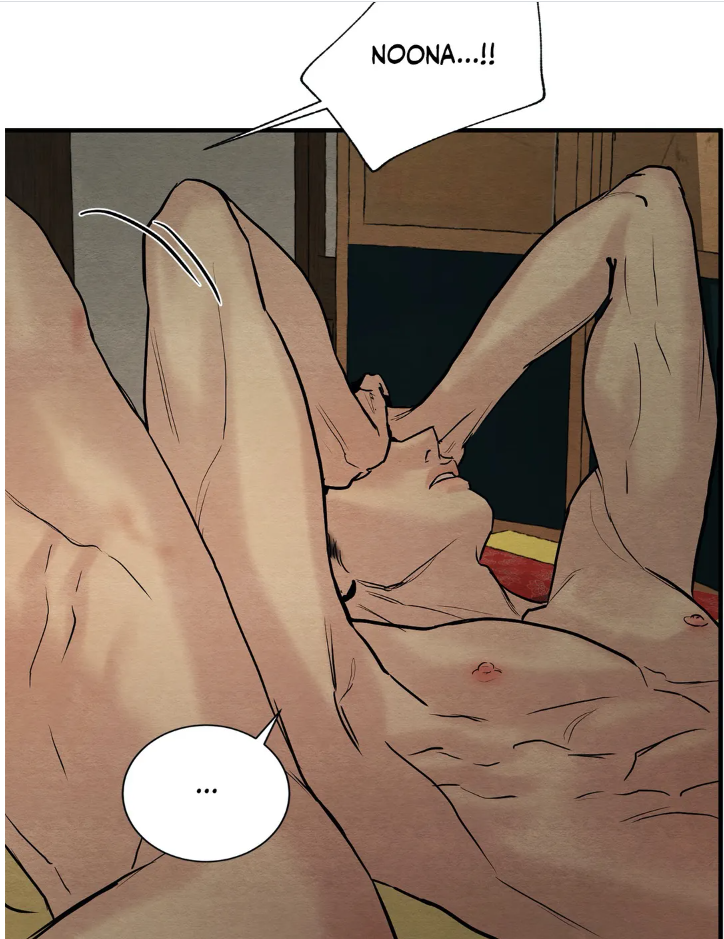 (Chapter 65) This shows that the painter had gained a new position: he was indeed a favored servant. He was allowed to spend the night in his lover’s bed and he could see the lord getting dressed.
  (Chapter 65) The slight change was that now the main lead was aware of this. This truly exposes the lord’s affection for the artist. He might have treated him like a plaything in the shed, in reality he had attempted to show “his skills“ as a lover. He had licked him, bit him and the painter had felt pleasure, though he kept saying no! This is not surprising that Yoon Seungho had denied the kiss in the study.
 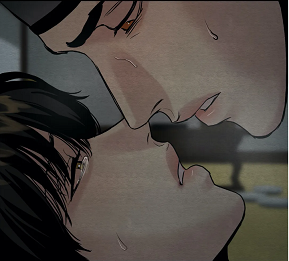 (Chapter 64) Because that’s how he had been deceived that night in the study.
 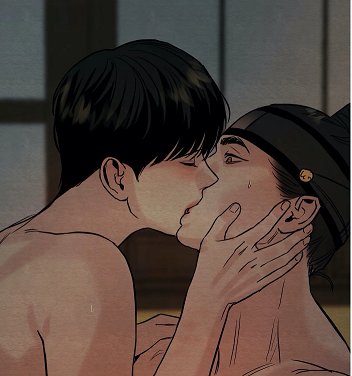 (Chapter 49) Baek Na-Kyum had silenced him with the kiss, as the main lead was about to protest.
  (chapter 65) What caught my attention is that the painter’s disappearance mirrored the lord’s wrongdoing. Lee Jihwa and the main lead had both kidnapped the artist. That’s why I believe that when he heard Heena’s words in the study
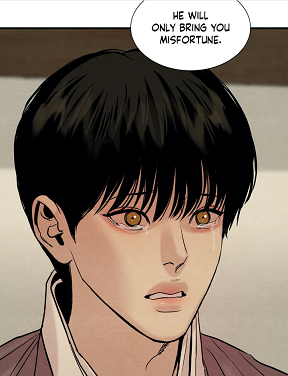 (chapter 68), the noble could only come to the following conclusion: he could only let the painter choose his destiny. But the moment the artist decided to remain by his side, he needed to change Baek Na-Kyum’s position in the mansion. He was no longer a servant, but a noble guest. Hence the lord tied the scarf like aristocrats did.
 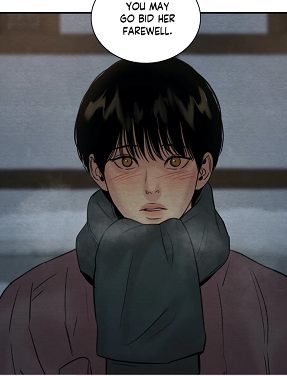 (chapter 69) Consequently, we could say that the painter had a similar status than Jung In-Hun. Yet, there was a huge difference: the owner of the mansion was now acting like the painter’s servant. Hence Deok-Jae’s words came true:
 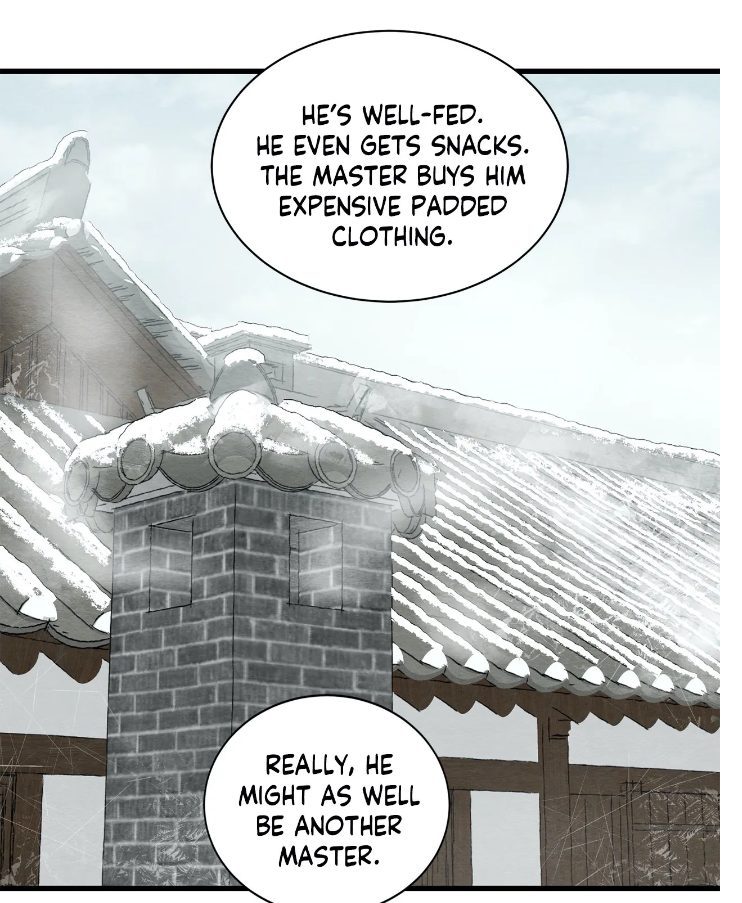 (chapter 46).
  (chapter 71). Why? It is because the lord made the decision that the painter chose him, then this means that he became his wife, though at the end of season 2, he was not thinking about marriage yet. He was not aware of this perception. By becoming his official partner, the spouse obtains the status of his husband: nobility. This explicates why the lord ate with his lover
 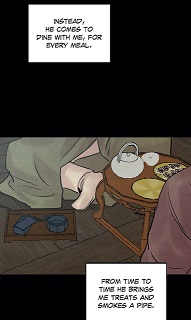 (chapter 74) and allowed him to smoke. Then in season 3, he gave him ladies-in-waiting in order to give him some company.
  (Chapter 78) He even gave him the music box, which was mistaken as a dowry. However, the problem is that the painter was still fighting his own feelings for the protagonist due to Heena noona’s words and past experience with the scholar. He feared that this new situation was too beautiful to be true, hence he thought that the lord’s feelings would fade away. But there was another reason for doubting the lord’s affection: there was no sex.
  (chapter 74) The painter had come to associate sex with love too. Yet, the moment he relived his trauma, he only found comfort and safety in the lord’s embrace.
 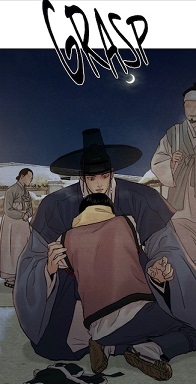 (Chapter 76) The main lead didn’t reject the painter’s urge for a hug in front of commoners. At no moment, Yoon Seungho felt embarrassment. He treated him like a special treasure. That’s how the painter came to realize that Yoon Seungho‘s love for him was true and genuine. Consequently, he decided to rely on him and to trust him. That’s why in this panel, the painter closed his eyes:
  (chapter 76) We could say that he was reminded of his own past. When he was a child, he sensed love through hugs and caresses. Since the painter could feel the lord’s genuine affection and warmth, he recognized that even when there was no sex, love was present. All his senses made him perceive the lord’s love:
 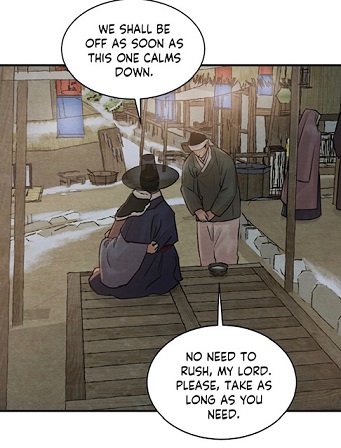 (chapter 76) His words showed his care and concern, then he bought him an expensive music box.
  (Chapter 76)
 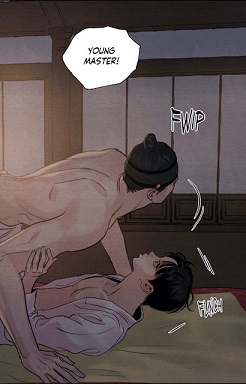 (Chapter 80) And now, you comprehend why the painter didn‘t confess during that night. He got interrupted. The kiss was the symbol for their love. Thus it is no coincidence that just after his confession,.
  (Chapter 94) the painter initiated a long and sensual kiss with his “husband“.
 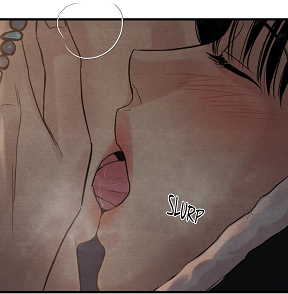 (Chapter 95) Since the painter had received caresses and embraces in his childhood, he came to view the kiss as the symbol for true love. And note that the kisses exchanged in the gibang were full of passion and love. This was the perfect combination of love and sex.
 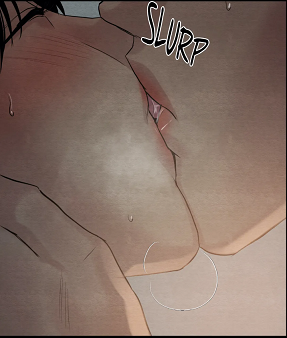 (Chapter 95)

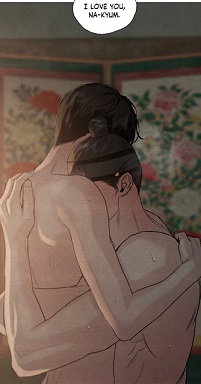 (Chapter 96) This shows that Yoon Seungho has always longed for a pure and spiritual love in the first place. His sexual preferences were already palpable in the last love session (season 2):
 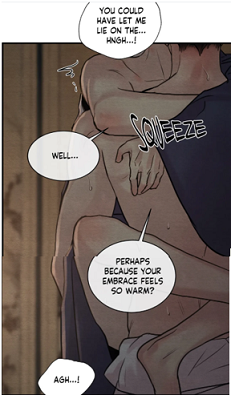 (chapter 72) We could say that he discovered all his sexual preferences thanks to the painter.
  (Chapter 80) But he failed due to the intervention of the butler and other schemers. Besides, the whispering of „Kyumah“ could only make his heart race. Let’s not forget that his painting in the sand
 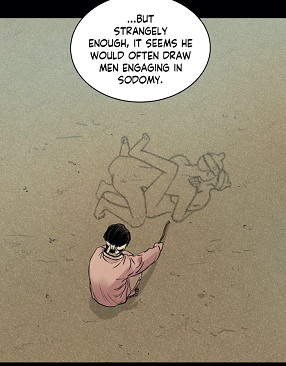 (chapter 1) externalized his own philosophy: love and sex can’t be separated. Note that the couple is is hugging and kissing at the same time! 😍 This picture will represent the peak of their love! Striking is that when the couple confirmed their mutual affection, they did in the kisaeng house, the symbol for prostitution. This truly exposed that Yoon Seungho had been treated like a male night servant in the past. .
 (chapter 72) in the next season, for the painter is still calling his lover “lord Seungho“
  (chapter 99)
  (chapter 102) This means that he is still viewing himself as a low-born. But note that contrary to the past, Baek Na-Kum is now wearing a hanbok and he has no other clothes. Thus I am deducing that the painter’s next lesson is to drop his notion that he is a commoner. He will be taught to view himself as an equal to Yoon Seungho. Only when he has internalized that there is no gap between him and his lover, then he will be able to address him as “Seungho-YA!“ At the same time, both protagonists will come to realize that they can express their love differently. Poetry, painting and more importantly through their desire to protect their loved one. The lord will start protecting Baek Na-Kyum more actively, just like the painter will decide to show more interests in his lover’s skills and past life. Baek Na-Kyum will feel responsible for the bloodshed in the shaman’s house. In my opinion, the lord will confide to him what happened to Min and the other nobles. I am assuming this, for the lord remained silent, when the messenger of his father came to the mansion. He didn’t want to scare his lover because of his brutal outburst.
 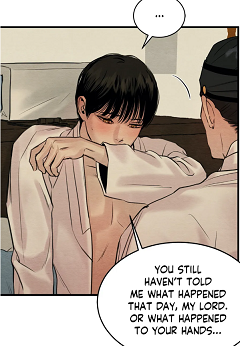 (chapter 84)
 The trigger for the change is the noble’s words. The latter keeps talking to the painter asking for an reply. Hence in my eyes, there are glimpses of love the moment Baek Na-Kyum said this:
  It sounded like a confession, hence the seme became more passionate:
 Here the lord acted like a client. Yet, notice that the lord is speaking again forcing to express himself. And the moment the painter cried and started voicing his own opinion, the sexual encounter was affected.
  (chapter 49) An expression of love and affection, but the painter rejected it, as he mistrusted his own judgement. He couldn’t help thinking of the learned sir’s fake embrace. Striking is that despite the rejection, the painter kissed and hugged back his lover
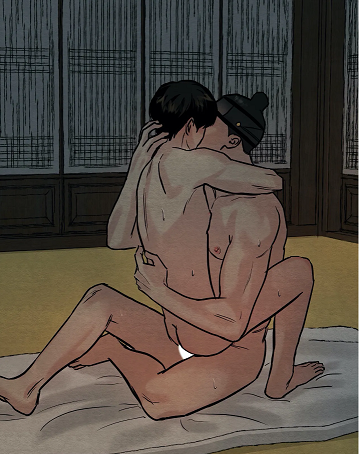 (chapter 49), which made the lord believe that he could only get embraced by the painter, if they had sex.
  . Although the second sex marathon starts like a pure sex session, the moment the painter calls Yoon Seungho differently
 , the lord’s attitude changes. The painter is turned around and faces his lover
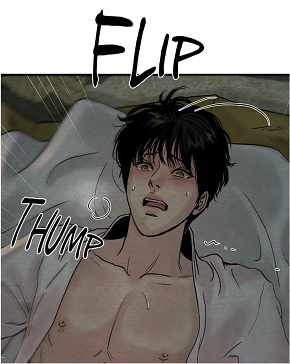 , a sign that they are getting closer. Striking is that again through their conversation, the painter is pressured to think about his own emotions.
  However, due to his own insecurities and fear, the noble still can’t trust the artist’s words, therefore there’s no confession.
  , it is just that both main leads were in denial.
  (Chapter 58) Thus he should become responsible for him. Yoon Seungho was unconsciously trying to push the painter to reciprocate his feelings, an imitation of Lee Jihwa‘s confession. Nevertheless, the painter remained silent, therefore it meant that his love was still denied. That’s why it stands more under the sign of dream and illusion. Consequently, the night in chapter 70, 71, 72 and 73 contrasts so much to the one from chapter 58. This time, it symbolizes the lord’s pure love. As such, the sex is already a real expression of love. That’s why the lord asked to be called intimately: Seungho-Ya
 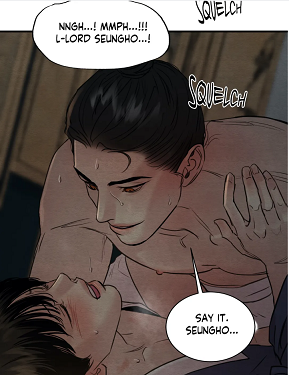 (chapter 72) On the other hand, this love session was strongly intertwined with the notion of forgiveness and punishment as well. This is important, it reveals that Yoon Seungho had internalized that sex was the expression to redeem himself. He had been tasked in the past that if he desired to obtain “forgiveness“, then he should have sex. And by comparing all these sexual encounters, I came to the following conclusion: the lord’s words definitely contributed to change the nature of the sex session, just like the hug.
  In chapter 66, he had a flashback, hence he couldn’t witness his lord’s attention and care.
 But the lord discovered this kind of embrace, when he helped the painter in chapter 53:
  That’s how the noble experienced the embrace as a source of comfort and affection. Therefore you can comprehend, why I wrote above that the painter was teaching the lord how to love properly, but also why the embrace became the symbol for love in the lord‘s eyes. He had never been embraced before by a man. And Lee Jihwa had recognized the true signification of this gesture, when he spied on the couple (chapter 43). That‘s how he knew the friend‘s biggest desire: and was deeply hurt after this discovery
  (Chapter 57) However, this shows that Yoon Seungho is a quick learner, because he knew what to do, when the painter was in pain and destress. At the same time, it explains why he could fake the embrace in chapter 62:
  This hug stands in opposition to the one at the end of season 3:
  (Chapter 84) In his unconscious, he knew that if the artist hugged him, he would have forgiven him. But he had no idea about it, thus he couldn’t suggest this. So far, he had experienced the embrace from the artist while having sex. Deep down, he had already internalized the embrace to forgiveness. So we could say that the absence of the embrace in this scene was the lord‘s punishment for the fake hug in the shed. And the painter let him discover the true nature of a warm embrace:
  (chapter 88) This is not surprising that this hug was not connected to sex at all. Yet it moved the lord so deeply. As the manhwalovers could sense it, season 3 was focused on love and sensuality. During that season, the couple was able to voice about their sexual desires and their preferences.
  (chapter 91)
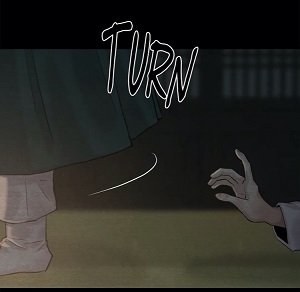 (Chapter 86) No one close to him had grabbed his hand in order to show their support. This gesture in the picture embodies abandonment. On the other hand, the painter had been the first one to take his hand and to swear “loyalty“.
 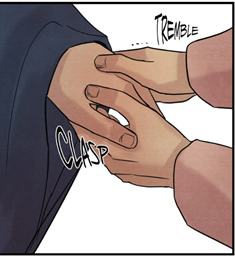 (Chapter 30) The joined hands were repeated in season 3 , the only difference is that this time, Baek Na-Kyum was doing it willingly.
 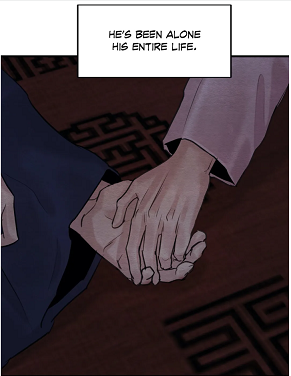 (Chapter 88) The symbol for support, company and responsibility.
 and his request for help are strong indications that Baek Na-Kyum was now accepting his affection. He was now trusting the noble, hence he revealed an important clue about the abduction.
  (chapter 41) Under this perspective, it becomes understandable why the couple neglected these pictures. They were all devoid of affection, it was more about prostitution and battle! And here is now the question? Where are these drawings?
  (Chapter 71) As you can envision, I am now examining each picture very carefully, hence when I saw this image, I couldn’t help myself associating it to the painter’s abduction. First, the painterofthenight-lovers will certainly remember the scene of the lord’s panic, when he left the room and saw the footprints on the ground misleading him to think that the painter had run away.
  (Chapter 60) In this picture, the manhwaphiles can even hear Nameless’ explication why the lord would jump to the wrong conclusion. The expression “on his own two feet” was actually visualized by the imprints left on the snow. We know for sure that Nameless knocked out the painter before carrying him away. He carried him the same way than he did with Lee Jihwa:
  (Chapter 59) What caught my attention is that the space between the footsteps on the wood
 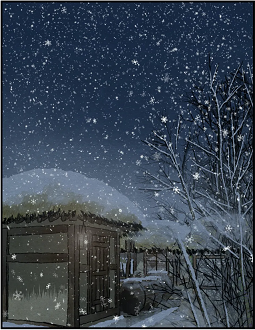 (Chapter 59) This image caught my attention for two reasons. Thanks to the analysis “The five candles”, I realized the true meaning of the pictures with landscapes. They expose the actual situation, therefore the beholder should study them under the following elements: moon or sun, air, water, earth and fire. So in this picture, you can detect the absence of the moon symbolizing the lord’s illness. He is too weak to look after his lover. Striking is that the earth element is predominant here, as the tree branches standing next to the buildings are almost touching the sky. So since the snow is falling, it indicates the presence of water and note that water is almost everywhere: in the sky, on the trees, on the ground and on the rooftops. The only element missing is fire. Yet if the manhwalovers examine the image more closely, they will detect the presence of a light hanging on the side of the restroom. However, the candle surrounded by glass is not lit. To sum up my observations, this panel exposes the predominance of water and earth and the presence of a lamp with glass. In other words, this image symbolizes butler Kim, the new version of chapter 58
  . First, let’s not forget that Kim is often seen carrying a bucket of water
 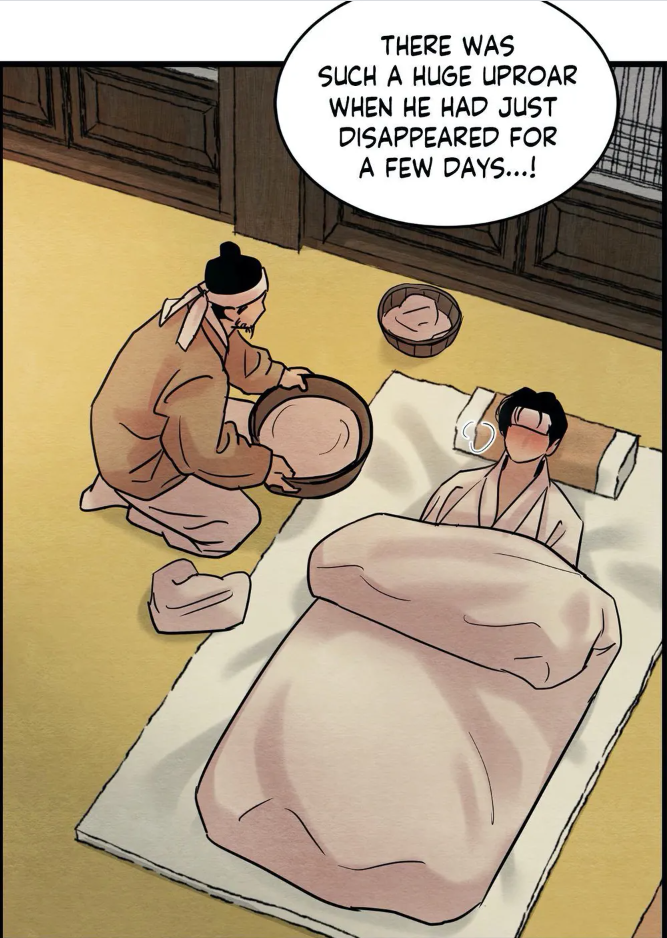 (chapter 33)
 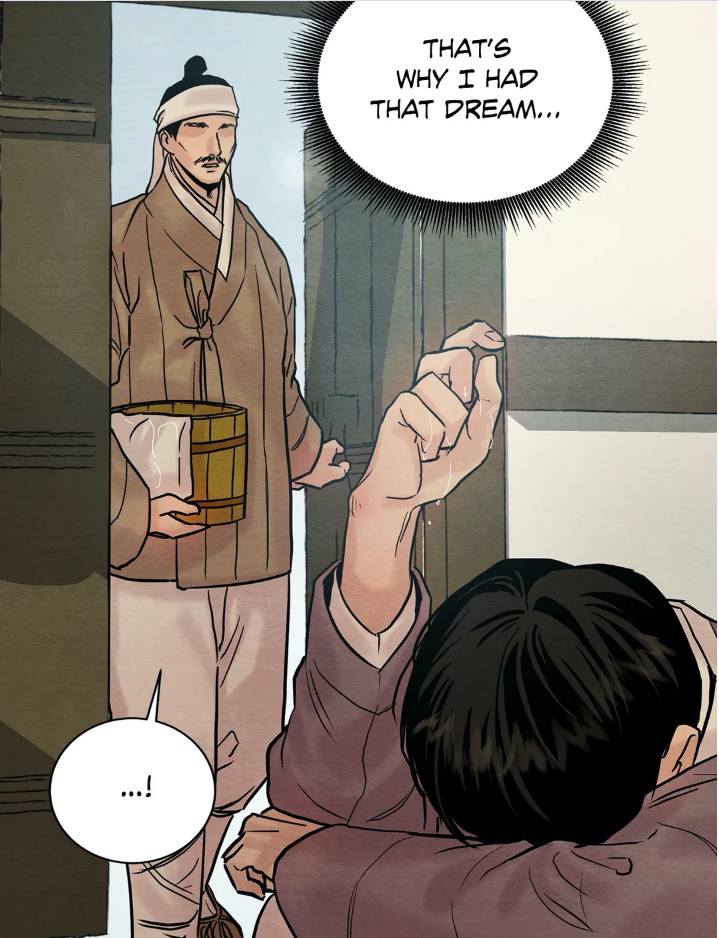 (chapter 56). Secondly, he is also linked to the lantern with a glass
  (chapter 20)
 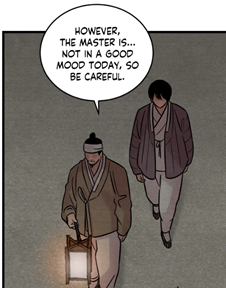 (chapter 36) But more importantly is that in the image from chapter 59, there is no light,
  (Chapter 59) Note that the painter is standing in front of the bathroom. He has just cleaned himself and note that the lamp is in the background. How is this a proof? If the painter had run away, he wouldn’t have gone to the restroom… he would have left the room right away, just like the footprints are indicating.
  (chapter 59) But since the artist was silent right away, as the Joker knocked him out immediately, the physician could have jumped to the conclusion that Baek Na-Kyum met an acquaintance. So when the vanishing of the painter was discovered, the doctor assumed that the artist had followed the person he met during that night. Honestly, I can’t blame the doctor for his “passivity”, if my assumption is correct. Due to the lord’s agitated state of mind, the doctor could only realize it afterwards. With this new discovery, it becomes more comprehensible why the physician hesitated the next morning. He didn’t know what he should do.
  (Chapter 63) If he revealed what he had heard, then he imagined that he could bring the person who had „helped“ Baek Na-Kyum to escape into trouble. Observe the presence of the drop of sweat on his face. He was definitely uncomfortable. If he testified, then he could reveal the presence of a conspiracy. Nonetheless, I believe that he had jumped to the wrong conclusion: desertion. And with this new discovery, you can understand why the butler was so worried. He had no idea what the doctor had noticed. Imagine, the valet got caught by his own method (spying behind doors), however in the physician’s case, the latter was not doing out of malevolence. He just happened to become a witness, but he had assumed something else. That’s the reason why Kim was so worried, he had seen no one, yet the doctor had observed something. Kim never imagined that such a small detail (noise) could become a threat for him. This explicates why he chose to visit the doctor during the night.
  (Chapter 64) He needed to ensure that the doctor remains silent. Many manhwaphiles will certainly recall how Kim threatened the doctor…
 (chapter 65) Back then, I had assumed that out of cowardice, he had not intervened due to Kim’s harsh words. Nonetheless, I came to a different interpretation. After recognizing how Byeonduck is tricking the readers, she gives the impression of a continuity, I believe that during that night, the butler visited two different physicians. According to my theory, there exist 3 different doctors. For more, please read the analysis “The mysterious doctor“. How did this idea come up? Simply by paying attention to the BEARD!!
  (Chapter 57) Note that the beard of this physician is covering the cheek and is straight.
 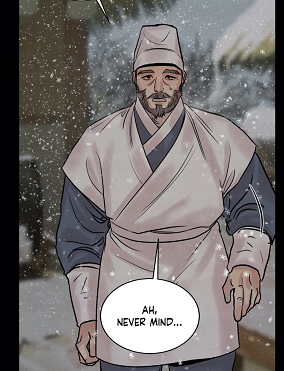 (Chapter 63) But now compare it to the physician’s beard in episode 65:
 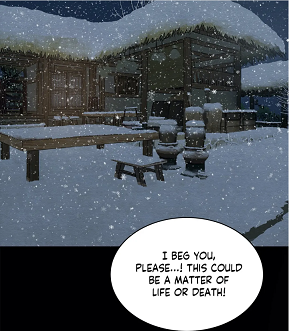 (Chapter 65) and from my point of view, he used pity to discover what the physician knew. Remember how he had used compassion the night before (chapter 57). Besides, if you contrast both statements, you will detect a contradiction. “This could be a matter of life or death“ implies that it was about saving someone, while in the second image, it is about killing someone: the other doctor! In my eyes, the valet must have begged the physician
 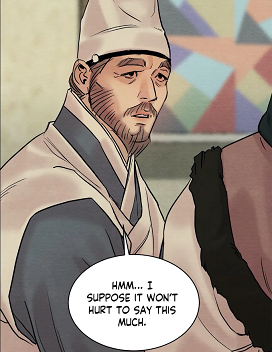 (chapter 57) to remain silent. If he revealed that he had discovered the presence of someone, then the other could get into trouble. In my opinion, the butler must have suggested that Baek Na-Kyum had tried to escape, because the lord had been abusing him. Don‘t forget that he had been treating the artist for his wrist. Then he must have seen the lord panicking too.
  (Chapter 60) But now, the manhwaphiles are probably wondering why he went to the other physician then. It was related to the lord’s behavior in the shed. He was acting like a sex-maniac.
 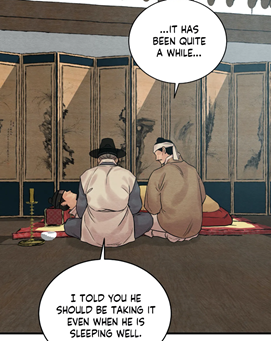 (Chapter 55) This doctor had reprimanded the butler and had been prescribing a tonic. So he visited the physician and used this opportunity to put the whole blame on the poor doctor.
  (Chapter 65) The man never saw anything, Kim just described to him how the main lead had been behaving! Yes, he was acting like Yoon Chang-Hyeon who had gone to the doctor and described the son’s illness.
  (Chapter 57)
  (chapter 61)
  (chapter 62)
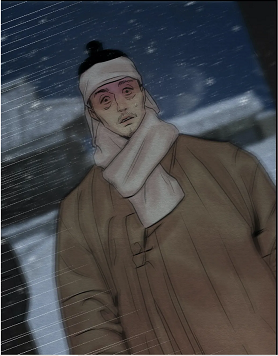 (chapter 64) He needed to confirm his death. But since the lord was having sex the whole night, the butler had to make sure to bury the truth. If the artist had fainted, then the valet would have fetched the other doctor, the one who imagined that Baek Na-Kyum had escaped. And now, you comprehend why the man hesitated to question the painter after his return:
 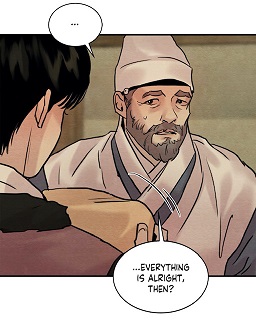 (chapter 74) He was wondering why the artist would look so fine, as he had attempted to escape before. Another evidence for this theory is the following rule: a reflection within the same season. Since the doctor had been puzzled by Yoon Seungho‘s illness, I am deducing that he had the exact opposite disposition concerning the artist. He imagined what the artist had done. He had jumped to the wrong conclusion due to the injured wrist. Besides, he was “aware“ of the lord‘s mood swings.
 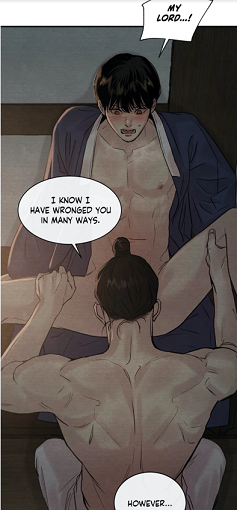 (Chapter 71) Consequently, he was not investigating the real circumstances of the abduction. But he has another reason for neglecting this aspect: he knows the culprit’s identity, unaware that unveiling the mastermind’s identity is far from enough. Real justice is to uncover truth. However, at the end of season 2, the wealthy noble was more like a teenager in love. That’s the reason why he was making a huge mistake.
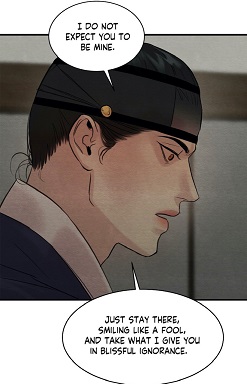 (chapter 85) He was already content if the artist would look at him, the moment you recall his first confession:
  (chapter 55). Hence in chapter 71, he’s blushing and happy, for Baek Na-Kyum is definitely starring at him with such a curiosity and desire.
 (Chapter 67)
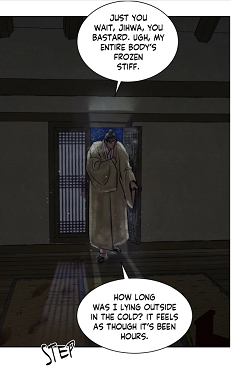 (chapter 102), yet in the snow it was no longer visible.
  (Chapter 102) Someone had erased the traces by putting mattresses on the soil. However, while the lord was walking through the mountain, he was definitely leaving a bloody trail behind
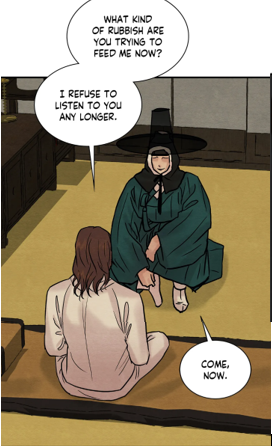 Due to his suggestion, he suffered a lot in the past, therefore he doesn’t want to make the same experience again: anxiety and remorse. Yet, at the end of the chapter 67, Jihwa is sitting like an obedient monkey and paying attention to Black Heart’s words.
 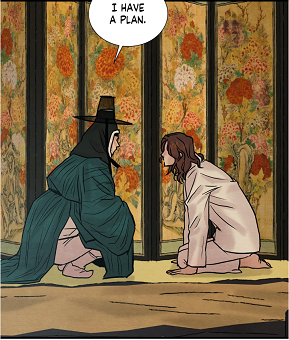 It was, as if the red-haired noble had given up on his “humanity” in the sense, he is no longer using his brain. How could this happen? The readers will blame Yoon Seungho for this. The moment he barged in his bedchamber, Jihwa ran away from his childhood friend and hid behind the windscreen.
 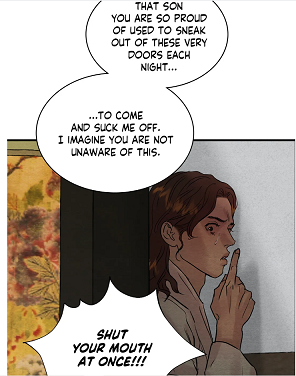 He was too scared and didn’t want to face Yoon Seungho’s wrath. But this attitude exposed simultaneously that he was not willing to assume his responsibilities. Remember that he relied on Nameless so much. Since the latter had become his hands, it signified that the criminal was accountable for the crime.
 Note this panel outlines Jihwa’s escapism. “I know, he couldn’t have seen me”, the scared man imagined, because Baek Na-Kyum had his eyes covered, then he wouldn’t get caught. What he failed to realize is that first, he spoke so that the servant could have recognized his voice, Nameless was well aware of this. Then, he counted on Nameless’ promise. For me, this panel embodies Jihwa’s habit: avoiding any responsibility for a wrongdoing, which could be seen in the three wise monkeys:
  In reality, a perverted version, as for Jihwa, if no one sees, speaks or hears his misdeed, then it means, he has nothing to fear. He has the impression that nothing happened. Getting caught triggers his anxieties, as it is connected to the incident with the door and Yoon Seungho’s suffering. And now you understand why Jihwa was so scared after the scene Yoon Seungho made: he had been caught for the third time!! Chapter 18
 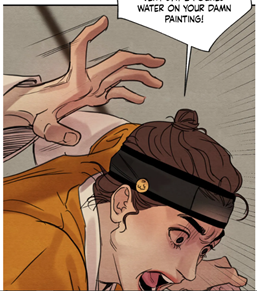 , chapter 57
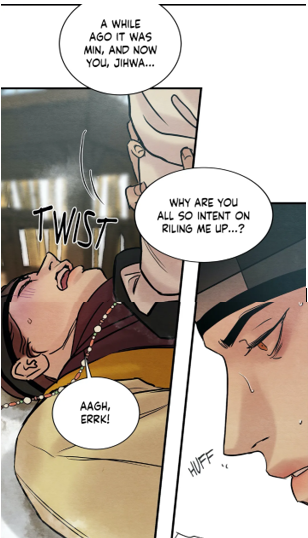 and chapter 67
 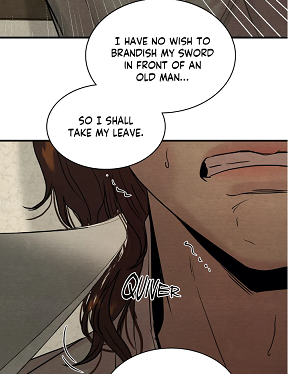 And each time, Yoon Seungho’s anger increased. However, each time, the aristocrat with black eyes never expressed remorse and offered an apology. I would even add that he never saw these as misdeeds, as he always justified his misdeeds. In chapter 10/17, Baek Na-Kyum represented a source of temptation for his friend and he had even seduced him. Then when he sent lord Song’s fake letter to his friend, he justified his action by putting the blame on his friend for changing and cutting ties with him.
 Finally, the painter was the reason why he got rejected. In all three cases, he never questioned, how his actions affected his victims. That’s why even when he got caught, he never changed his behavior. This explicates why Jihwa didn’t learn his lesson, as he didn’t see the wrongdoings and its impact on others.
  But it only looks like that on the surface, as from my point of view, the trigger for this switch are Min’s words. First he offered help.
 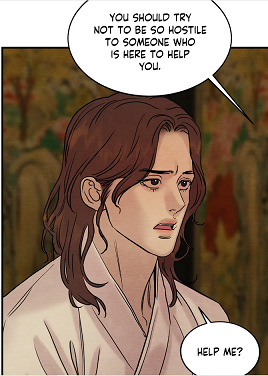 Then he predicted Yoon Seungho’s arrival, so that Jihwa was deceived.
 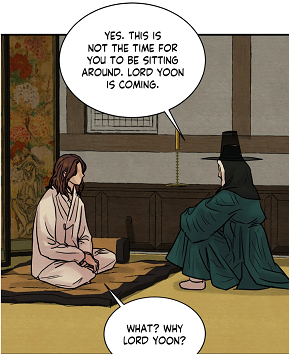 Black Heart had already prepared his move. He created the illusion that “To Help you” was genuine, as his prediction had become true. For me, “to help you” played a huge role, as Min is well aware of the red-haired noble’s personality. He knows that the neglected child has never been willing to take any responsibility, letting others take the blame. There’s a reason for that: Min was his teacher, The Joker who never got caught himself. For Jihwa, the idiom “to help you” is a synonym for reliability. Therefore he has the impression that thanks to Black Heart, he can keep avoiding any accountability. But Min, as The Joker, will be the one teaching him a lesson. The latter has already planned for Jihwa to take the fall, making him believe that the commoners (Heena, Kim and eventually Nameless) will be blamed for the painter’s second kidnapping. What Jihwa fails to realize is that since Black Heart revealed his secret twice,
 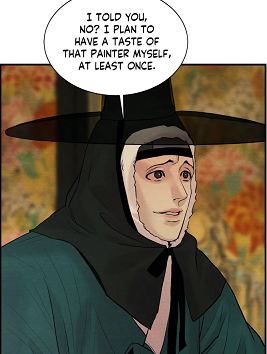 the latter needs to put a neat, clean ending,
  so that no one will realize the existence of a mastermind behind the second kidnapping. My prediction is that Min has already calculated Jihwa’s death. This is the devil talking, when he voices those words:
  He is tempting Jihwa. The Joker was there, when Yoon Seungho warned the former friend and used his sword against him. That’s why the Joker could only laugh, when he saw Jihwa trembling after seeing the weapon so closely. He had to contain his laugh and smile behind his hand.
 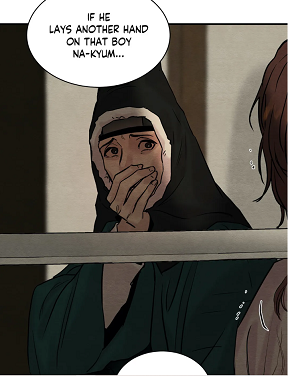 He saw it as a confirmation that the noble would retaliate, if Baek Na-Kyum got abducted a second time. The lord wouldn’t even question his childhood friend. That way, Min would be able to get away, while Yoon Seungho would have to face infuriated aristocrats who would despise him for killing one of their fellows for a low-born. Imagine the destruction he is preparing, just to taste the painter.
  That’s why he waited at Jihwa’s door the next morning.
  He could barely contain his impatience and his jealousy. The lord was far from being in a good mood. His smile is actually an expression of his anger and resent. As time passed on, his desire for the artist got so strong that at the end, he felt the need to approach Yoon Seungho’s mansion. But there, he had to see the painter’s smooth legs in the main lead’s arms.
 And now, imagine Min’s face, when he saw this: even the merchant,
 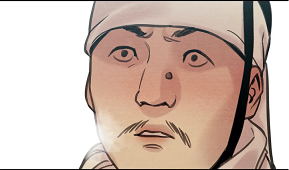 who never had sex with a man before was already bewitched by them. And now, you comprehend why Min has the sensation that he has been bewitched and can’t escape from this attraction. Therefore, it becomes comprehensible why Min wishes to have Jihwa killed in the end. He resents him for putting him in a misery. He had ordered his red-haired servant to bring him the painter, but the childish man had not only disobeyed him twice, but he had made it more difficult for Min to obtain the painter. Yoon Seungho would be on his guard now. That’s the other reason why Black Heart has already projected Jihwa’s death.
  Observe the presence of The Joker on the windscreen. Since the aristocrat is so paralyzed by his anxiety, his weakened condition explains why he falls for Black Heart’s manipulation so easily. At the same time, this drawing illustrates that Jihwa’s fear is more linked to getting caught than to Yoon Seungho’s wrath. Let’s not forget that in chapter 59, the readers heard about the protagonist’s rage shocking the noble with the mole.
 Yet, Jihwa didn’t seem to upset and traumatized after that, which the friend noted. He was even surprised that the red-haired noble was able to maintain his relationship with his childhood friend. I see it as a proof that his angst is linked to apprehension and arrest. That’s why I believe that the advice given by Min before the appearance of the main lead played a huge role. Since Jihwa has internalized avoidance and escapism, assistance sounds like avoidance of responsibility. And now, you understand, Jihwa has been following his “teacher”‘s rules so faithfully:
  Secondly, he saw the uproar she caused at the entrance of the propriety.
 Moreover, the Joker must have noticed how Kim was standing at the door, yet the latter never stopped him and allowed him to be pushed away.
  This gesture signalized that the valet was a pushover. Besides, I have to admit that I am suspecting Kim to have met Min during that night in chapter 52/53/54. Back then, I was wondering where the man was, when the door of Baek Na-Kyum’s study was destroyed and when Deok-Jae fled. Furthermore, between the time Yoon Seungho brought Baek Na-Kyum to his room and Black Heart’s return, minutes elapsed… yet Kim never intervened. I have the impression, he played a similar role than during the night of the rape. He acted in the shadow, following his favorite philosophy:
 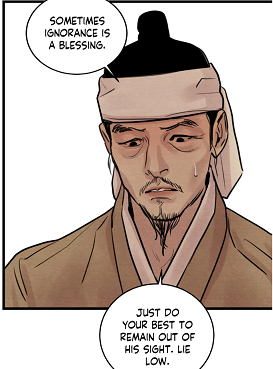 He is very similar to Jihwa, he is avoiding any responsibility by faking ignorance, whereas Jihwa has not learned to recognize evil and wrongdoings. Therefore I believe that The Joker must have recognized the butler’s true personality. Besides, because the valet doesn’t want to get into trouble with a noble, he can only accept any request from them. To sum up, in my opinion, the Joker’s plan is to involve Nameless, Heena noona and Kim, but he will make Jihwa the scapegoat. In Black Heart’s plot, his disciple killed the artist due to his fiery jealousy, whereas he tells the “monkey” that commoners like Heena noona will be blamed for this. However, Min already talked to Kim and asked him to let Heena noona to meet her brother. Min is expecting that the gisaeng will try to convince her brother to escape from the mansion. She just needs to get the opportunity to speak with Baek Na-Kyum.
 These words are important, as it shows that Kim has already envisaged what she will say to him. Hence Kim said this: he doesn’t need to say anything, while at the same time, he is putting the whole blame on her. He will say that he had no idea that she entered the mansion, therefore he justified his intervention:
  , secondly the painter caused him so many worries that he can only consider the low-born as a source of trouble now. Min must have convinced him that he won’t get caught due to the gisaeng’s intervention and scream. Besides Jihwa will get suspected, if a second kidnapping occurs. Therefore, he can always feign ignorance.
  and the physician acted, as though he saw nothing. In other words, we have 6 participants. Therefore, I believe that there will be another person involved in the second abduction beside Nameless, Min, Jihwa, Heena and Kim. This seems to corroborate my theory that Nameless has already planted a spy at Yoon Seungho’s mansion. But there’s another person who could play an important role in the second kidnapping: the head-maid of the kitchen. Don’t get me wrong: I am not saying that she will help them, but she will be involved, because she will help the noble and the painter.
  His dream was a mixture of dream and reality, yet as you know, the artist’s dream has always come true.
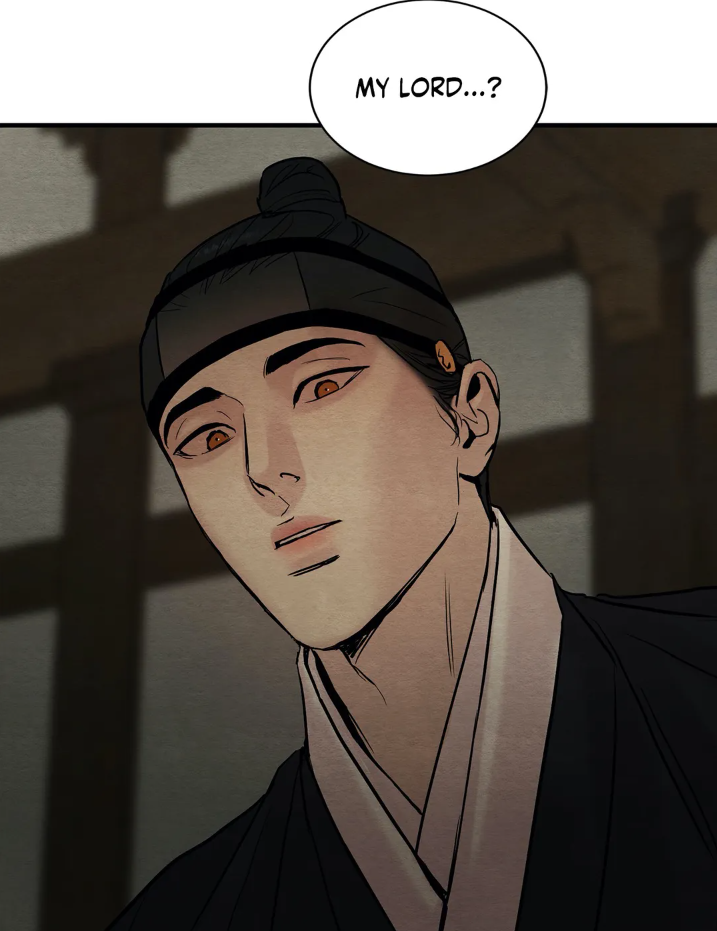 Besides, when he woke up, he imagined that he was seeing his lord, exposing his desire to have him by his side. That’s why I believe that Baek Na-Kyum won’t follow her suggestion. Besides, the manhwaphiles shouldn’t forget that the head-maid was heading to the painter’s chamber.
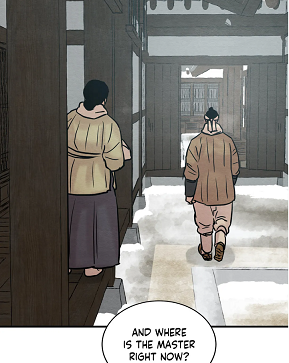 Consequently, I am expecting a new version from chapter 46.
 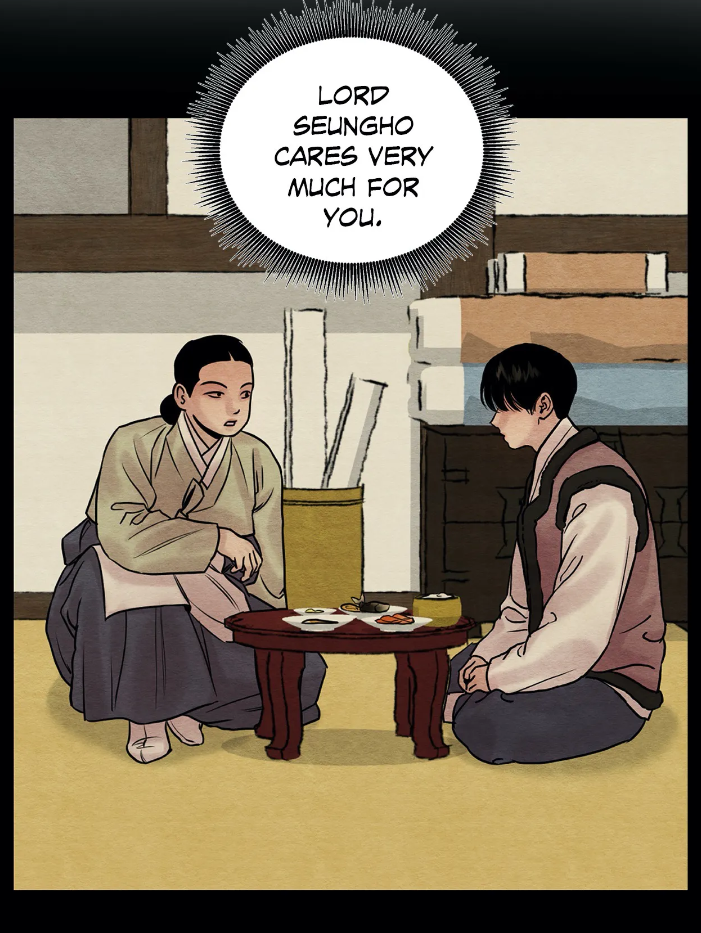 From my point of view, her words will have an influence on the low-born and his sister. Another evidence for this theory is the incident in Baek Na-Kyum’s study in chapter 53. The artist refused to leave the propriety, although he was hurt by Deok-Jae. In my opinion, the commoner will reject her offer so that Min is forced to wait. Imagine Min’s torments!! They will be so different from Jihwa’s.
  I have the feeling that unlike his disciple who drank to hide his anxieties, the lord Min will resort to opium.
 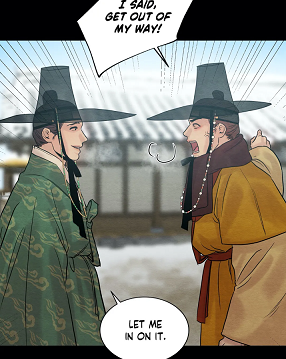 Min’s new hanbok in chapter 56 exposes his transformation: the pattern reminds the readers of the opium smoke. Furthermore, his return was announced with this picture:
 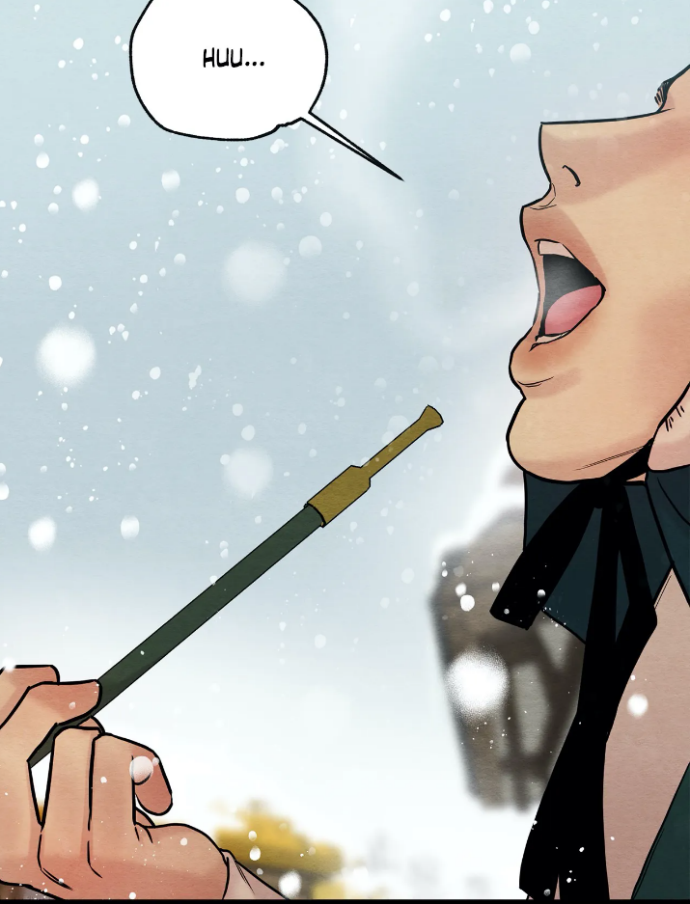 There’s no doubt for me that Min will get caught and will suffer the consequences of his manipulations. Since The Joker’s return, I have always predicted his death: he gets suffocated due to strangulation. First, Yoon Seungho broke the pheasant’s neck during the hunt with Min
  (chapter 41). The blood on his hands comes from the wounds caused by the arrows. But I also noticed a progression, how the lord used his hands during the second season: from this
  (chapter 61) to this
  (chapter 67). His hands are getting closer to the throat, for me a clue that Yoon Seungho will eliminate his rival personally.
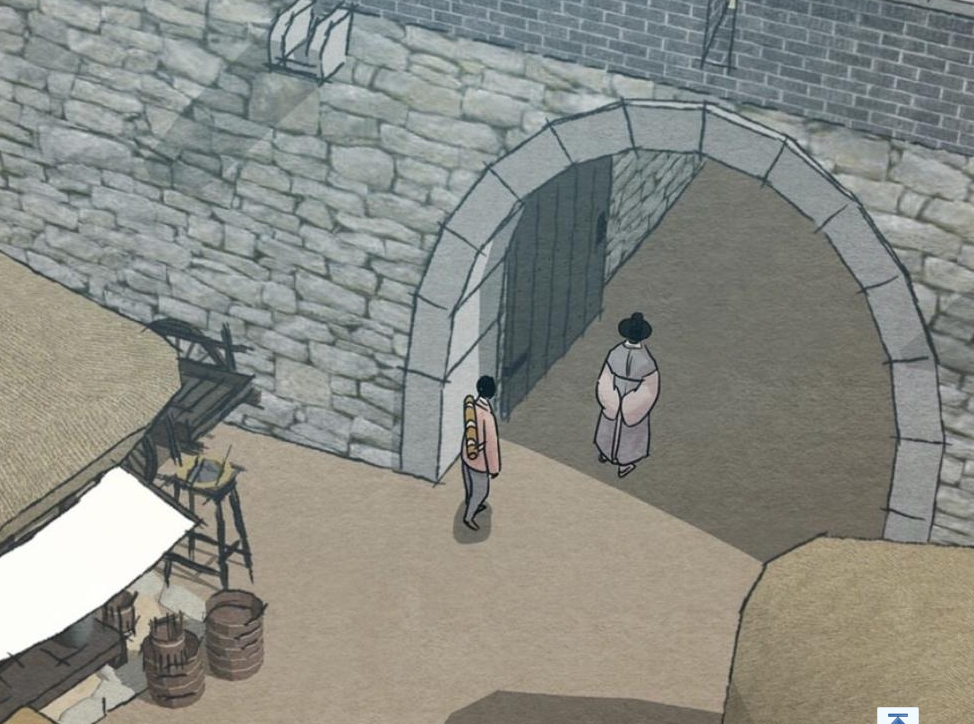 Yet, this time it will be the other way around.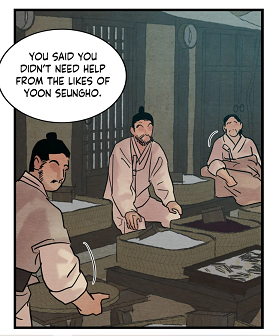
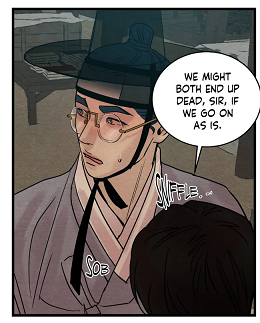
 , and I doubt that people will have already forgotten the artist. Since the low-born was seen many times in that town and no one paid attention to him before, Kim will imagine that no one will notice the artist. Remember that no one observed them, when they went to the doctor for the first time. And in the mean time, Baek Na-Kyum won’t leave the propriety for the time being. However, Kim is not expecting that people will witness him.
 Do you remember that a buffoon is a synonym for “joker”? From my point of view, Nameless has already placed a spy at Yoon Seungho’s mansion. I am still convinced that the new guardian is giving info to the criminal due to his explanations to Min.
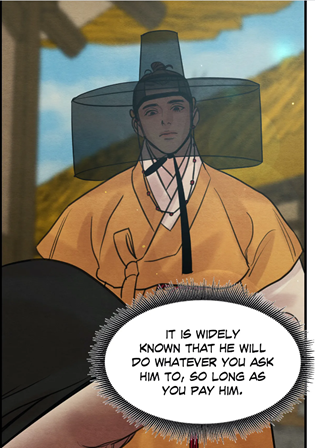 He can’t imagine that the criminal was the one who convinced the red-haired noble not to commit the murder. However, this time the butcher will refuse. Even if Jihwa’s involvement has been revealed, I doubt that the criminal is not aware of Yoon Seungho’s visit to the family Lee. Since Yoon Seungho didn’t retaliate against Jihwa and only warned him, Nameless has no reason to intervene first. From my point of view, it looks like Yoon Seungho is still not looking too closely to the circumstances of the abduction and Deok-Jae’s servant. But it could change, forcing Nameless to intervene. Due to my previous analyses about Nameless, I came to the conclusion that he represents Jihwa’s conscience, hence he is his liberator. Consequently Nameless can eventually become Jihwa’s hands again, yet this time, Jihwa will never be able to escape his fate: he will be caught and be forced to become responsible. As you can sense, I am still unsure about Nameless’ actions. My instinct is to say that he will refuse to help the red-haired noble first, but could change his mind. One thing is sure: Nameless will confront Jihwa and let him see the consequences of his decisions. I am still hoping that he plays a huge role in the discovery of the mastermind, but there’s nothing sure, as Byeonduck prefers characters with flaws. In her story, there’s no hero, except the artist, if we overlook his lies in the beginning.
 As you can anticipate it, my predictions are based on observations, therefore it can definitely turn out differently. Yet, I think the list I made could be helpful to envision the evolution of the story. In other words, you are more than welcome to imagine a different story about the second kidnapping.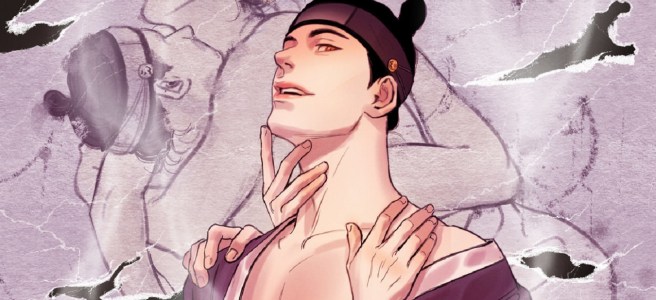
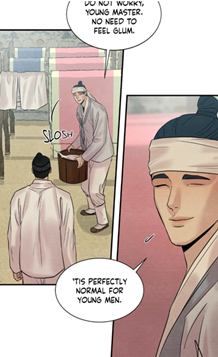 reminding me of the butler Kim in the original, implying that we have a fake affection. But if Jung In-Hun replaces Kim, it signifies that Baek Na-Kyum is now living the life of the noble Yoon Seungho in the original story. From that moment, I tried to verify this theory: We have an older sister who seems to be jealous of her younger brother, because she mocks him by calling him a baby.
  The source of her resent is simple: since Baek Na-Kyum is the only son of their family, he always gets the attention and admiration from the father, while she, as an older sister, is overlooked due to her gender. Hence I connected her to Yoon Seung-Won, the younger brother, for I had already pointed out in one of my former analyses that there existed a certain jealousy between them due to their father.
  This was truly palpable in this incident. Back then, I had imagined that it was related to the topknot incident. However, I think now that what we are witnessing is a straw mat beating. The younger master, who betrayed his older brother out of jealousy, never imagined that his father would retaliate like that. He had envisioned that his brother would get into trouble and loses the father’s admiration, yet not to this extent. Another allusion to jealousy was the words expressed by the main lead, when he confessed to his lover:
 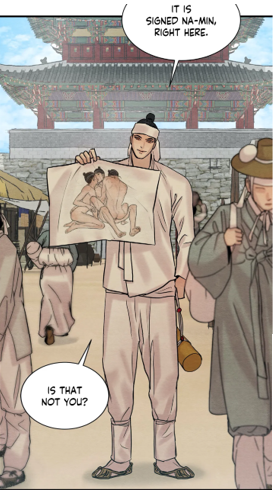 He showed the picture, while saying that it was signed Na-Min. However, if the readers pay attention to the painting, there’s no signature on it. Besides, I doubt that as a commoner, he is able to read, remember that the artist in the original story can’t read either. One might argue that the shopkeeper told him the name of the creator, when he showed him the painting. Yet, this argument is incorrect for three reasons. First, the merchant had no reason to mention him, because the former knows that Baek Na-Kyum is selling his pictures directly in order to keep his hobby a secret. Moreover, imagine, Baek Na-Kyum portrayed the famous sodomite Yoon Seungho who is a commoner. The merchant would have questioned him about the circumstances, how he got a painting from the noble. How could the innocent noble have painted the commoner as model? This would have shocked the merchant. From my point of view, the shopkeeper didn’t recognize the artist’s work at all, but he proposed him 5 coins due to his greed. He must have repeated the following remarks:
  In my perspective, the trader was just repeating the criticisms heard from someone else.
  Compare the two reviews, you will notice that the commoner is much more accurate in his review. And he is able to discern the origin of the flaws for such a drawing.
  That’s why I came to the conclusion that Yoon Seungho was a painter himself. In order to become an arts critic, you need to understand the subject, therefore many painting critics are artists themselves. My explanation is that he discovered the noble’s work by sleeping with nobles. His clients would buy the pictures, which the commoner couldn’t afford himself. What caught my attention is the following panel:
  Baek Na-Kyum questions his competence with his rhetorical question. In the main lead’s eyes, Yoon Seungho doesn’t have the eye to know… and to judge his paintings. But this question made me think the exact opposite. From my point of view, Yoon Seungho recognized the artist’s style, hence he could name it.
 But unlike Baek Na-Kyum, the commoner is not famous due to his social status. And you understand why I came to this idea that the powerful noble Yoon Seungho in the original story could have been an artist in his youth, a painter and even a poet. From that moment, I started to search for clues in order to corroborate my theory.
 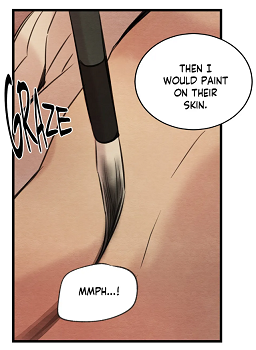 Note that he doesn’t say “write” but paint on their skin. This showed that the noble used to like painting. When I read chapter 36, I made the following mistake: Yoon Seungho was writing, hence I didn’t pay too much attention to his drawing on the painter’s body. However, I changed my mind, the moment I viewed his lines on Baek Na-Kyum’s body:
  It definitely looks like a plant and his lines show a certain confidence. Don’t forget that the artist was shivering due to the stroke of the brush, yet there’s no mishap or zigzag on his body. If I include the following panel from the Alternative Universe,
  then you’ll realize that it is a painting on Yoon Seungho’s body and the author is a painter. This could be judged as another evidence for my theory. A painter drew lines on the body of another artist. Therefore I come to the deduction that in chapter 36, Yoon Seungho started showing his passion to Baek Na-Kyum: he used to paint. The manhwaphiles should remember that in the previous chapter, the lord asked the commoner about his likes and dislikes. Such a conversation implies that the counterpart will also ask about the likes and dislikes of the partner. What does Yoon Seungho like in reality? My answer would be: he liked painting, but exactly like the low-born, he was forced to abandon his passion due to his father.
  someone attempted to draw a scene of men copulating. Since my hypothesis is Yoon Seungho was a painter in his youth, then it looks like he was the creator of his drawing. Then in chapter 23, the manhwaphiles certainly remember the book he showed to Baek Na-Kyum in order to revive his memory:
  Therefore Yoon Seungho could have been the author of this picture. Note the progression between the picture from chapter 8 and 23. This time, the artist included colors and the design is more precise, just like the lines are more firm. Then this would explain why Yoon Seungho knew what it meant, when an artist doesn’t practice for a long time.
  (chapter 2). In that same chapter, the artist noticed how well furnished his study was. He had such an expensive paper, and so many brushes revealing the aristocrat’s knowledge. And now it becomes comprehensible, why the lord could only laugh at the fake excuse given by Jung In-Hun in chapter 30: The low noble had brought the artist to the shop in order to buy him ink and brushes. The lord knew that the painter had everything he needed. In my opinion, Yoon Seungho was the one who took care of that room. That’s why the study is next to his bedchamber.
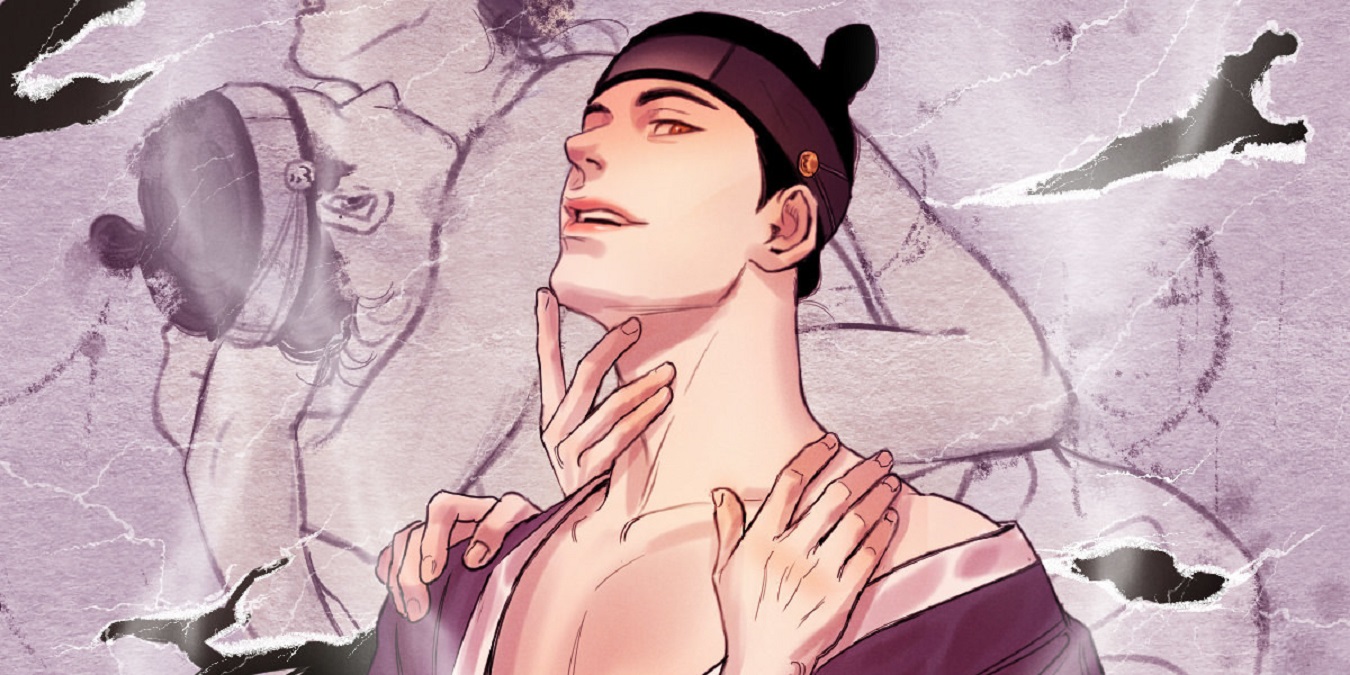 Note that the drawing behind the noble is not only torn, but it was made on an expensive paper indicating that this work was made by someone rich. Secondly, Baek Na-Kyum never created such a painting in the first season for the protagonist, yet the main lead painted a similar picture in his youth:
  . However, there exist small divergences: the uke in the purple drawing is embracing his lover exposing such a passion and strong love. And since I explained that Baek Na-Kyum was making the same experiences than the main lead, it looks like the author of this painting in this picture
  So in my opinion, Yoon Seungho used to paint in secret, exactly like the noble Baek Na-Kyum, as he knew that his father would never allow such a hobby. He had many reasons for that. First, since Father Yoon is portrayed as a controlling father, it means that he was paying attention to the main lead’s every move. While the father might have described painting or poetry as too feminine, the real reason for this interdiction was different. Father Yoon couldn’t allow that Yoon Seungho’s reputation outshines his own.
  As the king’s courtesan or prostitute, Yoon Seungho would lose all his rights. He would never get recognition and power as well, while father Yoon as his pimp would benefit from it. That’s why when the father mentions “illness”, he could definitely be referring to painting. Yoon Seungho learnt that he had to paint during the night to outlive his passion, and now you understand why I saw the combination of this illustration
  (chapter 45)
  (chapter 50)
  (chapter 53) and
 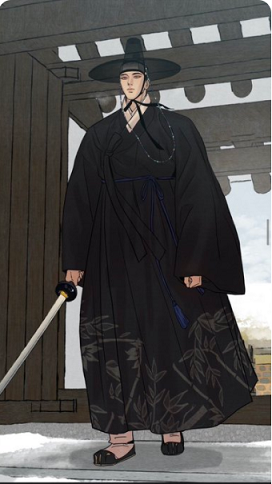 (chapter 67) Even when he died in a figurative sense, the last hanbok indicates that his liking for drawings has not died yet. Nevertheless, all the pattern have something in common: the presence of nature. There are always animals or plants. And this observation led me to the next conclusion, Yoon Seungho was a painter, but unlike his lover, he loved painting nature. This explains why the main lead painted a plant on the low-born’s body in chapter 36.
 and the latter used a plant to play with the animal.
  The drawing in the illustration for the first season was discovered by the father who destroyed it, because someone tattled on Yoon Seungho. Let’s not forget that in the Alternative Universe we have a lord peeping tom:
  Moreover, the painter’s sexuality resurfaces the moment he witnesses sex between Jihwa and Yoon Seungho, a new version of voyeurism. Why do I think that Jihwa was the one who led the innocent noble to become a voyeur? Note that in the Alternative Universe, the cat is the one leading Baek Na-Kyum to the cabin and even strokes the artist’s butt, while the latter is beholding the scene:
 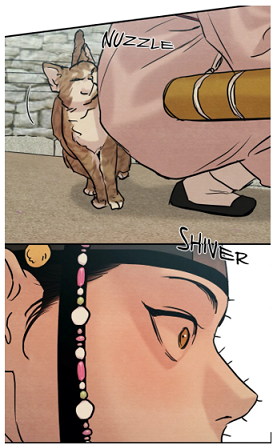 So the main lead was not alone, when he saw the commoner having a fellatio. Besides, the manhwalovers should recall how Baek Na-Kyum saw two nobles having sex at the gisaeng house.
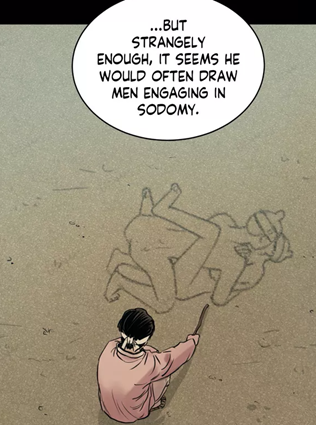 The aristocrats hid their sexual orientation behind the gisaengs. On the surface, they would behave like normal men, while in reality they loved another man. I doubt that Yoon Seungho could leave his mansion like that, especially if he was monitored by the staff and especially by his butler and his brother. From my point of view, Jihwa and his friend must have witnessed it at the pavilion.
 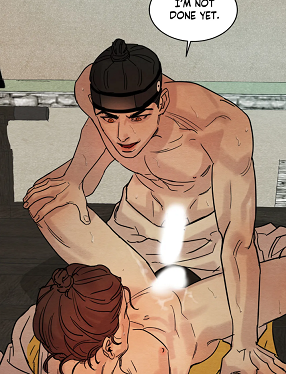 Note that the pavilion played a huge role in the first season: emancipation for Yoon Seungho in chapter 3 and the same for Baek Na-Kyum, as the latter was forced to admit that he loved his teacher in chapter 25. Furthermore, I would like to outline that each scene at the pavilion was linked to painting. After witnessing how two nobles made love, Jihwa begged his friend to paint for him
 This interpretation would explain why Yoon Seungho couldn’t perceive Baek Na-Kyum’s preference and why Jihwa was an expert for recognizing virgins. However, during that night, the door opened
  and Jihwa, too scared to get caught, left his friend behind. What followed, you can imagine: Father Yoon believed to see in his son a homosexual due to the painting and punished him. He beat him and asked for some medication from the doctor. Since there was an erotic painting in his son’s room, the father went to father Lee and told him about the painting. However, father Yoon blamed his son for the incident.
 That’s how Jihwa was separated from his friend, yet the latter chose to remain silent and let Yoon Seungho suffer the consequences from his request. Then he must have heard from the staff that a teacher was hired for a conversion therapy. This would explain why Yoon Seungho relived his second abandonment during that night of revelations: first, the friend who ran away because he had been able to escape
  and later the rape with Kim at the door:
 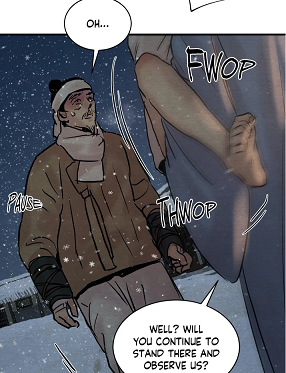 Besides, the manhwaphiles will certainly recall how worried Baek Na-Kyum was in chapter 16 and 17, after leaving the lord’s bedchamber in a hurry. He couldn’t eat and kept wondering if someone had seen him or not, a new version of what the red-haired noble had experienced. In my opinion, there were two incidents occurring with the painting:
 (chapter 37) to the younger master. This led to the straw mat beating. The scholar Jung In-Hun told his future sponsor this:
 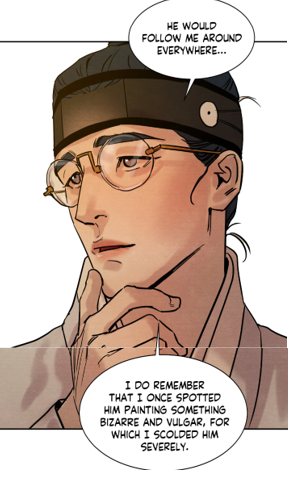 We have to envision that the powerful main lead experienced a similar incident.
 Furthermore, like my reader @Peperon21428670 pointed out, I had already associated the painter to nature. This explicates why Yoon Seungho chose to paint a plant on the artist’s body that night. He sensed the connection between nature and the artist.
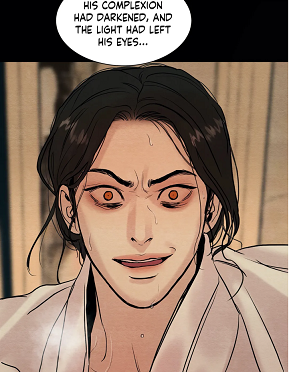 (chapter 57) His keen eyes were revived and the light in them returned.
  Slowly the lord rediscovered his love for arts and paintings… inciting him to draw again.
  Since in the past his face was a source of inspiration, the symbol for innocence, youth, freedom, carefree, naturality, honesty, happiness for the painter Yoon Seungho, the latter can only associate his face to dishonesty, deception, pain and suffering now. Although Jihwa didn’t get scolded or caught with his lie, he felt guilty, but he never felt the courage to correct the truth. That’s how Jihwa started behaving like a coward and playing tricks. With this incident, he learnt a terrible lesson: he learnt how someone else could take responsibility for his actions and decisions. Since it was never revealed, the young aristocrat faked his smile and cheerfulness due to his guilt. However, with the separation from his friend, he got lost and found himself a new “friend”: The Joker who perverted his innocence and naturality in the end. That’s why when they reunited, Yoon Seungho sensed the transformation in his childhood friend. And once Jihwa discovered that his friend was interested again in painting, he looked for pictures hoping to catch Yoon Seungho’s interest. However, he was rather bored,
  when he looked at the picture (chapter 9). Then in chapter 12, he proposed to hire a painter from the Royal Academy
 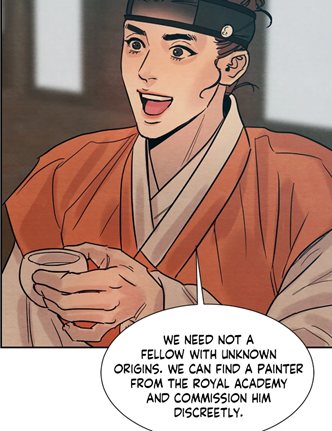 , because he knew how much his friend liked painting. Yet he couldn’t encourage him to paint himself, for he would have been confronted with the past. The red-haired aristocrat thought, he could manage to get rid of the artist without reminding Yoon Seungho of the incident with the door. And if my theory is correct, this scene implies that the noble never apologized for his friend’s suffering.
 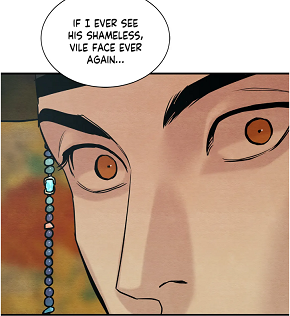 (chapter 67) The face is no longer a source of inspiration, rather of suffocation, and this picture contrasts so much to the main lead’s reaction, when he looked at the artist’s face in the following drawing.
 (chapter 25) He noticed the absence of facial expressions. Therefore he recommended him to use a mirror (chapter 28). As you can see, the muse’s face and facial expressions are very important for the powerful aristocrat. I believe that at some point, he will destroy the painting made with Jihwa
 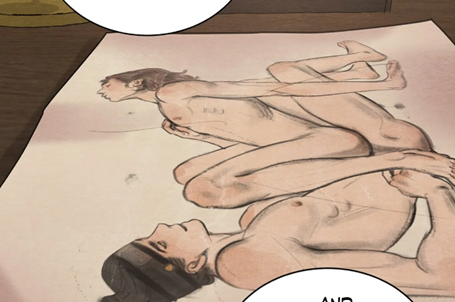 so that there are no picture left with him, a new version of chapter 2. For me, the chapter 67 marks the beginning of Baek Na-Kyum’s influence as the lord’s muse. With him, he is learning what love and courage are and he will inspire the master to paint again. Finally, he will be able to discern between fake and genuine affection and concern leading Kim to lose his master’s trust.
 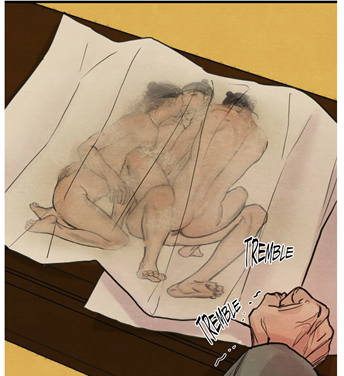 Imagine how he must have felt. He tried so desperately to stop his son from being linked to arts and painting, and here he receives an erotic painting. He can only be reminded of the past incident. At the same time, he is also criticized for his hypocrisy. He forced his son to prostitution for his own goal, but acted as if he was proper and righteous. No wonder that he was so enraged and could barely contain his fury. He was confronted with his lies and wrongdoings, one could say that he was finally seeing his failure as father. Because of this new approach, I come to the conclusion that Kim was the one sending the painting, hoping that the eldest master would intervene, as he prefers father Yoon to his actual master who is always linked to scandal and uproar, which contrasts to Kim’s philosophy. The butler hoped for an intervention, but since father Yoon hates himself to be connected to sodomy and would like to keep his reputation intact, he chose not to intervene.
 The first one is, when Baek Na-Kyum remembers that night where he had a near-death experience and the second one would be, when he is lying in his study with Yoon Seungho next to his bed.
 They would give such an answer, because they would use the black frame as reference. The latter represents a memory or a dream in Painter Of The Night. In other words, the manhwaphiles would invoke a literary phenomenon:
 and walked randomly in the room. His survival instinct had kicked in. Because of the flashback, the protagonist had lost his sense of orientation and couldn’t see where he was going, as all his thoughts and emotions were revolving around the trauma. He had the feeling that he was reliving his past experience. This explains why the chapter 65 ended with the following panels:

 in chapter 65. And if you read the chapter again, you’ll notice a huge white space between the next following panel.
  Yoon Seungho is opening the door leaving the painter in his bedchamber (chapter 65). As a conclusion, the beginning of the episode 66 has to placed between the last words and the opening door. Hence we have a fourth flashback in episode 66.
  , then covering his mouth
  and finally putting him under the cover
 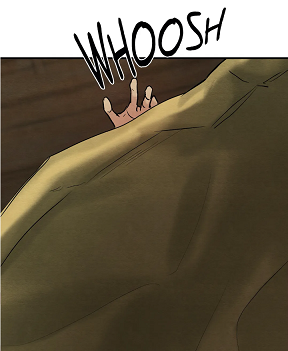 so that he could get rid of noona Heena easily. He recreated the situation Baek Na-Kyum was exposed to, when he had been abducted. And if the beholder pays attention to the way the painter is lying in the bed, they will realize another important aspect: the cover that the painter used as protection and comfort has become a prison or a trap now.
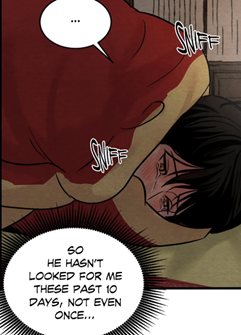 Besides, in this chapter, his heart started racing with the main lead’s appearance.
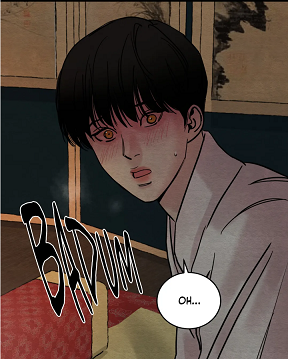 In both chapters, the main lead was the cause for the heartbeat, yet the reasons for the racing heart are totally different. It is important, because it shows us that the kidnapping left a deep wound on the artist’s psyche. When the main character recreated the condition of the abduction, he triggered a flashback. Because Baek Na-Kyum couldn’t scream for help and his head was held under a bag
  and the knife in his mouth
 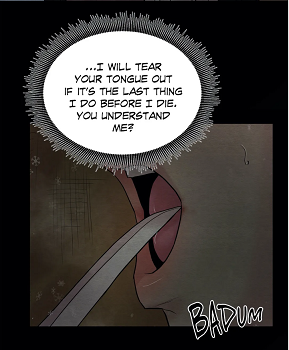 showed that Nameless knew how to scare the low-born. He triggered all the painter’s senses and aroused them to the maximum so that the artist wouldn’t be able to speak so easily. This explicates why the artist felt the abduction as a near-death experience. This is not surprising that when he woke up the next morning, he was trembling and felt scared.
  But if the manhwaworms looks at the criminal’s actions, they will conclude that Nameless was indeed ruthless. He knew how to terrify the painter. He tormented the painter psychologically. Nonetheless, since Nameless neither murdered nor atrophied the painter, in his eyes he was actually very kind and even merciful. He even felt pity for him, as he was well aware of the artist’s innocence. The latter was just a plaything caught in the middle of the fight between two nobles.
  Because of his words, I believe that Nameless stands in opposite to Kim’s philosophy. While the latter chose cowardice and indifference for his self-preservation, the “butcher” made the opposite choice. By becoming the dirty hands of the nobles, he was sure that the nobles would protect him, because if they didn’t, their crimes could threaten their position. He would always stand on the winning side. However, by acting like that, Nameless contributes to perpetuate injustice and reinforce the harsh treatment on commoners. As you can see, the flashbacks (memories of the painter) were used to explain why the low-born had a flashback (panik attack) at the end. By reproducing the condition of the entrapment, Yoon Seungho helped to unveil the truth unconsciously. The painter’s body revealed the terrible secret and the readers got a glimpse of Nameless’ true mindset too.
  This impression seems to be confirmed, as the moment he removes the cloth from the painter’s mouth, the lord criticizes him.
 However, from my point of view, we need to differentiate between the actions made by Yoon Seungho’s mouth and hands again. While the latter are under the influence of his unconscious, the mouth represents the mind and as such conscious. Note that he removes the cloth, although he could have ignored it. By liberating Baek Na-Kyum’s mouth, he is actually endangering his situation.
 Let’s not forget that since that terrible night, the lord has returned to his older self, therefore he has the impression that he is no longer using his heart. But he noticed that the painter was in a terrible condition, therefore he couldn’t ignore his lover. From my point of view, the two panels reveal that Yoon Seungho’s affection for the painter hasn’t changed one bit in the end. He continues saying that he is restraining himself, since he is not even able to refuse Baek Na-Kyum’s resistance: “But you have your ways”. From my point of view, we have here a new version of the lord’s confession:
  (chapter 58). The irony is that in chapter 66, the painter is a wreck, yet the lord is admitting his defeat displaying Baek Na-Kyum’s real power. The other divergence is that this time, it is a conscious choice. This is not a dream or an illusion. Yoon Seungho states that he can’t win against the low-born’s will. In other words, their relationship is progressing again. Due to the resemblance of the chapter 58, the readers have the feeling to witness another flashback. Nonetheless here, the noble hears a reply to his confession, unlike in the past: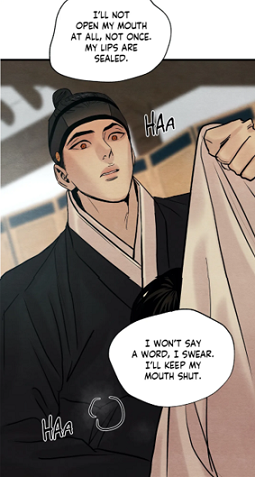
 The nature of the confession has changed: this is an admission for his silence. He lied and apologized in order to survive. These panels expose how deeply traumatized the painter is. He is still trapped in his flashback, reliving his near-death experience and doesn’t realize his lover’s presence. Therefore his gaze is directed elsewhere. I would even say, his gaze is lost in the flashback. What caught my attention is the protagonist’s reaction, when he hears the painter’s words and heavy breathing. He is not only surprised and shocked
 , he is also paralyzed. For me, the last panel shows the main lead’s realization. He must have recognized the painter’s real condition: he is traumatized. And in my opinion, the painter’s confession and behavior triggered a flashback in Yoon Seungho too, which we don’t really see, but can sense more or less. Observe his discomfort and his fixe stare.
  He seems lost as well, very similar to the commoner’s gaze. Besides, the aristocrat doesn’t move one moment, although some time has already passed. The sister has already left the house and Min is now standing at the door. The last picture even shows us Min’s perspective. He senses the lord’s worry and pangs of conscience too. From my point of view, the lord is reminded of his own bad past experience due to the artist’s behavior and words. The other clue for this interpretation is the lord’s phobia of the cover.
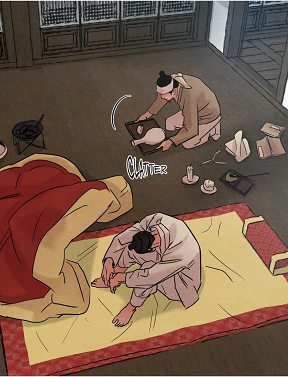 (chapter 35) Therefore I come to the conclusion that we have another flashback here, but Yoon Seungho’s is not revealed, only through his gaze and the observations I made: the fear of the cover and the commoner’s past as a repetition of the main lead’s tragic past. Let’s not forget that this scene is also a new version of chapter 53:
 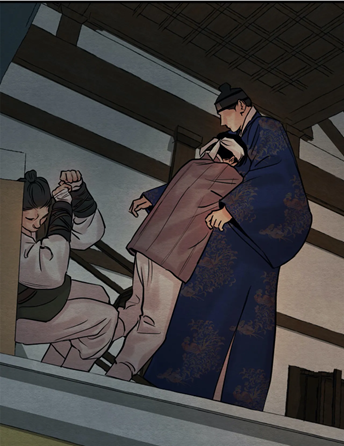 , back then, the main lead was the one who was in a dissociative state and the painter embraced him, when he sensed his fury and pain. However, this time the roles are switched. And this explains why the noble hugs the painter, attempting to give him some comfort. Yet, in my opinion, he has no idea about the real cause of the artist’s trauma in that moment
 indicating that he heard Min’s confession: Lee Jihwa is behind the painter’s disappearance. And right after, the flashback starts so that it feels like a caesura. Therefore many readers felt confused. In order to comprehend its true nature, the manhwaphiles should remember the definition of the flashback in fiction. It is either a memory or a hazy dream. That’s why we need to question ourselves about the nature of this scene. Is it a dream or a memory? And who is the person having a flashback?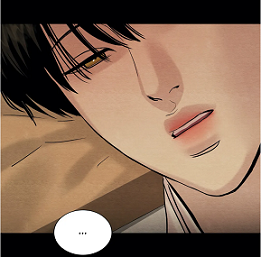
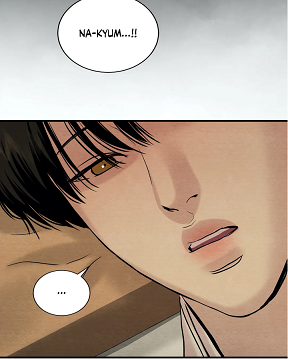 The images are almost identical, yet in the second picture, there’s no black frame, therefore this means that it represents reality. And now, you can better grasp the nature of Baek Na-Kyum’s flashback. It is a mixture of dream and memory. The lord stayed by his side the whole night (a new version of chapter 55)
  and at some point, the artist opened his eyes briefly, just like the lord nodded to Baek Na-Kyum’s question unconsciously
  , as he felt his presence, but never realized it in the end. In other words, the painter also detected the lord’s presence by his side, even opened his eyes for a second, heard him even calling his name
  . The tragedy is that exactly like during their Wedding Night, the painter won’t be sure, if what he sensed and saw was reality or a dream. Therefore I come to the conclusion that this is a new version of chapter 58, where the roles are reversed. Back then, the lord thought that this night with Baek Na-Kyum was too beautiful to be true and it is the artist’s turn to feel the same way. This flashback shows his wish mixed with a memory. And now, during this night, the lord expressed his regrets and showed his tenderness, just like in chapter 58. He took the hand with delicacy
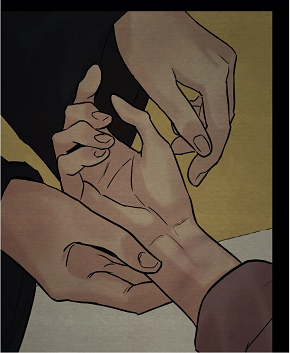 and touched the wrist and the wound with his finger carefully,
 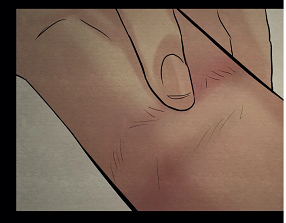 ,as though he wanted to heal himself the bruise. For me, this scene was so beautiful and moving, as it reflects the noble’s growth. He doesn’t just feel huge pangs of conscience, but he is determined to redeem himself in the end. When he touches the scar, he feel sorry for Baek Na-Kyum’s wounds which he hadn’t seen due to his self-hatred. At the end, he treats Baek Na-Kyum’s hand like a treasure. Yet, note that he is not kissing it.
  and put them on his loins.
  He only valued them, as they helped him to have a better libido. And now, his gesture
  She symbolizes reality. Consequently, I believe that the following picture from the flashback illustrates the artist’s true wish.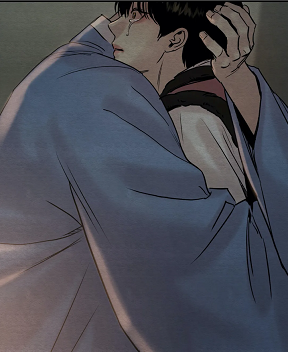
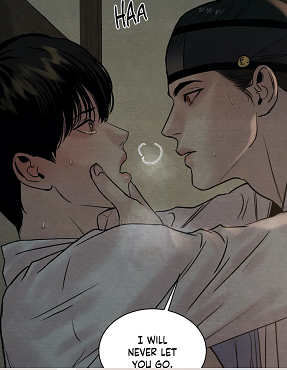 (even if it sounded so possessive and obsessive). Furthermore the same person even expressed that his smile and presence could be the source of his happiness
  Finally, the lord’s confession revealed that he never considered him as a whore in the end, as his request was just a smile and not his body. Finally, I believe, noona Heena’s presence will also have an influence in the painter’s thoughts and emotions. Baek Na-Kyum will be able to appreciate that Yoon Seungho allowed her companionship, willing to accept a gisaeng in his house, although the low-born heard him calling her a wench or harlot before. Unlike the past, the artist is no longer blind or deaf to the noble’s gestures. There’s no doubt that they will rekindle, but their relationship will mature. The lord will try to find a different connection and I am already imagining him asking again:
 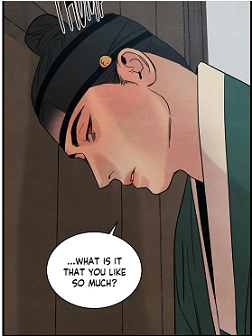 Another flashback from the past…
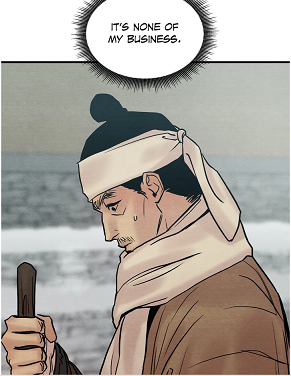 (chapter 65) As you can see, the valet Kim is not revealing the truth, not out of fear, but he has the impression, this is not his problem. He chooses indifference. With this single attitude, the readers discover Kim’s true personality and past, confirming my last analysis about him. When he heard the painter’s refusal,
  (chapter 65), he was brought back to the past. The domestic was a witness of Yoon Seungho’s rape and as such of his sexual abuse. Striking is that in episode 65, he didn’t even open the door, but instead of helping, he let it happened. He didn’t act according to his belief. This means that in the past, he must have acted the opposite. The door was open. This signifies that he abandoned the young Yoon Seungho, when the main lead asked for assistance.
 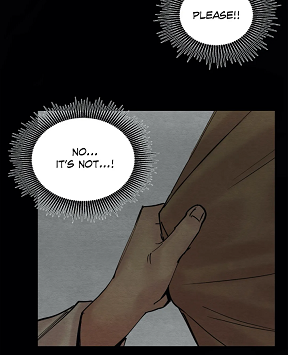 (chapter 65) He refused to listen to the young master’s plea. And now, you understand why Yoon Seungho had sex in front of him outside the barn. Unconsciously, he wanted to confront the valet with the consequences of his actions.
 (chapter 8). His hand expresses not only his rage, but also his powerlessness. With his hand, he wasn’t able to stop the valet from leaving him behind. He had tried to stop his father from leaving his side with his hand too.
 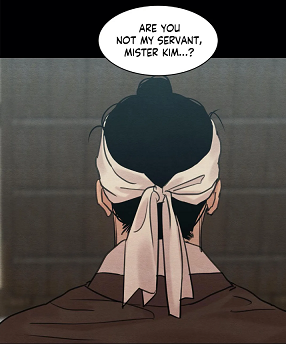 (chapter 77) My theory is that the main lead was raped by “lord Song”, the king. Therefore I assume that the man was invited by father Yoon. Remember that the kisaeng Heena proposed to her donsaeng to seek the protection of a nobleman, as he is a low-born.
  (chapter 97) My idea is that the valet thought that by seeking the monarch’s protection, the young master’s suffering would end, for the king stands above the scholars and elders. Anyway, I believe that the valet made a bad choice and regretted it afterwards. Due to his guilt, he developed resent towards Yoon Seungho. And this explains why Kim said this to the painter in order to ease his pain:
  (chapter 12) He couldn’t tell him details, since he would reveal his complicity to the crime. Furthermore, since the valet led the painter to the pavilion, it is very likely that Kim was the one who offered Yoon Seungho to the pedophile, which makes his crime even worse.
  (chapter 77), he became more and more burdened by his guilty conscience. He turned into an accomplice, for he never revealed his involvement and mistakes.. He could no longer reveal the truth, because he would have to get punished. He feared father Yoon’s wrath and he had reasons too. He could definitely die. That’s the reason why he reproaches the doctor his passivity and silence, though in my opinion, it was not about the abduction, but about the tonic. Sure, in Joseon, there was no law called “Duty to rescue or Failure to provide assistance”.
 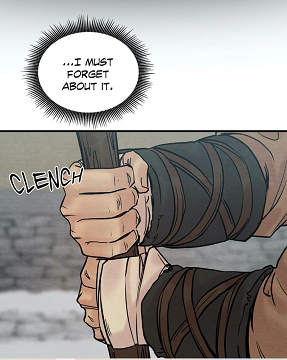 (chapter 65), they can’t, because they feel guilty and remorse. Note that right after voicing his wish to forget the incident, he recalls Yoon Seungho’s tragedy indicating his incapacity to forget. This explains why Kim gives the doctor the following advice:
 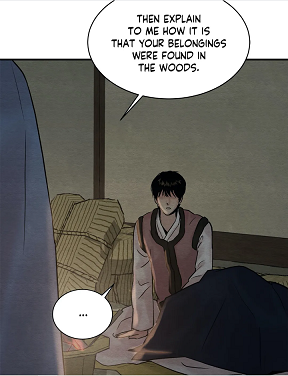 , (chapter 62) especially when you think that Baek Na-Kyum is just a commoner. But the problem is that he was biased, just like his father who had the impression that his son was a homosexual due to the testimonies of close people (Kim, Lee Jihwa and probably Yoon Seung-Won). After the rape, Yoon Seungho got punished. And this interpretation was proven correct in season 3
 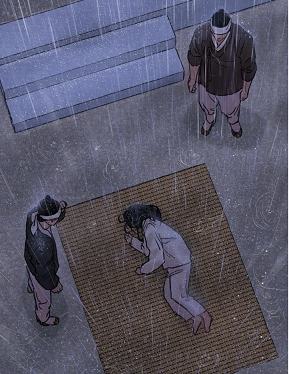 (chapter 77). But here Kim remained silent too.
 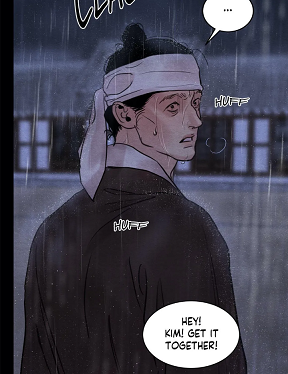 (chapter 77) It was even worse than before, because after the straw mat beating, he was paralyzed. No one spoke for him and believed his words, and Kim wasn’t willing to step in. Moreover, I believe that Kim had another reason for remaining silent.
 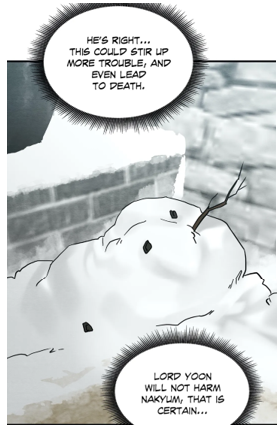 (chapter 65) He disliked the idea of a scandal and trouble. If he had told the truth, he knew that his punishment would be death. Out of convenience, he ran away from responsibility and from the uncomfortable truth.
  (chapter 65) That’s why I believe that the author is not showing that Kim and the physician chose secrecy and silence, because they feared for their life. They only started fearing for their life, when the truth is about to be revealed, as the painter was not dead yet. As the victim, he was a witness. Because once the lord discovers the butler’s passivity and complicity, it becomes a matter of life or death for him. According to me, there are two doctors. So the chapter 65 unveils that the first doctor didn’t testify, as he wanted to help the artist.
  (chapter 65) This represents his attitude in life, therefore he is responsible for Baek Na-Kyum’s loss of innocence. His other leitmotiv is
 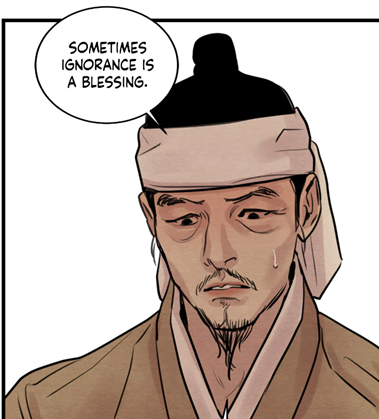 (chapter 23) He acts, as if he knows nothing reminding us of this scene.
 (chapter 28)That’s why I believe that the butler was lying back then and had even allowed the artist to run away that morning. I see a new version of chapter 29. But let’s go back to chapter 65.
  (chapter 82) Why didn’t he ask for a punishment after this humiliation? It is because he couldn’t. However, he must have definitely sought revenge. And the main lead became the sacrificial lamb, as in father Yoon’s eyes, his son was the reason for the purge: desertion, betrayal and probably drugs played a role in the purge. It is definitely possible that I have to change this theory about his traumatic past, but as you can observe, the main elements don’t change:
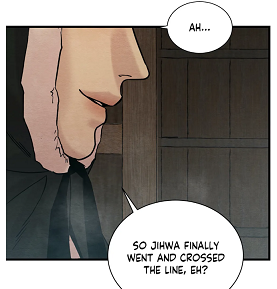 (chapter 66) The irony is that Heena suspected the main lead of kidnapping her brother and everything looked like her words were true: the wrist, the wounds around his wrist, his actual position (the mouth covered and his hands tied together…)
 (chapter 66) Thus the circumstances were turned against him.
  (chapter 65) But she was not present, when Min admitted Lee Jihwa’s crime. That’s how I realized that while chapter 65 represents silence, deception, cowardice and passivity, chapter 66 embodies the exact opposite. Min told the truth, Heena tried to save her brother by creating a ruckus! For Yoon Seungho, silence is a sign of culpability which he learnt from Kim. Hence he lied to the kisaeng
  (chapter 65), and later never spoke to the painter about the incident. If he had done it, he would have been forced to admit his misjudgment and wrongdoing. And now, you understand why Martin Luther King said this:
 (chapter 57) It doesn’t matter, if the butler told lies to the physician in the past, as they are now perceived as truth. Remember what Kim confided to the painter:
 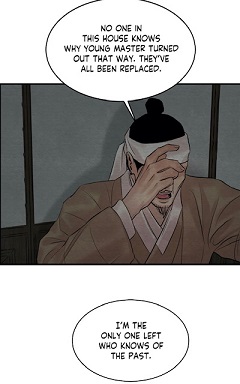 (chapter 86) He believes that he is the only one left who knows the past. But he is wrong, since the doctor also recalls the past. Hence how can Kim prove that he is telling the truth, since he told a different story to the physician? In addition, we have also lord Song. Besides, by giving the drug to Yoon Seungho without his knowledge and consent, Kim committed a wrongdoing. His knowledge won’t serve him in the end. I am deducing that the saying “silence is a true friend who never betrays” will no longer be valid. Therefore we have to expect a betrayal, and that would be from the physician, especially after we recall the butler’s warning in the first season, which was addressed to a different doctor from my point of view:
 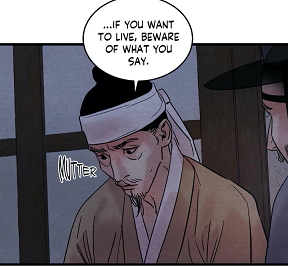 (chapter 33) Let’s not forget that in chapter 65, the servant tried to put the whole responsibility on the physician, making him feel guilty. And since Byeonduck is even using elements from the first and second season, I believe, we will have a reversed situation in season 4, where the doctor will speak up and put the whole blame on someone. Neither the physician nor Kim expected that the painter’s body wouldn’t remain silent
  (chapter 102) He needs to find the answer, which stands in opposition to silence and burying the truth (sweeping it under the carpet). This signifies that this time, Yoon Seungho has to gather information himself, and he can not rely on Kim:
 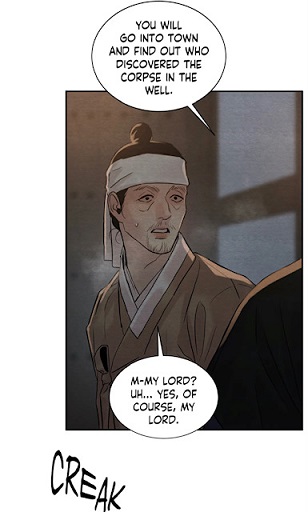 (chapter 98) As you can see, slowly people are forced to talk
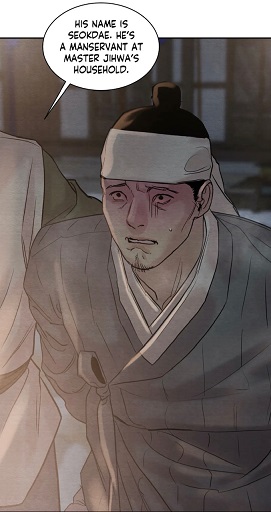 (chapter 99), hence their testimony can be questioned and perceived as lie.
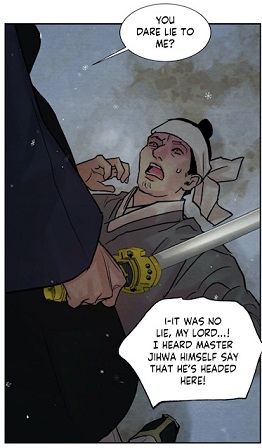 (chapter 100). This is important, because by getting confronted with lies, the lord will be able to discern the truth! In other words, silence embodies darkness and as such death.
  (chapter 74) Thus there was only silence in the lord’s nightmare. And this contradicts this statement:
  Bebebisous33s' analyses in K-Dramaland and Manhwas