
Please support the authors by reading the manhwas on the official websites. This is where you can read the manhwa: POTN But be aware that this Manhwa is a mature Yaoi, which means, it is about homosexuality with explicit scenes. If you want to read more essays about Painter Of The Night, here is the link to the table of contents.
It would be great if you could make some donations/sponsoring: Ko-fi.com/bebebisous33 That way, you can support me with “coffee” so that I have the energy to keep examining manhwas. Besides, I need to cover up the expenses for this blog.
1. Heaven and life
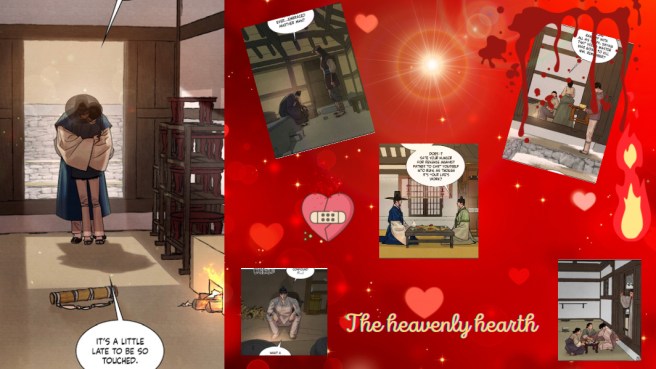
When many readers heard Yoon Seungho‘s statement  (chapter 119), they got worried and nervous, as they considered the expression „as long as I live“ as a clue for a sad ending. Why? It is because the lord was referring to his own death. Under this light, it becomes comprehensible why I selected „heavenly“ in the title. I was naturally alluding to the afterlife. However, I perceived his words in a positive light. He expressed his desire to live. He is no longer suicidal, he wishes to live a long life next to the painter and treasure his moments with him. That’s the reason why the author included the refraction in the scene. A dream had come true, the lord was finally able to escape the darkness.
  (Chapter 119) He is now truly alive. This explicates either why he smiled and laughed at the end. But why was he so happy? It is because Baek Na-Kyum had just confessed that he loved him not for his wealth or power, but for himself.
  (Chapter 119) He even described him as a treasure. Yoon Seungho had finally achieved his goal: to win the painter’s heart. His presence and love bring happiness to Baek Na-Kyum which stands in opposition to his reputation as bird of misfortune. Moreover, this description contrasts so much to Jung In-Hun
  (Chapter 119) and Yoon Seungwon’s.
  (Chapter 118) where both portrayed the main lead as a man consumed by lust and revenge. In other words, he was presented as a huge sinner. This implies that he stands so far away from heaven. But all these words were erased the moment the painter confessed his love for Yoon Seungho once again. What Baek Na-Kyum didn’t realize is that his love confession is pushing the protagonist to fight for the painter. (Chapter 119) If something were to happen to him, the low-born would be heartbroken and miserable. Baek Na-Kyum is his reason to live. Thus I consider this scene as the positive reflection from that terrible night:
 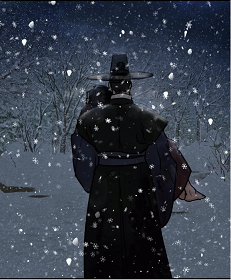 (chapter 102) In episode 102, he was renouncing on everything (life, mansion, wealth and connection), because he imagined that the artist had died. Consequently, I deduce that in episode 119, the painter’s life is attached to the lord’s for good. If the artist got into trouble, Yoon Seungho would side with him and the reverse. Thereby, I come to the conclusion that this moment in the kitchen represents their union, as they are no longer tied to the mansion. They are now a family no matter where they are. Let’s not forget that the painter expressed his wish to run away with his lover.
  (Chapter 119) It is important, because such a departure symbolizes that the bird “Yoon Seungho” is leaving the nest. He is now starting a family on his own.
2. Food, offerings and faith
Striking is that heavenly can be employed in a different context food. Let’s not forget that food is often served as offering to gods and spirits. Interesting is that in Asian societies, it is a tradition to offer the favorite dishes on the anniversary of the relatives’ death. As you can imagine, this custom was already practiced in Joseon. And now, take a closer look at this scene.

Yoon Chang-Hyeon was honoring his ancestors by bowing in front of the shrine. But what caught my attention is that in such an occasion, he should have brought food and his sons to such a ceremony. However, he just had lit incense 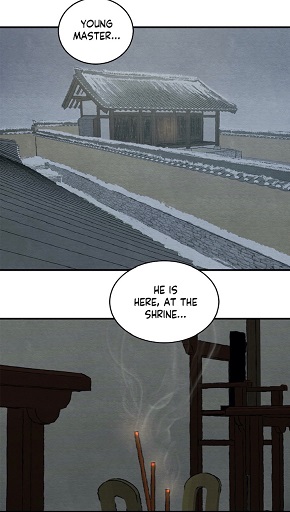 (chapter 85) and put a glass and that was it. This exposes the father’s hypocrisy, ignorance and greed. By acting on his own, he was exposing his true mindset. He views himself as the family. The sons are just the extension of himself, for they are his reflections.
Narcissists need a scapegoat to preserve their self-image, avoid taking responsibility for their actions, and to feel emotionally stable. Quoted from https://unfilteredd.net/why-do-narcissists-need-a-scapegoat/
As a narcissist, the father projects all his flaws onto Yoon Seungho, hence he is his scapegoat.  (Chapter 45) On the other hand, Yoon Seungwon is his golden child, for he represents his positive reflection.
A “golden child” is one who is considered “special” by their family and chosen as a proxy for a parent’s own achievements and magnificence. Unfortunately, the child must live up to perhaps unattainable levels of accomplishment and perfection. Being the golden child does not necessarily represent a positive familial position, and narcissistic parents frequently place this identity on one of their children. Quoted from https://www.choosingtherapy.com/golden-child-syndrome/
This explicates why in the bedchamber, the patriarch called his son a monster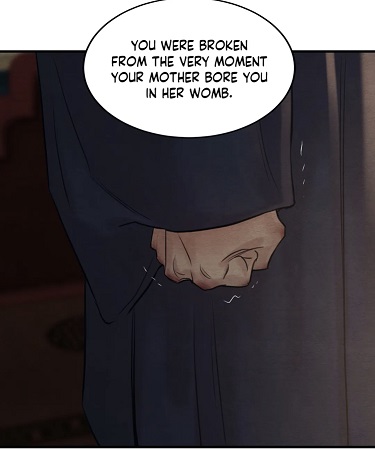 (chapter 86), whereas he put the other on a pedestal
 (chapter 86). Thus I created this illustration.
 Under this new light, it becomes comprehensible why the father could only reject the offer from lord Song in the gibang. Doubting Yoon Seungwon’s sexuality meant to question about the father’s sexual orientation. At the same time, it is not surprising why the elder master would blame Yoon Seungho for everything, for he couldn’t admit his responsibility for the purge. Consequently, the Manhwaphiles can grasp why Yoon Chang-Hyeon came alone to the shrine. If he had brought Yoon Seungwon, the father would have been reminded of the elder son, as both can not be separated. This explicates why the younger master asked his elder brother to submit to his father.
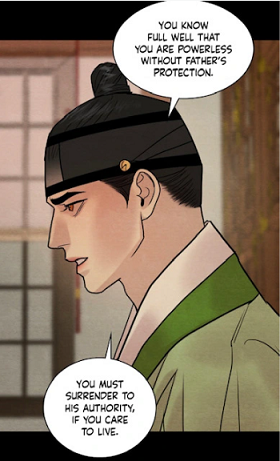 (Chapter 119) I couldn’t help myself smirking when the brother attempted to make him believe that.
 (Chapter 119) the protagonist could ever gain the father’s favor. Yoon Seungwon was definitely playing with his brother’s feelings, as if he could hope that their father would change.
At the same time, his position as golden child explicates why the younger brother resents the father and betrayed him:  (Chapter 118) It is because as a golden child, he is also suffering, but it is naturally nothing compared to Yoon Seungho’s position who could have died.
 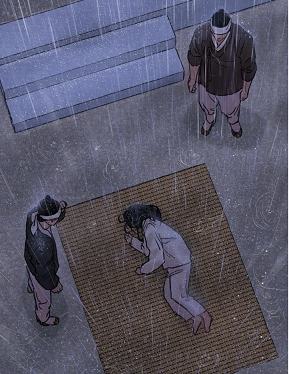 (Chapter 77)
Parents with NPD often shape one of their children into the golden child role. The golden child becomes an extension of that parent, and the child’s role is to please that parent. Narcissistic parents are unable to appreciate the golden child’s unique identity, and attempt to control their child’s interests and activities in ways that would reflect positively on them. They live vicariously through their golden child and they feed on their child’s successes, which serve as the parents’ narcissistic supply. Quoted from https://www.choosingtherapy.com/golden-child-syndrome/
Interesting is that psychologists said that it was easier for a scapegoat child to escape from this nightmare, as they can cut off ties more easily than the golden child who got used to special treatment. Moreover, the flaws from the patriarch rubbed off on Yoon Seungwon which often happens in such a toxic family. This signifies that for Yoon Seungwon, it is difficult to maintain good and healthy relationships in the end too. And now, you comprehend why the younger master made such a request to his brother. He needs him for two reasons.  (Chapter 119) First, by returning the petition to the father, Yoon Seungho would become the culprit. He was not only a traitor, but also a blackmailer of the Yoons and lord Song.
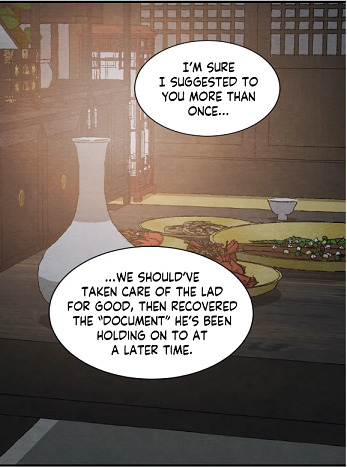 (Chapter 107), for he had stolen the petition. Yoon Seungwon would hide his wrongdoing, he betrayed their father.
 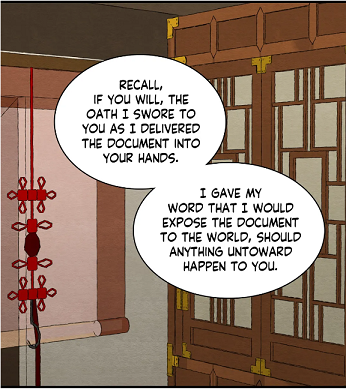 (Chapter 118) There is no doubt that Kim played a role in this as well. In other words, the brother and the valet would bury the truth by diverting the attention of the patriarch towards the main lead, if Yoon Seungho followed this suggestion.
  (Chapter 116) The elder master would no longer seek the truth, similar to the kidnapping in season 2 which was turned into a desertion and later Lee Jihwa’s abduction occulting the instigator and the helping hands. Simultaneously, Yoon Seungwon needs his brother as scapegoat, because the pressure coming from the patriarch and lord Song must have definitely increased. (Chapter 119) How ironic that Yoon Seungwon employed the expression “care to live”. Back then, the protagonist was just surviving, he had already developed suicidal tendencies, when this incident took place.
 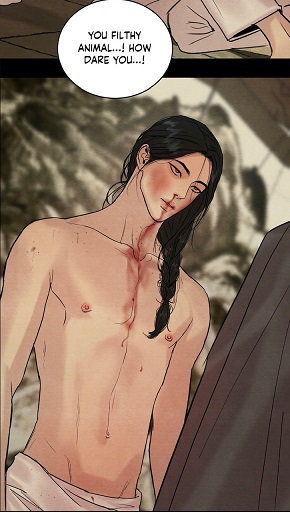 (Chapter 83) This shows that the young master wants to sacrifice his brother once again. Out of selfishness and cowardice, he is trying to convince Yoon Seungho that this is the right thing to do! (Chapter 119) This is a new version of this scene!
 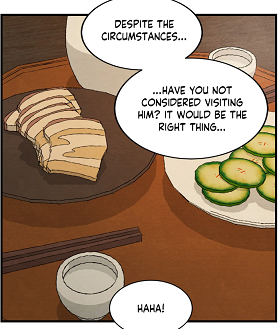 (Chapter 37) He is even implying that he needs to sacrifice himself in order to protect Baek Na-Kyum!! Moreover, he is distorting the reality, because he implies that his father is still powerful. (Chapter 119) However, the purge took definitely place,
  (chapter 37) like the memories from episode 37 are exposing it. It becomes clear that if Yoon Seungho returned the petition, he would die.
 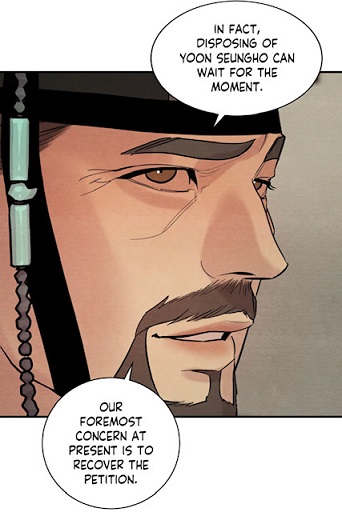 (Chapter 116) Thus I come to the conclusion that the meeting between the brothers in the gibang represents an offering. For the Yoons’ sake, Yoon Seungho should admit his wrongdoings (Chapter 119) and beg for forgiveness. Thus I interpret the scene in the kitchen hearth as true hope (chapter 119) while the table with many dishes in the gibang stands for fake hope and offering. (Chapter 118) It was, as though Yoon Seungwon was giving his brother his last meal before his sacrifice. This situation exposes that in the past, the main lead had been put in a similar situation, covering up for the brother’s mistake.
  (Chapter 55) People had played with his hopes and longing for acceptance and recognition. Interesting is that offerings is a synonym for atonement and sacrifice. But why is Yoon Seungwon so sure that he can repeat the same action from the past? It is because Kim and Yoon Seungwon have known for a long time that Yoon Seungho was longing for acceptance and love from his family, just like the scholar knew about the painter’s love for him.
  (Chapter 119) But everything changed, when the painter met the lord. So who is worse here? Jung In-Hun who tried to rape the painter or Yoon Seungwon who is sentencing his elder brother to death? Let’s say that the valet convinced the younger master to suggest this solution, this doesn’t diminish Seungwon’s responsibility at all. He knows that his father abused his elder brother. In my opinion, he is copying his father, like the former tried to diminish the responsibility of the patriarch.
 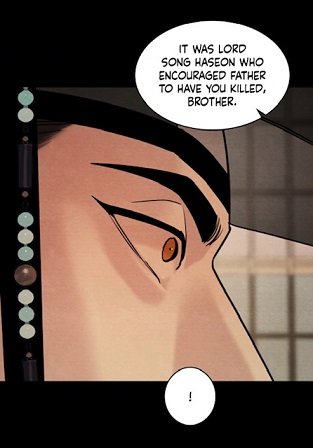 (Chapter 119) Yoon Seungho got hurt because of lord Song and not because of Yoon Chang-Hyeon. This means that the younger master was denying the existence of the patriarch’s choice and the helping hands. And if the brother listened to his advise and the father hurt or killed the main lead afterwards, the younger master could put the blame on the elder master, for the decision and responsibility belonged to the patriarch. Moreover, he heard from lord Song that killing Yoon Seungho was just a matter of time. (Chapter 116) Fact is that the younger master is betraying his brother once again.
Yet, the former is making two huge mistakes. He is considering the painter as a servant (chapter 119), therefore he believes that the artist is tied to the mansion. Secondly, I am quite certain that his perception about the artist is influenced by Kim. This signifies that the latter is also projecting his own thoughts onto the painter, for he is himself a narcissist. The latter is interested in wealth and comfort. If he came to lose everything, he would abandon Yoon Seungho, that’s what Kim is envisaging. Thus if Yoon Seungho were to submit himself to the father, Baek Na-Kyum would lose everything. Besides, I am even thinking that Jung In-Hun’s approach in the gibang is also related to the brother and the butler. All of them had an interest to separate the couple! And note that when the lord went to the noonas’ room, it looked like the painter had deserted him.  (Chapter 119) So technically, this situation could have triggered the protagonist’s insecurities like in season 1
  (chapter 28), 2
 (chapter 60) and 3
 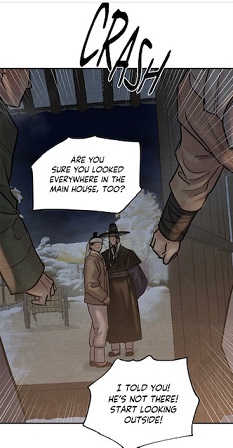 (chapter 98). However, through these constant exposures, Yoon Seungho came to learn not to jump to conclusions and to have faith in Baek Na-Kyum. He knew that he would return to the mansion. Hence he ran to the bedchamber first.
 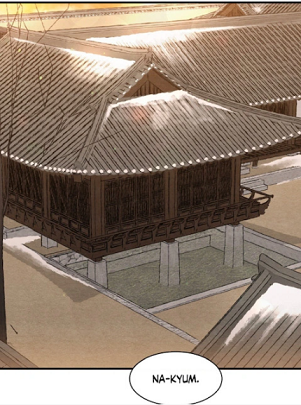 (Chapter 119) Another important detail is that we don’t see any staff in the courtyard or in the kitchen. It was, as if the propriety had been deserted.
 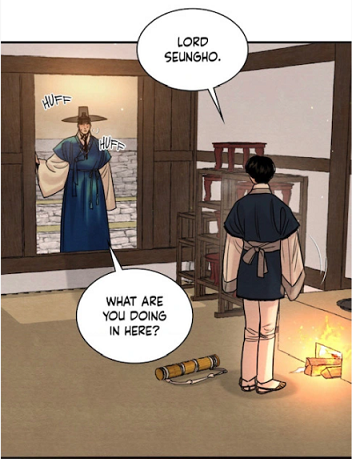 (Chapter 119) This implies that at no moment, he relied on the domestics’ testimonies which contrasts to the following scenes: (chapter 98)
 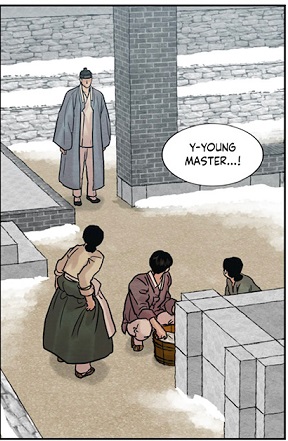 (chapter 104)
 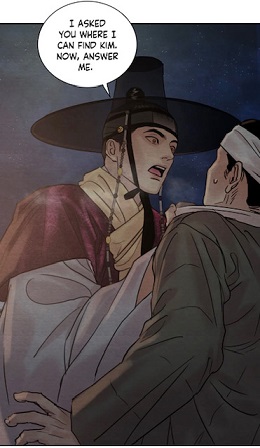 (chapter 107) and
 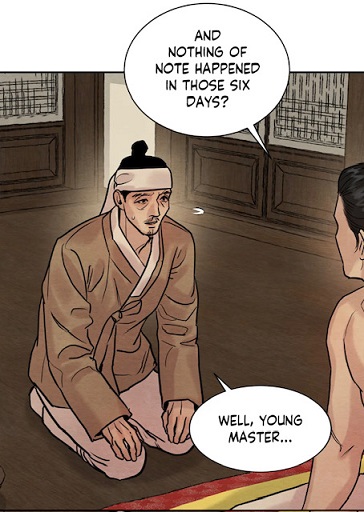 (chapter 116) However, observe that in episode 116, Yoon Seungho had witnessed how his lover had taken care of him, while he was unconscious. Furthermore, the petition had been handed over to the painter and not Kim, a sign that the artist had become the protagonist‘s confident. As you can see, as time passed on, the main protagonist learned the following lessons: he should stop relying on servants, he should only trust his partner. I would even add that he was taught the following principle: “If you want something done right, you have to do it yourself”. In my eyes, (chapter 119) the scene in the kitchen is exposing the betrayal from the staff, that’s the reason why we see no one! They were either expecting their lord’s return and imagined that he would be upset or even violent! At the same time, by not meeting the artist, the servants could feign ignorance about the lover’s whereabouts and claim their innocence. The proof is that this scene (chapter 119) is the positive reflection from that night:
 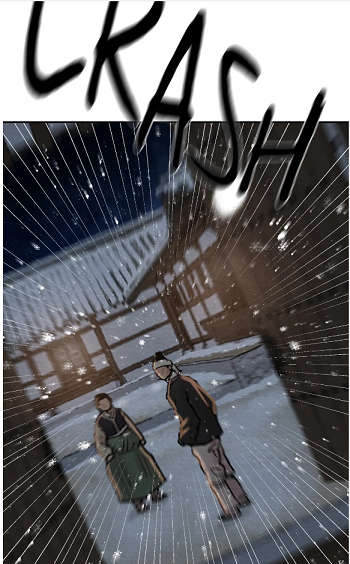 (Chapter 103) Here, they never expected the return of Yoon Seungho and the painter. The staff ‘s absence in episode 119 is the evidence of their desertion! Moreover, I consider Yoon Seungho’s search for his lover as a new version from episode 28/29/30:
 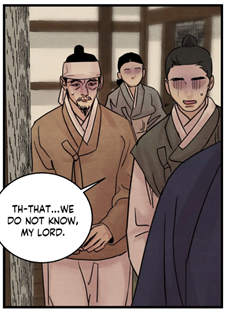 (chapter 28) Back then, they feigned ignorance, but they never anticipated a punishment from Yoon Seungho.
And this leads me to the following observation: Baek Na-Kyum’s action in the kitchen reminded me of an offering! (Chapter 119) Why? It is because he burned a paper. The evidence for this is the presence of the painter’s belongings. This is the place where he used to hide the scholar’s poem (chapter 4). Moreover, the painter is standing in front of the hearth which certainly triggered the manhwaphiles’s memory. Jung In-Hun was seen in front of the hearth burning the letter from Min in order to hide his involvement in the painter’s sexual abuse. 
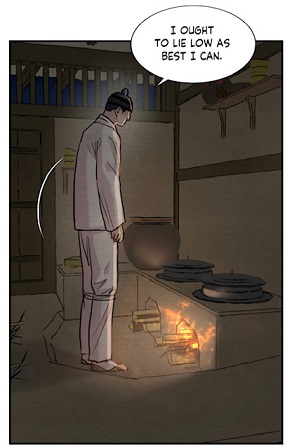 (chapter 115) And now you are wondering how the painter’s gesture can be considered as an offering. It is because the kitchen hearth is considered as sacred due to the fire. First, in shamanism, there exists the god of fire named Jowangshin.
The origin of Jowangshin is the fire of the home. But their realm also extends to the area that uses fire and water harmoniously. It is good etiquette to brig a set of matches when you move to a new house. One can enshrine the house god with an onggi of water placed on/above the stove or utilizing sacred mulberry paper put up on the wall in the kitchen. (…) Jowangshin is the emissary of heaven and will ascend to report the wrongdoings of the home’s inhabitants to Hwanin, God of Heaven. https://www.firelightlotus.com/post/jowangshin-god-of-the-kitchen
In China, people had a similar belief.
Zao Shen, Wade-Giles romanization Tsao Shen, in Chinese religion, the Kitchen God (literally, “god of the hearth”), who is believed to report to the celestial gods on family conduct and to have it within his power to bestow poverty or riches on individual families. Because he is also a protector of the home from evil spirits, his periodic absences are thought to make the house especially vulnerable to becoming haunted at such times. Zao Shen’s identity in life and in the history of his cult are uncertain. The god of the kitchen has also been confused with Huo Shen (god of fire) and with Zao Jun (“Furnace Prince”). Quoted from https://www.britannica.com/topic/Zao-Shen
As you can see, the kitchen is a sacred place. This explicates why next to the hearth, people had to follow the following rules:
- Do not curse while in the hearth.
(Chapter 115)
2. Do not sit on the hearth.
(Chapter 59)
3. Do not place your feet on the hearth.
(Chapter 98)
(Chapter 115)
4. Maintain the cleanliness of the kitchen.
(Chapter 47)
5. You may worship other deities in the kitchen. Quoted from https://en.wikipedia.org/wiki/Jowangsin
That’s how I realized why Byeonduck mentioned that lord Min would help Yoon Seungho. Note that Jung In-Hun cursed lord Min (chapter 115), when he burned the letter! Moreover, let’s not forget Black Heart’s claim during that night: Lee Jihwa  (chapter 102) who was a traitor, for he had tattled on Black Heart and his friends to Yoon Seungho. And now, you comprehend why I connected the shrine to the kitchen hearth. Both places are considered as sacred, for they are connected to gods and spirits.
3. Confessions and truth
And now it is time to return our attention to Yoon Chang-Hyeon.  (Chapter 85) The absence of his sons and of food as offerings reveals that he was not showing true respect to his ancestors. He used religion and social norms to hide his true intentions. He wanted to take over the mansion. Hence the black guards were standing at the entrance of the sacred house. Their presence symbolizes violence. Therefore it is not surprising that the gods chose to punish the elder master through Yoon Seungho. The former was not received properly
 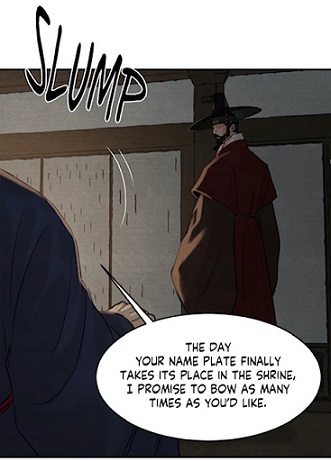 (chapter 86): no bow, no food and no seat.
 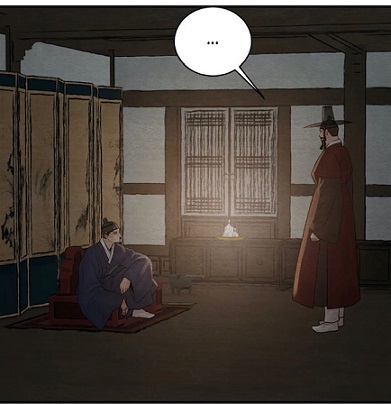 (Chapter 86) Let’s not forget that the elder master had entered the lord’s chambers without the permission of his owner. No wonder why he was left speechless. And now, you are wondering if I am not drifting away from the topic, as these chapters from season 3 don’t seem to be connected to episode 119. However, it is important to realize that these chapters have many common denominators
| Chapter 85-86-87 | Chapter 119 | |
| Death |   Here, we could detect the suicidal tendencies of the protagonist. He wouldn’t fight back. Here, we could detect the suicidal tendencies of the protagonist. He wouldn’t fight back. | Here, he wants to live and as such to fight back in order to protect his lover. |
| Coup d’Etat | 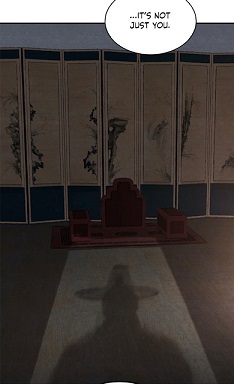 The seat looks like a throne. The seat looks like a throne. | Yoon Seungwon advises his brother to admit submission. It is like a surrendering. |
| The fire |  | Note the contrast. In the furnace, the fire was not properly lit. This explicates why the bedchamber didn’t get destroyed by the fire during that night. |
| The absence of the staff |  The courtyard is empty! No one is defending their master. The courtyard is empty! No one is defending their master. | No one is working in the kitchen. |
| A quarrel with a slap |  | 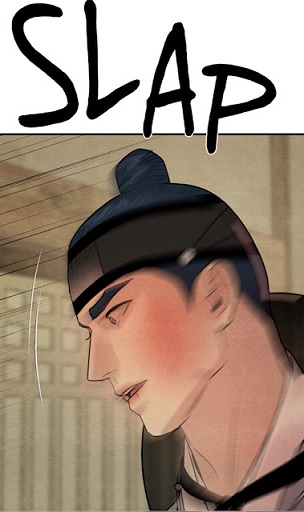 |
| Someone is out of breath | 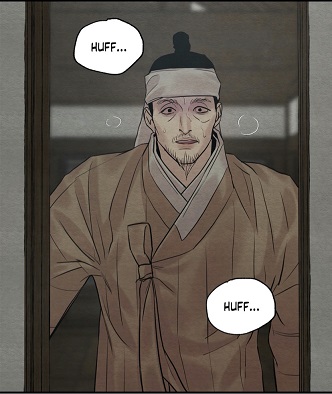 | |
| Treason |  | 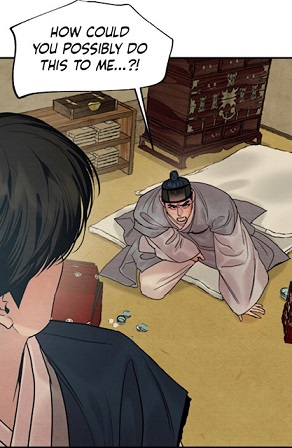 |
| Threat |  | |
| Sexual assault in the gibang | 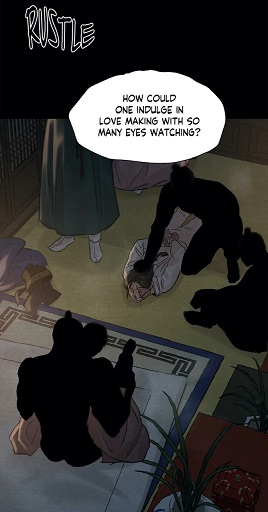 |  |
| A sudden kiss |  |  |
| the importance of family | | |
| The indirect reference to religion (curse, heaven versus hell, faith/trust) |  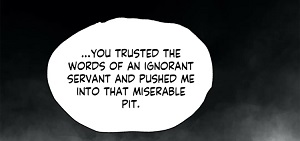 | |
| Wishes (ambition, dream) | | 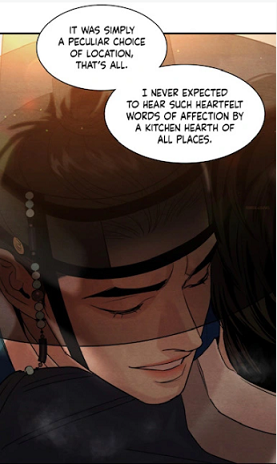 |
| Yoon Seungho portrayed as a depraved monster | 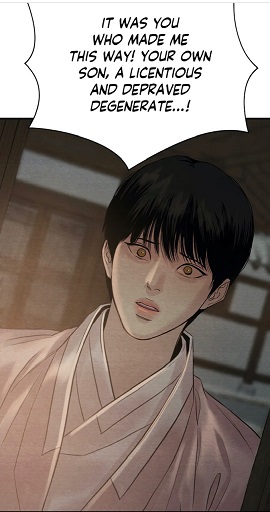 |  |
| An important paper/ document |  | |
| Jung In-Hun |  | Baek Na-Kyum not only wounded the learned sir, but also humiliated a person who passed the civil service examination. He is now a military official. |
| The painter’s escape | He was supposed to remain in the study. Kim allowed him to leave the room. |  Baek Na-Kyum freed himself. Baek Na-Kyum freed himself. |
As you can see, the night from episode 85 to 87 corresponds to the day in chapter 119. And now, it is time to examine the meaning behind this connection. First, the contrast between these two scenes reinforces my interpretation about the butler. At the beginning of the noble‘s suffering, the valet was ignorant, just like the painter is still unaware of the nobles’ death. But it is no longer the case. In episode 85, (chapter 85) he had faked his breathlessness. First, he didn’t need to run from the kisaeng house like Yoon Seungho. The kitchen, the gate or the servants’ quarters are not far from the study. Besides, why did Kim run in the end, when he joined the study? Contrary to his master in episode 119, he knew about his master’s whereabouts, for they had taken their lunch there.  (Chapter 85) The study is even close to the gate.
 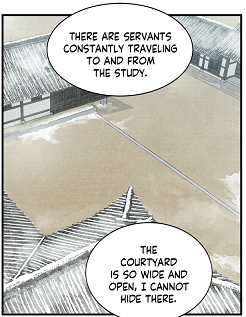 (Chapter 51) He could have reached the study before the father entered the shrine. Finally, observe that the patriarch even arrived to the bedchamber before Yoon Seungho, (chapter 86) though the study is close to the host’s chamber. As you can see, paying attention to the location of the different rooms exposes the betrayal from the staff and especially from the butler. He had been listening to their conversation, hence he knew about their quarrel. Interesting is that in the kitchen, the lord’s wish got fulfilled.
  (Chapter 117) The painter wants to leave everything behind too.
  (Chapter 119) Thus I am deducing that the authorities will be involved very soon. (Chapter 86) Why? It is because someone desires to take over the mansion.
  (chapter 119) They are not expecting the lord‘s resistance, for he remained passive all this time (season 2 and 3). The scholar has now the means to do so, and the necessary motivation. Imagine that he got wounded and humiliated by the couple! Besides, we have this broken promise due to Yoon Seungwon
  (Chapter 115) exposing the younger master’s lies and Yoon Chang-Hyeon’s delusions. Without the protagonist’s help, the younger brother would not be „successful“. Furthermore, the absence of food and fire in episode 86 indicates that this house was neglected and even not protected. (Chapter 86) It explains why the argument between father and son oozed hatred, coldness and looked like war! The hearth symbolizes home, family, warmth, love and protection.
Under this light, it is no coincidence that this new confession took place in the kitchen. At the same time, the kitchen hearth symbolizes humbleness and honesty, which stands in opposition to the love confession in the kisaeng house.  (Chapter 94) The gibang is connected to money, power, pleasure, artificiality, sensuality and lack of privacy.
  (Chapter 96) I am sure that you can detect all the contrasts (night, door close, spies, confession outside and inside, no fire, only light). Thus I am deducing that the painter’s words in the kitchen were not heard by others. As you can see, this scene in the kitchen is full of symbolism. In my previous essay “The true face of family”, I had already pointed out that sharing meals represented a criteria to define a real family. Therefore I had demonstrated that Yoon Seungho and Baek Na-Kyum were excluded from the mansion, for they wouldn’t eat their meals in the kitchen like the staff.
  (Chapter 17) Moreover, the hearth doesn’t just provide warmth, but also light! The latter embodies knowledge and as such Enlightenment.
  (Chapter 119) Hence they were clueless about the wrongdoings from the staff. Only in the kitchen, the lord could finally grasp the depth of Baek Na-Kyum’s love for him. It is an unconditional love contrary to Yoon Seungwon’s. The latter would only recognize him, if he listened to him. And he only seeks his assistance, when he needs him. It shows that Yoon Seungho is only approached, when he has power.
  (Chapter 118) (chapter 119) Moreover, because they are embracing each other in clothes, it exposes that their love is pure and not driven by lust. This scene contrasts so much to his meeting with his brother, for the latter never hugged him. He kept his distance from his brother.
 (Chapter 119) I would like to outline that during their conversation, Yoon Seungwon remained calm and indifferent, when he talked about the assassination attempt from Yoon Chang-Hyeon.
 (Chapter 116) But the biggest difference is the absence of fire in the kisaeng house. (Chapter 118) This reflects the lack of empathy from Yoon Seungwon.
Striking is that the couple stood at the entrance of the kitchen, when the painter declared his unconditional love to the noble. (chapter 119) It was, as if two worlds were meeting. Simultaneously, the door step symbolizes the gateway to new opportunities. In other words, it announces changes. Moreover, the embrace and the lord’s words expose that Yoon Seungho is focusing on the present moment and the future. This means that he is now moving on and as such cutting ties with the past! How ironic that Yoon Seungwon’s recommendations came true! (Chapter 118) Nonetheless, I doubt that he is including his brother and father in his future plans. For me, the noble’s words spoken in the bedchamber will become a reality:  (chapter 78) Furthermore, he tried to leave before
 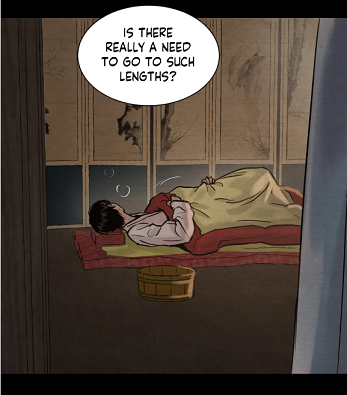 (Chapter 104)
  (chapter 105) Finally, we saw him in the courtyard standing next to a horse and a servant indicating that he had given him a task, and the latter needed to leave.
  (Chapter 108) Hence you comprehend why I am full of optimism in the end. Yoon Seungho has already made some preparations in my opinion. On the other hand, I am quite certain that their love will be tested. Can they face together trouble? Yes, because through their pain, they learned their lessons and changed.
4. The love confession in the kitchen
But why didn’t Yoon Seungho expect that he would be blessed next to the kitchen hearth?  (Chapter 119) It is because in the past, he was never allowed to join the kitchen hearth. This place was either beneath him or he was not worthy of entering the place. Thus he employed the expression scullery boy to Yoon Seungho.
 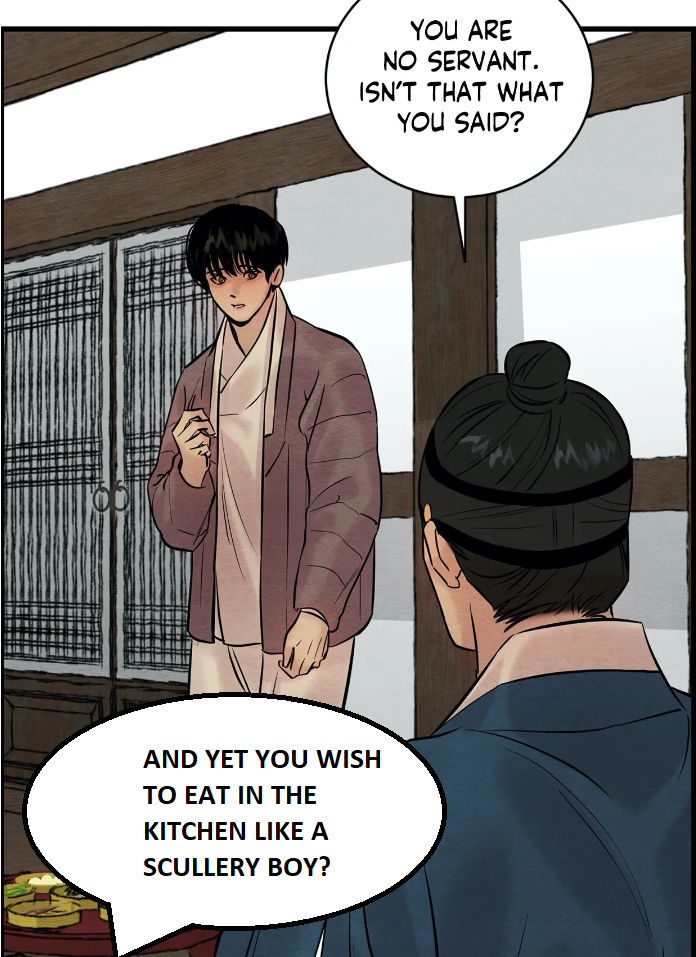 (Chapter 47) Here, I would like to outline that when the protagonist was held in the shed, someone brought him food .
  (Chapter 83) That‘s how I realized that the shed is connected to the kitchen!
- chapter 32:
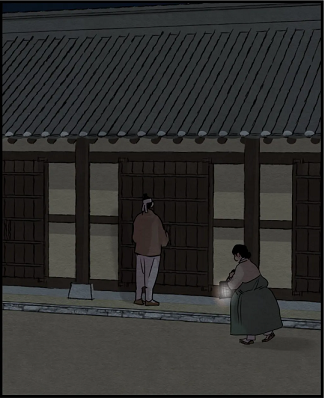 The maid had just brought water to the couple.
 - Chapter 51:
- Chapter 61:
 During that night, Baek Na-Kyum had been held captive in a shed.
 - Chapter 77:
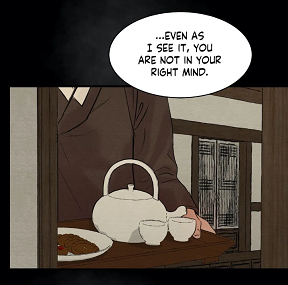
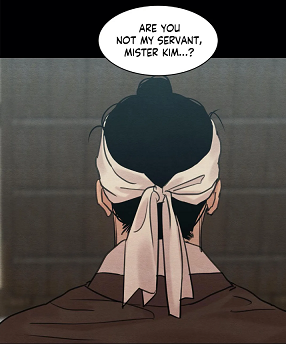
- Chapter 108:
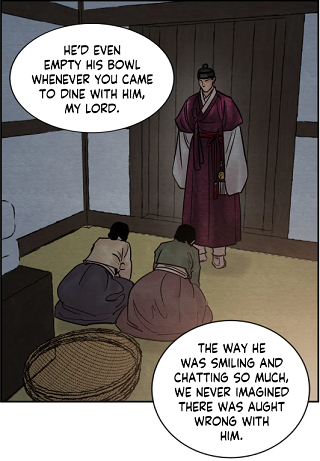

And what is the common denominator between these scenes? Kim was responsible for the kitchen and the shed. This observation brings me to the following conclusion. Then, you know why Yoon Seungho could never imagine that in the kitchen hearth, he would experience unconditional love. It is because the valet never allowed Yoon Seungho to enter the kitchen! And now take a closer look at this scene: 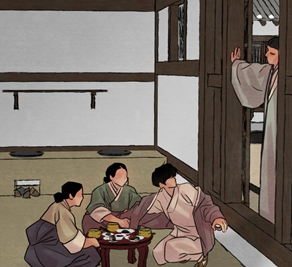 (chapter 38) Yoon Seungho remained outside on the door step. Consequently, I started comparing scenes where the kitchen hearth appeared and that’s how I discovered a pattern:
- A wrongdoing and an argument
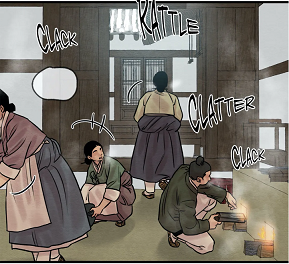
 (Chapter 46)
 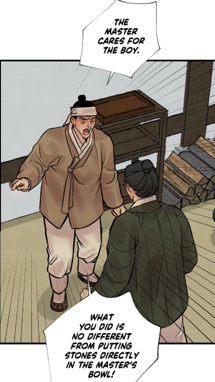 (chapter 47) (Chapter 98)
  (Chapter 110)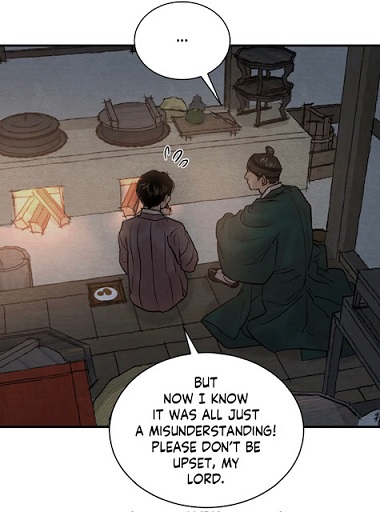
- – An apology – forgiveness:
 (Chapter 77)
 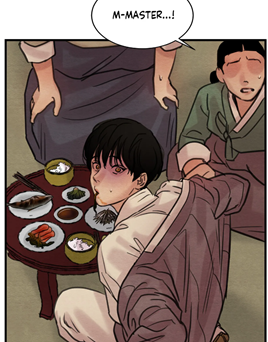 (chapter 38)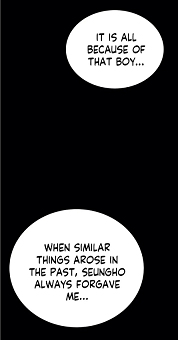
 (chapter 59)
  (chapter 119)
 - A confession
 (chapter 38)
  (chapter 47)
 (chapter 77)
 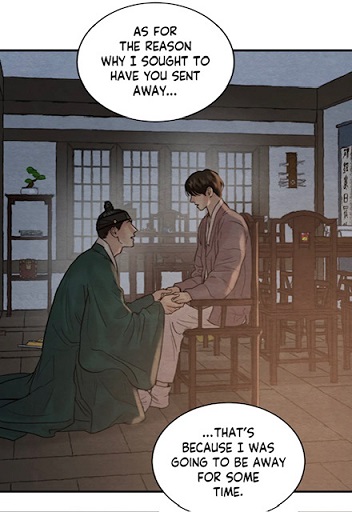 ( Chapter 110)
  (chapter 119)
 - A fire or its absence:
 (chapter 47) (chapter 38) (chapter 110)
To sum up, the kitchen is connected to a wrongdoing, an apology, a confession, a fire and a quarrel. Where was Baek Na-Kyum during the abduction? In a shed, while Lee Jihwa was arguing with No-Name!! That’s how I realized that the gods wanted to teach Kim a lesson. In the past, the butler should have invited Yoon Seungho to the kitchen hearth so that he would have found a family among the staff. Remember how the servant scolded the valet, it is because Kim must have taken pride to be the elder master’s servant.  (Chapter 77) For me, Kim must have looked down on the other domestics. I consider this scene as the best example what Kim should have done in the past. (Chapter 119) He should have brought him to the hearth and hugged him. That’s why Lee Jihwa got embraced during that night. Kim should have comforted him and made him smile! The father wouldn’t have noticed it, for there is a second entrance. The evidence is here:
 (Chapter 119)
  (Chapter 98) One door leads to the backyard and the other to the smaller courtyard. And this scene confirms my previous assumption
The kitchen is detectable thanks to the big wooden door in the smaller courtyard. However, I am quite certain that there’s a second access to the kitchen. They need to have an easy access to the jars situated in the backyard close to the walls. (…) This means that from the kitchen, if you follow the wall, you can pass by the lord’s bedchamber. And if you follow this path, you will discover the pond with the pavilion. Quoted from https://bebebisous33analyses.com/2022/03/31/painter-of-the-night-a-guided-tour-of-yoon-seunghos-domain🏡/
This means that Kim could have done something in the past.  (Chapter 87) Baek Na-Kyum is there to prove him wrong. He had other opportunities, like giving him a good meal.
  (Chapter 63) He should have sided with his master and even remained by his side. This signifies that this scene (chapter 83) exposes the butler’s betrayal and wrongdoing. Thus I conclude that the painter will show to the valet his cowardice and his treacherous nature.
(Chapter 119) So by burning the poem  (chapter 7) the artist is not only cleansing the kitchen, but also cutting off ties with the scholar. The latter is no longer protected. The spirits will intervene through chance. As a conclusion, the hearth has a spiritual and healing power, for it is connected to „Heaven“. Yoon Seungho‘s paradise is to have a family.
Feel free to comment. If you have any suggestion for topics or manhwas, feel free to ask. If you enjoyed reading it, retweet it or push the button like. My Reddit-Instagram-Tumblr-Twitter account is: @bebebisous33. Thanks for reading and for the support, particularly, I would like to thank all the new followers and people recommending my blog.

 Bebebisous33s' analyses in K-Dramaland and Manhwas