
Please support the authors by reading Manhwas on the official websites. This is where you can read the Manhwa: Jinx But be aware that the Manhwa is a mature Yaoi, which means, it is about homosexuality with explicit scenes. Here is the link of the table of contents about Jinx. Here is the link where you can find the table of contents of analyzed Manhwas. Here are the links, if you are interested in the first work from Mingwa, BJ Alex, and the 2 previous essays about Jinx Why Sleeping Beauty Had to Bleed part 2 and A Ruthless Fight, A Loverboy Break
It would be great if you could make some donations/sponsoring: Ko-fi.com/bebebisous33 That way, you can support me with “coffee” so that I have the energy to keep examining Manhwas. Besides, I need to cover up the expenses for this blog.
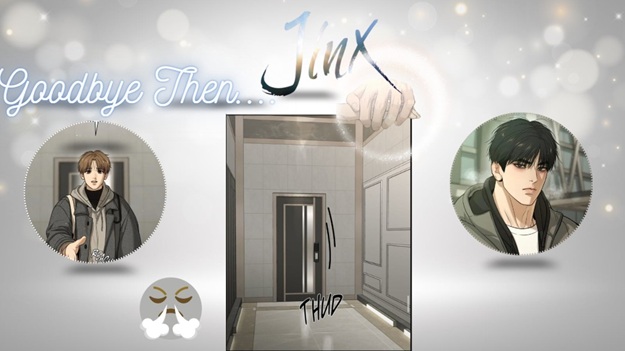
The Ghosts in the Warmth: Why Episode 100 Left Us Cold
Episode 100 of Jinx left many readers strangely unsatisfied. Some felt frustrated 😤, others emotionally empty. A few among us — readers, fans, longtime Jinx-lovers — even believed that this chapter resembled an ending so much that Mingwa herself had to clarify publicly (on X) that the story was not over. Some readers even considered dropping the story entirely. That alone says a great deal about the emotional violence of this chapter.
When a story’s atmosphere becomes so suffocating that readers instinctively want to step away from it, something unusual has happened. Dropping the story almost becomes a survival instinct. Remaining inside the narrative means remaining trapped in that freezing penthouse together with Kim Dan and Joo Jaekyung, surrounded by silence, distance, and unresolved pain.
But why did this episode create such discomfort? 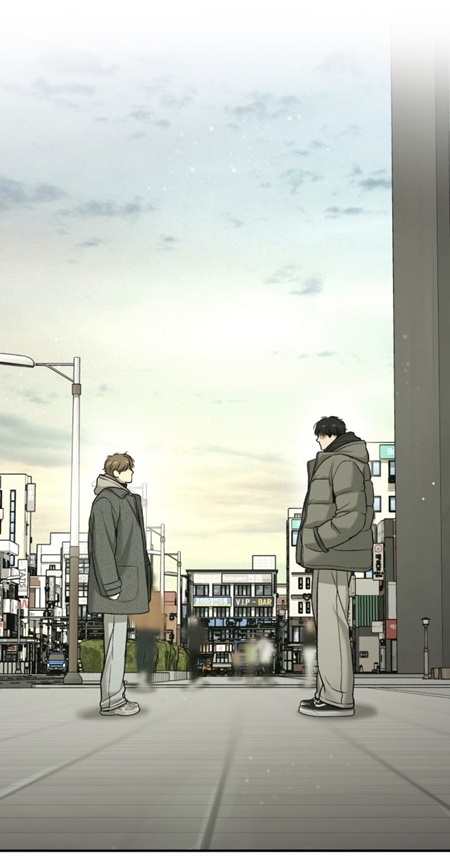 (chapter 100) Why does a chapter filled with flowers
 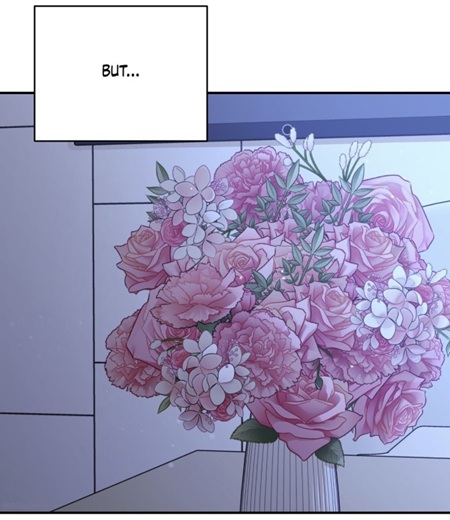 (chapter 100), warmth
 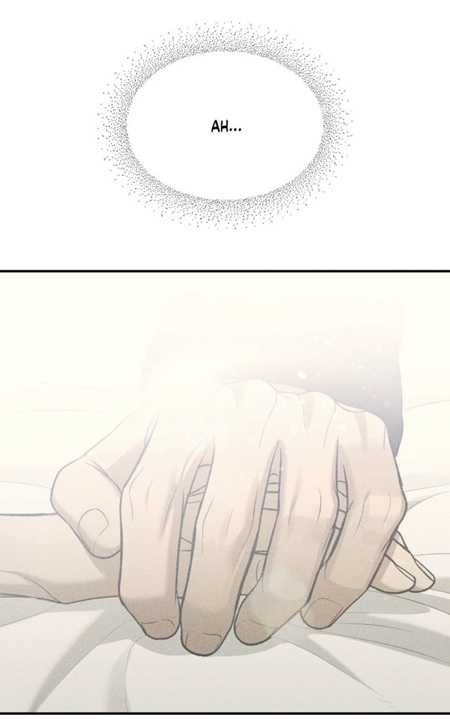 (chapter 100), survival, and reunion
 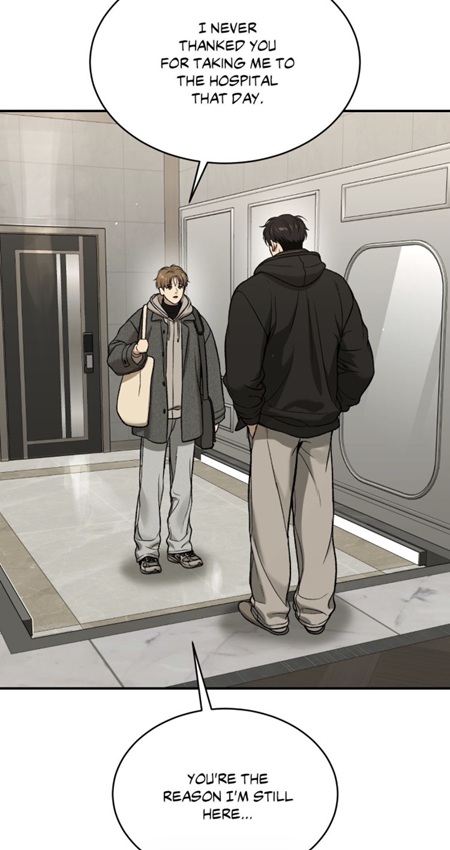 (chapter 100) feel so painfully cold? Why does “Goodbye then…”
 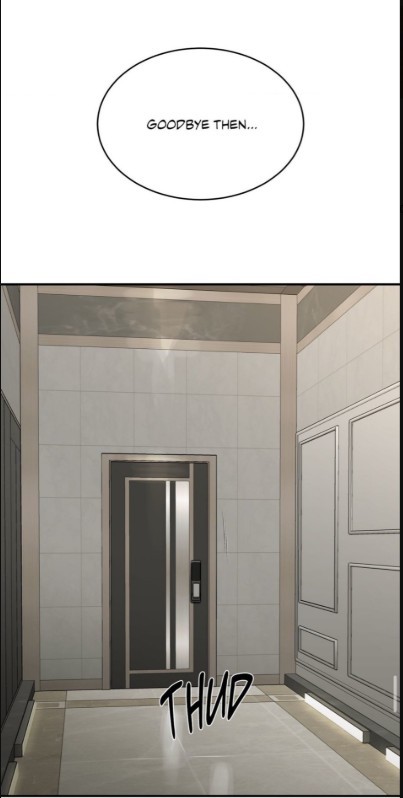 (chapter 100) sound more violent than the stabbing itself?
And perhaps the most disturbing question of all: how did Kim Dan and Joo Jaekyung end up acting like ghosts around each other?
For dozens of chapters, readers endured intense angst, toxic power dynamics, emotional repression, and physical trauma while holding onto a collective expectation: eventually, communication and emotional honesty would heal the damage. 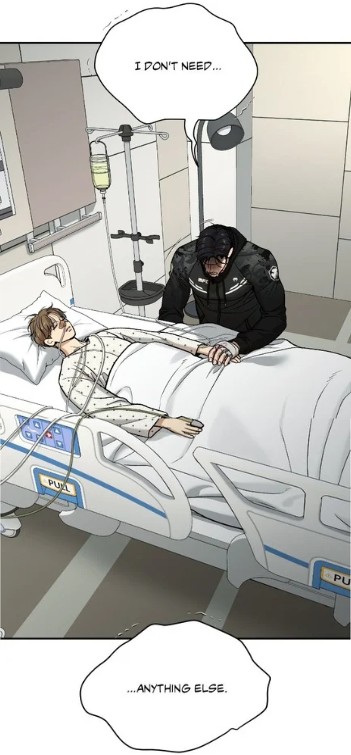 (chapter 99) Episode 100 appeared to be that turning point. The stabbing should have shattered the emotional walls between the protagonists. Many expected tears, confrontation, confession, catharsis. Instead, Mingwa deliberately subverted the classic romance payoff. Rather than an emotional embrace, readers received silence, hesitation, distance, and a strangely clinical handshake.
 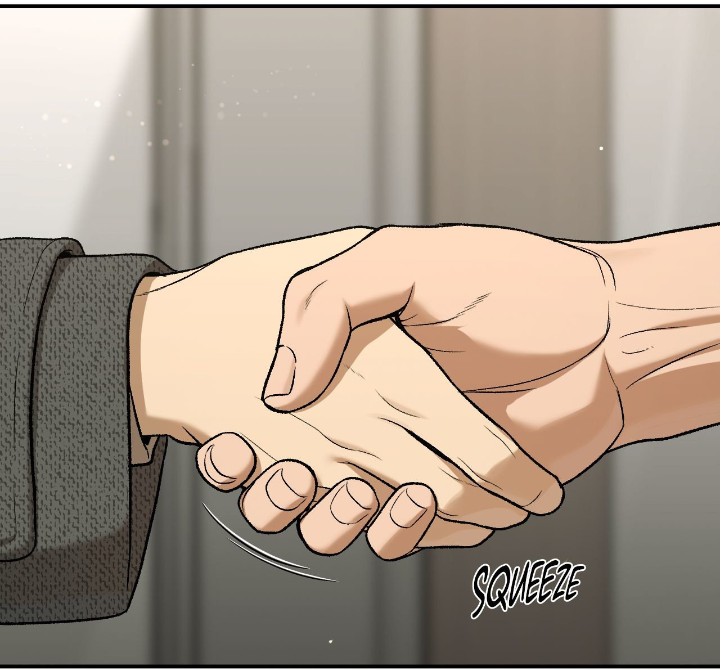 (chapter 100)
For many readers, that absence of catharsis felt almost unbearable. The realization suddenly emerged that the road toward healing might be just as long, painful, and exhausting as the road toward destruction itself.
At the same time, episode 100 strips away much of the fictional distance that once existed between the protagonists and the audience. Earlier in the story, Joo Jaekyung often functioned as a larger-than-life “red flag” character: 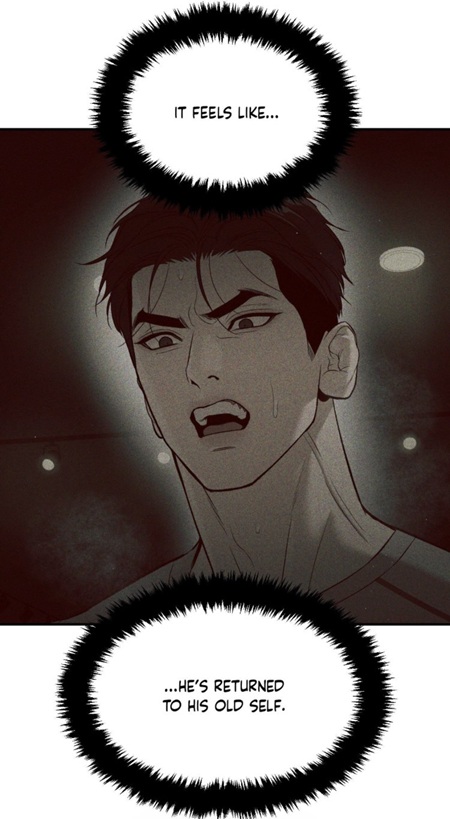 (chapter 96) dramatic, excessive, intimidating, almost unreal. But the tragedy presented in this chapter feels painfully ordinary in comparison.
 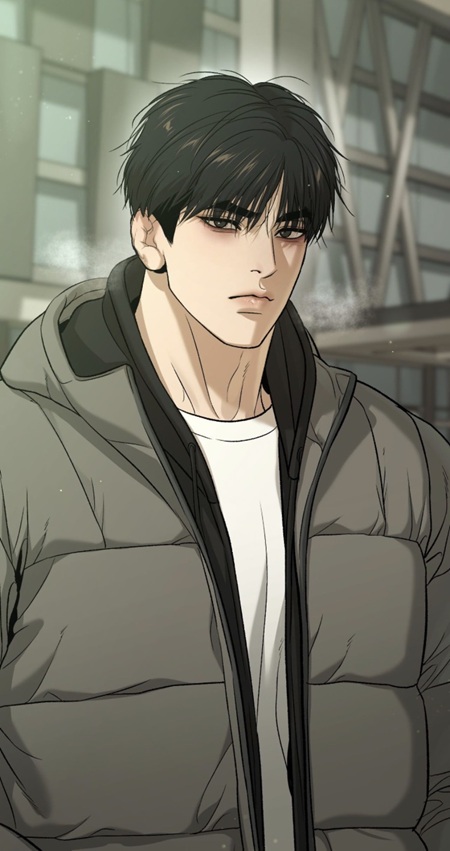 (chapter 100) Two people paralyze each other through assumptions, guilt
 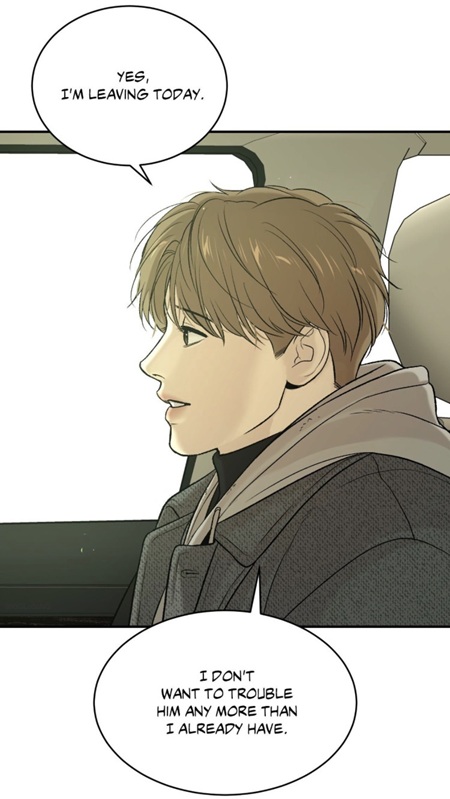 (chapter 100), low self-esteem
 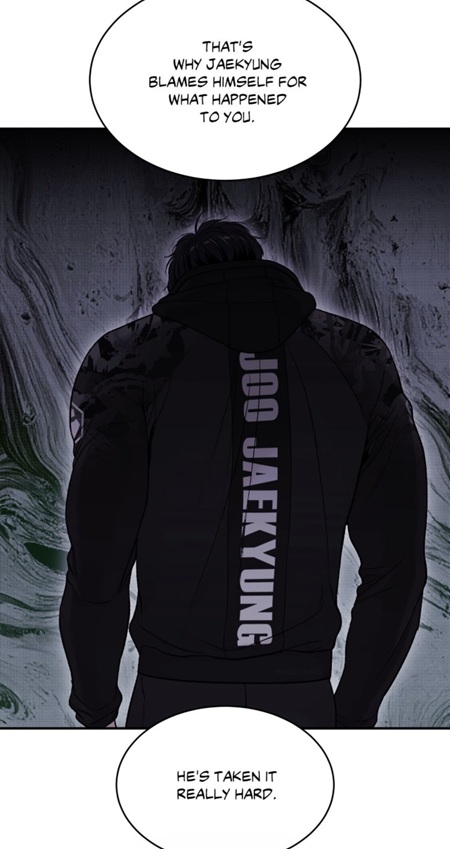 (chapter 100), fear of vulnerability, and lack of communication. Neither asks the questions that truly matter.
 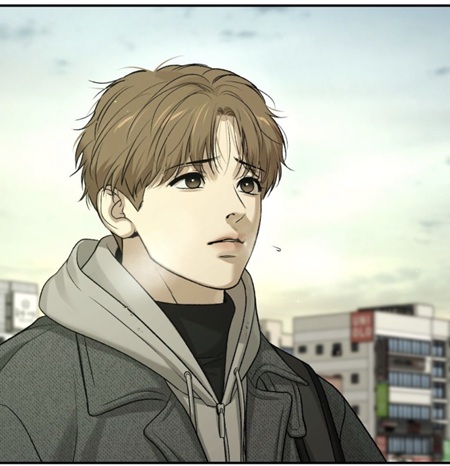 (chapter 100) Neither says what they genuinely feel.
 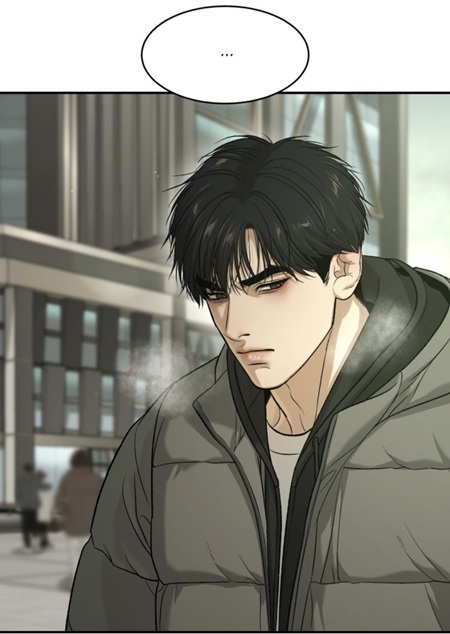 (chapter 100) Almost everyone has experienced a relationship, friendship, or family dynamic damaged not by hatred, but by silence and emotional avoidance. That realism transforms the chapter into something deeply uncomfortable because the fantasy slowly disappears, leaving behind a frighteningly human mirror.
Readers blamed Kim Dan for his passivity and self-sacrificial tendencies. 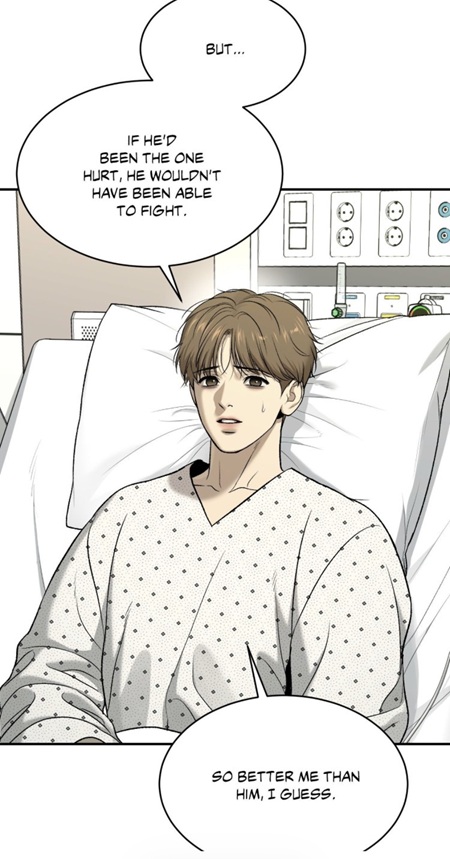 (chapter 100) Others condemned Joo Jaekyung for his emotional withdrawal and ghost-like behavior.
 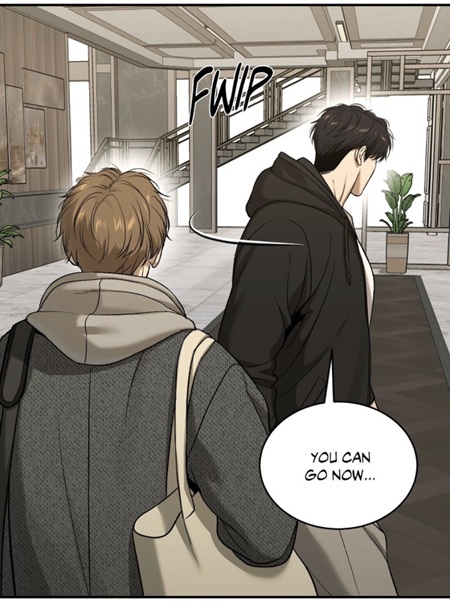 (chapter 100) Yet perhaps the real mystery of episode 100 is not who was right or wrong. Perhaps the more important question is this: how did two people who clearly long for each other become so incapable of speaking honestly at the very moment they needed it most?
The deeper one looks into this chapter, the stranger and more painful it becomes. Like wine slowly revealing hidden notes over time, episode 100 transforms upon rereading. Details that initially appeared insignificant — a warm hand, a bouquet of flowers, a hidden night visit, a missing conversation, a closed penthouse door, a simple “THUD” (chapter 100) — gradually begin forming another story beneath the surface.
A story not about the absence of love, but about the terrifying consequences of silence and secrecy.
The Counterfeit Departure
The final emotional image of episode 100 is not the handshake between Kim Dan and Joo Jaekyung, but the empty entrance of the penthouse accompanied by the words: (chapter 100) and the unsettling sound effect:
“THUD.”
This distinction is extremely important because the handshake itself does not yet create the impression of definitive separation. 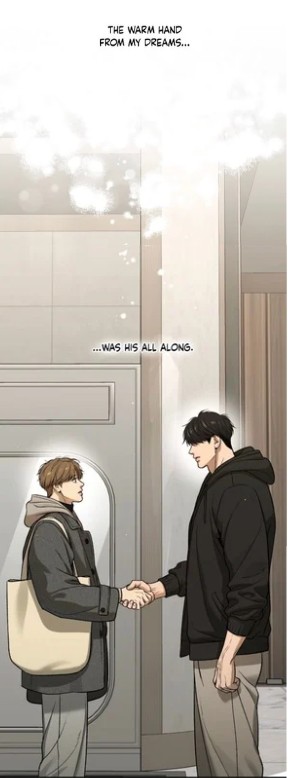 (chapter 100) On the contrary, the scene still contains physical proximity, warmth, gratitude, and mutual recognition. The handshake almost functions as an acknowledgment of everything the two protagonists survived together, but also as a quiet expression of thanks. Kim Dan recognizes the champion’s help, while Joo Jaekyung finally allows physical contact to occur without violence, coercion, or sexual tension. The emotional atmosphere only becomes truly haunting once Mingwa deliberately removes both protagonists from the frame itself, leaving behind nothing but the silent entrance and the implication of departure. (chapter 100)
Even the wording of the farewell creates ambiguity. Without the points of suspension, “Goodbye then” would sound definitive, emotionally sealed, almost like the final sentence of a completed story. Yet the ellipsis fundamentally changes the atmosphere of the phrase. The farewell suddenly becomes suspended, unfinished, hesitant. Kim Dan does not simply say goodbye; he trails off emotionally.
The word “then” itself is equally fascinating because it weakens the apparent finality of the separation. It functions as a temporal marker suggesting postponement:
not now,
after this,
later.
The phrase therefore already contains the contradiction defining the entire chapter. Verbally, Kim Dan enacts separation. Emotionally, however, he still remains attached to Joo Jaekyung. The title quietly preserves the possibility of continuation, just as the chapter itself refuses to provide true emotional closure.
Why end the chapter there?
Doors in Jinx are never neutral architectural elements.  Throughout the story, they repeatedly symbolize secrecy
  (chapter 7), emotional distance, hidden truths, privacy, abandonment, and separation
 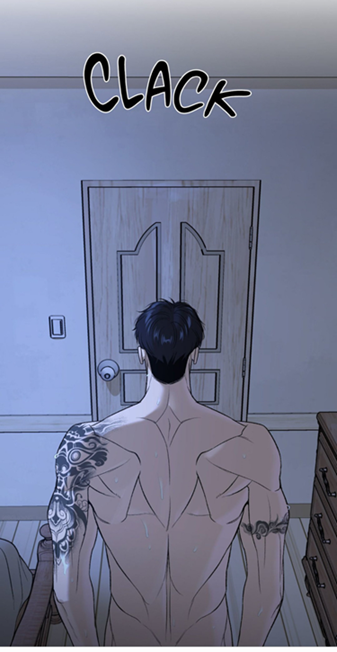 (chapter 64). A closed door immediately creates the impression that something has ended. (chapter 100) Someone has left. Access has been denied. Naturally, many readers instinctively interpreted this panel in the simplest possible way:
Kim Dan has already left the penthouse.
And once this assumption is accepted, the chapter suddenly feels final. The emotional logic becomes brutally simple. The debt is gone. The fight is over. The criminals were arrested. 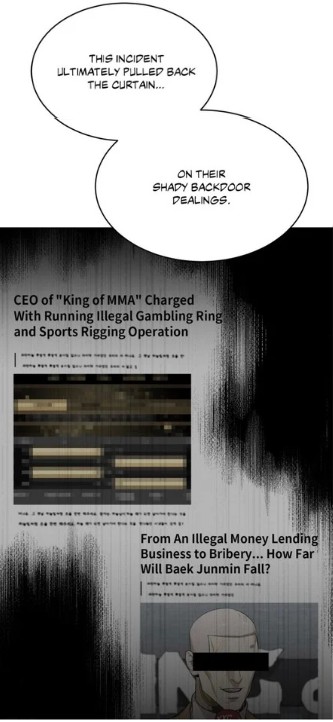 (chapter 100) The protagonists separate. The door closes. The story ends. It almost resembles the conclusion of a dark fairy tale where the suffering has finally reached its endpoint.
The problem is that the panel itself is far more ambiguous than it initially appears. (chapter 100)
The entrance is empty, yes, but the image does not actually show Kim Dan leaving the apartment. On the contrary, the scene remains strangely suspended. Mingwa does not show the elevator descending, the street outside, or Kim Dan physically walking away.  (chapter 4) Instead, she traps both the reader and the characters inside the penthouse itself, forcing us to stare at an almost silent threshold. (chapter 100)
This detail becomes even more significant when we observe the scene immediately preceding the “goodbye.” Kim Dan and Joo Jaekyung still stand physically facing one another. 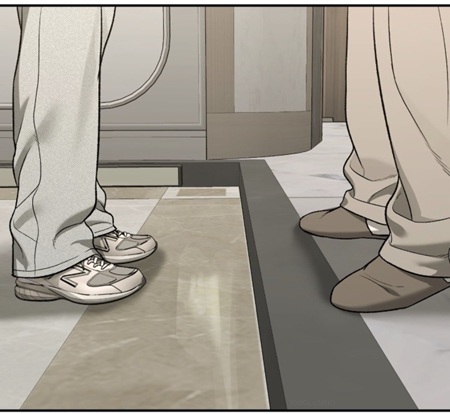 (chapter 100) Their feet remain oriented toward each other at the entrance. In Jinx, body positioning often reveals emotions that words suppress, and here the contradiction is devastating. Verbally, both protagonists are enacting separation. Physically, however, their bodies still seek connection. Neither truly turns away. The image therefore creates emotional suspension rather than emotional closure.
This is precisely why Mingwa does not show the actual departure itself at the end of the chapter. Emotionally, the separation remains incomplete because the protagonists themselves are incapable of fully separating from one another. The final panel traps both the characters and the audience inside the threshold between staying and leaving. (chapter 100)
The farewell scene itself becomes even more painful when placed beside earlier internal monologues from Joo Jaekyung that gain new meaning in retrospect. Earlier in the story, the champion silently admitted: 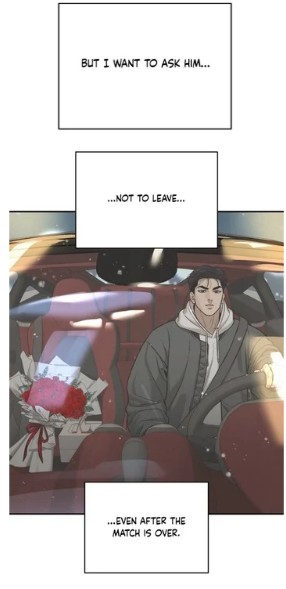 (chapter 97) Another scene reinforces this same emotional desire:
 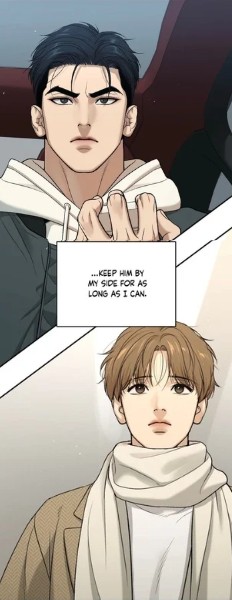 (chapter 97) These confessions reveal that beneath the aggression, possessiveness
 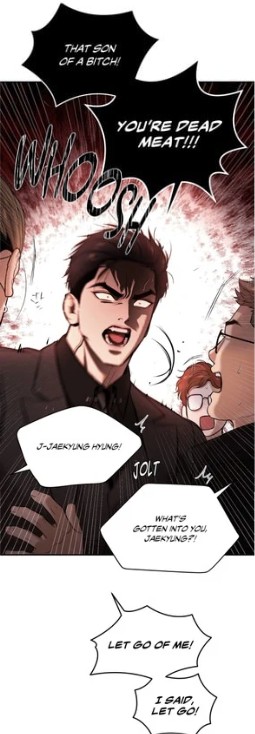 (chapter 82), and obsession with fighting and Kim Dan stood a much simpler fear: abandonment.
Yet when episode 100 finally confronts him with the possibility of Kim Dan truly leaving, Joo Jaekyung says the exact opposite of what he once desired. Instead of asking him to stay, he turns his head away and quietly says: (chapter 100) The Korean version with “가” (“Ka”) makes the moment even harsher because of its simplicity. It is short, direct, emotionally stripped bare:
Go.
And suddenly, the scene exposes the champion’s loneliness with devastating clarity.
Kim Dan stands before him carrying his bag, partially turned away, visually resembling the blurred image of departure from Jaekyung’s earlier imagination. 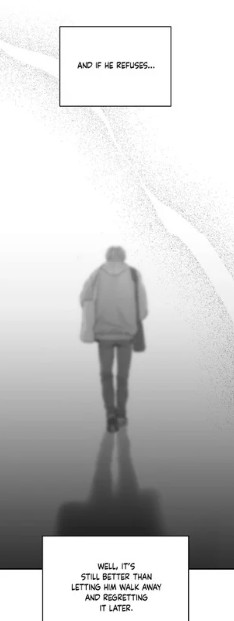 (chapter 97) At the same time, Joo Jaekyung himself avoids looking directly at him. Both characters physically reproduce emotional withdrawal. Neither can fully face the other because both are trapped inside fear, guilt, longing, and self-suppression.
Most tragically, Joo Jaekyung participates in the very abandonment he fears. Rather than risking rejection by asking Kim Dan to stay, he verbally permits the separation himself. The scene therefore does not portray emotional indifference, but defensive surrender. (chapter 100) The champion who once appeared emotionally untouchable reveals himself incapable of expressing the one thing he truly wants:
“Please stay with me.”
At the same time, both protagonists are now attempting to love through self-removal.
This emotional mirroring becomes even more fascinating when connected to the idea of tactile dissonance developed earlier in the story. (chapter 95)  Ironically, the eight-day separation did not emotionally distance the protagonists from one another. Quite the opposite. During this period, they became increasingly synchronized mentally and emotionally.
 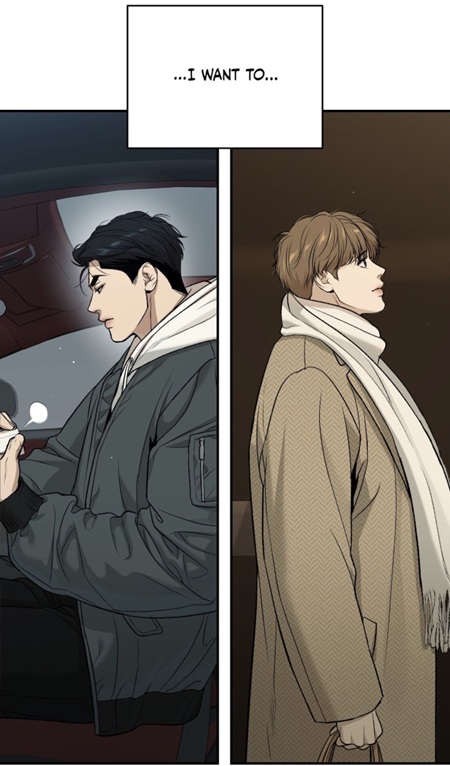 (chapter 97) Their thoughts, fears, and desires slowly began aligning almost unconsciously. Yet this growing emotional attunement produces a tragic paradox: they become so psychologically similar that they can no longer recognize their own reflection inside the other person. (chapter 100) (chapter 100) The real tragedy of episode 100 is therefore not emotional distance, but excessive emotional synchronization without communication.
Kim Dan increasingly convinces himself that he represents a burden (chapter 100) and even a threat to Joo Jaekyung’s career. The harassment, the public humiliation, the scandal surrounding the championship, and the stabbing itself all reinforce the idea that remaining beside the champion will only continue damaging his reputation and future.
Joo Jaekyung, meanwhile, arrives at the opposite side of the same tragedy. He increasingly perceives himself as a source of contamination and danger. (chapter 100) The harassment, Kim Dan’s suicidal despair, the sleepwalking, the stabbing, and the violence surrounding the championship all reinforce the terrifying idea that Kim Dan suffers because he entered his world. In his eyes, Kim Dan’s life is now endangered because of him.
Ironically, this emotional synchronization does not bring them closer together communicatively. Instead, it pushes both men toward the same logic of self-removal. (chapter 100) Kim Dan leaves because he believes the champion will recover better without him. Like out of sight, out of mind! Joo Jaekyung lets him go because he believes keeping him close will only expose him to more suffering.
Thus, both silently cooperate in mutual abandonment while simultaneously longing for the exact opposite.
Even the sound effect deserves closer attention. (chapter 100) Many readers automatically interpreted “THUD” as the sound of a closing door. Well, the Spanish translation is indeed “Clack” and not thud. So one might jump to the conclusion that there’s an error in the English version. Yet visually, the effect does not fully behave like one. The vertical motion lines suggest movement from top to bottom rather than the lateral motion usually associated with a door shutting. The sound resembles impact, instability, or collapse more than simple departure. This becomes particularly interesting when compared to earlier scenes such as episodes 57 and 61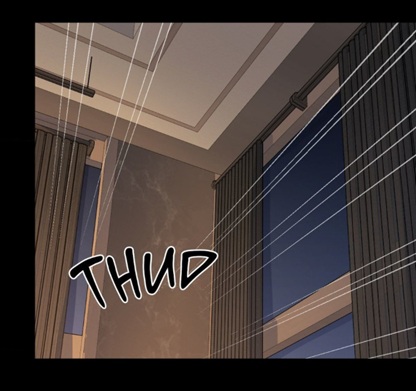
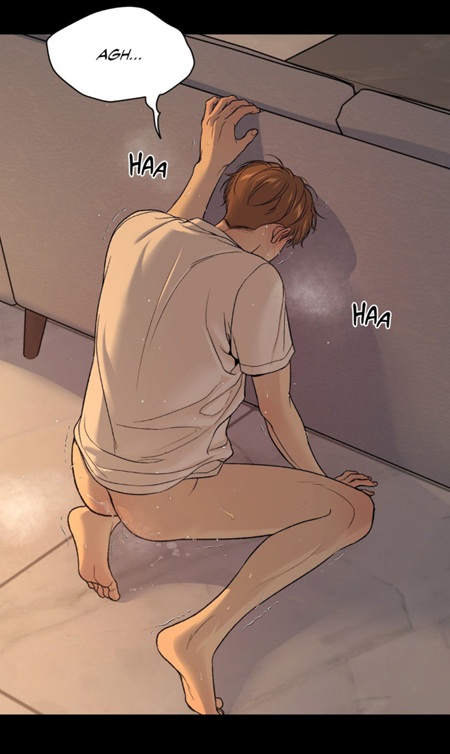 (chapter 61)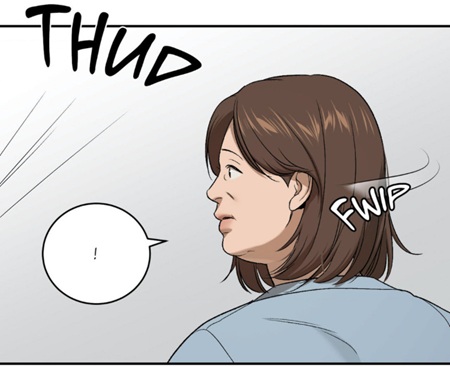
 (chapter 57), where emotional shock and physical weakness are visually connected to walls, imbalance, and bodies searching for support. The ambiguity becomes important because chapter 100 never clearly identifies (chapter 100) who destabilizes physically in that moment. Readers instinctively assume Kim Dan has already left, but the visual language simultaneously leaves open another disturbing possibility: that someone inside the penthouse is collapsing.
In other words, the panel may not depict emotional closure at all. It may instead depict destabilization. This possibility completely transforms the emotional meaning of the chapter. The “goodbye” no longer functions as a clean farewell, but almost like a psychological blow. Words can kill. And here, Kim Dan’s calm “Goodbye then…” lands with the violence of an invisible wound.
The choice of the empty entrance as the final image therefore reveals something important about reader psychology as well. The chapter creates the illusion of a completed fairy tale ending while simultaneously making that ending feel emotionally wrong. Earlier in the story, Kim Dan unconsciously adopted this exact logic himself through the expression:
 (chapter 41)
Like a little boy trying to force reality into the structure of a fairy tale, he attempts to convince himself that the story has now reached its proper conclusion. 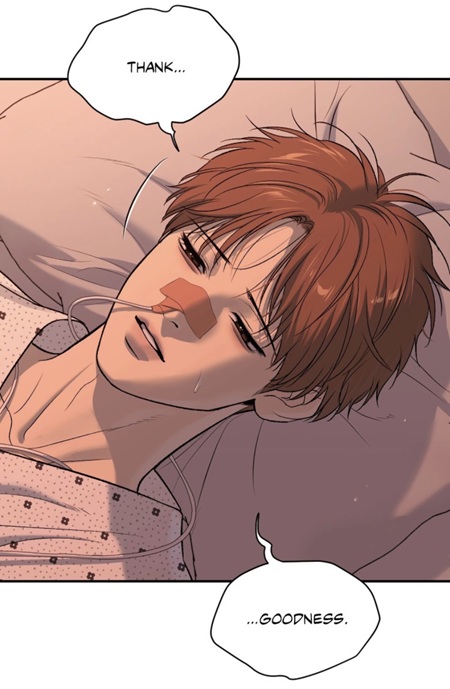 (chapter 100) The champion won. The villains were punished.
 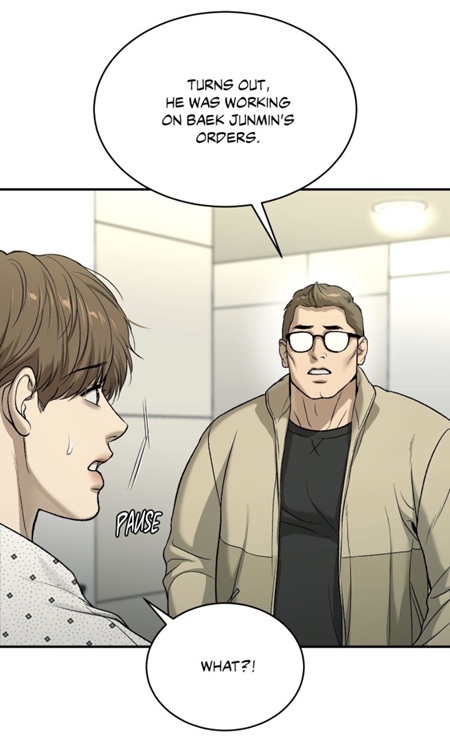 (chapter 100) The debt disappeared.
 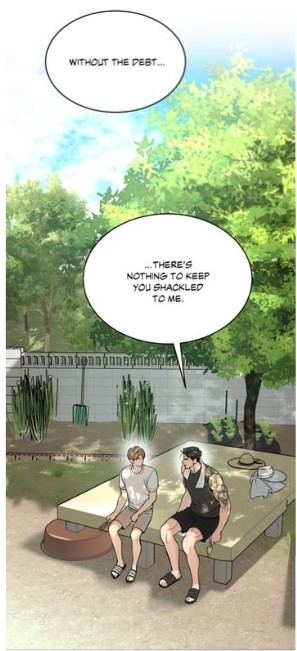 (chapter 77) Therefore separation must be the correct final step.
Yet Mingwa visually undermines this interpretation at every turn. (chapter 100)
The penthouse feels too empty, too silent, too cold, and too unresolved. The atmosphere resembles not peace, but haunting. Instead of emotional catharsis, the reader experiences emotional suspension.
Perhaps this explains why so many readers reacted so strongly to episode 100. The chapter weaponizes absence itself. Mingwa does not simply separate the protagonists; she traps both the characters and the audience inside uncertainty. The zoom on the closed entrance intensifies this sensation even further. Readers feel suffocated because the panel transforms the penthouse into a frozen emotional space where communication has failed completely.
The door therefore symbolizes much more than physical departure. It becomes the visual embodiment of the chapter’s central tragedy: two people standing on opposite sides of an emotional threshold (chapter 100), unable to reach one another despite desperately longing to do so.
What A Little Wimp
Before examining the significance of the handshake itself, we must return to one of the earliest emotional patterns established in the story: Kim Dan’s awkward departure after treating Joo Jaekyung at the gym. After accidentally crossing a physical boundary 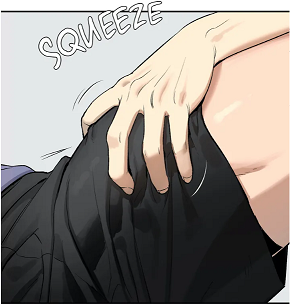 (chapter 1) and leaving himself totally embarrassed
 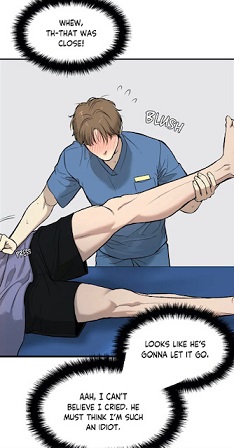 (chapter 1), the physical therapist has only one thought in mind: to run away. Before opening the door, he nervously stammers
 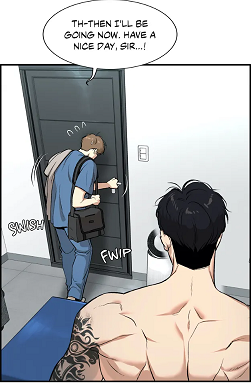 (chapter 1) and hurries away. Joo Jaekyung’s reaction after his departure is dismissive and mocking:
 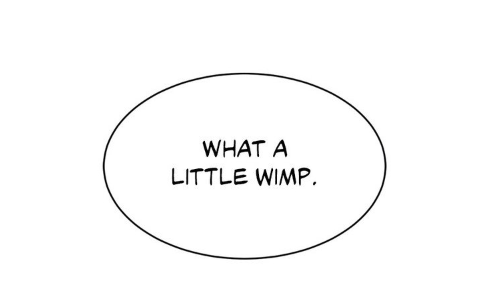 (chapter 1)
At first glance, the scene appears almost comedic. Kim Dan blushes, panics, avoids eye contact, and escapes after touching the champion too intimately. Yet retrospectively, this moment establishes an important pattern: touch  (chapter 1), admiration
  (chapter 1), destabilization, and departure are already intertwined from the very beginning. Kim Dan does not simply treat Joo Jaekyung’s body; he admires it through his hands and eyes, marveling at how different it is from every other client he has known. The accidental touch breaks the professional frame, and the result is immediate flight. (chapter 1)
This early departure quickly becomes part of Jaekyung’s mental archive. In episode 4, he does not actually witness Kim Dan leaving the penthouse (chapter 4); he only discovers the empty bed afterward. 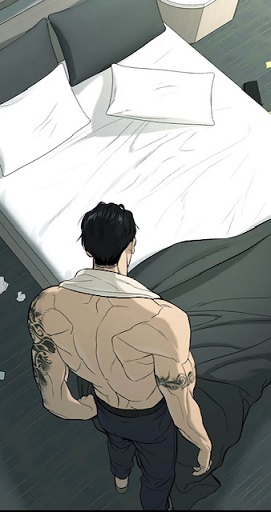 (chapter 4) The absence itself triggers projection. He imagines Kim Dan walking away, already converting disappearance into an internal image. Later, in episode 53, this fear becomes reality: Kim Dan truly leaves the penthouse
  (chapter 53), and this time the departure is explicitly shown. In his own mind, the doctor does not intend to return. By episode 97, the image repeats once more (chapter 97) when Jaekyung admits that he wants to ask Kim Dan not to leave, yet immediately imagines him walking away if he refuses. Significantly, as the figure of Kim Dan recedes into the distance, a heavy, creeping darkness swallows the panel. The shadow beneath Dan’s feet bleeds forward, stretching into a profound black void that anchors itself directly to Jaekyung’s perspective. This visual graduation of shadow reveals that Kim Dan’s departure is no longer just a hypothetical exit; it is an oncoming emotional eclipse. Jaekyung’s subconscious recognizes that if Dan walks out that door, the ensuing darkness will be absolute—a trauma from which the champion will not be able to recover.
This is why the line “What a little wimp” becomes deeply tragic in retrospect. The supposedly untouchable champion has become the one haunted by departure. The man who once mocked Kim Dan’s awkward escape now fears being left behind so intensely that he projects abandonment before it even happens. Hence he turns away like Kim Dan in episode 1. (chapter 100)
This fear cannot be separated from Jaekyung’s family wound. The image of his mother, presented entirely through her back and her silence 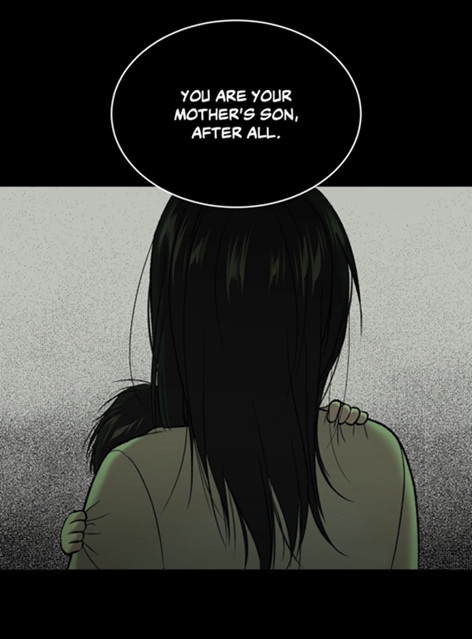 (chapter 73), suggests not only physical departure but permanent emotional inaccessibility. His father’s bitter line—“You are your mother’s son, after all”—reveals that this silence wounded him too. The father was not merely angry because the mother left; he was wounded by the way she left: without true confrontation, without emotional clarity, and perhaps with some distant promise that never became presence. The turned back, the heavy silence, and the unresolved farewell became the core of Jaekyung’s inherited trauma. He stops fighting for the relationship itself
  (chapter 72) and begins fighting merely against the clock, trying to finish a transaction before the countdown hits zero. This memory exposes a foundational trauma. To a young Jaekyung, his mother’s disappearance was directly tied to a transactional failure—his father’s inability to stop her or provide financial security. Consequently, Jaekyung internalized a distorted lesson: love is not protected through vulnerability, communication, or emotional pleading. Love is protected through material capacity and performance. In his child mind, a countdown began: he had to grow up, amass immense wealth, and become powerful enough to buy back his mother’s presence.
Tragically, this transactional clock is the exact blueprint he uses when Kim Dan enters his life. We see the definitive script for this transactional countdown written explicitly by Jaekyung himself in episode 77. Sitting on a wooden platform under a rare, open sky, the champion retreats into the safety of a contract to mask his growing vulnerability, declaring: (chapter 77) This is no coincidence that as he sets this absolute deadline, Mingwa frames Jaekyung from behind  (chapter 77) He turns his back entirely, casting his face in shadow and physically reproducing the visual motif of his childhood trauma. He is verbally establishing a countdown while visually acting out an ending. By telling Dan that their proximity is strictly bounded by the final bell of the title match, Jaekyung constructs the very cage that will later paralyze him.
Consequently, as the title match draws closer in episode 95, this psychological clock accelerates to a suffocating degree Surrounded by chaotic media headlines speculating about his imminent match and the possible collapse of his career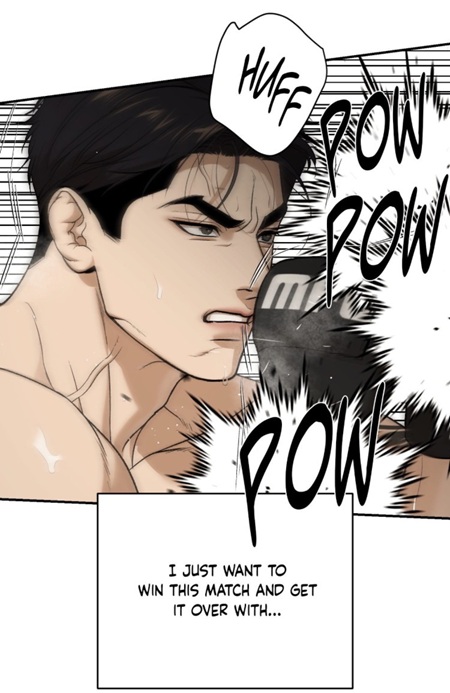 (chapter 95), Jaekyung’s mental space becomes a dark, claustrophobic cage. While sparring, his only internal thought is sheer exhaustion: “I just want to win this match and get it over with…”
Therefore it is not surprising why he chose to listen to his manager and distanced himself from his fated partner. In a sense, he first stops fighting for Kim Dan and begins fighting merely to reach the end of the timeline. The championship ceases to represent ambition, glory, or even personal desire; it becomes an expiration date. Increasingly, the champion loses the ability to project himself into the future at all.
This is precisely why his later thoughts become so devastating. When Jaekyung admits: (chapter 97),
the importance lies not only in the fear of abandonment, but in the word ask itself. For perhaps the first time in the story, Jaekyung unconsciously accepts Kim Dan’s freedom to choose. He no longer thinks in terms of ownership, obligation, or debt. Deep down, he already understands that once the match ends, Kim Dan will be free to leave him behind.
Yet even here, Jaekyung’s emotional framework remains tragically incomplete. Although he has begun abandoning the logic of ownership, he still cannot truly imagine a future built upon mutual existence rather than temporary possession. His thoughts remain structured around the championship timeline itself. The title match continues functioning as the organizing principle of reality. Even the phrase:
“…even after the match is over”
reveals the limitation of his emotional imagination. Jaekyung can imagine asking Kim Dan to remain. He can imagine losing him. He can imagine surrendering him. But he still cannot truly imagine simply living with him.
In other words, the champion still thinks in terms of “having” rather than “being.” [For more read the essay The Art of Loving] ]The relationship continues existing psychologically as something bounded by deadlines, countdowns, and expiration points. Once the contractual structure dissolves, Jaekyung unconsciously reaches the edge of his own emotional framework. The countdown ends, yet nothing replaces it.
And tragically, this realization does not awaken hope inside the champion, but resignation. Even before Kim Dan makes any choice himself, Jaekyung emotionally begins surrendering him. (chapter 97) The man once defined entirely by his monstrous willpower gradually loses his fighting spirit altogether. He no longer fights for a future with Kim Dan; he merely tries to endure the final countdown before the separation he already believes inevitable.
Therefore, when Kim Dan stands before him in episode 100 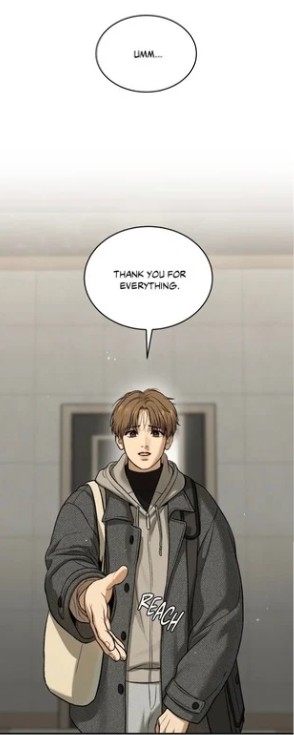 (chapter 100), Jaekyung is not reacting only to the present moment. He is reacting to a projected abandonment shaped by earlier departures, his parents’ history, the transactional contract he wound up himself, and the immense guilt he carries over the violence surrounding Kim Dan. The champion now knows about the harassment, the attempted sexual assault orchestrated through the former director of the hospital, the suicidal despair, the sleepwalking, the stabbing, and the terrifying chain of events connected to the championship itself. Increasingly, Jaekyung no longer sees himself merely as someone who might lose Kim Dan emotionally; he sees himself as the center of a destructive orbit that continually places Dan in danger. He seems to think, he is Kim Dan’s jinx. (chapter 100) That’s why Joo Jaekyung is no longer fighting, he has already anticipated the loss.
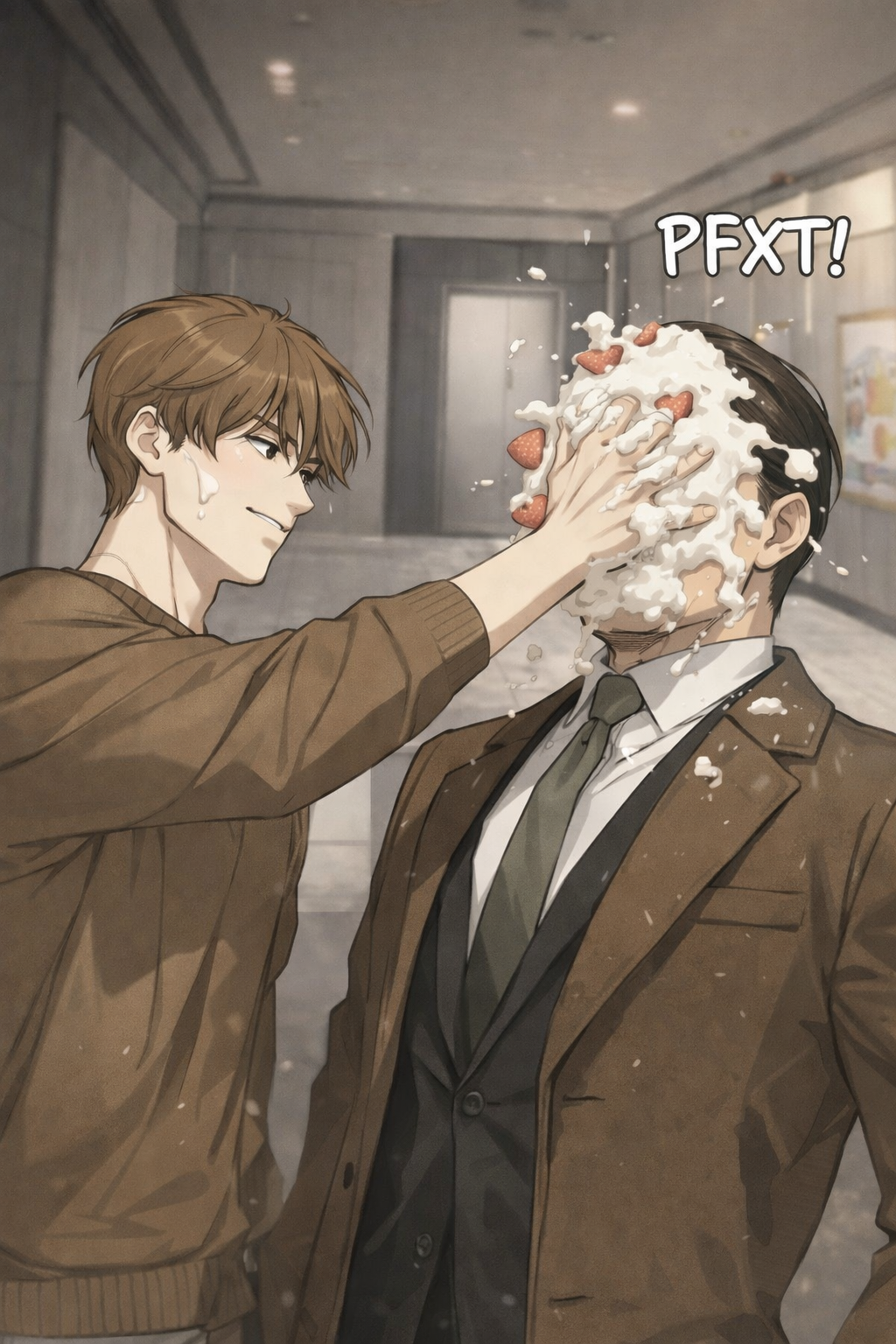
Ironically, by episode 97, Kim Dan himself has already begun unconsciously stepping into a completely different emotional mode. While Jaekyung remains trapped inside countdowns, departures, and anticipatory endings, the physical therapist instinctively begins imagining ordinary relational existence. This contrast becomes particularly visible with the hamster’s dream 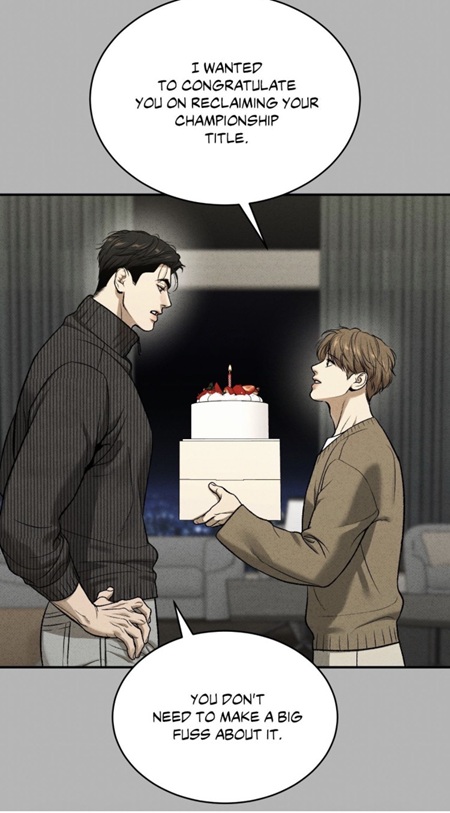 (chapter 97) , where Kim Dan arrives with a cake to celebrate Jaekyung reclaiming his championship title. The atmosphere of the interaction is striking precisely because of its normality. There is no treatment session, no debt, no violence, no professional obligation dominating the exchange. For this brief dream , Kim Dan behaves less like an employee or caretaker and more like someone already sharing daily life with the champion.
 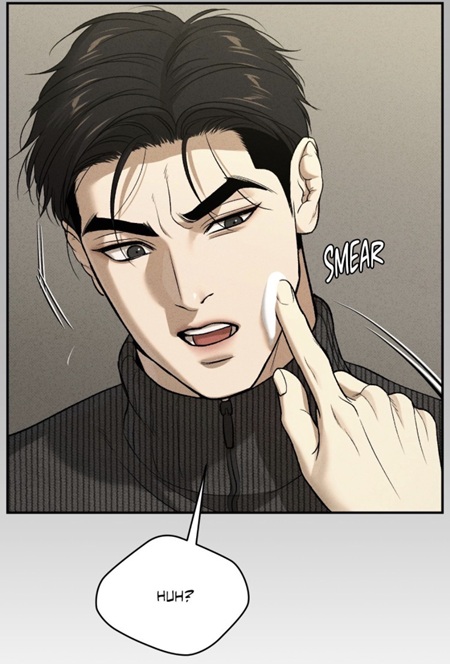 (chapter 97)
The small gesture of smearing cream across Jaekyung’s face becomes symbolically important for this reason. Kim Dan momentarily strips the champion of his overwhelming public aura and interacts with him through casual intimacy rather than admiration or fear. Unlike Jaekyung, Kim Dan unconsciously possesses fragments of an ordinary emotional model inherited from his life with his grandmother and parents: shared meals, small celebrations, routine care 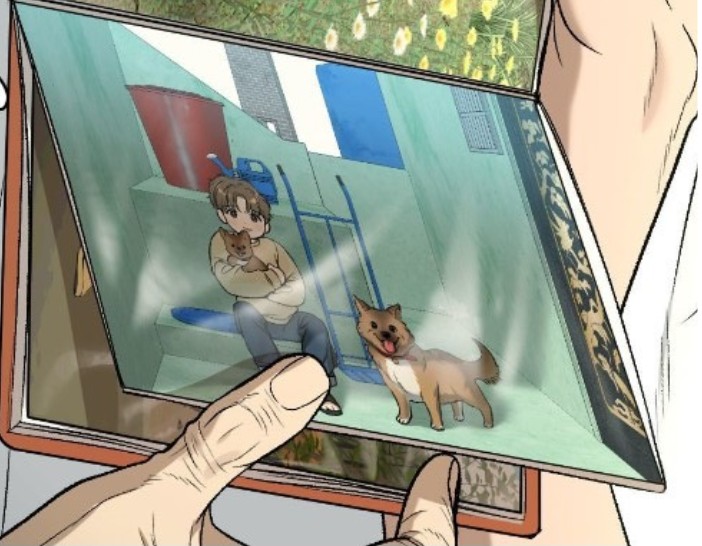 (chapter 94), and domestic familiarity. While the champion imagines endings, Kim Dan quietly begins imagining continuity.
The Warm Hand against the Jinx
This is precisely why the handshake matters so much. 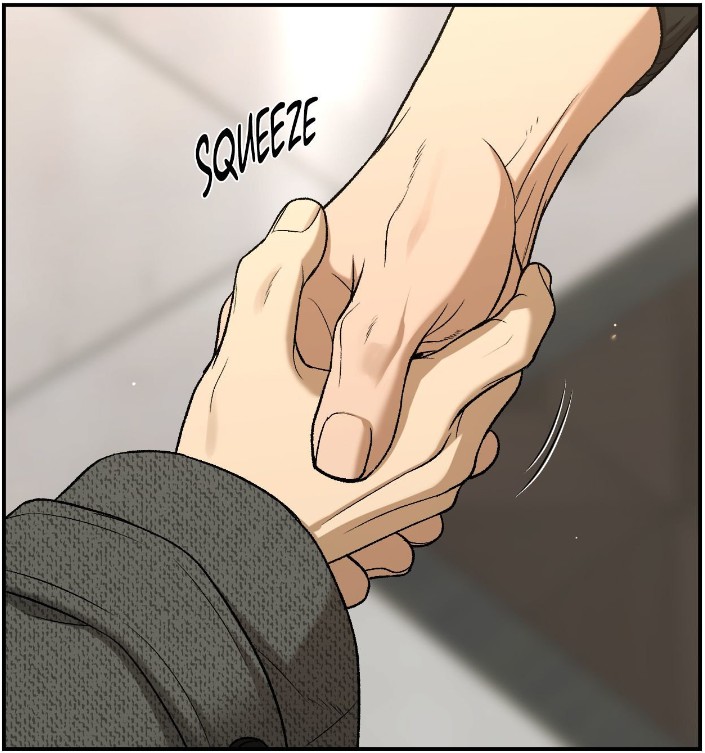 (chapter 100) It takes place right before Jaekyung tells Kim Dan to go. For one fragile moment, the projected departure is completely interrupted. Kim Dan is still there. His hand is still warm. The contact is no longer like that first treatment at the gym, where touch was mixed with embarrassment and professional confusion. (chapter 100) This time, touch becomes mutual recognition and reciprocity.
The tragedy is that this recognition does not yet become speech. The handshake briefly suspends the counterfeit departure, but it does not break the silence. After this fleeting moment of contact, Jaekyung retreats straight back into fear and self-removal. Unable to ask Kim Dan to stay, he turns away and says the exact opposite of what he wants: (chapter 100)
The handshake is not the end of the separation. It is the last, desperate interruption before the logic of abandonment reclaims them both.
This is where the spatial layout of the penthouse entrance exposes the final structural contradiction. (chapter 100) When Kim Dan stands before the champion, he is positioned directly in front of the door as though physically replacing it, turning his own body into the threshold. Yet meticulously, Mingwa leaves a massive, artificial gap between the physical therapist and the actual exit behind him. This distance is no coincidence. The vast, empty space behind Dan acts as a visual vacuum—a psychological buffer zone proving that while he is verbally enacting separation, he has not yet crossed the literal threshold.
He is suspended inside a vacuum of his own making, his hand still reaching forward toward connection while the enormous void at his back quietly threatens to swallow the moment whole.
Crucially, this gap represents a profound, hidden chance. It is the positive reflection of “distance.” By leaving such a significant space between his body and the door, Kim Dan has physically delayed his own exit, leaving a literal runway of time and possibility open. The finality of the goodbye has not yet been sealed; the door remains far behind him.
The ultimate tragedy of episode 100 is that Joo Jaekyung completely fails to recognize this positive reflection. (chapter 100) Poisoned by the creeping darkness of his own nightmares, the inherited trauma of his mother’s silence, and the immense guilt surrounding Kim Dan’s suffering, the champion no longer recognizes the distance as a space to step forward and intervene. Instead, his fear of vulnerability completely distorts his perception. He reads the gap not as an opportunity to change the script, but as an approaching, inevitable eclipse.
To protect himself from the pain of watching Dan step backward into the void, Jaekyung surrenders defensively—he turns his head away, preparing himself not to look back, and actively seals the very abandonment he was given a chance to prevent.
No, Joo Jaekyung is no little wimp, but rather a lost puppy frozen upon a threshold of his own making, completely blind to the choice standing before him. Yet because the contract has dissolved and the debt has disappeared, this wide, uncrossed emptiness also remains a radical space of possibility. For the first time, the relationship is no longer mediated by obligation, transaction, or countdown.
And perhaps this finally becomes Kim Dan’s chance to recognize Jaekyung’s paralysis, step into the gap himself, and prove his love and care without expecting anything in return.
Before the counterfeit departure can fully reclaim the scene, Mingwa inserts one final, crucial interruption: the handshake (chapter 100). Significantly, this gesture does not function as a standard goodbye. In ordinary social language, a handshake belongs either to a formal greeting or to a completed farewell. Here, however, the contact appears before Kim Dan says goodbye and before any true separation has taken place. Structurally, the handshake suspends the departure rather than confirming it.
This detail becomes even more meaningful when contrasted with the protagonists’ first encounter at the gym. Back then, there was no mutual greeting ritual between them.  (chapter 1) Kim Dan bowed nervously while Joo Jaekyung remained emotionally detached, dominant, and superior. Their relationship began asymmetrically: champion and therapist, admired body and embarrassed observer. After accidentally crossing a physical boundary during treatment, Kim Dan fled the room in humiliation, unable to withstand the emotional destabilization caused by touch itself. No reciprocal gesture softened the imbalance. There was no handshake, no equal acknowledgment, and no mutual recognition.
Episode 100 quietly upends that entire foundation. (chapter 100)
For the first time, both protagonists voluntarily reach toward one another at the exact same emotional level. Neither obligation, debt, nor treatment mediates the contact. (chapter 100) The gesture is entirely mutual and even reciprocated, both squeeze each other’s hand. (chapter 100) And unlike the first touch at the gym, which produced panic and flight, this touch produces a profound illumination. Kim Dan’s little gesture exposes a gradual metamorphosis, he becomes more proactive. Hence his fingers linger on the MMA fighter’s skin. 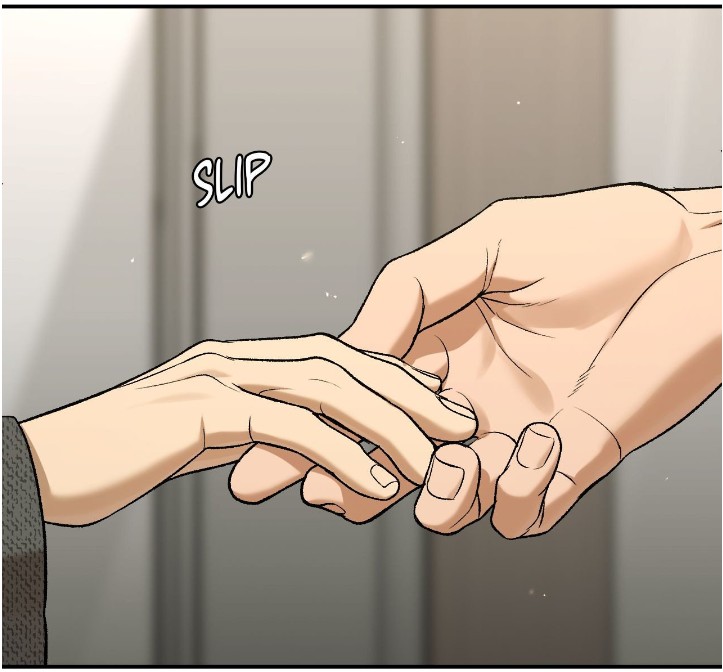 (chapter 100)
  (chapter 87) It becomes even more obvious, once compared with their hand gesture in Paris.
Unlike chapter 1, however, Kim Dan does not flee from the emotional intensity created through touch. This time, he consciously remains present. While extending his hand, he hesitates softly: (chapter 100)
The hesitation still reveals vulnerability, yet vulnerability no longer produces escape. Instead, Kim Dan deliberately chooses acknowledgment. This detail is crucial because the gratitude expressed here cannot be reduced to money, debt, treatment, or material compensation. In fact, the scene occurs precisely after the contractual framework governing their relationship has dissolved. The debt is gone. The transactional structure has collapsed. Therefore, Kim Dan’s gratitude suddenly becomes profoundly human rather than functional. He is no longer thanking:
- an employer,
- a client,
- or a benefactor.
He is thanking Joo Jaekyung himself.
For perhaps the first time in the story, Kim Dan consciously chooses to close the emotional distance between them instead of running away from it. The hand extended toward Jaekyung therefore becomes far more than a polite social gesture. It becomes Kim Dan’s first genuine attempt to acknowledge their relationship openly and properly.
The importance of this moment lies in what Kim Dan suddenly realizes through physical contact itself. 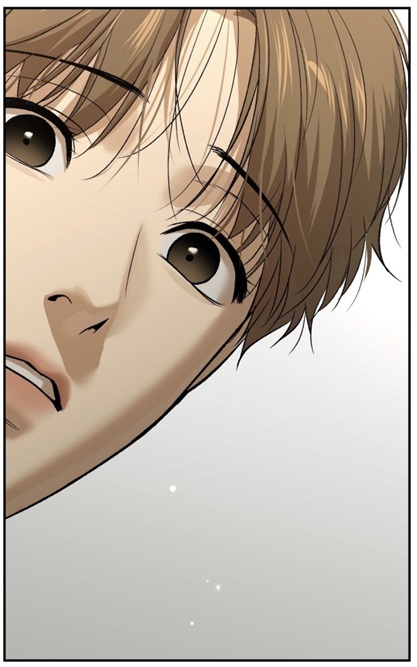 (chapter 100) Until now, the physical therapist remained trapped inside a distorted emotional narrative shaped by silence, institutional misunderstanding, his grandmother’s sacrificial principles, and Park Namwook’s logic of performance
 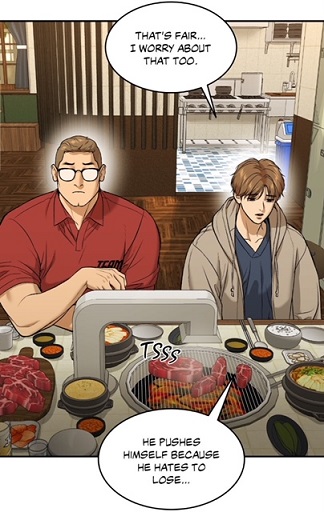 (chapter 43) and Hwang Byungchul’s wrong interpretation
  (chapter 70). Kim Dan had unconsciously learned to interpret Joo Jaekyung primarily as “the champion”: an untouchable entity sustained solely by victory, driven by a hatred of losing, and emotionally fulfilled through performance alone. This explicates why the “hamster” had made the following request:
 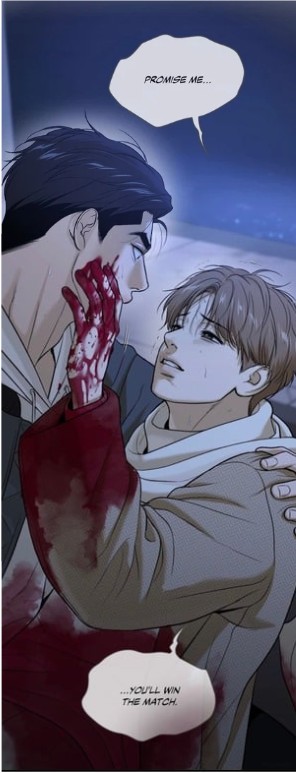 (chapter 98)
This misunderstanding becomes painfully visible during the hospital scenes. When Park Namwook explains that the culprit acted under Baek Junmin’s orders (chapter 100) and that Jaekyung blames himself for the attack (chapter 100), the manager unintentionally frames the entire assault through championship logic. The implication quietly becomes that Kim Dan was hurt because he stood too close to the champion, because enemies targeted Jaekyung, and because the title match had to continue.
As a result, doc Dan immediately internalizes guilt through a logic of substitution. He responds: (chapter 100) The statement is devastating because it fuses the two oppressive ideologies that have shaped Kim Dan’s entire life. From Park Namwook and Team Black, he inherited the belief that the championship comes first and that Jaekyung’s happiness depends entirely upon winning. From his grandmother, he inherited the logic of total self-erasure: if suffering must exist in the world, it should fall squarely upon him. Yet the sentence also reveals something even more tragic: Kim Dan still cannot fully imagine the depth of Joo Jaekyung’s emotional attachment to him. By concluding that it was “better” for him to become the victim, he unconsciously reduces the wolf’s suffering to the temporary inconvenience of a threatened match. In doing so, he actually denies the existence of the champion’s true feelings altogether. Kim Dan still sees “the Emperor,” the fighter obsessed with victory, rather than the terrified man who would have suffered infinitely more from losing him than from losing any championship belt. Thus before losing consciousness, he still had this image of the main lead: The Emperor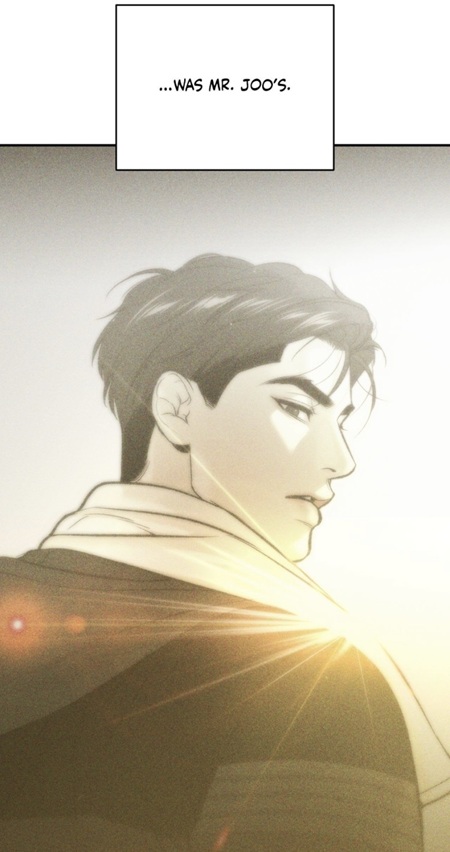 (chapter 100)
And perhaps this is the most disturbing implication of all. Even after the stabbing, Kim Dan still unconsciously evaluates the situation through the same brutal performance logic governing the fighting world itself: as long as the champion successfully won the match, the suffering required to secure that victory becomes psychologically acceptable. In this sense, Kim Dan does not yet fully confront what the championship truly cost Joo Jaekyung internally. (chapter 100)
After all, Kim Dan never witnessed the psychological destruction surrounding the fight itself. He did not see the emotional collapse hidden behind the title defense, the confrontation with Baek Junmin afterward, or the horrifying guilt poisoning the victory from within. Thus, while Kim Dan begins sensing the champion’s warmth emotionally, he still hesitates to recognize the full extent of the suffering hidden beneath the belt.
The tragedy, therefore, is not simple blindness. Kim Dan is beginning to perceive the truth, yet accepting it fully would force him to confront something unbearable: the possibility that the very victory he believed he protected may have shattered Joo Jaekyung psychologically instead and he might be responsible for his “ruthlessness and destruction”.
So the tragic irony is that the very thing Kim Dan believes he protected—the fight itself—is precisely what begins destroying Joo Jaekyung emotionally. Had the match been postponed, Jaekyung would never have encountered Baek Junmin afterward, never acquired the horrifying knowledge surrounding the assault, and never fused the championship psychologically with harassment, violence, guilt, and emotional collapse. Thus, while Kim Dan believes his sacrifice saved Jaekyung’s future, the victory title increasingly becomes a toxic poison inside the champion’s mind. Hence the young man looks so terrible despite his “victory”. (chapter 100)
And remarkably, almost nobody around them notices this internal collapse. Inside the hospital room, 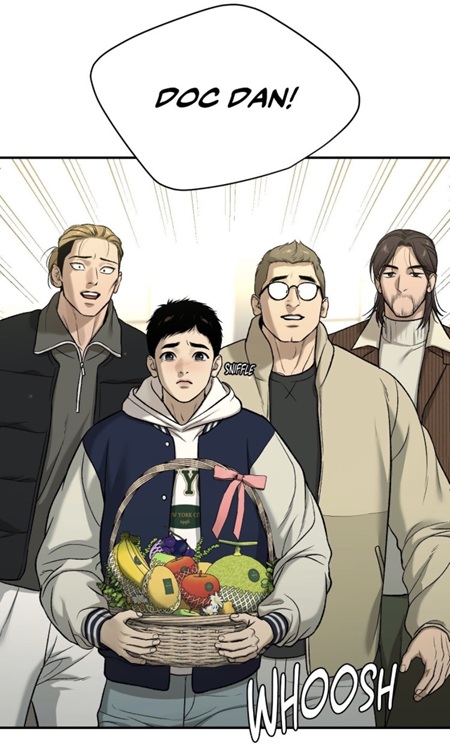 (chapter 100), Kim Dan is constantly insulated by a loud wall of warmth, visitors, food, and collective reassurance. Team Black worries boisterously about him
 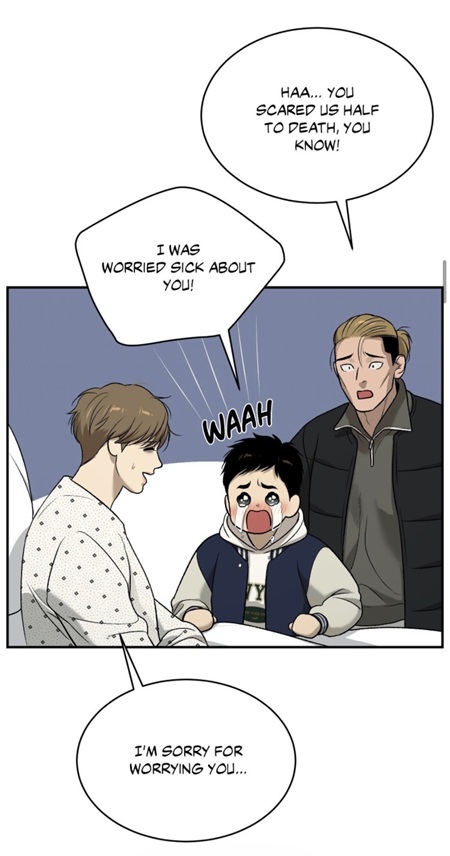 (chapter 100), jokes around his bed admiring the comfort of the room
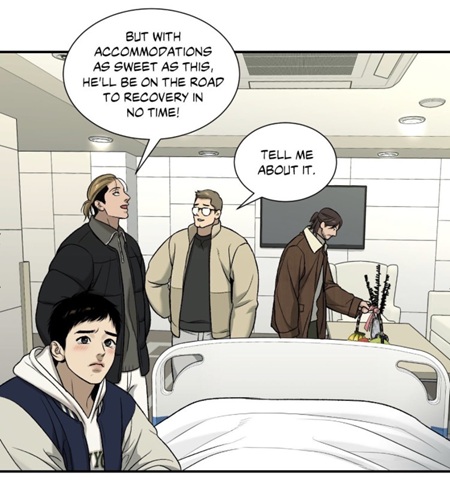 (chapter 100), scolds him affectionately,
 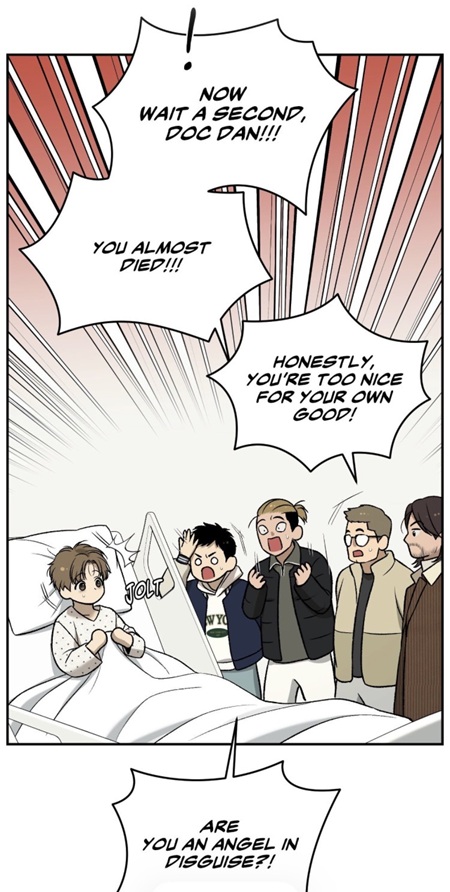 (chapter 100) and celebrates his survival. This lively atmosphere gradually reconstructs a superficial sense of normality. Meanwhile, Joo Jaekyung exists almost entirely outside this emotional circle. To the world, the champion is still perceived as rude, unmovable, and heartless,
 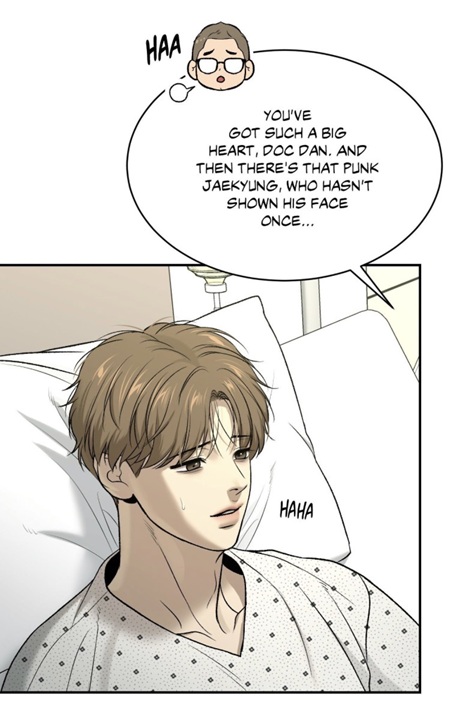 (chapter 100) while the members of Team Black get to play the roles of “affectionate and concerned” companions.
 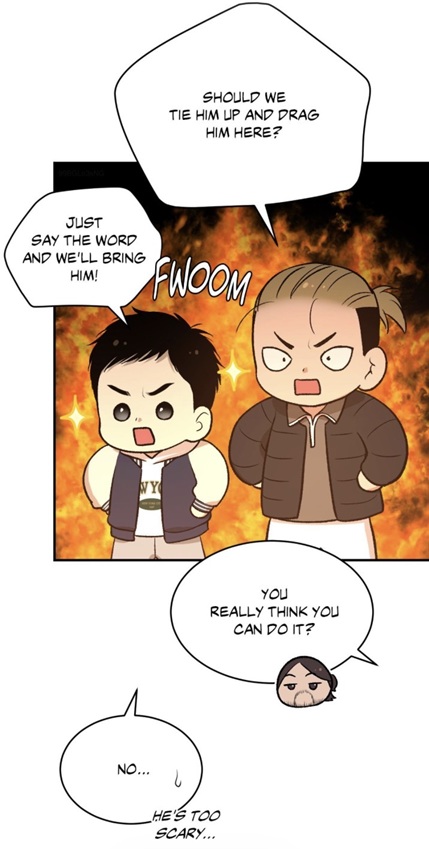 (chapter 100) Even when people discuss Jaekyung, they rarely speak about his exhaustion, fear, loneliness, or his disintegration as a human being. Why? Because they simply do not see it and believes in their hyung’s statement, the manager. They remain entirely blind to the human being beneath the title. They speak only of the match, the culprit, the belt, and his capacity to perform. Because he won the last fight, they treat him as an object that functions correctly, while keeping their distance from his harsh demeanor. They essentially avoid him as a temperamental monster, completely oblivious to the fact that they are leaving a deeply traumatized, lost puppy entirely on his own.
But there is a sharper edge to this scene: Team Black’s affection reveals itself as naive and profoundly superficial. They easily follow conventional social norms—bringing gifts (chapter 100), crying at a bedside—but their care lacks real, grounding intimacy. Neither Potato and Oh Daeyhun were present at the hospital in the hallway in front of the surgery room. None of them have stayed by Jaekyung’s side to offer real comfort 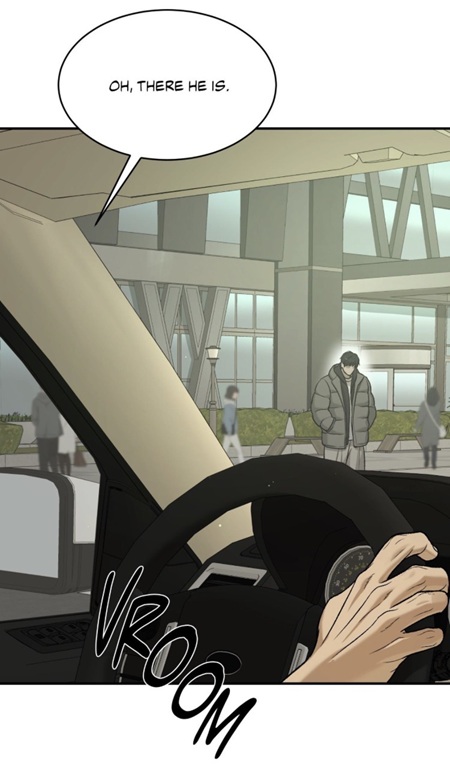 (chapter 100), thus the manager doesn’t leave his car to greet his boss and champion. He simply drops the physical therapist and drives away. But let’s return our attention to the scene at the hospital. Crucially, none of them correct the physical therapist when he pathologically apologizes for getting hurt. When Kim Dan stammers, (chapter 100), his words expose a deep reservoir of guilt and fractured self-esteem. Instead of challenging this unhealthy mindset, the crowd validates it by accepting the apology and coddling him as an “angel”. (chapter 100) And perhaps this image of the “angel” explains the deeper tragedy perfectly.
An angel is expected to comfort, heal, protect, and endlessly give. People receive warmth from angels, but rarely ask whether angels themselves are bleeding internally. Thus, Team Black fails to recognize that Kim Dan’s goodness itself has become pathological. They cannot see that his self-sacrifice contains a hidden violence directed against himself.
Therefore, it is entirely unsurprising that when Kim Dan finally walks out of that hospital, his internal narrative remains completely unchanged. (chapter 100) Because none of the members around him possessed the depth to correct his self-sacrificial logic, he still views himself exactly as he did before: as an inconvenient burden, a magnet for trouble, and someone who brings nothing but danger into the champion’s orbit. And note that the manager not only is not thanking him for his services but also is not determined to stop him from leaving. 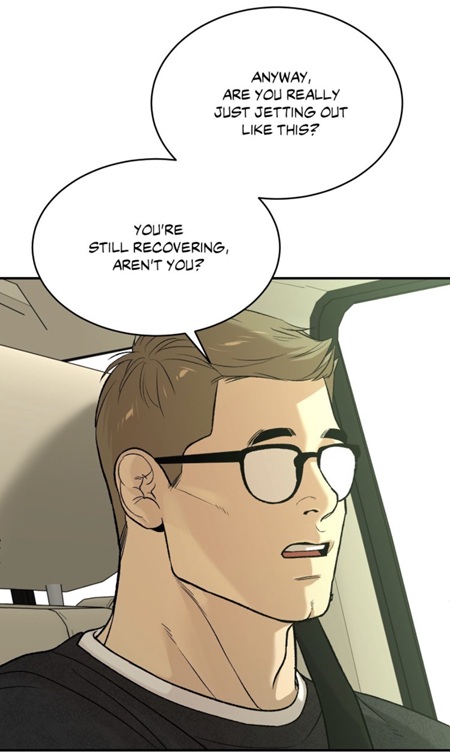 (chapter 100) For him, physical therapists can be easily replaced. Hence no tears and no handshake before the separation.
This is precisely why the handshake becomes so overwhelming for Kim Dan. Through touch, he suddenly realizes the truth. Joo Jaekyung had visited him for real. (chapter 100) At the same time, he gradually grasps that beneath the terrifying public image (chapter 100), Joo Jaekyung had quietly remained anchored beside him all along. The warmth in the champion’s hand reveals a hidden emotional reality that words denied. Thus, when Kim Dan thinks (chapter 100), the scene becomes far more than a romantic revelation. It is an emotional awakening. For the first time, Kim Dan realizes that the ‘Emperor’ was never emotionally distant by nature, only buried beneath fear, silence, and performance. The warmth in his hand reveals something profoundly human beneath the armor.
Importantly, this tactile recognition also begins transforming Kim Dan’s own inner world. For most of the story, he defined himself through usefulness, shame, and emotional disposability. He believed people kept him nearby only because he served a practical function: grandson, therapist, debtor, caretaker. Even his relationship with Jaekyung remained psychologically filtered through utility. 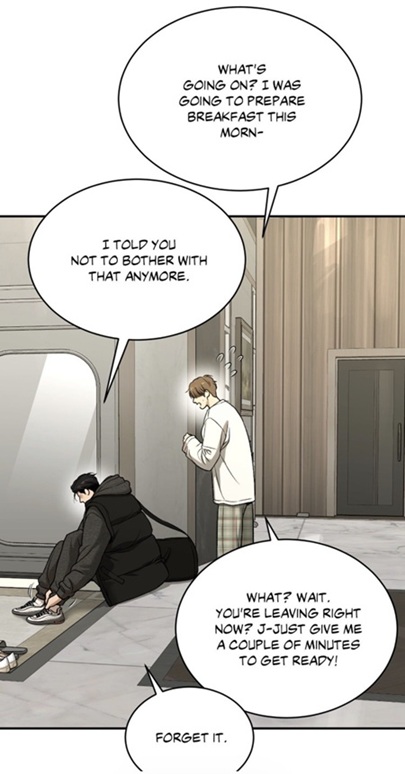 (chapter 100) Once the debt disappeared and the championship was reclaimed, Kim Dan instinctively assumed that his role in the champion’s life had ended too.
But the handshake completely destabilizes this entire belief system. Not only the dream became a reality, but also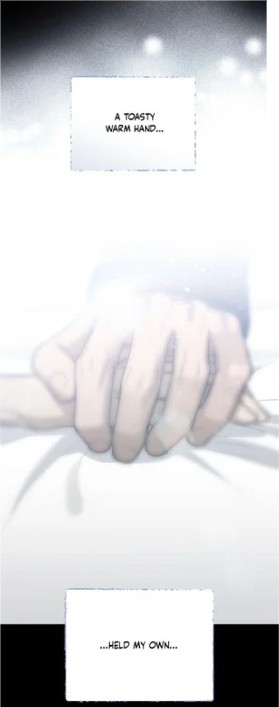 (chapter 100) the warmth in Jaekyung’s hand reveals that Kim Dan had never merely been “useful.” He had become emotionally necessary. For one fragile moment, Kim Dan experiences himself not as a burden, an obligation, or a temporary possession, but as someone genuinely cherished.
This is why the tiny sparks surrounding the scene matter so much (chapter 100). Earlier in the story, the relationship between the protagonists was repeatedly associated with an invisible, chaotic electricity pulling them together. 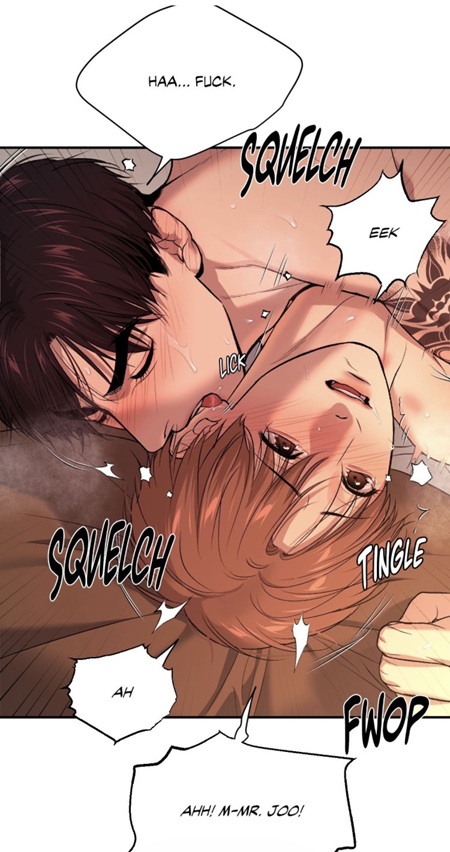 (chapter 86) Episode 100 revives this visual motif, yet transforms its meaning entirely. (chapter 100) The sparks no longer represent physical attraction or dangerous obsession; they resemble embers of emotional recognition finally igniting inside Kim Dan’s consciousness.
Significantly, however, only Kim Dan’s eyes contain visible light in these panels. (chapter 100) He is finally seeing the athlete’s warmth and care. Joo Jaekyung himself appears emotionally dimmed, exhausted, and internally extinguished. 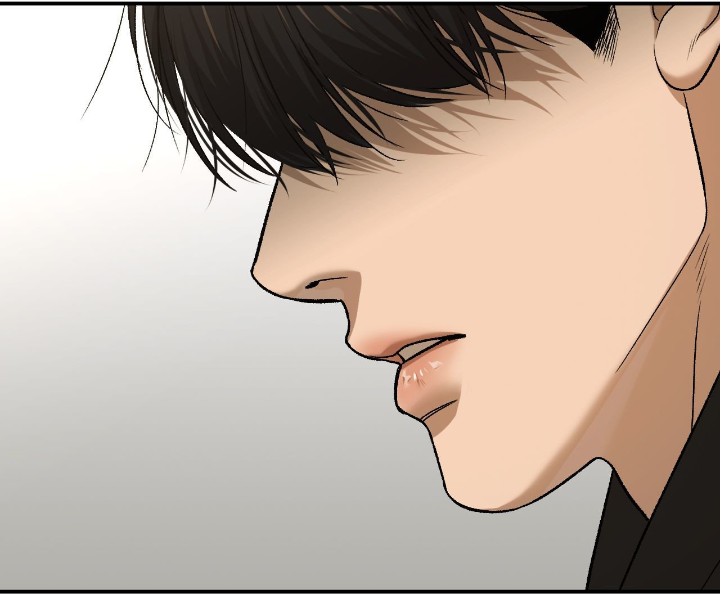 (chapter 100) Here, he is even portrayed as eyeless, as if he had lost his soul.
 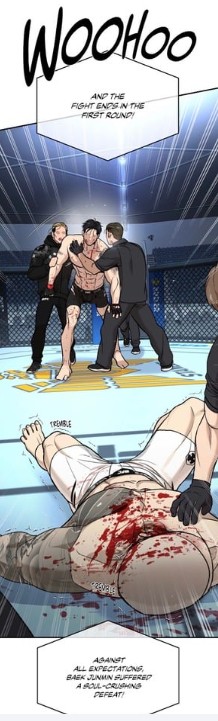 (chapter 99) The asymmetry is devastating. It almost feels as though the champion transfers his final remaining warmth and energy into Kim Dan through the handshake itself. (chapter 100) While Kim Dan awakens emotionally, Jaekyung continues withering inwardly beneath the weight of his guilt, his resignation, and his anticipatory loss.
And perhaps this is the cruelest irony of the scene. Through touch, Kim Dan is not yet fully understanding the love intellectually, rather he is beginning to sense it emotionally.
The realization remains tactile, intuitive, incomplete, and almost dreamlike. Yet at the exact same moment, the man extending that warmth no longer believes anyone will truly remain beside him once the final bell has rung. That’s the reason why the physical therapist looks back at his lover 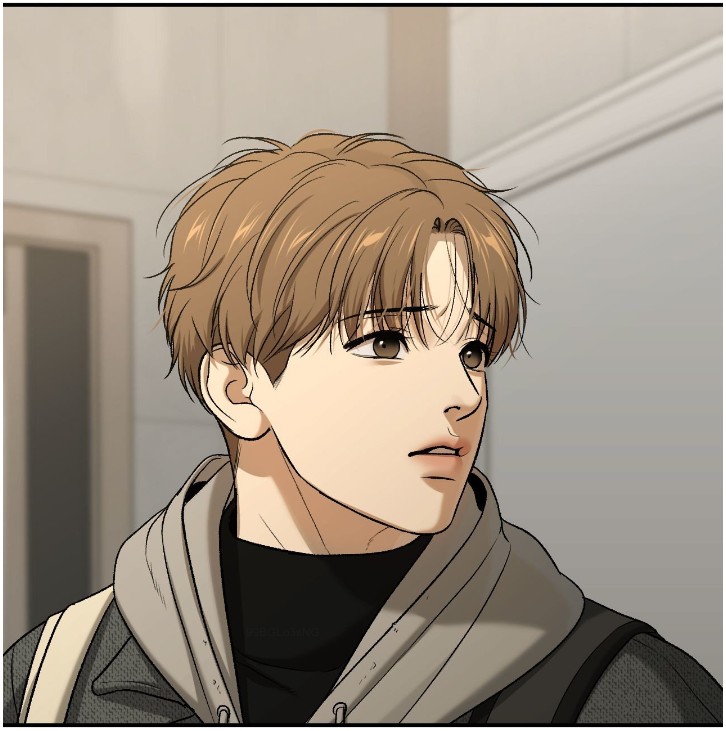 (chapter 100), he is detecting lingering feelings.
The handshake scene ultimately transforms not only Kim Dan’s perception of Joo Jaekyung, but the meaning of the jinx itself. (chapter 100) Until now, Kim Dan never truly questioned the existence of the curse surrounding the champion. 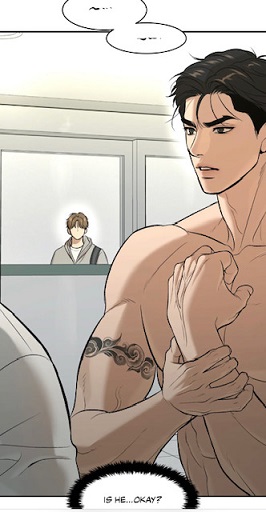 (chapter 27) He simply accepted it as an immutable part of reality. The “jinx” appeared almost supernatural: an ominous, mechanical force attached to Joo Jaekyung’s body, his victories, his violence, his rituals, and his frightening aura. Even the title of the series carried something cold, clinical, and oppressive. The word itself evoked danger, misfortune, contamination, and inevitability.
But episode 100 quietly begins dismantling this darkness.
When Kim Dan grasps Jaekyung’s hand, something extraordinary happens psychologically. Human warmth suddenly illuminates what fear, silence, and mythology had concealed for nearly one hundred chapters. 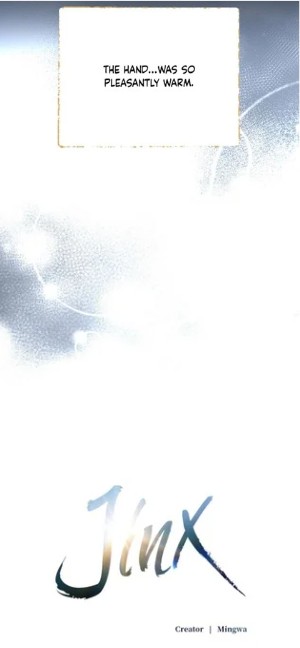 (chapter 100) Mingwa reinforces this revelation visually in a remarkable way. Immediately after Kim Dan describes the hand as “pleasantly warm,” the title Jinx itself reappears, glowing softly inside a luminous white space (chapter 100). The contrast with the earlier, heavy atmosphere of the story is striking. The title card no longer feels entirely dark. For the first time in the series, light enters the concept itself.
It is almost as though a hidden truth finally begins surfacing: the real curse was never supernatural fate, sexual ritual, or victory alone.
The true “jinx” was emotional isolation. It was the inability to communicate honestly. The inability to believe oneself worthy of love without usefulness, sacrifice, or performance. The inability to ask someone to stay. The inability to recognize the humanity hidden beneath fear, armor, and symbolic roles.
And perhaps this is why the scene begins subtly echoing Michelangelo’s The Creation of Adam. 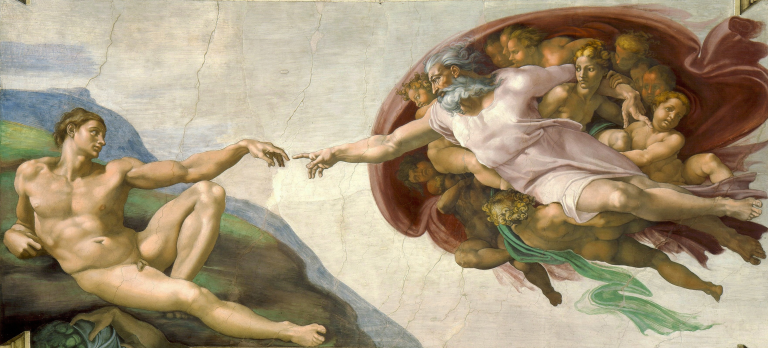
For nearly one hundred chapters, Jinx maintained a distorted version of that hierarchy. Joo Jaekyung existed as the towering “God” of the ring, wielding sovereign physical control, while Kim Dan remained the fragile mortal perpetually subjected to debt, rules, contracts, and bodily domination.
Yet as their fingers meet, Mingwa quietly reverses the entire structure. (chapter 100)
Kim Dan now stands upright, initiating the contact himself and reaching voluntarily across the emotional void. Meanwhile, Joo Jaekyung has become the limp, exhausted, emotionally paralyzed figure. His hand no longer stops gripping or possesses. Instead, it grows passive, heavy, and fragile as the fingers slowly begin slipping away.
This is precisely why the handshake becomes symbolically revolutionary. For one brief moment, the protagonists connect outside the toxic logic that governed their relationship for so long: no debt, no contract, no treatment, no championship, no transaction, and no performance. Only warmth.
But this is precisely where the tragedy deepens. Kim Dan is not a triumphant savior breathing life into a grateful recipient. He is still an insecure young man desperately searching for confirmation (chapter 100) that the warmth he sensed was real. He needs Jaekyung to tighten the grip, speak honestly, or offer any sign that he is wanted for more than his usefulness.
Instead, Joo Jaekyung retreats behind silence once again and delivers the devastating command: (chapter 100) This instruction seals Kim Dan’s internal misinterpretation completely. Paired with the slipping handshake, the sentence convinces him that the timeline established back in episode 77 has finally reached its inevitable conclusion. The transaction is over. The debt is dead. He is free to leave.
Yet the tragedy runs even deeper because Kim Dan does not perceive his own departure as abandonment at all. On the contrary, he genuinely believes he is acting lovingly and correctly by removing himself from Jaekyung’s orbit.
And in doing so, he unconsciously reproduces the exact emotional logic that shaped his own life and suffering.  (chapter 57) Long before episode 100, his grandmother attempted to push him away through almost identical reasoning.
  (chapter 57) Feeling powerless, burdensome, and guilty for his slow emotional deterioration, she repeatedly urged him to return to Seoul, live his own life, and stop “wasting away” beside her. Her love expressed itself through self-removal. Rather than openly asking Kim Dan about the reasons behind his pain, she tried to free him from herself before death could do it instead. She thought, she had the solution to the problem, because she believed she knew why!
Kim Dan internalized this worldview completely. Thus, when he prepares to leave the penthouse, he unknowingly imitates Halmoni’s sacrificial logic almost perfectly. He believes to know the athlete. Like out of sight, out of mind. Joo Jaekyung will stop suffering. (chapter 100) Love becomes synonymous with disappearing for the other person’s sake.
And devastatingly, Joo Jaekyung reproduces the exact same pattern simultaneously. Back on the beach, the champion promised: 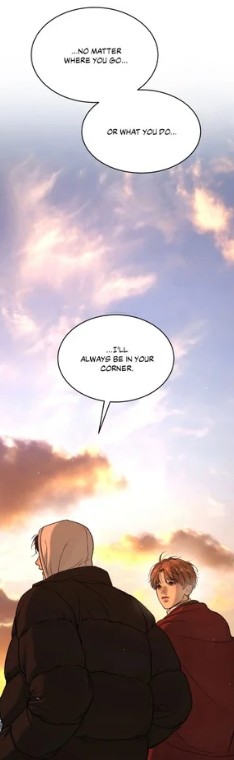 (chapter 95) At first glance, the sentence appears comforting and romantic. Yet retrospectively, the structure of the promise reveals a deeply corrupted blueprint for attachment. First, Jaekyung imagines Kim Dan leaving long before he ever asks him to stay. Even his love remains psychologically organized around future abandonment. Jaekyung’s words directly mirror the childhood promise made by his own mother—who told him she would watch over and support him from far away, leaving him with nothing but an inaccessible back and a heavy, permanent silence.
 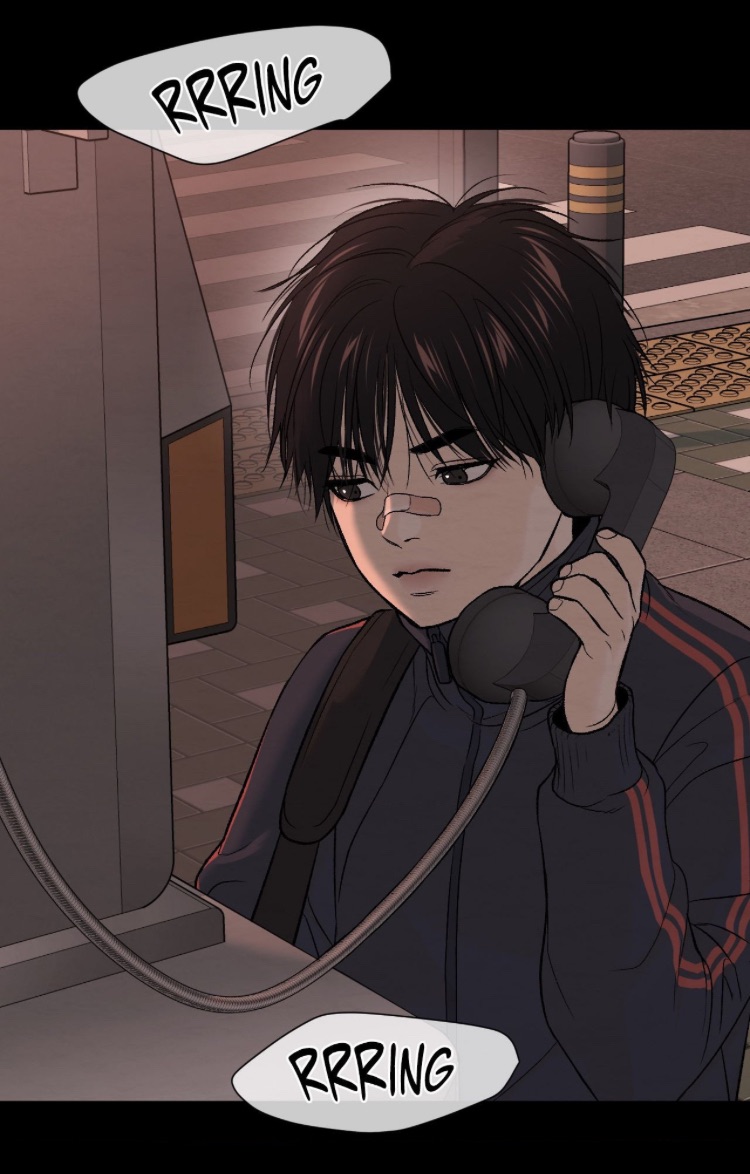 (chapter 72) But the ultimate cruelty of the narrative is that his mother’s promise was an absolute lie.
  (chapter 74) She did not watch from afar out of tragic necessity; she remarried, built an entirely new family, and willfully discarded Jaekyung to start a life where he had no place.
Thus, by episode 100, both protagonists express love through identical acts of self-erasure.
Kim Dan believes:
“If I want to help him feeling less guilty, then I should leave.”
Joo Jaekyung believes:
“If I want to protect him, I should let him go. He is getting hurt because of me. I am his jinx.
Neither realizes that they are silently reproducing the same inherited trauma script. And so, while still standing inside the vast uncrossed emptiness of the penthouse entrance, Kim Dan quietly utters: (chapter 100) The sentence acts like a psychological blade directly through Jaekyung’s deepest childhood wound. It confirms the terror haunting him since his mother’s disappearance and rejection: once the transaction ends and usefulness expires, people inevitably walk away. They don’t stay willingly, only because of money.
Then comes the devastating thud. Not the sound of emotional closure, but the sound of total collapse.
The monstrous willpower that carried Joo Jaekyung through brutal title fights, public scrutiny, and lifelong isolation suddenly evaporates beneath the unbearable weight of abandonment. The Emperor collapses on the threshold of his own making, similar to this nightmare:  (chapter 79)
 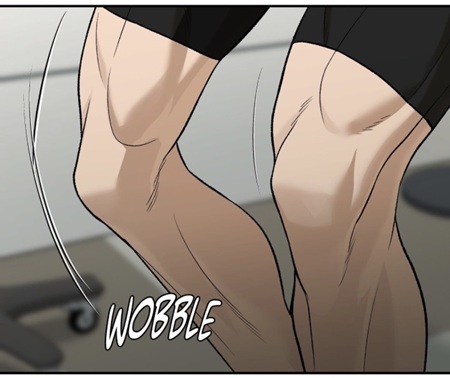 (chapter 99) Joo Jaekyung can only collapse under the weight of his immense knowledge and guilt: the hospital director, Baek Junmin, the switched spray (chapter 100). He almost killed a man, just like he did with his “father”.
And if my theory is true, then this is the moment where Kim Dan may finally begin understanding the champion properly for the first time. The terrifying realization finally emerges: beneath the armor, Joo Jaekyung suffers from the very same abandonment terror and low self-esteem that shaped Kim Dan’s own life. Because suddenly, the “Emperor” no longer resembles a distant monster at all.
He resembles a child, and not just a patient. Just like Halmoni. Just like Kim Dan himself.
The lost puppy hidden beneath the armor finally becomes visible. 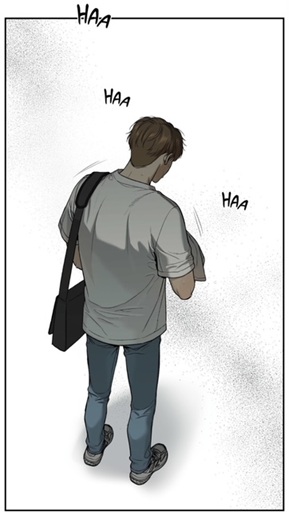 (chapter 59) And because Kim Dan still has not crossed the literal threshold , the collapse does not function as an ending, but as a confrontation with reality “sound THUD. (chapter 100) The counterfeit departure shatters completely. For the first time, Kim Dan stands before someone who is entirely incapable of saving himself.
And perhaps that is the true, revolitonary meaning of the scene. (chapter 100) The illusion of the untouchable Emperor cannot survive a collapse, and the myth of the unbleeding Angel cannot withstand a genuine psychological crisis. Episode 100 destroys both false frameworks simultaneously, leaving only two human beings at the entrance, waiting to see if anyone has the courage to reach back across the gap.
A HIDDEN REQUEST
Many readers walk away from this devastating cliffhanger feeling deeply frustrated with Joo Jaekyung. Across the fandom, the same complaint echoes repeatedly: “Why didn’t he just open his mouth?” “Why didn’t he ask Kim Dan to stay like he originally wanted to?”
The bitter irony, however, is that episode 100 already contains the request. I now invite my attentive readers to return carefully to the chapter itself and search for the exact panel where Joo Jaekyung’s true desire surfaces.
Once you find it, the emotional meaning of the entire chapter begins shifting.
Suddenly, episode 100 no longer feels like the story of a man incapable of asking someone to stay, but the story of two people trapped inside a far more complex emotional silence. And perhaps this is why episode 100 feels so haunting and terrible.
In the second part of this essay, we will examine why Joo Jaekyung gradually starts resembling a ghost himself — and how the chapter repeatedly buries his voice beneath misunderstanding, distance, and interruption.
Feel free to comment. If you have any suggestion for topics or Manhwa, feel free to ask. If you enjoyed reading it, retweet it or push the button like. My Reddit-Instagram-Twitter-Tumblr account is: @bebebisous33. Thanks for reading and for the support, particularly, I would like to thank all the new followers and people recommending my blog.

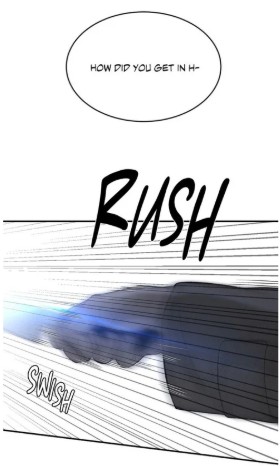 (chapter 98), and perhaps that is precisely why it unsettles so deeply. Readers had anticipated tension, even escalation—an argument, a kidnapping, a sexual assault or perhaps an act of self-defense—but not this sudden and irreversible intrusion of violence.
 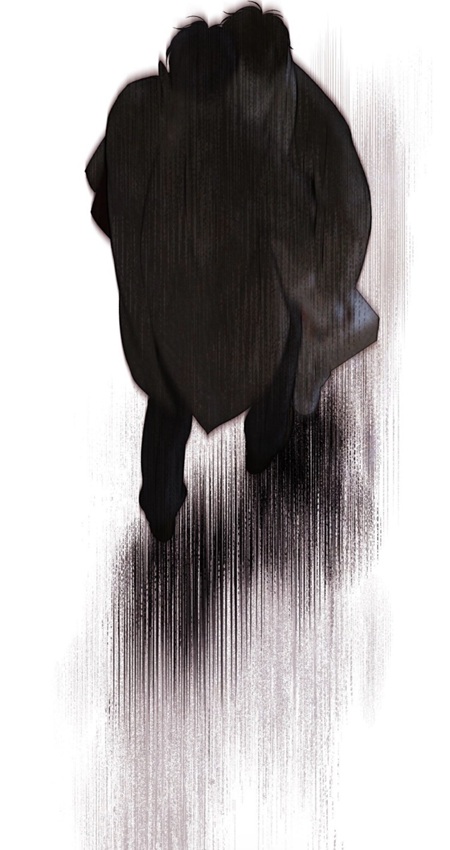 (chapter 98) The former hospital director does not merely attack; he interrupts the narrative itself, breaking the expected rhythm and replacing it with something harsher, more disquieting.
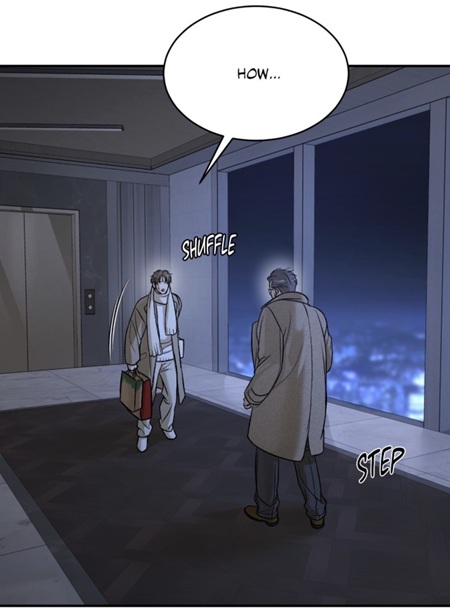 (chapter 98) who suffers rather than acts
 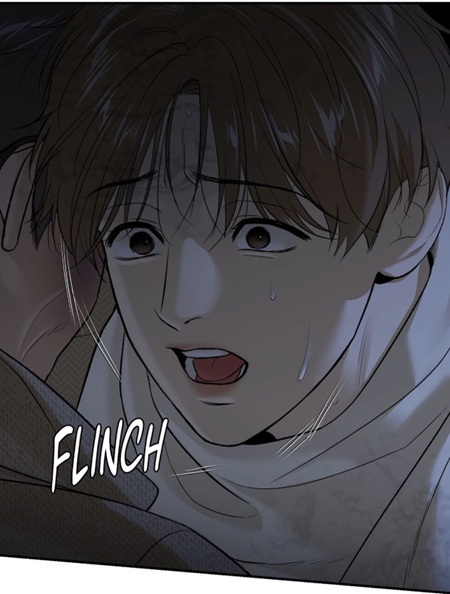 (chapter 98), the one who is endangered rather than decisive. He does not yell or attempt to run away while facing his ex-boss. Does this not reduce him to a passive figure, repeatedly placed in situations where others must intervene?
 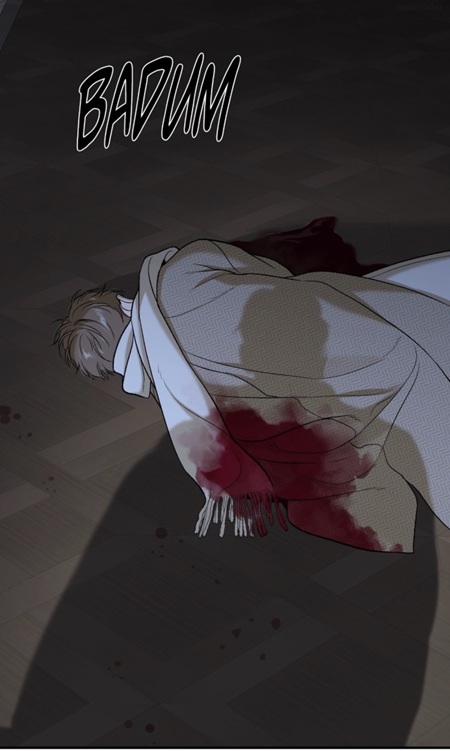 (chapter 98) Does it not risk transforming him into a character defined solely by vulnerability?
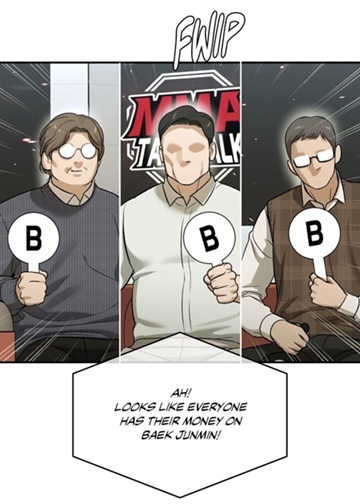 (chapter 95), and a financial machine. Its fall revealed that the ring was only the visible surface of a much darker structure.
 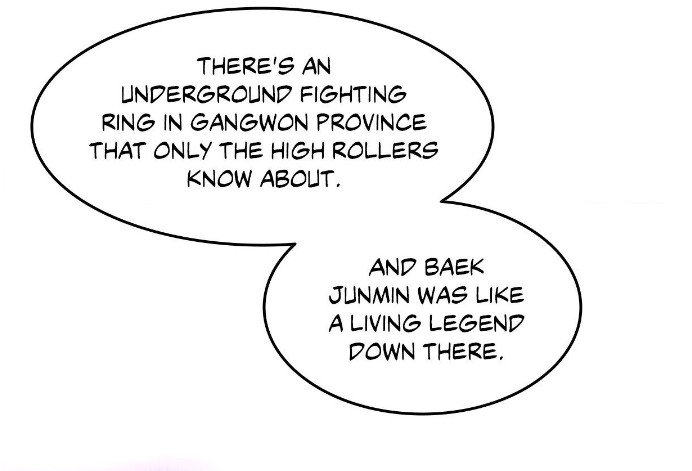 (chapter 47), and control intersect. This is precisely why figures like Baek Junmin cannot be reduced to mere competitors. His involvement in rigged systems
 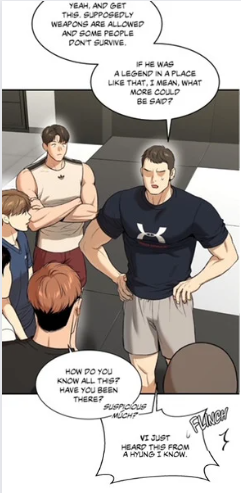 (chapter 47) places him within a framework where outcomes are manipulated and where harm—even death—becomes a possible consequence rather than an exception.
 and confront the system directly. However, the stabbing reorients that expectation. It places him, instead, in a position structurally analogous to that earlier fracture point
 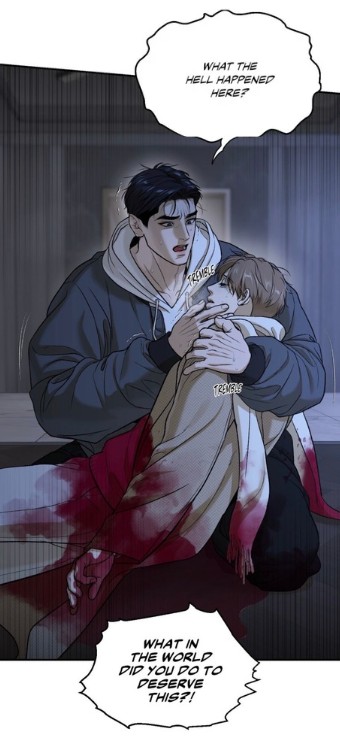 (chapter 98): not as the agent who exposes the system through action, but as the figure through whom its hidden logic becomes legible. Like the DSE case, where a single event forced observers to reconsider the boundaries between sport, money, and organized crime, Kim Dan’s injury functions as a node of convergence. It connects debts, institutional failure, and coercion into a single, visible rupture.
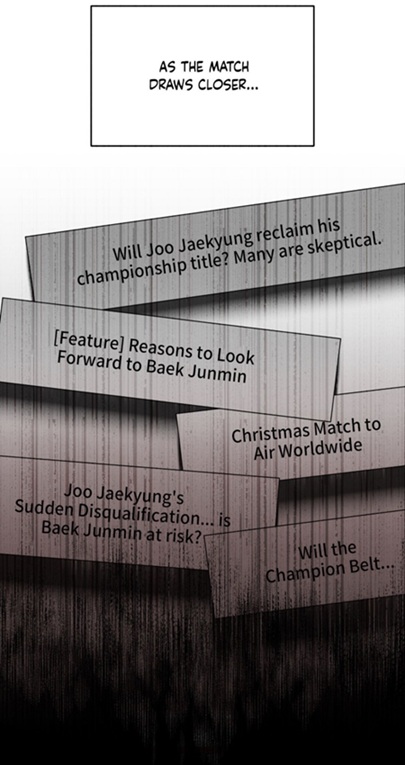 (chapter 95) It is broadcast worldwide, surrounded by articles, posters, speculation, and commercial pressure, though I doubt that the interview from Baek Junmin was broadcasted worldwide, as he spoke in Korean. The poster itself
 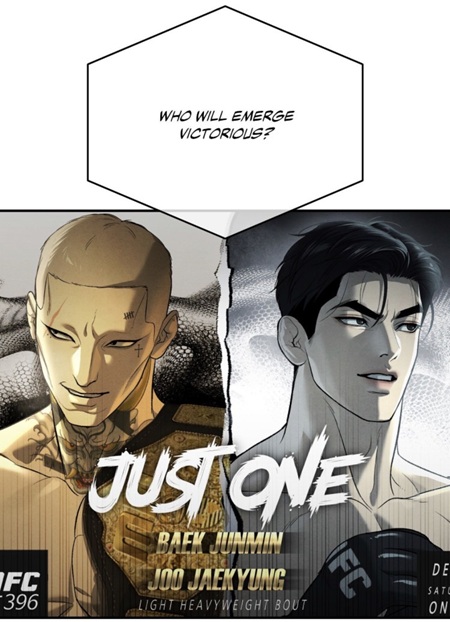 (chapter 97) already exposes the bias of the system: Baek Junmin is elevated like a golden idol, while Joo Jaekyung is portrayed more as a ghost from the past. The media does not simply report the match; it prepares the audience to accept a specific narrative.
 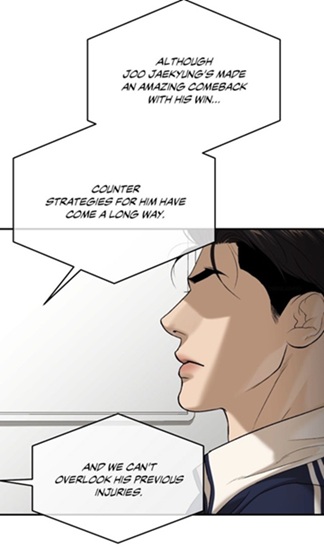 (chapter 95) The question is no longer “Who will win?” but ‘How will Joo Jaekyung’s defeat be made to appear inevitable?’”
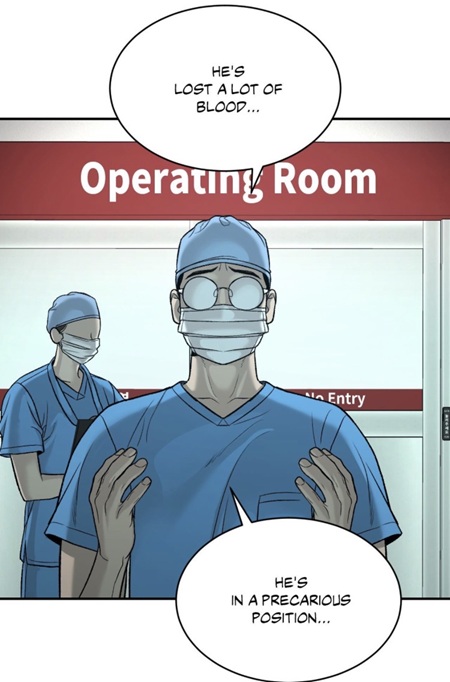 (chapter 98)
 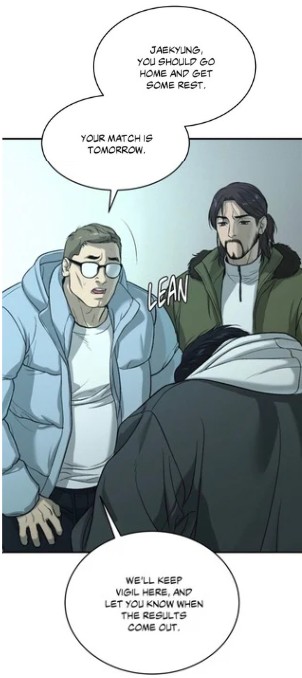 (chapter 98) processes the event as a private misfortune rather than a systemic failure. Their response reveals a hierarchy of value in which legal accountability is secondary, while the continuity of the event remains imperative.
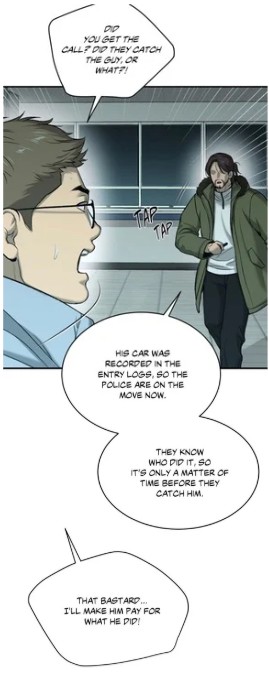 (chapter 98) Their words reveal the logic of the organization: the attacker may be pursued, but the event must continue. The absence of MFC representatives at the hospital is therefore not incidental, but symptomatic: it visualizes the system’s refusal of implication. Violence is acknowledged—but only insofar as it does not disrupt the spectacle. In a way, everyone seems to be focused on the fight and nothing else. No one publicly asks the most dangerous question
 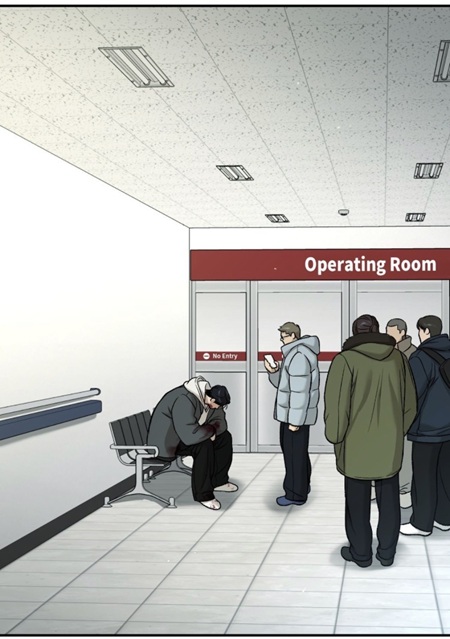 (chapter 98): why was Kim Dan targeted on the eve of the match?
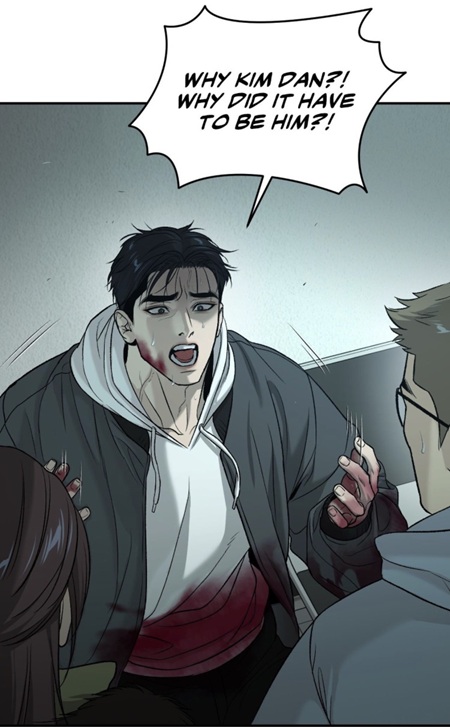 (chapter 98) His words are met with silence.
 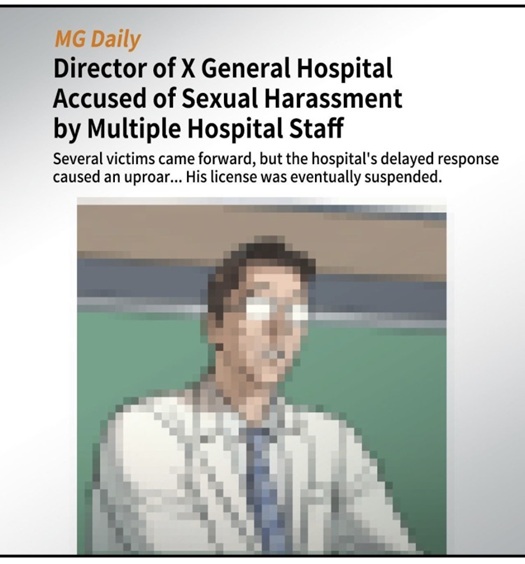 (chapter 91) More importantly, he has encountered the man directly and witnessed his attitude toward Kim Dan.
 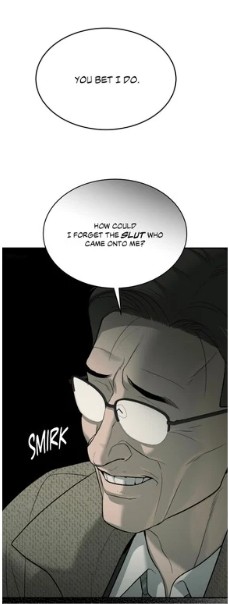 (chapter 90) In that earlier confrontation, the director reduced the physical therapist to an object of contempt
 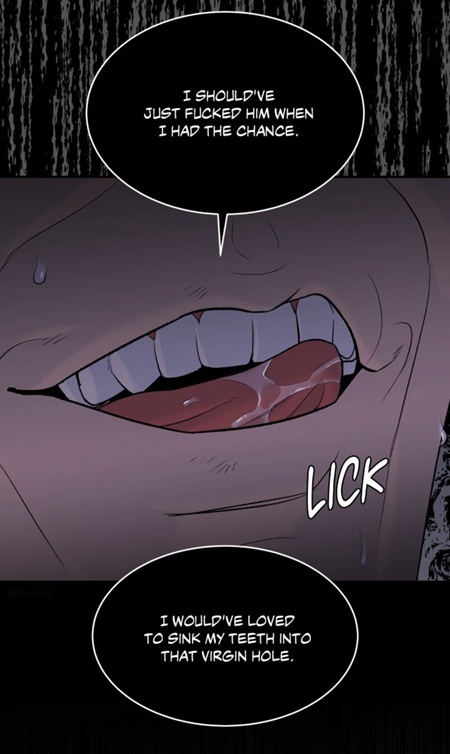 (chapter 90), employing degrading language that revealed not obsession, but dismissal.
 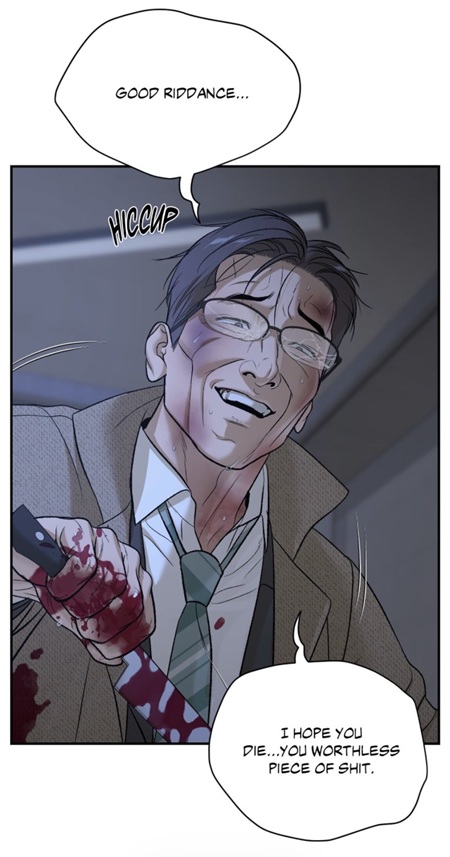 (chapter 98), yet it does not fully account for the nature and scale of the violence. His contempt explains hostility, but not the escalation into a calculated act carried out under coercive conditions. The panels themselves reveal that he was first cornered, threatened, and offered relief from his debts in exchange for compliance.
 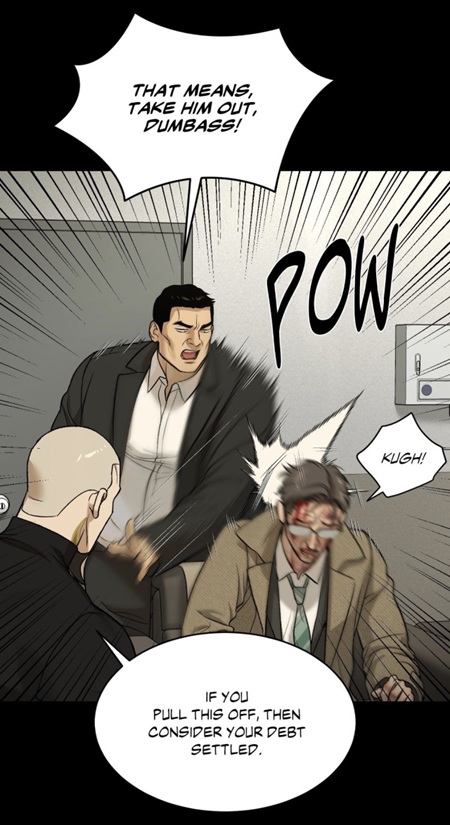 (chapter 98) The act thus exceeds the logic of personal grievance without entirely discarding it.
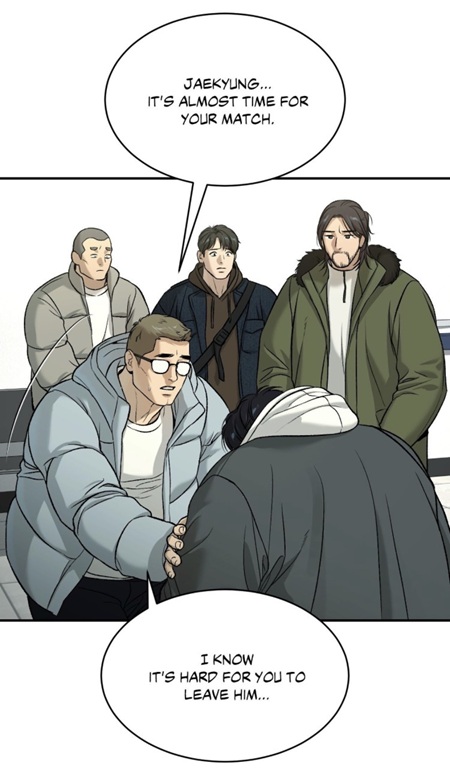 (chapter 98) Meanwhile, the real cost is paid elsewhere, by bodies that are not supposed to be seen. Kim Dan’s bleeding body becomes the hidden underside of the spectacle.
  (chapter 17), and protected him without receiving public recognition.
  (chapter 60) The assault on Kim Dan in the “private” space of the penthouse hallway
 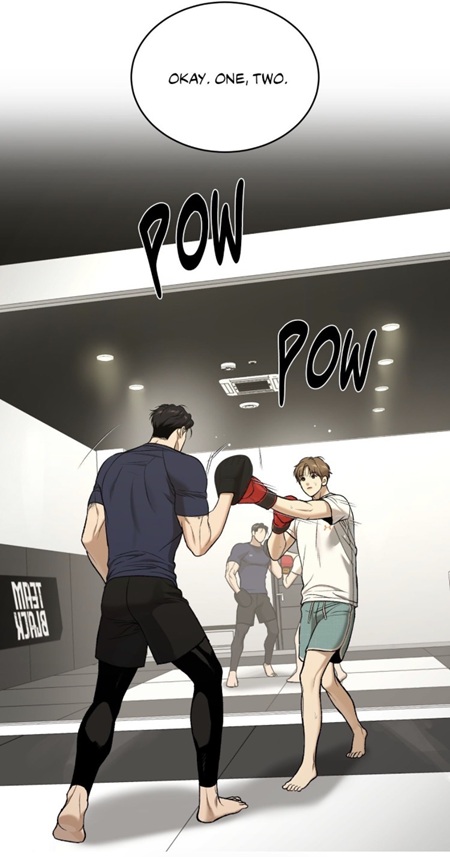 (chapter 88) The same hidden space became a refuge not only for himself, but for Kim Dan, allowing him to protect the physical therapist’s dignity and safety away from the media’s gaze.
 (chapter 37) and the switched spray
  (chapter 49), which unfolded within MFC’s operational sphere. Those events were embedded in the organization’s jurisdiction and thus carried the potential to implicate it directly.
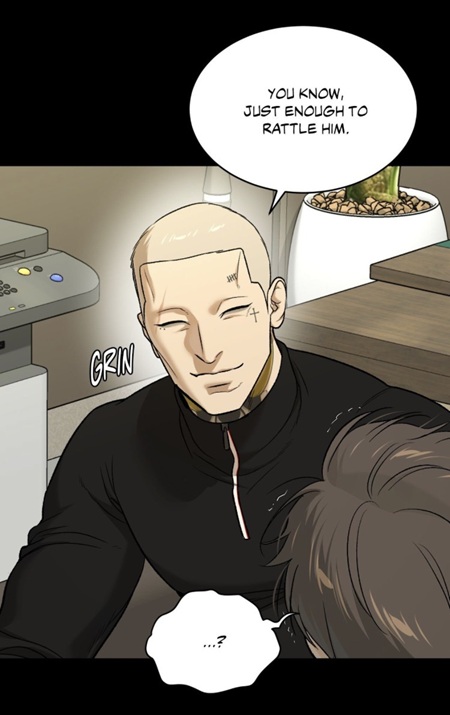 (chapter 98) It converts Jaekyung’s attachment into a site of vulnerability, forcing him into a position where his private life can be used against him.
 (chapter 17); this injury imposes limitation.
 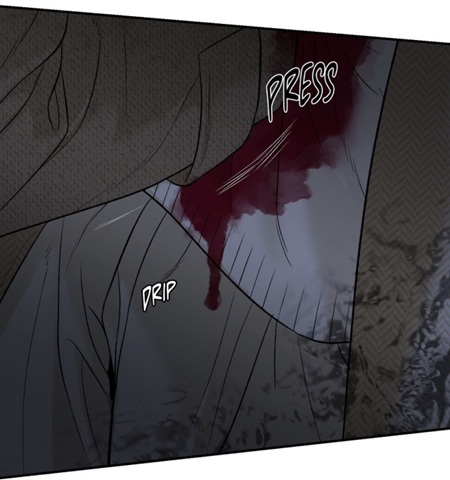 (chapter 98) It may become the first visible crack in the façade. The attack is supposed to remain a private tragedy, but if its connection to the match surfaces, then MFC’s credibility collapses. The question will no longer be whether Baek Junmin can defeat Joo Jaekyung, but whether the fight itself was ever clean or it can even take place at all.
  (chapter 87) and a title reclaimed, guilt alters not just performance, but identity. By transforming Kim Dan into a victim, Baek Junmin attempts to implant a belief far more enduring than physical trauma: that proximity to Joo Jaekyung is dangerous. The objective is not simply to destabilize him temporarily, but to reintroduce a form of inner collapse that had once defined the champion, shifting him from a state of self-destructive detachment back into a cycle of shame.
 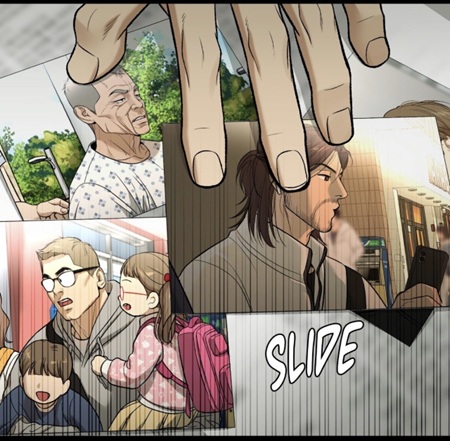 (chapter 98)
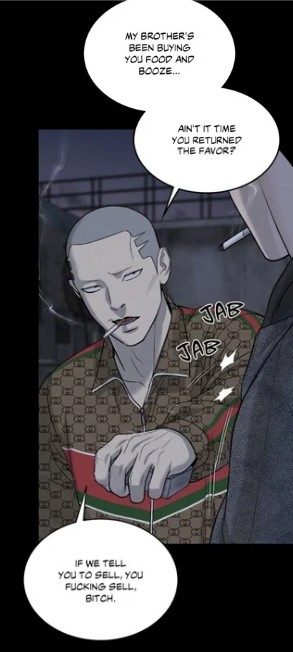 (chapter 74) In earlier encounters, Baek Junmin was unable to obtain the champion’s submission
 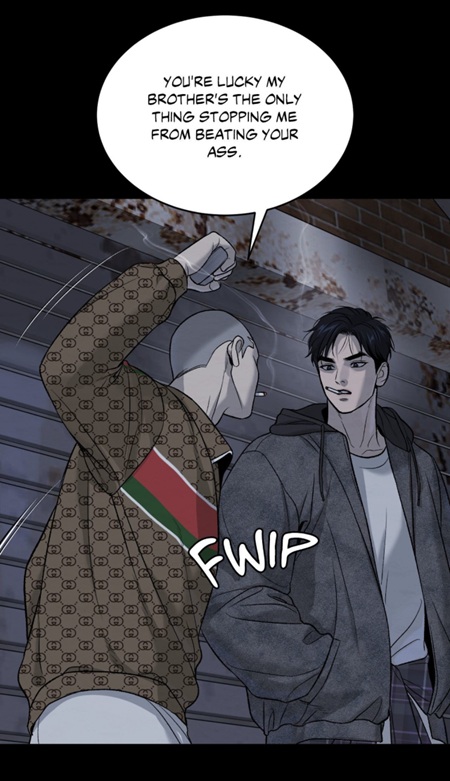 (chapter 74) and even to provoke any visible fear from Joo Jaekyung.
 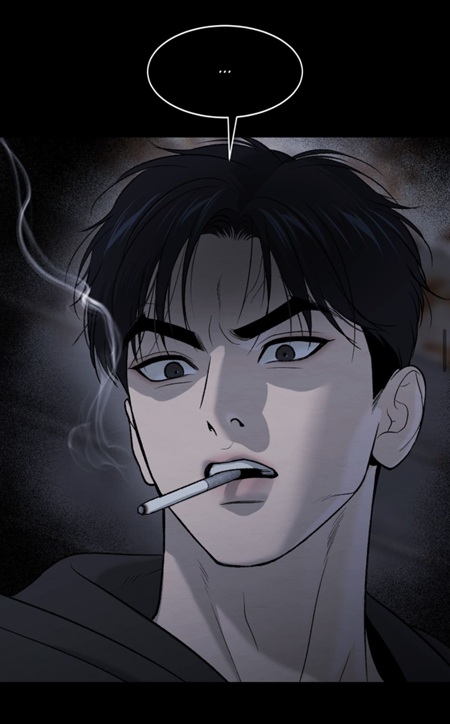 (chapter 74) His self-destructive indifference functioned as a form of armor. A man who places no value on his own survival cannot easily be coerced through threats of violence. He could not be rattled, because there was nothing to lose. Kim Dan changes that equation entirely.
 (chapter 74) What he could not escape, however, was responsibility. His past is marked by a formative rupture
 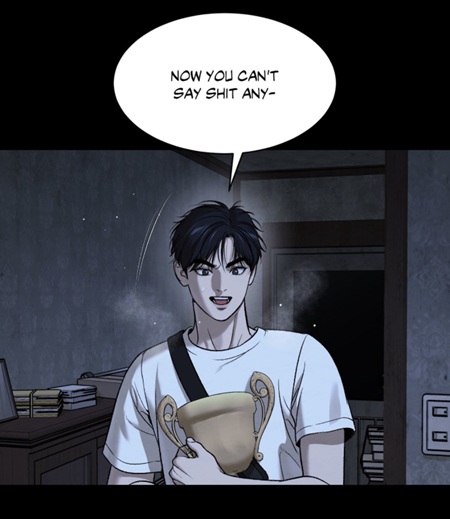 (chapter 74) in which personal achievement coincided with irreversible loss, producing a lasting association between his own success and the suffering of others.
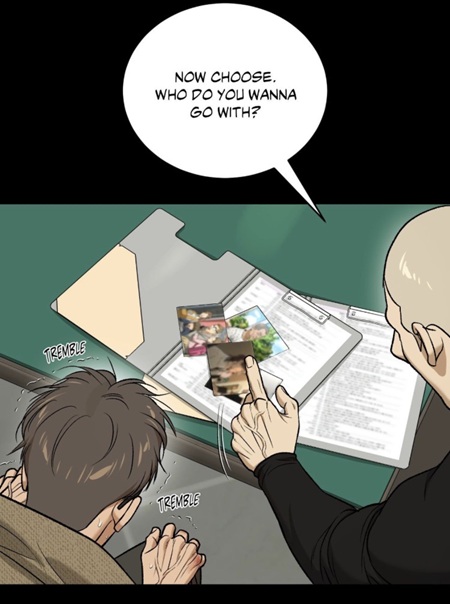 (chapter 98) The goal is to force the champion back into the familiar and agonizing position of the survivor—one who advances while others pay the price in blood. In this configuration, the match itself becomes secondary to the internal consequence: the resurgence of self-blame, the reemergence of guilt, and the deepening of self-loathing.
 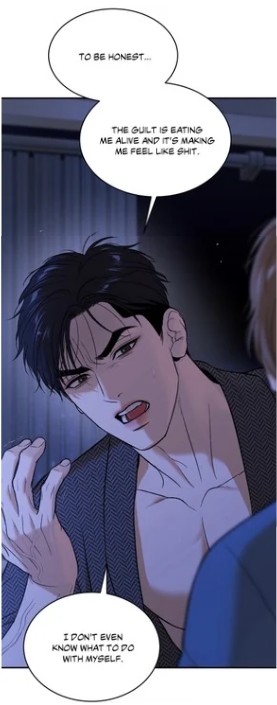 (chapter 91) The violence inflicted upon him is designed to echo within the champion, transforming an external assault into an internal fracture. In this sense, the attack operates less as a physical strike than as a mechanism of psychological inscription.
 (chapter 73) The result was not empowerment, but internalized blame—a distortion in which ambition became inseparable from shame.
 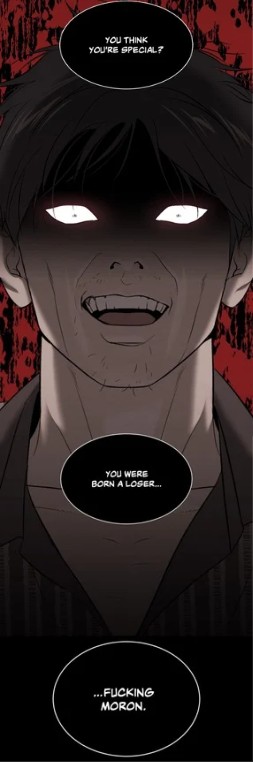 (chapter 73) Rather than confronting Joo Jaekyung directly, Baek Junmin reproduces this logic with greater calculation, engineering a situation in which the champion is compelled to interpret harm as his own responsibility.
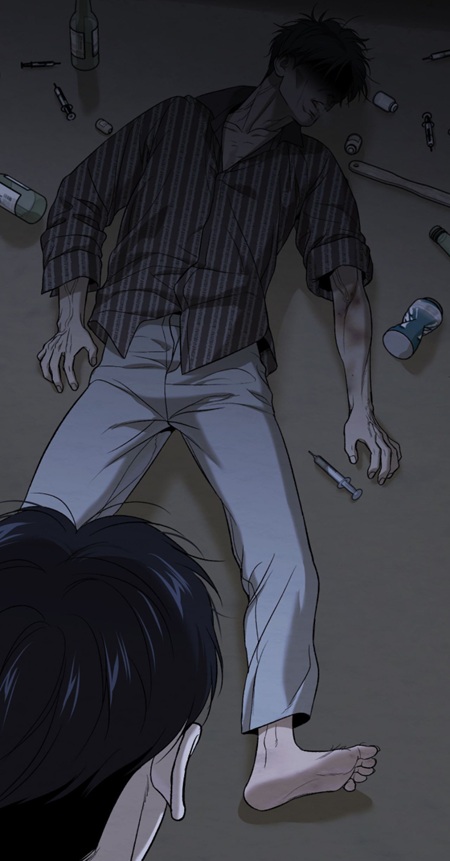 (chapter 73) He occupies the same structural position—not as a replacement, but as a continuation—forcing Joo Jaekyung to relive a pattern in which success, loss, and guilt converge.
  (chapter 73) This convergence is not incidental. On the very day his public success becomes visible, his private reality collapses into a scene of absolute abjection. Achievement and catastrophe are not merely juxtaposed—they are structurally bound.
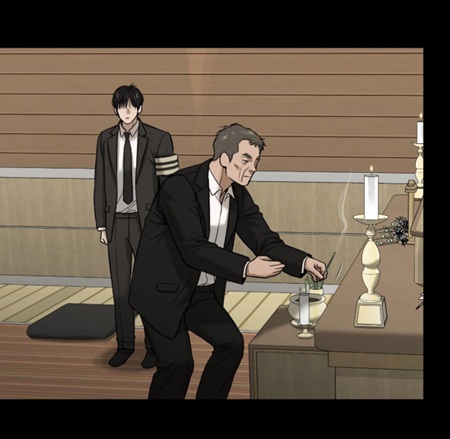 (chapter 74) As the sole representative of the athletic world, he becomes the figure through whom the scene attains institutional closure. By accepting the event as it appeared, without interrogating its conditions, he contributes—structurally rather than intentionally—to the stabilization of its official meaning. Boxing and the mob are two separate worlds. The tableau remains intact, not because it is verified, but because it is not questioned.
  (chapter 74), one would expect traces of that affiliation to persist—not necessarily as mourning, but at least as presence. Yet none appear. No representatives, no residual ties, no indication that he belonged to a structure beyond the domestic sphere. This absence does not confirm a break, but it renders continuity uncertain.
  (chapter 72), the later environment appears comparatively stabilized.
 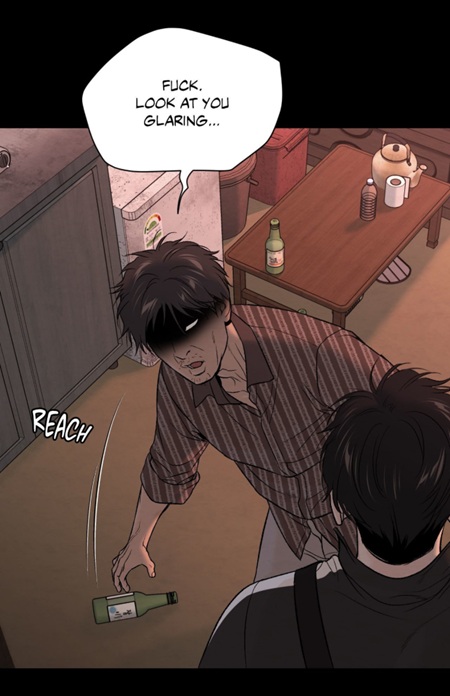 (chapter 73) This shift does not indicate resolution, but it does mark an interruption.
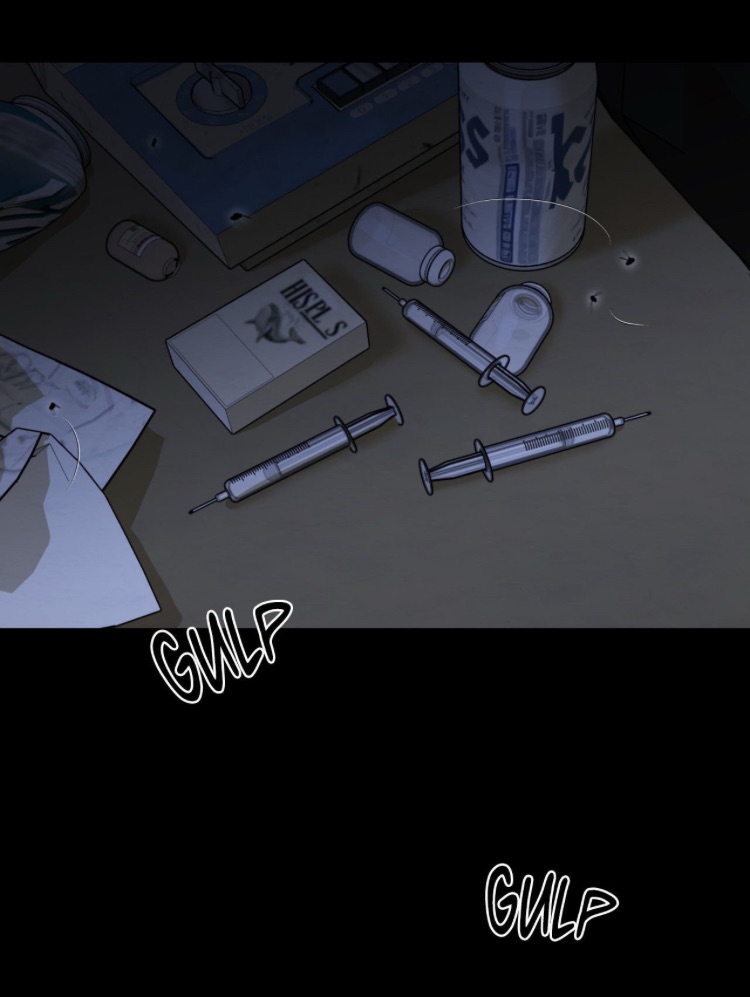
 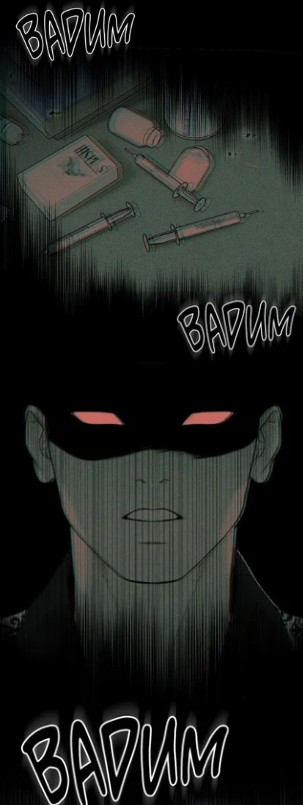 (chapter 73) The visual emphasis on syringes and narcotics does not introduce new information—it reactivates an earlier image, one already internalized during his childhood.
 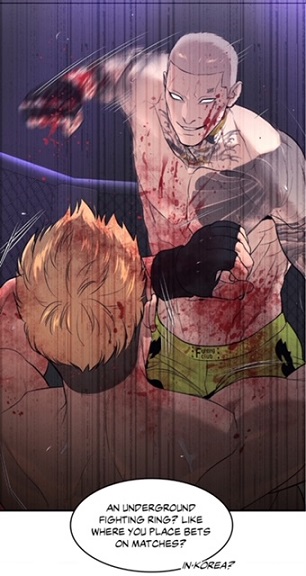 (chapter 47) What the narrative reveals instead is a single structure operating on two levels: a visible arena governed by rules, discipline, and public legitimacy, and an invisible layer sustained by coercion, debt, and manipulation. Joo Jaekyung’s father stands at the point where these two layers converge.
 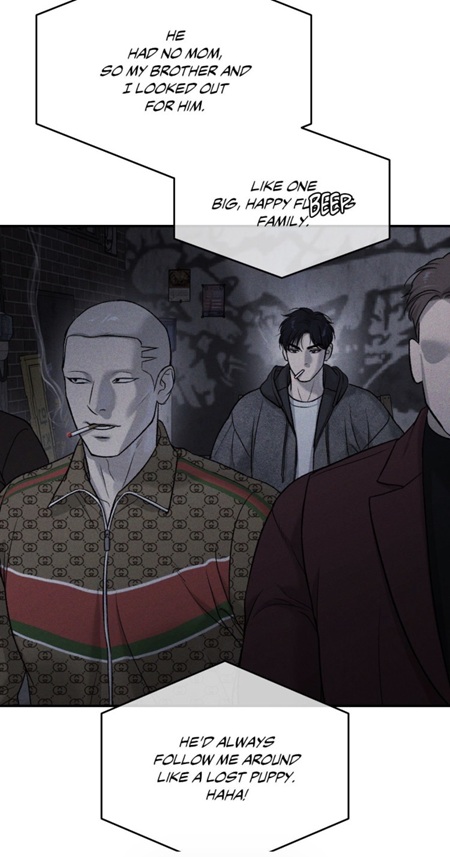 (chapter 96) acquires particular significance. Unlike the father, whose role has been reduced to memory, the hyung represents the active principle of authority within the hidden layer. if the Father was the curse’s origin, the faceless Hyung is its manager. This reinforces my point that Jaekyung was never “free,” only “transferred” from one owner to another. His presence signals that control does not disappear—it shifts location. Responsibility is no longer anchored in a single individual, but distributed across a hierarchy that regulates behavior through coercion rather than care. Baek Junmin operates within this structure, not as its originator, but as its agent. His actions do not create the system; they enact it.
 (chapter 98) Those present remain focused on the match, the perpetrator, or the urgency of treatment. The mark remains unaddressed, almost invisible in plain sight. Yet precisely because it is overlooked, it acquires a different kind of force. Unlike concealed wounds, this trace has the potential to enter the public sphere.
 (chapter 74) —coherent, legible, and therefore unquestioned—the present moment resists such closure. The structure that once foreclosed inquiry is no longer fully operative. The “jinx” reveals itself not as fate, but as the effect of an interpretation that had never been interrogated.
  (chapter 95) Why is the mechanism that produces harm repeatedly misidentified as fate, necessity, or personal failure?
  (chapter 74)
 (chapter 17), whose violence was never concealed behind the illusion of sport. His weapon was direct, explicit, and inseparable from his words. During that earlier encounter, he articulated a principle that now returns with unexpected clarity:
  (chapter 17)
  (chapter 11). This condition does not remain static; it intensifies. The violence directed at Kim Dan follows a clear trajectory—one that escalates in both form and intimacy. What begins as physical assault quickly extends into spatial violation: trespassing, intrusion into his living space, and the systematic erosion of any boundary that might protect him. From there, it evolves into abduction
  (chapter 16) and coercion
  (chapter 16), culminating in sexual violence.
  (chapter 16)
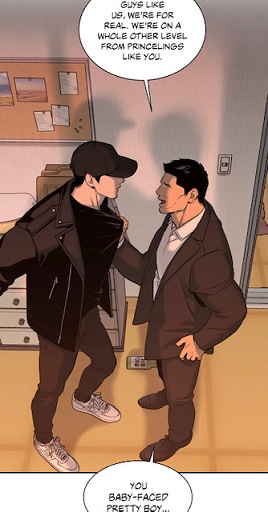 (chapter 17) Through this echo, the boundary between past and present collapses, as does the distinction between underground coercion and institutionalized spectacle. What once appeared as separate domains—the illegal underworld and the legitimate sport—are revealed as two expressions of a single, continuous structure.
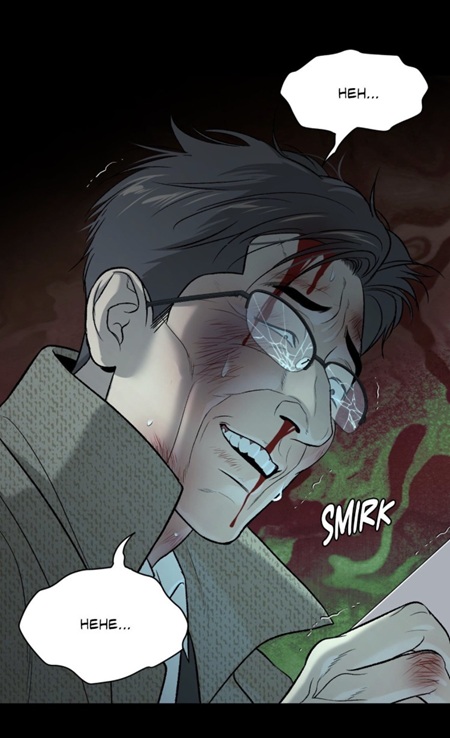 (chapter 98) It emerges from a structure already in motion—one that had previously manifested in a different form. The attempted sexual assault by the hospital director
 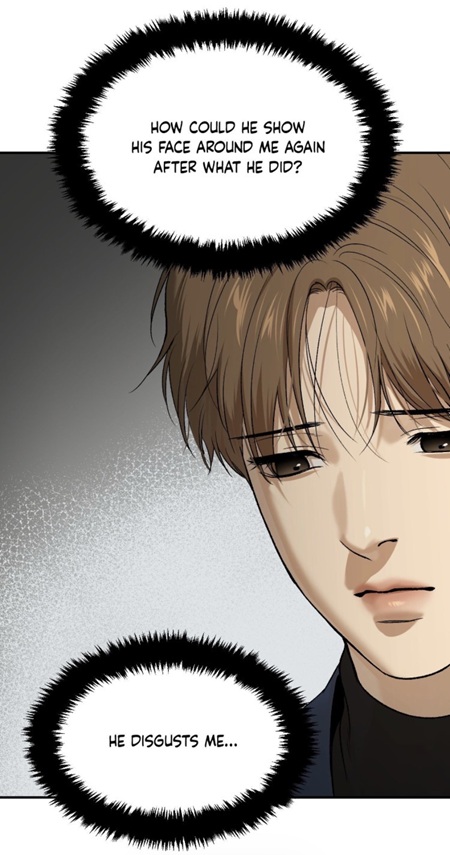 (chapter 91) What returns in the stabbing is therefore not a new intrusion, but the intensification of an unresolved structure.
 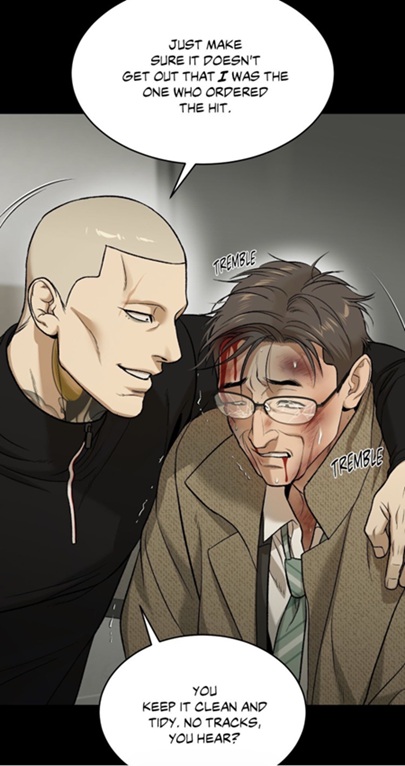 (chapter 98) —his attempt to sever himself from the act by delegating it and erasing traces—presumes that violence can be isolated and controlled. On the one hand his demand effectively reassigns the burden of protection. The former director, once shielded by institutional authority, is now positioned as the one who must protect another individual from exposure. Yet the very structure he activates exceeds his knowledge.
 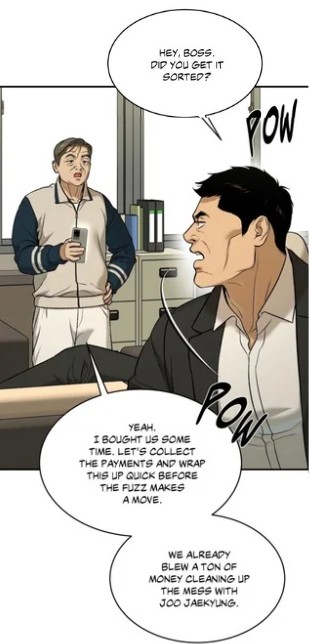 (chapter 93); the money laundering operation represents the material reality that must remain hidden behind the ‘fake’ spectacle of the sport.
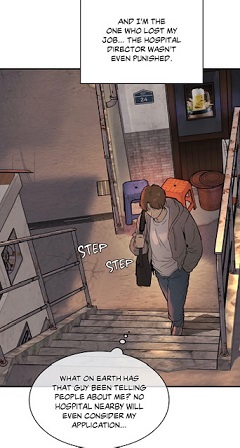 (chapter 1) He was not merely fired after the incident; he was made professionally untouchable. By damaging his reputation and preventing him from being hired elsewhere, the hospital did not simply remove a troublesome employee—it attempted to silence the one person whose testimony could expose the system that had protected the director.
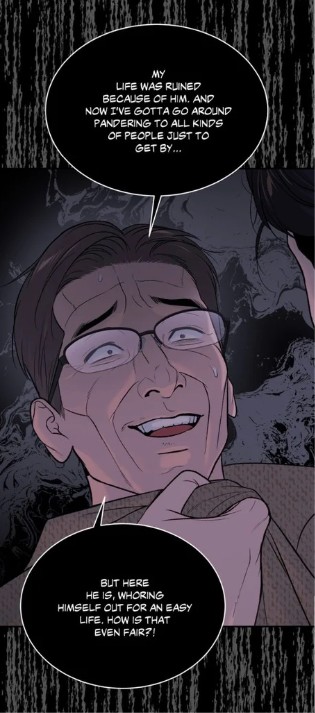 (chapter 90) suggests that Kim Dan’s case did not disappear quietly. His words imply that the incident created a ripple, perhaps even a precedent: other victims may have recognized their own experience in his and understood that they were not alone. In that sense, Kim Dan’s dismissal became the first crack in the hospital’s façade.
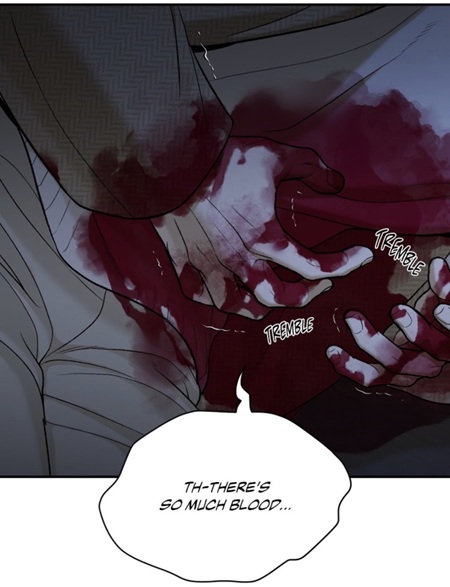 (chapter 98) It reveals that the “Official Narrative” of the director’s expulsion was a lie of containment. The institution did not heal itself; it simply exported its violence to a darker room, and in Chapter 98, that violence finally found its way back into the light of the hallway.
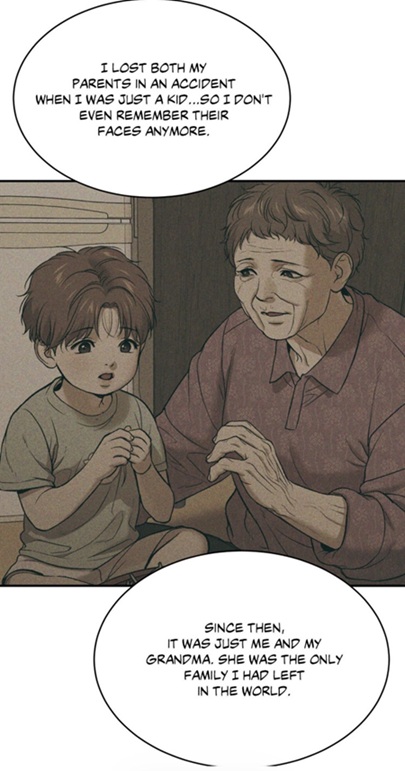 (chapter 94), is not a neutral description—it is a mode of interpretation. It designates his parents’ death as an event without structure, a rupture that cannot be traced back to conditions or causes. In doing so, it preserves the image of a past that appeared stable: a childhood not yet governed by coercion, obligation, or threat.
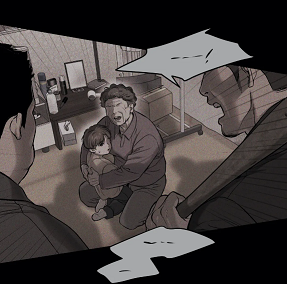 (chapter 5) —financial, social, and existential. This transition is not simply temporal, but conceptual. Where accident suggests contingency, debt imposes necessity. One denies causality; the other enforces it.
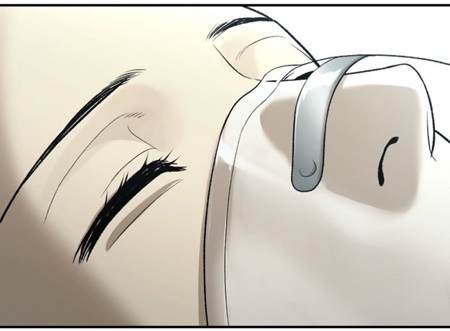 (chapter 98) cannot be reduced to a purely medical condition. It introduces a different mode of perception—one no longer governed by the interpretive framework that structures his waking life. Sleep does not simply heal; it suspends the language of accident.
 (chapter 19)
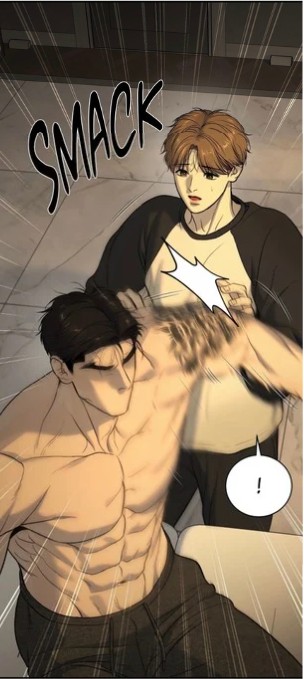 (chapter 96) A hand reaches out to continue what is not yet finished. Kim Dan tries to stop the champion, to maintain the contact, to complete the treatment.
 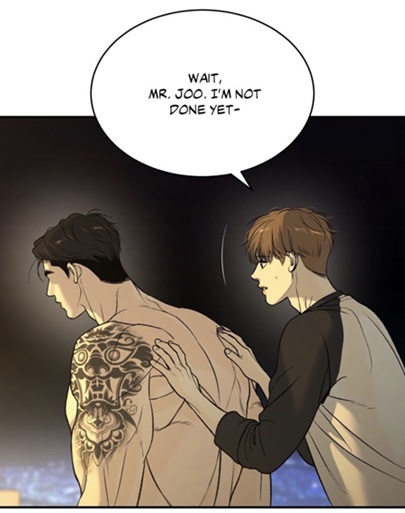 (chapter 96) The response is immediate: Joo Jaekyung pushes the hand away.
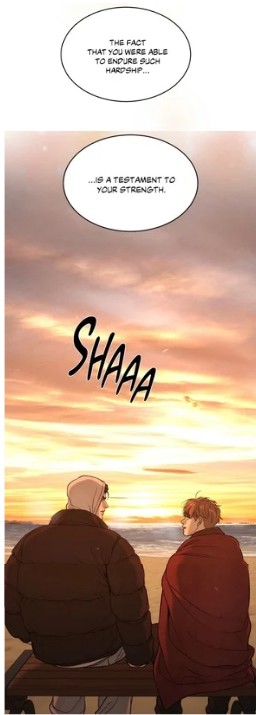 (chapter 95), and the one in the office, where Park Namwook places his hand on the champion’s shoulder and directs him once more toward performance.
 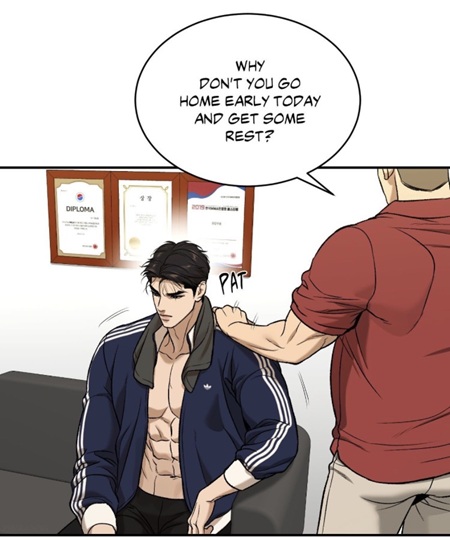 (chapter 95) Both scenes belonged to episode 95, and together they already announced a growing dissonance.
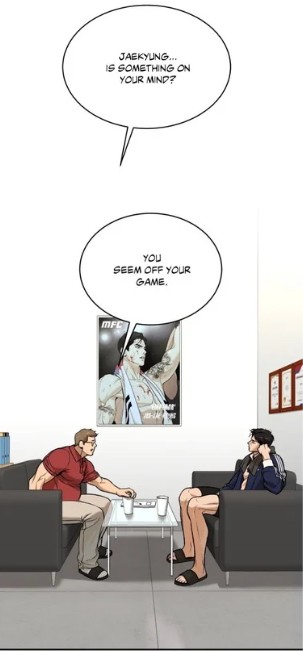 (chapter 95) The other was quieter, grounded in proximity, shared time, and a more fragile sense of presence.
 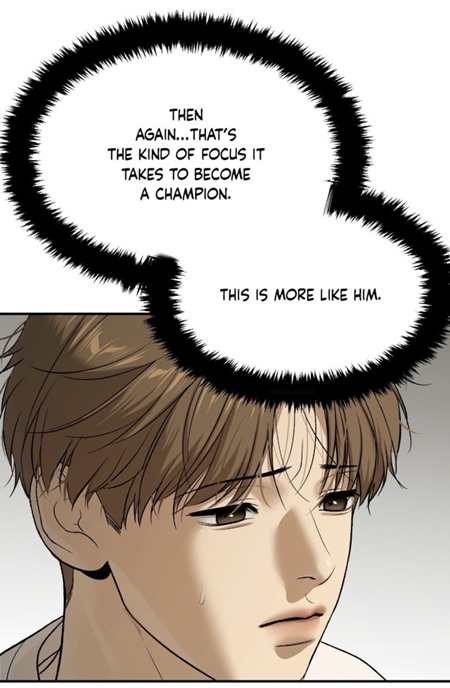 (chapter 96) From where he stands, the words and gesture appear as rejection, and the scene seems to confirm an old pattern.
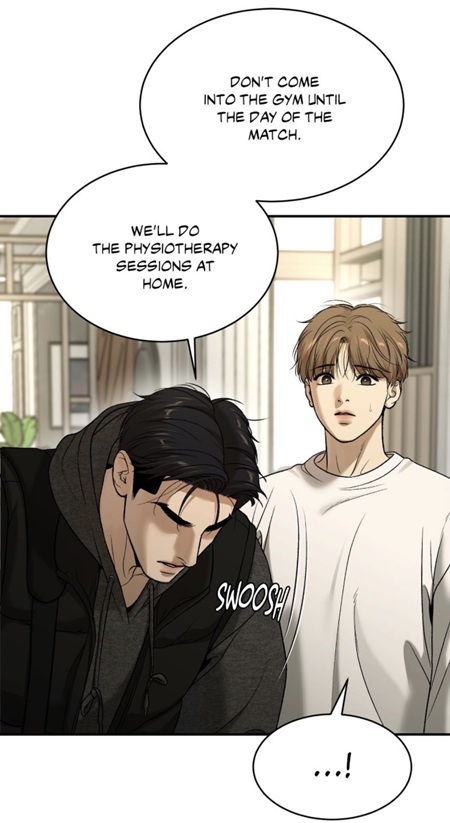 (chapter 96)
  (chapter 95): in what is missing, in what is delayed, in what no longer coincides. A presence that is no longer acknowledged.
 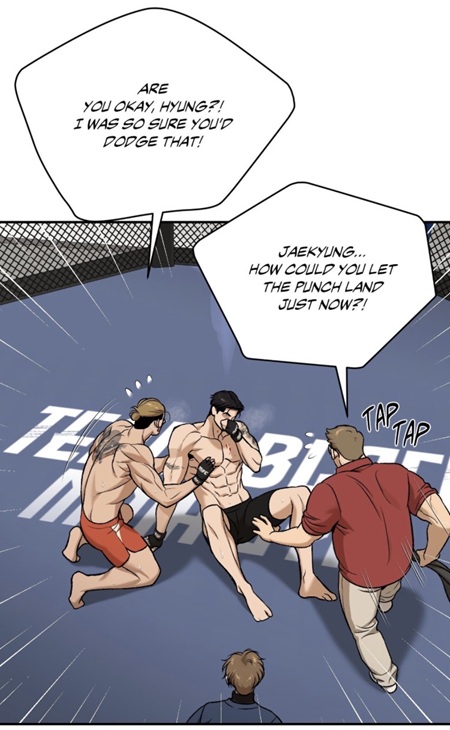 (chapter 95) A response that arrives too late.
 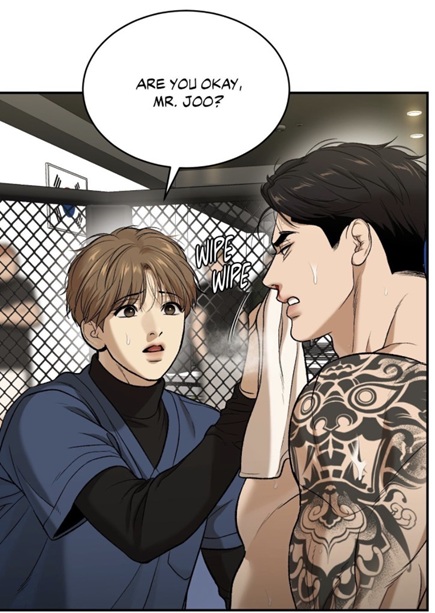 (chapter 95) A touch that relieves tension, but does not invite the burden to be shared.
 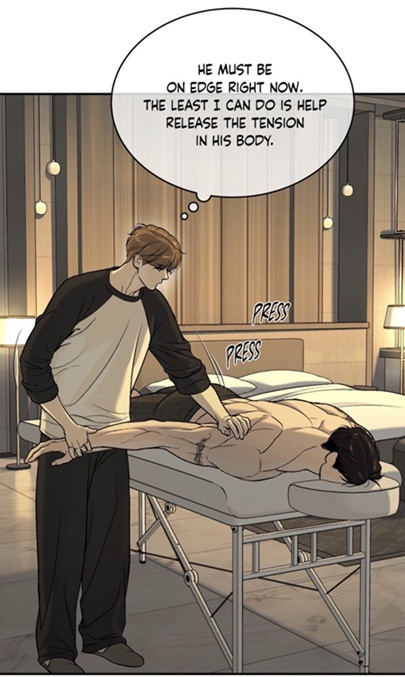 (chapter 96) A hand placed on a shoulder as if the body itself could once again be used to solve what language, trust, or recognition have failed to address.
 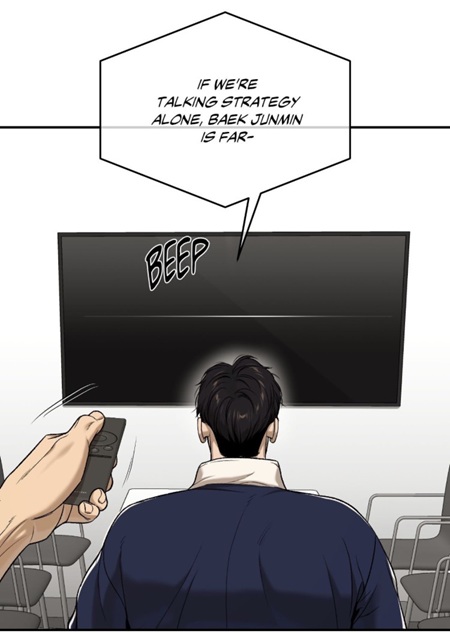 (chapter 95) There is no entourage
  (chapter 36), no managers, no advisors
  (chapter 47), no representatives from the entertainment agency
 (chapter 81). And yet, we know this moment matters: the match is approaching, the stakes are high, the narrative around him is already circulating. He only has 10 days left.
 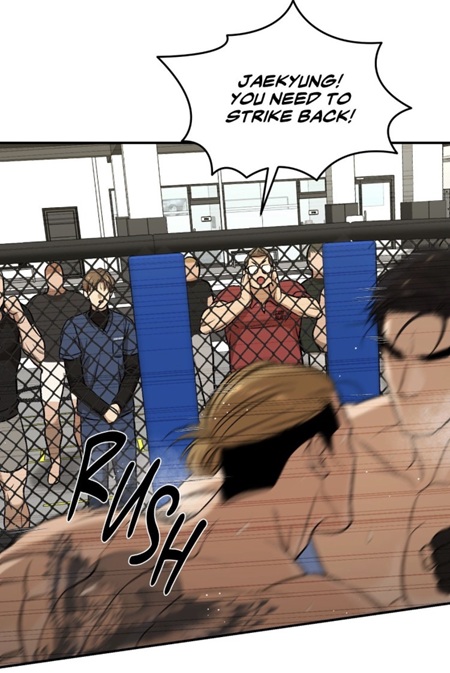 (chapter 95) It becomes even more obvious, if you compare the sparring between the champion and Oh Daehyun
 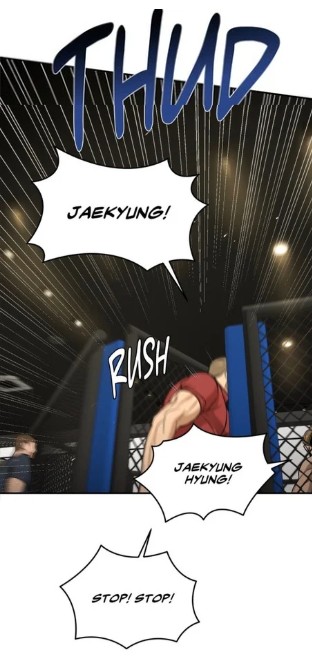 (chapter 95) and the one in episode 1, where the other partner got injured.
 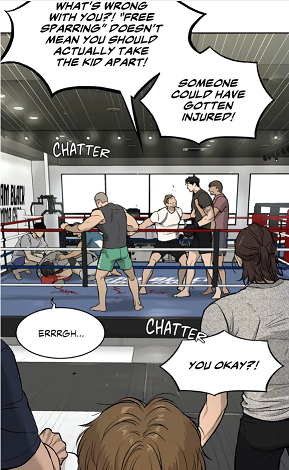 (chapter 1) He rushed to the injured fighter. But in episode 95, he is invisible. No explanation, no transition. His absence is not emphasized—and yet, it echoes. Especially if we recall episode 46, where he was on the verge of being sent out
 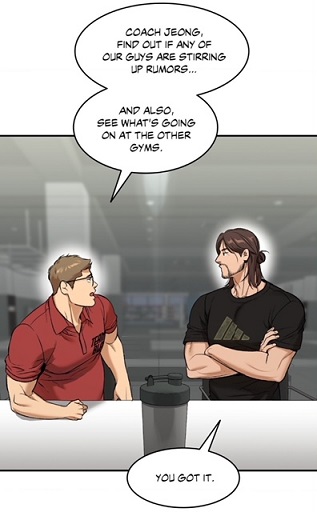 (chapter 46), tasked with gathering information, while Park Namwook positioned himself as the director of Team Black:
 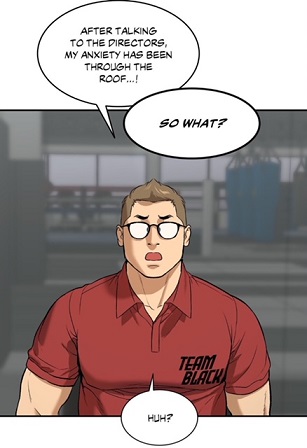 (chapter 46) This detail is not incidental. It establishes a division of roles that is directly connected to a larger structure: the network linking gyms and the MFC. This network is not hypothetical; it is explicitly confirmed in episode 49
 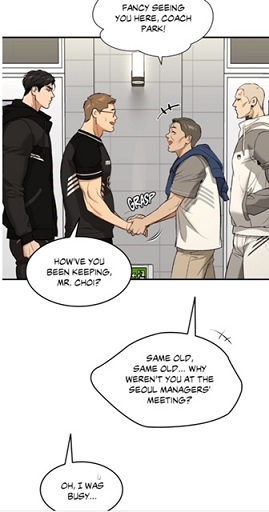 (chapter 49), when Choi Gilseok asks Park Namwook why he was absent from the Seoul managers’ meeting. In other words, coordination between gyms and directors is not occasional—it is organized, expected, and institutionalized.
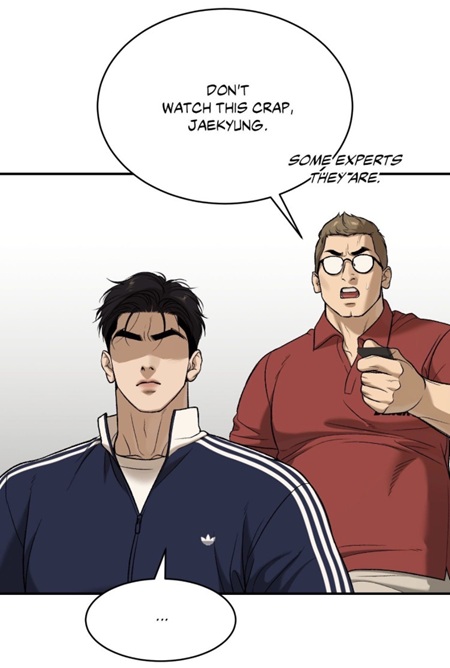 (chapter 95), yet we know that meetings and exchanges between directors must still be taking place, then the question becomes unavoidable: who represents Team Black within that network at that moment?
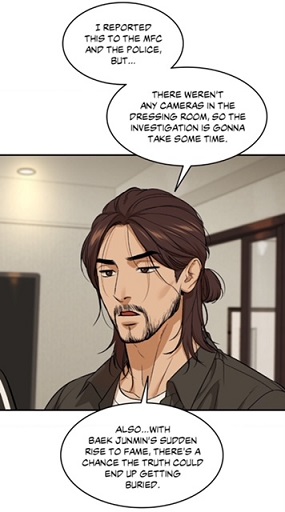 (chapter 52) His absence in episode 95 is therefore not passive. It indicates that he is operating elsewhere, in contact with the MFC and other gyms, possibly relaying information or participating in discussions that remain off-screen.
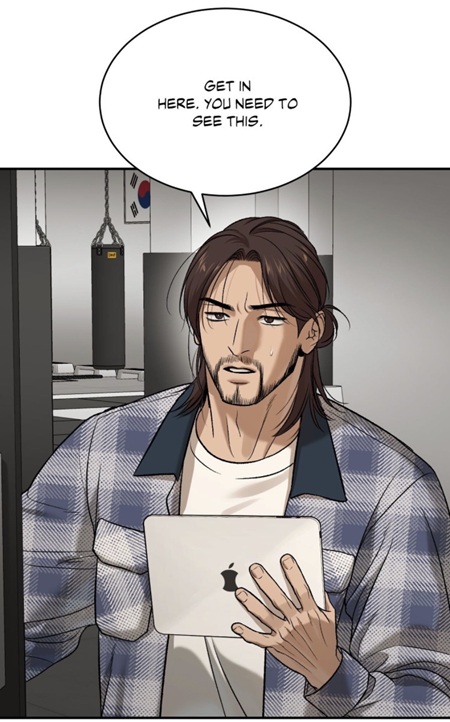 (chapter 96) Yosep is the one who calls Joo Jaekyung. He is already informed. More importantly, he is the one who presents the video—the interview in which Baek Junmin openly frames the confrontation.
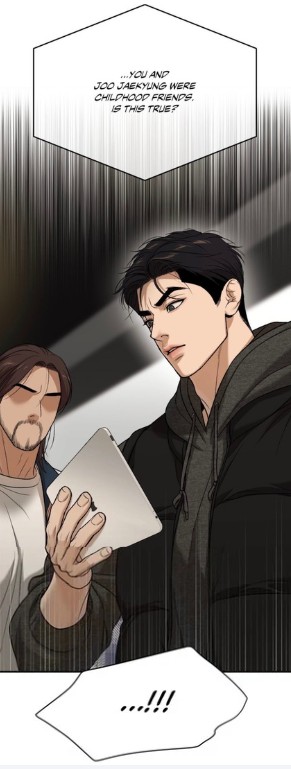 (chapter 96) Instead, he becomes the relay of a narrative that is already circulating publicly. What he transmits is no longer a report meant to establish truth, but a mediated version of events—one that exposes Joo Jaekyung to an external gaze shaped by others.
 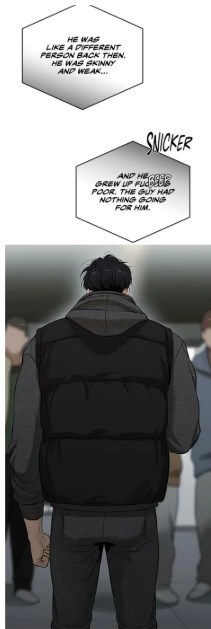 (chapter 96) And this is precisely why the final panel echoes the earlier scene in the office.
 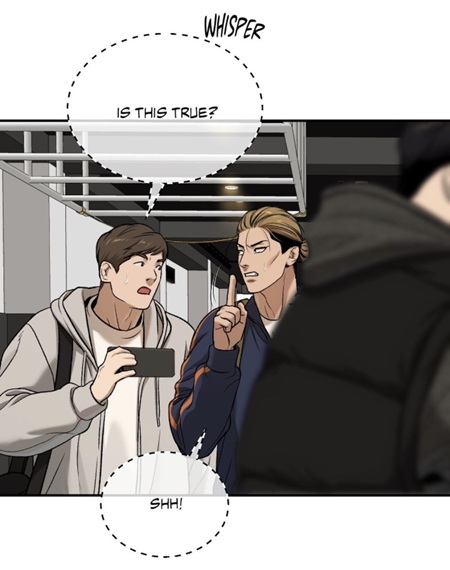 (chapter 96) The space remains silent in structure
 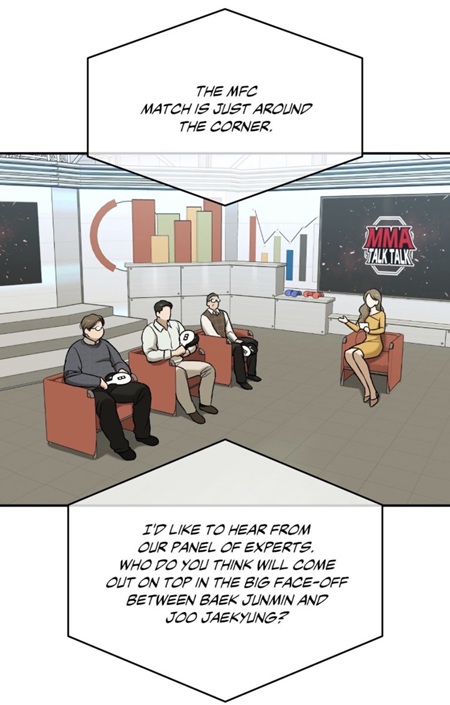 (chapter 95) Then at the end of the scene,
 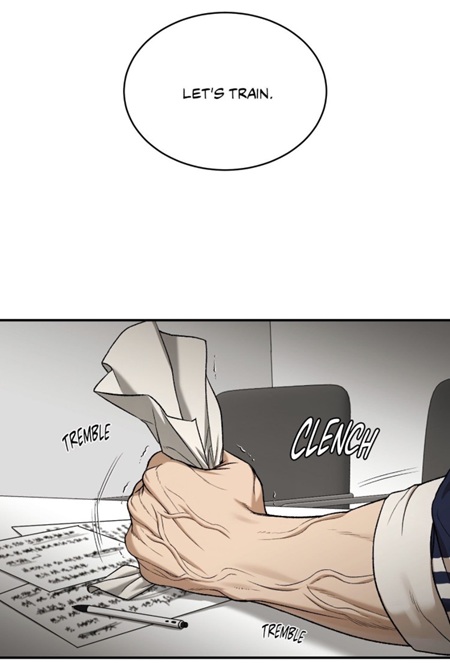 (chapter 95) the author reveals a table full of notes and a pen next to his left hand, while the champion is holding a sheet of paper. This image exposes that Joo Jaekyung was actually engaged in another activity: he was writing notes for his next fight. This implies that he was not oriented toward the act of watching, but toward a process of concentration. So why would he watch a show, when he is developing his game?
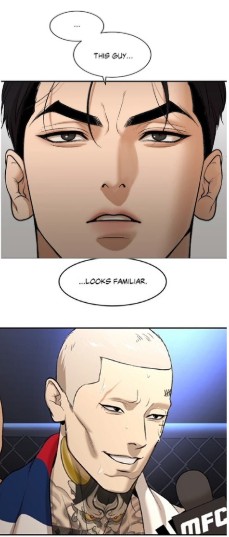 (chapter 47), his gaze is sharply defined and functions as a marker of attention
 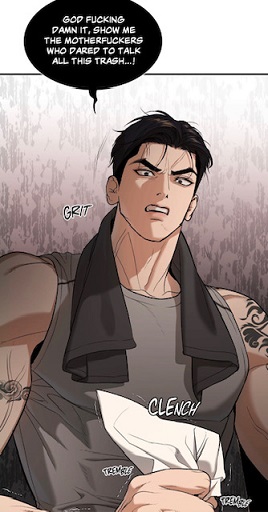 (chapter 36), recognition, or confrontation. Here, that anchor disappears. The subject is present, but not visually positioned as the origin of perception.
 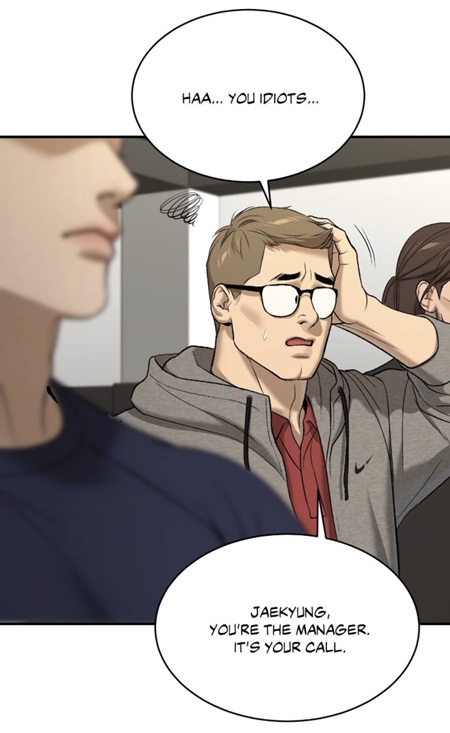 (chapter 87)
  (chapter 89)
 (chapter 13); he intervenes at its margins. He does not construct the framework; he reacts within it. And in doing so, he creates situations in which his presence becomes necessary again —whether by interrupting, redirecting, or framing what is happening.
  (chapter 88) and Shin Okja
  (chapter 94), the champion’s schedule has already shifted: training has been interrupted, attention divided, priorities altered.
 (chapter 37) —they allow it to pass through unchecked.
 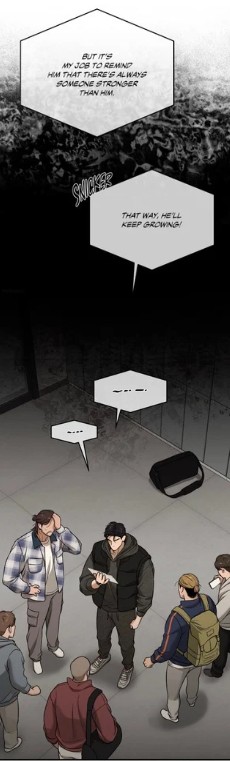 (chapter 96) The boundary between preparation and exposure collapses as the interview is introduced directly into his workspace.
 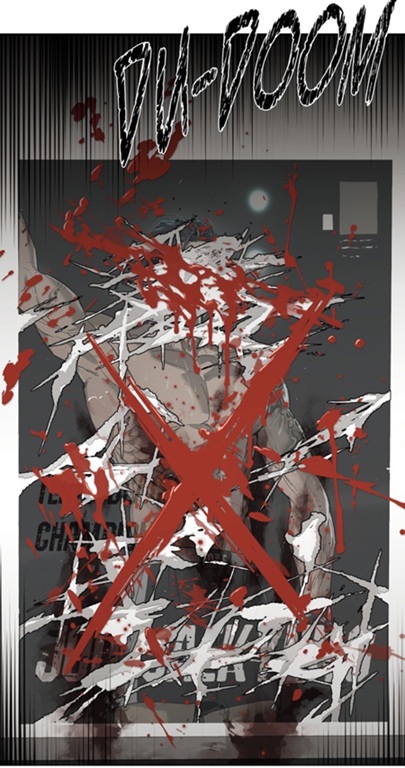 (chapter 96)
 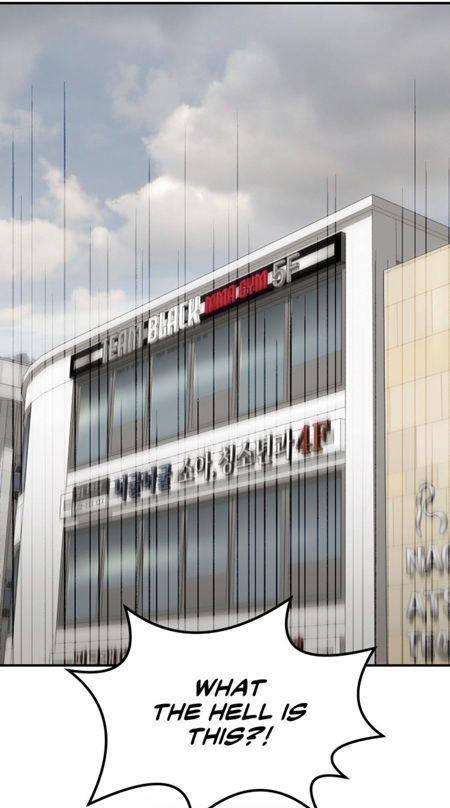 (chapter 96), but he can clear grasp the situation: an act of vandalism. Then he questions the identity of the perpetrator
 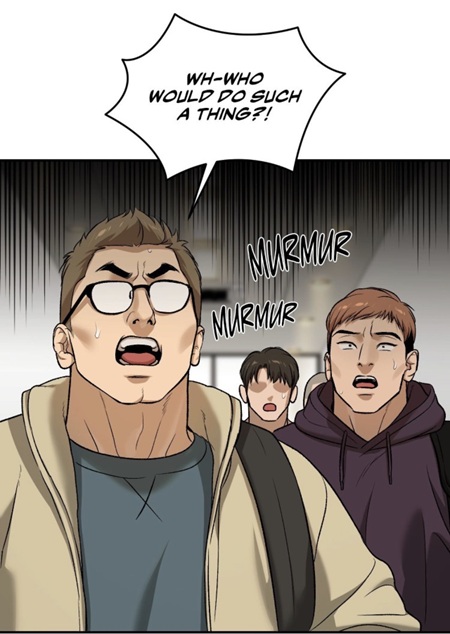 (chapter 96), and turns suspicion toward the fighters present.
 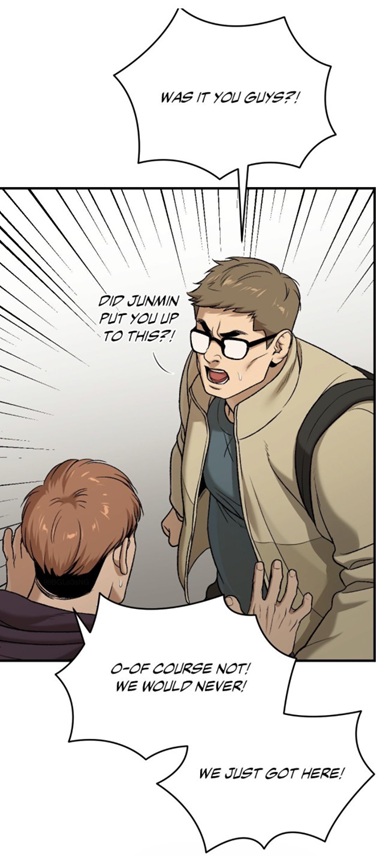 (chapter 96) The scene frames him as someone discovering the vandalism alongside the others.
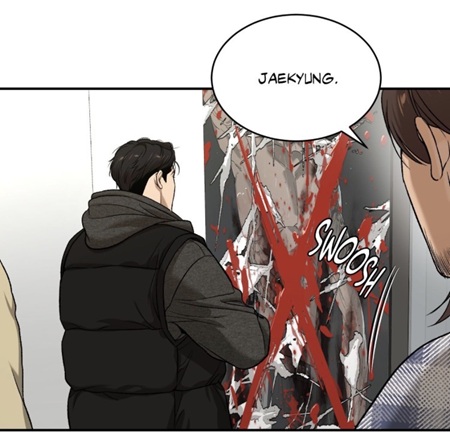 (chapter 96) Yosep is already inside the gym before the others arrive. He opens the door from the inside. This detail matters.
 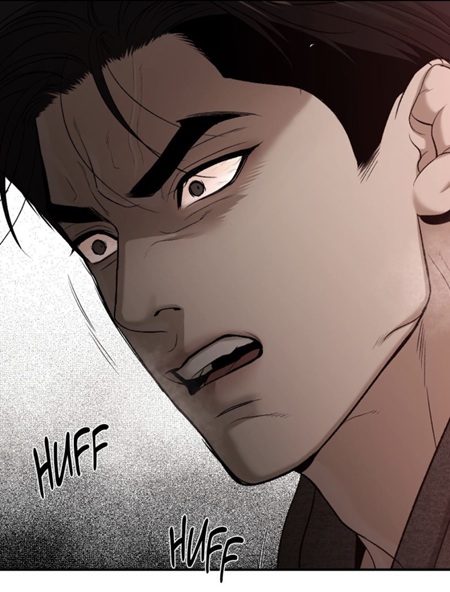 (chapter 96) This transformation is not abstract. It is rendered directly in the body of the athlete. His breathing becomes labored, his skin flushed, his eyes reddened—as if the system itself were overheating. The excess cannot circulate; it accumulates.
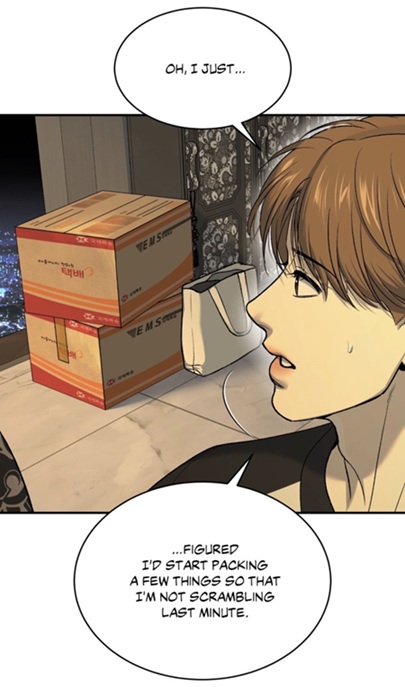 (chapter 96), he does not raise his voice.
 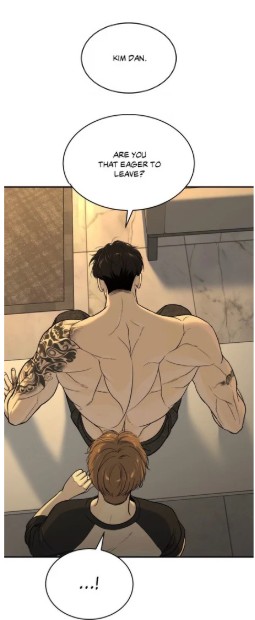 (chapter 96) He articulates his thoughts
 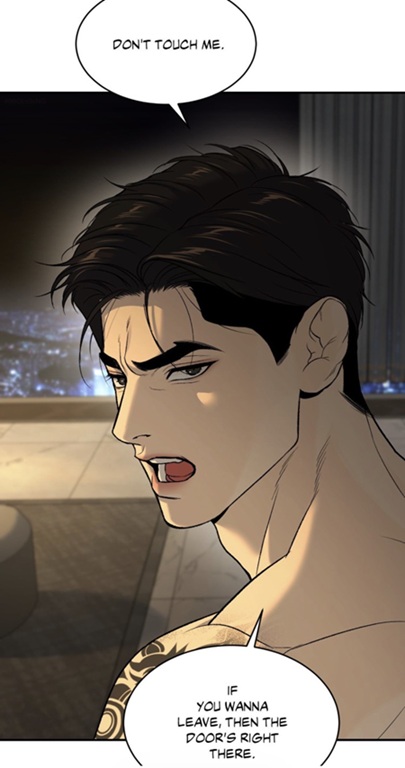 (chapter 96), maintains composure, and—most importantly—
 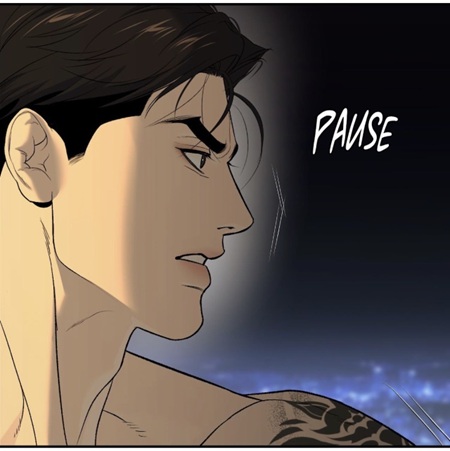 (chapter 96) attends to the other’s response before leaving.
 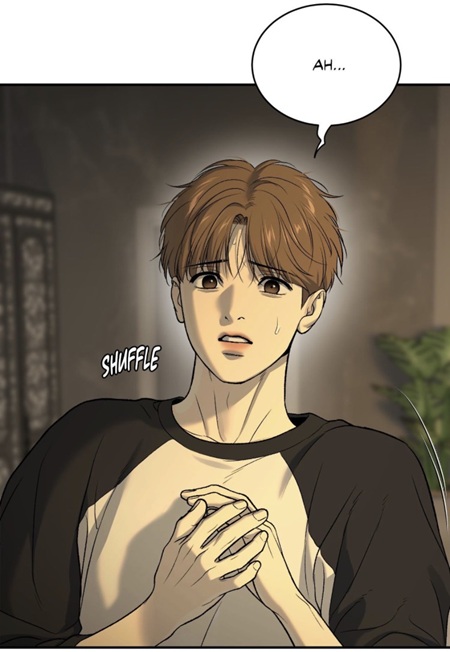 (chapter 96) This detail matters.
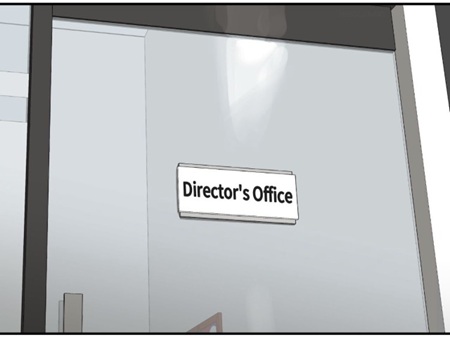 (chapter 95) At first glance, its transparency suggests continuity—the inside and the outside remain visually connected. And yet, the author frames the door in a way that emphasizes secrecy, separation rather than openness. The image functions less as a window than as a boundary.
 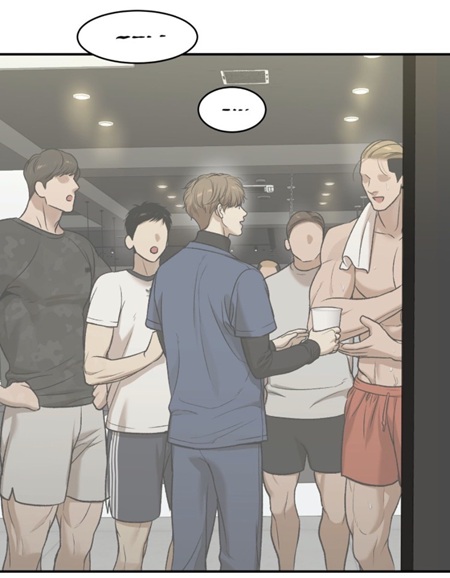 (chapter 95) From within the office, the gym is reduced to indistinct chatter. Voices are present, but blurred, stripped of clarity and meaning. What was previously intrusive—the gazes, the noise, the surrounding activity—is now filtered, contained, pushed into the background.
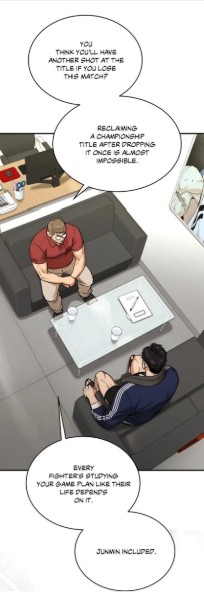 (chapter 95) The couch is positioned in front of the desk, not behind it. Park Namwook sits on that couch, facing Joo Jaekyung. He does not occupy the desk itself—the formal seat of authority remains physically unclaimed. And yet, the alignment of the space creates a different effect.
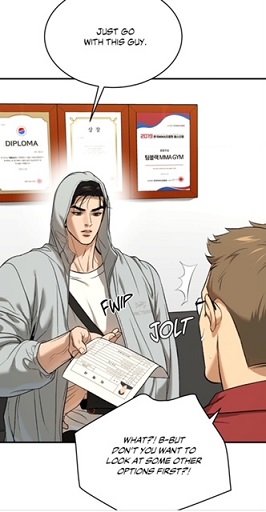 (chapter 54) He imagined that the celebrity would entrust him the selection. To conclude, Park Namwook’s seat is not random. He represents a hindrance to the fighter’s emancipation, becoming the director of a gym.
 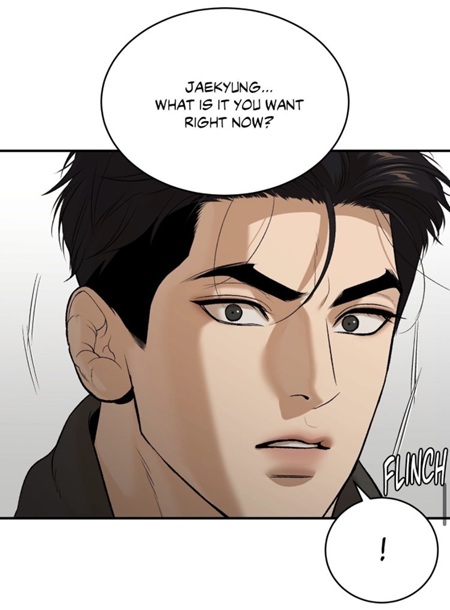 (chapter 95)
 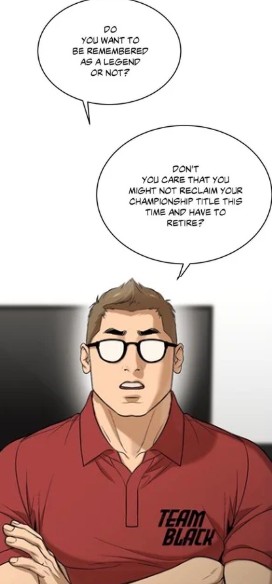 (chapter 95)
 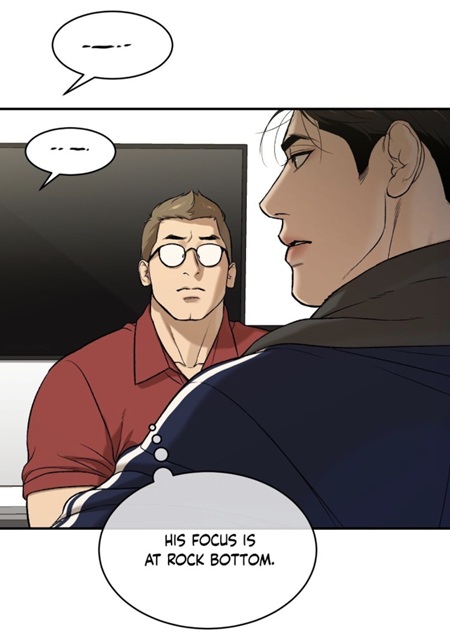 (chapter 95), readers can detect a pattern emerging.
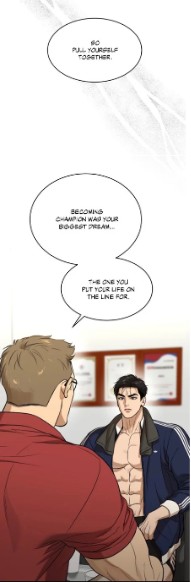 (chapter 95) There is no transition to negotiate, no boundary to maintain. There is only the fight. What appears, from this perspective, as distraction is therefore reinterpreted as failure. What is, in fact, a tension between two spheres is reduced to a flaw within one.
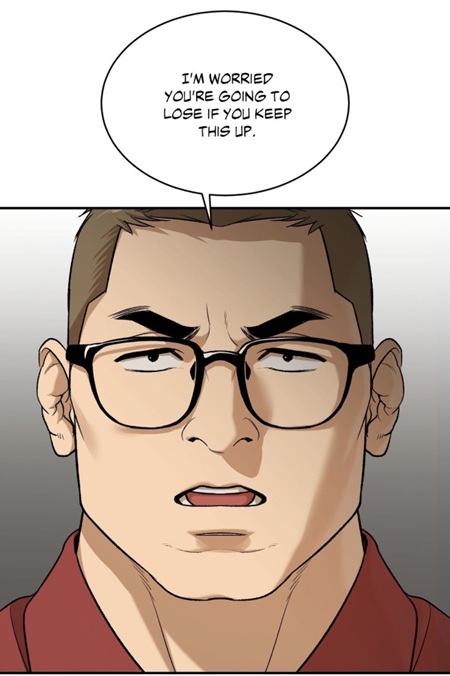 (chapter 95) This clarity signals a mode of perception that has already appeared elsewhere. When he looks at the main lead and calls him “fresh meat”
 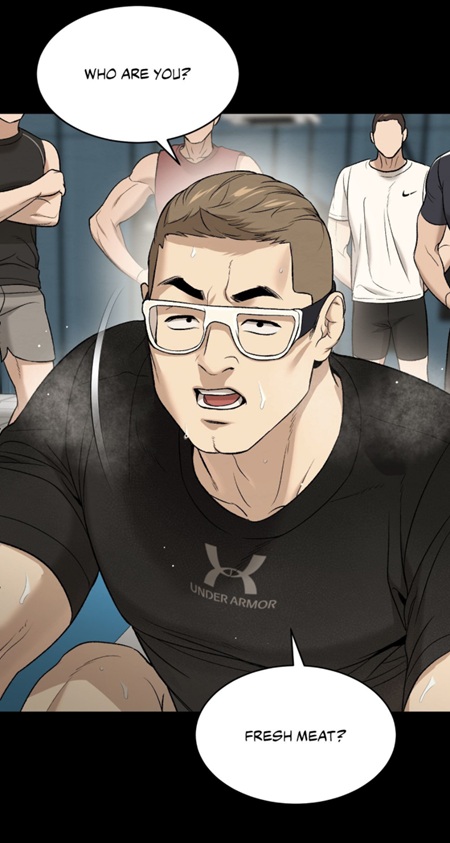 (chapter 74), the same logic is at work. The individual is not encountered as a subject, but classified as a function, reduced to a body that can be evaluated and positioned.
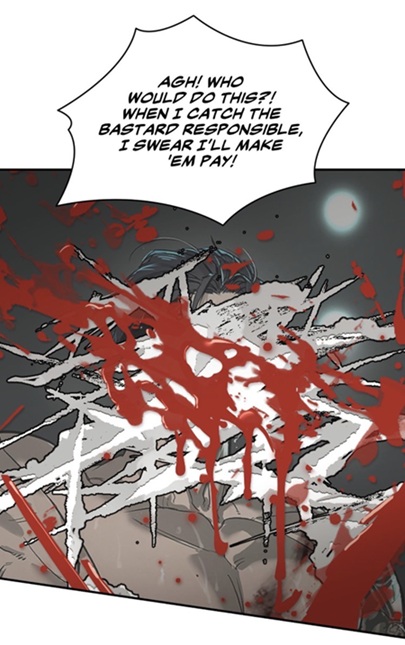 (chapter 96). His anger is immediate, but its object is telling. He does not interpret the act as hostility or as a symbolic attack directed at Joo Jaekyung. Instead, he speaks of damage, of responsibility, of compensation. The act is translated into material loss. What matters is not what it signifies, but what it costs. At the same time, he imagines that this is the work of a single person! But the broken CCTV
 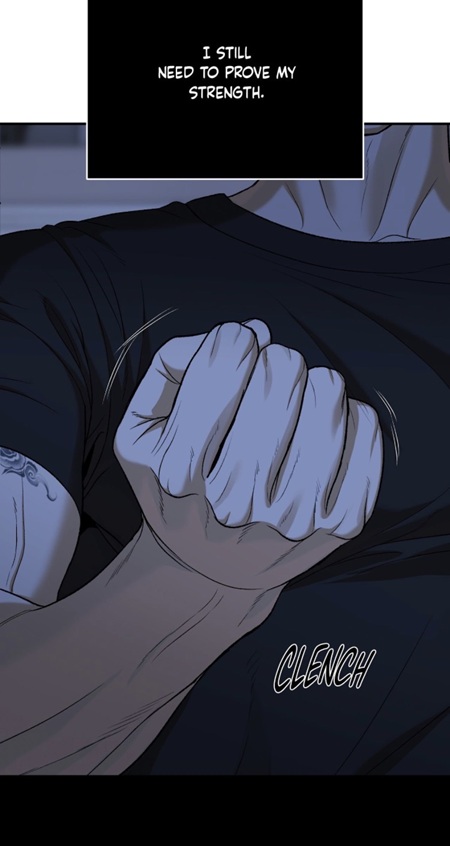 (chapter 95)
 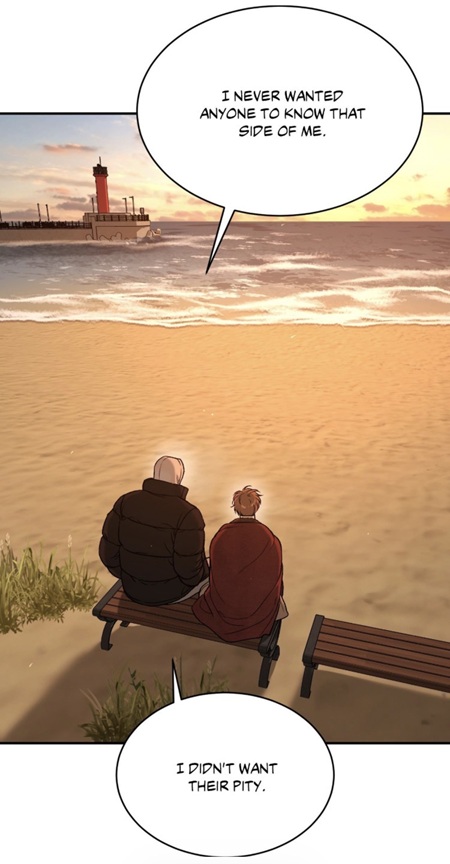 (chapter 95) Joo Jaekyung and Kim Dan sit side by side, aligned within the same horizontal plane. The asymmetry that structured the office—front versus opposite, speaker versus evaluated—seems to dissolve. The scene suggests proximity, even equality.
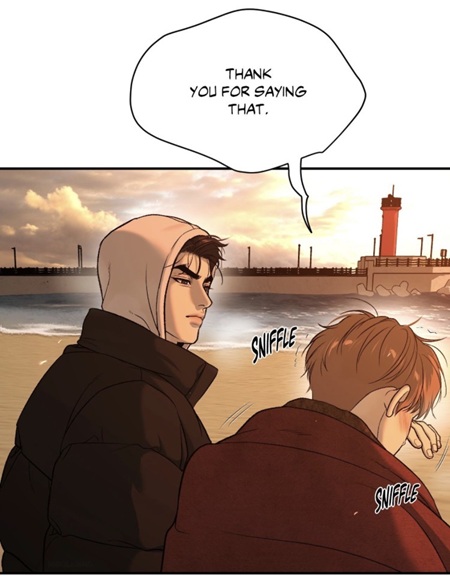 (chapter 95) The promise is unilateral. There is no reciprocal formulation, no mirrored commitment, no re-articulation of the bond from the other side. What is offered outward is not taken up and extended; it remains suspended.
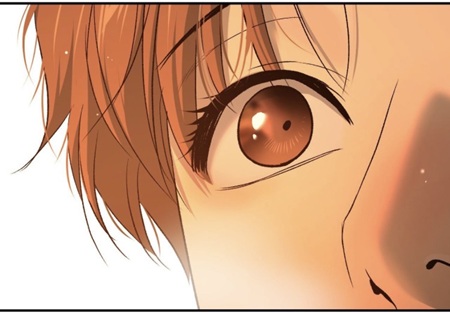 (chapter 95) In Kim Dan’s gaze, Joo Jaekyung is not reflected. What appears instead is the lighthouse in the distance. At first glance, this suggests a displacement: the athlete’s presence does not fully register within his field of vision.
 (chapter 69) This panel implied that Kim Dan had become his whole world. The comparison exposes that the athlete is still not in the center of his life yet. The lighthouse is not only an external point of orientation.
 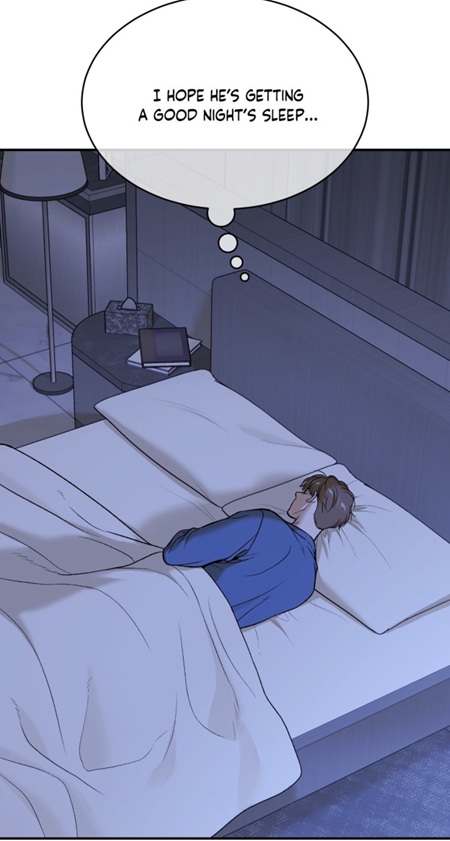 (chapter 91) It lingers in the background, acknowledged but never truly treated. And yet, it is not incidental. Insomnia signals the inability to withdraw, to interrupt exposure, to let the body enter a different rhythm. In this sense, it mirrors the function of the lighthouse. A lighthouse remains on—it stabilizes, but it does not allow rest.
  (chapter 96), without reestablishing that line of orientation, the structure collapses. What had been silently assumed—being seen, being turned toward—is no longer confirmed.
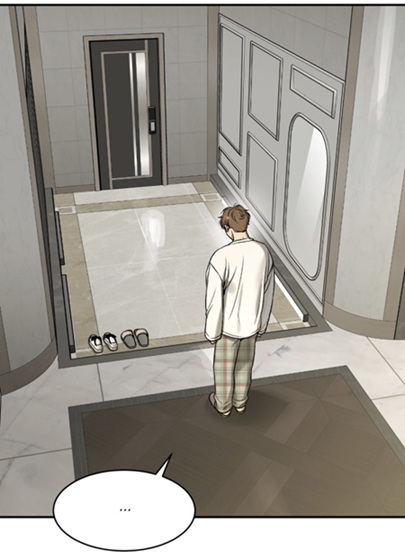 (chapter 96) But the position he has taken—the one of quiet constancy, of supportive presence—is not acknowledged. The lighthouse remains, but no one looks at it. Striking is that before the champion left, the doctor tried to reconnect with him by wishing him good luck.He is modest and hesitant.
 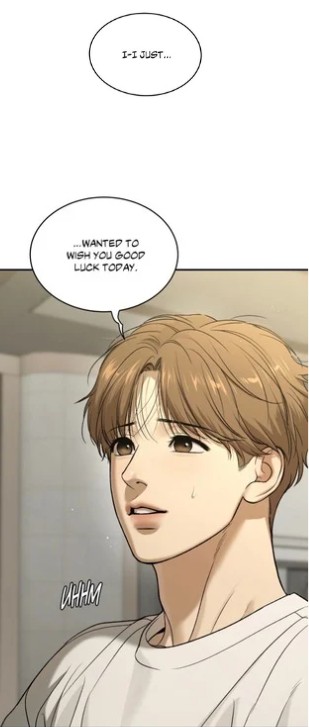 (chapter 96) At first glance, this appears simple. But it is not neutral. It is a repetition. Kim Dan tries to reactivate a shared ritual—the one established after the night in Paris.
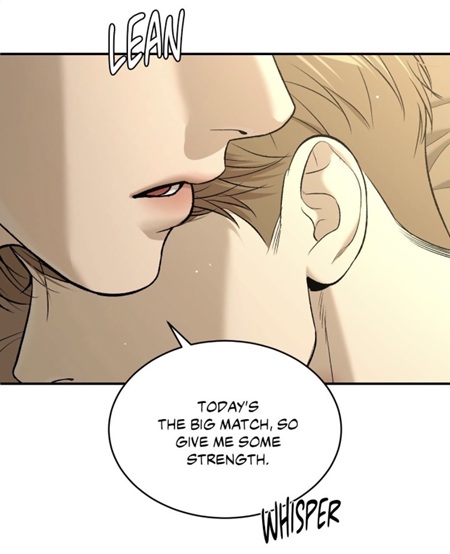 (chapter 87) A moment where touch, words, and intention aligned.
 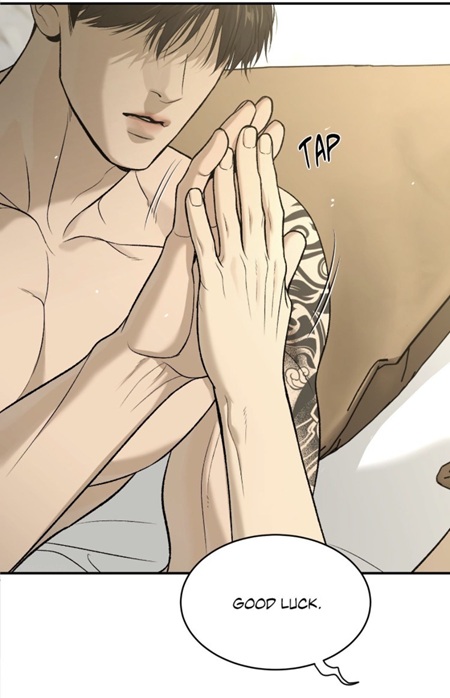 (chapter 87) A moment where connection was not abstract, but embodied.
 (chapter 87) But in front of the entrance, something is missing.
  — earlier echoed outside the narrative—suggests a moment that has not yet been reached. A point where gesture, intention, and response will finally align.
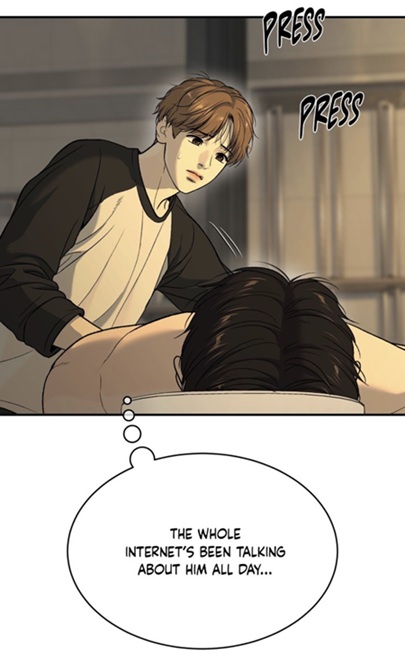 (chapter 96); this recognition does not lead to inquiry. It remains observational, not relational. He does not question the narrative, nor its effects. He adapts to it. I doubt that he even watched the interview, as the former coach and director Hwang Byungchul got insulted and diminished.
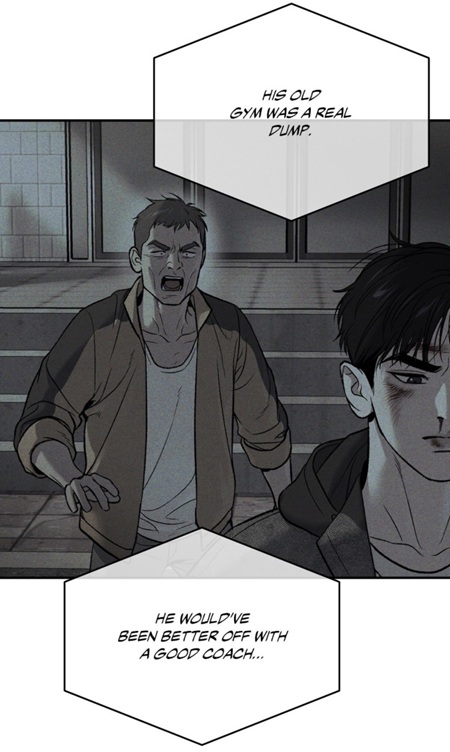 (chapter 96)
 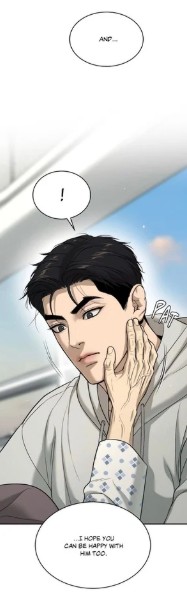 (chapter 94) The space is quiet, contained, almost suspended—and within it, a gesture occurs that does not follow the logic established elsewhere.
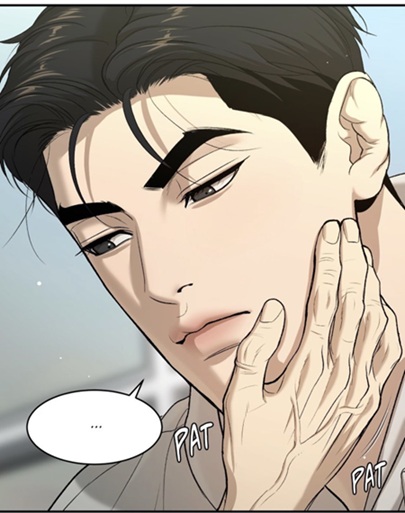 (chapter 94) It is not a gesture of control, nor of care defined by function. It is, instead, a gesture of recognition and affection.
 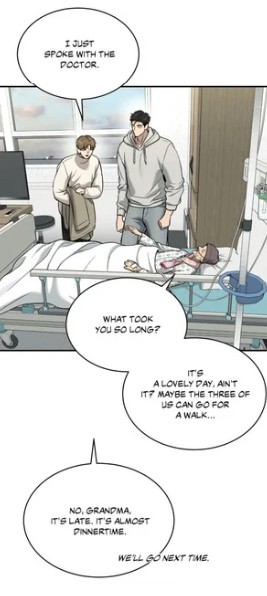 (chapter 94) When the grandmother suggests that “the three of us can go for a walk,” the gesture shifts from recognition to movement. The proposal is not incidental. It translates what has just been opened into a concrete form.
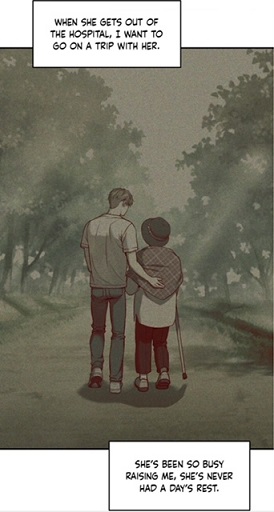 (chapter 47) It requires alignment—of direction, of rhythm, of time. It transforms a moment into a duration, a shared presence into a shared trajectory. It is, in its simplest form, the embodiment of synchrony. This observation outlines the contrast to the champion’s promise on the beach.
 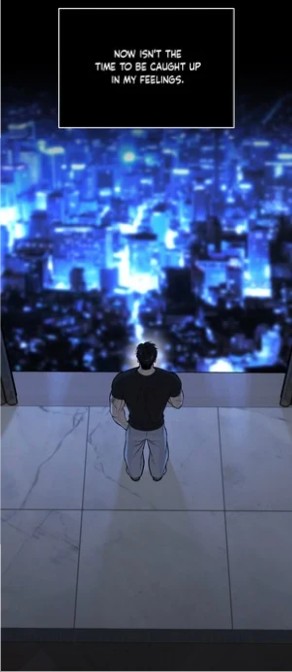 (chapter 95) Her words are not recalled, her figure is not evoked, her request is not consciously revisited. On the surface, she is absent. And yet, this absence is deceptive.
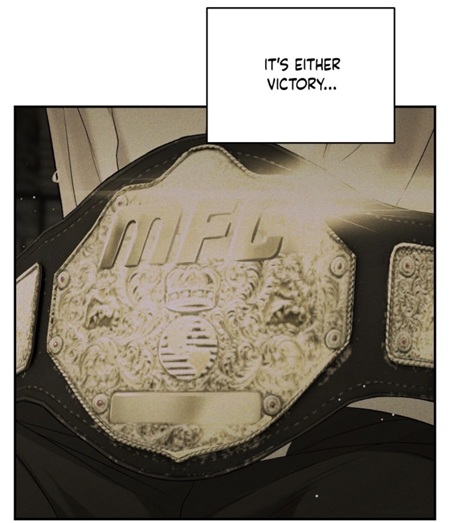 (chapter 95) —is no longer stable. It is immediately unsettled by another voice, another possibility:
 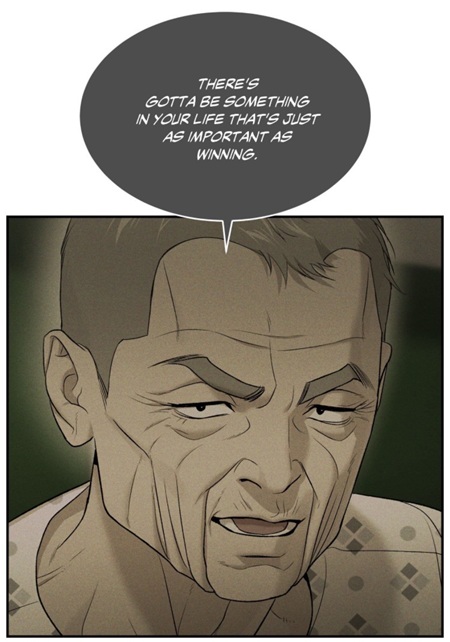 (chapter 95) And what follows is not an abstract idea. It is an image. Kim Dan appears.
 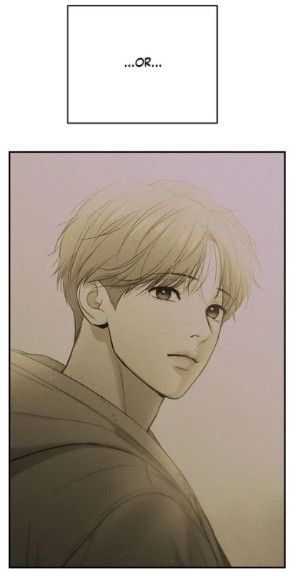 (chapter 95) This shift is decisive. The grandmother is not present as a figure, but as a function. She has already altered the internal configuration through which Joo Jaekyung perceives himself. Her gesture has been absorbed, displaced, and translated into a new form of questioning.
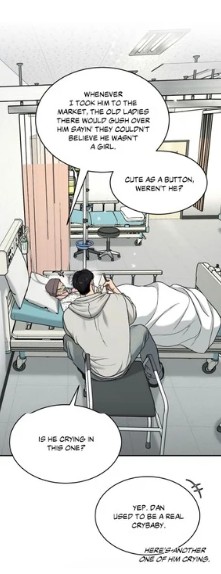 (chapter 94) It has introduced a new axis—one that opposes performance to relation, victory to something else that remains undefined, but essential. But this axis is not yet resolved. It exists as a fracture. And from this point onward, absence no longer signifies emptiness. It signifies transformation. What is no longer visible has already begun to act.
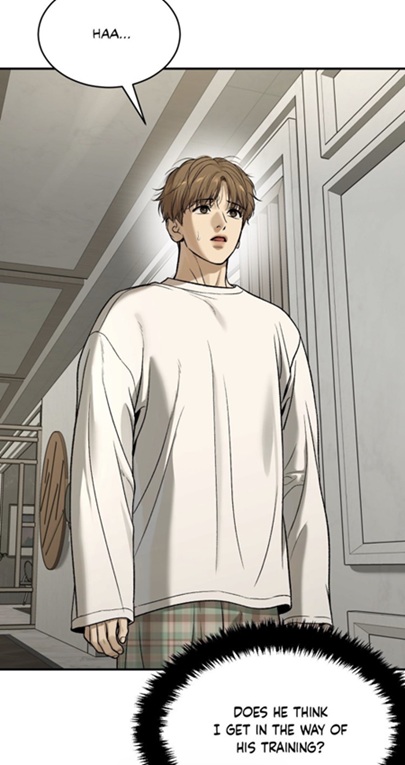 (chapter 96) Thus the physical therapist is not included in the meeting. Distraction must be eliminated, influence must be controlled, and relationships are tolerated only insofar as they remain functional. The body must remain available, and the mind aligned.
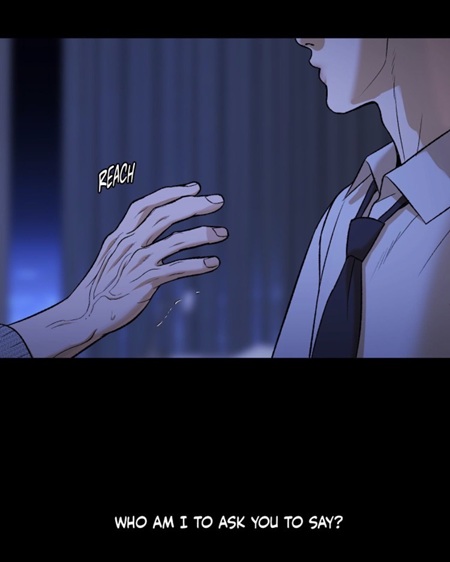 (chapter 90) — and then he pulls his hand back.
 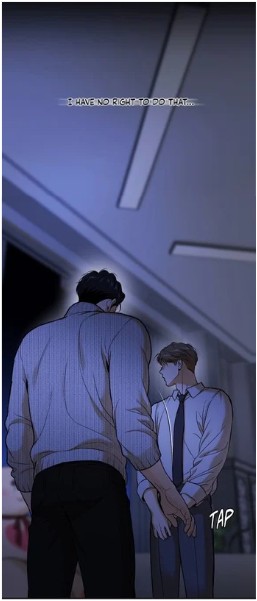 (chapter 90) No words are spoken to stop him. His hand is not even pushed away, like doc Dan did it before.
 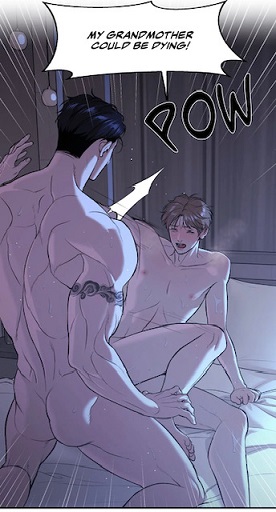 (chapter 21) Everything happens in silence. The interruption comes entirely from within.
 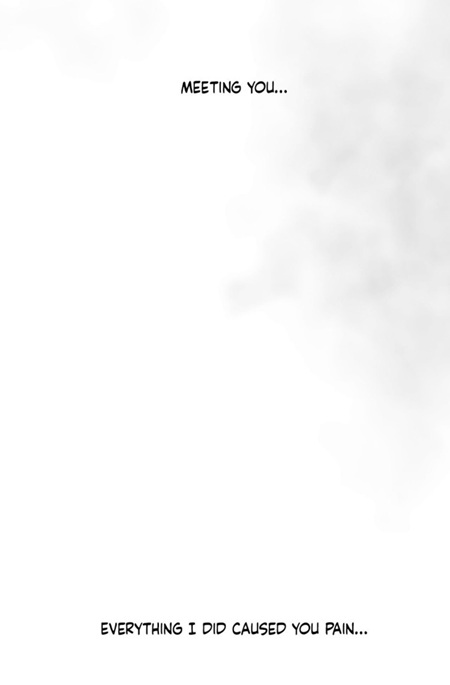 (chapter 90) In his mind, everything that followed the hiring — the money, the contract, the protection, the conflicts — converges back onto him. Faced with this conclusion, he rewrites the past. The good moments lose their weight.
  (chapter 26)
 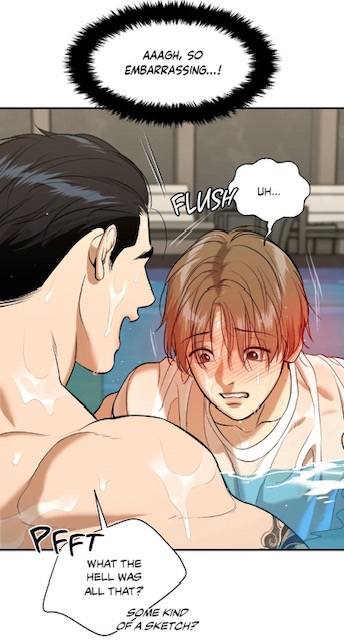 (chapter 27)
  (chapter 88)
  (chapter 89) The help he provided becomes irrelevant. What remains is a single narrative: meeting him caused harm.
 (chapter 61) the clenched fist, when he expressed determination to achieve his goal (bringing back doc Dan or winning a fight).
  (chapter 81)
  (chapter 74), or converting conflict into challenge.
  (chapter 73) Fighting was not only his profession; it was his primary mode of being in the world. Here, however, the impulse to fight dissolves.
  (chapter 16) The grasp that follows is not an invitation, but a reaction to damage already inflicted. Resistance has been broken through the body before appeal becomes possible. It symbolizes submission, exactly like in the penthouse.
  (chapter 89), unlovability, moral contamination
  (chapter 89) — do not introduce a foreign judgment. They articulate what Joo Jaekyung already believes about himself.
 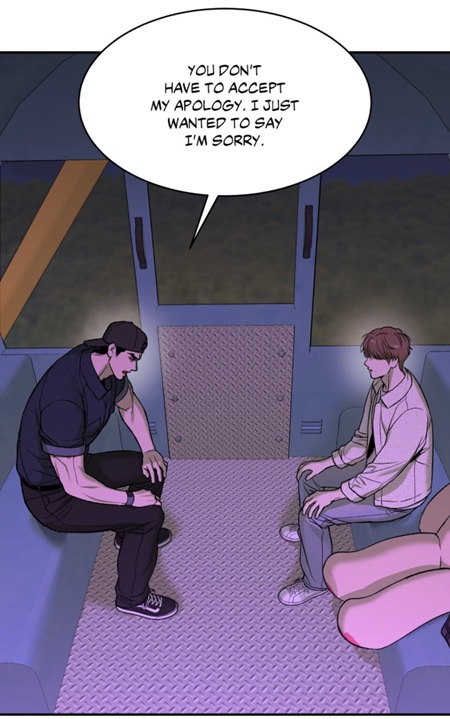 (chapter 84) Deep down, he thinks that he can not be forgiven and even loved. This is precisely why they take hold. Spoken aloud, they acquire the authority of truth. Once internalized, they no longer need to be repeated.
 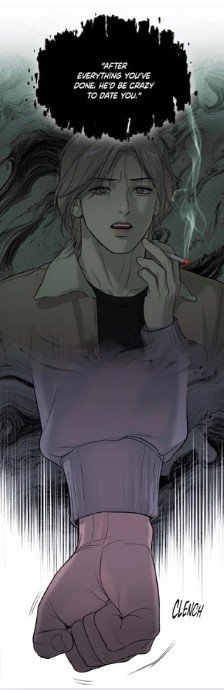 (chapter 89) The panel does not show Heesung speaking again; it shows Joo Jaekyung’s clenched fist, isolated, rigid, suspended in recollection. This is not the fist of imminent action. It does not precede a strike. It does not convert pain into confrontation. Instead, it freezes.
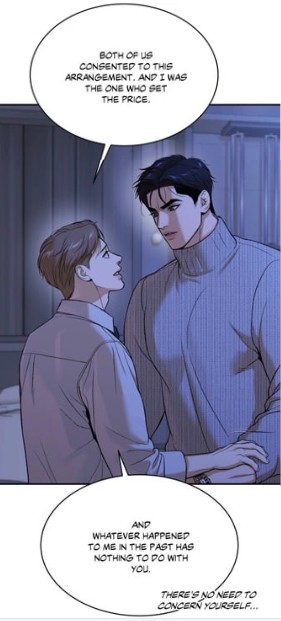 , (chapter 90) offering reassurance. That attempt failed, not because Kim Dan lacked care, but because reassurance can only reach someone who is still willing to fight for their place. Joo Jaekyung is no longer asking how to endure. He is asking whether he should exist in this space at all.
 (chapter 65), and Heesung who dismissed his agency
 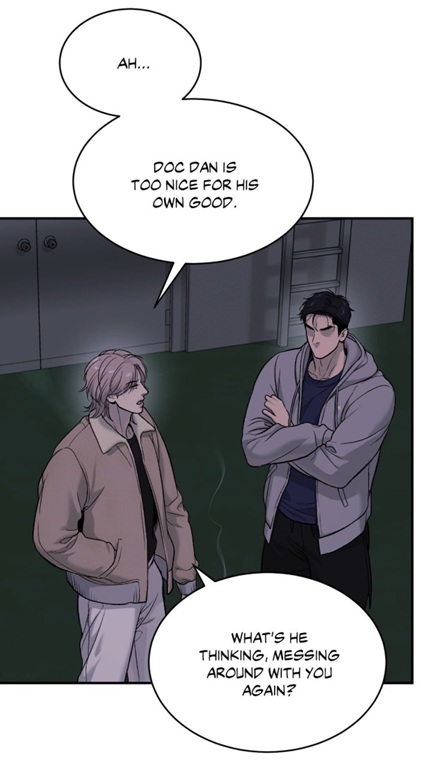 (chapter 89) under the guise of concern.
 (chapter 65), but denied in structure.
 (chapter 2), an external curse that followed his steps. Here, that distinction collapses. He no longer experiences the jinx as an event or condition, but as an identity. He does not fear what might happen because of him; he accepts that he himself is what causes harm. The curse is no longer something he carries. It is something he has become. Once internalized in this way, it no longer requires rituals to contain it.
  (chapter 75) Practices that once functioned as talismans—gestures meant to ward off misfortune or secure victory—lose their meaning.
  (chapter 75) What collapses is not only belief in luck, but belief in the necessity of striving at all.
 8episode 10), Kim Dan wakes up there after drinking excessively, confused why he is sleeping in the penthouse. He doesn’t know that the night before in his drunkenness, his thoughts were turning toward his grandmother. He was mistaking the athlete for his relative.
  (chapter 10) He feared getting abandoned. When the doctor realized his whereabouts, he imagined that he had sex with the champion. As you can see, the bedroom is strongly intertwined with longing and sin, where consciousness returns only after collapse. This association deepens in episode 20, when sexual intimacy is immediately followed by a phone call announcing his grandmother’s critical condition.
  (chapter 20) Pleasure and threat coexist in the same space, binding the room to the anticipation of loss.
 (chapter 29), his body once again giving way under accumulated strain. The room is no longer merely where exhaustion manifests; it is where it becomes undeniable. In episode 61, the association shifts again: Joo Jaekyung comes to the room seeking sex, but Kim Dan is unwell, unable to voice his own thoughts, unable to refuse.
  (chapter 61) Illness interrupts desire, and the room marks the moment where agency falters.
 (chapter 79). Once more, it is this room that frames the danger.
  (chapter 79) The body moves without consciousness, hovering at the edge between presence and disappearance. The room becomes a liminal space where life is not actively threatened by violence, but quietly endangered by exhaustion and dissociation (suicidal thoughts).
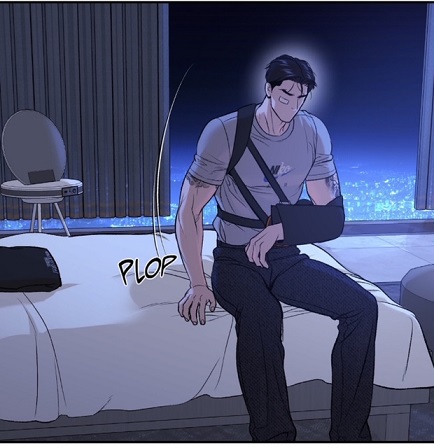 (chapter 53) The object becomes a trace of absence, and the room transforms into a container of loss. Standing by the window, Joo Jaekyung is portrayed without eyes.
  (chapter 53) The visual choice is crucial: it does not indicate blindness in a literal sense, but an inability to see forward, to orient himself. He is present in the room, but detached from direction and purpose. This scene announces the falling apart of the athlete.
 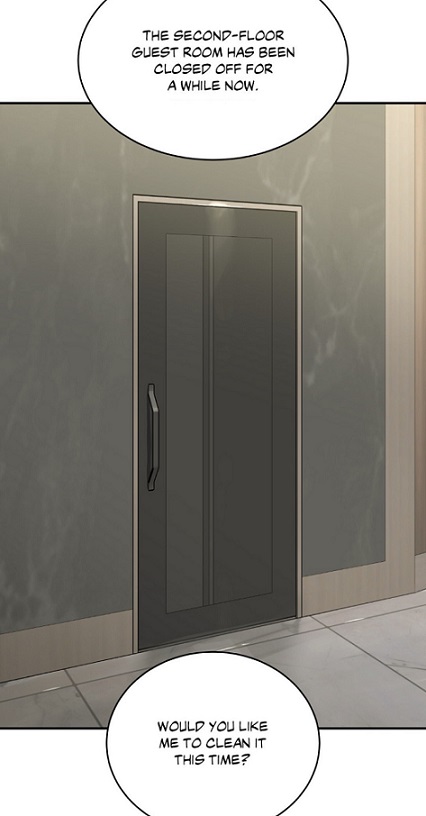 (chapter 55) The space is sealed off, preserved, treated almost as a forbidden zone. The cleaning staff is not allowed to enter. Nothing is moved, corrected, or neutralized. The room becomes a reliquary rather than a dwelling — a place frozen in the moment of loss. Joo Jaekyung does not confront what happened there; he keeps it intact, untouched, and therefore unresolved. At the same time, he imagines that avoiding that place will help him to forget doc Dan’s gaze and face.
 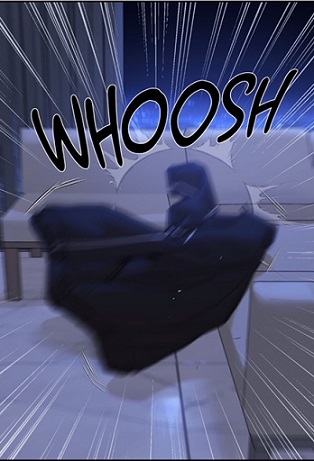 (chapter 53)
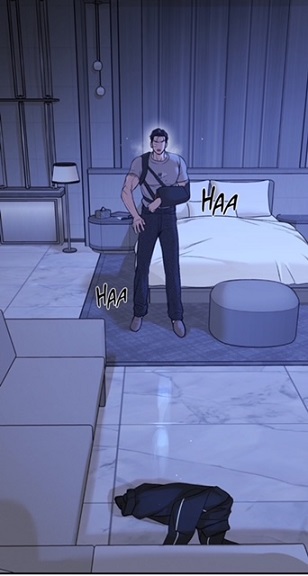 (chapter 53) In episode 54, wine bottles begin to accumulate beside the couch
  (chapter 54) in his own bedroom leaving a huge red wine stain on the carpet.
  (chapter 55) And in episode 90, the teddy bear now rests on the couch in Kim Dan’s room
  (chapter 90) — occupying the very place toward which the jacket once flew. Across these scenes, the hand and couch emerge as a recurring site of impact, exhaustion, and surrender. It is where bodies fall, where frustration lands, where the weight of what cannot be said is deposited. One detail caught my attention: because they are not sitting on the couch, the main leads are discussing together. They are able to face each other and as such to listen to each other.
 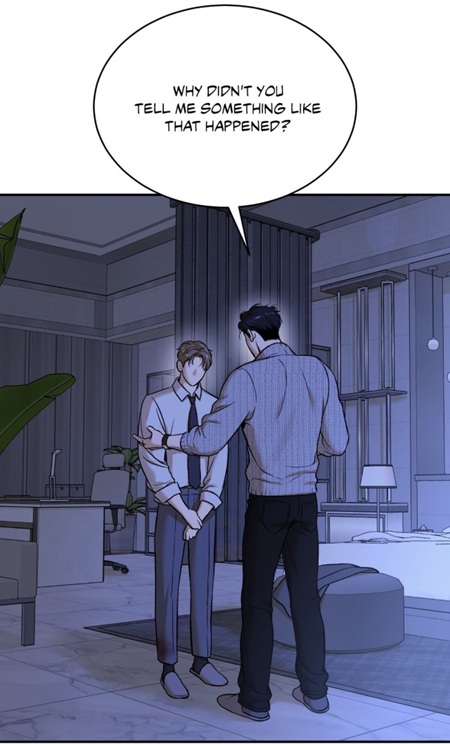 (chapter 90) Their respective position in this room reminded me of their previous arguments.
  (chapter 45)
  (chapter 51)
  (chapter 61)
  (chapter 64) Only when they would truly face each other, they would be more honest and expose their thoughts and emotions. As soon as there is a table, a bed or a couch, I detected some restrain and silence. In other words, the presence of the teddy bear and the couch in that scene explains why Kim Dan is silent and passive after their conversation. He is definitely remembering the day and conversation at the amusement park.
  (chapter 88) On the other hand, it is about time that doc Dan becomes proactive so that they finally become a real team.
 (chapter 79) for everything. He was to blame for everything.
 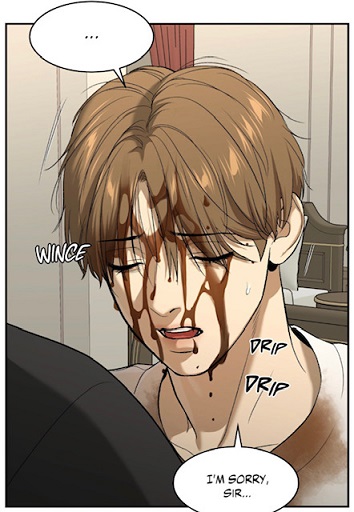 (chapter 37) He endured before being asked. He accepted harm as a condition of acceptance and staying. His silence was not passivity, but a learned ethics: if I ask for less, if I take up less space, if I disappear when necessary, others, in particular his grandmother, might be spared.
 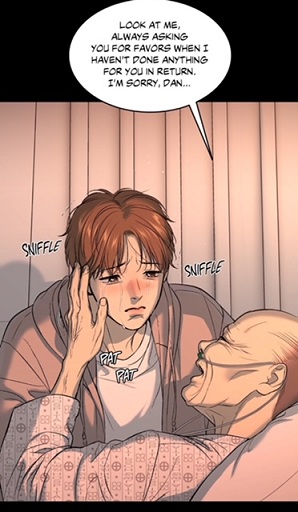 (chapter 53) That posture did not originate with Joo Jaekyung. It preceded him. It was shaped by debt, obligation, omission, and by figures who decided on Kim Dan’s behalf what he could endure and what he deserved.
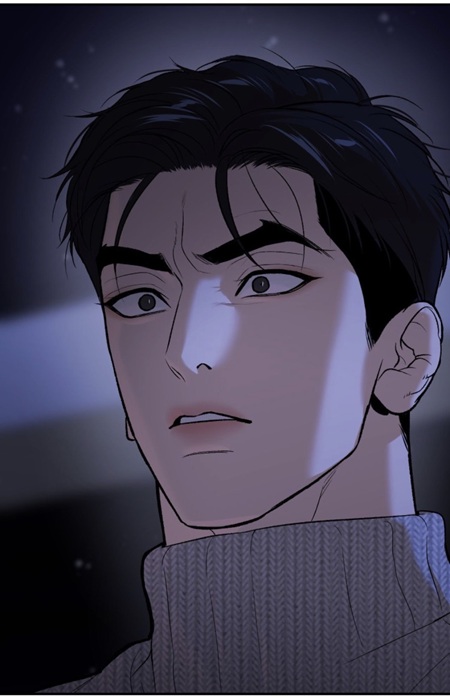 (chapter 90) He does not argue. He does not demand. Instead, he blames himself for everything, thus he withdraws. He refuses to claim a right. He positions himself as the problem that must be removed so that something better might follow.
 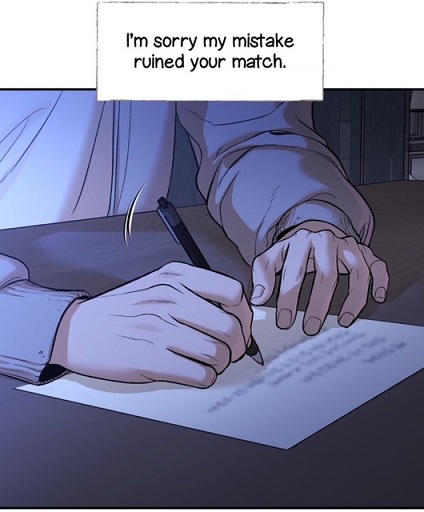 (chapter 53) This is the same moral calculus Kim Dan once applied to himself: the belief that care becomes ethical only when it is accompanied by sacrifice, and that love, if it exists at all, must be proven through disappearance. The only difference is that he can not apologize as his existence has become the synonym of wrongdoing. Thus Kim Dan can not hear the distress from his “loved one”.
 (chapter 74) He remains upright. His posture holds. Yet, he is now voiceless exactly like the physical therapist in the past. From the outside, he still appears powerful, but the loss of cry or sound indicates loss of agency and choice. But structurally, the positions have reversed. The one who once endured now asserts authorship over his choices.
 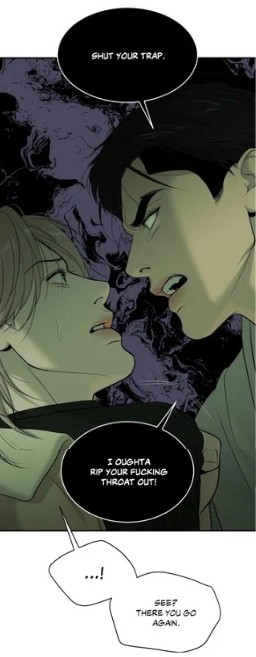 (chapter 89) and the green-haired man
  (chapter 42) operate through the same mechanism: they reduce complexity into a single verdict. Like false mirrors, they collapse months into moments, gestures into essence, and relationships into accusations. They speak as if they own the truth — not because they see clearly, but because jealousy and greed demand certainty. Hence they are connected to the color green. Their words are not reflective
 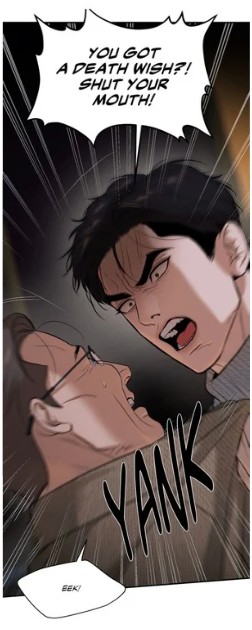 (chapter 90) — not because he shares it, but because the mirror he has become reveals it. Yet instead of recognizing this capacity as ethical clarity, he mistakes it for contamination. He equates himself with the very figures whose cruelty is laid bare in his presence. However, he is making a huge mistake, he is accepting this projection forgetting that he had it all wrong for one reason:
 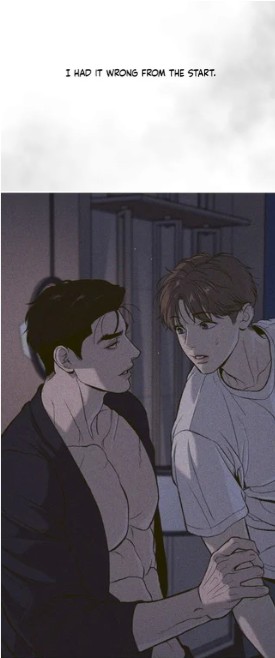 (chapter 90) During their first meeting, the “hamster” had grabbed his “anaconda”.
  (chapter 1) Finally, observe that after this incident, Joo Jaekyung was looking at the embarrassed doc Dan
 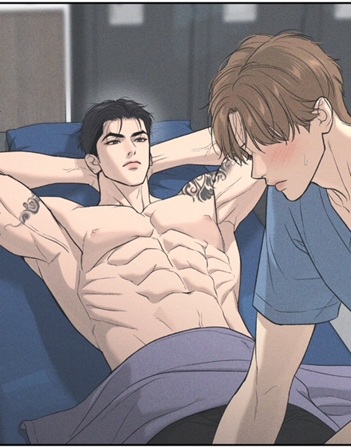 (chapter 56) and thinking that they could have fun together in bed.
  (chapter 56) So doc Dan has his share of responsibility in the champion’s misjudgment.
  (chapter 84) This gesture symbolized their reconciliation in the end,
  (chapter 84) the return of trust and faith in the “champion”. What Joo Jaekyung mirrors is not who the doctor is now, but who he once had to be in order to survive. The tragedy lies precisely there: the champion adopts a posture the doctor has already outgrown thanks to him.
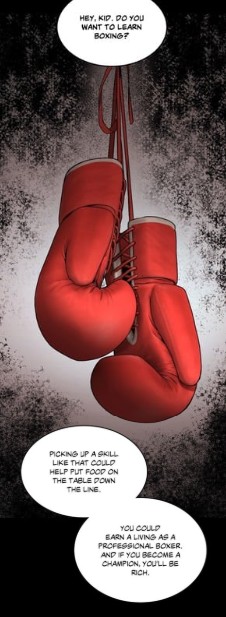 (chapter 72), the reality was that he longed for a home, which he came to associate with his mother. Thus over the phone, he promised to become strong
  (chapter 72), as if the boy’s role was to validate the father’s existence. Joo Jaewoong does not ask his son what he wants
  (chapter 73) and reduces his dream to delusion. Yet even in conflict, Joo Jaekyung seeks recognition.
  (chapter 74) He warns against becoming like the father, to change for the sake of his own mother
  (chapter 74), not by encouraging freedom, but by replacing one obligation with another: win, endure, don’t disgrace the dead. Many years later, he encourages him to change his mind-set, because he could end up alone.
 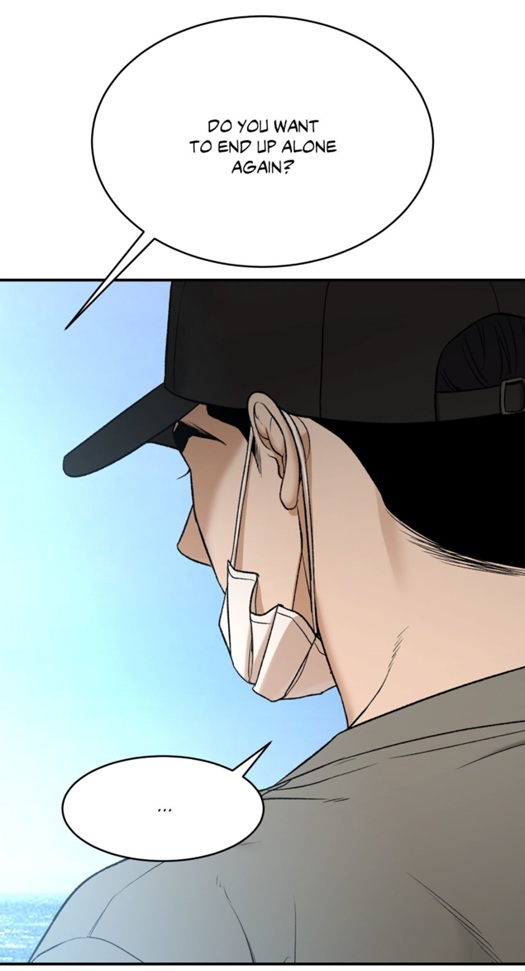 (chapter 75) For the first time, it is no longer about winning or enduring.
 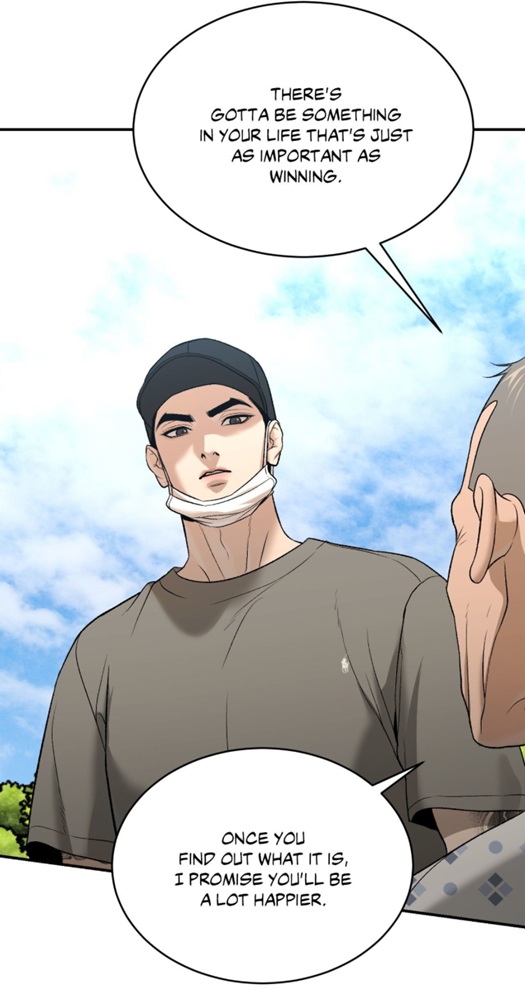 (chapter 75) However, observe how the main lead reacts to this well-meant advice:
  (chapter 75) He starts visualizing Doc Dan as his goal. It is once again focused on one person and future-oriented.
 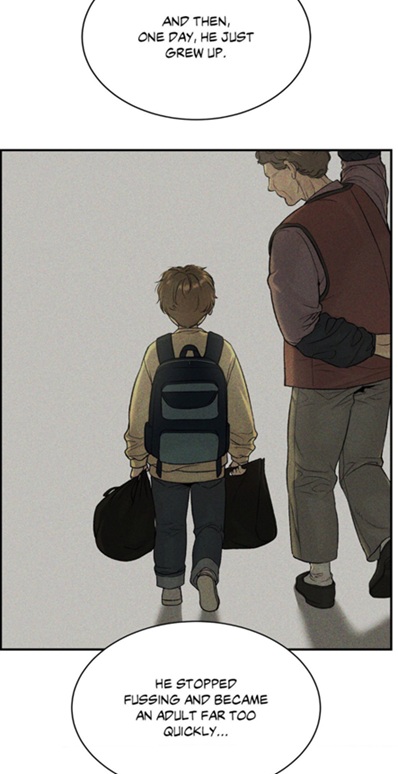 (chapter 65) He suppresses desire, health, and rest for her sake. The moral lesson is identical: if your presence risks harm, reduce yourself; if your absence protects others, endure it.
 (chapter 65), because she did the same in the past with doc Dan:
 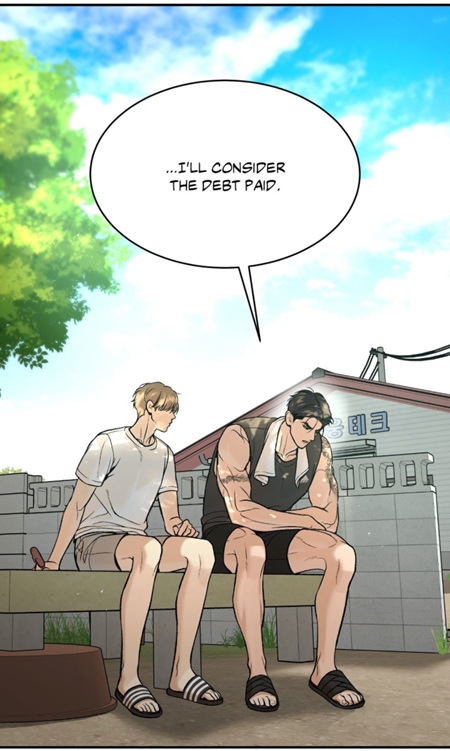 (Chapter 77) This means, the debts bring the terrible mind-set to the surface.
 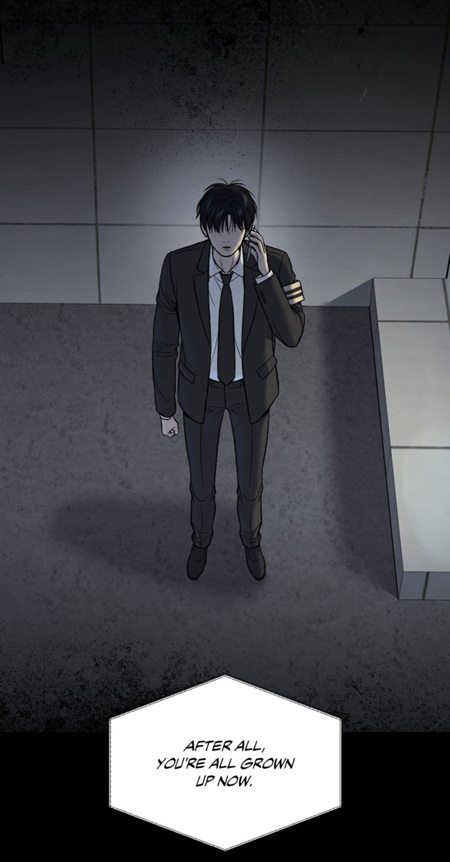 (chapter 74) The latter justifies her betrayal by saying that he is too late, as he is already too old. The promise that sustained him collapses. Winning no longer guarantees return. The future he fought for vanishes. And in the penthouse, we have the same thought again:
  (chapter 54) — longstanding, cumulative, and corrosive.
 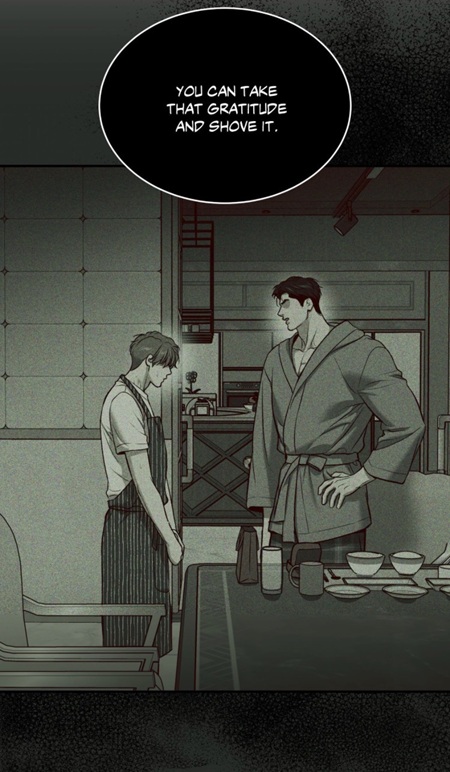 (chapter 90) And these two “friends” return during that night. What inhabits the room in episode 90 is not nostalgia, nor an unprocessed sadness that merely needs to be named. The same shame that has structured his life since childhood resurfaces here, stripped of all justifications. Joo Jaekyung is not suffering because he feels abandoned in the present. He is suffering because he believes himself to be the reason others leave.
 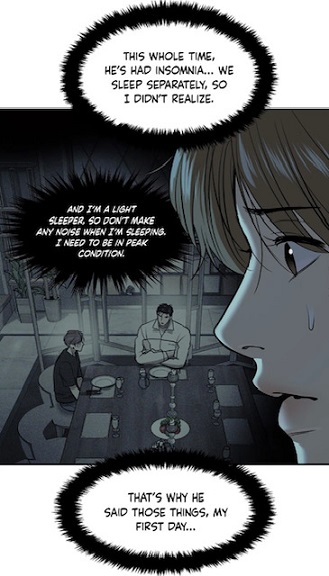 (chapter 29) He cannot sleep. He cannot relax. His body remains permanently alert because, in his words, he could “be killed” at any moment.
  (chapter 29) For him, this is not a symptom. It is simply part of being a fighter. Insomnia is normalized, rationalized, and dismissed as a professional hazard. Yet his listener immediately senses otherwise.
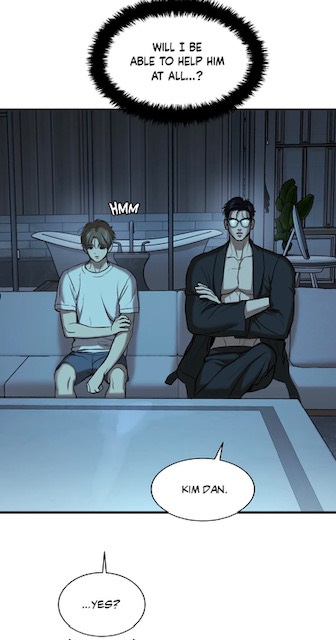 (chapter 29) He understands that this state is unsustainable — that it is only a matter of time before something gives way. What Joo Jaekyung treats as discipline, Kim Dan recognizes as danger.
 (chapter 53) In his mind, he is obeying a command.
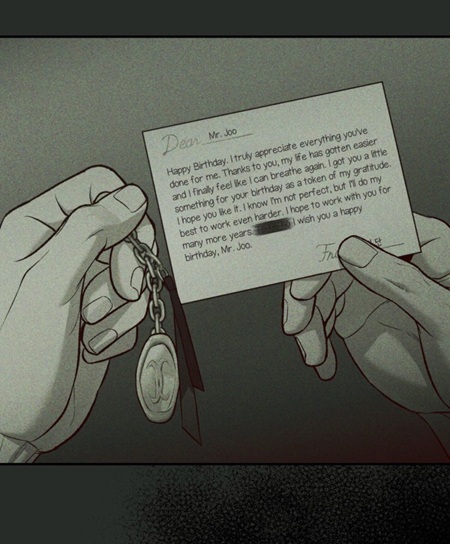 (chapter 90) But that explanation is insufficient. What actually begins after is grief and recognition.
 (chapter 54) Now the logic sharpens: Kim Dan does not merely embody bad luck. He embodies the champion’s mental state — depression, trauma, and chronic self-devaluation. He becomes the surface onto which Joo Jaekyung’s inner instability is projected.
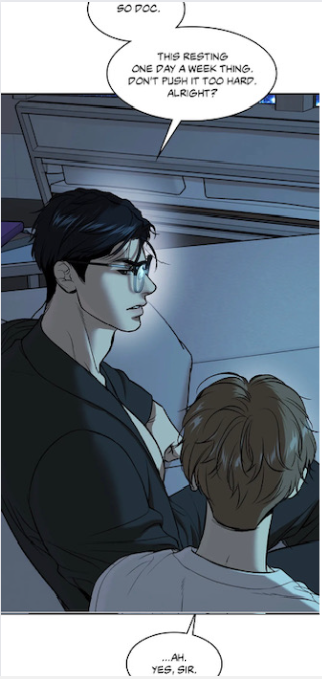 (chapter 29) And now, in episode 90, Jinx-philes can sense that the athlete is wearing the glasses “depressive realism” once again, where everything seems so true. He recalls all his misdeeds and can only perceive himself as the source of unhappiness for doc Dan. And like mentioned above, during that night, he is just only recalling his wrongdoings. He is overlooking that thanks to him, Doc Dan’s mental and physical conditions
 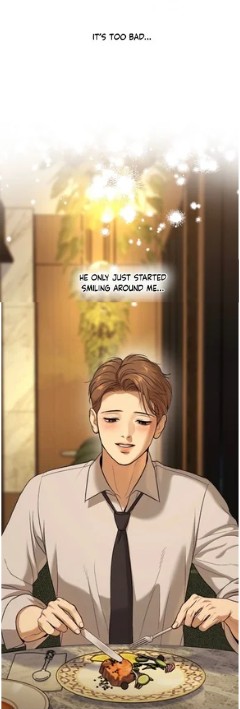 (chapter 89) improved, that he could make doc Dan smile. Meeting the hospital director made him see everything in a bad light. As you can see, he still has a black and white mentality. However, the truth is that right from the start, the champion had not just been a terrible person. He could be generous, help someone in need.
  (chapter 17) He saved doc Dan’s life twice.
 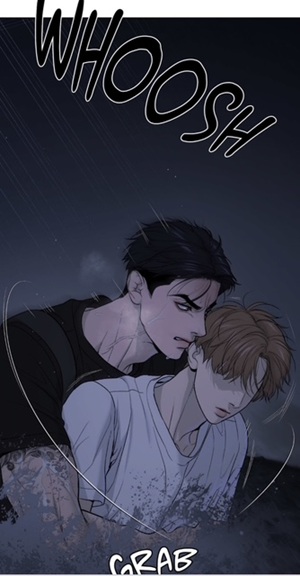 (chapter 59) He is reducing everything to one single moment and emotion: pain. And his reasoning is resembling a lot to the grandmother‘s:
  (chapter 65)
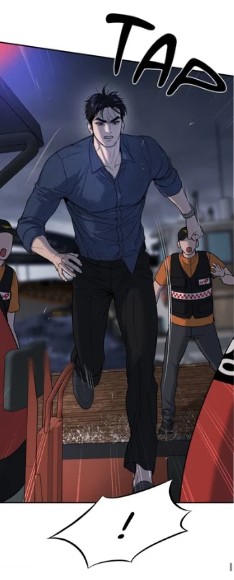 , when Joo Jaekyung imagines that doc Dan has once again fallen into the ocean and fears to lose him.
  (chapter 79) gestures toward falling, both physically and psychologically.
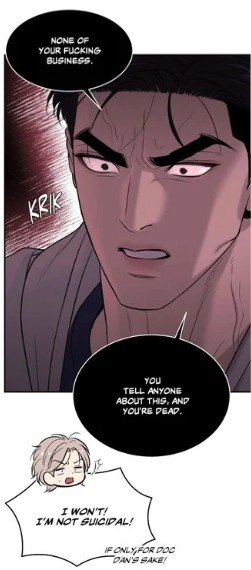 (chapter 89) Secondly, he is the only one referring to mental illness:
 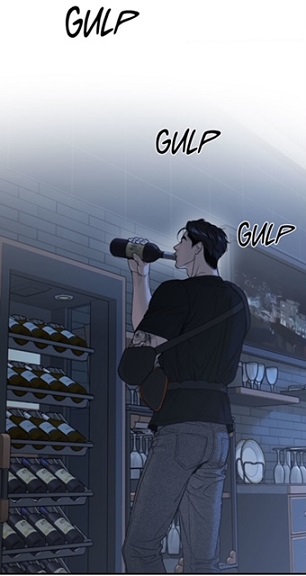 (chapter 54)
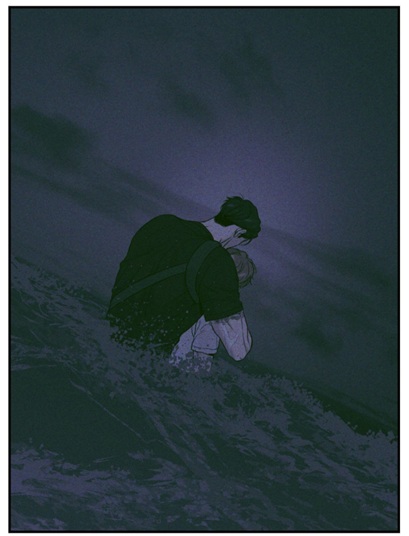 (chapter 78) Now, he is blaming himself for everything — and the narrative quietly aligns him with the same numbers, the same silences, the same logic of disappearance.
 (chapter 54), while he tells the opposite to his partner.
  (chapter 80) Secondly, he doesn’t know how the champion was blamed for everything and was treated by the other members of Team Black:
  (chapter 52) No one listened to his unwell-being, they rather silenced him. They showed no support and didn’t take care of him. Thus later the athlete started drinking. The physical therapist has no idea what Potato heard either:
  (chapter 52) At the same time, I am suspecting that Mingwa is putting doc Dan in a similar situation than in the past, so that repressed memories about the parents will come to the surface. Keep in mind that the athlete is actually mirroring the parents’ behavior (abandonment and sacrifice as a sign of love and respect). Thus the teddy bear is placed on the couch and the physical therapist is looking at it.
  (chapter 21) A teddy bear was present in his childhood, until it vanished.
 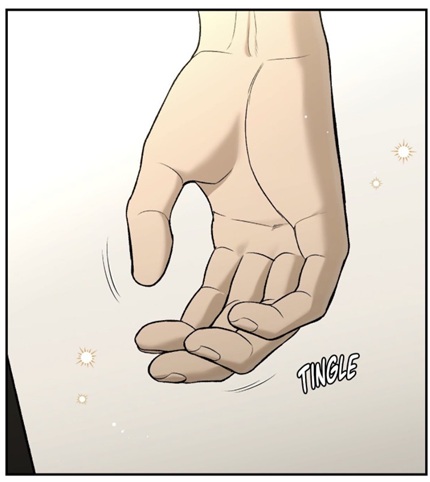 (chapter 87)

 (chapter 87) Both moments operate under pressure, yet they belong to radically different economies. One gathers force inward to protect, contain, and care. The other expels force outward to fracture, dominate, and erase. The biggest difference is not intensity, but direction—and whether the other is held, or destroyed.
 (chapter 87). Kim Dan answers with a gesture, the offered hand accompanied with a wish:
 (chapter 87) —but they are refused. Baek Junmin is denied any possibility of reply—no space to answer, to justify himself, or even to speak back.
  (chapter 87) The screen interposed between them
  (chapter 87) functions as both a physical and symbolic barrier: it delivers judgment without permitting response. Deprived of dialogue, Junmin is pushed out of language altogether. What remains available to him is not speech, but the body. His answer therefore does not come in words, but through the hand
 (chapter 87) and then through the foot.
  (chapter 87) The violence is not misdirected; it is precisely directed at the medium that silences him. The screen is the site of exclusion,
  (chapter 87), before the challenge
  (chapter 87), the champion turns around.
 (chapter 87) He looks—not at the crowd, not at the institution, but at Kim Dan. The gaze matters. It establishes a circuit. Like a phone call finally answered, it places both on the same wavelength. Only then does the question come.
  (chapter 87) Here again, language and body are aligned.
  (chapter 87) Kim Dan answers—first with a nod, then with words. The response is clear, immediate, and embodied. And what follows is decisive: the champion raises his arm.
  (chapter 87)
 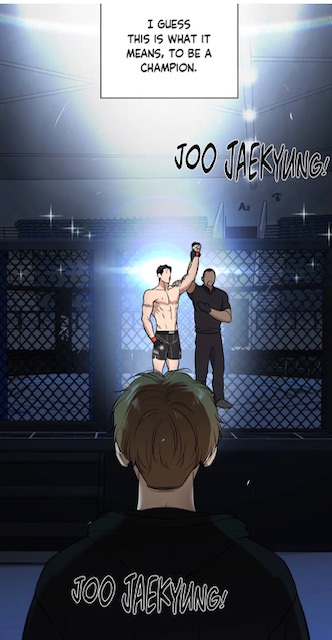 (chapter 15)
 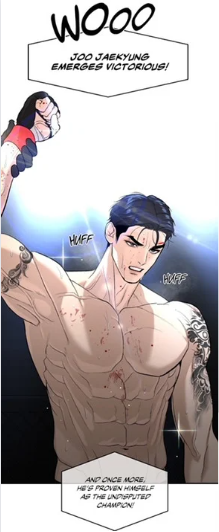 (chapter 40)
  (chapter 51), its meaning sharpens. For the first time, Kim Dan no longer occupies the position of fan or witness. He functions as judge and jury. 😮 And the champion acts accordingly. He declares himself the winner.
 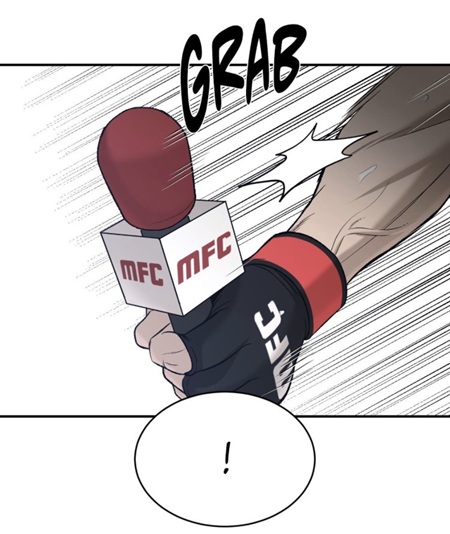 (chapter 87) Joo Jaekyung is no longer a puppet or zombie, but a man with a heart and voice.
 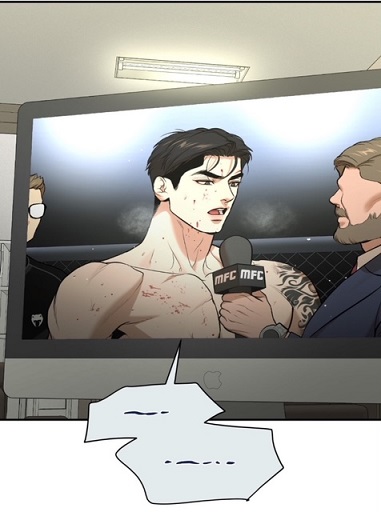 (chapter 46) It regulates turn-taking, determines who may speak, in what order, and under which framing. As long as it remains in the moderator’s hand, speech is mediated, filtered, and contextualized. Questions lead; answers follow. Meaning circulates vertically.
 (chapter 87) He no longer moderates; he reacts. He cannot redirect the statement, soften it, or translate it into spectacle. He can only acknowledge that something has escaped containment. The apology is not moral—it is procedural. It marks the moment the institution loses authorship.
  (chapter 57); he is narrating. He does not answer a question
  (chapter 14) Yet, CSPP
  appears more and more insistently
  (chapter 87), even in the cage
 (chapter 87), contrary to before.
  (chapter 15) Either you only see the C or the name is placed out of the frame.
  (chapter 40) Yet it remains unexplained. What does it stand for in the world of Jinx? A sponsor? A broadcaster? The story never defines it explicitly—and that absence matters. What goes unnamed is often what exercises the most power. I will elaborate about it further.
 (chapter 36) —depends on mediation. Delay. Scoring. Interpretation. The quiet redistribution of meaning after the fact. As long as nothing is said outright
  (chapter 69), control remains possible. Once speech becomes public, control becomes fragile.
 (chapter 87), people in the seaside town, a public that exists before commentary can shape it.
 (chapter 87) And the fight already answers the questions the system hopes to postpone. What we see in the cage is not merely a contest of strength, but a clash of communicative regimes. How one fights here is inseparable from how one speaks, evades, provokes, or withholds.
 (chapter 87) His movement privileges distance, tempo
  (chapter 87) and visibility. That way he gives the impression that he is superior to the former champion. The middle kick appears not as a finishing tool
  (chapter 87), but as an instrument of disruption—enough to score, enough to interrupt rhythm, never enough to end the exchange. The rest of his offense follows the same logic: repeated punches to the face
  (chapter 87), the hands, the shoulder. Targets chosen not for collapse, but for points. Not to silence the opponent, but to keep him talking through damage. The choice of targets is not arbitrary. The hands and the shoulder are not neutral zones. They are sites of vulnerability that presuppose knowledge. Arnaud Gabriel does not fight, as if he were discovering his opponent in real time; he fights as if he were acting on prior information.
 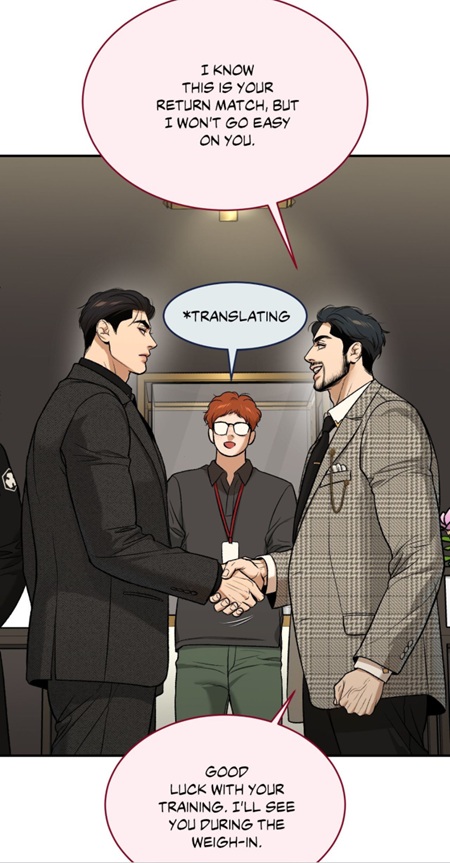 (chapter 82) He anticipated a diminished MMA fighter at the end of his career who would train at the hotel gym. His punches repeatedly return to the same areas—not to finish, but to aggravate. Not to silence, but to extract fatigue.
 (chapter 87) The shoulder carries the memory of surgery and recovery. The hands mediate both offense and defense; exhausting them degrades reach, timing, and confidence. And breathlessness
  (chapter 82)—noticed earlier during training—signals something even more fragile: limits that are physiological, not tactical.
 (chapter 87) It aligns disturbingly well with what had already circulated outside the match: commentary about tension, exhaustion, time away from competition. Whether through media narratives, observation, or informal channels of intelligence, the opponent’s body has already been translated into information.
 (chapter 47) Already discussed. Already framed. Gabriel’s reliance on point accumulation is inseparable from this logic.
  (chapter 87) He does not need to dominate the body; he needs to activate its known limits and let the scoring apparatus do the rest.
 (chapter 87) —his decision to close distance, to counter decisively, to end the exchange rather than prolong it—appears less like impatience than resistance. He does not correct the narrative. He interrupts it.
 (chapter 51) The fight is no longer about what happens between bodies, but about who controls evaluation. And that’s how they could rig the match between Baek Junmin and Joo Jaekyung.
  (chapter 70) acquires a different meaning. What he condemns as arrogance is not a moral failure, but a structural adaptation. These fighters have learned that they do not need to finish fights with a knockout. They only need to prolong them—to survive them—because the system will finish the sentence for them. Therefore, the moderator’s commentary during the match introducing the new Korean fighter takes on a clearer function.
  (chapter 71) He frames the rookie as someone “waiting for the right timing,” subtly suggesting a coming knockout rather than prolonged survival. The language is important: it reassures the audience that decisiveness still exists within the system, that power is merely deferred—not absent.
 (chapter 71) The director is not persuaded. Hwang Byungchul reads the situation differently. He recognizes stiffness, fear, and overreliance on structure—not composure, not strategy. Where the moderator sees patience, the director sees hesitation. Where commentary insists on strategy, experience detects rigidity and lack of instincts.
 (chapter 82) and inside the cage.
  (chapter 87) Publicly, he is courteous. Measured. Even complimentary.
  (chapter 82), gentle and polite gestures, and tactical distance— away from the spotlight, away from overt confrontation. His restraint is not humility, but alignment. He performs civility so that judgment, narration, and authority can be outsourced to the institution. That’s why for him, fighting is strongly intertwined with fun and he sees himself more as a star than as an athlete. He is definitely influenced by MFC. Hence we can say that his suit mirrors his mind-set. Gabriel’s suit does not soften his presence; it disciplines it. The patterned fabric signals rigidity rather than elegance—structure over fluidity. It mirrors his fighting style: calibrated, rule-bound, resistant to improvisation. Nothing about his appearance invites rupture. Everything is designed to hold form.
 (chapter 52) He lets others speak, provoke, circulate images, manage money, create pressure.
  (chapter 54) His power does not come from direct address, but from displacement. When he does appear, it is rarely to argue.
  (chapter 49) It is to smirk, to whisper, to apply pressure obliquely. In both cases, the logic is identical: control is preserved by never being fully present.
 (chapter 87) It is more observation. He allows the opponent to speak first—to reveal the structure of the exchange.
  (chapter 87) When it lands, it collapses distance. It forces the opponent inward. And crucially, it targets the center of the body—not the face that earns applause, but the core that sustains movement.
 (chapter 87) and delivers an uppercut.
  (chapter 87) This is not escalation; it is completion. Where Gabriel sought to keep the fight open, Joo Jaekyung compresses it. He refuses the long exchange. He refuses circulation. He refuses to wait for judgment. His strategy is not to be evaluated later, but to be undeniable now.
  (chapter 87) This is not silence imposed from outside, but silence produced by gravity. Once the body crashes, breath cannot return, and speech has nowhere to perch.
 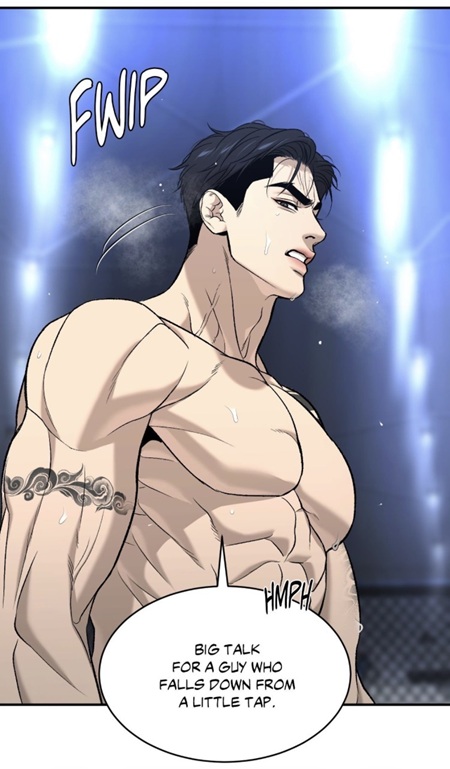 (chapter 87)
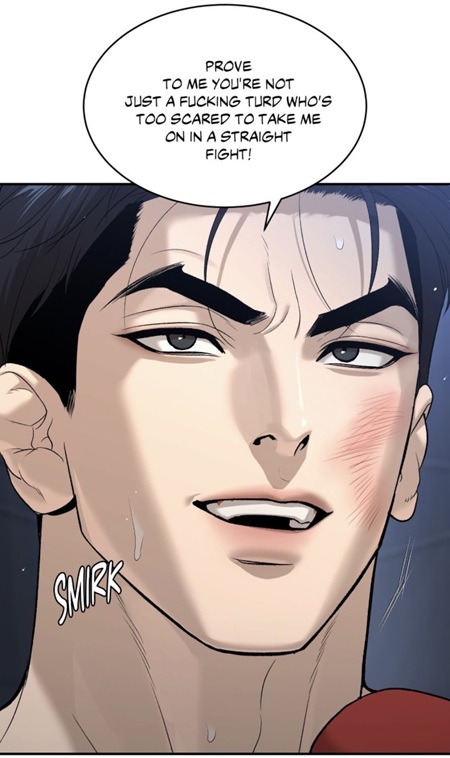 (chapter 87)
  (chapter 2) While the jinx held, action could still occur, but speech could not carry consequence. Words dissipated, were deferred, or were absorbed by systems designed to neutralize them. Powerlessness expressed itself as speechlessness.
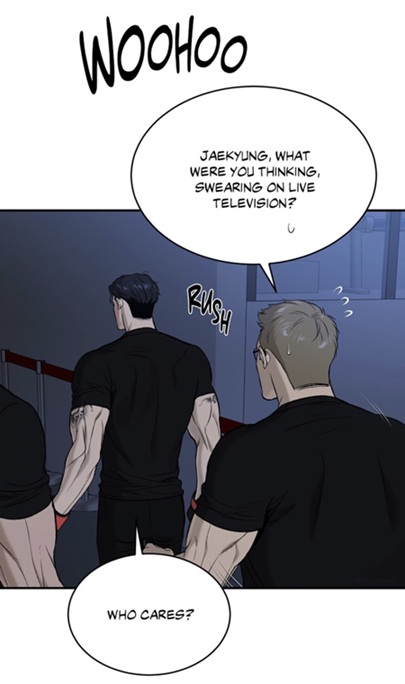 (chapter 87) His actions arrive before meaning can be reassigned. His words arrive where no answer is prepared. In this sense, episode 87 marks the moment Joo Jaekyung becomes fluent in his own discipline. Not merely competent, not merely dominant, but articulate. His movements surprise
  (chapter 5) which had surprised his manager Park Namwook.
  (chapter 5)
 (chapter 69) , the switching, the method—the institution could have responded. Clarifications could be issued. Liability could be managed. But by speaking elliptically, by pointing to manipulation without anatomizing it, the champion places the burden of interpretation onto the audience. And MFC can not deny the existence of an incident in the locker room.
 (chapter 62) They are not close enough to trust the system blindly.
 (chapter 57)
 (chapter 69), by allowing attention to cluster around foreign misconduct
  (chapter 69) and public embarrassment
  (chapter 74) Early incidents reframed as character. Let’s not forget that he was stigmatized as a thug by the members from Team Black too.
  (chapter 47) Nothing new needs to be invented. Only reassembled. They know about the dragon’s past, because they brought Baek Junmin, someone who resented the celebrity for his wealth and fame.
 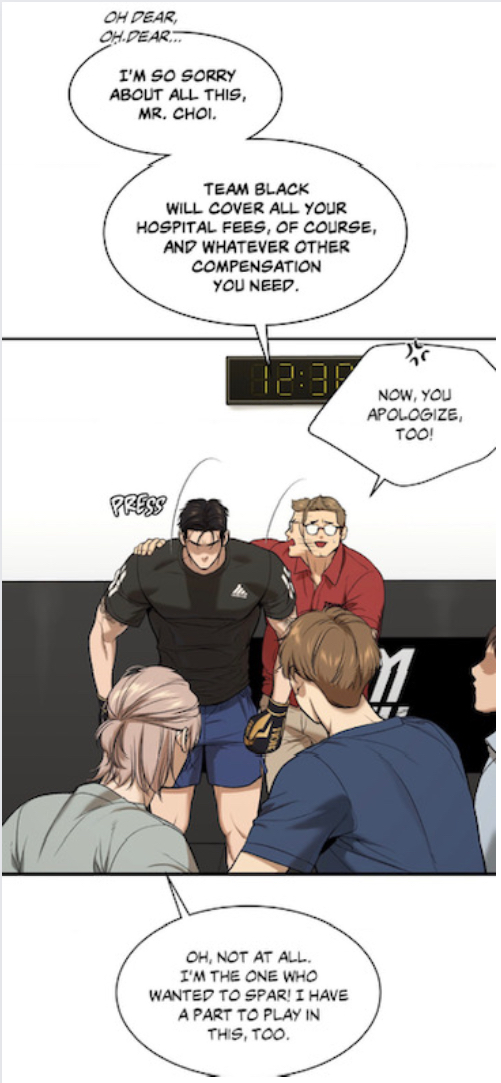 (chapter 31) The system does not deny the champion’s words ; it reclassifies them. What was a refusal of manipulation becomes “anger issues.” What was naming becomes “acting out.”
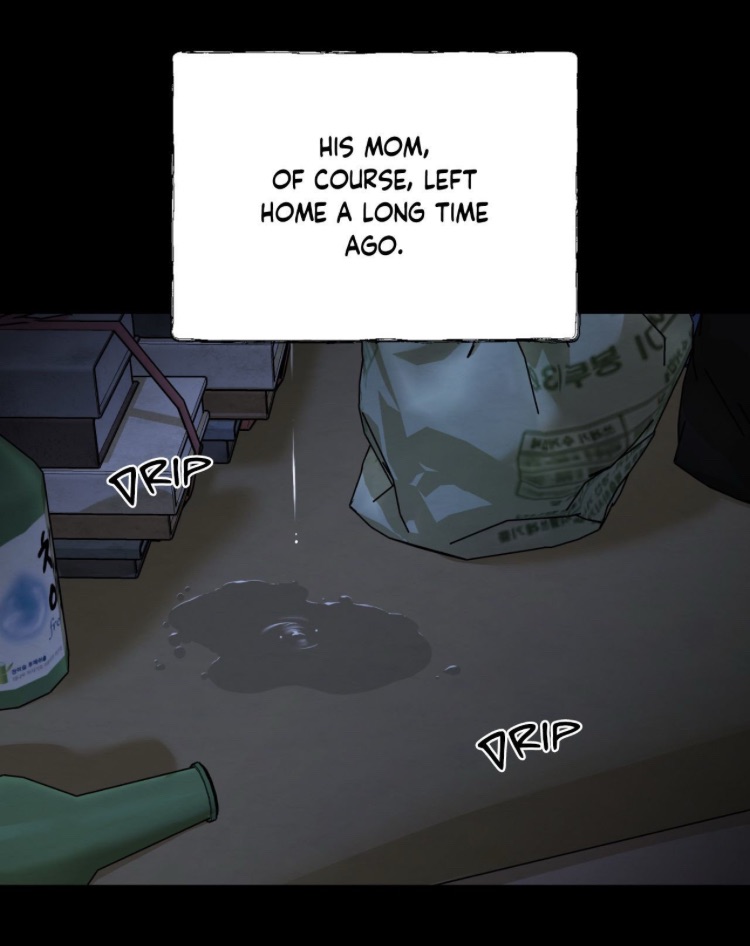 (chapter 72) It only needs to repeat an already accepted story: abandonment as necessity, violence as justification, disappearance as victimhood. A story the system knows how to circulate. And Hwang Byungchul never questioned her decision so far.
  (chapter 78) Secondly, Kim Dan is now able to distinguish the past from the present. Finally, thanks to doc Dan
  (chapter 62), he did so many good deeds in the seaside town that the inhabitants and the patients from the hospice won’t accept such accusations. I believe that such people won’t see “motherfucker” as a problem at all, they will rather see it as a part of his role after the match. What will remain in their mind is rather the accusation and riddle he voiced: the stunt Baek Junmin played.
 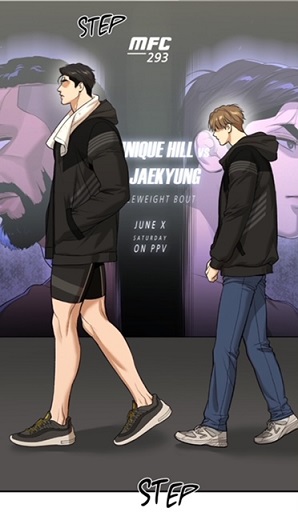 (chapter 87), which already tells us that CSPP does not function as a simple broadcaster. My idea is that CSPP operates as an intermediary apparatus: a company that packages events, sells broadcasting rights, coordinates visibility, and transforms violence into consumable spectacle. In other words, CSPP does not show fights; it produces events. This explicates why CSPP was present right from the start
  (chapter 14), but barely visible. But the moment it caught my attention in Paris, I realized that its increasing visibility displays the success of MFC as company. Observe that when the champion faced Randy Booker, the weight-in took place on the same day than the fight and in the arena, not at a prestigious hotel like in Paris. Here, the champion held a conference many days before the weight-in, and the latter took place the night before the match with Arnaud Gabriel. Secondly, you can observe the success of MFC through the banners. In Busan, the website of MFC was posed in the background next to CSPP.
  (chapter 50), only MFC and CSPP. But in Paris, it is now totally different.
  (chapter 48), and distribution platforms, insulating each layer from direct responsibility. If something goes wrong, blame can always be displaced sideways.
 (chapter 35), his suspension
 (chapter 57)
  (chapter 70) His matches are scheduled at hours accessible even to a Korean hospital
  (chapter 41) or hospice patients.
  (chapter 71) becomes intelligible. It is not a mark of anticipation, but of expendability. The match is placed where attention is thinnest, where failure or success carries minimal consequence. By contrast, Joo Jaekyung’s fights are positioned to be seen. The asymmetry exposes how dependent MFC’s visibility economy is on him—not as a competitor, but as the primary organizer of audience attention.
 (chapter 47) His presence circulates through curated highlights and controlled conference footage rather than open broadcast.
  (chapter 47) Weak opponents are chosen.
  (chapter 47) His image is inflated before he ever faces Joo Jaekyung. CSPP does not need to expose him fully; it needs only to prepare recognition. However, CSPP is an official company, they can not control rumors among fighters.
  (chapter 47) Thus the manager suggested this to his boss just before:
  (chapter 46) By mentioning the existence of spies, he incited the main lead to keep his distance from the doctor and the members so that the rumors about the underground fighting wouldn’t reach his ears.
 (chapter 14), the United States, Paris—the fights are placed in high-visibility slots. Loss must be witnessed. Decline must be shared. By contrast, the fight between Baek Junmin and Joo Jaekyung takes place in the morning
  (chapter 49), a time of dispersed attention, private viewing, and reduced collective response. Visibility is not maximized; it is managed.
  (chapter 49) CSPP’s role, then, is not neutral mediation. It is temporal governance. It decides when exposure becomes dangerous and when it becomes profitable. It does not silence events; it times them.
 (chapter 87) is dangerous not only for MFC, but for CSPP itself. If his connections to the underworld surface, CSPP is no longer a distributor of sport, but a conduit for illicit spectacle. Contracts dissolve not because violence occurred, but because violence escaped framing.
 (chapter 49) Under normal medical protocol, this should have stopped the fight immediately.
  (chapter 41) No athlete should perform when injured. Yet MFC Medical remains silent, the staff simply treats the wound. The bout proceeds. Only later—after attention has shifted, after consequences have begun to circulate—does the same medical authority step forward to issue disciplinary sanctions and a suspension
  (chapter 52) Structural complicity is translated into an individualized incident. What occurred in the cage is no longer the issue; what occurred afterward becomes the narrative.
 (chapter 46) that began elsewhere—losses already acknowledged when Choi Gilseok brought him into the system in the first place.
  (chapter 30) This implies that he won’t remain passive and silent like in the past, relying on structure and institutions (Entertainment agency…) and accepting to become a scapegoat.
  (chapter 54)
  (chapter 84) and the progression of their relationship, attuning readers to intimacy
  (chapter 85), care, and emotional release. When the chapter opens with a tactile, reassuring gesture, it naturally confirms that reading mode. The squeeze feels like a culmination.
 (chapter 87) — the slight jolt, the hesitation—and he responds by stopping. The restraint is not automatic; it is chosen. He does not ask for more reassurance, more certainty, or more support, even though he clearly desires it. Instead, he recognizes sufficiency.
 (chapter 87) So the doctor’s support was indeed limited in time. So the stop of the champion ‘s squeeze
  (chapter 33) Humbleness here
  (chapter 87) The opening scene unfolds in a space that feels inhabited and shared, composed in softer shades that emphasize stillness and presence. The final scene is colder, darker, sharper.
  (chapter 87) —the second collapses time inward. Baek Junmin does not act toward what is coming; he reacts toward what has already been. His violence is not exploratory but recursive.
  (chapter 49) When Joo Jaekyung addresses him with open disrespect, the breach of seniority provokes immediate outrage.
  (chapter 49) Intervention follows quickly. The insult is not tolerated
 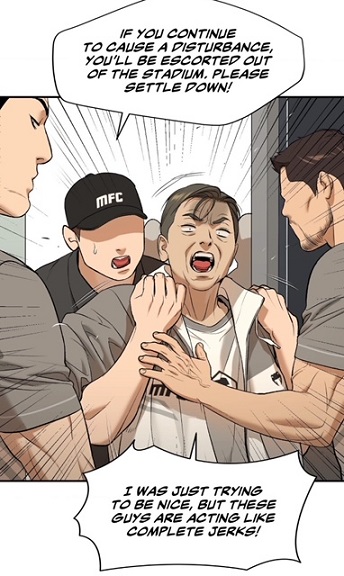 (chapter 49) because it threatens hierarchy itself. Choi’s anger is genuine in that moment and it reveals what he truly guards: status, order, and the visibility of respect.
 (chapter 87), and continues escalating without repercussion
  (chapter 78) Both continue to perceive Joo Jaekyung as nothing more than a fighter
 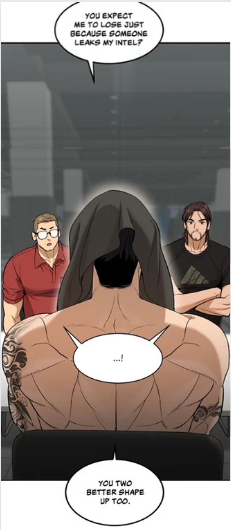 (chapter 46) Even after boundaries are formally stated, Park Namwook continues to rely on seniority to address the champion
  (chapter 46) as if he were a child or an employee—someone to be corrected, instructed, and disciplined. The warning does not alter behavior because it does not challenge the underlying assumption: that Joo Jaekyung’s place is below them.
 (chapter 49), handshakes, and private humiliation
 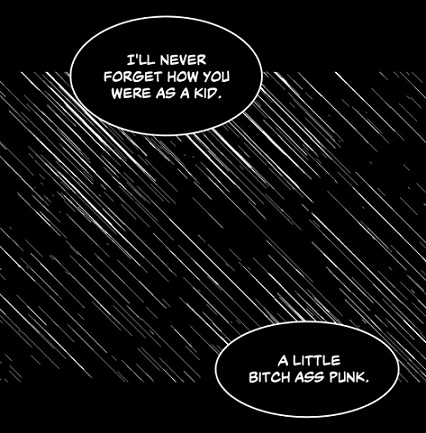 (chapter 49), the gesture becomes clearer still. He is accustomed to violence without witnesses, to domination shielded by proximity and secrecy. He was always the man in the shadow. The live broadcast deprives him of that refuge.
 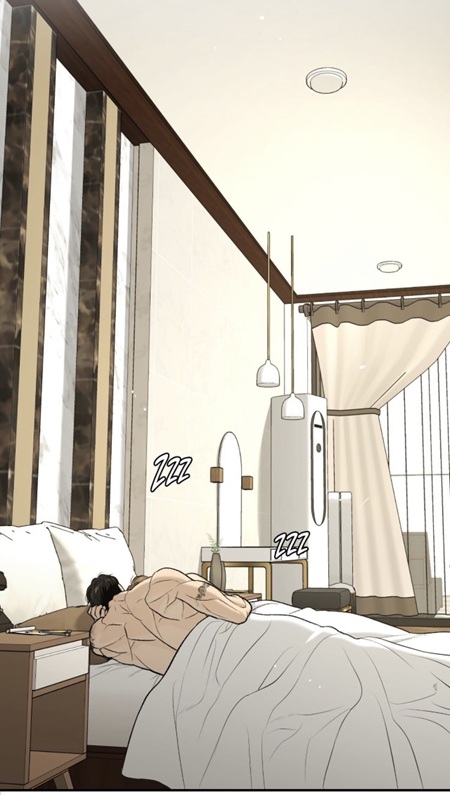 (chapter 87) also unfold under the sign of privacy.
  (chapter 87) He is announcing a shift of identity.
 (chapter 47) By rejecting visibility and embracing excess, he also rejects the last requirement that tied him to that system.
 (chapter 87) Kim Dan sleeping openly, showing his face, remaining there without fear—this is read by the champion as tacit trust. That trust becomes energy. In other words, this scene serves as the positive reflection of the argument in the locker room:
  (chapter 51)
 (chapter 75) —showering, cologne, self-regulation before a match. Here, that sequence is conspicuously absent.
 (chapter 69), recognition, and above all visibility. Yet this visibility is curiously incomplete. Despite his victory, Baek Junmin is not immediately present as a public figure. He appears as a result
  (chapter 52) —his name, his win—but not yet as a narrative subject.
 (chapter 50), they remain structurally hidden, absorbed by intermediaries, or misattributed.
  (chapter 52) In practice, hierarchy barely functions. Authority exists without discipline, protection without accountability. Baek Junmin is not positioned among other fighters, nor anchored in a collective. Thus he is not truly celebrated at the restaurant after the tie. Thus the fighters mentioned the director Choi Gilseok’s financial success or the odd behavior of Joo JAekyung.
  (chapter 52) Besides, he watches the match alone
 (chapter 84), the fireworks erupt, and Kim Dan turns his head too late.
  (chapter 84) Readers have replayed the blurred panel again and again, straining to decipher the muffled shapes of his mouth. Some are convinced that this is the confession, the moment the wolf finally says aloud what his body has been whispering for months. One Jinx-phile,
  just enough to match the Korean 좋아해 김단 (jo-a-hae Kim Dan)—“I like you, Kim Dan.”
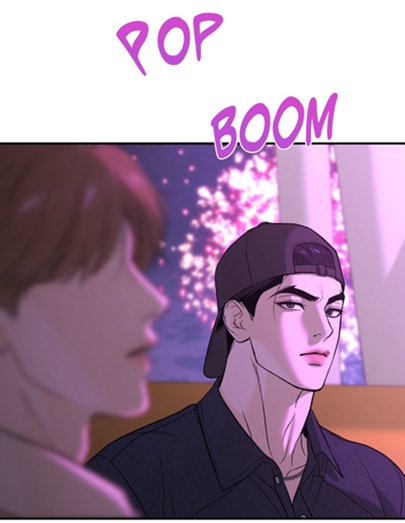 (chapter 84) —especially Japanese summer festivals where boys and girls, dressed in yukata, confess beneath crackling skies. Fireworks symbolize joy, romance, fleeting courage. It is no wonder many readers assumed that Mingwa was drawing on this cultural grammar: purple night sky, glowing lights, two lonely figures suspended above the world. A confession seems almost inevitable. And if it truly was a love declaration, then the champion’s refusal to repeat himself
  (chapter 84) would make perfect narrative sense—confession lost, moment gone, courage spent.
 (chapter 62)
  (chapter 77) Why does Joo Jaekyung speak exactly when the fireworks begin, as if choosing the one moment when he is guaranteed to be drowned out?
 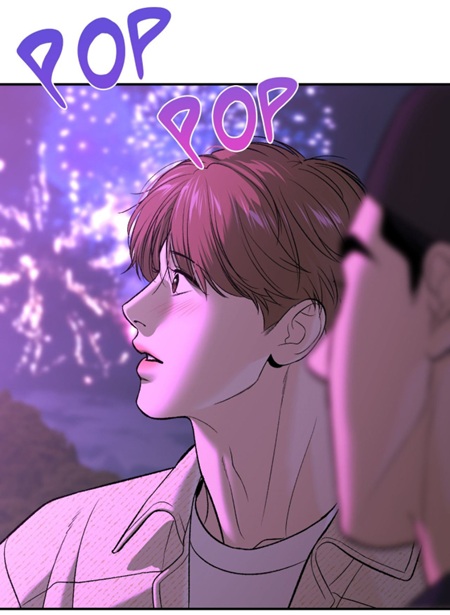 (chapter 84) Was he truly confessing love—or was he trying to verbalize something far more raw, far more primitive, far more difficult?
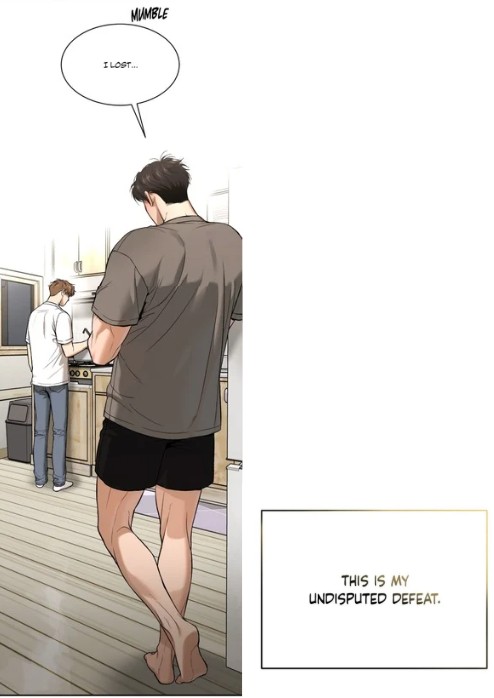 (chapter 76) and 79
  (chapter 79), where he “speaks” only when the other man cannot truly hear him. At the hostel, the mumbling was barely audible: yet according to my observation and deduction, doc Dan seems to have caught something. as later we discover this scene from the champion’s memory:
 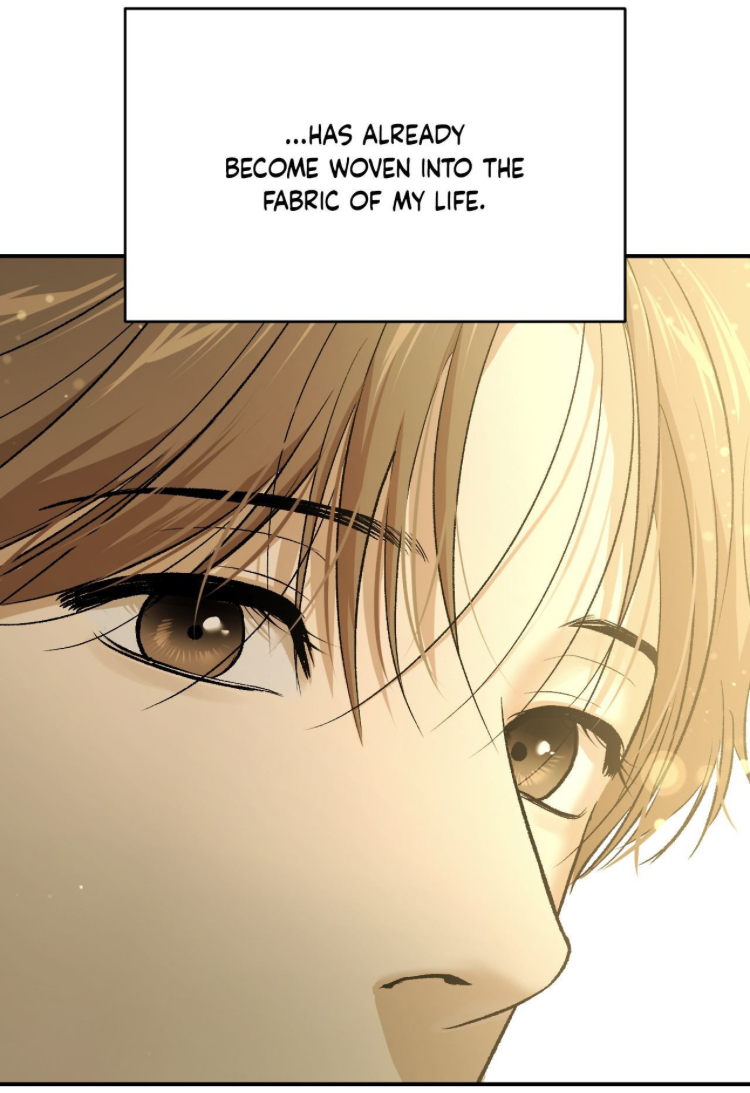 (chapter 77) He already knew that the athlete was standing next to him. However, observe that this vision focused on the doctor’s gaze was accompanied with silence. This means, doc Dan acted, as if he had heard nothing. So if he heard, what did the physical therapist catch exactly in the kitchen? “I lost…”, but it was devoid of any context. Doc Dan had no idea what the director Hwang Byungchul had advised to his former student.
 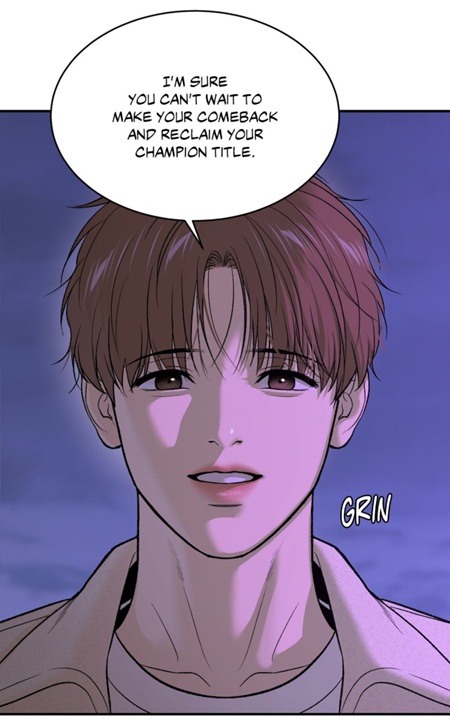 (chapter 84) He is taking the champion’s words at face-value.
  (chapter 84) A deadline designed to keep Kim Dan close without revealing the depth of the emotional dependency underneath. Finally, before we even analyze posture or timing, we must acknowledge the ghost that is sitting inside the cabin with them — Jaekyung’s own admission of dishonesty. Just minutes earlier, the narrative revealed again a thought he had never dared to voice aloud:
  (chapter 84) This is the language of surrender — not to defeat, but to vulnerability and selflessness. The champion who once insisted on keeping Kim Dan “one way or another” (chapter 84) now articulates the opposite impulse: the willingness to release him, to give him a choice.
  (chapter 84) Thus for me, in the cabin the champion became, for a moment, the boy with no mother’s gaze, no father’s protection, no safe place to rest. He must have said something cheesy, something a young person would say. Purity returns before experience does. Honesty returns before articulation. And in that moment inside the cabin, Mingwa makes a decisive artistic choice: we do not see Jaekyung’s eyes.
  (chapter 84) This pigment stands for innocence, purity, new beginnings and even equity.
  (chapter 84) Because they were not yet meant to be received, only meant to be released. The fireworks allow him to finally attempt a more honest sentence, but in conditions where it cannot reach its target.
 (chapter 81) Yet this is also the limit of what he can say.
 (chapter 79) Thus he could see the athlete’s mouth moving and hear sound. Nevertheless, observe that the moment the wolf reached to the doctor’s words, he bowed his head and looked down. From this
  (chapter 79) to this
  (chapter 79) However, he doesn’t fear coldness, but ridicule and mockery, the father’s gaze:
  (Chapter 44)
  (chapter 53) Jaekyung has never been granted either.
  (Chapter 45) Thus when he got upset with the present, he indirectly expressed the wish to be « looked at ». Moreover, in his visions or memories, this is what he keeps seeing:
  (chapter 51) His breath catches; his eyes widen. It is the moment he realizes his mistake. He never thought that doc Dan had been trusting him. That moment marks the first rupture in his emotional armor, not only because it hurt, but because it revealed. He realizes with terror that he wants to be seen by Kim Dan, but when he faced such a gaze, he could only feel guilty and bad. Thus it is not surprising that later, his nightmare let transpire his guilty conscience.
  (chapter 82), as the champion has always used his surroundings as a source of inspiration.
  (Chapter 29) It would also fit with 5 syllabes in Korean. And it would be cheesy too. Yet, I have my doubts about this theory which I will explain further below. Nevertheless, one thing is sure. The champion loves the doctor’s eyes and they have the power to move not only his heart but also his mouth. He is encouraged to verbalize his emotions.
  (chapter 84) The gaze under the fireworks triggers emotions in him. Thus he blurted out something. But for me, he does not know how to say “I love you.” He cannot even say “I like you.” Those sentences belong to someone who has matured emotionally — someone who can identify feelings properly, but so far he keeps saying: “to stay by his side” and his « affection declarations » were all linked to negativity.. Thus my idea was that Joo Jaekyung could have said this: “I want to hold you!” (안고 싶어 너). Let’s not forget that so far, the champion had never expressed such a longing before; a warm embrace. He would always follow his instincts:
  (chapter 4)
  (chapter 43)
  (chapter 69) The hug represents a metaphor for “staying by his side, for home and to be seen”. Moreover, in French embrasser can mean kiss and hug. And strangely, I noticed that the protagonists were never looking at each other during an embrace.
  (chapter 44) And let’s not forget that such a gesture is strongly intertwined with “childhood”.
  (chapter 65) It is for “babies”. No wonder why he retracted immediately.
 (chapter 84) Here, the doctor looks sad and wounded. His eyes are unfocused — he is not seeing the present. The water running down his eyelashes gives the impression of tears, even though he is not crying. His gaze is distant, fixed on something internal. His mouth looks tense, almost trembling. The mouth especially is a clue: Kim Dan’s emotions always gather there when something from the past resurfaces.This is the expression of someone thrown into an involuntary flashback. He is inside a memory. This explicates why this scene is similar to the champion’s shower after the latter had met Baek Junmin:
  (chapter 49)
  (chapter 49) Both scenes show a man pulled violently into a buried memory. Thus, my assumption is simple: the champion said something that pierced straight into Kim Dan’s oldest wound and brought his trauma to the surface. And this brings me to my next observation. Inside the cabin, there are not two people — there are three: the champion, the therapist, and the Teddy Bear.
  (chapter 84) Furthermore, we have a window. We have a phone (dead, but present). We have a childlike toy — symbol of stolen innocence.
 (chapter 84) And now, look again at episode 19:
 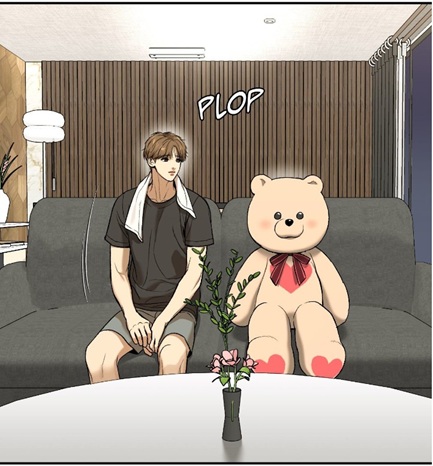 (chapter 84) It is not a fashion choice. It marks the moment when innocence collapses and the past reopens.
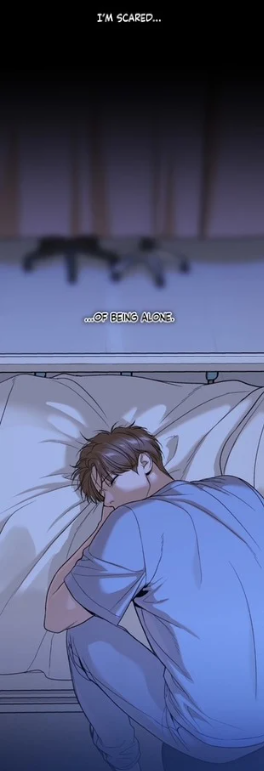 (chapter 56) In other words, wearing black is more than just a change of personality or mourning. It becomes the color of mystery, the beginning of descent into truth.
 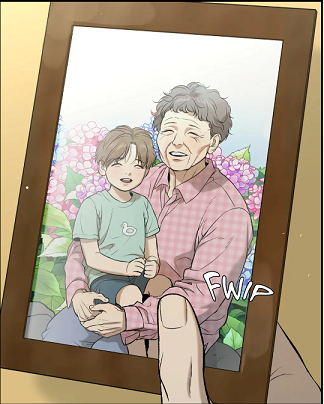 (chapter 19). Observe that in the penthouse, doc Dan has never placed the frame
 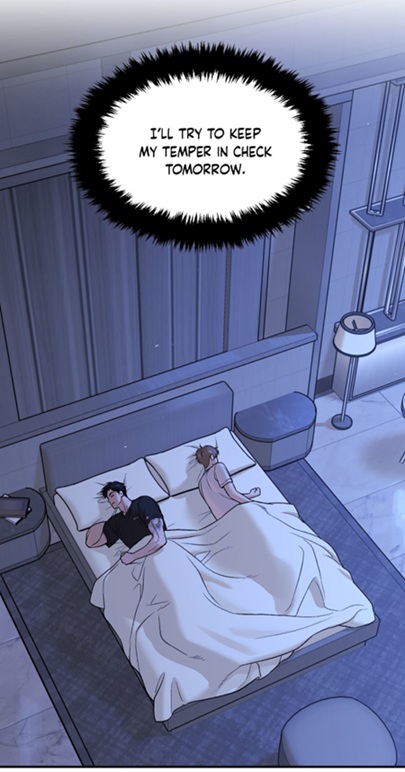 (chapter 79) on the night table.
  (chapter 47). Dan once had toys — proof that once, someone loved him enough to give him gifts which contrasts to the wolf’s childhood.
  (chapter 84) So by wearing black, doc Dan indicates that he is gradually becoming responsible for Team Blackand Joo Jaekyung the athlete.

 (chapter 81) No airport appears, no greeting, no applause — only movement, silent noise, and distance. The scene refuses arrival. It’s as if the air itself has become unwelcoming, unsure whether to receive or reject the traveler.
 (chapter 74) What does it mean that a man who once reached for his mother’s voice is now suspended between clouds, unreachable himself?
  (chapter 74) Why does the same stillness that once followed a farewell now fill the air around his flight?
 (chapter 65) Let’s not forget that the last poster of chapter 81
  (chapter 81) echoes Joo Jaewoong’s burial in chapter 74.
 (chapter 75), perfume
  (chapter 75) Every muscle, every breath, every instinct reminded him of the man he swore never to become. The body was a mirror of lineage, and lineage meant failure. In his dreams, that failure still reached for him: black hands emerging from the dark, the father who had lost everything.
  (chapter 75) The fighter calls it a “dream,” not a nightmare, because fighting was once his father’s dream — a dream of escape, of being seen, of proving that poverty was not fate. But for the son, that same dream turned into a curse. To fight was to repeat what had already destroyed the family.
 (chapter 75), the forbidden comfort that ended in scolding.
  (chapter 72) When he finally received it, it was not from a mother but from the director — a man whose gift could fill the stomach but not the heart. From that day, nourishment and submission became one.
 (chapter 72) And yet every attempt at purification only buried the rot more deeply. The more he washed, the more the stain spread inward — invisible, odorless, yet consuming.
 (chapter 81) — the same spot where he once sprayed his perfume
  (chapter 40) — it is more than desire: it is instinct, possession, and search. The gesture blurs the line between hunger and recognition, as if he were trying to inhale and keep what had always eluded him. The scent he once sought in bottles and rituals now breathes through another body, one that refuses to be contained. So when Jaekyung breathes against Dan’s skin, he is no longer trying to mask the stench of loss but to find the source of something living. The doctor’s scent does not erase hunger; it answers it. For the first time, the wolf eats without devouring.
  (chapter 44) — nuzzling the one destined to become his anchor. Jinx-philes can observe not only the presence of steam (which is similar to smoke), but also the effect of the scent. Back then, the champion had calmed down thanks to the hamster’s scent.
  (chapter 45)
  (chapter 65) He will make sure that doc Dan doesn’t smoke again and his scent remains pure. This signifies that the wolf will pursue its source through the smoke of deception, through the perfume of luxury and corruption. The doctor becomes both compass and contrast — the pure odor that exposes every false aroma around him. Through Dan’s scent he will breathe again—through that fragile, living fragrance the wolf begins to track the truth that stinks beneath luxury and lies.
 (chapter 36) When the champion left South Korea for the United States in episode 36, the plane glided through a void of light. There was no sky, no earth, no horizon — only a white expanse pierced by the sun’s glare. Even the boundaries of air and space seemed dissolved. The image radiated purity but felt sterile, stripped of texture. The machine was rising, not toward a destination but away from attachment itself.
 (chapter 37), the heart disinfected of need. Hence the bed became an instrument of “torture”. The upward flight marked a beginning, yet it already smelled of exhaustion and futility. A life built on departure cannot land anywhere.
 (chapter 36) instead of naming Joo Jaekyung himself. He might have stood beside the MMA fighter the entire time, yet he preferred to disappear behind collective language, as if the plural could shield him from personal involvement. It was a professional gesture, an attempt to efface the self, to stand beside the fighter without belonging to him. His role was service, not solidarity; his language confirmed distance. Thus his karma was that he got abandoned by the team after the match, while rescued by the celebrity himself!!
  (chapter 81) translates that awareness into sensation. It’s no longer the passivity of a bystander but the heartbeat of someone invested. The count of days becomes a shared horizon between doctor and fighter, a bridge of feeling.
  (chapter 81) When Jaekyung exhales the same “huu,” their anxiety synchronizes, transforming fear into connection. The loop of repetition (“days passed”) has turned into a countdown of empathy (“eight days left”). Time itself has begun to belong to both of them. The same “team” has become real, but contrary to the past: there are only 2 members, Kim Dan and Joo Jaekyung. At the airport he wears the Team Black jacket, a subtle but deliberate signal that he has accepted inclusion. The jacket is not uniform; it is recognition. Both form 8, which is a symbol for balance and infinity.
  (chapter 37) The others indulge in small pleasures — snacks, shopping, light rebellion — but the champion and his doctor remain trapped in routine, orbiting one another inside sterile rooms. I am suspecting that doc Dan must have bought the scarf at the airport, a small act of thoughtfulness before departure.
  (chapter 41) Yet the gesture, though sincere, carries a quiet irony. The scarf is printed with flowers, mostly roses, but as a piece of fabric it has neither scent nor warmth. It imitates life without containing it. What he gives her, in truth, is a copy of affection, not its essence — a bouquet that cannot breathe.
 (chapter 37) The answer lies in the contrast between the smell of life and the smell of emptiness. While others seek flavor in hot ramen or the sweetness of snacks, the champion’s room remains odorless, air-conditioned, antiseptic. Then, in the quiet of night, a faint aroma drifts toward him, the flavor of hot ramen. And now observe the progression of scents through Jinx.


 (chapter 72) — the garbage, the spoiled food, the stale air of neglect. What he truly covers is not his nose, but his fear of returning there. Later, in episode 22, when Dan cooks for him, the champion instinctively associates food with corruption:
  (chapter 22) Interesting is that here fish has a negative connotation: intrusion and thoughtlessness. This shows how detached the champion was from his true self: water and the ocean. Moreover, cooking, warmth, nourishment—all evoked garbage, the chaos of his first home.
 (chapter 54) couldn’t nourish him. Hence he replaced it with wine for a while.
 (chapter 74) Their fragrance became the perfume of loss. To his senses, flowers never meant beauty or love or nice smell; they mean burial and as such pain. Every petal recalls the suffocating smell of the funeral room, the smoke, the artificial but painful peace of goodbye.
 (chapter 32) The blue tie contains 3 striped colors: red, white and blue, which are quite similar to French flag, though the order has been switched. Secondly, Choi Heesung purchased
  (chapter 32) Hermès’ item, a French company famous its bags, scarfs and perfumes. So I am quite certain that once Jinx-philes discovered the identity of the next fighter
  (chapter 81) and saw the plane, they must have jumped to the conclusion that the next fight will take place in Paris! But France is more just than the capital. This country is called the Hexagon due to its form, and this name stands in opposition to the MMA ring, which is an octagon!
  (chapter 81) So we could say that despite the disadvantage being in a foreign country, they are “equal”, 6 colors against the team from the Hexagon, the blue light from the MMA ring. But let’s return our attention to Paris. The latter is widely recognized as the symbol of love, the global center for fashion, art, and stardom. The city has a deep historical connection to these fields, being the birthplace of haute couture and home to many of the world’s leading fashion houses and luxury conglomerates. Its cultural scene is equally rich, with a long history as a hub for artists and a more recent reputation for being a center for music and film stars. However, the image with the landing plane is actually revealing the truth.
 (chapter 81) and “splash”
  (chapter 14) Here, exactly like in the States, his trip to Busan never gave him the opportunity to visit the city and the beach, exactly like the athlete. The next airport to Cannes is Nice- Côte d’Azur and it looks more like the one in the Manhwa. Furthermore, the South of France has a milder climate in the fall, hence it is still possible to swim in September. Besides, in my last essay, I had connected the champion to Bruce Lee and water:
  Finally, Naturally, here I could be wrong with Cannes. Nevertheless, Cannes, with its glittering shorelines and film festival glamour, symbolizes the marriage of money (millionaires, yachts) and illusion — the theater of appearances. It is where contracts are made, where bodies are displayed, traded, and consumed through the gaze, the very economy that has always governed the champion’s existence. The wolf, once born among garbage and hunger, now finds himself surrounded by luxury, in a world perfumed with artificial success. Yet beneath the surface of that “breeze” and “splash” lingers the scent of corruption. The coastal light hides what the smoke once revealed: exploitation, manipulation, and the unspoken violence of commerce.
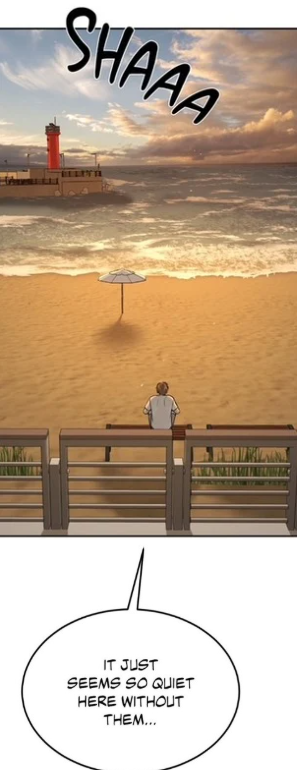 (chapter 59); silence had replaced air; life was drained of flavor. None of them truly enjoyed the nature: the ocean or the mountain. The seaside town was strongly intertwined with work
  (chapter 77) or danger. Then, when they returned to that place, their time was limited to visit the grandmother and the landlord.
  (chapter 81) They had no time to walk through the woods or visit the hills. They had no time for themselves. Consequently, I believe that in The French Riviera, the two of them will discover “savoir vivre”. Everything breathes, glows, and stirs. It is a land overflowing with color, aroma, and taste — precisely the senses that the wolf had long sought to erase through ritual. Doc Dan had led a similar life too, dedicated to his grandmother and work. If they are close to the sea, they might decide to walk on the beach together.
 (chapter 69), where Baek Junmin once fought for the championship belt. Thailand in Jinx is not a paradise but a mirror of corruption — the place where victory turns into prostitution, where the body becomes currency. There, the Shotgun won a crown but not respect; his triumph was drenched in manipulation, spectacle, and moral decay. He was admired by no one, celebrated by ghosts.
 (chapter 36), the transition from flight to arrival unfolds with seamless precision: no airport, no customs, no luggage — only the honk of city traffic and the flags fluttering over a hotel entrance. Everything about that journey screams logistics. It was a corporate trip, arranged, timed, and contained. The athletes passed through invisible gates, their movement stripped of individuality. The champion, like cargo, was transported rather than welcomed. His arrival, though triumphant
  (chapter 81)
 (chapter 81) The suitcase becomes the true protagonist of this threshold. In that small vibration lies all the instability the white air once denied. It is his portable home, his compressed past, the fragile proof that he finally has something to lose. In the earlier arc, he could have vanished mid-flight and no one would have noticed; now, if the suitcase disappears, another heart will break. That difference measures his evolution. Yet it also marks new vulnerability: any hand can touch what he carries.
 (chapter 41) and the wedding cabinet
 (chapter 80) before it, the suitcase belongs to the same symbolic lineage. It is the container of intimacy — filled with clothes, precious items like pictures or books, with the silent evidence of presence. But unlike its predecessors, it moves. The wardrobe once stood still, rooted in the domestic; the wedding cabinet invited intrusion within a private world, as it was once discarded. The suitcase, however, carries that vulnerability into the public realm. It is exposure on wheels — the private made portable.
  (chapter 81)
  (chapter 81) and Kim Dan has still no idea that the athlete has kept them like cherished relics. He might have placed the notebook from Hwang Byungchul as well. However, the person carrying the suitcase is the manager:
 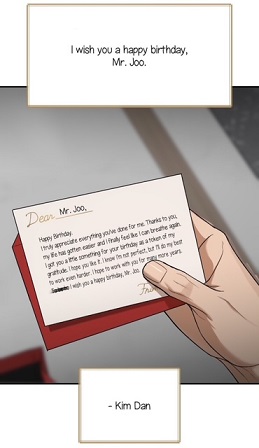 (chapter 55), where he expressed his desire to work for Joo Jaekyung for a long time. What would be the manager’s reaction, when he recalls this incident with the switched spray and Doc Dan’s sudden departure? Moreover, we have here “erased words”: to be ho… The timing of the discovery is really important. This could generate some tension and confrontation between the manager and the physical therapist. Besides, such a birthday card could generate negative feelings (like jealousy), Kim Dan is gradually taking more and more place in the athlete’s life. The violation that once occurred behind closed doors (the penthouse) now could happen in plain sight. The line between private and public collapses, just as the boundary between success and loss blurs.
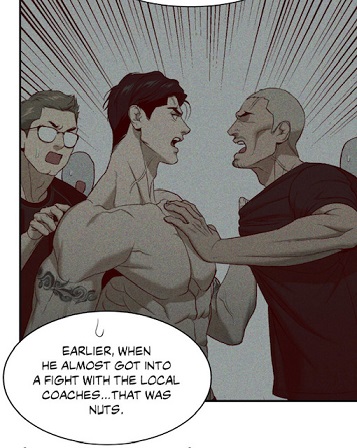 (chapter 37). So when the manager says this,
 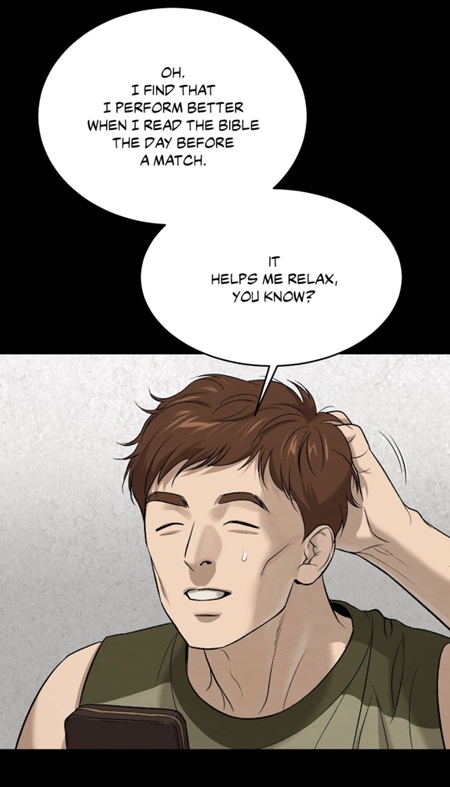 (chapter 75) While he was sick, he could recall this scene.
 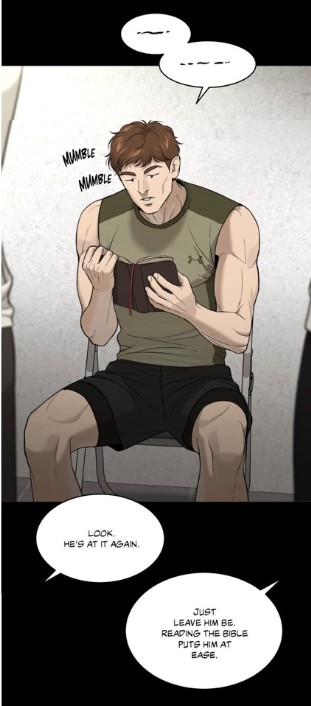 (chapter 75) where the fighter could stay focused, though he was surrounded by noise and people. The advice had seemed trivial, when first given. Now it re-emerges as revelation. The emperor, once incapable of rest, now reads
  (chapter 81) beside someone who represents safety. The book becomes a bridge between wakefulness and sleep, a ritual that does not erase consciousness but calms it. Where his earlier practices sought to block sensation, this one restores it.
 (chapter 81) The paper bends, absorbs scent, bears traces of fingers and warmth; the metal resists, reflects light, carries weight. Together they represent the balance between tenderness and strength — precisely what his life has lacked. In contrast to the mechanical milk and odorless perfume, these objects are human, imperfect, touchable.
 (chapter 80) And here, I had imagined that the mother had offered this t-shirt as a birthday present.
  (chapter 72) He did not sleep like a child but like an object kept near for safety. The woman lying beside him was a mother in name only — emotionally distant, physically present. No stroke, no kiss, hence the boy had to clinch onto her.
 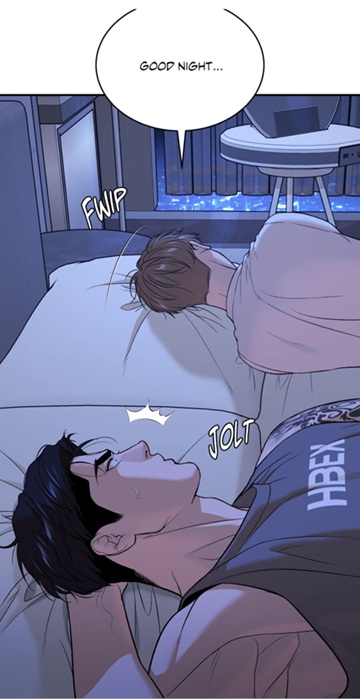 (chapter 78), without the good night! That missing intimacy was not a void but a distortion — a tenderness twisted into survival. The mother’s touch, meant to console, existed only to protect herself. She kept the child close not out of affection but out of anxieties and resent, turning him into a living barrier between her and the man she resented. What he experienced as warmth was, in truth, defense and rejection; what seemed like closeness was the choreography of avoidance. Hence she never looked at her child. The body that should have been cradled for its own sake was held as cover, its value defined by its usefulness.
 (chapter 29) which reminds us of breastfeeding. And now, look at the embrace in the swimming pool:
  (chapter 80). The hamster was imitating the behavior of the little Jaekyung in the past, clinching onto the “parent” like his life depended on him. But how did the athlete react to this embrace? He looked at his fated partner
 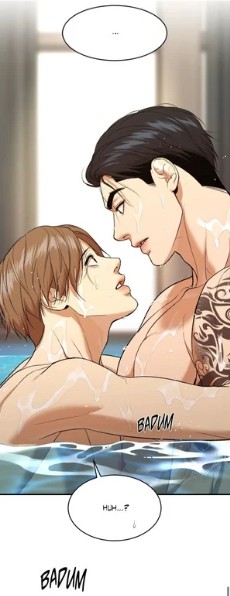 (chapter 80) and got all warm and fuzzy by looking at him:
  (chapter 81) A sign that the mother had never reacted the way her son is doing now, the feel to kiss the loved one! The problem is that in the swimming pool, the doctor’s scent and taste are covered by chlorine.
 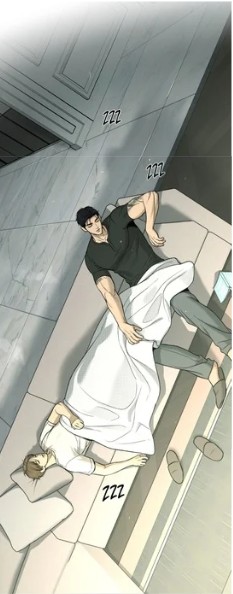 (chapter 81) The wolf falls asleep next to someone, not on top of or apart from them. That small preposition — next to — carries the weight of redemption. The couch, once a site of violation
 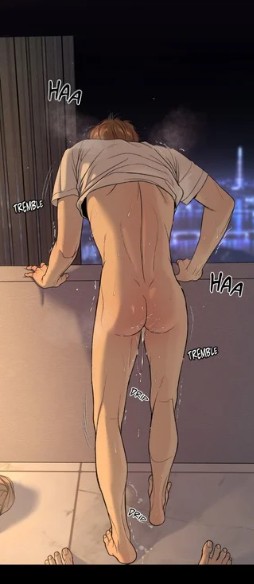 (chapter 61) or solitude, becomes again what it was meant to be: a place of rest and tenderness. Thus he touches his fated partner’s legs over the cover, showing his care and respect.
 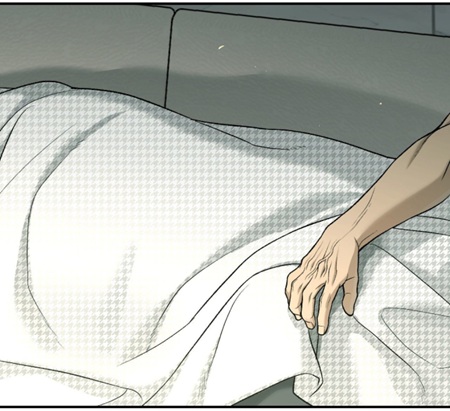 (chapter 81)
 (chapter 81), he can recognize the false nature of his mother’s affection. What she offered was conditional, deceptive and self-centered; what the doctor gives is ordinary and consistent. No grand gestures, no promises — only presence. The doctor does not rehearse concern; he lives it through routine. And this ordinariness, paradoxically, becomes sacred. It was, as if the athlete was treating his own inner child through the physical therapist.
 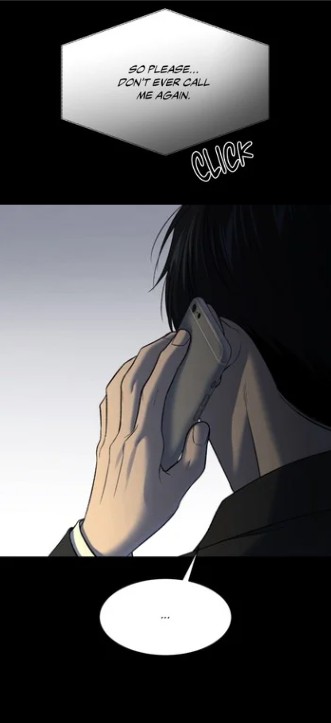 (chapter 74) At this moment, the page itself turns black, veined with smoky whorls of gray — as though her words had burned into the air rather than spoken. “I can’t live with you… please understand… let’s just go our separate ways.” The sentences rise like vapors, leaving behind the faint residue of a scent that refuses to vanish. This visual texture — half smoke, half ink — captures her true condition: she dissolves herself with every attempt at escape.
 France itself mirrors her — beautiful, perfumed, wrapped in silk and secrecy. She definitely climbed the social ladders through her second marriage, hence she could offer toys to her second son. The nation of couture and fragrance becomes the stage for the mother’s unmasking. Once the name of Joo Jaewoong rises again, questions about her will inevitably follow. And here, she can no longer hide behind silence or excuses. The myth of refinement — both hers and France’s — collapses under the weight of exposure.


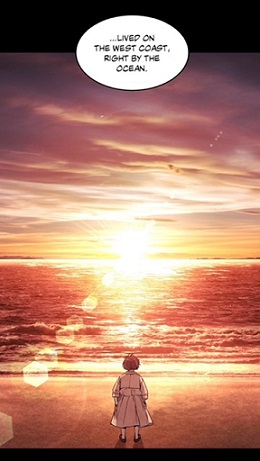 (chapter 53), yet she kept her distance. Observe that she only talked about one time experience. She sensed its danger and built her life on the solid ground of caution, duty, and control. In other words, she belongs to the world of the shore
 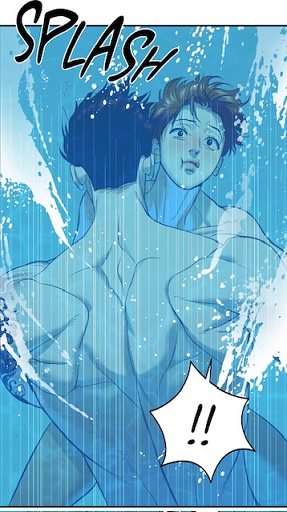 (chapter 28) and learn that not everything can be postponed or entrusted to someone else. Water, in this sense, rejects fatalism. It calls for motion, for risk, for personal responsibility.
 (chapter 80) And that intuition resurfaced and was confirmed in episode 80, when another day off brings the couple back to the pool. This time, the doctor steps into the water willingly.
  (chapter 80) He is no longer the man waiting to be rescued; he is the man learning how to swim. The champion’s words
  (chapter 80) distill the new doctrine: don’t wait for salvation
  (chapter 80), create your own buoyancy. Between the first swim
  (chapter 27) and this second lies the true point of no return—where superficial judgment turns into reflection, dependency into self-trust
  (chapter 80) and the rejection of powerlessness,
  (chapter 28) into the first stirrings of love
  (chapter 53) Safety lay in patience and dependence. Even when she later spoke with the champion by the sea, she avoided mentioning the ocean —as if to deny that any movement beyond her control could exist.
 (chapter 65)
  (chapter 80) Yet her absence from the pool scene is precisely what reveals her theology of avoidance. The pool was never her domain because her life revolves around work, not pleasure. She has no notion of rest without guilt, no concept of joy detached from utility. For her, swimming would appear frivolous—something “unnecessary” as long as one stays on solid ground. Jinx-philes should keep in mind that she never gave such a task to Joo Jaekyung. Her instructions to him were always practical, delegating care outward: take him back to Seoul, bring him to a big hospital and make sure he’s safe.
  (chapter 78) The subtext is unmistakable: she expected obedience, efficiency, not attachment. Furthermore, her final instruction—“Make sure you see a doctor regularly”—
  (chapter 78) sounds like ordinary concern, yet it hides her familiar logic of blame. It is as if she were implying that Joo Jaekyung has failed to fulfill her favor because Kim Dan has resisted care. In her eyes, the grandson is still the one responsible for trouble; the athlete’s role remains that of the dependable proxy who must “fix” him. What makes this moment striking is her tone of urgency, so unlike her habitual fatalism. The woman who once repeated “I’m the same as always”
  (chapter 65) suddenly speaks as though time is running out.
  (chapter 80) It was her graduation gift, yet it had nothing to do with his new profession or status. In contrast, the first episode already shows Kim Dan in a blue therapist’s uniform, name tag neatly pinned — a garment he must have purchased himself.
  (chapter 1) Traditionally, a graduation present helps the recipient embark on a career — like for example, a watch, a suit, or even a briefcase — symbols of adult entry into the job market. By offering him a hoodie instead, she unconsciously devalued her grandson’s professional worth. The garment belongs to the domestic sphere, not the workplace; it wraps him in comfort rather than readiness. In a moment meant to celebrate his arrival into public life, she reinscribes him into the private one — the house, the caretaker role, the obedient child. He doesn’t look like someone who went to university.
  (chapter 47) There was no curiosity about his career, no acknowledgment of his competence—only the quiet satisfaction that through her endurance, she had produced a “doctor.” In the graduation photo, she even wears the mortarboard herself, smiling with the pride of someone who believes the diploma justifies a lifetime of sacrifice. Her grandson’s success confirms her own virtue; his “adulthood” validates her survival. This question to the athlete exposes her lack of interests in his profession:
  (chapter 65)
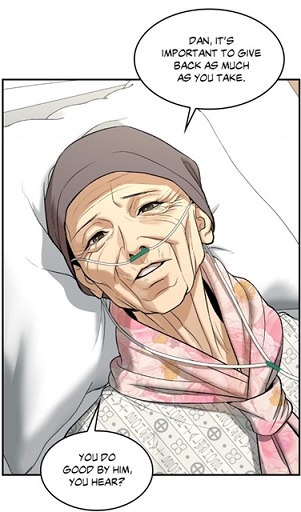 (chapter 41) While dying, she reduces love to an equation of productivity: “Dan, it’s important to give back as much as you take.” The verb do anchors her worldview — love must be measurable, visible, earned through action. To do good by someone means to labor for them, not to rest beside them. What caught my attention is that neither doctor
 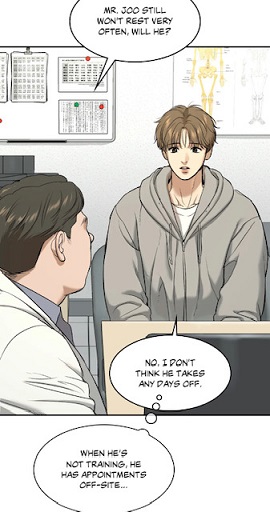 (chapter 27) nor the champion employs the expression “vacation” or “break”.
  (chapter 80) Why? It is because they never experienced a break. We have to envision that the “hamster” must have followed his grandmother, when he was not busy studying or working. Both main leads never experienced a real vacation. They say a day off, as if the day itself didn’t really exist, as if it were a temporary pause between “real” time. In their inherited logic, only work gives time its value; everything else evaporates. The grandmother’s way of loving has turned rest into an absence, something unworthy of being named. However, observe that there’s a gradual change in doc Dan’s vocabulary:
  (chapter 80) The problem is that for the hamster, only the athlete is worthy of getting his rest. It still doesn’t belong to his world.
 (chapter 5) the focus remains mechanical. Eating is fuel; sleep is maintenance. But rest, in the sense of surrender, stillness, or joy, is foreign to her lexicon.
 (chapter 30) — she watched The Fine Line, the very drama that made Choi Heesung famous. The detail seems trivial, yet it exposes everything: she had leisure
  (chapter 30), she simply refused to call it that. Watching television was permitted because it was passive, solitary, and could be rationalized as recuperation, not pleasure. In contrast, genuine rest — time shared, chosen, or joyful — never existed in her vocabulary. What she denied was not the existence of rest but the act of resting with him. She kept her downtime to herself, as if peace were a private possession. For her, love meant providing, not accompanying. Yet true care requires presence — sharing is caring, as the saying goes. [For more read this essay:
  (chapter 65) displays that she perceives her grandson’s exhaustion not as suffering but as malfunction, as if the human were a device that could be recalibrated through work and pills. That’s why her favors revolves about living conditions, but not about his “happiness”. Perhaps she genuinely hoped that the drugs and the stability of a “regular job” with the champion would realign him, as though routine alone could fix what grief and deprivation had unbalanced.
 (chapter 65) Her constant bookkeeping—every favor tallied, every gift framed as trouble—betrays a hidden fear: that if she stops keeping score, she will lose him. Rather than grant him autonomy, she entrusts him to another caretaker. Sending him to the champion is not an act of faith but of resignation, a way to offload responsibility while maintaining the illusion of control.
 (chapter 11), scarf tied under her chin, carrying a single sweet bun. She doesn’t need to say she “went out of her way”—her action already proclaims it. The effort is the gift.
  (chapter 11) That simple walk to the store becomes a moral event, proof of affection through fatigue.
 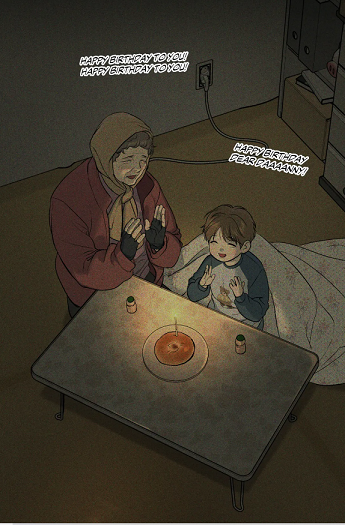 (chapter 11) Even the smallest purchase is framed as sacrifice. The sweet bread itself—a cheap red bean bun—is less nourishment than testimony: “Look what I endured for you.” If he had followed her, he would have seen that it didn’t take so much effort and money to buy the “present”. Finally, he had to share the sweet bread with his grandmother.
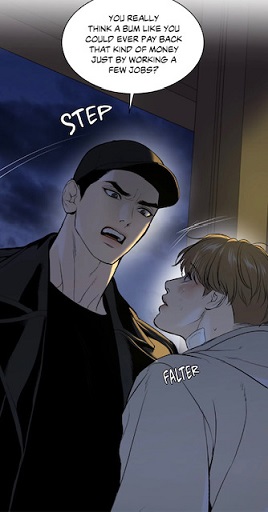 (chapter 80) In her eyes, generosity always justified expectation. The flowers were for display; the hoodie was the contract.
 (chapter 41) When Dan gifts his grandmother an expensive scarf, he hides its true price — “I got it for a bargain” — repeating her own pattern of disguised generosity. She sees through the lie, teasing him for “spoiling” her, yet she accepts the luxury without feeling guilty. The scarf becomes her version of the hoodie: a fabric trophy of moral worth. But its later disappearance is revealing. In season two, she wears it
  (chapter 56) shortly after her arrival at the hospice, never again. When she greets Joo Jaekyung, the scarf is gone
  (chapter 61). Why? One might reply that the scarf lost its value, especially since she is living next to the director’s room. I doubt that such men would pay attention to such an object. Another possibility is that she fears its brightness might betray her neglect, for the champion has lived with her grandson for a while. How could she display silk while her grandson owns almost nothing?
  (chapter 80) The gesture that once symbolized love now feels like pain and loss. The signification of the gift has changed. What once wrapped him in safety now weighs like absence — the fabric retains the shape of someone who is about to vanish. His silence is not understanding but hurt, a wordless awareness that affection can curdle into memory. The audience, not the character, perceives that with the grandmother’s approaching death, her ledger is about to close. The gray fabric, once proof of her sacrifice, will lose its moral weight; her “gesture” will expire with her. Yet Kim Dan may not yet realize that this very ending could one day free him. The book-keeping dies with the bookkeeper.
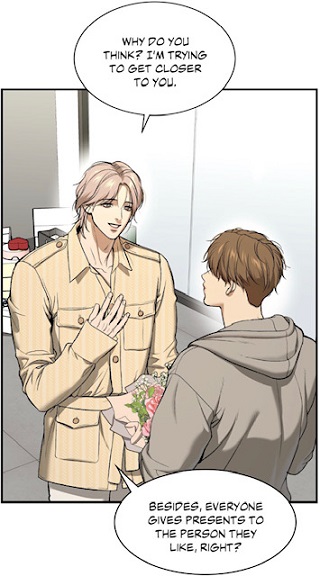 (chapter 31) When Heesung offers flowers “to get closer,” Kim Dan’s face mirrors the same unease: affection presented as transaction, intimacy disguised as generosity. What the actor calls closeness, the doctor feels as imbalance — the same emotional distance that Shin Okja’s presents once produced. Her gifts, meant to bind, isolated him instead; they built a hierarchy where gratitude replaced equality. Each present widened the gap between giver and receiver. To be cared for was to be indebted.
 (chapter 31) and tries to refuse it.
  (chapter 31)
 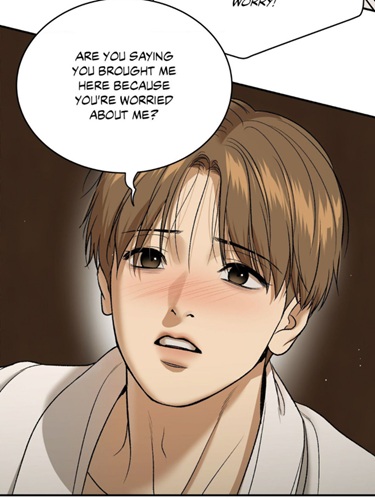 (chapter 67), loses sleep, or pays a price. He interprets Joo Jaekyung’s concern as “trouble,” Heesung’s gifts as “too much.” In his mind, affection is inseparable from cost:
 (chapter 80) “I’ll stay in the background.” His self-worth depends on not burdening others. His words let transpire that he has never been Shin Okja’s first priority in the end. The hoodie reinforces that psychology—it is not a professional outfit like a suit or briefcase would have been, but a teenager’s garment, meant for the domestic space rather than the adult world. It literally arrests his growth, keeping him in the house and under her logic. Thus it is not surprising that after receiving his diploma, he still took part-time jobs.
  (chapter 80) is the site of its quiet destruction. His act of giving reverses every law the grandmother ever taught. First, he does not “go out of his way.” The clothes are delivered effortlessly, without fanfare or moral accounting.
  (chapter 80) There is no speech about sacrifice, no self-congratulation.
  (chapter 80) If the grandmother’s motto was “I went through so much for you,” the champion’s is “It’s no big deal.” Generosity becomes invisible, unburdened, and therefore trustworthy.
 (chapter 80) The row of garments invites choice — a concept absent from Shin Okja’s universe, where love came in single doses and with strings attached. Here, the doctor is asked to select what he likes, to exercise taste, to inhabit preference. The abundance of options grants him agency, dignity, and the right to refuse.
 (chapter 22)
 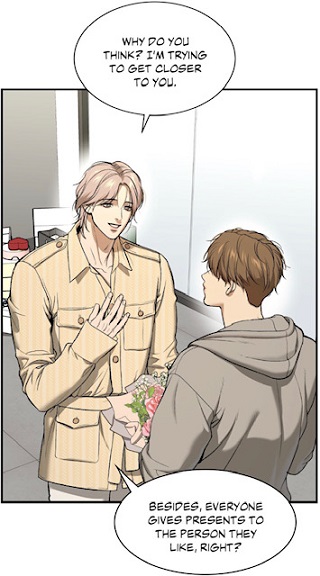 (chapter 30) becomes unexpectedly true here. The wardrobe bridges the distance that the grandmother’s gifts had always created.
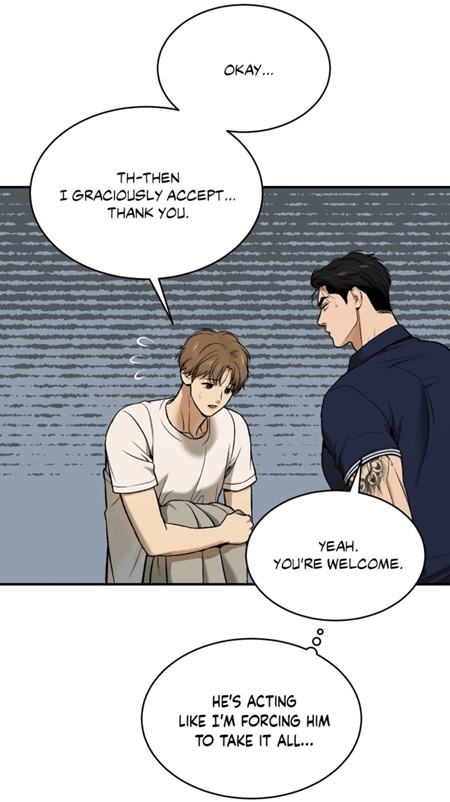 (chapter 80) This is why his hesitant and embarrassed gratitude, framed against a background of dissolving gray waves, feels so transformative. The air behind him ripples as if washing away the residue of his old faith.
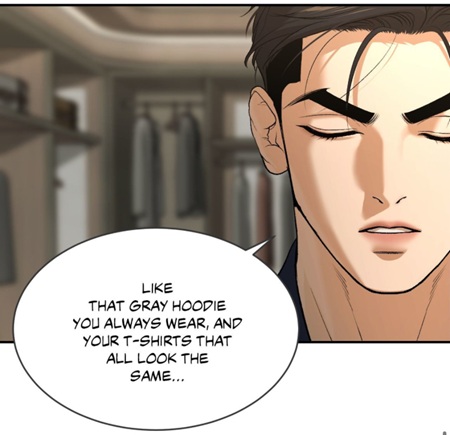 (chapter 80); they mark the passing of days, the return of seasons, the rediscovery that not every morning has to look the same. Variety itself becomes a form of freedom. When the wolf once complained that all his shirts looked identical, he was unknowingly naming what both of them lacked: differentiation, spontaneity, change. Through this act, he restores color not only to the doctor’s wardrobe but to his emotional world — a quiet resurrection through fabric.
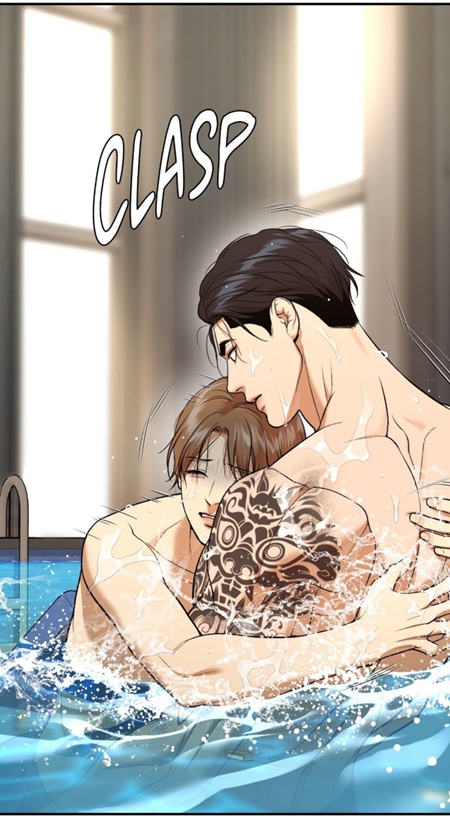 (chapter 80) The “hamster” had instinctively turned to the only person who had ever offered him help without cost.
 — the luminous, wish-granting jewel said to contain both wisdom and life energy. The dragon’s power is not innate; it is completed and elevated by the jewel. Without the yeouiju, it cannot ascend to the heavens — strength without meaning, force without direction.
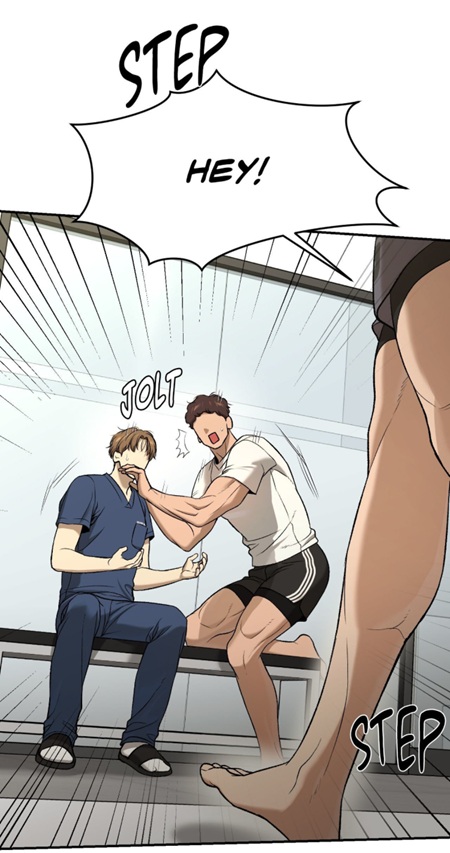 (chapter 79) This is one part of the new circle. Jealousy is the residue of imbalance — the echo of the 7 within the 8. In the numerology of Jinx, the 7-chapters, like for example episode 7
  (chapter 7), episode 18, where the champion had sex because of this statement
  (chapter 18),episode 34 with Choi Heesung
  (chapter 34) or episode 52, where the former members of Team Black and expressed their disdain and jealousy toward the main lead
  (chapter 52)
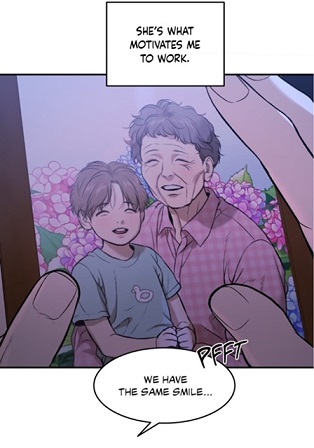 (chapter 47) and 8 lies that invisible hinge: the death of the old economy of love and the birth of a new one.
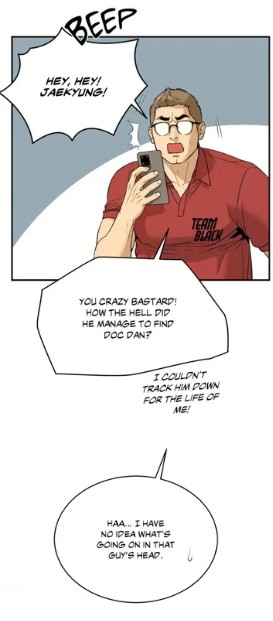 (chapter 61) and Heesung’s residual rivalry and resent. Each acts as a different face of control: the woman binds through guilt, the manager through hierarchy acting as the owner of the athlete’s time, the actor through charm and deceptions. Together they form the triad that tries to reopen the circle closed in the pool. Let’s not forget that the athlete chose to take a day off on his own accord
  (chapter 80), but he had just returned to the gym. It is no longer the same training and routine.

 I established that Kim Dan’s number is 8. It is therefore no coincidence that the arc from chapter 80 to 89 should revolve around him—his body, his suffering, and ultimately his recovery. The number 8, often associated with balance, renewal, and continuity, here signals not only the doctor’s rebirth but also the gradual thawing of his frozen world. It marks the moment when the past can no longer remain buried, when the last remnants of family and unspoken pain begin to surface. The mystery behind this phone call will be soon revealed.
  (chapter 26) the sparring between Joo Jaekyung and Kim Dan unfolds under the sign of fun and apparent joy, yet its origin lies in jealousy. The champion, unconsciously triggered by the doctor’s closeness with Potato
  (chapter 25), turns play into a contest—a way to reclaim attention.
  (chapter 25) The gym, usually a place of hierarchy, momentarily becomes a stage where both can laugh, but beneath that laughter runs an undercurrent of rivalry (with Potato). On the other hand, for the first time, the Manhwa allows both protagonists to exist outside the economy of debt and hierarchy. The gym, normally a place of discipline and work, transforms into a playground of laughter. The champion teases the doctor
  (chapter 26) He believes he has accomplished something meaningful and feels, perhaps for the first time, proud of himself. He was taught that he could fight back and overcome his fear.
  (chapter 26) He realizes that the hamster can beam at others, that such light has never been directed at him. In that instant, he no longer sees an employee but a companion whose gaze and embrace he covets, whose approval he unconsciously seeks.
 (chapter 62) The atmosphere is brighter in color but colder in tone. There, Joo Jaekyung got to experience how Kim Dan has lived all this time, helping others, making them happy with his assistance.
  (chapter 62)
  (chapter 62) Where chapter 26 radiated spontaneity, this one reveals calculation and fatigue.
  (chapter 62), where exposure to others leaves both men strangely isolated. The happiness of the crowd no longer unites; it separates. The champion’s outfit, ridiculous and domestic
  (chapter 62) which is actually his true nature. I will elaborate more further below. For the first time, the wolf looks at his companion and senses distance instead of warmth, as though the man he once touched so easily has withdrawn behind glass. His thought—“Has he always been this cold?”—marks the beginning of introspection, the moment when perception replaces instinct.
 (chapter 80) To “walk on thin ice” is to approach him gently, without force—a lesson the champion must learn if he wishes to thaw what has been frozen by years of duty and self-denial.
 (chapter 80)
  (chapter 80), not red. The atmosphere is fluid, reflective, submerged. Water—not flame—governs this new stage. What we witness is not combustion but fusion—ice meeting water, solid meeting liquid, two states of the same element touching at last. Ice does not just melt under fire; but also in the presence of water. It softens when it recognizes itself in another form. In that sense, Joo Jaekyung’s tenderness doesn’t heat Kim Dan—it mirrors him. The thaw begins not through passion, but through likeness, through quiet recognition. This signifies that Joo Jaekyung is on his way to discover their similarities: they both suffered from bullying and abandonment issues and they love each other.
 (chapter 80) at the board game table mirrors that moment: his smile is light, childlike, uncontaminated by dominance. Yet, tellingly, they do not smile together. Each glows in isolation, unaware of the other’s joy. Doc Dan has not realized it yet: he is the wolf’s source of happiness, he is the only one who can make him laugh and smile.
  (chapter 80), as it exposes the real metamorphosis from the “wolf”. The night Joo Jaekyung watches Kim Dan sleep is not erotic; it is revolutionary. For once, his desire gives way to perception and attentiveness. The fighter who has conquered bodies now studies one that is quietly losing its battle. The body before him is not the sculpted strength he knows, but a map of deprivation: protruding collarbones
  (chapter 80), visible neck tendons, the knobby finger joints and his stiff fingers resting on the blanket as if holding the body together.
  (chapter 80) The pale, bluish hue of the skin—half light, half illness—tells him what no words ever have.
 (chapter 80), the faint opacity of the nails
  (chapter 80) In the faint parting of the mouth he sees not seduction, but exhaustion—a man so depleted that even rest demands effort.
 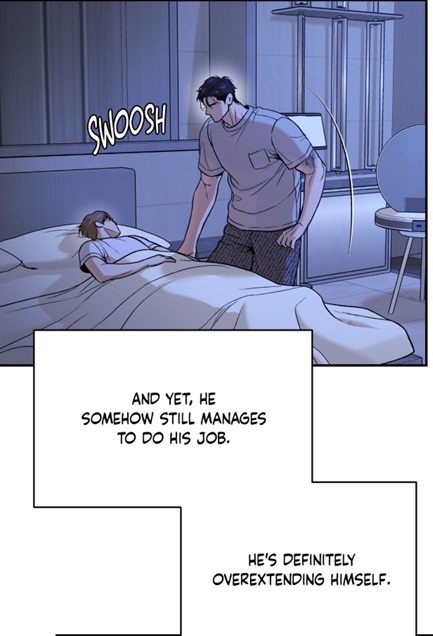 (chapter 80) he begins to treat rest not as weakness, but as reverence.
 (chapter 13) The fighter who once mocked stillness as laziness now finds meaning in it.
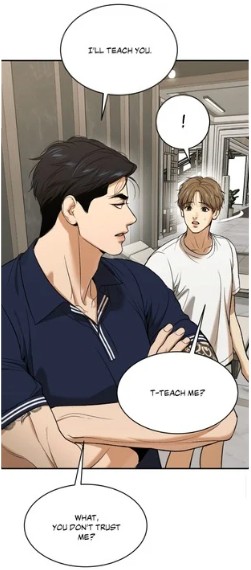 (chapter 80), it signifies that he will have to dedicate his time to the physical therapist! Hence his routine and training could get affected, just like their weekends.
 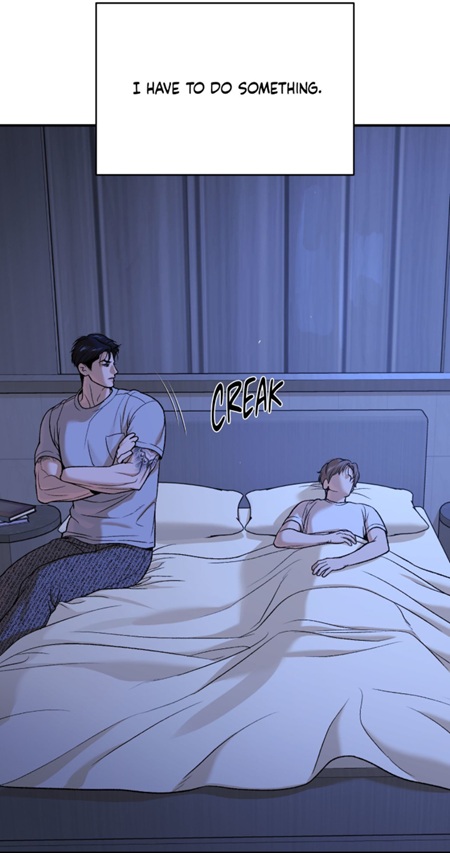 (chapter 80) —the doctor
  (chapter 13), the family member
 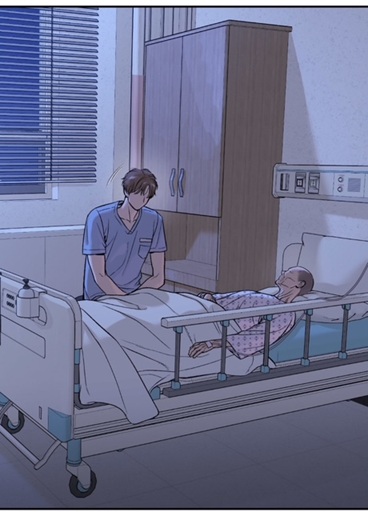 (chapter 56), the one who stays close enough to touch if needed.
  (chapter 80) Without realizing it,the athlete has inherited that role. His nearness is no longer intrusive but protective. He has crossed the invisible threshold that separates obligation from affection. The fighter who once stood as an outsider in the doctor’s life now finds himself within its most intimate circle.
 (chapter 80) Compare his facial expression to the hamster’s before their first day off together.
 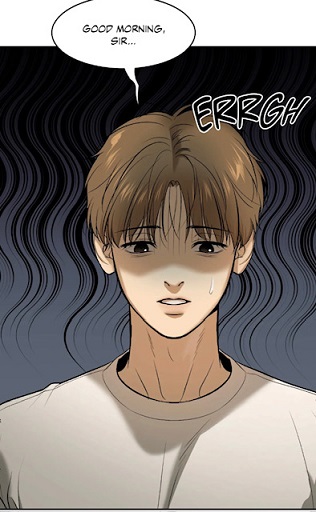 (chapter 27) That way, Mingwa can outline the champion’s confidence and that the one who needed the rest is the physical therapist and not the champion.
 (chapter 68) in the bathtub
  (chapter 68) —“I’ll keep him right here in the palm of my hand”—echo now with quiet irony. To hold someone in one’s hand is, paradoxically, to immobilize them; it grants possession but denies agency. The same gesture that promises safety also enacts paralysis. His possessiveness, once mistaken for protection, now appears as helplessness.
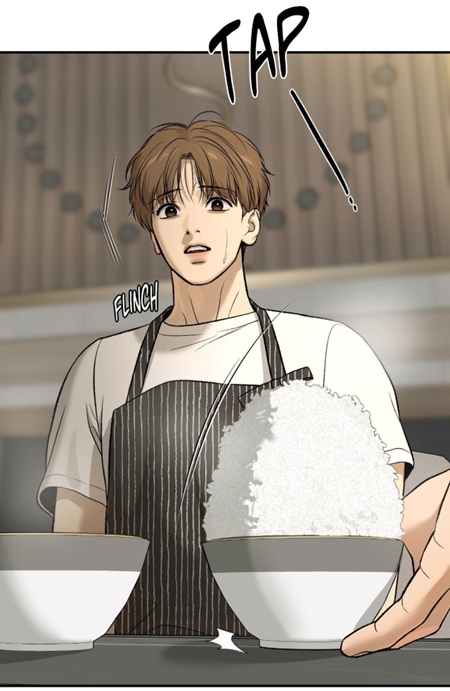 (chapter 79),
  (chapter 80) shrinking back when confronted. The body remembers the threat long after the mind tries to forget.
 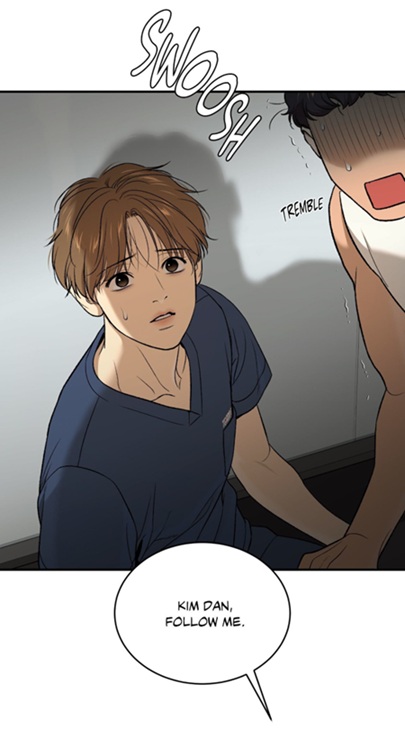 (chapter 79) He lives suspended between two survival reflexes: freezing or fleeing. Since the contract binds him to stay, he cannot physically run away; therefore, his body freezes instead. It is his way of obeying while still protecting himself. Exhaustion becomes his armor. And now, you comprehend why the celebrity could detect the coldness in the “hamster” in front of the hospice.
 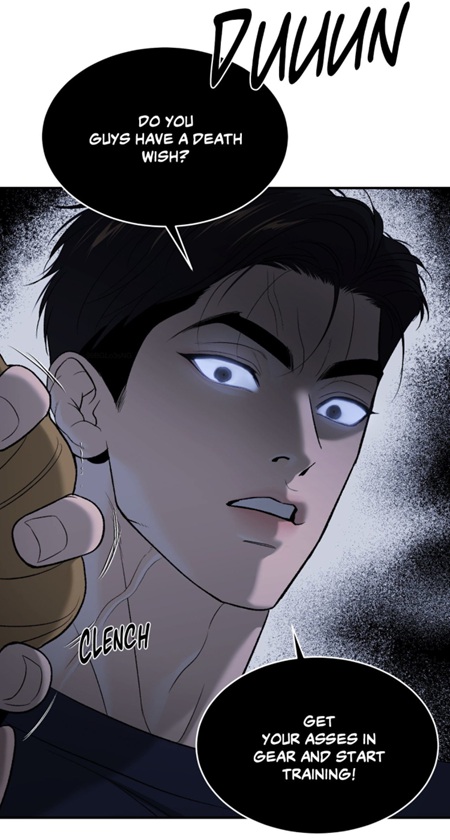 (chapter 79) — now turned outward and wounded the one he wished to protect.
 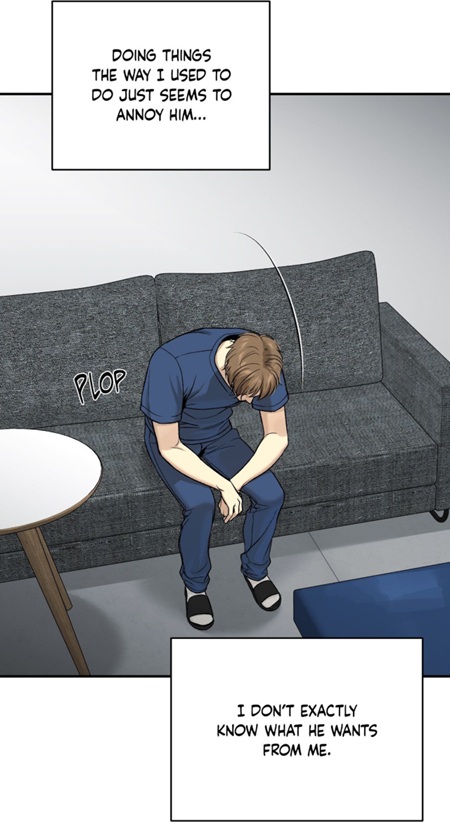 (chapter 79) Thus he clinched onto routine to maintain a normal relationship. But once the champion voiced his dissatisfaction (masking his jealousy), the light in the doctor’s gaze vanished.
  (chapter 79)
 (chapter 38) Born on December 26th, his very birthday ties him to winter, to the paradox of beauty that burns when touched.
  That’s why I can’t help myself thinking that the physical therapist is actually embodied by the snow. Ice and snow preserve, but they also isolate.
 (chapter 63), desperate to restore closeness, mistook passion and pleasure
  (chapter 63) for repair. Believing that physical heat could melt emotional frost
  (chapter 64), he tried to burn away the distance through souvenirs (evoking the night in the States) and desire. Yet the more he tried to ignite fire, the more he fed the cold.
  (chapter 64) The physical act, rather than fusing them, exposed the truth he had refused to see — that his partner was already freezing from within. On the other hand, during this night, the athlete used “self-control” for the first time, his roughness in bed started vanishing.
  (chapter 64) The wolf’s attempt to “burn the bridge” between them became the very thing that broke it. His flame met ice
  (chapter 64), and the result was not warmth but steam — a brief illusion of intimacy that vanished as soon as Kim Dan pulled away. His rejection wasn’t cruelty but a cry of despair, disillusion and exhaustion
 (chapter 64): a body too cold to burn, a heart too tired to love and fight.
 (chapter 80), but about melting together, letting warmth and cold coexist without annihilating each other. To melt together does not mean to dissolve into sameness, but to trust that proximity will not destroy one’s shape. True intimacy begins when both accept that they can share warmth without losing form — when fire believes it can touch ice without turning it to steam, and ice trusts it can meet fire without vanishing.
  (chapter 61) Touch it bare-handed, and you feel both heat and pain. The same holds true for Kim Dan’s presence: those who reach for him too quickly end up wounding both him and themselves. The sportsman’s early attempts at care followed that pattern — too forceful, too immediate, leaving frostbite where he intended warmth.
  (chapter 79), of not getting the doctor’s affection. Kim Dan’s coldness was not real rejection
  (chapter 80) They never played it — and that is no accident. The title encapsulates the temptation Jaekyung must resist: to treat intimacy as a contest, to imagine that trust can be won through tactics or timing. But hearts do not yield to strategies. The only way to melt the ice is not by “breaking” it, but by warming it, patiently, sincerely.
 (chapter 66) And this is something the physical therapist could notice, if he enters the room again and pays more attention to his surroundings. This is not about ownership but about inclusion: an unspoken invitation to share a part of himself.
  (chapter 30). Even in that comic panel, the imbalance between physical familiarity and emotional distance was evident. Kim Dan’s embarrassment stood for boundaries not yet earned, and Jaekyung’s casual tone for a love not yet understood.
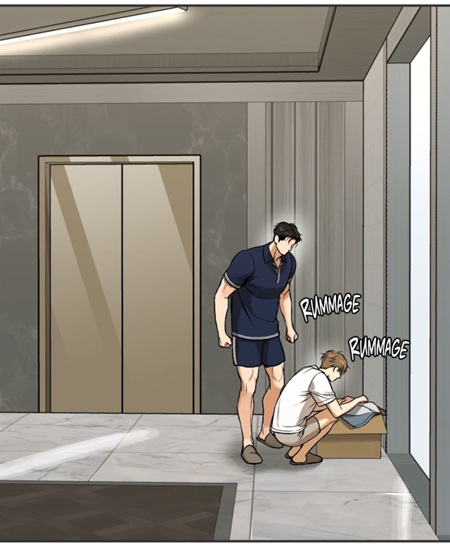 (chapter 80) The scene is small but seismic. The camera places Jaekyung slightly behind, his fists curled and his shoulders tense — an instinctive gesture of self-restraint rather than dominance. He is no longer the one towering above, demanding or explaining; he is waiting, watching, enduring the discomfort of having gone too far. His silence here is not indifference but humility — the silence of someone learning, painfully, what boundaries mean.
 (chapter 70) The athlete’s posture
 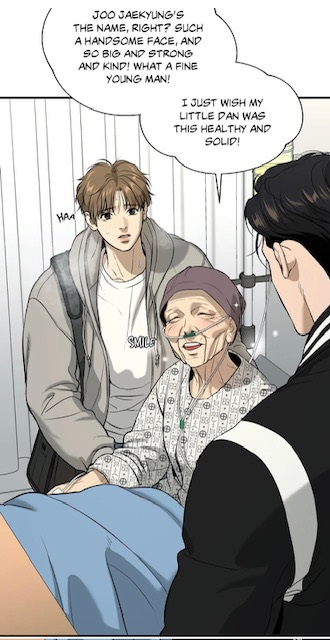 (chapter 21) Behind the warmth of her words lies a quiet wound: she loves her grandson, but she wishes him to be different — stronger, healthier, easier to care for. In his eyes, it’s an unreliable, burdensome shell — a vessel of weakness and sickness. Every protruding collarbone, every cracked lip or dark circle testifies to a deeper wound: the conviction that he is unworthy of care.
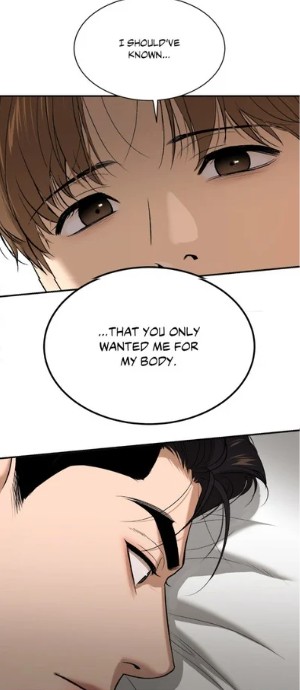 (chapter 62) the weight of that sentence stretches far beyond the bedroom. It carries the residue of every moral, familial, and physical contract that has reduced him to flesh. What the champion hears as accusation is, at its core, a confession of alienation — the echo of a man who has never learned to live inside himself. It’s not only a reproach but a confession. He hates his body because it has become the medium through which he is used, never loved.
 (chapter 27)
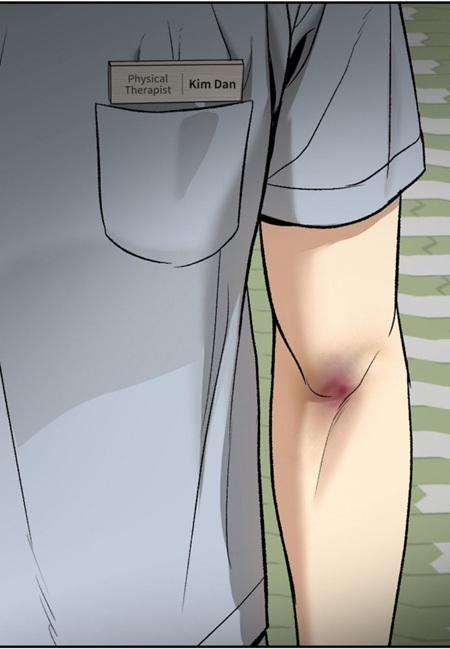 (chapter 61), the other where no one looks. Yet, the attitude of people is the same: no one pays attention to them. Both inhabit bodies that have forgotten the difference between endurance and pain. Both mistake self-destruction for strength.
  (chapter 18) when Kim Dan, bruised, had seized his hand and expressed his concerns. Back then, the gesture had confused the wolf. His hands were made to strike, to defend, to dominate — not to be pitied or protected. He had pulled away instinctively, unsettled by the tenderness and the huge sense of responsibility behind the question. He felt criticized, as if his power was questioned.
  (chapter 80) What began as misunderstanding in episode 1,
 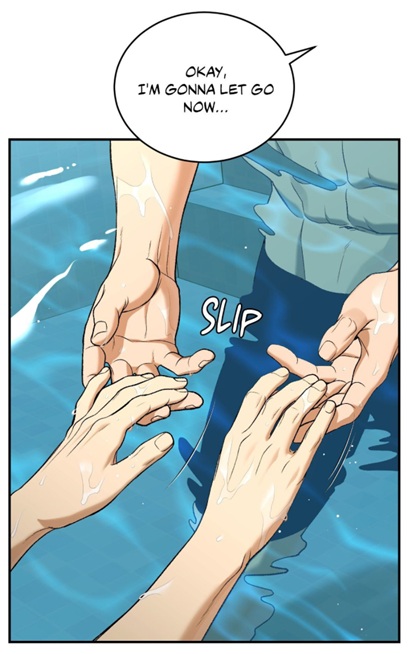 (chapter 80), Kim Dan panics, convinced that release equals abandonment.
  (chapter 80) He freezes once again. Yet the water holds him; he reaches onto the champion again — and this time, the embrace stays. What makes this moment remarkable is that the pool is shallow.
  (chapter 80) Kim Dan could easily stand on his own, but fear has eclipsed reason. His instinct is not to trust his feet, not to fight the water, but to cling to the man before him.
  (chapter 16) —that deceptively simple French word—finds its power. It means “ice,” but also “mirror” and “window.” When the champion looks through Kim Dan’s glace
  (chapter 77), unlike the touch of ice. It softens, sweetens, dissolves slowly on the tongue. Likewise, the heat between them no longer needs to scorch; it can melt. And yet, the kiss — once their most volatile exchange — has fallen silent.
  (chapter 64) Kim Dan had to bite his own lips to make Jaekyung stop, and neither has ever truly spoken of it. Yet, during the night, the athlete could see the remains of that cold war.
 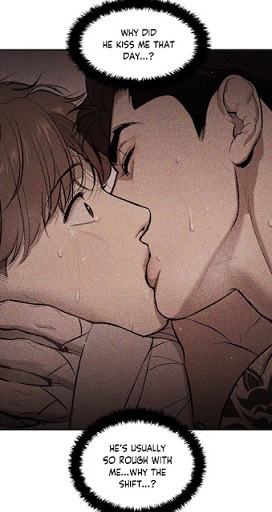 (chapter 16), just as the champion has never confessed that it was his first kiss. Moreover, during their first day off together, Joo Jaekyung had also initiated a kiss and back then, the doctor never wondered why.
  (chapter 27) Both men have been staring into the same mirror without realizing that the reflection was shared. They love each other. Joo Jaekyung needs to ponder on the signification of a kiss
  (chapter 13) and why doc Dan made such a request.
  (chapter 15) The kiss is more than just fun and pleasure. It is the expression of “love”. And now, you comprehend why I am expecting a huge change in the next episode.
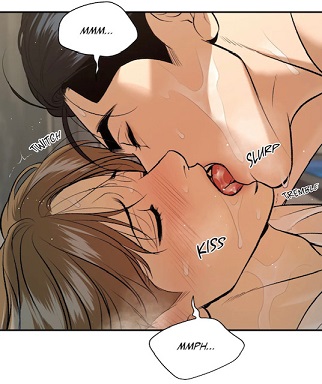 (chapter 28) and urge Kim Dan to ask, at last, the question that remained frozen between them. In doing so, he would not only reopen the conversation but also reclaim the meaning of touch itself: not as misunderstanding or survival, but as curiosity and love.
 (chapter 80) And it comes with a small but crucial instruction. In that single phrase, the MMA fighter encourages Kim Dan to discover his own power and strength without overexercising. His feet, which were once symbolically trapped in the nightly ice, now press against the water with intent during the day. For the first time, his body obeys him, not fear. His movements are neither frantic nor helpless but self-regulated, gentle and alive. That’s why the main lead becomes happy for a moment.
  (chapter 21) comes from the early loss of his mother.
 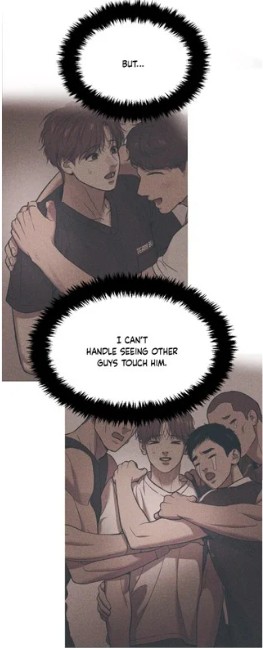 (chapter 79), if he knew that the doctor has already loved him for a long time.
 Kim Dan on Thin Ice was never just about danger or fragility — it was about transformation. The ice that once confined him to stillness has melted into water, and the fear that once froze his body has become motion. Where there was trembling, there is now flow; where there was isolation, there is connection.

 (chapter 79) However, let me ask you this. What kind of circle ends in episode 79? Moreover, how is this ending different from the past? Interesting is that episode 79 of Jinx doesn’t end with conflict, but with an awakening. For the first time, Joo Jaekyung does not rise to fight, command, or perform — he wakes up to a realization: “This can’t go on.” In the Korean version, his words carry an unusual clarity. It is not fate that changes, but choice. The champion, who once lived as if enslaved by habit and haunted by ghosts, now chooses transformation. The circle that has defined his life — power, silence, guilt, and repression — finally begins to close.
 (chapter 79) Until now, Jaekyung has moved through life as if carrying a curse — the belief that he is unworthy of care and love.
  (chapter 78) Every match, every order, every touch was an act of penance. Yet, in this episode, that belief dissolves. What vanishes in chapter 79 is not his strength, but the compulsion to suffer for it. Through the unconscious confession from Doc Dan, the wolf discovers that despite his wrongdoings, he is not hated by the “hamster”.
  (chapter 39) from the magical night in the States. Both moments unfold in half-darkness, both break through inhibition, and both blur the line between consciousness and surrender. The verbal difference hides a deeper sameness:
 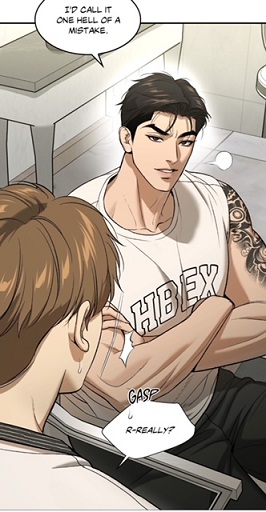 (chapter 41) What could have been a moment of truth was repressed through mockery. His body language was betraying him: his closed arms reveal that he was on the defensive. By trivializing love, he protected himself from suffering and as such from facing his own capacity for harm. Behind the joke hid an immense self-loathing: to accept the confession as real would have required believing himself worthy of it. To trust himself…. he is not a loser, a nobody!
 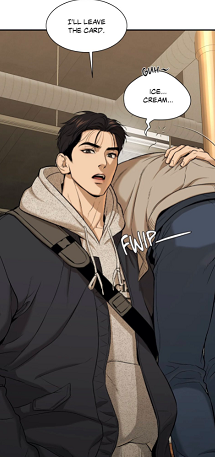 (chapter 9), 29’s confession on the couch
  (chapter 29), 69’s first expression of feelings in the dark
  (chapter 69). In chapter 79, the circle closes once more. The night’s palette tells the story — deep blue softens into violet
  (chapter 64)
  (chapter 79), the color born from the fusion of blue (Dan’s sorrow) and red (Jaekyung’s intensity). For the first time, in the penthouse the color of their relationship is not pain but balance. And now, you comprehend why in the hallway, the purple had almost vanished:
  (chapter 66)
  (chapter 79) To restore it, he will have to speak, to act, and ultimately, to smile again.
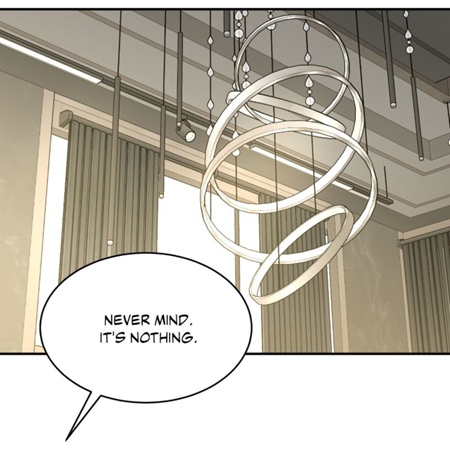 (chapter 79) His feelings collapse into the void between words. Above them, the spiral chandelier glows — the perfect symbol of their unfinished circle. His unspoken fear hangs suspended, waiting to be voiced because of someone else’s actions: the doctor’s grin
  (chapter 79) and fall
  (chapter 54) still equates vulnerability with humiliation.
 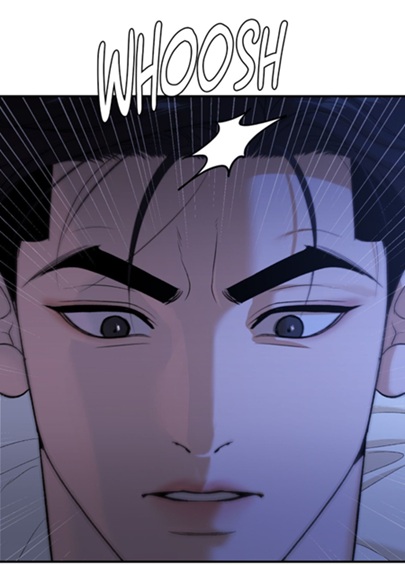 (chapter 79) The vision forces him to confront the origin of his shame. He realizes, instinctively, that the real Kim Dan would never smile at his pain — and through that recognition, he begins to separate present from past. He has already experienced a silent, but warm gaze
  (chapter 78) He has long recognized his wrongdoings — the pressure, the harshness, the selfishness
  (chapter 76) — but guilt without self-forgiveness remains sterile. What is the point of apologizing to someone when you cannot forgive yourself? His silence, then, is not arrogance but self-condemnation. Beneath his strength lies a man who believes that no apology can redeem him, because no one ever offered him one first. His father’s mockery, his coach’s reproaches
 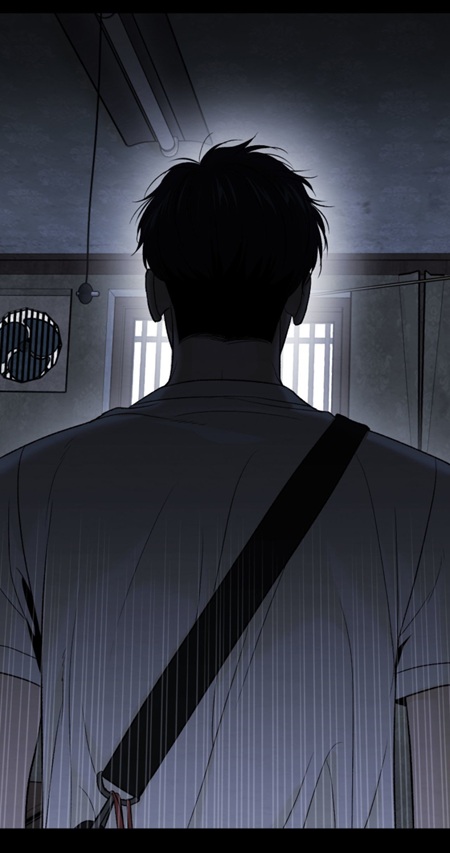 (chapter 73) Every punch was an act of self-erasure, every victory a brief anesthesia against the echo of his own self-loathing and regrets. He mistook exhaustion for atonement. But when Kim Dan whispers
 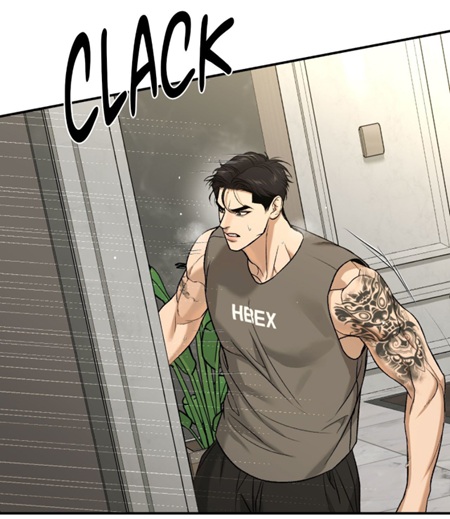 (chapter 79)— the breakfast scene
 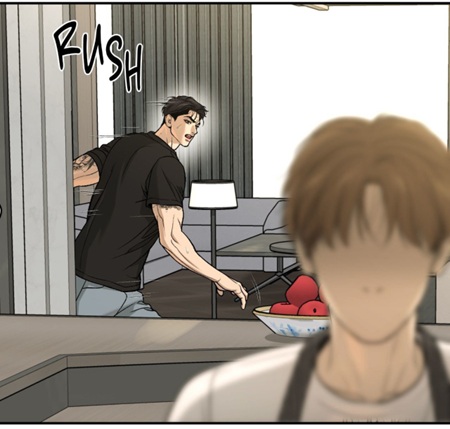 (chapter 79) , the casual
  (chapter 78) That word revealed his blindness — the refusal to acknowledge pain that does not announce itself through wounds. The new incident at the railing shatters that illusion. It was never an accident, but the expression of mental illness
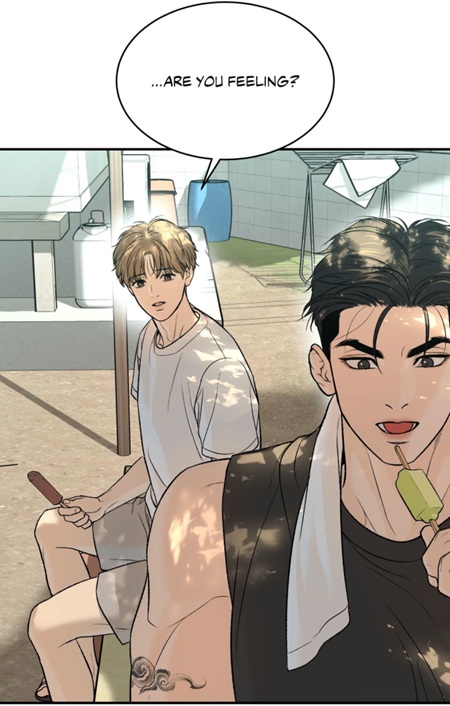 (chapter 77)
 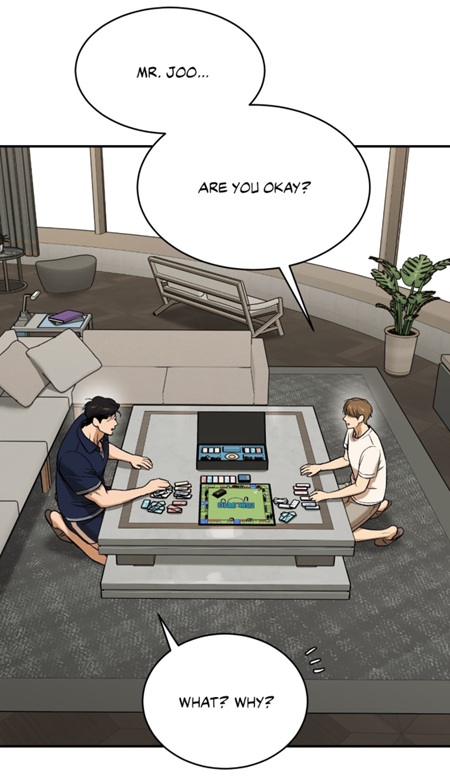 (chapter 80) Each time, the physical therapist shows concerns for the athlete’s well-being. He perceives this change of behavior as the expression of unwell-being.
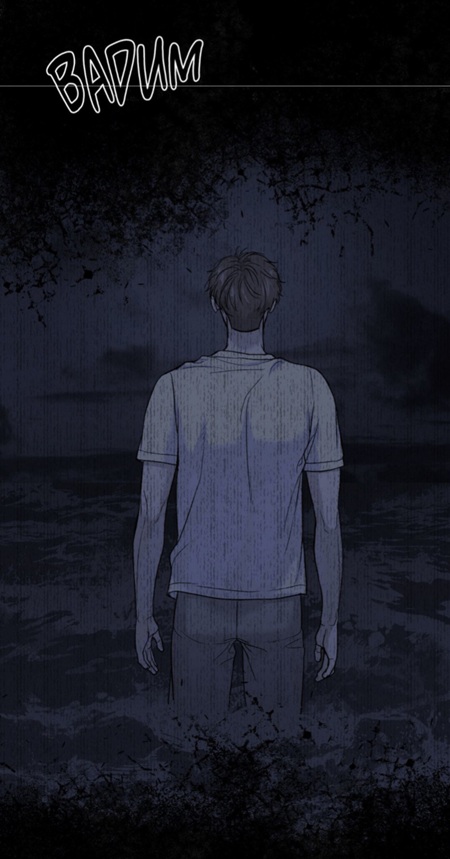 (chapter 69), and the balcony
  (chapter 37) Behind the champion, the Golden Gate Bridge stands as a silent witness — a place where many have ended their lives by leaping into the void between air and water. The bridge fuses both symbols: it is where drowning and falling meet. Moreover, the bridge embodies the connection of two worlds. This backdrop, unnoticed by the protagonists themselves, prefigures the later arcs. Joo Jaekyung is the one standing between the bridge and the physical therapist. It was, as if the author was already announcing the huge depression doc Dan would face in the future. At the same time, I came to wonder if the unconscious suicidal attempts from Doc Dan were actually revealing the biggest secret in his life: the suicide of his parents and their death could be linked to a bridge. Striking is that while the members of Team Black were partying
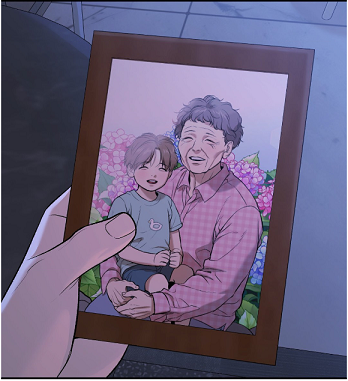 (chapter 47) The smiles here are hiding the past reality.
  (chapter 79) — so unlike his real, exhausted self — is a vision of peace, of love unburdened by fear, while this grin exposes the truth. The dream, the realm of clouds, becomes a stage where the wolf shows and learns tenderness. The dream’s fear and indirect self-reproach
  (chapter 41) In other words, the dream is giving him clues as well how to behave: not only greeting, but also talking. What caught my attention is that during their two last breakfasts together
 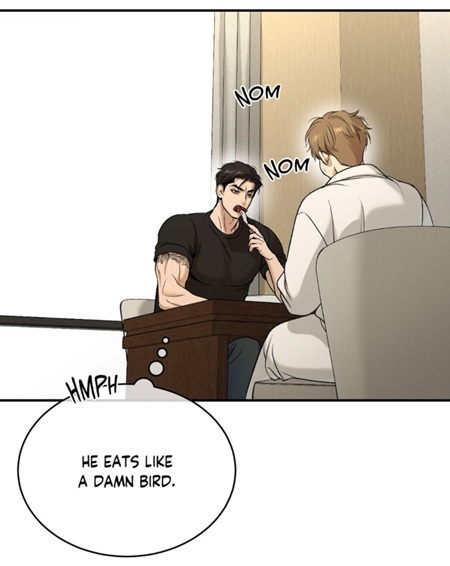 (chapter 68), they didn’t talk at all
 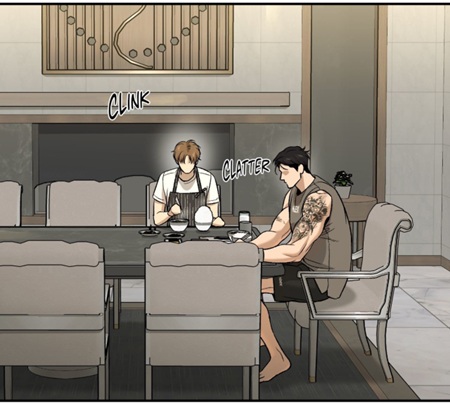 (chapter 79) which contrasts to the star’s vision.
  (chapter 79) He does not kneel; he sits, his body settling softly against the floor as he catches Dan in his arms. The man once associated with dominance becomes a cushion, a pillow, a living anchor. His strength, once used to impose weight, now exists to absorb it. The fall is not toward repentance through pain, but toward tenderness through stillness.
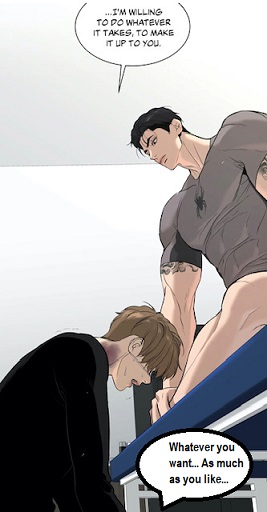 (chapter 11) now becomes the one who receives the collapse.
 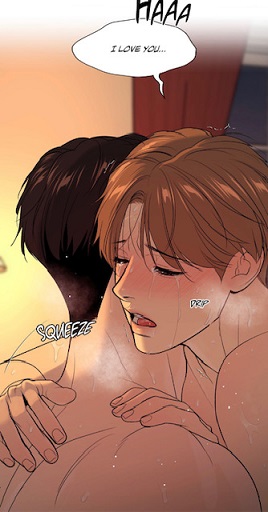 (chapter 39) escapes him in an embrace; his
 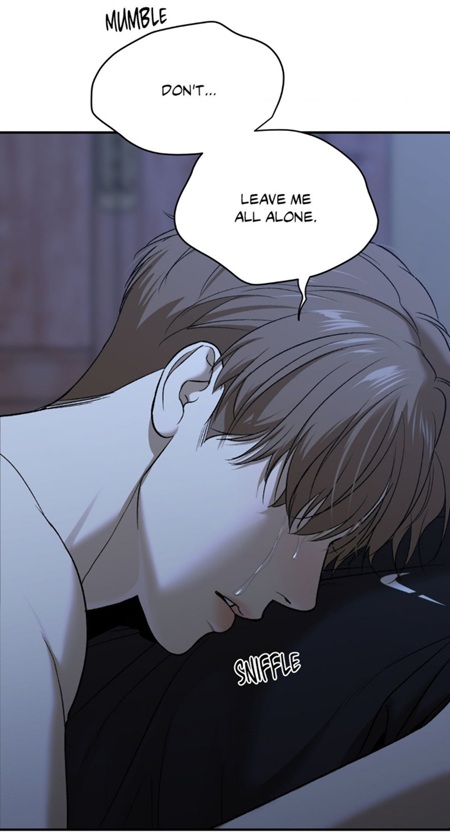 (chapter 66)
  (chapter 66) trembles out against Jaekyung’s chest; his
 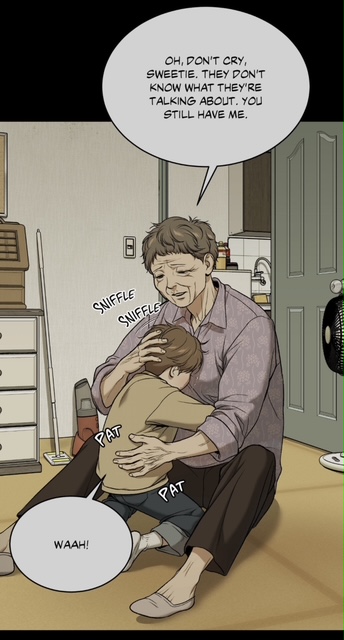 (chapter 57), he could only confide while being physically comforted. The grandmother’s embrace in chapter 57 becomes the prototype of this pattern — the last instance of safety tied to voice. Yet, crucially, that embrace was conditional and silencing. She soothed him but redirected his pain:
  (chapter 80) When Jaekyung takes his hands in the swimming pool, the gesture revives this primal language of reassurance. For the first time, the touch is neither coercive nor desperate; it’s sustaining. The handhold reverses the earlier dynamic — instead of silencing him, it gives him permission to speak. Furthermore, the champion is pointing out that he can rely on two things, the champion’s hands and the kickboard belt. This stands in opposition to the fake promise of Shin Okja.
  (chapter 57) In other words, he is inciting the doctor to trust himself more and become independent.
  (chapter 28)
  (chapter 69) The wolf, who once relied on dominance and silence, is now allowing his fated partner to hug him.
 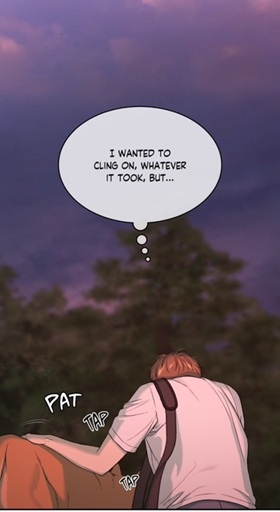 (chapter 59) His hand resting on Boksoon’s fur repeats the same motion — the pat once given to him, now returned to another being in pain. What he offers the animal is precisely what he has always longed for: warmth without judgment, touch without condition.
  (chapter 68); in the morning, Jaekyung acted as though nothing had happened. Then on the dock, Joo Jaekyung expressed his relief
  (chapter 65); “bring him to a big hospital so that he can take pills”
  (chapter 65)
  (chapter 57). Everything evolved around his lack of sleep and his dependency on her.
  (chapter 65) However, in episode 79, for the first time, the champion notices it.
 (chapter 79) It is important because very early on, the doctor Cheolmin had already detected his malnutrition:
  (chapter 13) In other words, the physical therapist’s depression and eating disorder were already existent before meeting the “wolf”. And what did the mysterious friend tell to the “wolf”? He shouldn’t wait out of fear that he might regret it later!
 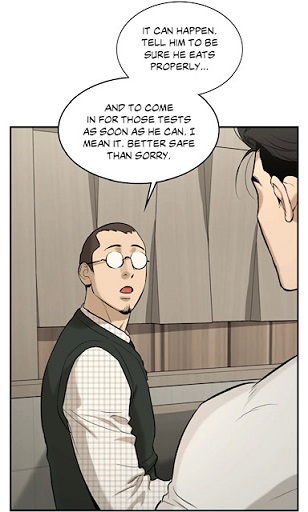 (chapter 13) As you can see, “sorry” is the link between the two doctors and the celebrity.
  (chapter 21) Imagine that I had written this part before the release of episode 80!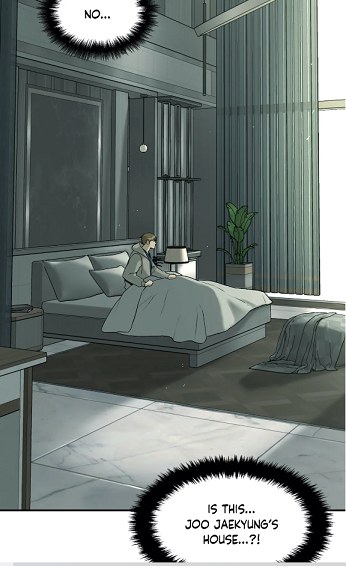
 (chapter 61) Hence it is no coincidence that while sleeping in his own bedroom, the physical therapist had a relapse.
 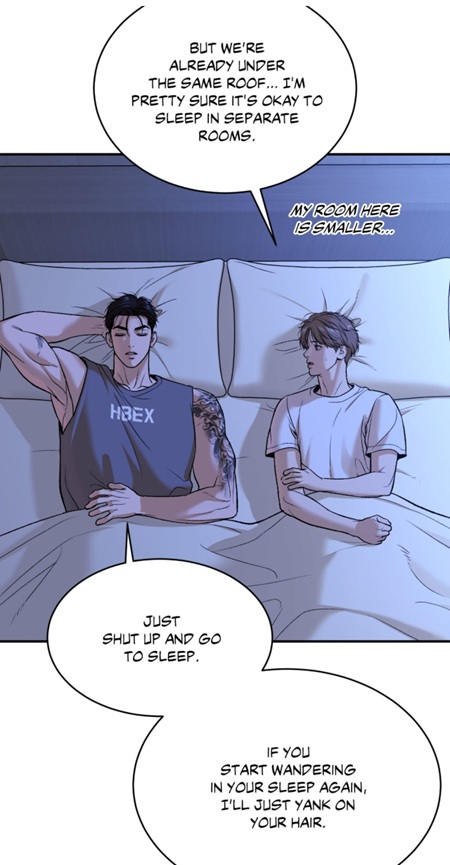 (chapter 78) And though he had another “accident”, the former is never bringing it up to doc Dan. There’s no blame or accusation. The athlete is keeping these accidents as secrets. However, pay attention that he is making sure that doc Dan is resting.
 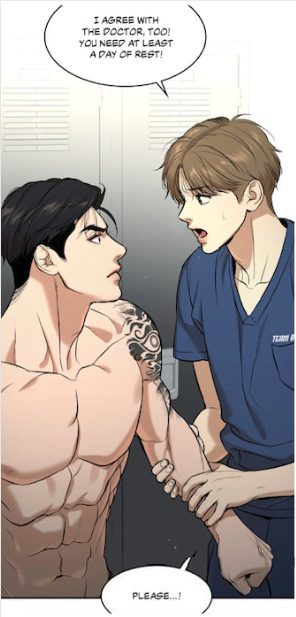 (chapter 27) Striking is that the champion always chose the left side of the bed
  (chapter 66) Thus I deduce that doc Dan is destined to take over his grandmother’s position in the bed:
 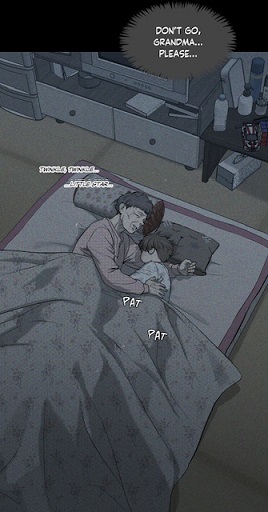 (chapter 21) And this observation seems to be validated by chapter 80.
  (chapter 79) He had the impression that he wouldn’t meet his “expectations”. Observe the parallels between the champion’s dream
 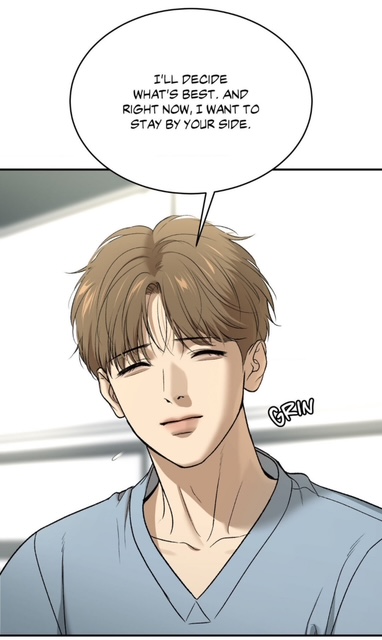 (chapter 57) We have the doctor’s fake smile which is strongly linked to rejection
  (chapter 11) yet she failed to notice it or refused to face his struggles, as they were related to their poverty.
  (chapter 5), he lost his voice and became a ghost. It is no coincidence that in this scene, doc Dan was silent despite the caress. He was avoiding any topic that could trouble his grandmother. He accepted to remain a little boy in her eyes. But thanks to the wolf, doc Dan is learning to become strong and independent so that he can decide about his life. The swimming lesson is pushing him to overcome his abandonment issues.
  (chapter 79). Yet as the doctor grows thinner and more exhausted, the wolf begins to understand what “starvation” truly means.
  (chapter 79)


 (chapter 126) to another
 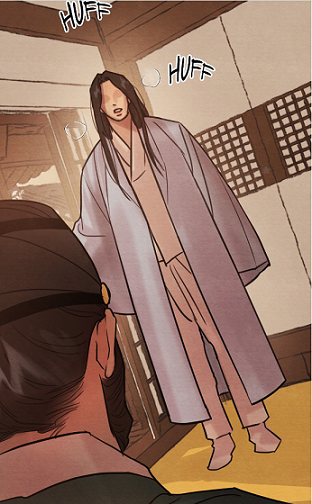 (chapter 126). He allowed his father to humiliate and abuse him
  (Chapter 126) once again. It was, as if the story was back to square one and the protagonist had learned nothing at all. Under this perception, my avid readers can comprehend why I selected such a title. However, instead of thinking that the author was a bad writer, I decided to ponder on the following question. Why did the author choose such an evolution?
 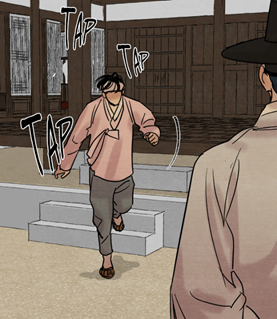 (chapter 7) Like Baek Na-Kyum, he rushed to his loved one’s side. However, he was first stopped
  (chapter 126), because it was not the right time. How so? Notice that his brother had fetched him at the port
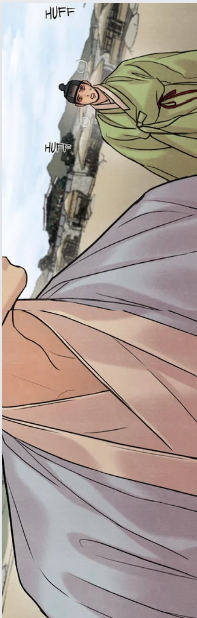 (chapter 125), but he never followed him to the bureau of investigation. And the same happened later. Why didn’t he go to his shed, when he was trapped there? Where was he, when the eldest son visited the father?
  (chapter 126) His absence exposed his passivity and betrayal. However, at no moment, Yoon Seungho noticed this. To conclude, Yoon Seungho was so worried for the painter that he didn’t pay attention to his surroundings, just like the painter didn’t see the learned sir’s disdain expressed through the cold gaze.
 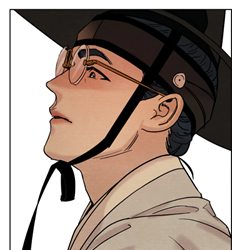 (chapter 07) Therefore Yoon Seungho didn’t notice the presence of a civilian next to the governor.
  (chapter 126). Striking is that the governor knew about Yoon Seungho’s whereabouts before his arrival: the coast. As you can see, I am detecting a link between the governor and the younger master Seungwon. Yet, it was disguised as a rumor behind the expression “I had heard”. My assumption is that Seungwon came from the bureau of investigation in order to inform his brother. Therefore it is not surprising that Seungho was invited by his brother to visit the prison during the night.
  (chapter 126) And the moment I perceived the protagonist as a fool in love, I realized that chapter 126 is a reflection of episode 7, 29
 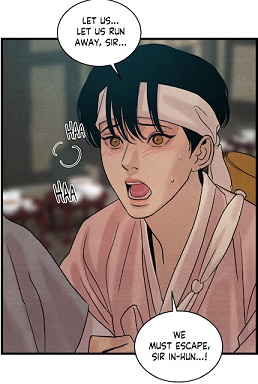 (chapter 29) and 40
  (chapter 40). Here, the painter was trying his best to protect Jung In-Hun’s interests (life, high position). Moreover, in episode 40, the painter had a dream, when he saw the announcement for the civil service examination. He smiled, for he was looking forward for the future.
 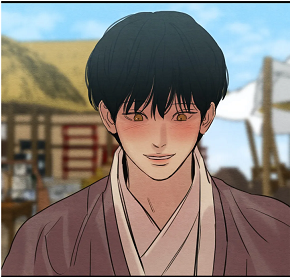 (chapter 40) And what have these episodes more in common? A betrayal, abandonment from a loved one and a paper (painting, poem). Hence I am more than ever convinced that the petition will resurface very soon and play a huge role in the downfall of the schemers and haters. Besides, chapter 40 represents the negative reflection of the conversation in the prison.
  (chapter 126) Though they are in a tough situation, Yoon Seungho is not leaving his side contrary to episode 40.
 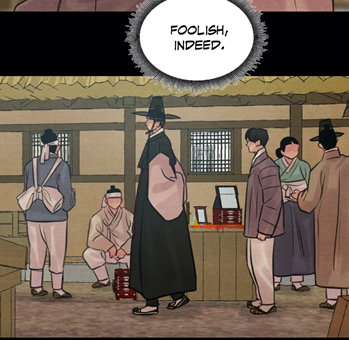 (chapter 40) There is neither disdain nor mockery. The mentioned scenes are similar, for the present resembles the past. And this brings me to the second reason for the Webtoonist’s decision.
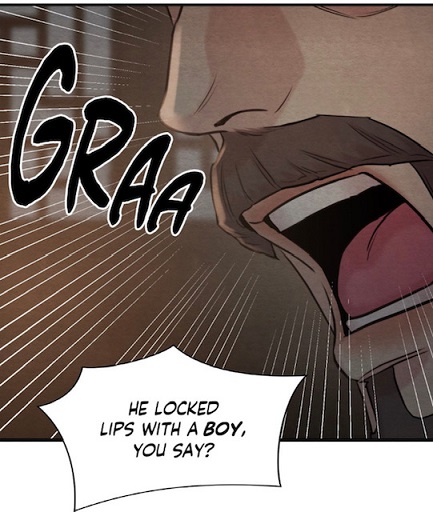 (chapter 123), Yoon Chang-Hyeon considered Yoon Seungho as a human, for he employed the personal pronoun “he”. He was still his son. Then in episode 77, he judged him as a slave
  (chapter 77), hence he was submitted to the straw mat beating and was held captive. He even refused to send for a physician.
  (chapter 83) Here, the father is denying his humanity, he is just an animal. In their next confrontation, he describes him as a monster, hence he wished that he had never been born.
 (chapter 86) However, his words exposed that he was still viewing him as a living being. Therefore it is not surprising that he accepted lord Song’s request to order the murder of his son! In the gibang, he decided to no longer acknowledge Yoon Seungho as his son.
  (chapter 107) The tragedy is that the protagonist still viewed the Yoons as his family because of Yoon Seungwon, who keeps calling him “brother”. This explicates why Yoon Seungho sponsored his brother to have an official position.
  (chapter 115) Therefore it is not surprising that he followed Yoon Seungwon’s advice again.
  (chapter 120). He would bring the petition to his own father. This means that he is acting like the painter who listened to his noona Heena so well.
  (chapter 46) But now, Yoon Chang-Hyeon believes to have the petition.
  (chapter 125) This explicates why the patriarch is now calling the main lead “nothing”.
  (chapter 126) He is not even a thing. This means that he is actually discarding him. This explicates why he sent him to the shed.
  (chapter 126) It was, as if he had become a merchandise. Or we could say that the elder master had been using him as a tool, which he can now abandon.
  (chapter 126) Interesting is that the idiom “plaything” has for antonyms tool, implement, instrument and utensil. And this brings me to the following remark. The father’s words are reflecting the last scheme. Yoon Seungho was used as the sword to get rid of an enemy, lord Song. It was, as if someone had decided to get rid of lord Song, for he represented a danger or threat. It also mirrors the trick in the shrine. Min and the others got killed, because Lee Jihwa went to his childhood friend. And who had seen the main lead using this sword, when he was enraged? Father Lee!
  (chapter 67) But let’s return our attention to the patriarch and his son. Yoon Seungho is no longer recognized as a Yoon member. Therefore I come to the conclusion that Yoon Seungho will make the following decision: to become an orphan. And this is symbolized by the loss of hair. I am expecting him to cut off his hair, something the painter has been doing for a long time. That’s why Byeonduck showed us the lord without a topknot.
  (chapter 126) This would coincide with my previous statement. The lord is going through the same experience than his loved one. However, people will come to the conclusion that this was done by the father. How so? Remember how each rumor became a reality.
  (chapter 1) I had already demonstrated that Yoon Seungho was not a fiend for sodomy with no regard for time and place, until he met Baek Na-Kyum. But once a deed is done, it can never be repeated.
  (chapter 101) So should Father Lee claim that he has long disowned Jihwa by cutting off his topknot, no one will believe him, for the young master was still seen with a topknot after confessing his feelings in public.
  (chapter 57) In other words, the topknot incident at the kisaeng would be brought up. It is impossible for 2 fathers to act the same way. Besides, the loss of the topknot has another signification: Yoon Seungho would cut off ties with valet Kim, for the latter was the one who gave him the topknot. And episode 126 reflected one more time his position:
  (chapter 126) He is the one dressing him. It was, as if he was the pope.
 (chapter 116) It is because someone had reported to him the conversation between lord Song and the painter.
  (chapter 122) There was a spy listening to their conversation. Since all the guards died
  (chapter 124)
  (chapter 125: I am assuming that the survivor got executed), I am suspecting the scholar. Moreover, why would Yoon Chang-Hyeon accuse his son to have abandoned Baek Na-Kyum? It is related to this departure of the staff and Yoon Seungho.
  (chapter 120) And who was present there? Jung In-Hun! But there is more to it. Since leaving Baek Na-Kyum behind is considered as an abandonment, it means that the patriarch abandoned his son too.
  (chapter 27) By speaking to Yoon Seungho, the elder master Yoon didn’t realize that he was admitting his own wrongdoings. Actually, he had abandoned him many times… like here for example
  (chapter 87) Therefore his words will come back to bite him. But these words are also exposing the valet’s betrayal and abandonment towards Yoon Seungho!! How so?
 (chapter 122), then he should have been at the patriarch’s house. The absence of the valet is the evidence of his treason. For me, he is now working for Jung In-Hun which explains why he never mentioned his presence in the mansion, only lord Song. Besides, keep in mind that once deed done can not be repeated. In episode 27, the lord was too angry and busy to notice the learned sir’s spying activities.
  (Chapter 27) Moreover, Kim didn’t report the interrogation to his master. This means that the butler covered up for the teacher’s wrongdoing. But here is the deal:
  (chapter 120) The library was ransacked, hence this crime is bound to be discovered. Finally, his intervention in the shed is exposing his deception.
  (chapter 83) That’s why I am convinced that these words
  (chapter 126) He is no longer suicidal, in fact he is full of hope! Though he was sent back to hell for a short moment, he came out of this as a winner. My evidence is that the lord has now become a believer.
 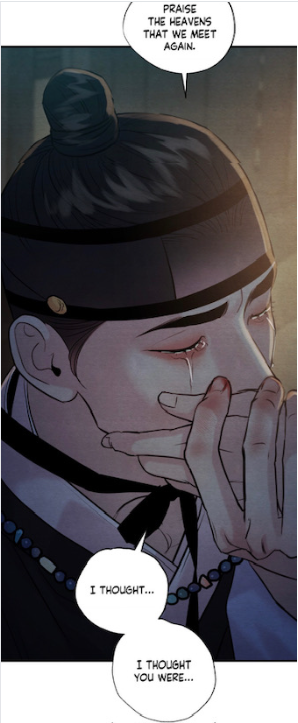 (chapter 126) Yes, episode 126 exposes the return of his faith! And where could we see the atheism of Yoon Seungho in the story? In chapter 92!
  (chapter 92) He didn’t believe in the spring poetry to ward off bad luck! That’s why he was sent back to the past. He needed to lose everything in order to find hope! In his darkest moment, he expressed a wish: to meet his loved one! And where did he pray to the gods? In the shed!
  (chapter 126) Observe how he is kneeling in direction of the bars. He is hoping to meet Baek Na-Kyum again. As you can see, though this scene
  (chapter 126) He was showing resistance and anger towards his father. Moreover, he was no longer shaking in front of the patriarch or the guards.
  (chapter 86) Thus I deduce that though he was mistreated and insulted like in the past, he was no longer suffering from his traumas. He is healed. His will is now really strong, supported by his new found faith.
  (chapter 62) Even if they were hugging, they were not close emotionally and mentally. This stands in opposition to the scene in the jail. They might be separated by the bars, but they are touching each other tenderly.
  (chapter 126) They are able to see each other.
  (chapter 126) Try Meditation
  (chapter 126) or Prayer
  (chapter 126)
 (chapter 126) Quoted from
  (chapter 126) It is relevant, because light represents knowledge and truth. He is now the bearer of the truth. And he got his blessing from Baek Na-Kyum, when he touched his hands.
  (chapter 120) Yes, chapter 126 mirrors 92! This somehow confirms my theory that the butler was the one hiding under the purple hanbok.
  (chapter 92) Moreover, we have another reference to this episode, the pouring of alcohol!
 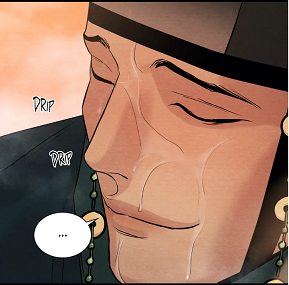 (chapter 92)
  (chapter 126) It was, as if someone wanted the lord to pay for Min’s insult! That’s the reason why I come to the following conclusion: Yoon Seungho is now opening up to Baek Na-Kyum. He is confessing to the painter about his wishes.
 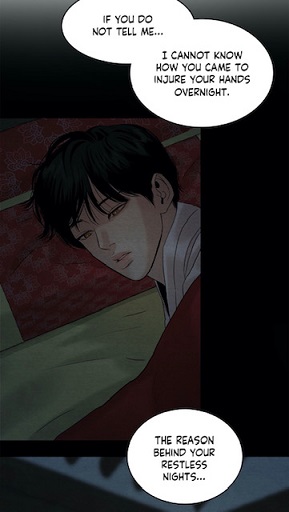 (chapter 85) The manhwaphiles should keep in mind that the request from the artist in the study was strongly connected to forgiveness. And Baek Na-Kyum could also confess what happened in the past: his guilt and regret asking for the lord’s forgiveness. Right now, both are blaming themselves for the incidents, although they got fooled by many schemers. Because the lord proved his loyalty and blinded trust in the painter, I see the scene in the jail as a new version of this confession:
  (chapter 75) Thus I consider the prison cell as a sacred place, where both characters are about to be freed from their guilt!
  (chapter 11) thus he could escape justice!
  (Chapter 11) Simultaneously, the first definition of life lie corresponds to Yoon Chang-Hyeon. The latter blames his eldest son for the downfall of the Yoons.
  ! (Chapter 86) Secondly, he still thinks that he is powerful. But it is just an illusion.
  (chapter 125). They fail their duty, for they allowed the main lead to barge in the room.
  (Chapter 126) Finally, observe how they keep apologizing without giving any explication.
  (Chapter 125) Their apology is fake. As you can see, the patriarch is living in an allusion. He is powerless, and the best evidence is that he doesn’t have the petition.
  (Chapter 126) He is actually encouraging his son to hate himself and indirectly his own father! However, the son made the exact opposite decision: love!! Hence I am more than certain that the elder master is about to experience a harsh awakening.
  (chapter 101) Thus they got punished. And now, the two main leads are about to face human justice.
  (chapter 65) But strangely, the painter is showing no fear at all.
  (chapter 126) He is ready to sacrifice himself. So why was Yoon Seungho dressed up in the end? One might say that with the topknot and the hanbok, the abuse from the patriarch got covered up. That way, Baek Na-Kyum wouldn’t detect Yoon Chang-Hyeon’s lies and abandonment!
 (chapter 125) The latter brainwashed him to take the fall for everything, implying that way, his loved one would be protected! However, I am suspecting that if the lord were to leave the prison, he could meet someone in the office. That way, this person is not confronted with the reality: the main lead was “abused”. According to the butler, he was supposed to meet his brother at the office.
  (Chapter 92) In episode 92, we have a mysterious man in the background dressed in black, but he is not wearing his gat. Besides, I would like my avid readers to remember this image from the trailer:
  which reminds us of the office:
  (chapter 98) This place symbolizes power and strength. And because episode 126 is a reflection of chapter 7, 11, 29 and 40, I think, Yoon Seungho is about to receive a deal, for these episodes are focusing on the deal between the painter and the protagonist: protection from the father and punishment in exchange for entertainment. He would appear as a fake savior in the end. Remember what in episode 11 the artist said in front of his fated partner:
 (chapter 11) He would do anything except painting!! He was not willing to give up on this principle, which reminds us of faith. So when Yoon Seungho faced his father, he experienced powerlessness for one reason.
  (Chapter 105) Then in episode 122,
  we discover that lord Song employed the pipe to beat the painter. Moreover, I detected a progression. In season 2, Yoon Seungho was still smoking.
  (Chapter 74) But once the painter showed that he didn’t like smoking, Yoon Seungho stopped taking the drug. This explicates why in season 3, he was no longer seen with the item in his hand. Even under stress, he chose to hunt instead of smoking in front of the window. We have two scenes where the pipe is present. One is when the lord is throwing it out of anger,:
 (chapter 86) which reminded me of the incident with the music box.
 (Chapter 85) This shows that this item had no value to the protagonist. Then the pipe appeared in the gibang on the table.
  (Chapter 96) However, here the lord had only eyes for the painter or Heena. Hence I have the impression that the pipe could resurface and serve as an tool to identify the perpetrator, just like the glasses were used to recognize the scholar.
  (Chapter 102) Finally, since the pipe appeared in the gibang twice, it indicates that this hobby is linked to the kisaeng house!! And this brings me to my final observation: the pipe is connected to paper
 (Chapter 1)
  (chapter 1) However, there exists two books!! And one has no PIPE! This coincides with the decision of the painter to stop drawing erotic pictures! Yes… dropped amusement! At the same time, Yoon Seungho has long lost his interest for erotic publications. He also dropped this hobby. On the other hand, the books were dropped in front of the painter.
  (Chapter 1) Finally, the petition was dropped in front of lord Song
  (chapter 123) which announced his death sentence. To conclude, the papers have a strong connection to punishment and death.
  (Chapter 126) Yoon Seungho went to the father’s mansion, and it didn’t take him that long! As you can see, I consider this trip with Yoon Seungwon as a diversion.
 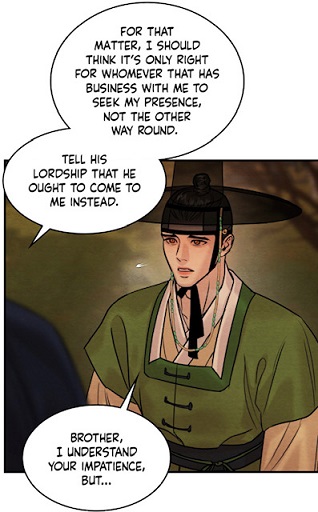 (Chapter 121) So why didn’t the elder master return to his old home? It is to drive the Yoons out of their propriety. In other words, the lies from the past are becoming a reality exposing the liars in the end. Their life lies will be ruined.
 (chapter 119), they got worried and nervous, as they considered the expression „as long as I live“ as a clue for a sad ending. Why? It is because the lord was referring to his own death. Under this light, it becomes comprehensible why I selected „heavenly“ in the title. I was naturally alluding to the afterlife. However, I perceived his words in a positive light. He expressed his desire to live. He is no longer suicidal, he wishes to live a long life next to the painter and treasure his moments with him. That’s the reason why the author included the refraction in the scene. A dream had come true, the lord was finally able to escape the darkness.
  (Chapter 119) He is now truly alive. This explicates either why he smiled and laughed at the end. But why was he so happy? It is because Baek Na-Kyum had just confessed that he loved him not for his wealth or power, but for himself.
  (Chapter 119) He even described him as a treasure. Yoon Seungho had finally achieved his goal: to win the painter’s heart. His presence and love bring happiness to Baek Na-Kyum which stands in opposition to his reputation as bird of misfortune. Moreover, this description contrasts so much to Jung In-Hun
  (Chapter 119) and Yoon Seungwon’s.
  (Chapter 118) where both portrayed the main lead as a man consumed by lust and revenge. In other words, he was presented as a huge sinner. This implies that he stands so far away from heaven. But all these words were erased the moment the painter confessed his love for Yoon Seungho once again. What Baek Na-Kyum didn’t realize is that his love confession is pushing the protagonist to fight for the painter.
 (chapter 102) In episode 102, he was renouncing on everything (life, mansion, wealth and connection), because he imagined that the artist had died. Consequently, I deduce that in episode 119, the painter’s life is attached to the lord’s for good. If the artist got into trouble, Yoon Seungho would side with him and the reverse. Thereby, I come to the conclusion that this moment in the kitchen represents their union, as they are no longer tied to the mansion. They are now a family no matter where they are. Let’s not forget that the painter expressed his wish to run away with his lover.
  (Chapter 119) It is important, because such a departure symbolizes that the bird “Yoon Seungho” is leaving the nest. He is now starting a family on his own.
 (chapter 85) and put a glass and that was it. This exposes the father’s hypocrisy, ignorance and greed. By acting on his own, he was exposing his true mindset. He views himself as the family. The sons are just the extension of himself, for they are his reflections.
  (Chapter 45) On the other hand, Yoon Seungwon is his golden child, for he represents his positive reflection.
  (chapter 86), whereas he put the other on a pedestal
 Under this new light, it becomes comprehensible why the father could only reject the offer from lord Song in the gibang. Doubting Yoon Seungwon’s sexuality meant to question about the father’s sexual orientation. At the same time, it is not surprising why the elder master would blame Yoon Seungho for everything, for he couldn’t admit his responsibility for the purge. Consequently, the Manhwaphiles can grasp why Yoon Chang-Hyeon came alone to the shrine. If he had brought Yoon Seungwon, the father would have been reminded of the elder son, as both can not be separated. This explicates why the younger master asked his elder brother to submit to his father.
 (Chapter 119) I couldn’t help myself smirking when the brother attempted to make him believe that.
 (Chapter 119) the protagonist could ever gain the father’s favor. Yoon Seungwon was definitely playing with his brother’s feelings, as if he could hope that their father would change.
  (Chapter 118) It is because as a golden child, he is also suffering, but it is naturally nothing compared to Yoon Seungho’s position who could have died.
 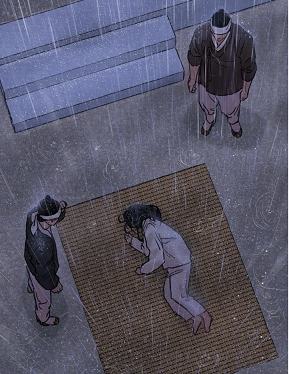 (Chapter 77)
 (Chapter 119) First, by returning the petition to the father, Yoon Seungho would become the culprit. He was not only a traitor, but also a blackmailer of the Yoons and lord Song.
 (Chapter 107), for he had stolen the petition. Yoon Seungwon would hide his wrongdoing, he betrayed their father.
  (Chapter 118) There is no doubt that Kim played a role in this as well. In other words, the brother and the valet would bury the truth by diverting the attention of the patriarch towards the main lead, if Yoon Seungho followed this suggestion.
  (Chapter 116) The elder master would no longer seek the truth, similar to the kidnapping in season 2 which was turned into a desertion and later Lee Jihwa’s abduction occulting the instigator and the helping hands. Simultaneously, Yoon Seungwon needs his brother as scapegoat, because the pressure coming from the patriarch and lord Song must have definitely increased.
  (Chapter 37) He is even implying that he needs to sacrifice himself in order to protect Baek Na-Kyum!! Moreover, he is distorting the reality, because he implies that his father is still powerful.
  (chapter 37) like the memories from episode 37 are exposing it. It becomes clear that if Yoon Seungho returned the petition, he would die.
  (Chapter 116) Thus I come to the conclusion that the meeting between the brothers in the gibang represents an offering. For the Yoons’ sake, Yoon Seungho should admit his wrongdoings
  (Chapter 55) People had played with his hopes and longing for acceptance and recognition. Interesting is that offerings is a synonym for atonement and sacrifice. But why is Yoon Seungwon so sure that he can repeat the same action from the past? It is because Kim and Yoon Seungwon have known for a long time that Yoon Seungho was longing for acceptance and love from his family, just like the scholar knew about the painter’s love for him.
  (Chapter 119) But everything changed, when the painter met the lord. So who is worse here? Jung In-Hun who tried to rape the painter or Yoon Seungwon who is sentencing his elder brother to death? Let’s say that the valet convinced the younger master to suggest this solution, this doesn’t diminish Seungwon’s responsibility at all. He knows that his father abused his elder brother. In my opinion, he is copying his father, like the former tried to diminish the responsibility of the patriarch.
  (Chapter 119) Yoon Seungho got hurt because of lord Song and not because of Yoon Chang-Hyeon. This means that the younger master was denying the existence of the patriarch’s choice and the helping hands. And if the brother listened to his advise and the father hurt or killed the main lead afterwards, the younger master could put the blame on the elder master, for the decision and responsibility belonged to the patriarch. Moreover, he heard from lord Song that killing Yoon Seungho was just a matter of time.
  (Chapter 119) So technically, this situation could have triggered the protagonist’s insecurities like in season 1
  (chapter 28), 2
 (chapter 60) and 3
  (chapter 98). However, through these constant exposures, Yoon Seungho came to learn not to jump to conclusions and to have faith in Baek Na-Kyum. He knew that he would return to the mansion. Hence he ran to the bedchamber first.
  (Chapter 119) Another important detail is that we don’t see any staff in the courtyard or in the kitchen. It was, as if the propriety had been deserted.
  (Chapter 119) This implies that at no moment, he relied on the domestics’ testimonies which contrasts to the following scenes:
  (chapter 104)
  (chapter 107) and
  (chapter 116) However, observe that in episode 116, Yoon Seungho had witnessed how his lover had taken care of him, while he was unconscious. Furthermore, the petition had been handed over to the painter and not Kim, a sign that the artist had become the protagonist‘s confident. As you can see, as time passed on, the main protagonist learned the following lessons: he should stop relying on servants, he should only trust his partner. I would even add that he was taught the following principle: “If you want something done right, you have to do it yourself”. In my eyes,
  (Chapter 103) Here, they never expected the return of Yoon Seungho and the painter. The staff ‘s absence in episode 119 is the evidence of their desertion! Moreover, I consider Yoon Seungho’s search for his lover as a new version from episode 28/29/30:
  (chapter 28) Back then, they feigned ignorance, but they never anticipated a punishment from Yoon Seungho.
 (chapter 115) And now you are wondering how the painter’s gesture can be considered as an offering. It is because the kitchen hearth is considered as sacred due to the fire. First, in shamanism, there exists the god of fire named Jowangshin.
  (Chapter 115)
 (Chapter 59)
 (Chapter 98)
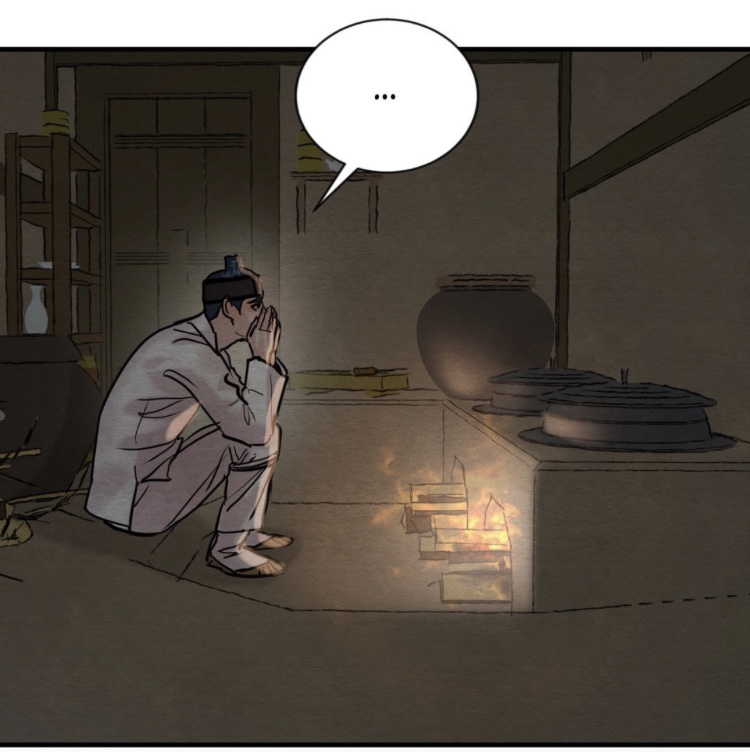 (Chapter 115)
  (Chapter 47)
 (chapter 102) who was a traitor, for he had tattled on Black Heart and his friends to Yoon Seungho. And now, you comprehend why I connected the shrine to the kitchen hearth. Both places are considered as sacred, for they are connected to gods and spirits.
  (Chapter 85) The absence of his sons and of food as offerings reveals that he was not showing true respect to his ancestors. He used religion and social norms to hide his true intentions. He wanted to take over the mansion. Hence the black guards were standing at the entrance of the sacred house. Their presence symbolizes violence. Therefore it is not surprising that the gods chose to punish the elder master through Yoon Seungho. The former was not received properly
  (chapter 86): no bow, no food and no seat.
  (Chapter 86) Let’s not forget that the elder master had entered the lord’s chambers without the permission of his owner. No wonder why he was left speechless. And now, you are wondering if I am not drifting away from the topic, as these chapters from season 3 don’t seem to be connected to episode 119. However, it is important to realize that these chapters have many common denominators
 Here, we could detect the suicidal tendencies of the protagonist. He wouldn’t fight back.
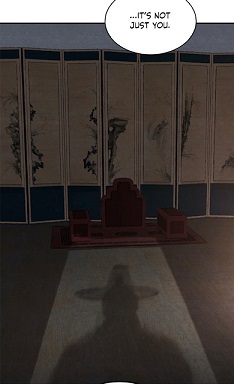 The seat looks like a throne.



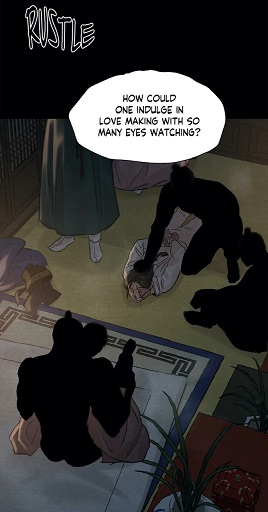


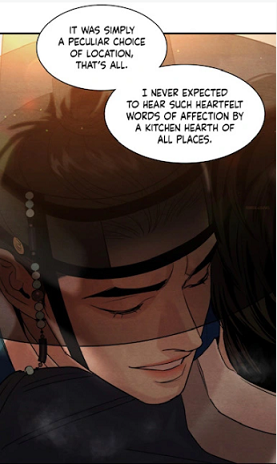
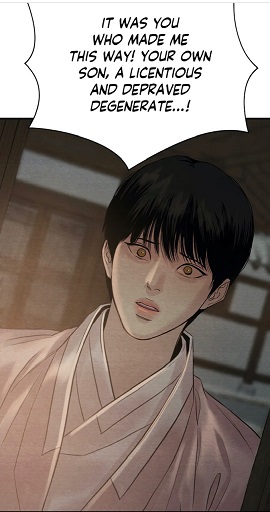


 Baek Na-Kyum freed himself.
  (Chapter 85) The study is even close to the gate.
  (Chapter 51) He could have reached the study before the father entered the shrine. Finally, observe that the patriarch even arrived to the bedchamber before Yoon Seungho,
  (Chapter 117) The painter wants to leave everything behind too.
  (Chapter 119) Thus I am deducing that the authorities will be involved very soon.
  (chapter 119) They are not expecting the lord‘s resistance, for he remained passive all this time (season 2 and 3). The scholar has now the means to do so, and the necessary motivation. Imagine that he got wounded and humiliated by the couple! Besides, we have this broken promise due to Yoon Seungwon
  (Chapter 94) The gibang is connected to money, power, pleasure, artificiality, sensuality and lack of privacy.
  (Chapter 96) I am sure that you can detect all the contrasts (night, door close, spies, confession outside and inside, no fire, only light). Thus I am deducing that the painter’s words in the kitchen were not heard by others. As you can see, this scene in the kitchen is full of symbolism. In my previous essay “The true face of family”, I had already pointed out that sharing meals represented a criteria to define a real family. Therefore I had demonstrated that Yoon Seungho and Baek Na-Kyum were excluded from the mansion, for they wouldn’t eat their meals in the kitchen like the staff.
  (Chapter 17) Moreover, the hearth doesn’t just provide warmth, but also light! The latter embodies knowledge and as such Enlightenment.
  (Chapter 119) Hence they were clueless about the wrongdoings from the staff. Only in the kitchen, the lord could finally grasp the depth of Baek Na-Kyum’s love for him. It is an unconditional love contrary to Yoon Seungwon’s. The latter would only recognize him, if he listened to him. And he only seeks his assistance, when he needs him. It shows that Yoon Seungho is only approached, when he has power.
  (Chapter 118)
 (Chapter 119) I would like to outline that during their conversation, Yoon Seungwon remained calm and indifferent, when he talked about the assassination attempt from Yoon Chang-Hyeon.
 (Chapter 116) But the biggest difference is the absence of fire in the kisaeng house.
  (chapter 78) Furthermore, he tried to leave before
  (Chapter 104)
  (chapter 105) Finally, we saw him in the courtyard standing next to a horse and a servant indicating that he had given him a task, and the latter needed to leave.
  (Chapter 108) Hence you comprehend why I am full of optimism in the end. Yoon Seungho has already made some preparations in my opinion. On the other hand, I am quite certain that their love will be tested. Can they face together trouble? Yes, because through their pain, they learned their lessons and changed.
  (Chapter 119) It is because in the past, he was never allowed to join the kitchen hearth. This place was either beneath him or he was not worthy of entering the place. Thus he employed the expression scullery boy to Yoon Seungho.
 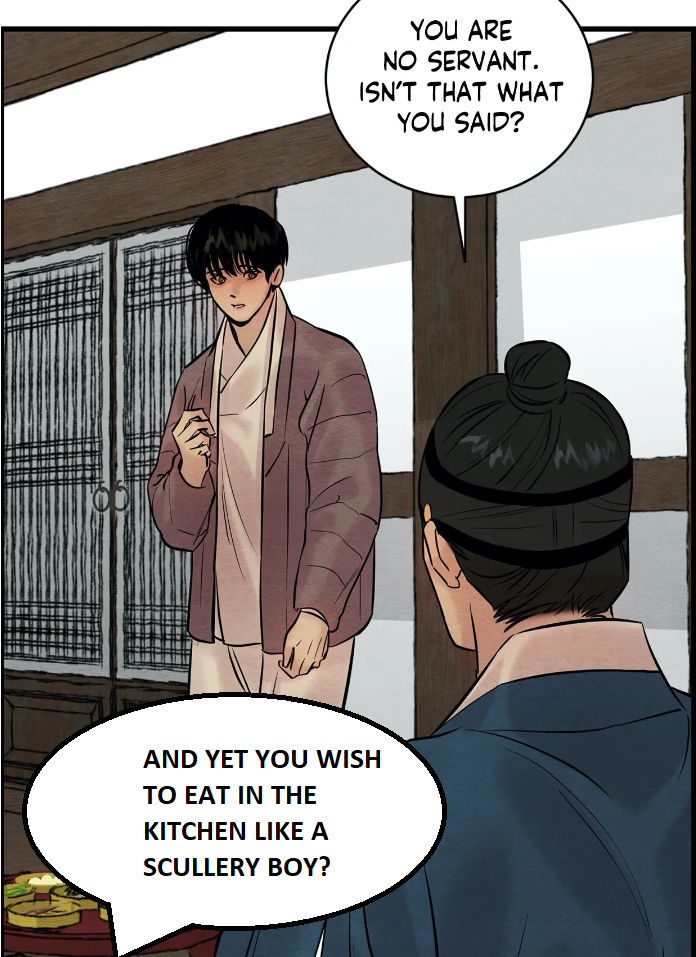 (Chapter 47) Here, I would like to outline that when the protagonist was held in the shed, someone brought him food .
 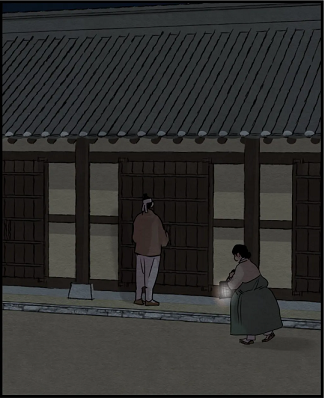 The maid had just brought water to the couple.
 During that night, Baek Na-Kyum had been held captive in a shed.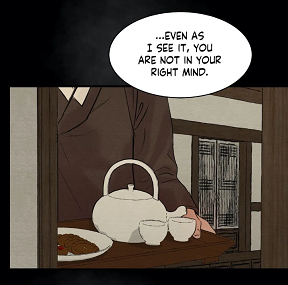
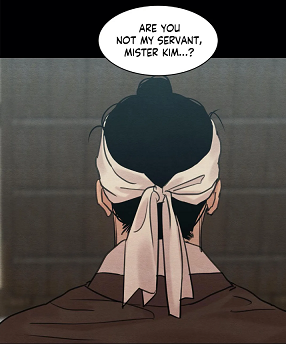

 (chapter 38) Yoon Seungho remained outside on the door step. Consequently, I started comparing scenes where the kitchen hearth appeared and that’s how I discovered a pattern:
 (Chapter 46)
  (chapter 47)
  (Chapter 110)
 (Chapter 77)
  (chapter 38)
 (chapter 59)
  (chapter 119)
 (chapter 38)
  (chapter 47)
 (chapter 77)
  ( Chapter 110)
  (chapter 119)
  (chapter 47)
  (Chapter 77) For me, Kim must have looked down on the other domestics. I consider this scene as the best example what Kim should have done in the past.
  (Chapter 119)
  (Chapter 98) One door leads to the backyard and the other to the smaller courtyard. And this scene confirms my previous assumption
 (Chapter 87) Baek Na-Kyum is there to prove him wrong. He had other opportunities, like giving him a good meal.
  (Chapter 63) He should have sided with his master and even remained by his side. This signifies that this scene
  (chapter 7) the artist is not only cleansing the kitchen, but also cutting off ties with the scholar. The latter is no longer protected. The spirits will intervene through chance. As a conclusion, the hearth has a spiritual and healing power, for it is connected to „Heaven“. Yoon Seungho‘s paradise is to have a family.
 (chapter 109) He discovers that Baek Na-Kyum has already prepared himself, as he is longing for him.
  (chapter 109) He never expected such a reaction. The reason why the evolution of Painter Of The Night is flowing at a snail’s pace is that season 4 is now focusing more on the past. First, Byeonduck needs to divulge the lord’s suffering and its causes. And this can only happen, if memories are brought up. Hence in episode 109, the painter’s memories stood in the center. Why? It is because he is trying to understand why his loved one is now avoiding him. Thus he is remembering what happened just before. The readers are actually put in the same situation than the artist. On the one hand, the focus on recollection is a method to unveil how the young master was turned into a “sodomite and pariah”, for the painter is going through the same experience than his partner. In episode 109, he is isolated from his “lover” and as such from his family, for he has now maids by his side. The latter are supposed to be his new “family”. On the other hand it helps the manhwaphiles to anticipate the future main events,. as the progression is in slow motion. This means, the Webtoonist left all the elements in the previous seasons in order to decode the past, the present and the future. That way, the manhwalovers are capable to unveil the mystery. Besides, the author has to answer all the questions the beholders had while reading the previous seasons, like this one:
  (chapter 27) What book was the scholar looking for? Up to now, we have no clue, though I had developed the following theory: Jung In-Hun was a Christian and had a bible.
  (chapter 109) How did this happen? One might reply that the book fell from the shelf, when the painter kissed his lover.
  (chapter 109) This interpretation can be easily refuted, for the noble stood next to the shelf and not in front of it. Besides, the counter stands on the noble’s left, while the ledger was on his right. However, one detail caught my notice, the beholder can not see Yoon Seungho’s hands!! That’s how I realized that the book came from the protagonist! He had carried it hidden in his right sleeve. This explicates why the book stands on the right side.
  (chapter 109) Besides, contrary to the previous panel, now the lord’s hand is visible! This is no coincidence. But if he was hiding the copy from Baek Na-Kyum, I deduce that it is related to the painter. But there is another person associated to manuscripts in this story, Jung In-Hun!! But what have the low-born and the scholar in common then? The erotic publications!
  (chapter 34) Note that in the background, there’s a book open on the desk, and it has the exact opposite position than in episode 109! And now, you comprehend why Yoon Seungho rejected the painter’s company next to his table. He didn’t want him to see the publication, for he feared that the painter would be reminded of Jung In-Hun. In the lord’s mind, the young artist still treasures his former teacher. He heard his confession on the bridge next to the pavilion.
  (chapter 94) However, Yoon Seungho is suspecting that the learned sir was behind the trick in the shaman’s house due to the glasses Min had in his hand before dying.
  However, there exist two reasons why I came to this deduction. I detected similarities with the first encounter between Yoon Seungho and his nemesis in the scholar’s home and the painter’s kisses.
  (chapter 6) Both were standing in front of the cupboard, while the learned sir suddenly took away the copy and closed it to put it back on the cupboard. This made the protagonist smirk. Due to the characters’ reaction,
  (chapter 6), I had assumed that the protagonist was making fun of Jung In-Hun. He had played a prank on the host, especially after asking about his occupation. I have always wondered about the content of the volume. Therefore I had developed the idea that this could be the bible. However, it was clear that the book was not for children which is visible due to the writing.
  (chapter 6) In fact, the learned sir should have the manual Thousand Character Classic (Chinese: 千字文; pinyin: Qiānzì Wén), also known as the Thousand Character Text.
 (chapter 6) In reality, he wasn’t teaching them reading and writing at all. But Yoon Seungho had feigned ignorance with this discovery. With his indifference and praises, the false teacher had the impression that he was supporting his attitude. This scene is relevant, because the learned sir had lied to the protagonist about the painter’s education.
  (chapter 6) This means that the book represents the evidence of learned sir’s betrayal and abandonment. He is responsible for his illiteracy. To conclude, this scene contains the following elements: a prank, a lie, a confession which was triggered by a book that Yoon Seungho had picked up by chance. But wait… it could be the book from the scholar’s home!
  (chapter 06) But this image can be used to refute this theory. How so? It is because this book has a title, hence there is a white rectangle!! However, take a closer look at the copy on the floor.
  (chapter 50) Finally, I would like the readers to keep in mind that they could only see the content of the books
  (chapter 6) He proposed him to sit and have a cup of tea to divert his attention from the books on the cupboard. Besides, I would like to outline the huge contrast between these two scenes. The scholar needed the assistance of the prestigious family Yoon, while the protagonist replied this to his loved one:
  (chapter 109) Needed versus not necessary!
  (chapter 6) He was here very vague (“bizarre and vulgar”), he spoke of a scolding, but never of rejection and abandonment!! This is important, because Yoon Seungho also experienced something similar in the shed:
  (chapter 77) Back then, the butler’s words must have wounded him terribly, he must have felt dirty either. Under this new perspective, it becomes comprehensible why I came to this conclusion that the book is related to the learned sir and to the erotic publication. But this doesn’t end here. In my eyes, episode 109 clearly outlined the importance of the library in the protagonists’ life. This is the place where both main leads got betrayed and abandoned.
  (chapter 40) When the scholar wounded the artist with his words, he implied that the artist was responsible for his lack of education. With the idiom “I thought, you could be educated”, he gave the impression that he had put some effort, but due to the artist’s disposition, he had failed. We had another scene where the learned sir was blaming Baek Na-Kyum.
  (chapter 70) He would fall asleep instead of studying. And who knows about the learned sir’s hypocrisy? Yoon Seungho!! That’s the reason why the goddess Byeonduck let them meet in the library. It is to heal their wounds. In this room, Yoon Seungho’s suffering started and later, the painter got betrayed by his former teacher, someone whom he viewed as his “family and mentor”.
  When Yoon Seungho got kissed by the painter
  (chapter 109), he got surprised, and he had the same gaze and facial expression than the one during the First wedding night
  , in the gibang
  and in the study
  (chapter 42), though here the artist kissed his companion twice!
  (chapter 49) And what had these scenes in common? Paintings and the artist’s confession. And now, you comprehend how I made the connection between the book and painting.
  (chapter 19) This scene could only break the artist’s heart, because he was reminded of the learned sir’s reaction: his rejection. The latter got angry and jealous that the low-born would be treated as someone special. Furthermore, Jung In-Hun had only got the noble’s sponsorship thanks to Baek Na-Kyum and not thanks to his own talent! In verity, the learned sir had been the tool to submit Baek Na-Kyum. Shortly after the exposition, the protagonist went to the study. There he got confused for Jung In-Hun, hence he received a wonderful confession
  (chapter 19) before getting kissed and embraced!
  (chapter 42) Yet, the artist was unable to explain the situation, for he had internalized Jung In-Hun’s criticism.
  (chapter 42) So we could say that the yangban tried to get a confession from the painter, but he failed. Hence they had just sex. The artist’s heartbreak was the reason why he never got to confess the truth! And what had happened in the study after the painter kissed the main lead? The lord saw the inauguration illustration and got jealous of Jung In-Hun
  (chapter 48), and the painting had exposed the main lead’s uneasiness and pain. The drawing was not refined, barely finished.
  (chapter 47) The behavior from the painter and the new painting had not only wounded the main lead, but also pushed the lord to discover why the artist was behaving this way. After the rough sex session, the artist had made a confession: he was dropping the rules he had been raised.
  (chapter 49) He was admitting his sexual orientation and his own pleasure, but he still kept his distance from Yoon Seungho. Why? It is because he was reminded of the learned sir’s fake embrace and betrayal.
  (chapter 49)
  (chapter 94) which incited the artist to recall his childhood. That’s how he came to unveil his past and confess his love to the noble!
  (chapter 19), the parties after the separation
  (chapter 51), his visit in the gibang and his tricks
  (chapter 96). In episode 109, the painter confused Yoon Seungho’s shadow with Black Heart’s. In his nightmare, he was brought back to the shaman’s house and the lord’s smile was similar to Min’s.
 (chapter 109)
  (chapter 99) Besides, let’s not forget that during that terrible night, Black Heart never touched the artist himself, as if he didn’t want to touch a trinket sullied by another man”. On Twitter, the author revealed that Min would help Yoon Seungho. Through this comparison, the beholder can confirm this. Thanks to Black Heart, the couple got closer in the end.
  (chapter 19), the spying on the painter – though here it appears like a good thing –
  (chapter 41), the stones in the rice
  (chapter 109). Here, the maid was triggering the painter’s memory and as such fears. That’s the reason why the readers can see the laugh of someone outside the building
  (chapter 109). She was acting, as if Baek Na-Kyum was not present, but in reality she knew that he could listen to her. How do I know this? The evidence are the sweets on the windowsill.
  (chapter 109) They never encouraged the tormented boy to eat the sweets!! Besides, this episode confirmed my interpretation about the complicity of the maids. As their role is to comfort Baek Na-Kyum, the readers should question themselves about their absence.
  (chapter 108) Why is the room dark? Where are the maids during that night, as they are supposed to sleep next to the painter?
  (chapter 109) The absence of the light is truly noticeable, an indicator that they are not in the bedchamber. Moreover, I had detected that the brown bed cover symbolizes the meddling of Kim. [For more read the essay
  (chapter 87) Sincerity versus fake concern; own choice versus manipulation, happiness versus sadness. Under this perspective, you comprehend why I view the maids as traitors. But since season 1, the women were never punished. Hence they felt free to badmouth Yoon Seungho or Baek Na-Kyum. So while he was preparing himself, where were the ladies-in-waiting? I doubt, the painter would give them orders. The painter was left alone on purpose. Finally, the manhwalovers should question why there is a bottle of oil in the bedchamber. So far, Yoon Seungho utilized it once
  (chapter 20) and it was during the first Wedding Night. And oil comes from the kitchen, the lord had fetched it from that room!! Naturally, there is an exception, and it is the kiss in the gibang. Yet, here the kisaengs had just replaced the maids. In other words, they had played a role in the confession. And this explains why the noona’s words are superposed with the maids.
 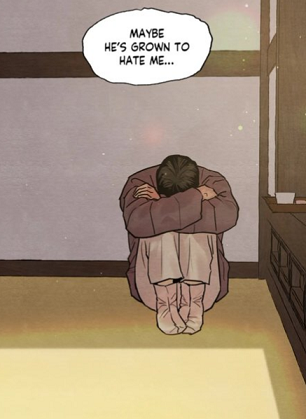 (chapter 109) That’s the reason why I am convinced that the book is strongly connected to the learned sir. In my eyes, it can only be the erotic publication of sodomy!! Why? It is because it represents the painter’s biggest wound. It explains his low self-esteem. Consequently, I am expecting the appearance of this panel:
  (tweet) The teacher told him “It’s dirty”, and wounded him the most with his gaze full of hatred, the symbol of rejection! Note that in episode 109, the painter always focused on the mouth and not the gaze,
 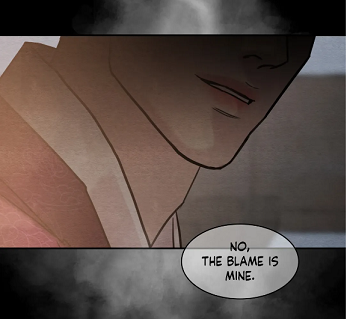 (chapter 109)
 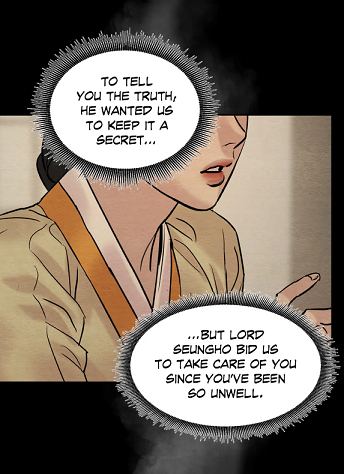 (chapter 109)
  (chapter 25) Moreover, during that night, we have the same elements: a painting, a confession, sex, a book that the scholar was looking for. From my point of view, in chapter 34, Baek Na-Kyum only recalled the beating from Jung In-Hun.
  (chapter 34) But like I wrote above, this place is also where Yoon Seungho got betrayed and in my opinion, the schemers are planning to use this place to ruin the protagonist!!
 (chapter 106)
  (chapter 106) And if Yoon Seungho gets caught having sex with the painter and he has an erotic publication of sodomy, he can be framed for the murder of lord Shin and the other nobles. He will be guilty by association. Thus I deduce that the schemers needed the father to report him to the authorities.
  (Chapter 105) As you can see, the staff had encouraged the lord to keep his distance from his companion on purpose, to create a misunderstanding… they used the painter’s anxieties. Why? That way, the artist would be more inclined to betray his lover, if the latter was in difficulty. He could put the blame on him. In my opinion, the book was planted there on purpose. Remember how the artist denied that he was the author of the erotic publications.
  (Chapter 1) Besides, there is no doubt that the father refuses to take any responsibility in his son’s suffering. And now, you comprehend why this copy was put on the lord’s desk. He was supposed to be the owner of the erotic book and even the author! I am suspecting that he was accused of the „same crime“ in the past. Then this observation raises the following question. Which erotic publication is it? The original
  (chapter 1) This would stand in opposition to the scholar’s rejection (dirty), as the artist was just the helping hand. Besides, there is no ambiguity that Yoon Seungho blames himself due to the erotic book. If he had not brought the painter to his mansion, none of this would have happened. But the painter’s confession would make him realize that his misery started long before he met Yoon Seungho. And how did the puppetmaster come up with such an idea? From my point of view, this plan was inspired by the learned sir.
  (chapter 37) Back then, he imagined that the man hidden under the green hanbok was the learned sir, but he was mistaken. Both father and son believes to have seen the relative’s sodomy. Besides, the brother mentioned letters and these usually are written on a desk and as such in the library. Yes, this night should trigger the lord’s memory… his brother’s betrayal and abandonment.
  I am still waiting for this picture. Yoon Seungwon had definitely tattled on his brother out of jealousy in the past. Don’t forget this flashbulb.
  (chapter 96) She would tell the truth… yet it wouldn’t serve her, because she reported it too late. She could be perceived as pathological liar. Besides, she was not supposed to be in the kisaeng house. Moreover, note that all the erotic paintings the painter created vanished. There is no evidence that the artist is the author of the erotic publications of sodomy, as his notebook contains images of nature.
  (chapter 84) Finally, the childhood paintings could be used as an evidence. But what about the book in the library? Both could decide to burn it…
 the burned letter
 the shrine
 (chapter 109) Note that there is no rejection from the lord, just surprise and shock. Besides, in the kisaeng house, the artist’s confession had led the main lead to confess as well.
 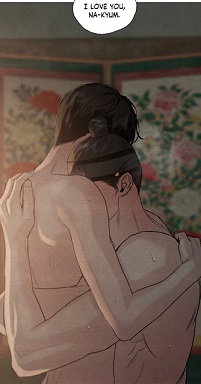 (chapter 96) Striking is that he had hidden his gaze from the artist first. As if love was a sin…Hence I am expecting a confession from Yoon Seungho in that very room too, something he has never done before! Why? It is because he was not the owner of his own past. Kim acted, as if he possessed his memories. Finally, the moment the painter divulges this incident to his companion,
  (tweet), the latter can only come to the conclusion that the scholar would have no problem to hurt Baek Na-Kyum and even get revenge on the artist, for he received the favors from the protagonist. Yoon Seungho would no longer feel obliged to respect Heena’s wish, for her words wouldn’t reflect reality.
  (chapter 105) And it was Yoon Seungho’s luck, when the book fell from his sleeve!
  (chapter 27) The goddess Byeonduck is on their side. But the problem is that the readers have the impression that both are followed by misfortune due to their misery. The reality is that they are both victims of manipulations and tricks. That’s their tragedy. But by repeating that the two figures are “birds of misfortune”, the accomplices are trying to deny their own involvement and as such responsibility. The maids are the perfect example. They blame Baek Na-Kyum for his own illness. He eats like a bird and he would hide his illness.
  (chapter 108) To sum up, he was responsible for his own suffering, for he was in denial and the maids could do nothing to help. But the lord can see the truth, when he touches his lover’s butt.
 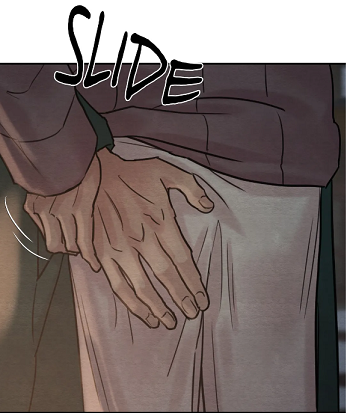 (chapter 109) He lost weight in such a short time. And their presence by Baek Na-Kyum’s side was supposed to help him. They were responsible for his well-being, but the women never realized it.
 (chapter 108) He blames himself for everything. For me, these women were lying to their master. Why do I think so? The first proof is that the painter’s fate is to go through the same experiences than his lover. And what did the valet admit in the shed?
  (chapter 108) There was not a soul in this household who was standing by his side back then and now! This signifies that there is not a soul in the mansion truly standing on the painter’s side as well!! Back then (before the massacre) and even now… Moreover, while these maids’ attachment was sincere
  (chapter 51)
 (chapter 108) Yes, this woman is not the same than the one from chapter 51, for her clothes diverge despite the same pigments. She is wearing a white ribbon around her waist.
  (chapter 108), whereas the other wears the belt more around the hips, hence her skirt has a bump on her butt.
  (chapter 46)
  (chapter 74) This explicates why the artist returned the table with the porridge to the kitchen himself.
  (chapter 62) The painter had been faking his “submission”, hence the “valet” got fooled. He had trusted the artist blindly. Thus the lord got angry, and resented the butler, for he wished the opposite. He didn’t want to admit that the artist had been acting. Yet, the seed of doubt was implanted in his mind. Consequently, in episode 108, we have the exact same situation, yet contrary to the past, the lord didn’t get angry at his lover. He never condemned the painter for his dishonesty, though he was not truly lying either. To conclude, chapter 108 is a reflection from episode 62. Thus it dawned on me that the valet could have attempted to fool his master once again. The artist was a hypocrite, for he was acting in front of the lord hoping that he wouldn‘t cut ties with him. It was for his best interests to send back to the kisaeng house. Yet, nothing like that happened.
  (chapter 104), a sign that he was recovering. But due to the two incidents during that day, Baek Na-Kyum had been feeling unwell and was hiding his discomfort out of fear of getting abandoned. This means that the deceivers were trying to portray the painter’s actual disposition as something unchanging. Since the painter had trouble with eating now, his eating disorder existed in the past. And this perception got reinforced, for the lord could notice afterwards that the maids’ statement had become a reality. What they had described, truly happened afterwards. Due to worries and anxieties, the artist lost his appetite. He would fake his “happiness”. The manhwalovers could witness how the painter had slimmed down
 (chapter 57) A single incident was turned into a generality, implying that it was the same in the past!! To conclude, the noble is put into the same situation than his own father, the only divergence is that Yoon Seungho has indeed the painter’s best interests in his heart. He is determined to provide him with the best!! Thus he blames himself contrary to the elder master Yoon.
  (chapter 104) This statement implies that the painter is responsible for the bloodbath, for he left the propriety. Yet, instead of confronting the painter, he was encouraged not to talk about the past. He was suggested that way, he would protect the artist’s mind and heart. Besides, his choice was influenced by his own anxieties. The lord fears argument, because the last time they had quarreled, the artist had threatened his lover to leave the place.
 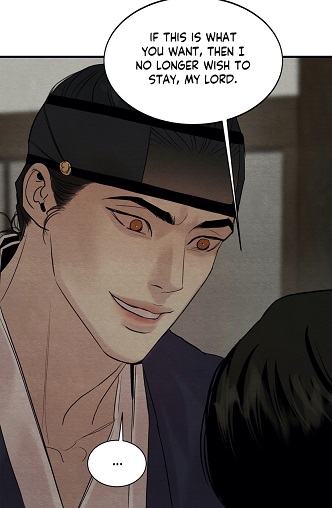 (chapter 85) I would like my avid readers to keep in mind that the lord wished to keep the artist by his side, sending the artist back to the kisaeng house was just a temporary measure.
  (chapter 105) That’s how a misunderstanding was created, provoking the painter’s abandonment issues to resurface. The lord had selected secrecy and silence out of love for the artist. Therefore when the lord sensed Baek Na-Kyum’s agony, he could only jump to the conclusion that the painter was acting the same way than him. He was also hiding something from Yoon Seungho. That’s the reason why the lord didn’t argue with Baek Na-Kyum.
 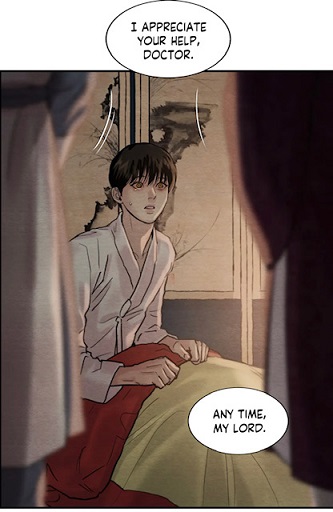 (chapter 107) He imagined that the artist was doing it out of concern for the noble. He was projecting his own thoughts onto the artist.
 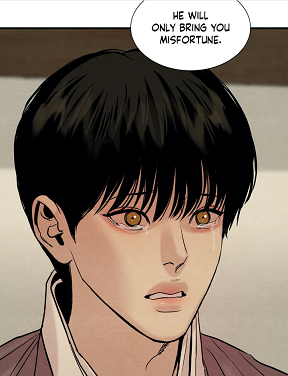 (chapter 68) According to this belief, the lord brings bad luck to others. This rule can only incite the main lead to doubt himself, to judge himself in a negative light, to doubt his own judgement. Moreover, the perfidy is that this principle pushes the protagonist to deny the existence of his own misery. It was, as though the lord had never suffered, only the others. This “faith” represents the biggest lie and hypocrisy. However, the main lead questioned this rule in front of Yoon Chang-Hyeon,
  (chapter 59) It was, as if Yoon Seungho feared to taint the painter by sleeping next to him. However, the artist’s biggest wish is to share the same bed than his lover.
  (chapter 97) To conclude, Yoon Seungho’s life is still influenced by a false cult, by propagandism. This faith is is based on Rene Girard’s theories about mimetic desire and scapegoat mechanism.
 (chapter 250) Hence the man created the following theory which is inspired by religion.
  (Doctor Frost, chapter 250). Under this new light, it becomes comprehensible why the author from Doctor Frost utilized the image of a black sheep as the future scapegoat. IT was selected, because it stood out. And you comprehend why Yoon Seungho became the target in the end. His good reputation attracted envy and jealousy.
 (chapter 57) Why? It is because each noble family aspires to the same: power and wealth!
  (chapter 107) This explicates why Yoon Seungwon was mentioned by the man with the purple hanbok. He implied that the son might have been well educated, yet he must be lacking elsewhere: his sexual education…. as his other task is to have a heir. This means that by standing out, Yoon Seungwon caught the jealousy and envy from other yangbans, though I have my doubts if he truly passed the civil service exam first. In other words, it is better not to stand out.
  (Doctor Frost, chapter 183) Since deprogramming is like brainwashing, it signifies that for the brainwashing, the victim needs to be isolated and even imprisoned too. And in order to be effective, the target of the brainwashing has to be exposed to stress and lack of sleep.
 (chapter 187) Fatigue and exhaustion are necessary in order to lower the target’s defense mechanisms. This explicates why it has to take place during the night, for the night is the time for humans to rest. Therefore the place of brainwashing is called “the fox’s hole” in Doctor Frost.
  (Doctor Frost, chapter 187).
 (chapter 187) The Ganzfeld effect happens when you undergo sensory deprivation for some time, and your brain tries to make sense of what is happening. Just 15 minutes of sensory deprivation can induce vivid hallucinations, according to researchers. This process involves muffling the ears and blindfolding, so people are unable to see or hear. And note what had happened to Baek Na-Kyum during the abduction. His head had been covered
  (chapter 66), and according to me, while his head was covered, he got strangled. Hence he had this nightmare.
  (chapter 61) But he lost notion of time and chronology, hence his nightmare is not coherent. One feature of altered states of consciousness during Ganzfeld exposure is an altered sense of time. In general, regardless of the induction method, altered states of consciousness can be characterized by changes in the sense of self and time. But this can only happen, when the brain is deprived of stimulations.
  (chapter 187) I had already outlined that Yoon Seungho had lost not only the notion of time, but also all his senses. And the nightmare is displaying the evidence of the Ganzfeld exposure. Hence the young master viewed himself flying
  (chapter 74), and at the end his eyes and ears got covered by hands and blood.
  (chapter 74) Besides, he was trapped in the dark room which looked like the servants’ quarters. Only thanks to the painter, the lord could recover his own senses, slowly he became the owner of his own body again. In addition, remember what he said to his own father:
  (chapter 62) Under this new light, it becomes comprehensible why the lord didn’t lose his whole sanity and as such didn’t fall completely into despair. The warmth and light served him as a guidance. Consequently, I deduce that in his childhood, he was trapped there in the dark for hours!! Because he was jailed in that room, he was exposed to the Ganzfeld effect. Therefore he relied on the valet’s words.
 (chapter 77) He trusted the butler, even after getting betrayed and abandoned each time. He developed blind faith in the butler. Why? It is because he was the only one “talking to him”. Though he wounded him so many times, he still remained by the lord’s side. That’s the reason why I come to the conclusion that the shed is not just a room for punishment, but also for “faith”, the place where the scapegoat was placed: “
 (chapter 62); “beg”, “trust” a synonym for faith,
  “soul”, ”
  (chapter 108) Moreover, I would like to outline that the main lead was seen sitting while looking up
  (doctor Frost, chapter 191). This description fits to the shed, the lord was not only cornered mentally, but also physically.
  (chapter 98) Consequently, I deduce that when the valet got punished in season 3, he portrayed the painter as a tattler for that reason. He didn’t want to become the scapegoat in the end.
 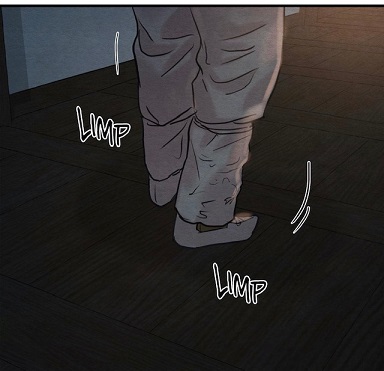 (Chapter 77) At the same time, receiving treatment from the physician, Kim could say that the lord regretted his decision. These new discoveries reinforce my prediction that the painter is doomed to become the next scapegoat!! Yet, chance is on the couple’s side. On the other hand, this signifies that someone will have to become sacrificed!
 (chapter 108) for his wrong choices, I come to the opposite interpretation. Naturally, if the manhwalovers compare the butler’s apology in the shed to the one in the library,
  (chapter 108) Nevertheless, for me, everything is an illusion, and you can only detect the manipulations, the moment you examine closely Kim’s words.
  (chapter 108) He had not told him about the shaman’s house on purpose. He had hidden the truth by omission. He justified his decision by using the “townsfolk” and their liking of creating gossips. However his real task was to protect his lord’s interest and inform him about everything. He made a decision without his lord’s permission, and as such he usurped his authority. He acted, as if he knew what was the best for Yoon Seungho. But this doesn’t end. What infuriated me the most are these two declarations:
 (chapter 61) The red-haired master utilized the present perfect tense, which is a combination of the past and present!! This time reveals that the young man was about to move on. On the other hand, the butler is either referring to the past and to the future, but not to the now! This means, he has no regret right now. He is projecting himself in the future. He implies “regret”, but he is not truly admitting it. Finally, when the childhood friend came to regret his choice, he voiced it outside the barn!!
  (chapter 61) This contrast outlines that the storage room is the place of illusion or false faith.
  (chapter 108): Here, my blood was literally boiling, when I read his second “confession”, because here he was now omitting Yoon Seungho. It was, as if the protagonist was not existing. His words were actually reflecting a new betrayal towards the main lead. Here, he was vowing loyalty to Baek Na-Kyum and not to Yoon Seungho!! He insinuated that if he was taking care of the painter, he was protecting Yoon Seungho’s interests. However, the artist and the noble are two different persons. Imagine the following situation: The main lead gets arrested for “murder”, the butler could justify his vanishing, passivity and silence by saying that he needs to take away the painter from the mansion so that the latter avoids getting into trouble as well. As you can see, he would keep his promise, but he would sacrifice Yoon Seungho. With his words, he was insinuating that he only had two choices: the elder master Yoon or the painter. Besides, once the lord were to be removed, Kim could put the whole blame on the painter afterwards. If he had not left the house… That’s the reason why I viewed the last statement as the biggest treason. In reality, he was not vowing loyalty to the main lead. This scene was a reflection from episode 30, where the artist had pledged loyalty to the main lead
  (chapter 30) and this in front of people. This explicates why the butler got grabbed in the storage room
  (chapter 108) like the painter in the courtyard.
 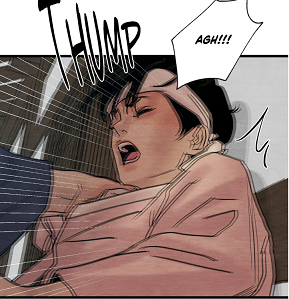 (chapter 30) We could say that it was the butler’s karma for his past manipulation. He had been the one who had encouraged the painter to flee the mansion (chapter 29/30). But this doesn’t end here. When the artist vowed his loyalty to the protagonist in the courtyard, the latter was present, which is not the case here. The artist is left in the dark.
 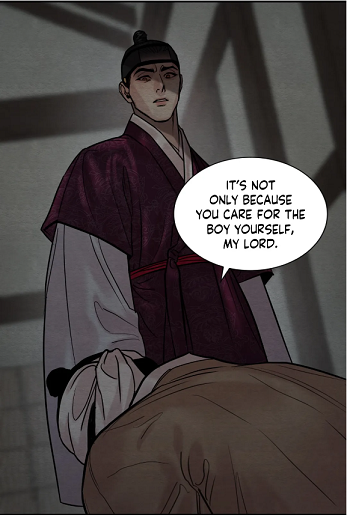 (chapter 108) Where is the personal pronoun “I” here? Nowhere. Only the lord cares for the painter, this was the butler’s declaration in the end. But what about the tears? How could he fake the crying?
  (chapter 81) When the lord had wounded his lover, when he was in a dissociative state, he had perspired so much that his sweat was falling like tears!! As you can see, fear could be the reason why drops of water were falling. Let’s not forget that the main lead had treated Kim very harshly and even threatened to have him killed, something he had never done before.
  (chapter 108) Kim had reasons to get scared and to sweat.
 , chapter 108, or my lord
 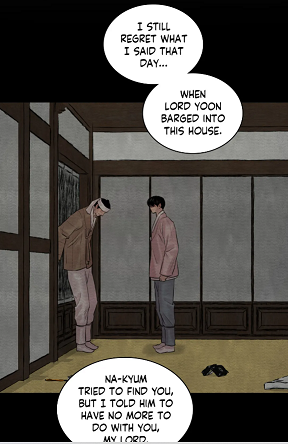 (chapter 108) However, the manhwalover should question this. Why did he regret that day? It is because he had revealed his true thoughts about Yoon Seungho to the painter, and he got reprimanded from the artist. Besides, according to me, he had hoped that the artist would leave the mansion due to the altercation. In addition, when he mentioned this scene, he wanted to appear as honest, because he had no idea if the artist had leaked this conversation to Yoon Seungho. Finally, just because he told the truth here, we shouldn’t judge the butler’s confession as verity. To conclude, for me, the valet was not really remorseful, he was more acting.
  (chapter 108) However, this is another illusion which can be easily refuted.
  (chapter 108) This memory is the same than the painter’s
  (chapter 108) In other words, the butler had acted on his own, and informed his master afterwards, when this information was necessary in order to protect himself. As you already know, for me, the butler had definitely acted on his own. But why does Kim need to deform reality so much? It is because he was present, when the young boy was abused sexually and he did nothing. He needs to erase the “traces” of the rape so that his culpability will not come to the surface. Just like the painter, Yoon Seungho has totally forgotten the sexual abuse. Besides, he never mentioned the incidents about the shed to the painter, only the bedchamber.
  (Chapter 87) Here, he was already hiding his guilt by turning Yoon Chang-HYeon into the main culprit. He is responsible for the lord’s suffering.
  (chapter 68), but he had heard a different story from the painter.
  (chapter 93) However, now I understand why Yoon Seungho was not able to discern the hypocrisy from the assistant.
 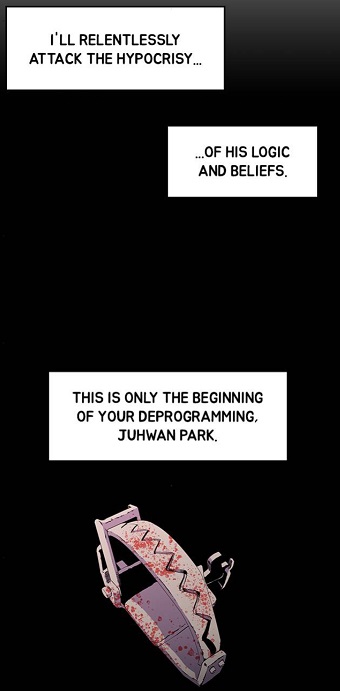 (chapter 188) It is related to the long brainwashing he was exposed for so many years and the lord’s low self-esteem. Thus I perceive this argument in the storage room as a new version of episode 40, a confrontation between the painter and the scholar. But who had been defeated in the shed? Yoon Seungho was still the loser, for he kept his distance from his lover afterwards.
  (chapter 108) He was making sure that no one would know that the painter was his weakness.
  (chapter 108) The new version of episode 50-51!! However, this was totally pointless, for the painter was living his bedchamber. His position was the proof that the painter was still favored, though the artist feared to be abandoned by the painter.
  (doctor Frost, chapter 187) This means that the couple has to communicate and the painter will interrogate his lover.
  (chapter 187) But this deprogramming is not pleasant, for the destruction of believes leads the victim to question everything afterwards. What caught my attention is that the painter went to the library, the symbol for “knowledge and education” which stands in opposition to the shed. This is no coincidence. Brainwashing is the antonym for insight.
  (chapter 108) In addition, the lord was dressed like in episode 36, he had the green hanbok.
  (chapter 36) Back then, the painter didn’t talk to the owner of the mansion. Finally, this episode is connected to the lord’s memories:
  (chapter 36) That’s how I had this revelation. The lord’s suffering is also linked to the library. From my perspective, the young master was dragged from the library to the shed at some point.
 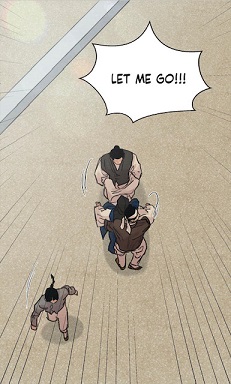 (chapter 77) I had already pointed out that in episode 77, the main lead had been dragged on multiple occasions, for he was dressed differently, and the servants would be different. Because I had described that the lord’s mind had been manipulated by indoctrination and the butler had confessed, I deduce that the next episode will contain elements from episode 48/49.
  (chapter 49) That’s the moment the painter dropped the last principle from the scholar and kisaeng. For me, something similar will take place, but such a deprogramming is painful. From my point of view, Jung In-Hun will be mentioned, as in the same place, the scholar had mentioned the painter’s past and future.
  (chapter 40) Since the shed embodies the valet’s betrayal, the lord voiced his abandonment issues there. On the other hand, the library symbolizes the teacher’s abandonment. This is not random. Baek Na-Kyum can not read, the symbol of the learned sir’s negligence. Hence I am expecting a new confession from the artist, like this scene:
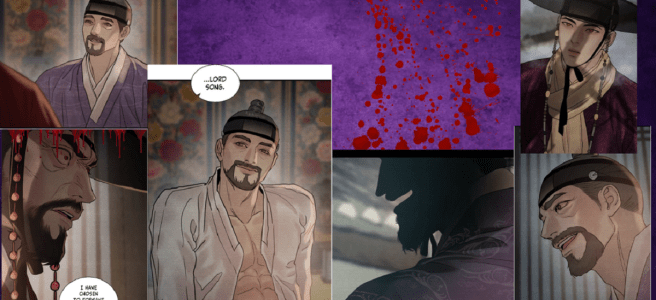
 (chapter 106) How could he abandon his lover like that? For some readers, he acted like a fool. Nevertheless, his reaction was normal, because the man with the purple hanbok represents the cause for Yoon Seungho’s martyrdom. This means that the ghost with the purple hanbok symbolizes danger for the protagonist. And if he gets targeted, his lover will suffer too. Striking is that during the same day and night, there is another person wearing a purple hanbok: Yoon Seungho!
 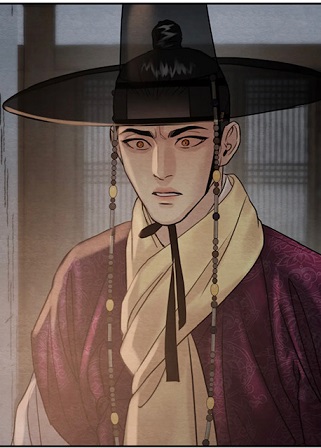 (chapter 107) Therefore it is no coincidence that in chapter 107, he was portrayed as a source of danger for the elder master Yoon and the mysterious “lord Song”.
  (chapter 107) According to “lord Song”, him and Yoon Chang-Hyeon were forced to renounce their position because of Yoon Seungho. In this image, the villain implies that the main lead is a blackmailer.
  (chapter 10) Under this new approach, it becomes comprehensible why the artist was wearing a purple hanbok after the bloodbath.
  (chapter 107) Therefore my theory that Baek Na-Kyum is related to the ruler gets reinforced. However, in episode 107, only the main lead and the new villain were seen with the purple hanbok, therefore in this essay, I will examine not only the new character “lord Song”, but also Yoon Seungho!
 (chapter 107) They had the impression that he was abandoning the artist one more time. And that’s how the painter felt the situation either! That’s the reason why Baek Na-Kyum was upset.
  (chapter 107) It was, as if the main lead was acting like the patriarch Yoon. This perception got reinforced, because the lord had a poker face and didn’t talk to his lover.
 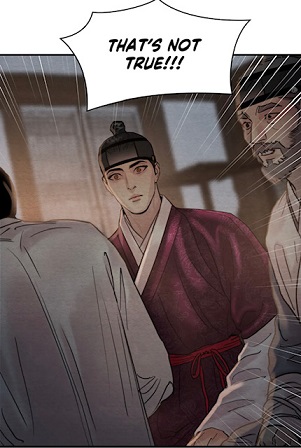 (chapter 107) Yoon Seungho didn’t side with the old bearded man in front of the painter. He thanked the man and sent away him with respect.
 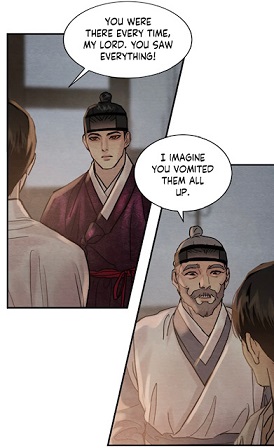 (chapter 107) He showed no real empathy for Baek Na-Kyum. It was, as if he was showing Schadenfreude. But this doesn’t end here. Kim brought a different doctor. It is not the same physician who assisted Baek Na-Kyum a month ago!!
 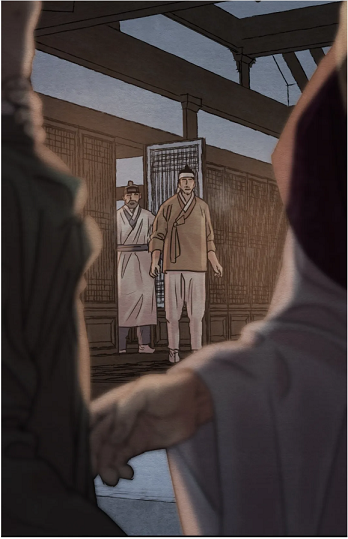 (chapter 107) First, the clothes diverge. The belt is blue, his sleeves are covered with some white protections.
  (chapter 107)
  (chapter 103) Finally, the white hanbok is much longer, and his pants are blue, while the other had white trousers. In my essay
  (chapter 107) How could he say that his health had deteriorated since a month ago? This is how the artist looked like a month ago:
 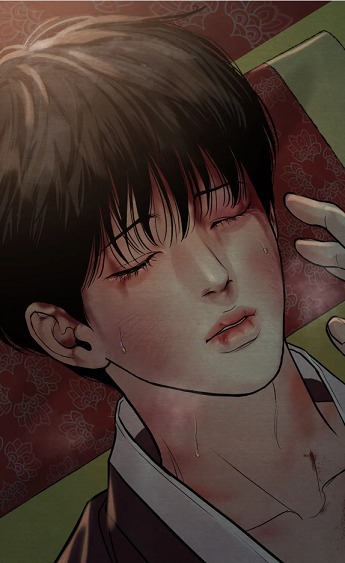 (chapter 103)
  (chapter 103) He was under the influence of the aphrodisiac, and he could have died of an overdose.
  (chapter 103) His face and his body were covered with bruises. How could the doctor say that his condition had worsened? This means that he had not seen the patient a month ago. To sum up, the doctor was impersonating his fellow. Note that he claimed to have prescribed the drug himself.
  (chapter 106) However, this image displays the betrayal from the physician, for I believe that this represents his view The latter had seen the artist in the restroom, but he had not intervened!! Besides, just because the artist had disgorged once, this doesn’t signify that he had done it all the time for one month. This is how the artist looked like, while he was walking through the street:
  (Chapter 107) As you can see, the doctor was exaggerating, as he was generalizing the regurgitation!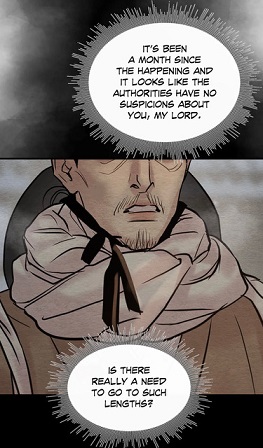
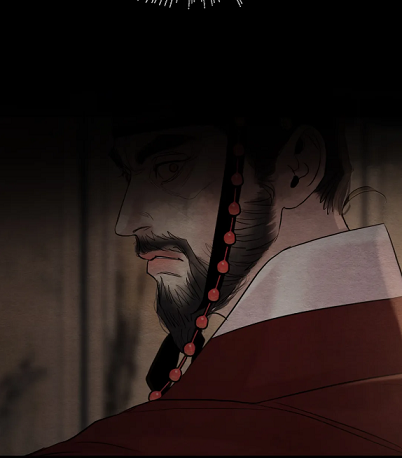 (chapter 107) Yoon Seungho was slowly realizing that his butler has not been telling the truth. He was gritting his teeth exposing his discomfort! This gesture indicates that someone has to endure something unpleasant, has to control himself and persevere. However, he was telling the opposite to his master: he had nothing to worry!! He should do nothing and simply lie low. The authorities had no suspicion about him. That’s the reason why the main lead desired to talk to the valet
 (chapter 107), and he got angry, for his servant was talking back and not answering him properly.
  (chapter 107) It looks like valet Kim and the physician got away with their tricks, for neither the doctor nor the the butler got admonished in the bedchamber. But what caught my attention is that after hearing the words from his lover, he replied that way:
 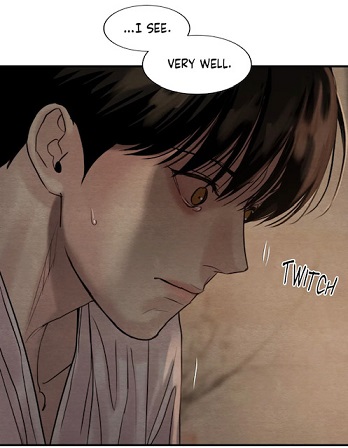 (chapter 107) This expression (“I see”) is important, because it could be the indication that the noble could discern the truth with his mind’s eye, like this
  (chapter 107) or the opposite, though I am still optimistic. We will see in the next chapter.
  (chapter 106), but we shouldn’t overlook that later the painter had yelled in order to voice his opinion which had caught his companion by surprise.
  (chapter 57) The father was convinced that his son had been ill for a long time. And from the mysterious “lord Song”, the manhwalovers discovered that the main lead was fed with an aphrodisiac:
  (chapter 107)
  (chapter 57) Therefore the doctor’s statement in episode 57 appears in a different light: he knew what he was prescribing! He knew what Yoon Chang-Hyeon desired thanks to the idiom “the wayward yang energies”. It was to provoke an erection. I would like to expose that the physician deceived the painter,
  (chapter 57) for at the end, the physician admitted that he had given the “solution” to the father. The father had received the medicine!! [For more read the essay “
 (chapter 106) He was supposed to get a drink from the physician. So the lord could remember the artist’s words and perceive the doctor as a traitor and liar. He could jump to the conclusion that the man had given his lover a drug. Under this new light, it dawned on me that the artist could have been telling the truth to his lover there:
  (chapter 106) That way, the “doctor” would not be suspected of a crime. Besides, according to me, the couple was actually sitting in the courtyard where the medicine store was!!
  (chapter 33)
  (chapter 65) Furthermore, in season 1, the artist had been forced to drink an aphrodisiac. So far, the main lead has never threatened or suspected a doctor. As you can see, there is a strong connection between the doctor and death! To sum up, we are witnessing the start of the storm… and when the painter was recovering, this represented the calm before the storm!!
  (chapter 107) It is related to the rumors he heard in the street.
  (chapter 106) The woman announced that the sacred tree had burned to the ground!! That’s the reason why it was gone… However, her words were just lies, for the tree is still standing there.
  (chapter 107) But note that she connected the incident to misfortune! In other words, she was denying the intervention of humans!! However, the lord had visited the place of his crime before.
  (chapter 104) This is what he had been told: the intervention of ghosts or spirits!! On the other hand, the unknown speaker had never mentioned the tree! Only the house had burned down. Nonetheless, even this statement was a lie, for the house was still standing too.
  (chapter 106) Since the schemers are mixing a lie with the truth, the lord heard that lord Shin had been killed during that night! However, when the lord had assassinated Black Heart and his friends, the young noble had never met lord Shin! Hence the gossips in town made the lord recognize that something huge is about to happen: a manhunt, and he could get into trouble. Besides, the grapevines are revealing the existence of witnesses and the main lead is aware that the noona is an important « witness ». But the problem is that by mixing each time a lie with a fact, the schemers are not realizing that the truth is coming to the surface, as minus and minus make plus.
  (chapter 50) Here, the butler had tattled on the painter so that the noble would distance himself from his sex partner. And in episode 104, we have a similar situation: through suggestions, the main lead was encouraged to send back the painter to the kisaeng house. Secondly, why would the lord think of the butler, when he saw the sacred tree?
  (chapter 88) During that night, he discovered warmth, loyalty and tenderness! In the darkness, the lord could detect the presence of the light: the painter! During that night, they vowed fidelity to each other. And in the garden next to the shrine, Yoon Seungho made the opposite experience: it was dawning on him that people from his own family, Kim and Yoon Chang-Hyeon,
 (chapter 88) are lying to him and even betraying him, especially if his life is threatened. Let’s not forget that this time, the lord did commit a crime and he is aware of this. In the bedchamber, the lord had criticized his own father, nonetheless he still thought that his father had just made a bad decision.
 (Chapter 82) Preserving the continuity of the lineage and ensuring that the Yoons remain powerful and wealthy. However, in front of the tree, the lord is slowly recognizing that his father is about to ruin him for his own sake.
  (chapter 107), and abandon his own son. This
  (chapter 62) the main lead chose not to punish his lover
 (chapter 63), he even swore that he would never let him go.
 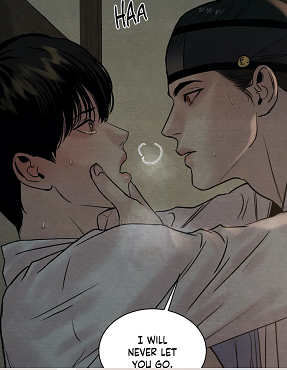 (chapter 63) As the manhwalovers can detect, the main lead was always able not to get swallowed by the darkness, thanks to the artist, he could still see the light. However, his father is making the opposite decision, unaware that he is “doomed” to fail! Karma is already waiting for him. And because the patriarch is now living in the darkness, he can not recognize the manipulations, as he is forced to use others to guide him.
  (chapter 107) the branch on the ground is the evidence that someone set fire to the shaman’s shrine and the tree! Secondly, the black guard deceived the patriarch:
  (chapter 107) Lord Shin was murdered afterwards and not before Black Heart and his friend!! The word “later” is relevant, for it implies that the young yangban was killed close to the place where the nobles Min and his friends were sentenced. But his body is lying elsewhere!
 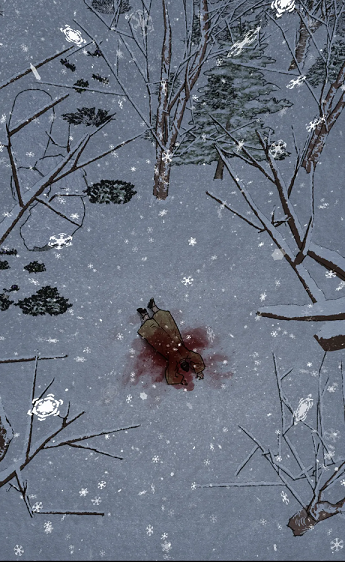 (chapter 103) This signifies that Yoon Chang-Hyeon is innocent! He never murdered Lord Shin in the woods, for he relied on the assistance of the helping hands. He never visited himself the scene of the crime.
  (chapter 103) At the same time, we can exclude that the black guard was the one killing the young scholar, for his pants are rather brown than grey.
 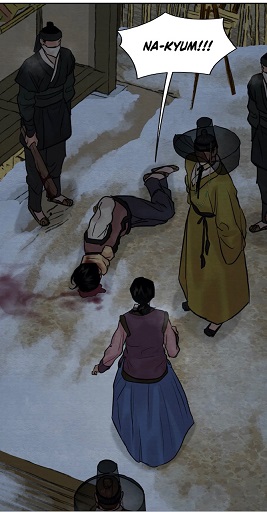 These two men are different, for their mask is white and not black. Besides, their clothes are black and not brown. Finally, the belt diverges as well: a huge purple strip with a different color in the middle, while the other guard is only wearing a simple ribbon. Thus I am inclined to think that the black guard is not only manipulating Yoon Chang-Hyeon, but he is also in truth working for someone else. Moreover, why would the man cover his face in the room, if he is truly working for the patriarch?
 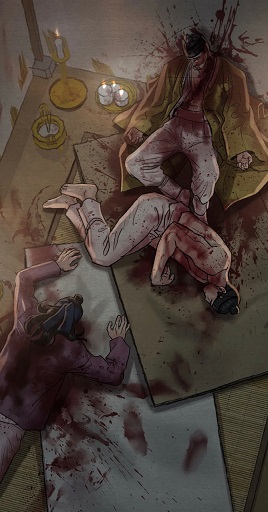 (chapter 102) From my point of view, it is related to Lee Jihwa. My theory is that the elder Lee can frame the main lead for assassinating his son, because during that night, Black Heart was dressed like Lee Jihwa. They needed the corpses to be decomposed so that father Lee could claim that Yoon Seungho had killed his son!! And the hanbok would serve to identify the corpse. In addition, he would use the incident with the sword as an evidence for his lunacy.
  (Chapter 67) It is important that the red-haired master is not perceived as traitor, rather as a victim. Moreover, since some time passed on, people have already forgotten the friend’s confession in the inn. However, the elder master Lee will never report Yoon Seungho to the authorities, it has to come from the father himself. That way, his involvement will never be detected. From my point of view, the schemers are trying to turn father and son against each other so that the Yoons get destructed. One might reject my theory about the implication of father Lee, but let me ask you this… What are “Lord Song”
  (chapter 107) and Lee Jihwa’s colors?
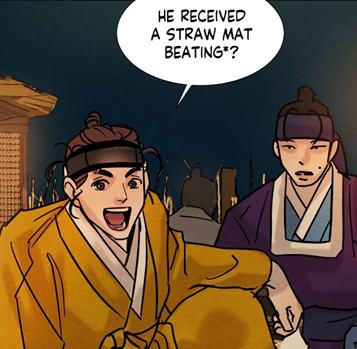 (chapter 12) Purple and yellow, right? Observe that the lord is wearing the same colors during that night: a purple hanbok with a yellow scarf!
 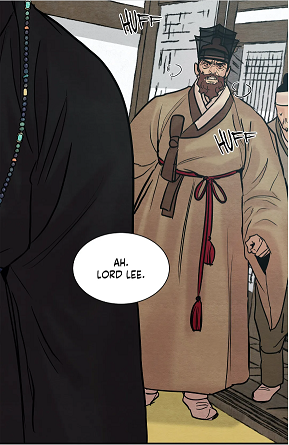 (chapter 67) Under this new perspective, it becomes comprehensible why I am suspecting that this guard
  (chapter 107) Furthermore, he could be recognized with the purple hanbok.
  (chapter 107) However, if you compare the form of the beard and the nose, the manhwaphiles can quickly recognize that Lee Jihwa saw someone else in the past, although the hanbok seems to have the same pattern than in episode 83.
  (chapter 83) Besides, another divergence is that the faceless lord Song has a rebellious strand in the neck which is not the same with “lord Song” from episode 107. As you can see, I deduce that we are dealing with two different “lord Song”. But this doesn’t end here. Secondly, according to father Lee, the man lost his home!
  (chapter 82) So how can he be wearing a purple hanbok, if he lost his position and home? This color is reserved for important people. In addition, when he entered the kisaeng house, the artist’s noona called him differently:
 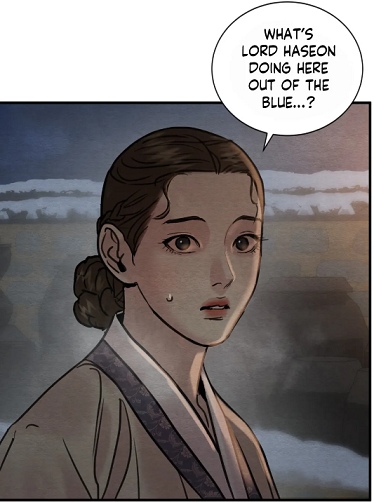 (chapter 107) She called him “lord Haseon” and not “lord Song”! Interesting is that neither the Korean nor the Spanish version utilizes such a name! I don’t think that the translator took the liberty to create a fictional name. Hence I am deducing that the author is trying to leave different clues in each version!! Naturally, Haseon could be his first name, yet there is no ambiguity that this man has a bad reputation among the kisaeng house. He was called “lecher” and in the Spanish version, he was described as sexual maniac.
 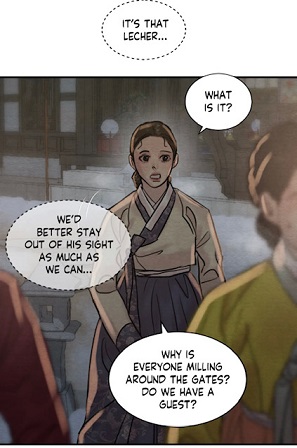 (chapter 107) Hence I doubt that the noona would feel so close to such a man and address him with his “first name”. On the other hand, the kisaeng has a drop of sweat on her face, which is a sign for a lie and deception.
 (Chapter 107) This signifies that « lord Haseon » is true, while « out of the blue » is the lie.
 (chapter 107) Besides, Yoon Chang-Hyeon’s vision of the world is based on the words from lord Song and others. Who informed him about the whereabouts of « lord Song » in the gibang? The man had not come to the kisaeng house for a long time. Because of this information, the patriarch is led to think that he is meeting « lord Song ». His perception of the world and his eldest son is embossed by lord Song. Thus he repeats the same expression from his counterpart: “lowly beast”.
  (Chapter 107)
  (chapter 107) Finally, like outlined above, the main lead imagined that he was meeting the same doctor, while in truth it was not the case. So « old friend » could be deceiving:.
  (Chapter 107) He could be one of the three men! The real « lord Song » who brought pain to Yoon Seungho is someone else. Let’s not forget that Kim fears the man,
  (chapter 56) and his statement implies that Yoon Seungho is usually not allowed to ignore the man’s request:
 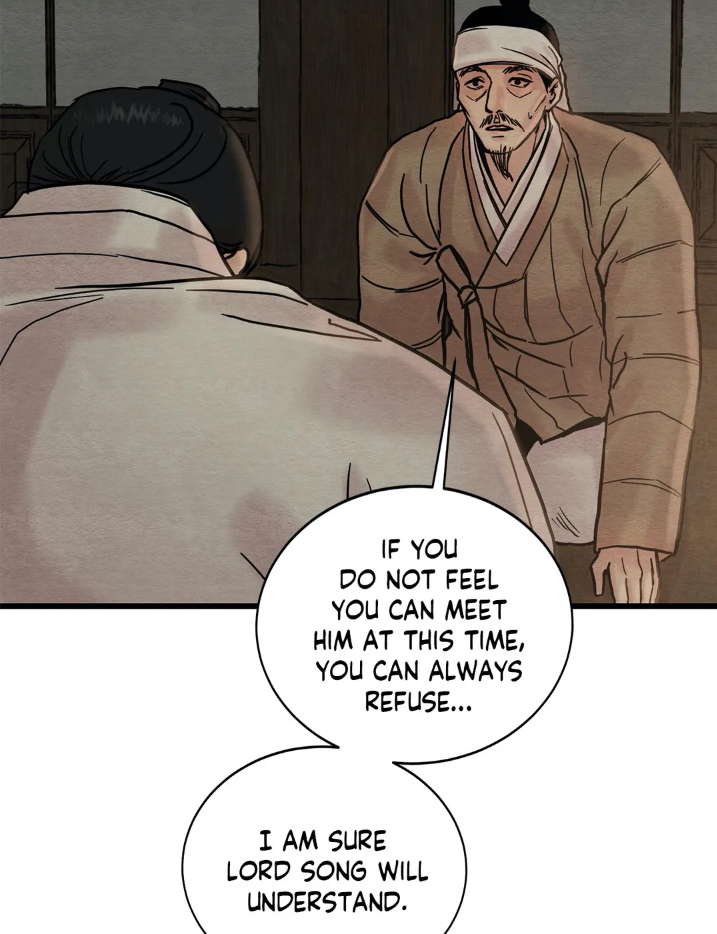 (Chapter 56). « At this time » stands in opposition to « always » which means that he can reject the invitation only because he is sick. To conclude, for me, this is not the lord Song Yoon Seungho hates and fears!
  (Chapter 107) Moreover, he didn’t visit the kisaeng house for a long time,
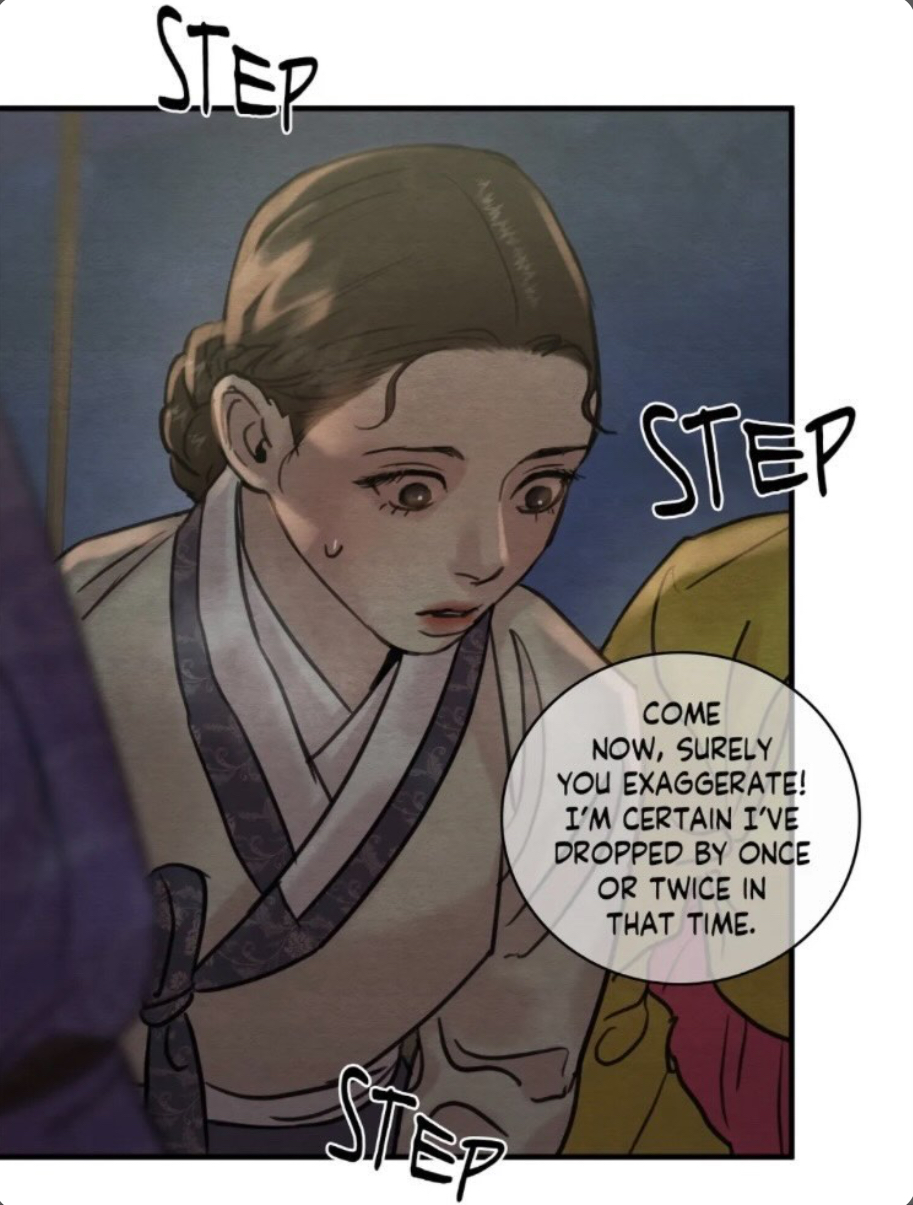 (Chapter 107) Hence they judge him as a pervert. And since the head-kisaeng received him at the gate, this signifies that this man has been in contact with the kisaeng house and in particular with the kisaeng leading him to the room.
 (chapter 37) The fake servant NEVER mentioned the retirement of lord Song. As you already know, for me, No-Name is the real lord Song who took the blame for everything, for he let people use his “name”. The most terrible thing is that “lord Song” puts the blame on Yoon Chang-Hyeon, when he explains his failure about the sexual education.
  (Chapter 33) Secondly, how does the lord know about the master’s illness, when his fever was only discovered after the straw mat beating?
 (Chapter 77) Besides, no physician had been fetched back then. Finally, how can lord Song remember the lord’s condition so well after 10 years? It is because he is using the diagnosis on the painter from the previous doctor:
  (chapter 103) Here, the man with the purple hanbok was utilizing the painter’s illness to hide his own crime. Under the pretense to help « Yoon Seungho » to become a man, the man abused him not only physically, but also sexually. There is no doubt that this reconversion was fake!
  (chapter 107) However, the trick doesn’t work, exactly like No-Name’s prediction:
  (chapter 76) But there is another reason why Yoon Chang-Hyeon doesn’t get fooled a second time.
  (Chapter 77) Thus I come to the following deduction: Yoon Seungho was sentenced to the straw mat beating, because after 2 nights, he had not been able to « have an erection ». They mixed a truth with a lie:
  (chapter 52) And what had Black Heart thought during that night? He had wished to taste the artist, while before he had desired his death. This is not random at all. There is a strong connection between death and sex which is also present in the conversation between lord Song and his « old friend ». The former reproached the elder master Yoon to have protected his son for too long.
  (chapter 107) Hence I am now assuming that this night is a reflection from chapter 67 and 69!! Min’s plan!
  (chapter 69) He had gone to the kisaeng house with the hope that the artist would return with his noona, and back then he had impersonated Lee Jihwa for the first time.
 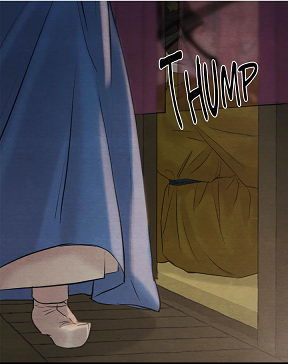 (chapter 69) As the manhwalovers can detect, the sudden return of lord Haseon is intentional. So who is he targeting here?
  (Chapter 82) In fact, both schemers have one goal in common: the couple is the victim and witness of their « crimes ».
 (chapter 105) Imagine that despite his rush, he was clear-minded enough to take the yellow scarf, a present that the noble had just bought him before. 😢 The item had more value than the mituri (shoes). Thus he was running in socks. His gesture displayed how much the lord means to the painter. He cherishes everything the lord does for him. At the same time, it indicates his heartache. He was so desperate and scared, for he felt that he was about to get abandoned one more time.
  (chapter 105) According to my follower @katamins, in the Korean version, this is what Baek Na-Kyum yells:
  (chapter 105) it works like a spell or a prayer. The artist is clinching onto this phrase hoping that the noble is remembering his promise. The irony is that the low-born was smiling like a fool,
  (chapter 105) masking his anxieties and huge pain… out of fear that Yoon Seungho would still reject him. He acted, as if nothing had happened: he had not hurt his hand, and the lord had done nothing wrong. The smile became the symbol of his agony which reminds us of Yoon Seungho’s.
  (chapter 83)
 (chapter 85) This means that Baek Na-Kyum was put in the same situation than his lover who wished to keep the artist by his side, but feared to open up to him out of self-hatred and guilt. The painter could get burdened or horrified by his revelations. Hence the painter’s reaction at the end mirrors the yangban’s in the study. Both were or are pleading the partner to stay by their side,.
  (chapter 85)
  (chapter 105) Nevertheless, their behavior diverges so much. The aristocrat couldn’t raise his voice or become violent by using his hand, because he could scare the artist and as such break his previous promise. Finally, by destroying the music box, he had already witnessed that he had pushed his lover further away.
  (chapter 85) At the same time, since he had been taught that no noble should lower himself in front of commoners, it is normal that he couldn’t beg Baek Na-Kyum on his knees. To sum up, the noble had to restrain himself extremely, his face and words were the only way to show his emotions and despair. And the artist sensed it, though the lord was not weeping. The proof is that when the father appeared, the artist changed his mind. He was no longer willing to leave, in fact he chose to look for his lover.
  (chapter 87) This shows that through communication, the lord had been able to affect the painter‘s mind and heart. On the other hand, we shouldn’t underestimate the lord’s flashback and Na-Kyum’s conversation with the butler which played a huge part in the artist‘s decision to vow loyalty to Yoon Seungho despite the secret.
 (chapter 105) Why did he change his mind? Is he responsible for this? As you can see, the painter came to voice his guilt and the remains of his deeply rooted self-hatred.
  (chapter 105) He must have committed a wrongdoing, he is responsible for the situation. He feels like a burden, for the lord had to take care of him each night.
  (chapter 104) He wished to help, that way he wouldn’t be seen as a spoiled child. He has to justify his presence in the mansion. Who is he exactly that he is sleeping in the lord’s bed? I am suspecting that there is a rumor circulating within the propriety, a new version of this scene:
  (chapter 38) which I will explain more in details below. Thus the artist is making sure to cause no trouble to Yoon Seungho and the staff, especially the maids. Hence he folds the cover and clean the bedroom.
  (chapter 104) Then he washes clothes. He makes sure that he is no burden to anyone. Yet, my impression is that the staff is taking advantage of the artist’s goodness. That’s how they fuel his guilt and shame.
 (chapter 105) In the Korean version, this is what Heena says:
  (chapter 104) He was told not to question what he had heard… he should simply consider everything like a nightmare. However, this method is actually wrong.
  (chapter 07)
  (chapter 104) Not only he knows about the lord’s traumatic past, but it is the same for the painter. In addition, we have another explanation for Yoon Seungho’s insomnia and dissociative state.
  (chapter 57) Not only the latter was turned into the scapegoat for the downfall of the Yoons, but also he was not allowed to reveal the incident, the so-called treason. Why? It is because if he had spoken, the truth would have come to the surface. He was simply a victim. And now, the schemers and accomplices are repeating the same MO. Who suggested to Yoon Seungho to say this to his lover?
  (chapter 104) Naturally, Kim, because he is now the only one in the mansion who knows his past. Besides, why do you think that the lord’s past is coming to the surface as a nightmare? It is because he was incited to repress everything. But since the painter is going through the same experiences, this is not surprising that the noble’s memory is triggered and the past emerges again.
 (chapter 27), when the other domestics left the propriety. This was his memory. Besides, like the servant confessed to Jung In-Hun, a huge part of the staff got replaced. This means that the lord was suddenly surrounded by people he didn’t know. Because my theory is that the young man was treated as a male kisaeng, this signifies that the new staff could never view the main lead as a noble. Besides, despite the betrayal, the elder master and Yoon Seungwon were his real family. Finally, Yoon Seungho had no saying in this, and I can imagine that the reason for this decision was not explained immediately. This must have been a huge blow for him as well. He must have felt lost and homeless. The result was that from that moment on, he became more dependent on the butler. And we have to question ourselves what the butler did with this huge responsibility, when the elder master moved to the second house.
 Since this phrase appears in connection with the staff (maids and servants) in the courtyard, I come to the conclusion that the authors of this gossip are in the domain. “Fellows” indicate that they are speaking among themselves. But I have two more clues proving that the traitors are the domestics. First, observe how they call the protagonist: Young Master Yoon.
  So far, people in town only calls the protagonist lord Yoon
  (chapter 45)
  (chapter 45) or lord Yoon Seungho
  (chapter 39) or my lord.
 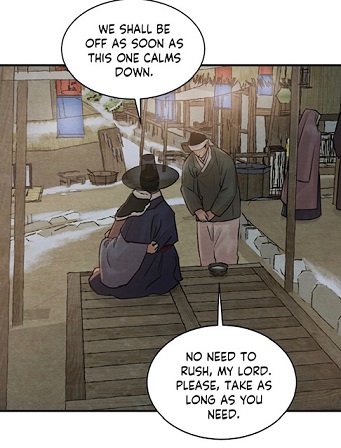 (chapter 76) Only the staff addresses him as “young master”.
  (chapter 103)
 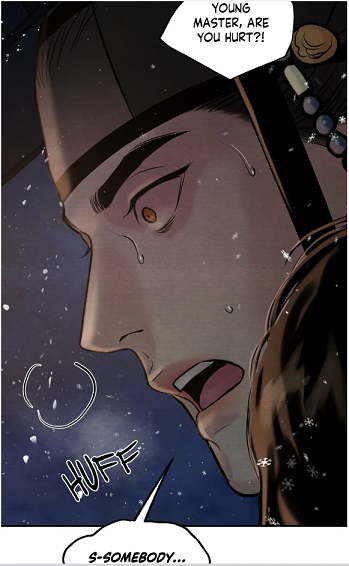 (chapter 103), and this since season 3. This coincides with the meddling of the Yoons. The servants treat him, as if he was not an adult, no real lord. But they are wrong, because he is wearing the topknot with the gat. Hence he is a lord. Finally, only people close to the couple could know about the painter’s tragedy.
  , because in the village and town, there exists another gossip:
 He is responsible for the lord’s lunacy. Under this new perspective, it explains why the painter is leaving the bed and working. He wishes to prove the words wrong. On the other hand, I think that Yoon Seungho also heard a grapevine in the domain, but a different one:
  (trailer). “He has many enemies”. How did I come to this idea? It is because he is addressed as Yoon Seungho! By underlining the painter as his weakness, the author of this rumor wishes to separate the couple. If he were to place the painter elsewhere, not only the latter would no longer be targeted, but also the lord would have no longer any weakness. Since there is always a reflection within the same chapter, I conclude that a second grapevine was spread in episode 104. This happened, while the lord was away. Thus the painter smiled like a “fool”, when he saw the lord:
 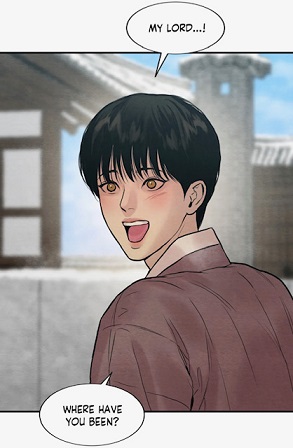 (chapter 104) As you can imagine, for me the maids were the perpetrators, a new version of episode 79
 (here, the woman implied that the artist was responsible for Yoon Seungho’s insomnia, thus the painter has a drop of sweat on his face, a sign for shame) and chapter 98
  (chapter 103) Finally, the staff has every reason to get rid of the artist, for he is the witness of their wrongdoings. They definitely played a major role in the “prank”. They didn’t learn their lesson.
 (chapter 29) This time, the one smiling like a fool
  (chapter 29) was Jung In-Hun who acted, as if he knew nothing and had seen nothing.
  (chapter 29) However, I have already pointed out that he was present, when the rape took place, for he knew where Yoon Seungho would meet the artist: the pavilion. And what have all these episodes in common? The first thought would be to say: abandonment and betrayal. The painter in front of the gibang felt “betrayed” and abandoned, but what shocked the lord so much was when the artist started blaming himself:
  (chapter 105) We have to imagine that the painter wanted to say that he regretted to have opened his heart to the protagonist. Thus he said this:
  (chapter 105) “I had known, I would have never confessed” Nonetheless, he never finished his phrase, for in reality, he had no regret!! He was sure that he had made the right decision. It is because he had pondered a long time about this. He had observed his lover. That’s the reason why he mentioned their mutual love confession and as such their promise to stay together. And this brings me to the next observation. All these scenes have another common denominator: BAD DECISIONS!! The lord had made the wrong decision to entrust the painter to the kisaengs. Thus he came to regret this. He had made his lover cry, and even wounded him, though he desired to do the opposite. Therefore it is not surprising that he apologized to his lover.
  (chapter 105) This shows that the painter is showing him what true love and loyalty are. Moreover, he is teaching to make good decisions.
 (chapter 246), I realized why Yoon Seungho suffered so much. Self-made decision implies a conscious choice. It is made deliberately and thoughtfully, considers and includes all relevant factors, is consistent with the individual’s philosophy and values. As you can see, it implies knowledge. This definition exposes that making a choice for the sake of another person without his consent or knowledge can never be a good decision. One might argue about this, because children are too young to make decisions. In Doctor Frost, this man
  (Doctor Frost 246) decided to support a terror attack, and justified this by saying that this was for his daughter’s sake. But like the counterpart pointed out, he questioned his decision. Was it truly his choice, or was he simply following the leader’s suggestion? As you can see, the daughter was used as an excuse, it was never for her sake. This shows that children are the exception, besides they are often raised by two parents. Thus they are making deliberations together. But like the author revealed in Twitter, Yoon Seungho’s mother hated her husband so much that she neglected her eldest son. The patriarch made decisions on his own, but observe that it was always for the Yoons’ sake. This means that the father never took his son’s well-being into consideration, he never asked him about his opinion. He imposed his will, but he listened to others, like we could see in different occasions.
  (chapter 82) Here, the red-haired bearded man was encouraging the elder master Yoon to return to the mansion and claim his rights. Finally, the young master admitted this to the messenger:
  (chapter 80) If someone stroke his ego, he would follow their advice and never doubt their words.
  (chapter 104) But he simply employed reverse psychology.
  (Chapter 85) Yoon Seungho was coerced to open up. If he did not, he wouldn’t be forgiven. Naturally, the painter meant it well, yet the main lead was pressured to reveal his „bad action“. The main lead feared his negative judgement and rejection. We could say that the artist had made this request for the lord’s sake, however this was not a conscious and long deliberated decision. And now, you comprehend why the main leads suffered both so much!! Yoon Seungho’s mother neglected her eldest son, but she kept her distance from her husband. They never talked to each other, and as such never made decisions together. And it was the same for the painter. The kisaeng Heena was the one who made the decision without the noonas’ consent and her brother‘s opinion.
  (chapter 105) She is still viewing the painter’s decision as a bad choice. But she is simply wrong, for the painter listened to her advice and after deliberations, he chose to open his heart. His confession was not made in the heat of the moment.
  (chapter 62) The lord’s vision
  (chapter 62) became a reality
 (chapter 97) And why did she act like that? She justified that it was for the painter’s sake, and she knew more than her brother. The reality was that it was for her own sake. She was definitely cornered, for she feared repercussions. Moreover, she pushed her brother to follow her advice. And now look at what the noona said in front of Yoon Seungho:
  (chapter 99) and her “fake death”, but as you already know, I think, he heard her during that night. Note that the painter didn’t meet his noona Heena during that day. Since Heena and the staff played tricks so that Baek Na-Kyum ended up going to the scholar’s house, it is not surprising why the staff is putting the whole blame on the painter. However, who is responsible for this? Naturally, the staff, Kim and Heena. The latter made bad choices blinded by her arrogance and prejudices. Thus I deduce that Yoon Seungho learned a good lesson in front of the gibang. He should never make a decision without consulting his partner.
  (chapter 105) From my point of view, both need to learn to make decisions TOGETHER!! But in order to do so, the two main leads need to listen to each other and communicate. And this is what truly happened in episode 105. The young noble discovered the painter’s low self-esteem and his guilt. That’s the reason why I believe that Yoon Seungho will decide to talk about the scholar. The lord suspects the learned sir, for he thinks that he is still alive.
  (chapter 105) This signifies that the noble will decide not to follow the noona’s advice:
  (chapter 105) with the noona’s statement, the painter looks happy with Yoon Seungho despite the tears, it looks like the noona is slowly coming to terms with her brother’s relationship. But I have to admit that I believe that her “decision” is just short-lived. First, in season 2, the noona had accepted to let her brother stay at the Yoons’
  (chapter 69) But then she had changed her mind after hearing the menace from the servant. However, I have three other reasons to expect a change of heart from the head-kisaeng. First, Heena is the younger reflection of the butler. The manhwaphiles shouldn’t forget that the valet had almost come to terms with the painter’s presence
 (chapter 65), but the ruckus caused by the kisaeng had provoked a change of heart in the valet. Then, the lord had made the following condition to the kisaeng:
  (chapter 105) The lord is keeping his lover by his side, as long as nothing happens to him. So if he gets into trouble… she could achieve her goal, the painter is returned to her. But the most important clue is for me the bowl!
  (chapter 105) While many jumped to the conclusion that this was the medicine sent by the physician, I had a totally different impression. For me, this bowl was used to write a letter!! First, the color is different from the normal “medicine”.
  (chapter 23) Most of them look dark brown and not black.
  (chapter 36)
 (chapter 77) Besides, it never leaves traces on the edge.
  (chapter 36) The points on the border are the traces left by the brush. She wrote a letter. And I have another evidence for this:
  (chapter 36) The painter used white bowls while painting. On the other hand, the lord wrote a letter during that time. As you can see, in episode 36, we have the combination of painting, seduction (touching) and medicine… exactly like in episode 105. The artist tried to paint a lucky charm, a tiger, but he didn’t finish it. He got interrupted… which is very similar than in chapter 36. So the letter should represent another common denominator.
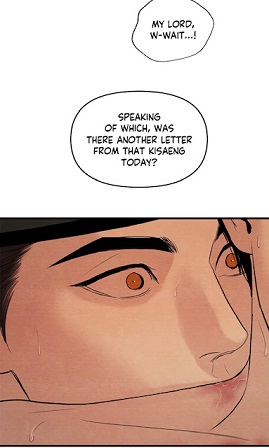
 (chapter 105) onto Yoon Seungho. Will she come to regret her action or not? One thing is sure, the painter accepted the sincere apology from his lover. How could he not forgive him after calling „Nakyumah“ and embracing him!
  (chapter 105) Both left the gibang together, while the artist was removing his tears. And this leads me to the final observation.
