

Please support the authors by reading Manhwas on the official websites. This is where you can read the Manhwa: Jinx But be aware that the Manhwa is a mature Yaoi, which means, it is about homosexuality with explicit scenes. Here is the link of the table of contents about Jinx. Here is the link where you can find the table of contents of analyzed Manhwas. Here are the links, if you are interested in the first work from Mingwa, BJ Alex, and the 2 previous essays about Jinx Sweet 🍬 Redemption or Sweet Poison ☠️? The Price of Desire and Burning Up, Losing Control
It would be great if you could make some donations/sponsoring: Ko-fi.com/bebebisous33 That way, you can support me with “coffee” so that I have the energy to keep examining Manhwas. Besides, I need to cover up the expenses for this blog.

Kim Dan and Nature
In Jinx, nature emerges as a symbol of purity and authenticity, a stark contrast to the city, which embodies corruption, materialism, indifference, and anonymity.  (chapter 56) This dichotomy in season 1 is vividly illustrated in a scene where Kim Dan, under the dappled light of a tree
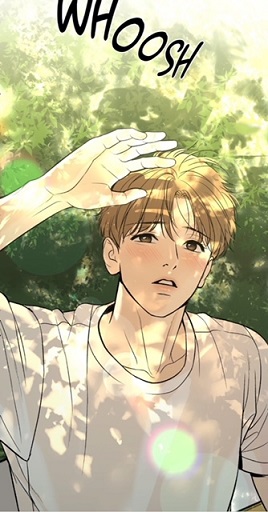 (chapter 41), experiences a profound moment of awakening. As his hand seems to reach towards the leaves
 (chapter 41), his senses come alive—he sees the light filtering through, feels the breeze, and hears the faint rustling sound. It is, as if in that moment, he reconnects to his true nature. Like a tree, Kim Dan is deeply rooted, yet capable of growth and resilience.
  (chapter 41) Nature awakens something within him— his heart and as such his third eye —allowing him to realize his affection for Joo Jaekyung. This quiet yet powerful moment emphasizes how nature offers clarity and purity, serving as a contrast to the suffocating, impersonal urban world where Kim Dan often found himself lost. Striking is when Joo Jaekyung met Kim Dan for the first time, he compared him to a “leaf,” shaking and fragile—an unconscious recognition of his true nature.
  (chapter 56) Leaves are part of trees, symbols of growth, life, and resilience, but since Kim Dan is just a “leaf”, this signifies that he is actually mutilated, reflecting his emotional and physical vulnerability caused by repeated abandonment and suffering. Joo Jaekyung, though dismissive at first, catches a glimpse of Kim Dan’s deeper essence—one connected to nature but battered by his struggles.
Interesting is that the return of the physical therapist in season 2 was presented in a similar situation:  (chapter 55) However, note that the main lead isn’t stretching his hand to the sky and sun. He is almost immobile. Just before, he was holding the cellphone in his hand:
 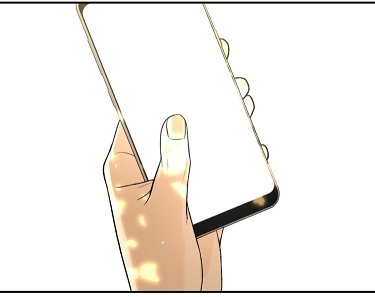 (chapter 55) Another divergence to the scene in episode 41 is that Jinx-philes couldn’t see his face. It indicates that the doctor reverted to his old self, and as such he is not true to himself. Therefore I come to the following conclusion. Mingwa uses nature as a mirror to Kim Dan’s emotional and spiritual state. While moments of connection with nature reflect clarity and self-realization, the juxtaposition in this scene underscores the opposite. Here, Kim Dan sits surrounded by trees and bathed in sunlight, yet his attention is consumed by his cellphone—symbolizing his entanglement with money, duty, and his ongoing struggles. Just moments prior, he wired money to the champion, a decision rooted in his past traumas and present desperation. The irony of the setting cannot be overlooked: though nature surrounds him, its purity and tranquility remain unnoticed, emphasizing how Kim Dan is still trapped in patterns of survival, burdened by his circumstances. He has become a ghost once again. This disconnect reveals how the weight of his past prevents him from embracing the present moment and reconnecting with his true nature, contrasting starkly with earlier scenes where his senses came alive under the trees.
In episode 56, Mingwa introduced Kim Dan’s world with the following panel:  (chapter 56) The empty beach scene, with its sunlight and tranquil beauty, reflects peace, but also unfulfilled connections. Kim Dan’s absence from this moment underscores his failure to keep a heartfelt promise to his grandmother:
  (chapter 53) to watch the sunset together. This failure stems not only from Joo Jaekyung
  (chapter 53) —now associated with the sunlight, symbolizing life and vitality—but also from Kim Dan’s fixation on his own suffering.
  (chapter 56) Abandoned once again, Kim Dan is consumed by the weight of his trauma, isolating himself emotionally and excluding himself from others.
This emotional isolation becomes apparent in his interactions with those around him. 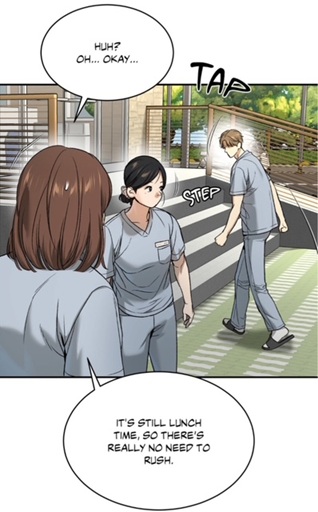 (chapter 56) When approached and complimented, such as when the nurse praises him and encourages him to take a break for lunch, Kim Dan pointedly ignores the praise and instead chooses to return to work. His inability to engage with others reflects the same disconnection that prevents him from connecting to nature. Mingwa subtly reveals a painful truth: Kim Dan’s fixation on his suffering not only blinds him to the solace and clarity offered by nature, but also hinders his ability to nurture relationships.
  (chapter 56) By choosing to exclude himself, Kim Dan becomes his own worst enemy—trapped in a cycle of abandonment, survival, and self-imposed isolation.
This disconnection deepens the symbolic duality of the sun and moon. While the sun, embodied by Joo Jaekyung, represents life, vitality, and intensity, the moon reflects subtle constancy, support, and quiet presence. However, Kim Dan’s emotional entrapment prevents him from recognizing it either. By turning his back to nature 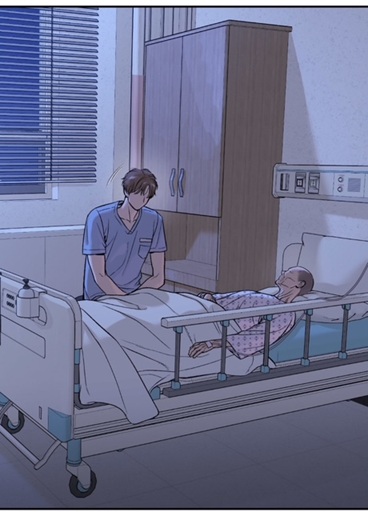 (chapter 56) and, symbolically, to the moon, Kim Dan remains oblivious to what has always been there for him: the enduring forces of love, stability, and healing.
Mingwa also underscores the impartial and eternal nature of the wind, the moon,  (chapter 56) the ocean and celestial elements like Saturn (Kim Dan stands for this planet). These forces, outside human control and independent of Kim Dan’s struggles, offer opportunities for renewal and clarity. Yet Kim Dan, consumed by his pain, remains trapped in patterns of survival and alienation. Nature’s constancy mirrors what he needs most—connection, healing, and presence—yet his inability to see it reflects his broader struggle to connect with others and himself.
By highlighting Kim Dan’s exclusion from both nature and human relationships, Mingwa reveals a poignant truth: Kim Dan’s suffering is not only external but also internal. While circumstances and abandonment have shaped his pain, his inability to step outside this trauma keeps him rooted in isolation. Mingwa’s use of nature—both as a symbolic force and a reflection of Kim Dan’s emotional state—invites readers to see that healing, like the tree, moon and wind, is constant and present. However, it requires awareness, acceptance, and the courage to connect—to nature, to others, and to oneself. The comparison to a leaf ties Kim Dan’s state of being to nature once more. A leaf shakes, when the tree it belongs to, is vulnerable. Yet it also signifies life, beauty, and renewal. Joo Jaekyung’s early observation foreshadows Kim Dan’s journey: a leaf that is fragile but has the potential to flourish again when given the right conditions. Kim Dan’s healing, like a leaf reconnecting to its tree, can only begin when he turns toward nature, relationships, and, ultimately, himself. But how can the athlete break this vicious circle and make him to turn to nature? One might say that he needs a true home. However, with the last incident, where the champion pushed him away 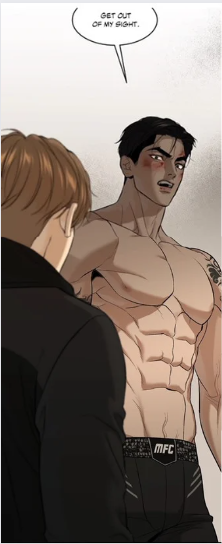 (chapter 51), the doctor learned the following lesson: it is better to keep people at a certain distance, because he got his heart broken. That’s the reason why he is avoiding the nurses and not eating lunches. He is simply avoiding gatherings. He is seeking solitude on purpose. That’s how it dawned on me that he is living like the athlete in season 1!! His whole world is revolving around work and as such taking care of patients.
That’s how I recalled an important change in the doctor’s attitude in season 1:  (chapter 26) Yes, the day where they sparred out of fun. For the first time, Kim Dan chose to accept a challenge for himself and for Potato. He felt a connection with Yoon-Gu, because he saw in him a puppy:
 (chapter 29) That’s the moment he started opening up to others, he confided his struggles to Oh Daehyun and Potato:
  (chapter 37) The puppy symbolizes not only nature, but also innocence. Let’s not forget that he was moved by the actor’s flowers in the past:
  (chapter 31) Thus it dawned on me how Kim Dan’s soul could be healed:
 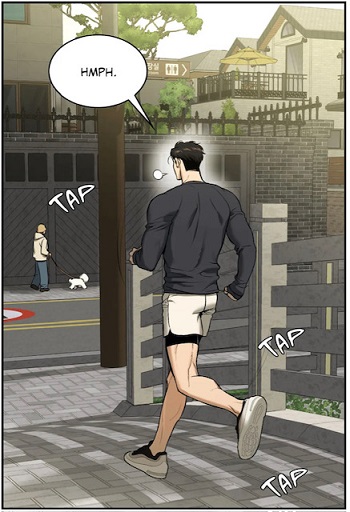 (chapter 21) Yes, by offering him a puppy! Is it a coincidence that the author made the champion jog next to a dog owner? I don’t think so. Until now, nothing could move Kim Dan’s heart:
 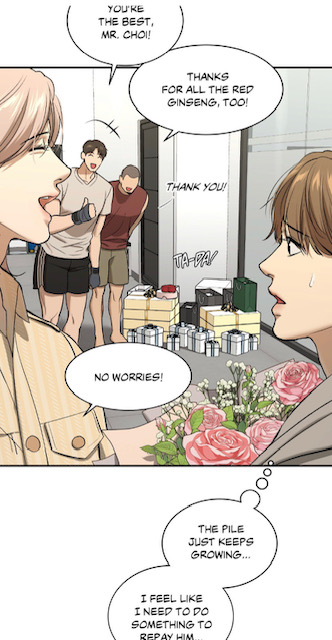 (chapter 31) Here, the main lead saw the gifts as a burden, for they made him think of money and debt. He never saw them as a sign of affection. In fact, dogs have a healing power.
The companionship that our furry friends offer is incredibly beneficial. Studies have found that dog owners are less likely to experience loneliness and depression. Dogs not only provide direct emotional support but also encourage social interaction with other dog owners, strangers, and friends. This helps create a sense of community and belonging, which further supports emotional well-being and can indirectly reduce anxiety. […] Research has shown that dog ownership can significantly reduce the stress hormone cortisol. This decrease in cortisol levels has been linked to improvements in various mental health conditions, such as post-traumatic stress disorder, anxiety, and depression. […]
Matlock taught me to live in the moment, cherish every belly rub, and perceive my intrusive thoughts as background noise I could control. Our daily walks became a therapeutic ritual, gradually making my anxiety more manageable. We explored various outdoor spaces, such as lakes, dog parks, and hiking trails. These activities helped me stay grounded in the present. Quoted from https://www.psychologytoday.com/intl/blog/its-not-just-about-the-food/202407/the-healing-power-of-paws#:~:text=Research%20has%20shown%20that%20dog,disorder%2C%20anxiety%2C%20and%20depression.
They boost our oxytocin levels (the love hormone), therefore they provide unconditional love. In addition, they lighten the atmosphere, and bring a sense of stability. Finally, I would like to outline that our famous doctor believed to see a “cat” in his fated partner: which made the doctor laugh for the first time:  (chapter 44) In other words, Kim Dan feels a strong connection to animals, but he could never have one due to his poverty and his grandmother. By taking care of a dog, he would be forced to pay attention to nature and in particular to trees. Naturally, I believe that Potato will play a similar role in the future, for Mingwa associated him with a dog.
 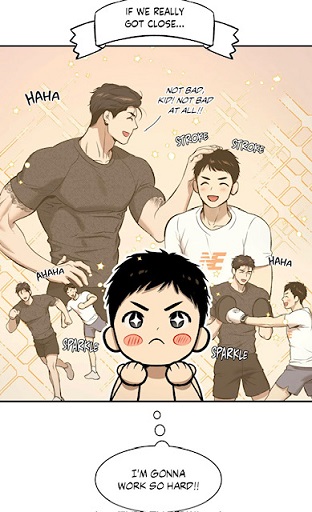 (chapter 23) While this was his original dream, after the last incident, there is no doubt that the young maknae must feel guilty and unhappy. He had not been able to protect and defend his new hyung. However, I have to admit that I would like to see the main couple having a pet! The latter would bring life in the penthouse, but also force the two protagonists to have a new routine. The penthouse would truly become a real home.
Women in Jinx
In Jinx Season 2, Mingwa introduces a new thematic focus: womanhood, symbolized through natural elements and the increasing presence of feminine energy. This shift is intertwined with the color blue —a hue often associated with calm, introspection, and the feminine principle. Blue dominates the imagery of the ocean, the beach, and the moon, natural symbols that deepen the narrative’s exploration of love, renewal, and emotional awakening. The ocean, in particular, evokes the myth of the Birth of Venus, where the goddess of love and beauty rises from the sea. By aligning Kim Dan’s journey with the ocean and the moon, Mingwa reinforces themes of rebirth, love, and emotional nurturing.
One might object to this interpretation, pointing out that women were already present in Jinx Season 1. We encountered Kim Dan’s grandmother, the oncologist Kim Miseon (chapter 47), the nursing attendant
  (chapter 21) or the reporters:
 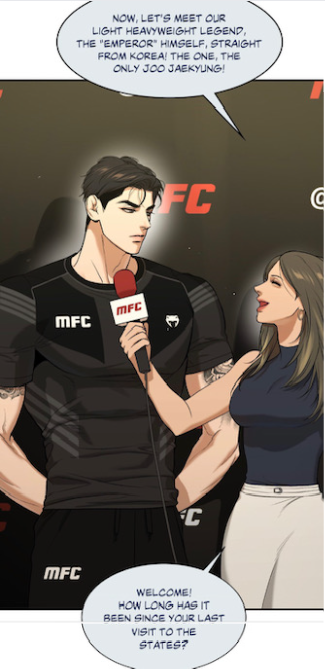 (chapter 37)
 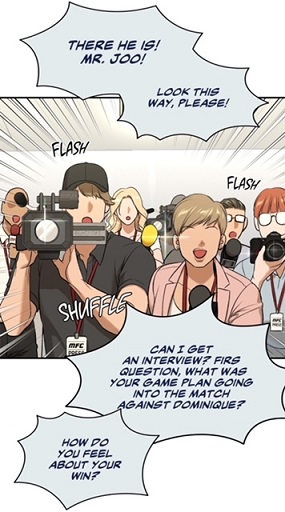 (chapter 40) However, Manhwa-worms will notice a significant distinction: in Season 1, these women were all tied to the world of work. Even Kim Dan’s grandmother, though she represents a familial figure, falls into this category.
Kim Dan’s grandmother complicates the notion of family and care. Though on the surface, she appears as a caring relative, the reality is that she is doing nothing. Her worries remain just words  (chapter 56) Moreover, the grandmother’s choice of words, “Why don’t you turn in?”, implies that she sees Kim Dan’s presence as a form of “work” or duty. This phrasing is often associated with someone finishing a day’s tasks or obligations before going to bed, which fits into the broader dynamic between Kim Dan and his responsibilities. In my eyes, it shows that she is seeing her grandson more as a caretaker than as a family member. We shouldn’t forget that she was the reason why the main lead became a PT. It was, as if her dream had come true. Nevertheless, the verity is that his grandmother is receiving treatment from his colleagues.
  (chapter 56)
So when she suggests to Kim Dan to return to Seoul, it makes her look like a heartless person.  (chapter 56) It looks like she’s pushing him away. On the one hand, her request sounds right, for she is treated quite well and the suggestion was made out of concern. She sees her grandchild struggling, and probably imagines that this move must weight down on Kim Dan. On the other hand, I can’t help myself thinking that this woman also has other reasons to send him back to Seoul. The nurse was already pitying the physical therapist:
 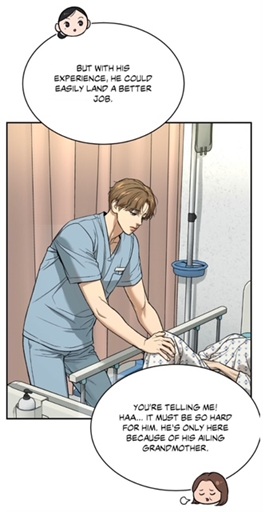 (chapter 56) She was seeing their move as the grandson’s sacrifice. And there’s no doubt that many people at the hospice must think similarly. So this could have reached the halmoni’s ears. Like mentioned in a previous analysis, I detected that the grandmother uses pity to achieve her goal, yet her grandson is receiving a lot of sympathy and attention. It looks like there’s a competition who is more pitiful in this.
But there’s more to it. By suggesting him to return to Seoul, she appears cruel, because she doesn’t know about all the changes in his life. She remains unaware that Kim Dan has no longer a home in Seoul due to the redevelopment and his resignation. He quit his job because of her. But she is not stupid, she can imagine it. At no point does she inquire about his needs, emotional state, or financial situation. Why? It is because she doesn’t desire to be burdened. For me, she feigns ignorance on purpose. (chapter 56) I also noticed a pattern: she only focuses on the moment. Hence she reacted so violently first to the new expensive treatment  (chapter 7) before she got reassured. Then she made this request (chapter 53) after hearing the bad news. She has the mind of a child, therefore she never thinks of the consequences of her choices and words. Her “ignorance” exposes a form of neglect: she takes his sacrifices for granted, further isolating him. Ironically, her detachment pushes Kim Dan further away, undercutting her role as a source of familial love and support. (chapter 56) As a result, she ceases to embody “real family” and instead represents the emotional burdens that trap Kim Dan in survival mode.
It is only in Season 2 that Mingwa shifts the portrayal of womanhood to emphasize its connection to family, emotional intimacy, and private life. A notable example is the conversation between the two nurses  (chapter 56) where one speaks candidly about her personal desires —having Kim Dan as a son-in-law – while the other calls him cute, giving the impression that she might consider him as a potential boyfriend . This dialogue marks a departure from the women of Season 1, who were defined solely by their roles as professionals or authority figures. Here, womanhood begins to represent emotional connection, care, and the nurturing qualities of family life—values that Kim Dan has been missing.
But it already started much earlier, when the cleaning lady made a teasing remark about the empty bottles of wine 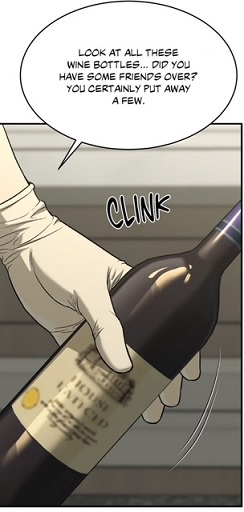 (chapter 55) and later brought the doctor’s present:
 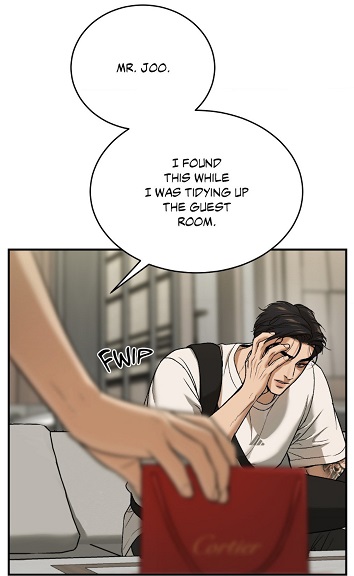 (chapter 55) And what is the common denominator with these two images? The woman’s hand. In the previous essay, I explained that her intervention signalized that the champion would stop drinking and was starting acknowledging Kim Dan. The zoom on the cleaning lady’s hand is a powerful visual cue that encapsulates many of the symbolic meanings associated with a woman’s hand, reinforcing the themes of care, healing, humility, and transformation.
Unseen Strength: The hand also carries an understated strength. While the cleaning lady’s actions are gentle, they require perseverance and resilience—qualities that align with Kim Dan’s own endurance and hint at the kind of emotional strength Joo Jaekyung will need to cultivate.
Care and Nurturing: The cleaning lady’s hand, likely engaged in a modest task like wiping or tidying, emphasizes the quiet but essential role of care. Her hand symbolizes the unseen work of women—work that brings order, comfort, and emotional warmth. This gesture contrasts with the harsh, physical force seen in earlier parts of Jinx, especially through Joo Jaekyung’s fists.
Healing and Emotional Connection: While seemingly mundane, her hand represents the nurturing touch that Kim Dan’s life lacks. Cleaning and caregiving symbolize acts of renewal and healing—clearing away what is dirty or broken to make space for something better. This resonates with Kim Dan’s need for emotional renewal and a gentler kind of care. At the same time, it also explains why the physical therapist was so bad at cleaning as well.  (chapter 19) He is not capable to take care of himself well.
Humility and Sacrifice: The hand of a cleaning lady also carries connotations of humility and unacknowledged sacrifice. Like Kim Dan, her role may be overlooked, yet her work is indispensable. This subtle symbolism mirrors Kim Dan’s own existence—his quiet struggles, unrecognized sacrifices, and the way he shoulders emotional and physical burdens for others.
Transformation and Softness: In contrast to the yang energy of fists, the cleaning lady’s hand introduces a feminine yin energy: soft, restorative, and transformative. This moment of focus suggests that the solution to Kim Dan’s struggles lies not in power or force, but in gentleness, patience, and care. That’s what the champion needs to discover. By meeting her, he discovered the magical “woman’s touch”.  (chapter 55) Observe how she smiled to him by saying goodbye. This is a sign that her respect and care are genuine. One might think that this nameless cleaning lady was unfortunately portrayed as eyeless:
 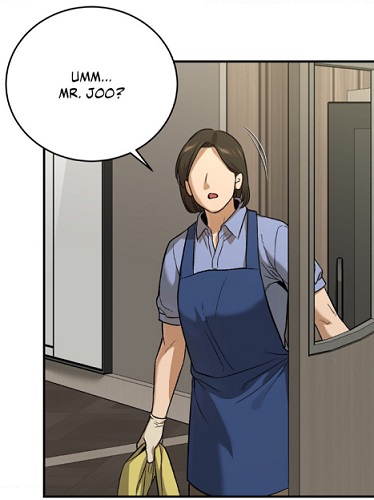 (chapter 56) I don’t think, we should see it in a pejorative light, like for an example of blindness or manipulation. In my eyes, the absence of her eyes are mirroring the nature of their relationship between the champion and the cleaning service. So far, he never met these people, as he was always away. In other words, the absence of the eyes is showing that the sportsman doesn’t know her that well. But it could change and this because of Kim Dan.
This thematic evolution aligns with Mingwa’s yin and yang motif. Season 1 emphasized the masculine yang: work, dominance, survival, and external conflict. Women, though present, were tied to this yang energy, inhabiting roles that reinforced Kim Dan’s emotional isolation and struggles. In contrast, Season 2 introduces yin energy—introspection, emotional nurturing, and family dynamics—through both nature (the ocean, the moon) and the increasing presence of women embodying these qualities. This shift reflects a new balance in the narrative: as Kim Dan navigates his journey, the story begins to explore the softer, more intimate aspects of relationships and healing.
For Joo Jaekyung, this shift signifies a challenge. The increasing presence of feminine energy and family-oriented symbolism suggests that his approach to Kim Dan must change. In Season 1, Joo Jaekyung relied on power, money, dominance, and force—tools that align with yang energy. However, in Season 2, this will no longer suffice. To truly connect with Kim Dan, Joo Jaekyung must embrace his yin side: patience, emotional vulnerability, and nurturing. If he wants to reconnect with the physical therapist, he needs to reveal more about his past and in particular his relationship with Baek Junmin. He has to explain why he doubted him:  (chapter 51) Women in Season 2—more prone to conversation and care—foreshadow this necessary transformation. Joo Jaekyung must learn to move Kim Dan not with his fists, but with empathy, understanding, and love. In essence, he must uncover his “motherly side” to create a genuine bond with Kim Dan.
By contrasting the utilitarian portrayal of women in Season 1 with the emotionally intimate depiction in Season 2, Mingwa highlights the evolving themes of family, balance, and healing. Womanhood becomes a vehicle for Kim Dan’s emotional growth and Joo Jaekyung’s transformation. It is through this shift—both in narrative tone and symbolism—that Mingwa begins to unravel the yin energy of Season 2, bringing the story closer to the emotional clarity and connection symbolized by the moon and ocean. And now, you are wondering why I included this image 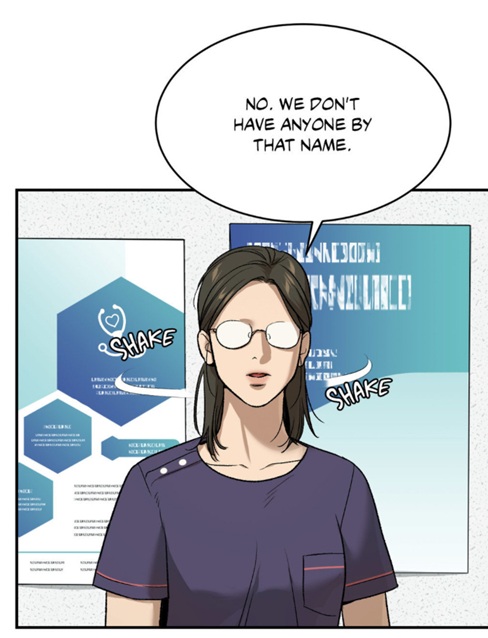 (chapter 56) in the illustration. It is because I realized that the champion first looked for Kim Dan at Sports Therapy Centers
  (chapter 56) before realizing that his fated partner might have switched the focus in PT, geriatrics. And what did the PT say at the Light Of Hope Hospice?
 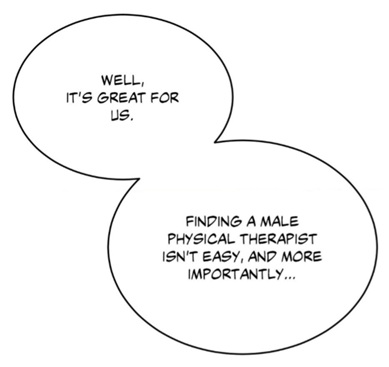 (chapter 56) Male physical therapists like this one
  (chapter 54) prefer specializing in treating athletes because it brings more money and fame, whereas female PT ends up at hospices due to their nature (nurturing, family). This means that by going to the hospice, the athlete will enter a whole new world. The appearance of the woman with glasses was indicating that the athlete was slowly broadening his horizon. As you can see, little by little, the fighter is opening his mind to new things. So how will he react, when he sees that his beloved “hamster” is withering again? This time, he can not blame the doctor. Since I detected similarities between Kim Dan’s current attitude and the champion’s past behavior, I have the feeling that the fighter will recognize himself in his loved one or someone will give him some advice. He will have the answer to this:
  (chapter 13) He is neglecting himself to the point of exhaustion, because he is living as a PT non-stop. While the champion was fighting with his bad shoulder, the other is using his hands for treatment, hence he is not eating.
Conclusions
In Jinx, Mingwa masterfully intertwines the symbolism of nature and womanhood to chart the emotional and relational evolution of Kim Dan and Joo Jaekyung. Nature—embodied through the ocean, the moon, and the color blue—represents purity, healing, and timeless constancy. It serves as a reflection of Kim Dan’s true self, a gentle yet resilient force that has been overlooked and mutilated by suffering. At the same time, nature’s yin qualities—calm, nurturing, and transformative—align seamlessly with the growing presence of womanhood in Season 2.
While Season 1 portrays women solely in the realm of work and survival, Season 2 introduces women as symbols of family, emotional connection, and healing. The cleaning lady’s hand, the nurses’ conversations about private lives, and the emphasis on yin energy shift the narrative focus toward care, introspection, and renewal. This change mirrors nature’s role as a constant yet quiet guide, offering opportunities for rebirth and balance that Kim Dan has yet to embrace.
By linking nature and womanhood, Mingwa constructs a path for transformation. For Kim Dan, this path lies in reconnecting with the nurturing forces of life—both within himself and in the relationships around him. For Joo Jaekyung, the presence of nature and feminine energy signals a challenge: to abandon the yang-driven tools of dominance and force, and instead embrace qualities of care, patience, and emotional vulnerability. This announces his „separation“ from his hyung Park Namwook and as such his maturity.
In conclusion, nature and womanhood act as two sides of the same coin in Jinx: both are timeless, restorative, and essential for healing and balance. Through these symbols, Mingwa not only reflects Kim Dan’s emotional state but also reveals the steps needed for growth, connection, and love—a journey that transcends survival and allows the characters to embrace life in its fullest, most harmonious form. That‘s how they will find happiness.
Feel free to comment. If you have any suggestion for topics or Manhwas, feel free to ask. If you enjoyed reading it, retweet it or push the button like. My Reddit-Instagram-Twitter-Tumblr account is: @bebebisous33. Thanks for reading and for the support, particularly, I would like to thank all the new followers and people recommending my blog.

 Bebebisous33s' analyses in K-Dramaland and Manhwas
While reading the essay I realized that despite saying to Dan that she wanted to see the beach once more, Halmoni as we can see has not stepped foot in the real coast once she reached there. We see although close the hospital is not literally beside the beach, its insulated by tracts of land where people live, obscuring the beach entirely. Halmoni and Dan have to make an effort to go and enjoy the breeze but neither seem interested, especially Halmoni, who doesn’t have to take treatment all day anymore and has free time to go but she won’t. Sea, nature and being outside, like the essay outlines is connected with healing internally, introspection and strengthening of mind and none of these things Halmoni seems to be interested in right now. Just like she seems to have checked out of being the caretaker role in their parent-child dynamic. She wants Dan to leave now without even inquiring about whether he can feasibly go and will be fine there. I am assuming since Dan is a college graduate, she thinks its a get out of jail free card to always be financially and emotionally stable forever.
That makes me realize why Dan wasn’t telling Halmoni about major financial and medical decisions he kept taking on her behalf so far- its not just about sparing her pain. Its clear she is not really interested in being involved in any major responsibility for herself or her grandson.
That is why he is so burdened and has no one to turn to. Even when Dan tries to use Halmoni as a crutch to escape his heartbreak with Jaekyung, life has handed him red card here. Halmoni won’t be engaging with him and hence he is destined to feel alone and helpless until Jaekyung arrives and they can escape this emotional statis together.
This is why Now I am anticipating these two will go to beach together somehow because Jaekyung will take the role of Halmoni in Dan’s life and fulfill the role of an emotional bulwark that Halmoni essentially never did but Dan thinks she did.
The idea of them having a puppy also makes a lot of sense. I noticed that although it makes sense why Jaekyung is so appealing to Dan, its not as clear why its so for them from Jaekyung’s POV for long term until we remember Dan being weak, vulnerable and unable to fend for himself makes him appear like a puppy too in many ways in Jaekyung’s eyes and by taking care of him so far, it distracts Jaekyung from the emotional turmoil inside his own mind. Taking care of people clearly is good for Jaekyung and it would be good for Dan as well for it will teach him emotional responsibility and reciprocity in relationships. A dog owner cannot be lashing out or put blame when things go wrong in training , nor can they afford to slack off by cloistering themselves away and not be regular in their lifestyle. No wonder they are known for being good for people with depression.
LikeLiked by 2 people
While reading your comment, it occurred to me that we should consider that Kim Dan is like a plant for the champion. The latter needs constant care, but won’t voice it. So what Kim Dan should offer to the champion is a plant, something which resembles Kim Dan. The plant or the tree is the place for meditation and peace. He has plants in his penthouse, but these have no sentimental values. A plant is much more discret than flowers.
LikeLiked by 2 people
Yup, giving plant respects his trauma while also expresses similar sentiment. Maybe a cactus or other such succulents ?? they are easier to carry just like a Hamster 😀
LikeLiked by 2 people
Yes, that’s it! The cactus symbolizes survival and resilience. Then, it combines two elements which seems to be so contradictory: fire and water.
LikeLiked by 3 people
As for the halmoni, she’s only interested in financial matters, when she’s directly concerned. It could affect her safety.
LikeLiked by 2 people