

Please support the authors by reading Manhwas on the official websites. This is where you can read the Manhwa: Jinx But be aware that the Manhwa is a mature Yaoi, which means, it is about homosexuality with explicit scenes. Here is the link of the table of contents about Jinx. Here is the link where you can find the table of contents of analyzed Manhwas. Here are the links, if you are interested in the first work from Mingwa, BJ Alex, and the 2 previous essays about Jinx Confines Spaces, Hidden Wounds and Only Wanted Me For My Body
It would be great if you could make some donations/sponsoring: Ko-fi.com/bebebisous33 That way, you can support me with “coffee” so that I have the energy to keep examining Manhwas. Besides, I need to cover up the expenses for this blog.

Joo Jaekyung’s journey in Season 2 represents a profound transformation, one that quietly unfolds through small yet significant acts of humility, care, and self-awareness. This transformation also connects deeply to the themes of vulnerability and community  (chapter 62), as his actions increasingly reflect a willingness to embrace his own fragility and build meaningful ties with those around him. Through his growing interactions with others and his immersion in the rhythms of town life, the champion begins to redefine his sense of identity and purpose, moving beyond dominance to discover the power of connection. From a man defined by strength, dominance, and transactional relationships
  (chapter 55), he evolves into someone deeply connected to others
  (chapter 62)
  (chapter 62) and, more importantly, to himself.
  (chapter 62) Thus in this essay I will explore the symbolic meaning behind his actions in the town, the interplay of nature and community in his transformation, and how these moments reflect his internal growth. The analysis begins with his transformative experience in the ocean during his rescue of Kim Dan
  (chapter 60), followed by his newfound attentiveness to his surroundings—jogging in silence and responding to the natural rhythms of life.
  (chapter 62) This heightened awareness paves the way for his burgeoning integration into the town through labor
  (chapter 62) and community service. His gradual acceptance of simplicity, represented by his clothing and the symbolism of cucumbers and potatoes, signals his reconnection to nature and humanity.
  (chapter 62)
The Sea: Baptism and a New Beginning
The champion’s rescue of Kim Dan in the ocean marks the starting point of his transformation.  (chapter 60) In many ways, this moment functions as a symbolic baptism, reflecting a deeper narrative of renewal and change. In Chapter 28, Kim Dan’s immersion in water during a pool scene
  (chapter 28) was symbolic of his acceptance of intimacy, reshaping his view of sex from something “filthy”
 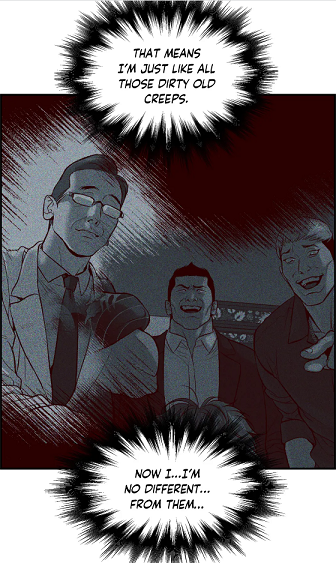 (chapter 20) into something natural and human.
 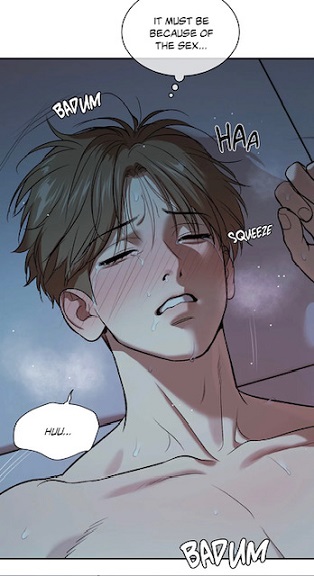 (chapter 29) Similarly, Joo Jaekyung’s dive into the ocean can be interpreted as his baptism into a new “religion”: love and vulnerability.
 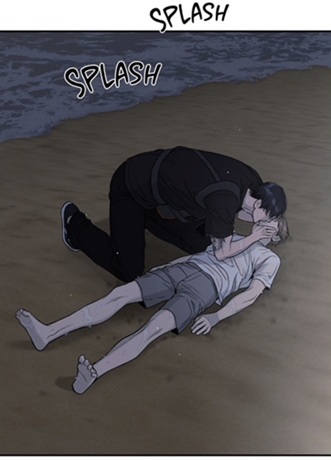 (chapter 60) His gesture is not just about saving his loved one, but also showing care to humans in general. He can no longer be indifferent to someone in pain or in danger.
Unlike the controlled environment of the MMA ring, the ocean’s vastness forces Joo Jaekyung to confront the vulnerability of humans. (chapter 60) The ocean, much stronger than any human, compels him to accept weakness and fragility as natural parts of existence. This act of salvation, driven by instinct, becomes his first step toward embracing a new mindset—one that values care, connection, and humility over material power or dominance.
This shift also challenges his reliance on money and material success. As a wealthy and renowned athlete, Joo Jaekyung is accustomed to solving problems through financial means or physical strength. However, his time in the town and his rescue of Kim Dan underscore the futility of these tools in addressing deeper human needs like love, trust, and emotional connection.  (chapter 62) He might complain, but in the end he accepts the presents. This change is reinforced by his willingness to accept gratitude in the form of vegetables and food rather than monetary gain, showing a newfound appreciation for simple, heartfelt exchanges over transactional relationships.
Moreover, the ocean connects to the myth of Venus’ birth, where the goddess of love emerged from the sea as a result of conflict and pain inflicted upon her parents. Similarly, Kim Dan’s plunge into the ocean stems from his own deep pain,  (chapter 59) caused by his grandmother’s neglect, indifference and rejection. The rescue, while focused on saving Kim Dan, also represents the birth of a new understanding for Joo Jaekyung—a recognition of the transformative power of vulnerability and connection.
However, this act of salvation is not immediately transformative. Hence his wish is to bring back Kim Dan to Seoul.  (chapter 60) At the time, his eyes were fixed solely on Kim Dan
 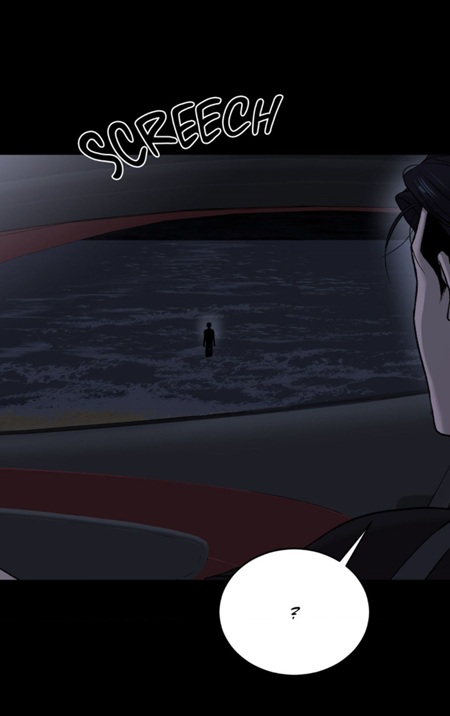 (chapter 60), not the natural world around him. The rescue planted a subconscious seed, setting the stage for his later behavior. When Kim Dan denies his assistance in Episode 60
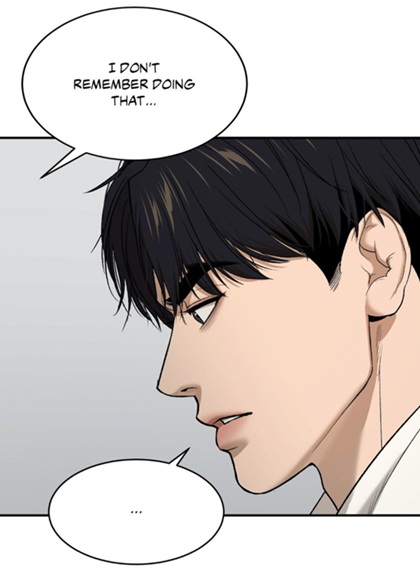 (chapter 60), it’s as if the doctor erases that defining moment, refusing to acknowledge the champion’s care. Yet Joo Jaekyung does not react with anger or frustration. Instead, he takes the doctor’s rejection as challenge.
  (chapter 60) However, contrary to the past, money and influence seems to have no impact on the physical therapist’s mind and heart. He is keeping the athlete at arms-length.
 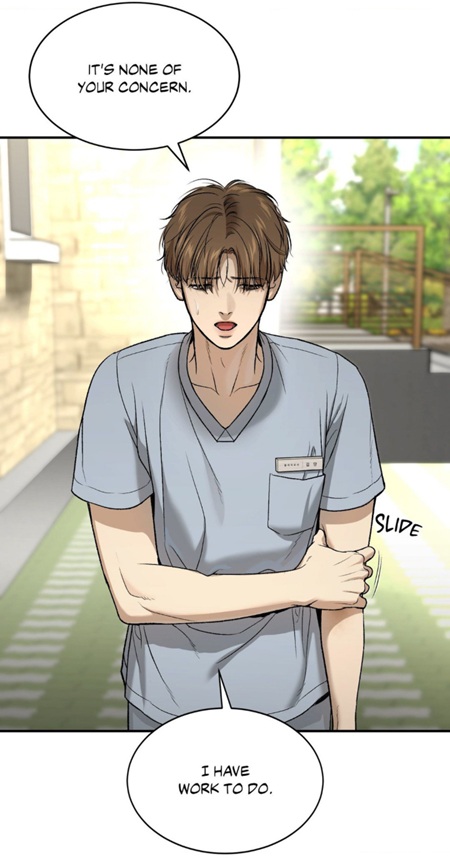 (chapter 61) The moment he moves to that little town
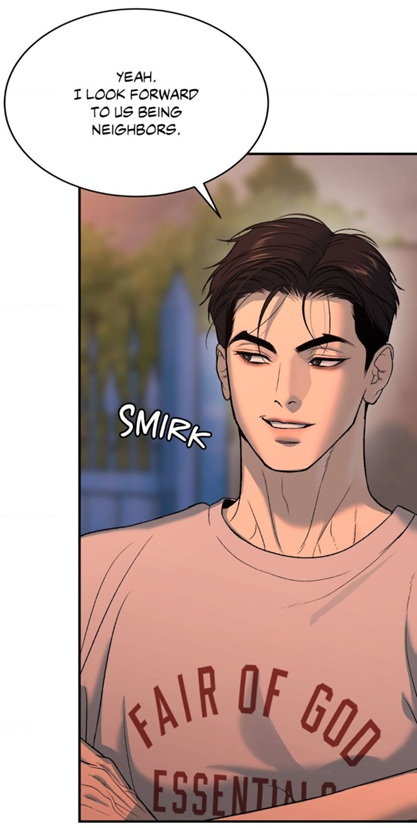 (chapter 61), he begins to demonstrate his growth through quiet, consistent actions—helping others without expecting gratitude in return.
Jogging Alone: A New Awareness
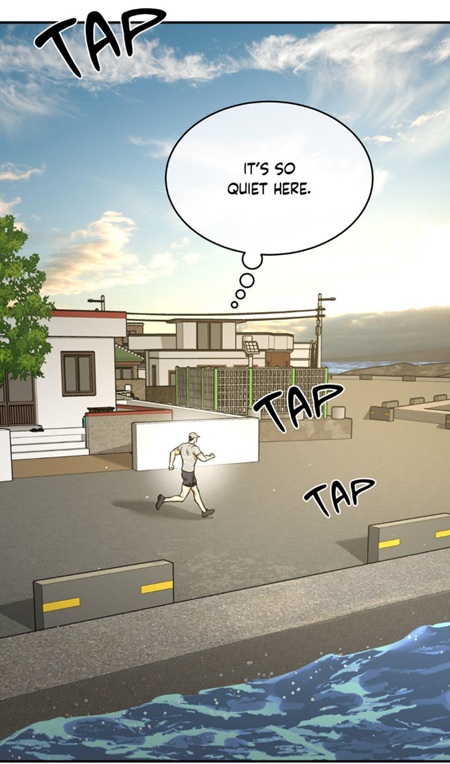
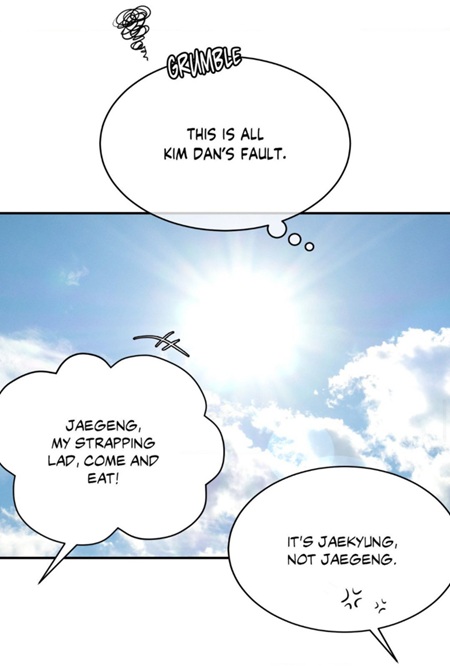
One of the most striking moments in Joo Jaekyung’s transformation occurs during his solitary jog at the beginning of this chapter.  (chapter 62) For the first time, he is not merely running for fitness or competition; he is paying attention to his surroundings. (chapter 62) He notices the quiet of the town, the warmth of the sun
  (chapter 62), and the natural rhythm of life around him.
This evolution is particularly evident in his interaction with the town chief, who interrupts his jogging to engage him in conversation.  (chapter 62) Running along the ocean, a setting that profoundly influences his state of mind, Joo Jaekyung demonstrates a newfound openness. (chapter 62) The ocean’s vastness, paired with the quiet rhythm of his steps, sets the tone for this scene. Rather than perceiving the interruption as intrusive, he pauses without hesitation, listens to the chief’s compliment, and accepts the subsequent request for help.
  (chapter 62) This moment underscores his growing ability to connect with others sincerely, without suspicion or defensiveness. His willingness to engage reflects a broader transformation—one that prioritizes meaningful connections over dominance or transactional relationships. This newfound awareness signifies a major shift in his character. His senses are becoming attuned to the world beyond himself, and he is learning to differentiate between what truly matters and what does not.
Jogging alongside the ocean, Joo Jaekyung is subtly influenced by his surroundings, a setting that begins to calm his mind and heart. (chapter 62) The image of the waves serves as a reminder of nature’s vast power, yet the author’s choice to focus only on the sound of his steps—through the onomatopoeia “tap”—emphasizes that Joo Jaekyung no longer perceives the ocean’s presence as intrusive or overwhelming. This highlights a new harmony between him and his environment, as he is learning to exist within its rhythm rather than overpowering it. This mindfulness mirrors his growing engagement with the community, where his labor and acts of service reflect his evolving priorities. His newfound attentiveness during the jog is a precursor to his willingness to contribute selflessly, signaling a transformation that blends physical discipline with emotional depth.
This heightened awareness aligns with his growing ability to say no, a skill that becomes crucial as he navigates the town’s requests and his evolving priorities within the community. (chapter 62) In the past, Joo Jaekyung never refused a challenge, whether in the ring or in life. However, his time in the town is teaching him the value of boundaries. By discerning which requests are worth his time and energy, he is preparing himself for the inevitable challenges he will face upon returning to Seoul. His refusal to blindly follow MFC’s demands would mark the ultimate culmination of this lesson, proving that his strength is no longer just physical but deeply rooted in wisdom and self-respect. This newfound discernment is also reflected in his ability to engage with meaningful interactions, as seen in his conversation with the town chief. (chapter 62) By stopping his jog and attentively listening to the chief’s compliments and requests, Joo Jaekyung demonstrates a growing openness and respect for others, reinforcing his transformation from a figure of dominance to one of genuine connection.
Helping the Town: Labor as Redemption
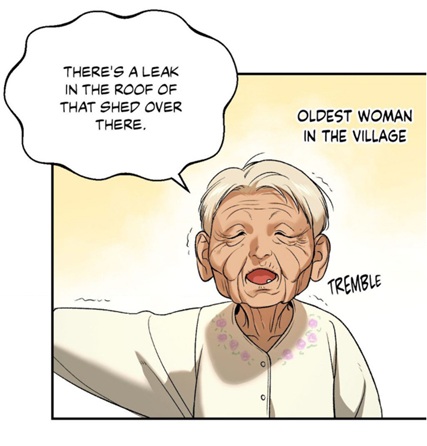
Joo Jaekyung’s labor in the town mirrors his “baptism” in the sea, emphasizing his shift toward humility and service. He assists the townspeople without hesitation (chapter 62), fulfilling requests that range from carrying cucumbers to harvesting potatoes or even repairing an elderly woman’s roof. (chapter 62) This latter moment marks a stark contrast to his earlier attitude in Chapter 10, where he viewed Kim Dan’s living conditions through the lens of judgment  (chapter 10), seeing only the “overpowering stench of poverty.”
  (chapter 10) At that time, his perception was clouded by indifference and a focus on material circumstances. Now, however, his response to the elderly woman’s request reflects empathy and an awareness of human vulnerability.
The shift is visually emphasized through the contrasting color palettes. In Chapter 10, the scene in Kim Dan’s apartment is steeped in grays and blues 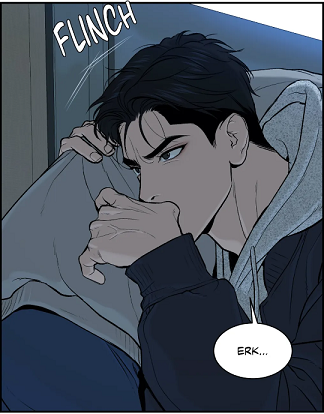 (chapter 10), evoking a sense of cold detachment and judgment. In contrast, the moment where Joo Jaekyung is asked to repair the roof is bathed in daylight (chapter 62), with warm yellows and soft tones that highlight his newfound openness and humility. This visual change symbolizes his evolving perspective—he no longer sees poverty as something to disdain but rather as a context where assistance is needed and deserved. His actions are guided not by obligation but by a genuine desire to help, reflecting a significant step in his transformation.
The vegetables he receives as compensation further highlight this transformation, symbolizing a newfound appreciation for non-material rewards and mutual exchange. (chapter 62) It is clear that he rejected money, when someone else asked for his assistance. 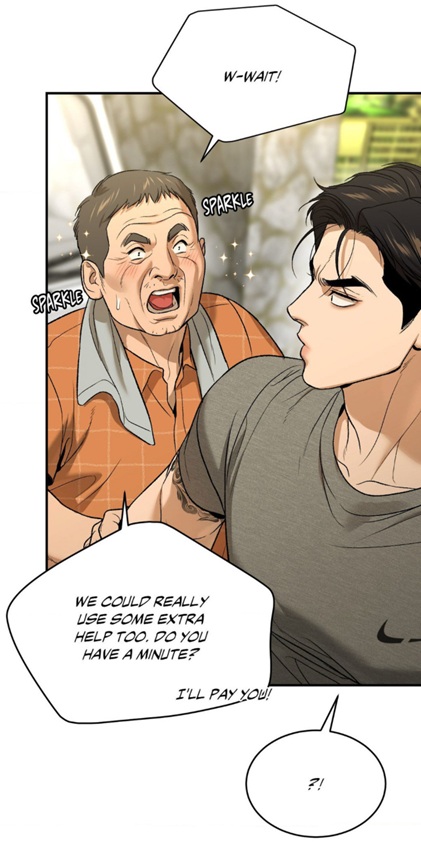 (chapter 62) Thus I deduce that he never accepted any kind of compensation in the end. But none of the inhabitants could accept such a generosity, therefore they brought vegetables or dishes. Unlike his previous life, defined by detachment and impermanence, these acts of community-oriented labor mark a significant shift in how he values his strength—not as a tool for control
  (chapter 62), but as a way to support and uplift others. The admiration from the inhabitants is genuine (chapter 62) contrary to the fans’. (chapter 62) His progression to harvesting potatoes, which grow hidden beneath the earth, deepens this symbolism, representing humility and a more profound engagement with nature and the people around him. This transition mirrors his personal growth: from surface-level participation to meaningful involvement in the lives of those around him. But why does he blame the doctor in the end?
  (chapter 62) One might think, he is doing all of this against his will and heart. In my opinion, it is related to his past behavior:
 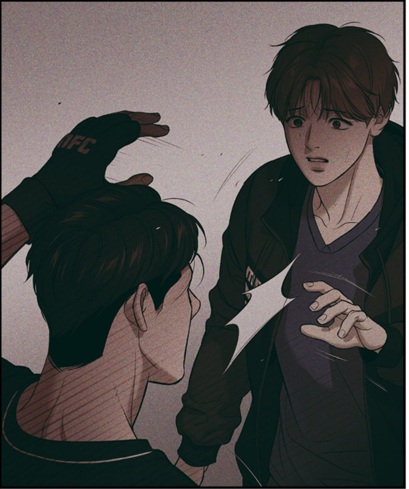 (chapter 62) The champion feels really bad for his rejection after the incident with the spray. And since he believes that Kim Dan comes from that town, he thinks that he can redeem himself by helping his “community”.
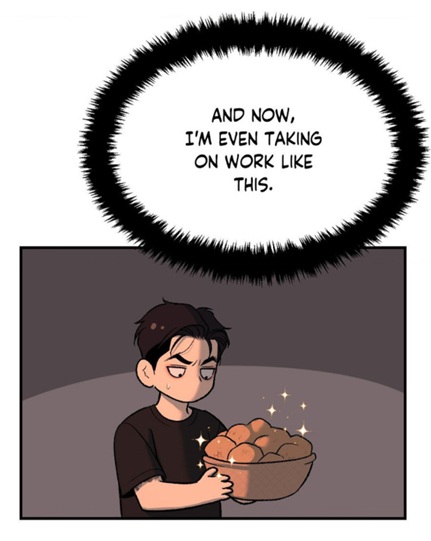
A defining moment occurs (chapter 62) when he receives a bowl of potatoes as compensation for his work. This simple yet heartfelt gesture reinforces the theme of “laying down roots,” as the vegetables symbolize his growing connection to the community and his appreciation for non-material rewards. The contrast between this moment and his life in the penthouse is striking—where once his wealth isolated him, now simplicity and community nourish him both literally and figuratively. His words (chapter 62) suggest disbelief or frustration, yet the sparkling stars around the potatoes contradict his words, revealing a quiet appreciation. The absence of his mouth in this scene further emphasizes an internal conflict—his words do not fully align with his growing understanding of value beyond material wealth. This scene in front of the vegetables (chapter 62) exposes a dissonance between his mind (mouth) and his heart revealing that he is not true to himself yet.
This moment also contrasts with Kim Dan’s grandmother’s behavior. While she sold vegetables for money  (chapter 47), she rarely prioritized Kim Dan’s nourishment. The grandmother’s actions were driven by financial survival. Joo Jaekyung, on the other hand, receives food as a form of gratitude and recognizes the significance of nourishment beyond monetary gain. (chapter 62) His words expose that he plans to use them for his meals.
These observations bring an intriguing dimension to the chapter, particularly when we contrast the actor’s perception of Joo Jaekyung  (chapter 58) with the reality of his evolving personality and his behavior toward others. Choi Heesung’s dismissive remark that Joo Jaekyung would “flip his shit” if he knew the living conditions of Kim Dan implies a static, unchanging view of the champion, one that aligns with a superficial understanding of him as merely ruthless and violent. However, this chapter reveals the fallacy in such an interpretation, exposing the actor’s arrogance and lack of true insight into Joo Jaekyung’s character.
The actor’s words stand in stark contrast to the champion’s behavior in the town, where he demonstrates care, humility, and a willingness to engage with others. (chapter 62) This shows that if someone, like Potato, had made a genuine effort to connect with Joo Jaekyung 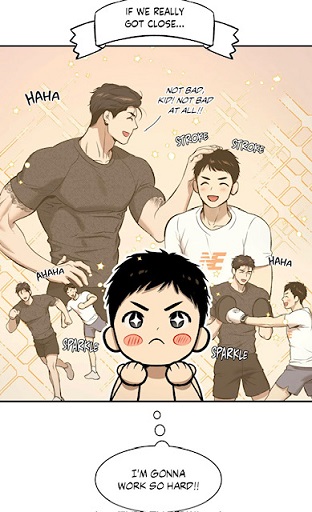 (chapter 23), they could have succeeded. Potato, the youngest member of the team, embodies this missed opportunity.
  (chapter 9) His nickname, “Potato,” while intended as lighthearted and affectionate, is something he despises because he perceives it as demeaning. Yet the reality is quite the opposite—nicknames like these often carry affection and camaraderie. Yet he rejects it out of insecurity or an internalized belief in its inferiority.
Joo Jaekyung’s actions in the town, contrasted with the actor’s dismissive remarks, suggest a deeper lesson about assumptions and the ability to build meaningful relationships. The young fighter’s rejection of his nickname and possible resentment toward the champion 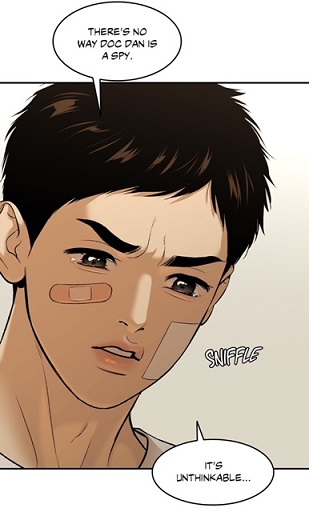 (chapter 52) reveal a missed opportunity for bonding. The champion, who is evolving into a more open and empathetic individual, might have been an unexpected source of support and connection had Potato not listen to others and chosen to embrace this chance instead of harboring negative assumptions.
This chapter  (chapter 62) underscores the gap between perception and reality, showing how preconceived notions can prevent genuine relationships from forming. It also reinforces the theme of growth and transformation, as Joo Jaekyung continues to break away from the static image others have of him, proving that even the most misunderstood individuals can surprise us with their capacity for change. The interplay between the nickname “Potato” and its underlying affection further echoes the theme of finding value and beauty in simplicity—a motif central to the champion’s journey as he embraces humility and authenticity.
Sandals and Flowers Over Fangs
While Joo Jaekyung’s floral-patterned pants and hat caught the readers by surprise (chapter 62), it is important to notice that this metamorphosis began much earlier.
First, I noticed that at the hospital, he was wearing sandals without socks 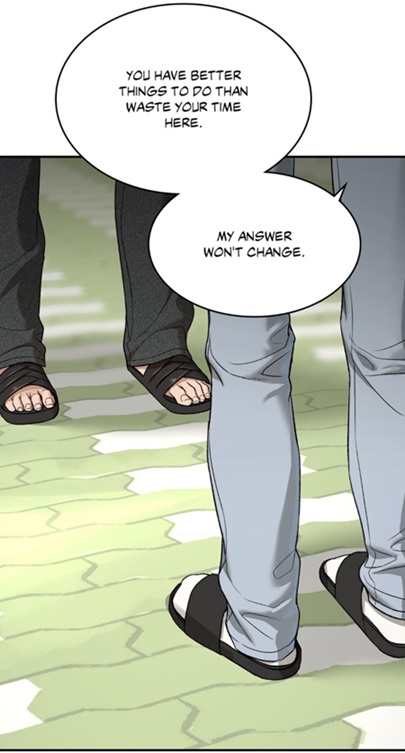 (chapter 62) , while he had put on his expensive jeans and CK tee-shirt.
  (chapter 62). This stands in opposition to the previous scene in front of the hospice:
  (chapter 61) The focus on Joo Jaekyung’s feet (chapter 62) and his choice of wearing sandals without socks, despite his otherwise branded and expensive outfit, carries deeper symbolism that extends beyond mere humbleness. It reflects his state of mind and highlights subtle aspects of his character and situation. Firstly, the exposed feet symbolize vulnerability and openness. Sandals, unlike closed shoes, leave the feet unprotected, suggesting that Joo Jaekyung is letting down his guard. This choice conveys his growing comfort or trust in the environment, particularly at the hospital, where he feels no immediate danger or need to maintain his usual defenses.
Secondly, the sandals reflect a sense of groundedness and comfort. They indicate that Joo Jaekyung feels at ease in this setting, contrasting with the stress or pressure he might experience elsewhere. 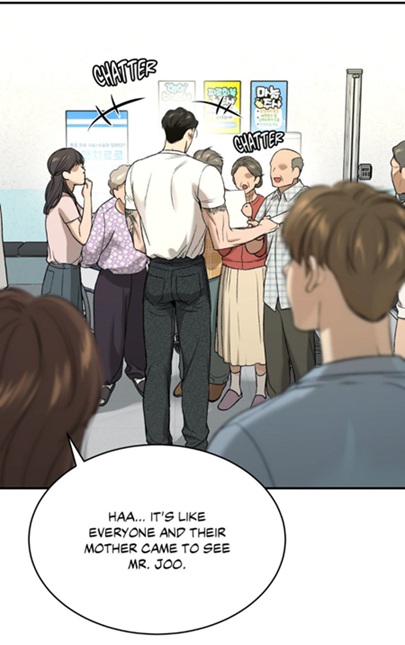 (chapter 62) The hospital or Kim Dan’s presence may provide him with a sense of stability and calmness, allowing him to adopt a more casual and relaxed appearance. Additionally, the contrast between his expensive jeans and branded t-shirt and his unassuming sandals reveals a division between his public image and private self. While his clothing aligns with his status as a wealthy and successful individual, the casual footwear hints at a simpler, more authentic side of him that is emerging in this setting. It reflects his willingness to shed some of the societal expectations tied to his identity.
The sandals can also be seen as a symbol of transition.  (chapter 62) Feet often represent movement or progress, and wearing casual footwear like sandals might signify that he is in a state of personal transformation. The lack of socks further emphasizes this shedding of layers—he is slowly allowing himself to be more vulnerable and introspective, stepping away from his usual, controlled persona. Finally, sandals reflect his connection to the environment. His footwear choice underscores that the hospital is a place where he feels secure and unthreatened. The focus on his feet could symbolize his groundedness in the moment, highlighting that this environment allows him to pause and reflect, rather than act or defend.
In summary, Joo Jaekyung’s sandals symbolize his vulnerability, comfort, and authenticity. They represent his transition toward a more unguarded version of himself and his growing trust in the environment and, perhaps, in Kim Dan. The author’s deliberate focus on his feet underscores this subtle but significant shift in his character.
Another detail attracted my attention: the vanishing of the cap. (chapter 62) The latte is used as a shield. He doesn’t want to be recognized. This explicates why the moment he removes the cap 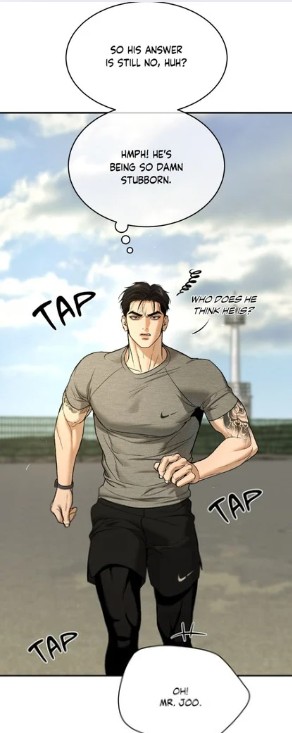 (chapter 62), he is immediately approached by the town chief. (chapter 62) This shows that the owner of the hostel had not only observed him for the past few days, but also had quite understood the significance of the cap: anonymity and distance. Consequently, when the celebrity chose to leave the hat at home, he expressed his satisfaction, safety and comfort in this place. This indicates another step in the dragon’s metamorphosis.
The champion’s floral-patterned pants and hat further illustrate his transformation (chapter 62) and his effort to integrate into the environment around him. These borrowed clothes symbolize humility and practicality, standing in stark contrast to his penthouse life  (chapter 42), where appearances and dominance once took precedence over community and connection.
  (chapter 02) The penthouse, perched high above the city, served as a symbol of isolation and self-reliance—an ivory tower of sorts, detached from the world below. In contrast, the town’s hostel
 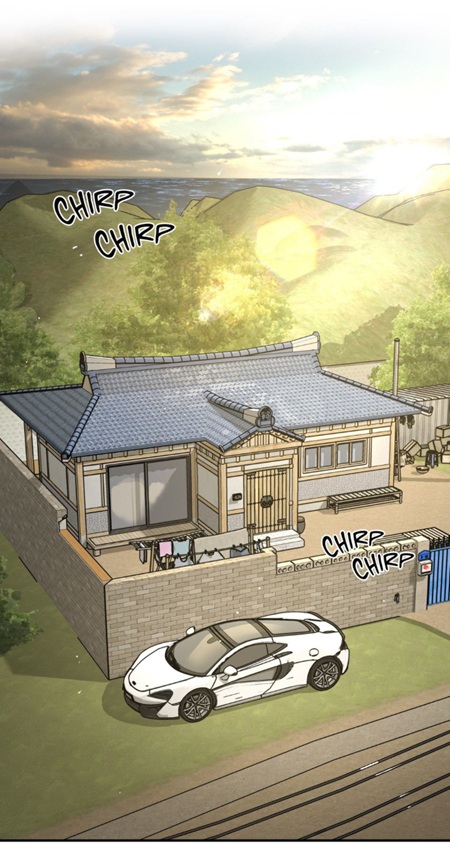 (chapter 62) reflects shared experiences and human connection, embodying a shift toward groundedness and humility.
The floral patterns on his clothing carry additional symbolic weight. (chapter 62) Flowers, often associated with growth, renewal, and gentleness, contrast sharply with the predatory imagery of his Season 1 leopard-print pajamas.  (chapter 30) This evolution from animalistic aggression
  (chapter 30) to floral gentleness mirrors his inner journey—from a man who thrived on dominance to one who values connection and vulnerability. By choosing practicality over intimidation, he signals a readiness to embrace his humanity and shed the pretensions of his past. Moreover, the hat has here a different function: it serves as a real protection from the sun, hence his neck is covered.
The practicality of these clothes also signifies his growing comfort in this environment and marks a stark contrast to his previous life in the penthouse. In the penthouse, his wardrobe and lifestyle reflected detachment and a preoccupation with dominance, symbolizing isolation and self-reliance. Now, his practical and borrowed clothing embodies a shift toward humility and integration into the town’s community. No longer concerned with appearances, he prioritizes function over image, a stark departure from his previous self. The champion’s acceptance of “ridiculous” clothing highlights his willingness to shed past pretensions and integrate into the town’s rhythm of life.
A New Name, A New Identity
Another subtle but significant aspect of Joo Jaekyung’s transformation is his landlord giving him a new name: 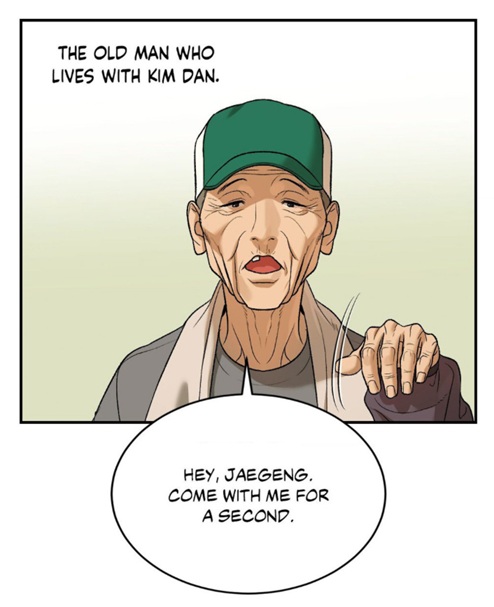 (chapter 62) “Jaegeng.” While this may initially appear as a simple mistake due to the landlord’s poor hearing, it holds deeper symbolic weight. This renaming can be interpreted as part of Joo Jaekyung’s rebirth in the town—a reflection of his evolving identity.
The landlord’s misnaming is especially poignant because it occurs without any knowledge of Joo Jaekyung’s fame, wealth, or status as an MMA champion. To the landlord, he is not “the Martial Emperor” or a celebrity but simply a man who has shown strength, care, and selflessness in his actions. This name, therefore, becomes a representation of how Joo Jaekyung is seen in this new environment: not for his achievements or material success, but for his intrinsic qualities and the genuine impact he has on those around him.
By giving him a new name, the landlord unknowingly affirms Joo Jaekyung’s transformation. In many cultures, names symbolize identity, belonging, and purpose. “Jaegeng” serves as a marker of his rebirth into a life that values connection over dominance, humbleness over pride. It underscores the idea that the town is becoming a place where he is recognized and appreciated for who he truly is, rather than what he has accomplished.
Furthermore, this renaming highlights the theme of visibility and acceptance. For most of his life, Joo Jaekyung has been defined by his physical prowess and public persona, often hiding his vulnerabilities behind his success. He was badmouthed by his manager Park Namwook, as an ill-tempered  (chapter 52), spoiled rich brat:
  (chapter 7) Yet here, in the quiet simplicity of the town, he is seen not for his image but for his actions. The landlord’s care and warmth (chapter 62) further reinforce this shift, showing that true respect and recognition come from authentic relationships, not societal labels. This chapter actually proves not only the manager’s bias wrong, but also MFC’s badmouthing.
  (chapter 54) Like mentioned above, his stay in this little town is teaching him to become immune to manipulations in the end. His self-esteem is getting boosted, hence he doesn’t mind being called “Jaegeng”. (chapter 62) Notice that he never corrects his neighbor and Kim Dan’s landlord.
Laying Down Roots: A Journey Toward Stability
The phrase “laying down roots” (chapter 62) offers a profound insight into Joo Jaekyung’s character, revealing his unfamiliarity with the concepts of stability and belonging. This idiom, often associated with establishing permanence or forming deep connections, feels foreign to him, reflecting a life where such notions were neither prioritized nor experienced. Its use in this context signals his subconscious recognition of a significant internal shift.
If we interpret this phrase through the lens of Joo Jaekyung’s possible upbringing—marked by frequent relocations or a transient lifestyle—it sheds light on why this concept might feel new and even perplexing. A life of constant movement, potentially due to his parents’ careers or ambitions, would have disrupted his ability to build meaningful relationships or develop a stable sense of home. Let’s not forget that he speaks English fluently. This emotional rootlessness could explain his hyper-focus on self-reliance and his struggle with vulnerability, as he likely learned to depend solely on himself.
In contrast, Kim Dan’s rootlessness stems from neglect and exclusion, experienced while remaining in a single place 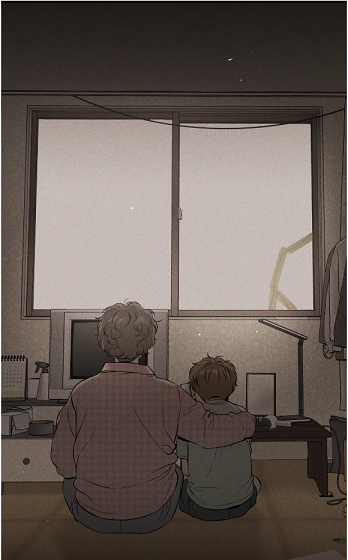 (chapter 19). This creates a fascinating parallel between the two characters: both grapple with the idea of belonging, but from opposing starting points. While Kim Dan longs for acceptance in a community
  (chapter 56) that has continually rejected him (parents, students, hospital; Team Black), Joo Jaekyung is learning how to stop running—physically and emotionally—and to establish a sense of permanence for the first time in his life.
By choosing to “lay down roots” in the town, even if initially motivated by his desire to bring Kim Dan back to Seoul, Joo Jaekyung is unknowingly practicing an act of stability and connection. His integration into the town’s daily life, through his labor and interactions with the townspeople, marks a pivotal step in his transformation. It shows that his motivations are gradually shifting away from self-serving goals toward something more meaningful: a life enriched by mutual care and human connection.
This phrase also ties into the broader symbolism of his actions in the town. Receiving vegetables as compensation, working in the fields, and forming relationships with the locals reflect his growing connection to the earth and to others. This stands in stark contrast to his previous life in the penthouse, where he lived isolated high above the world, detached from the lives of others. Now, by grounding himself—both literally and metaphorically—Joo Jaekyung is beginning to rebuild his identity on a foundation of humility, service, and authenticity.
Ultimately, “laying down roots” becomes more than just a metaphor for his time in the town. It represents a pivotal moment in his journey of self-discovery, as he learns to create a life not defined by dominance or independence but by connection and belonging.
Kim Dan’s Limited Perspective
Kim Dan, busy with his own work, remains unaware of the full extent of Joo Jaekyung’s contributions to the town. His landlord’s comment about the champion’s back pain forces Kim Dan to confront his own biases. (chapter 62) Refusing to treat Joo Jaekyung would make him appear heartless, yet his compliance is reluctant and transactional, rooted in obligation rather than understanding. This disconnect highlights how much Kim Dan has yet to grasp about Joo Jaekyung’s transformation. He still views the champion through the lens of their past, unable to see the quiet generosity that now defines his actions.
Interestingly, the townspeople’s admiration for Joo Jaekyung’s strength and kindness contrasts with Kim Dan’s perception. While they see him as a selfless helper, Kim Dan struggles to reconcile this new image with the man he once viewed as domineering and detached. He still views the protagonist as a celebrity, and not as a man. This tension underscores the theme of hidden growth, where transformation often goes unnoticed by those closest to us.
From Civilization to Nature: The Symbolism of Cucumbers and Potatoes
The progression from helping with cucumbers to working in the potato fields represents Joo Jaekyung’s deepening connection to nature. (chapter 62) Cucumbers, as cultivated crops, symbolize his initial steps toward humility within the structured framework of human civilization. They are tied to his early efforts to integrate into the town, where his labor is still defined by external expectations and requests.
(chapter 62) Potatoes, on the other hand, grow underground, unseen until harvested. They symbolize the deeper, hidden aspects of Joo Jaekyung’s transformation—a connection to the earth that goes beyond surface-level labor. Working in the potato fields brings him closer to the raw, unrefined essence of nature, marking a significant step in his journey. However, his interaction with nature remains tied to human intervention (agriculture). He has yet to venture into the untouched wilderness of the woods, which represents the final frontier of his self-discovery. And this brings me to my next observation:  (chapter 62) So far, the champion has not paid attention to Boksoon. He has not even looked at her, because his eyes are always directed at Kim Dan:
  (chapter 61) (chapter 61) However, her puppy has been buried next to the forest:
 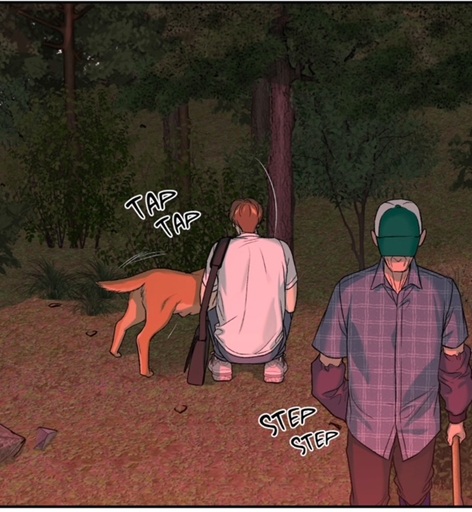 (chapter 59) Hence I have the impression, she could be the one leading him there, if not Kim Dan. Let’s not forget that the doctor’s deepest wish is to go on a walk through the woods:
 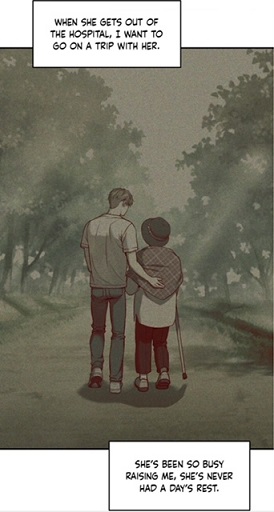 (chapter 47) Another interesting aspect is that the trip to the forest is connected to rest in the physical therapist’s mind. Striking is that though the champion helped the community, he still worked. So technically, he has never had a day’s rest either. But this is what he said to the landlord: (chapter 61) He came here for his recovery.
Conclusion: The Path to True Grounding
Joo Jaekyung’s transformation in the town unfolds through symbolic milestones: his baptism in the ocean, his labor in the fields, his floral clothing, and his connection to nature. Each moment represents a step away from power, control and isolation toward modesty and service. He is gradually moving away from MFC world. Yet, his journey is incomplete. The untouched woods remain a metaphorical frontier—one he has yet to explore fully.
Kim Dan’s limited awareness of this change highlights how transformation often goes unnoticed by those closest to us. This limited perspective mirrors Kim Dan’s own internal struggles, as he grapples with feelings of inadequacy and a worldview shaped by past trauma. His inability to fully recognize Joo Jaekyung’s growth underscores a poignant contrast—while Joo Jaekyung is learning to connect and embrace change, Kim Dan remains constrained by his guarded nature and lingering doubts about his worthiness of care and community. He considers himself as a waste of time: 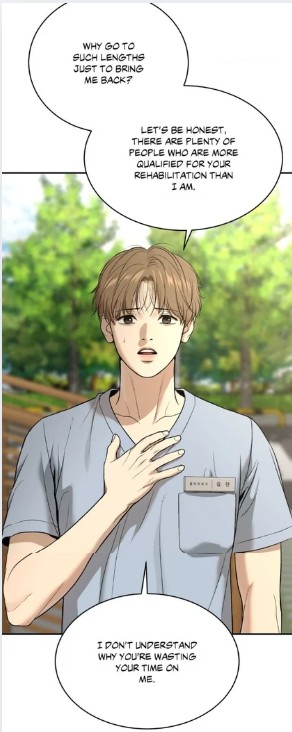 (chapter 62) Ultimately, Joo Jaekyung’s journey is not just one of self-improvement but a quiet challenge to societal values. True strength is not about control, but about the ability to grow, connect, and embrace change. Blooming muscles signifies not just physical power, but a strength nourished by care, community, and the courage to evolve. Finally, I would like my readers to pay attention to the sky, when the champion approached his fated lover:
 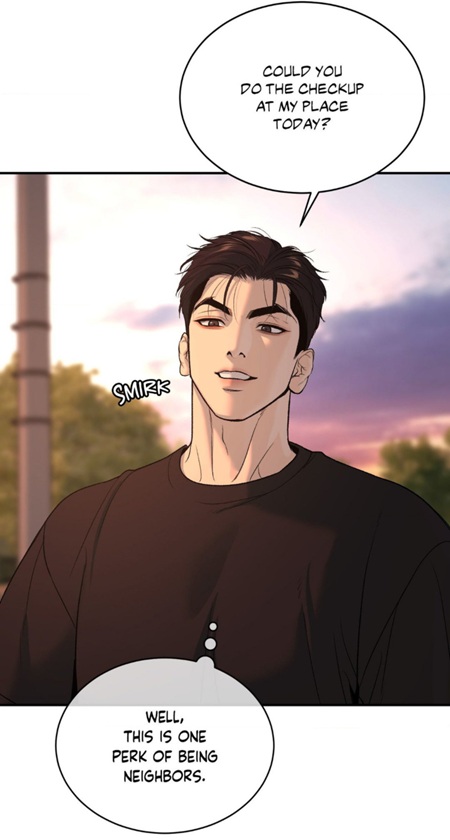 (chapter 62) It was a mixture of white, purple, pink and orange, a sign that not only the champion’s life has become more colorful, but also the night stands under the sign of love, enlightenment and life. At the same time, it reminded me of the night when the puppy was buried:
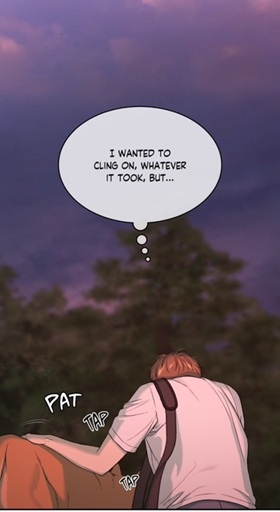 (chapter 59) Thus I am expecting another huge transformation in the next episode.
Feel free to comment. If you have any suggestion for topics or manhwas, feel free to ask. If you enjoyed reading it, retweet it or push the button like. My Reddit-Instagram-Tumblr-Twitter account is: @bebebisous33. Thanks for reading and for the support, particularly, I would like to thank all the new followers and people recommending my blog.

 Bebebisous33s' analyses in K-Dramaland and Manhwas