

Please support the authors by reading Manhwas on the official websites. This is where you can read the Manhwa: Jinx But be aware that the Manhwa is a mature Yaoi, which means, it is about homosexuality with explicit scenes. Here is the link of the table of contents about Jinx. Here is the link where you can find the table of contents of analyzed Manhwas. Here are the links, if you are interested in the first work from Mingwa, BJ Alex, and the 2 previous essays about Jinx The Sweet 🧁 Curse of the Round Table 🍴 and While They Embrace🫂: The Sparrows 🐦
It would be great if you could make some donations/sponsoring: Ko-fi.com/bebebisous33 That way, you can support me with “coffee” so that I have the energy to keep examining Manhwas. Besides, I need to cover up the expenses for this blog.

As Kim Dan asks his fated partner 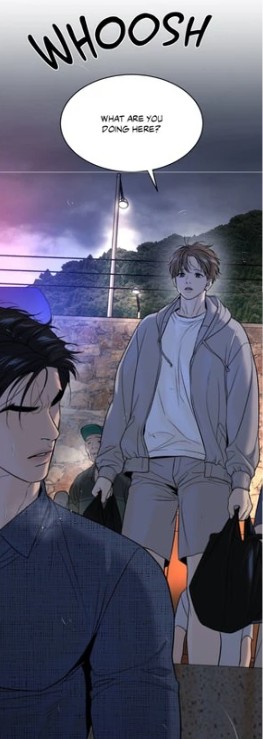 (chapter 69) and the latter stands stunned in the late-summer breeze, the moment seems suspended in light and silence. The doctor’s words are accompanied by a subtle music: the wind. It whispers through the panel with an audible “WHOOSH,” not covering doc Dan’s voice but giving it resonance. The wind, like words, travels through the air and reaches the celebrity’s ear. It connects characters across distance, marking the invisible line of perception, reaction, and awakening. But behind this charged reunion lies a quiet figure—barely visible, yet unmistakably present: the landlord. In this image, the old man appears only for a second, dressed in a jacket and green cap, almost blending into the night. He does not speak. He does not move. And yet, everything in that scene bears his mark.
The Invitation to Move
From the sneakers on Kim Dan’s feet to the jacket he wears  (chapter 69), and the bags of groceries in his hands, traces of the landlord’s influence are everywhere. Whether it was Kim Dan who offered his help or the landlord who extended the invitation, the result was mutual: for the first time, they acted as a community—two individuals sharing the same roof and engaging in reciprocal care. I observed that through this interaction, the doctor was subtly encouraged to behave differently. He was not merely going shopping. That quiet moment served as a turning point—an invitation to rejoin life, to move on, to dress with care, to claim space. While others meddle, accuse, or abandon, the landlord quietly watches, nudges, and supports. He is not the star of the scene, but its breath. He is the breeze before the embrace. The hand behind the rescue.
Shaping the Framework Without Words
From this new angle, I reached the insight: the landlord is not only present at pivotal narrative moments, but he actively shapes the emotional framework of season 2 without ever stepping into the spotlight. I observed that in Chapter 69, while readers may initially focus on the tense conversation between the champion, Park Namwook, and the CEO of MFC, there is another figure in the background—the landlord—who discreetly fades behind the couple:  (chapter 69) (chapter 69). His presence is easy to miss, but for attentive readers, it’s striking. He appears not as a passerby, but as the very person who guided Kim Dan toward that precise moment of vulnerability and strength. When contrasted with an earlier panel from the same episode, another layer of meaning emerges: in both scenes, the landlord is positioned in a way that suggests symbolic proximity. However, I made a striking observation: in the first panel, he is actually standing behind the champion and in front of Kim Dan. This creates a visual link between the two protagonists, as the landlord appears quite literally between them. I came to the following conclusion: he functions as a bridge or protective force—he does not slap or yell like the manager, but his stillness conveys safety. While he stands at the champion’s back, he faces Kim Dan, as if preparing the ground for their reunion.
 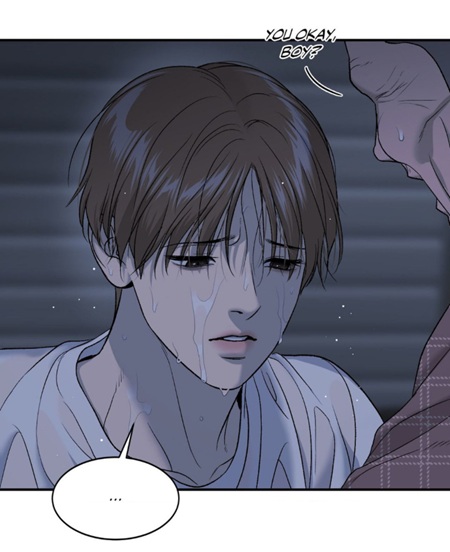 (chapter 69) These silent, parallel compositions reveal the landlord’s symbolic position as an enduring guardian: not static, but responsive. Therefore his position shifts constantly, either
  (chapter 65) in front of the couple, or behind Kim Dan in one scene, behind the champion in another.
The Wind That Adjusts
Seen through the lens of the wind metaphor, I discerned something more: the landlord’s mobility reflects a deeper symbolism.  (chapter 57) He is not fixed in place like house, wall or obstacle. This explicates why he is almost seen outdoors, even her. Opening the door means allowing the fresh air to enter the room.
 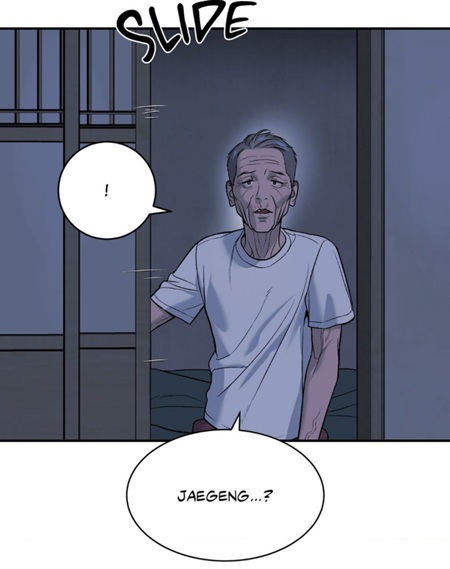 (chapter 65) He is like the wind, fluid and unobtrusive, adapting to the needs of the moment. His position is never rigid, therefore in the final panel he seems to have vanished. (chapter 69) At times behind Kim Dan, at others behind the champion, he realigns himself without fanfare. I realized this adaptability speaks to something elemental: the wind’s capacity to bend around others, to support without imposing. Unlike characters who plant themselves firmly in conflict
  (chapter 46) or authority
  (chapter 65), the landlord responds to what is needed, not what is expected. His flexibility does not stem from indecision—it is born from humility and care. Another aspect contributing to this perception is his ignorance. However, the latter should not be viewed negatively. Since he doesn’t know the champion’s profession or the doctor’s familial and financial situation, he is not projecting expectations or judgments onto them. Rather than acting out of assumption, he simply observes. This is precisely why he doesn’t come across as arrogant. His lack of knowledge becomes a quiet strength—it allows him to respond with presence, not prejudice. Just as the wind moves through open spaces without imposing form or judgment, his unknowing presence allows room for others to breathe and unfold, free from predefined roles or assumptions.
 (chapter 65) He does not try to define the protagonists by their past or their titles. He lets them define themselves. While he tried to encourage doc Dan to drink and work less, as time passed on, he came to notice his suffering and accept him with his illness. (chapter 69)
Just as the wind moves around structures and creates waves, his presence bends gently to support without overshadowing. This mirrors his role throughout Jinx season 2: he is a man who creates space rather than fills it, who enables others to find their footing by adjusting his own stance. In this way, his neutrality is not passivity, but grace in motion. In the embrace scene (chapter 65), when the waves rise audibly due to the wind, I observed that the landlord is no longer standing directly behind Kim Dan. And yet, a sandal, sock, and pant leg appear in the corner—suggesting he is still nearby. It seems to have stepped back deliberately, allowing privacy and intimacy to unfold. He remains part of the scene, like a breeze, felt but unseen. Another possibility is that he approached the coast guards and explained the champion’s reaction. If this is true, then In doing so, he would have acted not as an intervening outsider, but as a bridge—discreetly smoothing tensions without casting judgment. True to his role as the wind, he doesn’t speak to dominate, but to ease the air around others. Even in his ignorance, he responds not with assumption but with attentiveness—observing first, and acting only when necessary.
Gaze Toward the Horizon
And yet, one detail caught my attention. In the panel at the dock, the landlord is not looking at the champion. (chapter 69) His gaze is directed straight ahead—detached, not reactive. Under this new light, I gathered that he may not be overlooking the scene but instead quietly attuned to something else entirely—the weather. Since the storm had been announced on the news  (chapter 69), it is plausible that the landlord is calmly scanning the horizon, sensing the approach of the tempest. After all, he is a farmer
  (chapter 62) —his livelihood depends on observing the skies. (chapter 69) This attention to weather is not merely practical, but instinctual, shaping his rhythm of life and reinforcing his elemental bond with the air. As a man attuned to nature and grounded in routine, his awareness of such environmental shifts would come naturally. It is not panic or distraction—it is foresight. This reinforces his alignment with the air: he is always mindful of what is coming.
I initially assumed that the errand to the grocery store was directly tied to the storm forecast announced on the news. In such cases, villagers often prepare in advance, buying supplies before conditions worsen. Yet upon closer examination, the atmosphere among the townspeople doesn’t reflect growing panic or haste.  (chapter 69) They are murmuring, yes, but their attention is absorbed by the incident at the shore. This led me to reconsider: perhaps the purchase was not consciously connected to the weather after all. And yet, one man quietly stood apart from the crowd—the landlord, his silence and gaze directed not toward the commotion, but toward the open horizon.
This single detail speaks volumes. Unlike others, the landlord does not rely on media reports or buzzing gossip. Notice that he was the last one hearing about the champion’s generosity in the town. 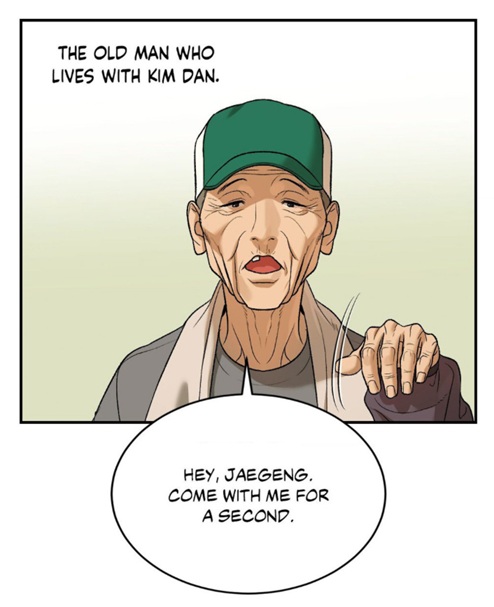 (chapter 62) He is a farmer—a man who reads the sky, the wind, and the rhythm of the land. Hence I am inclined to think that his awareness of the approaching storm stems not from a broadcast but from instinct. The wind carries signs, and he is attuned to them. It is even possible that while talking with the coast guards, he learned more about the forecast—not through digital alerts, but through human connection.
In this light, his decision to bring Kim Dan along acquires a new depth. Whether or not the storm was their explicit concern, the moment becomes symbolic: an act of movement, preparation, and subtle care. Once again, he does not push Kim Dan forward but opens the way gently. He creates a path that the doctor can walk—if he chooses to. As with the wind, his influence is neither loud nor commanding. It is felt through presence, not pressure.
Moreover, because of his silent behavior, I could only come to the conclusion that he was not the one recognizing the celebrity’s car parked by the dock. Rather, it must have been Kim Dan himself who noticed the vehicle, then he paid attention to the crowd forming nearby, or the emergency headlights—much like the champion had earlier. This is significant, as it reinforces the landlord’s role as someone who does not act on behalf of others—he simply prepares the space for choice to unfold. And since the two nurses  (chapter 69) had already been shown earlier together in the crowd, I suspect that one of them might informed Kim Dan about the incident and the champion’s presence. This would align with the narrative’s kaleidoscopic structure, where certain scenes are reflected in different timelines.
The Hand Fan: A Symbol of Breath
And now, you are probably how I came to associate the landlord with the wind. Earlier in Chapter 66, we encounter one of the most symbolic moments involving the landlord: 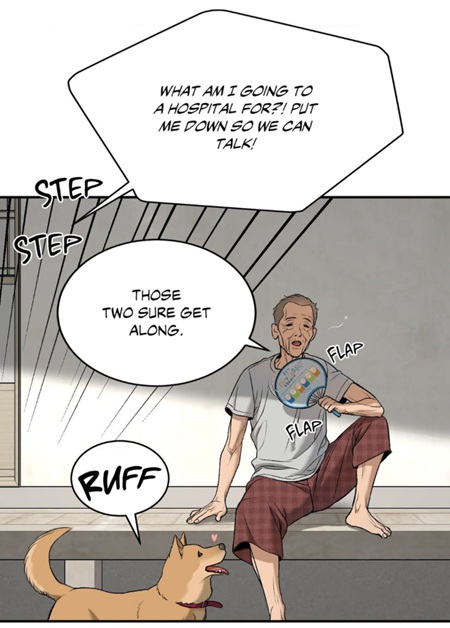 (chapter 66) the image of him gently fanning himself while sitting in his yard. I detected something immediately intimate and ancient in this gesture. A hand fan, in many East Asian cultures, denotes calm authority, self-discipline, and silence. I interpreted this scene as more than casual: the landlord becomes an embodiment of wind—present, refreshing, yet invisible. A man who can create movement without pressure. It is striking that in a story driven by action, fists, and fame, the one character who moves the plot forward with the least noise is this old man.
Upon closer inspection, I observed that the fan bears printed text and the number “365.” 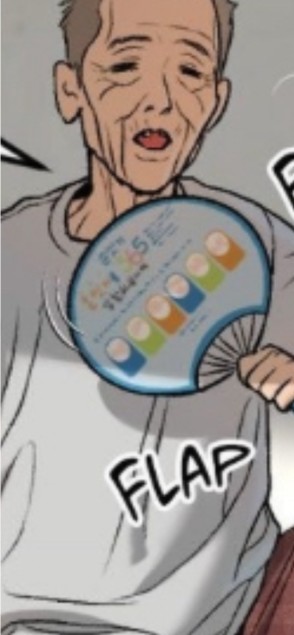 (chapter 66) Under this new light, it dawned on me that the fan was most likely handed out by a local institution—perhaps even the hospice Light of Hope, during a public health campaign or examination event. This means that he is taking good care of himself. One might argue with this interpretation, yet there exists another evidence for this perception.
  (Chapter 62) He is constantly wearing the green cap, a sign that he knows about the danger of the sun. This stands in opposition to the grandmother who would sell her vegetables without any hat.
  (chapter 57) These types of fans are typically distributed by hospitals or clinics: practical items with subtle promotional intent. But once in the landlord’s hands, it takes on symbolic weight. The number “365” does not simply represent a calendar year; it represents consistency, time, and the daily rhythm of care.
Strikingly, this fan aligns with the landlord’s quiet guardianship. Just as the fan moderates air and temperature, the landlord moderates the emotional climate of the household.
What’s more, I noticed the fan (chapter 66) is visually divided into six colored columns—blue, green, and orange tones recurring in a harmonious pattern. These colors stand in sharp contrast to the dominant black-and-white or blue-and-red palette of the main couple’s visual identity. This exposes that the landlord is portrayed as a multicolored figure: layered, grounded, and richly nuanced in ways that neither protagonist yet fully embodies. This explains why he is often seen wearing different shades: beige, 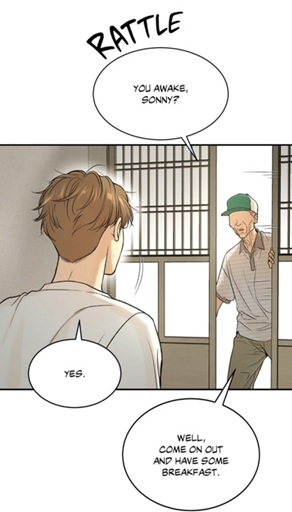 (chapter 57), white, (chapter 66) gray,
  (chapter 58), green, (chapter 62), orange
  (chapter 61) and brown. Yet, his clothes tend to lean toward brown hues, evoking earth and soil—symbols of rootedness and stability.
I came to an additional realization: the landlord doesn’t just enrich the emotional palette of Jinx—he restores the protagonists’ connection to Earth. His presence is grounding. He draws them out of sterile hospital rooms, detached penthouses, and fabricated spotlights, and into the soil-rich air of a small town. He is the one who invites breath, hunger, walking, sleeping—the ordinary rhythms of life that nourish the body and soul. By surrounding himself with the colors of the land—brown, orange, moss green—he reminds the doctor and the champion of a world that does not demand, but simply exists. A world where one can finally pause, take root, and rest.
Rather than simply standing apart, the landlord infuses the narrative with gentle warmth and vibrancy. His colorful presence offers more than emotional flexibility—it introduces a spectrum of life into the protagonists’ otherwise muted and high-contrast world. Previously dominated by blue and red, their visual universe begins to shift through his influence. Under this new light, I realized that he doesn’t just symbolize emotional depth—he brings light and color into their shadows, inviting them to rejoin the world of sensation and groundedness. Consequently, his quiet mission is to help them land back on Earth, to discover rest and a home. Like fresh air through a long-sealed room, his presence is not overwhelming—it simply makes it possible to breathe again.
 (chapter 62)
The six-part division also struck me as potentially symbolic. Since the fan appears for the first time in Episode 66, I came to the following conclusion: the six segments may represent his quiet integration into their bond. My idea is that he will not just remain a bystander, but emerge as a surrogate parent figure—not by blood, but by presence. Like a mother, he nourishes, guides, and trusts, yet without smothering or restraining. His care is rhythmical, like breath. His colors are inclusive. His fan—a calendar, a compass, a quiet lullaby. I deduced that he doesn’t simply carry the fan—he embodies what it represents: routine, protection, and the kind of stability Kim Dan has long been denied. The fan becomes an extension of his role: to circulate—not intervene, to cool—not confront.
Air Against Hot Air
Before moving further, a linguistic and symbolic insight struck me:  (chapter 65) words and wind share the same pathway—the ear. We do not see them; we hear or feel them. Just like the wind, the landlord’s influence often goes unnoticed unless we attune ourselves. Interestingly, in the English version of Jinx, he refers to Joo Jaekyung as “son”
 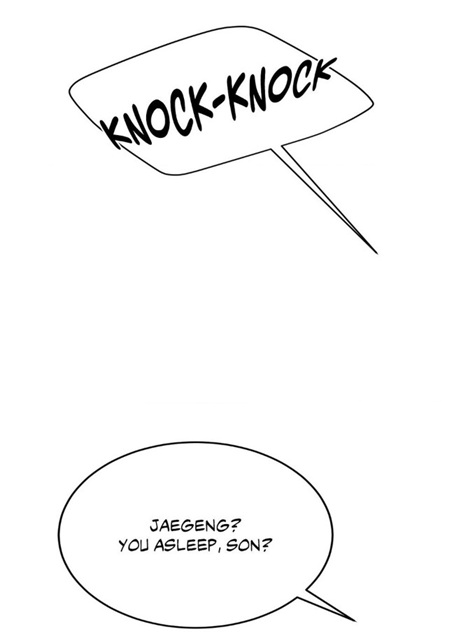 (chapter 69) and Kim Dan as “sonny” (chapter 57) or (chapter 69) “boy.” These terms of address, gentle and familial, contrast sharply with the control and emotional neglect shown by figures like the grandmother or Park Namwook. Because those characters views the main leads as “immature (chapter 65) and irresponsible
  (chapter 52), they use their “youth and seniority” to assert dominance or demand loyalty and obedience. On the other hand, the landlord positions himself as a silent guardian, perceiving the protagonists as children in need of warmth and care, not correction. (chapter 62) His words, like the breeze, are few and soft—but when spoken, they carry weight. This brings me to a broader observation. I detected that the hand fan becomes a symbol of breath itself (chapter 66) —the very thing Kim Dan is consistently deprived of.
 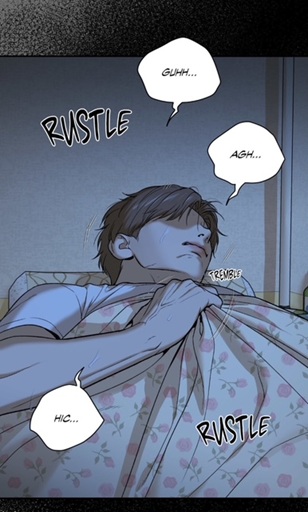 (chapter 59) Whether it’s due to panic, malnutrition, exhaustion, or psychological collapse, suffocation is one of the defining sensations of Kim Dan’s arc. In this context, the landlord, with his unassuming fan and grounded demeanor, emerges as a breath of fresh air—the very opposite of the heiße Luft, or “hot air,” surrounding the champion’s fabricated scandals and media distortions.
  (chapter 52)
Under this perspective, the fan’s soft FLAP (chapter 66) becomes almost therapeutic. It doesn’t try to rescue Kim Dan like the champion does. It doesn’t dramatize. It simply cools. It shifts the air around a suffocating figure, making room for recovery. Thus I deduce that the fan is not only a symbol of time, but also of space—space to breathe, space to reflect. The landlord does not speak of the past or demand a future; he offers 365 days of presence, through silence and small gestures.
Wind Before the Storm
Striking is the relationship between the wind and the storm, and how this elemental dynamic deepens the landlord’s symbolic role. When Joo Jaekyung hears at the dock in Chapter 69 about the incident with the drunk man, (chapter 69)  (chapter 69) the atmosphere grows heavier—not from external scandal, but from inner turmoil. Then Kim Dan’s puzzled reaction, (chapter 69) strikes like a gust.
  (chapter 69) The scene becomes emotionally charged, echoing classic storm symbolism: emotional intensity, uncertainty, and the prospect of sudden change.
Under this new light, I came to the following conclusion: what we witness is not chaos imposed by others, but a moment of crisis—of emotional confrontation and potential transformation. And yet, before this private storm could break, I observed that the landlord was quietly present. (chapter 69) He helped Kim Dan get dressed, leave the house, and carry groceries. He didn’t push him into the storm—he gave him the freedom to walk into it on his own terms.
That is the striking contrast. The storm represents the turning point, the fear of change, the weight of the past catching up. The landlord, as wind, offers the one thing Kim Dan lacked until now: air, movement, and choice. He doesn’t command. He prepares. He trusts. And in doing so, he gives Kim Dan room to decide—whether to run or stay, to speak or remain silent.
Following this exploration of wind and storm, I noticed another compelling pattern tied to sound and clarity. In the very panel where the champion realizes Kim Dan is safe  (chapter 69) —his face filled with shock and disbelief—the Webtoonist added the sound effect “WHOOSH.” Under this new light, I interpreted this as more than background ambiance. It marks a pivotal turning point, as if the wind itself had cut through the fog in Joo Jaekyung’s mind, sweeping away his spiraling fear and clearing space for truth. This sudden shift in emotional atmosphere visually alters him too. Hence it is not surprising that he looks visibly younger. Not broken, but stripped of his burdens. As if the wind blew away the years of pressure, fears and rage.
Strikingly, this is not the first time the gust is heard. Earlier, when Kim Dan first spots the champion on the dock, the same onomatopoeia—“WHOOSH” (chapter 69) —carries the weight of their emotional storm! That very night, I noticed, both Kim Dan (chapter 69) and Joo Jaekyung experienced an emotional shift. The wind, though announcing the coming storm, swept through their minds and cleared away emotional fog. Thus, I deduced that the wind in these scenes becomes a narrative force of mental clarity, awakening, and emotional release. (chapter 69) While there is no sunlight or calm skies, it opened a path for both characters to see clearly. That’s how I realized that Kim Dan’s enlightenment was not recognition, but humility! His dawning awareness that he never truly knew the champion, captured poignantly in his question (chapter 69) and the visual emphasis on the punctuation mark in a separate panel. (chapter 69) This means that the moment the champion embraced him, the doctor must have sensed that the champion’s worries and care were genuine. 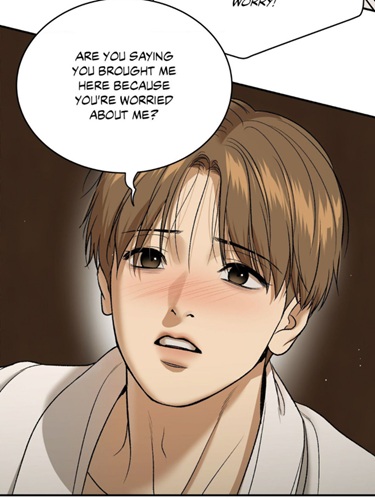 (chapter 67) Doc Dan got finally his answer to this question. Joo JAekyung is more a man of action than of pretty words. So awakening and flourishing are not something that occurs behind glass or sealed doors. It is born in the open, amidst uncertainty and confrontation. And under this new light, I reached a final insight: growth in Jinx does not happen behind closed doors or sealed windows. It happens in the open, where storms rage and air can finally circulate.
  (chapter 59) The landlord doesn’t shelter people from pain or storms. He makes sure they’re equipped to face them. And once they do, the wind is no longer a threat, but a form of grace. And now, you comprehend why the death of the puppy has not been discovered by the athlete yet. For the landlord, death is something natural and inevitable, and since doc Dan has been working at the hospice, I am quite certain that the old man imagined that doc Dan was well-equipped to deal with this situation. He must have been envisaging that Doc Dan was accustomed to it. The problem is that he doesn’t know the protagonist’s past and family.
Furthermore, linking this moment back to the storm and grace works thematically: the same wind that opens hearts also shakes foundations. The landlord’s silence and discretion, typically virtues, can now be understood as both protective and fallible, making him even more human. His trust, while generous, risks overlooking the complex layers of grief that Kim Dan carries. What is seen as strength might actually mask deep vulnerability. In this light, the landlord’s role as wind is also a lesson in perception—he adapts, but cannot always see the storms others keep within.
A Man Without Judgment
In a world where Kim Dan has long been deprived of agency—where he’s been pushed, controlled, bought, and silenced—the landlord brings something revolutionary in its simplicity: freedom and care without pressure. His wind does not knock doors down. It opens windows.
Even after the incident with the drunk doctor takes place —when others might rush to assign blame or cast doc Dan as victim—the landlord remains silent. As Joo Jaekyung walks away into the night (chapter 69), no words of condemnation are spoken. Unlike Heesung  (chapter 58), who plays the victim while hiding his own culpability, the landlord does not engage in gossip or vilification. His silence isn’t ignorance—it is grace. (chapter 52) He is the antithesis of the media’s “heiße Luft”—that German phrase meaning nothing but hot air. The landlord is not heat, not noise, but wind—cool, steady, and clear. He represents a rare truth in Jinx: the quiet man who watches, helps, and leaves judgment to the wind.
Standing Behind Kim Dan
And perhaps most strikingly, I deduced that it is this elemental quality—his alignment with air—that makes him essential to the story. He is not the hero, nor the villain. He is just a human, someone who opens the door after someone else unlocks it. He is the one who tells Kim Dan to give Boksoon her food (chapter 57), who lets her roam, who trusts without demanding. He is not a rescuer by force; he is a current that carries the exhausted to shore. Though he is disconnected from the social media  (chapter 58) and from media (chapter 62) in general, he is actually the one who can connect to others the best. (chapter 58) No wonder why the actor asked doc Dan to greet the “old man”.
 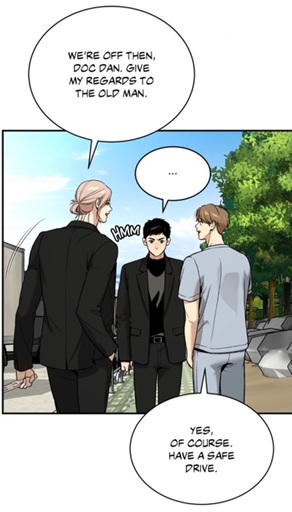 (chapter 59) He felt so comfortable around him.
While others stir scandal or are obsessed with success and money, the landlord flaps a hand fan  (chapter 66) and remains seated. Since he mentions it is the weekend, it is clear that he has no intention to work during the weekend. This explains why he is not wearing his usual green-and-white cap. This subtle detail reinforces his connection to nature’s rhythms—he is not a workaholic
 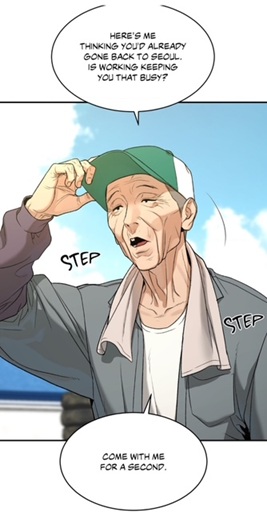 (chapter 57), but someone who understands the balance between labor and rest. He may not have a name, but he has a function. And sometimes, in storytelling, function is identity enough.
Because the old man was seen behind doc Dan’s back on the dock (chapter 69), I noticed a striking visual parallel in Kim Dan’s story: the recurring image of his back. 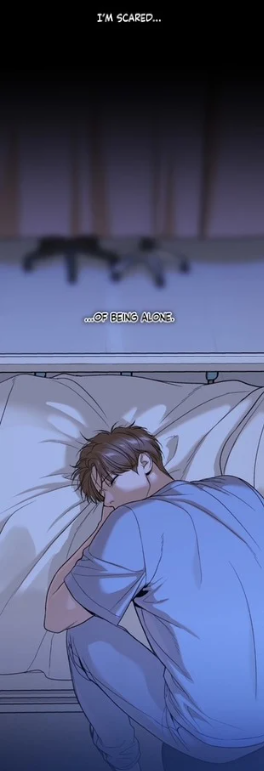 (chapter 56) In Episode 56, we see him resting in front of the window. This moment suggests not only emotional vulnerability but also isolation. There is no one behind him, no one shielding him from the coldness of the world. Later, when he watches the sunset, disconnected from his senses, unable to hear the waves or feel the breeze,
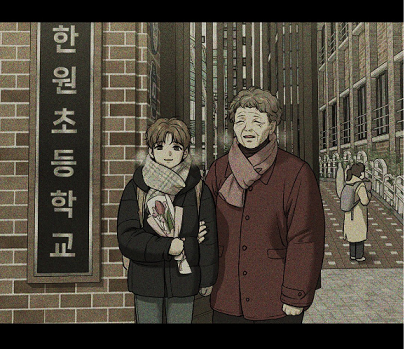
 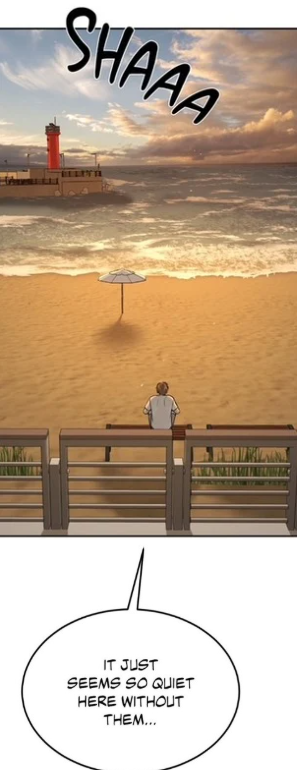 (chapter 59) there’s only one poor sun umbrella in front of him and a wall far behind him. His back is turned to the world, wrapped in solitude and silence. That’s how I was reminded of his childhood. There, the grandmother often stood beside him
  (chapter 47)
  (chapter 47)
 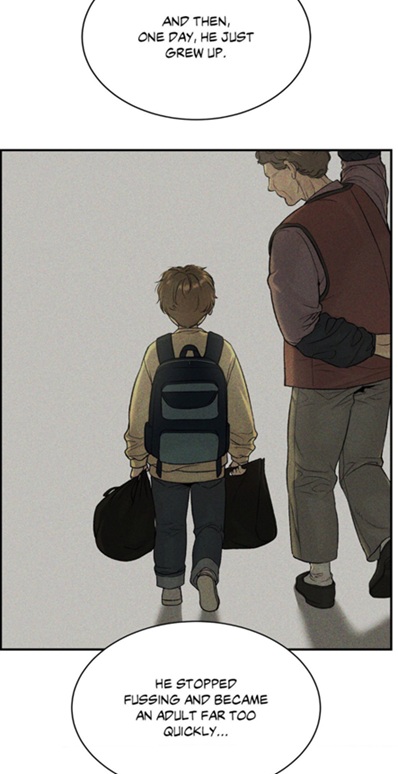 (chapter 65) but not behind. Thus the landlord’s placement (chapter 69) speaks of quiet support. It implies that the old man has his back now. He neither pushes nor pulls—he simply follows, allowing Kim Dan to move forward at his own pace.
The absence of a visual of someone positioned behind Kim Dan  (chapter 49) explains why he got abandoned in the locker room. It gains even more poignancy when viewed against his past. In Episode 47, while the grandmother was carrying him on her back, Kim Dan’s back is left unprotected.
 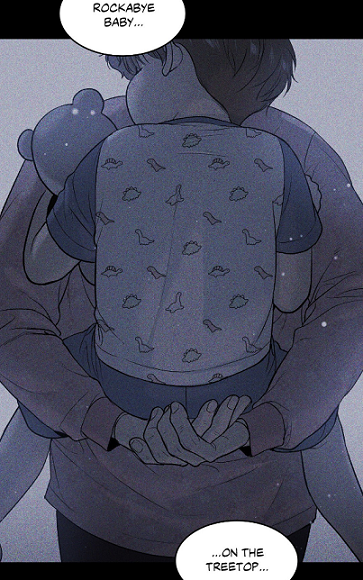 (chapter 47) Her proximity is visible, yet it lacks the symbolic protection associated with standing at someone’s back.
A particularly revealing moment occurs when young Kim Dan cries after being bullied at school. 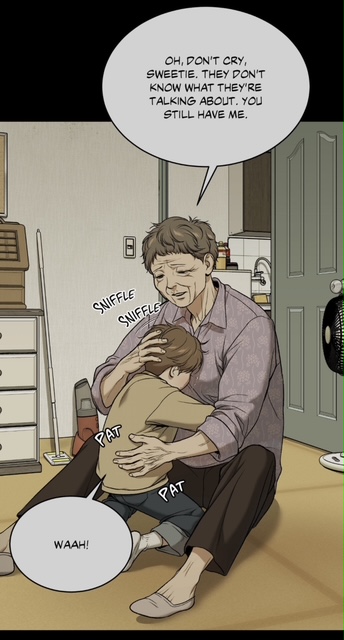 (chapter 57) The grandmother embraces him and taps his back gently while saying, “You still have me.” At first glance, this gesture may seem supportive. Yet, under this new light, I came to the following conclusion: her touch is more reflexive than instinctive. It soothes, but it doesn’t protect. It calms, but it does not empower. It is not a shield—it is a silencer. Her physical gestures, though present, lacked the emotional resonance necessary to foster true security. This interpretation gets validated, when you include her second “action”:
 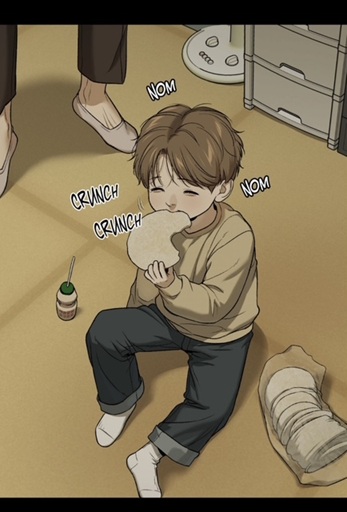 (chapter 57) The moment she offered him a snack, she distanced herself from him. Now, she is standing by his side.
That is why the photograph of young Kim Dan sitting on her lap is so striking.  (chapter 65) It becomes the exception—the rare moment where she appears to have his back. But photographs can be deceptive. They capture posed perfection, not lived reality. And as we trace Kim Dan’s emotional journey, we begin to understand that this illusion of maternal protection was not enough to sustain him.
By contrast, both the landlord and the champion now represent figures of genuine, if imperfect, support. They don’t just stand behind him  (chapter 61) —they give him the air, time, and space to grow.
  (chapter 62) Their presence—especially the landlord’s—is the embodiment of silent guardianship.
  (chapter 69) His consistent yet unobtrusive presence stands in opposition to the grandmother’s inconsistent gestures. One acted out care; the other lives it.
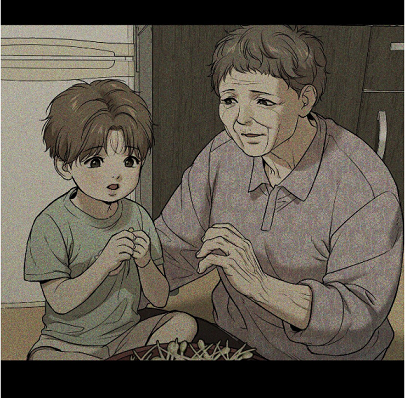
This distinction matters. It redefines what it means to have someone behind you—not merely as a backdrop, but as a source of strength. And this quiet, enduring presence is what finally begins to heal the fractures left behind by superficial affection.This moment echoes his childhood, marked by emotional distance and a lack of support, as seen in his memories with his grandmother.  (chapter 19)
  (chapter 47) (chapter 47)
 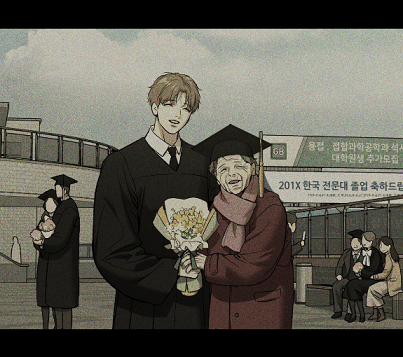 (chapter 47) Despite the rare instance of closeness captured in a photo, most scenes depict Kim Dan standing next to his grandmother, and he is the one supporting her.
I came to the following conclusion: the emphasis on his back is not random. It is a visual metaphor for abandonment and vulnerability. Therefore it is no coincidence that in the yard, doc Dan got hurt on his back, when the champion threw him onto the ground. 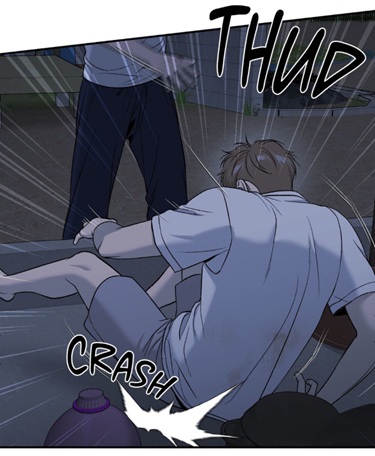 (chapter 69) This gesture, though seemingly violent, reveals something deeper—it forced Kim Dan to feel what he had been missing all along: there were people around him, he was not alone. I would even add, someone was finally standing behind him.
 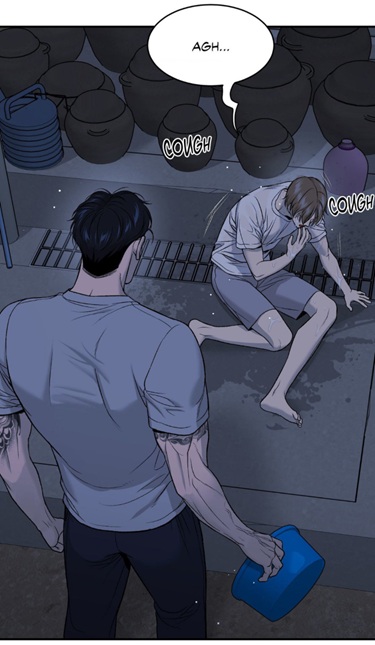 (chapter 69) In that brief moment, Kim Dan is no longer alone. The landlord, as a silent guardian, and Joo Jaekyung, as a fierce protector, are both behind him—symbolically and literally. (chapter 69) They are not towering over him or walking ahead; they are there, at his back, where no one had ever stood before. And that, perhaps, is the quiet miracle of Jinx—a boy once starved of love and breath, now flanked by the wind and the storm. This signifies that when the storm will hit the western coast, the main lead will strangely feel safe and comfortable, because he has company by his side.
Wheelchair and Truck: A Study in Contrast
Under this light, I noticed another contrast forming between the landlord and the grandmother. On one hand, we have a man who drives his own truck (chapter 69), tends his yard, walks to the fields, shares his meal with his tenant and guides him without uttering huge demands. On the other, we see a woman who claims independence  (chapter 56)
  (chapter 65) while seated in a wheelchair or lying in a hospital bed—entirely dependent on others to move her. Her self-image as a strong and autonomous elder clashes sharply with her visible reliance on those around her.
The landlord symbolizes mobility and quiet agency. His freedom lies not only in movement, but in his capacity to give space to others. By contrast, the grandmother is fixed in place  (chapter 65), reliant on beds, wheels, and nurses to navigate the world. Under this new perspective, the wheelchair and the truck are no longer just modes of transportation—they are emblems of character. One rolls forward by another’s push, the other steers by its own will.
And what would happen if the storm did arrive? If shifts prevented hospice staff from returning? The illusion of her autonomy would crumble. While the landlord silently prepares for such contingencies, the grandmother clings to the fantasy that she needs no one. Storms reveal truths: who bends and adapts, and who remains trapped in the comfort of stillness, unprepared for change and misfortune. Since she has this beautiful memory of the ocean 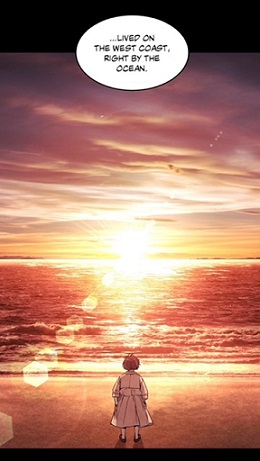 (chapter 53), I doubt that she anticipated the existence of dangers by living on the coast: storms and typhoons. So her beautiful town could get devastated, (chapter 65). Is it a coincidence that when she compliments the place, she is not listening to the wind and seeing the huge clouds in the sky? This stands in opposition to the silent landlord who is looking at the horizon turning his back to the little town: (chapter 69)
The Quiet Trinity
At the heart of this subtle narrative lies a trinity (chapter 69) —not loud or hierarchical, but quiet and balanced. The landlord, watchful and unobtrusive, takes on a godlike role: not in power, but in presence. Kim Dan, wounded and unsure, becomes the son figure seeking shelter and rediscovery. And Joo Jaekyung, long cast as the brute force or fallen star, now returns as a humbled spirit (chapter 69) —silent, alert, and transformed. Or we could say the reverse: Doc Dan becomes the dragon’s holly spirit  (chapter 69), while the star becomes the son. This trio, for now, are merely neighbors. But with the storm approaching, I am expecting that their separation may dissolve, drawing them into shared space and daily life.
This potential cohabitation stands in stark contrast to the dysfunctional head of Team Black: 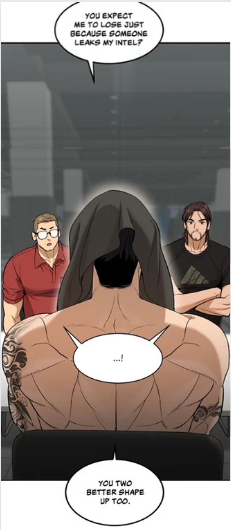 (chapter 46) Coach Yosep, Joo Jaekyung, and Park Namwook—a trio marked by authority without dialogue, control without care. In that group, the manager sowed distrust while avoiding accountability.
 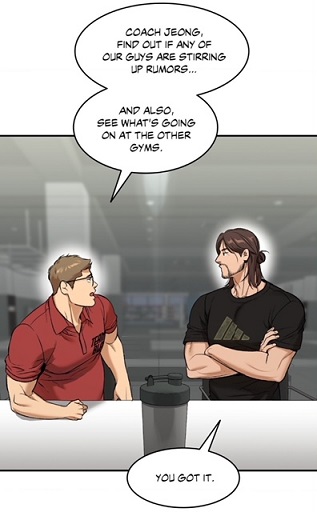 (chapter 46) In the new trio, no one holds dominion over the other. There are no contracts, no strings. The landlord has no financial stake in the fighter’s success. (chapter 61) Instead, he finds quiet satisfaction in their presence—a subtle joy in no longer eating alone, in hearing laughter in the yard, in offering a meal or a moment of guidance. His support is not selfless but unburdened by agendas. That’s precisely what makes his influence so restorative: his care is grounded, practical, and free of manipulation. However, as time passed on, the landlord discovered that by living close with the two young men, responsibilities couldn’t be avoided. Hence he is paying attention to Joo Jaekyung and Kim Dan. (chapter 66) Accountability, once optional, became natural. Without ever declaring himself their guardian, the landlord started noticing their silences, their movements, and their needs. He began to look after them—not because he had to, but because living with them made indifference impossible.
Here, in the modest shelter of shared presence, a new pattern emerges: a household of silent support and mutual growth. No one commands, yet all are transforming. It is a trinity not of power, but of breath, where healing flows like the wind—unseen but deeply felt. The champion and the doctor are no longer steered by duty or burden. For the first time, they seem ready to let the wind carry them—not as a force of chaos, but as a guide toward something lighter, freer, and true, like the two sparrows.  (chapter 66)
Feel free to comment. If you have any suggestion for topics or Manhwas, feel free to ask. If you enjoyed reading it, retweet it or push the button like. My Reddit-Instagram-Twitter-Tumblr account is: @bebebisous33. Thanks for reading and for the support, particularly, I would like to thank all the new followers and people recommending my blog.

 Bebebisous33s' analyses in K-Dramaland and Manhwas