

Please support the authors by reading Manhwas on the official websites. This is where you can read the Manhwa: Jinx But be aware that the Manhwa is a mature Yaoi, which means, it is about homosexuality with explicit scenes. Here is the link of the table of contents about Jinx. Here is the link where you can find the table of contents of analyzed Manhwas. Here are the links, if you are interested in the first work from Mingwa, BJ Alex, and the 2 previous essays about Jinx While They Embrace🫂: The Sparrows 🐦 and While They Embrace🫂: The Mysterious Landlord 🏠🐕
It would be great if you could make some donations/sponsoring: Ko-fi.com/bebebisous33 That way, you can support me with “coffee” so that I have the energy to keep examining Manhwas. Besides, I need to cover up the expenses for this blog.
The Announcement of the Storm
In episode 69, the weather report is not just an ambient detail:  (chapter 69) it is a harbinger of disruption. A radio broadcast delivers the warning: skies turning cloudy, strong winds forecasted at 20 to 25 meters per second. This is no ordinary breeze. It signals the arrival of a whole gale—powerful enough to topple trees, strip rooftops, and fracture routines.

Its target is not random: the western front. On the other hand, the reporter used the expression “storm warning”, so the wind scale on the coast should be higher and as such bring more damages. Either it is a mistake from the author or a deliberate decision to imply that the tempest could be worse on the coast than predicted, this observation outlines that we should expect destruction in the grandmother’s hometown. To conclude, both geographically and symbolically, this setting becomes the stage for upheaval, emotional exposure, and irreversible transformation. Like an uninvited guest, the gale is not background—it is catalyst and character at once.
But even before Jinx-philes could hear this “terrible” news, Mingwa had already announced the arrival of the storm with this image,  (chapter 69) as the champion’s sleek white car raced toward the tunnel, into a sky veiled by darkening clouds. This image foreshadowed the impending tempest not just in weather, but in fate. However, the celebrity didn’t pay too much attention to the warning, lost in thoughts, which is symbolized by the tunnel. The latter represents the protagonist’s ignorance, recklessness and “stubbornness” (he can not forget his loved one, he can not bear to leave his side). He races toward change, still shrouded in his old mindset, while nature prepares to strip away his last remaining believes and illusions.
Material Loss and Emotional Awakening
Striking is that after his meeting with the CEO of MFC, Joo Jaekyung decided to return straight to the little town. 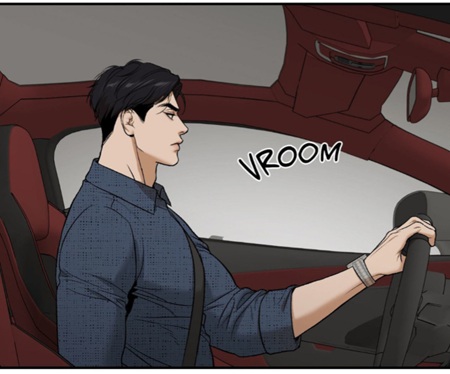 (chapter 69) Hence he is still wearing his dark blue shirt, pants and an expensive watch. But more importantly, he is now driving his white sports car. This means before meeting his hyung and the CEO, he went to the penthouse and changed not only his outfit but also his vehicle. He selected the white car,
  (chapter 69) Since the latter is a high-performance luxury model, it symbolizes wealth, speed, and prestige. That’s how he wanted to appear in front of the CEO. However, now he is going to the place where the storm will be the most violent. Because the star is still dressed in his dark blue shirt and expensive watch, I came to the following interpretation. This is not the champion in training clothes, but a man who now owns time (chapter 69) – it is the first time that we see the champion wearing a watch, marking a shift in his self-perception.
  (chapter 60)
 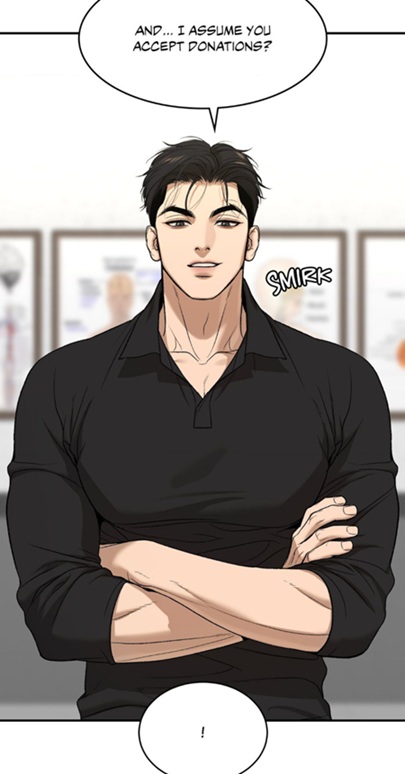 (chapter 61) No longer is he defined by his cellphone or his car, but by a reclaimed sense of agency. (chapter 69) The presence of the watch on his wrist becomes a subtle emblem of regained freedom—he is about to determine his own pace, away from the demands of MFC and Park Namwook. In other words, the western tempest represents a blessing for the athlete, as he is no longer dependent on his cellphone
 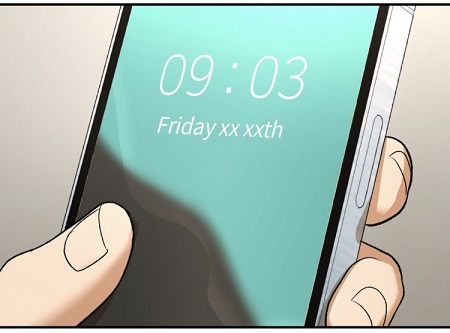 (chapter 38) or his car
 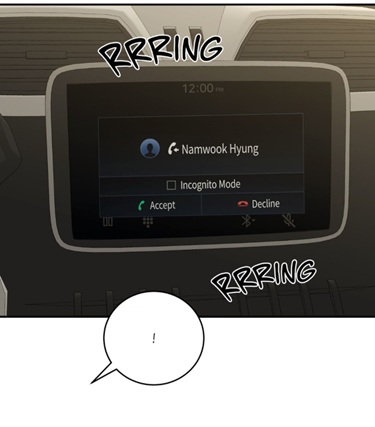 (chapter 69). Hence the manager can no longer be in touch with him.
  (chapter 66)
This shift mirrors the storm’s impact: external grandeur (like a fast car) will soon be challenged by a force that does not care for appearances. The car, left parked outdoors near the dock,  (chapter 69) or in front of the house
 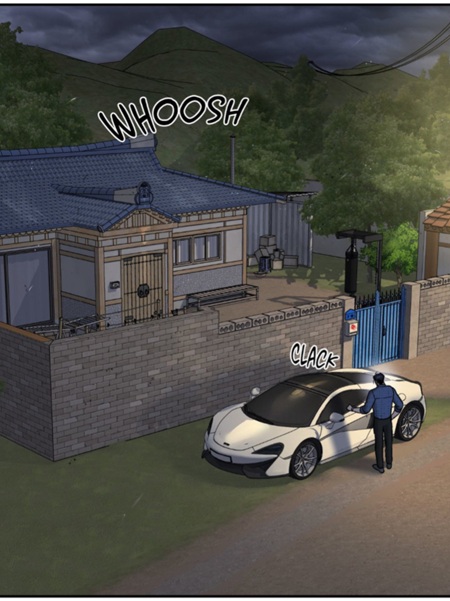 (chapter 69) might be damaged or lost to the tempest—a symbolic stripping away of status which reminded me of the way doc Dan treated the halmoni’s Wedding Cabinet.
  (chapter 53) Both instances symbolize a relinquishing of material attachments (he leaves his huge penthouse for a rented little “hostel”) and a profound shift toward emotional growth. For Jaekyung, the potential loss of his prized possession is not just about property—it marks the beginning of relying on others, accepting vulnerability, and letting go of his rigid, self-reliant identity. Similarly, the doctor’s decision to leave behind the Wedding Cabinet signals a break from the past and a readiness to build something new, no longer defined by inherited burdens or emotional debts. In both cases, possessions lose meaning. With nothing left to prove, the champion accepts vulnerability. He is no longer above asking for help, nor afraid of stillness. And that realization could only emerge under pressure. (chapter 69) He needs Doc Dan, the latter matters so much to him that he can not imagine a life without him. He enjoys this moment, therefore he keeps hugging his “friend and lover”. At the end of episode 69, he no longer pays attention to appearances and his image, therefore he doesn’t mind embracing the physical therapist in front of the crowd.
The Illusion of Safety
The Manhwa repeatedly emphasized the peacefulness of this seaside town.  (chapter 57) This initial depiction – of the sparkling blue sea, the gentle rhythm of waves (shaaa), the birds in the sky, the beautiful sunset
  (chapter 59) and
 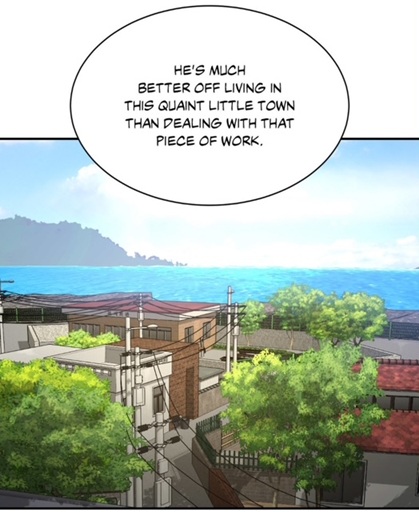 (chapter 58) daily life in slow motion—sets up a stark contrast to the approaching storm. All these images and including the elderly proclaiming
  , (chapter 65) “It’s a nice little town, isn’t it?”, lulled both the characters and readers into a false sense of permanence. But beauty is ephemeral. Storms, by nature, contradict stability. They sweep away trees, roofs—and with them, pipe dreams.
The grandmother, drawn to the town for its aesthetic charm and warm nostalgia, admired the landscape without realizing the presence of danger next to her. She confessed to Kim Dan her admiration for the ocean due its beauty, but ignored its dangers: the waves, the wind and storms.  (chapter 53) That’s why Mingwa zoomed on her gaze, but “cut” her ears, a symbol for her “deafness”. Hence she didn’t hear and feel the wind during her stroll with the champion. (chapter 65) The ocean can also represent a source of misery. Her wish to see the ocean again
 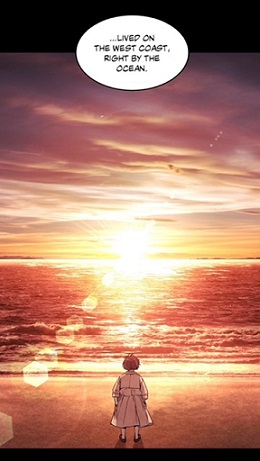 (chapter 53), bathed in the orange glow of a perfect sunset, reflected her toxic positivity—her tendency to ignore pain and erase any negative memories, including a life marked by hardship in Seoul. It encapsulated her attempt to embellish the past and project into the present
  (chapter 65) and future, disregarding reality, assuming the ocean/town’s beauty promised tranquility without acknowledging the lurking danger it could also bring. Her nostalgia operates as an emotional escape hatch—a curated fantasy where beauty masks regret. When she speaks of “seeing it one last time,” it is not a celebration of memory, but a quiet refusal to face her past failures and the reality of her present. For her, the coast is a postcard of serenity —a static image of peace and perfection she once clung to in her old home
 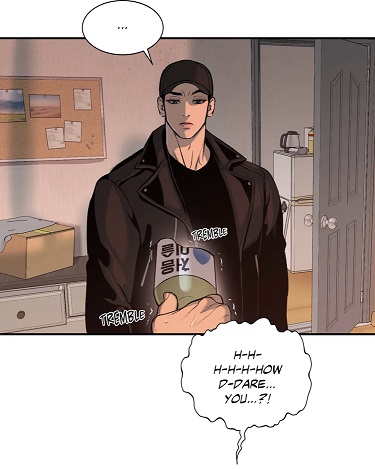 (chapter 17), where the walls were decorated with actual postcards of beaches she had never visited. These were not souvenirs, but illusions—windows into an idealized elsewhere that helped her ignore the hardship around her.
But the truth is harsher: this coastline is not a sanctuary, but a reckoning ground. (chapter 65) The ocean she admired in stillness now roars back with force, revealing that beauty without awareness is blindness. She never questioned the risks of living so close to the sea, nor imagined that its quietude could turn to devastation.
What she failed to grasp is now undeniable: nature has its own rhythm, one that does not bow to sentimentality. The storm, arriving with relentless gusts and shattering winds, becomes a physical embodiment of everything she tried to repress—her suffering, guilt, her dependency  (chapter 56), her illusions of control. This is not poetic justice, but poetic truth. She cannot walk.
  (chapter 65) She cannot escape. The wind howling outside her window will no longer be ambient noise—it is a reminder that she has no dominion here.
Mingwa visually marked this shift in power through the evolving position of her bed. In Seoul, her bed stood far from the window  (chapter 47), symbolizing distance from reality. In the hospice, it is placed next to the window (chapter 56) —yet initially hidden by doc Dan and veiled by Venetian blinds, limiting her view and insulating her from the outside world. When the champion first visits, the blinds are gone
 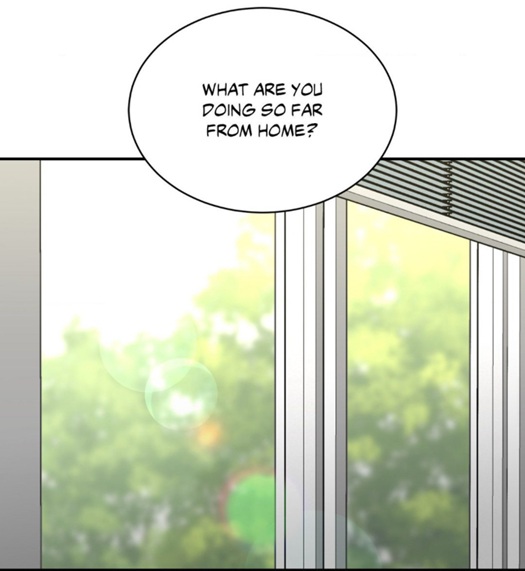 (chapter 61), revealing trees and the sky—nature encroaching. By her second stroll with Jaekyung, the image of the window reappears
 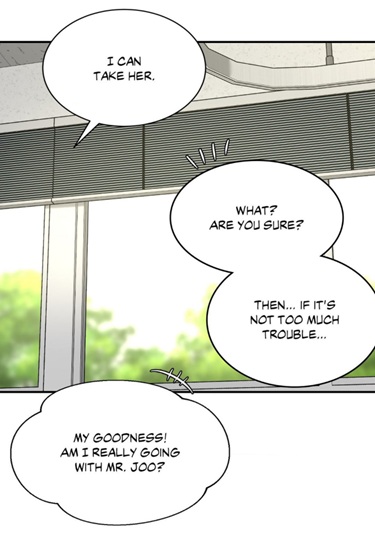 (chapter 65), subtly reminding readers of its fragility. Now, as the storm rolls in, the trees outside become potential hazards, and the window that once offered a view might shatter. Should this happen, then it will rupture her illusion of control and all her repressed fears should come to the surface.
This evolution of space is rich with symbolism. It recalls her former home  , (chapter 19) where another window—damaged and offering no real view—served as a silent witness to a life steeped in avoidance. In that space, a young Kim Dan sat beside her, answering a phone call. The fact that someone talked to him, not to her, already suggested the grandmother’s emotional detachment—the parent reached out to the boy, not to her. That room, like her present one, was filled with silence—not peace, but repression. She masked that silence with superficial comforts: beach postcards, a television, the illusion of a serene life. Now, the storm returns not just with wind (SHAAA), but with sound—branches breaking, waves crashing, windows shuddering—forcing all she suppressed to the surface.
The tempest breaches the last barrier of her denial. Her nostalgia, her careful staging of death as beauty, her belief in sunsets and serenity—all are ripped open. She who relied on silence and routine is now assaulted by noise and unpredictability. And as nature surges against the thin pane separating her from its chaos, she may realize: the stories she told herself were never shelter. The storm was always coming. This visual evolution suggests that the very boundary between her illusion and reality will be violently breached. (chapter 65) The hospice doctor had predicted more time based on a perceived serenity in her condition, suggesting her body was at peace after halting chemotherapy.  (chapter 56) But he misjudged her case for two reasons. First, the file had been tampered: she had received a new treatment. Secondly, he did not know her. What he saw as acceptance was actually a mix of comfort, avoidance and unresolved fear. The gale will expose the limits of both clinical assumptions and self-deception. The woman who once believed she could choose the time and manner of her death now faces nature’s blunt reminder: she is not in control of life and time—nor of anything else.
Trapped by the tempest, she is finally forced into the present. No longer able to rely on routines, expectations, or her grandson’s immediate care, she faces the one thing she has evaded: herself. The illusion of being the caregiver, the elder with wisdom, disintegrates in the face of a reality where she must depend on others—or be left behind. And so, what the storm exposes is not just danger. It exposes that the comfort she claimed to have built (chapter 56) was never truly hers to begin with.
The Town on the Edge facing the Tempest
The little town in Jinx is not just a backdrop  (chapter 56) —it is a layered terrain of symbolism and vulnerability. Perched on what appears to be a peninsula
  (chapter 65) in a bay (chapter 57), the settlement is structured by elevation: the beach and ocean lie at level 0
  (chapter 60) ; the docks, roads, and shops follow at level 1
  (chapter 62)
  (chapter 69); and the town proper stretches up with retaining walls (chapter 58) to the hilltop, where the hospice
 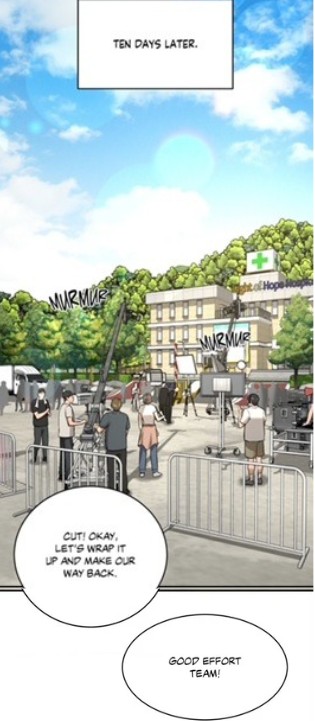 (chapter 59) (Light of Hope) overlook the coast and the landlord’s house
  (chapter 57) almost stands on the top of the hills. These heights offer a commanding view—but they also expose the buildings to the full brunt of the western tempest.
The hospice, in particular, is framed as the most precarious point, as it is surrounded by trees and facing the ocean 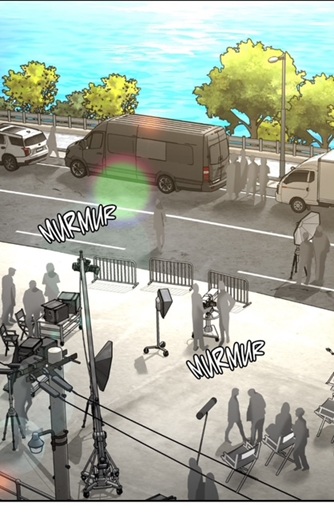 (chapter 57). I came to this deduction, as the champion could see the building from the beach, when he rescued doc Dan. (chapter 60) Secondly, the nurses could see the ocean from the window of the hospice. Due to its location, the building becomes the most likely target for falling branches, gale-force winds, and perhaps even landslides. Notice that this town is built on retaining walls, like we can detect in the last image and the following panel: (chapter 69) This is why the hospice, perched high on a hill surrounded by woods, becomes both sanctuary and risk.
 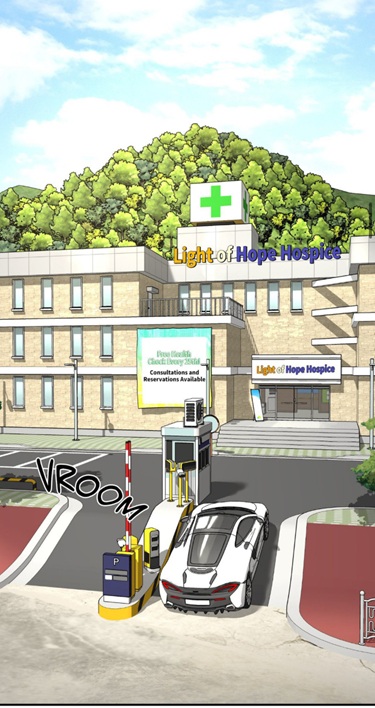 (chapter 61) Like pointed out before, his name is misleading, for hope implies “rescue”. However, a stay in that place means that their “inhabitants” are all destined to die due to cancer. There’s no real cure there. In other words, the tempest will bring to light its true nature. The hope, just like its comfort, are illusory.
Though the landlord’s house is close to the top of the hills like the hospital, his house is not facing the ocean, (chapter 57) it is turning its back to it. That’s why I developed the theory that the town is built on a peninsula. This means, the storm should reach them first and at his highest peak. On the other hand, the hills could restrain the gusts and affect less the landlord’s house. On the other hand, it is nestled near trees 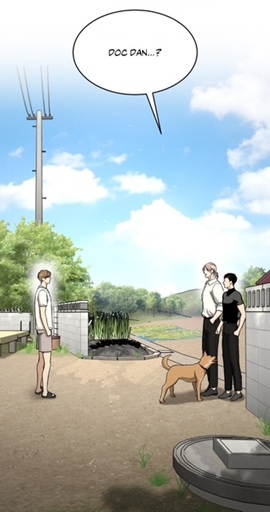 (chapter 57), fields and close to two power masts
  (chapter 61), so it is quite vulnerable as well. Therefore one might think that the champion’s hostel is similarly exposed to potential outages or structural damage. (chapter 65) Nevertheless, the house is slightly shielded by a high fence and secondly the form of the roof and the absence of high trees and power masts imply that his home is better “prepared” to face such a weather. Moreover, observe that his house
  (chapter 69) is so built that you don’t need to leave the building in order to “enter” a different room (kitchen, bathroom) contrary to the landlord’s. (chapter 57) The landlord’s hanok, traditional and open in its architecture, offers comfort and warmth under normal conditions—but becomes deeply vulnerable in a storm. Built around a central courtyard, it requires residents to step outside to move between rooms. Such exposure, so harmless in good weather, now turns hazardous. Even getting to the kitchen or another room could risk injury. The doctor, who has been staying there, may no longer be safe.
This architectural vulnerability sets the stage for an unexpected shift: Joo Jaekyung becomes the shelter once again.
Unlike the hanok, Jaekyung’s home is enclosed, protected, and perched farther from the treeline and power masts. It becomes the most stable haven in the storm. The champion—who once embodied force and solitude—now extends care and refuge. If he invites Kim Dan, the landlord, Boksoon and her puppies into his home, it signifies more than kindness. It signals growth. He is no longer just the “Emperor” who takes what he wants. He becomes a real guardian. At the same time, it would help doc Dan to review his perception about his loved one. The champion might have not seen him just as a tool this entire time.
This possibility starkly contrasts with an earlier scene where the celebrity’s home served as a quiet, solitary place while others—Potato, Heesung, and the landlord—danced joyfully under the stars in the hanok’s courtyard.  (chapter 58) Back then, Jaekyung was still on the outside of that communal warmth. But with such a prediction, the roles would be reversed. His home would become the beacon of safety, and he would be the one providing it.
Even more, the landlord—observant and unbothered by status—might become the first to voice Jaekyung’s good personality and generosity. He would offer praise not based on fame, but on integrity. Perhaps he’ll simply say, “He’s the kind of man who protects others.” and relate to doc Dan what the champion did in the past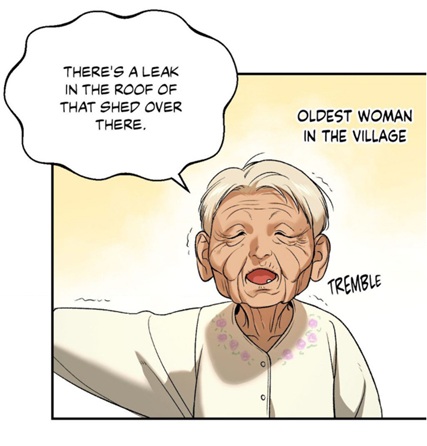 (chapter 62) There’s no doubt that the dogs will be invited to his home, as her place is right under a tree and power mast.
  (chapter 57) The landlord may even encourage the fighter to adopt a puppy from Boksoon’s litter, as he can see the champion’s care and sense of responsibility—not just for himself, but for another life.
Thus, a storm not only destroys; it reconfigures. The champion’s house, once a private retreat, may become the very heart of healing. Though no one is truly safe in front of a tempest, the latter serves as a message from the gods. The geographical truth becomes a narrative truth. The further up they go in elevation, the more isolated they are—and the more their illusions of control and security are tested. While the ones spend time to share their past and worries to others, the other is on her own at the hospice. She has no one by her side to talk to. There’s no doubt that the staff will become more busy due to the storm. Traditions can be exposed as vulnerabilities, like the Korean Hanok, at the same time, the gale helps to create deep bonds. To conclude, the storm, in this light, becomes not just a force of nature, but a force of truth: stripping away façades, toppling routines, and confronting each character with the reality they tried to avoid.
The Storm in Literature
Storms in literature are more than weather. They are moments of rupture, passion, and transformation. They can symbolize:
- Emotional turmoil
- Romantic or destructive passion
- Uncertainty and change
- Conflict between nature and civilization
- Negativity as such chaos, darkness and doom or turning points
- Power struggle and transformation (self-discovery) Quoted from https://www.firstediting.com/blogs/beyond-the-thunder-a-guide-to-storm-symbolism-in-literature/
In Jinx, the western tempest embodies all these layers. It peels back the narrative’s social and emotional veneers. Let me give you an example. Just before the gale hits the little town, the champion exposes his emotions toward his fated partner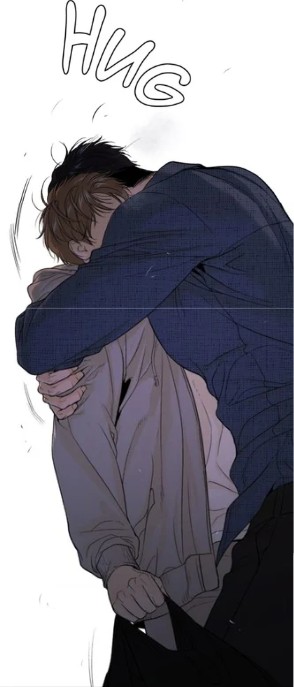 (chapter 69), when he hugs him. It announces the instant where the champion gave up on controlling his feelings. The gale announces the end of “internal turmoil”. So the moment they are together waiting for the storm to pass, they can do nothing except talking and cooking. Hence we should expect that Joo Jaekyung will expose his mental and emotional struggles to doc Dan (reference to point 1, 2,3,4 and 5), triggered by the offer from the CEO.
  (chapter 69) Such a confession would push the physical therapist to redefine his relationship with the celebrity: he is indeed his friend, even a close one. And if this takes place, then the doctor could start opening up as well. The tempest reveals fragility, forces new beginnings, and exposes fair-weather allies.
 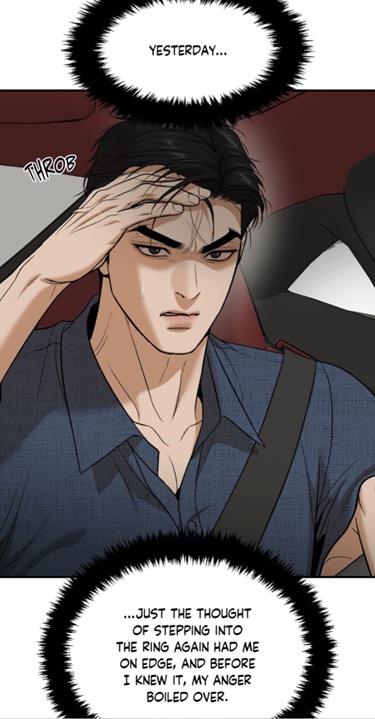 (chapter 69) The moment the champion exposes his fears and doubts, doc Dan would prove to the champion that he is no fair-weather ally contrary to Park Namwook, who pushes him back to the ring. The grandmother, so proud of her roots
 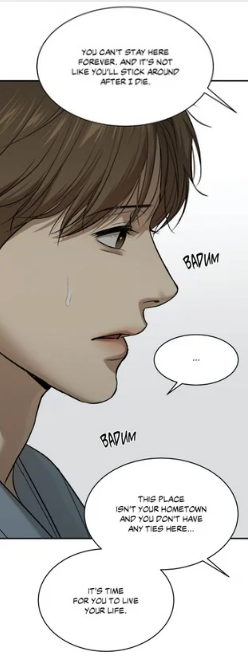 (chapter 57) and wisdom, finds herself outmatched—not by age, but by wind. Her idea of safety is shattered. Like pointed out before, the storm embodies present. So if they come to enjoy this time of respite together, they will realize that this “tragedy” for others represented a “blessing” for them.
Meanwhile, the storm breaks Kim Dan’s dependency cycle. He doesn’t have to rush, to fix, to prove. He is where he needs to be. The champion, too, is cut off from old obligations. Park Namwook cannot track him. He has been “blocked”—not digitally, but karmically. Moreover, if he loses his car, he has to rely on the “old man”, his neighbor. His move will be limited. His immobility would push the manager to “move” which would expose the true nature of their relationship. the manager is in reality dependent on the celebrity. The roles have changed.The champion, like the grandmother, has used routine to mask his suffering: her toxic positivity versus his self-reliant pessimism. So thanks to the storm, the athlete’s perception about life would be switched. His reputation as a fighter would no longer seem relevant. I would even add, the tempest will remove the sportsman’s negativity
They are forced to stay indoors, isolated together, but they can not have sex, for according to my prediction, the two protagonists would be living with the landlord and the animals. The chaos outside contrasts their stillness inside. There’s no gym, no manager, no routines. The sandbag in the courtyard  (chapter 69) would be left outside, symbolizing that this “sport” has become less central and vital in the main lead’s life. This is the first true pause in their relationship. Jaekyung, used to immediate gratification and external control, must slow down. And for the first time, he will see what he always overlooked: that meals take effort, that conversation has value, as it can help to get closer to another person. He doesn’t need the grandmother to get “through Kim Dan”.
 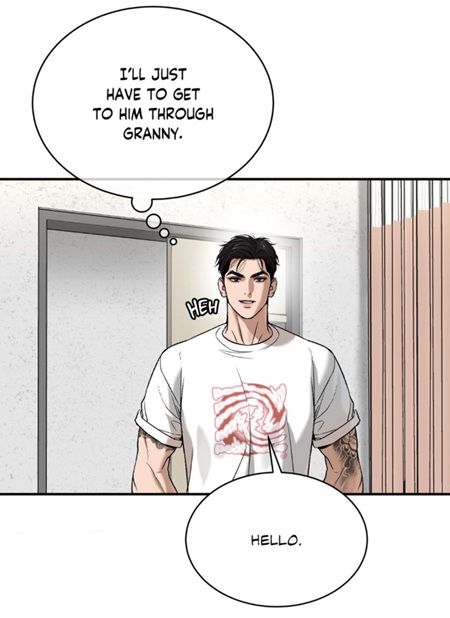 (chapter 65) Finally, if my prediction is correct, then by living with different people in a small place, he will realize the benefits of relying on others. He will discover the joy of having a family, having found a home. The storm creates a space for redefinition.
Five Disrupted Relationships
And so this tempest arrives not as an arbitrary backdrop but as a settlement. It disrupts the emotional architecture of the story—a confrontation, not a solution. The storm demands serenity; it strips away distraction and busyness, leaving space only for meditation. Characters can no longer move as they did before—they must pause, reflect, and reckon with themselves. The power outages, closed roads, and uprooted trees reflect the characters’ inner disruptions, they can no longer avoid certain problems in their own life: death, grief, fear, past, vulnerability, and the need to change. The weather has no concern for hierarchy.
1. Kim Dan and Joo Jaekyung
They are forced to remain indoors, potentially together. This is the first real pause in their story. Jaekyung, used to forward motion and clear roles, is confronted with the quiet. Here, he may begin to notice what he once ignored: the care behind every cooked meal, the invisible labor of the doctor, and the need to protect rather than possess. The wind howls outside, but inside, something tender brews.
2. Boksoon and the Puppies:
The small shelter where Boksoon gave birth is near a tree. It is no longer safe. She and her pups must be relocated—an urgent reminder of how quickly new life can be endangered.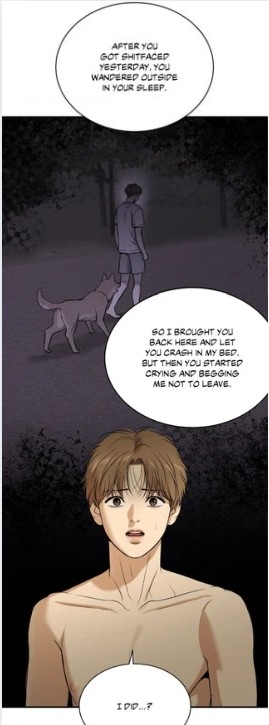 (chapter 66) Jaekyung, who has never seen the puppies, might discover them now. That discovery mirrors his gradual awareness of fragility and caretaking. For Kim Dan, nurturing the puppies symbolizes reclaiming his capacity for love and responsibility—free from obligation.
3. Shin Okja
Her admiration for the ocean and the town has been steeped in toxic positivity. She longed for a perfect sunset, a beautiful memory to crown her life. But she ignored the storm warnings—both literal and emotional. When she finally faces the tempest, the comfort she clung to shatters.
In Season 1, she summoned Kim Dan whenever she feared death 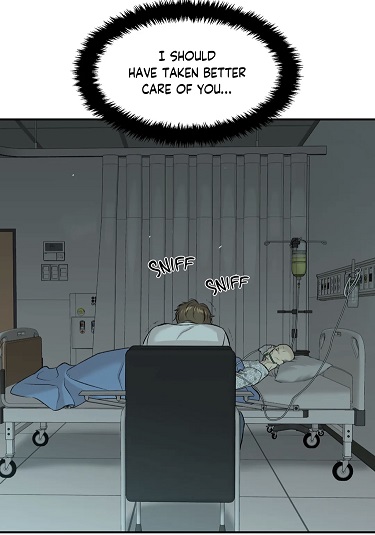 (chapter 21) and needed company.
  (chapter 21) The doctor would drop everything and rush to her side overlooking his own health. But now, with blocked roads and dangerous winds, Kim Dan cannot come—even if he wants to. He is no longer her servant or safety net. Nature has intervened where he could not set a boundary.
The grandmother must confront her own helplessness. Her seniority no longer grants her power. And if she calls out for her grandson and he does not come, she will be forced to realize: she is on her own. 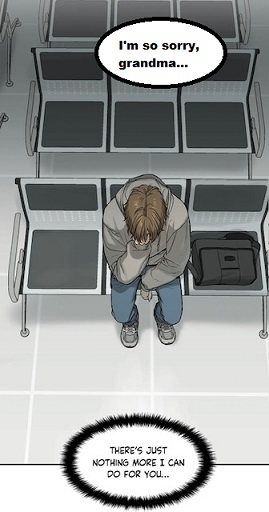 (chapter 5) Doc Dan can not assist her anyway, as he can do nothing against nature.
4. Park Namwook
The storm isolates the manager. Without power, without a car, and without knowledge of Jaekyung’s location, he is rendered irrelevant. The champion’s phone may be off. The line has gone dead—literally and symbolically. The manager, always able to take advantage of the celebrity’s loyalty and sense of responsibility, finds himself “blocked.” 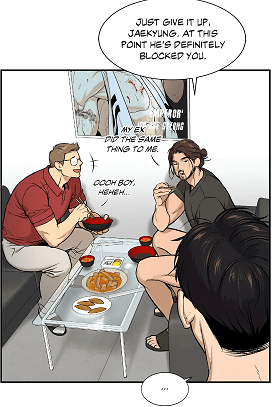 (chapter 5) Thus his anxieties should reach a new peak. His grip on the boy he used to control is gone. The storm draws a line between who remains—and who fades.
In Jinx, the western tempest is all of these. It tears through the “good-weather” relationships and reveals what’s real. Therefore it is no coincidence, when Choi Heesung and Potato met doc Dan again, (chapter 58) the ocean was calm and the sky very blue. Both embodied this notion: good-weather friends. Characters who stayed out of convenience or obligation vanish. Those who remain—like the landlord, Boksoon, and eventually Jaekyung 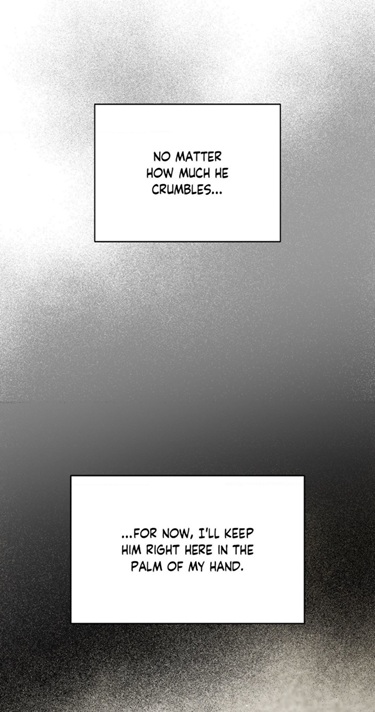 (chapter 68)—stand firm.
5. The Landlord
The landlord, in particular, becomes the story’s quiet moral compass. His home, his fan, his calm attitude, and even his absence of curiosity about fame set the standard. When he welcomes Joo Jaekyung, it isn’t out of admiration. It’s decency and a longing for company.  (chapter 61) Therefore I perceive him as the eye of the storm.
 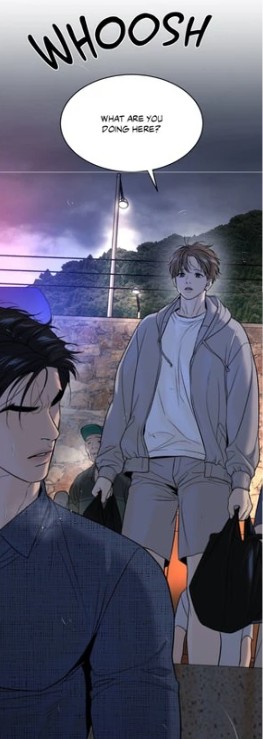 (chapter 69) That’s why he looks at the horizon. From my perspective, he is used to such events, hence when the storm hits the coast, he will be prepared mentally. Thus he could share his experiences and thoughts to the two young men.
Conclusions
Finally, the western tempest stands in direct contrast to the grandmother’s sunset dream.  (chapter 53) She imagined a final golden moment—warm, serene, and nostalgic before her death. But instead, she gets gusts and branches crashing down. In that sense, the tempest is her lesson: Humans are not superior to nature. They can not control time, nature and destinies. Moreover, nature does not serve our stories. It tells its own.
The storm, then, is not about destruction. It is about clarity. It forces all façades to fall. And when the winds calm, what remains is not who spoke loudest, but who stayed. In this story, the western tempest does not simply pass. It reshapes everything. Moreover, a storm is not “eternal”. So after the tempest, there’s sunshine—a sign that happiness may finally be within reach for the two protagonists.
Feel free to comment. If you have any suggestion for topics or Manhwas, feel free to ask. If you enjoyed reading it, retweet it or push the button like. My Reddit-Instagram-Twitter-Tumblr account is: @bebebisous33. Thanks for reading and for the support, particularly, I would like to thank all the new followers and people recommending my blog.

 Bebebisous33s' analyses in K-Dramaland and Manhwas