

Please support the authors by reading Manhwas on the official websites. This is where you can read the Manhwa: Jinx But be aware that the Manhwa is a mature Yaoi, which means, it is about homosexuality with explicit scenes. Here is the link of the table of contents about Jinx. Here is the link where you can find the table of contents of analyzed Manhwas. Here are the links, if you are interested in the first work from Mingwa, BJ Alex, and the 2 previous essays about Jinx While They Embrace🫂: The Mysterious Landlord 🏠🐕and While They Embrace 🫂: The Western Coast 🌬️🍃🌊🐦
It would be great if you could make some donations/sponsoring: Ko-fi.com/bebebisous33 That way, you can support me with “coffee” so that I have the energy to keep examining Manhwas. Besides, I need to cover up the expenses for this blog.

My avid readers might have been surprised that I didn’t publish any essay for almost a month. I had two reasons for this hiatus. First, the last publications didn’t receive much attention, while I had invested a lot of time in them. Secondly, I was myself under a lot of stress, just like our champion Joo Jaekyung and the Webtoonist Mingwa. I needed myself a break. On the other hand, this doesn’t mean that I stopped analyzing this terrific Manhwa, quite the opposite.
The First Sound: Episode 69 and the Birth of the Heartbeat
When I first read episode 69 of Jinx, one small, fragile detail caught me by surprise — the sudden appearance of the champion’s heartbeat: BADUM  (chapter 69). For the first time in this story, we as readers were allowed to hear Joo Jaekyung’s heart
  — not in battle, not in passion, not in rage — but in that suspended instant when he imagined Kim Dan missing, possibly forever. Since the author linked the BADUM with doc Dan
 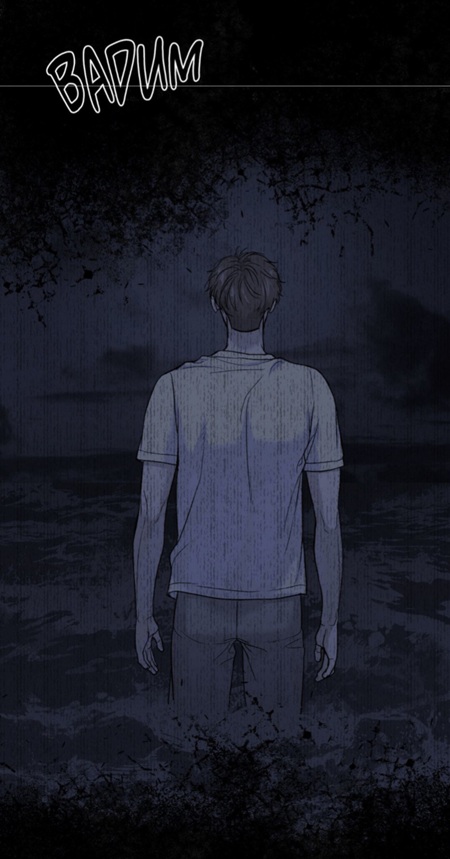 (chapter 69)
  (chapter 69), she created the illusion that the physical therapist was embodying the MMA fighter’s heart. This scene resonated with me long after I closed the chapter.
And then I came across a fascinating article: Resonance Theory: Vibrating with Music. It explained how sound activates deep biological responses — how rhythm, tone, and vibration connect us to life itself. According to this theory, when we hear sound — especially rhythmic or emotionally charged sound — it does not remain a surface experience. It triggers responses in our nervous system, heart rate, breath, and emotional centers. Sound can bypass the defenses of the thinking mind and speak directly to the body.
This is why music can make us weep, why a heartbeat can evoke terror or tenderness — and why a single human voice can call us back from fear or despair, like in this scene:  (chapter 69) Suddenly, the pieces clicked: the heartbeat in Jinx is not just a narrative sound effect. (chapter 69) It is a form of music — an embodied rhythm that signals life, love, and emotional awakening.
It was this article that first led me to reflect on why we so rarely hear heartbeat or music in the story — and why their presence or absence marks such a profound shift in the characters’ inner worlds.
Looking Back: The Silence of the Heart
As I began reflecting on this moment, I noticed how deliberately the manhwa had withheld the fighter’s heartbeats in earlier key scenes. Consider chapter 14:  (chapter 14) Jaekyung, insulted and trapped in shameful memories, is wrapped in rage
  (chapter 14)— yet no heartbeat is heard. One might think, the absence of the heart racing implies the lack of fear. His emotions are real, but they do not connect him to life or to others. Why?
Because at that time, there was no one to lose. His world was transactional: lovers came and went; gym relationships were shallow and competitive; even his manager was more functionary than family. Without meaningful attachment, there was no fear of loss — and thus no reason for the heart to speak.
This absence of heartbeat is mirrored in Joo Jaekyung’s actions in that scene. In episode 14, after the humiliating confrontation, we see him drive his fist into the locker 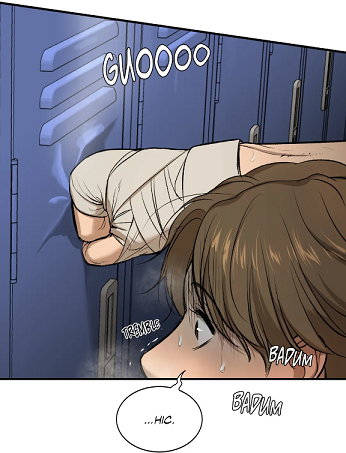 (chapter 14) — GUOOO, metal dented, yet no pain. Yet, Jinx-philes can see Badum Badum in that picture. Nevertheless it is connected to the physical therapist’s heart: he is scared of the athlete’s strength. On the surface, the champion’s gesture appears reckless — an act of a man who does not care for his body. But this is not pure “fearlessness.” In truth, the celebrity’s anger is masking deeper fear and suffering.
His mind, still trapped in past traumas, is locked onto an unseen enemy: the voice of his childhood abuser  (chapter 54), who had called him trash, weak, pathetic, incapable.
 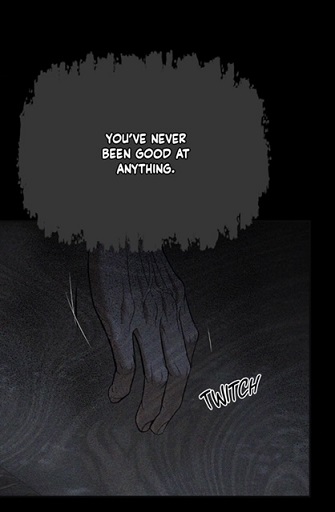 (chapter 54) The challenger, Randy Booker’s insult — calling him a “baby”
 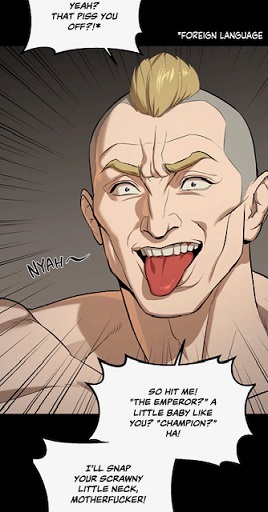 (chapter 14) — triggered this buried wound, igniting a desperate drive to disprove that old accusation.
Yet the protagonist is not consciously aware of this. He has repressed his childhood so deeply that he fights not the present opponent, but a shadow from the past. In this state, he acts on instinct, driven by the frustration, rage and pain he cannot name. (chapter 14) There is no conscious heartbeat — because he is not present with himself. He is moving as a zombie: reactive, destructive, unthinking. His body acts, but his heart remains silent.
Heartbeat Scenes: Love, Fear, and Danger
As you can see, Jinx does show us heartbeat scenes earlier — not for the MMA fighter, but for the physical therapist and for other moments of crisis. These examples help us understand the emotional vocabulary of the heartbeat in the narrative:
❤️ Episode 44: Heartbeat of Love and Attachment
In episode 44, we hear 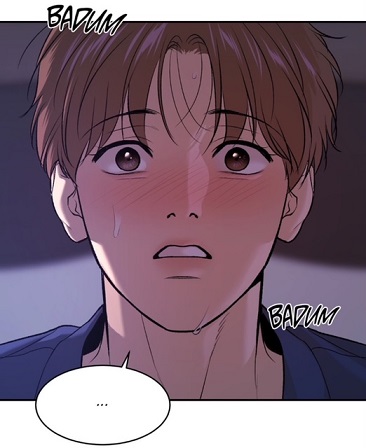 (chapter 44) BADUM BADUM from Kim Dan’s heart as Jaekyung makes a move on him. His blushing face, wide eyes, and parted lips all signal that this is not fear — it is love, excitement, and emerging attachment.
This is the positive heartbeat — the one that invites us to risk feeling, to follow the pull of connection.
Indeed, Dan did follow his heart that night, therefore he made requests  (chapter 44) and tried new things. He gave his lover pecks on his cheeks and ear
  (chapter 44). He chose intimacy, and chose to act from his own emotions. This gave him strength and courage. But by morning, he withdrew, the moment he met resistance and opposition.
 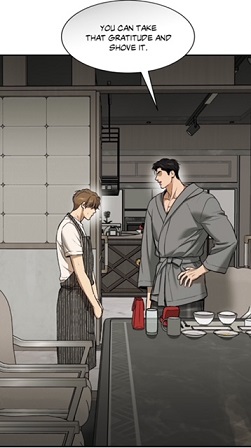 (chapter 45) He chose silence, unable yet to confess what that heartbeat had awakened.
💔 Episode 34: Heartbeat of Fear and Danger
By contrast, in episode 34, we witness a different kind of heartbeat — one driven not by love, but by survival panic.
When the protagonist first corners Choi Heesung and threatens him —  (chapter 34), we see the actor’s confidence gradually vanishing. His mask begins to crack. In that moment, he realizes that in the VIP spa his celebrity status offers no protection. No manager, no Park Namwook, no audience is present. He is utterly exposed to the raw force of the champion’s anger and fist — and the physical threat is real.
His body betrays him: the darkness around the gaze, the unmistakable BADUM BADUM of his racing heart. Here, the heartbeat does not speak of longing or love. It is a visceral alarm bell, signaling vulnerability and fear.
And yet — this makes the next moment all the more revealing. Later in the same episode, the actor faces the main lead again — but this time Dan is present. 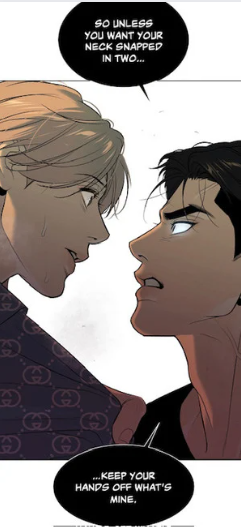 (chapter 34) The confrontation repeats — Jaekyung threatens once more. Yet, there is no visible BADUM, BADUM here. Why? Don’t forget that just before, the actor gulped and blushed
 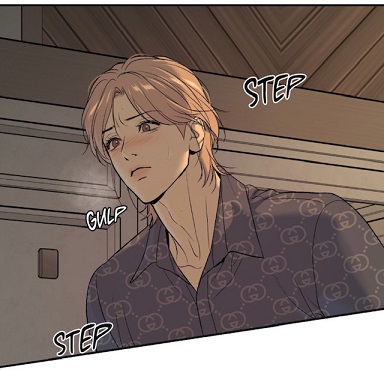 (chapter 34) — a clear sign of excitement, not fear. And still, his heart remains silent. This raises the question. Why was the actor not afraid of the MMA fighter? Because even if the words echo the previous threat, the perceived danger has changed. With doc Dan standing between them
  (chapter 34), the actor subconsciously knows: “He will not attack me here.” The champion made it clear that the physical therapist shouldn’t detect the actor’s presence. Doc Dan acts as an emotional shield, preventing true panic. The body no longer signals mortal danger — and so, no BADUM sounds.
In this, the manhwa subtly shows us:
Heartbeat is not simply about surface emotion. It reflects the perceived reality of threat, loss, or love.
When danger and loss feel real → the heart races.  (chapter 43) Here, the doctor feared the celebrity’s rejection. This scene was actually announcing that doc Dan was already in love with the “wolf”.
When one feels protected → the heart stays still, even if the mind recalls past fear.
Music as Substitute for the Heartbeat: Emotional Disconnection
There is another layer to this symbolism — and it lies in the rare appearances of actual music in Jinx. Music is introduced only twice:
1. Episode 21:
Kim Dan remembered his grandmother singing a lullaby 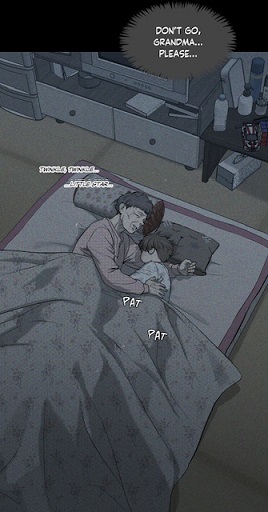 (chapter 21) — a sound of comfort and life. But it was a distant memory, not part of his adult world.
Crucially, Dan was asleep 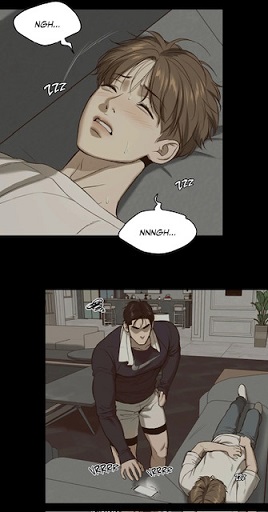 (chapter 21) — having a nightmare. It is only when the grandmother returned to the bed and began to sing that his body calmed. (chapter 21) Here, sound functions as both comfort and erasure. The lullaby soothes — but it also covers an earlier silence. It replaces what was absent: the voice of his parent(s). The melody fills the void — yet beneath it, the deeper wound remains untouched.
 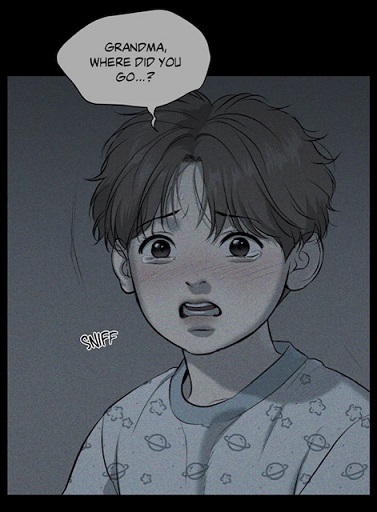 (chapter 21)
Thus the lullaby is not simply a token of love — it is also a symbol of emotional substitution. Dan carries this unresolved layer with him 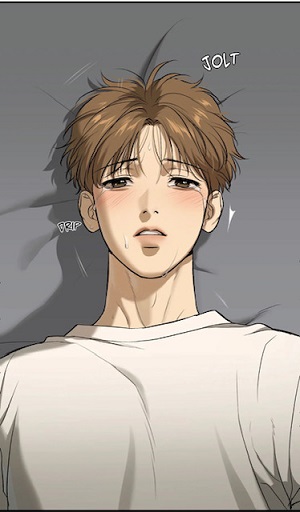 (chapter 21) — one that later echoes in his adult struggles with attachment and loss.
2. Episode 58 (season 2):
Outside, Heesung, Potato, and the landlord are singing and dancing  (chapter 58) — vibrant, alive. But Dan sits apart. He is disconnected — his inner state does not resonate with the music. At that moment, he is preparing to abandon Jaekyung.
What struck me is this: Dan’s own heartbeat is absent in that scene. Though he thinks  (chapter 58) “I am happy and at ease, but… why does my heart feel so heavy?” — it is as if the external music has replaced his internal rhythm. The joyous sound outside contrasts painfully with his own muted emotions. The music underscores his emotional disconnection and the inner weight he carries.
And here, the parallel with childhood becomes clear.
The cheerful music provides surface warmth — but the root pain of emotional rupture (with Jaekyung) is untouched.
Just like the lullaby once offered comfort without healing, the music here offers temporary relief, not true resolution.
In both moments, we see how music without heart resonance leaves the deeper wounds unaddressed — and why it is the sound of the heart, not external melody, that must ultimately speak.
3. Boksoon and the champion
In Dan’s case, music never fully reconnected him to life — it was merely a temporary surface. But Joo Jaekyung, guided not by a melody but by the raw bark of a dog,  (chapter 65) finds his way back to the man he cares for.
Boksoon’s bark in episode 65  (chapter 65) is more than noise. It’s a resonant signal — not unlike the heartbeat. When she barks, it alerts Jaekyung to Dan’s trance.
  (Chapter 65) Moreover, the dog is capable of expressing her „worries and pain“. And for the first time, the champion follows a sound not of the crowd, not of a bell, but of life calling to life.
 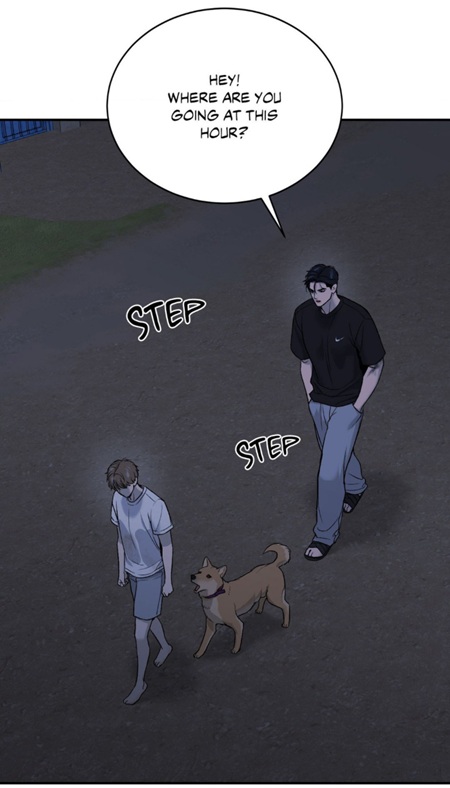 (Chapter 65) Her bark anchors him, just as Dan once did. And it marks the moment Jaekyung becomes emotionally receptive not only to Dan, but to care itself — puppies, vulnerability, connection. In other words, her presence foreshadows Jaekyung’s emotional readiness to care for others beyond the ring. Having rediscovered and embraced his own vulnerability, his heart is gradually open to softness — to animals, to dependency, to affection.
In this light, Boksoon’s bark becomes a canine echo of Jaekyung’s heartbeat: both signal that something fragile and important is alive. That life is worth protecting. And that Jaekyung — no longer the zombie fighter — is becoming someone who hears, feels, and chooses to respond.
The Black Veil: Emotional Death and Substitution of Memory
We see this deepening in the very next beat.  (chapter 58) During the happy party with the actor and Potato, Dan remembers his past lover — and we see the champion’s image under a black-and-white veil. It was, as if the sun was vanishing from his life. In that moment, Dan decided to detach himself from Jaekyung, to forget him. The champion is emotionally “dead” — unreachable, lost to him.
This may explain why after the death of the puppy, doc Dan goes toward the sea. Though in his trance, he is thinking of his grandmother 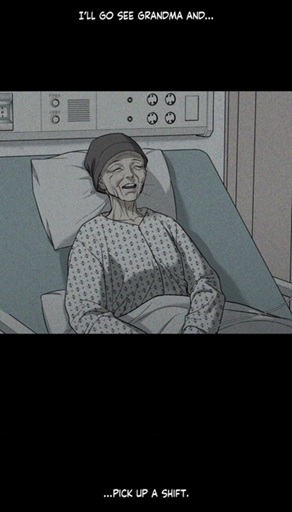 (chapter 59), the reality is that work has long lost its meaning. He has no goal in his life in the end. The emotional gravity of his loss regarding Jaekyung is palpable, though the physical therapist is not realizing it. Jinx-philes should keep in their mind that in season 1, the protagonist used his grandmother as a shield to justify his transactional relationship with the celebrity — and here, perhaps again, she becomes a cover for deeper pain.
Sound, Resonance, and Biological Awakening
And so we return to resonance theory. As the article explains, sound activates deep biological responses. It connects us to life, bypassing intellectual defenses. Rhythm, tone, and vibration speak first to the body — to the breath, to the heartbeat, to the reflexes — before they are processed by the conscious mind.
In Jinx, we see this principle embodied again and again — and nowhere more clearly than in the key moments of Jaekyung’s awakening. At first, the BADUM — the sound of the heart — announces the body’s recognition of fear and attachment. (chapter 69) But as his emotional state deepens, the manhwa subtly shows that the language of the heart is not always written — it is felt, seen, heard in breath and gaze.
This becomes especially clear when Jaekyung reaches the dock. 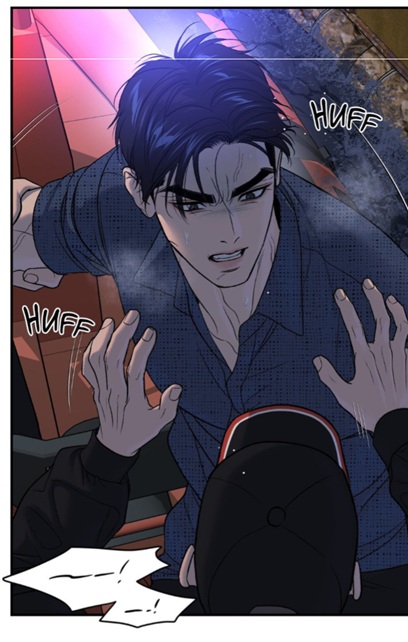 (chapter 69) There, as he sees a figure on the boat, his breath catches — for a moment, he believes it might be Dan. But as he draws closer, he recognizes his mistake. The man is not Dan.
 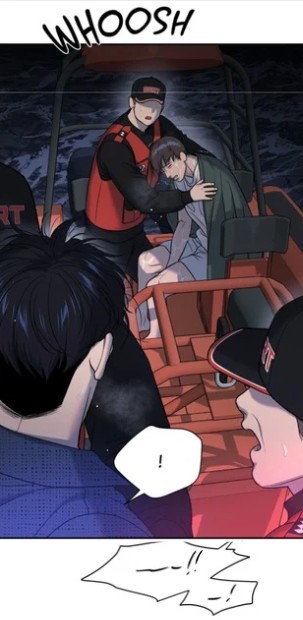 (chapter 69)
Now, on the dock, Jaekyung remains proactive — scanning for signs, seeking a solution. And when a small, fragile sound pierces the air (chapter 69) — “Umm” — we witness a subtle but profound shift.
Here, the heartbeat is no longer heard, but it is seen and felt: in the shallow breath  (chapter 69), the audible HAA…, and in the dilated pupil.
  (chapter 69) His body speaks what the panel leaves unsaid — a visceral resonance of surprise, longing, and fragile hope.
And when his eyes finally meet Dan’s, we see it: relief floods through him. In that instant, his hardened facade dissolves. He appears young again — the boy beneath the champion’s armor emerges.
This marks not only the depth of his attachment, but also a profound shift in perception: he is no longer the “superior” in this bond. In that moment of relief, he begins to see Dan not as a child or subordinate, but as an emotional anchor, an authority figure — someone he can trust, someone to whom he can turn. (chapter 69) But before he moves, before he speaks, he just looks. Frozen in place, he engulfs Dan with his gaze (chapter 69) — eyes wide, breath caught. His pupil dilates, as if trying to capture and preserve the image of the person he feared lost. In that breathless instant, Dan becomes the apple of his eye — the one irreplaceable figure in his emotional world.
And then something even deeper shifts: the roles reverse. Dan is no longer the puppy. Jaekyung is. He becomes Jaegeng.
Why this transformation? Because despite everything — the pain, the fear, the trauma of the night before 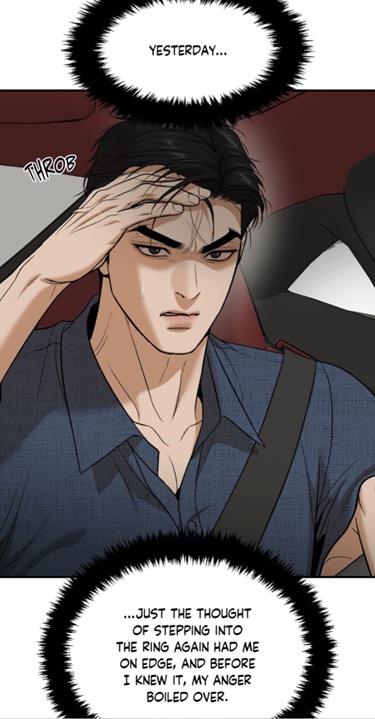 (chapter 69) — Dan does not scold him, reject him, or shrink away. He simply asks:
 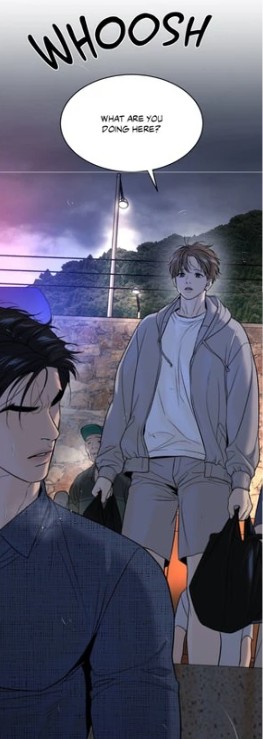 (chapter 69) There is no accusation, no resentment, no judgment.
Unlike Baek Junmin or the mysterious ghost from Jaekyung’s past, who mocked 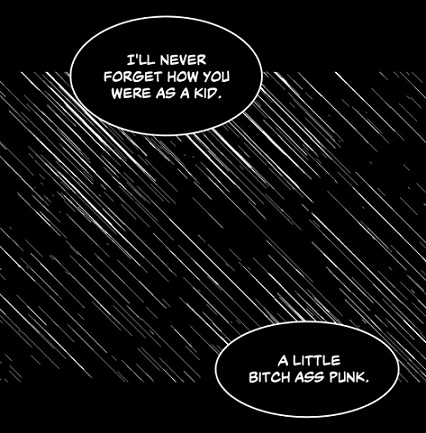 (chapter 49) the fighter’s vulnerability and punished his needs, (chapter 54) Dan sees the man, not the mistake.
And so, for the first time in his life, Jaekyung experiences unconditional regard — not the kind that is bought with talent or won through dominance, but the kind that says: you are worth caring for, even when you make mistake or falter. And that’s why he clings to Dan  (chapter 69) — not as a fighter needing a medic, but as a person giving affection and seeking warmth. And in Dan’s quiet presence, he finally finds someone who doesn’t shame his vulnerability — someone who holds space for both the man and the boy he has always been.The inner child from the athlete awakens — and with it, the first true opening of his heart. He is now reborn.
Revisiting Episode 44: Fear of Dependency and Fear of Loss
Here we can look back and understand earlier scenes more deeply.
In episode 44,Jaekyung’s heart had already begun reacting — but he could not name it. This is visible, when he questioned Dan: 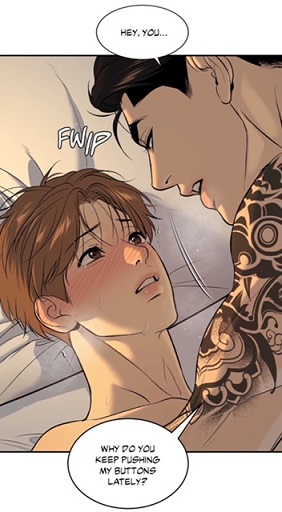 (chapter 44) What were those buttons? His heart. His breath. His body’s fear that Dan might vanish.
Every time he heard Dan leaving at night  (chapter 45), his heart raced. But he mistook this for irritation
 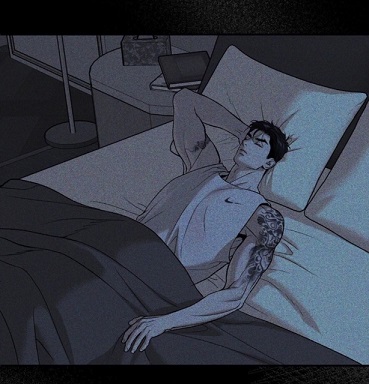 (chapter 45) — not attachment. That is why he threatened to hire another doctor the next morning: he feared dependency and as such vulnerability.
 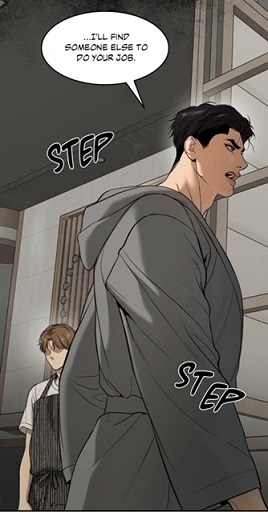 (chapter 45)
And there is one more layer. Before episode 69, even though Jaekyung feared Dan vanishing, he had never connected “vanishing” with death. 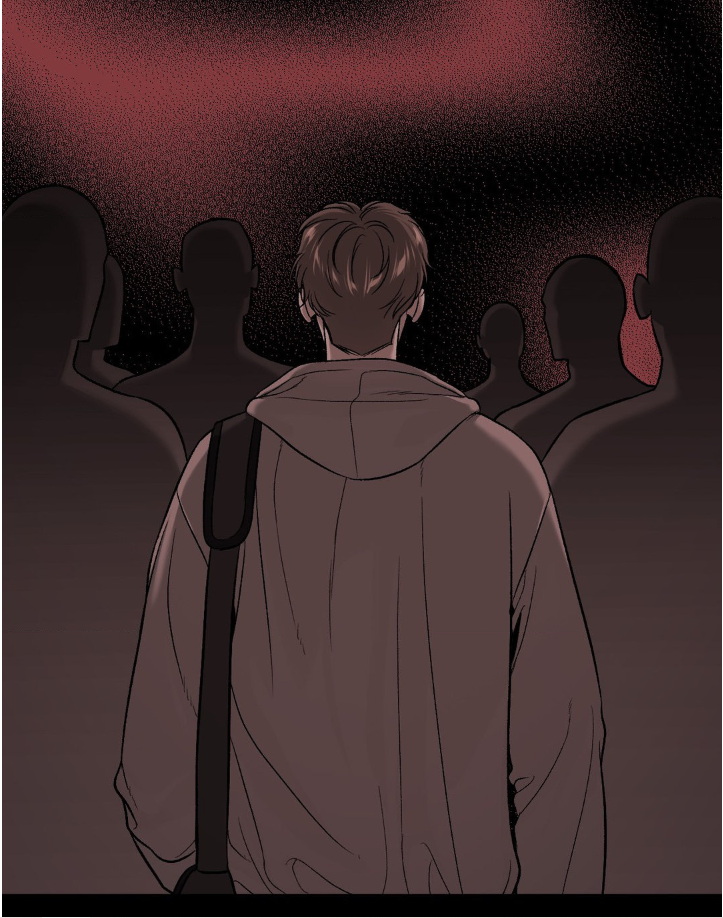 (chapter 55) In his mind, people leave — they live elsewhere — life goes on. He never imagined irretrievable loss.
But now — seeing the empty house, the footprints on the ground, imagining Doc Dan bare feet while (chapter 69) walking into the sea (chapter 69): he has this revelation: Dan might not simply leave. He might disappear forever. This unbearable thought awakens his heart completely. (chapter 69) Under this new light, it becomes comprehensible why Mingwa connected his beating heart to his face. With this panel, she implied the huge awakening and the protagonist’s transformation. He is facing reality. He is accepting his mortality, his beating heart. He no longer views it as a discomfort.
Conclusion: When the Heart Spoke, Life Began
And here, the lesson deepens. In episode 14, Jaekyung’s self-destructive punch had shown us a man trapped by past traumas, acting on raw instinct. There was no heartbeat — not because he was fearless, but because his mind was not free. He was still a zombie:  (chapter 29) moving through the world, but without true inner life. Hence his eyes were “empty”.
  (chapter 26)
But now, in episode 69, when the heart speaks (chapter 69), it teaches not only love — but emancipation. The BADUM announces the birth of a man who can finally think and feel for himself and for doc Dan. The resonance of the heart breaks the zombie trance. It awakens conscious presence.
And we can now see why this experience of fear was essential. (chapter 69) Until this moment, Jaekyung’s driving force had been to prove his mysterious childhood abuser wrong (chapter 54) — to erase the label of “weak, pathetic, incapable” that had haunted him.
This is why, in episode 67, when Dan asked him directly 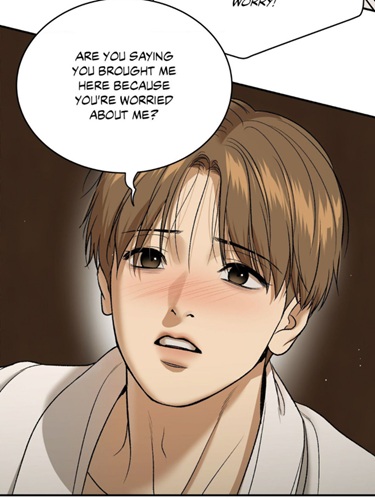 (chapter 67), Jaekyung could only remain silent.
 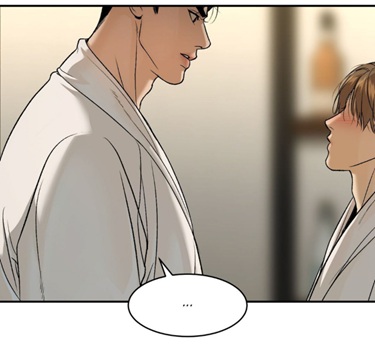 (chapter 67) He could not yet admit his worries, his vulnerabilities — not even to himself. To confess would be to risk blackmail, to risk being seen again as that helpless child.
Only by experiencing the true fear of losing Dan — a fear greater than his old shame — could he begin to open the sealed chamber of his heart.
And so, when the heartbeat came, it did not merely signal love. It marked the first break in the old defenses. The child within could finally begin to hope — not for victory, but for understanding, for acceptance. But there’s more to it.
But with that one heartbeat (chapter 69) — the BADUM that exploded in episode 69 — the jinx is broken. The undead becomes the living. His past, once the fuel of every punch, begins to fade. The rage that once drove him no longer holds its grip. He no longer needs to fight in order to prove that he isn’t weak — because someone has seen him at his most vulnerable and stayed. Under this light, my avid readers can grasp why the athlete hid his “growing attachment and dependency” behind the jinx.  (chapter 65)
In focusing on Dan (chapter 69) — not as a subordinate or tool, but as a source of emotional stability — Jaekyung finally turns his gaze forward. His reason for fighting is no longer rooted in resentment, but in attachment. His strength no longer has to scream; it can protect. Hence he desires to embrace his companion and lover in front of others. (chapter 69) The curse is lifted. The zombie breathes. The jinx dissolves — and in its place, a human being emerges. No longer driven by resentment or fear, he begins to choose connection over rage, presence over instinct. This means, he will be less vulnerable to schemes.
And that, at last, is the beginning of his humanity.
And we must also notice what happens just before the embrace. (chapter 69) When Dan speaks, Jaekyung remains utterly silent. He does not reply — not because he does not care, but because he is emotionally disarmed. In that moment, words fail him.
His silence is a form of submission — the instinctive response of a boy overwhelmed by fear, reaching for safety.
And the embrace that follows is not the act of a champion, or a lover. 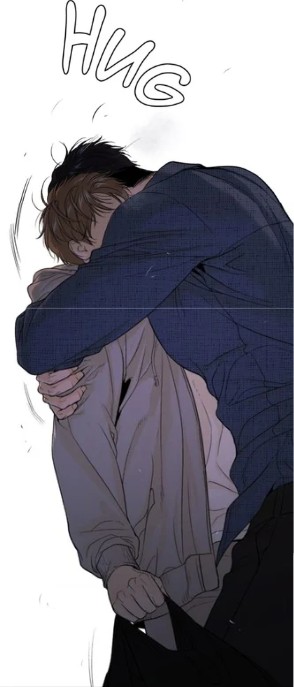 (chapter 69) It is the embrace of a child seeking a parent — of one who has never known how to ask for comfort, but who now surrenders to the need for it.
The boy hugs, because the heart has spoken — and in that moment, the first true human bond is formed.
Yet true liberation still lies ahead. For emancipation can only be complete when he begins to open his heart fully to Dan — to speak, to share, to trust.
When the heart spoke — life began.
But not yet the life of a man. First, the awakening of the child within — the boy who had never been allowed to feel, who now looks at Dan with open eyes.
And only through love, only through trust, will this child one day become a man — free, whole, alive.
Feel free to comment. If you have any suggestion for topics or Manhwas, feel free to ask. If you enjoyed reading it, retweet it or push the button like. My Reddit-Instagram-Twitter-Tumblr account is: @bebebisous33. Thanks for reading and for the support, particularly, I would like to thank all the new followers and people recommending my blog.

 Bebebisous33s' analyses in K-Dramaland and Manhwas