
Please support the authors by reading Manhwas on the official websites. This is where you can read the Manhwa: Jinx But be aware that the Manhwa is a mature Yaoi, which means, it is about homosexuality with explicit scenes. Here is the link of the table of contents about Jinx. Here is the link where you can find the table of contents of analyzed Manhwas. Here are the links, if you are interested in the first work from Mingwa, BJ Alex, and the 2 previous essays about Jinx Flight 🚪 from Truth 👁️✨🧠, Fight🥊 for Fragile Peace☮️ and What about The Wolf’s 🐺First Kiss? 💋
It would be great if you could make some donations/sponsoring: Ko-fi.com/bebebisous33 That way, you can support me with “coffee” so that I have the energy to keep examining Manhwas. Besides, I need to cover up the expenses for this blog.
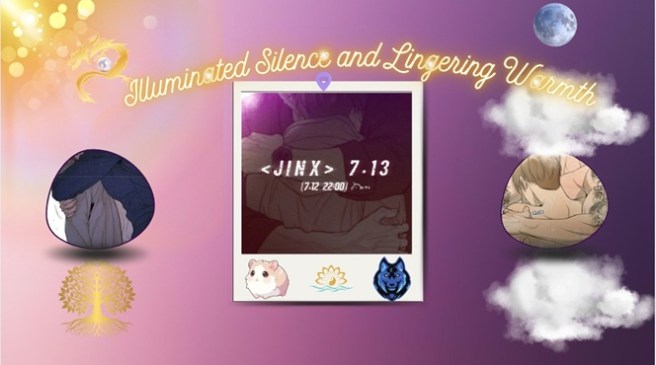
The Tenth Embrace – Stillness, Light, and Transformation
This image 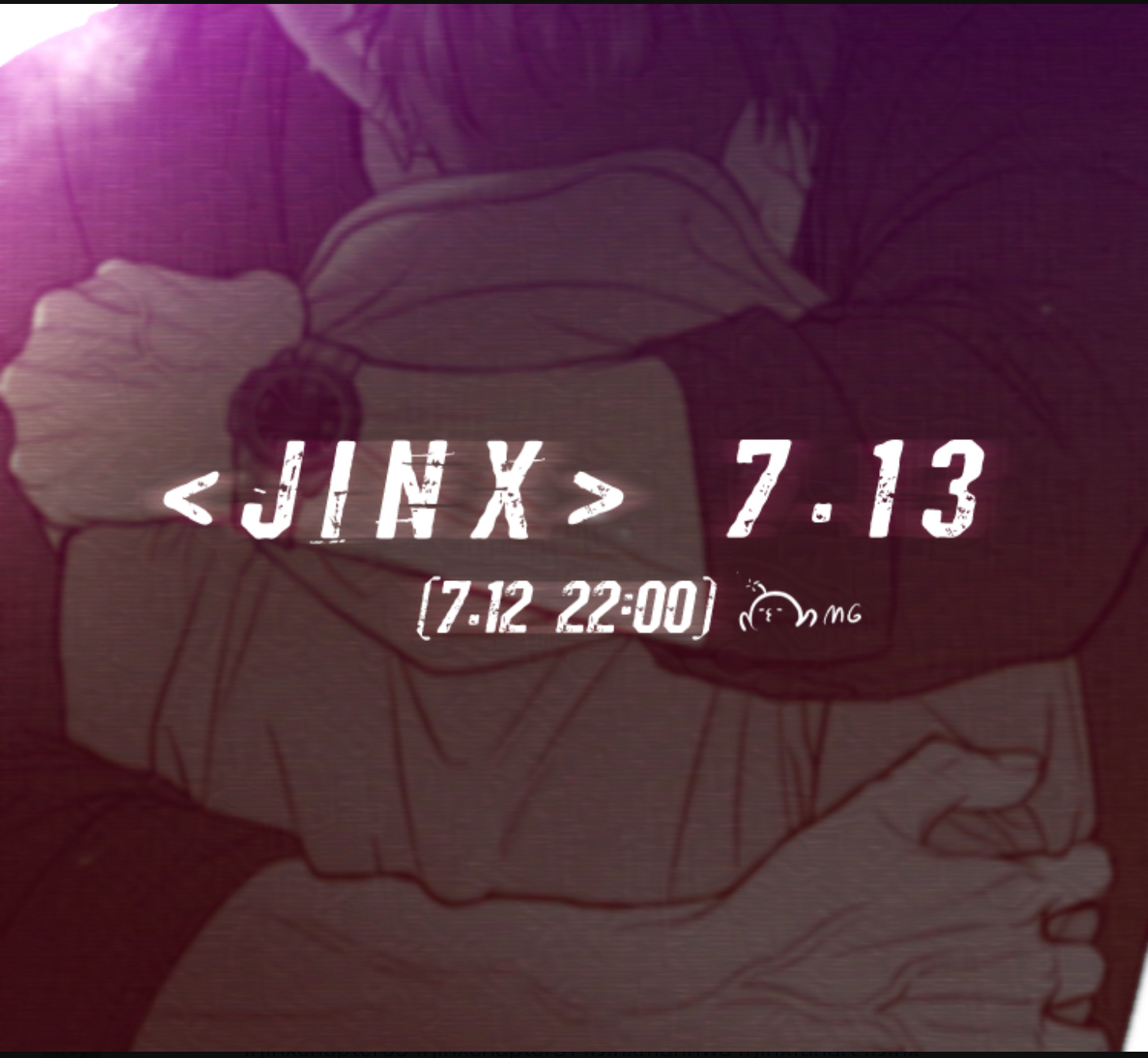 , released in anticipation of Chapter 70, is more than a promotional teaser. It is a moment frozen in time, yet brimming with motion—emotional, symbolic, and narrative. We see Joo Jaekyung embracing Kim Dan with both arms, pressing him tightly against his chest. There is no resistance, no distance, no tension in the frame. The palette moves from gray and brown fading into violet and pink, blooming into soft light. There is vapor, there is breath, an allusion to life. And most strikingly, there is stillness.
For my fellow Jinx-philes who have followed every bruise 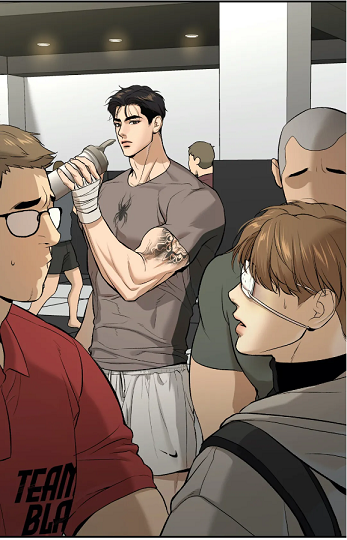 (chapter 11), every glare, and every awkward silence
 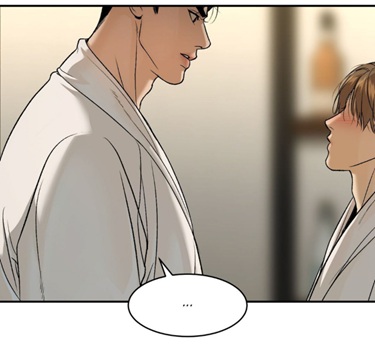 (chapter 67) between these two, this hug feels monumental. Why did the author choose this scene to announce the new chapter?
One might reply that it serves as a summary or visual recollection of the final moment in Chapter 69. And yes, it does that. But there’s more to it. The embrace is, in fact, a confession—one expressed not through speech but through touch. It may seem like a simple hug, yet it conveys something deeper and more vulnerable than any spoken admission. This is body language at its most honest: a quiet gesture that communicates all the things Jaekyung cannot articulate. Though words are absent, emotion is not. Silence, in this case, becomes a medium of connection rather than distance and lack of communication. Joo Jaekyung’s embrace reveals anxiety, tenderness, affection and the desire not to dominate, but to remain – to protect and to hold. And that is precisely why the author chose not to depict a kiss. A kiss would have shifted the tone toward romance, toward desire. But what Dan needs first is not romantic affection—he needs enduring, reliable friendship, a different form of love. Until now, he has only known fair-weather companions like Heesung or Potato.  (chapter 58)
This embrace gestures toward something deeper: a bond built not on conditions, but on presence. Hence in this illustration, we also glimpse the athlete’s watch strapped to his wrist—a detail that may seem minor, but resonates with meaning. It subtly grounds the scene in time, discipline, and routine, reminding us of his physical life as a fighter. Back then, the wolf was always preoccupied with the future  (chapter 29) —the constant possibility of being challenged, of losing ground, of falling from his throne. Time meant pressure. It meant movement. But now, in this image, the presence of the watch highlights how far he has come. No longer ruled by future threats, he chooses to pause, to stay grounded in the present. But in this moment, time is suspended. The watch becomes not a symbol of training, but of waiting—of calling time, of taking a breath, of choosing to be fully present for someone else. It marks a shift: he is no longer racing the clock, nor following the flow and facing the pack of challengers. He is here, holding, breathing, staying while keeping doc Dan in his sight.
This embrace is not just a recap of Chapter 69. It is a culmination. A reversal. A reflection. And above all, a threshold.
The date itself whispers symbolism. July 12. Add the digits: 1 + 2 + 7 = 10. In numerological terms, 10 signals the end of a cycle and the quiet promise of a new beginning. The “1” stands for rebirth, while the “0” opens the door to uncharted emotional space. We are no longer in the territory of possessiveness or pain. We are stepping into breath, presence, and vulnerability. It is the start of a real friendship and healing.
But how do I see all this in a single image? Naturally through reflections and comparisons. This essay will trace how this embrace reverses earlier dynamics—from the grandmother’s false comfort to the star’s previous grip of control. We will revisit the broken sandbag, the Emperor’s red backlit inner thoughts and visions (chapter 29, 55), and even the slap that echoed too loudly in the hospital. Because when Jaekyung finally hugs Dan with this kind of fragile openness, it doesn’t come from nowhere.
It comes from loss. From growth. From choosing stillness when everything in him was taught to keep running.
Revisiting the Embrace: From Control to Reciprocity
To truly grasp the emotional weight of the teaser hug , it must be examined in contrast with two pivotal earlier moments: the bathroom embrace in Chapter 68  (chapter 68) and the public hug on the dock in Chapter 69.
  (chapter 69)
In Chapter 68, the setting is intimate and vulnerable—a dim, wet bathroom. Kim Dan is asleep in the champion’s arms. Jaekyung holds him tightly from behind, but his own posture reveals something unresolved.  (chapter 68) He rests his chin not on Dan, but on his own hand, his arm propped on the edge of the bathtub. This detail is telling: even in a moment of supposed closeness, Jaekyung relies on himself for support, not on Dan. He is physically near but emotionally braced—still holding himself apart. His thoughts are private, tender, and possessive. In a rare moment of introspection, he confesses that
 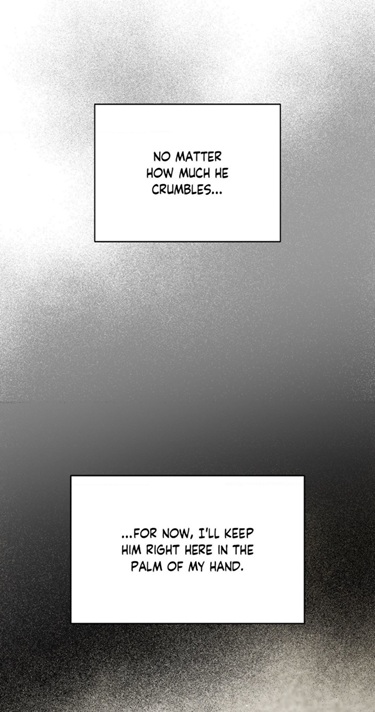 (chapter 68) This line (“I’ll keep him right here in the palm of my hand”) is deeply revealing. The champion frames care through the language of possession. The palm is open but hierarchical; it suggests that Dan is small, fragile, and dependent on Jaekyung’s will to hold or release. He does not yet see Dan as an equal. Even as he softens, his emotional vocabulary is shaped by superiority and containment. The hug is real, the sentiment sincere, but the dynamics remain unbalanced. And since Dan is asleep—unable to reciprocate, respond, or challenge—the embrace becomes more about the wolf’s soothing himself than forming a mutual bond. Furthermore, Dan is not even facing Jaekyung. (chapter 68) His head rests in the crook of the champion’s shoulder, turned away, a spatial choice that subtly reinforces the lingering emotional distance between them. They are close—but not yet connected. Initially, Dan’s profile is visible, resting gently against Jaekyung’s chest. However, as the moment progresses, Jaekyung subtly shifts Dan’s position.
  (chapter 68) In the next panel, we see Dan’s head from behind. This small but deliberate movement suggests a dynamic effort to hold onto him more firmly—to assert closeness, perhaps, but also to reposition him as something to protect and possess. The scene is filled with motion, both physical and psychological. And this motion, this shifting, stands in direct contrast to the stillness of the teaser image. In fact, the contrast goes deeper when considering the celebrity’s body language: (chapter 68) in the bathroom, we see only one of his hands holding Dan, while the other remains out of frame. Crucially, the watch he normally wears is missing. The absence of this item—one that often symbolizes the passage of time—hints at a suspended moment, an emotional pause where time no longer governs the champion’s thoughts. This subtle omission underscores how, in that quiet resolve to ‘keep him in the palm of my hand,’ Jaekyung momentarily abandons all concern for his career, his schedule, and the ticking clock of an MMA fighter’s short-lived prime. (chapter 68) It is no coincidence that the next morning he receives a new match offer: a test of that very resolution.
  (chapter 69) Yet, when faced with renewed pressure and stress, he falters—leaving Dan behind.
 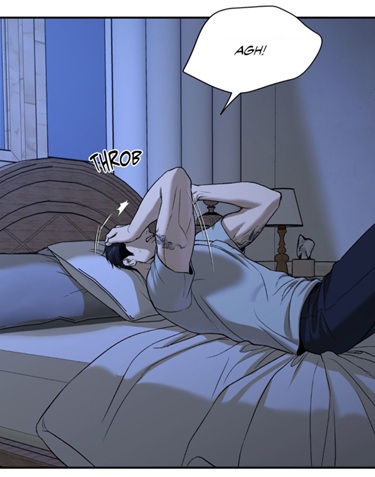 (chapter 69) The illusion of control dissipates, revealing that his earlier vow, however heartfelt, was not yet unshakable.
Under this new light, it becomes clear why Mingwa let Jaekyung make this silent resolution (chapter 68) without a witness. Had the athlete expressed his thoughts directly to Dan, they might have come off as arrogant, performative, or even hypocritical later. The quietness of his resolve shields it from judgment (chapter 68) —it’s neither a promise nor a performance, but a deeply personal moment of self-reflection. As such, it doesn’t demand perfection, only sincerity. And when Jaekyung breaks from it later, readers are invited to empathize rather than condemn. This unspoken vow belongs to him alone, and its failure stings not because of broken trust, but because we witnessed its honesty.
By Chapter 69, we see a notable progression. On a stormy night under a clouded sky, Jaekyung embraces Dan again—this time fully clothed, in public, and face-to-face. (chapter 69) The posture is protective, with Dan still clutching shopping bags. Much like the embrace in the bathroom, this one also unfolds under the moonlight and carries a strong sense of motion. Jaekyung acts on instinct and emotion, reaching out without hesitation. His gestures are protective, but still driven by impulse rather than reflection. This hug is no longer one-sided: Dan leans in, allows himself to be held. It marks a moment of shared emotional exposure. Still, it remains reactive, a response to emotional tension 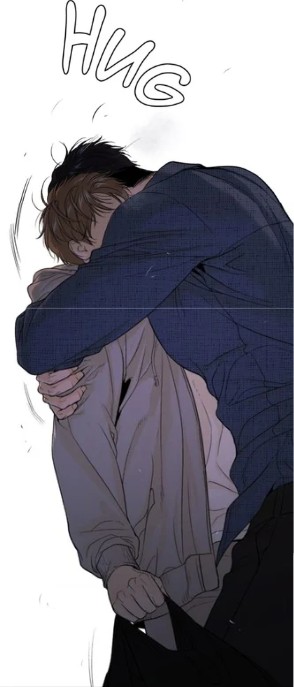 (chapter 69) rather than a moment of mutual resolution. Jaekyung offers no words, yet a silent gesture of care and vulnerability.
Notably, the watch is no longer visible in this embrace. Although we know from earlier panels 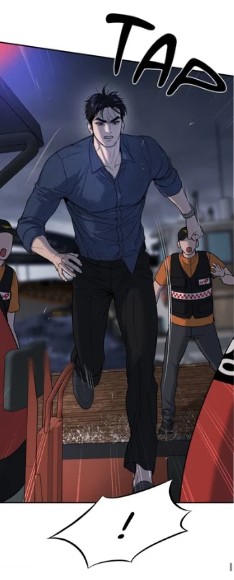 (chapter 69) that Jaekyung is wearing it, the change in angle—viewing the hug from behind—deliberately conceals it. (chapter 69) This compositional choice signals a subtle shift in perspective. Where the teaser centers the champion’s hands, the public embrace instead centers the environment, the setting, and the societal gaze. Dan’s face and back are hidden. Jaekyung’s back is turned to the viewer, signaling that this moment, while emotionally meaningful, remains partially opaque. Yet his vulnerability is visible—not through facial expression, but through posture. The tightness of his arms, the way he bends to reach Dan, the absence of hesitation—these all speak to a man laying down his guard. He is not posturing; he is clinging. And in doing so, he exposes his attachment and dependence.
By hiding Dan’s expression and placing him at the center of the frame, the author may be pointing to a new phase. Dan becomes the emotional axis, the silent center of Jaekyung’s emotional storm. As if to say: it is now Dan’s turn to interpret, to react, and eventually—to decide. The author thus repositions agency subtly but clearly in the teaser.
The embrace in episode 69 contrasts powerfully with the teaser image, which is defined by stillness. If the embraces in Chapters 68 and 69 are guided by nighttime instincts and lunar passivity, the teaser hints at something new—a quiet morning, or the symbolic arrival of sunlight. The glow on the left side of the illustration resembles the break of dawn, suggesting not only emotional warmth but also a conscious awakening. It is no longer about impulsive action in the dark; it is about holding on to someone in the light. The embrace is no longer a reaction—it is a decision.
The teaser embrace transcends both prior instances, not only in composition but in emotional clarity. The colors purple and pink respectively symbolize enlightenment, maturity and innocent love. Unlike the bathroom scene in Chapter 67, both men are now awake, and crucially, mutually present—not just physically, but emotionally. And unlike the last hug of Chapter 69, this embrace is not reactive; it is not prompted by surprise, fear, external danger, or a crisis. It emerges from stillness, from a shared decision to remain close. Yet within that stillness, it also oozes quiet determination (holding him tight)—a commitment not only to care, but to remain. The embrace becomes an embodiment of the unspoken motto: enjoy the present. It reflects a decision to prioritize presence over performance, commitment and connection over conquest.
Jaekyung’s posture is especially telling. His arms are wrapped tightly around Dan, but more than that, his entire body curves inward, as if folding into the space between them. His head rests against Dan’s neck or shoulder, a gesture that carries vulnerability, not dominance. This is not the body language of a man in control—it is that of someone seeking emotional grounding. He is not bracing Dan against the world; he is clinging to him, quietly, with all defenses down.
Dan’s body, too, speaks volumes. His back is visible, but this time, it is not a symbol of detachment. Compare it to the champion’s thoughts in the past. 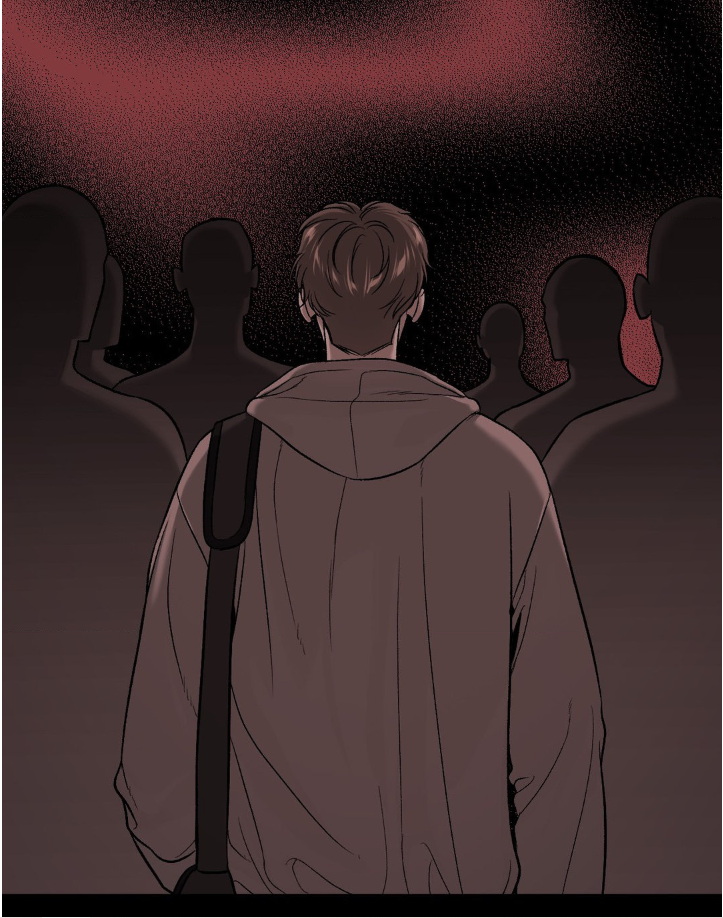 (chapter 55) In the new illustration, the hamster’s back is no longer representing anonymity and indifference, but visibility and care, for the champion is now facing his fated partner. In other words, doc Dan’s back in the teaser stands for uniqueness and high value. He can not be replaced. Moreover, doc Dan is not walking away, nor is he asleep. His hands are not visible—an intentional choice by the author. (chapter 69) By omitting them, the scene removes any external excuse for passivity, such as the black shopping bags seen in Chapter 69. Instead, it emphasizes Dan’s quiet agency. He is not weighed down or obstructed; he is simply there, choosing to stay. His stance is soft and grounded. He accepts the embrace—not out of resignation or shock, but through silent recognition. This marks a radical departure from earlier chapters where he either endured touch or froze under its weight. This time, he receives it—not as someone overwhelmed, but as an equal participant. That’s why I see the new illustration as the positive reflection of their argument in episode 45:
 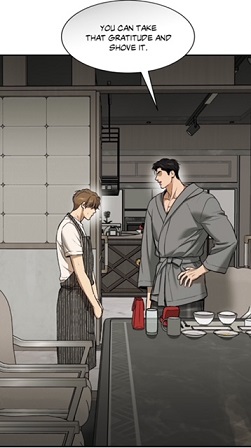 (chapter 45) Back then, the champion refused the expensive key chain, symbolizing a missed opportunity for emotional connection. Both men yearned for attention and affection, but failed to express it. Here, in contrast, the champion offers something far more meaningful than a 14,000₩ and free lodging —his unguarded embrace. And Dan, by remaining still, appreciates the moment. His quiet presence, free of obligation or material offering, affirms that emotional closeness has replaced transactional gestures.
The setting amplifies this transformation. The pink and purple tones that bathe the scene suggest warmth, serenity, and renewal. These colors have replaced the earlier palettes of red (associated with lust and violence – chapter 29) and black (linked to isolation and fear – chapter 55). The two main leads are no longer alone. This is what transpires in the new drawing. The faint mist or vapor in the air suggests breath, life, and emotional release—it is as if they are finally exhaling together after holding so much in.
This embrace, centered in the teaser, is not just a gesture of reunion—it is a visual representation of mutual recognition and emotional rebirth. It marks a turning point where neither man seeks to overpower or please the other. Instead, they allow themselves to be seen and held. The result is not control, but reciprocity—a new balance where love is no longer a struggle for dominance but a shared space of refuge. This moment also represents the birth of a true team: both are relying on each other. Dan becomes Jaekyung’s anchor, the grounding force he never knew he needed, while Jaekyung stands as Dan’s shelter, his unwavering protection. They no longer orbit each other in isolation—they have become interdependent, attuned, and quietly united.
The Hamster’s Gift: Reading The Unspoken
Dan’s stillness in the teaser illustration should not be mistaken for passivity. It is a deliberate act of emotional reception—something he was trained for from childhood. Raised by a grandmother who rarely expressed affection through words,  (chapter 21) Dan became fluent in a silent, physical language of care. She often asked him not to cry
 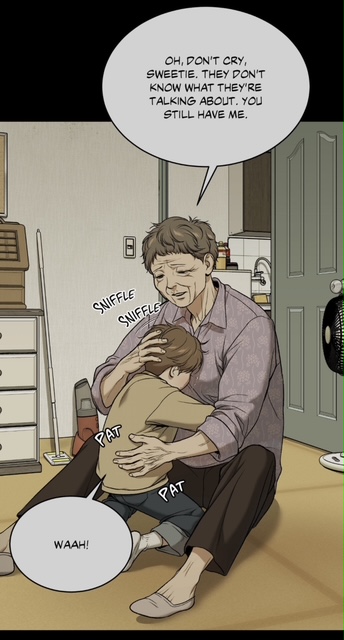 (chapter 57), unable or unwilling to face his vulnerability. To her, composure meant strength, and emotion—especially in the form of tears—was something to be managed or tucked away. Her love came in the form of caresses, pats
 (chapter 47) and composed embraces—gestures repeated with calm precision. These touches were predictable, rhythmic, and soothing, but they also suppressed genuine emotional exchange, the symbol of toxic positivity.
Dan learned early to interpret every small shift in touch: the rhythm of a pat, (chapter 57) the momentary pause of a hand
 (chapter 19), the direction of a gaze. Here, she was not looking at her grandchild who was talking on the phone. It was, as if she was excluding herself from the conversation. These gestures became his emotional compass—not because they were transparent, but because they were all he had.
Her hand was always in motion—patting, caressing  (chapter 5) never still—giving the impression of involvement, of care in action. But this motion avoided vulnerability and responsibility in reality. She never clung, never trembled. Her gestures conveyed comfort but not surrender, presence but not change, and not support either. They were not truly emotionally together. (chapter 57) Dan was never permitted to break down fully—he was urged to quiet his feelings rather than explore them. Thus it is no coincidence that the halmoni has no idea about the incident with the switched spray. Moreover, later the protagonist was often the one to reach for her,
  (chapter 47) to hold her hand, to initiate closeness
  (chapter 47)
 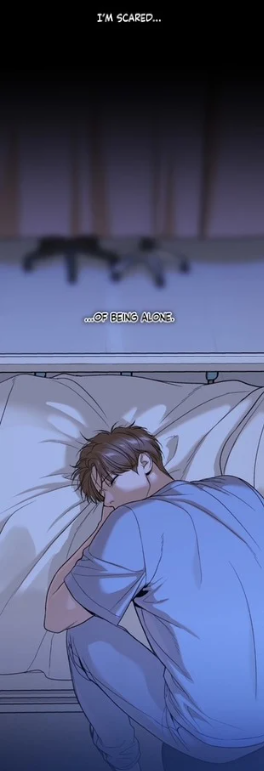 (chapter 56). This reversal of roles placed the burden of emotional stability on his young shoulders.
And layered into this physical restraint were her verbal reassurances—”You still have me,” “Grandma will always be there for you” (chapter 57); I’ll come back home, once I am all better”
 (chapter 11) —promises that sounded protective but masked emotional denial. Her words were spoken to soothe, not to reassure with truth. These assurances were emotional illusions—comforting on the surface, but hollow in substance. They created the illusion that she was always strong, ever-present, even immortal—an anchor that would never be lost. Over time, this illusion cemented itself in Dan’s mind. She became a fixed point of emotional gravity,
  (chapter 65) a mythic figure whose emotional distance he interpreted as noble sacrifice. Her constant reassurances and carefully controlled gestures fed into this perception, convincing Dan that love meant loyalty, restraint, and silent endurance.
This formative training becomes key to understanding why he doesn’t resist Jaekyung’s embrace. He does not shrink, flinch, or cling—he simply stays. Unlike in Chapter 69, where he clutched shopping bags that might serve as a pretext for his inertia (chapter 69), in the teaser his immobility is unburdened. The absence of his visible hands and possessions symbolically removes all excuses. Dan is no longer reacting out of confusion or fear. He is choosing to be held.
This emotional acuity is especially visible in Chapter 35, when Dan observes the aftermath of Jaekyung’s violent outburst at the sandbag.  (chapter 35) Instead of recoiling in fear or admiring his strength, Dan quietly states, “I think I really need to focus on Mr. Joo right now.” He does not focus on the strength or aggression, but on the pain beneath it. The burst sandbag, for him, is not a threat—it is a symbol of Jaekyung’s emotional unraveling. This silent recognition mirrors Dan’s interpretive skills developed in childhood. Just as he once learned to read a shift in his grandmother’s hand or the silence after a broken promise, he now interprets the damage to the sandbag as an unspoken plea for help. This sensitivity continues to define his bond with Jaekyung.
He recognizes the depth behind Jaekyung’s gesture —the trembling edge of desperation, the quiet need to be reassured. The celebrity’s grip is neither calculated nor repetitive. It is raw, clingy, and intense—each finger clutching as though Jaekyung fears losing him again. Unlike his grandmother’s composed movements, Jaekyung clings with both arms, as if to say: I need you to stay by my side. The absence of ritualized comfort, the lack of rehearsed gestures, tells Dan this is something radically different: not performance, but presence. There are no words exchanged—no hollow reassurances, no immortal promises. This is vulnerability in its purest form: exposed, messy, urgent.
For Dan, who was trained to perceive the emotional weight of silence and motion, the difference is staggering. The wolf’s embrace does not soothe from above—it clings from within. He doesn’t place himself above Dan like a guardian or caretaker. He reveals himself as someone who needs Dan’s presence, someone who trusts Dan with his own fragility.
This moment reshapes Dan’s emotional experience. In the past, stillness came from suppression. Now, it emerges from choice. In the past, he was the one to reach out 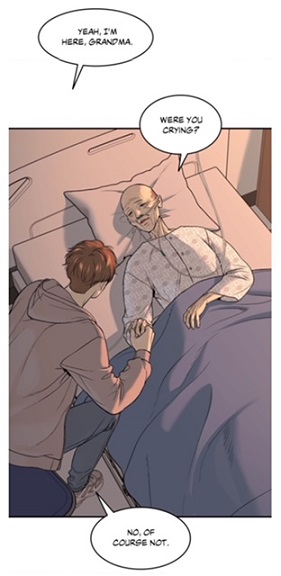 (chapter 47), to stabilize the person meant to support him. Now, he is receiving without shame or hesitation. The Emperor’s silent desperation, his refusal to hide behind ritual or false strength, creates the space for Dan to feel treasured—not pitied, but wanted.
Dan was conditioned to listen with his eyes, to decipher emotion from gesture. That gift has become the foundation of their bond. This time, silence is not loneliness—it is intimacy. Jaekyung’s embrace asks for nothing and gives everything. It is not a gesture of power or protection—it is a surrender. And the master, for the first time, accepts it as his own. Jaekyung and Dan do not need to pretend. They offer presence, not perfection. And Dan, trained to hear meaning in silence, receives the hug as something more profound than any spoken vow. It is not just a sign of Jaekyung’s attachment—it is an invitation, which Dan, for the first time, accepts freely.
Letting Go of the Guardians: From Slap to Embrace
The teaser leaves no room for misunderstanding: this embrace belongs to no one but them. There is no space for a third party to intervene, mediate, or translate. The intimacy captured in the image signals not only mutual acceptance, but also a decisive boundary—an exclusion of external authority. With this embrace, the narrative quietly removes the former guardians—Shin Okja and Park Namwook—from the emotional core. Their time as intermediaries 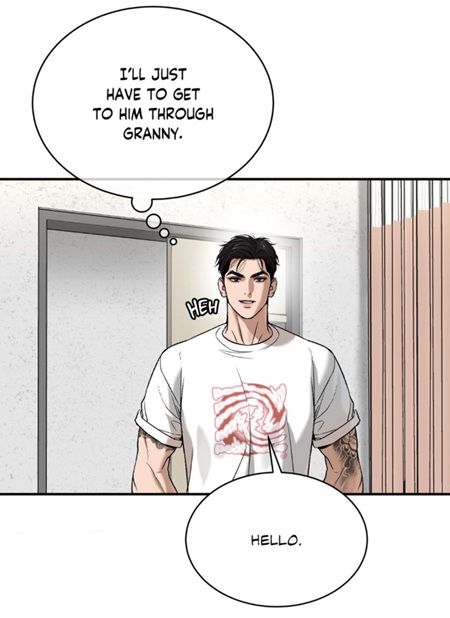 (chapter 65) or stand-ins
 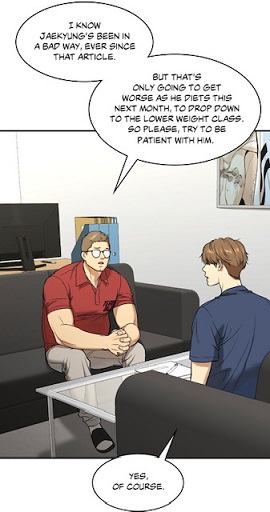 (chapter 36) for affection has ended. The spotlight now belongs solely to Jaekyung and Dan, who no longer require mediation to reach one another. This shift becomes particularly evident when contrasting the teaser with earlier moments of evasion, silence, and misplaced dominance—especially through the lens of Park Namwook’s slap and Jaekyung’s own past deflections.
In Chapter 29, Jaekyung is depicted as a hunted predator (chapter 29), constantly pursued by younger fighters—“a pack of hyenas” nipping at his heels. Yet beneath this portrayal of endless motion is a deeper emotional truth: Jaekyung is running not just from competitors, but from his own solitude. That night, he refused to rest 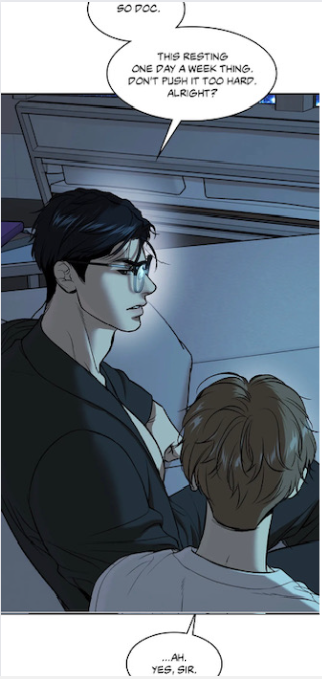 (chapter 29), ignoring Dan’s presence and concern. His rejection of the doctor’s offer of comfort or companionship underscores not only his emotional detachment but also the absence of true support from his supposed team. The manager, Park Namwook, is nowhere to be seen, (chapter 29) and Jaekyung operates in isolation—more fighter than partner, more machine than man. No man is watching his “back”. It is precisely this disconnection that prevents him from relaxing or recharging. He is trapped in a cycle of movement without relief, because he lacks the emotional foundation of trust and interdependence that the teaser illustration later comes to embody. In other words, behind this image of motion (chapter 29) lied an emotional stagnation. The champion was running from something internal, not just external. When Dan attempted to ask questions or reached out, Jaekyung frequently shut him down
 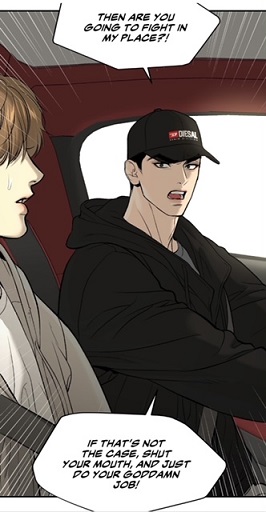 (chapter 42) or offered silence in return. He had no teamwork ability in the end contrary to the hamster who “assisted” his grandmother. But it is not surprising, since Park Namwook has always relied on his boy.
 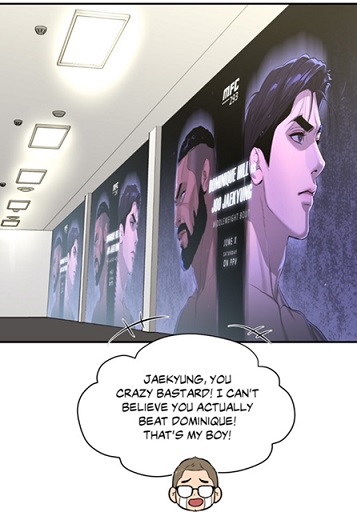 (chapter 40) Each time, they faced a problem, the athlete had to resolve it. He was the problem and the solution for everything.
  (chapter 17)
This emotional avoidance culminates in a pivotal rupture: Park Namwook’s slap in Chapter 52.  (chapter 52) Surrounded by others, the manager attempted to discipline Jaekyung not with understanding, but through force. The slap was not an act of care—it is an assertion of dominance. It reduced Jaekyung to a volatile asset and spoiled child, not a man in pain. Striking is that this gesture actually exposed the manager’s weakness and anxiety. He was the one reacting as a spoiled child, for he masked his wrongdoing with tears.
  (chapter 52) The reason is that he couldn’t face the terrible outcome and his own responsibility. He needed a scapegoat. Thus he blamed the champion for everything. But by doing so, he refused to share the burden and the athlete’s unwell-being. Striking is that this slap served as a wake-up for the athlete. From that moment on, he stopped relying entirely on his “hyung”. He was pushed to make decisions on his own. This harsh gesture mirrors Shin Okja’s attitude toward Kim Dan, (chapter 57) who was often comforted only when he concealed his distress. Both guardians acted as strong persons, while in reality they were hiding their own helplessness and anxiety. Both suppressed vulnerability
 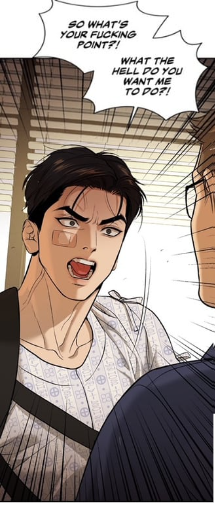 (chapter 52), seeing it as disruptive or shameful. Their guidance demanded emotional control, not emotional honesty.
Yet while the manager relied on open scolding and explosive gestures, Shin Okja’s strategy was the opposite: she smothered emotional crises with fake promises and quiet patting. Where Park Namwook used confrontation and order, Shin Okja relied on evasion and emotional sedative. Both mechanisms served the same purpose—denying the “boy” the freedom to feel and process complex emotions. Both were forced to deny the existence of “evil” in the end. “They don’t know” or “because of your temper”… Both guardians expected their wards to be functional rather than fragile. The reason is that they were expecting blind loyalty and submission. Naturally, since the grandmother was more gentle, her actions created an invisible chain between her “puppy” and her, while the slap from the manager caused an invisible riff between him and the Emperor. Park Namwook can no longer raise his voice 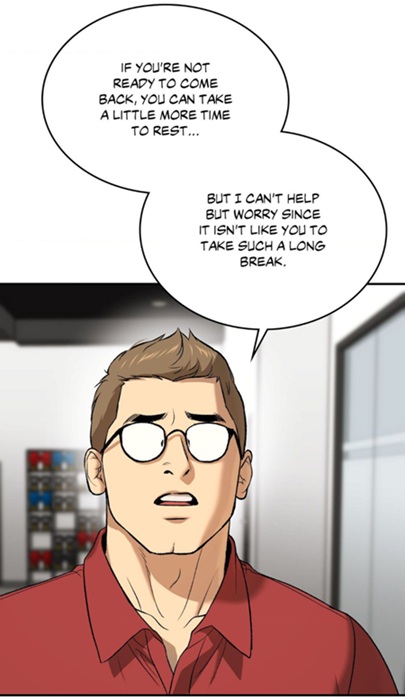 (chapter 66) or use violence to “tame the wolf”. That’s the reason why he is accepting the offer from the CEO of MFC. He is pushing the Emperor to return to the ring, but the problem is now that doc Dan was officially recognized as a member from Black Team.
 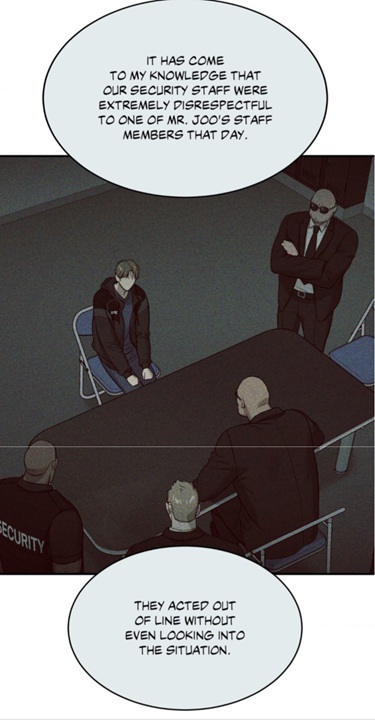 (chapter 69)
Herein lies the most profound contrast with the teaser embrace. The slap (chapter 52) is loud, performative, and corrective—a punishment wrapped in hierarchy. It takes place in a closed space—a hospital, ironically a place meant for healing. And yet, this act of violence is anything but restorative. Though members of Team Black are present, the moment remains confined, unspoken beyond its walls—a private humiliation masked as internal discipline. It does not foster intimacy or catharsis; instead, it isolates Jaekyung, stripping him of dignity both as an athlete and as a patient. In contrast, the embrace in Chapter 69 (chapter 69) occurs on a public street, before any audience. Its openness transforms what could have been a moment of embarrassment into a declaration. Jaekyung’s vulnerability becomes visible and valid—an indirect public confession that replaces the secrecy of the slap with the courage of connection. In fact, this scene displays the irrelevance of PArk Namwook in the “champion’s life”. He was never seen in the little town following his MMA fighter. So in the eyes of the inhabitants of this remote town, the doctor becomes a VIP. The embrace, by contrast, is quiet and egalitarian—a gesture of shared vulnerability and mutual respect. Where the slap severs emotional expression, the embrace enables it. Jaekyung does not mask his emotions or deflect responsibility with aggression; he leans into them, exposing his dependency and yearning without shame. This moment oozes closeness and intimacy, while indirectly their “secret” is exposed. They are important to each other.
This quiet exposure reverses the legacy of his guardians. Jaekyung does not slap, silence, or manage. He holds. And by doing so, he invites Dan to remain—no longer as a passive caretaker, but as someone who matters. The embrace thus becomes an answer to years of silencing: an offering of closeness where there was once only control.
By staging this gesture in full view—yet focused only on the pair—the teaser signals that no outsider can step in to define or distort their relationship anymore. Guardians are no longer needed. The embrace is their language now. Through the touch, both are feeling the warmth from each other. They are now friends and even family. Let’s not forget that the landlord saw them as “friends” 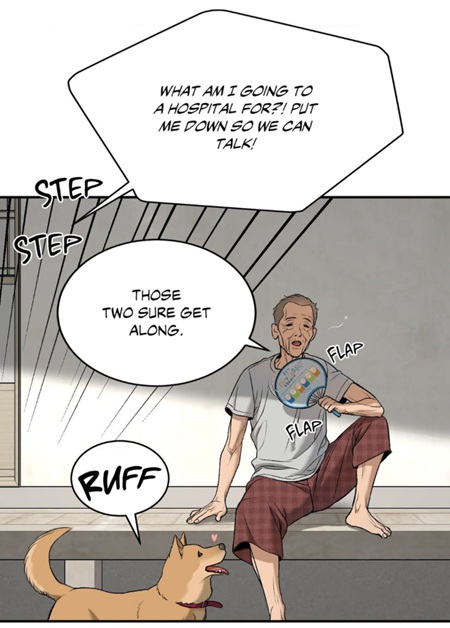 (chapter 66) the moment the Emperor carried away doc Dan. This looks like an “embrace”.
  (chapter 66)
Feel free to comment. If you have any suggestion for topics or Manhwa, feel free to ask. If you enjoyed reading it, retweet it or push the button like. My Reddit-Instagram-Twitter-Tumblr account is: @bebebisous33. Thanks for reading and for the support, particularly, I would like to thank all the new followers and people recommending my blog.

 Bebebisous33s' analyses in K-Dramaland and Manhwas