
Please support the authors by reading Manhwas on the official websites. This is where you can read the Manhwa: Jinx But be aware that the Manhwa is a mature Yaoi, which means, it is about homosexuality with explicit scenes. Here is the link of the table of contents about Jinx. Here is the link where you can find the table of contents of analyzed Manhwas. Here are the links, if you are interested in the first work from Mingwa, BJ Alex, and the 2 previous essays about Jinx Illuminated 🌥️🌤️Silence and Lingering 🫶 Warmth 🔥 and The Other, Hidden Door to the Past
It would be great if you could make some donations/sponsoring: Ko-fi.com/bebebisous33 That way, you can support me with “coffee” so that I have the energy to keep examining Manhwas. Besides, I need to cover up the expenses for this blog.
This essay won’t be a long one, as today two new episodes from Jinx will be released. However, I found three articles from Jennifer Delgado which let me perceive the protagonists’ metamorphosis and the progression of the story.
The Dock as Turning Point
In episode 69 of Jinx, the question 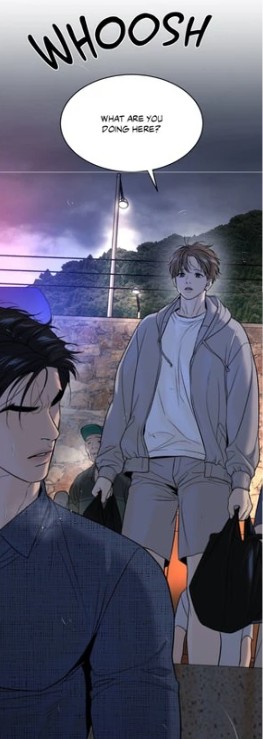 (Chapter 69) from the physical therapist is more than a startled greeting — it marks a critical shift in the psychological and emotional trajectory of both Kim Dan and Joo Jaekyung. Standing at the dock, doc Dan, still recovering from his depression and trauma of the switched spray incident, sees the champion not as an invincible athlete, but as someone equally unmoored. He is surprised and confused by such a behavior. Why would he act that way? Hence the author added right after this image:
  (chapter 69) Striking is that the champion has a similar reaction. He never expected that he had misjudged his fated partner. Both characters are forced to face their own prejudices and bias.
  (Chapter 69) This moment is less about resolution and more about recognition: two men, shaped by different paths of burnout, collide again — but this time not as patient and caregiver, predator and prey, but as human beings in crisis.
Symbolically, the dock represents more than just a location — it is a threshold between two domains: between land and sea, safety and uncertainty, solitude and reconnection. (Chapter 69) It is a liminal space, a bridge between their former roles and whatever comes next. The fact that this unusual encounter and subtle interrogation happens here underscores the narrative’s shift from repression to potential transformation. It is the space where isolation ends and vulnerability begins — the exact place where emotional disconnection gives way to tentative reattachment. This announces the premises for their true future collaboration. 
“It’s No Wonder Burnout Syndrome Hits This Field So Hard”
According to the article Growth Mindset in Healthcare: From Burnout to Breakthrough, burnout manifests not only through exhaustion but through rigid thinking: perfectionism, fear of failure, and fixed self-perception. The article points out that:
“Doctors, nurses, support staff, and other healthcare professionals face immense challenges every day: fast-paced environments, long shifts, relentless pressure, and high-stakes decisions. It’s no wonder burnout syndrome hits this field so hard.” Quoted from https://psychology-spot.com/growth-mindset-in-healthcare/
This line could describe Kim Dan’s reality perfectly. From taking double shifts 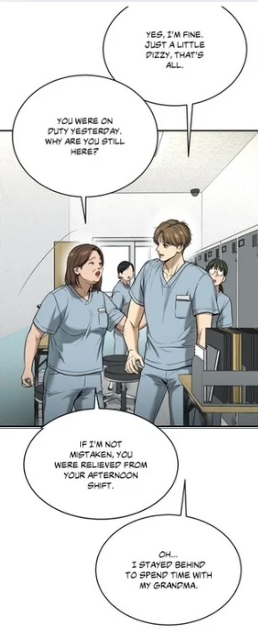 (chapter 57) that go unnoticed to dealing with the emotional numbness of detachment, Kim Dan begins to resemble the article’s description of someone silently breaking down.
  (Chapter 59) Although he didn’t face difficult patients at the hospice
 (chapter 57), he approaches his work like a robot, emotionally disconnected from those in his care. The burnout is not only shaped by the hospital environment — it’s also deeply tied to his role with Joo Jaekyung. The champion became, in many ways, his most demanding patient
 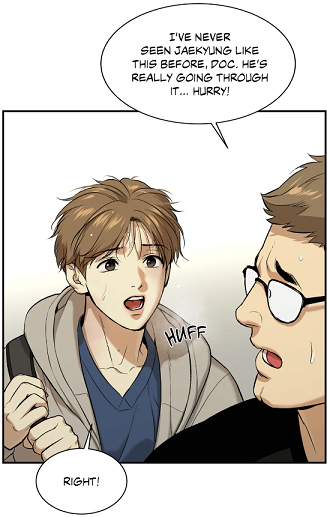 (Chapter 14), with unrealistic expectations
  – chapter 41 (such as pushing for a premature return to the ring), and an emotional climate of pressure and perfectionism
  f (chapter 45) rom superiors, he fits the article’s description of someone burdened by a toxic professional environment. More importantly, in episode 57, a nurse casually mentions that he might be suffering from burnout.
 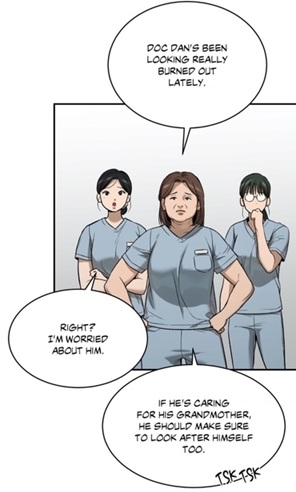 (Chapter 57) This offhand remark reveals that within the medical setting, the symptoms are visible to trained observers. And yet, the insight never reached the “hamster” or the “wolf.”
Dan internalizes his stress, rationalizes it as duty, 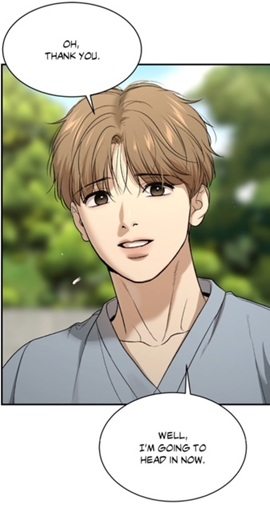 (chapter 56) and isolates himself emotionally. Therefore he doesn’t engage in a conversation with the nurses.
 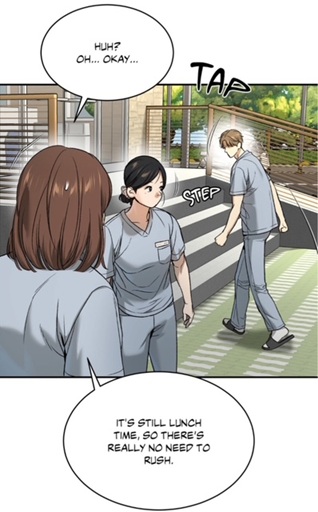 (Chapter 56) No wonder why the readers still don’t know the names of the three “angels in blue”’. Their presence is functional, but remains impersonal. They remain silent observants.
  (Chapter 57) Likewise, Jaekyung — despite not being in healthcare — he fits the article’s description of someone burdened by a toxic professional environment.
  (Chapter 27) He operates in an industry with crushing expectations, where performance is equated with survival.
  (Chapter 29) That’s why he doesn’t allow himself to rest.
Just as Kim Dan avoids emotional engagement with his peers — such as the nurses who sense his exhaustion — Jaekyung mirrors this relational withdrawal in the world of MMA. Other fighters are not allies but threats: in his own words, they are “hyenas”, always circling, waiting to take something from him. (Chapter 29) This worldview isolates him entirely. It’s no surprise, then, that his past with Baek Junmin remains shrouded in mystery  (chapter 49), or that in the aftermath of the suspicious match, he blames him
 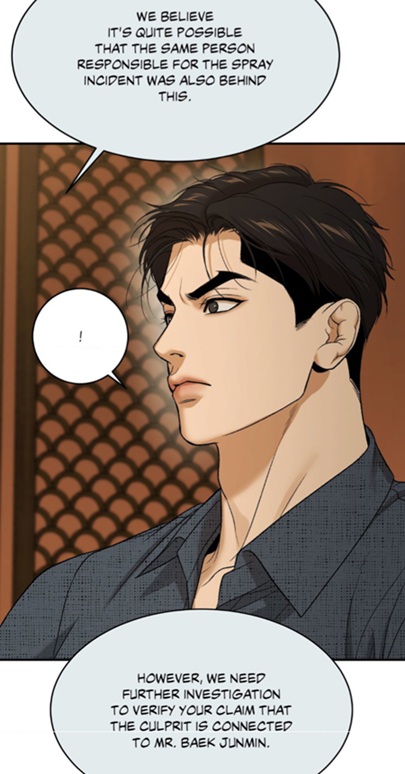 (chapter 69) and avoids speaking with Shotgun altogether. Instead of engaging in conversation, he contacts MFC — preferring institutional action over personal interaction.
This reinforces the parallel: both the hamster and the wolf have been conditioned to distrust their environment and the people in it. 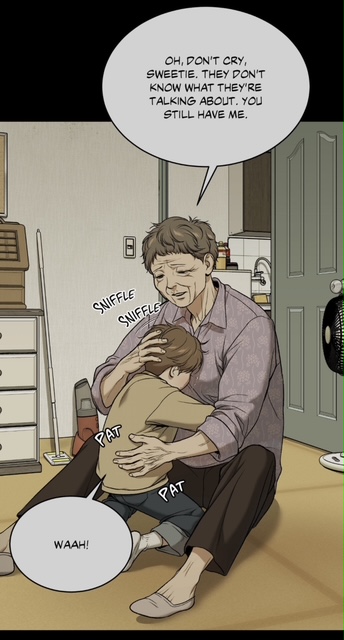 (Chapter 57) Since people don’t know them, they can not trust their judgement and perception. Both navigate high-stakes worlds that punish vulnerability and reward detachment. And both, when overwhelmed, retreat from human relationships rather than reaching out. They are, in different costumes, performing the same coping script — one that the article identifies as characteristic of fixed mindsets operating under systemic pressure and emotional isolation.
His perfectionism, his emotional suppression, the microstress accumulating from constant physical strain  (chapter 19) and relational isolation all echo the article’s diagnosis:
“This perfectionist culture often fuels a fixed mindset. It turns mistakes into personal failures, makes constructive feedback feel like harsh criticism, and sidelines personal growth in favor of immediate demands.” Quoted from https://psychology-spot.com/growth-mindset-in-healthcare/
Both men operate in systems where perfection is not just expected, it is demanded 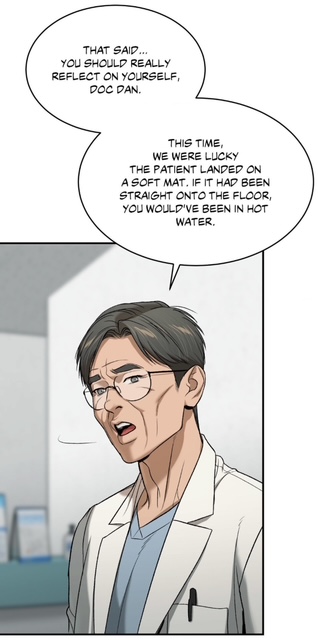 (chapter 59) — and any deviation from it is interpreted as personal failure. Here, it’s important that the hospice took advantage from the overworked protagonist. No one paid attention to the double shift. (Naturally, I am not saying that the main lead is blameless either). For Kim Dan, the patient’s fall in episode 59
  (chapter 59) and the sabotage incident destroyed his self-perception as “doctor” and “helper”.
 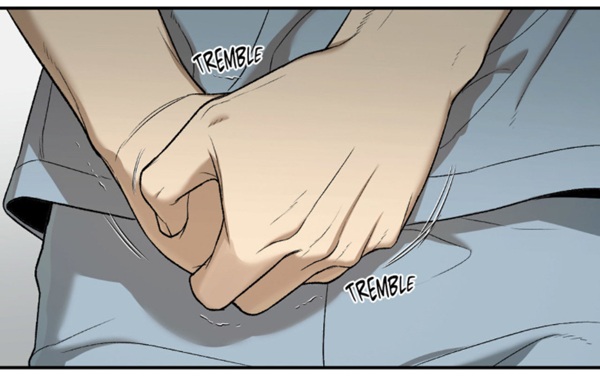 (Chapter 59) This is reflected in the image where the author zoomed on the “main lead’s” hands or when he is holding the dead puppy.
 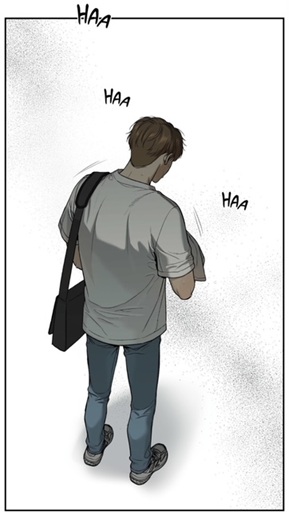 (Chapter 59) The hands have become the symbol of his powerlessness. For the wolf, the tie in his last match is perceived not as resilience, but as loss.
 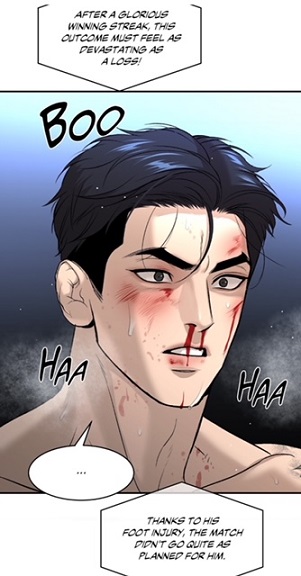 (Chapter 51) Neither of them has been taught to see difficulty as an invitation to adapt. They both cling to a fixed mindset — until crisis breaks the pattern.
Rooted Burnout: Identity, Perfectionism, and Selflessness
Kim Dan’s depression and burnout are not caused solely by repressed traumas  (Chapter 56) — they are also the result of two compounding forces: the champion’s perfectionism and the doctor’s own fixed mindset.
  (Chapter 64) This deeper entanglement explains why Dan ultimately rejects the celebrity.
 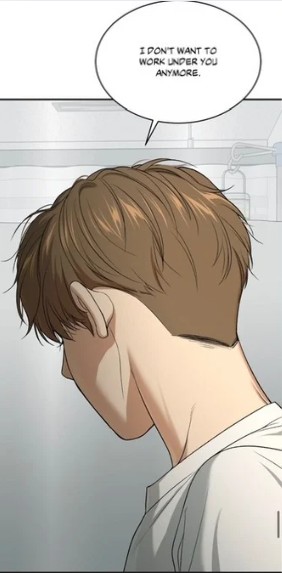 (Chapter 60) Though Dan has long suffered from low self-esteem, he has never questioned his sacrificial identity. It is as if he were destined — or conditioned — to care for others without regard for himself.
  (Chapter 29) He sees selflessness not as a virtue but as a default mode of survival. This explicates why he blames himself for the puppy’s death. Observe how Mingwa implied the relevance of the doctor’s hands while he was holding the poor puppy. (Chapter 59)
At the same time, his view of work has always been transactional. In episode 1, he sees his first assignment at the hospital as a means to earn money  (Chapter 1) — a way to repay debts. And it is the same, when he accepts his contract with the wolf.
  (Chapter 6) His grandmother reinforces this belief by reducing his worth to his earning capacity. This mindset is plainly illustrated in two key moments. In the first, she expresses her gratitude to the champion, because he gave him “a roof over his head and a salary.”
  (Chapter 65) These words reveal what truly matters to her: material provision and financial compensation. She does not seem to register the emotional toll the job may be taking on Dan, nor does she question the ethics of the contract or his living conditions. What she values is that her grandson is being paid and housed — signs of visible, quantifiable success.
In the second instance, she tells her “almost grandson” that  (chapter 65) Dan has “only lived for her” so far, and that he surely has a “ton of things he wants to accomplish” now. This comment, which at first sounds like encouragement, in fact exposes her own worldview: a life worth living is one centered on achievement, productivity, and external validation. The idea of simply resting, recovering, or living quietly does not even occur to her. When she urges that Dan should go back to Seoul to pursue his “best life,”
 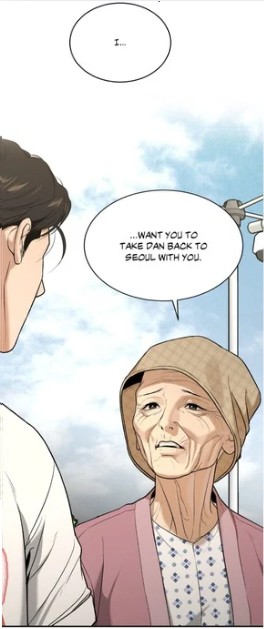 (Chapter 65) it becomes clear that for her, the capital is more than a location — it is a symbol of success, of competition, of visibility. She cannot imagine a fulfilling life outside that framework, and thus unknowingly erases Dan’s internal world: his trauma, exhaustion, and grief. To conclude, all her ideas are revolving around career, success and wealth. Work, in this logic, is not about pride, passion, or healing — it is about obligation. This began to shift when he started working with Jaekyung and discovers a different kind of validation:
 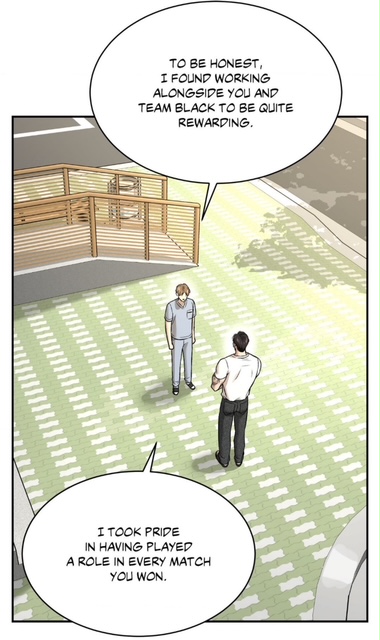 (chapter 62) the athlete’s success gave him a sense of purpose. No wonder why he took everything so personally.
But when the champion rejected him in the locker room, even blamed him (chapter 51), this fragile new identity got shattered. Dan loses not just a client or income source — he loses the first glimpse of professional dignity.
  (Chapter 51) The rejection didn’t just hurt emotionally; it disoriented him existentially. In that light, it is no coincidence that he ends up working at a hospice — a place symbolically linked to endings, quiet resignation, and the final stages of life.
 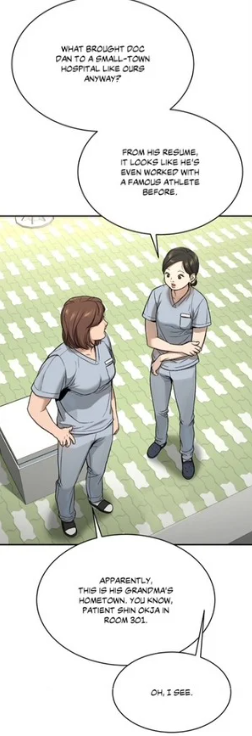 (Chapter 56) The hospice marks not just a physical retreat from his past, but a psychological one: a setting that echoes his emotional state. While his body continues to function, his inner life has entered a form of dormancy. His role in this environment reflects how deeply detached he has become — professionally, emotionally, and existentially. The job had become more than money, but now that it’s gone, he can no longer look forward. He feels lonely and rootless. (Chapter 56) His fears, his trauma, and his ingrained selflessness trap him in a state of emotional and professional paralysis.
Rescue as Absolution
The arrival of the champion in the seaside town, asking him to return 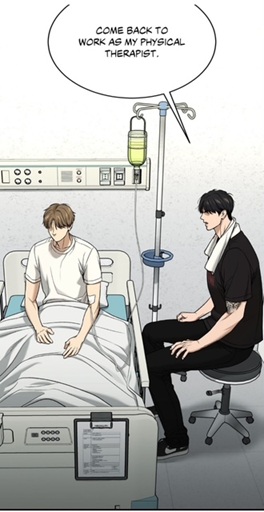 (chapter 60), functions as a form of emotional absolution, though doc Dan is not aware of it. This job offer is an indirect proof that he is still seen as competent and trustworthy.
 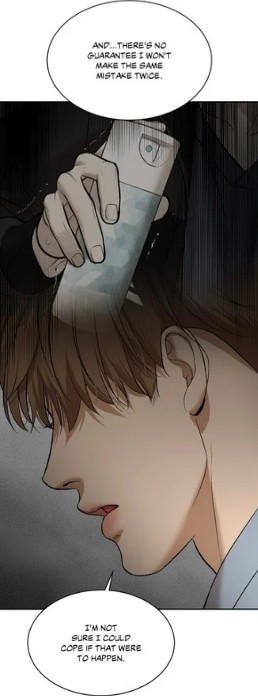 (Chapter 62) If Jaekyung had not come himself, it would have confirmed Dan’s worst fears: that he was to blame, that he was discarded. The first crack in his fixed mindset comes from this gesture — an external acknowledgment that the so-called “sin” may not have been his at all. This explicates why Kim Dan can give him the cold shoulder and even ignore him.
  (Chapter 61) It helps him to boost his strength and confidence. From that moment on, he is capable to express his own thoughts and as such criticize the star. (Chapter 64)
From Bewilderment to Presence
But transformation is not linear. By episode 69, Dan is still weighed down by unprocessed guilt and emotional avoidance.  (Chapter 69) His stunned reaction — “ (chapter 69) and the subsequent panel of him thinking “…?” (Chapter 69) reflect not openness, but bewilderment and curiosity. He cannot yet process why someone like Joo Jaekyung would show up so dramatically, defying his usual patterns of control and distance. This is not a confrontation, but a moment of interrogation and emotional inversion — Jaekyung is acting unusually, and Dan is quietly observing, almost uncertain whether to trust the shift. That moment marks a subtle but pivotal turn: Dan, no longer collapsed, is present and attentive. And Jaekyung, for the first time, shows emotional transparency rather than dominance. (Chapter 69) Their positions are shifting — slowly, hesitantly — toward mutual recognition.
Meanwhile, the champion is also unraveling — not due to a single catastrophic event, but from sustained microstress, as defined in the article Microstress: The Silent Stress That Accumulates.
- Microstress is characterized by:
- Frequent exposure. Unlike major stressful life events, everyday stressors are repeated continuously. They’re like a constant drip that eventually overflows the glass.
- Denial of impact. Microstresses are often minimized because they don’t seem “serious enough”: an irritating email, an awkward interaction, or a minor unforeseen event aren’t major crises. Since they aren’t legitimized, the usual response is “just suck it up” or “it’s not that big a deal,” which leaves us without the tools to manage them.
- Progressive burnout. Everyday stressors don’t set off our alarm bells because they aren’t an obvious threat. Therefore, we don’t mobilize our coping resources to counteract them. So we end up swallowing our anger, frustration, or exhaustion… until we explode.
- Recovery block. By the time we’re done dealing with one source of stress, another is already waiting. So we become like that overwhelmed waiter or nurse who hasn’t stopped working since 8:00 a.m. and, even though they haven’t suffered any catastrophe, comes home completely exhausted day after day. Quoted from https://psychology-spot.com/microstress-everyday-stress/
The athlete’s burnout stems from the relentless pressure of performance, the perfectionism and the obsession (chapter 69) with the title instilled by his hyung, the constant bodily strain, and his emotional isolation. Most crucially, he interprets his last match — a tie — as a personal failure. For someone with a fixed mindset, a tie is not balance; it’s inadequacy. Therefore it is not surprising that the athlete is not realizing that the outcome of his match has been changed from tie to loss.
At the dock, when the champion turns around and sees Kim Dan standing upright — not collapsed or fleeing — it destabilizes his expectations.  (Chapter 69) Dan’s very presence communicates something new: emotional steadiness, however tentative. And for the first time, Jaekyung doesn’t respond with control, but with vulnerability.
 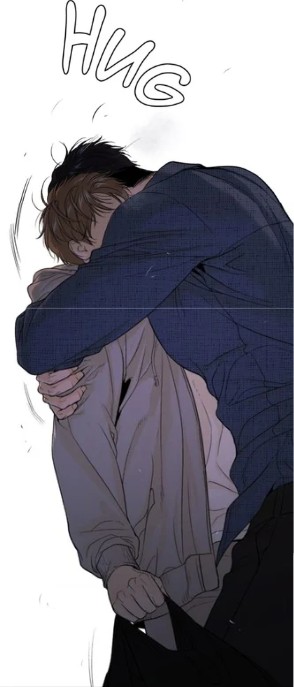 (Chapter 69) The hug becomes a form of speech — an action that acknowledges fear, relief and desire for connection.
Catharsis or Change?
This is where the article Talking About Emotions Is Not Enough becomes essential. It argues that simply talking about feelings is not transformation; catharsis without action becomes a trap:
“Talking isn’t changing. Knowing isn’t doing. And understanding isn’t transforming.” Quoted from https://psychology-spot.com/talking-about-emotions-is-not-enough/
Shin Okja illustrates this point vividly. She shares her emotions and fears with the “wolf”, appearing vulnerable and reflective  (Chapter 65) — yet she changes nothing. How so? She could have talked to the nurse, and the latter would have brought up the possibility of “burnout”. She frames her grandson as a victim
  (chapter 65) and herself as helpless, yet her only move is to push him away under the guise of concern (Chapter 65) She never confesses directly to Dan, nor does she take responsibility for her past actions.
  (Chapter 65) Instead, she subtly enlists the champion as a parental substitute, urging him to care for the “sick” Dan.
 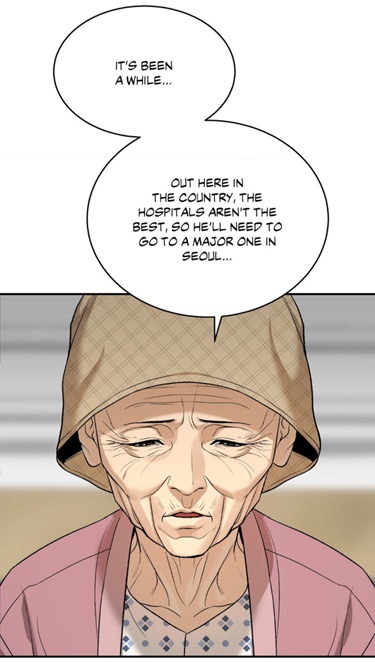 (Chapter 65) She imagines, pills will work their magic.
She sees in the champion an opportunity to unburden herself and outsource responsibility. But her strategy is not to help Dan become independent — rather, it is to have Jaekyung act as a caretaker, reinforcing the narrative that Dan is weak. Her emotional confession is not accompanied by a willingness to change or empower; it is yet another performance to ensure that others, not herself, do the hard work of care  (Chapter 65) and repair.
Her version of catharsis is hollow. She uses emotional language not to empower Dan, but to preserve her own comfort. She remains passive, speaking around Dan instead of to him. In contrast, the champion’s eventual confession to Dan is direct, emotionally honest, and followed by behavioral change. He doesn’t just reveal his emotions — he takes action. He questions his routines and believes, leaves Seoul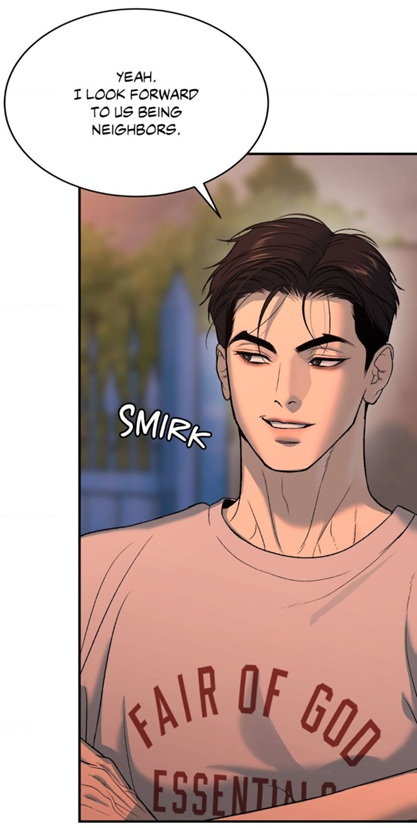 (chapter 61) , and approaches Dan not as a star reclaiming property, but as a person reaching out.
Practicing the Growth Mindset: Five Dimensions in Action
The article Growth Mindset in Healthcare: From Burnout to Breakthrough outlines five practical strategies that reflect a shift from fixed to growth mindset. Each of these aligns with key moments and changes in both Kim Dan and Joo Jaekyung — not as traits they naturally possess, but as difficult, earned responses that emerge through crisis.
1. Stay curious and keep learning
“A growth mindset encourages genuine curiosity and lifelong learning.” Quoted from Growth Mindset in Healthcare: From Burnout to Breakthrough
This shift begins subtly in episode 69. Kim Dan’s reaction (Chapter 69) signals not disdain or reproach, but curiosity. He no longer responds with total avoidance. The champion’s behavior destabilizes his old script, and for the first time, Dan is asking questions rather than shutting down. Jaekyung, in turn, also shows curiosity by seeking out Dan in person rather than defaulting to control or silence.
2. Focus on progress, not perfection
“Perfection in this science, or rather art, takes longer to be mastered than human life affords.” Quoted from Growth Mindset in Healthcare: From Burnout to Breakthrough
Jaekyung begins to shed his perfectionist mindset when he acknowledges his own limitations and emotional needs over performance.  (Chapter 69) He no longer focuses only on the next fight or media appearance — instead, he chooses emotional repair. Dan also learns to value life over denial. Hence we see him holding bags, certainly containing food. During the episode 69, the incident in the courtyard served as a wake-up call that he could no longer deny his mental illness. After his collapse, he gets back up, and is seen wearing his sports shoes.
  (Chapter 69) These items indicate the transformation in the doctor’s life. From my point of view, it announces the arrival of sports in his life.
3. View challenges as chances to grow
“Every tough moment is a chance to reflect, learn, and level up.” Quoted from Growth Mindset in Healthcare: From Burnout to Breakthrough
Both characters are forced to reframe challenges: Dan’s rejection and burnout become moments of reflection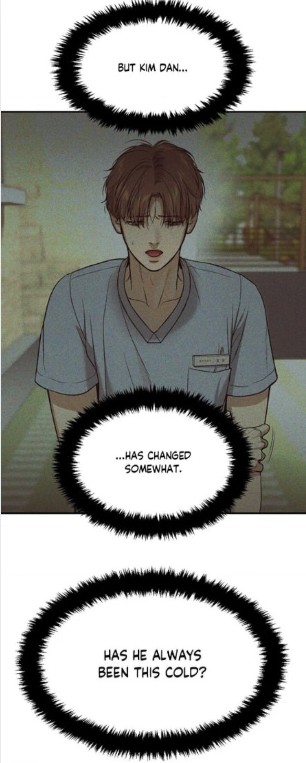 (chapter 62), not annihilation. Jaekyung’s emptiness and misery after the tie becomes the emotional opening that allows him to ask for connection, the more the hamster pushes him away.
4. Practice constructive self-talk
“Shift your inner dialogue: ‘It’s hard, but I can manage.‘” Quoted from Growth Mindset in Healthcare: From Burnout to Breakthrough
We begin to see this shift subtly in Dan’s refusal to collapse into guilt. He begins to set boundaries (chapter 60), stops apologizing constantly, and even expresses irritation or his discomfort.  (Chapter 67) Meanwhile, Jaekyung drops his script of invincibility and openly acknowledges his need for Dan. Neither of them says the perfect thing — but they are no longer using self-talk to punish themselves.
5. Be kind to yourself
“Growth thrives in kindness, not punishment.” Quoted from https://psychology-spot.com/microstress-everyday-stress/
This final dimension is visible most clearly in their embrace. The celebrity, who once saw human softness as weakness, now offers comfort.  (Chapter 68) For him, vulnerability and empathy are no longer rejected, rather embraced and accepted.
 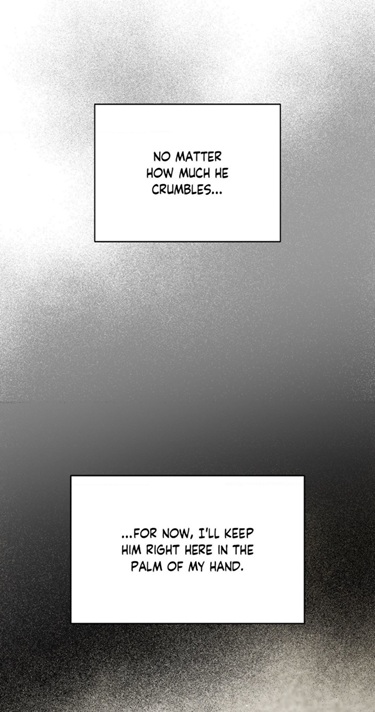 (Chapter 68) Dan, who once viewed care as something he must earn,
  (Chapter 69) begins to receive it. It is not a grand declaration, but a quiet shift: you can fail or cause a ruckus, and still be loved. Hence he doesn’t push away the wolf on the dock.
Modeling a Growth Mindset
Thus, I deduce that Jaekyung is becoming what the grandmother could have been: someone who turns vulnerability into connection and growth. And importantly, his growing acceptance of Kim Dan’s vulnerability marks a turning point not only for their relationship, but for his own inner evolution. By caring for someone fragile (chapter 69), the star begins to extend that care inward. Each gesture of empathy toward Dan becomes a step closer to self-compassion. In learning to protect someone else without demanding perfection, the wolf is learning, perhaps for the first time, that he too deserves kindness — not just from others, but from himself. He models what the article calls a true “growth mindset” — one that sees failure not as final, but as a catalyst for relational and emotional evolution.
“Having a growth mindset helps you handle stress, bounce back from tough days, and stay motivated. It keeps you learning and evolving without burning out along the way.” Quoted from Growth Mindset in Healthcare: From Burnout to Breakthrough
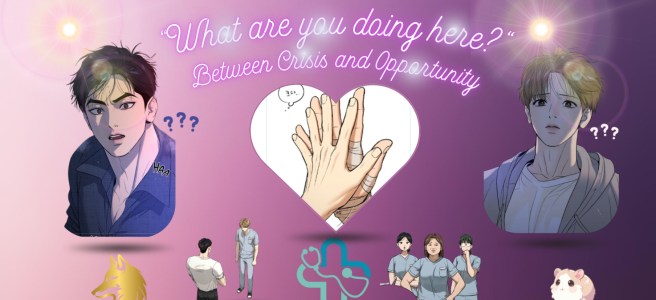
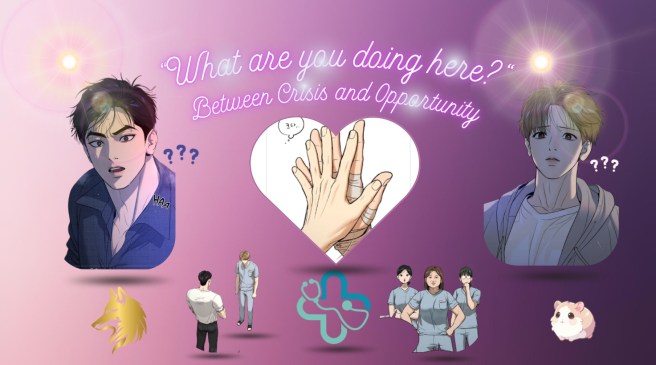
In the end, the question “What are you doing here?” captures a shared moment of disorientation, but also potential. Neither of them expected such a meeting. But it is precisely in that space — between crisis and opportunity — that transformation begins.
Feel free to comment. If you have any suggestion for topics or Manhwa, feel free to ask. If you enjoyed reading it, retweet it or push the button like. My Reddit-Instagram-Twitter-Tumblr account is: @bebebisous33. Thanks for reading and for the support, particularly, I would like to thank all the new followers and people recommending my blog.

 Bebebisous33s' analyses in K-Dramaland and Manhwas