
Please support the authors by reading Manhwas on the official websites. This is where you can read the Manhwa: Jinx But be aware that the Manhwa is a mature Yaoi, which means, it is about homosexuality with explicit scenes. Here is the link of the table of contents about Jinx. Here is the link where you can find the table of contents of analyzed Manhwas. Here are the links, if you are interested in the first work from Mingwa, BJ Alex, and the 2 previous essays about Jinx Behind The Emp’s Shadow and The Scent Behind The Jinx
It would be great if you could make some donations/sponsoring: Ko-fi.com/bebebisous33 That way, you can support me with “coffee” so that I have the energy to keep examining Manhwas. Besides, I need to cover up the expenses for this blog.
The Wrong Forecast
Many readers were happy to discover that Joo Jaekyung and Kim Dan are about to spend a day at an amusement park. 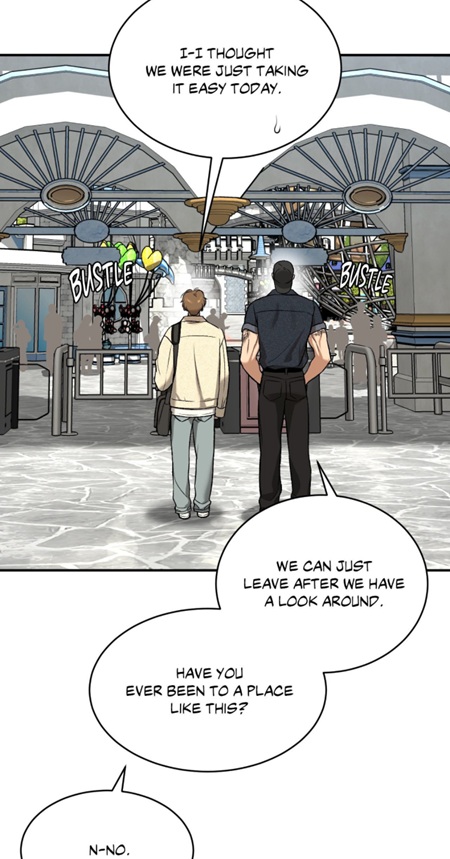 (chapter 82) Jinx-Lovers consider it as their first real date, a long-awaited moment of levity after so much pain. But perhaps we should pause and ask: why this place?
Among the brochures  (chapter 82) scattered on the table, one displays the Eiffel Tower — the obvious choice, symbol of mastery and control. Built for the Exposition Universelle of 1889, it was meant to celebrate France’s industrial power and the centenary of the Revolution — proof that bourgeoisie and steel, not kings and nobility, now ruled the sky and ground. It was even supposed to be dismantled after twenty years, yet it remained, and has since become the symbol of Paris and of France. A monument to progress, modernity, freedom, national pride and endurance.
But the man who picked up these brochures was never a tourist. In the past, Joo Jaekyung would not have chosen any destination at all. He would have stayed inside or trained, untouched by the world outside his window or the gym. 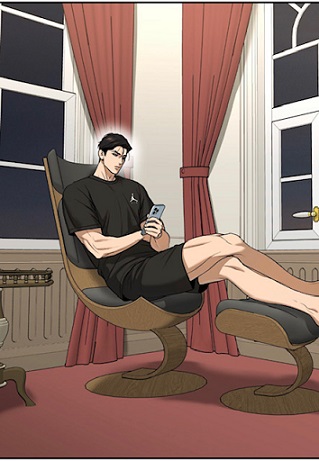 (chapter 38) Hence in the States he is here turning his back to the window and his only connection to others was through the cellphone. The cities he visited were backdrops, not experiences. He was always alone. And yet, here, something changes in Paris.
  (chapter 82) His hotel room opens onto a broad window and a balcony — an invitation to look out. Secondly, observe that he only proposed this activity after the other members had fallen sick. When doc Dan barged in his room, the champion was doing a one-handed handstand, holding his entire weight as if defying gravity itself
  (chapter 82) and proving his recovery. The posture seemed like control, yet it was closer to self-punishment — an immobility that devoured strength. Blood rushed to his heart and head, but his lungs stayed empty. It was, unconsciously, his way of treating his breathlessness. This also shows that he had no real expectation about the “rest” his manager had suggested
  (chapter 82) — the drinking, the empty and aimless trip (“check out the area”). For the wolf, such a downtime could only mean endurance, not release and excitement. By the way, such a suggestion from Park Namwook borders on stupidity and blindness. How could he propose drinking, when he had seen his “boy” indulged in alcohol before?
 (chapter 54) I guess, he must have taken the celebrity’s words at face-value. But let’s return our attention to the panel with the brochures selected by the champion. If you look carefully, you will detect the presence of 4 stars. (chapter 82) They reveal the protagonist’s thoughts and emotions. He is happy!! The news brought by doc Dan was actually good news! 😂
 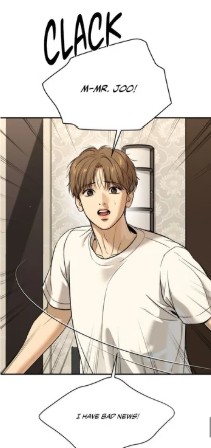 (chapter 82) How do I come to this interpretation? We have seen these stars before, during Kim Dan’s Summer Night’s Dream: the same glittering symbols of softness and excitement.

 (chapter 44) Yet, this time, the little “stars” belong to the celebrity.
For once, the fighter blushes, smiles, and dreams. 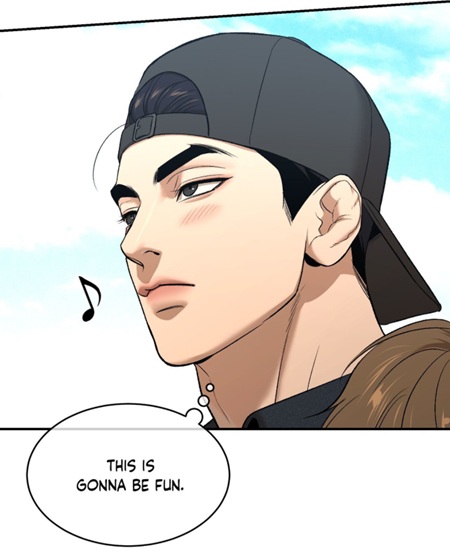 (chapter 82) His choice of the amusement park is not really about himself and his desires— it is an act of care, a wish to give happiness to someone else.
And here, I feel the need to add this information. The most famous theme park next to the capital is Eurodisney which is strongly intertwined with fairy tales (The Little Mermaid  , Sleeping Beauty
 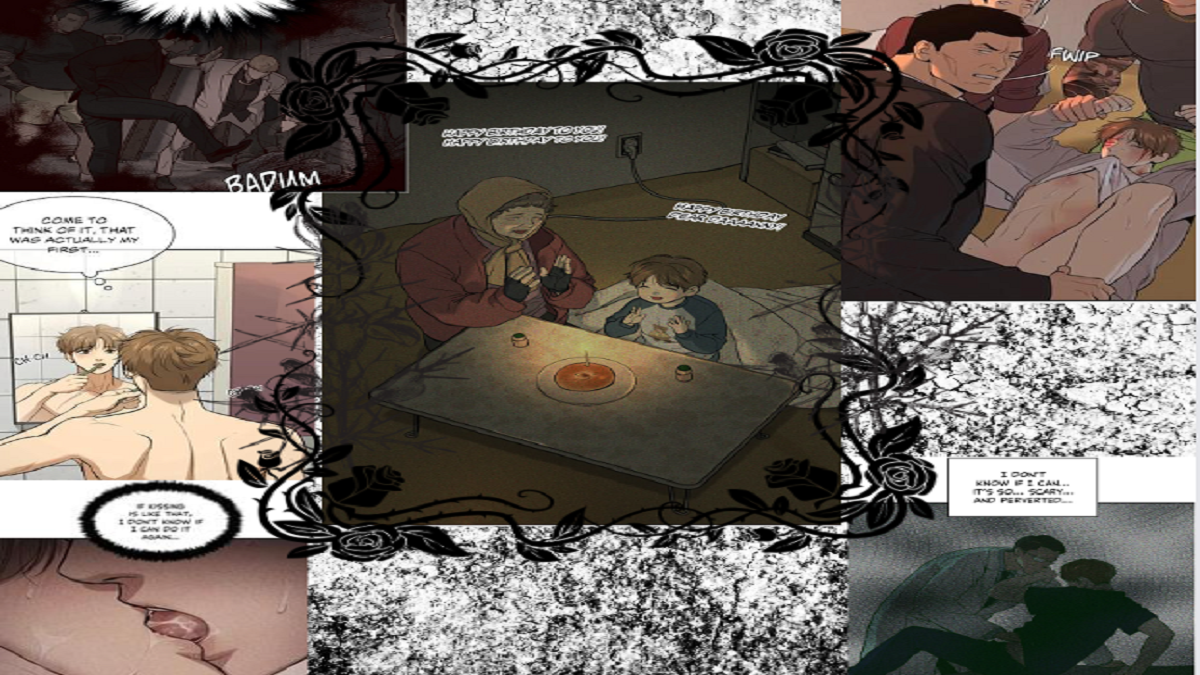 and Beauty and the Beast
 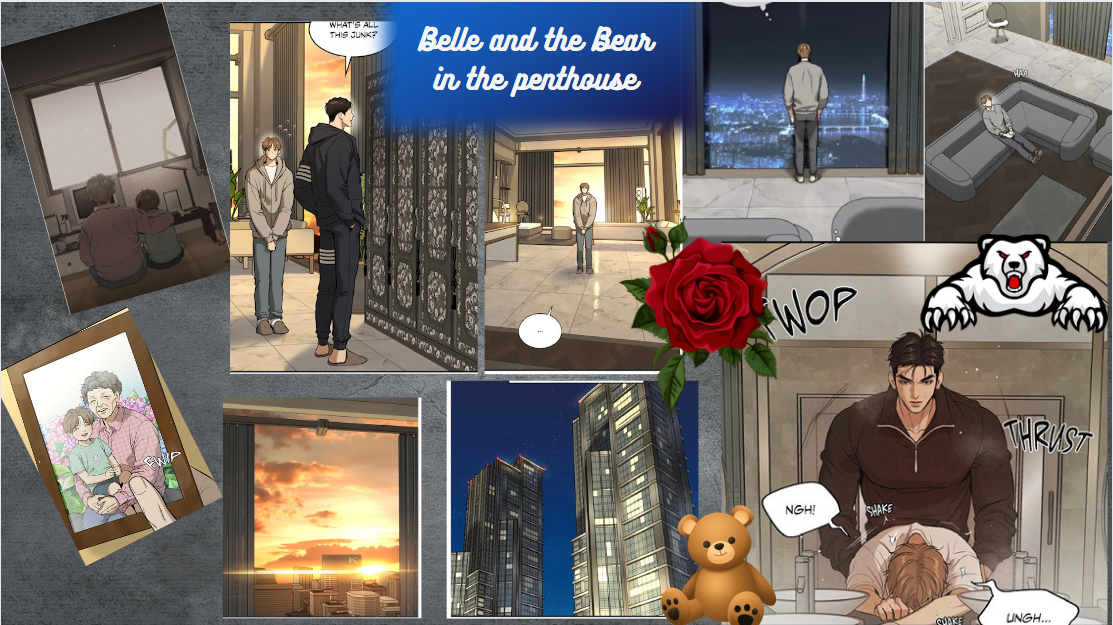 ).Hence there is the castle on the brochure. (chapter 82) This shows that my connection between the fairy tales and Jinx was correct. Eurodisney is a place built for children, stories, and families, where a person’s worth is measured not by conquest but by joy and time shared together. On the other hand, such a funfair cannot be separated from money; it is a space of paid joy, accessible only to families with a certain income. This alone explains why neither Kim Dan nor Joo Jaekyung has ever visited it before.
  (chapter 82) For both, it was financially and emotionally out of question. It grounds the symbolism of the amusement park in social reality, reminding readers that “fun” is also a form of privilege. This means that the champion is actually on his way to replace this picture:
  (chapter 65) So yes, this may look like a simple date. Yet beneath its playful surface lies the quietest revolution of all: the man who once ignored every view now opens the window, looks outward, and chooses wonder and fun over war.
When I first speculated about France, I imagined Cannes — the realm of spectacle, trophies, and bright façades. I was wrong about the destination  (chapter 81), but not about the geography and air. I had truly detected the importance of this image and its symbolism. The plane that opened this arc spoke not of luxury, but of altitude — of a life lived too high, where oxygen is rationed by pride. Below the aircraft stretch the Alps, which I had correctly identified. From there flows the athlete’s own water – Evian
 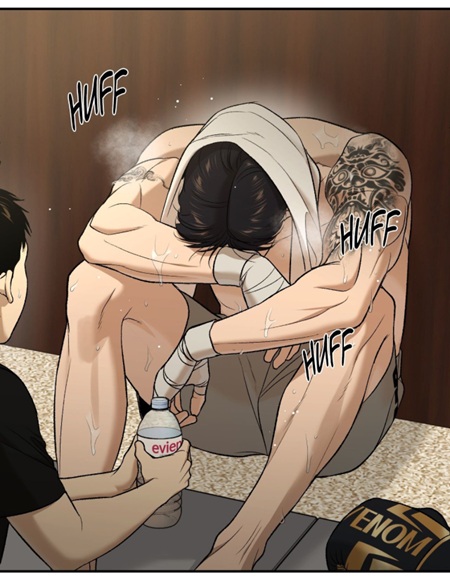 (chapter 82) (written Evien in the manhwa) — drawn from the mountain that sustains him and starves him at once.
And now, let me you ask this: what happens to a candle’s flame at high altitude? It flickers, gasps, and finally dies for lack of air. This is exactly what Mingwa foreshadowed in the promotional poster 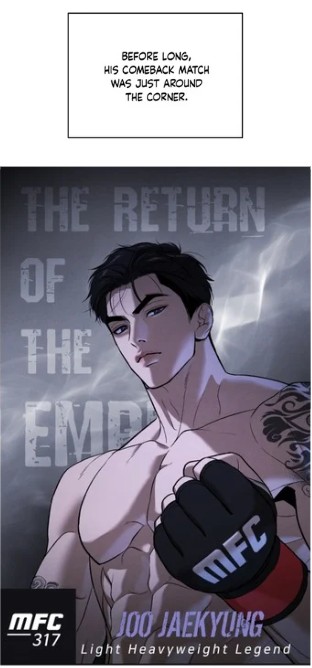 (chapter 81): the rising smoke, the suggestion of a light already suffocated. The higher they bring him, the closer he moves to extinction. Besides, the higher he climbs, the harder the fall. In other words, they are trying to break him — to make him fall — something the athlete has already sensed.
  (chapter 82)
It is no coincidence that his opponent in France is an eagle 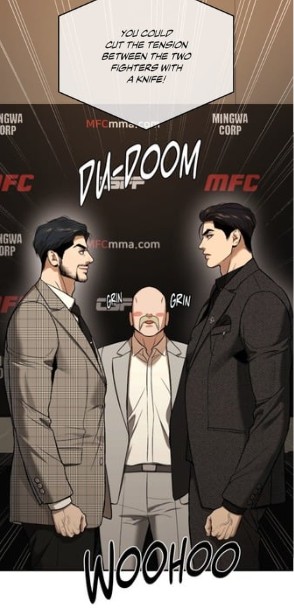 (chapter 82) — a creature of heights and thin air, born to dominate the skies where others can barely breathe. The metaphor could not be clearer: altitude is his arena, but also his undoing.
Now they are in Paris, and it is fall — not yet cold because of the presence of the sun.  (chapter 81) The air remains clear and generous, the sky washed in blue as if nothing could go wrong. Yet the trees, touched by the first copper tones, announce the slow turn of the year. It is a calm, lucid atmosphere, the kind of weather that hides transition inside serenity. The unseen Seine glides through the city like a long breath, steady and effortless.
In this luminous stillness, the champion tries, for the first time  (chapter 82), to build joy outside the ring (chapter 82) — to borrow light for someone else’s smile. Paris welcomes him not with spectacle, but with ordinary clarity: air that holds both change and peace.
So yes, this may look like a simple date. Yet beneath the gentle brightness lies something deeper: the rest is supposed to treat Joo Jaekyung’s breathlessness. (chapter 82) Everyone has noticed that the athlete has been burning out quickly during training.  (chapter 82)
So why is he struggling so much with breathing? It is more than just an altitude question.
Airport – Exhaling for the First Time
Like mentioned in the previous essay, the airport symbolizes transition, a sign that both protagonists are gradually changing, but their metamorphosis is not complete. Interesting is that Mingwa focused on the champion’s reaction at the airport which only Jinx-lovers could notice.  (chapter 81) A single breath — huu — escapes, white against the air. It looks like calm, but it isn’t. It’s the sound of a man forcing his body to obey. The clenched fist that follows betrays him: anxiety condensed into muscle.
 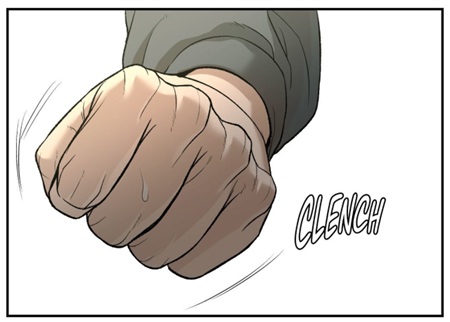 (chapter 81) The champion has descended, yet the altitude still lives inside him.
Every cell of his body is trained to equate success with survival, control with oxygen. Even here, standing on solid ground, he breathes as if a fight were about to begin. His chest expands too sharply; his breath leaves in bursts. The nervous exhale isn’t relief — it’s containment. To conclude, he is tense, because he is anxious. This time, his shoulder is not betraying him  (chapter 14), but his lungs and heart. Yet at the airport, the sportsman doesn’t realize it (chapter 81) — he is drawn eyeless, suspended in a state of self-control rather than awareness. His brief moment of meditation is still ruled by habit: the reflex of an athlete who measures calm through dominance. For him, success has always been synonymous with survival and such life. Hence later in his bedroom, he recalls his first tournament and defeat
  and makes the following resolution: (chapter 82) But there exists another reason why the athlete’s heart and lungs are betraying him.
The truth behind Joo Jaekyung’s breathlessness
Let me ask you this. When did we hear and see the champion’s breathlessness in the past? 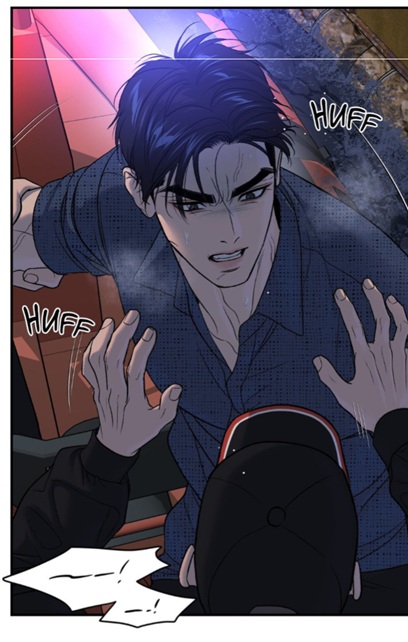 (chapter 69) Back then, he feared for doc Dan’s life and ran as if his own heart depended on it. His breathlessness wasn’t exhaustion but panic: the instinctive terror of losing the person who keeps him alive. Thus when he saw him alive on the dock, he could start breathing properly:
  (chapter 69) From HUFF to HAA… exhale versus inhale.
Seen under this light, his current symptoms are no mystery. What burns him out in training isn’t merely overwork—it’s fear disguised as stamina.  (chapter 82) His brain and heart remember that night at the dock; every harsh inhale during practice echoes that same dread of separation.
Before his collapse, the opponent Arnaud Gabriel had casually flirted with his “fated partner.”  (chapter 82) And how did the champion respond to that provocation? Like a cornered animal.
 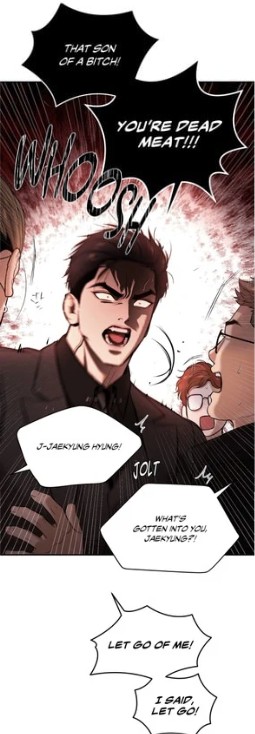 (chapter 82) He became the wolf again, not out of jealousy, but out of survival reflex—his body screaming its panic in place of words. In that instant, he was reminded that he could lose doc Dan as a partner, that the bond he relies on might not belong to him forever.. The roar emptied his chest; his lungs gave out before his pride did. There was no air left in his body… thus the heart and lung couldn’t work properly.
That’s why the “burnout” (chapter 82) after training feels different this time. It’s not a failure of strength but a signal from the body, revealing what he refuses to confess: his greatest fear is no longer defeat—it’s loss. And that’s what makes him so human. For the first time, the indestructible champion stands on the same ground as Oh Daehyun—both breathless, both weary, both trapped between expectation and emotion. The difference is that Jaekyung’s fatigue is not born of rivalry but of love. In other words, this scene announces the vanishing of the monster the manager had tried to create and preserve.  (chapter 75) The fearsome beast who once fought for dominance is gone. What remains is a tamed wolf, following his master’s voice (doc Dan) — not out of submission, but because he finally trusts where it leads.
 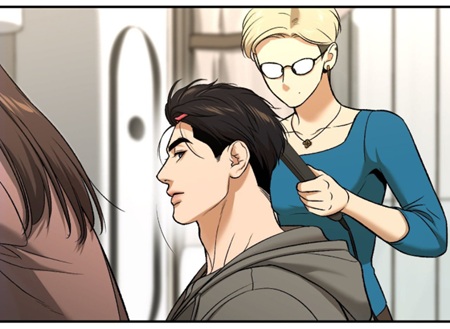 (chapter 82) He is now a tamed wolf following his master’s suggestions!
  (chapter 82) Thus the coach is now facing the couple. And now, my avid readers can understand why the champion seems almost radiant when he finds himself alone with doc Dan at the amusement park. It is not mere joy or freedom; it is the relief of finally acting from desire instead of duty (chapter 82) For once, he can do what he truly wants — to make the man beside him breathe.
The motivation behind this “date” goes beyond playfulness. It is his way of returning the gift he once received. Remember the birthday card (chapter 55): 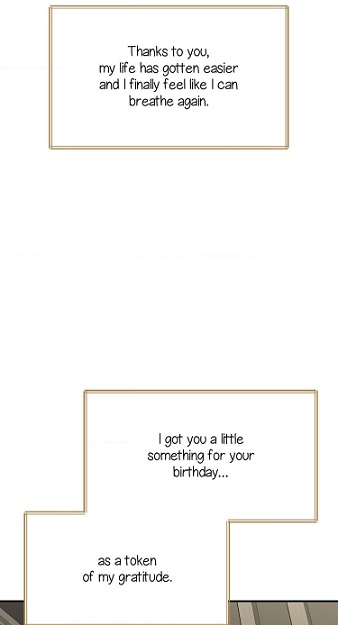 (chapter 55)
“Thanks to you, I finally feel like I can breathe again.” That card became the emblem of hope — a promise of redemption. Joo Jaekyung had been able to bring the physical therapist comfort and support in the past, so he can do it again. If he can help doc Dan breathe freely, without fear or debt, then perhaps he himself can breathe without fear as well. In other words, we should expect a confession in the future episodes.
“I Won’t Fall Again” — Gravity, Shame, and the Vow
Falling is actually the champion’s biggest fear. (chapter 82) That’s why Mingwa confronted him with reality, when she stages doc Dan’s unconscious suicidal attempt in front of the railing:  (chapter 79) The scene functions as both mirror and revelation: it forces the fighter to face the truth he has avoided all his life. In the past, he had never truly fallen. His defeats were painful, but never fatal; his failures never signified the end of a life. He could always stand up again — until now. Watching Kim Dan lean over the edge forces him to confront the difference between metaphor and mortality.
But this rises the following question. Why does he associate his first tournament (chapter 82) with fall (chapter 82)? After all, that match ended only in a knockout, not in death. The answer lies at home. The boy’s first image of defeat was not his own body in the ring, but his father’s corpse on the floor 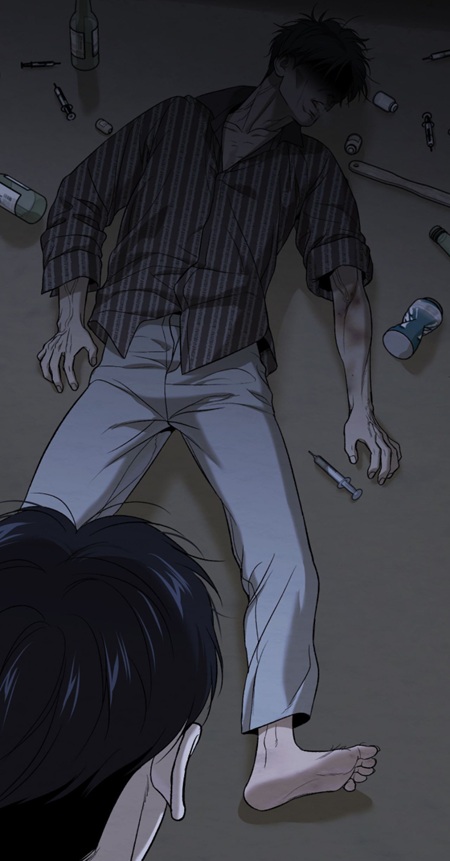 (chapter 73) – surrounded by bottles and syringes (chapter 73). Addiction, gambling, and intoxication: all ways of trying to rise above reality, to feel high, if only for a moment. Joo Jaewoong quite literally died from altitude, from chasing a false form of air. His father had tried to climb the social ladder through sport, to escape the poverty that trapped them, but he had failed. Those words
  (chapter 73), thrown like stones by the father at his son, buried themselves in the boy like shards.. They echoed like a curse — a prophecy Joo Jaekyung would spend his whole life disproving.
The young Jaekyung saw and understood. When he collapsed during his first tournament, finishing third because there were no other opponents (chapter 82), he has the same posture of that corpse — arms spread, breath gone, waiting for someone to call him back to life. Back then, his father was still alive, but didn’t care for him. However, such a position announced the future demise of Joo Jaewoong. He had fallen out of excess; he fell out of weakness. Both were conquered by gravity, one literally, the other symbolically.
But the mother’s departure turned that fall into reality. She left the house claiming that the father’s violence and failure were to blame  (chapter 72)
 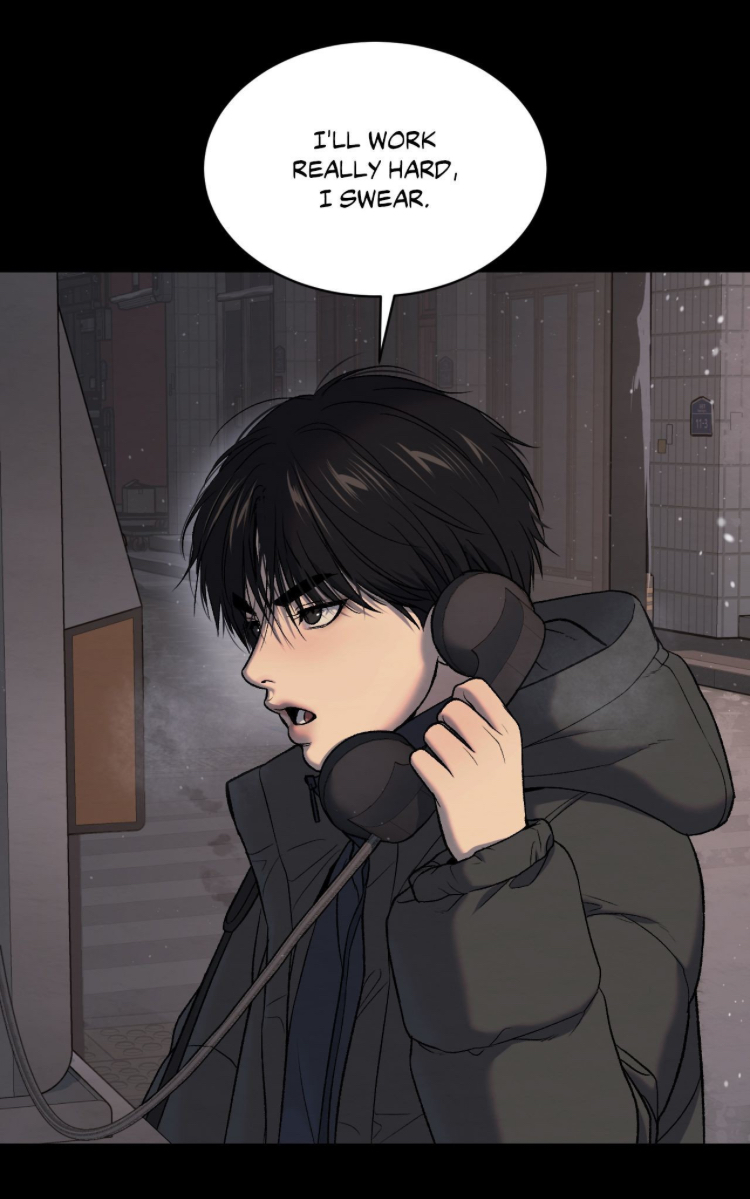 (chapter 72), yet she made no attempt to build an independent life. Her survival had always depended on his success — and when his career crumbled, she vanished with it. That’s the reason why the trash remained uncollected — a visual proof of abandonment
  (chapter 72) But the little boy failed to notice it, because he was suffering from the father’s abuse. Before leaving, she gave her son a phone number, as if absence were only temporary, as if love could be reached through a dial tone. That small gesture sustained an illusion: that she would come back if he became strong enough, rich enough, worthy enough. That illusion became the foundation of his life.
Thus he trained obsessively, demanding to compete even as an elementary student  (chapter 72) His first fight was not about trophies — it was an act of filial negotiation: a promise to buy her return. But of course, 300 dollars could not rebuild a family. His first fall became the confirmation of her silence. This explicates why he recalls his first tournament and considers it as “fall”. He had not been able to win, thus the mother could not return. He doesn’t fight for glory or passion; he fights to avoid being discarded again. So, when he says “I won’t fall again,” what he really means is “I won’t let myself be unloved again.”
In other words, he wanted to climb in order to rebuild the missing bridge to his mother.  (chapter 72) But the problem is that when he was finally able to reach his mother, the latter answered that Joo Jaekyung was too late. The mother’s words sealed the curse. He was “already grown up now”
 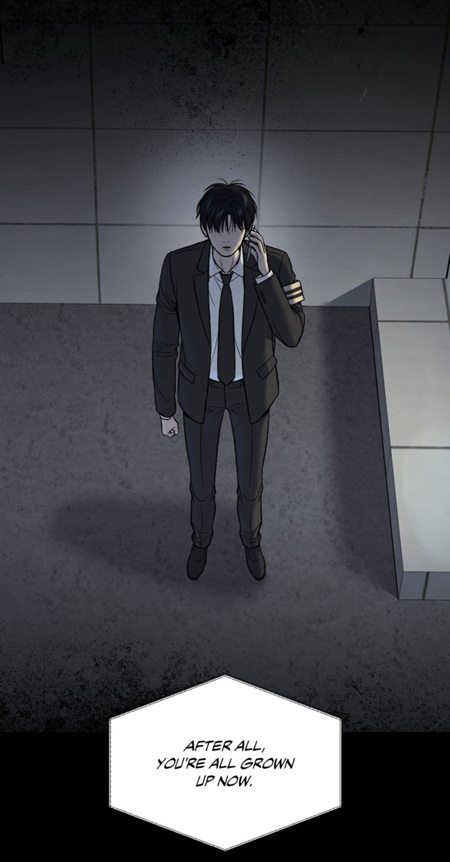 (chapter 74), hence he no longer needed her — as if maturity meant he no longer needed love. She actually implied that she had been all this time by his side.
  (chapter 74), while in reality, she had long abandoned him. Her departure turned growth into punishment, and independence into exile. This explicates why as an adult, he used money to buy people and turn them into toys. This could only make appear as a spoiled brat.
He built his entire life around that promise, standing against gravity like an inverted pillar. The body that once touched the ground became a monument to refusal. He had to reach the sky, to remain in the air. Thus he chose the penthouse as his new home.
But defying gravity comes at a cost. He trained to stay upright until breathing became difficult due to the thin air. Breathing itself became rebellion. Every gasp of air reminded him of the father’s last exhale. Every victory was a way of proving that he could resist both descent and inheritance. Yet the same vow that kept him standing also froze him in place: a man always in motion, never resting.
When Kim Dan almost fell from the railing (chapter 79), the scene echoed this primal fear. The champion’s hand reaching out was more than reflex — it was salvation in reverse. By catching the doctor, he was symbolically catching his father, his mother, and the child he once was. In that single gesture, he refused to let history repeat itself.
The sentence “I won’t fall again” is no longer just a boy’s defense; it is a man’s confession. It reveals the weight he carries: the fear of becoming the very body he once found on the floor, the terror of losing the one person who gave him air. Through doc Dan, Joo Jaekyung learns that grounding himself is not failure but healing: he must get closer to the ground to draw air back into his lungs.
And now, we can understand why he chose the amusement park over the Eiffel Tower. The fighter who once chased altitude now seeks balance at earth level. His goal is not to impress through grandeur or wealth, but to care, to laugh, to rebuild joy together.
By choosing play over pride, he is attempting to rewrite his history — to erase the legacy of his parents’ abandonment and failure. What once was a vow against falling now becomes a lesson in how to stand, breathe, and love on common ground. Hence he looked for attractions and found these brochures. He didn’t want to leave it to fate contrary to his hyung.
Breathlessness and Youth
Before focusing on the funfair, I would like to give another explanation for his sudden breathlessness. (chapter 82) In chapter 82, both Yosep and the manager interpret the champion’s shortness of breath in purely technical terms. Yosep assumes it comes from his long absence from the ring, while Park Namwook agrees — eager to reduce fatigue to mere physiology. Their reasoning sounds plausible, yet it misses the core truth.
Joo Jaekyung’s breathlessness was never an issue before.  (chapter 79) Even Park Namwook himself, only days earlier, had described the French match as
  (chapter 81) “a breeze” — a fight so effortless that it would bring some fresh air into the champion’s career. But that metaphor betrays its irony: what was supposed to refresh him is now suffocating him. The “breeze” promised by his manager has turned into lack of air.
If his lungs are giving out, it is not from lack of training, but from an excess of negative feelings. This is the paradox of his transformation. The man who once lived like stone — unyielding, heavy, immovable — is now becoming light, emotional, alive. His body, once used only for control, now responds to affection, anxiety, and loss. He is breathless because he has begun to feel again.
Interesting is that (chapter 79), the break is perceived differently, depending on the situation. (chapter 82) In one scene, the break is seen as a good opportunity, in the other not(“out of the game”). Besides, at no moment, they are using the word “recovery”, as if the man had never been surged.
What neither man notices is that the athlete’s body had already changed during that so-called “break.”
In truth, he had caught a cold  (chapter 70) — a detail no one around him ever learned. This simple fact overturns their interpretation.
 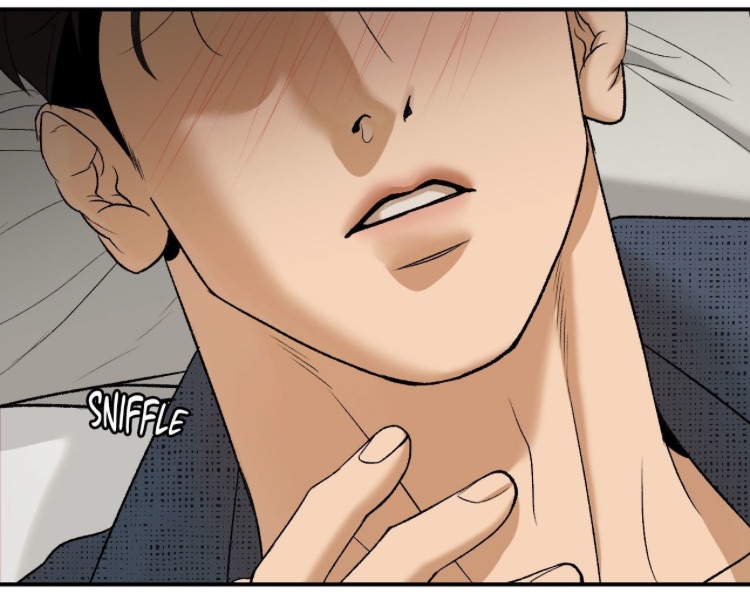 (chapter 70) The breathlessness they see now is not a decline in performance, but the residue of transformation. His body, once trained to suppress every weakness, had finally surrendered to nature.
The cold, therefore, was not an illness but a rebirth — the first genuine sign of rejuvenation.
The first sneeze burst out like a leftover gasp from the night of panic at the dock (chapter 69): an involuntary release of fear and tension. Flooded with air and emotion, his body responded the only way it knew how — by collapsing into vulnerability. It was the moment when the emperor turned into a man, when the monument learned to breathe.
This was not simple fatigue; it was renewal.
For the first time in years, his system behaved like that of a human being, not a machine. The flushed cheeks, the runny nose, the dazed look — all marked a regression to childhood, an age when feelings could still flow freely. Before, he had never been breathless, because he was living like a zombie or a machine ignoring pain. Breathlessness had once been a symptom of repression; the cold became the body’s quiet revenge, proof that he could still react, still feel.
In this sense, the cold acts as metaphorical cleansing — an expulsion of the stale air he had been holding since childhood. The “monster” that Park Namwook wished to preserve (chapter 75) was finally dissolving. What replaced it was something fragile yet alive. But Yosep and Park Namwook, more obsessed with performance and profit, mistook this renewal for decline.
This connection between breathlessness and youth extends beyond Joo Jaekyung. We’ve seen another fighter gasping for air — Seonho 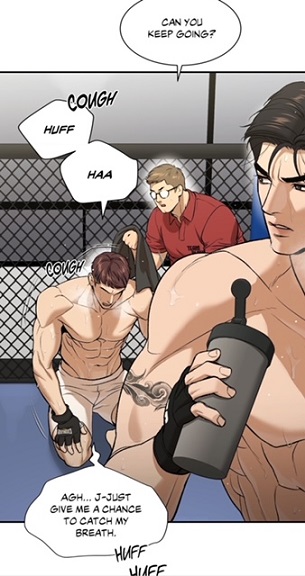 (chapter 46), whose clash with the champion exposes two different forms of frustration.
It begins with Jaekyung’s own accusation. 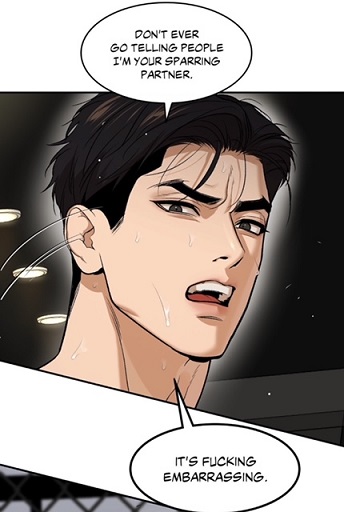 (chapter 46) He reproaches Seonho for using his title and image to promote himself, for bragging about their sparring sessions to boost his career. From his perspective, Seonho lacks both endurance and authenticity — he performs strength rather than living it.
 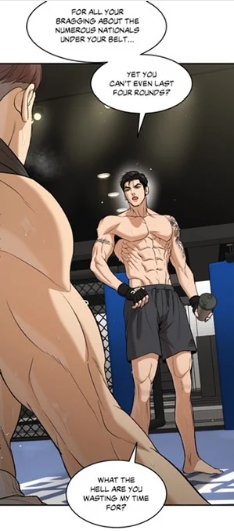 (chapter 46) For Jaekyung, such behavior is intolerable because it cheapens everything he has sacrificed to achieve.
But Seonho’s retaliation strikes closer to the heart. 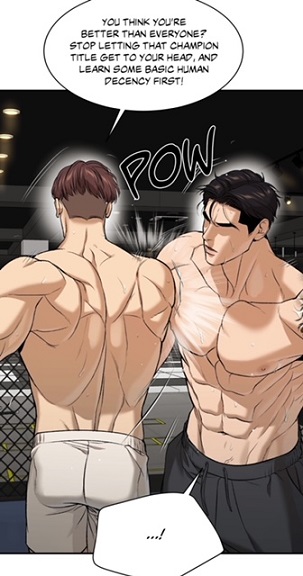 (chapter 46) He turns on Jaekyung and accuses him of arrogance — of using his champion title to look down on others. What Seonho perceives as disdain is, in truth, the athlete’s defense mechanism. The star’s detachment is not born from pride but from obligation and trauma (abandonment issues).
For years, he has been forced to be perfect — the faultless product that Yosep and Park Namwook can market and control.  (chapter 46) His perfection is not freedom; it is captivity.
The irony is cruel: Seonho envies what Jaekyung himself resents deep down. He is not happy.
One gasps because he cannot reach the summit; the other because he can never descend and have a family. Both are breathless — trapped at different altitudes of the same illusion. In this light, breathlessness becomes the shared symptom of youth distorted by ambition. For Seonho, it signals decline — the body’s inability to keep up with the illusion of eternal strength.
For Jaekyung, it marks the end of the illusion itself — the beginning of human fatigue, emotion, and rebirth.
Under this light, it became comprehensible why Seonho  (chapter 52) tried to recruit Potato, the youngest member from Team Black. He wanted to become the new idol of Hwang Yoon-Gu. He imagined that he could replace the main lead and Potato would be happy to become the new sparring partner of Seonho.
And this prepares the ground for his encounter with Arnaud Gabriel, the “eagle” who embodies yet another version of false air 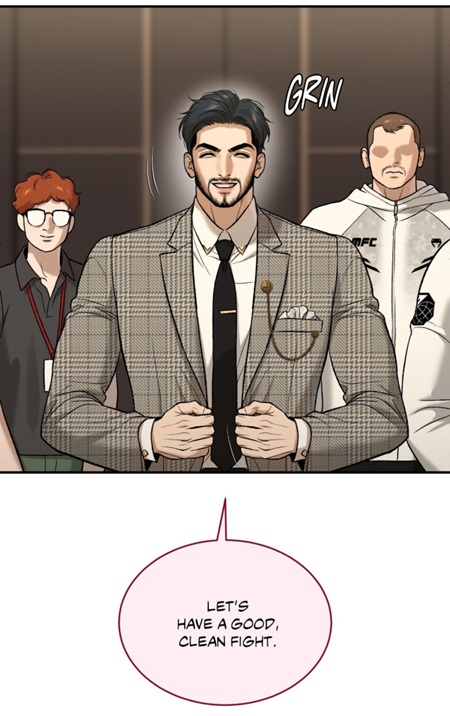 (chapter 82) — a beauty that glides but never lands. Like Seonho, Gabriel thrives on appearance — on surfaces polished by attention. His beauty, elegance, and social charisma are his weapons. He lives in the air of visibility, relying on wind — the shifting currents of social media
 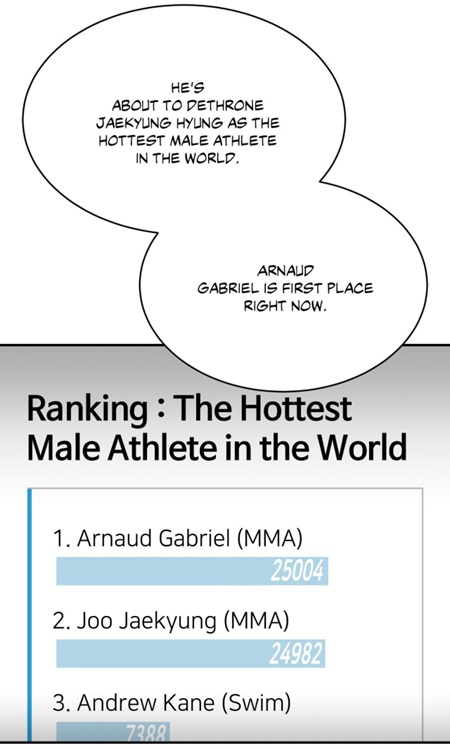 (chapter 81)
  (chapter 82) and press coverage — to lift his name higher. That’s why Mingwa made sure to show him at the press conference.
  (chapter 82) Every post, every camera flash, every headline serves as borrowed oxygen.
We see him carefully maintaining this illusion of effortless flight: (chapter 82) posing in his new suit for the press conference, his public image as flawless as his wings.
 (chapter 82) Yet beneath that composure lies dependency. Gabriel’s power exists only as long as others keep watching, as long as the wind keeps blowing. His world is made of altitude — but the higher one flies, the thinner the air becomes. But if there is no wind or air, the eagle can no longer fly. This is palpable on two occasions, his encounter with the two male leads.
When he flirts with doc Dan (chapter 82), Gabriel still speaks in French — creating an act of exclusion. The physical therapist can’t understand a word, but the eagle doesn’t care; comprehension isn’t the goal, impression is. The wink replaces language, turning seduction into spectacle. It’s not meant for dialogue but for display — a gesture meant to be seen, not felt. He imagines that he has wooed the physical therapist.
He doesn’t wait for a reply; he simply turns away, leaving Doc Dan behind. 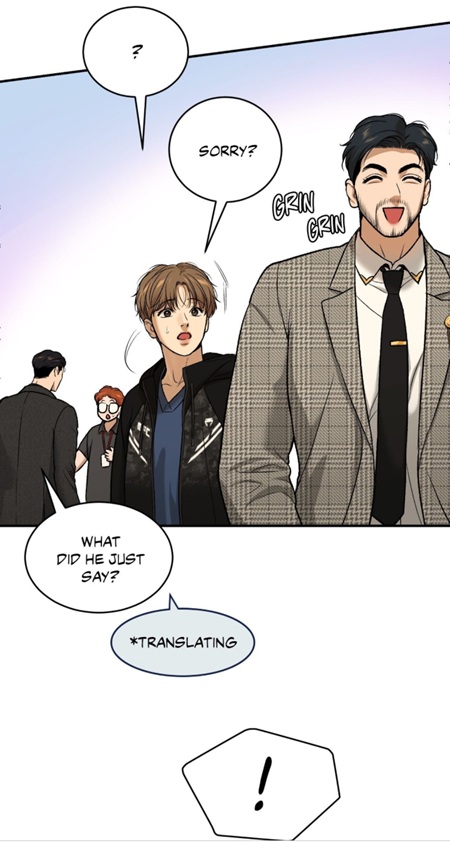 (chapter 82) The grin that follows is one of self-satisfaction and superficiality, not connection. It’s the smile of a man admiring his own reflection in another’s confusion — proof that he controls both the scene and the gaze. This shows that he had no intention to make the protagonist jealous. And it is clear that he never saw the wolf’s rage afterwards. (chapter 82)
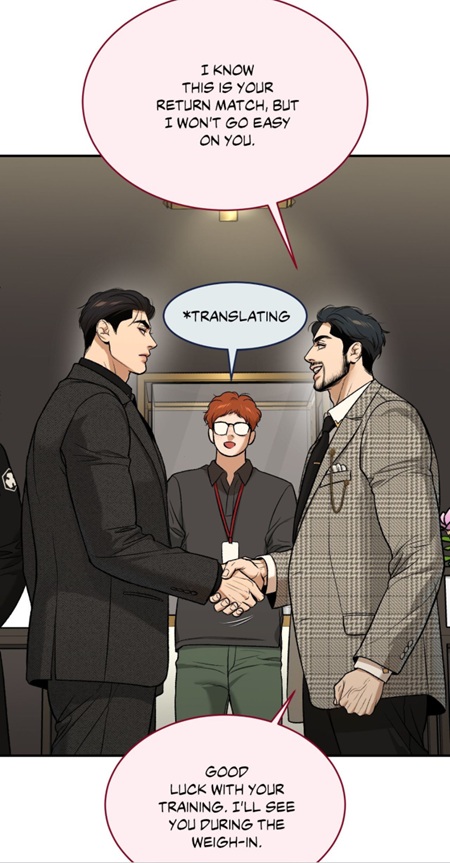
But why did he approach the Emperor, after he had left the spotlight? One might say that it was to get his attention and provoke a reaction. The same arrogance colors his handshake with Joo Jaekyung. Gabriel greets him with a polished smile and an extended hand, yet his words carry a double edge: (chapter 82)
- “I know this is your return match, but I won’t go easy on you.” Behind the polite phrasing hides mockery and calculation. The smile is diplomatic; the tone, predatory. By choosing to speak in French, through an interpreter, he asserts distance and superiority. It is not a language barrier — it is a form of hierarchy.
- “Good luck with your training,” he pretends to wish him well while quietly diminishing its target. The implication is clear: you’ll need it. The eagle knows about the champion’s surgery and exploits that knowledge beneath a façade of charm. Every word he utters, whether to Jaekyung or Dan, is a performance — a test of power disguised as civility.
Everything is pointing out that Gabriel knows more than he admits. His remark reveals that he is fully aware of the champion’s surgery and the rumors surrounding it. He could even know about the drinking and his “lack of stamina”. (chapter 82) The line echoes in irony. On the surface, it invokes sportsmanship; beneath it, it suggests that Jaekyung’s previous victories were not clean — that his reign was tainted by aggression or controversy. Yet the true paradox lies elsewhere: Gabriel himself knows that this match is anything but clean. He is exploiting Jaekyung’s weakened condition, confident that he will prevail against a half-healed opponent. That’s why the athlete was encouraged to appear in a suit.  (chapter 82) That way, his “vulnerability” would be masked. No one would question the champion’s health. And this brings me to my next observation.
This duplicity mirrors the logic of Hwang Byungchul, the old coach who once criticized Jaekyung for fighting too soon after his shoulder surgery 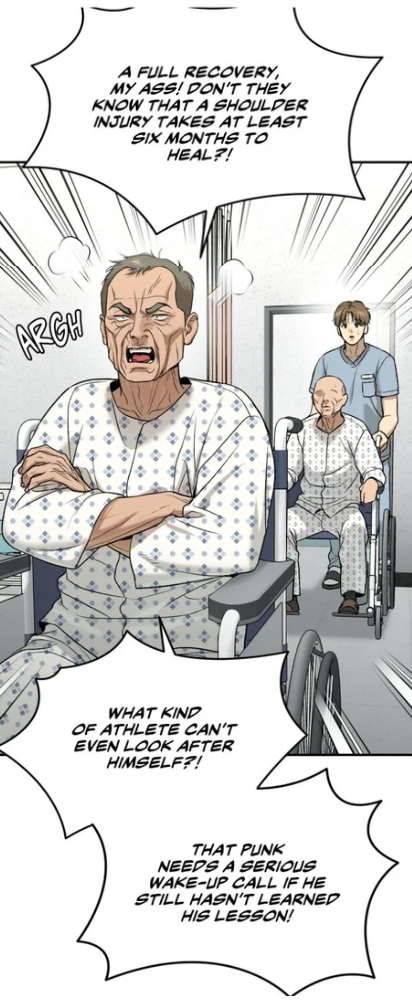 (chapter 70). Both men embody the same cruelty disguised as professionalism — one in the ring, the other from the shadows. They blame the champion for the new match, none of them question the system.
Gabriel’s arrogance, therefore, is not personal but systemic. He represents the world that raised Jaekyung: a world where weakness is mocked, empathy is absent or a lip-service, and “clean fights” exist only as public performances. That’s why he stands for fun. He has never truly challenged “dangerous opponents”. The eagle’s flight is powered by the same wind that once blew through the director’s gym — the cold air of superiority. This means that unlike Joo Jaekyung, the eagle has never faced real turbulence.
Gabriel has lived in an atmosphere of praise, never subjected to the kind of hostility that constantly surrounded the champion. He has not endured the venom of hateful comments 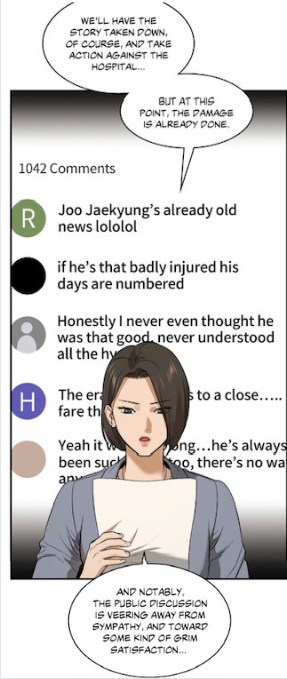 (chapter 36) or the media’s harsh verdicts after defeat
  (chapter 54), when analysts accused Jaekyung of recklessness for returning to the ring too soon, though he had problems with his shoulder. Gabriel’s fame soars above such storms — sustained by admiration, not endurance. Hence he is posting selfies.
(chapter 82) However,, Joo Jaekyung is no longer attached to his cellphone and the virtual world. What he truly wants now is real and true love from doc Dan. (chapter 82) This explains why he is seen interacting more and more directly with fans and this outside! 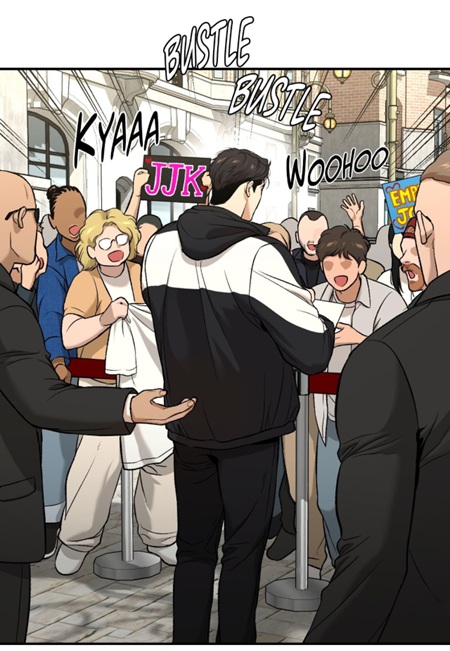 (chapter 82) He is now seen signing autographs
 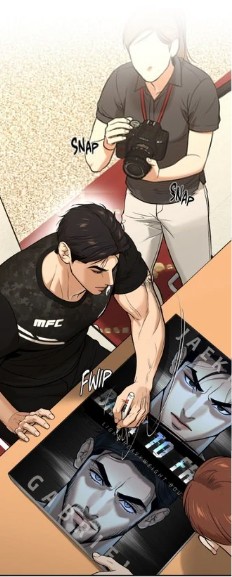 (chapter 82), whereas in the past, he was only seen in company of reporters in a secluded area.
  (chapter 40)
But this match carries a hidden danger. It was secretly arranged by the CEO, a fact still unknown to the public. Should Jaekyung win, the backlash could fall not on the loser, but on the victor. Critics could accuse the champion of avoiding a real challenge — of selecting an easy, lower-ranked opponent (chapter 81) rather than facing the fighters in first or second place.  (chapter 69) The victory would be branded as hollow, a publicity stunt rather than an athletic achievement.
Yet this very accusation could threaten Gabriel as well. By calling him weak, the same commentators who once worshipped his image would strip him of his core identity: that of an athlete. (chapter 81) He wants to be admired as the hottest male figure in the sport, but admiration without credibility is only ornament. If his skill is questioned, his entire persona collapses.
Thus, both men stand on fragile ground — one condemned for winning, the other diminished by losing. Gabriel’s elegance and Jaekyung’s strength mirror each other’s curse: both are trapped in a world where value exists only in the eyes of others, and where even victory can feel like a fall. However, this can change, if this fight becomes a true spectacle, and is born out of love! But the air that sustains Gabriel is not the same that now fills Jaekyung’s lungs.
The eagle rises through applause; the wolf begins to rise through love. Liebe verleiht Flügel (German) — love gives wings — but these wings do not lift him away from the world. They carry him closer to it, toward the ground, toward life and fun.
The Amusement Park and its Ferris Wheel — Circles of Breath and Light
If the Eiffel Tower was built to celebrate height and conquest, the Ferris wheel, 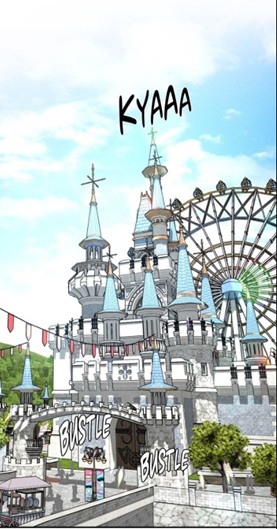 (chapter 82) first unveiled at the World’s Columbian Exposition in 1893, was created to transform height into play. Conceived by engineer George Washington Ferris as America’s answer to the Parisian tower, it sought to outshine France not through steel alone, but through motion — a structure that would rise and fall, carrying ordinary people with it. Unlike the fixed tower, the wheel invited participation: passengers would move together, share the air, rise and descend without fear. It was both monument and moment — a way to democratize the sky.
That is the kind of altitude Joo Jaekyung chooses.
After years of living at the top — in the isolating stillness of the champion’s penthouse, the rooftop — he now turns to a form of shared elevation. The Ferris wheel becomes his antidote to the rigid hierarchy that once defined his life. Here, there are no rankings, no first or second place, only circular motion. One rises while another descends, but both will meet again. It is the geometry of equality — and the perfect metaphor for breathing. This means that, by choosing the Ferris wheel, Joo Jaekyung and Kim Dan experience a gentle form of falling — one that no longer hurts.
Each rotation of the wheel is an inhale and exhale; ascent and descent, effort and release.
Inside the small cabin, air is shared. Love and life become visible through motion rather than achievement. The attraction’s design embodies the very thing Jaekyung and Dan have been learning all along: balance.
For the doctor, whose childhood was shaped by financial limits and emotional debt, the wheel offers what he never had — the chance to look at people from above, to rise without cost or guilt. For the champion, it restores what he lost — the ability to enjoy altitude without suffocating, to associate height not with fear, fame, or trauma, but with wonder. In that cabin, surrounded by laughter and sky, they can both breathe again.
But the symbolism extends further.
The Ferris wheel stands in sharp contrast to the highway, the modern symbol of depression and disconnection. As psychologists have noted, this kind of highway thinking characterizes the depressed and overdriven mind. It is the mental state of someone who keeps moving forward in a single direction — not out of purpose, but out of inertia. The brain becomes trapped in one lane, incapable of detouring, exploring, or slowing down. Over time, this creates a kind of perceptual tunnel: a world reduced to one goal, one fear, one story.
I watched this documentary, but it is in French https://www.youtube.com/watch?v=v5YcH5X5Xgo
In depression, this narrowing becomes pathological. The mind loses its ability to imagine alternatives, to see side roads or landscapes beyond the straight line ahead. Reality shrinks into a one-dimensional track — progress without perspective. The obsession with direction replaces the experience of life itself: one keeps accelerating or slowing down, chasing milestones, yet the inner landscape remains unchanged. This is how I came to connect these three scenes:
| Chapter 33 | Chapter 56 | Chapter 69 |
|---|---|---|
 That reflects the champion’s mind-set, his narrow-mindedness. But keep in mind that during that evening, the champion made a detour, he was disturbed by the destination/ goal: 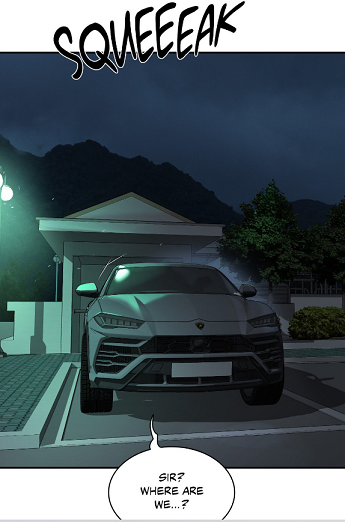 | 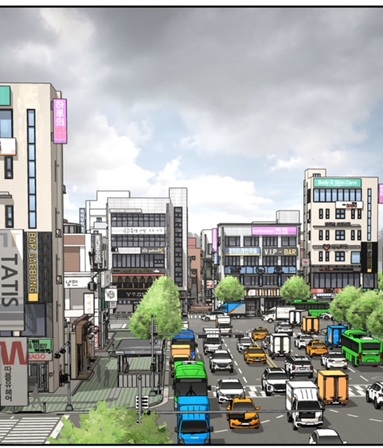 Here the athlete has only one goal: talk to doc Dan and clean the air. He has no intention to truly rekindle with him Here the athlete has only one goal: talk to doc Dan and clean the air. He has no intention to truly rekindle with him 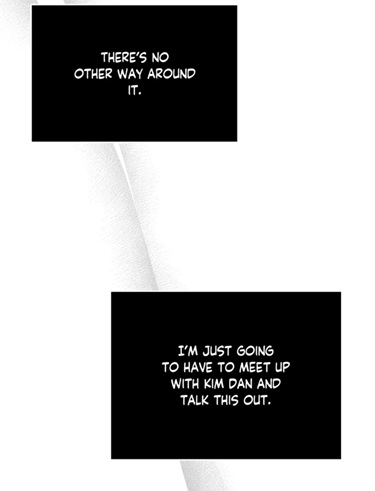 Thus he is still stuck in a traffic jam. Thus he is still stuck in a traffic jam. |  Here, there is a progression, because he can switch the lane. However, he is still driving in one direction, not looking out of the window. He is not taking his time either. These scenes illustrate the champion’s psychological confinement and mirror doc Dan’s mindset as well. Here, there is a progression, because he can switch the lane. However, he is still driving in one direction, not looking out of the window. He is not taking his time either. These scenes illustrate the champion’s psychological confinement and mirror doc Dan’s mindset as well. |
And now, look at the streets of Paris. (chapter 82) They look rather empty, yet we can see a crossroad — a sign that the champion’s mentality has improved. He is no longer narrow-minded or trapped in one lane. However, the high peak ahead represents the amusement park, because there, the destination is not important. There is no order or hierarchy either.
This is why healing requires not just rest but multi-perspectivity — the rediscovery of curves, loops, and crossings. The the funfair and Ferris wheel become the perfect antidote: it teaches that movement can be circular, playful, shared, and above all, reversible. Instead of racing toward a fixed destination, the wheel allows return, variation, and exchange. It reawakens the part of the brain that knows how to wonder. But the funfair offers other possibilities as well: the roller coasters. (chapter 82) The latter teach courage.They carry within them the echo of Jaekyung’s greatest fear: falling. But here, the fall is transformed into exhilaration. What once symbolized loss, shame, and trauma now becomes thrill and laughter. The mechanical descent reclaims the forbidden emotion; it gives the body permission to scream, to release control, to fall without dying.
Joo Jaekyung’s life before Kim Dan was precisely that: a mental highway.
Every victory led only to the next, every title erased the one before. The more he advanced, the less he lived. His body, disciplined into automation, had forgotten the curve of joy — the possibility of turning, pausing, returning. The Ferris wheel and the roller coasters break that pattern. The Ferris Wheel reintroduces circularity, where movement is not escape but rhythm, where the goal is not ascent but repetition with difference and observation. From there, you can look at your surroundings. 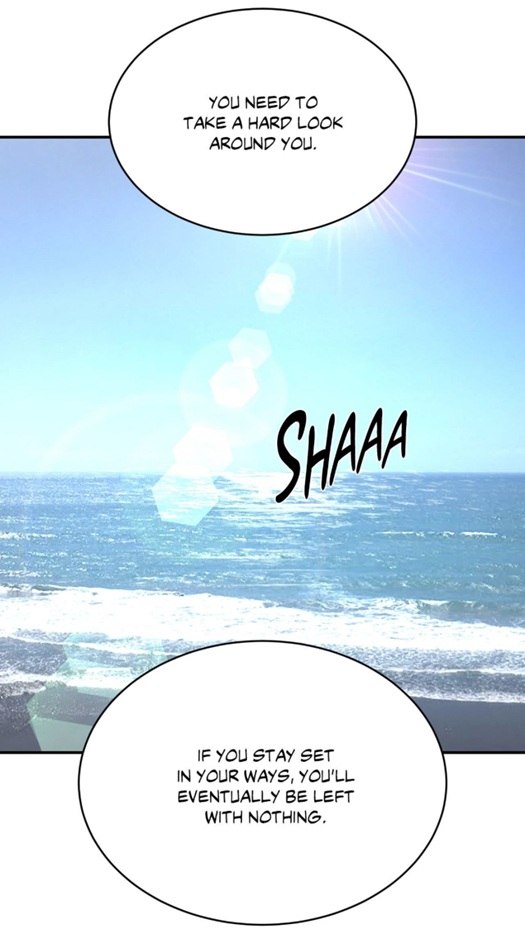 (chapter 75)
This is where Mingwa’s visual irony reaches its height.
The man who once swore, (chapter 82) now voluntarily steps into a machine that promises nothing but falling — and smiles. What once represented humiliation now produces joy. This reversal is the purest expression of healing: when what once wounded becomes what restores.
Together, the Ferris wheel and the roller coasters offer two complementary forms of breath.
One teaches rhythm — the inhale and exhale of life. The other teaches release — the scream that clears the lungs. And then, it came to my mind that such a theme park could offer bumper cars — small machines of collision and laughter. Unlike the Ferris wheel or the roller coaster, they don’t offer height or speed but contact. Here, impact is stripped of danger; the crash becomes a form of play. The goal is not to avoid others but to meet them — to touch, collide, and burst out laughing. In this attraction, aggression loses its sting and turns into connection.
One shows that peace is possible in repetition; the other shows that freedom lies in motion. Laughter becomes medicine for the two breathless men, but contrary to the past, this time, doc Dan will see the happiness written on his loved one’s face. So far, he has never paid attention to his genuine smiles: 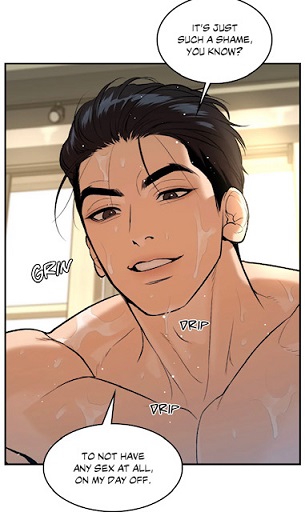 (chapter 27)
  (chapter 80) He has not grasped that he can make the champion happy. In fact, this day would represent a real break and rest, as they would learn nothing, only make new experiences so that life can appear colorful again. Here, we can see two balloons in the form of heart: green and yellow. (chapter 82) Once they enter this world, they will discover a world full of magic and lights.
And now, imagine this. If there was a love confession in that theme park, this could bring tears of joy, the opposite of these scenes  (chapter 52) a kid versus a grown-up, both rejected and silenced.
  (chapter 74) Joo Jaekyung would have achieved his goal: even vulnerable or childish, he is still lovable.
Both stand against the straight line of the highway — the depressive geometry of one-way thinking. The park and its attractions offer circles and loops instead, motions that bring one back to the self, not away from it. They turn fear into fun, control into connection.
If the highway is the architecture of burnout, the amusement park with its attractions is the architecture of recovery.
On the road, time accelerates; in the air, it expands.
On the highway, one is alone even among traffic; on the wheel, one is secluded but among people — the paradox of safe intimacy. Inside the cabin, the couple is both visible and hidden, surrounded by other voices yet enclosed in their own breath. It’s a fragile cocoon where public space becomes private moment, where affection can exist without fear of intrusion.
This is the healing structure of Jinx’s Paris arc. (chapter 82) The wheel is not a symbol of escape from the world but reconciliation with it. At the same time, it feels like a reverence to the fairy tales and their famous ending:  (chapter 41) They were destined to be together and lived happily.
It redefines air: no longer something to conquer or control, but something to share. The circular motion mirrors the psychological rhythm that both men have been denied — the ability to rise and fall without shame, to let life move through them rather than resist it.
Even the mechanics of the wheel resonate with their journey. It turns slowly, patiently; it demands trust. Once aboard, there’s no way to force speed or direction. One must surrender — to the mechanism, to the air, to the view. It is the perfect opposite of Jaekyung’s former life, where every second was measured, every breath controlled. Now, he can do nothing but sit, look, and breathe.
And there is more. The wheel’s origin — a response to France’s Eiffel Tower — completes the symbolic circle between the two monuments. The Eiffel Tower represented competition between nations, a masculine monument to progress, mastery, and endurance. The Ferris wheel transformed that spirit into something inclusive: it turned height into experience, individual triumph into collective wonder. Hence the Ferris Wheel exists in France and in other cities. This is exactly the transformation Jaekyung undergoes. The fight is no longer vertical — him against the world — but circular, relational, shared.
Seen from a distance, the wheel glows like a moving constellation — a ring of stars rotating in the night.
In the earlier chapters, stars appeared above Jaekyung’s brochures (chapter 82) to signal his quiet happiness, mirroring the stars that once surrounded Kim Dan’s laugh (chapter 44). The Ferris wheel reanimates that motif. Each cabin is a star, and together they form a galaxy of moments — proof that light can move without burning out, that joy can repeat without fading.
In that sense, the Ferris wheel is more than a date setting. It is a machine of breath: a gentle, mechanical reminder that even steel can carry tenderness, that love — not ambition — is what truly gives flight.
Love gives wings — but not the kind that seek altitude. These wings move in circles, not lines. They return to where they began, bringing both men back to the ground lighter than before. To conclude, the birthday card contained the key how to rekindle with the physical therapist and win his heart:  (chapter 55)
Feel free to comment. If you have any suggestion for topics or Manhwa, feel free to ask. If you enjoyed reading it, retweet it or push the button like. My Reddit-Instagram-Twitter-Tumblr account is: @bebebisous33. Thanks for reading and for the support, particularly, I would like to thank all the new followers and people recommending my blog.

 Bebebisous33s' analyses in K-Dramaland and Manhwas