

Please support the authors by reading Manhwas on the official websites. This is where you can read the Manhwa: Jinx But be aware that the Manhwa is a mature Yaoi, which means, it is about homosexuality with explicit scenes. Here is the link of the table of contents about Jinx. Here is the link where you can find the table of contents of analyzed Manhwas. Here are the links, if you are interested in the first work from Mingwa, BJ Alex, and the 2 previous essays about Jinx The Man Who Knew Too Much – part 2 and The Piercing Amber Shore
It would be great if you could make some donations/sponsoring: Ko-fi.com/bebebisous33 That way, you can support me with “coffee” so that I have the energy to keep examining Manhwas. Besides, I need to cover up the expenses for this blog.
In my previous essay, I ended with the observation that the photograph with the dogs 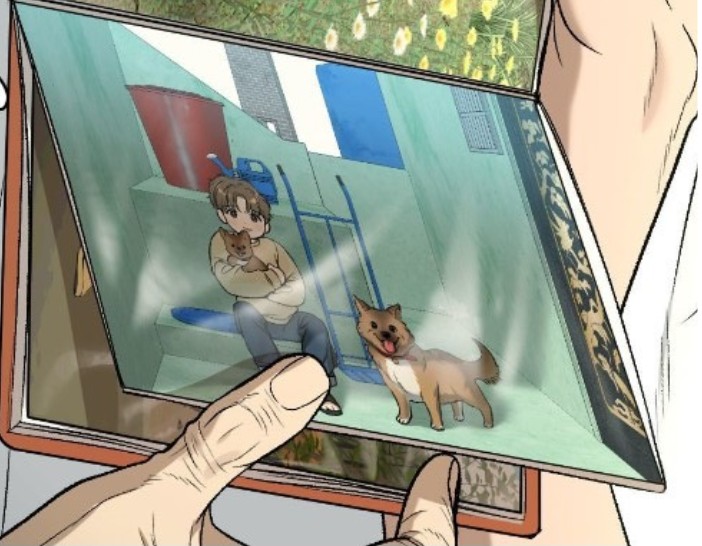 (chapter 94) was not simply a charming childhood image. It already contained the traces of loss, even if Joo Jaekyung did not recognize it as such. What appeared to him as innocence and warmth concealed a reality that remained invisible to him. This is where I want to begin.
If we look more closely at these images, we realize that they do not merely show fragments of Kim Dan’s childhood. 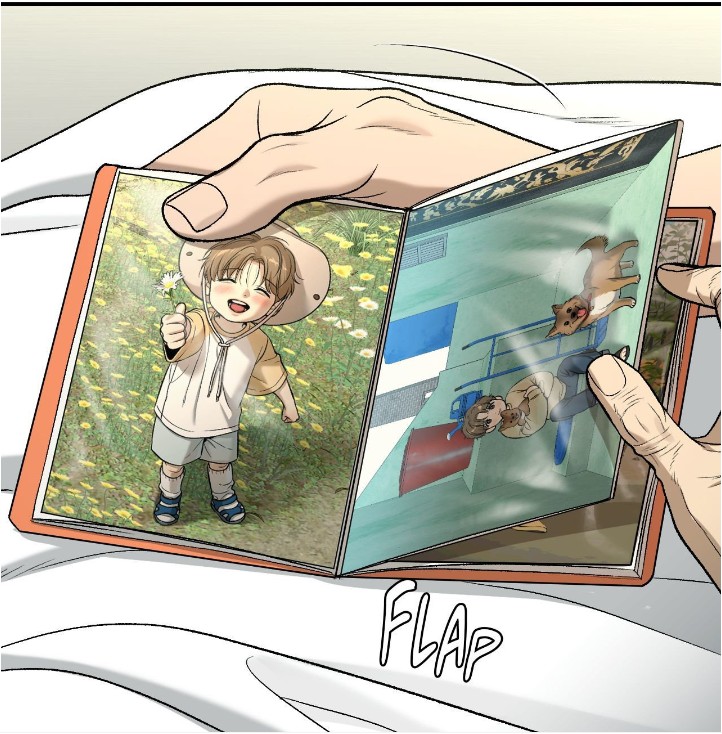 (chapter 94) They are traces of a life already shaped by forces that remain unseen. What appears as warmth and innocence is, in fact, embedded in a process of dispossession that has already begun.
In Jinx, there is one game that immediately comes to mind: Monopoly.  (chapter 27) Each time it is played, it reveals a rigid structure. One player accumulates, the other is gradually dispossessed. There is no space for coexistence or shared success. Loss is not accidental. It is built into the rules.
And what makes this dynamic even more revealing is the way each of them reacted to that loss. One responds with anger, denouncing “highway robbery,” refusing to accept defeat. The other remains seated and resigned: 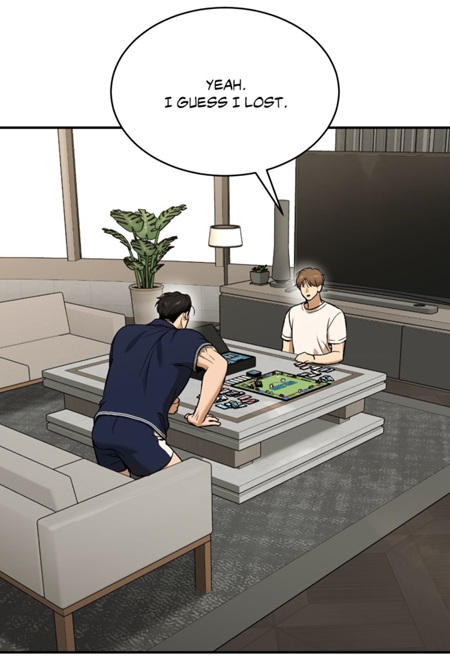 (chapter 80) These reactions were not incidental. They already suggest two fundamentally different ways of inhabiting the game. One resists and attempts to escape. The other endures and adapts.This distinction becomes crucial in episode 94.
If we keep this in mind, we can sense the same logic in episode 94 again. It is already suggested by the way Kim Dan compliments the champion and views himself. When he admits, 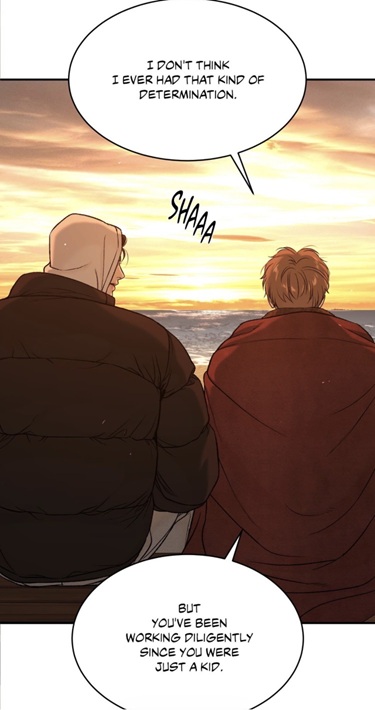 (chapter 94), he positions himself outside the logic of confrontation. He recognizes his lack of determination in the conventional sense. And yet, this does not place him outside the game. On the contrary, it reveals another mode of participation. His strength lies not in resistance, but in endurance, patience, and continuity.
This is where the structure becomes more complex. Because the same logic persists — only in a different form. This time, the game no longer takes place on a board. Instead of properties and rent, we are given photographs of a childhood (chapter 94). At first glance, they seem harmless. There is no visible competition, no immediate conflict, no explicit rules. What we see are moments of play: a child with a dog, a child offering a daisy, a child moving freely within his environment. These gestures suggest connection, spontaneity, and joy. They belong to a childhood experienced as something open and shared.
And yet, this is precisely what makes the scene deceptive. (chapter 94) Because if Monopoly makes loss visible, these images conceal it. What appears as play is already embedded in time, transformation, and conditions that remain outside the frame. The child is not competing, but he is not outside the system either. The game has not disappeared. It has become less visible.
This is why the photographs cannot be read as simple memories. 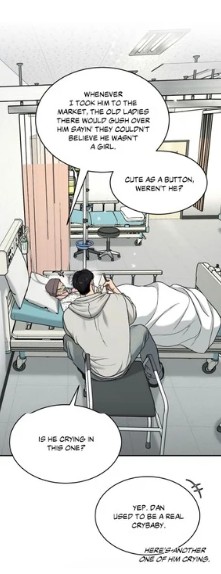 (chapter 94) They do not present a complete story. They offer fragments. Some are clear, others overlap, and one remains partially hidden. This fragmentation is not accidental. It requires reconstruction. We have to put them together, like pieces of a puzzle. And this raises a simple question.
And this immediately raises a question. How many pictures are actually shown in this scene? Most readers would answer: four. 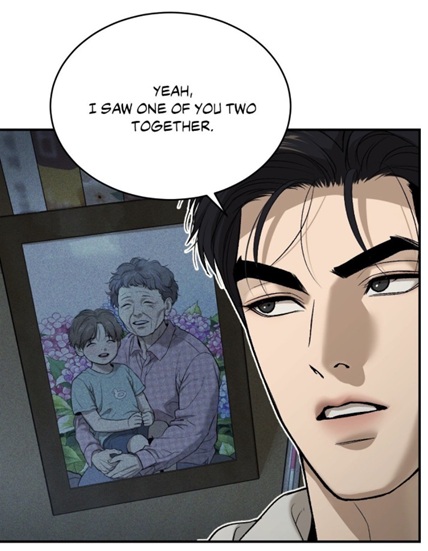 (chapter 94) And yet, this answer is incomplete. One image remains partially concealed, almost erased by another.
 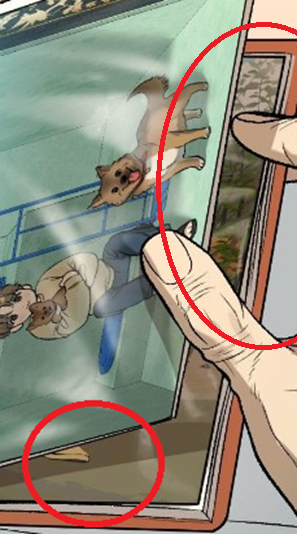 (chapter 94) It is easy to overlook, and that is precisely why it matters. Because once we begin to count more carefully, we also begin to see more precisely.
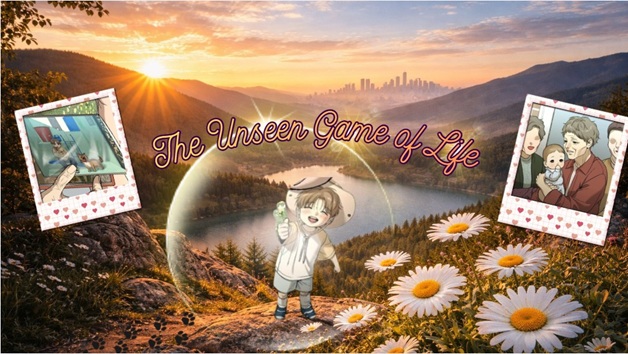
The images are not arranged randomly. They suggest a sequence. If we pay attention to clothing, landscape, and atmosphere, a pattern begins to emerge: spring, summer, autumn, winter. Childhood is not presented as a fixed and single moment, but as a cycle unfolding over time. This is where The Unseen Game of Life becomes visible.
The game is no longer limited to possession or victory. It unfolds through time, through what is shown and what is hidden, through what is remembered and what is ignored. It shapes not only outcomes, but experiences. It determines what kind of childhood is lived — and what remains invisible, even when it is right in front of us.
And this is where Joo Jaekyung’s position becomes revealing. He understands perfectly how to play Monopoly — not only within the game  (chapter 80), but also in reality, as he owns several properties. But he does not immediately understand what these photographs represent. What he sees are pleasant memories.
 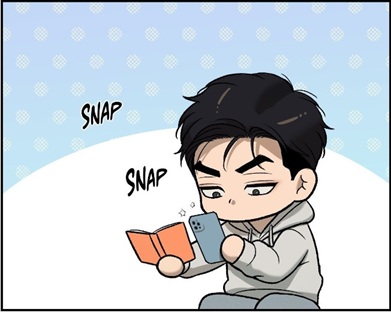 (chapter 94) And when he takes pictures of these pictures, his gesture exposes the limit of his perception. He preserves what is visible, not what it signifies. The stylistic shift reinforces this moment. Rendered as a chibi, the “Emperor” is momentarily stripped of his predatory gaze. His perspective is simplified, almost purified. He no longer sees Kim Dan as a function or a role, but as a cute and sensitive child. And yet, this remains incomplete. He captures the image, but not the structure behind it. He perceives the warmth, but not the cost that made it possible. He sees the surface of a life, but not the forces that shaped it.
This is why the game remains unseen.
Reconstructing a Childhood
If the photographs in episode 94 function like pieces of a puzzle, then the first step is not to interpret them immediately, but to examine them carefully. What do they show, and in what order should they be read? A closer look reveals that these are not static portraits, but carefully selected glimpses of Kim Dan’s childhood, each marked by a distinct posture, season, and emotional tone.
A closer look reveals that these are not static portraits, but carefully selected glimpses of Kim Dan’s childhood, each marked by a distinct posture, season, and emotional tone. (chapter 94) At first glance, these images appear simple. They are structured around play, companionship, and small gestures of joy: a child holding a puppy, offering a daisy, moving freely through his environment. In this sense, they seem to confirm what we might expect from childhood. Life appears light, open, and shared.
It is precisely this impression that makes Kim Dan’s confession on the beach so revealing. When he tells Joo Jaekyung that he has been working diligently since childhood (chapter 94), he constructs a clear contrast between them. The champion appears as someone shaped by effort from an early age, while he implicitly presents himself as someone who did not follow the same path. The statement suggests that determination belongs to one, and not to the other. This formulation echoes the logic we have already seen in Monopoly (chapter 80) In that game, positions are unequal from the very beginning. One player accumulates, the other is gradually dispossessed. What matters is not only the outcome, but the way each player responds to it. One resists, protests, and refuses defeat. The other accepts the loss and remains seated. Over time, this difference becomes internalized. The rules of the game are no longer questioned. They are absorbed.
This is precisely what happens in Kim Dan’s confession. He does not simply describe a difference. He accepts it as natural. He interprets Joo Jaekyung’s strength as something inherent, while reducing his own past to a lack. In doing so, he unknowingly adopts the logic of the game itself: one rises, the other yields.
And yet, this is where the photographs introduce a rupture. Because the child they show is not yet playing by these rules. One detail emerges with striking consistency: Kim Dan is always at the center of the image. (chapter 94) The photographs are not landscapes, nor are they focused on objects or environments. They are structured around him. He is the one being held, the one running, the one interacting, the one offering the flower. The gaze that frames these images is directed toward him. This has concrete implications. The child we see is not neglected. He is well dressed. His clothes are clean, varied, and appropriate to the seasons. He is also well fed. As his grandmother later remarks, he had a “hearty appetite as a kid” 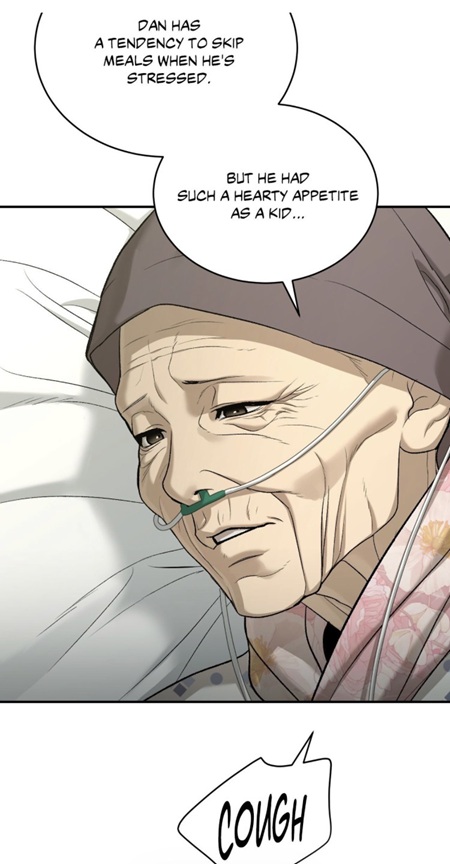 (chapter 94). These are not insignificant details. They indicate that, at this stage, his basic needs were met. He was cared for.
This stands in sharp contrast to his present situation. When Joo Jaekyung observes Kim Dan’s living conditions, he notices the absence of clothing 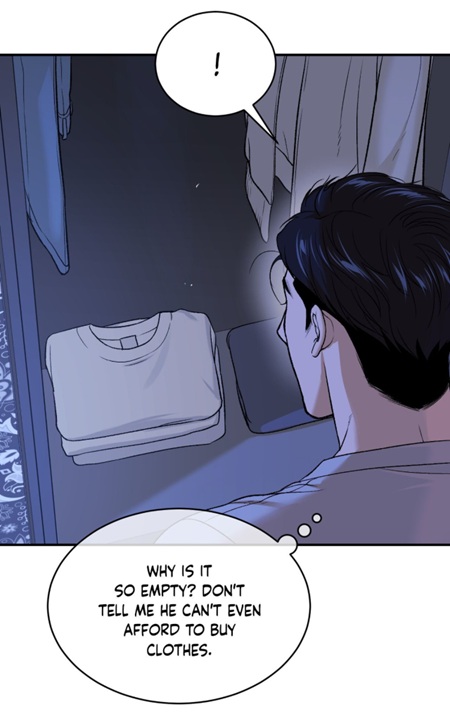 (chapter 80). The wardrobe is nearly empty. The implication is immediate: Kim Dan does not spend money on himself. This observation is confirmed by his own behavior. He uses his savings for others. He pays for his grandmother’s needs
  (chapter 41) and later spends a significant amount on a gift for Joo Jaekyung.
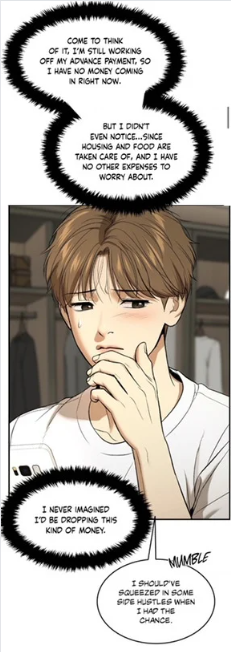 (chapter 42). This repetition is not incidental. It reveals a pattern: Kim Dan directs resources outward, not inward. He prioritizes others over himself. Even his relationship to food reflects this shift. As an adult, he skips meals when he is stressed, despite having once eaten well.
The contrast is therefore unmistakable. In the photographs, Kim Dan is the center of care. In the present, he has become the one who provides it. This inversion is crucial for understanding the structure of his life. The child who was once supported, fed, and dressed by others now assumes that role himself. Care has not disappeared. It has been reversed. This is what Kim Dan’s confession fails to recognize. (chapter 94) His statement on the beach creates the illusion that Joo Jaekyung alone was shaped by discipline and hardship, while he himself remained outside that logic. But the photographs reveal a different truth. They do not show a child who lacked strength. They show a child who had not yet been forced to transform strength into sacrifice. He was not yet responsible. He was not yet the one who gave. He was the one who received.
That is why these images matter so much. They do not simply preserve moments of happiness. They document a time before the rules of the game fully took hold of him. They reveal that Kim Dan’s later endurance did not emerge from a lack of determination, but from the reversal of a position he once occupied. What he now mistakes for weakness is, in fact, the trace of a childhood that was interrupted.
And yet, this is only one part of the story. If we read these images more carefully, a different structure begins to emerge.
The bodily positions already tell us something important. In one image, Kim Dan is held in his grandmother’s arms. 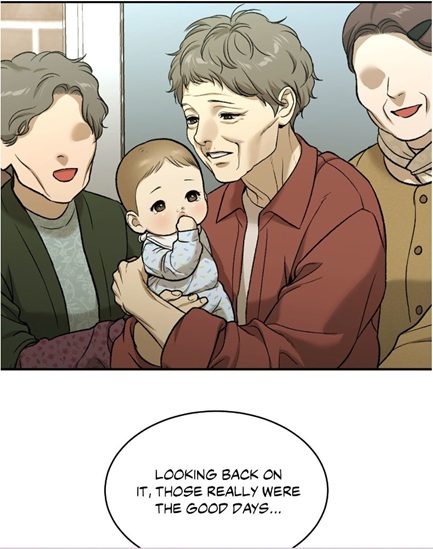 (chapter 94) His body is supported, carried, entirely dependent. In another, he is sitting on a step while holding a puppy close to his chest. (chapter 94) In the field, he stands on his own two feet and extends a daisy toward the person behind the camera.
  (chapter 94) In the almost hidden image, only one foot is visible, lifted off the ground: this is enough to conclude that he is running. (chapter 94) And in the photograph mentioned by Joo Jaekyung, he is seated on his grandmother’s lap among hydrangeas. (chapter 94) These positions are not accidental. They show a child who is allowed to inhabit many different states: dependence, stillness, affection, upright autonomy, movement. He is not fixed in one role. He is carried, he holds, he stands, he runs, he rests. Before we even interpret the backgrounds, the body already suggests a childhood marked by freedom.
This impression is reinforced by the objects that accompany him. In the image with the daisy, the flower is not simply part of the setting. It is held out toward the photographer. (chapter 94) The daisy, a simple wildflower, is traditionally associated with innocence, sincerity, and unfiltered joy. Unlike cultivated flowers, it grows freely, without constraint. By offering it, Kim Dan does not only interact with the person behind the camera, he shares something that belongs to his world. The gesture suggests trust, openness, and a spontaneous desire to connect.
A similar dynamic can be observed in the photograph with the puppy and the dog. (chapter 94) Animals, especially young ones, are often used to symbolize vulnerability, affection, and instinctive attachment. The puppy in his arms mirrors the child himself: small, fragile, and in need of care. At the same time, the presence of the adult dog introduces a second layer, that of protection and loyalty. Kim Dan is not alone in this image. He is part of a small relational world built on closeness and mutual dependence.
These elements are not incidental. They reinforce the impression that this is a childhood shaped not only by movement and freedom, but also by affection. The daisy, the puppy, and even the way these moments are framed suggest that the child is seen through a gentle and attentive gaze. They let transpire that he was loved. In other words, they actually prove my theory about his parents: he was raised by loving and caring parents. Hence he is placed in the center of the photography. But there exists another evidence for this interpretation: Joo Jaekyung’s lack of photos suggests he was never “beheld” with that same gentle gaze. If Dan was raised in a “natural cycle” (seasons, animals), Jaekyung was raised in an “industrial cycle” (results, training, utility). 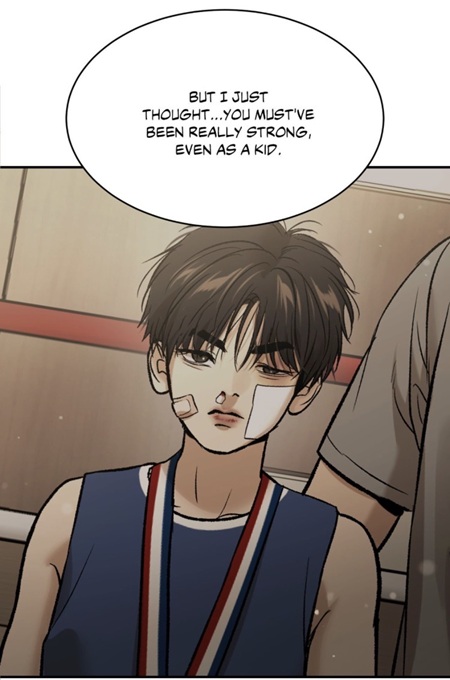 (chapter 94) Hence his only picture in his childhood is linked to a tournament and boxing.
This freedom becomes even clearer once the photographs are arranged in seasonal order. (chapter 94) The baby picture most likely belongs to early spring. The adults around him wear light jackets and scarves, which suggests cold but transitional weather rather than deep winter. Since Kim Dan was born on December 26th, this scene can plausibly be placed only a few months later. The woman on the far left wears a floral sleeve beneath a dark cardigan, a detail that subtly reinforces the idea of seasonal transition. Spring, then, is not only the season of beginnings. It is also the season in which Kim Dan first appears within a circle of adults, still dependent, still held, and still emotionally tied to others.
The image with the daisy comes later. (chapter 94) Here Kim Dan is dressed lightly, standing in an open field and offering the flower toward the photographer. The flower itself matters. Daisies belong to late spring or early summer, but they also symbolize simplicity, innocence, and spontaneous joy. Unlike a cultivated bouquet, a daisy is modest and wild. Kim Dan does not merely hold it for himself. He presents it. This gesture suggests trust, openness, and delight in shared attention. It is an image of a child for whom the world is still something to be explored and offered, not defended against.
The hydrangea photograph mentioned by Joo Jaekyung provides the clearest seasonal anchor. Kim Dan is wearing shorts and a short-sleeved T-shirt, and the hydrangeas behind him are in full bloom. (chapter 94) This places the image firmly in summer. Yet what matters here is not only the season, but the atmosphere. In contrast to the daisy picture, where he stands independently and reaches outward, he is now seated on his grandmother’s lap. Summer here does not simply symbolize expansion, but also fullness and protection. It is a moment of warmth, abundance, and secure intimacy. If spring marks origin and the daisy image marks early openness, the hydrangea scene represents the height of childhood ease but also its imminent ending.
The dog picture introduces a different mood. (chapter 94) Kim Dan is no longer in an open field, but in a structured outdoor hallway. Around him we can identify a trolley, a watering can, large containers, and in the background a large chimney. There is also a patterned door with birds and flowers, which echoes the decorative logic of the later cabinet without being the same object. These details suggest a hybrid environment where living and working coexist. His clothes are warmer than in the summer pictures, which indicates a drop in temperature. This does not allow us to assign the season with total certainty, but the heavier clothing, the functional setting, and the disappearance of open flowering landscapes point more convincingly toward late summer or early autumn. Symbolically, this matters. Autumn is the season of transition, upkeep, and preparation. The carefree openness of earlier pictures begins to recede. At the same time, this image introduces class more clearly than the others. The child still appears affectionate and gentle, but the world around him is already marked by labor, maintenance, and material necessity.
Finally, the hidden image completes the cycle. (chapter 94) Only fragments are visible: one foot in motion, a fence, a pale surface that resembles snow, and what looks like a hill in the background. Since only one foot is shown, the child must be running. This is not a posed portrait but a captured instant. The suggestion of snow or frost, together with the more closed landscape, points toward winter or perhaps late fall. The symbolism here is different from the others. Winter is not simply the season of hardship. In this sequence, it is the season of movement, exposure, and unfolding time. The child is no longer merely being shown. He is already in motion. This is not without significance. Kim Dan was born on December 26th, at the very beginning of winter. In this context, winter does not represent an end, but a point of origin. It marks a beginning that unfolds under conditions of cold and vulnerability, but also one that requires inner warmth and resilience. Rather than opposing warmth, winter redefines it. Since winter is his birth season and his “running” season, it suggests that Dan’s natural state is one of internal resilience. He is a “winter child”—he doesn’t need the sun to thrive; he generates his own warmth. This explains why he could survive next to Jaekyung’s distance. It is no longer given by the environment, but must be created and preserved. In this sense, winter becomes the season in which growth takes place in a less visible, more internal way.
Taken together, these images form a full cycle: spring with the baby in arms, late spring or early summer with the daisy, summer with the hydrangeas, late summer or early autumn with the puppy, and winter with the running child. The author does not show only growth, but a childhood unfolding through the seasons. This is not insignificant. Seasons imply rhythm, continuity, and immersion in a living world. Kim Dan’s childhood is therefore associated not with institutional milestones, but with natural time. That already tells us something about the kind of child he was and the kind of life he came from.
The symbolism of the clothes strengthens this reading. As a baby, he wears clothes patterned with little sweets (chapter 94), an image of softness and indulgence, as if childhood were still associated with comfort and delight. Later, he appears in a shirt with a duck, another gentle and playful motif. (chapter 94) These patterns are not random. They connect him to a childlike world of animals, tenderness, and whimsy. They suggest that he was once seen and dressed as a child who could be cute, soft, and playful. This matters all the more because, later in life, that softness will be reinterpreted as weakness.
Another recurring feature deserves attention. What matters is not whether Kim Dan’s eyes are open or closed, but how he relates to the presence behind the camera (chapter 94). In several photographs, he appears visibly aware of that presence. (chapter 94) In the image with the daisy, for instance, his eyes are closed, yet his gesture and expression clearly indicate engagement. He is blushing, smiling, and extending the flower outward. This is not withdrawal, but a form of shy openness. The gesture only makes sense if someone is there to receive it. The photograph captures an interaction. The child responds to the observer, and the observer is implicitly included in the scene.
A similar attentiveness can be sensed in other images, where his gaze is directed outward, alert and receptive. In these moments, Kim Dan appears fully present to the world and to the person who is looking at him. The photographs do not merely record him. They suggest a relationship with the photographer.
By contrast, the hydrangea photograph introduces a shift. (chapter 94) Here, Kim Dan is seated on his grandmother’s lap, and the composition is entirely centered on the two figures. There is no outward gesture, no attempt to reach beyond the frame. The scene is closed. The person behind the camera is no longer included in the same way, but remains outside, observing. The child is no longer interacting with that presence, but contained within a relationship that is already defined.
This does not diminish the warmth of the image, but it alters its structure. What was previously a shared moment becomes a framed intimacy. The child is no longer primarily engaged with the world around him, but situated within it. The difference is subtle, yet decisive. The closing of the frame mirrors the closing of his world; the open fields of the daisy photo (chapter 94) are replaced by the protective, yet narrow, lap of his grandmother. This picture announces Kim Dan’s imminent loss of innocence due to his parents’ vanishing.
This is what the photographs finally show about Kim Dan. He is presented as a child of openness rather than control, of movement rather than discipline, of relation rather than domination. He belongs to fields, flowers, animals, changing seasons, and spaces where work and life overlap. In other words, he embodies nature. He can be held, he can hold, he can stand, he can run. He is not yet trapped in one function. At the same time, the backgrounds complicate the apparent innocence of these scenes. The dog picture in particular reveals that this freedom existed within a modest environment already touched by labor and transformation. Kim Dan’s childhood, then, cannot be reduced either to pure happiness or to pure suffering. It appears instead as a life suspended between warmth and fragility, between natural abundance and quiet precarity.
This is precisely why these images matter so much. They do not simply preserve a past. They reveal a child who was still able to inhabit the world freely, even though the conditions of that freedom were already beginning to change. And that is where the unseen game starts to take shape.
A Changing Landscape
If the photographs (chapter 94) are read not only as personal memories, but as traces of a lived environment, they begin to reveal something more than childhood itself. They point toward the world in which that childhood was embedded.
The image with the dog and the puppy is particularly revealing (chapter 94). The setting is neither purely domestic nor entirely natural. It is a transitional space. The presence of a trolley, a watering can, and large containers suggests a place where living and working coexist. This is not a leisure environment. It is a space of small-scale labor.
At the same time, the child is not working. He is sitting, holding the puppy, fully absorbed in play. This contrast is decisive. It shows that his childhood unfolds within a world already shaped by work, but in which he himself is not yet subjected to it. This allows us to situate the family within a specific social context.
The environment suggests a modest, possibly semi-rural or peri-urban setting, where economic activity is directly tied to nature. The recurring presence of flowers, plants, and open spaces supports the idea that the family may have been involved in a form of small-scale production, such as flower cultivation or local trade. (chapter 94) The fact that Shin Okja later mentions taking him to the market reinforces this connection. The child is not isolated. He is part of a network of everyday economic life. This also explains why he is entrusted to her.
If the parents were working, possibly outside the immediate household or within demanding conditions, the grandmother’s role as caretaker becomes necessary.  (chapter 47) Her presence does not replace the parents. It supplements a structure already under pressure.
This pressure becomes more visible when we contrast these images with the later urban landscape. 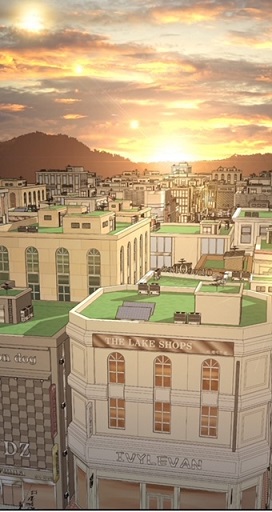 (chapter 48) In the city view, nature has not disappeared entirely, but it has been pushed to the margins. Hills and trees remain in the distance, while the foreground is dominated by dense construction, commercial buildings, and rooftops. The naming of places such as “The Lake Shops” is particularly revealing. The reference to the lake suggests a natural environment that is no longer accessible. What remains is its name, preserved as a surface within a commercial structure. This transformation is not incidental. Striking is that this image mirrors the painting in the champion’s penthouse:
 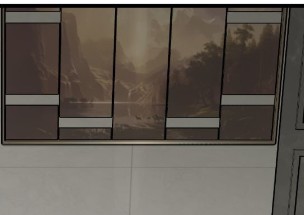 (chapter 93) But the lake has been replaced by a building. It corresponds to a broader process of urban redevelopment, in which natural or semi-rural areas are progressively absorbed into economic systems based on property, rent, and commercial use. In this context, land is no longer lived on. It is monetized.
To understand the “Unseen Game,” we must look beyond the frame of the photographs and into the historical shadow of the 1997 South Korean financial crisis. This was the moment the “Monopoly board” of the nation was violently reset. Triggered by a toxic cocktail of corporate debt, speculative volatility, and the sudden flight of foreign capital, the crisis forced the country into a brutal era of IMF-supervised restructuring.
For families like Kim Dan’s, this wasn’t just a headline—it was an earthquake. Property values didn’t just “fluctuate”; they collapsed. Debts became predatory. The “small-scale livelihoods” we see in the photographs—the gardening tools, the modest outdoor hallway, the flowers—were the exact type of “informal” or “traditional” economies that were liquidated to satisfy the demands of global capital. (chapter 94)
This is where the connection to Monopoly becomes more than metaphorical. The logic of the game — acquisition, accumulation, rising costs, and eventual dispossession — reflects the mechanisms at work in such transformations. Small-scale environments are gradually replaced by larger structures. (chapter 27) Those who cannot keep up with increasing economic pressure are displaced. Seen from this perspective, Kim Dan’s childhood does not only precede a personal rupture. It is situated within a world that is already undergoing structural change.
This also sheds light on his later relationship to money. And what did the physical therapist suggest back then, when the star was on the verge of bankruptcy? He could take a loan… that’s how the parents’ misery started. But there’s more to it. (chapter 42) As an adult, Kim Dan does not accumulate. He spends what he has on others. He supports his grandmother, pays for her needs, and later repeats this pattern with Joo Jaekyung. He does not invest in himself. He does not secure his own position. This behavior is not simply a matter of personality. It reflects a life shaped by instability, where resources are used for survival rather than growth. In this sense, his position within the “game” is already determined before he becomes aware of it. He does not enter it as an equal player. He enters it from a position marked by loss, adaptation, and necessity.
And this is what the photographs ultimately reveal.
They do not show a world that was stable and later broken. They show a world that was already fragile, already exposed to forces that would eventually transform it. What appears as a peaceful childhood is, in reality, a moment suspended between continuity and disappearance.
This context also allows us to comprehend the gap between the two main leads.
Kim Dan, who is three years older and approaching thirty, experienced the immediate impact of the 1997 financial crisis during his early childhood. He lived through a period of instability, displacement, and economic pressure without fully understanding its causes. The transformation of his environment, the loss of his family structure, and the increasing precarity of everyday life formed the background of his development.
Joo Jaekyung, by contrast, belongs to a slightly later moment. When he was a child, the crisis had already reshaped the social landscape. Its consequences were no longer unfolding, but had become part of a normalized reality. This is reflected in Hwang Byungchul’s description of his neighborhood
Joo Jaekyung grows up in its aftermath.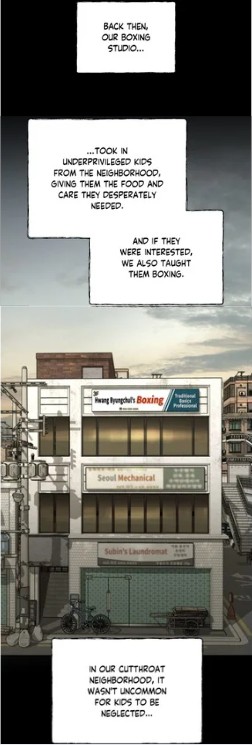 (chapter 72): a “cutthroat” environment in which neglect was common and institutions such as the boxing gym functioned as substitutes for basic care. The difference is subtle, but decisive. Kim Dan grows up at the moment of rupture. This is why the unseen game does not begin with loss. It begins much earlier, in the conditions that make that loss possible.
The Same Image, a Different Truth — Memory, Loss, and Reinterpretation
If the first set of photographs suggests a childhood shaped by freedom and affection, the images (chapter 94) involving the grandmother (chapter 94) introduce a more complex and unsettling dimension. At first glance, they appear similar. In both cases, Kim Dan is held close, framed within a moment of intimacy. The composition seems almost identical. And yet, a closer reading reveals a fundamental divergence.
In the image of Kim Dan as a baby, one detail cannot be ignored: his expression. (chapter 94) His eyes are wide, his gaze tense with tears, his mouth covered with his hand. He is not calm. He is not smiling. He has been crying. This raises an unavoidable question. Why?
If we take the image seriously, the tears cannot be dismissed as a trivial detail. They contradict the idea of a peaceful, happy moment. Instead, they suggest distress, discomfort, or even rupture. Such a reaction is not unusual. Infants often display what developmental psychology describes as stranger anxiety, a phase in which unfamiliar environments or faces provoke fear or distress. But in this context, the reaction points toward something more specific. Because this form of distress is not neutral. It implies the absence of a familiar figure. The child does not simply react to strangers; he reacts because the person to whom he is attached is no longer present.
In this sense, the image does not only show fear. It outlines a strong connection to the mother — a bond that is being disrupted at the very moment the photograph is taken. The child is no longer with his mother. He has been handed over, entrusted to Shin Okja. The presence of other women reinforces this reading. This is not an intimate, private scene. It is social, almost public. In this sense, the photograph does not simply show affection. It records a transition.
This reading becomes even more significant when we consider that Shin Okja refers to the “good old days” while looking at this very image. 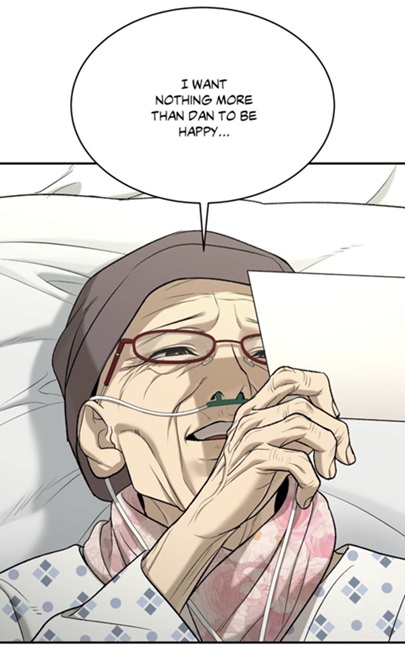 (chapter 94) She even associates this scene with Kim Dan’s happiness, while the photography contradicts this notion. The child is not at peace. He had just been crying. The moment is not one of stability, but of rupture. And yet, it is precisely this image that becomes the anchor of nostalgia. This creates a displacement.
This is where the contrast with the later hydrangea image 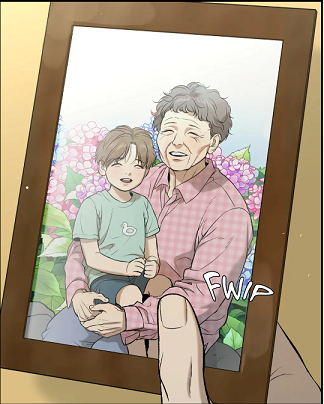 (chapter 19) becomes particularly revealing. In the first photograph, the women from the market are visibly present. (chapter 94) The moment is shared, exposed, embedded in a social environment. By contrast, in the hydrangea image, these figures have disappeared. They are replaced by flowers. What was once a public scene becomes a private one. At first glance, this shift may appear to enhance intimacy. The child is now alone with his grandmother, surrounded by blooming hydrangeas. The composition is softer, more harmonious, more contained. And yet, this transformation raises a question. What has been removed, and why?
What disappears is not only the social environment, but the structure that defined the earlier image. In the first photograph, the presence of the women from the market situates the scene within a moment of transition that is witnessed and shared. (chapter 94) The child’s tears unfold within this exposed space, and his reaction is oriented toward a presence beyond the frame.
In the hydrangea image, this structure has changed entirely. The scene is no longer oriented outward. The composition is closed, centered, and self-contained. The gaze that once participated in the moment is no longer included. This is not a simple shift toward intimacy. It is the consequence of a rupture. (chapter 94)
The hydrangeas do not merely decorate the scene. They occupy the space left by what has disappeared. Traditionally associated with apology, regret, and a desire for forgiveness, they introduce the idea that something unresolved persists beneath the surface. But they also carry another implication. Blooming fully, they mark a moment of completion — and, at the same time, of transition. They announce departure. Within this context, the image no longer represents a stable present. It captures a threshold. The child remains, but the relational structure that once connected him to the outside — and to the one behind the camera — has already begun to dissolve. (chapter 94)
Striking is that the image that most closely corresponds to a moment of calm, rest, and emotional balance is not part of the album at all. It is the photograph with the hydrangeas — the one Kim Dan himself has kept and framed. (chapter 94) In that image, he is older, composed, and seated on his grandmother’s lap, surrounded by blooming flowers. The scene is quiet, contained, and visually harmonious. According to my past interpretation, the last photography most likely represents the last moment before he lost his parents, a moment in which his world had not yet fully collapsed. And yet, this is not the image preserved in the album.
This difference is crucial. It reveals that the album does not simply gather memories. It reflects a specific point of view. 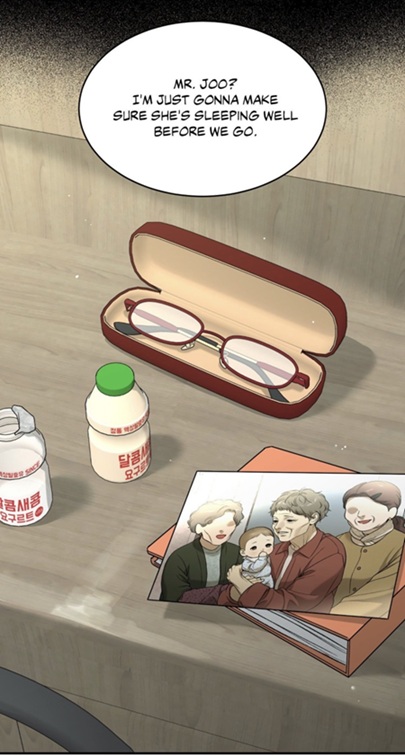 (chapter 94) The photographs it contains are not neutral. They are selected, arranged, and interpreted according to Shin Okja’s perspective. The image of separation becomes the “good old days,” while the image of relative stability is excluded from that narrative.
By contrast, the framed photograph belongs to Kim Dan. It is the only image he has chosen to keep. Unlike the album, which organizes memory collectively and retrospectively, the frame isolates a single moment. It suggests a different attachment, a different understanding of what should be preserved.
This divergence exposes two distinct relationships to the past. For Shin Okja, memory moves backward, reconstructing earlier moments and integrating them into a narrative of care and responsibility. For Kim Dan, memory condenses into a single image, one that he does not reinterpret verbally, but silently preserves.
The absence of the hydrangea photograph from the album, and its presence in his possession, therefore marks more than a simple difference in taste. It reveals a gap between two memories that do not fully coincide. Because if we follow the internal logic of the photographs, the moment that could most plausibly correspond to the “good old days” is not this one, but the later image with the hydrangeas. (chapter 94) In that scene, Kim Dan is older, calm, and seated on his grandmother’s lap, surrounded by blooming flowers. His clothing and the vegetation clearly situate the image in summer, a season associated with fullness and continuity. If your interpretation is correct, this photograph would mark the last period before he lost his parents — a moment when his family was still intact.
This creates a striking contradiction. (chapter 94) What we see is a child in distress. What is remembered and narrated is happiness.The gap between these two levels is crucial. It reveals that the photographs are not interpreted neutrally. They are reinterpreted through memory, filtered by emotion, and reshaped by nostalgia. Shin Okja does not lie consciously. Rather, she projects her own feelings onto the images. For her, these moments represent closeness, responsibility, and perhaps even purpose. The child’s tears disappear behind her own perception of care.
This becomes even clearer when we consider how she moves through the album. (chapter 94) Her gaze is not oriented toward the future, but toward the past. She flips through the pages in reverse, moving from the most recent images back to the earliest ones. This movement is not chronological. It is selective and directional. It functions as a form of regression.
In this sense, her gesture stands in direct contrast to the logic of a competitive game. A game such as Monopoly advances relentlessly toward an outcome, 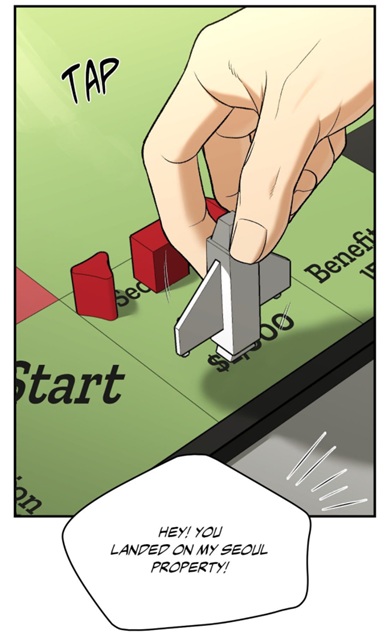 (chapter 80) structuring time as progression, accumulation, and eventual resolution. Her movement does the opposite. It moves backward, not toward victory, but toward a point of refuge. The album becomes a space in which time is reversed and the pressures of the present are temporarily suspended.
This reversal is not abstract. It is material and visible. (chapter 80) Each turn of the page, marked by the tactile flap of the paper, reduces Kim Dan. The sequence narrows. The independent boy who runs, stands, and interacts gradually disappears, replaced by a smaller, more contained figure. The movement through the album functions like a visual funnel: from autonomy to dependence, from mobility to stillness, from openness to enclosure. (chapter 94) At its endpoint stands the image of the infant.
Here, the contradiction becomes explicit. The baby had been crying, yet the grandmother is smiling in front of the photography. The scene contains two opposing emotional registers that are not experienced as such. The child’s distress is immediate, visible, and unresolved within the frame. And yet, for her, it does not signify rupture. It signifies need. This distinction is crucial. (chapter 94) Because a crying infant represents a form of suffering that can still be answered. It is simple, direct, and, above all, solvable. In that moment, she is able to position herself as the source of relief. The child depends on her, and that dependence gives structure and meaning to her role. This is why the contradiction does not appear as one. What we read as distress, she experiences as confirmation. She still views herself as his “source of happiness”.
By moving backward through the album, she does not merely revisit the past. She reconstructs a position in which her role is absolute and uncontested. The adult Kim Dan — the one who provides, who suffers, who exists outside her control — disappears from view. This psychological orientation explains why she continues to treat the professional physical therapist as a helpless infant 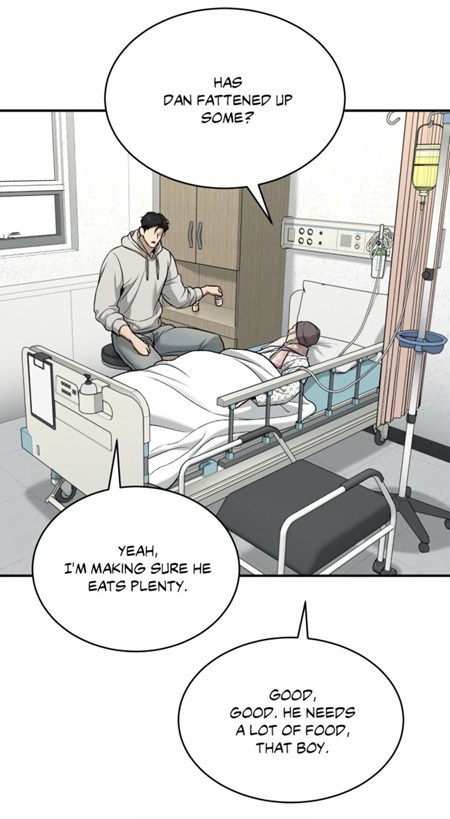 (chapter 94) Her persistent desire to see him “fattened up” is quite telling; it is not truly about the pleasure of eating, but about returning him to a state of physical dependence. To “fatten” a child is to exert a primary form of care that requires no complex dialogue or adult understanding—it is the most basic “rule” of her version of the game.
The photographs, then, are no longer treated as evidence of Dan’s life, but as emotional anchors for her own identity. This explains why the contradiction between his tears and her “good times” remains unaddressed. For her, the “good times” were a period of perfect dependence. In the space of the album, the 1997 crisis hasn’t arrived, the parents haven’t vanished, and the child’s only problem is a discomfort that a grandmother’s arms—and her “fattening” meals—can still resolve.
(chapter 94) What remains is a simplified structure in which the child’s distress is immediate and her response is sufficient. Not a time without suffering, but a time in which suffering was still manageable.This is what she calls the “good old days.”
Where the childhood images can be transformed into “good old days,” (chapter 94) the later photographs 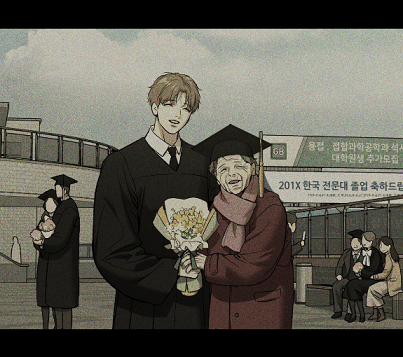 (chapter 47) remain tied to necessity. They reveal that, over time, the relationship between Kim Dan and his grandmother was no longer defined solely by care, but also by dependence.
The Mirror of Erasure: Doc Dan’s Compliance
The discrepancy between the photographs and Shin Okja’s verbal narrative reveals a profound structural shift in Kim Dan’s identity. On the beach, she insists that she  (Chapter 65), a statement that appears humble but subtly centers her own effort as the only relevant force in his life. When she speaks of her struggle, she envisions a calm baby. This makes her “failure” purely internal. By remembering him as calm while she felt “not enough,” she frames herself as the tragic martyr who was suffering even when things looked peaceful. It centers the entire era on her emotional state, not the child’s. But the picture from episode 94 displays a certain MO. She is simply ignoring reality. (chapter 94) In the physical photograph, the baby is clearly in distress (crying), but she is smiling. She is literally overlooking the child’s present reality in the photo to preserve her own feeling of “good times.” The child’s actual pain is invisible to her because, in that moment, she was the one holding him—and for her, being the “holder” is the only thing that matters. She frames his childhood through the definitive claim that he
  (chapter 65). This is not merely a description of loss; it is a transformation. By labeling him an absolute orphan, she erases the specific love and sacrifice documented in the early photographs, stripping him of his right to a specific grief. If he “never knew” them, he never lost them. In her version of the “game,” Dan is a blank slate upon which she has written her own narrative of care. At the same time, she
Strikingly, Kim Dan corroborates this void 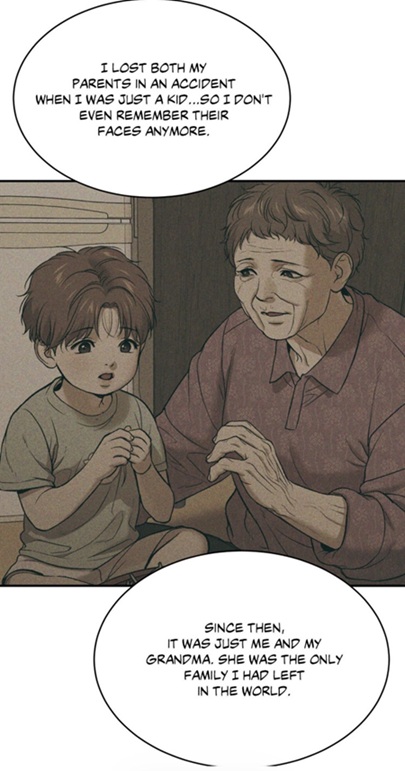 (Chapter 94). He speaks as if he were a baby when they vanished, yet the memory indicates the opposite. Moreover, the photos of him offering daisies and running prove he was old enough to know them. To survive under his grandmother’s care, Dan had to adopt her memory as his own, internalizing the image of a man who started from “nothing.” By erasing the parents, Shin Okja effectively erased the “Dan” who was once the center of a loving world, leaving behind only the “Doc Dan” who exists to serve the needs of others.
From Play to Performance: The Trophy Child
This shift becomes visible when comparing the childhood album shown to Jaekyung (Chapter 94) with the graduation photos Dan recalled at the hospital. (Chapter 47). The early images are structured around spontaneity—movement, animals, and open fields. However, as the timeline progresses toward his youth, the “Natural Cycle” is replaced by a trajectory of performance.
In these later institutional spaces—classrooms and stages—Dan no longer moves freely; he poses. 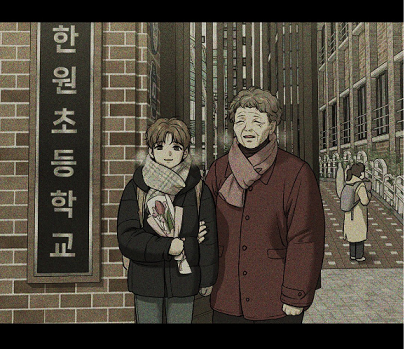 (chapter 47) He stands still, holding bouquets, looking at the camera to comply rather than engage. He is no longer a child “being,” but a trophy of successful care. His growth is recontextualized as the “interest” on his grandmother’s sacrifice, transforming his development into something useful and legible. This logic of appropriation is the “unseen rule” Dan eventually internalizes: his value is no longer grounded in his existence, but in his functional utility.
This is where the emotional register shifts again. The earlier photographs suggested a gaze directed toward the child — attentive, affectionate, and open. Here, the direction of that gaze becomes more complex. The child is still visible, but he is also being positioned within a narrative that exceeds him. His life is no longer only his own. It becomes intertwined with her need for meaning, recognition, and continuity. This is why these images feel different. They are not only more structured. They are more purposeful. The camera no longer captures a moment. It records a result.
The Crybaby
She looks fondly at this picture (chapter 94), she is able to position herself as the source of relief. The child depends on her, and that dependence gives structure and meaning to her role. This is why the contradiction does not appear as one. What we read as distress, she experiences as confirmation. And yet, her own words introduce a subtle tension within this dynamic.
When she refers to him as a “crybaby” (chapter 94), she does more than describe a child’s behavior. The term carries a judgment. It implies excess, weakness, a deviation from what is expected. Crying is no longer simply a response to pain or separation. It becomes something that must be corrected. This is where another layer emerges.
Because the child she describes is, in fact, behaving in a completely normal way. (chapter 94) He is a baby, or a very young child. If he cries in another one, it could be because he hurt himself, or he is frightened, or overwhelmed. The image of him crying after falling and injuring his knee 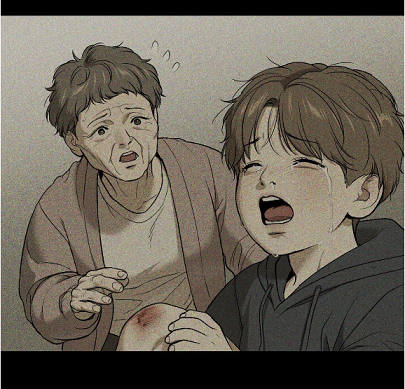 (chapter 47) confirms this. The tears are not excessive. They are appropriate. Thus he could have cried, because he lost the dogs for example. (chapter 94)
The label, then, does not describe the child. It reflects her perception. It reveals a discomfort with vulnerability, and more specifically, with the persistence of that vulnerability over time. The “crybaby” is not only the infant in distress. It is also the figure she does not want him to remain. This is reinforced by her later remark to Joo Jaekyung, where she praises his strength, his physique, and his masculinity 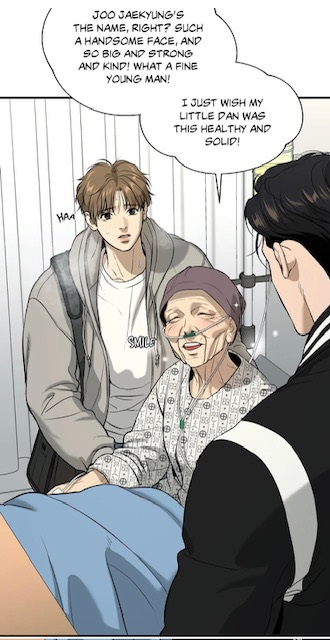 (chapter 21) The contrast is implicit but clear. The ideal is no longer the dependent child who cries, but the strong young man who does not. And now, you comprehend why he went to the restroom in order to cry. He is not allowed to express his sadness.
 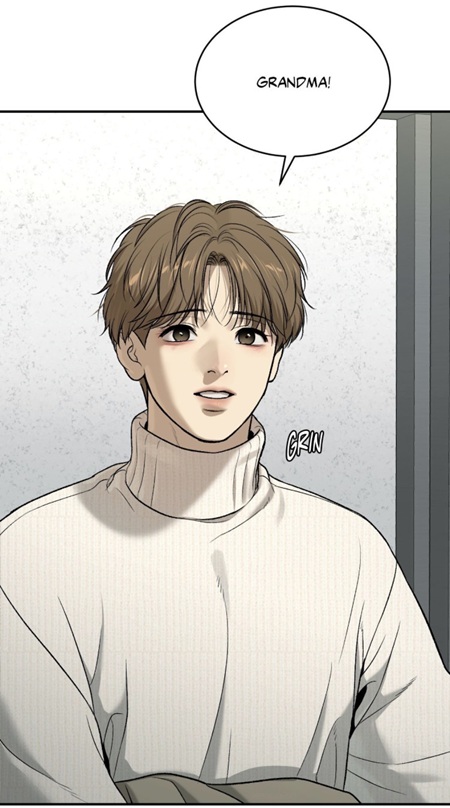 (chapter 94) In this sense, her perspective is structured by a normative expectation. A boy should be strong. He should endure. He should not cry. This creates a paradox.
On the one hand, she returns to the image of the infant because it secures her role as caretaker. On the other, she implicitly rejects the qualities associated with that same state. The crying child is both the foundation of her identity and something that must be overcome. This tension is crucial.
Because it helps explain the transformation we observe later. The child who once cried freely gradually becomes someone who suppresses his needs, who endures silently, and who defines himself through resilience rather than expression. In other words, the “crybaby” disappears. But what replaces him is not strength in the sense she admires. It is a form of self-erasure.
Because this transformation does not occur in isolation. It is mediated through her gaze. 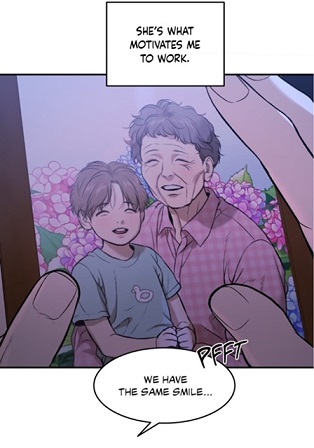 (chapter 47) Over time, Kim Dan learns to see himself as she sees him. The qualities that once defined his childhood — openness, sensitivity, emotional responsiveness — are no longer recognized as strengths. (chapter 94) They are recoded as weakness, something to outgrow, something to suppress.
This is why he cannot recognize his own strength. (chapter 94) What he has developed is not the visible, dominant form of strength embodied by Joo Jaekyung, but something quieter: endurance, patience, and an exceptional capacity for care. His strength lies in his ability to persist, to adapt, and to remain attentive to others even under pressure.
In other words, he stands for genuine empathy. And yet, because he perceives himself through the lenses of his grandmother, this form of strength remains invisible to him. What he sees instead is lack — a failure to meet an ideal that was never his to begin with.
The Production of Worthlessness
The consequences of this transformation are absolute. As Dan becomes the support structure of the relationship, he develops a pathological selflessness. His refusal to invest in himself—his empty wardrobe and skipped meals—is the continuation of a role where his only valid function is to provide. His lack of self-worth is not innate; it is a manufactured condition. (chapter 94) The original “Dan,” who offered daisies without expectation, has been overwritten by a provider who must justify his presence through constant sacrifice.
These later photographs (chapter 47) are excluded from the “happy” album because they resist reinterpretation. They cannot be turned into “good old days” because they document the exact moment care turned into dependence. They reveal a rupture that didn’t just remove his parents, but dismantled his entire environment—home, neighborhood, and unconditional joy. They expose her reliance on him and the doctor’s suffering and growth. By focusing on her role as the sole caretaker, Shin Okja reorganized the past, making the parents’ absence more visible than their existence ever was. Ultimately, Dan adopted this simplified history, losing the memory of the world that was taken from him.
The Glasses: Seeing the Past, Losing the Present
This dynamic becomes even more visible through a small but significant detail: the grandmother’s glasses (chapter 94) When she looks at the photograph, she is wearing them. This is not incidental. The glasses mediate her vision. They frame the way she perceives the image. She does not look at the past directly. She sees it through a lens. And that lens is not neutral.
It allows her to focus on what she wants to preserve: closeness, affection, meaning. At the same time, it filters out what cannot be integrated into that narrative: rupture, loss, contradiction. This is why the photograph can be reinterpreted.
The tears disappear behind the idea of “good old days.” (chapter 94) The moment of separation becomes a moment of connection. What is seen is not what is shown, but what can be emotionally sustained.
But this also implies a form of blindness. Her gaze is turned entirely toward the past. The present, by contrast, is only partially perceived. 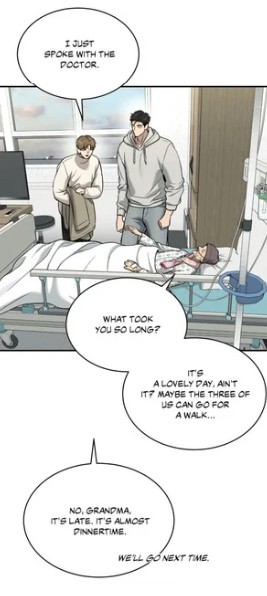 (chapter 94) She noticed his absence, but she failed to see his red eyes, his suffering. She does not fully register the adult standing in front of her. She continues to relate to him through the image she has preserved. This is where the gesture of removing the glasses becomes significant.
When she takes them off, the mediation disappears. The lens through which she has been interpreting the world is no longer in place. (chapter 94) This moment signals a possible rupture in her perception. The constructed coherence of her memory is about to be confronted by a reality that cannot be filtered in the same way. Her vision, quite literally, is about to collapse.
The Birthday: Time, Erasure, and the Illusion of Permanence
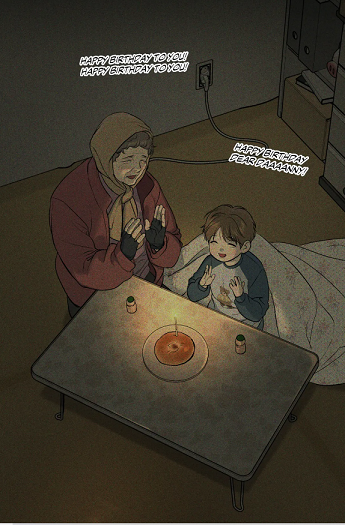
This tension between past and present becomes even more striking when we consider the question of the birthday.  (chapter 41) Birthdays are not trivial details. They function as markers of time, inscribing the individual within a social and temporal order. They acknowledge growth, change, and the passage from one stage of life to another.
 (chapter 11)
And yet, in this scene, the birthday is absent. This absence is revealing.
Jinx-philes already know that Kim Dan’s birthday follows immediately after Joo Jaekyung’s scheduled match on December 25th  (chapter 88). The temporal proximity is clear. If the grandmother is aware of his matches — if, as she claims, they “give her strength”
 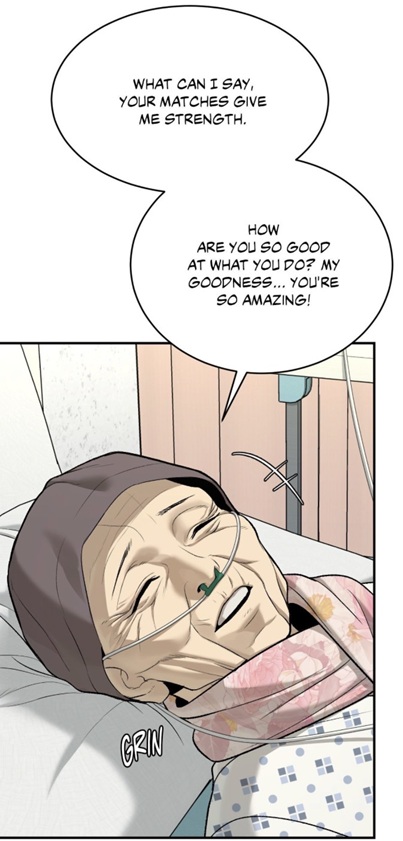 (chapter 94) — then she should also be aware of this date. But she does not mention it.
Instead, her attention is directed elsewhere. She complains that he does not spend enough time with her and asks him to come earlier next time. (chapter 94) She asks him to come earlier next time. 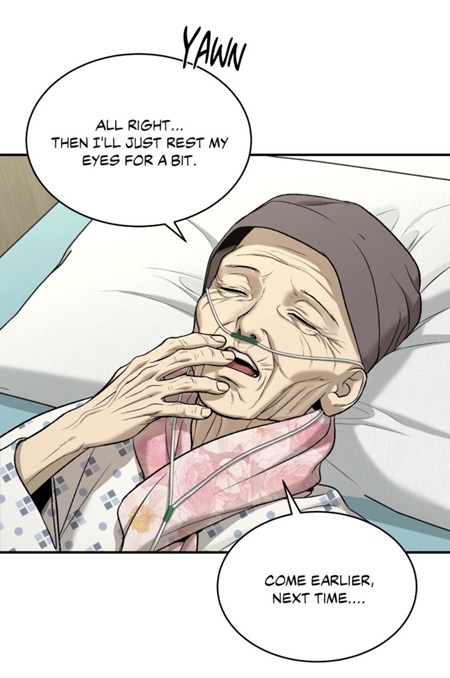 (chapter 94) Her concern is not oriented toward his life as it unfolds, but toward maintaining a certain relational dynamic.
This is where the contradiction emerges. She speaks as if she is connected to the present, yet her perception is anchored in the past. The fact that she only “heard” about his victory suggests distance rather than genuine involvement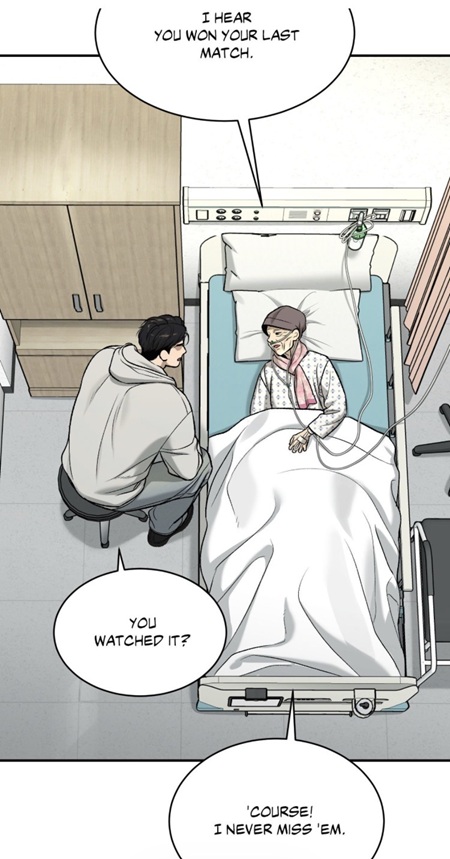 (chapter 94) Her knowledge is indirect, fragmented, and yet presented as intimacy. This gap is not incidental. It has structural consequences.
By not acknowledging his birthday, she does not acknowledge the passage of time. She does not recognize him as someone who is approaching thirty , as someone whose life extends beyond the role she has assigned to him. In this sense, the absence of the birthday is not a simple omission. It functions as a form of erasure.
Without temporal markers, the individual becomes fixed. He no longer moves forward. He remains suspended in a past that can be revisited, reshaped, and controlled. This is why he appears, in a certain sense, frozen in the end. (chapter 94) This also explains why she continues to treat him as a child. If time is not acknowledged, growth is not recognized. If growth is not recognized, the child never fully becomes an adult. He remains within a structure in which his role is defined by dependency, proximity, and care. This is where the notion of the “Unseen Game” reaches another level.
It is not only about economic structures or social conditions. It also operates through time itself. Through what is remembered, what is omitted, and what is allowed to change. And in this case, what disappears is not only the parents. It is Kim Dan as an individual. (chapter 11) When Jinx-philes encounter the birthday scene, they may assume that this celebration was a recurring ritual. But is that necessarily the case? The narrative does not confirm repetition. On the contrary, the absence of any reference to his birthday in the present suggests discontinuity rather than tradition.
This absence becomes even more striking when we consider the logic of the photographs. If, as suggested, one of the images corresponds to winter (chapter 94) then this season should have triggered her memory. And yet, it does not. The seasonal cycle that structures the photographs no longer structures her perception.
This indicates a deeper divide. She no longer inhabits the same temporal reality as her grandson. While his life continues to move forward, her perception remains anchored in a reconstructed past that she revisits selectively.
What disappears, then, is not only the parents. It is Kim Dan as an individual. He becomes, in a very precise sense, a ghost within his own life: present, functioning, necessary—but not fully recognized as someone who exists independently of the role he has been assigned.
And yet, this structure is not immutable.
Because the absence of the birthday does not mean that time has stopped. It only means that it has not been acknowledged. This is precisely where Joo Jaekyung’s role becomes decisive. By celebrating Kim Dan’s birthday, he does something that has been missing until now: he reintroduces time. He marks a transition. He recognizes not the child of the past, but the adult of the present. This gesture is not symbolic in a superficial sense. It has structural consequences. 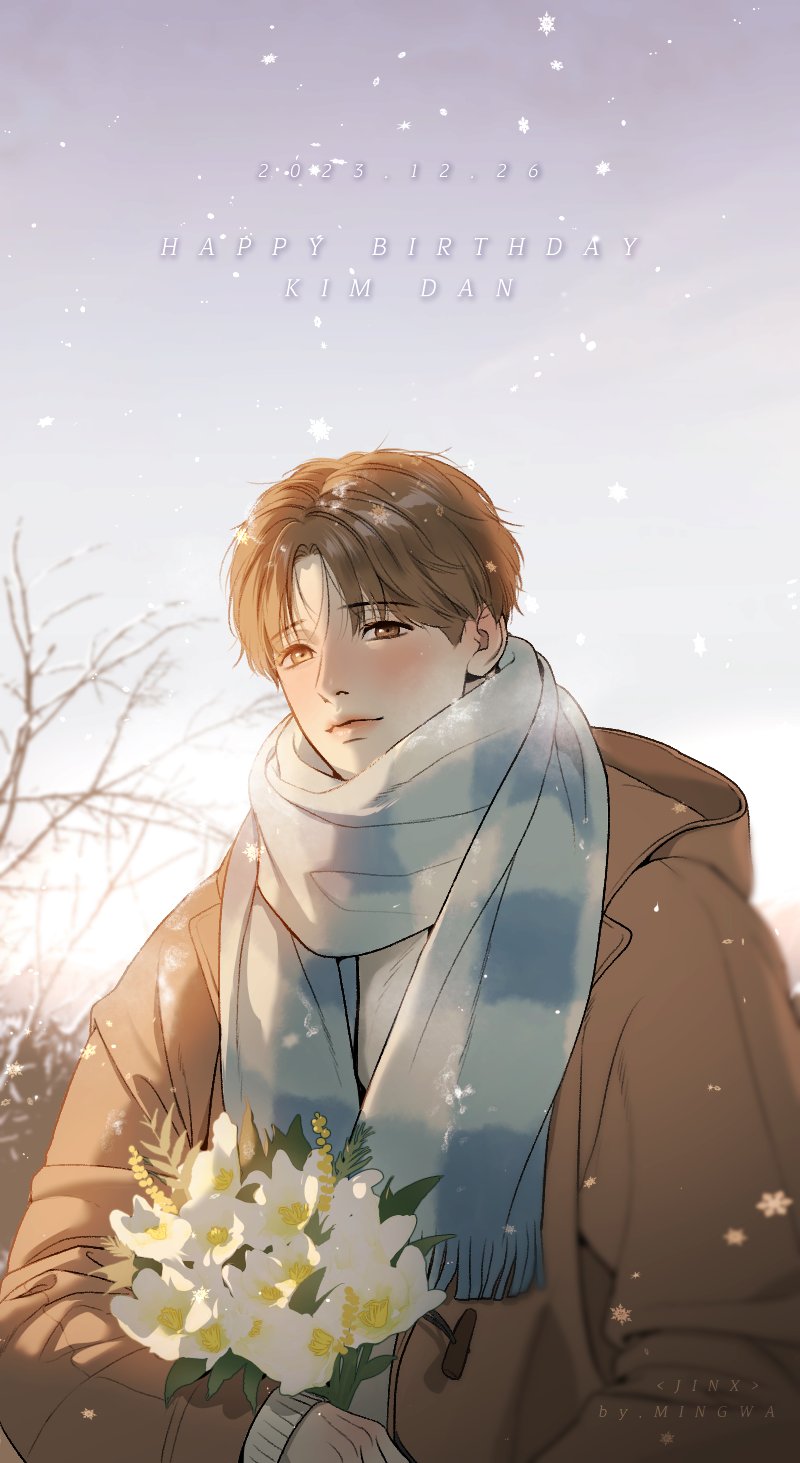 For the first time, Kim Dan is acknowledged as someone who has grown, who has endured, and who has reached a stage that cannot be reduced to dependency. The celebration does not create his maturity. It makes it visible. So this image could be seen as a picture taken by the main lead on Kim Dan’s birthday. And observe that this image lets transpire the presence of the photographer and the strong connection between the main lead and the photographer.
In this sense, Joo Jaekyung does not simply “care” for him. He restores a dimension that had been erased. He gives him back a temporal position. And with it, an identity.
The Function of the Photographs
This allows us to understand the true function of the photographs. (chapter 94) They are not simply memories. They are instruments of perception.
At first, Joo Jaekyung looks at them and sees only what is immediately visible: a child, innocence, warmth. (chapter 94) He recognizes the purity of that image, but not the conditions that surround it. The past appears self-contained, detached from the structures that shaped it. This limitation has consequences.
When he later recalls the encounter between Kim Dan and Choi Gilseok, his interpretation follows the same logic.  (chapter 48) He suspects manipulation, imagines betrayal, and attributes agency to the most visible figure, because he knows about the loan and debts. And don’t forget that in his mind, they are the result of gambling and not of an economical crisis. In this framework, Kim Dan appears as someone who could be bought
  (chapter 51), influenced, or used. Baek Junmin becomes the primary culprit, the one who acts openly, who attacks his wounds, who embodies threat. One might say that he looked at the pictures through the gaze of the photographer. But something remains unexamined.
Choi Gilseok. (chapter 48) He did not notice that these pictures were staged.
Because, unlike Baek Junmin, Choi Gilseok does not hide his position. On the contrary, he reveals it. In the café he owns, he lays out his resources with striking clarity.  (chapter 48) He speaks of his parent company, of pharmaceutical connections, of international treatment. He offers to cover medical expenses, to provide accommodation, to double Kim Dan’s salary, even to place a car at his disposal. This is not a conversation. It is a display.
What he presents is not simply help, but a system of possession. If we read this scene through the lens of Monopoly, the structure becomes unmistakable. Choi Gilseok is not a player struggling within the game. He is someone who already owns the board. The café, the company, the network, the capital—these are not isolated elements. They form a coherent system in which value is accumulated, controlled, and redistributed according to strategic interest.
Kim Dan, by contrast, is placed in the position of someone who has landed on another’s property. The offer appears generous. But like in Monopoly, generosity is never neutral. It is tied to incorporation. To accept means to enter the system, to become part of a structure in which the terms are already defined. This is where the illusion operates. Because what is presented as opportunity is, in fact, a form of capture. 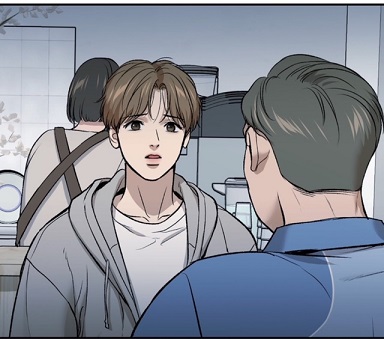 (chapter 48) And the switched spray was the price to pay for the “visit” at the café.
 (chapter 49) The meeting with Choi Gilseok is no longer a simple interaction between individuals. It becomes part of a larger configuration — one in which visible actions and invisible structures intersect. Responsibility is no longer attributed only to the one who strikes, but also to the one who orchestrates.
As you can see, the pictures can help Joo Jaekyung to see not only the director, but also his position within the game. This shift is crucial. (chapter 94) Because it allows him to recognize that Kim Dan is not defined by greed, weakness, nor by passivity, but by a history that required endurance, adaptation, and silent resistance. The child he saw in the photographs is not separate from the man he stands beside. It is the foundation of that man.
To conclude, this is where the photographs about Kim Dan’s childhood begin to transform Jaekyung’s perception. Indirectly, he has sensed the care and loving gaze of the parents. Because once he has learned to look beyond the surface — once he understands that what appears as innocence may contain loss, that what appears as simplicity may conceal structure — his way of seeing changes. He no longer looks only at what is shown. He begins to question what is hidden. And it is the same for Kim Dan (chapter 94) who could be forced to remember painful moments  (chapter 19)
 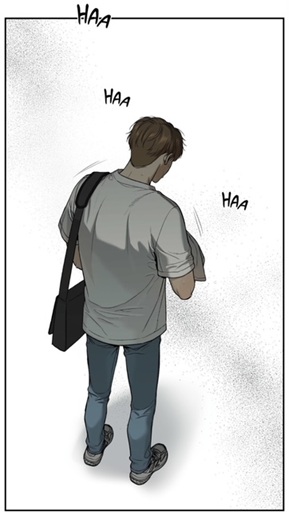 (chapter 59) by rediscovering the photos from his childhood, like the vanishing of the “puppy”. (chapter 94) I don’t think, it is a coincidence that Potato has pictures of the puppies as well.
  (chapter 60)
Feel free to comment. If you have any suggestion for topics or Manhwa, feel free to ask. If you enjoyed reading it, retweet it or push the button like. My Reddit-Instagram-Twitter-Tumblr account is: @bebebisous33. Thanks for reading and for the support, particularly, I would like to thank all the new followers and people recommending my blog.

 Bebebisous33s' analyses in K-Dramaland and Manhwas