The mirrors and its different meanings in “The King: Eternal Monarch”

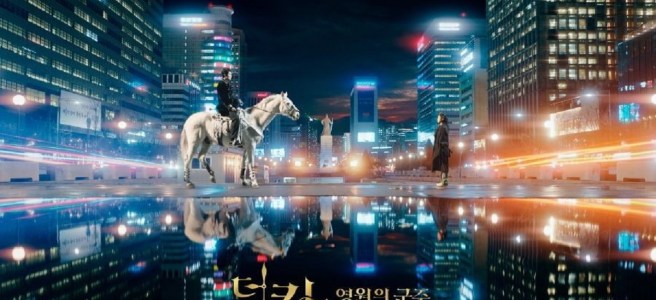
If you look at the poster above, you will notice the presence of three important characters: the king Lee Gon, the lieutnant Jeong Tae Eul and a huge mirror. The latter even occupies a bigger place than the two main leads indicating first the existence of a parallel world. Secondly, it also manifests the huge role the mirror will play in this story. Here, the mirror is actually the reflection from water and not a simple mirror made by humans. Therefore it means that the existence of two worlds is a natural phenomenon. It is not created by humans, the latter are just inhabitants in these worlds. Furthermore when we look at the reflection, the onlookers can notice the duplication of Lee Gon and Jeong Tae Eul. And this is not a coincidence: it announces that Lee Gon and Jeong Tae Eul will interact in both worlds. The director and writer could have used the doppelgangers, Ji Hun and Luna, in this poster underlining the idea that both have “adversaries” but it didn’t happen. From my point of view, the writer is already displaying the roles that the king and the detective will play in order to keep the balance of the two worlds.

Since mirrors reflect light, this object is often associated to illumination, wisdom and truth. In a mirror, the beholder can see his own self (the truth), how he or she appears, like in this following scene.
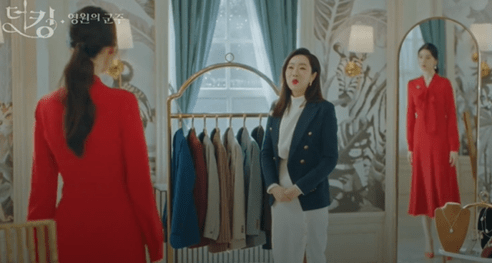
episode 7: The Prime Minister Goo Seo Ryung

On the surface the mirror here serves a purpose: she is about to choose her clothes for a certain event. She needs to judge herself if the clothes fit her and are suited for the event. Striking is that in this scene, Goo Seo Ryung catches the attention of the viewers due to the color of her dress contrasting so much to the background: red versus blue and white. Furthermore, there is only the reflection of the Prime Minister in the mirror, we can not see the stylist and her secretary in it. I could even add that the duplication of Goo Seo Ryung illustrates her confidence and charisma. She is not afraid to stand out which is also confirmed during the conversation. She rejects all the clothes because her stylist chose rather conservative clothes.

But a mirror symbolizes vanity as well, as the spectator wants to confirm his or her own beauty and attraction. And this scene illustrates Goo Seo Ryung’s vanity too. It even outlines her egocentrism. She is only looking at herself and not at the stylist. That’s why a mirror can be a source of danger which is presented in the myth of Narcissus.

Narcissus, the son of a river god and a nymph, was walking by a pond, when he decided to drink some water. The moment he saw his own reflection, he fell in love with it and kept staring at it until he died. It was his punishment from the goddess Nemesis because he kept rejecting suitors which caused the death of a female admirer. At the same time, the mirror in this myth is also linked to desire and wish that can not be fulfilled. Narcissus can never really touch himself, as soon as he tries to grasp the water, his own reflection disappears. Furthermore Narcissus can never feel the love and the warmth from his own reflection, since it comes from water. Therefore we can connect a mirror to futility too.

In the work “Faust” written by the famous author Goethe, Mephistopheles brings Faust to a witch who owns a magical mirror. In there, he doesn’t see his own reflection but “Gretchen”, the future love interest of Faust. Just like in the myth of Narcissus, the mirror here reflects Faust’s desire. He wishes to meet the young woman, however there is more to it. The mirror is here used as a temptation, since Mephistopheles, the personification of the devil, wants to get his soul. In exchange for youth and love, Faust agrees. It was as if Faust was seeing his own future with Gretchen. In other words, a mirror can be associated to the future.

As conclusion, a mirror can be linked to qualities (illumination, wisdom and truth) and negative aspects (vanity, futility, unfulfilled desire and temptation). Equally, this object is a symbol of physical and spiritual reflection. It represents the threshold between conscious and unconscious mind. In the scene above, the Prime Minister wants to shine and appear as an attractive and confident woman (conscious mind). Coexistent, she unveils her true personality: her self-centeredness and her vanity (unconscious mind).

But now let’s take a closer look to the utilization of mirrors in this k-drama. First, we can see the presence of a mirror, when Lee Gon is about to enter Republic of Korea, the parallel world. Here, it is introduced as a magical tool, even as a portal to enter another world.

episode 1

The mirror as magical tool has a long tradition. I could mention “Snow white and the 7 dwarfs” or even a more recent story “Harry Potter”. In the first story, the mirror speaks to the Queen and tells her the truth: Snow White is now more beautiful than her. It was as if this item was a living object, since it speaks and can even make its own judgement. In the past, the queen used to be the most beautiful woman in the world, now it is Snow White. The mirror has changed his assessment and adapted to the new situation. Then in “Harry Potter”, Mirror of eriseD serves to show what a person desires the most. In the 7th book, Harry Potter uses a fragment of a mirror in order to call for help, as he is imprisoned by Bellatrix. Dobby answers to his call. This magical tool is here connected to desire, danger and signal for help. Striking is that in the picture above, the mirror implies danger as well, since it is fractured. Lee Gon can only go through the mirror, since it is broken. Just like the mirror in Snow white and the 7 Dwarfs, the mirror seems to be a living object as the mirror appears on his own (Lee Gon doesn’t summon it) and it even breaks on its own.

At the same time, this mirror is in fact the physical threshold between the conscious and unconscious mind. While people from one world are rich or healthy, they live an opposite life in the parallel world. Luna is abandoned and has no family hence her biggest wish would be to have a family and a father, to be recognized. Whereas the CEO and his son from HG Group in Republic of Corea are powerful and famous, their doppelgangers in MOC are weak und rather common. Besides, I could name another example: while Myeong NaRi doesn’t fancy Jo Eun Sub, it is the opposite in Monarchy of Corea. That’s why I come to the conclusion that there is a balance between these two world. The conscious mind in one world is the unconscious mind in the other world and the reverse. The temptation and desires are never revealed to the world, until Lee Lim appears.

And this is the reason why Lee Rim is so dangerous as he acts as the devil, similar to Mephistopheles. He lets people see their own reflection and appeals to their unconscious and inner desires. We should consider pictures taken from the doppelgangers as a transformed reflection. He only allows them to see what they want to see. Let us forget that a mirror consists of glass and in a camera, there is a lens constituted by glass as well. In a different scene, the Prime Minister sees her doppelganger in the screen.

Or it could be the opposite… Goo Seo Ryung is seen by her doppelganger. While the latter is an average woman, Goo Seo Ryung appears rich and influential which could be a temptation for her doppelganger. Our strong politician gets scared at her own image, although she didn’t react the same in the scene mentioned above. The shock came because she didn’t even recognize herself. She had the impression to see a ghost as the doppelganger’s image is transparent. Actually, we don’t know about the origin of this phenomenon. Is Lee Rim behind this or not? In my opinion, I doubt it as Lee Gon is not a god. It could be a warning as it becomes clear during the episode 8 that Lee Rim is trying to lure her to Republic of Korea. It looks like someone is already working against Lee Lim in order to keep the balance between the two worlds. If she came to ROK, she could become the future president of the country, something she can never achieve in Monarchy of Corea. Lee Rim thinks that she is trying to seduce Lee Gon because she is attracted to his powerful situation. In a republic, she wouldn’t even need Lee Gon at all. But from my point of view, he forgets that the Prime Minister is above all a woman. Remember the scene with the clothes: she never wanted to give up on her femininity. She is definitely interested in Lee Gon the man and not just the king.

In this scene, you will notice that Goo Seo Ryung’s doppelganger is holding a mug. And in a different scene, we witnessed a weird phenomenon. Jo Young and Jo Eun Sub were both holding a drink, the former had a mug of hot coffee, while the other was holding a mug of iced tea. In that particular scene, both dropped their drinks as they felt a strange sensation. Jo Young was surprised because his coffee felt so cold, whereas Eun Sub got burnt by the ice tea. It was, as if their drinks had been exchanged. Due to the scene with Goo Seo Ryung, I came to realize that the Prime Minister, Eun Sub and Jo Young had all something in common: water and mirror. All three (Eun Sub, Jo Young and the doppelganger) were holding drinks, which is linked to water. Actually, the reason why I have been connecting mirror to water isn’t  just because of the myth of Narcissus. Actually, I kept thinking about the following scene from the movie Matrix

The Matrix

Notice in this scene, the mirror gives the impression to be a magical tool. It was, as if it was alive (just like in TK:EM). Then it transforms into a liquid, it looks almost like water, and at the same time, the mirrors serves as a portal as well. Neo is able to pass from one world (dream) to another world (reality), although Neo is confused, if this reality is true as it doesn’t feel and look real at all, rather mysterious and magical.

But let’s go back to our k-drama. Since the mirror is fractured each time someone goes through the passage, we have to imagine that each time something was leaked from one world to the other, hence water and mirrors haven been affected by the opening of the passage. In other words, reflecting items like screen or water in a drink leak reflections or sensation from the other world.

Then I also think that the moving from one world to another has also affected both worlds. Remember that the people are supposed to live the opposite of their life from one world to the other. So they are not supposed to do the same thing, actually the opposite. Yet, in both scene (ES-JY and the scene with the Prime Minister), their doppelgangers were doing the exact same thing:

– YJ/ES were about to drink something

– GSR was sitting in front of her screen just like the other

The more people are going from one world to the other, the more people will do the same thing than their doppelgangers. I hope, this is understandable. 

Finally this scene from Matrix can explain why ES and JY could feel the temperature from the other drink… Neo is touching the mirror and I would even say, he is eaten by the mirror the moment he touches it with his finger. Water is well known as the best current conductor, hence it means that sensations can be transferred through water.

Like I mentioned above, the reflection in the screen could be a warning, a signal of a danger. And this meaning is even more visible in the following scene, when the lieutnant JTE sees Luna in her rear-view mirror.
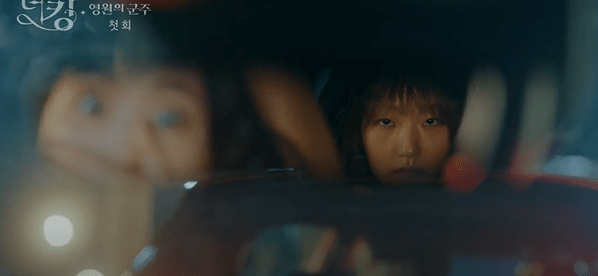
episode 1

Remember that the function of a rear-view mirror is to alert the driver of potential danger. Besides, Luna as a source of thread is even reinforced with Luna’s gaze. She looks at JTE with a certain animosity.

In another scene, the detective Kang Shin Jae is looking at his own reflection in a pool of blood.

episode 7

And this is no coincidence. This single taking is referring to Shin Jae’s past. His life in ROK is linked to the death of his surrogate. We discover much later that his doppelganger was in a coma for one year. Even the mother declares to him that she considers his recovery as a miracle. It becomes clear that Lee Lim has lured the father by giving him the hope that he could get a healthy son as the mother from ROK has no idea about the switch. But for that miracle, the adoptive parents paid a huge price: their company went bankrupt and the father even landed in jail. Seeing his own reflection in the pool of blood triggers something in the detective therefore while he is trying to sleep, a souvenir resurfaced, the moment he woke up at the hospital.

But this doesn’t stop here. In another scene, Shin Jae visits the ashes of Ji Hun and here again, he sees his own reflection in the picture.

episode 8

What caught my attention is that in this taking, the detective is almost translucent. Here again, the connection between his reflection and the face of Ji Hun jogs a memory: he remembers the funeral ceremony held by the infant Lee Gon who resembles Ji Hun. Concerning Shin Jae, the writer used the mirror in order to reminisce the past, something he had buried deep inside. As conclusion, the mirror helps to see the future (see above Faust) but also to discover or remember the past.

Finally, in the last episode, we see our villain Lee Lim walking to the shop of The Prime Minister’s mother where he left an umbrella behind. Here, his reflection comes from a puddle.
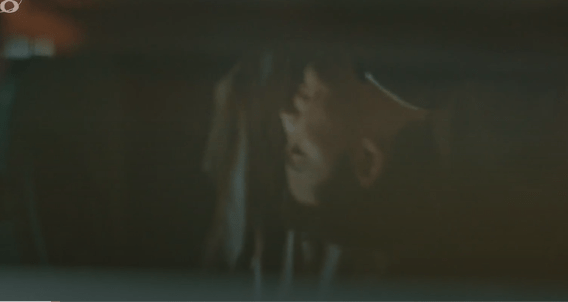
episode 8

Interesting is that

– the director used a puddle which I associate to dirt and failure, as we know the expression “step into a puddle”

– his head is shown upside down. It was as if the antagonist is trying to bring chaos to the world as there is this expression to bring the world upside down.

– He isn’t even looking at his own reflection. He doesn’t pay attention to his surrounding. He is blind, since he is obsessed with his own plan. People might have wondered why the camera zoomed here but after reading this interpretation, you can sense that this taking could be a prophecy of Lee Lim’s failure. Let us not forget that I suspect that there is something else or someone else working against Lee Lim. In this scene, we can see that the mirror serves as a spiritual reflection and as such, it foreshadows the consequences of Lee Lim’s actions. He is doomed to failure and he should fear the retribution of the gods.

Then in the episode 13, the mirror plays a huge part in the discovery of the savior’s identity.

image.png

In this scene, the mirror has an important purpose. It makes Lee Gon realize that he traveled in the past and saved himself. He had already imagined that a time travel was possible. In the same episode, he had told his girlfriend: “If there’s a time axis in there as well as a space axis, then it’ll be possible”. By looking at the mirror, he discovered his future self acting in the past. He only got aware of it, the moment he identified the woman as Luna and saw his own reflection in the mirror. That’s when he realizes that he is wearing the same clothes than the mysterious savior. It was as if the mirror allowed him to see his own past but at the same time his own future. At some point, he will travel to the past.

Then next to him, there is Luna, his enemy but since she looks like Jeong Tae Eul, we have to wonder if JTE will stand by his side, when he travels back in the past. Let us not forget that she is the one who had the cellphone with the inscription: Back to the future. On the other hand, we shouldn’t forget that Luna was the one who stole JTE’s cellphone. Since the cellphone is in her hands, she could travel back to the past as well. Luna wished, she had grown up differently, so maybe Lee Gon help her to change her fate so that when she travels back to the future, she can die in peace, as her time is limited. 

Feel free to comment or push the button “like” if you enjoy reading this analysis.
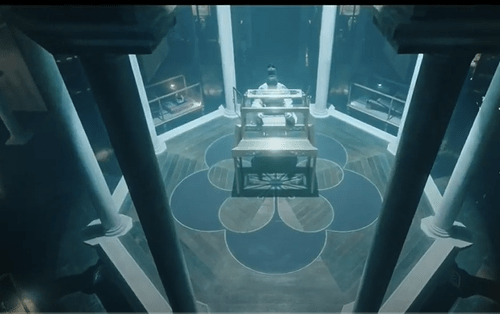
“Lee Rim: the birth of a new god?”, based on “The King: Eternal Monarch”

Anyone watching the k-drama “The King: Eternal Monarch” knows that Lee Rim is the antagonist in this story, Lee Gon’s uncle who conspired against his own brother, the king, in order to possess a mysterious flute.

Striking is that this k-drama starts right away with the introduction of the villain and not with the protagonists. This unusual move has a rather simple explanation. It exposes the true personality of the antagonist and his motivation behind the “coup d’Etat” which happens later.

However, there is more to it because in the first scene of the first episode, the viewers don’t see the villain immediately but only hear his voice. He is actually telling a story. What caught my attention in this first scene is that the story told by Lee Rim doesn’t initially match the taking. While the beholder sees a forest of bamboo, Lee Rim mentions an event recorded in the Memorabilia of the Three Kingdoms:

“In spring 682, King Sinmun received a bamboo flute from the Dragon King of the East Sea”.

First episode: Lee Gon’s father is taking the flute from his shrine”

Right after quoting this sentence from the historical Chronicles, the scene changes and viewers witness how the king takes the flute from a shrine. So with this move, the director wants to confirm the veracity of Lee Rim’s words. The flute does exit and it is possessed by the descendants from Silla Dynasty. Then Lee Rim adds:

“When the flute is played, enemies would retreat, diseases would be cured, rain would fall during droughts, the rainy season would end, the wind would stop and strong waves would subside. Seeing its powers, King Sinmun named the flute Manpasikjeok” and designed it as a “national treasure”.

Only after quoting this from the Memorabilia, Lee Rim appears, his face is covered in blood,

which is kind of surprising as he told the story about Manpasikjeok in a very calm manner. The head quotes from the Memorabilia outline that Lee Rim is a strong believer of the powerful flute. For him, the Memorabilia from the Three Kingdoms is similar to the bible. In other words, Lee Rim is an extremely religious man.

I would even add that he treats the Manpasikjeok as an idol. An idol is actually an image or a representation of a god used as an object of worship. So for Lee Rim, the flute has become a new religion and the owner of Manpasikjeok is a god. Interesting is his attitude towards disbelievers. He criticizes them indirectly as the non-believers call this story a myth. As you can observe, Lee Rim appears to be a radical believer, a fundamentalist. Fundamentalism is a form of religion that upholds belief in the strict literal interpretation of scripture. So the quotations from Memorabilia are taken literally by the antagonist. Like I mentioned it above, for him Memorabilia is like a Holy scripture. He believes in the true power of this mysterious flute. But his complain doesn’t stop there. He explains why he took it from his brother. Notice the words he used to legitimate his murder and coup d’Etat.

“I took it from my brother who had it but didn’t believe in it”

So for the antagonist, the king is categorized as non-believer. Nonetheless, if we look at the first picture above, the king is treating the powerful flute very carefully and it is put in a shrine. Only once every 20 years, the Manpasikjeok is revealed to wish peace to the world. This means that it is kept hidden the whole time, while in Lee Rim’s eyes, this flute should be shown to every one. For him, the cult around the Manpasikjeok should be practiced more openly and differently. We can feel his religios fervor, while his brother acts as if it was a hidden cult. I have the impression that while Lee Rim considers the flute as an idol, the king treats it as a relic. The latter is something associated with a saint, which some people regard as holy. A saint is a virtuous person, someone who does good for others. Now, you can better understand the huge gap between the two royals. While Lee Rim considers the flute as a divine object giving godly powers, the king connects it more to the human world and humbleness. This flute has to be used by a virtuous and honest man which elucidates why the flute is not revealed to the public eye.

We can feel his resent and jealousy towards his brother, when he yells to JTE that the king was able to see the Manpasikjeok each day. He didn’t cherish the flute properly. Furthermore, he reproached the king’s ignorance and passivity as he could have grasped the world with the flute. And with these words, it becomes clear that Lee Rim believes that this precious and divine flute can turn the owner into a god as the owner has the possibility to access to another world.

As conclusion, for Lee Rim, becoming the owner of the flute means becoming a god, yet simultaneously it means that Lee Rim will introduce a new religion with new rituals: sovereign’s cult. Since he is a fundamentalist, it also implies that Lee Rim expects a strict obedience to him, the new god, from his followers.

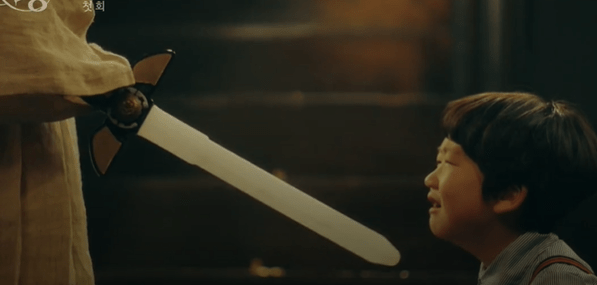
However, we can observe a huge contrast between Lee Rim and his brother. The latter keeps the Four Tiger Sword close to him and his son. Besides, when Lee Rim mentions that Lee Gon will be confronted with the legend and realize its authenticity, the camera zooms to the Four Tiger Sword. For Lee Gon and his father, the sword is far more important than the flute, whereas it is the opposite for Lee Rim. This lack of respect for the sword is actually outlined, when Lee Rim kills the king with the sword. Actually, the villain is soiling the sword. Furthermore, after using it, the uncle let the sword fall onto the ground, where Lee Gon can use it later in order to stop Lee Rim. So here is the question: why isn’t the sword as important as the flute for Lee Rim? Because it is not mentioned in the Memorabilia. Remember that Lee Rim considers it as a Holy scripture. Since Lee Rim is not a legitimate son, he has not been initiated to the secrets linked to the sword and the real story about the Manpasikjeok. He only knows the story through the Chronicles in reality. And he took these words for a reality. And we get another clue that the Four Tiger Sword is actually the real divine item with the following scene:

Episode 1 the young Jo Young is declared “Unbreakable Sword” by the young Lee Gon. We have to remember that Lee Gon has just lost his father and has already become the new King.

But now, let’s go back to our villain. While fighting with the king, Lee Rim denies the existence of gods (“God never created humans”) which contradicts his own words and belief. This actually underlines his real intention. His true goal is to become a god himself and for that, he needs the powerful flute. The flute will give him divine powers and simultaneously it serves as regalia, just like the sword. And we can clearly see that he uses the cult around the Manpasikjeok to justify his coup d’Etat. Religion in History has always been used as a justification for monarchs, see e. g. the French King Louis XIV called the Sun King. But what differs him from Louis XIV, an absolute monarch, is that Lee Rim intends to install a theocratic monarchy and not just an absolute monarchy. Now, you are wondering: what is the difference between these two? An absolute king is considered as a representative of God on Earth, whereas in a theocratic monarchy the king is considered as a god himself and has connections to gods. Since he denies the existence of god, he needs supporters in order to become a god, just like in a theocratic monarchy therefore he declares to his brother:

“it was the weak who created god”

But he fails so that he is forced to hide. Because he got the half of the magical flute, he is able to escape from Monarchy of Corea (MOF) and appears in Republic of Korea, where he discovers the existence of a parallel word. So this miracle proves him that the Manpasikjeok has godly powers and as such the owner of the flute is powerful. Then he meets by chance his half-brother who is poor and rude in this world. That’s when he realizes what he could do here. If you pay attention to his different actions from that moment, you will realize that Lee Rim as fundamentalist starts considering himself as a god.

  1. Before killing his own self, he claims that he is different and far nobler indicating that he doesn’t consider himself as a human being any longer.
  2. He shows up in front of his right-hand-man after so many years and he hasn’t aged at all. He reinforces the idea that he is an immortal.
  3. When Ji Hun’s mother returns from the morgue, she laughs as she is happy about her husband’s death. Her bruises on her face indicates that she has been abused by her husband. While laughing, she declares: “I guess, there is a god […] I prayed every day that he would die”. And here notice Lee Rim’s reaction: he waited on the wheelchair all this time listening to her laugh and her words. Then she starts mentioning her son Ji Hun which shows that her resent is only directed at her husband. She clearly loves her child. In that moment, Lee Rim stands up from the wheelchair. His behavior somehow reminded me of the resurrection of Jesus Christ as the doppelganger of Lee Rim looked like he was dead (he couldn’t move and didn’t even speak). Then he confronts the mother by telling her that she has sinned with her laugh. He acts like a god who judges people for their behavior. Ironically, her sin (laughing about her husband’s death) is nothing compared to the crimes Lee Rim committed before. He had already killed three people in ROK: his brother, his other self and Ji Hun, the doppelganger of Lee Gon. He acts as if he has answered her prayer but for her sin, she should repent and confirm her son’s death as an accident.
  4. In another scene, he acts as if he would answer a mother’s prayer. Her son is paralyzed and has been mocked by children on his birthday. HE tells her that her son can never walk but she should change her prayer so that her wish would come true. He even tells her what her prayer should be: the rude children should be punished and get paralyzed just like her son. In this scene, the beholder observes the limitation of Lee Rim’s powers. He is not a god, he can only play tricks.
  5. Then we see him at a temple painting the walls. It was as if he was creating his own temple where people would come to worship him.
  6. Finally, when he meets the pregnant woman who is poor like the other people he met in ROK. He tells her that she can live a great life but for that, she needs to pay a price: kill the doppelganger in MOC. So Lee Rim asks for a bloody sacrifice. It was as if he had become a bloodthirsty god. In order to have your prayer answered by the god, a human sacrifice is required.

All these scenes illustrate Lee Rim’s belief: only weak people create a god. He acts as if he was a powerful god, yet in fact his powers are limited. He can go from one world to the other, he doesn’t age as well, nonetheless he can not turn a sick person into a healthy one. All the prayers are linked to death and punishment. He is not someone who wants happiness and peace for people, he only uses weak humans to achieve his goal. He wants them to see him as a god that’s why he acts like that.

Finally, I would like the readers to remember the story told by Lee Rim in the beginning. He mentioned the Dragon King of the East Sea. Who is this Dragon King? A real dragon or is it the king from Japan as the island is situated in the East sea? Remember that the dragon is seen on Lee Gon’s robe. Striking is that so far Lee Rim has never explained the identity of this Dragon King. For Western countries, dragons are associated to destruction and death, whereas in Asia dragons are linked to positive aspects: great power and fortune hence the dragon is seen on the robe of the king. And here I’ve got the feeling that Lee Rim is influenced by Asian mentality. He considers the Dragon King as someone positive. Yet we heard from Lee Gon that his ancestor Prince Sohyeon became the king Yeongjong and stopped the Qing invasion. While doing some research, I read that prince Sohyeon was influenced by Western ideas and was for a modernization of Joseon. So Lee Rim represents the conservative type (fundamentalism, theocratic monarchy), while Lee Gon and his father are more modern and under the influence of occidental mentality. Therefore I think that this explains why Lee Rim criticized his brother as he saw the Dragon King as someone positive, while Lee Gon and his father have been raised to see the evil nature of the Dragon King from the East Sea.

As conclusion, because of his travel to the parallel world, Lee Rim has come to see that his belief was correct and that he has become a god who could rule over two worlds. However, if we pay attention to his actions, we can conclude that in reality, he is just an “idol”, a false god. He reminds me of the golden calf from the bible symbolizing the false faith.

Truth and Memories: Memorist, Nobody knows, Find Me in Your Memories and The King: Eternal Monarch

Before we start to analyse different actual k-dramas under the aspect of truth and memories, we need to take a look at the definition of truth. This is what I found under the following website (https://www.dictionary.com/browse/truth)

  1. the true or actual state of a matter:He tried to find out the truth.
  2. conformity with fact or reality; verity:the truth of a statement.
  3. a verified or indisputable fact, proposition, principle, or the like:mathematical truths.
  4. the state or character of being true.
  5. actuality or actual existence.
  6. an obvious or accepted fact; truism; platitude.

As you can observe, truth is not just simple, although it is a short word that is often used. Truth has different meanings. Even philosophers like e.g. Plato questioned the definition and essence of truth. In our case, the second and fifth meaning are the relevant ones because truth is in the center of crime series. Fact, verity and reality are the goals of police work. Police need facts and evidence in order to retrace the events. They attempt to find the whole truth hence they need to find the culprit for the offense as the identity of the perpetrator is often unknown. As such, people think that discovering the perpetrator is a synonym for truth as it is a fact and a reality (signification 2).

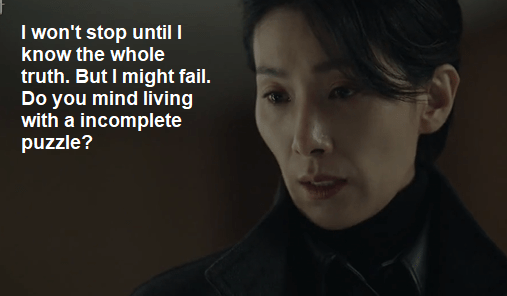
But is it correct to think so? Actually, we have to question this belief. Knowing the identity of the culprit doesn’t necessarily signify that the police know the truth… Sure, in order to unveil the truth, the police investigation has to bring physical evidence and testimony of witnesses. However, the motive and justification for the crime are all subjective hence the detectives can only guess those. They can reconstitute the whole crime scene but they can never retrace the thoughts of the culprit. Moreover, it’s very difficult to prove a motive, especially if the perpetrator is motivated by emotions (anger, jealousy, etc.) and even irrational thoughts (serial killers). The profiler and detective can only guess and make assumptions but there is no guarantee that their reconstitution is the truth. Finally, retracing the events can never become the reality and as such the truth, since the victim is already injured or dead. The crime has already happened. As you can see, finding the whole truth is not physically possible. The thoughts can never be shown, the reconstitution can only give a glimpse of reality.

But even so, in order to retrace the events, the detectives have to rely on evidence and the testimony of witnesses, like I mentioned above. Evidence is quite simple as these are traces, like a bill, a phone call etc. On the other hand, it is quite different for the testimony of witnesses. The latter have to remember and we know that memory is not reliable, as people tend to forget or the witness didn’t pay attention to the scene and could only get a small part of the event, or even misinterpreted the words or the scene. In other words, memories are very subjective and even fluctuate, yet for the detectives, the memories of a witness can become facts. That’s why in memories lie a certain danger and can never served as the whole truth. Memories are quite subjective but are often treated as objective by people. This explains why during a trial, the witnesses are questioned by the lawyer and the prosecutor. By analyzing the veracity (truthfulness) of a testimony from both perspectives, the trial is trying to retrace the crime and retrace the thoughts of the accused before the events. All of this in the attempt to find the whole truth. That’s why memories play a huge part in the investigation and this topic is treated in the following k-drama, Memorist.

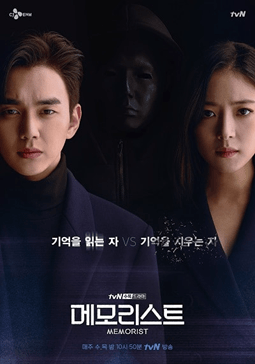
Poster of Memorist

Detective Dong Baek (Yoo Seung Ho) has the supernatural ability to read people’s memories, when he touches them. Armed with this power, he tackles a mysterious serial murder case. And due to his ability, he catches criminals and is able to send them to jail. Initially Han Sun Mi, a profiler, dislikes the detective because she finds his method suspicious and quite dangerous. As you can see, the detective’s ability is perceived as an objective tool. We are not shown, how the criminals he caught were really convicted. He is the only one who can read their memories and in this drama, the viewer have the impression that memories read by DB are quite objective. Strangely, our main protagonist is suffering himself from amnesia. He knows nothing about his past, he only remembers the corpse of a woman. That’s why he is using his supernatural ability, he wishes deep down to discover his own past and the culprit of the murdered woman he keeps remembering.

Striking is that although Han Sun Min kept her distance from Dong Baek for a while, she relied herself a lot on her memories. She still wants to catch the culprit of her father’s murder. Only after many years, she realizes her mistake. She thought she saw a scar on the culprit’s face, while in reality she saw the mark of a face mask. As you can observe, the memories and their interpretation misled the profiler. Later, both protagonists are confronted with a crime, where the witnesses have no memories at all. All their memories have been erased and with no evidence, Bong Baek and Han Sun Mi have no lead to find the culprit. As the investigation progresses, they realize that they have to deal with a man with the supernatural ability to erase memories. At the end of the episode 12, DB touches Lee Shin Woong, Han Su Min’s superior, and read his memories. To his shock and surprise, he sees his younger self and the police commissioner confirms that it was DB who killed 7 people 20 years ago. As conclusion, the witness and the memorist believe these memories as the truth and fact. However, seeing is not the same as knowing. Dong Baek could have a twin brother hence Lee Shin Woong misjudged the situation. He thought, he saw DB, while it was not correct. Another possibility is that Lee Shin Woong manipulated his memories in order to mislead the memorist. All these events actually outline that testimonies should never be treated as the truth. That’s why we have trials where the reliability of witnesses is questioned. The use of DB’s ability for investigation is actually questionable. He is a human being and the memories read by him are also subjective.

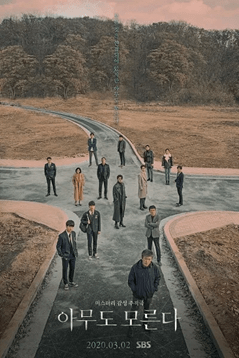
Nobody knows

Then in this k-drama, the writer is already pointing out through the title “Nobody knows” that it is quite impossible to find the whole truth. Sure, the title is first referring to secret. All the persons involved have a secret which is revealed one by one. CYJ was the best friend of the 8th victim in the stigmata serial killing, HMS cheated on a test, KEH had discovered the identity of his biological father etc. In other words, discovering secrets play a huge part in discovering the truth but that’s not enough. It is possible that some secret will never be unveiled hence the whole truth won’t be known. Another parameter are the memories. Thus just like in the k-drama Memorist, the writer focuses on the importance of memories too.

The teenager Ko Eun Ho fell from the rooftop of the Millenium hotel in order to escape from the minions of the villain Baek Sang Ho. Striking is that after the victim wakes up, he is suffering from amnesia and wonders how he got injured. He is actually missing one month of his life. While the mother prefers her son not remembering the past month (“she declares that missing one month of his life won’t affect his future”), the young student expresses the desire to know the truth that’s why he questions the officer Cha Young Jin and his mother (“How did I get hurt?”; “Did I tell you something strange before getting hurt?” “why won’t anyone tell me anything?”) so that at the end, CYJ gives in and tells him how he got injured. She could retrace a huge part of the events but she couldn’t tell him why his minions were really after him. As she notices the teenager’s desire to know the whole truth, she tells him this.

episode 11

Striking is that for Cha Young Jin, retracing the whole event with evidence and testimonies, it means that she will get the whole truth. However, like I pointed out before… her promise can’t never be fulfilled in reality. Furthermore, when she made this, she believed that it was related to the book JKH gave to the teenager. And she knows nothing about Baek Sang Ho’s past and trauma as well. For KEH, getting his memories back is a synonym for knowing the whole truth. He is so determined to remember his lost month that he discusses the topic with his teacher.

Scene from the episode 11
The teacher LSW: “And even if you fail to remember, people around you will tell you bits and pieces of what happened and you fill up your missing memory.”
The teenager Ko Eun Ho: “But that’s not my own memory. I want to remember what happened myself. “

As you can read in their conversation, the amnesiac teenager doesn’t accept the memories from the others as he perceives it as a false reconstruction of the past. He knows deep down that their memories is subjective as they only knew a part of him. Remember that he has a secret buried in his brain, besides the people close to him weren’t by his side all the time, as he was often on his own. His mother neglected him and spent time with her lover, the friend and officer was busy with her investigation, his friend DM was busy working. So the proposition from his teacher is rejected… he wants to remember himself as he believes that only with his memories he can get the whole truth.

However, KEH is wrong too. He makes the assumption that with his memories he knows the truth as he was the witness and the victim. Yet, while he was sitting in the car waiting for BSH, he never saw how the driver CDH was forced to drink some drugged water. While he was eating a piece of cake, the driver CDH was lying in the trunk of the car and later killed by BSH’s minions. They faked his suicide. When his short term amnesia disappears, he remembers that he discovered CYJ’s photo with the cellphone of SJ, the 8th victim from the stigmata killer. What caught my attention with his scene is that with this revelation, the viewers realize that they had been misled. All this time the viewers thought, they knew the whole truth as we were shown the events that took place before the fall from the hotel.

However, at the end of the episode 12, we get aware that we only saw the events from BSH and his minions’ perspective. KEH never left the 10th floor in a hurry because he had realized BSH’s mistake (“You already bought the book again!”). With these words, BSH revealed that he was the one who stole his school bag. In reality, KEH got scared because he discovered the photo of CYJ and SJ with the cellphone in the drawer of the desk. This was a clever move from the writer because it outlines one more time that nobody knows. The viewers didn’t know KEH’s memories until the end of the episode 12. Yet viewers are usually the ones who can get the whole truth because the crime is usually shown in his entirety. The scenes are not memories… the director and the writer are the one who hold the whole truth. But the reality is different: the detectives have no director by their side to show them what really happened. The only truth the police know for sure is: someone has been injured or killed. Everything else can not be considered as “reality” and “fact” but just “a reconstructed truth”, not the whole truth.

Find Me in Your Memory

In this k-drama which is more a melodrama than crime series, our main protagonist Lee Jung Hoon is a famous anchorman suffering from hyperthymesia. This illness gives people the ability to remember an abnormally vast amount of their life experiences in vivid detail hence they can never forget. On the surface, it doesn’t sound terrible, nonetheless they have problems to deal with loss and breaks-up as they can never forget. Remember the saying: time heals wounds, for people like LJH, this saying doesn’t work at all. As time passes one, he can not forget, hence he is unable to move on. On the other hand, the female lead Yeo Ha Jin is suffering from amnesia. She has forgotten the most important moments of her life, as she couldn’t bear the loss of her best friend. 

The thing is that since LJH is suffering from hyperthymesia, people and even LJH himself believe that he knows the whole truth. He lost in front of him his girlfriend Seo Yeon who had been abducted and later pushed by the stalker Moon from the rooftop. However remembering and knowing something are two different things. JH only knows the story from his point of view. While he was dating her, she said things that HJ, her best friend, used to like or say. Furthermore,  Seo Y’s last words were strange : “I’m sorry”. This is not something you say, especially after being pushed from the roof. If I had been in her place, I would have named the culprit immediately in order to ensure that he gets punished. Or she could have said that she loved him … But no… she feels sorry for this. Then we know for sure that HJ discussed with the stalker Moon based on a small flashback. She got a glimpse of one lost memory. The journalist saw Moon showing around SY in the past, hence when he saw his flat full of pictures of his girlfriend, JH jumped to the conclusion that Moon was a stalker. Then the latter complained that if JH hadn’t showed up, he wouldn’t have ruined their relationship. Sure, hearing such words from Moon, JH thinks that he has to deal with a delusional man. Sure, the man’s words are not entirely reliable, yet we were shown glimpses that SY was not herself with JH the whole time. She acted as if she was HJ. Just like Moon was obsessed with SY, I have the impression that SY did everything in order to catch JH’s attention. JH never investigated SY’s past and her real relationship with Moon, as he considered Moon’s words and behavior as stalking. However, JH has always been a determined journalist who wouldn’t just rely on his hyperthymesia but also get fact in order to expose crimes or misbehavior (see the case of the abusive CEO in the beginning). So the whole truth has not been unveiled and our anchorman is not aware of it. He needs to dig the past but he doesn’t do it as he relies too much on his own memories. On the other hand, he doesn’t want HJ to regain her memories as he fears, she could try to commit suicide like in the past. However, her memories are important in order to understand what really happened in the past which led to SY’s death. But since JH is now showing signs that he is moving on as he is falling in love with HJ, the stalker Moon thinks that he is the only one who really loved SY and SY’s death was in vain. He can only remember her but he lost her forever. In other words, the stalker Moon lost SY, while JH is able to find a new love. Even having the best memory is not a proof that you can get the whole truth.

Sinopsis The King: Eternal Monarch Episode 1 | Tentang Sinopsis
Lee Lim in The King: Eternal Monarch

In an earlier statement, I said that knowing the culprit doesn’t mean that you know the whole truth. The best example is proved with the k-drama “The King: Eternal Monarch”. In this story, we already know the villain: Lee Lim. He killed the king and tried to murder the crown prince Lee Gon, as he was a witness. However, Lee Gon, as a young child, couldn’t identify his savior. He doesn’t even know how the black man could show up, why he left the ID of Jung Tae Eul. First, the witness thought that she was related to his mysterious savior, yet he realized, he was wrong. We know the culprit, even his reasons, but we don’t know how and what is really happening. In other words, the whole truth signifies here to discover the mystery of the savior and his reasons. The viewers is intrigued… he has to reconstruct the whole story: why doesn’t Lee Lim age, who saved Lee Gon, what Lee Lim is going to do in the future etc.

As conclusion, knowing the truth is not really possible in reality, only in watching crime or fantasy series. Only the director and writer know the truth. Memories are not reliable, there is too much subjectivity, hence they should be analyzed carefully.

Painter of The Night: Yoon Seungho: A tragic figure or a hell-raiser ? (second version)

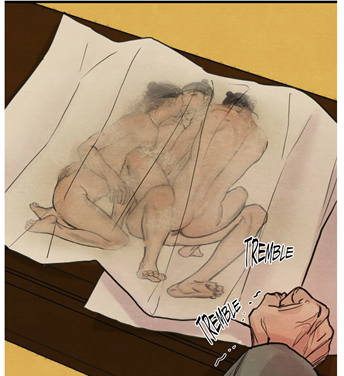
This is where you can read the manhwa. https://www.lezhinus.com/en/comic/painter But be aware that this manhwa is a mature Yaoi, which means, it is about homosexuality with explicit scenes. If you want to read more essays, here is the link to the table of contents:  https://bebebisous33analyses.wordpress.com/2020/07/04/table-of-contents-painter-of-the-night/

It would be great if you could make some donations/sponsoring: Ko-fi.com/bebebisous33  That way, you can support me with “coffee” so that I have the energy to keep examining manhwas. Besides, I need to cover up the expenses for this blog.

The seme, Yoon Seungho, in this story is introduced with this expression “a hell-raiser” by the uke Baek Na-Kyum. The latter has heard about Seungho’s bad reputation. Strangely, the more chapters we read, the more we realize that our main lead is different from what he appears to be.
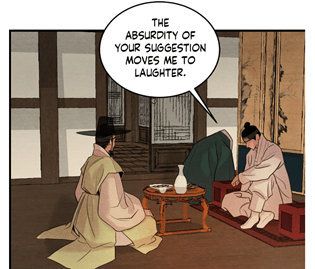
What caught my attention while reading this manhwa was the way Seungho stands, when he interacts with people. First of all, as a wealthy and influential noble, he sits far away from the others, not just from the servants. There is always some distance or a table between him and the others. Let me show you a few examples.

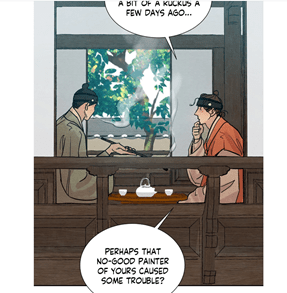
In the chapter 12, Jihwa visits the main lead without any appointment. In this scene, notice that Jihwa doesn’t sit next to the seme but in front of him. This underlines the gap between Seungho’s status and Jihwa. Furthermore, there is no physical contact between them at all. Even Seungho is looking outside the window, while talking to Jihwa, that’s how he sees Baek Na-Kyum and decides to go to him. In other words, although Jihwa is physically closer to Seungho, the reader can sense the existence of an invisible wall between him and Jihwa.

Chapter 12, Seungho drinking tea with Jihwa on the right

But this doesn’t happen just once. Even after the long night spent with BNK who got so sick, we see Seungho sitting in the center of the room after a sex orgy and it was as if his sex partners would be below him, as if they were all standing at his feet. In this chapter (33), they are all asking for BNK’s presence… their request underlines the special status Seungho has over them. At the end, Seungho decides to leave the room which shows that Seungho is no pushover and makes sure to maintain the distance between him and his sex partners.

This contrasts so much to the interaction between Seungho and BNK. Right from the start, there is no gap and distance. Remember the first chapter where Seungho took BNK’s hands and even let him touch his own loin. Later, you see him always touching the painter’s face. However, there is one scene that caught my eye, it is in the chapter 16. Jihwa and Seungho had just a sex session and Seungho decides to go to BNK’s side.

chapter 16

Notice the contrast between Seungho’s behavior in the chapter 12 and here. Seungho is not even closing his robe, he even lays down next to the painter. And he keeps asking questions. He is very relaxed in opposition to the scene where he is drinking some tea. The way he is dressed contrasts so much: his robe is loose and open, while he is well-dressed with Jihwa. While he maintains an air of nobility and oozes mind control in the chapter 12, here he gives the impression of cheerfulness. It was as if he was playing as he has BNK’s hairband in his hand and keeps looking at it. Notice the huge opposition: Seungho is lying on the ground next to the painter, while with Jihwa he was sitting in front of him. This gives an explanation why Jihwa is furious and jealous. Seungho has never really rushed to go to his side, he even ignores Jihwa who is about to leave.
This behavior outlines Seungho’s curiosity for the painter and his wish to be close to his idol. He definitely shows an interest towards BNk, while he remains quite indifferent to Jihwa and the others. In this scene, there is intimacy and closeness and this is no coincidence that the noble calls the painter Na-Kyum while whispering. He is quite intimate and reveals his need to close the gap between him and the painter. In other words, Seungho has a different attitude towards the painter. While he maintains a gap between him and his sex partners, he is doing the opposite with BNK. He is not indifferent but curios and quite cheerful. He even smiles.

This closeness and intimacy is even underlined one more time, when Seungwon, Seungho’s younger brother, pays him a visit. The latter announced him that their father was ill and our seme should pay him a visit. Although the painter is a low-born, he is actually sitting next to Seungho’s side, while the brother is facing him. This shows that Baek Na-Kyum is even closer to him than his own family. He let the painter hide his face, yet he didn’t even ask him to be dressed. (chapter 37:

The painter is even turning his back to the brother which shows a certain disrespect, nonetheless this was certainly ordered by our lord.

Then after this scene, Seungho shared his bed with Baek Na-Kyum for the first time. The lord was even hugging the painter and let us not forget that he always sent his sex partners right away after their love session. Striking is that both chapters 16 and 37 have something in common: the lord is the one pleasuring the low-born and not the other way around. So, here the lord shows rather an “inferior” position, although from his social status he is above Baek Na-Kyum. This indicates that the social norms have disappeared.

Then I observed another phenomenon. I noticed that Seungho was often shown in front of a window (chapter 12, chapter 44) or under a roof (chapter 19 :

chapter 30 :

Chapter 30: Yoon Seungho hears about the painter’s return,

while he keeps watching BNK who is standing outside. It appears to me that the author has an intention with Seungho’s position. I get the feeling that Seungho had stopped living after the incident with the topknot and the purgery. In the chapters mentioned above, the noble witnesses:
-the disappointment of BNK, when In Hun hears that he was invited due to the deal with the paintings.
– the departure of In Hun from his room, just like he looks at BNK returning from the gate.
– how BNK leaves his bedroom after the punishment.

Striking is that Seungho shows two different kind of behaviors:
– he remains passive and indifferent on the surface but can’t help thinking about the painter

chapter 44


– he rushes to BNK’s side (chapter 12, 30)

episode 30

and touches him right away. He grabs his wrist, or touches his head… there is always this physical contact which Yoon Seungho never has even outside their sex sessions. Usually, he acts like that, when he is upset and very emotional. In other words, BNK is able to change Seungho, as the former ignites reactions from Seungho. My interpretation is the following: The noble only watches life from his window, meddles more and more in people’s life due to BNK. Remember that after meeting Seungwon, it looks like Seungho sent a painting of himself with his sex partners to his father. So far, he had ignored his father and his brother.
The lord is less and less indifferent. I have the feeling that for the first time, he is no longer feeling empty. Even after the rape, he can’t help looking for BNK in the bathroom. He is angry, feels guilty and jealous. The violence of his emotions can only be explained by the fact that Seungho felt nothing for so long. He is not able to control his emotions, and this illustrates that Seungho is no longer an indifferent, passive and emotionless person, quite the opposite. Seungho needs to learn to control his emotions, something he forgot. And you can observe that as time passes on, Seungho is able to show more and more affection. The so-called loyal servant Kim told BNK that Seungho had mood swings, which I explain so. Seungho could be either violent and ruthless or indifferent/broody. When he killed the servant, he showed no fear, no remorse… he just did it without feeling anything, though his face lets transpire sadness. While killing the domestic, the lord tried not to take it to heart. But his violence has nothing to do with emotions first, only when Seungho started interacting with the painter. In the first chapter, the noble had even announced that he would kill someone, which outlines his lack of emotions and empathy. And this shows that his brutality is not inherent to Yoon Seungho. His violent outbursts are also linked to his suppressed anger and rage due to his past trauma, as he was forced to accept his fate. Hence he started cutting himself from emotions… but in reality, he was like a dormant volcano, and his eruptions were caused by BNK’s reactions.

From my point of view, Seungho is starting to live for real, and the sex he had before was a way for him to pass time. This would also explain why Seungho had problems with erections before (he needed to be prepared, to have replenishing medicine and even the erotic books in order to get a reaction). This also explains why Seungho refuses to join In Hun in reality. He has been detached from the world for so long, he has no interest in politics and whatsoever. However, I sense that Seungho will be forced to act outside his courtyard in the long run. Being indifferent and detached from the outside world, is not right, as we can see that Jihwa is about to have BNK killed and In Hun might try to hurt BNK in order to weaken Seungho. In Hun has not forgotten the humiliation and I am quite sure, he wants a payback for that. Seungho will be forced to handle.
At the end of this season, Seungho remains passive and indifferent on the surface, yet his gaze never leaves BNK and even with In Hun, he thinks about him. He is no longer a robot, but a human being seeking for love and recognition. He knows that BNK has given up on his crush hence he feels much more confident than before that’s why he mentions BNK to In Hun before the latter leaves for the capital.

But now, you are wondering why Yoon Seungho became such an distant, passive and rather indifferent man, who was feeling rather empty. I mentioned before that Yoon Seungho was suffering from a past trauma. His loyal servant once told our uke that the lord had a tragic and painful past. However, we don’t know anything specific. The reader is just aware that the son is estranged from the father. While reading the manhwa for a third time, I came to the following theory. Naturally, there is no guarantee that this theory is the story imagined by Byeonduck.

From the start, Seungho was not a sodomite but due to the discovered conspiracy, the father decided to have his son to take the blame in order to escape the purge and divert attention. He created the rumor that Seungho was a sodomite and put on a show. This would explain why the father dishonored his son in such a ostentative way: cutting off the topknot which is not just a humiliation but also symbolizes a castration. Another possibility is that the father somehow “sold” his eldest son in order to escape the purge so that Yoon Seungho got raped by a higher-up official. Both theories have in common that the father betrayed his eldest son for his own survival and in order to ensure that his son would never reveal their connection to the conspiracy, he ruined his son’s reputation by declaring him a sodomite and cutting him the topknot. Why not a sodomite from the start? (sorry for the repetition)

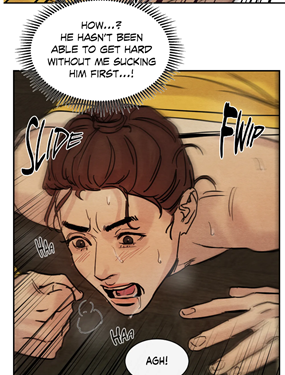
We shouldn’t forget that we heard the lord drinks a lot replenishing medicine, which is an aphrodisiac. Now, Baek Na-Kyum is drinking the same thing and notice his reaction: he was hard… The servant was helping his master this way. Notice how happy Seungho was, when he noticed Na-Kyum’s reaction. Seungho was just writing and Na-Kyum was already reacting. Secondly, we read from Jihwa that the latter always had to prepare Seungho (blowjob) in order to get aroused. (chapter 3)

Finally, right in the first chapter, Seungho confessed that only with Baek Na-Kyum’s book, he could get aroused right away. (chapter 1)
This would explain why Seungho resents his father and said to Seungwon that he was living by the father’s principle… which is living as a sodomite because his father ruined his reputation and life. The father betrayed the son, when he declared him a sodomite. With this move, the father made it impossible for the son to become an official with a high position.

But now, I would like to add new aspects. Actually, Seungho was not sent away because he was a sodomite. It was actually the opposite. The family left the domain and went to the countryside, leaving Seungho behind. And this new detail is quite important… it was as if the father wanted Seungho to become the head of the family Yoon and if the authorities decided to punish Yoon’s family, then Seungho would have become the target. Since the father had left the property to his son, if the police had come to arrest Yoon, then the family could have said that Seungho was the one responsible as he was living in the courtyard, but the family had cut ties with him as he was a sodomite. In other words, not only the father humiliated his son but he also tried to turn him into a real scapegoat. The father thought that Seungho would be the one to take the fall. Furthermore, while the family left, it is said that all the servants were replaced which is a clue that all of them were killed. And I have the impression that Seungho was forced to get rid of them if he wanted to survive. With no witness, Seungho could survive the purge, however he couldn’t kill the loyal servant who had been by his side all this time.

As conclusion, since the family left the family domain, it means, the father not only pushed all responsibilities on his eldest son Seungho but wanted to sacrifice him. The latter was the one who had to dirty his hand in a way to survive. That’s why he is suffering from insomnia and has often nightmares. This is much more terrible than what I wrote a few days ago. This explains why Seungho really hates his father and had his hand shaking, when the younger brother mentioned the father’s illness. With Seungwon’s visit, it becomes clear that the father has decided that it is time to return to the family domain hence if Seungho visits his father, this represents a reconciliation and marks the return of the Yoon. Since the brother smiled, while receiving the letter, it looks like it was a good sign for the father. At least, Seungho wrote a letter to the father… I can imagine that during all this time, Seungho ignored his family that’s why he never replied to the brother’s letter. I can imagine that the father is asking for a visit and will ask that Seungho helps his brother to become an official. I even suspect that since the father has been so cruel and selfish, that he wants from Seungho another sacrifice. Since Seungho has a bad reputation as a sodomite, he can not become an official, the father ruined his life. However, I have the impression that Seungho might have been close to the deceased grandfather who had a high position in the government. Jihwa mentioned like some others that the Yoon family was declining. The reason is that no one after the grandfather took up a government post, like Seungho mentioned it to In Hun in the chapter 6.

And here is another speculation from my side. Since according to Yoon Seungho, the father never had a position, it looks like the young man has either repressed that his prostitution helped his father to get a high position, or he has no idea that his father sold him as courtesan for his own career. We know for sure that father Yoon had a high position and was forced to resign. (chapter 37)

I was wondering if the grandfather considered his own son as not suited for a high government post, and wanted his grandson to follow his footsteps. Besides, I had the impression that there’s some secret behind Yoon Seungho’s birth, which would explain why his official father truly loathed him. When Yoon Seungho lost his position as courtesan, because he was framed for an incident, the father used this opportunity to save his skin and get rid of his own son: create the rumor, he was a sodomite, cut off his topknot and leave the domain to Seungho so that he would take the fall. Though the protagonist is smart and cunning, he has never perceived father Yoon’s actions and motivations, for he was always longing for recognition and love. Besides, the long exposure to physical and sexual abuse could only ruin the main lead’s sanity.

But now time has passed on, and the father wants his younger son Seungwon to become an official which would underline one more time the disdain and even hatred between the father and Seungho. (chapter 37) However, I doubt that Seungho will accept all of this, especially after having been put through all of this. Besides, he will want to protect Baek Na-Kyum. Remember that Seungho decided to take his responsibilities towards the painter. He took Na-Kyum’s virginity which the painter had reserved for the loved one and latter he put the red point on his forehead symbolizing that he was his bride. (chapter 40)

And this would explain why at the end of the season 1, it is revealed that the father received an erotic painting of Seungho having sex with 2 men. (Chapter 44) The eldest son is showing the father the consequences of his past actions. He is a notorious sodomite with no boundary and the father is responsible for this. This gesture illustrates that the young master doesn’t want to reconcile with his own father. Yoon Seungho definitely wants to hurt and infuriate his father. It was as if Seungho was saying: “See… this is what I have become due to you!!” On the other hand, the delivery of the ruined painting was orchestrated by the butler without the main lead‘s knowledge. (Chapter 37)

As conclusion, Yoon Seungho seems to be more a tragic figure, especially if my theory is true. The way he had been living was a way to cope his own traumas and suffering.

And this interpretation was confirmed in the second season: he got raped, then drugged and gangraped to finally become the king’s courtesan.

Feel free to comment. If you have any suggestion for topics or manhwas, feel free to ask. If you enjoy reading it, retweet it or push the button like (tumblr- reddit- Instagram- Twitter account: @bebebisous33). Thanks for reading and the support.

Painter Of The Night: “The first meeting between Yoon Seungho and Baek Na-Kyum: the prelude of a special relationship”

This is where you can read the manhwa. https://www.lezhinus.com/en/comic/painter But be aware that this manhwa is a mature Yaoi, which means, it is about homosexuality with explicit scenes. If you want to read more essays, here is the link to the table of contents:  https://bebebisous33analyses.wordpress.com/2020/07/04/table-of-contents-painter-of-the-night/

For the first time, I’ll analyse a manhwa and this under different aspects. Just like in my other essays, this is not a summary of the story written and drawn by Byeonduck. A manhwa is the korean version of a manga. The huge difference between the manga and the manhwa is that the latter are usually in colors. “The painter of the night” caught my interest not just because of the beautiful drawings but because of the depth of the story. The characters are well-written. Actually, I just hope that after reading this post, your interest will be picked so that you want to start to read the manhwa.

If we pay attention to the first chapter, when Yoon Seungho, a wealthy and influential lord, and Baek Na-Kyum, a painter of erotic books about sodomy, met for the first time, we will realize that right from the start the painter already occupies a huge place in the lord’s mind and heart.
The moment Baek Na-Kyum confirms his identity, you can observe a huge change in the lord’s behavior.

Seungho turns into an innocent and enthusiastic noble which contrasts so much to the introduction of the young lord in an earlier scene. In the beginning of the first chapter, the young lord was taking care of his sword while talking to his domestic. In this scene, he already announced that someone would get killed. As conclusion, the lord was introduced as a distant, indifferent, serious and cold-hearted master. When he meets the young painter, we see not only a smiling Seungho, but also a warm and touchy lord. He grabs the painter’s hands and treats them as treasure, although he was quite rough. It’s because he can’t restrain his admiration.
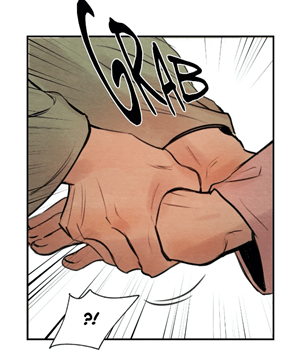
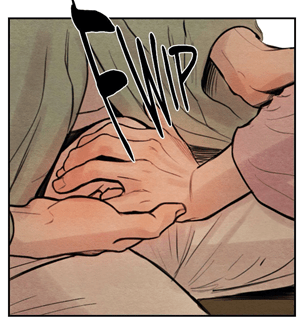
He sees Baek Na-Kyum as a talented painter, he even doesn’t care if the painter was caught drunk and if he is a low-born. The contrast between Seungho’s two different behaviors reinforces the impression that he has a very high esteem for the author of the paintings. His respect for the young man goes further. He even lets the painter touch his loins, which represents a very intimate part.

Imagine, a noble lets a low-born touch his penis right after their first meeting. If Jihwa, a sex partner in love with Yoon Seungho, had been there, he would have been shocked. As you can see, their first meeting outlines that the painter has a special place in his mind and heart. But so far, he is only moved by his works. Yet, this emotional meeting ends very abruptly as BNK denies to the creator of these paintings. And in one moment, the noble’s mood switched to the opposite… as much as he was enthusiastic, as much as he becomes ruthless and heartless. He kills a servant in front of the painter. He can’t risk to kill Baek Na-Kyum because if it is revealed later that he had lied, then he wouldn’t never get any new pictures. And this illustrates the huge value the paintings have in Seungho’s heart.

Pay attention to the gaze of the protagonist. His eyes are showing his true feelings: anger, frustration, determination but also harshness. Imagine that his friendly attitude towards the painter was genuine but Baek Na-Kyum refused to tell him the truth. The dishonesty of the artist truly upsets the young master. Let us not forget that Seungho went so far to pay a visit to the painter, even he even sat down next to him. As you can see, the lord already lowered himself so much and the result for all this was a lie and insincerity. Let us not forget that Yoon Seungho is not someone who will usually visit other nobles. As conclusion, right from the start Seungho’s actions and behavior revealed how much the creator of the paintings meant to him. I mean, he could have sent someone to fetch the artist but he didn’t. He will do anything to get the creator by his side… it was, as if he couldn’t live without the painter any longer. For one year, BNK didn’t paint anything and it shows that Seungho needed new paintings from the author and searched for him desperately. I have the impression that he realized that the paintings were not enough any longer. He needed the painter by his side. I even suspect that BNK’s paintings had somehow become an addiction for the lord. This addiction is somehow insinuated in the following picture:

Then let us not forget that Seungho has an erection, when he meets his idol and we shouldn’t forget that Jihwa said later that he usually needed to prepare Seungho. So the mere presence of his idol has an effect on his body, Seungho is touchy and smiling… and keeps looking into BNK’s eyes the whole time.

Now let us focus on Baek Na-Kyum’s behavior. The first thoughts coming to the author are the rumors about Seungho’s bad reputation. He is unable to perceive the honesty coming from the young lord, just like the genuineness in the compliments. It was as if he was deaf and blind. In fact, there is an explication for this behavior. He has gotten used to the falsehood coming from the teacher Jung In-Hun. The painter has not learnt to perceive deception from honesty and frankness. The teacher’s manipulations and brainwashing are the cause for his mistake.

Due to these observations, I can’t help myself comparing BNK’s adoration for his teacher In Hun with Seungho’s admiration for BNK. Seungho acts the same way in this scene than BNK who adores his teacher. However, there is a huge difference… Seungho reveals that he is also physically attracted by the painter… his works and his presence affect his body, while the painter’s adoration for In-Hun remains very pure. It was, as if BNK would worship an idol and the mere touch would tarnish his idol.

And this explains why Seungho gets more and more upset and so jealous of In Hun. Imagine, your own idol ignores your compliment (“These are the talented hands”) and even shows no respect for you (he lies, he tries to touch the lord in order to get back the poem, he wants to run away twice). BNK even blushes by the mere thought of In Hun, whereas BNK shows no such reaction for Seungho in the beginning. Our seme was definitely happy to see BNK getting an erection or blushing more and more often, as Seungho had all these reactions (more or less: Seungho never blushes) right from the start. Finally, his hope that his idol will acknowledge him seems to come true.

And this also gives us a clue why Seungho was so determined to be painted by BNK. Imagine, you are the source of the inspiration of your idol. As a fan, you would be so happy. But this also explains why he even wanted to have BNK portrayed with him,

chapter 25

as time passed on. Then it is like a selfie nowadays, where a fan wants to be in the same picture than his idol. And to have a sexual relationship with an idol represents the highlight for a fan…

Sure, Seungho is not just a fan… he has fallen in love with Baek Na-Kyum for real, as he got to know the painter. More importantly, Seungho’s heart was deeply moved by their first night together. I believe that BNK’s love confession touched his heart:

– “I pine for you Sir”

The fact that he preserved his virginity for his loved one was a huge surprise for Seungho. Imagine, your idol tells you such words… it was always what Seungho had wanted. However, this scene is bittersweet, as the lord knew that he was not the real recipient of this love confession. That’s why Seungho had been longing to renew this night but this time, Seungho would receive love, respect and admiration from his idol. This is the reason why Seungho waited so patiently. He showed care and respect towards the painter hoping that BNK would realize this and show the same respect and admiration. But it never happened. Only in front of Baek Na-Kyum, the lord showed his real true self: his sincerity was there, when they met. He showed so many different emotions in front of the painter.

As conclusion, Yoon Seungho showed right from the beginning that he could be sincere and warm. At the same time, the first episode reveals that the painter is already able to awaken so many emotions in Yoon Seungho: happiness, admiration, anger, frustration and even sexual desires. The lord could no longer hide behind his harshness and indifference. On the other hand, we see that Baek Na-KYum can’t see this nice and genuine side of the young master, too blinded by Jung In-Hun faked smile and by his manipulations. So even at the end of the first season, Baek Na-Kyum has not really realized how deeply Seungho has fallen in love with him. So I am expecting in the second season that Baek Na-Kyum will little by little discover Seungho’s true personality and simultaneously perceive his love.

Feel free to comment. If you have any suggestion for topics or manhwas, feel free to ask. If you enjoyed reading it, retweet it or push the button like. My Reddit- Instagram-Tumblr-Twitter account is: @bebebisous33. Thanks for reading and for the support, particularly, I would like to thank all the new followers and people recommending my blog.

Confession: A mystery evolving around confessions and its implications

This K-drama deals about a lawyer, Choi Do Hyun who is trying to find the truth about his father’s crime. Our main protagonist believes that his father has been innocent, however the latter had confessed his crime from the start. This K-drama started airing just three weeks ago on TVN and so far, it is quite entertaining because of the script and the acting. Lee Joon Ho as Choi Do Hyun and Yoo Jae Myung as the detective Ki Choon Ho are doing a terrific job.

What caught my attention was the title “Confession” because after 6 episodes, it becomes clear that the main topic of this K-drama is indeed confession. In each episode, the viewer sees different kind of confessions.

  1. Han Joon Gu and his confessions

In the first episode, the criminal Han Joon Gu kept calling the police in order to tease them as they had not caught the murderer. Indirectly, the police and the prosecution used these calls as evidence that he was in fact the killer.

But at his trial, he retracted his confession. A retracted confession is a statement made by an accused person before the trial begins, by which he / she admits to have committed the offence, but which he/she repudiate at the trial. This gave the impression that the police could have use violence in order to obtain his confession.

episode 1 the accused Han Joon Gu

Our male protagonist is able to defend his client so that Han Joon Gu is found not guilty. Then 5 years later, a similar crime occurs and all the evidence is pointing out Han Joon Gu. The latter had just left the prison a few days ago. The lawyer is now facing a dilemma: he knows now that Han Joon Gu had killed the victim Yang Ae Ran 5 years ago but he is well aware that this time his client is innocent.

episode 3: Han Joon Gu confessing his crime

This time, his confession creates a scandal. The double jeopardy protects him from being prosecuted for the murder. He has been found innocent due to lack of evidence 5 years ago and now he is once again released. His lawyer with the detective’s help could prove his innocence for the second murder. Besides, the prosecution can not press charges against Han Joon Gu for the same crime despite his confession.

2. The nurse Cho

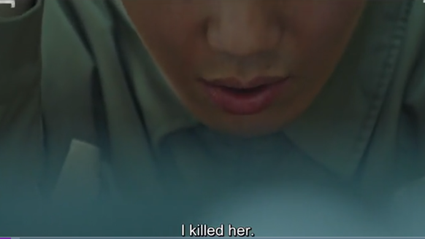
She is Choi Do Hyun’s second client. The prosecution accuses the nurse of committing a professional mistake but later changes the charges. Now, the patient’s death is considered as a murder. During the trial, the nurse remains quiet so that her silence is used as evidence against her. Only at the final hearing, she confesses her crime explaining how it happened. The victim had sexually assaulted her in the past. Her confession contrasts so much to Han Joon Gu’s confession as it shows the pain of the defendant.

episode 5

Yet, this doesn’t end here as the nurse confesses to Choi Do Hyun’s friend Han Yu Ri that 10 years ago no one asked her anything, when Han Yu Ri’s father died. So her words imply that back then a crime occurred and she was involved in the death of Han Yu Ri’s father.

3. Choi Pil Soo and his confession 

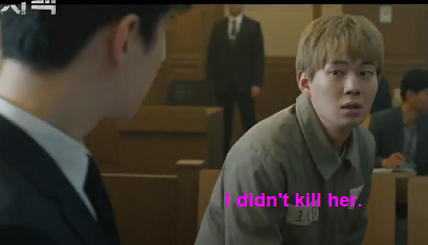
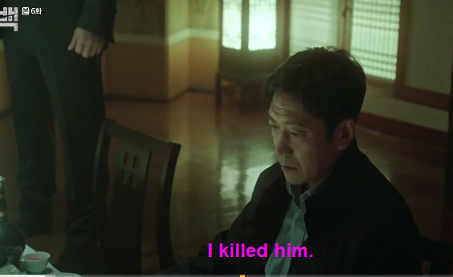
episode 6 : Choi Pil Soo is holding a gun, there is a witness and the crime has just happened.

Unlike in the other cases, the confession is made right after the crime, when the detective Ki Choon Ho arrives at the crime scene. Choi Do Hyun’s father admits the crime immediately without any emotion. Besides, he never gives an explanation or a motive for the murder. Furthermore, after his confession, he remains silence and even cuts ties with his own son. Yet, it becomes clear that Choi Pil Soo admitted the crime in exchange for his son’s surgery. Choi Do Hyun had a heart transplant shortly after his father’s trial. Here there is a conspiracy where the confession was used as the best evidence in order to cover up the real murderers and the motive, corruption.

Love in Sadness: an analysis of self-portraits

Striking is that in this drama, we can witness the birth of a painting. The beholder usually only gets to see the start or the end product but not a work in progress. Nevertheless, we saw here two paintings that were not finished and each time, the finished work revealed the real state of mind of our heroine YMR, as both creations were named as a self-portrait. The difference between the paintings underlined that something had happened to our painter. But now, let’s take a closer look to these paintings. The first “Self-Portrait” was used in the first episode.

This image has an empty alt attribute; its file name is image-1.png
A cistus: episode 1 (the painting is unfinished, right after this taking, due to KIW’s remark, YMR gives the picture a name: ” A self-portrait”
The painting “A self-portrait” is now finished. We learn here the meaning of the cistus: I’ll die tomorrow.

Looking at the first picture, we can observe two things:

  • the darkness of the picture: we see a dead wood, she even used a lot of black and brown
  • First, we have two flowers. Furthermore their white color contrast so much to the surrounding. Since the flowers are blossomed, they indicate that their withering is about to happen, especially due to the environment.

So since it is a self-portrait, it actually symbolizes her actual situation: she is in a terrible situation. Her husband is embodied by the dead wood, he can not bring her happiness and life, actually he is the reason why she is perishing. Her world is cold and she feels lonely. There is no light, so there is no hope. The choice of a white flower and the number of cistus caught my attention because in the episode 12, she said that the flowers represent her heart and tears. It looks like back then YMR had lost all her energy hence there are only two flowers. Due to her desperate situation, she can not even cry. She is withering like a flower…
So the first version wasn’t just depressing because of the dark colors and the environment. Even the choice of the flower was pessimistic: I’ll die tomorrow. However, in the finale version, the beholder observes a huge difference: the flowers are burning. This indicates that not only her situation has even worsened but also her despair has increased. She is literally screaming for help and if no one can see this, then she will die. Moreover, the fire could be perceived as a final attempt from her part. She will leave her husband and if she doesn’t succeed, then she is even willing to die, to get burned. So she is well aware of her husband’s outburst, if she leaves him again.

image.png
episode 10:
The painting is called “A Self-Portrait Part Two” the first and unfinished version

In the second self-portrait, we also saw a first version (third picture above). Striking is the presence of wood, just like in the first self-portrait. Nevertheless, the wood is different. Here YMR used a table, unlike in the first painting where it looks more like a dead wood. Moreover, there is a presence of a human being in this picture due to the cup of tea and the letter envelope indicating that there is life in this picture. Finally, our painter chose to draw anemones in her painting. She even drew more anemones than cistus. Since the flower is red and the color red is associated to blood and life, I come to the conclusion that YMR’s state of mind has already changed. She has been brought back to life, since the painting is already oozing more life. The first version is still dark, although the beholder can see a ray of sunshine on the table. Yet the light is barely visible. Furthermore the message behind the anemone is “May I confess my love for you?” which illustrates that her heart has started beating again. She is no longer lifeless and loveless. Like she said to SJW, the flowers symbolizes her tears and heart. She can cry now. She has started caring for SJW. Due to the presence of wood in this self-portrait, we can come to the conclusion that YMR hasn’t been able to cut ties entirely with KIW, he is still affecting her life. The wood reveals that she is still suffering from a trauma.

episode 11: “A Self-Portrait Part Two”, the final version

The final version mirrors the evolution of her mental health. It looks like the flowers are actually growing from the table. YMR is able to remove little by little her bad memories, recover these with new good memories. Notice that this time, the flowers are painted with green leaves indicating that the flowers are not cut or put on the table, they look as if they were really alive. Then the ray of sunshine is much more pronounced this time. The dark and gloomy atmosphere has entirely disappeared. There is now more hope. YMR is not back to her old self, yet she has changed a lot. She is alive, feeling many emotions. The presence of a living person is also more visible than in the first version. Now, we see a letter with a feather. It was as if YMR had just left the table. Since YMR is not able to paint herself, this shows how much YMR suffered under KIW. She had lost her identity and her own personality, yet this time, YMR has found the courage to show to the world that she exists with different items: the envelopes, the letter and the feather. Naturally, she has another reason now, not to draw her face, since she has received the face of WHK. This second self-portrait still outlines her identity loss but unlike in the first self-portrait, the beholder can realize that YMR is searching for her own identity. She is trying with all her might to find her own place that’s what the growing flowers are representing. The flowers are trying to find their place in that table, it looks like the flowers want to cover the table, a symbol for her attempt to forget her painful experience and memories. As conclusion, YMR is no longer pessimistic and desperate. She is alive, feeling many positive emotions and she is hoping that she can leave her past behind.

When YMR offered SJW her self-portrait, SJW could connect her painting to the famous painting of Frida Kahlo, a famous Mexican painter. Both characters were referring to that following picture, the wounded deer:

Image result for frida kahlo wounded deer
Frida Kahlo: wounded deer, 1946

Back then, Frida Kahlo had just been surged on her spine but her surgery had not been successful. Unlike in YMR’s self-portraits, Frida used an animal in order to represent herself. However, the deer has her face. Notice how the surroundings can give us a clue about Frida Kahlo’s state of mind. The forest looks lifeless, the trees are leafless, even one tree has lost a branch which lies on the ground. The dead nature embodies broken body of the painter. Furthermore, the colors (brown and beige) give a gloomy and pessimistic impression. The sun is not visible, just like there is no wave in the sea. All these elements put together make the beholder feel that there is no life and no energy. Frida Kahlo is heartbroken and broken physically. Moreover, the painter used an unreal perspective for the wounded deer. It doesn’t look like it is standing on its feet, but it doesn’t look like it is lying on the ground either. In my opinion, Frida wants to underline how terrible her physical situation is: she is not really paralyzed but she can not move freely either. She can not rest in the end. The arrows symbolize the surgery and the pain in her spine due to the surgery as the arrows are situated all around her spine. As you can see, the deer mirrors Frida Kahlo’s situation and feelings as the deer has Frida’s face. The Mexican painter is feeling powerless and she is showing her pain and despair to the world through her painting. YMR is in a different situation as she has lost her identity, unlike Frida Kahlo, that’s why the flowers have no face at all or there is no human being represented among her flowers. However, I am expecting YMR to be capable to drew a third self-portrait later which will be similar to her first painting that KIW saw in the beginning.

A woman holding a sword lily

We know that this week, YMR will leave SJW’s side as she will use WHK’s death to her advantage. By forcing SJW to declare WHK dead, KIW will be cornered. WHK was the only link to his wife’s whereabouts. For her, this departure will have a huge impact as she will be able to free herself completely from KIW.

The significance of hands and feet in Encounter (part 2)

This analysis is composed of two parts: I will focus first on the hands and later on scenes where the feet are shown.

While the hands and feet played a huge importance in the relationship between our protagonists CSH and KJH, a good observant might realize that the hand had an important part in the relationship between KJH and her friend HI. Until the episode 5, we see that JH and HI are close but not so close friends as JH doesn’t confide to her at all. She has no idea what happened in Cuba. Only when HI recognized him in the scandal, he had to explain himself.

Striking is that JH feels comfortable around HI, he teases her, runs after her after joking but he doesn’t really touch her physically. However, after revealing his identity in the hall, HI goes to a cafe and remembers the past. Interesting is that JH approaches HI in order to congratulate her. He knew that she would be alone hence he came. She is thankful but he just answers:

Encounter episode 5 JH HI school.png
episode 5

What HI hasn’t realized yet is what is about to happen. JH wants to take a picture and hugs her with one arm. What caught my attention in this scene was the hand. 

Encounter episode 5 HI JH hand.png
episode 5

While JH is focusing on the camera, she looks at his hand that touches her shoulder. He has just declared that she was a good friend and here with this touch, HI perceives JH for the first time in a different light. His hand on her shoulder changes everything. From now on, she views him as a man. JH is unaware that his gesture is quite “intimate” as he keeps looking at the camera. 

Encounter episode 5 HI looking at JH.png

He doesn’t see how she looks at his face. She views him as a handsome man… JH’s other hand is in the foreground, blurred which serves as contrast. JH is paying attention to the camera, not to the girl that stands so close to him and his face. For HI, the camera in front of her is not important… JH is more important to her hence the second hand of JH is blurred. With this taking, the viewer can see both perspectives: JH is unaware that his casual gesture has triggered something in HI, for him taking a good picture is more relevant.

Encounter episode 5 HI picture.png
episode 5: she keeps this picture with her all the time. The moment she perceived KJH as man and his hand made her heart flutter.

JH gave her the picture later and for HI, this picture symbolizes the moment she fell in love with JH, the moment she realized that JH was a man after all. She clings to that memory hoping to find strength that’s why her hand is shown. For her, this picture is a treasure, the brief moment where she was so close to him: a happy memory which is linked to pain as well. Now, we all understand why HI was never able to confess to JH. Since he had declared before, they were friends… this picture marks for him the beginning of their real friendship (no more childhood friends), whereas for her it means the opposite: the moment she fell in love with him.

Since JH had touched her so casually once, I sense that HI might have thought, JH would come to touch her again like in this scene and would experience the same. She hoped that staying close to him, a casual touch might happen which would trigger feelings in him. What HI didn’t realize is that this memory has a different significance for JH: from that moment, he would always see her as a friend. That’s why he keeps saying to her that she is a friend.

However, I believe that his words must hurt her a lot because she is constantly reminded that in that moment she fell in love with him. Sure, HI had other reasons to believe that JH might come to love her… they belong to the same social class, she knows him well, she knows his family well too. On the surface, there was no reason for her to woo JH as he didn’t seem to be the type to be interested in woman.  But the other reason why HI got never close to KJH is that we never see her foot get closer to KJH. She only had a connection with KJH’s hand: the red diary book or the scene with the picture (see above). HI was never able to get closer to him… that’s why we see this game: HI is chasing after KJH but she is unable to win as her feet never get closer to his.

Encounter episode 2 HI JH playground chasing.png
episode 2 HI is trying to catch KJH

But we were shown in many other occasions takings of hands. So the director didn’t just focus on hands between CSH and KJH or HI and KJH, he paid attention to hands generally as he had another purpose in his mind. After JH entered CSH’s world (episode 4), he came in contact with director Choi and Chairman Kim. He had to hear terrible things. These painful experiences were shown in the episode 7 in flashbacks. 

Encounter Episode 7 JH flashback 1.png
Encounter episode 7: Director Choi with our hero KJH
Encounter Episode 7 JH flashback 2.png
Episode 7: Chairman Kim facing KJH
Encounter Episode 7 JH flashback 3.png

Striking is that they are all in black and white, just like CSH’s memories from the episode 1,

Encounter episode 1 Morro Cabana 3.png
Episode 1: Cha So Hyun with her father CJH and mother. CJH has become the mayor of Seoul.
Encounter episode 1 Morro Cabana 4.png
episode 1: her marriage with JWS

where she remembered her sad, painful and lifeless life. As you can see, JH went through the same things than CSH. People telling him how to behave and what to say, giving harsh comments. By using the same mean of filming, the director underlined the similarity between our main leads. Moreover, these black and white scenes symbolize CSH’s world, the kingdom Taegyeong Group, the world JH had decided to enter in order to become a meaningful person to CSH. Now, he knows in what kind of world she has been living. This kingdom is huge and scary. 

But in this black and white world, how can the subjects survive, as there is no sunlight and no warmth at all? Well, I had already pointed out that CSH had found ways to keep her mind sane and to express herself: the paintings and the hands. But actually, she is not the only one who uses the hand as a way to express feelings and indirectly thoughts.

In order to endure everything, to bear the humiliation and the harsh treatment, all of them, even director Choi who is just a pawn, react the same way. They hide their true feelings by hiding behind a smile or an expressionless face and use their hands in order to release their anger

Encounter episode 4 JH hand anger.png
episode 4: KJH’s hand just before he intervenes and decides to enter her world

(JH, episode 4… he hears director Choi insulting CSH) , anxiety, fear
(episode 3, CSH’s hand sitting in front of Chairman Kim),

Encounter episode 3 CSH hand fear.png

helplessness

Encounter episode 7 JH hand.png

(JH, episode 7 after hearing about his transfer) or their hurt. That way, queen Kim and the other royals think that they are all obedient puppets. However, this is just a subterfuge. None of them stop thinking or feeling. They remain humans.

Encounter episode 7 Choi hands.png
episode 7: director Choi is meeting CEO Kim.

With this taking, the hands of director Choi reveal two aspects: he is hiding one hand with the other. Actually, he is scared because Chairman Kim tells him that she discovered his disobedience and she saw his gesture as backstabbing (episode 7). With his two hands, director Choi is able to deceive Kim as his gesture underlines his obedience. However, we could interpret this gesture as a way to hide his fear… while the one hand is shaking, the other is able to hide and control the shaking.  

Now, you understand the “obsession” of this director with the hands. The hand is used in this cold world as a way to endure everything but at the same time to remain human. They are able to stay calm and overcome the terrible situation. Striking is that the director even decided to show the hands of minor characters like director Choi reinforcing the idea that in this chaebol world no one is actually really speechless. They might not speak in front of chairman Kim but they are still able to think on their own and feel.

But now let us focus on the takings of feet. Sure, the director often zoomed on KJH or CSH’s shoes. Nevertheless the way the taking was made has its significance. When KJH decided to enter CSH’s world, we see the following zooms:

episode 4

As you can see, when we see KJH’s feet, his legs are visible, whereas it is not the case for CSH. Her shoes are partially visible or we only can observe her feet with ankles. To me, this reflects their freedom. CSH is not able to move freely like KJH. The closer the zoom, the less mobile and free the person is. Sure, this could be a coincidence. However, it was continually used this way. Let me give you another example. In the episode 7, KJH is told that he will be sent to Sokcho. Frustrated, he goes jogging. Then suddenly, we see this:

episode 7

To me, this taking reflect the pressure and his actual position: he is still free to tell CSH about the demotion, whereas in reality he has not many options. He can not tell CSH the truth as he fears that she might get hurt again. Moreover, she might do something that could tarnish her reputation.

episode 7

This explains why later the viewer can observe this: CSH is returning to her office after hearing the news about KJH’s demotion. Notice that this time, we see more than her feet. She has definitely more freedom than before… I see another confirmation with this scene from the episode 11:

Here, you could object that we don’t see the legs, yet their legs are visible through the shadows. So now we see that their feet are next to each other. Not only their closeness is reflected with this taking, but also their freedom . CSH chose to be with KJH and she made her decision willingly. Yet, notice that KJH’s shadow is bigger than CSH’s indicating that CSH’s situation is still different from KJH. She still has some issues: her own fears and insecurities.
In the camera zoom from the episode 7, we see her walking which contrasts to the former takings from the episode 3

Encounter episode 3 KJH's foot under the table 1.png
episode 3: KJH wants to get closer to CSH, hence he moves his foot just a little, which CSH will reject. She moves her foot away… just a little.

or 4 (see pictures above). She is no longer immobile. The zoom (Picture from the episode 7, see above) reflects her change of mind. She is active. This justifies why CSH’s feet are moving more slowly than KJH’s (episode 9).

Encounter episode 9 CSH feet end.png
episode 9: CSH is returning to KJH’s side.

She was trapped before, unable to move… had no freedom, now she is free but due to her long immobility, she can not run like KJH.

Encounter episode 9 KJH feet.png
episode 9

Striking is that just like with the hands, the director used zooms on feet of other characters.

episode 7: driver Nam with Min Jun, KSJ’s daughter

This taking underlines two aspects: the closeness of these two persons, yet the problem that MJ is facing: the divorce of her mother. Driver Nam can only remain by her side and help her to overcome this. He can not do what he would like.

To conclude, the takings of hands and feet revealed a lot about the characters’ situation and their emotions. The director used a very unconventional way to symbolize the actual situation, the feelings of the characters.

The image of marriage in K-dramas

Nowadays the focus of modern k-dramas has changed as more and more we see female characters (leads or second characters) in their thirties or forties. This actually shows that the writers are using the dramas in order to point out the difficult situation modern Korean women are facing: the struggles in the marriage, divorce, raising a child, work… By doing so, the dramas are trying to change the perception of women and their status.

Striking is that in Encounter and Romance is a Bonus Book, we see divorced women indicating that divorce has become a normality. Not just both female leads are divorced but also the PR manager Kim Sun Joo (Encounter) and Seo Young Ah (Romance is a Bonus Book). While infidelity was the reason for the three divorces, in SYA’s case it is different. The latter felt neglected and not protected by her husband. The latter not only preferred avoiding trouble, he also didn’t pay attention to her at all, since he was reading, while she was looking at the shoes.

Now if we focus on our two female leads, we will notice a huge difference. Unlike CSH, Kang Dan Yi’s life worsened due to the divorce. While CSH felt free for the first time and she managed to get a job (CEO of Donghwa Hotel) as her alimony, KDY, who had given up her career for her husband and family, was left with nothing. Her husband claimed that he was broke hence he never gave her any alimony. KDY was not just abandoned, she
was struggling financially too, since she couldn’t find a job. In the end, she became homeless. Marriage had a huge impact on her life: she chose to give up on her career and to focus on her family. After her divorce, she tried to find a job like she used to have. However she was not successful, since she had to fight against younger graduated women. Her status as housewife represents a huge hindrance in her come back. People see this as if she had done nothing important, as if she had been lazy all the time. KDY worked hard as a housewife but her work is not recognized by society. I could mention another k-drama “Terius behind me”, whose female main lead Go Ae Rin was in a similar situation. She had to raise two kids while trying to find a job after her husband’s sudden death. Go Ae Rin as a housewife didn’t feel acknowledged by her husband hence their marriage was facing a crisis.

Terius behind me: episode 1 Go Ae Rin with her husband

GAR was hurt and struggling as well. With these three examples, we can clearly see that the women’s situation hasn’t changed a lot: being a housewife is not rewarding, becoming dependent of a husband isn’t good either. Just like KDY, GAR tried to find a job but her status as housewife and mother became a hindrance. Yet, besides there is a new type of married woman: Kim Sun Joo

Encounter episode 6: Kim Sun Joo announcing her divorce to her friend Nam.
Romance is a Bonus Book: Seo Young Ah as the marketing manager is helping Kang Dan Yi

and Seo Young Ah are the perfect example. Both women have a family, yet they kept working… they never wanted to give up on their career. However both end up divorced for different reasons. Nevertheless unlike KDY and GAR, both women are not struggling financially and have not really lost their confidence. The divorce has affected them but they are still able to live normally and have no real identity crisis. For KDY, GAR and CSH, this is different. The three female leads have all something in common: loss of identity.

Encounter episode 7
Romance is a Bonus Book: episode 3

As you can read, both women lost their name therefore they lost their identity. In KDY’s case, we hear how she was called all these years (“Honey, Mummy, Madame”), while Cha Soo Hyun was always presented as the daughter or the ex-daughter-in-law. Striking is that the moment Cha Soo Hyun decided to do what she wants in her life, she started using her name again. Today is the first day, when she uses herself her own name. For KDY, it is similar. She also felt good being called by her name. Both women lost their identity and name as they were perceived for their function, usefulness. KDY was the one who helped her husband and daughter, CSH was useful for her father, mother and Taegyeong Group. It seems that the status as housewife and married woman is no longer a dream and reference. The reality is that housewives are isolated. In “Terius behind me”, GAR had friends but they were all housewives. KDY had only Cha Eun Ho as friend. CSH had no friend too.

Yet, in Romance is a Bonus Book we also see the other side of the coin: remaining single is not good either. Ko Yoo Sun ran away just before getting married as she was afraid of losing her job, her career and even her identity. However, now she regrets it as she is alone.

Romance is a Bonus Book: episode 8. Koo Yoo sun reveals her secret and past.

To conclude, in the actual k-dramas we see that a marriage can lead to misery and that being a housewife is linked to struggle, loss of identity and can lead to tragedy. The fairy tale with the marriage as happy ending is proven wrong. Reality is that housewives are too dependent on their husband’s income and their own worth is not acknowledged by society and even by the husband. In “Terius behind me”, her husband asked her to find a part-time job so that she would lose her weight and earn some money. As you can see, even her husband felt their situation burdensome… he was put so much under pressure as his whole family was relying on his income. On the other hand, remaining single is not a solution either as the result is loneliness. That’s why the traditional perception of marriage has changed. Being married and having a child doesn’t mean that a woman has to give up her job and career. Then Seo Young Ah’s husband made a mistake: he took his wife for granted. He thought, their love for each other would be enough and he was wrong. Love and respect are essential which is revealed in the three k-dramas I used as example. Moreover, we also see more and more that the image of men has changed either: the man should help his wife at home and raise the children as well. “Terius behind me” was the perfect example: Terius became really close to the twins and did a good job as taking care of the children. This is no longer the job of the wife. Nowadays men are expected to do house chores and raise the children. Cha Eun Ho and Terius correspond to this new image of men.

Encounter: the symbol of Cha Soo Hyun’s love

After reading the definition of “encounter”, 

adj.

  1. unexpectedly be faced with or experience (something hostile or difficult).”we have encountered one small problem” 
  2. meet (someone) unexpectedly.”what do we know about the people we encounter in our daily lives?”synonymes : meet by chance, run into etc
  3. nounan unexpected or casual meeting with someone or something.”she felt totally unnerved by the encounter”

you come to realize the ambiguity of the title “Encounter”. Moreover, it also reveals why JWS can never become a part of CSH’s life.

If we take the first definition (facing some difficulty and hostility), it is referring to the adversities that CSH and JH have already faced and will face together. So far, CSH had to deal with a few bad experiences:

  • the article and picture about a possible romance which forced to hear bad comments from her ex-mother-in-law and mother
  • the anonymous message on the bulletin board;
  • the gossiping
  • the terrible question from the reporter
  • the terrible comments from her own mother
  • the incident with the contract (Hotel in Cuba)
  • the arrival of Jung Woo Suk as second CEO (episode 12)
  • her meeting with KJH’s mother (episode 13-14)

The same happened to JH:

  • the gossiping and the weird gazes from his co-workers (episode 5, 9)
  • the harsh words from chairman Kim (episode 6)
  • the harsh words from secretary Jang (episode 6)
  • his meeting with director Choi (episode 7)
  • his demotion to Sokcho
  • his meeting with JWS (episode 11-12) which made our hero feel insecure

But now let us focus on the second meaning of encounter. It implies an unexpected meeting and if we look back at the different events between CSH and JH, we will notice that they had a lot of unexpected meetings:

– Cuba :

  1.  The accident with the taxi. If JH hadn’t been asked to change the seat, CSH would have never noticed him.
  2. The taxi was supposed to bring her to that place in order to watch the sunset but it broke down. She had to take the ferry… by walking on the street, she caught JH’s attention which led him to follow her.
  3. She almost fell from the wall therefore JH had to intervene. I doubt that he would have approached her without her mistake.
  4. At the airport.

Striking is that they missed each other at the café the next morning. And this was not an encounter but a planned meeting (rendez-vous).

– South Korea:

  1. He becomes her employee.
  2. After reading his letter, she wants to visit the playground he had mentioned to her before. But she is caught there red-handed which triggers JH to invite her to look at the pictures from Cuba.
  3. JH is drunk and CSH sees him standing all sleeping. She decides to bring him home.
  4. When he followed Jang to Seokcho, this meeting was not planned by JH nor CSH. Our heroine was surprised to find him there. But even if we consider it as a planned meeting, there was a casual meeting in all this, especially if we compare it with JWS.  CSH was not at the hotel, when JWS and JH arrived at the hotel. JWS kept waiting and missed her. The opposite happened with JH. CSH  was walking around, until she saw him. They could have missed each other like JWS but it didn’t happen.
  5. After arriving home, JH listened to radio and the message of a listener which made him realize that the listener was CSH. They met “through the radio”.
  6. Then we have got the car accident. If she hadn’t been involved in that accident, she wouldn’t have received her birthday gift from JH and even become closer to him.
  7. CSH saw JH a little depressed at the café as she was on her way to a meeting. She changed her plan in order to cheer him up.
  8. Then at the end of the episode 5, they meet in front of that painting. JH wasn’t expecting to see her there too.
  9. In the episode 6, she goes to teacher Lee’s place, although she is not even sure that KJH will be there as she had told him that she wouldn’t come.
  10. He runs to her house as he is depressed. He needs to be close to her house in order to overcome the future separation. She catches him there.
  11. In the episode 8, Driver Nam picks him up so that he can be at the ball.
  12. Episode 9: She is able to meet him near the lighthouse, she could have missed him.
  13. Episode 10: KJH meets her at the café where he was supposed to meet her in the first episode. She finally reads his note and discovers the question he wanted to ask
  14. Episode 16: she is able to find him at the playground.

I could have mentioned more encounters between our protagonists. Nonetheless all these encounters had a huge impact on CSH and JH and their relationship. Because it was always unexpected, CSH couldn’t be like an ice princess. Her guard was down, besides she got sometimes caught red-handed, where she was unable to behave like a CEO. Furthermore, through these casual meetings, JH was able to see CSH in a different light. Only through encounters, KJH could break down her walls and her resistance. Then she was forced to do new things with him. It was refreshing for her and she could see how natural and simple their meetings were. The encounters in the later episode have a different function: she lets KJH enter her heart and mind completely.

However, in the beginning of my post, I wrote that the title gives us an explanation, why JWS can never be a part of CSH’s life. If you look back at all their meetings, JWS always tries to meet her. He needs to get an appointment. But if an encounter occurs, then either the one leads to create a misunderstanding and put JWS in a bad light or he is destined to witness how Kim Jin Hyuk gets closer to Cha Soo Hyun. The first case was, when he enters the shop in order to retrieve the ordered suit. He wants to impress a picky lady. Unfortunately, his ex-wife hears his words and thinks, he has another woman in his heart and mind. As for the second case, the fateful encounters are the following:

  • episode 4: He witnesses KJH bringing CSH with the old truck. He witnesses how KJH’s present is accepted. On the hand, his gift (the expensive dress) is later rejected.
  • episode 6: He sees, how CSH puts the bought necktie to KJH
  • episode 9: the kiss at the ball
episode 6: this is what JWS sees
This is his reaction, when he sees them kissing

CSH has never had any encounter with JWS:

  1. The meeting at the restaurant before they got married.
  2. In the first episode, JWS meets her at his mother’s birthday. JWS knew that CSH had to appear there.
  3. In the episode 3, she wants to meet JWS in order to protect JH. JWS is waiting for CSH at the bar.
  4. He drove to Seokcho in order to meet her but he missed her and when he had an encounter with her, she was with JH coming back from the beach.
  5. He meets her again at a restaurant in order to resolve the problem. 
  6. The press conference (episode 6): he received an invitation.
  7. He couldn’t find her at the ball despite knowing how she was dressed. (episode 8)
  8. Then in the next episode, he asks her to go a restaurant where he proposes to her again.
  9. In the episode 10, he wants to meet her at the sky lounge but she refuses for the first time to follow his request.

JWS represents the exact opposite of “encounter”/JH. Every meeting he has is organized, even with JH. Let just take the episode 6. He wanted to help CSH but also see if JH was the one who received the necktie. That’s the exact reason why CSH can not fall in love with him. JH is natural and simple, whereas JWS is sophisticated and artificial. We shouldn’t forget that CSH doesn’t come from the same world than JWS. She only entered it, when she was young… like her friend and secretary said, she used to be different in the past: more natural and carefree. Through the different encounters, the viewers realize that human beings are powerless since time and nature are the real forces. Cha Soo Hyun was destined to meet Kim Jin Huyk and Jung Woo Suk couldn’t stop it as money means nothing to time and nature. He could never win over them. When the time was right, her path crossed his and this time, she could notice him, unlike in the past.

The episode 5 shows that they missed each other in the past. They were not ready.