

This is where you can read the manhwa. https://www.lezhin.com/en/comic/painter But be aware that this manhwa is a mature Yaoi, which means, it is about homosexuality with explicit scenes.
In the 4th part, I explained that the main character Baek Na-Kyum made multiple confessions during the first season. I listed three confessions: the one in the chapter 19/20, the other in the chapter 25 and the final one in the chapters 41/42. I made this discovery because I had noticed the similarities between the chapter 49 and 20/21 hence I created a list of all the parallels. Only then I recognized that we had the same ingredients in the chapter 25 and 41/42. This led me to the following conclusion. Each time, Byeonduck used all the same ingredients but she changed the chronology. However, I count 4 confessions in reality, as we shouldn’t forget that in the chapter 40, the painter attempts to confess his love but he is stopped by the scholar.  He is finally realizing his “dream” only to get rejected and even abandoned. For the teacher, the low-born is so impure, he came from a brothel and will never leave this social status. So the love confession Baek Na-Kyum always dreamed of
  becomes a disaster. His dream turns into a nightmare. Therefore I will come back to this confession in this essay, although my main focus is a comparison of the painter’s confessions in the presence of Yoon Seungho.
Before comparing all these confession scenes to each other one more time, I am quoting the list again as a help for my readers.
- The noble’s visit in the painter’s study
- Yoon Seungho acting as someone else
- The painter’s confession
- Their kisses
- Seungho’s surprised gaze
- The two hugs
- The prostitution/brothel
- The painter’s tears
- Baek Na-Kyum’s position on the floor
- Seungho’s rough actions
- Seungho’s comments
- The presence of Jung In-Hun as a shadow
- The painter’s emotional heartache
- The mixture of love and sex session
The moment, I started contrasting all the confession scenes together, I perceived new aspects in the common denominators. Let’s examine the first point, the reason why the lord went to the painter’s study. Before, I stated that he went there (chapter 19/20) because he saw it as an opportunity to taste the innocent man. The powerful aristocrat had witnessed the quarrel between the scholar and the artist, he thought that he could now approach the low-born. However, thanks to the comparison, I came to another revelation hence I would like to include another cause for his visitation. From my point of view, he was also worried about Baek Na-Kyum. He knew that the man had stolen the expensive and very strong wine. Let’s not forget that he was accompanied by his loyal valet Kim. So there was a mixture of concern and lust. The reason why I adjoin care is that we have the same motivation in the chapter 41 and in the chapter 48/49. In both scenes, he is troubled by the painter’s behavior. In the chapter 41, he heard from the servants that the low-born had been working non-stop to the point that he was even skipping his meals.

Look at the protagonist’s face, when he asks the painter about the reason for his behavior.

He is definitely troubled to discover his “loved one” crying. He has to find the reason for his tears. And during the chapter 47, his submissive, resigned and passive attitude caught the master’s attention as well. He kept wondering why the low-born would apology.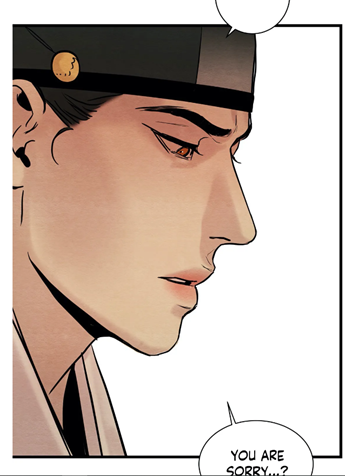 As you can see, care was always the trigger for his visit to the painter’s study. In the chapter 48, he wasn’t just angry. If fury had been his only motivation in the chapter 48, then he wouldn’t have contained his anger. Yet during the chapter 48, the master remained quite calm.
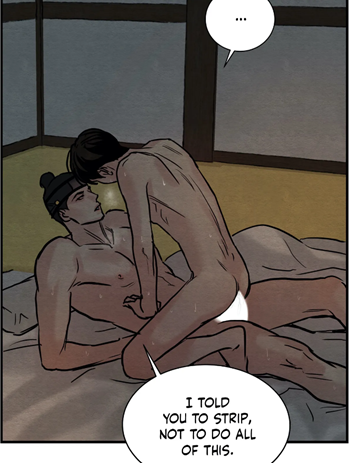 He acted like a master or a client at a gisaeng house, yet he kept talking to the artist, pointing out the weirdness of his attitude. He kept asking why, just like in the chapter 41/42. Therefore I come to the conclusion that care and concern were the biggest motivations for the lord to visit the painter’s chamber. In other words, Seungho has never been cold-hearted, like some readers are still judging him.
Now, if you pay attention to the second confession (chapter 25), it doesn’t look like worry is the lord’s motivation. But here, let’s not forget that they meet at the pavilion and not at Baek Na-Kyum’s study. At the pavilion, Seungho’s motivation was desire. He wanted a renewal of their wedding night. He imagined that he would see a painting of their first intercourse, a proof of their “marriage” and make love again to the painter, so that he could experience the feeling of being loved again. We should remember that the lord experienced his own liberation at a pavilion too so this place signified a lot to him. He first became disappointed, then worried because the artist hadn’t remembered their night together. He feared that this wonderful night would disappear forever, would just remain a dream, an one-night stand and this was not what the master was longing. That’s why he said this: 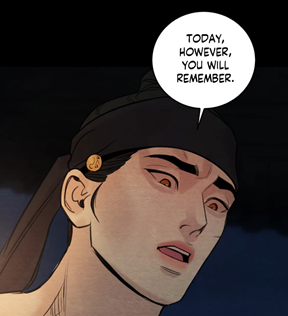 As you can see, the more the lord spent time at the pavilion, the more he became troubled. His despair and worry pushed him to make the wrong decision: force the painter to remember their wedding night so that he could claim Baek Na-Kyum as his “wife” and partner.
As you can observe, by contrasting all the confessions, we get new interpretations and a deeper insight on Yoon Seungho’s actions, for the latter is not very expressive. Only his gaze reveals his true thoughts and emotions but this is not enough. Just looking at the lord’s actions doesn’t really mirror the protagonist’s personality. Worry and care were all present in the confession scenes.
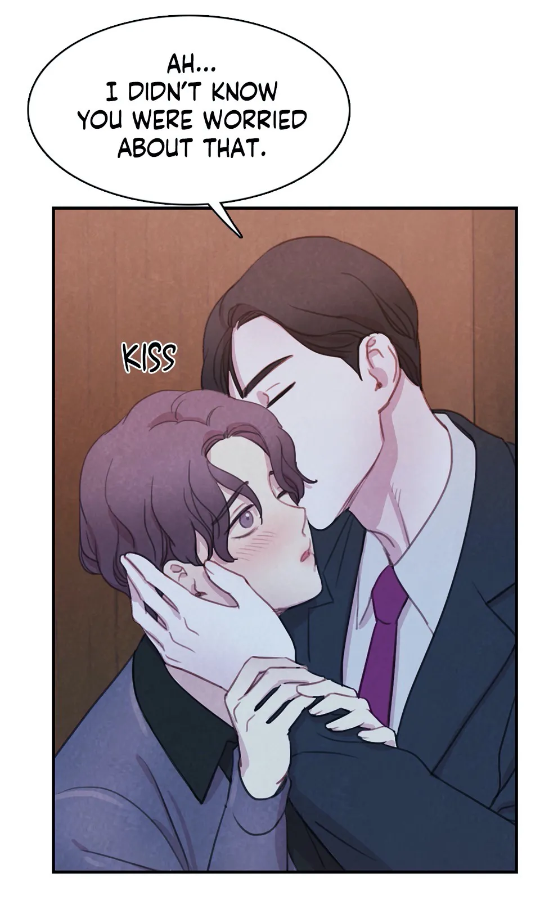
Moreover, if you compare the chronology of the wedding night with the last one, you can observe another divergence. In the chapter 20, the kisses marked the beginning of their wedding night, which is quite normal during a wedding night, while the kisses in the chapter 49 have a different meaning. 
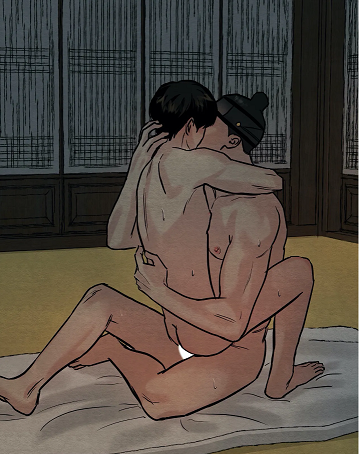 Here, the kisses and the hug are a sign that the relationship between Yoon Seungho and Baek Na-Kyum has improved, even deepened. They already had sex before, hence the kisses have another signification.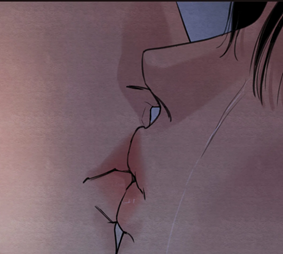

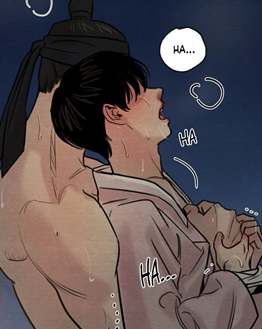
 In the chapter 20, Baek Na-Kyum was the only one hugging his partner while kissing. He wanted to make love, while the master was following his sexual desires or better said, that’s what he believed. I would like to remind that from my perspective, the noble was already in love with Baek Na-Kyum but didn’t recognize his own feelings as he had never introspected his emotions before. I even have the impression that he is still unaware of the depth of his feelings for the painter. In other words, in the episode 49, both main leads start making love. From my point of view, Yoon Seungho is making love to the artist, while the latter just perceives it as a sex session, as he doesn’t want to get hurt emotionally again. He prefers following his physical reactions, he is no longer repressing his unconscious. Yet, there is affection coming from the artist as he is someone with a big heart, like his erotic publications suggested. That’s why we have here again a combination of sex and love. This is understandable as the low-born doesn’t even grasp the true motivation behind his actions. His gestures are exuding love and affection and not just pure lust but since the painter doesn’t see his own actions in a mirror, he has the impression, he is only following his sexual desires. As a conclusion, the kisses in the chapter 49 mark the second phase of their intercourse, the love session.
We also had two stages during their first night. Back then, the master thought that he could have sex with the commoner finally hence his gestures were quite rough.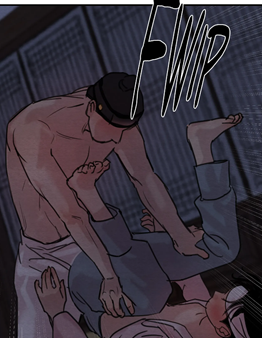 He was just following his own interests and never paid any consideration for the painter. He was just looking for sex in his mind, but the moment he was told that his partner was a virgin, he was surprised. Nonetheless he was willing to change his behavior and became more gentle.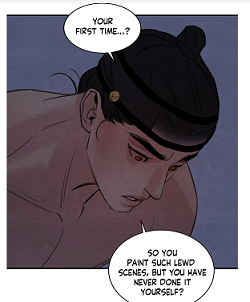
That’s why I come to the next topic, the presence of the brothel in all the confessions (20, 40, 41/42, 48/49). I would link to outline the importance of this aspect as the gisaeng house is associated to corruption and defilement. Since Yoon Seungho knew that the painter came from the gisaeng house, he imagined that he was not pure. He saw the images as a proof of his dirtiness. The paintings mirrored lewdness in his eyes, hence he thought that they would reflect the artist’s impurity. With this revelation (the commoner is a virgin), he recognizes that he somehow misunderstood the images. He just considered them as lewd, though in fact, they were beautiful as they are oozing naturalness and affection. The fact that the commoner was raised at a “filthy” place, yet remained pure, not just enhanced his virtue but also unveiled his innocence.
No wonder why the noble can’t let the painter go. Baek Na-Kyum embodies the opposite of his own life. While Yoon Seungho, due to his status as noble, was supposed to live in a world of virtue and honor, he experienced the opposite: treachery, dirty sex, corruption so that he ended up tainted and impure. The so called virtuous world of the nobility was in reality a filthy place. And that’s how he felt too and during their wedding night, he meets someone willing to accept him, a person who wanted to remain chaste out of love and fidelity. His words display honor and virtue, all the features that aristocrats should represent. This explains why the noble decides to take the painter as his wife in that moment. He sees him as worthy, Baek Na-Kyum is in fact the real noble person here. This explicates that the master doesn’t consider the social gap as a hindrance. Baek Na-Kyum has lived as a honorable and dignified person, unlike all the aristocrats Yoon Seungho has ever met. That’s why the marriage was important for the noble. It was, as if their union would clean the aristocrat from all the filth he experienced before. Right early on, I had associated their first night as a wedding night and the more I examine this manhwa, the more my interpretation is confirmed.
Strangely is that Jung In-Hun refused the painter because of his “dirtiness”, he preferred distancing himself from the commoner as he feared his “cleanliness” due to his title would be tarnished.

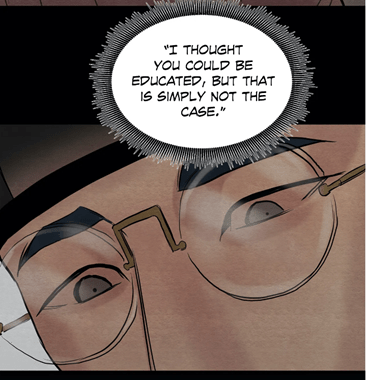
And in the last image, Baek Na-Kyum saw his own reflection in the teacher’s eyes, he was a prostitute. The glasses literally made him blind hence the painter could no longer consider himself as pure. However, I have the feeling that the scholar’s words will come to bite him because he will experience what Yoon Seungho went through in his past. He will discover how dirty and evil the nobility is. Jung In-Hun is already vicious, yet his arrogance makes him stupid and even naive. That’s the reason why in the chapter 42, the painter tried to act like a whore as he had accepted Jung In-Hun’s words and gaze as the truth.


That’s why the lord wasn’t even excited and suspected that Jung In-Hun had abused the artist’s innocence in order to obtain something. Striking is that later the noble gave in in that scene but he didn’t allow the artist to act like a whore. He ensured to please his “wife” and followed his advice. We could say that we have a reversed situation from the chapter 25. Back then, the noble used his right as husband to have sex with his “partner” and now, the painter was more or less cornered to act like a “spouse”, although the latter never perceived it that way. He just thought that he was judged as a prostitute.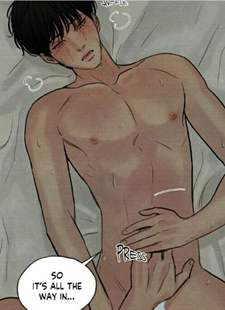
 Let’s not forget that the master did follow all the painter’s requests in that scene. That’s why he kissed and hugged his lover so passionately, he wanted to comfort him so much but he failed to stop the painter’s heart from freezing. That’s why Baek Na-Kyum still judged himself as a whore after that night. And in the chapter 48/49, this time the manhwaphiles behold the lord acting like a real client at a brothel.
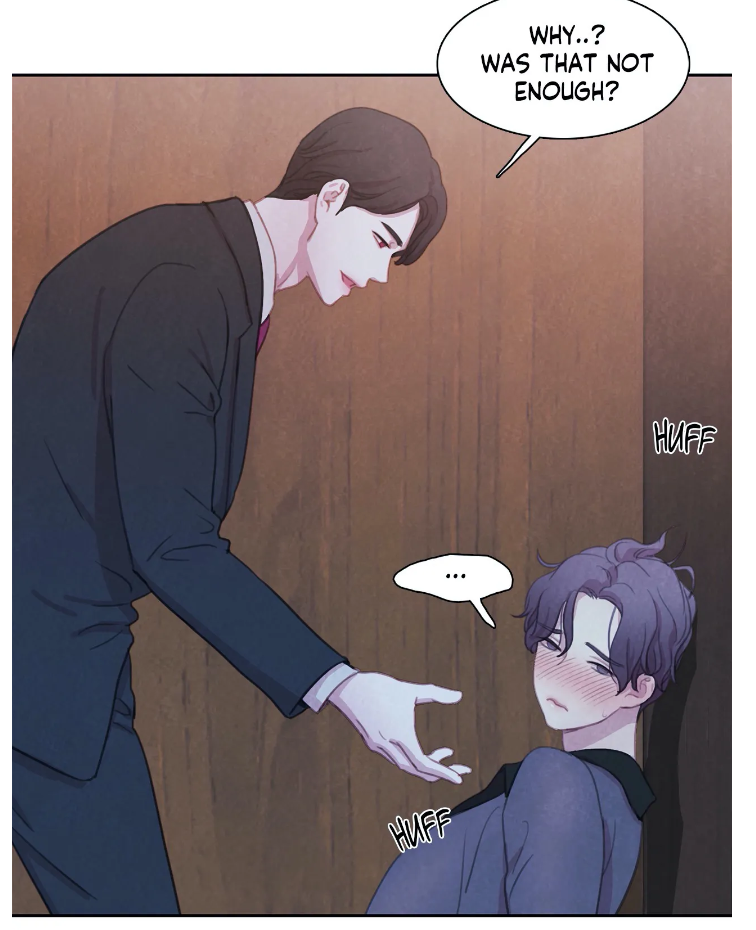
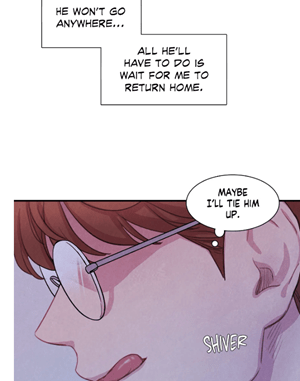
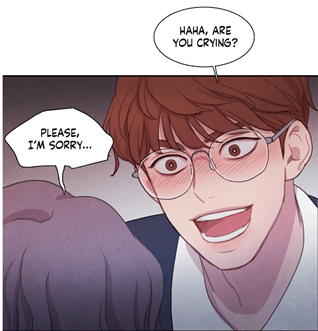
 He wants to provoke a physical and emotional reaction in the painter so that the latter finally leaves his state of shock. By playing this role, he wanted to make the commoner realize the harsh reality of a brothel and the real fate of prostitutes. He frightened the painter so much that the latter begged the lord to stop, to listen to his requests.
 However, this time he did succeed but still didn’t achieve his original goal: winning the painter’s heart. I am well aware that some readers are still thinking that Baek Na-Kyum hasn’t changed his view about himself. I have a different opinion because he is now the master of his own fate. For me, he has become a libertine, sure his negative opinion about himself is not entirely removed, yet he is now able to differentiate between his own interests and the ones from his partner, which he never did in the past. He imagined that Jung In-Hun’s interests were the same than his own hence he was willing to do anything for the scholar. He has finally realized his own existence so he is no longer the same person, a whore with no identity and desire. He is now creating his new life, making new rules.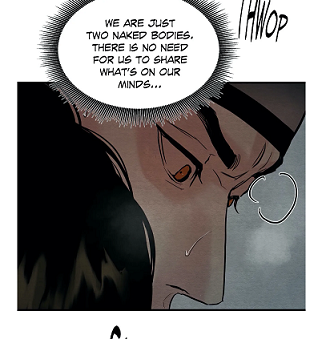

Striking is that the painter’s origins are indeed a source of shame for Baek Na-Kyum and the image where Jung In-Hun expresses his disappointment “I thought you could be educated” explains why the painter had a low self-esteem concerning his social origins. He had no education. That’s the reason why he was attracted to the low noble in the first place. He met a person with some education that’s why we have now reached a crossroad for both characters. Yoon Seungho knows now why the painter behaved like that and in my opinion, he has already realized how he can solve this problem. The last image in the chapter 50 is already indicating that Yoon Seungho will become the “learned sir” Baek Na-Kyum has always wished. 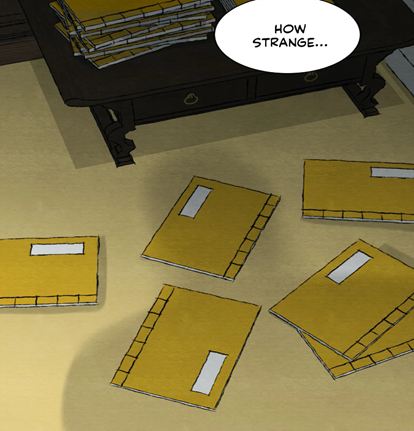 That’s the reason why the noble was only seen as a shadow. He hasn’t slipped into the role of the painter’s teacher yet. By giving him an education, the master will boost the commoner’s confidence so that Baek Na-Kyum can no longer deny his feelings for the lord. This will affect his perception about Yoon Seungho.
As you could see, the brothel play a huge part in all the confessions as it is connected to filth and corruption. Baek Na-Kyum hasn’t grasped that the protagonist fell in love with him due to his purity and innocence. Besides, he helped him to change his perception about himself (chapter 4, chapter 20). Through the erotic paintings and their wedding night, the noble has now regained his “virtue” hence he has become monogamous. He is a reformed man like the folks in town observed it.
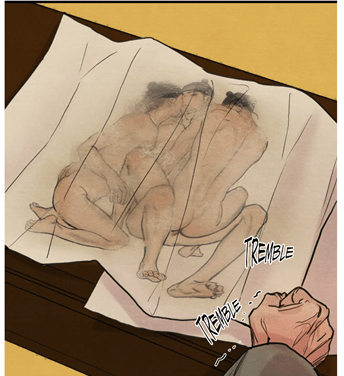
Okay, that’s it for the 5th part. In the next part, I will keep comparing all the confession scenes again but I will examine this drawing more particularly.

Feel free to comment. If you have any suggestion for topics or manhwas, feel free to ask. If you enjoyed reading it, retweet it or push the button like. My tumblr-twitter account is: @bebebisous33. Thanks for reading and the support.
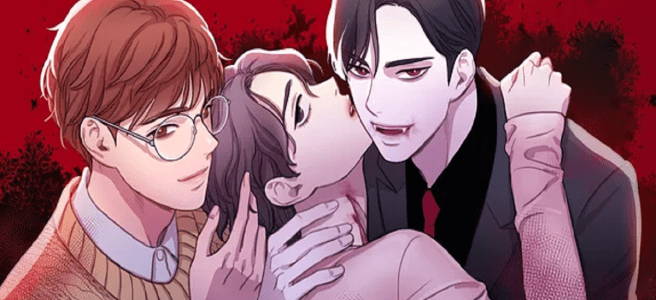
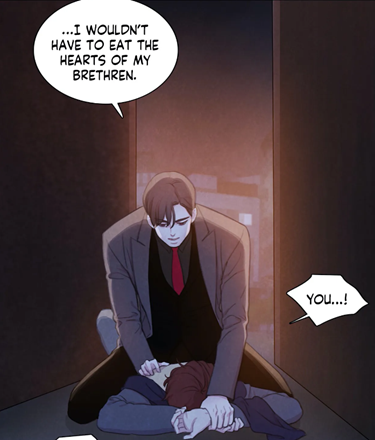 Consequently, while liberation will be the topic of the essay, I’ll question at the end, if their emancipation just announces a positive change.
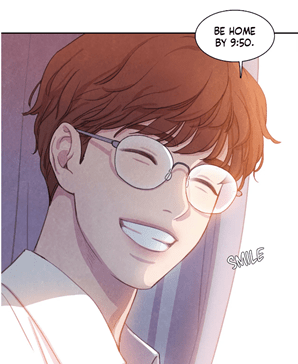
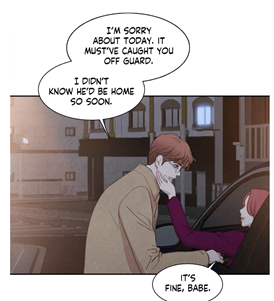
 The double-faced man even supervised their sexual encounters, he never took the uke’s pleasure into consideration. In fact, he actually enjoyed it, when the protagonist would cry.
 He abused the main character so much that at the end, Joo Sooin had even adopted Sungha’s worldview. As a homosexual, he was a dirty and filthy pervert. The red-haired man had succeeded to transform Sooin into a man with no confidence, no dream and no desire. That’s why I described him as a zombie in my first analysis about Dine With A Vampire (“What defines being a human?”). Imagine that for a brief moment his “only hope and dream” was to be thrown away, as if he was some garbage.
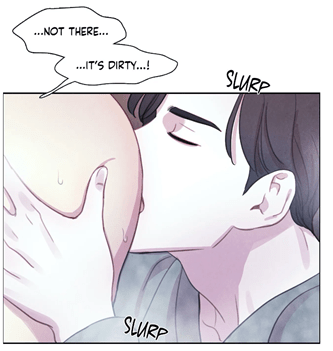

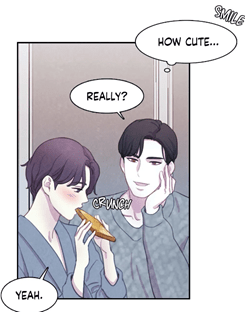

 due to the colors (dark blue and black) the selected shirt and the trousers resemble to the jacket he wore, when he was living with the future doctor.


 grab his head so that he could take his whole shaft, I believe that this desire was influenced by Kwon Sungha too. What caught my attention is the main lead’s reaction, when he hears from his lover that he will do what Sooin wants.
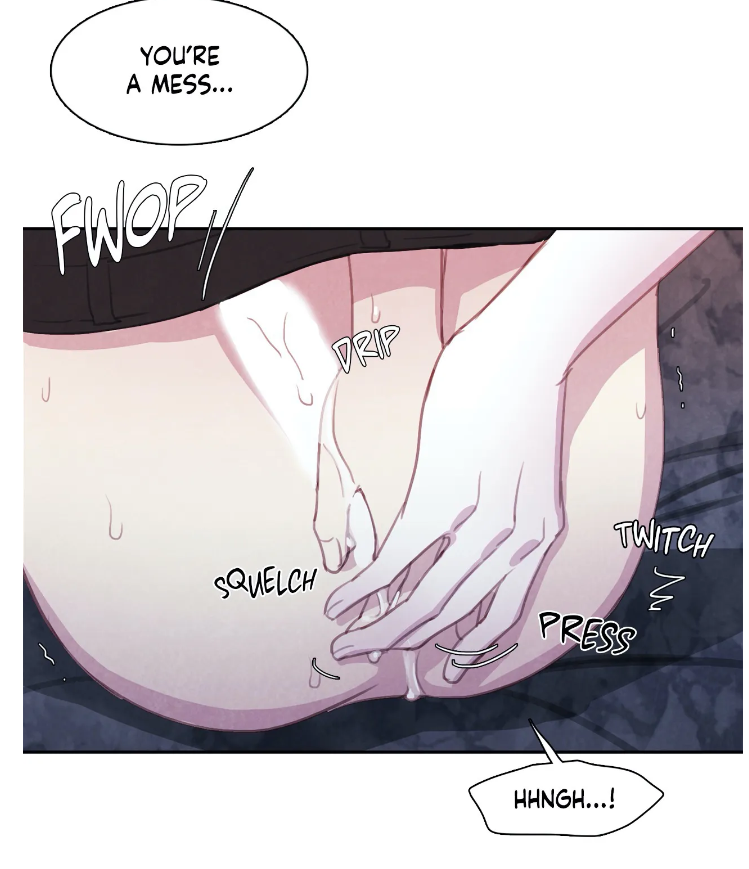
 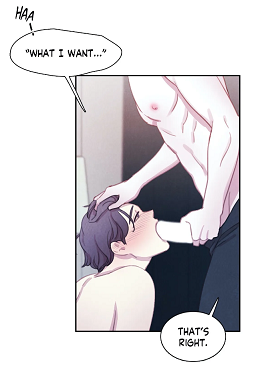 The quotation marks indicate a certain surprise and hesitation expressed by the sensitive human. At that moment, the new lover has no idea that the request doesn’t truly reflect the human’s wish, it is more linked to the violent internist. Besides, if you consider how rough the fellatio is (deep throat), even the vampire wonders how he can allow this, because he knows how delicate the human is. This would explicate why at the end, when the vampire declares that Sooin looks like a mess, the latter starts crying and apologizing. The deep throat fellatio and Chi-Hwan’s words triggered the main lead to remember about the negative image he has about him.
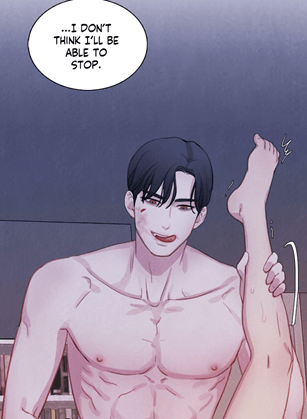
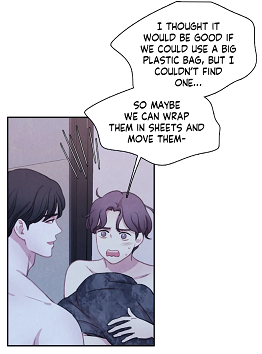 . The personal pronoun “I” is quite central in order to detect the slow recovery. If you compare to the way he spoke much earlier
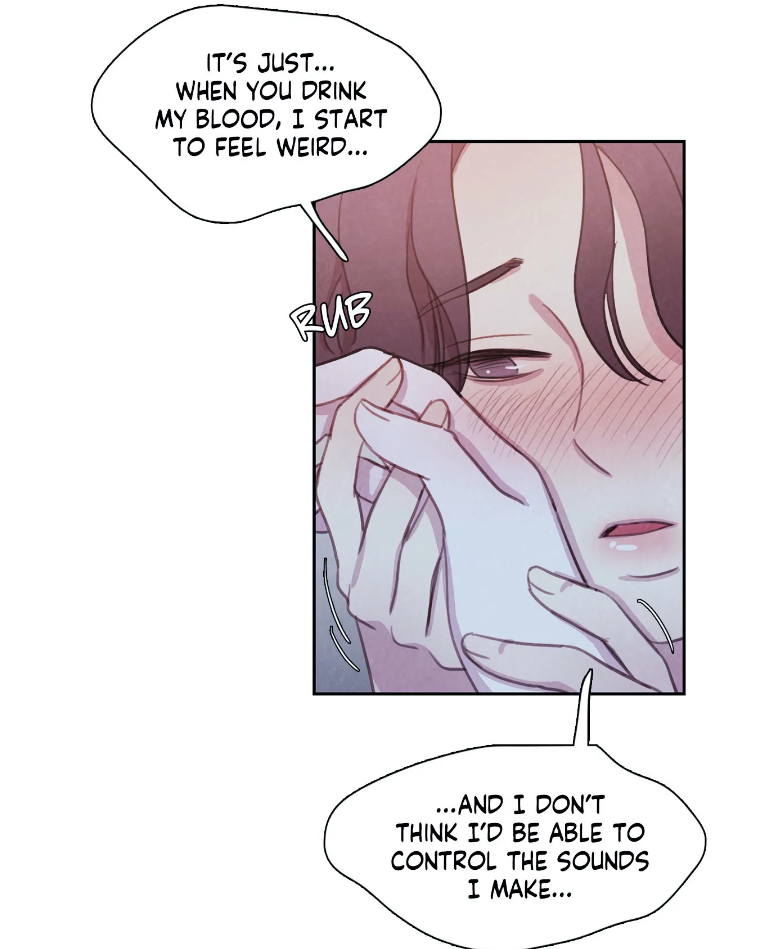 , his sentences in the second picture above are much longer and without any break. Sooin is less reserved and more determined. There is a progression between the two pictures, the “I” becomes more and more important.
 He even tells Sooin that he will always listen to his wishes and desires.
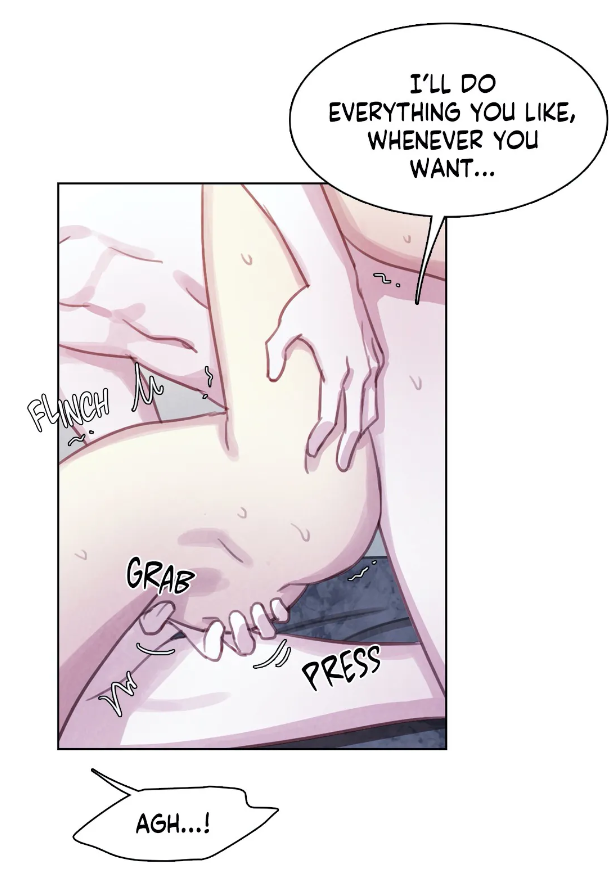 Why is there such a huge contrast between this relationship and Sooin’s bond with Sungha? Sooin and Chi-Hwan call each other master hence there exists no superiority between them, unlike Sungha who was the only master. For him, Sooin was just his pet or his object. While Sungha planned to cage his sex partner in a studio for his own sexual desires, Chi-Hwan uses the expression “our home”.
 Notice that he smiles and even laughs more, while in the introduction, he appeared more grumpy. He was avoiding humans and even vampires. The reasons were quite simple. He disliked the scent of humans’ blood and he needed to avoid vampires so that he could hunt them without getting noticed. In other words, he was quite lonely. He couldn’t share anything with others. Affection and care were non-existent. I also believe that he also discovered sexuality and its pleasures thanks to Sooin. Notice his reaction, when he drinks the human’s blood for the first time.


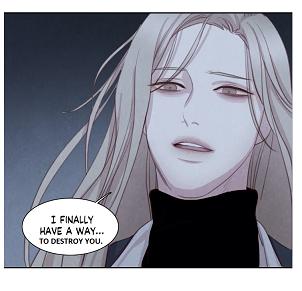 Since he has bonded with a human, the origin of his powers is now Sooin and no longer the vampires. Does it signify that he will lose his supernatural powers over other vampires in the long term? Honestly, I believe the opposite. But we’ll see if this impression will be proven correct. Besides, as human’s life is so fragile, it is normal that Park Chi-Hwan’s enemy will target Sooin because he seems to be the weaker one. Once Sooin is removed from Chi-Hwan’s side, the latter will lose his happiness and joy.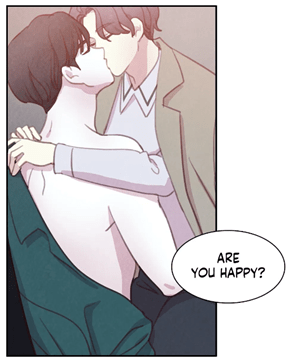


 He had the impression that this sonnet would express the scholar’s yearning due to the metaphors used in the poem. What he didn’t know was that the scholar had just copied it from the original. In other words, the yearning that transpires in the scholar’s poetry is actually the longing of the original author, Wang Bang-Yeon, and not the aristocrat’s fascination. Since the commoner had no contact to poetry, he couldn’t know that this was just a plagiarism.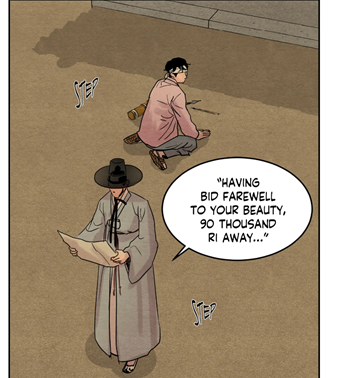
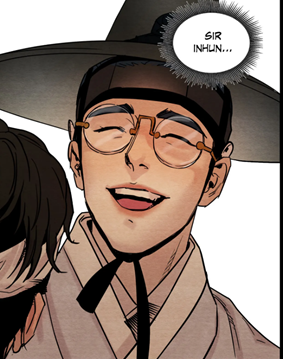 Let’s not forget that the teacher never showed his true gaze to the painter until the chapter 40. Besides, we should remember that I already associated Jung In-Hun to the day and the sun (a fake one), therefore he couldn’t choose the moon as a metaphor for himself. Usually, kings are associated to the sun (see Louis XIV, the sun king or the pharaon in Egypt) and not the moon.
 Therefore the seme was forced to take the man with him and pressured him until the painter gave in. He had to admit that painting was his way to survive. Notice that Yoon Seungho cornered him to concede this.
 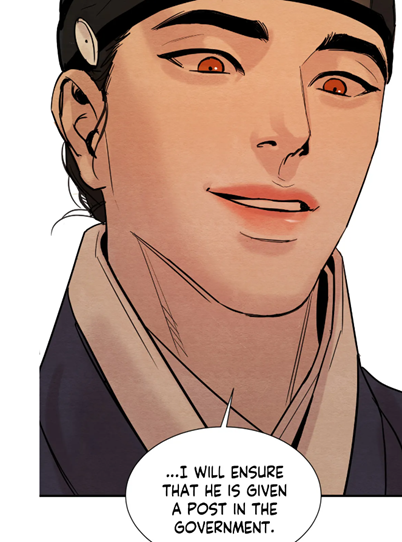 (chapter 7) Notice that in order to force the painter to violate the scholar’s rules, the noble had to use stratagems that didn’t require a lot of strength in the beginning: some little menace and the blackmail. Yet, the manhwaphiles can detect that the thread keeps growing as well. The aristocrat already has to use his power (influence and money) in order to corner the painter (chapter 7) which shouldn’t be neglected. It did represent a lot: a roof and free food for the low noble.
 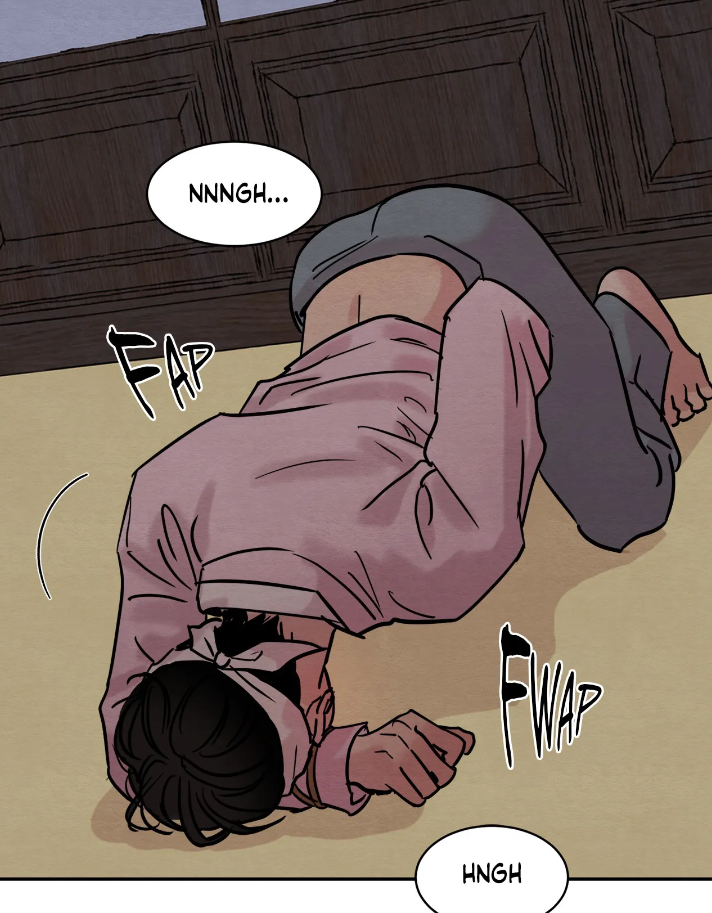 I am quite sure that the innocent protagonist hadn’t done it before due to the scholar’s preaching. So the chapter 9 marked another progression. Baek Na-Kyum disrespected the rule 3 for the first time on his own. He can’t admit to feel attracted to another man, to be recognized as a sodomite. That’s why the masturbation represented a compromise. Since he was alone, nobody would know about it. As you can detect, little by little Seungho is removing all the rules set by the low aristocrat. But the higher the rules are, the more Yoon Seungho needs to use force.
  (rule 2) Surprising is that due to his interaction with the main lead, Baek Na-Kyum had somehow started thinking on his own, using his own critical thinking therefore he reprimanded the rich master for his cruel behavior towards the servant who got killed. In that moment, Jung In-Hun had to put him back to his place. He admonished the painter harshly for his criticism. As a low-born, he was not allowed to make such comment.
  (chapter 10) From my point of view, the chapter 10 not only reveals the huge influence Jung In-Hun has on the painter, but also illustrates the growing influence of Seungho on the artist. The master’s words and actions did shake the rule 6. But it wasn’t enough to remove this wall hence Baek Na-Kyum accepted the low noble’s reproach and remained silence.
  (chapter 11) Compared to the past where he just pushed the low-born away, his gestures in the chapter 11 displays the increasing use of Seungho’s force. But the master felt remorse hence later the painter was only scratched by the master. Nonetheless, let’s not forget that Seungho had already set his eyes on the painter. He wanted to taste the artist. As a first conclusion, the lord had only removed the rule 1 and 2. At the end of the chapter 15, the noble is facing another hindrance, the rule 3: his denial of his homosexuality. Therefore the masturbation in the chapter 16 marks the first step in order to destroy the rule 3. Notice that the noble was annoyed, when the artist gave the false excuse that he was tired in order to avoid the noble. So he somehow “attacked” Baek Na-Kyum by hugging him and grabbed his penis.
 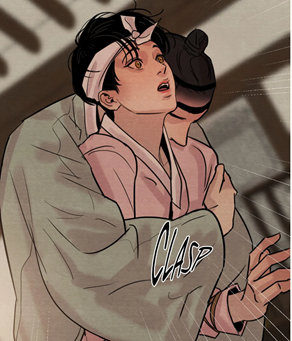 (chapter 16) Let’s not forget that he didn’t ask for the commoner’s permission. That’s why the painter cried in that scene. The latter knew that he was violating the rule 3, yet the seme saw that Baek Na-Kyum was aroused and felt pleasure.
  (chapter 19), he was already on his guard waiting for a signal which appeared in the form of the stolen bottle. He seized the opportunity to meddle between Jung In-Hun and Baek Na-Kyum. He needed to squash in between these two men.
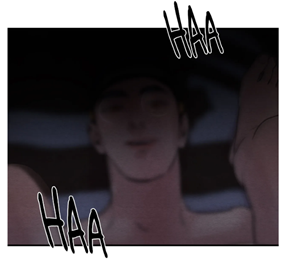 (chapter 21) In fact, he was attempting to deceive himself and the noble. During their night, Baek Na-Kyum was well aware that this could only remain a dream because if he admitted it as a reality, then this would signify that he was conceding his own sexual orientation and even his attraction to Yoon Seungho which he felt very early on (chapter 2, 6, 8-9, 13-16). Therefore I come to the conclusion that the artist somehow knew what happened during that night but chose to act as if the noble was Jung In-Hun. Later he repressed his memories and even ignored them so that he would act as if he was still following the teacher’s doctrines.
 (chapter 21).
 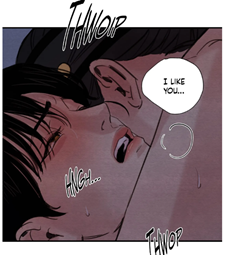 (chapter 21) Yoon Seungho heard a love confession, got hugged and kissed tenderly and there was someone crying out of happiness because of him. For the first time, he saw that tears could be related to happiness and he could affect someone positively. That’s why he reacted by kissing the painter’s eye and tears.
  (chapter 21) Although he knew that it was just an illusion because Baek Na-Kyum had confessed to someone else, he hoped deep down that the painter would love him, if he remembered their night today. He tried to trigger his memory through different tricks (like here with the book)
  but he failed (chapter 23). Yet he showed a certain patience as he didn’t pressure the artist to paint their night immediately, he gave him time. He imagined that once Baek Na-Kyum remembered their night and painted it, it will become a reality, a proof that this was not an illusion. But because of the coercive persuasion, Baek Na-Kyum tried to repress his memory. He had to if he wanted to keep following the scholar’s rules. The painter chose to ignore the images he had since it meant that he hadn’t kept his vow. All this time, Yoon Seungho has no idea about the true nature of the relationship between Jung In-Hun and the low-born. First, he believes to see it as a crush, then he witnesses the depth of the painter’s feelings. This is important because from that moment, the main motivation for the lord will be love and no longer his libido. This will be his goal which will give him the necessary strength to remove the other rules: 3, 4, 5, 6 and 7.
 (chapter 25) The rape represented the ultimate use of violence which kept increasing from the start. But the noble failed as he was not able to remove the rule 4, 5 and 6. Yet he did achieve something which I’ve realized only now. For the first time, Baek Na-Kyum was admitting that he loved a man and he could no longer the excuse that he was under the influence of the alcohol. So at the pavilion, the artist violated the law 3 (being a homosexual) as he confessed his love for Jung In-Hun.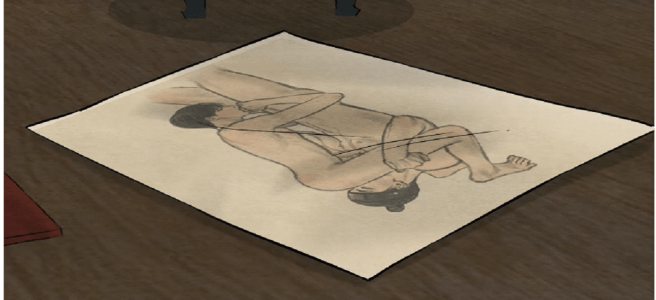

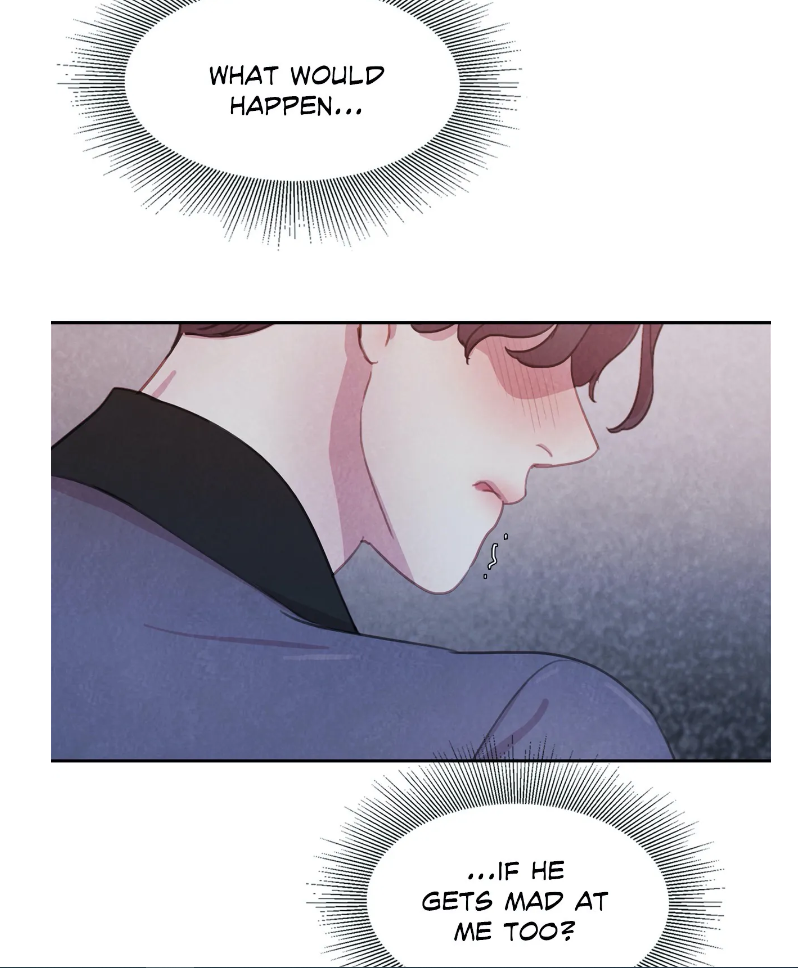
 Striking is that the moment he hears this sentence, he starts mistaking the vampire for Sungha. Note that he is not even looking at his sex partner, because he hid his eyes with his arm. This reveals the importance of the gaze once again. Sooin can’t look at Park Chi-Hwa as he fears to see his own reflection in the vampire’s eyes. Will he see himself in the man’s gaze as a monster? Here, I feel the need to elaborate Jean-Paul Sartres’ theory about the gaze.
 It was as if his eyes had died due to the constant confrontation with Sungha’s gaze. As a conclusion, the main lead sees himself as a monster, not deserving any attention and warmth. He is still surprised by the affection the vampire is exuding towards him. This explains why the main lead started fearing the supernatural creature, when Sooin heard chi-Hwa sighing after the uke had refused to comply to the vampire’s needs (drinking his blood). He heard Chi-Hwa sighing and misinterpreted this as dissatisfaction. Observe that the drawing doesn’t show Sooin’s eyes and at the same time, he is only focused on the vampire’s voice and not his eyes.
  We could say that the uke is still under the influence of the brainwashing operated by Sungha. Sooin has not regained his humanity, his true identity. The so-called monster is still under the ruling of Sungha, because he rejects to fulfill the vampire’s need due the ex-friend’s ideology.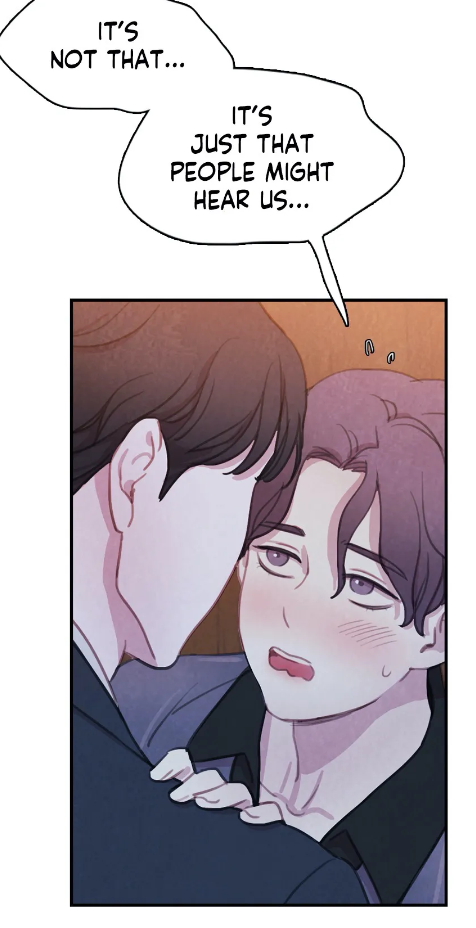
 The innocent man still fears the gaze and the gossip from others. Now you can understand why Sooin became a zombie, a monster in his eyes. He saw a bad image of himself in Sungha’s gaze but at the same time he was manipulated through the friend’s doctrine that even others would perceive him like that.
 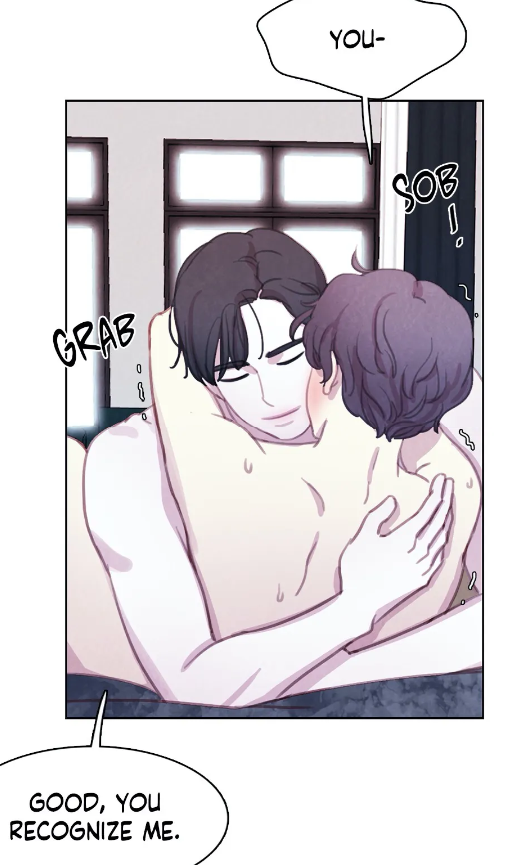 At some point, Chi-Hwa gets aware that Sooin needs to look at him, so he forces the man to look at him in the eyes. This is important because for the first time, Sooin is confronted with a different gaze and judgement. He recognizes the lord, his kindness.
 and his fangs come out.
 He wants to taste the man’s blood. In this moment, Chi-Hwan seems to follow his instincts hence he approaches Sooin. It was, if the vampire’s true nature would surface, he is a monster led by his blood thirst. Remember that Park Chi-Hwa even described the vampires as predators or parasites, so one might say that they are indeed monsters. So do we have two monsters here?
  and treats him as such. He listens to Sooin’s excuses and wishes. When the uke refused to give him his blood in the cabine, the supernatural creature questioned himself.
 The readers can witness how the so-called monster reflects on his behavior. He even kisses the man
 , comforts him twice, when he realizes the traumatized state of Sooin.
  since it represents the peak of his hunger. The readers can even sense the increasing of his bestiality as the expressions are getting more and more violent: “I want to devour him”; “I just want to rip him open” … “and devour every part of him”. We have the impression that the vampire’s animalistic instincts are growing to the point he could lose the control of his bestiality. However at no moment, he changes his behavior. I feel that while his thoughts indicates the awakening of his “monstrosity”, he acts more humanly in reality. He stands in opposition of Sungha, who gave up on his humanity and his reason. He let social standards and religious doctrines ruled his behavior and his thoughts.
  One might dispute that he rejected to have a fellatio in the cabine, as Sooin wanted. However, his proposition to do it home represents the compromise between the concerns the uke expressed before (people might hear his voice, his fear of people) and the request Sooin had. All this mirrors how caring and attentive the vampire is. He might be an “animal”(when we analyse his thoughts), nonetheless he never lets his instincts cloud his reasoning and judgement. At no moment, he acts like a monster towards the human. Like I mentioned before, the vampire treats the human like his master. However, if you take a closer look at the following image, this reflects their relationship:
 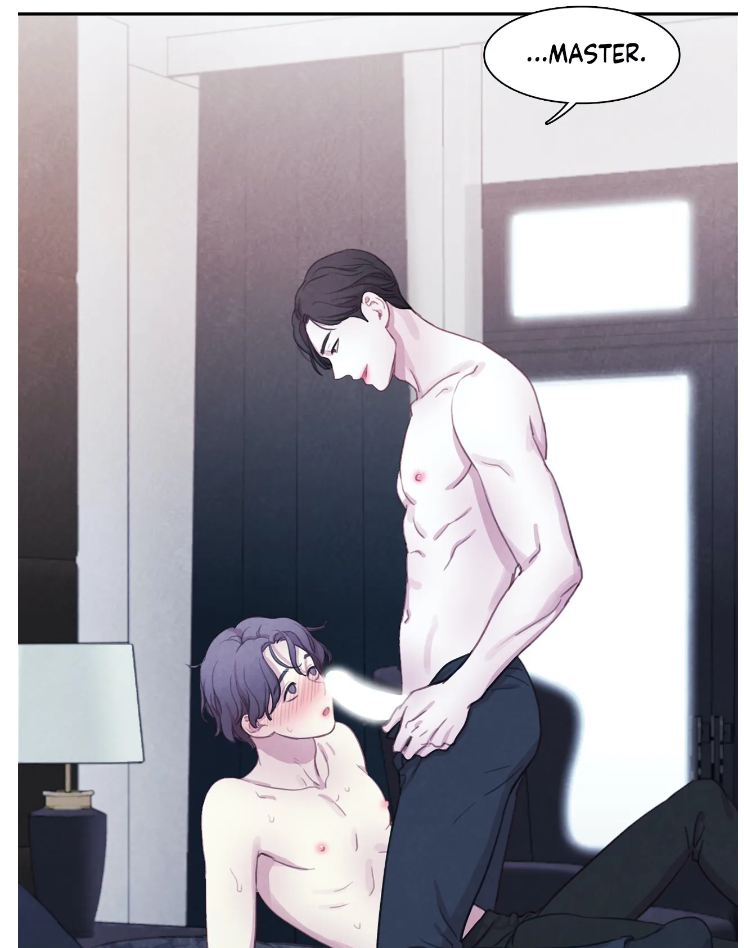 Sooin is the master, yet he is below the vampire as if he was inferior to the vampire. Furthermore, the creature gives the order: “Suck it”. Besides, the man calls Chi-Hwa “sir” and this is how someone addresses to a master.
  So in my opinion, both are masters. The vampire is helping the man to become a human again, he is helping him to get a personality and identity. He knows that the man needs to discover that his homosexuality is something natural, that he is first a human. That’s why he promises Sooin to let him forget Sungha. For him, Sooin should never define himself based on his sexual orientation.
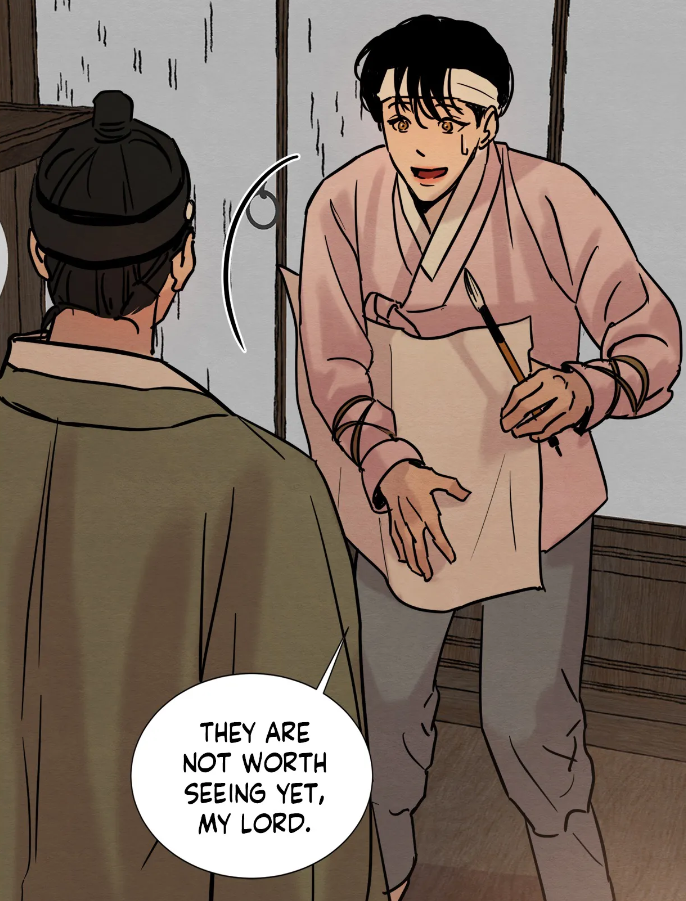 (Chapter 9) Baek Na-Kyum excused himself with a lie, he would show him when the work would be finished. However, the true reason for his departure was his erection. Notice that he is using the paper to hide his erected phallus. He was also on his knees before, when Yoon Seungho approached him. The cause of his sexual urges is revealed with the following drawing.
 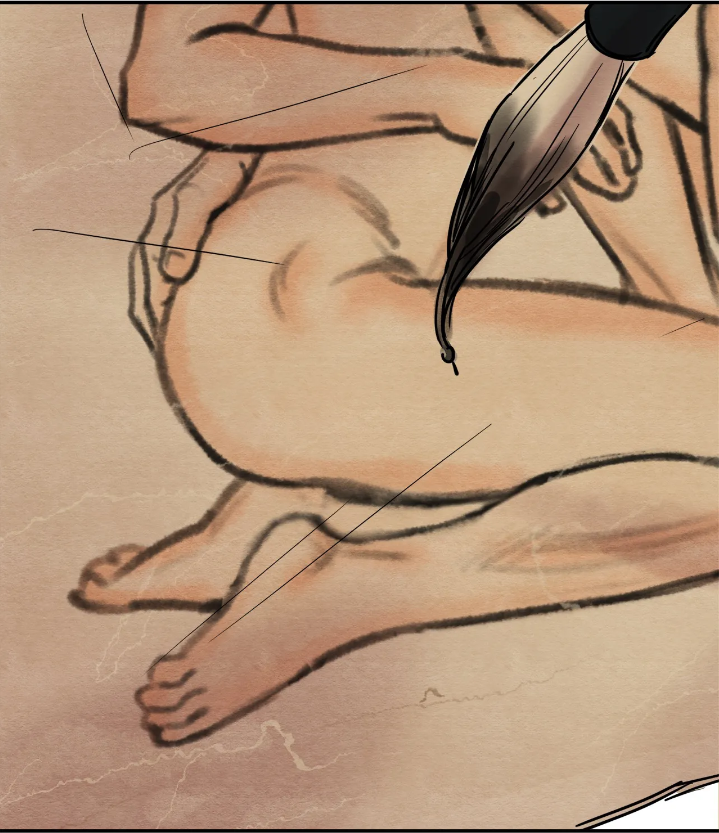 (Chapter 9) This drawing represents the painter’s perspective. As you can see, the painter’s eyes are focused on the lord’s hand touching the butt and anus. From my point of view, he is imaging the lord’s touching him. This time, the artist is conscious and can no longer repressed his sexual desires. Later, his gaze focuses on the other uke, the one penetrated by our main lead. Here, it is quite clear that the artist wishes that he had replaced Min.
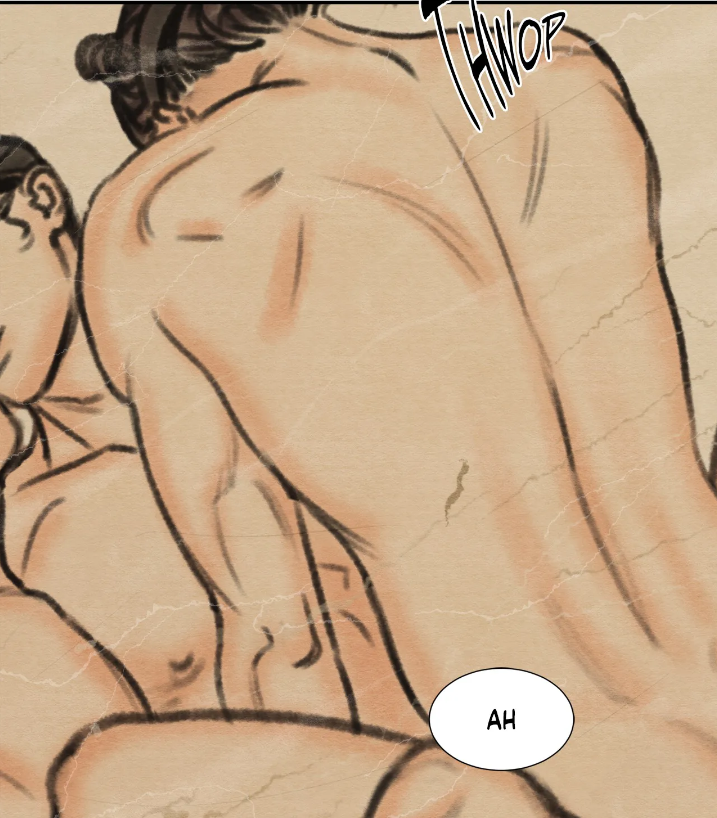 (Chapter 9) In both cases, the painter never painted the sex partners’ faces properly so that it would easier to imagine for him to switch places with them. All these zooms reveal the growing sexual desires. That’s why he feels the need to masturbate, as he can’t repress this urge any longer. This didn’t escape Yoon Seungho hence he couldn’t help himself smiling.
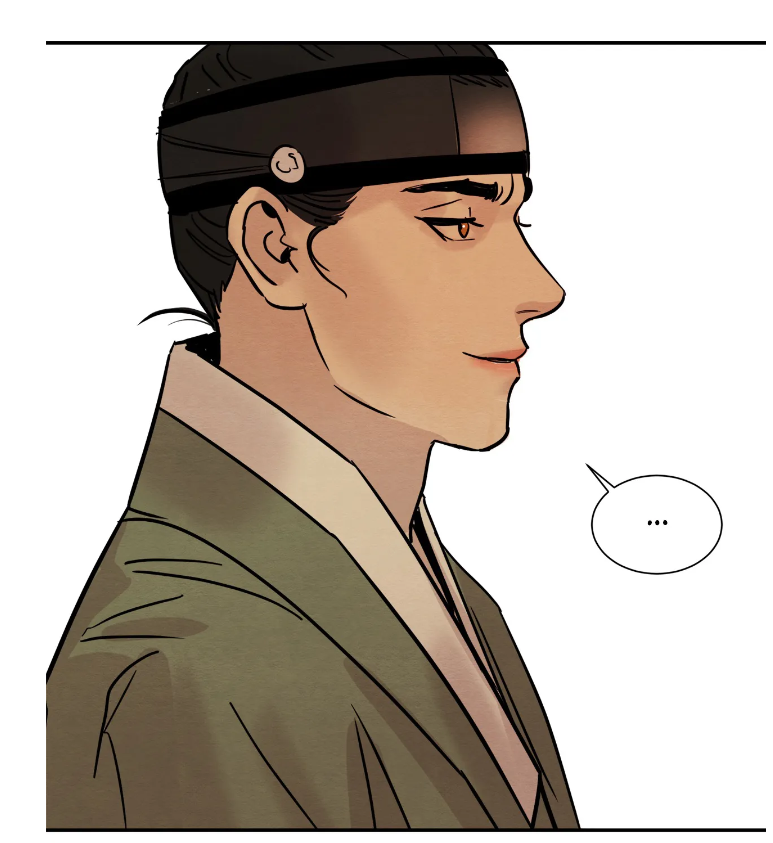 (Chapter 9) Although the painter had been quite rude and left him behind, the lord wasn’t bothered. In fact, he was pleased that he had indeed affected the artist.
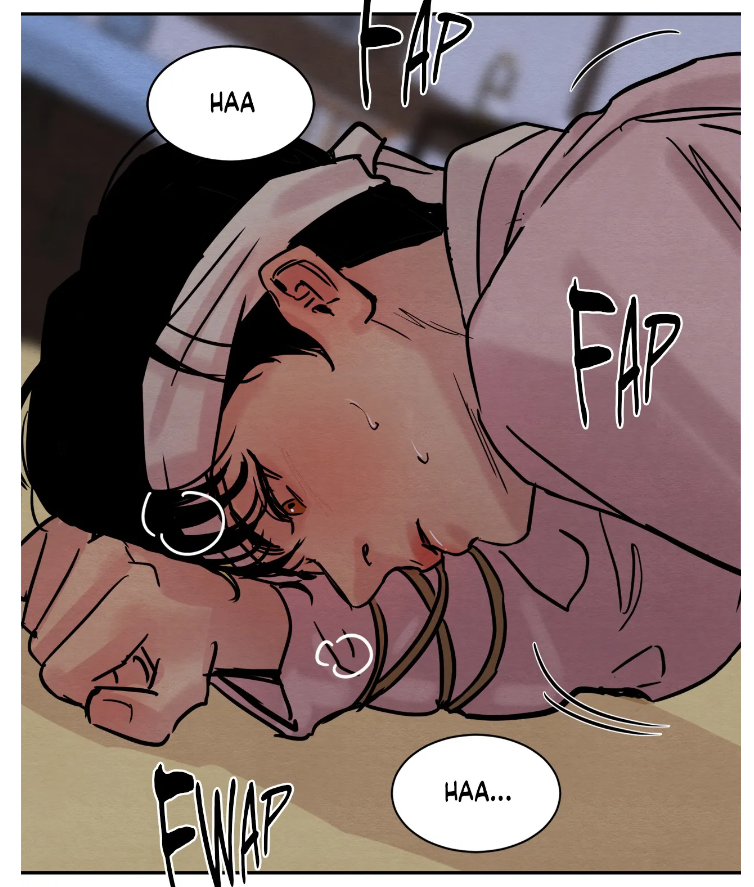 (Chapter 9) His eyes might be open but his spirit seems to be elsewhere. He is not really looking.
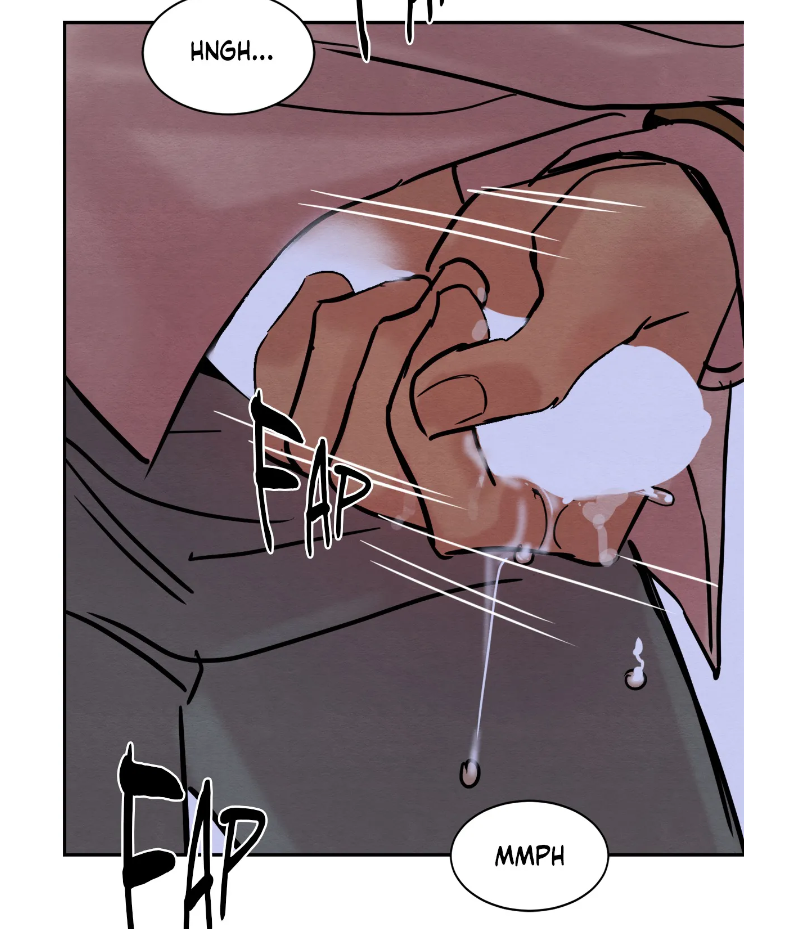 Because the readers never see his gesture, they can not be certain. Hence Byeonduck had to draw a picture with his erected phallus showing his masturbation.
  Striking is that the moment he feels that he is about to climax, he closes his eyes. Here again, this reinforces the statement that Baek Na-Kyum is determined to refuse to face reality and deny his attraction for a man, for the noble.
 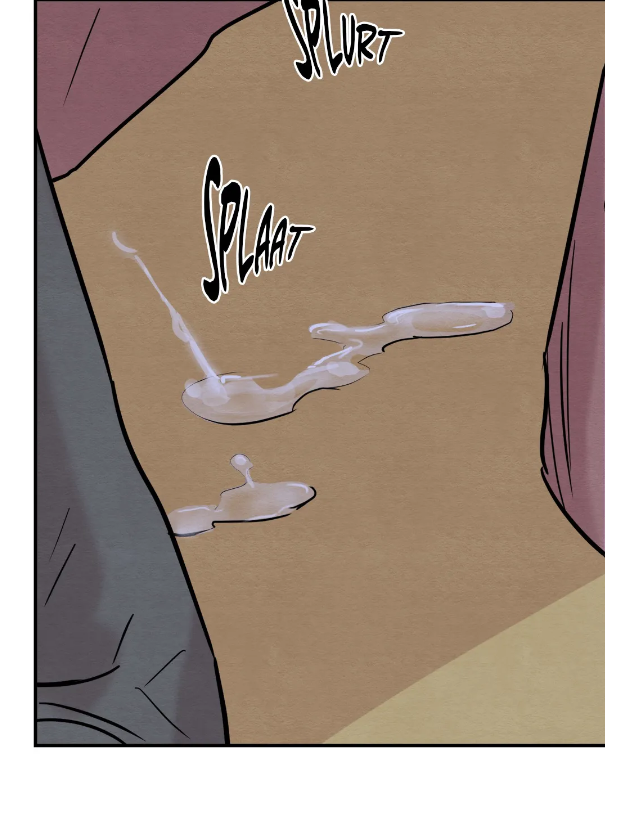 (Chapter 9) When the sperm comes out, it lands on the floor. This is quite important as it illustrates the artist’s attitude towards the semen. He considers it dirty and filthy hence he makes sure that his hand doesn’t get soiled. That’s how much he despises himself and his needs but he can no longer repress these urges. He prefers closing his eyes, masturbating behind a door and using his body to cover his filthy gesture so that no one can ever witness it. But he is too focused on his needs that he forgets that he is making noise so that Yoon Seungho knows what he is doing. At the end, you sense the low-born’s despair and disgusted attitude with his final position.
 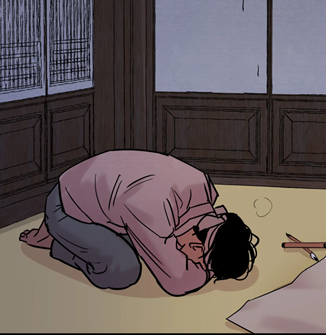 (Chapter 9) The manhwaworms feel his strong refusal to admit his attraction towards the noble, his sexual arousal and his sexual desires towards Yoon Seungho. The painting had such an effect on him, it awoke his repressed sexual desires.
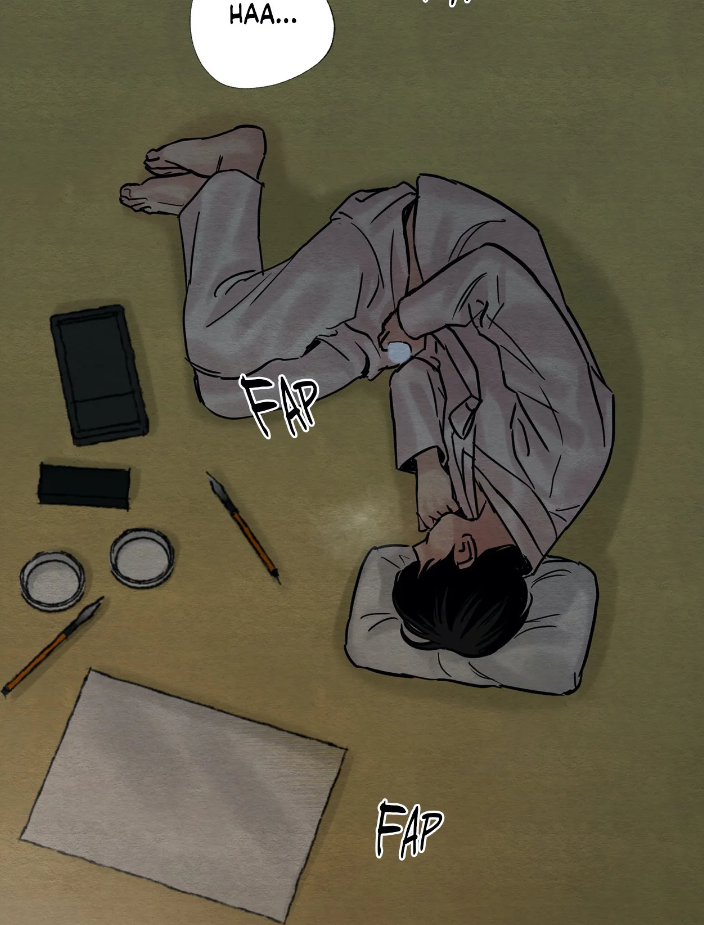 (Chapter 46) However, he has still a position where it is still protected. If someone came from the side, they wouldn’t detect immediately what the low-born is doing. This can be explained that there is still some shame left but it is now related to his perception that homosexuality is a synonym for prostitution. That’s why he is still reserved. On the other hand, the semen doesn’t land on the floor but on his hand which shows that he no longer feels disgusted.
 (chapter 46) Some readers complained that he didn’t wash his hand before falling asleep. Yet what they failed to realize is that this proves that Baek Na-Kyum no longer perceives sperm as dirty and filthy. This symbolizes a huge step forwards. Now, if we compare the two masturbations, the readers will notice another huge divergence: the chronology of the drawings of Baek Na-Kyum with closed or opened eyes. In the chapter 9, we had first the painter with opened eyes as he was lost in his thoughts and the moment the ejaculation was about to come, he closed his eyes. Here, we have the opposite, first the closed eyes.
 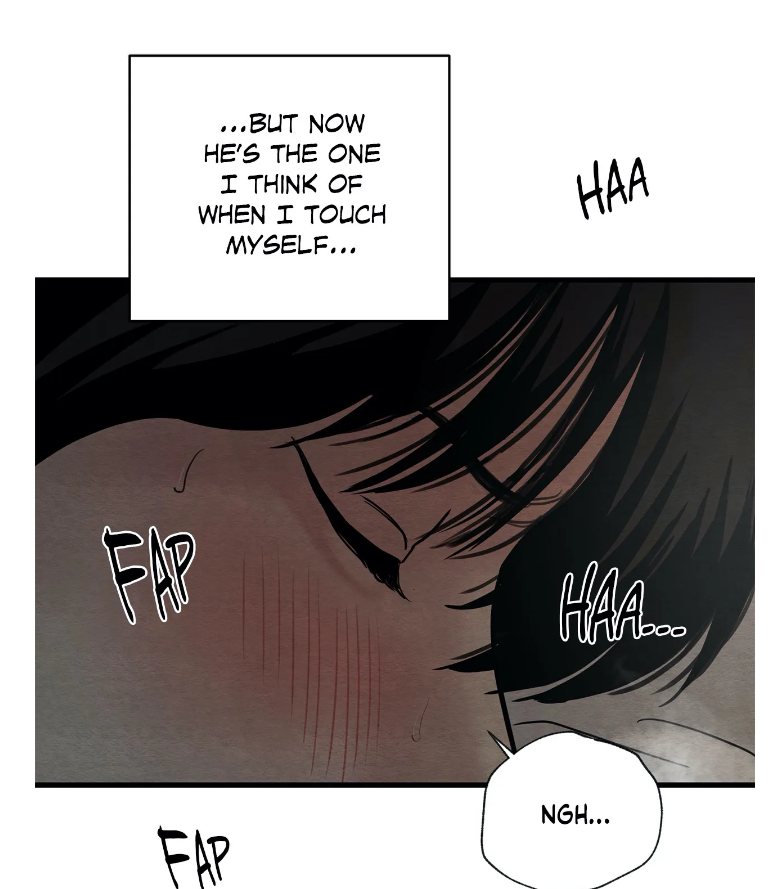 (Chapter 46) The reason is simple: he is not lost in his thoughts, quite the contrary. All his thoughts are revolving around the master confirming the change of his attitude. He is no longer denying his attraction towards the noble. That’s why the author lets the manhwaphiles see the images he has in his mind. What caught my attention here is that the painter had visions of the moments, the lord made love to him.
 (chapter 42)
  (chapter 46) In the last picture, this happened right after the painter had made a sort of confession which triggered the lord to become more vigorous and passionate. This shows that he sensed the lord’s affection but he can’t define this as such yet.
  (Chapter 46) The kiss triggered the climax indicating that the kiss, full of love and passion, moved him so much. He sensed the lord’s love stronger here. Since his eyes are wide-opened, it clearly shows that the man is actually facing reality. He is no longer hiding, running away from his sexual desires and admitting that his feelings towards Seungho have changed. Notice that this time, he even questioned himself for this reason. Why could such a kiss provoke such a reaction? He is now looking for an answer, he is no longer running away. He wants to discover the truth.
 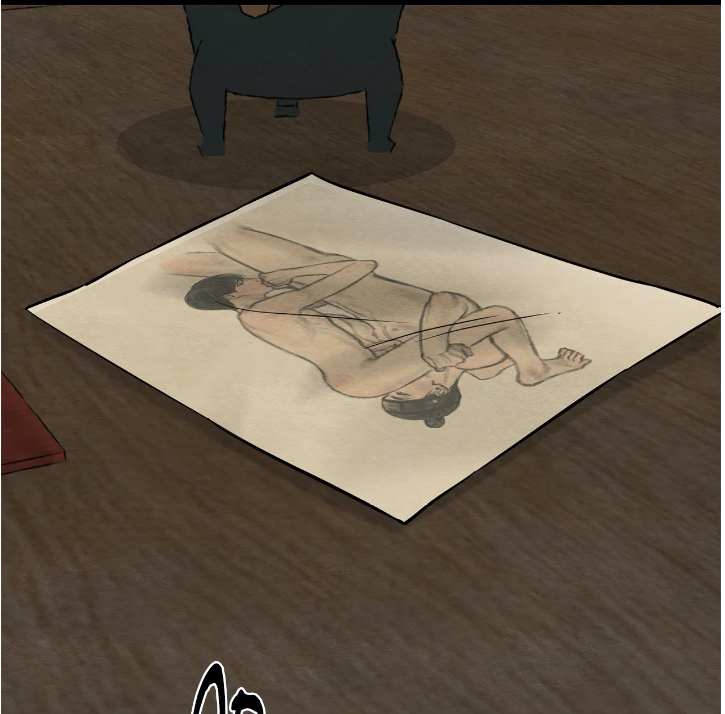 (Chapter 47) What caught my attention in the new drawing is that he didn’t select the memory we saw:
 (Chapter 41) Furthermore, his face is more defined. Now we are able to see his eyes, unlike in the past, where he had no face and as such no identity. This drawing symbolizes something important. Little by little, he is gaining a new identity. Therefore the readers shouldn’t judge this picture as something bad, even the noble was pleased. The painter created a new picture on his own (without any clear order from the seme) although it has become clear that the aristocrat no longer needs the pictures. For Seungho, it represented a huge step because the picture was bigger and more detailed than the former ones. He saw as a improvement of their relationship. Sure the artist had another reason for this picture. It was an attempt to be perceived as a painter and not just as a prostitute. But like I wrote in another analysis (Drawings and emotions, part 1), each picture reveals the commoner’s emotions and state of mind: a painter and a whore, yet he has eyes now. He is no longer denying his homosexuality.
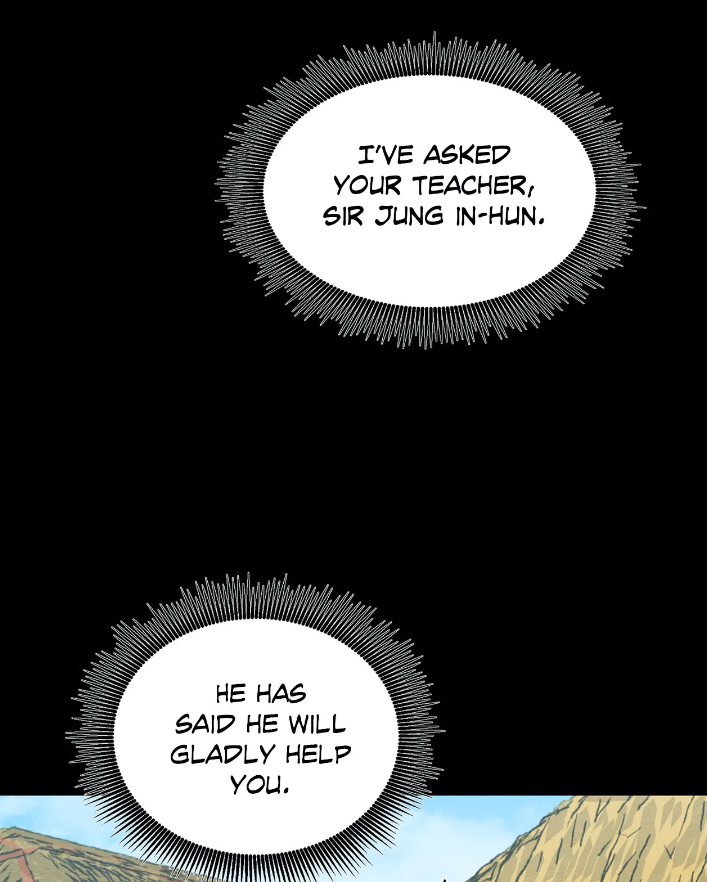
 Jung In-Hun had become his guardian because he had been bribed by the head-gisaeng. Only yesterday I came to realize why the painter could repress the bad memories about his physical abuse: The Stockholm Syndrome. And this is relevant as it explains why the artist adopted such a fear of homosexuality and even talked like the scholar. Furthermore I can even envision that this Stockholm Syndrome must have affected his hands and talent. This even reinforces my opinion about the huge impact of Yoon Seungho on our low-born. Due to his attraction to the lord and the sex session, the repressed sexual desires were unleashed so that his talent was triggered. That’s why he impressed the lord so much in the chapter 2.
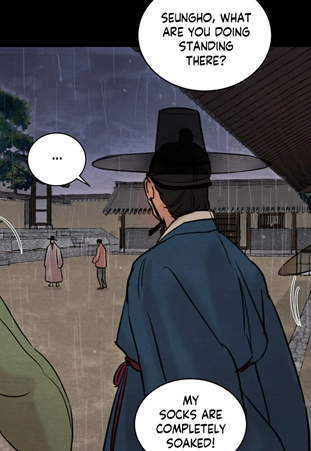
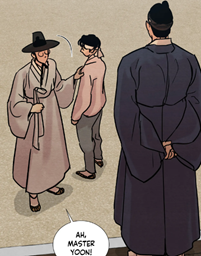 Nevertheless it started to rain the moment the teacher discovered the existence of the deal between the powerful noble and his former pupil.
 Imagine the rain followed with thunder represented Baek Na-Kyum’s tears and heartache because of the teacher’s rejection symbolized by the hand.
 This simple gesture, where the low noble used no strength, was so powerful because of the Stockholm Syndrome. Since the rain embodies the tears and the agony the thunder, I couldn’t restrain myself connecting it to the Surrealism once again as nature is often used as a representative of the unconscious and the state of mind.
 It was as if the snow embodied the artist’s tears once again, yet this time the real pain is no longer existing because his heart has turned cold. He feels nothing at all hence he has no problem to ask the butler Kim to throw away the painting. The more fall and winter are approaching, the more the painter’s relationship with Jung In-Hun deteriorates. In the chapter 35, the painter is definitely hurt by the low noble’s gesture, when the latter closes the mansion door right in front of him. This coincides with the fire where the fallen leaves are burnt.
 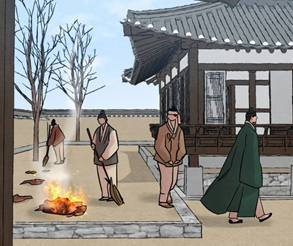 The caress on the cheek equivocates to the fire, the last real warm gesture the painter received from his teacher.
 In the chapter 38, the artist no longer falls for the teacher’s fake stroke thereby he is able to lie to Jung In-Hun. Because of this, I came to the following interpretation. The landscape with the snow embodies Baek Na-Kyum’s actual state of mind and emotions.
 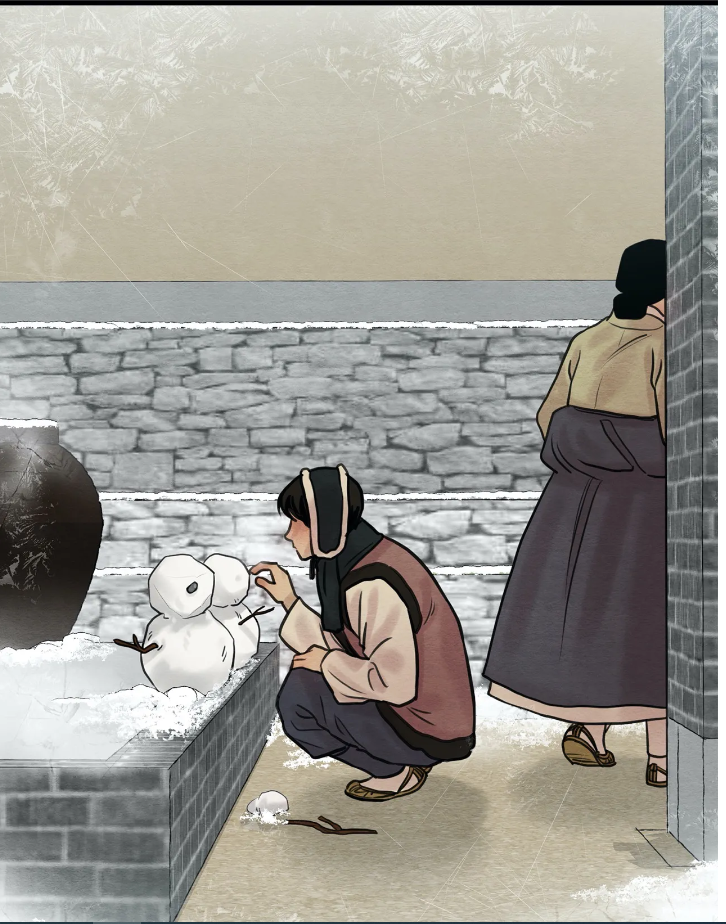 It was as if his heart was frozen consequently he feels nothing. However, the presence of the snowmen illustrates his innocence and his longing for companionship. He wished deep down that he wasn’t alone and had someone by his side. Yet, the painter has no idea about it. Now, you can understand why I connected Byeonduck’s drawings to the Surrealism. Sure, this is my own interpretation and nothing more. The weather and the seasons are following the same evolution than the painter’s transformation. Little by little, he starts losing his admiration for the scholar which ends with the real separation. He has been so hurt that he is like an empty shell. But there is one difference from the past. This time, Baek Na-Kyum was the one who cut definitely ties with the scholar hence the double-faced man has no idea that he can no longer use the painter as his tool.In the past, the jealous aristocrat could push him away but the painter never resented his admired sir and accepted that the teacher would return to his side without questioning his motivation behind his smiles and strokes. He had been abandoned once, hence he became a drunk. However, the painter had no grudge hence he fell for Yoon Seungho’s lie in the chapter 7.
 It was the same in the chapter 24, when the scholar took him and pushed him against the wall.So far he had avoided the painter, yet he needed him again. At no moment, the artist rejected the man’s advances (kiss on the hand, his head on his shoulder). The low-born always forgave the low noble.
  It was as if the painter was coming back to life, the noble’s warmth has finally reached his heart through his body. Consequently, the spring will announce the beginning of their real relationship, the growing love between our two protagonists.
 Then we have the first falling snow witnessed by Baek Na-Kyum and Yoon Seungho. This is quite important as the Korean tradition says that if you watch the first falling snow with your loved one, this is your true love.

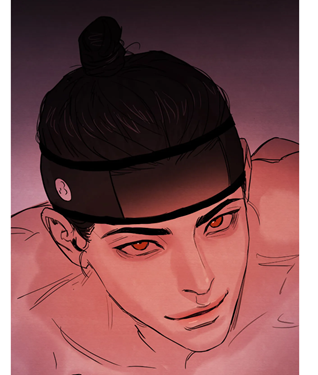 Furthermore the huge distance between Jihwa and Yoon Seungho could be explained that the artist wished, he had joined the lord and put himself between the main lead and the red-haired man. Remember that he wanted to take the sex partner’s place. As you can see, the first painting displayed a lot the painter’s unconscious, his sexual desires that’s why he had to destroy it. The image represented a proof of his homosexuality. In other words, the first drawing let the noble perceive the painter’s emotions and feelings hence he felt his own attraction. Therefore he could liberate himself from his negative image he had of himself.
![ANALYSE] Le Cri, Edvard Munch](https://alheuredelart.files.wordpress.com/2018/01/3-3_le_cri2.jpg)
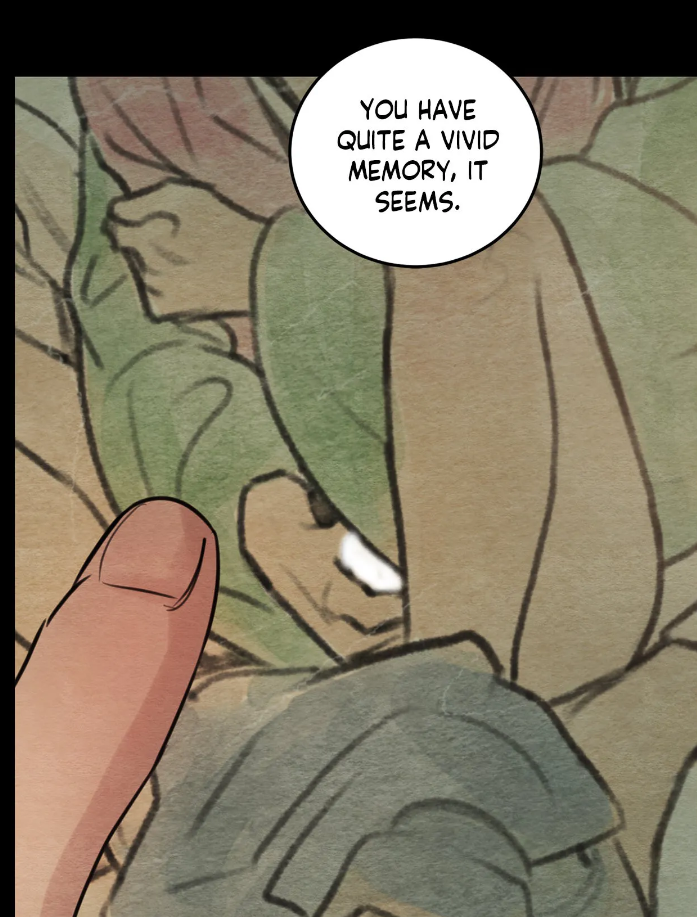 The word “vivid” is definitely characteristic for Expressionism. That’s why I connected the artist’s work with the Expressionism. Sure, the low-born lives in a different period, the industrialization had not reached Joseon yet. However, it is pretty obvious that the painter’s creations are strongly influenced by his emotions and state of mind.
  and asked his admired sir to take care of him.
 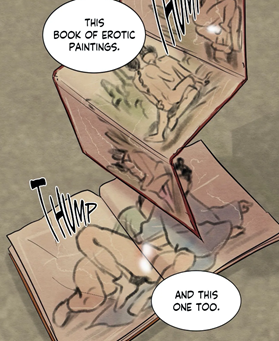 Since all the books were motivated by his love for the learned sir, the nobles could already sense the painter’s emotions and desires in these erotic pictures. Sodomy was portrayed as something natural and lovely. This explains the painter’s popularity and why the main lead became addicted. Because of this observation, I couldn’t help myself connecting this to another Art movement from the 20th Century called Surrealism.

 The readers can detect that he is starting to think on his own, showing that he is no longer under the teacher’s influence: this is the evidence of critical thinking, something the seme tried to initiate in the artist.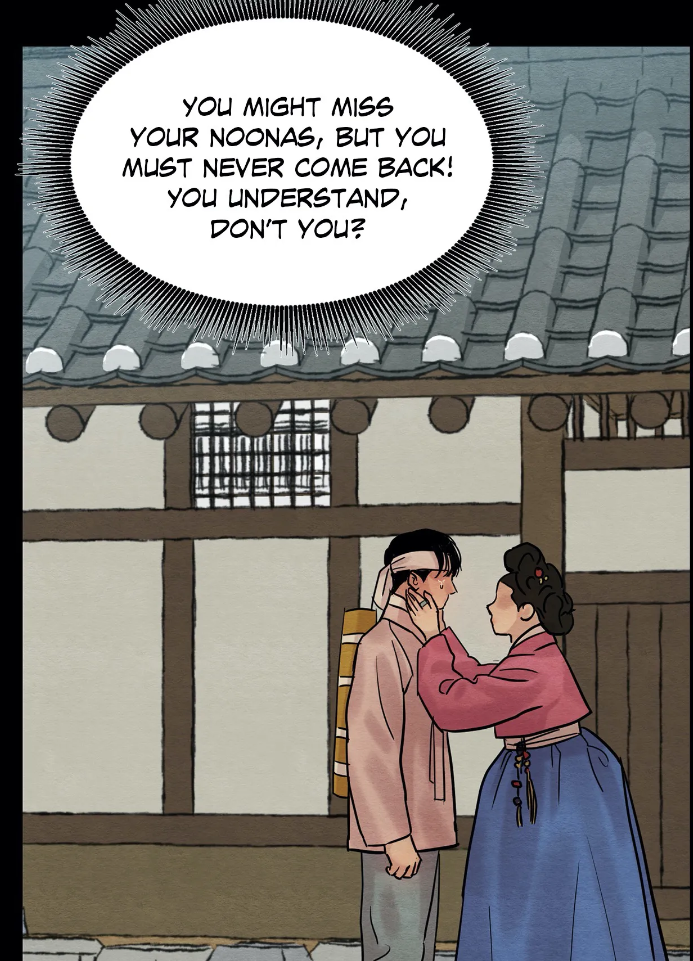
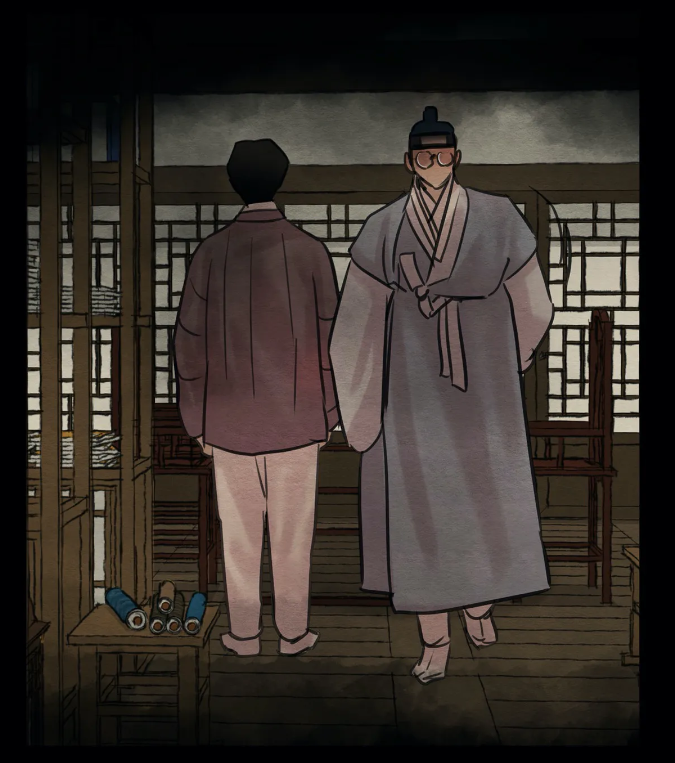
 why he made up his mind to remain at the mansion. He can sleep and eat well, he recognizes the advantages accompanying his stay at Yoon Seungho’s mansion, furthermore he can not be abandoned like in the past. Even if the lord loses his interest in him, he could work as a servant, that’s exactly what he is thinking. His abandonment issues forced him to redefine the signification of home. As a conclusion, the painter never chose to return because of the protagonist Yoon Seungho who is perceiving him as his “bride”, although right now his status reminds us more to the one of a concubine.
 He is definitely treated like an important guest. From my point of view, the elevation of his ambiguous status is linked to the confession he made to the lord before.
 From my point of view, the comment said by the head-maid of the kitchen did affect the painter. She was the one who pointed out that the master cared for him very much, although the noble never acted so caring in front of him.
  He ended up in a worse situation as now he had no one on his side. The painter must have realized that leaving the noble did appear good on the surface, yet in the long run he would have to face a more terrible fate. Like I mentioned above, the mansion represents a shelter. In the past, leaving the brothel seemed to be a good decision for the painter’s bright future. The mother saw that the painter’s origins would become a hindrance to his career hence by asking the teacher to become his guardian would give a better reputation to the painter and help him in his career.
  Notice how he is diminishing the painter’s importance in his life. Secondly, he even admitted that he scolded the painter severely once, the moment he saw the content of the paintings. In my former analyses, I had already pointed out that this was a lie but the new element is that since he had become his adoptive father, he knew about the painter’s identity right from the start: he was the famous painter publishing under a pseudonym. From my point of view, the painter was inspired by his love for the teacher hence his work was so lewd and was oozing love and warmth. Remember that people keep wondering how he could create such paintings. The low noble is the origin for the publications. Now, you can better understand why the artist has lost his inspiration. That’s why he could create such a nice picture of Jung In-Hun’s inauguration and the pictures of Seungho with the painter lacked details and passion. This doesn’t surprise us that the painter is not really motivated and creative. For that he needs to fall in love with the master for real. We see a progression in that sense. First, he dreamed of sex with him, so his unconscious was telling him that he was attracted to him. Now he is even awake and remembers their sex sessions which arouse him. He could ejaculate because he sensed that lord was making love to him, when he kissed and embraced him. That’s why we are the witness of the painter’s transformation, how the lord will become his new inspiration and this will enhance his talents. That’s why Yoon Seungho’s place will become the true home of the painter: a place to rest and eat but at the same time, where he will fall in love again and become more inspired and creative than before.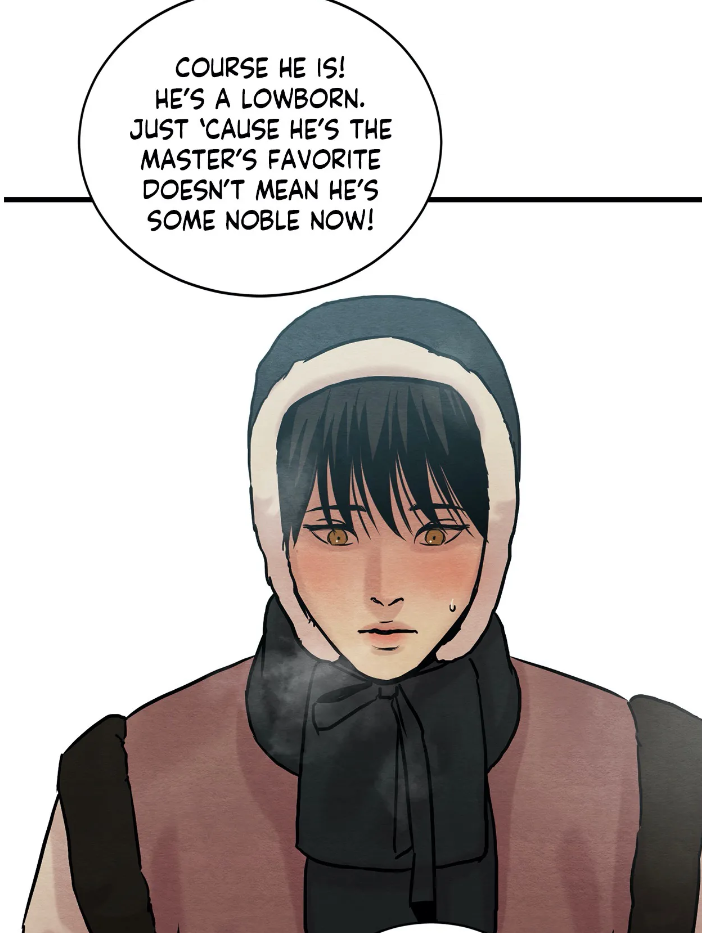
 From my point of view, the servant will serve as a tool in Baek Na-Kyum’s growth. Through Deok-Jae’s betrayal the painter will realize that the teacher’s harsh words and abandonment were caused by jealousy and were not reflecting the truth. That’s the moment the scholar will have no influence any longer on the artist.
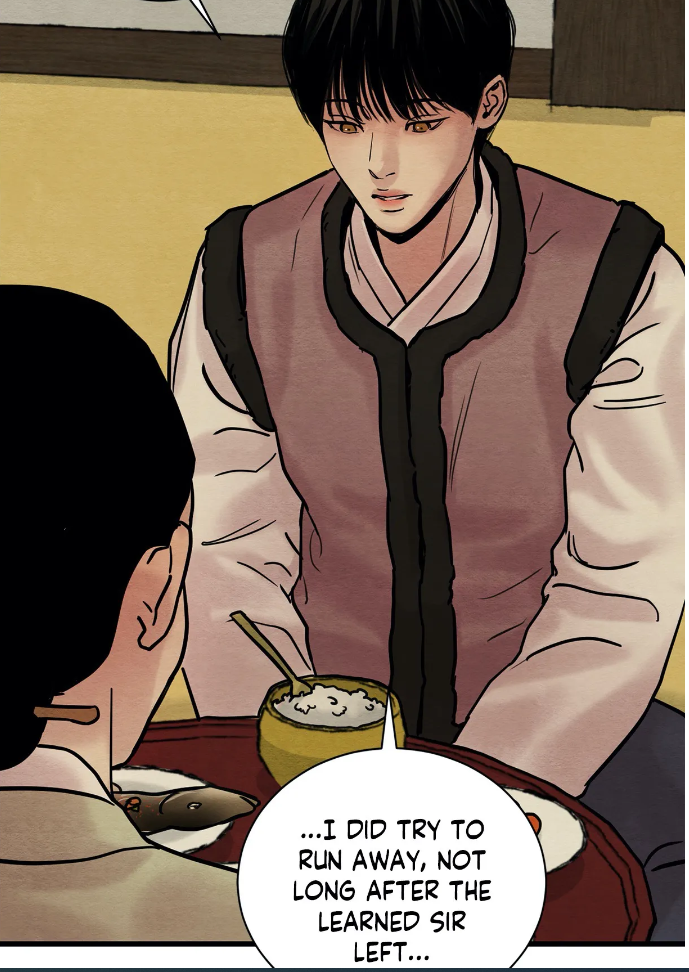 Little by little, he’s expressing himself better. The sentences might still contain some pause, yet his sentences are much longer. Besides he is able to explain why he is no longer trying to run away. The fact that he confided to her about his final attempt and his change of mind indicates a certain emancipation from the terrible surrogate father.
 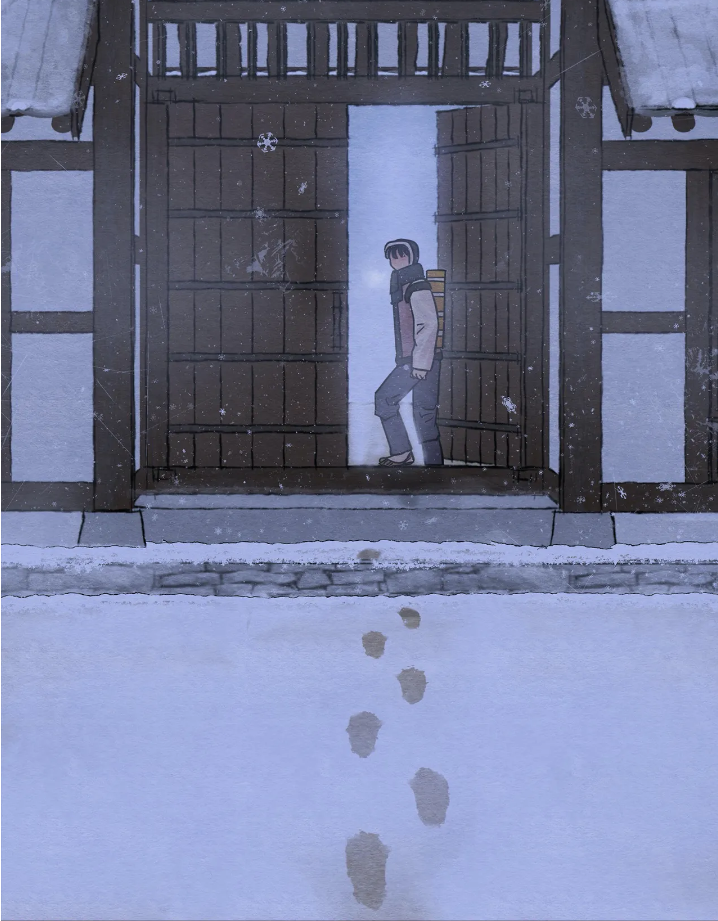 We have Baek Na-Kyum standing in front of the mansion door. Yes, this image confirms my interpretation about the symbolism of the door. The painter’s situation is always reflected through the door. First, the foot print on the snow left by him outlines his loneliness. Now he’s on his own. The teacher is no longer by his side. Nonetheless his foot print is regular hence we can say that Baek Na-Kyum was resolute in his decision. There is no hesitation based on the foot print.
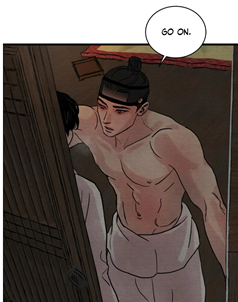
  ; chapter 19: Seungho
 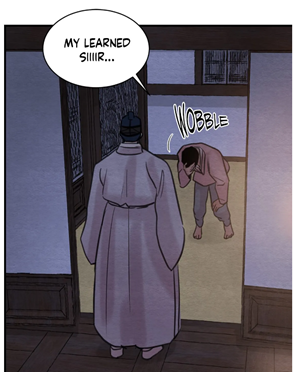 , although here the low-born hallucinated that it was the scholar; episode 29: Jung In-Hun led him back
 ; chapter 34: Seungho
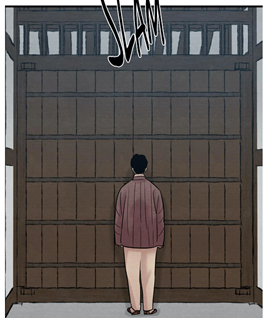
 ; chapter 35 the teacher closed the door in front of the commoner
 , chapter 41 Seungho again but this time the door is left open
 ). In only one case, we witnessed him opening the door but here he had been forced to enter the lord’s chamber
 due to the protagonist’s thread. At no moment Byeonduck showed us the painter opening himself the door because he really wanted it. When he escaped in the chapter 29, he only appears in the street meeting the teacher. Moreover, Baek Na-Kyum stood either in front of the door or behind it. I would say that this characterizes the painter’s lack of freedom and passivity. He was never master of his own destiny. This is important because the image from the chapter 46 illustrates the artist’s determination to escape but simultaneously the acceptance of his own sexual orientation. He is no longer hiding it but the fact that the man just opens the door slightly indicates a certain discomfort and embarrassment. For me the positive aspect is that he acts on his own, he is no longer forced to hide or admit his homosexuality or to stay at the mansion. He chose to leave and this was his first true choice for a very long time. In the beginning he was dragged to the mansion, then he was stopped by Yoon Seungho in the chapter 4. Later he was persuaded to return by the fake scholar. He never had the freedom to choose for himself therefore we never saw him opening the door himself willingly. Therefore you can understand why I am not so sad despite the sorrow exuding from the chapter 46. Here he shows a strong will like he did in the past, when he was courageous enough to defy and even criticize the lord.
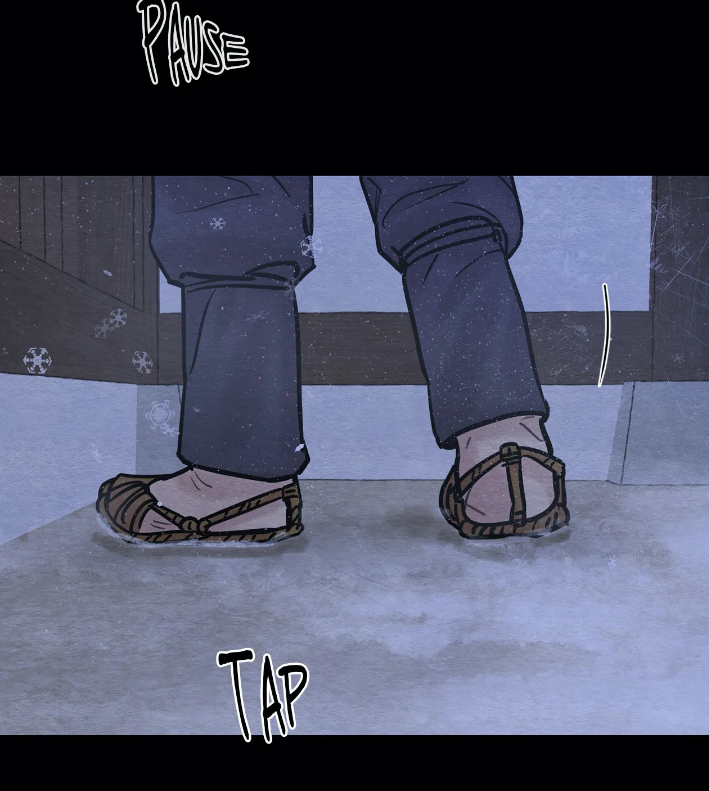 We had images focusing on the hand or the gaze but never on the feet. This is no random, Byeonduck wanted to tell us something through the zoom on the feet.
 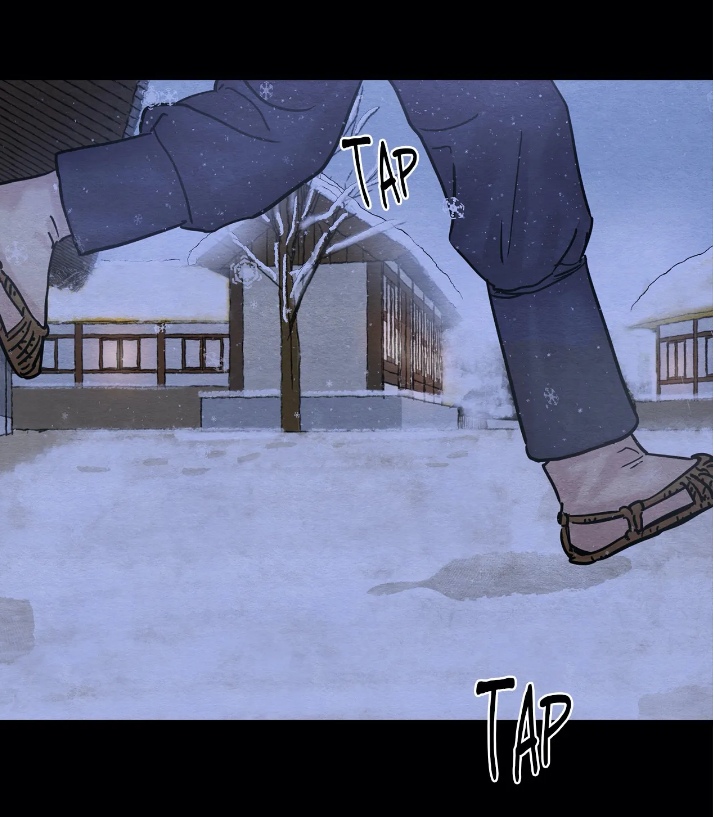 The second relevant detail is the chronology of the drawings. First, she pays attention to the painer’s feet, then to his head with his thoughts.
  The alternation between images of the feet and the artist’s thoughts exhibits the instinctive decision of the painter. He might be resolute, yet his feet are guiding him. He is just following his intuition and this is something more spontaneous than a well planned escape. It was as if his feet were carrying him somewhere else. Notice that first his mind is associated to black insinuating that his mind was blank. He couldn’t really ponder about this decision. This sudden and instinctive decision lets him run away. However, while his feet are leading him away from Yoon Seungho’s home, he realizes that he needs to find a shelter. Only then he starts thinking deeply about his destination.
 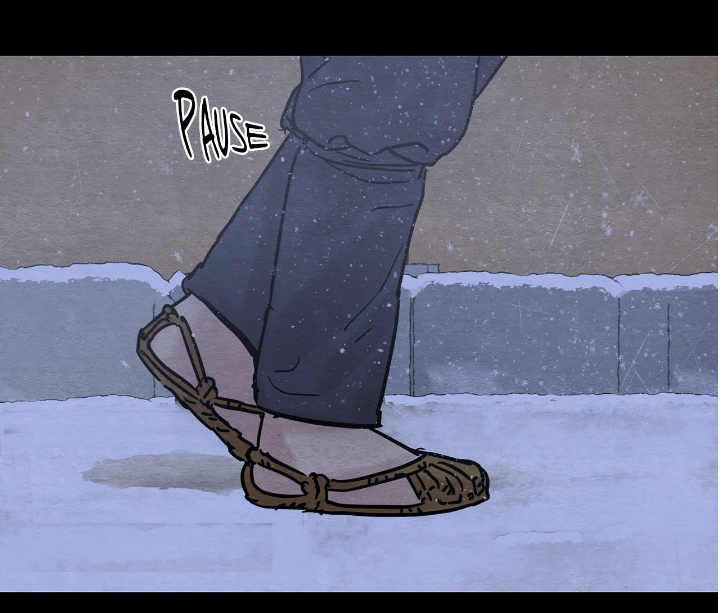 That’s the reason why he slows down as the more he ponders, the more he gets aware that he has no place where he could find a shelter. He is truly alone. That’s why he stops in the street. This represents his ultimate escape and his resignation.
  He feels abandoned without a home. Striking is that there is no door stopping him. Although he is free, he has the impression that he is still “imprisoned” as he has no home where he can seek refuge. The author revealed through the choice of the images that Baek Na-Kyum made the decision to leave because of his instincts. Nevertheless, this flee ended with the heartbreaking realization that either his mother or the teacher had abandoned him for good.
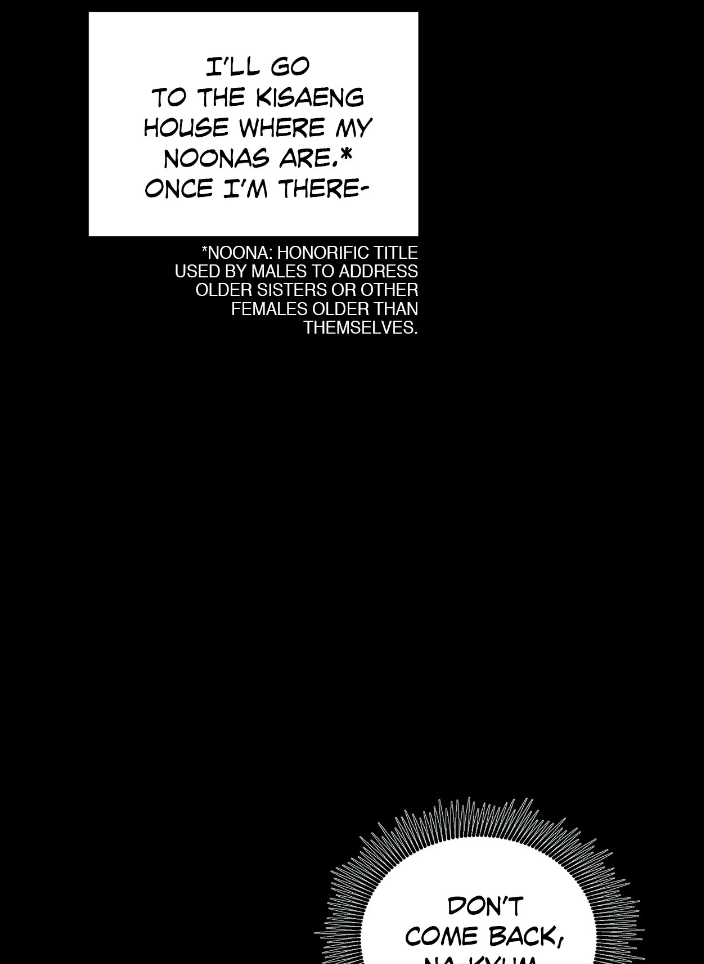 Then the last words spoken by the head-gisaeng resurface which triggers in him the memory of his adoptive mother’s gesture, the caress on his cheek, while he is crying.
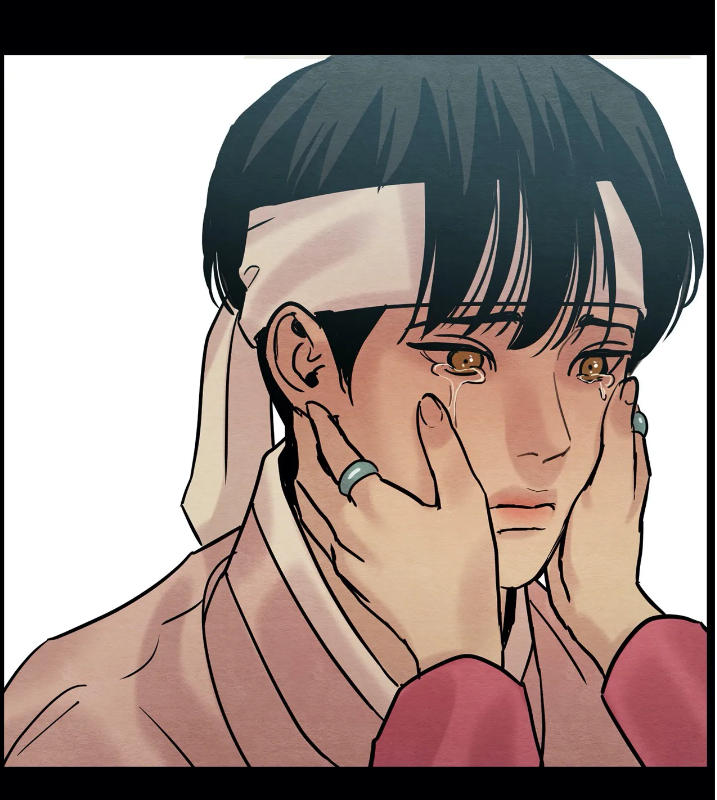 This is quite important because it is the pain that Baek Na-Kyum remembers the most.
  As much as the past affected him and his escape, it does have a positive effect. He might have resigned initially but he is now turning his mind and eyes towards the master. This is a good change and this will alter his future.
 The face expresses mixed feelings, since the eyes are expressing a certain sadness, while there is a glimpse of a smile on the mouth. The painter’s heartache has not completely disappeared, but the agony has diminished. The size of the eyes is quite interesting. The logical explication is that Baek Na-Kyum couldn’t find stones of the same size, yet I can’t help myself giving it a deeper signification. This symbolizes the transformation of Baek Na-Kyum, he is between childhood and adulthood. The small eye refers to the childhood and as such the candidness, and the bigger one to the adulthood, as he is now able to comprehend better the world and its reality (inspired by the saying getting a bigger picture). Through the bad experience (abandonment by the teacher), he is disillusioned but not to the point where he has lost his innocence definitely. That’s why I interpret that the future attempted assassination will become a real wake-up call and will mark the pivotal moment in the painter’s life. He will lose his purity for good, his worldview will change forever. Like I said before, the painter hasn’t perceived the teacher’s true personality and his real intentions behind his harsh words. He hasn’t grasped that the scholar was so jealous and envied him that he felt the need to destroy him with his words. He still thinks that what Jung In-Hun said was correct. Later, I’ll explain the reasons for this mindset. But let’s get back to the snowman.
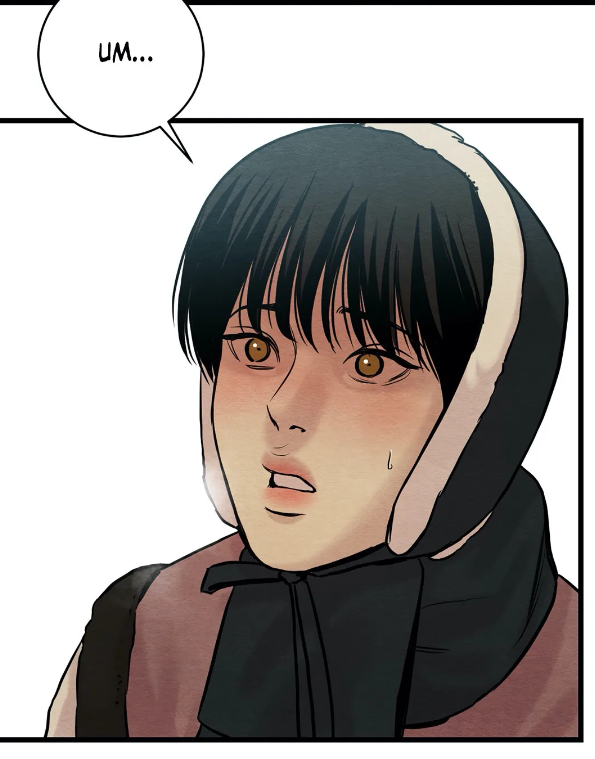 He is left speechless, feels uncomfortable hence he is sweating. Notice that while the servant kept criticizing him, he never said anything to his defense. This outlines what I explained in the essay “An easy conquest”, he is not able to express himself due to the loss of his ex-mentor and guru. Furthermore, there is another reason for his silence. He somehow believes what the jealous domestic is saying. He still views himself as a low-born and even worse, as a prostitute. The fact that he wanted to stay in the backyard with the staff shows his longing to be perceived as a servant. He feels like a prostitute but he would like to be treated like a servant so that his special position would not be detected. He feels really embarrassed, when the head maid from the kitchen outlines his special status.
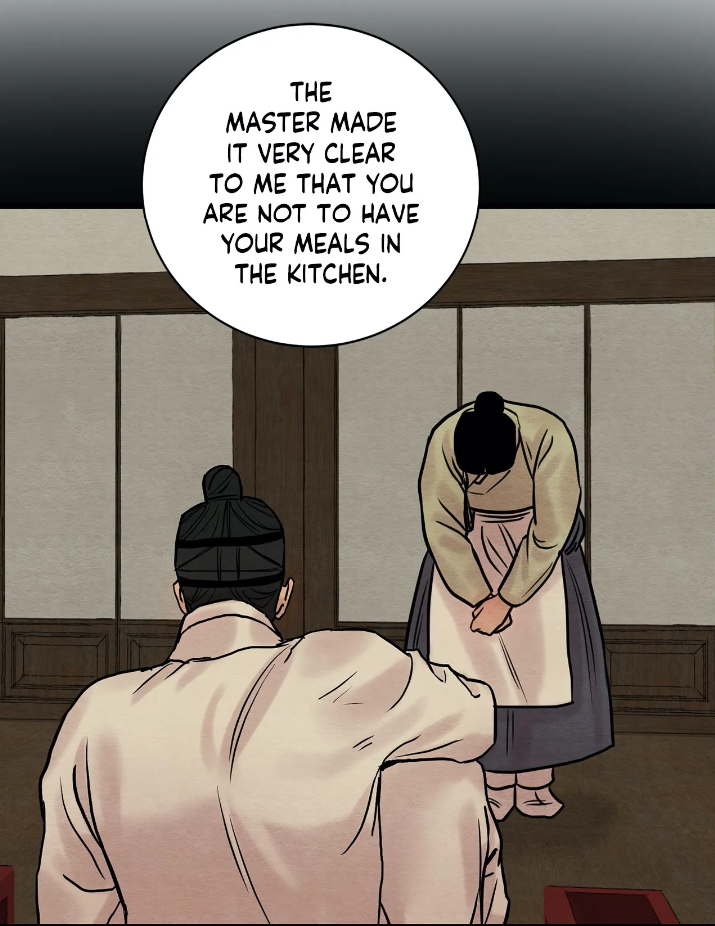 His status had been elevated by the lord. He is his partner hence he can no longer be perceived as a servant. The fact that he is no longer wearing his white headband illustrates that Seungho doesn’t recognize him as a commoner but as his lover. I would say that since he has no topknot, his status reminds me of a concubine, although it is quite obvious that for the seme, Baek Na-Kyum is his wife. From my point of view, the lord is changing his status little by little, the closer they get. Remember that there is a lack of trust between Seungho and the painter. The noble has no idea why the artist chose to give in, hence he asked in the episode 45. However I explain the sudden order from Yoon Seungho as a consequence of the “love confession” in the chapter 45. The more Baek Na-Kyum is opening up, the more Seungho is showing his true colors, intentions. But the trust is based on shaking grounds. In reality, the “I like- My lord” is a misunderstanding, on the other hand the chapter 46 reveals that Baek Na-Kyum is indeed leaning more and more on the noble, as he has no home any longer. The first reason why I associate the painter’s status to the one of a concubine is that he has no topknot like Seungho. If he had one, he could be considered as a master.
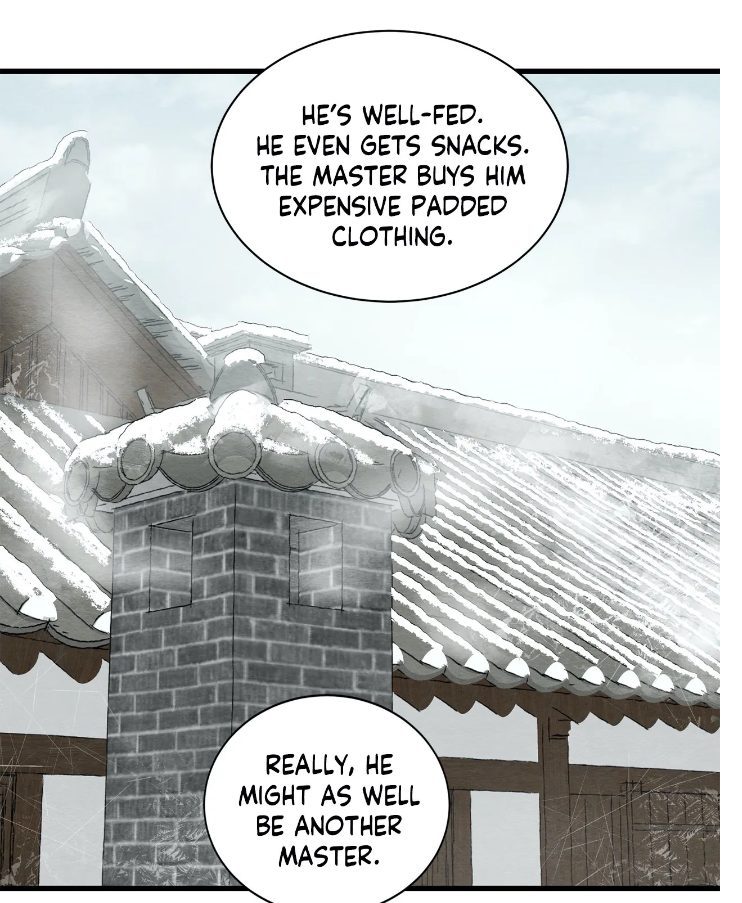 Besides, the jealous man pointed out that the “favored servant” wasn’t a master at the moment, but he could be perceived as one due the privileges the artist has. Yet the envious man was somehow making fun about this (“might”), as if this idea was so ridiculous and impossible. Notice that at no moment, the painter spoke for himself, defending his actions and his innocence indicating that what Deok-Jae said about him was how he views himself. He has such a low self-esteem. He didn’t voice one complain (even the destruction of the snowmen), he let the domestic criticize him because he even feels lower than the servants: he is indeed a prostitute. That’s why he can’t think about his future and he is not even focused on his painting too. Hence the readers saw no new painting in his bedroom.
 in another essay. However both were influenced by the perception he had about Yoon Seungho and his attraction for that noble. In the analysis, I had pointed out that they reveal his repressed sexual desires. Nonetheless, the manhwaworms are well aware that Baek Na-Kyum felt that the lord was attracted to him, and he sensed the lord’s desires. Interesting is that these “illusions” became a reality, since the master became the painter’s sex partner and “husband”. Striking is that our artist is far from happy because his dream was to become the teacher’s bride.
 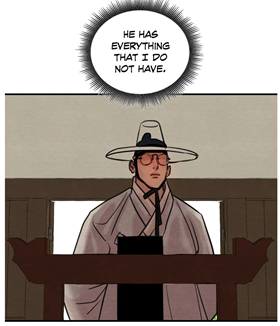 He would like to become rich and powerful like Yoon Seungho, the latter serves as example. Since he considers himself as morally upright and more educated, he has the impression that his dream will come true soon. He received such a good offer from the famous hell-raiser after all, even without working hard and using his knowledge.
 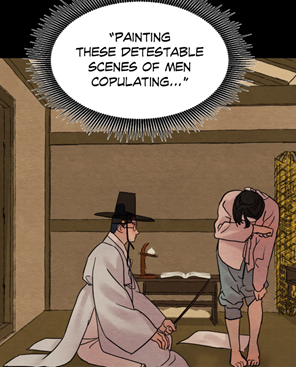 Let’s face it: the teacher could have achieved greatness by becoming a good and exemplary teacher so that the commoners would have come to admire him. This kind of fame could have reached the ears of an influential official. But the scholar never considered it as an option, because he disdains the commoners. As he feels superior to them due to his title, he didn’t want to rely on them for his career. For the low noble, it’s important that on the surface he achieves greatness on his own. What I mean with it is that he doesn’t want to share his fame and admiration. So on the one hand he imagined that he needed the help of an influential noble, on the other side he envisaged that once he got a high position in the government, he would be able to cut ties with Yoon Seungho so that only his name would get connected to that powerful government post. Once in position, Jung In-Hun could threaten his sponsor in case the latter refused to follow his request. He thinks so highly of himself that he doesn’t realize his own shortcomings. He’s not intelligent and cunning enough to perceive the protagonist’s raillery and empty promises
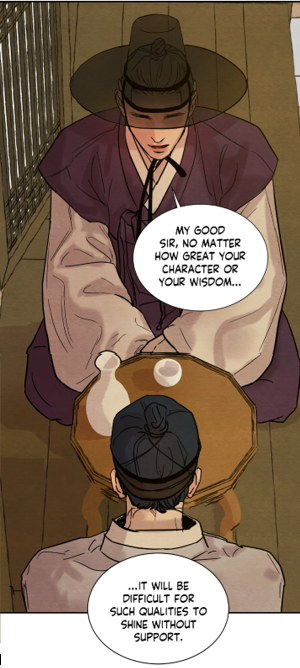 (chapter 7). He never anticipated that the lord would do something like that, while he had already imagined that his promise to support the lord would be just an empty promise. As a conclusion, fate and entitlement explicate why the teacher didn’t get famous in the past and why he is destined to fail.
 , he had the impression that he understood him. He imagined, his childhood friend would only hate and resent his own family due the father’s abandonment and betrayal. He wasn’t sharp enough to perceive that Yoon Seungho saw beyond his family’s wrongdoings. Besides, he never got to know what truly happened to his childhood friend, as he was informed through Kim. For him, nobility was the real cause of his own suffering. First he got betrayed by his own family, sold as a concubine to the king, and when one of the aristocrats betrayed his family for his own benefit, the main lead’s father chose to backstab his own son and blame him for everything. Consequently, in Seungho’s eyes, nobility is a synonym for treachery, cowardice and selfishness. What Jihwa judged as common denominator represented in reality the barrier between him and his childhood friend. Yoon Seungho could never love someone from the aristocracy, though the main character has no idea about it.
 “I like-My lord”. He must have felt that he got closer to his goal. He was definitely surprised but it moved him that’s why he ejaculates soon after.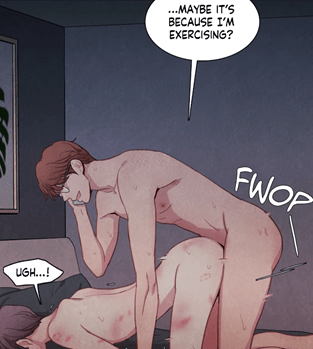
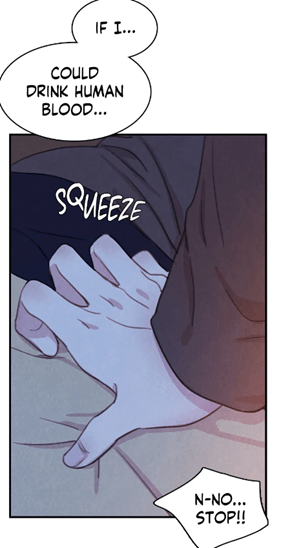





 A duck is not considered as beautiful per se but we have the fairy tale of the ugly Duckling. Here, in this story, the ducks are conceited and perceived themselves as pretty compared to the baby swan (vanity). Furthermore, in this fairy tale the ducks are excluding a family member because of his different appearance, just like in the manhwa. Yoon Seungho got abandoned by his father and his brother. In the ugly Duckling, the duck represents the family and their intolerant behavior outlines the strong bond between the ducks and their babies resembling them. Seung-Won is indeed supported by his father, the former even speaks for the family.
  The duck symbolizes the family and this isn’t surprising, when in Korea, couple of ducks are offered for a wedding. One of the purpose of marriage is to continue the family heritage.
  He is sweating and avoiding his older brother’s gaze. Then his hands are on his knees showing his discomfort. Yet he has no problem to lie about the father’s illness and to suggest Yoon Seungho to visit his parent, well aware of the significance of this visit. He is quite arrogant to think that his brother wouldn’t catch the meaning behind this visitation. He is underestimating the protagonist because he believes in the rumors that Yoon Seungho lives in debauchery. He has the impression that his older brother is not so smart, however the way his suggestion is rejected reveals that Yoon Seung-Won knows very well how his brother became a famous sodomite.
  This shows that the brother is neither cunning nor smart. The duck is not considered as a smart bird, compared to the magpie or the eagle.
  We have to envision that he even avoided to meet Yoon Seungho personally, until it became absolutely necessary due to the urgency of the matter. We should remember that the latter didn’t support his brother the moment he was abandoned by the father, he preferred following the father.
 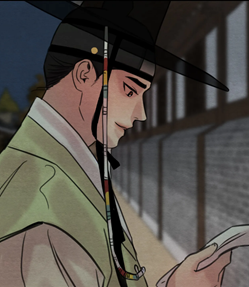 Look at the figure’s smile, he thinks that his move did succeed, whereas there is only raillery coming from Yoon Seungho. The latter remembered the words expressed by his loyal assistant the same morning.


 Striking is that once he is home, the low noble takes off his hat, even his robe in front of his rich and powerful guest. You might wonder why, in particular when you know about the teacher’s pride and arrogance. You are correct to assume that this action is deliberate, he wants to reveal his true financial condition to Yoon Seungho, showing him that as a noble he is not well enough and needs the support of a sponsor. At the same time, we shouldn’t forget that the lord chose a dark purple robe with short sleeves in order to deceive the teacher too. Just a reminder about the meaning of dark purple: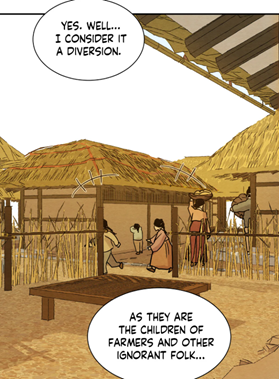
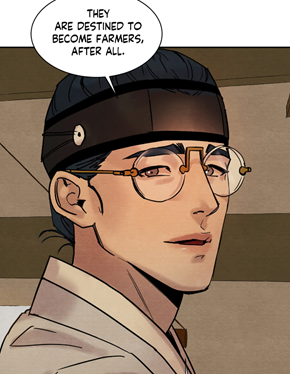 His speech only illustrates arrogance, entitlement and disdain for commoners contradicting his attitude. The protagonist is no fool, in fact he misled the low noble on purpose. The seme forced the teacher to make lip service in order to obtain a sponsorship, yet simultaneously it actually served to reveal his true thoughts and his true personality: a hypocrite and obsequious (greasy) noble.

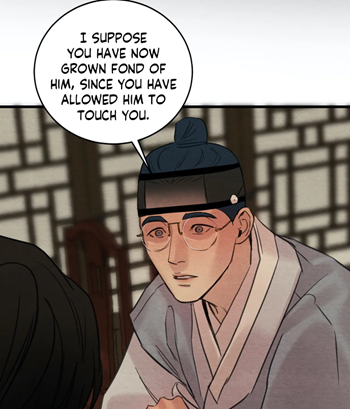 Sure, he immediately puts these back but the fact that in that particular scene he reveals his true self in front of his “fan” just after removing his glasses is significant. This gesture symbolizes and announces what is about to occur. He displays his true emotions and expresses his arrogance and contempt towards the painter. In his eyes, the artist is just a man consumed by lust hence he is a prostitute. He was raised in a brothel therefore he can only live like a whore. This signifies that if the noble takes away his glasses in the second season, we have to observe his future comments and attitude.
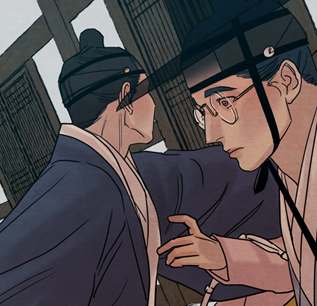
 He thinks that as a noble, he can touch the powerful lord so easily. He even comes to the belief that since he is controlling the artist, he stands on the same level than the main character. He doesn’t even notice the killing gaze Seungho is oozing. The learned sir has definitely a poor sight, when it comes to people and situations. He believes that his “intelligence” and knowledge gained through the books is enough for his career, but the man is definitely lacking experiences. He has no knowledge of the world and people, he has never meddled with other dirty, scheming and treacherous nobles before.
  And this is exactly what Yoon Seungho is telling him before his departure. He is warning him about what could happen to him in the future. Remember that I associated him to the library where he is buried by the books. Even the books are following him in his bedroom.
  So we could say that Jung In-Hun is naive in a certain sense. He needs to learn through bad experiences in order to understand the harshness of life and to comprehend his own delusions.
 The robe hasn’t changed at all reinforcing the idea of his poor financial situation. He doesn’t own many clothes. Simultaneously, he wants to keep this appearance as simple and humble as possible hoping that the lord would decide to buy him some clothes. But nothing happens here. On the other hand, he has to witness how the painter gets so many special treatments. He is hired to paint erotic pictures signalizing that he is talented. Then the artist is invited to the hunt, although he is just a low-born. Moreover the master pays attention to his moves (prevent him from falling) and he is even invited by the lord to join him at the pavilion. A doctor is called for him, the main lead even accepts to buy expensive medicine for his painter. The latter has the right to sleep in the master’s chamber, to spend the night with him, to wear the noble’s clothes and to get new winter clothes at the same tailor shop than the master’s. All along, Jung In-Hun listed all the favors the commoner received, while the teacher got nothing in return, only free lodging and a free access to the noble’s huge library. That’s why he loathed Baek Na-Kyum so much and lashed out to him in the chapter 40. The glasses could no longer contain his negative emotions towards the commoner.

 (here the belt looks purple)
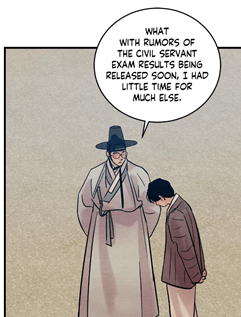


 During the hunt, he had chosen to confront the powerful lord and humiliate him by accusing him of hypocrisy and telling him that he was a talented man full of potential. It ended up in a disaster as he never expected the lord to know the origin of the poem he gave to Baek Na-Kyum. Furthermore he has to hear that he is far from being skillful, a terrible statement for the arrogant man.
 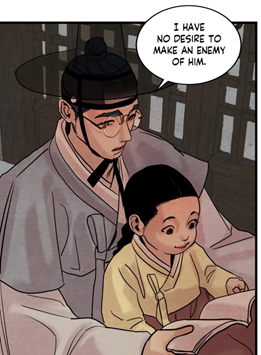 Then when he visits the artisan, he wants to impress him because he needs his help. He has to dress like a quite rich noble so that the craftsman will be willing to help him for the investigation in Yoon Seungho’s past. Remember that he even gave money to the man, yet we truly know his own financial situation. He has no real fortune and only his title that distinguishes him from the commoners.


 Finally, the masturbation symbolizes the climax of his slow approach.
 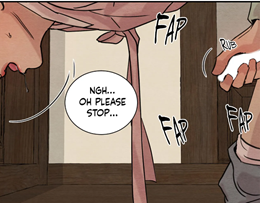 He knows that he has to be careful with the painter, since the latter was forced to remain by his side by using Jung In-Hun as leverage. In this scene, it becomes clear that he was already aiming at the commoner.
  He is willing to do anything so that the artist accepts him as his lover. As a conclusion, “Dangerous liaisons” has a lot of common points with the manhwa.


 and dragged by Yoon Seungho
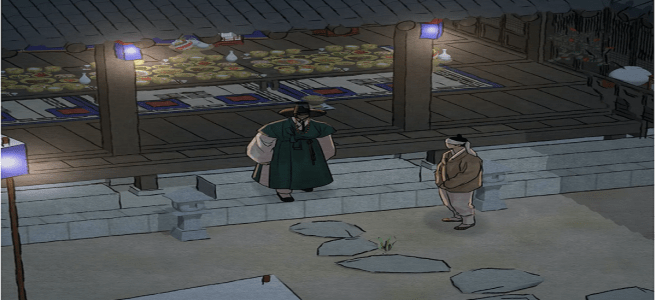


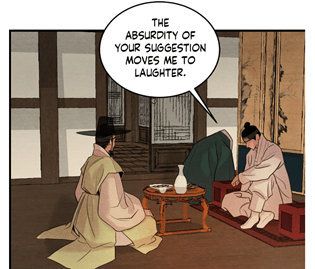

 (chapter 37) when the brother asked him to visit the father. His suffering has not ended totally, for that he needs to unveil his past to the artist.
