This is where you can read the manhwa. https://www.lezhin.com/en/comic/dine_vampire But be aware that this manhwa is a mature Yaoi, which means, it is about homosexuality with explicit scenes.
In my first analysis about Dine With A Vampire, I pointed out that the vampire Park Chi-Hwan was behaving more like a human than the real humans Joo Sooin and Kwon Sungha because he showed more empathy and care for Joo Sooin than the human Sungha. Besides, Sooin had become a zombie due to Sungha’s hatred for homosexuality and the latter was in fact the real monster due to the emotional and physical abuse he perpetrated on the main lead. Now, I would like to examine the chapters 12 and 13 because both revolves around the new relationship between Sooin and Chi-Hwan. What are they to each other? Who is the master and who is the animal, the monster, in their relationship? This essay will try to answer this question.
What caught my attention in the two chapters is that the long abuse experienced by the main lead totally changed his perception about himself. He judges himself as a monster because he is a homosexual. That’s why he keeps using the words “weird” in the chapter 12 and in the chapter 13, he calls himself “a pervert, a fag”. Imagine, he is actually insulting himself. He sees himself as an anomaly, as a monster who is not allowed to exist. Hence he can’t attract attention. We shouldn’t forget in the chapter 10 and 11, Sooin felt so uncomfortable with the new clothes and the number of dishes proposed by Chi-Hwan because he was asked to choose. Since Sungha took away his freedom, our main character lost his ability to say what he truly likes and desires. The last image above illustrates the impact of the violence used on Sooin. It becomes clear that Sungha truly destroyed Sooin’s personality and identity. Just like Baek Na-Kyum (the main lead from Painter Of The Night), Sooin can’t voice his true desires and thoughts properly. Notice that there are a lot of pauses in his sentences, when he speaks. Besides, he uses the same idioms (pervert, fag) than the manipulator Sungha so that we can conclude that the former friend used coercive persuasion. The outburst of his self-hatred was caused by the single words said by the vampire: Striking is that the moment he hears this sentence, he starts mistaking the vampire for Sungha. Note that he is not even looking at his sex partner, because he hid his eyes with his arm. This reveals the importance of the gaze once again. Sooin can’t look at Park Chi-Hwa as he fears to see his own reflection in the vampire’s eyes. Will he see himself in the man’s gaze as a monster? Here, I feel the need to elaborate Jean-Paul Sartres’ theory about the gaze.
In Sartres’ theater play “No Exit” (“Huis Clos” in French), the three protagonists Joseph Garcin, Inez Serrano, and Estelle Rigault, are dead and their damned souls are brought to the same room in Hell where there is no mirror. As they are locked inside by a mysterious valet, they are confronted with their own reflection through the gaze from the others. Here, in this deformed reflection, the three sinners are unable to accept what they see that’s why at some point Garcin concludes that “”hell is other people” (“l’enfer c’est les autres”) because the judgement perceived through the gaze of people makes it unbearable for the “sinners”. They avoid the gaze because they can’t face their own wrongdoings and flaws. In other words, the gaze serves as a mirror, however there is a lot of subjectivity in it and the gaze doesn’t truly reflect the reality. Here, Joo Sooin never sinned but he was sent to hell due to Sungha’s gaze containing hatred and resent. As you can detect, Sooin’s fate resembles the fate of Garcin and the others. He lived in a cage like an animal with no hope to escape, yet he was innocent. Because he spent so many years with such a terrible reflection, he kind of became “blind” and relied more on his ears. That’s why the uke’s eyes were so lifeless, when the vampire met him for the first time. It was as if his eyes had died due to the constant confrontation with Sungha’s gaze. As a conclusion, the main lead sees himself as a monster, not deserving any attention and warmth. He is still surprised by the affection the vampire is exuding towards him. This explains why the main lead started fearing the supernatural creature, when Sooin heard chi-Hwa sighing after the uke had refused to comply to the vampire’s needs (drinking his blood). He heard Chi-Hwa sighing and misinterpreted this as dissatisfaction. Observe that the drawing doesn’t show Sooin’s eyes and at the same time, he is only focused on the vampire’s voice and not his eyes. We could say that the uke is still under the influence of the brainwashing operated by Sungha. Sooin has not regained his humanity, his true identity. The so-called monster is still under the ruling of Sungha, because he rejects to fulfill the vampire’s need due the ex-friend’s ideology.The innocent man still fears the gaze and the gossip from others. Now you can understand why Sooin became a zombie, a monster in his eyes. He saw a bad image of himself in Sungha’s gaze but at the same time he was manipulated through the friend’s doctrine that even others would perceive him like that. At some point, Chi-Hwa gets aware that Sooin needs to look at him, so he forces the man to look at him in the eyes. This is important because for the first time, Sooin is confronted with a different gaze and judgement. He recognizes the lord, his kindness.
Striking is that the moment Sooin shows himself with the new clothes, he awakes the vampire’s appetite. Surprising are the clothes Sooin chose. They are dark (dark blue, black) reflecting his actual state of mind: almost lifeless, very pessimistic. So the vampire’s excitement is not caused by the colors, rather by the form of the collar revealing his neck and his chest. This is very alluring for the supernatural creature. In Park Chi-Hwan’s gaze, the main lead is definitely no monster but a delicious meal. That’s why he gulps loudly and his fangs come out. He wants to taste the man’s blood. In this moment, Chi-Hwan seems to follow his instincts hence he approaches Sooin. It was, if the vampire’s true nature would surface, he is a monster led by his blood thirst. Remember that Park Chi-Hwa even described the vampires as predators or parasites, so one might say that they are indeed monsters. So do we have two monsters here?
While the main lead judges himself as a monster, Park Chi-Hwa calls him “master” and treats him as such. He listens to Sooin’s excuses and wishes. When the uke refused to give him his blood in the cabine, the supernatural creature questioned himself. The readers can witness how the so-called monster reflects on his behavior. He even kisses the man, comforts him twice, when he realizes the traumatized state of Sooin. He knows the importance of Sooin’s well-being. In the vampire’s eyes, the human is so precious and delicate as he represents his source of energy and life. Sure, he needs his blood thereby one might argue that Sooin is just a prey, the vampire’s meal and not a master. The reader could even confirm this judgement, Park Chi-Hwan is a monster because in the chapter 13, the author chose to reveals the creature’s inner thoughts showing his beastly nature. He wants to devour Sooin. All his thinking revolves around food and even death, the manhwaphiles can detect the brutality in his language. I chose as illustration the following image since it represents the peak of his hunger. The readers can even sense the increasing of his bestiality as the expressions are getting more and more violent: “I want to devour him”; “I just want to rip him open” … “and devour every part of him”. We have the impression that the vampire’s animalistic instincts are growing to the point he could lose the control of his bestiality. However at no moment, he changes his behavior. I feel that while his thoughts indicates the awakening of his “monstrosity”, he acts more humanly in reality. He stands in opposition of Sungha, who gave up on his humanity and his reason. He let social standards and religious doctrines ruled his behavior and his thoughts.
My point is that Park Chi-Hwa followed all the requests Sooin had in the chapter 12 and 13. One might dispute that he rejected to have a fellatio in the cabine, as Sooin wanted. However, his proposition to do it home represents the compromise between the concerns the uke expressed before (people might hear his voice, his fear of people) and the request Sooin had. All this mirrors how caring and attentive the vampire is. He might be an “animal”(when we analyse his thoughts), nonetheless he never lets his instincts cloud his reasoning and judgement. At no moment, he acts like a monster towards the human. Like I mentioned before, the vampire treats the human like his master. However, if you take a closer look at the following image, this reflects their relationship: Sooin is the master, yet he is below the vampire as if he was inferior to the vampire. Furthermore, the creature gives the order: “Suck it”. Besides, the man calls Chi-Hwa “sir” and this is how someone addresses to a master. So in my opinion, both are masters. The vampire is helping the man to become a human again, he is helping him to get a personality and identity. He knows that the man needs to discover that his homosexuality is something natural, that he is first a human. That’s why he promises Sooin to let him forget Sungha. For him, Sooin should never define himself based on his sexual orientation. They live in symbiosis, in perfect harmony. Sooin is receiving love, warmth for the first time and the other can finally enjoy life too. He is no longer living like a vampire but like a human because he shows his human side to Sooin. As conclusion, both are masters and monsters, although it is only a matter of time, until Sooin becomes a real human who can express himself perfectly and know his taste.
Feel free to comment. If you have any suggestion for topics or manhwas, feel free to ask. If you enjoyed reading it, retweet it or push the button like. My twitter account is: @bebebisous33. Thanks for reading and the support. Tomorrow, I’ll post about Painter Of The Night again.
This is where you can read the manhwa. https://www.lezhin.com/en/comic/painter But be aware that this manhwa is a mature Yaoi, which means, it is about homosexuality with explicit scenes.
In the previous essay, I explained the reasons why the painter chose to produce another work. His masturbation did incite his creativity, while simultaneously he felt obliged so that he wouldn’t be perceived just as a prostitute. Yet the result of his picture displayed a lot his state of mind, including positive and negative changes. With only this drawing, I was able to underline the importance of the motivations behind the painter’s action. Striking is that the question “why” seems to be in the center of the chapter 47 (it already started in the previous chapter). First, we have different people asking directly such a question: “why?” Others are not using the question mark so obviously, however their questions or remarks let perceive that they are wondering about the motivation behind the comments or behavior, like for example Yoon Seungho. Let me show you an example. After the appearance of the maids, the painter stands up, when he hears that they will prepare new rice for him. The aristocrat witnesses how the artist stands up and wants to leave the room. The noble is wondering about the painter’s reaction: Why would he feel the need to go to the kitchen? Why would he stand up? The lord’s words (“you are no servant”) are the proof that he overheard the whole conversation between the maids and the painter in the kitchen and only intervened, when they were criticizing him. This shows that the lord got aware that the painter’s position was unwelcome by his staff. He had the feeling that they would somehow bully, consequently he intervened. At the same time, he decided to make sure that the painter would have a different status so that the domestics would treat the artist better: his personal warning and the new clothes. So now, he sees the low-born acting as if he was a servant, a “scullery boy” which surprises him. He can’t imagine such a change. Why is he acting like a scullery boy, whereas he was so adamant about his status: he is no servant. What provoked the transformation? Now, you understand the topic of this essay. In this analysis, I will examine the pictures and events under this aspect (why?) and question the intentions of the characters and the author behind their actions, conversation and the pictures.
First, let’s talk about the drawings. Striking in that chapter, Byeonduck chose to alternate between distant and close takings. Even in different drawings, the gaze is not revealed or even half-cut. We have even a blank image with just a comment. And you know, each picture has a meaning. From my perspective, the alternation between close and distant takings is used in order to underline the protagonist Yoon Seungho’s feelings but at the same time to unveil his desire to hide his vulnerability. It was, as if the author wanted to respect the noble’s shyness so that he is able to hide his gaze, to keep his mask as someone who has everything under his control. Let me give you an example. Notice that here the noble is expressing his emotions towards the painter. Yoon Seungho likes Baek Na-Kyum for his honest and innocent reactions (his blushing, while observing the lord getting dressed). The master is happy to witness that he is able to evoke the painter’s reddening, while in the past he could only observe this reaction caused by the scholar. So this puts him in a good mood therefore he can’t restrain himself and expresses his pleasure. Yet the readers, just like the painter, are not able to see the lord’s gaze. While the painter is facing his back, the author didn’t draw his face. This is deliberate. In this picture, the manhwalovers are indirectly asked to imagine the lord’s gaze. It was, as if the creator wanted to help the protagonist to hide his weakness, to respect his privacy. As you can observe, only the valet Kim is able to see the protagonist’s eyes, while making the knot. This outlines how much the main lead trusts the butler. But right after, we have a distant taking: In this drawing, the lord is expressing his wish to eat with the painter. But he doesn’t make it too obvious hence he is more or less asking a rhetorical question to which the domestic replies with an affirmation. Here, we have a scheming lord, he is not voicing his desire directly. Why? He is hiding his true intentions therefore he is able to look at the artist. His words are his shield to hide his true inclination. As you can observe, the alternation between the close and distant takings is relevant because it was if the author was helping the protagonist to hide his vulnerability. On the other hand, it shows that the lord is still on his guard. Moreover, the picture also illustrates the huge gap between the aristocrat and the low-born. The latter is on his knees with his head down, a sign of submission and resignation, while the other is standing. What brought them together (the erotic paintings) is now representing a barrier and creating a gap between them. He is just a painter and not a lover. That’s why I would recommend my followers and readers to treat each picture as a drawing and question the intentions of Byeonduck with the picture. Not only this image reflects the actual situation felt by the painter, but also this portrays how the lord is not entirely trusting the painter. He is only revealing his true thoughts in a straightforward manner, when he is not looking at Baek Na-Kyum.
The invisible question mark “why” is also present with the following picture. While Yoon Seungho is teasing the artist, he is actually wondering why the low-born created this unfinished painting. He noticed that the image was somehow lacking, the lines unclear and there are traces in the middle. So the ironical question “You have some place to be, I assume?” shows that the noble is wondering why the commoner did such a drawing, sensing that there is something lacking. Here, the aristocrat is in fact expressing his surprise. Besides, he adds that he never expected a picture (first remark). Like I mentioned it before, Yoon Seungho is no longer interested in the erotic paintings but in the painter. This conversation reflects his interest and care for the artist. On the other hand, the readers are deprived of the painter and lord’s face. There is a reason for that. Here, Lord Seungho is again revealing his true emotions towards the low-born but attempts to diminish or disguise this behind his teasing. Note that the lord is not inquiring the painter directly. He never asks openly: “Why did you paint such an image so quickly and so early, when it is not perfect?” But he is indeed showing that he cares for Baek Na-Kyum, that he is interested in the reason for this unfinished work. Remember that in the past, the commoner would even ask the lord to wait until the painting is finished (chapter 9). Here, we have the exact opposite. In other words, the zoom on the food had a purpose. IT helped the noble to inquire about the cause for this lacking work, he showed his interest and a certain weakness, while he tried to mask this behind his teasing. And now we have a distant taking again revealing the distance created by the ironical remarks. The irony is that Baek Na-Kyum is so naive that he doesn’t perceive the true meaning of these comments and answer so honestly. He can not leave the place without the aristocrat. The lord might be able to veil his weakness, but in reality he fails to realize that his schemes are not helping his cause. The more he hides his love for the painter, the more lonely and depressed the artist is. This creates a distance between them because the noble is not really straightforward and frank with him.
As you can detect, the way Byeonduck used the alternation of close and distant taking is relevant. It mirrors their actual positions: the distance but also Yoon Seungho’s longing for getting close to the painter but the fear to reveal too much of his dependency on him.
That’s it for tonight. I continue tomorrow.
Feel free to comment. If you have any suggestion for topics or manhwas, feel free to ask. If you enjoyed reading it, retweet it or push the button like. My twitter account is: @bebebisous33. Thanks for reading and the support.
It would be great if you could make some donations/sponsoring: Ko-fi.com/bebebisous33 That way, you can support me with “coffee” so that I have the energy to keep examining manhwas.Besides, I need to cover up the expenses for this blog.
This will be the final analysis about the chapter 46. While reading this episode, the final scene caught my attention. We see Baek Na-Kyum masturbating himself for the second time. When I saw this, I decided to compare it to the first masturbation in the chapter 9. By distinguishing the divergences, the manhwaphiles will be able to observe a progression or not. Yet I am glad that I decided to postpone this essay because the chapter 47 had an impact on this topic.
Now let’s go back to the first masturbation. (Chapter 9)
It happened right after a sex session, to be more precise, the artist had witnessed a threesome (chapter 9). The low-born couldn’t wait any longer hence he abruptly left the lord who wanted to see the new creation. (Chapter 9) Baek Na-Kyum excused himself with a lie, he would show him when the work would be finished. However, the true reason for his departure was his erection. Notice that he is using the paper to hide his erected phallus. He was also on his knees before, when Yoon Seungho approached him. The cause of his sexual urges is revealed with the following drawing. (Chapter 9) This drawing represents the painter’s perspective. As you can see, the painter’s eyes are focused on the lord’s hand touching the butt and anus. From my point of view, he is imaging the lord’s touching him. This time, the artist is conscious and can no longer repressed his sexual desires. Later, his gaze focuses on the other uke, the one penetrated by our main lead. Here, it is quite clear that the artist wishes that he had replaced Min. (Chapter 9) In both cases, the painter never painted the sex partners’ faces properly so that it would easier to imagine for him to switch places with them. All these zooms reveal the growing sexual desires. That’s why he feels the need to masturbate, as he can’t repress this urge any longer. This didn’t escape Yoon Seungho hence he couldn’t help himself smiling. (Chapter 9) Although the painter had been quite rude and left him behind, the lord wasn’t bothered. In fact, he was pleased that he had indeed affected the artist.
Remember what I said about this scene. The masturbation happens right behind the door, since he wants to hide his homosexuality. Notice that the man is on his knees and hiding his eyes with his arm. It was, as if the door was not enough, he is refusing to see himself masturbating. (Chapter 9) This position displays his denial about his sexual orientation. His body covers his phallus and his gesture. (Chapter 9) His eyes might be open but his spirit seems to be elsewhere. He is not really looking.Because the readers never see his gesture, they can not be certain. Hence Byeonduck had to draw a picture with his erected phallus showing his masturbation. Striking is that the moment he feels that he is about to climax, he closes his eyes. Here again, this reinforces the statement that Baek Na-Kyum is determined to refuse to face reality and deny his attraction for a man, for the noble. (Chapter 9) When the sperm comes out, it lands on the floor. This is quite important as it illustrates the artist’s attitude towards the semen. He considers it dirty and filthy hence he makes sure that his hand doesn’t get soiled. That’s how much he despises himself and his needs but he can no longer repress these urges. He prefers closing his eyes, masturbating behind a door and using his body to cover his filthy gesture so that no one can ever witness it. But he is too focused on his needs that he forgets that he is making noise so that Yoon Seungho knows what he is doing. At the end, you sense the low-born’s despair and disgusted attitude with his final position. (Chapter 9) The manhwaworms feel his strong refusal to admit his attraction towards the noble, his sexual arousal and his sexual desires towards Yoon Seungho. The painting had such an effect on him, it awoke his repressed sexual desires.
Now, if we look at the masturbation in the chapter 46, the manhwaphiles can detect the huge change. Now, he is no longer hiding his gesture with his body as he is lying on the floor on the side. (Chapter 46) However, he has still a position where it is still protected. If someone came from the side, they wouldn’t detect immediately what the low-born is doing. This can be explained that there is still some shame left but it is now related to his perception that homosexuality is a synonym for prostitution. That’s why he is still reserved. On the other hand, the semen doesn’t land on the floor but on his hand which shows that he no longer feels disgusted.(chapter 46) Some readers complained that he didn’t wash his hand before falling asleep. Yet what they failed to realize is that this proves that Baek Na-Kyum no longer perceives sperm as dirty and filthy. This symbolizes a huge step forwards. Now, if we compare the two masturbations, the readers will notice another huge divergence: the chronology of the drawings of Baek Na-Kyum with closed or opened eyes. In the chapter 9, we had first the painter with opened eyes as he was lost in his thoughts and the moment the ejaculation was about to come, he closed his eyes. Here, we have the opposite, first the closed eyes. (Chapter 46) The reason is simple: he is not lost in his thoughts, quite the contrary. All his thoughts are revolving around the master confirming the change of his attitude. He is no longer denying his attraction towards the noble. That’s why the author lets the manhwaphiles see the images he has in his mind. What caught my attention here is that the painter had visions of the moments, the lord made love to him. (chapter 42) (chapter 46) In the last picture, this happened right after the painter had made a sort of confession which triggered the lord to become more vigorous and passionate. This shows that he sensed the lord’s affection but he can’t define this as such yet.
Surprising is that the moment he feels the ejaculation, he opens his eyes. He is astonished by his reaction. (Chapter 46) The kiss triggered the climax indicating that the kiss, full of love and passion, moved him so much. He sensed the lord’s love stronger here. Since his eyes are wide-opened, it clearly shows that the man is actually facing reality. He is no longer hiding, running away from his sexual desires and admitting that his feelings towards Seungho have changed. Notice that this time, he even questioned himself for this reason. Why could such a kiss provoke such a reaction? He is now looking for an answer, he is no longer running away. He wants to discover the truth.
The final difference is that the painting was the trigger for Baek Na-Kyum to masturbate in the chapter 9, while here it is the opposite. The paper is still blank. However, the next morning he presents a new painting to the lord. So the masturbation and the memories with Yoon Seungho did trigger him to paint. In other words, Yoon Seungho inspired him. (Chapter 47) What caught my attention in the new drawing is that he didn’t select the memory we saw: (chapter 46) The low-born chose the position when the lord complained about the artist’s poor techniques. In this situation, it reflects the artist’s state of mind. Since he considers himself as a prostitute, he felt the need to choose such a position: The picture should mirror his actual situation (whore). That’s why the comment from Deok-Jae hurt the painter so much. He saw it as a confirmation. Besides, the lines in the painting seem uncertain and in the middle there are traces so that we feel Baek Na-Kyum’s lack of confidence and his hesitation. We have to imagine that he didn’t paint for some time.
However, I feel that despite this choice, the painting reflects the artist’s positive transformation. The size of the paper is bigger. Secondly the artist’s body is now as big and important as the noble’s. Both are in the center, while in the picture of Jung In-Hun’s inauguration, he was so small, even in the other drawings. (Chapter 41) Furthermore, his face is more defined. Now we are able to see his eyes, unlike in the past, where he had no face and as such no identity. This drawing symbolizes something important. Little by little, he is gaining a new identity. Therefore the readers shouldn’t judge this picture as something bad, even the noble was pleased. The painter created a new picture on his own (without any clear order from the seme) although it has become clear that the aristocrat no longer needs the pictures. For Seungho, it represented a huge step because the picture was bigger and more detailed than the former ones. He saw as a improvement of their relationship. Sure the artist had another reason for this picture. It was an attempt to be perceived as a painter and not just as a prostitute. But like I wrote in another analysis (Drawings and emotions, part 1), each picture reveals the commoner’s emotions and state of mind: a painter and a whore, yet he has eyes now. He is no longer denying his homosexuality.
That’s why I would like to conclude this essay with the following advice. Despise the pain and the sadness, try to notice the positive details in the future because so far in each chapter of the second season, I could perceive a progression, although the painter doesn’t feel like it. It is part of a painful process: maturing is never painless. The moment he will lose his innocence for good, he will become a man and will be able to face adversity. He just needs a guide to help him to go through this phases. Unlike Candide who had to find his dream in life on his own, Yoon Seungho will be by the painter’s side to protect him and give him a new goal in life. They both save each other.
Feel free to comment. If you have any suggestion for topics or manhwas, feel free to ask. If you enjoyed reading it, retweet it or push the button like. My Reddit-Instagram-Tumblr-Twitter account is: @bebebisous33. Thanks for reading and for the support, particularly, I would like to thank all the new followers and people recommending my blog.
It would be great if you could make some donations/sponsoring: Ko-fi.com/bebebisous33 That way, you can support me with “coffee” so that I have the energy to keep examining manhwas.Besides, I need to cover up the expenses for this blog.
In the second part, I explained how the weather, the season and the landscape represented the painter’s state of mind and emotions (agony, emptiness). Now, it is time to focus on the time and the moon. Why? First, the title of this manhwa is “Painter Of The Night” indicating that the time has its importance. With night, we associate the moon and as for the day the sun. So I looked for the images with the moon in it. Thanks to the help of my followers, I could gather all the drawings where the moon was displayed. Before showing them in their chronology so that we can figure out if the drawings with the moon have a deeper meaning like the weather and the season, I have to say that if I analysed each picture separately, my interpretation would diverge each time, yet my goal is to find an explication valid for all the pictures illustrating the moon. Let me give you an example.
episode 1 Here, the full moon seems so far away, Yoon Seungho’s mansion is almost illustrated in its entity. My first thought was that the full moon personified Baek Na-Kyum and the latter is so far away from the powerful noble as they have not met yet. The sky is so dark (almost black) due to the light glowing of the moon. It was as if the noble’s world was full of darkness and his future meeting with the painter represents his only joy and hope in life. He is so eager to have the painter by his side and to have the artist painted for him. The mansion is so big, indicating his wealth and power, however it feels so big and empty at the same time. It was as if his domain was not a real home. The light coming through the windows doesn’t exude warmth, the beholder feels a certain coldness as there is nobody outside the building. So this image could be judged as an illustration of the main lead’s world: dark, cold, empty, lonely and lifeless.
But with this interpretation, I have some problem, when it comes to the picture from the episode 13. First, why is this a crescent moon unlike in the first image? Did the painter lose something hence he is no longer complete? Secondly, there is no building and the moon seems to glow stronger as the sky is lighter. If the moon is the painter and the sky Seungho’s world, how come that the moon is glowing stronger because even if the painter had felt excited before, he was still resisting the noble’s advances and attraction? Furthermore, in this chapter he is threatened by the master. Then we see no mansion, while we saw the roof in the image from the chapter 4. Why is there no building portrayed here? That’s why I saw it as a necessity to find an explanation that would fit to all the pictures. Hence I would like to show all the images in their chronology so that we can figure out if the drawings with the moon have a deeper meaning like the weather and the season.
episode 1
episode 4 (the end)
episode 13
episode 25
episode 32
episode 34
episode 43
episode 43
episode 46
The first thing people would pay attention to is the form of the moon: full or crescent moon and try to recognize if there is an evolution. But as you can see, the full moon is only in the first chapter, the episode 34 and the episode 43. So on the surface, we can’t see any progression. Honestly, I had to ponder a very long time before coming up with a solution. Like always, I would like to repeat that this is my own interpretation and anyone is more than welcome to think differently. Now, you are wondering about my theory.
Let me explain how I came up with this. What caught my attention is that Jung In-Hun is never meeting the painter during the night. In the chapters 19 and 24, it was sunset and rather early evening as they were on their way back to the mansion. We could even say that the scholar has always met the low-born during the day (chapter 7, 10, 22, 29, 35, 38, 40). Hence I came to associate the scholar to the sun which led me to the next thought. If the sun represents Jung In-Hun, then the moon must symbolize the main lead Yoon Seungho. Let’s not forget that this manhwa is entitled: Painter Of The Night. In other words, this could be seen as a synonym for “Painter of Yoon Seungho”. Furthermore I had already linked the main lead to an eagle, so the moon with the dark sky are elements embodying him.
I also observed two details before the form of the moon: its distance and the color of the sky. In the first picture, the sky is so black indicating that Seungho is not really living, while the moon shines so far away. Hence we could comment that the lord is so far away from people that he lives detached from everything. That’s why he has no pangs of conscience, when he announces that someone might die if the painter rejects his offer. I often compared him to a zombie due to his passivity. The night is the only time when he appears to be really active in the beginning. Notice that he meets the painter for the first time during the night(chapter 1), then he asked the artist to paint the next night. In my opinion, Yoon Seungho didn’t interact much with people during the day, as he was rather smoking and looking through his window. Therefore his appearance at Lee Jihwa’s mansion was something extraordinary. He couldn’t even wait for the next night which the red-haired noticed. Let’s not forget that this man is suffering from insomnia so he can’t sleep during the night. That’s why I have the impression that the moon and the dark sky are personifying the protagonist.
The other element is the distance of the moon. It seems to get closer (episode 4, 13) but then the distance increases again in the chapter 25. This coincides with his relationship with the painter, the closer he gets to the artist, the closer the moon shines in the drawings. Since the rape occurs in the chapter 25, it is normal that the moon is so distanced. That’s why in the chapter 46, we can observe the peak of their own intimacy. (chapter 46) This fits their actual situation. The lord heard a sort of confession and now the painter is not allowed to eat with the servants. His status has been elevated. However one might object to this conclusion because of the full moon in the chapter 43. Here the satellite seems to be further away, yet they are sleeping together. I can refute this argument because of the presence of the building. Here, the pavilion belongs to another noble hence the moon and the sky looks darker. The color of the sky mirrors the main lead’s feelings. He feels nothing for Jihwa and the other aristocrats, nevertheless, his affection keeps increasing from the chapter 4 and 13. [By the way, I doubt that in this picture above the building belongs to Yoon Seungho. For me, it could be a building in the street, while Jihwa is on his way to his friend, the aristocrat with the mole.] Even in the chapter 25, the sky is not so dark compared to the one from the chapter 1. We know that despite the rape, the lord was already in love with the painter. My thought is that while the lord is personified by the moon and the night sky, the painter is present in these drawings too. He is embodied by something as well: the mansion, especially the roof.
I came up with this idea since Bak Na-Kyum is longing for a home, for a family. In the first chapter, the mansion appears so big because Baek Na-Kyum only perceives the main character as a powerful and infamous lord. However, due to his attraction to the noble, his perception changes a little. The part of the roof becomes bigger each time, as if the artist’s place and influence were increasing. (episode 4); (episode 32);(episode 34);(episode 46)
Little by little, he starts owning more of the roof (even the walls). Observe that the snow is now covering the roof. That’s why we have the pavilion shown in his entity in the chapter 25. This represents the low-born who was raped. The building doesn’t have any wall, this is a fake house, not a real home. Yet one might argue that in the chapter 13, there was no building. So why? Remember that this is connected to the characters appearing in the chapter. In the episode 13, Jihwa enters the lord’s chamber right after this image. Baek Na-Kyum is not even present yet. However, the moon is closer and the color of the sky is lighter, blue. This illustrates the noble’s feelings and attraction to the commoner. We shouldn’t forget that during this night, he already has the intention to ask the low-born to join them in their sex session. He has already decided to taste the artist.
My other evidence that the moon and the building are personifying our main leads is the picture from the chapter 21. We never saw the moon during that night and the sky looked so bright. It was as if the moon was looking down on the building, while the noble is embracing and kissing the painter. This night was particular because it never looked like a real night… a mixture of day and night, giving the illusion of a different time. That represents the “dream”, something special is happening right now. The lord has discovered love and warmth hence the light of the moon seems warmer and closer. This was just an illusion and the reality came back in the chapter 25. However, although the moon is further away, the sky is not so dark compared to the one from the chapter 4. It is related to the growing feelings of the lord. He might have done something wrong, yet he did it because he wanted to obtain the artist’s heart believing that once he uses force, the low-born will surrender. Yet he failed with this stupid move. The forced rape created a riff between the two main leads.
Now, it is about time to explain why we have a full and crescent moon. In my opinion, this has something to do with his wishes. In the first chapter, he hears that the servant discovered the painter’s identity and he is about to get his wish fulfilled. In the chapter 34 , he has just realized that he can’t stay away from the painter, he really loves him and he can’t give him to others. It’s his “wife” hence he needs to return to Bak Na-Kyum’s side hoping that the painter might not resent him for risking his life out of selfishness (sex marathon). He granted the painter’s wish to leave his bedroom as he saw no real rejection coming from the commoner. Yoon Seungho never heard any harsh criticism after entering his bedchamber. Hence there is hope for him. On the other hand, there is this huge distance between the roof and the moon. Yoon Seungho has no idea how to reconnect with the painter after the sex marathon therefore he ponders the whole night about it. He knows what he really needs and wants and has to crack up his brain to come up with a solution. Hence during the night in the chapter 43, there is another full moon. The painter asked him to have sex together, for the lord this was as if his deepest wish had been fulfilled. They are together. But soon after he realizes that his sex sessions don’t bring him what he has been longing: love. Hence there is a crescent moon again. (chapter 46) He is missing warmth, yet the “confession” did affect the lord so much that the glow coming from the moon appears warmer. This represents the lord’s feelings, he is getting closer and closer to the painter… and to the building.
In my opinion, the artist is the “earth”, as the house symbolizes the painter. That’s why we have Jung In-Hun as the sun, since the Earth rotates around the sun. Since the sun abandoned the Earth, the painter’s heart is frozen. For Yoon Seungho is the moon, the painter was never able to notice it as it is not so visible during the day. We all know that the moon is a satellite of the Earth. Now, the painter is able to see that there is another planet circulating around him. Yoon Seungho has caught his attention, therefore he is no longer looking at the sun. In reality, Jung In-Hun is a fake sun, while Baek Na-Kyum thought, he was looking at the real sun… it was a fake source of warmth, an illusion.
Feel free to comment. If you have any suggestion for topics or manhwas, feel free to ask. If you enjoyed reading it, retweet it or push the button like. My Reddit-Instagram-Tumblr-Twitter account is: @bebebisous33. Thanks for reading and for the support, particularly, I would like to thank all the new followers and people recommending my blog.
This is where you can read the manhwa. https://www.lezhin.com/en/comic/painter But be aware that this manhwa is a mature Yaoi, which means, it is about homosexuality with explicit scenes.
In the first part I explained the role played by the painter’s emotions and unconscious in his inspiration and creativity. Moreover I also outlined the significance of Yoon Seungho in the artist’s work after their first meeting. Due to their mutual attraction, Baek Na-Kyum was able to paint again and demonstrate his talent. We have to imagine that Baek Na-Kyum was totally exposed to physical and emotional abuse for a while as he was supposed to live with the teacher.Jung In-Hun had become his guardian because he had been bribed by the head-gisaeng. Only yesterday I came to realize why the painter could repress the bad memories about his physical abuse: The Stockholm Syndrome. And this is relevant as it explains why the artist adopted such a fear of homosexuality and even talked like the scholar. Furthermore I can even envision that this Stockholm Syndrome must have affected his hands and talent. This even reinforces my opinion about the huge impact of Yoon Seungho on our low-born. Due to his attraction to the lord and the sex session, the repressed sexual desires were unleashed so that his talent was triggered. That’s why he impressed the lord so much in the chapter 2.
However in my introduction from the first part, I had explicated that this manhwa and Art shared two points. I would like to remind that Painter Of The Night has another common denominator with drawings. The story itself is made of pictures hence they also have a huge importance. Now, this will be in the center of the analysis. I actually had this idea for a long time but wasn’t sure until the chapter 46. I saw a confirmation of my theory with the latest episode. The weather and the season correspond to the artist’s state of mind.
When the teacher arrived at the mansion, it was sunny and warm. Nevertheless it started to rain the moment the teacher discovered the existence of the deal between the powerful noble and his former pupil. Imagine the rain followed with thunder represented Baek Na-Kyum’s tears and heartache because of the teacher’s rejection symbolized by the hand. This simple gesture, where the low noble used no strength, was so powerful because of the Stockholm Syndrome. Since the rain embodies the tears and the agony the thunder, I couldn’t restrain myself connecting it to the Surrealism once again as nature is often used as a representative of the unconscious and the state of mind.
“Surrealist imagery is probably the most recognizable element of the movement, yet it is also the most elusive to categorize and define. Each artist relied on their own recurring motifs arisen through their dreams or/and unconscious mind. At its basic, the imagery is outlandish, perplexing, and even uncanny, as it is meant to jolt the viewer out of their comforting assumptions. Nature, however, is the most frequent imagery: Max Ernst was obsessed with birds and had a bird alter ego, Salvador Dalí’s works often include ants or eggs, and Joan Miró relied strongly on vague biomorphic imagery.”https://www.theartstory.org/movement/surrealism/
The weather is a representation of the painter’s emotions and unconscious, however Byeonduck is the creator of these drawings and not the painter himself like in the Surrealism. In this Art movement, the painter attempted to unlock their own unconscious and reveal their dreams and fears unpolluted by society and their conscious mind.
But let’s go back to the season and weather. Then in the chapter 44, we witness a snow fall. It was as if the snow embodied the artist’s tears once again, yet this time the real pain is no longer existing because his heart has turned cold. He feels nothing at all hence he has no problem to ask the butler Kim to throw away the painting. The more fall and winter are approaching, the more the painter’s relationship with Jung In-Hun deteriorates. In the chapter 35, the painter is definitely hurt by the low noble’s gesture, when the latter closes the mansion door right in front of him. This coincides with the fire where the fallen leaves are burnt. The caress on the cheek equivocates to the fire, the last real warm gesture the painter received from his teacher. In the chapter 38, the artist no longer falls for the teacher’s fake stroke thereby he is able to lie to Jung In-Hun. Because of this, I came to the following interpretation. The landscape with the snow embodies Baek Na-Kyum’s actual state of mind and emotions. It was as if his heart was frozen consequently he feels nothing. However, the presence of the snowmen illustrates his innocence and his longing for companionship. He wished deep down that he wasn’t alone and had someone by his side. Yet, the painter has no idea about it. Now, you can understand why I connected Byeonduck’s drawings to the Surrealism. Sure, this is my own interpretation and nothing more. The weather and the seasons are following the same evolution than the painter’s transformation. Little by little, he starts losing his admiration for the scholar which ends with the real separation. He has been so hurt that he is like an empty shell. But there is one difference from the past. This time, Baek Na-Kyum was the one who cut definitely ties with the scholar hence the double-faced man has no idea that he can no longer use the painter as his tool.In the past, the jealous aristocrat could push him away but the painter never resented his admired sir and accepted that the teacher would return to his side without questioning his motivation behind his smiles and strokes. He had been abandoned once, hence he became a drunk. However, the painter had no grudge hence he fell for Yoon Seungho’s lie in the chapter 7. It was the same in the chapter 24, when the scholar took him and pushed him against the wall.So far he had avoided the painter, yet he needed him again. At no moment, the artist rejected the man’s advances (kiss on the hand, his head on his shoulder). The low-born always forgave the low noble.
Yet, after the chapter 44, the artist will refuse to acknowledge his relationship with Jung In-Hun, since he is just a whore and the scholar doesn’t want to be associated with him. Now, the manhwaphiles can comprehend why once I saw the landscape with snow and the snowmen, I recognized it as a confirmation for linking the weather to the painter’s emotions and state of mind. With just the rain, it wasn’t enough.
Since Baek Na-Kyum’s heart is cold and lifeless, his words said to the lord in the chapter 46 have a huge significance now. It was as if the painter was coming back to life, the noble’s warmth has finally reached his heart through his body. Consequently, the spring will announce the beginning of their real relationship, the growing love between our two protagonists.
But the rain and the snow play another role, influenced by Asian and Korean belief. The rain falling on a wedding day is perceived as a good sign for married couples, their relationship will last which coincides with our protagonists’ “Wedding night” hence Byeonduck chose to show the rain falling on the room where the couple was as the final image of the episode 21. Then we have the first falling snow witnessed by Baek Na-Kyum and Yoon Seungho. This is quite important as the Korean tradition says that if you watch the first falling snow with your loved one, this is your true love.
That’s it for today. Tomorrow the essay will be a continuation of this analysis. I’ll keep examining Byeonduck’s drawings under a different aspect. Just to let you know: this is the work of 3 hours. Gathering the pictures as illustration takes a long time as much as writing.
Feel free to comment. If you have any suggestion for topics or manhwas, feel free to ask. If you enjoyed reading it, retweet it or push the button like. My twitter account is: @bebebisous33. Thanks for reading and the support.
This is where you can read the manhwa. https://www.lezhin.com/en/comic/painter But be aware that this manhwa is a mature Yaoi, which means, it is about homosexuality with explicit scenes.
What have paintings and manhwas in common? Both are images drawn by creators. However, in this manhwa, paintings are in the center of the story too thereby we could say that we have two art of drawings in Painter Of The Night: the work created by the protagonist Baek Na-Kyum and the drawings made by Byeonduck.
In one of my former analyses, I had explained that each painting made by the low-born reflected his state of mind and emotions.I could mention for example the first image that the innocent man did.
Here the painter revealed how attracted he was to Yoon Seungho so that the noble was painted looking at him. This gaze turned towards the artist unveiled how the painter wished to be desired by the powerful aristocrat. Simultaneously he was revealing the lord’s fascination for him. The reason why I write that this represented the commoner’s unconscious is based on the wet dream we saw while Baek Na-Kyum was drawing. Furthermore the huge distance between Jihwa and Yoon Seungho could be explained that the artist wished, he had joined the lord and put himself between the main lead and the red-haired man. Remember that he wanted to take the sex partner’s place. As you can see, the first painting displayed a lot the painter’s unconscious, his sexual desires that’s why he had to destroy it. The image represented a proof of his homosexuality. In other words, the first drawing let the noble perceive the painter’s emotions and feelings hence he felt his own attraction. Therefore he could liberate himself from his negative image he had of himself.
In Art history, there is a movement called Expressionism where the painters wanted to exteriorize their emotions and their thoughts. This Art movement, inspired by the Impressionism (for more info, read my analysis about the difficult life of painters). This Art movement started in Germany at the beginning of the 20th Century. The artists used vivid and shocking colors and even abstract forms to illustrate their thoughts and emotions, as they were not interested in representing the reality. I chose this one as illustration.
The Nun, by Otto Dix 1914
As you can observe, the black is the dominant color, combined with red and green. It exudes a very pessimistic atmosphere. The common denominator of Expressionistic pictures is the rather dark and angsty attitude. It indicates Otto Dix’s negative attitude towards Church and religion. First, the Church forces the nun to deny her own femininity (see the woman on the side stroking her belly), as she is not allowed to have a child. My interpretation is the following: It was as if the veil was the cause of the woman’s decay. She was somehow rotting because she can’t live like a normal human being. We have to remember that in this period, the painters sensed that something terrible would happen and they were not wrong as 1914 marked the beginning of World War I. Because of industrialization and imperialism, there was a lot of tension between European countries. The new inventions didn’t just bring progress, the scientists were also asked to develop new weapons. From cars, German invented the first tanks, submarines and even gaz bombs which would be used during World War I. I could also add another image as illustration, the famous painting from Edvard Munch, called the Scream that is often chosen as the representative of Expressionism:
Here, again the beholder can sense the despair, the fear and negative attitude. The painter’s emotions and thoughts were influenced by their society. My point is that the paintings created by Baek Na-Kyum are somehow reflecting his emotions too. Even Seungho used a similar expression to describe the following picture: The word “vivid” is definitely characteristic for Expressionism. That’s why I connected the artist’s work with the Expressionism. Sure, the low-born lives in a different period, the industrialization had not reached Joseon yet. However, it is pretty obvious that the painter’s creations are strongly influenced by his emotions and state of mind.
But I would even go further. The painter’s inspiration is also related to his unconscious, his dreams and desires. In my analysis about the chapter 46, I explicated that the painter wished to be the teacher’s lover hence his mother sent him away and asked his admired sir to take care of him. Since all the books were motivated by his love for the learned sir, the nobles could already sense the painter’s emotions and desires in these erotic pictures. Sodomy was portrayed as something natural and lovely. This explains the painter’s popularity and why the main lead became addicted. Because of this observation, I couldn’t help myself connecting this to another Art movement from the 20th Century called Surrealism.
“The Surrealists sought to channel the unconscious as a means to unlock the power of the imagination. Disdaining rationalism and literary realism, and powerfully influenced by psychoanalysis, the Surrealists believed the rational mind repressed the power of the imagination, weighing it down with taboos.” https://www.theartstory.org/movement/surrealism/
Salvador Dali: The persistence of Memory 1931
As you can detect, Baek Na-Kyum’s work and the surrealism share something in common: the fight against taboos, the influence of the unconscious as a source of inspiration.
We saw how the painter had wet dreams and I used the psychoanalysis to interpret the painter’s dreams. His unconscious played a huge role in his creations, especially the first one. In my opinion, the artist had also stopped painting because the teacher had destroyed so many emotions and repressed so much his sexual desires that he could no longer produce anything. Even Yoon Seungho wondered if the painter could produce something right away and imagined that he must have lost his talents as he didn’t work for a long time. Nevertheless, the artist was able to create a really good painting right after his first sex session because the noble’s charisma did trigger his unconscious. Now, the manhwaphiles can comprehend the huge significance of the noble in the painter’s creativity.
However, the painter is facing an identity crisis. He has the impression that he is just a whore, at the same time his status is very ambiguous. He is no servant since he is wearing expensive clothes and eats fine dishes. Furthermore he is no longer allowed to work and eat in the kitchen with the staff. He has a bed reserved for a master, his study is next to the lord’s chamber. But he is not wearing any topknot, therefore he can not be considered as a master after all. Furthermore, the abandonment caused by Jung In-Hun ruined the painter’s inspiration and creativity, although the low-born already has slept with Yoon Seungho many times. Yet, what we saw was just a blank paper. I believe that the painter needs to realize the lord’s affection for him, just like he needs to realize his feelings for the main lead. The ending of the last chapter insinuated that the painter was on his way to grasp his own feelings. Notice that he is questioning himself, wondering why he keeps thinking about the lord and why he reacted like that The readers can detect that he is starting to think on his own, showing that he is no longer under the teacher’s influence: this is the evidence of critical thinking, something the seme tried to initiate in the artist. For the first time, we see him reflecting on himself. As a conclusion, we see the importance and growing influence of Yoon Seungho in the painter’s life. He was the source of his inspiration and creativity right from the start, he freed him from the scholar’s brainwashing so that Baek Na-Kyum could exercise his talent right away. That’s the reason why I was not so sad and pessimistic after reading this chapter. The main lead didn’t appear directly but through the conversation and the thoughts, he was always present. Baek Na-Kyum is a strong-willed person so that the moment he recognizes their mutual love for each other, he won’t waver due to the pressure caused by his scandalous relationship with the powerful noble. The publications showed his determination to show homosexuality as something natural and beautiful. Finally, I could reveal the importance of the painter’s emotions and unconscious in the artist’s creations.
That’s it for today. I still have more to say.
Feel free to comment. If you have any suggestion for topics or manhwas, feel free to ask. If you enjoyed reading it, retweet it or push the button like. My twitter account is: @bebebisous33. Thanks for reading and the support.
This is where you can read the manhwa. https://www.lezhin.com/en/comic/painter But be aware that this manhwa is a mature Yaoi, which means, it is about homosexuality with explicit scenes.
In the second part I explained that the painter’s last escape was the result of a spontaneous and instinctive decision. However the more he thought about his destination and his future, the more he was reminded of his past where the closest persons to him chose to push him away and cut ties with him.
While running, he got aware that he had no one he could turn to thereby his regained freedom had no more meaning. We have to imagine that for Joseon people having no roots and no relative as guardian is perceived as a terrible fate. Even nowadays in South Korea being an orphan is a huge stigma. Now consider this in the past, the stigmatization must be even stronger. This explains why Baek Na- chose to return to the mansion. What caught my attention is that he loved the brothel because of his good relationship with the gisaengs. When he was pushed away by his adoptive mother, the latter picked Jung In-Hun as his mentor and guardian. Notice that the scholar is welcoming him with open arms. So for Baek Na-Kyum, home was associated to people. In other words, the synonym for home was family. Nonetheless he was abandoned by people. That’s the reason why he decided to return to the huge property. We could say that he dropped the idea that home meant family. For him, home has a different meaning now. Home has become a place, a location where you can be protected from the most important needs (bed and food). At least he has a home where he can rest and feel protected. That’s why he says the following to the lady why he made up his mind to remain at the mansion. He can sleep and eat well, he recognizes the advantages accompanying his stay at Yoon Seungho’s mansion, furthermore he can not be abandoned like in the past. Even if the lord loses his interest in him, he could work as a servant, that’s exactly what he is thinking. His abandonment issues forced him to redefine the signification of home. As a conclusion, the painter never chose to return because of the protagonist Yoon Seungho who is perceiving him as his “bride”, although right now his status reminds us more to the one of a concubine.
Now if we compare the dishes he had before and in the chapter 46, the readers can observe an improvement in the quality. He is able to eat more refined dishes. Moreover he is no longer allowed to eat with the servants. He is definitely treated like an important guest. From my point of view, the elevation of his ambiguous status is linked to the confession he made to the lord before. I like it very much that this second misunderstanding led the seme to feel that he had got closer to the painter. Let’s not forget that the improvement of their relationship was caused by another misunderstanding, the erection in the chapter 35. The butler Kim had fed the young man with an aphrodisiac, yet the lord thought that the artist was excited due to his presence and sexiness. Strangely this kind of misunderstanding underlines the low-born’s innocence. Through these mistakes, the manhwaphiles are able to see the genuineness of the commoner. There is no scheme behind these misleading words. If you compare the way Jung In-Hun received him with open arms and smiles with the way the main lead is integrating him in his household, you can detect the huge contrast. While the former treated him so nicely right from the start, the other seems less welcoming on the surface. However, the teacher’s gesture was so fake that in the end he abandoned him without second thoughts. Baek Na-Kyum realized that. Despite oozing warmth, the scholar turned so cold and distant the moment he pushed him away. That’s why I would say that the main lead is choosing the right approach. Both need to learn to trust each other. The irony is that although the artist made the decision to return to the mansion because of the place, at the end of the chapter 46, he can’t help himself thinking about Yoon Seungho. So little by little, the place gets associated to the lord. From my point of view, the comment said by the head-maid of the kitchen did affect the painter. She was the one who pointed out that the master cared for him very much, although the noble never acted so caring in front of him.
What caught my attention in this chapter are the similarities between his departure from the brothel and departure from the mansion. While the head-gisaeng thought that sending Baek Na-Kyum away would become a good opportunity for the painter to get closer to his admired sir and the latter would even look after him, the outcome was totally different. He ended up in a worse situation as now he had no one on his side. The painter must have realized that leaving the noble did appear good on the surface, yet in the long run he would have to face a more terrible fate. Like I mentioned above, the mansion represents a shelter. In the past, leaving the brothel seemed to be a good decision for the painter’s bright future. The mother saw that the painter’s origins would become a hindrance to his career hence by asking the teacher to become his guardian would give a better reputation to the painter and help him in his career.
Because of the explanation of Baek Na-Kyum’s mother, it becomes clear that the painter had already started publishing his erotic paintings. They must have known that his work had become popular. Now I understand better why the artist had his work published under a pseudonym. It wasn’t just because of the topic but rather to hide his true origins. If people had known that he was raised at a brothel, his reputation would have been really damaged. They would have diminished his talents saying that he was inspired by the place. However thanks to the anonymity, the nobles imagined that the painter was an old man and never looked for him. Striking is that this chapter reveals the circumstances how the artist came to the teacher’s side and why he always listened to him so blindly. This is important since it portrays the true viciousness of the low noble.
From now on, my argumentation is mostly speculative as we have to fill the blanks with the few details we were given.
Based on the info we have, the low aristocrat was asked by the head-gisaeng to take care of the painter. I doubt that the teacher would have accepted the offer so willingly as we know for sure that he despises commoners. So the cause for his fake smile and welcoming attitude is quite simple. He was bought by the head-gisaeng. She must have given him some money which the lord couldn’t refuse. Now, I am suspecting that the purse we saw in the chapter 29 came from the head-gisaeng. I doubt that Yoon Seungho gave him money directly because the teacher would have never been so jealous of the artist. So maybe the teacher tried to publish a book of poetry too but was refused, while he saw the painter’s success and fame. He became so envious that he decided to ensure that the painter would stop painting.
What made me so furious while reading this chapter are we are discovering more and more Jung In-Hun’s lies. Remember what he told Yoon Seungho in the chapter 6. He only mentioned that Baek Na-Kyum was his pupil once but omitted to say that in reality he had become the painter’s guardian. Notice how he is diminishing the painter’s importance in his life. Secondly, he even admitted that he scolded the painter severely once, the moment he saw the content of the paintings. In my former analyses, I had already pointed out that this was a lie but the new element is that since he had become his adoptive father, he knew about the painter’s identity right from the start: he was the famous painter publishing under a pseudonym. From my point of view, the painter was inspired by his love for the teacher hence his work was so lewd and was oozing love and warmth. Remember that people keep wondering how he could create such paintings. The low noble is the origin for the publications. Now, you can better understand why the artist has lost his inspiration. That’s why he could create such a nice picture of Jung In-Hun’s inauguration and the pictures of Seungho with the painter lacked details and passion. This doesn’t surprise us that the painter is not really motivated and creative. For that he needs to fall in love with the master for real. We see a progression in that sense. First, he dreamed of sex with him, so his unconscious was telling him that he was attracted to him. Now he is even awake and remembers their sex sessions which arouse him. He could ejaculate because he sensed that lord was making love to him, when he kissed and embraced him. That’s why we are the witness of the painter’s transformation, how the lord will become his new inspiration and this will enhance his talents. That’s why Yoon Seungho’s place will become the true home of the painter: a place to rest and eat but at the same time, where he will fall in love again and become more inspired and creative than before.
That’s it for today. I have still more to say … but I can’t write for hours at my parents’ home.
Feel free to comment. If you have any suggestion for topics or manhwas, feel free to ask. If you enjoyed reading it, retweet it or push the button like. My twitter account is: @bebebisous33. Thanks for reading and the support.
This is where you can read the manhwa. https://www.lezhin.com/en/comic/painter But be aware that this manhwa is a mature Yaoi, which means, it is about homosexuality with explicit scenes.
In the first part I described how the painter was affected by the abandonment thereby he lost his dream and even his passion for painting. He claims that he likes painting, yet he is not able to paint anything once alone. I also pointed out that the artist was more living in the moment as he was too embarrassed by his actual situation. The problem is that the low-born views himself as a prostitute but wished deep down he was treated like a servant so that his special relationship with the master wouldn’t be too obvious. The final observation is his acceptance of Deok-Jae’s criticism revealing his low self-esteem. At no moment he defended himself.
However there’s one thing I didn’t comment in the first part, the future role played by Deok-Jae. Although the head-servant told Baek Na-Kyum the reason behind the domestic’s disregard and harshness, I believe that the painter is not capable the scope of the servant’s jealousy and its consequences. From my point of view, the servant will serve as a tool in Baek Na-Kyum’s growth. Through Deok-Jae’s betrayal the painter will realize that the teacher’s harsh words and abandonment were caused by jealousy and were not reflecting the truth. That’s the moment the scholar will have no influence any longer on the artist.
Right now, the manhwaphiles detect that the painter has accepted the teacher’s reprimand and contempt as he considers himself as a whore. Nevertheless even in this chapter I perceive a small change in the low-born. Little by little, he’s expressing himself better. The sentences might still contain some pause, yet his sentences are much longer. Besides he is able to explain why he is no longer trying to run away. The fact that he confided to her about his final attempt and his change of mind indicates a certain emancipation from the terrible surrogate father.
What caught my attention in the episode 46 is his escape and as such the following picture. We have Baek Na-Kyum standing in front of the mansion door. Yes, this image confirms my interpretation about the symbolism of the door. The painter’s situation is always reflected through the door. First, the foot print on the snow left by him outlines his loneliness. Now he’s on his own. The teacher is no longer by his side. Nonetheless his foot print is regular hence we can say that Baek Na-Kyum was resolute in his decision. There is no hesitation based on the foot print.
But now what’s so different from before? For the first time, we see the painter opening the door himself voluntarily. If you compare it to the past pictures with the door, you’ll note that the door was most of the time opened by someone else (chapter 4: Seungho; chapter 16: by an unknown servant; chapter 19: Seungho , although here the low-born hallucinated that it was the scholar; episode 29: Jung In-Hun led him back; chapter 34: Seungho; chapter 35 the teacher closed the door in front of the commoner, chapter 41 Seungho again but this time the door is left open). In only one case, we witnessed him opening the door but here he had been forced to enter the lord’s chamber due to the protagonist’s thread. At no moment Byeonduck showed us the painter opening himself the door because he really wanted it. When he escaped in the chapter 29, he only appears in the street meeting the teacher. Moreover, Baek Na-Kyum stood either in front of the door or behind it. I would say that this characterizes the painter’s lack of freedom and passivity. He was never master of his own destiny. This is important because the image from the chapter 46 illustrates the artist’s determination to escape but simultaneously the acceptance of his own sexual orientation. He is no longer hiding it but the fact that the man just opens the door slightly indicates a certain discomfort and embarrassment. For me the positive aspect is that he acts on his own, he is no longer forced to hide or admit his homosexuality or to stay at the mansion. He chose to leave and this was his first true choice for a very long time. In the beginning he was dragged to the mansion, then he was stopped by Yoon Seungho in the chapter 4. Later he was persuaded to return by the fake scholar. He never had the freedom to choose for himself therefore we never saw him opening the door himself willingly. Therefore you can understand why I am not so sad despite the sorrow exuding from the chapter 46. Here he shows a strong will like he did in the past, when he was courageous enough to defy and even criticize the lord.
If we look at the drawings used to display his flee, we’ll notice two things. First, the author zooms on the painter’s feet for the first time. We had images focusing on the hand or the gaze but never on the feet. This is no random, Byeonduck wanted to tell us something through the zoom on the feet. The second relevant detail is the chronology of the drawings. First, she pays attention to the painer’s feet, then to his head with his thoughts. The alternation between images of the feet and the artist’s thoughts exhibits the instinctive decision of the painter. He might be resolute, yet his feet are guiding him. He is just following his intuition and this is something more spontaneous than a well planned escape. It was as if his feet were carrying him somewhere else. Notice that first his mind is associated to black insinuating that his mind was blank. He couldn’t really ponder about this decision. This sudden and instinctive decision lets him run away. However, while his feet are leading him away from Yoon Seungho’s home, he realizes that he needs to find a shelter. Only then he starts thinking deeply about his destination. That’s the reason why he slows down as the more he ponders, the more he gets aware that he has no place where he could find a shelter. He is truly alone. That’s why he stops in the street. This represents his ultimate escape and his resignation. He feels abandoned without a home. Striking is that there is no door stopping him. Although he is free, he has the impression that he is still “imprisoned” as he has no home where he can seek refuge. The author revealed through the choice of the images that Baek Na-Kyum made the decision to leave because of his instincts. Nevertheless, this flee ended with the heartbreaking realization that either his mother or the teacher had abandoned him for good.
Now, if we pay attention to the thoughts the painter had while running away, the manhwaphiles can observe a certain progression. The memories are slowly coming back to his mind. First he thinks about the brothel where he was raised, yet it is a just a black picture too. Then the last words spoken by the head-gisaeng resurface which triggers in him the memory of his adoptive mother’s gesture, the caress on his cheek, while he is crying. This is quite important because it is the pain that Baek Na-Kyum remembers the most. Her words did hurt him deeply, though she was imaging that she was acting for her son’s best interests. Since the mother asked Jung In-Hun to take care of him, the artist is also reminded of the scholar. The pain leads him to the surrogate father abandoning him. That’s why he stops walking. His feet can’t carry him any longer as he is in agony. It was as if he was paralyzed. The past determined his future, he couldn’t dream of being free as he was homeless and alone. He prefers having a home rather being on his own. The loneliness is a terrible burden for him. He is a social person hence he made two snowmen and not just one.
Later he remembers how Seungho is affecting him. For the first time, he perceives the lord in a different light. He remembers the man kissing and hugging him full of passion, deep down he sensed that the lord wasn’t just having sex with him but was making love to him. As much as the past affected him and his escape, it does have a positive effect. He might have resigned initially but he is now turning his mind and eyes towards the master. This is a good change and this will alter his future.
That’s it for today. I have still two essays to write about this chapter.
Feel free to comment. If you have any suggestion for topics or manhwas, feel free to ask. If you enjoyed reading it, retweet it or push the button like. My twitter account is: @bebebisous33. Thanks for reading and the support.
Dreams play a huge role in people’s life since they serve as motivation and goal in order to become happy like for example The American dream. As you can observe, dreams have a strong connection to happiness, yet simultaneously to illusion too. When we sleep, dreams appear in our mind revealing our unconscious. Dreams allows us to escape from reality, because in dreams, there are no rule and no limit. This explains why dream has for synonyms goal and illusion.
In other words, dreams can become a source of beatitude, especially when it becomes a reality. On the other hands, they can be a source of misery, when the person realizes that everything was just an phantasm, and it can never turn into a reality, because in real world there exists limits and rules. Therefore it’s important in order to achieve a dream and as such to become happy to take into consideration facts and limits. I had already analyzed Baek Na-Kyum’s dreams, the daydream in the chapter 2 and the wet dream in the chapter 6, in another essay. However both were influenced by the perception he had about Yoon Seungho and his attraction for that noble. In the analysis, I had pointed out that they reveal his repressed sexual desires. Nonetheless, the manhwaworms are well aware that Baek Na-Kyum felt that the lord was attracted to him, and he sensed the lord’s desires. Interesting is that these “illusions” became a reality, since the master became the painter’s sex partner and “husband”. Striking is that our artist is far from happy because his dream was to become the teacher’s bride.
Baek Na-Kyum
The existence of these contradicting visions reflects the huge impact the coercive persuasion had on the low-born. Since the latter was no longer allowed to be attracted by men, he projected all his feelings on the scholar, as the latter was the only one Baek Na-Kyum was authorized to admire. This idea was even encouraged by his noona Heena. Thereby he was able not to lose his true self completely. That’s why the commoner could only dream of the teacher as a pure and untainted love which would never be fulfilled. (chapter 19) In other words, being the scholar’s lover could only be a chimera. So the wet dreams came true, because real facts played a role: the mutual attraction between Yoon Seungho and Baek Na-Kyum, their sexual orientation as the lord never condemned sodomy per se, while his dreams with Jung In-Hun was just a chimera, because they had nothing in common. The scholar looked down on the painter initially, but his homosexuality and his success as anonyme author of erotic paintings reinforced his jealousy and resent. The low-born embodied everything the teacher hated hence he could never fall in love with the artist.
2. Jung In-Hun
In fact, the artist represented something Jung In-Hun wished to have himself: get recognition and fame among the high nobility. Let’s not forget that Yoon Seungho wasn’t the only buyer of these erotic publications, even Min showed an interest indicating the painter’s popularity. Hence the teacher had to destroy Baek Na-Kyum, because he saw in him a hindrance to realize his own dream. This is visible in episode 10, when the learned sire incites the low-born to stop painting. In the chapter 19, Jung In-Hun expresses his dream. He would like to become rich and powerful like Yoon Seungho, the latter serves as example. Since he considers himself as morally upright and more educated, he has the impression that his dream will come true soon. He received such a good offer from the famous hell-raiser after all, even without working hard and using his knowledge.
Notice that the low aristocrat even admitted to the powerful protagonist that he was waiting for the right time (chapter 6). Nonetheless, we know that in order to live The American dream, efforts, skills and work are necessary. This illustrates that Jung In-Hun’s dream belongs to the second category, an illusion. The antagonist doesn’t take into consideration his own skills, his intelligence and his life conditions. He has no real talents (see his poor poetry skills) and his knowledge is quite shallow, as he could only become a teacher for commoners. Moreover, he’s quite lazy which was noticed by the lord. Even as a teacher, he didn’t put any effort, it was just a diversion after all. He justified his own laziness and lack of conscience that the commoners didn’t need to become literate, as they were destined to work on the fields.
Interesting is that Jung In-Hun’s vision about his future is strongly associated to fate. He has already envisaged that he’s destined to have a great career, to achieve greatness. That’s the reason why he is lazy in the end. The scholar’s entitlement is the foundation of his chimera. This explicates why he saw the artist as a threat to his own vision, for the rise of a low-born would contradict his fancy and his worldview. Through the commoner, he detected that his vision of a big career could be an illusion. Yet instead of changing his ways and his thinking, he chose to destroy the painter’s career, rather than change his own goal in life. Let’s face it: the teacher could have achieved greatness by becoming a good and exemplary teacher so that the commoners would have come to admire him. This kind of fame could have reached the ears of an influential official. But the scholar never considered it as an option, because he disdains the commoners. As he feels superior to them due to his title, he didn’t want to rely on them for his career. For the low noble, it’s important that on the surface he achieves greatness on his own. What I mean with it is that he doesn’t want to share his fame and admiration. So on the one hand he imagined that he needed the help of an influential noble, on the other side he envisaged that once he got a high position in the government, he would be able to cut ties with Yoon Seungho so that only his name would get connected to that powerful government post. Once in position, Jung In-Hun could threaten his sponsor in case the latter refused to follow his request. He thinks so highly of himself that he doesn’t realize his own shortcomings. He’s not intelligent and cunning enough to perceive the protagonist’s raillery and empty promises (chapter 7). He never anticipated that the lord would do something like that, while he had already imagined that his promise to support the lord would be just an empty promise. As a conclusion, fate and entitlement explicate why the teacher didn’t get famous in the past and why he is destined to fail.
He’s not trying to become happy in reality, his true goal is to obtain admiration, power and wealth. But with his disposition, he can never get it as he’s too weary and too self-centered. Furthermore, he’s overestimating his own abilities. His ream is just an illusion that will get destroyed the moment he lives at the capital. We could say, the low noble has been living in a soap bubble that’s about to explode. Consequently, the painting of the teacher’s inauguration will be a constant reminder of Jung In-Hun’s chimera and false hope.
3. Lee Jihwa
Now if we compare Jung In-Hun’s vision with the one from Lee Jihwa, we can sense some similarities. Just like the scholar, the red-haired noble waited for Yoon Seungho’s love, hoping that with time the latter would fall in love with him. The cheerful aristocrat dressed up and smiled in order to impress him. He was also his only sex partner, hence the young noble thought that Yoon Seungho would realize that he was privileged because of his affection. Yet at no moment Jihwa put a real effort to understand the noble. He prefers installing spies to get updated. This explains why Jihwa even cursed his sex partner after being humiliated.
This expression « filthy libertine » and Jihwa’s facial mine indicate that his love for the main lead is too superficial. He never got to know what Seungho wished and needed, as he relied on rumors and observations through others. So for the red-haired lord, time, his special position as a long friend and his title were the reasons why Jihwa never worked hard to win Seungho’s heart. In other words, Jihwa’s dream was just a fantasy just like with the scholar. The only difference is that since the main character belongs to Joseon nobility, Jihwa thought that he and his friend had something in common, too stupid to realize that Seungho resented aristocrats and used sodomy to get revenge on them. His true purpose was to humiliate them.
Just because Jihwa knew about the protagonist’s past (chapter 36), he had the impression that he understood him. He imagined, his childhood friend would only hate and resent his own family due the father’s abandonment and betrayal. He wasn’t sharp enough to perceive that Yoon Seungho saw beyond his family’s wrongdoings. Besides, he never got to know what truly happened to his childhood friend, as he was informed through Kim. For him, nobility was the real cause of his own suffering. First he got betrayed by his own family, sold as a concubine to the king, and when one of the aristocrats betrayed his family for his own benefit, the main lead’s father chose to backstab his own son and blame him for everything. Consequently, in Seungho’s eyes, nobility is a synonym for treachery, cowardice and selfishness. What Jihwa judged as common denominator represented in reality the barrier between him and his childhood friend. Yoon Seungho could never love someone from the aristocracy, though the main character has no idea about it.
This explains Jihwa’s delusion. He was too self-centered and too shallow to grasp the impossibility of his dream. Besides his passivity proves that his love for the main lead was never his true goal in life. He wasn’t motivated enough to work hard so that he could obtain the protagonist’s heart. Now the manhwaphiles are able to recognize the parallels with Jung In-Hun’s dream and illusion. Jihwa believes that if he gets rid of his rival, he will still be capable to turn his dream into a reality. He is acting exactly like the scholar, but we know that Jung In-Hun’s actions didn’t work out like he hoped. Seungho made the effort to discover the painter’s identity and to force him to paint again. The artist’s fame didn’t disappear just, because Baek Na-Kyum stopped painting. It’s the same for the lord’s feelings for the low-born. Hence there’s no doubt that Jihwa’s plan is doomed to failure. And this interpretation was confirmed in season 2. In chapter 61, the childhood friend admitted that he was responsible for his failure.
Yoon Seungho isn’t just a filthy sodomite, he’s strong and smart. He’ll retaliate against his childhood friend, and the former will judge Jihwa’s actions as a confirmation that nobles shouldn’t be trusted. This will bring the powerful noble closer to the low-born. I’m actually expecting that the attempted assassination will force the lord to open up and drop completely his mask in front of the artist.
4. Yoon Seungho
Now, we’ve already analyzed Baek Na-Kyum, Jung In-Hun and Jihwa’s dreams. What about Yoon Seungho? Did he have one? In my opinion, not really in the beginning because he was living like a zombie trying to bypass time. He just used his sex sessions to humiliate the nobles but this wasn’t a dream as such, just an occupation. For me, the main lead started dreaming the moment he discovered the erotic publications and the sudden end of these. Since Baek Na-Kyum stopped painting and Seungho was already addicted to his drawings, he made sure to get the painter and have him painted for him. Such a simple goal and yet with deep consequences.
From that moment, the master’s goal shifted little by little. At some point, he intended to taste the low-born. All these dreams or goals share the same aspect: they’re all short-term, he is not fancying something big in the distanced future, unlike his fellows Jihwa and Jung In-Hun. The explication is simple: he’s a disillusioned man, he thinks that he knows everything about life. In other words, he is not dreaming big due to his bad experiences. But he’s not prepared for the huge revelation that awaits him, when he opens the door of Baek Na-Kyum’s study. He anticipates that his short-term goal might come true, while in reality this moment foreshadows a huge change in Seungho’s mindset. He’ll start dreaming of getting love and getting married.
The real turning point in Seungho’s life is the wedding night. What the painter expressed resonated in the lord. (“I’m so happy, my heart is so full”) Although the latter said nothing, he felt the same hence he kissed the painter’s eyes so tenderly. Consequently this night symbolizes the moment where the main lead realized that love did exist and he could obtain happiness too. Since he was well aware that the love confession was addressed to the intellectual, he decided to work hard for his own dream and happiness.
His dream was to marry the uke and get his love, yet this was just a decision of his heart. This signifies that his “marriage” was not consciously done. In his unconscious, he imagined that by making the painter his official partner, he would get the artist’s heart and love. He had to struggle a lot and work hard to achieve this. Yet his goal is not reached, since he hasn’t gained Baek Na-Kyum’s love yet. So his happiness isn’t complete, which the manhwaworms could sense in the chapter 76. They are both not entirely open to each other. In chapter 45, the lord’s joy was not total, for he was not entirely satisfied. He smoked, he complained and talked a lot indicating a certain nervousness and insecurity. Their sexual encounters didn’t feeel like the one during the Wedding night. And there’s a reason for that. It was a chimera. Both protagonists were not honest to themselves.
Nevertheless imagine the effect Baek Na-Kyum’s words had on the lord, when he said “I like-My lord”. He must have felt that he got closer to his goal. He was definitely surprised but it moved him that’s why he ejaculates soon after.
What distinguishes the main character to the other nobles is that he doesn’t believe in fate or even thinks that time will come to help him. He knows that effort and work are the conditions in order to obtain happiness. That’s why the protagonist never admitted defeat, even when he was too exhausted and desperate. Even when he envisioned that the painter had betrayed him, he refused to drop his dream. The noble made the decision to never let him go. In my first version, I had expressed the idea that Yoon Seungho still had to learn that his own happiness was also dependent on his partner’s beatitude and he needed to discover what Baek Na-Kyum really wanted in the past before the latter met the fake and jealous teacher: education and climbing the social ladder through hard work thanks to his talented hands. And this observation was confirmed, for the noble realized after the abduction that he needed to treat his lover much better. He had to show true respect to the painter and not just give him food and a refuge. The abduction made him recognize his own hypocrisy. But he is still unaware of the painter’s dream and desires, that’s why he still has to improve his personality. The fact that Baek Na-Kyum wanted to learn how to read and write reveals his desire to change his social situation.
Let’s not forget that Yoon Seungho has never discovered the true reason why the painter vowed not to paint any longer. He knows now that the scholar is responsible (chapter 75), but he has no idea what the learned sir did to the artist. I’m waiting for that moment, when the master realizes what happened to his lover. He’ll comprehend Jung In-Hun’s real intentions behind the coercive persuasion. The lord will support the painter in his career to humiliate the low noble, but also get revenge for his “wife”‘s sake.
I have the feeling that sex will become a weapon, and the scholar will use it against the two protagonists. Let’s not forget that the learned sir is lazy and not smart, hence in his eyes, his goal will justify the means. Once the painter is no longer attached to the scholar, the latter can in the best case use Heena noona and send her to Yoon Seungwon. Yet, at some point, he will be on his own. Consequently, I am expecting that the scholar sells his body in exchange for favors.
“The mere sight of old, bearded men makes me shudder” (chapter 44)
Remember the warning Yoon Seungho expressed in front of the low-noble, this will come true, and the irony will be that the learned sir becomes the image he has always abhorred: a prostitute. By achieving his dream (a high position), he is forced to give up on all his principles. could be that the main lead is the one who used this for revenge.
Feel free to comment. If you have any suggestion for topics or manhwas, feel free to ask. If you enjoyed reading it, retweet it or push the button like. My instagram/tumblr/twitter account is: @bebebisous33. Thanks for reading and the support.
Yes, I decided to write about another manhwa which caught my attention for two reasons. While reading this story, I couldn’t restrain myself from connecting this manhwa to Painter Of The Night and to the American series True Blood which I enjoyed very much. The latter has not only vampires as a common denominator but also uses vampires as symbol for homosexuality. In True Blood, the integration of vampires in the society is a terrible process because of the fight for legalization of vampire rights, paranoia and religious extremism leading to exclusion and even persecution. All this resembles the legalization of rights for homosexuals concerning marriage and even children. Moreover, while this American series questions the values of Western societies (role of politics, morals and Churches/religion), it also makes the viewers ask what defines being a human and how humans are superior to other species. And it is the same with the manhwa. Even after a few chapters, it becomes clear that the characters are not really human or better said, their humanity is questioned.
Before examining the definition of humanity through the manhwa, it’s important to summarize the story thereby the manhwaworms can better comprehend why I came to this topic while reading Dine With a Vampire. Our main lead Joo Sooin is forced to live with Kwon Sungha, his first love and best friend in the past, because the latter has been blackmailing him with his homosexuality by taking pornographic pictures of our protagonist. In their flat Sungha torments the young man physically and emotionally.
Here, Sungha is talking to his girlfriend, the daughter of an ex-congressman with his cellphone. In this scene, he forces Sooin to tell his girlfriend that Sungha is exercising.
Sooin is so desperate that once he has the impression he will never be able to escape from this abusive relationship. However everything changes once he meets the vampire Park Chi-Hwan, his new boss. The latter discovers that Sooin’s blood is so special that he can drink it without any discomfort that he proposes to kill his terrible roommate in exchange for his blood. The poor man agrees so that the vampire fulfills his promise. After killing Sungha, Chi-Hwan brings the uke back to his home. From that moment, Sooin lives with the creature and his life seems to change for the better. Now let’s focus on the definition of human.
If we look up, this is what we find:
human: adjective
of, pertaining to, characteristic of, or having the nature of people: human frailty.
consisting of people:the human race.
of or relating to the social aspect of people:human affairs.
any individual of the genus Homo, especially a member of the species Homo sapiens.
a person, especially as distinguished from other animals or as representing the human species:living conditions not fit for human beings; a very generous human being.https://www.dictionary.com/browse/human-being
Based on this definition, a human being belongs to Homo sapiens and distinguishes himself from other species like animals due to his appearances and habits. Furthermore, being human is a synonym for having compassion. If we compare the definition human as noun with a vampire, the reader can detect a problem because based on the common legend about vampires, the latter used to be human beings but after their death, they came back to life. Therefore we could say that they also belong to the genus Homo but they evolved to something else.
The first difference with human beings is that a vampire is supposed to be immortal. Since he is already dead, then he can’t die. Yet both in True Blood and in Dine With a Vampire, vampires can die. In the series, they are weak to sunlight for example. In the manhwa, the vampire Park Chi-Hwan is a predator killing someone from his own kin in order to survive.
Since he can’t digest human blood which he finds repulsing, he has to eliminate other vampires in order to eat their heart and live on. In other words, a vampire can become the prey of his own brethren. Consequently, we can say that they are mortal and not invincible, just like humans. So immortality is not what really differentiates them from humans. In reality, they just don’t age but this is not obvious. Therefore I come to the first conclusion that vampires are not really different from humans. They can die and they look like humans. They might feed on humans but the latter are not aware of this because they are kind of hypnotized. That’s the reason why they don’t catch the attention of humans. The latter are usually not aware of their existence. Striking is that the introduction of the main lead in the second chapter gives us the impression that he is a ruthless monster. He has no problem to kill other vampires, shows a certain disdain for humans as well due to his intolerance to human blood. When the readers meet him for the first time, he looks cold and detached from the world. Therefore we can say that the first impressions the readers have about the vampire is not quite positive. He seems selfish, very particular and merciless. Hence we could define him as inhuman as he is not able to show any empathy and compassion for others.
Striking is that in the first chapter, the life of a vampire is compared to hell as they are shown as ruthless and brutal. What differs a human from a vampire in reality? Are humans better than vampires because the latter are actually parasites living on sucking blood from their prey? Based on the introduction of the vampire, it looks like their nature as ruthless and bloodthirsty creatures separates them from humans.
Striking is that Park Chi-Hwan reveals his true identity by showing Sooin his sharp canines. Therefore we could say that what distinguishes vampires from humans are the teeth. However this is not visible right away. This explains why vampires are difficult to discover. Nothing on the surface differentiates them from humans, although their personality could be the major divergence like I illustrated above. We could say that these fantasy creatures are not truly different from humans. In fact they have a lot in common: their origins and as such their morphology and even mortality. Furthermore humans are also predators as we are hunters too. We kill other species in order to survive. I could even say that humans are also parasites since we raise cows and chickens for milk and eggs. Here I am excluding vegetarians because historically speaking, the first Homo sapiens started eating meat before discovering agriculture. So the only big difference between vampires and humans is the aging and death due to illness that’s why their existence has something supernatural, only explainable with godly or devilish powers.
What caught my attention is that Sooin shares more common points with Chi-Hwan. While in the first chapter, vampires’ life is described as hell,
the main lead’s life is also like hell due to the abuse caused by his roommate. The irony is that although Sooin is a human based on the definition from the dictionary, the manhwaphiles can’t perceive him as a real human. He resembles more a zombie, even Chi-Hwan notices this. He describes him as « lifeless ». Furthermore Sooin has no control over his life because the abuser tells him what to do and what to say. Then if you look at the main lead’s body, you’ll notice how pale and thin he is. His eyes are also apathetic.
He is even covered with scars and marks due to Sungha’s cruelty and perversion. It was as if the protagonist had been sucked dry by his former best friend hence he looks more like a walking dead than a human. The only thing distinguishing him from a zombie is that he bleeds when he cuts his finger. Blood is the reminder that Sooin is not really dead. Striking is that the moment he accepts the deal with Park Chi-Hwan and is even willing to give his blood for real in exchange for a murder, Sooin becomes more lively. The death of Sungha seems to confirm my comparison of the protagonist with a zombie as we know that this kind of monster feeds from blood.
The main lead could even feel nothing under’s Sungha abuse. I interpret the vampire’s intervention that way. It was as if Chi-Hwan was taking away the pain and suffering brought by Sungha. I would even say that the vampire is erasing the shadow of death in Sooin’s body. The zombie can only return to his original state once the parasite Sungha has disappeared. Sooin became a walking dead due to his ex- best friend and the latter has to pay the price for his wrongdoings with his life. Funny is that both, Sungha and Sooin, are humans on the surface but lost their humanity because of their toxic relationship. Because Sungha didn’t view his friend as human but only as homosexual, he transformed him into a zombie. Strangely, the vampire has the opposite effect, although he doesn’t actually belong to the living.
Another important aspect is that Park Chi-Hwan keeps reminding Sooin of his mortality. Since Sooin is a human, he can die easily by chocking or falling hence the vampire wants to ensure that nothing like that happens. The creature fears for the uke’s life, whereas it never mattered to Sungha, which makes us see that the vampire acts more like a human than like Sungha (human = empathetic). Although the vampire is supposed to be cold as he died once, Sooin notices Park Chi-Hwan’s warm hand.
Compare the contrast between the vampire and Sungha. While the latter is a human and should be warm and empathetic, Park Chi-Hwan is in fact the one oozing warmth and showing care and compassion. The divergence is important because it already implies that the vampire will treat Sooin differently.
For the vampire, he is an important human therefore his homosexuality is irrelevant. He has no problem to accept such a relationship since blood and his life matter more than religious dogmas and social standards. Striking is that the supernatural creature even calls him master underlining who has the upper hand in the couple. Park Chi-Hwan has no problem to lower himself, to become a dog or a wolf for the human.
This indicates that the vampire is willing to renounce to be treated like a human. While this qualification displays a certain modesty, this also illustrates his determination to act like a guardian. He’ll become a wolf, a big predator, if it’s necessary, in case Sooin catches the attention of other vampires. That’s why the main lead marked Sooin as his possession through his scent. On the other hand, Chi-Hwan can become a dog if the uke is threatened by his own brethren, humans disregarding his master. Though the vampire is financially and physically stronger than Sooin, the former perceives the human as more significant because he knows that his own « life » depends on him. He is the first human being whose blood is so alluring thereby he can drink it. Notice the contrast between both treatments. For Sungha, Sooin was like an animal that he needed to tie up and put in a cage (the flat).
Both are parasites, yet for the creature of the night Sooin is more valuable because of his precious blood and humanity, whereas the uke was never a human, just a homosexual in the homophobe’s eyes. For the roommate, the main lead represented a sin, he could never see beyond his sexual orientation.
That’s why he enjoys to torment the poor man, turning him into a zombie.
As you could observe, the vampire in this story acts like a human (showing care and compassion) but at the same time, he gives up voluntarly on his status as human in order to protect his “master”. Thanks to Sooin’s blood, Park Chi_Hwan is no longer forced to kill other vampires, besides he can now feel pleasure. We could say that both perceive each other as savior. Thanks to the other, both could change their nature, one metamorphosed into a human, although it’s already announced that he’ll be a dog or a wolf for the uke in order to protect him. The other was a zombie at the beginning, yet with Park Chi-Hwan’s help, he regained his liberty and as such his humanity. Now he can choose his food and his clothes, whereas in the past his ex-best friend took Sooin’s liberty and as such Sooin’s human rights. He was ordered what to do and what to say, he was like a doll who wasn’t allowed to voice his own thoughts and emotions.
Just like in True Blood, religion plays a huge role in this manhwa. Striking is that Sooin has already lost hope until his encounter with the vampire.
The protagonist sees it as a miracle, calls Park Chi-Hwan a savior and describes his life with Sungha as hell.Hope, savior, miracle nd hell are terms referring to religion and especially Christianity. Imagine th iron, Park Chi-Hwan is like Jesus Christ for Sooin and it was as if Sungha had been acting as the Devil, Satan punishing Sooin for his sexual orientation.
On the other hand, Kwon Sungha visits Church,
seems to live like a perfect Christian so that a mother tries to set up her own daughter with the internist.
It becomes obvious that the future doctor, who is supposed to save life, is a hypocrite. Furthermore, the readers can also perceive the negative influence of religion condemning homosexuality. Sungha rejects his best friend,
curses him after hearing his love confession and starts abusing him at high school
because he represents temptation and embodies what the roommate should hate. Sooin made the friend realize that he was also a homosexual.However since he was raised in an environment where sodomy was condemned, he projected all his hatred onto Sooin. Notice that he calls his roommate filthy but he can’t help himself to have sex with him. The former even anticipates that at some point he will get rid of Sooin, the moment he gets tired of him, but it’s quite obvious that this is just an illusion and he is lying to himself. He is just a repressed homosexual who hates sodomy at the same time. Since he can’t hate himself, too selfish and too arrogant, he projects his hatred onto his roommate. In reality, he needs him hence he keeps him by his side. It was as if he could live out his true sexuality by hiding Sooin. Therefore he even plans to maintain his sexual relationship with the protagonist after his marriage. So on the surface, he lives like an exemplary Christian: he has already chosen his bride, the daughter from a rich and influential family, he is about to become a doctor and he has a good reputation. In reality, he is a sodomite with sadistic tendencies.
Now you can understand why he reminded me of Jung In-Hun from Painter Of The Night. First, they both wear glasses. This item symbolizes that these persons are wearing a mask and are not revealing their true self. Secondly, they both often smile, nonetheless they are selfish and vicious. They use moral standards and religion to insult and look down on homosexuals. Both are huge hypocrites, yet the only difference is that Kwon Sungha is himself a sodomite refusing to acknowledge his own sexual orientation. He resents Sooin so much because he sees in him the cquse of his deviation from the doctrine he has been taught. Since humanity is a synonym for benevolence, we can describe Sungha as inhuman as he is violent and cruel towards his best friend. He showed no empathy for him due to his sexual orientation. When we recall the uke’s question about Park Chi-Hwan, if the latter is a human, a person or a monster, the readers should apply this to Sungha. Is he a person, a human or a monster? The reply is quite obvious: Sungha is a monster, a parasite sucking on Sooin’s misery. This explains why the main lead’s body is covered with marks and bruises. These are the evidence of Sungha’s perverted nature, his monstrosity.
It becomes clear why Sungha is so inhuman towards the main character. For the double-faced internist, his roommate is just a homosexual. He can no longer perceive his ex-best friend as a human hence he is no longer bound to respect his human rights. Through this story, the author reminds us how important the legalization of homosexual rights is because they’re first of all humans. As humans, they should have the same rights than others: being able to find their own happiness and live openly their sexuality. It looks like Sooin could never reveal the abuse to his family since he feared the rejection and the criticism for his sexual orientation. Consequently, the main lead turned into a zombie because he was a human being in the beginning. This person can never be treated like an object as there is life in his body. blood is and was the proof of his existence, yet Sungha could never see it, too obsessed with his homosexuality and his rejection of his own sexual orientation. The vampire Park Chi-Hwan, who was introduced as a monster, acted like a real human as soon as he met the main lead and brought the latter back to life. The humans in this story appear more as different species (parasite and zombie) than the vampire himself.
As you can observe, this manhwa is interesting because it makes the readers question the definition of human and his supposed superiority. Is a vampire a human, when he helps a person in distress and shows a caring side, although he odes it out of selfishness? Or is Sungha a human because he is a mortal and sinned? Sure, Sungha is not dead and it is only a matter of time until he comes back to life as a vampire. There is no doubt that he will go after Sooin because he will need his blood and he will be attracted by him. The question is now: how will he perceive his ex-friend? Will he still resent him, especially after the protagonist ordered his death and betrayed him (in his eyes)? I doubt that Sungha will change for the better first.
Feel free to comment. If you have any suggestion for topics or manhwas, feel free to ask. If you enjoyed reading it, retweet it or push the button like. My twitter account is: @bebebisous33. Thanks for reading and the support. Tomorrow, I’ll post about Painter Of The Night again. The title is: Dreams.
It would be great if you could make some donations/sponsoring: Ko-fi.com/bebebisous33 That way, you can support me with “coffee” so that I have the energy to keep examining.
This won’t be a long analysis but the new chapter from the second season made me realize the importance of rumors. In one of my former essays, I discovered that there were two different kind of gossips:
The one among the nobles, where Yoon Seungho is condemned for his relationship with the painter.
The one among the commoners, where people believe that Yoon Seungho has now a fiancée.
After giving some thoughts, I realized that there were also rumors in the first season but I never really paid attention to the origins of the gossips. If we pay attention to the rumors about the Yoons, we’ll notice there are two different kind of rumors circulating about this family. In the chapter 13, Lee Jihwa insults Yoon Seungho as filthy libertine and describes that Yoon Seungho is from a declining family.
Then in the chapter 22, Yoon Seungho replies to the low noble that he knows about the existence of his bad notoriety.
Notice the contrast between these two rumors. On the one side, they are described as if they were losing their influence, on the other side the Yoons are called as wealthy but uncultured. This looks like a contradiction, yet there is none. The declining family is actually referring to Yoon Seung-Won and his father who are losing their influence because they have no official post, whereas the wealthy but uncultured family is an allusion to Yoon Seungho. Since he decided to keep his distance from the government, he put all his strength and knowledge in order to get power through trade. That’s how he became powerful and influential, while his father and his younger brother had no power any longer, as they were living too far away from the capital and the government. Now, the manhwaphiles understand better why the brother visited his brother and asked him to visit their father. By reconnecting to the eldest son, they hoped to use his money but also his connection to get some influence but they were turned down. With his help, they could have got a direct nomination as official, however the eldest son refused to follow the request. Through Jihwa’s curse, we can detect that the red-haired noble looks down on Yoon Seungho because of his father. Since the father’s influence is in declin, then
Yoon Seungho might keep his distance from the officials, however he has definitely power and can use his connection to get a government post. I doubt that he was lying to the painter, when he threatened him in the chapter 11.
Now, we can better comprehend why the nobles were attracted by Yoon Seungho despite his terrible reputation.
He was powerful through his trade and his connections and the nobles needed his help, either because of his wealth or because of his closeness to officials. It becomes even clearer why Jihwa claimed in the chapter 18 that in fact he had been using Yoon Seungho all along. Therefore the sex sessions with the seme were a sort of prostitution. They approached him for their own interests, however the main lead was aware of that and chose to humiliate them with his sex sessions. That’s why he abhors prostitution and was happy to have found someone so pure. Now, you realize the importance of the hearsay. The nobles are the ones spreading these rumors about Yoon Seungho. He is uncultured because he does commerce and deals with commoners. They need to spray this gossip in order to keep their dignity and remain honorable. They use grapevine in order to tarnish the main lead’s reputation as they can’t accept that they have to lower themselves in order to get what they need from the protagonist.
No wonder why Yoon Seungho is so confident about his influence and never looked down on Baek Na-Kyum despite his humble origins. Yoon Seungho is already an outcast among the aristocrats and Jihwa tried to use the rumor in order to force him to keep his distance from the painter.
As you can detect, the hearsay is among the young nobles and the red-haired lord is trying to use this as a weapon to weaken the rich master. This doesn’t surprise us that the seme refuses to submit to this kind of pressure and even replies that he will make sure that this rumor will become true. This would ridicule more the young nobles. Right from the start, the rumors are a weapon of the nobles targeting the protagonist. Consequently, the manhwaphiles grasp better why in the second season Yoon Seungho is also using gossip among commoners to get support, to change his reputation. He is a transformed man. At the same time, it outlines how powerful and influential Yoon Seungho is. He is not seeking for an official post because of his traumatic past, yet he learnt due to his bad experience that he needed money to protect himself and through his fortune, he could create his own network without getting too close to the government. This also explains why he hates nobility and even feels closer to merchants and commoners. This arrogance among the nobility towards Yoon Seungho doesn’t surprise me at all. In France before French Revolution, the bourgeoisie was also despised by the aristocracy, although the high bourgeoisie was even richer than some old families among the nobility.
The nobles needed to turn Yoon Seungho into an unrefined noble because they couldn’t accept that despite his declining family and his terrible reputation as sodomite, he was more influential than them. I don’t think that he lied to Jung In-Hun and Baek Na-Kyum about his power,
however the irony is that he never said clearly that he would give Jung In-Hun a government post. When he says “our”, he is actually speaking about himself and not his other relatives.
Because of this, I have the impression that once Jung In-Hun realizes that he has been abandoned by Yoon Seungho and Baek Na-Kyum, he will turn his attention to Seung-Won and his father as they represent the old and traditional nobility, whereas Yoon Seungho is a loner. Due to his family, he belongs to the aristocracy, yet he decided to develop his influence through commerce thereby I suspect that Jung In-Hun will look down on him for mixing with commoners and will attempt to help the Yoons (father and son) unaware that they might use him as his pawn and sell him to an old official.
As you can observe, with each new chapter, we get new info which helps us to perceive the older episodes in a different perspective.
Feel free to comment. If you have any suggestion for topics or manhwas, feel free to ask. If you enjoyed reading it, retweet it or push the button like. My twitter/tumblr account is: @bebebisous33. Thanks for reading and the support.
This is where you can read the manhwa. https://www.lezhin.com/en/comic/painter But be aware that this manhwa is a mature Yaoi, which means, it is about homosexuality with explicit scenes.
This is my last daily analysis about Painter Of The Night. My goal was to write one essay a day until the release of the second season and I really did it. I have still some new ideas about this manhwa, so don’t worry. I’ll still post something about this terrific manhwa. Since I was able to compare this story to many classic novels (French, Russian, British, German) from the 18th Century and the 19th Century it shows how good Byeonduck is. She has not only talented hands but also a brilliant creativity and mind. But let’s stop there and start with the new essay.
In many different analyses, I was able to compare the characters with animals. Baek Na-Kyum was a lamb due to his innocence and purity, Yoon Seungho an eagle because of his behavior: he is a loner with very sharp eyes, ruthless but majestic. On the other hand, an eagle is very loyal once tamed, this explains why he got calmer and more docile later. Then we had Jung In-Hun embodied by a peacock, a snake and chameleon, Jihwa was associated to a crane (that’s how he perceived himself) and a pheasant and Min reminded me of a snake, a magpie and a crow. The manhwaphiles could observe how I always connected birds to the nobles. Since Seung-Won appeared so little, just like his father, I had a hard time to find a bird corresponding to his personality. I simply had too few elements.
Yet because of my “sexy” brain based on @inoosyub, I think, I have found the right solution. You are more than welcome to disagree or discuss it. However, the fun will be to see if my association will be confirmed in the second season. Now, I am quite sure that you’re dying to know what kind of bird symbolizes Seung-Won.
From my perspective, it is the duck. First, I had to find a bird that is associated to beauty and vanity. Remember that I described that Seung-Won pays a lot of attention to his apparel and appearances. A duck is not considered as beautiful per se but we have the fairy tale of the ugly Duckling. Here, in this story, the ducks are conceited and perceived themselves as pretty compared to the baby swan (vanity). Furthermore, in this fairy tale the ducks are excluding a family member because of his different appearance, just like in the manhwa. Yoon Seungho got abandoned by his father and his brother. In the ugly Duckling, the duck represents the family and their intolerant behavior outlines the strong bond between the ducks and their babies resembling them. Seung-Won is indeed supported by his father, the former even speaks for the family. The duck symbolizes the family and this isn’t surprising, when in Korea, couple of ducks are offered for a wedding. One of the purpose of marriage is to continue the family heritage.
The fairy tale contains so many parallels with Painter Of The Night. We have to imagine that our poor Seungho is the swan who has to grow up on his own despite the isolation and harshness of life but thanks to his love for the painter, he is able to transform himself into a beautiful swan and get the admiration he never received in the beginning therefore I predict that Yoon Seungho’s reputation could change in the future. Sure, not right now because of his scandalous relationship with a low-born. Yet, I believe that the moment the servants witness how their master becomes a teacher and even changes his attitude, the commoners will judge him less harshly than the nobles.
But let’s return our attention to the ugly Duckling. In this fairy tale, the other animals made fun of the ugly Duckling. They must have talked behind his back too so the bad reputation Yoon Seungho has right now corresponds to the time, when the ugly Duckling hasn’t metamorphosed yet. This fits our story because like I mentioned it yesterday, the lord’s transformation is not completed yet. The lack of consideration of the duck resembles the selfishness of the younger brother who never cared for the protagonist, until he realized that he needed his brother’s support for his own career.
But there are other reasons why I believe Seung-Won has the features of a duck. When the bird waddles, it definitely attracts the attention of bystanders and we know that Seung-Won likes getting attention due to the bright colors of his robes and belt. At the same time, this bird is awkward. The younger brother is characterized by a certain clumsiness because he can’t lie very well so that his intentions are immediately perceived. He is sweating and avoiding his older brother’s gaze. Then his hands are on his knees showing his discomfort. Yet he has no problem to lie about the father’s illness and to suggest Yoon Seungho to visit his parent, well aware of the significance of this visit. He is quite arrogant to think that his brother wouldn’t catch the meaning behind this visitation. He is underestimating the protagonist because he believes in the rumors that Yoon Seungho lives in debauchery. He has the impression that his older brother is not so smart, however the way his suggestion is rejected reveals that Yoon Seung-Won knows very well how his brother became a famous sodomite. This shows that the brother is neither cunning nor smart. The duck is not considered as a smart bird, compared to the magpie or the eagle.
The other reason for associating the noble with this bird is his lack of courage. There are many expressions in English illustrating avoidance and cowardice. To duck means lower the head or the body to avoid a blow or missile. Then to duck out signifies to evade responsibility. As you can observe, “duck” is definitely linked to gutlessness which fits our second character. Let’s not forget that the brother thought that sending letters would be enough to move his brother. We have to envision that he even avoided to meet Yoon Seungho personally, until it became absolutely necessary due to the urgency of the matter. We should remember that the latter didn’t support his brother the moment he was abandoned by the father, he preferred following the father.
Furthermore, we have the expression “to water of a duck’s back” meaning that this has little or no effect. The brother’s actions had no effect on the protagonist in reality. The moment Yoon Seung-Won is about to leave, he receives a paper hand-delivered by the valet Kim. Look at the figure’s smile, he thinks that his move did succeed, whereas there is only raillery coming from Yoon Seungho. The latter remembered the words expressed by his loyal assistant the same morning.
“The younger master specifically requested that I bring back a response.”
Imagine, the brother was there but the protagonist never handed-over himself the paper, he let the servant do it. Seung-Won doesn’t even grasp the meaning behind the way the paper was delivered thereby he doesn’t realize the mockery coming from his brother. That’s why we could say that the protagonist and his brother were playing ducks and drakes with each other.
If someone plays ducks and drakes with people, they treat them badly by being dishonest with them or not taking them seriously.
The smile illustrates Seung-Won’s naivety, lack of intelligence and foresight. His call had no effect, in fact it did the opposite. It even infuriated more the seme, despite the hidden pain. What caught my attention is that Seung-Won didn’t even look at the content of the paper because in the chapter 44, he has no idea why his father is not coming out to bid farewell. The son is so filial, like a duckling following the mother obediently.
Moreover, a duck is defenseless, that’s why there is this saying a “sitting duck”.
“sitting duck”: something or someone is unprotected and vulnerable to an easy attack.
We have to remember that this kind of bird only has a small beak that is not sharp therefore it is not so dangerous like an eagle or even a swan. The latter can be aggressive and even attack people. Actually, the duck behaves the opposite. The small bird flies away or enters the pond in order to avoid the danger. In other words, the duck is not ruthless, violent and dangerous which the manhwaphiles could observe in the younger master’s behavior. Seung-Won is not really attacking his brother, he just hopes that the latter will help him. The younger master might have disturbed his brother, yet he didn’t dare to open the door, when he heard someone yelling. He might make its plumage swell through his robes in order to impress people and create the illusion that he is stronger and more resilient, yet there is nothing concrete behind the appearances. Seung-Won is not a fighter that’s why he chose the path to become an official. He imagines that once he has a position he can increase his influence and power. Yet I doubt that he will be acting on his own, he will be like the duckling following the father’s orders. We can already anticipate that he will become a lame duck.
If a politician or a government is a lame duck, they have little real power, for example because their period of office is coming to an end. I couldn’t help myself connecting him to the following
So when Jung In-Hun meets the younger master at the capital, does it mean that the teacher won’t be able to get what he wants through the naive and rather simple-minded lord? Let’s not forget that there is the following idiom: “milking a duck”.
milking a duck: An impossible task. Used in comparisons to tasks or activities that are or seem to be impossible.Trying to get a straight answer out of this candidate is proving harder than milking a duck.
In my opinion, Jung In-Hun will be become the tool of the Yoon family to a certain extent. That’s how I perceive it right now. The father Yoon can’t turn his second son into another sodomite but he needs a helper and pawn for sure. Therefore, the saying “milking a duck” could come true in some way. On the other hand, I sense that Jung In-Hun’s investigations will lead him to the father because the dirty secret is more threatening for the elder master Yoon than Yoon Seungho in reality. In other words, I have the impression that at the end, Jung In-Hun and Eldest Master Yoon will rely on each other.
As a conclusion, the duck shows many similarities to the character Seung-Won. He is coward, vain, selfish and conceited because he can not imagine how smart his brother is. I have the impression that his career won’t be so brilliant hence he needed Yoon Seungho’s support. Yet, the brother refused and when the younger master meets Jung In-hun for the civil service examination, I sense that the scholar might be able to manipulate Seung-Won letting him thinking that he has impressed his own brother. But the results of the exam will affect their relationship and their position could be switched. Seung-Won will have the upper-hand. But these are just speculations so far.
Tomorrow, I’ll post something about the new episode. Happy reading.
Feel free to comment. If you have any suggestion for topics or manhwas, feel free to ask. If you enjoyed reading it, retweet it or push the button like. My twitter account is: @bebebisous33. Thanks for reading and the support.
On twitter, I created a poll in order to know the age bracket of my readers. It would be great if you could participate. My twitter account has the same name @bebebisous33
The second news: I am now writing the list of manhwas which have the potential to be examined. As soon as the second season of Painter Of The Night starts, I’ll write less about it. I have already explained many things. Sure, I won’t stop but I would like to focus on other stories and aspects:
A painter behind the curtain
Legs That Won’t Walk
Dine With a Vampire (has just started)
At The End of The Road
On The Emperor’s lap
Ellin’s Solhwa
Pian Pian
BJ Alex
The Beast Must die
Home Alone Together
Body Complex
My Starry Sky
Let me know which ones you would like to have an analysis about. Thanks for the reply and the support.
This is where you can read the manhwa. https://www.lezhin.com/en/comic/painter But be aware that this manhwa is a mature Yaoi, which means, it is about homosexuality with explicit scenes.
For francophone readers: Candide ou l’optimisme de Voltaire- Intégrale (Français) 2013 de DELPATURE+DUFRANNE (Auteur) ISBN-13 : 978-2756047805
After seeing the illustration for the analysis, you might think that Candide is a graphic novel but you are totally wrong. Here I am just using the cover of the BD (the French term for graphic novel/Comic), since in reality Candide or the optimism [this is the whole title] is a philosophical tale written by the French philosopher Voltaire in the Age of Enlightenment (18th Century). Fact is that BD has become so popular in France that famous novels are now adapted into graphic novels thereby these great stories are not forgotten by younger generations. It goes so far that important Historians even use BD in order to bring their knowledge closer to public. You might not know but in France BD is considered the 9th art, meaning that it has the same value than poetry, paintings or movies.
Since I teach History and French for German students, you can understand why I own graphic novels. It allows the students to discover History and classic French literature without the problem of the language barrier since there are pictures and the quantity of text has been reduced. Another advantage for Candide as BD is that it helps the readers to grasp better the irony and sarcasm of Voltaire behind this work. This author wanted not only to condemn Leibniz’s theory but also to incite his readers to use critical thinking and to give some advice about the pursuit of happiness. That’s why Candide is considered as a philosophical tale. At the same time, this story is a satire because Voltaire criticized different problems in European societies in the 18th Century, like intolerance, the absurdity and atrocity of war, slave trade and its ignominy, the hypocrisy of Church, absolute monarchy etc.
Before comparing the manhwa to this philosophical tale, I need to summarize the story. Young and naive, Candide grows up happily in the castle of Baron Thunder-ten-tronckh. He admires the ridiculous theories of the tutor Pangloss, according to which “everything is for the best”. But one day, the baron surprises Candide embracing his daughter Cunégonde, chasing him out of this paradise because it is unimaginable that a bastard would marry a noblewoman. Immersed in the horrors of the world, Candide discovers that reality contradicts Pangloss’ teaching: wars and natural disasters are everywhere. His initiatory journey takes him all over the world (Holland, Spain, Portugal, Argentina, Surinam, Italy, Turkey) and with each misfortune he experiences, he doubts more and more the doctrines of his tutor. During his wandering, he finds Cunégonde and Pangloss on several occasions but each time he gradually discovers the true nature of these admired people. Cunégonde becomes a courtesan and uses her beauty to survive or we could even say to enjoy life, while the tutor is disfigured by syphilis but continues to preach that every misfortune is for the good of man. However, his love for Cunégonde and his love of life encourages the main lead not to fail into despair and in the second part of the story, the protagonist starts questioning the definition of happiness. After his long and painful apprenticeship, the protagonist comes to the conclusion that in order to be happy, one must work. Through work, evil like vice, boredom and need can be avoided. Moreover, fortune and ambition cannot be sources of happiness. One must also abandon sterile reasoning (doctrines) but rather use his own reason. Only thinking nourished by experiences and observations allows people to build their own happiness. At the end of the story, Candide finds Cunégonde again but marries her out of duty, she has become ugly and acrid. With the people he met during his wanderings, he manages to form a community where only work distinguishes them. Through this philosophical tale, Voltaire advocates equality, the abolition of social order and democracy.
Now, you might be wondering why I see some connections between both stories. First, certain figures coincide with the persons from Painter Of The Night. Yet the most important similarity is in my opinion the mentality and philosophy preached in both works.
However, let’s start with the persons from philosophical tale. I only mentioned the three most important characters from Candide: Candide, Cunégonde and Pangloss. The manhwaphiles can already envisage who in Painter Of The Night resemble the main character from the French novel. Baek Na-Kyum is a new version of Candide. This is quite simple.
First they share the same important feature. Both embody innocence and purity. Candide is so naive that he always falls into traps and can’t perceive the dishonesty in the people he meets. Due to his candor, the readers are even misled because the main lead takes by face-value what he has been told. Let me give you an example. In a certain chapter, what Candide calls a hotel is in reality a jail. Therefore it is very important to read between the lines and pay attention to the words used by the author in order to comprehend the real situation. That’s how innocent and ironical Candide and Voltaire are. Now, you understand why I mentioned above how useful Candide as BD can be.
Both main leads have unknown origins. Candide is rumored to be the illegitimate son of the baron’s sister who refused to marry the father because he wasn’t noble enough. Baek Na-Kyum has been adopted by the head of the gisaeng house so his biological parents are unknown. In addition, both are considered as low-born.
The third similarity is their positive and forgiving nature. At no moment, Candide resents his teacher for preaching his ridiculous doctrine, the corrupted and double-faced people who stole or even betrayed him, to the point that he wants to seek revenge. At the end, the young man even accepts his old tutor in his new created garden. Notice that despite the rape, Baek Na-Kyum did not resent the lord later revealing his forgiving disposition. Both never fall into despair. Baek Na-Kyum might choose to run away but he isn’t depressed. He doesn’t resign or wants to commit suicide. Both are quite persistent and are able to learn from their mistakes. Both learn through their experiences and observations. Baek Na-Kyum is a little more obedient after the straw mat beating and later admits his own sexual orientation as he can no longer lie to himself. The mirror helps him to witness his own arousal. Furthermore, in the chapter 42, he finally confesses that their first night together did affect him.
Candide and Baek Na-Kyum meet one tragedy after another because of the doctrines they were taught by their teachers. However, there are huge differences between the two main characters. First, the nature of Jung In-Hun’s indoctrination diverges: homosexuality is filthy. Pangloss never spoke about sexuality. Besides, Baek Na-Kyum was exposed to physical abuse and coercive persuasion, while Candide lived happily in the Garden of Eden, until he was expelled. The painter’s trauma was so huge that he repressed these terrible events, he only sees a glimpse of it in a nightmare. Because of the fake preaching, Baek Na-Kyum is unable to understand that all his misery has been caused Jung In-Hun in reality. Like I have expressed it before, if he hadn’t denied his own homosexuality, he might have succumbed to the lord’s seduction much quicker before.
Consequently just like Candide, the artist is banished from paradise (see my analysis about Fall of man) the moment he discovers that he broke his vow of chastity and he is raped. In both works, sex is the reason for the expulsion of paradise. Therefore we could say that both novels are referring to Fall of man. Nevertheless, Cunégonde is the one initiating the move on the very pure man. The reason for her behavior is the following. Cunégonde had witnessed in the woods, how the tutor Pangloss seduced a maid and decided to apply this new teaching onto our naive protagonist. Now, I am showing another drawing from the graphic novel:
This is what Pâquette is saying: “Oh Master Pangloss, flood me with your knowledge.” In the next picture, she even adds: “How sweet is your teaching!” I am quite certain that you can sense the humor in this situation. We could call this sex education (LOL!).
Another connection is the corporal punishment for example. After being forced to become a soldier for the King of Bulgary, Candide is caught picking flowers which is judged by his superior as an act of desertion hence he is condemned to be beaten 36 times by the whole regiment. This reminds us of the incident leading to the straw mat beating. Baek Na-Kyum became the victim of an injustice and was punished by Yoon Seungho to the straw mat beating.
I believe that all the points I wrote above are convincing enough to validate my comparison between Candide and Baek Na-Kyum. They have so many common denominators that I could continue writing about it for hours. But this is not my main point. My purpose for this association is the following. Through his bad experiences and his own reflection, Candide becomes the person who changed the most compared to all the other characters. Little by little, he starts criticizing the dogmas told by Pangloss until he can no longer accept this doctrine. Then he starts using his own mind and observing thereby he becomes a very mature and responsible man. He is the one who is able to find an answer how to get happiness and how to avoid misery. That’s why this philosophical tale is called an initiatory voyage. The main lead gained real knowledge through experiences and observations. In the final chapter, Candide promotes work and encourages talent, he values critical thinking and is no longer accepting false preaching, social hierarchy and as such order society.
If the manhwaphiles return their attention to Painter of The Night, they will notice a similarity in the painter’s growth. Due to his observations, he starts perceiving the main lead differently. That’s the reason why the chapter 35 is so significant. While the artist felt Jung In-Hun’s lack of concern and the superficiality of his kindness , he could see Yoon Seungho’s exhaustion, vulnerability and real concern for his health.
The lord had stroked his head because he couldn’t resist due his attraction, yet simultaneously he wanted to know about his physical conditions.
He even showed an interest in his person, he wanted to know about his likes and dislikes. This explicates why the commoner decides not to betray Yoon Seungho and to lie to Jung In-Hun in the chapter 38. With his own eyes, he recognized the lord’s fatigue and weakness that’s why Byeonduck gave us each time a picture of the painter reacting to his observations. (chapter 35)
chapter 38
He has become so attentive and observant that he is able to detect the lord’s vulnerability and distress, hence he can not follow the teacher’s order and prefers lying. As you can now recognize, the first season of Painter Of The Night represents the slowly transformation of an innocent and manipulated man who gives up on his teacher’s dogma. However, this doesn’t mean that he has entirely perceived his learned sir’s true personality. I doubt that he has really realized the manipulation and viciousness of Jung In-Hun. Therefore I predict that they will meet again, just like they parted from each other in the past. Remember that Baek Na-Kyum became a drunk because he could no longer be by the low noble’s side. Notice the parallels between Candide and Painter Of The Night. Candide’s path crosses his teacher’s many times but their encounter is always limited in time. The irony is that while the low noble thinks that he can still use Baek Na-Kyum as his pawn, the low-born is no longer naive. Hence he decides to cut ties with his former teacher for good. That’s why he asks the valet Kim to get rid of the painting. As a first conclusion, Baek Na–Kyum’s apprenticeship looks a lot like Candide’s. At the end, he is no longer delusional about Jung In-Hun’s feelings for him and has been able to reject the teacher’s false preaching. He will now go his own way and has already abandoned his former teacher for real.
Now, it is time to focus on the other figures from Candide: Cunégonde and Pangloss. In my opinion, Jung In-Hun is a combination of Pangloss and Cunégonde.
Initially, the tutor has a similar work like Jung In-Hun. Voltaire described Pangloss as teacher of “metaphysico-theologico-cosmo-lonigology.” This long expression is full of raillery as it reflects the emptiness of the teaching. Furthermore the word lonigology contains a reference to “nigaud” /pronounciation: nigo/ which means “stupid” in French. His name is also another mockery because Pangloss means “all-tongue”. But be aware that here the author is rather saying that this man is full of air, all-tongue signifies “empty talk”. No surprise when I associated the Korean version to air in the analysis [see “The window, the door, the air and their signification]. Hence you can imagine that the French figure does lip service for the baron too, just like the low noble in Painter of The Night. In other words, the tutor can be described as fake, arrogant and even stupid. Imagine, he explains to his gullible pupil that nose were created for glasses. The poor man is mixing cause and effect. Glasses were invented for bad eyesight and not for nose. Here, you can understand why I use this example for revealing the tutor’s stupidity. Both teachers are wearing glasses. As a first conclusion, their respective personality is really similar.
Interesting is that Pangloss is the representative of the theory of Gottfried Leibniz (18th Century), which I’ll elaborate now. The German philosopher affirmed that God is good since he created the best of all possible worlds. But if the created universe is globally perfect, some of its parts are touched by an evil necessary to the triumph of Good. According to the German, every action, every evil is part of a rigorous chain of events leading to a good. In other words, people should accept evil and tragedies since at the end, all this will lead to a good outcome. Therefore the philosopher’s theory is called “optimism”. For him, humans don’t need to change the world, they should accept everything occurring to them as God has already planned it. The necessary evil is just a part of God’s design in the end. Now, you can understand what this theory means. The professor advocates stagnation and is not encouraging criticism, progress and new discoveries. He is not interested in improving the world, he wants to keep the actual situation forever. Men should accept misfortunes and be resigned to their fate. And that’s exactly what Jung In-Hun is telling to Yoon Seungho in the chapter 6. He only sees teaching as diversion because the commoners should remain in their mountains and accept their conditions. Their fate is already determined, just like Baek Na-Kyum was fated to become a prostitute.
Although Pangloss is a little fake, the teacher from Joseon is a bigger hypocrite since the low noble isn’t accepting his own condition. He is ambitious and dreams of wealth and power because he is a noble. Maybe this is the only huge difference between Pangloss and Jung In-Hun. The tutor is not ambitious because he is a true believer of Leibnitz’s theory. This is not the case for the poor aristocrat, he just wants the stagnation for commoners but not for himself. That’s the reason why he forced the painter to stop from painting because he was jealous and didn’t want a low-born to succeed and climb the social ladders. To summarize, the scholar is more double-faced than Pangloss but both preach the same: “stagnation”, “this is for the best”. Jung In-Hun is definitely more vicious and scheming. Yet they are both stupid because the man with glasses fell into the trap set by Yoon Seungho and didn’t see that the latter only made empty promises.
Just like Candide, Pangloss encountered disaster after one another. He loses his job as tutor because the castle is invaded and destroyed by the King of Bulgary. Furthermore, the sexual encounter with Pâquette brought him syphilis hence when he meets Candide in Holland by chance, he is no longer healthy and admirable. After getting cured from syphilis, Pangloss loses an ear and an eye, increasing his blindness and deafness to the reality of the world. Let me remind you that glasses symbolize lack of foresight and judgement. That’s why Pangloss never changes till the end. He spent too much time living in his own world and his books that he is not capable to learn through experiences and observations. Jung In-Hun takes exactly after the former tutor. First, he has never mingled among scheming and treacherous nobles before, since he lived in the countryside among commoners. Besides, he only had his library to cultivate his knowledge as he refused to meddle with low-born. That’s why the low noble is either seen wandering in the mansion and on the streets alone or standing close to books. He has no real interaction with others.
But let’s go back to Pangloss. For him, since there’s no effect without a cause, he accepts his misfortune and never tries to discover the true origins of his own misery. Like I mentioned above, he often mixes cause and effect. He is not able to ponder and reflect on his own wrongdoings. According to him, the origin of his sexually transmitted disease is not the decadence of people, but love. However, if you pay attention to the pictures from the French graphic novel, Pangloss never made love to Pâquette, he just had sex. In this entire novel, sex is never associated to love but rather to perversion and dissipation. There is no fidelity in the French story, only Candide remains chaste and faithful in the sense he never falls in love with another woman. Yet, in the finale chapter, he no longer has deep feelings for his wife. She is just appreciated for her talent as baker.
Remember what I wrote about Jung In-Hun’s worries and problems, his future seems so uncertain. I detect that he will have a similar path: tragedy is on his way.He has no idea what awaits him at the capital. The protagonist warned him but the latter didn’t comprehend the message or was unwilling to take the advice. He is too ambitious and arrogant to envision this possibility. And the powerful lord reminded him once what it means, when you get sponsored. You are not allowed to speak ill about your benefactor and you should know your own status. However, the scholar didn’t learn his lesson, blinded by his hurt pride and the suffered humiliation. Therefore I predict that the scholar will remain unreformed, although he has already dropped his doctrine about homosexuality for good. Like I said before, his immorality and duplicity are becoming more visible. Yet, his arrogance, his stupidity and his selfishness will be the cause for his own downfall. Pangloss found a refuge thanks to Candide as the former never schemed against the naive protagonist, he was just a stupid scholar, victim of a false belief.
Nevertheless, I mentioned above that the Joseon scholar was a combination of Cunégonde and Pangloss. The reasons for this association are quite simple. Cunégonde represents Candide’s pure love, just like Jung In-Hun is the painter’s first love. Candide is blinded by her beauty and gentle manners hence he is not able to perceive her vanity and superficiality. Baek Na-Kyum was deceived by the teacher’s smiles and gentle manners too. If we pay attention to Cunégonde again, we remember that she is the one who caused the Candide’s departure from the castle as she seduced him. We have a similar situation in the manhwa. Baek Na-Kyum admires his teacher, has a chaste and pure love for him. However, the rejection incited him to drink and in his drunkenness, he dreamed of the teacher’s visit. He decided to confess his love which makes the painter declare his love to the wrong person. That’s how the original sin happens.
Besides, Cunégonde awaits a tragic path too. She gets raped the moment the castle is invaded by soldiers. At some point, she becomes a courtesan due to her beauty. She is not outraged and hurt by her situation. She actually enjoys it because she can enjoy luxury and comfort. We could say that she gets sponsored by men. However, her situation only lasts, until she loses her beauty for good. This explains why she is pungent at the end of the story. She never had a good disposition to begin with. If she had remained pretty, then she would have kept living as a mistress. Now, the manhwaphiles can already predict what I am about to say. I foresee that Jung In-Hun will resort to sex in order to advance his career. I had already explained this, when I compare him to “Bel-Ami”. Let’s not forget that he is not brilliant like I explained many times and it has already dawn on him that he could fail the civil service examination. Since Cunégonde gets raped, it could definitely happen to the low noble and the warning expressed by Yoon Seungho could perceived as a bad foreshadowing. Nevertheless, I must confess that I won’t feel pity for the scholar if this happens because he never comforted or helped the painter, when the forced sex happened and he witnessed it. Besides, I have already shown in different analyses that the low noble has started acting like a pimp and a whore. That’s why we could say that sex has now become a part of his life.
Now, the manhwaphiles are probably questioning where our favorite seme is in the philosophical tale. There is no character perfectly fitting to Yoon Seungho, yet I sense that to a certain extent, he has some similarities to Martin, an Anabaptist and a rich merchant. Martin represents the opposite of Pangloss. While the latter promotes optimism, the kind man is a partisan of pessimism. In his eyes, evil rules humankind hence he is so disillusioned about the world. His pessimistic nature is the reason why he overlooks goodness. Yoon Seungho is also disenchanted about the world and society due to his traumatic past, he had no real expectation before meeting the painter therefore he was living like a zombie. His passivity, reflected through his smoking, does somehow remind me of Martin’s attitude, although I have to say that Martin’s behavior diverges a little, the latter was not totally passive. He helped Candide and Pangloss with good intentions, yet he has the tendency to expect betrayal from anyone. And the source of their mistrust and negativity is their bad experiences. Both characters experienced betrayal and abandonment, therefore they have this negative attitude. Notice that the lord still refuses to meddle with politics and officials showing that he only sees government as a source of evil. This is normal, as he was used and betrayed by nobles. Just like Candide observed, having ambition is not source of happiness. Power can lead to misery as well. The French man witnessed the downfall of kings. Seungho thinks like Candide. However, the former is not able to realize the possibility what comes with a high post, he could change the situation of commoners, promote education among the low-born. It seems that Yoon Seungho’s wealth is also connected to trade as well, like he implied in the chapter 22. Martin never changes like Pangloss, however we know that this is not true for our beloved aristocrat.
Besides, I have more the impression that Yoon Seungho’s mentality embodies perfectly what Voltaire wanted to encourage. He arouses Baek Na-Kyum’s critical thinking, he admires the painter for his talent hence we could say that he advocates work. Notice that he is the one asking the artist to paint for him. He forced him to work again. Until their first meeting, the low-born had become a drunk and was not happy at all. So his social status as low-born was never a problem for the aristocrat because he recognized the painter’s real value. I would even add that he did admire the commoner for publishing erotic paintings and becoming successful. Baek Na-Kyum did want to change his situation through his talent and his passion. The seme doesn’t care about gossips, about social status and order society. In fact, he abhors nobility. Moreover, he is even willing to change his position and become the servant in his relationship with the painter. Finally, he isn’t averse to promote education for commoners which was detectable in the chapter 6, when he mocked the low noble
.
Finally, Yoon Seungho acts like Voltaire wished. He is a free thinker. Besides, the noble is someone pounding a lot, reflecting and learning from his experiences and mistakes thereby he is able to change little by little. At the end of the season, he is no longer the lord he was at the beginning. He has already softened and is able to accept reprimands, to listen to the artist’s grievances. He is less selfish, quite the opposite. That’s why I have to complain here. There are still many readers asking for a transformation and redemption of the noble implying that the aristocrat never changed. In my eyes, the metamorphosis has already started but is not completed. I’m going to repeat myself but my predictions are that the noble will become the painter’s teacher, will help him in his career and I sense that Yoon Seungho will be forced to change his attitude towards the government. He will be forced to meddle with politics because of his family and Jung In-Hun.
The real huge difference between both works is how the authors value love. For Voltaire, love is not so important, whereas Byeonduck shows that love can transform people, it can give hope and strength. Although there is a lot of sex in Painter Of The Night, love is not non-existent unlike in Candide, where it is more described as an illusion. Candide only marries Cunégonde because he feels obligated but he has no longer feelings for her because he is able to judge her true personality correctly. So the philosopher is diminishing the value of love because it is more connected to superficiality (physical attraction), false perception of the partner or ephemeral. However, I can not accept this description because love can be timeless as love can always change. Yoon Seungho is not just attracted by the painter’s appearances, he had already a huge admiration for the artist’s hands and talents. The more he interacts with him, the more he likes the low-born’s genuineness and honesty.
My final comparison is that both stories are showing the pursuit of happiness. Once, Yoon Seungho made love to the painter, he discovered something new and wanted to keep it. It has affected him so much to the point that he accepted to change. The painter will have to find a new goal in his life and his happiness is definitely connected to his talents and his relationship with the seme.
Feel free to comment. If you have any suggestion for topics or manhwas, feel free to ask. If you enjoy reading it, retweet it or push the button like. My tumblr/twitter account is: @bebebisous33. Thanks for reading and the support.
This is where you can read the manhwa. https://www.lezhin.com/en/comic/painter But be aware that this manhwa is a mature Yaoi, which means, it is about homosexuality with explicit scenes.
Now, you might be wondering if the scar mentioned in the title is related to Yoon Seungho’s tragic past. It could be interpreted so, yet I had something else in my mind. I wanted to focus on the scratch Yoon Seungho got from Baek Na-Kyum before raping him. The scar or wound is visible from the chapter 25 to the chapter 32.
It is just a small wound, nevertheless this scuff has so much meaning. First, remember my statement that sex sessions should be comprehended as fights. Until the chapter 25, the main lead came out victorious. It is also the same, when he had an altercation with the nobles. He was even able to drag two aristocrats by the topknot and another was forced to kneel down in front of him. All the three lords were not even able to retaliate or defend themselves.
All of them were put on the ground, while he stood. When they tried to hurt him with their words by mocking him about his infamous reputation, the lord wasn’t even battered for one second. He remained calm and sovereign, since he is totally immune concerning his bad notoriety. My explanation for this indifference and calmness is quite simple: his bad fame is just a cover hence the master can’t take these attacks personally. It was as if their poisonous words were targeting a different person. The infamous hell-raiser is not him, he is not a man consumed by lust and uneducated.
Furthermore notice that there is also a certain MO, when his counterparts try to injure and defeat him with their arguments. The powerful lord stabs back with a real weapon. In the chapter 18, he injured the amateur spy instead of his friend and during the hunt, the wealthy noble stabbed the deer, showing his counterpart that such words don’t affect him at all. In fact, they have the opposite effect. Instead of retreating, he retaliates immediately with composure. Striking is that the person involved in the dispute is never hurt personally illustrating that the protagonist is always in control of the situation. He shows no emotion at all, he is quite levelheaded. This outlines that during all these altercations, he was not harmed once.
However, after the slap and rejection, the main character receives for the first time a wound. This signifies that he is battered, physically and emotionally. This scratch mirrors the protagonist’s agony. That’s why he becomes more aggressive and he starts losing his temper.
He is no longer controlling the situation contrasting so much with the quarrels with the other nobles. In his dispute with the aristocrats, he was always two steps ahead of them, here he can’t predict the artist’s reaction. If we compare the scene at the pavilion with the others, we’ll note that this time, their respective position doesn’t diverge much. The lord is not standing unlike in the past, he is on his knees underlining that here the master’s superiority has diminished.
The gap has been reduced significantly, Yoon Seungho’s physical strength is the only explanation for the small divergence. The painter’s body is just weaker hence he is below the lord. He might be submitted physically but not mentally. Besides, notice that despite being grabbed by the hair, the artist doesn’t admit defeat and retaliates by criticizing him for his bad actions.
This time, the reproach is so personal hence the main character’s heartache can only increase. At the pavilion, the aristocrat is never detached and levelheaded. After hearing the admonishment, he is so enraged and emotional because in this instant, the argument truly bruises him that’s why the author zooms on the noble’s face. Baek Na-Kyum is not attacking the man with a bad reputation but the person in front of him: “you, sir!” The seme is literally left speechless as the reproach is correct. The aristocrat can’t deny the truth, he knew that the love confession was addressed to Jung In-Hun. Since he can’t refute this point, he needs to hurt the man physically. He pushes his head to the floor in order to shut his mouth. These are definitely the words he didn’t want to hear, since he wanted to become the loved one. He doesn’t want to admit defeat and keeps fighting. He is determined to win this fight that’s why he chooses to force himself on the painter. He is definitely not thinking clearly revealing that in this moment he is not two steps ahead like in the past. Observe the difference in his reactions. The low-born is the only one who is able to batter Yoon Seungho. That’s why the scar on the face is so significant. It embodies the master’s injuries.
We could even say that the presence of the wound on the lord’s face foreshadows his first defeat. Even if he rapes him afterwards, the main character has never the last words because at the end, he can only hear the painter whispering the scholar’s name. As a conclusion, even when he forced himself on the low-born, he didn’t win the fight. The painter kept thinking about another man in his presence. Yoon Seungho acted more on his instincts, he had the habit to perceive sex as a fight, hence he chose to treat this like in the past. Yet, it ended in a disaster. Therefore we can clearly understand why later the protagonist reflected on his behavior at the pavilion. He had never behaved like that during an altercation: losing his temper, letting his emotions taking control of his mind.
There is a reason why this wound caught my attention. First, this was due to the scene in the bathroom. The lord is showing more concern towards the painter’s face and eyes than to his own face. He even prefers wiping the tears on Baek Na-Kyum’s face. I interpret this scene the following. The master’s own injury and pain signify so little compared to the artist’s pain mirroring the deepness of his feelings for Baek Na-Kyum. Furthermore, I sense that he could have viewed the scratch as a sign of a small loss, as a reminder that he had been battered for the first time.
Besides at no moment the readers see him putting ointment on his wound, yet he acted differently, when it came to the painter’s cut in the chapter 12. The protagonist sent his own valet to treat the painter’s injury. On the other hand, when the valet Kim mentions the graze on his master’s face, he looks like lost and later the servant even receives a deadly gaze. So this shows that the noble is well aware of the existence of this wound but prefers not treating it. While he is taking his bath, he even remembers the events at the pavilion revealing his pangs of conscience. This underlines that he doesn’t care about his appearance and his own pain. Hence I conclude that he never treated his wound. Why? Like I mentioned above, he could have perceived this as a reminder of his first loss. Another possible interpretation could be that the lord was not admitting defeat. Treating the graze could be judged as a sign of retreat. Just like in a real fight, the aristocrat considered it as a small injury so that the battle was not lost in his eyes. Despite the terrible agony, Yoon Seungho was still fighting for the painter’s acceptance and love. He wanted to become his lover. Notice that the last time the readers can observe the scratch is in this picture. (chapter 32)
So the scratch on his face wasn’t that deep because in about two days, it was no longer visible. At the end of the sex marathon, Seungho’s face is back to normal. We could say that the disappearance of the graze mirrors the saying: time heals wound. But there is more to it. The first defeat did affect the lord but not for so long because he fought back. The sex marathon is the proof of his refusal to admit defeat. However, this struggle has other consequences. The physical and emotional pain caused by the dispute might have lessened overtime, as he was able to get the painter to pledge alliance and submission (chapter 30). But the outcome of this battle are the deep pangs of conscience which is far worse. These were much bigger than in the bathroom. Therefore the lord’s gaze reveals his shock and negative inner emotions. He finally grasps that he might have been able to defeat the painter physically but this struggle could cost the artist’s life. All this coincides with the disappearance of the scar. The self-reproaches symbolize that the nature of the wound has changed, the scar was just the beginning of the lord’s transformation. Now, he is forced to pond and reflect on his bad actions. He tried to bury his remorse by having sex with others (chapter 33/34) but simultaneously he did think deeply about the reasons why he had acted so differently from all the previous quarrels and why he was so obsessed with the painter. The challenge with Min was the trigger for the lord to return to Baek Na-Kyum’s side, he preferred facing an infuriated man than losing his “possession” to another.
As a conclusion, the small scar is full of significance. It disappeared because this wound means nothing to the trauma experienced in his past. Here, the scar is much deeper. Moreover Baek Na-Kyum might have rejected and hurt him but his words were true and honest hence the pain was different compared to the actions caused by betrayal. His own father backstabbed and abandoned him, whereas the painter confronted the lord directly with the truth. That’s why the master could never win this dispute as truth and honesty were always present. Through their quarrel, the lord learnt his lesson and was forced to change in the end, whereas this won’t be the same with his father. The eldest son will never forgive his father, just like the lord forgave the artist for the wound. He never reproached it to the painter as he was well aware that he was responsible for the grasp.
Feel free to comment. If you have any suggestion for topics or manhwas, feel free to ask. If you enjoy reading it, retweet it or push the button like (twitter account: @bebebisous33). Thanks for reading and the support.
This is where you can read the manhwa. https://www.lezhin.com/en/comic/painter But be aware that this manhwa is a mature Yaoi, which means, it is about homosexuality with explicit scenes.
In this essay, I’ll examine the issues and preoccupations the learned sir has during his stay at Yoon Seungho’s mansion. Yet before starting with the topic, it is important to remember how the protagonist convinced him to accept his sponsorship. During the chapter 6, Yoon Seungho ensured to stroke the arrogant man’s ego by letting him believe that he was a talented man full of potentials. The powerful noble even faked his admiration for the poem discovered through the low-born Baek Na-Kyum. Because of these words, Jung In-Hun even came to the belief that the compliments coming from the main lead were genuine and the latter was not aware that the low noble had in fact plagiarized the poem from a famous author.
Therefore he couldn’t help himself smirking because his cheap trick was even able to impress a rich but frivolous aristocrat. At the end of their conversation, the latter even emphasized the importance of a wealthy and powerful support. Without any sponsorship, Jung In-Hun wouldn’t be able to advance his career.
These words are quite important because it outlines that intelligence and skills mean nothing compared to fortune and connection. So for the teacher, this means that as long as the aristocrat supports him, then he has nothing to fear. He doesn’t even need to use his “great character” and his “wisdom” because he has now the help of a rich backer who is on the other hand convinced of the low noble’s talents and intelligence. Besides, encouraged by the constant compliments, the low noble is even more persuaded that with his knowledge and brain he will be able to get a higher position. Since he has the aptitude and now a backer, he can only become successful. He is so blinded by his conceit that he doesn’t even grasp that he is walking into his own trap. The plagiarism truly reveals the teacher’s lack of knowledge and smartness, yet blinded by Yoon Seungho’s false admiration, he is convinced of his own brilliance, unaware that capacity is in reality more significant than a backer because of the exam. In other words, the words in the image above illustrates the power of Yoon Seungho’s manipulation. He is capable to deceive the teacher by making him believe that the sponsorship has more importance than skills.
Therefore the teacher fails to grasp that he is played by the so-called frivolous noble. For the teacher, there is no reason to refuse such a tempting offer. He thinks that the right time has finally arrived like he always dreamed of. Imagine what this scene represents to him. He has finally caught the attention of a strong backer through a trick and now he can to leave the shady place he was living in and live like a real noble. He can finally distinguish himself from the commoners he despises so much. Yet, he judges himself as smart enough to think that this proposition isn’t for free. So the offer sounds so good because the only request Yoon Seungho has is that the poor noble returns the favor, once he has become an official.
chapter 7
This is perfect for an upstart, however if you pay attention to the noble’s words, you’ll note that his words “some government post” are quite ambiguous. The main character’s dangling the low noble the idea that he’s going to get a high function as official, yet the expression “some” makes it sound like an empty promise because for that, he needs to pass the civil service examination. This is implied by the expression “when you begin working”. If the readers are on guard, they will note that at no moment Yoon Seungho promises the teacher that he will get him a position as official, he just says that he will support him because he has a bright future.
Notice that in all these pictures, Yoon Seungho never appears as subject displaying that in reality he is only supporting him financially and nothing more. Everything is revolving around the low noble: “when you begin”; “a scholar with a bright future”. In order to create the illusion that Jung In-Hun has nothing to lose with this offer, Seungho asks for a favor, the moment the low noble has become an important official. On the surface, it looks like the wealthy noble will become dependent of Jung In-Hun’s good will once in position, hence Jung In-Hun can not refuse. He is already anticipating that once an official, he can even use his function in order to get more advantages from Yoon Seungho. Moreover, this return of favor sounds so vague and distant that it looks like the teacher can act later as if he wasn’t bound by this promise.
There is no specific request expressed by the lord therefore this looks so promising for the low noble. The deal is in fact based on two empty promises. Yoon Seungho was never concrete with the support, he never said that he would give him a specific government post. The main character just insinuated to the counterpart that he considered himself not talented enough to follow in his grandfather’s footsteps.
While the one was downplaying his own brilliance, the other was so comforted in his delusion of his own brightness. This validates the judgement I made about our main lead: he is the master of deception. Jung In-Hun is more than willing to take the bait because on the surface, it looks like he has already won the lottery jackpot without doing anything. This outlines the teacher’s laziness since he never really worked hard in his life. He considered his job as teacher a diversion and we can clearly see how bad he was as a teacher. Baek Na-Kyum still can’t read. This reinforces his preconception that he doesn’t need to work hard in the future thanks to the wealthy noble’s help. As a conclusion, the tempting offer was just a bait and Jung In-Hun falls into the trap. He is already imaging himself living in luxury while being powerful.
Now, we need to analyse his arrival (chapter 7) at the mansion in order to understand how he could start having worries. Striking is that he arrives on his own following the loyal valet Kim. He is dressed simply, he actually wears the same robe than the day where Yoon Seungho visited him.
Like I mentioned in another analysis, he wants to maintain the image of a humble but poor scholar hoping that the lord would even give him new clothes. He has already anticipated that he has impressed Yoon Seungho so much that he can get any favor. When the valet announces his arrival to Yoon Seungho in the presence of Baek Na-Kyum, the powerful noble lies to the painter declaring that the teacher came to visit him personally.
This catches the artist by surprise because he never expected this. The seme knew the artist’s admiration for the low noble and decided to use for his own benefit. We are all well aware that he wants to pressure the painter to paint for him by using Jung In-Hun as a leverage, yet the main character is unaware that the teacher was the reason why Baek Na-Kyum quit his job so that he is putting the artist into a dilemma. Therefore this won’t work entirely like he had envisaged.
But why does the main character lie to the painter in the first place? In my opinion, I speculate that Yoon Seungho does this for two reasons. First he wants to humiliate the teacher by reminding him that he could only get his attention thanks to Baek Na-Kyum, a commoner, whom he despises so much. He likes making fun of people. The poem might have triggered something in the noble, yet it only happened because the artist had kept his poem. The second reason is that he can’t propose the deal to Baek Na-Kyum right away because the latter could refuse. He has already anticipated the low noble’s reactions towards the low-born. He would express his gratitude and tell him that he can now achieve his goal and advance in his career. In other words, the protagonist needed to set up a trap and the lie was the bait for the trap.
Due to his naivety, Baek Na-Kyum believes the deception quite easily hence he runs outside to meet his former teacher. He is so happy that the low noble decided to call on him and can’t restrain himself to ask for a confirmation.
The teacher can not tell the truth because this would expose the master’s lie. He can’t offend his benefactor. Striking is that his initial reaction reveals the contempt for the low-born. There is no mutual admiration and respect. The poor aristocrat abhors the idea of being touched by a commoner. Besides, we shouldn’t forget that his ego has been so amplified by the aristocrat’s fake praises the day before so that his arrogance and his disdain for low-borns has deeply increased. At the same time, he is reminded through the hard way that this is all thanks to the low-born that he could get such a good offer. So his self-pride takes a hit. Fact is that Yoon Seungho is toying with the poor aristocrat’s feelings. The other reason to send the painter first is to let the teacher know that Baek Na-Kyum is also favored. In the chapter 6, he just told him that the low-born was a servant, yet the artist comes from the mansion and the master only joins him after. So the order of appearance reflects that the artist is more than just a servant. Kim was the one who welcome him first. Baek Na-Kyum could even run without being criticized. The powerful protagonist is rubbing under the teacher’s nose that the commoner is also sponsored, just like him. The irony is that he, a noble, is put on the same than the commoner. Moreover, notice the noble’s gesture towards Baek Na-Kyum in the drawing above, it was as if the painter was pushed away and is already considered as a rival. His arrival represents a huge letdown for the upstart, he thought that he had already won the jackpot only to discover that he is not the only one sponsored. Furthermore, he observes that the master doesn’t follow him to the library but remains by the painter’s side. The loyal valet Kim is the one who leads him to his quarter and to the library. Right from the start, the teacher understands that Baek Na-Kyum is a hindrance for his own interest as he knows about the painter’s talent. If he remains at the mansion, then the other will be forced to work hard too. And he had thought, he just needed to rely on the noble’s generosity without working hard. However, he can’t expose his true thoughts right away, he needs to play the game, hence he stays courteous and even thanks the painter personally for the great opportunity.
Yet from my perspective his little speech to the painter must be infuriating for the low noble. He has to lower himself, to do lip service because he can’t offend the artist right away. This would mean like insulting the lord of the mansion. He has a competitor and it is all about to get to win the noble’s favor.
The first lie engenders another lie.
That’s how Baek Na-Kyum realizes the main character’s deception but can not expose him because this would hurt the teacher’s pride. The reality is that the artist never spoke about the learned sir so highly. Truth is that Yoon Seungho criticized the value of the poem and as such the author. The contradiction signalizes that he has been deceived by the lord. The low noble didn’t come for him but for his own career and benefit. Striking is that here Yoon Seungho is misleading the painter.
He offers a fake deal to the artist too, making him believe that the teacher needs a strong backer if he wants to realize his ambition and propel his progress. In other words, the protagonist is misleading both people. Admittedly he claims that he will help the low noble directly by giving him a post, yet the condition for the low noble’s promotion is his success at the civil service examination which the low-born is well aware of. However, the protagonist is deceiving the poor painter turning the low noble into a hard working man which is definitely not the case. He manipulates the painter to think that money and power are necessary in order to become successful. Sure, now the manipulative man has an access to a bigger library but no matter what he needs to work in order to achieve greatness. That’s why the painter accepts the deal. Furthermore thanks to this situation, he gets to meet his admired sir.
Now, it becomes quite clear why Jung In-Hun will worry and have issues. First, it looks like he has a rival who represents a thread to his own career because he knows that the painter is a hard worker. The second problem is that Jung In-Hun did believe in Yoon Seungho’s deceit:
Jung In-Hun is a talented and bright man
Wealth and connection matter more than skills
Therefore he really thinks that his success and fortune are guaranteed, if he gets rid of the competitor. That’s why in the chapter 10, the teacher meets the painter and convinces him to stop painting. He uses his dogma in order to appeal to the artist’s guilt. If he is able to persuade the artist one more time to give up on painting, then his problem is solved. The powerful noble will only focus on him and he can enjoy the privileges linked to the favoritism.
Pay attention that we never see the low noble appearing from the chapter 11 to 19. Why? Because the punishment served his cause. When the painter is submitted to the straw mat beating, his hands can get injured so that he can no longer paint. The scholar never showed any care for the low-born during that time as he thought that he had achieved his goal. For him, the painter had lost the noble’s favor. So the manhwaphiles have to envision him gloating over the artist’s misfortune. That’s why we see him admiring the mansion in the chapter 19. This scene illustrates that the low noble is already thinking that he has won the lord’s favor for good. I don’t think, he ever paid attention to the fact that the lord had personally stopped the straw mat beating or he even sent Kim to treat the wound. He is already too self-centered and too haughty. Moreover let’s not forget that he is literally too short-sighted (see my explanation in the analysis The significance of clothes, part 4).
The other important observation is that he is never shown at the library after the chapter 7. He walks in the courtyard, when he meets the painter in the chapter 10. In the chapter 19, we see him strolling through Yoon Seungho’s property full of jealousy and envy. He is not learning and preparing for the future exam because he envisions himself to have already succeeded. He is full of envy because he has the impression that he will get what the powerful noble has once he gets his function. He bought the master’s lie that he is enough talented to achieve greatness. This scene is quite important since it unveils the huge delusion the low noble has about himself. His laziness and his ego are the reasons why he could never become successful before, he was just too passive thinking that he was entitled to get admiration because of his title. The higher his spirits were, the harder the fall is.
While dreaming, he is confronted by reality so suddenly. The painter never lost the master’s favor, quite the opposite. In fact, Yoon Seungho is even willing to cut ties with another aristocrat because of him. This shows the real value Baek Na-Kyum has in the lord’s mind. Furthermore, the learned sir witnesses how Yoon Seungho even caresses the painter’s cheek while complimenting him. He discovers that the painter disobeyed his order and kept painting for Yoon Seungho. But for that, Baek Na-Kyum has to justify his disobedience. The low-born defends his action that he did it for the low noble’s sake.
Jung In-Hun can’t accept this argument for two reasons. First, this would be too much for the self-conceited man. He, as a noble, has to receive the help from a commoner. Secondly, this would mean that Yoon Seungho’s words were all lies which Jung In-Hun can’t really digest. He thought, he had fooled the man and here, he glimpses that he might have been the one manipulated. Consequently, he replies this: He implies that the painter earned the lord’s favor through immoral means (seduction, sex). He describes the artist as a man consumed by lust, whereas the former embodies honesty and purity. That way, he can reject the painter’s words. Based on his words, he is a honorable man, as he belongs to the nobility, while Baek Na-Kyum as a low-born is so perverted that he will do anything in order to get what he wants and to improve his situation. What the low noble is doing here is called projection. He is projecting his own mindset into the commoner’s. His criticism displays his true self: he is dishonest, lazy, corrupted and ruthless. Through his accusations, it becomes clear that for him and the readers, the end justifies the means. We already witnessed his scheming nature in the chapter 10. However, he failed and he is now attempting to put the blame on Baek Na-Kyum. He gained the lord’s benevolence through dishonesty and not hard work. Imagine the irony. Jung In-Hun wasn’t even working really hard until now which was shown in the beginning of the chapter 19.
But for the first time Baek Na-Kyum has to refute the learned sir’s accusations and that’s how the existence of the deal is unveiled. Due to his arrogance, the teacher can’t accept the truth. He doubts the words from the low-born. He is skilled and intelligent in his eyes hence he doesn’t need the help from a commoner. Therefore he pushes the painter away. He doesn’t want to be associated with such a person, he needs to think things through. Now, he has some doubt about the frivolous and uneducated Yoon Seungho. He might have discovered the plagiarism, fact is that he needs to confront the lord in order to show him his superiority, if necessary. Since he is a scholar, he has more knowledge and skills than the hell-raiser and sodomite noble.
To summarize: Until that moment in the chapter 19 the scholar had always believed he had won the jackpot with his plot and now, his dream to be able to grasp power and fortune seems to be in danger. If the noble knew right from the start that he had copied the poem, then he was never admired and favored. The proposition was fake and the sponsorship is actually limited in time because there is the civil service examination. Moreover, the lord never promised him that he would give him a high position directly. The learned sir starts worrying again. He thought that once the rival loses the lord’s privileges, he is safe and can enjoy the master’s favors. Now with the new revelation, he is uncertain. That’s why he needs to investigate the matter and wants to discern the noble’s personality and intentions during the hunt.
First, he observes the favoritism shown to Baek Na-Kyum by the master. The latter invited the low-born to the hunt and even prevents him from falling. So Jung In-Hun’s jealousy is growing and making him even more suspicious of the commoner’s words. He might have told the truth. Hence the moment the low noble hears praises about his hunting skills from Yoon Seungho, the scholar detects the sarcasm in his words for the first time.
Furthermore, the question from the master if he is preparing well for the exam increases his wariness. We have to understand that this is in fact a rhetorical question. The powerful aristocrat is well aware that the learned sir didn’t work hard during his stay at the mansion or he might have heard that the learned sir did some digging at the library. Remember that he witnessed the quarrel between the painter and his admired sir. So he has already figured out that the existence of the deal has been revealed to the low noble. That’s why he is no longer determined to keep his pretense.
Since Jung In-Hun is getting warier, he has to confirm the painter’s words. Therefore he needs to discover if the lord has already perceived his mischief, the plagiarism. The readers have to imagine that after the scholar heard about the existence of the deal, he had to find out if the book published by that famous Joseon poet was at the lord’s library. He must have discovered it there but he could never be 100% certain if the lord had ever opened the book. Therefore he has to know if the lord has ever read the poem he copied.
Note the MO of Jung In-Hun. Each time he wants to get something, he praises the person thinking that the counterpart won’t notice his lip service and the true purpose of the compliments. From my point of view, the chapter 22 emphasizes the scholar’s conceit. He still believes that he is a great manipulator and schemer in order to dig info.
But the main character is already 2 steps ahead of him that’s why he is entirely honest. He doesn’t hide the fact that he has already read all the books at his library. He has already perceived the intention behind this innocent question but he acts as if there is nothing wrong and keeps praising the scholar for his shooting practice. But this is too much for the low noble and he needs to confront the lord with the deal between him and the painter. By accusing Yoon Seungho of dishonesty, the learned sir wants to prove his purity but the master is no fool and shows him his pettiness and scheming nature. He tried to impress him with a plagiarism but he never fell for it. The scholar doesn’t want to admit defeat and implies that because of the bad rumor about his reputation, he is not skilled and talented enough to judge his true talents. He refuses to acknowledge that such an aristocrat can judge him so poorly. He needs to prove his superiority in front of the lord, his ego can’t accept to be damaged like that by such a ruffian. However, the lord forces him to kneel in front of him proving him his strength and supremacy. He is not only educated but also athletic. He is much more than what the rumors describe him. And now compare this scene to the one in the chapter 7.
Notice that Yoon Seungho is actually demonstrating that the scholar is not full of wisdom and character like in the chapter 7. He even predicts the opposite, he can never achieve greatness. I feel that these words could foreshadow the scholar’s future. Besides, it was as if he was crushing the learned sir’s dream. The latter is reminded that as a person sponsored by a powerful noble, he should be careful with his words and thoughts. He can’t act as if he was superior and he should know his place. Just due to Yoon Seungho’s bad reputation, the scholar shouldn’t look down on him. First, the low noble is humiliated with the forced kneeling. Secondly, his dream of getting a high position as official seems to be much further than before. Yoon Seungho never admired him for his brilliance, quite the opposite. So the teacher’s future has become really uncertain. Furthermore, what did he get from this deal? Nothing real in reality because for that he needs to succeed with the civil service examination. I detect that in this scene, the low noble gets aware of the precariousness of his situation.
That’s why he is so desperate in the chapter 24 and starts acting like a prostitute towards the painter. He needs the latter to spy on the strong noble in order to blackmail him. Little by little, he is giving up on his dogma “sodomy is dirty and filthy” since he perceives that in such a short time, he has to use extreme measures. From my point of view, this is not just a matter of pride and humiliation. There is this sudden realization that he has been manipulated by Yoon Seungho and that if he fails the exam, the noble’s sponsor could end anyway. For the first time, he gets aware that he has to rely on his skills but the problem is that he never really worked hard in the first place. He thought that Yoon Seungho would deliver everything to him on a silver plate. This truly demonstrates that Jung In-Hun has somehow grasped that he might not be so smart and talented like he imagined, especially after getting a wake up call from the protagonist. So if the scholar fails, then the seme can decide to stop sponsoring him. That’s why the learned sir needs to dig some dirty secret so that he can blackmail the lord. Once he has found some info, he is sure that he has some leverage and can still benefit some privileges from Yoon Seungho.
That’s why from the chapter 24 to 38, we can observe a certain change in Jung In-Hun’s behavior. Notice that the events occurring from the chapters 24 to 29 are all happening during the same night and the following day. He becomes really proactive and explores every possibility as he is running out of time. That displays how worried and insecure he is about his future. First, he starts acting like a pimp and a prostitute because now he needs the painter’s help. Furthermore he even asked for some info about the library
We witness him how he can’t fall asleep due to worries. The very next morning, he pays a visit to the craftsman and even gives him some money so that the latter can ask around. Let us not forget that the man doesn’t possess much money and this proves how desperate and worried he is. He needs to discover some dirty secret about Yoon Seungho at any mean and as soon as possible to force the main lead to support him. In the best case, he could use it later against the wealthy aristocrat. Besides, he can not just rely on the painter’s trust. He even believes that if he uses Baek Na-Kyum as his whore, then he will get some info. That’s why he attempts to sell off the artist to the infamous sodomite. He witnessed the rape hence he knows that the lord is interested in the artist. Nevertheless he thinks that Baek Na-Kyum is just a plaything for the lord. So by telling him (chapter 30) that the painter only obeys the scholar, he finally believes that he has found a way to gain the noble’s support for real. Yet, due the painter’s intervention, this deal falls through. What the short-sighted noble fails to realize is that he would have been killed. He hadn’t internalized the warning during the hunt, he should know his place and never act as if he was on the same level than Yoon Seungho. We can feel the urgency of the low noble, he needs to find some leverage in order to get some privileges. That’s the reason why he resents the painter so much. For him, it seems like the artist has it easy. He just needs to sleep with the lord and that’s it.
Then I would like to add that there is an explication why the low noble never showed any concern for the painter during his illness. Sure, now he had to learn for the examination hence we see him twice in company of books, in his chamber in the chapter 27 (see the picture above) and at the library in the chapter 40. Now, he has not much time left before the day of the civil service examination. However, I sense another explanation. The scholar actually expected and hoped for the artist’s death. For him, this was even better because there would have been no more competition. I sense that in his mind, with the disappearance of the painter, the lord might avert his attention to him. That’s why he resents the painter so much and lashes out to him in the chapter 40. He has to witness the accumulation of privileges, whereas he only gets free lodging and free access to the huge library. He has to pass an exam, while the artist has no constrain. But since Baek Na-Kyum has recovered, the scholar reminds him of his request. He needs to pry into the master’s life. During this scene we can even feel the urgency of the teacher because he walks towards the door while talking to Baek Na-Kyum. He needs to meet the washer in order to know if he had found something. The caress on the cheek before closing the door illustrates that Jung In-Hun even values more the info coming from the washer and informer than the painter. First, he is jealous of him and secondly, he has never been helpful before.
The time pressure and the worries of the scholar are more obvious in the chapter 38. He can’t even wait for the appearance of the painter.For the first time, he looks for the artist and even visits his chamber. He needs to know what transpired between the two brothers. Maybe he can get some juicy info. And let’s not forget that the day before, he was finally able to discover some elements from Yoon Seungho’s past but this was not enough to blackmail the powerful aristocrat. But here he has to hear two lies. The low-born refuses to divulge anything.
The artist’s lies confirm the scholar that Baek Na-Kyum was always more a hindrance and a thread to his own interest. Besides, he is just a low-born hence he can never be trusted. In other words, the learned sir leaves the room empty-handed. He couldn’t gather any important info or secret about the lord so that he could blackmail him.
Now, you can better understand why the scholar vents all his negative feelings on the painter in the chapter 40. He is not just jealous and envious. Imagine that he is asked by the painter if he will be responsible for him in the future. Yet the teacher is not even sure if he can succeed with the examination. He was put under pressure the whole time. He is so uncertain about his own future and now he needs to be responsible for a low-born. That’s quite daring and insulting for the scholar. Simultaneously he had to witness how the commoner, whom he considers inferior to him, was able to gain the favor of the lord. So he acts on the moment, he feels that his big dream has more or less escaped from his hands so he abandons the painter. What he fails to realize is that the moment he abandons the painter, he will never be able to gain anything from Yoon Seungho.
The irony is that at the end of the first season, Jung In-Hun believes that he can still use Baek Na-Kyum as his tool because he gets aware of the lord’s affection for the painter. Yet he has just cut ties with him. But for him, this was nothing important. He is not even aware of the consequences of his past behavior. What caught my attention is that we only see two flashbacks from the second character in the first season. Jung In-Hun’s first flashback happens in the chapter 7 and the second in the final chapter of the first season. Striking is that all the flashbacks are revolving around him. First, he is thinking about the proposed deal and in the chapter 44, he is recalling the protagonist’s behavior towards the painter because he is so jealous. He even comments that Yoon Seungho only talks about Baek Na-Kyum. The flashbacks indicates the lack of conscience and remorse, the egoism of the scholar. He can’t see beyond his own interest and horizon.
And now observe the parallels between the arrival and the departure of the scholar. First, the master is with the learned sir but he doesn’t follow him outside, whereas he welcome in the courtyard in the chapter 7. Now, there is no pretense and hypocrisy. The powerful master just sends him away with a servant. In the final chapter, we sense a certain despair in the scholar that’s why he asked the lord to accompany him to the capital. He wants him to pass the exam too so that he can be his companion or assistant, if the infamous hell-raiser succeeds. Notice that now Jung In-Hun is finally admitting that Yoon Seungho could be more smart than him. He even hopes that if the lord accompanies him, the scholar can attract the attention of other aristocrats and officials. However, the main lead refuses any suggestion from the teacher showing that the rich noble doesn’t care about him at all. Till the end, the low noble hopes that he can get some favor, yet he fails. Furthermore, he is warned that the officials might not be what the naive and scheming scholar imagines. Then when he is about to leave, he is reminded to take his leave from the artist.Nonetheless Jung In-Hun refuses to do so because he is just a low-born. So the scholar’s disdain for commoners from the chapter 7 is still intact, yet this time he doesn’t want to fake his admiration for the painter. He leaves without saying goodbye, although he realizes the master’s love for the artist. This outlines his arrogance and stupidity. He has the impression, he can still utilize the low-born, since the latter has always been loyal towards him despite the harsh beating and several betrayals. The scholar hasn’t comprehended yet that without biding goodbye and with his behavior at the library, Baek Na-Kyum can no longer be his tool in the long run. The moment he refused to assume responsibility for him, the painter is no longer obliged to listen to his requests. Jung In-Hun might come later to him asking for a request, and the low-born will reject him. He could even reply that as a prostitute, he has no power.
That’s why I believe that the scholar will have to find new ways in order to advance in his career because in the end, the offer proposed by Yoon Seungho, was just an empty promise. However, he had already dreamed that he would achieve greatness and he had to witness how everything he imagined fell apart.
Feel free to comment. If you have any suggestion for topics or manhwas, feel free to ask. If you enjoy reading it, retweet it or push the button like. Thanks for reading and the support.

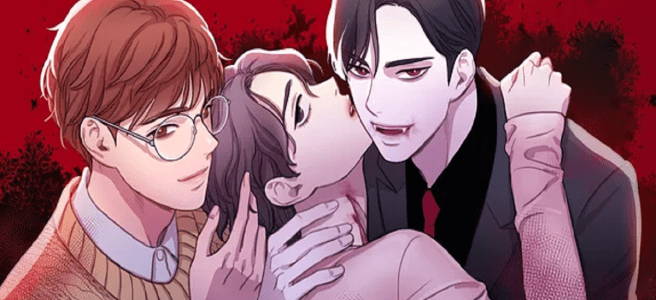

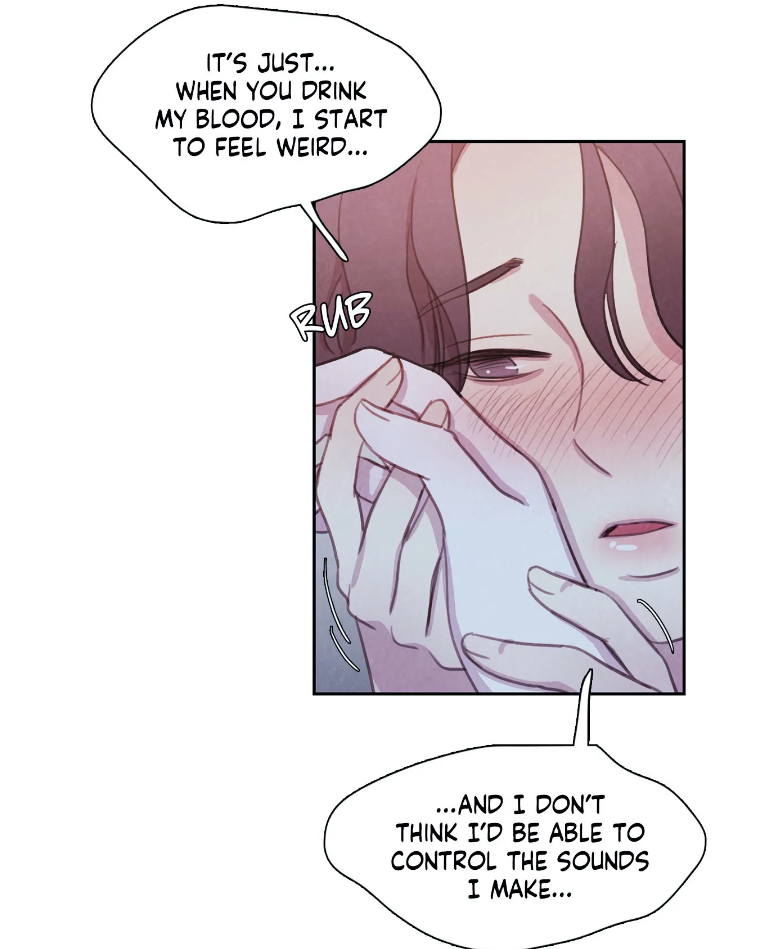 and in the chapter 13, he calls himself “a pervert, a fag”.
  Imagine, he is actually insulting himself. He sees himself as an anomaly, as a monster who is not allowed to exist. Hence he can’t attract attention. We shouldn’t forget in the chapter 10 and 11, Sooin felt so uncomfortable with the new clothes and the number of dishes proposed by Chi-Hwan because he was asked to choose. Since Sungha took away his freedom, our main character lost his ability to say what he truly likes and desires. The last image above illustrates the impact of the violence used on Sooin. It becomes clear that Sungha truly destroyed Sooin’s personality and identity. Just like Baek Na-Kyum (the main lead from Painter Of The Night), Sooin can’t voice his true desires and thoughts properly. Notice that there are a lot of pauses in his sentences, when he speaks. Besides, he uses the same idioms (pervert, fag) than the manipulator Sungha so that we can conclude that the former friend used coercive persuasion. The outburst of his self-hatred was caused by the single words said by the vampire:
 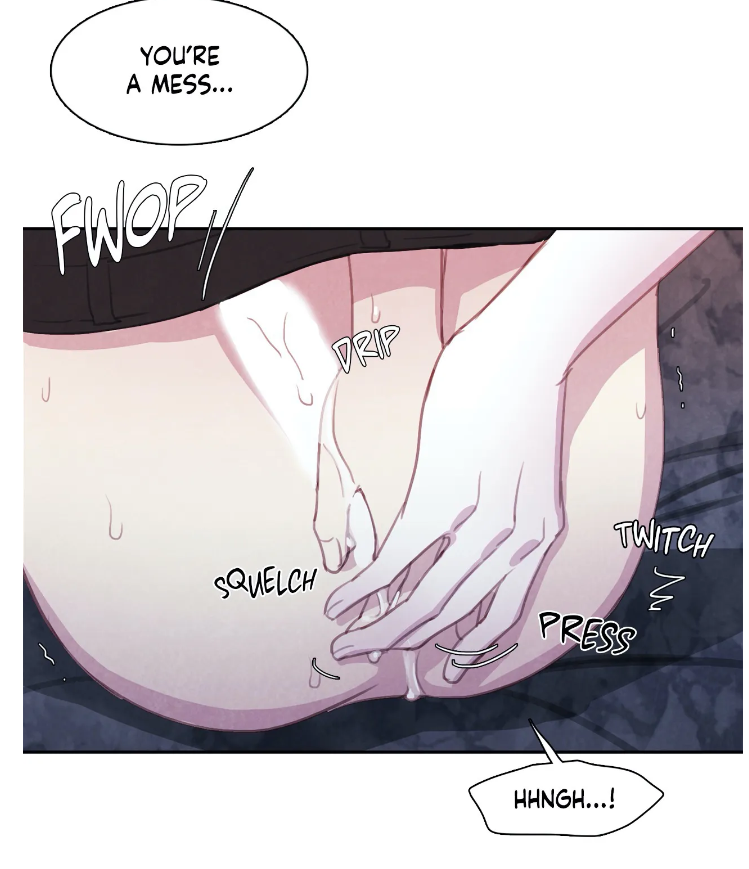 Striking is that the moment he hears this sentence, he starts mistaking the vampire for Sungha. Note that he is not even looking at his sex partner, because he hid his eyes with his arm. This reveals the importance of the gaze once again. Sooin can’t look at Park Chi-Hwa as he fears to see his own reflection in the vampire’s eyes. Will he see himself in the man’s gaze as a monster? Here, I feel the need to elaborate Jean-Paul Sartres’ theory about the gaze.
 It was as if his eyes had died due to the constant confrontation with Sungha’s gaze. As a conclusion, the main lead sees himself as a monster, not deserving any attention and warmth. He is still surprised by the affection the vampire is exuding towards him. This explains why the main lead started fearing the supernatural creature, when Sooin heard chi-Hwa sighing after the uke had refused to comply to the vampire’s needs (drinking his blood). He heard Chi-Hwa sighing and misinterpreted this as dissatisfaction. Observe that the drawing doesn’t show Sooin’s eyes and at the same time, he is only focused on the vampire’s voice and not his eyes.
 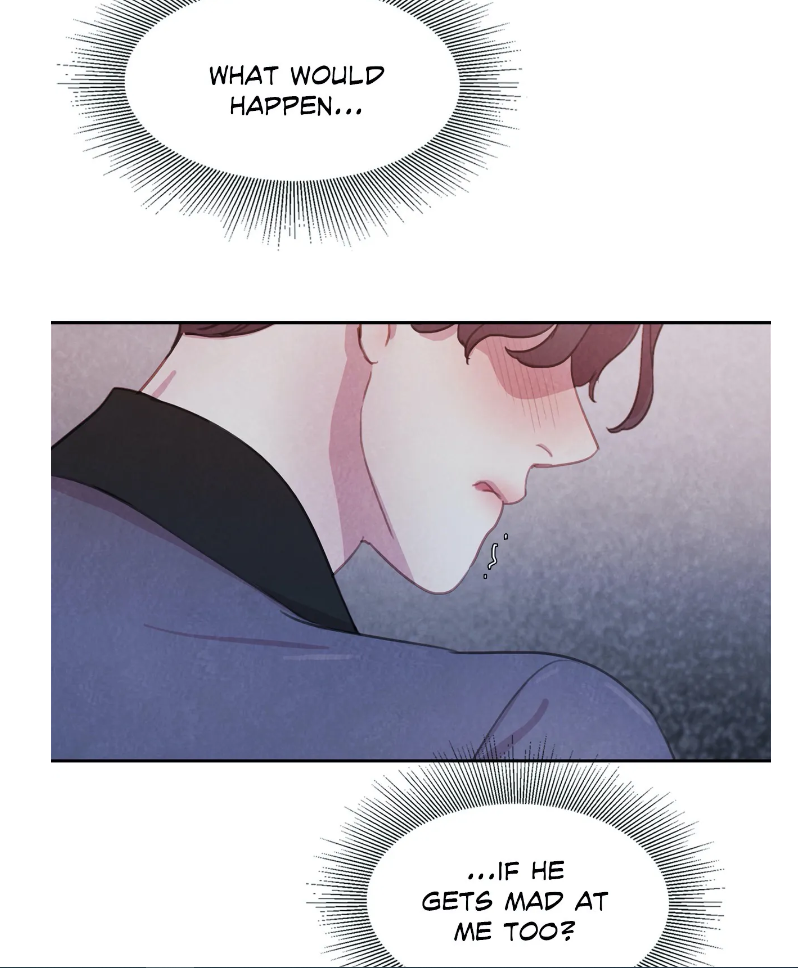 We could say that the uke is still under the influence of the brainwashing operated by Sungha. Sooin has not regained his humanity, his true identity. The so-called monster is still under the ruling of Sungha, because he rejects to fulfill the vampire’s need due the ex-friend’s ideology.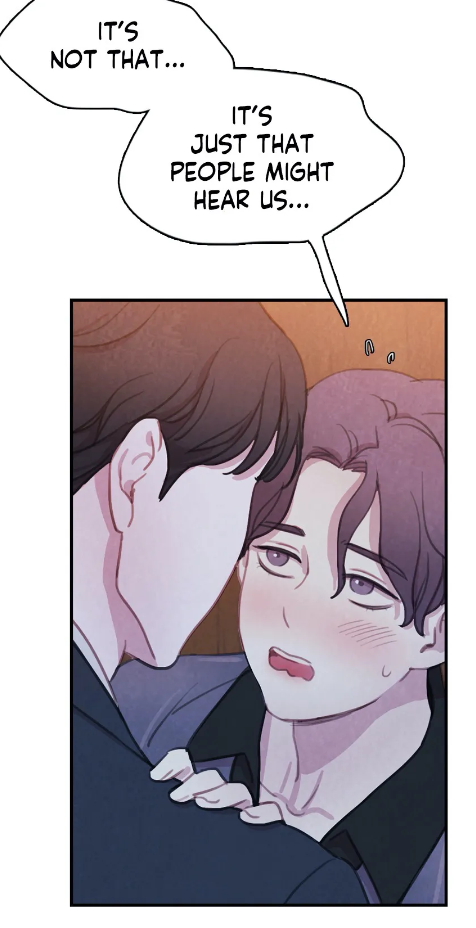
 The innocent man still fears the gaze and the gossip from others. Now you can understand why Sooin became a zombie, a monster in his eyes. He saw a bad image of himself in Sungha’s gaze but at the same time he was manipulated through the friend’s doctrine that even others would perceive him like that.
 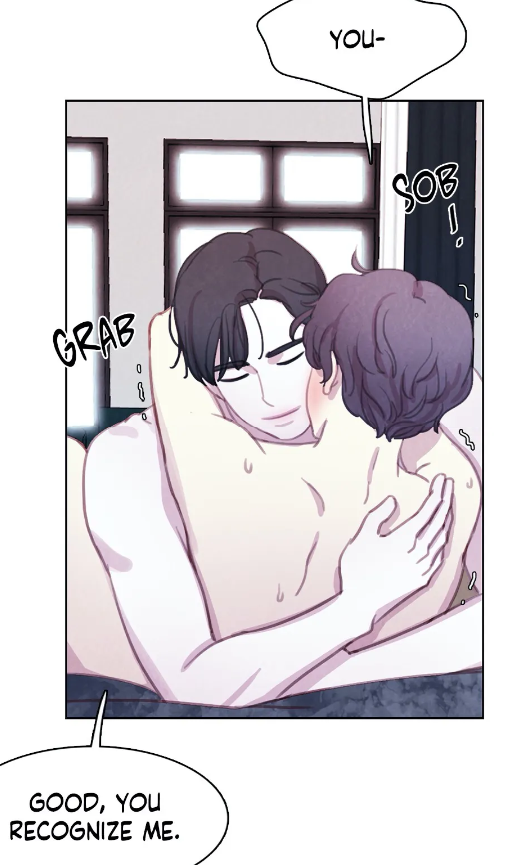 At some point, Chi-Hwa gets aware that Sooin needs to look at him, so he forces the man to look at him in the eyes. This is important because for the first time, Sooin is confronted with a different gaze and judgement. He recognizes the lord, his kindness.
 and his fangs come out.
 He wants to taste the man’s blood. In this moment, Chi-Hwan seems to follow his instincts hence he approaches Sooin. It was, if the vampire’s true nature would surface, he is a monster led by his blood thirst. Remember that Park Chi-Hwa even described the vampires as predators or parasites, so one might say that they are indeed monsters. So do we have two monsters here?
  and treats him as such. He listens to Sooin’s excuses and wishes. When the uke refused to give him his blood in the cabine, the supernatural creature questioned himself.
 The readers can witness how the so-called monster reflects on his behavior. He even kisses the man
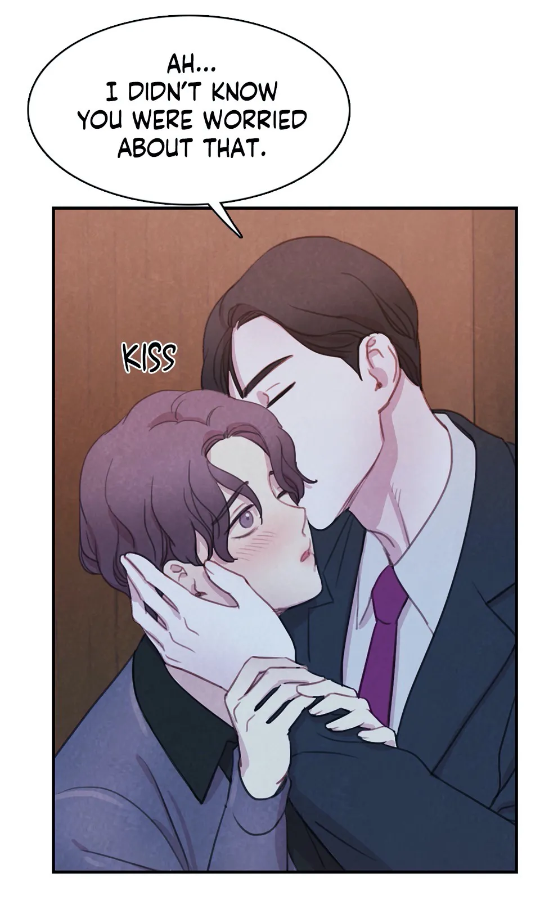 , comforts him twice, when he realizes the traumatized state of Sooin.
 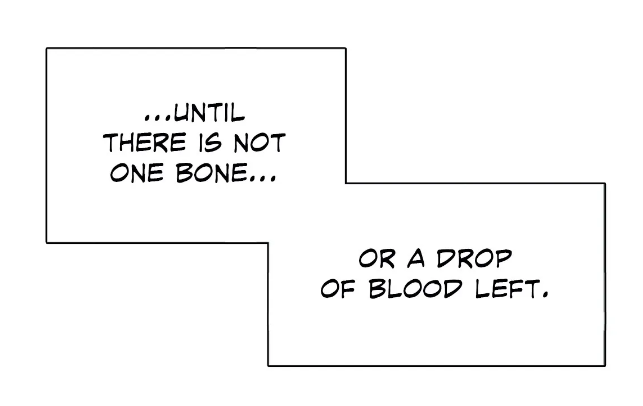 since it represents the peak of his hunger. The readers can even sense the increasing of his bestiality as the expressions are getting more and more violent: “I want to devour him”; “I just want to rip him open” … “and devour every part of him”. We have the impression that the vampire’s animalistic instincts are growing to the point he could lose the control of his bestiality. However at no moment, he changes his behavior. I feel that while his thoughts indicates the awakening of his “monstrosity”, he acts more humanly in reality. He stands in opposition of Sungha, who gave up on his humanity and his reason. He let social standards and religious doctrines ruled his behavior and his thoughts.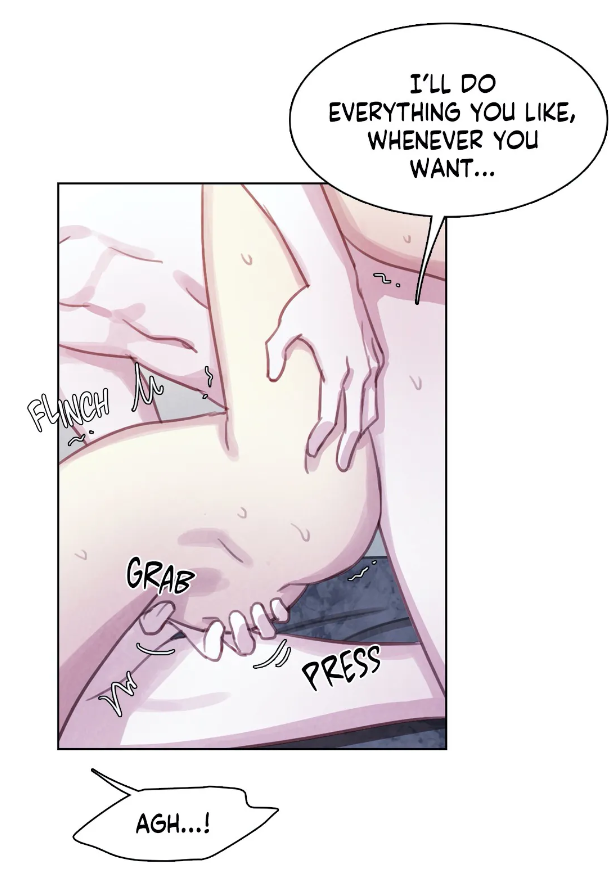
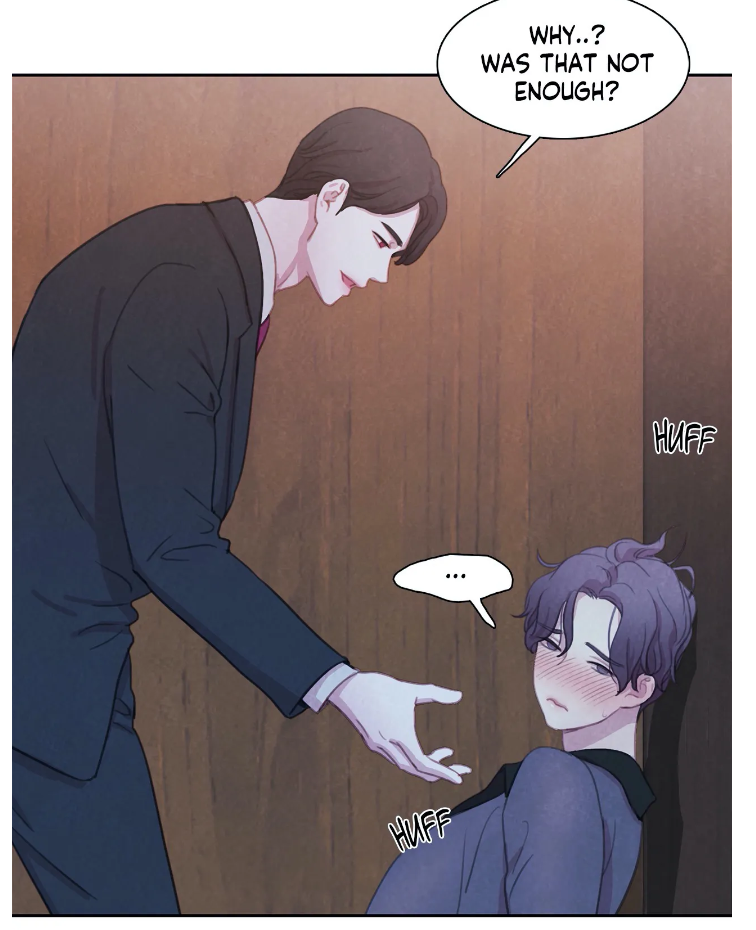 One might dispute that he rejected to have a fellatio in the cabine, as Sooin wanted. However, his proposition to do it home represents the compromise between the concerns the uke expressed before (people might hear his voice, his fear of people) and the request Sooin had. All this mirrors how caring and attentive the vampire is. He might be an “animal”(when we analyse his thoughts), nonetheless he never lets his instincts cloud his reasoning and judgement. At no moment, he acts like a monster towards the human. Like I mentioned before, the vampire treats the human like his master. However, if you take a closer look at the following image, this reflects their relationship:
 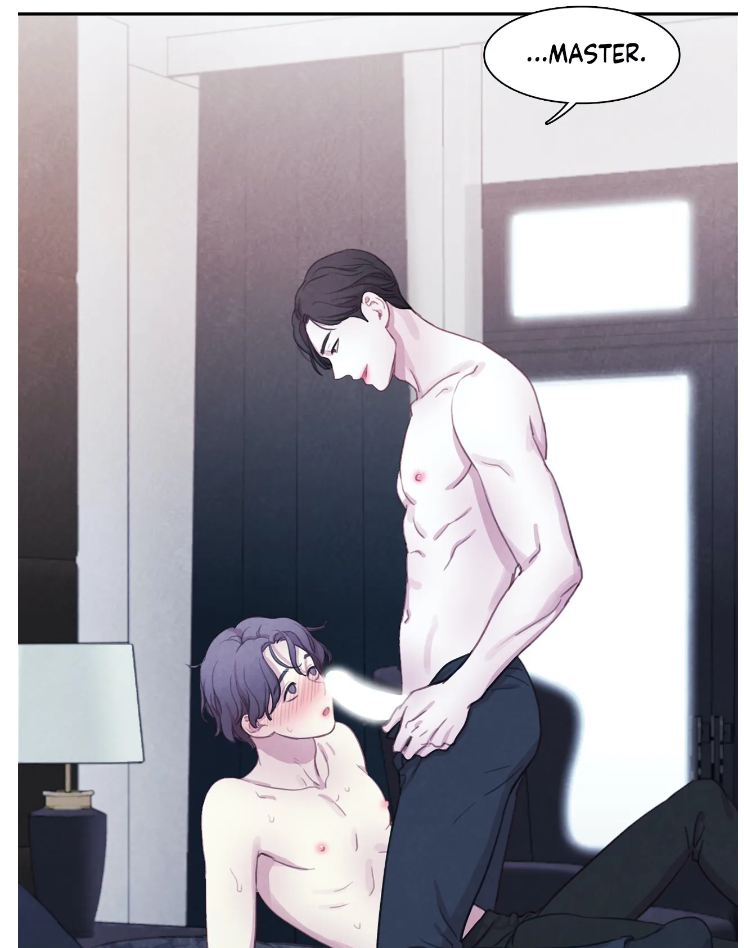 Sooin is the master, yet he is below the vampire as if he was inferior to the vampire. Furthermore, the creature gives the order: “Suck it”. Besides, the man calls Chi-Hwa “sir” and this is how someone addresses to a master.
  So in my opinion, both are masters. The vampire is helping the man to become a human again, he is helping him to get a personality and identity. He knows that the man needs to discover that his homosexuality is something natural, that he is first a human. That’s why he promises Sooin to let him forget Sungha. For him, Sooin should never define himself based on his sexual orientation.
 They live in symbiosis, in perfect harmony. Sooin is receiving love, warmth for the first time and the other can finally enjoy life too. He is no longer living like a vampire but like a human because he shows his human side to Sooin. As conclusion, both are masters and monsters, although it is only a matter of time, until Sooin becomes a real human who can express himself perfectly and know his taste.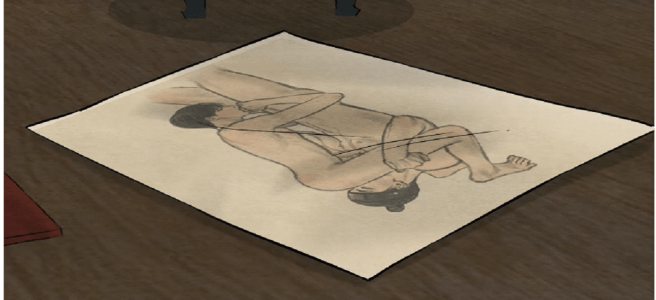

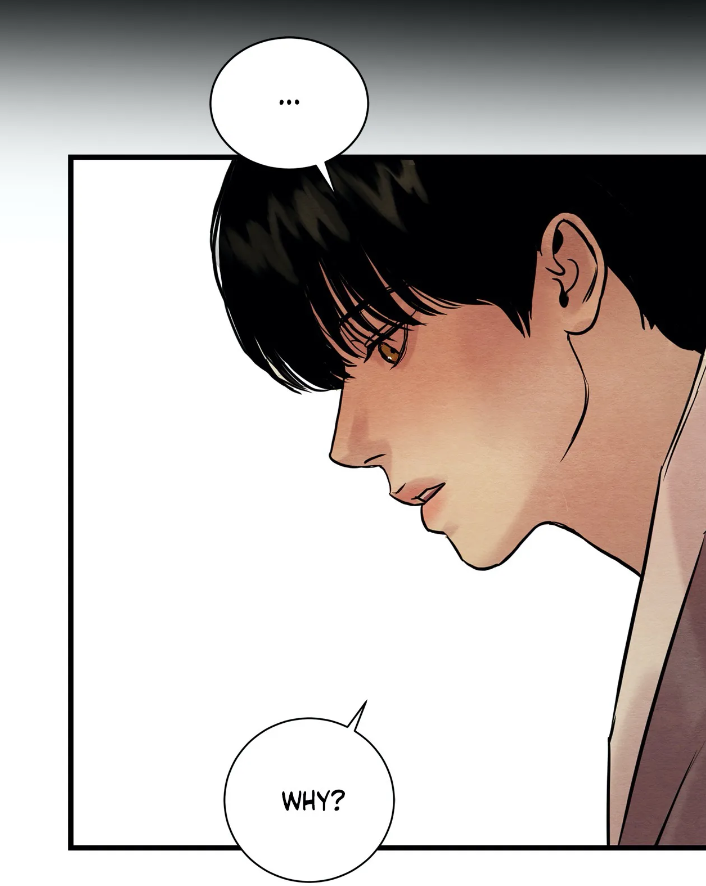
 Others are not using the question mark so obviously, however their questions or remarks let perceive that they are wondering about the motivation behind the comments or behavior, like for example Yoon Seungho. Let me show you an example. After the appearance of the maids, the painter stands up, when he hears that they will prepare new rice for him. The aristocrat witnesses how the artist stands up and wants to leave the room.
 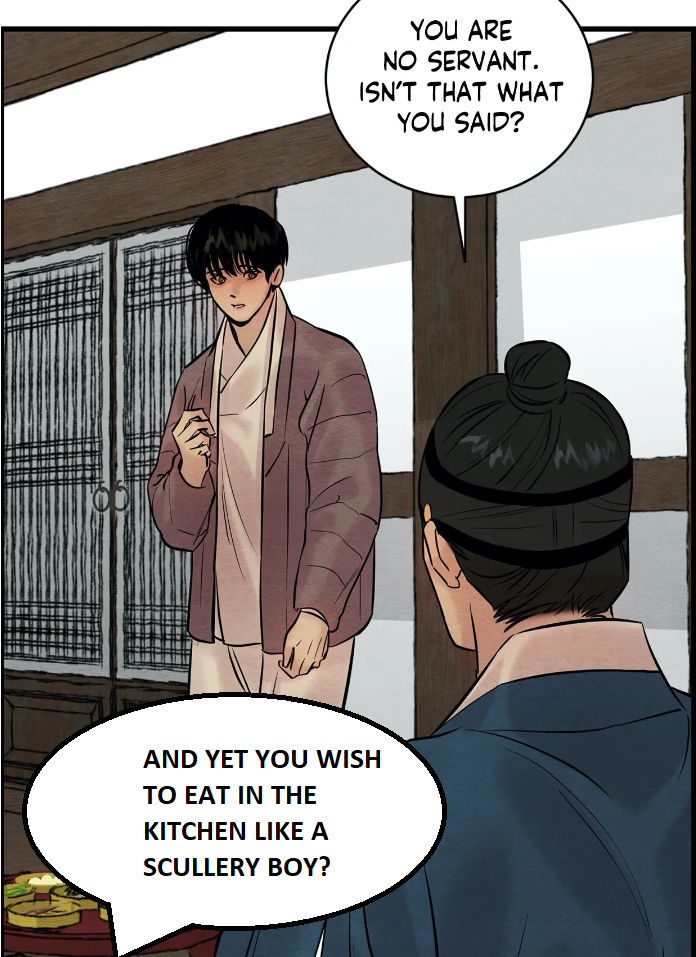 The noble is wondering about the painter’s reaction: Why would he feel the need to go to the kitchen? Why would he stand up? The lord’s words (“you are no servant”) are the proof that he overheard the whole conversation between the maids and the painter in the kitchen and only intervened, when they were criticizing him. This shows that the lord got aware that the painter’s position was unwelcome by his staff. He had the feeling that they would somehow bully, consequently he intervened. At the same time, he decided to make sure that the painter would have a different status so that the domestics would treat the artist better: his personal warning and the new clothes. So now, he sees the low-born acting as if he was a servant, a “scullery boy” which surprises him. He can’t imagine such a change. Why is he acting like a scullery boy, whereas he was so adamant about his status: he is no servant. What provoked the transformation? Now, you understand the topic of this essay. In this analysis, I will examine the pictures and events under this aspect (why?) and question the intentions of the characters and the author behind their actions, conversation and the pictures.
  Notice that here the noble is expressing his emotions towards the painter. Yoon Seungho likes Baek Na-Kyum for his honest and innocent reactions (his blushing, while observing the lord getting dressed). The master is happy to witness that he is able to evoke the painter’s reddening, while in the past he could only observe this reaction caused by the scholar. So this puts him in a good mood therefore he can’t restrain himself and expresses his pleasure. Yet the readers, just like the painter, are not able to see the lord’s gaze. While the painter is facing his back, the author didn’t draw his face. This is deliberate. In this picture, the manhwalovers are indirectly asked to imagine the lord’s gaze. It was, as if the creator wanted to help the protagonist to hide his weakness, to respect his privacy. As you can observe, only the valet Kim is able to see the protagonist’s eyes, while making the knot. This outlines how much the main lead trusts the butler. But right after, we have a distant taking:
 In this drawing, the lord is expressing his wish to eat with the painter. But he doesn’t make it too obvious hence he is more or less asking a rhetorical question to which the domestic replies with an affirmation. Here, we have a scheming lord, he is not voicing his desire directly. Why? He is hiding his true intentions therefore he is able to look at the artist. His words are his shield to hide his true inclination. As you can observe, the alternation between the close and distant takings is relevant because it was if the author was helping the protagonist to hide his vulnerability. On the other hand, it shows that the lord is still on his guard. Moreover, the picture also illustrates the huge gap between the aristocrat and the low-born. The latter is on his knees with his head down, a sign of submission and resignation, while the other is standing. What brought them together (the erotic paintings) is now representing a barrier and creating a gap between them. He is just a painter and not a lover. That’s why I would recommend my followers and readers to treat each picture as a drawing and question the intentions of Byeonduck with the picture. Not only this image reflects the actual situation felt by the painter, but also this portrays how the lord is not entirely trusting the painter. He is only revealing his true thoughts in a straightforward manner, when he is not looking at Baek Na-Kyum.
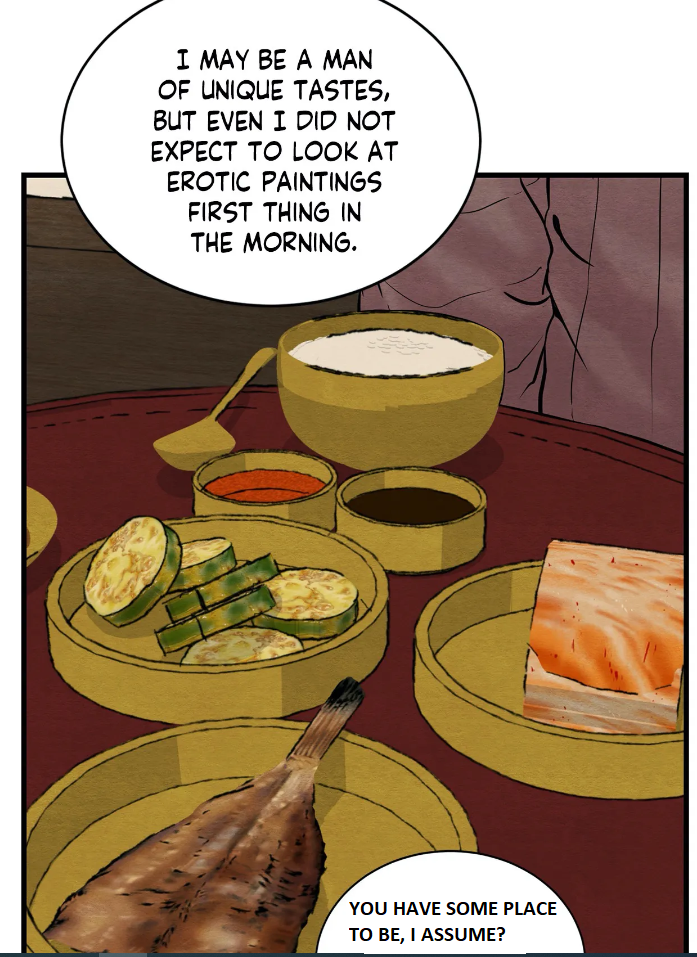 While Yoon Seungho is teasing the artist, he is actually wondering why the low-born created this unfinished painting. He noticed that the image was somehow lacking, the lines unclear and there are traces in the middle. So the ironical question “You have some place to be, I assume?” shows that the noble is wondering why the commoner did such a drawing, sensing that there is something lacking. Here, the aristocrat is in fact expressing his surprise. Besides, he adds that he never expected a picture (first remark). Like I mentioned it before, Yoon Seungho is no longer interested in the erotic paintings but in the painter. This conversation reflects his interest and care for the artist. On the other hand, the readers are deprived of the painter and lord’s face. There is a reason for that. Here, Lord Seungho is again revealing his true emotions towards the low-born but attempts to diminish or disguise this behind his teasing. Note that the lord is not inquiring the painter directly. He never asks openly: “Why did you paint such an image so quickly and so early, when it is not perfect?” But he is indeed showing that he cares for Baek Na-Kyum, that he is interested in the reason for this unfinished work. Remember that in the past, the commoner would even ask the lord to wait until the painting is finished (chapter 9). Here, we have the exact opposite. In other words, the zoom on the food had a purpose. IT helped the noble to inquire about the cause for this lacking work, he showed his interest and a certain weakness, while he tried to mask this behind his teasing. And now we have a distant taking again revealing the distance created by the ironical remarks.
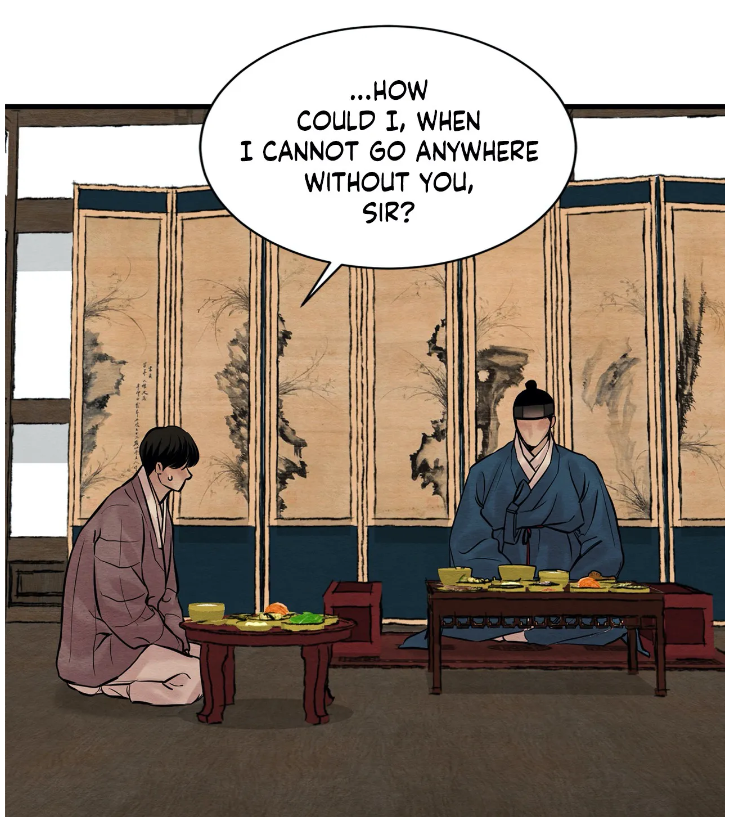 The irony is that Baek Na-Kyum is so naive that he doesn’t perceive the true meaning of these comments and answer so honestly. He can not leave the place without the aristocrat. The lord might be able to veil his weakness, but in reality he fails to realize that his schemes are not helping his cause. The more he hides his love for the painter, the more lonely and depressed the artist is. This creates a distance between them because the noble is not really straightforward and frank with him.
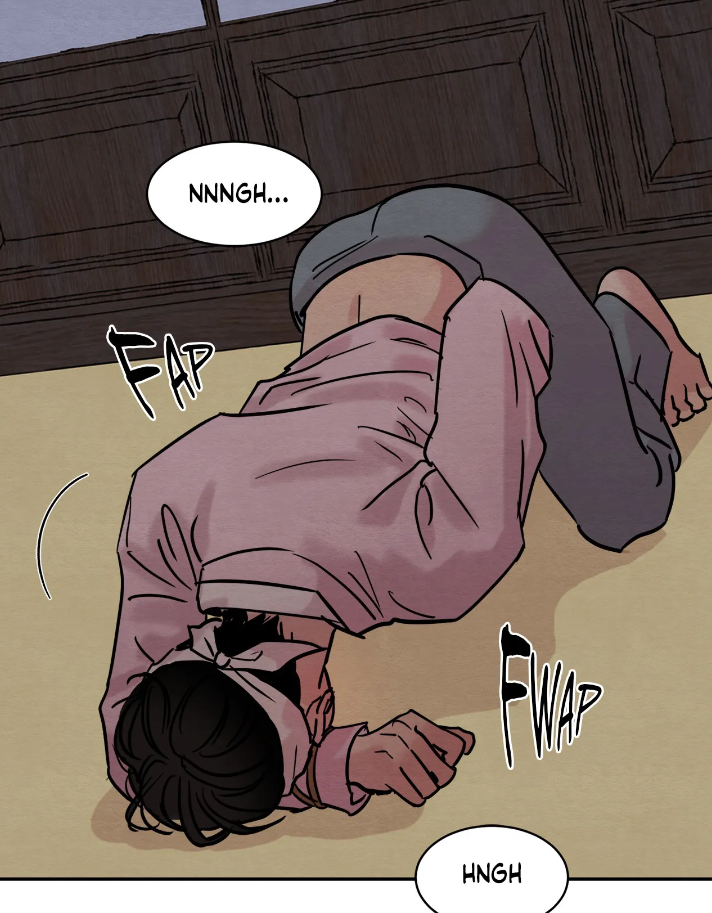 (Chapter 9)
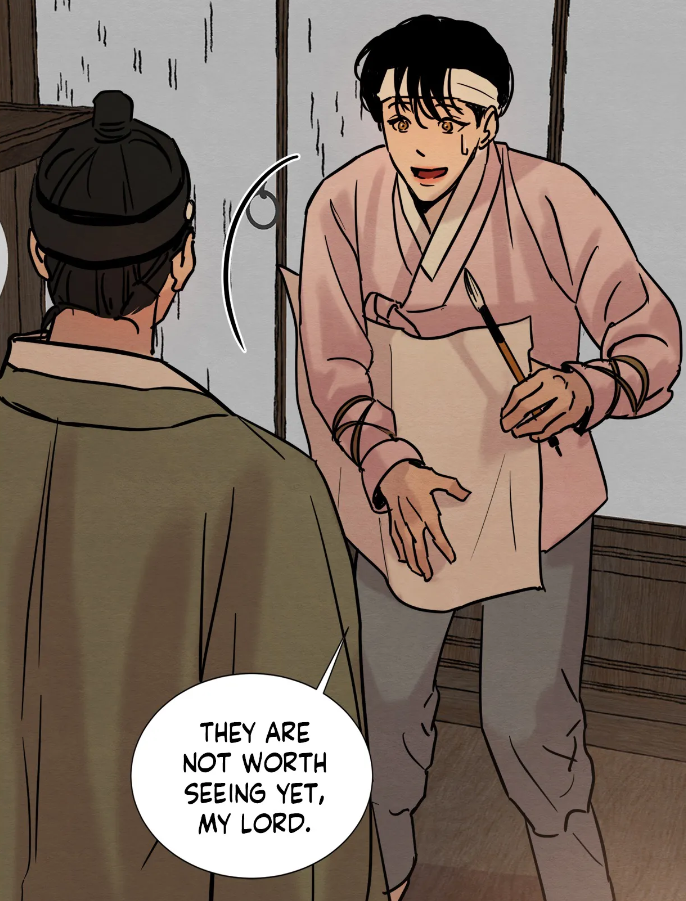 (Chapter 9) Baek Na-Kyum excused himself with a lie, he would show him when the work would be finished. However, the true reason for his departure was his erection. Notice that he is using the paper to hide his erected phallus. He was also on his knees before, when Yoon Seungho approached him. The cause of his sexual urges is revealed with the following drawing.
 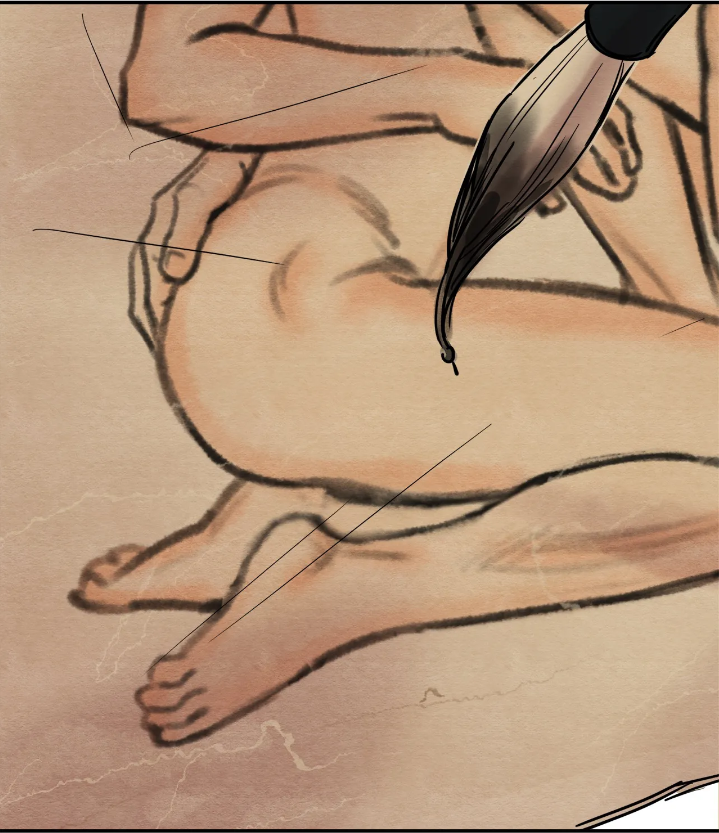 (Chapter 9) This drawing represents the painter’s perspective. As you can see, the painter’s eyes are focused on the lord’s hand touching the butt and anus. From my point of view, he is imaging the lord’s touching him. This time, the artist is conscious and can no longer repressed his sexual desires. Later, his gaze focuses on the other uke, the one penetrated by our main lead. Here, it is quite clear that the artist wishes that he had replaced Min.
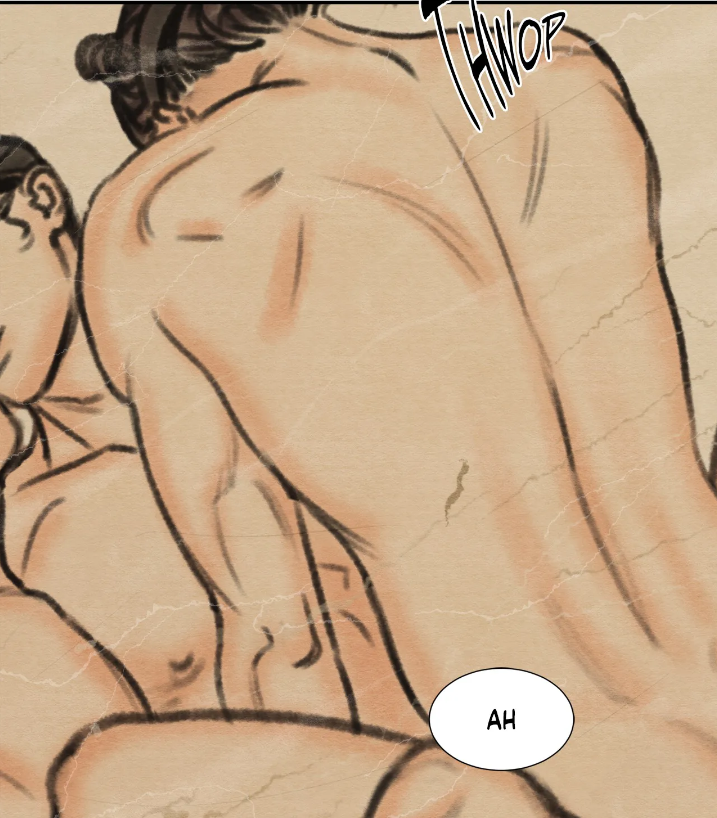 (Chapter 9) In both cases, the painter never painted the sex partners’ faces properly so that it would easier to imagine for him to switch places with them. All these zooms reveal the growing sexual desires. That’s why he feels the need to masturbate, as he can’t repress this urge any longer. This didn’t escape Yoon Seungho hence he couldn’t help himself smiling.
 (Chapter 9) Although the painter had been quite rude and left him behind, the lord wasn’t bothered. In fact, he was pleased that he had indeed affected the artist.
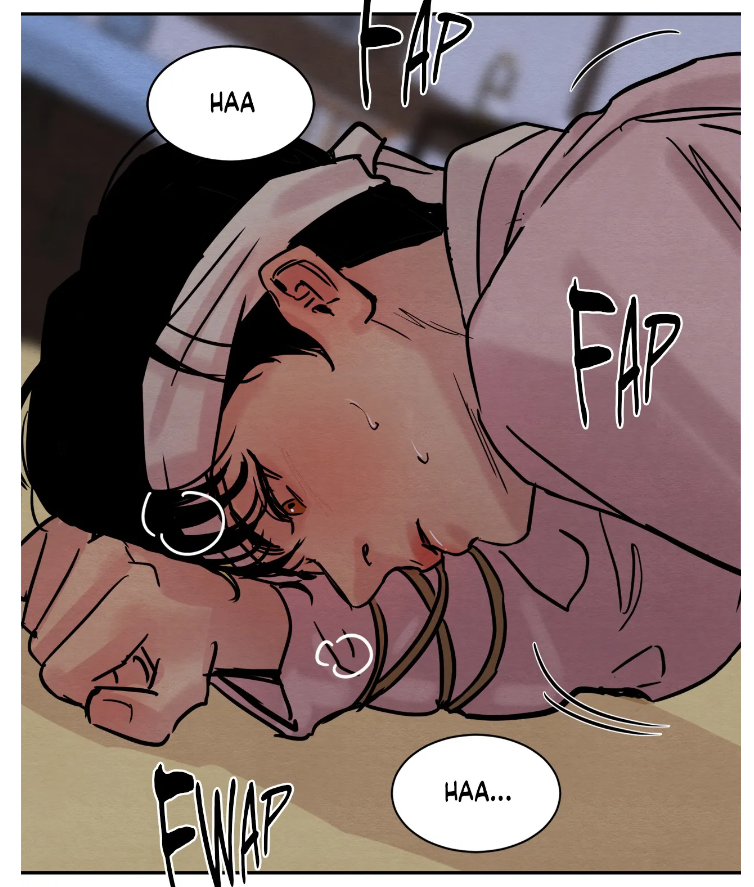 (Chapter 9) His eyes might be open but his spirit seems to be elsewhere. He is not really looking.
 Because the readers never see his gesture, they can not be certain. Hence Byeonduck had to draw a picture with his erected phallus showing his masturbation.
  Striking is that the moment he feels that he is about to climax, he closes his eyes. Here again, this reinforces the statement that Baek Na-Kyum is determined to refuse to face reality and deny his attraction for a man, for the noble.
  (Chapter 9) When the sperm comes out, it lands on the floor. This is quite important as it illustrates the artist’s attitude towards the semen. He considers it dirty and filthy hence he makes sure that his hand doesn’t get soiled. That’s how much he despises himself and his needs but he can no longer repress these urges. He prefers closing his eyes, masturbating behind a door and using his body to cover his filthy gesture so that no one can ever witness it. But he is too focused on his needs that he forgets that he is making noise so that Yoon Seungho knows what he is doing. At the end, you sense the low-born’s despair and disgusted attitude with his final position.
  (Chapter 9) The manhwaworms feel his strong refusal to admit his attraction towards the noble, his sexual arousal and his sexual desires towards Yoon Seungho. The painting had such an effect on him, it awoke his repressed sexual desires.
 (Chapter 46) However, he has still a position where it is still protected. If someone came from the side, they wouldn’t detect immediately what the low-born is doing. This can be explained that there is still some shame left but it is now related to his perception that homosexuality is a synonym for prostitution. That’s why he is still reserved. On the other hand, the semen doesn’t land on the floor but on his hand which shows that he no longer feels disgusted.
 (chapter 46) Some readers complained that he didn’t wash his hand before falling asleep. Yet what they failed to realize is that this proves that Baek Na-Kyum no longer perceives sperm as dirty and filthy. This symbolizes a huge step forwards. Now, if we compare the two masturbations, the readers will notice another huge divergence: the chronology of the drawings of Baek Na-Kyum with closed or opened eyes. In the chapter 9, we had first the painter with opened eyes as he was lost in his thoughts and the moment the ejaculation was about to come, he closed his eyes. Here, we have the opposite, first the closed eyes.
  (Chapter 46) The reason is simple: he is not lost in his thoughts, quite the contrary. All his thoughts are revolving around the master confirming the change of his attitude. He is no longer denying his attraction towards the noble. That’s why the author lets the manhwaphiles see the images he has in his mind. What caught my attention here is that the painter had visions of the moments, the lord made love to him.
 (chapter 42)
  (chapter 46) In the last picture, this happened right after the painter had made a sort of confession which triggered the lord to become more vigorous and passionate. This shows that he sensed the lord’s affection but he can’t define this as such yet.
  (Chapter 46) The kiss triggered the climax indicating that the kiss, full of love and passion, moved him so much. He sensed the lord’s love stronger here. Since his eyes are wide-opened, it clearly shows that the man is actually facing reality. He is no longer hiding, running away from his sexual desires and admitting that his feelings towards Seungho have changed. Notice that this time, he even questioned himself for this reason. Why could such a kiss provoke such a reaction? He is now looking for an answer, he is no longer running away. He wants to discover the truth.
 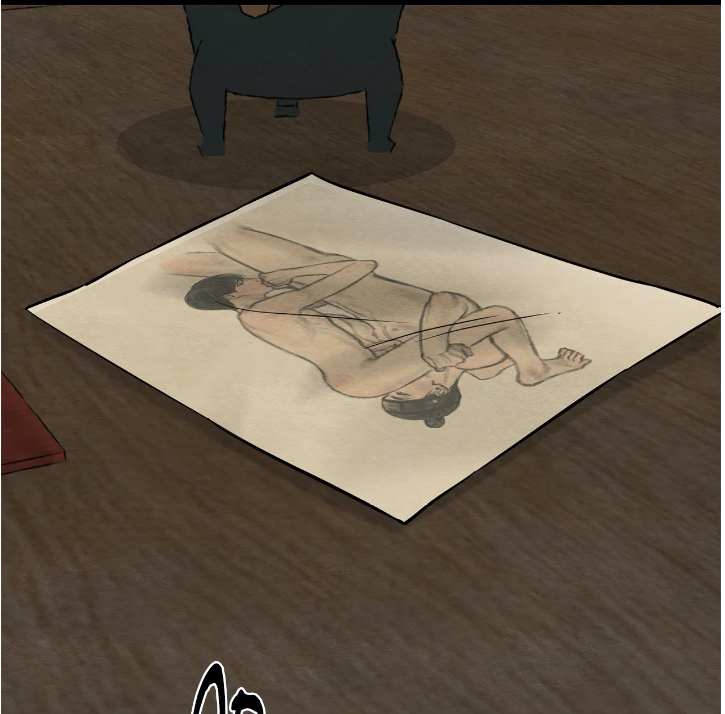 (Chapter 47) What caught my attention in the new drawing is that he didn’t select the memory we saw:
 (Chapter 41) Furthermore, his face is more defined. Now we are able to see his eyes, unlike in the past, where he had no face and as such no identity. This drawing symbolizes something important. Little by little, he is gaining a new identity. Therefore the readers shouldn’t judge this picture as something bad, even the noble was pleased. The painter created a new picture on his own (without any clear order from the seme) although it has become clear that the aristocrat no longer needs the pictures. For Seungho, it represented a huge step because the picture was bigger and more detailed than the former ones. He saw as a improvement of their relationship. Sure the artist had another reason for this picture. It was an attempt to be perceived as a painter and not just as a prostitute. But like I wrote in another analysis (Drawings and emotions, part 1), each picture reveals the commoner’s emotions and state of mind: a painter and a whore, yet he has eyes now. He is no longer denying his homosexuality.
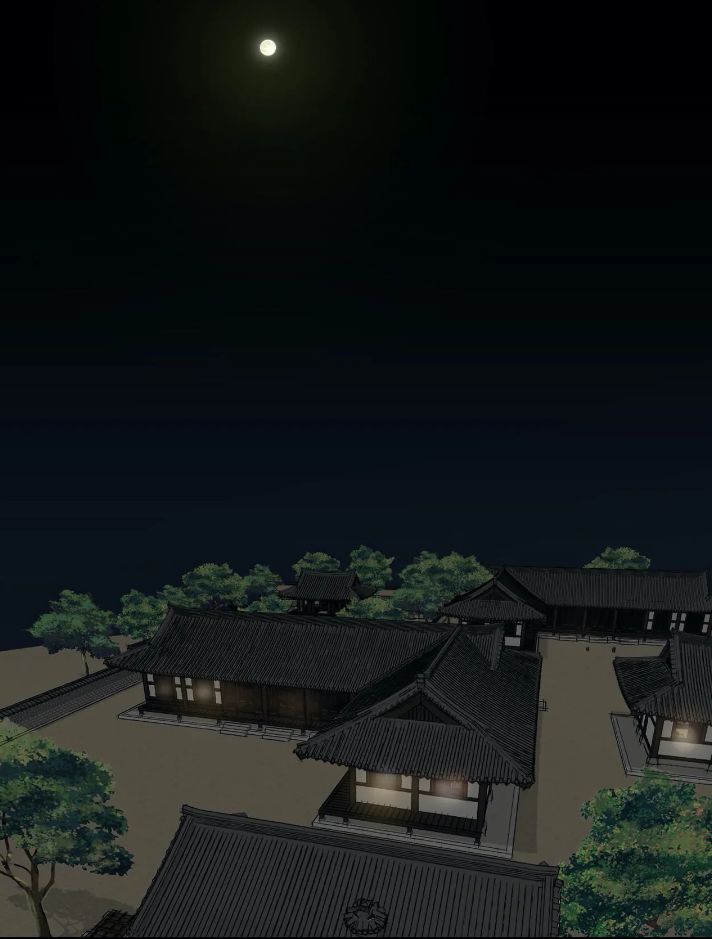 Here, the full moon seems so far away, Yoon Seungho’s mansion is almost illustrated in its entity. My first thought was that the full moon personified Baek Na-Kyum and the latter is so far away from the powerful noble as they have not met yet. The sky is so dark (almost black) due to the light glowing of the moon. It was as if the noble’s world was full of darkness and his future meeting with the painter represents his only joy and hope in life. He is so eager to have the painter by his side and to have the artist painted for him. The mansion is so big, indicating his wealth and power, however it feels so big and empty at the same time. It was as if his domain was not a real home. The light coming through the windows doesn’t exude warmth, the beholder feels a certain coldness as there is nobody outside the building. So this image could be judged as an illustration of the main lead’s world: dark, cold, empty, lonely and lifeless.
  First, why is this a crescent moon unlike in the first image? Did the painter lose something hence he is no longer complete? Secondly, there is no building and the moon seems to glow stronger as the sky is lighter. If the moon is the painter and the sky Seungho’s world, how come that the moon is glowing stronger because even if the painter had felt excited before, he was still resisting the noble’s advances and attraction? Furthermore, in this chapter he is threatened by the master. Then we see no mansion, while we saw the roof in the image from the chapter 4. Why is there no building portrayed here? That’s why I saw it as a necessity to find an explanation that would fit to all the pictures. Hence I would like to show all the images in their chronology so that we can figure out if the drawings with the moon have a deeper meaning like the weather and the season.
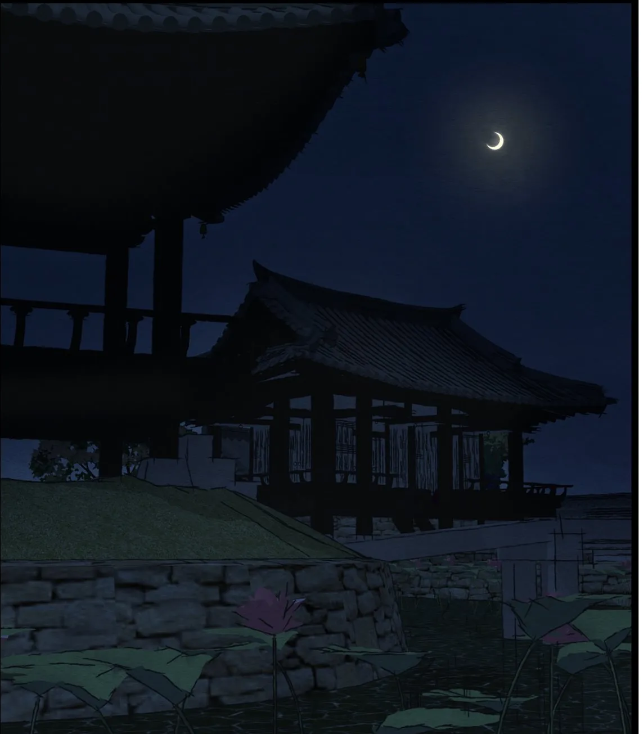
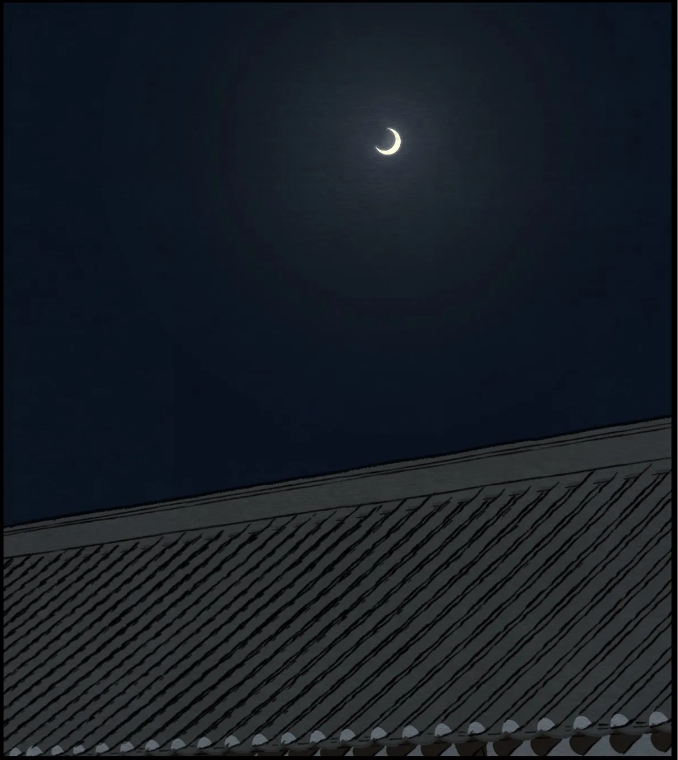
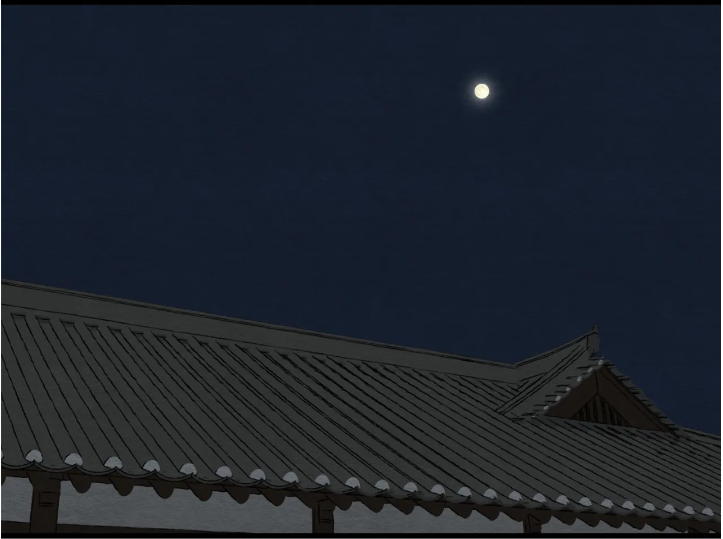

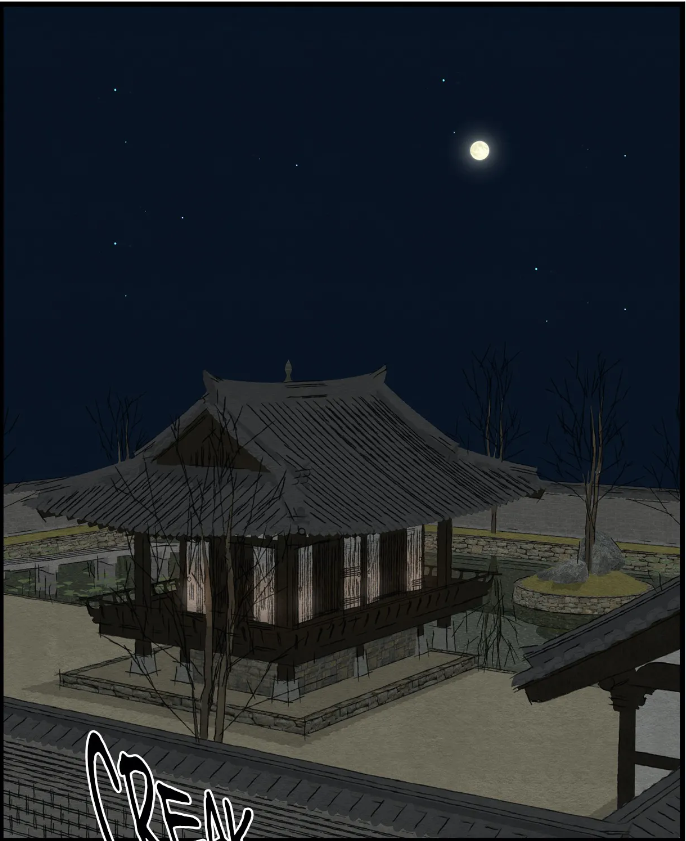

 (chapter 1), then he asked the artist to paint the next night. In my opinion, Yoon Seungho didn’t interact much with people during the day, as he was rather smoking and looking through his window. Therefore his appearance at Lee Jihwa’s mansion was something extraordinary. He couldn’t even wait for the next night which the red-haired noticed. Let’s not forget that this man is suffering from insomnia so he can’t sleep during the night. That’s why I have the impression that the moon and the dark sky are personifying the protagonist.
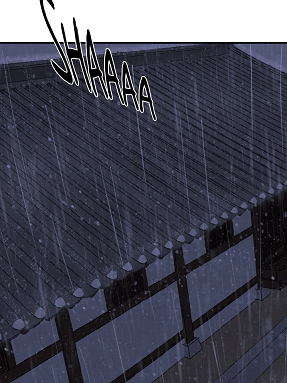 We never saw the moon during that night and the sky looked so bright. It was as if the moon was looking down on the building, while the noble is embracing and kissing the painter. This night was particular because it never looked like a real night… a mixture of day and night, giving the illusion of a different time. That represents the “dream”, something special is happening right now. The lord has discovered love and warmth hence the light of the moon seems warmer and closer. This was just an illusion and the reality came back in the chapter 25.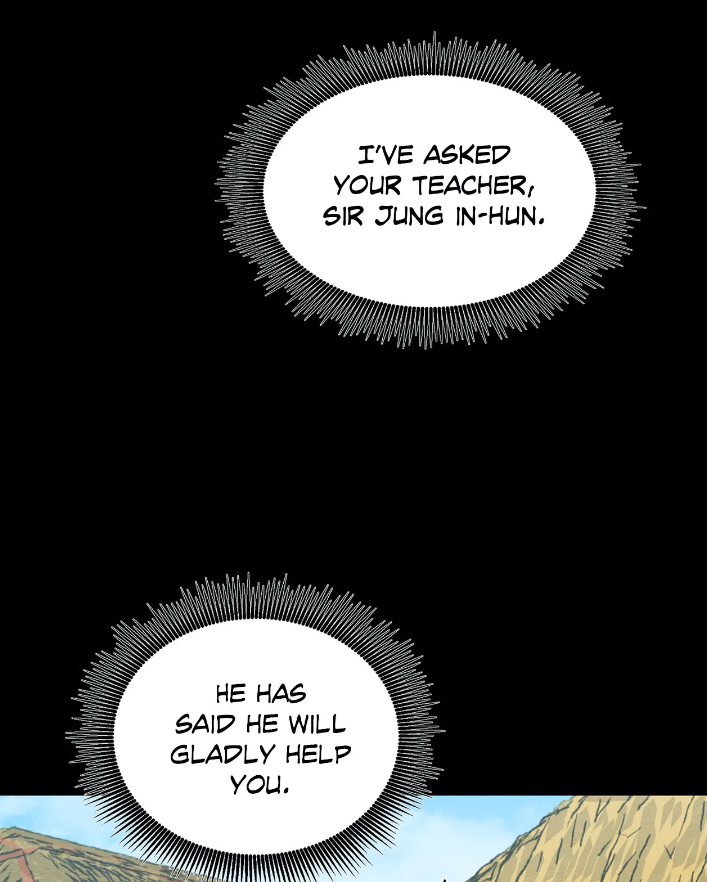
 Jung In-Hun had become his guardian because he had been bribed by the head-gisaeng. Only yesterday I came to realize why the painter could repress the bad memories about his physical abuse: The Stockholm Syndrome. And this is relevant as it explains why the artist adopted such a fear of homosexuality and even talked like the scholar. Furthermore I can even envision that this Stockholm Syndrome must have affected his hands and talent. This even reinforces my opinion about the huge impact of Yoon Seungho on our low-born. Due to his attraction to the lord and the sex session, the repressed sexual desires were unleashed so that his talent was triggered. That’s why he impressed the lord so much in the chapter 2.
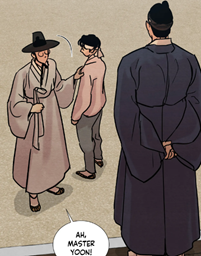 Nevertheless it started to rain the moment the teacher discovered the existence of the deal between the powerful noble and his former pupil.
 Imagine the rain followed with thunder represented Baek Na-Kyum’s tears and heartache because of the teacher’s rejection symbolized by the hand.
 This simple gesture, where the low noble used no strength, was so powerful because of the Stockholm Syndrome. Since the rain embodies the tears and the agony the thunder, I couldn’t restrain myself connecting it to the Surrealism once again as nature is often used as a representative of the unconscious and the state of mind.
 It was as if the snow embodied the artist’s tears once again, yet this time the real pain is no longer existing because his heart has turned cold. He feels nothing at all hence he has no problem to ask the butler Kim to throw away the painting. The more fall and winter are approaching, the more the painter’s relationship with Jung In-Hun deteriorates. In the chapter 35, the painter is definitely hurt by the low noble’s gesture, when the latter closes the mansion door right in front of him. This coincides with the fire where the fallen leaves are burnt.
 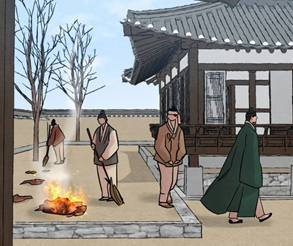 The caress on the cheek equivocates to the fire, the last real warm gesture the painter received from his teacher.
 In the chapter 38, the artist no longer falls for the teacher’s fake stroke thereby he is able to lie to Jung In-Hun. Because of this, I came to the following interpretation. The landscape with the snow embodies Baek Na-Kyum’s actual state of mind and emotions.
 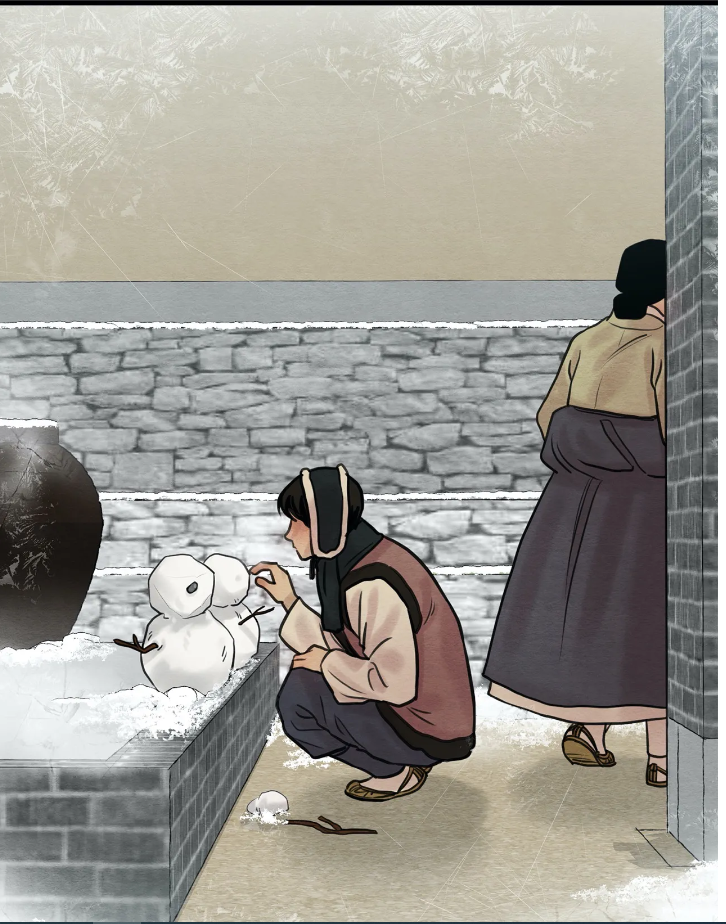 It was as if his heart was frozen consequently he feels nothing. However, the presence of the snowmen illustrates his innocence and his longing for companionship. He wished deep down that he wasn’t alone and had someone by his side. Yet, the painter has no idea about it. Now, you can understand why I connected Byeonduck’s drawings to the Surrealism. Sure, this is my own interpretation and nothing more. The weather and the seasons are following the same evolution than the painter’s transformation. Little by little, he starts losing his admiration for the scholar which ends with the real separation. He has been so hurt that he is like an empty shell. But there is one difference from the past. This time, Baek Na-Kyum was the one who cut definitely ties with the scholar hence the double-faced man has no idea that he can no longer use the painter as his tool.In the past, the jealous aristocrat could push him away but the painter never resented his admired sir and accepted that the teacher would return to his side without questioning his motivation behind his smiles and strokes. He had been abandoned once, hence he became a drunk. However, the painter had no grudge hence he fell for Yoon Seungho’s lie in the chapter 7.
 It was the same in the chapter 24, when the scholar took him and pushed him against the wall.So far he had avoided the painter, yet he needed him again. At no moment, the artist rejected the man’s advances (kiss on the hand, his head on his shoulder). The low-born always forgave the low noble.
  It was as if the painter was coming back to life, the noble’s warmth has finally reached his heart through his body. Consequently, the spring will announce the beginning of their real relationship, the growing love between our two protagonists.

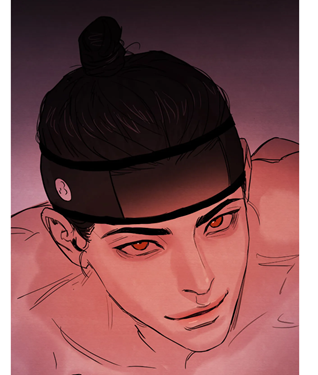 Furthermore the huge distance between Jihwa and Yoon Seungho could be explained that the artist wished, he had joined the lord and put himself between the main lead and the red-haired man. Remember that he wanted to take the sex partner’s place. As you can see, the first painting displayed a lot the painter’s unconscious, his sexual desires that’s why he had to destroy it. The image represented a proof of his homosexuality. In other words, the first drawing let the noble perceive the painter’s emotions and feelings hence he felt his own attraction. Therefore he could liberate himself from his negative image he had of himself.
![ANALYSE] Le Cri, Edvard Munch](https://alheuredelart.files.wordpress.com/2018/01/3-3_le_cri2.jpg)
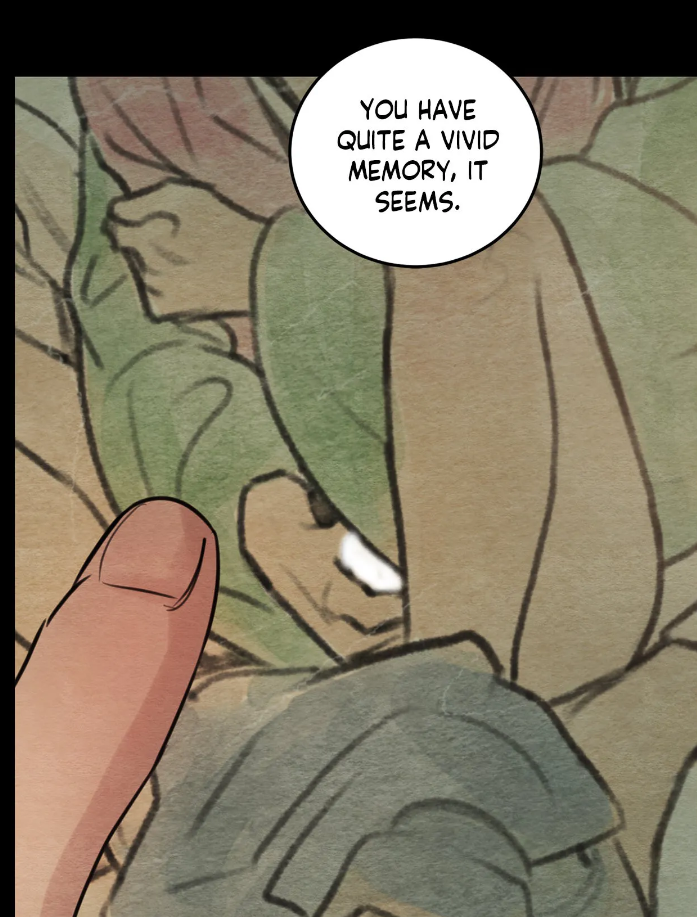 The word “vivid” is definitely characteristic for Expressionism. That’s why I connected the artist’s work with the Expressionism. Sure, the low-born lives in a different period, the industrialization had not reached Joseon yet. However, it is pretty obvious that the painter’s creations are strongly influenced by his emotions and state of mind.
  and asked his admired sir to take care of him.
 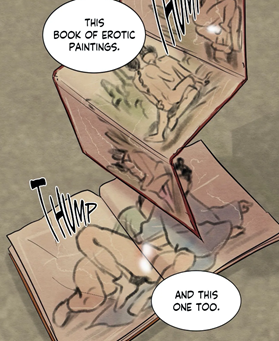 Since all the books were motivated by his love for the learned sir, the nobles could already sense the painter’s emotions and desires in these erotic pictures. Sodomy was portrayed as something natural and lovely. This explains the painter’s popularity and why the main lead became addicted. Because of this observation, I couldn’t help myself connecting this to another Art movement from the 20th Century called Surrealism.

 The readers can detect that he is starting to think on his own, showing that he is no longer under the teacher’s influence: this is the evidence of critical thinking, something the seme tried to initiate in the artist.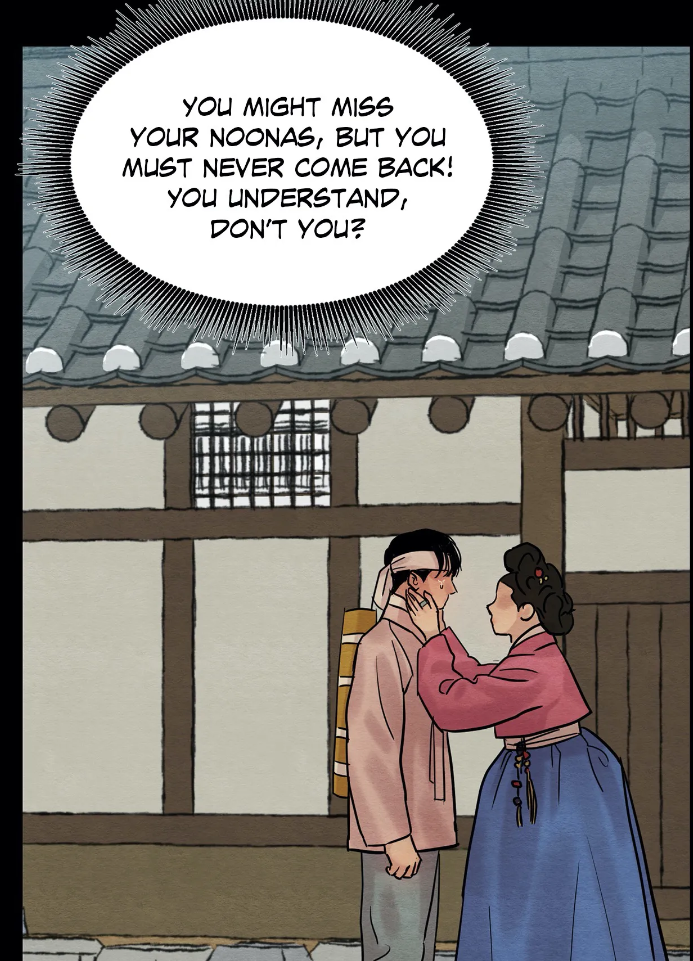
 why he made up his mind to remain at the mansion. He can sleep and eat well, he recognizes the advantages accompanying his stay at Yoon Seungho’s mansion, furthermore he can not be abandoned like in the past. Even if the lord loses his interest in him, he could work as a servant, that’s exactly what he is thinking. His abandonment issues forced him to redefine the signification of home. As a conclusion, the painter never chose to return because of the protagonist Yoon Seungho who is perceiving him as his “bride”, although right now his status reminds us more to the one of a concubine.
 He is definitely treated like an important guest. From my point of view, the elevation of his ambiguous status is linked to the confession he made to the lord before.
 From my point of view, the comment said by the head-maid of the kitchen did affect the painter. She was the one who pointed out that the master cared for him very much, although the noble never acted so caring in front of him.
  He ended up in a worse situation as now he had no one on his side. The painter must have realized that leaving the noble did appear good on the surface, yet in the long run he would have to face a more terrible fate. Like I mentioned above, the mansion represents a shelter. In the past, leaving the brothel seemed to be a good decision for the painter’s bright future. The mother saw that the painter’s origins would become a hindrance to his career hence by asking the teacher to become his guardian would give a better reputation to the painter and help him in his career.
  Notice how he is diminishing the painter’s importance in his life. Secondly, he even admitted that he scolded the painter severely once, the moment he saw the content of the paintings. In my former analyses, I had already pointed out that this was a lie but the new element is that since he had become his adoptive father, he knew about the painter’s identity right from the start: he was the famous painter publishing under a pseudonym. From my point of view, the painter was inspired by his love for the teacher hence his work was so lewd and was oozing love and warmth. Remember that people keep wondering how he could create such paintings. The low noble is the origin for the publications. Now, you can better understand why the artist has lost his inspiration. That’s why he could create such a nice picture of Jung In-Hun’s inauguration and the pictures of Seungho with the painter lacked details and passion. This doesn’t surprise us that the painter is not really motivated and creative. For that he needs to fall in love with the master for real. We see a progression in that sense. First, he dreamed of sex with him, so his unconscious was telling him that he was attracted to him. Now he is even awake and remembers their sex sessions which arouse him. He could ejaculate because he sensed that lord was making love to him, when he kissed and embraced him. That’s why we are the witness of the painter’s transformation, how the lord will become his new inspiration and this will enhance his talents. That’s why Yoon Seungho’s place will become the true home of the painter: a place to rest and eat but at the same time, where he will fall in love again and become more inspired and creative than before.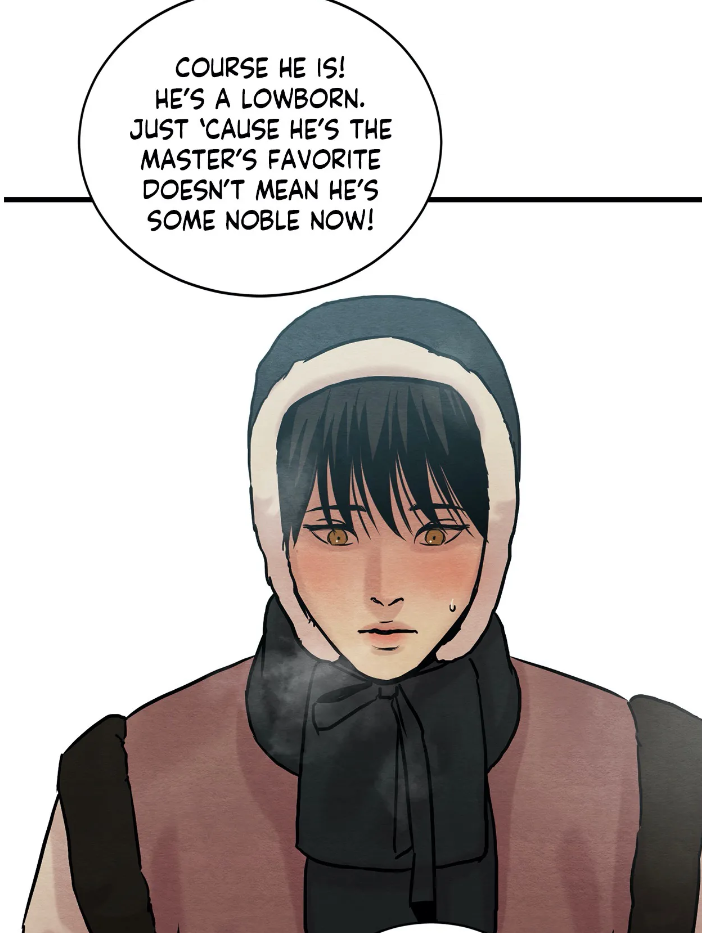
 From my point of view, the servant will serve as a tool in Baek Na-Kyum’s growth. Through Deok-Jae’s betrayal the painter will realize that the teacher’s harsh words and abandonment were caused by jealousy and were not reflecting the truth. That’s the moment the scholar will have no influence any longer on the artist.
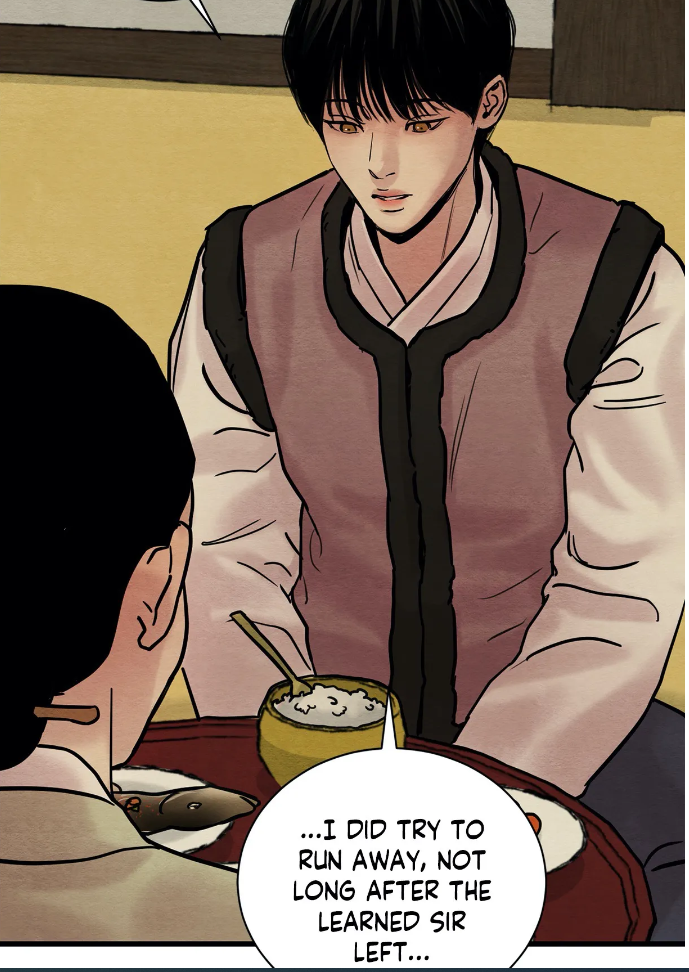 Little by little, he’s expressing himself better. The sentences might still contain some pause, yet his sentences are much longer. Besides he is able to explain why he is no longer trying to run away. The fact that he confided to her about his final attempt and his change of mind indicates a certain emancipation from the terrible surrogate father.
 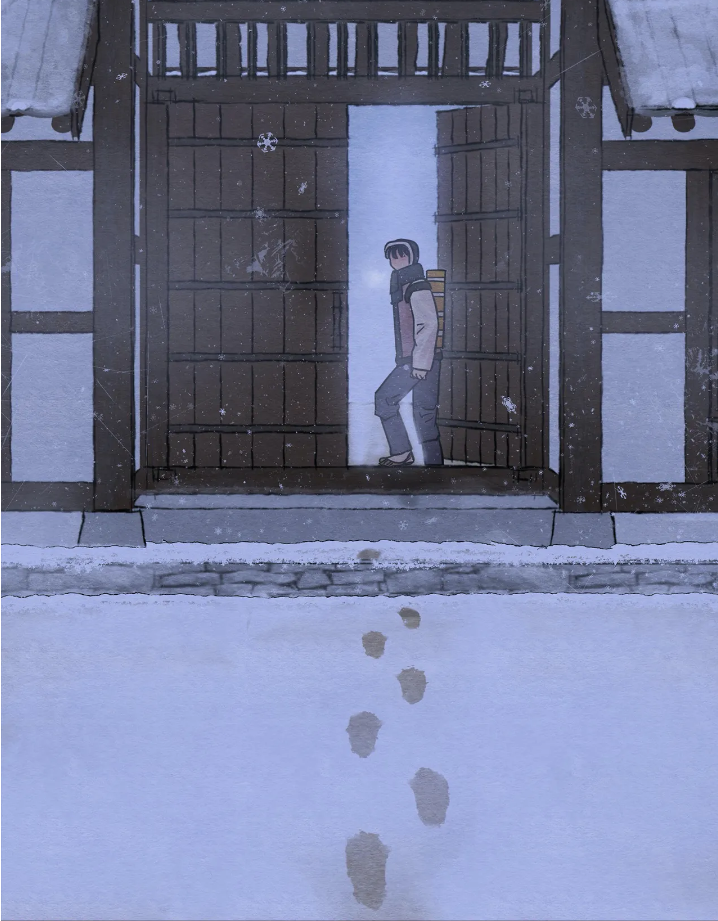 We have Baek Na-Kyum standing in front of the mansion door. Yes, this image confirms my interpretation about the symbolism of the door. The painter’s situation is always reflected through the door. First, the foot print on the snow left by him outlines his loneliness. Now he’s on his own. The teacher is no longer by his side. Nonetheless his foot print is regular hence we can say that Baek Na-Kyum was resolute in his decision. There is no hesitation based on the foot print.
  ; chapter 19: Seungho
 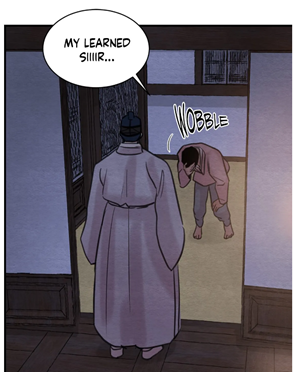 , although here the low-born hallucinated that it was the scholar; episode 29: Jung In-Hun led him back
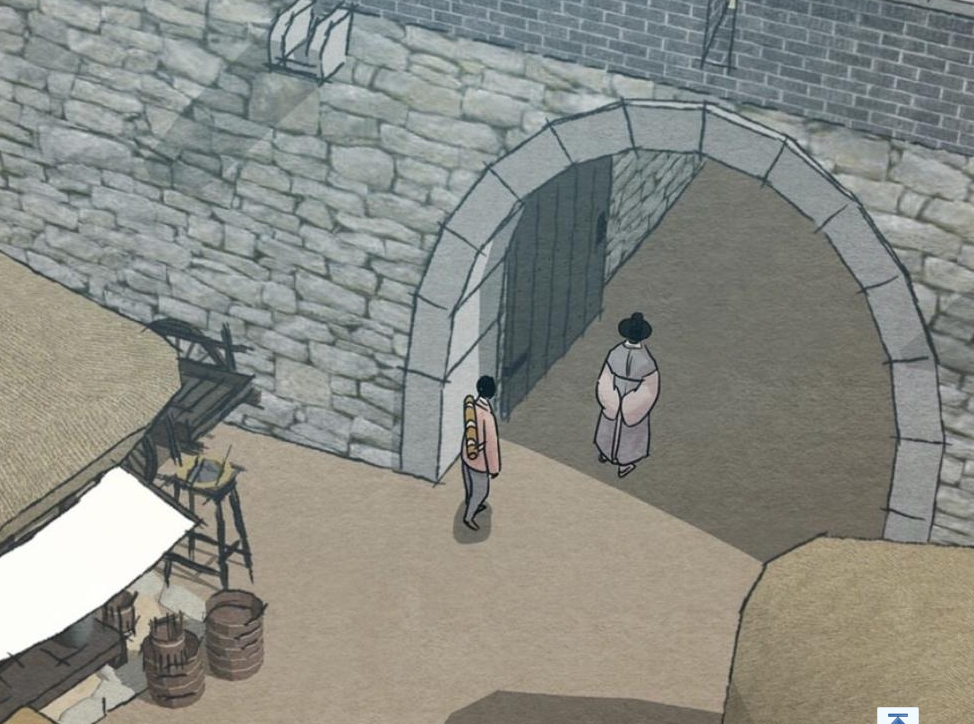 ; chapter 34: Seungho
 ; chapter 35 the teacher closed the door in front of the commoner
 , chapter 41 Seungho again but this time the door is left open
 ). In only one case, we witnessed him opening the door but here he had been forced to enter the lord’s chamber
 due to the protagonist’s thread. At no moment Byeonduck showed us the painter opening himself the door because he really wanted it. When he escaped in the chapter 29, he only appears in the street meeting the teacher. Moreover, Baek Na-Kyum stood either in front of the door or behind it. I would say that this characterizes the painter’s lack of freedom and passivity. He was never master of his own destiny. This is important because the image from the chapter 46 illustrates the artist’s determination to escape but simultaneously the acceptance of his own sexual orientation. He is no longer hiding it but the fact that the man just opens the door slightly indicates a certain discomfort and embarrassment. For me the positive aspect is that he acts on his own, he is no longer forced to hide or admit his homosexuality or to stay at the mansion. He chose to leave and this was his first true choice for a very long time. In the beginning he was dragged to the mansion, then he was stopped by Yoon Seungho in the chapter 4. Later he was persuaded to return by the fake scholar. He never had the freedom to choose for himself therefore we never saw him opening the door himself willingly. Therefore you can understand why I am not so sad despite the sorrow exuding from the chapter 46. Here he shows a strong will like he did in the past, when he was courageous enough to defy and even criticize the lord.
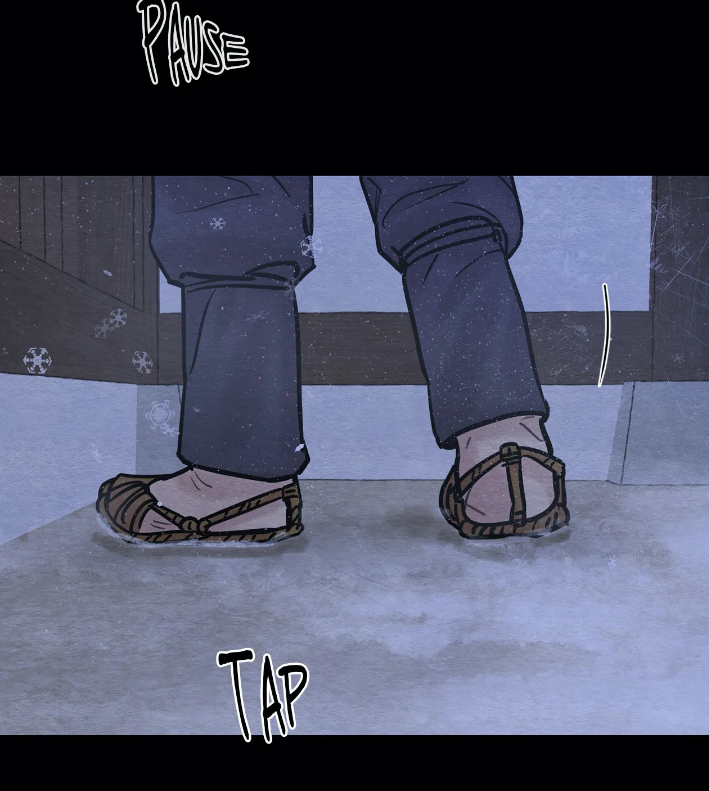 We had images focusing on the hand or the gaze but never on the feet. This is no random, Byeonduck wanted to tell us something through the zoom on the feet.
 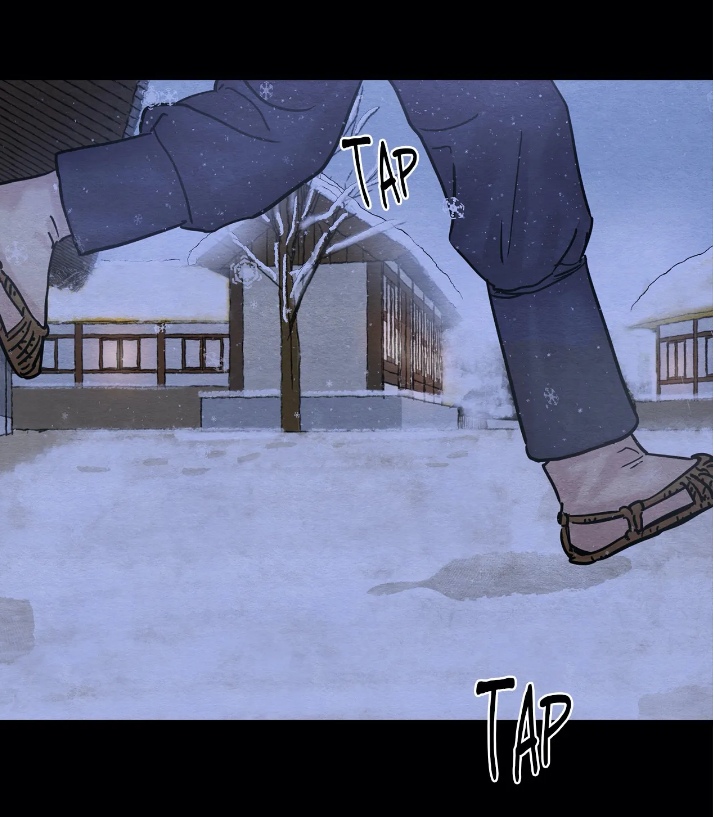 The second relevant detail is the chronology of the drawings. First, she pays attention to the painer’s feet, then to his head with his thoughts.
  The alternation between images of the feet and the artist’s thoughts exhibits the instinctive decision of the painter. He might be resolute, yet his feet are guiding him. He is just following his intuition and this is something more spontaneous than a well planned escape. It was as if his feet were carrying him somewhere else. Notice that first his mind is associated to black insinuating that his mind was blank. He couldn’t really ponder about this decision. This sudden and instinctive decision lets him run away. However, while his feet are leading him away from Yoon Seungho’s home, he realizes that he needs to find a shelter. Only then he starts thinking deeply about his destination.
 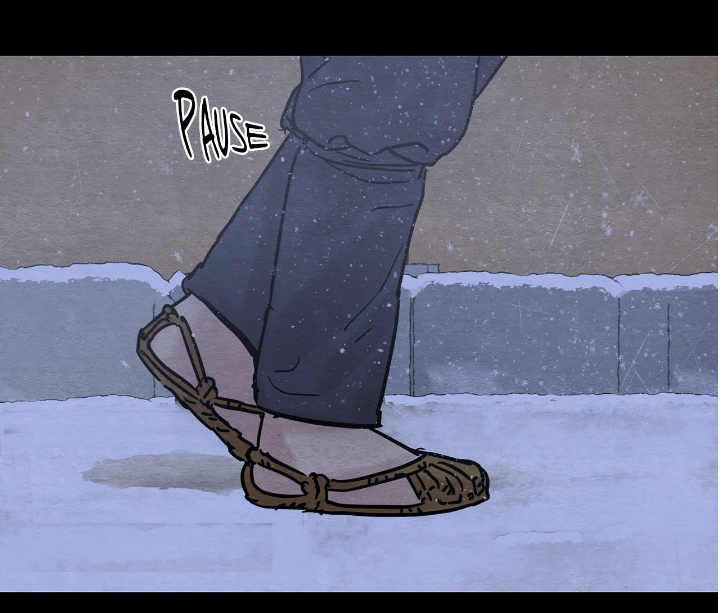 That’s the reason why he slows down as the more he ponders, the more he gets aware that he has no place where he could find a shelter. He is truly alone. That’s why he stops in the street. This represents his ultimate escape and his resignation.
  He feels abandoned without a home. Striking is that there is no door stopping him. Although he is free, he has the impression that he is still “imprisoned” as he has no home where he can seek refuge. The author revealed through the choice of the images that Baek Na-Kyum made the decision to leave because of his instincts. Nevertheless, this flee ended with the heartbreaking realization that either his mother or the teacher had abandoned him for good.
 Then the last words spoken by the head-gisaeng resurface which triggers in him the memory of his adoptive mother’s gesture, the caress on his cheek, while he is crying.
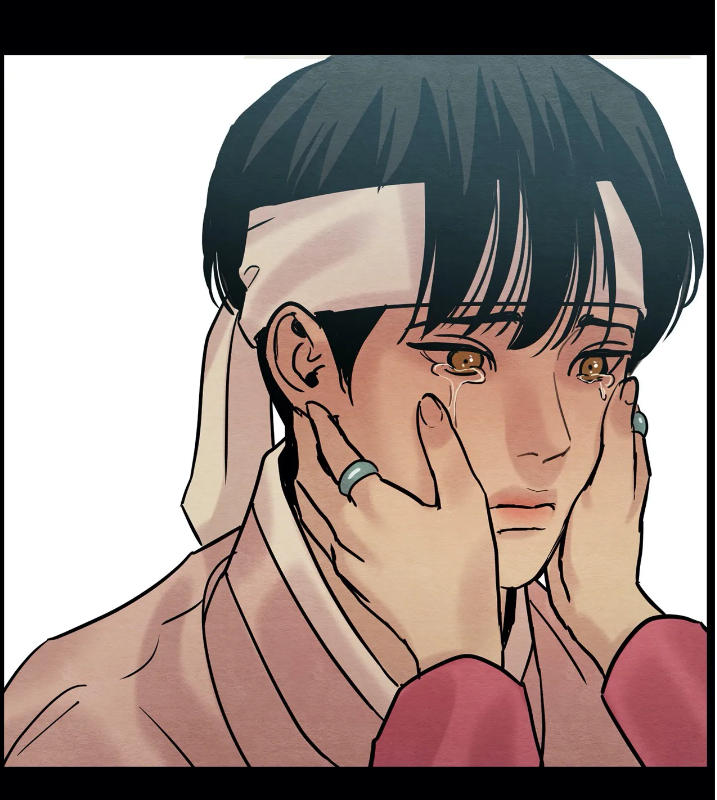 This is quite important because it is the pain that Baek Na-Kyum remembers the most.
  As much as the past affected him and his escape, it does have a positive effect. He might have resigned initially but he is now turning his mind and eyes towards the master. This is a good change and this will alter his future.
 in another essay. However both were influenced by the perception he had about Yoon Seungho and his attraction for that noble. In the analysis, I had pointed out that they reveal his repressed sexual desires. Nonetheless, the manhwaworms are well aware that Baek Na-Kyum felt that the lord was attracted to him, and he sensed the lord’s desires. Interesting is that these “illusions” became a reality, since the master became the painter’s sex partner and “husband”. Striking is that our artist is far from happy because his dream was to become the teacher’s bride.
  He would like to become rich and powerful like Yoon Seungho, the latter serves as example. Since he considers himself as morally upright and more educated, he has the impression that his dream will come true soon. He received such a good offer from the famous hell-raiser after all, even without working hard and using his knowledge.
  Let’s face it: the teacher could have achieved greatness by becoming a good and exemplary teacher so that the commoners would have come to admire him. This kind of fame could have reached the ears of an influential official. But the scholar never considered it as an option, because he disdains the commoners. As he feels superior to them due to his title, he didn’t want to rely on them for his career. For the low noble, it’s important that on the surface he achieves greatness on his own. What I mean with it is that he doesn’t want to share his fame and admiration. So on the one hand he imagined that he needed the help of an influential noble, on the other side he envisaged that once he got a high position in the government, he would be able to cut ties with Yoon Seungho so that only his name would get connected to that powerful government post. Once in position, Jung In-Hun could threaten his sponsor in case the latter refused to follow his request. He thinks so highly of himself that he doesn’t realize his own shortcomings. He’s not intelligent and cunning enough to perceive the protagonist’s raillery and empty promises
 (chapter 7). He never anticipated that the lord would do something like that, while he had already imagined that his promise to support the lord would be just an empty promise. As a conclusion, fate and entitlement explicate why the teacher didn’t get famous in the past and why he is destined to fail.
 , he had the impression that he understood him. He imagined, his childhood friend would only hate and resent his own family due the father’s abandonment and betrayal. He wasn’t sharp enough to perceive that Yoon Seungho saw beyond his family’s wrongdoings. Besides, he never got to know what truly happened to his childhood friend, as he was informed through Kim. For him, nobility was the real cause of his own suffering. First he got betrayed by his own family, sold as a concubine to the king, and when one of the aristocrats betrayed his family for his own benefit, the main lead’s father chose to backstab his own son and blame him for everything. Consequently, in Seungho’s eyes, nobility is a synonym for treachery, cowardice and selfishness. What Jihwa judged as common denominator represented in reality the barrier between him and his childhood friend. Yoon Seungho could never love someone from the aristocracy, though the main character has no idea about it.
 (“I’m so happy, my heart is so full”) Although the latter said nothing, he felt the same hence he kissed the painter’s eyes so tenderly. Consequently this night symbolizes the moment where the main lead realized that love did exist and he could obtain happiness too. Since he was well aware that the love confession was addressed to the intellectual, he decided to work hard for his own dream and happiness.
  “I like-My lord”. He must have felt that he got closer to his goal. He was definitely surprised but it moved him that’s why he ejaculates soon after.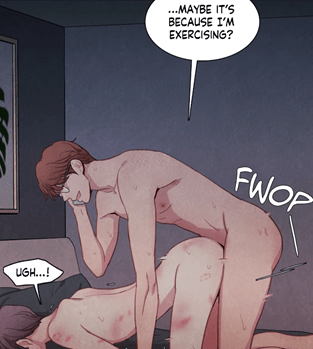
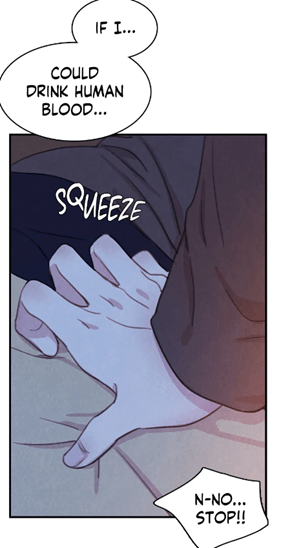

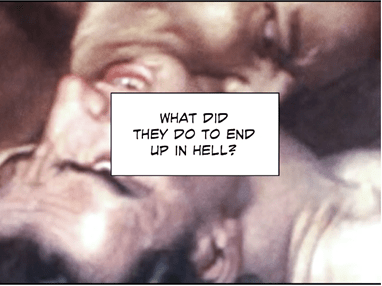
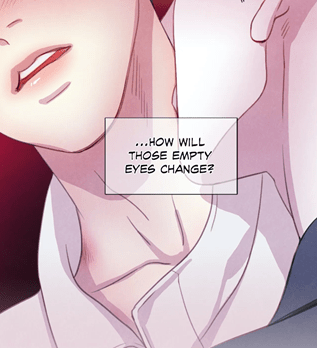
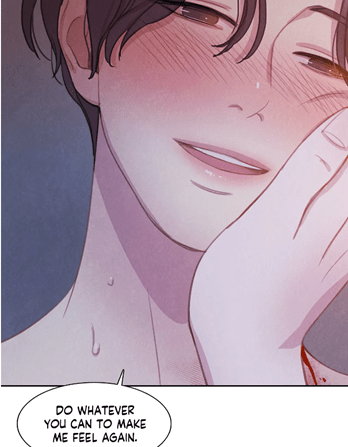
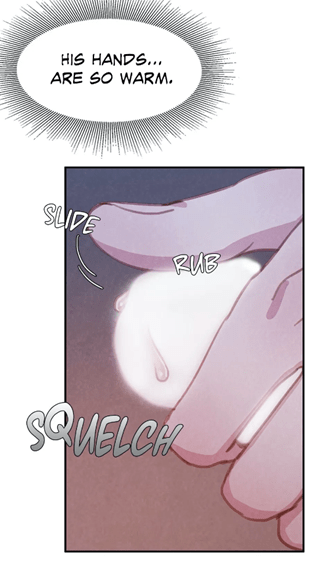

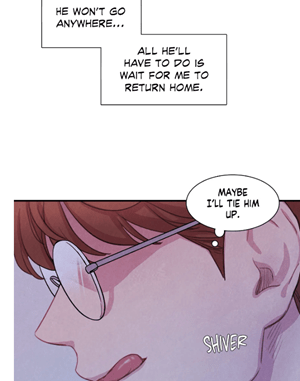
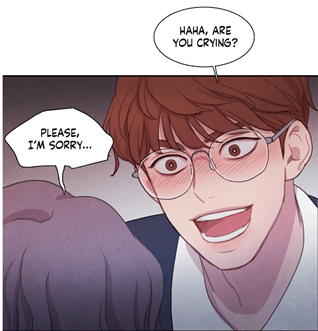
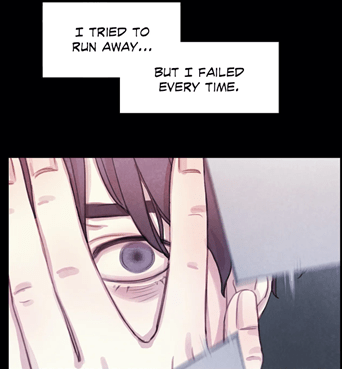

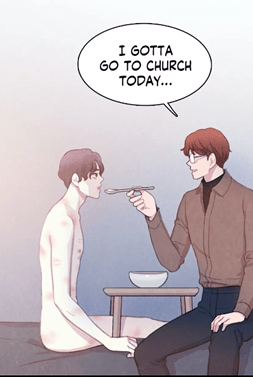


 He showed no empathy for him due to his sexual orientation. When we recall the uke’s question about Park Chi-Hwan, if the latter is a human, a person or a monster, the readers should apply this to Sungha. Is he a person, a human or a monster? The reply is quite obvious: Sungha is a monster, a parasite sucking on Sooin’s misery. This explains why the main lead’s body is covered with marks and bruises. These are the evidence of Sungha’s perverted nature, his monstrosity.
 I doubt that he was lying to the painter, when he threatened him in the chapter 11.

 Therefore the sex sessions with the seme were a sort of prostitution. They approached him for their own interests, however the main lead was aware of that and chose to humiliate them with his sex sessions. That’s why he abhors prostitution and was happy to have found someone so pure. Now, you realize the importance of the hearsay. The nobles are the ones spreading these rumors about Yoon Seungho. He is uncultured because he does commerce and deals with commoners. They need to spray this gossip in order to keep their dignity and remain honorable. They use grapevine in order to tarnish the main lead’s reputation as they can’t accept that they have to lower themselves in order to get what they need from the protagonist.
 As you can detect, the hearsay is among the young nobles and the red-haired lord is trying to use this as a weapon to weaken the rich master. This doesn’t surprise us that the seme refuses to submit to this kind of pressure and even replies that he will make sure that this rumor will become true.
  This would ridicule more the young nobles. Right from the start, the rumors are a weapon of the nobles targeting the protagonist. Consequently, the manhwaphiles grasp better why in the second season Yoon Seungho is also using gossip among commoners to get support, to change his reputation. He is a transformed man. At the same time, it outlines how powerful and influential Yoon Seungho is. He is not seeking for an official post because of his traumatic past, yet he learnt due to his bad experience that he needed money to protect himself and through his fortune, he could create his own network without getting too close to the government. This also explains why he hates nobility and even feels closer to merchants and commoners. This arrogance among the nobility towards Yoon Seungho doesn’t surprise me at all. In France before French Revolution, the bourgeoisie was also despised by the aristocracy, although the high bourgeoisie was even richer than some old families among the nobility.
 When he says “our”, he is actually speaking about himself and not his other relatives.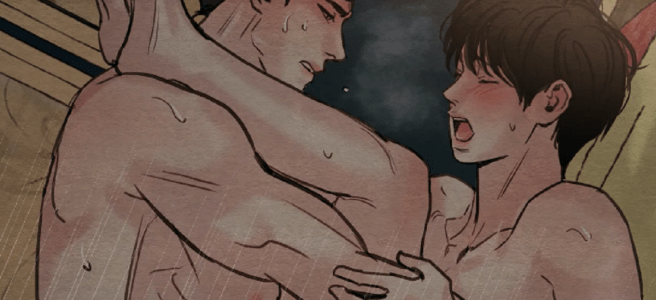
 A duck is not considered as beautiful per se but we have the fairy tale of the ugly Duckling. Here, in this story, the ducks are conceited and perceived themselves as pretty compared to the baby swan (vanity). Furthermore, in this fairy tale the ducks are excluding a family member because of his different appearance, just like in the manhwa. Yoon Seungho got abandoned by his father and his brother. In the ugly Duckling, the duck represents the family and their intolerant behavior outlines the strong bond between the ducks and their babies resembling them. Seung-Won is indeed supported by his father, the former even speaks for the family.
  The duck symbolizes the family and this isn’t surprising, when in Korea, couple of ducks are offered for a wedding. One of the purpose of marriage is to continue the family heritage.
  He is sweating and avoiding his older brother’s gaze. Then his hands are on his knees showing his discomfort. Yet he has no problem to lie about the father’s illness and to suggest Yoon Seungho to visit his parent, well aware of the significance of this visit. He is quite arrogant to think that his brother wouldn’t catch the meaning behind this visitation. He is underestimating the protagonist because he believes in the rumors that Yoon Seungho lives in debauchery. He has the impression that his older brother is not so smart, however the way his suggestion is rejected reveals that Yoon Seung-Won knows very well how his brother became a famous sodomite.
  This shows that the brother is neither cunning nor smart. The duck is not considered as a smart bird, compared to the magpie or the eagle.
  We have to envision that he even avoided to meet Yoon Seungho personally, until it became absolutely necessary due to the urgency of the matter. We should remember that the latter didn’t support his brother the moment he was abandoned by the father, he preferred following the father.
 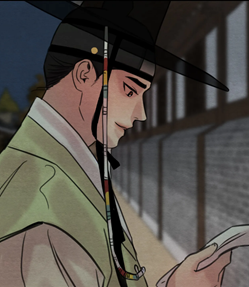 Look at the figure’s smile, he thinks that his move did succeed, whereas there is only raillery coming from Yoon Seungho. The latter remembered the words expressed by his loyal assistant the same morning.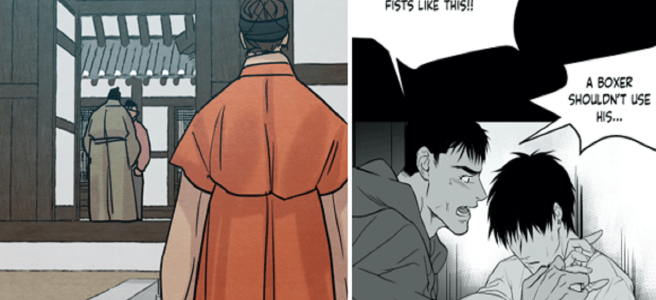
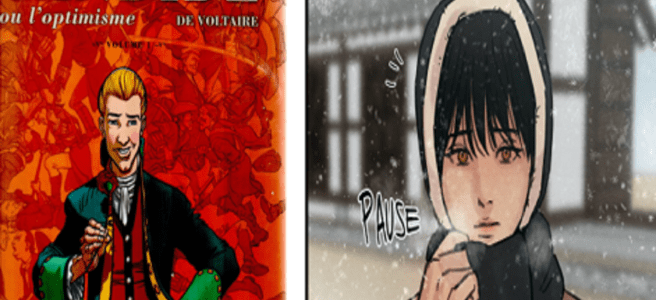
 The mirror helps him to witness his own arousal. Furthermore, in the chapter 42, he finally confesses that their first night together did affect him.
 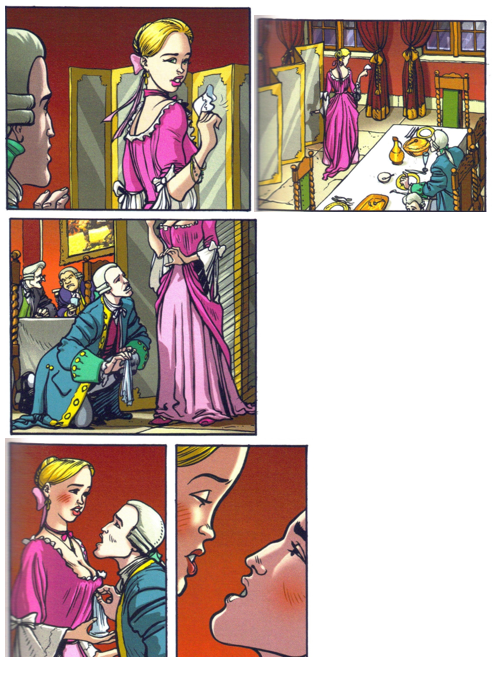 The reason for her behavior is the following. Cunégonde had witnessed in the woods, how the tutor Pangloss seduced a maid and decided to apply this new teaching onto our naive protagonist. Now, I am showing another drawing from the graphic novel:
 This is what Pâquette is saying: “Oh Master Pangloss, flood me with your knowledge.” In the next picture, she even adds: “How sweet is your teaching!” I am quite certain that you can sense the humor in this situation. We could call this sex education (LOL!).
 Baek Na-Kyum became the victim of an injustice and was punished by Yoon Seungho to the straw mat beating.
 , he could see Yoon Seungho’s exhaustion, vulnerability and real concern for his health.
 This explicates why the commoner decides not to betray Yoon Seungho and to lie to Jung In-Hun in the chapter 38. With his own eyes, he recognized the lord’s fatigue and weakness that’s why Byeonduck gave us each time a picture of the painter reacting to his observations.
 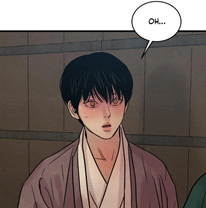 (chapter 35)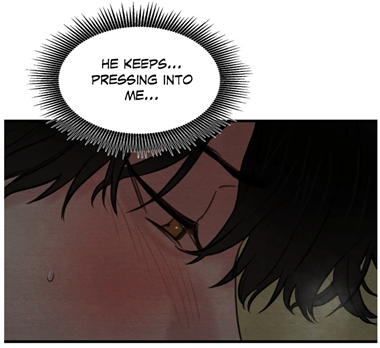
 As a first conclusion, Baek Na–Kyum’s apprenticeship looks a lot like Candide’s. At the end, he is no longer delusional about Jung In-Hun’s feelings for him and has been able to reject the teacher’s false preaching. He will now go his own way and has already abandoned his former teacher for real.
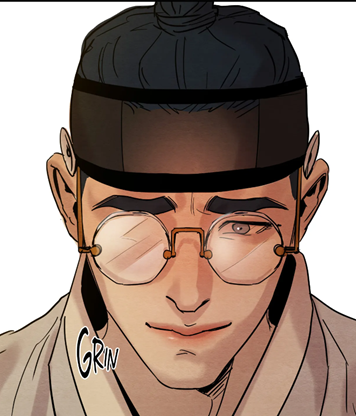 As a first conclusion, their respective personality is really similar.
  because the commoners should remain in their mountains and accept their conditions.
  Their fate is already determined, just like Baek Na-Kyum was fated to become a prostitute.
 After getting cured from syphilis, Pangloss loses an ear and an eye, increasing his blindness and deafness to the reality of the world. Let me remind you that glasses symbolize lack of foresight and judgement. That’s why Pangloss never changes till the end. He spent too much time living in his own world and his books that he is not capable to learn through experiences and observations. Jung In-Hun takes exactly after the former tutor. First, he has never mingled among scheming and treacherous nobles before, since he lived in the countryside among commoners. Besides, he only had his library to cultivate his knowledge as he refused to meddle with low-born. That’s why the low noble is either seen wandering in the mansion and on the streets alone or standing close to books. He has no real interaction with others.
  He has no idea what awaits him at the capital. The protagonist warned him but the latter didn’t comprehend the message or was unwilling to take the advice. He is too ambitious and arrogant to envision this possibility.
  And the powerful lord reminded him once what it means, when you get sponsored. You are not allowed to speak ill about your benefactor and you should know your own status. However, the scholar didn’t learn his lesson, blinded by his hurt pride and the suffered humiliation. Therefore I predict that the scholar will remain unreformed, although he has already dropped his doctrine about homosexuality for good. Like I said before, his immorality and duplicity are becoming more visible. Yet, his arrogance, his stupidity and his selfishness will be the cause for his own downfall. Pangloss found a refuge thanks to Candide as the former never schemed against the naive protagonist, he was just a stupid scholar, victim of a false belief.
  Besides, I have already shown in different analyses that the low noble has started acting like a pimp and a whore. That’s why we could say that sex has now become a part of his life.
  His passivity, reflected through his smoking, does somehow remind me of Martin’s attitude, although I have to say that Martin’s behavior diverges a little, the latter was not totally passive. He helped Candide and Pangloss with good intentions, yet he has the tendency to expect betrayal from anyone. And the source of their mistrust and negativity is their bad experiences. Both characters experienced betrayal and abandonment, therefore they have this negative attitude. Notice that the lord still refuses to meddle with politics and officials showing that he only sees government as a source of evil. This is normal, as he was used and betrayed by nobles. Just like Candide observed, having ambition is not source of happiness. Power can lead to misery as well. The French man witnessed the downfall of kings. Seungho thinks like Candide. However, the former is not able to realize the possibility what comes with a high post, he could change the situation of commoners, promote education among the low-born. It seems that Yoon Seungho’s wealth is also connected to trade as well, like he implied in the chapter 22. Martin never changes like Pangloss, however we know that this is not true for our beloved aristocrat.
 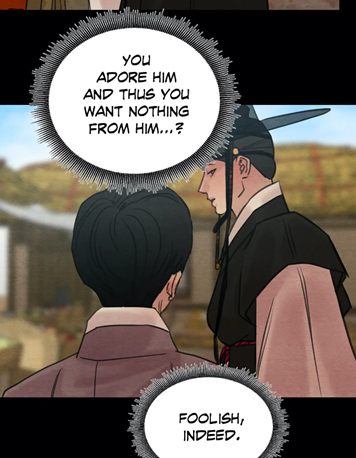 He arouses Baek Na-Kyum’s critical thinking, he admires the painter for his talent hence we could say that he advocates work. Notice that he is the one asking the artist to paint for him. He forced him to work again. Until their first meeting, the low-born had become a drunk and was not happy at all. So his social status as low-born was never a problem for the aristocrat because he recognized the painter’s real value. I would even add that he did admire the commoner for publishing erotic paintings and becoming successful. Baek Na-Kyum did want to change his situation through his talent and his passion. The seme doesn’t care about gossips, about social status and order society. In fact, he abhors nobility. Moreover, he is even willing to change his position and become the servant in his relationship with the painter. Finally, he isn’t averse to promote education for commoners which was detectable in the chapter 6, when he mocked the low noble


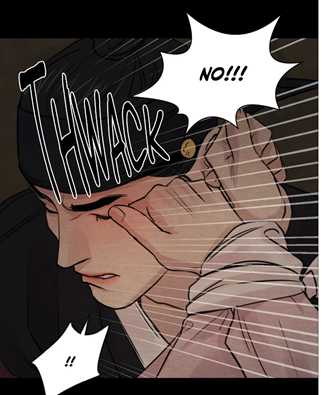 The scar or wound is visible from the chapter 25 to the chapter 32.
 In fact, they have the opposite effect. Instead of retreating, he retaliates immediately with composure. Striking is that the person involved in the dispute is never hurt personally illustrating that the protagonist is always in control of the situation. He shows no emotion at all, he is quite levelheaded. This outlines that during all these altercations, he was not harmed once.
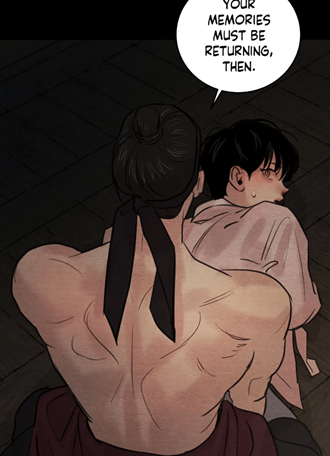

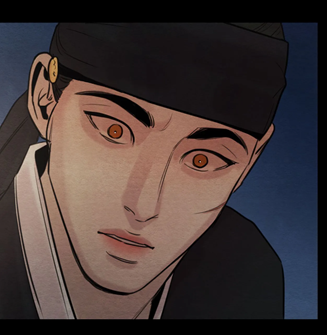 Baek Na-Kyum is not attacking the man with a bad reputation but the person in front of him: “you, sir!” The seme is literally left speechless as the reproach is correct. The aristocrat can’t deny the truth, he knew that the love confession was addressed to Jung In-Hun. Since he can’t refute this point, he needs to hurt the man physically.
  He pushes his head to the floor in order to shut his mouth. These are definitely the words he didn’t want to hear, since he wanted to become the loved one. He doesn’t want to admit defeat and keeps fighting. He is determined to win this fight that’s why he chooses to force himself on the painter. He is definitely not thinking clearly revealing that in this moment he is not two steps ahead like in the past. Observe the difference in his reactions. The low-born is the only one who is able to batter Yoon Seungho. That’s why the scar on the face is so significant. It embodies the master’s injuries.
  As a conclusion, even when he forced himself on the low-born, he didn’t win the fight. The painter kept thinking about another man in his presence. Yoon Seungho acted more on his instincts, he had the habit to perceive sex as a fight, hence he chose to treat this like in the past. Yet, it ended in a disaster. Therefore we can clearly understand why later the protagonist reflected on his behavior at the pavilion. He had never behaved like that during an altercation: losing his temper, letting his emotions taking control of his mind.
  The lord is showing more concern towards the painter’s face and eyes than to his own face. He even prefers wiping the tears on Baek Na-Kyum’s face.
  I interpret this scene the following. The master’s own injury and pain signify so little compared to the artist’s pain mirroring the deepness of his feelings for Baek Na-Kyum. Furthermore, I sense that he could have viewed the scratch as a sign of a small loss, as a reminder that he had been battered for the first time.
  The protagonist sent his own valet to treat the painter’s injury.
  On the other hand, when the valet Kim mentions the graze on his master’s face, he looks like lost and later the servant even receives a deadly gaze. So this shows that the noble is well aware of the existence of this wound but prefers not treating it.
 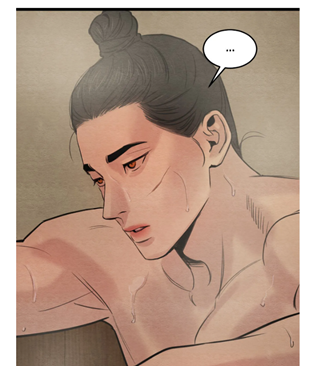 While he is taking his bath, he even remembers the events at the pavilion revealing his pangs of conscience. This underlines that he doesn’t care about his appearance and his own pain. Hence I conclude that he never treated his wound. Why? Like I mentioned above, he could have perceived this as a reminder of his first loss. Another possible interpretation could be that the lord was not admitting defeat. Treating the graze could be judged as a sign of retreat. Just like in a real fight, the aristocrat considered it as a small injury so that the battle was not lost in his eyes. Despite the terrible agony, Yoon Seungho was still fighting for the painter’s acceptance and love. He wanted to become his lover. Notice that the last time the readers can observe the scratch is in this picture. (chapter 32)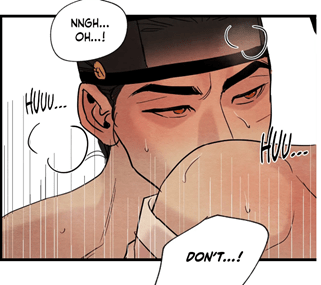
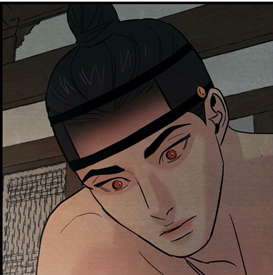 Therefore the lord’s gaze reveals his shock and negative inner emotions. He finally grasps that he might have been able to defeat the painter physically but this struggle could cost the artist’s life. All this coincides with the disappearance of the scar. The self-reproaches symbolize that the nature of the wound has changed, the scar was just the beginning of the lord’s transformation. Now, he is forced to pond and reflect on his bad actions. He tried to bury his remorse by having sex with others (chapter 33/34) but simultaneously he did think deeply about the reasons why he had acted so differently from all the previous quarrels and why he was so obsessed with the painter. The challenge with Min was the trigger for the lord to return to Baek Na-Kyum’s side, he preferred facing an infuriated man than losing his “possession” to another.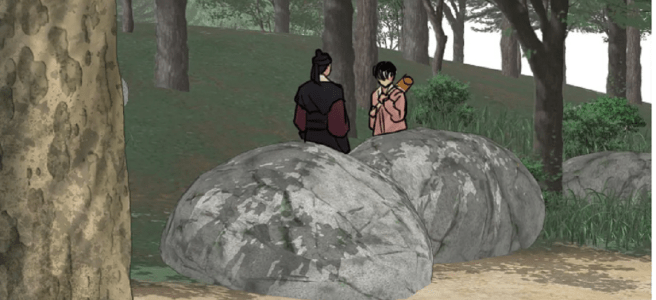

 Imagine what this scene represents to him. He has finally caught the attention of a strong backer through a trick and now he can to leave the shady place he was living in and live like a real noble. He can finally distinguish himself from the commoners he despises so much. Yet, he judges himself as smart enough to think that this proposition isn’t for free. So the offer sounds so good because the only request Yoon Seungho has is that the poor noble returns the favor, once he has become an official.

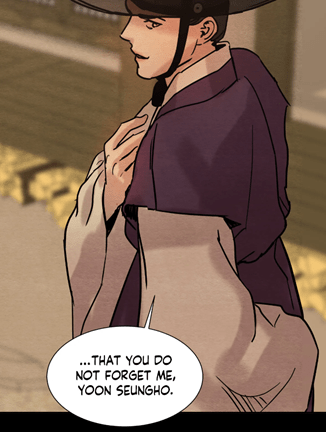
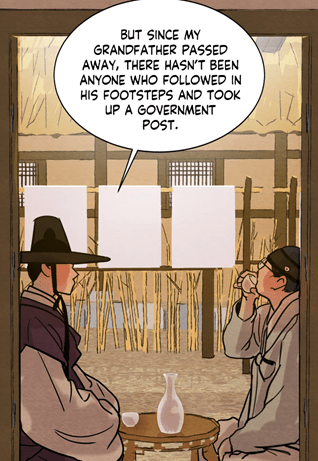
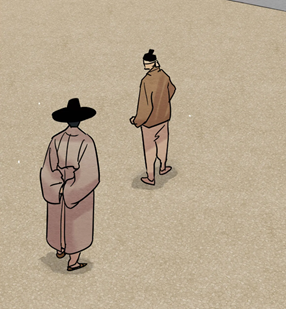

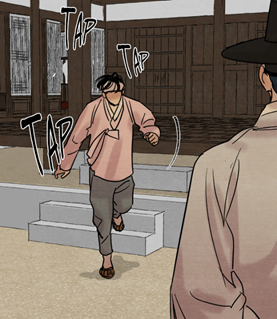 He is so happy that the low noble decided to call on him and can’t restrain himself to ask for a confirmation.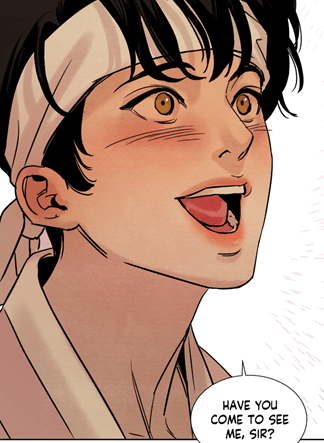
 There is no mutual admiration and respect. The poor aristocrat abhors the idea of being touched by a commoner. Besides, we shouldn’t forget that his ego has been so amplified by the aristocrat’s fake praises the day before so that his arrogance and his disdain for low-borns has deeply increased. At the same time, he is reminded through the hard way that this is all thanks to the low-born that he could get such a good offer. So his self-pride takes a hit. Fact is that Yoon Seungho is toying with the poor aristocrat’s feelings. The other reason to send the painter first is to let the teacher know that Baek Na-Kyum is also favored. In the chapter 6, he just told him that the low-born was a servant, yet the artist comes from the mansion and the master only joins him after.
 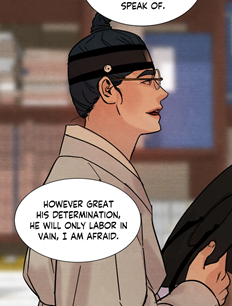 The loyal valet Kim is the one who leads him to his quarter and to the library. Right from the start, the teacher understands that Baek Na-Kyum is a hindrance for his own interest as he knows about the painter’s talent. If he remains at the mansion, then the other will be forced to work hard too. And he had thought, he just needed to rely on the noble’s generosity without working hard. However, he can’t expose his true thoughts right away, he needs to play the game, hence he stays courteous and even thanks the painter personally for the great opportunity.


 That’s why in the chapter 10, the teacher meets the painter and convinces him to stop painting. He uses his dogma in order to appeal to the artist’s guilt. If he is able to persuade the artist one more time to give up on painting, then his problem is solved. The powerful noble will only focus on him and he can enjoy the privileges linked to the favoritism.
  This shows the real value Baek Na-Kyum has in the lord’s mind. Furthermore, the learned sir witnesses how Yoon Seungho even caresses the painter’s cheek while complimenting him.
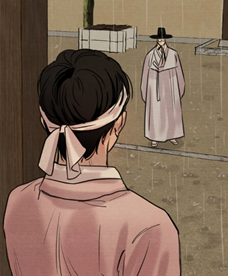 He discovers that the painter disobeyed his order and kept painting for Yoon Seungho. But for that, Baek Na-Kyum has to justify his disobedience. The low-born defends his action that he did it for the low noble’s sake.
 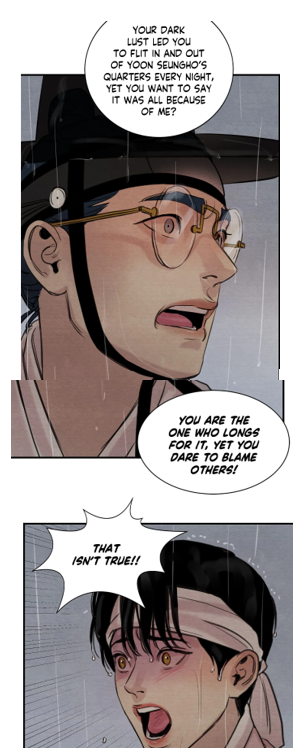 He implies that the painter earned the lord’s favor through immoral means (seduction, sex). He describes the artist as a man consumed by lust, whereas the former embodies honesty and purity. That way, he can reject the painter’s words. Based on his words, he is a honorable man, as he belongs to the nobility, while Baek Na-Kyum as a low-born is so perverted that he will do anything in order to get what he wants and to improve his situation. What the low noble is doing here is called projection. He is projecting his own mindset into the commoner’s. His criticism displays his true self: he is dishonest, lazy, corrupted and ruthless. Through his accusations, it becomes clear that for him and the readers, the end justifies the means. We already witnessed his scheming nature in the chapter 10. However, he failed and he is now attempting to put the blame on Baek Na-Kyum. He gained the lord’s benevolence through dishonesty and not hard work. Imagine the irony. Jung In-Hun wasn’t even working really hard until now which was shown in the beginning of the chapter 19.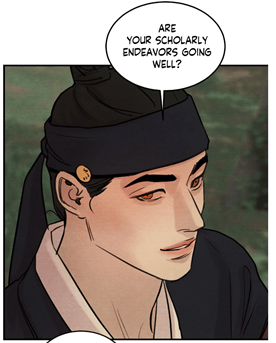


 He tried to impress him with a plagiarism but he never fell for it. The scholar doesn’t want to admit defeat and implies that because of the bad rumor about his reputation, he is not skilled and talented enough to judge his true talents. He refuses to acknowledge that such an aristocrat can judge him so poorly. He needs to prove his superiority in front of the lord, his ego can’t accept to be damaged like that by such a ruffian. However, the lord forces him to kneel in front of him proving him his strength and supremacy. He is not only educated but also athletic. He is much more than what the rumors describe him. And now compare this scene to the one in the chapter 7.
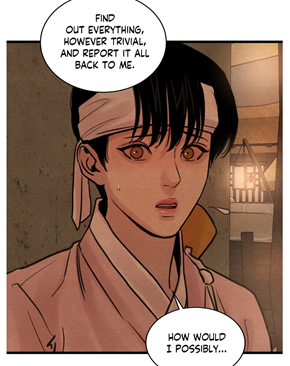
 He needs the latter to spy on the strong noble in order to blackmail him. Little by little, he is giving up on his dogma “sodomy is dirty and filthy” since he perceives that in such a short time, he has to use extreme measures. From my point of view, this is not just a matter of pride and humiliation. There is this sudden realization that he has been manipulated by Yoon Seungho and that if he fails the exam, the noble’s sponsor could end anyway. For the first time, he gets aware that he has to rely on his skills but the problem is that he never really worked hard in the first place. He thought that Yoon Seungho would deliver everything to him on a silver plate. This truly demonstrates that Jung In-Hun has somehow grasped that he might not be so smart and talented like he imagined, especially after getting a wake up call from the protagonist. So if the scholar fails, then the seme can decide to stop sponsoring him. That’s why the learned sir needs to dig some dirty secret so that he can blackmail the lord. Once he has found some info, he is sure that he has some leverage and can still benefit some privileges from Yoon Seungho.

 The very next morning, he pays a visit to the craftsman and even gives him some money so that the latter can ask around.
  Let us not forget that the man doesn’t possess much money and this proves how desperate and worried he is. He needs to discover some dirty secret about Yoon Seungho at any mean and as soon as possible to force the main lead to support him. In the best case, he could use it later against the wealthy aristocrat. Besides, he can not just rely on the painter’s trust. He even believes that if he uses Baek Na-Kyum as his whore, then he will get some info. That’s why he attempts to sell off the artist to the infamous sodomite. He witnessed the rape hence he knows that the lord is interested in the artist. Nevertheless he thinks that Baek Na-Kyum is just a plaything for the lord. So by telling him (chapter 30) that the painter only obeys the scholar, he finally believes that he has found a way to gain the noble’s support for real.
  Yet, due the painter’s intervention, this deal falls through. What the short-sighted noble fails to realize is that he would have been killed. He hadn’t internalized the warning during the hunt, he should know his place and never act as if he was on the same level than Yoon Seungho. We can feel the urgency of the low noble, he needs to find some leverage in order to get some privileges. That’s the reason why he resents the painter so much. For him, it seems like the artist has it easy. He just needs to sleep with the lord and that’s it.
 He is not just jealous and envious. Imagine that he is asked by the painter if he will be responsible for him in the future. Yet the teacher is not even sure if he can succeed with the examination. He was put under pressure the whole time. He is so uncertain about his own future and now he needs to be responsible for a low-born. That’s quite daring and insulting for the scholar. Simultaneously he had to witness how the commoner, whom he considers inferior to him, was able to gain the favor of the lord. So he acts on the moment, he feels that his big dream has more or less escaped from his hands so he abandons the painter. What he fails to realize is that the moment he abandons the painter, he will never be able to gain anything from Yoon Seungho.
 The irony is that at the end of the first season, Jung In-Hun believes that he can still use Baek Na-Kyum as his tool because he gets aware of the lord’s affection for the painter. Yet he has just cut ties with him. But for him, this was nothing important. He is not even aware of the consequences of his past behavior. What caught my attention is that we only see two flashbacks from the second character in the first season. Jung In-Hun’s first flashback happens in the chapter 7 and the second in the final chapter of the first season. Striking is that all the flashbacks are revolving around him. First, he is thinking about the proposed deal and in the chapter 44, he is recalling the protagonist’s behavior towards the painter because he is so jealous. He even comments that Yoon Seungho only talks about Baek Na-Kyum. The flashbacks indicates the lack of conscience and remorse, the egoism of the scholar. He can’t see beyond his own interest and horizon.
  First, the master is with the learned sir but he doesn’t follow him outside, whereas he welcome in the courtyard in the chapter 7. Now, there is no pretense and hypocrisy. The powerful master just sends him away with a servant. In the final chapter, we sense a certain despair in the scholar that’s why he asked the lord to accompany him to the capital.
 He wants him to pass the exam too so that he can be his companion or assistant, if the infamous hell-raiser succeeds. Notice that now Jung In-Hun is finally admitting that Yoon Seungho could be more smart than him. He even hopes that if the lord accompanies him, the scholar can attract the attention of other aristocrats and officials.
  However, the main lead refuses any suggestion from the teacher showing that the rich noble doesn’t care about him at all. Till the end, the low noble hopes that he can get some favor, yet he fails. Furthermore, he is warned that the officials might not be what the naive and scheming scholar imagines. Then when he is about to leave, he is reminded to take his leave from the artist.
 Nonetheless Jung In-Hun refuses to do so because he is just a low-born.
  So the scholar’s disdain for commoners from the chapter 7 is still intact, yet this time he doesn’t want to fake his admiration for the painter. He leaves without saying goodbye, although he realizes the master’s love for the artist. This outlines his arrogance and stupidity.
