

This is where you can read the manhwa. https://www.lezhinus.com/en/comic/painter But be aware that this manhwa is a mature Yaoi, which means, it is about homosexuality with explicit scenes. If you want to read more essays, here is the link to the table of contents: https://bebebisous33analyses.wordpress.com/2020/07/04/table-of-contents-painter-of-the-night/
It would be great if you could make some donations/sponsoring: Ko-fi.com/bebebisous33 That way, you can support me with “coffee” so that I have the energy to keep examining manhwas. Besides, I need to cover up the expenses for this blog.
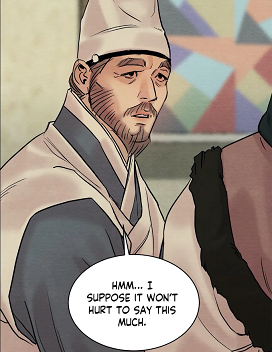
The chapter 67 caught me by surprise, because it proved me wrong in one aspect: Lee Jihwa is not like Baek Na-Kyum, in the sense that he is no orphan. The red-haired aristocrat has a father, an old-bearded man. (chapter 67) My first thought was: “Where were you all this time?”
I couldn’t help myself laughing, when Yoon Seungho barged into Lee’s mansion in chapter 67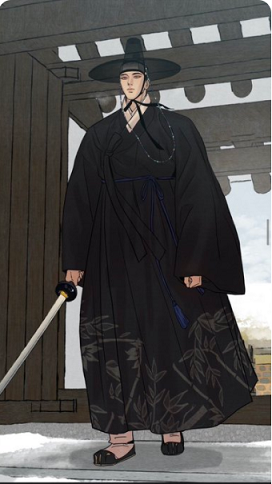 , because I immediately connected it to chapter 3, when the protagonist visited his childhood friend early in the morning. Back then, he barged with an erected phallus
 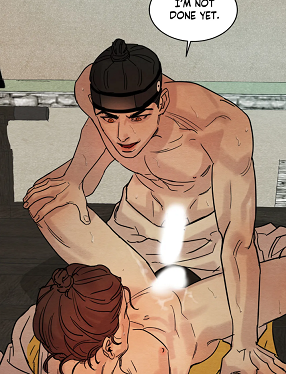 (chapter 3) and had sex with Jihwa at the pavilion, where both were not quiet at all. The red-haired noble kept even moaning.
  (chapter 3) Their intercourse was noticeable, but at no moment father Lee interrupted them. And now, the erected phallus was switched to a sword, and unlike in chapter 3, where the second lead was eager to meet his sex partner
 , the master chose to hide behind a windscreen.
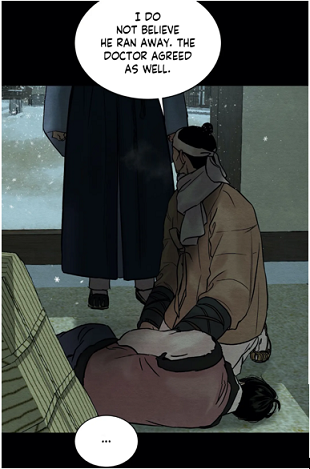
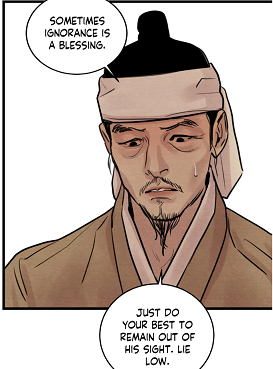
 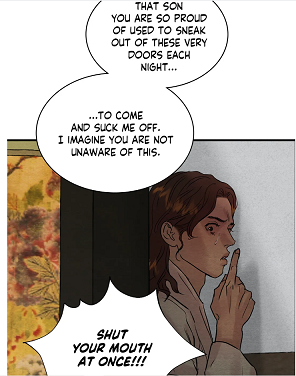 (chapter 67) However, this time father Lee intervened. Why all of the sudden? For the first time, his son caused a real trouble, because someone entered his house with a sword: a huge scandal! Furthermore, he must have realized that his son’s life was in danger, hence he had to intervene. The domestics couldn’t deal with such a powerful noble. And now, you understand why I couldn’t restrain myself from smiling, because the father Lee’s reproach sounded so hypocrite. (chapter 67) Where was he, when Yoon Seungho had sex at the pavilion? Why didn’t he intervene, especially if he sees the main lead as responsible for his son’s debauchery?
Because of this question, I was reminded of the song called “Papaoutai” from Stromae, a French speaking singer from Belgium. I am posting the video with the english subtitles.
In this song, the singer outlines the importance of fathers for children. However, he does it by criticizing their absence (Papaoutai = Papa où tu es?/ Papa, where are you?). Although this represents his main message, he also questions the role played by fathers in our modern societies. He points out that’s easy to become a father biologically, but being a father symbolizes responsibilities. He explains it, men don’t become fathers naturally, since it is a work process: “nobody knows how to make Papas” / Mister “know-it-all” would’ve inherited it, is that it? Does it come from sucking our thumbs, or what”. Moreover, for him many fathers don’t take their role seriously (“Genitors or genius, tell us who gives birth to irresponsibles”). The author exposes that a father needs to think a lot about his role as father. As a conclusion, the singer would like men to become more responsible for raising their children.
And it is time to return our attention to Painter Of The Night. Byeonduck utilizes her work to show the importance of fathers in sons’ life, as she exposes different types of negative behavior of fathers.
First, we have Father Lee. He only appeared after 66 episodes. His absence had given the impression that he was inexistent and Jihwa was an orphan. We could describe father Lee as ghost. And now, you understand why I chose such a title: Absence. What does it mean for children, when their father is not by their side?
Absence of parents is a synonym for parental neglect. What is child neglect exactly? There are 6 different types of child neglect:
- Physical Neglect or Deprivation of Needs Neglect
- Medical Neglect
- Educational Neglect
- Emotional Neglect
- Supervisory Neglect
- Environmental Neglect from https://www.kaplanco.com/ii/six-types-of-neglect
Many people think that this situation only happens in families with a low income, because it is related to physical and supervisory neglect which is more visible. However reality is different. We find neglected children in wealthy families. How so? The affluent children live in comfort, but they are often starved of love and affection (Emotional Neglect). This happens, when parents are too busy to spend time with their children. Therefore they hire personal to take care of their children or send them to boarding school. As you can imagine, Lee Jihwa is a child suffering from supervisory, emotional and educational neglect.
Since Father Lee relies on his servants to take care of his son, they are not qualified or responsible enough to care for him (supervisory neglect). Due to their lower status, they are not allowed to teach him or reprimand him. That’s why in chapter 9, only the servant asked Jihwa where he was going so early at dawn. Jihwa had not to justify his departure to his father. Then in chapter 41, one domestic finds the young man sleeping on the street, while looking for him.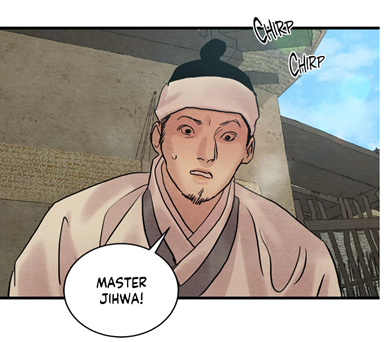 (chapter 41) He spent the whole night drinking and his father never asked about his whereabouts. He never showed any concern, as he has his staff to take care of him. In other words, he put the whole responsibility on the domestics. After confessing to Yoon Seungho in public, no servant shows up and takes care of him indicating that neither father Lee nor the staff heard about the scandal. Nameless was the one who was asked by the inn owner, if he could take care of the young noble.
  (chapter 59) He even gave him a dry robe and a home for the night. Since the servant only showed up the next morning in chapter 41 and he didn’t even appear during the night in chapter 59, it illustrates that the staff is more attached to the mansion than to the impulsive noble himself in truth.
This is not surprising that in chapter 67, the servant does his best to protect his master. Despite his rude behavior in chapter 50  (chapter 50), he is even willing to risk his life
 . (chapter 67) He simply follows his master’s request, as he feels, that’s his duty and lord Lee could ask for his accountability. (chapter 67) Amazing, when you compare it to Kim’s behavior. We could say that the staff does feel responsible for their young master to a certain extent. Why? I believe, they all know that father Lee doesn’t pay attention to his young son and they are now responsible for him. On the other hand, their care is limited, because they are domestics to the mansion. They are not obliged to give him the emotional comfort and the education he needs. As long as there’s no real scandal, then everything is fine in father Lee and the staff’s mind. Remember that in chapter 45, the town folks described the second lead as the “mistress”, showing that even they had noticed the lord’s movements, whereas father Lee has no knowledge about it.
 (chapter 45) That’s how isolated the father is cut off from reality and world. This is not surprising that his son resembles him, he also lives in his own world.
But what are the consequences of emotional neglect? I would like to quote a passage from a website in French (translated)
It can also be so because a lack of love and human contact hinders its development. In some cases, neglect traps the child in sensory isolation, slowly and continuously undermining his or her mind to the point where there is little desire to connect with others and explore the world. Thus, parental neglect is a terrible absence. http://educationsante.be/article/la-negligence-parentale-est-une-terrible-absence/
Remember how I had described the red-haired noble, before Nameless helped him to become more responsible: I compared him to a blind and deaf person  , which corresponds to the expression “sensory isolation”. Back then, I had imagined that he had been abused as well. I was wrong, since it was just neglect which I had already detected. However, the consequences of such a severe neglect are as terrible as abuse. Consequently, abuse and neglect are often considered the same.
Now, I will list how neglect affects the child’s personality (I won’t add to each characteristic a picture):
- Extremely low tolerance for frustration
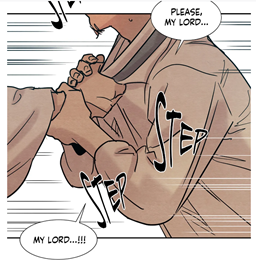 (chapter 13)
 (chapter 13); aggression
 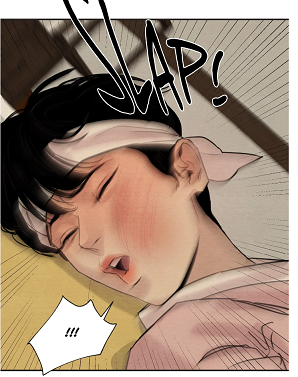 (chapter 17)
 - Sense of entitlement
 (chapter 51)
 - Lack of appropriate guilt
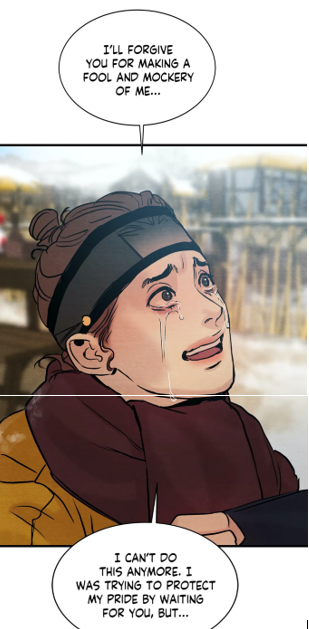 (chapter 59) In chapter 56, Jihwa sent a fake letter reminding Yoon Seungho of his trauma, yet he acts as if the other is to blame and shows no remorse. That’s why many children suffering from emotional neglect have problems with rules and laws.
 - Lack of coping skills: Jihwa is unable to accept any rejection or criticism. We could observe this in chapter 5, when the lord sent him away. He didn’t pay attention to the reason why Yoon Seungho couldn’t focus on him.
- Boredom
 (chapter 9)
 - Lack of purpose: This explicates why Jihwa was so obsessed to obtain his friend’s love. Since he has been neglected by his own father, the main lead became his “surrogate” father, who gave him attention because he criticized him and even punished him.
- Blaming others
 (chapter 57)
 - Reduced empathy
- Poor planning skills: When he enters Yoon Seungho’s mansion in chapter 17, he is not able to hide his frustration and starts assaulting the painter so that he creates a ruckus. That’s how Jihwa is caught. As for the kidnapping and murder, he left the whole responsibility on the commoner. He never paid attention to his actions and whereabouts. He believed the criminal and that was it. Sure, Nameless didn’t take advantage from Jihwa, but this shows that he relies too much on others. This is not surprising that the second lead listens to Min’s words and manipulation
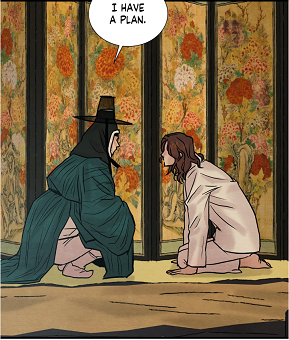 (chapter 67), although he had lied to him in the past.
 - Difficulties with competition: this explains why he uses tricks to act behind the painter’s back.
- Problems withstanding peer pressure quoted from https://www.paracelsus-recovery.com/blog/affluent-neglect/
- depression
- Anxiety
 (chapter 67)
 - Low self-esteem
- substance misuse
 (chapter 50)
 - shunning emotional closeness or intimacy: That’s why Jihwa kept waiting for the main lead’s confession. https://www.healthline.com/health/mental-health/childhood-emotional-neglect#symptoms-in-children
The effects of neglect are such that it leaves sequels on so many levels: socially, emotionally, intellectually and psychologically. Children exposed to neglect are at a greater risk of developing conduct disorders and of participating in delinquent behavior, which is visible in the red-haired figure: he trespasses proprieties, ruins a painting, he even had the painter kidnapped. Due to his scheme, the vicious servant Deok-Jae was killed. Then their knowledge and cognitive capacities are diminished, which is also perceptible in the young man. The latter is not able to recognize evil at all, hence he can’t detect hypocrisy and manipulations. And this leads me to the following observation: Byeonduck chose the monkey as an animal for Jihwa. The manhwaphiles can see the singe in the windscreen.  (red circle). Because of the character’s previous deafness and blindness, I immediately connected it to the wise 3 monkeys:
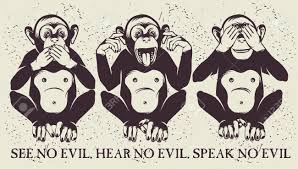
In Asia, the monkeys are considered as wise, because they represent proper behavior. Confucius says:
“Look not at what is contrary to propriety, listen not what is contrary to propriety and finally speak not what is contrary to propriety.”
In other words, the 3 monkeys serve as role model. One should behave properly by avoiding any form of evil. Since Min is the Joker, also visible in the windscreen (yellow circle), it explains why Jihwa has become such a bully in the end. Min became his role model replacing the father. Consequently, the red-haired aristocrat can’t recognize evil. That’s why Lee Jihwa appeared as a spoiled child with a delinquent behavior in the end. Byeonduck is displaying the extreme consequences of a father’s the absence. And this leads me to the next question: what is the role of a father in the end?
“The function of the father is to separate the child from the mother. He must intervene between the mother and the child to allow the child to develop his identity outside the maternal symbiosis” from https://www.psycho-ressources.com/bibli/fonction-pere.html
And now, the manhwaphiles comprehend why the red-haired noble has such a low self-esteem.  (chapter 67) This is is visible in this panel. The character can’t even stand. Min, the Joker and surrogate father, treats Jihwa as his servant and punishes him, because he had not followed his order. Jihwa has not entirely developed his identity, since he has always lived in his own limited world. A father has not only to provide security and comfort, he helps the child to learn self-control and boundaries. A father is associated to rules and should teach his child how to channel aggressivity. In other words, he serves as a role model for the child. But with the absence of a father, this is impossible. And since the domestics belong to the lower social class, Lee Jihwa always had the upper hand and could do anything: his father never appeared, when Jihwa was destroying his room with his sword in chapter 21. Besides, father Lee never paid attention to the friends his son had. He blames Yoon Seungho for his son’s debauchery, yet at no moment he intervened in the past. The main lead is correct to blame the father and put his son in a different light. (chapter 67) And now, the readers can understand the role Nameless is slowly taking over: he will be the father and lover teaching him how to recognize evil and even think critically. We saw Jihwa rejecting Min’s advice
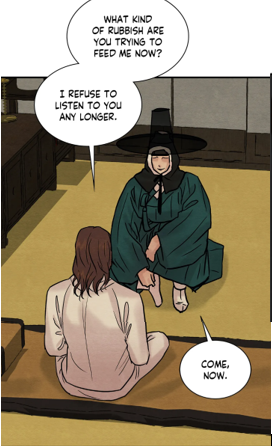 (chapter 67), but it was short-lived due to Yoon Seungho’s appearance. We have to assume that Yoon Seungho played the role of the father after the former had been abandoned by his own father. However, he could never assume this function properly, as he was suffering himself and couldn’t give him the emotional and educational comfort Jihwa needed. Let’s not forget that the protagonist chose to ignore his own feelings, to even numb them. Hence it was impossible for them to connect emotionally.
After discerning Father Lee’s behavior, I could easily portray father Yoon, who stands in opposition to father Lee. He is a controlling father using his sons as his pawns and tools for his own career. Here, I gathered the characteristics for a controlling parent:
- Interfering in nearly every aspect of the child’s life.
- Criticizing any choice a child tries to make independently.
- High, truly unattainable standards.
- Conditional love.
- Rigid (and unrealistic) rules.
- Lack of empathy and respect.
- Unreasonably harsh punishment. 8.
- Lack of appreciation for the child’s individuality.
- Expecting the child to act like a parent.
- Manipulation through gifts.
- Playing on guilt and/or shame. https://www.mindbodygreen.com/articles/signs-of-controlling-parents-and-how-to-cope-as-adult
This explicates why Yoon Seungho had been longing to see admiration and love in his father’s gaze, always hoping that at some point he would get it. The existence of the rules I elaborated is a proof of this abusive parent. And now, you understand why Father Yoon described his eldest son as ill, suffering from wayward yang.  (chapter 57) “wayward” is a synonym for rebellious indicating that Yoon Seungho had started questioning his father’s behavior and words. Simultaneously, I believe that the father judged his son’s behavior as too childish, thus he said that he had been suffering from an illness for a long time. The adolescence represents an important step in the child’s development. That’s the moment when a teenager decides to take his distance from his father in order to find his own identity. Since the main lead was described as intelligent, it was normal that the main character would decide to make his own decision and could sense his father’s flaws. Consequently father Yoon could only see the critical remarks as a sign of insubordination. This is not surprising that he blamed his son, when something happened due to Jihwa. (chapter 67) Since Father Lee never paid attention to his own son’s behavior, the former was more than pleased to hear that Yoon Seungho was responsible for an incident. Father Lee was following the rule:
But unlike before, this is the Western interpretation: he acts as if he doesn’t see evil or hear evil. He will never talk badly about his son. That way, he escapes any responsibility for his son’s failures. But like Confucius wrote:
“The father who does not teach his son his duties is equally guilty with the son who neglects them”.
From my point of view, father Lee will pay a huge price for his negligence due to his son. I saw in the chapter 67 a confirmation that Jihwa will cause a huge tragedy which ends with a terrible punishment. It is getting more probable that Jihwa will lose his title as noble 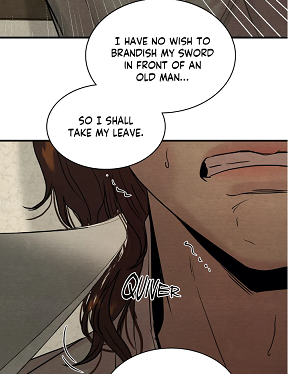 (chapter 67) and it is even possible that he gets a scar or a tattoo.
 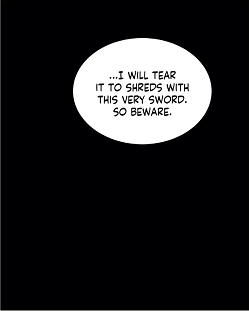 (chapter 67) This scene was important as it represented a new version of chapter 18. This time, the lord aimed at Jihwa’s face and the servant was not harmed. The main lead put the whole responsibility on the former friend.
But since I had described the role played by the servants in the Lee mansion, it is also important to take a look at the domestic’s function, when father Yoon was the master of the house. What caught my attention is that father Yoon has been also represented like a ghost, very similar to father Lee. However, while the latter represents lack of interests for the son, the other stands in opposition to this. He is everywhere due to his servants. All of them were asked to pay attention to his children and their behavior. In other words, he is also absent. The domestics must have reported him everything. And now, you can understand why Yoon Seungho kept his distance from his staff as the lord of the mansion. He didn’t want to be observed by them, that’s why he relied more on Kim in the end. With his help, he could maintain a certain gap and escape their “monitoring”. There is another evidence for this theory: remember that Yoon Seungho asked his servants through Kim to pay a closer look at Baek Na-Kyum, but they didn’t take his request very seriously. Hence the painter could escape the mansion in chapter 29. And you all know that the artist is reliving the noble’s past. This explicates why Yoon Seungho targeted the amateur spy in chapter 18, he was reminded of his own past. He could only get furious.
However, there’s another huge difference in the role played by Father Yoon’s servants. Since they only had to report to him, that means that they didn’t need to take any responsibility, as the lord was the one who made all the decisions afterwards. And now, you understand why Kim rejects any form of responsibility by saying 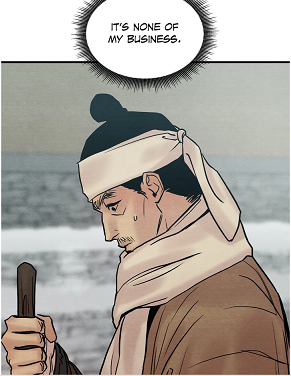 (chapter 65). Father Yoon put a lot of trust in valet Kim in the end, as he relied on his information. This is another evidence for me that Kim is responsible for the main lead’s suffering. Since father Yoon was relying on Kim’s eyes and ears, his perception got changed and this in a negative way. That’s how he became blind. He contributed to the terror ruling at the mansion, but since Kim was kind and caring, Yoon Seungho believed this illusion, while Kim was his biggest spy. I am quite sure that he played a major role, when Yoon Seungho got separated from Lee Jihwa and received his reeducation therapy. For me, there’s no doubt that his responsibility kept getting bigger, when he saw the main lead getting raped, and he decided to close the door and ignore the incident. He just needed to say that this was not his business. Another possibility is that he could justify his choice by saying that it was done for the main lead’s best interest. Let’s not forget that Kim was the one who presented the physician to father Yoon.
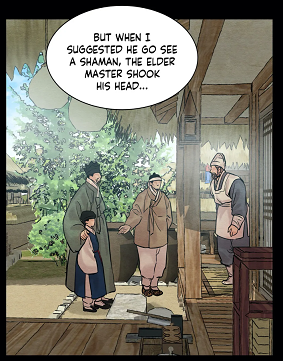 (chapter 57) There’s no doubt that father Yoon put all his trust in Kim. This explicates why Kim acts, as if he had the authority to give orders.
 (chapter 67) He must have developed this habit, because father Yoon gave him some power. Observe that he sometimes dresses like a noble
  (chapter 57) due to the hat and the robe. What caught my attention is that he acts behind his lord’s back, when the latter is absent.
  (chapter 68) Besides, since this story is based on the principe that history keeps repeating itself, then Yoon Seungho is making the same mistake like his father. However, Yoon Seungho will realize it thanks to the painter and the head-maid. Father Yoon put all his trust in his valet, unable to recognize evil in his butler. Just a reminder:
“The only thing necessary for the triumph of evil is for good men to do nothing.” from Edmund Burke
This is not just about silence and passivity, it is also about responsibility. Note that in chapter 67, Kim voices that he has been given the permission (chapter 67), so he is not assuming anything in case something happens. And in front of Heena noona and Baek Na-Kyum, he has the same attitude: (chapter 67) if Heena noona gets caught, then they can’t put the blame on him. He will feign ignorance. He has no idea how she entered the mansion. He is also applying the saying from the three monkeys:
He didn’t see or hear anything. He won’t tattle too. Nonetheless, he is acting only like that, when it concerns Yoon Seungho. It is a different story, when it comes to father Yoon. That’s why Kim still keeps thinking about his previous master. 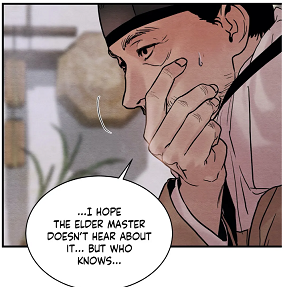 (chapter 57) By examining Kim again, I have to admit that I suddenly had this question: who gave the painting to Yoon Seung-Won? Did the valet act on the lord’s order?
 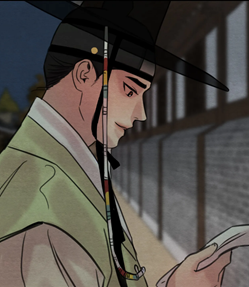 (chapter 37) Or did he decide to act on his own? Let’s not forget that during that evening, the valet had been reprimanded by Yoon Seung-Won for lying to him. It is possible that the valet chose to give the painting in order to put the blame on Yoon Seungho, as he feared that the young master could report his lie and behavior to father Yoon. The latter might not be present at the mansion, but there’s no doubt that he asked his trusted servant to keep an eye on his eldest son, whom he considered as a troublemaker. This would explain why the main lead keeps taking the medicine. And now, you can grasp why Kim is more loyal to father Yoon than his actual master. The latter gives him more freedom, yet he expects from him more responsibility. Under the ruling of father Yoon, the butler could avoid any trouble by tattling on the young master Yoon Seungho or by faking ignorance, when it was necessary. Since father Yoon put all his trust in the valet, he was not able to see evil or hear evil in the end. Kim framed innocents or he feigned ignorance. As a conclusion, Father Yoon was put in the same situation than father Lee due to Kim’s actions.
As a final conclusion, Byeonduck’s work exposes the huge importance of a father in a child’s development. Unfortunately many people still think that mothers are much more important than fathers. This explicates why in many countries, mothers receive more often custody of their child than fathers. Yet, the judges seldom question the mother’s abilities. The irony is that mothers are not per se good mothers, exactly like Stromae described it in his song, although he only talked about fathers: “Mister “know-it-all” would’ve inherited it, is that it? Does it come from sucking our thumbs, or what”. This applies to mothers as well. Being a parent means work, dedication and affection. There’s nothing intuitive.
Feel free to comment. If you have any suggestion for topics or manhwas, feel free to ask. If you enjoyed reading it, retweet it or push the button like. My tumblr-twitter account is: @bebebisous33. Thanks for reading and the support.

 He used his knowledge to hurt Yoon Seungho in the hope that the latter would keep him by his side. This was in fact a reminder that the protagonist shouldn’t change.
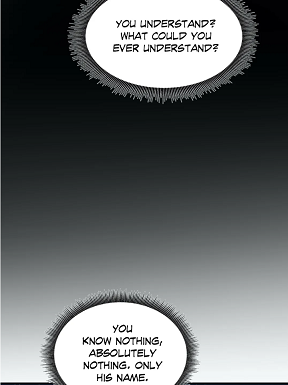 (chapter 59), he has the impression, he knows Yoon Seungho’s true past. He projected his own past onto his childhood friend’s. Yet, their suffering was different: father Lee neglected his son, while father Yoon was an abusive father. Besides, though he must have heard what father Yoon used his son as prostitute in order to save his own skin, Jihwa came to the conclusion that he knew the past and as such the truth.
 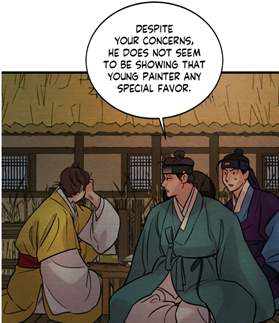 I suspect that lord Song is the origin of this misinformation and manipulation, because this would explain why Jihwa is so sure about his intelligence. He thought, he got his insight from the original and sure source. But let’s return our attention to the chapters 56 and 57. At the inn, Jihwa got chastised and battered for using his knowledge.
  (chapter 56)
 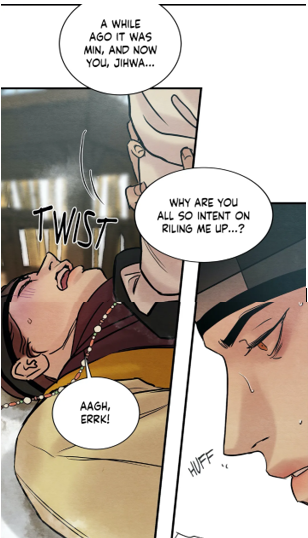 (chapter 57). What caught my attention is that although the noble described the friend’s action as a prank
 , the main lead was definitely so hurt that he had to hide his gaze from Kim the moment he received the letter.
  This exposes how vulnerable and wounded Yoon Seungho was, but how misinformed Jihwa was in the end. That’s why the protagonist can only reproach his former friend that he understands nothing, because his “knowledge” has been transmitted by someone else, exactly like in the Greek story: Prometheus gave fire to humans. As a conclusion, each time someone reveals a secret related to the past, this person will get sentenced sooner or later, like the new added illustration proves it.
  But this list of Pandoras doesn’t end here. There’s no doubt that Kim will resent him for the scandal, as his reputation and tranquility were ruined by the shopkeeper’s revelation. It is definitely possible that Kim is the one who retaliates, as he was present at the tailor shop.
 That way, he could “tarnish” the painter’s innocence in his master’s eyes, as the former represents a real source of uproar and ruckus in his life. Therefore I predict, Kim will change his mind about Baek Na-Kyum and decide to get rid of him: he caused him too much trouble. And my prediction came true: the butler tried to send away the artist through his noona, and he got punished for his action. The lord caught him usurping his position so that the valet ended up losing his master’s trust. Kim used his knowledge from the night of revelations.
 (chapter 64) He believed to have seen sexual abuse, while in the shed the noble confessed his love and hope one more time.
 Yes, the drug the main lead has been fed since his teens. Exactly like in the Greek story, the box is associated to disease, as the medicine is responsible for the protagonist’s illness, his hot temper.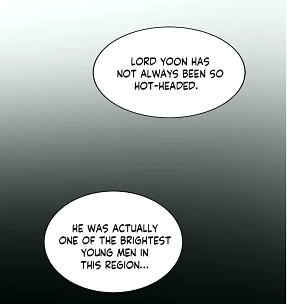
 As you can imagine, the opposite happened, exactly like I had foreseen. Observe that the moment he revealed his knowledge
 (chapter 65), the butler punished him by threatening him, making him believe that he would get killed, if the lord were to discover the truth. As you can see, he opened the pandora box in front of the valet and the latter chose to retaliate. That’s why I come to the conclusion that the physician will play a huge role in the future again. I think that contrary to the butler’s behavior, the noble will have a different reaction, when he discovers the truth. Besides, since he knows about his past, the physician will open the pandora box again. That way, the noble could hear about his past and the existence of the drug so that he has a different perception about valet Kim. There’s no doubt that the physician represents a pandora box for the butler. During the second season, he could still control him, yet he is still unaware of the revelations he confided to the painter.
  From my point of view, Yoon Seungho will envisage that there was an accomplice. That’s why I sense that Kim and the physician’s testimonies will be examined. Since both were present that night, the aristocrat can only suspect them. And since the physician revealed his secret to Kim
 , it backfires because of the painter. The latter brings up the topic about the lord’s illness in his youth and the medicine he has been receiving all this time.
  He had no idea about the real affect of the drug. At the same time, we shouldn’t forget that in chapter 33, Kim asked for an aphrodisiac without the lord’s authorization, which the physician noticed,
 because Kim only asked after the noble’s departure. Note that in that chapter, the physician gave the prescription in front of Yoon Seungho, and the latter only left, after he had heard the treatment.
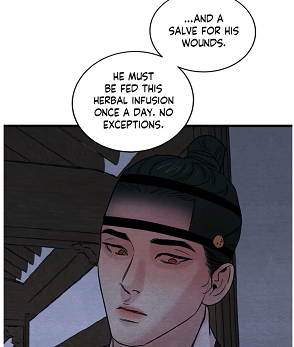 From my point of view, the incident in the first season will resurface, as it will be linked to the lord’s own medicine. It is possible that Kim and the physician tries to put the blame on each other. However, I believe that Baek Na-Kyum’s testimony will play a major role. The manhwaphiles should recollect that Baek Na-Kyum voiced his rejection of the infusion in front of the head-maid. He even described the effects of the medicine which also surprised the woman.
  As a conclusion, I believe, the head-maid will be the reason why Kim loses his master’s trust entirely. The medicine, the advice he gave to the physician and the fact that he kept giving a drug ordered by father Yoon, although he knew how the aristocrat treated him… there’s no doubt that Kim will lose his position as butler.
 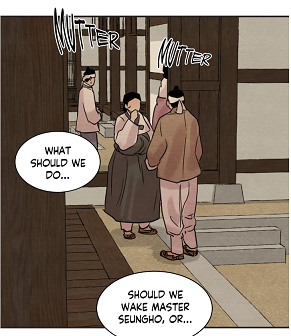 . From my perspective, her attitude changed, the moment she got reprimanded in chapter 38. Notice that right after that incident, Jihwa’s servant explained to his master that now the staff from the Yoon’s mansion would no longer leak anything. This is important, as he it shows her influence over the staff. She was also present, when Kim scolded Deok-Jae, but she said nothing. In my opinion, she was still relying on his authority and trusted him. Let’s not forget that Yoon Seungho started relying more on the maid, as the latter was given the order personally to bring the artist’s food to the low-born.
 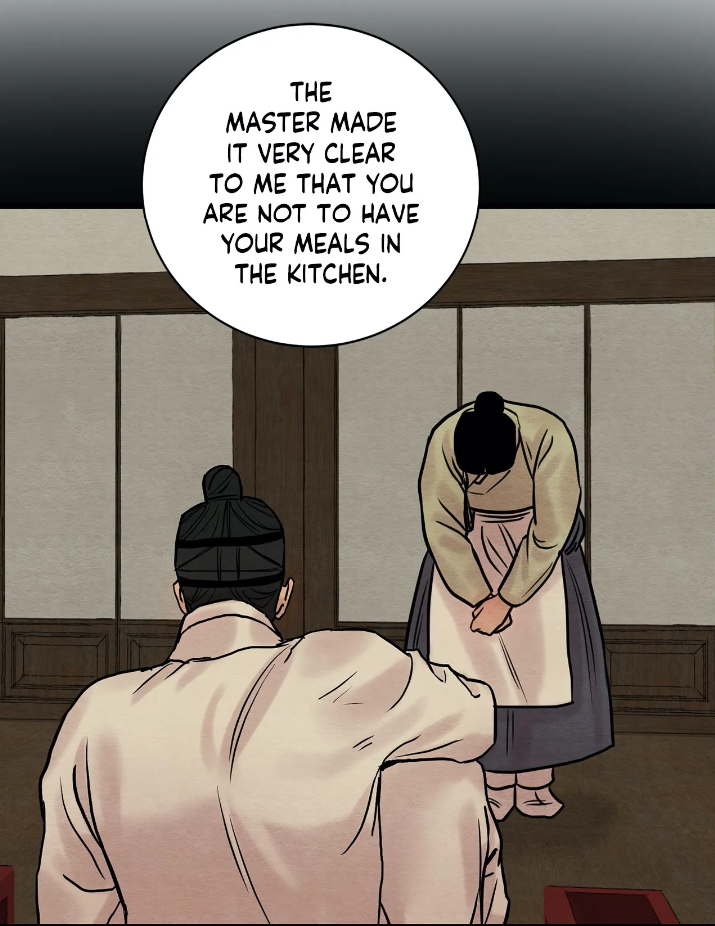 The closer the painter gets to Yoon Seungho, the closer the maid got to her master. In fact, she served as a bridge and mediator. First, she confessed to the artist that the lord cared for him, and her words did leave a deep impression on Baek Na-Kyum, because the latter remembered her words after their second love night. Third, when the noble returned to his bad habits, she didn’t scold the artist like Kim, she implied that the commoner had such a good influence on the lord.
 The readers can sense that the two servants had a different approach. While she was encouraging the painter in a positive way, Kim chose to put the whole blame on the artist. The most surprising that she changed so much, when we all remember her words in chapter 33:
  Furthermore, after the new episode, it becomes more obvious that the head-maid will play a major role. She caught Kim allowing Heena to enter the mansion and questioned his action
 , while in chapter 17, she just asked for his advice. For me, there’s no doubt that her testimony will be used against the valet and the main lead will lose his faith in the butler’s loyalty. But if the latter loses his master’s trust, the servant won’t be able to live in peace. He will have now more reason to fear his lord. As you can detect, I am expecting that all the incidents in the past (rape, the aphrodisiac given to Yoon Seungho and Baek Na-Kyum) will be revealed.
 hence the latter must have reported to her about the incident. Moreover, she had even planned to visit the artist, when she caught Kim.
 . Hence Kim thought that if he let her see the artist, she would stop causing a ruckus. At the same time, note that in that scene, Kim is portraying his lord in a negative way
 There’s a reason for that, he is seeking for her cooperation so that she doesn’t keep yelling at the front of the mansion
  and gather more attention from spectators. For the butler, she represents a new burden. But since Kim never witnessed the conversation between the maid and the painter (chapter 36 and 46), he has no idea that something happened behind his back, since peace only matters for him. As a conclusion, I am expecting that all the lies and tricks Kim used in the first and second season will be revealed the moment he opens Pandora’s box, when he confesses that the physician was a witness and didn’t help the artist. For me, one thing is certain now: Yoon Seungho’s rebirth is related to the valet.
  He was a gentle but strong hero, willing to protect and console his lover, when the latter feared for his life. At no moment, the main lead cared for his reputation and people’s gaze. Baek Na-Kyum’s well-being was what mattered the most to him. the irony is that his actions never caused an uproar. As you can see, Kim is in truth Yoon Seungho’s closest enemy, and it is only a question of time, until the protagonist realizes his butler’s first real betrayal, like Baek Na-Kyum experienced it in chapter 29:
 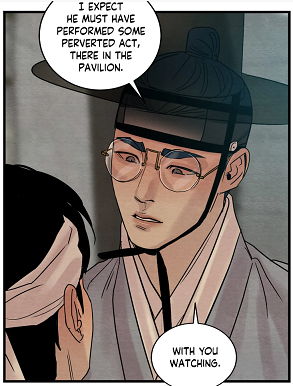 He has already discovered his disobedience, yet he will get shocked when he discovers all the lies Kim told him. At some point, he will recognize that Kim has always been a traitor. The pandora box will be used against the valet, the same tool he used to fool people.
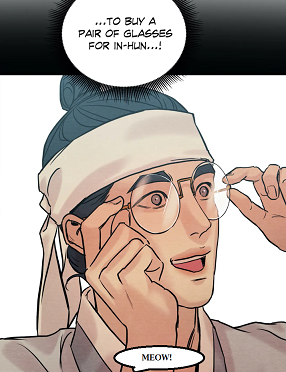 And here, the readers should wonder why he feels the need to earn the money for the glasses. Technically, he could just go to the merchant and buy these with his family’s money. My answer is that it is related to social norms and the huge social gap between the domestic and the young master. I believe, Baek Na-Kyum’s family is rather traditional and as such makes a huge distinction between nobles and low-borns. This traditional mind-set is perceptible, when the shopkeeper threatens the artist. From my point of view, his father will never allow a noble to offer such an expensive present to a servant. That’s why the innocent man started painting. But does the personal domestic know about his master’s secret activities and true goal? Yes, he is aware of Baek Na-Kyum’s actions and intention, which is detectable in the following picture:
  Note that the noble gave him the order to wait at the door of the merchant’s shop, but the servant preferred disobeying him. This picture is relevant for two reasons. First, it outlines the true nature of the relationship between the lord and his servant. Jung In-hun can afford to disregard Baek Na-Kyum, as the latter doesn’t punish him at all. On the one hand, the young master underlines that his order was not respected, on the other hand nothing happens afterwards. This truly indicates that the domestic has the upper hand here. Secondly, he didn’t obey Baek Na-Kyum’s request, as he didn’t want to hear or to be seen with his master selling his last work. Note that, when the master leaves the shop, the trader speaks so loudly that the master can hear his explanations:
 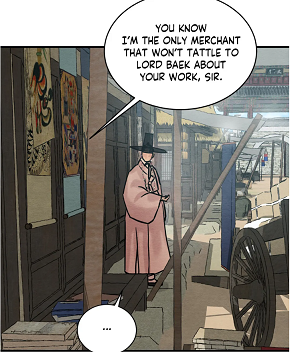 And now imagine Jung In-Hun waiting at the door for the return of his master. If he had stood there as requested, he would have heard the merchant’s comment and would have become an accomplice. As a conclusion, we can definitely say that the domestic acts, as if he didn’t know about Baek Na-Kyum’s activities. He is applying Kim’s philosophy from the original story:
 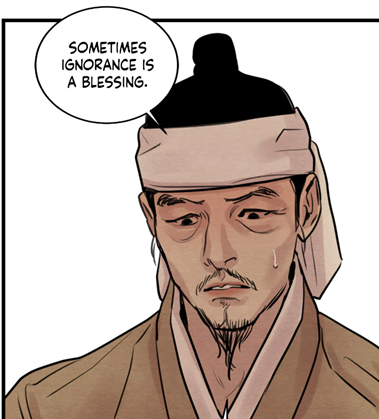 However, let’s not forget that the servant has a real reason for his silence and his faked ignorance. He will get glasses, which he truly desires, therefore he can’t tattle this to lord Baek. On the surface, Jung In-Hun hates sodomy, nonetheless he benefits from it through the master’s paintings, exactly like in the original story. As you can imagine, I saw a new evidence for my theory that Kim is actually Yoon Seungho’s enemy, the surrogate father who betrayed and abandoned the aristocrat due to his selfishness. First, the servant has a similar mentality: silence and ignorance. Besides, observe that in the second special chapter, the domestic plays the role of the “adoptive” father, the one who is caring and giving some comfort.
 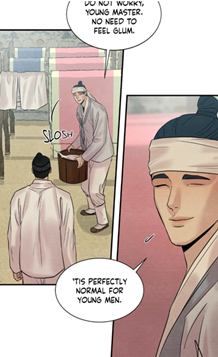 This clearly indicates that the scholar was never the painter’s true love, but the latter was more suffering from an oedipal complex:
 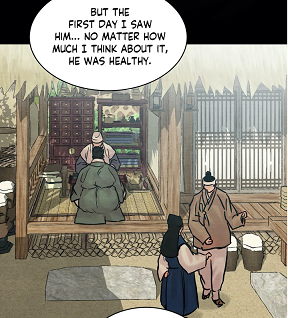 And there’s another reason why I suspect the valet in the original story has a similar function than the scholar. Only recently, I realized that Kim’s first appearance coincides with Jung In-Hun’s arrival at the mansion.
 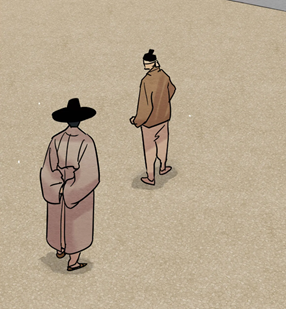 (chapter 7) Besides, it is Kim who takes care of the former teacher too, by bringing him to his room. As you can detect, the servant Jung In-Hun reinforced my negative perception about the “loyal and caring” butler.
 , while in reality his works are so appreciated that he has already made a name himself. Striking is that the merchant contradicts himself exposing his greed and hypocrisy, because first he compliments the artist:
 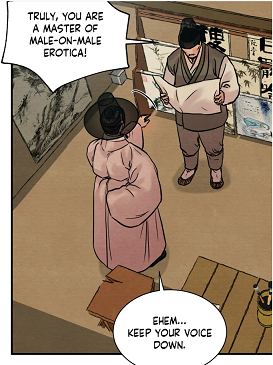 before criticizing his last work so that the main lead ends up with just 3 coins! And the trader reminds the painter that he can’t complain, as he can’t reveal this to his father. So we have a greedy merchant, who takes advantage of the artist due to his social status. On the other hand, Baek Na-Kyum has no other solution to accept his fate. In the second episode, Yoon Seungho reveals once again the artist’s popularity.
 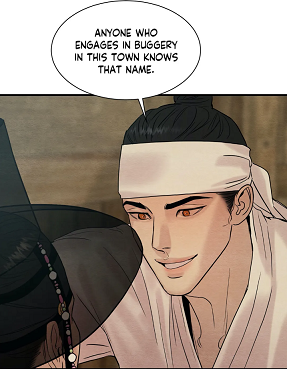 And this situation with the painting made me think about the original story. How did the selling occur? Since the Alternative Universe is similar to the original, although the social status of the characters have been switched, we have to imagine that Baek Na-Kyum must have made a similar experience. As a low-born, the shopkeeper could use the lower social status to buy his paintings for a cheap price. I have to admit that when the first special episode appeared, I wondered if the glasses were not financed by the artist too. However, I rejected the idea, because when he left the brothel, the low noble already possessed glasses.
  (chapter 46) But the chapter 64 finally gave me the answer: the snake in the original story who took advantage of Baek Na-Kyum’s low social status is the tailor.
  And now, you understand why Min knew about the incident at the tailor’s shop. Min is also a client who bought Baek Na-Kyum’s publications.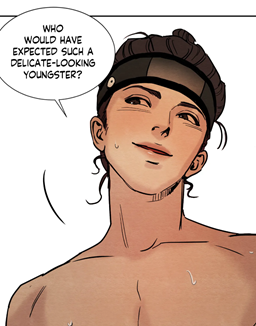
 (chapter 8). And now, it is important to revisit the chapter 39 and the romantic date:
 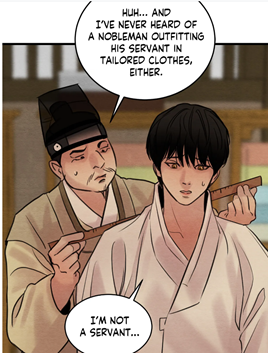 What caught my attention are the drops of sweat on both characters. Back then, I thought, like many readers, that the origin of the discomfort was related to the unusual order: the tailor was supposed to make expensive clothes for a low-born. However, since we know that the tailor recognized Baek Na-Kyum as the painter working under a pseudonym, I believe that they were awkward for a different reason. They had to act, as if they didn’t know each other. This explains why the drop of sweat appears on both faces
 In my opinion, there’s more than curiosity. He needs to know his relationship with the lord Yoon Seungho, in case the artist decides to sell again his paintings. He could no longer act like before, buy paintings for a cheap price. That’s why he needed to get more insight. And now, with the artist’s disappearance creating chaos among the town folks, the tailor revealed his knowledge and in reality his secret.
 He saw no reason to hide it any longer. First, he was mad, because people would mock him. Secondly, since the painter hadn’t created any new publication, as he was taken care by the master, he could mention the low-born’s real job: a buggering painter! He had the impression that he had nothing to worry. Striking is that he mentions it in front of the sister
  , the manhwalovers can observe the absence of the gaze and eyes, indicating that his eyes and glasses played a huge role in the past. And now, if the readers look again at Yoon Seungho’s face during the Wedding night, they will notice the barely visible presence of glasses, the symbol for the teacher.
 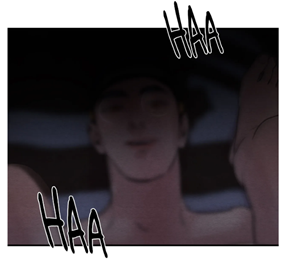 And if Baek Na-Kyum did pay for the low noble’s glasses, then it is comprehensible why they mean so much to the low-born. The teacher could have voiced, he needed glasses. I can even imagine that he justified his actual situation, he is just a simple teacher due to the absence of glasses. In other words, he couldn’t do well at the exam, because he couldn’t afford the glasses. His true desire was to use the painter’s innocence and gentleness to obtain a favor without doing anything: just smile and compliment. And Baek Na-Kyum had to wait for a long time before being able to buy the present. The scholar was well aware how Baek Na-Kyum achieved his goal by selling erotic pictures, but the teacher feigned ignorance. However, the sister realized that the shopkeeper and publisher had abused the painter due to his humble origins, therefore Heena imagined that if the teacher was to take care of Baek Na-Kyum, the former would help him to get better paid. However, what happened was that the scholar realized that despite his popularity, Baek Na-Kyum wouldn’t earn that much, unless the former had to intervene. For him, it was unbearable to be linked to homosexuality. Therefore he could only see the artist as a burden. That’s why he decided to cut ties with the artist by no longer feigning ignorance. On the surface, he discovered the erotic painting and coerced the artist, until the latter vowed to never paint anything. It is also possible that Jung In-Hun tried to use the artist’s popularity in order to sell his own book, but was rejected. Anyway, there’s no doubt that the scholar in the past took advantage of Baek Na-Kyum, until he had the impression that the painter had become a burden and he refused to be responsible for him. Let’s not forget that history is repeating itself in Painter Of The Night. And now, you can understand that I am expecting another scandal: the tailor’s enrichment through the publications .
  There’s no doubt that we will hear this sentence in the original story. However, I have the feeling that Heena will play a major role in this, as the shopkeeper revealed it in front of her. At the same time, this incident will lead to the scholar’s involvement as well. Why did the artist stop painting for a while? Why did Baek Na-Kyum become drunk? Why did he abandon the painter twice after receiving the glasses?
 (special episode 1), like I had pointed out in a former essay. Since I have determined that Baek Na-Kyum is the butterfly in that story, symbolizing truth and hope, the question is now: what is the box in Painter Of The Night? For me, the box represents the past with all his secrets linked to pain and traumas. And the opening of the lid leads to suffering and tragedy, yet despite the agony, the figures will be able to move on and have hope. The painter will serve as a tool to unveil the truth signifying that all the secrets and as such the past will be revealed. And now there’s only one question left. Who is Pandora in this story? Which person opens the box full of secrets bringing misery but hope to the characters in this story?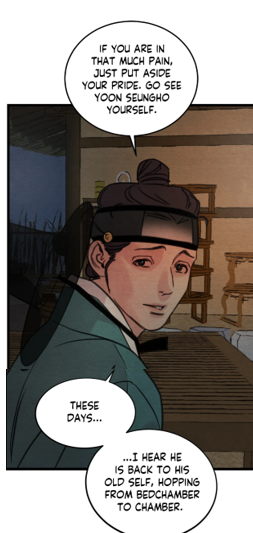
 and chapter 18
  . Jihwa is always listening to the hearsay. In the last case, he tried to influence Yoon Seungho with such gossips. That’s why the red-haired aristocrat could only fall into Black Heart’s trap. The latter knew not only Jihwa’s love for his childhood friend, but also the influence of rumors on him. Min knew that Jihwa would always get his intel through others, because he would avoid to be confronted with reality and as such facts. Besides, Min perceived that the noble was very sensitive to Yoon Seungho’s sex life, hence he used the idiom “hopping from bedchamber to chamber”. It is important to remind the readers of Jihwa’s confession
  Min was definitely aware of Jihwa’s weaknesses: his love for his childhood friend, the importance of hearsay on him and the resent for this image “Yoon Seungho is fooling around with men”.
  Note that his friend with the mole caught the lie. Observe that the latter is sweating and looking at Min with such a serious face. Nevertheless, he doesn’t try to contradict Min. He remains silent here and looks at Jihwa’s reaction. Since the latter claims that he will never visit Yoon Seungho, the noble with the mole believes that the lie will have no consequence. This scene is important for two reasons. First, although the noble with the mole is a confident of Jihwa, the former doesn’t have a good understanding of his friend. In reality, he doesn’t truly know Jihwa’s weaknesses. This was visible in chapter 9, when he visited him and told him about the humiliation. The noble with the mole was not aware that Jihwa would be irritated and wounded, when the latter would hear that the former had planned to participate in a sex session with Yoon Seungho. That’s how perceptive Min is. He detected all the red-haired noble’s secrets. Striking is that in that particular scene, while Min employed his knowledge to trick the drunk noble, he discovered the existence of a secret, which was triggered by the noble with the purple robe.
  Why? It’s because “You know” is standing in opposition to “dream”. Knowledge is a synonym for facts and reality. Therefore, Jihwa finally confesses that he knows a secret about the main lead.
 In that moment, Min is able to catch the existence of the main lead’s weakness. The latter must have been deeply wounded in the past. It doesn’t matter how… the fact that Yoon Seungho has a wound is enough for Min. Through the red-haired noble’s revelation, Min realizes that Yoon Seungho is acting like a cold-headed person, while in reality he is hot-tempered due to his wounds. Min could make the connection to the incident with the top-knot.
 That’s how he recognized that Jihwa would use his knowledge of the past and would hurt his childhood friend due to his love for him. As you can sense, Jihwa left clues here and there to Min so that the latter could gather all the information about his rival and use his knowledge to defeat his rival. That’s how innocent and naive Jihwa was. While he thought, he was keeping everything a secret, since he was always allusive, he never recognized that he was doing the opposite. As you can see, Jihwa was the one who delivered the box to Min, and Min opened it therefore he brought pain to the protagonists, yet at the same time, he created an opportunity for them as well. The main leads were forced to face reality and reveal their true thoughts and emotions.
 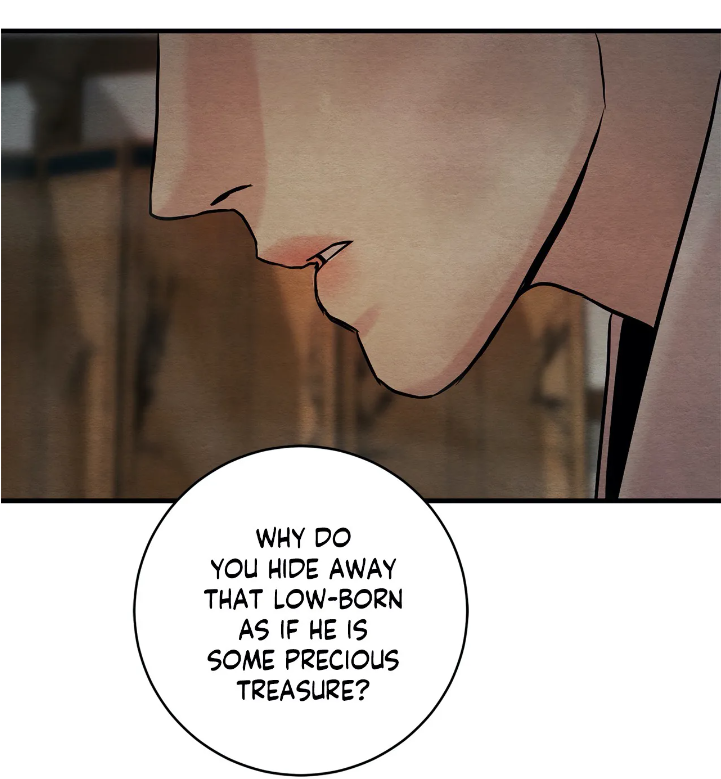 The snake had detected that the lord was protecting his pride in reality despite the bad reputation: “common brute” (chapter 59) or in Min’s case:
  He humiliated him for the second time by revealing that he was in love with a commoner. As you can see, Min could perceive Yoon Seungho’s vulnerabilities and used the secrets in order to wound his rival and the object of his obsession. By opening the box, he made the protagonists suffer. However, the manhwalovers shouldn’t forget that Pandora in the story gets hurt as well, signifying that Min will get hurt by these secrets too.
 and charlatan
 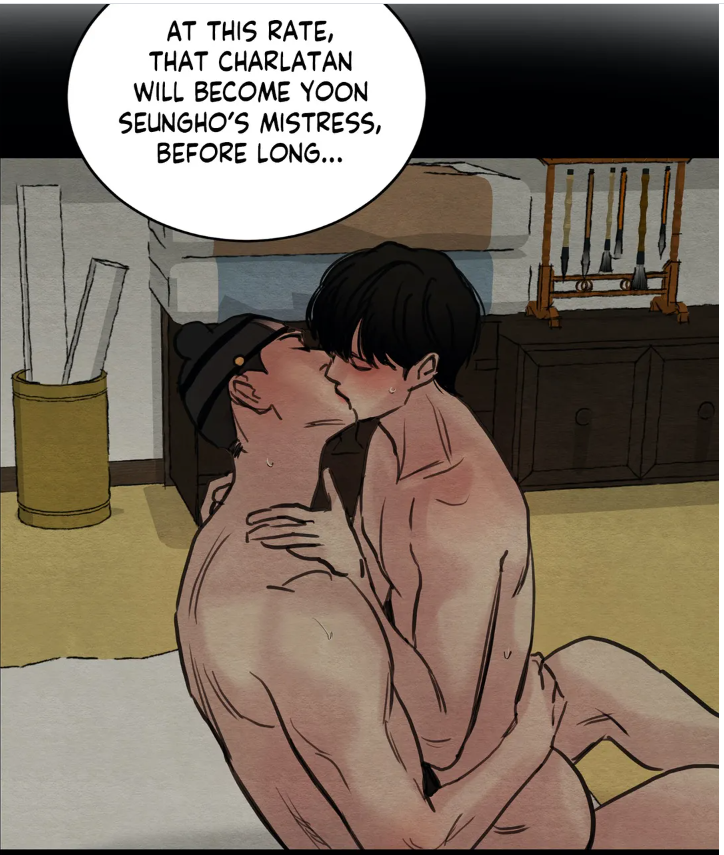 who was putting the main lead in danger, creating the illusion, if Jihwa intervened, he would do something honorable. He reversed the situation by describing Baek Na-Kyum as bad as possible. He knew exactly how to trigger the red-haired noble’s jealousy, simultaneously making him believe that he was representing righteousness. Yet, like I mentioned it in the essay “The Joker – part 3”, in this scene, Min was actually revealing his own thoughts and emotions. He was envious of Yoon Seungho and couldn’t bear the thought that the painter would become the protagonist’s mistress, because this signified that he could never taste the commoner. Yet during that night, no one recognized this.
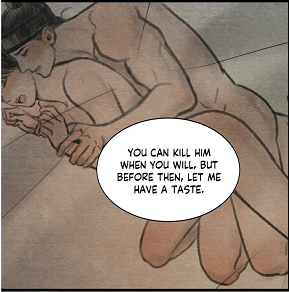 And since Min only talked to the red-haired noble, this means that this information became a secret.
  In this panel, Jihwa questions Min’s reliability which indicates that he is now questioning the character’s personality, a first sign of critical thinking. In my opinion, soon the position will be switched. Jihwa will be in possession of a secret, Black Heart’s real motivation for targeting Yoon Seungho. From my point of view, Min’s weapons (knowledge and secrets) will be employed against him.
  He revealed the childhood friend’s involvement in the painter’s disappearance thinking that Yoon Seungho would act like in the past: become a monster and vent his anger against Jihwa. But what he didn’t know and anticipate is that Yoon Seungho would hurt the painter first. With this new revelation, Yoon Seungho realized his true sins. He had misjudged the painter, had allowed his rage to blind him to the point that he had hurt an innocent. He was responsible for the commoner’s trauma. Therefore he couldn’t blame Jihwa for the disappearance right away, the main lead had to face his own culpability. When Black Heart mentions Jihwa’s participation, he is expecting an immediate reaction from his counterpart: Jihwa will become the target of Yoon seungho’s anger and fury. Yet, what Min fails to realize is that by revealing Jihwa’s involvement, he exposes his complicity. He knew that the childhood friend had planned something and remained silent. And since I pointed out that Yoon Seungho suffered in the past because of the silence of a witness, I believe, the lord will remember this and decide to retaliate against all the people who knew about the incident and stayed quiet. Furthermore, I think, the main lead must have learned his lesson with the last incident: never judge someone based on impressions and beliefs. From my point of view, Yoon Seungho will investigate the matter, just like he did an investigation on the painter and Jung In-Hun during the first season. Besides, I would like to remind that when the murder was suggested, it took place at Min’s friend, so the circumstances make it look like there was a plot.
 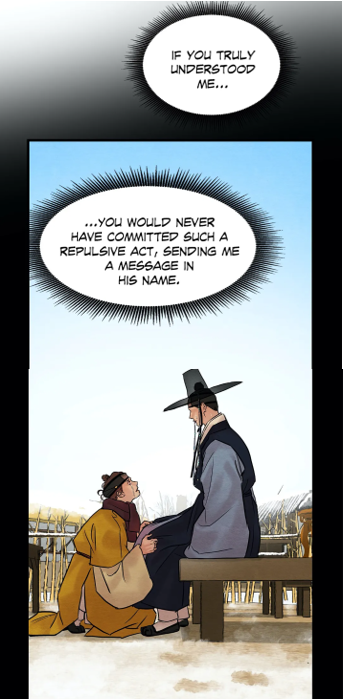 Secondly, Black Heart made the mistake to believe that he could understand the main lead’s personality by just observations.
  And what did he see?
 , then he had defended him against a vicious servant.
 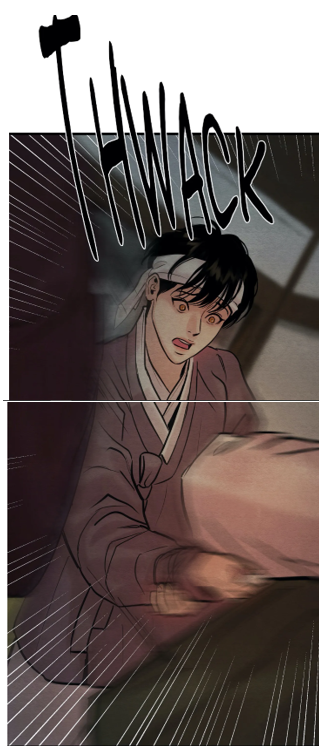 One might argue that the noble had brought him to the sex session, yet since the host stopped the rape before and even evicted his guests in a rough manner, for Min, it was a real sign that Yoon Seungho was very caring. However, this is not reality, as Yoon Seungho mistreated the painter. Strangely, the painter never saw his true caring side, because he was always asleep (chapter 33, 34, 45, 50) or he was blind and deaf due to his own agony. Their relationship was far more complex. Finally, since Min’s knowledge was based on his observations, he could only view what Yoon Seungho allowed him to see: Black Heart is not aware of the main lead’s insecurities and self-hatred or his illness. Not even Jihwa knows about the existence of his illness which was supposed to have appeared in his teens. This explicates that Min’s information was not correct and he was fated to make mistakes. Besides, he doesn’t care for commoners and servants so Min is not paying attention to changes among Yoon Seungho’s staff. His understanding is quite superficial. The other mistake is that he is not aware of the last events at the mansion: Deok-Jae’s disappearance and his involvement in a poisoning incident. Furthermore, he has no idea about Yoon Seungho’s true power and connections, although his friend warned him
 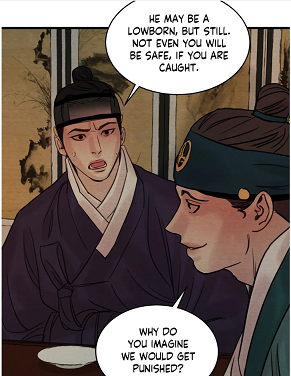 . There’s no doubt that Min’s judgement about Yoon Seungho is also influenced by his reputation as a hell-raiser. That’s the reason why Min came to the conclusion that the protagonist was exactly like him. For Black Heart, the main character was seeking pleasure and fun by causing commotions and violating social norms, whereas the cause for main lead’s behavior is different: he has been brainwashed and traumatized. more complex. And you comprehend why I believe, Min will get hurt in the end. “His knowledge” will be the source for his misery and his punishment. And it will backfire on him. Besides, I suspect that Min won’t learn from his mistake and will make another mistake … he will still believe that he just needs to find a secret in order to have the upper hand. I have the feeling that Min will investigate why Yoon Seungho decided to sponsor the scholar Jung In-Hun, since the latter was mentioned in connection with the envious man.
 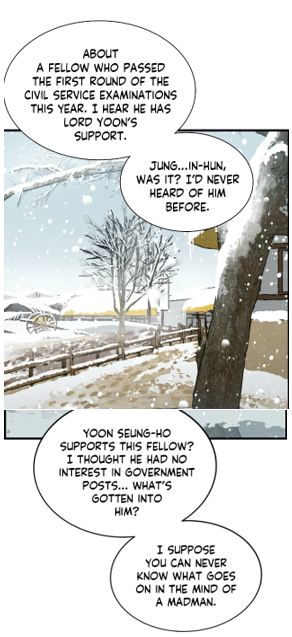 (chapter 52). Consequently he will discover the true reason behind the sponsor: Baek Na-Kyum has always admired the teacher. There’s another reason why the scholar’s path will cross Black Heart’s: their preference for investigation and secrecy. Don’t forget that the teacher tried to find some secrets in order to find a weakness in his sponsor and blackmail him (chapter 29).
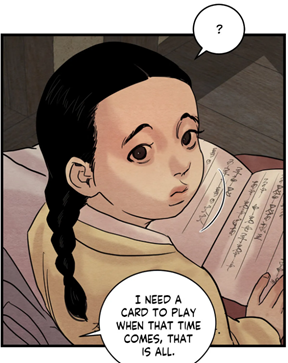 That’s why I envision that with the scholar’s return, we will witness how the teacher tries to use his knowledge in order to gain something, especially if the wealthy aristocrat abandons him, the moment Baek Na-Kyum refuses to help his former teacher. There’s no doubt that Jung In-Hun will use secrets in order to manipulate Min, when the latter approaches him. In my opinion, the scholar could use the incident at the pavilion (the rape)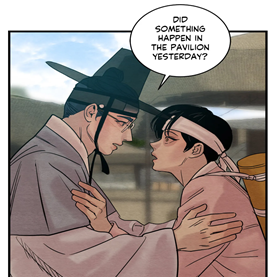
 and Baek Na-Kyum’s discovery of the teacher’s true face and hypocrisy. And imagine Black Heart’s reaction, when he hears about the rape, in that moment, he will interpret all the incidents in a different light. He never brought the painter to the sex sessions, because the artist got raped and in reality he was secluded. Then he will remember that the lord distanced himself from Baek Na-Kyum and returned to debauchery, the painter denied the lord’s feelings for him and as such rejected the master’s advances. Then he will remember that the commoner was brought to the sex party, before the noble changed his mind. Envision that if Jung In-Hun decides to expose how the lord treated the artist during the first season (the straw mat beating, the rape, the escape… ) which Min never heard of, the latter could imagine that the artist is kept captive and decide to “abduct” him in order to liberate him. That way, he could turn himself into a hero… I know, here I am no longer studying the story, but just making assumptions. Yet, what I want to demonstrate is that knowledge and secrets represent the key to Pandora’s box. My point is that all the secrets from season 1 will become fatal to Min and Jung In-Hun, as they will be used to manipulate. There is no coincidence that both use the same methods (manipulation, lies and knowledge to deceive others), since the two figures have a similar disposition (jealousy, greed and ambition). Yet their insight is superficial in the end. So far, they both lived in their own world, quite protected and have never experienced the harshness of reality. That’s why I am convinced that the scholar and Min will find each other and their encounter will cause them to suffer in the end. That’s why I have the impression that Jung In-Hun could be judged as another Pandora. In my opinion, his investigation about the past
 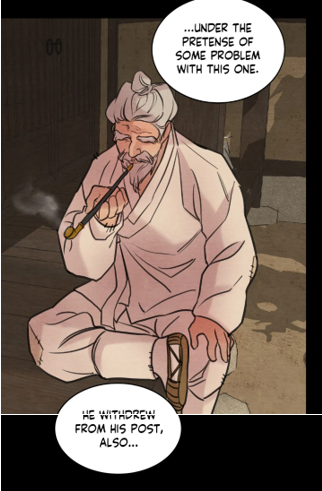 will bring him suffering, while he is anticipating that the discovery of secrets will help him to achieve his goal.
 Note that he mentions here “channels” indicating that he has different sources. First, we can assume that Nameless gets some info from the gisaeng. We know for sure that he hired Deok-Jae. Finally, we are suspecting that he placed a spy among the nobles’ house (Jihwa
 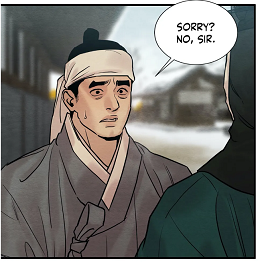 ). He knew the servant’s true motivation behind the betrayal, like he explained it to Jihwa in chapter 51.
 However, I believed that exactly like Min, he made a terrible mistake. He thought that this was related to the harsh beating caused by the painter’s first disappearance.
  In Nameless’ mind, Deok-Jae hated his lord for his “unfair punishment”, while in reality, Deok-Jae put the whole blame on the painter. In the servant’s eyes, the artist should have been the one receiving the harsh beating.
 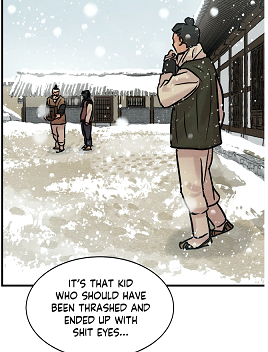 This shows that he never questioned the punishment as such. Why did the criminal misunderstand the domestic? Let’s not forget that Nameless suffered injustice in the past, perceptible by the numbers of his tattoos, hence he projected his own thoughts onto Deok-Jae. What he failed to recognize was the vicious servant’s true motivation: he was jealous of the painter and wished, he had been the one receiving the lord’s favors, willing to become a homosexual, if it meant to improve his living conditions.
 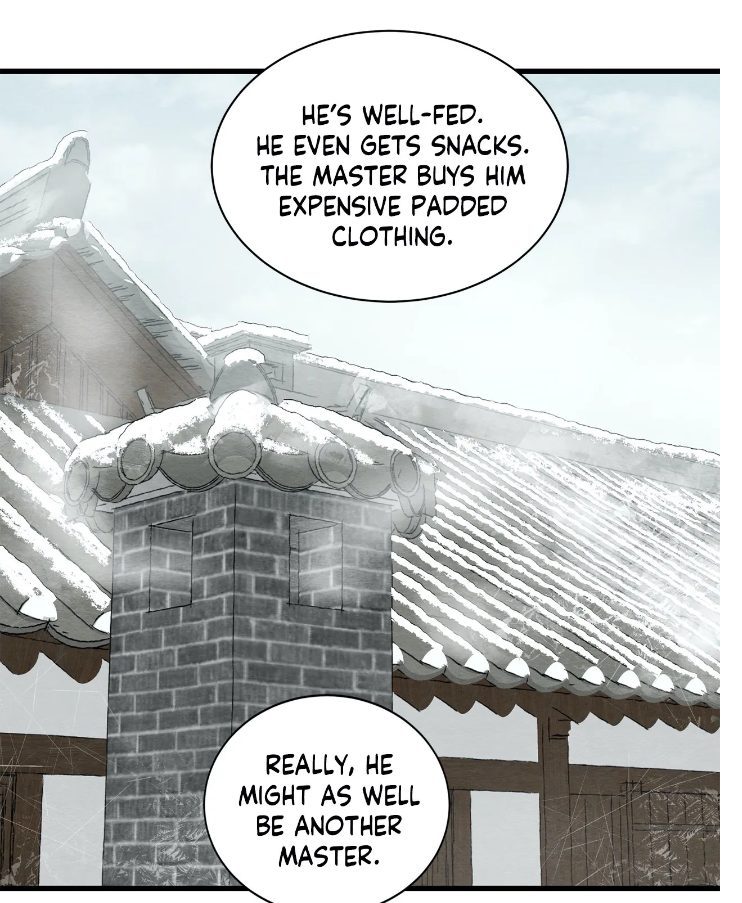 (chapter 46) This explains why the blackmail happened in the end. Since Nameless envisaged that Deok-Jae was resenting his master due to the harsh thrashing, he didn’t expect that Deok-Jae would decide to side with Yoon Seungho in the end, if it meant to get some benefit.
 (chapter 54) In my opinion, Nameless must have always thought that only aristocrats were greedy, unjust, ruthless and vicious, and would blame the commoners for their crimes.
 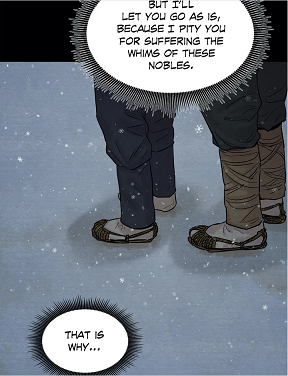 However, reality is much more complex, like I explained in a different essay: silence and passivity can cause damages. Besides, commoners are also humans, therefore they can be vicious, greedy and ruthless. To sum up, the criminal has a biased perception of the world. The other mistake the criminal made is related to his perception about Jihwa. He noticed the red-haired noble’s innocence due his bad habit (biting nails) and showed signs of bad conscience. Therefore he had the impression that Jihwa was not responsible for this situation, rather the childhood friend who chose to reject him and drop him for a low-born acting on a whim. Yet, what Nameless doesn’t know is what the red-haired noble did before: the constant bullying on the painter (chapter 5, 10, 17). For me, Nameless is already biased and has a better impression of his client than Yoon Seungho who hurt his staff so unfairly (chapter 29/30) and humiliated Jihwa twice (chapter 18, 57). That’s why he is pitying his client.
 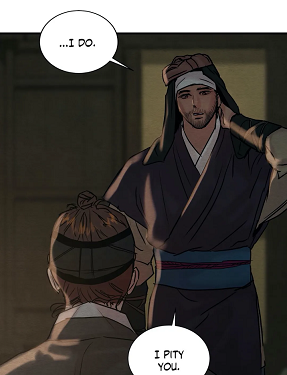 In his eyes the master did nothing wrong, he only loved his friend. Consequently he imagined that the aristocrat was acting on impulse and anticipated that he would give up, yet the latter never did. Since no one visited Jihwa during that time, Nameless thought that the second lead was acting on his own. The noble never mentioned how the idea of the murder was brought up… and he never said anything about Min’s visit in chapter 56.
  And now imagine his surprise…if my theory is correct, the new guardian is his spy. Jihwa kept a secret from him… but it is the same for Nameless, who killed the domestic. Nameless will realize that other people knew about Jihwa’s intentions, hence he will question the noble’s actions. Nameless will realize quickly that this was more than just a love quarrel. In my opinion, he will investigate the matter. There’s no doubt that we will witness a scene where the criminal and Jihwa will blame each other: one will reproach him for involving the servant Deok-Jae, while the other will tell him how stupid and naive he was. He got betrayed by Min.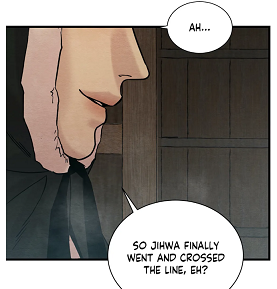
 (chapter 51), I have been thinking about this: what if the criminal was searching for Baek Na-Kyum? Envisage, with Heena’s intervention, he discovers the painter’s true identity and realizes that he hurt the person he was looking for and was even supposed to protect. For me, there’s no doubt that Min, Jung In-Hun, Jihwa and Nameless will pay for their “knowledge”, because they were actually biased by their own belief and arrogance.
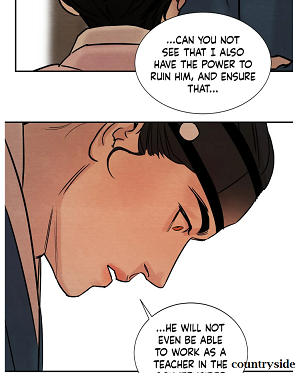

 (chapter 11), his insecurities
  (chapter 58)
  (chapter 63) and his hopes. One might argue that Yoon Seungho was not entirely himself in these chapters, as he couldn’t control his feelings. Yet I believe that because of that, the lord was the most honest. He could never fake his true thoughts and emotions in front of the painter. I am quite certain that the lord learned due to his traumatic past that he needed to be strong in order to protect himself from others… remember that he had no one by his side, therefore I think that despite his debauchery, Yoon Seungho made sure that he had enough power to never become a victim again. However, Baek Na-Kyum is on his way to discern the master’s real personality, not only by discovering his past, but also because from now on, the lord will never approach Baek Na-Kyum for sex and they will have to interact differently: he will show him his true competences.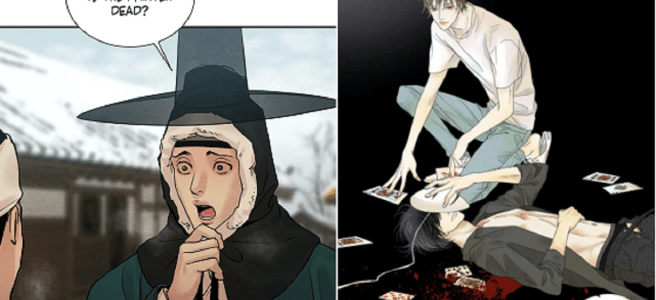
 , I came to realize the lord’s true personality. He doesn’t just want to replace the main lead as the new alpha among the nobles, more importantly he takes pleasure in ruining friendships and as such causing pain to others. As a conclusion, I noticed that he enjoys destruction. Therefore I stated in the first part that Min had a nihilistic mindset: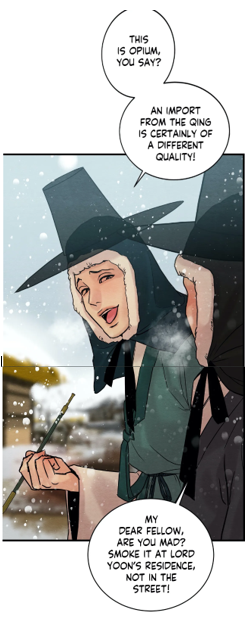
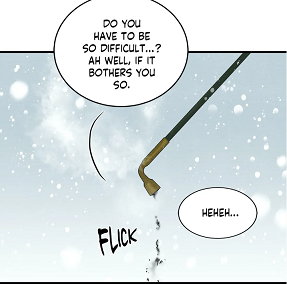 (chapter 52). Then he violates the rights of his host in chapter 43, when he proposes the assassination. Since this is not Min’s pavilion, this means that his friend’s house is transformed into a conspiracy place.
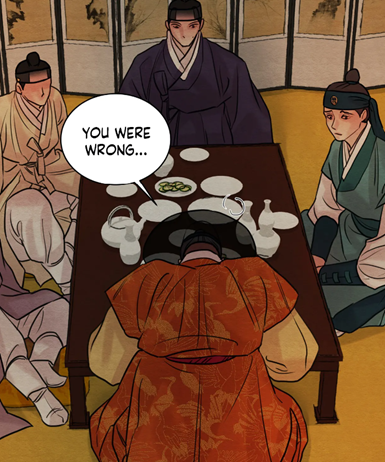 This will play a huge part in the future, as I am anticipating a purge. At another party, he violates again the rights of his host by mocking and insulting him: chapter 52, 53
 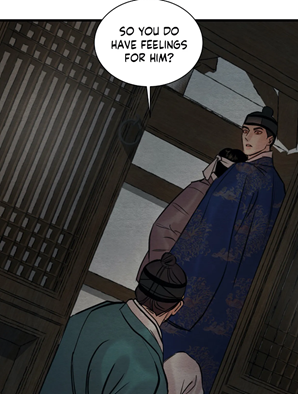 54
54 . I could also add that he disregards the painter by suggesting his murder (43, 56) or by treating him like a sex object (chapter 33/52). Moreover, he often lies (chapter 36
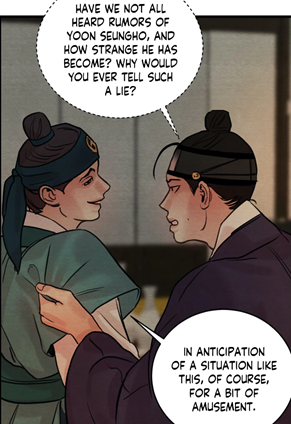 . All these examples expose that he manipulates his surroundings constantly. He influences Jihwa by giving him the idea of the murder (
 chapter 43, chapter 56
 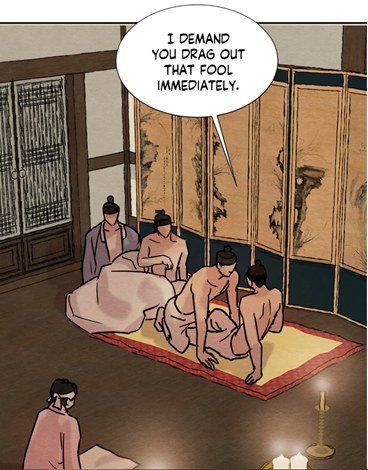 ,
,  chapter 33
  chapter 52), he doesn’t care about them. In fact, he uses them for his own benefit. Remember that he took the opium from his acquaintance (chapter 52). Then he ruined his “friend”‘s party by causing a ruckus, while the other wanted to have some discreet fun.
 I would even say, he manipulates the masses by making requests, which the other nobles can’t truly reject. Note that neither in chapter 33 nor in 52, the aristocrats stopped Black Heart from talking and even supported his request: the main lead should bring the commoner to their sex party. As a conclusion, he uses his influence over the other aristocrats to get what he desires: have sex with the painter. This displays his true power as manipulator. No one is capable to stop him, not even Yoon Seungho, the alpha king among the local aristocracy.
  (chapter 52). This is understandable, as during that night, Yoon Seungho was totally vulnerable and tried to hide his weak disposition with his clothes.
 He must have heard about the painter’s disappearance and desires to witness Yoon Seungho’s pain. For him, this would represent the best proof of his skill as manipulator. But to his disappointment, Baek Na-Kyum is not dead.
  This mask exposes his lack of empathy and his joy for imagining that the main lead is suffering (“difficulty with showing remorse or empathy“). Since his plan failed, he is disappointed
 . Therefore he enters Yoon Seungho’s mansion. However, pay attention to the last picture which indicates that Min is thinking about Jihwa and his disobedience. The red-haired noble didn’t act like planned. In my perspective, his thoughts indicate that Min will make Jihwa pay for his “disobedience”. At the same time, I believe that Min is already thinking about his next move, this is the other reason why he enters the main lead’s house without a proper invitation (a new version of chapter 12). This image serves as another evidence for his continuous disregard for social norms. And this chapter 66 represents a turning point in my opinion, as it exposes Min’s impulsiveness to the best. Since he didn’t get Yoon Seungho’s defeat by afflicting pain on him, he needs to cause another uproar and inflict pain on Jihwa, who didn’t follow his “order”. Note that Black Heart just reversed the roles, showing that he doesn’t care who wounds whom. His main focus is pain. By revealing the secret, Black Heart is hoping that Yoon Seungho will retaliate against his childhood friend because of the kidnapping.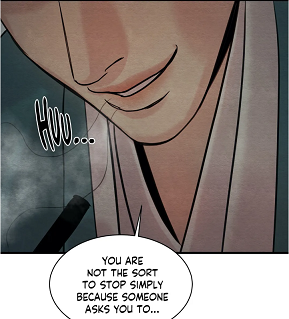
 Hence I come to the conclusion that for Black Heart, the commoner had been a killjoy in that scene. And now, it makes perfect sense why Min chose Jihwa as his pawn in the end. He had witnessed how the latter could turn Yoon Seungho into a “monster”
 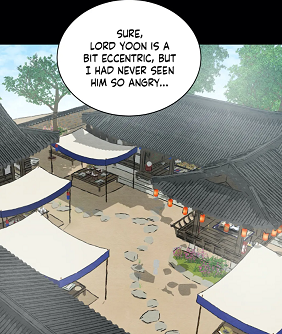 and found it so entertaining and funny that he decided to recreate the same situation. This observation explicates why Yoon Seungho put Jihwa and Min in the same bag in chapter 57. Min knew how to provoke the main lead thanks to Jihwa.
  , when he revealed himself the planned assassination in front of Baek Na-Kyum. However, back then he wasn’t caught, as neither the painter nor the powerful protagonist paid attention to his words. And instead of learning from his mistakes (f. ex. the murder didn’t occur like planned or the punches he received from the main lead for his provocations), he continues irritating Yoon Seungho. He notices that the latter is no longer denying his feelings in front of him, hence he can’t humiliate him like in chapter 54.
  Consequently he has to search for another trigger in order to provoke the owner of the mansion. But here, he fails again, as the artist is more important than Jihwa’s wrongdoing. Yoon Seungho is already more focused on his own misdeeds, the afflicted abuse on the painter: the violent sex marathon, the insults and the sequestration. Consequently he has no time for his uninvited guest. He ignores him and leaves him behind, but this won’t do for Min, hence he unveils a secret: Jihwa’s participation.
  Since the chapter 66 stands in opposition to the episodes 53/54, it becomes obvious that the main lead will react differently. He won’t act on his emotions, he learned his lesson due to the painter. He punished the commoner, although the latter was innocent, too blinded by his rage and pain. That’s why I think, we should consider the chapter 66 as Min’s ultimate defeat.
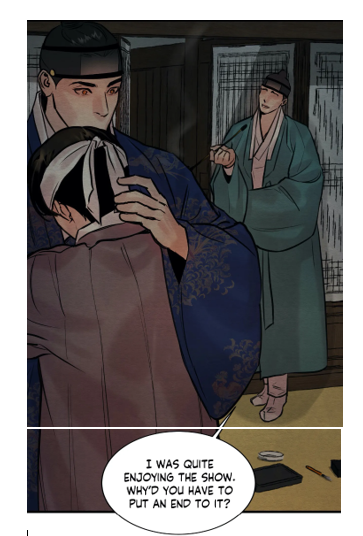 He chose to irritate him again, risking his own life. That’s why he got slapped so violently that the door was destroyed. But note that Black Heart didn’t feel any pain and showed no tears, instead he started laughing and showed pleasure.
 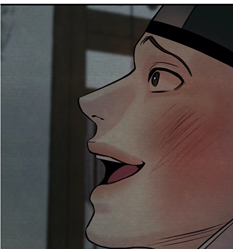 But even after receiving the slap, he continued provoking the host thereby the main lead started punching him so many times.
  Yet at no moment, he asked the lord to stop from hurting him, he kept laughing.
  However, there exists another explanation why Min kept provoking Yoon Seungho. But this aspect will be elaborated later.
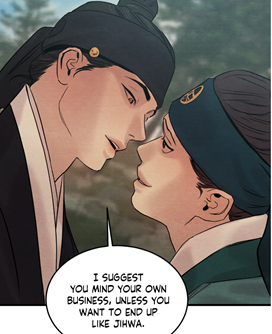 (chapter 41) Don’t forget that he calls the vicious man “a mouse”, a real insult to someone who sees himself as superior and talented. Then the night after the beating, Min waits for Jihwa in front of his house and urges Jihwa to murder the painter.
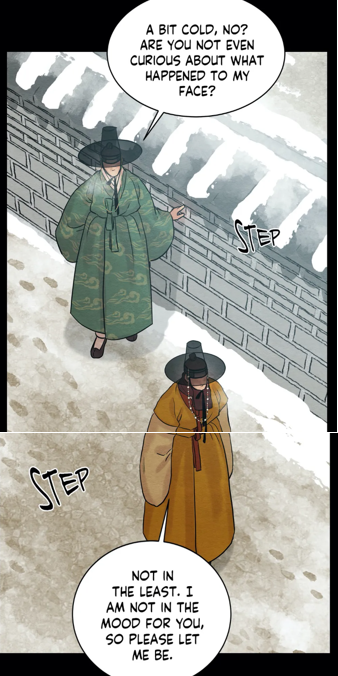 However, this time he adds that he wants to taste the painter before and note that here, he is mentioning the punches he received from Yoon Seungho.
  As the manhwaphiles can detect, Min is here retaliating against the main lead for hurting him. He will make him suffer much more: not only he will lose the commoner, but also the latter will get raped: a double affront. However, just like before, he prefers using the childhood friend so that he can avoid to take any responsibility. If something happens, then only Jihwa will pay for this. We should remember that Min never wrote anything concerning a crime. The idea he proposed was at his friend’s place, and the idea of the rape was also mentioned on the street with no witness.
 Min realized the importance of knowledge. Jihwa knew his friend well, hence he was able to awake the “beast” in the main lead. Besides, he could notice that Jihwa had an immense influence on the main character. He could wound him, yet the latter wouldn’t cut ties with him. Note that in that scene, Min never said a word, yet he was observant and realized that Yoon Seungho had a weakness: “in the most wretched of states”. That’s why he chose to get closer to the protagonist, willing to become an uke, if it was necessary for his plan. He needed to discover more about his prey and the best place was to get closer to Jihwa and Yoon Seungho, slowly and silently exactly like a snake. However, I believe, the real war between the two semes started in chapter 41, which caught my attention during the first season. The hand on the main character’s waist was a sign that the psychopath planned to “screw” the main character.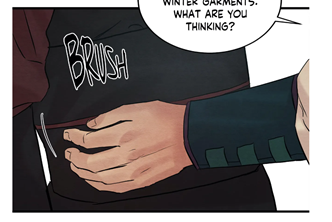
 (chapter 41) Not only he showed his desire to submit Yoon Seungho, but also he acted, as if he was superior to him. He asked questions and even criticized the main character for his behavior: he was creating a ruckus, exposing his hypocrisy, as Black Heart loves uproar.
  This observation leads me to the following explanation: The Arousal Theory of Motivation. This psychological conception tries to elaborate what stimulates people.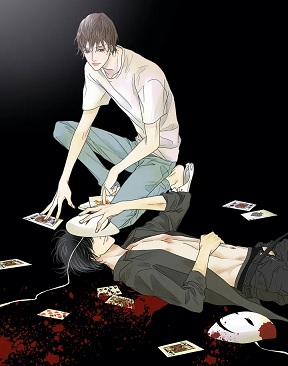
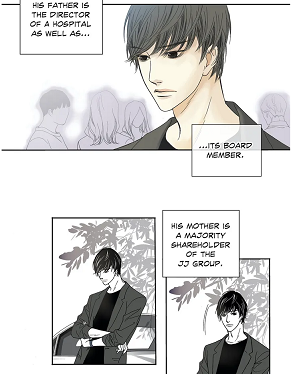 His reason is his thirst for revenge. His sister Lee Seorin was a victim of a gang rape, but since the perpetrators were never prosecuted, the sister killed herself out of despair. The culprits were students coming from wealthy and influential families and members of an organization called “secret fraternity”.
 Because Lee Kirin had no idea about the identities of the culprits and only knew that they belonged to that “secret fraternity”, he decided to get close to Kang Moo in order to investigate and get revenge for his sister’s death. While Lee Ki-Rin believes, he is manipulating Kang Moo, the readers can quickly realize that the opposite is happening. Kang Moo is the one who let Lee Kirin approach him in the end. What Lee Kirin doesn’t know is that Kang Moo is a psychopath. The latter has always hidden his mental illness in front of people.
 Even the members from that “club” had no idea except Lim Joohyuk. There’s a reason for that. When he killed a dog for the first time as a child, he saw his mother’s rejection and disgust.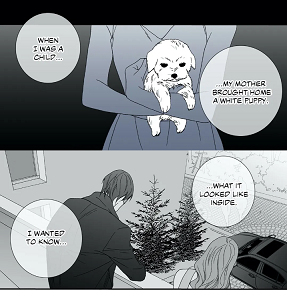
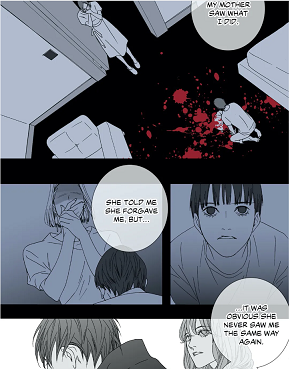 Striking is the importance of the gaze again. As a child, the boy sensed his mother’s negative judgement and rejection. However, this incident didn’t stop him to lose his “urge” for blood. Therefore he started to have hobbies like collecting dead bodies, taking pictures of dead creatures and even hunt.
 As you can detect, in that story Kang Moo has an abnormal low arousal and needed stronger stimuli, as time passed on.
 This reminds us of Min who keeps looking for entertainment and commotion. Note that Min’s violence has gradually increased: from sex as a symbol for fight, he went to a verbal challenge (chapter 33/41), then it escalated to a murder (43), then to a beating and gangrape (52/53) and finally to a combination of murder and rape (56). And in The Beast Must Die, the protagonist is well aware of the consequences of his behavior. If he killed someone, he would ruin his life.
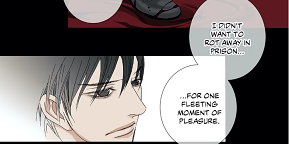 (chapter 32) The manhwaphiles can sense the similarity in the vocabulary: for Min, it is fun/entertainment, while Kang Moor keeps talking about “pleasure”. Since Kang Moo recognized the repercussions of a murder, he chose to fight against it contrasting to Min’s attitude. And there’s reason for that: Min’s social status and historical period. The latter is a noble and can use his superiority to hurt commoners and even break laws, because aristocrats are not prosecuted like low-borns. Secondly, I believe that his family and his surroundings played a huge role. Observe that the nobility is portrayed as corrupt and decadent. Besides, the manhwalovers should remember that Min’s MO is to manipulate others, therefore it reveals that the character had found a way out how to outlive his “urge and need”. He could commit small wrongdoings, as he knew that he wouldn’t get punished for this. But if he had to hurt another noble, he had to use someone else. And this exposes the similarities between Kang Moo and Min. Both are well aware that certain things are not allowed, yet they try to find a different way to move around the rules and laws.
  (chapter 32) the readers shouldn’t take his words as face-value. In my opinion, he felt a similar emotion than Lee Kirin (revenge), because Lee Seorin was the first person who showed understanding and no rejection, when he removed his mask and revealed his true personality.

 (chapter 33) . What caught my attention is that Kang Moo is voicing his fear indicating that he was well aware of his own mental issues. Moreover, it also outlines his despair… he desired to escape from this, but didn’t know how to. Lee Seorin comprehended Kang Moo’s anxiety, therefore she tried to encourage him not to give up, by supporting him that he could continue maintaining a normal life, if he truly wanted it.
  And now, you grasp why Kang Moo snapped, when he heard about the circumstances of her death. It was his club that was responsible for her suicide. Naturally, when Lee Kirin asks him if he loved his sister, the psychopath can’t answer that question, since he is unable to grasp his emotions.
 (chapter 34). However, there’s no doubt that the protagonist had an affection for Lee Kirin’s sister. I believe to perceive an evidence of his attachment to her, when he mentions the suffering of a victim of gang rape.
  (chapter 56) Sure, in this scene he is threatening Mr. Jang to organize a gang rape on Mrs. Hong’s daughter, because the man with the glass was also menacing his lover Lee Kirin. Yet, the fact that he mentioned such a crime indicates that he didn’t forget the crime Lee Seorin suffered from and he could understand her pain. And there’s another proof that Kang Moo is not truly emotionless. It becomes even more obvious that he loves the main lead too. It is shown in two different occasions. First, he states that he will never let Lee Kirin go.
 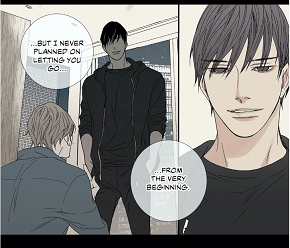 (chapter 34) And latter, he requests from his lover to help him to “stop the beast inside him”.
 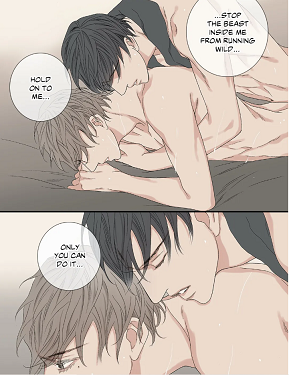 That’s his love confession, although Kang Moo doesn’t truly comprehend the true signification of his words. At some point, he begins to grasp that he has changed and is relying more on Lee Kirin which makes him nervous. This shows that Kang Moo has some problems to accept his love for Lee Kirin. However, this manhwa truly indicates that a person suffering from ASPD is capable to live a normal life and to feel love, even if this patient is not expressing it in the normal way. Furthermore, in this story, Kang Moo tries to use others in order to dirty less his own hands so that the members from “secret fraternity” kill each other indicating that this is not just to enjoy pleasure. Let’s not forget that at the same time, he helps a friend who is getting abused by her fiancé. So he is not a serial killer per se. He is determined to punish “scums” while committing crimes. Yet he believes that he uses revenge as an excuse. To sum up, the story is not just about a psychopath following his urges to kill, but rather the battle of a psychopath who struggled to lead a normal life, but gave in the moment he lost the person who supported him.
 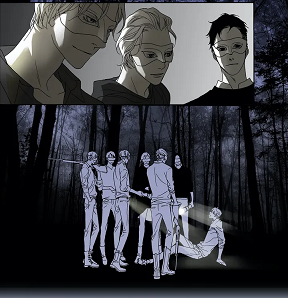 (chapter 1). Here, they hunt someone for fun. Besides, I would like to mention here the k-drama “It’s Okay not to be okay” with Kim Soo-Yun and Seo Yea-Ji. In this terrific drama, the main lead is a famous writer suffering from ASPD and the so-called normal people are actually portrayed in a rather negative way as well: they insult, exclude and hurt the persons suffering from a disorder or disability. This shows that authors in South Korea are trying to change the image about mental disorders and plead for more understanding and open-mindedness. In “The Beast Must Die” and “It’s Okay Not To Be Okay”, the characters help people to comprehend that the boundary between normality and abnormality is thin and I would even say, illusory. Lee Kirin desired to get revenge, yet he doesn’t feel sorry for the death of the culprits, but no one is questioning him. It becomes a different story, when a psychopath is involved. The detective will do anything to catch Kang Moo, but finds excuses for Lee Kirin. But observe that he is not diagnosed as a psychopath. As you can sense, there’s here a double standard. Normal people even call for violence and revenge due to their anger and pain, that’s why there’s still death penalty in so many countries. As a conclusion, being diagnosed as a psychopath doesn’t mean that they are no human and people should treat the patient like a monster. Being excluded from society is not the correct answer, like Kang Moo sensed it. He felt the condemnation in his parents’ gaze hence he felt abandoned and lonely.
  (chapter 8), the aristocrat imagined that he could get the same gaze, if he had sex with the painter. And that’s how the love triangle started. He wished to be gazed like Yoon Seungho was.
  since he viewed such a pure gaze, while the protagonist was having sex, Min associated the painter’s stare to sex. This explicates why the former is so obsessed with sex and keeps desiring to taste the artist (chapter 33, 52, 56). He couldn’t forget that gaze. I can imagine that he must have called it an obsession, which is an idiom Kang Moo utilized to describe Lee Seorin’s affection for her brother. With this approach, it becomes comprehensible why Min tells Jihwa that Yoon Seungho has been bewitched by Baek Na-Kyum.
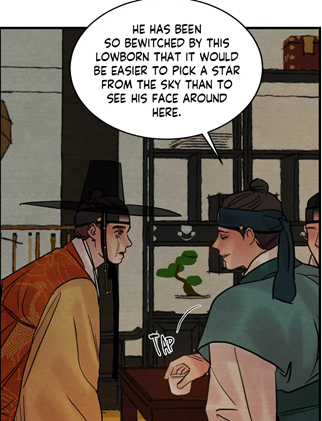 In reality, he is describing his own thoughts. In other words, he is projecting his own thoughts into the protagonist. He explains his desire and obsession with witchcraft, because he feels vulnerable. That’s his way to confess his love in my opinion. Just like Kang Moo, he can’t say these words (“I love you”), as he has no idea what he feels and what love is. With this interpretation, it becomes comprehensible why Min suggested the painter’s murder in the end. If he can’t satisfy his urges (taste the painter) and he is still thinking about it, then he needs to get rid of the source of his obsession. Because the moment the painter disappears, Min will be able to move on. Witnessing Yoon Seungho’s pain will compensate him for the loss. Therefore, the manhwaphiles can comprehend, why Min still associates Baek Na-Kyum to death. Deep down, he fears the painter, as he senses that the former represents a source of danger for him. He can become his weakness. And the best way to remove this is to manipulate Jihwa to commit the crime. I also think, Min had already detected that he couldn’t do it himself.
 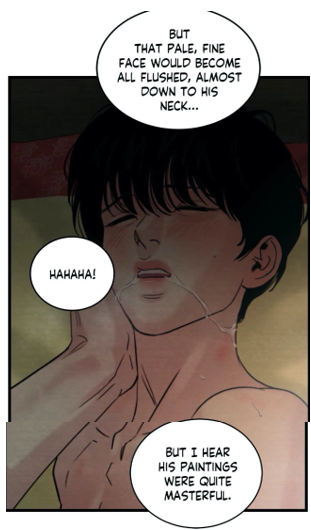 , chapter 36
  chapter 43
  , chapter 53
 And now, it becomes comprehensible why Min chose to walk on the picture
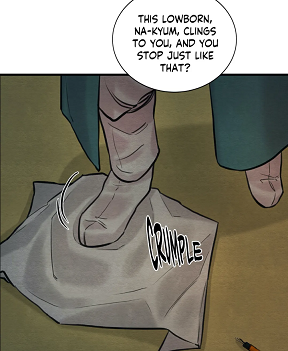 , when he was in the artist’s study. He felt the urge to destroy the image, as he desires to be the one portrayed in that painting. This explains why the next morning when he talks about the Baek Na-Kyum’s assassination and rape, he remembers the drawing.
  (chapter 43) So his job corresponds to the second definition. That’s why he is wearing a mask. Striking is that his mask is very similar to The American Joker:
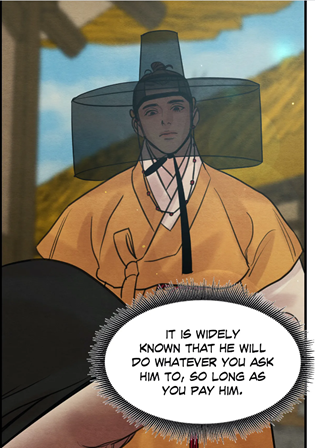 But most importantly, Nameless acts exactly like a special playing card (definition 1), since his function is very similar to Black Heart’s. First, he breaks laws (trespassing, abduction, murder, hiring spies), because the joker is not supposed to follow the game rules. Secondly, the Korean jester is an extremely beneficial and harmful card to the figures in Painter Of The night. Observe, that Nameless’ interventions have a devastating and beneficial impact on Jihwa and the main couple. While the characters had to suffer due his actions, the latter helped the protagonists to realize their true feelings and face reality. Nameless noticed right away that Jihwa was not the type to order the murder of a person. He noticed the noble’s nervousness with his bad habit: biting his fingernails.
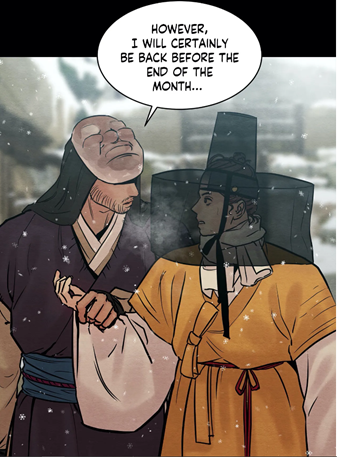 (chapter 50) Therefore he chose to mislead the red-haired client, because he hoped that with time, the aristocrat would change his mind. However, in order to give Jihwa the impression that he was taken seriously, he gave a false excuse and explained that he needed some time. As you can see, exactly like Min, the commoner manipulated the instigator. Later, when the latter criticized the criminal for his inaction, the latter was the one who reminded the red-haired lord of the gravity of the crime: he intended to kill a person. The irony is that the assassin, a symbol for immorality, was actually playing the role of consciousness:
  (chapter 51) In my point of view, it is very important, because it shows that Nameless has a huge sense of justice and morality. He can distinguish from right and wrong, and is well aware that killing someone is in truth a terrible crime. And thanks to his intervention, he stopped Jihwa from committing a grave sin. He forced the lord to face reality, by describing in the most horrible but real way possible the things
  he would do to the painter, so that Jihwa would truly see the consequences of his choice. Nameless brought pain to the red-haired master, but at the end, Jihwa could finally admit his mistake and regret his actions. He was responsible for ruining his relationship with his childhood friend. What caught my attention is that Nameless’ words had such an effect on the lord that the latter even vomited. It was, as though Nameless’ words had such power that they could remove the poison from Jihwa’s heart.
  His words and actions worked like an antidote, which reminds us of the words used by the noble with the mole:
 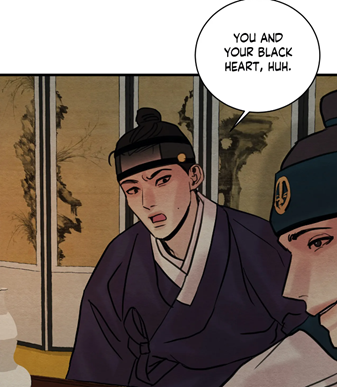 As you can observe, Nameless embodies truth and Min lies, and Black Heart’s lies were the reason why Jihwa had been “poisoned” and deceived. Only reality could make him perceive the truth. Striking is that Nameless had already planned that Jihwa would never give the final hit order, therefore he had already envisioned to return the painter to Yoon Seungho. Min might have suggested the plan, but since Nameless executed it, he is also responsible for their misery and liberation. Consequently, the abduction made the painter realize his feelings for the main lead. The latter would have never recognized it, if he hadn’t been facing death. In front of death, social gap and social status didn’t matter any longer. What is truly important were the persons’ actions that moved the person facing his imminent end. The manhwaphiles should remember that Yoon Seungho’s smile was the last thought Baek Na-Kyum had, revealing that the lord’s smile must have touched his heart back then, giving him some hope. That’s why at the end, he screamed for Yoon Seungho’s help
  and the way he called the main lead showed a certain intimacy: lord Seungho. The result of the abduction on the main lead is clear. He recognized his powerlessness and recognized that he couldn’t bear the thought of being separated from Baek Na-Kyum. Furthermore, the chapter 66 displays how the main lead is no longer denying his affection for the painter in front of witnesses. Don’t forget that Yoon Seungho is carrying the artist in front of Min and his staff during the day
 . Back then, only Min saw it and the protagonists denied both the main lead’s love for the commoner. Simultaneously, this panel
  , because the lord is not naked, a sign for his obsession with sex, but he is not even hiding the identity of his lover. The abduction destroyed the relationship between the two protagonists which was only based on sex, yet simultaneously the kidnapping helped them to change the nature of their relationship, to come to a spiritual love, something the noble had been longing all this time. And this explains why there won’t be any dichotomy later: sex or love. In the future, sex will become one of their ways to express their love for each other. Yet, I am quite sure, both will reveal their affection through other actions: painting, poetry and teaching. As you can conclude, Nameless has a similar effect than Min in the end. Both bring misery and pain, yet they help the characters to perceive truth and accept reality. And now you understand why I had this revelation: Nameless is also a Joker.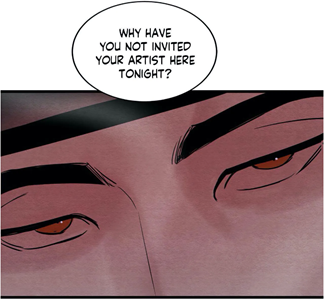
 (chapter 33) and hide his true wish (taste the painter), the clown is working with musicians and another dancer. This exposes that Nameless is actually team-oriented. Moreover, we know for sure that Nameless has a good relationship with his workers, since they gave info to Jihwa.
 And now, you can understand while examining Black Heart, I had the following revelation: Nameless stands in opposition to Black Heart.
 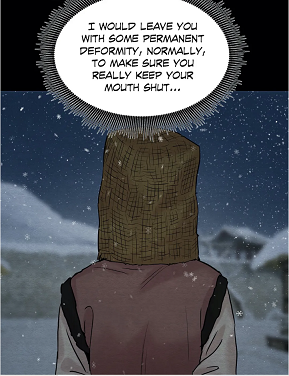 , although it signifies that he is taking some risk. Sure, he is here not soft-hearted, quite ruthless. Yet, let’s not forget that he is here wearing his mask. In that scene, the criminal scares the victim so much for a reason: he is trying to ensure that this incident remains a secret and that no one gets hurt in the end. He is loyal towards his client, since he is acting for Jihwa’s best interest (not dirty his hands by murdering a person), willing to get rid of a possible thread.
  (a memory from the painter, chapter 61), he is wearing the mask.
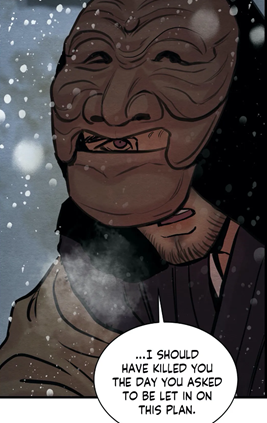 Hence I come to the deduction that the mask symbolizes his role as criminal, yet at the same time, it exposes that this doesn’t represent Nameless’ true identity and personality. There’s a different person behind the mask, whereas it is different for Black Heart. Min’s face is the mask itself, the symbol for his hypocrisy.
  (chapter 50)
 Furthermore, Nameless does have a sense of justice…. like I pointed out earlier: he is well aware of the painter’s innocence. Yet, there’s no doubt that there are divergences between Nameless and Batman, as the former belongs to the commoners, whereas Bruce Wayne is really rich. The criminal is not powerful, unlike the American hero who can use his wealth and connection to fight against villains. But since the low-born stands in opposition to Min and I considered the latter as a new version of The Joker due to the similarity of their mentality, I can only perceive Nameless as Batman, the one who will be able to defeat Min. And in chapter 66, their antagonism is already palpable.
 Why did Byeonduck decide to show us the roof, when the guardian gave us an explanation about the commotion? It is important, as it represents Nameless’ deception. When I saw this panel, I was immediately reminded of this image:
  (chapter 50). The color of the clothes are the same. Thanks to her, I could finally put the puzzle together. It looks like Nameless planted a spy in Jihwa’s mansion in order to know how the lord would behave after giving the hit order. And this is not surprising why Nameless would know that Jihwa had been drinking all this time, even before removing the veil from the hat. Sure, he noticed the trembling hand, but this could be caused by nervousness and anxiety.
 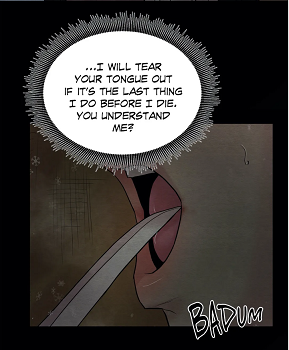 Since Nameless is well aware of the nobility’ mentality, he can use it to his advantage. The aristocrats never pay attention to servants and as such commoners. The criminal is right in the end: Min doesn’t even recognize that there’s a new guardian, although he has been at the mansion before twice (8, 52) and he even saw Deok-Jae getting beaten. Besides, I would like to remind my readers that there’s no coincidence in Byeonduck’s work. She focused a great deal on the guardian and his explanations. Since he was delivering a similar explanation than Nameless had made up, I truly suspect that the domestic is informing Nameless in the end. And note that in chapter 66, Min reveals in front of Yoon Seungho Jihwa’s involvement.
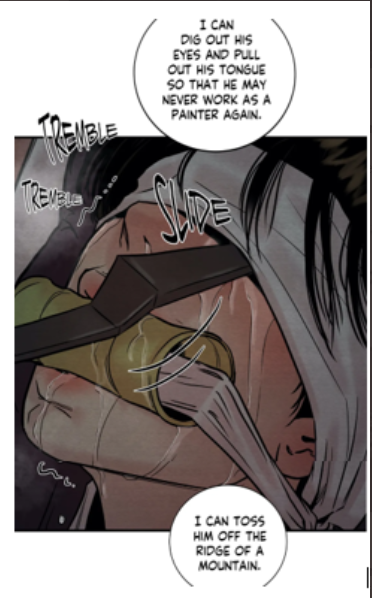 Let’s not forget that this story is constructed according to the principle: history repeats itself. So there must have been a painter in the past as well. Finally, Jihwa is linked to secrets either, as his favourite sentence is: I know
  Besides, I had explained that Jihwa seems to be involved in the past and felt guilty. Therefore I sense that both characters will discover that they have much more in common: the past and their involvement with the two main leads’ past.
 The man never got punished for his misdeeds: the theft, the treason, the bullying, the poisoning and the trashing of Baek Na-Kyum’s place. The vicious domestic met his karma. Sure, nowadays no one would receive a death sentence for such crimes, yet in that period it is a different story.
 (chapter 52) And notice that his desire to taste the painter contrasts so much to Jihwa’s words in chapter 18.
  and to his bloody face
 He kept asking rhetorical questions, making comments without waiting for Yoon Seungho’s answer. It was, as if Min was acting like an entertainer. However, we should remember that despite his role as jester, his true goal is not to entertain his host or his friends. He is behaving like that out of selfishness. He is the one who desires to have fun.
 And due to Min’s trick, Yoon Seungho was hurt, as he considered it as a rejection. Note that in that scene, social norms played a huge part in the denial of both protagonists, although they were never directly mentioned. Min as the joker was a reminder of scandal and as such of standard norms.
 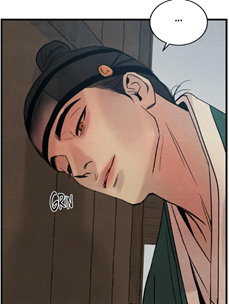 and screamed for his help.
  For him, it was also too beautiful and incredible to be true. At the same time, his denial stopped him from realizing his true feelings. Yet in front of death, Baek Na-Kyum couldn’t control his emotions and thoughts pressuring him to voice his deepest desires. And the artist’s disappearance had a similar effect on the main lead in the end. First, in the storage room, he confided his real wish
 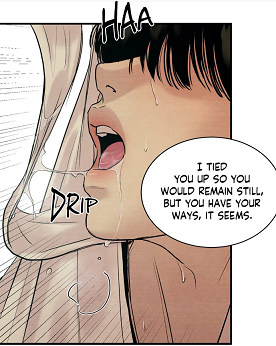 Then he is not even trying to hide the painter in front of Min. He is indeed carrying him like a treasure, while feeling no embarrassment.
 Like my follower @seunghosimp observed it correctly, this gesture symbolizes his capitulation and submission. Due to Min’s intervention, all the secrets were removed so that the relationship between the two protagonists can be rebuilt on a new and real foundation. The noble has no longer the upper hand in their relationship and will always listen Baek Na-Kyum’s words. Now, Yoon Seungho can trust the painter and will never question his behavior and words. What the main lead fails to recognize is the painter will never see himself as superior and as the lord. For him, love is not a synonym for war or defeat. Baek Na-Kyum will teach him the true nature of love.
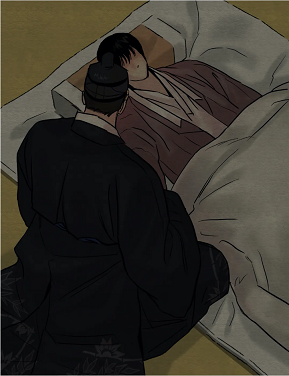 They would give such an answer, because they would use the black frame as reference. The latter represents a memory or a dream in Painter Of The Night. In other words, the manhwaphiles would invoke a literary phenomenon:
 and walked randomly in the room. His survival instinct had kicked in. Because of the flashback, the protagonist had lost his sense of orientation and couldn’t see where he was going, as all his thoughts and emotions were revolving around the trauma. He had the feeling that he was reliving his past experience. This explains why the chapter 65 ended with the following panels:

 in chapter 65. And if you read the chapter again, you’ll notice a huge white space between the next following panel.
  Yoon Seungho is opening the door leaving the painter in his bedchamber (chapter 65). As a conclusion, the beginning of the episode 66 has to placed between the last words and the opening door. Hence we have a fourth flashback in episode 66.
  , then covering his mouth
 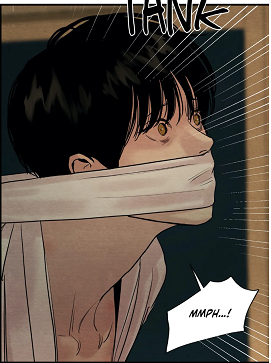 and finally putting him under the cover
  so that he could get rid of noona Heena easily. He recreated the situation Baek Na-Kyum was exposed to, when he had been abducted. And if the beholder pays attention to the way the painter is lying in the bed, they will realize another important aspect: the cover that the painter used as protection and comfort has become a prison or a trap now.
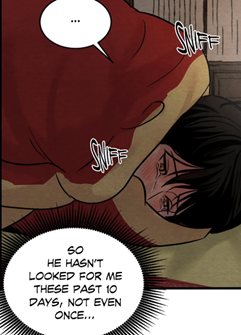 Besides, in this chapter, his heart started racing with the main lead’s appearance.
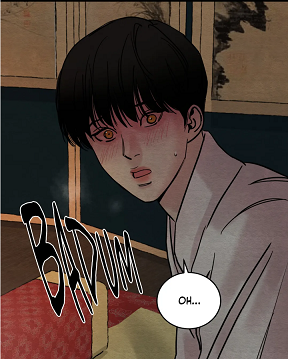 In both chapters, the main lead was the cause for the heartbeat, yet the reasons for the racing heart are totally different. It is important, because it shows us that the kidnapping left a deep wound on the artist’s psyche. When the main character recreated the condition of the abduction, he triggered a flashback. Because Baek Na-Kyum couldn’t scream for help and his head was held under a bag
 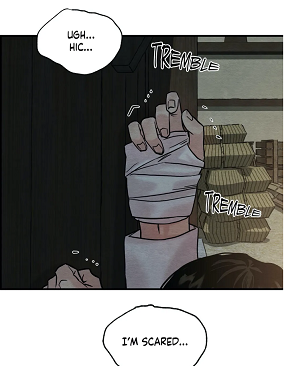 But if the manhwaworms looks at the criminal’s actions, they will conclude that Nameless was indeed ruthless. He knew how to terrify the painter. He tormented the painter psychologically. Nonetheless, since Nameless neither murdered nor atrophied the painter, in his eyes he was actually very kind and even merciful. He even felt pity for him, as he was well aware of the artist’s innocence. The latter was just a plaything caught in the middle of the fight between two nobles.
  This impression seems to be confirmed, as the moment he removes the cloth from the painter’s mouth, the lord criticizes him.
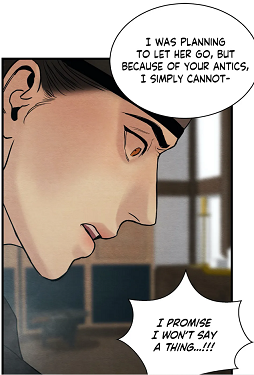 However, from my point of view, we need to differentiate between the actions made by Yoon Seungho’s mouth and hands again. While the latter are under the influence of his unconscious, the mouth represents the mind and as such conscious. Note that he removes the cloth, although he could have ignored it. By liberating Baek Na-Kyum’s mouth, he is actually endangering his situation.
 (chapter 58). The irony is that in chapter 66, the painter is a wreck, yet the lord is admitting his defeat displaying Baek Na-Kyum’s real power. The other divergence is that this time, it is a conscious choice. This is not a dream or an illusion. Yoon Seungho states that he can’t win against the low-born’s will. In other words, their relationship is progressing again. Due to the resemblance of the chapter 58, the readers have the feeling to witness another flashback. Nonetheless here, the noble hears a reply to his confession, unlike in the past: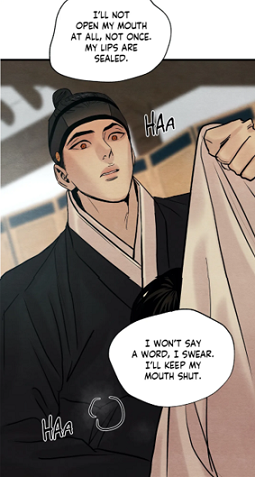
 The nature of the confession has changed: this is an admission for his silence. He lied and apologized in order to survive. These panels expose how deeply traumatized the painter is. He is still trapped in his flashback, reliving his near-death experience and doesn’t realize his lover’s presence. Therefore his gaze is directed elsewhere. I would even say, his gaze is lost in the flashback. What caught my attention is the protagonist’s reaction, when he hears the painter’s words and heavy breathing. He is not only surprised and shocked
 , he is also paralyzed. For me, the last panel shows the main lead’s realization. He must have recognized the painter’s real condition: he is traumatized. And in my opinion, the painter’s confession and behavior triggered a flashback in Yoon Seungho too, which we don’t really see, but can sense more or less. Observe his discomfort and his fixe stare.
  He seems lost as well, very similar to the commoner’s gaze. Besides, the aristocrat doesn’t move one moment, although some time has already passed. The sister has already left the house and Min is now standing at the door. The last picture even shows us Min’s perspective. He senses the lord’s worry and pangs of conscience too. From my point of view, the lord is reminded of his own bad past experience due to the artist’s behavior and words. The other clue for this interpretation is the lord’s phobia of the cover.
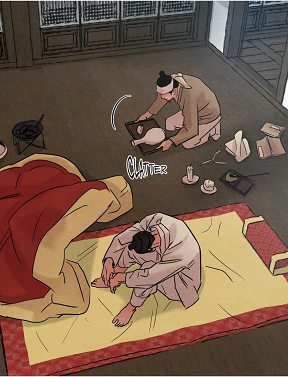 (chapter 35) Therefore I come to the conclusion that we have another flashback here, but Yoon Seungho’s is not revealed, only through his gaze and the observations I made: the fear of the cover and the commoner’s past as a repetition of the main lead’s tragic past. Let’s not forget that this scene is also a new version of chapter 53:
 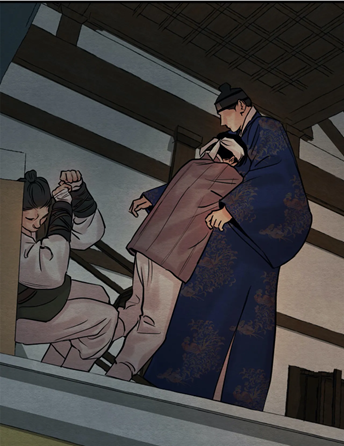 , back then, the main lead was the one who was in a dissociative state and the painter embraced him, when he sensed his fury and pain. However, this time the roles are switched. And this explains why the noble hugs the painter, attempting to give him some comfort. Yet, in my opinion, he has no idea about the real cause of the artist’s trauma in that moment
 , therefore he feels responsible and terrible. That’s the reason why he remains so passive and silent. He feels the need to console Baek Na-Kyum, but note that he doesn’t even attempt to dress the painter or to put him in a better position.
 The images are almost identical, yet in the second picture, there’s no black frame, therefore this means that it represents reality. And now, you can better grasp the nature of Baek Na-Kyum’s flashback. It is a mixture of dream and memory. The lord stayed by his side the whole night (a new version of chapter 55)
  and at some point, the artist opened his eyes briefly, just like the lord nodded to Baek Na-Kyum’s question unconsciously
  , as he felt his presence, but never realized it in the end. In other words, the painter also detected the lord’s presence by his side, even opened his eyes for a second, heard him even calling his name
  . The tragedy is that exactly like during their Wedding Night, the painter won’t be sure, if what he sensed and saw was reality or a dream. Therefore I come to the conclusion that this is a new version of chapter 58, where the roles are reversed. Back then, the lord thought that this night with Baek Na-Kyum was too beautiful to be true and it is the artist’s turn to feel the same way. This flashback shows his wish mixed with a memory. And now, during this night, the lord expressed his regrets and showed his tenderness, just like in chapter 58. He took the hand with delicacy
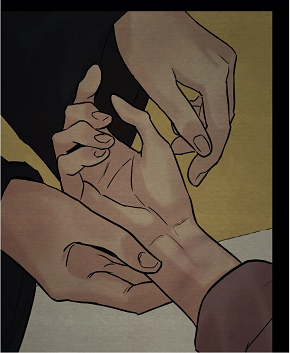 and touched the wrist and the wound with his finger carefully,
  ,as though he wanted to heal himself the bruise. For me, this scene was so beautiful and moving, as it reflects the noble’s growth. He doesn’t just feel huge pangs of conscience, but he is determined to redeem himself in the end. When he touches the scar, he feel sorry for Baek Na-Kyum’s wounds which he hadn’t seen due to his self-hatred. At the end, he treats Baek Na-Kyum’s hand like a treasure. Yet, note that he is not kissing it.
  and put them on his loins.
  He only valued them, as they helped him to have a better libido. And now, his gesture
  She symbolizes reality. Consequently, I believe that the following picture from the flashback illustrates the artist’s true wish.
 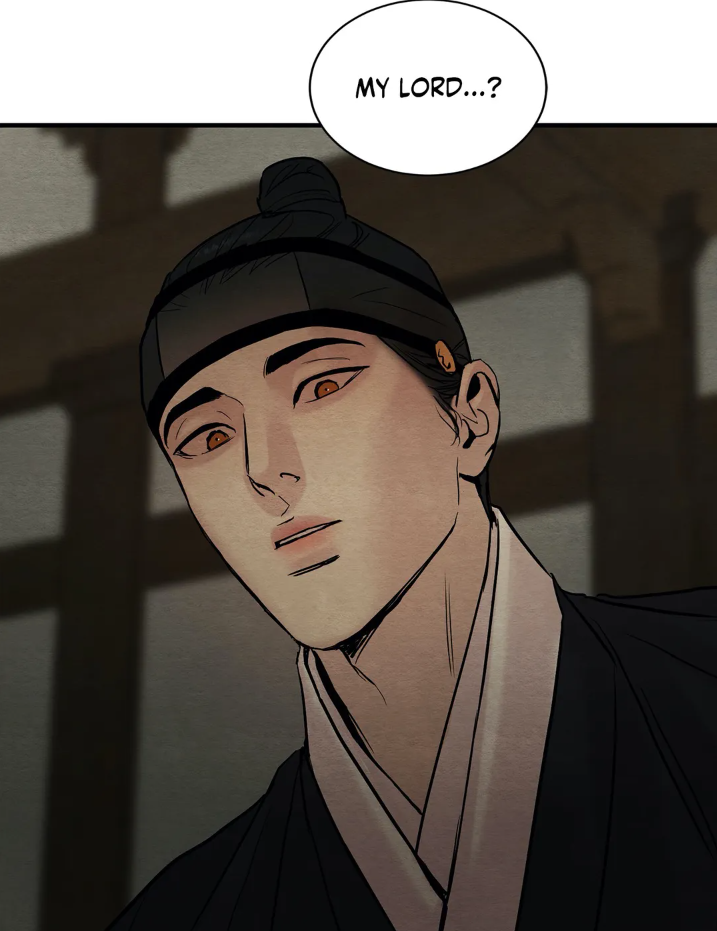 He desired the lord by his side, but the reality was different. His noona was by his side. This didn’t upset the painter, because he received a warm embrace full of love and compassion, something really important in order to heal his wounds,
 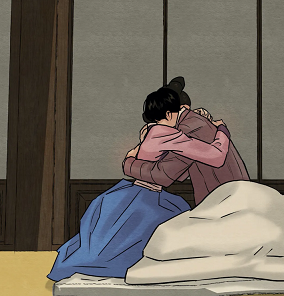 contrasting to the hug in the barn symbolizing fakeness and coldness.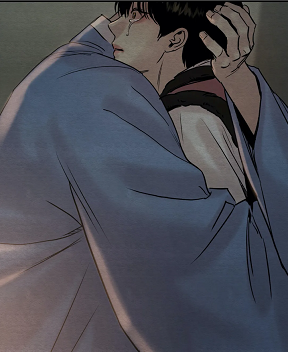
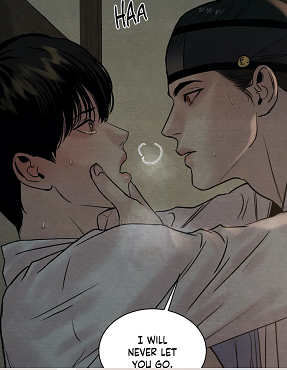 (even if it sounded so possessive and obsessive). Furthermore the same person even expressed that his smile and presence could be the source of his happiness
  Finally, the lord’s confession revealed that he never considered him as a whore in the end, as his request was just a smile and not his body. Finally, I believe, noona Heena’s presence will also have an influence in the painter’s thoughts and emotions. Baek Na-Kyum will be able to appreciate that Yoon Seungho allowed her companionship, willing to accept a gisaeng in his house, although the low-born heard him calling her a wench or harlot before. Unlike the past, the artist is no longer blind or deaf to the noble’s gestures. There’s no doubt that they will rekindle, but their relationship will mature. The lord will try to find a different connection and I am already imagining him asking again:
  Another flashback from the past…
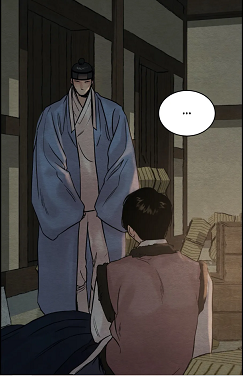
 [I already examined the clothes from the first season, here are the links:
 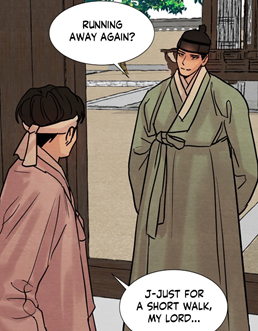 (chapter 12)
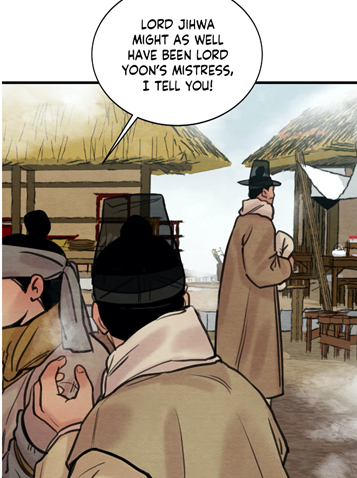 However, it changed the moment, Yoon Seungho made love to the painter. Since he knew that he had acted as the scholar’s replacement, he needed to attract the painter’s attention and used his clothes in order to impress the commoner so that the latter would fall for him.
  That’s why he chose a purple hanbok with short sleeves. Imagine that he had worn the same hanbok, when he visited the scholar and back then, it was to demonstrate his wealth and power. And this shows that in his mind, the hanbok would do the trick in order to win the painter’s love and admiration. The lord thought that the cloth would expose that he had everything what the low scholar didn’t have. But his effort went unnoticed by the painter. In other words, the presence of the painter started affecting his clothing. At the same time, his choice of clothes were not always a conscious decision, which we could sense at the end of the first season.
 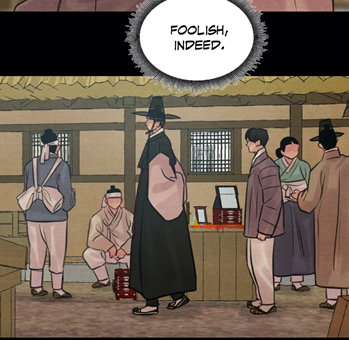 In chapter 39/40, he selected a pink robe with a black hanbok. This represented his actual state of emotions. He had just shared his bed with the painter for the first time and felt pleased and refreshed, like a happy man in love. However, he was trying to hide his emotions, therefore the pink was covered by the black hanbok. And since he wore a hanbok with short sleeves, it is palpable that here again, he desired to seduce and impress the artist. In conclusion, the lord felt the need to become desirable in the artist’s eyes and used his hanboks for this purpose, indicating some insecurities. Simultaneously, his selection was influenced by his emotions and unconscious. Striking is that in chapter 39, he had not the valet by his side to dress him up. Therefore Kim had no influence in the selection of his hanbok for that romantic date. And it happened again in season 2. When the main lead chose the blue hanbok with short sleeves
 , Kim was taking care of the painter. Therefore I come to the conclusion that Kim has some influence, in the way the main lead is dressed. This explains why we saw him helping the lord to get dressed in two occasions and each time, he chose the same hanbok: in chapter 11
 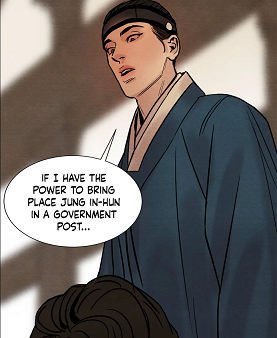 and chapter 47
  . And this is no coincidence. This outlines the importance of Kim in Yoon Seungho’s life. He is his right-hand, he is the only one allowed to see his hair down and comb it, a privilege that Baek Na-Kyum has never got to experience yet. However, little by little, the readers can perceive the painter’s increasing influence through the hanboks.
  In chapter 45, Yoon Seungho has a robe with cranes on it. And due to this panel, we have the impression that the lord perceives the artist as his symbol of good fortune. Consciously, he ordered such a hanbok, because he considered himself as the crane for the painter, yet in his unconscious it is the opposite, especially when you look at the way he is carrying the painter with the hanbok. Then in chapter 50,
  his black hanbok with a red design displays an progression. There are not only birds, but plants (leaves). In that scene, it represented his heart. It was, as if his heart had been wounded and he was bleeding to death. During the night before, he had been rejected one more time and had the impression that he could only be Baek Na-Kyum’s sex partner and not lover. But the one who pushed him over the edge was not the painter, but Kim who revealed at that exact moment the reason why Baek Na-Kyum had been behaving like a doll. With this revelation, the lord could only distance himself from the painter, as he couldn’t bear the thought that the artist would consider himself a prostitute. And here, I would like my readers to incite to question Kim’s motive to unveil this incident that morning? For me, there is no doubt that it was no coincidence due to the selection of the hanbok. The valet could sense the master’s mood and let’s not forget that even Yoon Seungho described Kim as very perceptive.
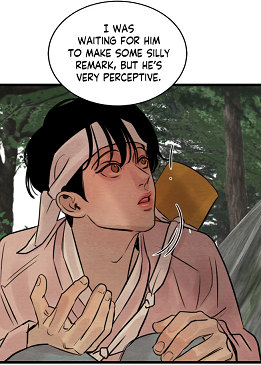 But if we look at the hanbok again, we will notice that the addition of plants in the pattern illustrates the importance of nature for the noble. So it looks like nature is gaining the upper hand, it reached the climax with the beautiful hanbok where you see the phoenix among plants and herbs
  It looks like Yoon Seungho’s unconscious has finally been able to perceive his true identity. Therefore I come to the conclusion that his relationship with Baek Na-Kyum helped him to find his true self and the clothes reflected his transformation. He is indeed a phoenix, but he feels like dying due to his unrequired love. With this new approach, you can comprehend how the painter is represented in the hanboks. He is nature himself: the trees and the flowers making the main lead feel alive. That’s the reason why during the second season, the aristocrat wears hanboks with a design. The pattern is a metaphor for the low-born, which is not surprising, since he is himself a painter.
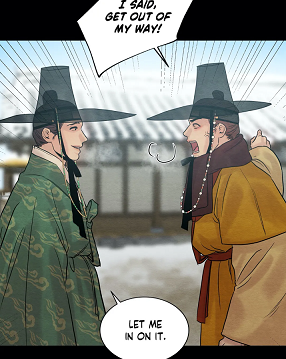 The irony is that his design was totally different. It reminds us of the smoke of opium or even worse: someone full of hot air. He talks a lot, but doesn’t know much which is true. He has no idea what really motivates the main lead. And with Min’s new hanbok, I consider it as an evidence that Yoon Seungho is indeed the phoenix and we just need to wait, until he raises from his ashes… the moment he abandons his self-hatred and love selflessly like he desired in the past. But let’s return our attention to the blue hanbok with phoenixes on it. I assume too that deep down, the main character wished to catch the painter’s attention from afar. He has such a magnificent hanbok that he could be distinguished from all the other nobles. And you are now all wondering about the return of the simple robe with long sleeves.
  It was, as if he had returned to his old self. First, I had imagined that the light blue could still be judged as a good sign, as this color symbolizes peace of mind. Furthermore
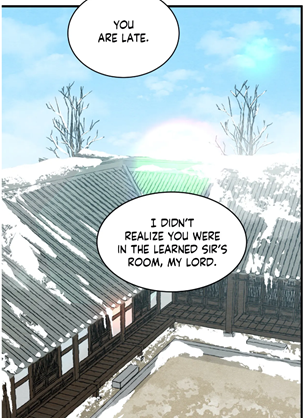 Therefore I come to the conclusion that the aristocrat was the one who selected his hanbok that morning. And this situation happened again in chapter 56. And notice that this time, he chose a hanbok with short sleeves indicating that he wanted to impress someone again. For me, there’s no doubt that he had the painter in his mind. Since he had heard that Baek Na-Kyum had not run away after his first confession, the lord had hope again, mixed with some insecurities. And now, you understand why Yoon Seungho felt so betrayed after his second confession. He had treated the artist tenderly, had been given hope a second time, only to discover the next morning the painter’s disappearance. No wonder why he felt so hurt and betrayed and couldn’t see the truth. And now, note that in chapter 65, Yoon Seungho got dressed in front of the artist without Kim’s assistance, while the painter was still in the bedchamber half-naked.
 This final scene indicates that despite the rough treatment, the painter has become even more intimate with Yoon Seungho. The progression is even more palpable, when you compare it with the scene in chapter 47:
  But due to chapter 64, I questioned his loyalty towards Yoon Seungho and came to the deduction that he was just faithful to the mansion and as such to the Yoons. Now, if you examine the definition of loyalty, this is what you find:
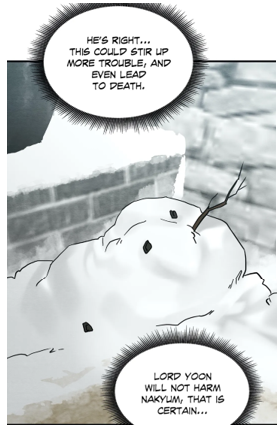 If there is no trouble, then he can live his life in peace, away from any worry and concern. And now, you understand the real cause of his cowardice. And if I include another quote about loyalty,
  Imagine that the protagonist had succeeded with his suicide, then this means that father Yoon could have returned to the mansion. And with his return, there’s no ambiguity that father Yoon wouldn’t have let live him like before. He had definitely another reason for saving Yoon Seungho’s life. Hence the main lead mistook his gesture as a act of kindness. Note that the main lead kept living according to father Yoon’s principles and Kim knew it. So his bad reputation was not a real scandal, because he kept making deals with other nobles.
  If he becomes a servant of this mansion, then the scandalous relationship will remained hidden. No uproar. Let’s not forget that Jung In-Hun betrayed the painter on several occasions: the coercive persuasion (past), then his request to spy on the lord implying that he could sleep with him (chapter 24), the false hug (chapter 29) and finally the abandonment in chapter 40.
 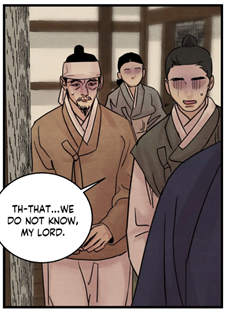 Note, that Deok-Jae was put in the front line, whereas the butler remained in the background. He had chosen the guardian as his scapegoat, hence the vicious man got punished the most and resented the valet so much afterwards.
 He had every right to do so. Both worked together to let the painter escape, but once the desertion was discovered causing the lord’s fury, they envisioned that they could use ignorance as an excuse. And here, I see another evidence that Kim was behind it
 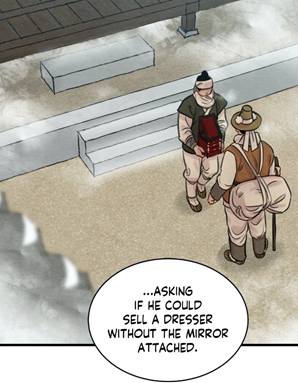 , then he spoiled the artist’s rice and finally the incident with the hurt wrist will resurface. Yoon Seungho will recall, how the painter even stopped him from killing the man. Kim will use this to his advantage. Deok-Jae will become the scapegoat of the abduction. The maids will testify in his favor, as they saw how jealous Deok-Jae was. The servant will let the lord feel guilty and even put the blame on the doctor, saying that the latter remained silent and he could have intervened.
 and tarnished his tranquility and reputation. Besides, there’s no doubt that noona Heena will request that the painter returns to her side, once he has recovered from his wounds. The valet will be happy, if Yoon Seungho is forced to send away Baek Na-Kyum. This will mean the end of his trouble, once the painter leaves the mansion. By doing so, Kim is helping Min in the end, as the painter will be left without any protection. In my eyes, Kim is Yoon Seungho’s real enemy, because he fakes loyalty and care, while in reality he prioritizes his own interests. He is a hypocrite, but a different kind, which is much more difficult to perceive. I had questioned his behavior right in chapter 45, but it took me 19 chapters to really grasp his personality. Let’s not forget that the painter had two enemies during the first season, the scholar and Jihwa, and since Byeonduck likes using parallels, we have to imagine that Kim and Min are the main lead’s enemies. Besides, Kim is also a surrogate father for the main lead. Consequently, he will use the main lead’s insecurities and self-hatred to his advantages. One might argue that the servant tried to plead to his master in the barn.
 He recognized his wrongdoings, which is not the case with Kim and chapter 65 showed.
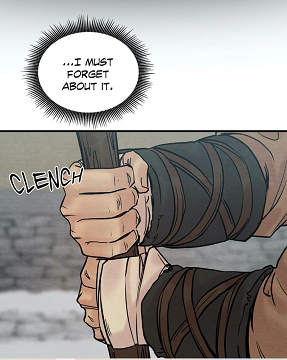 The butler will never become a man, responsible for his actions and decisions. My reasoning is the following: Kim plays a similar role than Jung In-Hun and we know that the scholar didn’t change his thinking and behavior. Even after abandoning him, he imagines that he can still use him.
  , a new version of chapter 1: “die like a dog”. However, this time, the main lead will have a reason for his execution. Kim betrayed him by not revealing what he knew and allowed his loved one to get hurt again. And in my opinion, Kim is the reason why Yoon Seungho was trapped in the end. He was never a good example for the main lead to grow up. He never taught him how to become a true master. His passivity, indifference and selfishness influenced the lord in a bad way, but the aristocrat never noticed it, because Kim took care of him. He relied on the butler one more time and imagined that he was still a good servant. That’s why they had this master-domestic relationship and this explains why the main lead is using it again against the painter, which doesn’t contradict Kim’s philosophy. The painter was just a favored servant.
  (chapter 65), he was brought back to the past. The domestic was a witness of Yoon Seungho’s rape and as such of his sexual abuse. Striking is that in episode 65, he didn’t even open the door, but instead of helping, he let it happened. He didn’t act according to his belief. This means that in the past, he must have acted the opposite. The door was open. This signifies that he abandoned the young Yoon Seungho, when the main lead asked for assistance.
 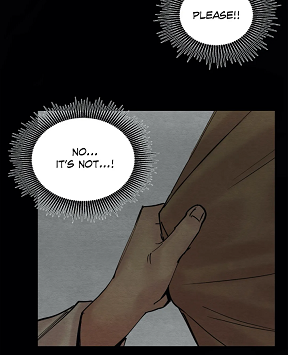 (chapter 65) He refused to listen to the young master’s plea. And now, you understand why Yoon Seungho had sex in front of him outside the barn. Unconsciously, he wanted to confront the valet with the consequences of his actions.
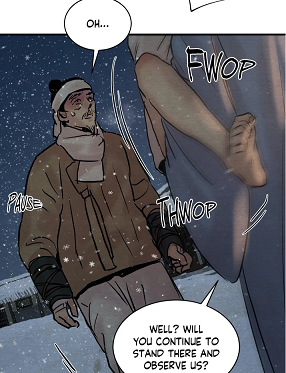 (chapter 64) The teenager was left behind by the servant, and his hand couldn’t even stop him. But since it is a reflection, I think that the butler was the one who brought the main lead to the predator, naturally his intention was not to have him raped. And now, I grasp why the lord feels the need to hurt people with his hand, like for example strangling the painter
  (chapter 61) or grabbing the topknot of a noble
 (chapter 8). His hand expresses not only his rage, but also his powerlessness. With his hand, he wasn’t able to stop the valet from leaving him behind. He had tried to stop his father from leaving his side with his hand too.
  (chapter 86) Furthermore, Yoon Seungho couldn’t even punish the valet for betraying him, because he had no authority and no strength. Back then, he was just a teenager. In chapter 63 and 64, Yoon Seungho was indeed reliving his traumatic past. Because the butler was recollecting two different memories (the night before and the lord’s sexual abuse), my first impression was that the young boy had been abused in the shed.
 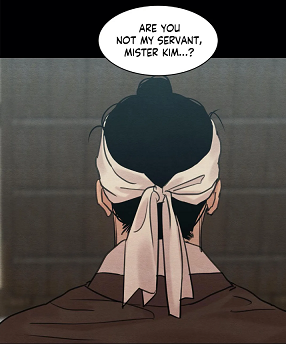 (chapter 77) My theory is that the main lead was raped by “lord Song”, the king. Therefore I assume that the man was invited by father Yoon. Remember that the kisaeng Heena proposed to her donsaeng to seek the protection of a nobleman, as he is a low-born.
  (chapter 97) My idea is that the valet thought that by seeking the monarch’s protection, the young master’s suffering would end, for the king stands above the scholars and elders. Anyway, I believe that the valet made a bad choice and regretted it afterwards. Due to his guilt, he developed resent towards Yoon Seungho. And this explains why Kim said this to the painter in order to ease his pain:
  (chapter 12) He couldn’t tell him details, since he would reveal his complicity to the crime. Furthermore, since the valet led the painter to the pavilion, it is very likely that Kim was the one who offered Yoon Seungho to the pedophile, which makes his crime even worse.
  (chapter 77), he became more and more burdened by his guilty conscience. He turned into an accomplice, for he never revealed his involvement and mistakes.. He could no longer reveal the truth, because he would have to get punished. He feared father Yoon’s wrath and he had reasons too. He could definitely die. That’s the reason why he reproaches the doctor his passivity and silence, though in my opinion, it was not about the abduction, but about the tonic. Sure, in Joseon, there was no law called “Duty to rescue or Failure to provide assistance”.
 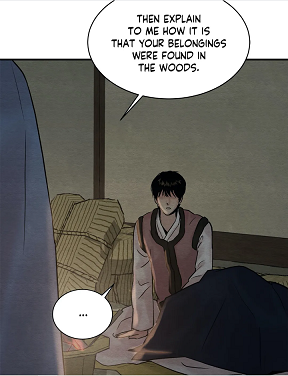 , (chapter 62) especially when you think that Baek Na-Kyum is just a commoner. But the problem is that he was biased, just like his father who had the impression that his son was a homosexual due to the testimonies of close people (Kim, Lee Jihwa and probably Yoon Seung-Won). After the rape, Yoon Seungho got punished. And this interpretation was proven correct in season 3
 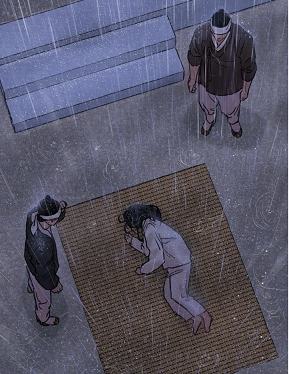 (chapter 77). But here Kim remained silent too.
 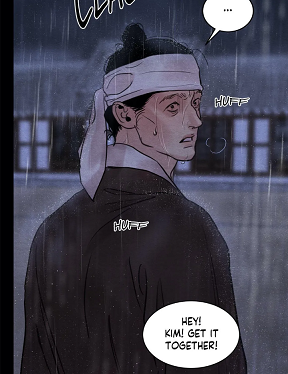 (chapter 77) It was even worse than before, because after the straw mat beating, he was paralyzed. No one spoke for him and believed his words, and Kim wasn’t willing to step in. Moreover, I believe that Kim had another reason for remaining silent.
  (chapter 65) That’s why I believe that the author is not showing that Kim and the physician chose secrecy and silence, because they feared for their life. They only started fearing for their life, when the truth is about to be revealed, as the painter was not dead yet. As the victim, he was a witness. Because once the lord discovers the butler’s passivity and complicity, it becomes a matter of life or death for him. According to me, there are two doctors. So the chapter 65 unveils that the first doctor didn’t testify, as he wanted to help the artist.
 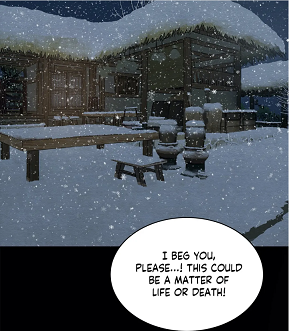 (chapter 65) In my opinion, the butler had deceived the commoner, he let him believe that Baek Na-Kyum had run away because of the lord’s violent temper. The painter had come wounded to his office. This negative perception of the young lord Yoon could only make the doctor jump to wrong conclusion. ,Striking is that this scene
 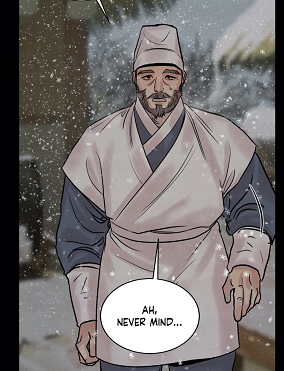 (chapter 63) revealed that the doctor was hesitating to give his opinion to the butler, he thought that the artist had run away. And what is the common denominator of all these scenes with the doctors. They all chose silence for different reasons. Just like Kim, the doctor had become an accomplice. As for the second, he remained silent out of fear, that he could get into trouble.
 (chapter 65) This represents his attitude in life, therefore he is responsible for Baek Na-Kyum’s loss of innocence. His other leitmotiv is
  (chapter 28)That’s why I believe that the butler was lying back then and had even allowed the artist to run away that morning. I see a new version of chapter 29. But let’s go back to chapter 65.
  (chapter 82) Why didn’t he ask for a punishment after this humiliation? It is because he couldn’t. However, he must have definitely sought revenge. And the main lead became the sacrificial lamb, as in father Yoon’s eyes, his son was the reason for the purge: desertion, betrayal and probably drugs played a role in the purge. It is definitely possible that I have to change this theory about his traumatic past, but as you can observe, the main elements don’t change:
 (chapter 66) Thus the circumstances were turned against him.
  (chapter 65) But she was not present, when Min admitted Lee Jihwa’s crime. That’s how I realized that while chapter 65 represents silence, deception, cowardice and passivity, chapter 66 embodies the exact opposite. Min told the truth, Heena tried to save her brother by creating a ruckus! For Yoon Seungho, silence is a sign of culpability which he learnt from Kim. Hence he lied to the kisaeng
  (chapter 65), and later never spoke to the painter about the incident. If he had done it, he would have been forced to admit his misjudgment and wrongdoing. And now, you understand why Martin Luther King said this:
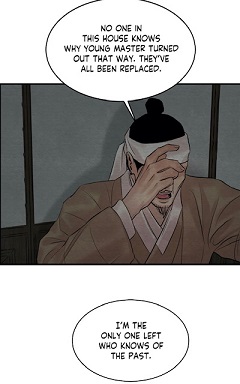 (chapter 86) He believes that he is the only one left who knows the past. But he is wrong, since the doctor also recalls the past. Hence how can Kim prove that he is telling the truth, since he told a different story to the physician? In addition, we have also lord Song. Besides, by giving the drug to Yoon Seungho without his knowledge and consent, Kim committed a wrongdoing. His knowledge won’t serve him in the end. I am deducing that the saying “silence is a true friend who never betrays” will no longer be valid. Therefore we have to expect a betrayal, and that would be from the physician, especially after we recall the butler’s warning in the first season, which was addressed to a different doctor from my point of view:
 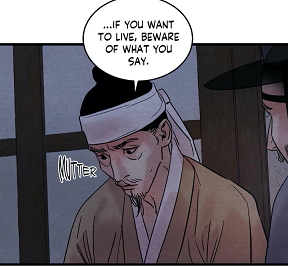 (chapter 33) Let’s not forget that in chapter 65, the servant tried to put the whole responsibility on the physician, making him feel guilty. And since Byeonduck is even using elements from the first and second season, I believe, we will have a reversed situation in season 4, where the doctor will speak up and put the whole blame on someone. Neither the physician nor Kim expected that the painter’s body wouldn’t remain silent
  (chapter 102) He needs to find the answer, which stands in opposition to silence and burying the truth (sweeping it under the carpet). This signifies that this time, Yoon Seungho has to gather information himself, and he can not rely on Kim:
 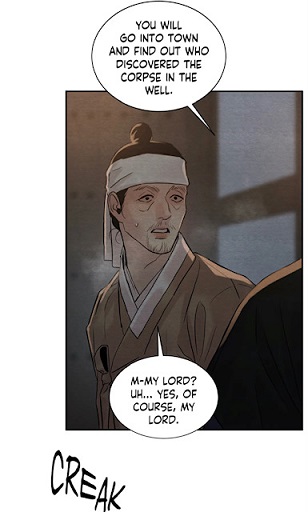 (chapter 98) As you can see, slowly people are forced to talk
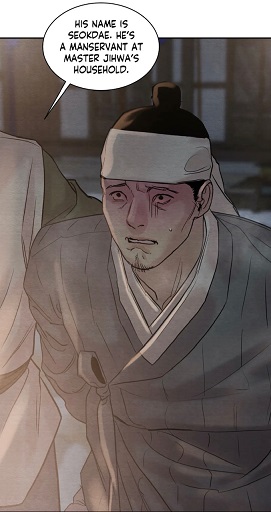 (chapter 99), hence their testimony can be questioned and perceived as lie.
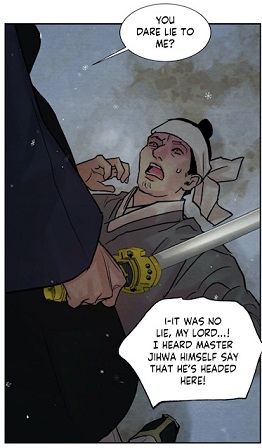 (chapter 100). This is important, because by getting confronted with lies, the lord will be able to discern the truth! In other words, silence embodies darkness and as such death.
  (chapter 74) Thus there was only silence in the lord’s nightmare. And this contradicts this statement:
 And during the second season, Deok-Jae is hired as spy on Jihwa’s behalf. Nameless might have been the hand who decided it, yet since it was in order to help his client, Jihwa is somehow responsible for this.
 And since in the same chapter, we have Jihwa’s confession and the doctor’s statement that Jihwa had the same disease
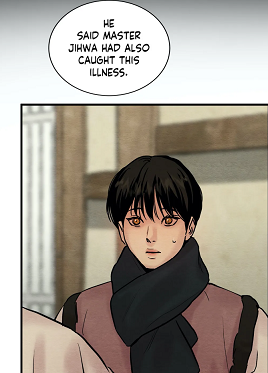 , we deduced that the main lead’s seclusion and separation from his childhood friend was definitely related to homosexuality. However, back then, I pointed out that the words from the physician about father Yoon made it pretty obvious that Jihwa was the cause for the protagonist’s seclusion. The father must have come to the conclusion that Jihwa was in love with his eldest son. Let’s not forget that Jung In-Hun is a character mirroring father Yoon. And we know for sure that the scholar used to abuse him physically due to the erotic paintings.
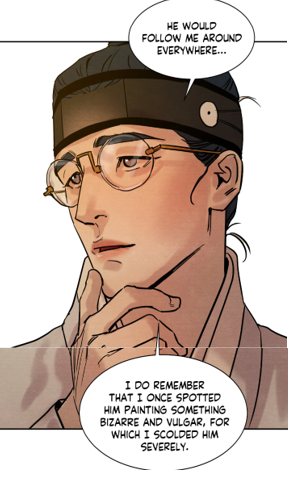 , but he tried to diminish his coercive persuasion by describing it as a simple punishment. From my point of view, the father must have either discovered a letter from Jihwa addressed to Yoon Seungho, where the latter expressed his admiration or witnessed a scene, where he caught Jihwa’s gaze towards his eldest son, like a new version of this scene for example.
 What if Seung-Won, who was jealous of his brother due to his good notoriety, decided to fake a letter from Jihwa containing a love confession? He came to this misdeed, after seeing how Jihwa would look at his elder brother. Then he delivered it to their father so that the latter would see him as a diligent and filial son and feels disappointed by his eldest son (new version of chapter 44). I had this idea, because both faked a letter and since they are both linked to a similar incident, I have the feeling that this could be a clue related to their past. Anyway, because of their young age and their innocence, their actions had a lot of bad repercussions, which they never anticipated. Out of disgust, jealousy and fear that father Yoon might lose his son, the terrible father started abusing the main lead physically and sexually. Yet the sexual assaults remained a secret, as Kim covered up for his master. I see now another evidence for this signification with the chapter 65.
 The latter was able to get some insight through gossips, like Seung-Won’s visit for example. And it is definitely possible that Jihwa could have done the same in the past, therefore he must have noticed that something was going on at the mansion. Imagine that at the end, he chose to contact an adult asking for help which led to the discovery of the plot and the purge. Let’s not forget that Jihwa got info through Min who manipulated him. It is definitely possible that the second lead betrayed Yoon Seungho’s family, by revealing the gathered info he had and confided it to an adult, like for example lord Song, who took benefit from it. Although out of love, Jihwa desired to help his friend, he caused a purge leading to the death of many people and Yoon Seungho suffered even more, as he was sacrificed and abandoned by the father. Because he refused to abandon his childhood friend out of affection, he had the impression that he was responsible for this, thereby he felt so guilty that he repressed this. Why? Since the painter is the mirror of Jihwa, the manhwaworms can remember that Baek Na-Kyum also repressed the memories of the coercive persuasion.
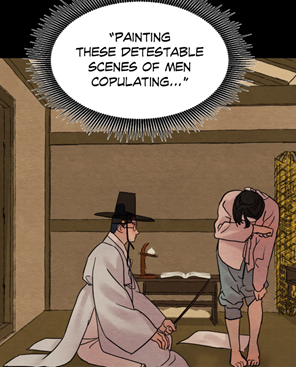 And since I associated this manhwa to the Russian novel, Crime and punishment, I would like to remind that the main lead could only stop feeling remorse and regrets, the moment he admitted his crime. Let’s not forget that we have two confessions from Jihwa: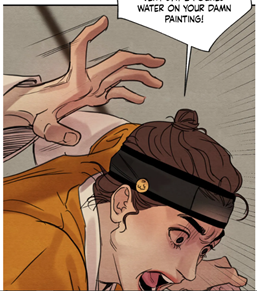
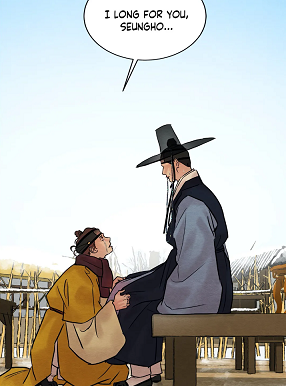

 What caught my attention is that before Byeonduck added the first picture with the moon, the manhwaphiles behold Seungho looking up at the sky.
 And this is no coincidence, as the first image represents the lord’s state of mind. The dead tree indicates the absence of life. Furthermore, the moon seems so distant, underlining that during that night the main lead is not himself. The absence of light in the buildings exposes his pain and the loss of hope: his heart is no longer beating. This stands in opposition to the picture from the first episode,
 where there were a full moon, a huge amount of trees with leaves and light in the building. Striking is the difference of the perspective reflecting how the main lead perceived himself: he was a spirit denying the existence of his heart, hence he was free and never considered himself trapped in the domain. However, in chapter 64, the lord is finally recognizing his mortality and his imprisonment. Notice the emptiness of the property exposed by the immense empty courtyard.
 Surprising is the change of perspective again. This time, the beholder is gazing at the mansion from the sky. Besides, the moon seems closer too. And just like before, it is important to take the previous panel into consideration.
  The lord is refusing to kiss the painter and moves away his head from the low-born’s. From my point of view, the landscape represents the lord’s perspective. For him, the painter is just an empty building oozing emptiness and coldness. Furthermore, there’s a huge gap between the beholder and the mansion indicating the deterioration of the relationship between the two protagonists. The home the main character imagined to have found in the artist seems to be an illusion. He is no longer expecting anything from him. The abandonment and betrayal made him think that his dream was just a chimera and nothing more. But what the noble doesn’t realize is that he is actually seeing is actually a reflection of his own thoughts and emotions. Moreover, he is actually the one who is afflicting his loved one due to his insecurities and lack of trust. Notice that during this night, it is snowing the whole time underlining the depth of the noble’s sadness. And there’s no doubt that this drawing illustrates Yoon Seungho’s perspective. Simultaneously, we could also say that the falling snow could be the painter’s tears as well. He can no longer cry, he has been wounded terribly by Yoon Seungho, when the lord stopped himself from kissing him. I have to admit that I couldn’t help myself connecting this image to the one from chapter 21:
  Observe the contrast. Due to the perspective, the manhwaphiles sense the intimacy and closeness exposing the change of the lord’s feelings for the artist. While I once wrote that the rain symbolized the painter’s tears (tears of happiness), I would like to add that the rain was also a metaphor for the noble’s tears. He was feeling happy, was able to exude warmth and tenderness. And let’s not forget that the artist is the mirror of the master. Baek Na-Kyum’s tears represented the noble’s tears who couldn’t cry. That’s why he was so sensitive to his crying. He felt the same emotions, yet his eyes were unable to show this expression: sadness and wound. And now, the readers understand the signification of the chapter 64. Since it stands in opposition to their Wedding Night, it reflects the low point of the relationship between Yoon Seungho and Baek Na-Kyum. However, there’s no doubt that they will move on from this. First, we have the painter’s fighting spirit and resistance. He was even willing to risk his life in order to protect Deok-Jae and received a huge slap.
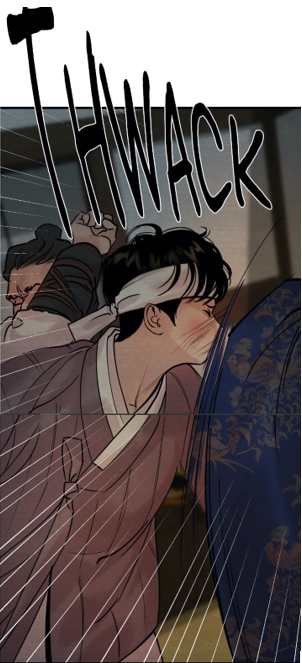 So it is definitely possible that the painter won’t be so devastated like in chapter 40. Let’s not forget that this character always forgave the protagonist for his wrongdoings, he never held any deep grudge. Furthermore, he has been able to sense the lord’s affection for him. The latter confessed twice and even expressed that the painter’s happiness meant a lot to him. Moreover, there’s no doubt that the noble will feel huge pangs of conscience, especially if Kim, with the help of the physician, is able to make him recognize the truth: Baek Na-Kyum never abandoned him. Since the heart is frozen, I believe that he will be able to use more his intellect. As a conclusion, the manhalovers shouldn’t lose hope in the main couple. The frozen heart will start beating again, the moment he senses the painter’s warmth and love.
 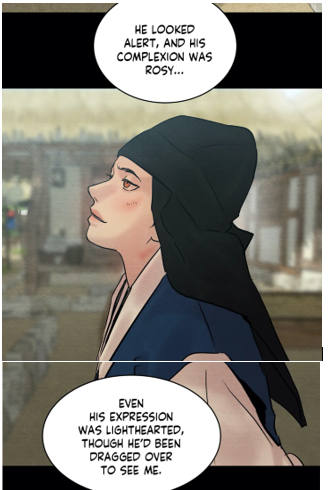 (chapter 57) The way the boy is looking up at Kim indicates that the main character is quite attached to him. And because of this scene, the manhwaworms could sense the domestic’s qualities: care, trust, affection and loyalty. But what many readers failed to realize is that servant Kim is actually following father Yoon in reality. This means that the elder master trusts this domestic. The latter is even the one who introduced the physician to the lord of the mansion.
 (chapter 35) In this scene, the valet gives an order to his master and not an advice, since he employs the verb “must”. Why? Because he thinks, the letter was sent by the elder master. And Yoon Seung-Won knew that Kim was loyal to their father. Hence when he sent the letter, he used his father’s name and authority, but in order to maintain the illusion that father Yoon was the author, the brother also requested that valet Kim would bring back himself the reply. The deceitful brother used not only the butler’s fidelity to his advantage, but also gave the impression that father Yoon cared somehow for the black sheep. It was, as if the elder master was trying to rekindle with his older son. The readers can sense more his loyalty to the elder master, if they compare his reaction, when Yoon Seungho received the fake letter from lord Song.
 (chapter 56) Here, the domestic got scared, by just hearing the name. Nevertheless, he gave his master the advice to postpone the meeting due to his health.
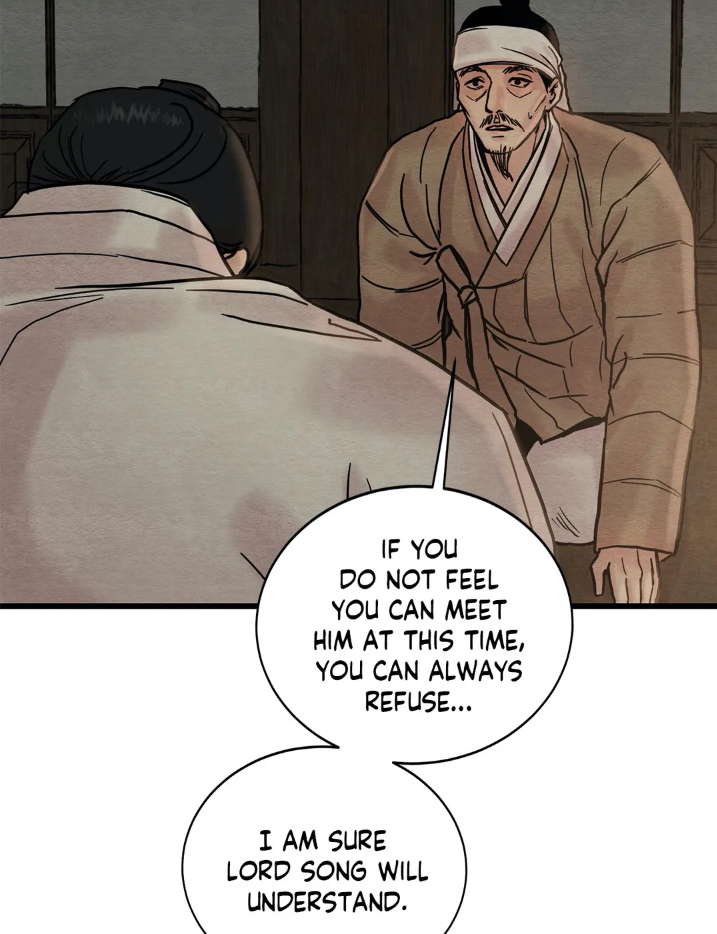 Yet, observe how he hides his discomfort and fear to his master by suggesting to postpone the meeting which exposes that he is hiding his true emotions. He justifies his advice by faking concern for his lord. Hence the lord can only have the impression, he is protecting his interest. Striking is that since we saw him scared, we have the impression that he is brave enough to propose not to the follow the invitation. My initial impression was to think that he got afraid of the name lord Song due to the lord’s traumatic past and he feared for his master’s mental health condition. However, the moment the valet realizes that the noble is on his way to meet this aristocrat, he gets so scared that he leaves the mansion immediately. So he doesn’t want them to meet.
 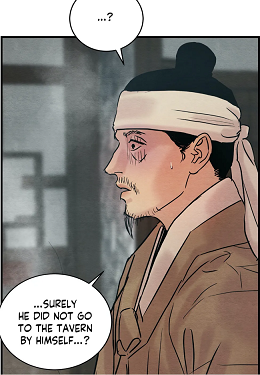 (chapter 56) Then in chapter 57,
  the butler expresses his worries concerning father Yoon. He doesn’t want the elder master to hear the news about Jihwa’s public confession, as the servant is well aware of father Yoon’s mentality.
  (chapter 57) He barks like one, when he yells at Deok-Jae.
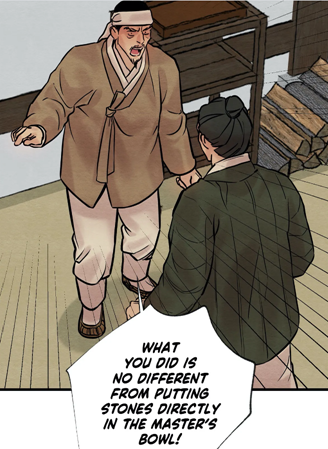 (chapter 47) He is also sent to fetch the painter, when the latter is somehow “abducted” by the scholar.
  (chapter 24) But the most conclusive evidence for this association is his rapport to the door. He is always shown next to an opened door or even often stands on the door threshold.
  (chapter 45) Since dog owners often put the sign “beware of the dog” on their door, you understand why I see it as an evidence that the valet is more as a dog than anything else. The butler is the guardian of the mansion, watching out for the owner’s safety. However, here we should comprehend it in a figurative sense. On the surface, the butler is looking out for the reputation of the Yoons, while in truth he is just focused on living a peaceful life far from trouble.
 (chapter 64) The dog is not only a symbol for loyalty, but also it represents obedience and secrecy. He knows what is happening in the mansion, but he won’t let it transpire to the outside world. Therefore I deduce that valet Kim is quite similar to Jihwa. He knows the main lead’s whole past and tragedy, but he doesn’t truly feel sorry for the main character, for if he revealed the truth, because it would expose his culpability.
 (chapter 26) He is leaving the artist behind, as he doesn’t want to be confronted with his wrongdoing: his passivity and cowardice. Then when he meets the protagonist in the main way, he sees his cold and distant gaze. So he knows that his master is in a bad mental condition, yet out of fear, he still leaves the artist behind, well aware that something bad could happen. That’s why he chose to intervene in the shadow (like for example, sending a servant to the scholar) so that I am now convinced that he even witnessed what happened to Yoon Seungho, but chose to close the door. There’s a reason for this assumption. First, he is connected to an opened door. Secondly, there’s this incident with the door in chapter 16.
 (chapter 16) The butler chose to open it in secret, because he desired to remain anonymous, so that his loyalty wouldn’t be questioned. As soon as it was opened, he ran away without looking back, fearing to see what was happening. That’s the butler’s trauma in the end. Back then, he chose to remain passive and close the door leaving his young master behind. But Yoon Seungho caught his terrified expression, which he can never forget, that’s why he pointed it out to the painter.
  (chapter 64) He resented valet Kim for his betrayal and abandonment. That’s why I believe, in that scene, Yoon Seungho is using the same words than his rapist from back then.
  (chapter 64) In this scene he is reliving his own traumatic past, the first rape. And after it had occurred the first time, the valet must have told him this:
  (chapter 65) Baek Na-Kyum is now the lord’s companion, while in the past he used to plot against him. In that moment, the valet recognized that ignorance is not a blessing, because this doesn’t erase the event. Observe that Kim has a similar approach than Jihwa again. Since the painter returned to Yoon Seungho’s side, the noble has now the feeling that nothing happened. For the first time, Kim sees the true face of his master
  . (chapter 45) First, it symbolized that the painter was more than just a favored favor. But more importantly, he never cared about the item, since
  (chapter 63) He is indeed a hypocrite, a selfish person,
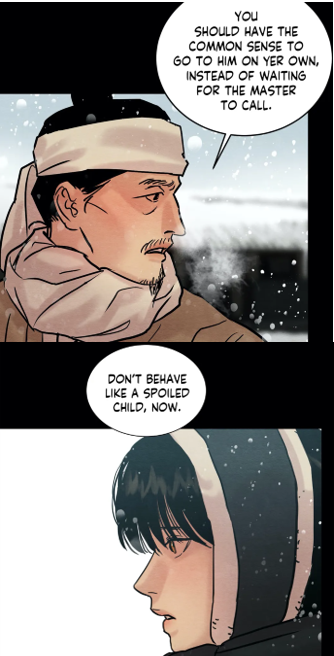 (chapter 52) He was not the “wife”, the mistress of the house, just a servant. As you can observe, the butler is someone who abides to rules very strongly, he can’t accept a relationship between a low-born and a noble. That’s why I come to the conclusion that Valet Kim never understood the real needs of his master in the end. He never grasped that the noble was missing love and couldn’t cope with his betrayal in the end, because for him love is not important, only a peaceful life. And with this new approach, it becomes understandable why Yoon Seungho was never repulsed by the low-born. Since his childhood, he felt closeness to a commoner, and considered Kim as his father.
 (chapter 50) This explicates why Yoon Seungho can’t trust Kim’s words in the end.
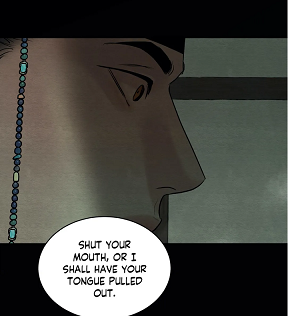 (chapter 62) In his eyes, he betrayed and abandoned him once, therefore it is definitely possible that he is lying. The longer the lord lives with the artist, the more he senses that Kim shouldn’t be trusted. This explicates why the lord’s relationship with the valet is deteriorating. In season 1, he never doubted Kim’s words, but now it has changed. The painter’s genuineness makes Yoon Seungho detect the butler’s fakeness and hypocrisy. And since the lord threatened him with the sword, I am envisaging that he will do it, the moment he feels that his loyal butler betrayed him.
  so much. Furthermore the sex in episode 64 is linked to immorality, shame and shock.
  Here, the painter expressed the wish that the penetration should be deeper, he even asked for more roughness. All these sex scenes oozed sadness and violence. While in chapter 63, love was still present, the opening of the door marked a turning point. Kim’s presence triggers a memory deeply buried in the lord’s unconscious: Yoon Seungho’s first rape and the butler’s betrayal and abandonment. While all the readers, including myself, loathed Yoon Seungho for that terrible behavior, I only recognized afterwards why the lord changed one more time. He became even crueler and more brutal in that episode due to the valet’s appearance and presence.
  (chapter 45)
  (chapter 43) While Baek Na-Kyum’s problem is sex, Jihwa’s struggle will be crime, like trespassing, abduction and murder. Like I had already mentioned it in another analysis, crane is connected to happiness, honor, longevity and good fortune. However, this doesn’t signify that the person embodied by the crane encounters good fortune. Due to Baek Na-Kyum, the second Justine, the red-haired aristocrat is forced to change and Nameless becomes his guide.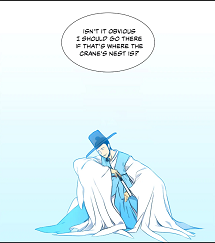
 That’s why Jihwa will play a different role than the commoner. Jihwa’s fate will be connected to justice, but he will suffer and his tormenter and liberator will be Nameless. The red-haired aristocrat is ignoring true moral values like charity, selflessness and justice, while his unconscious has not forgotten it. This will be his inner struggle, while Baek Na-Kyum was rejecting sex, connecting it to something dirty. Furthermore, unlike in the French novel from the 18th Century, where evilness and injustice win at the end, as the heroine dies, the manhwaphiles witness in the manhwa the spiritual death of the culprit, Yoon Seungho. This is represented by the following panel:
 (chapter 5) This marks the return of his older self, but a worse version, as there is no light. The yellow bougie on the candelabra is a symbol for coldness, frigidity and selfishness. Yet, since there is no light in chapter 64, the absence of light is a metaphor for the non-existence of life. In other words, we are witnessing the death of the phoenix. When I say that this is his spiritual death, it signifies that the lord’s heart is no longer beating for the painter. He closed his heart, and since the heart was in possession of his mind, this means that neither his heart nor his mind are alive. Yet, the manhwaphiles shouldn’t misunderstand me. I am not saying that Yoon Seungho’s love for Baek Na-Kyum vanished for good. It’s just that his self-hatred has taken over his mind and heart, therefore he is not able to give any love and warmth to his lover.
  Now, you understand the signification of chapter 64. The latter doesn’t reveal his true personality, the violent and obsessed side to the painter
 But instead of assuming his responsibility, he acts exactly like in the past. He acts, as if nothing was happening and runs away. The only difference is that he can not make the painter feel guilty. This is important, because Baek Na-Kyum is not pushed to repress the incident. The painter won’t forget his behavior… exactly like during the night of the rape at the pavilion. Back then, he only reproached that he never revealed the truth. Yet during that night, he experienced his cowardice and abandonment. The painter is very sensitive concerning abandonment.
 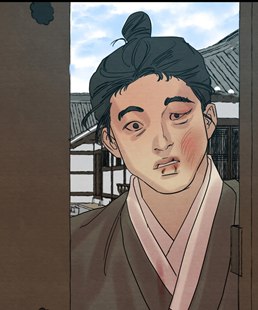 We have to understand them. They were desperate to please their master, as they feared his brutality. They didn’t want to experience another huge beating. And the tailor plays a huge role in the birth of the huge scandal.
 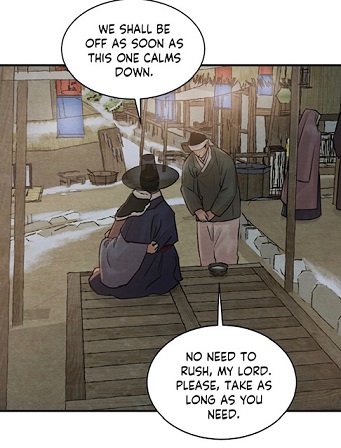 (chapter 76)
 That’s why the yellow candle is also a metaphor for the painter.
 I believe that he didn’t cry after that night. And the manhwaphiles can note the vanishing of the painter’s physical reactions, if you compare it to the sex scene in the barn
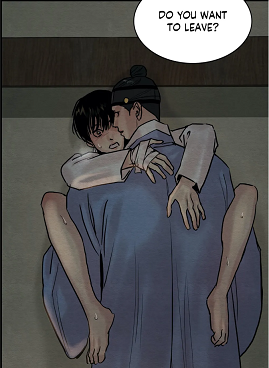 or in front of the storage room.
  The painter is still blushing and ejaculates. And the interpretation from my previous analysis was correct. The scene with the storage room is a combination of the sex marathon and the chapters 40-41-42. Here, the absence of the kiss is similar to the scholar’s words:
 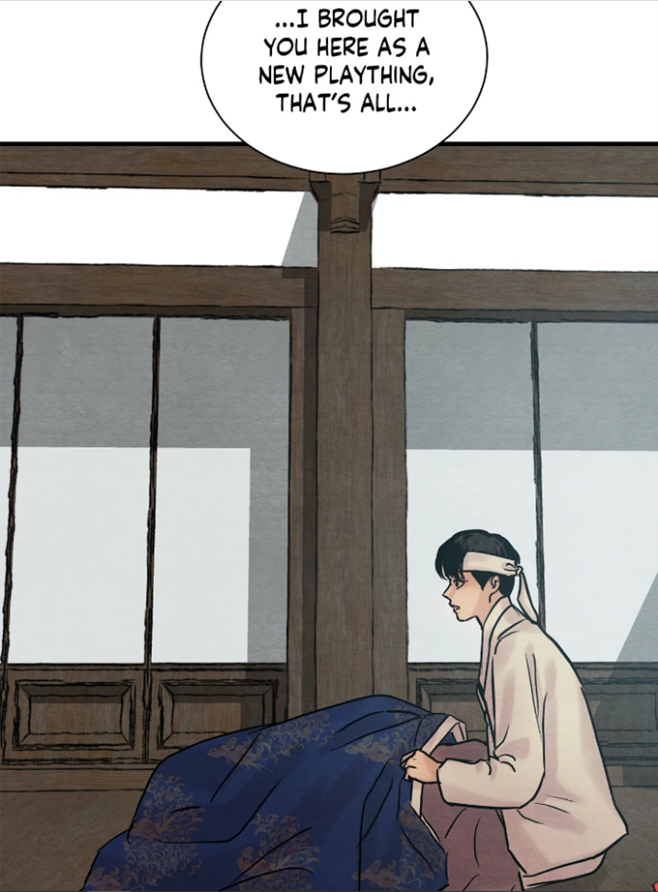 Notice the parallels. We have the return of the yellow candle on a candlestick, then the treatment is similar to the first chapter, where Baek Na-Kyum was kept captive in the barn.
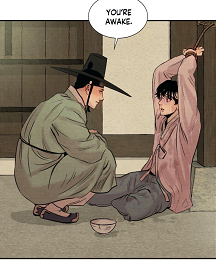 In chapter 1, the room was bright contrasting to the darkness in the storage room in chapter 62-63. Back then the main character was intelligent and cunning, as he was not aware of the influence of his heart. From chapter 62 on, the lord is no longer in possession of his smart and bright mind, as the darkness of his heart has taken possession of his mind. Yet, since the painter was able to hear and see the lord’s love on two occasions,
  From my point of view, this second marathon has affected his creativity. He couldn’t paint due to his injury, but he remembered the orchid from Yoon Seungho. In my opinion, the lord’s words from that night
  (chapter 64)
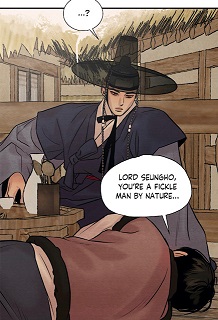 (chapter 75) And now, you grasp why the author is tormenting our main lead. His function is to liberate Yoon Seungho, but for that, he needs to go through the same pain and wounds. By destroying the artist, he kills himself in the end. This explicates why the yellow bougie represent the two protagonists in chapter 64:
  His dream became real. I perceive this scene as the evidence that Jihwa’s role is quite similar to the artist’s. The latter’s dreams always turned into reality. But there’s more to it. Now, I comprehend the meaning of the following images differently.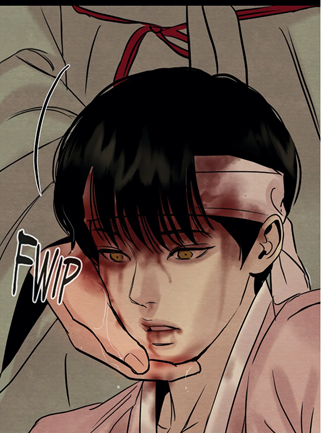
 The painter’s dead gaze is the reason for the main character to have dark eyes. Observe that the noble’s hand is holding the painter’s head, indicating that the lord is responsible for the artist’s spiritual death. The darkness of Yoon Seungho’s heart was brought to the surface due to Jihwa’s action. Due to his misdeed, he caused the noble to become oblivious of the truth, his gaze is covered by a shadow. As you can observe, the new episode gives us the opportunity to perceive Jihwa’s prediction under a new light. That’s why Baek Na-Kyum is able to move on from the scholar.
 and once they meet, the artist affects him and his life. A small creature, like the butterfly, brings huge transformation to the people around him: Jung In-Hun, the valet Kim, the servants, Deok-Jae, the nobles and Jihwa. Note that in chapter 8, Min met the artist for the time and awoke lust and desires in him. That’s why he started challenging the main lead. And since Jihwa is the noble version of the painter, we can conclude that Jihwa plays a similar function in the end. He brings transformation, positive and negative, just like Baek Na-Kyum, but to Nameless and Yoon Seungho. And this is no coincidence that the butterfly is a symbol for transformation and temporality.
 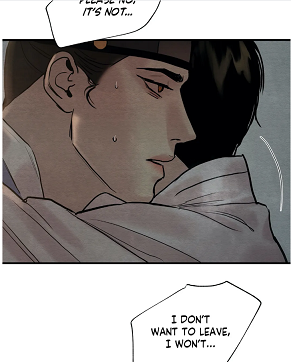 He follows the lord till the end, never rebelling which contrasts to the painter’s behavior during the first season. He won’t even try to run away after that night, as he will keep his promise. However, this new vow is not without consequence.
 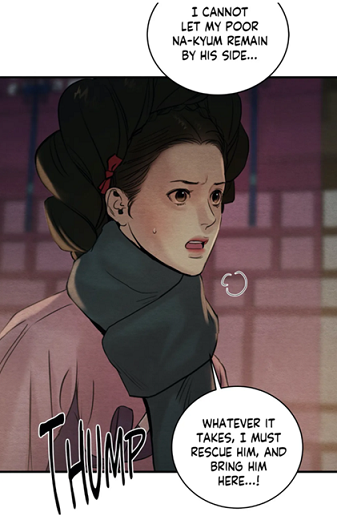 (chapter 69) Due to this panel, it becomes obvious that Heena noona will behave the same way than Jihwa in the end, though the roles have been switched. Her brother has been seduced by a witch and he needs assistance. She will do anything in order to save her brother, unaware that she will be the cause for her brother’s misery. While I thought in the past that Kim embodied the saying “the road to hell is paved with good intentions”, I came to recognize that this bible quote fits Heena noona’s personality. And this would definitely reinforce my interpretation that the kisaeng is a Christian.
 signifies that Baek Na-Kyum is indeed connected to power in the end. Since I consider him as a phoenix, this could be an indication that he could be more than just a filthy low-born, like Jihwa and Jung In-Hun imagined.
 (chapter 31) Consequently in chapter 34, the painter sensed a change of perception about his body after the sex marathon. For the first time, he detected his heartbeat and the butterflies in his stomach, which were triggered by the main lead’s presence.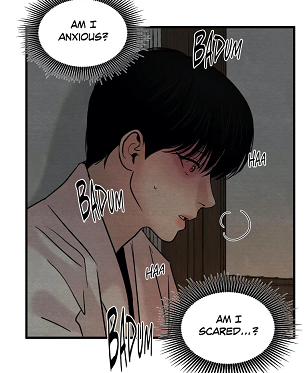
 (chapter 34) The parallels can be observed by the absence of the eyes of the protagonists in certain panels. Compare the picture with the mirror
  (chapter 63) Striking is that the character represented with eyes plays the role of the liberator for his sex partner. Due to the sex marathon, Yoon Seungho had helped the painter to free himself from his torpor, since due to the coercive persuasion, the artist had come to deny not only his sexual orientation, but also the existence of his own body. That’s why he could no longer admire his learned sir like before after the sex marathon. By recognizing the existence of his own body, the painter couldn’t feel the same attraction towards the teacher. And since the sex marathon played a huge role in his healing process, we have to imagine that the sex scene in the barn has the same signification for Yoon Seungho. He is on his way to be liberated from his self-hatred, but as you can imagine, it will be a painful process. Back then, the painter got ill and the lord ran away from his responsibility. That’s why this time, the blinded person will be the one suffering from the sex marathon: he will feel like dying, when he realizes that he wounded his lover blinded by his prejudice and anxieties.
  (chapter 63) He has no guarantee that this is true, and love is like a leap of faith. This isn’t something that you can grasp or see. Besides, he would have no control over him, if he accepts the confession. Loving means taking risks, which is linked to fears. This displays how much the master has been brainwashed. Since the painter disappeared in his mind, he came to acknowledge his father’s doctrines one more time before dropping them completely, when he discovers the truth.
  when his father betrayed and abandoned him. This will help him to forget the father’s gaze engraved in his heart. The latter was full of hatred and resent, which the main lead internalized. And with this new interpretation, the chapter 63 appears in a different light. It gives the manhwaphiles hope.
  (chapter 65)
 (chapter 69) He had ruined his relationship with the artist. Because he refused to make the leap of faith in the shed, Yoon Seungho decided to make the opposite choice. He let the painter decide about his own fate, yet he was definitely living in agony. The wounded, fearful and desperate gaze revealed his turmoil.
  (chapter 69) In my eyes, the absence of the lord’s eyes during the night of revelations stands in opposition to the lord’s gaze full of expressions in chapter 69. Note that in that episode, the author always drew his eyes, underlining that now the noble was using his own eyes finally. He is no longer relying on Kim and his information. I was also right that this night would affect Yoon Seungho’s relationship with the valet, yet I didn’t expect, it would unveil his true personality. For me, this second sex marathon was a real eye-opener: it made me recognize Kim’s hypocrisy and cowardice. From that moment on, I could no longer view him as a real father figure.
 (chapter 62)
 He rejected his concern and yelled at him. In chapters 62-63, the positions are switched. Yoon Seungho is the one upset and pained, since he is convinced that the artist abandoned him, therefore his anger is aiming at the commoner. Yet, the true culprit of his wound is his childhood friend Jihwa. Simultaneously both have a common point: Baek Na-Kyum gets hurt, because he becomes the target of Yoon Seungho’s anger, while in chapter 40, he is backstabbed by his admired sir and used the master to get some comfort. Yet, the situation is similar, as the real culprits of the wound never witness the consequence of their actions and words.
  (chapter 63) And if we take the chapter 41/42 into consideration, the painter did request that the lord should be particularly rough.
 (chapter 42) As you can see, the chapter 40 can not be really detached from the sex scene which follows the teacher’s betrayal. Another contradiction is that the painter is just asking the lord to stop, since Baek Na-Kyum is exhausted, while the aristocrat believes that the commoner is pushing him away, begging him to let him go for good.
 (chapter 63) But this divergence comes from the fact that this scene is a new version of the sex marathon, which I mentioned above. Back then, the painter made a similar request. As conclusion, the violence of the sex in chapter 62-63 is strongly connected to an emotional wound, a repetition of chapter 41/42. And in my opinion, the artist understood the situation and the lord’s motivation. Hence he doesn’t feel badly about Yoon Seungho. Notice that the next night, Baek Na-Kyum doesn’t think badly of this sex marathon.
 (chapter 40)
 (chapter 63) What caught my attention is the contrast between the two declarations. While the artist’s feelings for his admired sir seem to be very strong (I adore you), his words don’t really correspond to his affection, because his feelings have already diminished. He did lie to his teacher and protected the main lead in chapter 38. That’s why the “I adore you” should be judged as an exaggeration. It was, as though the painter desired to convince himself and his teacher that he was still attached to him. Besides, he needed to persuade him not to abandon him, after hearing so many reproaches. This observation leads me to the conclusion that Baek Na-Kyum made up his mind to still follow his teacher out of loyalty despite the harshness of Jung In-Hun’s words. On the other hand, the author used a litotes (“I do not dislike you”), implying that in fact his attachment is much stronger. And this is exactly what happens during this scene. Despite the harshness, the painter is forced to question his true feelings for the main lead and recognize them. He is even willing to confess, yet he is stopped. I doubt that Yoon Seungho would have perceived it as a love confession, as he hates meek words. I can use this panel as a reminder:
 (chapter 48). Yoon Seungho is exactly like the painter, he loves strong and metaphorical confessions, like “you’ve made me a wreck” or “I will never let you go”. But let’s return our attention the scholar and Yoon Seungho. Both nobles act the same way. Both can’t accept the artist’s declaration, yet their motivation diverges. The teacher finds it disgusting to be connected to a commoner, whereas Yoon Seungho is too afraid of being lied. He has the impression that this dream can never come true. Yet, while contrasting them, we see the painter’s determination who is willing to overlook the reproaches expressed before by both aristocrats. And he remains faithful till the end. That’s why he waited for Jung In-Hun at the gate in episode 44.
  He needed to see with his own eyes, how the learned sir had truly abandoned him. This represents another explication why the low-born didn’t react like Kim and Min anticipated. He didn’t follow his sister out of loyalty, compassion and a certain trust. However, Heena noona was able to sow seeds of doubts.
 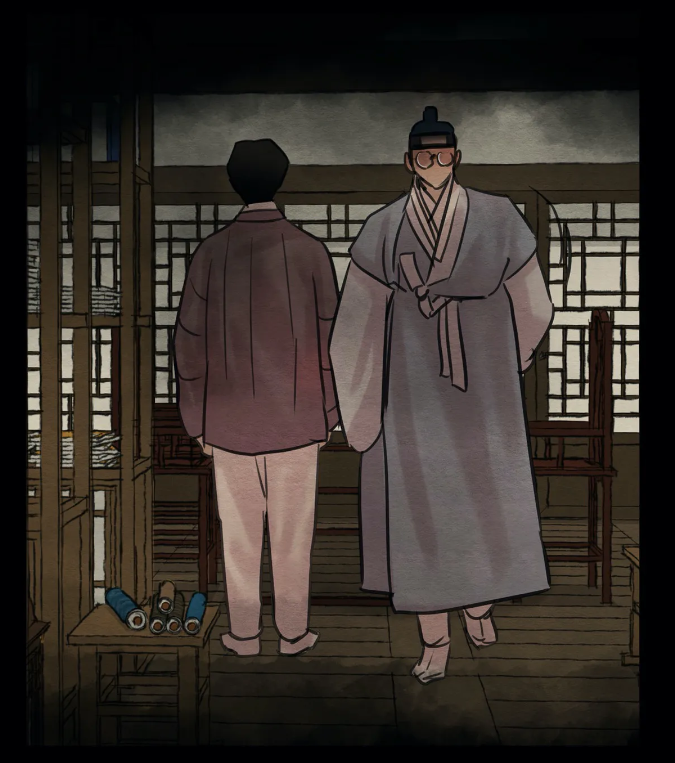 (chapter 40) In this picture, the scholar leaves the painter behind, a metaphor for his abandonment. He even repeats this action, when he leaves for the capital. In chapter 62-63, Yoon Seungho sees in the commoner’s escape a rejection and betrayal.
  (chapter 62) This panel illustrates the thoughts of the protagonist: the commoner has turned his back on him.
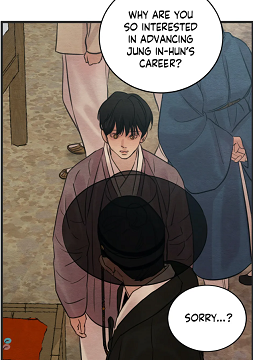 (chapter 40)
 (chapter 40)
  (chapter 62)
  (chapter 63) In both cases, the aristocrats questions the commoner’s motivations for his actions. While Jung In-Hun’s interrogation serves him as an occasion to break his promise by putting the blame on Baek Na-Kyum, the other character is more curious to know about the reasons for his desertion. From my point of view, this shows the noble’s desire to comprehend the painter better. And this illustrates that his obsession with the “why” is well meant. Why is he pushing him away? If he knows the cause, he could find a solution in order to bring the painter to his side.
 (chapter 40) The painter became happy, when he heard that the civil service examination would take place soon. He immediately thought of his learned sir and envisioned that this would please his former teacher. Jung In-Hun’s excitement became the painter’s joy, this is how the painter was thinking in that scene.
 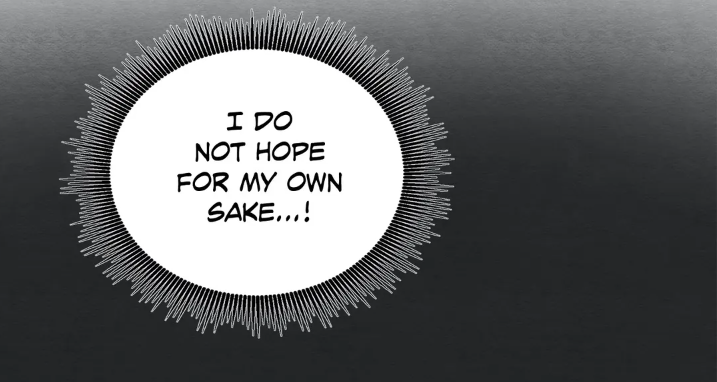 (chapter 40)
 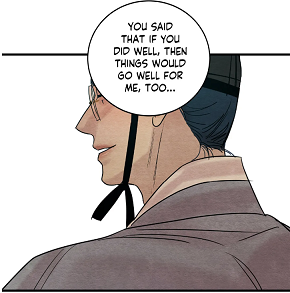 (chapter 29) By contrasting both panels from chapter 40, the readers can detect the painter’s lie. He expects something from the low noble. He is indeed hoping that Jung In-Hun will keep his promise and he will take his responsibility for him, since the painter supported him.
  (chapter 40) The former had Yoon Seungho’s attention all the time, and we all know that Jung In-Hun’s desire is to get attention and admiration. Striking is that the comparison enlightens the materialistic and narcissistic side of Jung In-Hun, while Yoon Seungho appears purer. He is just content with a smile. Besides, he would like to be the source and recipient of Baek Na-Kyum’s smile, whereas the other wishes to get favors (clothes, a room closer to the lord’s chamber, the favor to spend the evening in the bedchamber etc). That’s why by contrasting both chapters, the protagonist’s purity and simplicity become even more palpable, which is hidden due to the violence employed during that confrontation.
  Furthermore, if we take the chapter 41 into consideration, since we have a flashback of the incident at the library,
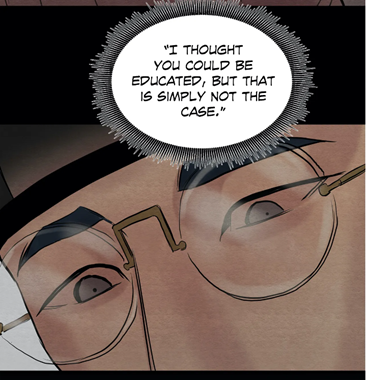 then the readers can recall that in this episode, Baek Na-Kyum was so heartbroken that he asked from Yoon Seungho to be embraced. He needed a shoulder as solace and comfort. The low-born literally begged him, while crying to be hold in his arms, but the noble didn’t know how to respond to this request.
 (chapter 41) He only knew sex. In chapter 62, the lord hold the artist in his arms, only to betray him afterwards. The warmth is faked.
  (chapter 62) Yet, if you pay attention, you’ll observe a second hug in the barn: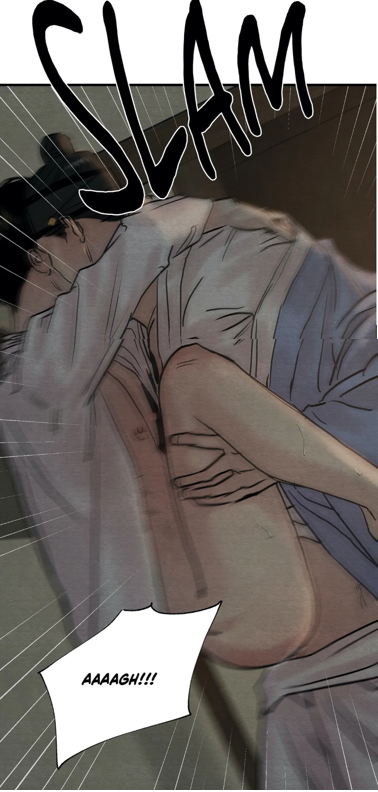
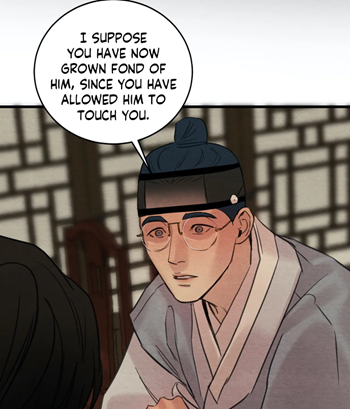
 (chapter 40) while in chapter 63, it is the turn of our seme to reveal his expectations and desires.
  ,(chapter 62) while the scholar calls the artist a fool
 . (chapter 41) He is just jealous, furious and repulsed. Yoon Seungho is seeking closeness and uses sex in order achieve his goal, therefore he is is refusing to stop. He is so desperate to remain intimate with the painter, while the other noble has only one thought: keeping his distance from the low-born.
  (chapter 63) and words
 (chapter 63) have a huge effect on the upset protagonist. They trigger the noble to open up and reveal himself. That’s why the chapter ends with a face to face: the aristocrat is not decided to look at the painter’s eyes directly.
 (chapter 40)
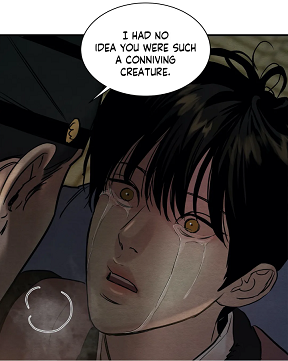 (chapter 62)
 (chapter 62)
  (chapter 71) and Yoon Seungho’s outburst
 (chapter 70). Furthermore, when the painter is able to calm down the main lead by calling his name “Lord Seungho” and showing a blushed face, the aristocrat initiates a real conversation
  (chapter 62)
  (chapter 71) There was a “love confession” in the barn, but the lord didn’t use the typical expression for that:
  (chapter 76). The only problem is that Baek Na-Kyum is still fearing his own emotions for the infamous noble. Therefore he has not confessed yet, which will be the reason why both main leads will suffer again. The painter has just opened up and is not trusting Yoon Seungho entirely.
 (chapter 37) The younger brother was taught his father’s principles too, but unlike Yoon Seungho, the younger brother is NOT living according to their father’s rules. This means that he is living differently. And now we have to question this: how is his life different?
  And notice the brother’s embarrassment. He avoids his brother’s gaze. He can not deny it, for if he did, he would have to reveal the true identity of the “pedophile”. Hence the younger master is humiliated. The younger master can not argue with this point. That’s the reason why I come to the conclusion that the brother has already internalized his father’s values: Yoon Seungho should keep working for the family, like he did in the past. He should use his connection. He is truly viewing his brother as an accessory for the family’s benefit. And it is time to examine the chapter 37 one more time. In the first composition, I had demonstrated that the brother was selfish, insensitive and quite arrogant, since he never asked his brother about his well-being. All his business mattered. But I can add more layers to his description and it starts with the way he was introduced.
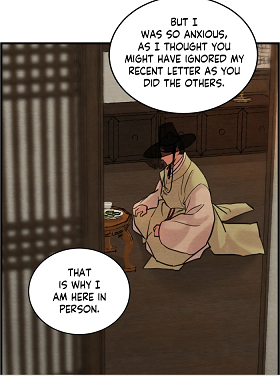 (chapter 37) However, I can bring up another evidence for this conclusion: the fake letter from lord Song.
 (chapter 37) He mentioned his father directly, but he never answered to the question properly, since he didn’t announce the true reason for his visit. Why? Since he used the name of his father in the letters and in the conversation, I can only deduce that the brother knows the true power of father Yoon over the main character. He is actually playing with the protagonist’s fear and he knows it too well. Notice his hands: they show a certain discomfort, indicating that he is well aware of the signification of his words. One might argue that he has been pressured by the father and he is just a pawn. To this, I can only retort that he is doing the same to his brother. By asking him to visit their father, he is not just requesting from his brother to reconnect with their family, but also to submit himself to father Yoon. In other words, the elder master could utilize Yoon Seungho’s connections and wealth for their family’s interest. Besides, this would signify that the father would become the main lead’s pimp again. As the new head of the family, father Yoon could decide to treat his eldest son like in the past. And if my theory of the incest is correct, then this means that Yoon Seung-Won is asking his brother to relive a hell again. This is not surprising that the lord gets upset and becomes cynical:
 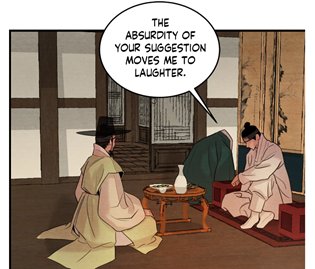 (chapter 37) Who would accept such a suggestion after getting treated like an sex toy, a prisoner and as a pariah at the end? And now envision that Yoon Seungho has been exposed to physical and sexual abuse because of his father. This scene reveals the selfishness and cowardice of the brother. This is not surprising that the lord clenches his fist, and his hand is shaking: there’s definitely fear due to the father and anger towards his brother. Yoon Seung-Won knows his father’s rules, but he doesn’t desire to apply them, as he is well aware of the meaning. And now the following panel gets another significance:
 He desires to have a private conversation and suggests his brother to send away the painter. His reason is simple: he would like to appeal to his brother’s compassion, he must be in a rather difficult situation. His father is now relying on him. But since the master of the mansion is not following this suggestion, the brother chooses to mention the father. The illness is an excuse, but Yoon Seung-Won is determined to maintain his image as a loyal and honorable son. Yet, like I pointed out earlier, the true intention with the father’s evocation is to put Yoon Seungho under pressure. And now, I would like to bring another evidence that the younger master is well aware of his brother’s fear in front of their father. He witnessed the constant abuse, and as such he noticed and internalized the brother’s anxieties. Remember that the moment Jihwa heard that the brother had visited Yoon Seungho, Jihwa chose to rush to his childhood friend’s mansion. Why? He knew that Yoon Seung-Won’s visitation would torment the main lead and provoke nightmares, indicating that this must have happened in the past well. And since the main lead is connecting his brother to his past trauma, then this reveals that the younger master is related to the protagonist’s suffering. Why? In my opinion, Yoon Seung-Won must have been favored all this time, whereas the powerful noble was just treated like a servant. In other words, even if the younger brother was weak as well, he never tried to help his brother behind his father’s back. This explains the resent from the protagonist. He can never consider him as a relative. Let’s not forget that when the elder master moved from the house, only valet Kim remained by the main lead’s side, showing that all the other servants sided with Yoon Seung-Won and the father.
 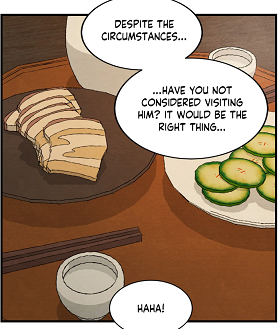 (chapter 37), while in reality he is just a hypocrite. I would even add, he is quite immoral. He lies about the illness, fakes letters in the sense that he uses his father’s name and authority. Then he utilizes social norms (“the right thing”), though he is well aware what the visit would mean for his brother. I also perceive an evidence of father Yoon’s influence in the younger master’s behavior: his words and behavior. Remember that I connected the lies to the protagonist’s dissociative episodes, indicating that the elder master must have punished his eldest son, when he imagined that he had been lied to. Observe the reaction Yoon Seung-Won has, when he realizes that Kim has been lying to him:
  (chapter 37)He gets outraged and yelled to the butler, although he is not the lord of the mansion. Striking is that he would have opened the door
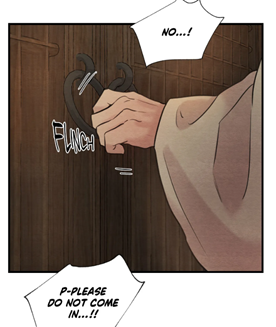 (chapter 37), if the painter hadn’t screamed through the door. Not recognizing the voice from the inside, the young man got surprised and stopped. And this single gesture outlines his disrespect towards his elder brother in reality. I had already observed his selfishness and lack of sensitivity, but with the new elements, I can definitely determine that the younger brother has indeed internalized father Yoon’s values. He treats servants and commoners like people with no right. His tone is quite strict, authoritative and rude.
 (chapter 37) This is not surprising that he requests his brother’s assistance in the end. He has experienced it first hand, has envisioned that through his father’s influence, he could manipulate the brother and get benefit from his increased fortune and influence. However, this time the lord didn’t follow his suggestion, since he has already started moving on. In fact, the younger lord was mocked through the main character’s following suggestion: Yoon Seung-Won should also live according to their father’s principles.
  (chapter 38) This reinforces the immorality and ruthlessness of the brother’s suggestion. With the letter, Yoon Seung-Won has the impression that in the end, the main lead bent to his will. This means that he is ignoring his brother’s reproach and rejection. But since the brother used their father’s name in order to approach his brother, it looks like, it was Yoon Seung-Won’s decision to utilize the brother. Even if this idea is not correct, and the father did use the younger son as a pawn to approach Yoon Seungho, this doesn’t diminish the atrocity of the younger master’s gesture. He is not just a pawn, but a real accomplice, because he knows his past but prefers his own comfort over his brother’s life. However, let’s not forget that during their conversation, the younger brother never spoke in the father’s name, like for example: “Father Yoon desires to reconnect with you and asks for a visit from you”. Even that way, the father’s honor would have been maintained, since the main lead was asked to pay a visit to their father unofficially. My final point for this interpretation is the importance of reputation in father Yoon’s eyes. The latter chose to act behind closed doors and maintain his image as a respectable aristocrat. By sending letters to his eldest son who is well-known in the mansion as an infamous sodomite, his image as strong lord is kind of tarnished. He is the one asking for help from his son… a humiliation in his eyes. Now, you can better comprehend why I believe that Yoon Seung-Won is not just a pawn in reality.
  That’s why he said this to the servant. By putting the blame on his older brother, he excuses his father’s behavior for not showing more concern for him. He didn’t leave the bedchamber in order to bid farewell, because the lord had been troubled due to Yoon Seungho. The latter serves again as an excuse to save the appearances. By giving the ruined painting, Yoon Seungho was indeed determined to provoke his father. He shows him his hypocrisy and the consequences of his principles. At the same time, the ruined painting illustrates his message: the Yoon family will never get a benefit from his sexual performances (“damaged image”).
  (chapter 37) Here, he envisioned that the lord’s companion was a noble due to the green hanbok. He is definitely more than just a pawn, in my eyes he has become a willing helper of father Yoon’s dictatorship, since he could profit from his situation. He is like an indoctrinated child, since he behaves like his father in a certain way. On the other hand, he has not completely lost a certain sense of morality. Since he is showing a certain discomfort during the conversation in chapter 37, it displays that he recognizes the wrongness of his request. But his interests are prioritized over his brother’s well-being. Another aspect is that he is not so brutal compared to his model, Father Yoon. But he has a common denominator with the elder master. He is also quite naïve. Hence Yoon Seungho could see right through his brother and his lies, just like the father. The master of the domain was well aware of the true purpose of his younger brother’s visitation: sponsoring. In the end, the younger master is forced to take the exam, like the scholar Jung In-Hun. I had imagined that their paths would cross, unaware that the learned sir would die before. There’s no ambiguity that Yoon Seung-Won would get annoyed and humiliated to hear that his brother chose a scholar with no connection and wealth over him.
  Bebebisous33s' analyses in K-Dramaland and Manhwas