
This is where you can read the manhwa. https://www.lezhinus.com/en/comic/painter But be aware that this manhwa is a mature Yaoi, which means, it is about homosexuality with explicit scenes. If you want to read more essays, here is the link to the table of contents: https://bebebisous33analyses.wordpress.com/2020/07/04/table-of-contents-painter-of-the-night/
It would be great if you could make some donations/sponsoring: Ko-fi.com/bebebisous33 That way, you can support me with “coffee” so that I have the energy to keep examining manhwas. Besides, I need to cover up the expenses for this blog.

1. Laziness or not?
When the final episode of the main story was released, many Manhwa-philes were laughing about Yoon Seungho’s work attitude as governor. The latter had left his seat in order to return to his lover’s side.  (chapter 131) Hence the police officers found the governor’s seat deserted.
 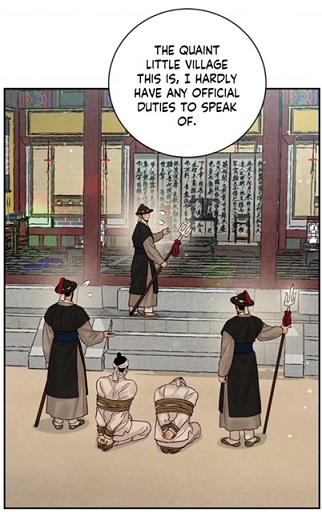 (chapter 131) By contrasting the statement from the governor and the panel, the readers could easily catch his lie. He was a lazy governor, preferring to keep his lover company rather than attend to his official duties. On the one hand, it exposes the main lead’s true mind-set. He is not longing for power or glory. To conclude, he has no ambition. This implies that he is not determined to gain attention either. One might add that he selected this region on purpose. No one would willingly go to that place. The norm was that officials would go there, because they were demoted.
 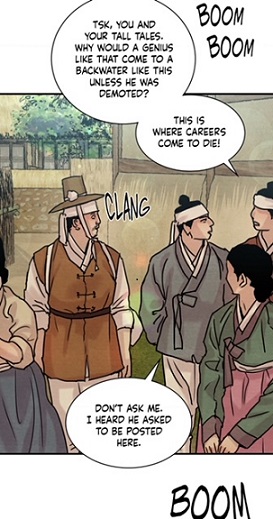 (episode 129) Thus I deduce that Yoon Seungho made the opposite choice to his father. The latter longed for a high position at the government so that the family’s reputation would become famous and powerful again.
  (chapter 86) It is because Yoon Chang-Hyeon was thinking of getting the attention or support from noble families. What he truly wanted was to get recognition from people among his own social class. But with such a decision (join the painter’s side), Yoon Seungho seems to have turned the former patriarch’s nightmare into a reality. Yoon Seungho is about to ruin the family. The name “Yoon” is destined to become forgotten, right? However, I believe that this interpretation is not correct. How so? Let me ask you this.
Why is this region regarded as “backwater”? It is because there are no powerful families like in the town, where the Yoons used to live. There are no huge store or doctor either. The new governor is surrounded by “peasants”, commoners. In other words, it is not a place you can earn a lot of money or gain power, especially for an official. This signifies that buying the governor, like Yoon Chang-Hyeon did, won’t happen.  (chapter 127) No one has such a wealth! That’s the reason why no official would select such a place. Yes, Jung In-Hun’s words from chapter 6
  (chapter 6) (chapter 131) are reflected in the final episode. Peasants are poor und uneducated, and this will not change overnight. Hence they represent ignorance and naivety. This raises the following question. Why did the officers bring these two men? What was their crime? One might reply that it is impossible to figure it out. Nevertheless, I think, Byeonduck left clues in her story. Painter Of The Night is composed of reflections. In each season, certain scenes or elements resurface with slight changes.. Thus I developed the following theory concerning these two commoners.
My hypothesis is that these two men were innocent. In season 1, we have a similar scene:  (chapter 37). It is about a crime, treason. In season 4, we know that the plot was true and there was an evidence, the paper with the signatures from lord Yoon and lord Song. Since in season 1 the wrongdoing was true and heavy, I deduce that it is not the case in the final chapter. Because there is an evidence of the crime in the past, I can’t help myself thinking that in the final chapter, there was no evidence. Additionally, I feel the need to expose my other interpretation about this man:
 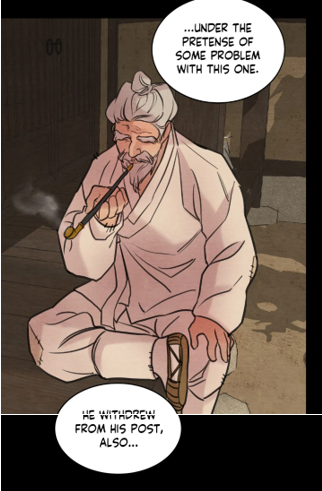 (chapter 37) I have always stated that this man couldn’t be a servant, for he was smoking a pipe and we saw a glimpse of his memory. No commoner would be allowed to enter the courtyard, when three noblemen are tortured and interrogated. Moreover, notice that in both scenes (37 and 131), the magistrate is absent. That’s how it dawned on me that this nameless man could have been a former “governor” who lost his position.
But if the two commoners are rather innocent, why did the officers bring them to Yoon Seungho then? My idea is that they imagined that the new governor wanted to make a statement so that he wouldn’t be looked down by the locals. Or even worse. The guards desired to get protection money from them!! Yes, because this region is not well perceived, the guards thought that the governor would act like his predecessor. Since it is a poor region, it signifies that the officials are not well recognized and well paid. (chapter 131) First evidence that the last image is not symbolizing justice, but corruption, is the behavior from the guards. They are caught by surprise, when they arrive in front of the empty stool. Yet, they are not gesticulating or panicked. If a real crime had taken place, they would be looking for their superior. And this observation leads me to this image. (chapter 131) In this picture, we can detect the governor’s office in the background. It is the yellow building with the multicolor decorations. That’s where the empty stool is!! In other words, if they truly needed him, they just had to go to the other side of the wall. Third evidence for this hypothesis was left in season 3:  (chapter 94) Here, the officers went to the mansion before visiting him at the gibang.
  (chapter 97) Back then, it was about the death of a commoner, a servant. If there’s an urgency, they would look for him. The comparison exposes that the “wrongdoing” from the peasants in the final chapter was no huge deal. Yet, many readers already condemned them due to the guards and the protagonist’s behavior. Funny is that the lord was portrayed as a huge liar, but not “the officers”. (chapter 131) But it could have been the reverse. Officers could have abused their authority. Furthermore, let’s not forget that Min indicated that guards could be bribed easily.
  (chapter 101) His statement displays another aspect: the governor and the guards are not working together. Jihwa would have been sent to jail without being able to talk to the superior, similar to this scene:
  (chapter 126) The guards’ own interests are not necessarily aligned with the governor’s. And now, take a closer look at this scene:
 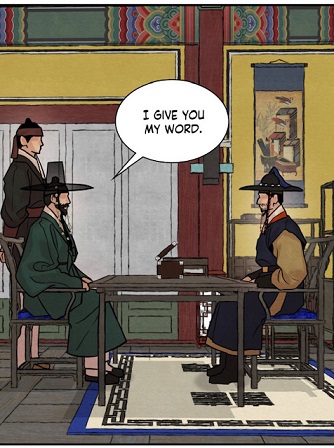 (chapter 127) The official received the patriarch in his office alone. The reason is simple. That way, he wouldn’t have to share the money with others.
But since the guards never went to the lord’s mansion, they must have realized that this man was not like his predecessor. He was not frustrated or demoted. He was indeed not after power or money. They couldn’t rely on his protection either. In fact, they could get blamed for disturbing his privacy. I would even add that since Yoon Seungho comes from a wealthy family, he doesn’t need to rely on bribe at all. In other words, the guards can only come to the conclusion that treating him well can only benefit them. His wealth was already implied with his arrival: 
 (chapter 129). He was not sitting on a horse with a few musicians contrary to Jung In-Hun. He was carried by four men, and other people were announcing his arrival with flags and music.
  (chapter 111) Moreover, Yoon Seungho had a inauguration banquet organized, where the local inhabitants could join.
 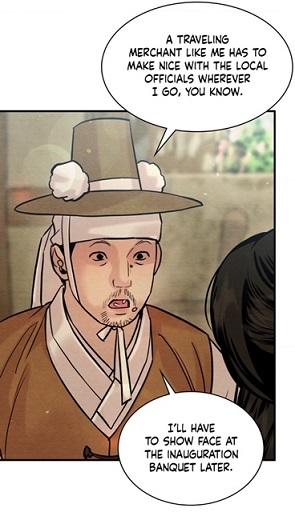 (chapter 129) There was no social exclusion at all. This stands in such opposition to the lord’s statement in season 1, where he distinguished between nobles and commoners.
But let’s return our attention to the two suspects. What happened to them then? (chapter 131) In my opinion, they were released. Why? For the simple reason that in this place, Yoon Seungho expected no huge duty! Yes, his words were not just exposing a lie, but also the truth. Nothing was supposed to happen. People are peaceful and helpful to each other.  (chapter 129) This signifies that the arrest could lead to trouble to the guards too. So was the lord lazy in the end?
  (chapter 131) Yes and no… By acting that way, he put an end to the abuse of authority in that place!! Thus I deduce that the governor is destined to gain recognition and admiration from the local inhabitants. He is generous (inauguration banquet where anyone could join), humble, loyal (he is not forgetting his lover)
  (chapter 131), but also well organized! He had planned to join this place a long time ago. The peach trees were planted about 3 years ago. He is no longer making any distinction between nobles and commoners, and that’s how he will get the respect from the peasants. As a conclusion, we should envision that the lord will become famous. Therefore the son didn’t turn the father’s nightmare into a reality. He didn’t contribute to the family’s ruin at all. Yet, there exists a huge divergence. Yoon Seungho is about to make a name on his own. It is not about the Yoons. On the one hand, the father’s dream was illusory and superficial, especially due to the treason
 (chapter 86). Since Lord Song had been forced to resign, there’s no doubt that the man would resent the Yoons to become successful again. This explicates why lord Song saw Yoon Seungwon as a problem
  (chapter 107) and tried to tarnish the younger son’s reputation. But let’s return our attention to the patriarch. His vision was based on Confucianism. However, he had a very narrow-minded perception of it.
“There is government, when the prince is prince, and the minister is minister; when the father is father, and the son is son.”- The Analects, Book XII, Yen Yuan, Chapt XI Quoted from https://www.chinausfocus.com/society-culture/confucius-more-individualistic-than-you-think
He expected not only blind obedience from his son, but also absolute devotion for the family. The individual steps aside for the community, and as such for the Yoons. This explicates why the main lead’s relative has no name in episode 6, he is simply reduced to a grandfather. 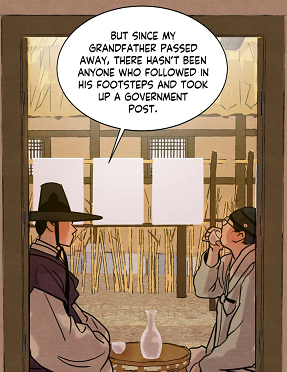 (chapter 7) This shows that the tradition was to “vanish behind the family name, the Yoons”. Under this new light, my avid readers can grasp why the main lead was destined to suffer immensely
 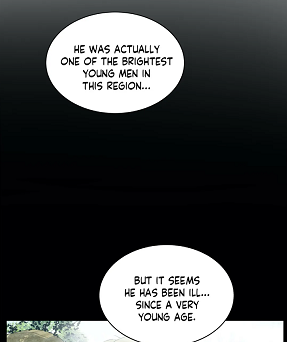 (chapter 57). His reputation was already outshining his father’s. Secondly, by being stigmatized as a homosexual, he was endangering this principle. His role was to continue the lineage and as such produce a heir.
As you can see, Yoon Seungho is breaking the tradition and even dropping Confucianism, as the latter rejects homosexuality. The main lead embodies other values: Modernity, Individualism, true Love and Humbleness. Yoon Seungho is no longer judging people based on their social status and relationship. This signifies that at the end of the story, the new governor symbolizes true justice. He put an end to corruption and malpractice. He is not influenced by people’s opinions and prejudices either. He is only listening to his heart and conscious. He makes sure to keep all his promises and not to say any empty words. He is a reformed man through and through.
However, we shouldn’t forget that the protagonist did kill many people before. Hence my other interpretation is that Yoon Seungho as a sinner is not “allowed” to become a judge himself. (chapter 131) How could he condemn others, when his hands had been soiled with blood? Thus I deduce that through her work, Byeonduck exposed the corruption of human justice in Joseon. It was impossible to get true and fair justice from anyone, let alone from the authorities. The latter were ruled by greedy and arrogant nobles who used law enforcements for their own needs. That’s why the patriarch  (chapter 116) or even Min could commit crimes in the open. They felt safe, for they knew that the authorities belonged to the same social class than them. However, this could only work, as long as the nobles would cover for each other. Should a yanbang denunciate a noble family, it was a different story. Therefore I assume that lord Lee was the one who reported the treason to the authorities (the painting in the bedroom was the evidence). But such a painting couldn’t represent a proof. However, since human justice was corrupted, the gods decided to give justice to the protagonists. That’s how Yoon Seungho became the hand of justice. Everyone involved in the protagonists’ suffering had to pay for their crimes.
  (chapter 102) That’s the reason why Baek Na-Kyum’s martyrdom was strongly intertwined with the young master’s. Yoon Seungho only received this power through Baek Na-Kyum, the character embodying fairness, sincerity, hard work, home and equity. This was particularly perceptible in this scene:
  (chapter 27) The lord couldn’t kill anyone randomly.
Yet, considering the scene in the shrine as a trial from the “gods”, can appear weird, for the main lead attacked Min and his friend under the influence of his unconscious past. 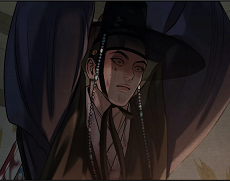 (chapter 102) However, I consider it as a first step to the lord’s emancipation and life lesson. The latter is indirectly learning not to pay attention to status and power. That’s why the author portrayed him as blind and deaf to their plea and special status. While his behavior in the shrine was rather impulsive and influenced by deeply rooted fears, we should consider lord Song’s execution as a true act of justice.
  (chapter 123)
  (chapter 123) The latter had confessed all his crimes: the ones from the past (the lies in order to fool the father)
 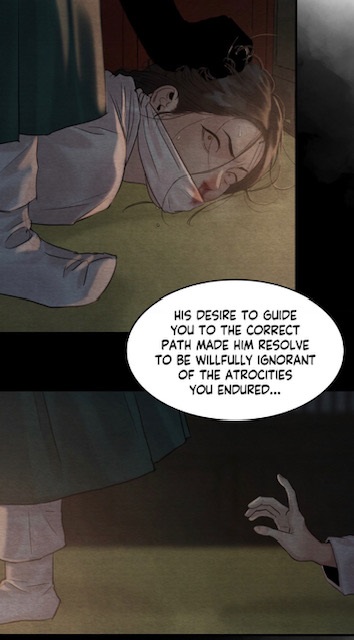 (chapter 123) and the painter’s murder. Funny is that lord Song didn’t feel threatened by the young master at all despite the sword.
 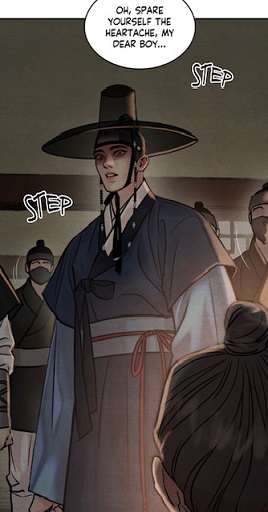 (chapter 123) Why? It is because he feels, he is the one with the upper hand. First, he has the petition, hence he is already projecting himself in the future (he can get a high position again). Secondly, he thinks, Yoon Seungho is outnumbered. He is surrounded by 4 guards. But more importantly, he views himself superior to the main character due to his age. He is an elder. That’s the reason why he calls “my dear boy”. This implies that he is underestimating the main figure. The latter would never dare to raise his hand against a senior!! However, true justice is also blind to age.
 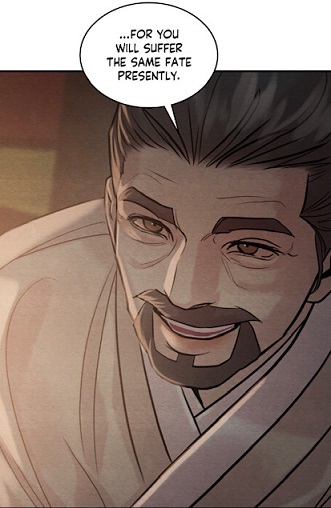 (chapter 123) His smile at the end of the episode should be perceived as a reflection from Min’s vanishing.
  (chapter 103) One might even add that the lord’s action could have been seen as self-defense. However, don’t forget that we are here in Joseon, where a commoner’s life means nothing. Because of this new association, I came to the following deduction: lord Song was the one behind lord Shin’s death.
  (chapter 103) The latter couldn’t imagine that an elderly yanbang, an official, would raise the sword against another noble. After this new realization, it dawned on me why Yoon Seungho had to get separated from his loved one.
 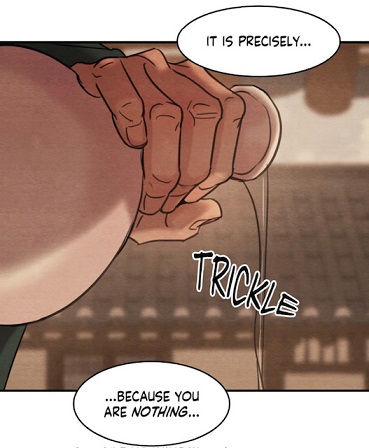 (chapter 126) This humiliation made Yoon Seungho realize that he needed to have his power on his own. He learned through the hard way that he was not just a Yoon, but Seungho. Yes, this helped him to differentiate himself from his father and to become stronger mentally. His religion was now his lover, Baek Na-Kyum, whom he needed to protect. But he could only do it, if he had himself a powerful position. But he needed to witness the corruption of the authorities to realize that in Joseon, there exists no justice. (chapter 127) That’s the reason why I deduce that Yoon Seungho is not destined to become a lazy or unfair governor. He learned through the hard way how important it is to give proper justice. (chapter 131) Should these two men know the artist, the latter could encourage his lover to listen to their testimonies and not judge them based on their status.
Under this new light, it becomes comprehensible why I don’t perceive the main lead as a lazy governor. Just because he appears as one in this scene (chapter 131), we shouldn’t generalize such a behavior. By paying no attention to power and fame, the protagonist learned what true justice is. Moreover, he realized the true source of happiness: love and simplicity. He made sure to keep all his promises to his loved one. Moreover, the artist is there to remind Yoon Seungho of his duties: (chapter 131) Hence I can’t help myself imagining the couple strolling through the village and listening to the people. Thanks to the artist, Yoon Seungho can only get recognition and acceptance from the autochtones. Besides, Baek Na-Kyum is even giving painting lessons to children, so I doubt that he will drop everything for his lover’s sake. We should envision the opposite behavior from the scholar:  (chapter 6): neglect and indifference towards the commoners. And this new observation brings me to my other topic, Jung In-Hun.
2. The real sinners: the hidden hustlers and workhorses
In the first part of this essay, I compared the arrival of the lord in his new jurisdiction with the scholar’s Jung In-Hun.
| YoOn Seungho | Jung In-Hun |
|---|---|
| |
Through this comparison. I had a huge revelation. Manhwaphiles can notice not only the absence of flags and the palaquin, but also the absence of uniforms. The two men in black leading the horse were simply wearing black hanboks and not blue and white costumes. Then it dawned on me that after this cortege on the street, there was no banquet after his success. Hence I deduce that he had not really succeeded at the civil service examination. First, he had not finished top place  (chapter 129), therefore he couldn’t select one position contrary to the main lead. This means that when he celebrated his “victory” in episode 111, it was not official. He had no post. I would even add, his name had not been announced on the official board, like we could witness it in this scene.
 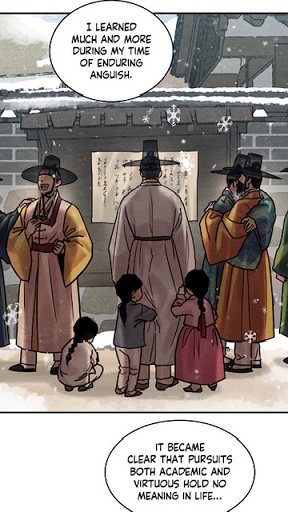 (chapter 121) Here, he is informed that he didn’t pass the exam, for his name was not written there. We can detect this, because people are congratulating each other. His name was left out due to the intervention from lord Song. This means that when Yoon Seungho made him this offer
 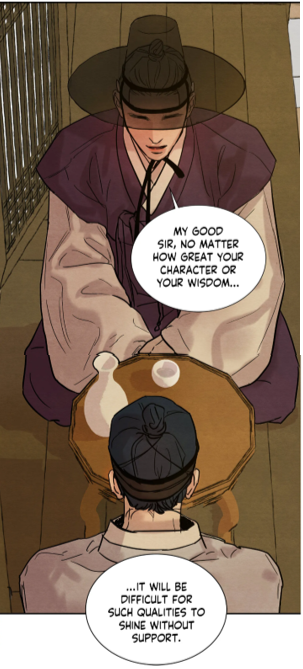 (chapter 7), these were not empty words. He did help the learned sir to pass the civil service exam. But the scholar didn’t succeed like anticipated. The absence of his success explicates why Jung In-Hun received such an offer from lord Song later.
 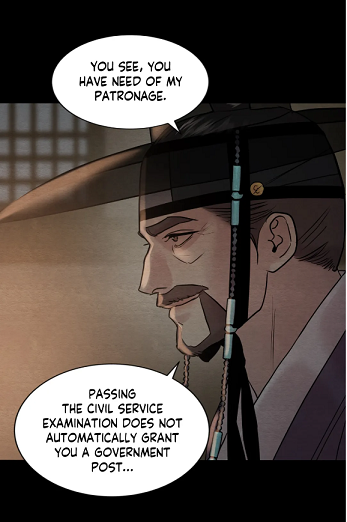 (chapter 117) He had no post, he couldn’t choose it, for he was not the best. Thus I deduce that the scholar had just proven his mediocrity. He was just an average man. That’s how it dawned on me that the ceremony in the street was more a simulacre! (chapter 111) Yes, it was fake, for there was no banquet, no sedan chair, no flag and just civilians were surrounding the former teacher. The painting from Baek Na-Kyum can even serve as another evidence that a palanquin and flags are attributes to a ceremony of inauguration.
 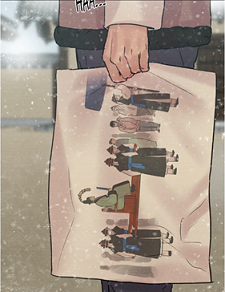 (chapter 44) Only one thing was real: Jung In-Hun was wearing an official uniform, that way no one would doubt his “victory”. Moreover, observe that lord Song only approached the learned sir after the parade. So he was not behind the parade. Besides, keep in mind that the main couple was informed about the parade through the tailor
 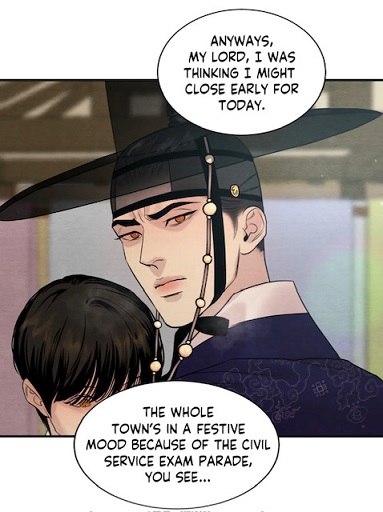 (chapter 111) and not from the official board. His reaction shows not only his displeasure, but also his ignorance. If he had known about the cortege, he would have avoided the place in the first place. Thus I suspect that the tailor had been encouraged to leak this information in front of the couple. Let’s not forget, as a tailor, he was definitely involved in the cortege. It is no coincidence that he informed Yoon Seungho about this “sudden parade”. At the same time, I come to the following deduction: someone must have paid for this spectacle, and it was not Yoon Seungho, for he had been kept in the dark until the last moment. I doubt that the learned sir had the connections and money for this. This new perception corroborates my previous interpretation: the show was sponsored by someone, and it was definitely inspired by the drawing (the hat and the green uniform).
  (chapter 111). Yet this was just a cheap trick, for the person didn’t send a sedan chair with carriers. Under this new light, I realized why Jung In-Hun ended up stigmatized as a criminal.
 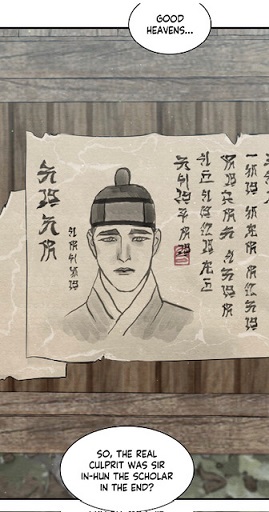 (chapter 127) It was his karma, for he had deceived the painter with his lies. His success was not his own.
 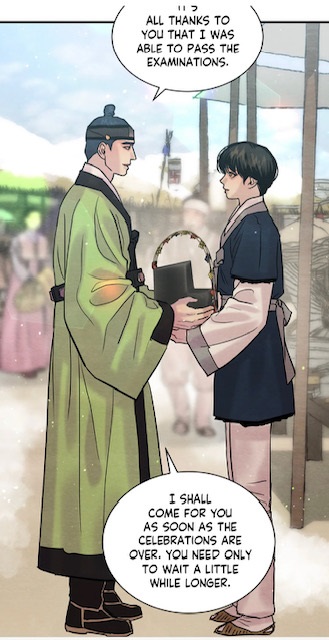 (chapter 111) He realized that even after passing the exam, he needed the assistance of people, a sponsor for the spectacle, a noble with connections. Besides, when in season 1, the painter was accused of a crime (ruining the picture), the learned sir did nothing at all. He didn’t protect his student, for he desired to keep his sponsor. When the latter was sick, he neglected him as well. He wouldn’t have sent a doctor for him. Hence in season 4, the sponsor Na-Kyum decides to end his “sponsorship” for the learned sir. We could say that the former teacher is confronted with a similar situation. He ends up being abandoned and framed for a crime, which he didn’t commit. Yet, contrary to his pupil, he is not entirely blameless, for he played a huge role in the death of the nobles lord Song, lord Shin, lord Min and others. Because Baek Na-Kyum embodies hard work, justice, equity, love and honesty, I deduce that his surrogate father embodies the negative notions: laziness, corruption, partiality, hierarchy, ambition and hypocrisy. That’s why his face ended up on the official board, while the painter’s accusation just remained rumors.
  : (chapter 125) versus (chapter 127) His fate reflects Joseon’ society and authorities, especially when the latter are closer to the capitale.
At the same time, the poster of the scholar exposes that the scholar’s dream had always been to see his name on the official board. (chapter 121) However, the notice was not associated with glory and honor, but with the opposite value. He was an immoral and brutal man. (chapter 127) which was actually reflecting his true personality. We should see the parade in episode 111 as an illusion due to the absence of an official document. And who had paid for this charade? One might think lord Song. However, don’t forget that he approached the man much later. I feel like someone else was involved as well. For me, it was Heena. She was seen with the tailor in season 2, and she had seen the painting from her brother. Finally, she had tried in season 2 and 3 to separate the couple. So she should have repeated the same action, because her resent towards nobles runs deeply, just like her admiration for Jung In-Hun is strong. She knew that her donsaeng was no longer listening to her and his new lover. He was determined to remain by his lover’s side. Thus she didn’t intervene here. 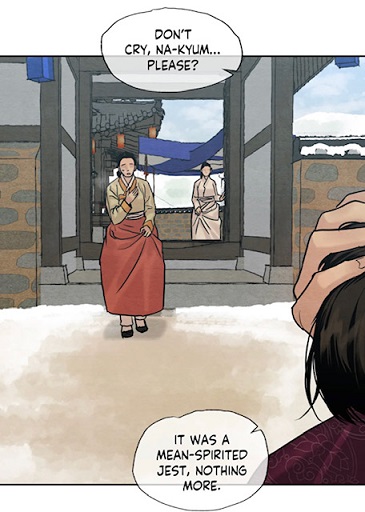 (chapter 105) IMO, she had to use another mean in order to achieve her goal: the scholar. Let’s not forget that the artist had confided to her this:
  (chapter 68) He was simply waiting for the learned sir’s return. And she was present during the cortege.
  (chapter 111)
Naturally, Jung In-Hun ended up being accused of murder, because not only he had lied, but also he had contributed to the death of lord Min and the others. By giving the spectacles, he was also responsible for their death. Finally, by hurting Baek Na-Kyum and giving him to lord Song 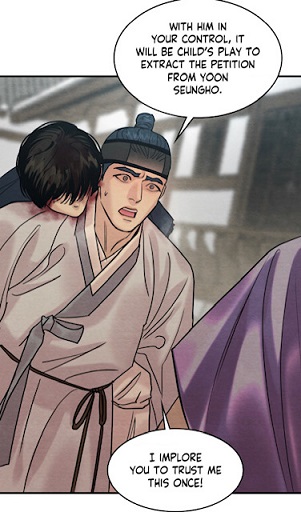 (chapter 121), he put the painter in a position which led him to take for the fall for his loved one. It was like framing an innocent. Exactly like in season 3
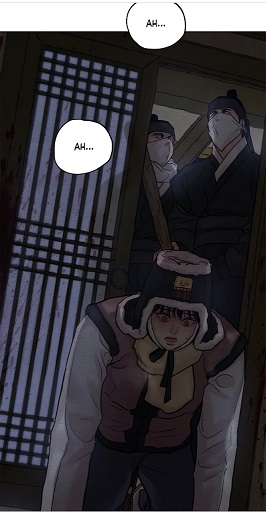 (chapter 99), Yoon Seungho had been forced to take the sword because of the scholar. And the trigger for the massacre
 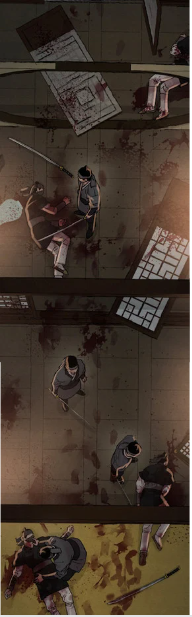 (chapter 124) was always Jung In-Hun. And now, you comprehend why Jung In-Hun became the scapegoat for the last incident. But there’s more to it.
The sexual and physical assault, playing a trick on multiple occasions and the lies are the reasons why the learned sir ended being labelled as a dangerous bandit. (chapter 127) The paper reflects the transformation of the former teacher. He is no longer a honest man. He lost everything: his home, his name and even his life, killed by lord Song’s minions. 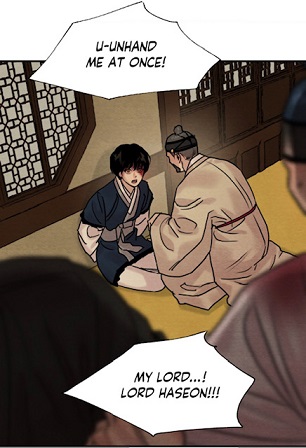 (chapter 121) His final lesson was to learn that he was exactly like the others: he is just a human despite his education. All humans are equal in front of death. In fact, during his confrontation with lord Song, he came to give up on his integrity. His true face came to the surface: he was just an opportunist, a lazy scholar who relied on fate and his arrogance.
  (chapter 6) This brings me to my next interpretation. Jung In-Hun learned through the hard way that there is nothing like fate (“right time”), but life is the result of decisions. However, because the scholar always regretted all his past choices, he decided to blame others for his wrong choices. That’s the reason why he ends up to take the whole crime. We should see this paper (chapter 127) as a reflection from the poem in episode 4:
 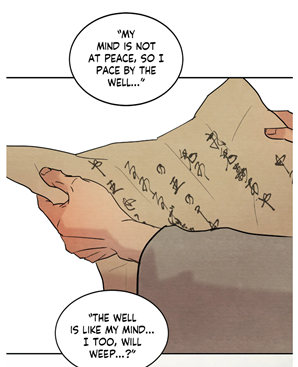 The author from this sijo was the poet and official Wang Bang-Yeon who is said to have lived in the time of Joseon’s sixth king Danjong (1441-1457) and his successor king Sejo (1417-1468). As the official of the state tribunal, he followed the young king Danjong into his exile and gave him poison to drink by royal command. Yes, both are symbols of power, corruption, partiality and injustice. Yet, there exists one divergence. While Wang Bang-Yeon left a poem revealing his yearning for the king, the learned sir had no deep attachment towards the artist. Hence it is no wonder why the paper “Wanted” is not connected to affection. It really reflects the emotions and thoughts of Baek Na-Kyum. Due to the last incident, the latter no longer cares for this man.
Jung In-Hun should have realized much sooner that happiness is not a synonym for power and admiration. In reality, he was living quite well in the small village. (chapter 6) He had a roof over his head, and he was surrounded by children, who liked him. (chapter 121) But the problem is that he was consumed by entitlement and greed. How so? It is because of his education. He saw himself superior to others morally and mentally. Hence he didn’t feel the genuine admiration from the children.  (chapter 6) He couldn’t enjoy it at all. It is no coincidence that the synonyms for ambitious person are “busy person” and “workhorse”. Yes, this mirrors the expression “laziness”. A true ambitious person is actually proactive and not really relying on sponsors and bribes. So when we see the learned sir on the horse (chapter 111), he is acting like a workhorse. The reality is that he is lazy, as he saw himself destined to achieve greatness. He had the impression that no one had recognized his true value. On the horse, he is just waving his hand and smiling. Later, he confesses this to the artist: (chapter 111) As you can see, his success is not the result of his hard work, but rather of his connections!! Though he didn’t kill lord Song himself, Jung In-Hun had to receive his due punishment for all his lies and sins.
3. The brother’s punishment
This brings me to the next interpretation: Yoon Seungwon and his success. (chapter 107) Though he passed the civil service exam too, he is not able to fulfil his father’s wish either. (chapter 86) They lack support now because of the treason. The families close to the Yoons got executed. But there’s more to it. The youngest son had first betrayed his father by giving the petition to Yoon Seungho,
 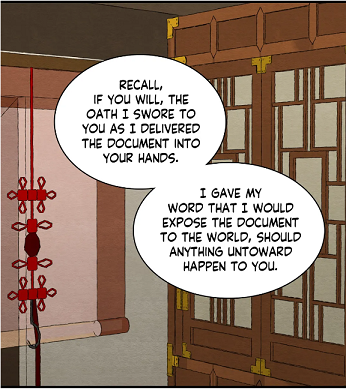 (chapter 118) His intention was to protect not only his brother, but also their family. It was to ensure that lord Song would get blackmailed. That’s how this investigation (chapter 37) got stopped in the end, and the Yoons escaped any punishment. However, by doing so, Yoon Seungwon turned his brother into a blackmailer. Thanks to him, Yoon Seungwon could keep his reputation intact. In fact he never lost his father’s trust. However, in season 4, we can witness a change of heart in the brother.
  (chapter 118) It is because he knows that with the petition in his brother’s hands, lord Song represents a hindrance to his own career. The latter can only see the Yoons as a threat. Besides, he can only resent the family, if they are able to gain reputation and power, while he can not return to Hanyang and occupy a high position. As you can see, the young master’s success can only irritate lord Song. You can sense a rivalry between Seungwon and lord Song Haseon
  (chapter 116) in this scene:
  (chapter 116) The latter has already sensed that the traitor is sitting next to them, thus he raised this question. That’s why I come to the following conclusion that the young master must have realized that he also needed his brother’s assistance. First, if Yoon Seungho returns the petition to the father, the investigation about the traitor in the mansion would be no longer necessary. Secondly, Yoon Seungwon needs to create new connections in Hanyang, but he can only achieve it with his elder brother. Under this new light, you comprehend why Seungwon asked his relative to move on from the past and as such “forgive their father”
 . (chapter 118) In other words, the young man embodies the notion of “fake forgiveness, fake promise, fake understanding”. He is an opportunist, exactly like the scholar. Yet, there exists a huge divergence between them. His affection for Yoon Seungho was not fake. He is feeling sympathy for his brother. But that’s it. This explains why he didn’t help his brother before. In my eyes, Seungwon represents a different notion of family: bloodline. In my eyes, he embodies traditions and Confucianism. His goal is to turn his father’s dream and life motto into a reality: glory and power for the Yoons. Besides, he must have experienced himself the downfall for the family. And this observation leads to my next interpretation. This means that Yoon Seungwon must have lied to his father by omission as well. (chapter 86) In my opinion, he must have promised to fulfil the patriarch’s wish, but reality made him realize that this was not possible. He couldn’t do it alone. However, I doubt that he confronted the elder with reality.
Let’s not forget that he is only the second son. So he can not inherit the family’s properties. Remember that once the main lead succeeded the civil service exam, he received many marriage proposals.  (chapter 128) What about Yoon Seungwon then? Though he succeeded too, there is no mention about engagement or marriage proposals. However, it is clear that this achievement is connected with adulthood and marriage, therefore the elder Song Haseon brought up the topic sex!
 (chapter 107) It is because Yoon Seungho is the first son who will inherit the title and properties. Yoon Seungwon’s success can only work with his brother’s presence. This means that thanks to the last episode, I could finally find the answer from Byeonduck’s question:
  What was the reason for Yoon Seungwon’s embarrassment? First, it is because his brother selected the backward place, though he had passed the exam with flying colors. Yoon Seungwon imagined that once his brother had passed the exam, he would get married and establish new connections. That way, Seungwon would be able to get married with a properous and famous family. In other words, Yoon Seungho would turn the father’s dream into a reality: the return of the Yoons’ glory and power. And Seungwon would benefit a lot from this. So in the gibang, his advices might have sounded well meant, (chapter 118), in verity he was also motivated by his own desires. He wanted to get the help from his older brother. This means that the moment the main lead lost his father, Seungwon’s words became true. Yoon Seungho followed his advice: he cut off ties with his past and as such with his family. He was no longer obliged to fulfil the family traditions and the father’s dream. This means that Yoon Seungwon is now on his own. I find it funny that he blamed his brother for his debauchery, but what did he do during this time? Nothing… he waited, until he received pressure from his own father. Moreover, since Yoon Seungwon didn’t help the artist and allowed him to take the fall for the massacre
  (chapter 126), his karma is not only to end up alone, but also not to receive any support from his brother.
To conclude, Yoon Seungwon tried to convince his brother to change his behavior  (chapter 117), because his career was still insecure due to lord Song’s influence. He needed his brother’s help in the end. At the same time, Seungwon had already long internalized the values from his father: Yoons’ honor and reputation were top priorities. In other words, the younger brother stands for social norms and fake righteousness. He desires to maintain his perfect image (loyalty, filial piety),
 (chapter 118), hence he left the document at the mansion. He wanted his brother to return the papers on his own so that his past action would remain undetected. Returning the paper was like an admission that he had stolen it in the first place. Yet he still barged in his brother’s house twice.
 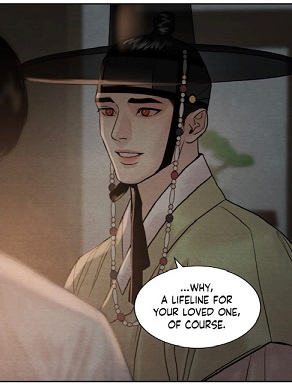 (chapter 117) Here, he exposed the existence of the “petition” to Baek Na-Kyum for one reason. The latter should be used as a way to pressure the main lead to give up on the paper. Notice that this topic was brought up in the gibang:
 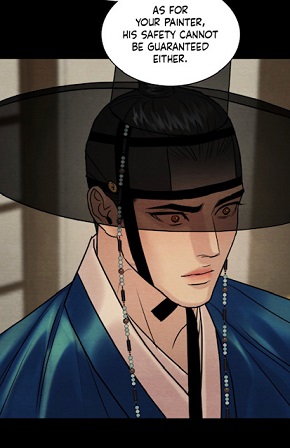 (chapter 119) However, the reality is that Seungwon is not just trying to fulfil his father’s dream, but also he has his own ambition. He wants to make a name on his own. That’s why he confessed this to his brother:
  (chapter 119) He doesn’t associate himself with the father and his sins. In his eyes, he is blameless. The reality is that he is guilty like his father, for he failed to care for Yoon Seungho. He failed to listen to him and his suffering. He didn’t try to understand him. Like mentioned above, he only sympathized with him and that’s it. Thus he condemned him for his debauchery in the gibang, but this was no longer the case.
When the father confronted his own son with reality (he had no power without him), Yoon Seungwon was once again absent!! The latter is the evidence of his “neglect”. It is important, because when the main lead bowed in front of the patriarch,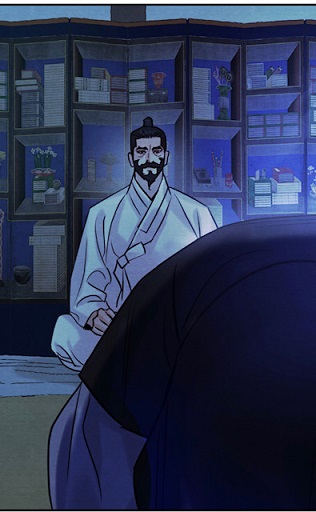 (chapter 127)
 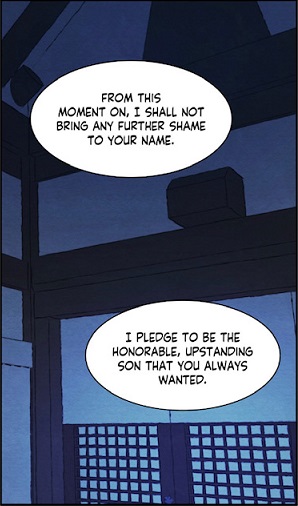 (chapter 127) the former only made a promise to his father and not to the brother. With his death, Yoon Seungho is no longer bound by a promise. Since the main lead had been living properly for 3 years and even passed the civil service exam, it is clear that for the brother, Yoon Seungho must have forgotten his past lover. He must have judged his brother based on appearances, just like he was behaving himself. However, this was just a subterfuge. He was waiting for the right time too. He had no change of heart, he had just been copying his brother’s behavior.
To conclude, the main lead abandoned Yoon Seungwon in the end for his loved one. It happened, when he not only rejected the marriage proposals, but also moved to that “poor region”. The sibling received his punishment for his lack of loyalty and his dishonesty. Funny is that the main lead actually followed his brother’s advices: 8chapter 118) He cut off ties with the past and the family!! This means that his words in the lord’s bedchamber came true:  (chapter 78) Let’s not forget that at the gibang, Yoon Seungwon never revealed his true intentions towards his brother. The latter always said that his advices were for his best interests. He should become involved in the government. But everything was for the Yoons, or better said, for Yoon Seungwon’s sake. And there exists another reason why the sibling must have been embarrassed: This marriage!
  To conclude, Yoon Seungwon embodies the opposite values of Baek Na-Kyum and Yoon Seungho: ambition, corruption, forgetfulness, hierarchy/social norms, traditions and reality versus understanding, forgiveness, simplicity, closeness, modern family and happiness. Selfishness versus Selflessness. This explicates why the main lead gave up his success for the artist. However, though it looks like an exile, the reality is that he will gain popularity and admiration among the inhabitants. Why? It is because he is no longer making distinctions between nobles and commoners, he doesn’t see this place as a punishment, but as a heaven and as such he has a better perception of humans in general. In my eyes, he is bringing progress and change in the region. Baek Na-Kyum is already teaching the kids how to draw… so it is only a matter of time, until his lover takes care of the education for these children. This means that these words will become a reality:
  (chapter 6) He will think of the futures of those children because of his lover.
PS: Tell me, if you are interested in another essay. The question would be: how did lord Yoon die? Was he poisoned or not?
Feel free to comment. If you have any suggestion for topics or manhwas, feel free to ask. If you enjoyed reading it, retweet it or push the button like. My Reddit-Instagram-Tumblr-Twitter account is: @bebebisous33. Thanks for reading and for the support, particularly, I would like to thank all the new followers and people recommending my blog.

 Bebebisous33s' analyses in K-Dramaland and Manhwas
The essay was interesting. I think I also have similar but different take on many of the things described here like I wonder of Lord Song is one of the distant relatives of the royal family ?? he always appears wearing purple, a color of royalty. Although it could also mean he thinks of himself as a little “King” of his own conspiracy gang, its possible he might have distant royal blood and hence why he decided to plan treason alongside Father Yoon and others in the first place? That would explain what is in it for him and Yoons. Treason are usually committed by people when they have a replacement heir of some kind as a back up who would reward the fellow conspirators highly . Lord Yoon talks about the glory of Yoon family but he probably wasn’t that high if he thought he had to resort to being a treasonous lackey to fly up the social ladder.
Yoon obeys and listens to Song like a lackey with no brain and can only bully his sons . He acts like a “filial” subject to lord Song. So when the coup attempt failed Lord Song could only act out his frustration and his tyrannical tendencies among his obedient lackeys . Hence why he was miffed and tried to even prey on younger Yoon brother too
About the identity of the sponsor, I am thinking, that Heena , could be a sponsor, she could be an indirect sponsor. Although she is head of a Kiseang house now, it still doesn’t mean she could burn up that much money on a parade for In Hun just because she is platonically infatuated with him. It would be quite the splurge she won’t be able to explain to her fellow underlings without being ousted. She won’t even give her little brother enough money on his own to “flee”.
Considering most of the children that studied under In Hun were kids from Kiseangs she knows, plus the peasants, Its likely In Hun has fleeced a lot of kids because of if his connections with her and his ability to charm gullible peasants. This is why most of the people in the parade are people he knows, happy to act his lackey and dance to his tunes, this time a bit literally. So in a way I think In Hun sponsored his own little parade from the money he fleeced from Heena and her fellow Kiseangs and other peasants by pretending to teach their kids letters.
The interpretation of Seungho as opposite of lazy governor is very interesting and likely will be true too. Like the reflection shows, unlike the two conspirators, perhaps the criminals brought before SGH might be innocent and if not its at least likely their crimes are petty instead. What is even the point of attending to :justice: over criminals in a peaceful village where most crimes do not warrant getting punished by the governor himself? True justice is about interpreting the intent not the letter of the law, and cruelly punishing peasants for stealing a bag of grain or two while letting of criminal nobles who kill people is clearly not justice. Since the guards didn’t think its an emergency, so Seungho spending time with Nakyum instead is much more productive than any of this anyway. Which also makes for a funny comedy moment as suits the nature of the extra chapters
I also like to think Lord Yoon was poisoned but nobody around the Yoons decided to blame or seriously endanger Seungho at all even when they knew. Its because of Yoons, people like Lord Song would come and hovered over the common people of their village, endangering everyone. Even the Kiseangs were afraid of him. His cruelty towards his son is not hidden either. Although Neo Confucianism states a son must be filial towards father and authority, the authority abusing their power aka Yoon abusing his son so badly that he has become a “debauched” degenerate from bright young and promising sprout must have not sit right with anyone. If Lord Yoon had not abused his son so much they could have had a top scholar in court from their villages YEARS ago. They lost a potential way of prosperity from their village.
Perhaps they even feared that if Yoon can do this to his own son, then what fear does he has abusing the rest of the peasants. So in a way the gossip, unlike the first season protects Seungho rather than endangers him. Everyone know and everyone hence has made a tacit agreement to let him get away with it.
Also I have read in A song of Ice and Fire series that “poison is a women’s weapon” as a saying which is inspired by Medieval Italian sayings when poisoning to get rid of unwanted husband and family rivals by women and even Popes were quite famous. It is hence considered a “weak” person’s way of retaliation . The fact Seungho had used that weapon, a sly , hard to detect weapon to kill the man who has used sly social power to shirk his duty as a father is indeed quite fitting.
LikeLiked by 1 person
Thanks for pointing out these little details. Yes, I doubt that Heena sponsored him on her own, but it exposes her naivety in the end. She imagines that once successful, he will get a good position. Secondly, the poison as « women’s weapon » is a good observation, but actually it shows that Yoon Seungho can not be the one behind this. In my eyes, it is the work of the commoners (staff, doctor, Kim, Heena). I didn’t write it in the essay, but for Heena the paper « Wanted » of Jung In-Hun must have represented a huge blow. Imagine, her idol is « framed » as a criminal. Her prejudices against nobles can only get reinforced. That explains why Yoon Seungho became the target of rumors again. They wanted to frame him, thinking that the brother would turn against YSH. Let’s not forget that the latter had betrayed the main lead, but so far, he had acted like a loyal and filial son. Yet, such an event could only give the main lead the opportunity to cut off ties with the staff. As the new head, since he had no one by his side, he made sure to get rid of them legally.
LikeLiked by 1 person
Seungho calmly executing and hiding his involvement in his death means no one can accuse him for any crime he committed especially crimes for justice . Just like he got away with killing Min and his accomplices.
LikeLiked by 1 person