

Please support the authors by reading Manhwas on the official websites. This is where you can read the Manhwa: Jinx But be aware that the Manhwa is a mature Yaoi, which means, it is about homosexuality with explicit scenes. Here is the link of the table of contents about Jinx. Here is the link where you can find the table of contents of analyzed Manhwas. Here are the links, if you are interested in the first work from Mingwa, BJ Alex, and the 2 previous essays about Jinx The Hollow Crown👑 : An Ambiguous Dream 😶🌫 (locked) and ️The Clash 💥Of Flesh👄 and Will 🤯
It would be great if you could make some donations/sponsoring: Ko-fi.com/bebebisous33 That way, you can support me with “coffee” so that I have the energy to keep examining Manhwas. Besides, I need to cover up the expenses for this blog.

Time has always been a subtle but powerful force in Jinx, shaping the actions and mindsets of its characters in ways that they themselves barely perceive. In season 1, I had compared Kim Dan to Sleeping Beauty  (chapter 13), who had been awakened by the champion, though contrary to the fairy tale, this arising was associated with pain. [For more read the analysis Painful awakening of Sleeping Beauty🤼♂️💕] What caught my attention is that in season 2 Joo Jaekyung was still himself trapped in temporal stasis too.
 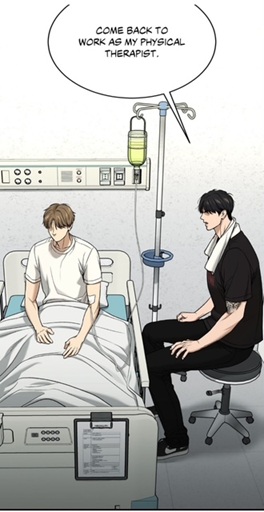 (chapter 60) But how did they ended up both cursed by the same spell? The reason is simple. They were either halted by guilt and self-loathing or distorted by the desperate need to escape a traumatic past. Yet, amidst this stasis, small cracks are beginning to appear, suggesting that the flow of time cannot be denied forever. The past can not be repeated
 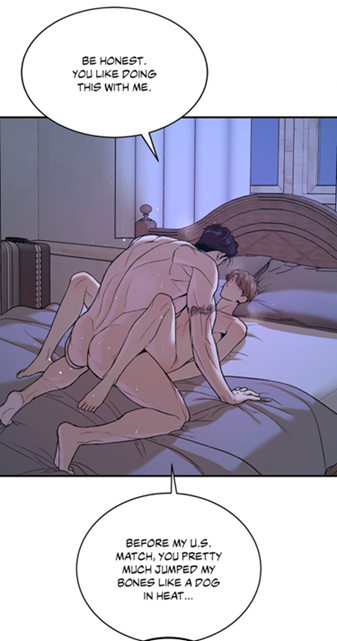 (chapter 64) or become the present or future. At the heart of this struggle lie symbols of doors, windows, and reflections—metaphors for how both characters perceive their realities and their chances of breaking free.
Interestingly, while Kim Dan became aware of the passage of time in Season 1  (chapter 44), he still does not fully include himself in this awareness. His concern was limited to his grandmother’s limited time
  (chapter 59), reflecting his selfless role as a caregiver. As someone who has long allowed others to define his time—whether as a physical therapist or as a prostitute—Kim Dan has yet to acknowledge his own mortality. Even during the lavender-tinted night, while he determined the length
  (chapter 64) and nature of the encounter
 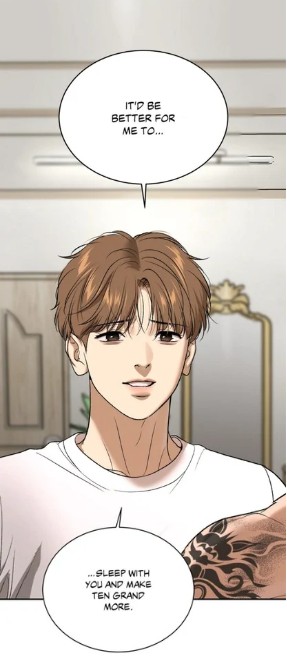 (chapter 62), he did so for the sake of debts, not for himself.
  (chapter 64) The recent death of the puppy serves as a stark reminder
  (chapter 59) that he is not exempt from time’s reach, that he too is aging and vulnerable. But the doctor failed to recognize this warning. He only viewed it as a sign of his own powerlessness, reducing it from his own perception. He overlooked the fragility of life as such.
Meanwhile, Joo Jaekyung’s struggle is equally profound. By meditating before an expansive window  (chapter 35), he created an illusion of freedom that only masked his deeper confinement—his glass prison. When Kim Dan closed the door and left
 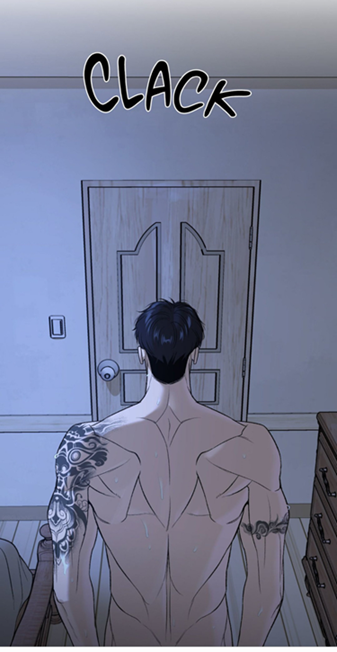 (chapter 64), the illusion shattered, revealing the reality of his loneliness. The jinx,
  (chapter 55) once confined to the bedroom, now permeates his entire life, binding him to a past shaped by his abuser’s cruel words.
The Window: Illusions of Freedom
Joo Jaekyung’s habit of meditating in front of the window in his penthouse seemed, at first glance, like an attempt to find peace.  (chapter 55) The view created an illusion of openness and freedom, masking the reality of his confinement. Glass, by its very nature, is transparent—a barrier that is invisible yet unbreakable, creating a false sense of freedom. The window’s clarity hid the fact that it was, in truth, an impassable wall that confined him, turning the promise of escape into a cruel irony. By focusing on the horizon, he could avoid looking inward, denying the unresolved trauma left by his anonymous abuser.
  (chapter 54) The ghost’s words, ‘
 (chapter 54) were designed to create the illusion of eternity—as if time itself was under the phantom’s control. This assertion not only sought to freeze Joo Jaekyung in a perpetual state of inadequacy but also to distort his perception of change as impossible. Trapped in a cycle of hatred and self-loathing, the athlete’s vision of freedom was limited to the false infinity of the horizon.
 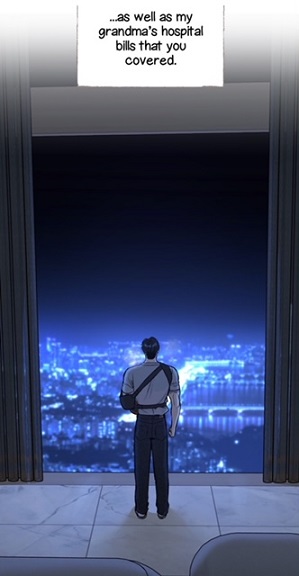 (chapter 53) And now, you comprehend why the champion chose not to look for Kim Dan after his departure. He was so close to the window, making him think that he had a “choice”. That’s how I realized that the closer he would stand to the window, the less he would get Enlightenment. Hence he is portrayed eyeless here.
  (chapter 53) Ironically, the window—symbol of escape—became his glass prison, a barrier that reflected the endlessness of his struggle rather than a path to liberation.
In contrast, Kim Dan faced a broken, opaque window in his grandmother’s home 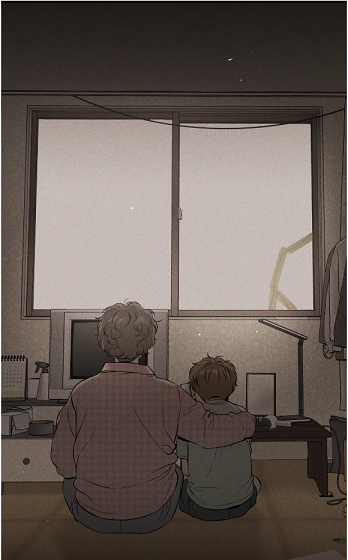 (chapter 19) —a window that offered no view of the outside world. This reflected his entrapment in a life defined by guilt and sacrifice, unable to envision a future beyond repaying debts and fulfilling duties. The window’s visible cracks and makeshift repairs represent not only the physical deterioration of their environment but also the psychological fragmentation within Kim Dan himself. By choosing to patch the window rather than replace it, Shin Okja’s actions reflect a mentality of denial and resignation—an unwillingness to confront the full extent of their impoverishment and suffering.
This refusal to replace the broken window 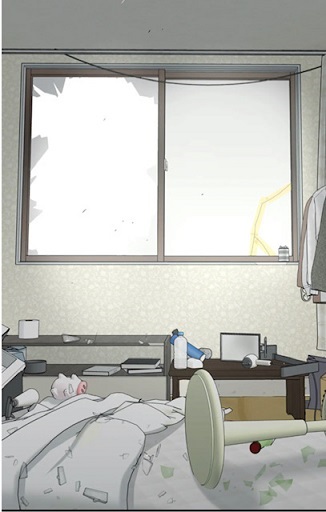 (chapter 19) suggests a deeper symbolic resistance to change or moving forward. In a sense, the grandmother’s decision to live with the broken window mirrors her acceptance of a life defined by limitations and unspoken grief. (chapter 19) It implies a preference for preserving a fragile status quo over embracing the uncertainty of transformation. For Kim Dan, who grew up in this environment, the broken window became a constant reminder that his world was fractured yet stagnant—a prison where time seemed to stand still, marked by routines of survival rather than progress.
Moreover, the window’s damage also serves as a visual metaphor for Kim Dan’s own brokenness, his unresolved trauma, and his sense of abandonment. The act of looking through a cracked and dirty window obscures the view of the outside world, just as Kim Dan’s perception of the future is clouded by past wounds and insecurities. Unlike Joo Jaekyung’s glass prison—clear but impassable—Kim Dan’s window is both broken and opaque, reinforcing the sense that he cannot even see what lies beyond his current existence, let alone escape it.
The grandmother’s passive acceptance of the broken window further exposes her powerlessness. It’s not merely about financial inability; it reflects a mental state of giving up—a resignation to a life where even repairing what’s broken seems pointless. In this context, the window becomes a symbol of Kim Dan’s psychological inheritance—a learned helplessness that prevents him from fully embracing the flow of time and the possibility of change. When he sat in front of that broken window, turning his back to the door, it symbolized his abandonment issues—an unconscious reenactment of being left behind. His world grew smaller with each passing day, suffocating him to the point of nightmares where he struggled to breathe.
The Door: Abandonment and Isolation
The motif of doors carries a dual significance in Jinx. On one hand, the fighter’s words in Episode 51 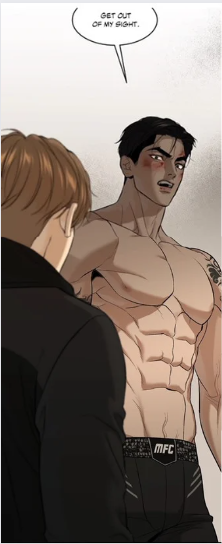 (chapter 51) served as the key that triggered Kim Dan’s abandonment trauma. How so? While “get out of my sight” implied that Kim Dan should leave him, the reality is that the champion left the locker room first.
 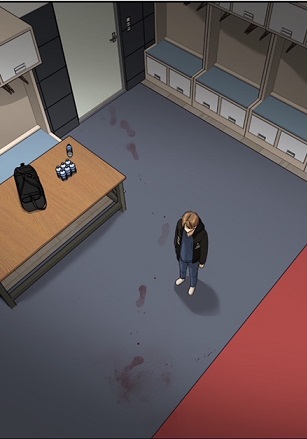 (chapter 51) Observe how the “hamster” is once again turning his back to the door. However, the bloody footprints became an evidence for Kim Dan that he had been abandoned and left behind. And now, you comprehend why the main lead took the athlete’s request seriously and literally. It is because the door in the past was the symbol of betrayal and abandonment. This explicates why he is so sensitive to the sound of a closing door and could recognize it, even if his ears and eyes were covered.
 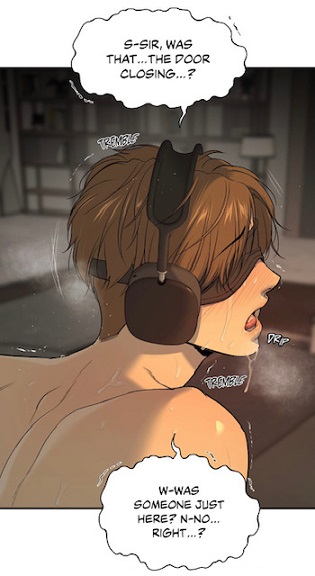 (chapter 35)
As a child, he had been turning his back to the door, while he was talking over the phone. (chapter 19) According to my hypothesis, this memory announces the moment of the parent’s abandonment. Thus I deduce that when unconsciously, he came to associate the door with desertion. No wonder why he woke up, when he sensed the lack of warmth in the bed: 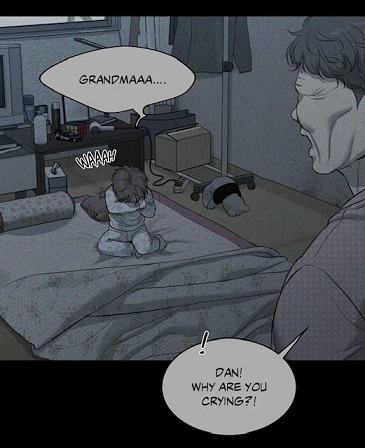 (chapter 21) Consequently, I interpret the following scene like this:
  (chapter 19) When he was standing here, he must have sensed it as a betrayal against his own grandmother. Hence he employed the expression “goodbye” and not “farewell” to diminish his guilt. No wonder why he chose to hide his move from his relative and bring the Wedding Cabinet to the penthouse. Under this new perspective, my avid readers can grasp why Kim Dan’s nightmares in season 2 were linked to the opened door:
  (chapter 57) His unconscious was telling him this: Shin Okja had broken her promise. She was about to abandon him. He had the impression that he was reliving the past. That’s the reason why he was scared and suffering.
 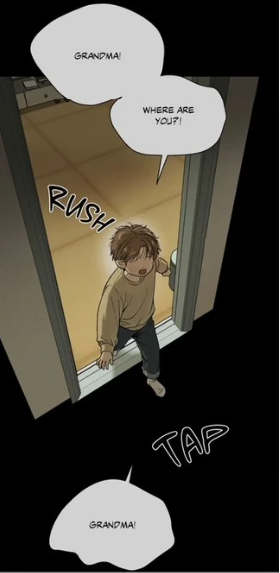 (chapter 57) In addition, I believe that his unconscious was pushing him to come clean with the past, to reveal the changes in his life. It was impossible for both of them to keep such unreal promises.
  (chapter 11)
Because of the champion’s action in episode 51, the door became synonymous with rejection, with the fear of being cast aside at any moment. However, this time the association was more conscious. The open door in Kim Dan’s nightmare, where the halmoni had vanished, represented his deepest fear of being left alone in darkness. And what is he doing now? He is afflicting the same pain to his lover (chapter 64)
But there’s more to it. I had long outlined that the little boy was talking over the phone, when he recalled this moment.  (chapter 19) That’s how he came to associate the telephone with betrayal and abandonment. Therefore it is no coincidence that the “hamster” was not calling Shin Okja either, when she was at the hospital. Joo Jaekyung’s inability to call Kim Dan
 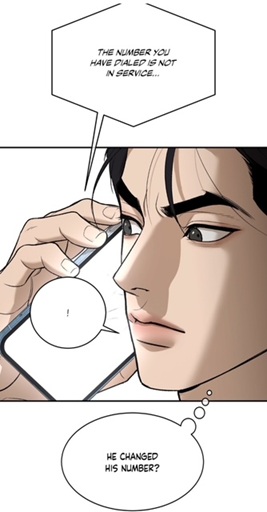 (chapter 56) revealed the existence of a past trauma. It highlighted his own fear of abandonment and rejection—an emotion he had long denied. The door, a supposed barrier against the outside world, now stood as a reminder of all he had pushed away, including his own need for connection. Therefore he never left his door open in the penthouse:
 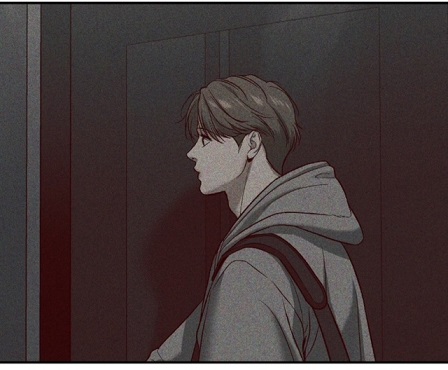 (chapter 55) That’s why I perceive this scene as an important step for Kim Dan himself:
  (chapter 64) By opening and closing the door, he is overcoming his abandonment issues. He becomes the ruler of his own life (time and relationship). He is freeing himself from the mental torment which readers could witness in earlier episodes.
However, the door symbolizes another notion: secret! Thus Mingwa created this sex session behind a closed door:  (chapter 24) The physical therapist has kept his past trauma a secret. And what is the synonym for “secret”? Key! So when the main lead leaves the champion behind (chapter 64), he doesn’t realize that he is exposing the existence of his “secret”. In verity, he is actually inviting Joo Jaekyung to open the door and as such find this secret. In his mind, he is excluding his partner, whereas in truth the opposite is happening. Don’t forget that in episode 24, Kim Dan desired to hide the truth from Potato
  (chapter 24), yet the latter didn’t get fooled at all. He found out the true nature of their relationship. (chapter 64) By leaving, Kim Dan unwittingly presents Joo Jaekyung with the opportunity—or perhaps even the challenge—to find the ‘key’ to understanding him. This key is not just about uncovering past traumas but also about unlocking the true nature of their relationship—transforming it from a transactional arrangement into something genuine and emotionally honest.
The Wedding Cabinet: A Prison of Timelessness
In the absence of a transparent window,  (chapter 19) the Wedding Cabinet in Kim Dan’s home functioned both as a mirror and a false window, preserving an illusion of timelessness.
  (chapter 19) Unlike the rest of the dilapidated house
  (chapter 10), the cabinet remained pristine, suggesting a futile attempt to halt the passage of time and maintain the status quo.
  (chapter 53) By throwing it away, Kim Dan unknowingly released time from its prison, breaking the spell that his grandmother’s control had cast over him. This act was not just a rejection of his past but an unconscious acknowledgment that time was moving forward—that he could no longer live as if he were already dead. Simultaneously, this gesture symbolizes his separation from his grandmother, breaking the illusion of perpetuity that she maintained. So while he might have been by her side physically
  (chapter 53), he was deep down miles away from her emotionally and mentally. This observation explains why he could object to her suggestion.
 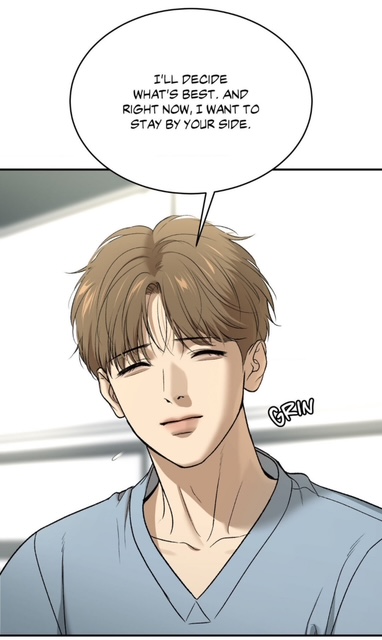 (chapter 57) On the one hand, it shows that he was maturing, on the other hand as a young adult, it is clear that he is destined to make mistakes. He has always defined himself as the caregiver, but he forgot his own true nature: he is a human before anything else. And what is the definition of humanity? I would say, the capacity of benevolence and the inevitability of mistakes. It reflects the dual nature of human existence—the potential for compassion, kindness, and altruism on one side, and the propensity for mistakes, weaknesses, and moral failings on the other. And that’s exactly what the doctor has been mirroring to the champion in the lavender-tinted bedroom:
  (chapter 64) Joo Jaekyung was in his eyes a human, and not a champion. The irony is that with this idiom “always”, he is implying that he had hopes and expectations. The athlete would change and treat him better. Since the doctor has always been the embodiment of “selflessness”, the gods made sure to remind him of his own true nature: “mistakes”. That’s why he is often making blunders
  (chapter 1) to the point that I called him “Mister Mistake”.
 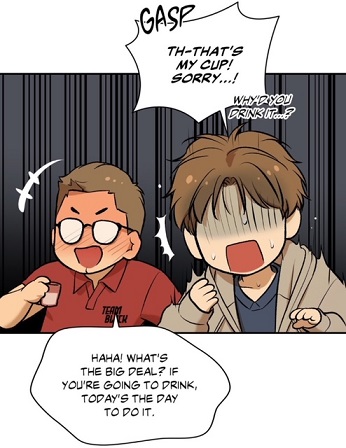 (chapter 43) On the other hand, his missteps are there to teach the fighter to drop his perfectionism and to bring the notion of entertainment in his fated partner’s life. Kim Dan is funny in his own way.
In religious contexts, errors are often framed as sins, accentuating the moral dimension of human actions and the necessity of redemption or forgiveness. This duality suggests that to be human is not only to strive for virtue but also to acknowledge and learn from one’s imperfections. The very ability to err, seek forgiveness, and change is seen as an intrinsic part of the human experience. This new perception reinforces my previous interpretation: the existence of champion’s jinx was indirectly questioned, when Kim Dan reminded his lover of his own true nature. He is a sinner. (chapter 64) He doesn’t respect humans in general. The irony is that by criticizing Joo Jaekyung, the doctor is overlooking his own nature. He is also a sinner.
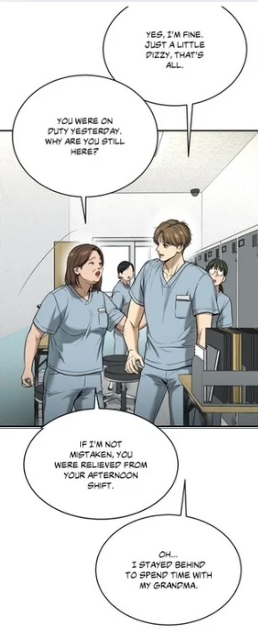 (chapter 57) Is it a coincidence that the doctor’s cold attitude takes place in chapter 60 -64?
 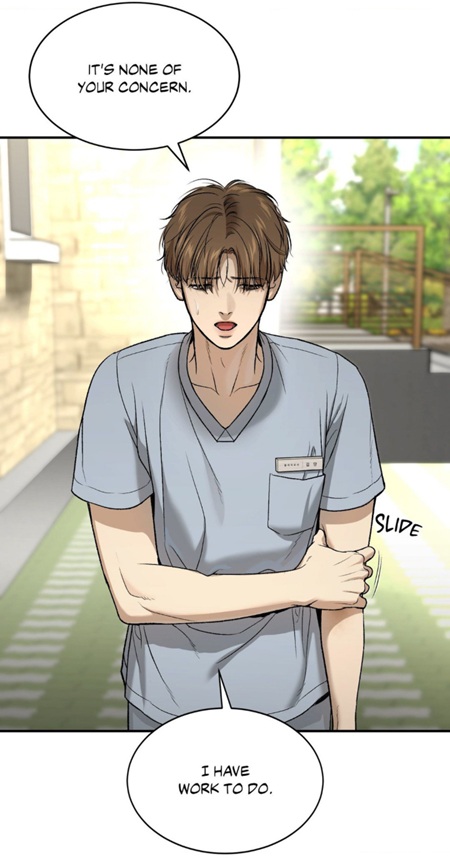 (chapter 61) No, as the number 6 sounds similar to sex. Moreover, don’t forget that Satan’s number is strongly associated with 6 (666 or 616). From my point of view, the “hamster” is on his way to become an adult and as such a sinner as well. The physical therapist’s stubbornness reminded me of the behavior of a teenager who believes to know everything about life, while in verity, such people lack experiences. And what did the nurse say about the main lead?
 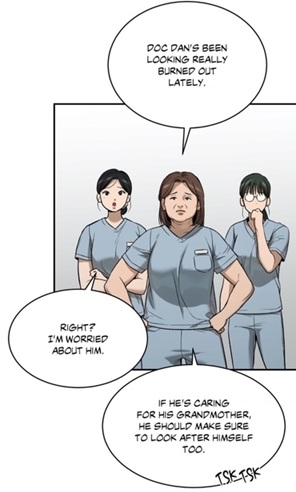 (chapter 57) He should nurse himself for his halmoni’s sake so that the latter wouldn’t worry. From my point of view, if doc Dan gets sick, he could be the catalysator for her deteriorating health. But now, it is time to return our attention to the “champion”.
The Abuser’s Shadow: A Timeless Sentence
Joo Jaekyung saw himself as a god who could turn time back: 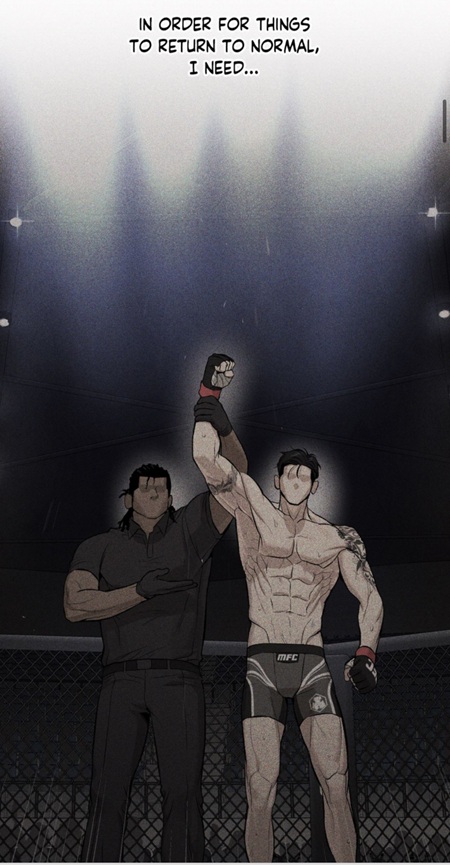 (chapter 61) But why did he want to return to the past? It is because of the ghost’s criticism
 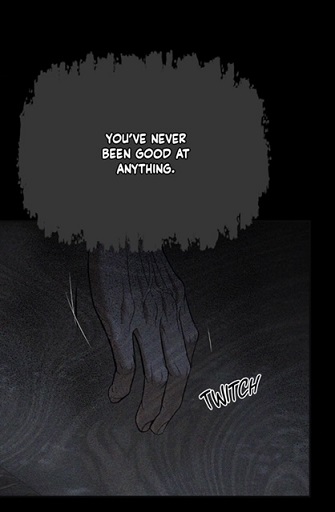 (chapter 54) ‘You’ve never been good at anything’ were designed to freeze Joo Jaekyung in time, trapping him in a mental prison where change was impossible. I would even add, the mysterious person gave a negative connotation to “change”. On the one hand, the champion was pushed to prove the tormentor’s statement wrong, on the other hand, this implied that one “loss” would be perceived as a validation of the ghost’s claim. This signifies that his obsession with maintaining his title stemmed not from pride but from a desperate need to refute the man’s statement. We could say that the fighter fought not out of fun, but out of hatred and fears.
  (chapter 29) That’s why he was on survival modus and could never refuse any challenge. By associating sex with endurance and control
 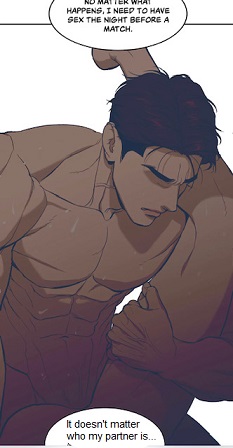 (chapter 2), he replicated the sports-like expectations imposed by his abuser—likely someone from the medical or sports world who viewed him not as a human but as an asset. This means that despite the distance, this invisible abuser was still ruling over the athlete’s life exposing the falsehood of his belief: self-reliance. He was still acting as a helpless person. Under this new light, it becomes comprehensible why Joo Jaekyung had to leave the penthouse with its huge windows. By leaving this place behind, he was actually moving away from the abuser’s claws, similar to the doctor’s move in episode 19.
So when Kim Dan’s words are here challenge this narrative. By accusing Joo Jaekyung of treating him like a doll, he inadvertently exposed the athlete’s own objectification at the hands of his abuser. For the first time, Joo Jaekyung is confronted with the possibility that he has been living as a reflection of his tormentor, not as himself. That’s the reason why he is placed with Kim Dan on the bed in the same position as his abuser: 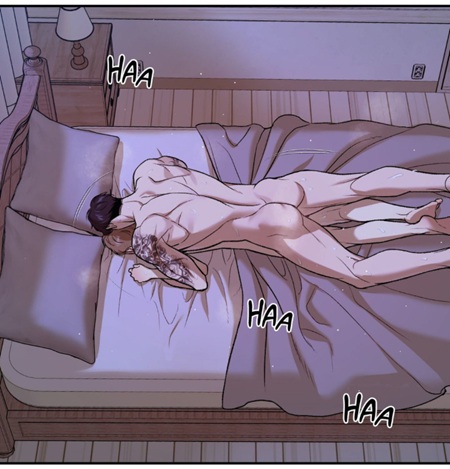 (chapter 64) (chapter 54) Imagine: it was, as though he had become the same person than his tormentor. Under this new light, it becomes comprehensible why the champion had to turn around doc Dan before his climax. It is because he feared his lover’s gaze. I would even add, he was unconsciously projecting himself in the “hamster’s place”. Yes, deep down, he is still a child, exactly like Kim Dan. (chapter 57) But contrary to the physical therapist, we don’t know how the champion looked like as a “child”. So when the teenager closes the door, he is taught not only that he is alone (chapter 64), but also that he has lived in a mental prison too. His fated companion made him realize the positive side of change! The ghost is also a mortal, he can not control time either. He is aging as well. By distorting the past (chapter 64), the fighter is encouraged to question his own past and narrative, in particular his feelings. (chapter 54) What he felt back then, is no longer the same! All this time, he rejected emotions because he feared attachment and betrayal. The reality is that he was still feeling emotions (fears, resentment) and allowed them to rule his life. But now, he is feeling something: attachment, pleasure and warmth.
 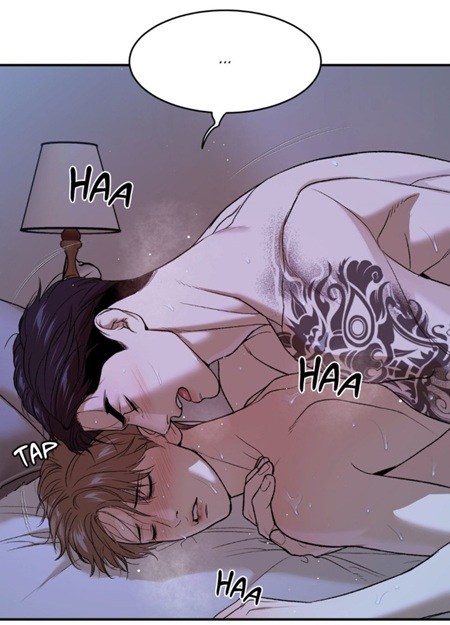 (chapter 64) That’s why the door (chapter 64) becomes the place of Joo Jaekyung’s Enlightenment.
  (chapter 64) Hence the author focused on his wide opened gaze. Kim Dan’s intervention was painful but necessary, because through this reflection, the athlete’s motivation to fight is bound to change. In the future, the fight won’t be deadly serious like before, he won’t act like a tyrant in the ring where he couldn’t control his rage.
 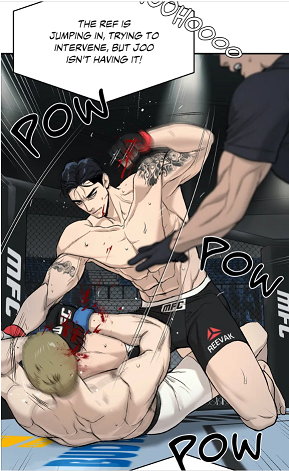 (chapter 1) He will see his opponent as an artist too.
The Key of Time: Acceptance and Change
If the Wedding Cabinet symbolized a frozen past and a fake future (chapter 19), then the key to breaking this spell lies in accepting the passage of time. (chapter 53) Kim Dan’s act of discarding the cabinet was the first turn of this key, an unconscious decision to face mortality and change. He was embracing the unknown. And if the champion chose to retrieve it and became his new owner, I come to the following interpretation: the Wedding Cabinet will become the symbol of loyalty and a precious memory linked to Shin Okja. He definitely had a good time 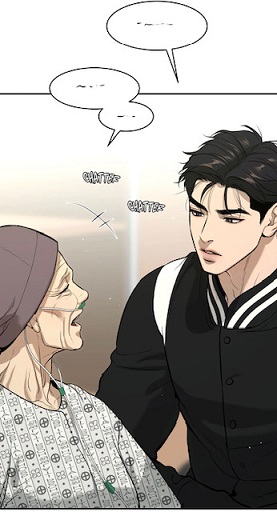 (chapter 21) with her, because he felt treasured.
  (chapter 61)
Similarly, Joo Jaekyung’s growing awareness of his own emotions  (chapter 63) —no matter how reluctantly—represents the second turn. With the doctor’s cold rejection, he is forced to choose: What does he want in life? Only the champion title or something else?
 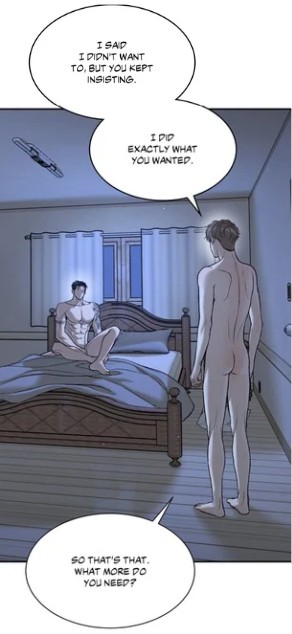 (chapter 64)
By recognizing the difference between the star and the human Joo Jaekyung, he can finally start to separate his identity from the expectations of his abuser. For the first time, he may come to see the title not as his existence but as a part of it—something that can be let go without losing himself. And this brings me back to my previous observation: the symbol of the window in the athlete’s life! (chapter 64) My avid readers will certainly recognized that in that hostel room, the window is covered by curtains! Besides, the bed is placed in front of it implying that the person can not meditate in the bed while looking at the window. That’s why the celebrity is turning his back to the window. Kim Dan is his reflection and as such the key to his release. This means, the bedroom loses its meaning as a fake place for “introspection”. Joo Jaekyung is destined to follow doc Dan in the end.  Hence the latter will become his hyung. For me, there’s no doubt that through this confrontation, the athlete’s respect for Kim Dan can only increase. (chapter 64) He voiced his own thoughts and emotions without raising his voice or using violence which contrasts to Park Namwook. Joo Jaekyung’s gaze reveals no resentment or anger, just disbelief and realization. So if he starts following the doctor’s lead, I can only come to the deduction that he has to leave the room. So his feet should lead him to nature, if he doesn’t follow his lover directly. Since water is the place where he feels comfortable
  (chapter 27), and he noticed the quietness of the ocean
 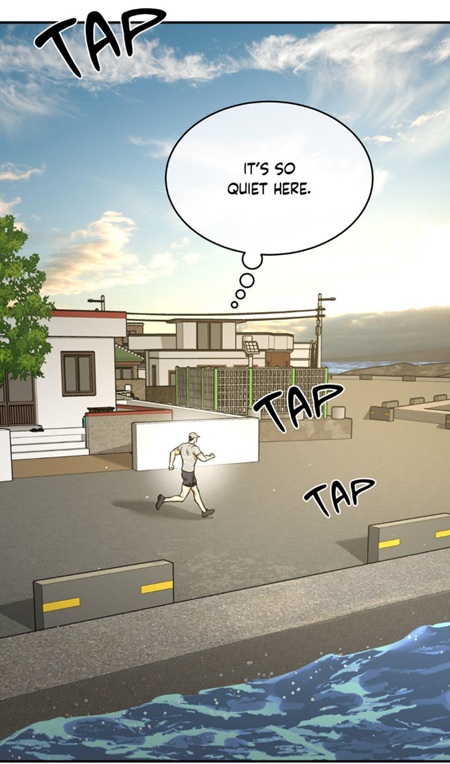 (chapter 62), I am expecting that he will go to the beach. A new version of this scene:
  (chapter 59) But this time, that would be a conscious choice. That’s how he will reconnect with his true self for good. But strangely, I am expecting that he won’t be on his own. I am quite certain that this man will make a similar experience than the grandmother:
 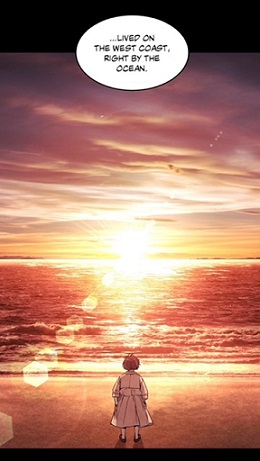 (chapter 53) However, from my point of view, Joo Jaekyung should witness the sunrise and not sunset… which would announce his rebirth. There was only one sunset in season 1, which was linked to Shin Okja’s mortality:
 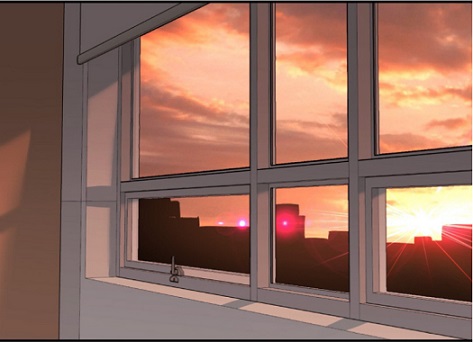 (chapter 47). Moreover, in season 1 and 2, the doctor was often connected to the sunset:
 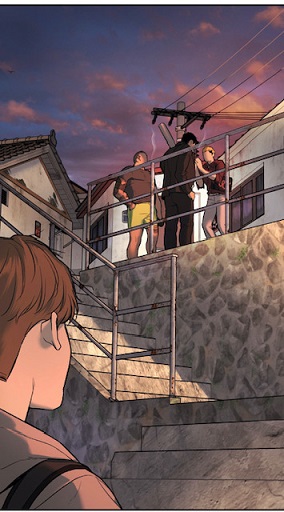 (chapter 1)
 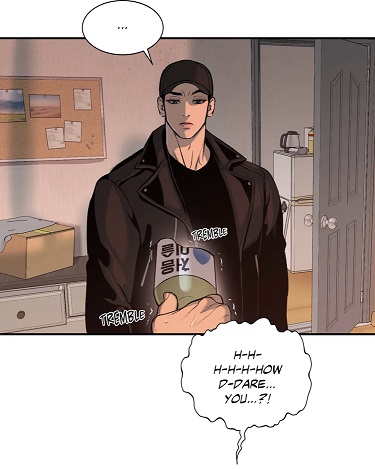 (chapter 17) And we had the beach here in the background.
 (chapter 48) This was an ominous sign for the champion’s symbolic “death” and rebirth. Sun and moon are natural tools to determine the flow of time.
Conclusion: The Time of Liberation
As time resumes its flow, both Kim Dan and Joo Jaekyung are being forced to confront the illusions that have kept them trapped. The glass prisons of windows and mirrors, the locked doors of abandonment, and the preserved Wedding Cabinet are all starting to crumble, revealing the path forward. They are about to receive their final life lessons: no one is powerful in front of time. Time can heal as much as it can destroy. They should enjoy their life due to its brevity.
Feel free to comment. If you have any suggestion for topics or Manhwas, feel free to ask. If you enjoyed reading it, retweet it or push the button like. My Reddit-Instagram-Tumblr-Twitter account is: @bebebisous33. Thanks for reading and for the support, particularly, I would like to thank all the new followers and people recommending my blog.

 Bebebisous33s' analyses in K-Dramaland and Manhwas
They have lived their lives under their own spell from which they cannot easily escape.
In the countryside of the sea, they seem to be escaping from their respective prisons, but together.
Jae-kyung still uses the jinx as an excuse, but I think he subconsciously realizes that the only companion in his life is Dan.
Dan’s condition is not good, and he, too, needs help while rejecting Jae-kyung.
I hope that their will will produce a good outcome for them.
LikeLiked by 1 person
That’s the reason why I don’t think, they can return to Seoul like the grandmother is expecting. The latter is imagining that medicine will help him to sleep better. The irony is that by sending him away, she is festering the wound, aggravating the situation. And finally, one sentence caught my attention. “Is he that good?” Deep down, she is not trusting Kim Dan either. And this comment definitely surprised the champion.
LikeLiked by 1 person