

Please support the authors by reading Manhwas on the official websites. This is where you can read the Manhwa: Jinx But be aware that the Manhwa is a mature Yaoi, which means, it is about homosexuality with explicit scenes. Here is the link of the table of contents about Jinx. Here is the link where you can find the table of contents of analyzed Manhwas. Here are the links, if you are interested in the first work from Mingwa, BJ Alex, and the 2 previous essays about Jinx Perfect👼🏼 Defect and The Secret Doctor’s Jinx
It would be great if you could make some donations/sponsoring: Ko-fi.com/bebebisous33 That way, you can support me with “coffee” so that I have the energy to keep examining Manhwas. Besides, I need to cover up the expenses for this blog.

The Hippocratic Oath, one of the oldest binding documents in history, originates from Ancient Greece and has long been regarded as the ethical foundation of Western medicine. Traditionally attributed to Hippocrates, often called the ‘Father of Medicine’, the oath originally included commitments to treat the sick to the best of one’s ability, to preserve patient confidentiality, and to pass on medical knowledge without demanding payment.
The text of the Hippocratic Oath (c. 400 bc) provided below is a translation from Greek by Francis Adams (1849).
I swear by Apollo the physician, and Aesculapius, and Health, and All-heal, and all the gods and goddesses, that, according to my ability and judgment, I will keep this Oath and this stipulation—to reckon him who taught me this Art equally dear to me as my parents, to share my substance with him, and relieve his necessities if required; to look upon his offspring in the same footing as my own brothers, and to teach them this Art, if they shall wish to learn it, without fee or stipulation; and that by precept, lecture, and every other mode of instruction, I will impart a knowledge of the Art to my own sons, and those of my teachers, and to disciples bound by a stipulation and oath according to the law of medicine, but to none others. I will follow that system of regimen which, according to my ability and judgment, I consider for the benefit of my patients, and abstain from whatever is deleterious and mischievous. I will give no deadly medicine to any one if asked, nor suggest any such counsel; and in like manner I will not give to a woman a pessary to produce abortion. With purity and with holiness I will pass my life and practice my Art. I will not cut persons laboring under the stone, but will leave this to be done by men who are practitioners of this work. Into whatever houses I enter, I will go into them for the benefit of the sick, and will abstain from every voluntary act of mischief and corruption; and, further from the seduction of females or males, of freemen and slaves. Whatever, in connection with my professional practice or not, in connection with it, I see or hear, in the life of men, which ought not to be spoken of abroad, I will not divulge, as reckoning that all such should be kept secret. While I continue to keep this Oath unviolated, may it be granted to me to enjoy life and the practice of the art, respected by all men, in all times! But should I trespass and violate this Oath, may the reverse be my lot! Quoted from https://www.britannica.com/topic/Hippocratic-oath
Over centuries, this oath has undergone numerous revisions to reflect the changing nature of medicine and ethics in society. While its core values—non-maleficence, beneficence, and fidelity—remain intact, modern versions are more secular and inclusive, often omitting archaic references to gods or master-apprentice hierarchies. The intention behind the oath has always been clear: to put the well-being of the patient first and to uphold the dignity and responsibility of the medical profession. These noble intentions raise important questions in today’s context. To what extent are they still fulfilled? Do contemporary medical professionals act in the spirit of this oath? And can structural realities—limited time, profit-driven care, burnout—undermine a physician’s ability to live up to its promise?
These critical perspectives crystallized while reading Chapter 67 of Jinx, and triggered a thought-provoking exchange between my friend @Milliformemes2024 and me. Our diverging interpretations of the sleep specialist in chapter 67 helped to shed new light on the enduring relevance—but also the limitations—of the Hippocratic tradition. What began as a discussion about a single consultation evolved into a broader reflection on symbolic language, institutional care, and the ethical cost of modern medicine. In truth, both perspectives hold merit. Our conversation mirrored a larger dialogue between Idealism and Reality: one of us defending the emotional depth and symbolic resonance in care, the other grounded in the necessity of boundaries and pragmatism. This essay unfolds in three parts: first, a symbolic analysis of the sleep specialist and the contrasting figure of Cheolmin; second, a comparison of institutional care and how financial motives shape medical ethics; and third, a visual exploration of hospitals and their architectural relationship to nature.
The Sleep Specialist and the Invisible Patient
Our discussion began with differing impressions of the sleep specialist in Chapter 67. My friend viewed her approach as textbook 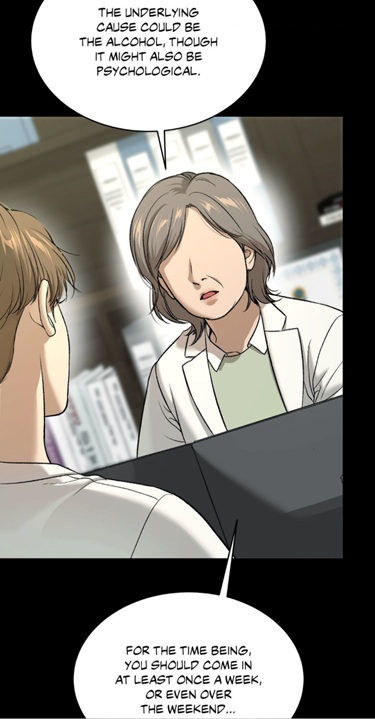 (chapter 67): the brief diagnosis, the recommendation for weekly visits, the specialist’s tentative attribution of Kim Dan’s condition to either alcohol or a possible psychological cause, emphasizing the need for continued observation and weekly visits before offering a definitive diagnosis —all standard responses. For her, this was a doctor following routine procedure without overstepping professional boundaries. However, I perceived her behavior very differently. I saw someone who remained emotionally detached and almost absent, reducing the complexity of Kim Dan’s condition to simplistic surface-level causes without genuine inquiry.
This divergence in opinion hinged on what each of us prioritized. My friend appreciated the clinical neutrality, interpreting it as a mark of competence. I, however, found it troubling—too minimal, the possible psychological cause was only mentioned. The symbolism in her appearance intensified my reaction. She is portrayed eyeless, a metaphor for her blindness—not in vision, but in perception. Her gaze is absent; her diagnostic process relies not on what she sees but on what others report, most notably, Joo Jaekyung.  (chapter 67) Rather than forming an independent assessment, she accepts the narrative of a third party, which introduces bias and limits her understanding. One might argue about that, because she is looking at a paper, probably result of a blood test which seems to corroborate the guardian’s statement. Hence the sleep specialist concludes that Kim Dan is suffering from insomnia, alcohol addiction and sleepwalking. The problem is that his statement is based on external observations (halmoni and the landlord) and their limited knowledge. Moreover, Jinx-philes should keep in mind two important aspects:
  (chapter 61) The champion had been himself suffering from similar symptoms which could be seen as a projection on his loved one. Additionally, based on previous observations, I have interpreted Kim Dan’s nightly walks not merely as sleepwalking, but as dissociative episodes—likely triggered by overwhelming guilt, unresolved trauma, and a chronic sense of disconnection from his body and surroundings. But how could the champion know about this? He’s not a doctor himself. In order to have a more accurate picture of the whole situation, she should have talked to the patient himself. But by relying on papers and the guardian’s testimony, she not only distances herself from the patient physically and emotionally, but also delegates the responsibility of interpretation. She is using the eyes of others.
She wears an open white coat, (chapter 67) revealing a light green pullover layered over a white shirt—clothing that clearly belongs to her private wardrobe. This visual detail suggests a separation between her personal identity and her professional role. It’s as if donning the coat is enough to signal her authority, without requiring emotional engagement. The coat becomes a badge, not a commitment.
Yet one could argue that this very distinction is essential. The boundary between self and profession is what prevents the physician from becoming emotionally overwhelmed. Without such a barrier, the practitioner might absorb too much of the patient’s pain—leading not only to fatigue but to burnout. 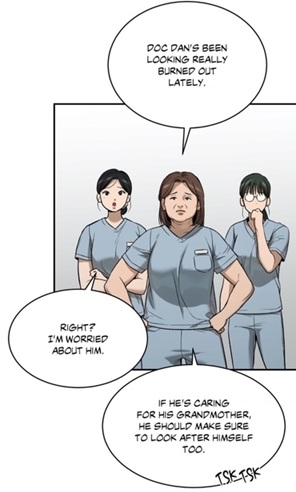 (chapter 57) Perhaps the doctor’s detachment is not indifference, but a survival mechanism in a healthcare system that demands efficiency over intimacy.
The white coat in this scene does not function as a symbol of care (chapter 67): it becomes an emblem of role-playing. What caught my attention is that she doesn’t directly address the patient, she doesn’t ask him any question either. She is not curious at all. If she had, she would have heard this:  (chapter 67) indicating that his alcohol addiction is not the real reason for his insomnia. Then she fails to examine Kim Dan physically, the desk is between them. Therefore she can not detect his visible malnourishment.
Both insomnia and malnutrition are quite common and can cause similar negative consequences, such as falls, depression, and cognitive impairment in older adults, but there is no study investigating the relationship between the 2. The aims were to investigate relationships between insomnia/insomnia severity and Mini Nutritional Assessment (MNA) score and serum nutrient levels. […] There is a close relationship between MNA scores and insomnia or insomnia severity in older adults. Therefore, when evaluating an older patient with insomnia, malnutrition should be evaluated, or insomnia should also be questioned in an older patient with malnutrition. Thus, more effective management of the 2 can be possible. Quoted from https://pubmed.ncbi.nlm.nih.gov/31109907/
But she couldn’t see it, as she relied on second-hand testimony (Joo Jaekyung’s words). The irony is that the latter failed to notice it. Each time he saw the doctor’s body, he got aroused. 
 (chapter 62) Moreover, both the landlord and the grandmother never brought up this aspect, though Shin Okja had observed this terrible transformation:
  (chapter 57)
And this raises the following question. Why did the sleep specialist not question the main lead directly and relied on other sources?  (chapter 66) It is because the physical therapist is just a number (2) and as such a file. Therefore the doctor is not seeing the patient as a human. I can not blame the woman either, for she has so many patients to treat during the day. And now look at the building of the hospital:
  (chapter 66). It is huge reminding me of a factory. This “modern hospital” with its sleek architecture, expansive buildings, and impressive specialization exudes a sense of advancement and trustworthiness. Yet beneath this polished surface lies a business-oriented structure, one that prizes efficiency, reputation, and patient turnover over genuine patient connection. This “modern hospital” (chapter 67) functions like one factory: patients are numbers in a queue, doctors are overloaded, and individual care becomes secondary to systemic goals. The very design of the building reflects this: towering facades and compartmentalized departments, where nature and warmth are pushed to the background. In such an environment, the Hippocratic Oath—rooted in ideals of empathy, presence, and personal responsibility—is reduced to ritual, overshadowed by institutional pragmatism and economic demands. Hence she is simply treating his symptoms: insomnia and “sleepwalking”! She is prescribing him “sleeping pills”.
 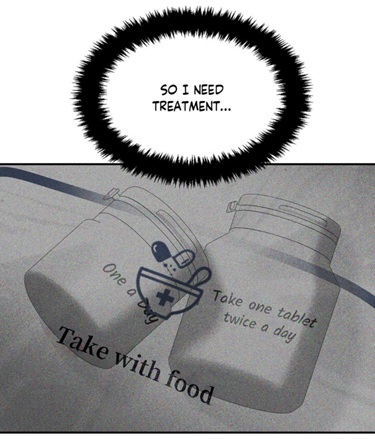 (chapter 67) She is doing exactly what Shin Okja wanted:
 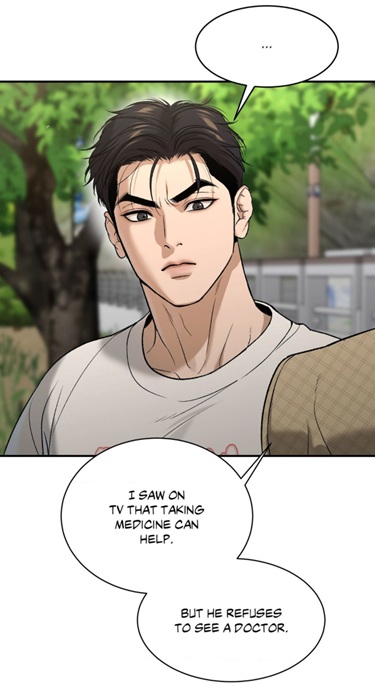 (chapter 65)
 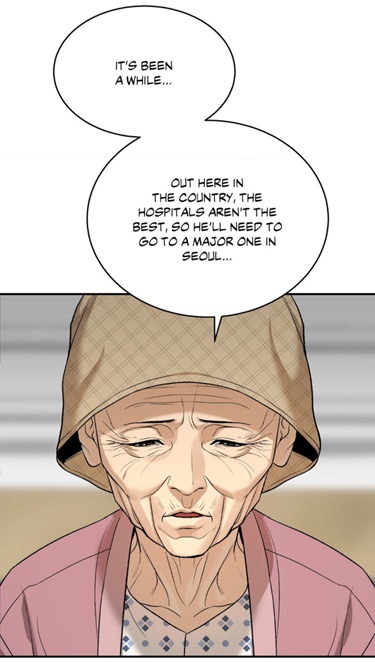 (chapter 65) It is as though thanks to the drug, the odd behavior from Kim Dan would simply vanish. (chapter 67) That’s the reason why Mingwa didn’t give the doctor a name. She has become a soulless doctor, like a robot. On the one hand, the absence of her name implies that she is not trying to seek fame like Kim Miseon
  (chapter 5) with the new medicine. On the other hand, it implies that the light-brown haired woman is doing her job for her paycheck which reminds me of Cheolmin’s statement:
  (chapter 13): “Oh no, no. That won’t do. My precious paycheck!”.
This “namelessness” is not a coincidence. It mirrors how large hospitals treat their staff: as interchangeable parts of a system that prioritizes efficiency and profit over personalized care. (chapter 67) The sleep specialist becomes a faceless figure in an institution where doctors are overworked, underpaid, and pressured to diagnose quickly. Her task is not to heal, but to manage—preferably in under 10 minutes. This reminds me of a confession I received from my own osteopath-orthopedist-chiropractor. He once told me that in hospitals (Germany), proper care is nearly impossible. Due to pressure and time constraints, most doctors are given no more than two or three minutes per patient. As a result, many end up recommending surgery as the default solution—not necessarily because it’s the best, but because it’s fast and system-approved.
Disillusioned by this assembly-line approach, he eventually left the hospital and opened his own private practice. There, he devotes at least one full hour to each new patient—first to examine, then to diagnose, and finally to treat them himself. I remain deeply grateful to him, because he was the only one able to resolve my long-standing shoulder and neck pain. While others focused on symptoms—treating the neck in isolation—he identified the true origin: spinal blockages further down the column. What struck me even more is that he once recognized signs of depression in a patient—not through tests or charts, but simply by observing how the symptoms would worsen or improve. He talks to his patients while treating them, listening not only to their words, but also to their bodies. This interaction allows him to adjust the treatment in real-time and to notice subtle signs others might miss. That’s what makes him a true healer. He doesn’t rush; he takes his time and creates space for the patient to be seen and heard. In doing so, he provides something that modern hospitals often fail to offer: attention without judgment, and care without hurry.
On the other hand, he also confided in me that he has learned to select his patients. Some individuals came to him with fixed expectations, treating him like a service provider rather than a medical expert. They arrived with their own self-diagnoses and requests, expecting him to execute treatment plans they had already designed in their minds. In those cases, he had to draw a line—because healing, in his view, depends on trust and dialogue, not on fulfilling demands. A doctor, he reminded me, is not a technician carrying out orders, but someone who must observe, assess, and guide with discernment. This dynamic reminded me of Joo Jaekyung, who often treated both Dr. Lee and Kim Dan  (chapter 27)
  (chapter 49) as mere service providers. Whether it was brushing off medical advice with “Don’t push it, I know my body better than anyone else” (chapter 27) or demanding instant pain relief to continue training (chapter 49), the champion positioned himself as the ultimate authority over his own treatment. Since his attitude echoed the confession of my osteopath, it is understandable why my osteopath-orthopedist began to select his patients carefully. This mirrors Kim Dan’s evolution, when the latter chose to reject the champion’s offer. Indirectly, he is “learning” to select his job and not take them by opportunism. He is also learning to select his “patients”. Striking is that Shin Okja has a similar attitude than the athlete.
  (chapter 7) She desired to have a treatment with less side effects and less painful. And the moment she was confronted with reality, this painful new treatment only brought pain and nothing more, she chose to leave this institution and move elsewhere.
 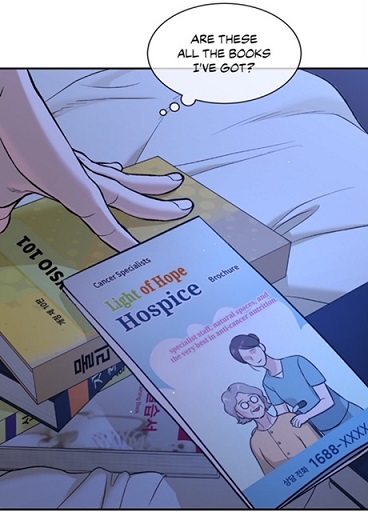 (chapter 53) Therefore it is not surprising that she is treating the protagonist the same way: she knows what is the best for him.
  (chapter 57) She is treating him like a service-provider, she is now rejecting that he has lost his “usefulness”. His pay here is not high, …
But let’s return our attention to the anonymous sleep specialist. The latter has just become a victim of this terrible health system. She is not engaging with Kim Dan’s trauma, nor investigating his psyche, for she doesn’t have the time for it. Her task is not to heal deeply, but to manage efficiently. Secondly, she is specialized in sleep medicine, so she is no psychologist or psychiatrist. Therefore it is not surprising that she is focusing on certain aspects. But sending him to a different department would mean that she would lose her „new patient“. If you have ever watched series about hospitals, you are aware of the competition between departments. Here I can recommend the K-drama LIFE. Since she is more treating him in such a short time, it is not astonishing that doc Dan is doubting her words,  (chapter 67) and not even following her recommendation.
  (chapter 67) He felt misjudged and misunderstood; reduced to a file number, not seen as a complex human being.
However, there’s more to it. Two details stood out to me in particular. First, consider what the anonymous doctor told Joo Jaekyung  (chapter 67) and second, what Kim Dan actually received as treatment: (chapter 67) pills in a plastic bag marked with a standard instruction: “Take with food”. These two panels capture more than a routine prescription, they reveal the institutional deflection of responsibility and the impersonal mechanics of care.
By printing the instruction on the packaging rather than saying it aloud, the doctor shields herself from accountability. If something goes wrong, she can point to the label. She doesn’t have to engage, explain, or ensure understanding. It’s a subtle but calculated transfer of responsibility—from physician to patient, and even more so, to the guardian. Now it’s not just Kim Dan who’s expected to monitor himself, but Joo Jaekyung as well. The burden of care is silently offloaded onto those least equipped to manage it.
What makes it worse is that Joo Jaekyung is never shown holding or reading the bag. The implication? He likely never noticed the fine print at all. No one is actively guiding the treatment. No one is watching over Kim Dan.
Her verbal emphasis is even more revealing. Instead of discussing the food requirement or giving Kim Dan any personal advice, she delivers a single, sweeping command: “Drinking is off-limits.” It’s not just vague—it’s scolding. The patient’s alcoholism isn’t treated; it’s sidelined. The system checks the boxes—and moves on. It frames her as an authority figure who cares more about issuing warnings than offering help. There’s no nuance, no tailored support, no effort to build trust. What Kim Dan hears is not empathy, but judgment. He’s treated as a risk to be managed, not a human being to be helped. She can only reinforce his low self-esteem: he‘s a burden.
This is what deepens his sense of being misdiagnosed, as if the doctor was painting his condition so negatively in order to scare him. He doesn’t receive insight or compassion—he receives protocol. And in a healthcare system ruled by efficiency and liability protection, the doctor’s priority becomes covering herself—not ensuring the well-being of her patient.
The invisible doctor and the visible patient
Cheolmin  (chapter 13), in contrast, enters the story with no white coat at all. He carries only a doctor’s bag, dressed in a green pullover and a beige checkered shirt.
  (chapter 13) Despite this informal attire, he immediately recognizes Kim Dan’s symptoms and engages both the guardian and the patient. He doesn’t need institutional support to assert authority; his presence and diagnostic clarity define him. While his clothes might elsewhere be read as conservative or emotionally restrained, here they highlight that care can come outside rigid systems.
Previously, we interpreted Cheolmin’s clothing as a reflection of a certain emotional reserve. The beige checkered shirt, covered by the green pullover, suggests a guarded personality; someone who perhaps maintains a protective layer between his professional and emotional worlds. And yet, this emotional caution doesn’t hinder his ability to act with warmth and competence.  (chapter 13) Quite the opposite. He doesn’t hide behind his distance; he manages it. His approach is practical and grounded, but never cold. He doesn’t wear a white coat, yet he brings with him a doctor’s case and an unshakable sense of responsibility. His tools are simple (his own body), (chapter 13) his posture relaxed, and his tone—often sprinkled with humor—adds a human touch that the eyeless doctor sorely lacks. And what is the cause for this huge difference? It is because the “famous sleep specialist” is relying on her institution (nurses, blood tests, drugs). She is following a procedure, as the visit took place at the hospital.
Unlike Cheolmin, who uses his emotional detachment constructively, the sleep specialist disappears behind it. She neither touches nor addresses the patient directly. She offers no humor, no effort to ease the atmosphere—only sterile authority and detached warnings.
Ironically, while Cheolmin may seem less emotionally expressive at first glance, he is far more emotionally present. His humor isn’t just a personal trait—it’s a therapeutic tool.  (chapter 13) It bridges the gap between roles, making the patient feel seen rather than categorized.
 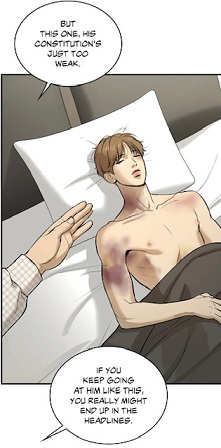 There’s no judgement in their relationship. The eyeless doctor may appear neutral, but in truth, she is hollow. Cheolmin appears reserved, yet his actions speak with empathy. Where she recites guidelines, he initiates dialogue.
  (chapter 13) Where she avoids involvement, he offers engagement.
In short, Cheolmin’s clothes reflect thoughtful distance—not absence. He remains attentive, responsive, and subtly warm. His restraint is a choice, not a flaw. And it is precisely this contrast that reveals what the Hippocratic Oath should still mean today: presence, humility, and care; and not money, drug and efficiency.
The positions between my friend and me reflect a core conflict between reality and idealism. She values adherence to clinical norms and sees the specialist’s behavior as a rational expression of professional boundaries. Emotional distance, she argued, is often necessary—not just to ensure objectivity, but also to protect healthcare professionals from burnout, especially in overburdened systems. I agreed in principle, but maintained that detachment becomes damaging to the patients and the doctors. It affects the relationship between them, because it prevents accurate diagnosis or erases the patient’s voice entirely or the patient starts seeing himself as a “client” and the doctor as his “service provider”. A middle ground must be found—where presence doesn’t equate to over-involvement, but where empathy still has space. My orthopedist found his solution: open a small office where he tries to help his patients to avoid surgeries. He told me: “The first surgery in his field is always an option, the second one will always be a necessity.”
Moreover, our analysis acknowledged the limitations the doctor faces. The specialist likely juggles a tight schedule. A queue of patients, like the one displayed before Kim Dan’s session, signals the industrial rhythm of care. In such a system, she may not have time for deeper engagement. But for patients like Kim Dan—vulnerable, undernourished, spiraling emotionally—this neglect can reinforce their invisibility. In contrast, Joo Jaekyung receives deferential treatment, because he is famous. The medical world depicted in Jinx bends toward prestige, not need.
This contrast reveals something vital: in medicine, presence matters. The specialist hides behind procedures. Cheolmin shows up. The white coat, then, becomes a mirror: does it reflect a vocation or disguise institutional distance?
Institutions and Ideals—Comparing the Medical World of Jinx
In Jinx, medical care unfolds within a tapestry of institutions—anonymously vast hospitals  (chapter 61)
  (chapter 67), the Light of Hope hospice
  (chapter 61), the sleek University hospital dedicated to research
  (chapter 5), and more intimate yet modern facilities like this one.
 (Chapter 27) Each medical setting not only has its own architecture but also its own moral blueprint. In the essay “Doctor Romantic 3 (locked)“, I had already compared doctor Lee’s workplace and behavior to the “beautiful Kim Miseon” from the University Hospital. Season 2 introduced us to new institutions. Each place claims authority through professional codes and visual symbols, but the deeper narrative explores how care is either embodied or abandoned. Mingwa uses attire, body language, and structure to draw sharp distinctions between appearance and intent.
Kim Miseon (chapter 5) from Sallim University Seongshim Hospital: This research-driven university hospital is connected to Kim Miseon, the doctor who prescribed a new experimental treatment for the grandmother. (chapter 5) Despite the pristine exterior of the building and the promise of scientific advancement, her actions raise ethical concerns. She dilvuged information in the hallway.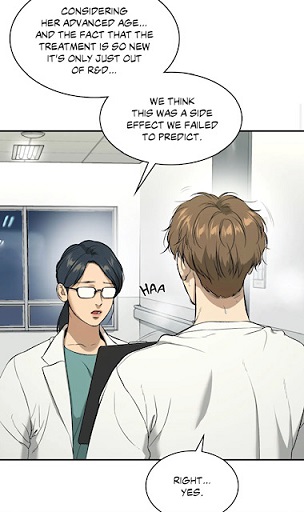 (chapter 21) Then the treatment’s failure is attributed either to the grandmother’s frailty or Kim Dan’s late arrival and absence, subtly shifting blame.
 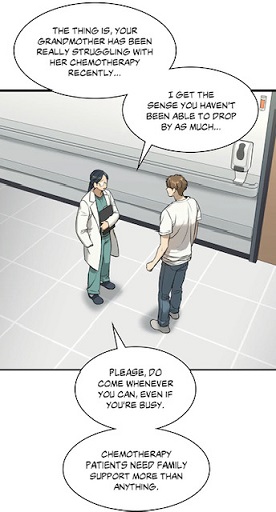 (chapter 21) Like mentioned before, this treatment wasn’t even properly recorded in the patient file raising the suspicion of deliberate concealment.
  (chapter 56) It appears as “pain killers”. Her open white coat (chapter 21), worn over a green uniform resembling surgical scrubs, aligns her visually with institutional authority, while her eyeless portrayal emphasizes detachment. (chapter 21) Her motivation seems driven not by compassion but ambition: a pursuit of recognition and success through experimental medicine, regardless of consequence. It seems that this new therapy didn’t bring her the results she hoped, and strangely later director Choi Gilseok
  (chapter 48) got aware of Shin Okja’s conditions, implying that patient confidentiality had been breached.
Park Junmin  (Chapter 61): In contrast, Park Junmin
  (chapter 61) represents the polished face of a business-oriented clinic. While his office projects sleekness and personalized care, his comments betray his priorities. He praises Joo Jaekyung’s fame and urges a return to the ring—not out of medical concern, but because it would guarantee the champion’s return as a paying patient. He wants to retain a high-profile client. His friendliness is strategic. (chapter 61) He does not embody the Hippocratic Oath but rather a service model. The coat becomes a costume that sells recovery. It is clear that he is promoting his own hospital. Joo Jaekyung, however, surprises him by refusing
  (chapter 61), highlighting that the athlete has become aware of what genuine care should look like. When the champion calmly declares, “I’ll be receiving rehabilitation services in another hospital,” Junmin answers with a stunned “Sorry?”. But this is not confusion. It’s a reflexive mask for shock. He did not expect to lose control of the situation. Beneath that one-word response lies disbelief, disappointment, and veiled panic. He’s losing a lucrative patient—and more importantly, a public endorsement. The moment exposes how fragile his authority truly is when faced with a patient asserting autonomy. Let’s not forget that when the champion was facing a mental and emotional breakdown, the latter offered no other support than “rest”. He even avoided his gaze.
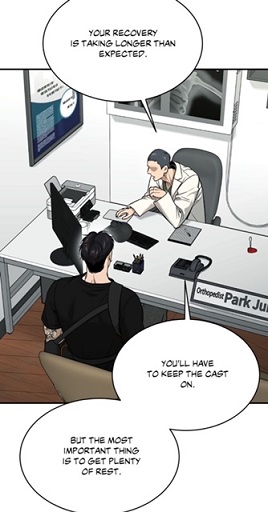 (chapter 54) The athlete was left on his own.
Light of Hope Director 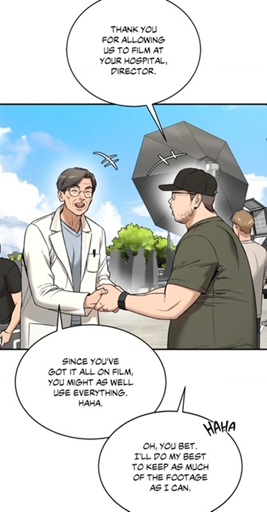 (Chapter 59): At first glance, the hospice appears to be underfunded and outdated.
  (chapter 61) However, its director breaks expectations. Unlike the smooth-talking or indifferent doctors at larger institutions, he is directly involved in patient care. (chapter 56) He informs the physical therapist about the grandmother’s condition, works late at night
  (chapter 60), criticizes people for their rude behavior
  (chapter 59) or actively disciplines staff
 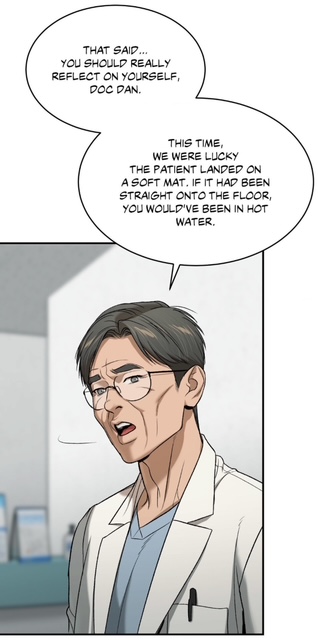 (chapter 59) when mistakes are made. Though he also flatters the champion
  (chapter 61) and sees promotional potential, he never exploits patients.
  (chapter 61) The juxtaposition of humility and responsibility in his demeanor, combined with his stunned reactions to sudden events, suggests an overworked and understaffed environment—but not one without moral grounding. His white coat and blue medical uniform echo the nurses’ attire, subtly promoting a sense of equity among staff. Despite being a director, he doesn’t separate himself from frontline caregivers. His uniform also contrasts with the green worn by Kim Miseon or Park Miseon, suggesting a focus on practical responsibility over prestige. By blending in with the team, he fosters a culture of shared accountability, not rigid hierarchy. Among all institutional figures, he comes closest to balancing authority with integrity.
Hospital Director  (Chapter 6): While this figure appears authoritative
 (chapter 1), the details of his attire tell another story. Wearing a suit beneath his coat implies professionalism, but here it also suggests a business-driven mindset. The coat becomes a sleek outer layer masking deeper intentions. His charming demeanor conceals a more sinister reality—he weaponizes authority for personal gain. His use of professional attire isn’t about respectability but manipulation. Beneath the surface, profit, control, and coercion drive his actions.
  (chapter 1) The white coat, in his case, is not a symbol of healing but a façade for exploitation. drives his authority. The coat becomes a literal cover for abuse—harassment disguised under professionalism. His entire persona is a façade: calculated, charming on the surface, but predatory and morally bankrupt beneath.
The Sleep Specialist (Chapter 67): (chapter 67) Eyeless and detached, the sleep doctor treats Kim Dan without any emotional or physical engagement. Her absence of a name symbolizes depersonalization. She doesn’t speak directly to Kim Dan, doesn’t examine him, and only echoes what she heard from Joo Jaekyung. The prescription she offers is another layer of critique. The instruction “Take with food” appears only in print—never verbally stressed—thus shifting liability. If Kim Dan suffers side effects or mixes medication with alcohol, responsibility falls on him or his guardian. This is institutional medicine in its most risk-averse form: impersonal, quick, and shielded from consequence.
Dr. Lee (Chapter 27): Dr. Lee is the only named and truly visible doctor. 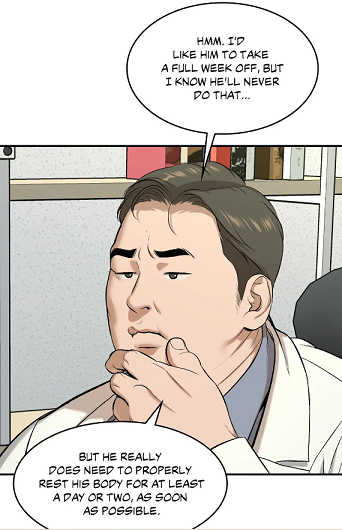 (chapter 27) His gray shirt signals a more relaxed approach,
 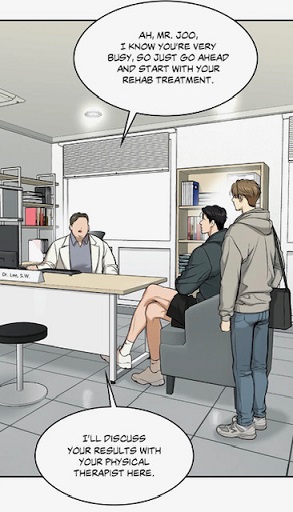 (chapter 27) and his facial expression conveys a certain empathy—though his words also betray resignation. He sits beside the patient, not opposite, visually erasing the typical hierarchical divide between doctor and athlete. His recommendation that Joo Jaekyung rest is gently delivered, but he knows it will likely be ignored. He represents the tension between medical idealism and the pressures of athletic performance. He is trying his best to protect Joo Jaekyung’s career.
  (chapter 27) Notably, he doesn’t chase fame or loyalty—he’s realistic, yet still rooted in care. (chapter 27) His clinic, with open blinds and wide windows, stands for transparency and modern ethics.
Cheolmin (Chapter 13): 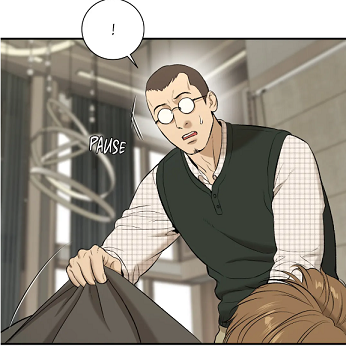 (chapter 13) Finally, Cheolmin exists outside the hospital system. He wears no white coat, but his behavior mirrors a true physician’s. He diagnoses accurately, gives immediate advice, and engages both patient and guardian. His attire—a shirt layered under another—might suggest emotional restraint, but it doesn’t interfere with his actions. He jokes and teases, breaking through tension and inviting trust. He acts not because protocol demands it, but because someone needs help. That’s enough.
This comparative tableau reveals that white coats do not guarantee compassion—and their absence doesn’t negate it. In Jinx, only those who break institutional molds offer real help. The rest follow protocols, serve systems, and sometimes cause harm through inaction or self-interest. It exposes that doctors are simply humans and not gods.
Furthermore, the financial aspect underpins all these interactions. Hospitals in Jinx are not purely charitable; they’re businesses. The emphasis on new medicine, fame, or facility branding often outweighs the patient’s actual condition. Misdiagnoses, evasions, and moral compromises follow from this reality.
Kim Dan’s journey through these institutions underscores how vulnerable patients are when medicine is transactional. Blame is subtly shifted. Responsibility is diffused. And yet, in emergencies, the expectation remains: doctors should act.
Nature, Architecture, and the Illusion of Healing
A striking feature in Jinx is the architectural integration of nature into hospital design. (chapter 67) Trees and greenery appear in every facility—but their placement and symbolism vary. These visual cues subtly reveal each institution’s philosophy of care.
At the university hospital where Kim Miseon works, 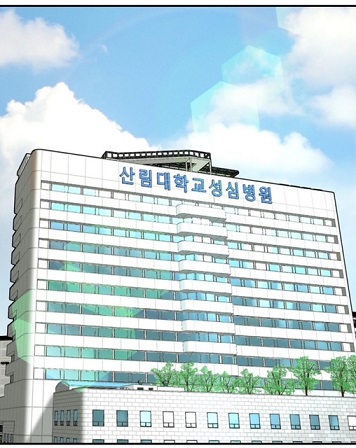 (chapter 41) nature is neatly confined. Rooftop gardens and structured greenery exist, but more as visual accessories than lived environments. The hospital is a towering research center, representing scientific advancement—but also bureaucratic coldness. Here, nature exists to impress, not to comfort. This artificial balance between concrete and green reflects a clinical detachment: nature is curated, not embraced. It aligns perfectly with Kim Miseon’s demeanor—professional, pristine, but ultimately distant and ambition-driven.the environment feels controlled.
  (chapter 41)
In the rain-drenched hospital  (chapter 54) where Joo Jaekyung receives treatment, the rooftop greenery appears remote and ornamental, disconnected from patient care. (chapter 61) Nature is present but removed, almost symbolic of lost ideals. The building is imposing, gray, and bureaucratic, which is quite similar to the university hospital.
In the sleep therapy hospital (chapter 67), the setting amplifies this detachment. Trees do appear, but they are overwhelmed by massive, impersonal structures. The greenery seems almost trapped, overshadowed by glass and steel. This mirrors the interaction with the sleep specialist, who issues warnings and prescriptions without genuine communication. In this environment, nature is not a partner in healing—it is background noise, a symbolic performance of care in a place that prioritizes liability and speed over connection.
By contrast, the Light of Hope hospice (chapters 61) is embedded in a hillside, its architecture low to the ground, surrounded by untamed, organic greenery. The trees are not ornamental—they embrace the building, echoing a kind of natural protection. Nature here is not only real, but alive. It reflects the ethos of the institution: flawed, underfunded, but grounded in human presence. The hospital director may wear a coat, but his modest blue uniform aligns him visually with the nurses, suggesting equity and participation rather than hierarchy. Just like the unpolished trees, he is there not to be admired but to serve.
A fourth setting appears with Dr. Lee’s clinic (chapter 27). The building is smaller,  (chapter 18) modern, and set among scattered trees.
  (chapter 18) Large windows suggest openness and transparency—the very qualities Dr. Lee brings to his interaction. This is a space that, while modest, is genuinely attentive. Here, nature doesn’t impress, it is integrated in the landscape. The park is not surrounded by huge buildings.
Through these varied landscapes, Jinx critiques the illusion of healing as something that can be staged through architecture. It exposes how hospitals, like people, can hide behind appearances. Trees and plants, like white coats and professional titles, can be used to mask indifference just as easily as they can accompany real care. Healing does not bloom in greenery alone—it flourishes through presence, attentiveness, and trust.
Yet these visual patterns also contain hope. The presence of even small parks and rooftop gardens within institutional designs reflects an underlying truth: nature matters. (chapter 41) These green spaces acknowledge, even if superficially, that human beings do not heal through medicine alone. They need sunlight, air, softness—a sense of rhythm beyond fluorescent lights and steel corridors. Nature grounds. It breathes.
The science of the healing power of nature
There are numerous studies that support the healing power of nature. A study of 20,000 people found that those who spend at least 120 minutes per week in nature, whether in a local park or other natural environment, were more likely to report better health and well-being.
The World Health Organization recently released a report called Green and Blue Spaces and Mental Health, which shows that time in nature, including urban areas, improves moods, mindsets and mental health. Furthermore, research suggests that exposure to forests, parks, gardens or coastlines can help mitigate the psychological impact of climate change, promote physical activity and provide opportunities for social interaction. Quoted from https://www.uc.edu/news/articles/2023/08/the-healing-power-of-nature.html
That is why the small town, 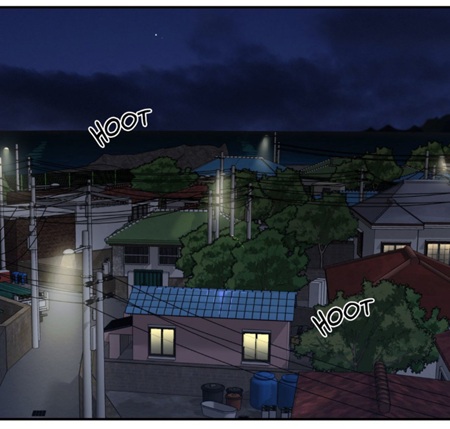 (chapter 65) nestled in the countryside and far from institutional rigidity, emerges as a space of true potential. In returning there, Joo Jaekyung and Kim Dan are not just escaping their past—they are moving toward a form of healing that modern hospitals imitate but rarely achieve. Closer to nature, they are closer to themselves. If hospitals imitate forests, the village becomes the forest. And in that simplicity, Jinx suggests, real happiness might grow.
Conclusions
From open to closed, from crisp to wrinkled, the white coat becomes a symbol of ideology. Some wear it like armor, others like a mask—and some not at all. But it is not just the coat that deceives. Buildings too wear their own uniforms. Grand glass hospitals draped in rooftop gardens and courtyard trees promise healing, yet often fail to deliver. Nature becomes another costume—just like the coat.
But Jinx reminds us: real care cannot be faked. It is revealed not through polished surfaces or institutional prestige, but in action—staying late, listening carefully, protecting the vulnerable. The doctors who truly heal are those who treat the person, not the file.
And why, then, do so few doctors recommend sunlight, trees, or quiet walks? The answer is simple: nature costs nothing. It cannot be patented or billed. And yet, its presence in every hospital design is a silent confession that healing lies outside the system. That, in the end, true recovery begins where profit ends. This is precisely what Jinx shows through Joo Jaekyung’s arc: once he leaves the sterile confines of the gym and begins spending time outdoors,  (chapter 62) surrounded by greenery, animals, and people who don’t treat him as a product—his health improves. His muscles may still ache, but mentally and emotionally, he is lighter. Research confirms what the story suggests: sunlight and time in nature significantly boost mental health. In that way, his borrowed floral pants and farmwork reflect something deeper—a return to balance. Nature becomes not just a background, but a remedy.
The Hippocratic Oath promised to do no harm. But in a medical world where patients are reduced to symptoms, empathy is replaced by protocol, and care becomes a product, harm happens quietly—disguised in good intentions and sealed with institutional polish.
And yet, what the Oath once embodied still exists—just not in the systems that claim it. It lives in a shared meal, a walk under trees, a quiet moment in the sun.  (chapter 57) It lives where no one is watching and no one is billing. In Jinx, the real medicine lies outside the chart—in the dirt on borrowed floral pants, in sweat earned under open skies. Nature becomes the unspoken vow that systems forgot.
The coat may still be white. The walls may be green. But healing comes not from the symbols, but from the soil.
That’s the truth behind the Oath of Hippocrates.
Feel free to comment. If you have any suggestion for topics or manhwas, feel free to ask. If you enjoyed reading it, retweet it or push the button like. My Reddit-Instagram-Twitter-Tumblr account is: @bebebisous33. Thanks for reading and for the support, particularly, I would like to thank all the new followers and people recommending my blog.

 Bebebisous33s' analyses in K-Dramaland and Manhwas