

Please support the authors by reading Manhwas on the official websites. This is where you can read the Manhwa: Jinx But be aware that the Manhwa is a mature Yaoi, which means, it is about homosexuality with explicit scenes. Here is the link of the table of contents about Jinx. Here is the link where you can find the table of contents of analyzed Manhwas. Here are the links, if you are interested in the first work from Mingwa, BJ Alex, and the 2 previous essays about Jinx What about The Wolf’s 🐺First Kiss? 💋 and Illuminated 🌥️🌤️Silence and Lingering 🫶 Warmth 🔥
It would be great if you could make some donations/sponsoring: Ko-fi.com/bebebisous33 That way, you can support me with “coffee” so that I have the energy to keep examining Manhwas. Besides, I need to cover up the expenses for this blog.

The composition opens with a visual puzzle: a collage of doors, house numbers, and figures caught mid-motion. At first glance, the images appear disconnected, yet the arrangement and title invite my avid readers to look again. What connects the blue gate in the seaside town, a young man hesitating before a door, and two house number plaques: 7-12 and 33-3? One Jinx-phile on X, @Jaedan4ever, insightfully noted that “7-12”  (chapter 65) corresponds to the release of Jinx Chapter 70, which marked the series’ return after a three-month hiatus. This observation is more than clever numerology—it mirrors the manhwa’s deeper message: the past always haunts the present, and at times, it even foreshadows the future. And that’s exactly what I will do in this essay. I propose that the key to understanding the protagonists and characters’ evolving identities lies in the overlooked architectural and administrative details—especially the house numbers, door placements, and legal ownership of space. These seemingly minor visual cues are in fact loaded with meaning, offering insight into how home, memory, and identity are fragmented and reassigned across time and place.
A Mysterious Numbering System: 7-12 vs. 33-3
While the reader focused on 7-12 and the publication of episode 70, something else caught my attention.  (chapter 57) The landlord’s house has the number 33-3. Why do two neighboring houses bear such disconnected numbers: 7-12 and 33-3?
  (chapter 61) For readers unfamiliar with Korea, this looks quite bizarre. In most European and American countries, street addresses follow a linear order; house number 12 would typically be located between 10 and 14. But in Korea, especially in rural areas, many towns use the older jibeon (지번) land-lot numbering system. Here, numbers are based not on street sequence but on the chronological order of land registration and subsequent subdivisions.
The older system, sometimes translated as the land-lot number address (지번 주소, 地番 住所, jibeon juso) resembles that used in North Korea and Japan. It is ordered from largest to smallest units and based on dividing by city (시, 市, si), then district (구, 區, gu), and neighborhood (동, 洞, dong). (To read more about district zoning and a detailed differentiation between dong, gu, si and others, click here.) Next the city block (번지, 番地, beonji) which could be several dozen to several thousand per neighborhood, then the building number is given (호, 戶, ho ). Often the markers 번지 and 호 were skipped and their numbers were separated by a hyphen. The floor (층, 層, cheung) and apartment or suite number (호, 號, ho) and receptient’s name were written last. It is worth noting that this address and a street address are not the same thing as no street name is mentioned. The old system was officially decommissioned on December 31, 2013 but is still widely used. Quoted from https://centers.ibs.re.kr/html/living_en/housing/addy.html
At first glance, parcel 7 appears to be registered earlier than parcel 33. Yet there is a twist: the subdivision number attached to 7—namely 12—implies that this plot has been split far more frequently than 33, which is only on its third subdivision. In rural Korea, early subdivisions often indicate inherited land, long-term residency, or family continuity. Later, higher subdivisions tend to signal commercial fragmentation, detachment from familial lineage, and transient habitation—often reflecting rental properties  (chapter 62), newer developments, or administrative restructuring rather than deep-rooted inheritance. In this context, a higher subdivision number implies not only later division, but also the erosion of legacy and the weakening of kinship-based territorial claims—an erosion especially poignant in the context of Confucian traditions that once emphasized multi-generational cohabitation and patrilineal inheritance. In classical Korean society, a home was not merely a shelter but a physical emblem of familial continuity, with ancestral rites often performed within the same household across generations. As addresses fragment and land parcels divide, so too does the symbolic structure of the family unit. The once-cohesive ideal of the extended household dissolves into isolated, rented spaces, reflecting not only economic realities but also the fraying of intergenerational bonds and filial authority.
This contrast is reflected in both setting and narrative. Kim Dan lives in house 33-3 with the elderly landlord—a man who is not just a neighbor but likely an old local landholder. (chapter 57) In contrast, the house numbered 7-12, which Jaekyung rents, (chapter 61) has been transformed into a tourist hostel.  (chapter 61) Though Jaekyung is a wealthy celebrity, he inhabits a parcel of land that speaks to impermanence and anonymity. Meanwhile, Dan shares space with someone who quietly represents legacy and transparency.
The Blue Gate 7-12
The spatial layout reinforces this: the landlord’s house opens directly onto the street—there is no gate. (chapter 57) This openness reflects a traditional mindset rooted in hospitality and community. By contrast, 7-12 is sealed by a blue metal gate, a clear symbol of privacy, control, and urban values. (chapter 65) But here’s the irony: the gate does not protect the landlord’s legacy from encroachment—it shields the outsider from the town. The presence of the blue gate enclosing 7-12 speaks volumes. In contrast to the landlord’s open home, this barrier reflects the mindset of its builder—the town chief (chapter 62) —who likely anticipated that visitors from the city would prefer privacy. But in attempting to accommodate their expectations, he inadvertently created a symbolic divide. The gate does not just offer seclusion; it enforces a boundary between the guests and the local community. This spatial arrangement, then, subtly underscored the champion’s outsider status. Despite his wealth and fame, he remained separated—literally and figuratively—from the rootedness and communal life that defines the town. This explicates why his direct neighbor didn’t reach out to him right away. He was the last to ask for a favor. 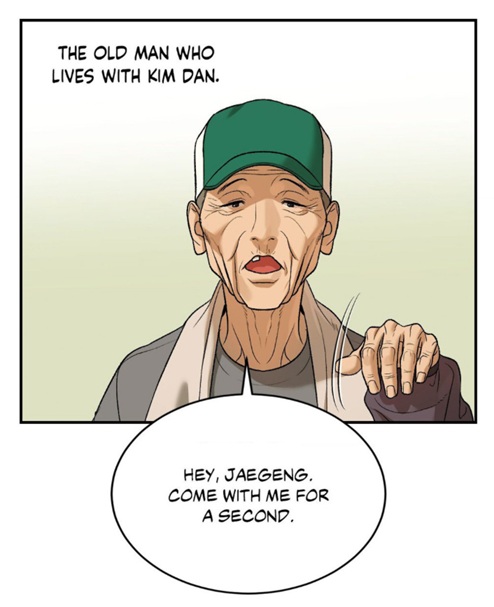 (chapter 62) However, this “dynamic” (distinction) began to shift the moment Jaekyung started working for the local residents.
  (chapter 62) No longer just a “guest” or a “tourist,” he earned their recognition and acceptance through acts of service and humility.
 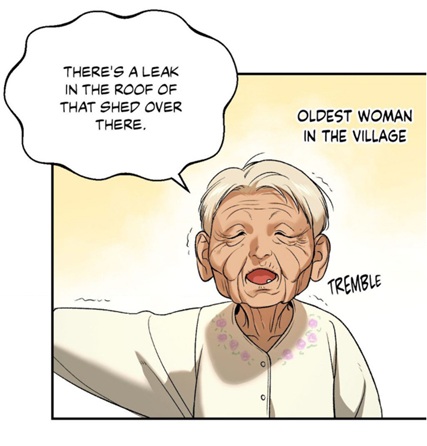 (chapter 62) As he helped them with manual tasks—such as lifting goods or assisting the elderly—they started seeing him not as an outsider, but as one of their own. However, it is important to note that these gestures of inclusion occurred while Jaekyung was outside the blue gate
  (chapter 62) —beyond the formal boundary of the rental property.
 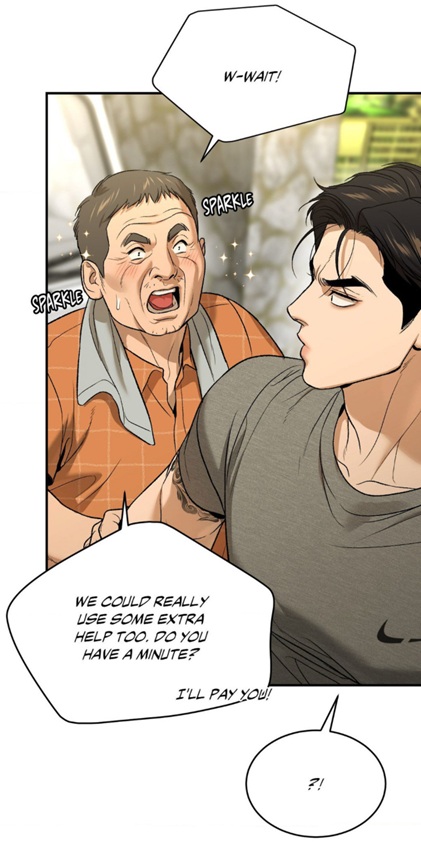 (chapter 62) In this way, the gate truly functioned as a symbolic threshold: only once he crossed it through action and humility, the community began to approach him. This change in perception was symbolized, when he received vegetables from the townspeople, a traditional gesture of inclusion and local acknowledgment.
  (chapter 62) Nevertheless, the best sign that he has been accepted by the community is when he received traditional welcome gifts: the toilet paper and detergent.
  (chapter 69) [For more read Unseen 👀 Savior🦸🏼♂️ : The Birth Of Jaegeng (locked)] His physical strength, once used for spectacle and entertainment, now becomes a bridge into the fabric of rural life, exposing his true personality: he is generous and modest. The closed blue gate of the hostel might have marked him as a city dweller at first, (chapter 65) but his actions gradually dissolved that boundary. Therefore it is no coincidence that after the wolf took care of doc Dan during that night
 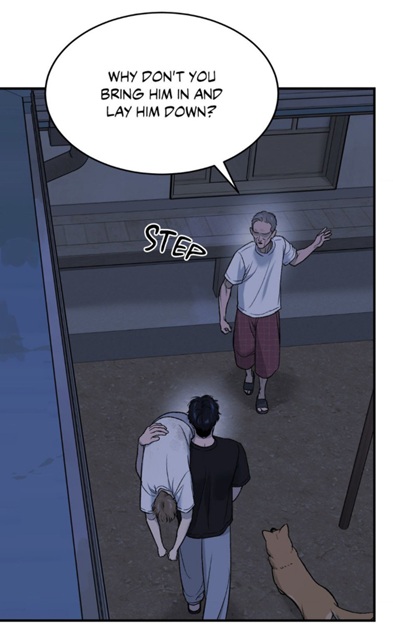 (chapter 65), the elderly neighbor chose to open the blue gate shortly after:
  (chapter 69) Thus I deduce that the blue gate lost its purpose. The champion definitely saw the advantages of the absence of a gate by his neighbor. He could arrive there at any moment
  (chapter 62) and the landlord never rejected him. In fact, he was always welcome.
 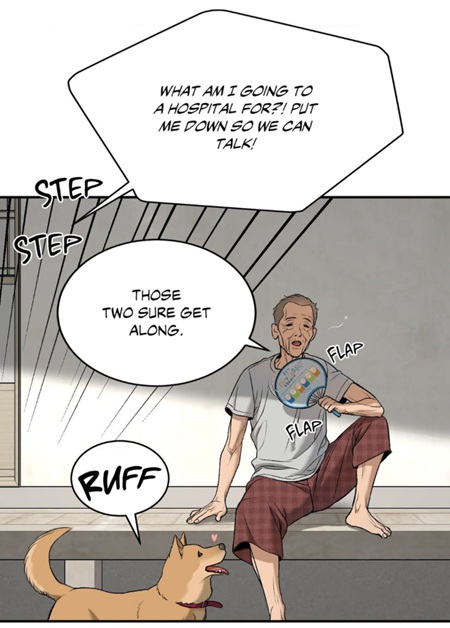 (chapter 66)
But let’s return to the house numbers and its signification. In this way, 33-3 stands at the crossroads of tradition and change: it is old, but not untouched by rupture. It represents a home that has endured change while maintaining its emotional and social value. This makes it an apt setting for the star and the physical therapist, two individuals who themselves come from fractured emotional lineages—both wounded by broken familial bonds, yet gradually learning to rebuild a form of kinship. That number becomes a silent metaphor for their coexistence: the wolf and the hamster, sharing not blood but space, trust, and now roots.
Father, Son and Ancestor: 33-3
Numerologically, “33” itself can evoke multiple layers of meaning. In some interpretations, 33 is a master number, associated with healing, altruism, and emotional growth. It is also a number of spiritual maturity—hinting at a kind of “final trial” before enlightenment. That fits the evolution of both characters. And the number 3, repeated, might subtly allude to the Christianism (Father, Son and Holy Spirit) or Confucian triad—father, son, and ancestor—or more abstractly, to harmony among heaven, earth, and humanity. With Jaekyung and Dan forming a new domestic unit under the benevolent yet quiet watch of the elderly landlord, we can almost see 33-3 as a broken but reassembled version of the traditional multigenerational household—one not bound by blood, but by mutual recognition and earned care.
Thus, 33-3 becomes more than an address. It’s a compact expression of the characters’ trajectory: from scattered and rootless to housed and healing—not in a perfect family, but in a fragile, evolving one. The wolf’s integration is not based on lineage or history, but on community and contribution.
Another layer to the contrast is the identity of the landlord. While the owner of 7-12 is the town chief—someone with institutional power—he is not necessarily the town’s patriarch. His propriety, 7-12, suggests his roots are more administrative than ancestral. He is in charge, but he does not represent continuity. On the other hand, the landlord of 33-3 is mistaken by Choi Heesung for Dan’s grandfather 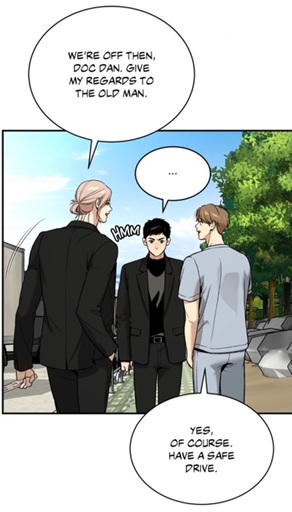 (chapter 59), and townspeople instinctively report Dan’s behavior to him.
  (chapter 69) I would like to point out that the kind man said “villagers” and not “villager”, a sign that he was contacted by many people. Such recognition is reserved for those woven into the community’s long memory.
This dynamic becomes even more intriguing when we consider how the wolf might have ended up in house 7-12 in the first place. 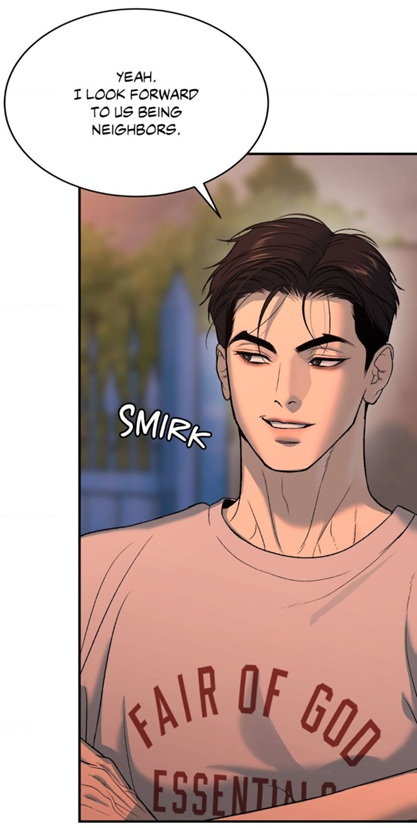 (chapter 61) Given that the rural address system is based on the older jibeon model—and most GPS systems now rely on the newer road-based address format— it is unlikely that Jaekyung could have located Dan’s home through navigation alone.
 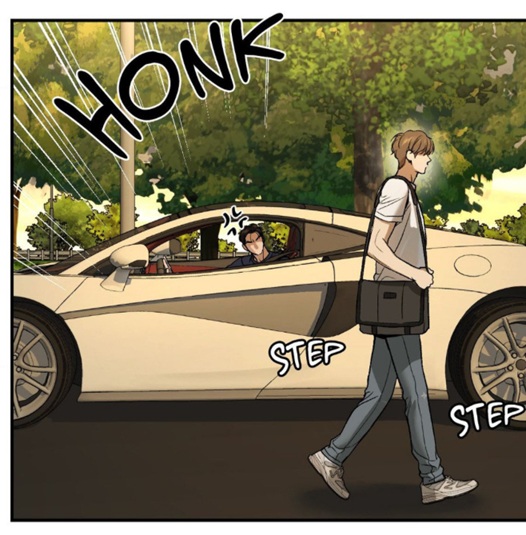 (chapter 61) That’s the reason why the author included this scene. Even if someone had disclosed Dan’s address, the GPS in Jaekyung’s luxury car would not have been able to guide him there. Like mentioned above, the streets have no names, and the numbering lacks logical sequence. Thus, we have to envision how the Emperor followed Dan on foot, observing where he went. In doing so, he not only located the general vicinity. Afterwards, he must have contacted a local and requested for a vacant house close to 33-3. That’s how he found the “hostel” right next door. (chapter 62) No wonder why the athlete stopped his training for his benefactor, the town chief. His act of renting that space was not just about proximity—it was a quiet, determined form of emotional pursuit, bypassing digital maps in favor of personal presence. Once again, this mirrors the emotional structure of the story: Jaekyung could only find the hamster by leaving behind his car (the older version of episode 69
  – chapter 69) and walking through the confusion himself.
Finally, this rural numbering system is placed in relief by an urban counterpart. In episode 1, 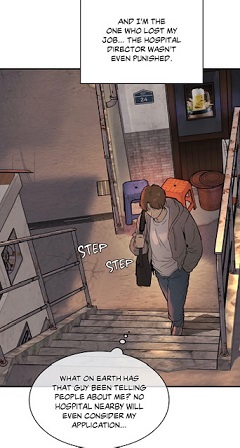 (chapter 1) we see Dan walking under a blue plaque labeled “24”—the newer, street-based system introduced after 2013. This number, part of Seoul’s revised address format, contrasts sharply with the rural jibeon model. Where 7-12 and 33-3 reflect layered histories and family division, “24” is precise, administrative, and arguably impersonal. The place is no longer connected to family and traditions, rather to migration and anonymity. The juxtaposition between systems emphasizes not only physical distance but emotional dislocation.
Shin Okja’s Childhood Town and Numbers
Yet among all these numbered spaces, one person remains strangely untethered: Shin Okja.  (chapter 65) Though she insists this seaside town is where she “grew up,” she never identifies a lot number, street, or ancestral parcel. In a rural system where numbers are more than logistical—they are signs of rootedness and intergenerational presence—her vagueness stands out. Everyone else is connected to a numbered gate, a registry, or a mailbox. She alone floats in narrative space, clinging to emotional claims without material proof: no concrete location is brought up.
 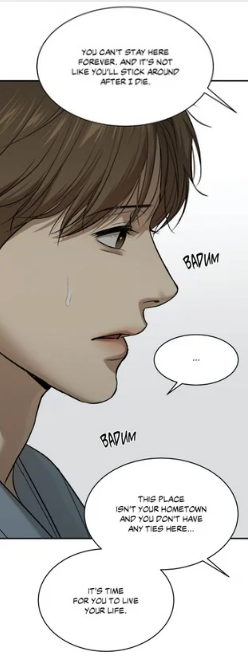 (chapter 57) The contrast becomes sharper when she refers to Seoul only in generic terms. She never mentions a district, (chapter 65), a person
  (chapter 56), a neighborhood, or specific location. This lack of detail, especially when juxtaposed with the specificity of the rural jibeon system (where even a subdivision number implies lineage and ownership), exposes her rootlessness. It reinforces the idea that her ties to place are performative rather than grounded. Even her nostalgia for Seoul is flattened
 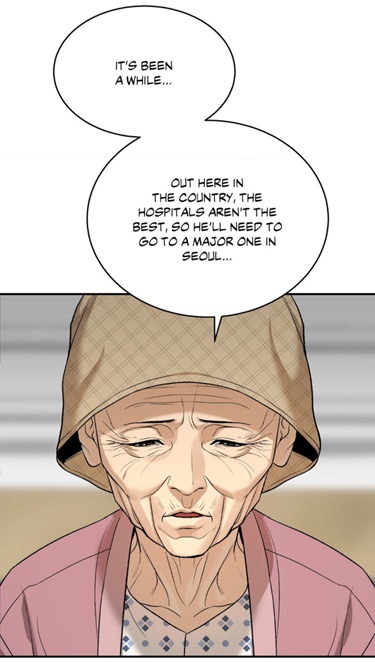 (chapter 65) into a symbol of urban superiority—money, prestige, modernity—without anchoring it to a real “home.” In short, she idealizes Seoul the way she romanticizes the countryside—selectively, superficially. At the same time, she is giving the impression that she is erasing her stay in Seoul, as if her past there, too, is unmoored. Because of this observation, I realized why the nurse never questioned the senior’s statement.
 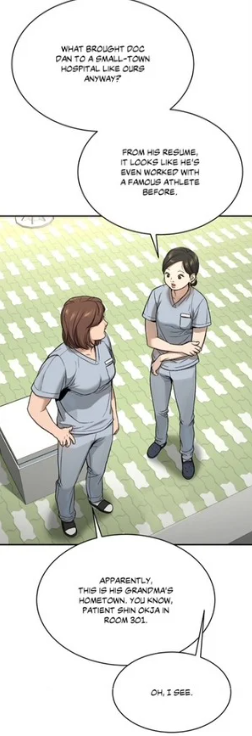 (chapter 56), though she expressed some doubt. By asking for more details, she imagined that she could touch a sensitive topic, like for example loss of her home etc. Shin Okja‘s inability—or refusal—to locate herself within a concrete building and specific numbered system of belonging hints at a deeper truth: Shin Okja may perform the role of native and guardian (chapter 57), but the land does not affirm her story. In Jinx, numbers are roots, and she is rootless. The more she talks about places, the less we see of her in them. She becomes a woman suspended between two worlds, belonging to neither.
Finally, the narrative suggests with the Emperor’s example, rootedness is not determined by a map or a deed, but by how much responsibility and memory one carries. And so far, the halmoni is not contributing much to the little town. She remains in the confines of the hospice. Hence no one among the inhabitants noticed her so-called return to her hometown.
A Numbered Home in Seoul: Whose Name, Whose Burden?
But since the new system is used in Seoul, I wondered about her address and house number. So what was the house number of Shin Okja`s home in the capital?  (chapter 17) As Jinx-lovers can detect, next to the entrance of her apartment, there is no blue house number plate or street name. How is that possible in a metropolis where every residence should be digitally registered? And now, pay attention to the house where the “goddess” and her “puppy” lived.
 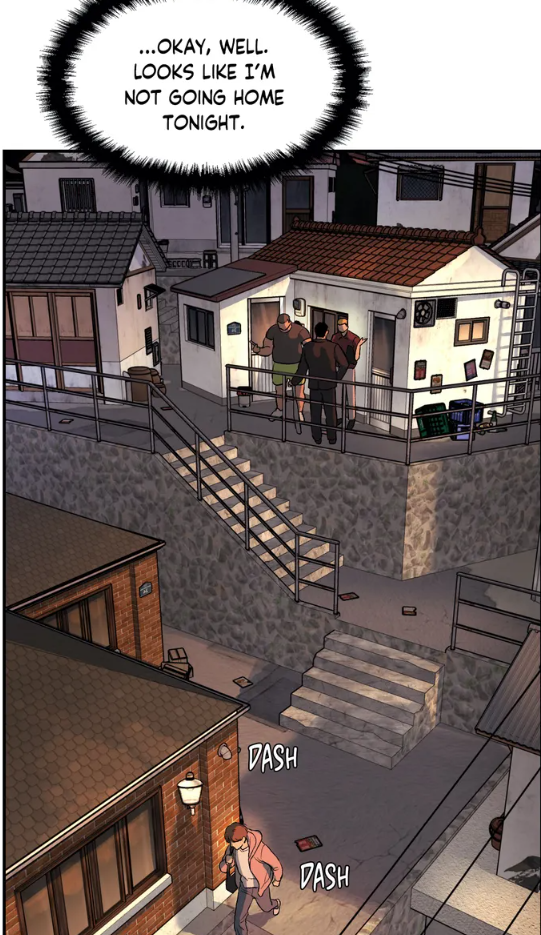 (chapter 1) The building had not only two doors, but also the plaque is placed next to the other door. It is also partially visible in this image:
 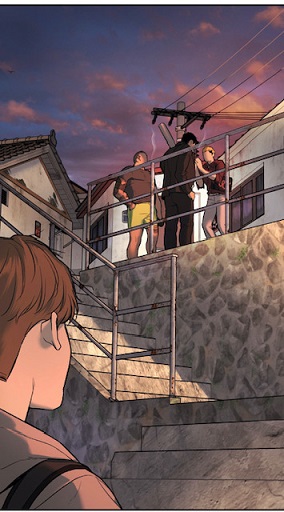 (chapter 1)
This raises a series of subtle but important questions. When we see Kim Dan standing in front of the darker, metal-framed door in episode 11  (chapter 11), we naturally assume he is returning home—entering the same shared space he and his grandmother inhabit. But is that actually the case? A closer look reveals he is using the other entrance. On his right side, we see the electricity meter, the mailbox, and the window—the signs of an inhabited and administratively recognized unit. This suggests that Kim Dan’s official residence is behind this second door. Once again, I am showing the view of the same building from a different perspective,
 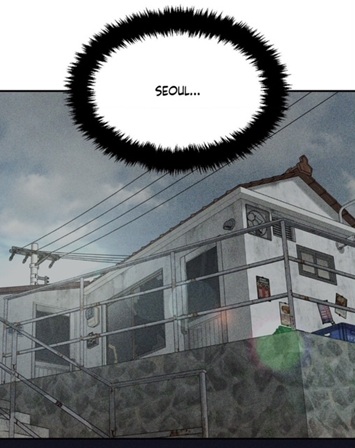 (chapter 57) where the mail box and the electricity meter are. But I have another evidence for this observation. During that night, the hamster got assaulted by Heo Manwook and his minions.
  (chapter 11) And keep in mind that after getting beaten by the Emperor, anyone could recognize the grandmother’s place from outside due to the broken window.
  (chapter 19) The moment I made this discovery, I couldn’t help myself wondering why doc Dan would go to the other door and not to the halmoni’s room.
And this thought led me to the following deduction. He had been triggered to go to that place because of the phone call from the redevelopment association.  (chapter 11) The voice on the phone reveals something legally crucial
 (chapter 11): Kim Dan is the last remaining resident in that building. That one line reframes everything. This suggests that Kim Dan’s official residence is behind this second door. 😮 In fact, the building features (chapter 57) only one house number plaque, one mailbox, and one electricity meter. These markers aren’t decorative—they are infrastructural indicators tied to administrative systems. In a city like Seoul, this configuration implies a single legally registered unit. So despite there being two entrances, only one household is formally recognized by the system. And since the resident registration system restricts each individual to a single verifiable address, this means only Kim Dan is recorded as the building’s legitimate occupant. The other door—the one associated with Shin Okja—exists outside the scope of legal recognition. She may live there physically (her belongings are still there), but bureaucratically, she doesn’t exist in that space.
Under the Korean Resident Registration System, every citizen must register their place of residence with the local government. Since 1994, this data has been digitized, allowing all state institutions to access and verify a person’s registered address electronically. This information is not symbolic—it is legally binding. Your registered address determines where you pay taxes, vote, access services, and claim benefits. Moreover, because so many government processes now rely on digital access to this central database, only one person can be officially tied to any residential unit at a time. Crucially, it is also a prerequisite for accessing financial credit. One cannot take out a bank loan or act as a legal guardian without a valid, registered place of residence.
This means that in the past, Shin Okja must have been officially registered at the address. 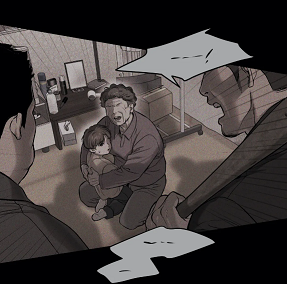 (chapter 5) When the loan shark came to collect the interest of the debts during Kim Dan’s childhood, he went straight to her door
  (chapter 5) —the door that, at the time, likely bore the blue house number plaque.
However, attentive readers will notice a striking detail: the door seen during this childhood memory opens outward toward the viewer and is positioned closed to the left corner,  (chapter 5) the door associated with Kim Dan in later episodes—particularly the one through which the champion entered during the confrontation with the thugs —opens inward and is placed in the corner of the right wall. The interior layouts and door directions don’t match, though the furniture is similar. This strongly suggests that these are two different units within the same building, exactly like I had observed before. The “goddess” and the hamster’s house had two doors and as such two units. (chapter 1)
These architectural clues support a subtle but significant shift: Shin Okja once resided in the main unit, the one connected to the official registration and legal address, in other words her initial flat was there. (chapter 11) At that time, Kim Dan, as a child, must have lived in the other unit, the one without number. She was probably taking care of him. However, at some point, she must have switched the place and moved to the other unit. This would explain why doc Dan  (chapter 19) had a recollection of this moment, when he was about to leave this humble dwelling.
  (chapter 19) His move to the penthouse triggered another “move” from the past. Consequently, I am deducing that this souvenir represents the moment of the grandmother’s arrival and the departure of the hamster’s parent(s) from the other unit. But there’s more to it.
Since people are obliged to get a residency number with 17, I am assuming that the halmoni ceded legal registration to him, once he reached his 17th year. Kim Dan took over the smaller, neighboring room officially, and with it, the burden of formal residency. When she relinquished her official role, the system would have required a transfer of household headship and residency—most likely to Kim Dan. In my opinion, she became listed as household members (세대원, saedaewon). They are fully registered, just not as the head. It is important, because in front of the champion, she acts, as if she is still the head of the household  (chapter 65) and Kim Dan the immature child, whereas according to my observations, she is legally dependent on the “hamster”. She is just a household member. As you can see, I detected a contradiction between her words and “hidden actions”, all this triggered because of the closed door. By transferring the address and registration to the physical therapist, she made it possible for him to inherit not just the space, but also the liability. That’s why he’s now the only registered person.
Thus, by the time we see Kim Dan revisiting the building (chapter 11), the name tied to the legal system, to the loan, and to the state’s digital records, is his—not hers. This administrative shift allowed Shin Okja to become legally invisible while Dan remained trapped in a place that was once hers, yet bore no official acknowledgment of her presence.
In short, the building’s physical structure masks a deeper displacement. (chapter 1) What appears to be a modest shared home conceals a painful history of passed-down burdens and reallocated responsibilities. The grandmother’s true door is off to the side, connected physically but separated in symbolic meaning. It has no number, no mailbox, no markers of legal presence. This hidden door is a perfect trompe-l’oeil: it masquerades as the heart of the home, but it’s actually a legally invisible annex. The framing invites the viewer to overlook it, just as the narrative invites us to overlook the grandmother’s evasions. And ironically, the one who stayed—the “last resident”—is also the one who was slowly pushed into the background, into the unnumbered space, into silence. And now, you comprehend why the grandmother asked from him this:  (chapter 11) When he says “home,” he is referring not just to a physical place, but also to a legal and emotional placeholder—a registration number that ties him to bureaucratic existence, familial duty, and emotional manipulation. With her promise to return in that home, Shin Okja is essentially demanding he remains the legal anchor—the one who stays behind, the one who remains registered, the one who continues to carry the official burdens, even as she herself fades into invisibility. That’s how she became a “carefree” ghost in the end. It wasn’t just a promise of care, but a submission to being tethered—not to belonging, but to obligation masked as love. The irony is that by remaining legally “present,” Dan was emotionally erased.
To conclude, Kim Dan was not just the last physical inhabitant—he is the last legal one. His mailbox, his electricity meter, his official records—all point to the metal-framed door. (chapter 11) That’s where his address was, until he moved to the penthouse. But that’s where the loan is linked. That’s where the city saw him. And because the resident registration is necessary for work and taxes, Kim Dan had to change his resident number, when he moved to the penthouse or to the seaside town. That’s how I came to the following conclusion: Shin Okja must have known about his stay with the champion in the end.The Korean Resident Registration System is the evidence. This shows how important this scene was in season 1. (chapter 11)  (chapter 65) In this panel, her words in English were ambiguous, while in the Korean version, the grandmother exposes that she was well aware that her grandson and the emperor would live together.
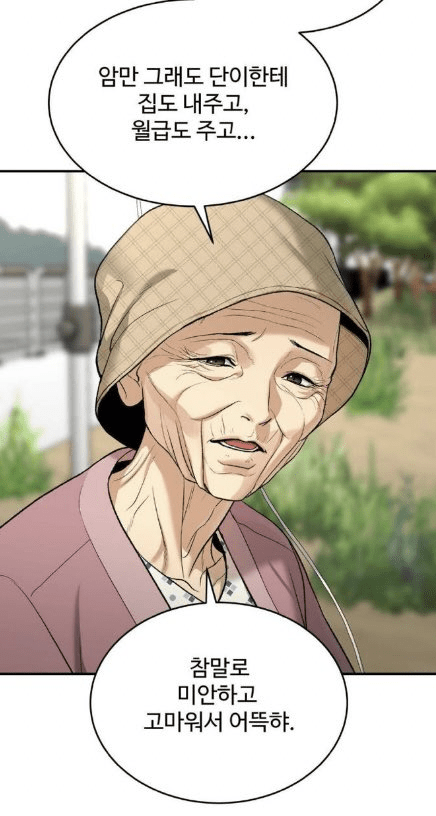
“I’m truly sorry and thankful—what can I say.”
This means that the halmoni must be well aware where her grandson is staying in her “hometown” in the end!!
Don’t forget that in South Korea, when a person enters a hospice or hospital, they must provide a valid registered address for several reasons: Health insurance eligibility (National Health Insurance Service); Billing purposes; Coordination of long-term care or welfare benefits; Resident registration confirmation (especially in hospice care, where end-of-life planning intersects with legal identity). She is legally totally dependent on him, and not just financially. So when she suggests to doc Dan to return to Seoul, she is actually denying the existence of a relationship between the physical therapist (chapter 57) and the landlord from 33-3. In fact, she was indirectly expressing a lack of gratitude toward the elderly man.
This realization, the existence of two units within the same building, subtly destabilizes the commonly accepted idea that Shin Okja is his grandmother. I have to admit that while reading episode 57, doubts (chapter 57) about their parentage came to my mind, especially when she claimed that doc Dan had different roots as hers. However, so far, I could never find an evidence for such a theory and imagined that my mind was simply too creative. Yet, with this new insight her role begins to look less like that of a familial guardian, and more like that of a caretaker, a nanny, or even an intruder—someone who moved in but was never truly rooted in Dan’s legal or emotional household. This theory would explain why the grandmother is not talking about doc Dan’s parents, why she remained passive, when he got stigmatized as orphan. She had every reason to suggest that she was enough for him, he just needed her. 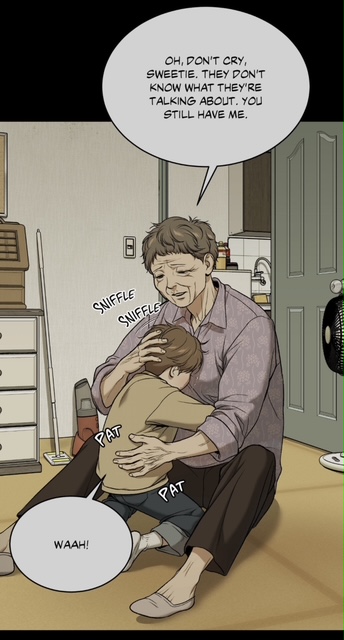 (chapter 57) That way, he became attached to her. It’s a startling reversal: the woman who claims maternal authority is
  (chapter 65), in the eyes of the system, merely lodging in his shadow. She is indeed a ghost.
 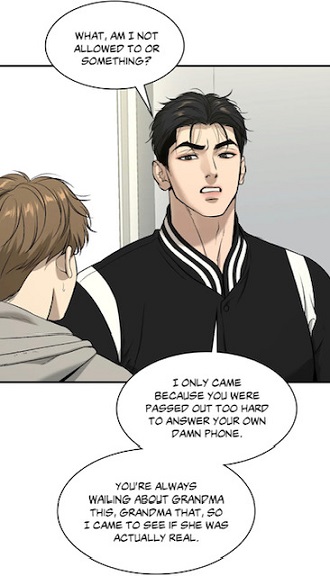 (chapter 22) This architectural division is deeply symbolic. Despite being the dependent, Dan is the one bearing responsibility—both financially and administratively. Shin Okja, on the other hand, manages to live without accountability.
And perhaps it’s no coincidence that the Seoul house (chapter 1) resembles the configuration in the small town. (chapter 57) In both cases, the boy lives next to someone who is older, legally distinct, and spatially close yet administratively separate. However, in the capital, the room with the second door is much smaller, as if doc Dan was the “servant”, though he was the main resident and the household head. In the countryside, this creates a healing bond with a benevolent elder. In the city, it sharpens a sense of entrapment. The echo between the two homes becomes a subtle commentary on the difference between chosen family and imposed family, between true guardianship and the performance of care.
And what did Shin Okja say to the Emperor? 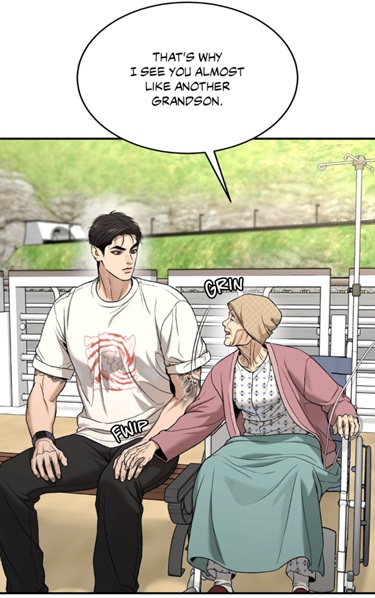 (chapter 65) Joo Jaekyung is almost her grandson!! It was, as if she was about to adopt him. Let’s not forget that he embodies all her ideals and dreams: strong, healthy, rich, famous, generous, polite and gentle! And according to my observations, she knows that the athlete owns a flat in Seoul, big enough to take a room mate.
The invisible chain between the door and the sharks
The silent yet stark detail about the two units (chapter 1) also reshapes our perception of Shin Okja. This singular registration setup does more than highlight Dan’s bureaucratic burden—it reframes the nature of the doctor’s relationship with Shin Okja. (chapter 11) But why did she ask him to become the household of this unit in the past? For me, the answer is quite simple. She had already planned that the young boy would take over her debts. One might argue that the debts might have been related to the hamster’s family. Yet I can refute this point. How so?
First, according to my previous observation, Shin Okja was living in the other unit, and the thugs went straight to her flat, the one with the sign on the wall. (chapter 5) They were looking for her and not “doc Dan” or his family. Unfortunately, the little boy was present. Because they were seen together, people assumed that they were together, a family. But like mentioned before, there was a move within the same building. Moreover, as a child, Dan was exposed to violence from the loan sharks. He couldn’t have signed any documents at the time, for a resident registration number is required and the other place is not registered; the grandmother was the official borrower. But later, Heo Manwook declared that Kim Dan is the named debtor. 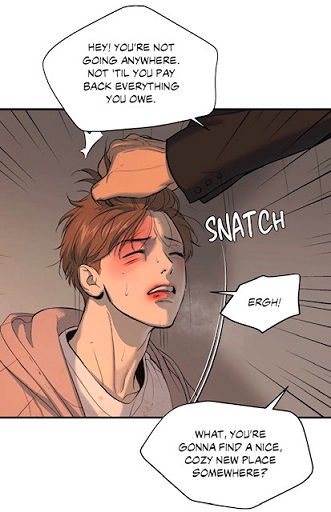 (chapter 16) He even showed the amount Kim Dan owned with his cellphone to the Emperor
 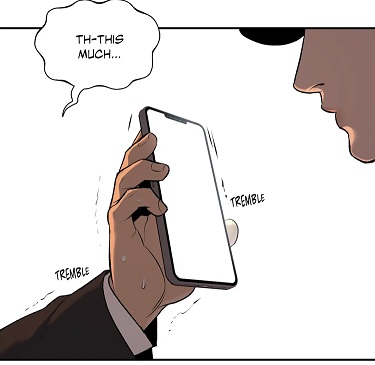 (chapter 17) That’s how the champion internalized that the hamster was the one with debts. This theory explicates why doc Dan is not blaming his grandmother for the debts in the end, as he signed himself loans. And now, you can imagine what happened in the past. Once he became 17 years old, she asked him to get a resident registration number. With this, he could apply for a loan in order to reimburse the grandmother’s debts. This must be one of her favors from the past:
 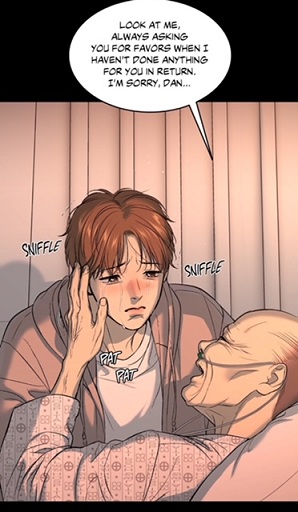 (chapter 53) So far, in season 1, she had made only one (chapter 41) before her request to visit the West Coast. The most plausible explanation is that Shin Okja persuaded him to take over the loan. She likely presented it as a necessary sacrifice, something he could manage given his income as a physical therapist. This explains why the elderly woman is no longer asking about the debts or loan. It is no longer her main concern, she is not the household head either. And don’t forget what the physical therapist thought, when he heard from Kim Miseon the bad prognostic about his grandma.
 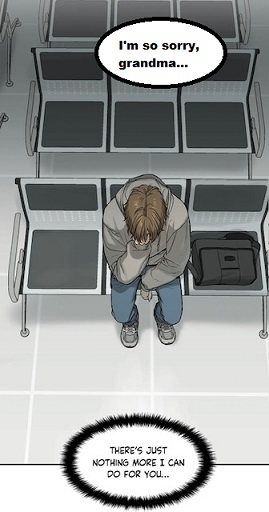 (chapter 5) His words imply that he had done something in the past for her. And that would be to become her guardian and take her debts. This hypothesis explicates why only in episode 11, Doc Dan was comparing the progression of the interests with a snowball system, something unstoppable.
  (chapter 11) His thoughts reflect a rather late realization that he is trapped in a system and he can not get out of it. In other words, this image oozes a certain innocence. This also explained why Joo Jaekyung had to confront him with reality in front of the hospital.
 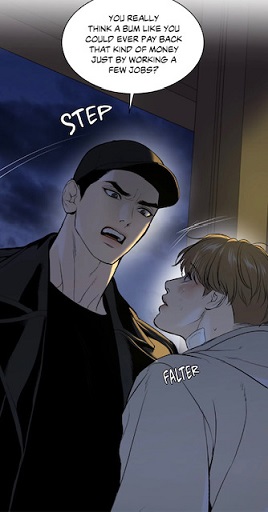 (chapter 18) The location is not random: for the halmoni, such a work place symbolizes respectability, power and money. The problem is that in the hospice, Doc Dan is not well-paid.
 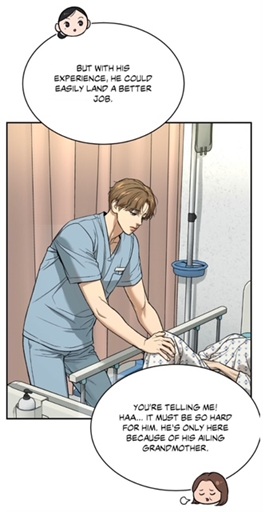 (chapter 56)
And so, when he returns to that door after the triggering phone call (chapter 11), it isn’t just a physical movement—it’s a re-entry into responsibility and also past. The metal door doesn’t lead into a shared home, but into a legal burden. It is the entrance not to comfort or care, but to debt, disrepair, and abandonment. No wonder why during that night, the hamster had to face Heo Manwook and his minions.  (chapter 11) And now, it is time to return our attention to my illustration for the essay:
  As my avid readers can observe, the panel with the champion facing the blue door comes from episode 69, while the one with doc Dan comes from chapter 11. These scenes are mirroring each other. It is about concern and danger! While in episode 69, the athlete got worried, as he imagined that doc Dan’s life was in danger, in episode 11, the hamster was about to face an old threat: Heo Manwook and his minions!
  (chapter 11) But back then, he was on his own and no one paid attention to his health. Not even Shin Okja… He was truly abandoned, while the episode 69 exposes the opposite. Society in this little town takes care of people in general.
Striking is that Heo Manwook does not even know about Dan’s profession. When he sees the influx of money 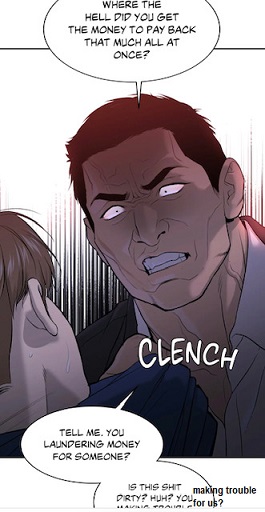 (chapter 11), he jumped to the conclusion that Dan was either prostituting himself or laundering funds. Why? It is because he had taken odd jobs, until he got hired by the dragon, Joo Jaekyung, and had such a huge income. Under this new light, it becomes comprehensible why Heo Manwook knew how to use the old lady in order to threaten doc Dan.
  (chapter 16) Like I wrote in a different analysis, I doubt that the grandma would have signed a loan by Heo Manwook. This reveals how Dan entered the contract in obscurity, without recognition or protection. He did it for Shin Okja’s sake to repay her for her support and “love”.
  (chapter 65) No wonder why Shin Okja never mentions the loans when speaking to Joo Jaekyung, thus erasing her responsibility. And imagine this: Doc Dan is now living with an elderly man who is a farmer. She might suspect that the senior is trying to take advantage from her “grandsons”. If this is true, then she would just be projecting her own thoughts and fears onto the landlord. Since she connects the city to success and money, I am quite certain that she doesn’t judge farmers in a positive light. For her, doctors or celebrities are much more recommendable persons.
In the following article, the paper’s data underline a social reality: farming in Korea is struggling, and its practitioners—despite their essential role—are economically marginalized. In 2022, average agricultural income per household dropped to just KRW 9.49 million (~US $7,300)—under the 10-million-won mark for the first time in 30 years. Farming households earn only about 20–27% of what they once made, a steep decline from over 50% in the 1990s. Structural issues—aging farmers, small-scale plots, high material costs, and price volatility—have trapped many in long-term economic strain. Far from being a supplement, farming is often no longer a primary income source, pushing many rural households into poverty, with younger generations fleeing to cities. This evolution is reflected in the Korean manhwa. The room of Doc Dan contains traces of a teenager who left the house. 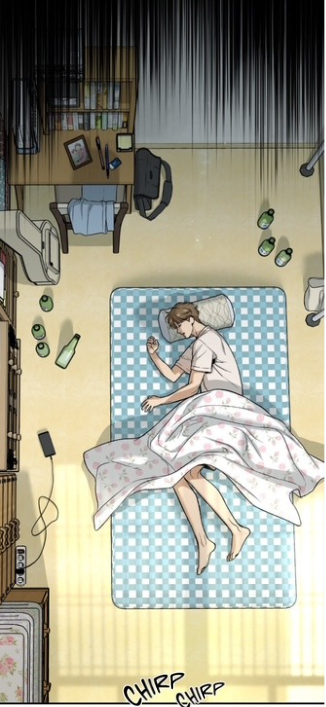 (chapter 57) Therefore I am expecting an argument between the halmoni and the inhabitants of 33-3. The landlord embodies the opposite values of Shin Okja.
The Cabinet’s Silence: Misattributed Memory
This layered confusion about the flats extends to the objects within the home, especially the massive mother-of-pearl bridal wardrobe. 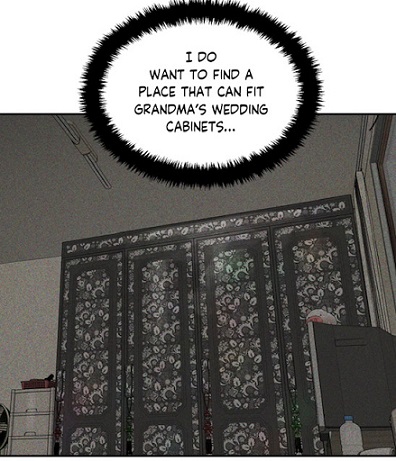 (chapter 16) Dan repeatedly calls it his grandmother’s and even dreamed of finding a new place that could house it—a gesture that underscores how much he believed she treasured the object, even though she herself never mentions it. But she never once references it, not even when returning from the hospital. The absence of interest is striking. What if the cabinet didn’t belong to her at all? Its size suggests that it predates the division of the house. Besides, according to my observation, she used to live in the other unit and I can not imagine, the halmeoni moving this furniture from one unit to the other. Perhaps it once belonged to Dan’s mother—a remnant of the original household, now misattributed to the woman who unofficially took over.
Dan’s reverence for the cabinet mirrors his longing for stable familial identity. He projects value  (chapter 19) onto the object just as he projects loyalty and gratitude onto his guardian. But the silence around the cabinet speaks volumes: it is not treasured by Shin Okja, only by Dan. Much like his name on the loan, or the house number on the door, it could be a misplaced inheritance. At the same time, such an item could serve to identify doc Dan’s true origins, if the Wedding Cabinet belonged to his true family.
The Wolf’s residence: 7-12
In contrast, Jaekyung’s initial intention was to stay in the seaside town only temporarily. (chapter 61) He claimed the move was for recovery and recuperation—a short break from his life in Seoul. Yet Korean law requires anyone staying in a location longer than a month to officially change their resident registration. If he were to do so, this would not just signal a change of address but a severing of administrative ties with Seoul—and by extension, Park Namwook and MFC.  (chapter 66) Changing his registration would mean stepping outside of the institution’s control and surveillance.
However, I doubt that the star has ever officially registered his stay. Like Kim Dan before him, he exists in a limited legal space—present but not formally tied. This ambiguity mirrors his emotional state. His real return to Seoul was always conditional—it depended on Dan’s willingness to follow him. 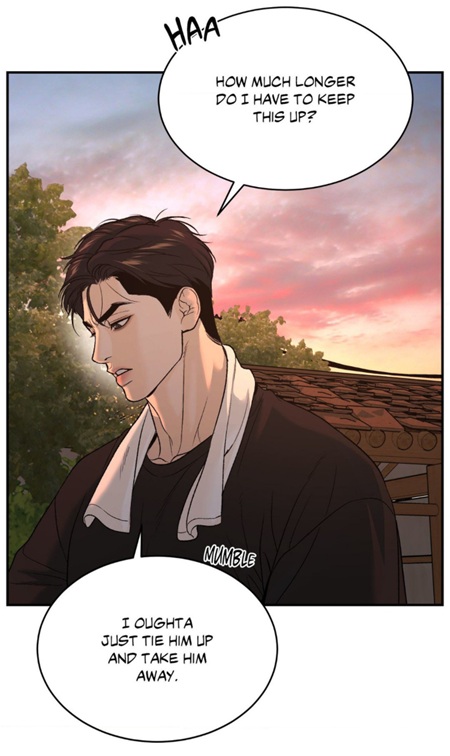 (chapter 62) Without Dan, Seoul held no meaning. But if he remains in the town past the statutory threshold, it would imply that he is ready to leave behind the world of contracts and competitions. It would mean he is now rooted—not by career, but by choice. Not by obligation, but by emotional truth.
In this way, the law becomes a mirror: resident registration, typically viewed as bureaucratic red tape, becomes a metaphor for chosen identity. The champion’s choice to return straight to the seaside town displays his psychological transition. He is no longer the man who moved through cities on training schedules. He is beginning to act like someone who stays—and stays for someone. And that someone is Kim Dan.
Conclusion: Opening the Right Door
The titular “hidden door to the past” is not just a visual motif—it is the emotional architecture of Jinx. By attending to overlooked details—address numbers, cabinet placement, financial responsibility, and architectural sleight-of-hand—we can trace the emotional fault lines that run beneath Dan’s quiet suffering and the champion’s slow awakening. The question is no longer just where they live, but who gets to call it home. The essay began with an image collage, but what it truly offers is a blueprint: not of real estate, but of memory, grief, and quiet resilience.
Feel free to comment. If you have any suggestion for topics or Manhwa, feel free to ask. If you enjoyed reading it, retweet it or push the button like. My Reddit-Instagram-Twitter-Tumblr account is: @bebebisous33. Thanks for reading and for the support, particularly, I would like to thank all the new followers and people recommending my blog.

 Bebebisous33s' analyses in K-Dramaland and Manhwas