

Please support the authors by reading Manhwas on the official websites. This is where you can read the Manhwa: Jinx But be aware that the Manhwa is a mature Yaoi, which means, it is about homosexuality with explicit scenes. Here is the link of the table of contents about Jinx. Here is the link where you can find the table of contents of analyzed Manhwas. Here are the links, if you are interested in the first work from Mingwa, BJ Alex, and the 2 previous essays about Jinx This has to change and Kim Dan on Thin Ice
It would be great if you could make some donations/sponsoring: Ko-fi.com/bebebisous33 That way, you can support me with “coffee” so that I have the energy to keep examining Manhwas. Besides, I need to cover up the expenses for this blog.

Water and Power
Two years ago, I published the analysis  At the crossroads: between 🤍, 💙, and ❤️🔥 and it has become the most read essay on my blog. [27.3 K views] It traced Joo Jaekyung and Kim Dan’s first day off together—the fateful swim in chapters 27-28 —when Joo Jaekyung’s apparent selfishness became the catalyst for Kim Dan’s first spiritual awakening. There, the water served as both mirror and baptism: a liquid threshold through which the doctor began to accept sexuality not as sin or submission, but as part of being alive. I had compared the athlete to a dragon holding his yeouiju. The pool stood for motion, rebirth, and the courage to breathe underwater—to trust one’s body rather than deny it.
Though the grandmother was never mentioned, I had sensed her ghostly presence in the grandson’s thoughts and actions. In her youth, the ocean looked beautiful to her 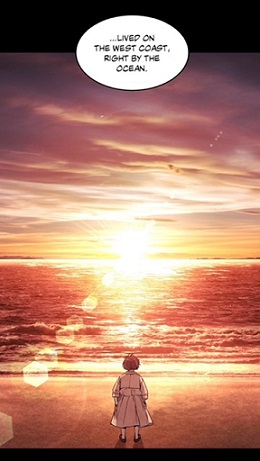 (chapter 53), yet she kept her distance. Observe that she only talked about one time experience. She sensed its danger and built her life on the solid ground of caution, duty, and control. In other words, she belongs to the world of the shore (chapter 53) —the solid, the measurable, the safe. Her fascination with the sea’s beauty reveals the limits of her perception: she judges by what is visible, by surface calm and reflected light. The ocean entrances her precisely because she refuses to imagine what lies beneath. For her, beauty is something to be looked at, not entered. Depth implies risk; darkness suggests loss of control.
That is why she keeps her distance. She fears what cannot be seen or accounted for — the unseen currents, the hidden life beneath the glittering skin of water. Her faith is built on appearances, not intuition; on the stability of the shore, not the movement of the tide. Thus I deduce that she never learned to swim. To her, entering the water would mean surrendering control, accepting fluidity, and admitting the existence of life below the surface. This means, swimming would expose the falsehood of her philosophy. That’s why I come to the following deduction that to her, swimming was unnecessary; one simply had to stay on land and hope never to fall in. But the pool, unlike the ocean, demanded a choice: enter, move, the pleasure of being below the surface  (chapter 28) and learn that not everything can be postponed or entrusted to someone else. Water, in this sense, rejects fatalism. It calls for motion, for risk, for personal responsibility.
What the grandmother built on faith in others was quietly undone by breath and muscle.  (chapter 80) And that intuition resurfaced and was confirmed in episode 80, when another day off brings the couple back to the pool. This time, the doctor steps into the water willingly.
  (chapter 80) He is no longer the man waiting to be rescued; he is the man learning how to swim. The champion’s words
  (chapter 80) distill the new doctrine: don’t wait for salvation
  (chapter 80), create your own buoyancy. Between the first swim
 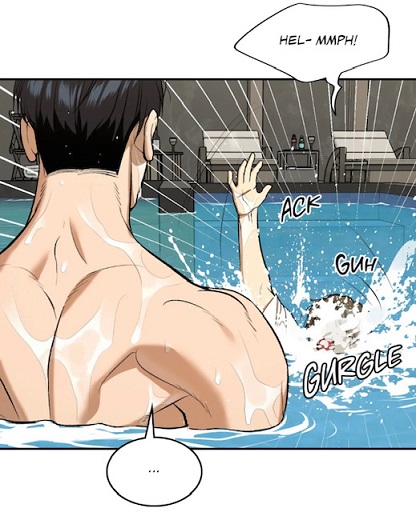 (chapter 27) and this second lies the true point of no return—where superficial judgment turns into reflection, dependency into self-trust
  (chapter 80) and the rejection of powerlessness, (chapter 80), and fear of closeness
 (chapter 28) into the first stirrings of love
  (chapter 80).
Shin Okja’s private religion was one of delegation: wait for the right person, the right moment, the right help to come. That’s why she never got the chance to return to the ocean. 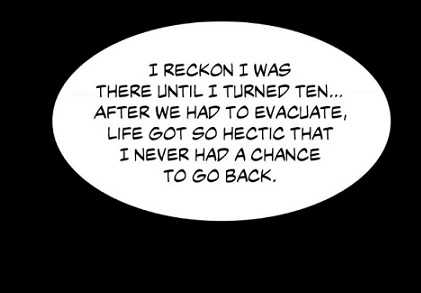 (chapter 53) Safety lay in patience and dependence. Even when she later spoke with the champion by the sea, she avoided mentioning the ocean —as if to deny that any movement beyond her control could exist.
 (chapter 65)
One might argue that I am overinterpreting, since the grandmother’s presence seems unrelated to the swimming pool and tied instead to her graduation gift—the gray hoodie. 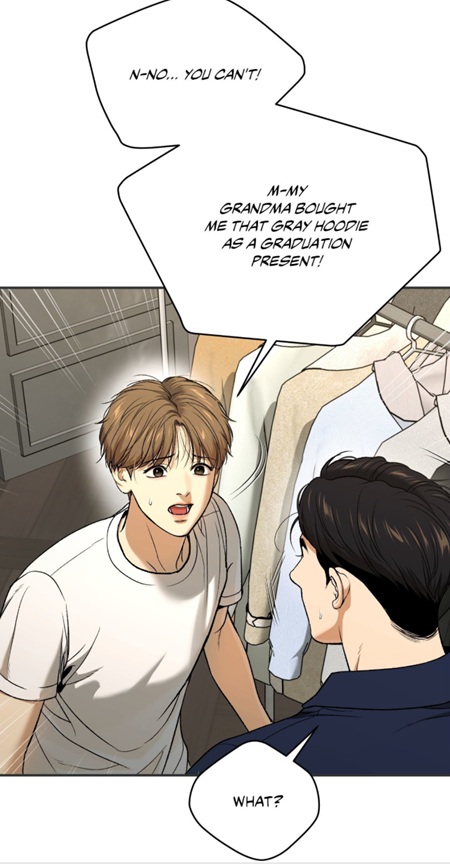 (chapter 80) Yet her absence from the pool scene is precisely what reveals her theology of avoidance. The pool was never her domain because her life revolves around work, not pleasure. She has no notion of rest without guilt, no concept of joy detached from utility. For her, swimming would appear frivolous—something “unnecessary” as long as one stays on solid ground. Jinx-philes should keep in mind that she never gave such a task to Joo Jaekyung. Her instructions to him were always practical, delegating care outward: take him back to Seoul, bring him to a big hospital and make sure he’s safe.
  (chapter 65) When she sees them together, her first reaction is not pride or relief but mild reproach— doc Dan should have left already.
 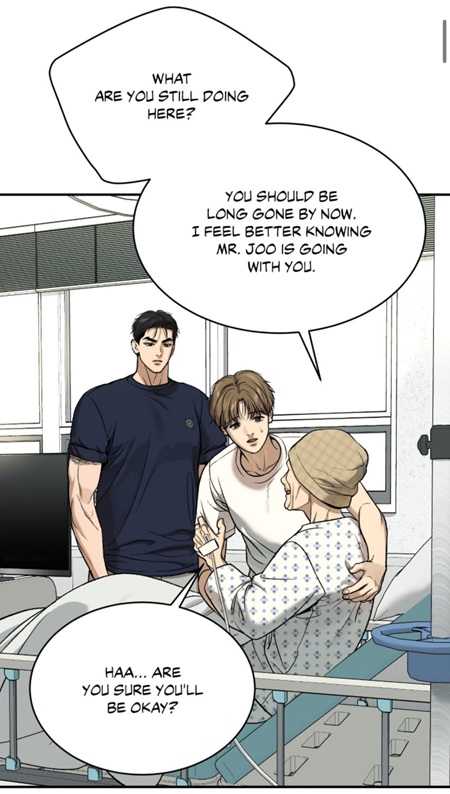 (chapter 78) The subtext is unmistakable: she expected obedience, efficiency, not attachment. Furthermore, her final instruction—“Make sure you see a doctor regularly”—
 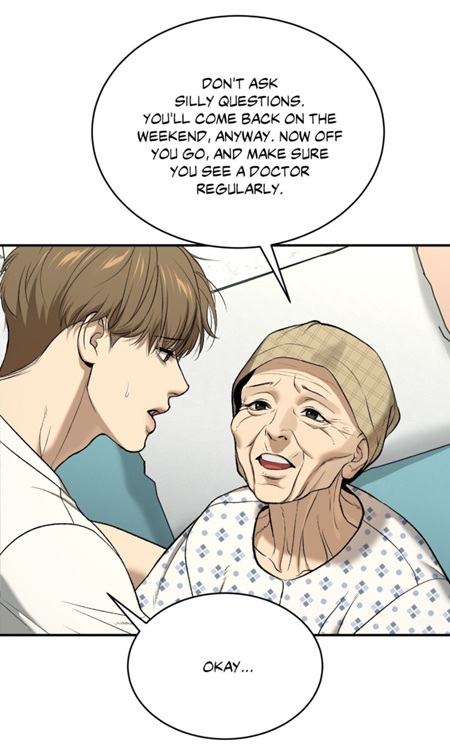 (chapter 78) sounds like ordinary concern, yet it hides her familiar logic of blame. It is as if she were implying that Joo Jaekyung has failed to fulfill her favor because Kim Dan has resisted care. In her eyes, the grandson is still the one responsible for trouble; the athlete’s role remains that of the dependable proxy who must “fix” him. What makes this moment striking is her tone of urgency, so unlike her habitual fatalism. The woman who once repeated “I’m the same as always”
  (chapter 65) suddenly speaks as though time is running out. (chapter 78) Her words, however, do not signal newfound insight—they only reinforce her desire to keep control, to ensure that someone else continues her mission of delegated care.
But what she interprets as negligence is actually independence. The champion is no longer following her religion of work and duty; he is inventing a new one based on choice 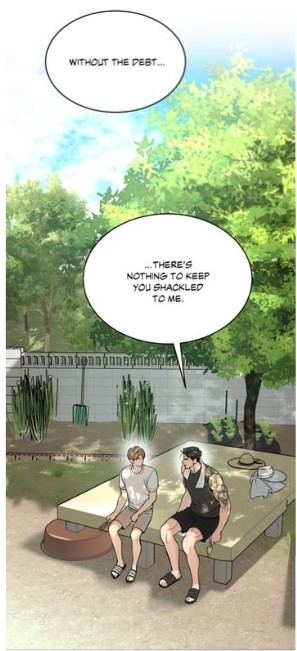 (chapter 77), respect and care. What she calls delay is, in truth, meditation and transformation.
Presents: The Gray Hoodie and the Lady
If the grandmother’s religion was built on work, the gray hoodie was its sacred relic.  (chapter 80) It was her graduation gift, yet it had nothing to do with his new profession or status. In contrast, the first episode already shows Kim Dan in a blue therapist’s uniform, name tag neatly pinned — a garment he must have purchased himself.
  (chapter 1) Traditionally, a graduation present helps the recipient embark on a career — like for example, a watch, a suit, or even a briefcase — symbols of adult entry into the job market. By offering him a hoodie instead, she unconsciously devalued her grandson’s professional worth. The garment belongs to the domestic sphere, not the workplace; it wraps him in comfort rather than readiness. In a moment meant to celebrate his arrival into public life, she reinscribes him into the private one — the house, the caretaker role, the obedient child. He doesn’t look like someone who went to university.
The gesture, whether she intended it or not, tells him that his identity has no market value beyond her recognition. The gift affirms warmth but denies competence; it soothes rather than equips. In addition, the grandmother’s choice of a hoodie exposes her lack of investment in that future. Her pride ended at the diploma; what came next was his responsibility. 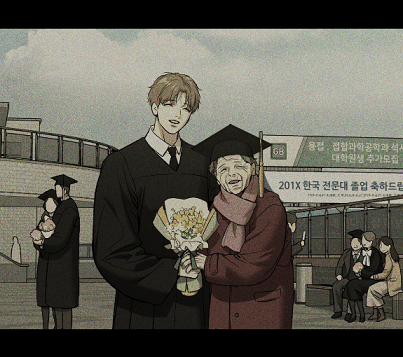 (chapter 47) There was no curiosity about his career, no acknowledgment of his competence—only the quiet satisfaction that through her endurance, she had produced a “doctor.” In the graduation photo, she even wears the mortarboard herself, smiling with the pride of someone who believes the diploma justifies a lifetime of sacrifice. Her grandson’s success confirms her own virtue; his “adulthood” validates her survival. This question to the athlete exposes her lack of interests in his profession:
  (chapter 65)
But her act of giving, like her act of living, was book-keeping disguised as affection. 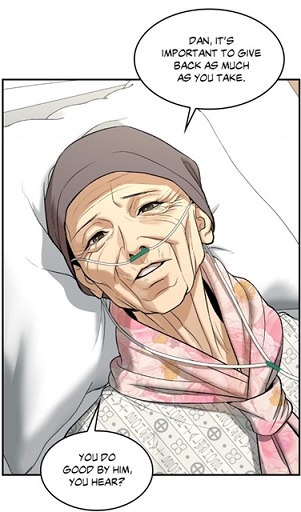 (chapter 41) While dying, she reduces love to an equation of productivity: “Dan, it’s important to give back as much as you take.” The verb do anchors her worldview — love must be measurable, visible, earned through action. To do good by someone means to labor for them, not to rest beside them. What caught my attention is that neither doctor
 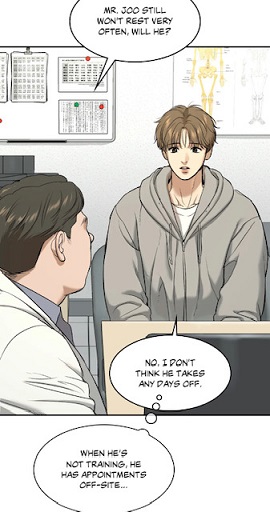 (chapter 27) nor the champion employs the expression “vacation” or “break”.
  (chapter 80) Why? It is because they never experienced a break. We have to envision that the “hamster” must have followed his grandmother, when he was not busy studying or working. Both main leads never experienced a real vacation. They say a day off, as if the day itself didn’t really exist, as if it were a temporary pause between “real” time. In their inherited logic, only work gives time its value; everything else evaporates. The grandmother’s way of loving has turned rest into an absence, something unworthy of being named. However, observe that there’s a gradual change in doc Dan’s vocabulary:
  (chapter 80) The problem is that for the hamster, only the athlete is worthy of getting his rest. It still doesn’t belong to his world.
Shin Okja’s universe contains no category for leisure, play, or shared time; such things produce nothing, and what produces nothing has no value. Even when she worries — “You haven’t eaten?”  (chapter 5) the focus remains mechanical. Eating is fuel; sleep is maintenance. But rest, in the sense of surrender, stillness, or joy, is foreign to her lexicon.
Her self-image as a tireless worker 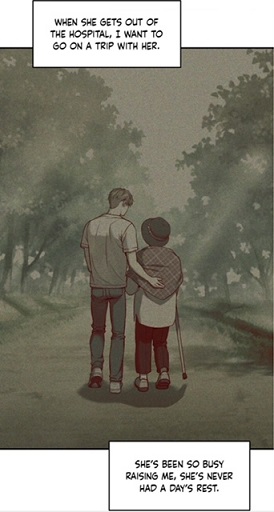 (chapter 47) is, in truth, a legend she wrote about herself. When Kim Dan recalls that “she’s never had a day’s rest,” the statement reveals more about his belief than about her reality. The woman who claimed endless labor also knew the comfort of “weekends”
 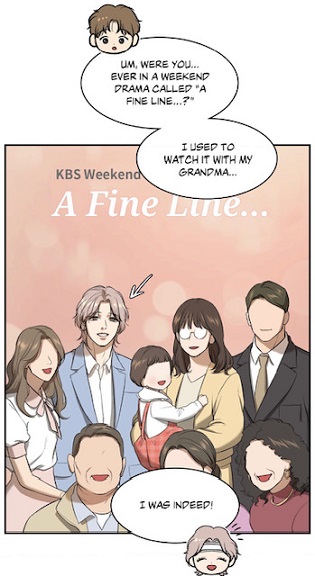 (chapter 30) — she watched The Fine Line, the very drama that made Choi Heesung famous. The detail seems trivial, yet it exposes everything: she had leisure
  (chapter 30), she simply refused to call it that. Watching television was permitted because it was passive, solitary, and could be rationalized as recuperation, not pleasure. In contrast, genuine rest — time shared, chosen, or joyful — never existed in her vocabulary. What she denied was not the existence of rest but the act of resting with him. She kept her downtime to herself, as if peace were a private possession. For her, love meant providing, not accompanying. Yet true care requires presence — sharing is caring, as the saying goes. [For more read this essay: Sharing is caring ] To share one’s time is to acknowledge another person’s worth beyond utility. Shin Okja never did that; she offered comfort but withheld companionship.This is why Kim Dan later struggles to accept that Joo Jaekyung is willing to spend his own time on him — the champion does what the grandmother never did: he makes room for him in his rest. His attempt is to make the main lead smile, to make him happy.
Her statement in chapter 65 —  (chapter 65) displays that she perceives her grandson’s exhaustion not as suffering but as malfunction, as if the human were a device that could be recalibrated through work and pills. That’s why her favors revolves about living conditions, but not about his “happiness”. Perhaps she genuinely hoped that the drugs and the stability of a “regular job” with the champion would realign him, as though routine alone could fix what grief and deprivation had unbalanced.
What she never imagines, however, is that balance might emerge not from regulation but from relationship — not from control, but from the unpredictable rhythm of living. Thus the readers can hear or sense the heart racing of the protagonists.
But let’s return our attention to the grandmother. Because she keeps an account, affection becomes another form of work, and gratitude a form of repayment. She cannot imagine love that simply exists — it must be done. Every gesture had to be accounted for and eventually entered into the invisible ledger of “what I’ve done for you.” For her, a gift was never spontaneous; it was a transactional record. It had to suggest effort without truly requiring it—so she could later recall it as proof of trouble taken. But why is she doing this? Ultimately, Shin Okja’s greatest flaw is not cruelty but distrust. She never truly believes her grandson can stand on his own. She fears that he might take the wrong path. 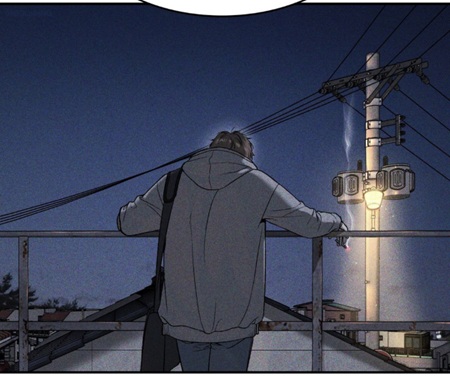 (chapter 65) Her constant bookkeeping—every favor tallied, every gift framed as trouble—betrays a hidden fear: that if she stops keeping score, she will lose him. Rather than grant him autonomy, she entrusts him to another caretaker. Sending him to the champion is not an act of faith but of resignation, a way to offload responsibility while maintaining the illusion of control.
When she “went out of her way,” she made sure the phrase itself became part of the gift. The author let transpire this philosophy in two events. In an earlier memory, the child Kim Dan watches his grandmother return home from the cold night  (chapter 11), scarf tied under her chin, carrying a single sweet bun. She doesn’t need to say she “went out of her way”—her action already proclaims it. The effort is the gift.
  (chapter 11) That simple walk to the store becomes a moral event, proof of affection through fatigue.
 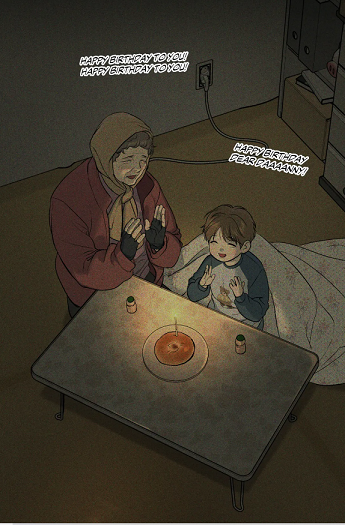 (chapter 11) Even the smallest purchase is framed as sacrifice. The sweet bread itself—a cheap red bean bun—is less nourishment than testimony: “Look what I endured for you.” If he had followed her, he would have seen that it didn’t take so much effort and money to buy the “present”. Finally, he had to share the sweet bread with his grandmother.
This moment sets the pattern for her entire philosophy of giving. Love must be earned through trouble; care must leave a trace of effort. The gesture matters more than the joy it brings. In her world, affection is always accompanied by labor, and gratitude becomes indistinguishable from guilt.This pattern repeats across her life. To “go out of one’s way” (chapter 80) becomes both proof of care and a claim for repayment. Hence she went to school or university for the ceremonies. However, such an action stands for social tradition and normality. She gives little, but ensures it feels heavy. Each offering, no matter how modest, is wrapped in the language of fatigue and obligation. The child, in turn, learns that to be loved is to feel guilty, and to receive is to incur debt.
The hoodie later inherits this same emotional script. It’s the adult version of the birthday bun: humble, practical, and accompanied by invisible conditions. Both are gifts that measure sacrifice, not joy. When she says she “went through so much” to raise him, she isn’t lying—she is testifying, recording her hardship in fabric and flour. However, pay attention to the picture from the hamster’s memory: (chapter 47) Where is the gray hoodie? That day, he only received a bouquet of flowers. Its absence in the photo is revealing. A gray hoodie would have looked out of place beside formal suits and robes; it would have exposed her thrift. The omission is both aesthetic and psychological: she hides the evidence of small-minded practicality beneath the spectacle of maternal pride. What was invisible at the ceremony later re-emerges in episode 80 (chapter 80), and with it, the emotional economy she built.
It is not far-fetched to imagine that the hoodie came paired with a favor or transaction 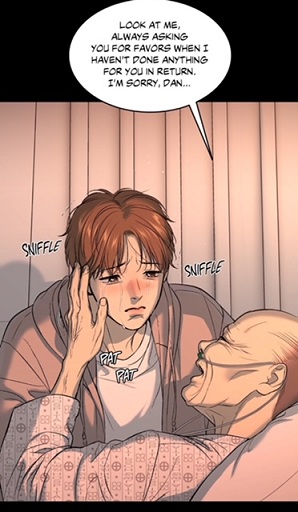 (chapter 53) —perhaps the signing of the loan. “You’re a doctor now; you’ll pay it off quickly.”
  (chapter 80) In her eyes, generosity always justified expectation. The flowers were for display; the hoodie was the contract.
That’s why her gifts always come from the same palette: dull, neutral, gray. Even the birthday sequence is bathed in that dim, ochre light where warmth looks like exhaustion. The gray hoodie continues this chromatic philosophy—safety without brightness, affection without ease.
This explains why the hoodie feels less like a present and more like a receipt. At the same time, it denies him “adulthood” too. A sweater, not a suit; warmth, not celebration. Its comfort masked her emotional distance and her disinterest in his career. She gave him something to wear at home—a garment of rest that forbids real rest—because her world allowed no leisure without guilt.
Her sense of time mirrored that logic. She lived oriented toward the past  (chapter 65) and the future (chapter 78), rarely the present. Hence she shows no real joy about their visit before their departure. Life for her was a chain of recollections and predictions: what she had done
  (chapter 65), what he would one day repay
  (chapter 47). The present moment existed only as a bridge between past sacrifice and future obligation. The embrace is conditional — a rehearsal for independence, not tenderness. In that instant, love is already an investment waiting for return. The teddy bear pressed between them, once a symbol of innocence and comfort, becomes collateral in this emotional economy: the pledge that he will someday “grow up,” earn, and pay back the care that raised him. Even at the graduation, she treated the day not as fulfillment but as record keeping. (chapter 47) The bouquet of flowers visible in the picture served as public proof of pride, while the hoodie—cheap, colorless, and private—belonged to the closed economy of obligation.
The scarf later mirrors this same logic, but in reverse.  (chapter 41) When Dan gifts his grandmother an expensive scarf, he hides its true price — “I got it for a bargain” — repeating her own pattern of disguised generosity. She sees through the lie, teasing him for “spoiling” her, yet she accepts the luxury without feeling guilty. The scarf becomes her version of the hoodie: a fabric trophy of moral worth. But its later disappearance is revealing. In season two, she wears it
  (chapter 56) shortly after her arrival at the hospice, never again. When she greets Joo Jaekyung, the scarf is gone
  (chapter 61). Why? One might reply that the scarf lost its value, especially since she is living next to the director’s room. I doubt that such men would pay attention to such an object. Another possibility is that she fears its brightness might betray her neglect, for the champion has lived with her grandson for a while. How could she display silk while her grandson owns almost nothing?
 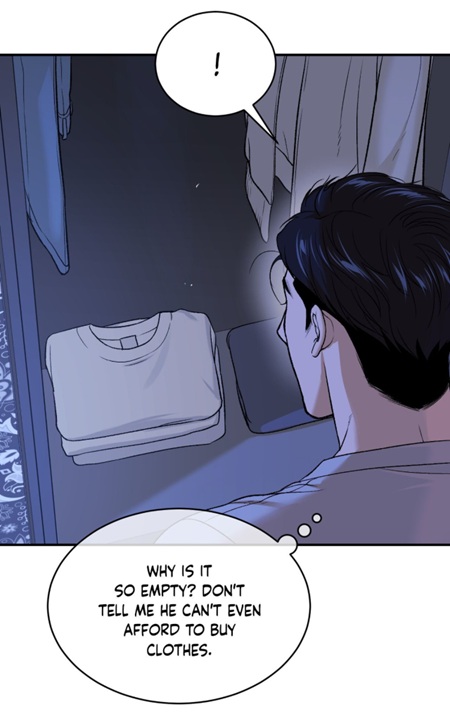 (chapter 80) The missing scarf thus exposes both her superficiality and exaggerated generosity. Her affection, like her pride, is short-lived — decorative rather than enduring. Should Heesung ever visit her, (chapter 30) one can easily imagine the scarf’s reappearance: the fabric of self-deception, ready to flatter, to perform, to erase guilt under the sheen of respectability. She already acted like a fan girl in front of the celebrity. (chapter 61)
The pattern of her giving finds its quiet conclusion in episode 80. When Kim Dan rediscovers the hoodie, his first smile fades into silence.  (chapter 80) The gesture that once symbolized love now feels like pain and loss. The signification of the gift has changed. What once wrapped him in safety now weighs like absence — the fabric retains the shape of someone who is about to vanish. His silence is not understanding but hurt, a wordless awareness that affection can curdle into memory. The audience, not the character, perceives that with the grandmother’s approaching death, her ledger is about to close. The gray fabric, once proof of her sacrifice, will lose its moral weight; her “gesture” will expire with her. Yet Kim Dan may not yet realize that this very ending could one day free him. The book-keeping dies with the bookkeeper.
This moment also reveals why he remains wary of other people’s gifts. 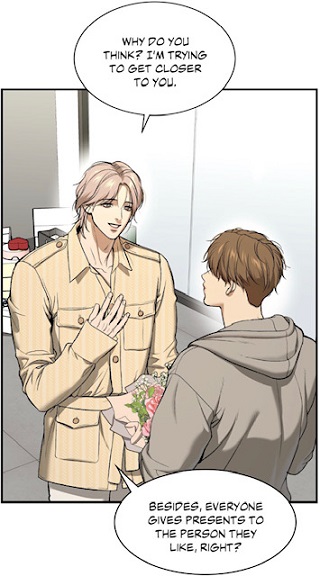 (chapter 31) When Heesung offers flowers “to get closer,” Kim Dan’s face mirrors the same unease: affection presented as transaction, intimacy disguised as generosity. What the actor calls closeness, the doctor feels as imbalance — the same emotional distance that Shin Okja’s presents once produced. Her gifts, meant to bind, isolated him instead; they built a hierarchy where gratitude replaced equality. Each present widened the gap between giver and receiver. To be cared for was to be indebted.
From this upbringing stems Kim Dan’s reflexive equation:
Presents = trouble, debt, or burden.
Each time someone offers him something, he instinctively feels burdens  (chapter 31) and tries to refuse it.
  (chapter 31) (chapter 80) “You don’t have to go through all this trouble.” The line is not modesty but defense. To him, receiving kindness creates imbalance. His grandmother’s “help” was always instrumental; every act of support came attached to sacrifice: “I went through so much for you.” The hoodie thus becomes a moral anchor, a fabric reminder that love must always be earned and repaid.
Guilt as Love Language.
Because of this, Kim Dan experiences love only through fatigue and suffering. He feels cared for when someone worries  (chapter 67), loses sleep, or pays a price. He interprets Joo Jaekyung’s concern as “trouble,” Heesung’s gifts as “too much.” In his mind, affection is inseparable from cost:
If you love me, you must pay for it. And if I accept your love, I’m guilty.
Caretaker Identity and Self-Erasure
To escape that guilt, he lives as a helper. 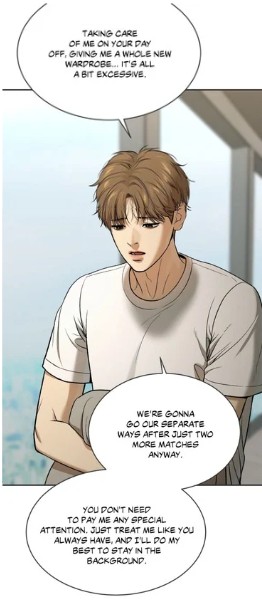 (chapter 80) “I’ll stay in the background.” His self-worth depends on not burdening others. His words let transpire that he has never been Shin Okja’s first priority in the end. The hoodie reinforces that psychology—it is not a professional outfit like a suit or briefcase would have been, but a teenager’s garment, meant for the domestic space rather than the adult world. It literally arrests his growth, keeping him in the house and under her logic. Thus it is not surprising that after receiving his diploma, he still took part-time jobs.
Gifts as Triggers of Anxiety
When others try to give him something—Heesung’s flowers, Jaekyung’s wardrobe—his first instinct is panic. “What do I do? It’s all so expensive.” He expects a hidden price: affection, submission, repayment. Every gesture of generosity recalls the old bargain with his grandmother.
Repetition Compulsion
He repeats the same dynamic with new authority figures. With Heesung, he suspects every gift hides control. With Joo Jaekyung, he accepts care only to reduce someone else’s burden. When the champion lies—“These brands sent the wrong size; I was going to throw them out anyway”—Kim Dan hears not kindness but necessity. Refusing would mean waste, and he has long internalized that nothing must ever be wasted. So he accepts—not out of entitlement, but as an act of thrift, a way to help the giver by taking what is “useless.”
And yet, through this misreading, something begins to shift. The logic of guilt quietly bends toward mutual release. Jaekyung sheds excess; Dan sheds shame. The exchange of clothes becomes an exchange of burdens.
Gray: The Color of Suspension.
The hoodie’s color captures the entire tragedy of their old world. Gray is neither black nor white—it refuses decision, blending work and rest, love and obligation. It is the color of compromise, of deferred joy, of life half-lived. Gray also carries another meaning beyond monotony. It fuses black and white — two opposites that, when mixed, erase each other’s clarity. The hoodie’s color therefore reflects the fused identity of grandmother and grandson: their lives blended until he became her shadow. Her pride shone only through his dimness. To live in gray meant to live as her reflection — never as himself. The color embodies both her dominance and his self-erasure. When Kim Dan finds it again in episode 80, his first smile fades into silence. (chapter 80) The object that once expressed care and promised safety now mirrors grief. The gray fabric absorbs the light around him, turning into the shade of everything unspoken between love and duty.
The hoodie, once a symbol of endurance, now becomes a relic of a world where love meant survival. To wear it again would be to stay in that twilight. To put it away is to risk color, to learn to live in the present tense.
The Wardrobe: Undoing the Gray Religion
If the gray hoodie was the relic of Shin Okja’s work-based faith, Joo Jaekyung’s wardrobe 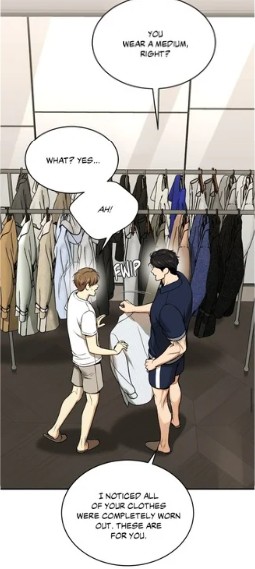 (chapter 80) is the site of its quiet destruction. His act of giving reverses every law the grandmother ever taught. First, he does not “go out of his way.” The clothes are delivered effortlessly, without fanfare or moral accounting.
 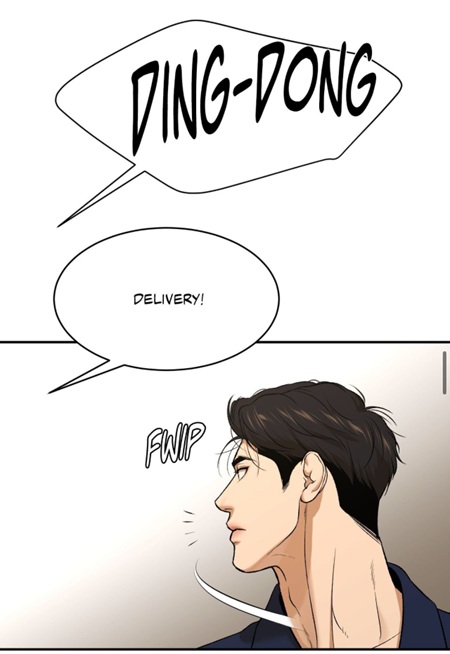 (chapter 80) There is no speech about sacrifice, no self-congratulation.
  (chapter 80) By erasing the gesture of “effort,” he removes the emotional price tag that once accompanied every gift.
Second, he tells a deliberate lie: that he did not spend a dime, that the brands sent the wrong sizes. This white lie has healing power. It dismantles the logic of debt that rules Kim Dan’s psyche.  (chapter 80) If the grandmother’s motto was “I went through so much for you,” the champion’s is “It’s no big deal.” Generosity becomes invisible, unburdened, and therefore trustworthy.
Third, he offers not one item but an entire range.  (chapter 80) The row of garments invites choice — a concept absent from Shin Okja’s universe, where love came in single doses and with strings attached. Here, the doctor is asked to select what he likes, to exercise taste, to inhabit preference. The abundance of options grants him agency, dignity, and the right to refuse.
Fourth, note the nature of the clothes: they are not sportswear. (chapter 80) These are professional garments — coats, shirts, and slacks suitable for the workplace, not the gym. They restore the image his grandmother’s hoodie had erased. In offering these, Joo Jaekyung is not only dressing him but reframing his social identity: from dependent to equal, from housebound caretaker to visible professional. This means that they are bringing him into the adult world. Yet this also creates a paradox — wearing such refined clothes will attract attention, making it impossible for Kim Dan to “stay in the background.” (chapter 80) They will incite him to voice more his thoughts, to become stronger as a responsible physical therapist. The wardrobe, like a mirror, forces him into presence. This means that he is losing his identity as “ghost”, which was how the halmoni was perceived by the athlete. 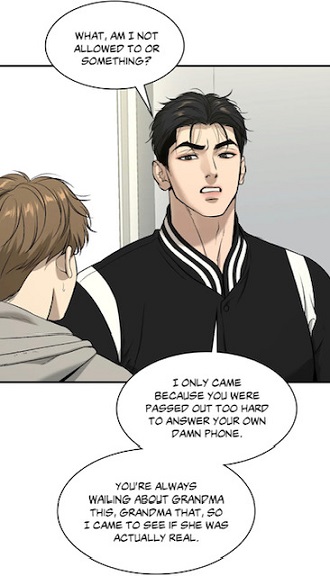 (chapter 22)
Symbolically, the location intensifies the gesture: the clothes are placed inside the champion’s own wardrobe. (chapter 80) The two now share a domestic and symbolic space. What once separated their worlds — fame, class, gendered roles — begins to dissolve thread by thread. The actor Choi Heesung’s remark, that gifts can “bring people closer,” 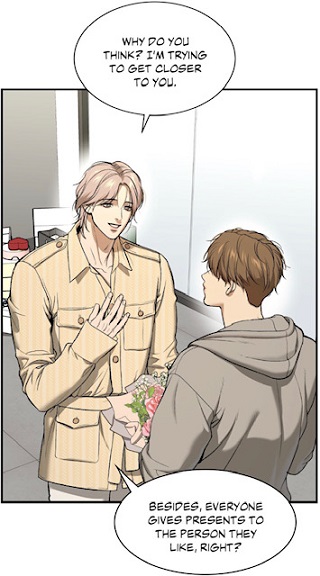 (chapter 30) becomes unexpectedly true here. The wardrobe bridges the distance that the grandmother’s gifts had always created.
When the champion remarks, (chapter 80) he implies that these items would just go to waste. Therefore he completes the reversal. Waste, once the grandmother’s greatest fear, becomes the vehicle of grace. By claiming the clothes are “leftovers,” he removes their monetary and moral value; they are no longer costly. In accepting them, Kim Dan does not incur debt — he prevents waste. 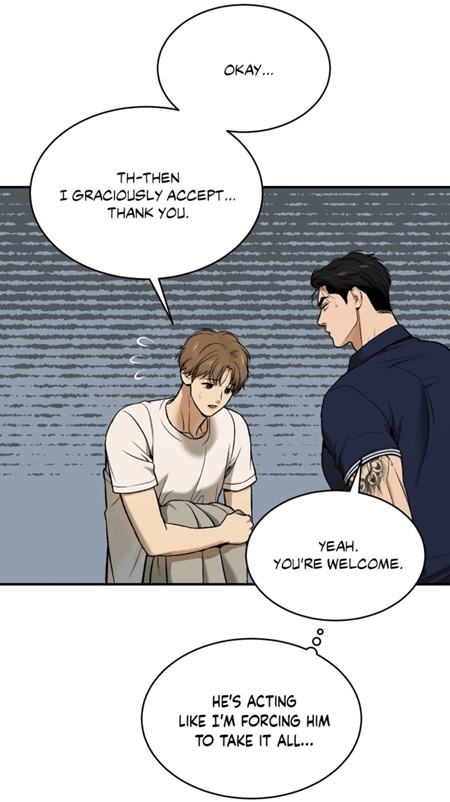 (chapter 80) This is why his hesitant and embarrassed gratitude, framed against a background of dissolving gray waves, feels so transformative. The air behind him ripples as if washing away the residue of his old faith.
The striped blue-and-white shirt he finally chooses carries its own quiet symbolism. (chapter 80) Yet unlike gray — the color of fusion and loss of identity — these shades remain distinct. They do not blend but alternate, acknowledging the coexistence of two identities: the doctor and the man, the caregiver and the self. In contrast to the grandmother’s world, where love meant absorption and sameness, Joo Jaekyung’s gesture affirms difference. The champion does not swallow him; he gives him space.
At the same time, the stripes hint at the complexity of Kim Dan’s inner life. Beneath his apparent passivity lies rhythm, variation, and resilience — qualities long suppressed by duty and guilt. The pattern becomes a visual metaphor for the layered texture of his heart.
By filling the wardrobe with clothes of different colors, the champion quite literally brings light and time back into Kim Dan’s life. The new hues break the monotony of gray 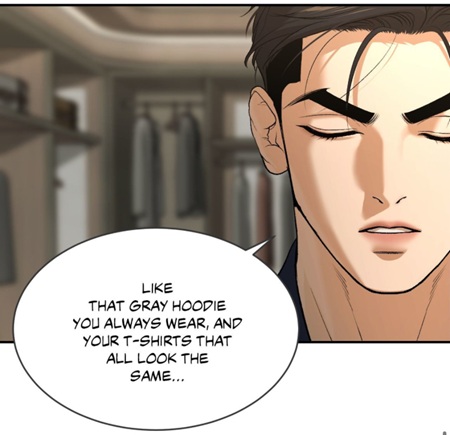 (chapter 80); they mark the passing of days, the return of seasons, the rediscovery that not every morning has to look the same. Variety itself becomes a form of freedom. When the wolf once complained that all his shirts looked identical, he was unknowingly naming what both of them lacked: differentiation, spontaneity, change. Through this act, he restores color not only to the doctor’s wardrobe but to his emotional world — a quiet resurrection through fabric.
Finally, the celebrity’s next gesture — teaching him how to swim — extends this transformation. If the grandmother’s graduation gift (the hoodie) kept him grounded and homebound, neglecting his future and career, the champion’s “lesson” propels him toward movement and autonomy. (chapter 80) Swimming means survival without the shore; it is the art of staying afloat without a hand to hold. In this sense, Joo Jaekyung’s care points forward, not backward. He offers not protection but potential, not memory but future.
The wardrobe, then, is not a storage space but a threshold — between debt and desire, between inherited caution and chosen freedom. And now, you comprehend why the doctor chose to seek refuge and support, when he feared to sink.  (chapter 80) The “hamster” had instinctively turned to the only person who had ever offered him help without cost.
In reaching for the champion, he does not regress into dependence; he reaches toward a new form of trust, one that no longer confuses care with control. To let himself be held is not to return to childhood, but to unlearn fear. The act of seeking support becomes the first stroke of a new swimmer — hesitant, but free.
This scene also recalls the image of the Korean dragon and its yeouiju  — the luminous, wish-granting jewel said to contain both wisdom and life energy. The dragon’s power is not innate; it is completed and elevated by the jewel. Without the yeouiju, it cannot ascend to the heavens — strength without meaning, force without direction.
When Kim Dan finally pulls Joo Jaekyung into his arms  (chapter 80), the myth reverses. The dragon—once feared, untouchable, wrapped in rage and solitude—is suddenly embraced by the very being he once believed too fragile for his world. The power dynamic inverts: the human shelters the beast.
In that gesture, the legend of the Korean dragon and its yeouiju gains a new form. The jewel is no longer an external object of desire, but a state of being—mutual recognition. By holding the dragon, Kim Dan becomes the hand that completes the circle, allowing power to flow again. The yeouiju exists between them, not in either of them: it is the bond itself.
For the champion, who has long carried the invisible scar of disgust—  (chapter 75) —this embrace is nothing short of salvation. The man who once fought to wash off shame through endless training now finds himself accepted in his unguarded state. He doesn’t need to mask his trauma with perfume
  (chapter 75), the imagined smell, or cleanse his skin of battle; he is held and, therefore, purified. Through Dan’s arms, he rediscovers his value and humanity—the dragon touched and not destroyed. He is worth of being embraced, even if he is already so old!
This reversal has immense symbolic power. The yeouiju is no longer something the dragon must seize; it is something that recognizes him back. (chapter 80) When Kim Dan holds him, the light of that jewel shines from within the dragon himself. Power and tenderness, once enemies, coexist in the same body.
For Kim Dan, this act also signals a new allegiance. He is no longer in service of duty or debt—no longer the caretaker bound to an old creed of sacrifice. By choosing to embrace Joo Jaekyung, he chooses his friend, not his “master.” He decides who is worthy of his trust, and in doing so, reclaims his agency.
The dragon, embraced rather than worshiped, rises stronger. The yeouiju—the bond, the shared heartbeat—no longer lies at the peak of a mythic mountain but glows quietly between two exhausted men who have stopped running from touch.
The gray world — the realm of thrift, debt, and book-keeping — dissolves into color and movement. Blue and white ripple through the water, reflecting not fusion but harmony. For the first time, love does not demand payment; it breathes.
Arc 8 – The point of no return
The shape of the 8 itself evokes both the infinity loop and the closed circuit: two halves endlessly reflecting each other, each incomplete without the other’s motion. It is the symbol of reciprocity, but also of a threshold — the moment when balance can no longer be postponed. Once complete, the loop allows no intrusion — it admits no third. The number’s symmetry carries both union and exclusion: whatever falls outside its rhythm disappears.
This is the geometry of Jinx’s emotional world in Arc 8. The loop that once included a third observer — the grandmother’s watchful eye, the manager’s interference, the actor’s rivalry and resent — now folds inward, leaving no aperture for control. The form itself performs the story’s evolution: dependency becomes reciprocity; triangulation dissolves into dual motion. And now, you comprehend why Mingwa included a new outburst of the wolf’s jealousy. 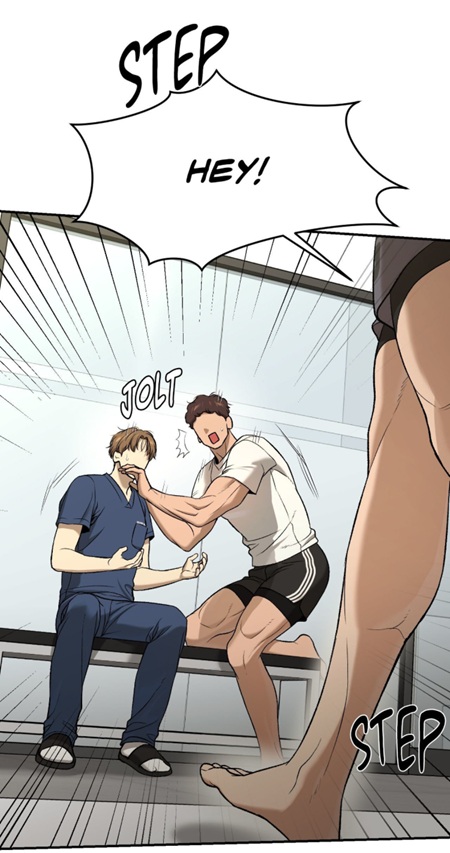 (chapter 79) This is one part of the new circle. Jealousy is the residue of imbalance — the echo of the 7 within the 8. In the numerology of Jinx, the 7-chapters, like for example episode 7
  (chapter 7), episode 18, where the champion had sex because of this statement
  (chapter 18),episode 34 with Choi Heesung
  (chapter 34) or episode 52, where the former members of Team Black and expressed their disdain and jealousy toward the main lead
 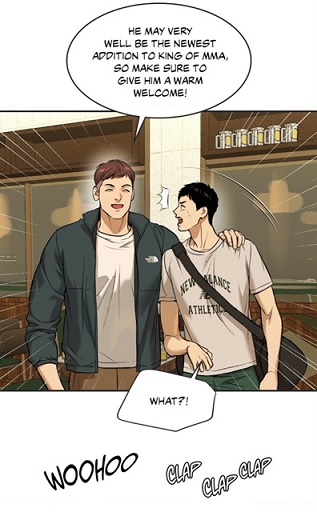 (chapter 52)
But Arc 8 changes the equation. For the first time, both protagonists risk loss because they have something — and someone — to lose. The return of jealousy is therefore not regression but proof of attachment and the occasion to improve their personality  (chapter 79), the final test before the circle closes for good.
Eight is the reversal digit, where hidden motives come to light and attachments are tested. Between 7 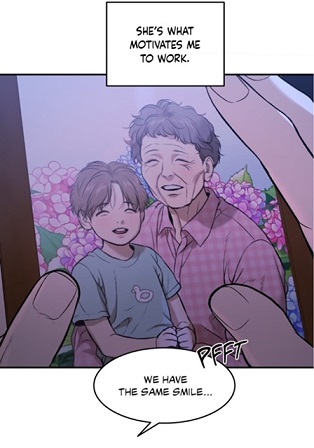 (chapter 47) and 8 lies that invisible hinge: the death of the old economy of love and the birth of a new one.
Thus, Arc 8 becomes the arena of triangular pressure. The grandmother’s possessive nostalgia (she sees herself as the mother, doc Dan as the boy and the champion as her surrogate husband) (chapter 78) mirrors Park Namwook’s managerial anxiety 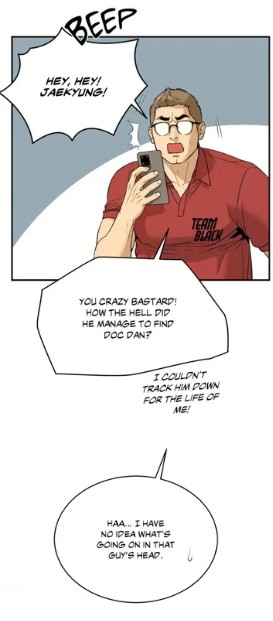 (chapter 61) and Heesung’s residual rivalry and resent. Each acts as a different face of control: the woman binds through guilt, the manager through hierarchy acting as the owner of the athlete’s time, the actor through charm and deceptions. Together they form the triad that tries to reopen the circle closed in the pool. Let’s not forget that the athlete chose to take a day off on his own accord
  (chapter 80), but he had just returned to the gym. It is no longer the same training and routine.
Park Namwook in particular represents the system that resists intimacy. His “interference” is not random but defensive: he fears that Jaekyung’s change and his attachment to the physical therapist (the promise to teach the doctor to swim implies that he will focus on other things than MMA) will unbalance the professional order. In the symbolic arithmetic of the story, he inherits the number 7 — the unstable, the one who can no longer maintain symmetry.
Jealousy, then, becomes not corruption but purification. It exposes what still belongs to duty and what belongs to choice. Through these frictions, Kim Dan is compelled to speak for himself, to claim the very agency his grandmother once withheld. It makes the protagonists to perceive people in a different light and move away from their self-loathing, passivity and silence.
When he does, the circle of the 8 stabilizes at last. The old triangle — grandmother, doctor, and debt — gives way to the new one: champion, doctor, and trust. In the Arc 8, the color gray finally meets its antidote: blue. 💙What was once the hue of exhaustion and suspended time becomes the pulse of renewal. The blue heart 💙, which first appeared in my earlier essay At the Crossroad, returns here as the emotional compass of both men.
In Jinx, the white heart with the gray hoodie belongs to the past — to the grandmother’s logic of duty, guilt, and caution. Blue, by contrast, is the color of water, movement, and breath. It signals the capacity to feel without measuring, to give without debt. When Kim Dan accepts the new clothes, he does not merely change garments; he crosses from the gray zone of survival into the blue realm of relation. His heart, long muted by obligation, begins to circulate again.
The blue heart marks this point of no return: once it beats, neither man can retreat into solitude. Its rhythm unites the wolf and the hamster in a shared tempo — one that excludes the third, but not the world. For the first time, affection no longer obeys the law of bookkeeping. It flows.
The ocean, once feared and distant, now extends inward, beating quietly beneath their joined silhouettes. The gray relic of the past lies folded away, and in its place, something transparent begins: a friendship that breathes like water — uncounted, unowned, and alive.
Feel free to comment. If you have any suggestion for topics or Manhwa, feel free to ask. If you enjoyed reading it, retweet it or push the button like. My Reddit-Instagram-Twitter-Tumblr account is: @bebebisous33. Thanks for reading and for the support, particularly, I would like to thank all the new followers and people recommending my blog.

 Bebebisous33s' analyses in K-Dramaland and Manhwas