
Please support the authors by reading Manhwas on the official websites. This is where you can read the Manhwa: Jinx But be aware that the Manhwa is a mature Yaoi, which means, it is about homosexuality with explicit scenes. Here is the link of the table of contents about Jinx. Here is the link where you can find the table of contents of analyzed Manhwas. Here are the links, if you are interested in the first work from Mingwa, BJ Alex, and the 2 previous essays about Jinx The Scent Behind The Jinx and Breathless in the Light – part 1
It would be great if you could make some donations/sponsoring: Ko-fi.com/bebebisous33 That way, you can support me with “coffee” so that I have the energy to keep examining Manhwas. Besides, I need to cover up the expenses for this blog.
Since today, a new chapter will be released, this second part can not be long. Yet, I wanted to share my latest observations before the publication of chapter 83.
In the first part, I focused on the origins of the champion’s breathlessness and its cure: the amusement park. However, the air was not the only important element in episode 82. Let’s take another look at this image:  (chapter 81) The plane soars not only above the Alps, but also above a vast river (probably the Rhône)— two landscapes that silently echo the dual composition of breath itself. Breath is made of air and water: oxygen and vapor, wind and moisture.
  (chapter 82) In that sense, the clouds surrounding the aircraft are not mere weather; they are the perfect union of the two elements that sustain life.
Joo Jaekyung’s breathlessness, then, is not simply a physiological lack of oxygen — it is the absence of water, the missing element of tenderness and flow. The champion has spent his life breathing air devoid of moisture, surviving on discipline, pride, and control — a dry atmosphere where emotion cannot condense. 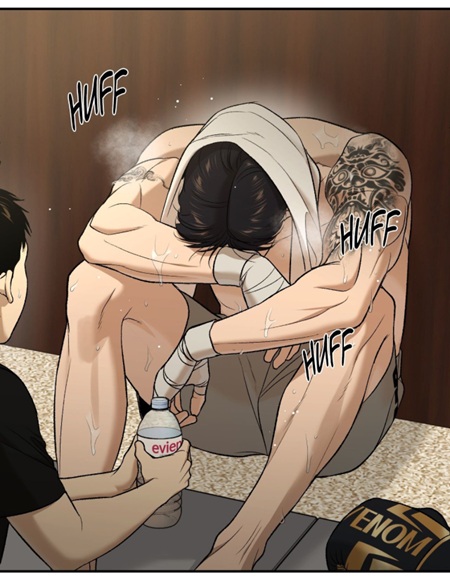 (chapter 82) That’s why, when Potato offers him a bottle of Evian, he doesn’t even look. He doesn’t need the water from the mountain and as such the world; he needs the water of the body — the intimacy, the shared moisture that reconnects him to life itself. What he truly longs for is Kim Dan’s saliva, the living trace of water transformed into affection, into care, into exchange.
 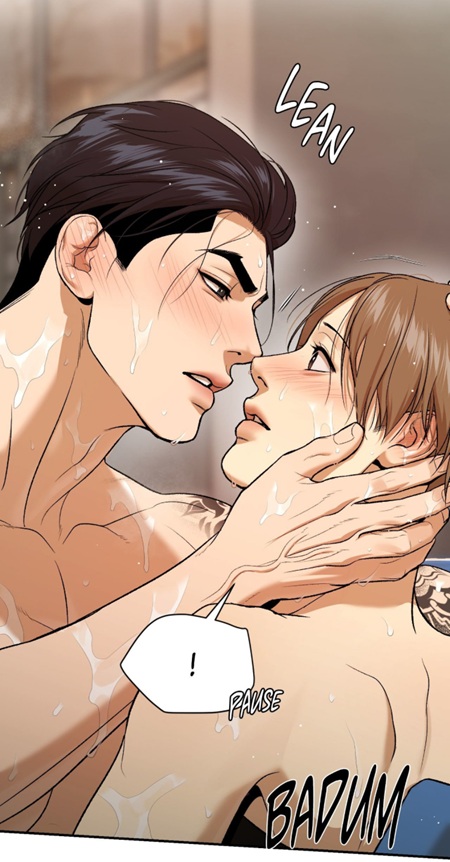 (chapter 81) He is longing for his lips and as such a kiss.
Only through that bodily element — through the return of water inside air — can he breathe again fully. Dan’s body literally rehydrates him. The vapor that once escaped his lungs returns as mist, as breath shared between two beings. At the same time, it teaches him how to breathe properly, the reverse of this scene in the locker room. 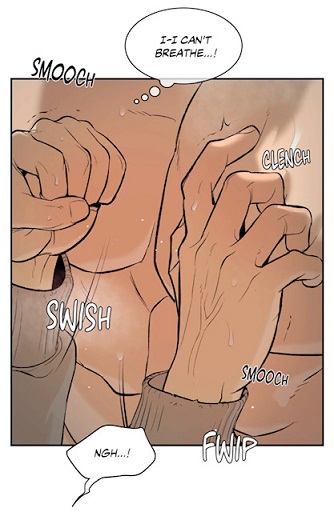 (chapter 15)
And this elemental union anticipates the next landscape: the amusement park, where the air is filled with laughter, humidity, and movement. 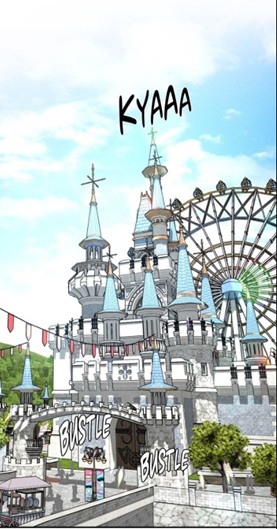 (chapter 82) Many attractions — the Ferris wheel, the fountain rides, the water park zones — combine air and water, height and spray, just like breath itself. And now, you understand why the champion got wounded with the spray
  (chapter 49) It corresponds to the negative version of the “breath”.
Another possibility is that they first share the same drink or the same ice cream 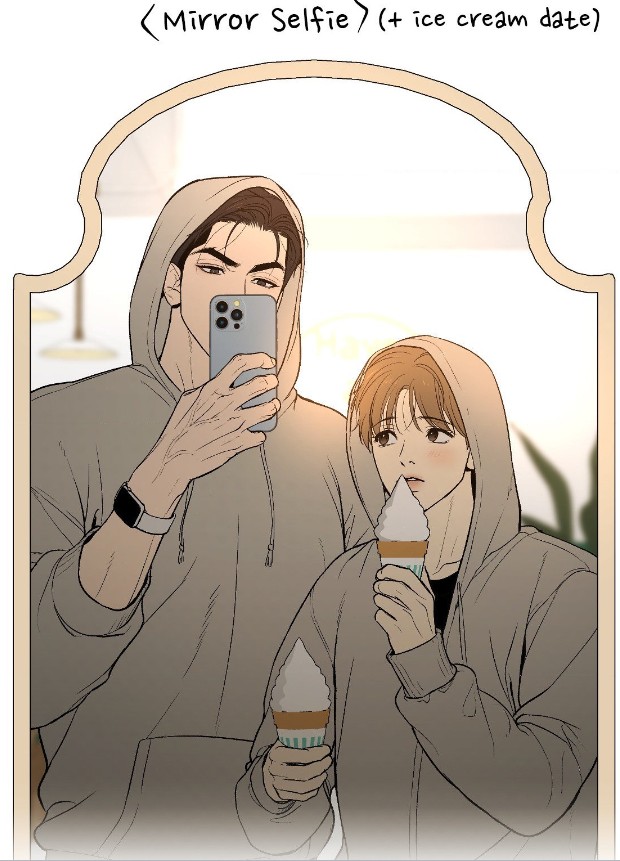 (epilogue), because doc Dan wants to ensure that the drink or the ice cream is okay.
 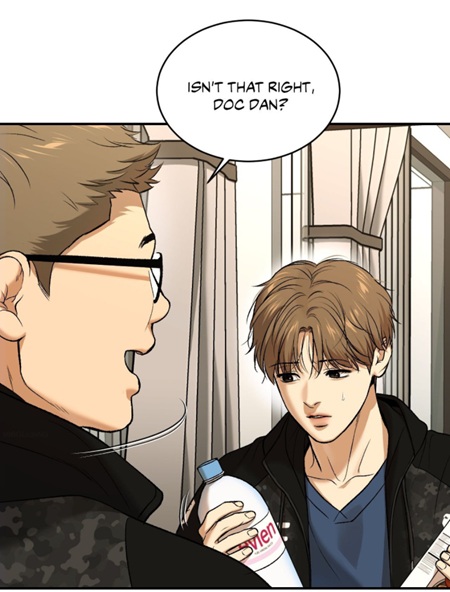 (chapter 82) When Jaekyung and Dan enter the funfair, they’re not simply having fun; they’re reliving the chemistry of respiration and affection — the inhalation of joy, the exhalation of fear, the splash of renewal. The park becomes an externalized lung, a circular world of rides where water and air, play and life, are finally reconciled.
The Castle as Fairy-Tale Threshold
In the amusement park, the castle (chapter 82) stands as a replica of every child’s first dream: a place where danger ends, where curses lift, where the beast becomes human. In this new setting, the ring is replaced by an amusement park — a space where joy is no longer born from suffering. 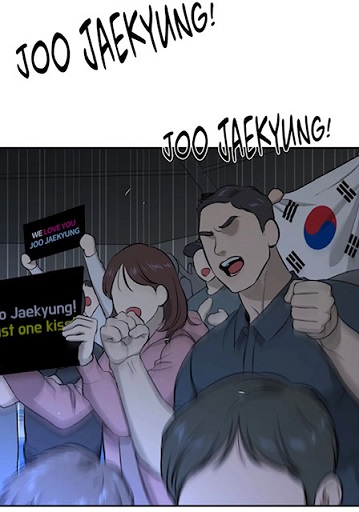 (chapter 15) The arena that once fed on pain, blood, and hierarchy gives way to a landscape of shared laughter, circular motion, and renewal. Here, entertainment is not built upon the exhaustion of bodies but upon their liberation. The crowd no longer watches to see who will fall; they rise and descend together.
 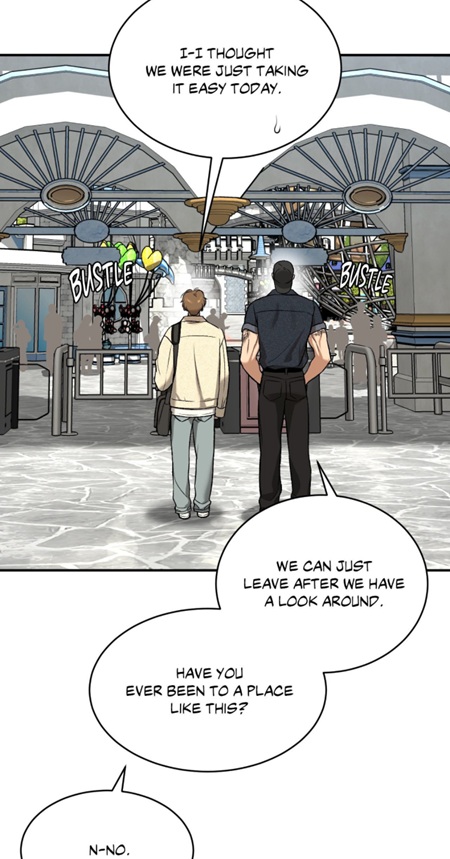 (chapter 82) People are more focused on their own emotions and experiences.
For Joo Jaekyung, this shift marks a fundamental redefinition of performance itself. The fighter who once turned agony into spectacle now experiences movement as play. The wolf who fought to survive in the ring learns to live among rides, fountains, and lights — spaces where the body moves not to conquer, but to feel.
Thus, the amusement park becomes his anti-ring — a sanctuary of reciprocity, where elevation and descent belong to everyone, and no one bleeds to entertain the rest. For Joo Jaekyung, who has spent his life trapped in the cycle of competition and rage, walking into that space with Kim Dan is an act of symbolic initiation. He brings the doctor — his witness and healer — into a world he has always avoided: fantasy, gentleness, illusion.
The wolf who once prowled in underground gyms now enters a castle built for children, and in doing so he accepts the possibility of becoming a fairy-tale prince — not by winning, but by transforming.
Why the “First Kiss” Matters Here
A fairy tale’s turning point is always the kiss — the moment when the spell breaks. And you might recall that I came to associate Kim Dan with Sleeping Beauty and in the illustration of that analysis, I 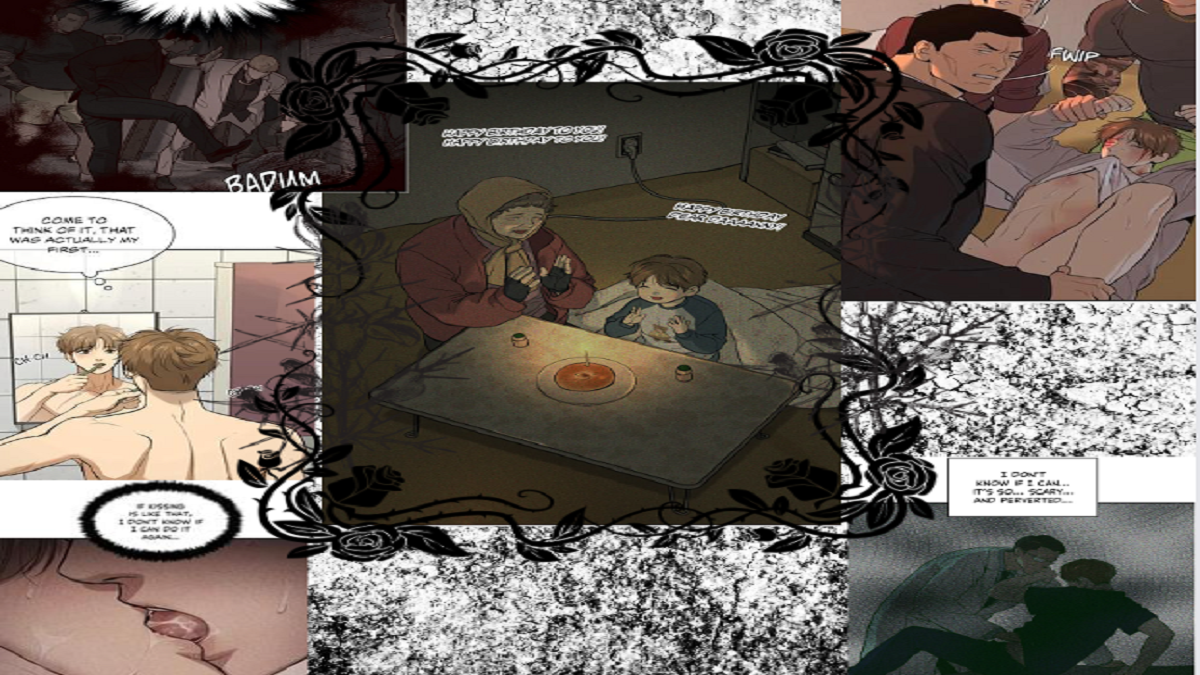 I placed the doctor’s birthday. And that’s how I remembered here the boy’s huge smile and joy.
 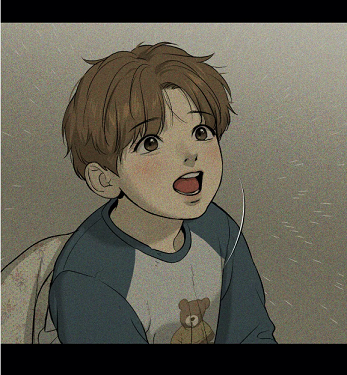 (chapter 11) And now, pay attention to the number of the next episode: 83! The two numbers combined together make 11! As you can see, the amusement park is the most natural setting for a smile and kiss. Joo Jaekyung could even speak about his first kiss, an intimate secret that even Kim Dan doesn’t know. Confessing it there would align his personal myth with the fairy-tale architecture around him. This would make doc Dan realize that he is special contrary to the green-haired ex-lover.
  (chapter 42). But there’s more to it. In episode 81, Doc Dan rejects the champion’s advance — he turns his head away
 (chapter 81) letting the lips slip past him like water. Yet, in the very same scene, he allows a kiss on the neck, a place where breath, warmth, and pulse converge.
  (chapter 81) He never pushes him back. The doctor resists with the face — with speech, with identity — but not with the body. (chapter 81) And so, at the end, the athlete moves upward, trying to reach the mouth, trying to taste what remains forbidden. But he fails.
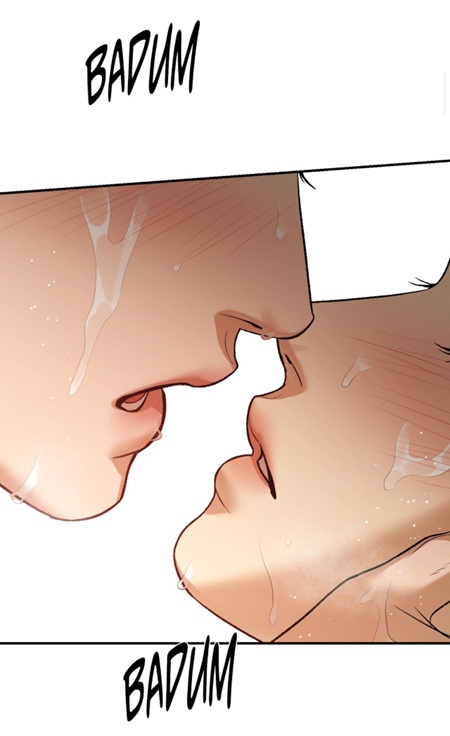 (chapter 81) Why? Because the lips are not mere flesh; for Doc Dan, they are the visible border between desire and love. Jinx-lovers will remember his quiet request in the locker room (chapter 15): he links the lips to the heart — and through it, to the notion of consent.
  (chapter 15) To kiss him there is to ask for entry not into his body, but into his feeling.
That is why the scene at the pool stops at the threshold. The champion can touch his skin, but not yet his soul. 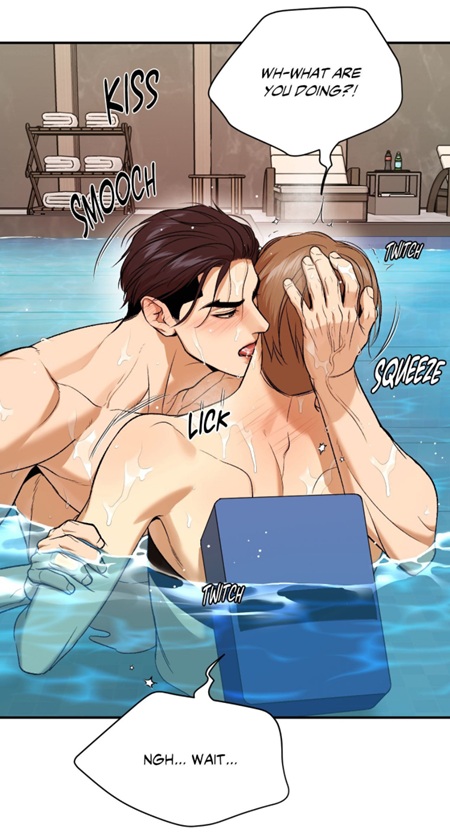 (chapter 81) The water envelops them both — fluid, intimate — yet the final element is still missing: agreement, the meeting of air and will. Until Jaekyung learns to ask, to replace taking with invitation, the kiss will remain suspended, like a breath held underwater, waiting to surface into love. And now, you comprehend why he couldn’t achieve his goal in the swimming pool. It was, as if he was trying to recreate the situation in season 1. In other words, I deduce that there will be a confession before a kiss happens!!
From Wolf To Prince
A Jinx-lover noticed the similarities between this scene  (chapter 17) and the one in front of the amusement park:
  (chapter 82) The two scenes mirror each other like opposite poles of Joo Jaekyung’s evolution. In both, he is dressed in black — a color that once signified anonymity and danger, but later becomes the mark of calm confidence.
In episode 17, the champion hides behind darkness. The cap pulled low conceals his eyes, his face is half-shadowed, and his clothes absorb light rather than reflect it.  (chapter 17) When he intervenes to save Kim Dan from the loan sharks, he is first mistaken for one of them — a predator among predators. The irony is sharp: the man who comes to rescue looks indistinguishable from those who harm. The fighters’ world has taught him that power and fame must be hidden; he was encouraged to hide, as if the fans would attack him. He chose anonymity, unaware that this would not only isolate him but also make him appear as a thug. And don’t forget how the manager called him initially:
  (chapter 75) He is a monster. It was, as if the manager wanted to hide the “wolf” from people out of fear that he might attack people randomly. But the problem is that by dressing like that, he was no different from Heo Manwook. Therefore his heroism passes unnoticed, interpreted as violence and intrusion.
  (chapter 18) Like Batman, he moves in secrecy, protecting without ever being thanked. The outfit explains why his good deed leaves no trace of gratitude — the savior looks like the aggressor.
By episode 82, the transformation is complete. 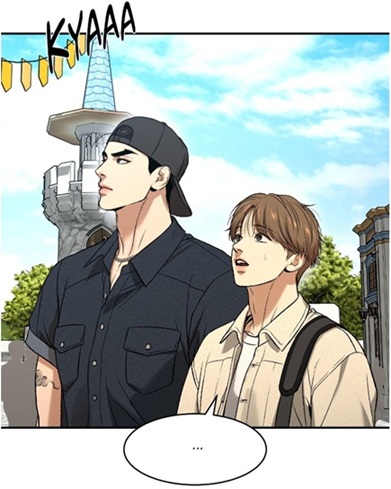 (chapter 82) He still wears black, but the darkness no longer hides him. The cap now sits higher, revealing his eyes and mouth — the organs of emotion and speech. A necklace gleams at his throat, a quiet emblem of openness. He walks beside Kim Dan in daylight, not to fight but to share joy. The man who once lurked in alleys now stands beneath the sky of the amusement park, where black absorbs light rather than extinguishes it.
The contrast encapsulates the metamorphosis of the wolf into a prince. And how did Heo Manwook call him? 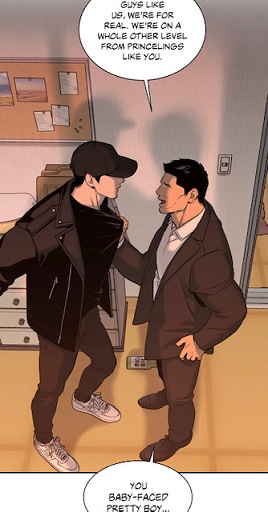 (chapter 17) A princeling! He was mocking him, because he knew that the fights were actually rigged. That’s why he called him fake.
 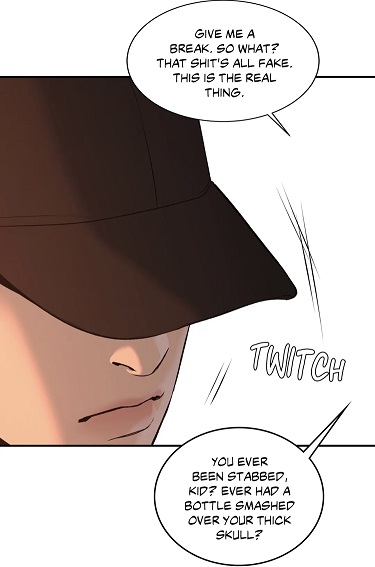 (chapter 17) This new connection reinforces my theory that the schemers are anticipating the Emperor’s demise.
 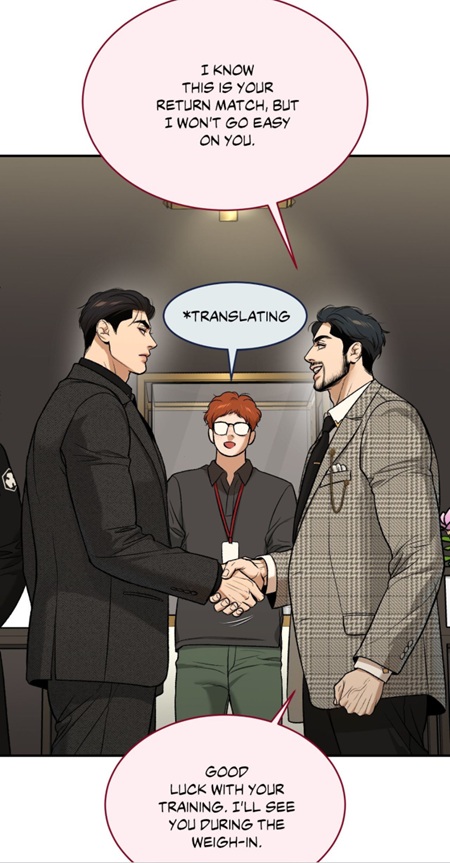 (chapter 82) Thus Arnaud Gabriel’s words are full of irony. There’s no luck in this match. However, the antagonists are not anticipating a metamorphosis. The wolf hides and strikes; the prince reveals and protects. The wolf saves without witnesses; the prince loves in full view. In the ring’s darkness he fought to survive; in the park’s brightness he learns to live and love. And the moment Joo Jaekyung is freed from his curse and can breathe, his next game will be different. Why? It is because the champion has another reason to make doc Dan’s wish to come true: they should work together for a long time! And observe the power of Doc Dan’s angel on the Emperor after spending his first night with his “bride”. He was full of energy!
Where his earlier anonymity made his goodness invisible, his new transparency makes tenderness possible. The same man, once mistaken for a criminal, now smiles like a fairy-tale hero. The cap lifted from his eyes symbolizes the lifting of his own blindness — he can finally see and be seen.
The Floating Duck Syndrome
However, contrary to the Sleeping Beauty or the Mermaid, we have two men as protagonists. So there is no princess. It is important because it signifies that we should expect two metamorphosis at the amusement park. That’s why it is difficult to say who will confess first. Nevertheless, this weekend, I discovered the following article: Floating Duck Syndrome. Psychologists use the expression floating duck syndrome to describe people who appear serene on the surface while paddling frantically beneath the water to keep themselves afloat. The image is both graceful and tragic: calm above, exhaustion below. It captures the condition of those who have learned to survive through composure — who equate love with performance and stability with silence.
Emotional exhaustion. Pretending everything is fine, constantly feigning calm and serenity, requires enormous energy. The mind remains in a state of constant tension, trying to control gestures, words, and emotions to conceal what’s really happening inside. Over time, this inner vigilance generates a profound exhaustion that even physical rest can’t alleviate.
Anxiety and perfectionism. Trying to ensure everything is always in order and goes according to plan fuels a constant fear of failure. Many people who suffer from “floating duck syndrome” live in fear of being “found out,” feeling as if they are playing a role that isn’t theirs. As a result, they tend to scrutinize every step they take and exaggerate every stumble. This level of self-demand doesn’t drive excellence, but rather anxiety, because nothing ever seems good enough.
Great frustration. A study conducted at the University of Cambridge revealed that people who experience the “floating duck syndrome” often develop enormous frustration. The problem is that, being aware of the effort they are making, they tend to expect greater rewards and recognition. However, since they project a more carefree image, this recognition often doesn’t materialize, leading to frustration and resentment.
Fragile self-esteem. When we believe our worth depends on projecting an image of success and serenity, any mistake is experienced as a threat. Self-image becomes a facade that must be protected at all costs, relegating authenticity to a secondary role. Consequently, external recognition replaces self-knowledge, weakening self-esteem, as researchers from UIN Walisongo Semarang have found.
Emotional disconnection. Pretending to be okay for too long ends up disconnecting us from our emotions. In the long run, we lose the ability to recognize what we feel and why, which prevents us from properly managing that discomfort. The result is often a kind of emotional numbness that seems like protection, but in reality, it prevents us from healing. Quoted from https://psychology-spot.com/floating-duck-syndrome/
This is Kim Dan’s illness in miniature. Ever since childhood he has floated through life without showing the effort beneath. The grandmother’s silence taught him that visible pain is shameful; the bullying taught him that vulnerability invites attack. So he learned to glide — polite, deferential, self-effacing — while his legs beat desperately under the surface. His smiles are survival reflexes, not joy. His stillness is not peace but tension. And we should see the picture of Kim Dan with his grandmother as a reflection of this Syndrome.  (chapter 65) so he is not standing on his own two feet. And remember that according to me, Shin Okja stands for shore. He is smiling as if everything is fine, but the reality is different. When Dan sits on her lap wearing the duck shirt, he seems safe, grounded, “held.” Yet the shore (the halmoni) isn’t truly stable — it’s brittle earth pretending to resist erosion. She gives him the illusion of safety, not the reality of it. The hydrangeas stand for temporality. The body contact replaces emotional transparency. What he learns in that moment is: “If I stay still and quiet, she’ll hold me.” Thus, his first emotional rule becomes immobility and silence. That is how the floating duck is born — not by moving freely in water, but by learning to suppress movement to preserve attachment.
The floating duck explains why he could live beside death for so long — the dying grandmother, the dying puppy, the dying parts of himself — without ever asking for help. He confuses endurance with dignity. When the champion first meets him, he sees only the surface: the quiet doctor, calm as water.  (chapter 56) He doesn’t yet see the storm and suffering beneath.
Parallel Currents: The Prince and the Duck
As Joo Jaekyung rises from wolf to prince, he travels from hidden aggression to open affection. And by doing so, he encourages to see activities as something fun. So far, Kim Dan sees such a day more as a burden and not as a source of joy. Why? It is because he still views himself as the champion’s physical therapist and nothing more.  (chapter 82) But in such a place, it is, as if time was stopped. Thanks to the many emotions and sensations, his body and heart will be revived. Through fun, the duck will change. As Kim Dan ascends from floating duck to swimmer and to a flying duck, he moves from hidden suffering to open breath. Thus the Ferris Wheel will have definitely an impact on him. Both arcs revolve around air and water — the two elements that make up breath and emotion. Don’t forget that the doctor embodies the clouds as well, while the athlete stands for steam.
In the early episodes, Dan’s relationship to water is defensive: he stays afloat but never dives. He cannot trust the element that once carried his grief. Jaekyung, conversely, dominates air — he owns every breath in the ring but cannot breathe freely outside it.
When the champion teaches him to swim and later to have fun, their roles merge: the man of air brings air to the man of water. Dan’s first genuine strokes are also his first act of rebellion against quiet despair. He is no longer a duck faking serenity; he is a swimmer choosing motion. Thus he can start flying. And now, you comprehend my illustration. 
From Survival to Freedom
The floating duck syndrome ends the moment visibility becomes safe. For Kim Dan, that safety arrives when Jaekyung learns to play — when the arena turns into an amusement park, when life stops demanding perfection and begins inviting joy. Play, after all, is what ducks do when they are no longer afraid of drowning: they splash.
Thus both men’s journeys converge.
- The wolf learns tenderness.
- The duck learns courage. Hence he has the strength to fly on his own and can join the clouds.
- The air learns moisture.
- The water learns breath.
Together they compose the complete lung of the story — two halves finally synchronizing. The one who once hid in darkness now walks in light; the one who once floated in silence now swims toward sound. And this can only happen, when both feel grateful toward each other. 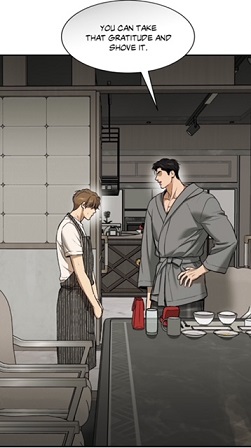 (chapter 45)
Feel free to comment. If you have any suggestion for topics or Manhwa, feel free to ask. If you enjoyed reading it, retweet it or push the button like. My Reddit-Instagram-Twitter-Tumblr account is: @bebebisous33. Thanks for reading and for the support, particularly, I would like to thank all the new followers and people recommending my blog.

 Bebebisous33s' analyses in K-Dramaland and Manhwas