

Please support the authors by reading Manhwas on the official websites. This is where you can read the Manhwa: Jinx But be aware that the Manhwa is a mature Yaoi, which means, it is about homosexuality with explicit scenes. Here is the link of the table of contents about Jinx. Here is the link where you can find the table of contents of analyzed Manhwas. Here are the links, if you are interested in the first work from Mingwa, BJ Alex, and the 2 previous essays about Jinx The Sweetest Downfall Ever and Hot 🔥Sparks ⚡, Feverish 🌡️Reality (part 1)
It would be great if you could make some donations/sponsoring: Ko-fi.com/bebebisous33 That way, you can support me with “coffee” so that I have the energy to keep examining Manhwas. Besides, I need to cover up the expenses for this blog.

After the Spark: What Changes Once the Circuit Is Closed?
When episode 86 ends 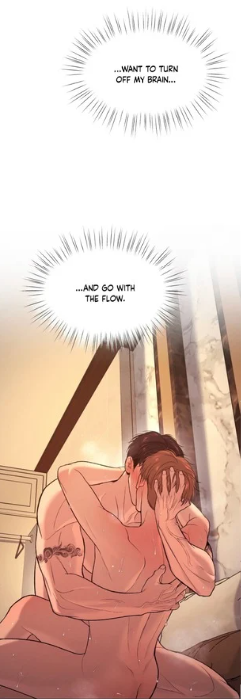 (chapter 86), it does not close the night through narrative resolution. There is no statement, no promise, no verbal seal. And yet, for many Jinx-philes, the final panel refuses to let the scene dissolve. What remains is not heat, not tension, not even tenderness — but circulation.
What caught my attention, on rereading the episode with some distance, is precisely this ending. In the final embrace and kiss, bodies are not merely touching; they are aligned. Kim Dan is neither collapsed nor clinging. Joo Jaekyung is neither looming nor enclosing. Their torsos meet without compression, their heads incline toward each other, and the kiss does not interrupt movement — it completes it. The image does not suggest release, but continuity. Not dispersal, but return. In other words, the final embrace functions as a closed electric circuit, while the kiss operates as the activating spark — not a release, but the moment the current begins to flow.
This detail matters because it reframes the entire night. Earlier nights in Jinx burned intensely and then vanished. This one does not. Heat exhausts itself. Electricity does not. It remains as potential — stored, latent, waiting to be activated. When readers feel that “something has shifted,” they are not sensing emotional climax, but a closed circuit. The night ends, yet nothing needs to be said, because something has already been set.
Under this new light, my perception of relationships in Jinx changed. What had long been read through the language of excess — desire, domination, sacrifice, endurance — began to appear instead through the logic of current: circulation, interruption 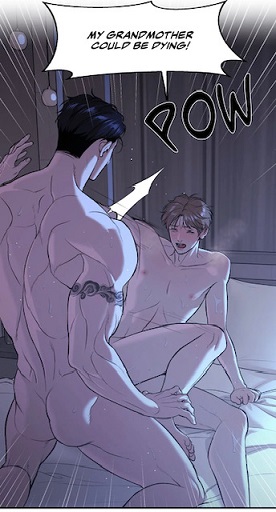 (chapter 21), overload
  (chapter 33), short circuit
  (chapter 51),
 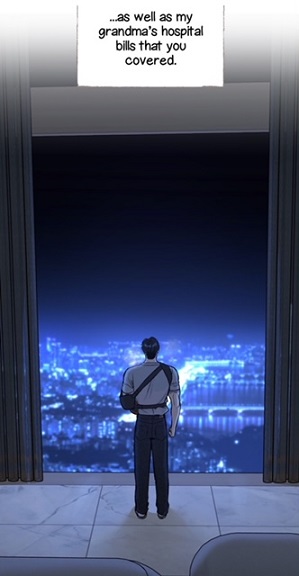 (chapter 53) reset. And once that lens is adopted, it becomes impossible to limit the consequences of episode 86 to the couple alone. Because a closed circuit does not only affect those directly connected to it. It alters the surrounding system.
In the first part of Hot Sparks, Feverish Reality, the focus lay on how this night functions in itself: how electricity replaces fire, how illusion gives way to continuity, how silence becomes embodied communication. That analysis allowed us to rethink the nature of the moment. But once the circuit is closed, another question inevitably arises — quieter, but far more consequential: What changes once the night is over?
If the Paris night is not a dream, not a relapse, and not a miracle, then it must be understood as a reconfiguration of conditions. Memory begins to behave differently. Surprise no longer carries the same meaning. The past can no longer be invoked automatically as justification. And responsibility — long deferred — becomes unavoidable.
This second part of the essay therefore turns toward repercussions. To approach them, the analysis will move through four interlinked angles. First, it will examine surprise, returning to the sudden kiss in episode 86. By placing this gesture alongside earlier moments where surprise meant threat or emotional risk, the essay will show how the same structure acquires a different meaning once agency is restored — and why this matters. Second, it will address recognition without erasure, focusing on the line 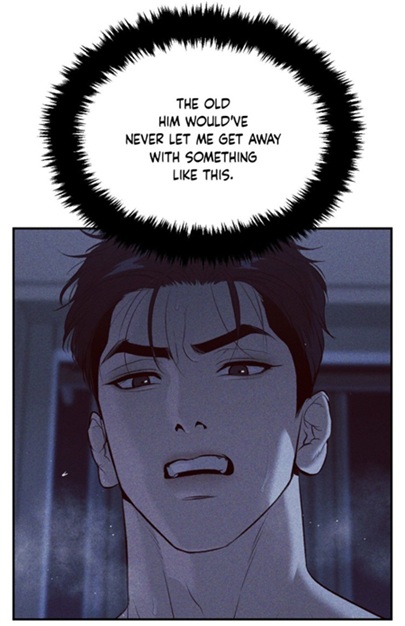 (chapter 86). This section will explore how acknowledging change without denying past harm opens a new ethical position — one that prevents memory from being weaponized, while still preserving responsibility. Third, the analysis will turn to conversion, revisiting earlier nights marked by failure, asymmetry, and isolation. Rather than cancelling them, episode 86 absorbs and transforms them. This is where forgiveness, reflection, and the first true encounter with consequence quietly enter the narrative. Finally, a new section will widen the lens further by examining shared experience and memory
  (chapter 53), particularly through Kim Dan’s relationship with his grandmother. Here, the focus will not be accusation, but contrast: between memories carried alone and memories held together; between cycles of repetition and moments of presence; between a worldview structured around endurance and one shaped by circulation. The Paris night does not only affect how Kim Dan sees Joo Jaekyung (chapter 86) — it changes how he may begin to situate himself within inherited bonds and unspoken expectations.
The Paris night did not resolve the story. It changed the system in which the story must now continue. And like electricity itself, its importance will only become fully visible when something — or someone — can no longer function as before.
Surprise Reversed: From Threat to Agency
To understand why the kiss in episode 86 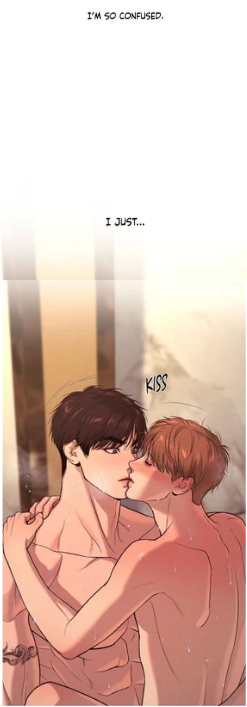 (chapter 86) carries such weight, we must return to the origin of kissing itself in Jinx. Because surprise, in this story, is not an abstract theme. It has a history. And that history begins with a body being caught off guard.
The first time Kim Dan is kissed by Joo Jaekyung, it is sudden. 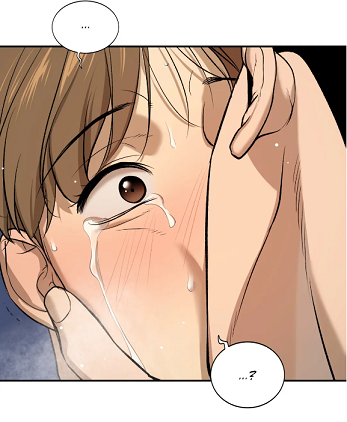 (chapter 14) There is no warning, no verbal cue, no time to prepare. The kiss arrives as interruption. It is not negotiated; it is imposed. Hence the author focused on the champion’s hand just before the smooch.
 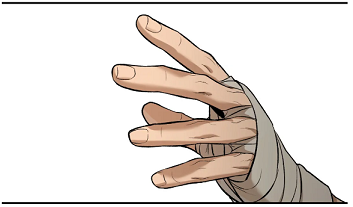 This moment matters far more than it initially appears, because it establishes the template through which Kim Dan first encounters intimacy.
  (chapter 15) Affection does not emerge gradually. It breaks in.
Kim Dan reacts accordingly. Shortly afterward, he articulates a need that is easy to overlook but fundamentally revealing: he asks Joo Jaekyung to tell him before kissing him.  (chapter 15) He needs preparation. He needs time to brace himself emotionally. This request reveals two aspects. First, he connects a kiss with love. On the other hand, the request is not really about romance; it is rather about survival. Surprise, for Kim Dan, has already been coded as something that overwhelms the body before the mind can intervene.
And yet, what follows is one of the most striking contradictions in the narrative. Every time Kim Dan initiates a kiss himself  (chapter 39), he violates his own request.
His kisses arrive suddenly.  (chapter 39) They are unannounced, often landing on unusual places (cheek or ear) (chapter 39)
  (chapter 44). They often take place under asymmetrical conditions — when one of them is intoxicated, confused, or emotionally exposed. Sometimes they occur without full consent, sometimes without clarity. In chapters 39 and 44, kisses surface precisely when language fails or consciousness fractures. It is as if Kim Dan has internalized a rule he never chose: a kiss must be sudden. Observe how the champion replies to the doctor’s smile and laugh: he kissed him, as if he was jealous of his happiness.
 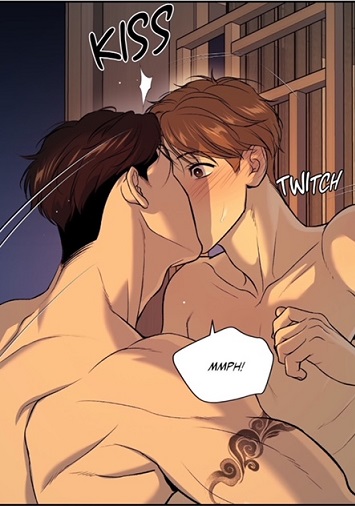 (chapter 44) That’s how I came to realize that the kiss in the Manhwa is strongly intertwined with “surprise”. This is the missing link.
Kim Dan does not merely endure surprise; he learns it. Because intimacy entered his life through interruption  (chapter 2), he comes to reproduce interruption as intimacy. He knows that surprise destabilizes him — that is why he asked for warning — but he has no other model. What overwhelms him also becomes what he reaches for. Surprise is both threat and language.
This paradox explains much of Season 1. Surprise is repeatedly associated with danger  (chapter 3): the sudden call from the athlete,
  (chapter 1), the offer of sex in exchange for money (chapter 3), the contract that turns availability into obligation
 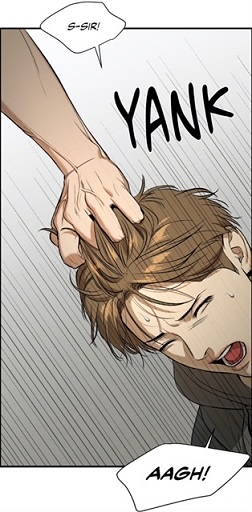 (chapter 6), the switched spray
  (chapter 49), the sudden changes in rules. These moments strip Kim Dan of anticipation and agency. His body reacts before his will can engage. Surprise equals exposure.
And yet — this is where the narrative becomes uncomfortable — these same surprises also pull him out of ghosthood.
Before Joo Jaekyung, Kim Dan lives in a state defined by repetition and duty.  (chapter 1) His life is governed by “always”: always working, always returning, always responsible. He lives for his grandmother. Nothing unexpected is allowed to happen, because nothing unexpected can be afforded. This is safety through stasis. Presence without experience.
But this does not mean that surprise was absent from his past. On the contrary, when unpredictability did enter Kim Dan’s life earlier, it came in its most destructive form: through the loan shark, Heo Manwook and his minions. His appearances were sudden, intrusive, violent.  (chapter 5)
  (chapter 1) They shattered routine rather than enriching it. Surprise, in that context, did not open possibility; it threatened survival. It meant debt, coercion, fear. And precisely because of that, it could not be integrated into memory as experience — only repressed as trauma.
This distinction matters. When Kim Dan’s grandmother is hospitalized and removed from the house, the loan shark also disappears from daily life. His violence becomes something that can be pushed aside, denied, or avoided 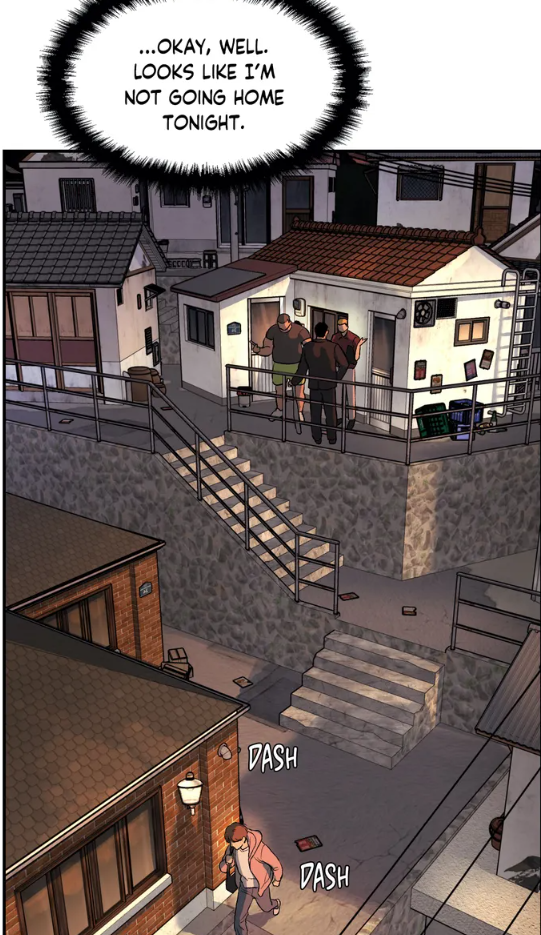 (chapter 1), if he doesn’t return home. Surprise, in its earlier form, is excised from the household. What remains is a world of repetition and endurance — safer, but lifeless.
Seen from this angle, Joo Jaekyung does not introduce unpredictability into Kim Dan’s life from nothing. He replaces it. 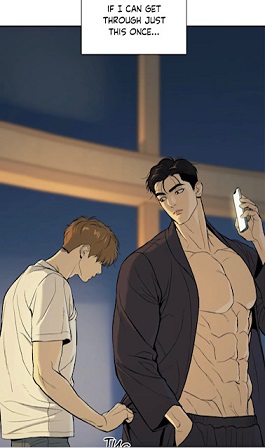 (chapter 2) but in a fundamentally different form.
The loan shark embodies surprise without negotiation.  (chapter 11)
 (chapter 11) His appearances are sudden, his demands non-discussable, his violence immediate. He does not ask; he enforces. Surprise, under his rule, eliminates speech. It leaves no space for argument, no room for clarification, no possibility of consent. One endures, or one is punished.
Joo Jaekyung, by contrast, introduces unpredictability through contracts and negotiation. 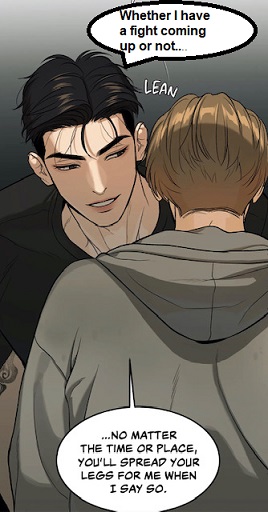 (chapter 6) Even when power is asymmetrical, even when the terms are coercive, speech is required. Conditions are stated. Rules are articulated. Kim Dan is forced to listen, to answer, to argue, to object. He must speak.
This difference is decisive. Surprise no longer arrives solely as terror; it arrives as confrontation. Kim Dan is not merely acted upon — he is compelled into dialogue. The body is still exposed, but language re-enters the scene. Where the loan shark silenced, the athlete imposes discussion.
This is why Joo Jaekyung can occupy the same structural position as the loan shark — and yet not replicate him. Both disrupt repetition. Both break the closed circuit of endurance. But only one does so in a way that keeps Kim Dan within the realm of human interaction. Even coercive negotiation presupposes a subject who can respond.
This also explains the later confrontation in the house.  (chapter 17) The two figures cannot coexist because they represent mutually exclusive regimes of surprise: one that annihilates speech, and one that forces it into being. In other words, only one allows experience to be lived rather than survived.
Surprise enters Kim Dan’s life violently, but it does not remain mere rupture. (chapter 2) It functions as negative charge — an abrupt influx of energy into a system that had been closed for too long. Fear, anger, desire, attachment appear not as orderly developments, but as shocks. These experiences are unstable, often painful, sometimes destructive  (chapter 51) — yet they are unmistakably his. They mark the moment when something begins to circulate. (chapter 51)
This distinction is crucial. Before Joo Jaekyung, Kim Dan’s life operated in a static loop, governed by repetition, sacrifice, and gratitude. Energy was expended, but never transformed. Surprise, in its first incarnation, is therefore pure threat: uncontained, overwhelming, incapable of integration. It breaks the system without yet allowing current to flow.
What changes with Joo Jaekyung is not the presence of danger, but its conductivity. Surprise becomes ambivalent — still risky, still destabilizing — but now capable of generating movement and as such meditation. Negative charge no longer annihilates the circuit; it begins to activate it.  (chapter 27) Experiences accumulate instead of disappearing. They demand response, speech, negotiation. Life no longer consists in enduring impact, but in processing it.
This is why these experiences cannot be shared with Kim Dan’s grandmother. Her moral economy is built on infantilization  (chapter 65) and as such neutralization: suffering must be absorbed, pain must be justified, disruption must be folded back into endurance. There is no place for charge there — only for dissipation. What Kim Dan lives through with Joo Jaekyung follows a different logic altogether: not sacrifice, but circulation; not repetition, but conversion.
Surprise thus becomes the hinge not between danger and safety, but between static survival (–) and relational movement (+). And once that conversion begins, the past can no longer be returned unchanged — nor can it be shared without transformation.
This is why Kim Dan falls in love  (chapter 41) not despite surprise, but through it. Not because dominance is romanticized, but because surprise is the first force that treats him as someone to whom things can happen. And don’t forget that for him, a kiss symbolizes affection. Even negative experiences generate subjectivity. They prove that he exists beyond function.
Seen through this lens, Kim Dan’s habit of surprising Joo Jaekyung with kisses (chapter 39) — on the ear or the cheek — is no longer random or contradictory. It is learned behavior. He has absorbed surprise as a mode of relation. What was once done to him becomes something he does, imperfectly and often prematurely. These kisses are not about dominance. They do not corner or silence. They test connection. They ask, without words: Are you still here?
But until episode 86, this structure remains unresolved. Surprise exists, but it is never fully safe.  (chapter 85) Kim Dan either endures it or reproduces it under unstable conditions. Agency is partial. Meaning collapses afterward.
This is what makes the doctor’s kiss in Paris categorically different. (chapter 86)
Formally, it is still sudden. Kim Dan does not announce it. He does not negotiate it verbally. But structurally, everything has changed. For the first time, surprise is not imposed on him — and it is not enacted from confusion or imbalance. It is chosen. Kim Dan is clear-minded enough to recognize both his desire and his uncertainty. He is not dissociating. He is not reacting. He is deciding to remain present despite risk. And the response confirms the shift.
Joo Jaekyung does not neutralize the kiss with passivity  (chapter 39), irony
 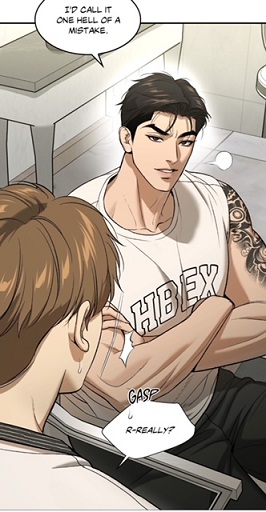 (chapter 41) or rejection
 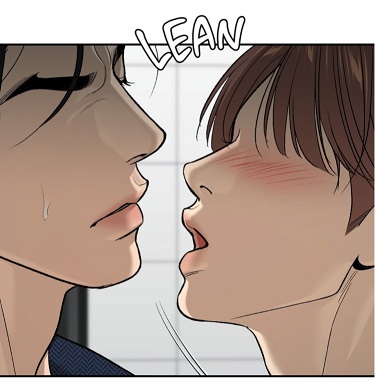 (chapter 55). He does not retreat into his habitual “it’s nothing” or “never mind.” He does not reinterpret the gesture as convenience or reflex.
  (chapter 86) He kisses back while looking tenderly at his partner. He holds Kim Dan’s head gently. He can only see such a gesture as a positive answer to his request: acceptance and even desire. Surprise is not punished. It is received.
This is the moment where the meaning of surprise reverses. Surprise no longer equals threat. Surprise becomes agency. And that’s how I could discover a link between the kiss and the doctor’s birthday present, the key chain.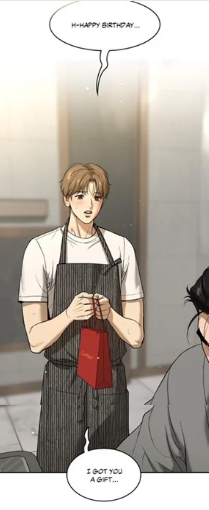 (Chapter 45) This time, the athlete not only accepts the present (the kiss), but but also expresses “gratitude” by kissing back actively. (Chapter 86) This means that the athlete is recognizing the existence of feelings.
The kiss does not erase the past. (Chapter 86) It does not retroactively justify earlier violations. But it establishes a new condition: surprise can now occur without annihilation. Intimacy can arrive without silencing reflection. Experience no longer collapses into shame or disappearance. IT symbolizes a positive and enjoyable moment.
This is why the kiss matters more than any spoken line in the episode. It is not simply romantic. It is structural evidence that the logic governing their interactions has changed. Surprise now operates within a closed circuit of consent and presence.
Kim Dan is no longer a ghost enduring interruptions. He is a subject capable of initiating them. He has learned surprise — and now, for the first time, he reclaims it. Under this new condition, the question is no longer whether surprise will hurt. It is whether life can proceed without it. And once that question is raised, the story cannot return to repetition or silence.
Recognition Without Erasure: When Memory Changes Function
What struck me next was how subtly episode 86 reorganizes the role of the past. Once surprise ceases to function purely as threat and begins to circulate, memory itself starts behaving differently. Electricity does not only move bodies; it redistributes charge. And it is precisely at this level — the level of memory and recognition — that something decisive occurs.
The line is brief, almost casual: (chapter 86) And yet it performs an extraordinary operation. Kim Dan does not deny the past. He does not soften it. He does not excuse it. Instead, he repositions it. For the first time, the past is no longer invoked as an absolute reference point, but as a differentiated state — one phase among others. Such a confession contradicts the grandmother’s philosophy: ALWAYS (chapter 65) In her eyes, she has never changed, just like her grandson. (chapter 65) If there were changes, they were associated with trouble and worries.
This distinction is crucial, because in Jinx, the past has long functioned like a blunt instrument. It has been used to fix identities  (chapter 52), justify behavior
  (chapter 57), and foreclose change. The champion’s violence is explained through reputation.
  (chapter 1) Kim Dan’s endurance is explained through obedience and debt. The grandmother’s authority is explained through sacrifice. In every case, the same logic applies: this is how it has always been; therefore this is how it must remain.
That logic is static. Electrically speaking, it is a circuit without polarity — no – and +, no tension, no movement. The past becomes a dead weight, not a source of information. It does not inform the present; it dominates it.
What episode 86 introduces is not forgiveness in the sentimental sense, but recognition without erasure. (chapter 86) Recognition means the charge of the past remains. Erasure would mean grounding it, neutralizing it, pretending it never existed. Kim Dan does neither. He keeps the – while allowing the + to emerge.
A World Without Polarity: When the Past Becomes a Weapon
This is where the electrical metaphor becomes indispensable. In a functioning circuit, negative and positive do not cancel each other out. They coexist. They create potential difference. And it is that difference — not harmony — that allows current to flow. (chapter 86) In the final panels, Kim Dan does not embrace an idealized version of the champion, nor a redeemed figure cleansed of history. He embraces Joo Jaekyung as he is now, with the knowledge of who he was before. This distinction matters. Acceptance here is not absolution. It is contact without denial.
Electric current does not pass between identical charges. It requires tension. Polarity. Resistance. The − and the + must remain distinct, or nothing moves. In this sense, Kim Dan’s embrace is not a gesture of harmony but of recognition. He acknowledges the champion’s flaws and mistakes — not to excuse them, but to stop pretending they never existed or to stop pretending to be better. What he accepts is not the past itself, but the reality that the past does not exhaust the present. That’s why he is able to stop ruminating and to follow his heart.
Furthermore when Kim Dan recognizes that “the old him” (chapter 86) existed, he does not collapse the timeline. He does not say: he was never that person. Nor does he say: he is forever that person. Instead, he introduces temporal polarity. Then and now. Before and after. – and +.
This move has immediate consequences. First, it disarms the past as a weapon.  (chapter 65) If the past is absolute, it can be endlessly invoked to invalidate the present. We have a perfect example on the beach. (chapter 65) Kim Dan is here compared to the past. (chapter 65) When Shin Okja speaks of Kim Dan as a heavy smoker, she is not recounting a neutral habit. She is anchoring him to a past version of himself — one defined through worry, decline, and deviation from the “good boy” image.
What follows is telling. She does not ask why he smoked. She does not ask what changed. She does not ask how he lived. The only question that matters to her is: “Does he still smoke?” (chapter 65)
The present is interrogated exclusively through the past. In this logic, the past functions as a fixed reference point. If the habit persists, the present confirms her narrative. If it does not, the absence is not read as growth but as an anomaly — something provisional, something that could always return. This is not concern. It is classification.
Shin Okja does not relate to Kim Dan as someone moving through phases, but as someone who must remain legible within a stable moral category. Change is not interpreted as development, but as risk. When Shin Okja repeatedly frames Kim Dan’s smoking and drinking as failures (chapter 65), she is not simply expressing concern about health. She is doing something more consequential: she is disqualifying the legitimacy of his decisions. In her discourse, Kim Dan’s actions are never treated as choices made under pressure, pain, or circumstance. 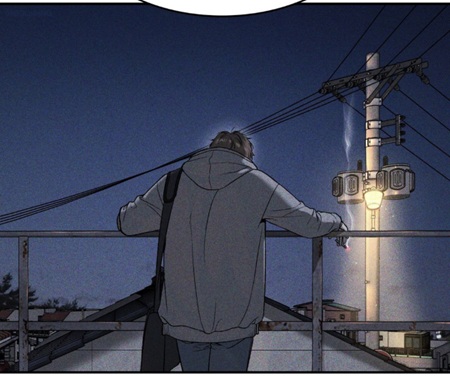 (chapter 65) They are evaluated exclusively through a moral lens. Smoking and drinking are not responses; they are flaws. And because they are framed as flaws, they retroactively define his character rather than his situation. This is where agency collapses.
Care and Choice
If every decision Kim Dan makes is already interpreted as “bad,” then decision-making itself becomes suspect. Choice is no longer a neutral capacity; it is something he is assumed to misuse. In other words, he is not someone who chooses poorly — he is someone who should not be choosing at all. Under this new light, my avid readers can grasp why the grandmother approached the champion and asked for this favor: 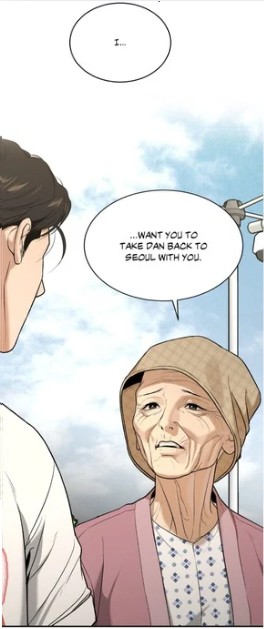 (chapter 65) Her behavior does not contradict her claim that she wants Kim Dan to “live his own life.”
  (chapter 65) It reveals how she understands such a life should be arranged. She sees herself as superior, as if she had never done any mistake, as if she had lived as a saint.
If she had truly accepted Kim Dan as a subject capable of self-direction, she would have spoken to him directly. Conversation presupposes agency; it allows disagreement, hesitation, and refusal. Instead, she chose a different route: influencing his fate behind his back. This move preserves her moral position while bypassing the risk of confrontation. It allows her to believe she is acting in his interest without ever having to acknowledge his will. That’s why she is entrusting her grandson to the athlete. 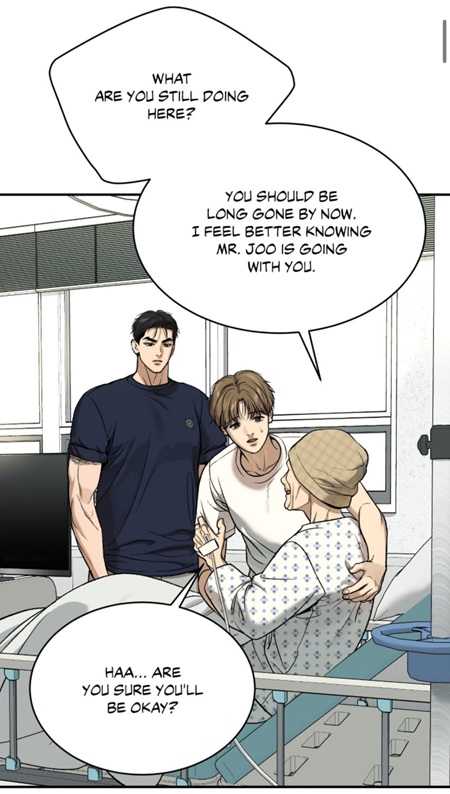 (chapter 78)
In other words, she does not imagine Kim Dan living freely through his own choices, but being placed into a better configuration by others — preferably by someone stronger, more decisive, and more visible than himself. The request to the champion thus follows the same logic that governs her judgment of Kim Dan’s habits: she does not trust him to choose, only to comply.
And this is precisely why her worldview stands in quiet opposition to what unfolds in episode 86. The physical therapist’s desires are not only acknowledged, but also respected.  (chapter 86) Once again, the “hamster” is given the opportunity not only to decide, but also to follow his heart. Where the Paris night allows difference to coexist with memory, Shin Okja’s framework collapses difference back into judgment. Where electricity requires polarity, her logic insists on sameness. Under this new light, it becomes comprehensible how doc Dan came to neglect himself. Self-care is inseparable from choice — from the belief that one’s decisions can meaningfully alter the present. If change is denied, care loses its purpose. Attending to oneself becomes optional, even suspect, because it implies a future different from the one already prescribed.
Recognition without erasure breaks that pattern. It allows Kim Dan to say, implicitly: what happened matters — but it does not get to decide everything.
Second, this recognition introduces responsibility where there was previously only fatalism. If change is possible, then it can be acknowledged. And if it can be acknowledged, it can be responded to. The past no longer excuses inaction. It no longer absolves neglect. It becomes a reference, not a refuge.
Two Versions, One Person: Temporal Polarity and Ethical Clarity
By acknowledging that there is an “old him” (chapter 86) and a present one, Kim Dan implicitly accepts that change has causes. And this is where his position shifts in a way that is easy to miss. If Joo Jaekyung has changed, then Kim Dan is not obligated to assume that he is the reason. He does not interpret the change as something he must earn or preserve through obedience.
Instead, a question becomes possible: what happened in between? And this question matters, because Kim Dan does not know. He does not know about the incident at the health center. He does not know about the slap at the hospital (chapter 52). He does not know that no one stood by the champion afterward — not even Potato.
By recognizing two versions of Joo Jaekyung, Kim Dan opens a space for inquiry rather than self-accusation. The change no longer needs to be attributed to his own sacrifice. It can be understood as something that also happened to the champion. This is not naivety. It is ethical clarity. Consequently, I perceive the night in Paris as the end of doc Dan’s low self-esteem and shame.
It also means that if anyone were to invoke the champion’s past against him — a manager, a coach (chapter 57), the system — Kim Dan can now side with him without denying what came before. The past stops being a weapon. It becomes context. This move has immediate consequences.
This shift is subtle, but it radiates outward.
Until now, Kim Dan has often carried memory alone. He remembers nights that others forget. He remembers moments that were dismissed. This asymmetry has turned memory into burden.  (chapter 44) The one who remembers bears the – alone, while the other continues forward unmarked. That imbalance is corrosive. It distorts perception. It turns even good memories sour.
Episode 86 begins to redistribute that charge. Not by forcing confession, but by establishing shared presence. Once current circulates between two points, no single node carries the full load. Recognition does not mean recounting every wound; it means no longer isolating the wound in silence.
This is why the line about “the old him” matters more than it appears. It is not merely observational. It is infrastructural. It signals that memory is no longer trapped in a single body.
And this logic does not stop with the champion. It extends, inevitably, to Kim Dan’s relationship with his grandmother, like mentioned above.
Her worldview has long been organized around moral continuity. She remembers suffering  (chapter 65), but she remembers it in a way that flattens time. Pain becomes proof of virtue. Sacrifice becomes identity.
  (chapter 65) Change is allowed only insofar as it returns to the same point. Electrically speaking, her system is grounded — all charge dissipates into endurance. There is no polarity, only repetition.
This is why the past, in her discourse, often appears as reproach. Not necessarily spoken harshly, but structurally unavoidable. You used to drink. You used to smoke. You used to be helpless. The past is not cited to understand, but to fix position. It anchors Kim Dan to a role: the one who must be protected, managed, or sent away “for his own good.”
Recognition without erasure offers Kim Dan a way out of this bind. If the past is no longer absolute, then it can be questioned. Not denied — questioned. The statement “you don’t know me and my life” becomes thinkable. Not as rebellion, but as differentiation. Kim Dan can hold the memory of his past while refusing to let it define his present. He can acknowledge the grandmother’s suffering without allowing it to dictate his future.
This is where forgiveness enters the narrative — quietly, without ceremony. (chapter 86) Forgiveness here is not reconciliation. It is not forgetting. It is not moral absolution. It is the decision not to collapse polarity. To allow – and + to coexist without forcing resolution. Forgiveness becomes a form of electrical insulation: it prevents overload, not by cutting the circuit, but by stabilizing it.
Seen this way, forgiveness is not weakness. It is structural maturity. And it has consequences. For Kim Dan, it means the past no longer monopolizes his self-understanding. He is not bound to prove gratitude through self-erasure. He can recognize care without submitting to control. He can accept gifts and help without dissolving into debt.
From Spark to Current: Why the Jinx Loses Its Power
For Joo Jaekyung, it means the jinx can no longer function as fatal explanation.  (chapter 65) Even though the word jinx is never spoken during the Paris night, its logic quietly collapses there. (chapter 86)
Until now, sex operated as discharge. 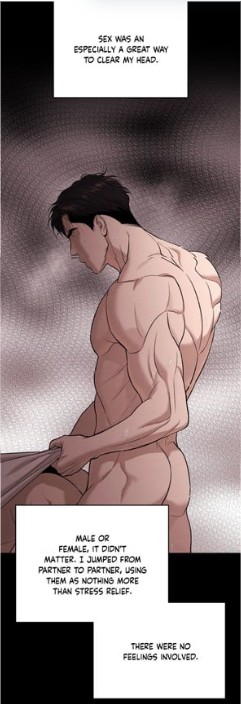 (chapter 75) In chapter 75, it is explicitly framed as a way to “clear the head”: an act designed to release pressure and return the system to zero. Partners were interchangeable. Feelings were excluded. Electricity existed only as a spark — brief, violent, and self-extinguishing. Energy was expelled, not circulated. That is the true mechanics of the jinx: power without continuity, intensity without consequence.
Paris introduces a different configuration. Sex is no longer oriented toward erasure or reset. It is no longer about escaping thought or silencing memory. Instead, it becomes a mode of presence.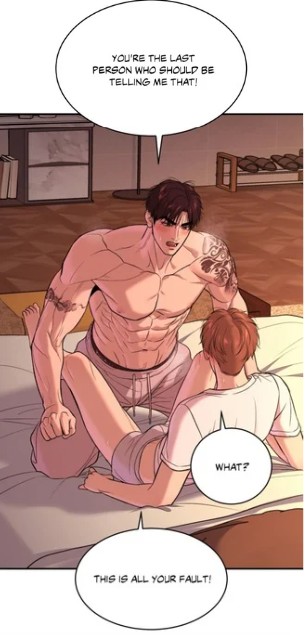 (chapter 85) Desires matter, not the match the next morning. Besides, the identity of the partner matters — not just romantically, but also structurally. Current requires two poles. It requires response. It cannot flow through an object, only between 2 subjects.
This is why the jinx does not need to be confronted explicitly to be undone. A system built on discharge cannot survive circulation. Once energy is no longer expelled but sustained, once tension is held rather than neutralized, fatalism loses its grip. The spark does not burn out; it becomes current.
And with current comes consequence. Sex no longer clears the mind; it sharpens awareness. It no longer abolishes the future; it implies one. What happens in Paris does not redeem the past — it renders repetition impossible. Reflection becomes unavoidable, not because someone demands it, but because the system no longer resets cleanly.
The jinx dissolves not through force, but through continuity. Recognition without erasure thus prepares the ground for the final transformation: conversion. Thus the story can move forward.
– and – = + : Conversion and the End of Ghosthood
Two nights once marked by failure — chapter 39 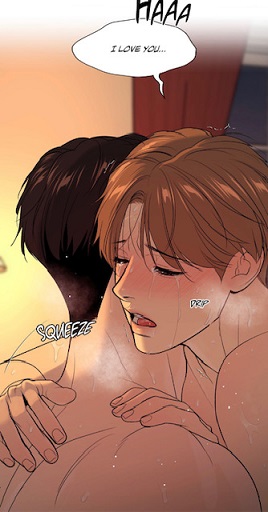 (chapter 39) and chapter 44 (chapter 44) — converge in episode 86. This convergence is not coincidental, nor is it nostalgic. It is a conversion.
Both earlier nights shared the same fatal structure: only one person remembered. In chapter 39, Kim Dan’s confession existed without continuity; his body spoke, but his memory did not follow. In chapter 44, the reverse occurred: Kim Dan remembered everything, while Joo Jaekyung attempted to forget. In both cases, memory became asymmetrical. One carried meaning; the other escaped it. And meaning, when carried alone, curdles. What might have been tenderness transformed into obsession, shame, or bitterness. Memory became burden.
Episode 86 breaks this curse through a gesture that is deceptively simple: both remember. (chapter 86) Both made surprising experiences: dry orgasm and a gentle and caring sex partner.
This is why simultaneity matters so profoundly. Sparks appear on both bodies. Confusion is mutual. Questions circulate rather than collapse inward. Neither consciousness outruns the other. Time, which had previously fractured under intoxication, coercion, or denial, resumes its flow. Not because the past is resolved, but because it is finally shared. Shared experience.
Here, memory begins to function differently — no longer as fixation or haunting, but as integration.
This shift allows us to recognize a much older pattern in Kim Dan’s inner life. His relationship to memory has always been selective, but not arbitrarily so. When it comes to his grandmother, Kim Dan remembers each interaction with his grandmother in a positive light: the warmth 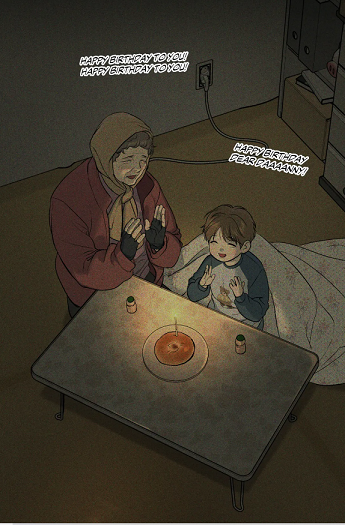 (chapter 11), the care – even if he had hurt himself –
 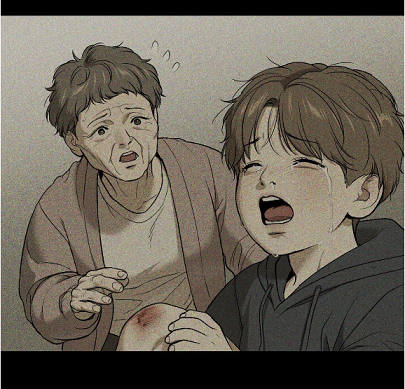 (chapter 47), the shared smiles
 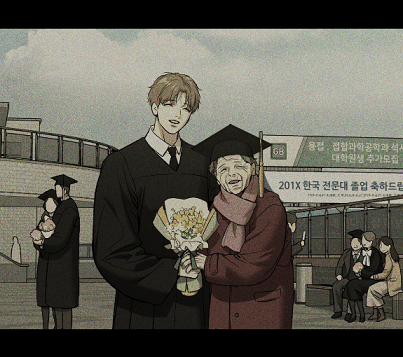 (chapter 47). Thus this photograph
  (chapter 65) becomes a talisman — not a record of reality, but a distilled image of safety. Painful dimensions are filtered out. Conflict, coercion, and silent pressure recede into the background. Memory protects him by idealizing. Because of this picture, he projected himself in the future, making unrealistic plans.
 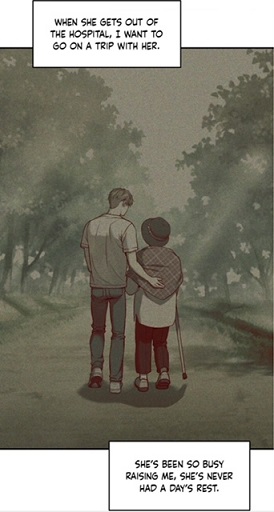 (chapter 47) It was, as if he only had good times with his grandmother.
Shin Okja, by contrast, remembers the same past through a radically different lens. (chapter 65) Her recollection is saturated with pity, loss, fear (chapter 65), and blame (chapter 65). The vanishing of the parents becomes the gravitational center around which all other memories orbit. Where Kim Dan remembers warmth, she remembers danger. Where he remembers protection, she remembers failure. One memory soothes; the other hardens. One preserves life; the other polices it. Kim Dan must remain the “good boy,” unchanged, because acknowledging his growth would mean acknowledging that the past did not remain intact.
The graduation photos make this painfully clear. They immortalize achievements, (chapter 47) not shared experiences. They resemble press photos of the champion more than lived moments. The work, the strain, the cost are absent. And tellingly, Kim Dan does not keep these pictures. They do not anchor memory; they flatten it. They freeze time rather than allowing it to move.
This asymmetry is crucial. It reveals that the relationship between Kim Dan and his grandmother has always mirrored the structure of those failed nights: one person remembers in a way that helps to keep working, the other remembers in a way that poisons (infantilizing doc Dan). One idealizes; the other condemns. And because the tragedy at the center of their past was never fully spoken, memory could not be synchronized. Kim Dan was pushed — silently, indirectly — to carry an idealized version of their shared life, while Shin Okja carried the unresolved catastrophe alone. (chapter 65) Toxic positivity emerges precisely here: not as cheerfulness, but as enforced idealization that denies the legitimacy of pain, anger, or differentiation.
And it is precisely here that the connection with the grandmother crystallizes. The latter is often connected to sleep 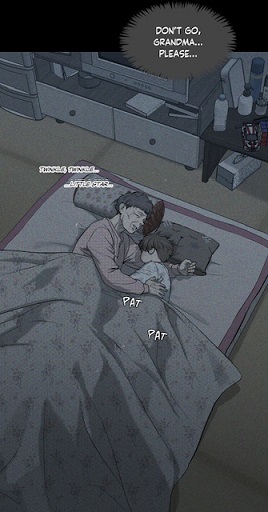 (chapter 21)
  (chapter 47) and memories.
 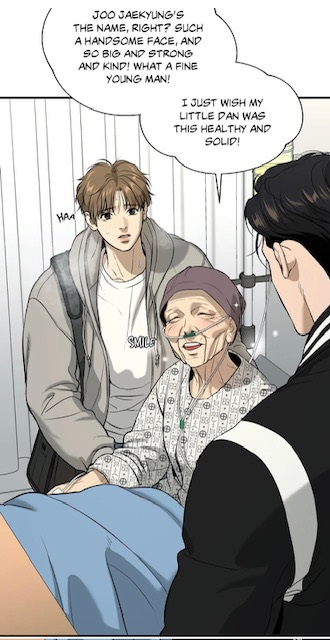 (chapter 21)
 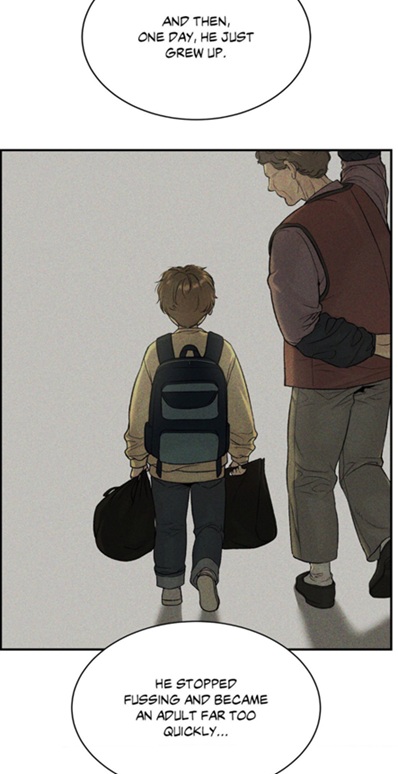 (chapter 65). While sleeping, memories come to the surface.
Only at this point did something else catch my attention — something that, retrospectively, had been present all along. The painting in the living room: 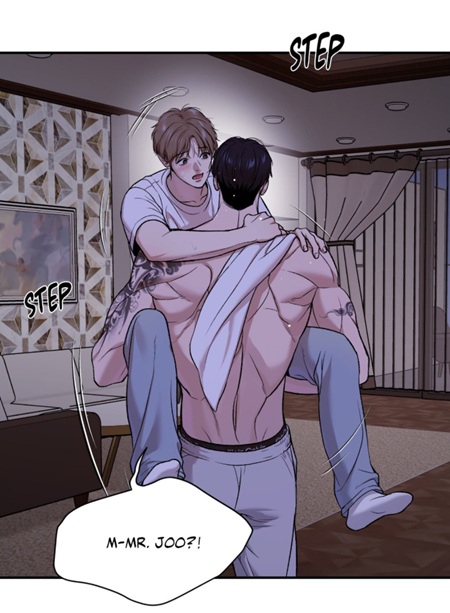
 (chapter 85) I believe that its appearance does not function as decoration. Its imagery — figures suspended among clouds, bodies neither falling nor grounded — introduces a different register of time. Not urgency. Not performance. Not spectacle. Stillness. Interval. A space where movement pauses without collapsing. Under this new light, the reference is Morpheus.
Morpheus is not the god of illusion. He is the one who allows rest, who brings form to dreams so the body can sleep. His presence signals not escape from reality, but the possibility of restorative sleep. This matters, because insomnia has haunted Joo Jaekyung from the beginning. 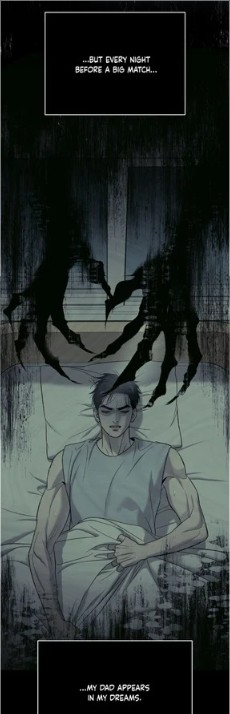 (chapter 75) Until now, rest had been replaced by discharge: sex as erasure, violence as exhaustion, ritual as compulsion. The Paris night does not abolish wakefulness through collapse; it introduces the conditions under which sleep might finally be possible.
Episode 86 introduces a third possibility: the kiss of Morpheus or the famous goodnight kiss. (Chapter 86) What caught my attention is that the athlete was irritated, when the doctor simply wished him a good night. 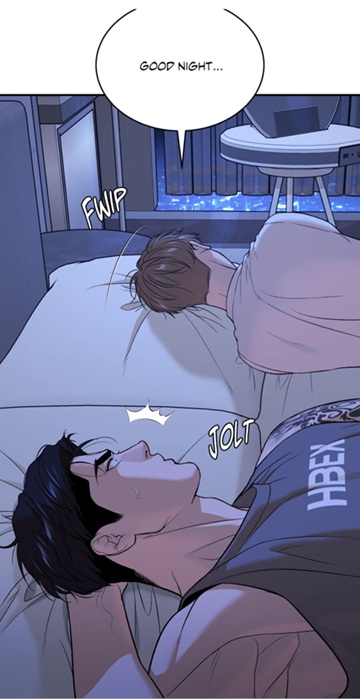 (Chapter 78) Here, he reduced it to the absence of sex, but I am sure that deep down, he would have been satisfied, if the “hamster” had given him a good night kiss.
The Paris night does not ask either character to idealize or to condemn. (chapter 86) It does not demand that the past be redeemed, nor that it be endlessly rehearsed. (chapter 86) Instead, it contextualizes. Memory is no longer absolute; it becomes temporal. Then and now. (chapter 86) Before and after. – and +.
This is why the electrical metaphor reaches its full force here. Two negatives do not annihilate each other. They convert. The shared remembering of two previously failed nights produces not cancellation, but potential. 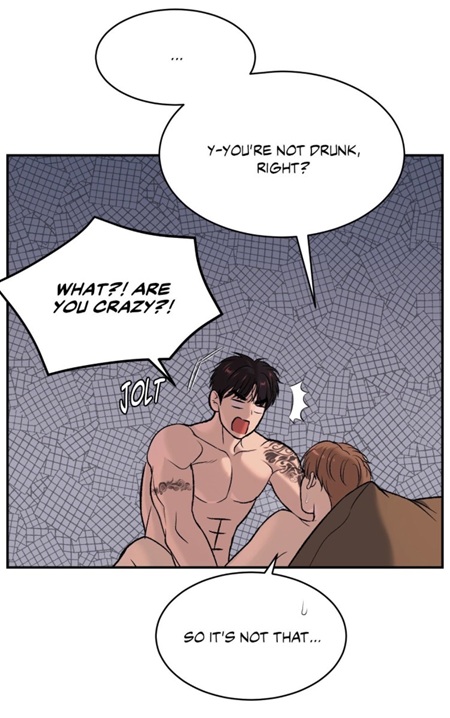 (chapter 86) The charge redistributes. Memory ceases to isolate and begins to circulate. Hence it creates a new memory.
It is at this point that Prometheus quietly enters the scene — not as explicit mythological references, but as symbolic functions. Electricity, like fire stolen from the gods, marks a return to humanity. It is the end of purely divine punishment and purely mechanical survival. At the same time, illusion dissolves. Sleep, dream, and dissociation lose their grip. The characters are no longer ghosts moving through each other’s lives, nor zombies repeating ritualized behaviors. They become human again — vulnerable, reflective, embodied. And once human, reflection becomes inevitable.
The night itself remains carpe diem. It is presence without calculation, sensation without projection, intimacy without bargaining. For those hours, the future does not intrude. But this does not mean consequence is erased. On the contrary: because the night is no longer an illusion, its aftermath must be faced. The jinx has not disappeared because its existence was not mentioned or danger is gone. Corruption, rigged matches, replacement, and blacklisting still await. What has changed is not the external threat, but the internal configuration.
The Paris night did not save the protagonists. It returned them to themselves. And this return has consequences beyond the couple. It destabilizes the grandmother’s moral economy. This new observation reinforces my previous interpretation: this position  (chapter 86) was a reflection of the picture. (chapter 65) Shin Okja is no longer doc Dan’s center of gravitation. That’s the real revolution. There is no longer interruption or triangulation. I am even inclined to think, that’s the night where the main leads became a true team.
Moreover, if memory can be shared without collapsing into blame, then her version of the past can no longer function as unquestionable authority. (chapter 65) If Kim Dan no longer needs to idealize in order to survive, then he can finally see the cost of that idealization — for himself and for her. The tragedy she alone has been carrying can surface, but without demanding that he sacrifices his present to it. The past stops being a sealed vault and becomes a shared, albeit painful, terrain.
This is the true end of ghosthood. That’s why doc Dan is feeling feverish during that night.  (chapter 86) No one is erased or reduced to an object. Nothing is overlooked or forgotten. But repetition loses its hold. And from here, the story can no longer proceed as before.
Feel free to comment. If you have any suggestion for topics or Manhwa, feel free to ask. If you enjoyed reading it, retweet it or push the button like. My Reddit-Instagram-Twitter-Tumblr account is: @bebebisous33. Thanks for reading and for the support, particularly, I would like to thank all the new followers and people recommending my blog.

 Bebebisous33s' analyses in K-Dramaland and Manhwas