Protected: Painter Of The Night: Sound 🎵 and silence: Memories (second version)

Bebebisous33s' analyses in K-Dramaland and Manhwas
Analyses of K-dramas and Manhwas (for the most part Yaoi)



This is where you can read the manhwa. https://www.lezhinus.com/en/comic/painter But be aware that this manhwa is a mature Yaoi, which means, it is about homosexuality with explicit scenes. If you want to read more essays, here is the link to the table of contents: https://bebebisous33analyses.wordpress.com/2020/07/04/table-of-contents-painter-of-the-night/
Since I wrote “The end of the vicious circle”, I am still trying to put all the pieces together. I had some problems with the following panels for example: 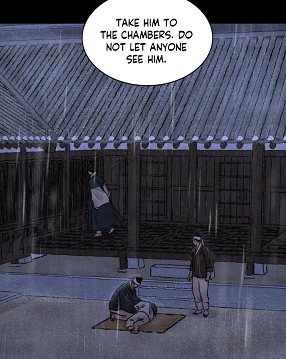
 I have already found a solution, but it takes some time to elaborate all the thoughts. Hence expect that the last two essays will be updated one more time, just like a third one will be released soon. The title has already been chosen: Time and crime.
However, don’t get me wrong. All my main ideas remain the same: lord Song is the king, he was targeting Yoon Seungho and fooled father Yoon. The latter accepted to offer his son as sacrifice in exchange for the throne. But now, with my new ideas inspired by my conversation with one of my followers, I can elaborate Yoon Seung-Won’s role in the past more precisely. Then I realized that for the story is centered on father-son relationship, it signifies that Jung In-Hun plays another part as well. Don’t forget that each character has multiple identities according to my theory. As example I could use Baek Na-Kyum who was supposed an old bearded painter, than a servant or a fiancée or a kisaeng. In other words, the learned sir is more than just a “surrogate father” and “teacher”.
Simultaneously, I wanted to announce that from Monday on, I am back to school, and I won’t be able to write as much as before.

This is where you can read the manhwa. https://www.lezhinus.com/en/comic/madplace_en But be aware that this manhwa is a mature Yaoi, which means, it is about homosexuality with explicit scenes. Here is the link, if you are interested in more analyses about other manhwas https://bebebisous33analyses.com/2021/06/06/table-of-contents-of-analyzed-mentioned-manhwas/
It would be great if you could make some donations/sponsoring: Ko-fi.com/bebebisous33 That way, you can support me with “coffee” so that I have the energy to keep examining manhwas. Besides, I need to cover up the expenses for this blog.
After reading such a title, readers familiar with this story will wonder how I came to select such a headline, because it gives the impression that this manhwa contains supernatural elements, while in reality the story is a mystery, or more precisely a crime novel. Besides, the illustration of Mad Place is clearly reflecting this situation. The Korean prosecutor, Gu Sehyuk, has handcuffed and trapped in his arms the suspect Ha Ideun, while holding the keys of the handcuffs in one hand. But if you pay attention to the scenery, you will notice that the district attorney is also trapped, hugged by the chaebol Ha Ideun. Yet, at no moment there‘s a presence of a ghost or a priest.
However, the manhwaphiles should look carefully at the way the two protagonists are introduced and even portrayed. Only through a meticulous analysis, they will realize that both characters are more than just a prosecutor and a chairman‘s son.
And now, it is time to focus on Ha Ideun. 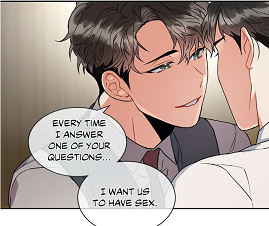 (Chapter 7) After viewing such a panel, the readers can only judge him as weird, but funny. Though the main lead is now a murder suspect, he keeps smiling while making requests, and as you can see, his main condition is sex. Because of such a behavior, he can not look trustworthy in the attorney district’s eyes, rather obsessed with sex. It was, as if he was amused by this situation. That‘s even how Gu Sehyuk views him in the beginning of this story. Nonetheless, this is just a deception. The man is actually using the situation for his own benefit. Why? First, his first request is quite serious. He is asking for an investigation.
  (Chapter 2) This signifies that he needs Gu Sehuyk’s help and power as district prosecutor. And this observation leads me to the following conclusion. He created such an opportunity to approach his target, Gu Sehyuk. How did I come to such a conclusion?
The author gave us clues on different occasions. First, he knows the code for the house. 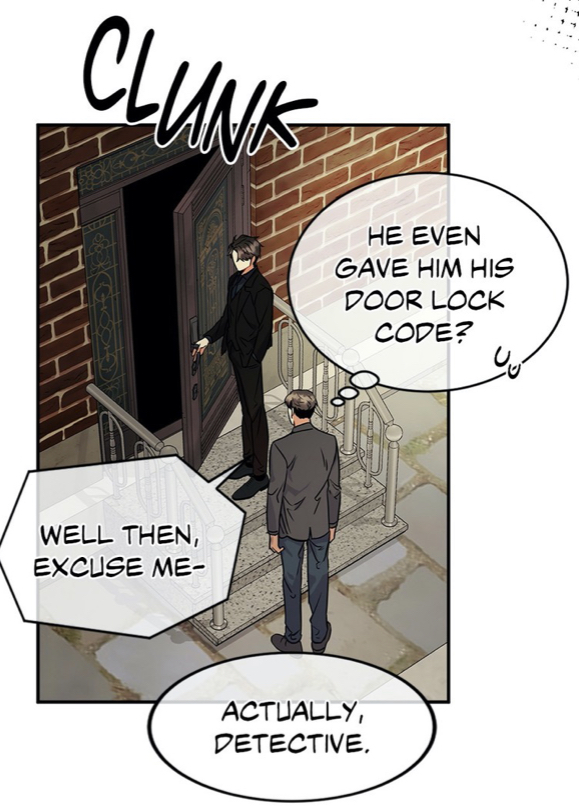 (Chapter 12) I doubt that the main lead gave it to the „suspect“, since the latter is under investigation. Secondly, he knows the prosecution officer’s life so well. Observe that he is the one telling the young detective how long Gu Sehuyk will stay at work.
  (Chapter 12) Moreover, he knows about the death of Gu Sehyuk’s brother and the circumstances of his assassination. That’s why he sent him a picture of the killer, Yoon Gyuho, who had committed suicide right after. Then, the manhwaworms can witness
  him kissing the prosecutor’s wrist tenderly, a sign of affection. He might have introduced himself as his biggest fan
 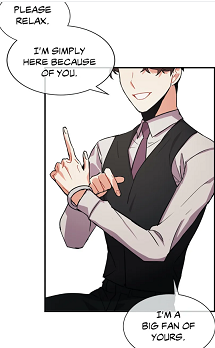 (chapter 2), yet such a gentle kiss expresses more than just admiration. Moreover, I would like to point out the absence of the eyes in the last picture, a sign that the protagonist is here wearing a mask and not entirely honest.
All these elements truly expose that he is well informed about the district attorney‘s life. But since the latter has no idea how he is connected to the „suspect“, the first assumption would be that Ha Ideun has been spying on him like a shadow. A second possibility would be that he was an acquaintance of Gu Sihwan, the assassinated brother, but the prosecutor was left in the ignorance. Yet, I have to admit that I have a different theory. I am actually more inclined to perceive him as a ghost from Gu Sehyuk‘s past, but the latter has no recollection due to his trauma. This means that he would have ghosted Ha Ideun. This theory would also explain why he proposes the deal: sex in exchange for information. That way, he would restore their past relationship. As you can detect, for me the sex scenes in a really good manhwa are not just created for entertainment, they always have a purpose (see Painter Of The Night, The Pawn’s revenge etc.) Moreover, we could perceive the ghost’s behavior in episode 18 as an evidence for this thesis. 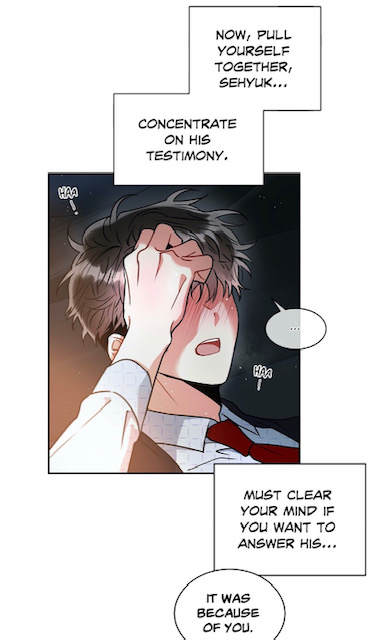 (Episode 18) Notice that in this scene, the „suspect“ is blushing and hiding his gaze with his hand, while he admits that he did it because of him. In addition, he reminds the attorney district of their actual situation. One sex session means the divulgation of intel. Here, Gu Sehyuk had the impression that he was the only one who got carried away, whereas Ha Ideun was still able to remain rational and calm. Yet, due the blushing and the covering of his eyes, it becomes obvious that the „suspect“ was definitely moved. Besides, Ha Ideun justifies his action with the prosecutor. It is for him or his brother. Then he begs him for his trust. Yet, this is just a theory of mine and you have every right to think otherwise. But one thing is sure: the young man is definitely more close to Gu Sehyuk than the latter is aware.
As you could see, I used in two opportunities the idiom „ghost“, when I described his relationship with the prosecutor:
Yet, at no moment I elaborated why I couldn‘t help myself connecting the chaebol‘s son to a phantom. First, the protagonist is presented as Gu Sihwan‘s shadow 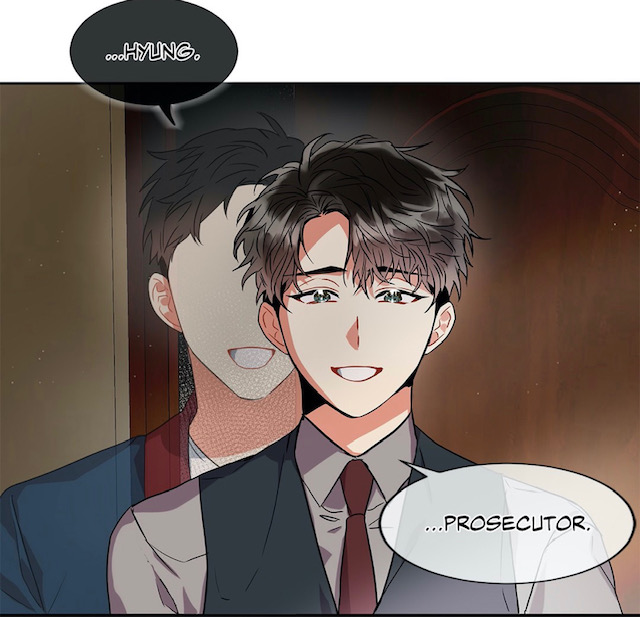 (chapter 6), exposing that both characters are similar and in fact related. Furthermore, what caught my attention is that the face of the chairman’s third son is never revealed to citizens, when his arrest is mentioned in the news. In fact, we only get to see a white television screen.
  (Chapter 1) But this doesn‘t stop here. Later, when the attorney district meets the deputy prosecutor general Na Joohwan, the latter reveals that during a search concerning the existence of a slush fund, he noticed that Ha Ideun’s room was devoid of life.
 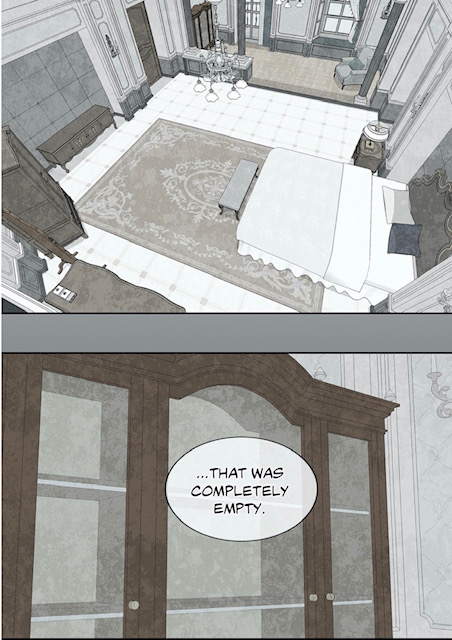 (chapter 8). There was no picture and no cloth. It was, as if the owner of the room was a phantom. Besides, note that we have the presence of white again. The manhwaphiles certainly know the expressions „white as a sheet“, „pale/white like a ghost“. As you can see, these panels reflect these idioms. That’s how I connected the chaebol’s son to a ghost.
Furthermore, if the manhwalovers recall how the young man is described, they will notice that neither the detective and the prosecutors can truly perceive his identity. He is rumored to be consumed by sex  (chapter 7), he is not working and he doesn’t own any apartment. In other words, he is living in the shadow, for he has no possession and is not interacting with people. His sexual habits are presented as hearsay. And now, you comprehend why I made this association. That‘s why it is not surprising that at the end of episode 18, Gu Sehyuk wondered about Ha Ideun‘s true personality.
And note again that the young man appears quite emotional, once he is alone in front of the mirror. This truly exposes that their last sex session definitely affected him and he was controlling himself, when he made new revelations.
Another parallel is his words addressed to Gu Sehyuk. First, he confesses to him that he knows the truth.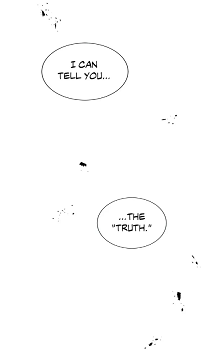 (Chapter 5), while the district attorney is only aware of facts.
  (Chapter 4) There’s no doubt that the suspect is telling the truth. He is not blinded by agony, like Gu Sehyuk who suffered a lot from his brother’s loss. I will explain the difference between truth and facts more in details later. Besides, let‘s not forget that a spirit is able to see more than humans, because they are detached from the physical world. They can move from one place to another very easily. Therefore they can gain more insight than mortals. As a ghost, he is able to spy and discover new clues.
Since Ha Ideun is related to the color white, a symbol for purity, wisdom, knowledge and light, it becomes obvious that the young man is in reality more than just a hedonistic and carefree person. Observe this scenery:  (chapter 2) The light oozing from the television stands in the protagonist’s back and illuminates the prosecutor. It was, as if Ha Ideun was bringing light into the main lead’s darkness. With his knowledge, he will be able to help to unveil the mystery of his brother’s death. For me, there’s no ambiguity that he has long planned to approach the prosecutor and he knows very well, why Gu Sihwan was murdered. But he can‘t reveal everything at once, because the latter would never believe him. Besides, he needs to prepare the protagonist to face the truth and exactly for this reason, the young man has to investigate himself. Only by becoming the investigator, Gu Sehyuk can discover and accept the verity. Moreover, Ha Ideun has to gain the prosecutor‘s trust. And now the manhwaphiles can comprehend why he is asking for the prosecution officer‘s confidence.
  (Chapter 15) Therefore he is willing to be investigated and questioned by Gu Sehyuk. He has no problem to get tested. Since he is clean, he has nothing to fear. On the other hand, he is not releasing much information, because he is well aware that his knowledge could generate suspicions among the prosecution office. Observe that once caught in the CCTV, he was immediately turned into a murder suspect. Words can be misinterpreted, hence he is very reluctant to speak so freely. The readers should keep in their mind that each information he gave was related to a concrete evidence (the picture, the bag full of drugs and the knife),
  (Chapter 15) something that can not be tampered, as long as the district attorney is supervising the investigation. In other words, he is guiding the district attorney to unveil the mystery.
And now, you might be wondering why he approached the prosecutor after two years. In my opinion, it is related to his good notoriety. Gu Sehyuk has become famous as a hardliner, as a serious and integer prosecutor. He made sure that the accused would always receive a harsh sentence. Nonetheless, there exists another reason from my perspective. Since Ha Ideun is a „ghost“, this signifies that he is powerless. I suspect that the absence of his life and presence is related to his other brother Ha Sungjoon.  (Chapter 2) After analyzing so many manhwas, I discovered that many characters wearing glasses were hypocrites, often manipulative and ruthless. Hence I am suspecting that everything is related to Hasung Group. I believe that Ha Ideun’s powerlessness is related to Ha Sungjoon. Note that in that scene, the main lead showed a disdain towards his brother, when the latter appeared on television. There exists a rivalry and Ha Ideun‘s bad reputation (lazy, consumed by sex) is definitely playing into Ha Sungjoon‘s hands. Simultaneously, it could be a diversion from the main lead‘s part, that way he could deceive his brother and investigate his crimes. The manhwaworms shouldn‘t forget the existence of a slush fund and the sudden increase of benefits from Hasung Group.
Finally, by approaching the district attorney, Ha Ideun is slowly revealing his existence to the outside world. For the first time, his name becomes public. This means, he can no longer be hidden. This is no coincidence that he allows the NFS to take his hair and blood, because that way he can prove his existence. I have to confess that Ha Ideun sounds similar to „hide“. From my perspective, it looks like the protagonist was forced to live in the shadow. And now, with this interpretation, it becomes more understandable why he would make the request to have sex. Through sexual encounters, he has the impression to feel alive. It was his only way to prove his existence. Furthermore, it would give him the perfect excuse to hide his true intentions. He needs Gu Sehyuk’s strength and trust, and through intimacy, he can get his faith and as such justice.
Now, the manhwaphiles are wondering about the origin of this interpretation. What caught my attention is the protagonist’s behavior. First, he lives like a hermit, keeping his distance from his coworkers and totally disinterested in worldly pleasures. This explicates why after his victory at the trial he refuses to celebrate with his colleague. 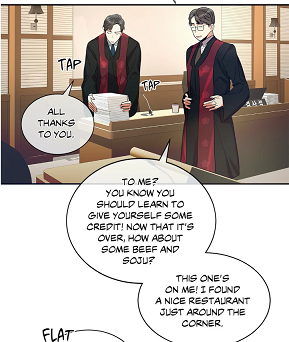 (Chapter 1) His whole life is revolving around his work as prosecutor, a life full of dedication, humbleness and chastity. He is actually not truly living, just determined to keep his vows. He is making sure that the defendants are all receiving harsh sentence.
  (Chapter 1) What the other district attorney calls as obsession, is in my eyes the protagonist’s religion.
The way I portrayed the main lead reminds me of a priest, and more precisely of a monk: seclusion, modesty, abstinence of worldly pleasure, hard work and virtue are the features corresponding to a ascetic. His cult is to make sure that culprits are receiving their punishment, since he failed to do it with his brother. It was, as if he was trying to absolve his sin towards Gu Sihwan. But if Gu Sehyuk is a priest, then he needs to have a shrine. (Chapter 3) The pictures on the cupboard are representing his „idol“ or „saint“. Since Gu Sihwan got assassinated, he became a martyr and his brother turned him into a „saint“. And now, you comprehend why Ha Ideun is not allowed to touch his deceased brother’s belonging. They are sacred relics.
  Therefore it is not surprising that the brother’s bedroom is associated to white as well:
  It was, as if his bedroom was a crypt. That’s why I came to the following interpretation. The mansion, which Gu Sehyuk described as „frozen in time“, is his tempel. Consequently, his residence is intemporal. Because this is a sacred place, he can’t live properly there. At the same time, he feels the intrusion of a stranger as a sacrilege. Therefore the manhwaphiles can grasp why Gu Sehyuk cleaned the house after the ghost‘s visit.
 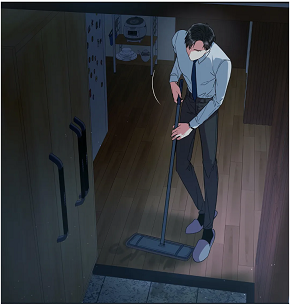 (Chapter 3) The tempel had lost his purity. The reason for his transformation is naturally his brother’s murder. The latter suffered so much from it, that he couldn’t move on. This is no coincidence that once he is confronted with the culprit’s face, he gets a flashback, a panic attack.
 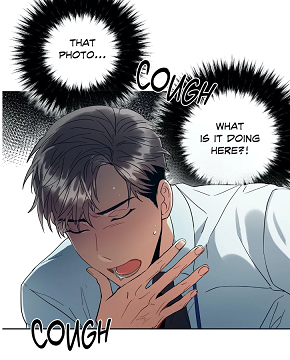 (Chapter 3) But since he is so trapped in his past, he starts suffering, once he encounters Ha Ideun, for the latter forces him to remember his repressed memories.
Because he lived as a monk, he never got the occasion to get emotional. However, once the „ghost“ touched his wounds from the past, the prosecutor could only get infuriated and upset, and as such became a sinner. This is not surprising that he even got violent. And now, it is time to explain what Ha Ideun meant with this:
(Chapter 4) The hard working man witnessed Gu Sihwan’s murder and caught the culprit at the crime scene. Hence he could never forget his face. 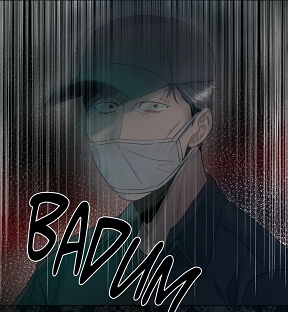 But the problem is that memories are never objective. They are definitely influenced by the subject‘s past experiences, emotions and mentality. What Gu Sehuyk saw here could be viewed differently. He views a murderer in this image, while I detect the killer‘s despair and angst through the eyes. From my point of view, the man was not lusting for blood, though he stabbed him 7 times, a sign for rage and madness. And notice that after the crime, Gu Sehuyk investigated the matter from the culprit‘s perspective. Why would he stab his brother 7 times? Why would he do this? In other words, he tried to find out his motivations. But like Ha Ideun pointed out, he was missing something important there: the victim.
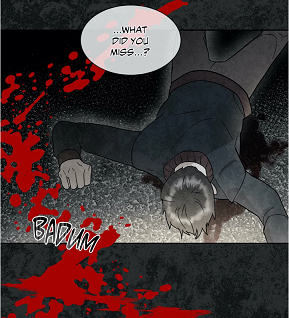 (Chapter 4) Because he was close to his brother, he had the impression that he knew his brother: he was a smiling and cheerful person with no secret.
 The picture of his idol exposes Gu Sehyuk‘s blindness. And now, you comprehend why the „ghost“ put it down in the end. This was not the truth, Gu Sihwan hid things from his brother. And this leads me to the following conclusion. Because the prosecutor idolized his brother so much, he couldn‘t discover the truth. Moreover, he acted like every district attorney. They just need to catch the culprit and the case is closed. However, there‘s a huge difference between truth and identifying the perpetrator‘s identity. There was definitely a conspiracy, but the protagonist failed to see this, as he was too obsessed with the assassin. Here I would like to mention my other essay called „Truth and memories: Memorist, Nobody knows, Find me in your memories and The King“, where I elaborated the problematic of unveiling the truth through memories.
Under this new light, it becomes comprehensible, why Ha Ideun switched on the light in the prosecutor‘s residence, which caught the district attorney by surprise. This has a methaphorical signification. He brings the prosecutor closer to the truth, he enlightens him. This explicates too why the spirit entered Gu Sihwan‘s room and grabbed his book. He was violating the sacred place for one reason. He wanted Gu Sehyuk to leave the darkness of his temple and fight for his brother’s rights.  (Chapter 4) Why did he have to die? Ha Ideun needs to transform the deceased brother into a human so that Gu Sehyuk decides to look into his brother’s past life.
However, Ha Ideun has to change the prosecutor’s way of life as well. He needs to force him to become sinful so that he stops being a monk and the house is no longer perceived as a shrine. That’s another reason why the „suspect“ requests sex as an exchange for information. He is inciting the main lead to become a sinner. That way, the main lead is pressured to drop his role as an ascetic. By turning him into a sinful priest, the latter is forced to question himself. Hence the main lead gets violent enraged in the episode 3 and 4, signs of wrongdoings. Besides, this is exactly what is happening in episode 18. For the first time, he discovers pleasures  and is taken by surprise. He wonders why he acted like this.
  (Chapter 18) In my eyes, this scene indicates that Gu Sehyuk is slowly coming back to life. But the problem is that the main lead has lived like that for two years, therefore he won’t change right away. From my point of view, his „temple“ will become a mad place, because he commits a sin in a sacred place.
 (Chapter 1) Ha Ideun won’t be able to remove the prosecutor’s religion despite their sex sessions, as long as the truth is not totally unveiled. This is my explanation why Junah chose such a title.
And now, you comprehend why both protagonists are trapped in each other‘s embrace. Both need each other in order to unveil the whole truth. Ha Ideun is definitely lacking power, as he has always lived in the shadow. He needs to become a human in order to get justice, just like Gu Sihwan.
Feel free to comment. If you have any suggestion for topics or manhwas, feel free to ask. If you enjoyed reading it, retweet it or push the button like. My instagram-tumblr-twitter account is: @bebebisous33. Thanks for reading and for the support, particularly, I would like to thank all the new followers and people recommending my blog.

This is where you can read the manhwa. https://www.lezhinus.com/en/comic/painter But be aware that this manhwa is a mature Yaoi, which means, it is about homosexuality with explicit scenes. If you want to read more essays, here is the link to the table of contents: https://bebebisous33analyses.wordpress.com/2020/07/04/table-of-contents-painter-of-the-night/
It would be great if you could make some donations/sponsoring: Ko-fi.com/bebebisous33 That way, you can support me with “coffee” so that I have the energy to keep examining manhwas. Besides, I need to cover up the expenses for this blog.
Now, you are all wondering why I am using a panel from chapter 59 as illustration, when the story has already moved on, and our beloved couple is actually celebrating their marriage. Everything started with the following panel:  (Chapter 71) As you can envision, I am now examining each picture very carefully, hence when I saw this image, I couldn’t help myself associating it to the painter’s abduction. First, the painterofthenight-lovers will certainly remember the scene of the lord’s panic, when he left the room and saw the footprints on the ground misleading him to think that the painter had run away.
  (Chapter 60) In this picture, the manhwaphiles can even hear Nameless’ explication why the lord would jump to the wrong conclusion. The expression “on his own two feet” was actually visualized by the imprints left on the snow. We know for sure that Nameless knocked out the painter before carrying him away. He carried him the same way than he did with Lee Jihwa:
  (Chapter 59) What caught my attention is that the space between the footsteps on the wood (Chapter 71) is much bigger compared to the ones left in the snow. (Chapter 60) Why such a difference? It is related to the divergence of height between the lord and the painter. So here is the question? How could Nameless walk with small footsteps, when he is carrying another person? As you can see, the panel from chapter 71 serves as a clue for the presence of an accomplice during this night. I had already elaborated that Kim must have participated in this, but I could never prove it. But one might argue that this proof is not strong enough to validate my theory. That’s why I examined the chapter 59 more closely again.
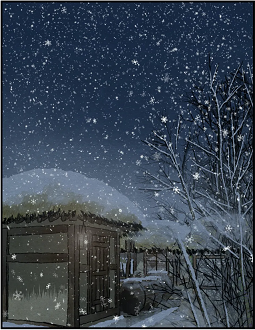 (Chapter 59) This image caught my attention for two reasons. Thanks to the analysis “The five candles”, I realized the true meaning of the pictures with landscapes. They expose the actual situation, therefore the beholder should study them under the following elements: moon or sun, air, water, earth and fire. So in this picture, you can detect the absence of the moon symbolizing the lord’s illness. He is too weak to look after his lover. Striking is that the earth element is predominant here, as the tree branches standing next to the buildings are almost touching the sky. So since the snow is falling, it indicates the presence of water and note that water is almost everywhere: in the sky, on the trees, on the ground and on the rooftops. The only element missing is fire. Yet if the manhwalovers examine the image more closely, they will detect the presence of a light hanging on the side of the restroom. However, the candle surrounded by glass is not lit. To sum up my observations, this panel exposes the predominance of water and earth and the presence of a lamp with glass. In other words, this image symbolizes butler Kim, the new version of chapter 58
  . First, let’s not forget that Kim is often seen carrying a bucket of water
 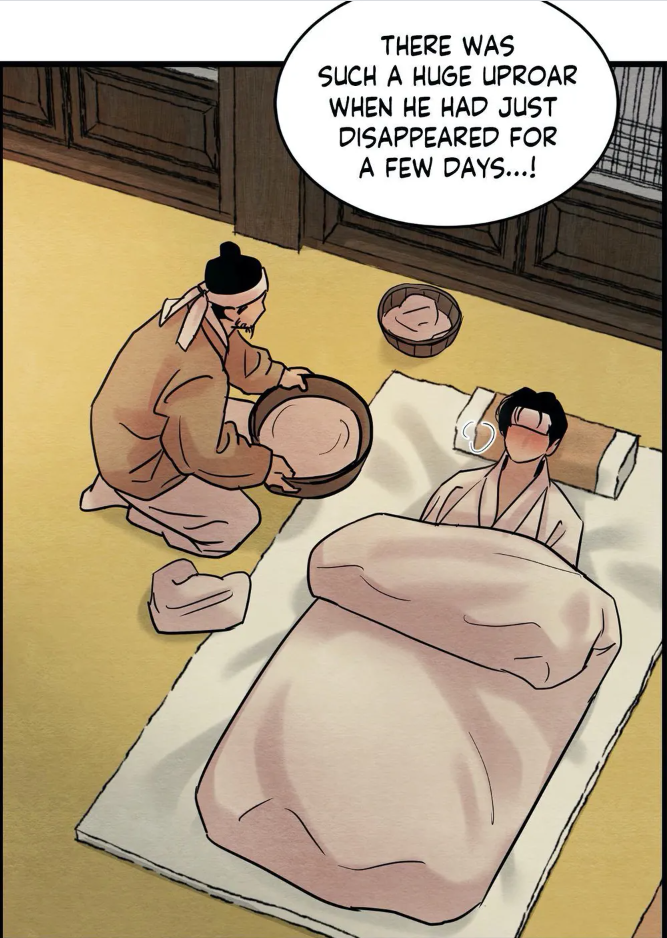 (chapter 33)
 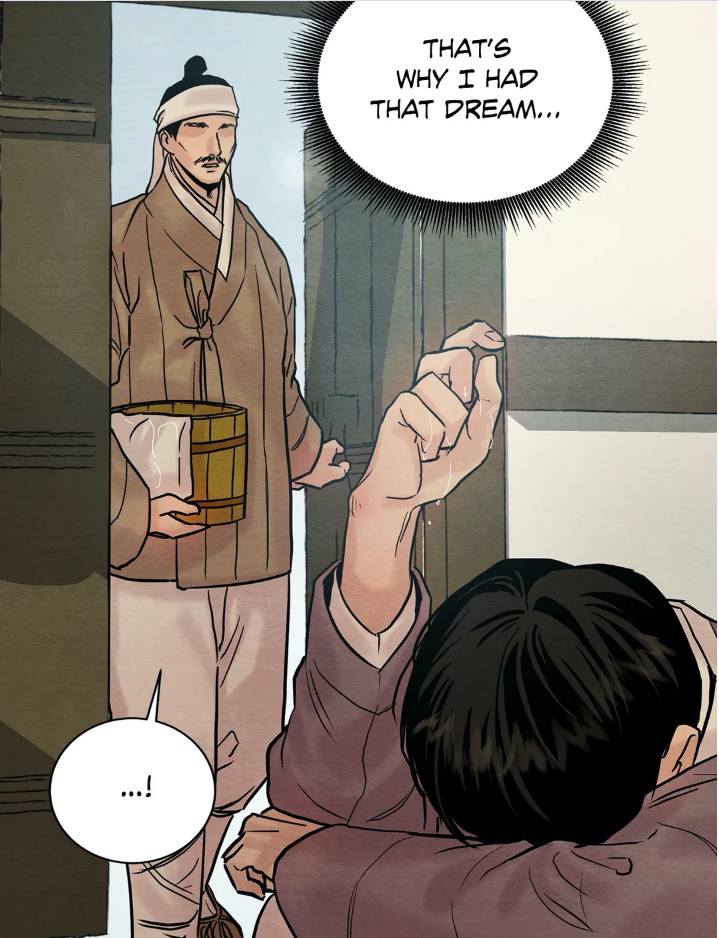 (chapter 56). Secondly, he is also linked to the lantern with a glass
  (chapter 20)
  (chapter 36) But more importantly is that in the image from chapter 59, there is no light, (Chapter 59) which can not be a coincidence. In my eyes, the valet is already aware of the future kidnapping, but he is not sharing his knowledge to the protagonists. He wants to keep them in the dark. Moreover, if you add the picture from the chapter 58, you’ll detect the absence of the glass lamp too. (Chapter 58) The presence of light comes from the physician’s room, where both main leads are making love. Hence the fire element is associated to Yoon Seungho and not Kim. All this indicates that the valet will apply his favorite philosophy: feigning ignorance. Both panels are actually exposing the valet’s complicity. Even before I realized Kim’s true personality, I had already explained that he was the one who put the protagonists’ shoes next to each other. Back then, I considered it as a gesture of kindness, whereas now I have a different opinion. As you can imagine, I perceive these two panels as evidences for Kim’s complicity. The butler will be the one creating the painter’s imprints.
But some might say that this is not enough, as they are just interpretations. Therefore I am now bringing up this final evidence:  (Chapter 59) Note that the painter is standing in front of the bathroom. He has just cleaned himself and note that the lamp is in the background. How is this a proof? If the painter had run away, he wouldn’t have gone to the restroom… he would have left the room right away, just like the footprints are indicating. (Chapter 60) But since he went to the restroom before, it signifies that imprints should have been left behind. Yet there’s nothing like that. Therefore, this means that someone had to erase the imprints. It can only be Kim!! As for the doctor, I believe that he must have heard the painter visiting the restroom. (Chapter 59) Note, there’s the sound of the door closing. But when the disappearance of the artist was noticed, the physician didn’t realize the significance of this noise, only afterwards hence he hesitated to mention it, as it appeared so anodyne. However, as the readers can envision, if the physician had talked about the painter’s visit to the bathroom, then the lord would have realized that someone had tampered evidence. However, the noble due to the footsteps had sent for his domestics in order to start a research, hence the doctor didn’t think about this right away. But this doesn’t end here. I suddenly realized that the doctor could have heard something else, the sound of No-Name jumping and the painter‘s question:
  (chapter 59) But since the artist was silent right away, as the Joker knocked him out immediately, the physician could have jumped to the conclusion that Baek Na-Kyum met an acquaintance. So when the vanishing of the painter was discovered, the doctor assumed that the artist had followed the person he met during that night. Honestly, I can’t blame the doctor for his “passivity”, if my assumption is correct. Due to the lord’s agitated state of mind, the doctor could only realize it afterwards. With this new discovery, it becomes more comprehensible why the physician hesitated the next morning. He didn’t know what he should do.
  (Chapter 63) If he revealed what he had heard, then he imagined that he could bring the person who had „helped“ Baek Na-Kyum to escape into trouble. Observe the presence of the drop of sweat on his face. He was definitely uncomfortable. If he testified, then he could reveal the presence of a conspiracy. Nonetheless, I believe that he had jumped to the wrong conclusion: desertion. And with this new discovery, you can understand why the butler was so worried. He had no idea what the doctor had noticed. Imagine, the valet got caught by his own method (spying behind doors), however in the physician’s case, the latter was not doing out of malevolence. He just happened to become a witness, but he had assumed something else. That’s the reason why Kim was so worried, he had seen no one, yet the doctor had observed something. Kim never imagined that such a small detail (noise) could become a threat for him. This explicates why he chose to visit the doctor during the night.
  (Chapter 64) He needed to ensure that the doctor remains silent. Many manhwaphiles will certainly recall how Kim threatened the doctor…
 (chapter 65) Back then, I had assumed that out of cowardice, he had not intervened due to Kim’s harsh words. Nonetheless, I came to a different interpretation. After recognizing how Byeonduck is tricking the readers, she gives the impression of a continuity, I believe that during that night, the butler visited two different physicians. According to my theory, there exist 3 different doctors. For more, please read the analysis “The mysterious doctor“. How did this idea come up? Simply by paying attention to the BEARD!!
  (Chapter 57) Note that the beard of this physician is covering the cheek and is straight.
 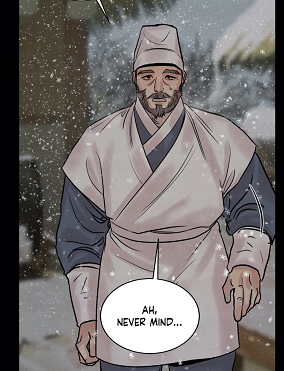 (Chapter 63) But now compare it to the physician’s beard in episode 65: The cheek is free on the side, and it has the form of a W!! First, he went to the one who treated the painter
 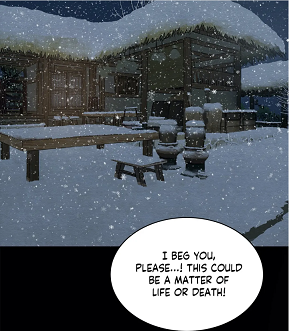 (Chapter 65) and from my point of view, he used pity to discover what the physician knew. Remember how he had used compassion the night before (chapter 57). Besides, if you contrast both statements, you will detect a contradiction. “This could be a matter of life or death“ implies that it was about saving someone, while in the second image, it is about killing someone: the other doctor! In my eyes, the valet must have begged the physician
 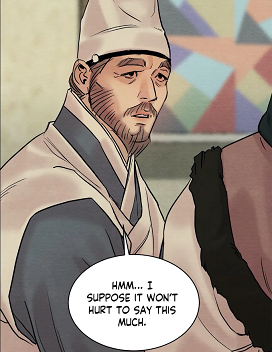 (chapter 57) to remain silent. If he revealed that he had discovered the presence of someone, then the other could get into trouble. In my opinion, the butler must have suggested that Baek Na-Kyum had tried to escape, because the lord had been abusing him. Don‘t forget that he had been treating the artist for his wrist. Then he must have seen the lord panicking too.
  (Chapter 60) But now, the manhwaphiles are probably wondering why he went to the other physician then. It was related to the lord’s behavior in the shed. He was acting like a sex-maniac.
 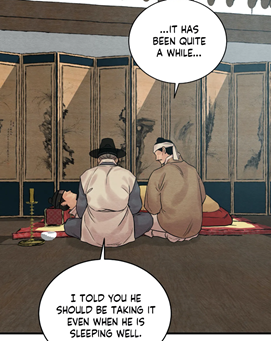 (Chapter 55) This doctor had reprimanded the butler and had been prescribing a tonic. So he visited the physician and used this opportunity to put the whole blame on the poor doctor. (Chapter 65) Because of him, the painter was now treated like a sex toy. The physician had poisoned the lord. Keep in mind that we always have a reflection within the same season. Baek Na-Kyum got “poisoned“, so it should be the same for the lord! Kim threatened the poor man for one reason. No one should discover that two different physicians had been treating Yoon Seungho!!
  (Chapter 65) The man never saw anything, Kim just described to him how the main lead had been behaving! Yes, he was acting like Yoon Chang-Hyeon who had gone to the doctor and described the son’s illness.
  (Chapter 57)
Now, it becomes comprehensible why the valet silenced the two doctors. Both were important witnesses who could reveal the butler’s complicity. The latter had been frequenting two different doctors, and he had made the decision on his own accord. He had acted like a noble, while in reality he was just a servant. Besides, if this doctor (chapter 63) had mentioned the presence of a third person, then Yoon Seungho could have asked the painter and the latter could have revealed the abduction. With such an innocent observation, the noble would start questioning the butler and he could realize that the imprints had been erased and new ones had been created. That’s why Kim had a huge interest for Baek Na-Kyum’s death, and hoped that the noble had killed him in the barn, hence he kept approaching the shed.
 (chapter 61)
  (chapter 62)
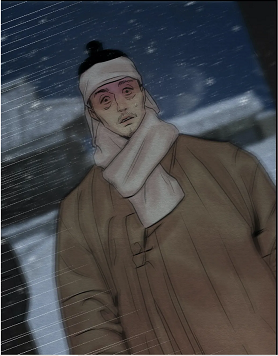 (chapter 64) He needed to confirm his death. But since the lord was having sex the whole night, the butler had to make sure to bury the truth. If the artist had fainted, then the valet would have fetched the other doctor, the one who imagined that Baek Na-Kyum had escaped. And now, you comprehend why the man hesitated to question the painter after his return:
 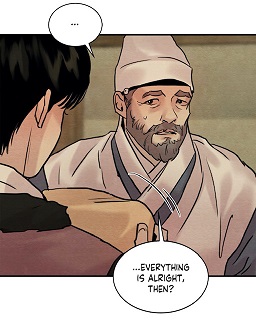 (chapter 74) He was wondering why the artist would look so fine, as he had attempted to escape before. Another evidence for this theory is the following rule: a reflection within the same season. Since the doctor had been puzzled by Yoon Seungho‘s illness, I am deducing that he had the exact opposite disposition concerning the artist. He imagined what the artist had done. He had jumped to the wrong conclusion due to the injured wrist. Besides, he was “aware“ of the lord‘s mood swings.
So after the abduction, everything looked fine again, because Yoon Seungho was more focused on getting the painter’s acceptance. 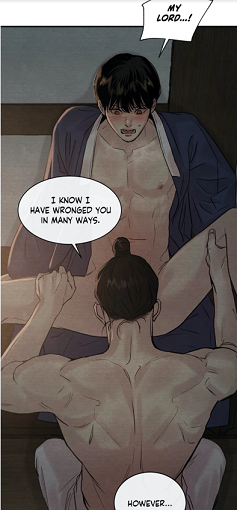 (Chapter 71) Consequently, he was not investigating the real circumstances of the abduction. But he has another reason for neglecting this aspect: he knows the culprit’s identity, unaware that unveiling the mastermind’s identity is far from enough. Real justice is to uncover truth. However, at the end of season 2, the wealthy noble was more like a teenager in love. That’s the reason why he was making a huge mistake.
I could understand the lord’s attitude, although this doesn’t signify that I couldn’t criticize him. He has always hoped for a home and as such acceptance, and the artist did fulfil his wish: he definitely selected him and chose to remain by his side. On the other hand, Yoon Seungho was no longer hoping for the painter’s confession. And this perception was confirmed in season 3: 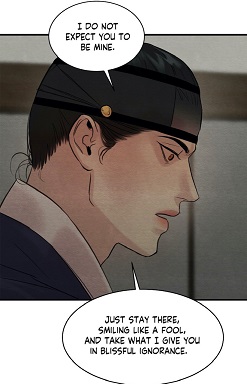 (chapter 85) He was already content if the artist would look at him, the moment you recall his first confession:
  (chapter 55). Hence in chapter 71, he’s blushing and happy, for Baek Na-Kyum is definitely starring at him with such a curiosity and desire.
 Moreover, the painter talks to him, has even accepted his advances. That’s why he is no longer paying attention to the circumstances that led him to think that the painter had run away on his own feet. As for Kim, he was running out of time, because at any moment, Baek Na-Kyum could mention his visit to the restroom or meeting the Jester. Consequently, the former had to use any trick to remove the artist. Hence he encouraged the kisaeng Heena to take away her brother.
  (Chapter 67)
However, Byeonduck drew such a panel in chapter 71: Why? In my first version, I had expressed the following expectation: the imprints would play another important role again and this theory was confirmed in season 3.  (chapter 100) Here, they revealed that the main lead had gone down on his knees, the moment he had seen the traces of fresh blood. Then note that in the shaman’s house, the lord had left a bloody foot print
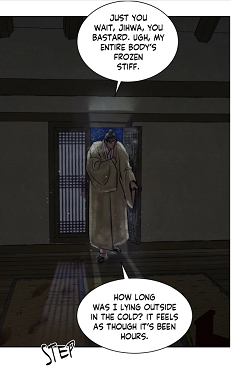 (chapter 102), yet in the snow it was no longer visible.
  (Chapter 102) Someone had erased the traces by putting mattresses on the soil. However, while the lord was walking through the mountain, he was definitely leaving a bloody trail behind
  (chapter 102), a sign that someone had been helping him. And this can only be KIM!! And the last chapter from season 3 seems to confirm my initial investigation: The butler had erased the traces from the abduction. He knew about the kidnapping and helped Lee Jihwa and the Joker.
Feel free to comment. If you have any suggestion for topics or manhwas, feel free to ask. If you enjoyed reading it, retweet it or push the button like. My instagram-tumblr-twitter account is: @bebebisous33. Thanks for reading and for the support, particularly, I would like to thank all the new followers and people recommending my blog.
This is where you can read the manhwa. https://www.lezhinus.com/en/comic/painter But be aware that this manhwa is a mature Yaoi, which means, it is about homosexuality with explicit scenes. If you want to read more essays, here is the link to the table of contents: https://bebebisous33analyses.wordpress.com/2020/07/04/table-of-contents-painter-of-the-night/
It would be great if you could make some donations/sponsoring: Ko-fi.com/bebebisous33 That way, you can support me with “coffee” so that I have the energy to keep examining manhwas. Besides, I need to cover up the expenses for this blog.
The final words in the essay called “A thousand thoughts swept through my mind till sunrise” were the following:
“I believe to see here another clue for my prediction that the next chapters will contain elements from chapter 26 (the bath), 36 (the head-maid and the fellatio), 46 (the maid talking to Baek Na-Kyum), 56 (the wet dream and the bathroom) and 66 (the dream). Striking is that all the episodes I mentioned are ending with a 6!! The most incredible is that the symbolic meaning of six are harmony, balance, sincerity, love, and truth.”
Therefore imagine my surprise, when I read the chapter 70. My prediction turned out to be quite accurate, for elements from the chapters ending with a 6 were indeed present. Yet the only difference is that I didn’t include the episode 16. This signifies that my conclusion remains unchanged: the interaction between Yoon Seungho and Baek Na-Kyum in the bathroom stands under the sign of truth, harmony, honesty and love. No wonder that all the readers were very satisfied with the new chapter.
What caught my attention is that the episodes 16, 36, 46, 56 and 66 have one common denominator, which I didn’t recognize first: pranks. In episode 16, we witness how the lord is playing with the headband.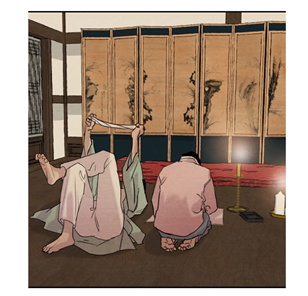 He is not only playful, but also flirtatious. Note how he puts the headband on the main lead giving him a seductive allure.
  At the same time, he acts like an innocent teenager who keeps asking questions: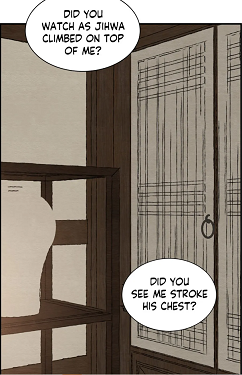
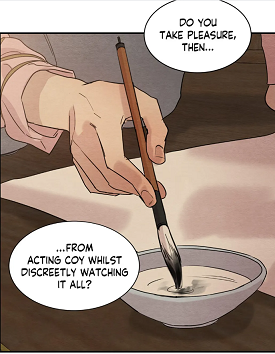 Yet, the topic is actually about sex, which contrasts so much to purity and innocence. It was, as if Yoon Seungho was behaving like a teenager discovering sexuality for the first time.
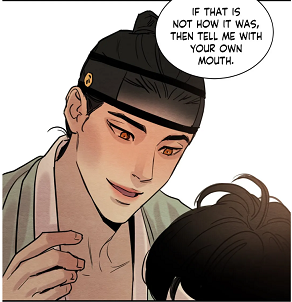 While talking, he can’t even help himself smiling. Striking is that his joke and words are used to woo the painter. He keeps getting closer and closer to Baek Na-Kyum, so that his head approaches the painter’s, before his hand starts touching his leg.
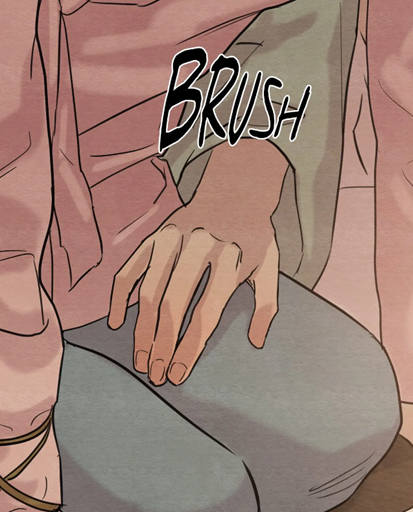 As you can detect, the scene in episode 16 is a combination of seduction and frivolity. He is so happy to be by the painter’s side, hence he is talkative. He desires to have a real conversation with the painter. On the other hand, since the topic of the conversation is revolving around sexuality, it explains why Yoon Seungho is tempting the painter. And we have a similar situation in chapter 70. Therefore there exist so many similarities between these two episodes, which I will now list:
 (chapter 16) versus
  (chapter 70) (chapter 16)
 (chapter 70) (chapter 16)
  (chapter 70)
 and
and 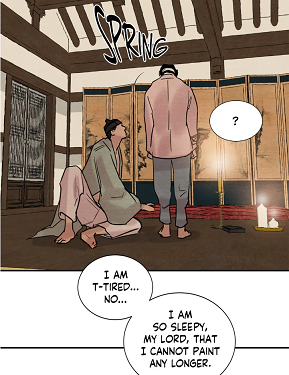 (chapter 16) versus
  the removal from his hand and
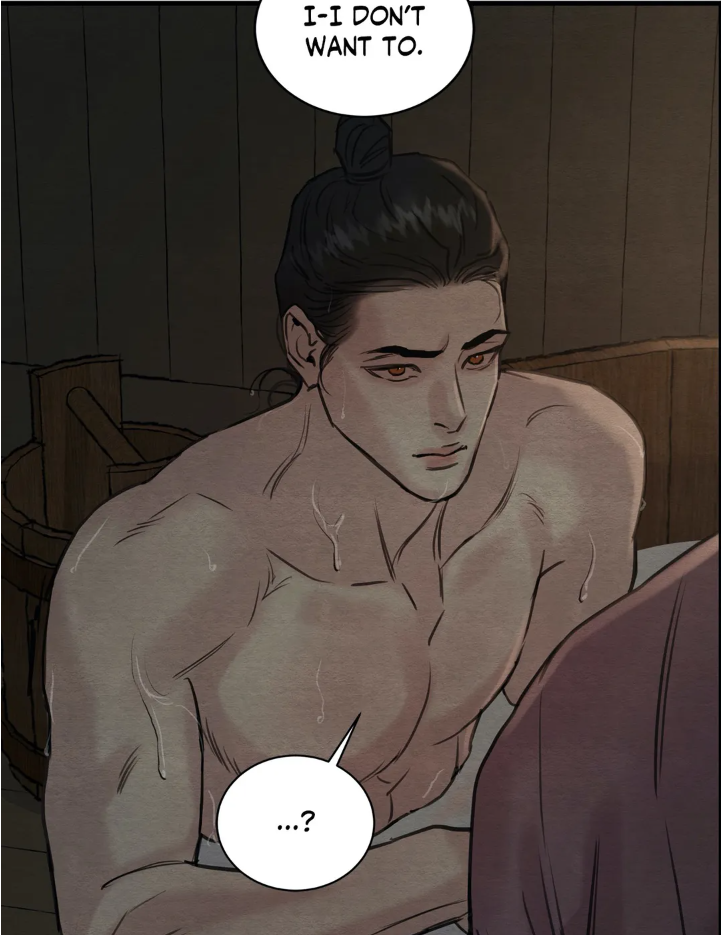 (chapter 70) (chapter 16)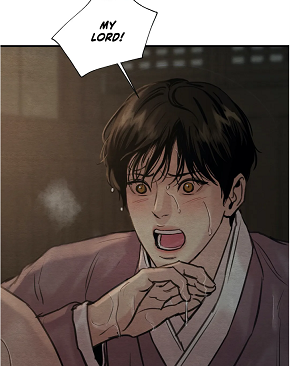
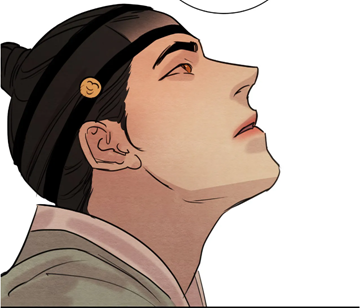 (chapter 16) versus (chapter 70)
 (chapter 16)
 (chapter 70)
The problem is that in chapter 16, the low-born couldn’t value the joke and perceive the lord’s playful personality, as the former was busy fighting against his arousal. He wasn’t immune at all to the lord’s seduction. That’s why we also have a pouty face from the painter in episode 16. 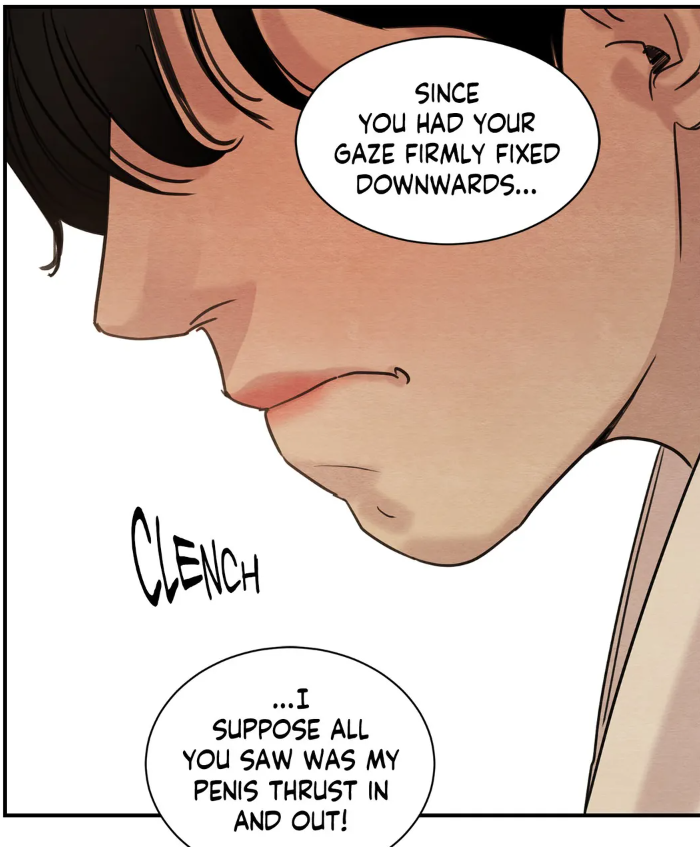 And here, we can detect the first huge difference between these two episodes. Because the artist is no longer denying his homosexuality, and as such he has finally dropped the scholar’s doctrines, he is able to perceive the aristocrat’s true personality. He is indeed moved,
 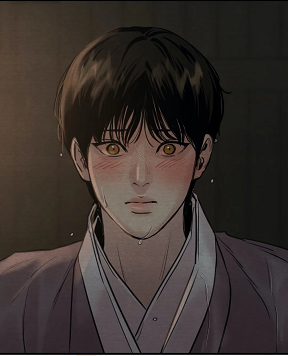 when he sees Yoon Seungho smiling after playing his prank. He blushes so much that he feels the need to hide his face, hence he lowers his head, while in chapter 16, he had his head down because of shame. He desired to cover his pleasure out of guilt. He was definitely struggling internally. In chapter 70, the artist is more scared of his own feelings for Yoon Seungho.
The other divergence is Baek Na-Kyum’s attitude. This time, he is no longer silent. He talks back , when he hears the main lead calling his sister a wench. He requests respect from the lord. He is confident in his words and behavior. He even gives further explications.
 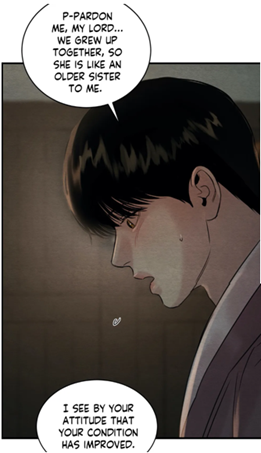 Moreover, he is no longer using fake excuses, unlike in the past. He rejects the lord’s suggestion (taking a bath together) clearly and directly without displaying any disrespect. When the lord keeps pressuring him, his justification sounds reasonable.
This explicates why for the second time the manhwaphiles are witnessing a real and honest conversation between the two protagonists. The first time it happened, it was in the bathroom as well, 
 (chapter 26). Yet back then both were driven by negative emotions (anger and sadness) due to their wounds. However, this time it is different. They are both calm and very careful. The two are determined to treat each other with respect.
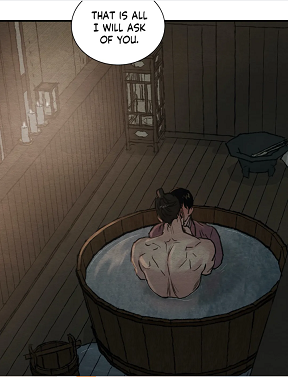
 (Chapter 70) In other words, the bathroom is the place where the main leads can be honest to themselves, hence they are genuine to their counterpart. This is no coincidence that the painter was indeed touched, when he reminisced the lord cleaning him.
 (chapter 59) In this place, there is no rule or social class separating them, they are equal. In the washroom, there’s only purity symbolized by water. I would conclude that they are truly naked physically and mentally. That’s why they can only be honest to themselves and in front of each other.
Another huge contrast between chapter 16 and 70 is the lord’s eloquence. While he mastered the conversation in chapter 16, he reveals his inability to speak properly in episode 70. How do we explain this contradiction? The answer is quite simple. Let’s not forget that in the previous episode, the noble was talking about sex. For he was living like a “man consumed by lust”, his vocabulary was quite rich in that area due to his experiences. However, since he has never had a real partner he could converse with, his true eloquence suffered a lot due to neglect. At the same time, it reveals that his social skills have been overlooked for so long too. This explicates why he has no idea how to convey his thoughts and feelings properly. Besides, the manhwaphiles should recall that the noble had avoided to feel anything and analyze any emotion for so long, hence he still has troubles to voice these. That’s why he keeps calling the kisaeng “that wench” not realizing that he is insulting the low-born’s relative. Nevertheless, in this scene, the noble has no intention to offend anyone, that’s why he is caught by surprise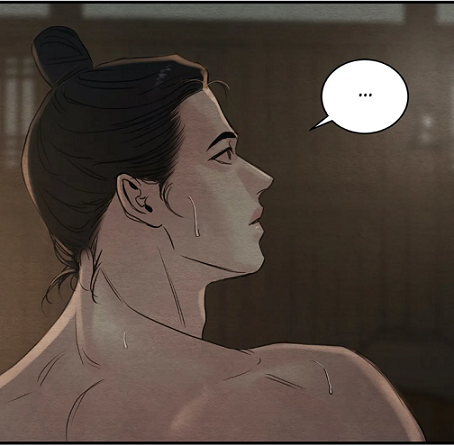 , when the painter retorts that he should mention her differently. His facial expression oozes naivety and shock. He didn’t pay attention to the idiom (“wench”), as all his thoughts were revolving about the painter’s happiness. He just desired to know if he had succeeded:
  (chapter 63: this is the master’s biggest wish) Astonishing is that the painter is not outraged by the lord’s words, as he has already sensed the lord’s true attention: the artist’s happiness. Carefully, Baek Na-Kyum corrects his master and starts describing his relationship with Heena. Consequently, the lord considers it as a good sign. Their bond has not been too damaged. Despite his mistake, the low-born is interacting with him. That’s why he takes the painter’s hand. He has the impression that the artist is opening up, hence he starts conveying his own thoughts too. The problem is that when he says this
  , he makes a huge mistake again. However, his words cause the painter to remember how the lord treated him in that room
  (chapter 66). The artist has no idea that Yoon Seungho is referring to the flashback.
  (chapter 66) Nonetheless, due to his mistake, Baek Na-Kyum retrieves his hand. The reality is that Yoon Seungho was attempting to show his concern and his remorse. Unfortunately, he chose the wrong diction, thereby his thoughts were not expressed properly. Moreover, I would like the readers to keep in mind that the lord has never apologized before. First, as a noble, he was never asked to apologize to a commoner. Secondly, it is related to his own trauma. The main lead associates the apology
 to fakeness and hypocrisy due to the butler, who keeps repeating these words
 (chapter 25)
  (chapter 65). Besides, the painter also apologized once, and back then, he was not really sincere too.
 (Chapter 11) This explicates that he misjudged the painter’s apology in chapter 62. Moreover, exactly like in episode 11, the painter had selected silence over giving a proper explanation. As you can see, silence was another reason why the couple had such huge issues in the past. It generated doubts and increased insecurities. However, in chapter 70, silence is barely present.
  (Chapter 70) Both are communicating verbally in all sincerity. In other words, this panel represents the first step for the lord to apologize. Nonetheless he has to learn how to convey his regret perfectly. Hence this is understandable that we can’t expect him to voice this apology yet. As a conclusion, his poor social skills and lack of articulation mirror Yoon Seungho’s true personality.
The powerful noble detects the change in the painter’s behavior, the latter acts exactly like in the beginning (chapter 5, 8, 11, 16). He speaks his own mind now without being disrespectful. This encourage the lord to step up the game. Even if he made a mistake, the artist forgave him. Yet there’s no doubt that the lord must have felt a little insecure before confessing his true thoughts. Therefore Yoon Seungho takes the painter’s hand and touches the fingers very tenderly.  In my opinion, the skinship serves as support. The master is not just wooing the low-born, but also he desires to voice his emotions. He would like to expose his concern and affection, yet like I exposed above, he fails due to the wrong selection.
What caught my attention is that unlike in chapter 16, the noble tries to determine the reason for the artist’s rejection.  (Chapter 70) Imagine, before he never showed any interest why the commoner refused to paint for him.
  (chapter 1) This exposes the huge transformation of Yoon Seungho. Now, he would like to be judged differently. He has already realized that he will never achieve his goal (being loved), if he is still full of insecurities and self-hatred. Nonetheless, his selfishness is still present in the bathroom, because he can’t bear being pushed away again. This interpretation is exposed with the number of white candles.
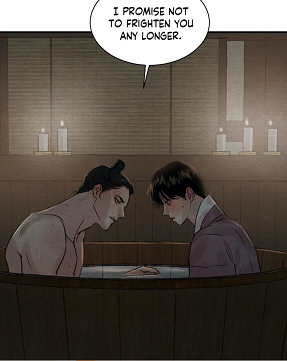 Note that on the lord’s side, there are just 2, while on the painter’s side the beholder can count three. The number 3 symbolizes harmony, completion and wisdom. This observation leads me to the deduction, the aristocrat’s transformation is not completed yet. This explains why he plays a trick by dragging him into the tub. The prank is the perfect solution in order to pursue his dream without becoming forceful or frightening. Moreover, note that he refuses to act like a master by giving him an order. From my point of view, the noble’s tone has changed. Not only his gaze but also his gestures have already softened.
Moreover, both keep looking at each other during this conversation, whereas in the episode 16 there was no eye contact. Only the lord was looking at the painter, (chapter 16) while the commoner’s gaze was fixated on the drawing as an excuse, until he was forced to look at him.
As a conclusion, for the first time both protagonists are following the 10 golden rules of communication:


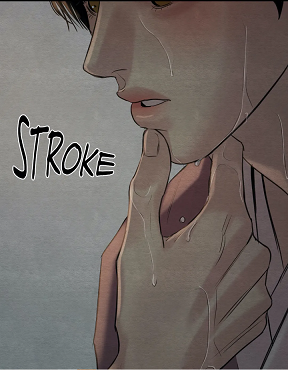 The caress serves as a mean to confess his love towards the artist.
  quoted from https://www.psychologytoday.com/us/blog/hide-and-seek/201207/the-10-golden-rules-communication
From my perspective, the prank played a huge role in truly breaking the ice between the main characters. Because he didn’t succeed to reveal his own thoughts and emotions properly, he had to find a new approach. That’s why he suggested the bath. In his mind, if the artist recognized that they were just two naked bodies, the distance between them would vanish. This means, that the moment the painter decided to stay at the mansion, the lord’s second dream 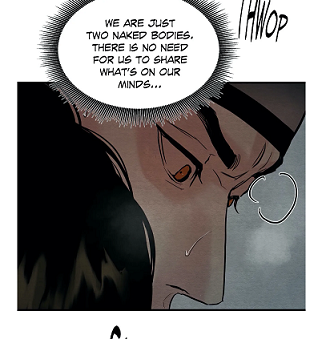 (“to share what’s on their mind”) got revived. He was once again full of hope, that’s why he felt the need to touch the painter. He wanted to share his feelings and thoughts. Unfortunately, the low-born rejected the offer, which is also comprehensible. We have to imagine that with this proposition, he could just intimidate the commoner. If the latter had to undress himself, in Baek Na-Kyum’s eyes, there was a high chance that the noble would have asked for a physical intimacy… and we shouldn’t forget that he had just experienced a rough sex marathon the night before. Therefore he couldn’t accept the suggestion. On the other hand, the lord couldn’t stand a rejection either. That’s why he had a pouting face. And just like a child, he decides to play a prank. The painter might yell at Yoon Seungho, however there is no real resent. Besides, contrary to the past, he doesn’t say no, he just scolds the noble. That’s why his feelings switch quite quickly. Through the joke, the seriousness has literally vanished. At the same time, the readers are finally able to witness the noble’s genuine laugh:
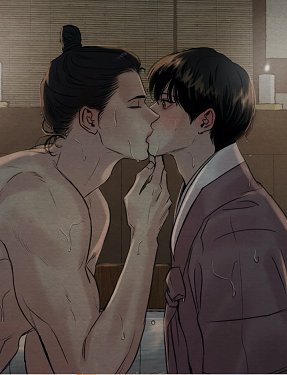
  I believe that for the first time, the low-born is able to detect a new side from the aristocrat. Imagine that the artist could not only make the noble laugh, but also smile. That’s why the painter can no longer reject the lord, as his fear is slowly disintegrating. Note that he doesn’t reject the kiss from the aristocrat. What I love in this panel is that the lord’s eyes are closed, illustrating his leap of faith. He chose to trust the artist blindly. Simultaneously, the manhwaphiles can detect a certain shyness in Yoon Seungho. His ear is red exposing the slow rebirth of the protagonist.
Another contradiction between the chapters 16 and 70 is that the seduction is not focused on sex, but on love. This signifies that the “corruption” from episode 16 has disappeared. We are truly witnessing a scene exuding pure affection and warmth. He is here courting the painter, hence there’s no real sexual desire in the tub. The skinship is full of sensuality and tenderness: a caress, a kiss and the beginning of an embrace. The master’s second wish is gradually coming true. The lord is putting his guard down for real in chapter 70. That’s why he is completely naked: he has no green robe and no headgear as well. He has finally become a real human. He is no longer a ghost or vengeful spirit, only an innocent teenager discovering real love for the first time, whereas in chapter 16, he was behaving as if sexuality was quite new.
But since my topic is “prank”, I would like to point out that the main lead played another prank in chapter 36 exposing his cheerful personality. Nevertheless, back then, there was only silence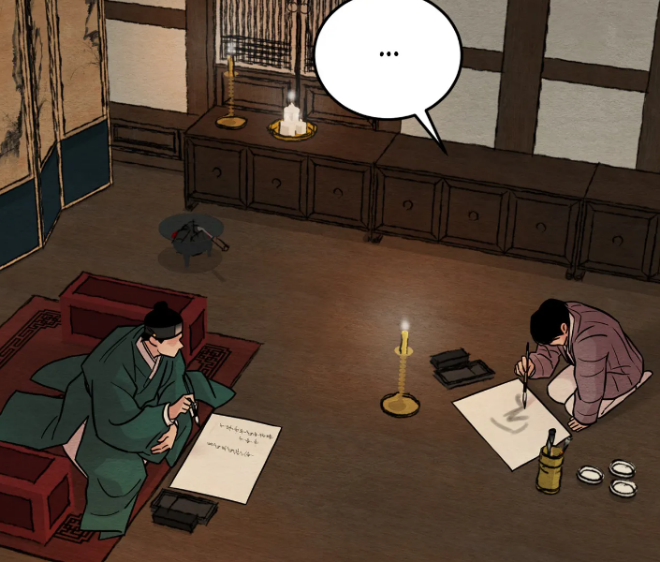 , because the butler had warned the artist not to irritate the main lead. According to him, he was in a bad mood, which was untrue. (Chapter 36) The noble had regained hope due to the painter’s genuine reactions (his shyness, blushing and his mention about the painting). And this truly exposes the valet’s evilness in the end. He made sure that both wouldn’t get close in reality by hindering a real conversation. For that, he utilized sex. That’s why he let the painter drink an aphrodisiac. He knew that the moment, the lord would notice the erection, the main lead would be attempted to have sex. For me, there’s no doubt that Kim made sure that the lord’s deepest wish wouldn’t come true: an exchange of thoughts, a real intimacy. This explicates why the prank played by the noble failed in this scene.
  (Chapter 36) With this joke, he wanted to initiate a conversation, but unfortunately he saw the erection. Yet, the valet’s trick didn’t work completely either. Note that during that night, there was no sexual intercourse, just a fellatio. We shouldn’t forget that during that day, the painter was still feverish which the noble had noticed. So envision what would have happened, if the lord had engaged a second sex marathon. Therefore, I believe that in chapter 70, the valet is hoping that the noble will behave like the previous night
 , so that the painter’s health condition deteriorates more, or the artist gets scared and changes his mind to leave the mansion.
However, let’s return our attention to the joke played by the main lead. The “prank” helped him not only to shorten the gap between them, but to externalize his thoughts more accurately. Note that right after laughing and smiling, he is able to express himself more properly. 
After playing the joke, he is truly more relaxed, yet there is a certain timidity as well, for he tries to hide his laughing face and smile. Initially, he has his head down and later he even puts his hand in front of his mouth. I have to admit that his smile followed by this gesture affected me the same way than the painter. He is definitely seductive and charming here. And now you comprehend why the artist reacts the opposite from chapter 16. He doesn’t say no or runs away. He remains immobile listening carefully to the lord’s words and sensing his caress on his chin and lips. The words accompanied with nonverbal communication are finally reaching the low-born’s heart and mind. He finally realizes the truth in the lord’s confession. This leads me to the conclusion that Kim’s plan is not going to work again. There won’t be any sex during the next night, but a new physical intimacy:  (chapter 38)
  (chapter 50): caresses, embrace and kisses, the symbol of harmony, love and sincerity.
After comparing both episodes, the readers realize the importance of the joke made by the main lead. However, in my introduction, I had explained that all the chapters ending with a 6 contained pranks. We shouldn’t forget that some people are justifying their misdeed by downplaying it. Remember that in chapter 47, Deok-Jae defended himself  (chapter 47) by saying that he had just made a prank. But now, you will wonder where there was a prank in chapter 46, 56 and 66.
 (Chapter 46) Deok-Jae destroyed the painter’s snowmen. There is no doubt that he would have replied the same, if he had to answer for his behavior.
 (Chapter 56) He knew that this would hurt the noble, yet note that he felt no remorse and blamed his childhood friend. However, like I pointed out, he was impersonating a person. If asked, the childhood friend would have used a similar excuse. That’s why Yoon Seungho answers in a quite similar way: he calls him “lord song”. However, he pushes him.
 (chapter 66) , he implied with his words that Jihwa played just a prank, since the painter returned alive. Yoon Seungho shouldn’t just get angry, because it was just a joke. As you can observe, all the misdeeds are reduced to a joke. It was, as though they had done nothing wrong. However, the intention is definitely different: the perpetrators intended to hurt the protagonists. And this is not surprising that the chapter 36 contains both pranks: Kim drugged the painter against his will, while the joke from the noble was harmless. And in my opinion, the episode 70 contains both pranks as well. Kim was the one who sent the painter to the aristocrat. Why do I believe this? The reason is quite simple: the servant leading the painter to the bathroom is portrayed with no eye
  (chapter 70) and is carrying a lamp similar to Kim’s
  (chapter 36). And remember that this chapter is a new version of chapter 36. In that episode, the valet was the one who brought the artist to the lord’s chamber. Moreover, the way the door is shut clearly exposes a certain violence.
  (Chapter 70) Besides, the domestic is also urging the painter to join the bathroom. From my point of view, the domestic wants to make sure that the artist arrives, before the lord leaves the bathroom. Moreover, the lord’s expression in beginning is not quite welcoming
 . So I am more inclined to think that Yoon Seungho didn’t plan it that way. And remember my explanation after the first sex marathon. The butler had placed the painter in the lord’s bed (chapter 33)
  (chapter 34) in order to incite the latter to have sex with the commoner. Imagine, he had just regained consciousness, therefore this trick could have cost the artist’s life. And we shouldn’t forget, the butler witnessed the second sex marathon. He even viewed the flashback from the painter. Therefore in my opinion, the butler is hoping with his “prank” that the lord will act like the previous night. Furthermore, I would like to point out the presence of domestics in chapter 16 and 36. We have Deok-Jae who spied on the couple and manipulated the butler to open the door
 [theory confirmed by the author herself]. Then during that evening (chapter 36-37), Kim tried to stop Yoon Seungwon from entering the room.
 (Chapter 37) Hence this means, he was paying attention to what was happening in the bedchamber. What caught my attention are the following panels: Why did the author show the window or door?
Since there’s no coincidence, this indicates that a servant is spying on them, listening to their conversation. Why? It is because the next prank is already planned:  (chapter 69) Since Kim got caught disobeying his master, he needs to lie low. On the other hand, he needs to be updated. That’s why he is now using other servants as his spies. There’s no ambiguity that the servants, manipulated by the butler, must resent the low-born. He caused them another trouble. But the reality is that these tricks are no jokes but crimes. That’s why I feel that after the second abduction, there will be a purge among the staff. The ones who followed the butler’s instructions will definitely suffer.
  (Chapter 69)
And this outlines that Yoon Seungho has a different personality from them. He is never diminishing his wrongdoings, and his pranks are real ones. The problem is that he can’t remain as an innocent child, since he told the painter, he would become responsible for him. As an adult and lord, he should be able to protect his loved one and anticipate his enemies’ moves. At the same time, each “prank” organized by the butler, Min and Jihwa always backfired on them and brought the protagonists even closer to each other. That’s why this is not surprising that all the pranks are connected to the number “6”, because this number signifies harmony, love and sincerity. The villains helped the relationship between Yoon Seungho and Baek Na-Kyum to improve.
Feel free to comment. If you have any suggestion for topics or manhwas, feel free to ask. If you enjoyed reading it, retweet it or push the button like. My instagram-tumblr-twitter account is: @bebebisous33. Thanks for reading and for the support, particularly, I would like to thank all the new followers and people recommending my blog.

This is where you can read the manhwa. https://www.lezhin.com/en/comic/painter But be aware that this manhwa is a mature Yaoi, which means, it is about homosexuality with explicit scenes.
In this essay I am not analyzing the chapter 69, rather making some predictions about the next chapter, since many readers kept asking me about this. Fortunately, I postponed it, because Byeonduck released a panel from the chapter 70 yesterday. 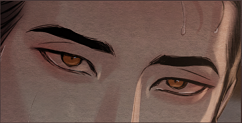 Therefore it helped me to become more precise in the predictions.
When you look at the picture, you’ll detect the presence of water on the lord’s face. There are drops running down his forehead and his temple. Moreover, there’s a wet strand hair on the right side due to a drop, indicating that the main lead is taking a bath. As we have a clue about his possible location, this means that we have a new version of chapter 26.  Yet, we shouldn’t forget that during the first season, the noble bathed after the rape, hence the lord was in the bathroom in chapter 25 and not in 26.
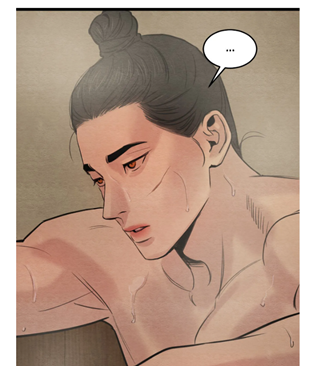 And if we compare the last two pictures, we can observe huge contrasts. First, the beholders can sense a difference in the luminosity. It is the same light than at the physician’s
  and in the barn. Why? It is because the two protagonists lit a fire place
  (chapter 57)
 (chapter 62). In both scenes, the main characters made sure that the loved one wouldn’t get cold, while in chapter 25-26 Kim was the one preparing the bath, hence he used a lamp surrounded by glass. And since me and my follower have already analyzed the signification of the candles, the manhwaworms will recognize this type of light symbolizes the valet. (chapter 20) (chapter 36) Note in this picture, there are two lights, one is behind Yoon Seungho and the other in the background. This kind of lamp reflects the butler’s personality. Since the light is more intense, it gives the illusion that there’s a lot of warmth due to the luminosity, whereas in reality the heat is kept behind the glass. As you can imagine, I perceive in this type of light as another evidence of Kim’s hypocrisy and manipulative side. That’s why I come to the conclusion, this time the bath is not prepared by the butler.
Due to this new interpretation, it becomes now comprehensible why the two main leads are connected to the fireplace. They might still be ignorant about their past and the manipulations around them, yet now both of them are starting sensing the warmth and affection from the partner. This explicates why Baek Na-Kyum was not affected by the sex session in the barn. Remember that he even tried to confess to the aristocrat.  The reality is that the painter was more wounded by the absence of a kiss at the end
 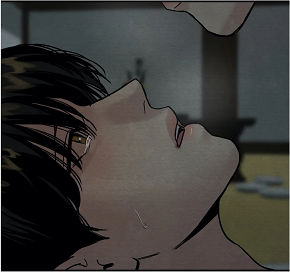 (chapter 64). Moreover, in that barn the main character had even opened up and confessed what he truly desired: seeing the painter smile. As a conclusion, I believe, we will have a fireplace in the bathroom, affecting Yoon Seungho.
The other divergence is the position of the light. It is quite similar to the one at the physician’s  (chapter 62), yet it contrasts to the scene in the storage room, where the lord was turning his back to the fire place. Back then, the main lead was in denial, he refused to acknowledge the truth: Baek Na-Kyum hadn’t abandoned him. He had indeed accepted his advances and recognized his love. However, this time, the light is reflected on the lord’s face, exposing that the latter is gradually facing reality and not longer in denial. Remember that during the second love session, the aristocrat refused to look at the painter’s facial expressions, hence he avoided the light. In other words, his visage was not illuminated. Note that he was hiding his face behind the painter’s face or on his chest.
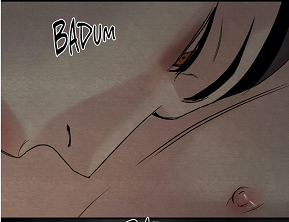 Since the light is a symbol for knowledge and warmth, his attitude during that love session exposed his insecurities and doubts. And now, if you look at the image again, you’ll sense the change of the lord’s behavior. He is facing truth and reality. Moreover, the light seems closer to him, therefore I conclude that not only the lord’s anxieties have vanished, but he is thinking very carefully. Consequently his head stands in front of the light. This marks the return of Yoon Seungho’s clarity of mind. And since Byeonduck mentioned apology in her tweet, it signifies that the lord is pondering how he can apologize to Baek Na-Kyum and redeem himself. He needs to, as he is well aware that after the rough sex marathon and the rough treatment, his relationship with the artist has been negatively affected. The painter might have accepted his gesture (putting the scarf around his neck), yet let’s not forget that right after the artist gave it to his noona. I doubt, this escaped the main lead’s notice. Moreover, with the way he addressed him (“my lord”, “sir”, “lord Seungho”), their relationship is now clearly defined: Baek Na-Kyum is just a servant. I have to admit that after witnessing Byeonduck’s tweet, I couldn’t help myself connecting this picture to the one from chapter 62:
 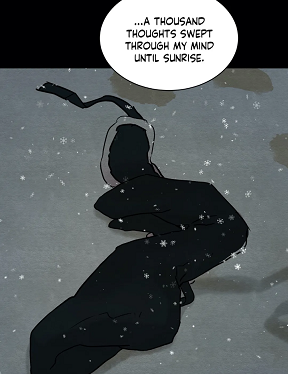 This is the noble’s current state of mind, which is also a new version of chapter 35
  All the three scenes have something in common: the noble’s mind is occupied with worries, as all his thoughts are revolving around the painter. In chapter 35 and 70, Yoon Seungho is wondering how to improve his bond with the artist. He has no idea how to approach him. Some readers might be surprised by my association with chapter 62 with the picture from episode 70. Note that in the last panel, there exist two parallels: the presence of the head due to the headgear and the words and the proximity of water through the snow and the snowflakes.
And this leads me to the following observation: the presence of water in the picture from chapter 70. While in chapter 25, the manhwaphiles could only detect the proximity of steam, which was more palpable, when Baek Na-Kyum took his bath. And in my opinion, the panel from episode 70 exposes that the lord is truly cleaning himself. The purification that I had already announced is still ongoing and each time, it is getting deeper. First, we had the painter washing the lord, when the latter was sick. However, back then he was just rinsing his face.  This explicates why later the lord chose to confess his love differently. Since in chapter 58, the low-born was the one who prepared the fire place, although we never witnessed it, there’s a high probability that Baek Na-Kyum is the one preparing the aristocrat’s bath. Moreover, in chapter 26, the lord brought himself the change of clothes for the low-born.
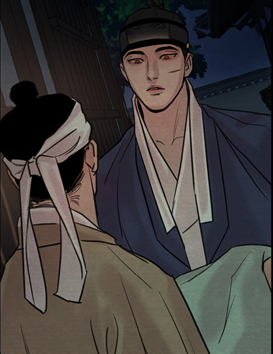 This is important, because it would signify that Baek Na-Kyum has once again taken over another task from Kim. First, he was present, when the lord put his hanbok in chapter 65
 , while the valet was no longer helping him to get dressed. That’s why I believe that the manhwaworms are going to witness another huge change, and the panel from episode 70 is already insinuating it.
If the beholder pays more attention to the eyes, they can view a white line in the eyes, exposing the return of tears. However, Byeonduck clearly stipulated that the main lead wouldn’t cry, as it wasn’t the right time yet. Nonetheless, I believe that the presence of water displays the return of life, another indication of rebirth.
Furthermore I have already outlined that Baek Na-Kyum has now recognized Yoon Seungho as his lord and as such his benevolence, 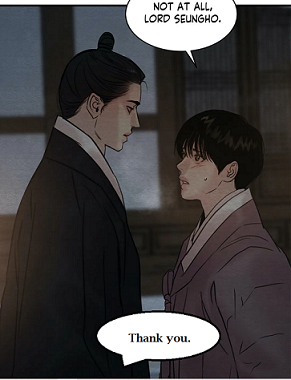 their relationship has already changed in a good way. Right now, the painter is just a favored servant, since the noble gives him an order, but simultaneously he treats the artist as someone precious. He allows him to receive a guest, then he gives him a scarf in order to keep him warm. So just like in the first season, the noble is lowering himself in front of Baek Na-Kyum. Remember the chapter 36, when the lord gave the painter a fellatio
 , and in chapter 37, he even opened the door instead of Baek Na-Kyum. During that night, Baek Na-Kyum was even the one shouting an order:
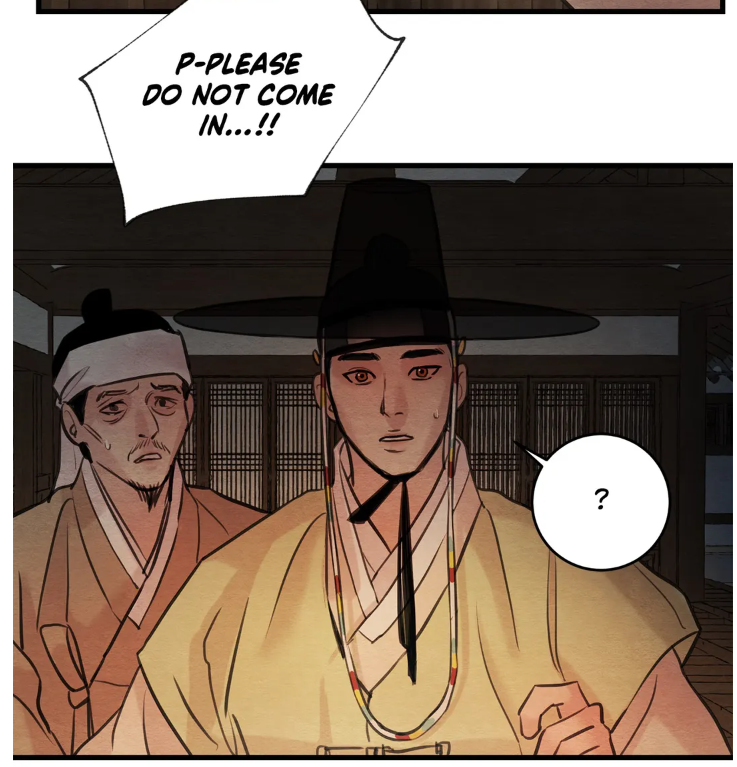 That’s why in chapter 69 the main lead removed the manggyeon too, before joining the painter and his guest. Therefore I am expecting a similar situation like in the last part of the first season. The lord will treat Baek Na-Kyum more and more like his official “wife”. It is highly possible that we get a new version of chapter 47, where both characters eat together. However this time the aristocrat will be the one eating his meal in the painter’s study… exactly like in chapter 11.
But how come that the painter will prepare the lord’s bath? There’s no doubt that the protagonist will make sure to treat his loved one so well, hence he won’t order him to take care of his bath. In my perspective, the head-maid will play a huge role here. Let me now explain how I came to this deduction. First, what caught my attention is the following panel: 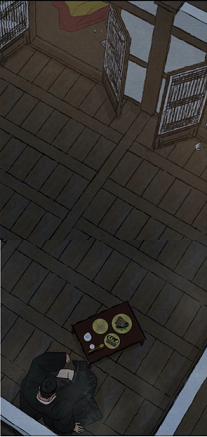 The lord is sitting alone in the dark with a table full of dishes. The food is an indication that the head-maid ensured the noble would get something to eat. Due to his confrontation with Yoon Seungho, the butler is avoiding his master, hence there’s no ambiguity that he wasn’t the one taking care of his master. When she brought his dinner, she must have noticed the darkness, the chaos and the cold in the room. Therefore I think, this must have concerned her. In her eyes, a hot bath would be the right solution for her lord so that he doesn’t get ill again.
Secondly, the readers could sense how the head-maid was gradually taking Yoon Seungho’s side. The climax was reached, when she started protecting the noble’s rights in chapter 67. First, she not only bowed to him in chapter 46, but also pointed out to the low-born the noble’s care and kindness.
 Then in chapter 47, the main lead didn’t scold her for the incident, he showed a real benevolence towards her and her colleague,
  which could only move her. Moreover, she implied that the painter had affected the master in a good way (chapter 51)
  . And notice how wounded and upset she was, when she imagined that the painter had lied to her.
  Finally, let’s not forget that her colleague was at the door of the master’s bedroom
 , when the painter had a flashback. She definitely witnessed how concerned and caring the lord became. She must have told the head-maid that the main lead was no longer infuriated towards the artist. Since the servant had been protecting Baek Na-Kyum (chapter 46 and 47) and Yoon Seungho (chapter 63 and 67), there’s no ambiguity that she will keep acting that way. In truth, her role is to bring the two protagonists together. As a conclusion, she is gradually becoming their surrogate mother. Since the lord can’t confide to her due to her position, she can definitely help her master by talking to the artist. That’s why she confided him her observations in chapter 46.
  But there are more evidences for this prediction. Striking is that the moment the main leads became an “official couple” (chapter 33), she always appeared next to the butler, except in two cases:
| The head-maid | Valet Kim |
| Chapter 33 | Chapter 33 |
| Chapter 34 | |
| Chapter 35 | |
| Chapter 36 | Chapter 36 |
| Chapter 37 | |
| Chapter 38 | |
| Chapter 39 | |
| Chapter 44 | |
| Chapter 45 | |
| Chapter 46 | |
| Chapter 47 | Chapter 47 |
| Chapter 50 | |
| Chapter 51 | Chapter 51 |
| Chapter 52 | |
| Chapter 55 | |
| Chapter 56 | |
| Chapter 57 | |
| Chapter 58 | |
| Chapter 61 | |
| Chapter 62 | |
| Chapter 63 | Chapter 63 |
| Chapter 64 | |
| Chapter 65 | Chapter 65 |
| Chapter 66 | Chapter 66 |
| Chapter 67 | Chapter 67 |
| Chapter 68 |
Notice that each time she appeared and the valet was not present, her actions helped the main lead to improve his relationship with the painter. When she was caught mocking the artist and got scolded, the aristocrat sent Baek Na-Kyum to his tailor. Consequently, both could experience a good date. 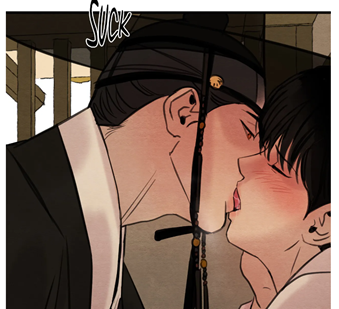 Then after conversing with the low-born, the next day the lord invited the painter to have his breakfast with him, because the latter had entered his room with a new painting.
 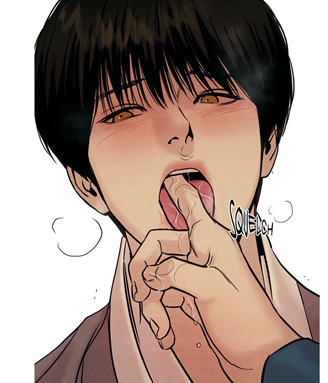 Her words had affected the artist, thereby he created a new picture. Since she interacted with the commoner without the valet’s presence, I believe, she will be the one asking the painter to take care of her master telling him how the lord was waiting for the kisaeng’s departure in the cold and dark. Besides, let’s not forget that the fire place is associated to the kitchen as well, reinforcing my interpretation that the head-maid is on her way to become part of her family.
Besides, I have already stated that it is the painter’s turn to approach the main lead, a new version of chapter 52. Back then, the butler had asked him to act like a servant. From my point of view, the head-maid will have a different approach. She will underline how the lord was affected in the morning and what he did, like carrying him to the study and it is definitely possible that she explains what lord Seungho did, while the commoner was in his room. Yoon Seungho created a ruckus at the Lee’s mansion. Besides, the manhwaphiles should recall that Kim never mentioned to the painter where the lord went: . There’s no ambiguity that Kim will approach the artist again, and tell him that he was the one who asked the noble to be kind. That way, he will attempt to portray his master as “cruel”, but the butler’s words won’t change the artist’s perception, because the head-maid has already talked to him. If this truly occurs, then this signifies that the head-maid’s influence is increasing and Kim’s manipulations are no longer working. Besides, I am still hoping that the painter will remember the butler’s behavior during the night of the second sex marathon: He did run away and acted, as if nothing was happening. He truly abandoned him, and unlike the aristocrat, the artist’s relationship with the valet is not that deep. The latter has already hurt him once: 
My final observation is the following: I am expecting a visit from Yoon Seungho in the painter’s study. Why? After pondering in his bath, the lord’s thousand thoughts will lead him to the conclusion that if he wants to redeem himself, then he needs to protect better his lover. And he can only do it, if he is constantly next to him. Due to the first abduction, I believe that the main lead won’t leave the painter out of his sight, but he is afraid of scaring the painter. Imagine, the commoner was kidnapped, when the artist was next to him. This explicates why he asked the artist to follow his noona to the main door. He wasn’t giving the order out of jealousy, but out of concern. The fear to lose him again… has deeply affected him, and this happened outside the propriety. He will try to remain by the low-born’s side all the time. On the other hand, the noble is very cautious, because he made a terrible mistake. Therefore for me, there is no ambiguity that the noble will appear in the study during the night watching over his lover. In other words, the painter’s dream will become true again:
 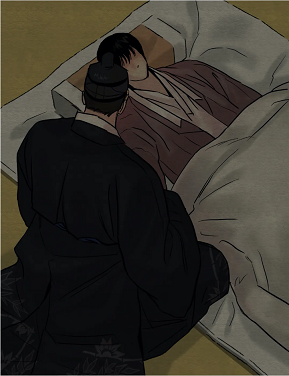 It is definitely possible that the artist confesses his love to the noble, because in the wet dream from chapter 56, the lord’s confession happened in the painter’s chamber.
 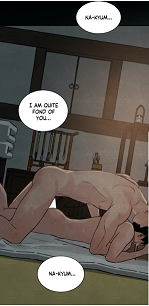 Since I have already anticipated that the artist will confess with the following expression, I think, this will definitely occur at some point. Moreover, let’s not forget that in chapter 56, the painter visited the bathroom to clean his underwear, I believe to see here another clue for my prediction that the next chapters will contain elements from chapter 26 (the bath), 36 (the head-maid and the fellatio), 46 (the maid talking to Baek Na-Kyum), 56 (the wet dream and the bathroom) and 66 (the dream). Striking is that all the episodes I mentioned are ending with a 6!! The most incredible is that the symbolic meaning of six are harmony, balance, sincerity, love, and truth.
Feel free to comment. If you have any suggestion for topics or manhwas, feel free to ask. If you enjoyed reading it, retweet it or push the button like. My instagram-tumblr-twitter account is: @bebebisous33. Thanks for reading and for the support, particularly, I would like to thank all the new followers and people recommending my blog.

This is where you can read the manhwa. https://www.lezhin.com/en/comic/painter But be aware that this manhwa is a mature Yaoi, which means, it is about homosexuality with explicit scenes.
In the first part, I exposed why Kim should be perceived as a villain and not as hero. Many readers believed that the butler’s words would always reflect the truth, while in reality it wasn’t the case. I have already unveiled, how the valet lied in chapter 11, 29, 35, 67 and 68. Nevertheless, with just a few examples, I don’t think that many readers are willing to change their opinion about the valet, and even question the genuineness of his concerns and advices. That’s why I desire to continue deconstructing the myth about Kim as hero.
Therefore I will add another lie, which my reader Luzy noticed. In chapter 17, Kim is asked why he brought back the lord’s meal.  He justifies his return that the master was fast asleep
 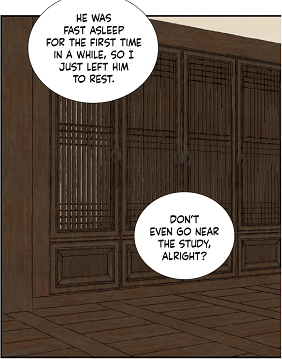 , so he decided to let him rest. However, the readers see that the lord looks rested and seems to be waiting for the butler.
 He sits in his bed, he has no dark circle.
  If he had been suffering from insomnia, then he would have looked like in chapter 35.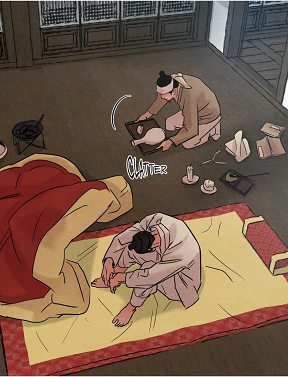
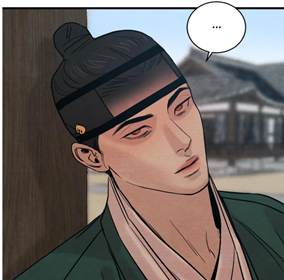 And since chapter 35 contrasts so much to the episode 17, it means that chapter 35 is a reflection of this incident. This leads me to the following observation. First, Kim never opened the door. Secondly, he wanted his master to remain in his room, so that he wouldn’t know what was happening in his mansion. This would stand in opposition to chapter 35, where Kim led the lord on purpose to the opened window so that he would get jealous. With this comparison, it becomes palpable that Kim knew about Jihwa’s presence, hence he advised the maids not to approach the study. Kim was determined to protect Jihwa’s intervention. The final evidence for his lie and complicity is the absence of Kim’s eyes, a signal that the valet is closing a blind eye and a deaf ear to the incident. But more striking in this scene is the valet’s disrespect and disobedience towards Yoon Seungho. He made the decision on his own that the lord shouldn’t eat the meal. It was truly an outrage, yet due to his “concern”, I fell for his lie myself. Notice that the maid questions him, if he asked the noble. He denies it and uses concern for his action. Striking is that when Kim manipulates, the author is not showing us the butler’s face, but the door or the rooftop.
 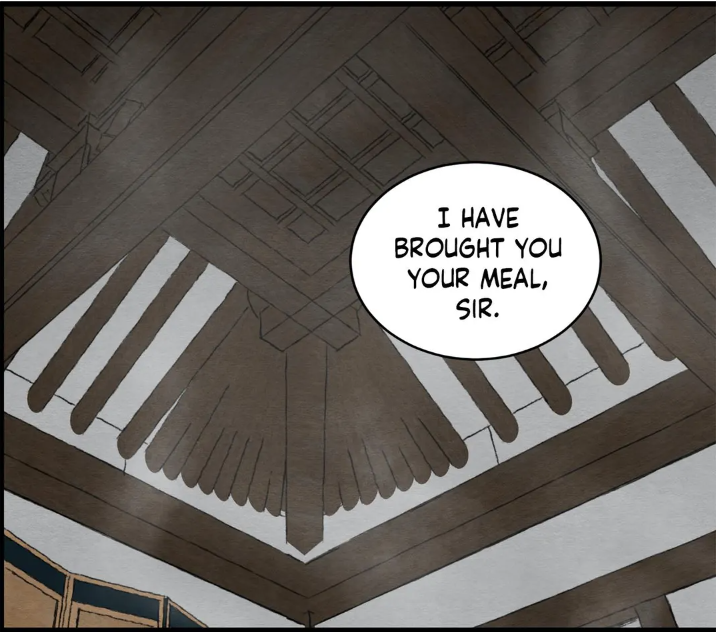 (chapter 35) This indicates that Kim’s worries are truly fake, they just serve one purpose: to protect his interests. He would like to have his peace and if my theory about him being a spy, then he has every reason to remove the artist from the lord’s side. Anyway, Kim makes decisions for others (Baek Na-Kyum and Yoon Seungho) without asking them. It was, as if he knew what was the best for them, whereas in truth, he is doing it for his own benefit. Moreover note that he is just a servant, yet he acts, as though he stood above the lord by disrespecting his lord. For him, worry and kindness are tools serving him to justify his passivity or his disobedience. And the scene in chapter 17 is important, because it reflects the chapter 68, where Kim had also disrespected the master’s order. However, in chapter 68, he was caught in the act. For me, the incident with Jihwa clearly revealed Kim’s silent complicity. If the main lead hadn’t been awaken, then he wouldn’t have been able to protect Baek Na-Kyum from Jihwa’s violence. In chapter 17, the butler attempted to keep his lord in the ignorance by stopping the head-maid of the kitchen from warning the master.
 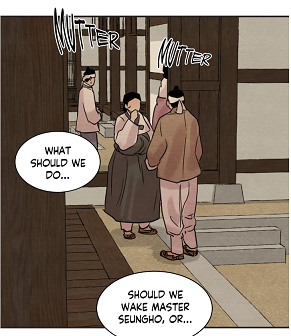 Yet, the servant failed, therefore in chapter 18 he stood behind the maid.
 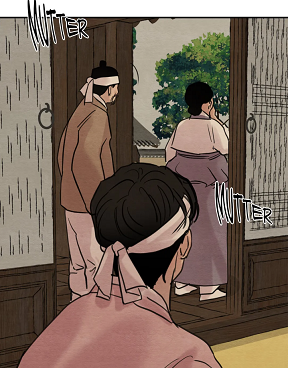 That’s Kim’s other MO. If someone has to be blamed for this ruckus, then it should be the head-maid, explicating why Kim always hides behind others (chapter 29, chapter 50, chapter 65). In chapter 18, once he realized that Yoon Seungho was not angry, then he could act as a docile, but strong servant, hence his position was switched again. Later he stood in front of the maid. With this new interpretation, Kim’s visit to the doctor in chapter 65 appears in a different light as well. Here, he is actually threatening the physician, (“are you trying to have me killed?”), saying that he will reveal the doctor’s passivity and silence to Yoon Seungho in order to scare the poor man. With this attitude, he can ensure that the doctor won’t testify and at the same time, if his secret is leaked, then Kim can make sure that the physician takes the whole blame. He hides behind him to take the responsibility for the abduction. That’s why the man begs for his mercy. And this incident clearly exposes Kim’s scheme and manipulation. In this scene, the butler acts like a lord, therefore we have the following expressions “I beg you”, “spare me”, which are usually addressed to a noble. Yet, since Kim is just a servant, he can’t become violent himself. He just needs to employ the lord as his weapon. As a conclusion, the main lead is definitely his puppet, who will help him to get rid of any source of trouble. However, we shouldn’t forget that in this chapter 65, the valet reveals his complicity, as he realized that the physician had noticed something. He had no idea if the poor man had noticed his involvement. He needed to make sure that the doctor didn’t talk, because if he did, then the noble might also come to question the domestic’s whereabouts.
As you could see, Kim is not just a liar, but also an excellent manipulator, because he uses his knowledge to his advantage, like in chapter 19. Here, he feigns ignorance concerning the culprit’s identity for the disappearance of the expensive wine. There’s no ambiguity that he knew, since he had no eyes in the picture. Yet he hoped that this incident would cause a riff between his master and the painter. Imagine in this scene, Min even asked for the thief’s death. 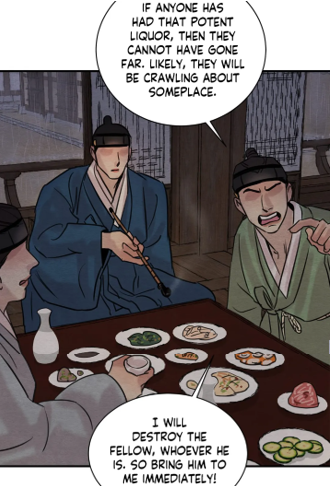 Yet, nothing happened, because the lord covered up his “crime”. In other words, Yoon Seungho saved his life. However, the lord was not celebrated as a hero in this scene. And like I explained it before, I am even suspecting that Kim left the bottle on purpose, expecting that the artist would take it. And now, I have found a proof for this theory. If Baek Na-Kyum had truly stolen the wine, then he wouldn’t have drunk it in the open.
  Note that he is not hiding at all. From my point of view, Kim used the painter’s ignorance to his advantage (“ignorance is a blessing for the perpetrator”), and he just didn’t expect his master’s reaction. Finally, when Yoon Seungho reveals the incident to Baek Na-Kyum the next morning,
  the low-born is embarrassed and gives quickly a fake excuse, because he realizes that he was the cause for the ruckus.
 From my point of view, the commoner had no idea about the true value of the alcohol, and only discovered it with Yoon Seungho’s revelation. That’s why his lie was easily discovered, the artist was only reacting to the lord’s words and indirect questioning. He had to give himself an alibi so quickly. Note that he didn’t feel guilty, until he heard the truth. In other words, Kim applied his philosophy
  in Baek Na-Kyum’s case. For the butler, the painter’s ignorance and innocence was a blessing, because this could help the domestic to get rid of him. For me, the chapter 19 and 23 are strongly intertwined, therefore we should see the valet’s leitmotiv in a different approach. With only these two examples (17-19), it becomes visible that the valet Kim has already targeted the artist. However, the lord was capable to protect him twice. That’s why I would like to revisit the circumstances of the rape at the pavilion. But for that, we need to examine the previous chapters (23 and 24) closer.
What caught my attention is the conversation between Kim and Baek Na-Kyum. The butler kept using the question word “why” which can not be a coincidence. 

 In other words, Kim was digging for information, as he is well aware that knowledge is power. At the same time, it indicates that Yoon Seungho’s obsession for the “why” is related to the valet. From my point of view, the servant must have asked the main lead the same questions in the past. Yet, since Yoon Seungho’s affection was genuine, the latter never suspected the true intentions behind the interrogation. Therefore, this scene exposes that Kim is already working as a spy, as he is invading the painter’s privacy, trying to figure out the true nature of the relationship between the master and his “guest”.
Let’s not forget that we could see how he utilizes his knowledge to his advantage (chapter 11, 12, 17, 19, 35, 65, 67, 68). Due to the artist’s innocence, the butler discovered that Baek Na-Kyum had not only forgotten his love confession addressed to the wrong person, but also he had been tasked to paint a new drawing for the lord. That’s how Kim realized that Baek Na-Kyum’s privileges were related to their first night: the lord’s visit in his study the next morning, he even lets deliver a potion for the hangover, the absence of new sex sessions, the invitation to the hunt and his protectiveness . Since Yoon Seungho was expecting a picture of their Wedding night, the valet could only deduce the importance of the sexual encounter. He recognized that Yoon Seungho was already in love with the painter and he desired to get a picture of their night together. Nevertheless, we should recall that the butler was also present, when he heard the artist’s confession. (chapter 19) So he knew that the artist was in love with his teacher. As a conclusion, he was aware of the existence of the love triangle. And through the interrogation, he could fill all the blanks. He thought that he was the only one owning the truth, yet he was wrong. He could only judge Jung In-Hun, from what he saw. But more importantly, with this conversation, the valet got aware that the new painting Baek Na-Kyum had created was not representing their first night.
  That’s why I judge his advice to the painter in a new light. He refused to give any clue to Baek Na-Kyum, while the latter complained about his lack of insight.
  The butler was deliberately misleading the commoner. On the surface, it looks like he is saying that what happened that night, should be forgotten… Yet in truth, he means something else. He is speaking about himself. For Kim, it is a blessing that Baek Na-Kyum doesn’t remember and doesn’t know what happened, because he couldn’t profit of his “power” over the main lead. If he had remembered their night and had accepted the invitation, this meant that he was acknowledging the lord as his lover. This would signify that Kim’s position as the lord’s right-hand was threatened. The readers should remember that Kim’s power comes from the master’s genuine affection and closeness.
On the other hand, the butler can take advantage of the situation, a repetition of chapter 19. For the butler, ignorance is a blessing, because he still can change the actual situation.  That’s why these words are exposing the valet’s hypocrisy. If the artist is left in the ignorance, then he can’t take Kim’s position or influence the main lead. Besides, his words could be judged as a warning: “lie low”, “remain out of his sight” signifies that Baek Na-Kyum is not allowed to get close to Yoon Seungho, because the butler will aim at him, making sure that he loses the master’s favor. As you can detect, Kim’s best advice contains so many layers, and shouldn’t be treated so lightly.
Striking is that after the painter’s admission, he leaves him. And there’s a reason for that. He has achieved his goal, he has gained a new insight about the actual situation. Baek Na-Kyum is now favored, because their night together left a deep impression on the noble, nonetheless he is clueless about the change. Furthermore, if the love triangle was revealed, and as such Yoon Seungho would get rejected, this would push the main character to cut ties with Baek Na-Kyum and the teacher. The servant definitely knew about the lord’s past tragedy: his suffering due to abandonment, rejection and jealousy. From my perspective, he decided to use the lord’s jealousy and insecurities to his benefit. That’s why he ensured to keep them alive. With his self-hatred, the lord would come to rely more on him.
And now, if you pay attention to the chapter 24, you’ll notice two important elements: the role played by valet Kim and the chronology is disrupted. Striking is that the butler announces that the lord desires to meet the painter at the pavilion in front of Jung In-Hun.  This is relevant, since the latter was already very jealous of the artist. He had observed the lord and the commoner at the end of chapter 23 and felt unhappy. So Kim ensured that the scholar would hear this. Secondly, the manhwalovers can observe the absence of the butler’s eyes, when he expresses his emotions.
  For me, this is a signal that the valet is deceiving the scholar and the painter. And if we think carefully, then we can only come to the conclusion that the butler is lying again, when he claims that the lord is waiting for him at the pavilion. And now, you might come to the belief that I am suspecting the butler too much… However, I have different reasons to view his declarations as deceptions. Why?
 , then we have Baek Na-Kyum’s memories, where he is shown painting the scene with the masturbation, before witnessing Baek Na-Kyum on the ground trapped by Yoon Seungho.
  Why did Byeonduck utilize a time jump and a discontinuation of the chronology? Since there’s nothing random in her work, I believe that this disrupted chronology had a purpose. She never showed us the protagonists’ arrival at the pavilion. What caught my attention is the position of the bodies. If the lord had been waiting for the artist, then they should sit differently. Note that the noble is closer to the entrance of the pavilion than the painter. After the rape, the latter’s legs
  are facing the butler who stands at the entrance of the pavilion.
  This would explain why Baek Na-Kyum couldn’t flee at the pavilion, as the noble stood in the way. He could only just crawl away… A reversed situation of chapter 16. And this indicates that Yoon Seungho must have arrived after the low-born who was waiting for him at the pavilion. So this would indicate that Kim lied, when he invited the artist to follow him to the pavilion.and the following picture shows the valet’s wrist, when he announces the invitation to the pavilion (reminding us of the observation that Byeonduck would never show the valet’s face, when he tells lies or manipulates). That’s why I see these elements as a clue that Kim has been acting as a puppet master in the rape at the pavilion. In Kim’s mind, the noble would feel insecure with the rejection, therefore he would turn into a beast. Remember what I wrote before: the lord had been protecting the painter (from 12 to 22), so Kim’s last resort was to use the master himself as his pawn in order to get rid of the painter and the scholar. Besides, we shouldn’t forget that at the pavilion, Baek Na-Kyum was forced to confess his love for the scholar in front of Yoon Seungho. This is exactly what Kim had intended and even imagined that the teacher would react and protect the painter. With this incident, the painter would decide to leave the mansion with his “master”, Jung In-Hun. However, the butler never expected that the lord would still claim the painter as his and wouldn’t accept the situation. I even envisage that Kim had predicted the artist’s death. If it happened, the lord had no longer any reason to sponsor the teacher. In my opinion, Kim misjudged the low noble’s hypocrisy. Hence he didn’t anticipate that Jung In-Hun would remain passive and silent, because the man needed Baek Na-Kyum as the lord’s lover. He wanted the low-born to be a spy. I have always claimed that Jung In-Hun witnessed the rape
 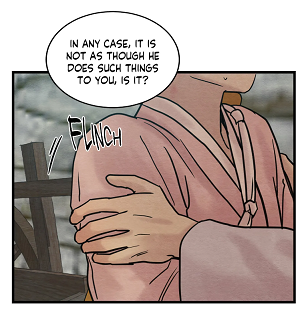 (chapter 29), but chose to feign ignorance, since it didn’t serve his interests. Therefore I perceive the panel where Kim announces the invitation to the low-born in front of Jung In-Hun as an evidence for my theory. Kim let it transpire to incite the scholar to go to the pavilion.
 And observe in chapter 25 that after faking his concern for Yoon Seungho by pointing out the scar, Kim asks his lord the painter’s whereabouts.  Why? From my perspective, Kim was expecting something and by faking concern for the artist, he would like to know the outcome of the encounter at the pavilion. I have to admit that I can no longer sense genuineness in the butler’s words. Striking is the idiom he employs: “that … painter”. He doesn’t give him any name, a real identity. His words are quite similar to Min’s expression “low-born”. In my eyes, the innocent protagonist is perceived as a function and as such an object or subject. With the painter ‘s absence and the lord’s reaction, he gets aware that something happened, exactly what he desired. In my opinion, he is already envisioning that he has achieved his goal. The drop of sweat is just a sign of discomfort, because once again, there was a ruckus, but it was necessary for his own interest, his tranquil life. The only difference is that with his question, he infuriates the main character, which must have been totally new for the valet. Moreover, when he says this
  , the readers (including myself) thought, he expressed concern and felt pity. But who is talking to in reality? Baek Na-Kyum is still far away from him, hence I doubt that these words were addressed to him. Furthermore, the butler has again no eye. That’s why I have now the impression that “oh dear” could have been addressed to himself. Now, he needs to clean up the mess. In other words, he feels pity for himself. Since he stands far away, he must see the body on the ground, so for me it looks like he imagined that the artist was dead. But to his surprise, when he gets closer to Baek Na-Kyum, he recognizes that the artist is still alive. Striking is his next comment: Now, he knows why the noble brought the horse. The main lead felt concern for the artist, so he was considerate enough to spare Baek Na-Kyum from moving too much. After detecting the valet’s hypocrisy, I could only sense coldness and indifference in this picture. The gaze is cold and at no moment, he talks directly to Baek Na-Kyum. His words are only centered on him and the noble (“I”, “me”, “he”). Besides, even if his eyebrows indicate a certain concern, it doesn’t necessarily mean that his worries are related to the painter, rather to himself. And the scholar had not even fled the mansion, which the valet must have noticed, since he was wandering around with the lamp. So in the end, Kim’s manipulation had failed once again. And if you consider that in chapter 35, he tries again to motivate Yoon Seungho to kill the painter out of jealousy, it becomes understandable why I believe that Kim had already envisaged his death before. Since the main lead had always been protective, he needed to trigger the lord’s rage caused by abandonment and rejection so that the main lead would turn into the weapon to hurt Baek Na-Kyum. Yet, it never happened like he desired. Each time, Yoon Seungho’s violent mood changed him into a sex monster, unwilling to get separated from the low-born. And now, you understand why I perceive the following butler’s words in a new light:
  Since each tentative to get rid of Baek Na-Kyum through the lord has always failed (chapter 11, 25, 34, 35, 36 and 61/62 – this one I will explain it later), Kim’s last remark gets a new signification. Here, he makes a statement, he is realizing that he can no longer utilize the main lead like in the past, the lord with his violent mood swings is no longer obeying him. Back then, many readers had the impression that the valet was telling a lie in order to diminish his guilt and responsibility (self-deception). But what if he was telling the truth in reality and was not trying to deceive himself? I would like to point out that in the previous picture, the butler is shown with his eyes and ears indicating that he is no longer closing his eyes to the truth and reality. Moreover, note in this scene, he is reminded of the past, when he abandoned the main lead to his misery, which leads him to the following conclusion. If the painter remains a favored servant, then everything is fine.
 The artist never abused his position or truly threatened him. So his privileged situation wouldn’t truly change, if Baek Na-Kyum was a “concubine”. However, while he is on the verge to abandon his plan to remove the artist from Yoon Seungho’s side, Heena noona causes a ruckus, which makes the valet change his mind once again. Observe the contrast: the closer he gets to reality and accept it, the closer the zooming on his face. So in the last panel, Kim is facing the truth and facts. Yet in the end, he is forced to correct his judgement, as there is another trouble. But what Kim fails to recognize is that there’s no life without worry and problems. As you can see, the chapter 65 is a new version of chapter 35… however this time, Kim is the one on the verge of giving up on his original plan: remove the artist from Yoon Seungho’s side.
Another point for this theory that Kim is a villain and a mastermind using people for his own happiness (leading a life without trouble) is that each time, Kim had to clean up the mess afterwards. The irony is that Yoon Seungho is unaware of this.
 and later, when he takes care of Baek Na-Kyum, the latter confronts him with his lie. He knew about the sexual encounter and chose to remain silent. So he is once again forced to face reality and recognize his misdeed. However, the butler decides to run away.
 for allowing the painter’s escape. And because of his intervention, Yoon Seungho felt even more insecure than before, which explains why he had a sex marathon. In his mind, the artist had to accept his sexuality and as such him as his lover thereby he would remain by his side. That’s why Kim had in the end to take care of the exhausted painter. The sex marathon was a direct consequence of the rape and desertion involving Kim.
I could add the list of the punishments Kim received for his lies and manipulations. It was definitely his karma, reflecting his own flaw. Kim is a person who is trying to escape from reality by closing his eyes and ears, with the belief that uproar and problems stands in opposition to a good and peaceful life. And the conclusion is that there’s no redemption for the valet. The latter chose to keep his original plan, as Baek Na-Kyum has become a synonym for worry and scandal in his eyes. That’s why I am more than ever convinced that he will participate in the next kidnapping and unlike in the past, he won’t just be a manipulator and mastermind, but a real perpetrator. And my final observation is the following: since Kim manipulated the situation in chapter 24/25, the readers have to question the butler’s responsibility in the rape. Kim could have revealed the truth to the main leads, but he chose not. This shows that Kim never acted like a father or a true advisor and allowed the situation to escalate. And it is the same for the teacher who witnessed the violence and decided to feign ignorance. As you can see, the whole situation is far more complex than it looks like.
I still have more to say about Kim… Therefore there will be a part 3.
Feel free to comment. If you have any suggestion for topics or manhwas, feel free to ask. If you enjoyed reading it, retweet it or push the button like. My tumblr-twitter account is: @bebebisous33. Thanks for reading and the support.

This is where you can read the manhwa. https://www.lezhinus.com/en/comic/painter But be aware that this manhwa is a mature Yaoi, which means, it is about homosexuality with explicit scenes. If you want to read more essays, here is the link to the table of contents: https://bebebisous33analyses.wordpress.com/2020/07/04/table-of-contents-painter-of-the-night/
The story doesn’t progress much in chapter 63, as it is still the same night, where the painter is with the main lead in the storage room. Yet, this doesn’t signify that there’s no change in the relationship between the two protagonists. In fact, we could say that this is the night of revelations. In chapter 63, the manhwalovers get to hear two love confessions, although their form diverges: Baek Na-Kyum and Yoon Seungho’s. Here, the painter is on the verge to admit his affection for the lord, yet he is stopped by Yoon Seungho. The latter can’t believe his words, he only trusts the painter’s physical reactions. As for the master’s love confession, it couldn’t appease the readers and please them, since they were upset with the way the main character was treating the painter. The reason is simple: they identify themselves with the painter and as such, they would never accept abuse, which is totally normal. However, I believe that it is important to read this manhwa with a certain detachment and analyze the main lead’s words very carefully. The portrayed brutality overshadows the lord’s words, hence his opening up and gradual transformation doesn’t catch the readers’ attention. That’s why I will focus on the lord’s behavior and words in this essay, because through them, the artist discovers new aspects about his lover.
But before starting with the analysis of chapter 63, I would like to examine this night, in particular, how Byeonduck introduced it.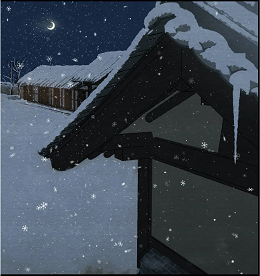 This panel comes from chapter 62, and here what caught my attention is the dimension of the house compared to the sky and the moon. In the former similar pictures, it was the opposite.
 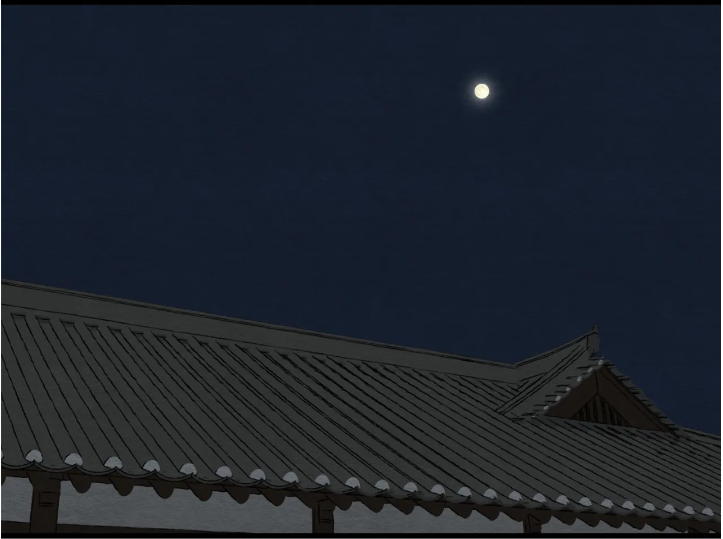 (chapter 33). Besides, the moon was rather in the center of the image. Here, the satellite seems so far away, while the mansion occupies the biggest part of the image. Since I had interpreted that the house is a metaphor for the painter and the moon for Yoon Seungho, this picture reflects the importance of Baek Na-Kyum in the aristocrat’s life. Baek Na-Kyum represents his whole world. However, since the moon is so small, I sense that this reflects the lord’s emotional and mental state. Yoon Seungho isn’t really himself, he is lost in his fears and insecurities.
Another possible interpretation is the coming disappearance of the moon, announcing the rebirth of the phoenix. Furthermore, the moon is so distant illustrating the gap existing between the two lovers. At the same time, the huge mansion also reflects the cause for the distance between them. One is a lord, a noble who can treat the artist as he pleases, since the former is a servant. And this issue is actually visible in chapter 62 and 63. Yoon Seungho is using his right as master to define their relationship. That’s why he expresses his firm refusal to let the painter go on two occasions.
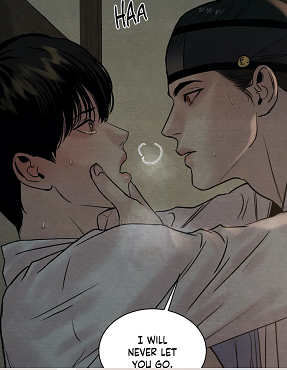 And if you compare the two idioms, you’ll observe a progression, the increasing determination of Yoon Seungho to keep the painter by his side. In the first sentence, Yoon Seungho puts “That” as first, which indicates how much the artist means to him: he can not permit the artist to leave him. On the other hand, we could say that this sentence mirrors Yoon Seungho’s treatment towards the artist. The latter is considered as a possession, an object (“that”). I would even add that this sentence illustrates his actual position. Baek Na-Kyum has no right, hence he is not even mentioned here. The lord doesn’t say here: “I can’t allow you that”. Then in the second sentence (“I will never let you go”), the personal pronoun “I” appears first showing his strong will to make it happen. His needs are prioritized and the painter has to submit himself. The personal pronoun “you” referring to the low-born is used as an object, once again the expression mirrors their relationship: the one is a master and the other a servant. As the manhwalovers can detect, both sentences have something in common: it revolves around permission, reinforcing my conviction that the noble’s one of major issues in their relationship is his status.
This third love confession is strongly connected to his status as master. And there’s a reason for this sort of love declaration. In his eyes, he has no other way to keep the painter by his side. He is not expecting a sense of loyalty or duty from Baek Na-Kyum, as he believes, the latter ran away. As the lord of the mansion, he is the one with the upper hand.
Nonetheless, in the last panel, Yoon Seungho reveals his true thoughts and feelings, demonstrating that he is definitely opening up. For the first time, he shows his need for the painter. So far, he had never attached himself to others, even confessed a certain dependency on others, though he was definitely relying on Kim and his knowledge. On the other hand, he has always perceived the painter as a servant in the end, despite his claim that he didn’t consider him as such. 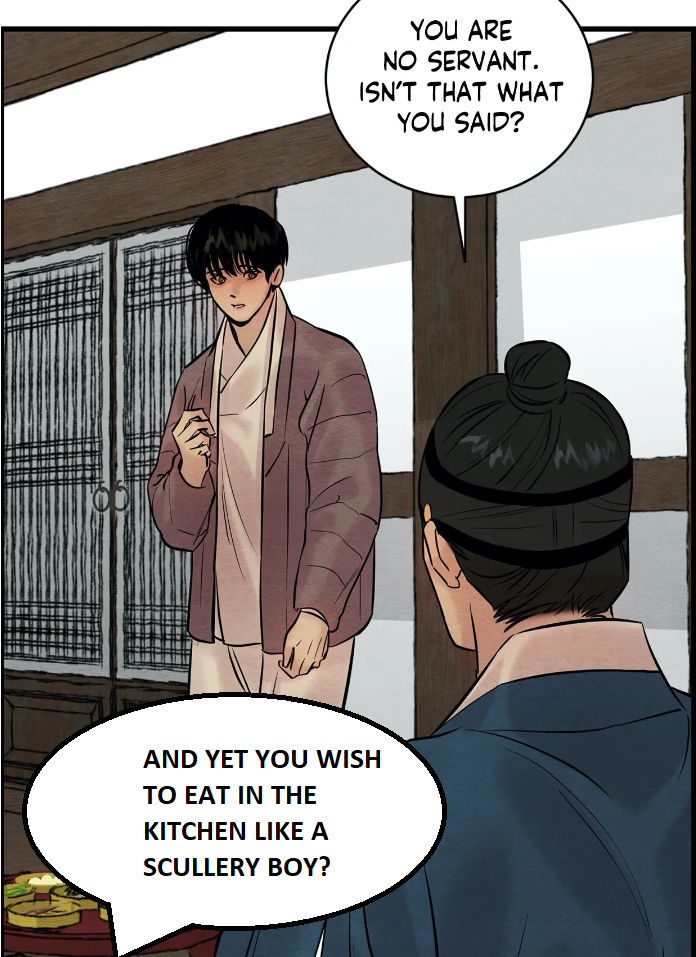 (chapter 47) In my opinion, the painter could definitely confront him with his own lies, just like he did in chapter 26.
And now, if we compare the aristocrat’s “love confession” in chapter 63 to the previous ones, we can detect a huge progression. (chapter 55)  (chapter 58) and (chapter 63)
First, the manhwaphiles can observe that when the lord admitted his love for the artist for the first time, he kept his distance from the painter.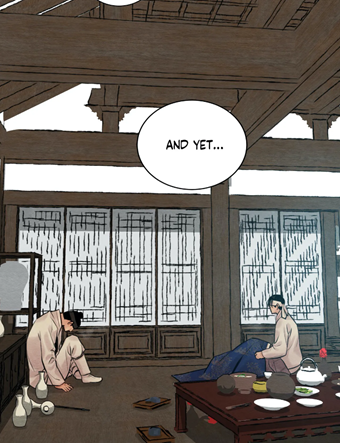 The physical separation indicates his fear to reveal his true emotions. He definitely views this as a weakness and has the impression that he is exposed to danger. He is definitely protecting his heart by maintaining a space between them.
  In the second love declaration, the noble trapped the painter under his body displaying his fear that the painter might run away after a love confession from him. As you can observe, both love confessions had a huge difference. On the one side, the master encouraged the low-born to desert the mansion by opening the door and keeping his distance from Baek Na-Kyum. During the second love confession, Yoon Seungho was no longer willing to accept the artist’s escape. Since he had admitted his feelings and as such his dependency, the painter was forced to remain by his side. He had no other choice than to obey to his master.
However, both scenes have a common denominator. During these moments, the noble avoids the artist’s gaze. In chapter 55, he looks down, and in chapter 58, he only whispers it to the artist’s ears. Even when they are physically so close, the lord is attempting to hide his face on the painter’s chest. (chapter 62) For the first time, he hears Baek Na-Kyum’s heart, yet he is not ready to face the artist. This illustrates his huge insecurities. The main lead fears his own reflection. Nevertheless, in episode 63, this is totally different, as for the first time, the lord is looking at Baek Na-Kyum’s face directly, while admitting his dependency on the commoner. There is no physical distance and the master is starring at the artist and waits for his reaction. But here, he comes out as a strong person, because he utilizes his position as a master. This gives him the strength to face the painter. Yet, this is not what the latter desires too. He doesn’t want to be treated as an object or as a servant. That’s why I think, a real discussion is needed here. Does he really love him or does he just view him as a domestic? Furthermore, being in love is not a weakness and that’s what the low-born needs to show him. As you can observe, the lord utilizes now his position so openly to face his loved one. Only as a master, he has the power to claim Baek Na-Kyum as his partner.
Striking is that when the lord declared his feelings for the artist for the second time, he never said these words: I love you. Instead, he chose this: He admitted his defeat. Since he had lost the battle, he had become a wreck, making him very vulnerable. Whereas we all took it as a metaphor, the noble meant it literally. And now, we see the result of this defeat: he is indeed a wreck, hence he is blind and deaf. Moreover, it looks like the lord is unable to use his brain and notice the bruise on the painter’s wrist.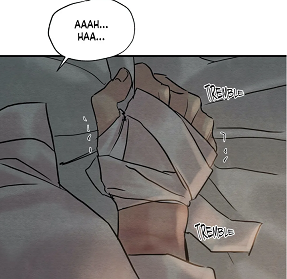 He is emotionally unstable, because he had been forced to reveal his affection and vulnerability (dependency). According to his father’s doctrine, sex is a battle, therefore by confessing his love, he surrenders. And now, you understand why his father gave him such a role, absence of love is a synonym for independency and liberty. By attaching himself to the artist, he is in truth trapped himself. Now, the manhwaphiles can grasp, why the noble acted like that. The lord already viewed himself as a servant and object due to his love for the artist, but he was refusing to accept his position. In other words, he was in denial. That’s why he acts like a lord so openly.
On the other hand, by abandoning this rule (absence of love), we have to imagine that the lord must feel confused. He still thinks that every relationship is a balance of power and the painter’s confession did reinforce this impression.  Remember that the artist treated the master as his sexual object, the one who will give him pleasure. The master could only perceive it as a power of force. Yoon Seungho doesn’t know, this is not correct, as he has never experienced it differently. Power relationship was the nature of his rapport with his own father. Just like he said, he has been living according to his father’s principles.
 In other words, the noble is no different from Baek Na-Kyum in the end. He was also exposed to coercive persuasion. This explicates why his last resort is to use his status as master to force Baek Na-Kyum to remain by his side. This is the only power he has over the commoner in his eyes. He is no longer expecting to be loved by the painter. Simultaneously, he is also revealing his true position: he is no longer free, dependent on the low-born.
Nevertheless, you can sense his powerlessness despite the use of his physical strength during this night, which the manhwaworms can detect in the following panel: The reason for his frailty is that in reality he is longing for something else. He wanted to obtain the painter’s love, hence he desired to be gazed with admiration and to see a smile on the painter’s face. However, he has no hope any longer. Just like I wrote it before, a confession from the painter was just a dream that would never come true. And his “escape” confirmed his doubts. Their magical night was just an illusion, and he became a victim of deception. The more he made positive experiences, the more he doubted his senses and reality. But the cause for this lack of trust and confidence is his self-hatred, which I had already pointed out. And now, I understand why he chose to impersonate the scholar. That way, he could feel love for the first time. By replacing the scholar, he could drop his self-hatred, for he was someone else. However, he got caught in his own trap. After this first experience, he longed for more and hoped for a renewal. But he imagined that by having sex would be enough, and realized the falseness of his belief. He imagined that his wealth and power would impress the artist, but he was proven wrong. His self-hatred is the reason why he is blind and deaf in the end. He has the feeling, he is not lovable. Yet, like he states, he was never able to receive a smile from Baek Na-Kyum. This shows that he would have treasured a smile from the low-born, revealing that despite owning the artist’s body, he has no control over Baek Na-Kyum’s heart and mind in the end. The tragedy is that he didn’t witness that his confession made the painter blush.
 He was definitely moved and happy. The rich main character’s impotence in front of the artist explains why he is using his sexual potency to submit the commoner. This is no coincidence why the lord is particularly rough in chapter 63.
 He is trying to compensate his impotence by using sexual power. Many readers could sense that this chapter was a new version of chapter 25, the rape at the pavilion.
However, this time, it is different for many reasons. First, the artist didn’t reject the lord, unlike in chapter 25. Here, the lord is reminding the artist, how he behaved during that night. He scratched his face and pushed him away.
 He even confessed that he loved the scholar Jung In-Hun. This panel reveals that the lord could never forget that night. He still remembers the rejection, which left a deep wound reinforcing his self-hatred. Yet, since the lord is wearing his mask of deception, we shouldn’t take the last sentence as face-value. If you recall that night at the pavilion, you could see, how mad, sad and pained the lord was for the rejection and how much he disliked the situation. He did feel remorse for his action later. That’s why I see this comment as a proof that he is surprised by the lack of resistance from the artist. He was expecting a different reaction.
The second difference I noticed is the following. Since the painter declared that they had just a sexual relationship, the master is using this aspect to torment the painter. Because they are just two naked bodies and he is a lord, he can treat the partner as a toy. He has the right to do so. It was, as if Baek Na-Kyum was getting punished for his lack of honesty in chapter 49 due to his fear. His lack of trust caused the lord to mistrust the painter either. This is the second wound Yoon Seungho is confessing. The lord imagined in chapter 25 that if they had sex again, then the artist would come to accept him and even love him. Back then, the lord had no idea, what he was expecting exactly. He couldn’t tell that he was looking for love. In his mind, he was longing for admiration in the gaze, for a smile and for a blushing face. He had the hope that he could get, what he desired, if they renew their Wedding night. Here we have the opposite. He is so convinced that he is not loved and will never obtain the painter’s heart, although this time, Baek Na-Kyum is truly loving him. Yet both incidents unveil the lord’s major flaw. The lord is again too dwelled in his own thoughts to perceive reality. He has lived for too long as a spirit in his mind that he is not able to see the truth in front of him.
The third divergence is that there’s actually a misunderstanding. While the painter is just asking the noble to stop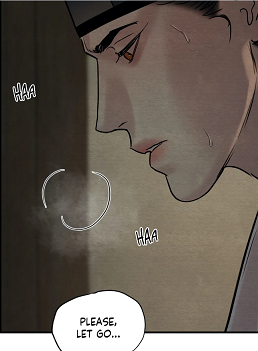 , because he is exhausted and fears to show pleasure, the lord has the impression that Baek Na-Kyum is rejecting him totally, begging him to let him go forever. That’s the reason why the noble replies later that
And now, you can understand what my next point will be: the word “never”. Striking is that this idiom is constantly present in Yoon Seungho’s mind. Here, it is implied due to the utilization of the different tenses (simple past – present). When he rejected his childhood friend, there was an allusion to never too (“not the slightest chance of ever”).  And in chapter 63, it appears twice. This unveils the lord’s true mind. He will never be loved. However, while revealing his true thoughts, he expresses a positive emotion for the first time. He felt joy due to the painter’s words
 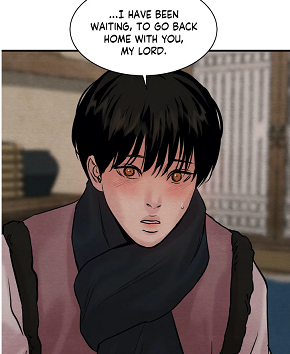 This is a huge step for the lord, which doesn’t escape Baek Na-Kyum’s notice. The painter is indeed surprised and moved in my opinion,
 although he doesn’t have the time to reply to this admission. The fact that the painter is looking at Seungho’s eyes without any fear or disgust indicates for me that Baek Na-Kyum is slowly grasping the noble’s state of mind. For the first time, he is discovering the lord’s insecurities and wounds. In the past, it was different, since the artist was himself blind and deaf due to Jung In-Hun’s abandonment and betrayal. He also avoided his lover’s gaze and didn’t pay attention to his words
 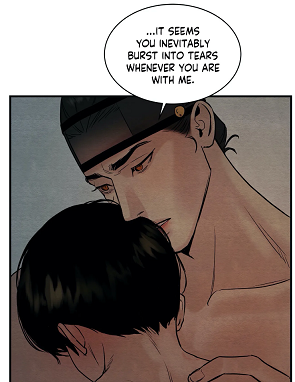 (chapter 49) Besides, during their rough sexual encounter, the painter’s mind is neither polluted by the scholar’s doctrines nor influenced by his negative emotional state. Even the idiom “never once” outlines the lord’s despair and pain. I believe that the artist is able to sense that the noble was in a similar situation than himself. Besides, let’s not forget that the artist heard about the main lead’s past from the doctor.
In the first version, I had voiced that the painter wouldn’t react, like the lord had anticipated and I was proven correct. When he got the opportunity to leave the mansion, Baek Na-Kyum refused to follow his sister. In my opinion, their interaction in the shed was the reason for his stay, while every one imagined that this would be the cause for his departure. Imagine the irony. Kim, Min and Heena all saw the wrecked Baek Na-Kyum, therefore they could only see it as mistreatment. Nonetheless, the painter heard, saw and sensed the lord’s despair and affection during this intercourse. Besides, observe that in the following picture, Baek Na-Kyum is neither avoiding nor fearing the aristocrat’s gaze. I couldn’t help myself connecting this to the scene in chapter 52, where the artist was wondering about the lord’s impenetrable gaze and his indifferent expression. By showing himself entirely, with his self-hatred and longing for love, the artist was sensitive enough to comprehend the lord’s state of mind. That’s why I see here another difference to the scene in chapter 25. This time, there is a real conversation, even if there’s a misunderstanding from Yoon Seungho. The lord is communicating his thoughts and emotions, although the conversation doesn’t start right away. In fact, the chronology differs. First, they have rough sex, but the moment the painter whispers Lord Seungho
 , the latter decides to turn around the artist and face him.
 This is the first time that Baek Na–Kyum calls him like that in his presence. This did catch his notice. Then when he detects the painter’s blush,
 he starts talking but this time, this is no longer a dialog of the deaf. This time, the lord is listening more to the artist’s words, exactly like I had anticipated. When the picture of a blushing Baek Na-Kyum was briefly released, I couldn’t restrain myself from associating this picture to the scene in chapter 35, where the lord decided to give it another try, after witnessing the painter’s blushing. After hearing “Lord Seungho” and seeing his red face, the lord is opening up, however his doubts and self-hatred are too deeply rooted in the aristocrat to have a huge revelation. He can’t believe that the painter is in love with him…. especially after the lord made him cry so much. That’s why at the end, he prefers relying on his status as master to claim the painter. His deep lack of confidence is strongly intertwined with the idea of happiness. He has the impression, he will never be able to make someone happy. The importance of the artist’s smile in his life illuminates two aspects:
As a first conclusion, the chapter 63 announced the coming breakthrough and this interpretation is proven correct. The painter was able to get a glimpse of Seungho’s true thoughts and emotions and accept it. He was no longer in denial about his lover’s adoration. After this night, he was more struggling with his own feelings. Exactly like I had predicted, this final transformation was accompanied with a tragedy and with huge pain. Yoon Seungho had to admit that his self-hatred led him to commit wrongdoings towards his loved one. Hence he was forced to give up on his title. He could no longer be a noble, as he had behaved like a “savage”. On the other hand, the painter had proven his “nobility” by remaining faithful and loyal despite the harsh treatment. Baek Na-Kyum’s empathy, endurance and courage pushed the lord to get rid of the terrible reflection the aristocrat had about himself. As the painter’s servant, Yoon Seungho is less pressured and he has the artist as role model.
Feel free to comment. If you have any suggestion for topics or manhwas, feel free to ask. If you enjoyed reading it, retweet it or push the button like. My reddit- Instagram- tumblr-twitter account is: @bebebisous33. Thanks for reading and the support.
This is where you can read the manhwa. https://www.lezhin.com/en/comic/painter But be aware that this manhwa is a mature Yaoi, which means, it is about homosexuality with explicit scenes.
Before starting exposing the topic to this essay, it is important to remind the manhwalovers that for me, Byeonduck’s drawings about the landscape and the sky have always conveyed a certain meaning. In my perspective, they always represented the characters’ thoughts and feelings which reminded me of the expressionism movement. Therefore I wrote the following analyses: Drawings and emotions (part 1-part 2- part 3). And in order to comprehend the following study, it is necessary to have read the part 3, where I examined the moon position and its relationship to the nature. https://bebebisous33analyses.wordpress.com/2020/08/06/painter-of-the-night-drawings-and-emotions-part-3/
As you can imagine due to the title, my focus in this analysis will be on two drawings where the moon appeared. In chapter 58, the manhwalovers could admire this wonderful panel 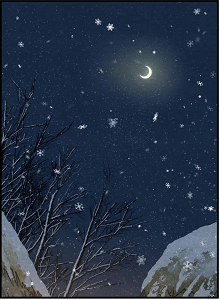 where the moon shone brightly next to the stars and the sky was filled with beautiful snow flakes mixed with stars, while the lord was making love to Baek Na-Kyum. This picture exuded magic and peace of mind. Yet in chapter 59, the readers are viewing a different night sky
  although it is happening during the same night. The moon is closer, nonetheless covered by clouds. Moreover, the stars are not visible and the snow flakes are less recognizable. We have the impression that there’s some wind due to the multitude of points and the clouds around the moon. It was as if the wind would push the clouds away from the moon and the snow from the roof was blown away by the wind. It was as if the clouds were trying to hide the moon. Since not all the snow flakes are coming from the sky, the few visible are the ones falling from the sky. From my perspective, there is a mixture of snow fall and wind-swept snow indicating that there’s a certain restlessness. As you can sense, we have a panel oozing calmness and clarity first and the other image emanating confusion and restlessness. Why is it so different, although it is the same night? As you can imagine, there is a reason for that and you might have already found the answer.
Before starting studying the second panel, I would like to remind my readers about the interpretation I made about the first panel posted in the analysis “Yoon Seungho’s love confession: Dream and reality”.
“This represents the painter’s gaze at his lover, as Seungho is embodied by the moon and the night sky. The moon shines brightly and the stars are even visible. This picture oozes a certain warmth as the beholder can distinguish the snow flakes very well. For me, this picture mirrors the painter’s thoughts. Now, he is able to recognize and enjoy the lord’s affection.”
However, what caught my attention first is the distance of the moon, especially if you compare it to the picture from chapter 59. Although the satellite glows so strongly, it looks so far. Yet during that night, the two protagonists were actually getting closer. Consequently we have to wonder about the reason for this gap. But the answer is quite simple if you recall that this image represents the painter’s perspective. Thereby the distance symbolizes the painter’s thinking. We shouldn’t forget that the latter has problems to accept the obvious. It is so incredible that it can’t be true, that’s how he thinks. For him, the noble is so powerful and stands so far above him, while he’s just a low-born who was raised at a brothel. Even a low-noble like Jung In-hun looked down on him and now an aristocrat from a higher position is loving him, it sounds so unrealistic. It was, as if this reality was just a mirage. As the manhwaphiles can sense, the gap reflects the painter’s internalization of norms and values.
The other striking detail is the disposition of the buildings and their respective roof. They don’t serve as a border, rather the opposite. It was as if there was an imaginary road leading to the moon and the trees were showing the way to the painter. The tree tops remind the spectators of fingers pointing to the moon. Furthermore, for the second time, we have the presence of nature in such a panel, while it was rarely in the past.
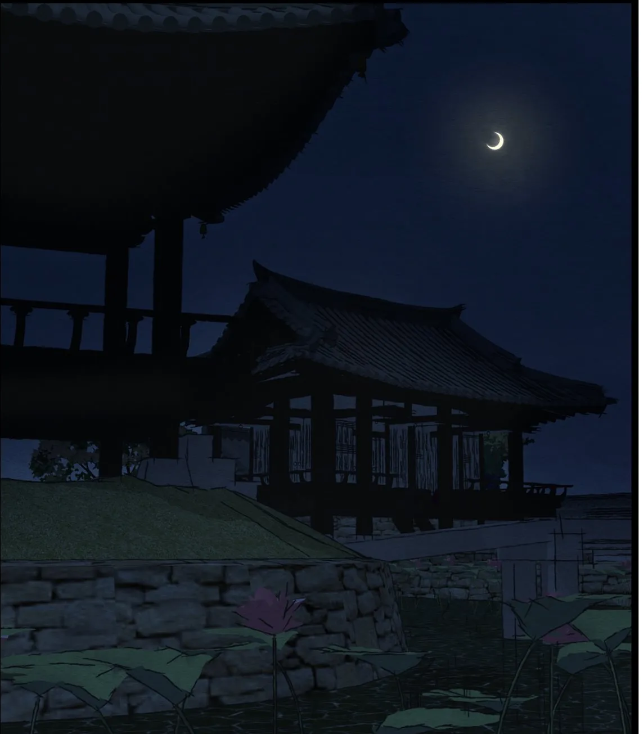 Besides, if you compare it to the first image (chapter 4), you’ll notice that the tree is facing the roof. I interpret the position like this. Back then, the artist had to choose between his conscious (social norms), embodied by the roof where he denied his homosexuality, and his unconscious (his true desires), symbolized by the tree. The moon, a representation of Yoon Seungho, stood in the middle creating this inner conflict in the painter. And even so, the presence of civilization was more dominant than anything else. In the second picture, nature is barely visible (only water with some lotus), while we have two pavilions. However, in the drawing from the chapter 58, the readers can detect the switch. Nature is getting more importance as it occupies more place in the drawing. The number of trees has significantly increased. Furthermore, the roofs are covered with wood/ hay hence we don’t sense the presence of culture in this picture. We even have the impression that the trees are coming from the roof. With the former meaning, I deduce that the painter is no longer repressing his desires, is acknowledging his sexual orientation, yet the second roof symbolizes the remaining of social values. Since Baek Na-Kyum is still in denial due to the huge social gap, this becomes more understandable why he has issues to accept the truth. To summarize, we witness the flourishing of nature, which is strongly connected to the artist. And this is no coincidence. For me, it was, as if nature had been able to defeat civilization, society and its traditions. The lord’s love for the artist is a symbol for nature. Besides, according to my interpretation, the painter is associated to Earth hence to nature. The presence of the trees are a clue for this. Thanks to this magical night, the artist and the lord are slowly reconnecting to their true self. This explains why the lord can sleep peacefully
 and the painter is thinking very carefully and calmly. The presence of the trees, connected to the roof and representing Baek Na-Kyum’s emotions and sexual orientation, are now a real part of his identity. In other words, his conscious is slowly integrating these values. In my perspective, the starry night illustrates the painter’s transformation. Little by little, he is getting stronger as he has been able to find a roof over his head, a real home.
And striking is in chapter 59 Baek Na-Kyum is going outside in order to ponder about this magical night.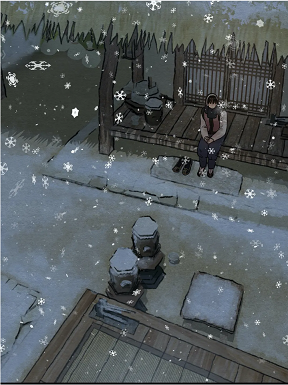 It was, as if he wanted to clear his mind and think calmly, proving to me that the peace of mind is not just associated to Yoon Seungho but also to the artist. He is recalling all the good deeds the lord did to him. Therefore you can now understand why the first picture radiates peace of mind and beauty. Furthermore remember, in chapter 44 we had snow fall too and back then, I had pointed out that in Korea watching the first snow fall with the loved one has a huge signification. It means your wish will come true and it will be a real and deep love. Hence we could say that the snow fall during that magical night announces that Seungho’s dream will come true. Or the snow flakes could also symbolize the painter’s affection for the noble because snow flakes are similar to water drops and remind us of Baek Na-Kyum’s tears. Due to his tears, we know that the character’s personality is a water element. Yet, since he is denial, his love for the master has not become fertile (hence snow), while during their first night in chapter 21, it rained as his dream had come true.
 Let’s not forget that water is connected to fertility and life. But in chapter 21 this rain had a negative connotation, since it was linked to storm (the sound of a thunder). So it was pouring down, illustrating that this rain was not fecund and didn’t emanate tranquility. All these observations lead me to the following conclusion: the Wedding night had created a turmoil of emotions in both people. Yoon Seungho got swayed away by his feelings, when he was showered with love by the artist, while the latter was swayed away by the sensuality discovered through his first sexual experience. However, since both were not honest to each other and themselves, this night was an illusion causing chaos in the end. This is not surprising that at some point, this night led to a catastrophe, the rape at the pavilion.
And now, if the beholders look at the starry night, they’ll note that the panel contains so many messages:
 Surprising is the way Baek Na-Kyum calls the main lead, it’s Lord Seungho!! This is no longer “master Yoon” or “my lord” but he is utilizing his first name!! And this detail didn’t escape Jihwa’s notice. He knows, this unveils a certain intimacy between his ex-lover and the low-born. Imagine, so far, Jihwa only called his friend Seungho, when he was upset: chapter 15 and 17!! He was forced to address him as lord/master Yoon all the time.
Besides, I would like to point out that due to my interpretations, I discovered that the painter’s personality contains earth-water elements contrasting to Yoon Seungho’s nature. For me, the noble is a combination of fire and air. Remember my comparison to a volcano and my association to the eagle, but the best proof is the phoenix. The phoenix embodies both as the rebirth of this mystical bird is related to fire: reborn from its ashes. Note, this is what I found about the combination of earth-air:
“Earth and water in combination leads to something very sensual and moody indeed. Without any of the distancing possible from the light elements, this personality is easily drawn into the sensual, the exotic, and the new. While earth does mitigate some of water’s tendencies towards mutability, this combination is still somewhat unpredictable, particularly if water edges out earth as the dominant force. The combination of deep-felt emotion and links to the senses makes this person very tied to the world as it is, as well as its experiences.” quoted from http://aelfhame.net/~darkhawk/elem2.html
Sure, I have to admit that I am no psychologist but striking is that this description really fits our innocent man so well. His huge sensuality and unpredictability are the features what caught the aristocrat’s attention. Besides, he lives in the present which corresponds to the following words: “tied to the world as it is”. As for the lord, the author gives the following description:
Air and fire together make for a very powerful, logical personality. With a complete lack of heavy elements, this person can easily detach from mundane living and apply himself to what needs to be done with the full force of fire’s energy. Additionally, air mediates fire’s somewhat scattered tendencies by channeling them through logic, so that while an air/fire person may be working on any of a number of things, all with full energy and force of will, it is in a reasonable progression, and nothing important will get left behind. While this person is not necessarily deeply involved with the physical world, more often applying his force of will to the mental, he is generally practical, because leaving things be that have to be dealt with will only cause problems later. quoted from http://aelfhame.net/~darkhawk/elem2.html
It fits the protagonist so well too: detached (the impression, he is a ghost) and he keeps his distance from people, powerful, logical, strong willed and practical. Baek Na-Kyum can ground more the lord, while the latter give him more support, education and energy. And now, it makes perfect sense why they fit so well to each other, as they create a certain balance. And you might wonder if I didn’t drift away from the topic, since my analysis was about the two panels. However, the readers should recall that we have the wind and clouds in the second panel: air and water elements.
And now, it is time to analyze the second image with the moon. Here, the moon seems closer, then why, since Yoon Seungho rejected his friend? The answer is quite simple. This image represents Jihwa’s perspective. That’s why this picture oozes restlessness. The red-haired noble always felt that he was so close to the main lead, until the commoner appeared therefore the moon appears closer. But this is just a delusion from Jihwa. Now, he has the impression that his ex-lover is disappearing from his life. Therefore we could say that the clouds embody the painter in the aristocrat’s eyes. Hence he is the cause for the separation. If he was removed,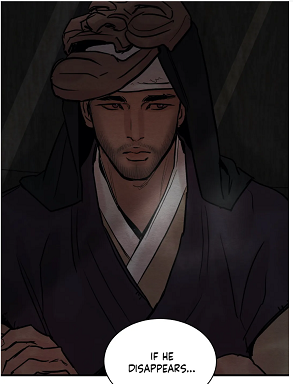 then the moon would remain by his side and their closeness would return. That’s how the second character views this night, especially after being humiliated and rejected. But the reality is that the clouds are actually a representation of Jihwa. Therefore, the clouds represent a boundary. It was as if the clouds would circulate around the moon, trapping it. Why do I interpret it like that? It is because of two elements: the composition of clouds which are made of water and air and expressions concerning clouds.
If you know water cycle, you are well aware that evaporation plays a huge part in the formation of clouds. The heat from the sun is the cause for evaporation. As you know, Jihwa is also weeping a lot, hence his first element is also water. However, unlike the commoner, his second element is fire. First, we shouldn’t forget that the noble has always been wearing yellow and orange clothes reminding us of the sun and heat.
 And if you put fire and water together, you have evaporation. And this is what I found about the combination of fire and water:
Probably the most “unstable” combination of elements is fire and water. Both of these are elements given over to passions of some sort or another, and without the possible mitigations of any of the other elements, this combination has a tendency to go a bit overboard. Emotions are never felt more deeply than by someone who is fire and water, as water’s depth is powered by the sheer force inherent in fire. However, these emotions are prone to change, often without warning, and without apparent reason. Problems tend to phase a fire/water, as their general inclinations are either to blast through or flow around them Ñ and these approaches are fairly contradictory. Others often have trouble dealing with this seeming indecision on the part of this sort of personality, as well as their extremely changeable nature. quoted from http://aelfhame.net/~darkhawk/elem2.html
And just with the two protagonists, this description fits our character. I had already pointed out a certain superficiality in Jihwa’s love (depth of the affection mixed with changes), the tendency going overboard can be viewed with the pranks he played (the ruined painting, the letter, the insult leading Seungho to cut his hair) and his huge switch of moods. Remember in the chapter 12, the manhwalovers saw him really happy and 30 minutes, he was enraged
 I could include the new episode here. During the same night, he is devastated and lifeless
 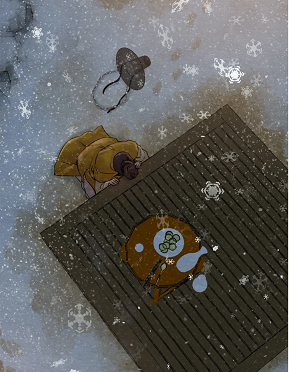 then once he sees the captured painter, he is full of rage and yelling, although he was complaining before that the criminal hadn’t done his work.
 That’s why we see the constant mood swings in the noble, however they have a different origin than Seungho’s. Nevertheless since both have fire elements in their personality, this is not surprising if they often clashed in the past.

 And because the cloud embodies the aristocrat, it is important to know its signification. The cloud is the symbol of the ephemeral and impermanence which can not help the main lead to get grounded. Just like the rain and the snow, the cloud is also linked to fertility as it brings water but it can also bring destruction (typhon) or hope (“silver lining”). Now, you understand why Jihwa and the painter are so different, although they both have water in their personality.
Secondly, we have many expressions in French or in English linked to clouds which actually mirror the red-haired character’s nature. He’s living in the clouds signifying that he is ignoring the reality and is rather dreaming (similar to living in cloud-cuckoo land which means to be in an unrealistically idealistic state). As I had pointed out in another former analysis, the aristocrat neglects the present, therefore he never paid attention to reality. He was always hoping of becoming Seungho’s official lover. That’s the reason why I described Jihwa as someone trapped in the past, while his mind was looking at the future, dreaming of an uncertain prospect, living in an illusion. Another expression is having the head in the clouds (another allusion to dream and illusion) or being in cloud 9, which was sometimes palpable in Jihwa’s reactions. His extreme overjoy could turn into extrem despair, like the manhwaphiles could witness it in chapter 43.  The way he was dressed exposed his joy and anticipation to be reunited with Seungho. He was already imagining himself being embraced by him, when he saw the lord having sex with the painter. Then he got so upset, jealous and enraged that he would yell and burst into tears at his friend’s pavilion.
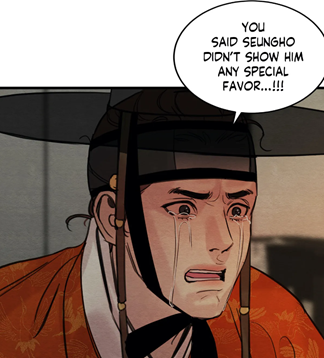 Then a cloud on the horizon refers to a bad omen, something bad is about to occur and we know that each time, Jihwa approached his childhood friend, something bad happened to the painter later because his feelings had been wounded by his childhood friend before (chapter 5 -> 11; chapter 15-> 17; chapter 57->60). And now it becomes more understandable why Jihwa appears so emotionally unstable, a characteristic of people with a combination of water and fire. Since I have determined that the cloud is a visualization of Jihwa in Seungho’s life, it becomes clear that the following panel has now a different signification. The clouds are circulating around the moon, trying to clinch onto it. The clouds were the reason why the moon couldn’t glow, at the same time, the cloud could never be satisfied with Seungho’s interaction as the warmth from the moon is colder and can never warm up clouds. Both hindered each other to move on. Striking is that in the picture above, it looks like the clouds are moving. It seems that the wind is blowing away the clouds. It could be definitely be perceived as a signal that the clouds are removed slowly from Yoon Seungho’s side, thanks to the wind.
And here is the next question: What does the house mean here? Who is symbolizing the wind? I believe now, you are smart enough to fill the blanks. Nameless has a personality combining earth (roof) and air (wind). Observe that the roof stands in the way, it was already separating the red-haired noble from his childhood friend. Let’s not forget that this panel appears, when the lord is still kneeling down thinking about the last words from his ex-lover. Furthermore, we often see the criminal in the cabin (chapter 51 , 59
, 59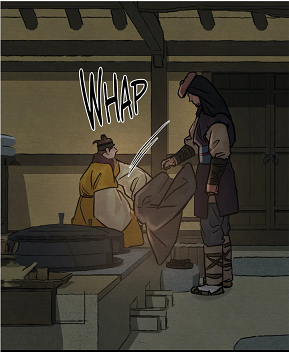 , 60
, 60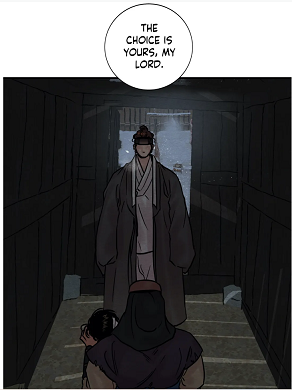 ) . Striking is that the light in the cabin is slowly disappearing. The more time passes on, the darker it becomes exposing the evolution of Jihwa’s situation. His world is getting darker as he is more desperate and emotionally wounded.
As for the wind, it is a constant companion of clouds giving them a certain permanence and foundation. The wind helps the cloud to move on. Let’s not forget that in reality, clouds are composed of air and water therefore I see it as another sign that Nameless will help Jihwa to become a different person, give him more stability which is confirmed in chapter 60. He stops the noble from hitting the artist, led by his instincts therefore he takes away the weapon. Exactly like I had explained, he will become Jihwa’s hands but since the noble is now forced to make the decision himself, he will have to bear the responsibility for his decision. If he hadn’t witnessed this, the desperate aristocrat would have refused to be accountable for the crime. The criminal detected the guilty conscience consequently he postponed the murder hoping that the aristocrat would change his mind. In my opinion, he believes that the noble won’t be able to express the death sentence. In two occasions, he underlined the severity of the wrongdoing (chapter 51
 , 60
, 60 ) which is a clue for me that the butcher doesn’t want the noble to have his hands tainted. Observe that during the last scene, the criminal proposes other alternatives: death or turning Baek Na-Kyum into a handicapped person who can never tell what happened.
Furthermore in different religions the wind is considered as the messenger of the gods, exposes the presence of divinity. Therefore, I believe that Nameless is the one who will bring a huge change in the life of all the main characters, forcing them to switch their perception about life and their life. Notice that before Jihwa was trying to attack the painter, he was still using conditional sentences revealing his desire to deny the reality. By coercing the noble to make a choice, he is forcing him to live in the present and to admit the huge responsibility for the action. And the moment he chooses to have the painter killed, we have to imagine that the door will close and the closing door will symbolize the choice of Jihwa selecting darkness. The commoner stands on the opposite side as his hands and world are already tainted with blood and full of darkness. Yet, he doesn’t desire the naive but impulsive noble to choose this side. By underlining the gravity of the crime, he wanted the noble to follow his pangs of conscience. Therefore you comprehend why this panel was already announcing the role played by Nameless , separating Jihwa from Seungho’s side, forcing him to change his mindset and confront him with reality. That’s why when you read the description of persons with air and earth elements, you’ll recognize Nameless: thoughtfulness and caution.
“Earth when combined with air in an individual makes for someone well-versed in contradiction. Air lends a certain amount of caution and thoughtfulness to the earthy pursuit of sensation and experience. On the other side of the coin, earth forces air to interact with the world as a whole, not allowing it to deny the value of the senses. If this sort of personality can resolve this particular internal conflict, then it is quite well versed in being able to apply concrete meaning to thought, or rationality to the matters of existence and enjoyment in the physical world.” quoted from http://aelfhame.net/~darkhawk/elem2.html
Feel free to comment. If you have any suggestion for topics or manhwas, feel free to ask. If you enjoyed reading it, retweet it or push the button like. My tumblr-twitter account is: @bebebisous33. Thanks for reading and the support.

This is where you can read the manhwa. https://www.lezhin.com/en/comic/painter But be aware that this manhwa is a mature Yaoi, which means, it is about homosexuality with explicit scenes. As for the psychology of colors, I used this website: https://www.empower-yourself-with-color-psychology.com/color-blue.html
In my former analysis, I associated father Yoon to corruption due to the color of his clothes. Khaki is a synonym for dead water and rotting and in the chapter 57, the readers discovers how the young protagonist’s heart got poisoned by his vicious and cruel father. Sure, we just get glimpses of the main lead’s past but it is enough to establish the father’s responsibility and ruthlessness.
In my opinion, his corruption starts with the visit to the doctor. The father is determined that his son is ill, although the physician can’t confirm the sickness. In fact, he can’t make a real diagnosis. 
 These panels are important for two reasons. First, we detect the physician’s reservation. He expresses his doubts about the illness: “It seems”, “he said strange things” and “he looked alert and his complexion was rosy”. Furthermore, it becomes more obvious that the doctor is repeating what father Yoon told him: “since a very young age”. However, we know for sure that the physician only met the young man, when he was a teenager so the expression “since a very young age” indicates that he is relying on the father’s information. According to the latter, the protagonist was ill very early on but fact is that there is no diagnosis confirmed by any doctor.
What caught my attention is the huge contrast between the doctor’s saying and father’s words: Note that Yoon Seungho has a very good reputation, yet the doctor had never heard any rumor about his illness. That’s why I come to the conclusion that father Yoon had decided to use medicine on his son because of his jealousy. The reason for this statement? This is no coincidence that his good reputation is mentioned altogether with his illness. Father Yoon couldn’t bear the thought that his son’s notoriety was exciding his own.
Notice that when the father describes the illness, the physician recommends a visit to a shaman, but the father refuses. He keeps saying that Yoon Seungho is sick. In other words, the protagonist’s relative acts as if he was a doctor and he knows exactly the diagnosis. Yet the words “he said strange things” expressed by the doctor outlines the incompetence of the noble with “dragon eyes”. He uses technical words without knowing the true meaning. With this, I conclude that father Yoon’s real knowledge is superficial and he is actually overestimating his intelligence. The lack of knowledge didn’t get unnoticed by the expert. In reality, the noble with the khaki robe is just picking up the medicine for his son and needs the doctor’s collaboration. Here, it is important to point out that after this visit, the father never went to this physician again. The latter only became Yoon Seungho’s personal doctor again, after the latter had been abandoned by his own father. Let’s not forget that the physician only visits Yoon Seungho after the topknot incident.
 Valet Kim must have decided to ask for his help remembering their first visit and how good and qualified the doctor was. The latter took his time and talked a long time with the father, like we can witness in this panel. The father had to sit down indicating that the doctor didn’t fulfil his wish right away. He had to persuade the expert.
  Unfortunately, despite his doubts, he did follow the father’s wish. So when the doctor visits the lord for the second time, he is able to diagnose that the young aristocrat is really sick.
  Here, he can observe the symptoms. As a conclusion, despite his doubts about the mysterious illness diagnosed by the father, he did prescribe the medicine and kept giving it to valet Kim. Strictly speaking, he has still not questioned the real use of that medicine because after his second visit, the patient was indeed unwell. It’s important to note that until now, Yoon Seungho has kept drinking this medicine, ordered by his own father.
  Valet Kim was the one taking care of it all this time. Yet this has nothing to do with insomnia, since Baek Na-Kyum asks if his “usual medicine” is related to his sleeping problems
  and the doctor denies it. He replies that he has been taking it since his youth and back then, insomnia was never brought up. All this indicates that the corruption is still effective due to the drug. No one has ever questioned the true purpose for that medicine, neither Yoon Seungho nor valet Kim nor the physician. That’s the reason why he is still agitated in my perspective.
In my opinion, since the father couldn’t force his son to fake any illness, he used “sodomy” as an excuse for his son’s sickness, although he never mentioned that explicitly. Yet, his description of the sickness “illness of the spirit”, “contagious illness” are all related to homosexuality. I think, he must have come up with this idea, when he saw the interaction between Lee Jihwa and Yoon Seungho. The father must have realized that his son’s friend was attracted to his eldest son  and he saw the perfect opportunity to separate Yoon Seungho from Jihwa under the pretense of an illness and isolate his son.
 By using the drug and his reclusion, he made sure that his son’s reputation would no longer overshadow his own notoriety. By banning him from leaving home, he hoped, Yoon Seungho would lose people’s attention, while he would get more support. I have the impression, he used this “illness” to submit his son too. However, I doubt that this was enough. At some point, he must have realized his lack of influence and power as he was a very ambitious man. I am quite sure that he must have dreamed of achieving greatness. There is another clue for this interpretation. Let’s not forget that Jung In-Hun did the same to the painter. He used “sodomy” as an excuse in order to pressure the artist to stop painting. It was immoral and filthy according to him. The low noble must have known that Baek Na-Kyum’s publications got famous among nobles, when he was asked to become the commoner’s guardian. Yet within one year, the painter stopped publishing due to the vow forced by the coercive persuasion. So this is how Baek Na-Kyum’s perversion started and here, the administration of the drug marks the beginning of the educated protagonist’s corruption.
The most upsetting is that valet Kim never questioned Yoon Seungho’s father’s decision and action behind this visit. He imagined that this was for the sake of the boy. Who would suspect a father drugging his son due to jealousy? Valet Kim has always liked the boy and this close relationship is visible in this chapter. He keeps company to the boy and the latter looks at him with such a tenderness and affection. This explains why the loyal butler remained by his young master’s side and why he accepted the mood swings later. He knows deep down the lord’s true personality. And since the corruption started with the drug administrated by valet Kim, this would explain why the lord has still mood swings in the end. This is not just caused by his trauma. There’s a combination of both in my opinion. However, by interacting with the painter, the lord’s heart and mind improved a lot, but his transformation and purification have not been completed yet, unlike with the low-born. The latter is no longer thinking about his former teacher, has dropped for good Jung In-Hun’s doctrine and is using his own mind and eyes, while he observes his lover. We could say, the painter’s thoughts are always revolving around the lord
(his dreams ,
,
when he takes care of him ,
,
when he is separated from him 

when he masturbates  etc). Jung In-Hun’s influence and shadow has disappeared for real. Like I wrote once, the lord has been the cure for Baek Na-Kyum, so is the painter for lord’s. The artist will be the one who purifies the main lead. And now, I come to the second part of this essay: purification.
What caught my attention in the chapter 57 is the final scene and especially the final panel.  For the first time after the lord’s confession, Yoon Seungho is looking at the painter’s gaze. He is no longer avoiding his eyes showing that he has regained some confidence. He no longer fears his eyes. he has gathered enough courage to face his lover. He would like to read the painter’s thoughts and emotions, as he knows about his transparency. Furthermore, both protagonists are quite close and this hasn’t happened since the chapter 54.
The other important detail is that the artist took the initiative to approach the noble, creating another precedence. We should remember that in the chapter 52, he did it because he was criticized by the butler and in the chapter 55, he was asked to take care of him by the loyal domestic. Sure, in the last case, the main lead would have done it on his own, as bringing the bucket of water was his own choice before. Nonetheless, I sense another progression as Kim never gave him any precise order here. While looking at the young master, he recognizes that the hat must cause some discomfort to the aristocrat hence he wants to remove it.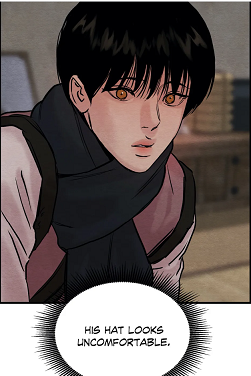 However, we could say that he is just looking for an excuse to approach the master as he keeps starring at him. Hence we have two pictures about Yoon Seungho’s handsome face from his perspective.
Striking is that when he is looking at his lover and perceives the hat as a source of discomfort, we can detect the presence of two important items full of symbolism: A mirror on the left and a white candle on the right. This was noticed by my chingu @user4792569. This signifies that Baek Na-Kyum is no longer represented by the yellow candle on a candlestick, a symbol for frigidity and selfishness. Here, the manhwalovers can conclude, the artist has finally truly returned to his old self. He’s pure and selfless which is reflected by his behavior. As for the mirror, my interpretation is the following: the mirror just symbolizes the painter’s function. His face will serve as mirror for the noble in the next chapter. Yoon Seungho will be able to see his own reflection: he is worthy to be loved. The readers should keep in mind that the main lead still fears his own image. This would be a new version of the chapter 31 and this time, Yoon Seungho would be the one who gets liberated. Another possibility is that the painter truly uses the mirror to show the lord his true image. But honestly, I have more doubt about this probability.
In this scene, he observes his lover, prepares the bed and finally approaches very close to him. All this reveals how dedicated he is towards Yoon Seungho. That’s the reason why we have a white candle behind the painter. This is not surprising that he keeps thinking about the love confession in his dream, disclosing that he is no longer repressing his desires and unconscious. He is truly free. Surprising is that his knees are even touching the master’s robe,  reminding us of the scene in the chapter 55, where he first kept a certain distance from the lord’s bed but at the end, his feet touched the sick man’s cover
 .
.
While he tries to remove the hat, he is stopped by Yoon Seungho as the latter fears hands next to his head, a repercussion of the “incident with the top knot”. Until now, no one has ever been allowed to touch his head, except his loyal assistant. And this is relevant as it announces the transition, slowly the painter will replace valet Kim. I anticipate that Baek Na-Kyum will be permitted to touch his hat, displaying the increasing of trust between the two protagonist. When the lord grabs the low-born’s hand, it is just an instinctive gesture but what is different now is his reaction. He’s not pushing away the painter, like he did in the chapter 4, a good connection made by another follower, @kei_tsukishima. 
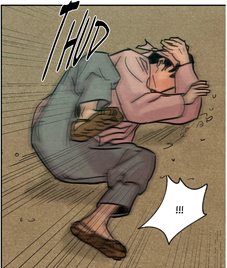
[As you can observe, my essays have now such an influence on my readers that the latter are able to notice and interpret details. This can only make me happy, it feels like my work as teacher is very successful. The analyses have affected so many people that they are now capable of helping me, that’s why I hope, people will decide to contribute with observations to my essays]
But now let’s focus on the hat again. The huge contrast between the lord’s attitude in the chapter 4 and 57 mirrors the evolution of their relationship. The aristocrat trusts much more the artist. Striking is that the hat played a huge role in another chapter. Can you guess which one? It’s the chapter 39. Here, the hat announces the arrival of the first romantic and tender kiss between the two main characters. 
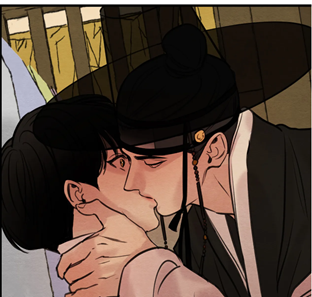 Back then, the painter didn’t hide his pleasure and reciprocated the kisses making the lord so happy. That’s why I believe that in the next chapter we will witness a kiss, as the hat will be the trigger for the kiss. And since I’ve made a connection between the chapter 39 and 57, I also think that this chapter should be judged as a new version of the chapter 39:
the choice of color is relevant. This is no coincidence that we have a rather pale blue which means creativity and the freedom to break free, a sign for liberation. Furthermore, if we look up at dark blue, this is what we discover: Dark blue is the color of conservatism and responsibility. Although it appears to be cool, calm and collected, it is the color of the non-emotional worrier with repressed feelings, the pessimist and the hypocrite. Dark blue can be compassionate but has trouble showing it as its emotions run deep. Dark blue is a serious masculine color representing knowledge, power, and integrity, and is used quite often in the corporate world.
As the manhwalovers can sense, the lord’s mood and confidence have improved again. He’s compassionate but still fears to reveal his feelings. We can make another connection to the chapter 39, the recurrence of the topic “responsibility”. While in the chapter 39/40, Yoon Seungho kept saying that he would assume his responsibility for the painter, we have a switch of roles. The artist is now the one taking responsibility for the noble. He’s prepared the bed, wants to remove the lord’s hat, he would like him to lie down and rest properly.
That’s why I am quite certain that in the next chapter, we’ll have a new version of the chapter 40. The purification can only work if the painter is caring, selfless and gentle towards Yoon Seungho and since all the conditions are met, the manhwaphiles can prepare their hearts. They will witness how Yoon Seungho gets cured by Baek Na-Kyum’s love. Actually, the idea of purification came to my mind the moment I saw this picture: 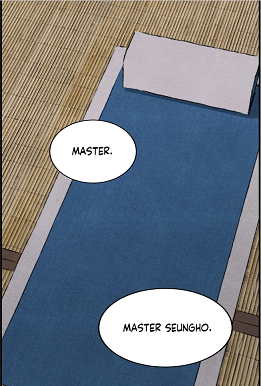
The colors of the bed contrast so much to the lord’s bed. I had already explained that yellow was related to sand and as such referring to a fight arena and red to blood and death. Here, while the blue reminds me of water, I link white to purity. The bed might look less comfortable and more simple, yet I consider its simplicity as a positive feature. And this is what I found about Sky blue:
Sky Blue: One of the calmest colors, sky blue inspires selfless love and fidelity. It is non-threatening and promotes a helpful nature that can overcome all obstacles. It is the universal healer. quoted from https://www.empower-yourself-with-color-psychology.com/color-blue.html
As you can observe, blue is associated to healing and liberation. We have so many different blues in this chamber that it is now important to quote the positive aspects of blue:
“loyalty, trust and integrity, tactful, reliability and responsibility, conservatism and perseverance, caring and concern, idealistic and orderly, authority, devotion and contemplation, peaceful and calm.” quoted from https://www.empower-yourself-with-color-psychology.com/color-blue.html
Hence I believe something important will occur in the next chapter: the renewal of the wedding night. I have to admit that when I saw this panel, I couldn’t help myself connecting it to the k-drama Dong Yi. In the k-drama, inspired by a true story, King Sukjong falls in love with a low-born named Dong Yi and the latter becomes a famous concubine, she even gets the rank of sook-bin . The irony is that in the k-drama the king has his first night with Dong Yi in a simple home, which is very similar to the room, where the two protagonists are.
But there are other elements why I think that we are about to witness a renewal of their wedding night. First, let’s not forget that during that fateful night, the color of the room was also blue  , just like the night was light blue.
  They used a blue robe as bed. And we had also the presence of white as well in during their Wedding night: the white candles and the paper in the background and the white bottle.
  Back then, the painter was under the influence of alcohol, yet the lord once commented that the low-born was delirious, another reference to the lord’s actual sickness. Notice that in the final panel
  there is no distance between them, the painter doesn’t need to stand on tiptoes. They are now equal which is an indication that their relationship can work for real now. Consequently I am expecting a confession. Let’s not forget that the painter has just dreamed about a confession coming from Yoon Seungho and like I am pointed out before, his visions always became a realit. Consequently, I am quite sure, his wish will become true.
But when I read the chapter for the first time, I connected it to purification and to the chapter 40, the romantic date. Yet since Yoon Seungho is sick, I doubted that he would have sex with the painter. Furthermore, we had a masturbation at the tailor shop, so my initial thought was that there would be only foreplay. But by analyzing the scene more closely, I couldn’t help myself connecting to the Wedding night because of the bed and Dong Yi so that I somehow forgot my initial thoughts: they can’t have sex as Seungho is too sick. However, this morning, I had a revelation. The renewal of their wedding night doesn’t mean, there will be sex as such. Quite the opposite, it will be something very pure: deep love.
Let’s not forget that when the lord went to the painter’s room in the chapter 19, he really hoped to have sex with the painter but what he received was a love confession. The pure kiss led to a passionate one and the lord thought, he could finally taste the painter. Remember what I wrote: he went for sex but discovered love, when Baek Na-Kyum hugged him, declared one more time that he liked him. The artist even added how happy he was. He couldn’t believe, that this was real, it was so beautiful that it felt like a dream. Therefore we should expect a renewal of this scene: a hug, the reference to a dream and a love confession. The manhwalovers are well aware that Baek Na-Kyum had a dream and loved to be confessed. I have the impression that the painter will change his words: From “it feels like a dream” it will become “my dream has come true”. Back then, he was doubting if all this was true therefore I am expecting that this time, there will be no insecurity from his part. He will accept it as a reality which will make him happy. And he will shed tears of happiness again. That’s why I am even more convinced that the next chapter will be a renewal of their wedding night but quite different. After kissing, hugging and even caressing each other, they will share the same bed and this time, I have the impression that Baek Na-Kyum will be the one hugging his lover as the latter’s the sick one who needs comfort and care.
The purification had already started in the chapter 20/21 but the problem was that back then we had the presence of a third person. Now, the shadow of the scholar has vanished for good and the lord has already rejected his friend Jihwa. He made things clear, he wouldn’t accept his love. Simultaneously, thanks to his friend’s love declaration, he discovered that it was still possible for him to be loved, since Jihwa would accept him despite his flaws. As you can see, I believe that Jihwa’s behavior did help his friend in the end. And let’s not forget the presence of a witness during their first night, valet Kim. It’s definitely possible that he interrupts them and has to leave quickly. We could have another whisper “close the door” or he just closes the door silently.
As a conclusion, since the readers witness the start of Yoon Seungho’s corruption in the chapter 57, it’s not surprising that the final scene announces the beginning of his purification. The lord will finally get what he has been hoping all along: feeling loved by the painter, being admired as someone respectful and trustworthy. In other words, the next chapter will be a new version of the chapter 40 and 20/21. And this is definitely needed as the enemies are gathering around them. We have the appearance of the lord Song, father Yoon and the planned assassination ordered by Jihwa, incited by Min. Only their love for each other can help them to overcome adversity.
Feel free to comment. If you have any suggestion for topics or manhwas, feel free to ask. If you enjoyed reading it, retweet it or push the button like. My tumblr-twitter account is: @bebebisous33. Thanks for reading and the support.
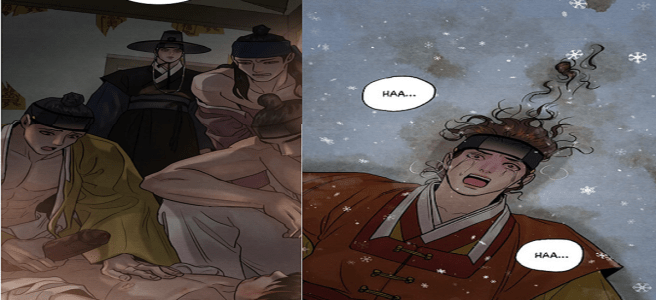

This is where you can read the manhwa. https://www.lezhin.com/en/comic/painter But be aware that this manhwa is a mature Yaoi, which means, it is about homosexuality with explicit scenes.
When I read the chapter 53, I was happy to discover that my predictions were mostly correct. It really turned out like a new version of the chapter 30. That’s why in this essay, I wanted to compare both chapters in order to outline the differences. Consequently the readers would perceive better the characters’ evolution and the change in their relationship. Furthermore it would help me to imagine how the story could go on. But since there are so many details to contrast, I chose to focus on Deok-Jae in the first part. By examining Deok-Jae more closely, I had suddenly a realization and this will be the topic of this analysis: Deok-Jae’s secret leading him to have prejudices against the painter.
It all starts with the discovery of the painter’s disappearance in the chapter 29, which causes the lord to get so infuriated that he starts beating all his servants. Even valet Kim begs for his master’s mercy, willing to receive any punch so that the servants suffer less. The former is pushed away, the moment the protagonist witnesses the painter’s return. Among the victim of the physical abuse, there is Deok-Jae. The manhwaphiles discover his face for the first time in the chapter 30. The domestic’s face is covered with blood and bruises, when he opens the door to Jung In-Hun and the painter. 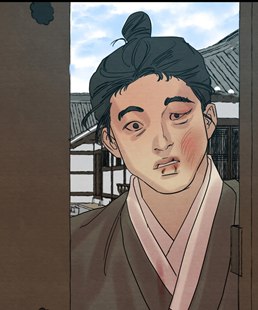 However, the author introduced him for the first time in the chapter 29
  which didn’t catch my attention as I was too focused on the lord’s behavior and reaction. [I want to thank taeminiebaby for her tip, this shows that everyone is welcome to contribute to my analysis] This gradual introduction is quite important for two reasons. First, his face gets more and more features. While the man has no visage in the first drawing, Byeonduck gave him eyebrows and a mouth in the second drawing. And the climax of his presentation is in the chapter 30, when Deok Jae opens the door. Striking is that in the two scenes, he always stands close to a door. These two observations are quite important because I’ll refer to it later.
In the chapter 53, we discover that before the escape, the noble had already given the order to his staff that they should keep an eye on the artist but no servant took it seriously. 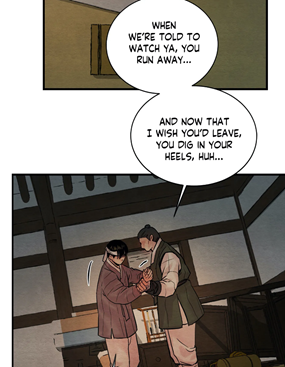 The explication is quite simple. Baek Na-Kyum was a low-born hence he couldn’t be a guest. On the other hand, his job was so different from the servants’ as he painted erotic pictures of sodomy. Due to all this, the staff could only disapprove the artist. In other words, due to his undefined position, the servants couldn’t view him as a part of the staff but just as an outsider. That’s why the low-born could escape. On the other hand, they never witnessed how the noble started having a relationship with the artist (chapter 20/21; chapter 25/26/27) therefore they just thought, he was only important because of the paintings.
The irony is that in the chapter 53, the servant is even referring to that incident. He notices the contrast. Back then, Baek Na-Kyum had no reason to run away because the servants didn’t witness the rape. Yet he decided to flee. Now the innocent young man is doing the opposite. Despite the lord’s neglect and the suffered violence he refuses to leave the mansion. He resists to the jealous and resentful domestic with his body (“you dig in your heels”), although the latter is weaker than the brutal domestic. This displays the commoner’s strong will. Therefore this forces the domestic to hurt his hand. If the protagonist is disabled, the noble can no longer keep him as the latter has lost his ability and function. The consequence could be terrible for Baek Na-Kyum. Yoon Seungho could decide to send away the low-born. Deok-Jae has already anticipated that the lord is no longer favoring the painter as he returned to his older self during that week. That’s the reason why Deok Jae says this: What caught my attention in this drawing is the first comment. His words reveal that the domestic must have stood by the door of the bedchamber, when he heard the artist’s moans. Therefore we should ask ourselves when and why he was spying on his master and the painter. Striking is that he mentions the lord’s chamber and the moan sounded similar to pain. Thanks to this info, we can already reduce the number of probabilities and almost figure out when he was observing the painter. Naturally, I can only mention the sex sessions that we could witness.
He can’t be referring to their “wedding night” or the rape as the protagonists were not at the master’s chamber. The one occurred at the painter’s chamber and the other at the pavilion. Deok-Jae couldn’t be referring to the night in the chapter 42 and 48/49, as they were at the painter’s study, when they had sex.  . We have two possibilities. The first one would be that he heard the moan during the sex marathon, yet valet Kim seemed to pay attention to the lord’s bedroom. Since the domestic notices the resemblance of the sound between the pain and the moan, he could be thinking about the sex session in the chapter 45. Yet, the problem with this proposition is that the painter never complained here so that the moans can’t be similar to pain. As you can conclude, the mention “master’s room” is an important clue.
The last probability is when the powerful mean lead masturbated the painter for the first time (chapter 16). Remember that during that night the door of the lord’s chamber got open and no one could see the perpetrator of this wrongdoing. Every reader speculated that a servant must have opened it but we wondered about the reason for this action. Many manhwaphiles complained about the lord’s leniency. Furthermore since we didn’t see any face, we were clueless about the motivation behind this action. From my point of view, during that night Deok-Jae could have been the one observing the door. Since no one talked about the event happening, then it is clear that Kim must have been the one opening the door and he left it open in order to force the painter to leave Seungho’s side. However, I am quite sure that the loyal butler wasn’t the only one who paid attention to what was happening in the lord’s chamber. Why? It is because of Jihwa’s words in chapter 17.  With his statement, it is clear that someone was observing the door and the painter’s move. Jihwa is using the expression “servants” in order to hide the identity of the informant. There is no doubt that the domestics had no idea how Seungho felt attracted to the painter, since he kept organizing sex sessions (8,12-15). Besides, observe how the noble implies that the spy must have observed the low-born, until he returned to the study, while I doubt that Kim would have kept observing the artist till the end. The heard footsteps indicate that the valet was running away. From my perspective, Deok-Jae must have witnessed how Jihwa left Yoon Seungho’s chamber but he didn’t see or hear the painter leaving the master’s room and worried that Seungho would make a move on the commoner. Annoyed, he could have misled the butler so that the latter would interrupt them. He knew that if Kim intervened, the master would never scold him. Besides, he had no right to open the door. We shouldn’t forget that during that night, the lord hugged the painter before the latter tried to leave the bedchamber.
 Imagine that their shadows were visible from the outside due to the candles light hence Deok-Jae could have seen how the master had got close to Baek Na-Kyum. The other reason for this supposition is that the painter cried during the masturbation… which is also related to pain. We shouldn’t forget that the low-born felt embarrassed to have an erection. He was still in denial about his homosexuality. This could explain why the moans were so similar to pain.
  From my point of view, Deok Jae was spying on his lord for an important reason and used valet Kim to stop this event. Now, you are wondering why as well.
My interpretation is the following. Deok-Jae has always felt attracted to the lord and wished deep down to become his sex partner. But this wasn’t just a pure love, for it was mixed with greed. He wished to change his position. Nonetheless he had to witness how the lord showed so much care for the artist. He saw how they got closer and closer. The lord went even so far to spare the artist from the straw mat beating. The moment you assume that the domestic wanted to be the lord’s partner, you understand why he resents his lord and the commoner so much. But let’s go back to that famous door. If my assumption is correct, then it makes sense why the domestic opened the door and ran away. He wanted to stop his lord to get closer to the innocent main lead. The domestic got jealous and resentful that the painter, a low-born like him, could get the noble’s attention and the master would try to woo him, which Deok-Jae refused to admit.
If you pay attention to the servant, you’ll observe two details distinguishing him from all the other low-born. He is the only one not wearing a white headband. Even valet Kim wears one. He thought if he had no white headband, this would reduce the distance between him and his master. Furthermore he might catch the lord’s attention that way. The second observation is that he is often seen next to doors. We can see him standing next to the door of Jung In-Hun’s chamber in the chapter 29, opening the door in the chapter 30, then we have this drawing
  in the chapter 45, then in the chapter 47
in the chapter 51 (when he visits Nameless and at his return). The manhwalovers can notice the door on the right side in the chapter 52 and finally in the chapter 53.

I don’t think my readers have already forgotten the signification of the door. Back then, I demonstrated how the door represented the painter’s opinion concerning his sexual orientation. In other words, Deok-Jae is a homosexual too, attracted to Yoon Seungho but he can’t reveal it because it is a taboo. Let’s not forget the criticism Jihwa told to his childhood friend in the courtyard in front of the staff. Sodomy with a commoner is considered as degrading and filthy. I have to admit that I was totally wrong concerning Deok-Jae’s resent.
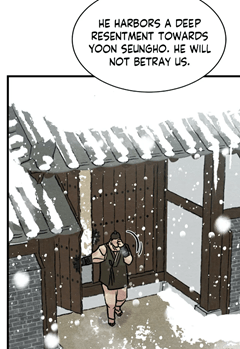
I thought, he had been punished a second time hence his hatred for Yoon Seungho had increased to the point of betraying him. We know for sure that pure greed was not the motivation for his betrayal.

So why would he resent the lord so much? The beating in the chapter 30 can’t be the explanation as many servants were punished, included valet Kim. But it is a different story, when it comes to love. He had to witness how his master fell in love with someone else and this person was not only coming from a brothel but also was wearing a white headband without a topknot. From my perspective, Deok-Jae was trying to imitate the nobles with his hair dress. Yet this could never appeal the master as he is not attracted to superficiality and beauty. He was attracted by the naturality and purity of Baek Na-Kyum’s tears and reactions. But there is nothing attractive about Deok-Jae as he is vain, full of malice and envy. This explains why he kept hurting Baek Na-Kuym by pushing him or poisoning his rice or calling him a whore.
And it is time to reveal the real evidence for this theory. In the chapter 29, when the painter escapes from the mansion and meets Jung In-Hun in the street. Their encounter is no accident, although it looks like one, as Baek Na-Kyum runs into the teacher out of fear.  The painter mentions that he has been tipped off by a servant. He says no name but if you contrast this to the following picture. Deok-Jae is actually saying that he has no idea about the noble’s whereabouts. Then there is a drop of sweat on his face. From my perspective, Deok-JAe was the one who helped the painter to flee and gave him the info about the scholar so that both would disappear. The drop of sweat indicates discomfort and now, the readers can fill the blank. He is actually lying to Yoon Seungho. He hopes, his master will buy his lie and give up on Baek Na-Kyum. The servant Baek Na-Kyum is referring to can only be Deok-Jae, since he is slowly introduced in the same chapter.
And now, if you consider him as a jealous man who longed for his master’s attention, you’ll understand why he destroyed the snowmen, why he pushed him hard and why he spoiled the rice. He acted as a jealous concubine we can see in Chinese or Korean historical dramas. Killing the rival is another typical trope too hence this is not surprising that he is determined to have the painter killed so quickly. This discloses Deok-Jae’s urgency, he needs to act now as the painter is no longer favored. His action to ransack the painter’s room reminds me of the concubine’s plot trying to ruin clothes. Now, I understand better his jealousy and resent for both protagonists.
He acts like a dejected concubine, out of revenge. Moreover, this would explain why he never stopped the painter from leaving the mansion in the first place. He wished, the man would leave the place so that he would no longer represent a thread. No wonder why he keeps making rude remarks, when he sees the painter receiving the butler and the lord’s attention (the clothes, the material for the painting, the special dishes etc.). He wanted to be the one receiving the master’s favors. That’s the reason why the servant acted on impulse that night. There was despair, resent and urgency… Deok-Jae feared that the master would change his mind. With this new revelation and interpretation, I feel a little stupid for not realizing it sooner. I made the mistake to imagine that he had been beaten as an explanation but the reality seems to be different.
But let’s go back to the picture, where Deok-Jae claims that he can hurt the painter. The mean domestic thinks, he can do whatever he wants to the painter as the lord no longer cares for Baek Na-Kyum. The typical behavior of a jealous concubine in front of the neglected wife (LOL). Besides, Baek Na-Kyum is not part of the staff. Deok-Jae never considered him as one right from the start and with the incident in the chapter 30, his prejudice was reinforced. He justified the lord’s fury with the painter’s seduction. Baek Na-Kyum must have somehow bewitched his master. How could he fall for someone who had no topknot and was wearing a white headband? On the other hand, while the painter claimed in the past, he was no servant  (chapter 38), he is now determined to remain in this mansion as a servant. This outlines how much the mansion means to him. It has indeed become his home. If he’s a servant, then he can’t be called a prostitute. For Deok-Jae, it is really important to perceive him as a prostitute because he has no other explanation for the lord’s behavior. How could he fall for someone like him, when he on the other hand had worked at his place for a long time and paid attention to his appearance? That’s why he can only insult the painter , when he sees the drawing of Seungho having sex with the painter.
  Observe his look. He is not disgusted by the drawing as such, he is not rejecting sodomy. He resents the artist, he wished, they would have switched places.
At the same time, we shouldn’t forget that in the chapter 53 the painter’s position and image are relevant. Baek Na-Kyum is not like in the past, where he was proud of his work, in this moment he is willing to be viewed as a domestic which explains why he abandoned the expensive clothes. First Baek Na-Kyum is rejecting the tailored clothes therefore he can’t be considered as a prostitute. Secondly, he is lowering himself in order to be included in that mansion. He did listen to the butler’s words. He could no longer act like a spoiled princess, he was a part of this mansion and needed to serve their master. Thanks to the reprimand, the painter realized that he could become an assistant if he was dressed like the others. Through Kim, the painter was reminded of the words from the maids. Now, the painter is choosing his position at the mansion. Since the begin of the second season, his status had become even more ambiguous. Was he a wife, a favored servant or a prostitute? Due to the separation, the painter had no other option than becoming a servant.
But this switch of clothes represents a danger for Deok-Jae. Sure, he was asked to make the painter leave the house, yet from my perspective he has another problem. If Baek Na-Kyum becomes a part of the mansion, then he can get the master’s favors again as he had been able to catch Yoon Seungho’s care and even affection right from the beginning. Baek Na-Kyum’s position as a servant represents a source of thread for the rejected domestic. Besides, the more the painter remains there, the more he will become accepted by the others. Deok-Jae has already experienced the change of attitude among the staff. The maids were quite nice to the painter in the chapter 47. This causes the domestic to increase the pressure on the painter. He has to leave the domain. The other reason for his fury is that in his eyes, the protagonist has always been just a whore and he wants him to keep this image.
 By breaking the low-born’s hand, Deok-Jae is determined to change the painter’s status and image. If he loses his hand, he will lose his job and become a prostitute. His wish is to turn the painter into a gigolo so that he can get rid of a rival and his prejudice about Baek Na-Kyum will come true. Let’s not forget that’s how exactly the domestic is perceiving him. This pejorative perception he has about the artist is also confirmed with the following drawing.

Here, the painter is described as a seducer, someone who wanted to get some benefit through sex. However, we all know that in the chapter 30, the lord dragged the painter to his chamber so that their intimacy was no longer a secret. The domestic must have witnessed it but due to his jealousy, he resented the artist too much to accept this truth. The painter wasn’t willing to become the lord’s partner but he was forced to. The servant is using the image of a prostitute in order to wound the artist. He claims that everyone is saying this, yet we are all aware that the head-maid of the kitchen declared the opposite. From my point of view, the servant is using every possible mean to make the painter leave the mansion. First, he creates a mess in his chamber out of revenge and enviousness. When the boy appears so suddenly, he has to change his plan, he needs to make him leave the place so that his wrongdoing won’t be revealed. He uses violence to pressure the artist to depart from the domain. But this doesn’t stop here, he needs to become more vicious so that the artist will give in. That’s the reason why he mentions the rumor about the painter in front of him. Notice that Baek Na-Kyum is more hurt by his words than by his brutal gesture of his hand. But the servant doesn’t stop there, he keeps envisioning the painter’s future: he will become a whore. He definitely wants this to happen.
 His obsession to perceive the painter as a seducer justifies the harsh words Baek Na-Kyum has to hear. He was a prostitute right from the start and he will become one at the end. He has to because if not, how could he explain Yoon Seungho’s sudden change? Baek Na-Kyum won’t escape his fate and Deok-Jae will make sure that this really occurs. In reality, the domestic is projecting his own mentality into the painter. He wished, he had become a favored servant so that he would benefit from it. He would get expensive clothes, fine dishes, wouldn’t need to work etc. He is actually acting like the negative image the nobles Jung In-Hun and Min have about low-born. They would do anything in exchange for changing their conditions.
Another evidence for this interpretation is the way the jealous man portrays the painter. He describes his rival as attractive, revealing that he is well aware of the features that could attract other men. This reveals how envious he is of the artist. If he had been more attractive, maybe he could have caught the master’s eyes.
Striking is that in the chapter 29 and 30, the servant doesn’t play a huge role. First, he only confesses that he has no idea about the teacher’s whereabouts.
Later, he just opens the door and announces the commoner’s return. Back then, he served as an illustration for the lord’s brutality and rage. But it looks like Byeonduck planned to introduce this character slowly. That’s why we have the servant’s face becoming more and more detailed. At the same time, now it becomes more obvious why Deok-Jae was the one who suffered the most among the staff. Since he had no idea where the low scholar was, the lord could only vent his frustration and jealousy on him. Deok-Jae became the lord’s punching ball because of Jung In-Hun. On the other hand, the latter didn’t realize it. For him, the true cause of his brutal beating was the painter’s escape. If he had not run away, then nothing would have happened to him. On the other hand, since he saw the painter as a rival, he must have been more than willing to close an eye on him. Nonetheless, he didn’t imagine that he would become the scapegoat for this incident.
Striking is that during the second season, his role has increased because he is shown bullying the artist many times: chapter 46, 47 and now 53. At the same time, the punishment in the chapter 30 caused a huge resent against Baek Na-Kyum because he has now problems with his eyes. On the other hand, I believe that he started begrudging his master, the more the lord paid attention to the artist. He had remained by the lord’s side for so long, yet he was never able to get his notice. Consequently Deok-Jae decided to help the killer Nameless to fulfil his task. That way he gets rid of a rival and his master has to feel the pain for not taking him as his favored servant.
Another huge contrast is that the chapter 30 begins with the beating, whereas the beating ends the chapter 53. Yet, the last person getting punched is not Deok-Jae but Min. Nevertheless, what caught my attention is that in both chapters, the servant got punched because of the painter. In the episode 30, the reason was his escape and in the chapter 53, it is because Deok-Jae is insulting and even hurting Baek Na-Kyum. While he only looked down the painter in the past, now he truly hates the low-born. He blames him for his punishment and for his rejection. What the servant fails to recognize are his own short-comings and prejudices. This is no coincidence that he is losing his sight. His physical blindness mirrors his mentality: he is blind due to his prejudices. Striking is that in this chapter, the manhwalovers witness the servant’s thrashing for the first time. Back then, we only got to see the result: a bruised face. Now, we view how Deok-Jae gets pushed, then later punched.
 The brutality increases so much that at some point we barely see Deok-Jae.
  The readers only hear the sound of the slaps and the crashing displaying the domestic’s physical powerlessness and the huge amount of strength Yoon Seungho uses with his hands. It was as if little by little the domestic was disappearing due to the violence used by Yoon Seungho. First, the servant is reduced to a lost tooth.
 , then the manhwaphiles only hear the sound of the thrashing. The vengeful shadow is slowly killing Deok-Jae, almost turning him into another shadow too. The irony is that while he is getting beaten, he has to hear from Yoon Seungho: “Who do you think you are to put hands on him?” Now, I believe, I can answer his question. Deok-Jae viewed himself as a future concubine, waiting for the lord’s favors but at the end, he is so hurt that he can’t even walk straight. He crawls out of the room.
Striking is that during the thrashing, Deok-Jae’s face starts vanishing: from this picture to this image. His identity has been reduced to a single tooth. Furthermore, during the whole beating, the author drew pictures with Deok-Jae from such an angle that his face was not visible reinforcing the idea that he is losing his face and identity. At the end, when the vicious man leaves quietly the room, his visage looks quite similar to the drawing in the chapter 29: no eye, only the eyebrow. (chapter 29) . If you compare these two images, you’ll notice the absence of the mouth in the chapter 53 displaying that he can no longer talk. We could say that his lips are sealed as he has no longer a mouth here. For me, I interpret this last drawing as an indication of his future. Since his face is slowly disappearing, this signifies that he is slowly losing his identity. He is vanishing slowly mirroring the gradual introduction in the chapter 29. Therefore now that we know what happens in the chapter 54, I perceive this picture as a clue about Deok-Jae’s future: his death. By disappearing quietly from the lord’s side, he is not only losing his visage and identity but also his important function as Nameless’ secret helper.
 While some readers think that his death is unsure because we only see a black veil next to blood, I believe to see another evidence for Deok-Jae’s death in the presence of the door!

Remember that he is always associated to the door. Since I have always pointed out that Byeonduck likes using metaphors and symbols for certain events, I do think that the door embodies the mean servant. Besides, let’s not forget that Deok-Jae threatened Nameless to reveal the secret about Jihwa’s involvement in the planned assassination. We shouldn’t forget that secret and door are strongly connected to each other that’s why in many languages there are expressions linking a secret to the door: coming out, behind closed doors, sortir du placard (French), à huit-clos (French), hinter verschlossenen Türen (German), detrás de puertas cerradas (Spanish), a porte chiuse (Italian) etc. Furthermore, since I have already explained that Nameless mirrors Yoon Seungho and the second season is inspired by the events in the first season, we should see Deok-Jae’s death as a new version of the lord’s killing in the chapter 1. Unlike Yoon Seungho, Nameless has to hide the servant’s body as he is just a commoner, while the noble had used his right to dispose of the low-born. Besides, let’s not forget that Baek Na-Kyum was responsible for the domestic’s death in the chapter 1 due to his lie. As I have already declared that Jihwa is the noble version of Baek Na-Kyum, then his order to have the painter killed is the reason why Deok-Jae ends up dead.
So with Deok-JAe’s death, all the secrets are buried or better said remain behind doors: his homosexuality and Jihwa’s involvement in the planned assassination.
This was my 100th analysis, although I have to confess that I should remove or edit a few essays because some of them contain errors. However, like I had mentioned it before, since the second season is not entirely released, it is much more difficult to be accurate. Yet the purpose of this blog is to let people read this manhwa, to let them to perceive this story in a different light and to share our ideas.
And it is indeed working because many of my readers gave me ideas and info which helped me to understand the manhwa/characters much better. Therefore this is my message: if you discover any little detail, you are more than welcome to tell me about it. I might use it for my analyses.
Feel free to comment. If you have any suggestion for topics or manhwas, feel free to ask. If you enjoyed reading it, retweet it or push the button like. My tumblr-twitter account is: @bebebisous33. Thanks for reading and for supporting me.

