Protected: Painter Of The Night: The life of women 👯♀️in Joseon (second version)

Bebebisous33s' analyses in K-Dramaland and Manhwas
Analyses of K-dramas and Manhwas (for the most part Yaoi)


This is where you can read the manhwa. https://www.lezhin.com/en/comic/painter But be aware that this manhwa is a mature Yaoi, which means, it is about homosexuality with explicit scenes.
I am well aware that some readers will be upset, if they read this essay, especially Kim’s stans. However, I can no longer postpone this topic, a real portray of the so-called “loyal valet”. I have to admit that Byeonduck even deceived me, as I let my first impressions about the butler misinterpret his past actions. For example, I had determined that Kim had helped the painter to escape in chapter 29. I had explained his behavior by writing that he felt sorry for him or he gave the artist the aphrodisiac in order to make his lord happy. He had realized the master’s affection for the painter. Yet, this was my wishful thinking in truth. Kim had other reasons to act like that, which I only recognized around chapter 62. This made me realize that I had been blind to the truth for a long time, because I had paid too much attention to the pictures concerning him and his words. It signifies that I trusted too much my eyes. From my point of view, the author of Painter Of The Night desires us to see the story with our mind and not only our eyes. The Greek philosopher Plato wrote that “noesis”, the Greek expression for insight, was the highest kind of knowing. With this description, he meant that the mind saw what was true. And we have a scene referring to this type of knowledge: 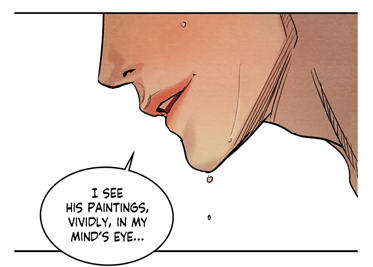 As you can detect, knowledge is linked to sight. That’s why when a person employs the following idiom “I see”, she or he indicates that the person knows and understands. However, we need to see the butler’s behavior with our mind’s eyes and not only our eyes. With this new perspective, it becomes important to examine the valet’s actions beyond the pictures Byeonduck presented to the readers in order to have a real insight about Kim. What is his true personality in reality? He appears kind and gentle, therefore the readers judged him as such. However, this is not the truth and the topic of this essay will be to destroy the myth about Kim as a hero. And in order to achieve this goal, it is important to review all his actions and words from the start.
If we consider the formal aspects, we will notice that Kim is introduced in the same chapter than Jung In-Hun’s arrival at the mansion.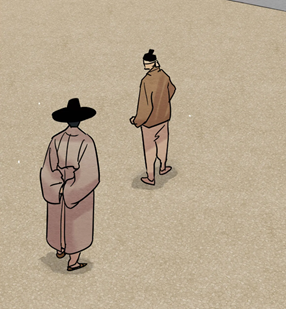 That’s his first introduction. I doubt that this is a coincidence. As I have already described the scholar as a villain, this can be viewed a first evidence for this theory. Secondly, if we count the number of chapters (2, 6, 7, 10, 11, 17, 19, 21, 22, 23, 24, 27, 29, 30, 35, 37, 38, 40, 41, 44) where Jung In-Hun appears, you’ll notice that Kim has the exact same number: 20 (7, 11, 12, 16, 17, 18, 19, 22, 23, 24, 25, 26, 30, 33, 34, 35, 36, 37, 39, 44). One might argue that Kim has been developed to contrast to Jung In-Hun, yet this is not possible, as the valet often lies (f. ex. episode 11, 12, 29, 34, 35, 44, 67, 68), exactly like the teacher. Nevertheless, I am well aware that these exterior aspects might not be not convincing enough.
Let me elaborate why I believe that Kim isn’t only an antagonist in Painter Of The Night, but also a villain. But before bringing up all the points, I need to define the nature of an antagonist and a villain.
“In literature, an antagonist is a character, or a group of characters, which stands in opposition to the Protagonist, which is the main character. […] ” quoted from https://literarydevices.net/antagonist/
This definition points out that the antagonist hinders the protagonist to achieve his goal, hence he creates conflicts for the protagonist. He can be a villain, but not necessarily. He can be just a competitor and rival. And note that in my last analysis (“The slaps in the kaleidoscope”), I had described Kim as a rival to the painter. The latter was slowly taking away the power Kim had over the powerful noble. At the end of chapter 66, Yoon Seungho is submitting himself to the artist’s authority. But I could also use the confrontation Kim had with Yoon Seungho as illustration in chapter 68. The butler used his knowledge to literally destroy the lord’s confidence and power. He portrayed him as a bad and cruel person who made a false judgement and was even wayward in his youth.  At no moment, he gave a real advice to the protagonist, contributing to his lord’s growth and improving his behavior. But one might argue that everything is linked to the valet’s position. He is just a domestic. Yet, he had disobeyed his master’s order showing a certain confidence.
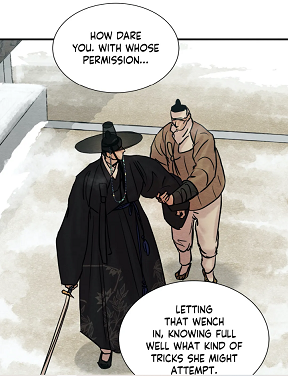 And his disregard for his master was already visible on different occasions, like in chapter 33
 or chapter 56
 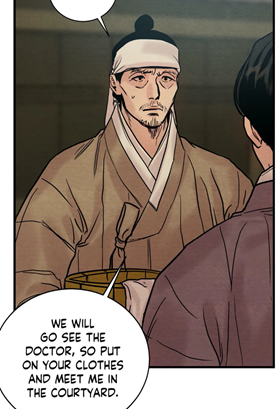 . He brought the artist to the physician without his master’s permission. Back then, many like myself overlooked his infraction, because it seemed like it was for the artist’s sake. However, the readers should remember that the physician was called to the lord’s property in the past. So why bring the painter to the doctor’s office? And let’s remember that in the past Yoon Seungho visited the doctor’s office in order to get drugged. Back then, the main lead became a victim of drug. As you can observe, Kim’s actions should be judged with the mind’s eye and not with just with the heart or the eye. Besides, the butler’s attitude towards the main lead revealed a certain confidence to use knowledge and lies to manipulate Yoon Seungho. So maybe Kim represents a certain hindrance to the two protagonists, but to describe him as a villain, some readers will question this interpretation.
“A villain is the bad guy, the one who comes up with diabolical plots to somehow cause harm or ruin. It is one of the archetype characters in many stories. The villain may truly believe that he/she is helping society, but causes harm in the process.” quoted from https://literaryterms.net/villain/
On the surface, it looks like a villain is a bad person. Yet this is not correct, it is not complete. The definition portrays the villain mainly as a scheming person who believes that his actions are right, because he has a good justification. However, his words and actions have a negative impact on the protagonists. “Schemes and causing harm” stand in the center of this definition and not if the villain acts badly so obviously. In other words, the villain is not necessarily an evil or brutal person, as long as the person legitimates his actions. Furthermore, there are different types of villains:
After reading these different descriptions, the readers recognize that Min resembles to the Schemer and Devil, while father Yoon looks more like a patriarch. I would like to remind that Min justifies his schemes with his urges for the painter and his desire for entertainment. Nevertheless, the first type is often overlooked, the traitor. From my point of view, Kim represents the first type, because he has already backstabbed his master on multiple occasions. I could mention Kim’s betrayal towards Yoon Seungho in chapter 65. Here, he heard and saw something, but decided to turn a blind eye and abandoned the young boy.
 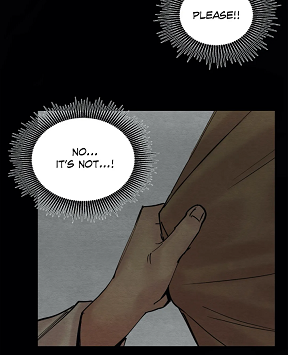 He allowed the young master to get assaulted and chose not to intervene, because he dislikes the idea of trouble so much. His real desire is to lead a peaceful life. Arguing that he feared for his life can also be refuted. If the butler had intervened immediately, then father Yoon would have believed him. Father Yoon trusts the valet so much that he followed Kim who recommended him the physician. So he had the valet’s trust. However, it became a different story, if Yoon Seungho had revealed the truth and accused the butler for abandoning him. In my opinion, he didn’t want to get in the way of a noble hurting the main lead, therefore he became an accomplice. He had to hide his wrongdoings. And in order to ease his conscience, he justifies his passivity and inaction with the following motto:
 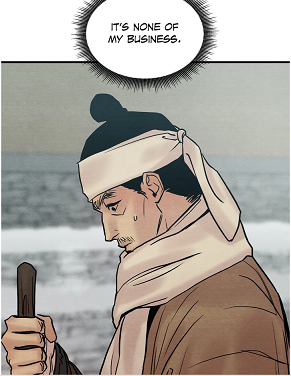 Since it doesn’t concern his life, then he doesn’t need to care. But one might refute my argumentation that Kim only made a mistake once. However, let’s not forget that there’s another main lead in this manhwa: Baek Na-Kyum. Kim betrayed him in chapter 11, by letting take the fall for the damaged painting. Like I had already exposed in a previous analysis, Kim lied to his master in chapter 11:
 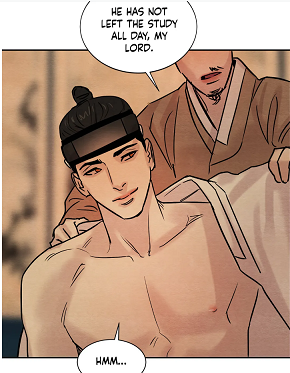 In fact, Baek Na-Kyum had left the room for a stroll. And with his two lies in chapter 11
 , he allowed the painter to get hurt and punished unfairly. In other words, he caused harm not only to Yoon Seungho, but also to Baek Na-Kyum. What caught my attention is the absence of the eye in the first picture. First, one might think that this aspect is an indication that the servant is trying to hide his true thoughts. However, I would even add another dimension. The absence of the valet’s eyes displays his leitmotiv: turning a blind eye. But there’s more to it. The absence of his eyes mirrors his desire to ignore the consequences of his actions.
 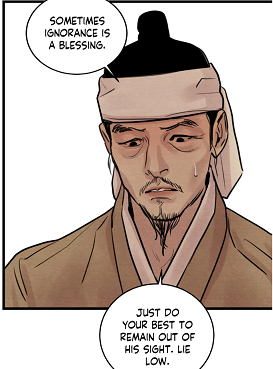 Therefore he keeps running away
  (chapter 64)
 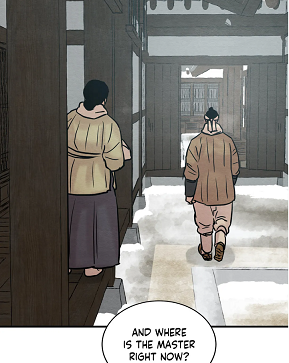 (chapter 67) in order to avoid any confrontation. Furthermore he avoids peoples’ gaze
  and questions (see the picture from chapter 67)
  (chapter 63). Note that in this scene (last image), before leaving, he never answers to the maids’ question corresponding to the missing ears in the following picture: He is also turning a deaf ear. That’s other Kim’s MO. He is deliberately closing his eyes and ears to reality and truth, so that he doesn’t need to feel guilty. With this attitude, he doesn’t want to feel burdened and responsible for his actions. And he prefers letting others take the blame. Yet, this doesn’t mean that he doesn’t use his senses like Jihwa, it is quite the opposite. He utilizes his senses in order to get knowledge, as he has already recognized that insight can help him to live a quiet life. That’s why he is described as perceptive by Yoon Seungho in chapter 23.
Then one might refute that he only hurt the protagonists once, he can’t be a villain. Besides, he never intended the main leads to get hurt, he just feared to get punished. However, this is just an illusion. In reality, if you pay attention to the butler’s actions, you can actually witness Kim’s true power which is based on manipulations and drugs. In my opinion, he is a puppet master hiding in the shadow and the pawns have no idea that they have been masterminded by a “kind” valet. Now, you are wondering how?
What caught my attention is the medication that Yoon Seungho has been fed since his teens.  In chapter 57, even the doctor questioned the lord’s illness, yet he still gave him the medicine without a real diagnosis, because father Yoon would talk to him, until the latter gave in.
 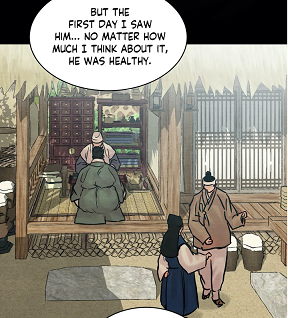 Besides, Kim decided to continue feeding him after the abandonment, and it was never questioned by the doctor. The latter only heard through Kim that Yoon Seungho had started getting seriously sick.
 The readers should recall that the doctor only examined the lord twice, the second time it happened many years later. The doctor has never been able to define the illness the main lead was suffering. And note that the doctor pointed out that before the lord wasn’t known as hot-tempered.
 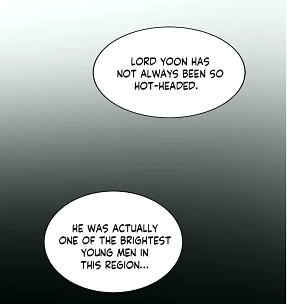 That’s why I believe that the drug is the cause for Yoon Seungho’s mood swings and impulsive behavior. Sure, there exist other causes, the different traumas the lord experienced. And from my perspective, the connection between the violence and the drug is visible, if you think carefully about the return of the lord’s violent and impulsive attitude from chapter 61 on.
  It coincides with his stay at the physician’s. For me, there’s no coincidence in this story. Since the story is repeating itself, the author revealed that after the visitation, Yoon Seungho as a teen started receiving the medication affecting his mood. For he went to the doctor’s in chapter 57, it means that the physician must have given him some medicine after the disappearance of the painter. And let’s not forget his words in chapter 55:
 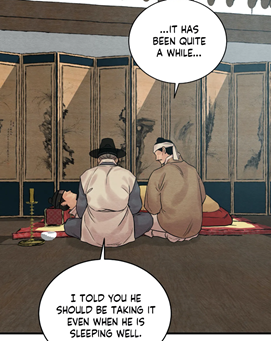 The man recommended Kim to give him the tea. Now, due to the physician’s words, which Baek Na-Kyum clearly heard
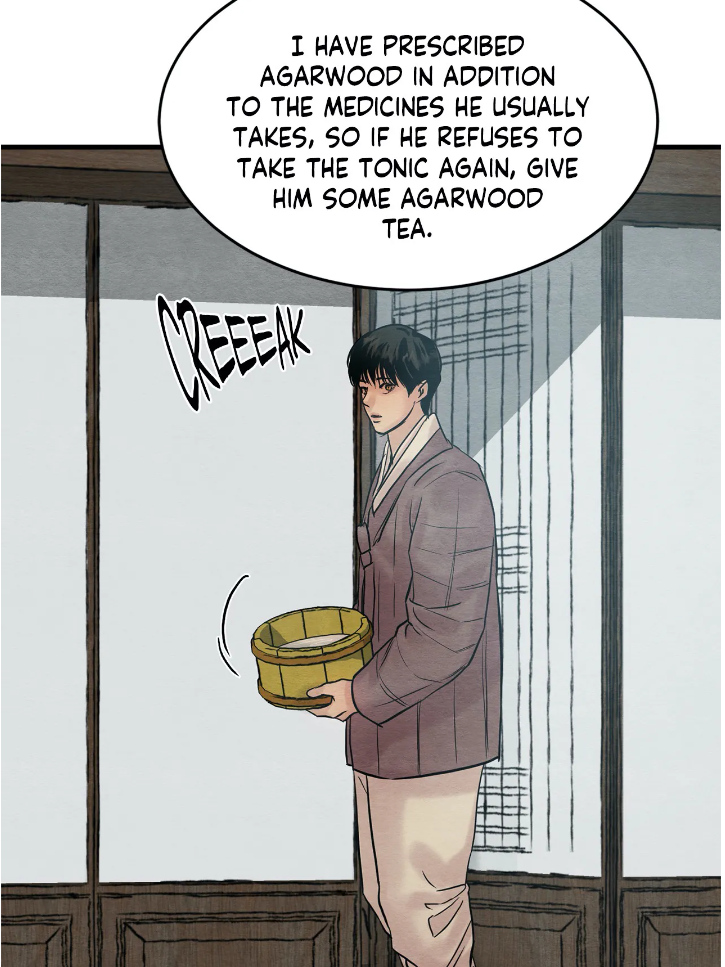 , Kim has a reason to feed him the drug again. He is just following the doctor’s prescription and note that Kim has the painter as a witness. This panel is relevant, as it exposes that the lord refused to take the tonic before. His reason was simple: he slept better. In my opinion, we have to envisage that Kim would use the doctor’s innocence to justify his action, if he was caught giving the drug. Furthermore, the master was at the doctor’s, hence the former would trust his recommendation and his tea. Hence I believe that the lord got drugged after that night explaining his relapse (violent temper). Since we know that this story is built as a kaleidoscope, it means that this medication was mentioned in season 1. It first appears in chapter 35,
  and the lord declined the “medicinal tea”, a reflection of chapter 55. But the readers have to envision that Yoon Seungho had already stopped drinking the potion even before chapter 35. Let’s not forget that the main lead was away for many days, hopping from one bedchamber to the next.
 Consequently, he couldn’t take the drug. And after Baek Na-Kyum became the lord’s lover, the latter had no reason to drink the medicinal tea. First, thanks to the low-born, the noble had been able to get some sleep. Observe how refreshed he looks the next morning after spending a night with the painter. Later he was busy having sex with Baek Na-Kyum and could sleep better, like Kim described it in chapter 55. One might argue that Kim is doing for the lord’s sake, but then the manhwaphiles should question truly his intentions, as he gave an aphrodisiac to the painter against his will in chapter 36. The purpose for his action was simple: he intended to use the artist as the new sex toy for the master, so that Yoon Seungho would be busy with sex and forget the outside world. And the artist didn’t want to take it either. There’s no real legitimation to drug someone, the goal doesn’t justify the means. Besides, giving the wrong medication to someone who is not sick can never be good. It can definitely make someone sick, and the manhwaworms should recognize that the doctor could never truly diagnose the lord’s illness. He created the medicine based on the father’s desires and suggestions. Yet, at no moment, Kim stopped the treatment, although he knows that father Yoon was a cruel man, like he revealed in chapter 68.
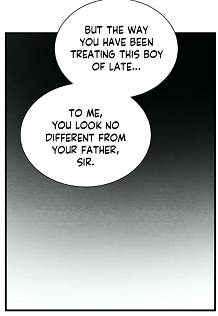 Therefore I judge Kim as a real dangerous person, because he drugs people and uses people’s innocence. I doubt that the physician is aware that he has been used by father Yoon and later by Kim. The clue for his innocence is palpable because of his testimony to the painter. He is not hiding anything, he reveals the past to the artist, since he knows the relationship between the two protagonists. However, like I have already explained it, the doctor’s revelations will help to uncover the truth. One might still argue that Kim is just doing what father Yoon told him. He is still loyal to the eldest master. So he is not responsible for the drugs. I could just argue that father Yoon never gave him the permission to drug the painter, Kim made the decision on his own and no one asked him to do so. Besides, he works as Yoon Seungho’s butler and not father Yoon’s, therefore we can definitely describe him as a traitor, since he drugs the main lead and we have to imagine that Yoon Seungho must have refused it in the past as well. So once the father abandoned his son, Kim could have stopped with the medication.
And let’s turn our attention to my second point: the butler’s manipulations, symbolizing that Kim is indeed a villain. In order to validate my theory, it is necessary to examine all the butler’s words and actions. Like I had already mentioned in a previous chapter, Kim lied in chapter 11 with a certain intention. My first reaction was to say that he didn’t want to take the blame for the second lead’s misdeed. However, I believe that there’s more to it. Observe the way he lies. He notices the lord’s good mood, and he suggests the noble to visit the painter in his study by saying that the painter spent the whole day. With his words, he implies that the painter has been dedicated towards Yoon Seungho and he must be tired, the first version of the following panel from chapter 41.  That way, the noble would discover the ruined painting. He anticipated that the noble would like to go to the painter with his suggestion, since he knows that the lord is a goodhearted man in reality.
 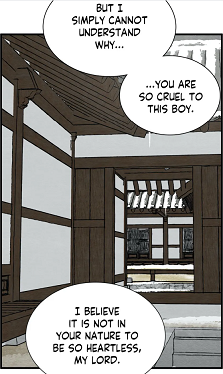 He orchestrated the whole situation, he knew that the lord would have a mood swing and his rage would target the painter. That’s why he hid behind the door
 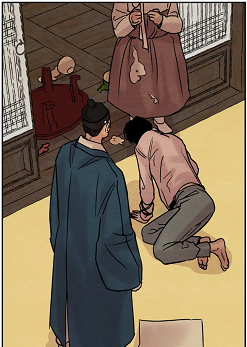 , so that he wouldn’t be confronted with the consequences of his lie and manipulations. Like I demonstrated it before, there’s no doubt that Kim had seen Jihwa’s arrival and had chosen to close his eyes. From my point of view, the butler had already judged the painter as a source of trouble and desired to get rid of him. Why?
My theory is the following: Kim is actually working as a spy. Since he has only been loyal to himself, I suspect that Kim has been working behind Yoon Seungho’s back for several people. His motivation was never money or power, rather leading a tranquil life without any trouble and struggle. However, this mentality led him to the dark side. I believe that the starting point was the protagonist’s abuse in the storage room. After his silence and passivity, he was bound by secrecy. It is definitely possible that he has been blackmailed too, the older version Deok-Jae’s thread. In my opinion, it is lord Song, but this is now only a supposition. First, I discovered that Kim was able to read and as such write.  If I complete Kim’s sentence, we have this: Lord Song is not one to write to my master. Then to whom is lord Song supposed to write? I doubt that Kim is aware of lord Song’s mail contacts, since the valet lives in that mansion the whole time. The logical deduction is to say that the valet has been in touch with lord Song. Besides, another evidence for Kim’s hidden abilities is the painter. Remember how I described the artist as the positive reflection of Kim. Since Baek Na-Kyum was supposed to be literate and the lord discovered that it was not true, Kim as the low-born’s negative reflection is supposed to be illiterate, while in reality he can read and write. Moreover, if you pay attention to Kim’s reaction in chapter 56, when he hears that lord Song desires to meet the main lead at the tavern, Kim gets scared.
  Back then, many imagined that the butler’s fear was related to Yoon Seungho’s past and he felt concerned for the master. Yet, he got scared twice. The second time, the master was not present and Kim was definitely frightened.
 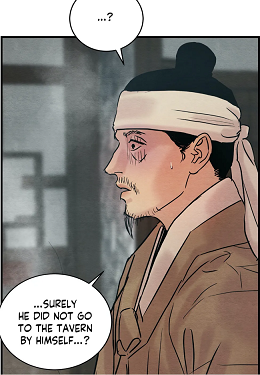 Finally, note how he tries to suggest to his master to postpone the meeting due to his illness. It sounds reasonable and legitimate, yet if you think that Kim is a spy, he has a motive to make sure that both don’t encounter. That’s why he abandoned Baek Na-Kyum at the physician’s and rushed to the lord’s side. He was scared that Yoon Seungho would discover the truth. Once he saw Jihwa there, he felt relieved and faked concern. That’s why he said this to the doctor:
  He definitely expressed relief here and notice, he hides his eyes again, a sign that he is hiding his true thoughts, but also avoiding to face the consequences of all his lies and manipulations. Besides, I couldn’t help myself thinking about Yoon Seungho’s comment in chapter 18:
  The amateur spy got discovered, because he showed true concern for Jihwa. So what if we had a professional spy, the reflection of the amateur spy? As such he is a puppet master who can deceive people due to his acting skills. Now, you can comprehend why for me, Kim is a villain, a traitor. He is always perceived as kind, gentle and genuine, yet the truth is different. His thoughts exposed his selfishness and dishonesty towards the painter and the master.
And now, it is time to return our attention to the reasons for Kim’s manipulation in chapter 11. Let’s not forget the circumstances that led to Jihwa’s revenge. In chapter 8, Yoon Seungho had humiliated a noble and even grabbed him by the topknot creating a scandal, 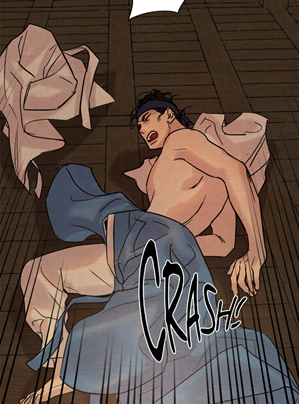 something Kim abhors the most.
 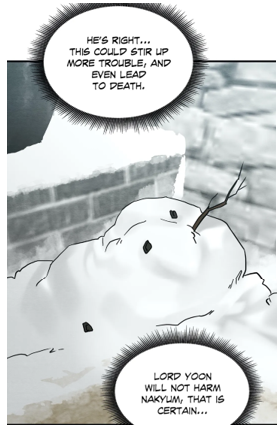 And this was caused by the low-born’s presence. And we have to imagine that Kim must have been staying in the background and saw the scene, a repetition from chapter 33.
  So with such a humiliation, Kim could only object to the lord’s attitude and consider the painter as the source of trouble and danger. However, if my theory about Kim as a spy is correct, we shouldn’t forget that Jung In-Hun had just arrived at the mansion, and the scholar must have told Kim about the reasons for his stay here: the lord desires to sponsor him and give him a high position. Since Jung In-Hun is arrogant and likes admiration, I doubt that he hid it from the butler. So Kim has a bigger cause to get rid of the painter. If Yoon Seungho has connections to the government, he can become dangerous. Since the latter has an affection to the teacher, which Kim witnessed, he must have recognized that his sponsorship is related Baek Na-Kyum. So when he viewed Jihwa’s arrival in chapter 10, he knew what would happen, and saw it as an opportunity to get rid of the painter and indirectly the teacher. That’s why he tricked the main lead to pay a visit to the artist, by portraying the low-born as a hardworking painter. Besides, we also have to envision that he knew that Jihwa had hired one of the servants from his staff. Since his policy is to turn a blind eye and a deaf ear in the sake of his “peace”, he had no reason to intervene. At the same time, since he knew that the teacher was the artist’s alibi, the other possible outcome was that Jung In-Hun intervenes so that a quarrel between the two nobles begins leading to the end of the sponsorship. However, the artist chose to remain silent and the scholar didn’t show any interest for Baek Na-Kyum. Anyway, Kim could only win with such an action: either Jung In-Hun chose to cut ties with the main lead for mistreating the commoner or Baek Na-Kyum decides to leave the mansion after such a punishment. That’s why Kim allowed the amateur spy to leave the mansion and announced that the lord had chosen the straw mat beating as punishment.
 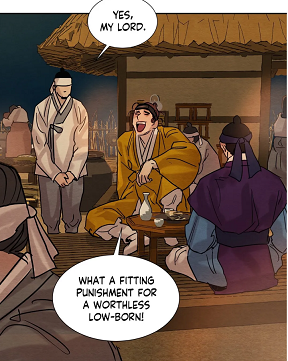 However, the manhwalovers have to envision that Kim never revealed his knowledge. He must have just given the servant the permission to leave the property without his master’s knowledge. Consequently, the hired spy had no idea that he had been used as a pawn by Kim. For the latter, it was important that no one would notice his manipulation. He only had to fake ignorance and kindness, while in reality he was utilizing his eyes and ears. By using the amateur spy, Jihwa had no idea about the butler’s involvement. That way, no one would realize that there was a puppet master behind them. At the same time, I also believe that the butler anticipated the childhood friend’s intervention. And let’s not forget that Kim is the only one who knows Jihwa since his childhood. He witnessed their separation, therefore he already envisaged that the red-haired noble would target the artist, like he did in the past.
 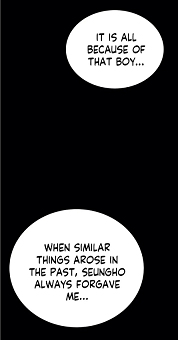 In other words, Kim has always utilized Jihwa in order to isolate the lord and hinder him to focus on someone else for too long. Kim had already imagined that the painter would get punished severely and the scholar who seemed so affectionate towards the artist, would decide to cut ties with the lord. Who would like to be seen with such a violent sodomite?
  From my perspective, that’s the reason why Byeonduck chose to introduce the butler in chapter 7. The teacher’s goal stands in opposition to Kim’s. As long as the lord is busy with sex and debauchery, Kim can lead a peaceful life and his misdeeds can never get discovered. And all the persons responsible for his misery in his youth, like lord Song, don’t need to fear any revenge. However, nothing worked like the valet had envisioned, because neither the painter nor the master reacted like he had anticipated.
What caught my attention is that in chapter 12, the amateur spy appears twice. Not only he goes to the tavern to tip off Jihwa, but also he is the one who announces the red-haired noble’s arrival. This is no coincidence. 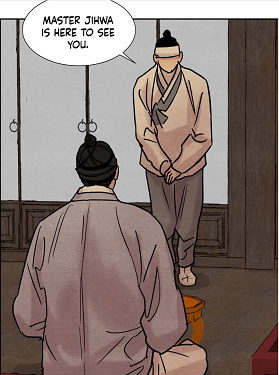 Since Kim knew about his true relationship with Jihwa, he knew that the red-aristocrat would question the domestic and vent his anger at him. Furthermore, Kim suggests the painter to make a walk
 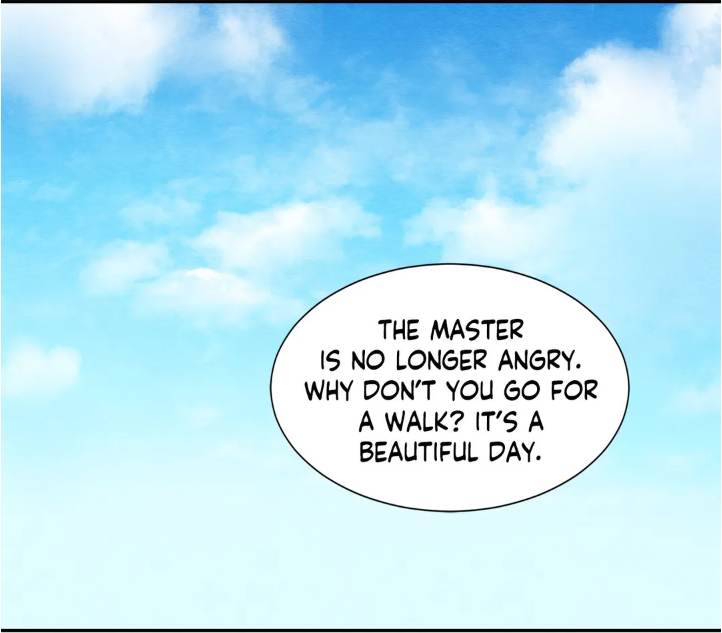 which led the second lead to notice that his plan had failed. This also indicates that Kim witnessed the painter taking a walk with the teacher. And striking is that when Yoon Seungho saw the painter, he asked him, if he was trying to run away.
 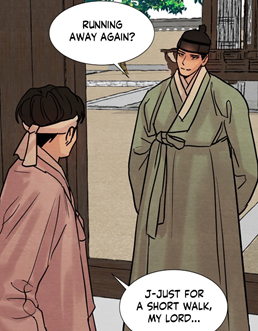 We can definitely question if this was not the butler’s original plan, especially when the readers recall that Kim witnessed the painter’s behavior in chapter 11. He talked back to Yoon Seungho and even refused to submit to Yoon Seungho’s authority first. So maybe when Kim took care of the painter, Kim hoped that if he said that he would have to resign and accept his fate, these words would have the opposite effect, the artist would choose to leave the mansion after witnessing his mentality.
 One thing is sure: Kim was in the background all the time and knew what was going on. And this is reflected in chapter 17. The valet refuses to intervene and has even allowed Jihwa to enter the mansion without any invitation. Let’s not forget that in chapter 17, we have the same constellation of characters than in chapter 12: the amateur spy following the second lead, Yoon Seungho in his bed, valet Kim in the background
 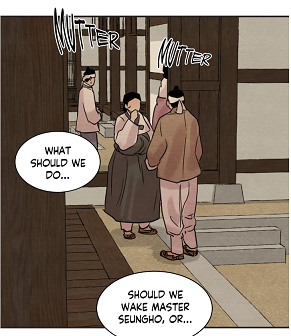 and the painter. The only change is the apparition of the head-maid of the kitchen. For me, he was definitely an silent accomplice, who tried to stop Yoon Seungho from intervening and causing another trouble. With this new perception, it would explain why Yoon Seungho and Jihwa maintained their relationship despite its toxicity. Kim could use the noble to get rid of any thread, without causing any big trouble. And if there was a huge incident (like Jihwa’s topknot incident), then this would be swayed under the rug, because Jihwa was always willing to overlook Yoon Seungho’s retaliation.
Furthermore I think, Kim expected Jihwa’s return after his success and if he met the painter, he would see that his plan had failed. Note that in that moment, the childhood friend tried to suggest his friend to get rid of the artist by hiring a painter from the Royal Academy.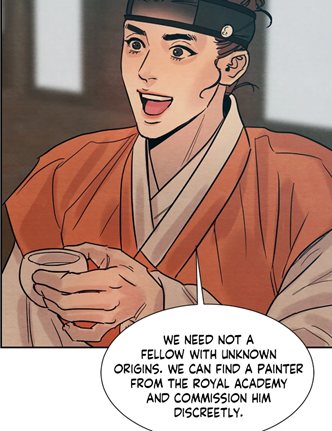 Observe that despite the sex session with Jihwa, the latter had lost the fight against the painter. He was even sent away and the host didn’t pay attention to him at the end. However, during that same night, Kim got himself tricked by Deok-Jae, something he hadn’t expected. And that’s the moment the butler realized that he could use the guardian as his second pawn. That’s how Deok-Jae took over the role from the amateur spy and helped Kim in his attempt to separate the artist from the noble: chapter 29/30. But since the vicious servant got betrayed, because Kim abandoned him and let him suffer the most, Deok-Jae could only act on his own. He tried to steal the red dresser, he sabotaged the rice, and finally he even ransacked the study and hurt the artist causing so much trouble to Kim that he could only ask him to disappear. Nevertheless, I would like to remind that the moment when the amateur spy reveals his complicity in chapter 18, he doesn’t even deny or try to put the blame on the valet. This shows that he has no idea that Kim knew about his role. Kim has always been able to survive thanks to this philosophy: IGNORANCE IS A BLESSING.
Then in chapter 19, there is another crime committed: the theft of the expensive wine. Back then, everyone was convinced that the painter was the thief, because we saw him with the bottle. However, Baek Na-Kyum is supposed to be a pure person who wouldn’t commit a crime. So the protagonist is not only a liar but also a theft, no one was upset. But now, if you perceive this incident in a different perspective, Kim is a manipulator, he created the incident so that Baek Na-Kyum would get caught. This time, no one would speak for him. Surprising is that Kim is again portrayed eyeless. 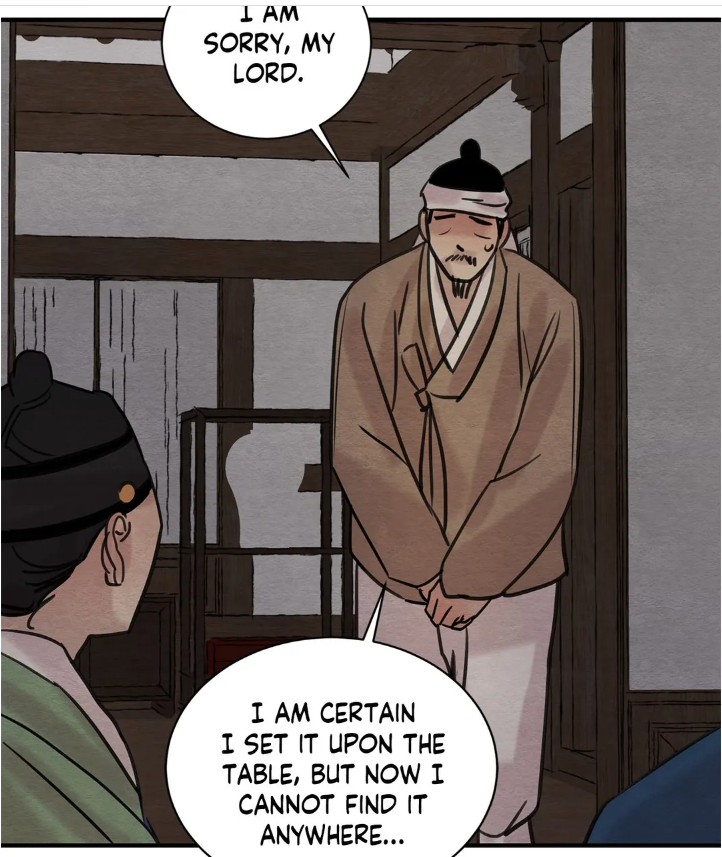 For me, a sign that he saw what happened: the painter was the criminal. People would think that he was covering up for the painter, yet if you look at Min’s reaction after hearing the butler’s words, you’ll realize that Min is asking for blood.
 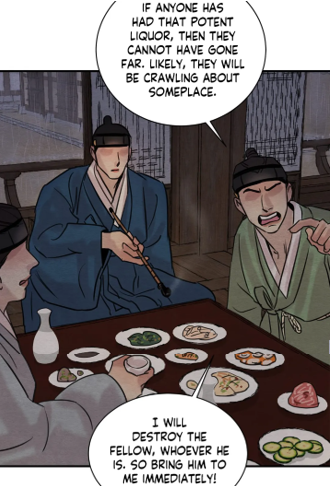 Striking is that in chapter 19, we have elements from chapter 11:

Since it is a new version of chapter 11 and I had explained that Kim had orchestrated the first punishment, so the logical consequence would be that Kim tried to recreate a similar situation. Besides, just before, the lord had cut ties with Jihwa, hence Kim could no longer use him like in the past. But what if Kim left the bottle on purpose so that the artist would take it? Let’s not forget that during that night, Yoon Seungho witnessed the quarrel between Jung In-Hun and Baek Na-Kyum, therefore it is definitely possible that Kim could have witnessed it as well. Just because we didn’t see it, this doesn’t signify that this didn’t exist. Realizing the painter’s sadness, the butler could have anticipated the painter’s next move. And when he revealed the crime to the guests, he desired to use Min’s anger and request to have the painter punished, even killed. This time, the lord wouldn’t be able to change his mind and show remorse. However, once again his plan didn’t work out, because the lord covered up himself the misdeed of the painter. For me, there’s no doubt that the absence of Kim’s eyes are a signal that Kim is up to something. With this new interpretation, I come to the following conclusion that chapter 67-68 are the new version of chapter 19. Kim and Min are already working together and both are determined to use Jihwa once again, like they did in the first season. Yet back then, Min had no idea that he was used by the humble valet.
But if Kim has already planned the painter’s rape and murder in the second season, then this signifies that he must have done in the first season, as history repeats itself. And he actually did it, which no one noticed before, including me. However, his plan didn’t work out so that we can definitely predict the butler’s failure.
Thanks to Luzy’s observation, I came to this realization. It all started with her notice that Kim lied in chapter 34. When Baek Na-Kyum gets sick after the sex marathon, he brings himself the painter back to the study, even clean him. Observe that the doctor is in the painter’s room, when he examines the low-born. Then in chapter 34, the head-maid declares that the painter has been sick for 4 days and observe that the painter is still lying in his bed. 
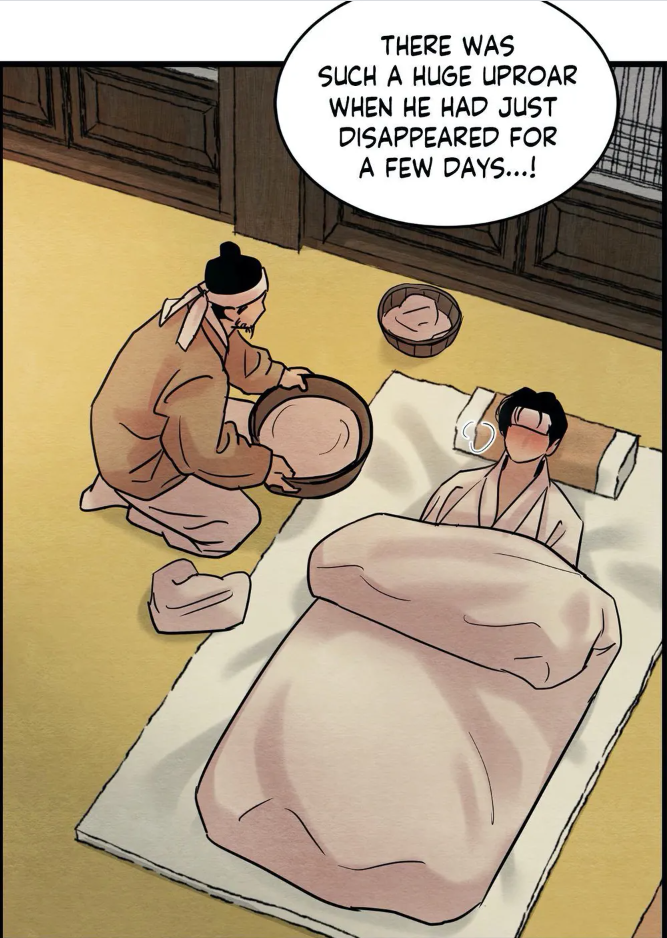 Then, when the artist wakes up, he discovers that he is in the lord’s bed. He assumes that the lord left him behind after the sex session, that’s why he remembers the sex marathon. However, Kim deceives the artist by portraying the lord in a good light: He brought himself to his bed, because it is the warmest room.
 However, Kim announces him that the painter has been sick for 10 days
 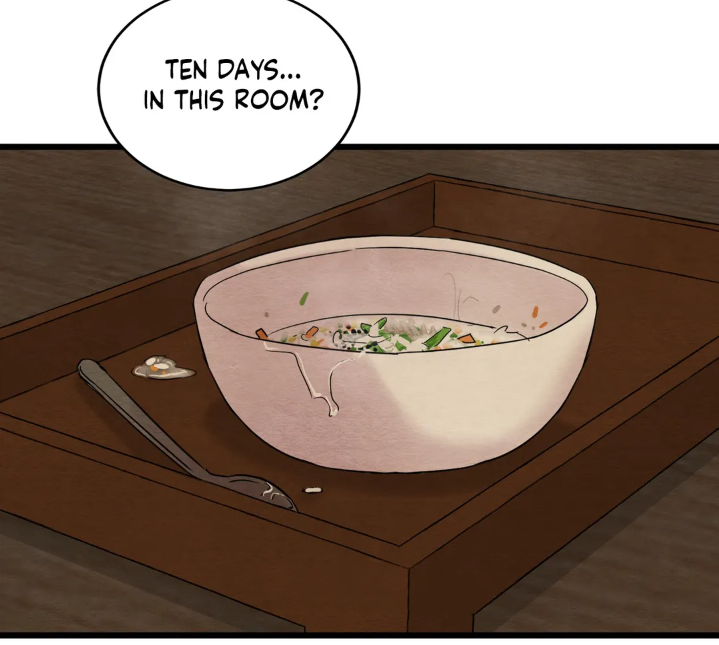 and the lord has been hopping from one bedchamber to the next.
  So how can he have brought the painter to his bedchamber during these 10 days, if he was away? Besides, how is he supposed to have brought the painter to his bed, if he was already in the bed after the sex marathon? In my opinion, the valet had chosen to turn Baek Na-Kyum into a favored servant and placed the painter in the master’s bed. If the latter chose to become the master’s lover, then the lord would have no interest in keeping sponsoring Jung In-Hun. Now, he needed to separate the two. Besides, he knew that at some point, the lord would return. That’s why Yoon Seungho was surprised, when he arrived in his room. He tried to hide it by showing a rather indifferent expression. Yet, Kim’s machination failed. The butler never imagined that Baek Na-Kyum would leave the room and Yoon Seungho would agree to it. We have to imagine that the poor boy had just recovered, so if the main lead had ignored the painter’s condition, the new sex session could have led to the painter’s exhaustion and death. That’s why I can’t perceive Kim’s trick as a favor for the main lead. Yet, both protagonists in their innocence defeated the butler’s plan. And note that the valet lies again the next morning. He announces his arrival with the excuse, he is bringing his meal:
 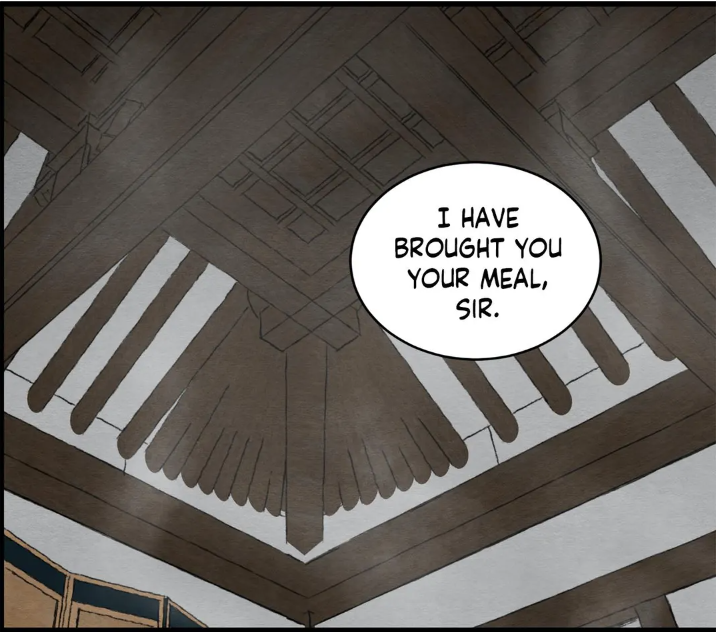 But where is the meal? Read the chapter 35 again, you don’t see anything like that at all.
 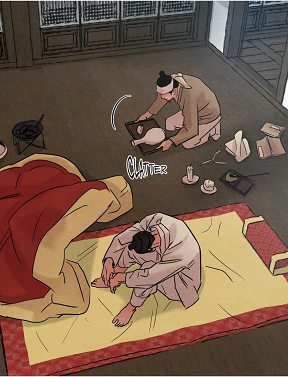 Besides, pay attention to the valet’s reaction, when he opens the door: he is feeling uncomfortable, as if he was expecting something.
 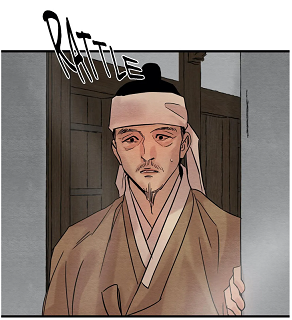 He imagined to see the painter there with the lord, maybe dead… But no, his master is alone and didn’t sleep the whole night. He had reasons for that. He must have wondered why the painter was in his bed, but then he left him in order to let him rest. Then what caught my attention is that the valet opens the two windows,
 although the lord is not even dressed. He doesn’t even hurry to bring him the hanbok and later he even comments, it is cold.
  Note that here again, the domestic is without eyes again. From my point of view, he saw the painter strolling in the courtyard and meeting the scholar, therefore he opened the two windows so that the lord would feel the need to come closer to the window and witness the scene. Since there’s no ambiguity that Kim witnessed how the lord took the sword during the night of the rape, and tried to kill the teacher, he recognized the lord’s jealousy. Therefore, he imagined if he saw the painter with the scholar, he would get so resentful that he would grab his sword and kill the painter in affect.
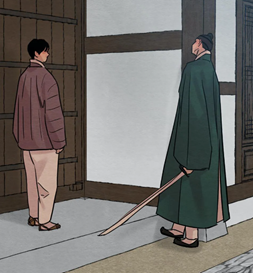 Notice that at no moment Kim intervened, although he was by the lord’s side, when he saw this. He literally vanished and only reappeared, after the situation had called down. The lord had not killed the artist. He even brought the fake letter from father Yoon, an excuse for his disappearance and at the same time a diversion. That’s why the artist was given the aphrodisiac right after. The painter needed to become the lord’s favored servant. If he remained loyal to Yoon Seungho, the latter would have no longer any interest in the teacher’s support. And since I judged the incident with the sword in chapter 35 as an attempt on the painter’s life masterminded by Kim, there’s no ambiguity that his participation in the second murder attempt will surface. However, this time it will become visible, because the puppet master lost his pawns one by one (the amateur spy, Jihwa, Deok-Jae). He can only use the second lead through Min that’s why he was included. Under this different approach, Jihwa’s crimes are relativized and it becomes obvious that Nameless is not only Min’s nemesis, but also Kim’s. Nameless contrasts so much to the butler, if you compare their attitude. Nameless might be ruthless, yet he is compassionate and genuine. And he is not running away from any responsibility and from reality, he is not putting the blame on others.
As a first conclusion, Kim has always manipulated people and he was never caught, because he often seems nice and humble. That’s how powerful the butler is. Yet, like I demonstrated, he lied on many occasions and worked in the shadow. That’s why I believe, it can only be recognized if people use their mind’s eye. Moreover, if the painter is a theft, then why shouldn’t the butler be a liar and manipulator? Under this new approach, we can say that Kim took advantage of people’s weaknesses (f. ex. the protagonists’ abandonment issues, Deok-Jae’s greed, Jihwa’s need for attention) explicating why the lord was so reluctant to open up. Besides, giving drugs to people is not right, especially when they are not aware of the real effects. Yoon Seungho is still unaware that he has been fed with the same drug from his youth. If he knew, he would definitely reject it, because he sees his father in a very negative light. As you can anticipate, there is so much more to say about this character, I didn’t even explain the incident with the rape, the missed farewell from the learned sir in chapter 44, the reason why Kim hid the painter’s identity etc… Just an advice, look at the panels where Kim is portrayed without eyes and question the reason for this. With Byeonduck, this is never random.
Feel free to comment. If you have any suggestion for topics or manhwas, feel free to ask. If you enjoyed reading it, retweet it or push the button like. My tumblr-twitter account is: @bebebisous33. Thanks for reading and the support.
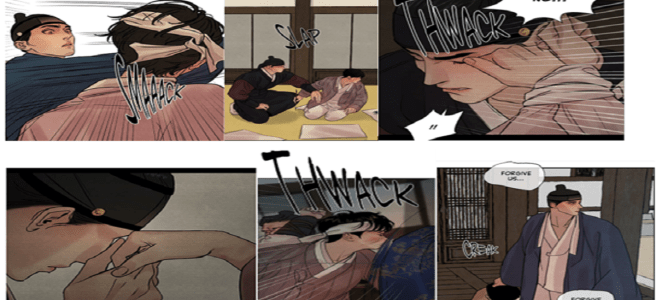

This is where you can read the manhwa. https://www.lezhin.com/en/comic/painter But be aware that this manhwa is a mature Yaoi, which means, it is about homosexuality with explicit scenes.
In my essay “Heroes – part 1”, I already presented a possible continuation of the story. I explained that we would have a new version of chapter 41 and 42. Now, it is time to develop more precisely my predictions. Nonetheless, I first need to elaborate how I came up with these ideas.
After analyzing so many chapters and comparing them to others, I realized that not only Byeonduck would utilize scenes from the first season in the second, but also she would repeat the same elements within the same season. Let me give you one example, which will be explained very accurately.
We have two incidents with a door during the first season. In chapter 16, valet Kim opened the door without announcing his arrival.  Yet we never saw him directly, we could only hear his footsteps. The manhwalovers only got clues about the identity of the “culprit” in the next chapter, yet there was still some mystery left. As for Jihwa, he heard about the late departure from the lord’s room the next morning through the guardian.
  However, at some point, I could recreate the incident. Like I had exposed it previously, Deok-Jae was responsible for this incident, which was also confirmed by the author herself (she liked my tweet). He had been spying on the painter’s moves, because he saw the artist as a rival. Nonetheless, the evidence for this theory was truly exposed in chapter 53. Deok-Jae had listened to the way Baek Na-Kyum sounded, when he was aroused.
 So in chapter 16, out of jealousy, Deok-Jae sent the butler to the lord’s bedchamber telling him that the artist had already left. His true intention was to separate the low-born from Yoon Seungho and his move did succeed. Yet, I doubt that Kim was very happy, as he could have been in trouble. And this incident was repeated in the second half of the first season. Jihwa opened the door of the study in chapter 43.
 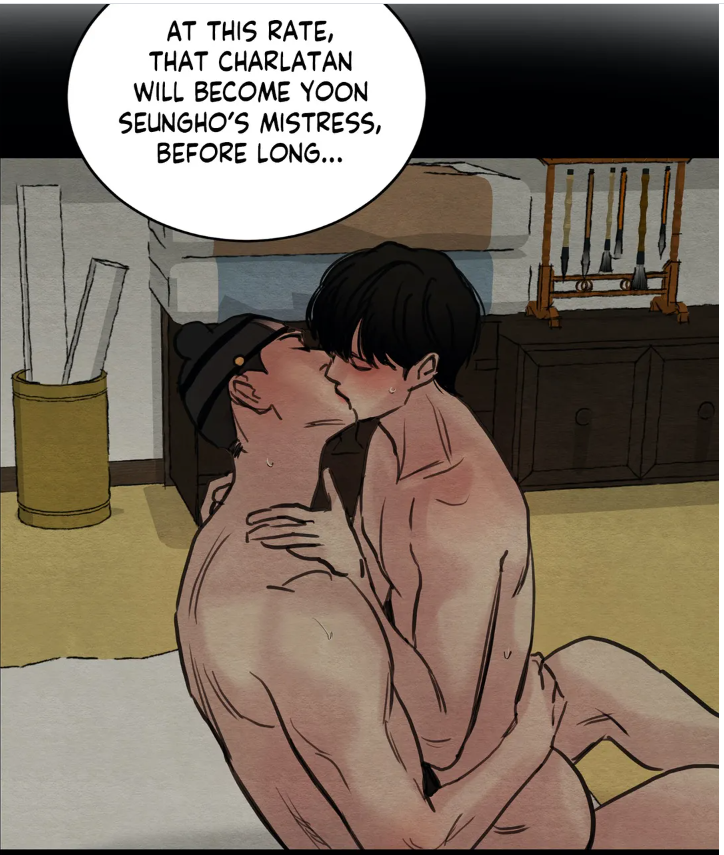 And here is the question? How could he know where Yoon Seungho was? Actually, he should have gone to the master’s bedroom. There’s no doubt that Deok-Jae played a huge role here. He tipped him off again, but this was caught by Kim. Deok-Jae wanted to use the aristocrat in order to bring apart the couple. He knew that the butler would no longer assist him. Yet he failed in the sense that Jihwa didn’t interrupt them. The former was just too shocked.
  However, in his mind, it was not a complete failure. He had already anticipated Jihwa’s jealousy and fury and its consequences. He already envisioned the painter’s murder. That’s why he knew the identity of the client hiring Nameless.
 The vicious domestic had used the red-haired noble as a chess pawn. He desired to get rid of Baek Na-Kyum through an assassination. It was already palpable in chapter 51. He urged the joker to kill the low-born in a hurry.
  That way, he wouldn’t get his hands tainted, and if Jihwa got caught, the second lead would become his scapegoat and feel the lord’s wrath. We have to imagine that the jealous servant had no time and opportunity to tail Jihwa’s moves. Yet, he could control him, each time he entered the mansion. As a conclusion, Deok-Jae had been manipulating the second lead in the shadow too. Jihwa was in reality manipulated by The Joker and the commoner. Yet, there was a witness of the second incident: Kim. Why do I think like that? Note that in the next chapter, Deok-Jae is sent away to the capital.
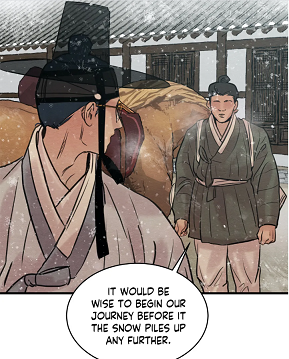 He is the servant following the scholar. Kim made sure that the guardian would be sent away, so that there would be no longer any trouble. He had the same reaction than his master. But he was not doing it as a favor for his lord, far from it. His desire was to avoid any uproar or big incident. Deok-Jae had become a source of danger, a thread to his tranquility. For Kim, if his master often had sex with Baek Na-Kyum, then in his eyes he had achieved his goal. The lord would lead a quiet life, and he could act like the lord of the mansion. First, he could use the lord’s money, as he saw fit
 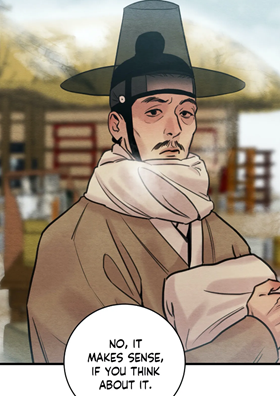 and he could give orders to other servants, especially the guardian after his return, although he never got the authorization.
 Note, the butler is employing the imperative tense. Therefore I come to the following observation: in this scene, he used his power to force Deok-Jae to give up on his “dream”, becoming the master’s favored servant. This explicates why the butler kept asking Deok-Jae to bring the material for painting to the study.
  His real intention was to make him accept the new situation: Baek Na-Kyum was now the favored servant and not him.
  No wonder, why Deok-Jae called him a
  He was not only abusing his position, but also choosing the lord’s partner. This explicates why Kim described the painter as favored servant. This status was just temporary, and it was linked to Kim’s tranquility. As long as he was acting as the lord’s sex toy, everything was fine. And now the manhwaphiles can comprehend, why Kim never revealed the conversation at the library. He didn’t have any reason to. Furthermore, it could lead to another outburst, the lord could seek revenge on the teacher. While hiding his knowledge, the butler could do anything he wanted, leave the mansion without any permission. With this new approach, it becomes obvious that Kim never bought the ink and brushes, because he was kind to the painter or felt concerned for him. the painter had everything he needed. He used him as a justification in order to put the guardian in his right place, to make him give up. This was a new version of chapter 12: Since the painter was a kind and gentle person, Kim mirrored his behavior. However, Deok-Jae was a jealous bully, therefore only authority and power could pressure him to give up. This explicates why Deok-Jae started acting like a bully behind the butler’s back, although I doubt that the valet was not unaware of it. Since the head-maid took care of it and defended the artist, the butler didn’t feel the need to intervene directly. His main goal was to lead a tranquil life. And this scene should be judged as a new version of chapter 45:
 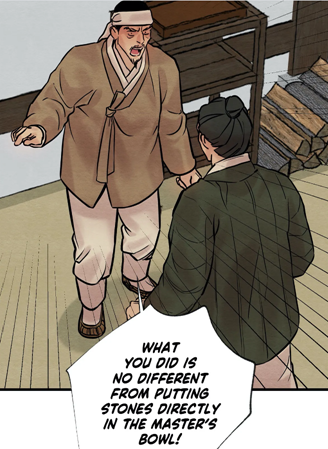 This time, Kim used his position to scold the servant. Yet he didn’t truly punish him, because he had no authority. He swept the incident under the carpet, because the lord could question his competency. For the butler, the rivalry and jealousy were not his business, it only became one, if he got into trouble. As you could see, each incident is repeated twice in each season, yet there’s an escalation and the painter becomes a victim of these incidents. At the same time, I would like to point out the following deduction. It becomes comprehensible, why the butler keeps feeding his lord the aphrodisiac. When the lord acts like a man obsessed with sex, Kim can have his hands free and enjoy quite a nice life. He leaves the mansion, gives orders and even buys things. That’s why he keeps telling others, that they shouldn’t worry about the permission from Yoon Seungho. The master never paid attention to it.
So if we summarize all my discoveries, then you’ll observe that during the two door incidents in the first season, we always have three people involved: Kim, Deok-Jae and Jihwa. The valet and the aristocrat were the trespassers, while in both cases Deok-Jae used them. Simultaneously, there are two masterminds for the murder: Deok-Jae and Min. That’s why we have to imagine that there will be a second mastermind behind the second abduction. And since Kim played a huge role in the door incident leading to Jihwa’s jealousy and violence (chapter 43, a silent witness), the manhwalovers should anticipate the butler’s involvement in the second assassination. Furthermore, the two incidents with the door have already occurred in the second season:
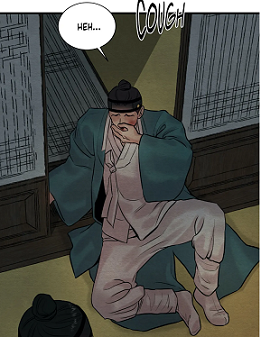 The door was broken due to Min’s action and in the same chapter, Deok-Jae crawled past the Joker. It was, as if he was passing his torch to his successor.
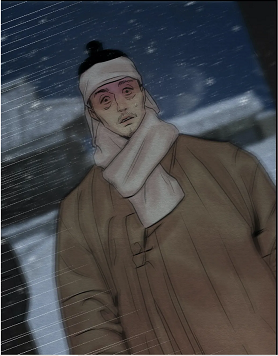
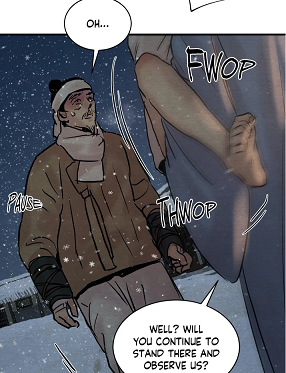 Kim got caught this time, exactly like Deok-Jae. He couldn’t run away like in the past. And now, all the culprits involved in the incidents with the door were discovered during the second season, which gives us a clue that Min will also be caught in the end.
 But let’s go back to my initial thought. After chapter 64, Kim has definitely a reason to get rid of the main lead. He was already annoyed that the artist had failed his job as favored servant in chapter 52. 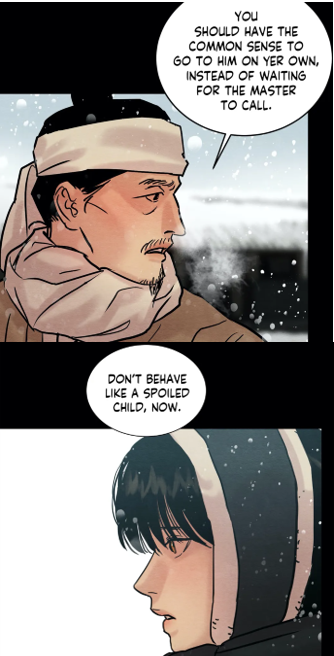 Hence I can imagine that the night in chapter 53/54 and the next morning must have bothered him a lot, the new version of the night at the pavilion. A servant had ran away after getting beaten, because he had hurt the artist. Then a door was broken, and the study was in such a mess. Finally his own master had offended many aristocrats. He had humiliated them by punching one and by evicting all his guests. Yoon Seungho had created a scandal among the aristocracy, a nightmare for the butler. Besides, the next morning, the lord had been ill and he had to fetch the doctor and the medicines. I am quite certain that Kim must have seen Baek Na-Kyum as trouble. Besides, if a noble like Min approaches the butler, I can’t envisage that he will tell this to his lord. His philosophy is and That’s why I have the feeling that Kim was already aware of the kidnapping, but chose to remain silent (repetition of the night 29/30). Yet, he wasn’t sure if the doctor had witnessed him as silent accomplice, hence he needed to verify what the physician had observed. Consequently, I perceive this panel
  under a different perspective. It could definitely be seen as an evidence that Kim must have seen something, because he didn’t leave the hot water close by the door. Then later it had disappeared. Note the difference between this panel and the following one:
 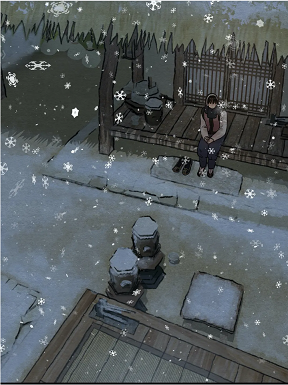 That’s why I believe that he was acting like in chapter 29/30: feigning ignorance. But since the painter had returned, he needed to change his plan without revealing too much, hence he used the expression “I believe”, in order to mask his knowledge.
 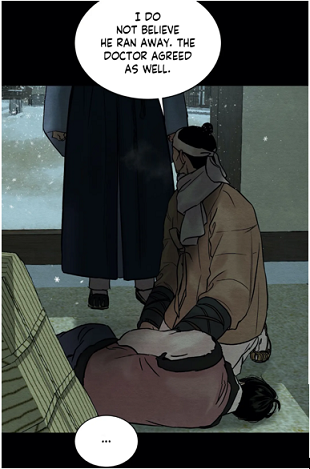 Since the physician is copying the butler’s words, I am more and more convinced that Kim was already aware of the abduction. The doctor had to act the same way than Kim. But now after chapter 64, just like Deok-Jae represented a source of danger to his tranquility at the end of the first season, the valet judges the artist now as a cause for uproar. Moreover, he is losing his master’s trust.
  That’s why in his eyes, the painter needs to leave the mansion. Deok-Jae was sent away and now Kim is attempting to do the same. This explicates why Kim confronted the lord with the truth. He used his misdeeds to make him feel miserable and he reinforced his self-hatred so that the noble would keep his distance from the low-born. He is not just opening Pandora’s box here, he is opening a way for the commoner to depart from the property, hence the door is open here. First, Kim had imagined that Baek Na-Kyum would follow his sister Heena, the moment when he would see his sister. Yet, it didn’t happen like expected, and he got caught usurping his authorities. Therefore he needed to find a new solution to bring the couple apart. He knew how the lord would feel. He is very perceptive and can use the main lead’s weaknesses. This is not surprising that Yoon Seungho fears to reveal his vulnerabilities, as these were turned against him in the end. And Kim was responsible for this. From my point of view, Kim is no longer a silent witness, but he has turned into a true accomplice. Kim and Min have already plotted with each other. It happened during the night of the stopped gangrape. Since Kim worked in the shadow in the first escape (chapter 29-30), the manhwaphiles have to anticipate a repetition of Kim’s behavior during that night (chapter 52-53-54), the shadow acting during the night. Note that he left the mansion with the painter without the lord’s authorization in chapter 57. Furthermore, he has not mentioned the disappearance of Deok-Jae yet. Finally, in chapter 66 Min and Kim were seen together at the door, a strong clue that they are working together in the end.
  As a conclusion, Kim is trying his best to separate the couple. While he acts kind towards the painter making him believe that he is doing it for his interest, he acts the opposite towards his master. He utilizes the truth in order to hurt the main lead, since he can’t use his position, like he did with Deok-Jae. However, like I said before, this won’t work like Kim has envisioned it. Therefore he will be forced to act directly in the end, revealing his true personality: a coward who never wanted to take any responsibility and let others suffer so that he was never confronted himself with a terrible situation. His tranquility was paid with the suffering of others.
So Kim’s first plan fails. Initially, Baek Na-Kyum refuses to follow Heena and argues with her points. Secondly, like my follower @LolitaJina observed it correctly, the door the main lead goes through at the end gives us a clue for the next event:  This is the same door, the main character went through during that famous night, when he was walking under the influence of his unconscious:
  Back then, he went through the courtyard to the painter’s room and I believe, Yoon Seungho is following the same way. However, this time, it is a conscious choice. He feels the need to keep his distance from the commoner. He has definitely heard that he was considered as a bad omen for Baek Na-Kyum.
 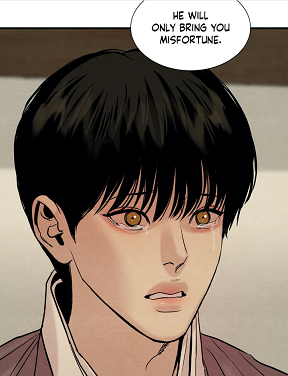 The chapter 68 is definitely a new version of chapter 53, yet this time Yoon Seungho didn’t intervene.
  In other words, he is retreating and he will remain in his room in my opinion. Yet unlike the chapter 52, he won’t organize any orgy, he will remain hidden thinking that Baek Na-Kyum must have decided to leave him. He has no other reason to think otherwise, since he was portrayed in such a negative way by two people: Heena and Kim. In other words, I am expecting a new version of chapter 52, the lord is in his bedroom alone, hiding his wound and even skipping his meals.
But while noticing that each incident always happens twice in each season, I realized something important: There’s one element that hasn’t occurred a second time yet. 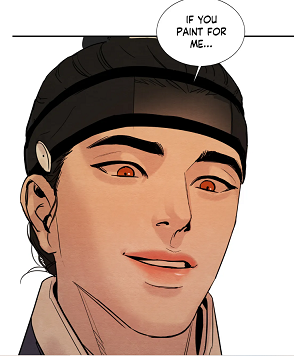
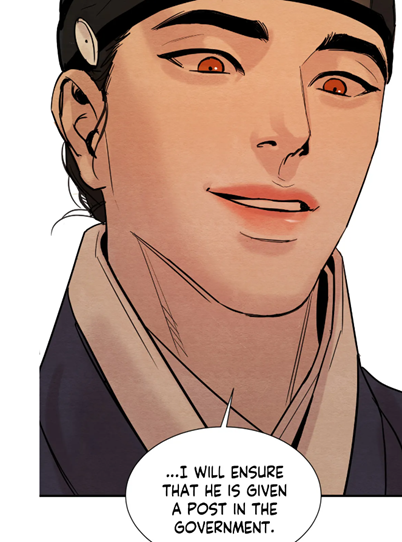 . So far, it was just mentioned in chapter 68
  . Yet, it was already changed. From “if you paint for me, then… ” it became “if you stay here…”. This is important in my opinion, as the painting seems to have lost its purpose.
Then suddenly I connected these words “ to my theory: Yoon Seungho has been a painter in the past. What if Baek Na-Kyum discovers this? We have to imagine that Baek Na-Kyum starts getting worried for the lord and chooses to visit his chamber. Yet, this time, he is not bringing any picture  , because he knows that the lord has feelings for him. However, he is keeping his distance from him, a similar situation than in episode 41-42. Furthermore, the manhwaworms should remember that the night in chapter 41-42 was a new version of the episode 20-21: the first Wedding night. In during both nights, the artist cried.
  In the chapter 41 and 42, his tears were the symbol of his agony. His heart started getting frozen.
 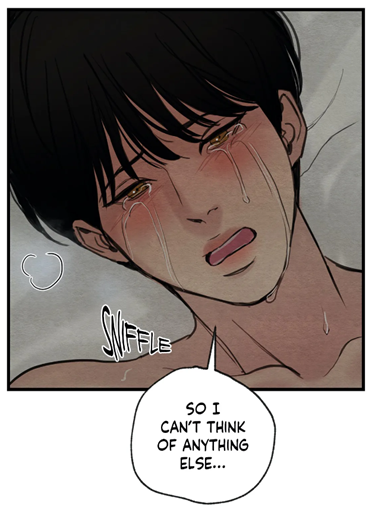 As a conclusion, the following episodes will contain elements from chapters 20-21 and 41-42. But let’s focus on the following elements contained in episodes 41-42:


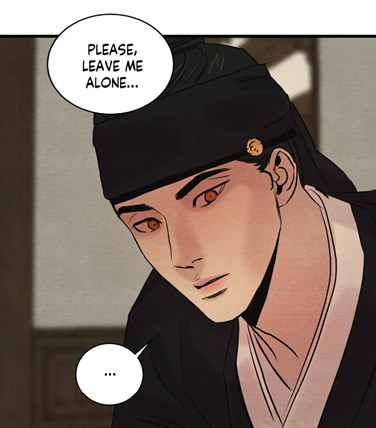 Baek Na-Kyum was trying to hide his sorrow, and Yoon Seungho wanted to help, but had no idea how. They argued. Yoon Seungho refused the painter’s advances, which he felt half-hearted and not genuine.
In other words, this scene showed that there existed a mini-discussion between the two protagonists. The lord failed to discover the cause of the painter’s tears for two reasons. First, Baek Na-Kyum had no idea that he was longing for warmth and love, and as such he confused love with sex. Furthermore, the lord was not even aware of his own true wishes: being loved. The other reason is that now, the painter knows about the lord’s feelings and he felt his sincerity.  Furthermore, he is now intrigued by Yoon Seungho, he might resent him for his misdeeds, yet he can’t truly reject him. Therefore I am expecting a new version of this chapter, full of sadness, while the painter tries to discover the reason for his distance and isolation.
What I am now expecting is that Baek Na-Kyum will question the noble and the latter will try to push him away. Yet, the artist won’t move and will keep asking. At some point, the low-born will wonder if his bad condition is related to his sickness from his youth, which will surprise the main lead. 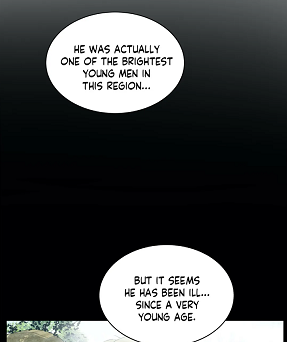 And that’s how I believe that the topic of painting will resurface again. Yoon Seungho will finally reveal that he used to paint, which would infuriate father Yoon. And this will lead the painter to request from the lord to paint for him, a new version of: However, Baek Na-Kyum will propose the following deal:
“If you paint for me, then I’ll stay here”
Remember my previous observation, the painter had already changed the deal. It was no longer to paint for the noble, but to stay at the mansion. So the lord decides to use his own tools, which were always present in the room: 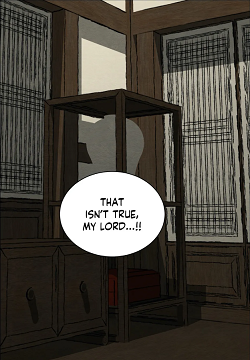 , the red box which corresponds to the painter’s item:
  And that’s how Yoon Seungho is invited to paint for the painter, so that we have a new version of chapter 36.
  And he paints a plant again
  This time, the lord is the one struggling, because he hasn’t done it for a long time. However, the moment when the artist sees the lord’s work, the low-born can’t help himself smiling, surprised by the main lead’s talent. The painter will compliment the noble for his picture, a new version of this panel:
  The redness will be replaced with a smile. And that’s how Yoon Seungho starts crying. For the first time, he made someone smile again, a source of joy for him.
  And now you can imagine what I am expecting. This time, the lord is saying something similar to this: For the first time, Baek Na-Kyum sees the lord’s tears and can’t help himself holding the lord and even kissing his eyes.
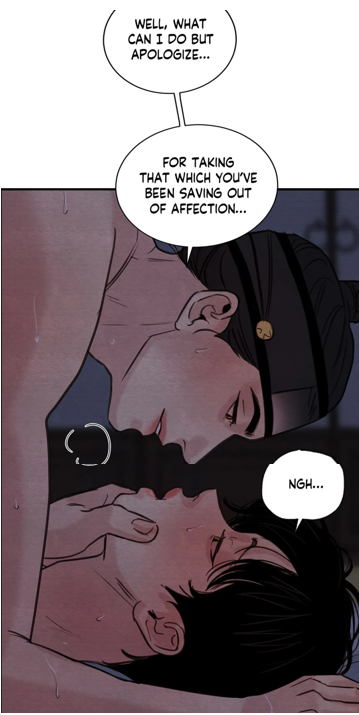
  Just like in chapter 42, Yoon Seungho can’t stop weeping. Finally, it is important to recall that in chapter 20-21, the lord gave a false apology
  . Since he experienced a genuine apology in chapter 63
 , the noble will know how to ask for the painter’s forgiveness. From my point of view, the rejection of the kiss in chapter 65 will be replaced by a gentle and tender kiss. There’s no doubt for me that Kim only succeeded to separate the couple temporarily. Kim never expected that Baek Na-Kyum would remain by Yoon Seungho’s side despite the harsh treatment.
And if this truly happens like predicted, this night will mark the rebirth of the phoenix. Yoon Seungho will have the artist as his teacher and guide, simultaneously the low-born will see that the noble is not truly obsessed with sex. They will be able to talk about other subjects, yet painting will give the lord the occasion to become active again. The lord will be able to outlive his passion, hence he will be able to start living again. His pictures will make the painter smile, making the noble happy. That’s why Kim will be forced to become truly active in the second abduction. He won’t be able to act in the shadow or be a silent accomplice like in the past, which will lead to his demise. The painting will bring them together and we will have two painters of the night. As a conclusion, I am expecting the chapters 69-70 containing elements from the following episodes:
In other words, the chapters 69-70 will stand in opposition to the episode 58. The love session won’t be any longer a dream, an illusion, this wonderful night will symbolize reality. The lord’s painting will be a proof that Yoon Seungho didn’t dream, he will see with his eyes and hands that the painter’s concern and love were genuine and real. The lord won’t associate his love confession to a defeat like in the past  , but to a victory. Furthermore, the painting will force the aristocrat to rely on his own senses, so that he won’t any longer rely on the butler’s words. From that moment, Kim won’t be able to distort reality and make the lord doubt his judgement. He saw and felt the painter’s admiration through his painting. However, this doesn’t mean that the lord’s transformation is completed. He might be reborn during the next episodes, yet he has still a long way to go before truly shining. He needs to change people’s perception about him and it will start with the staff. From my point of view, the head-maid will approve the changes and can only encourage the artist to remain by Yoon Seungho’s side. Little by little, Kim will lose his privileged position among the domestics. And Min will become more and more impatient. His desires for the artist will make him go crazy, overlooking the presence of another shadow: the second Joker, Nameless, the one who ruined Deok-Jae and Min’s original plan. There’s no ambiguity that the buffoon will also be responsible for the failure of the second abduction.
These are my predictions… I hope, you liked these. Maybe I am too romantic, however I feel that the chapter 58 will serve as a mirror for the future episodes.
Feel free to comment. If you have any suggestion for topics or manhwas, feel free to ask. If you enjoyed reading it, retweet it or push the button like. My tumblr-twitter account is: @bebebisous33. Thanks for reading and the support.

This is where you can read the manhwa. https://www.lezhin.com/en/comic/painter But be aware that this manhwa is a mature Yaoi, which means, it is about homosexuality with explicit scenes.
Reflection has different significations:
While reading the chapter 67, I realized that we had all these different meanings offered by Byeonduck. Therefore I chose to analyze this episode under this aspect.
First, we have the incident with the broken mirror,  , a new version from chapter 29, when lord Seungho discovered the painter’s escape.
  The common denominators are:
 (chapter 29)
  (chapter 67)
 (chapter 29), in the first season he was looking for the artist, in the second for Jihwa as the instigator of the abduction
  (chapter 67)
 (chapter 67). Striking is that this time the complicity is clearly revealed. Here, we see, the red-haired aristocrat asking for his domestic’s complicity, while in the first season it was never shown. It only came to light through my closer examination: Kim had a hand in this and let the domestic Deok-Jae assume the responsibility for the desertion. That’s why he stood behind the servant. Consequently the latter got beaten the worst.
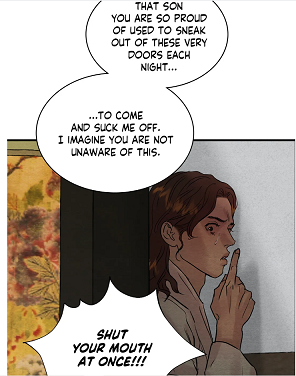
 The reflection (definition 3) of this comparison is the absence of loyalty towards Yoon Seungho. He is betrayed not only by his own staff (chapter 29), but also by his former friend.  (chapter 67). Unlike in the past, his gaze is not covered by darkness, but he gets a true reflection (definition 1) of his childhood friend. The cheerfulness and naturality he saw in his friend’s visage has turned into a monstrosity. But in chapter 67, Yoon Seungho got to see and hear his own reflection: definition 1 and 2. Father Lee described him as a man consumed by sex, a man full of vices who led his son to debauchery.
  He blamed the main lead for corrupting his son. However, for the first time, Yoon Seungho stood his ground and refused to be accountable for Jihwa’s reputation as sodomizer. Hence the protagonist gave father Lee a different reflection about Jihwa: Yet, this time, he confronted him with facts. He portrayed his son as a strong-willed and free person. Jihwa knew how his father would disapprove, hence he acted behind his back (“sneaking during the night”). With these words, the lord pointed out not only the son’s hypocrisy, but also the father’s. Father Lee preferred turning a blind eye and preferred reproaching Yoon Seungho for his son’s sexuality. So the reflection (3) was that father Lee got to hear and see for the first time his son’s true behavior. In other words, Yoon Seungho was actually putting the blame on the father and son. Either father Lee had been blind and deaf, or the son manipulated the head of the family. In reality, it becomes obvious that father Lee was well aware of his son’s behavior, but chose to feign ignorance and let Jihwa tell him lies so that the appearance of respectability could be maintained. Both Lees had an interest to let Yoon Seungho become the scapegoat, that way Lee’s reputation would be still intact. The father could no longer pretend innocence, when his son returned one day with his topknot cut off.
  With this kind of words, the father could only put the whole responsibility on the main lead. However, in chapter 67, father Lee got confronted with a different reflection. Lee Jihwa was never forced to visit him, he did on his own volition, hence the main lead can not be responsible for the second lead’s sexual orientation. Yoon Seungho’s words became the reflection father Lee needed to hear and see: his “pure” son was quite the opposite. The lord had finally grasped Jihwa’s mean and hypocrite personality. Jihwa’s hypocrisy was already perceptible in chapter 3, when he attempted to hide the hickeys from the servant
  and note that he acted the same in chapter 67. However, this time he desires to hide the marks left by Nameless from The Joker, because his sex with the commoner would create a scandal.
  Note that the second lead has a hickey on his chest, and when he is facing his acquaintance, the shirt covers the mark.
 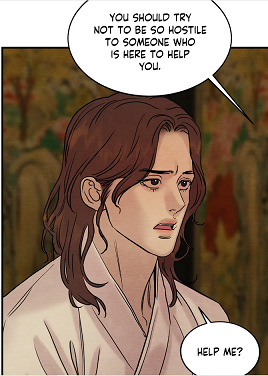 If Min saw the mark, he would ask the red-haired noble how he got the hickey. And this time, Jihwa can no longer hide his homosexuality behind Yoon Seungho’s reputation as the biggest sodomite. Imagine, Jihwa has done exactly what he reproached to the main lead: having sex with a commoner.
  . He has fallen so deep into sodomy that he is now reaching for a low-born, yet at no moment he feels remorse or disgusted. In fact, he even admits that he did enjoy it.
  This exposes Jihwa’s superficiality in my opinion. He doesn’t reflect (definition 4) on his own actions, and these contradict his own rules. And now, I am even wondering, if Heena’s words addressed to the painter in chapter 68 could be the reason why Jihwa was so obsessed with his childhood friend in the past.
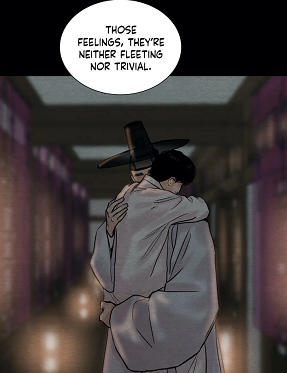 Since he was so young and had no adult by his side as advisor, he had no idea how to identify what he truly felt for his friend. Yet, in chapter 67, we don’t see Jihwa’s heartbreak any longer. And from my point of view, it is related to Nameless. The moment Jihwa had sex with another man, he was able to move on. Jihwa had a false perception of love in the end, which explains why the red-haired noble was so obsessed with his friend.
However, what caught my attention in this chapter is the broken mirror. It is exactly the same than the one the main lead offered to the painter. This implies that the protagonist must have given it to Jihwa in the past.  (chapter 3)
 (chapter 45) It shows that Jihwa had already got closer to Yoon Seungho than anyone else. Yet, by destroying the red dresser, it signifies that the main lead is cutting ties with the red-haired noble for real. They have no longer any connection. Let’s not forget that when Baek Na-Kyum received the dresser, he saw his future:
  (chapter 28). the mirror predicted the evolution of the protagonists’ relationship. They would become lovers. Since Yoon Seungho destroys himself the red dresser, it displays that Jihwa and him have no future together. At the same time, I believe to see two other interpretations in the broken mirror. When Baek Na-Kyum destroyed the mirror, it didn’t just mean that he was rejecting the lord as his partner, it also meant that he refused to accept his sexual orientation. He was denying his own identity as homosexual. And now, you understand why the main lead used the mirror to confront the artist. That way, he pressured him to accept his sexuality. And now, when the lord throws the dresser, it means that the lord is rejecting the red-haired aristocrat’s identity. He is not the one he thought he was: his personality is different from what he imagined. The reflection the mirror gave is not the reality. His true face is vile and deceptive.
The broken mirror has the other following signification for Jihwa: loss of identity. I would like to remind my readers of the 7 functions a mirror has:
In my opinion, this scene in chapter 67 marks a turning point for Jihwa. From that moment, he won’t be able to identify himself with the main lead. Striking is that Jihwa’s room contains the same furniture that Yoon Seungho’s: the cupboard, the white vase, the candelabra, the red box and the shelf  (chapter 56) (chapter 65) The only differences are the windscreen and the colors of the bed. The resemblance exposes the true nature of Jihwa’s feelings for his childhood friend. Jihwa never developed his own taste. When the main lead started showing an obsession for erotic paintings, Jihwa bought an erotic painting from Qing (chapter 9). He had no real identity, he was still identifying himself in relation to the protagonist. From my point of view, Yoon Seungho represented in reality the surrogate father, the father Jihwa was missing. Since his father was absent and Yoon Seungho seems to be dedicated and gave him his attention, the red-haired noble developed an affection based on an oedipal complex. That’s why he couldn’t accept the separation and any other lover. In other words, he had similar feelings than Baek Na-Kyum’s had for Jung In-Hun. The only difference is that Yoon Seungho was first a boy and later a young man full of traumas. He couldn’t act as a real father. Note that Yoon Seungho is the only one scolding Jihwa and reminding that there are lines that shouldn’t be crossed. Father Lee never took his responsibility as father, that’s why he can only blame the main lead for Jihwa’s sodomy.
And now without a mirror, Jihwa is forced to develop his own identity. His “adoptive” father is cutting the umbilical cord literally speaking. Jihwa needs to find his own taste and make his own choices. Since Jihwa didn’t go through puberty properly, he couldn’t distance himself from his surrogate father properly, an important step into adulhood. Let’s not forget that he was separated from him for so many years, when father Yoon decided to seclude Yoon Seungho at the mansion. The years of separation reinforced the noble’s longing for his “father figure”. At the same time, I believe, his emotions were also connected to guilt. This explicates why Jihwa couldn’t accept being separated from him. He imagined that being together would erase everything. However, Jihwa is now an adult, hence he needs to be independent and become responsible.
That’s why Jihwa is so scared that he is crawling afterwards. His behavior is not just the reflection of the sword aimed at him. Note that he is crawling exactly like a child. This is no coincidence in my perspective. For the first time, he is on his own, hence he feels very insecure. The main lead is no longer willing to be responsible for him, and since father Lee was confronted with the truth, the young man can no longer put the blame on Yoon Seungho. And like a young child discovering the world for the first time, he feels afraid and fears for his life.
  Everything feels new and scary for him. Consequently he hides his face and ears, he prefers darkness, as it gives him a certain protection.
 And now, you grasp better why The Joker was able to manipulate Jihwa. He gave him the reassurance and comfort a scared child needed. Yet he deceived him that he just needed to rely on his plan, which includes that he will put the blame on others. Since Jihwa always defined himself in relation to Yoon Seungho, it means he never tried to use his own mind. He never reflected deeply, as he relied to much on mirrors:
“Mirror should think longer before they reflect.” from Jean Cocteau
Since he didn’t ponder deeply before, he prefers relying on others’ thoughts: rumors, gossips and Min’s words. That’s why he looks like a monkey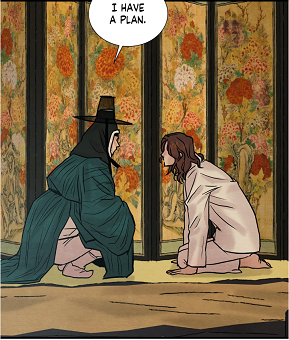 , when he is facing Black Heart. He prefers renouncing on his humanity and skills than thinking carefully. The Joker stands here in opposition to Nameless’ role. The latter acted like his mirror and his guide into adulthood. That’s why I believe that the criminal will play a crucial role and he will confront Jihwa, but at the same time leading him to find his true identity. Nameless will become his mirror, fulfilling the same role Baek Na-Kyum has with the main lead. It will force him to drop the hypocrisy he adopted from his second surrogate father figure: The Joker. I believe, Nameless will assist to find the purity deeply buried in his soul, yet I am still expecting a punishment for Jihwa. Since my theory is that Nameless was framed in the past, I also believe that Jihwa will have a similar fate. He will become Min’s scapegoat.
As you can see, we had so many different kind of reflections. They helped the manhwaphiles to comprehend the functions Yoon Seungho and Min had in Jihwa’s life. They were both the red-haired noble’s surrogate fathers, because father Lee decided to let his servants to take care of his son. In this chapter, father Lee’s guilt is clearly demonstrated, while he feigned ignorance, another person applying Kim’s philosophy: Nonetheless, I am quite certain that father Lee will be punished for his negligence, just like father Yoon lost his position as official due to the purge.
Feel free to comment. If you have any suggestion for topics or manhwas, feel free to ask. If you enjoyed reading it, retweet it or push the button like. My tumblr-twitter account is: @bebebisous33. Thanks for reading and the support.
This is where you can read the manhwa. https://www.lezhinus.com/en/comic/painter But be aware that this manhwa is a mature Yaoi, which means, it is about homosexuality with explicit scenes. If you want to read more essays, here is the link to the table of contents: https://bebebisous33analyses.wordpress.com/2020/07/04/table-of-contents-painter-of-the-night/
It would be great if you could make some donations/sponsoring: Ko-fi.com/bebebisous33 That way, you can support me with “coffee” so that I have the energy to keep examining manhwas. Besides, I need to cover up the expenses for this blog.
The first reaction many readers had was to celebrate the butler’s courage, because he chose to tell his lord the truth and confront him with his true reflection. And unlike all the other characters, he mentioned one positive aspect: the lord’s good heart. (chapter 68) In their eyes, valet Kim had turned into a hero not fearing his death. But we had another hero in this chapter, the scholar Jung In-Hun. The latter took the crying Baek Na-Kyum in his arm and brought him away from the scene, where Heena noona was getting beaten by a rich noble.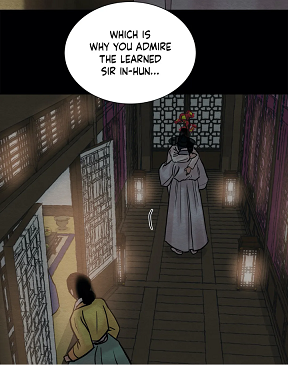 (chapter 68) In her eyes, he was a hero, because he showed concern and care towards her tenderhearted brother. (chapter 68) Yet, only a few applauded Jung In-Hun for his behavior. Why? It is because many readers have already perceived his true nature: his hypocrisy and coldness hidden behind his calm demeanor and huge smiles. That’s why we need to examine more closely the behavior of these two father figures. Are they truly heroes? In order to answer this question, it is important to look at the definition of heroism and at the characteristics of a hero.
Heroism is characterized by:2
So let’s start with the scholar’s heroism. I would like to remind the reader that this scene is told from Heena noona’s perspective. If the manhwalovers observe Jung In-Hun’s action, they have the impression that the scholar is indeed helping someone in need. He is comforting the upset boy. (chapter 68) So the first condition is met. However, neither the second condition or third component are present in the teacher’s gesture. Jung In-Hun is not exposing himself to danger, risking his own life as he doesn’t come to help the real person in danger: Heena noona. Actually, the real person who needed to be rescued was the gisaeng, and not the artist. 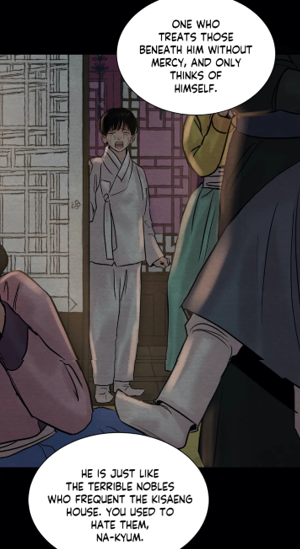 (chapter 68) Yet, the so-called hero abandoned her to her misery, as he walked away from the room. (chapter 68) This shows that he wasn’t willing to risk his life or position. There are no selflessness and sacrifice. Secondly, he did hope something in return: while consoling the kind boy, he hoped to get recognition from the gisaengs. They would see him in a positive light, hence if he came to visit the brothel again, they wouldn’t ask him for money, and I can even envision that they would give him some wine or food. Furthermore, they would allow him to roam around. No one would question, why he would come to the gisaengs. His reason was simple: he liked the tenderhearted boy. Finally, we have to question about the scholar’s appearance at the brothel. Why was he there, so dressed up? This scene is relevant, because it displays how Heena noona got manipulated in the end. The teacher used Baek Na-Kyum as tool in order to save his own skin. In reality, Jung In-Hun was there in order to get noticed by rich and powerful nobles. He hoped to find some connections, as he knew that the brothel was the place, where influential aristocrats would like to spend their time. In my opinion, this is what happened. Jung In-Hun knew the importance of Baek Na-Kyum at the brothel. From my point of view, he used this knowledge to achieve his goal. He must have approached the guest at the gisaeng, while Heena noona was serving him. But the rich aristocrat got upset that a scholar was bothering him and started beating the poor woman. Seeing this, Baek Na-Kyum cried which gave Jung In-Hun the excuse to leave the place. He needed to console the boy. While reading this, the manhwalovers sense the origin of Heena noona’s prejudices towards rich aristocrats. The latter would disregard her, because the teacher was around, as the latter was hoping to get some benefit from it. With this scene, Byeonduck exposes the origin of Heena’s blindness, which is also visible in different panels, like this one:
  (chapter 68) As you can detect, the absence of her eyes reflect her blindness. The feelings she is projecting onto the painter’s are actually her own. (chapter 68) Now, we know why Baek Na-Kyum was so indoctrinated in the end. His own sister was also a victim of the manipulator, whom I had already diagnosed as a person suffering from a narcissistic personality disorder. Note that she uses the same vocabular than the scholar.
 (chapter 18) Hence I come to the conclusion, the teacher used the school in order to manipulate the commoners and the gisaengs. While he portrayed himself as righteous and kind, he described the powerful nobles as violent and arrogant, so that he would get the admiration from the commoners. In truth, he was deceiving them, since he looked down on them. Yet he needed them in order to get some connections to the powerful and rich nobles visiting the gisaeng house. On the other hand, since he didn’t want to get too close to the gisaengs, he employed the innocent boy as a shield, misleading Heena noona to think that Jung In-Hun had feelings for her brother. That’s why he hugs the protagonist so tightly. (chapter 68) For Heena, he was a hero, because he gave the impression that he cared for them, whereas it was the total opposite.
If we pay now attention to the butler’s behavior, it looks like the first aspect (“Acting voluntarily for the service of others who are in need“) is present in his action. He wanted to help Heena.  (chapter 67) However, the second component (“Performing actions without any expectation of reward or external gain“) doesn’t apply, because he is not doing it for free. Let’s not forget Kim’s philosophy, which was exposed in chapter 65: (chapter 65) He hates scandal and trouble. The gisaeng created such a uproar that Kim almost lost his credibility in front of his master. (chapter 65) He had two reasons for allowing her to meet the painter. First, Kim feared that she would cause more chaos in the future. Secondly, Kim realized that Baek Na-Kyum had become a huge source of trouble. He knew that the artist had been abducted, hence he got aware that Baek Na-Kyum had become a target of nobles. Furthermore, as soon as he had been returned, his sister made such a ruckus that she had turned the mansion upside down. Besides, like I had mentioned before, due to her behavior, she had put Kim in a difficult spot. Finally, he had another ground for giving his help: (chapter 65) He had seen the painter hurt in the bedchamber, so his words “Lord Yoon will not harm Nakyum” were proven wrong. Therefore I conclude, he had something to gain from his intervention. But what exactly? In my perspective, Kim wanted to get rid of the painter. The valet had already anticipated that Heena noona would ask her brother to leave the mansion. That’s why he said her this: (chapter 67) The butler anticipated her words and actions, as he is very perceptive (see chapter 23). At the same time, he told her the truth:
  (chapter 67) He had never received the authorization from his master. However, the manhwalovers should recognize that he painted his master in a rather negative light, while leaving a good impression on her.
  (chapter 67) In his mind, the butler thought that Baek Na-Kyum would leave the place right away after the harsh treatment he had received. For him, there was no doubt that no one in his right mind would stay at such a place. He knew that Yoon Seungho would come back soon. In other words, he was not helping Heena or Baek Na-Kyum here. He was doing himself a favor: his desire was to lead a peaceful life. Therefore, this explanation contradicts the first point.
As for the third point (“Recognition and acceptance of the potential risk or sacrifice made by taking heroic actions“), the manhwalovers should question this: When he granted the favor, was he putting his life at risk or was he willing to sacrifice himself? In my opinion, he was not, as he was acting behind his master’s back. He waited for the lord’s departure, then he allowed her to enter the mansion with the hope that Baek Na-Kyum would follow her right away. That’s why he was waiting outside next to the door. At the same time, he couldn’t tell her to hurry. At no moment, he was risking his life. He was using his position as the loyal valet to make decisions on his own, and even lied to the head-maid, when she questioned his behavior. (chapter 67) In my opinion, we have here a new version of the painter’s escape from the first season: Kim acting as a shadow helped the artist to run away (chapter 29-30). However, the problem is that he got caught by Yoon Seungho.
  (chapter 68) What should he do now? I would like to remind the manhwaphiles that Kim had not only disobeyed his master’s order, but he had acted, as if he was a lord. He had given the permission without Yoon Seungho’s consent. (chapter 68 It is important to recall that this story takes place in Joseon, therefore Kim’s action can definitely be judged as a betrayal and usurpation of power. One might argue that he desired to help Heena, yet like I exposed above, he did out of selfishness and not because he felt concerned for the painter and for her. As such, Yoon Seungho has the right to be upset. He is the master and someone is acting behind his back, overlooking his orders. Under this perspective, the head-maid appears more loyal to her lord than Kim himself. In this scene, he was only serving his own interest.
People were rejoicing that Kim became brave, because he criticized his master for his behavior. But what they failed to realize is the importance of the timing. Why now? Observe that Kim only starts confronting the main lead after Yoon Seungho threatens him with consequences:  (chapter 68). Note that the protagonist doesn’t menace to kill the gisaeng. He just desires to send her away, but he is now determined to punish his butler for his disobedience. He usurped his position, and as a lord he is allowed to do so. And that’s the moment, when Kim starts speaking the truth, which many readers associate to something positive.
However, this is important to realize that truth can also be used as manipulation. This is called paltering. Psychologists discern 3 types of lie: lie by commission, lie by omission and paltering.
“Like lying by omission, paltering can involve failing to disclose relevant information, but unlike lying by omission, paltering involves the active disclosure of true but misleading information: paltering enables would-be deceivers to actively influence a target’s beliefs” (Rogers, Zeckhauser, Gino, Norton, & Schweitzer, 2016). quoted from https://workplacepsychology.net/2016/12/18/to-deceive-using-truthful-statements-is-called-paltering/
This type of lie and manipulation is often used by politicians and even traders. They try to divert attention from the real main issue, and in our case: the butler’s disobedience and abuse of power. The other advantage is that since the paltering person is using truth as his tool, it is easier to remember and not get caught by the target. Moreover, the manipulator doesn’t have to feel guilty, as it looks like ethically more correct than lies.
That’s why it is important to look at the timing, when Kim reveals the truth. Here, I would like to bring another scene, where Kim’s first paltering was visible: chapter 50 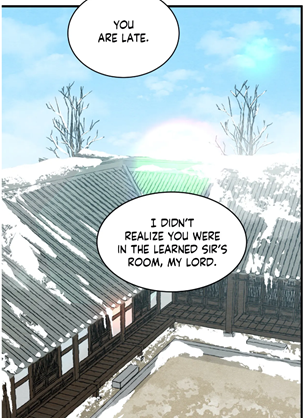
 Note, that in that chapter, the lord had the sword in his hand, and strangely the valet came late. As you can imagine, this is no coincidence. In my opinion, butler knew that something bad had happened and in order to escape his lord’s bad mood, he arrived late on purpose (lie by commission), but at the same time he revealed his knowledge about the cause for Baek Na-Kyum’s depressed mood in order to divert his master’s attention. That way, he could put the blame on the absent noble, but also on the painter. The latter had disregarded him due to the scholar’s words. At the same time, he made the lord feel insecure, because it showed him that he had behaved exactly like a client, a man obsessed with sex. That’s why with the butler’s intervention, the master had a relapse. What mattered for Kim was a peaceful life, the rest is (chapter 65) Yet, he never expected such a change of behavior in the main lead, that’s why he blamed the painter afterwards. (chapter 52)
Hence I come to the conclusion that Kim’s MO is mostly paltering. And now, it is time to return our attention to the conversation between Yoon Seungho and his valet. It is important to examine each argument Kim brought up: (chapter 68) Initially, it looks like he is appealing to the lord’s heart, but in reality the main point is the noble’s judgement. The valet is reprimanding his master for his lack of discernment. He misjudged the painter’s behavior. This is relevant because in this panel, I view a first emotional manipulation. His real intent is to make the lord doubt his own judgement, like “look, back then you made the wrong decision… therefore you could be wrong here”. But the readers know that Yoon Seungho is right. Heena is determined to take away his lover, so his initial judgement about Heena is indeed correct. In his eyes, she represents a source of thread, he might lose the artist. One might argue that Yoon Seungho is sequestring the painter which is also correct, yet like my reader Luzy pointed out, this is the painter’s decision. Neither Kim nor Heena nor Yoon Seungho have to make the decision for him. And here, Kim and Heena are trying to do so. The problem is that Kim got caught. But let’s go back to my initial thought. Kim used his knowledge (the lord’s misjudgment) in order to make his lord doubt himself. and he appealed to his emotions for that. This type of manipulation is called gaslighting:
“Gaslighting is a form of emotional abuse that’s seen in abusive relationships. It’s the act of manipulating a person by forcing them to question their thoughts, memories, and the events occurring around them. A victim of gaslighting can be pushed so far that they question their own sanity.” https://www.healthline.com/health/gaslighting#:~:text=Gaslighting%20is%20a%20form%20of,they%20question%20their%20own%20sanity.
As a conclusion, Kim made the lord feel insecure and doubt his own judgment and used facts in order to achieve his goal. The lord should rely on his butler’s discernment. But the mercy and favor for the painter are just a subterfuge, he is trying to mask his wrongdoing.
I could bring up another panel as illustration:  (chapter 68) Here, he is using the past in order to distort reality and memories while speaking truth. What Kim doesn’t mention here is his involvement in that incident. (chapter 65) Kim is destroying the lord’s confidence, so that Yoon Seungho will rely on Kim’s judgement.
If you pay attention to Kim’s words during that confrontation, Kim is actually utilizing many psychological and emotional manipulations:
(chapter 68) “You are so cruel to this boy”. He might be right, yet why didn’t he say anything in chapter 64? (chapter 64) He literally looked away, because truth wasn’t helpful in this case. Feigning innocence and ignorance was more appropriate. (chapter 23) (chapter 68) (chapter 68) (chapter 68) Here, Kim is mentioning the past, where he played an active role between the father and son. In other words, he is reminding the master that he is acting like a mediator. However, this revelation exposes the servant’s manipulation. He was one of the causes for the falling apart between father Yoon and the eldest son. We have to imagine that he never revealed the real reason for Yoon Seungho’s rebellious nature to father Yoon. And here, he is behaving like in the past. He tries to intervene between Baek Na-Kyum, Heena noona and Yoon Seungho, as if he had the right to.
 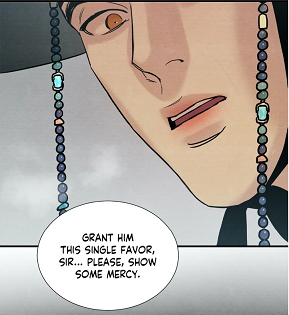 (chapter 68) (chapter 68) he is bringing up the past to divert Yoon Seungho from the main problem: Kim abused his position. (chapter 68) making a person feel bad about herself, by giving backhanded compliments or comparing to another person. On the surface, it looks like constructive criticism, while in reality the victim is supposed to feel terrible and doubt his personality. https://www.healthline.com/health/mental-health/negging
 I have to admit that I can’t give you an illustration of all psychological tricks Kim used in this confrontation. On wikipedia, there is a whole list of different psychological manipulations, which served me as orientation. https://en.wikipedia.org/wiki/Psychological_manipulation Nonetheless, as the readers can detect, I tried to look for more info for this analysis.
After portraying Kim as a manipulator, I would like to remind my reader of two aspects: I described the butler as the gatekeeper, the one who opens the door. And now, if the manhwaphiles pay attention to this picture, (chapter 68) they will detect that the door is now open. The valet opened Pandora’s box in my opinion. That’s why Yoon Seungho was hurt and at the end ran away. (chapter 68) He had heard, how Heena noona was comparing him to misfortune, reinforcing his negative opinion about himself.  He had been already prepared mentally by his butler. He was as wounded as Baek Na-Kyum, when the scholar had voiced his true thoughts about the painter.
  (chapter 40) While the artist’s fate is to become a prostitute, the other is destined to bring misery. He already externalized this perception about himself in chapter 49:
 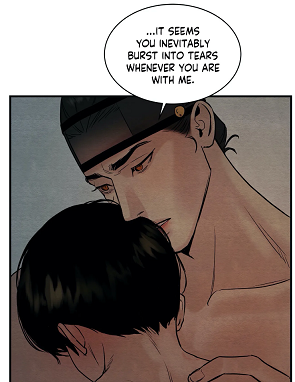 (chapter 68) For me, chapter 68 is the new version of chapter 40. That’s why I wasn’t rejoicing at all about Kim’s behavior. He was far from being honest with his truth. In reality, he used truth mixed with emotions as his ultimate tool in order to save his own skin. In other words, he functioned as the noble’s mirror.
This scene made me think of “Snow White and the 7 dwarfs”, where the mirror of truth tells the jealous queen that Snow White is far more beautiful than her. With this truth, the queen is led to take actions against the heroine and torment her. And here, we have another allusion how truth can be used as a weapon. The mirror never told the queen how to become the most beautiful woman. He never gave her any advice, it retained information: beauty can be different. It is not just the physical aspect, but it is about the personality. Therefore we could say that the mirror of Truth manipulated the queen leading her to her own demise. However, at no moment the queen never questioned the mirror of Truth and its ulterior motive. That’s exactly how Kim behaved the whole time explaining why Yoon Seungho never suspect his words. They reflected the truth. Yet the valet never intervened for his sake and for the painter’s sake. He only did, when he noticed that his lord was angry and let others take the blame, like here the father or Yoon Seungho himself. However, the readers should remember that in this scene, Kim had abused his authority. That’s also a fact.
Therefore I don’t consider Kim as a hero, quite the opposite. He is the worst manipulator, the reason why Yoon Seungho ended up with self-hatred and became violent with his swing moods. Kim isolated him, eroded his sense of reality, making him fear his own image. Besides, he didn’t even help him, when he got raped. Since Yoon Seungho has been manipulated psychologically and emotionally for years, he ended up hating himself.
“Long term effects of emotional manipulation:
That’s the reflection Kim wanted him to have, so that the latter would never question his servant’s actions. And now, this picture has another meaning for me: 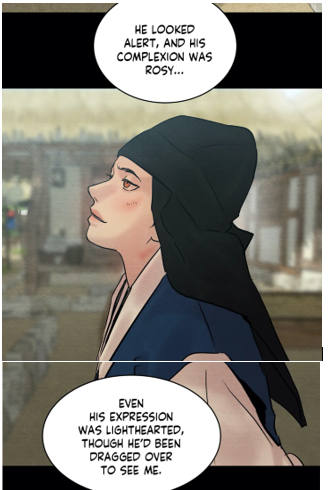 (chapter 57) His gaze is only focused on his valet, not realizing that the latter is not honest with him. From my point of view, there’s a reason why Byeonduck put Jung In-Hun’s so-called heroism (chapter 68) next to the valet’s . (chapter 68) For me, she put the readers in the same situation than Heena noona’s. Just like the kisaeng, many readers expressed their admiration for the butler, because he had told the truth. They associated truth to goodness. Heena noona also watched the kindness in the scholar’s gesture leading her to think that the teacher was a honest and caring person, yet she overlooked that the teacher had in reality abandoned her. He never protected her and let her suffer. This picture truly reflects his cowardice and treachery
  (chapter 68) He slowly takes the artist in his arms. He doesn’t rush to her side, remains silent and immobile. His passivity reflects his true personality, but Heena is too focused on her young brother to grasp the situation. (chapter 68) The crying boy is used as a diversion. Besides, I am quite certain that Jung In-Hun was actually the source of her misery by trying to get attention from powerful nobles. Note that the scholar and Kim utilize both the painter’s to hide behind their misdeed. He serves as a justification why the scholar left the gisaeng behind and why Kim defied his master’s order. The domestic used kindness and pity as legitimations (chapter 68), while it was the opposite. He desired to get rid of them.
But there’s hope in my opinion. Baek Na-Kyum refused to listen to his sister’s words, which Kim hadn’t expected. Therefore he got caught, he anticipated Baek Nakyum’s eagerness to leave. (chapter 67) Secondly, by giving his master a reflection of his behavior, the valet lost his influence on the main lead. Remember that I wrote that Baek Na-Kyum served as the lord’s mirror, therefore he will take over the valet’s role. He will reveal his true reflections: his flaws and wrongdoings

 (chapter 68), but also his quality: his honesty (chapter 58). Let’s not forget that the artist realized his dedication in chapter 58. Note the huge difference. The artist never uses others in order to judge the lord. Kim will realize soon enough the consequences of opening Pandora’s box. He might have achieved his goal (the lord won’t punish him for his disobedience), yet he lost his lord’s trust. Notice that right after this quarrel, Yoon Seungho started treating Baek Na-Kyum like a noble.
 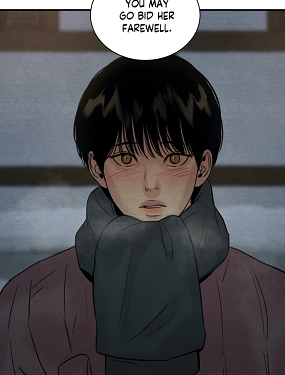 (chapter 69)
 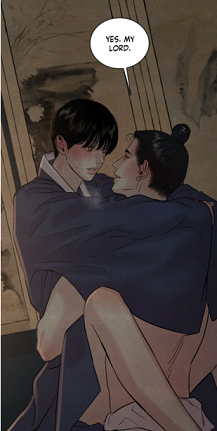 (chapter 72) From that moment on, Yoon Seungho was no longer viewing the valet as the unofficial lord. We could say that he had lost his status as “hero” in the main lead’s eyes.
Feel free to comment. If you have any suggestion for topics or manhwas, feel free to ask. If you enjoyed reading it, retweet it or push the button like. My Reddit-Instagram-Tumblr-Twitter account is: @bebebisous33. Thanks for reading and for the support, particularly, I would like to thank all the new followers and people recommending my blog.
This is where you can read the manhwa. https://www.lezhin.com/en/comic/painter But be aware that this manhwa is a mature Yaoi, which means, it is about homosexuality with explicit scenes. If you want to read more essays, here is the link to the table of contents: https://bebebisous33analyses.wordpress.com/2020/07/04/table-of-contents-painter-of-the-night/
Thanks to my reader @nakyuhm, I could definitely improve this version.
I guess, you are surprised by the choice of the picture for the illustration, but as you can guess, there’s reason for this. While reading the second episode from Alternative Universe, two elements caught my attention: the role played by the servant Jung In-Hun and the words said by the main lead Yoon Seungho to the noble Baek Na-Kyum.
First, the domestic shows kindness and care to his young master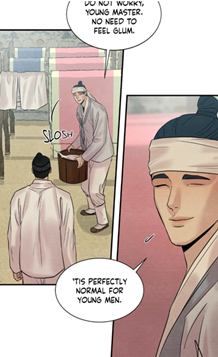 reminding me of the butler Kim in the original, implying that we have a fake affection. But if Jung In-Hun replaces Kim, it signifies that Baek Na-Kyum is now living the life of the noble Yoon Seungho in the original story. From that moment, I tried to verify this theory: We have an older sister who seems to be jealous of her younger brother, because she mocks him by calling him a baby.
  The source of her resent is simple: since Baek Na-Kyum is the only son of their family, he always gets the attention and admiration from the father, while she, as an older sister, is overlooked due to her gender. Hence I connected her to Yoon Seung-Won, the younger brother, for I had already pointed out in one of my former analyses that there existed a certain jealousy between them due to their father.
  This was truly palpable in this incident. Back then, I had imagined that it was related to the topknot incident. However, I think now that what we are witnessing is a straw mat beating. The younger master, who betrayed his older brother out of jealousy, never imagined that his father would retaliate like that. He had envisioned that his brother would get into trouble and loses the father’s admiration, yet not to this extent. Another allusion to jealousy was the words expressed by the main lead, when he confessed to his lover:
  (chapter 55) From my point of view, he was reliving his past, when he saw his brother getting the father’s attention. Let’s not forget that this story is based on the principle: history keeps repeating itself, therefore the jealousy resented towards the low noble was the present, while in the past, Yoon Seungho resented his brother in the past, it was the moment where jealousy reached his peak. That’s why I saw the roles played by the sister and Jung In-Hun as a confirmation that Byeonduck had chosen to reveal the protagonist’s past in the Alternative Universe by switching their places. Yet, this means that the readers will always see the uke suffering. She desires the readers to imagine the main lead’s traumatic past. While many readers are liking the Alternative Universe because of the humor and the lightness, I am convinced that we are actually headed to a huge tragedy, a repetition of the original story… as it represents Yoon Seungho’s past. On the other hand, it is important to remember that although this is just a repetition of the story, we shouldn’t forget that the story is not simply a pure repetition, as the elements and the chronology are changed. As a conclusion, Baek Na-Kyum will suffer a similar tragedy than the protagonist in the main story, yet it will also be a little different, maybe less painful.
But if Baek Na-Kyum represents the powerful noble Yoon Seungho from the original story, this means that the latter was a painter too. What caught my attention is the following panel: 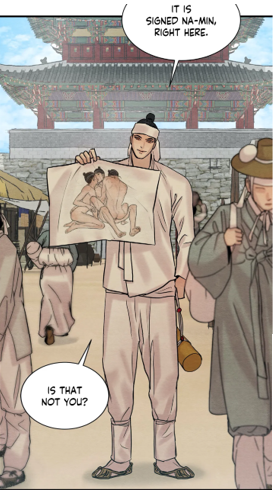 He showed the picture, while saying that it was signed Na-Min. However, if the readers pay attention to the painting, there’s no signature on it. Besides, I doubt that as a commoner, he is able to read, remember that the artist in the original story can’t read either. One might argue that the shopkeeper told him the name of the creator, when he showed him the painting. Yet, this argument is incorrect for three reasons. First, the merchant had no reason to mention him, because the former knows that Baek Na-Kyum is selling his pictures directly in order to keep his hobby a secret. Moreover, imagine, Baek Na-Kyum portrayed the famous sodomite Yoon Seungho who is a commoner. The merchant would have questioned him about the circumstances, how he got a painting from the noble. How could the innocent noble have painted the commoner as model? This would have shocked the merchant. From my point of view, the shopkeeper didn’t recognize the artist’s work at all, but he proposed him 5 coins due to his greed. He must have repeated the following remarks:
  In my perspective, the trader was just repeating the criticisms heard from someone else.
  Compare the two reviews, you will notice that the commoner is much more accurate in his review. And he is able to discern the origin of the flaws for such a drawing.
  That’s why I came to the conclusion that Yoon Seungho was a painter himself. In order to become an arts critic, you need to understand the subject, therefore many painting critics are artists themselves. My explanation is that he discovered the noble’s work by sleeping with nobles. His clients would buy the pictures, which the commoner couldn’t afford himself. What caught my attention is the following panel:
  Baek Na-Kyum questions his competence with his rhetorical question. In the main lead’s eyes, Yoon Seungho doesn’t have the eye to know… and to judge his paintings. But this question made me think the exact opposite. From my point of view, Yoon Seungho recognized the artist’s style, hence he could name it. And there’s no doubt that he is familiar with his paintings.
  But unlike Baek Na-Kyum, the commoner is not famous due to his social status. And you understand why I came to this idea that the powerful noble Yoon Seungho in the original story could have been an artist in his youth, a painter and even a poet. From that moment, I started to search for clues in order to corroborate my theory.
First, I remembered this scene in chapter 36: Yoon Seungho used to punish his servants with paint. 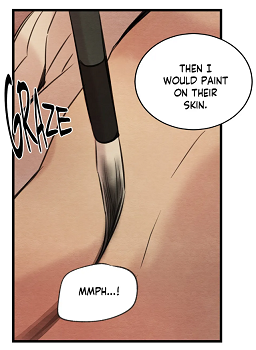 Note that he doesn’t say “write” but paint on their skin. This showed that the noble used to like painting. When I read chapter 36, I made the following mistake: Yoon Seungho was writing, hence I didn’t pay too much attention to his drawing on the painter’s body. However, I changed my mind, the moment I viewed his lines on Baek Na-Kyum’s body: It definitely looks like a plant and his lines show a certain confidence. Don’t forget that the artist was shivering due to the stroke of the brush, yet there’s no mishap or zigzag on his body. If I include the following panel from the Alternative Universe,
  then you’ll realize that it is a painting on Yoon Seungho’s body and the author is a painter. This could be judged as another evidence for my theory. A painter drew lines on the body of another artist. Therefore I come to the deduction that in chapter 36, Yoon Seungho started showing his passion to Baek Na-Kyum: he used to paint. The manhwaphiles should remember that in the previous chapter, the lord asked the commoner about his likes and dislikes. Such a conversation implies that the counterpart will also ask about the likes and dislikes of the partner. What does Yoon Seungho like in reality? My answer would be: he liked painting, but exactly like the low-born, he was forced to abandon his passion due to his father.
But this was not the first time that Yoon Seungho painted. First, in chapter 8, we have the following panel: 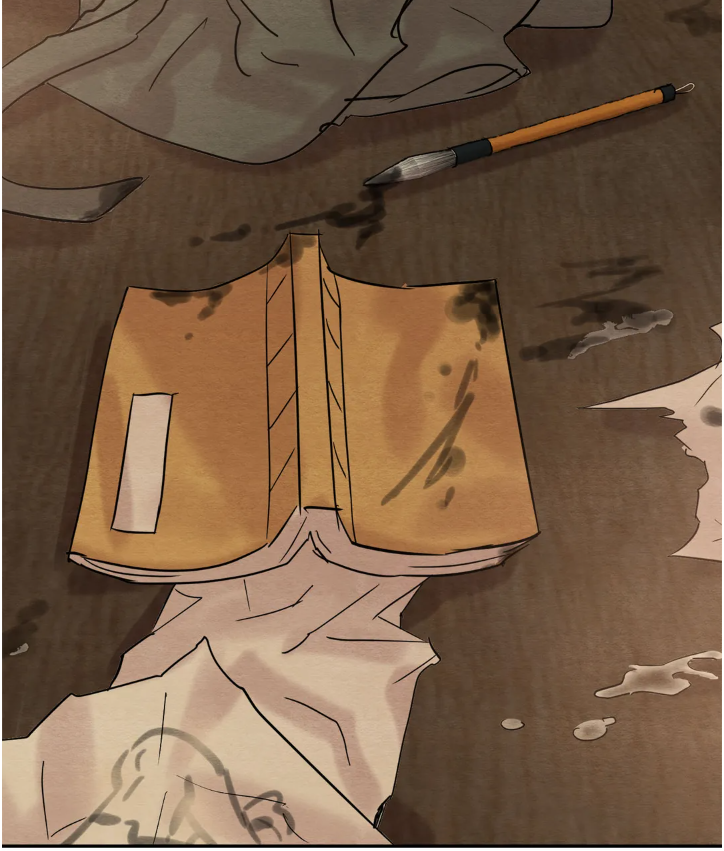 someone attempted to draw a scene of men copulating. Since my hypothesis is Yoon Seungho was a painter in his youth, then it looks like he was the creator of his drawing. Then in chapter 23, the manhwaphiles certainly remember the book he showed to Baek Na-Kyum in order to revive his memory:
  Therefore Yoon Seungho could have been the author of this picture. Note the progression between the picture from chapter 8 and 23. This time, the artist included colors and the design is more precise, just like the lines are more firm. Then this would explain why Yoon Seungho knew what it meant, when an artist doesn’t practice for a long time.
  (chapter 2). In that same chapter, the artist noticed how well furnished his study was. He had such an expensive paper, and so many brushes revealing the aristocrat’s knowledge. And now it becomes comprehensible, why the lord could only laugh at the fake excuse given by Jung In-Hun in chapter 30: The low noble had brought the artist to the shop in order to buy him ink and brushes. The lord knew that the painter had everything he needed. In my opinion, Yoon Seungho was the one who took care of that room. That’s why the study is next to his bedchamber.
Another evidence for this theory is the picture Byeonduck chose as illustration for the first season of Painter Of The Night:  Note that the drawing behind the noble is not only torn, but it was made on an expensive paper indicating that this work was made by someone rich. Secondly, Baek Na-Kyum never created such a painting in the first season for the protagonist, yet the main lead painted a similar picture in his youth:
  . However, there exist small divergences: the uke in the purple drawing is embracing his lover exposing such a passion and strong love. And since I explained that Baek Na-Kyum was making the same experiences than the main lead, it looks like the author of this painting in this picture could have been Yoon Seungho who saw two nobles making love and reproduced the scene. Furthermore, observe that the color of the drawing is purple, exactly like the color of the main lead’s robe. We know that Yoon Seungho likes purple very much, he put on a purple hanbok in order to impress the painter in chapter 23.
 So in my opinion, Yoon Seungho used to paint in secret, exactly like the noble Baek Na-Kyum, as he knew that his father would never allow such a hobby. He had many reasons for that. First, since Father Yoon is portrayed as a controlling father, it means that he was paying attention to the main lead’s every move. While the father might have described painting or poetry as too feminine, the real reason for this interdiction was different. Father Yoon couldn’t allow that Yoon Seungho’s reputation outshines his own. Note that no one remembers the protagonist’s previous reputation. He was intelligent and talented, until father Yoon started spreading the rumor that his son was ill. He needed to get treated. Then later he portrayed him as unruly and difficult in front of people, like the former servant explained in chapter 37.
 Yoon Seungho liked paintings and even poetry, a thorn in the eye for Father Yoon, as it represented a source of threat for father Yoon. There’s no ambiguity that such an ambitious and greedy man would reject arts. Why? According to my theory, the main lead is the illegitimate son of a kisaeng and the grandfather, so seeing his half-brother getting more famous would definitely infuriate him. Moreover, it would be a constant reminder of Yoon Seungho’s true origins. Finally, if Yoon Seungho became famous as an artist, he could get close to power, like for example he becomes the personal painter of the king. However, when father Yoon discovered that his son had caught the king’s attention, he realized that he could use the protagonist differently.
  As the king’s courtesan or prostitute, Yoon Seungho would lose all his rights. He would never get recognition and power as well, while father Yoon as his pimp would benefit from it. That’s why when the father mentions “illness”, he could definitely be referring to painting. Yoon Seungho learnt that he had to paint during the night to outlive his passion, and now you understand why I saw the combination of this illustration with the title Painter Of The Night as another possible evidence for my theory: Yoon Seungho was also a painter of the night, just like the noble Baek Na-Kyum in the Alternative Universe.
Another point supporting this theory would the appearance of designs on the main lead’s hanboks. This clearly reveals his passion for drawings and he has such a fine eye for designs:  (chapter 45)
  (chapter 50)
  (chapter 53) and
  (chapter 67) Even when he died in a figurative sense, the last hanbok indicates that his liking for drawings has not died yet. Nevertheless, all the pattern have something in common: the presence of nature. There are always animals or plants. And this observation led me to the next conclusion, Yoon Seungho was a painter, but unlike his lover, he loved painting nature. This explains why the main lead painted a plant on the low-born’s body in chapter 36. And we have a clue that Yoon Seungho loves plants and animals, if we use the story from Alternative Universe: Remember how the cat caught the noble’s attention
 and the latter used a plant to play with the animal.
But how come that he created an erotic painting, if according to my hypothesis, the main lead was preferring nature and animals? In my opinion, Jihwa was responsible for this. Since no one in his mansion paid attention to his whereabouts, he witnessed sodomy and that’s how he discovered his sexual orientation. Then one night, he led his childhood friend to the place where the couple was having sex and Jihwa begged his friend to paint for him what they had seen. The drawing in the illustration for the first season was discovered by the father who destroyed it, because someone tattled on Yoon Seungho. Let’s not forget that in the Alternative Universe we have a lord peeping tom: 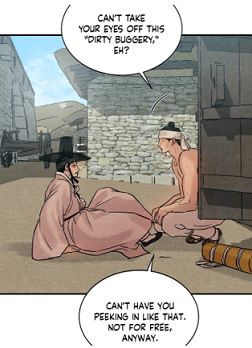 Moreover, the painter’s sexuality resurfaces the moment he witnesses sex between Jihwa and Yoon Seungho, a new version of voyeurism. Why do I think that Jihwa was the one who led the innocent noble to become a voyeur? Note that in the Alternative Universe, the cat is the one leading Baek Na-Kyum to the cabin and even strokes the artist’s butt, while the latter is beholding the scene:
  So the main lead was not alone, when he saw the commoner having a fellatio. Besides, the manhwalovers should recall how Baek Na-Kyum saw two nobles having sex at the gisaeng house.
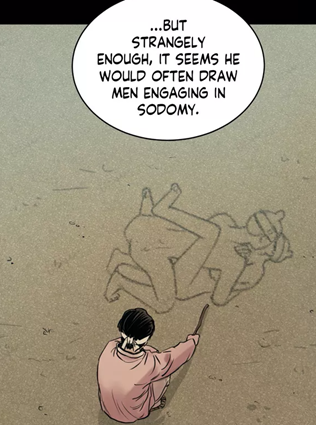 The aristocrats hid their sexual orientation behind the gisaengs. On the surface, they would behave like normal men, while in reality they loved another man. I doubt that Yoon Seungho could leave his mansion like that, especially if he was monitored by the staff and especially by his butler and his brother. From my point of view, Jihwa and his friend must have witnessed it at the pavilion.
 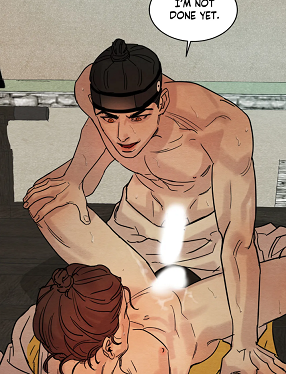 Note that the pavilion played a huge role in the first season: emancipation for Yoon Seungho in chapter 3 and the same for Baek Na-Kyum, as the latter was forced to admit that he loved his teacher in chapter 25. Furthermore, I would like to outline that each scene at the pavilion was linked to painting. After witnessing how two nobles made love, Jihwa begged his friend to paint for him (new version of chapter 8). Simultaneously, the red-haired friend decided to make some advances, as he had always felt attracted to him:
 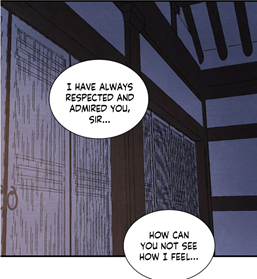 That’s why Jihwa decided to visit him during the night, since no one noticed his absence from home. So while the innocent man, Yoon Seungho, was focused on the drawing requested by his friend, Jihwa said this:
  This interpretation would explain why Yoon Seungho couldn’t perceive Baek Na-Kyum’s preference and why Jihwa was an expert for recognizing virgins. However, during that night, the door opened and Jihwa, too scared to get caught, left his friend behind. What followed, you can imagine: Father Yoon believed to see in his son a homosexual due to the painting and punished him. He beat him and asked for some medication from the doctor. Since there was an erotic painting in his son’s room, the father went to father Lee and told him about the painting. However, father Yoon blamed his son for the incident. That’s how Jihwa was separated from his friend, yet the latter chose to remain silent and let Yoon Seungho suffer the consequences from his request. Then he must have heard from the staff that a teacher was hired for a conversion therapy. This would explain why Yoon Seungho relived his second abandonment during that night of revelations: first, the friend who ran away because he had been able to escape
  and later the rape with Kim at the door: Besides, the manhwaphiles will certainly recall how worried Baek Na-Kyum was in chapter 16 and 17, after leaving the lord’s bedchamber in a hurry. He couldn’t eat and kept wondering if someone had seen him or not, a new version of what the red-haired noble had experienced. In my opinion, there were two incidents occurring with the painting:
 (chapter 37) to the younger master. This led to the straw mat beating. The scholar Jung In-Hun told his future sponsor this:
 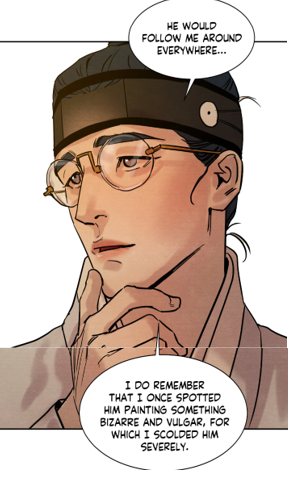 We have to envision that the powerful main lead experienced a similar incident.
I have to admit that I have no idea about the identity of the persons involved in the love session at the pavilion. One thing is sure: One of the fathers was caught making love to another man. And now, you can comprehend why I got more and more convinced that Yoon Seungho was a painter.
I sense that Jihwa’s spirit and love for nature inspired Yoon Seungho in his drawings. Note that the windscreens in Jihwa and Yoon Seungho’s chamber have a pattern containing trees and plants. I believe, Yoon Seungho could sense free spirit in his childhood friend, reminding him of nature and freedom. That’s why I believe that the cat in Alternative Universe represents Jihwa. First, we have the presence of red . Moreover, Jihwa is represented by an animal in the original story, the monkey. Furthermore, the behavior of Baek Na-Kyum in Alternative Universe reminds us of a cat’s…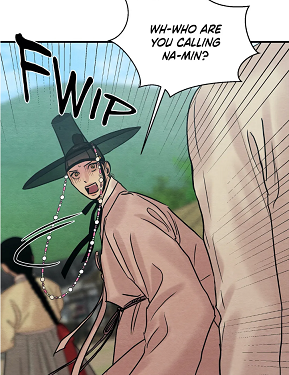 Furthermore, like my reader @Peperon21428670 pointed out, I had already associated the painter to nature. This explicates why Yoon Seungho chose to paint a plant on the artist’s body that night. He sensed the connection between nature and the artist. And since Jihwa and Baek Na-Kyum are similar, then the cat embodying free spirit and longing for affection can only represent the second lead. This would stand in opposition to Yoon Seungho’s mansion, which the eldest son felt like a cage and prison. This explicates why Yoon Seungho was painting nature and liked his childhood friend so much. He embodied everything what the main lead couldn’t have. Furthermore, with this new approach, it would confirm that there were two people watching the nobles making love at the pavilion, as Baek Na-Kyum peeped at Yoon Seungho with the cat by his side. With this new interpretation, the manhwalovers can better grasp why Jihwa was waiting for Yoon Seungho’s love, as he hoped that he would see the same gaze than in the past. However, from my point of view, Yoon Seungho could never feel like before due to the abandonment he experienced, when Jihwa left him. Furthermore, since Yoon Seungho’s passion for painting was killed by the coercive persuasion and sexual assaults, he could never gaze at his childhood friend the same way. This would explicate why Jihwa is so convinced that he knows Yoon Seungho’s true past
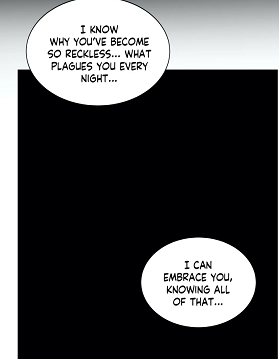 (chapter 57), whereas he is only aware of the peak of the iceberg.
So if Yoon Seungho was a painter forced to vow to never paint, it becomes understandable why Baek Na-Kyum’s paintings affected the main lead so much. They healed his eyes which had been ruined by his traumatic experiences.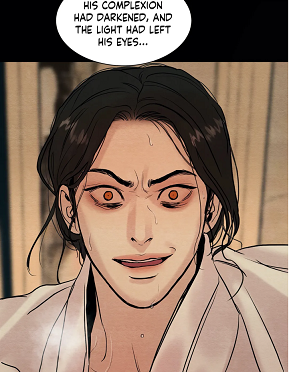 (chapter 57) His keen eyes were revived and the light in them returned.
  Slowly the lord rediscovered his love for arts and paintings… inciting him to draw again.
Arts therapy is nowadays used as a method to heal people suffering from mental illnesses due to huge traumas. That’s why Yoon Seungho could only fall in love with the painter’s work. They were kindred spirits, and when the lord saw the painter for the first time, he fell in love at first sight, unaware of his emotions. Just like in the first special episode… Yoon Seungho’s face inspired the noble so much that he drew a threesome.
Therefore, with this new perception, the manhwaworms comprehend why Yoon Seungho wanted to scratch Jihwa’s face in the chapter 67. Since in the past his face was a source of inspiration, the symbol for innocence, youth, freedom, carefree, naturality, honesty, happiness for the painter Yoon Seungho, the latter can only associate his face to dishonesty, deception, pain and suffering now. Although Jihwa didn’t get scolded or caught with his lie, he felt guilty, but he never felt the courage to correct the truth. That’s how Jihwa started behaving like a coward and playing tricks. With this incident, he learnt a terrible lesson: he learnt how someone else could take responsibility for his actions and decisions. Since it was never revealed, the young aristocrat faked his smile and cheerfulness due to his guilt. However, with the separation from his friend, he got lost and found himself a new “friend”: The Joker who perverted his innocence and naturality in the end. That’s why when they reunited, Yoon Seungho sensed the transformation in his childhood friend. And once Jihwa discovered that his friend was interested again in painting, he looked for pictures hoping to catch Yoon Seungho’s interest. However, he was rather bored,  when he looked at the picture (chapter 9). Then in chapter 12, he proposed to hire a painter from the Royal Academy , because he knew how much his friend liked painting. Yet he couldn’t encourage him to paint himself, for he would have been confronted with the past. The red-haired aristocrat thought, he could manage to get rid of the artist without reminding Yoon Seungho of the incident with the door. And if my theory is correct, this scene implies that the noble never apologized for his friend’s suffering.
Now, the noble is able to perceive his friend’s corrupted nature, hence he describes his friend’s face as vile. (chapter 67) The face is no longer a source of inspiration, rather of suffocation, and this picture contrasts so much to the main lead’s reaction, when he looked at the artist’s face in the following drawing. (chapter 25) He noticed the absence of facial expressions. Therefore he recommended him to use a mirror (chapter 28). As you can see, the muse’s face and facial expressions are very important for the powerful aristocrat. I believe that at some point, he will destroy the painting made with Jihwa
  so that there are no picture left with him, a new version of chapter 2. For me, the chapter 67 marks the beginning of Baek Na-Kyum’s influence as the lord’s muse. With him, he is learning what love and courage are and he will inspire the master to paint again. Finally, he will be able to discern between fake and genuine affection and concern leading Kim to lose his master’s trust.
And now it is important to remember the painting sent to father Yoon:  Imagine how he must have felt. He tried so desperately to stop his son from being linked to arts and painting, and here he receives an erotic painting. He can only be reminded of the past incident. At the same time, he is also criticized for his hypocrisy. He forced his son to prostitution for his own goal, but acted as if he was proper and righteous. No wonder that he was so enraged and could barely contain his fury. He was confronted with his lies and wrongdoings, one could say that he was finally seeing his failure as father. Because of this new approach, I come to the conclusion that Kim was the one sending the painting, hoping that the eldest master would intervene, as he prefers father Yoon to his actual master who is always linked to scandal and uproar, which contrasts to Kim’s philosophy. The butler hoped for an intervention, but since father Yoon hates himself to be connected to sodomy and would like to keep his reputation intact, he chose not to intervene.
With this new theory, I believe that Baek Na-Kyum will become the lord’s muse, just like the main lead will become Baek Na-Kyum’s source of inspiration. At the same time, I imagine that Yoon Seungho becomes the painter’s teacher as well, in the sense that the aristocrat teaches him how to paint other topics: nature for example.
So the painter of the night is not only referring to Baek Na-Kyum, but also to Yoon Seungho. That’s why Byeonduck chose this illustration for the first season: the past and the present are visible in this panel.
Feel free to comment. If you have any suggestion for topics or manhwas, feel free to ask. If you enjoyed reading it, retweet it or push the button like. My instagram-tumblr-twitter account is: @bebebisous33. Thanks for reading and the support. Thanks for reading and for the support, particularly, I would like to thank all the new followers and people recommending my blog.
This is where you can read the manhwa. https://www.lezhinus.com/en/comic/painter But be aware that this manhwa is a mature Yaoi, which means, it is about homosexuality with explicit scenes. If you want to read more essays, here is the link to the table of contents: https://bebebisous33analyses.wordpress.com/2020/07/04/table-of-contents-painter-of-the-night/
It would be great if you could make some donations/sponsoring: Ko-fi.com/bebebisous33 That way, you can support me with “coffee” so that I have the energy to keep examining manhwas. Besides, I need to cover up the expenses for this blog.
The chapter 67 caught me by surprise, because it proved me wrong in one aspect: Lee Jihwa is not like Baek Na-Kyum, in the sense that he is no orphan. The red-haired aristocrat has a father, an old-bearded man. (chapter 67) My first thought was: “Where were you all this time?”
I couldn’t help myself laughing, when Yoon Seungho barged into Lee’s mansion in chapter 67, because I immediately connected it to chapter 3, when the protagonist visited his childhood friend early in the morning. Back then, he barged with an erected phallus (chapter 3) and had sex with Jihwa at the pavilion, where both were not quiet at all. The red-haired noble kept even moaning.  (chapter 3) Their intercourse was noticeable, but at no moment father Lee interrupted them. And now, the erected phallus was switched to a sword, and unlike in chapter 3, where the second lead was eager to meet his sex partner
 , the master chose to hide behind a windscreen. (chapter 67) However, this time father Lee intervened. Why all of the sudden? For the first time, his son caused a real trouble, because someone entered his house with a sword: a huge scandal! Furthermore, he must have realized that his son’s life was in danger, hence he had to intervene. The domestics couldn’t deal with such a powerful noble. And now, you understand why I couldn’t restrain myself from smiling, because the father Lee’s reproach sounded so hypocrite. (chapter 67) Where was he, when Yoon Seungho had sex at the pavilion? Why didn’t he intervene, especially if he sees the main lead as responsible for his son’s debauchery?
Because of this question, I was reminded of the song called “Papaoutai” from Stromae, a French speaking singer from Belgium. I am posting the video with the english subtitles.
In this song, the singer outlines the importance of fathers for children. However, he does it by criticizing their absence (Papaoutai = Papa où tu es?/ Papa, where are you?). Although this represents his main message, he also questions the role played by fathers in our modern societies. He points out that’s easy to become a father biologically, but being a father symbolizes responsibilities. He explains it, men don’t become fathers naturally, since it is a work process: “nobody knows how to make Papas” / Mister “know-it-all” would’ve inherited it, is that it? Does it come from sucking our thumbs, or what”. Moreover, for him many fathers don’t take their role seriously (“Genitors or genius, tell us who gives birth to irresponsibles”). The author exposes that a father needs to think a lot about his role as father. As a conclusion, the singer would like men to become more responsible for raising their children.
And it is time to return our attention to Painter Of The Night. Byeonduck utilizes her work to show the importance of fathers in sons’ life, as she exposes different types of negative behavior of fathers.
First, we have Father Lee. He only appeared after 66 episodes. His absence had given the impression that he was inexistent and Jihwa was an orphan. We could describe father Lee as ghost. And now, you understand why I chose such a title: Absence. What does it mean for children, when their father is not by their side?
Absence of parents is a synonym for parental neglect. What is child neglect exactly? There are 6 different types of child neglect:
Many people think that this situation only happens in families with a low income, because it is related to physical and supervisory neglect which is more visible. However reality is different. We find neglected children in wealthy families. How so? The affluent children live in comfort, but they are often starved of love and affection (Emotional Neglect). This happens, when parents are too busy to spend time with their children. Therefore they hire personal to take care of their children or send them to boarding school. As you can imagine, Lee Jihwa is a child suffering from supervisory, emotional and educational neglect.
Since Father Lee relies on his servants to take care of his son, they are not qualified or responsible enough to care for him (supervisory neglect). Due to their lower status, they are not allowed to teach him or reprimand him. That’s why in chapter 9, only the servant asked Jihwa where he was going so early at dawn. Jihwa had not to justify his departure to his father. Then in chapter 41, one domestic finds the young man sleeping on the street, while looking for him.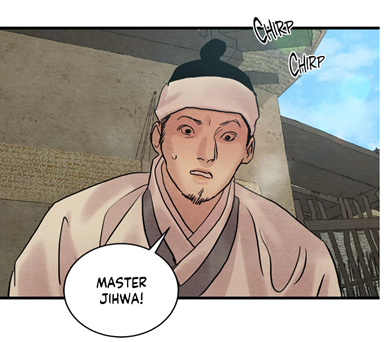 (chapter 41) He spent the whole night drinking and his father never asked about his whereabouts. He never showed any concern, as he has his staff to take care of him. In other words, he put the whole responsibility on the domestics. After confessing to Yoon Seungho in public, no servant shows up and takes care of him indicating that neither father Lee nor the staff heard about the scandal. Nameless was the one who was asked by the inn owner, if he could take care of the young noble.
  (chapter 59) He even gave him a dry robe and a home for the night. Since the servant only showed up the next morning in chapter 41 and he didn’t even appear during the night in chapter 59, it illustrates that the staff is more attached to the mansion than to the impulsive noble himself in truth.
This is not surprising that in chapter 67, the servant does his best to protect his master. Despite his rude behavior in chapter 50  (chapter 50), he is even willing to risk his life
  . (chapter 67) He simply follows his master’s request, as he feels, that’s his duty and lord Lee could ask for his accountability. (chapter 67) Amazing, when you compare it to Kim’s behavior. We could say that the staff does feel responsible for their young master to a certain extent. Why? I believe, they all know that father Lee doesn’t pay attention to his young son and they are now responsible for him. On the other hand, their care is limited, because they are domestics to the mansion. They are not obliged to give him the emotional comfort and the education he needs. As long as there’s no real scandal, then everything is fine in father Lee and the staff’s mind. Remember that in chapter 45, the town folks described the second lead as the “mistress”, showing that even they had noticed the lord’s movements, whereas father Lee has no knowledge about it.
 (chapter 45) That’s how isolated the father is cut off from reality and world. This is not surprising that his son resembles him, he also lives in his own world.
But what are the consequences of emotional neglect? I would like to quote a passage from a website in French (translated)
It can also be so because a lack of love and human contact hinders its development. In some cases, neglect traps the child in sensory isolation, slowly and continuously undermining his or her mind to the point where there is little desire to connect with others and explore the world. Thus, parental neglect is a terrible absence. http://educationsante.be/article/la-negligence-parentale-est-une-terrible-absence/
Remember how I had described the red-haired noble, before Nameless helped him to become more responsible: I compared him to a blind and deaf person  , which corresponds to the expression “sensory isolation”. Back then, I had imagined that he had been abused as well. I was wrong, since it was just neglect which I had already detected. However, the consequences of such a severe neglect are as terrible as abuse. Consequently, abuse and neglect are often considered the same.
Now, I will list how neglect affects the child’s personality (I won’t add to each characteristic a picture):
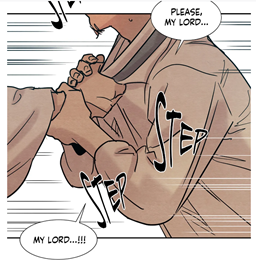 (chapter 13)
 (chapter 13); aggression
 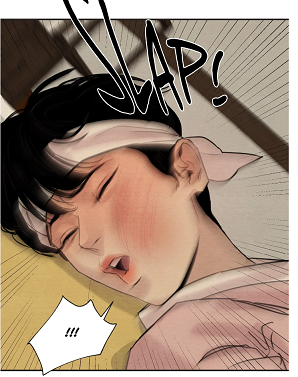 (chapter 17)
 (chapter 51)
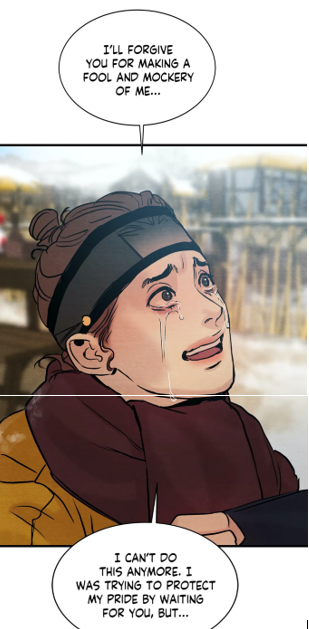 (chapter 59) In chapter 56, Jihwa sent a fake letter reminding Yoon Seungho of his trauma, yet he acts as if the other is to blame and shows no remorse. That’s why many children suffering from emotional neglect have problems with rules and laws. (chapter 9)
 (chapter 57) (chapter 67), although he had lied to him in the past. (chapter 67)
 (chapter 50)
The effects of neglect are such that it leaves sequels on so many levels: socially, emotionally, intellectually and psychologically. Children exposed to neglect are at a greater risk of developing conduct disorders and of participating in delinquent behavior, which is visible in the red-haired figure: he trespasses proprieties, ruins a painting, he even had the painter kidnapped. Due to his scheme, the vicious servant Deok-Jae was killed. Then their knowledge and cognitive capacities are diminished, which is also perceptible in the young man. The latter is not able to recognize evil at all, hence he can’t detect hypocrisy and manipulations. And this leads me to the following observation: Byeonduck chose the monkey as an animal for Jihwa. The manhwaphiles can see the singe in the windscreen.  (red circle). Because of the character’s previous deafness and blindness, I immediately connected it to the wise 3 monkeys:
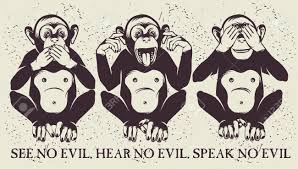
In Asia, the monkeys are considered as wise, because they represent proper behavior. Confucius says:
“Look not at what is contrary to propriety, listen not what is contrary to propriety and finally speak not what is contrary to propriety.”
In other words, the 3 monkeys serve as role model. One should behave properly by avoiding any form of evil. Since Min is the Joker, also visible in the windscreen (yellow circle), it explains why Jihwa has become such a bully in the end. Min became his role model replacing the father. Consequently, the red-haired aristocrat can’t recognize evil. That’s why Lee Jihwa appeared as a spoiled child with a delinquent behavior in the end. Byeonduck is displaying the extreme consequences of a father’s the absence. And this leads me to the next question: what is the role of a father in the end?
“The function of the father is to separate the child from the mother. He must intervene between the mother and the child to allow the child to develop his identity outside the maternal symbiosis” from https://www.psycho-ressources.com/bibli/fonction-pere.html
And now, the manhwaphiles comprehend why the red-haired noble has such a low self-esteem. (chapter 67) This is is visible in this panel. The character can’t even stand. Min, the Joker and surrogate father, treats Jihwa as his servant and punishes him, because he had not followed his order. Jihwa has not entirely developed his identity, since he has always lived in his own limited world. A father has not only to provide security and comfort, he helps the child to learn self-control and boundaries. A father is associated to rules and should teach his child how to channel aggressivity. In other words, he serves as a role model for the child. But with the absence of a father, this is impossible. And since the domestics belong to the lower social class, Lee Jihwa always had the upper hand and could do anything: his father never appeared, when Jihwa was destroying his room with his sword in chapter 21. Besides, father Lee never paid attention to the friends his son had. He blames Yoon Seungho for his son’s debauchery, yet at no moment he intervened in the past. The main lead is correct to blame the father and put his son in a different light. (chapter 67) And now, the readers can understand the role Nameless is slowly taking over: he will be the father and lover teaching him how to recognize evil and even think critically. We saw Jihwa rejecting Min’s advice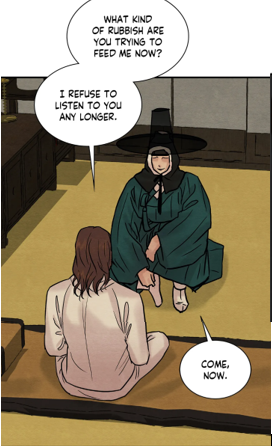 (chapter 67), but it was short-lived due to Yoon Seungho’s appearance. We have to assume that Yoon Seungho played the role of the father after the former had been abandoned by his own father. However, he could never assume this function properly, as he was suffering himself and couldn’t give him the emotional and educational comfort Jihwa needed. Let’s not forget that the protagonist chose to ignore his own feelings, to even numb them. Hence it was impossible for them to connect emotionally.
After discerning Father Lee’s behavior, I could easily portray father Yoon, who stands in opposition to father Lee. He is a controlling father using his sons as his pawns and tools for his own career. Here, I gathered the characteristics for a controlling parent:
This explicates why Yoon Seungho had been longing to see admiration and love in his father’s gaze, always hoping that at some point he would get it. The existence of the rules I elaborated is a proof of this abusive parent. And now, you understand why Father Yoon described his eldest son as ill, suffering from wayward yang.  (chapter 57) “wayward” is a synonym for rebellious indicating that Yoon Seungho had started questioning his father’s behavior and words. Simultaneously, I believe that the father judged his son’s behavior as too childish, thus he said that he had been suffering from an illness for a long time. The adolescence represents an important step in the child’s development. That’s the moment when a teenager decides to take his distance from his father in order to find his own identity. Since the main lead was described as intelligent, it was normal that the main character would decide to make his own decision and could sense his father’s flaws. Consequently father Yoon could only see the critical remarks as a sign of insubordination. This is not surprising that he blamed his son, when something happened due to Jihwa. (chapter 67) Since Father Lee never paid attention to his own son’s behavior, the former was more than pleased to hear that Yoon Seungho was responsible for an incident. Father Lee was following the rule:
But unlike before, this is the Western interpretation: he acts as if he doesn’t see evil or hear evil. He will never talk badly about his son. That way, he escapes any responsibility for his son’s failures. But like Confucius wrote:
“The father who does not teach his son his duties is equally guilty with the son who neglects them”.
From my point of view, father Lee will pay a huge price for his negligence due to his son. I saw in the chapter 67 a confirmation that Jihwa will cause a huge tragedy which ends with a terrible punishment. It is getting more probable that Jihwa will lose his title as noble 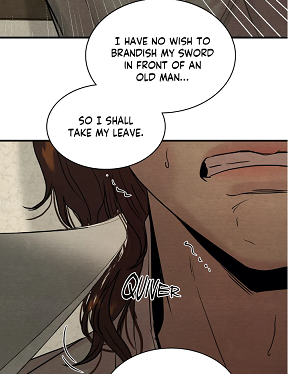 (chapter 67) and it is even possible that he gets a scar or a tattoo. (chapter 67) This scene was important as it represented a new version of chapter 18. This time, the lord aimed at Jihwa’s face and the servant was not harmed. The main lead put the whole responsibility on the former friend.
But since I had described the role played by the servants in the Lee mansion, it is also important to take a look at the domestic’s function, when father Yoon was the master of the house. What caught my attention is that father Yoon has been also represented like a ghost, very similar to father Lee. However, while the latter represents lack of interests for the son, the other stands in opposition to this. He is everywhere due to his servants. All of them were asked to pay attention to his children and their behavior. In other words, he is also absent. The domestics must have reported him everything. And now, you can understand why Yoon Seungho kept his distance from his staff as the lord of the mansion. He didn’t want to be observed by them, that’s why he relied more on Kim in the end. With his help, he could maintain a certain gap and escape their “monitoring”. There is another evidence for this theory: remember that Yoon Seungho asked his servants through Kim to pay a closer look at Baek Na-Kyum, but they didn’t take his request very seriously. Hence the painter could escape the mansion in chapter 29. And you all know that the artist is reliving the noble’s past. This explicates why Yoon Seungho targeted the amateur spy in chapter 18, he was reminded of his own past. He could only get furious.
However, there’s another huge difference in the role played by Father Yoon’s servants. Since they only had to report to him, that means that they didn’t need to take any responsibility, as the lord was the one who made all the decisions afterwards. And now, you understand why Kim rejects any form of responsibility by saying (chapter 65). Father Yoon put a lot of trust in valet Kim in the end, as he relied on his information. This is another evidence for me that Kim is responsible for the main lead’s suffering. Since father Yoon was relying on Kim’s eyes and ears, his perception got changed and this in a negative way. That’s how he became blind. He contributed to the terror ruling at the mansion, but since Kim was kind and caring, Yoon Seungho believed this illusion, while Kim was his biggest spy. I am quite sure that he played a major role, when Yoon Seungho got separated from Lee Jihwa and received his reeducation therapy. For me, there’s no doubt that his responsibility kept getting bigger, when he saw the main lead getting raped, and he decided to close the door and ignore the incident. He just needed to say that this was not his business. Another possibility is that he could justify his choice by saying that it was done for the main lead’s best interest. Let’s not forget that Kim was the one who presented the physician to father Yoon.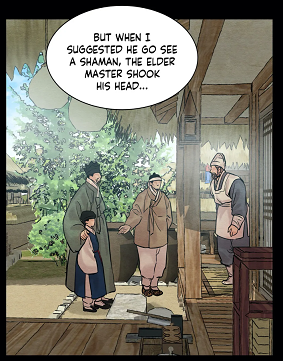 (chapter 57) There’s no doubt that father Yoon put all his trust in Kim. This explicates why Kim acts, as if he had the authority to give orders. (chapter 67) He must have developed this habit, because father Yoon gave him some power. Observe that he sometimes dresses like a noble
  (chapter 57) due to the hat and the robe. What caught my attention is that he acts behind his lord’s back, when the latter is absent. (chapter 68) Besides, since this story is based on the principe that history keeps repeating itself, then Yoon Seungho is making the same mistake like his father. However, Yoon Seungho will realize it thanks to the painter and the head-maid. Father Yoon put all his trust in his valet, unable to recognize evil in his butler. Just a reminder:
“The only thing necessary for the triumph of evil is for good men to do nothing.” from Edmund Burke
This is not just about silence and passivity, it is also about responsibility. Note that in chapter 67, Kim voices that he has been given the permission (chapter 67), so he is not assuming anything in case something happens. And in front of Heena noona and Baek Na-Kyum, he has the same attitude: (chapter 67) if Heena noona gets caught, then they can’t put the blame on him. He will feign ignorance. He has no idea how she entered the mansion. He is also applying the saying from the three monkeys:
He didn’t see or hear anything. He won’t tattle too. Nonetheless, he is acting only like that, when it concerns Yoon Seungho. It is a different story, when it comes to father Yoon. That’s why Kim still keeps thinking about his previous master. 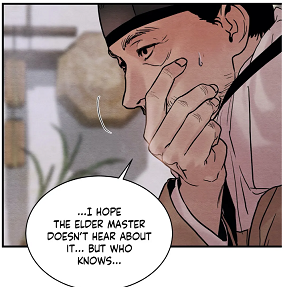 (chapter 57) By examining Kim again, I have to admit that I suddenly had this question: who gave the painting to Yoon Seung-Won? Did the valet act on the lord’s order?
 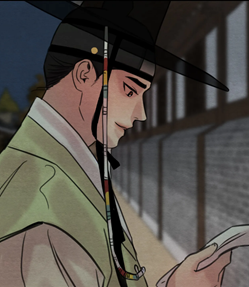 (chapter 37) Or did he decide to act on his own? Let’s not forget that during that evening, the valet had been reprimanded by Yoon Seung-Won for lying to him. It is possible that the valet chose to give the painting in order to put the blame on Yoon Seungho, as he feared that the young master could report his lie and behavior to father Yoon. The latter might not be present at the mansion, but there’s no doubt that he asked his trusted servant to keep an eye on his eldest son, whom he considered as a troublemaker. This would explain why the main lead keeps taking the medicine. And now, you can grasp why Kim is more loyal to father Yoon than his actual master. The latter gives him more freedom, yet he expects from him more responsibility. Under the ruling of father Yoon, the butler could avoid any trouble by tattling on the young master Yoon Seungho or by faking ignorance, when it was necessary. Since father Yoon put all his trust in the valet, he was not able to see evil or hear evil in the end. Kim framed innocents or he feigned ignorance. As a conclusion, Father Yoon was put in the same situation than father Lee due to Kim’s actions.
As a final conclusion, Byeonduck’s work exposes the huge importance of a father in a child’s development. Unfortunately many people still think that mothers are much more important than fathers. This explicates why in many countries, mothers receive more often custody of their child than fathers. Yet, the judges seldom question the mother’s abilities. The irony is that mothers are not per se good mothers, exactly like Stromae described it in his song, although he only talked about fathers: “Mister “know-it-all” would’ve inherited it, is that it? Does it come from sucking our thumbs, or what”. This applies to mothers as well. Being a parent means work, dedication and affection. There’s nothing intuitive.
Feel free to comment. If you have any suggestion for topics or manhwas, feel free to ask. If you enjoyed reading it, retweet it or push the button like. My tumblr-twitter account is: @bebebisous33. Thanks for reading and the support.

This is where you can read the manhwa. https://www.lezhinus.com/en/comic/painter But be aware that this manhwa is a mature Yaoi, which means, it is about homosexuality with explicit scenes. If you want to read more essays, here is the link to the table of contents: https://bebebisous33analyses.wordpress.com/2020/07/04/table-of-contents-painter-of-the-night/
In the first part, I concluded that persons with knowledge would always get punished, the moment they would reveal it. In other words, their action was similar to Pandora who opened the box, releasing secrets in form from diseases and catastrophes. So far, I had portrayed Jung In–Hun, Min, Jihwa and Nameless as such Pandoras.
Jihwa might have delivered the box to Min, yet the red-haired noble became himself the woman created by Zeus and other Greek gods, the moment he faked a letter from lord Song. He used his knowledge to hurt Yoon Seungho in the hope that the latter would keep him by his side. This was in fact a reminder that the protagonist shouldn’t change.(chapter 57) The red-haired aristocrat desired to return to the past, when both were close. From my point of view, the childhood friend believes, he knows the truth: lord Song was the person responsible for the main lead’s suffering. However, we don’t know his identity. Either he was a low noble like Jung In-Hun who was invited by his father with the request to employ conversion therapy or to turn the young master into a prostitute. Another possibility is that he was the king or a powerful noble lusting after Yoon Seungho. Finally, he could have been Yoon Seungho’s painting teacher and the latter stole the young master’s creation. Since the father was so jealous of his own son’s good notoriety and as such resented him, father Yoon believed the thief.
Anyway, since in Jihwa’s mind he was exposed to a similar conversion (love between men is a taboo and low-borns are filthy), he believes that his friend must have suffered the same way. What he doesn’t realize is that his friend was treated like a servant and the other causes for the protagonist’s traumas are the prostitution and repeated sexual assaults. Since Jihwa knows his name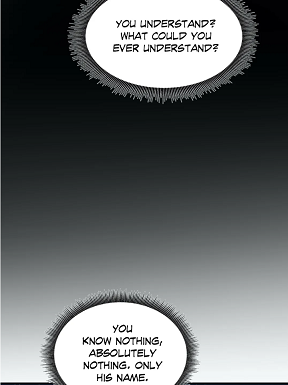 (chapter 59), he has the impression, he knows Yoon Seungho’s true past. He projected his own past onto his childhood friend’s. Yet, their suffering was different: father Lee neglected his son, while father Yoon was an abusive father. Besides, though he must have heard what father Yoon used his son as prostitute in order to save his own skin, Jihwa came to the conclusion that he knew the past and as such the truth.
But he is unaware of the true events occurring in the mansion and in the capital, for he was separated from his friend. He had to rely on others to know what was happening. Remember that in the first season, Jihwa got manipulated by Min in chapter 36… Since history repeats itself, it signifies that the man with black eyes got deceived by someone who fed him with false info, a repetition of this scene.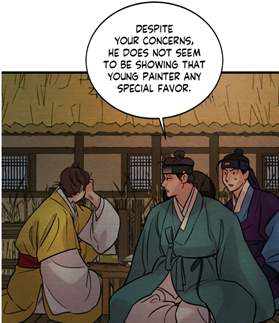 I suspect that lord Song is the origin of this misinformation and manipulation, because this would explain why Jihwa is so sure about his intelligence. He thought, he got his insight from the original and sure source. But let’s return our attention to the chapters 56 and 57. At the inn, Jihwa got chastised and battered for using his knowledge.
  (chapter 56)
 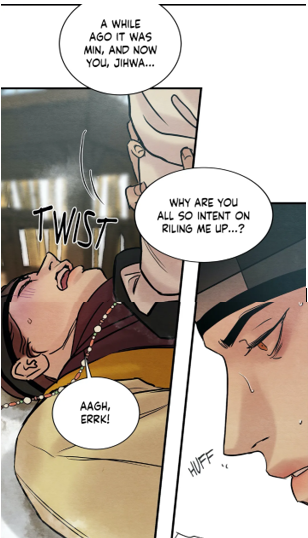 (chapter 57). What caught my attention is that although the noble described the friend’s action as a prank
 , the main lead was definitely so hurt that he had to hide his gaze from Kim the moment he received the letter.
  This exposes how vulnerable and wounded Yoon Seungho was, but how misinformed Jihwa was in the end. That’s why the protagonist can only reproach his former friend that he understands nothing, because his “knowledge” has been transmitted by someone else, exactly like in the Greek story: Prometheus gave fire to humans. As a conclusion, each time someone reveals a secret related to the past, this person will get sentenced sooner or later, like the new added illustration proves it.
In the essay “Painting and desires – part 1”, I had exposed that the tailor was another Pandora who will suffer some consequences. He knew that Baek Na-Kyum was the author of the erotic publications and revealed it in front of Heena noona. But this list of Pandoras doesn’t end here. There’s no doubt that Kim will resent him for the scandal, as his reputation and tranquility were ruined by the shopkeeper’s revelation. It is definitely possible that Kim is the one who retaliates, as he was present at the tailor shop.
 That way, he could “tarnish” the painter’s innocence in his master’s eyes, as the former represents a real source of uproar and ruckus in his life. Therefore I predict, Kim will change his mind about Baek Na-Kyum and decide to get rid of him: he caused him too much trouble. And my prediction came true: the butler tried to send away the artist through his noona, and he got punished for his action. The lord caught him usurping his position so that the valet ended up losing his master’s trust. Kim used his knowledge from the night of revelations. (chapter 64) He believed to have seen sexual abuse, while in the shed the noble confessed his love and hope one more time.
Thanks to my reader Luzy, I can complete the list: the doctor, whom I had forgotten in the first part. Striking is that we have the apparition of a real Pandora’ box in chapter 57: Yes, the drug the main lead has been fed since his teens. Exactly like in the Greek story, the box is associated to disease, as the medicine is responsible for the protagonist’s illness, his hot temper.
Imagine the irony, when the doctor shows the box, he adds this: 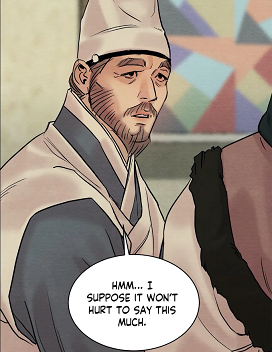 As you can imagine, the opposite happened, exactly like I had foreseen. Observe that the moment he revealed his knowledge
 (chapter 65), the butler punished him by threatening him, making him believe that he would get killed, if the lord were to discover the truth. As you can see, he opened the pandora box in front of the valet and the latter chose to retaliate. That’s why I come to the conclusion that the physician will play a huge role in the future again. I think that contrary to the butler’s behavior, the noble will have a different reaction, when he discovers the truth. Besides, since he knows about his past, the physician will open the pandora box again. That way, the noble could hear about his past and the existence of the drug so that he has a different perception about valet Kim. There’s no doubt that the physician represents a pandora box for the butler. During the second season, he could still control him, yet he is still unaware of the revelations he confided to the painter.
Little by little, the truth will be unveiled, especially if the manhwaphiles recall my interpretation: Yoon Seungho symbolizes Truth. Hence I am expecting that after the next incident in season 3, Yoon Seungho will decide to investigate the whole incident. He will recognize that truth and the discovery of the culprit’s identity are not the same. My theory is that Yoon Seungho will remember the first abduction. Only two persons claimed that they didn’t believe in the painter’s escape. From my point of view, Yoon Seungho will envisage that there was an accomplice. That’s why I sense that Kim and the physician’s testimonies will be examined. Since both were present that night, the aristocrat can only suspect them. And since the physician revealed his secret to Kim, the latter will choose to use this secret in order to save his own skin. Yoon Seungho will be infuriated, because the doctor with his silence and cowardice covered up a crime. From my point of view, it is possible that in that moment Baek Na-Kyum decides to save the physician’s life by mentioning the lord’s illness. He took care of Yoon Seungho for so many years and is responsible for his treatment since his youth and that he has been given him the medicine he needed. Remember that the painter is associated to purity and forgiveness, and since now the main lead considers the painter as his lord, he will listen to his words and show mercy. At the same time, his words will make Yoon Seungho realize that he has been drugged for a long time by Kim.
Imagine the irony is that the moment Kim decides to use the “secret” about the physician’s testimony  , it backfires because of the painter. The latter brings up the topic about the lord’s illness in his youth and the medicine he has been receiving all this time. Since the doctor showed a real concern for the main lead’s health and correct diagnosis, Baek Na-Kyum has no idea about the new revelation. Yoon Seungho is well aware that his father betrayed him and is responsible for his suffering, the main lead can only get upset, once he hears that Kim kept feeding him such a medicine. In that moment, Kim could plead his ignorance: He had no idea about the real affect of the drug. At the same time, we shouldn’t forget that in chapter 33, Kim asked for an aphrodisiac without the lord’s authorization, which the physician noticed, because Kim only asked after the noble’s departure. Note that in that chapter, the physician gave the prescription in front of Yoon Seungho, and the latter only left, after he had heard the treatment.
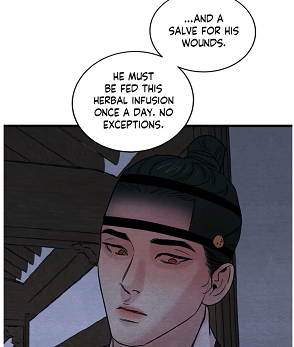 From my point of view, the incident in the first season will resurface, as it will be linked to the lord’s own medicine. It is possible that Kim and the physician tries to put the blame on each other. However, I believe that Baek Na-Kyum’s testimony will play a major role. The manhwaphiles should recollect that Baek Na-Kyum voiced his rejection of the infusion in front of the head-maid. He even described the effects of the medicine which also surprised the woman.
  As a conclusion, I believe, the head-maid will be the reason why Kim loses his master’s trust entirely. The medicine, the advice he gave to the physician and the fact that he kept giving a drug ordered by father Yoon, although he knew how the aristocrat treated him… there’s no doubt that Kim will lose his position as butler.
And if you pay attention the maid’s behavior, you’ll observe the increasing involvement in the lord’s life. In chapter 17, she asked for Kim’s advice. From my perspective, her attitude changed, the moment she got reprimanded in chapter 38. Notice that right after that incident, Jihwa’s servant explained to his master that now the staff from the Yoon’s mansion would no longer leak anything. This is important, as he it shows her influence over the staff. She was also present, when Kim scolded Deok-Jae, but she said nothing. In my opinion, she was still relying on his authority and trusted him. Let’s not forget that Yoon Seungho started relying more on the maid, as the latter was given the order personally to bring the artist’s food to the low-born. 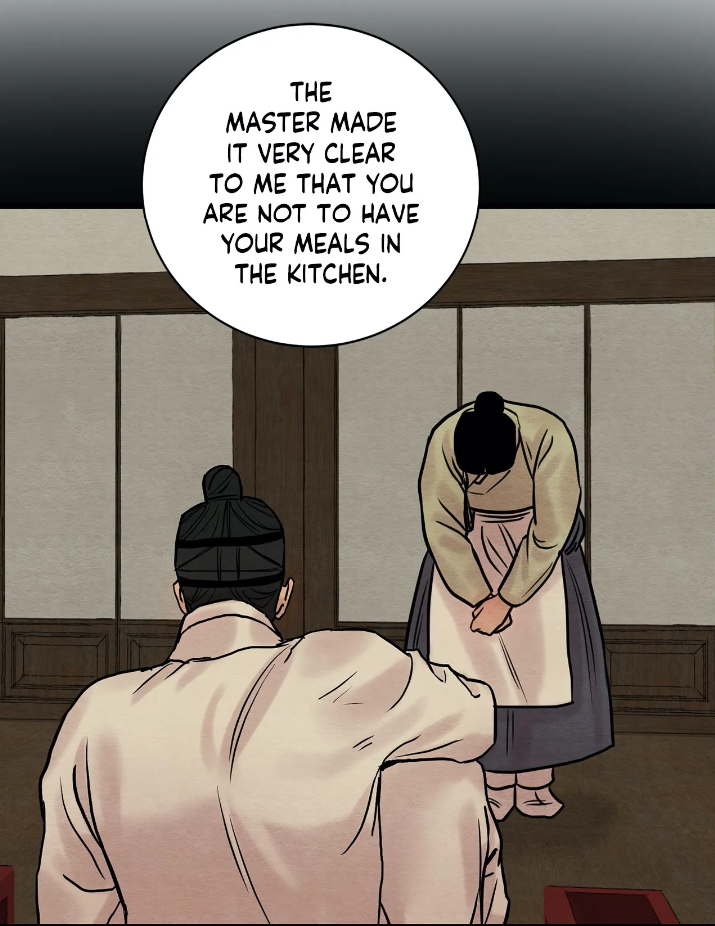 The closer the painter gets to Yoon Seungho, the closer the maid got to her master. In fact, she served as a bridge and mediator. First, she confessed to the artist that the lord cared for him, and her words did leave a deep impression on Baek Na-Kyum, because the latter remembered her words after their second love night. Third, when the noble returned to his bad habits, she didn’t scold the artist like Kim, she implied that the commoner had such a good influence on the lord.
 The readers can sense that the two servants had a different approach. While she was encouraging the painter in a positive way, Kim chose to put the whole blame on the artist. The most surprising that she changed so much, when we all remember her words in chapter 33:
  Furthermore, after the new episode, it becomes more obvious that the head-maid will play a major role. She caught Kim allowing Heena to enter the mansion and questioned his action
 , while in chapter 17, she just asked for his advice. For me, there’s no doubt that her testimony will be used against the valet and the main lead will lose his faith in the butler’s loyalty. But if the latter loses his master’s trust, the servant won’t be able to live in peace. He will have now more reason to fear his lord. As you can detect, I am expecting that all the incidents in the past (rape, the aphrodisiac given to Yoon Seungho and Baek Na-Kyum) will be revealed.
From my point of view, the head-maid started caring more and more for Baek Na-Kyum and the lord, the moment she saw that the master’s actions towards the commoner were influenced by a genuine affection and were not the result of a whim. He used his position to protect him in front of his staff, then he gave him nice clothes and asked her to treat him like an important guest despite his social status. And if the manhwaphiles pay attention to her action, you’ll notice that her colleague stood at the door of the lord’s bedchamber in chapter 66, hence the latter must have reported to her about the incident. Moreover, she had even planned to visit the artist, when she caught Kim. Note that she has a towel or cover showing that she is concerned for the artist. Although she was upset, because she thought that the artist had lied to her, she changed her mind, when she heard how the lord carried the artist from the bedchamber. Her friend must have told about the artist’s poor condition and his heavy breathing. From my point of view, the head-maid will be get closer to Baek Na-Kyum after this incident. While I imagined, Heena would serve as a bridge between the protagonists, I have come to a different conclusion. She will become their surrogate mother and help them to differentiate true care from fake kindness. The last incident taught her a lesson: never judge too quickly. Slowly, she will replace the valet. She had already started with this function, but I believe that she will become more proactive.
As for Kim, his true personality is getting more palpable. There’s an ambiguity that this scene in chapter 67 exposes the butler as a liar, because he said to Heena noona that he was acting behind his lord’s back, while he said the exact opposite to the head-maid. What is the truth here? From my point of view, Kim never asked his master, but acted on his own, because he saw in Heena noona as a source of trouble. She had put him in a terrible situation before: the master had noticed that the butler had done his job very badly.  . Hence Kim thought that if he let her see the artist, she would stop causing a ruckus. At the same time, note that in that scene, Kim is portraying his lord in a negative way, while he appears as a kind man.
 There’s a reason for that, he is seeking for her cooperation so that she doesn’t keep yelling at the front of the mansion
  and gather more attention from spectators. For the butler, she represents a new burden. But since Kim never witnessed the conversation between the maid and the painter (chapter 36 and 46), he has no idea that something happened behind his back, since peace only matters for him. As a conclusion, I am expecting that all the lies and tricks Kim used in the first and second season will be revealed the moment he opens Pandora’s box, when he confesses that the physician was a witness and didn’t help the artist. For me, one thing is certain now: Yoon Seungho’s rebirth is related to the valet.
The moment he distances himself from him, he will be able to shine. While the chapter 67 confirmed my negative perception about Kim, my interpretation about Yoon Seungho was reinforced with the final episode from the second season. The protagonist could shine like phoenix.  He was a gentle but strong hero, willing to protect and console his lover, when the latter feared for his life. At no moment, the main lead cared for his reputation and people’s gaze. Baek Na-Kyum’s well-being was what mattered the most to him. the irony is that his actions never caused an uproar. As you can see, Kim is in truth Yoon Seungho’s closest enemy, and it is only a question of time, until the protagonist realizes his butler’s first real betrayal, like Baek Na-Kyum experienced it in chapter 29:
 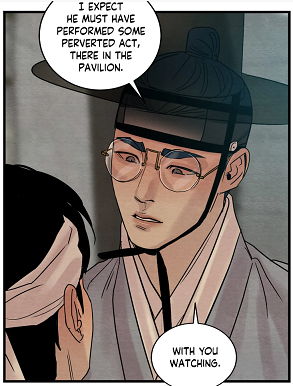 He has already discovered his disobedience, yet he will get shocked when he discovers all the lies Kim told him. At some point, he will recognize that Kim has always been a traitor. The pandora box will be used against the valet, the same tool he used to fool people.
Before ending this essay, I would like to deliver my last thoughts about the different Pandoras. First, it looks like the roles are switched. While in the bible and in the story about Pandora, women were blamed for Fall of Man or the opening of the box, we have the exact opposite in Painter Of The Painter. Yet, this is only partially correct, because the head-maid also opened Pandora’s box in chapter 38, as she revealed the artist’s true situation at the mansion: he looked like a servant. In truth, Byeonduck made sure that all the characters have flaws and made mistakes, nevertheless the women (the head-maid, Heena) and the ukes are able to learn from their mistakes and change their behavior, while it looks like the others show no improvement. For me, there’s no ambiguity that Jihwa will change his behavior, yet he will need for that to reach the bottom. This means, the moment he gets punished and loses everything, he will realize the true nature of evil.
The lessons from this manhwa are: NEVER judge people too quickly. Secondly, NEVER judge people on first impressions. Finally, a judgement about a person should NEVER be definitive. It needs to be constantly reviewed, as people change.
Feel free to comment. If you have any suggestion for topics or manhwas, feel free to ask. If you enjoyed reading it, retweet it or push the button like. My reddit- Instagram-tumblr-twitter account is: @bebebisous33. Thanks for reading and the support.

This is where you can read the manhwa. https://www.lezhin.com/en/comic/painter But be aware that this manhwa is a mature Yaoi, which means, it is about homosexuality with explicit scenes.
Just like with the first special episode, the new chapter from Alternative Universe helps us to get new insight about the original story. Not only we discover the character’s true thoughts and emotions, but also Byeonduck gives us tips so that the readers can reconstruct the protagonists’ past in the original story. Nevertheless, it is only possible, if one pays attention to details. Hence I came to the following theory: Byeonduck will never reveal the whole past as a narration, but will unveil it as a puzzle and the manhwalovers need to put the pieces together. Exactly like in real life… we can never get the truth, because people involved in the past don’t possess all the information. Finally the witnesses’ memories are also influenced by their own thoughts, experiences and emotions so that the former don’t reflect reality. And now it is time to reveal the pieces I observed in the special episode.
In the Alternative Universe, Baek Na-Kyum belongs to the influential aristocracy and is the only son in his family, which means that his father must have high expectations for him. His duty is supposed to continue the family’s legacy, as he is the only heir. Moreover, he paints erotic pictures of sodomy in order to buy glasses for his surrogate father, the servant Jung In-Hun.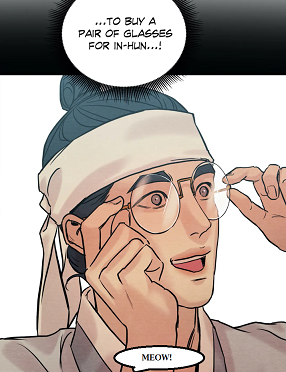 And here, the readers should wonder why he feels the need to earn the money for the glasses. Technically, he could just go to the merchant and buy these with his family’s money. My answer is that it is related to social norms and the huge social gap between the domestic and the young master. I believe, Baek Na-Kyum’s family is rather traditional and as such makes a huge distinction between nobles and low-borns. This traditional mind-set is perceptible, when the shopkeeper threatens the artist. From my point of view, his father will never allow a noble to offer such an expensive present to a servant. That’s why the innocent man started painting. But does the personal domestic know about his master’s secret activities and true goal? Yes, he is aware of Baek Na-Kyum’s actions and intention, which is detectable in the following picture:
  Note that the noble gave him the order to wait at the door of the merchant’s shop, but the servant preferred disobeying him. This picture is relevant for two reasons. First, it outlines the true nature of the relationship between the lord and his servant. Jung In-hun can afford to disregard Baek Na-Kyum, as the latter doesn’t punish him at all. On the one hand, the young master underlines that his order was not respected, on the other hand nothing happens afterwards. This truly indicates that the domestic has the upper hand here. Secondly, he didn’t obey Baek Na-Kyum’s request, as he didn’t want to hear or to be seen with his master selling his last work. Note that, when the master leaves the shop, the trader speaks so loudly that the master can hear his explanations:
 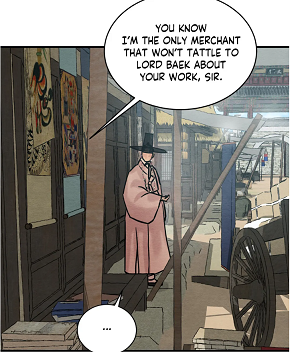 And now imagine Jung In-Hun waiting at the door for the return of his master. If he had stood there as requested, he would have heard the merchant’s comment and would have become an accomplice. As a conclusion, we can definitely say that the domestic acts, as if he didn’t know about Baek Na-Kyum’s activities. He is applying Kim’s philosophy from the original story:
 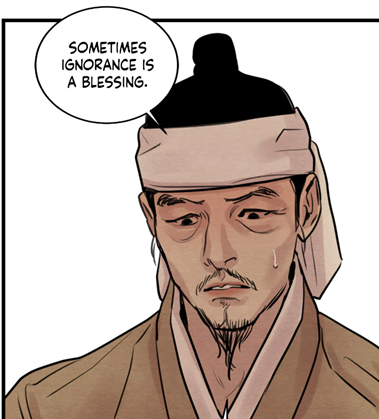 However, let’s not forget that the servant has a real reason for his silence and his faked ignorance. He will get glasses, which he truly desires, therefore he can’t tattle this to lord Baek. On the surface, Jung In-Hun hates sodomy, nonetheless he benefits from it through the master’s paintings, exactly like in the original story. As you can imagine, I saw a new evidence for my theory that Kim is actually Yoon Seungho’s enemy, the surrogate father who betrayed and abandoned the aristocrat due to his selfishness. First, the servant has a similar mentality: silence and ignorance. Besides, observe that in the second special chapter, the domestic plays the role of the “adoptive” father, the one who is caring and giving some comfort. This clearly indicates that the scholar was never the painter’s true love, but the latter was more suffering from an oedipal complex:
“The Oedipal complex, also known as the Oedipus complex, is a term used by Sigmund Freud in his theory of psychosexual stages of development to describe a child’s feelings of desire for his or her opposite-sex parent and jealousy and anger toward his or her same-sex parent.” quoted from https://www.verywellmind.com/what-is-an-oedipal-complex-2795403#:~:text=The%20Oedipal%20complex%2C%20also%20known,or%20her%20same%2Dsex%20parent.
Since the artist is a homosexual, then he won’t be attracted to his mother, rather to the “father”. Striking is that in the last image, the domestic gives his master an advice, although Baek Na-Kyum never asked for this. This displays that Jung In-Hun is well aware of the young man’s affection and employs it to his advantage. For me, these two episodes not only explain how the relationship between the low-born and the teacher worked in the original story and as such in the past, but also seems to unveil Yoon Seungho’s bond to his butler Kim. And there’s another reason why I suspect the valet in the original story has a similar function than the scholar. Only recently, I realized that Kim’s first appearance coincides with Jung In-Hun’s arrival at the mansion. (chapter 7) Besides, it is Kim who takes care of the former teacher too, by bringing him to his room. As you can detect, the servant Jung In-Hun reinforced my negative perception about the “loyal and caring” butler.
But let’s return our attention to the circumstances of the selling of paintings in the special episodes. Baek Na-Kyum is not doing it in order to survive, but to make his domestic happy. But the problem is that he is not earning a lot of money. The reasons are quite simple: the lord can only sell it in secret and the merchant uses the master’s precarious situation (his high social status) in order to buy the creations for a cheap price. He gives false excuses , while in reality his works are so appreciated that he has already made a name himself. Striking is that the merchant contradicts himself exposing his greed and hypocrisy, because first he compliments the artist: 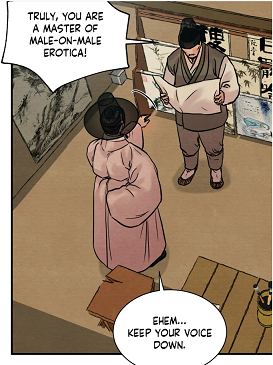 before criticizing his last work so that the main lead ends up with just 3 coins! And the trader reminds the painter that he can’t complain, as he can’t reveal this to his father. So we have a greedy merchant, who takes advantage of the artist due to his social status. On the other hand, Baek Na-Kyum has no other solution to accept his fate. In the second episode, Yoon Seungho reveals once again the artist’s popularity.
 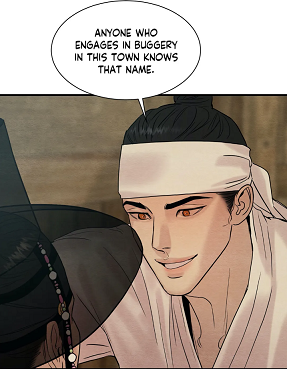 And this situation with the painting made me think about the original story. How did the selling occur? Since the Alternative Universe is similar to the original, although the social status of the characters have been switched, we have to imagine that Baek Na-Kyum must have made a similar experience. As a low-born, the shopkeeper could use the lower social status to buy his paintings for a cheap price. I have to admit that when the first special episode appeared, I wondered if the glasses were not financed by the artist too. However, I rejected the idea, because when he left the brothel, the low noble already possessed glasses.
  (chapter 46) But the chapter 64 finally gave me the answer: the snake in the original story who took advantage of Baek Na-Kyum’s low social status is the tailor. This picture is relevant because it shows that the tailor knew the painter’s identity right from the start. Let’s not forget that Yoon Seungho never showed any picture to outsiders. The merchant sold the publications behind the curtains and gave the info to Yoon Seungho’s servant, when the latter questioned the identity of the real painter.
 And now, you understand why Min knew about the incident at the tailor’s shop. Min is also a client who bought Baek Na-Kyum’s publications.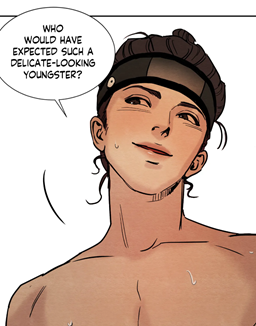
 (chapter 8). And now, it is important to revisit the chapter 39 and the romantic date:
 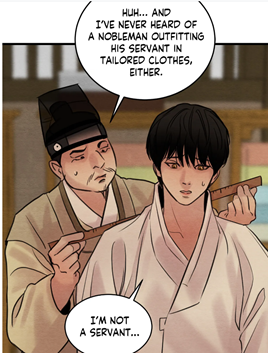 What caught my attention are the drops of sweat on both characters. Back then, I thought, like many readers, that the origin of the discomfort was related to the unusual order: the tailor was supposed to make expensive clothes for a low-born. However, since we know that the tailor recognized Baek Na-Kyum as the painter working under a pseudonym, I believe that they were awkward for a different reason. They had to act, as if they didn’t know each other. This explains why the drop of sweat appears on both faces, when they are facing each other while looking at Kim. That’s why the merchant had to call the commoner a servant, he couldn’t call him a painter. Notice that in that scene, the painter never says, he is a painter, although he could have mentioned it. No one is supposed to know the nature of his paintings, so Baek Na-Kyum had no reason to feel embarrassed, unless the merchant knew the content of his pictures and Baek Na-Kyum was well aware of that. And if you pay attention to the exchange between Kim and the merchant, you’ll notice how he tries to catch some info by questioning the true nature of the relationship between Yoon Seungho and Baek Na-Kyum.
 In my opinion, there’s more than curiosity. He needs to know his relationship with the lord Yoon Seungho, in case the artist decides to sell again his paintings. He could no longer act like before, buy paintings for a cheap price. That’s why he needed to get more insight. And now, with the artist’s disappearance creating chaos among the town folks, the tailor revealed his knowledge and in reality his secret.
 He saw no reason to hide it any longer. First, he was mad, because people would mock him. Secondly, since the painter hadn’t created any new publication, as he was taken care by the master, he could mention the low-born’s real job: a buggering painter! He had the impression that he had nothing to worry. Striking is that he mentions it in front of the sister And I am quite sure that you remember what I wrote: people with knowledge and secrets will get punished. In my opinion, Heena and Yoon Seungho will expose the merchant’s hypocrisy and greed, who benefited from Baek Na-Kyum’s talent.
And now, you are wondering about the scholar? How does he fit in this story? Due to the special episodes, I deduced that the painter used to sell his paintings to the merchant, because he wanted to buy glasses for his teacher Jung In-Hun. First, in the following picture , the manhwalovers can observe the absence of the gaze and eyes, indicating that his eyes and glasses played a huge role in the past. And now, if the readers look again at Yoon Seungho’s face during the Wedding night, they will notice the barely visible presence of glasses, the symbol for the teacher.
  And if Baek Na-Kyum did pay for the low noble’s glasses, then it is comprehensible why they mean so much to the low-born. The teacher could have voiced, he needed glasses. I can even imagine that he justified his actual situation, he is just a simple teacher due to the absence of glasses. In other words, he couldn’t do well at the exam, because he couldn’t afford the glasses. His true desire was to use the painter’s innocence and gentleness to obtain a favor without doing anything: just smile and compliment. And Baek Na-Kyum had to wait for a long time before being able to buy the present. The scholar was well aware how Baek Na-Kyum achieved his goal by selling erotic pictures, but the teacher feigned ignorance. However, the sister realized that the shopkeeper and publisher had abused the painter due to his humble origins, therefore Heena imagined that if the teacher was to take care of Baek Na-Kyum, the former would help him to get better paid. However, what happened was that the scholar realized that despite his popularity, Baek Na-Kyum wouldn’t earn that much, unless the former had to intervene. For him, it was unbearable to be linked to homosexuality. Therefore he could only see the artist as a burden. That’s why he decided to cut ties with the artist by no longer feigning ignorance. On the surface, he discovered the erotic painting and coerced the artist, until the latter vowed to never paint anything. It is also possible that Jung In-Hun tried to use the artist’s popularity in order to sell his own book, but was rejected. Anyway, there’s no doubt that the scholar in the past took advantage of Baek Na-Kyum, until he had the impression that the painter had become a burden and he refused to be responsible for him. Let’s not forget that history is repeating itself in Painter Of The Night. And now, you can understand that I am expecting another scandal: the tailor’s enrichment through the publications .
  There’s no doubt that we will hear this sentence in the original story. However, I have the feeling that Heena will play a major role in this, as the shopkeeper revealed it in front of her. At the same time, this incident will lead to the scholar’s involvement as well. Why did the artist stop painting for a while? Why did Baek Na-Kyum become drunk? Why did he abandon the painter twice after receiving the glasses?
As you can see, I perceive the merchant as a hypocrite, who took advantage of the painter’s innocence and social status. This became truly visible thanks to the new episode. And it becomes understandable why he resents Kim in the end. He remained quiet, but he didn’t get any benefit. That’s why he revealed his knowledge. He imagined that with the new revelation, he would no longer be looked down. He didn’t realize that he just opened Pandora’s box.
[In the second part, I will focus more on the two protagonists.]
Feel free to comment. If you have any suggestion for topics or manhwas, feel free to ask. If you enjoyed reading it, retweet it or push the button like. My tumblr-twitter account is: @bebebisous33. Thanks for reading and the support.

This is where you can read the manhwa. https://www.lezhin.com/en/comic/painter But be aware that this manhwa is a mature Yaoi, which means, it is about homosexuality with explicit scenes.
Now, you are wondering how this story from Greek mythology is connected to the manhwa. [I am posting links for people who are not familiar with this story https://www.youtube.com/watch?v=rNk-zV2T7bI https://www.thoughtco.com/what-was-pandoras-box-118577] While examining Min, I recognized his ultimate weapons, knowledge and as such secrets, and these elements play a huge part in Pandora’s box.
Prometheus brought humans fire, a sign for knowledge, and Zeus decided to punish Prometheus and humankind, by creating Pandora, the first woman. The latter had flaws hidden behind her beautiful face and gentle manners, curiosity was one of them. In other words, she was a poisonous gift, but Epimetheus, Prometheus’ brother, didn’t realize it. When Pandora was entrusted with the box, her curiosity couldn’t help her from opening the lid of the box, that’s how diseases and catastrophes appeared on Earth bringing misery to humankind. Pandora desired to know the content of the box, it means, she wished to discover the secrets of that box. As you can observe, in this story knowledge is associated to punishment. Humankind should be punished, because they had fire brought by Prometheus. At the same time, when the box was opened, the secrets in form of diseases and other misfortunes were revealed, bringing misery to people. And strangely, Epimetheus discovered in the box the last secret: a butterfly embodying hope. With hope, life on Earth was still bearable. Hope was the solution to the released secrets. And in Painter of The Night, the painter is represented by the butterfly  (special episode 1), like I had pointed out in a former essay. Since I have determined that Baek Na-Kyum is the butterfly in that story, symbolizing truth and hope, the question is now: what is the box in Painter Of The Night? For me, the box represents the past with all his secrets linked to pain and traumas. And the opening of the lid leads to suffering and tragedy, yet despite the agony, the figures will be able to move on and have hope. The painter will serve as a tool to unveil the truth signifying that all the secrets and as such the past will be revealed. And now there’s only one question left. Who is Pandora in this story? Which person opens the box full of secrets bringing misery but hope to the characters in this story?
I am quite sure that the manhwalovers have already found an answer: Min, since the latter uses knowledge and secrets as his tool in order to achieve his goals. Let me you give an illustration. In chapter 36, 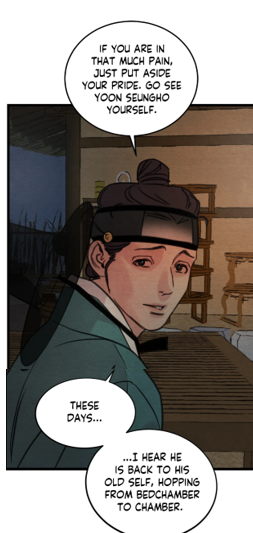 Black Heart actually lies to the second character by giving a false information, yet he gives the impression that his intelligence is real and concrete. If you pay attention to his expressions (“I hear”, “He doesn’t seem”), you’ll notice that his tip is uncertain and unreliable. In fact, he reveals that he is utilizing rumors. Why doesn’t the red-haired aristocrat recognize the manipulation? It’s because Min is well aware of the character’s personality. Min knew that Jihwa would always believe the gossips. The manhwaphiles should remember how Jihwa often mentions hearsays: chapter 13
  and chapter 18 . Jihwa is always listening to the hearsay. In the last case, he tried to influence Yoon Seungho with such gossips. That’s why the red-haired aristocrat could only fall into Black Heart’s trap. The latter knew not only Jihwa’s love for his childhood friend, but also the influence of rumors on him. Min knew that Jihwa would always get his intel through others, because he would avoid to be confronted with reality and as such facts. Besides, Min perceived that the noble was very sensitive to Yoon Seungho’s sex life, hence he used the idiom “hopping from bedchamber to chamber”. It is important to remind the readers of Jihwa’s confession
  Min was definitely aware of Jihwa’s weaknesses: his love for his childhood friend, the importance of hearsay on him and the resent for this image “Yoon Seungho is fooling around with men”.
  Note that his friend with the mole caught the lie. Observe that the latter is sweating and looking at Min with such a serious face. Nevertheless, he doesn’t try to contradict Min. He remains silent here and looks at Jihwa’s reaction. Since the latter claims that he will never visit Yoon Seungho, the noble with the mole believes that the lie will have no consequence. This scene is important for two reasons. First, although the noble with the mole is a confident of Jihwa, the former doesn’t have a good understanding of his friend. In reality, he doesn’t truly know Jihwa’s weaknesses. This was visible in chapter 9, when he visited him and told him about the humiliation. The noble with the mole was not aware that Jihwa would be irritated and wounded, when the latter would hear that the former had planned to participate in a sex session with Yoon Seungho. That’s how perceptive Min is. He detected all the red-haired noble’s secrets. Striking is that in that particular scene, while Min employed his knowledge to trick the drunk noble, he discovered the existence of a secret, which was triggered by the noble with the purple robe.
  Why? It’s because “You know” is standing in opposition to “dream”. Knowledge is a synonym for facts and reality. Therefore, Jihwa finally confesses that he knows a secret about the main lead.
 In that moment, Min is able to catch the existence of the main lead’s weakness. The latter must have been deeply wounded in the past. It doesn’t matter how… the fact that Yoon Seungho has a wound is enough for Min. Through the red-haired noble’s revelation, Min realizes that Yoon Seungho is acting like a cold-headed person, while in reality he is hot-tempered due to his wounds. Min could make the connection to the incident with the top-knot. That’s how he recognized that Jihwa would use his knowledge of the past and would hurt his childhood friend due to his love for him. As you can sense, Jihwa left clues here and there to Min so that the latter could gather all the information about his rival and use his knowledge to defeat his rival. That’s how innocent and naive Jihwa was. While he thought, he was keeping everything a secret, since he was always allusive, he never recognized that he was doing the opposite. As you can see, Jihwa was the one who delivered the box to Min, and Min opened it therefore he brought pain to the protagonists, yet at the same time, he created an opportunity for them as well. The main leads were forced to face reality and reveal their true thoughts and emotions.
And now, you understand why Min used the same method to wound Yoon Seungho in chapter 52/53/54. He ridiculed the protagonist because the latter was treating the low-born like a precious treasure. The snake had detected that the lord was protecting his pride in reality despite the bad reputation: “common brute” (chapter 59) or in Min’s case:
  He humiliated him for the second time by revealing that he was in love with a commoner. As you can see, Min could perceive Yoon Seungho’s vulnerabilities and used the secrets in order to wound his rival and the object of his obsession. By opening the box, he made the protagonists suffer. However, the manhwalovers shouldn’t forget that Pandora in the story gets hurt as well, signifying that Min will get hurt by these secrets too.
What caught my attention is that in chapter 43, Black Heart used his knowledge about Jihwa’s love for Yoon Seungho in order to manipulate the childhood friend. He described the painter, Jihwa’s rival, as a manipulative witch  and charlatan who was putting the main lead in danger, creating the illusion, if Jihwa intervened, he would do something honorable. He reversed the situation by describing Baek Na-Kyum as bad as possible. He knew exactly how to trigger the red-haired noble’s jealousy, simultaneously making him believe that he was representing righteousness. Yet, like I mentioned it in the essay “The Joker – part 3”, in this scene, Min was actually revealing his own thoughts and emotions. He was envious of Yoon Seungho and couldn’t bear the thought that the painter would become the protagonist’s mistress, because this signified that he could never taste the commoner. Yet during that night, no one recognized this.
Then in chapter 56, in front of Jihwa, Black Heart voiced his wish to taste the painter, exposing his interest for the low-born.  And since Min only talked to the red-haired noble, this means that this information became a secret.
  In this panel, Jihwa questions Min’s reliability which indicates that he is now questioning the character’s personality, a first sign of critical thinking. In my opinion, soon the position will be switched. Jihwa will be in possession of a secret, Black Heart’s real motivation for targeting Yoon Seungho. From my point of view, Min’s weapons (knowledge and secrets) will be employed against him.
I consider the chapter 66 as the turning point for Min. The latter is not aware that he is jeopardizing his position, too sure about his superiority and his knowledge. Let’s not forget that Min made a terrible mistake in chapter 66.  He revealed the childhood friend’s involvement in the painter’s disappearance thinking that Yoon Seungho would act like in the past: become a monster and vent his anger against Jihwa. But what he didn’t know and anticipate is that Yoon Seungho would hurt the painter first. With this new revelation, Yoon Seungho realized his true sins. He had misjudged the painter, had allowed his rage to blind him to the point that he had hurt an innocent. He was responsible for the commoner’s trauma. Therefore he couldn’t blame Jihwa for the disappearance right away, the main lead had to face his own culpability. When Black Heart mentions Jihwa’s participation, he is expecting an immediate reaction from his counterpart: Jihwa will become the target of Yoon seungho’s anger and fury. Yet, what Min fails to realize is that by revealing Jihwa’s involvement, he exposes his complicity. He knew that the childhood friend had planned something and remained silent. And since I pointed out that Yoon Seungho suffered in the past because of the silence of a witness, I believe, the lord will remember this and decide to retaliate against all the people who knew about the incident and stayed quiet. Furthermore, I think, the main lead must have learned his lesson with the last incident: never judge someone based on impressions and beliefs. From my point of view, Yoon Seungho will investigate the matter, just like he did an investigation on the painter and Jung In-Hun during the first season. Besides, I would like to remind that when the murder was suggested, it took place at Min’s friend, so the circumstances make it look like there was a plot.
As a conclusion, chapter 66 displays Min’s miscalculations. He thought, he knew Yoon Seungho well, while he didn’t. Why? It is related to Jihwa’s knowledge. The latter keeps saying that he knows the protagonist, whereas it is not correct, as he doesn’t understand what the main lead went through. 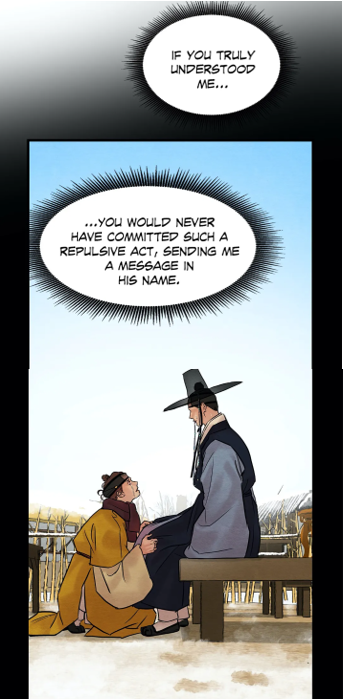 Secondly, Black Heart made the mistake to believe that he could understand the main lead’s personality by just observations.
  And what did he see?
Black Heart saw Yoon Seungho’s protective attitude towards the commoner. First, he would refuse to share him (chapter 33), then the protagonist would humiliate him in order to protect the painter’s identity (chapter 41). Min imagined that Baek Na-Kyum was treated like a treasure, especially due to the incident at the tailor’s shop. In the second season, the main lead had even kissed him in order to protect the low-born  , then he had defended him against a vicious servant.
 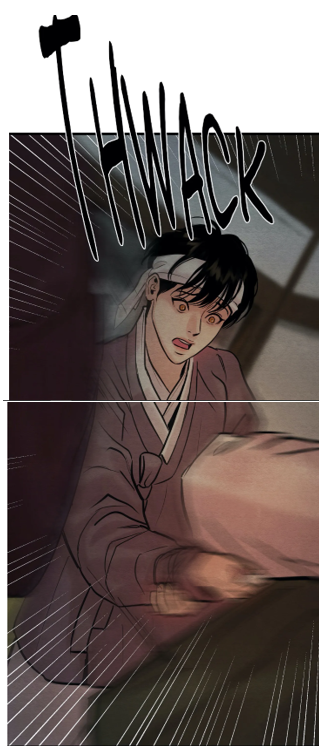 One might argue that the noble had brought him to the sex session, yet since the host stopped the rape before and even evicted his guests in a rough manner, for Min, it was a real sign that Yoon Seungho was very caring. However, this is not reality, as Yoon Seungho mistreated the painter. Strangely, the painter never saw his true caring side, because he was always asleep (chapter 33, 34, 45, 50) or he was blind and deaf due to his own agony. Their relationship was far more complex. Finally, since Min’s knowledge was based on his observations, he could only view what Yoon Seungho allowed him to see: Black Heart is not aware of the main lead’s insecurities and self-hatred or his illness. Not even Jihwa knows about the existence of his illness which was supposed to have appeared in his teens. This explicates that Min’s information was not correct and he was fated to make mistakes. Besides, he doesn’t care for commoners and servants so Min is not paying attention to changes among Yoon Seungho’s staff. His understanding is quite superficial. The other mistake is that he is not aware of the last events at the mansion: Deok-Jae’s disappearance and his involvement in a poisoning incident. Furthermore, he has no idea about Yoon Seungho’s true power and connections, although his friend warned him
 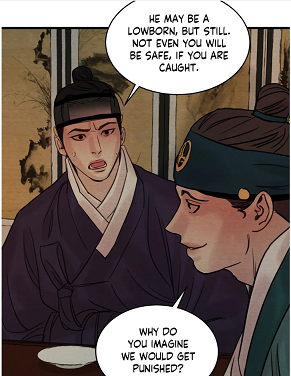 . There’s no doubt that Min’s judgement about Yoon Seungho is also influenced by his reputation as a hell-raiser. That’s the reason why Min came to the conclusion that the protagonist was exactly like him. For Black Heart, the main character was seeking pleasure and fun by causing commotions and violating social norms, whereas the cause for main lead’s behavior is different: he has been brainwashed and traumatized. more complex. And you comprehend why I believe, Min will get hurt in the end. “His knowledge” will be the source for his misery and his punishment. And it will backfire on him. Besides, I suspect that Min won’t learn from his mistake and will make another mistake … he will still believe that he just needs to find a secret in order to have the upper hand. I have the feeling that Min will investigate why Yoon Seungho decided to sponsor the scholar Jung In-Hun, since the latter was mentioned in connection with the envious man.
 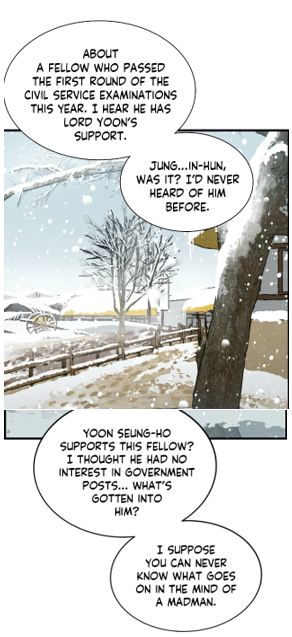 (chapter 52). Consequently he will discover the true reason behind the sponsor: Baek Na-Kyum has always admired the teacher. There’s another reason why the scholar’s path will cross Black Heart’s: their preference for investigation and secrecy. Don’t forget that the teacher tried to find some secrets in order to find a weakness in his sponsor and blackmail him (chapter 29).
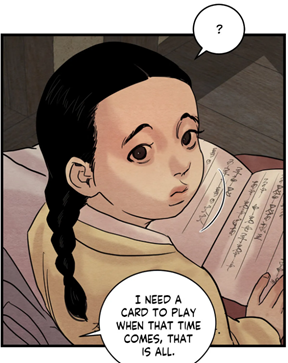 That’s why I envision that with the scholar’s return, we will witness how the teacher tries to use his knowledge in order to gain something, especially if the wealthy aristocrat abandons him, the moment Baek Na-Kyum refuses to help his former teacher. There’s no doubt that Jung In-Hun will use secrets in order to manipulate Min, when the latter approaches him. In my opinion, the scholar could use the incident at the pavilion (the rape)
 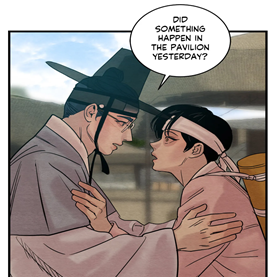 , when he notices that Min has the same “obsession” than Yoon Seungho. For me, there was never an ambiguity that the teacher witnessed the rape but chose not to intervene. He used his “knowledge” by acting ignorant, applying the butler’s philosophy: That way, he didn’t need to take the responsibility for the wrongdoing. Since history repeats itself in Painter Of The Night and the past is slowly revealed, we have anticipate that the incidents from the first season will resurface: the rape, the reproach
  and Baek Na-Kyum’s discovery of the teacher’s true face and hypocrisy. And imagine Black Heart’s reaction, when he hears about the rape, in that moment, he will interpret all the incidents in a different light. He never brought the painter to the sex sessions, because the artist got raped and in reality he was secluded. Then he will remember that the lord distanced himself from Baek Na-Kyum and returned to debauchery, the painter denied the lord’s feelings for him and as such rejected the master’s advances. Then he will remember that the commoner was brought to the sex party, before the noble changed his mind. Envision that if Jung In-Hun decides to expose how the lord treated the artist during the first season (the straw mat beating, the rape, the escape… ) which Min never heard of, the latter could imagine that the artist is kept captive and decide to “abduct” him in order to liberate him. That way, he could turn himself into a hero… I know, here I am no longer studying the story, but just making assumptions. Yet, what I want to demonstrate is that knowledge and secrets represent the key to Pandora’s box. My point is that all the secrets from season 1 will become fatal to Min and Jung In-Hun, as they will be used to manipulate. There is no coincidence that both use the same methods (manipulation, lies and knowledge to deceive others), since the two figures have a similar disposition (jealousy, greed and ambition). Yet their insight is superficial in the end. So far, they both lived in their own world, quite protected and have never experienced the harshness of reality. That’s why I am convinced that the scholar and Min will find each other and their encounter will cause them to suffer in the end. That’s why I have the impression that Jung In-Hun could be judged as another Pandora. In my opinion, his investigation about the past will bring him suffering, while he is anticipating that the discovery of secrets will help him to achieve his goal.
But there’s another Pandora in this story, someone who uses knowledge and secrets as weapons. Yes, that’s Nameless. There’s no ambiguity that he is using commoners in order to obtain his intel. Note that he mentions here “channels” indicating that he has different sources. First, we can assume that Nameless gets some info from the gisaeng. We know for sure that he hired Deok-Jae. Finally, we are suspecting that he placed a spy among the nobles’ house (Jihwa and now Yoon Seungho
 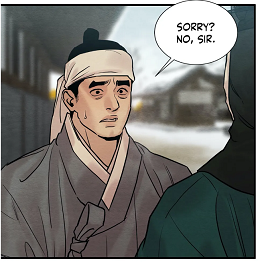 ). He knew the servant’s true motivation behind the betrayal, like he explained it to Jihwa in chapter 51.
 However, I believed that exactly like Min, he made a terrible mistake. He thought that this was related to the harsh beating caused by the painter’s first disappearance.
  In Nameless’ mind, Deok-Jae hated his lord for his “unfair punishment”, while in reality, Deok-Jae put the whole blame on the painter. In the servant’s eyes, the artist should have been the one receiving the harsh beating.
 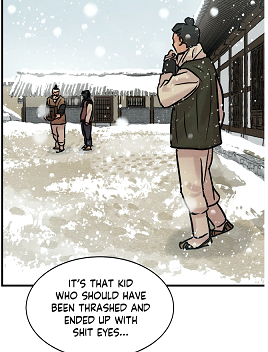 This shows that he never questioned the punishment as such. Why did the criminal misunderstand the domestic? Let’s not forget that Nameless suffered injustice in the past, perceptible by the numbers of his tattoos, hence he projected his own thoughts onto Deok-Jae. What he failed to recognize was the vicious servant’s true motivation: he was jealous of the painter and wished, he had been the one receiving the lord’s favors, willing to become a homosexual, if it meant to improve his living conditions. This panel can be considered as a proof that Nameless misjudged Deok-Jae’s true personality: The latter was in reality greedy!
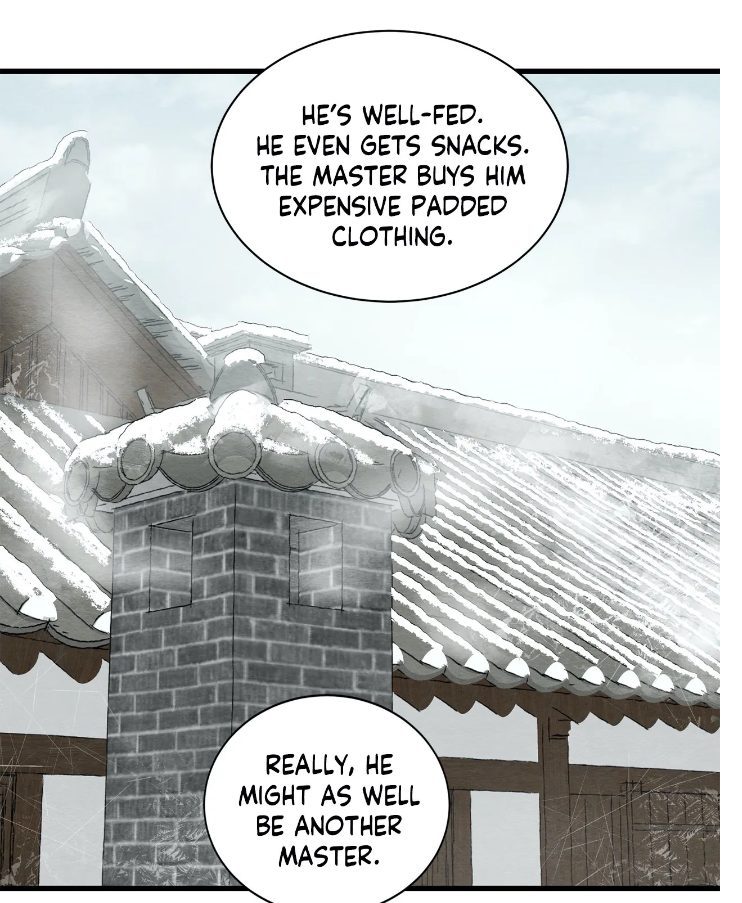 (chapter 46) This explains why the blackmail happened in the end. Since Nameless envisaged that Deok-Jae was resenting his master due to the harsh thrashing, he didn’t expect that Deok-Jae would decide to side with Yoon Seungho in the end, if it meant to get some benefit. (chapter 54) In my opinion, Nameless must have always thought that only aristocrats were greedy, unjust, ruthless and vicious, and would blame the commoners for their crimes.
 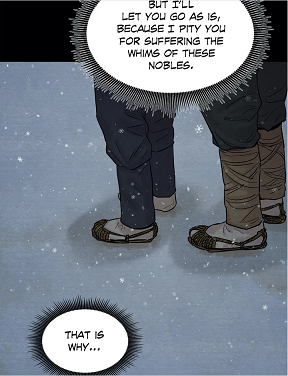 However, reality is much more complex, like I explained in a different essay: silence and passivity can cause damages. Besides, commoners are also humans, therefore they can be vicious, greedy and ruthless. To sum up, the criminal has a biased perception of the world. The other mistake the criminal made is related to his perception about Jihwa. He noticed the red-haired noble’s innocence due his bad habit (biting nails) and showed signs of bad conscience. Therefore he had the impression that Jihwa was not responsible for this situation, rather the childhood friend who chose to reject him and drop him for a low-born acting on a whim. Yet, what Nameless doesn’t know is what the red-haired noble did before: the constant bullying on the painter (chapter 5, 10, 17). For me, Nameless is already biased and has a better impression of his client than Yoon Seungho who hurt his staff so unfairly (chapter 29/30) and humiliated Jihwa twice (chapter 18, 57). That’s why he is pitying his client.
 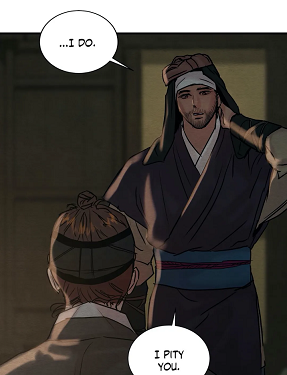 In his eyes the master did nothing wrong, he only loved his friend. Consequently he imagined that the aristocrat was acting on impulse and anticipated that he would give up, yet the latter never did. Since no one visited Jihwa during that time, Nameless thought that the second lead was acting on his own. The noble never mentioned how the idea of the murder was brought up… and he never said anything about Min’s visit in chapter 56.
  And now imagine his surprise…if my theory is correct, the new guardian is his spy. Jihwa kept a secret from him… but it is the same for Nameless, who killed the domestic. Nameless will realize that other people knew about Jihwa’s intentions, hence he will question the noble’s actions. Nameless will realize quickly that this was more than just a love quarrel. In my opinion, he will investigate the matter. There’s no doubt that we will witness a scene where the criminal and Jihwa will blame each other: one will reproach him for involving the servant Deok-Jae, while the other will tell him how stupid and naive he was. He got betrayed by Min.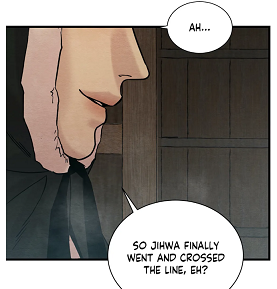
From my point of view, Nameless will realize that his knowledge was really superficial and led him to make huge mistakes. Besides, he needs to question his role. He might have pitied the painter during that night, yet the criminal acted as their hands. He is an accomplice and is responsible for the nobles’ misdeeds. His actions are the reason why the nobles can be ruthless and violent and still call themselves honorable and pure.
At the same time, I believe, the appearance of the gisaeng will play a huge role as well. I have to admit that since Nameless was seen with the gisaeng  (chapter 51), I have been thinking about this: what if the criminal was searching for Baek Na-Kyum? Envisage, with Heena’s intervention, he discovers the painter’s true identity and realizes that he hurt the person he was looking for and was even supposed to protect. For me, there’s no doubt that Min, Jung In-Hun, Jihwa and Nameless will pay for their “knowledge”, because they were actually biased by their own belief and arrogance.
And remember that Pandora’s box was a punishment because humans had received “knowledge” in the form of “fire”. This story is important because it shows that no one can have the whole knowledge and as such possesses truth. And now, you comprehend why Jihwa, the teacher, Nameless and Min made mistakes. It’s because Yoon Seungho never revealed his true thoughts and emotions in front of Jihwa and he never showed his true self in front of Min. Jung In-Hun never got to experience the true power from the main lead. The latter never showed him his real capacities. Finally, the main lead also used rumors in order to deceive people. No one met the real Yoon Seungho, except the painter who got to hear and see everything: his true power 
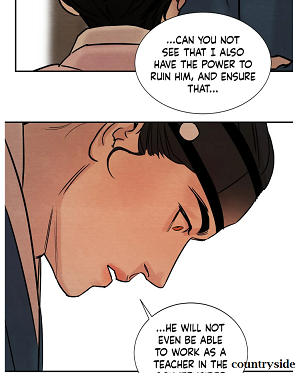

 (chapter 11), his insecurities
  (chapter 58) (chapter 63) and his hopes. One might argue that Yoon Seungho was not entirely himself in these chapters, as he couldn’t control his feelings. Yet I believe that because of that, the lord was the most honest. He could never fake his true thoughts and emotions in front of the painter. I am quite certain that the lord learned due to his traumatic past that he needed to be strong in order to protect himself from others… remember that he had no one by his side, therefore I think that despite his debauchery, Yoon Seungho made sure that he had enough power to never become a victim again. However, Baek Na-Kyum is on his way to discern the master’s real personality, not only by discovering his past, but also because from now on, the lord will never approach Baek Na-Kyum for sex and they will have to interact differently: he will show him his true competences.
As a final word, all those who imagined that they knew the past, the lord’s true personality and skills, the reality (aristocracy is corrupt, while the commoners are just victims), they will recognize that they were all wrong, the moment the secrets are leaving Pandora’s box. They will be punished for their “knowledge”.
Feel free to comment. If you have any suggestion for topics or manhwas, feel free to ask. If you enjoyed reading it, retweet it or push the button like. My tumblr-twitter account is: @bebebisous33. Thanks for reading and the support.
This is where you can read the manhwas. https://www.lezhin.com/en/comic/painter The Beast Must Die: https://www.lezhin.com/en/comic/beast_en But be aware that these manhwas are mature Yaois, which means, it is about homosexuality with explicit scenes.
So far, I had compared Min to a snake, a wolf, a crow and a magpie, however my analysis of this character didn’t do him any justice. The moment I recognized the affinities between Min and The Joker , I came to realize the lord’s true personality. He doesn’t just want to replace the main lead as the new alpha among the nobles, more importantly he takes pleasure in ruining friendships and as such causing pain to others. As a conclusion, I noticed that he enjoys destruction. Therefore I stated in the first part that Min had a nihilistic mindset:
“In philosophy, nihilism is the complete rejection of moral values and religious beliefs. It is such a negative outlook that it denies any meaning or purpose in life.” https://www.vocabulary.com/dictionary/nihilism#:~:text=In%20philosophy%2C%20nihilism%20is%20the,existing%20political%20and%20social%20institutions.
Due to this association with The Joker, I had the following realization: lord Min seems to suffer from a mental disorder, and to be more accurate, from an Antisocial Personality Disorder (ASPD). The distinction between “sociopath” or “psychopath” is here more or less irrelevant because in the end, the specialists always diagnose such patients as a person suffering from ASPD. Then if you make some research about The Joker’s personality, you will discover that even psychologists and psychiatrists tried to determine his mental issues, that’s how fascinating this supervillain is.
Here, the author Arash Javanbakht M. D. is referring to the character from the movie Joker (2019)
But what caught my attention is that The Joker’s mental disorder changes according to the stories, like the author Scott A. Bonn Ph. D. pointed out. https://www.psychologytoday.com/intl/blog/wicked-deeds/201911/is-the-joker-psychopath Therefore, it is important to determine the identity of The Joker I am referring to. I have to admit that since Min’s behavior reminds me more of The Joker from The Dark Knight, that’s how I came to the diagnosis of an Antisocial Personality Disorder. If you read the article mentioned above, the author confirms that The Joker’s profile (The Dark Knight, 2008) does fit the characteristics of a psychopath. But since our topic is Min’s personality, it is relevant to describe the symptoms of such a mental disorder. I am just quoting the following symptoms from two websites, other sites showed similar info:
And when you compare this to Min’s behavior, you’ll notice the similarities which I will outline now. First, he breaks laws and social norms without feeling remorse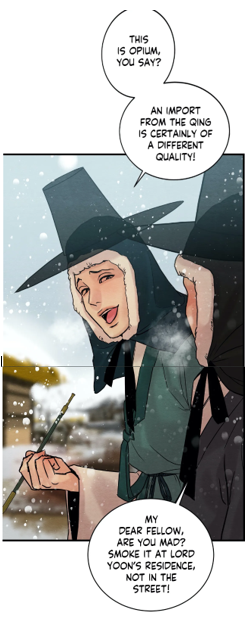
 (chapter 52). Then he violates the rights of his host in chapter 43, when he proposes the assassination. Since this is not Min’s pavilion, this means that his friend’s house is transformed into a conspiracy place.
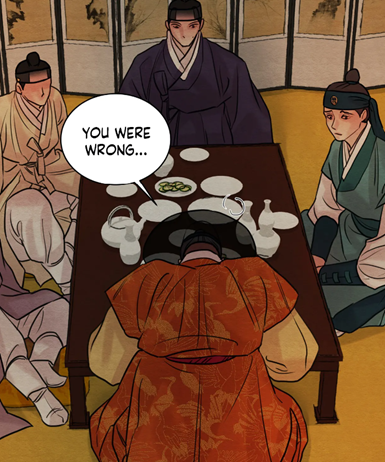 This will play a huge part in the future, as I am anticipating a purge. At another party, he violates again the rights of his host by mocking and insulting him: chapter 52, 53
 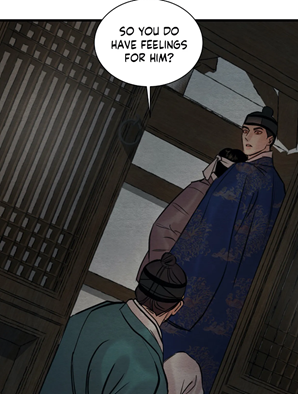 54
54 . I could also add that he disregards the painter by suggesting his murder (43, 56) or by treating him like a sex object (chapter 33/52). Moreover, he often lies (chapter 36 , chapter 43
 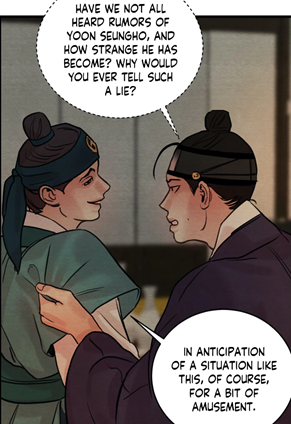 . All these examples expose that he manipulates his surroundings constantly. He influences Jihwa by giving him the idea of the murder (
 chapter 43, chapter 56 ). He pressures Yoon Seungho to bring the artist to their party so that he can taste him (chapter 33, chapter 52). Observe that although Black Heart is often seen with other aristocrats (chapter 8
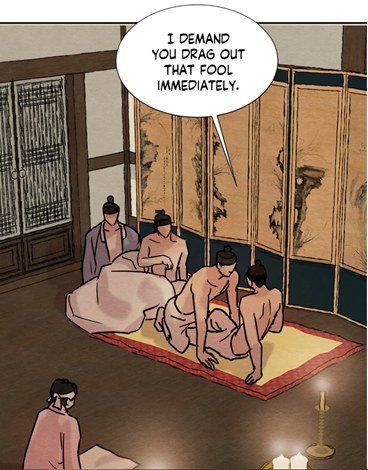 ,
,  chapter 33 chapter 43,
  chapter 52), he doesn’t care about them. In fact, he uses them for his own benefit. Remember that he took the opium from his acquaintance (chapter 52). Then he ruined his “friend”‘s party by causing a ruckus, while the other wanted to have some discreet fun.
 I would even say, he manipulates the masses by making requests, which the other nobles can’t truly reject. Note that neither in chapter 33 nor in 52, the aristocrats stopped Black Heart from talking and even supported his request: the main lead should bring the commoner to their sex party. As a conclusion, he uses his influence over the other aristocrats to get what he desires: have sex with the painter. This displays his true power as manipulator. No one is capable to stop him, not even Yoon Seungho, the alpha king among the local aristocracy.
  (chapter 52). This is understandable, as during that night, Yoon Seungho was totally vulnerable and tried to hide his weak disposition with his clothes.
And now you understand why Min enjoys being in Yoon Seungho’s company. If he is capable to manipulate the main lead, then Black Heart will consider it as a proof that he is far superior to the main lead, whom he considers similar to him. That’s the reason why he told his acquaintances that Yoon Seungho was so easy to understand. (chapter 52) This explains why Black Heart continues targeting the main lead with his tricks (chapter 52/53/54). Not only he simply can’t get enough, but also he is determined to prove his supremacy. The manhwaphiles comprehend now why in chapter 66, Min even visits directly the protagonist’s mansion on his own indicating that he has been keeping an eye on Yoon Seungho. Observe that for the first time, he comes alone, unlike in chapter 8 and 52. He must have heard about the painter’s disappearance and desires to witness Yoon Seungho’s pain. For him, this would represent the best proof of his skill as manipulator. But to his disappointment, Baek Na-Kyum is not dead.
  This mask exposes his lack of empathy and his joy for imagining that the main lead is suffering (“difficulty with showing remorse or empathy“). Since his plan failed, he is disappointed
 . Therefore he enters Yoon Seungho’s mansion. However, pay attention to the last picture which indicates that Min is thinking about Jihwa and his disobedience. The red-haired noble didn’t act like planned. In my perspective, his thoughts indicate that Min will make Jihwa pay for his “disobedience”. At the same time, I believe that Min is already thinking about his next move, this is the other reason why he enters the main lead’s house without a proper invitation (a new version of chapter 12). This image serves as another evidence for his continuous disregard for social norms. And this chapter 66 represents a turning point in my opinion, as it exposes Min’s impulsiveness to the best. Since he didn’t get Yoon Seungho’s defeat by afflicting pain on him, he needs to cause another uproar and inflict pain on Jihwa, who didn’t follow his “order”. Note that Black Heart just reversed the roles, showing that he doesn’t care who wounds whom. His main focus is pain. By revealing the secret, Black Heart is hoping that Yoon Seungho will retaliate against his childhood friend because of the kidnapping.
Striking is that the author zooms on the character’s mouth and chin, revealing that Min has the intention to hurt Jihwa through the main lead. I noticed a certain pattern: Byeonduck always focused on Min’s mouth each time Min envisioned to hurt someone. Remember this panel from the episode 53:
This was just before the character kissed Baek Na-Kyum. The zoom on his mouth was announcing Min’s mischief. He had planned to irritate the host and desired to annul the painter’s action. The artist’s embrace had stopped the “vengeful ghost, the beast”. But Black Heart wanted the main lead to continue with his violent and irrational behavior in order to be entertained. Note the contradiction between his words (“not the sort to stop simply because someone asks you to”) and his action: he doesn’t ask anyone but steals a kiss from Baek Na-Kyum while separating both protagonists.  Hence I come to the conclusion that for Black Heart, the commoner had been a killjoy in that scene. And now, it makes perfect sense why Min chose Jihwa as his pawn in the end. He had witnessed how the latter could turn Yoon Seungho into a “monster”
  and found it so entertaining and funny that he decided to recreate the same situation. This observation explicates why Yoon Seungho put Jihwa and Min in the same bag in chapter 57. Min knew how to provoke the main lead thanks to Jihwa.
But let’s return our attention to Min’s mischievous plan. Observe that in chapter 66, he is doing the same thing again: He says the exact opposite of his true thoughts. While begging for the protagonist’s mercy, he is hoping for the opposite reaction. However, his plan can’t work like in chapter 53 because of the painter’s presence. The reason for this is simple. The lord is embracing the unconscious commoner underlining the importance of the hug. Although Baek Na-Kyum is unconcious here, just his presence is now strong enough to stop Yoon Seungho from getting violent and enraged. Baek Na-Kyum is so vulnerable that the lord can only focus on him, whereas it was the opposite in chapter 53. In other words, this episode marks Min’s defeat. He is not able to manipulate Yoon Seungho like in the past and the painter represents his antidote.
And now, you are wondering why I consider this episode as an evidence for Min’s impulsiveness. It is related to the guardian and Deok-Jae’s death. Min is not aware that a servant among the main lead’s staff has already been killed, therefore he doesn’t realize the consequence of his revelation. Min’s thoughts are always revolving around entertainment and ruckus, hence he doesn’t pay attention to details. He has no idea of the consequences of his intervention. We could already perceive his impulsiveness in chapter 52  , when he revealed himself the planned assassination in front of Baek Na-Kyum. However, back then he wasn’t caught, as neither the painter nor the powerful protagonist paid attention to his words. And instead of learning from his mistakes (f. ex. the murder didn’t occur like planned or the punches he received from the main lead for his provocations), he continues irritating Yoon Seungho. He notices that the latter is no longer denying his feelings in front of him, hence he can’t humiliate him like in chapter 54.
  Consequently he has to search for another trigger in order to provoke the owner of the mansion. But here, he fails again, as the artist is more important than Jihwa’s wrongdoing. Yoon Seungho is already more focused on his own misdeeds, the afflicted abuse on the painter: the violent sex marathon, the insults and the sequestration. Consequently he has no time for his uninvited guest. He ignores him and leaves him behind, but this won’t do for Min, hence he unveils a secret: Jihwa’s participation. But he fails again, as Yoon Seungho is only seen with the following reaction:
  Since the chapter 66 stands in opposition to the episodes 53/54, it becomes obvious that the main lead will react differently. He won’t act on his emotions, he learned his lesson due to the painter. He punished the commoner, although the latter was innocent, too blinded by his rage and pain. That’s why I think, we should consider the chapter 66 as Min’s ultimate defeat.
Another affinity to the symptoms for psychopathie is that Min shows a disregard for safety and responsibility. First, he was willing to provoke the protagonist, although he saw that the noble had almost killed a servant with his beating.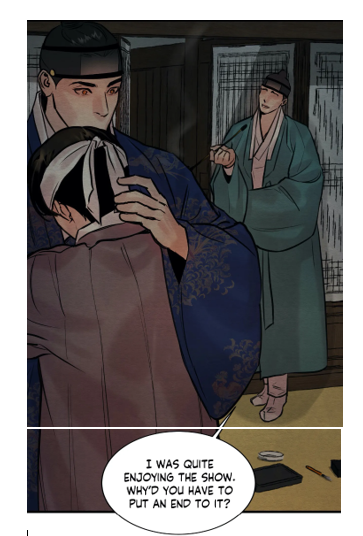 He chose to irritate him again, risking his own life. That’s why he got slapped so violently that the door was destroyed. But note that Black Heart didn’t feel any pain and showed no tears, instead he started laughing and showed pleasure.
 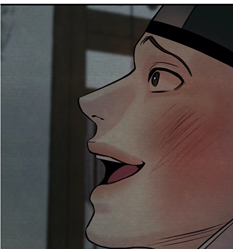 But even after receiving the slap, he continued provoking the host thereby the main lead started punching him so many times.
  Yet at no moment, he asked the lord to stop from hurting him, he kept laughing.
  However, there exists another explanation why Min kept provoking Yoon Seungho. But this aspect will be elaborated later.
And now there’s only one symptom left from the list: “Hostility, significant irritability, agitation, aggression or violence“. So far, we never saw Min becoming irritable or violent, which explains why I didn’t even realize myself his true personality: he is a psychopath. But if you pay attention to my previous observations, you’ll notice a certain MO. He just uses his pawns to hurt others and enjoys seeing people aggressive and in pain. From my perspective, Min will never employ force directly, but prefers using people in order to voice his hostility and aggression. He will never dirty his hands, which stands in opposition to the Korean Batman, Nameless. Yet this doesn’t mean, Black Heart isn’t aggressive at all, quite the opposite. I will name two examples in order to prove my interpretation. Note that Min manipulates Jihwa to have the painter killed soon after Yoon Seungho humiliated Black Heart in the woods.
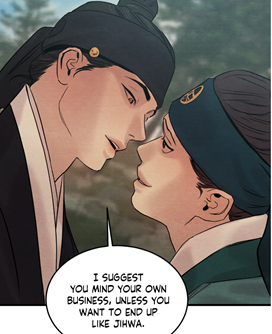 (chapter 41) Don’t forget that he calls the vicious man “a mouse”, a real insult to someone who sees himself as superior and talented. Then the night after the beating, Min waits for Jihwa in front of his house and urges Jihwa to murder the painter.
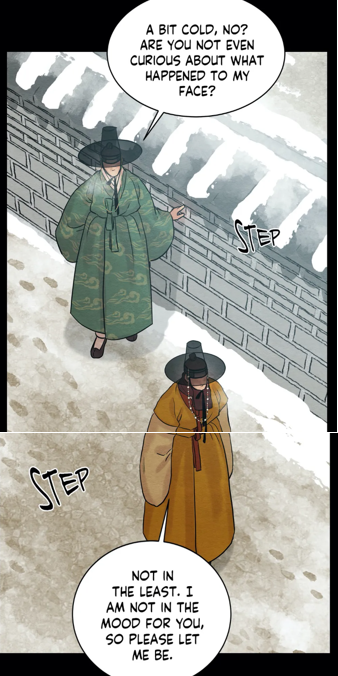 However, this time he adds that he wants to taste the painter before and note that here, he is mentioning the punches he received from Yoon Seungho.
  As the manhwaphiles can detect, Min is here retaliating against the main lead for hurting him. He will make him suffer much more: not only he will lose the commoner, but also the latter will get raped: a double affront. However, just like before, he prefers using the childhood friend so that he can avoid to take any responsibility. If something happens, then only Jihwa will pay for this. We should remember that Min never wrote anything concerning a crime. The idea he proposed was at his friend’s place, and the idea of the rape was also mentioned on the street with no witness.
In the last panel, his smile made me think even more of The Joker than before. He takes pleasure in inciting crimes and imagining people in pain. And now, if you recall The Joker’s behavior in The Dark Knight, you’ll note some similarities. He wants to prove to Batman that even good men can turn into criminals. The Joker is the reason why the famous prosecutor Harvey Dent turns into Two-Face, because he wants to denounce the hypocrisy of Gotham society and its rules. That’s why The Joker keeps breaking laws and committing crimes. He abhors society and its norms, hence he is determined to destroy it. And now, you understand why Min chose Jihwa as his pawn and target in the end. He knew that Jihwa could trigger Yoon Seungho’s violence, he was determined to prove that he could turn a rather innocent man into a criminal.
Furthermore, after reading the following quote,
“When psychopaths view others as prey, their lack of feeling and bonding to others allows them to have unusual clarity in observing the behavior of their intended victims. As demonstrated by the Joker in The Dark Knight, psychopaths are unencumbered by the anxieties and emotions that normal people experience in interpersonal encounters. This is because psychopaths are unable to form emotional attachments or feel real empathy with others, although they often have disarming or even charming personalities.” https://www.psychologytoday.com/intl/blog/wicked-deeds/201911/is-the-joker-psychopath
the manhwalovers will notice that Min considered Yoon Seungho as his prey very early on. In my opinion, this conversation played a huge part in his decision: 
 Min realized the importance of knowledge. Jihwa knew his friend well, hence he was able to awake the “beast” in the main lead. Besides, he could notice that Jihwa had an immense influence on the main character. He could wound him, yet the latter wouldn’t cut ties with him. Note that in that scene, Min never said a word, yet he was observant and realized that Yoon Seungho had a weakness: “in the most wretched of states”. That’s why he chose to get closer to the protagonist, willing to become an uke, if it was necessary for his plan. He needed to discover more about his prey and the best place was to get closer to Jihwa and Yoon Seungho, slowly and silently exactly like a snake. However, I believe, the real war between the two semes started in chapter 41, which caught my attention during the first season. The hand on the main character’s waist was a sign that the psychopath planned to “screw” the main character.
 (chapter 41) Not only he showed his desire to submit Yoon Seungho, but also he acted, as if he was superior to him. He asked questions and even criticized the main character for his behavior: he was creating a ruckus, exposing his hypocrisy, as Black Heart loves uproar.
After showing point after point that Min’s personality shows many signs of ASPD, it is important to understand the real nature of this mental disorder. After comparing him to The Joker and reading the first part of this essay, you have the impression that people suffering from ASPD are all criminals and they are potential serial killers. However, it is not true, because this mental disorder doesn’t necessarily mean that the affected person is a killer. If you pay attention to Min’s words, he keeps talking about fun and scandal. This observation leads me to the following explanation: The Arousal Theory of Motivation. This psychological conception tries to elaborate what stimulates people.
“Each person has a unique arousal level that is right for them. When our arousal levels drop below these personalized optimal levels, we seek some sort of stimulation to elevate them.” https://www.verywellmind.com/the-arousal-theory-of-motivation-2795380
Since Min keeps seeking entertainment, it shows that he is a person with an abnormally low arousal. Therefore he needs strong stimuli, like violence and attention. And now, you understand first why Min is often seen in company with other nobles. He needs to attract their attention, hence he challenges Yoon Seungho in chapter 33 or in 52. It is the same on the street, when he smokes the opium so openly. It occurs at his friend’s place as well (chapter 43). Notice that he is the one who talks the most and proposes the murder. What caught my attention is that despite the objections from one noble and Min’s friend, the vicious man is able to give a whole speech why Jihwa should have the artist eliminated. No one stops him talking, indicating his skills as orator but more importantly this displays that he likes being in the center of the attention. However, as you can imagine, attention is not enough for him. He needs stronger stimuli than just admiration. He feels the urge to see pain and blood. And this made me think of the other manhwa entitled “The Beast Must Die” written by Lee Hyeon-Sook. 
Striking is that we have in the image the same topics: Joker/card, mask and blood. And this is naturally no coincidence, as the protagonist is a psychopath too, in other words, another Joker.
In this manhwa, the main character Lee Ki-Rin approaches the rich but mysterious student Kang Moo.  His reason is his thirst for revenge. His sister Lee Seorin was a victim of a gang rape, but since the perpetrators were never prosecuted, the sister killed herself out of despair. The culprits were students coming from wealthy and influential families and members of an organization called “secret fraternity”.
 Because Lee Kirin had no idea about the identities of the culprits and only knew that they belonged to that “secret fraternity”, he decided to get close to Kang Moo in order to investigate and get revenge for his sister’s death. While Lee Ki-Rin believes, he is manipulating Kang Moo, the readers can quickly realize that the opposite is happening. Kang Moo is the one who let Lee Kirin approach him in the end. What Lee Kirin doesn’t know is that Kang Moo is a psychopath. The latter has always hidden his mental illness in front of people.
 Even the members from that “club” had no idea except Lim Joohyuk. There’s a reason for that. When he killed a dog for the first time as a child, he saw his mother’s rejection and disgust.
 Striking is the importance of the gaze again. As a child, the boy sensed his mother’s negative judgement and rejection. However, this incident didn’t stop him to lose his “urge” for blood. Therefore he started to have hobbies like collecting dead bodies, taking pictures of dead creatures and even hunt.
 As you can detect, in that story Kang Moo has an abnormal low arousal and needed stronger stimuli, as time passed on.
 This reminds us of Min who keeps looking for entertainment and commotion. Note that Min’s violence has gradually increased: from sex as a symbol for fight, he went to a verbal challenge (chapter 33/41), then it escalated to a murder (43), then to a beating and gangrape (52/53) and finally to a combination of murder and rape (56). And in The Beast Must Die, the protagonist is well aware of the consequences of his behavior. If he killed someone, he would ruin his life.
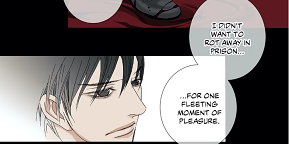 (chapter 32) The manhwaphiles can sense the similarity in the vocabulary: for Min, it is fun/entertainment, while Kang Moor keeps talking about “pleasure”. Since Kang Moo recognized the repercussions of a murder, he chose to fight against it contrasting to Min’s attitude. And there’s reason for that: Min’s social status and historical period. The latter is a noble and can use his superiority to hurt commoners and even break laws, because aristocrats are not prosecuted like low-borns. Secondly, I believe that his family and his surroundings played a huge role. Observe that the nobility is portrayed as corrupt and decadent. Besides, the manhwalovers should remember that Min’s MO is to manipulate others, therefore it reveals that the character had found a way out how to outlive his “urge and need”. He could commit small wrongdoings, as he knew that he wouldn’t get punished for this. But if he had to hurt another noble, he had to use someone else. And this exposes the similarities between Kang Moo and Min. Both are well aware that certain things are not allowed, yet they try to find a different way to move around the rules and laws.
Striking is that Kang Moo never committed a crime, until Lee Seorin committed suicide. She was the trigger for him to change his behavior. While he claims in front of his future victim that she was just an excuse,  (chapter 32) the readers shouldn’t take his words as face-value. In my opinion, he felt a similar emotion than Lee Kirin (revenge), because Lee Seorin was the first person who showed understanding and no rejection, when he removed his mask and revealed his true personality.

 (chapter 33) . What caught my attention is that Kang Moo is voicing his fear indicating that he was well aware of his own mental issues. Moreover, it also outlines his despair… he desired to escape from this, but didn’t know how to. Lee Seorin comprehended Kang Moo’s anxiety, therefore she tried to encourage him not to give up, by supporting him that he could continue maintaining a normal life, if he truly wanted it.
  And now, you grasp why Kang Moo snapped, when he heard about the circumstances of her death. It was his club that was responsible for her suicide. Naturally, when Lee Kirin asks him if he loved his sister, the psychopath can’t answer that question, since he is unable to grasp his emotions.
 (chapter 34). However, there’s no doubt that the protagonist had an affection for Lee Kirin’s sister. I believe to perceive an evidence of his attachment to her, when he mentions the suffering of a victim of gang rape.
  (chapter 56) Sure, in this scene he is threatening Mr. Jang to organize a gang rape on Mrs. Hong’s daughter, because the man with the glass was also menacing his lover Lee Kirin. Yet, the fact that he mentioned such a crime indicates that he didn’t forget the crime Lee Seorin suffered from and he could understand her pain. And there’s another proof that Kang Moo is not truly emotionless. It becomes even more obvious that he loves the main lead too. It is shown in two different occasions. First, he states that he will never let Lee Kirin go.
 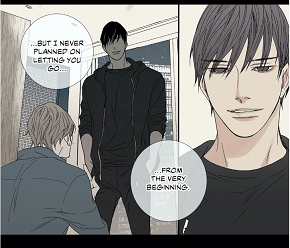 (chapter 34) And latter, he requests from his lover to help him to “stop the beast inside him”.
  That’s his love confession, although Kang Moo doesn’t truly comprehend the true signification of his words. At some point, he begins to grasp that he has changed and is relying more on Lee Kirin which makes him nervous. This shows that Kang Moo has some problems to accept his love for Lee Kirin. However, this manhwa truly indicates that a person suffering from ASPD is capable to live a normal life and to feel love, even if this patient is not expressing it in the normal way. Furthermore, in this story, Kang Moo tries to use others in order to dirty less his own hands so that the members from “secret fraternity” kill each other indicating that this is not just to enjoy pleasure. Let’s not forget that at the same time, he helps a friend who is getting abused by her fiancé. So he is not a serial killer per se. He is determined to punish “scums” while committing crimes. Yet he believes that he uses revenge as an excuse. To sum up, the story is not just about a psychopath following his urges to kill, but rather the battle of a psychopath who struggled to lead a normal life, but gave in the moment he lost the person who supported him.
As you can sense, I like this story, because the real villain of this story is not the abnormal one, but the ones who are supposed to be mentally sane and normal. The secret fraternity was perverted by one member so that the 5 members started committing crimes and never got punished. 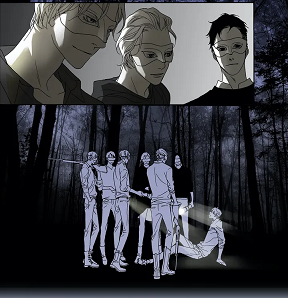 (chapter 1). Here, they hunt someone for fun. Besides, I would like to mention here the k-drama “It’s Okay not to be okay” with Kim Soo-Yun and Seo Yea-Ji. In this terrific drama, the main lead is a famous writer suffering from ASPD and the so-called normal people are actually portrayed in a rather negative way as well: they insult, exclude and hurt the persons suffering from a disorder or disability. This shows that authors in South Korea are trying to change the image about mental disorders and plead for more understanding and open-mindedness. In “The Beast Must Die” and “It’s Okay Not To Be Okay”, the characters help people to comprehend that the boundary between normality and abnormality is thin and I would even say, illusory. Lee Kirin desired to get revenge, yet he doesn’t feel sorry for the death of the culprits, but no one is questioning him. It becomes a different story, when a psychopath is involved. The detective will do anything to catch Kang Moo, but finds excuses for Lee Kirin. But observe that he is not diagnosed as a psychopath. As you can sense, there’s here a double standard. Normal people even call for violence and revenge due to their anger and pain, that’s why there’s still death penalty in so many countries. As a conclusion, being diagnosed as a psychopath doesn’t mean that they are no human and people should treat the patient like a monster. Being excluded from society is not the correct answer, like Kang Moo sensed it. He felt the condemnation in his parents’ gaze hence he felt abandoned and lonely.
And now, you understand why Black Heart is often surrounded by people and is even close to the noble with the mole. I believe, he sensed that he was different, but he could never reveal his true self. This explains why his friendship with the noble with the mole was so calm and so harmonious. Hence Jihwa expressed his admiration for their relationship. But their relationship was in reality fake, because Min could never remove his mask. His friend might have sensed his lies and his “Black Heart”, nonetheless I doubt that Min truly confessed his true thoughts in front of the aristocrat with the mole. Moreover, their bond changed the moment Min met the painter. For the first time, Black Heart was attracted, hence he looked at Baek Na-Kyum, while having sex with Yoon Seungho. Furthermore, he saw genuine attraction in the painter’s gaze because of Yoon Seungho. Let’s not forget that Min considered the protagonist as a person similar to him. The commoner was not attracted due to his power or wealth but by the person himself… meaning that he didn’t care about his bad reputation and bad habits. That’s how Min got fascinated by the artist. Since he saw the pure desire in Baek Na-Kyum’s eyes during the intercourse  (chapter 8), the aristocrat imagined that he could get the same gaze, if he had sex with the painter. And that’s how the love triangle started. He wished to be gazed like Yoon Seungho was. since he viewed such a pure gaze, while the protagonist was having sex, Min associated the painter’s stare to sex. This explicates why the former is so obsessed with sex and keeps desiring to taste the artist (chapter 33, 52, 56). He couldn’t forget that gaze. I can imagine that he must have called it an obsession, which is an idiom Kang Moo utilized to describe Lee Seorin’s affection for her brother. With this approach, it becomes comprehensible why Min tells Jihwa that Yoon Seungho has been bewitched by Baek Na-Kyum.
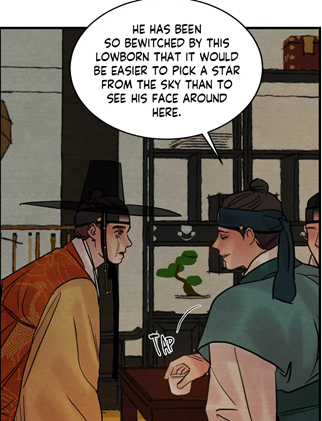 In reality, he is describing his own thoughts. In other words, he is projecting his own thoughts into the protagonist. He explains his desire and obsession with witchcraft, because he feels vulnerable. That’s his way to confess his love in my opinion. Just like Kang Moo, he can’t say these words (“I love you”), as he has no idea what he feels and what love is. With this interpretation, it becomes comprehensible why Min suggested the painter’s murder in the end. If he can’t satisfy his urges (taste the painter) and he is still thinking about it, then he needs to get rid of the source of his obsession. Because the moment the painter disappears, Min will be able to move on. Witnessing Yoon Seungho’s pain will compensate him for the loss. Therefore, the manhwaphiles can comprehend, why Min still associates Baek Na-Kyum to death. Deep down, he fears the painter, as he senses that the former represents a source of danger for him. He can become his weakness. And the best way to remove this is to manipulate Jihwa to commit the crime. I also think, Min had already detected that he couldn’t do it himself. For me, the character’s thoughts are actually mirroring Min’s true state of mind. Once again, he is projecting his own emotions “fiery in his jealousy”, “too weak at heart” into Jihwa. In fact, we could say the opposite. Jihwa’s heart was strong enough to resist negative emotions. That’s why Byeonduck chose to reveal Min’s thoughts in this chapter. Black Heart is someone who is always projecting his feelings and emotions into others, because he can’t deal with them himself. We had a similar phenomenon, in chapter 43. What Jihwa envisioned in chapter 43 represented Min’s thoughts in reality as well. Min was witnessing how Baek Na-Kyum was escaping from him: first a paramour, now a mistress. There’s another evidence for Min’s attachment to the painter. Like my reader @Lahuno66666 pointed it out correctly, Min is always talking about Baek Na-Kyum, exactly like the main lead. Note that in each chapter Min appears, he always mentions the artist: (chapter 8), chapter 33
 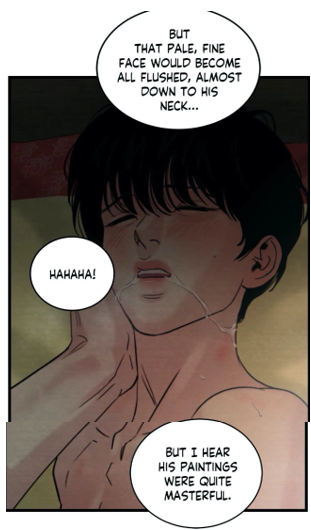 , chapter 36 , chapter 41
  chapter 43 , chapter 52
  , chapter 53
  , chapter 54 , chapter 56 , chapter 66 This outlines the importance of the painter in Black Heart’s thoughts. Thanks to her observation, I realized that Min has a similar mentality than Yoon Seungho. Both were confusing the mind with the heart. While Yoon Seungho was in denial of his feeling as he had the impression, he had no heart, the vicious noble is unable to distinguish his heart from his mind due to his ASPD. Furthermore, his so-called “obsession” (love) has never been noticed by the nobles, because when he talked about Baek Na-Kyum, he always talked about Yoon Seungho as well. The latter misunderstood Min’s actions and words. He just thought that Min was just jealous of him, while in reality the source of his envy was the artist. We shouldn’t forget that in chapter 8, Min chose to remain by Baek Na-Kyum’s side , while the main lead was having sex. This truly indicates that the commoner was much more intriguing and alluring than sex. The manhwaphiles should remember my remark about The Arousal Theory of Motivation. Min decided to remain inactive and observe the painter, exposing how much entertained and attracted he was towards Baek Na-Kyum. IT stands in opposition to the sex Yoon Seungho was having: Min was so fascinated by the sexual arousal in the painter’s gaze that he let the nobles alone! Note that he wasn’t even talking in that scene!! It contradicts so much to Min’s usual behavior (talkative, laughing, committing wrongdoings). This displays the artist’s real power. No wonder that Min tried to catch his attention in chapter 52, while the painter was standing at the door. When he saw the new painting, he must have felt so bothered that he felt the need to mock his host and the artist.
 And now, it becomes comprehensible why Min chose to walk on the picture
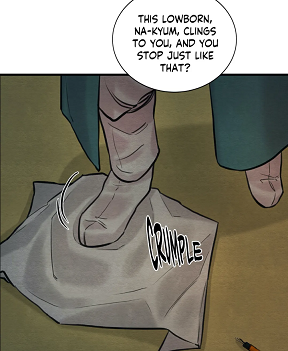 , when he was in the artist’s study. He felt the urge to destroy the image, as he desires to be the one portrayed in that painting. This explains why the next morning when he talks about the Baek Na-Kyum’s assassination and rape, he remembers the drawing. He would like to be the one in that painting. As you can observe, Min was behaving like the main lead, all his thoughts and emotions were revolving around the painter, that’s why he felt bewitched. However, since he always mentioned Yoon Seungho with the painter, no one noticed his obsession. Jihwa couldn’t, because Black Heart was always talking about the commoner in such a negative way and had even suggested a murder and a rape. How could he notice that Min was in love with Baek Na-Kyum, when he was trying to hurt him? The red-haired noble’s blindness is understandable, because he was doing the same thing to his childhood friend. He would hurt him in the name of love.
Since Min is suffering from ASPD, it explains why Min is causing pain to others. For he is devoid of any feeling, he can only sense them, when he sees them in others. And now, you can understand why he is seeking pleasure and fun all the time. He needs pain and fun in order to feel something, in order to feel alive. But exactly like Kang Moo, the more time passes on, the more he feels this emptiness and his urges keep growing. And the painter became the trigger for Min to become more aggressive and reveal his true face. His jealousy and envy could only worsen. First, he tried to use the support from the other nobles to satisfy his immediate urges in chapter 33, but the main lead refused to share the commoner with him. That’s the moment he decided to remove Yoon Seungho from his throne. He saw how daring Yoon Seungho became, he would even fondle the artist at the tailor shop. I can only envisage that this event must have caused some jealousy and envy… That’s why he challenged Yoon Seungho properly this time and touched his waist. However, he was defeated with an insult: “a mouse”. And remember that at the end of the scene in chapter 41, Min wondered how good the artist would taste. For me, it is clear that Min was so annoyed by this defeat that he wanted to retaliate, like “if I can’t have Baek Na-Kyum, then no one should have him”. As a conclusion, Min is already in love with the painter, but his “love” is associated to so many negative emotions that Black Heart can’t deal with them. Due to his love which he explains with witchcraft, he feels weak, powerless, jealous, greedy, ruthless… and now, you understand why when I compared him to Nameless, I came to the following observations: Min is selfish, jealous, manipulative, poisonous, ruthless, greedy, dishonest and even disloyal. All these feelings are in truth related to Baek Na-Kyum. That’s why Min is able to insult Baek Na-Kyum (“witch”, “charlatan”) and order the murder on the person he is obsessed with. Min can’t accept that he is captivated by a low-born. He needs some abstruse explanations for the emotions he is feeling. In other words, he is in denial!
Because of this new revelation, it becomes necessary to examine once again the chapter 53/54. He kissed the painter, because he couldn’t resist the temptation. He got so jealous that the painter would embrace a vengeful ghost and even accept a slap without getting upset. Imagine, he saw how Baek Na-Kyum was willing to embrace the main lead with all his flaws: rage, brutality and his terrible reputation. Another reason for getting jealous!! At the same time, he felt the need to mock Yoon Seungho due to his jealousy and envy. He had to make him suffer, because he was “suffering” himself. And now, the readers can grasp why Min was even willing to risk his face. He couldn’t contain his negative emotions, he felt the need to provoke the “monster”… In reality, he was mocking himself. How could he feel captivated to the painter? I can even imagine that he accepted the punches, because these could serve as a wake up call. And now, you understand why Min felt the need to retaliate against Baek Na-Kyum and Yoon Seungho the next morning. He sensed that he needed more than before to remove the artist, as his desires for Baek Na-Kyum kept increasing, and as such his envy and jealousy had become insufferable. As you can observe, Min is a really complex character. To reduce him to a psychopath is not correct. Sure, it helps the readers to comprehend his personality better, however by analyzing another psychopath, we could definitely perceive his true thoughts and emotions.
My final word is the following: Psychopath or not, such people shouldn’t be judged like beast or monstrosity, because in reality, normal people can become murderers or criminals. Don’t forget that Holocaust was only possible due to the participation of “willing helpers” who were actually normal and sane. However, we can criticize and condemn people and characters for their wrongdoings. Ordering a murder or a rape is a crime, therefore Min is indeed a criminal psychopath.
Feel free to comment. If you have any suggestion for topics or manhwas, feel free to ask. If you enjoyed reading it, retweet it or push the button like. My tumblr-twitter account is: @bebebisous33. Thanks for reading and the support.
This is where you can read the manhwa. https://www.lezhin.com/en/comic/painter But be aware that this manhwa is a mature Yaoi, which means, it is about homosexuality with explicit scenes.
In the first part, I had associated lord Min to The Joker and elaborated why both characters were similar. And for that, I had used the definition of the joker, which I am quoting again:
While comparing Min’s words and behavior to the definition, I came to realize that the manhwa Painter Of The Night had another Joker. And now, the manhwaphiles have already guessed the identity of the second Joker: Nameless.
If you look carefully at his role, you’ll notice that he is indeed an entertainer.  (chapter 43) So his job corresponds to the second definition. That’s why he is wearing a mask. Striking is that his mask is very similar to The American Joker:
Furthermore, Nameless is indeed someone who annoys others, as he is a criminal. (definition 3) He commits wrongdoings for his clients who are all nobles. He is even quite famous among the aristocracy, as Min even described the commoner as ruthless, greedy and unscrupulous. 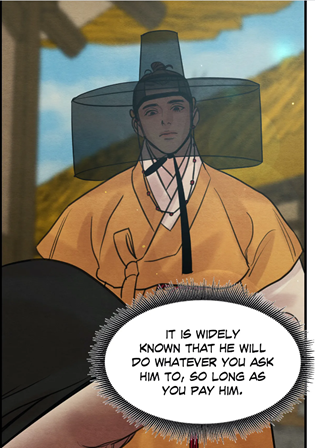 But most importantly, Nameless acts exactly like a special playing card (definition 1), since his function is very similar to Black Heart’s. First, he breaks laws (trespassing, abduction, murder, hiring spies), because the joker is not supposed to follow the game rules. Secondly, the Korean jester is an extremely beneficial and harmful card to the figures in Painter Of The night. Observe, that Nameless’ interventions have a devastating and beneficial impact on Jihwa and the main couple. While the characters had to suffer due his actions, the latter helped the protagonists to realize their true feelings and face reality. Nameless noticed right away that Jihwa was not the type to order the murder of a person. He noticed the noble’s nervousness with his bad habit: biting his fingernails.
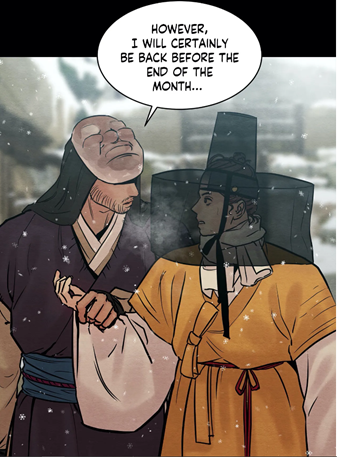 (chapter 50) Therefore he chose to mislead the red-haired client, because he hoped that with time, the aristocrat would change his mind. However, in order to give Jihwa the impression that he was taken seriously, he gave a false excuse and explained that he needed some time. As you can see, exactly like Min, the commoner manipulated the instigator. Later, when the latter criticized the criminal for his inaction, the latter was the one who reminded the red-haired lord of the gravity of the crime: he intended to kill a person. The irony is that the assassin, a symbol for immorality, was actually playing the role of consciousness:
  (chapter 51) In my point of view, it is very important, because it shows that Nameless has a huge sense of justice and morality. He can distinguish from right and wrong, and is well aware that killing someone is in truth a terrible crime. And thanks to his intervention, he stopped Jihwa from committing a grave sin. He forced the lord to face reality, by describing in the most horrible but real way possible the things
  he would do to the painter, so that Jihwa would truly see the consequences of his choice. Nameless brought pain to the red-haired master, but at the end, Jihwa could finally admit his mistake and regret his actions. He was responsible for ruining his relationship with his childhood friend. What caught my attention is that Nameless’ words had such an effect on the lord that the latter even vomited. It was, as though Nameless’ words had such power that they could remove the poison from Jihwa’s heart.
  His words and actions worked like an antidote, which reminds us of the words used by the noble with the mole:
 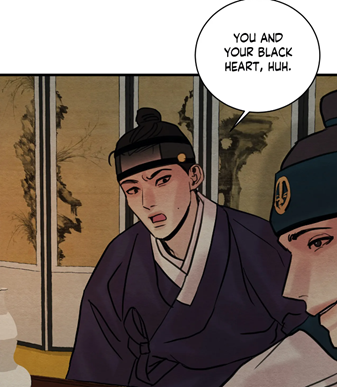 As you can observe, Nameless embodies truth and Min lies, and Black Heart’s lies were the reason why Jihwa had been “poisoned” and deceived. Only reality could make him perceive the truth. Striking is that Nameless had already planned that Jihwa would never give the final hit order, therefore he had already envisioned to return the painter to Yoon Seungho. Min might have suggested the plan, but since Nameless executed it, he is also responsible for their misery and liberation. Consequently, the abduction made the painter realize his feelings for the main lead. The latter would have never recognized it, if he hadn’t been facing death. In front of death, social gap and social status didn’t matter any longer. What is truly important were the persons’ actions that moved the person facing his imminent end. The manhwaphiles should remember that Yoon Seungho’s smile was the last thought Baek Na-Kyum had, revealing that the lord’s smile must have touched his heart back then, giving him some hope. That’s why at the end, he screamed for Yoon Seungho’s help
  and the way he called the main lead showed a certain intimacy: lord Seungho. The result of the abduction on the main lead is clear. He recognized his powerlessness and recognized that he couldn’t bear the thought of being separated from Baek Na-Kyum. Furthermore, the chapter 66 displays how the main lead is no longer denying his affection for the painter in front of witnesses. Don’t forget that Yoon Seungho is carrying the artist in front of Min and his staff during the day, which contrasts so much to the incident of the broken door with Min
 . Back then, only Min saw it and the protagonists denied both the main lead’s love for the commoner. Simultaneously, this panel stands in opposition to the incident in chapter 45
 , because the lord is not naked, a sign for his obsession with sex, but he is not even hiding the identity of his lover. The abduction destroyed the relationship between the two protagonists which was only based on sex, yet simultaneously the kidnapping helped them to change the nature of their relationship, to come to a spiritual love, something the noble had been longing all this time. And this explains why there won’t be any dichotomy later: sex or love. In the future, sex will become one of their ways to express their love for each other. Yet, I am quite sure, both will reveal their affection through other actions: painting, poetry and teaching. As you can conclude, Nameless has a similar effect than Min in the end. Both bring misery and pain, yet they help the characters to perceive truth and accept reality. And now you understand why I had this revelation: Nameless is also a Joker.
But let’s return our attention to our initial observation: Nameless’ role as dancer and clown. What caught my attention is that although Min and Nameless act like entertainers, Nameless distinguishes himself from Black Heart, because he is not doing it to distract himself (chapter 66), but to make people happy. In other words, that’s his job. Therefore, we can say that he is doing it in order to survive, contrasting so much to Min who considers fun as hobby. This is understandable, as the noble is not forced to work, he lives on his wealth and status. Whereas the noble is doing everything for fun, the other is actually living from fun. At the same time, I can’t help myself sensing that Nameless’ work as clown and dancer exudes a certain selflessness, as entertaining the public means making people happy, even if the performers are earning some money through their show. Their performance is rewarded by donations. As a first conclusion, while Black Heart stands for leisure, lightness and selfishness, the other embodies survival/work, seriousness and a certain selflessness. Another divergence is that while Black Heart is using other nobles to pressure Yoon Seungho 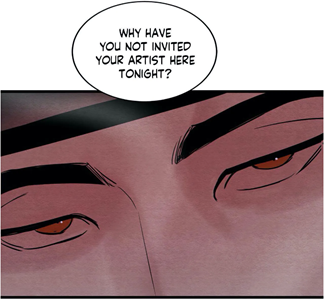
 (chapter 33) and hide his true wish (taste the painter), the clown is working with musicians and another dancer. This exposes that Nameless is actually team-oriented. Moreover, we know for sure that Nameless has a good relationship with his workers, since they gave info to Jihwa.
 And now, you can understand while examining Black Heart, I had the following revelation: Nameless stands in opposition to Black Heart.
| Nameless | Min |
| selflessness | selfishness |
| Work/survival | hobby |
| truth | lie |
| team-oriented | loner |
| generosity | greed |
| understanding | jealousy |
| compassionate | ruthless |
| honest | hypocrite |
| loyal | Disloyal – traitor |
| Antidote | „poisonous words“ |
The criminal is not greedy, as he doesn’t even accept the money offered by Jihwa at the end. He is compassionate, as he feels pity for Jihwa’s situation. Moreover, he decides not to mutilate the artist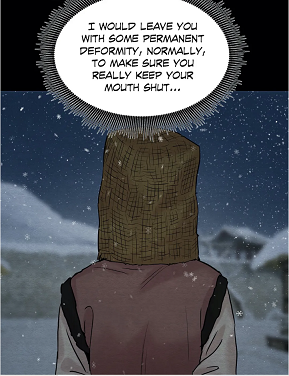 , although it signifies that he is taking some risk. Sure, he is here not soft-hearted, quite ruthless. Yet, let’s not forget that he is here wearing his mask. In that scene, the criminal scares the victim so much for a reason: he is trying to ensure that this incident remains a secret and that no one gets hurt in the end. He is loyal towards his client, since he is acting for Jihwa’s best interest (not dirty his hands by murdering a person), willing to get rid of a possible thread.
Thanks to the observation of one of my readers, I came to the realization that Black Heart lives through the anger and pain from others, because if he didn’t, he wouldn’t feel alive, whereas the other is just living through the pain of others in order to survive. Yet, he has a heart despite his crimes. He is in fact an disillusioned man due to his past and bad experiences, and this can be sensed in the following panel: He knows the brutality and hypocrisy of aristocracy. And this leads me to the next deduction: when Min described Nameless in chapter 43 , he was in truth portraying the nobles. The butcher’s actions were reflecting their own attitude: immoral, manipulative, greedy and ruthless. And now, the manhwaphiles can grasp why Nameless behaved differently in front of Jihwa. Since the latter was different, he had to act differently. In other words, he has a similar function than the painter: the mirror. He gives a true reflection of the red-haired noble’s personality. Hence the pain Nameless afflicted on others had a different cause. He was just doing it in order to protect himself. Yet, unlike the noble, the criminal has never given up on his consciousness and righteousness. He might be brutal and frightening, yet in his mind he does it for a good reason: protect himself or in the last case protect an innocent noble. Since the latter is not a coldblooded person, Nameless feels the need to stop that person from dirtying his hands, as he is well aware that he will be plagued with huge pangs of conscience.
And now, if the manhwalovers observe the way Nameless uses his mask, they will note that he only wears it, when he is acting as a criminal. Naturally, I am excluding the scene, where he acts as a real entertainer. Let me give you examples:
 (a memory from the painter, chapter 61), he is wearing the mask.
  Slowly, his face disappears behind the mask.
  Hence I come to the deduction that the mask symbolizes his role as criminal, yet at the same time, it exposes that this doesn’t represent Nameless’ true identity and personality. There’s a different person behind the mask, whereas it is different for Black Heart. Min’s face is the mask itself, the symbol for his hypocrisy.
 As you can detect, the more I analyze Nameless, the more it reveals how different he is from the noble. That’s why I had the following revelation: Nameless is Min’s real nemesis. Because of this deduction, I came to the conclusion: Nameless is Batman in the manhwa. Why? First, just like Batman, Nameless has two identities: the entertainer and the “ruthless butcher”. And note that the commoner often acts like Batman during the night: (chapter 50) (chapter 66) Secondly, he is wearing a mask, when he acts like a criminal, hiding his identity. At the same time, he is hiding his true personality (thoughts and emotions) behind the mask as a way to protect himself, very similar to the American Hero, who is full of doubts. One might argue that this association is incorrect. Batman can’t be considered as a criminal, since he fights villains. However, if you pay attention to Batman’s actions, you’ll notice that he breaks laws and rules, he is not working with police, he acts on his own. And if you include the movies from Christopher Nolan, Batman refuses to work with his friend Rachel Dawes, since he doesn’t trust prosecution office and Gotham justice. Finally, let’s not forget that at some point, Batman is even considered as a criminal by authorities, as he is blamed for the death of many people. And both have indeed a tragic past, suffering from a trauma, which is perceptible through the tattoos.
 Furthermore, Nameless does have a sense of justice…. like I pointed out earlier: he is well aware of the painter’s innocence. Yet, there’s no doubt that there are divergences between Nameless and Batman, as the former belongs to the commoners, whereas Bruce Wayne is really rich. The criminal is not powerful, unlike the American hero who can use his wealth and connection to fight against villains. But since the low-born stands in opposition to Min and I considered the latter as a new version of The Joker due to the similarity of their mentality, I can only perceive Nameless as Batman, the one who will be able to defeat Min. And in chapter 66, their antagonism is already palpable.
What caught my attention is the following panel: 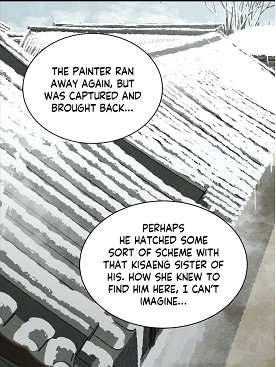 Why did Byeonduck decide to show us the roof, when the guardian gave us an explanation about the commotion? It is important, as it represents Nameless’ deception. When I saw this panel, I was immediately reminded of this image: . The roof top is associated to Nameless, which is also a place linked to Batman. Then my follower @BlackPearl1301 noticed that the new guardian looked a lot like the servant serving Jihwa before:
  (chapter 50). The color of the clothes are the same. Thanks to her, I could finally put the puzzle together. It looks like Nameless planted a spy in Jihwa’s mansion in order to know how the lord would behave after giving the hit order. And this is not surprising why Nameless would know that Jihwa had been drinking all this time, even before removing the veil from the hat. Sure, he noticed the trembling hand, but this could be caused by nervousness and anxiety.
But let’s return our attention to the new guardian. How could they hire someone so quickly? The manhwalovers should remember that only Nameless knows about Deok-Jae’s disappearance and death, therefore he was well aware that Yoon Seungho’s staff might look for a replacement. Since the criminal no longer needs a spy to observe the red-haired master’s move, he needs to plant a spy in order to know if Baek Na-Kyum will remain silent or not.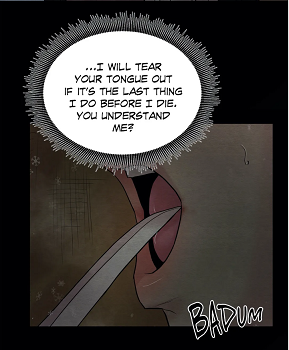 Since Nameless is well aware of the nobility’ mentality, he can use it to his advantage. The aristocrats never pay attention to servants and as such commoners. The criminal is right in the end: Min doesn’t even recognize that there’s a new guardian, although he has been at the mansion before twice (8, 52) and he even saw Deok-Jae getting beaten. Besides, I would like to remind my readers that there’s no coincidence in Byeonduck’s work. She focused a great deal on the guardian and his explanations. Since he was delivering a similar explanation than Nameless had made up, I truly suspect that the domestic is informing Nameless in the end. And note that in chapter 66, Min reveals in front of Yoon Seungho Jihwa’s involvement. Kim and other servants must have heard the aristocrat’s words. And with this new revelation, Nameless’ strategy becomes obsolete. The criminal will realize that Jihwa is in danger, because he knows about Deok-Jae’s death and he is also responsible for this situation. He hired the servant on the red-haired client’s behalf. Therefore Jihwa could take the fall for this. With Min’s revelation, Yoon Seungho could decide to retaliate. Yet, in this moment, I detect Min’s arrogance and stupidity. He has the impression that since the painter was not hurt, there’s nothing to fear. However, Min didn’t notice the change of the guardian and once Deok-Jae’s death is revealed, Yoon Seungho could use it to go after the nobles. Who knew about the kidnapping? The manhwaphiles should remember the words from the noble with the mole: As you can observe, Nameless’ plan was ruined by Min’s action, who believes that he is protected. However, he doesn’t realize that his favorite weapon, a secret, could be turned against him, as he is not aware of the existence of another secret. Since Min is responsible for Jihwa’s fate and the latter will blame Nameless for the servant’s death, the criminal will feel responsible for the red-haired noble. At the same time, Min made himself a new enemy who is definitely ruthless and smart. Since Min was responsible for Jihwa’s corruption, I believe that Nameless will be the one who will fight against Min and will defeat him in the end. That’s why he reminds me of Batman. The reason why I can’t truly associate Yoon Seungho to Batman is that I have the impression, the main lead will use the legal system to go after the people involved in that conspiracy. I have the feeling that he will be responsible for a purge and no one will ever imagine that it was triggered by the painter’s kidnapping. Nevertheless, I anticipate that in the future, Nameless will come to work with Yoon Seungho. There’s a reason for that. While Nameless represents truth and secrets, Yoon Seungho stands for justice and power, like I demonstrated it before. That’s why I believe that Nameless knows a lot more about the painter and his past, though he is not aware that Baek Na-Kyum is that person. The fact that the Joseon Batman was seen with a gisaeng, makes me think that he was looking for info. Then I couldn’t help myself thinking that Nameless must have witnessed something similar in the past, when he made a very realistic description how to get rid of the painter.
 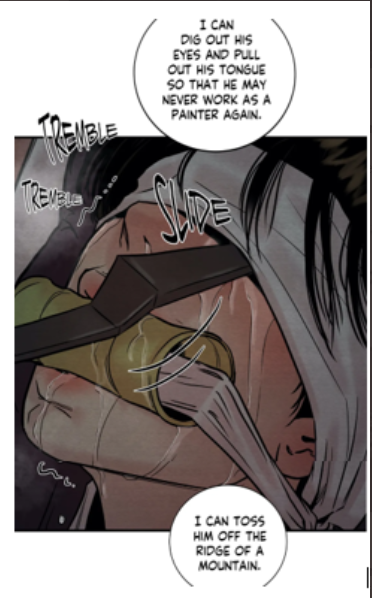 Let’s not forget that this story is constructed according to the principle: history repeats itself. So there must have been a painter in the past as well. Finally, Jihwa is linked to secrets either, as his favourite sentence is: I know Besides, I had explained that Jihwa seems to be involved in the past and felt guilty. Therefore I sense that both characters will discover that they have much more in common: the past and their involvement with the two main leads’ past.
And now, the manhwaworms can grasp, why I came to the idea that Nameless and Yoon Seungho will work together. The moment they are collaborating, they will definitely uncover what truly happened in the past and brought justice to the responsible ones. At the same time, we could say that Nameless is already working like the hand of justice, though he is not truly aware of it. He killed Deok-Jae who was a criminal in reality.  The man never got punished for his misdeeds: the theft, the treason, the bullying, the poisoning and the trashing of Baek Na-Kyum’s place. The vicious domestic met his karma. Sure, nowadays no one would receive a death sentence for such crimes, yet in that period it is a different story.
As a conclusion, Nameless has a similar function than Min, yet unlike the noble he has kept his heart pure. The darkness of his mind has a different origins than Baek Na-Kyum’s: he must have experienced injustice and even witnessed crimes committed by nobles, but they put the blame on commoners. Back then, he must have felt powerless, exactly like the main character. That’s why he chose to become a criminal in the end. If he became the nobles’ dirty hands, then he would get protected. As for Heena, I perceive her as Rachel Dawes, the one who fights for justice, even if there’s corruption.
Feel free to comment. If you have any suggestion for topics or manhwas, feel free to ask. If you enjoyed reading it, retweet it or push the button like. My tumblr-twitter account is: @bebebisous33. Thanks for reading and the support.
This is where you can read the manhwa. https://www.lezhin.com/en/comic/painter But be aware that this manhwa is a mature Yaoi, which means, it is about homosexuality with explicit scenes.
After reading the title, I am quite certain that the manhwaphiles have already guessed the identity of The Joker in Painter Of The Night: Lord Min. I have to admit that I connected Min to The Joker the moment I saw this panel: In this picture, the character’s facial expression stands in opposition to his words. First, he expresses his surprise and shock with his face, while in reality he is just asking for a confirmation. Therefore the contradiction indicates that he knows something and he is expecting a certain outcome. Secondly, his open mouth and big eyes oozes a certain lightness and ease, whereas he is talking about a serious topic: the death of the painter. Because of the discrepancy, the manhwalovers can detect Min’s fakeness and as such hypocrisy. He is neither shocked nor moved by the low-born’s death. And this important panel made me think of The Joker, the villain from Batman. [https://shiftermagazine.com/film/evolution-of-the-joker-1966-2019] Why? It is related to the contrast between seriousness and comedy, intelligence and stupidity, genuineness and fakeness represented by the character’s face and behavior. The famous antagonist is often portrayed with a huge smile and a hysterical laugh, very similar to Min.  (chapter 54) Furthermore, The Joker’s eyebrows are quite distinguished due to the make up and Min is recognizable with the special form of his eyebrows too. Besides, the Joker’s make up outlines the importance of his eyes too. Observe that Min opens his eyes so much, reminding us of The Joker’s from 1966. (the actor on the left). Although The Joker is dressed like a clown due to his make-up, his actions have nothing to do with comedy at all. He actually embodies destruction, chaos and death, therefore his disguise contradicts his behavior, explicating why I came to associate Min to The Joker. Due to this connection, I came to realize the character’s true role and personality. This explicates why I will divide “The Joker” in two parts. In this essay, I will only focus on Min’s function in the story as a joker, while in the second part, I’ll study his personality.
First, it is necessary to take a look at the definition of a joker, because it explains why the authors Bill Finger, Bob Kane, and Jerry Robinson came to give the name to their supervillain:
These different significations explain why joker has a lot of diverse synonyms: card, actor, clown, buffon, jester, trickster, prankster etc. That’s why I would like to study Min’s behavior under the aspect of a joker first. What kind of joker is he?
First, Min could be considered as a special playing card. The joker doesn’t abide to the card rules. This signifies, the joker represents an exception to norms and conventions corresponding to Black Heart’s behavior. First, Min shows no respect social norms and traditions. That’s why he doesn’t feel bothered smoking opium so openly on the street. He has no problem to have sex with a low-born, hence he asks his host to bring the painter to him twice (chapter 33, 52)  (chapter 52) And notice that his desire to taste the painter contrasts so much to Jihwa’s words in chapter 18. The joker in chapter 52 even insulted Jihwa as sodomite, showing that he doesn’t consider himself as a homosexual per se. His sex with other men has nothing to do with love. Unlike the main lead, Min associates sex with fun. Since sleeping with a commoner is considered as a taboo, Min can only get curious and feels the desire to experience sex with Baek Na-Kyum. And now, you understand why I associated Min to The Joker from Batman. Both show no respect laws and social norms, they are breaking them, bringing uproar, chaos and destruction in the end. (chapter 53) Here, the readers can observe that Min is criticized for creating a ruckus contrasting to “discreet fun”. Hence we can describe Min as an extremist. He loves scandal so much that he takes pleasure in ruining friendship and relationships. And since for Min and The Joker, laws, social norms and true values (love, friendship, family) should be eliminated, then we can describe them as nihilists.
“In philosophy, nihilism is the complete rejection of moral values and religious beliefs. It is such a negative outlook that it denies any meaning or purpose in life.” https://www.vocabulary.com/dictionary/nihilism#:~:text=In%20philosophy%2C%20nihilism%20is%20the,existing%20political%20and%20social%20institutions.
However, both characters are not advocating destruction of the social system for its own sake. They commit crimes and violate social norms due to their selfishness and their own pleasure. There exists no real plan behind their actions. Since Min is associates to extremism and annihilation, you can comprehend why Min’s actions lead to the destruction of the door in chapter 53 and to his bloody face . He literally ignores manners, even risking his own safety. He knew Yoon Seungho’s anger and rage, as he was a witness of the topknot incident concerning Jihwa. (chapter 59) Even if it is Jihwa’s friend who is speaking here, we have to imagine that Min was also there due to his words in chapter 53: He must have seen how Jihwa was powerless and couldn’t stop his childhood friend to humiliate him. Besides, Min had even seen what the host had done to Deok-Jae, therefore he was well aware of the repercussions, if he kept provoking the protagonist with his mockery. And now, the readers can understand why the joker is a synonym for trickster or prankster in the end. Because the joker is not attached to rules and laws, he can play tricks and fool people around him.
And now, if the manhwaphiles behold the Joker as card, they all will notice that the joker is dressed like a jester or buffon. https://depositphotos.com/vector-images/joker-card.html
During the Middle-Age and Renaissance, the jester or also called fool, was a member of a household of a nobleman or a king hired to entertain his guests. And the manhwaphiles can understand why a joker is “someone likes telling funny stories or doing stupid things in order to make people laugh” (definition 2). However, The jester’s role shouldn’t just be reduced to an entertainer, as he could also use insolence to make critical comments. That’s why in the Korean movie “The king and the clown”, the clowns put on a performance ridiculing the council members by implying that they receive expensive gifts for favors. In this movie, it becomes visible that a clown is walking on a thin line between success and failure. His closeness to the king can lead to fame, but also to loss of freedom and tragedy. And now, if you remember the role played by Min, you’ll observe that in chapter 52, he was indeed acting like a jester, mocking the host dressed like a king.
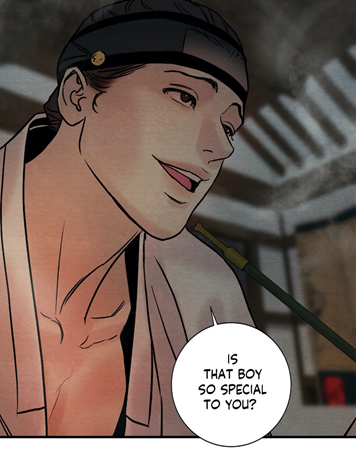 He kept asking rhetorical questions, making comments without waiting for Yoon Seungho’s answer. It was, as if Min was acting like an entertainer. However, we should remember that despite his role as jester, his true goal is not to entertain his host or his friends. He is behaving like that out of selfishness. He is the one who desires to have fun. (chapter 66) With his mockeries, he expressed his wish to taste the painter and Yoon Seungho understood his insinuations, therefore the main lead voiced Black Heart’s wish and even accepted his request, because he was terribly annoyed by Min’s interrogation. That’s why we can say, Min was in that scene not only a jester, but also a trickster (referring to the third definition). He manipulated the main character to achieve his goal.
At the same time, the joker can be in different card games an extremely beneficial or an extremely harmful card because of his special function. And this fits Min’s role concerning our main couple. While bringing misery to Baek Na-Kyum (the idea of the murder and a gangrape), he actually forced Baek Na-Kyum and Yoon Seungho to realize their true feelings for each other. When Yoon Seungho imagined that the artist would never love him, because he considered himself as a prostitute, the lord never questioned his own emotions. This illustrates that Yoon Seungho had deeply internalized social values and father Yoon’s doctrines in the end: a noble is superior to a low-born, and no aristocrat would lower himself to admit his affection to a commoner. An abnormity in this historical period and since Min shows no respect to social values, he could only question the lord’s behavior and actions. And now, you understand his role as jester in chapter 52. First, he cornered the protagonist and forced him to be in denial. This reminds us of a fool who makes critical comments leading the monarch to question himself and his politics. In Yoon Seungho’s eyes, since he was the noble, only the commoner should confess his affection. However, when the mischievous aristocrat kissed the low-born, the main lead could only react instinctively. He had to push away Black Heart. For Yoon Seungho, Baek Na-Kyum was his lover, even if he was in denial. But observe that the main lead wasn’t the only one who had internalized certain values. The artist had a similar mind-set. For him, it was impossible that such a powerful and rich aristocrat could love him, who comes from the brothel and has unknown origins. That’s why he denied the aristocrat’s feelings. 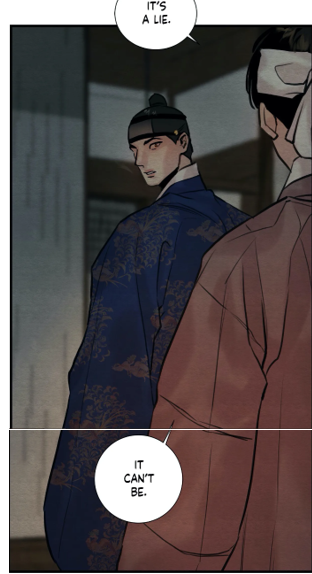 And due to Min’s trick, Yoon Seungho was hurt, as he considered it as a rejection. Note that in that scene, social norms played a huge part in the denial of both protagonists, although they were never directly mentioned. Min as the joker was a reminder of scandal and as such of standard norms.
But let’s go back to our initial observation. Min as the joker can be an extremely beneficial or an extremely harmful card to our main couple. We have another incident, when this is palpable: The abduction and the murder. When the painter was fearing for his life, he recalled the noble’s gentle smile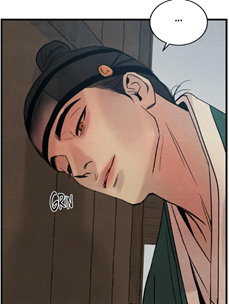 and screamed for his help. Yoon Seungho was the last person he was thinking of, when he imagined that he could die. And let’s not forget that the artist was still in denial after the second confession and their second love session. He kept denying the obvious and recognize the noble’s feelings.
 For him, it was also too beautiful and incredible to be true. At the same time, his denial stopped him from realizing his true feelings. Yet in front of death, Baek Na-Kyum couldn’t control his emotions and thoughts pressuring him to voice his deepest desires. And the artist’s disappearance had a similar effect on the main lead in the end. First, in the storage room, he confided his real wish before “destroying” the painter with sex. That’s why I view this panel as a parallel to the one where the painter was screaming Yoon Seungho’s name. Remember how I described this night (chapter 62-63-64): it symbolized the death of the phoenix. In chapter 66, the noble is finally admitting his complete defeat, he lost the war against Baek Na-Kyum. First, he admits that he can’t resist against the painter’s protest.
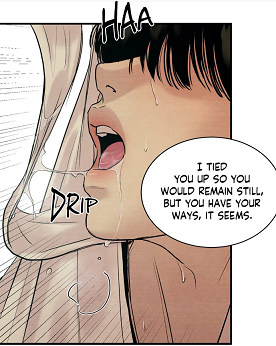 Then he is not even trying to hide the painter in front of Min. He is indeed carrying him like a treasure, while feeling no embarrassment. And this explains why Min has to provoke Yoon Seungho again, by revealing Jihwa’s involvement. Since Min has realized that the main lead is no longer in denial and doesn’t consider it as a scandal and secret, then Min has to use another secret in order to annoy the main character. Since he couldn’t ruin the relationship between the painter and the noble, he needs to destroy the friendship between the red-haired aristocrat and the main lead. Note that in that scene, Min even recommends the main lead to be lenient and not become angry at Jihwa. Here, Black Heart is actually using an antiphrasis. He is actually hoping that with his words, the main lead will become angry at his former friend and retaliate against him. This scene is important as it exposes Min’s nihilistic mentality. He feels the need to annihilate something, if it is not the painter, then it must be Jihwa.
And the joker doesn’t realize that his actions have the opposite effect. This new revelation is the reason why Yoon Seungho surrenders during the next night.  Like my follower @seunghosimp observed it correctly, this gesture symbolizes his capitulation and submission. Due to Min’s intervention, all the secrets were removed so that the relationship between the two protagonists can be rebuilt on a new and real foundation. The noble has no longer the upper hand in their relationship and will always listen Baek Na-Kyum’s words. Now, Yoon Seungho can trust the painter and will never question his behavior and words. What the main lead fails to recognize is the painter will never see himself as superior and as the lord. For him, love is not a synonym for war or defeat. Baek Na-Kyum will teach him the true nature of love.
But the irony is that Min is not realizing that he is helping the main couple.
For him, commotion  and annihilation are a synonym for fun. That’s why he is a joker and as such The Joker. He is trying to tell funny stories or make stupid things in order to make himself laugh. He is the actor and the spectator at the same time, which is quite similar to The Joker from Batman. From my perspective, they both are trapped in their own world, therefore they can ruin relationships and kill people. This explicates why Min could even laugh, though he was getting punched. It was, as if he couldn’t feel any pain, as his “joke” had provoked such a reaction. And now, you understand why The Joker is wearing a make-up as a clown in the end. He isn’t only the joker from the cards, but also the jester from the Middle-Age. At the same time, he embodies selfishness and destruction contrasting to the real function of a clown. But his role is not just to bring chaos and ruin Gotham, but also to question the society and its values.
Let’s return our attention to Black Heart. Since he failed to hurt Yoon Seungho and even separate the main couple, we have to envisage that the more the scandalous relationship will get support, the more this vicious man will get bothered. The reason is simple: normality stands in opposition to uproar and ruckus. At some point, their relationship will be accepted signifying that he won’t be able to taste Baek Na-Kyum. Note that each time, the noble asked the main lead to bring the painter to their sex session, he used the other nobles as an excuse. That way, he could hide his own desire and weakness. This shows his own hypocrisy. He will never reveal his attraction to the painter. He will use “fun” or “the other nobles” to hide his own secret. The irony is that the more he meddled, the further he got from the painter. Consequently, his urge to taste the painter will increase more and more, while he has to witness how the main lead gets closer to Baek Na-Kyum. This can only annoy the jester. His interest for the artist can be explained by the following:
After describing Min’s role, the manhwaphiles can grasp why this character is liked by many readers. He reminds us of the supervillain from Batman. Min’s weapons are secrets, that’s why he could manipulate Jihwa and the main lead in the end. And now, it is important to ask ourselves: who will stop Min and destroy him? Where is the Batman in Painter Of The Night? With this, I would like to incite my readers to find an answer to this question, but I have to admit that I have already found the answer (or better said, a possible answer).
Feel free to comment. If you have any suggestion for topics or manhwas, feel free to ask. If you enjoyed reading it, retweet it or push the button like. My tumblr-twitter account is: @bebebisous33. Thanks for reading and the support.
This is where you can read the manhwa. https://www.lezhin.com/en/comic/painter But be aware that this manhwa is a mature Yaoi, which means, it is about homosexuality with explicit scenes.
If I asked the manhwalovers about the number of flashbacks used in chapter 66, they would certainly reply that there were 2 flashbacks. The first one is, when Baek Na-Kyum remembers that night where he had a near-death experience and the second one would be, when he is lying in his study with Yoon Seungho next to his bed.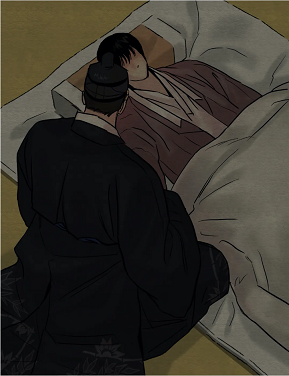 They would give such an answer, because they would use the black frame as reference. The latter represents a memory or a dream in Painter Of The Night. In other words, the manhwaphiles would invoke a literary phenomenon:
“Flashback is a device that moves an audience from the present moment in a chronological narrative to a scene in the past. Often, flashbacks are abrupt interjections that further explain a story or character with background information and memories. […] Flashback can occur as a sudden thought sequence, a hazy dream, or a vivid memory. It can be announced or unannounced in the line of narrative.” https://literaryterms.net/flashback/
However, we have more than 2 in reality, as Byeonduck used a different type of flashback too: the psychological flashback linked to PTSD.
“Flashbacks are psychological phenomena during which a person relives a past event or fragments of a past experience. […] Conversely, some flashbacks may be devoid of visual and auditory memory and may lead a person to experience feelings of panic, helplessness, numbness, or entrapment. Many individuals report the onset of flashbacks after surviving a near-death experience or another traumatic situation.” https://www.goodtherapy.org/blog/psychpedia/flashbacks#:~:text=Flashbacks%20are%20psychological%20phenomena%20during,fragments%20of%20a%20past%20experience.
Striking is that the author linked both phenomena together in order to explain the reason for Baek Na-Kyum’s behavior. He was having a panic attack in form of a flashback, which terrified him so much that he left the bed in his distress  and walked randomly in the room. His survival instinct had kicked in. Because of the flashback, the protagonist had lost his sense of orientation and couldn’t see where he was going, as all his thoughts and emotions were revolving around the trauma. He had the feeling that he was reliving his past experience. This explains why the chapter 65 ended with the following panels:

The readers had here to fill the blank and explain, why the painter was first lying under the cover to finally end up in the room next to the cupboard on the floor. Yet, Byeonduck never showed us this. She just offered us the result requesting from the readers to imagine the whole scene. By doing so, she forced the manhwaphiles to put themselves into the artist’s shoes. That way, she let them feel what Baek Na-Kyum was experiencing.
But let’s return our attention to the flashbacks. When the episode 66 starts, the time of the narration has actually changed. We are already reading a flashback, although this time Byeonduck didn’t use the black frame. There’s a reason for that. She employed a time jump, but not in the future, like k-dramas often utilize it, but a time jump in the past. The first scene of chapter 66 happens right after Yoon Seungho says those words in chapter 65. And if you read the chapter again, you’ll notice a huge white space between the next following panel.
  Yoon Seungho is opening the door leaving the painter in his bedchamber (chapter 65). As a conclusion, the beginning of the episode 66 has to placed between the last words and the opening door. Hence we have a fourth flashback in episode 66.
First, she showed us the protagonist tying the painter on the bed , then covering his mouth
 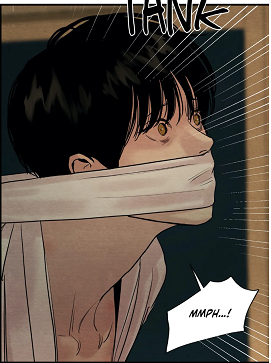 and finally putting him under the cover
  so that he could get rid of noona Heena easily. He recreated the situation Baek Na-Kyum was exposed to, when he had been abducted. And if the beholder pays attention to the way the painter is lying in the bed, they will realize another important aspect: the cover that the painter used as protection and comfort has become a prison or a trap now. The cause for this heartbeat is not excitement or surprise but fear. And this panel is very important for two reasons. First, it is a new version of chapter 34, where the painter was crying that the scholar hadn’t asked for him and used the cover as solace.
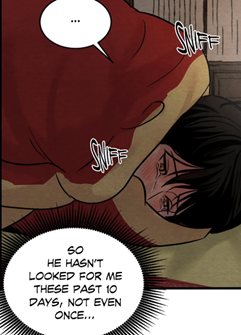 Besides, in this chapter, his heart started racing with the main lead’s appearance.
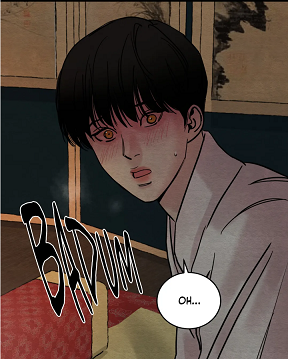 In both chapters, the main lead was the cause for the heartbeat, yet the reasons for the racing heart are totally different. It is important, because it shows us that the kidnapping left a deep wound on the artist’s psyche. When the main character recreated the condition of the abduction, he triggered a flashback. Because Baek Na-Kyum couldn’t scream for help and his head was held under a bag , he had difficulties to breathe, therefore in Seungho’s room, he starts suffocating too: “HAA, HAA”. Furthermore, during the kidnapping, the threads and the knife in his mouth showed that Nameless knew how to scare the low-born. He triggered all the painter’s senses and aroused them to the maximum so that the artist wouldn’t be able to speak so easily. This explicates why the artist felt the abduction as a near-death experience. This is not surprising that when he woke up the next morning, he was trembling and felt scared.
 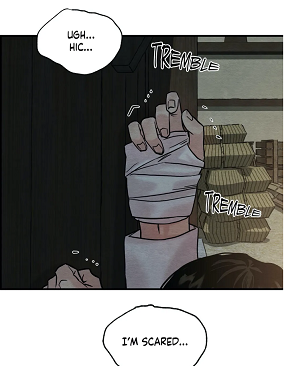 But if the manhwaworms looks at the criminal’s actions, they will conclude that Nameless was indeed ruthless. He knew how to terrify the painter. He tormented the painter psychologically. Nonetheless, since Nameless neither murdered nor atrophied the painter, in his eyes he was actually very kind and even merciful. He even felt pity for him, as he was well aware of the artist’s innocence. The latter was just a plaything caught in the middle of the fight between two nobles. Because of his words, I believe that Nameless stands in opposite to Kim’s philosophy. While the latter chose cowardice and indifference for his self-preservation, the “butcher” made the opposite choice. By becoming the dirty hands of the nobles, he was sure that the nobles would protect him, because if they didn’t, their crimes could threaten their position. He would always stand on the winning side. However, by acting like that, Nameless contributes to perpetuate injustice and reinforce the harsh treatment on commoners. As you can see, the flashbacks (memories of the painter) were used to explain why the low-born had a flashback (panik attack) at the end. By reproducing the condition of the entrapment, Yoon Seungho helped to unveil the truth unconsciously. The painter’s body revealed the terrible secret and the readers got a glimpse of Nameless’ true mindset too.
So when the lord opens the door and sees the artist on the ground, he looks angry, because his lover caused him some trouble.  This impression seems to be confirmed, as the moment he removes the cloth from the painter’s mouth, the lord criticizes him.
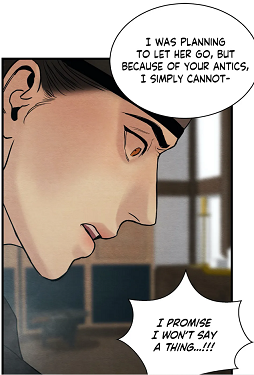 However, from my point of view, we need to differentiate between the actions made by Yoon Seungho’s mouth and hands again. While the latter are under the influence of his unconscious, the mouth represents the mind and as such conscious. Note that he removes the cloth, although he could have ignored it. By liberating Baek Na-Kyum’s mouth, he is actually endangering his situation. Let’s not forget that since that terrible night, the lord has returned to his older self, therefore he has the impression that he is no longer using his heart. But he noticed that the painter was in a terrible condition, therefore he couldn’t ignore his lover. From my point of view, the two panels reveal that Yoon Seungho’s affection for the painter hasn’t changed one bit in the end. He continues saying that he is restraining himself, since he is not even able to refuse Baek Na-Kyum’s resistance: “But you have your ways”. From my point of view, we have here a new version of the lord’s confession: (chapter 58). The irony is that in chapter 66, the painter is a wreck, yet the lord is admitting his defeat displaying Baek Na-Kyum’s real power. The other divergence is that this time, it is a conscious choice. This is not a dream or an illusion. Yoon Seungho states that he can’t win against the low-born’s will. In other words, their relationship is progressing again. Due to the resemblance of the chapter 58, the readers have the feeling to witness another flashback. Nonetheless here, the noble hears a reply to his confession, unlike in the past: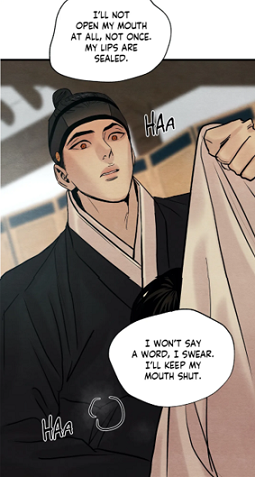
 The nature of the confession has changed: this is an admission for his silence. He lied and apologized in order to survive. These panels expose how deeply traumatized the painter is. He is still trapped in his flashback, reliving his near-death experience and doesn’t realize his lover’s presence. Therefore his gaze is directed elsewhere. I would even say, his gaze is lost in the flashback. What caught my attention is the protagonist’s reaction, when he hears the painter’s words and heavy breathing. He is not only surprised and shocked
 , he is also paralyzed. For me, the last panel shows the main lead’s realization. He must have recognized the painter’s real condition: he is traumatized. And in my opinion, the painter’s confession and behavior triggered a flashback in Yoon Seungho too, which we don’t really see, but can sense more or less. Observe his discomfort and his fixe stare.
  He seems lost as well, very similar to the commoner’s gaze. Besides, the aristocrat doesn’t move one moment, although some time has already passed. The sister has already left the house and Min is now standing at the door. The last picture even shows us Min’s perspective. He senses the lord’s worry and pangs of conscience too. From my point of view, the lord is reminded of his own bad past experience due to the artist’s behavior and words. The other clue for this interpretation is the lord’s phobia of the cover. (chapter 35) Therefore I come to the conclusion that we have another flashback here, but Yoon Seungho’s is not revealed, only through his gaze and the observations I made: the fear of the cover and the commoner’s past as a repetition of the main lead’s tragic past. Let’s not forget that this scene is also a new version of chapter 53:
 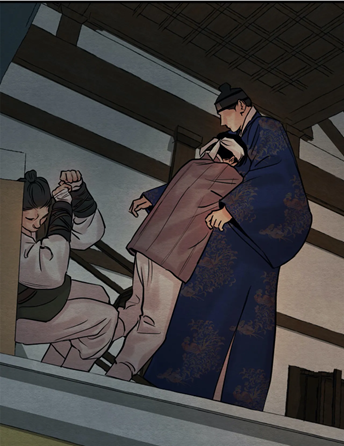 , back then, the main lead was the one who was in a dissociative state and the painter embraced him, when he sensed his fury and pain. However, this time the roles are switched. And this explains why the noble hugs the painter, attempting to give him some comfort. Yet, in my opinion, he has no idea about the real cause of the artist’s trauma in that moment
 , therefore he feels responsible and terrible. That’s the reason why he remains so passive and silent. He feels the need to console Baek Na-Kyum, but note that he doesn’t even attempt to dress the painter or to put him in a better position. He stays kneeling in an uncomfortable position, using his body and hands to protect Baek Na-Kyum from others. And now, the manhwaphiles can comprehend why I chose such a title. The flashbacks are not just memories, but also psychological phenomena due to PTSD.
And now it is time to focus on the last flashback. I have to admit, it took me some time to fully grasp what it really represents. The first confusion is the chronology of the episode. Before the appearance of the flashback, we have a zoom on Yoon Seungho’s face indicating that he heard Min’s confession: Lee Jihwa is behind the painter’s disappearance. And right after, the flashback starts so that it feels like a caesura. Therefore many readers felt confused. In order to comprehend its true nature, the manhwaphiles should remember the definition of the flashback in fiction. It is either a memory or a hazy dream. That’s why we need to question ourselves about the nature of this scene. Is it a dream or a memory? And who is the person having a flashback?
For me, there’s no doubt that this can’t represent the lord’s memory. First, the chronology shows that the flashback happens during the next night due to the way the lord and Baek Na-Kyum are dressed. The lord is still wearing the hanbok from the morning and this time, the painter has his own expensive clothes on. From my point of view, the lord took care of the artist personally. Unlike in chapter 33, Yoon Seungho took his responsibilities for his wrongdoings and didn’t delegate it to the doctor or his assistant. It was his way to show repentance. Secondly, I believe that the owner of this flashback is Baek Na-Kyum due to the ending and the two following drawings: 
 The images are almost identical, yet in the second picture, there’s no black frame, therefore this means that it represents reality. And now, you can better grasp the nature of Baek Na-Kyum’s flashback. It is a mixture of dream and memory. The lord stayed by his side the whole night (a new version of chapter 55)
  and at some point, the artist opened his eyes briefly, just like the lord nodded to Baek Na-Kyum’s question unconsciously
  , as he felt his presence, but never realized it in the end. In other words, the painter also detected the lord’s presence by his side, even opened his eyes for a second, heard him even calling his name
  . The tragedy is that exactly like during their Wedding Night, the painter won’t be sure, if what he sensed and saw was reality or a dream. Therefore I come to the conclusion that this is a new version of chapter 58, where the roles are reversed. Back then, the lord thought that this night with Baek Na-Kyum was too beautiful to be true and it is the artist’s turn to feel the same way. This flashback shows his wish mixed with a memory. And now, during this night, the lord expressed his regrets and showed his tenderness, just like in chapter 58. He took the hand with delicacy
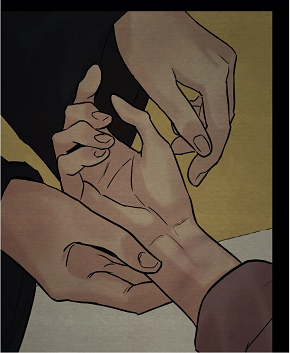 and touched the wrist and the wound with his finger carefully,
 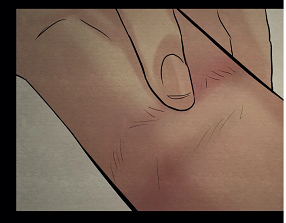 ,as though he wanted to heal himself the bruise. For me, this scene was so beautiful and moving, as it reflects the noble’s growth. He doesn’t just feel huge pangs of conscience, but he is determined to redeem himself in the end. When he touches the scar, he feel sorry for Baek Na-Kyum’s wounds which he hadn’t seen due to his self-hatred. At the end, he treats Baek Na-Kyum’s hand like a treasure. Yet, note that he is not kissing it. First, I interpret his gesture as a sign of regret. Secondly, a kiss is linked to sensuality and the noble is no longer for such a love, especially after that terrible sex marathon. Moreover, I believe that lord Seungho has the impression that he is not worthy of the painter, hence he puts a finger between his eyes and the low-born’s hand. The absence of his eyes is not necessarily referring to his blindness. For me, it points out that the lord has finally recognized the true value of his hands: the painter’s beautiful spirit and soul. Besides, they helped him to see the truth. Why? I have to confess that this scene made me remember their first meeting in chapter 1. Although the lord called them “talented hands”, he grabbed them in a rather rough way
  and put them on his loins.
  He only valued them, as they helped him to have a better libido. And now, his gesture has a different meaning. The hand made him recognize that the drawings had an effect on his heart and soul. At the same time, the artist made him realize his hypersexuality. As you can observe, by contrasting these two scenes, you can detect the noble’s development. But since the painter only opened eyes shortly, the noble decided not to remain by his side, because he had the impression that the artist didn’t wish to see him after what he had put him through. That’s why he sent for noona Heena. He knew the importance of his sister, since the commoner had tried to protect her before. That’s why we see the sister by the painter’s side the next morning.
  She symbolizes reality. Consequently, I believe that the following picture from the flashback illustrates the artist’s true wish.
 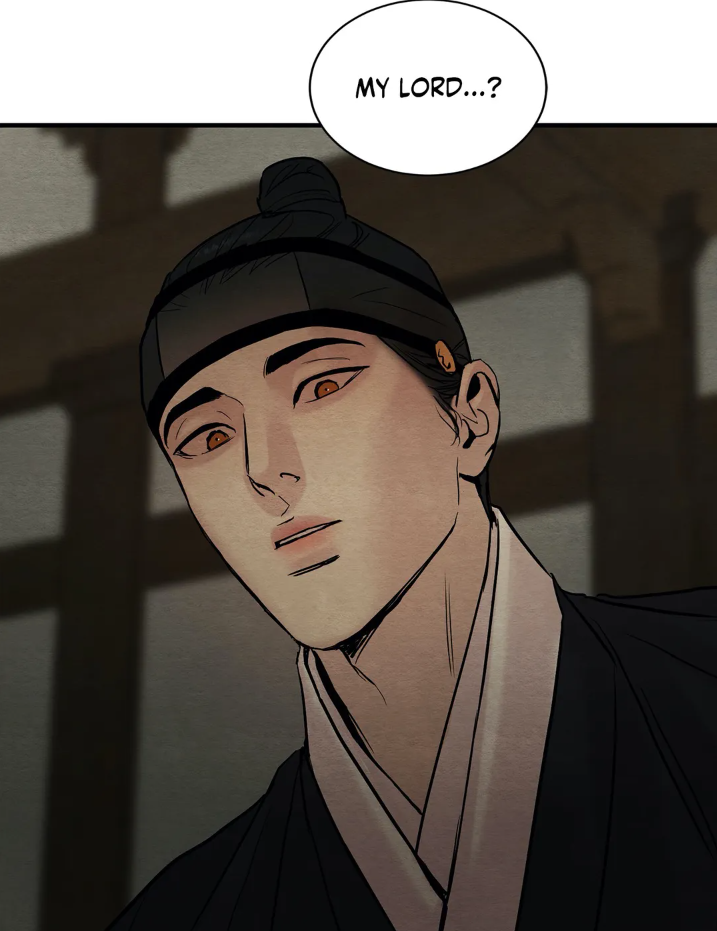 He desired the lord by his side, but the reality was different. His noona was by his side. This didn’t upset the painter, because he received a warm embrace full of love and compassion, something really important in order to heal his wounds,
 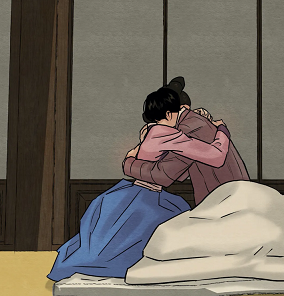 contrasting to the hug in the barn symbolizing fakeness and coldness.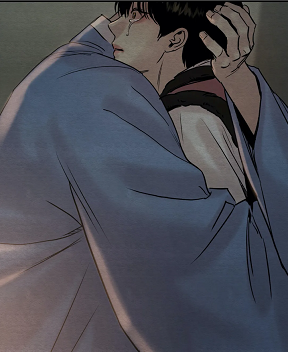
As you know, Baek Na-Kyum’s dreams were always connected to reality, as they often announced the future events. However, here I feel that the dream is connected to reality differently: it is connected to the past. The lord was indeed present in his study. The flashback is influenced by a memory mixed with a wish. Consequently this flashback stands in opposition to the first one, where the painter relived his trauma due to the memories linked to his terrible near-death experience. Both flashbacks were influenced by memories, yet in the last one, the painter will have the impression that it was too good to be true. There’s no ambiguity that Yoon Seungho will keep his distance from the artist. Just like during the first season after the chapter 35, he won’t ask for sex. The gesture with the hand was pretty clear for me. The aristocrat will be content, if he sees the artist by his side from afar. However, this doesn’t signify that Yoon Seungho will leave his mansion for sex orgies. No, it is impossible. Since he knows that Jihwa hurt his lover, he has to be by his side to ensure Baek Na-Kyum’s safety. Therefore I come to the conclusion that Yoon Seungho will start paying attention to his mansion and staff. He will ask for answers, like for example: How could the guardian let Min walk in the mansion so freely? He will give strict orders. From my point of view, the main lead will start acting like a real lord and pay attention to the behavior of his staff. At the same time, Yoon Seungho will also have a flashback of that night, where he beat Deok-Jae, who had hurt his lover. He will interrogate Kim about his whereabouts and investigate the circumstances of his disappearance.
Although the painter is now unsure, if the lord was by his side or not, it’s only a matter of time, until the painter approaches the noble again. I am expecting a new version of chapter 52. Why? Due to the analysis of the flashback, I think that despite the new sex marathon, the artist is not resenting Yoon Seungho. I explain his reaction the following: In the barn, the aristocrat’s words left a deeper impact than anything else. For the first time, someone was refusing to abandon him 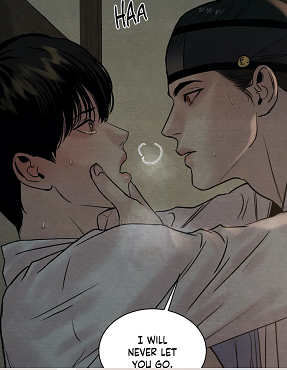 (even if it sounded so possessive and obsessive). Furthermore the same person even expressed that his smile and presence could be the source of his happiness , something he had never heard before. Finally, we shouldn’t forget that Baek Na-Kyum’s ears have always been very sensitive to words, explaining why the commoner was so devastated by Jung In-Hun’s last sentence. Finally, the lord’s confession revealed that he never considered him as a whore in the end, as his request was just a smile and not his body. Finally, I believe, noona Heena’s presence will also have an influence in the painter’s thoughts and emotions. Baek Na-Kyum will be able to appreciate that Yoon Seungho allowed her companionship, willing to accept a gisaeng in his house, although the low-born heard him calling her a wench or harlot before. Unlike the past, the artist is no longer blind or deaf to the noble’s gestures. There’s no doubt that they will rekindle, but their relationship will mature. The lord will try to find a different connection and I am already imagining him asking again:
  Another flashback from the past…
Feel free to comment. If you have any suggestion for topics or manhwas, feel free to ask. If you enjoyed reading it, retweet it or push the button like. My tumblr-twitter account is: @bebebisous33. Thanks for reading and the support.

This is where you can read the manhwa. https://www.tappytoon.com/comics/painter-behind-curtainm. But be aware that this manhwa is mature Yaoi, which means, it is about homosexuality with explicit scenes, although there is a softer version: A Painter Behind The Curtain (All Ages) Here is the link where you can find the table of contents of analyzed manhwas. Here you can read the first analysis about A Painter Behind The Curtain: The difficult life of painters
It would be great if you could make some donations/sponsoring: Ko-fi.com/bebebisous33 That way, you can support me with “coffee” so that I have the energy to keep examining manhwas. Besides, I need to cover up the expenses for this blog.
The reason why I am writing another essay about A Painter Behind The Curtain is quite simple. The first composition about this wonderful manhwa has become the most read essay among all the other manhwas I examined. This signifies that people are interested to learn more about the manhwa and its historical context. In the first composition, I described the strong connection between art and monarchs. The latter would use painting in order to legitimate their power and authority. However, art and as such painting also played a huge role in revolutions.
Let me give you an example. When French revolution started in 1789, the deputies from Third Estate (mostly represented by bourgeoisie) accompanied by a few from Nobility and Clergy gathered in the Jeu de Paume court (Jeu de paume = similar to tennis) in order to take an oath that they will never separate, until a constitution is composed. This event is very important, as it represents the deputies’ second revolutionary act against Louis XVI’s authority. And in 1791, the famous painter Jacques-Louis David created a painting representing this oath. https://fr.wikipedia.org/wiki/Jacques-Louis_David#/media/Fichier:Le_Serment_du_Jeu_de_paume.jpg
And this shows that artists can also support revolutionary ideas and movement, they can either help to reinforce the ruler’s authority or even do the opposite. In other words, arts are never obsolete or just for entertainment. They can have a strong influence of public opinion. This is also not surprising that dictators in the 20th Century used arts as a tool for propaganda. However, if you pay attention to the drawing from Jacques-Louis David, you’ll notice that his way of painting is still influenced by classical rules. And this leads me to the next observation, a painter can also become a revolutionary himself, when he starts defying academic rules in arts and as such to authorities. The best example for this statement is the Russian painter Kazimir Malevitch, who created in 1915 the work called The Black Square or Malevitch’s Black Square. https://en.wikipedia.org/wiki/Black_Square_(painting)#/media/File:Kazimir_Malevich,_1915,_Black_Suprematic_Square,_oil_on_linen_canvas,_79.5_x_79.5_cm,_Tretyakov_Gallery,_Moscow.jpg
The first reaction young people have, when they see this painting, is to laugh and say that they could do such a painting themselves, as it doesn’t seem to show any profound skill or talent. What they fail to see is how revolutionary his creation is, because they don’t put the work into his historical context. In 1915, Russia was still an autocracy, the Russian version of an absolute monarchy, where the Czar was still considered as the supreme ruler of the country. In this historical period, Russia was very conservative and refused any modernization, which signifies that academic rules in arts were very strict too. Thereby the idea itself was totally new. When Malevitch created his Black Square, he was challenging not only the Russian arts academy, but also authorities. He was asking for a profound change in his country, he literally eliminated every rule and decided to create a new art, the suprematist movement. And this is no coincidence that 2 years later, Russian revolution occurred and in October 1917, Bolshevik faction organized an armed uprising against the Provisional Government leading to the establishment of the Bolshevik regime. From that moment, the new government tried to erase all the symbols from the past and the Russian autocracy, just like Malevitch had done it with his paintings. It was, as though the author had announced a new huge change for Russia. As a first conclusion, the manhwalovers can sense that painters can play a huge role during a Revolution, they can advocate revolutionary ideas and movement, but they can also be used to reinforce the current government and as such become an instrument for propaganda.
After this introduction, it is time to focus on the manhwa and to examine the role played by Ian Scornel. It becomes clear that Ian belongs to the first part. Because he portrays the people involved in their revolution, he is advocating their ideas: liberty and equity.  (chapter 44) He isn’t only a witness of the preparations for the revolution, he is also a participant, therefore he desires to assist to the revolution. This explains why he doesn’t intent to paint the event itself afterwards based on different sources and testimonies, like Jacques-Louis David. His paintings are the results of his observations. By portraying the revolutionaries, he support their protest and the change.
Nevertheless the revolution planed by Henry fails, since Raymond betrays the movement in order to obtain power and revenge. Due to his love for Raymond, the painter Ian accepts his decision and remains by his lover’s side,  (chapter 46) although he feels terribly guilty. However, the consequences of his choice are far worse than the artist and even Raymond could ever imagine. Due to the immense burden, Ian Sconel’s creativity gets affected. He is no longer able to paint like before.
  It was, as though the loss of his innocence had tainted his creativity. Furthermore, since he is now connected to king and nobility, his topics get limited.
 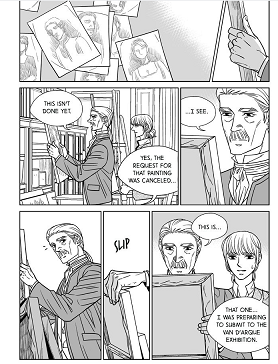 He becomes a painter portraying nobles. This explains why the paintings above are lacking energy and creativity. In other words, the closer Raymond got to power, the more Ian gets pressured to paint for the higher-ups. And this reminds me of the painter Jacques-Louis David, who first supported the revolutionaries and even Robespierre, the representative for Reign of Terror (La Terreur). When the latter got executed, the painter left France and came back, when Napoleon became the ruler as First consul (1799). Only in 1804, Napoleon became emperor Napoleon Ist. As a conclusion, the artist supported an authoritarian monarchy contrasting to his first convictions. Jacques-Louis David became famous with the following paintings:
In my opinion, his conservatism is palpable in the way he created these paintings. That’s why he is labeled as a classic painter. And now, we have to wonder if Ian will become a second Jacques-Louis David. As you can anticipate, this won’t be the case. Ian might feel guilty, but he never gave up on the ideas of liberty and equity. And this is not the case of the French painter, although Napoleon presented himself as the heir of French revolution. Nevertheless, the readers have to grasp that this was just a justification for his expansionist politics. But there’s another reason for my statement. Right from the start, Ian was a revolutionary artist because of his style. Mr. François noticed it right away. This explicates why the latter is asking Ian to follow him, when he is about to move away. He is well aware that if he remains by Raymond’s side, his creativity and talent won’t be nurtured.  And now, you understand that I consider the protagonist as revolutionary in both senses: he advocates liberty and equity, but he also represents a new style breaking academic rules. This is visible with the following painting:
  He expresses his emotions and a certain melancholy through the painting. That’s why I have the impression that the author chose Ian as a representative of Romanticism. Romanticism is characterized by the dominance of sensitivity, emotion and imagination over reason and morality. Artists paint by affirming their ideas and letting their personal impressions and feelings appear with passion through their works. This explains why Manuma selected Ian as first name for the protagonist, although the story takes in Italy. Romanticism was born in Germany existing from 1800 to 1850. Furthermore, Romanticism identifies with liberal and national movements in Europe (19th century). In order to understand what they are, especially for readers from other continents, it is important to explain the historical context.
The origin of these liberal and national movements existing in every European country comes from the French revolution. This important event started in 1789 and ended in 1799, when Napoléon Bonaparte seized power through a coup d’état. This marked the end of French revolution, although Napoléon used its ideals (liberty and equity) in order to conquer the rest of Europe. In other words, the name of freedom and equality, Napoleon expanded his empire. He wanted to create an Europe of nations under French hegemony. That’s why the emperor supported Poles and Italians, who were ruled by foreign countries (Russian-Austria- Prussia for Poles and Austria for Italians). For Italians, it is different because the country was divided under different rulers as well. By creating a Polish and Italian nation, the French emperor imagined that he would get the support from people against traditional absolute monarchs. In order to disguise his true intentions, he introduced reforms in the different occupied countries: abolition of hierarchical societies, introduction of a constitution and the code civil. Yet, in reality, Napoleon’s ruling was not different from an absolute king, because freedom and equity were just paroles, empty promises. First, he exploited the conquered countries. Besides, Napoleon could be perceived as the first dictator in our modern world. He used propaganda, schools in order to indoctrinate children and turn them into his future soldiers and even planted spies in all different social classes in order to monitor people. His minister Fouché desired to install fear among people by letting them think, there were spies everywhere. But with the downfall of Napoleon, people in Europe assisted to the return of the absolute monarchy. Metternich and other rulers decided to erase the ideals from French revolution, which was impossible, as you can imagine. Napoleon’s politics had indeed affected European peoples. The latter started dreaming of nations, constitutions and human rights. While people can die, ideas don’t. This era is called Restoration, as the kings were trying reestablish the Ancien Regime. This explicates why the rulers were against the idea of nation and liberty. They didn’t want people to decide of their regime and as such determine their fate. That’s why in the 19th Century, in Germany and Italy, liberals were fighting against the princes or even against foreign authorities. Italians, Poles and Germans desired to create their own nation, based on the ideals of liberty and equity. However, the monarchs did everything to eliminate this movement, therefore the artists from Romanticism chose to use arts in order to express their feelings and support the national and liberal movements. I could use the following painting as illustration: https://en.wikipedia.org/wiki/File:Eug%C3%A8ne_Delacroix_-_La_libert%C3%A9_guidant_le_peuple.jpg
Eugene Delacroix painted the French Revolution from 1830, when the king Charles X had to flee to England. Back then, the revolutionaries succeeded and obtained a monarchy with a constitution. And now, you might wonder if I am not deriving from the topic, yet you have to remember that the story “A Painter Behind The Curtain” takes place in Italy. And we have many allusions that the king in this region has some diplomatic relationship with France. The king would like to marry his youngest daughter to the French crown. So it looks like that the story takes place before French Revolution (1789-1799). Besides, the way Henry planed the revolution reminds me more of French revolution from 1789, establishment of a new society based on equity and freedom  , as Henry never speaks about Italian nation nor foreign ruling. Moreover, we have the impression that it takes place at the end of the 18th Century due to the culotte Ian Sconel is wearing like in the following picture.
  However, this is not possible, since Raymond is using a hat worn during the 19th Century. As you can see, the manhwa contains some historical inexactitudes. But what here matters is that Ian, as a painter from the Romanticism movement, is strongly influenced by his emotions. The latter are the source of his inspiration and creativity. And since he decided to side with Raymond and feels guilty, you can now comprehend why the young man can no longer paint like before. Because of this observation, I come to the conclusion that Ian will have to be separated from Raymond, as their relationship will affect the artist’s creativity. Once liberated from Raymond’s world, the young man will be able to discover the world and find a new inspiration. At the same time, Raymond will be forced to choose: power or love.
Right now, many readers are loathing Raymond, because he betrayed his friend Henry and Ian. He preferred siding with power and the king in order to get his revenge. But like always, it is important to see beyond the surface. The protagonist is definitely a modern man, who despises estate-based society. He reminds me of the finance ministers like Necker who tried to make the France’s finances healthier by criticizing the court and its expenditures or Turgot who attempted to impose some taxes on nobility. However, all of them failed in the end, because they were just ministers and as such advisors. The absolute king Louis XVI had the final saying. And Raymond will realize that he won’t get a real change, like he imagined. Furthermore, the moment he will lose Ian, he will realize that losing ideals for power is not right, as he obtained nothing. Let’s not forget that he will be just the princess’ husband and nothing more. In reality, by betraying his friend, he hurt himself. Therefore, there is no doubt that in the long run, Raymond will change his mind and support Henry’s revolution. The painter will play a huge part in Raymond’s final decision. That’s why the author chose this title for the manhwa. The painter behind the curtain was the one who inspired people for a change: he helped painters to create their own exhibition and develop their own style. At the same time, he pushed Raymond to question his values forcing him to support Henry for real. There’s no doubt that due to their separation, Ian will develop his talent in a different place and find his inspiration again. While his lover played a huge part in his inspiration and emancipation, Ian needs to learn to live on his own. With his new independency, Ian will become stronger and more motivated to paint again, so that he can recover from the wound afflicted by the betrayal.
As a conclusion, Ian belongs to Romanticism, that’s why he is a revolutionary artist. Not only he supports modern ideals (equity and liberty), but even his style is revolutionary, because he has even developed it without knowing the Romanticism from Germany.
Feel free to comment. If you have any suggestion for topics or manhwas, feel free to ask. If you enjoyed reading it, retweet it or push the button like. My tumblr-twitter account is: @bebebisous33. Thanks for reading and the support.
This is where you can read the manhwa. https://www.lezhin.com/en/comic/painter But be aware that this manhwa is a mature Yaoi, which means, it is about homosexuality with explicit scenes.
In this short essay, I’ll examine the clothes the main lead is wearing during the second season, especially the last two hanboks. 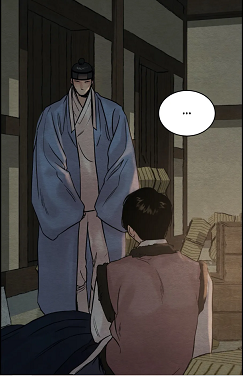
(chapter 62)  [I already examined the clothes from the first season, here are the links:
Before starting analyzing Yoon Seungho’s clothes again, it is important to remind my readers about the hanboks the protagonist wore during the first season. What caught my attention is that the lord has always used his clothes in order to make a statement. When he was around Jihwa and the other local nobles, he was simply dressed, as he didn’t feel the need to impress them and demonstrate his power. He was confident in front of them, that’s why he was just wearing a simple hanbok with long sleeves. At the same time, his color was very similar to the one his biological father was wearing. (chapter 12) (chapter 57) It was, as if by imitating father Yoon, he would get some recognition and love. Yet, he had another reason to use hanboks with a single color. His surrogate father, valet Kim, is also dressed simply. 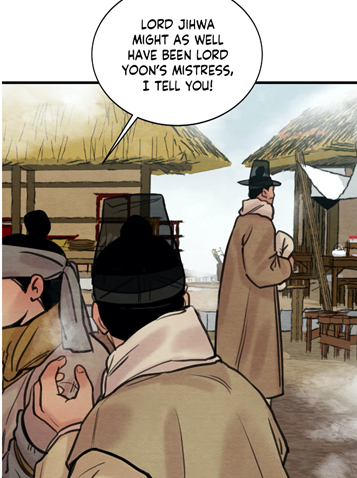 However, it changed the moment, Yoon Seungho made love to the painter. Since he knew that he had acted as the scholar’s replacement, he needed to attract the painter’s attention and used his clothes in order to impress the commoner so that the latter would fall for him. That’s why he chose a purple hanbok with short sleeves. Imagine that he had worn the same hanbok, when he visited the scholar and back then, it was to demonstrate his wealth and power. And this shows that in his mind, the hanbok would do the trick in order to win the painter’s love and admiration. The lord thought that the cloth would expose that he had everything what the low scholar didn’t have. But his effort went unnoticed by the painter. In other words, the presence of the painter started affecting his clothing. At the same time, his choice of clothes were not always a conscious decision, which we could sense at the end of the first season.
 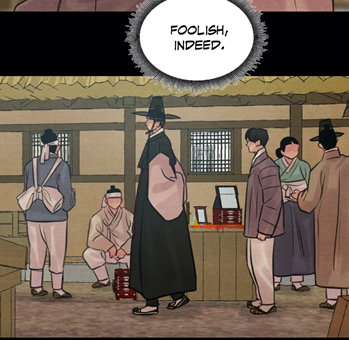 In chapter 39/40, he selected a pink robe with a black hanbok. This represented his actual state of emotions. He had just shared his bed with the painter for the first time and felt pleased and refreshed, like a happy man in love. However, he was trying to hide his emotions, therefore the pink was covered by the black hanbok. And since he wore a hanbok with short sleeves, it is palpable that here again, he desired to seduce and impress the artist. In conclusion, the lord felt the need to become desirable in the artist’s eyes and used his hanboks for this purpose, indicating some insecurities. Simultaneously, his selection was influenced by his emotions and unconscious. Striking is that in chapter 39, he had not the valet by his side to dress him up. Therefore Kim had no influence in the selection of his hanbok for that romantic date. And it happened again in season 2. When the main lead chose the blue hanbok with short sleeves
 , Kim was taking care of the painter. Therefore I come to the conclusion that Kim has some influence, in the way the main lead is dressed. This explains why we saw him helping the lord to get dressed in two occasions and each time, he chose the same hanbok: in chapter 11
 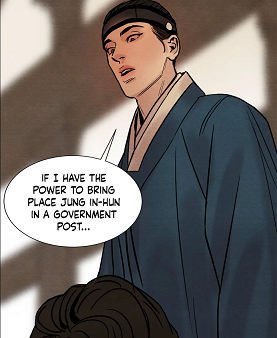 and chapter 47
  . And this is no coincidence. This outlines the importance of Kim in Yoon Seungho’s life. He is his right-hand, he is the only one allowed to see his hair down and comb it, a privilege that Baek Na-Kyum has never got to experience yet. However, little by little, the readers can perceive the painter’s increasing influence through the hanboks.
First, we have the apparition of drawings on his hanboks. In chapter 45, Yoon Seungho has a robe with cranes on it. And due to this panel, we have the impression that the lord perceives the artist as his symbol of good fortune. Consciously, he ordered such a hanbok, because he considered himself as the crane for the painter, yet in his unconscious it is the opposite, especially when you look at the way he is carrying the painter with the hanbok. Then in chapter 50, his black hanbok with a red design displays an progression. There are not only birds, but plants (leaves). In that scene, it represented his heart. It was, as if his heart had been wounded and he was bleeding to death. During the night before, he had been rejected one more time and had the impression that he could only be Baek Na-Kyum’s sex partner and not lover. But the one who pushed him over the edge was not the painter, but Kim who revealed at that exact moment the reason why Baek Na-Kyum had been behaving like a doll. With this revelation, the lord could only distance himself from the painter, as he couldn’t bear the thought that the artist would consider himself a prostitute. And here, I would like my readers to incite to question Kim’s motive to unveil this incident that morning? For me, there is no doubt that it was no coincidence due to the selection of the hanbok. The valet could sense the master’s mood and let’s not forget that even Yoon Seungho described Kim as very perceptive.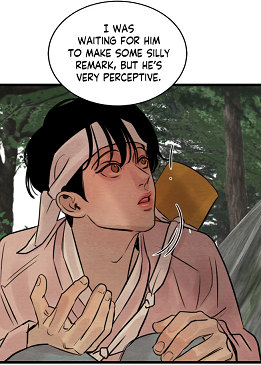 But if we look at the hanbok again, we will notice that the addition of plants in the pattern illustrates the importance of nature for the noble. So it looks like nature is gaining the upper hand, it reached the climax with the beautiful hanbok where you see the phoenix among plants and herbs
  It looks like Yoon Seungho’s unconscious has finally been able to perceive his true identity. Therefore I come to the conclusion that his relationship with Baek Na-Kyum helped him to find his true self and the clothes reflected his transformation. He is indeed a phoenix, but he feels like dying due to his unrequired love. With this new approach, you can comprehend how the painter is represented in the hanboks. He is nature himself: the trees and the flowers making the main lead feel alive. That’s the reason why during the second season, the aristocrat wears hanboks with a design. The pattern is a metaphor for the low-born, which is not surprising, since he is himself a painter. That’s why in chapter 65, he wears a black hanbok with plants at the bottom. He has the impression, he is dead, but there are remains of nature. It shows the lord’s determination to have the painter by his side. However, the plants are at the bottom symbolizing his actual position, the main character is trying to diminish the painter’s place in his heart. But it is in vain, as the white/grey shows that there’s still some life and light in Yoon Seungho. The phoenix died during the last night. And this shows that despite the noble’s words and behavior, his affection for the painter has not vanished entirely. That’s why I am optimistic in the end. Yoon Seungho is no longer able to live without Baek Na-Kyum. Besides, we all know that nature can never truly disappear.
At the same time, the colors and the designs were not purely influenced by his unconscious. In chapter 52, he was staging himself as a king in order to mask his despair and vulnerability. The hanbok exposed his vulnerability, which didn’t escape Min’s notice. This contrasts to his clothes and behavior during the first season, he is masking his powerlessness with the robe. However, the beautiful hanbok left such an impression on the envious aristocrat that the next morning, Black Heart also picked up a hanbok with a design.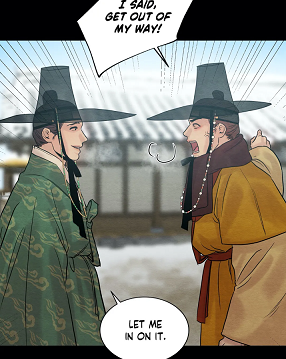 The irony is that his design was totally different. It reminds us of the smoke of opium or even worse: someone full of hot air. He talks a lot, but doesn’t know much which is true. He has no idea what really motivates the main lead. And with Min’s new hanbok, I consider it as an evidence that Yoon Seungho is indeed the phoenix and we just need to wait, until he raises from his ashes… the moment he abandons his self-hatred and love selflessly like he desired in the past. But let’s return our attention to the blue hanbok with phoenixes on it. I assume too that deep down, the main character wished to catch the painter’s attention from afar. He has such a magnificent hanbok that he could be distinguished from all the other nobles. And you are now all wondering about the return of the simple robe with long sleeves.
 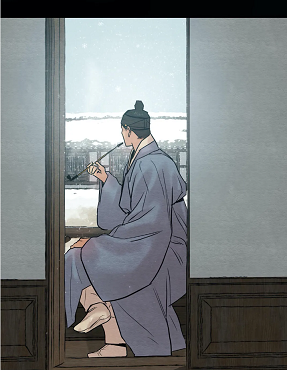 It was, as if he had returned to his old self. First, I had imagined that the light blue could still be judged as a good sign, as this color symbolizes peace of mind. Furthermore
“Pale blue inspires creativity and the freedom to break free.” https://www.empower-yourself-with-color-psychology.com/color-blue.html
However, I was wrong for two reasons. I had overlooked that his selection is also influenced by his conscious. In his mind, since he hadn’t strangled the painter and had restrained himself for the abandonment, he had the impression that he was very calm and rational. Yet, in reality, he was boiling inside that’s why he smoked at the window again. It was again to numb his emotions. Old habits are hard to die. Besides, he had another reason to wear such a hanbok. We can imagine that Kim must have helped him that morning to dress.
And now, if you pay attention to the role played by Kim as his assistant for the morning, you will notice that little by little, he is losing his territory to Yoon Seungho and as such to Baek Na-Kyum. Compared it to the chapter 11, Kim was alone helping him to dress, then in chapter 35 he is seen once again giving a green hanbok to his master. However, in the second season, notice that we only witness him one time helping his lord to get dressed: chapter 47. At the same time, for the first time, Baek Na-Kyum is present. A huge sign that both protagonists are getting more and more intimate. And in chapter 50, Yoon Seungho was already dressed, when Kim joined him in the scholar’s chamber indicating that he was not present, when the lord prepared himself. Kim arrived late, which Yoon Seungho reproached him. Therefore I come to the conclusion that the aristocrat was the one who selected his hanbok that morning. And this situation happened again in chapter 56. And notice that this time, he chose a hanbok with short sleeves indicating that he wanted to impress someone again. For me, there’s no doubt that he had the painter in his mind. Since he had heard that Baek Na-Kyum had not run away after his first confession, the lord had hope again, mixed with some insecurities. And now, you understand why Yoon Seungho felt so betrayed after his second confession. He had treated the artist tenderly, had been given hope a second time, only to discover the next morning the painter’s disappearance. No wonder why he felt so hurt and betrayed and couldn’t see the truth. And now, note that in chapter 65, Yoon Seungho got dressed in front of the artist without Kim’s assistance, while the painter was still in the bedchamber half-naked. This final scene indicates that despite the rough treatment, the painter has become even more intimate with Yoon Seungho. The progression is even more palpable, when you compare it with the scene in chapter 47: The bed has disappeared and there’s the painting between them. Secondly, he sits like a servant with his head down. Here, he is acting like a domestic, while in chapter 65, he is sitting on the bed. His place has not only changed, but he is also able to touch the lord’s cloth. Finally Baek Na-Kyum is even wearing the lord’s shirt and like I mentioned it above, there’s no servant by their side. All this points out that the lord is determined to share his bed with the artist. Sure, he has a reason: he fears the painter’s desertion and feels that he needs to keep an eye on him himself so that this won’t happen again. Therefore the manhwaphiles can comprehend why I am optimistic. It signifies that this incident forced the aristocrat to no longer rely on Kim’s assistance and information. He will do it himself. Hence it is just a matter of time, until the lord shows him his hair down. Simultaneously, it reveals the loss of Kim’s influence over Yoon Seungho. The latter will choose his clothes himself and even at some point we can imagine that he asks the painter for this. For me, there’s no doubt that the valet played a huge role in the selection of the lord’s hanboks in the past, but now he is slowly removed from his side, which I perceive as a good sign. You’ll know why in the next essay.
Feel free to comment. If you have any suggestion for topics or manhwas, feel free to ask. If you enjoyed reading it, retweet it or push the button like. My tumblr-twitter account is: @bebebisous33. Thanks for reading and the support.
 Bebebisous33s' analyses in K-Dramaland and Manhwas
#/media/File:Kazimir_Malevich,_1915,_Black_Suprematic_Square,_oil_on_linen_canvas,_79.5_x_79.5_cm,_Tretyakov_Gallery,_Moscow.jpg)


