

Please support the authors by reading Manhwas on the official websites. This is where you can read the Manhwa: Jinx But be aware that the Manhwa is a mature Yaoi, which means, it is about homosexuality with explicit scenes. Here is the link of the table of contents about Jinx. Here is the link where you can find the table of contents of analyzed Manhwas. Here are the links, if you are interested in the first work from Mingwa, BJ Alex, and the 2 previous essays about Jinx 🕊️🦆Voyage, Voyage 🌏🌌 (locked) and Unseen 👀 Savior🦸🏼♂️ : The Birth Of Jaegeng (locked)
It would be great if you could make some donations/sponsoring: Ko-fi.com/bebebisous33 That way, you can support me with “coffee” so that I have the energy to keep examining Manhwas. Besides, I need to cover up the expenses for this blog.

Following up on the analysis in Unseen Savior🦸🏼♂ : The Birth Of Jaegeng (locked), it is now time to dive into the symbolic and narrative weight of the meeting between Joo Jaekyung, Park Namwook, the CEO, and the mysterious woman in red. That earlier essay depicted the offer extended during this encounter as the devil’s temptation. In this piece, we will take a step back and ask an important question that may have gone unnoticed by most readers: Was this truly a lunch meeting? 😮
Lunch or “Kaffee und Kuchen”?
. (chapter 69)
At first glance, the setting may imply a formal lunch: a round table in a private room, a well-lit ambiance, and Western-style plating. Moreover, some Jinx-philes might have been reminded of the lunch between Choi Heesung and Kim Dan that took place in a similar location: 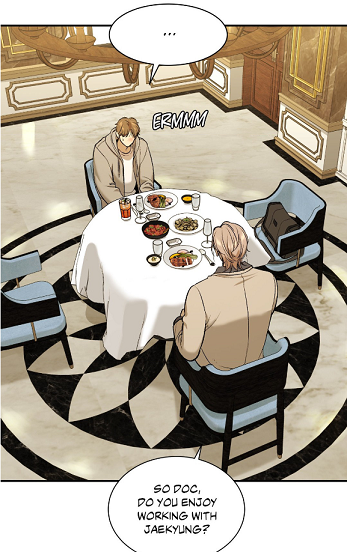 (chapter 32) Yet upon closer inspection, certain oddities stood out to me. (chapter 69) The most telling is the absence of water glasses—normally present during a full meal. Then, there are untouched knives and forks placed beside the plates, suggesting that they were arranged for formality rather than function. For cakes, such utensils are unnecessary, so they should have been removed. In contrast, the only utensils that should be used are dessert spoons. These subtle visual cues point to an unusual conclusion: this was not a full meal, but rather a dessert meeting.
This observation is further supported by a humorous yet significant moment from Chapter 43.  (chapter 43) In that scene, Kim Dan poured soju into his water cup to pace himself during a drinking session.
  (chapter 43) Joo Jaekyung, unaware, mistakes it for his own and angrily reacts upon drinking it. This moment shows how closely water glasses are associated with Korean dining culture—even in casual or alcohol-heavy settings. Hence during a meal, the characters always have
  (chapter 32) two glasses on the table. In South Korea, it is customary for restaurants to provide a glass of water to every diner, regardless of the meal’s formality or complexity. This small gesture reflects hospitality, attentiveness, and the expectation of proper nourishment. The absence of water glasses, therefore, subtly communicates indifference or even disrespect—signaling that the recipient is not truly welcome to enjoy a full meal or rest. When applied to the “dessert meeting,” this detail becomes all the more striking: a cultural standard is ignored, revealing the performative nature of the gesture. Their absence at the “dessert meeting” feels deliberate, a symbol of superficiality and arrogance. (chapter 69)
Birthday Party or Not?
Funny is that the moment I paid attention to the table and made a connection between the gatherings in episode 43 and 69, I made a huge discovery concerning the champion’s birthday party.  (chapter 43) The reason for his mistake was that they had only placed a spoon and sticks.😮 He had no glass for himself. It was, as if they had forgotten him. In other words, he was not supposed to eat and drink at his own birthday party!! 😂 (chapter 43) The absence of a rice bowl, plate, and glass in front of Joo Jaekyung, despite the presence of utensils, indeed suggests that he wasn’t expected to truly participate in the meal. In my opinion, the manager expected that the fighter would behave like in episode 9:
 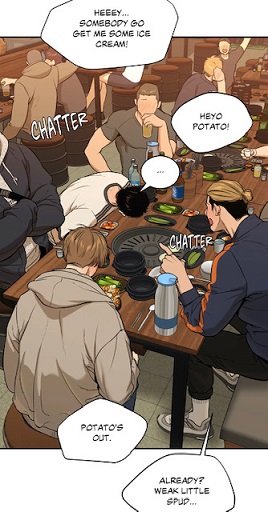 (chapter 9) It reflects a pattern: the champion is present but not included in the communal or emotional aspects of the gathering. His spoon and chopsticks function like a prop, much like the untouched knives and forks at the dessert meeting.
  (chapter 69)
Symbolically, this reinforces the idea that Park Namwook sees him not as a person with needs or preferences, but as a role—a figure to be paraded, not fed. It’s also a strong indicator of the superficial hospitality offered by Team Black. The same way MFC served only dessert as a façade of generosity, here Park Namwook maintains the appearance of inclusion without the substance of care. One might wonder if the person behind this dessert meeting is not the manager in the end. However, I can refute this hypothesis. But I will explain my reasoning elsewhere.
Why Coffee and Cake?
This revelation casts the entire interaction in a new light. Desserts traditionally symbolize sweetness, pleasure, and reward—a closing gesture in a meal meant to satisfy or celebrate. Yet here, they are served in isolation, with no nourishment preceding them. It reflects the hollowness of the offer being made to the champion. Symbolically, the sweets are fake nutrition: surface-level compensation meant to placate and divert attention. Their isolated presence, without the customary water or a full course, also exposes a certain stinginess and greed—lavish in appearance but lacking genuine generosity or investment. There is no genuine sustenance here, only an illusion of care and abundance. At the same time, it is clear that the champion avoids cakes, thus for his birthday, he only ate the strawberry. Ordering desserts indicates the indifference toward the former „Emperor“.
To further contrast the deeper meaning, it’s worth considering the German tradition of Kaffee und Kuchen. This custom involves sitting down in the late afternoon with friends or family to enjoy coffee and cake—a sincere gesture of rest, connection, and shared time. (chapter 69) The Black Forest cake served to Joo Jaekyung connects directly to this tradition, yet its context here is anything but restful. It was through observation that I noticed the dessert’s identity—its distinctive shape and cherry decoration evoking the iconic Schwarzwälder Kirschtorte (A reminder: I live in Germany). However, this symbolic dessert becomes a tool of irony: rather than promoting genuine connection or relaxation, it masks a veiled demand. The setting in Jinx is not about togetherness or leisure but manipulation under the guise of civility. Instead of offering a break, this “dessert meeting” is designed to signal the end of the champion’s rest. It pressures him to return to fighting, weaponizing the illusion of hospitality to serve a corporate agenda. This signifies that this dessert becomes a symbol not of comfort, but of interruption. It marks the end of the champion’s rest and the return to duty. Far from being an act of care, it is a veiled command.
This scene around a round table mirrors another pivotal moment 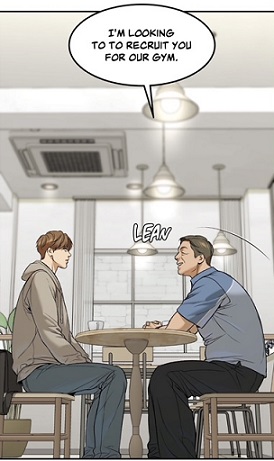 (chapter 48), the meeting between Choi Gilseok and Kim Dan. The former invited him for coffee.
 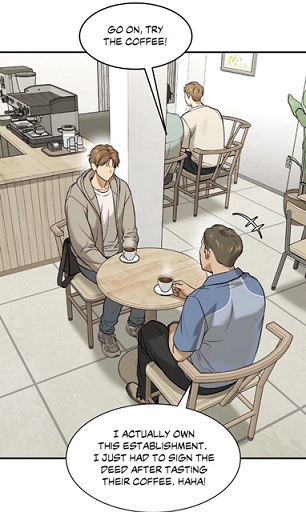 (chapted 48) At first, the gesture seemed generous—he offers a home, a car,
 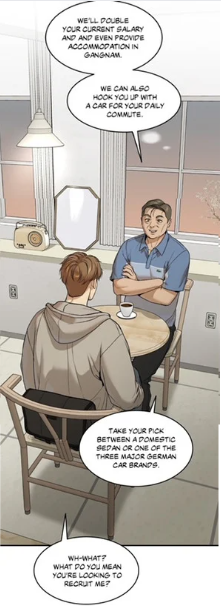 (chapter 48) and the promise to help doc Dan to get a new treatment for the grandmother.
  (chapter 48) But this so-called kindness is conditional: in exchange, Kim Dan must betray Joo Jaekyung. Striking is that director Choi only ordered coffee. But a coffee without a dessert is no real break, but a stimulant—fuel for continued work. In both this meeting and the previous one with Choi Gilseok, the core remains the same: “work”, stinginess and greed wrapped in the guise of generosity. Every sweet drink or dessert lies a hidden price. This comparison highlights that the current meeting is not for the athlete’s sake—it is meant to serve Park Namwook and the CEO, who share different but aligned goals.
In this scene, every detail is meticulously crafted to portray the illusion of equity, civility, and generosity—when in fact, it is manipulation cloaked in civility.
The Round Table and Directional Symbolism
The round table is a reference to King Arthur’s court (chapter 69), where knights would gather as equals. This allusion conjures a sense of idealized unity and fairness—values that stand in stark contrast to the characters’ actual motivations in this scene. Whereas the original Round Table emphasized equality and noble purpose, the meeting in Jinx distorts these ideals, using the circular table as a facade to mask manipulation, hierarchy, and hidden agendas, as there are no clear sides and perspectives. The characters gather not to collaborate or share truth and knowledge, but to impose control, push self-serving narratives, and pressure the champion under the guise of courtesy. Yet, the illusion of equality is shattered when we examine the seating arrangement and the design beneath the table.
The floor beneath the table is made of black marble. Black marble traditionally symbolizes sophistication, power, and mystery—often linked to wealth and elite status. In this context, it reflects the polished surface of MFC’s operation, hiding its manipulative and corrupt core. The marble’s reflective nature serves as a mirror for distorted truths, hinting at concealed motives. Interestingly, even though the floor contains no design contrary to the lunch with the actor (chapter 32), I detected a reference to the yin-yang through the clothes. (chapter 69) A symbolic balance is still conveyed through the color palette of the characters’ clothing: black and white on one side (CEO and Park Namwook), and red and blue on the other (the woman and Joo Jaekyung). This contrast references yin and yang—light and dark, passive and active, East and West. It captures the ideological and emotional tension between the characters gathered at the table, exposing how appearances veil a struggle for control, identity, and allegiance.
Each guest occupies a cardinal point based on their clothing colors, which reflect traditional Korean symbolism:
- Joo Jaekyung, wearing a dark blue shirt with black shades, represents the East (청, Cheong), associated with the color blue/green, spring, the element of wood, rebirth, and emotional clarity—but also with tradition and conformism. Ironically, though he embodies the East, he now lives on Korea’s western coastline, which emphasizes his internal conflict and transition.
- Park Namwook, in white, embodies the West (백, Baek), symbolizing the color white, the element of metal, autumn, endings, coldness, and judgment. This perfectly reflects his role as the fading, cold manager—emotionally distant and aligned with institutional power. His upcoming downfall and loss of power are foreshadowed by this placement.
- The woman in red signifies the South (적, Jeok),
 (chapter 66) linked to fire, summer (hence the reference to the trip in the States), passion, performance, and vitality—ironically twisted here into cold professionalism and superficial seduction. Her position contrasts with her symbolic warmth, highlighting the emptiness of her care. This explains why she is portrayed eyeless. She sold her “soul” to money and as such to the “devil”.
 - The CEO,
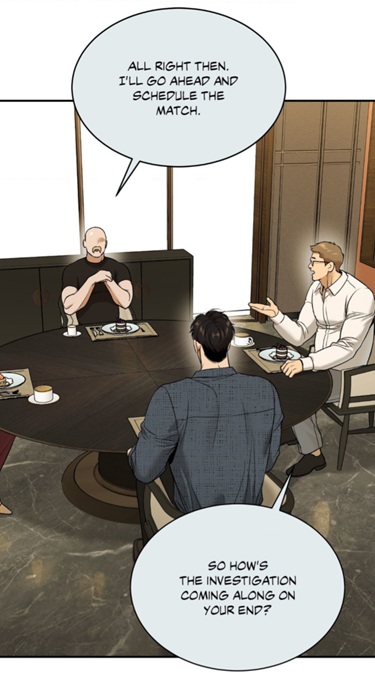 (chapter 69) wearing black, aligns with the North (흑, Heuk), associated with the color black, winter, water, authority, secrecy, and hidden control. It was, as if he was representing the missing glass of water. His position as the initiator of the meeting and his location near the window reinforce his dominance and detachment.
A second interpretation is based on physical orientation. The CEO sits in front of the window, suggesting he leads the direction of the conversation—reinforcing his alignment with the North. This would position:
- Joo Jaekyung in the South, the symbolic realm of sincerity, renewal, and emotional strength.
- Park Namwook in the East, which then implies the potential for change, growth, and conflict with the West.
- The woman in red in the West, making her Park Namwook’s symbolic counterpart and challenger.
Both readings emphasize an important underlying theme: the meeting is not just about strategy, but also about the clash of symbolic forces—tradition vs. transformation, control vs. sincerity, illusion vs. truth. These opposing tensions reflect the champion’s current state of evolution and foreshadow his rebellion against the system that once defined him. This arrangement paints a coherent symbolic tableau grounded in Korean cardinal point philosophy. Not only do the colors align (black for North, white for West, blue/green for East, red for South), but so do the personalities: the CEO as cold and calculating authority, the woman as sharp and composed evaluator, the manager as a conformist tool of the system, and the champion as the figure of emotional awakening and transformation. It also reflects their roles in the narrative: the CEO and the woman attempt to assert control from a place of detachment and oversight, while the star is awakening to his own truth, standing in contrast to their cold rationality.
The hosts clearly control the setting, tone, and tempo of the meeting. The choice of the round table is not accidental; it is meant to give the illusion of closeness and fairness, but the positions and body language expose the hierarchy. The CEO’s gesture (chapter 69), joining his hands in front of his chest, is subtle but telling. Combined with his seating near the window (symbolizing clarity or enlightenment), this gesture indicates control, restrain, self-protection and finally judgment. He’s calmly evaluating the situation and others at the table, implying a power dynamic. Bringing the hands in front of the chest can form a subconscious barrier—suggesting he is guarding himself, possibly from confrontation or uncomfortable truths, while it helps him to give a composed and confident posture. The CEO positioned near the light, faces outward, and dominates. Behind the champion is an abstract green painting 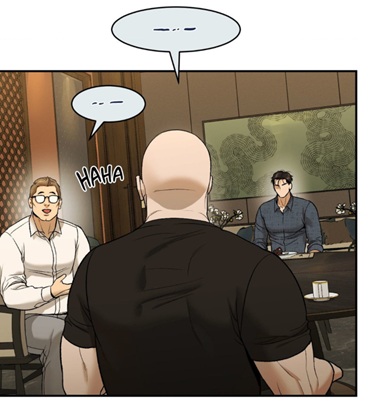 (chapter 69), which evokes confusion and corruption. This artistic backdrop continues the theme from Voyage, Voyage (life is a journey), positioning Jaekyung as mentally “adrift” within this orchestrated trap. At the same time, the green might reference the “Black Forest”—a literal and metaphorical journey ahead. Like Hansel and Gretel, he is being lured with sweets into the forest. But unlike the fairy tale, the athlete’s breadcrumb trail will not lead him home—it will lead him to Kim Dan. On the other hand, by making this connection, I couldn’t help myself thinking that exactly like Hansel and Gretel, doc Dan and his fated partner will cross the witch’s path on their journey to independence and happiness.
Color Symbolism and Character Portrayal
The characters’ clothes also reflect deeper symbolism. The CEO wears a black shirt and dark blue jeans—dark, imposing, and utilitarian, suggesting control, power, and hidden motives.  (chapter 69) Notably, this outfit marks a shift from his previous appearances: during his public pose with Baek Junmin
 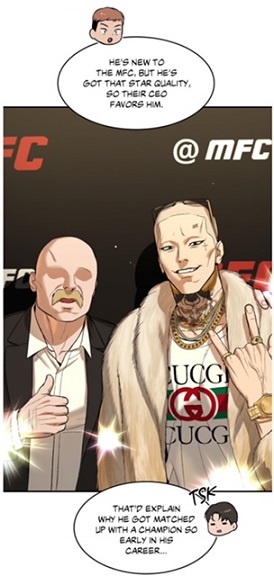 (chapter 47), he wore a formal black suit with a white shirt, signaling polished professionalism. When he met the champion in the States, his full black outfit resembled a manager’s uniform and a badge, signaling humbleness and authority but also a hands-on, corporate role.
  (chapter 37) Now, Joo Jaekyung mirrors this casual dark attire (chapter 69), which points to a lack of reverence or ceremonial respect from the CEO. The diminishing formality in the CEO’s wardrobe reveals a gradual unmasking of his character—less the respectable businessman and more the manipulative broker. His clothing now mirrors more than that of a loan shark or exploiter, revealing the raw ambition and control beneath his once-slick exterior.
The woman in red wears a vivid red suit, a clear visual signifier of power, respectability, and Western flamboyance. However, unlike a red dress—which often symbolizes femininity, seduction, and traditional gender expectations—the red suit strips away that softness and replaces it with authority and androgyny. It underscores her ambiguity as a character: she is commanding and polished, yet emotionally distant. Her attire blends masculine-coded professionalism with a bold, attention-grabbing palette, reflecting both her status within MFC and her detachment from nurturing roles. She appears calm and calculating, and her positioning and expressions make her seem less like an accessory to the meeting and more like a silent strategist. Symbolically, she represents MFC’s security system, (chapter 69) the eye that sees but does not act, like a cold and distant mother figure whose role is to supervise, protect, and feed. Yet, the dessert served to the champion feels like an affront, a form of care without understanding—especially given that Joo Jaekyung usually avoids sweets and alcohol altogether. The Black Forest contains kirschwasser, a cherry liqueur.
Park Namwook mimics the CEO with a white shirt—a deliberate act of mimicry that exposes his lack of individuality and herd mentality. (chapter 69) But the white shirt has layered meaning: it also symbolizes his ignorance and naivety. He believes the meeting is a gesture of goodwill, a “favor” from the top, and fails to question the power dynamics at play. The irony is that Park Namwook is not actually an MFC agent—he works for Joo Jaekyung as his manager. His neutrality is superficial. His grey pants further signal his moral ambiguity and lack of integrity. Far from being a righteous figure, he embodies passivity, complicity, and indifference.
Joo Jaekyung, however, wears a blue shirt darkened by shades of black 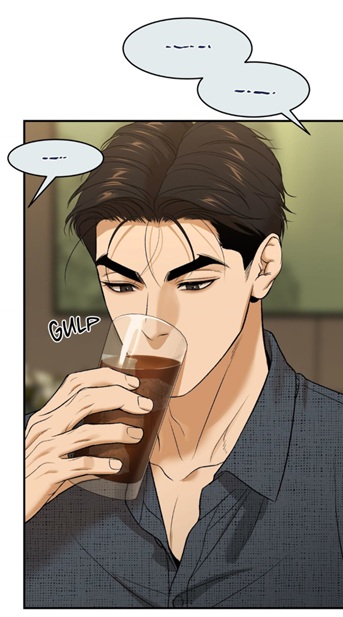 (chapter 69) —a signal of inner turmoil and his transition from his former life. Blue stands for loyalty, thought, and calm, while black alludes to his troubled past. He is evolving but not yet free.
Knights, Sweets, and Illusions
The round table conjures the Knights of the Round Table, but these “warriors” are not pursuing spiritual quests. Their prize is not the Holy Grail but money, rank, and relevance.  (chapter 69) In this world, ideals are hollow, and tradition is co-opted to mask self-interest.
The desserts themselves are symbols: 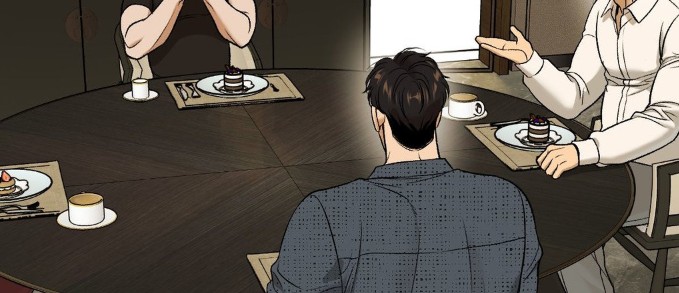 (chapter 69) the strawberry fraisier (chosen by the woman) stands for surface sweetness and seduction; the layered chocolate cake (perhaps a feuilleté) represents indulgence and opulence. Joo Jaekyung alone chose a square Black Forest cake—a form traditionally associated with structure, truth, and boundaries. Because the cake contains kirschwasser, subtly referencing the athlete’s brief brush with alcohol, it becomes clear that Park Namwook was not the one behind this order. Imagine this: under his very own eyes, the champion is encouraged to taste a strong alcohol. In my opinion, they must know that the star has been drinking. Yet, it was through Kim Dan’s presence that he stopped drinking, making this dessert an unconscious mirror of both his struggle and strength. Meanwhile, Park Namwook, ever the follower, selects the same dessert as the CEO and the same drink as the woman, revealing his pretense and pastiche once more. Since the manager has always bought junk food (chicken
 – chapter 26, hamburgers, ramen
 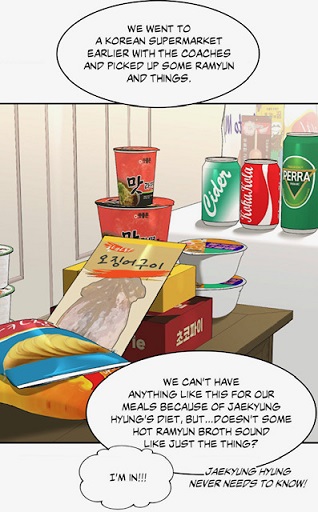 – episode 37), it becomes clear that the hyung simply has no idea about Western food in general and in particular expensive French or German dishes. That’s why he didn’t ask about the dish or questioned the champion if he should eat the deadly sweet cake. (chapter 69) The alcohol was masked by the sweetness. Moreover, let’s not forget that these “Kaffee and Kuchen” were offered by the CEO. However, the paradox is that the star didn’t fall for this trick. He chose to drink the coca while staring at the cake. (chapter 69) At no moment he felt tempted by the dish. The angel Kim Dan was protecting him from a distance. The athlete longs for homemade food:
  (chapter 22)
A Meeting Built on Fear
Since I detected some similarities with the manipulative coffee meeting between Kim Dan and Choi Gilseok, another difference stood out to me. Though doc Dan had been approached in front of the gym  (chapter 48), their meeting was not supposed to be secretive. On the other hand, because the scene was photographed
  (chapter 48), it created the illusion of “betrayal” as it looked like a secret meeting”. In episode 69, the meeting is hidden from the public. In contrast to the earlier public appearance alongside Baek Junmin for the cameras (chapter 47), —where the CEO posed proudly and visibly as a form of promotional endorsement—this encounter is cloaked in secrecy. According to Park Namwook, the CEO only stopped by South Korea specifically to meet the champion, as if offering him a special privilege.
 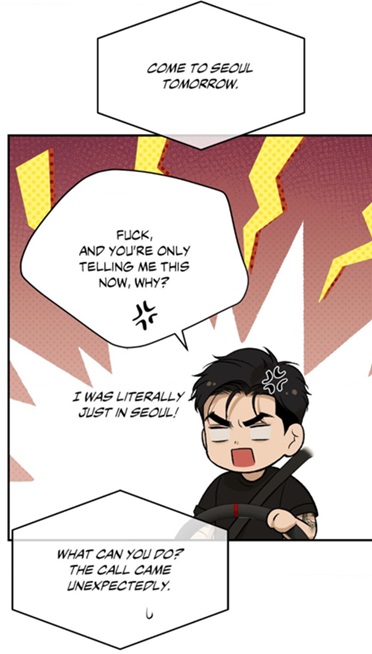 (chapter 69) This framing is deceptive: far from being a gesture of goodwill, it reveals the urgency and opportunism driving the meeting. However, this gesture is carefully staged: the CEO and the woman in red are the ones who selected the time and location of the encounter, placing the athlete in a reactive position where he must adjust his schedule to their convenience. It reinforces the illusion of privilege while concealing a dynamic of control. The meeting is designed to appear personalized, but it reflects MFC’s ethos that ‘time is money’—a business-centered logic that prioritizes efficiency over empathy. The CEO’s urgency to schedule a match, despite Jaekyung’s unclear health status, further exposes the commodification of the athlete. Notably, the proposed match is not even a title bout.
 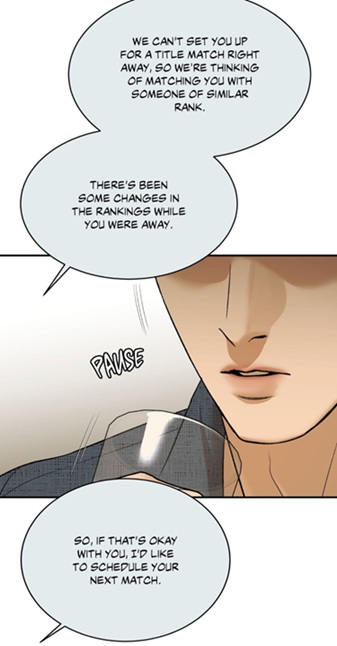 (chapter 69) This strategic omission likely serves to shield the organization from scrutiny, as a title match would demand full transparency around the champion’s ranking and physical condition—areas that may not withstand public examination. In truth, the meeting is not about offering the protagonist an opportunity, but about maintaining MFC’s narrative control while exploiting his fame. This framing is deceptive: far from being a gesture of goodwill, it reveals the urgency and opportunism driving the meeting. To conclude, the discreet setting implies that MFC is not interested in publicizing their dealings with the star, possibly to avoid scrutiny or backlash. The lack of transparency underscores the manipulative nature of this so-called “favor,” which ultimately serves the organization’s agenda, not the athlete’s interests. The problem is that this meeting is heard by doc Dan
  (chapter 69), hence the “future match” is no longer a secret.
  (chapter 69)
The core motivation behind this encounter is fear. First, due to this phone conversation, Jinx-worms could sense that the celebrity was not moving on from the past, he was still pressuring MFC to investigate the matter concerning the switched spray.  (chapter 67) He was not dropping the case. That’s the reason why the fighter is offered a match in the fall. If he is busy, then he might forget the “case”, especially since fall is right around the corner. He would be occupied training. Like mentioned in previous essays, my theory is that the CEO is involved in the scheme. This assumption got reinforced with this meeting. Striking is that the focus of the “chief of security” was the incident in the States.
  (chapter 69) By stating that the criminal belonged to a Korean gang in the States, she implied that this man had no direct connection in South Korea. In addition, with this statement, she claims that he is still in the States and the champion is safe. However, if the “fake manager” had been living in the States for a long time, he wouldn’t have spoken in Korean automatically.
  (chapter 37) In other words, she is trying to place the mastermind in South Korea.
 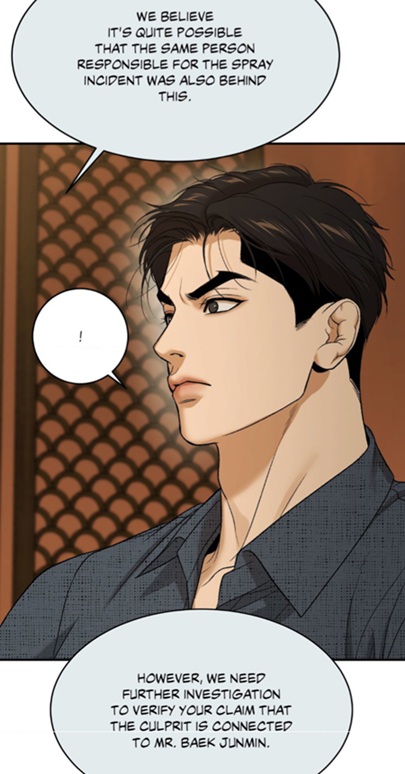 (chapter 69) This means that she is attempting to erase the involvement of MFC in the scheme. That’s why they are now offering an apology, which is naturally fake: (chapter 69) However, I believe that there’s more to it. First, the CEO is planning a schedule in the fall, but he hasn’t selected the opponent yet, a sign that they are rushing things. (chapter 69) Besides, don’t forget that the game in Seoul was rigged, hence the result was a tie. Because the cakes were all from Europe, I am suspecting that his match should take place abroad, in Europe. Moreover, since I sensed parallels between chapter 69 and 42
  (chapter 42), it dawned on me that MFC is actually treating the Emperor like a “cash cow”, they imagine that they can keep milking him. I could say, this encounter is exposing the reality to the athlete: Joo Jaekyung is treated like any other fighter. Hence there is no longer mention of Baek Junmin in the news. On the other hand, they have to vouch for Baek Junmin’s integrity (chapter 69), for the CEO had declared him that the Shotgun had that star quality. (chapter 69) In other words, they are trying to bury the case, thinking that giving him an opportunity will stop the champion from pressuring them any further.
As for Park Namwook, the latter has a similar interest. Since the athlete has been avoiding the gym, he imagines that organizing an imminent fight will push the champion to return to the gym. However, the reality is that Joo JAekyung can train anywhere, he has never needed Park Namwook by his side. Besides, he has another hidden motivation for supporting this match: his fear of being forgotten. (chapter 69) For him, the title of “champion” is not Jaekyung’s alone—it is part of his identity. Without the champion, Park Namwook is no one. His aim is to push the athlete back into the gym, to keep the wheels turning. With his words, he created the illusion that the Emperor would lose his special status and title, if he doesn‘t return to the ring soon.
But his plan is flawed. First, Jaekyung is still recovering. No one mentions his health. Unlike Chapter 41, where he referred to the MFC’s medical clearance,  (chapter 41) here the topic is avoided altogether—possibly due to the lack of actual clearance. Should a third-party hospital intervene, the match could be canceled. Secondly, Park Namwook assumes control of the timeline: a match in the fall means training now. But the champion is no longer dancing to his tune. He is meditating, admitting his exhaustion.
  (chapter 69) His priorities have changed: Kim Dan. This chapter announces a turning point of the Emperor, he is getting liberated from his “role” as Champion. Besides, if he were to lose the game, they can blame the athlete for his bad decision: he returned to the ring too soon. That’s the reason why the meeting and offer from the CEO was not revealed to the public.
One notable moment in the meeting is the aborted (fake) apology from the CEO (chapter 69) —an empty gesture blocked by Park Namwook, who clearly fears the emotional consequences of honesty. His interruption signals an unwillingness to address the past and a desperate attempt to reframe the narrative. Besides, a senior is lowering himself to a younger man, this stands in opposition to social norms, especially for the manager’s. One might say that there is a fake apology, because Joo Jaekyung is a star and champion. However, it is important to recall that he is in truth the head of Team Black. He is the true owner of the gym. He is also a head of a small company, 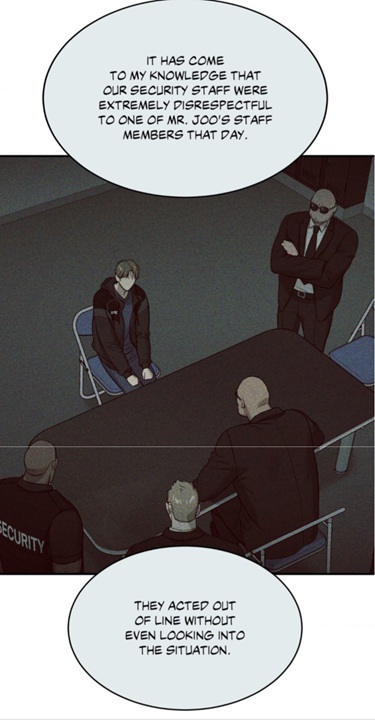 (chapter 69) So Joo JAekyung is more than a fighter and the apology (interrupted by the manager) is the evidence for this. Under this new light, Jinx-philes can understand Park Namwook’s interruption and embarassement. Not only he doesn‘t want to be reminded of his past mistakes (passivity, failure of his job, the slap), but also this apology serves as a mirror and reminder that he is not the true owner of the gym.
At the same time, the CEO and woman in red are not realizing that by acting this way (chapter 69), they were recognizing Kim Dan as a part of “Joo Jaekyung’s team”. He is no longer alone, he is on his way to develop his own “team”, far away from Park Namwook’s influence. Finally, since Mingwa made constantly references to scenes from chapter 40, we should see this meeting in front of a round table as a new version of “the interrogation scene” where Kim Dan was pressured to admit a crime and as such to say yes. Yet, at no moment the main lead said anything. On the surface, he remained silent, patient and obedient (chapter 69), but in reality his mind was elsewhere: on doc Dan!  (chapter 69) He is his unseen savior. Thanks to Kim Dan, the star remained silent and calm giving the impression that he had fallen for MFC’s trick.
There exists two other reasons why I am comparing this secret meeting (chapter 69) with the interrogation room in the States. First, he use of English throughout the entire conversation (indicated by blue speech bubbles) reinforces their arrogance and detachment. It exposes their view of Jaekyung as merely a fighter lacking education, whose linguistic skills might not allow full comprehension.  (chapter 40) This echoes Kim Dan’s confusion in Chapter 40 when interrogated in English. It also conveniently hides their ties to local authorities—acting as foreigners with no responsibility or rootedness in Korea. But this is what director Choi Gilseok confessed to the angel:
  (chapter 48) The business is rooted in the USA.
Moreover, Park Namwook’s physical placement in the room (chapter 69) reinforces his symbolic role in this dynamic. He is seated directly in front of the door, characterized by its striking orange-black motif. Rather than standing as a guardian or ally, his position evokes that of a gatekeeper—someone who controls access and restricts transparency. This is especially poignant when contrasted with Chapter 40, where Joo Jaekyung had burst into an interrogation room to protect Kim Dan 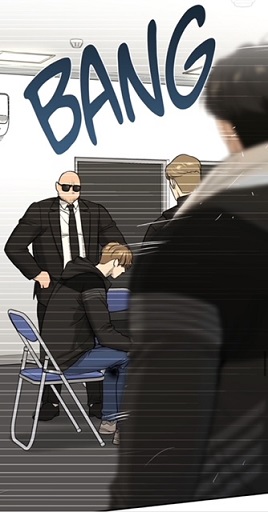 (chapter 40), effectively opening the metaphorical door to truth and protection. In this meeting, however, Park Namwook serves to contain and silence, not to defend. His placement underscores his complicity and fear—not just of the CEO or MFC, but of confronting the consequences of his own failures. But the manager is on his way for a rude awakening, he will be taught a lesson: don’t judge a book by its cover. The athlete won’t be the depressed, anxious, submissive and passive “boy” any longer. Moreover, he listened carefully to the chief of security: (chapter 69), so at some point he will remember their statement and discover the deception.
Metamorphosis and Reorientation
The square cake (chapter 69) signifies the champion’s true nature: disciplined, resilient, seeking truth. Its rigid, geometric shape symbolizes structure, balance, and clarity—reflecting his desire to make sense of his chaotic circumstances and reclaim control over his life. Unlike the circular or layered desserts of the others, the square form suggests a grounded and introspective mindset. It serves as a metaphor for his ongoing transformation: moving away from being a tool for others and toward becoming a fully autonomous individual with his own moral compass and emotional center. Kim Dan, symbolized by a circle, represents softness, unity, emotion. In Chapter 69, we see Jaekyung internalize this through the reflection in his pupil—a circular form. His new “center” is no longer the belt, the rank, or the applause.  (chapter 69) It is Kim Dan.
This shift is not just emotional but philosophical. Unlike the CEO and Park Namwook, who treat time as currency and rush through everything, Jaekyung is now learning to be present. He no longer wants to fight to survive or prove something. The ring, once a battleground, could become a place of meaning again—but only if he fights for something real.
Geography and Time
Symbolism blends into geography. Jaekyung now lives in a small town on the northwest coast of South Korea. His journey from Seoul takes hours—  (chapter 69) he leaves during the day and arrives by night.
  (chapter 69) This spatial detachment echoes his emotional separation from MFC and its toxic grip. Distance, both literal and figurative, is now his strength. The fact that he chose to return to the little town outlines that he is now considering that place as his “home” and not the penthouse. He is not realizing that his true home is doc Dan.
Conclusion
The Sweet Curse of the Round Table is a tale of control masquerading as diplomacy. The round table offers no true equality; it is a trap dressed as tradition. But Jaekyung, scarred yet evolving, is no longer fooled. His eyes have found a new center—not in gold belts or rankings, but in the quiet presence of someone who sees him as human.
And as the “blue knight,” he may one day bring other fighters to a new table—not to be ruled, but to share in a dream grounded in truth, not gold.
Interestingly, visual foreshadowing appears as early as Chapter 32.  (chapter 32) During Kim Dan’s lunch with Choi Heesung, the floor beneath their round table shows a twelve-petal flower motif—evocative of the legendary Knights of the Round Table, who were said to sit twelve strong. That earlier scene featured Heesung testing Dan, much like the fake round table later hosts a veiled test for Joo Jaekyung. The repetition of round tables masks exclusion and betrayal. These early “false” tables pave the way for a true table—one that Jaekyung might one day forge with fighters like Heesung, Potato, Oh Daehyun, and others, where loyalty and respect, not manipulation, define the bond.
For now, he eats dessert with devils. But he no longer hungers for their approval.
PS: I am suspecting that the proposed “fight” will take in Europe, but not in Italy, rather in Germany or France. Angelo should appear later as the last match.
Feel free to comment. If you have any suggestion for topics or Manhwas, feel free to ask. If you enjoyed reading it, retweet it or push the button like. My Reddit-Instagram-Twitter-Tumblr account is: @bebebisous33. Thanks for reading and for the support, particularly, I would like to thank all the new followers and people recommending my blog.

 Bebebisous33s' analyses in K-Dramaland and Manhwas