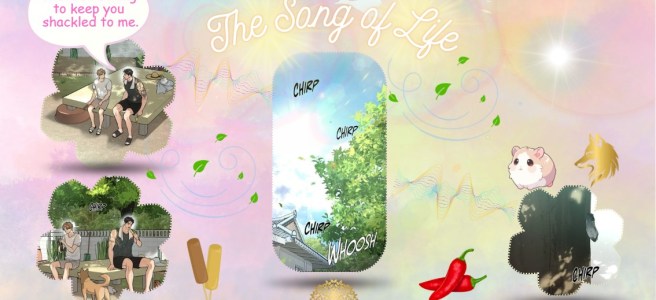
Jinx: The Song 🎼Of Life 🌳🪲

Introduction – Life, Sound, and Seasonality

A single cicada pierces the silence. (chapter 77) One tree, one voice, one yard — and yet the chapter closes not with human speech, (chapter 77) but with this fragile chorus of sound: chirp, chirp, chirp, whoosh. The choice feels deliberate, unsettling. Why does Mingwa give the final word to nature? Why let the cicada and the tree, not the champion or the doctor, occupy the last panel? Why offer us a rhythm so fleeting, so fragile, instead of the solidity of spoken language? (chapter 77)

The question lingers because silence (chapter 77) defines the scene as much as sound does. Between the two men, honest words fail. One proposes deals, bargains, contracts (chapter 77) — the same old language of power — while the other listens (for the most part of the time), seemingly passive, letting the conversation wash over him. Yet beneath these little moments of awkward stillness, another layer pulses: the soundscape of life itself. (chapter 77) The cicada sings not out of calculation, but because it must. The summer is nearing its end. The branches of the tree move not with intention, but with rhythm due to the wind. (chapter 77) Both are ungoverned, unowned. Both remind us of temporality: cicadas live only a short time above ground, trees sway but remain rooted, summer heat will fade into autumn. The backdrop insists on limits the characters refuse to see. Neither the doctor nor the athlete pay attention to their surroundings and see nature, too focused on the presence of the other.

And yet, the framing provokes further unease. The cicada is solitary, (chapter 77) not part of a swarm. The tree stands alone in the yard, (chapter 77) separated from the other trees and the vegetable plots, more ornament than sustenance. Is this tree a symbol of rootedness or of isolation? Is the cicada a reminder of vitality or of brevity? Why end with nature (chapter 77), when the story is about human bonds (chapter 77)? Perhaps because nature itself becomes the mirror — exposing the illusion of control, the futility of contracts, the precariousness of voices that are not truly heard.

More questions press in. Why does Jaekyung’s supposed change feel at once moving but also hollow? Why does Dan’s passivity strike us as both annoying and deeply human? Why does the cicada’s song seem more alive (chapter 77), more honest, than anything either man manages to say? (chapter 77) Are we witnessing growth, or a repetition with a new mask? Rhythm, or song?

This chapter demands we hold these contradictions without resolution — at least for now. Life here is not only about seasons and maturation, but also about the unpredictable song that emerges in the gaps of silence, in the fragile moments where genuine speech fails. Why else end with the tree and the cicada, if not to suggest that the real heartbeat of the story lies outside the men’s grasp?

The Tree, the Wind, the Sun and the Cicada

As you can sense, nature is now writing the rhythm of the protagonists’ lives, though none of them grasps it. Why? It is because they don’t hear the cicada’s song and appreciate the shadow from the tree. Both still cling to the illusion of control — Jaekyung through his fighter’s creed of schedules (chapter 77), contracts, and matches; Dan through his low self-esteem, his sense of duty and repayment of debts (chapter 77). Yet the cicada’s song interrupts their exchange (chapter 77), cutting through human words to remind us that time is not theirs to master. If nature is the true composer of this tale, then what are they but its creatures — a cicada on the trunk, a tree standing silently next to the characters?

The champion’s unheard song

But which figure embodies the cicada and the tree? Everything is pointing out that Joo Jaekyung is the cicada. (chapter 77) Observe that after each thought (chapter 77) or suggestion from the MMA fighter, the cicada’s song appears, as if the insect was echoing the human. (chapter 77) And now, you comprehend why the author (chapter 77) ended the episode like that. (chapter 77) The cicada, exactly like the celebrity, was waiting for an answer or more precisely looking for a companion. (chapter 77) Yes, the melody of this little insect is actually an appeal for mating.

In other words, the cicada’s voice in Jinx is not random background noise. (chapter 77) It displays that this cicada is rather late in his search for his mate. Since, in the real world, male cicadas sing only to attract a mate before their imminent death, its song in Jinx appears even more as an urgent appeal, not to the world in general, but to one listener, one partner. If Jaekyung is the cicada here, then his “song” is his repeated deals, his desperate way of seeking a bond he cannot name. He wants intimacy with doc Dan, but he can only cloak it in the language of contracts and obligations.

That’s why the episode ends with the chirp chirp and the sound of the branches. There still exists a gap between them. Joo Jaekyung was not able to cross the line: intimacy. In reality, he views doc Dan more than as a physical therapist. The athlete failed to convey his true emotions and thoughts due to his immense guilt: (chapter 77) (chapter 77). He is the cicada, because he feels powerless in front of doc Dan. Or we could say, he is the cicada due to his self-loathing. Hence he feels so small. On the other hand, observe that he doesn’t expose his vulnerability to doc Dan. He appears strong, independent and determined in front of the physical therapist. (chapter 77)

Thus the athlete chose to rely on the language he masters: deals. And this makes sense once we recall his past. Physical therapists in his life (chapter 1) have always been temporary, rotated and replaced like disposable tools. (chapter 53) Never once did he sustain a long relationship with one which was definitely influenced by his manager. Even now, with Dan, he cannot cross the invisible line between professional and personal (chapter 77) life, between contract and confession. Instead of admitting his own desires and true needs, he offers a time-limited deal: a future that already announces separation. (chapter 77) It is no wonder that his voice and the cicada’s noise blur into one rhythm — restless, repetitive, transient. (chapter 77)

The Cicada’s Life

But there exists another evidence for this interpretation. The little insect spends two to five years underground before it emerges, molts, and sings — a lifespan that eerily mirrors the champion’s career.

He entered the global stage at twenty (chapter 75), and now at twenty-six (chapter 75), like the cicada in its final molt, he sings louder than ever, defiant against the silence that waits for him. (chapter 77) His entire existence is noise, presence, demand: every word in this chapter punctuated by the chirp of the cicada, as if his voice itself were inseparable from its call. And the choice for the cicada is no coincidence, for in East Asian cultures, cicadas often stand for rebirth and transformation because these creatures go through 5 metamorphosis and spend years underground before finally breaking free into the light. To conclude, Jaekyung, too, has been buried in survival, in the underground world of his trauma and the MFC system. This means, like the cicada that takes years of unseen preparation before its brief summer of song, Jaekyung has reached the peak of his arc. His final metamorphosis is imminent — and now, you comprehend in the introduction why I pointed out that the athlete’s metamorphosis felt hollow or at least not complete. In reality, he is still under the influence of Park Namwook. Keep in mind that in the car, he expressed the absence of desire to fight, his mental and physical exhaustion: (chapter 69) Under the tree, the “fighter” is acting, as if he was strong and healthy again! (chapter 77) He has already accepted the fight in the fall (chapter 77), while in the car, he was still hesitant.

The Ant and The Cicada

Here the fable of The Cicada and the Ant from Aesop casts its shadow. The cicada sings recklessly, wasting summer in song while the ant toils and prepares. Jaekyung is the cicada, immersed in the immediate, deaf to winter’s approach; Dan has lived like the ant (chapter 57), sacrificing joy for survival, laboring without song. But Mingwa overturns the moral. The grandmother embodies the ant’s labor (chapter 62), turning Dan into a beast of burden — obedient, exploited, mute. The landlord has a similar mind-set (chapter 77), yet he diverges from Shin Okja, because he is aware of the importance of rest. Moreover, we see him working next to the two “kids”. On the other hand, note that doc Dan is working once again during his free time. (chapter 77) Shin Okja’s hoarding brought no music, no life which contrasts a little to the nameless farmer: (chapter 77) His words are linked to music. Yet, if we compare the champion with the grandmother, the cicada fills the silence with sound (chapter 77), making the tree’s presence visible. If the ant embodies survival without joy, the cicada insists on life even in its brevity.

But the cicada carries yet another, subtler illusion. It sings in heat and brightness, as if conversing with the sun itself. (chapter 77) To our ears, its music feels like a hymn to light—a celebration of the afternoon. The insect appears to believe the sky is its partner: I sing because the sun hears me. Yet the sun never answers. It is too distant, too indifferent. The cicada’s true companion has always been the trunk under its feet—the tree that holds it up, the branches that amplify its vibration, the roots that fed it in secret while it was buried as a nymph. The duet we hear is not with the sun; it is with wood and leaf, with the body that can actually respond—the tree that answers song with a rustling whoosh. (chapter 77)

A Lifetime Deal: the Cicada and the Sun

This misrecognition is Jaekyung’s, exactly. For years he has believed his real partner was the spotlight—the blinding, artificial sun of the ring. Titles, cameras, crowds: a heliocentric religion where the brighter he burns, the more “alive” he must be. And Park Namwook officiates that faith. He is the high priest of the false sun—controlling calendars, selling narratives, promising glory (chapter 75) (bench-talk during the night under a street lamp “let’s make history” pitches), always angling the wolf toward the next blaze. Under that light, every human bond is recoded as use: therapists rotate, friends become assets, even pain becomes a publicity arc. The “spotlight” warms (chapter 77); it never cares. It cannot hold you when the lights go out.

So what, in truth, lets the cicada sing? Not the sun. The mate and indirectly the tree. And this leads to my next observation. Doc Dan is the tree, but the sick doctor has no idea about his true nature. (chapter 41) (chapter 77) He is the surface that carries Jaekyung’s vibration, the structure that turns his noise into presence. Even underground, the cicada nymph lives by roots—its unseen life depends on the tree’s hidden water. It serves as their burials too. Likewise, Jaekyung’s fiercest seasons have been fed by quiet, unglamorous care: taped hands, worked tendons, meals cooked at dawn, a body coaxed back from ruin. The sun applauds; the tree sustains.

This reorders the scene in chapter 77. Every time Jaekyung makes a proposal—“two matches,” “debt cleared,” “contract ends”—the cicada answers, chirp, chirp, as if the insect were echoing the man. But hear it more precisely: he keeps singing upward (chapter 77), toward the sun that will never reply. The only answer available is lateral, beside him—the whoosh in the leaves, the breath of the tree. And that is Dan. The real dialogue of the chapter is not man ↔ spotlight, but cicada ↔ tree: chirp answered by whoosh, willpower answered by presence. Is this not beautiful?

Here the warning sharpens. The sun is a spectacle that consumes. Namwook’s “solar” system—rankings, schedules, comeback arcs—demands continuous radiance from a body that has already confessed fatigue. A cicada can sing itself to death.The star risks doing the same—confusing performance with relationship, mistaking visibility for intimacy, burning precious time before he has learned how to live. If he keeps treating the spotlight as companion, winter will arrive while he is still calling to a sky that cannot hold him. If so, he will end up alone, a warning Hwang Byungchul expressed on the rooftop. (chapter 75) This shows that the athlete has not found the right answer yet. He only focused on this aspect: doc Dan (chapter 76) But the director had told him this: (chapter 75) He should pay attention to his surroundings which doesn’t only include doc Dan, but also the puppies, the trees, the ocean, the sun etc.

This solitude is already foreshadowed. On the bench, Jaekyung mirrored Dan’s own posture of resignation: (chapter 77) he sacrifices himself for others. He agrees to his manager’s demands, he prioritizes Dan’s recovery and desires, he helps the landlord for the doctor’s sake and in the process he erases himself. Thus he has no time for himself and his “family”. He still has no private life. (chapter 77) At no moment, he is mentioning Hwang Byungchul or the landlord. He goes further—he defines himself as a shackle, an anchor weighing Dan down. The language is borrowed directly from Dan’s own vocabulary: (chapter 77). In a grim symmetry, both men come to see themselves as burdens, unworthy of being chosen, each convinced he is dragging the other down. Under this new perspective, my avid readers can understand why I perceived no deep change in the wolf, he is still defining himself as a fighter and champion, nothing more.

This raises the following question. How can the champion fight with such a mindset? (chapter 77) Each match will only bring him closer to separation. Whether he wins or loses, the outcome is the same: Dan will leave. (chapter 77) His mind will never be at peace. That certainty can only gnaw at him, poisoning his training with dread. He can no longer imagine a victory that can be shared, nor a defeat that can be softened. Glory and suffering alike will be stripped of their meaning, because both exclude the very person he longs to share them with, if the doctor agrees under these conditions. (chapter 77) He won’t be able to enjoy their time together either, always thinking of the separation. And this is exactly why episode 77 feels like the culmination of an old rhythm of blindness — first staged in episode 11 (chapter 11), replayed in episode 58 (chapter 58), and now revealed in its bleakest form on the bench.

  • Episode 11: Dan on his knees, begging for help, is met not with recognition but with Jaekyung’s misinterpretation. The champion, unable to read the doctor’s suffering, turns the plea into a promise of “fun.” Dan’s misery is swallowed in pleasure’s disguise.
  • Episode 58: At the landlord’s gathering, the others dance, drink, and laugh while Dan sits silent and withdrawn. Again, suffering and loneliness are silenced by entertainment. His isolation deepens because those around him are blind to his exhaustion, masking solitude and absence with noisy joy.
  • Episode 77: Finally, on the bench, there is no misinterpretation and no distraction — yet no joy either. (chapter 77) Both men hold popsicles, and both let them melt away. The sweetness drips into nothingness. Neither finishes the treat; neither savors the moment. The popsicles are wasted like their time together, like their words unsaid. Life is slipping through their hands, uneaten, unlived.

Here the symmetry sharpens: in 11, while Jaekyung seized the opportunity to have fun at Dan’s cost; in 58, others’ play excluded the physical therapist altogether; in 77, the absence of play exposes the core truth — neither man knows how to enjoy the present. However, the cicada’s noise stands for entertainment and short-lived happiness which means that the “goddess” Mingwa is indirectly warning her figures, not to waste time and enjoy the present. They should confess. At the same time, she is underlining the importance of “health” and that “illness” should be taken seriously.

This is Dan’s tragedy: despite knowing life’s fragility – chapter 59- (the puppy’s burial seared death into his memory), he still cannot taste life. The sweetness of the moment melts as passively as he endures it. Yet it is also Jaekyung’s tragedy, because by calling himself a “shackle” (77), he steps into Dan’s shoes: burdened, unworthy, longing — and unheard. What was once Dan’s silent plea for companionship is now Jaekyung’s, but this time it is Dan who cannot perceive the truth, too focused on himself and his self-loathing.

The bench thus becomes the mirror of episodes 11 and 58, binding them into a single arc. It shows how fun, sweetness, and joy — the song of life itself — are continuously misplaced, misread, or wasted between them.

Once again, Jaekyung finds himself racing against time (chapter 77). In the past, he fought to shorten it—to end fights quickly, to push through exhaustion, to prove himself before fate closed in. Now he fights to prolong it, to stretch the fragile terms of this contract, to squeeze eternity into borrowed weeks. Yet the irony is merciless: the more he tries to hold on, the more unbearable his solitude becomes. Every strike, every victory, every step forward is also a countdown toward the moment Dan vanishes from his side. Thus I can only deduce that he is doomed to lose his “match” in the fall, if he doesn’t postpone it.

The Rootless Tree

If Jaekyung is the cicada, Dan is the tree. But not any tree: he is the one standing in the corner of the yard, silent, enduring, and taken for granted. (chapter 77) A tree provides shade, stability, and wood — others rest beneath it, lean against it, even cut it down when it no longer “produces.” That has been Dan’s role in life: used by the grandmother, landlord (chapter 77), the director of the hospice and even patients as a background presence, dependable (chapter 71) but voiceless. His attraction to Shin Okja’s wedding cabinet makes sense here. (chapter 19) The cabinet, crafted from dead wood and mother-of-pearl, is civilization’s tree: beautiful, heavy, but lifeless. It embodies control and permanence, much like the grandmother’s treatment of him — precious in appearance, mute in agency. When Dan strokes it longingly in chapter 19 (chapter 19), he projects himself onto it and his grandmother, identifying with its polished silence. By chapter 53, however, the tone shifts. (chapter 53) The cabinet becomes a burden, an inheritance of death and stasis that he must abandon, just as he begins to sense the need to step beyond his grandmother’s shadow.

The parallel runs deeper. A tree, unlike a cabinet, is alive. (chapter 41) But life requires care: water, soil, and balance between sun (chapter 41) and shade. This means that trees need care, yet the problem is that since they grow patiently, people take them for resilient. Nevertheless, the illness of a tree (parasites, fungus) can be difficult to perceive because signs are not always obvious and can be confused with normal growth patterns (falling leaves due to the season). This mirrors doc Dan’s conditions. He is blamed for his sickness, as he has a weak constitution (chapter 21) or he is neglecting himself (chapter 70). Thus I see Dan’s decline, his exhaustion, his silence at the bench in chapter 77, as a reflection of this reality: he is not being tended like the tree in the courtyard which contrasts to the way the chili peppers are treated. (chapter 77) He is not bringing any fruit or nourishment. However, a tree serves as a habitat for animals (birds, insects…) Additionally, notice his hands — almost lowered throughout (chapter 77), even when holding a Popsicle. (chapter 77) Doc Dan doesn’t eat, doesn’t raise his hands, doesn’t claim space. He neglects himself as others have neglected him. In the last panel, one detail caught my attention: with one hand, he is holding his wrist. It was, as though he was trying to stop himself from eating the Popsicle.

And yet, in chapter 41, under a vast tree, (chapter 41) his posture was different. Then, he looked up. He opened his palm toward the light, acknowledging that a tree does not live for utility alone but breathes and feels. (chapter 41) That was the moment he realized he had caught feelings for Jaekyung. The tree embodies life, hence there is this expression: “The tree of life”. Under this new perspective, it becomes comprehensible why the main lead came to associate rest and companionship to a walk through the woods. (chapter 47) The symbolism is sharp: a tree in a forest is never lonely. Surrounded by others, it becomes part of a living community. Dan’s nightly walks (chapter 65) — through woods, past the grave of the nameless puppy — reveal his repressed longing: to mourn, to belong, to root himself in a place where companionship is natural, not demanded. He is indeed longing for recognition and care.

The contrast could not be clearer: the grandmother abandoned her furniture in Seoul, and now she prepares to abandon him the same way (chapter 57), treating him as a cabinet to be left behind or a baggage to be passed on. (chapter 65) But Dan is not furniture. He is a tree, and the forest remains his true horizon. His illness, his exhaustion, his silence are not fate; they are symptoms of neglect. What he longs for — and what his love for Jaekyung first awakened — is to step into the woods, to be among companions, to be cared for as living. I would even add that deep down, he is neglecting himself in order to receive care: (chapter 76) What he expressed in front of the champion was actually reflecting his own desires. But so far, no one is willing to stay by his side and take care of him, when he is sick. Exactly like the athlete, the main lead was not allowed to become “sick” in the end, as he had to support his grandmother.

The tree in myth and ritual embodies the axis of existence itself: roots sunk into death, trunk standing in life, branches reaching toward heaven. Roots hold what is buried — the puppy’s nameless grave (chapter 59), the parents never properly mourned, all the grief denied him. The trunk carries scars, weathering seasons while others lean against it — the image of Dan’s silent, taken-for-granted endurance. And it is precisely on the trunk, in the realm of life itself, that the cicada sings. (chapter 77) Jaekyung’s restless call resounds through Dan’s endurance: his silence becomes resonance, his shade becomes sound. His song fills the air, making the tree’s existence suddenly audible, visible, alive. (chapter 77) This mirrors their relationship: the champion’s presence — disruptive, insistent — compels Dan out of muteness, dragging his quiet endurance into resonance. Where the grandmother reduced him to labor and servitude, Jaekyung insists, almost violently, that Dan should be free and heard. That’s the reason why I am expecting a huge change in him in the next episode (78). Besides, doc Dan’s number is 8!

This is why the symbolism of natural burials resonates so strongly. In South Korea, groves are increasingly chosen as final resting places, where ashes feed the soil and the deceased “return to the bosom of nature.”

Dan has never been permitted to visit a burial — neither for his parents, nor for his own grief, the loss of the puppy. Is it a coincidence that the doctor is never seen going to the burial site for the puppy after that fateful night? It is because he has never been taught how to be vulnerable and to mourn. The vanishing of the parents was never brought up. (chapter 57) And because I made the connection between the main lead and the tree, another association came to my mind: the picture of the smiling Kim Dan with his grandmother in front of the hydrangeas. (chapter 65)

This plant blooms brilliantly but requires constant shade and water — fragile beauty that cannot be uprooted without withering. For me, they echo the absent mother: ornamental, dependent, ultimately unsustainable. However, this photography exposes not harmony but hierarchy. Shin Okja stands proudly before the blooms, lush plants that demand water and shade in abundance, while the mother lingers blurred in the background. The image suggests exclusivity: the grandmother has never been able to pay attention to more than one person at a time. For me, she used the little boy as her excuse to claim care for herself — because she “took care of him,” she believed herself entitled to receive attention in return. The hydrangeas thus mirror her role: fragile in appearance, but voracious in need, drawing resources to herself and leaving others in the shadows. The mother, displaced into the background, must have felt the loneliness of someone perpetually excluded from this one-sided economy of affection. Even Dan’s duck-printed shirt reinforces the point. The duck belongs to the pond, a space of water and cyclical nurture, yet there is no pond in the picture. Moreover, the “pond” is not freedom but a closed circuit where water flows only to the hydrangea. The child, like the duck, does not swim freely; he is displayed as proof of the grandmother’s virtue, her moral claim to attention. In this way the photograph unveils a disturbing inversion: Shin Okja as the hydrangea that consumes, Dan as the duck that justifies her entitlement, and the mother as the silent absence pushed beyond the frame. And since both are smiling in the picture, I assume that the photographer must have hidden their suffering behind the camera, which would mirror this scene: (chapter 58) In this panel, the tree in the corner of the yard is not visible, mirroring the exclusion of the main lead in this “happy scene”. This interpretation reinforces my theory that the treasured picture of doc Dan is actually an allusion to the loss of Eden and the grandmother’s sin.

To conclude, Doc Dan’s true longing, lies elsewhere. Not to stand as a solitary trunk in the corner of a yard, nor to be polished into furniture (Wedding Cabinet), nor to prop up fragile blooms — but to be part of a forest and as such to have a family, a home. So when Joo Jaekyung gives him the freedom to choose his path (chapter 77), he is actually pushing him to find his own roots. Thus the tree replies with his branches. (chapter 77) And here the sound symbolism crystallizes. While in the yard, the cicada chirps and the wind whooshes, in the champion’s bedroom, the sound “whoosh” (chapter 76) accompanied the ghostly illusion of Dan, a presence felt but no longer seen. As you can see, the sound exposes the doctor’s true life: he is a ghost, exactly like the tree in the corner of the yard. This means that we should expect doc Dan’s response to the champion’s offer in the next episode. However, this time, the physical therapist will make his own choice, not influenced by his grandmother, born from his true desire.

Sweetness and Fire – Red Bean, Chili, and the Melon

In the previous part, I already examined the signification of the popsicles. However, I didn’t study their flavors. Interesting is that each flavor mirrors the men’s inner stance toward life. (chapter 77)

Dan reaches for the red bean popsicle, the Bibibig (chapter 77). One might think, he selected it, because he likes it and as such has already tasted it. However, I can refute this perception. (chapter 16) When doc Dan was looking for a new place, he was eating a red bean bread in front of a freezer at a convenience story. The little boy in the background was looking for a popsicle himself. This shows not only the malnutrition of doc Dan’s from the past, but also his choices were influenced by his grandmother and her taste. In episode 11, the grandmother offered him red bean bread for his birthday (chapter 11), and his choice in the present is still shaped by her hand. In addition, red bean is sweetness born of endurance: boiled, mashed, sugared — a labor of patience. This reflects his childhood and life with his grandmother. Finally, the juxtaposition of doc Dan and the boy in front of the freezer serves as a metaphor: doc Dan still has the mind of a child. Interesting is that under the tree, doc Dan does not eat it. (chapter 77) The wolf has already taken a huge bite, while the 29 years old man’s lips barely touches the ice cream. Moreover, his statement (chapter 77) is not referring to the popsicle, but to the good news from the celebrity. This disconnection exposes the doctor’s lack of appetite and listlessness. He is not living, he is withering. Hence the popsicle melts untouched, a confession without words: (chapter 77) Dan continues to deny himself sweetness, continues to let what he desires drip away, uneaten. His passivity here is no accident — it is his illness, his habit, inheritance, the echo of a life where his own likes never mattered. At the same time, his behavior could be judged in a positive light: it displays his confusion and loss of identity as well. He didn’t reject the popsicle. He is at a crossroad, for he doesn’t know what he likes in life. He selected the red bean popsicle out of habit and politeness… but deep down, he didn’t feel like eating it. Hence he is not looking at his fated partner.

But red bean in Korea also carries another meaning: it is a ward against misfortune and evil spirits. Families once scattered red beans around the house after funerals or during rituals, believing their bitter-sweetness drove away bad luck. How ironic, then, that Dan’s uneaten popsicle becomes a symbol of this very curse. By refusing sweetness, by letting it melt away, he also refuses the power to ward off the misfortunes that have haunted his life. What should have been protection becomes waste. His own “amulet” is abandoned, just as he was. This could be seen as an allusion to a future collapse or incident in his life. Keep in mind that his suicide attempt has not been perceived correctly yet. Under the tree, it was reduced to an accident (chapter 77) or “sleepwalking” (chapter 77) and not depression!

On the other hand, Dan is not only red bean. He is also chili pepper: (chapter 77) sharp, hot, forged by survival. Chili peppers, introduced to Korea centuries ago, became a cornerstone of its cuisine — not only for flavor but as a sign of vitality and strength. They are hung in bundles outside homes to ward off bad luck, their fiery color a talisman of life-force. Doc Dan brings life into the champion’s life , pushing the athlete to change his habits. The physical therapist also burns (chapter 18), though he rarely lets it show. His fire erupts in flashes — anger, defiance, or hidden passion (chapter 44)— but most of the time it is suppressed, hidden like a chili dried and strung up, more symbol than taste. If the red bean is the sweetness he represses, the chili is the intensity he fears unleashing. Together, they reveal a man both sweet and burning, tender and scarred. His tragedy is that he has learned to mute both sides of himself — neither savoring sweetness nor embracing fire. By muting his own appetite, he also mutes his voice — which is why he cannot confess his feelings to the champion. (chapter 77) He refuses the penthouse not because he dislikes it, but because he has already grown attached to it, to its inhabitant, and to the bond he fears to name. To admit this attachment would be to risk exposure — to risk being seen and rejected once again.

For Dan, Jaekyung is not the cicada but the sun itself: (chapter 41) distant, unreachable, dazzling. The tree cannot imagine that the sun could notice its shade. To him, Jaekyung is both too far and too important, a star in every sense, while he himself remains a mere trunk at the margins — one physical therapist among many, a man without fame, without recognition. Thus his silence is not only fear but conviction: that he is invisible, that his love could never matter to someone who shines so brightly.

Jaekyung, by contrast, chooses melon. (chapter 77) Melon is not survival food, not inherited obligation. It is pure refreshment, fruit turned into summer sweetness. For once, he accepts it without protest, without remark, even tastes it. (chapter 77) The detail matters: this is not the strawberry of chapter 43 (chapter 43), presented on his birthday cake, but a quieter gesture of allowing sweetness into his body. Contrary to the past, he is now taking his time to eat it. (chapter 77) The melon popsicle hints at a shift. The cicada who only worked, only sang for survival in the ring, is beginning to taste life’s sweetness outside of it. However, his attitude changes, the moment he hears doc Dan’s refusal and hesitation. From that moment on, he can no longer eat the popsicle. (chapter 77) Thus I deduce that Joo Jaekyung must have enjoyed this brief moment with doc Dan under the tree. (chapter 77) Therefore we hear the cicada’s song.

And yet, their shared moment ends in waste. Neither finishes their ice cream. Both popsicles drip away in silence, signs of a larger failure: they cannot yet enjoy the present, cannot take in sweetness or fire without fear. This inability extends beyond food. It is mirrored in their blindness to life’s smaller joys — symbolized by Boksoon and her puppies. (chapter 77)

For the first time, the puppies appear directly before Jaekyung, (chapter 77) circling, playful, embodiments of innocence, pranks, and uncalculated joy. And yet, the champion does not see them. His gaze is elsewhere, fixed on Kim Dan and as such on promises, contracts and shackles, on the logic of debts and repayment.

Deals, Favors, and Shackles

This interpretation leads me to the following observation and question. Why are Boksoon and her puppies present under the tree (chapter 77), only to vanish soon after? (chapter 77) Their brief appearance offers a key to understanding the bind between Dan and Jaekyung. Boksoon approach the adults because of the popsicles, while the puppies are simply following their mother. The dog is drawn by the hope of food (chapter 77) — playfulness, comfort, life. But when no treat comes, they drift away. This is exactly what Dan longs for and exactly what he never receives: nourishment freely given, affection not tied to debt, contract, or favor. (chapter 13) His life has been shaped by exchanges where even love must be earned, and so he remains haunted by the sense that he is tolerated, not chosen. (chapter 19)

From the very start, the relationship between the hamster and the wolf has been trapped in this logic of contracts. In chapter 6, the penthouse agreement reduced everything to transaction : a fighter guarding his jinx, a therapist financing his grandmother’s care. (chapter 6) There was no cicada-song, no play — only sterile bargaining. Dan’s body and labor were priced; Jaekyung’s superstition was indulged. Both were tools, not partners.

Chapter 48 repeats the pattern in a darker key. Choi Gilseok offered another “contract,” one that smelled of temptation and corruption. (chapter 48) It was no real bargain, but a devil’s deal: short-term relief in exchange for entrapment in illegality. (chapter 48) Dan, swayed by Shin Okja’s illness (chapter 48), hid the meeting from Jaekyung. The secrecy itself poisoned the bond, culminating in the locker-room explosion. There Jaekyung hurled his cruelest accusation (chapter 51) : that Dan was obsessed with money. What Jaekyung failed to see is that this “obsession” was not Dan’s own desire, but Shin Okja’s influence. She had molded his tastes, his choices, his gifts (chapter 41) — even the act of repaying Jaekyung was her idea. Money became the currency of gratitude because she defined it so. Observe that her request from the celebrity evolves around money and time again: (chapter 65)

And favors, too, weigh like shackles. At the ocean, Shin Okja asked Jaekyung to take Dan to Seoul. (chapter 65) On the surface, it was framed as concern. But beneath, it was another manipulation: gratitude weaponized, agency erased. If Dan were ever to learn of this request, he would see himself once again reduced to baggage, carried not out of love but out of obligation. (chapter 77) Worse still, he would relive the sting of mistrust (chapter 51) — the same wound opened by Jaekyung’s suspicion in the locker room. To Dan, such favors are never gifts; they are veiled commands, proof that others act on his behalf because he cannot be trusted to act himself. Moreover, keep in mind that she denied him her request: (chapter 57), while she spent time with the champion on the beach. Xshe simply ignored his desire: (chapter 57) making decisions on his behalf without knowing his actual life. Her choices are based on the past and on her believes (television, trust in drugs and huge hospitals). She has no idea about his sleepwalking, his malnutrition, the incident with the switched spray, his blacklisting in Seoul …

This brings us to the bench in chapter 77. Here Jaekyung offers something new — or so it seems. (chapter 77) A finite contract: stay with me until the fight with Baek Junmin, then be free. Unlike the penthouse agreement, this one comes with an end date. But the language betrays him. It is still framed in terms of debt: (chapter 77) Shackles: the very word reveals the failure. A contract that was meant to liberate instead repeats the logic of bondage. While they are sitting next to each other, people might come to the following interpretation. They are equals contrary to the past: (chapter 6) (chapter 6) The reality is that this new offer doesn’t stand for equity and respect, rather servitude and submission. Something the doctor has already sensed: (chapter 77) He was already shocked how far the athlete was willing to go. Besides, he keeps wondering why the athlete would act this way: (chapter 77) As you can see, I have the impression that a quarrel between Shin Okja and her grandson could occur because of the celebrity, the doctor having the impression that he can not make his own choices, his life is ruled by Shin Okja (see chapter 2, 6 and 11).

Worse, Jaekyung introduces a word he has never voiced before: hatred. (chapter 77) In his mind, hatred is the imagined opposite of love — the binary hammered into him by his father. (chapter 73) Pride or shame, strength or weakness, love or hate: these were the categories of his childhood, the narrow spectrum in which he was trained to live. Resentment was inevitable, as natural as shadow beneath the sun. Jaekyung cannot yet imagine tenderness, attachment, or yearning as possibilities that stand outside this binary. He can’t anticipate that someone can be loved despite his flaws or wrongdoings.

And so the new contract fails, just like all the others. What Dan needs is neither another favor nor another deal, but the recognition of emotions that cannot be reduced to transaction. Gratitude is not enough. Obligation is not enough. To speak in terms of shackles and hatred is to miss the very heartbeat of life. Doc Dan wants to love properly and be loved. (chapter 71)

The truth has been there all along — whispered by nature, mirrored by Boksoon and her puppies. What Dan longs for is what the dog sought: a gift freely given, nourishment without condition. And what Jaekyung must learn is that between love and hate lies a spectrum of feelings unnamed in his vocabulary: tenderness, affection, vulnerability, confession. Until then, both men remain bound — not by contracts or favors, but by their own inability to imagine a bond beyond them. But they have the landlord by their side.

Notice how the landlord’s words (chapter 77) float with a note of music attached, as though he were not naming a financial debt but humming an invitation. Unlike Shin Okja, who used debts and favors as invisible shackles, the farmer’s “debt” carries no real weight of obligation. It is more like a pretext — a socially acceptable language that hides what he truly means: I enjoyed your presence, and I hope you’ll return.

That is why his request is so different from the grandmother’s. She demanded endless sacrifice, her “favors” becoming manipulative bonds (chapter 53) that left Dan trapped. The landlord, by contrast, knows limits. He praises without exploiting: “You’re doing better than anyone else here, the best!” But then, instead of pushing for more, he tells them to rest. He values their health, not just their productivity. In other words, he is not really an “ant” in La Fontaine’s fable, hoarding labor until exhaustion. He embodies a balance — work as a way to connect, not to consume.

Placed against the backdrop of chili harvests (chapter 77) — red, fiery, alive — his words gain even more resonance. Through the language of “work” and “debt,” he is offering something closer to companionship, a bond that extends beyond utility. If Shin Okja reduced Dan to a cabinet, the landlord gently places him back into the rhythm of life: song, labor, pause, and rest. This explicates why Jinx-philes could notice a glimpse of a smile on doc Dan’s face. (chapter 77) The landlord represents the link between the two insects in the end.

The Laughter Not Yet Heard Before Winter

The chapter ends warm, colorful, alive — cicadas singing, leaves swaying, ice cream dripping in the sun. (chapter 77) Yet where there is life, there is death. Nature teaches no illusion of permanence: every chirp already contains the silence that will follow, every green leaf already carries the memory of autumn’s fall. Jaekyung has only ever confronted death once, in the violent loss of his father (chapter 74), and since then he has refused to look beyond the ring. To him, the jinx belongs to matches, not to hospitals or funerals. He takes comfort in the grandmother’s words that she will choose her time of departure (chapter 65), never considering that illness could strike suddenly, that Dan’s health could collapse without warning, that Hwang Byungchul’s shadow could fade from the story altogether. Hence he imagines that they can visit Shin Okja regularly. (chapter 77) His eyes are locked on Baek Junmin, as if victory or defeat in the cage were the only horizon. (chapter 77) Yet, he is forgetting that he has already developed attachment to Shin Okja and even likes the director. Should the latter die, the star would be definitely affected, especially if he recalls their final moment together: the latter had a smile! (chapter 75) To conclude, he is still acting, as if he could control time and as such life.

Dan, by contrast, already knows that death waits close. (chapter 59) He buried his puppy at the edge of the forest. He spent some time by his grandmother’s side with the quiet resignation that each day might be the last. (chapter 59) For him, sweetness is fragile — a red bean bun, a fleeting popsicle — always on the verge of melting away. This is why silence overwhelms him on the bench: Jaekyung offers a contract, and as such the cicada calls, But Doc Dan’s own voice fails. Hence the wind answers (chapter 77) What he longs for is not a deal or a favor, but a confession — of love, of vulnerability, of fear.

Here the puppies and Boksoon hold the missing thread. (chapter 77) They appear in the yard, playful, unpredictable, embodiments of innocence and joy — yet Jaekyung does not see them. (chapter 76) He misses that for Dan, they are a source of comfort, tiny sparks of smile (chapter 57) in a life otherwise muted by burden. The tragedy is that Jaekyung himself is the only one who could give Dan that genuine laughter — the kind we glimpsed once, briefly, in chapter 44 (chapter 44) — but he does not yet grasp this. The reason is that he has repressed this night, the only smile he remembers is linked to Shin Okja. (chapter 77) Yet, she is no longer his source of “comfort”. (chapter 22) But the grandmother doesn’t embody jokes and games, only obligations and duties. So helping the grandmother doesn’t signify assisting his fated partner. Without pranks, without jokes, without the unpredictable gift of play, their bond risks becoming another duty, another sterile shackle.

And so the chili returns. (chapter 77) The wolf’s food has always been bland (chapter 22) — carefully measured meals from his nutritionist, even the doctor’s recent convalescent porridge of rice and chicken. (chapter 77) The male lead didn’t add abalone for example. But what if the athlete tasted something different? A hot, spiced dish, the kind that makes you laugh and cry at the same time? This is no abstract thought — Mingwa has already staged it in parallels. (chapter 37) In the States and in Seoul… After Heesung slept with Potato, he cooked him ramen studded with chili peppers. The gesture was not just breakfast but an intimate code, echoing the well-known phrase, “Do you want to eat ramen?” (chapter 35) — an invitation to closeness. Jaekyung might know the phrase, with his many partners before Dan, (special episode 1) but he has never truly eaten the ramen. Dan, ironically the virgin, has never received the invitation at all. The one ignorant of the metaphor has lived it (chapter 37); the one familiar with the code has never tasted its reality. 😂

This is foreshadowing. When Jaekyung finally accepts chili (chapter 77) — really eats it, really reacts — it will be the moment when bland survival gives way to fiery life. It will sting, it will burn, it may even make him cry, but those tears will not be the sterile sweat of weight-cutting or the hidden sobs of exhaustion. They will be tears shared, as laughter is shared, as sweetness is savored, as fire is embraced. This idea came to my mind because the athlete needs to learn the joy of mistakes! Once again, he offered a perfect deal, he fears to make mistakes… unaware that errors are part of life and should be embraced in the end.

Thus the title of this arc sharpens: The Song of Life is not only cicadas in the sun but also the spice that makes you choke and laugh (chapter 77), the puppy that dies yet leaves behind play, the silence that becomes confession, the contract that dissolves into companionship. Life and death are inseparable, grief and laughter intertwined, exactly like the day the athlete lost his guardian: (chapter 73) Joy and smile were followed by guilt (chapter 73), sadness and resent. (chapter 74)

The cicada sings because it will soon die. The tree sways because the wind reminds it it is not alone. And one day, Jaekyung will discover that the true ramen was never about the phrase, but about the burning, unpredictable, joyous taste of life itself.

This is the song hinted at in chapter 77. (chapter 77) Not just the Song of Life, but the song of life and death together — a melody where even the laughter not yet heard before winter has its place.

Feel free to comment. If you have any suggestion for topics or Manhwa, feel free to ask. If you enjoyed reading it, retweet it or push the button like. My Reddit-Instagram-Twitter-Tumblr account is: @bebebisous33. Thanks for reading and for the support, particularly, I would like to thank all the new followers and people recommending my blog.

Leave a comment