

Please support the authors by reading Manhwas on the official websites. This is where you can read the Manhwa: Jinx But be aware that the Manhwa is a mature Yaoi, which means, it is about homosexuality with explicit scenes. Here is the link of the table of contents about Jinx. Here is the link where you can find the table of contents of analyzed Manhwas. Here are the links, if you are interested in the first work from Mingwa, BJ Alex, and the 2 previous essays about Jinx The Fabric of Silence and The missed Party
It would be great if you could make some donations/sponsoring: Ko-fi.com/bebebisous33 That way, you can support me with “coffee” so that I have the energy to keep examining Manhwas. Besides, I need to cover up the expenses for this blog.

Chapter 79 proved my previous interpretation correct: the number 9 announces the end of a circle. 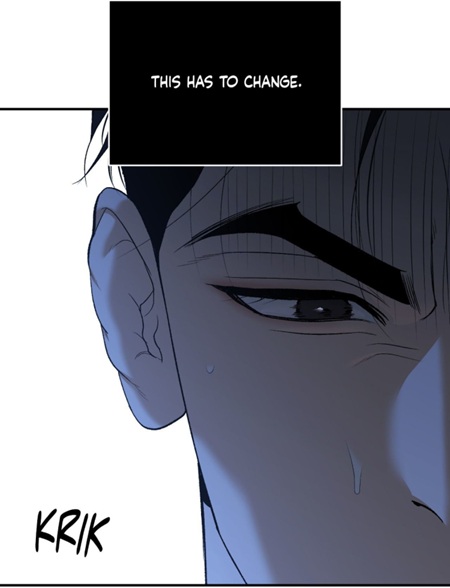 (chapter 79) However, let me ask you this. What kind of circle ends in episode 79? Moreover, how is this ending different from the past? Interesting is that episode 79 of Jinx doesn’t end with conflict, but with an awakening. For the first time, Joo Jaekyung does not rise to fight, command, or perform — he wakes up to a realization: “This can’t go on.” In the Korean version, his words carry an unusual clarity. It is not fate that changes, but choice. The champion, who once lived as if enslaved by habit and haunted by ghosts, now chooses transformation. The circle that has defined his life — power, silence, guilt, and repression — finally begins to close.
The decision is quiet but monumental: he will no longer live in a cycle of fear and self-loathing. 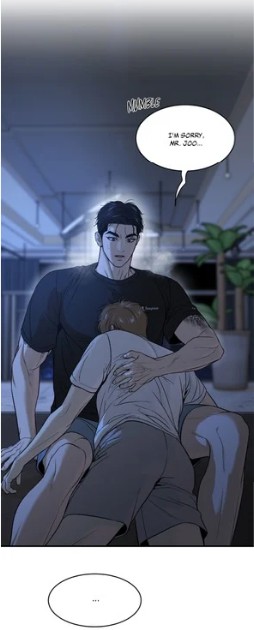 (chapter 79) Until now, Jaekyung has moved through life as if carrying a curse — the belief that he is unworthy of care and love.
 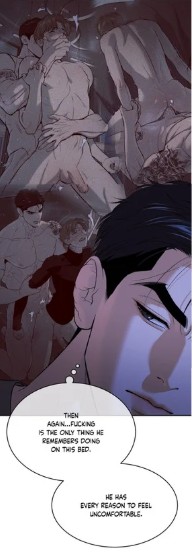 (chapter 78) Every match, every order, every touch was an act of penance. Yet, in this episode, that belief dissolves. What vanishes in chapter 79 is not his strength, but the compulsion to suffer for it. Through the unconscious confession from Doc Dan, the wolf discovers that despite his wrongdoings, he is not hated by the “hamster”. (chapter 79)The words carry the same emotional weight as
 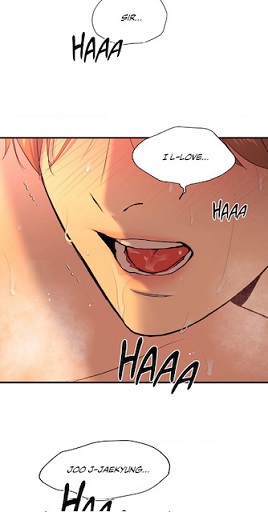 (chapter 39) from the magical night in the States. Both moments unfold in half-darkness, both break through inhibition, and both blur the line between consciousness and surrender. The verbal difference hides a deeper sameness:
  (chapter 79) is not remorse alone — it is an act of love, an instinctive reaching-out toward the other’s pain.
Mingwa mirrors the composition of these two scenes to stress their equivalence. The parted lips, the contrast between the heavy breath and the mumbling, the closeness of skin — all visual echoes that turn guilt into a language of tenderness. In chapter 39, the confession was drug-induced, raw and unfiltered, but afterward Jaekyung dismissed it with a laugh: 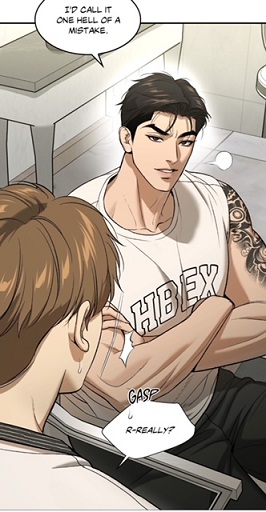 (chapter 41) What could have been a moment of truth was repressed through mockery. His body language was betraying him: his closed arms reveal that he was on the defensive. By trivializing love, he protected himself from suffering and as such from facing his own capacity for harm. Behind the joke hid an immense self-loathing: to accept the confession as real would have required believing himself worthy of it. To trust himself…. he is not a loser, a nobody!
Chapter 79 reverses that denial. This time, the athlete cannot turn away or make light of what he hears. (chapter 79) The doctor’s voice — faint, sleep-bound, and sincere — forces him to listen. The “mistake” returns, transformed into absolution. Where laughter once erased meaning, silence now restores it. The champion finally grasps that Dan’s words, whether “I love you” or “I’m sorry,” spring from the same place: care that persists despite injury.
This is why the “blue night” cannot be read as accident or madness. It is revelation. The wolf sees, perhaps for the first time, that he can be forgiven — that love, for Dan, includes compassion for his flaws. The “I’m sorry” becomes the mirror image of the earlier “I love you,” not a repetition but a correction. What Jaekyung once labeled a mistake now stands as proof of connection, as if fate itself were rewriting the joke into a prayer.
The End of a Circle
Each chapter ending in nine has marked emotional completion: chapter 9’s first gesture of care 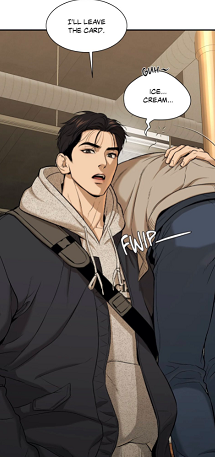 (chapter 9), 29’s confession on the couch
  (chapter 29), 69’s first expression of feelings in the dark
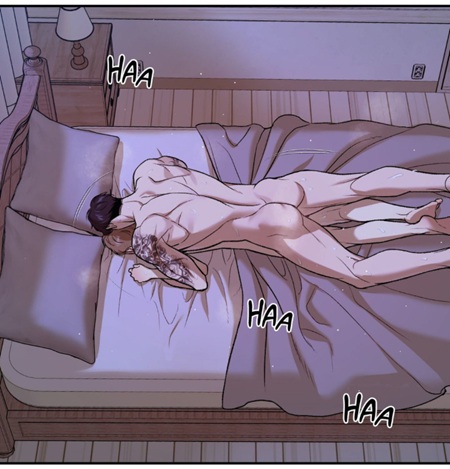
  (chapter 69). In chapter 79, the circle closes once more. The night’s palette tells the story — deep blue softens into violet
  (chapter 64)
  (chapter 79), the color born from the fusion of blue (Dan’s sorrow) and red (Jaekyung’s intensity). For the first time, in the penthouse the color of their relationship is not pain but balance. And now, you comprehend why in the hallway, the purple had almost vanished: (chapter 79) The light purple – lavender that once filled their world turns
  (chapter 66) (chapter 79) fades into the cold blue of the night. The light shifts — not toward warmth, but toward fragility. The purple, symbol of fusion, nearly disappears, leaving behind the dominant blue of isolation and fear. (chapter 79) This chromatic regression visualizes what happens next: in the hallway, both men are still haunted by their separate pain. Dan, drawn by the pull of despair and self-loathing, almost falls over the railing. Jaekyung, still guided by fear, rushes to catch him.
  (chapter 79)
The blue in this scene is not mere sadness — it is the residue of old wounds resurfacing. It unites them through pain rather than peace, yet this unity marks the turning point. The absence of purple is what propels the wolf to make a decision: he is about to drop his routine and as such his past believes, like for example, his life is still his first priority or he is just a shackle. He realizes that color — the life and warmth in Dan — is fading.  (chapter 79) To restore it, he will have to speak, to act, and ultimately, to smile again.
What truly ends here is the Emperor’s old language. The vocabulary of orders —  (chapter 79) gives way to the silent recognition of fear. When the champion admits,
  (chapter 79), it is a confession disguised as complaint. For the first time, he voiced his dependency and vulnerability more clearly, as his body language is no longer expressing hesitation and shyness. Imagine that so far, he had lived following the principle of “self-reliance”. Yet when Dan asks, “What?” the champion retreats:
 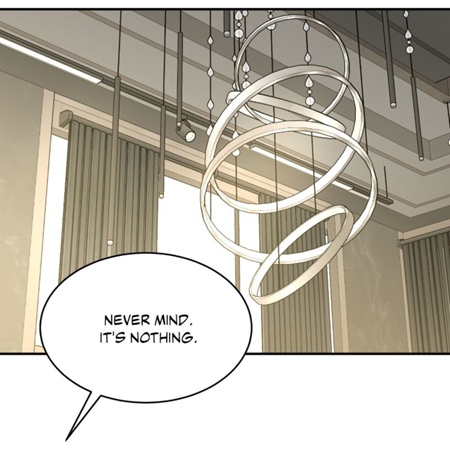 (chapter 79) His feelings collapse into the void between words. Above them, the spiral chandelier glows — the perfect symbol of their unfinished circle. His unspoken fear hangs suspended, waiting to be voiced because of someone else’s actions: the doctor’s grin
  (chapter 79) and fall (chapter 79) That retreat exposes a deeper fear — not of rejection, but of mockery. The man who once endured his father’s contempt and smirks
  (chapter 54) still equates vulnerability with humiliation.
 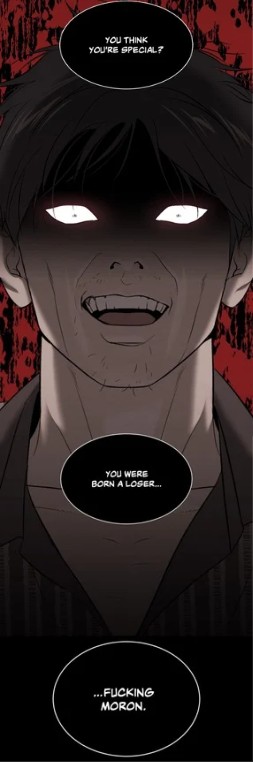 (chapter 73) In the past, every sign of weakness was punished or laughed at; even longing arrived through ridicule. Hence the “grinning” Dan of his nightmare (chapter 79) should be perceived as a distorted echo of the father’s cruel smile. And now, Jinx-philes can grasp why the wolf woke up from this “dream”.
 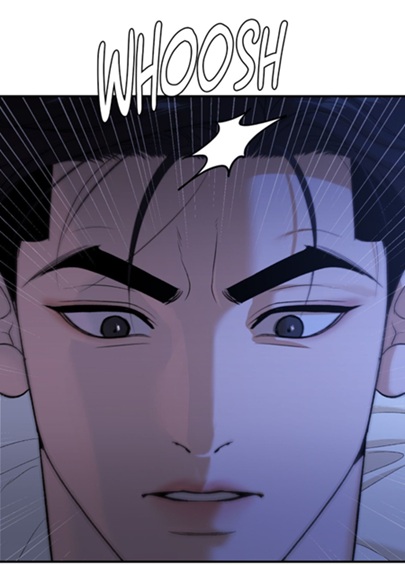 (chapter 79) The vision forces him to confront the origin of his shame. He realizes, instinctively, that the real Kim Dan would never smile at his pain — and through that recognition, he begins to separate present from past. He has already experienced a silent, but warm gaze
 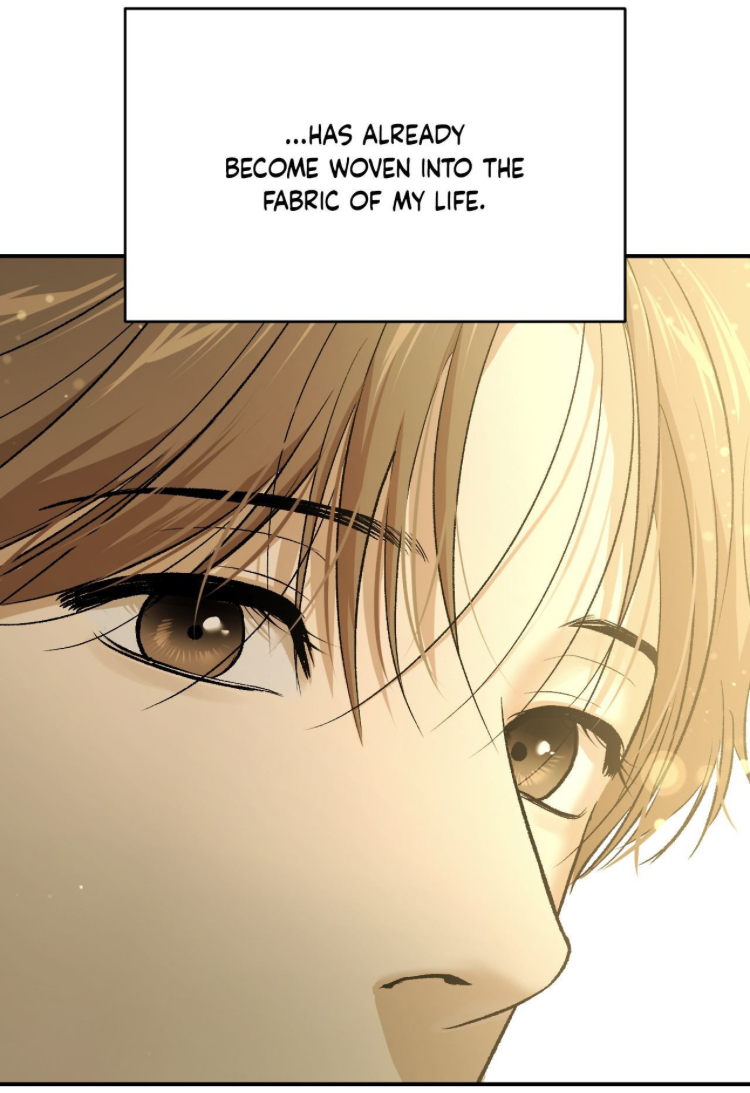 (chapter 77) from his fated partner after admitting his defeat:
 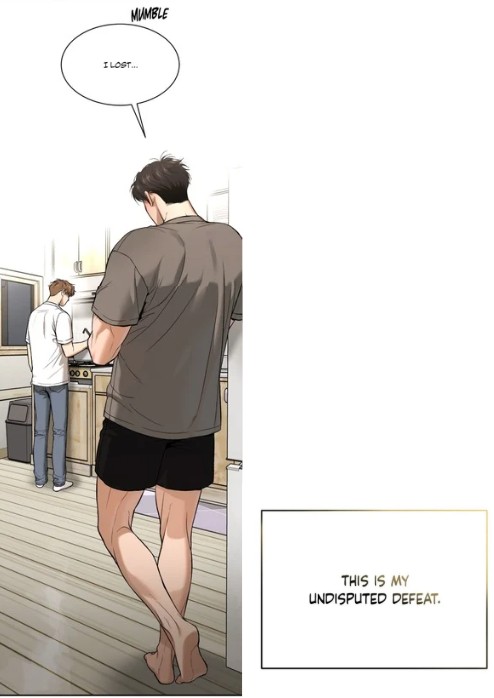 (chapter 76)
In silencing or voicing his fear, Jaekyung crosses the boundary between guilt and growth. He is no longer haunted by his father’s accusations like “you’re just trash” or 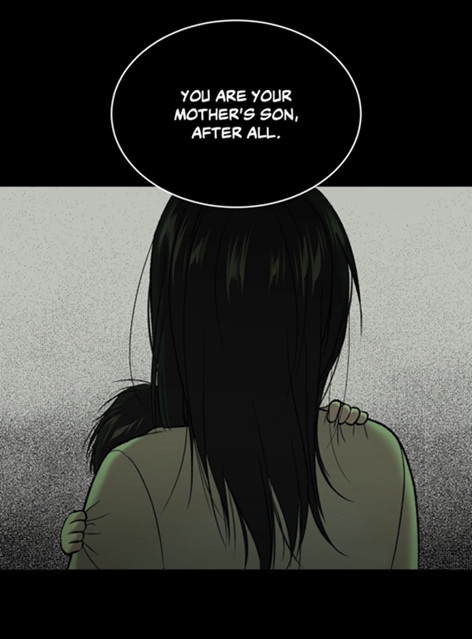 (chapter 73) but by a new, fragile dread: the possibility of losing the one person who would never say it. What vanishes in episode 79 is not his strength, but the belief that to need someone is to be weak.
That completion arrives at night. In his sleep, Kim Dan murmurs, (chapter 79) The two halves of their dialogue finally meet: the fear Jaekyung silenced finds its answer in the apology Dan utters unconsciously. One speaks awake but retracts; the other speaks asleep but reveals. The night itself becomes their interpreter — turning “nothing” into meaning.
Until now, Jaekyung’s remorse had lived without a voice.  (chapter 78) He has long recognized his wrongdoings — the pressure, the harshness, the selfishness
  (chapter 76) — but guilt without self-forgiveness remains sterile. What is the point of apologizing to someone when you cannot forgive yourself? His silence, then, is not arrogance but self-condemnation. Beneath his strength lies a man who believes that no apology can redeem him, because no one ever offered him one first. His father’s mockery, his coach’s reproaches
  (chapter 74) and expectations, his mother’s betrayal
  (chapter 74), his manager’s slap at the hospital
  (chapter 52) — none of them ever voiced regret and said “I’m sorry.”
Fighting became his substitute for repentance. 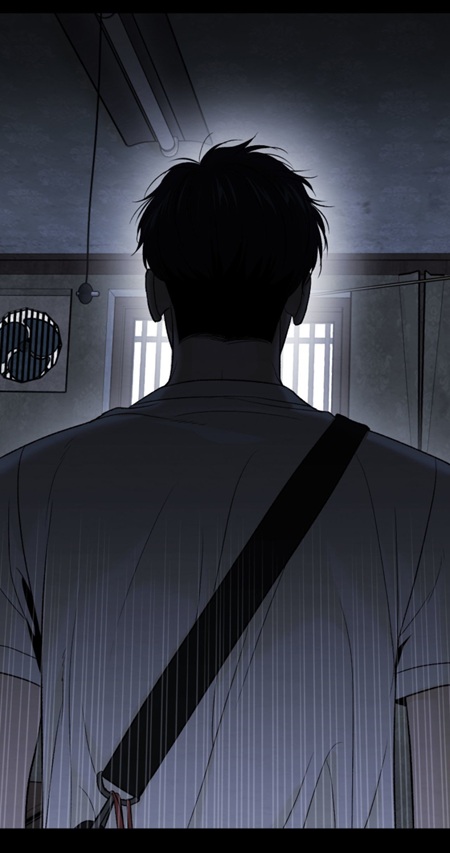 (chapter 73) Every punch was an act of self-erasure, every victory a brief anesthesia against the echo of his own self-loathing and regrets. He mistook exhaustion for atonement. But when Kim Dan whispers (chapter 79) in his sleep, something shifts. The word that once chained him to guilt now sounds different — tender, not accusatory. For the first time, he experiences apology as care, not as confession.
That is why this night matters. It teaches the champion what he was never taught: that forgiveness is not granted by punishment, but by connection and communication. Through Kim Dan’s unconscious words, he senses that he can be forgiven — that love does not vanish because of fault. He is still accepted despite his wrongdoings, not because he hides them. For the first time, Joo Jaekyung begins to believe that being loved and being imperfect can coexist. And in that fragile belief, change truly begins.
The Fall of the Angel
The dream of the wolf is not punishment — it is confession. It becomes the space where Jaekyung’s unconscious dares to speak what he hides from waking life.  (chapter 79) His vision of Kim Dan’s false grin is not a taunt from the other (chapter 79), but a message from within: You shouldn’t have hidden your fear. You should have trusted me. What appears as irony is, in truth, the echo of a moment that had once wounded him — the doctor’s trembling question,
  (chapter 51) The dream revives that unspoken answer, revealing that what Jaekyung perceived as danger was, in fact, an offer of trust. In trying to protect himself from mockery, he denied the very connection that could have saved him. The dream reconstructs the very morning he had dismissed his vulnerability
  (chapter 79)— the breakfast scene
 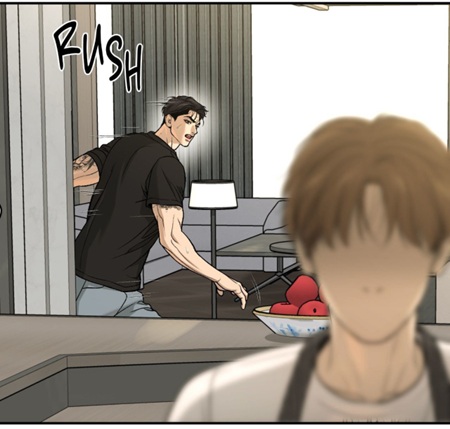 (chapter 79) , the casual (chapter 79) By replaying it in this distorted form, his mind stages a confrontation with his own denial.
The wolf’s remorse takes the shape of fear. In his dream, Jaekyung finally admits that he cannot bear to lose the one person who makes him feel human (chapter 79) — yet even there, his confession is shadowed by dread. (chapter 79) The grin that startles him awake is his own projection of unhappiness and shame, the echo of the mockery he once received from his father. But the truth beneath it is different: his soul is telling him that vulnerability is not ridicule, that he must stop silencing himself.
The resemblance between dream and reality is deliberate. The kitchen reappears, the same domestic warmth, the same silence. The unconscious replays what the conscious has failed to complete — the moment he turned away instead of speaking his fear aloud. His body wakes before his mind does, moving instinctively toward redemption. When he finds Kim Dan by the railing  (chapter 79), it is as if he is saving not only his partner but the part of himself that used to give up. He was living like a ghost denying his own emotions.
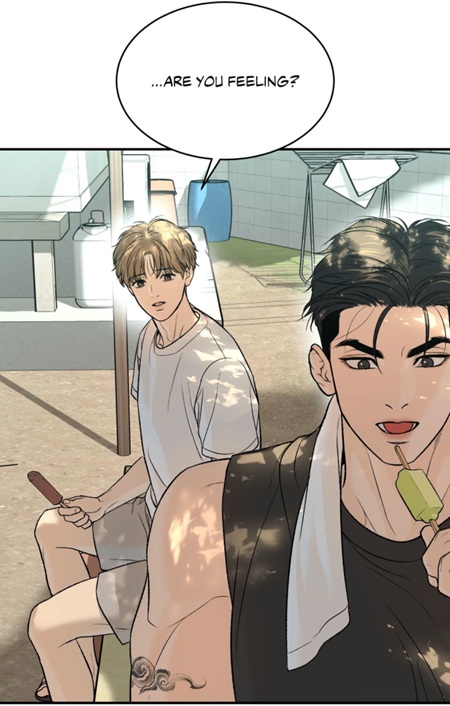
A few days before, the champion had called Dan’s drowning “an accident.”  (chapter 78) That word revealed his blindness — the refusal to acknowledge pain that does not announce itself through wounds. The new incident at the railing shatters that illusion. It was never an accident, but the expression of mental illness (chapter 79) Both events spring from the same silent cry for help, the same exhaustion he once ignored. This time, he sees it for what it is: suffering, not weakness. The shock of recognition becomes his wake-up call — not to fight harder, but to understand deeper. The problem is that so far the champion never had a true companion, hence he has not learned how to share thoughts and emotions to others. This explicates why doc Dan is actually the one initiating the conversation.
  (chapter 77)
 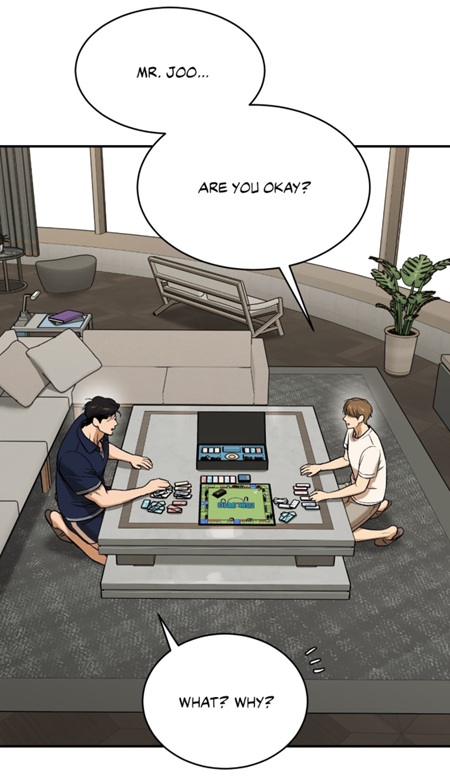 (chapter 80) Each time, the physical therapist shows concerns for the athlete’s well-being. He perceives this change of behavior as the expression of unwell-being.
Symbolically, the near fall (chapter 80) represents the danger of repeating inherited unhappiness and despair — the impulse toward surrender that has haunted the doctor. Both the ocean 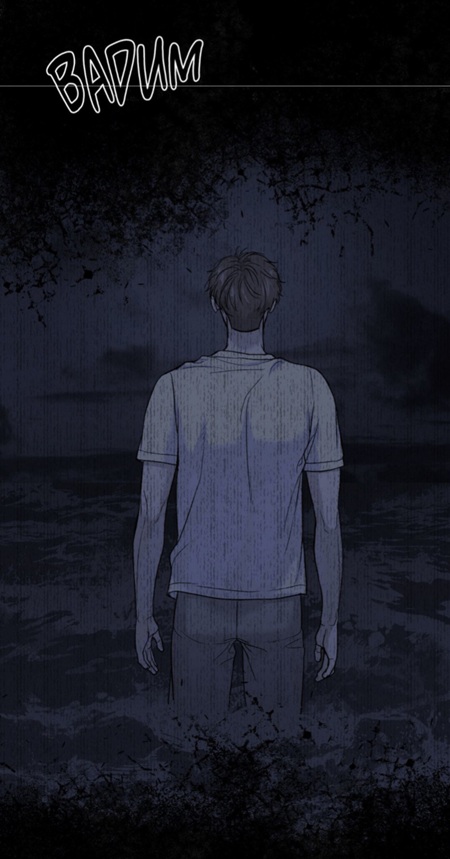 (chapter 69), and the balcony (chapter 79) embody the same impulse — escape — yet they reveal two distinct forms of suffocation. In the sea, Kim Dan moves toward the element that promises oblivion through absorption: water swallows, erases boundaries, and offers rest through dissolution. It is the drowning of exhaustion, of someone who wishes to return to the womb of stillness. On the balcony, however, the element shifts to air — the emptiness between life and death. Falling from a high place is the asphyxiation: the lungs collapse not by immersion but by void. Both gestures — walking into the waves and leaning over the railing — spring from the same inner logic: the unbearable weight of pain and expectation. But if water and air unite, they create clouds
  (chapter 38) — the very image that defines Kim Dan’s being. The clouds on his phone screen are not incidental; they reflect his essence. A cloud has no home, no fixed form, forever moving, dissolving, reforming — just like the doctor’s life, endlessly displaced and redefined by others’ expectations. Clouds embody both dream and danger: they promise transcendence but conceal the storm. Besides, a cloud can fall as rain, return to the ocean, or vanish into the sky — an image of the soul that oscillates between grounding and escape.
As soon as I made this connection, I couldn’t help myself thinking of the painting in the background of chapter 37:  (chapter 37) Behind the champion, the Golden Gate Bridge stands as a silent witness — a place where many have ended their lives by leaping into the void between air and water. The bridge fuses both symbols: it is where drowning and falling meet. Moreover, the bridge embodies the connection of two worlds. This backdrop, unnoticed by the protagonists themselves, prefigures the later arcs. Joo Jaekyung is the one standing between the bridge and the physical therapist. It was, as if the author was already announcing the huge depression doc Dan would face in the future. At the same time, I came to wonder if the unconscious suicidal attempts from Doc Dan were actually revealing the biggest secret in his life: the suicide of his parents and their death could be linked to a bridge. Striking is that while the members of Team Black were partying (chapter 37), death was standing behind the celebrity and this reminded me of the champion’s last genuine smile
  (chapter 73) before he discovered Joo Jaewoong’s corpse. The bridge thus becomes a metaphor for invisible grief: joy and pain occurring simultaneously, one masking the other. And keep in mind that according to my theory, the picture of Dan with his grandmother is hiding a tragedy. This would explain why doc Dan is so obsessed with this picture:
 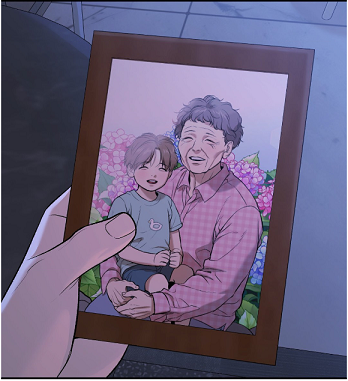 (chapter 47) The smiles here are hiding the past reality.
But let’s return our attention to the champion’s vision in episode 79. In that same duality (water/air) lies salvation. (chapter 79) The dream that wakes Jaekyung is not a nightmare but a revelation. He senses that the smirk is not the reality, but also the mask hiding misery. The greeting from the smiling Dan  (chapter 79) — so unlike his real, exhausted self — is a vision of peace, of love unburdened by fear, while this grin exposes the truth. The dream, the realm of clouds, becomes a stage where the wolf shows and learns tenderness. The dream’s fear and indirect self-reproach (chapter 79) becomes action; remorse (chapter 79) turns into rescue.
That’s how I noticed that so far, the champion never greeted his room mate with a good morning and smile in the morning.  (chapter 41) In other words, the dream is giving him clues as well how to behave: not only greeting, but also talking. What caught my attention is that during their two last breakfasts together
 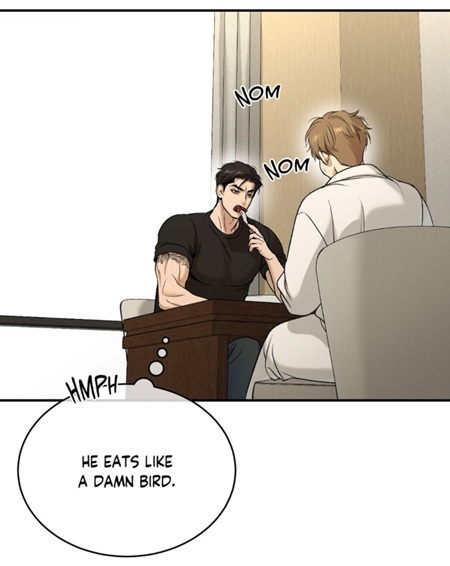 (chapter 68), they didn’t talk at all
 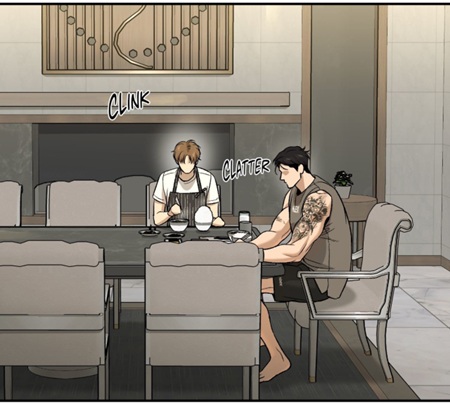 (chapter 79) which contrasts to the star’s vision.
In the dream, he had fallen to his knees — a gesture of humility and unspoken remorse. Yet in reality, the fall takes a gentler form.  (chapter 79) He does not kneel; he sits, his body settling softly against the floor as he catches Dan in his arms. The man once associated with dominance becomes a cushion, a pillow, a living anchor. His strength, once used to impose weight, now exists to absorb it. The fall is not toward repentance through pain, but toward tenderness through stillness.
This inversion transforms descent into grounding. The wolf who once incited Dan to kneel 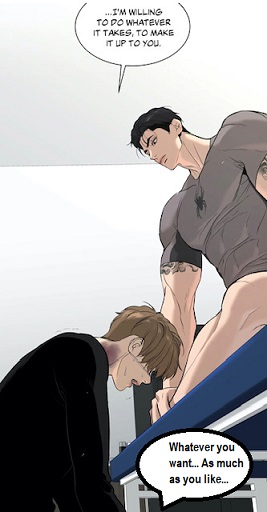 (chapter 11) now becomes the one who receives the collapse. (chapter 79) His body — no longer an instrument of violence — turns into safety itself. In that moment, he is neither fighter nor emperor, but a quiet surface where another can rest. The fall that once signified defeat now marks awakening: the champion’s muscles, built for battle, finally serve their true purpose — to hold, not to harm; to bear, to protect, not to break.
The Mercy Of The False Saint
That’s how I detected another pattern. Kim Dan’s speech is tethered to touch — every genuine confession or plea emerges only when he is held. Physical contact functions as emotional permission: the body grants what words alone cannot. His first “I love you” 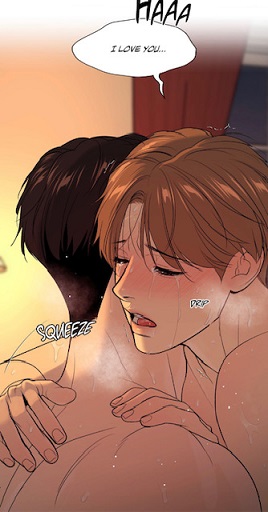 (chapter 39) escapes him in an embrace; his
 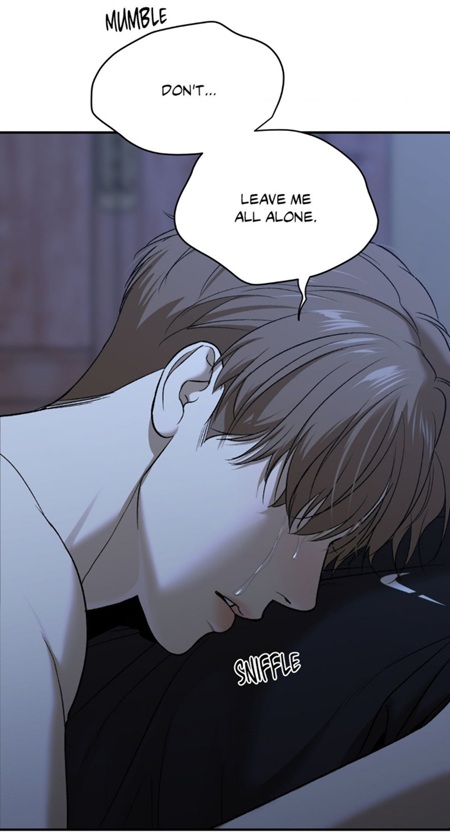 (chapter 66)
  (chapter 66) trembles out against Jaekyung’s chest; his (chapter 79) is whispered while clinging to the same body. Even as a child
 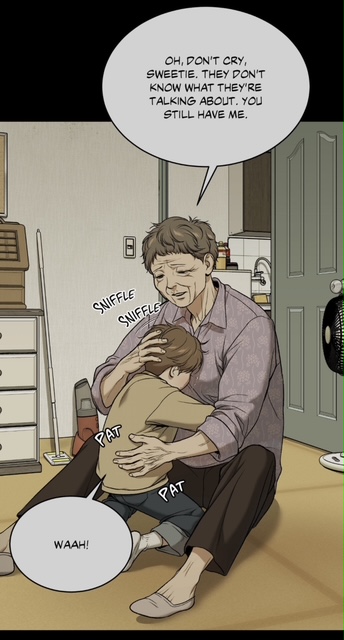 (chapter 57), he could only confide while being physically comforted. The grandmother’s embrace in chapter 57 becomes the prototype of this pattern — the last instance of safety tied to voice. Yet, crucially, that embrace was conditional and silencing. She soothed him but redirected his pain: (chapter 57) Instead of validating his pain and terrible experience, she absorbed it into her own narrative of endurance. The physical comfort coexisted with emotional invalidation — he was held but not heard.
And this interpretation (the touch is triggering the doctor’s desire for communication) got even corroborated by the latest episode.  (chapter 80) The moment the star was holding doc Dan’s hands, the latter started voicing more his emotions (fears, displeasure).
  (chapter 80) When Jaekyung takes his hands in the swimming pool, the gesture revives this primal language of reassurance. For the first time, the touch is neither coercive nor desperate; it’s sustaining. The handhold reverses the earlier dynamic — instead of silencing him, it gives him permission to speak. Furthermore, the champion is pointing out that he can rely on two things, the champion’s hands and the kickboard belt. This stands in opposition to the fake promise of Shin Okja. (chapter 57)
  (chapter 57) In other words, he is inciting the doctor to trust himself more and become independent.
  (chapter 80) (chapter 80) The champion’s words — “If you ever end up in the water, you can come back to shore as long as you know how to swim” — stand in quiet but radical opposition to the grandmother’s old reassurance: “You still have me.”
Both statements aim to comfort, yet they embody two entirely different philosophies of love. Shin Okja’s version of care was possession and control disguised as protection. Her “You still have me” offers solace by denying reality — her own mortality and it erased the boy’s suffering and loss and his capacity to cope. It promises stability but at the cost of autonomy: he is safe only through her. Love, in her logic, means dependence. Jaekyung’s line, by contrast, offers trust instead of control. 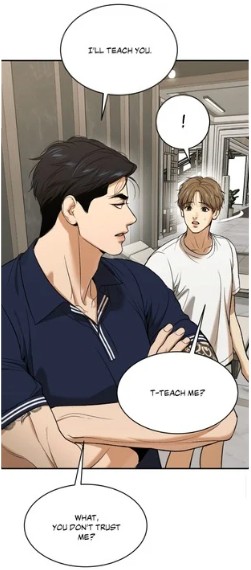 (chapter 80) His comfort does not deny danger — he acknowledges the possibility of falling into the water — but he links survival to skill, not assistance and dependency. His statement affirms Dan’s agency: he can save himself. Once he can swim, he is strong enough. Where the grandmother sought to replace the absent parents
  (chapter 65), the champion seeks to restore the missing confidence.
This is why the swimming lesson in chapter 80 carries so much symbolic weight. It is not only about overcoming fear of water, but about learning to float between love and self-sufficiency. (chapter 80) He just needs to learn and trust his own body and skills. For the first time, someone tells Kim Dan that he doesn’t need to cling to live. The wolf’s hands do not promise eternal rescue; they teach assurance and confidence.
Through this opposition, Mingwa traces the transformation of care in Jinx: from the grandmother’s pitying dependency to Jaekyung’s empowering faith. The very moment the wolf steadies his trembling fingers, the doctor begins to voice his worries and fears, words that previously only surfaced through sleepwalking or half-conscious murmurs. That’s why I believe that this embrace 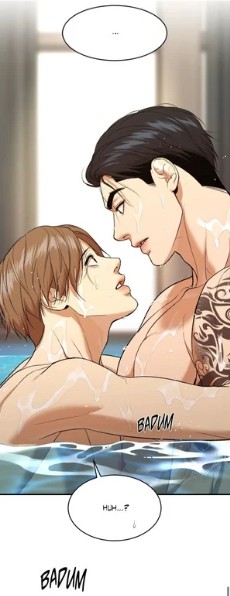 (chapter 80) in the swimming pool carries transformative potential. It is not merely a gesture of survival, but an initiation into honesty. Surrounded by water, both men are stripped of pretense. And observe that Joo Jaekyung is not rejecting the physical embrace
  (chapter 80) contrary to the past.
  (chapter 28)
  (chapter 69) The wolf, who once relied on dominance and silence, is now allowing his fated partner to hug him. (chapter 80) He accepts his vulnerability and struggles. In the swimming pool, the athlete is also learning to reassure instead of command. Dan, who has long associated touch with consolation and suppression, begins to experience it as safety and trust.
In that moment, their bodies speak what their words still resist: trust me. (chapter 80) The embrace might become the very impulse that pushes them toward verbal honesty — toward saying what they have long hidden. For Dan, it means learning to voice his needs and desires without shame; for Jaekyung, it means acknowledging his feelings without fear of losing control or strength.
But let’s return our attention to the physical therapist’s childhood. (chapter 57) Dan came later to associate love with contradiction: touch equals permission to speak, yet speaking never brings resolution. His psyche learned that disclosure leads nowhere — the listener (the grandmother) offers affection, not change. That’s the reason why he came to suppress his thoughts and emotions and project onto his grandmother. Her way of dealing with pain was denial, rooted in her own fear of trouble and probably social judgment. From my point of view, it is related to the secrecy surrounding the family’s past.
Furthermore, for the hamster, the embrace is more than comfort — it is survival.  (chapter 21) From childhood onward, being held becomes the only assurance that the world still contains care. When he woke crying and was taken into his grandmother’s arms (chapter 21), the patting gesture did not merely quiet his fear; it taught him that consolation requires contact. Yet this early lesson carried a hidden cost: it trained him to associate peace with submission and silence, and affection with dependency. Therefore the swimming lesson contains another important life lesson: it is about choice! Joo Jaekyung wants to be “chosen” by the physical therapist, hence he wants to conquer his heart.
  (chapter 80) That’s the reason why he can not change doc Dan’s heart and mind with the new clothes. For that, he needs to reveal his “weakness” to the physical therapist.
When the puppy died, Dan instinctively tried to recreate that lost safety. 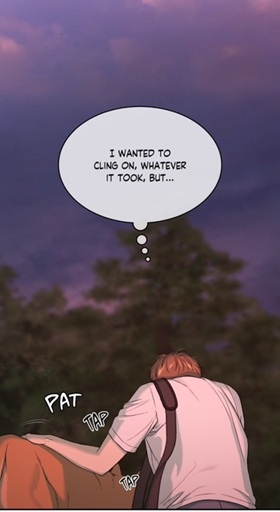 (chapter 59) His hand resting on Boksoon’s fur repeats the same motion — the pat once given to him, now returned to another being in pain. What he offers the animal is precisely what he has always longed for: warmth without judgment, touch without condition.
This explains why every later confession — “I love you,” “Don’t leave me,” “I’m sorry” — is born inside an embrace. Speech emerges only when his body feels that safety again. Yet, until now, the wolf’s touch has never been a true confession. The wolf initially held him through instinct  (chapter 4), not intention: a reflex of possession, not communication. As time passed on, it changed, yet in the bathtub (chapter 68), Dan fell asleep against him so that he could never experience the athlete’s care
  (chapter 68); in the morning, Jaekyung acted as though nothing had happened. Then on the dock, Joo Jaekyung expressed his relief (chapter 69), yet he never explained the reason behind his behavior. Besides, he removed himself from Doc Dan very quickly. There was no continuity between touch and word, no bridge from body to heart. The embrace between them was marked by silence.
Only now, in the night of chapter 79, does that change. (chapter 79) The embrace that once silenced finally begins to speak. Dan’s trembling body against Jaekyung’s chest reactivates all those buried associations — fear, need, longing — but this time, the silence is attentive. The champion listens. The gesture that once merely soothed now confesses.
When Shin Okja finally apologizes 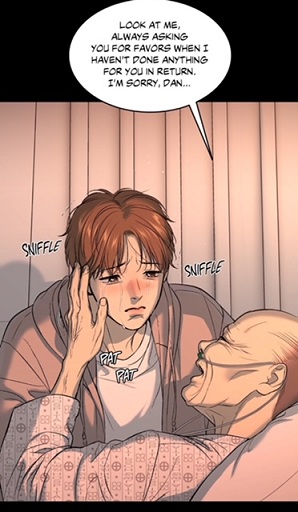 (chapter 53), she frames her guilt in terms of debt, not grief. What she cannot say is: “I’m sorry your parents are gone, and I buried the truth.” Her compassion never touches the core wound. Instead, she redirects her remorse into pity (chapter 65), a safer, one-sided emotion that keeps her in control. Pity allows her to appear virtuous while avoiding responsibility. It transforms shared pain into hierarchy: she the giver, he the grateful recipient.
This emotional economy defines Kim Dan’s childhood. He was loved through guilt, not through recognition. Every tender gesture — the pat on the head (chapter 57), the hug after bullying — carries the unspoken message: “You’re unfortunate, but you still have me.” That is not empathy; as she is not showing any sign of distress and pain. In my eyes, it is containment. It keeps the child dependent, silent, and bound by gratitude.
Hence, her confession to the celebrity (chapter 65) reveal the same mechanism. The focus remains on her heart, her pain, her goodness, not on his loss. She centers herself within his tragedy. Pity becomes a mask for unacknowledged guilt — perhaps linked to the parents’ disappearance or to choices she justified under social pressure. Her “mercy” is, in truth, a way to maintain her moral purity at the cost of his emotional autonomy.
Through this lens, it becomes clear why Dan needs reciprocal touch to speak. Pity silenced him; touch, when offered without pity, finally frees his voice. This is why the doctor’s embrace in episode 79 marks such a decisive turning point: it is the first time doc Dan is holding someone and that person is taking his words and pain seriously. The champion does not silence or reinterpret what he hears; he simply receives it. For the first time, Dan’s trembling voice is met not with pity, denial, or instruction — but with presence. (chapter 79)
Finally, this moment also exposes Jaekyung’s awakening. Until now, he had followed the grandmother’s advice as if it were gospel: 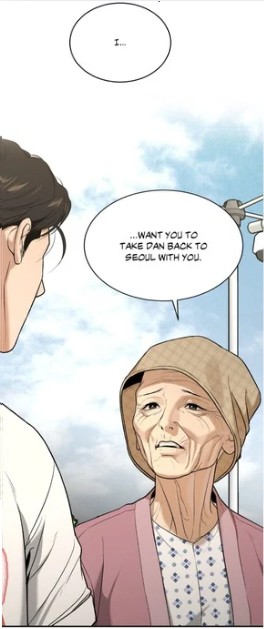 (chapter 65); “bring him to a big hospital so that he can take pills”
 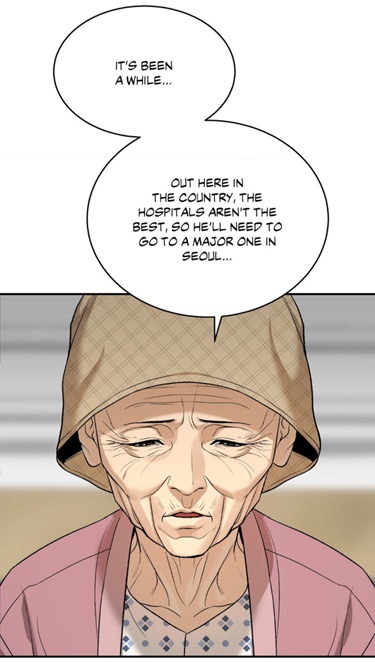 (chapter 65)
  (chapter 65) He trusted her words and advises. I would even add that he believed that compliance equaled real care. Yet the night by the balcony teaches him otherwise. (chapter 79) Despite doing everything the “saintly” grandmother prescribed, Dan is still suffering. The illusion collapses: her mercy never healed, it merely concealed. Interesting is that she never brought up to the athlete the doctor’s loss of weight in front of the ocean. Yet, she had noticed it.
 (chapter 57). Everything evolved around his lack of sleep and his dependency on her.
 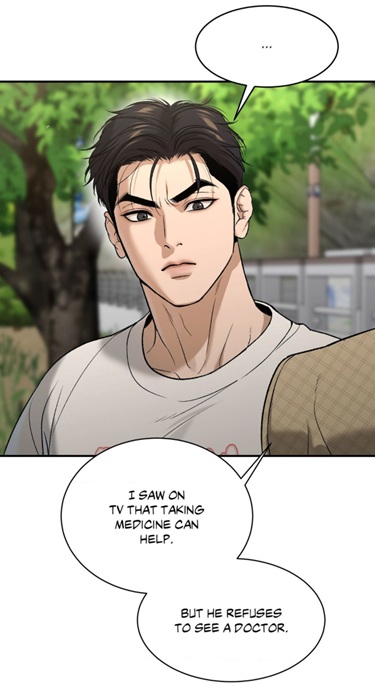 (chapter 65) However, in episode 79, for the first time, the champion notices it.
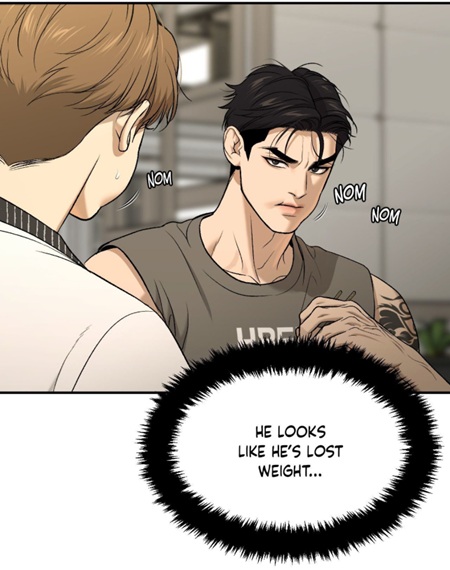 (chapter 79) It is important because very early on, the doctor Cheolmin had already detected his malnutrition:
  (chapter 13) In other words, the physical therapist’s depression and eating disorder were already existent before meeting the “wolf”. And what did the mysterious friend tell to the “wolf”? He shouldn’t wait out of fear that he might regret it later!
 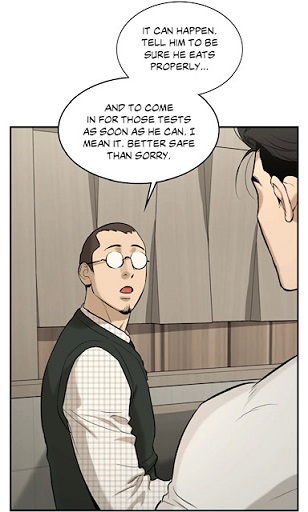 (chapter 13) As you can see, “sorry” is the link between the two doctors and the celebrity.
Thus, the “wolf” realizes that love cannot be delegated to duty. (chapter 79) What Dan needs is not obedience to the old woman’s script, but presence, dialogue, and trust. The champion must now do what she never did — look at pain without denial, listen without pity, and finally speak from the heart. This means that after that night, the wolf will gradually change not only his vocabulary, but also his tone and gestures.  His metamorphosis will be complete with the birth of the kind and sweet Joo Jaekyung!
  (chapter 21) Imagine that I had written this part before the release of episode 80!
The secret behind doc Dan’s room
Another detail caught my attention in episode 79 which was confirmed with the publication of episode 80. Doc Dan’s bedroom has always been associated with illness and as such rest! 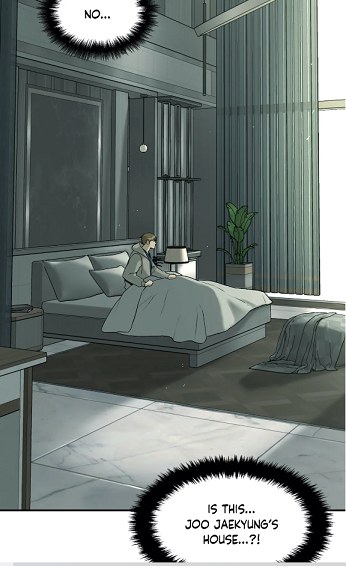
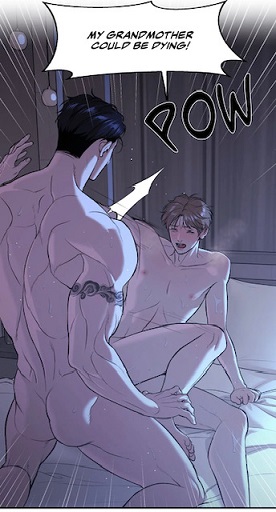 (chapter 21)
  (chapter 29)
  (chapter 61) Hence it is no coincidence that while sleeping in his own bedroom, the physical therapist had a relapse.
  (chapter 79) Because the champion had come to the conclusion that his own bedchamber was linked to sex (chapter 78) and as such “wrongdoings”, the next day, he must have suggested to doc Dan to sleep together in his bed. This explicates why both main leads are sleeping in doc Dan’s bedroom at the end of episode 78: (chapter 78) This shows that the star is listening more and more to his fated partner
 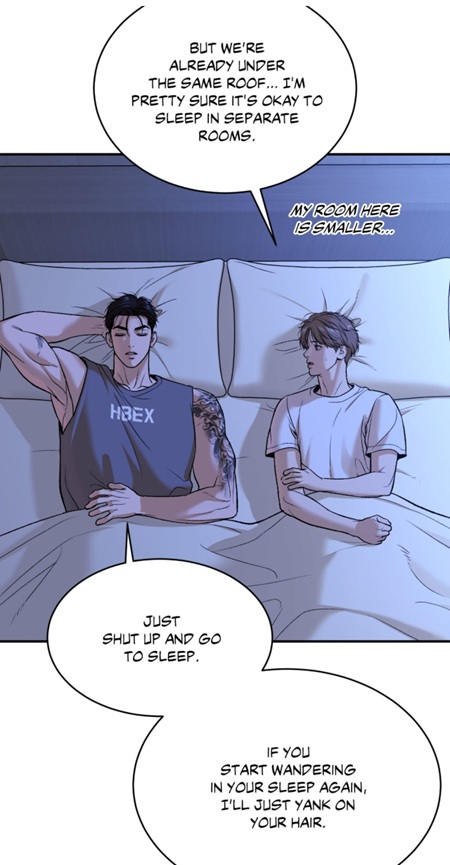 (chapter 78) And though he had another “accident”, the former is never bringing it up to doc Dan. There’s no blame or accusation. The athlete is keeping these accidents as secrets. However, pay attention that he is making sure that doc Dan is resting.
  (chapter 80) Notice that he joined him later, acting as if they had not shared the same bed. Gradually, the champion is giving back doc Dan’s freedom and privacy. He is guiding him to take care better of himself by using his own words.
 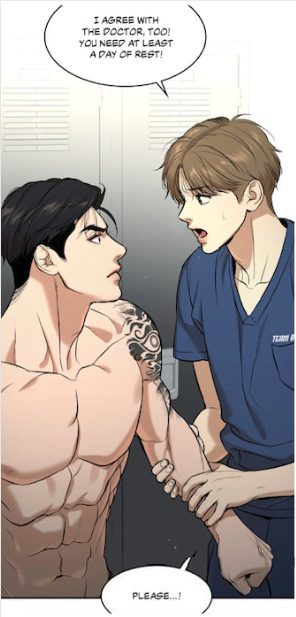 (chapter 27) Striking is that the champion always chose the left side of the bed (chapter 79), while he came to sleep much better, when he slept on the other side of the bed:
  (chapter 66) Thus I deduce that doc Dan is destined to take over his grandmother’s position in the bed:
 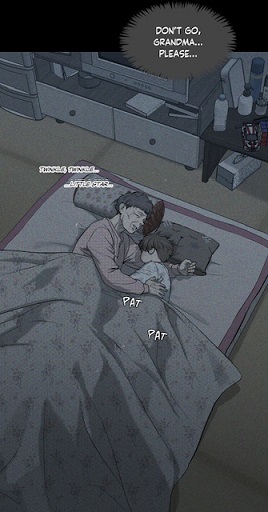 (chapter 21) And this observation seems to be validated by chapter 80.
  (chapter 80) The star was sitting on the right side of the bed while watching his sleeping partner. Why? It is because he can see his face. But by lying on the left side, doc Dan came to turn his back to him.
 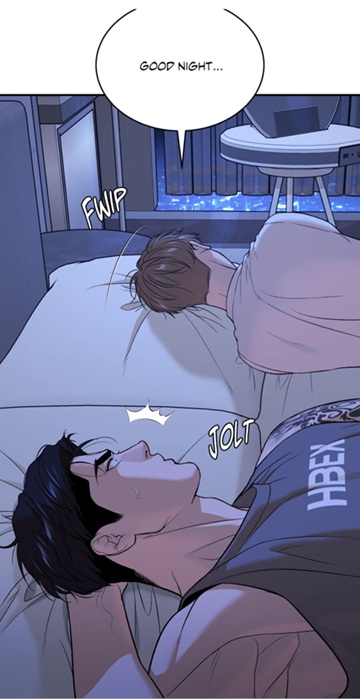 (chapter 78) But if they switch places, the wolf should be able to watch his partner’s face. And now, pay attention to the way Mingwa placed the new embrace in the swimming pool: (chapter 80) Doc Dan is placed on the left side…. and that’s where the heart is placed. Doc Dan’s racing heart is displaying not only the revival of his repressed affection for the champion, but also his desire to live. He is not truly suicidal, as all his attempts were unconscious choices.
The second “accident”
I have to admit that after reading this image (chapter 78), it was clear to me that the doctor would make a new suicidal attempt during his sleep walking. I was already anticipating him to go to the rooftop, thus the new incident didn’t catch me by surprise. Yet, chapter 79 gave us an important clue about doc Dan’s dissociative state (sleepwalking). They were all triggered:  (chapter 79) Because of the champion’s cold gaze, doc Dan felt rejected and even hated.
  (chapter 79) He had the impression that he wouldn’t meet his “expectations”. Observe the parallels between the champion’s dream (chapter 79) and the doctor’s reply in front of Shin Okja:
 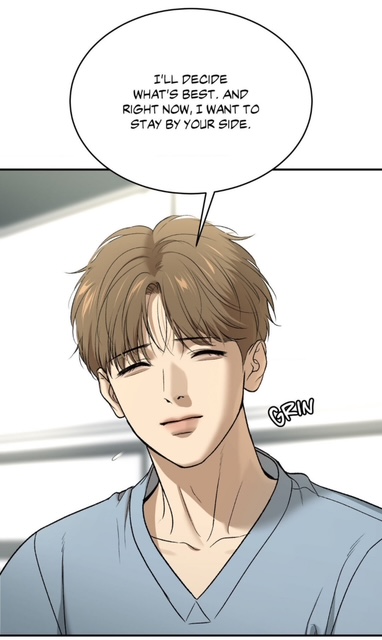 (chapter 57) We have the doctor’s fake smile which is strongly linked to rejection
  (chapter 57) and expectations. And what is the other common denominator? His self-loathing and immense guilt. He has the feeling that he is not lovable. In my opinion, doc Dan is suffering because no one is listening to him at all. So far, they all projected their own thoughts onto him. The reality is that doc Dan already had a hard time before moving to the seaside town,
  (chapter 11) yet she failed to notice it or refused to face his struggles, as they were related to their poverty.
Because he lived alone for a long time without any physical touch  (chapter 5), he lost his voice and became a ghost. It is no coincidence that in this scene, doc Dan was silent despite the caress. He was avoiding any topic that could trouble his grandmother. He accepted to remain a little boy in her eyes. But thanks to the wolf, doc Dan is learning to become strong and independent so that he can decide about his life. The swimming lesson is pushing him to overcome his abandonment issues.
The Songs of Change
While I was on my way to visit my son ( a 6 hours trip), I listened to an old CD from French singer Jean-Louis Aubert entitled Ideal Standard. While listening to the music, three songs — “On vit d’amour,” “On aime comme on a été aimé,” and “Parle-moi” caught my attention. They reminded me a lot of the main couple.
If the previous night (chapter 79) marked the end of a circle, then the next day announces a new rhythm — one that no longer follows the tempo of fighting or guilt, but of tenderness. These 3 songs form a hidden soundtrack to this transformation. They mirror, with startling precision, the inner journey of the champion and his fated companion.
1. “On vit d’amour” — Living on Love
On vit d’amour / Et d’eau fraîche / On vit d’amour, de rien du tout…
We live on love and fresh water / We live on love, on almost nothing at all.
| On vit d’amour French | We live on Love English |
| On vit d’amour Dans le regard des autres On vit d’amour Dans le mien et le votre On vit d’amour Quand il n’y a plus d’eau fraiche On vit d’amour Tout au fond de la dèche Laisse le briller Éclairer Laisse le venir Laisse le aller Car on vit d’amour On vit d’amour Sous le bong et les pluies On vit d’amour Dans la boue et la suie On vit d’amour Jusqu’au bout de la nuit Laisse le briller Éclairer Laisse le venir Laisse le aller Laisse lui vivre sa vie d’amour Car on vit d’amour On vit d’amour Je mens, j’aime tant ta main On vit d’amour Et je bois à ta bouche On vit d’amour On vit d’amour Toujours Laisse le briller Éclairer Laisse le venir Laisse le aller Laisse à l’amour sa liberté On vit d’amour On vit d’amour On vit d’amour On en vivra Toujours (2*) Laisse le briller Éclairer Laisse le venir Laisse le aller Laisse lui vivre sa vie d’amour | We live on love In the eyes of others We live on love In mine and in yours We live on love When there’s no more fresh water We live on love At the very depth of poverty Let it shine, Let it light, Let it come, Let it go. For we live on love, We live on love Under the bong and the rain, We live on love In the mud and the soot, We live on love All the way through the night. Let it shine, Let it light, Let it come, Let it go, Let it live its own life of love, For we live on love, We live on love. I lie — I so love your hand, We live on love, And I drink from your mouth, We live on love, We live on love, Forever. Let it shine, Let it light, Let it come, Let it go, Let love have its freedom. (We Live on love, we Live on love, we Live on love, And we’ll live on it Forever.) |
This refrain captures the quiet revelation at the heart of Jinx: love is sustenance.
Until now, Jaekyung has lived on adrenaline, duty, and pride — mistaking physical dominance for vitality. His meals with Dan were about nutrition 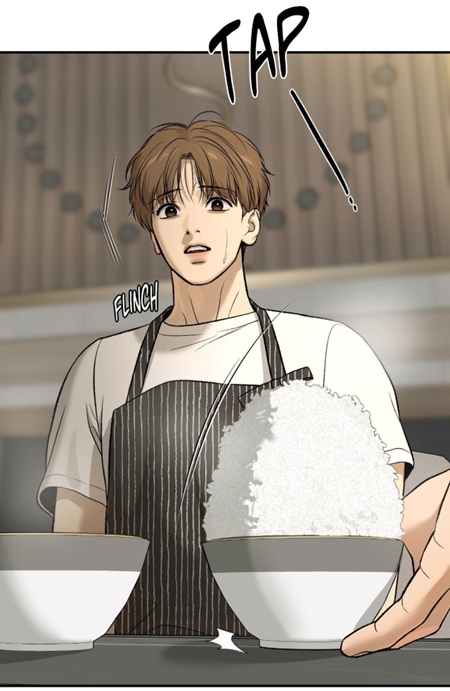 (chapter 79), not communion; his affection, an extension of performance
  (chapter 79). Yet as the doctor grows thinner and more exhausted, the wolf begins to understand what “starvation” truly means. (chapter 79) Dan’s body becomes a metaphor for their shared deficiency — not of food, but of warmth. Although the athlete’s actions were all well-meant, he failed to touch doc Dan’s heart due to the way he spoke to his loved one:
  (chapter 79)
In On vit d’amour, Aubert contrasts material survival with emotional survival. “We live on love and almost nothing” rejects the capitalist or competitive logic that defines Jaekyung’s world (MFC, rankings, contracts). The line speaks instead to the simplicity of presence — the kind of nourishment that Dan quietly provides through care, routine, and wordless understanding. No wonder why the athlete failed to move doc Dan’s heart by offering so many clothes in episode 80.
This song thus signals the first shift: Jaekyung begins to eat differently — not just at the table, but emotionally. The wolf who once devoured life is gradually learning to taste it through love.
2. “On aime comme on a été aimé” — We Love as We Have Been Loved
| On aime comme on a été aimé | We love as we have been loved. English translation |
| On n’invente pas un sentiment Les baisers donnent l’alphabet L’amour nous griffe Ouvre ses plaies L’amour nous soigne L’amour nous fait On aime comme on a été aimé C’est cela qui nous fait courir De reproduire et faire grandir Ce qui nous a été donné Sans jamais pouvoir en parler On aime comme on a été aimé C’est dans les mains de nos parents C’est dans les coeurs de nos amants Regard aimé, regard aimant C’est le plus clair de notre temps Le plus obscur de nos tourments On n’apprend pas un sentiment Même si on veut faire autrement On aime comme on a été aimé On dit les chiens n’font pas des chats Et que l’on est que c’qu’on connait Qu’on désire ce qu’on n’connait pas Un autre chien, un autre chat On aime comme on a été aimé Toutes ces secondes de tendresse Dérobées à l’emporte-pièce Toutes les claques, les maladresses Pour que ça dure, pour que ça cesse On aime comme on a été aimé C’est dans les mains de nos parents C’est dans les bras de nos amants C’est dans les yeux de nos enfants C’est le plus clair de notre temps Le plus obscur de nos tourements On n’invente pas un sentiment Même si on veut faire autrement On aime comme on a été aimé Et j’aime comme tu m’as aimé | We don’t invent a feeling. Kisses give us the alphabet. Love scratches us, Opens its wounds, Love heals us, Love makes us. We love as we have been loved. That’s what makes us run — To reproduce and to grow What was once given to us, Without ever being able to speak of it. We love as we have been loved. It’s in the hands of our parents, It’s in the hearts of our lovers. A loved gaze, a loving gaze — It’s the clearest part of our days, The darkest part of our torment. You don’t learn a feeling, Even when you want to do otherwise. We love as we have been loved. They say dogs don’t make cats, And that we are only what we know, That we desire what we do not know — Another dog, another cat. We love as we have been loved. All those fleeting seconds of tenderness, Stolen in haste, All the slaps, all the clumsy gestures — So that it lasts, or so that it ends. We love as we have been loved. It’s in the hands of our parents, It’s in the arms of our lovers, It’s in the eyes of our children. It’s the clearest part of our days, The darkest part of our torment. We don’t invent a feeling, Even when we want to do otherwise. We love as we have been loved. And I love as you have loved me. |
On aime comme on a été aimé / On hait comme on a été haï…
We love as we have been loved / We hate as we have been hated.
This lyric exposes the chain both men must break. The author’s line suggests that love is not spontaneous but inherited — modeled through wounds and care. In his childhood, Jaekyung learned rather hatred and misguided affection as domination, silence, lies and endurance, while Dan learned it as sacrifice and appeasement in his grandmother’s care. Both were taught that affection or recognition was not free — through obedience, perfection, or pain.
Throughout Jinx, each reenacts the love they received: the champion demands submission, the therapist offers self-effacement. Yet chapter 79 introduces a turning point — they begin to unlearn this inheritance. (chapter 79) The unconscious apology “I’m sorry, Mr. Joo” is not submission; it is vulnerability freely given. The wolf’s fears in his sleep are not weakness (chapter 79); they are an echo of the love and tenderness he never received.
In this sense, Aubert’s line becomes prophetic: to love differently, they must be loved differently first. This means that b spending time with each other, they will learn how to love each other properly. This is the essence of growth: transforming the very grammar of intimacy they once feared. The story becomes a re-education of the heart — the rewriting of emotional syntax. And episode 80 is the perfect illustration for this change. In love we can make mistakes, but it is important to detect them and learn from them.
3. “Parle-moi” — Talk to Me
Parle-moi, parle-moi de toi / Qu’est-ce que tu veux, qui tu es, où tu vas…
Talk to me, talk to me about yourself / What do you want, who are you, where are you going…Parle-moi, parle-moi de nous / Tous les deux, qu’est-ce qu’on veut, qu’est-ce qu’on fout…
Talk to me, talk to me about us / The two of us, what do we want, what are we doing…
| Parle-moi | Talk to Me |
| Parle-moi Ce qui nous vient Nous vient de loi Ce qui nous tient Jamais ne nous appartient vraiment Ce qui nous tue Gagné, perdu Ce qu’on a cru On en a perdu la vue vraiment Parle-moi, parle-moi de toi Qu’est-ce tu veux, qui tu es Où tu vas Parle-moi, parle-moi de toi Qu’est-ce tu dis, fais entendre Ta voix Ce qu’on nous vend Ce qu’on nous prend Mais qu’est-ce qui nous prend On dirait qu’on a plus l’ temps A rien Perdu de vue Perdu tout court Peau tendre, coeur pur On dirait qu’on a plus l’ goût A rien Parle-moi, parle-moi de toi Parle-moi de tes doutes de tes choix Parle-moi, parle-moi de toi Qu’est-ce tu dis, plus fort J’entends pas Parle-moi de toi Alors parle-moi, parle-moi de nous Tous les deux, qu’est-ce qu’on veut Qu’est-ce qu’on fout Parle-moi, parle-moi de nous Avec toi j’irai n’importe où Parle-moi de toi | What comes to us Comes from afar. What holds us Never truly belongs to us. What kills us — Won or lost, What we once believed — We’ve truly lost sight of it. Talk to me, talk to me about you. What do you want, who are you, Where are you going? Talk to me, talk to me about you. What do you say? Let me hear your voice. What they sell us, What they take from us — But what’s gotten into us? It feels like we no longer Have time for anything. Lost from sight, Lost altogether — Tender skin, pure heart. It feels like we no longer Have the taste for anything. Talk to me, talk to me about you. Talk to me about your doubts, your choices. Talk to me, talk to me about you. What are you saying? Louder — I can’t hear you. Talk to me about you. So talk to me, talk to me about us — The two of us, what do we want, What are we doing? Talk to me, talk to me about us. With you, I’d go anywhere. Talk to me about you. |
This is the anthem of the new cycle — the song of conversation.
In the beginning, Jaekyung’s language was pure command: “ (chapter 38) (chapter 79) ,” eat” . (chapter 79) His speech created hierarchy, not connection. Aubert’s plea, “Parle-moi”, reverses this logic: it is a call to dialogue, to mutual self-revelation. It embodies exactly what Jaekyung’s dream anticipates — the moment when he will learn to speak with Dan, not at him.
When, in the vision, Dan smiles and says (chapter 79) the tone has changed entirely. The greeting is not fearful or dutiful; it is gentle, open, normal — the image of domestic peace. The dream thus becomes prophetic: language, once the instrument of control, will become a bridge.
Aubert’s words — “Parle-moi de tes doutes, de tes choix” — invite the very vulnerability Jaekyung has never practiced. The wolf who only barked commands must now learn to whisper doubts. The day he speaks softly — “Parle-moi” — will be the day his transformation is complete. Moreover, observe that his repeated plea, “Parle-moi” (“Talk to me”), moves from singular to plural — from me to us. The pronoun shift is decisive: it marks the passage from individual solitude to the possibility of relationship. As long as the “me” dominates, there is distance; only when they learn to say “us” can love begin to exist as dialogue, not projection.
This last strophe, where me dissolves into nous, mirrors precisely where Jaekyung and Dan now stand. They share space, touch, even breath — but not yet language. They might be sharing the same bed, but they don’t talk really to each other and confide to each other. (chapter 80) So far, the nights were full of gestures, yet empty of conversation. Jaekyung would often command and Dan accept everything. Words, when spoken, were often either wounds or vanished into silence. Thus, Aubert’s refrain becomes prophetic: as long as they do not talk, they cannot become a couple.
The line “Avec toi j’irai n’importe où” (“With you, I’d go anywhere”) contains both promise and condition. It imagines a future that depends on mutual speech. To “go anywhere” is not to flee, but to move together — something the two protagonists have never managed. Their shared journey remains suspended in the present, circling between misunderstanding and longing. The dream in chapter 79 — where Dan finally greets him with a smile and a “Good morning, Mr. Joo” — (chapter 79) is the first glimpse of this future tense, a promise that conversation will one day replace command. Strangely, this observation was confirmed the new episode:
For now, the song stands as both prophecy and warning: without dialogue, they remain me and you, parallel solitudes orbiting the same pain. There’s still no “we” between them yet. Only when Jaekyung learns to parler — not shout, not order, but truly speak — will me become us, and their love find a voice strong enough to last.
A Chanson of Renewal
Taken together, the three songs form a triptych of metamorphosis:
- “On vit d’amour” teaches Jaekyung that love is nourishment and a source of happiness, not distraction.
- “On aime comme on a été aimé” forces both men to face the ghosts of their past and their abandonment/trust issues so that they can love their partner properly.
- “Parle-moi” charts the path forward — communication as redemption.
They are not merely songs; they are stages of awakening.
From hunger to empathy, from repetition to reinvention, from silence to speech — Aubert’s lyrics sketch the same arc that Jinx now traces.
If Jaekyung once fought to dominate the world, he now fights to pronounce gentleness correctly. And when he finally dares to speak — not as a champion, but as a man who listens — he will fulfill the promise implicit in Aubert’s refrain:
“Avec toi j’irai n’importe où” — With you, I’d go anywhere.
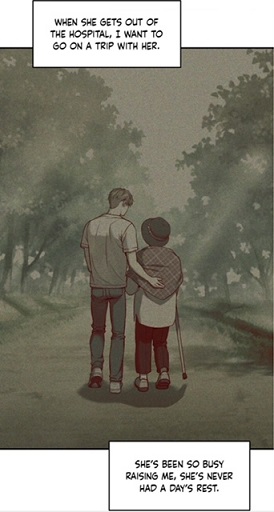
The biggest wish doc Dan has is to go on a trip and walk through the woods with a loved one. The old circle closes; the new begins — not with a punch, but with a word.
Feel free to comment. If you have any suggestion for topics or Manhwa, feel free to ask. If you enjoyed reading it, retweet it or push the button like. My Reddit-Instagram-Twitter-Tumblr account is: @bebebisous33. Thanks for reading and for the support, particularly, I would like to thank all the new followers and people recommending my blog.

 Bebebisous33s' analyses in K-Dramaland and Manhwas