Please support the authors by reading Manhwas on the official websites. This is where you can read the Manhwa: Jinx But be aware that the Manhwa is a mature Yaoi, which means, it is about homosexuality with explicit scenes. Here is the link of the table of contents about Jinx. Here is the link where you can find the table of contents of analyzed Manhwas. Here are the links, if you are interested in the first work from Mingwa, BJ Alex, and the 2 previous essays about Jinx Why Sleeping Beauty Had to Bleed part 2 and A Ruthless Fight, A Loverboy Break
It would be great if you could make some donations/sponsoring: Ko-fi.com/bebebisous33 That way, you can support me with “coffee” so that I have the energy to keep examining Manhwas. Besides, I need to cover up the expenses for this blog.
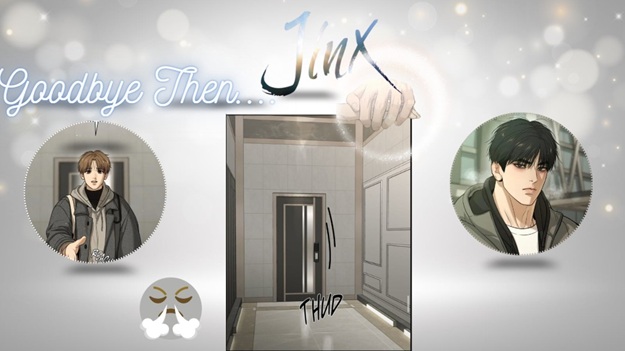
The Warm Hand and the THUD
The final penthouse sequence becomes even crueler once one realizes that Kim Dan may be misreading the sensory evidence itself.
The squeezing and warmth of Jaekyung’s hand can function as comfort and reassurance 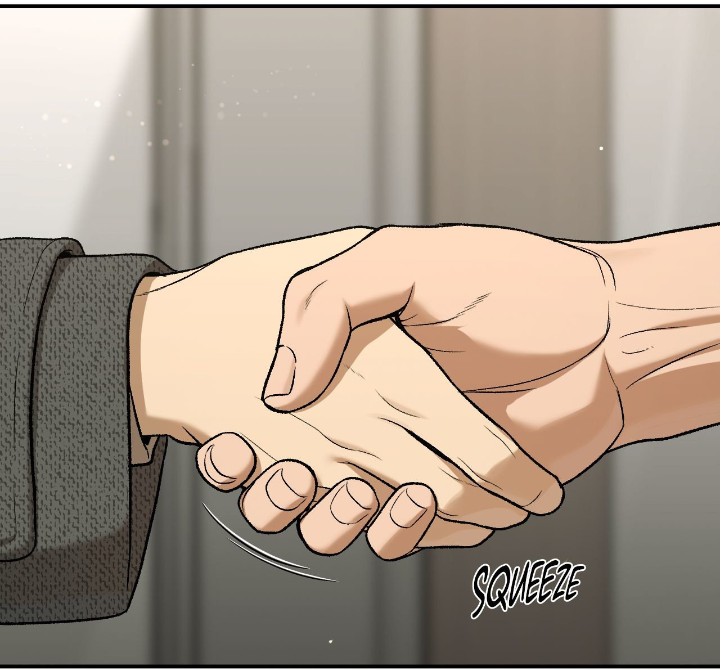 (chapter 100), convincing Kim Dan that the champion is alive, stable, and therefore ultimately “fine.” But warmth does not necessarily signify health. It can also indicate fever, exhaustion, overexertion, and a body approaching collapse. Thus the tactile comfort Kim Dan clings to may actually conceal the severity of Jaekyung’s condition rather than disprove it.
This reinterpretation fundamentally alters the meaning of the final “THUD.” 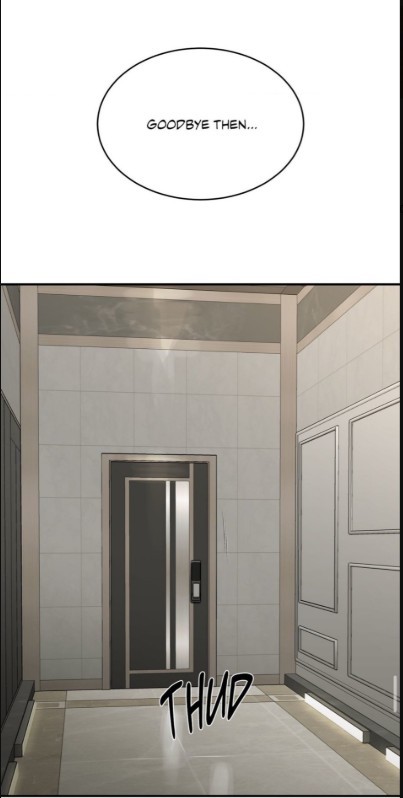 (chapter 100)
Importantly, Mingwa does not visually show the collapse or wobbling itself. Instead, she makes both Kim Dan and the readers hear it. That distinction matters enormously because if she had visually depicted Jaekyung collapsing onto the floor, the interpretation would immediately become fixed and undeniable. Instead, she traps both Kim Dan and the readers inside uncertainty or into a false illusion.
Kim Dan sees the hollow eyes, the trembling exhaustion, the devastated face 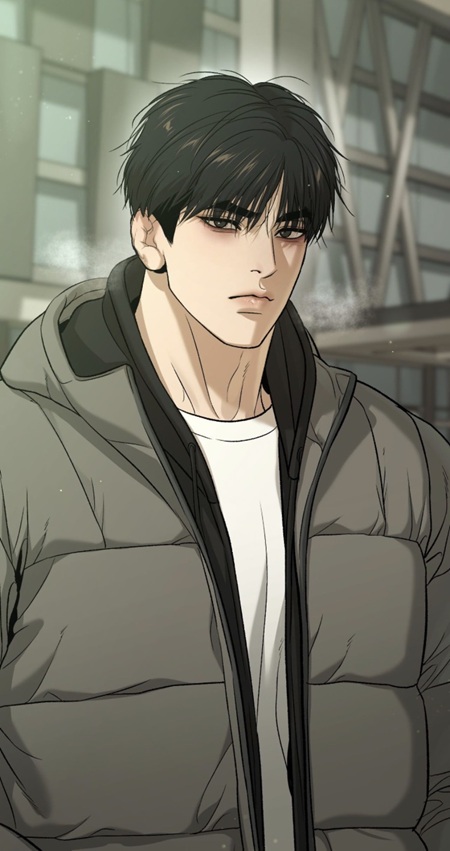 (chapter 100), the passivity, and the emotional distance. Yet he doesn’t initiate any conversation. On the other hand, the warm hand even allows him to construct a safer narrative.
 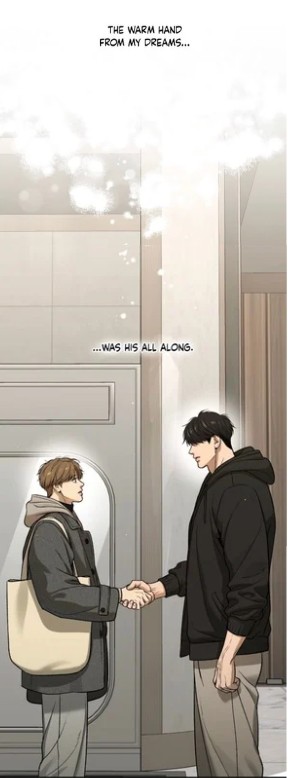 (chapter 100) The champion was not hurt, he won the match. He is warm. He will recover. There is nothing to fear.
The “THUD” violently interrupts this emotional minimization.
And the timing matters profoundly because according to me, Kim Dan has not actually left yet. The chapter only creates the illusion of departure. The words “Goodbye then…” remain suspended through the ellipsis itself. Kim Dan still stands at the entrance. He has not crossed the threshold yet. The goodbye remains emotionally unfinished. He is waiting for a response or word from his lover. 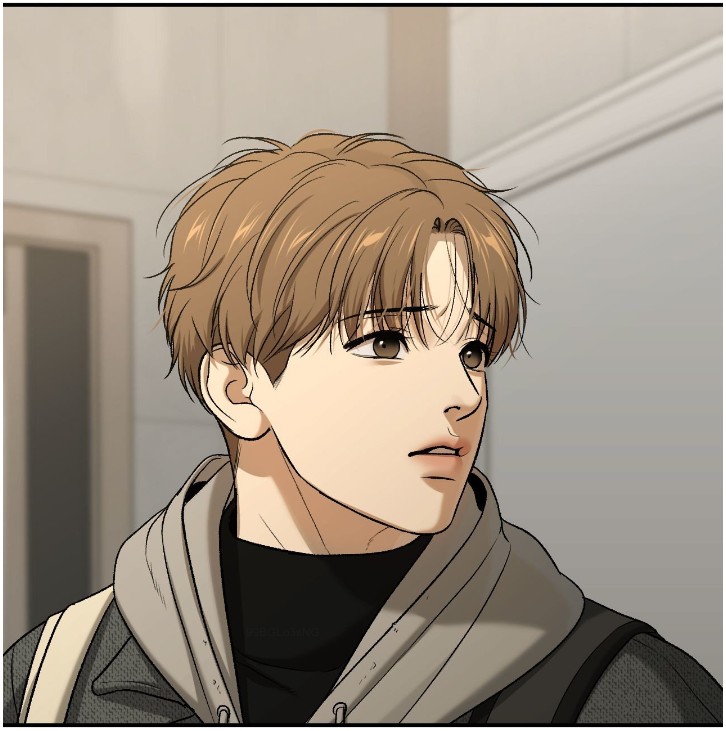 By uttering the phrase, “Goodbye then…”, Kim Dan suddenly shifts from a passive observer of his own fate to the active arbiter of the narrative. He is the one stepping forward to single-handedly determine the meaning of the separation, dictating the final emotional framing, and drawing the absolute conclusion of the relationship itself.
(chapter 100) The sound forces reality back into the sensory field before Kim Dan can finalize the goodbye psychologically.
This pivot exposes a profound structural shift: it reveals the sudden emergence of power.
This is not a display of external authority, physical dominance, or toxic control. Instead, it represents something far more critical to his psychological survival: the reclamation of narrative and emotional agency. For the first time in the text, he is no longer waiting to be discarded or directed; he is attempting to author his own ending.
Thus the “THUD” becomes the sound of reality interrupting self-erasure before separation can become real. (chapter 100) By shattering his sensory anesthesia, the physical weight of that sound completely dismantles Kim Dan’s constructed fantasy of “noble self-sacrifice.” Up until this exact threshold, his mind had processed his departure as a perfectly balanced, clean transaction. 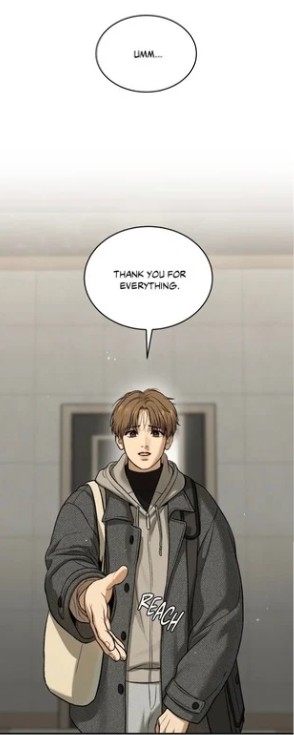 (chapter 100) In his internal trauma script, he was performing a deeply logical, protective act: paying his final respects, leaving behind the material markers of a dissolved contract, and erasing his “toxic, burdening presence” so that the champion could return to unencumbered glory.
But the unyielding gravity of the “THUD” forces a terrifying realization into his consciousness: he has completely excluded his own personhood from his moral universe. 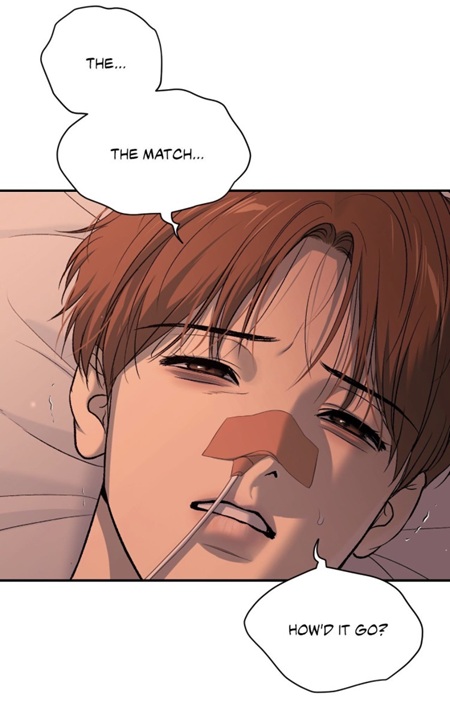 (chapter 98) While Kim Dan possessed a fierce, uncompromising moral compass when defending the life of his grandmother—violently pushing the wolf’s hand away to establish that a dying human body is infinitely more important than sex, duty, or financial leverage
 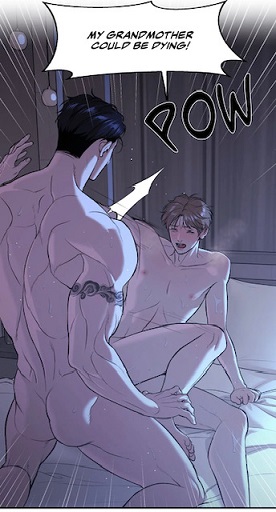 (Chapter 21)—he systematically denies himself that same basic right to exist.
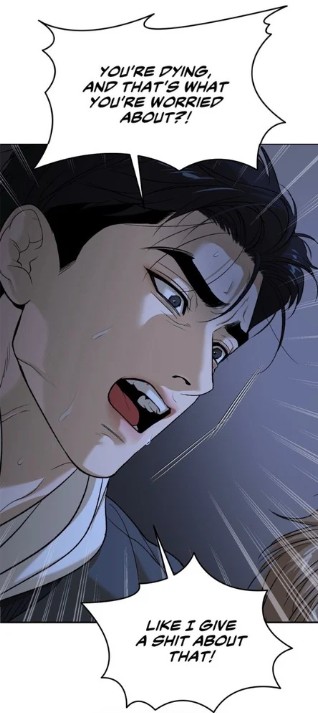
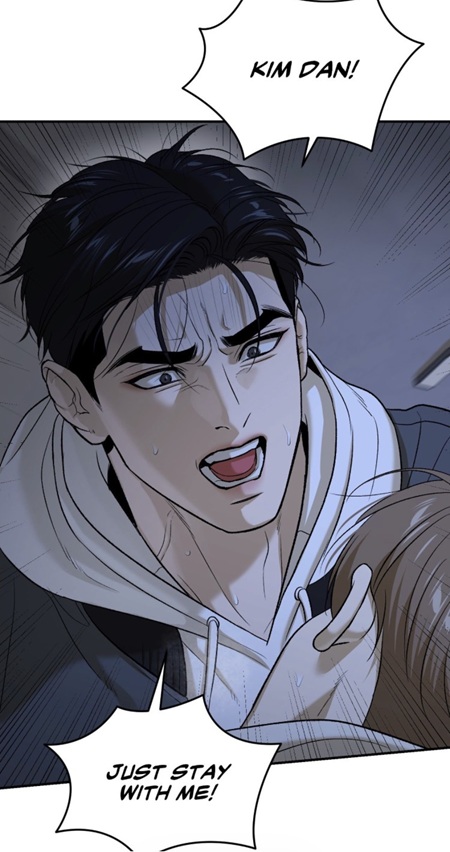
When lying in a pool of his own blood in Chapter 98, reaching up to touch Jaekyung’s face, he forced a desperate mandate upon the champion: 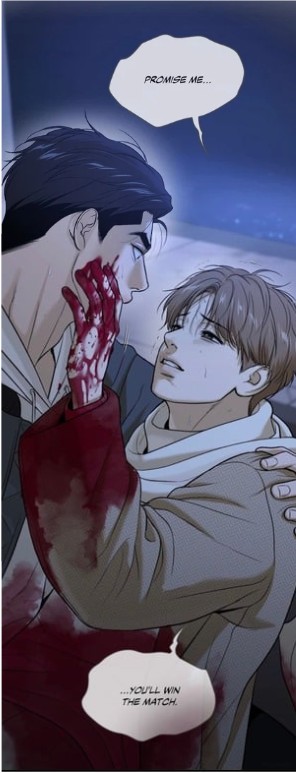 (chapter 98) In that agonizing moment, Dan entirely broke his own foundational principle. He demanded that Jaekyung prioritize performance, utility, and a championship title over a dying human life. The irony is that here, he thinks he is being selfless. Nonetheless, Doc Dan, in his pursuit of self-erasure, accidentally acts with immense psychological cruelty. He forces Jaekyung into a horrific repetition compulsion: abandoning a dying loved one for the sake of the ring.
He remains tragically blind to the profound psychological heartlessness of this request which he repeats much later. 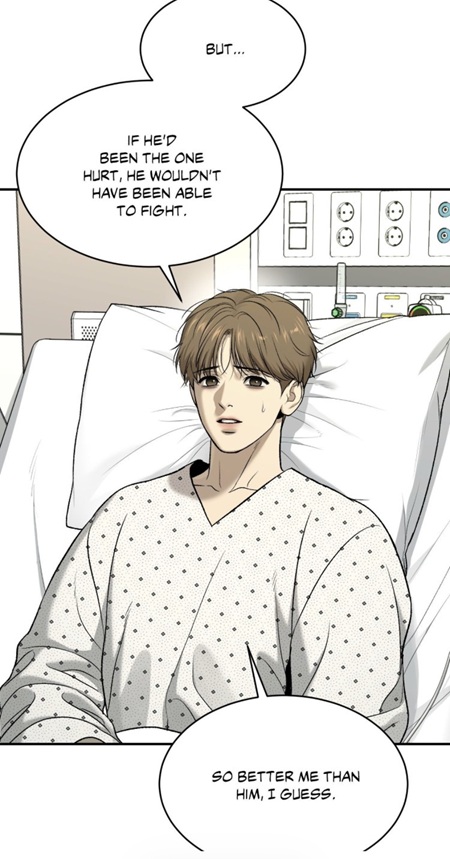 (chapter 100) For Joo Jaekyung, the match had instantly lost all meaning; his entire world was paralyzed by the terror of losing Dan. By pushing the champion to abandon his bleeding body to go perform inside an octagon, Kim Dan did not save him—he unconsciously destroyed him. He pushed a man whose childhood trauma permanently fused athletic victory with the catastrophic death of his parents
  (Chapter 73) to go repeat his ultimate nightmare.
The “THUD” at the threshold is the precise moment Kim Dan is forced to face the real-world consequences of his own words. Throughout their entire history, Dan has remained completely unable to initiate emotional intimacy, perpetually waiting for a sign from Joo Jaekyung (chapter 100), as if he wanted to be “chosen” rather than face the terrifying vulnerability of making a conscious choice himself. He wanted to be selected by the champion, to be granted permission to exist in that space, rather than taking the emotional risk to claim it. If he continues to treat his own life as expendable and vanishes into the dark, his submissive endurance ceases to be a shield—it becomes an active weapon. 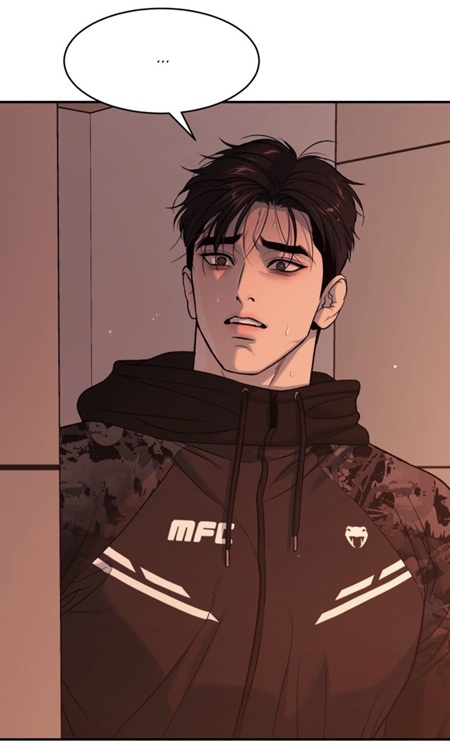 (chapter 100) His passivity would effectively sentence Jaekyung to a lifetime of crushing, unearned guilt, forcing the champion to live as a monster in his own mind, convinced his presence only contaminates and destroys.
By attempting to slip away like a grateful ghost under the guise of an polite eviction, Kim Dan stands on the precipice of becoming the active architect of another person’s ruin. The hollow echo of the penthouse layout confronts him with the ultimate baseline of psychological responsibility: gratitude cannot engineer happiness (chapter 100), and if he walks away now, he will lose everything permanently—not because he was abandoned, but because he refused to choose to stay.
Toxic Positivity and Emotional Avoidance
Episode 100 repeatedly exposes characters trying to impose the illusion that everything will be alright now onto a reality that is psychologically catastrophic underneath.
Superficially, the chapter appears filled with healing imagery. Flowers, gifts 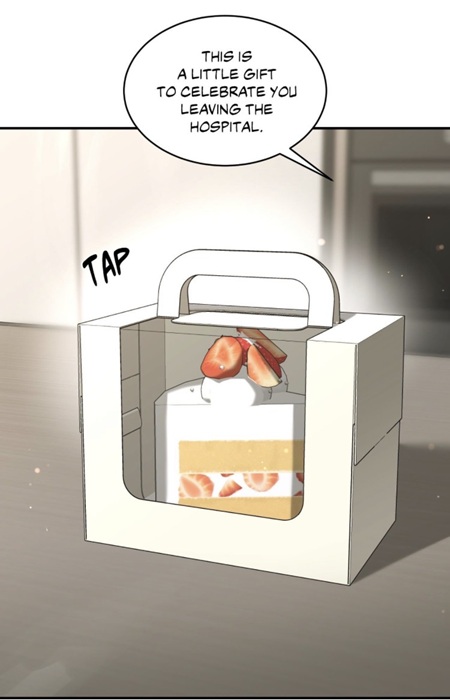 (chapter 100), warm lighting, soft dialogue
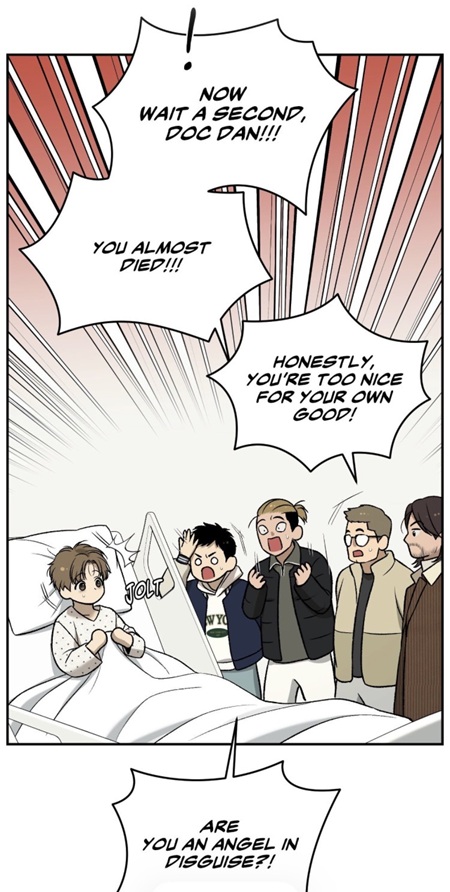 (chapter 100), survival, tenderness, and celebration aesthetically imitate recovery. And yet emotionally, the chapter feels suffocating.
Kim Dan constantly reframes catastrophe into survivable meaning. (chapter 100) At least the champion could fight. At least the title was reclaimed. At least he survived. He will recover. Everything will return to normal.
This is not healthy optimism. It is emotional minimization.
Team Black behaves similarly. Their affection is genuine, yet emotionally superficial. They celebrate survival, normalize the situation quickly, and soothe symptoms without confronting the psychological devastation underneath. Nobody openly says that something is deeply wrong. (chapter 100) In fact, they even praises him.
The final penthouse sequence therefore becomes a brutal dismantling of toxic positivity. Kim Dan tries to impose a healthy narrative onto reality. The debt is gone. The danger passed. Now he should leave. But Mingwa repeatedly inserts contradictions: the terrible face, the red eyes, the hesitation, the trembling silence, the disappointed mouth 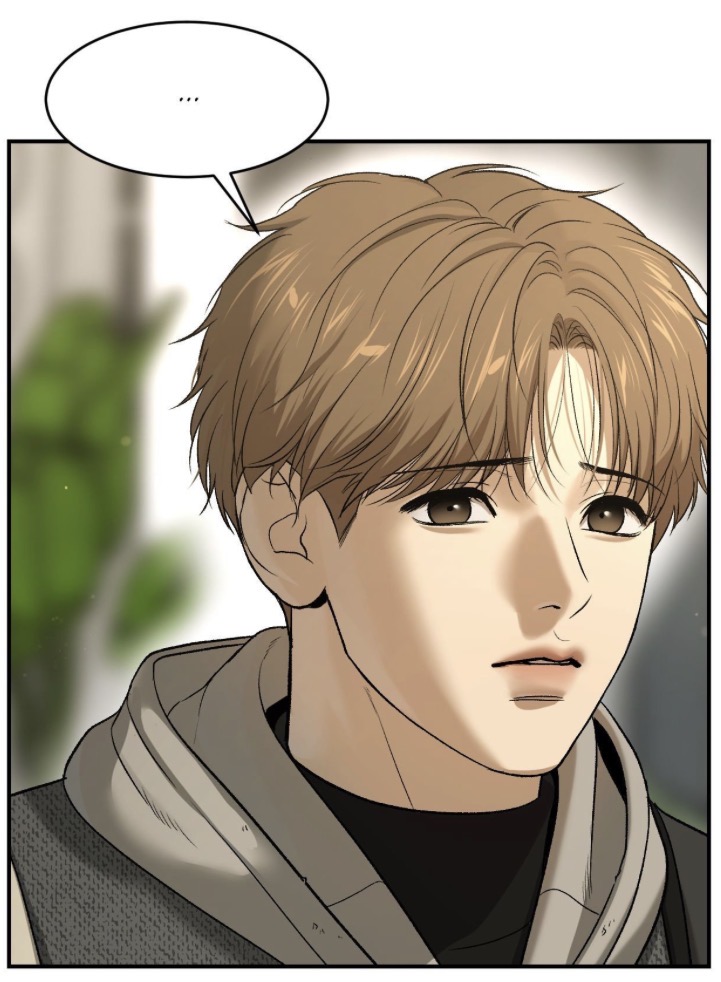 (chapter 100), the unfinished goodbye, the warm hand, and finally the THUD.
The chapter refuses emotional simplification. The body keeps revealing the truth the characters attempt to suppress verbally.
The Day Kim Dan Says “Stay With Me”
For this reason, Kim Dan’s emotional evolution cannot find its resolution in the moment Joo Jaekyung drops his armor and whispers, “Stay with me.” The phrase, though revolutionary within the champion’s own psychological history 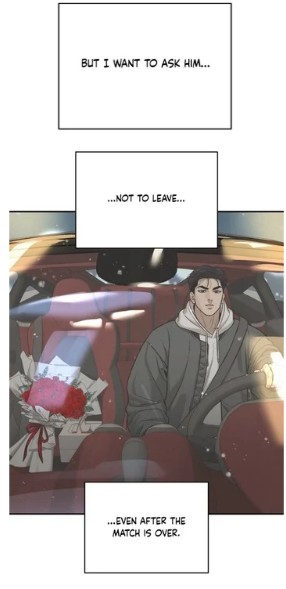 (chapter 97), remains entirely inaccessible to Kim Dan’s internal landscape. Within Dan’s trauma script, he remains the permanently expendable entity—the one who leaves quietly, adapts silently, apologizes constantly, and survives solely through systematic self-erasure.
Even after the profound physical and emotional crises of the hospitalization, his cognitive architecture is frozen in a state of hyper-vigilant transition; he prepares for a clean disappearance rather than a permanent settlement. He proceeds under the lifelong assumption that companionship is inherently temporary, strictly conditional, and destined to dissolve into an empty room the moment his immediate economic or physical utility reaches its natural expiration.
The roots of this profound emotional paralysis extend far deeper than his history with Joo Jaekyung, anchoring themselves in a foundational, intergenerational rupture. Episode 57 quietly exposes that Kim Dan’s defining psychological wound is not the surface-level humiliation of poverty, debt, or social isolation, but a deep-seated terror of broken permanence. 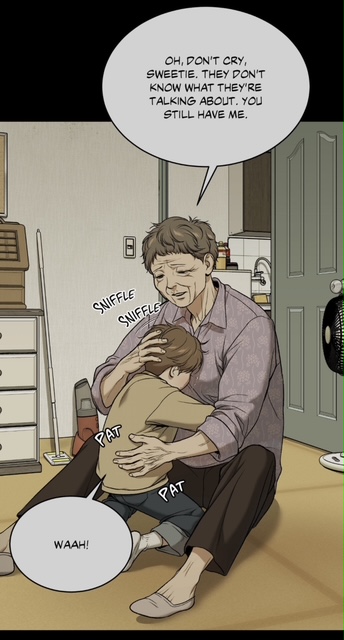 (chapter 57) In the opening movements of his recurrent nightmare, the memory presents itself under an illusion of maternal comfort. Following an episode of childhood bullying
  (chapter 57), a young Kim Dan is met with the rhythmic, tactile reassurance of his grandmother: “Grandma will always be there for you. You still have me” (Chapter 57). However, the nightmare exposes the truth: the starting point of the little boy’s suffering is the opened door:
  (chapter 57), a symbol for departure which is strongly connected to loss and grief.
This tactile grounding is structurally paramount. (chapter 57) Within the visual language of the series, the physical act of patting and touch is established as the literal definition of safety, presence, and protection. The young Dan cries, yet he surrenders completely to the belief that emotional warmth possesses the power to permanently stabilize external violence. It is this total emotional vulnerability that renders his tearful, smiling response—“Okay!”—so retroactively devastating. 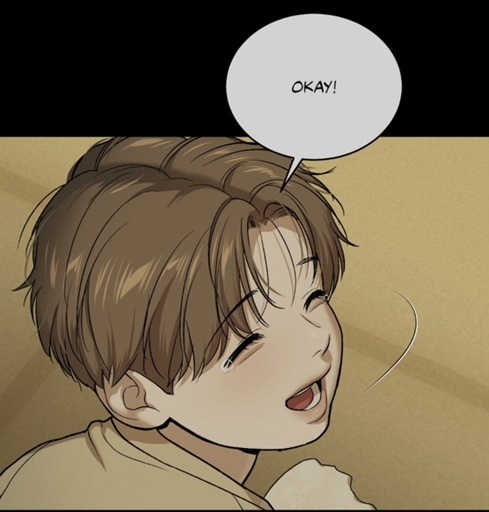 (chapter 57) It represents an absolute, unhedged contract with permanence; a child’s clean surrender to the promise that an attachment figure will remain physically and emotionally reachable no matter what hostile forces gather outside.
The Trauma of the Unfinished Departure
The structural cruelty of the nightmare, however, lies in its precise chronological sequence: first comes absolute reassurance, and then comes immediate, total erasure. The bullying itself is merely an ambient hostility; the true catastrophe is the sudden mutation of safety into a void. 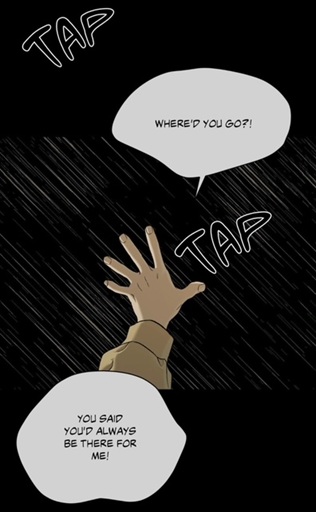 (chapter 57) The visual transition occurs through one of the most chilling images in the work: a domestic door standing wide open, leading directly into an unyielding, featureless darkness. Kim Dan stands paralyzed before this threshold, staring into the empty entrance as he quietly whispers, (Chapter 57).
The emotional structure of the nightmare unfolds through a devastating chain of associations. It begins with maternal reassurance and the promise of permanence: “Grandma will always be there for you.” For a brief moment, Kim Dan experiences emotional safety, physical comfort, and the belief that attachment can protect him from the hostility of the outside world. Yet this reassurance is immediately shattered by sudden disappearance. The opened door leading into darkness transforms the promise of permanence into a terrifying image of absence and emotional unreachability.
The Ultimate Catastrophe: The Dissolution of Roots
The small, raw mound of dirt that marks the final resting place of the unnamed puppy in Episode 59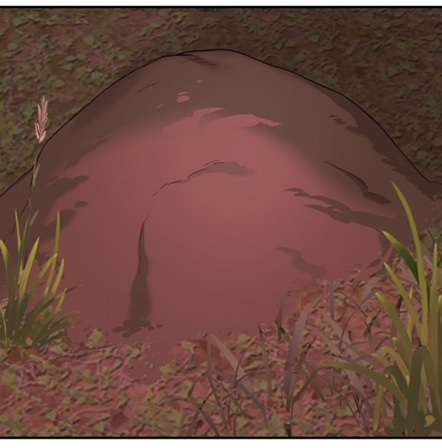 (Chapter 59) functions as a tragic monument to emotional minimization. The animal is given no name, no formal ceremony, and no structural acknowledgment within the household’s narrative. For the elderly landlord, this loss is processed through a lens of pragmatic detachment, viewed merely as a rustic, natural occurrence
  (chapter 59) or a minor rut
 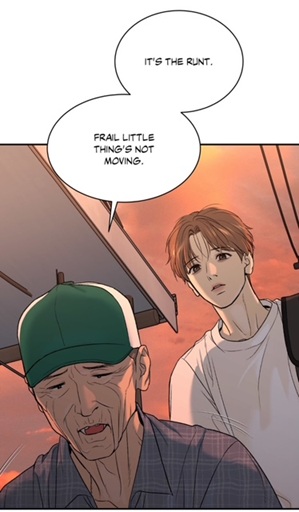 (chapter 59) in life’s ordinary routine. Because the grandfather dismisses the animal’s death as a trivial event, he lacks the psychological framework to connect it to Kim Dan’s rapid mental deterioration. He never mentions the loss to Joo Jaekyung, effectively sealing the entire event in absolute silence.
 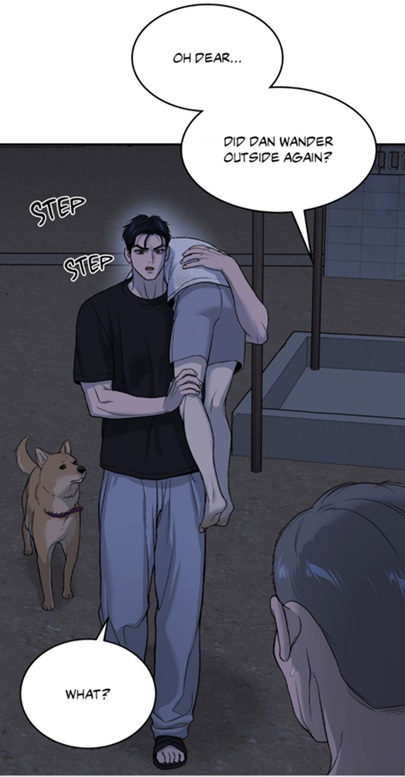 (chapter 65) By treating the puppy’s death as an unnoteworthy blip, the narrative environment strips Kim Dan of the baseline right to grieve, signaling to him that his sorrow is disproportionate, inconvenient, and ultimately invisible to the outside world.
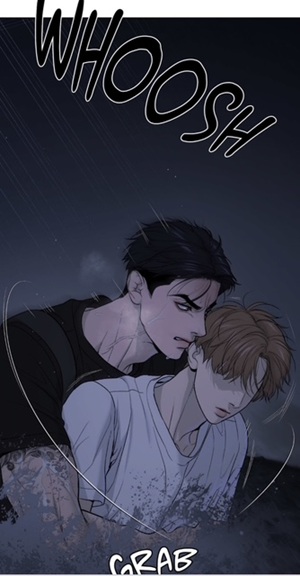
This absolute isolation of grief yields the catastrophic psychological state exposed in Chapter 65. When the grandfather notes that Dan slips out like he is in a trance and expresses a terrifying fear that the young man might end up drowning himself in the ocean, he is witnessing a literalized enactment of Kim Dan’s trauma script. This behavior is not simple drunkenness or passive depression, but an active, sleepwalking surrender to the void. The ocean represents the ultimate space of non-existence, a vast, featureless horizon where a burdened identity can be quietly dissolved without disrupting the lives of others. When Joo Jaekyung physically intercepts Dan, lifting him out of the darkness and carrying him away from the shoreline, the physical contrast is stark. Jaekyung acts as an anchor of brute force, yet he remains completely blind to the ghost haunting Dan’s mind, pulling his body from the surf without ever reaching the unmourned graveyard hidden beneath the silence.
The true terror of this sequence lies in how the puppy’s death 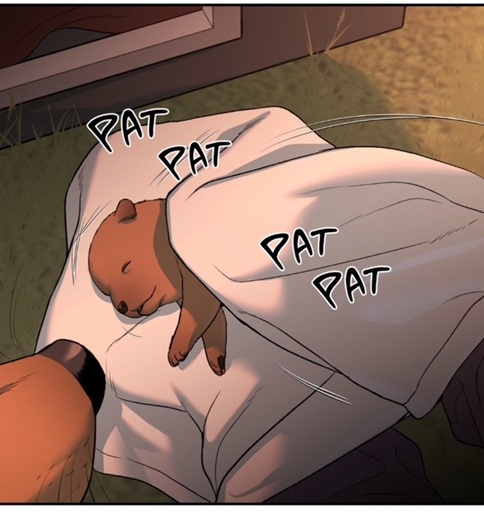 (chapter 59) interacts with Shin Okja’s terminal timeline.
 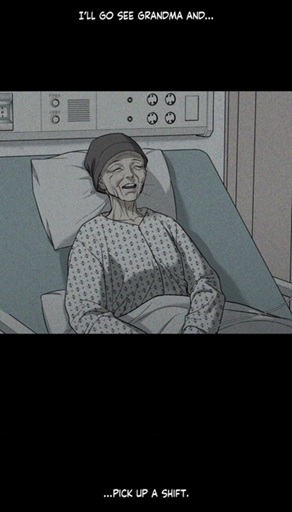 (chapter 59) With his grandmother’s days explicitly numbered, the sudden erasure of the unnamed puppy strips Kim Dan of his final buffer against the original, unresolved trauma of his life, which is the unmourned loss of his parents. While Dan consciously frames his terror as the fear of being left entirely alone in a hostile world, the deeper, more paralyzing horror is the total collapse of his past. Shin Okja is not merely his protector; she is the sole living witness to his childhood, his family, and his original identity. Because Kim Dan was never permitted to properly process, understand, or mourn the sudden disappearance of his parents, his psychological roots were already incredibly fragile. The photographs in Chapter 94 prove that his childhood was materially documented through images of flower fields and playgrounds
 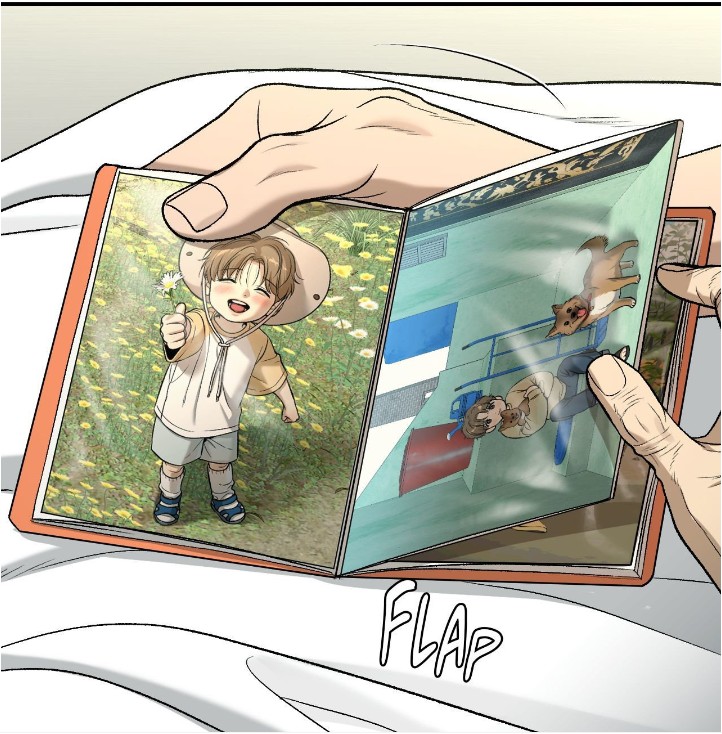 (chapter 94), yet his parents were completely erased from that visual record. When the puppy dies unnoticed and the grandmother approaches the threshold of death, Kim Dan faces an existential erasure. If the last person who remembers where he came from vanishes, then Kim Dan ceases to exist in any meaningful, continuous reality, meaning his submissive endurance and his active steps toward the ocean are the desperate measures of a man who believes he has already become a ghost. However, what the physical therapist doesn’t know is that Shin Okja that Shin Okja already shared fragments of her memories and emotional legacy with Joo Jaekyung.
 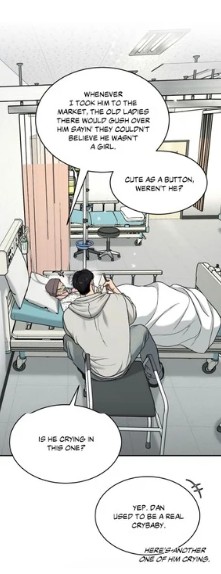 (chapter 94) By showing the champion photographs from Kim Dan’s childhood, she quietly creates continuity where Kim Dan unconsciously expects only disappearance and erasure. In this sense, her final wish almost functions like a symbolic letter left behind through the athlete himself.
 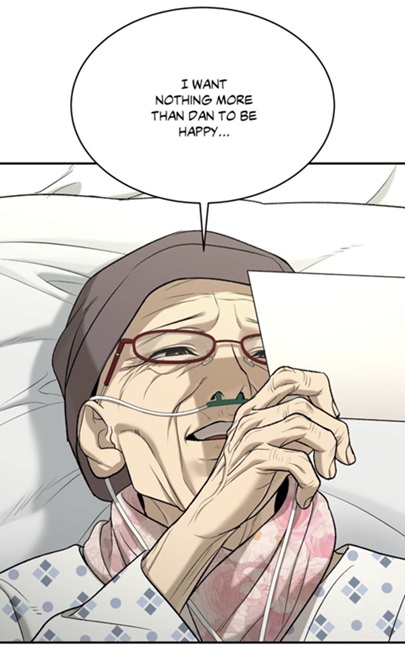 (chapter 94) When she tells Joo Jaekyung that she wants nothing more than for Kim Dan to be happy and hopes he can be happy beside him too
 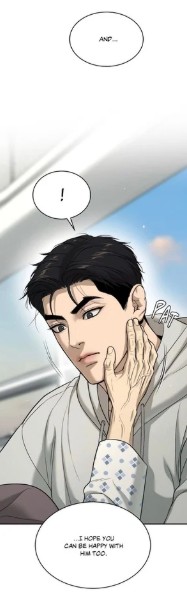 (chapter 100), she unknowingly entrusts Kim Dan’s future, memories, and emotional continuity to another person before disappearing herself.
The Ghostification of Memory
This disappearance does not function as an isolated fear connected only to Shin Okja herself. 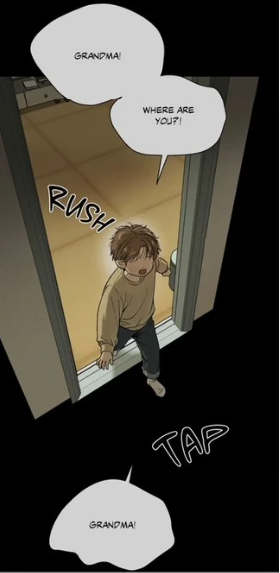 (chapter 57) Instead, it unconsciously reactivates Kim Dan’s primary unresolved trauma: the sudden loss of his parents in the accident.
 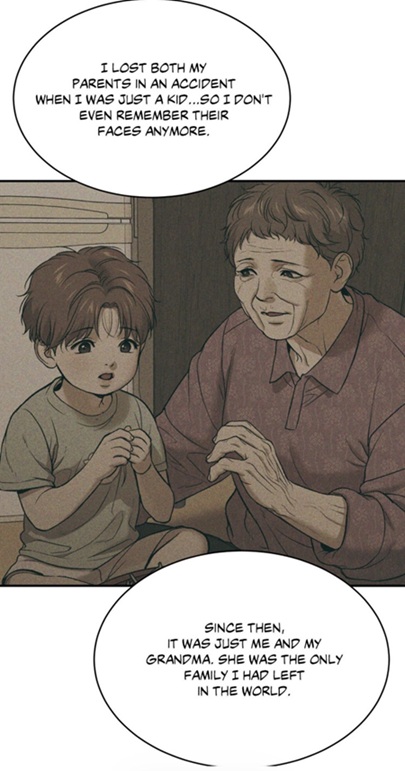 (chapter 94) Once again, someone leaves the domestic space and fails to return, forcing Kim Dan into the same helpless position of searching after an absence he cannot stop, explain, or emotionally resolve.
From this repeated experience of broken permanence emerges the survival script governing Kim Dan’s adult personality. He learns to survive not through emotional dependence or openly expressed need, but through usefulness, gratitude, debt repayment, minimization, and self-erasure. Because attachment repeatedly became associated with disappearance and loss, Kim Dan unconsciously prepares himself for abandonment before it fully arrives.
The psychological consequences of this unresolved loss extend even further than abandonment itself. Kim Dan does not simply lose people; he gradually loses the ability to stabilize their emotional reality internally. (chapter 94) When he quietly admits that he no longer remembers the faces of his parents, the statement appears deceptively simple. Yet psychologically, it reveals a catastrophic form of erasure. A face is not merely visual recognition. It anchors identity, continuity, emotional permanence, and existence itself. Without faces, loved ones gradually begin resembling ghosts.
This realization retrospectively illuminates Kim Dan’s strange confusion between dream and reality throughout episode 100. 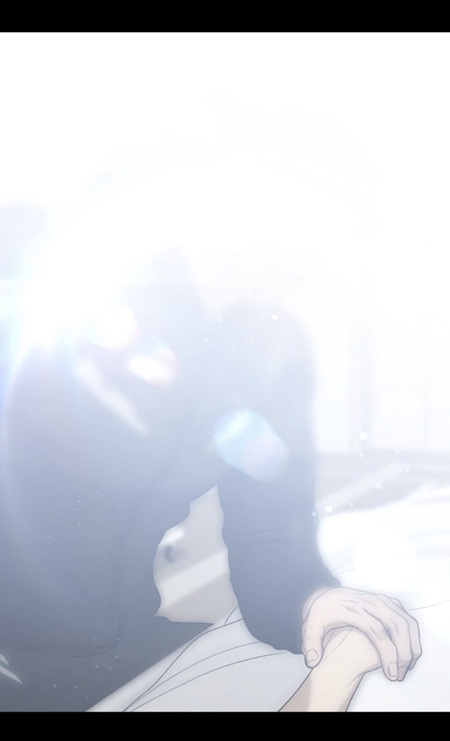 (chapter 100) Even when Joo Jaekyung physically touches him, lies beside him, squeezes his hand, and leaves behind tangible traces of his presence, Kim Dan struggles to stabilize the champion visually and emotionally. The face repeatedly appears blurred, hidden by light, partially obscured, or emotionally difficult to grasp. The body says: someone is here. But the unstable face says: they may disappear again.
In this sense, Kim Dan’s fear is not merely abandonment. It is the dissolution of emotional reality itself around attachment.
Visual Continuity and the Ghostification of Memory
And yet Mingwa quietly introduces one object that resists this entire process of emotional erasure: the amusement park photograph. 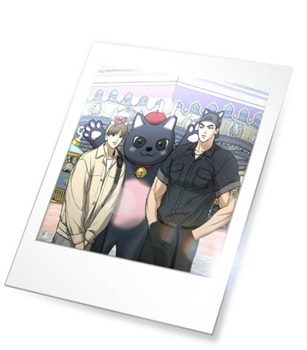 (chapter 87) Unlike the fragmented visions haunting episode 100, the picture materially preserves Joo Jaekyung outside the role of the “Emperor.” The champion appears awkward, calm, almost ordinary, participating in a shared moment rather than performing dominance publicly. For perhaps one of the first times in Kim Dan’s life, emotional continuity becomes fixed visibly instead of dissolving into absence.
This matters profoundly because the photograph directly opposes ghostification itself. Kim Dan cannot reduce the moment into pure dream, hallucination, or unstable memory. The image preserves:
- a face,
- a shared place,
- a lived moment,
- and emotional reality existing outside survival and obligation.
For perhaps the first time since the death of his parents, attachment becomes materially anchored to reality rather than threatened by disappearance. Unlike the faceless disappearance haunting his childhood memories, Joo Jaekyung remains materially visible inside the frame.
And this may explain why the present-day “champion” after the stabbing feels so emotionally disorienting. 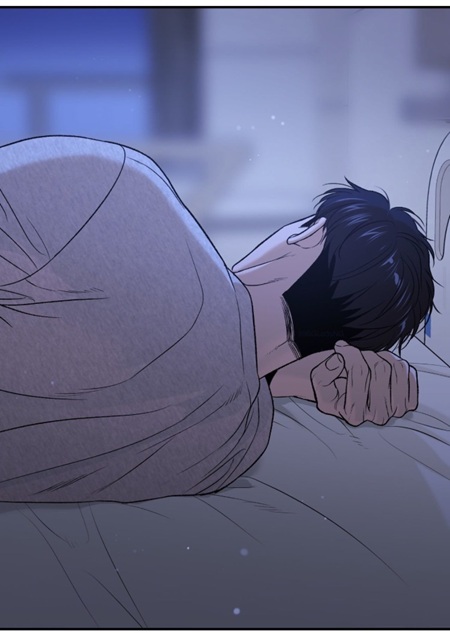 (chapter 100) The exhausted, sleepless figure wandering through the hospital at night no longer fully resembles the mythological Emperor constructed by MFC and Team Black. (chapter 100) Yet neither does he fully resemble the ordinary man preserved inside the amusement park photograph. (chapter 87) Kim Dan therefore stands psychologically between two competing realities: the collapsing public myth and the fragile private human being slowly emerging underneath it.
The photographs shown in episode 94 make this even more devastating. (chapter 94) Shin Okja preserves Kim Dan’s childhood materially: the flower fields, the playground, the puppy, the smiling child. Yet the parents remain entirely absent from the preserved emotional narrative. Even more importantly, the photographs themselves are shown not to Kim Dan, but to Joo Jaekyung. Symbolically, the champion becomes a witness to a forgotten continuity that Kim Dan himself can no longer fully access.
As a result, Kim Dan’s personal history becomes emotionally frozen around a single surviving relationship: himself and his grandmother. Everything surrounding that bond gradually dissolves into invisibility. The accident does not merely take his parents away physically; it erases emotional continuity itself. The lost family begins resembling something unreal, distant, and ghost-like inside memory.
This also explains the overwhelming terror surrounding Shin Okja’s eventual death.  (chapter 57) If she disappears too, Kim Dan unconsciously fears losing not only companionship, but the final remaining anchor connecting him to his own past and identity.
The horror of this panel is entirely acoustic and structural rather than explicitly violent. (chapter 57) The grandmother has vanished. The room remains physically ordinary, recognizable, and static, yet the emotional center that validated the space has been instantaneously wiped clean. The open doorway stands as a permanent monument to an irreversible departure. Someone has left, and Kim Dan has once again arrived too late to stop the hemorrhage.
This specific visual configuration exposes a profound sense of absolute powerlessness before disappearance. Throughout his life, Dan experiences the people and animals 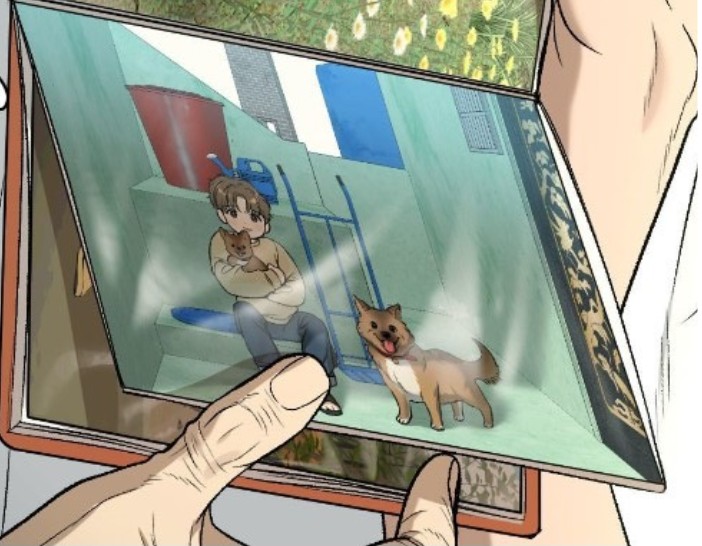 (chapter 94) upon whom his emotional survival depends as slipping away into unreachability without warning, explanation, or the possibility of interception.
This nightmare sequence does not merely depict the fear of losing Shin Okja; it functions as a psychological screen memory that reactivates the original, unresolved catastrophe of his childhood: the sudden death of his parents in an accident. The parental loss functions psychologically not as an understood transition, but as a sudden, violent departure completely stripped of emotional closure. Someone leaves the domestic sphere and simply never returns. The child is left behind to wander the empty rooms (chapter 57), searching for an explanation, a destination, or a lingering trace of continuity.
When Shin Okja later assumes the role of his sole protector, she temporarily stabilizes this primary wound  , but her eventual illness and death cause the old terror to resurface with unchecked force. The reassurance that “Grandma will always be there” collapses into the exact same darkness, rain, breathlessness, and panic that defined the loss of his parents.
This cycle of sudden, unexplained abandonment implants a devastating psychological mechanism within Kim Dan: survivor’s guilt. He internalizes the catastrophic belief that his continued existence is a fundamental material and emotional burden to those around him. He adopts an identity of extreme minimization—reducing his physical footprint, eating nothing under stress, apologizing for occupying space, and preemptively preparing for his own eviction before the other person can abandon him first. Because he unconsciously links deep emotional attachment to sudden death, ruin, or disappearance, he learns to survive by never allowing himself to believe in permanence again.
To openly ask another human being to stay beside him is an act of agency completely prohibited by his trauma script. Such a request requires a fundamental faith in the stability of the future. It requires trusting that a shared warmth will not instantly mutate into an empty hallway or a clinical operating room. Trapped within the logic of the opened door in Chapter 57, Kim Dan cannot ask anyone to remain; he can only wait in silence for the inevitable moment they vanish.
Yet one of the cruelest aspects of the relationship is that Joo Jaekyung’s care alone cannot fully dismantle the psychological structure governing Kim Dan’s self-perception. The champion provides financial stability, physical protection, rest, fun 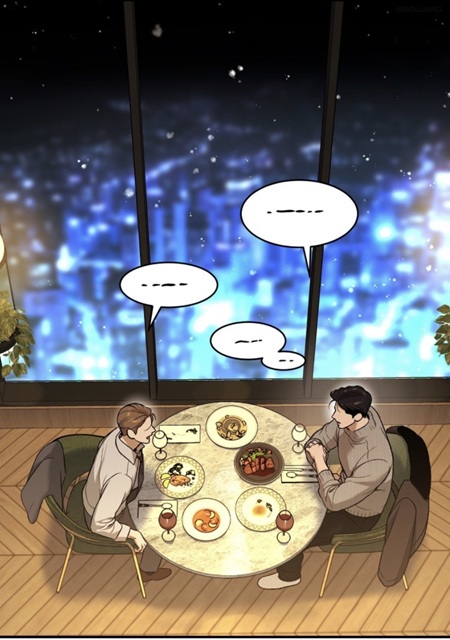 (chapter 89), emotional attachment, and eventually even places Kim Dan above the championship itself. But none of these gestures automatically erase decades of trauma, survivor guilt, and self-erasure. Kim Dan continues interpreting himself through the logic of burden, usefulness, and temporary emotional permission. As a result, even genuine love becomes destabilized inside his perception. Care transforms into guilt. Freedom feels like eviction. Presence becomes dream-like. (chapter 100) And companionship itself remains emotionally difficult to trust.
From Ghost to Sinner: The Inversion of the Trauma Script
That is why the emotional reversal of the story likely requires something much more devastating: Kim Dan witnessing Joo Jaekyung collapse.
Until now, the champion has functioned almost like a force of nature inside Kim Dan’s mind. No matter how wounded, exhausted, or emotionally unstable he became, Jaekyung always remained standing.  (chapter 69)
 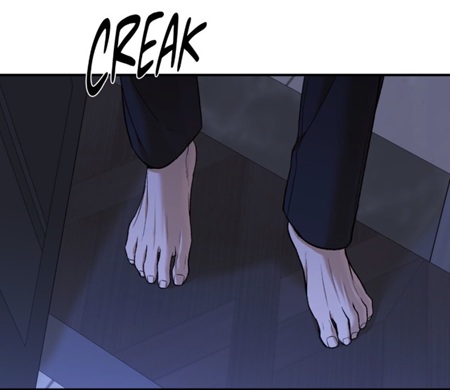 (chapter 91)
But episode 100 quietly dismantles this image. The disheveled hair, dark red eyes from crying and insomnia, starvation, (chapter 100) emotional distance, and nightly wandering all reveal someone slowly destroying himself from within.
If Joo Jaekyung’s body finally gives in — if exhaustion overwhelms him, if his legs give in or if he faints or loses consciousness directly in front of Kim Dan — then the emotional structure of the story would reverse completely. Kim Dan would suddenly experience what Jaekyung experienced in the hospital and at the seaside: the terror of watching someone he loves become physically unresponsive and getting really sick.
This matters profoundly because Kim Dan’s understanding of death has never been linked primarily to gore or violence. (chapter 59) His trauma seems connected instead to stillness, sleep 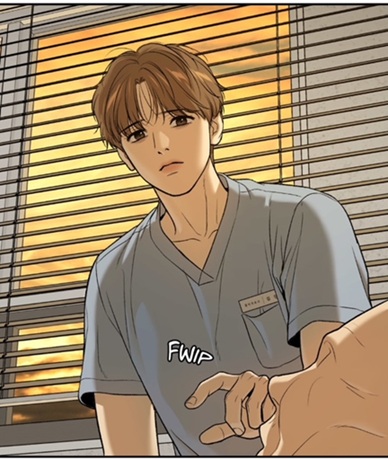 (chapter 59), silence, unconsciousness, and disappearance.
Thus witnessing Jaekyung collapse would strike directly at the center of his childhood trauma.
More importantly, such a moment would destroy Kim Dan’s ability to hide love behind gratitude. He could no longer tell himself that he stayed because he owed something. Instead, he would finally confront the truth: he cannot lose him.
And only then could Kim Dan truly say:
“Stay with me.”
Not as repayment. Not as obligation. Not as gratitude. But as pure emotional need. At the same time, speaking openly about his childhood, the accident, and the disappearance of his parents would force Joo Jaekyung to confront an important truth:Kim Dan’s suffering did not begin with him. He doesn’t know everything about him either. The champion incited the physical therapist not only to confront his traumas, but also to gather courage and affirm himself. He might have caused him some pain, but he did not create the original wounds. Long before entering the octagon’s violent world, Kim Dan had already learned to associate attachment with disappearance, guilt, and emotional instability. Besides, in reality, he is no angel either, just like him a sinner. (chapter 100)
This pivot exposes the agonizing threshold where Kim Dan undergoes a profound psychological transformation: the loss of absolute innocence and the violent birth of true adult maturity. Throughout his life, Dan has operated under the survival script of a grateful ghost, a creature who believes he must minimize his physical and emotional footprint to ensure the survival of those around him.  (chapter 53) A ghost leaves no tracks, carries no weight, and can be evicted or replaced without altering the fabric of the room it inhabited. However, the unyielding weight of the physical collapse at the threshold forces a terrifying realization into his consciousness. By witnessing the catastrophic toll his words and his impending departure have taken on Joo Jaekyung, Kim Dan is stripped of his narrative anesthesia. (chapter 98) He is forced to realize that he is not a ghost at all. Instead, he has become a sinner which is symbolized by the blood left on the athlete’s cheek that night.
This shift from ghost to sinner is monumental because a sinner possesses density, gravity, and the undeniable capacity to inflict a wound. For the first time, Dan cannot hide behind the convenient illusion of his own insignificance; he is confronted with the undeniable evidence that he has left permanent, indelible traces in the champion’s life. He is not replaceable, and he cannot vanish cleanly because his presence has already fundamentally altered the internal architecture of the celebrity. To acknowledge that he has the power to wound Jaekyung is to acknowledge his own personhood and agency.
Paradoxically, this recognition of his own capacity to cause pain becomes the first true validation of his existence as a real, impactful human being. For someone anchored in a trauma script of self-erasure, happiness always appears fragile and temporary, destined to dissolve back into an empty room. Pain, however, possesses undeniable reality. Discovering that he can wound Joo Jaekyung therefore destroys the illusion of his own insignificance.
By forcing the loss of his protective, childlike innocence, this realization marks the birth of his adult maturity. (chapter 100) He can no longer view himself as a passive victim of fate or an expendable burden. If his existence carries enough weight to cause ruin, then it also carries enough weight to cultivate healing. Consequently, his psychological survival ceases to be about achieving safety through total self-erasure. Instead, it matures into a conscious, courageous choice to engage in a mutual exchange of lasting impressions—willingly claiming the power to leave indelible traces in Jaekyung’s heart, while finally allowing Jaekyung to carve permanent, undeniable traces into his own world.
This transformation also fundamentally alters Kim Dan’s relationship to silence and moral judgment. 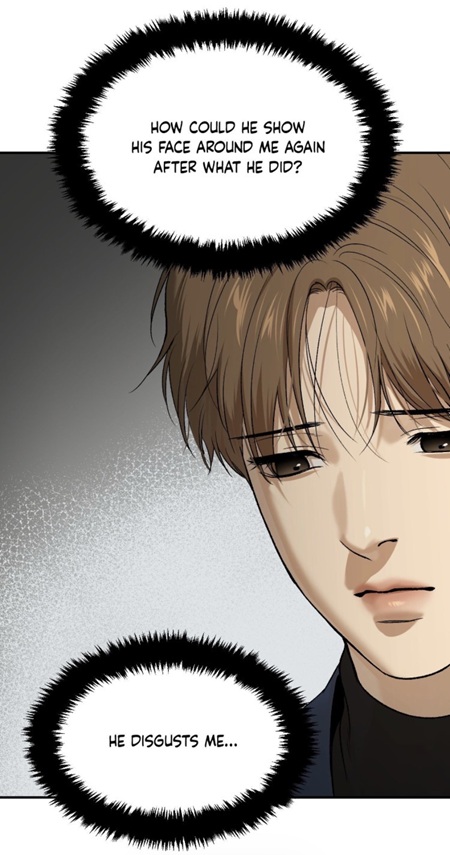 (chapter 91) Throughout the series, he remains almost completely passive toward institutional abuse and exploitation. He never openly confronts the perverted hospital director, never pursues legal retaliation against those who destroyed his livelihood
  (chapter 11), and never truly challenges the structures that repeatedly reduce him to a disposable object. His anger emerges almost exclusively toward Joo Jaekyung because the champion emotionally reaches him deeply enough to wound him personally. (chapter 100) Yet the “THUD” destroys the illusion that passivity itself is harmless. Once Kim Dan realizes that his choices possess the power to devastate another human being emotionally, he can no longer maintain the fantasy of existential insignificance. A ghost silently endures injustice because it believes it lacks the right to leave traces behind.
 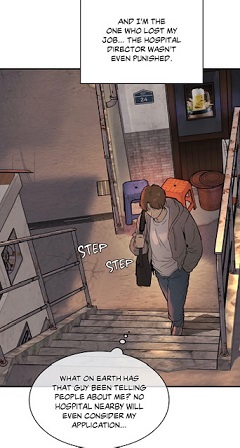 (chapter 1) A sinner, however, possesses moral weight. By recognizing his own capacity to wound, Kim Dan simultaneously acquires the adult authority to judge silence, cowardice, and passivity in others as well.
The Closed Door: The Acoustic Anchor of Reality
Throughout the series, and especially within Kim Dan’s recurring childhood nightmare in Chapter 57, the open door functions as the primal image of abandonment. (chapter 57) It marks the threshold where loved ones disappear into darkness while he remains behind, powerless to stop them from leaving. In Kim Dan’s trauma logic, an open doorway is never neutral. It is a wound left permanently unresolved.
This symbolism returns with devastating force in Chapter 100. (chapter 100) Standing at the entrance of the penthouse, Kim Dan attempts to perform what he believes is a final act of noble self-sacrifice. His suspended “Goodbye then…” reflects the familiar survival strategy that has governed his entire life: leave quietly, minimize the burden, disappear before causing further damage. He still imagines departure as a clean emotional transaction, one in which he can slip away harmlessly like a grateful ghost.
The violent “THUD” of Joo Jaekyung’s collapse destroys this illusion instantly. It brings an end to the generational trauma repetition and as such Kim Dan’s jinx! 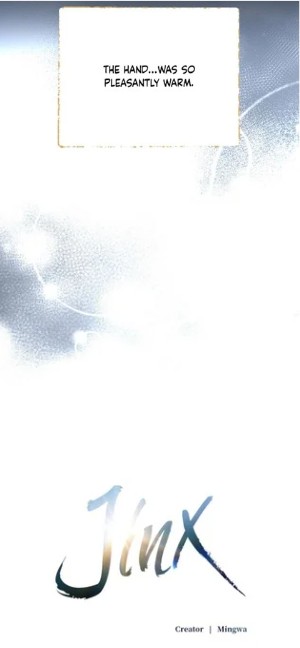 (chapter 100)
The sound functions like an acoustic shockwave tearing through Kim Dan’s entire childhood survival script. For perhaps the first time in his life, he is forced to confront the catastrophic possibility that his passivity is not emotionally neutral. By attempting to erase himself quietly, he is no longer protecting the person he loves. He is actively destroying him. In this sense, Kim Dan unconsciously begins reenacting the very trauma that shaped his own childhood. Just like the parents who vanished beyond the open doorway of his memory  (chapter 19), and just like Shin Okja repeatedly attempting to remove herself from his life for his “own good,”
 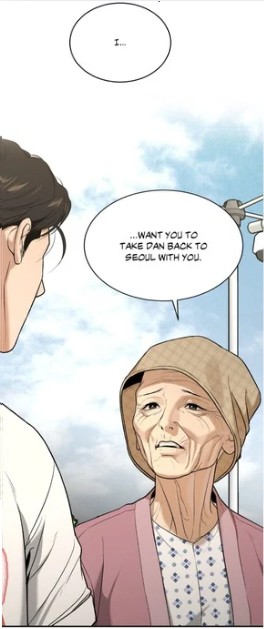 (chapter 65) Kim Dan convinces himself that disappearance is an act of love. The tragedy of the threshold scene lies precisely in this inherited logic of self-removal. He believes he is preventing suffering, while unknowingly reproducing the emotional catastrophe that destroyed him in the first place.
And this is where the scene undergoes its most profound symbolic reversal. (chapter 57) In the childhood nightmare, the open door represented irreversible disappearance and emotional hemorrhage. Here, however, the collapse effectively slams the threshold shut. The exit no longer exists psychologically. Kim Dan cannot continue drifting into the darkness as though his existence leaves no trace behind.
The apartment itself suddenly transforms. The hallway no longer offers escape into abstraction or self-erasure. The sealed space forces Kim Dan to confront the weakened body inside the room and the devastating evidence that his existence leaves real wounds behind.
This realization marks the destruction of the “ghost” identity he has inhabited for years. 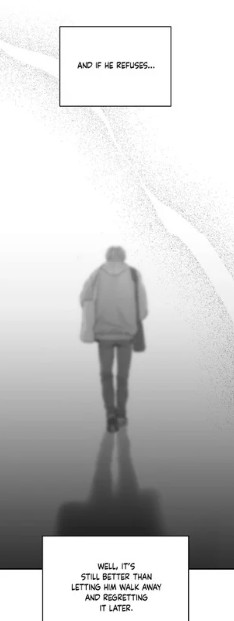 (chapter 97) A ghost passes through spaces invisibly, leaves no wounds behind, and can vanish without fundamentally altering the lives of others. Kim Dan has survived precisely by believing himself replaceable, temporary, and emotionally weightless.
But the body collapsing behind him proves the opposite.
For the first time, Kim Dan is forced to recognize that he possesses the power to wound another human being permanently. And paradoxically, this terrifying recognition becomes the first true confirmation of his own existence. (chapter 100) Pain carries undeniable gravity. Because suffering has always been the most concrete reality in Kim Dan’s life, discovering that he can inflict emotional devastation on Joo Jaekyung shatters the illusion of his own insignificance.
The threshold scene 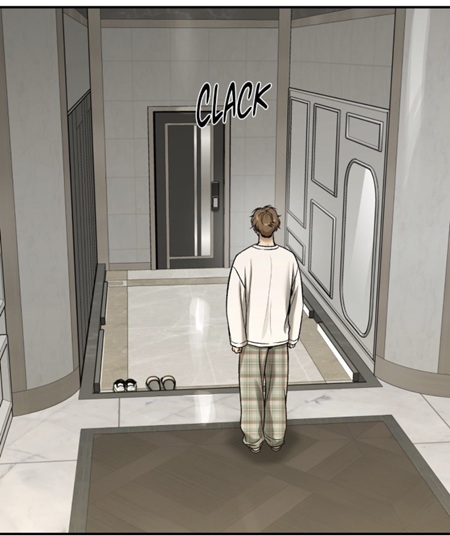 (chapter 96) (chapter 100) therefore becomes the site of an agonizing psychological transformation: the death of passive innocence and the birth of adult responsibility. Kim Dan can no longer remain a silent victim waiting to be chosen, summoned, or emotionally permitted to exist by someone else. The collapse forces him to understand that refusing to choose is itself a choice, and that disappearance can become cruelty when another person’s emotional survival depends upon your continued presence.
In this sense, the “THUD” becomes more than the sound of physical collapse. It is the acoustic force that seals the door against self-erasure. The fantasy of a painless goodbye is destroyed forever. Kim Dan is no longer allowed to vanish into darkness untouched by consequence. He must finally turn around, step away from the threshold, and confront the traces he has already carved into another person’s heart.
Two Ghosts at the Threshold
By the end of episode 100, both protagonists resemble ghosts trapped at an emotional threshold. Kim Dan believes that if he truly loves Jaekyung, he should leave and stop burdening him. 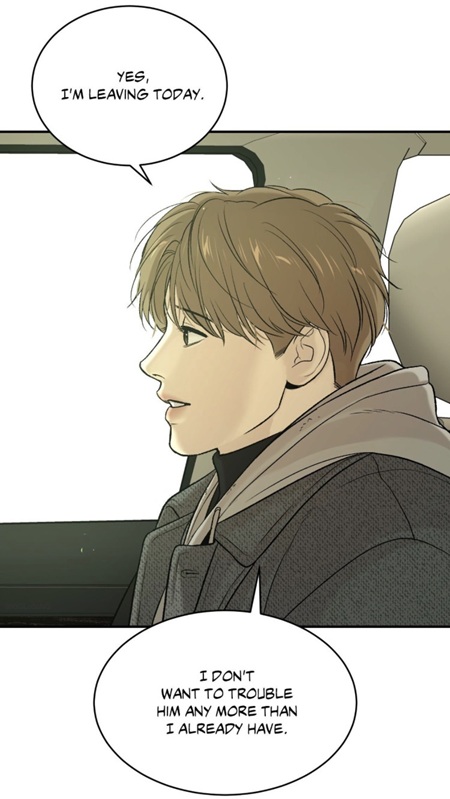 (chapter 100) Joo Jaekyung believes that if he truly loves Kim Dan, he should let him go and stop endangering him.
 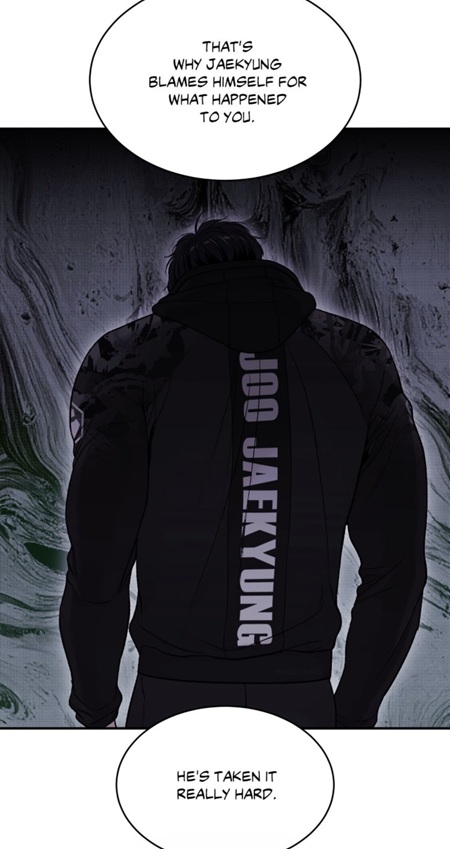 (chapter 100)
Both unconsciously reproduce the same inherited trauma logic: love through disappearance. Yet the webtoon author carefully situates this confrontation not during the stability of daytime, but at sunrise. 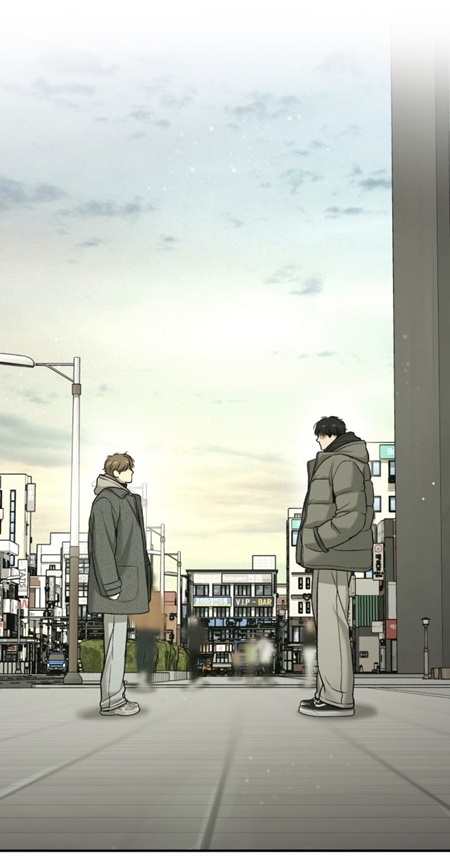 (chapter 100) The timing matters profoundly. Throughout the series, dawn repeatedly appears after moments of emotional rupture, exhaustion, or psychological transition.
 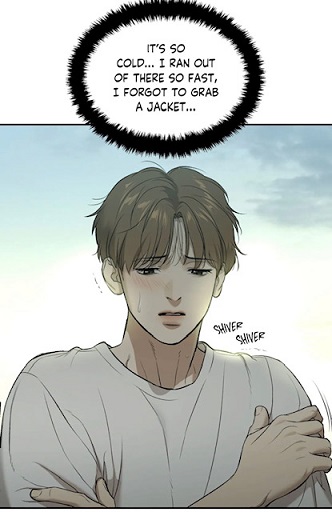 (chapter 21) Kim Dan once returned from the hospital at the break of day after another traumatic encounter, intending only to “rest for an hour” before returning to work, as though emotional catastrophe itself had to be minimized and folded back into routine immediately.
 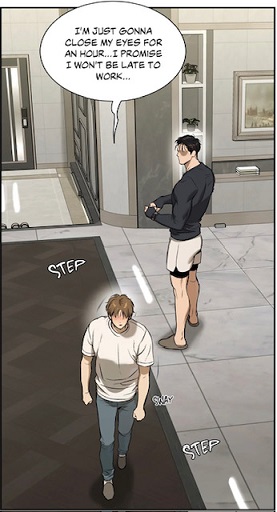 (chapter 100)
In episode 100, however, sunrise acquires a radically different meaning. 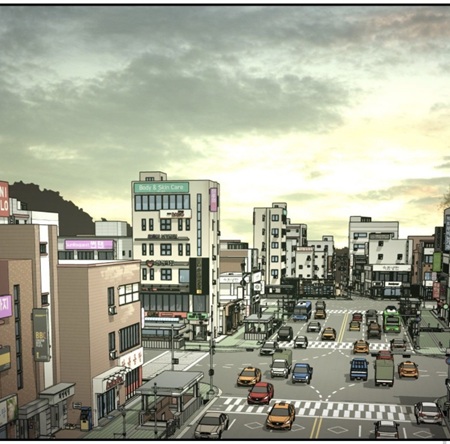 (chapter 100) Mingwa carefully emphasizes the gradual awakening of the city itself through the changing atmosphere of the streets. When Kim Dan first exits the hospital, the urban environment still feels strangely suspended and emotionally empty. The streets remain quiet, the traffic sparse, and the pale sky carries the lingering stillness of night. Both men stand isolated within this transitional hour, suspended psychologically between separation and recognition.
This is perceptible, once you contrast the traffic in the same street during the day. 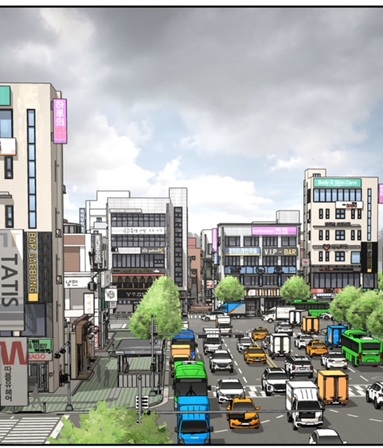 (Chapter 56) So we have to envision the following scenery in episode 100. Cars begin accumulating in the streets, intersections grow crowded, daylight strengthens, and ordinary life resumes around them. The world itself begins moving forward again.
And significantly, this transition unfolds precisely while the “Emperor” identity starts destabilizing visibly. The sleepless figure 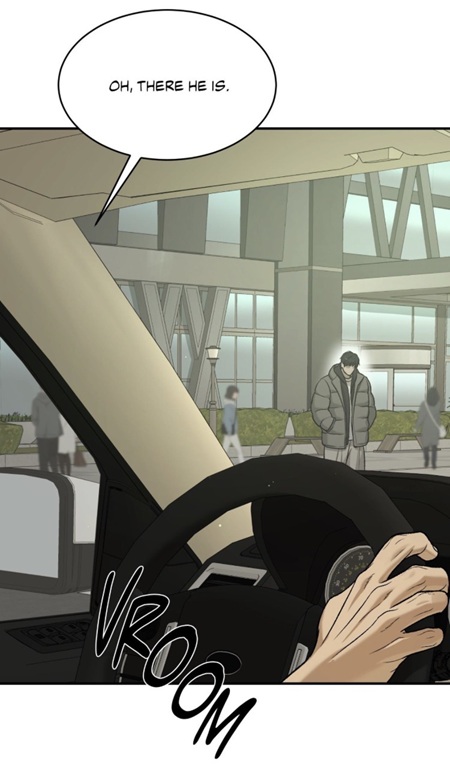 (chapter 100) standing outside the building no longer resembles the untouchable public champion sustained by MFC, Team Black, spectacle, and violence. Instead, the growing daylight increasingly exposes exhaustion, emotional fragility, insomnia, grief, and human vulnerability. (chapter 100) In this sense, the awakening city does not accompany the rebirth of the mythological fighter, but the gradual emergence of the man hidden underneath the role itself.
This may explain why Joo Jaekyung increasingly appears ghost-like throughout the hospitalization arc. 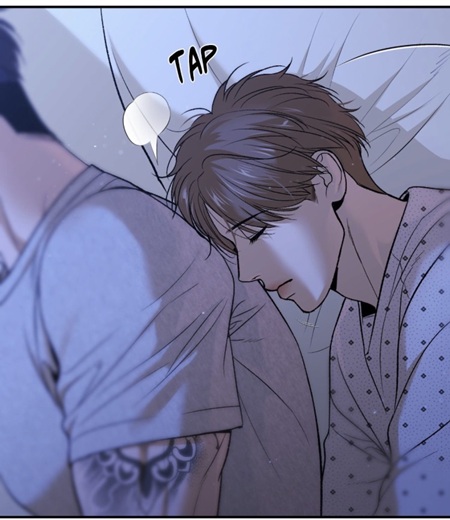 (chapter 100) He does not merely hide from Kim Dan physically. He is unconsciously shedding an identity built entirely around performance, dominance, and emotional suppression. The champion must temporarily become a ghost so that the man himself can finally emerge.
This is why the chapter feels so suffocating despite all its tenderness. The flowers are beautiful, but the giver disappears. The cake is sweet, but the celebration remains broken. The confession exists, but recognition becomes delayed. The warmth is real, but it arrives through traces left behind during darkness rather than open emotional presence.
The Managerial Ghost: Mobility versus Attachment
This transitional atmosphere becomes even more revealing once Park Namwook quietly exits the scene. 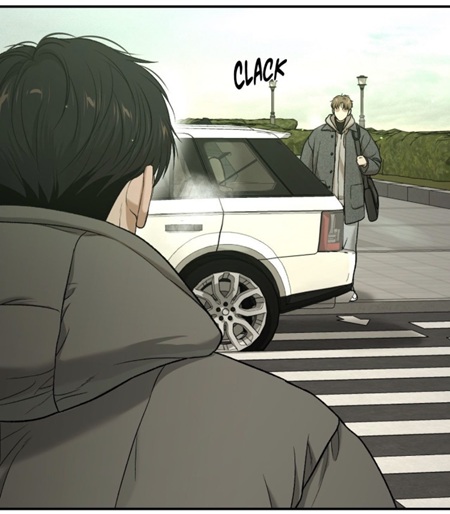 (chapter 100) After dropping Kim Dan off in front of the building, the manager simply drives away without greeting Joo Jaekyung directly or remaining beside him. The movement appears emotionally hollow, especially when contrasted with the unresolved intensity surrounding (chapter 100) “Goodbye then…”. Namwook’s departure resembles transit rather than attachment. He arrives, transports, then disappears again.
The location itself quietly reinforces this instability. (chapter 100) Park Namwook leaves Kim Dan directly beside a pedestrian crossing: a place not meant for permanence, but for transition. Symbolically, Kim Dan stands neither fully inside the old structure nor fully outside it yet. He remains suspended between identities, relationships, and possible futures. Even Namwook’s language unconsciously reflects his belief that the previous system will continue functioning normally. 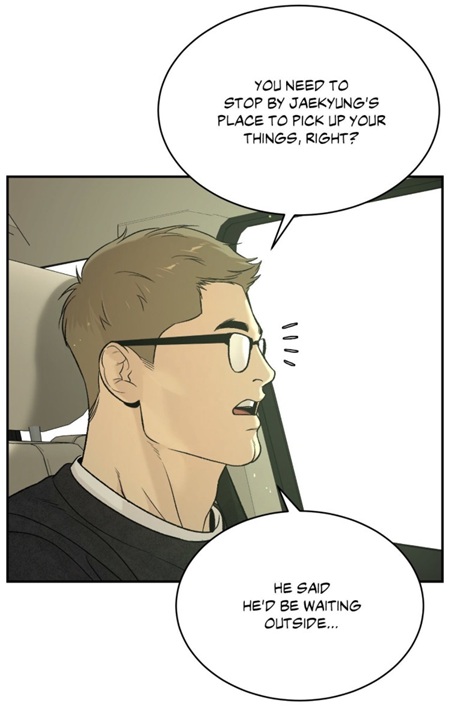 (chapter 100) He assumes Kim Dan will simply “stop by” the penthouse to collect his belongings and perhaps “visit” Team Black again later. The manager still imagines continuity, routine, and return.
 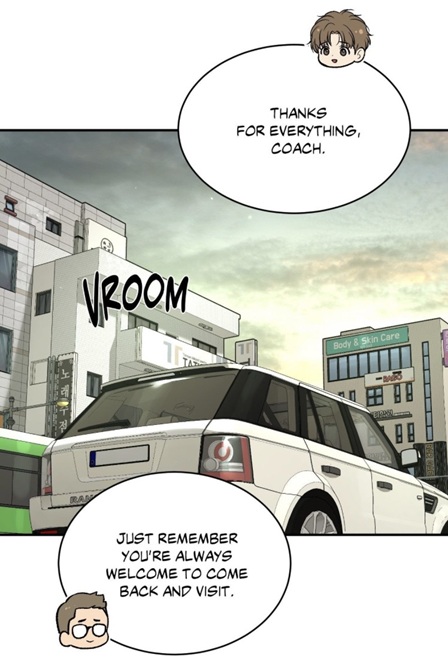 (chapter 100)
And significantly, he expects Joo Jaekyung to behave according to that same logic. In episode 95, the time visible inside the car showing 9 a.m., 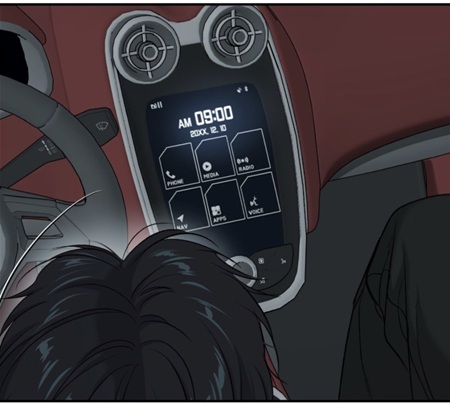 (chapter 95) reveals their routine, though here, a small transgression took place. Joo Jaekyung let Kim Dan rest a little:
 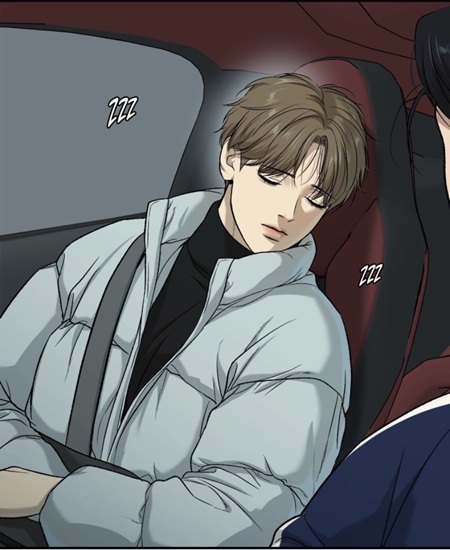 (chapter 95). This scene indicated that Joo Jaekyung had already started psychologically drifting far outside this structure. He was already prioritizing his lover. Joo Jaekyung does not wake him despite obligations, schedules, or practical inconvenience. Instead, he silently watches over him for a while and allows the moment of rest to continue. The car therefore temporarily stops functioning as transportation toward labor, treatment, or fighting. It becomes a protected space where exhaustion is permitted rather than suppressed.
So the sunrise indicates that it is much earlier than 9.00 am, an indication that Park Namwook is already going to the gym in order to “welcome” the next physical therapist. By helping him with the discharge so early, the manager avoids a goodbye between the members of Team Black and Kim Dan. (chapter 100) The sleepless wandering through hospital corridors, the nightly visits, the emotional collapse after the stabbing, and the abandonment of ordinary rhythm (no shower and jogging) all reveal someone no longer functioning according to the predictable temporality of the fighting system.
Park Namwook, however, continues organizing life through functionality, punctuality, and performance structure. (chapter 100) This explains why his farewell with Kim Dan feels emotionally procedural (chapter 100) rather than existential. He drops him off, tells him he is always welcome to visit again, then drives away. (chapter 100) The car itself begins symbolizing Namwook’s role inside Joo Jaekyung’s life: constant movement toward fights, schedules, media obligations, and professional continuity, yet strangely little emotional presence outside those structures.
This irony becomes even sharper when connected to episode 5, where Park Namwook laughed about the circumstances concerning Yosep’s divorce. 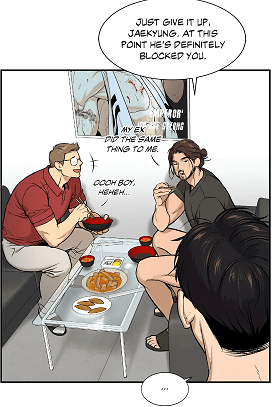 (chapter 5) Yosep had been “ghosted” emotionally by his wife, abandoned after years of prioritizing MMA over personal life. Yet episode 100 quietly suggests that Namwook himself increasingly resembles a ghost within Joo Jaekyung’s life. This explicates why he didn’t help him getting discharged from the hospital
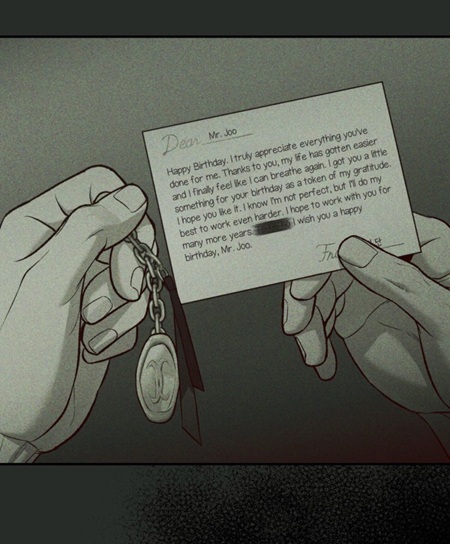
 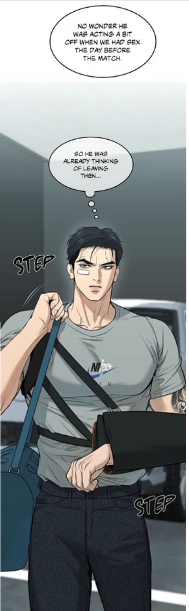 (chapter 53) contrary to the athlete. So this kindness toward the “hamster” is not truly selfless. He constantly orbits the champion professionally while remaining emotionally detached from the human being underneath the “Emperor” persona. And the best evidence is this video sent on his birthday:
 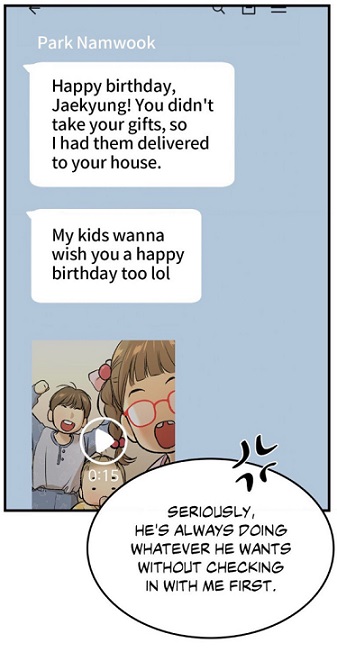 (chapter 45)
The contrast with Kim Dan therefore becomes profound. (chapter 100) “Goodbye then…” emerges from overwhelming attachment, fear of abandonment, survivor guilt, and anticipatory self-erasure. Park Namwook’s farewell, by contrast, remains rooted in managerial continuity. (chapter 100) One goodbye fears love too much. The other barely recognizes it at all.
And significantly, Joo Jaekyung waits outside. (chapter 100) Not inside the gym. Not inside the penthouse. Not inside the institutional spaces that previously defined the “Emperor.” 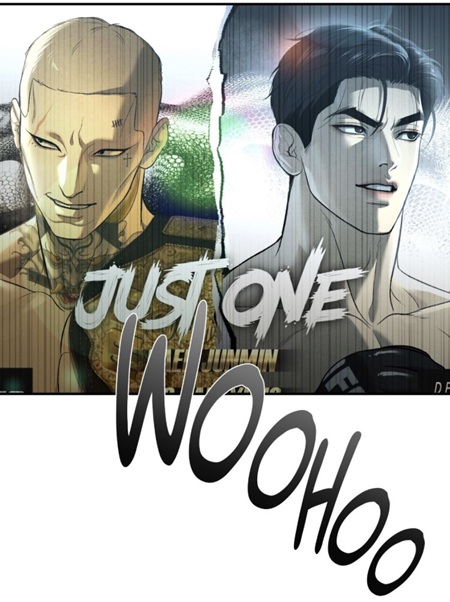 (chapter 100) He stands beyond them at dawn, beside the crossing itself, as though the story were positioning him between an ending identity and an unknown new life.
And perhaps this becomes the true tragedy of Jinx. The problem is not absence of love. The problem is that Shin Okja, Kim Dan, and Joo Jaekyung all mistake self-erasure for love itself.
Yet beneath all the silence, flowers, interrupted confessions, ghostly gestures, and unfinished goodbyes, one desperate emotional truth slowly begins emerging: Kim Dan’s journey may ultimately require something even more transformative than saying:
“Stay with me.”
Because throughout his entire life, he has always been the one left behind. (chapter 57) The child standing before the opened door. The survivor searching after disappearance. The person quietly remaining while others vanish into emotional unreachability.
Beyond the Penthouse: Moving Toward a Shared Horizon
This is why the true emotional resolution of the story may instead take the form of a radically different sentence:
“Come with me, a new version of this scene
(chapter 43)
Unlike “Stay with me,” which still implies remaining inside someone else’s space, (chapter 100) “Come with me” fundamentally reverses the structure of abandonment itself. It completely changes the geography of their relationship. It grants Kim Dan absolute agency. He is no longer walking out of an open door into darkness; he is the one opening a path forward. 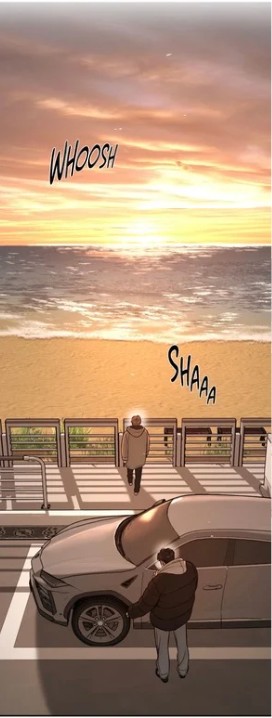 (chapter 94) He is inviting the champion into a mutual, shared trajectory.
In many ways, the story quietly foreshadows this desire much earlier through Kim Dan’s simple wish to travel together after Shin Okja leaves the hospital. 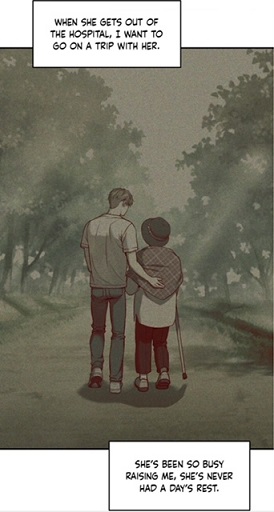 (chapter 47) At first glance, the statement appears almost painfully modest: a peaceful trip, rest, shared time, ordinary companionship. Yet symbolically, the fantasy already contains the emotional architecture of “Come with me.” The dream is not organized around labor, debt, treatment, fighting, or survival. It imagines movement detached from institutional obligation entirely.
This matters profoundly because throughout most of the series, movement itself remains tied to exhaustion and performance. Cars transport fighters toward matches. Hospital corridors lead toward illness and disappearance. The gym reduces bodies into instruments of labor and spectacle. The imagined trip in the woods quietly opposes all of these structures. It represents shared movement without destination anxiety, emotional utility, or professional function.
In this sense, “Come with me” does not simply mean romantic attachment. It signifies the possibility of constructing a life no longer governed entirely by trauma, survival, or institutional rhythm. For perhaps the first time, Kim Dan is no longer merely trying to endure another day. He is imagining a future someone else could walk beside him willingly.
It completely upends his lifelong belief that he is an expendable creature who must minimize his physical footprint to avoid being discarded.
And psychologically, this changes everything. For perhaps the first time in his life, Kim Dan would no longer be searching after someone vanishing into darkness. Instead, both men would be walking toward the same horizon together, carrying their ghosts openly rather than disappearing behind them. In this sense, the story quietly redefines the meaning of home itself. Home is no longer a fixed place haunted by abandonment, empty rooms, or opened doors. It becomes the place where the loved person remains beside you willingly.  (chapter 69) “Come with me” would illustrate this principle: life is a journey and not a destination.
Feel free to comment. If you have any suggestion for topics or Manhwa, feel free to ask. If you enjoyed reading it, retweet it or push the button like. My Reddit-Instagram-Twitter-Tumblr account is: @bebebisous33. Thanks for reading and for the support, particularly, I would like to thank all the new followers and people recommending my blog.
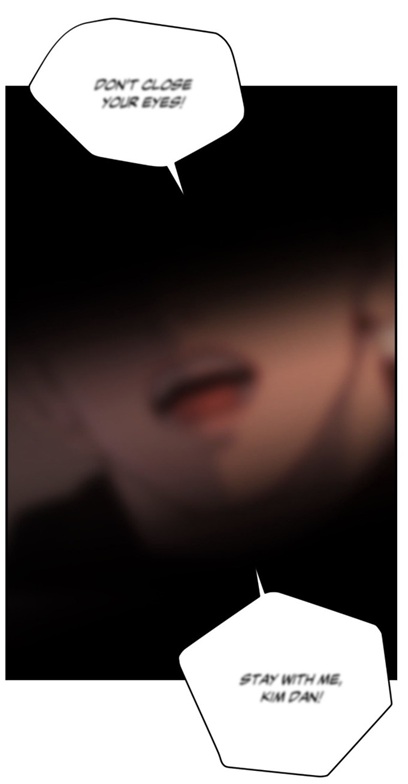
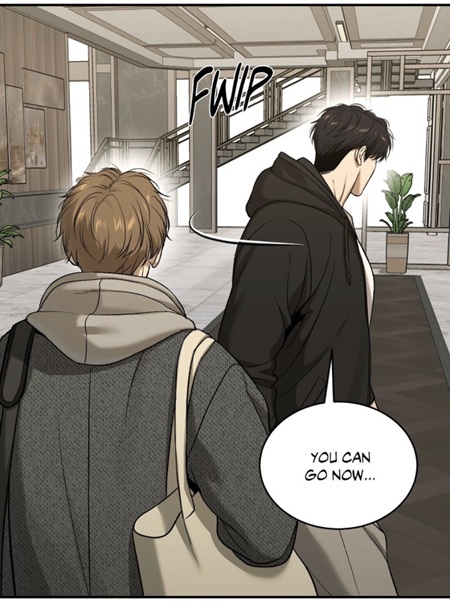 (chapter 100), and why Kim Dan continuously retreated into the sterile scripts of formal gratitude and apology instead of absolute emotional honesty. Yet, the cruel irony of the chapter is that the confession itself does not belong to a future resolution; it already exists, fully articulated, inside the physical boundaries of the narrative. While Kim Dan drifts precariously in the liminal space between life and death following the stabbing, Joo Jaekyung drops his hyper-masculine armor and desperately begs him:
  (chapter 100)
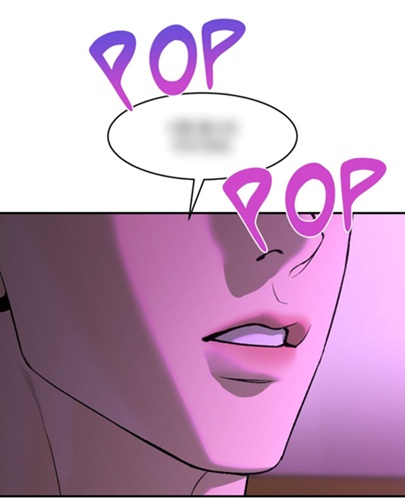 (chapter 84) And in episode 100, the wish is yelled at a moment that was both physically and psychologically too late. Physically, the plea materializes while Kim Dan is actively losing consciousness
 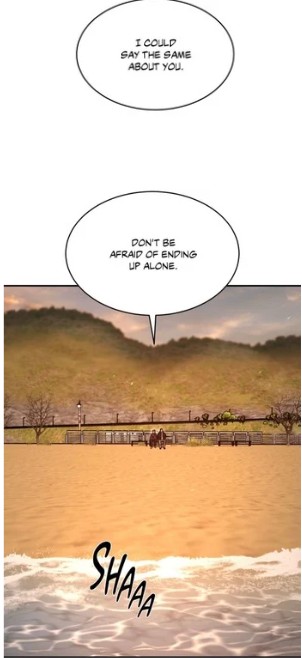 (chapter 95) His entire existence has evolved instead around the crushing mechanics of repayment, survival, and economic and emotional burden.
 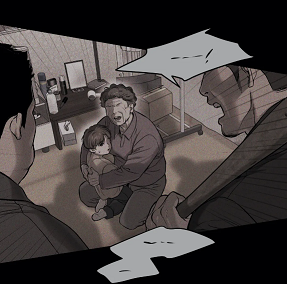 (chapter 5) Having lost his parents at a young age, Dan did not grow up believing that attachment could exist freely, unconditionally, or safely.
 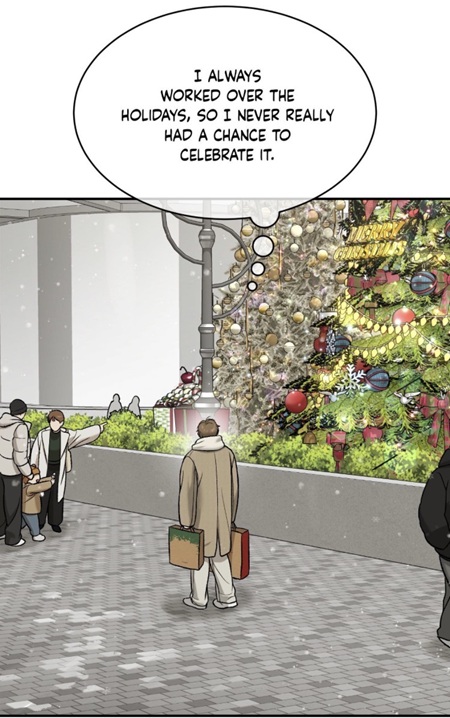 (chapter 97) Therefore he never rested.
  (chapter 47); he only understands relationships through the desperate lens of survivalist necessity. Hence the grandmother and Kim Dan are seen clinching onto each other.
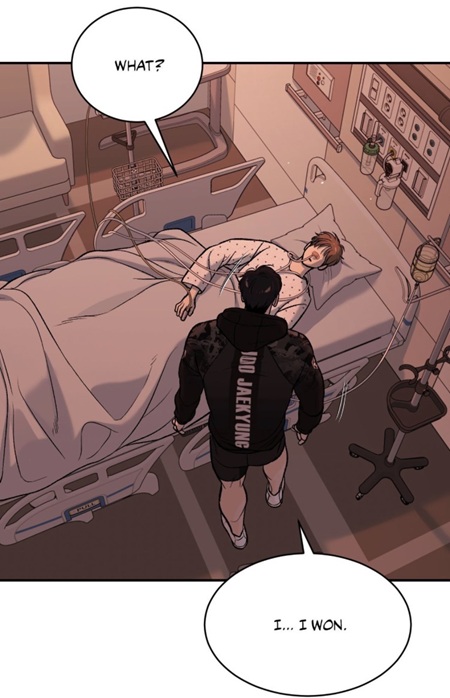 (chapter 100) readers instinctively interpret his reaction through a lens of uncritical relief.
 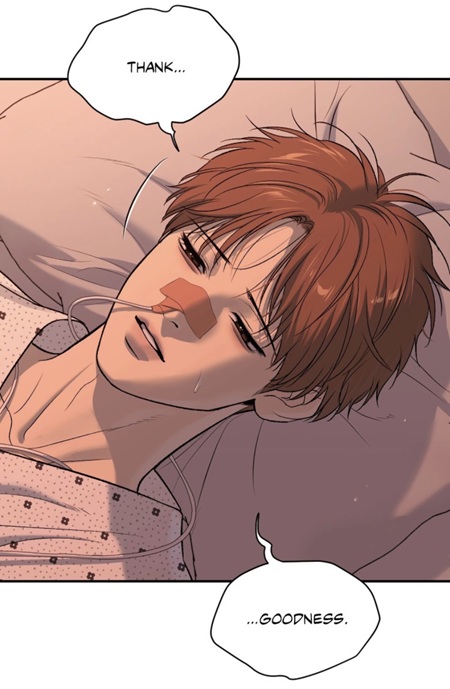 (chapter 100) Yet, the formal pacing of the scene quietly suggests a far darker internal reality. For Kim Dan, the champion’s victory signifies nothing less than the absolute completion of their contract. The title has been recovered, the emotional and physical debt has been cleared, and the utilitarian role he assigned himself beside Joo Jaekyung has reached its natural endpoint.
 (chapter 98)
 (chapter 98)
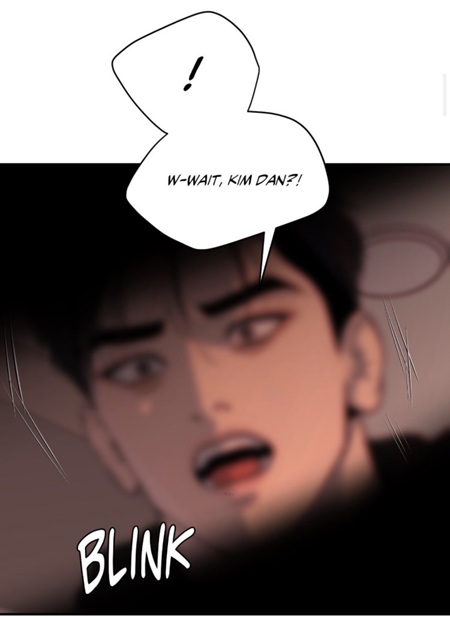 (chapter 100) While a surface-level reading diagnoses this as mere physical exhaustion, psychologically the moment functions as an immediate emotional retreat. It is as though Kim Dan’s psyche reaches a instantaneous, catastrophic conclusion the second the victory is confirmed: everything is over; I am no longer needed. This interpretation achieves an exquisite, painful symmetry when placed against Joo Jaekyung’s own origin story, which similarly fused hyper-success with absolute loss, having lost both of his parents
  (chapter 74) on the exact night he triumphed as a boxer. Episode 100 constructs the perfect inverse of that trauma script for Kim Dan: the champion’s victory becomes structurally associated with emotional abandonment, proving that for both protagonists, success itself is a dangerous catalyst for isolation.
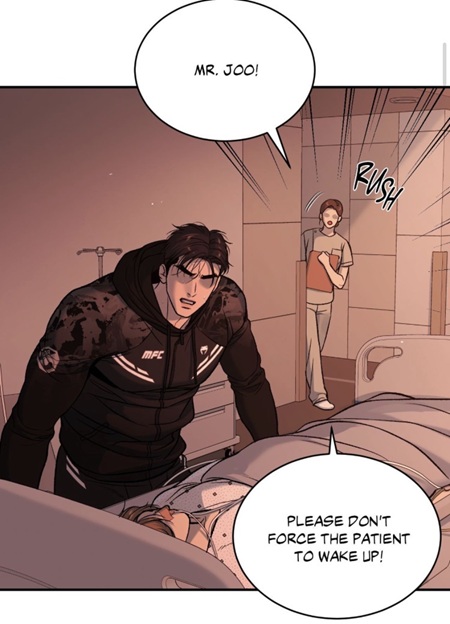 (chapter 100) The nurses rush into the room, treating Jaekyung’s desperation as a physical disturbance to the patient’s recovery. While their actions are entirely reasonable on a clinical level, psychologically the scene becomes devastating. Unintentionally, the medical intervention reinforces the exact, toxic logic that governs both characters: your emotions are a disruption, your presence causes harm, and distance is the only metric of safety.
 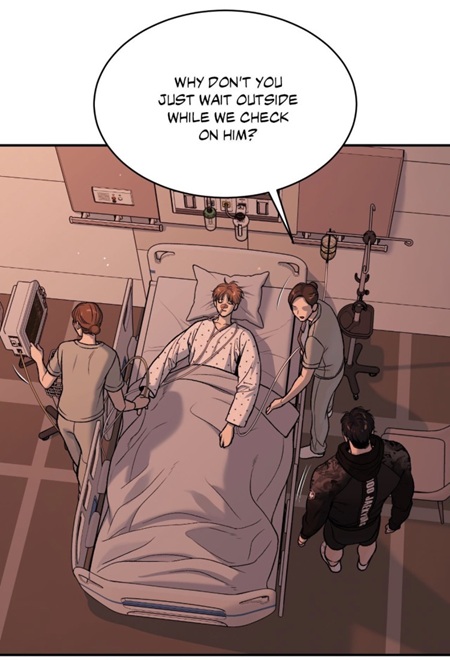 (chapter 100) They show no understanding for his emotional outburst. Because Joo Jaekyung already suffers under the subconscious belief that his violent world has contaminated and ruined Kim Dan, this interruption silently validates his deepest fear. The confession is not merely delayed; it is actively policed and silenced before Dan can consciously receive it. So no wonder why he couldn’t ask later.
 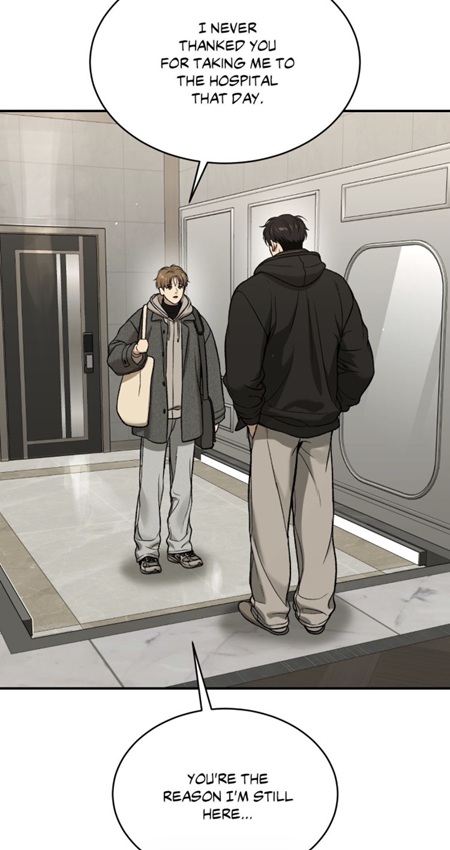 (chapter 100) because gratitude remains the safest emotional language he knows. When he thanks Joo Jaekyung for saving his life and bringing him to the hospital, he unconsciously falls back into the same survival mechanism that shaped his entire existence:
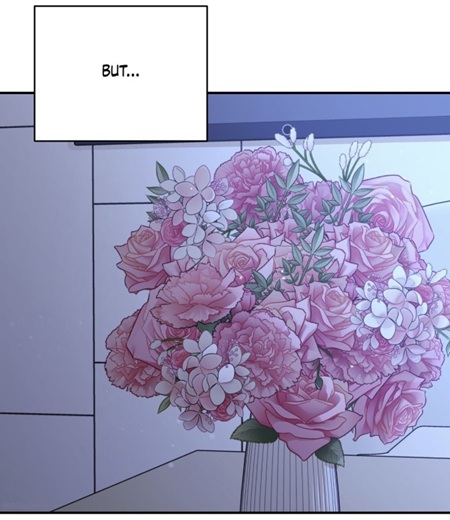 (chapter 100) The pink roses evoke tenderness, admiration, vulnerable affection, and emotional attachment. The peonies suggest healing, compassion, sincerity, and quiet devotion. The smaller pale flowers evoke remembrance, enduring emotional bonds, and spiritual connection despite distance. On the surface, the bouquets seem to communicate something reassuring: someone deeply cares whether Kim Dan survives.
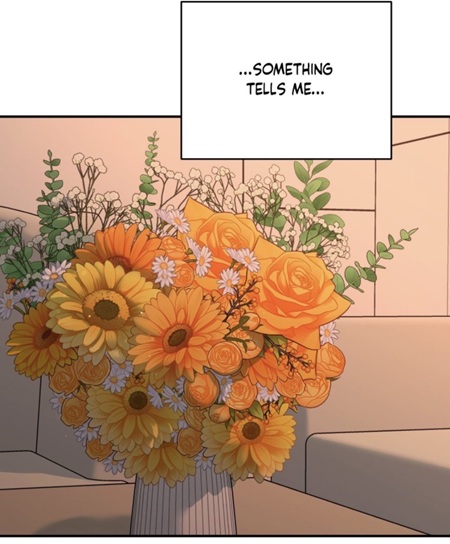 (chapter 100) The reason lies in the absence of the giver himself. Joo Jaekyung never openly remains beside Kim Dan during the day. Instead, the flowers appear during the night like traces left behind by someone haunting the room in silence.
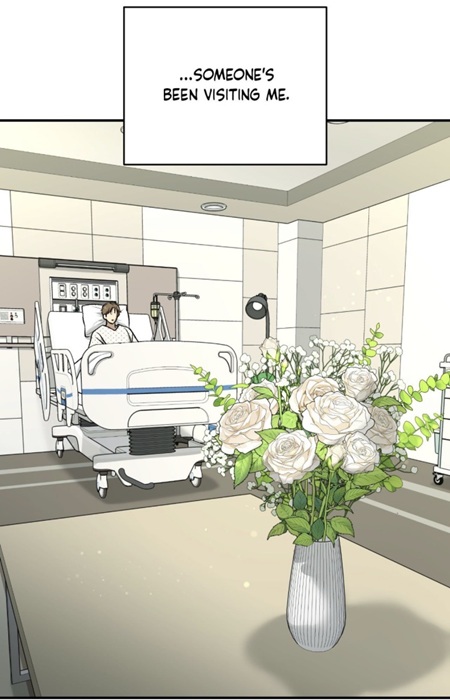 (chapter 100) Kim Dan wakes up surrounded not by Jaekyung’s physical presence, but by evidence that he had been there before disappearing once again. The flowers therefore become emotionally contradictory objects. They communicate affection, but simultaneously reinforce absence. They say: someone came, while also saying: someone vanished again.
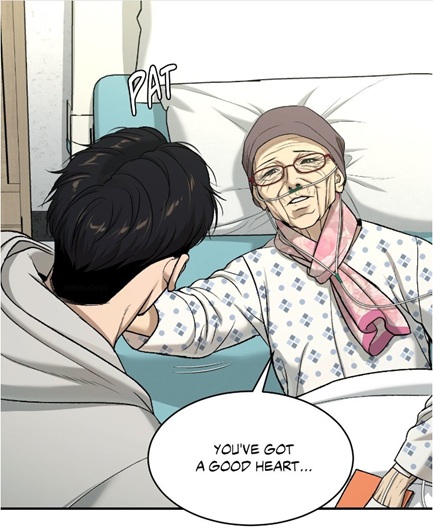 (chapter 94) This visual parallel quietly transforms the flowers from romantic gifts into symbols of caregiving shaped by distance and self-removal. Shin Okja genuinely loved Kim Dan, but her solution to his suffering repeatedly became emotional disappearance. She believed that if she removed herself from the center of his life, he would finally become free and happy. Episode 100 reveals that Joo Jaekyung begins reproducing this exact same pattern. He leaves flowers, cake, comfort, and reassurance behind, but increasingly excludes himself from Kim Dan’s life physically and emotionally. Like Halmoni, he convinces himself that the person he loves suffers because of him.
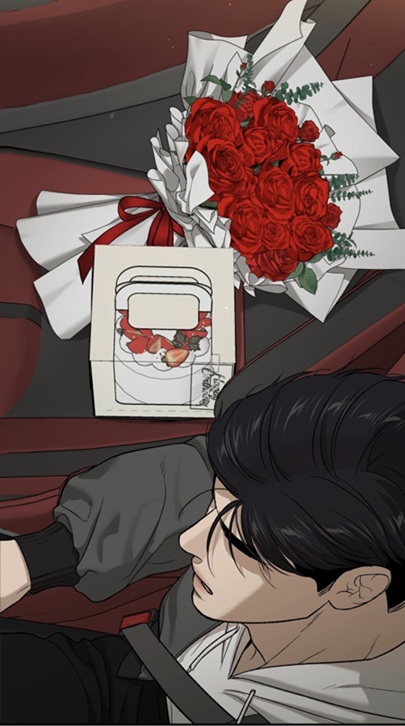 (chapter 97) toward increasing emotional fading. Earlier arrangements contain reddish tones to vivid pink traditionally associated with attachment, tenderness, living warmth, and vulnerable affection.
  (chapter 31)
 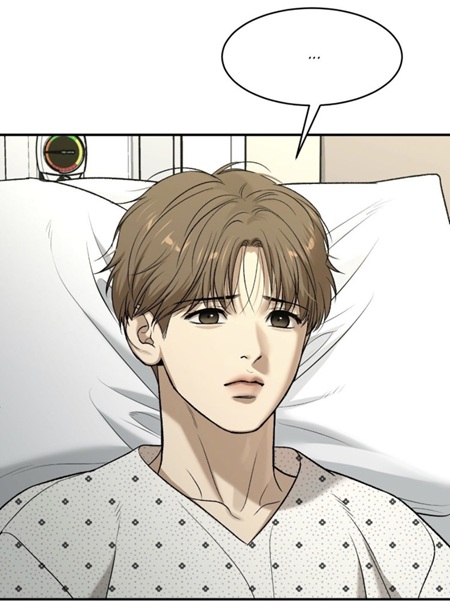 (chapter 100) Thus Kim Dan is not happy at all. The bouquets therefore become profoundly double-edged objects. They evoke tenderness while simultaneously reviving the emotional atmosphere of a childhood that vanished forever and departure.
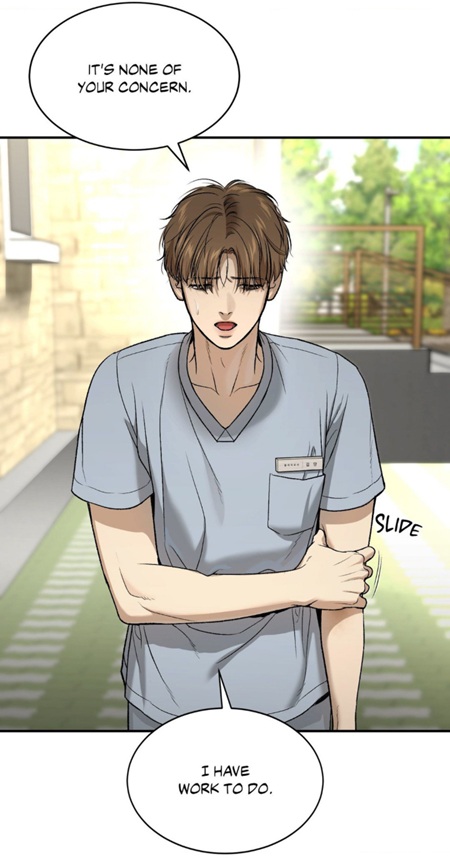 (chapter 61) But now the Emperor begins displaying the exact same symptoms. His hair is disheveled. His eyes are red from crying and sleeplessness.
 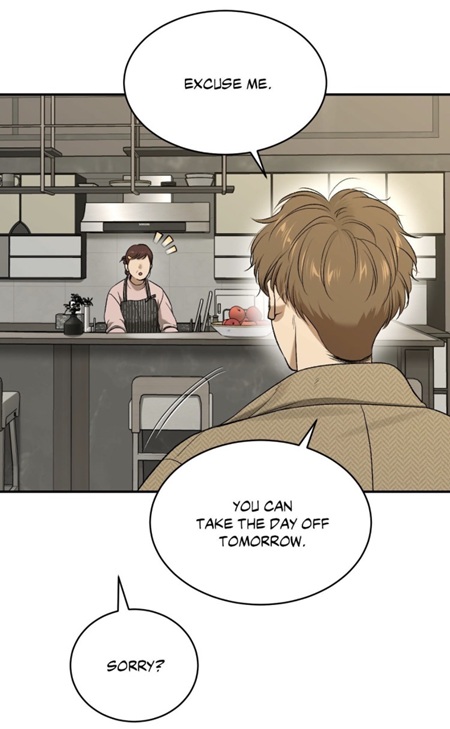 (chapter 97)
  (chapter 57) The harassment, the assault, the stabbing, and the violence surrounding the title fight all reinforce the terrifying idea that Kim Dan’s life deteriorates because he entered the champion’s world. As a result, Jaekyung arrives at the same conclusion as Shin Okja: perhaps the person he loves would be safer without him nearby.
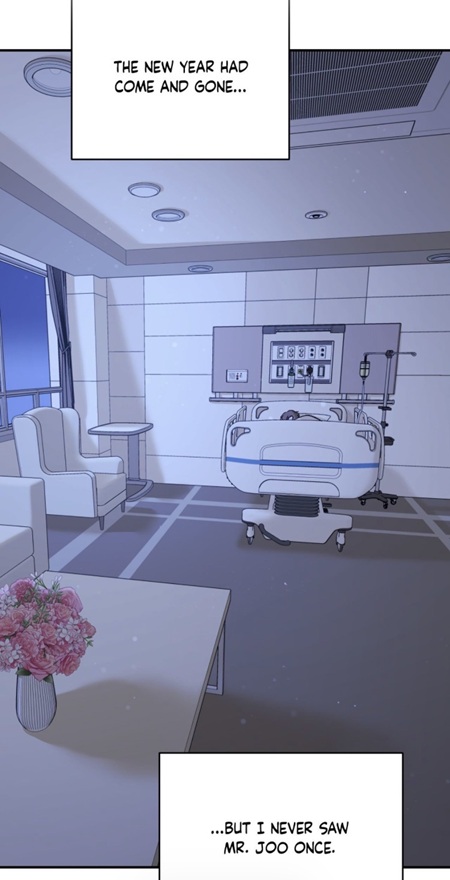 (chapter 100) Readers initially interpret them romantically, but the deeper emotional logic behind them is much darker. Joo Jaekyung is the only person who truly understands how little Kim Dan values his own life.
 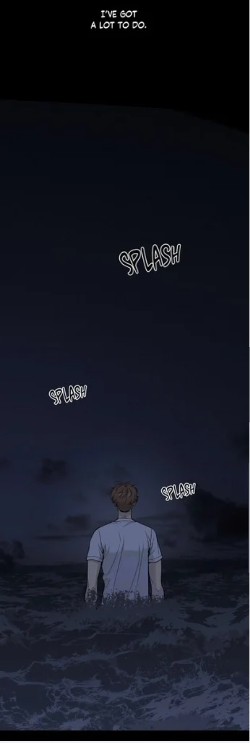 (chapter 59) Instead, the pattern emerges behaviorally through starvation, bodily neglect, overwork, emotional resignation, rejection of care, passivity toward danger, and repeated willingness to sacrifice himself without hesitation. His self-erasure slowly extends toward the body itself.
 (chapter 79)
 (chapter 45) to buy a key chain as a birthday present.
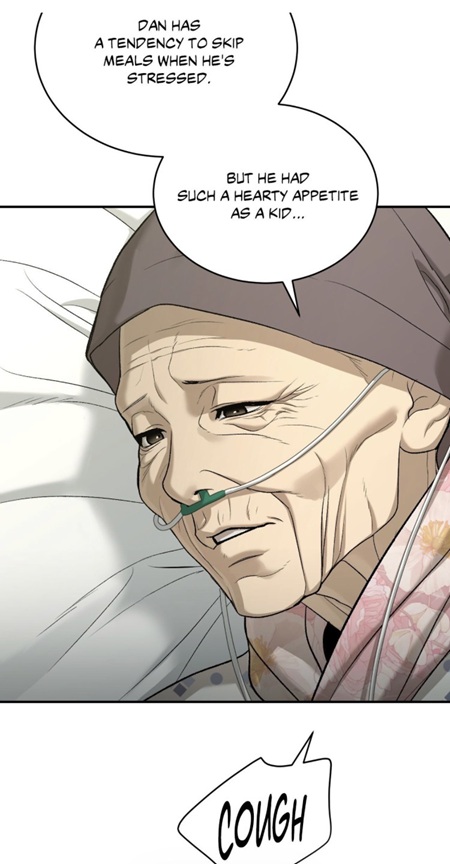 (chapter 94) Joo Jaekyung initially fulfilled this exact role. He gave Kim Dan work, stability, material protection, and relief from crushing economic pressure. But the chapter quietly reveals that Jaekyung also begins inheriting Halmoni’s deeper pathology: self-removal mistaken for love. Like Shin Okja and his hyung, he increasingly convinces himself that Kim Dan would ultimately suffer less without him at the emotional center of his life. Thus he leaves behind flowers, comfort, financial freedom, and reassurance while gradually destroying himself psychologically through absence, guilt, and emotional isolation.
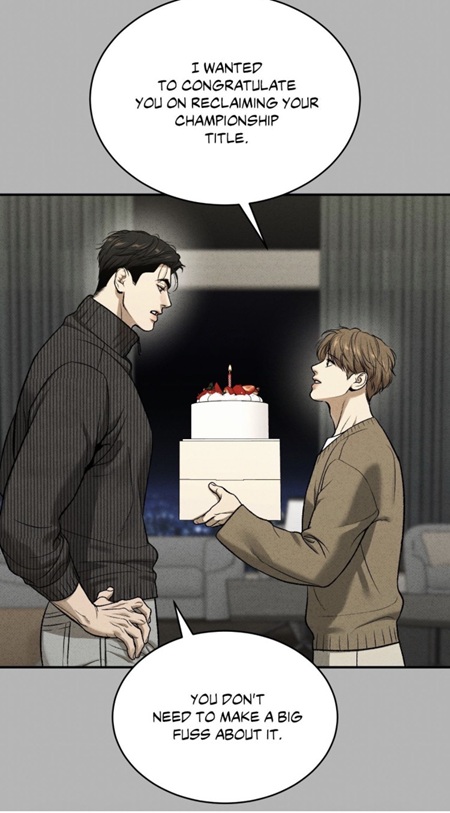 (chapter 100) And on his way home, he started imagining what would happen with this cake. The atmosphere of the scene felt so real, though it was just a dream. Soft lighting, playful intimacy, teasing, physical closeness, and domestic warmth briefly isolate the two men from the violence surrounding the outside world.
 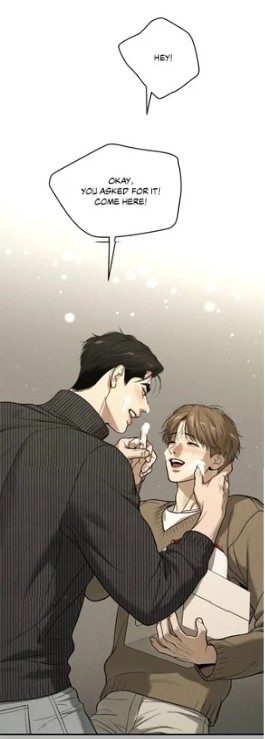 (chapter 97) For perhaps one of the first times in the narrative, Kim Dan acts not out of obligation, survival, or repayment, but out of genuine emotional desire. He wants to make Joo Jaekyung happy and have fun with him.
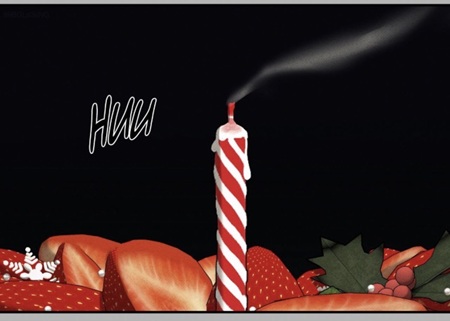 (chapter 97) The smoke rising into the darkness transforms the celebration into visual foreshadowing. The dream of happiness exists briefly, warmly, beautifully… then immediately begins dissolving into air, as if this was already announcing the future stabbing. So the assault violently interrupts the vision before Kim Dan can fully inhabit it emotionally.
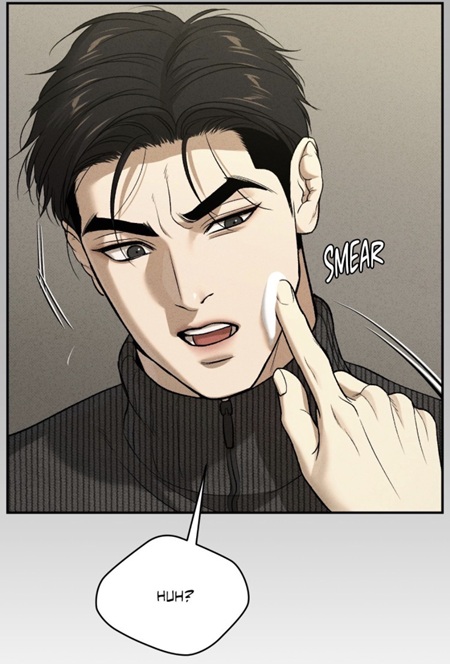 (chapter 97) The celebration was not simply about the championship victory itself. It represented the possibility that warmth, intimacy, and laughter might continue after the fight, beyond the violence of the octagon. For a brief moment, Kim Dan allowed himself to believe that happiness could survive the match and extend naturally into everyday life.
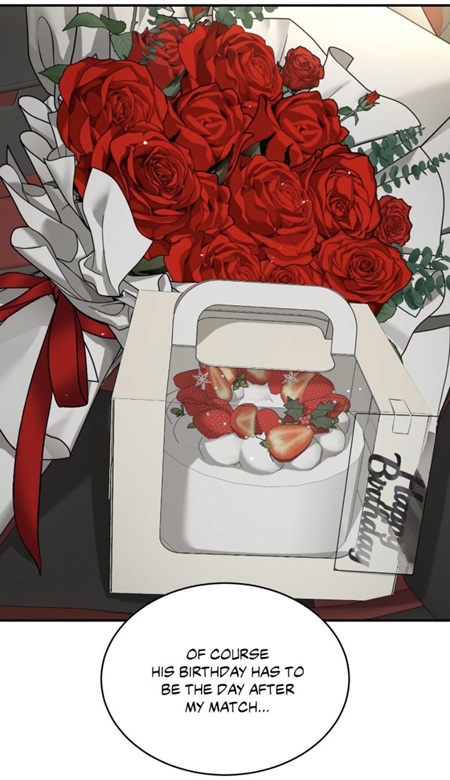
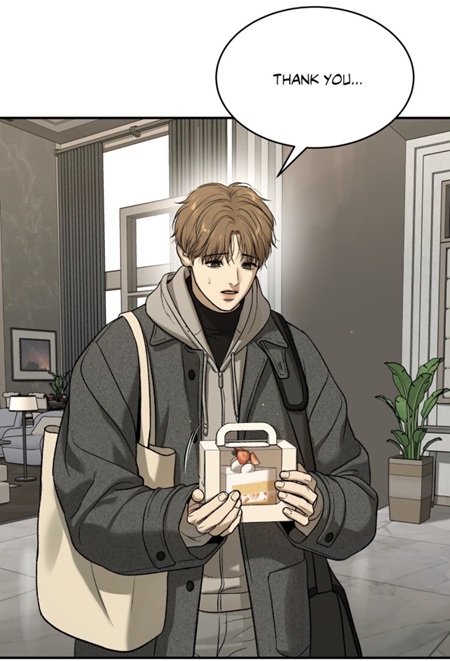 (chapter 100) The cake silently reminds him that the happiness he imagined had not been absurd or impossible. For a brief moment, reality itself had begun moving toward that future. The championship victory happened exactly as expected. Yet the companionship attached to that imagined future never arrived.
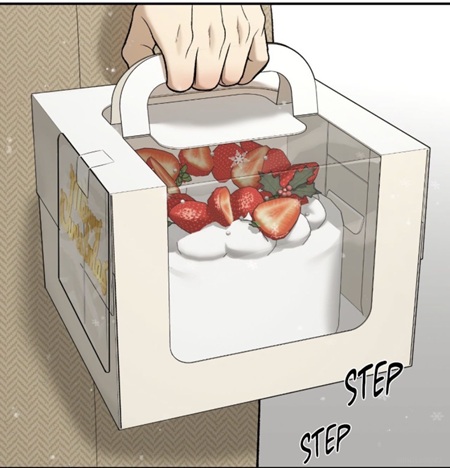 (chapter 97) What remains afterward is no longer the original cake itself, but only a single detached fragment. The large celebratory cake bearing the visible message: “Happy Birthday” disappears entirely.
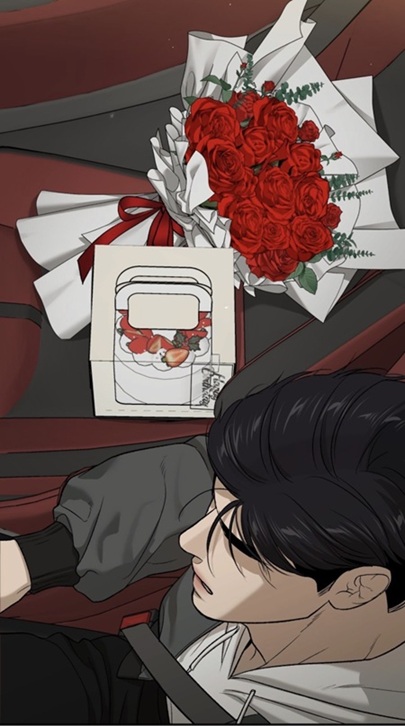 (chapter 97) The original celebratory atmosphere therefore belonged not only to Dan’s imagined future, but also to Jaekyung’s own silent desire to share happiness with him openly. Yet after the stabbing, the birthday itself becomes psychologically unbearable. Kim Dan spent that day unconscious, hospitalized, and hovering near death. Thus by offering only a small piece of cake instead of a full celebratory cake, Jaekyung unconsciously buries the birthday itself.
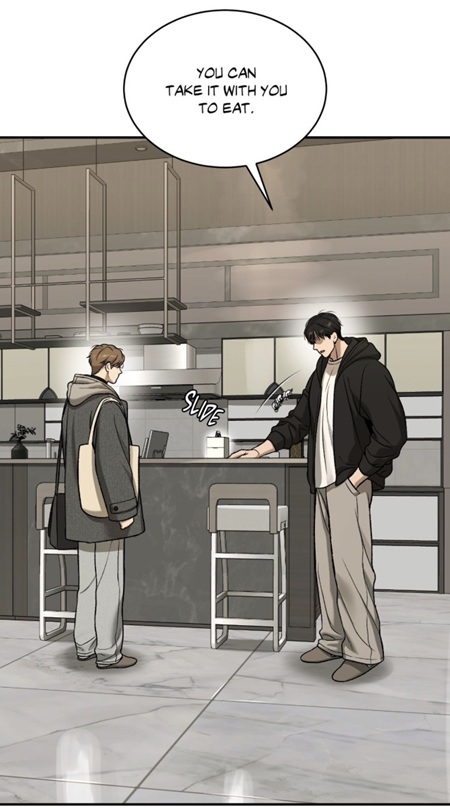
 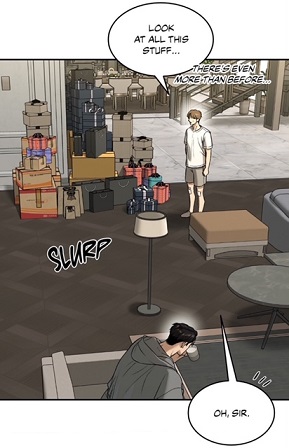 (chapter 45) Birthdays and presents didn’t exist innocently for him before, but now with this new incident, they become psychologically more than ever associated with catastrophe, interruption, and the terror of almost losing Kim Dan forever. The fragment therefore no longer functions as a birthday cake at all. It becomes reduced to something emotionally survivable: a quiet gesture of care stripped of festivity, joy, and openly shared happiness.
 (chapter 100)
  (chapter 97)
 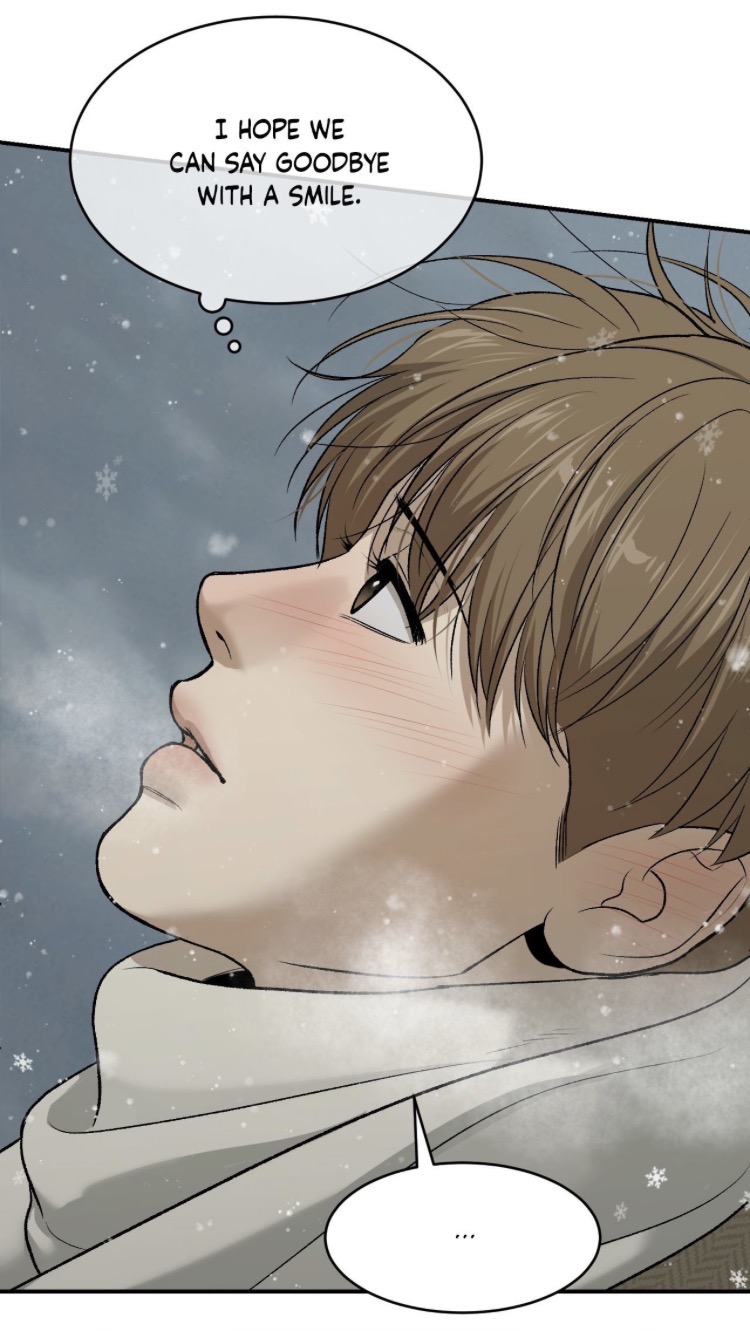 (chapter 97) For a profoundly traumatized psyche, the answer is no. Gratitude is a defensive mechanism designed to restore a transactional balance; it is an acknowledgment of a debt that must be managed. It requires a strict, professional distance to remain safe.
 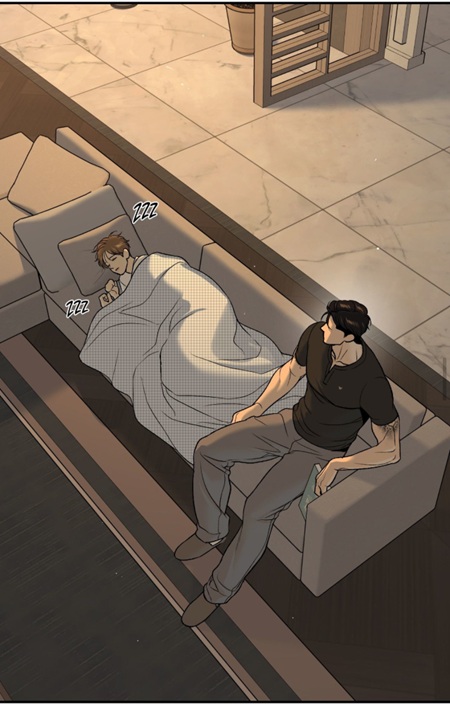 (chapter 81)
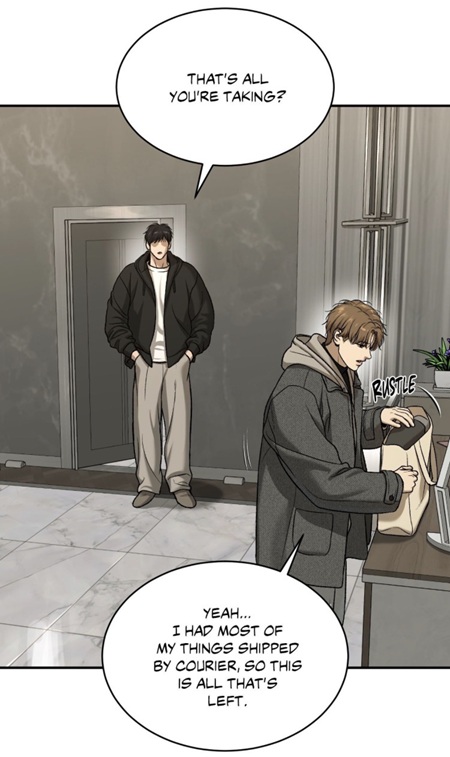 (chapter 100) Dan casually confesses that he had the vast majority of his belongings shipped ahead by a courier service.
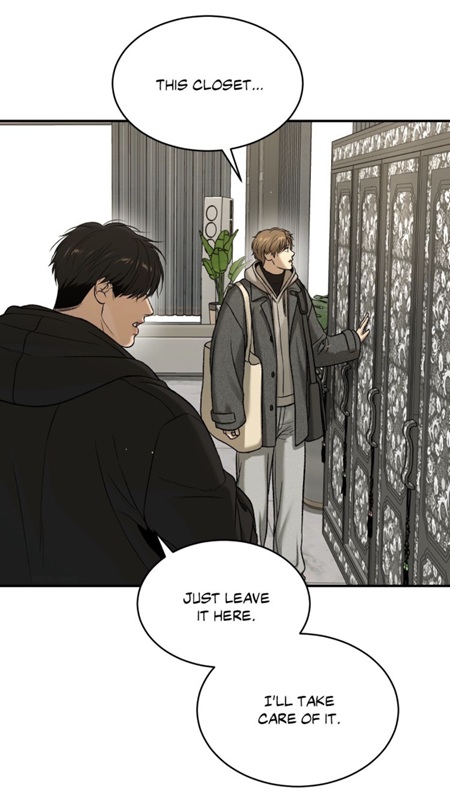 (chapter 100) That’s why each time Mingwa focuses on his facial expressions after each interaction with his lover.
 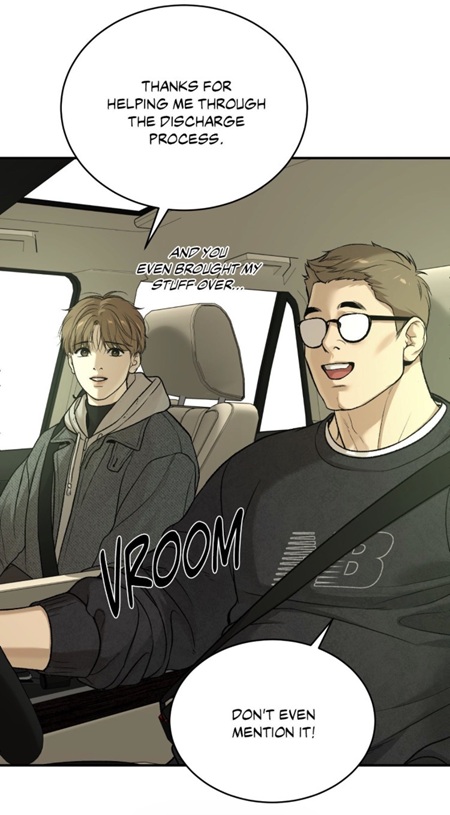 (chapter 100) The manager is the only entity who possesses the logistical knowledge of Dan’s whereabouts and timeline, making the deliberate choice to allow this meeting to occur.
 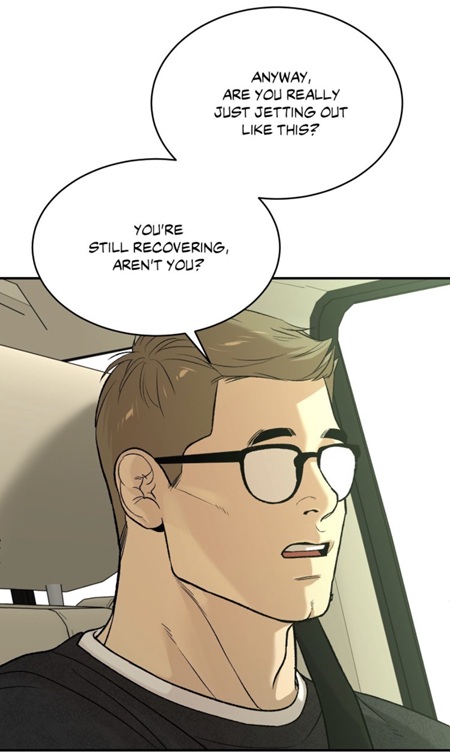 (chapter 100) For Park Namwook, bringing Dan to the penthouse is an attempt to foster a healthy, mature sense of closure between two heavily damaged men. That way, he won’t have to go through the trouble looking for the physical therapist like in episode 56 and Joo Jaekyung can move on.
 (chapter 53) Back then, when Dan believed he was fleeing the penthouse because of his failure and promise to his grandmother, acting under the absolute threat of emotional and professional ruin, his treatment of the cabinet was violent and definitive.
  (chapter 53) He had actively dragged it out of the domestic sphere, casting it out into the sterile, exposed isolation of the public hallway. In Episode 53, throwing the cabinet away was a desperate attempt to sever his connection to the space.
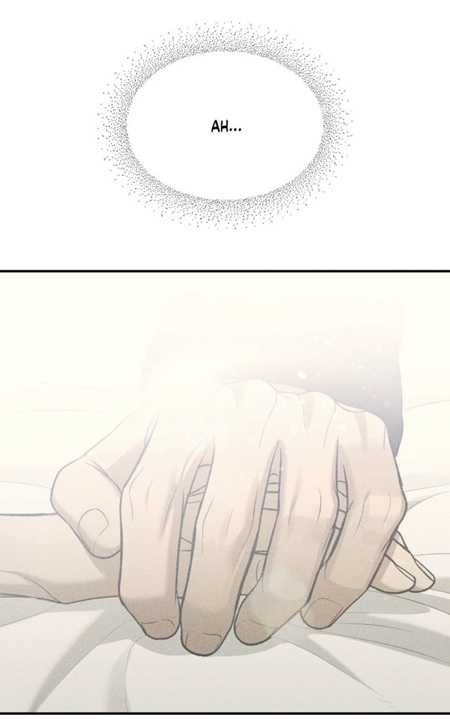 (chapter 100), but that he repeatedly experiences Joo Jaekyung’s genuine presence as something psychologically unreal. Throughout the hospital arc, the champion increasingly resembles a figure existing at the edge of consciousness itself: someone who appears during the night, leaves warmth and traces behind, then disappears again before stable daylight certainty can fully emerge.
 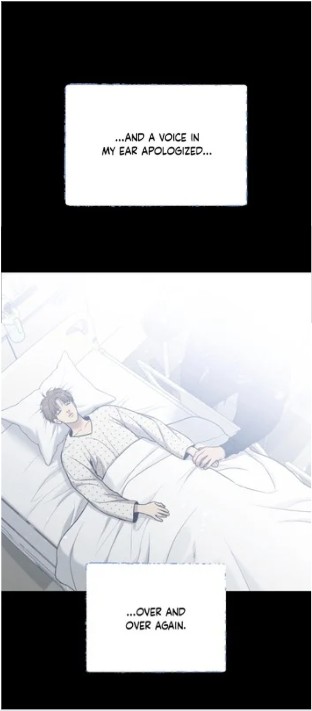 (chapter 100) while Kim Dan drifts between unconsciousness and waking reality. The sequence feels extraordinarily intimate, yet emotionally difficult to grasp. First, Kim Dan quietly concludes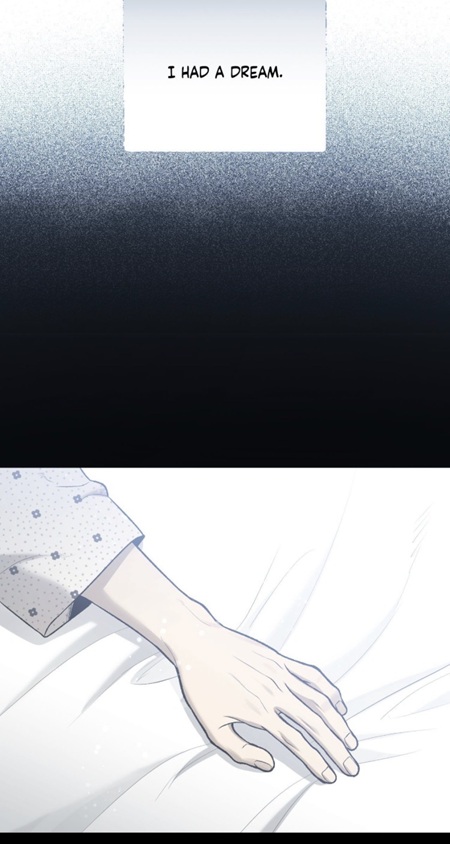
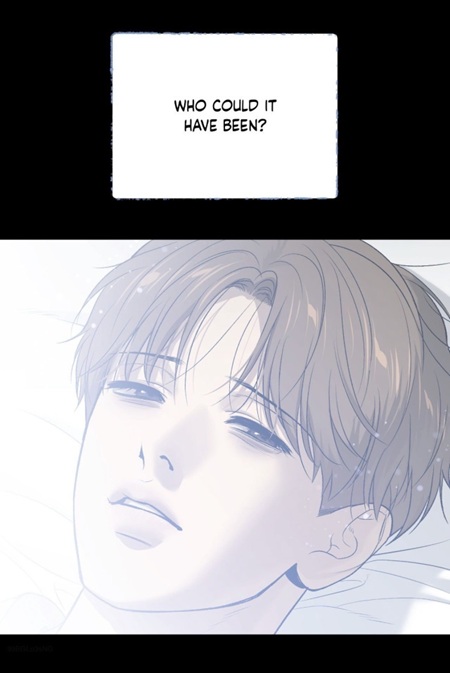 (chapter 100) Part of him wants to move toward reality.
 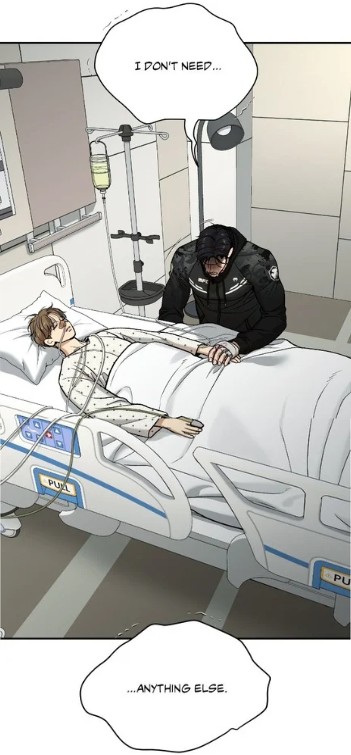 (chapter 99) Joo Jaekyung desperately holding Kim Dan’s hand, begging him to stay awake, refusing to leave his side, and remaining emotionally fixated on him after the stabbing. Because of this continuity, readers instinctively accept the warmth of the hand as emotionally real even while the scene itself remains visually suspended between dream and reality.
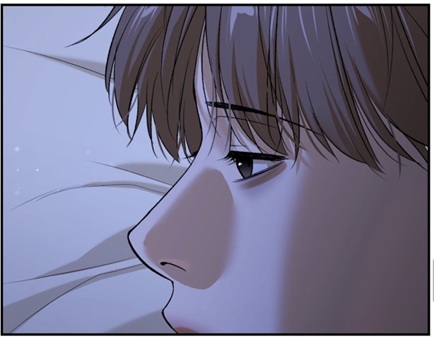 (chapter 100) Here Kim Dan half awakens and perceives Joo Jaekyung lying beside his hospital bed.
 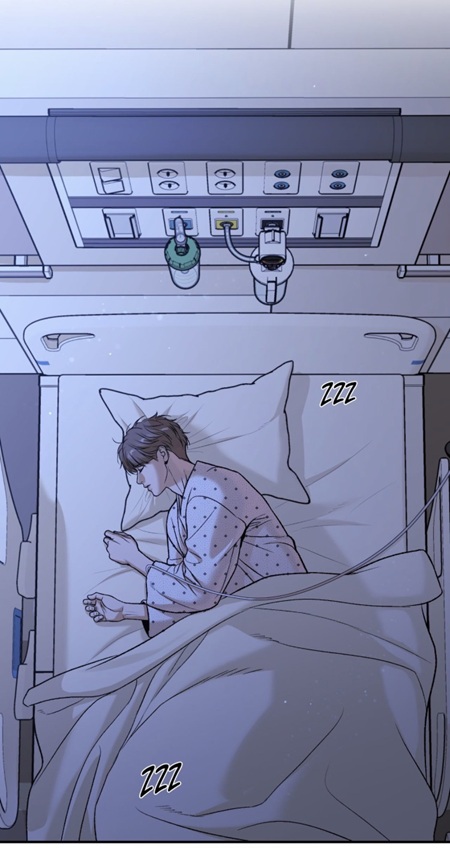 (chapter 100) It creates the illusion that the doctor had been hallucinating. But the sound “TAP” seems to indicate the opposite. Moreover, the narrative cuts toward the lonely hospital room accompanied by the statement:
 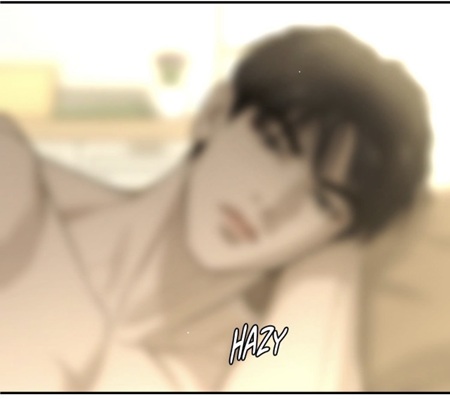 (chapter 87) The champion’s desperate plea to “stay with me”
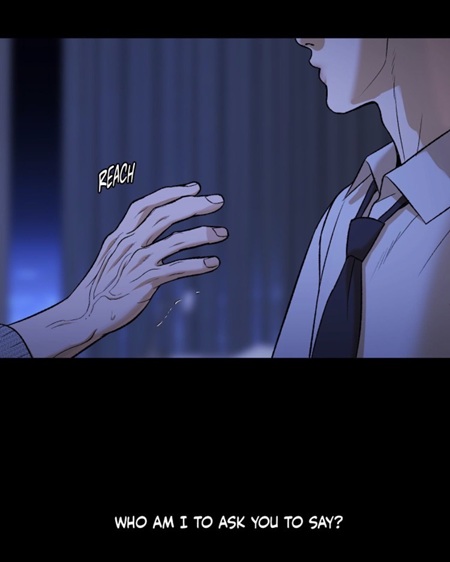 (chapter 90) — and then he pulls his hand back.
 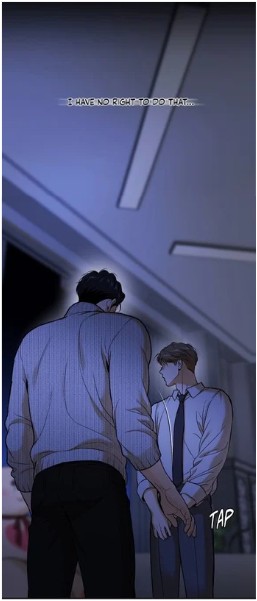 (chapter 90) No words are spoken to stop him. His hand is not even pushed away, like doc Dan did it before.
 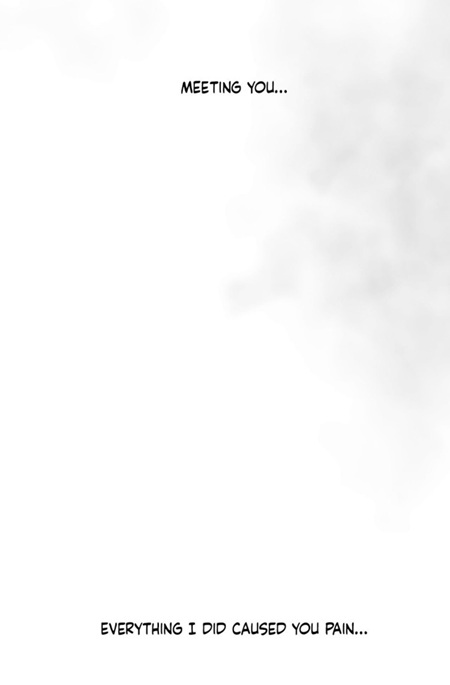 (chapter 90) In his mind, everything that followed the hiring — the money, the contract, the protection, the conflicts — converges back onto him. Faced with this conclusion, he rewrites the past. The good moments lose their weight.
  (chapter 26)
 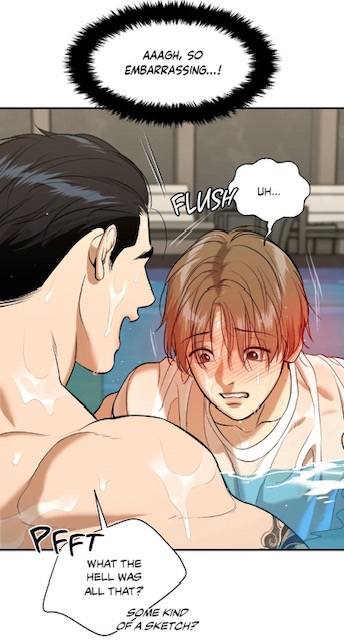 (chapter 27)
 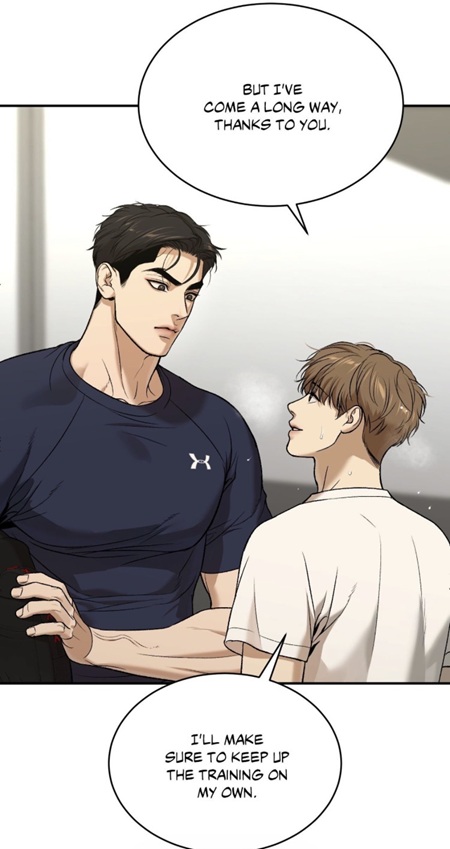 (chapter 88)
 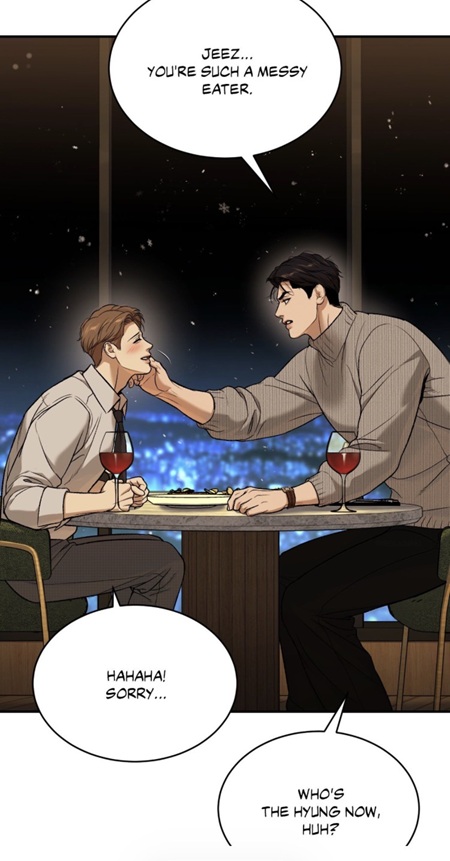 (chapter 89) The help he provided becomes irrelevant. What remains is a single narrative: meeting him caused harm.
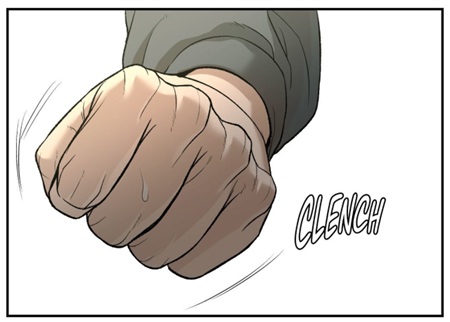
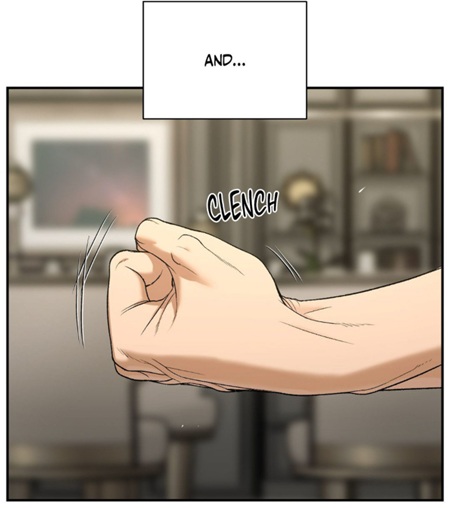 (chapter 61) the clenched fist, when he expressed determination to achieve his goal (bringing back doc Dan or winning a fight).
  (chapter 81)
  (chapter 74), or converting conflict into challenge.
 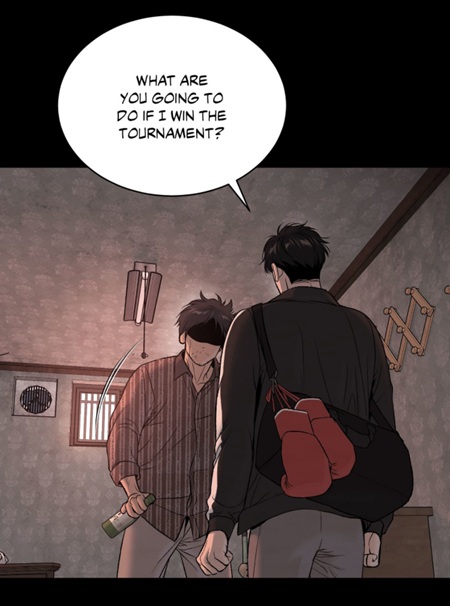 (chapter 73) Fighting was not only his profession; it was his primary mode of being in the world. Here, however, the impulse to fight dissolves.
  (chapter 16) His hand is first crushed. The antagonist targets the very instrument of his livelihood, injuring what allows him to work, to treat, to survive. Only after this act of violence does Kim Dan cling to his aggressor.
 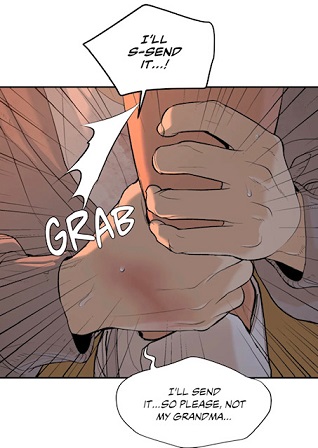 (chapter 16) The grasp that follows is not an invitation, but a reaction to damage already inflicted. Resistance has been broken through the body before appeal becomes possible. It symbolizes submission, exactly like in the penthouse.
 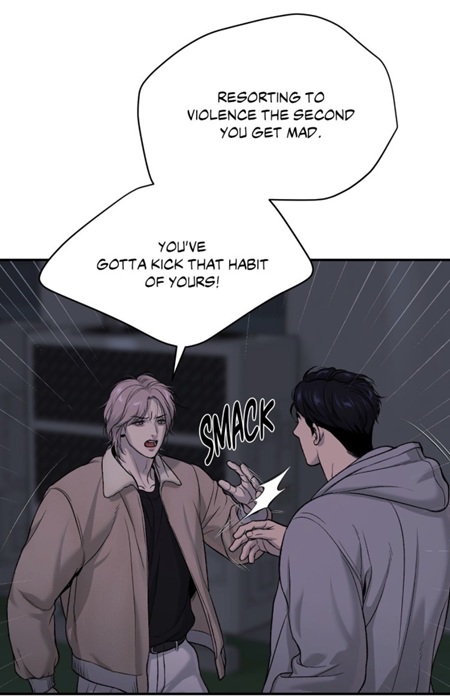 (chapter 89), unlovability, moral contamination
 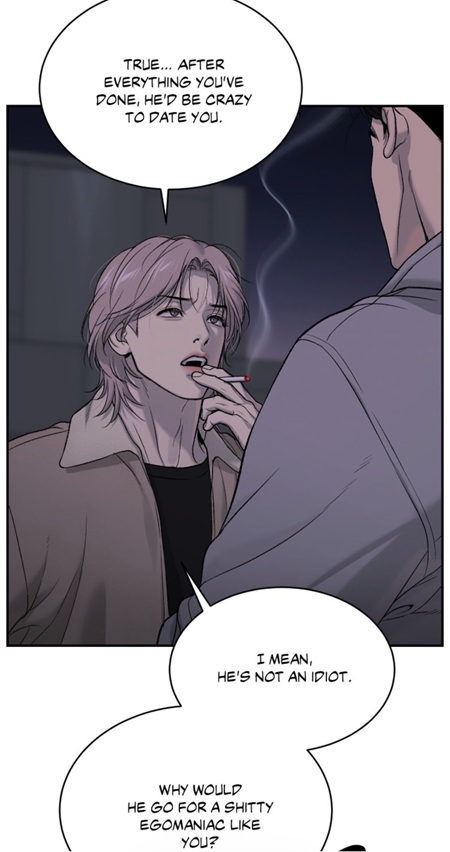 (chapter 89) — do not introduce a foreign judgment. They articulate what Joo Jaekyung already believes about himself.
 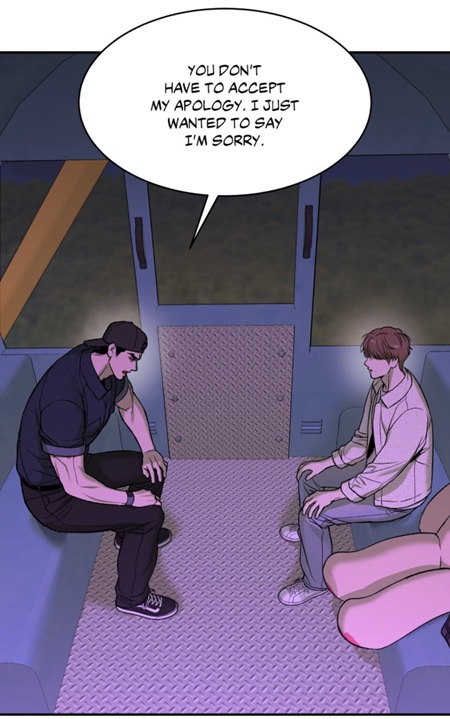 (chapter 84) Deep down, he thinks that he can not be forgiven and even loved. This is precisely why they take hold. Spoken aloud, they acquire the authority of truth. Once internalized, they no longer need to be repeated.
 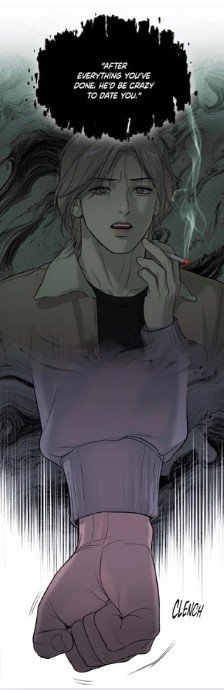 (chapter 89) The panel does not show Heesung speaking again; it shows Joo Jaekyung’s clenched fist, isolated, rigid, suspended in recollection. This is not the fist of imminent action. It does not precede a strike. It does not convert pain into confrontation. Instead, it freezes.
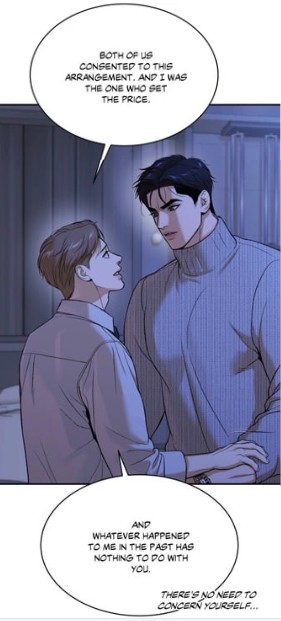 , (chapter 90) offering reassurance. That attempt failed, not because Kim Dan lacked care, but because reassurance can only reach someone who is still willing to fight for their place. Joo Jaekyung is no longer asking how to endure. He is asking whether he should exist in this space at all.
 (chapter 65), and Heesung who dismissed his agency
 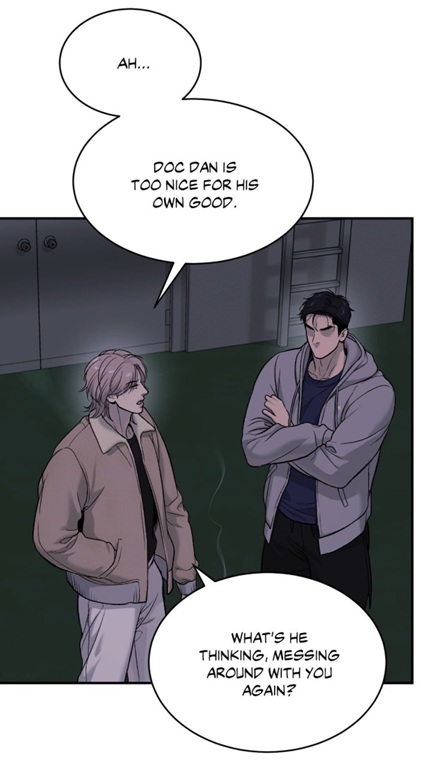 (chapter 89) under the guise of concern.
 (chapter 65), but denied in structure.
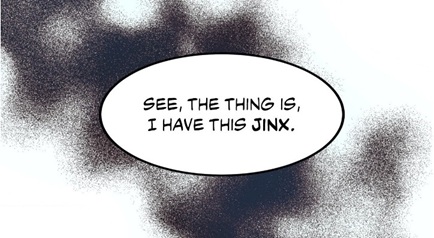 (chapter 2), an external curse that followed his steps. Here, that distinction collapses. He no longer experiences the jinx as an event or condition, but as an identity. He does not fear what might happen because of him; he accepts that he himself is what causes harm. The curse is no longer something he carries. It is something he has become. Once internalized in this way, it no longer requires rituals to contain it.
  (chapter 75) Practices that once functioned as talismans—gestures meant to ward off misfortune or secure victory—lose their meaning.
  (chapter 75) What collapses is not only belief in luck, but belief in the necessity of striving at all.
 8episode 10), Kim Dan wakes up there after drinking excessively, confused why he is sleeping in the penthouse. He doesn’t know that the night before in his drunkenness, his thoughts were turning toward his grandmother. He was mistaking the athlete for his relative.
  (chapter 10) He feared getting abandoned. When the doctor realized his whereabouts, he imagined that he had sex with the champion. As you can see, the bedroom is strongly intertwined with longing and sin, where consciousness returns only after collapse. This association deepens in episode 20, when sexual intimacy is immediately followed by a phone call announcing his grandmother’s critical condition.
 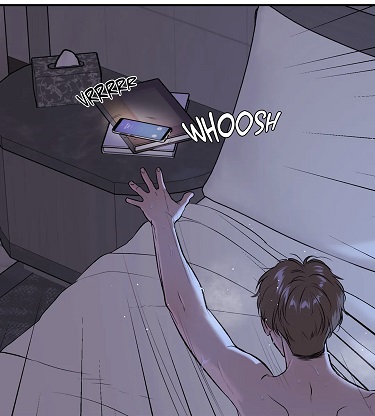 (chapter 20) Pleasure and threat coexist in the same space, binding the room to the anticipation of loss.
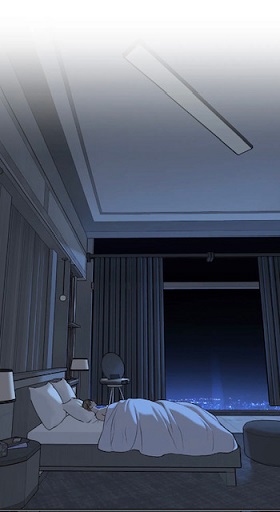 (chapter 29), his body once again giving way under accumulated strain. The room is no longer merely where exhaustion manifests; it is where it becomes undeniable. In episode 61, the association shifts again: Joo Jaekyung comes to the room seeking sex, but Kim Dan is unwell, unable to voice his own thoughts, unable to refuse.
 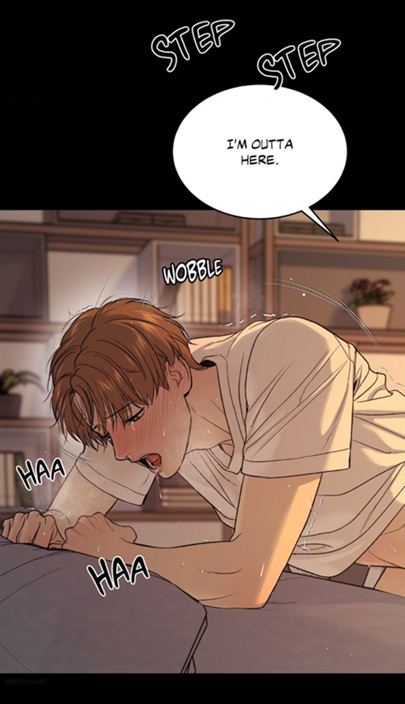 (chapter 61) Illness interrupts desire, and the room marks the moment where agency falters.
 (chapter 79). Once more, it is this room that frames the danger.
 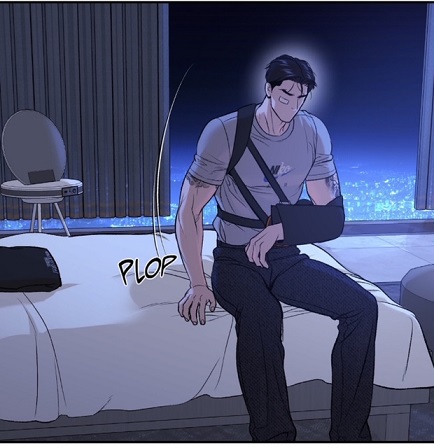 (chapter 53) The object becomes a trace of absence, and the room transforms into a container of loss. Standing by the window, Joo Jaekyung is portrayed without eyes.
  (chapter 53) The visual choice is crucial: it does not indicate blindness in a literal sense, but an inability to see forward, to orient himself. He is present in the room, but detached from direction and purpose. This scene announces the falling apart of the athlete.
 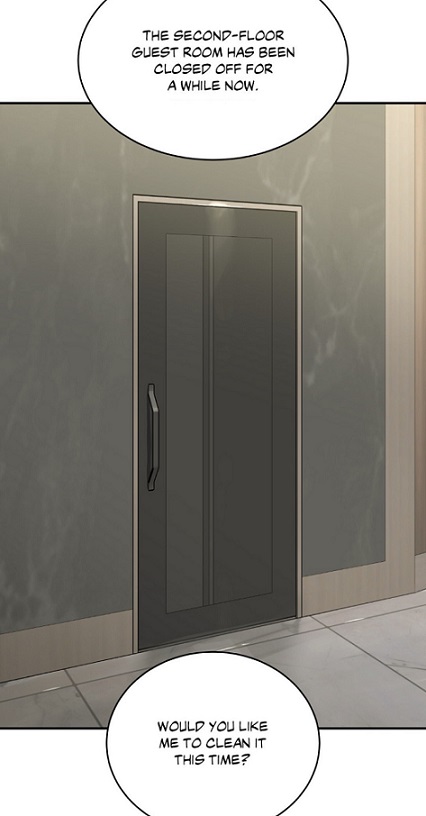 (chapter 55) The space is sealed off, preserved, treated almost as a forbidden zone. The cleaning staff is not allowed to enter. Nothing is moved, corrected, or neutralized. The room becomes a reliquary rather than a dwelling — a place frozen in the moment of loss. Joo Jaekyung does not confront what happened there; he keeps it intact, untouched, and therefore unresolved. At the same time, he imagines that avoiding that place will help him to forget doc Dan’s gaze and face.
 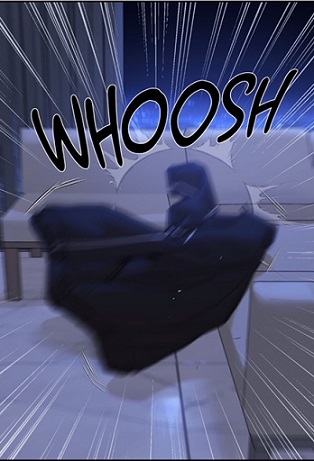 (chapter 53)
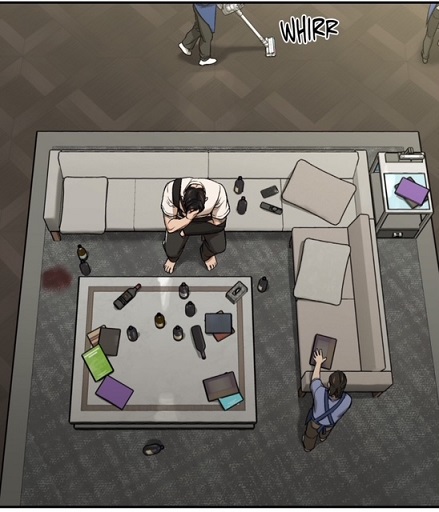
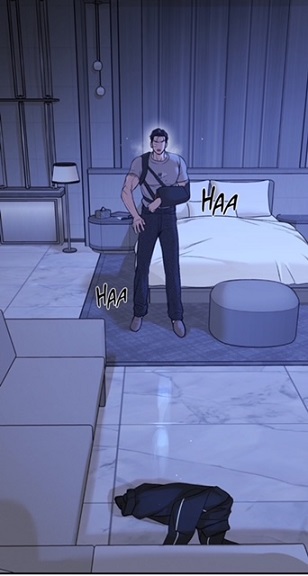 (chapter 53) In episode 54, wine bottles begin to accumulate beside the couch
 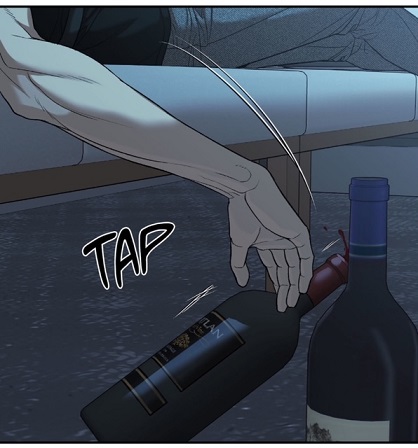 (chapter 54) in his own bedroom leaving a huge red wine stain on the carpet.
  (chapter 55) And in episode 90, the teddy bear now rests on the couch in Kim Dan’s room
 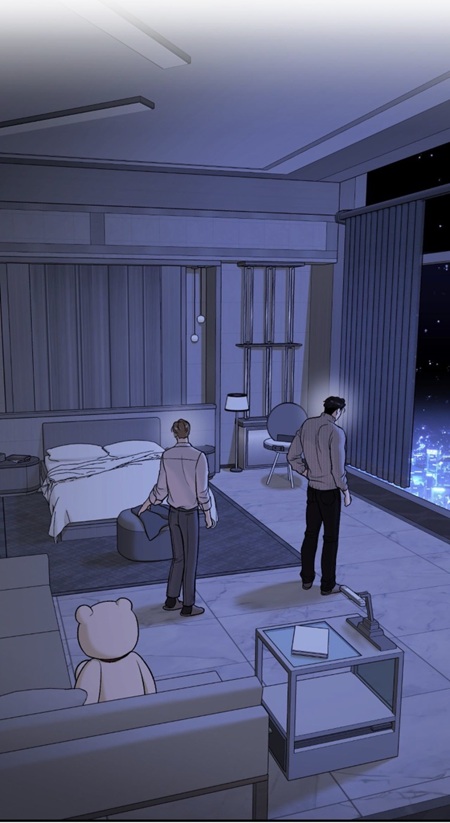 (chapter 90) — occupying the very place toward which the jacket once flew. Across these scenes, the hand and couch emerge as a recurring site of impact, exhaustion, and surrender. It is where bodies fall, where frustration lands, where the weight of what cannot be said is deposited. One detail caught my attention: because they are not sitting on the couch, the main leads are discussing together. They are able to face each other and as such to listen to each other.
 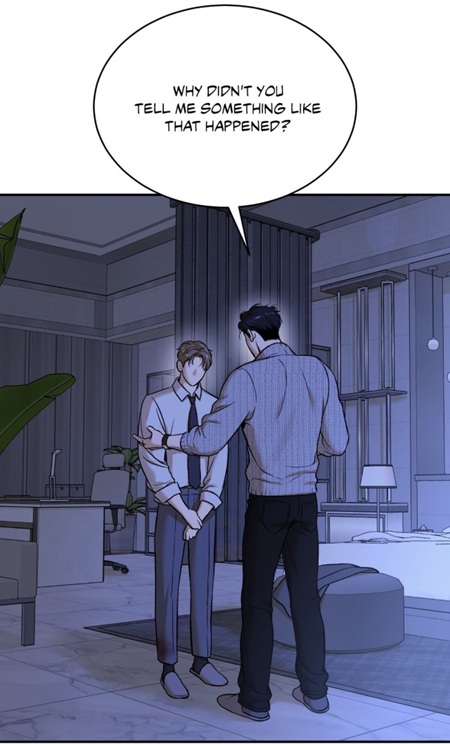 (chapter 90) Their respective position in this room reminded me of their previous arguments.
 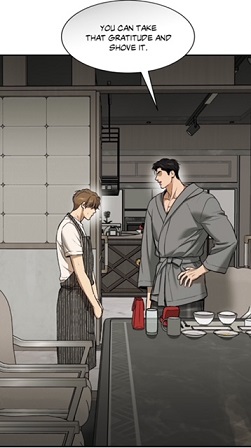 (chapter 45)
  (chapter 51)
 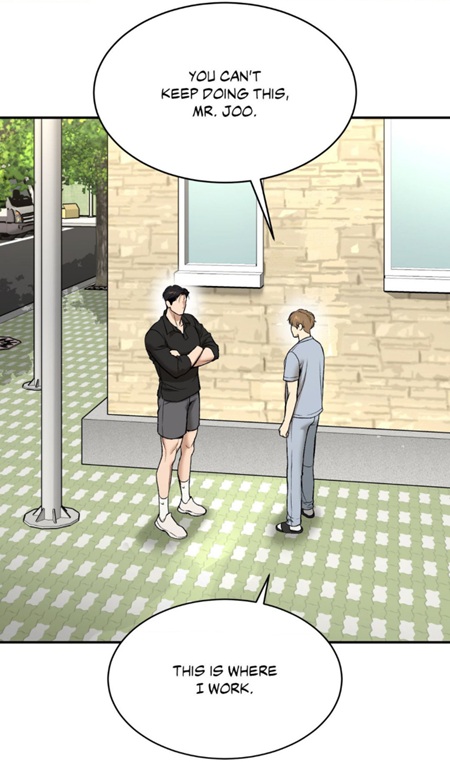 (chapter 61)
 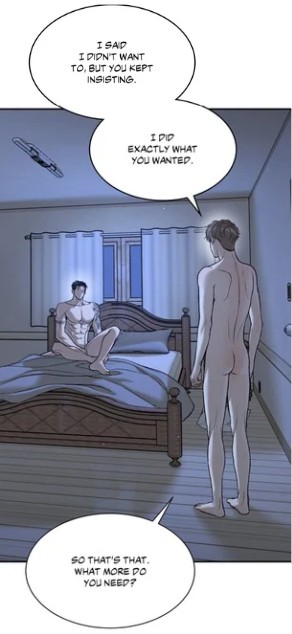 (chapter 64) Only when they would truly face each other, they would be more honest and expose their thoughts and emotions. As soon as there is a table, a bed or a couch, I detected some restrain and silence. In other words, the presence of the teddy bear and the couch in that scene explains why Kim Dan is silent and passive after their conversation. He is definitely remembering the day and conversation at the amusement park.
 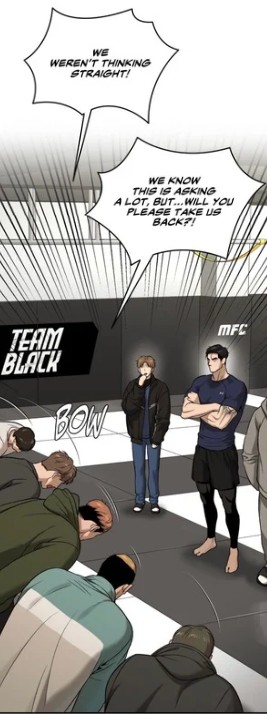 (chapter 88) On the other hand, it is about time that doc Dan becomes proactive so that they finally become a real team.
 (chapter 79) for everything. He was to blame for everything.
 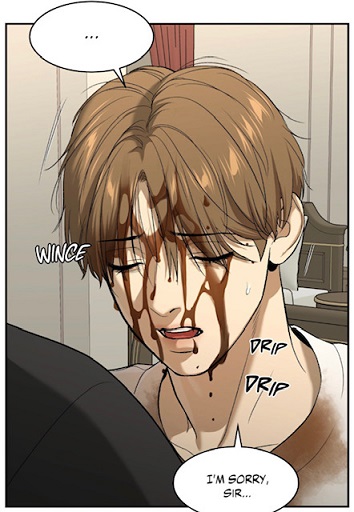 (chapter 37) He endured before being asked. He accepted harm as a condition of acceptance and staying. His silence was not passivity, but a learned ethics: if I ask for less, if I take up less space, if I disappear when necessary, others, in particular his grandmother, might be spared.
 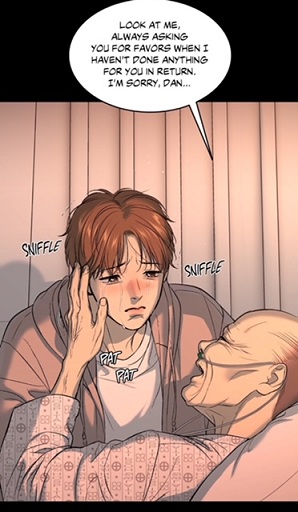 (chapter 53) That posture did not originate with Joo Jaekyung. It preceded him. It was shaped by debt, obligation, omission, and by figures who decided on Kim Dan’s behalf what he could endure and what he deserved.
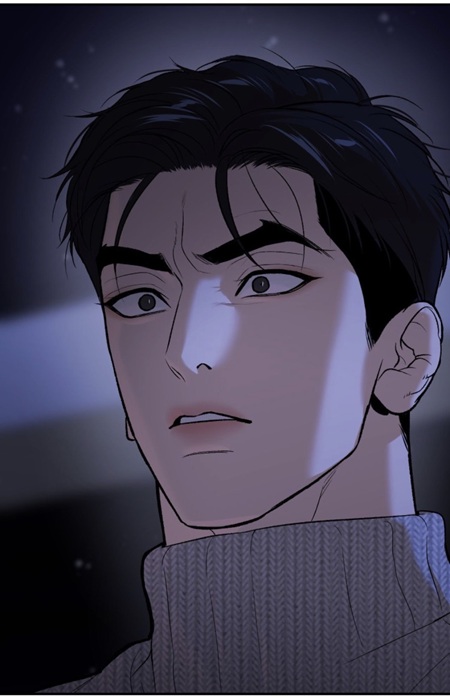 (chapter 90) He does not argue. He does not demand. Instead, he blames himself for everything, thus he withdraws. He refuses to claim a right. He positions himself as the problem that must be removed so that something better might follow.
 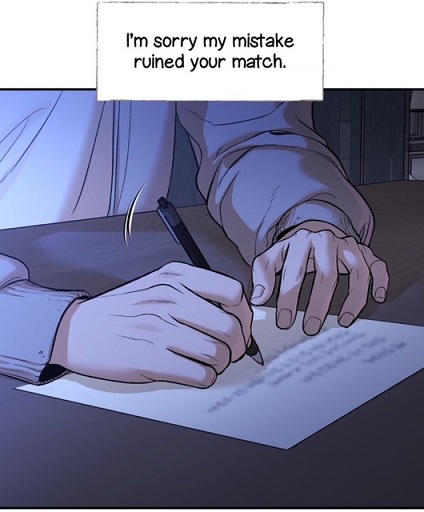 (chapter 53) This is the same moral calculus Kim Dan once applied to himself: the belief that care becomes ethical only when it is accompanied by sacrifice, and that love, if it exists at all, must be proven through disappearance. The only difference is that he can not apologize as his existence has become the synonym of wrongdoing. Thus Kim Dan can not hear the distress from his “loved one”.
 (chapter 74) He remains upright. His posture holds. Yet, he is now voiceless exactly like the physical therapist in the past. From the outside, he still appears powerful, but the loss of cry or sound indicates loss of agency and choice. But structurally, the positions have reversed. The one who once endured now asserts authorship over his choices.
 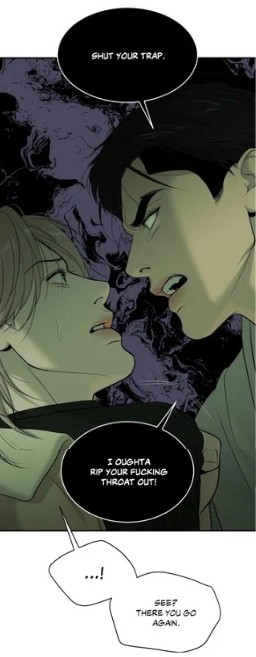 (chapter 89) and the green-haired man
  (chapter 42) operate through the same mechanism: they reduce complexity into a single verdict. Like false mirrors, they collapse months into moments, gestures into essence, and relationships into accusations. They speak as if they own the truth — not because they see clearly, but because jealousy and greed demand certainty. Hence they are connected to the color green. Their words are not reflective
 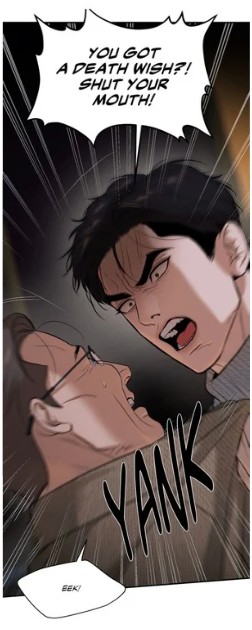 (chapter 90) — not because he shares it, but because the mirror he has become reveals it. Yet instead of recognizing this capacity as ethical clarity, he mistakes it for contamination. He equates himself with the very figures whose cruelty is laid bare in his presence. However, he is making a huge mistake, he is accepting this projection forgetting that he had it all wrong for one reason:
 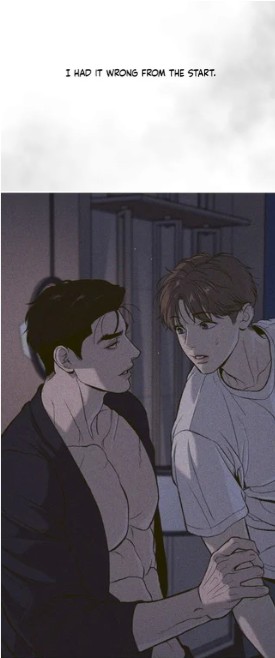 (chapter 90) During their first meeting, the “hamster” had grabbed his “anaconda”.
 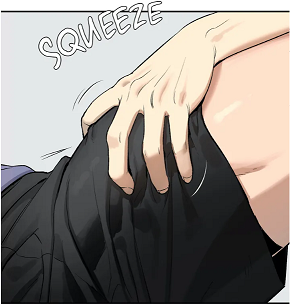 (chapter 1) Such a gesture could be interpreted as a seduction, and don’t forget that the previous physical therapist had rubbed him the wrong way:
  (chapter 1) Finally, observe that after this incident, Joo Jaekyung was looking at the embarrassed doc Dan
 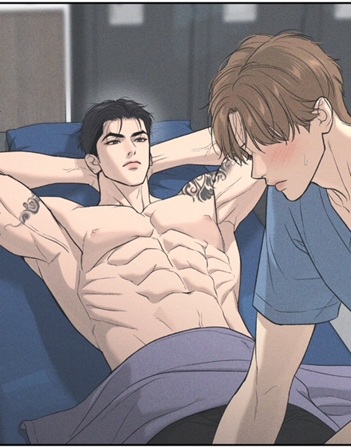 (chapter 56) and thinking that they could have fun together in bed.
  (chapter 56) So doc Dan has his share of responsibility in the champion’s misjudgment.
  (chapter 84) This gesture symbolized their reconciliation in the end,
  (chapter 84) the return of trust and faith in the “champion”. What Joo Jaekyung mirrors is not who the doctor is now, but who he once had to be in order to survive. The tragedy lies precisely there: the champion adopts a posture the doctor has already outgrown thanks to him.
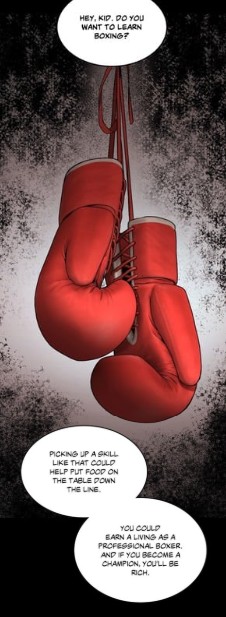 (chapter 72), the reality was that he longed for a home, which he came to associate with his mother. Thus over the phone, he promised to become strong
  (chapter 72) and earn a lot of money so that his mother could return home. As you can see, fighting was strongly intertwined with his mother and his longing for a family.
  (chapter 72), as if the boy’s role was to validate the father’s existence. Joo Jaewoong does not ask his son what he wants
  (chapter 73); he mocks his ambition
  (chapter 73) and reduces his dream to delusion. Yet even in conflict, Joo Jaekyung seeks recognition.
 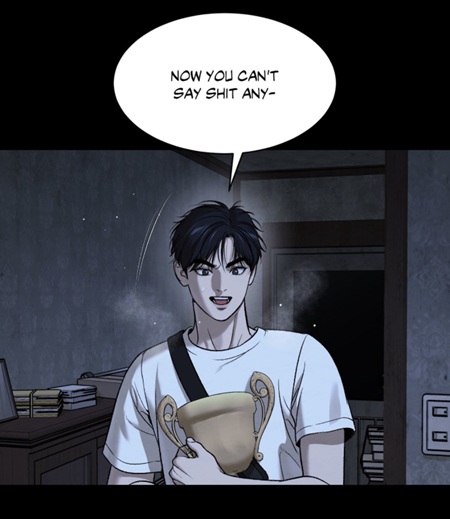 (chapter 73) As you can see, his life is always focused on the future, on one goal and as such one person: the mother, then the father.
  (chapter 74) He warns against becoming like the father, to change for the sake of his own mother
  (chapter 74), not by encouraging freedom, but by replacing one obligation with another: win, endure, don’t disgrace the dead. Many years later, he encourages him to change his mind-set, because he could end up alone.
 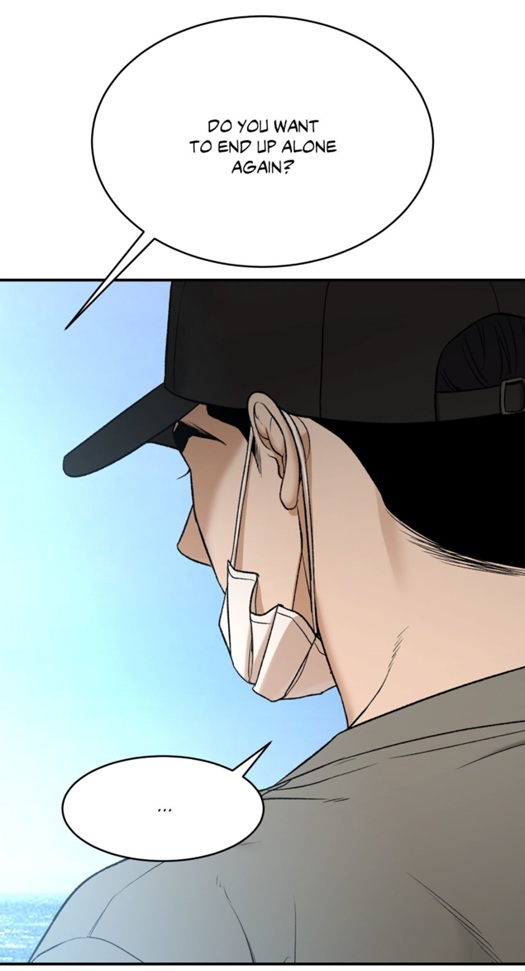 (chapter 75) For the first time, it is no longer about winning or enduring.
 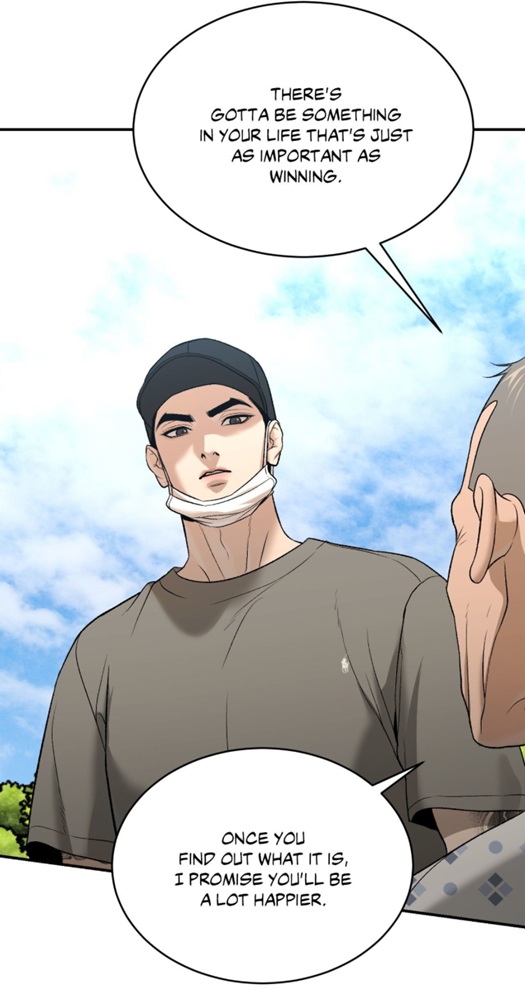 (chapter 75) However, observe how the main lead reacts to this well-meant advice:
  (chapter 75) He starts visualizing Doc Dan as his goal. It is once again focused on one person and future-oriented.
 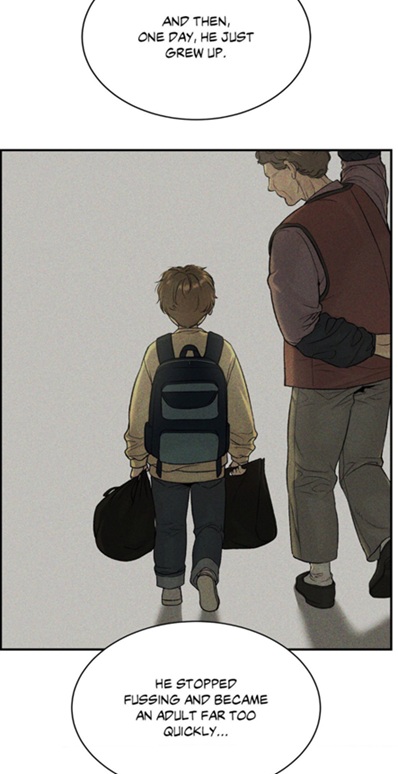 (chapter 65) He suppresses desire, health, and rest for her sake. The moral lesson is identical: if your presence risks harm, reduce yourself; if your absence protects others, endure it.
 (chapter 65), because she did the same in the past with doc Dan:
 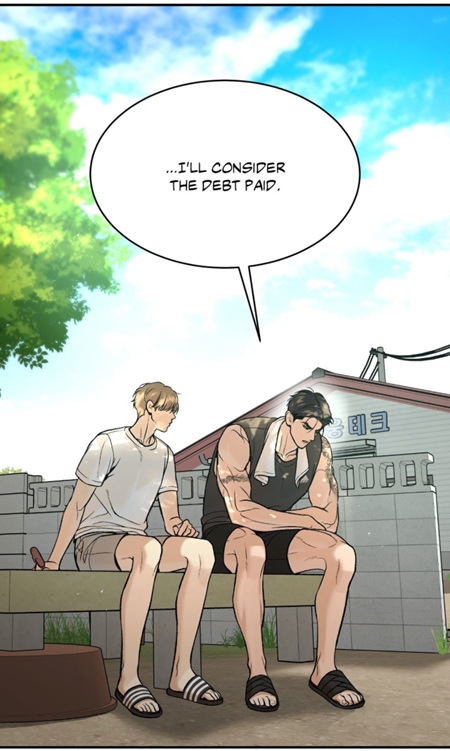 (Chapter 77) This means, the debts bring the terrible mind-set to the surface.
 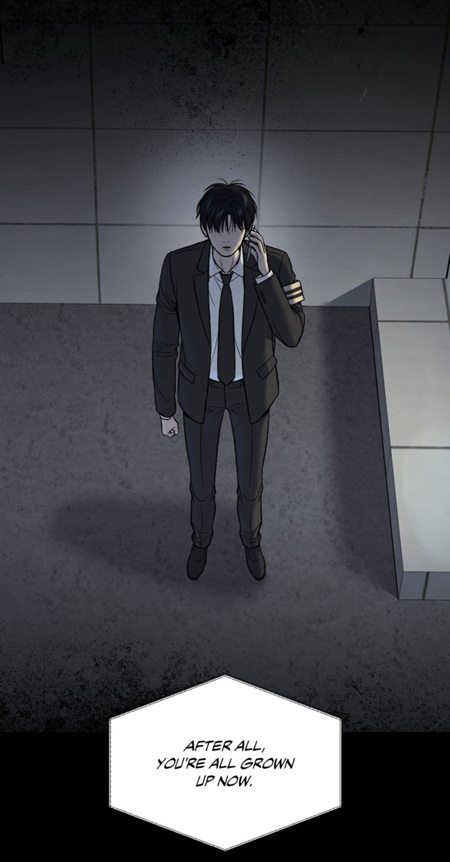 (chapter 74) The latter justifies her betrayal by saying that he is too late, as he is already too old. The promise that sustained him collapses. Winning no longer guarantees return. The future he fought for vanishes. And in the penthouse, we have the same thought again:
 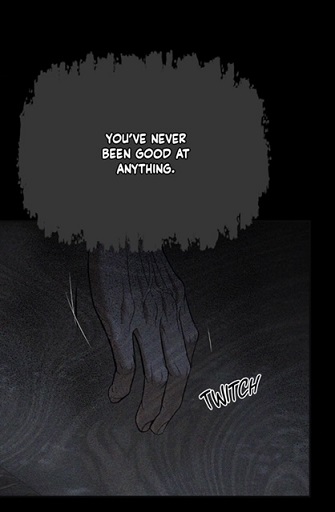 (chapter 54) — longstanding, cumulative, and corrosive.
 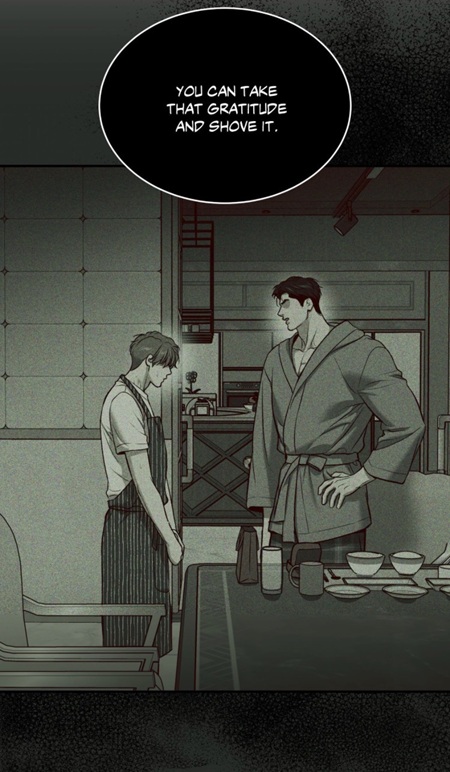 (chapter 90) And these two “friends” return during that night. What inhabits the room in episode 90 is not nostalgia, nor an unprocessed sadness that merely needs to be named. The same shame that has structured his life since childhood resurfaces here, stripped of all justifications. Joo Jaekyung is not suffering because he feels abandoned in the present. He is suffering because he believes himself to be the reason others leave.
 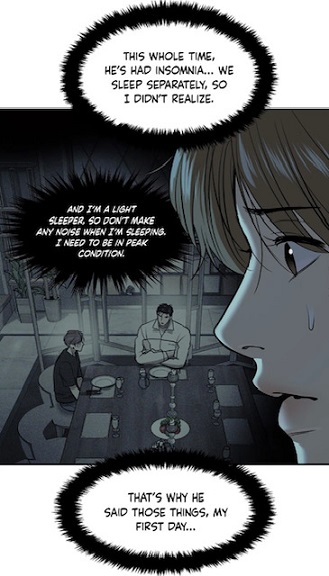 (chapter 29) He cannot sleep. He cannot relax. His body remains permanently alert because, in his words, he could “be killed” at any moment.
  (chapter 29) For him, this is not a symptom. It is simply part of being a fighter. Insomnia is normalized, rationalized, and dismissed as a professional hazard. Yet his listener immediately senses otherwise.
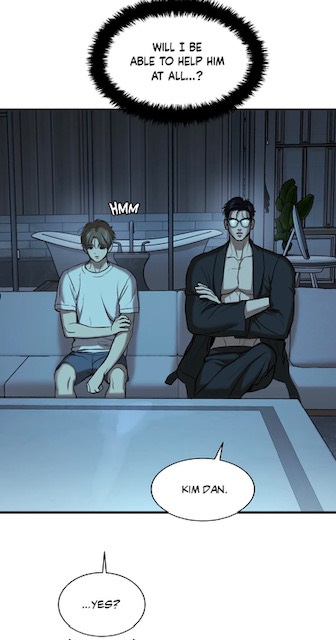 (chapter 29) He understands that this state is unsustainable — that it is only a matter of time before something gives way. What Joo Jaekyung treats as discipline, Kim Dan recognizes as danger.
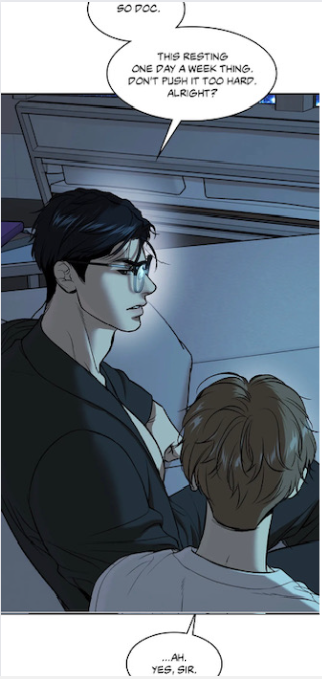
 (chapter 90) But that explanation is insufficient. What actually begins after is grief and recognition.
 (chapter 54) Now the logic sharpens: Kim Dan does not merely embody bad luck. He embodies the champion’s mental state — depression, trauma, and chronic self-devaluation. He becomes the surface onto which Joo Jaekyung’s inner instability is projected.
 (chapter 29) And now, in episode 90, Jinx-philes can sense that the athlete is wearing the glasses “depressive realism” once again, where everything seems so true. He recalls all his misdeeds and can only perceive himself as the source of unhappiness for doc Dan. And like mentioned above, during that night, he is just only recalling his wrongdoings. He is overlooking that thanks to him, Doc Dan’s mental and physical conditions
 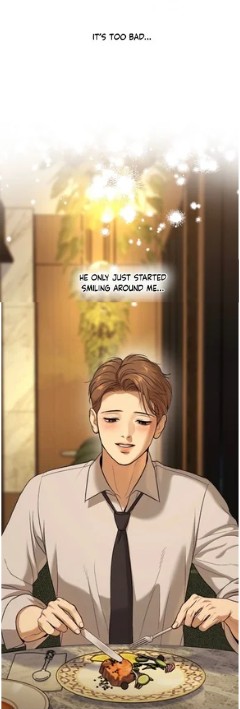 (chapter 89) improved, that he could make doc Dan smile. Meeting the hospital director made him see everything in a bad light. As you can see, he still has a black and white mentality. However, the truth is that right from the start, the champion had not just been a terrible person. He could be generous, help someone in need.
  (chapter 17) He saved doc Dan’s life twice.
  (chapter 59) He is reducing everything to one single moment and emotion: pain. And his reasoning is resembling a lot to the grandmother‘s:
  (chapter 65)
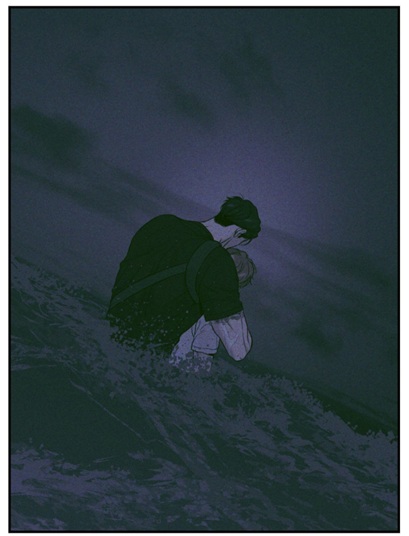
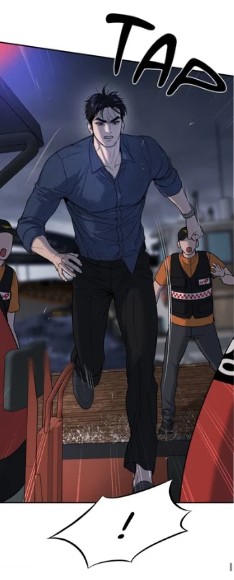 , when Joo Jaekyung imagines that doc Dan has once again fallen into the ocean and fears to lose him.
  (chapter 79) gestures toward falling, both physically and psychologically.
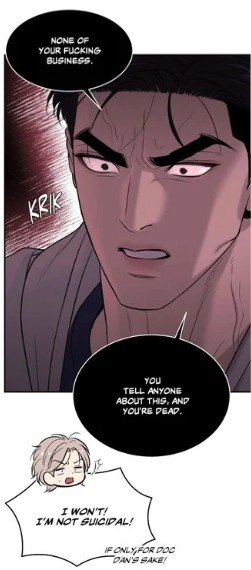 (chapter 89) Secondly, he is the only one referring to mental illness:
 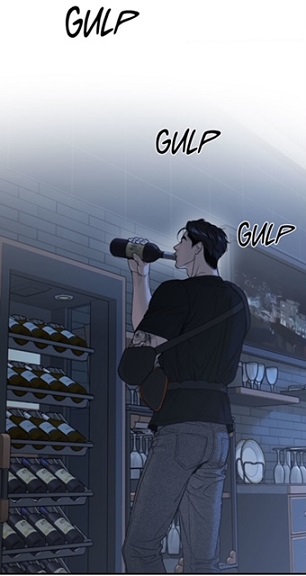 (chapter 54)
 (chapter 78) Now, he is blaming himself for everything — and the narrative quietly aligns him with the same numbers, the same silences, the same logic of disappearance.
 (chapter 54), while he tells the opposite to his partner.
  (chapter 80) Secondly, he doesn’t know how the champion was blamed for everything and was treated by the other members of Team Black:
  (chapter 52) No one listened to his unwell-being, they rather silenced him. They showed no support and didn’t take care of him. Thus later the athlete started drinking. The physical therapist has no idea what Potato heard either:
  (chapter 52) At the same time, I am suspecting that Mingwa is putting doc Dan in a similar situation than in the past, so that repressed memories about the parents will come to the surface. Keep in mind that the athlete is actually mirroring the parents’ behavior (abandonment and sacrifice as a sign of love and respect). Thus the teddy bear is placed on the couch and the physical therapist is looking at it.
  (chapter 21) A teddy bear was present in his childhood, until it vanished.
 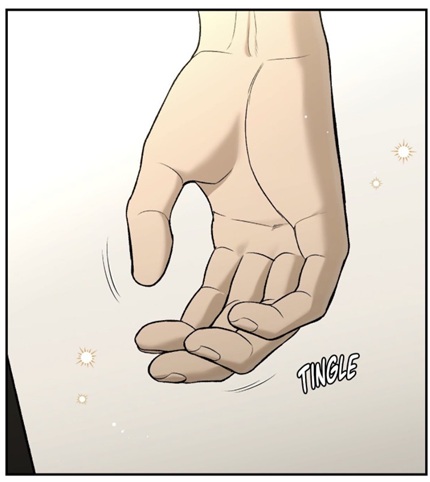 (chapter 87)

 (chapter 87)
  (chapter 87) The intimacy of the gesture
  (chapter 87) and an entire match took place, readers were largely talking about the introduction alone. 그나저나 이번화 나름 ㅂㅈㅁ도 나오고 경기도 했는데 다들 맨앞 도입부만 얘기하셔서 너무나 커엽군요,, (손잡았어 웅성웅성) Mimicking the collective reaction with a playful “They held hands!”, she described this selective focus as 커엽군요—not reproachful, but gently teasing.
 (chapter 84) and the progression of their relationship, attuning readers to intimacy
 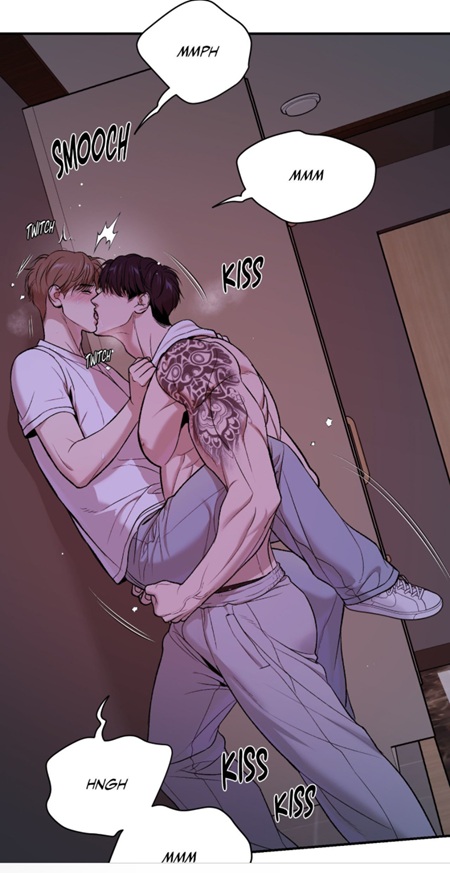 (chapter 85), care, and emotional release. When the chapter opens with a tactile, reassuring gesture, it naturally confirms that reading mode. The squeeze feels like a culmination.
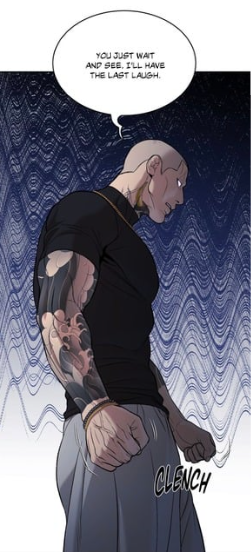 (chapter 87), where a very different gesture unfolds.
 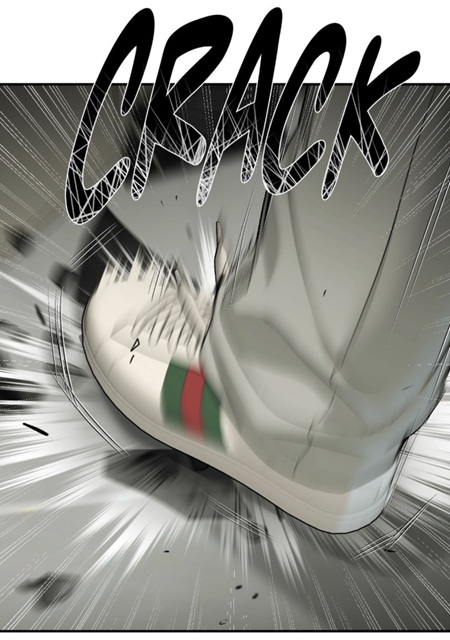 (chapter 87) There, Baek Junmin rejects restraint, pushes away guidance, and verbalizes a resolve shaped not by trust or release, but by anger and revenge.
  (chapter 87) This sentence marks a limit. It is not indifference, but acceptance. The champion has just registered the doctor’s surprise
  (chapter 87) — the slight jolt, the hesitation—and he responds by stopping. The restraint is not automatic; it is chosen. He does not ask for more reassurance, more certainty, or more support, even though he clearly desires it. Instead, he recognizes sufficiency.
 (chapter 87) So the doctor’s support was indeed limited in time. So the stop of the champion ‘s squeeze
 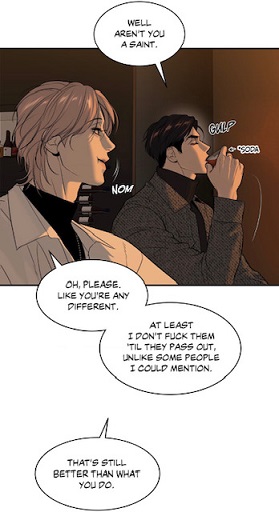 (chapter 33) Humbleness here
 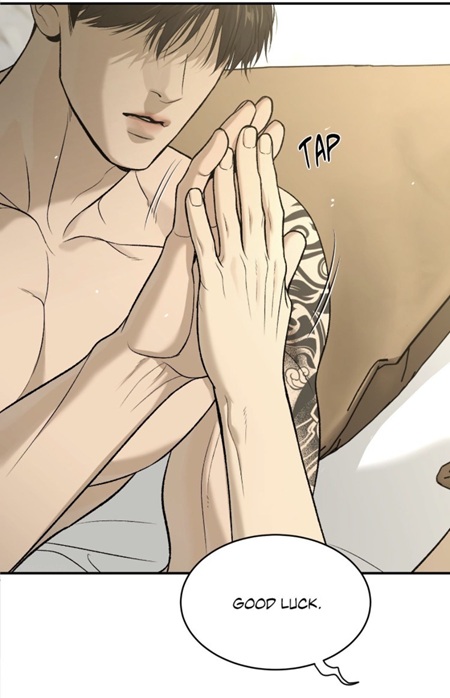 (chapter 87) Nothing mediates the gesture. There is no object, no talisman, no substitute. Meaning is produced entirely through contact.
 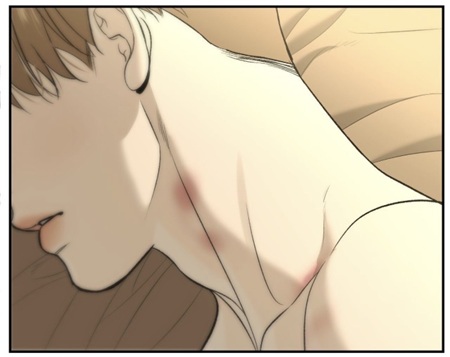 (chapter 87) The opening scene unfolds in a space that feels inhabited and shared, composed in softer shades that emphasize stillness and presence. The final scene is colder, darker, sharper.
  (chapter 87) Motion replaces quiet. An object enters the frame, absorbing force and redirecting it away from human contact. Where the first scene restores continuity—between bodies, between effort and outcome, between present and future
  (chapter 87) —the second collapses time inward. Baek Junmin does not act toward what is coming; he reacts toward what has already been. His violence is not exploratory but recursive.
  (chapter 87) It invokes the past as a template, attempting to reinstate an earlier hierarchy in which domination was secure and uncontested.
 (chapter 87)—the very surface on which images circulate, words are fixed, and visibility is regulated. The screen does not reveal truth; it organizes perception. It is where victories are staged, reputations stabilized
 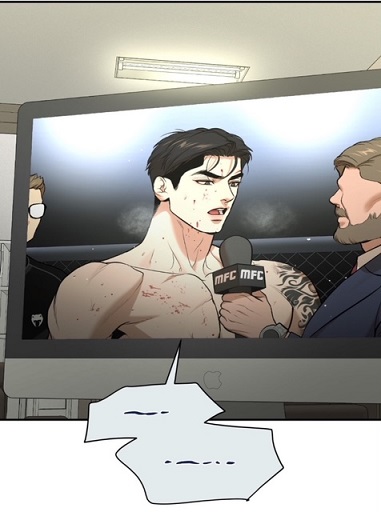 (chapter 46), and statements acquire permanence through broadcast.
 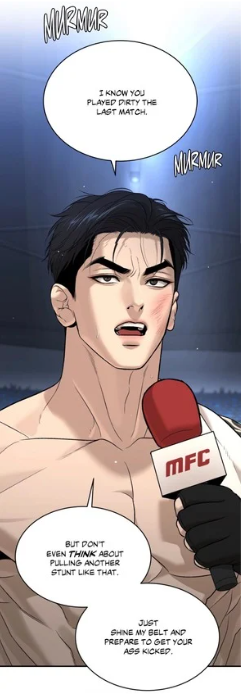 (chapter 87)
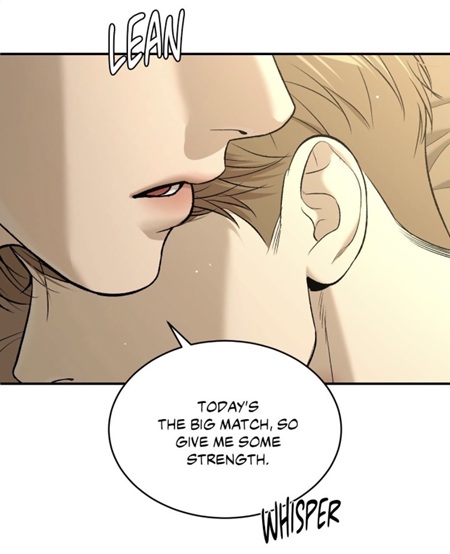 (chapter 87), then the pause; then Kim Dan’s tentative tap
 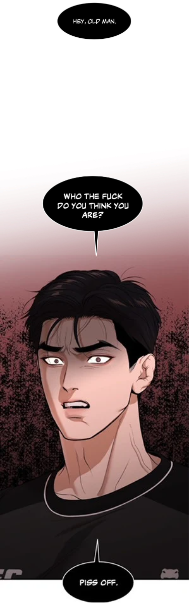 (chapter 49) When Joo Jaekyung addresses him with open disrespect, the breach of seniority provokes immediate outrage.
  (chapter 49) Intervention follows quickly. The insult is not tolerated
  (chapter 49) because it threatens hierarchy itself. Choi’s anger is genuine in that moment and it reveals what he truly guards: status, order, and the visibility of respect.
 (chapter 87), and continues escalating without repercussion
  (chapter 78) Both continue to perceive Joo Jaekyung as nothing more than a fighter
  (chapter 87) This assumption governs how they speak to him, how they threaten him
  (chapter 46) His presence creates a convenient fiction: those around the table come to believe that he is the owner, or at least the one who truly governs the gym. Joo Jaekyung’s absence is interpreted not as autonomy, but as immaturity or dependence. Authority, once again, attaches itself to performance rather than reality.
 (chapter 46) Even after boundaries are formally stated, Park Namwook continues to rely on seniority to address the champion
  (chapter 46) as if he were a child or an employee—someone to be corrected, instructed, and disciplined. The warning does not alter behavior because it does not challenge the underlying assumption: that Joo Jaekyung’s place is below them.
 (chapter 87)
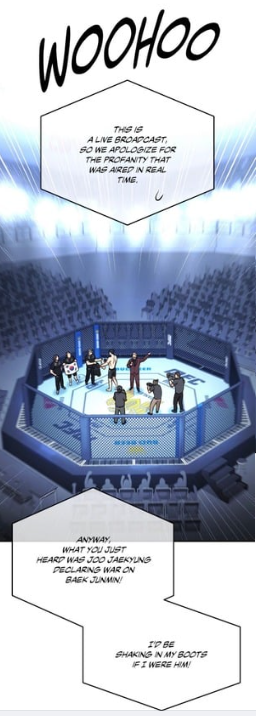 (chapter 87) What Baek attempts to destroy is not the object, but what it represents: the irreversibility of public speech, the collapse of secrecy, the loss of narrative control.
 (chapter 49), handshakes, and private humiliation
  (chapter 49), the gesture becomes clearer still. He is accustomed to violence without witnesses, to domination shielded by proximity and secrecy. He was always the man in the shadow. The live broadcast deprives him of that refuge.
 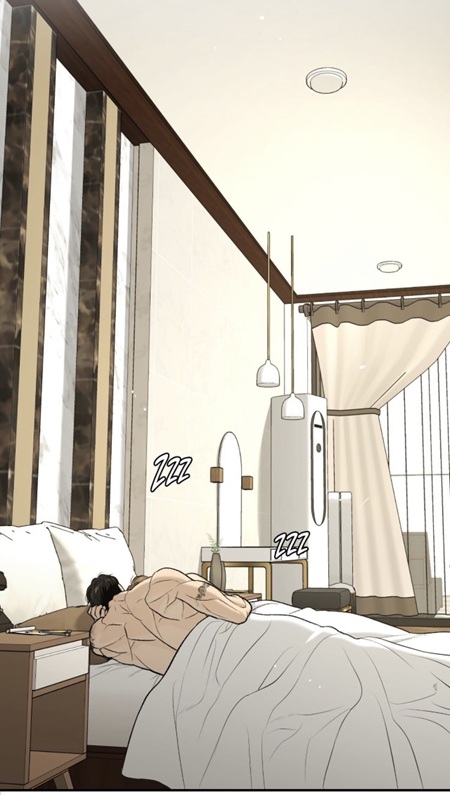 (chapter 87) also unfold under the sign of privacy.
 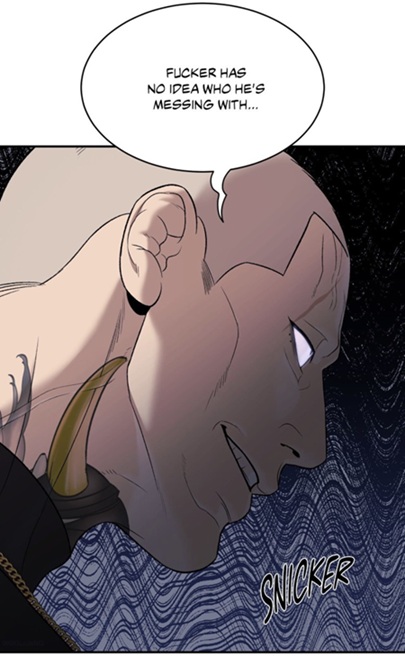 (chapter 87) He is announcing a shift of identity.
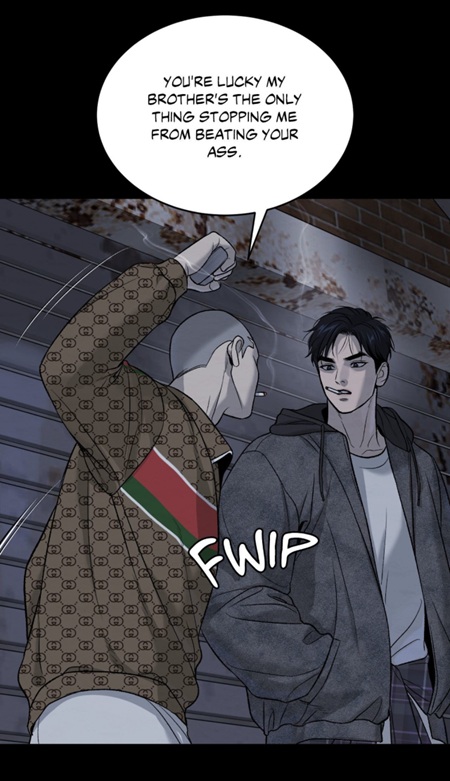 (chapter 74) seeking legitimacy, and the underground enforcer shaped by violence, order and debts
 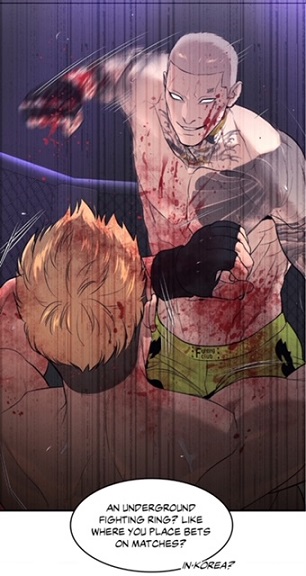 (chapter 47). The broken screen already signaled that he no longer cares about how he is seen.
 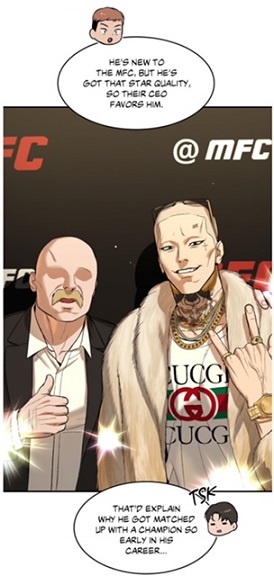 (chapter 47) By rejecting visibility and embracing excess, he also rejects the last requirement that tied him to that system.
 (chapter 48) And their collaboration is founded on money laundering!! The shooting star is in reality
 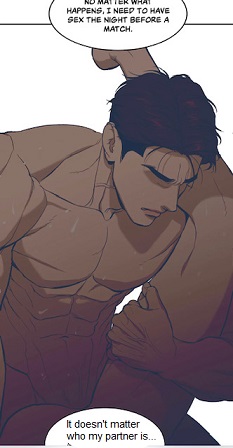 (Chapter 2). Here, strength is no longer something he takes. It is something he receives.
  (chapter 87) Kim Dan sleeping openly, showing his face, remaining there without fear—this is read by the champion as tacit trust. That trust becomes energy. In other words, this scene serves as the positive reflection of the argument in the locker room:
  (chapter 51)
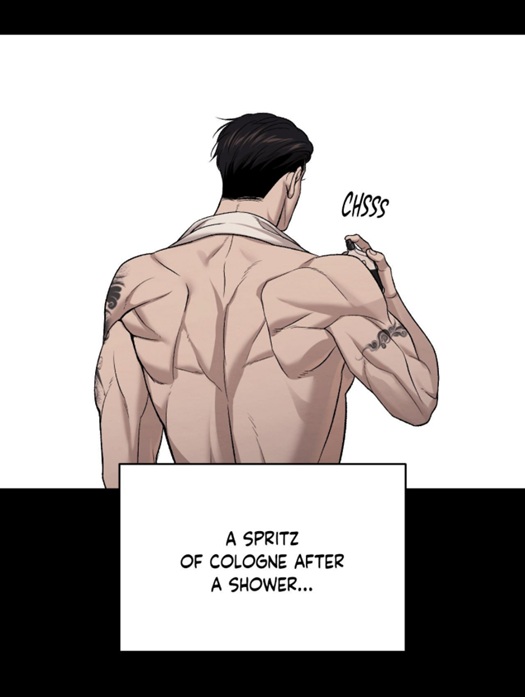 (chapter 75) —showering, cologne, self-regulation before a match. Here, that sequence is conspicuously absent.
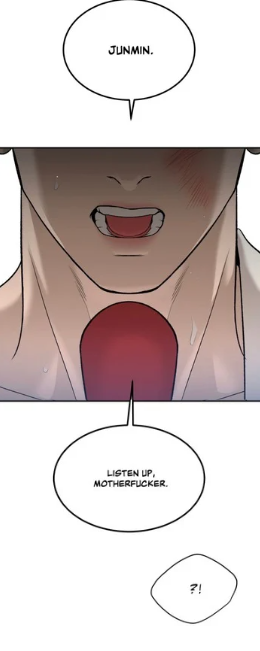 (chapter 87) The profanity is not recklessness—it is evidence that image management has lost its hold. The champion does not stop caring about how he is seen; he narrows the field of recognition. Public perception no longer governs him
 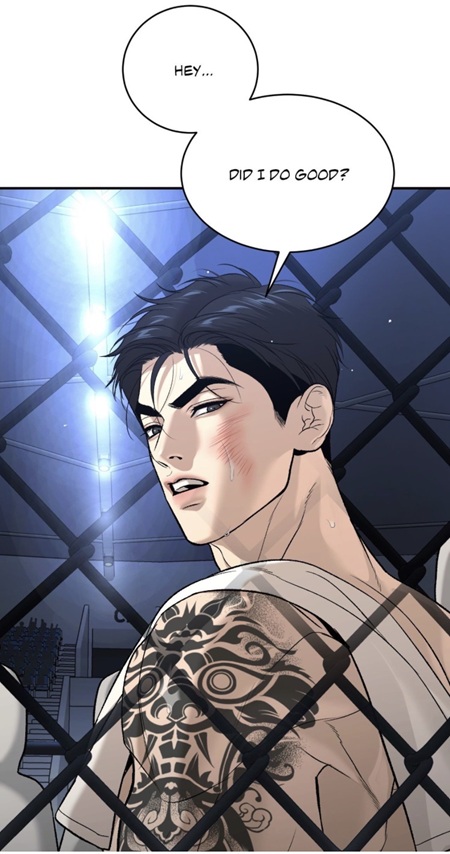 (chapter 87)
 (chapter 69), recognition, and above all visibility. Yet this visibility is curiously incomplete. Despite his victory, Baek Junmin is not immediately present as a public figure. He appears as a result
 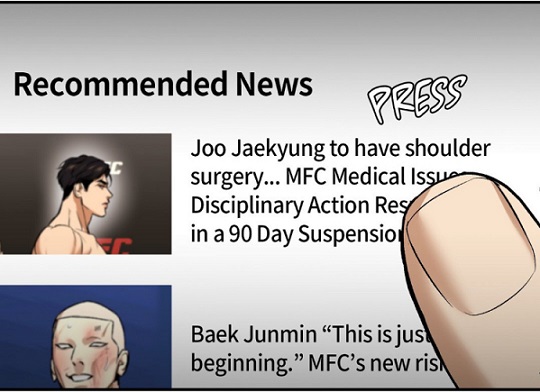 (chapter 52) —his name, his win—but not yet as a narrative subject.
 (chapter 77) does the story formally reveal his identity as champion. Until that moment, he remains strangely undefined, as if held back from full exposure. This delay is not incidental. It reflects a controlled form of recognition: Baek Junmin is allowed to win, but not yet to be seen. It already exposes that his success or victory is not clean.
 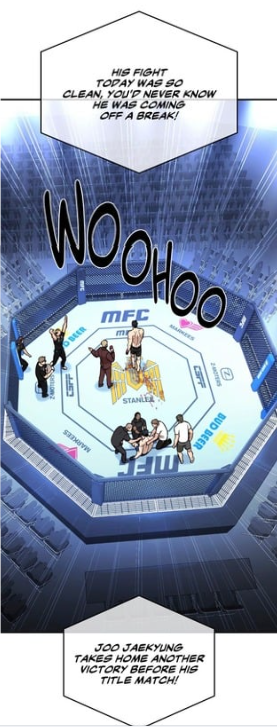 (chapter 87)
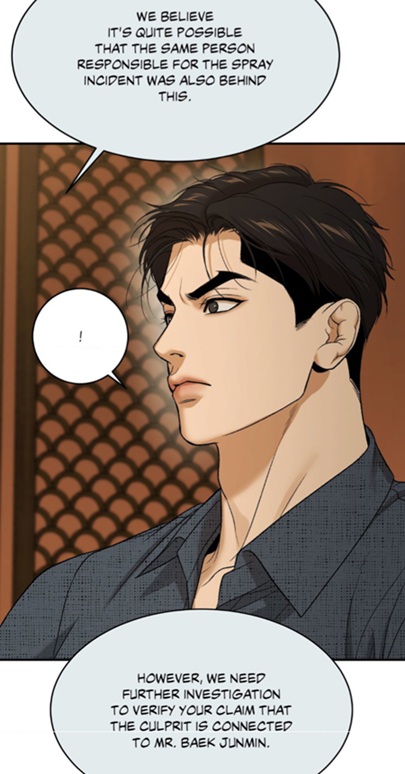 (chapter 69) to carry him forward: sanctioned fights, official narratives, public status. Crimes may occur along the way, but they remain hidden, delegated, or absorbed by others. Power, for him, is something that must appear legitimate, even when it is not.
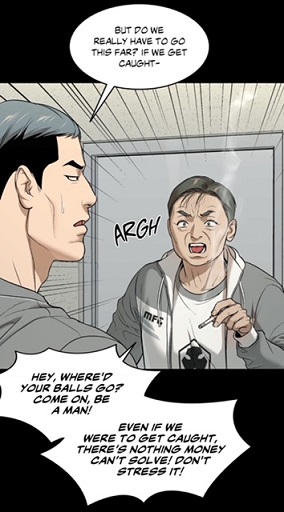 (chapter 50), they remain structurally hidden, absorbed by intermediaries, or misattributed.
  (chapter 69) Violence is laundered through legitimacy. The system continues to present him as a contender, even as it quietly tolerates sabotage and manipulation. Importantly, Baek Junmin does not need to know every detail for this economy to function; it protects him by design.
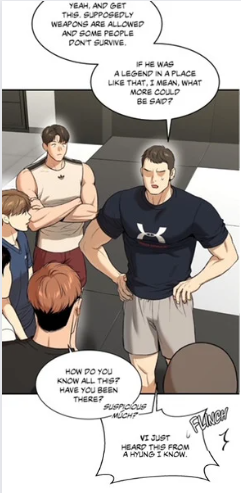 (chapter 47) Where the legal economy requires patience and exposure, the illicit one promises certainty and silence.
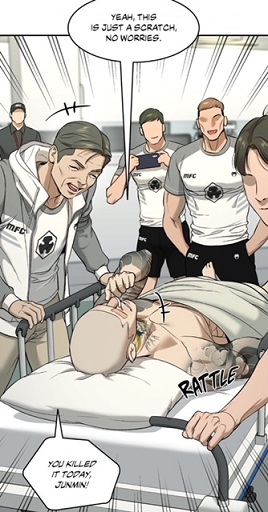 (chapter 52) In practice, hierarchy barely functions. Authority exists without discipline, protection without accountability. Baek Junmin is not positioned among other fighters, nor anchored in a collective. Thus he is not truly celebrated at the restaurant after the tie. Thus the fighters mentioned the director Choi Gilseok’s financial success or the odd behavior of Joo JAekyung.
  (chapter 52) Besides, he watches the match alone

 🌶️😂
🌶️😂 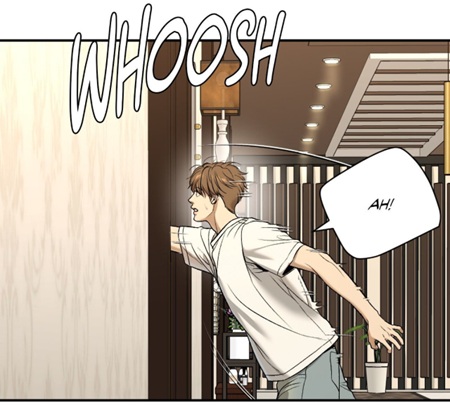 (chapter 85) Why care about the color of a carpet or the direction a door opens
 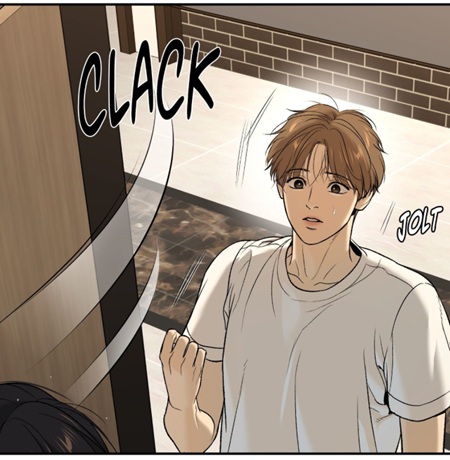 (chapter 85), when the real story unfolds between Joo Jaekyung and Kim Dan?
 (chapter 82) Floors and patterns are not neutral decoration. They function as a parallel narrative system—one that tracks changes in status
  (chapter 85), exposes the actual situations in which the characters are placed
  (chapter 85), and helps us locate spaces and relationships within the hotel architecture itself. In other words, the floors do not merely frame the story; they add a spatial depth that sharpens our understanding of the “characters.”
 (chapter 82)
 (chapter 82)
  (chapter 82) One might think, the only information we get is that MFC had booked a conference room at the hotel where Team Black is staying. However, in the States, the carpet of the hallway at the hotel had a similar pattern.
  (chapter 37) This similarity and repetition caught my attention. It suggests continuity between public spectacle and private space, between what is shown and what is concealed. Following this thread led to a broader realization: the floors simultaneously signal elevation and confinement. They show who appears powerful—and who is, in fact, enclosed.
 (chapter 37)
 (chapter 37) It is in that hallway that Kim Dan collapses after drinking a drugged beverage. He literally falls onto the carpet, on his knees. The trap activates—but not on its intended target.
 (chapter 46), not by MFC directly. The scheme exists, but it is imperfect. Joo Jaekyung is not truly “caught” in that moment, which explains why the plan ultimately fails.
  (chapter 69) As you can see, the pattern of the carpet could be seen as an evidence for a trap, and the “Emperor” is their target once again. Their plan is to end his career so that all the incidents and crimes from the past can be buried.
 (chapter 82). The opponent stands on the surface that embodies order, hierarchy, and control, and behaves accordingly. He flirts, comments on the doctor’s eyes, and treats the moment as harmless. Then he turns his back.
  (chapter 82) He never steps onto, nor does he seem to register, the animal-patterned carpet nearby, as doc Dan was standing on a white-off carpet. In other words, Arnaud Gabriel interacts only with the space that reflects the institution’s worldview.
  (chapter 82) This is not the response of a neutralized Emperor, but the instinctive surge of a predator whose territory has been violated. The scene echoes an earlier, more intimate image from the bathroom in chapter 30,
  (chapter 30), where Joo Jaekyung appeared wearing leopard-patterned pajamas. The animal imagery was already present then, but dormant. Here, it reawakens.
 (chapter 85) The champion is not alone inside the cage. He is supported, grounded, and no longer isolated. What MFC fails to see is that this support does not weaken the predator—it stabilizes him. And a stabilized predator is far more dangerous than a cornered one. For years, Joo Jaekyung’s violence was reactive, triggered by threat, humiliation, or loss of control. Such a fighter is powerful, but predictable. He can be provoked, exhausted, and manipulated.
 (chapter 84) These visual cues distinguish floors, mark thresholds between zones, and separate different kinds of isolation. The hotel ceases to function as an abstract backdrop and instead reveals itself as a structured environment in which hierarchy is materially inscribed.
 (chapter 85)
  (chapter 85) The corridor seems to have white linoleum covered a dark brown carpet, similar to the one in his bedroom. However, observe that the manager’s entrance has the same tiles than in the hallway.
  (chapter 85) reminds us of the champion’s living room in the hotel.
  (chapter 82) This clearly exposes that doc Dan’s room is not a normal room. It exceeds that basic category. It is larger, brighter, and arranged for comfort. The interior layout is particularly revealing: the bathroom is located close to the bedroom
  (chapter 85) clearly separating living space from bedroom
 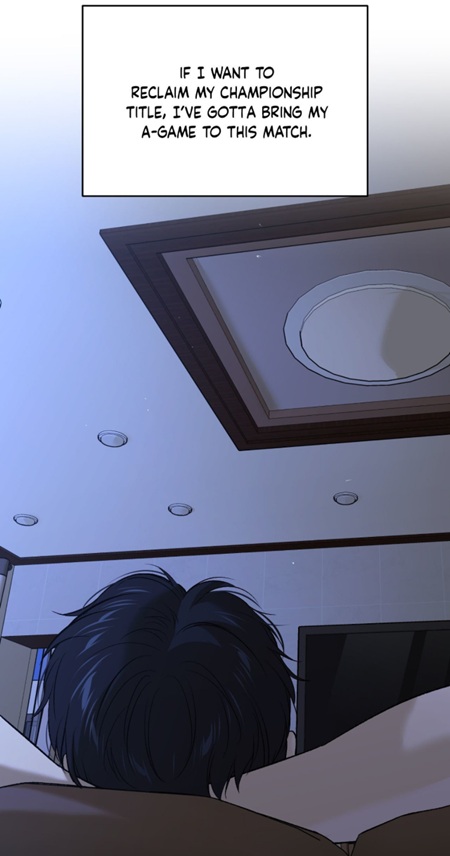 (chapter 82), and extending outward through more than one balcony.
  (chapter 82)
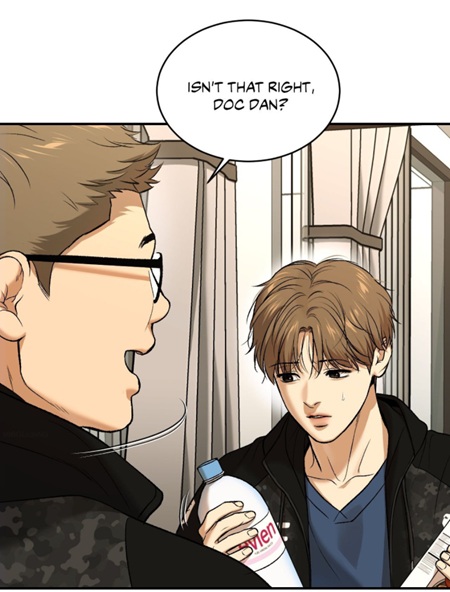 (chapter 82) And the moment I had this realization, architecture, once again, speaks first, my attention returned to the hotel in the States.
  (chapter 37)
 (chapter 37) This detail is crucial. It explains why he can hear their laughter and smell the food they are eating.
 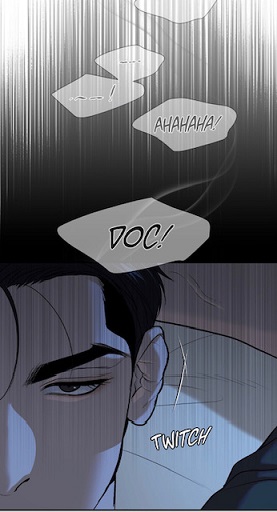 (chapter 37) Architecturally, he was not isolated. Despite his status, he remained embedded within the collective space of the team.
  (chapter 37) Besides, Episode 40 confirms that Joo Jaekyung did occupy an imperial suite: the interior layout includes a door separating the bedroom from another room
  (chapter 40), a feature characteristic of a suite rather than a standard hotel room. The issue, therefore, is not the absence of a suite, but how that suite was positioned and managed.
 (chapter 37) Because the suite was embedded within a shared corridor, an intruder could approach the champion’s room without attracting attention.
  (chapter 37) intended for weight-cutting and post–weight-cut recovery. This detail exposes a managerial failure rather than a hotel failure. The environment was not curated around the champion’s physical needs. Discipline was demanded of his body, but not enforced in his space. Meanwhile, fighters and coaches purchased junk food behind the champion’s and Kim Dan’s back, reinforcing the gap between stated goals and actual practice.
 (chapter 37) There is no visible keycard system, and no clear indication of an interior lock.
 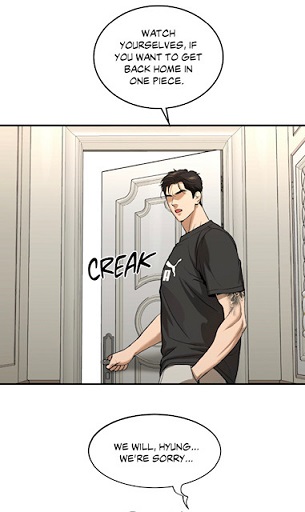 (chapter 37) This absence is striking, especially when contrasted with the Paris hotel
  (chapter 85), where doors are equipped with keycards and locks on both sides
 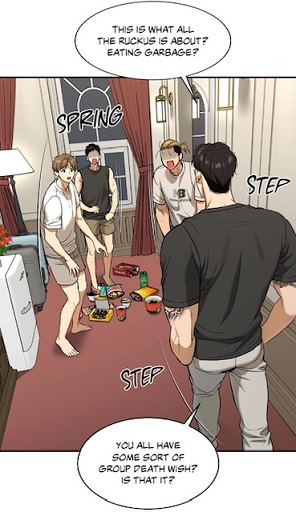 (chapter 37) Access was not negotiated; it was simply taken. The architecture allowed it. The space did not protect its occupants.
 (chapter 37) At first glance, this appears implausible. A suite, by definition, should insulate its occupant from such disturbances. His bedroom is not situated next to the corridor.
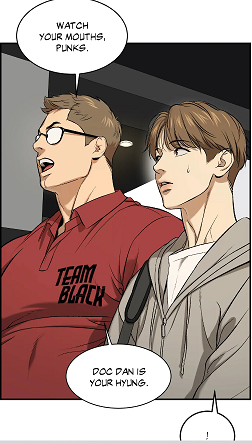 (chapter 7) Status was asserted rhetorically, but not enforced spatially, exactly with Joo Jaekyung.
 (chapter 37), negotiating access with local coaches and nearly getting into a physical altercation before being allowed to use their facilities
 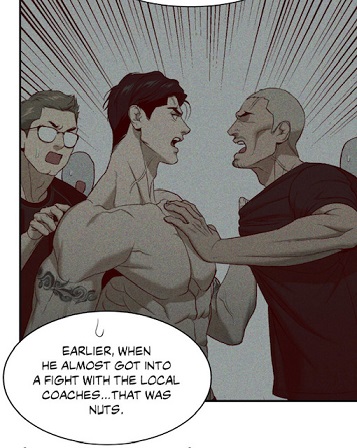 (chapter 37). Only after asserting himself does he gain permission to train. Even then, the gym he ultimately uses is unremarkable — functional, crowded, and indistinguishable from what any average fighter might access. There is nothing exceptional about it.
 (chapter 82) The infrastructure finally aligns with the demands placed on his body. This shift is not a luxury; it is a correction. It reveals retroactively how deficient the American setup was — and how little institutional care surrounded the champion at the time.
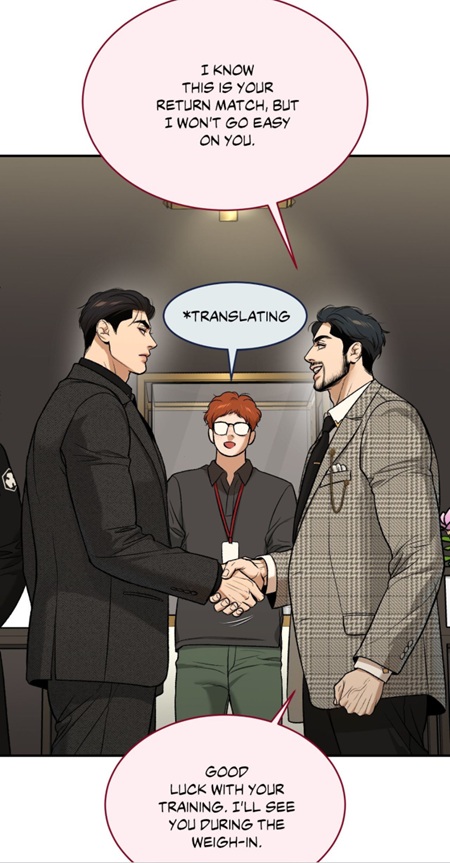 (chapter 82) The remark does not stem from arrogance alone; it is grounded in observation. The training space available to Joo Jaekyung at the hotel is not designed for an elite athlete, even less for MMA fighters.
  (chapter 82) It is a generic fitness room intended for ordinary guests. There are no heavy bags, no proper equipment, no environment suited to the demands of a reigning champion.
  (chapter 37) This is precisely why his training must be adapted, restrained, and partially improvised.
 (chapter 5) MMA is not baseball or soccer
  (chapter 54); it does not benefit from the same institutional prestige or resources. Earlier in his career, the champion was more likely trained to endure damage than to prevent it. What we see now is not the continuation of an elite system, but its gradual construction — one in which Kim Dan plays a central role.
  (chapter 81)
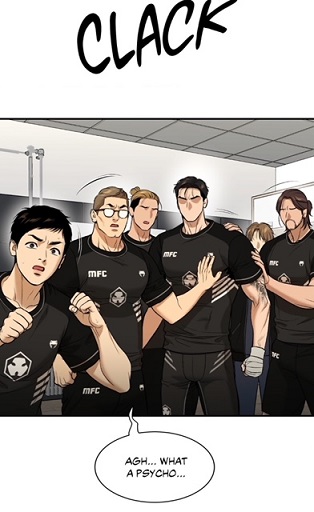 (chapter 49), rather restraining him and as such exposing him to danger.
 (chapter 37) and the post–weight-cut recovery.
 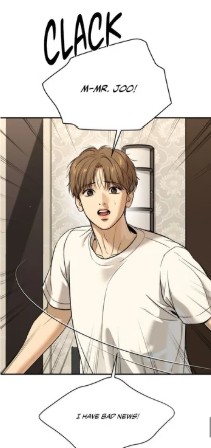 (chapter 82) Kim Dan may indeed possess a keycard to Joo Jaekyung’s suite. If so, this is not a minor convenience. It constitutes a symbolic transfer of access. The physical therapist is granted proximity not merely to the champion’s body, but to his private space. Hence the athlete is not caught by surprise, he doesn’t even mind this intrusion or interruption.
 (chapter 82) and support
 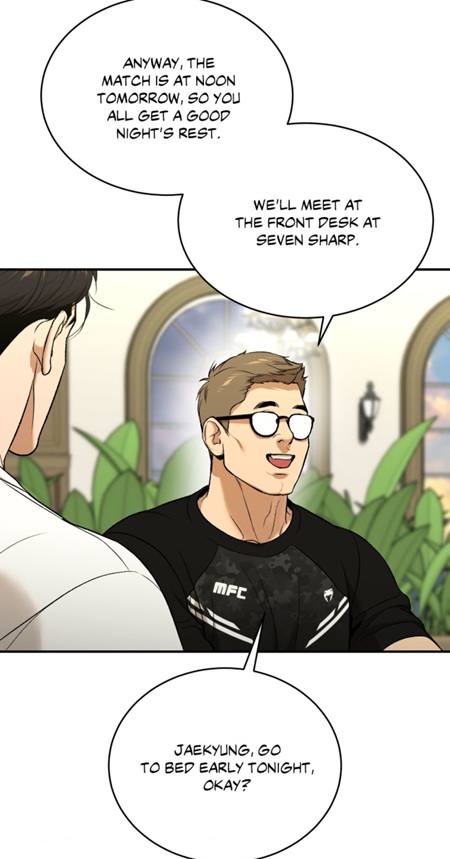 (chapter 85), he expects everyone to wake up on time and appear at seven sharp. He doesn’t see it as his “task” to wake up the champion. Once again, he is delegating responsibility onto others. However, it is clear that he expects Joo Jaekyung to be awake early like he did before. So if the champion doesn’t appear on time, the manager’s decision should be to call doc Dan or visit his room. In his eyes, he is the one responsible for the champion!!
 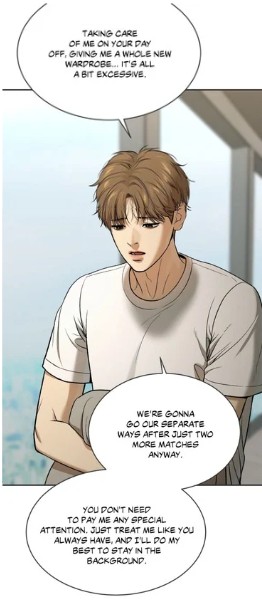 (chapter 80) for his contract is limited not only to Joo Jaekyung, but also in time. He was never a fighter, hence he is not part of MFC at all contrary to the other hyungs.
 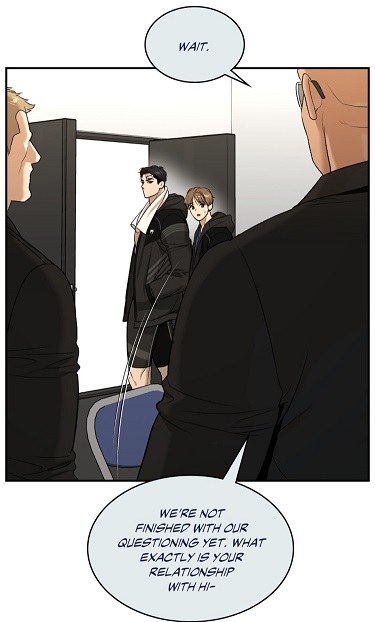 (chapter 40)
  (chapter 82) These are managerial functions.
 (chapter 40) Doc Dan is not one among others, but the BEST physical therapist. He is also a champion
 (chapter 86), gentle, attentive
  (chapter 86) — asking questions instead of imposing answers
  (chapter 64). For Joo Jaekyung’s unconditional stans (and I count myself among them), such an attitude
 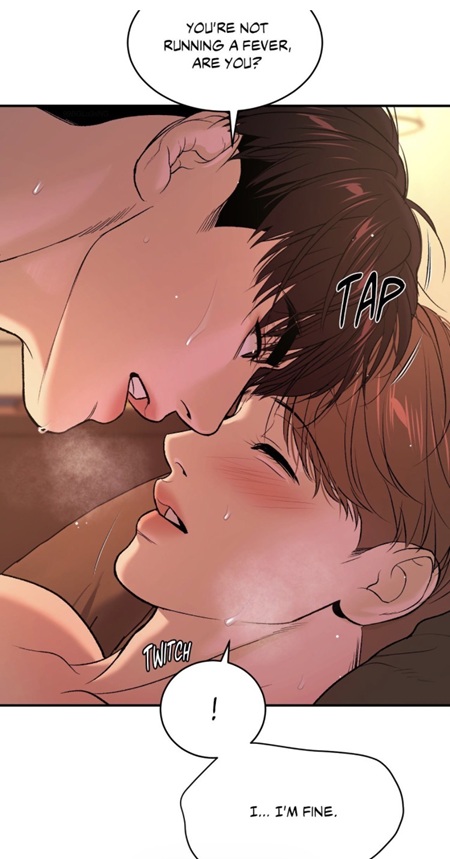 (chapter 86) can easily be read as proof that the protagonist’s good heart has always been existent, but it was barely visible. Compared to earlier chapters, the contrast is now undeniable. And yet, I would like to pause you right there.
 (chapter 61), sometimes awkwardly
 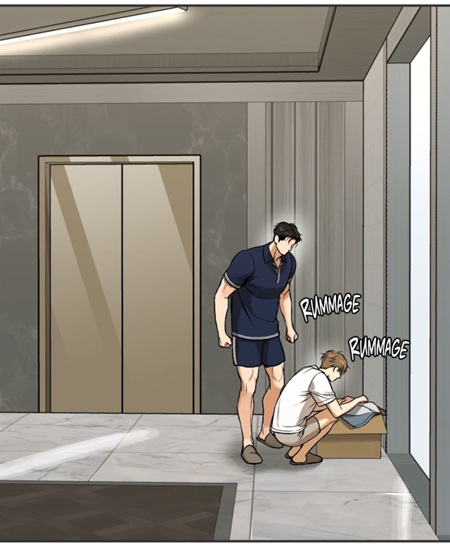 (chapter 80), sometimes inconsistently
  (chapter 79), but unmistakably
 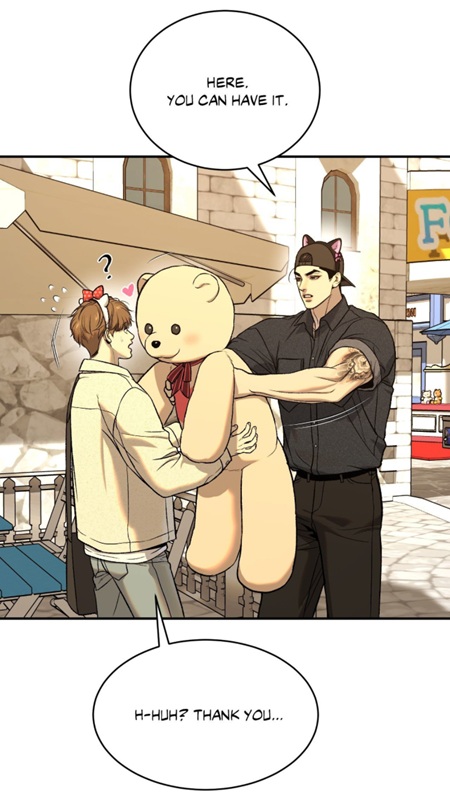 . (chapter 83) Tenderness, concern, even a certain form of devotion had appeared earlier
  (chapter 18) misunderstood or poorly timed. This night
 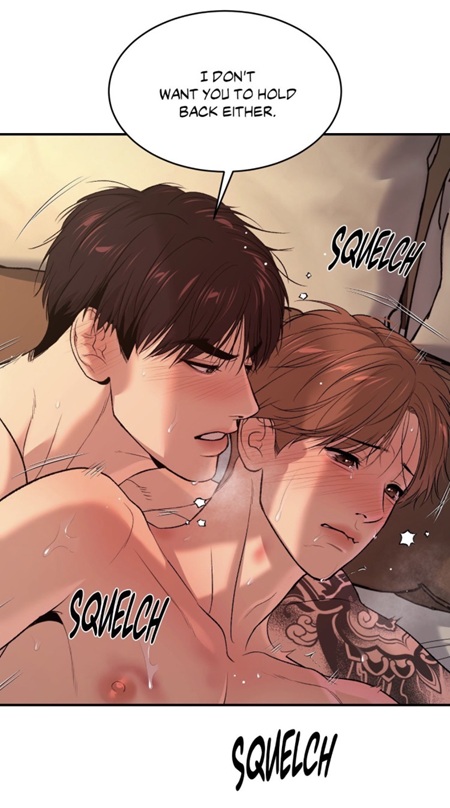 (chapter 86) does not initiate his metamorphosis.
 (chapter 86), sparks
  (chapter 86), and softness, many Jinx-philes might instinctively describe it as magical. The imagery invites such a reading. After all, we have seen similar nights before. The night in the States shimmered with illusion
  (chapter 39); words were spoken, confessions made — only to dissolve with memory.
  (chapter 41) The penthouse night echoed A Midsummer Night’s Dream
  (chapter 44), suspended between intoxication and desire, intense yet fragile. Both nights felt unreal, and both were later reframed as mistakes
  (chapter 41) — moments to be erased rather than carried forward.
 (chapter 45). This raises an essential question. Is episode 86
  (chapter 86) a renewal of those nights? Another dream layered over the past? A repetition disguised as healing? Or, on the contrary, is this the first night that resists enchantment altogether?
 (chapter 4), in the return of light
  (chapter 66), in what remains once the sparks fade. A dream dissolves with daylight. Reality does not.
 (chapter 86) for final transformation. The real shift occurs elsewhere — more quietly, and perhaps more unsettlingly. To grasp the nature of this night, we must follow more importantly the doctor and his interaction with his fated partner.
 (chapter 86), processes, and responds to it. How he hesitates
  (chapter 86), reflects, and allows himself to reconsider what this moment can mean — and what it can lead to.
  (chapter 86), sparks, that strange shimmer that seems to hang in the air
  (chapter 86). Why? It was, as if their dream had come true. However, is it correct? Is it not wishful thinking? What if this night is not magical at all? What if its true signature is not enchantment, but electricity—a current that interrupts, tests, and resets? 😮
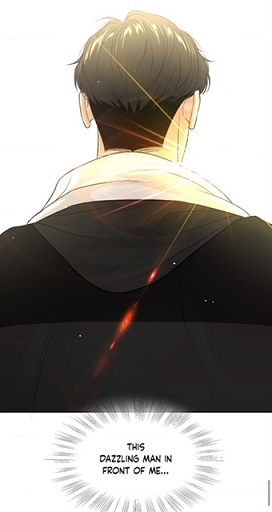 (chapter 40) in Kim Dan’s perception: overwhelming, radiant, dominant, a heat-source that does not negotiate.
  (chapter 41) The sun can be admired, feared, and endured—but it cannot be questioned.
  (chapter 58) It simply shines, and the one who stands in its light adapts. This explicates why the physical therapist would choose silence and submission over communication.
  (chapter 48)
 (chapter 83)
  (chapter 83) Every ride, every light, every scream suspended in midair depends on current: motors accelerating and braking, circuits opening and closing, energy stored, released, and cut off.
  (chapter 83) Roller coasters do not move by heat, charisma, or sheer physical force; they move because electricity flows through them. The Viking ship swings
  (chapter 83) because current allows it to swing. The Ferris wheel ascends
  (chapter 83) because circuits hold — and descends because they release.
 (chapter 84)
  (chapter 84) explicitly names what had previously gone unspoken: the rides function only because current flows. When it disappears, the illusion of effortless motion collapses.
 (chapter 84) The Ferris wheel has stopped. The current is gone. The carefully regulated system that lifted, rotated, and sustained them is no longer in control. Yet movement does not disappear entirely. It mutates. When the champion shifts his weight, grips the structure, reacts instinctively, the cabin begins to shake. Panels emphasize instability: creak, swish, ack. The motion is no longer generated by electricity but by the body itself.
 (chapter 84) Stranded above ground, stripped of the park’s mechanical rhythm, he apologizes.
  (chapter 84) and fears. He avoids the doctor’s gaze, crosses his arms
 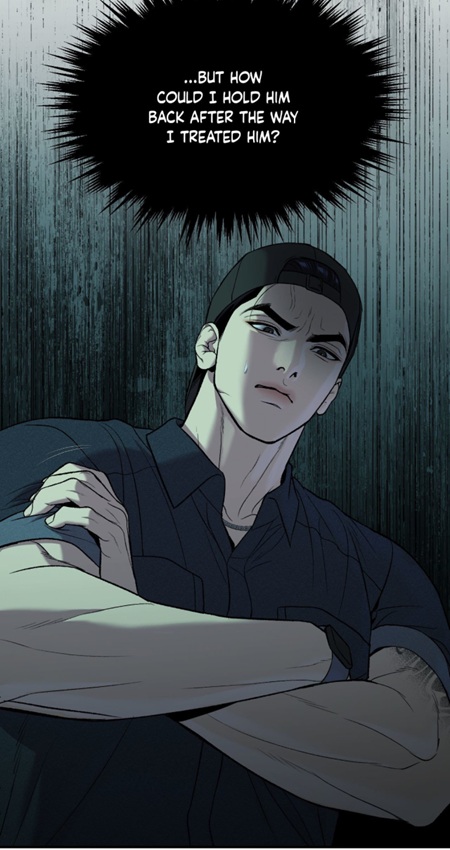 (chapter 84) or squeezes his arm
 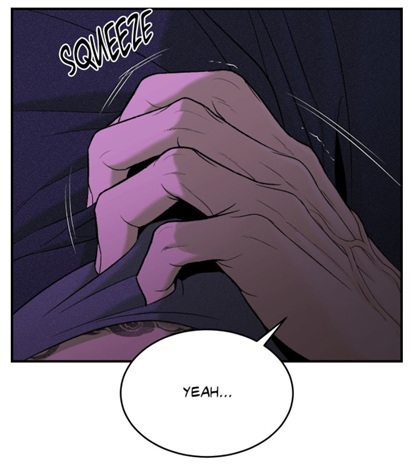 (chapter 84). The cessation of electrical motion coincides with a shift in his own mode of action. Where the park depended on current to keep things moving, he now moves without it. The absence of electricity forces something else to surface: responsibility, attention, presence. Additionally, this sequence anticipates what will later unfold more fully. Proactivity is no longer expressed through force or motion, but through articulation. Words stand for action and have weight. The champion’s future action is announced here, quietly: he will no longer push forward by shaking the structure. He will move by sharing thought, by naming feeling, by allowing himself to be affected.
  (chapter 86),
  (chapter 86) jolts, sudden contractions of the body
  (chapter 86). Kim Dan is repeatedly shown convulsing, gasping, losing linear thought, and it is the same for the MMA fighter. Panels insist on interruption: jolt, tingle, broken breath, aborted sentences. The doctor’s body behaves as if struck, especially in this image.
  (chapter 86) It is at this point that a phrase surfaced in my mind — instinctively, almost involuntarily. A phrase we use in French when something intangible yet decisive occurs between two people: Le courant passe. Literally, the current passes. Idiomatic meaning: they are on the same wavelength, something connects, communication flows. However, here, the current is not the product of civilization, but of nature. Two people interacting with each other. And it is precisely because of the unusually high frequency of sparks and jolts in the illustrations that a belated realization imposes itself: nature, too, produces electricity — through storms, through thunder.
 (chapter 69) A storm was announced back then. And yet, upon closer inspection, no thunder was ever shown there. There was tension, there was excess, there were dark clouds
  (chapter 69) — but there was no strike, no discharge, no interruption. The imagery remained continuous, fluid, enclosed within the logic of escalation rather than rupture.
 (chapter 83). In Roman terms, Thursday corresponds to dies Iovis — Jupiter’s day — the god of thunder. Both gods are strongly connected to thunder and as such current.
  -chapter 67-; for more read my analysis
  (chapter 83). Before striking anything, he is already unwell: angry overstimulated and complaining, visually reduced to a childlike register. This matters. The hammer does not create excess — it receives it.
  (chapter 34), the hammer gesture is not confrontational, for the machine is immobile. There is no opponent.
  (chapter 83) Too much energy released at once. The system registers it, but cannot contain it. This means, the record won’t be registered and as such “remembered”. In fact what mattered here was the prize, the teddy bear, and restored self-esteem of the athlete. He could offer a present to doc Dan which the latter accepted without any resistance.
  (chapter 86) Therefore it is not surprising that doc Dan starts looking at his fated lover. Imagine what it means for the athlete, when the “hamster” is staring at him, though he is a little embarrassed. Finally, he is truly looking at him. The champion loves his gaze. And now, you comprehend why the “wolf” listened to the “cute hamster” and stopped leaving marks.
 (chapter 85), but this time, its nature has changed. It is no longer jealousy or anger, but love and desire. Hence the current is not colored in red, but white and pink.
  , but a thunder and as such it is still restrained and regulated.
 (chapter 86) or second-hand data. New information must now be gathered. New meanings must be negotiated. Because Joo Jaekyung acts differently (son-father), the doctor is incited to discuss with his fated lover and not to generalize. He is pushed to become curious about the main lead and even adapt himself in the end.
 (chapter 39) and the penthouse night
  (chapter 44) as emotionally charged, intense, even pivotal. Confessions were made. Bodies responded. Vulnerability appeared to surface. And yet, both nights collapsed almost immediately afterward. What was felt
  (chapter 39), arousal, and emotional exposure under the influence of a drugged beverage. His body reacts strongly, almost violently. His speech loosens. He confesses.
 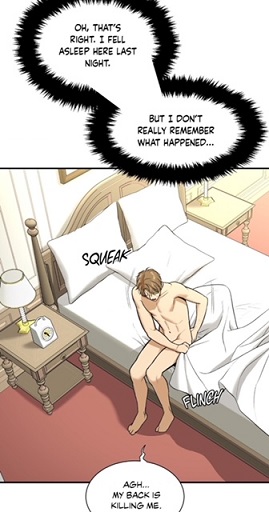 (chapter 40)
 (chapter 86) In this panel, we should glimpse a reference to the night in the States as well, and not just to the night in the penthouse.
  (chapter 44) The setting is elevated, luxurious, almost theatrical. The doctor is brought into a space of power that is not his own.
 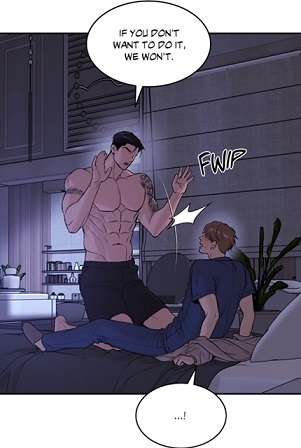 (chapter 44) By acting that way, the athlete created a false impression of himself, as if he was still rational and clear-minded. Again, desire unfolds.
  (chapter 44)
  (chapter 44) Again, closeness occurs. And again, the aftermath reveals the same fracture.
 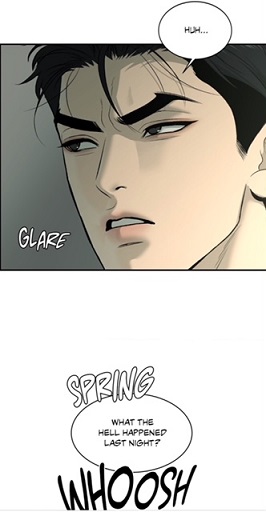 (chapter 45) and later wants to even forget it.
  (chapter 45) and he can not deny his own involvement and actions. Hence the doctor is left alone. Only he can recall this “dream”.
  (chapter 44) But memory alone is not power. Remembering without the other’s participation transforms recollection into isolation. Kim Dan cannot confront, confirm, or renegotiate what happened, exactly like the champion did in the past. Meaning freezes instead of evolving. Striking is that he came to associate feelings with addiction.
  (chapter 46) No wonder why later doc Dan had no problem to reject the athlete. And for him, the next morning became a cruel reality, even a nightmare. It wounded doc Dan’s heart and soul so much that he learned the following lesson: to not get deceived by impressions. Hence in Paris, Doc Dan tries to explain the change of the champion’s attitude with drunkenness.
  (chapter 44) One participant is altered. The other must carry the weight of meaning alone. The night does not end in shared reflection, but in silence and absence.
 (chapter 44) Words blur, vanish, or are forgotten. Even gestures go unnoticed: a kiss, an embrace or a patting. Memory fractures. The morning after is defined not by continuity but by confusion. The body has moved forward, but the narrative has not.
  (chapter 84)
 (chapter 39)
  (chapter 44) It was as if these nights could only exist under altered states — as if clarity on either side would have made them impossible.
  (chapter 86)
 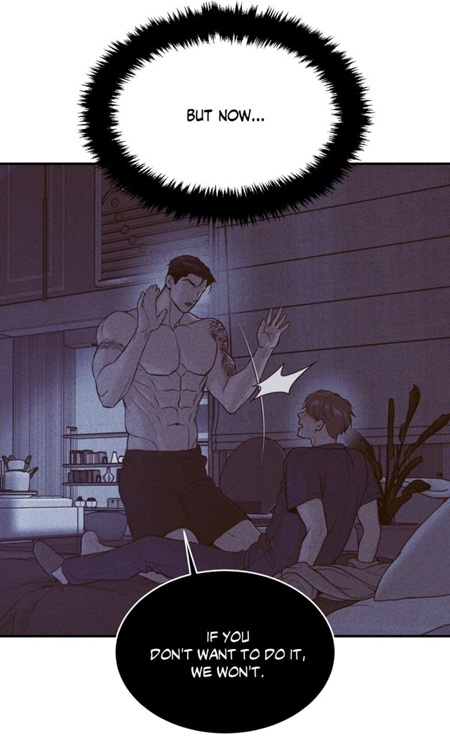 (chapter 86) This is why, when electricity returns in episode 86, it does not revive heat. It interrupts it.
  (chapter 86) That’s the reason why the athlete stops for a moment and asks doc Dan, if he needs a break.
  (chapter 86) This question is important because doc Dan admits his confusion and ignorance. He confesses to himself that he “knows nothing” not only about himself, but also about his fated lover.
  (chapter 86) They function as temporal markers. A spark exists only now. It has no duration. It cannot be stored, recalled, or anticipated. It appears — and vanishes. In this sense, electricity becomes the perfect visual language for the present moment itself.
 (chapter 10), statements blurred by drugs
  (chapter 44) and even laugh…. if only he could remember that night…
 (chapter 79), the “never mind”,
  (chapter 84) or it is a mistake, the easy erasure that once dissolved meaning after the fact. The kiss interrupts that mechanism. It produces a pause that cannot be talked over. It forces reflection.
  (chapter 19) The grandmother’s lap structured Kim Dan’s understanding of safety, endurance, and knowledge. Sitting there meant being held — but also being taught how to survive through sacrifice, silence, and self-effacement. That worldview sustained him, but it also confined him.
 (chapter 85) represents the positive reflection of this night
  (chapter 58)
  (chapter 58), when the physical therapist chose to give up on the athlete and stop listening to his heart. Here, I am not only referring to the numerical symmetry but also to the doctor’s shifting vision of Joo Jaekyung.
 (chapter 85), Jaekyung appears with a towel around his neck. This simple object evokes water and sweat, but in Jinx, these elements are never neutral. They are tied to one of the champion’s earliest traumas: the humiliation of being called “dirty”
  (chapter 75) and “smelly” as a child. This is why Jaekyung learned to perfuse his body with cologne after every shower
  (chapter 40) It was, as if the fear of smelling “wrong,” of being perceived as contaminated, was still dictating his movements. Hence he could only claim doc Dan as one of his own, but not as his “physical therapist” or even “family”. And interesting is that doc Dan copied his attitude. In the hallway, he maintained a certain distance from the athlete.
  (chapter 40)
 (chapter 40) the moment he dried off
  (chapter 85) His hair is unstyled, his scent unmasked — and yet he approaches Dan without hesitation. He even kisses him. The item that once symbolized rejection now signifies trust: without fragrance, he is certain that doc Dan will not call him “dirty,” will not recoil, will not shame him. What once provoked distance becomes an unexpected bridge, revealing that Jaekyung is finally letting someone remain close, when he feels most vulnerable. The night in Paris does not simply suggest a return of desire; it announces the return of hope
  (chapter 85) and trust — and perhaps even the moment when Dan chooses, for the first time, to be honest with his own body and heart.
  (chapter 85)
  (chapter 61) [I will elaborate it further later]. And perhaps this is why the moment feels so disarming: because the downfall is not tragic but tender, not humiliating but intimate. Sweet, even.
 (chapter 85) Dan is lost in his thoughts — anticipating the night ahead with the champion — and has barely touched his food. Park Namwook notices this. One might think, such a remark displays the manager’s concern for the main lead’s well-being. However, the manager adds that the other members of the team are all almost finished. With such a remark, it becomes clear that the manager is urging the protagonist to finish his plate. Although Park Namwook addresses Dan as if showing concern, the content of his remark betrays his true priority: not Dan’s well-being, but the team’s schedule. By pointing out that ‘the rest of us are almost finished,’ he urges Dan to keep pace, treating him as staff who had to follow the group rather than someone with personal needs. As you can sense, schedule is essential for the manager. However, because doc Dan couldn’t reveal the true reason behind his behavior, he gives an excuse for his lack of appetite.
 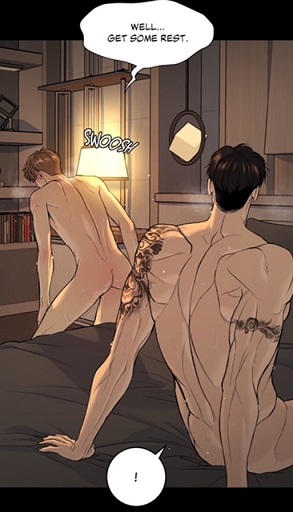 (chapter 53) The manager’s words bring Joo Jaekyung back to reality and its uncomfortable truth that Dan’s presence now is still bound to a contract — temporary, contingent, never fully his. In other words, with his remarks, Park Namwook is reopening old wounds which shows his total blindness and lack of finesse and of empathy. He treats the last match, as if nothing bad had happened. The incident with the switched spray is simply erased.
 (chapter 53) leaving without thinking; now, after Dan vanished from his life entirely, that earlier departure feels like a sign he failed to read. Park’s question brushes against this bruise, and Jaekyung’s lips reflect the discomfort.
 (chapter 85) The younger fighter suddenly bursts into panic, declaring how nervous he would be in Jaekyung’s place, how his heart would be pounding out of his chest. His outburst is sincere, naïve, and completely focused on the champion — he never once considers Dan’s feelings. Yet these words strike deeper than he intends. At the mention of a pounding heart, Jaekyung’s eyes lift upward in a brief, involuntary movement. It is the smallest gesture, but it exposes everything he wishes to hide. Because his heart is pounding — but not for the match. It is because of doc Dan!
  (chapter 85) “Come to my room at 11.”
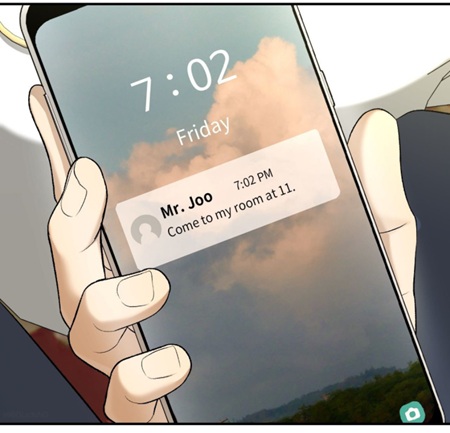 (chapter 85) the need for reassurance, the wish to rewrite the pattern of the past, the quiet hope that Dan will not leave him again — not tonight and not afterwards.
 (chapter 85), as soon as the athlete stands up right after his recommendation and announces he is now returning to his room.
  (chapter 54)
 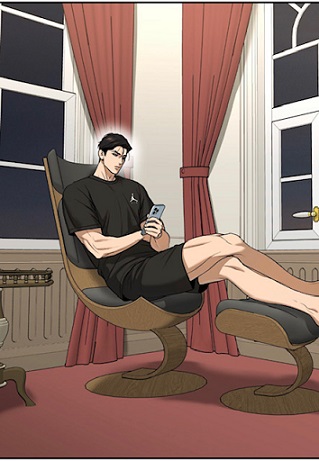 (chapter 38) and Korea
  (chapter 48) before a big fight: watch his opponent’s videos, study their habits, rehearse counters. If we only looked at the clock, we might assume he spent the evening thinking about Arnaud Gabriel.
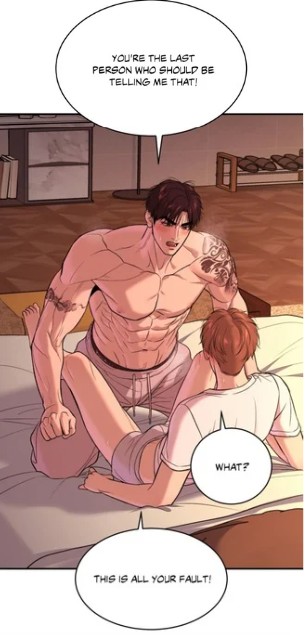 (chapter 85) From 7:02 onward, the question is no longer “How do I beat Gabriel?” but “How do I win doc Dan’s heart?” The clock from 7:02 to 11:00 p.m. stops being a “training window” and becomes an emotional countdown. He is no longer the champion preparing for an opponent—he is the man hoping not to be abandoned again. This is why the later scene at the door feels so contradictory: when Dan finally arrives, Jaekyung behaves like someone who couldn’t wait.
  (chapter 85) He opens the door and immediately grabs him inside
  (chapter 85) This is not the controlled, casual emperor of old; it is someone who has been holding back for hours and refuses to risk even a second in which Dan might change his mind.
  (chapter 65) and the comment of the champion in front of this movie:
  (chapter 29) Moreover, I consider this scene
  (chapter 85) as a new version of Choi Heesung’s advice: Doc Dan just needs to sit back and enjoy!!
  (chapter 31) Joo Jaekyung is now doing everything, as deep down he wants to become the perfect lover! And how had I described the night in the States?
  Back then, the hamster Dan had become the champion’s perfect lover, especially because he had kissed his face, hugged him and confessed to him.
  (chapter 38) One might reply that the athlete desired to maintain appearances and as such to hide his suffering and anxiety. In other words, he was hiding his emotions behind routine, Jinx-sex would always start at 11 pm. However, this idea is not entirely satisfying because once doc Dan was in his room, the fighter was no longer hiding his emotions and desires.
  (chapter 72), when the latter would return late from his “work” and the death of his father
  (chapter 73).
 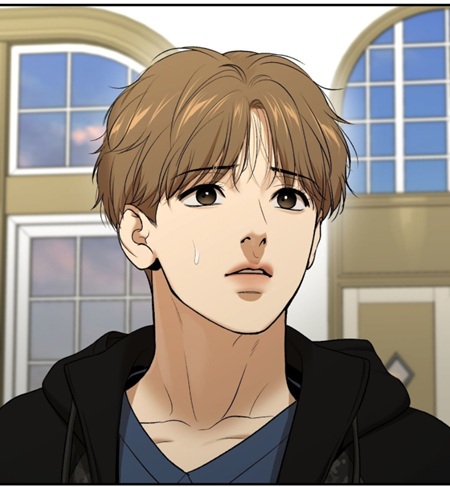 (chapter 85) This explains why his worried gaze followed his fated partner.
  (chapter 85) In other words, the text had a different meaning. It was not an order, but rather a wish…and it had nothing to do with his match against Arnaud Gabriel. During that night, Joo Jaekyung is not seeing a surrogate fighter in front of him or a sex toy, but his real partner, his future boyfriend. This means, this night stands in opposition to the one in the penthouse:
  (chapter 85) This is why he touches Dan’s face instead of flipping him over.
 (chapter 85) — something he has never done before. This does not come from instinct. It comes from intention. It comes from effort. It comes from learning. He is indeed showering doc Dan with love and tenderness, therefore it is not surprising that the “hamster” is moved sensually and emotionally. Exactly like during the Summer Night’s Dream, he is reaching nirvana, hence Jinx-philes are constantly seeing stars,.
  (chapter 85)
  (chapter 85) — or the emotional slip that comes with resurfacing feelings: the therapist losing distance, falling back into intimacy. All of these readings sound plausible at first glance.
 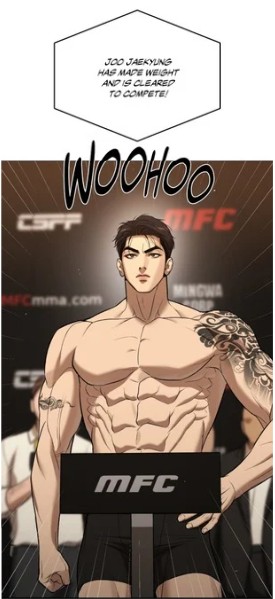 (chapter 85) Styled up, hardened with gel
 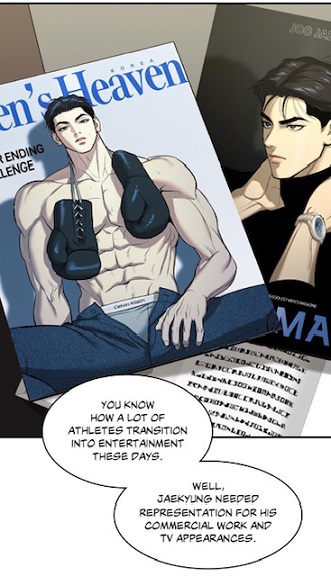 (chapter 30) , perfectly arranged — it is the crown of the Emperor, the symbol of his control, his discipline, and the myth that MFC sells:
 (chapter 85) — but not the way adults or professionals usually do.
 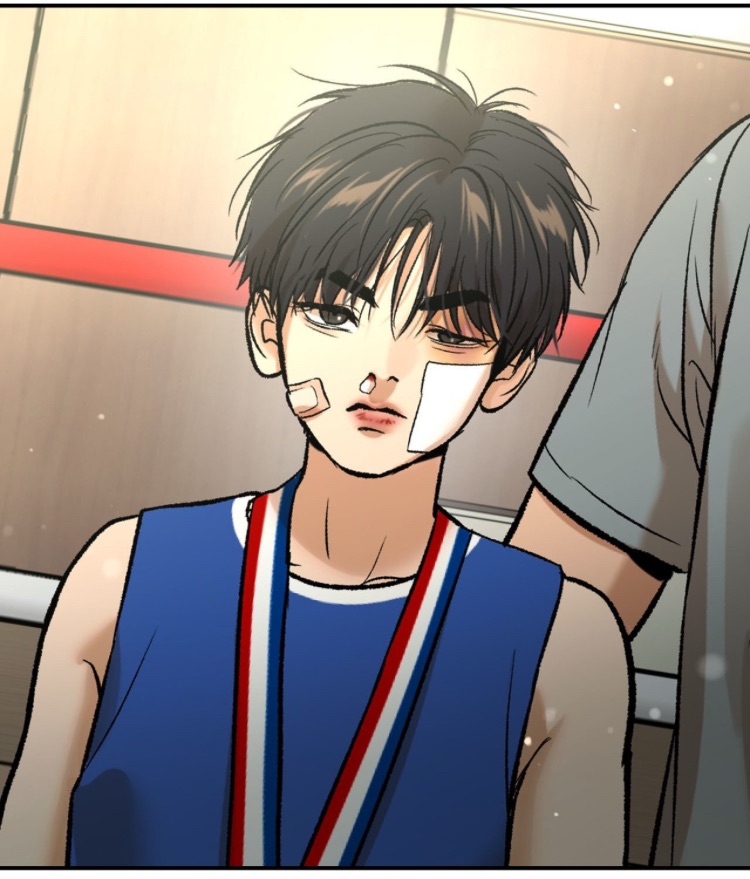 (chapter 71) So doc Dan could recognize the little boy in the athlete, the more he sees the protagonist with his hair down. Furthermore, I noticed that contrary to season 1, Doc Dan has now more memories of the “wolf” facing him.
  (chapter 85) In the past, he would more look at him from behind:
  (chapter 35)
  (chapter 35) Seeing his face reflects not only the increasing care for each other, but also the improving communication between them.
  (chapter 85) more mature, more “masculine” in the traditional sense. This explicates why the stylists had to dress him up.
  (chapter 82) Yet such an intervention did more than prepare him for the cameras — it tightened the restrictions around his own image, reducing the fighter’s rights over how he appears to the world. With the suit, he appeared older and more powerful. The French fighter leans into age, while the Korean champion leans into youth — a symbolic inversion that reinforces the central tension in the Paris arc: Gabriel performs adulthood; Jaekyung rediscovers the adolescence he never lived.
  (chapter 85) But just as Jaekyung begins to slip into these youthful, softer identities, MFC reasserts control.
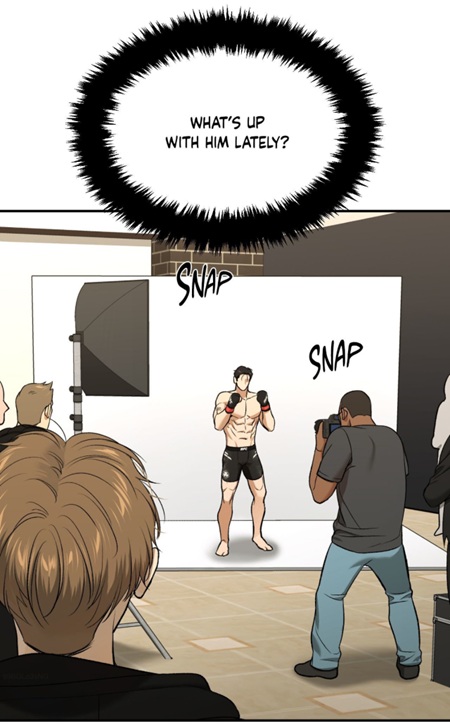 (chapter 85) hair up, face polished, a look engineered for posters and rankings. He becomes once again the Emperor — the man who must appear older, sharper, more intimidating, more manufactured.
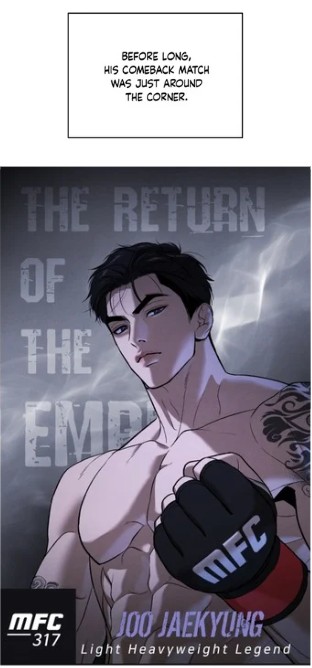 (chapter 79) This is the boy from the childhood photograph.
 In the rain, with his hair heavy and unstyled, his gaze dark and sensual, Jaekyung appears nothing like the commanding emperor. He looks free — freed by weather, freed by desire, freed from roles. It was foreshadowing, not just fanservice. It announces the end of the « jinx » in reality.
 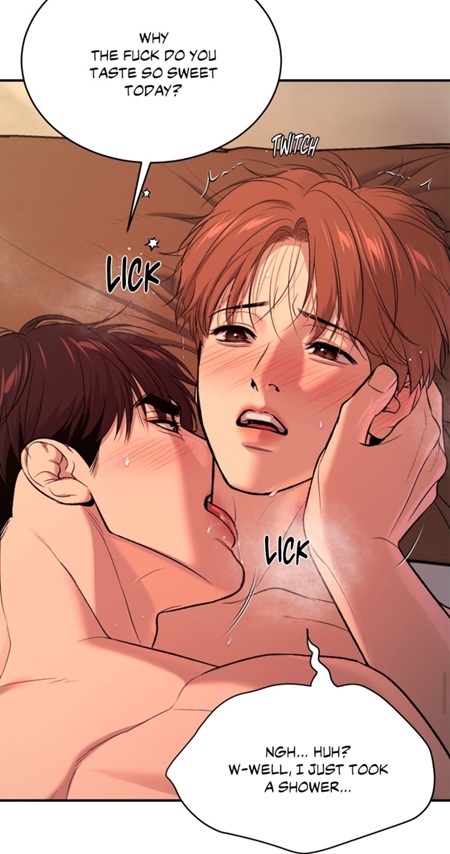 (chapter 85) He is describing himself. His sweetness is the taste of freedom — freedom from performance, freedom from control, freedom from MFC, freedom from fear. He is enjoying this moment. Dan tastes sweet because Jaekyung is finally tasting the life he never allowed himself to want.
 (chapter 21) The image of winged rescue and divine protection hangs over the very piece of furniture that, throughout the series, has functioned as Dan’s private sanctuary. This is not incidental. In Jinx, the couch is tied to his deepest memories of care and abandonment, and Mingwa activates this symbolism each time Dan gravitates to it.
 (chapter 10) Secondly, at no moment, we ever witness the grandmother carrying the little boy to bed. Either she is rocking him to sleep outside the house
 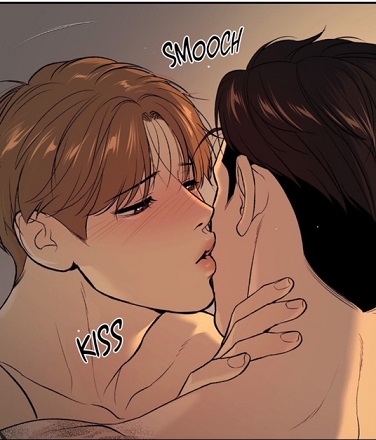 (chapter 44),
  (chapter 44) traces from parents. And now, you comprehend why the hamster could never truly rest in the bed. The couch is therefore not an adult preference; it is a trauma imprint. Resting there feels safe because beds—large, empty, abandoned spaces—became reminders of whoever no longer carried him. Hence it is no longer surprising that he woke up, when he sensed the vanishing of warmth.
 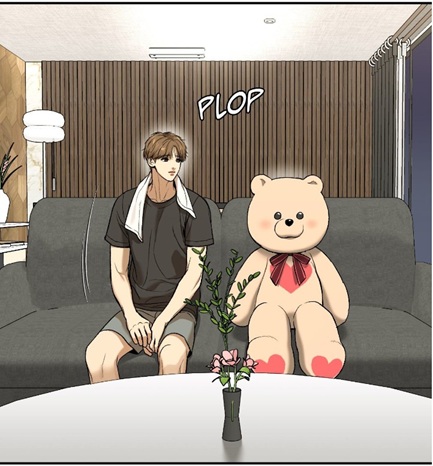 (chapter 84): the bear stands in for a lost comforting presence. It also represents the main lead, Joo Jaekyung. The latter is gradually reentering in the physical therapist’s heart and life. Therefore it is not surprising that there, he squeezes the hand of the toy. It is also why Doc Dan curls around it like a child who deep down hopes to be chosen, lifted, and held. And it is why, even as an adult, his body still whispers the same yearning: someone, please carry me to bed again.
 chapter 40, chapter 65, chapter 68, chapter 79)
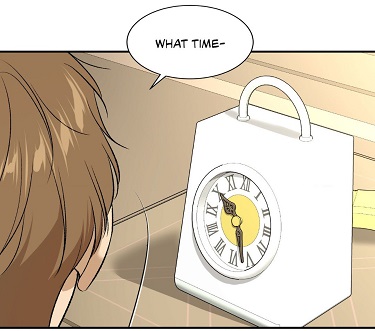 (chapter 85) and he was still able to arrive on time in the arena.
 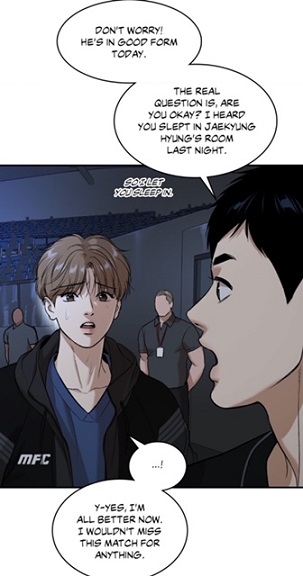 (chapter 40) For me, it is a clue that the manager would always request to meet around 7.00 am, when the match was at noon. But what should do the athlete do during all this time? He can only get nervous and feel pressured.
 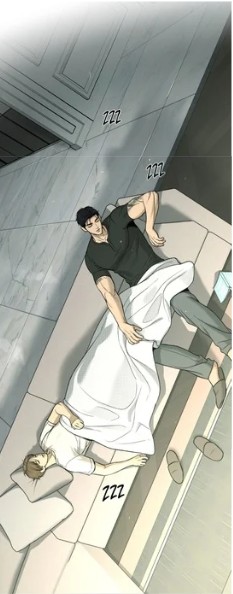 (chapter 81) I noticed that in different scenes from season 2, the athlete started waking up later and even after doc Dan.
  (chapter 66) But the manager’s rigid schedule threatens even that. An early morning summons drains the fighter’s cortisol reserves before the match has even begun, creating a long, empty corridor of waiting — a period where tension, anxiety, fatigue, and irritation ferment in the body. Instead of resting, centering, and preparing, the champion would spend hours fighting against the clock imposed on him.
 (chapter 54) , he might even jump to the wrong conclusion: that Jaekyung drank again — this time behind his back.
 (chapter 84) Readers have replayed the blurred panel again and again, straining to decipher the muffled shapes of his mouth. Some are convinced that this is the confession, the moment the wolf finally says aloud what his body has been whispering for months. One Jinx-phile,
  just enough to match the Korean 좋아해 김단 (jo-a-hae Kim Dan)—“I like you, Kim Dan.”
 (chapter 84) —especially Japanese summer festivals where boys and girls, dressed in yukata, confess beneath crackling skies. Fireworks symbolize joy, romance, fleeting courage. It is no wonder many readers assumed that Mingwa was drawing on this cultural grammar: purple night sky, glowing lights, two lonely figures suspended above the world. A confession seems almost inevitable. And if it truly was a love declaration, then the champion’s refusal to repeat himself
  (chapter 62)
  (chapter 77) Why does Joo Jaekyung speak exactly when the fireworks begin, as if choosing the one moment when he is guaranteed to be drowned out?
  (chapter 84) Was he truly confessing love—or was he trying to verbalize something far more raw, far more primitive, far more difficult?
 (chapter 76) and 79
  (chapter 79), where he “speaks” only when the other man cannot truly hear him. At the hostel, the mumbling was barely audible: yet according to my observation and deduction, doc Dan seems to have caught something. as later we discover this scene from the champion’s memory:
  (chapter 77) He already knew that the athlete was standing next to him. However, observe that this vision focused on the doctor’s gaze was accompanied with silence. This means, doc Dan acted, as if he had heard nothing. So if he heard, what did the physical therapist catch exactly in the kitchen? “I lost…”, but it was devoid of any context. Doc Dan had no idea what the director Hwang Byungchul had advised to his former student.
 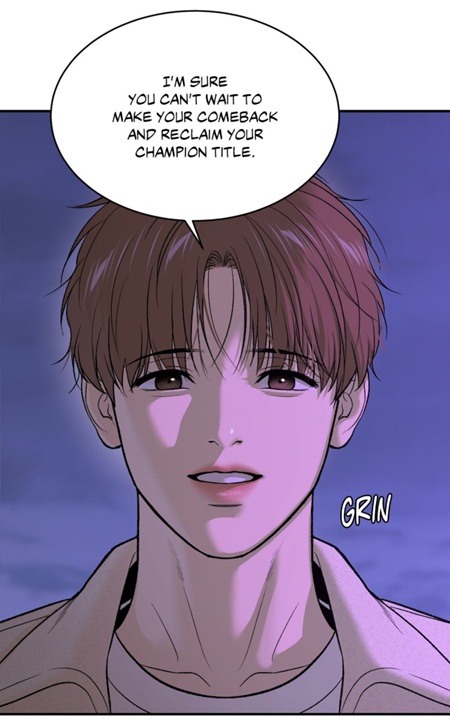 (chapter 84) He is taking the champion’s words at face-value.
  (chapter 84) A deadline designed to keep Kim Dan close without revealing the depth of the emotional dependency underneath. Finally, before we even analyze posture or timing, we must acknowledge the ghost that is sitting inside the cabin with them — Jaekyung’s own admission of dishonesty. Just minutes earlier, the narrative revealed again a thought he had never dared to voice aloud:
  (chapter 84) This is the language of surrender — not to defeat, but to vulnerability and selflessness. The champion who once insisted on keeping Kim Dan “one way or another” (chapter 84) now articulates the opposite impulse: the willingness to release him, to give him a choice.
  (chapter 84) Thus for me, in the cabin the champion became, for a moment, the boy with no mother’s gaze, no father’s protection, no safe place to rest. He must have said something cheesy, something a young person would say. Purity returns before experience does. Honesty returns before articulation. And in that moment inside the cabin, Mingwa makes a decisive artistic choice: we do not see Jaekyung’s eyes.
  (chapter 84) This pigment stands for innocence, purity, new beginnings and even equity.
 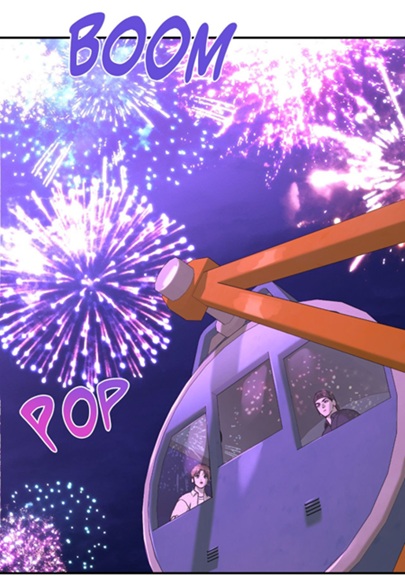 (chapter 84) Because they were not yet meant to be received, only meant to be released. The fireworks allow him to finally attempt a more honest sentence, but in conditions where it cannot reach its target.
 (chapter 81) Yet this is also the limit of what he can say.
 (chapter 79) Thus he could see the athlete’s mouth moving and hear sound. Nevertheless, observe that the moment the wolf reached to the doctor’s words, he bowed his head and looked down. From this
 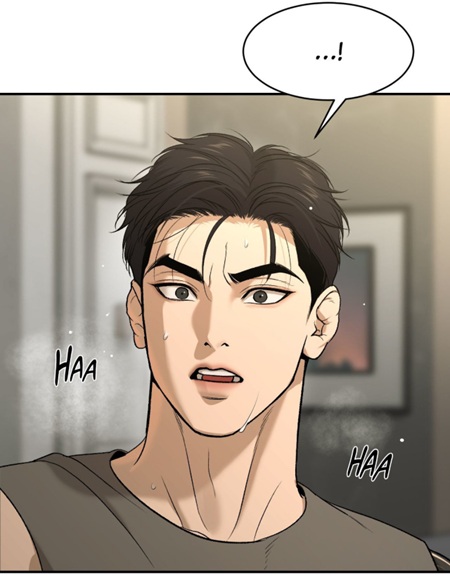 (chapter 79) to this
  (chapter 79) However, he doesn’t fear coldness, but ridicule and mockery, the father’s gaze:
 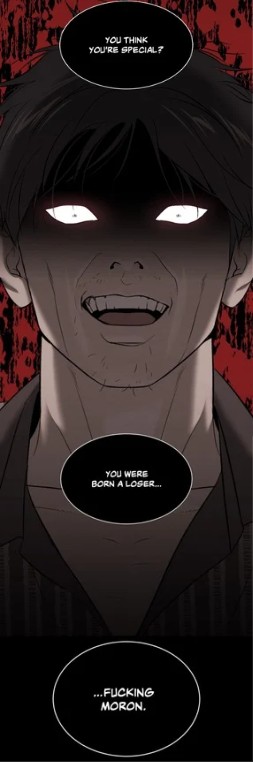 (chapter 73) Under this light, people can grasp why Joo Jaekyung was not facing doc Dan directly in the cabin. To conclude, the mechanism is identical, but amplified.
 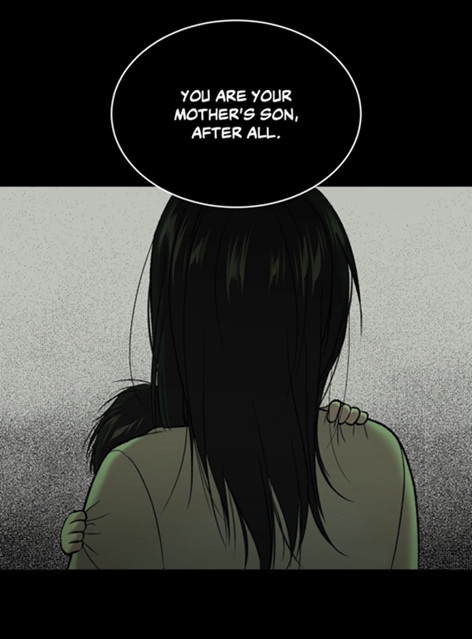 (chapter 73) Besides, the head of her position is indicating that she was not looking at her son, the boy was hiding his face from Joo Jaewoong and his mother. Then his father mocked him, degraded him, and used resemblance as an insult: “
 (chapter 53) Jaekyung has never been granted either.
  (Chapter 45) Thus when he got upset with the present, he indirectly expressed the wish to be « looked at ». Moreover, in his visions or memories, this is what he keeps seeing:
 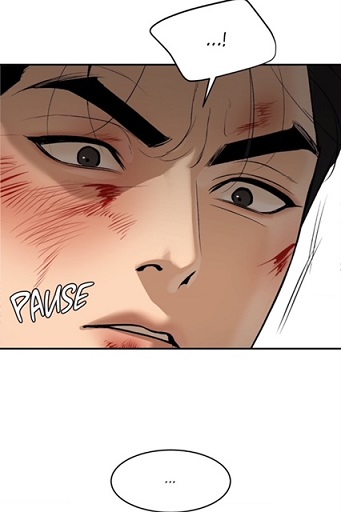 (chapter 51) His breath catches; his eyes widen. It is the moment he realizes his mistake. He never thought that doc Dan had been trusting him. That moment marks the first rupture in his emotional armor, not only because it hurt, but because it revealed. He realizes with terror that he wants to be seen by Kim Dan, but when he faced such a gaze, he could only feel guilty and bad. Thus it is not surprising that later, his nightmare let transpire his guilty conscience.
  (chapter 82), as the champion has always used his surroundings as a source of inspiration.
  (chapter 84) The gaze under the fireworks triggers emotions in him. Thus he blurted out something. But for me, he does not know how to say “I love you.” He cannot even say “I like you.” Those sentences belong to someone who has matured emotionally — someone who can identify feelings properly, but so far he keeps saying: “to stay by his side” and his « affection declarations » were all linked to negativity.. Thus my idea was that Joo Jaekyung could have said this: “I want to hold you!” (안고 싶어 너). Let’s not forget that so far, the champion had never expressed such a longing before; a warm embrace. He would always follow his instincts:
  (chapter 4)
  (chapter 69) The hug represents a metaphor for “staying by his side, for home and to be seen”. Moreover, in French embrasser can mean kiss and hug. And strangely, I noticed that the protagonists were never looking at each other during an embrace.
  (chapter 65) It is for “babies”. No wonder why he retracted immediately.
 (chapter 84) Here, the doctor looks sad and wounded. His eyes are unfocused — he is not seeing the present. The water running down his eyelashes gives the impression of tears, even though he is not crying. His gaze is distant, fixed on something internal. His mouth looks tense, almost trembling. The mouth especially is a clue: Kim Dan’s emotions always gather there when something from the past resurfaces.This is the expression of someone thrown into an involuntary flashback. He is inside a memory. This explicates why this scene is similar to the champion’s shower after the latter had met Baek Junmin:
  (chapter 49)
  (chapter 49) Both scenes show a man pulled violently into a buried memory. Thus, my assumption is simple: the champion said something that pierced straight into Kim Dan’s oldest wound and brought his trauma to the surface. And this brings me to my next observation. Inside the cabin, there are not two people — there are three: the champion, the therapist, and the Teddy Bear.
 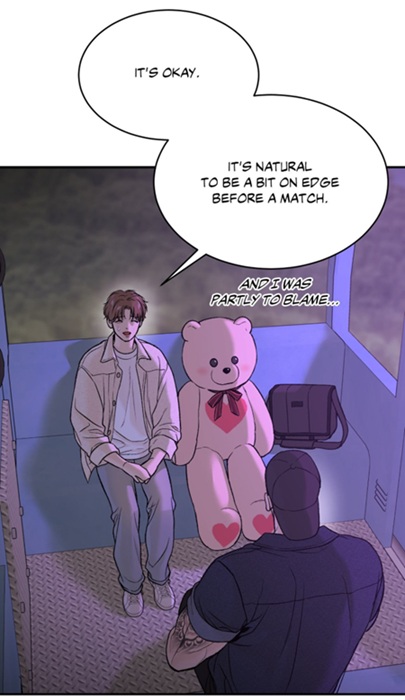 (chapter 84) Furthermore, we have a window. We have a phone (dead, but present). We have a childlike toy — symbol of stolen innocence.
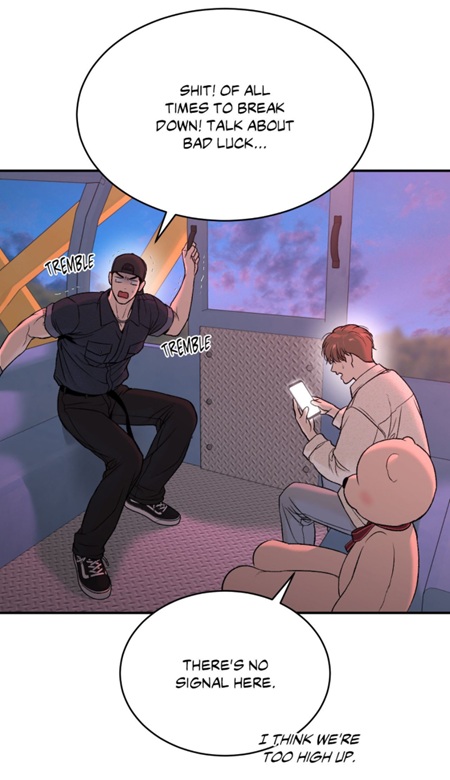 (chapter 84) And now, look again at episode 19:
 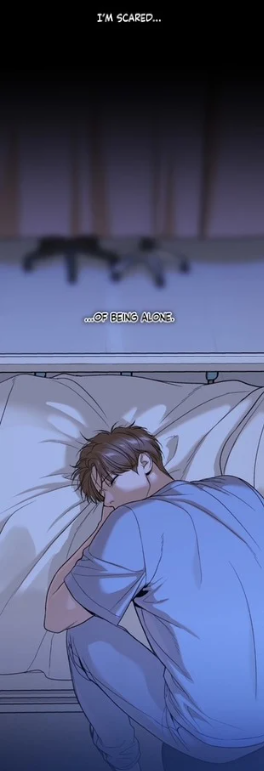 (chapter 56) In other words, wearing black is more than just a change of personality or mourning. It becomes the color of mystery, the beginning of descent into truth.
 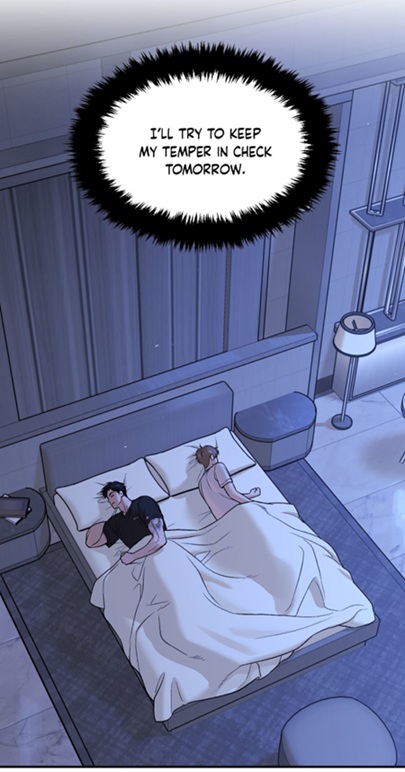 (chapter 79) on the night table.
  (chapter 84) So by wearing black, doc Dan indicates that he is gradually becoming responsible for Team Blackand Joo Jaekyung the athlete.

 (chapter 83) mirroring the contrast of their clothes and their personalities — and the champion even leans in to lick a smear of ice cream from the therapist’s finger, an image so intimate that any passerby would mistake them for lovers. And yet, not quite. The physical therapist approaches the outing as part of his job, a therapeutic break meant to soothe his patient’s nerves
  (chapter 83), while the athlete approaches the day with a far more personal hope. He stages the rides strategically, intending to appear strong and reliable so that his companion might grow frightened and instinctively reach for him
  (chapter 83) — just as he once did in the swimming pool.
  (chapter 80) Beneath the surface, what looks like a date is a carefully orchestrated attempt to recreate closeness without naming it. To conclude, whereas the episode flirts with the aesthetics of a date, the intentions behind it remain mismatched, unspoken, and unresolved. It is not an official date, yet it does not behave like a simple work-related excursion either, and we as readers are left suspended in that tantalizing in-between space — as if the very moment were hanging weightless above the ground, waiting for someone to name what it truly is.
 (chapter 83), charged with a warmth that seasoned Jinxphiles will recognize immediately: a tension between joy and tension, duty and desire, wind and water. And then we see him — the usually anxious physical therapist — smiling with his eyes closed, arms raised, as if offering himself to the sky and joining his “companions”, the clouds. In this panel, his hands — so often clenched, overworked, or trembling from exhaustion, fear or anger — are finally resting, suspended in a gesture of pure lightness and ease.
 (chapter 83) and waking life, quietly present in the lyrics themselves, resurfaces at the park amusement as well — though its meaning will become clearer as we look deeper. In season 1, the boundaries between the celebrity fighter and his therapist were blurred in ways neither of them understood: professional on the surface, intimate in practice, yet undefined in essence. Physical closeness existed, but emotional clarity did not. Now, in the bright openness of this amusement-park afternoon and evening, we are invited to look again. What exactly is their relationship here? A supervised rest day? A moment of companionship? The first fragile step toward something tenderer that neither man is ready to articulate?
 (chapter 83) or a family laughing together
  (chapter 83), something in him shifts so quietly that one might miss it at first glance: he smiles.
  (chapter 83) Not out of politeness, not to reassure someone else, not through exhaustion or habit. He smiles because he witnesses joy — and for once, it does not make him feel smaller. It does not activate the reflexes of deprivation or fear that shaped his life from childhood to early adulthood. On the other hand, the smile he gives in that moment is not radiant, not wide, not unguarded. It is a grin, a restrained upward curve that reveals both warmth and hesitation. His joy is present — unmistakably so — but it is still contained, as if his body has not yet learned how to express happiness without caution. This small, hesitant grin shows us a man who is beginning to open, yet still holds himself back, afraid of wanting too much.
 (chapter 1) reminded him of responsibility , every sight
  (chapter 1) pulled him back to duty or scarcity. Happiness belonged to others; he lived on the margins, always working, always surviving. But here, in the brightness of the amusement park
  (chapter 83), his gaze is finally unshackled. He looks outward and takes in the warmth of strangers’ affection without translating it into loss or longing.
  (chapter 83), though an accident could actually occur there. This contrasts so much to his thoughts in episode 1.
  (chapter 1) The amusement park becomes a place in which love exists openly, visibly, harmlessly. The lyrics capture this awakening beautifully: “And I don’t know if I’m being foolish… but it’s something that I must believe in.”
  (chapter 83) — the man who seems invincible and superior in every domain — has never been to an amusement park, a spark ignites inside him.
  (chapter 83) His heart, which moments earlier beat quietly in observation, begins to race with excitement. For the first time, he is equal to the athlete. At the same time, for the first time, he is the one with experience or power. 😲 How so? For the first time, age becomes real
  (chapter 83): the physical therapist is twenty-nine, the athlete twenty-six.
 (chapter 83) He suddenly steps into a role he has never been allowed to inhabit before: that of the knowledgeable one, the guide, the hyung.
 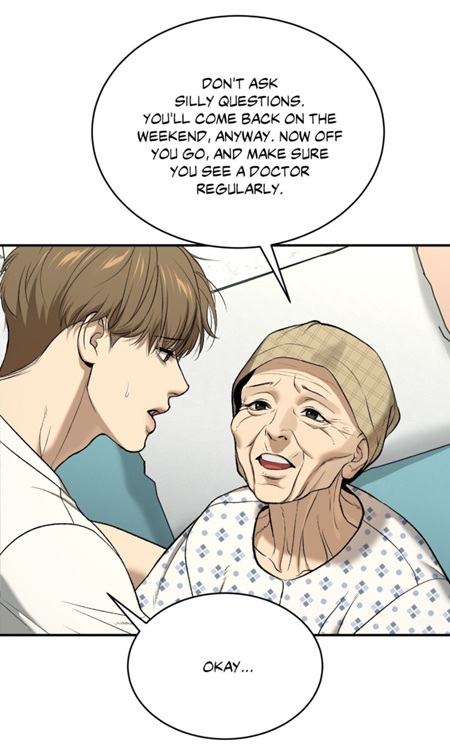 (chapter 78) Dan’s lifetime of passivity did not come from lack of intelligence or lack of will; it came from conditioning. He was raised by a guardian who loved him, yes, but who also unintentionally infantilized him. He was not allowed to question her words and decisions. His grandmother, who was not just older but twice his senior in authority, experience, and certainty, occupied every position of knowledge in his life. She decided what was dangerous, what was sensible, what was allowed, and what was forbidden. Her worldview dominated so completely that Dan’s own judgment never had room to form. His grandmother’s authority was absolute — not malicious, but unquestioned — and Dan learned very early that his role in the household was not to decide but to obey.
 (chapter 7) As if a twenty-nine-year-old man — a working professional — were incapable of making a responsible financial decision. Dan’s “Of course not!” is instinctive, defensive, almost childlike, exposing the emotional hierarchy between them. In her eyes, he is not an adult with agency, but a boy who must be corrected, cautioned, overridden.
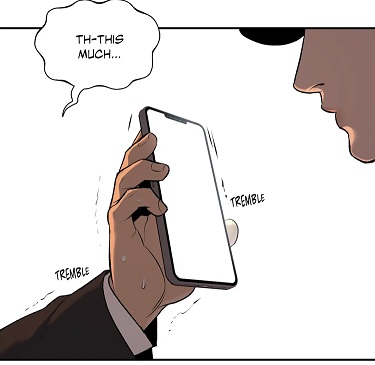 (chapter 17) Legally, financially, the burden is his. But emotionally, symbolically, he was never allowed to own that responsibility; it was neither recognized nor validated. Instead, his grandmother continued to treat him as a child incapable of navigating the world on his own — even though he was the one saving them both.
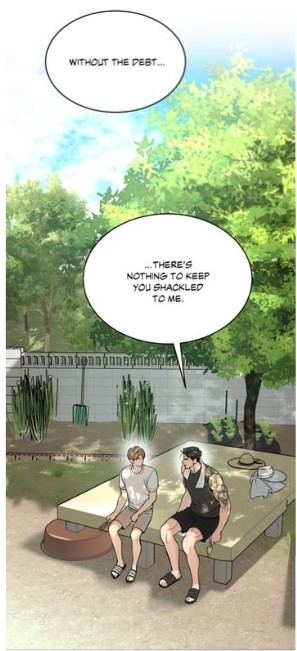 (chapter 77) and asking for his opinion
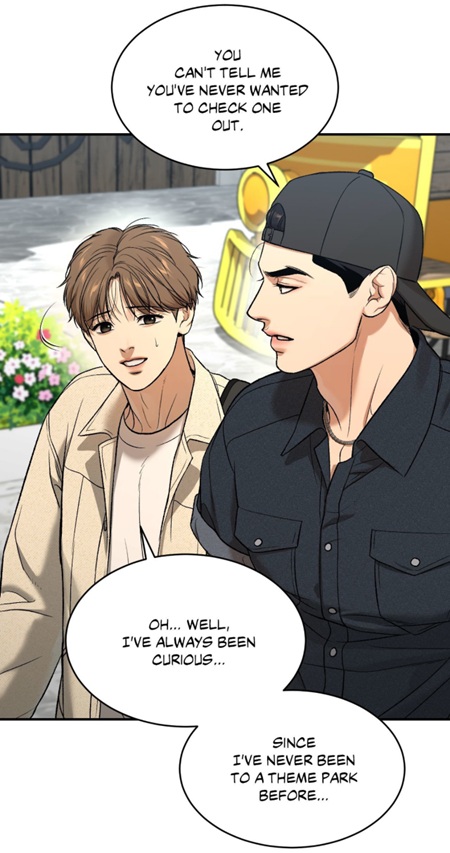 (chapter 83), Joo Jaekyung is liberating his fated partner.
  (chapter 83) He accepts the fighter’s generosity without guilt
  (chapter 83), yet offers his own in return — buying the drinks, fetching the ice cream, participating in the flow of giving rather than shrinking from it.
  (chapter 83) No one questions cost; no one frames affection as financial burden. This reciprocity is gentle, natural, unspoken. It stands in stark contrast to Heesung
  (chapter 32), who immediately reduced generosity to calculation. He implied that doc Dan couldn’t afford it. His smile was a lure; his kindness, a transaction.
  (chapter 83) Someone who can choose.
 (chapter 83) That’s the reason why Mingwa placed a boy with his father between the couple in this image. At the same time, she also insinuated that Joo Jaekyung was acting not only as a father, but also as a “boy”. That’s why love is in the air… they come to accept their true self. The two protagonists are both adults and kids!
 (chapter 83) The second half of the verse — “in the thunder of the sea” — finds its embodiment not in waves or ocean spray, but in a wooden flying boat swinging high above an amusement park.
  (chapter 83) It is here, of all places, that the façade of the undefeated champion bends, flickers, and reveals the frightened boy hiding beneath the man.
  (chapter 83)
 (chapter 83), although the knowledge is borrowed, second-hand, quoted from “the guys at the gym.” He buys cute headbands
  (chapter 83), selects a giant teddy bear as a prize. He tries to perform adulthood, to appear experienced, reliable, worldly — the one who leads. That’s why his reaction after the ride on the boat resembles a lot to the father: scared of rides
  (chapter 83) Because the truth is that Jaekyung, too, is both an adult and a child. Thus the author used many “chibi” in this chapter:
  (chapter 83) He is the warrior who never loses, but also the boy who becomes jealous of a rollercoaster because it made Dan smile.
  (chapter 83) When he sees Dan laughing with the wind in his hair, he is first moved.
  (chapter 83) For the first time, he truly notices the doctor’s joy and happiness. However, later his thoughts tighten into a childish pout:
  (chapter 72)— even those that fall short of a diagnosable concussion — accumulate inside the inner ear like invisible fractures. The system responsible for balance, spatial orientation, and visual stabilization becomes worn, over-calibrated to impact but under-prepared for fluctuation. A man can be conditioned to withstand punches that would floor an ordinary person, yet still falter when the world tilts beneath him.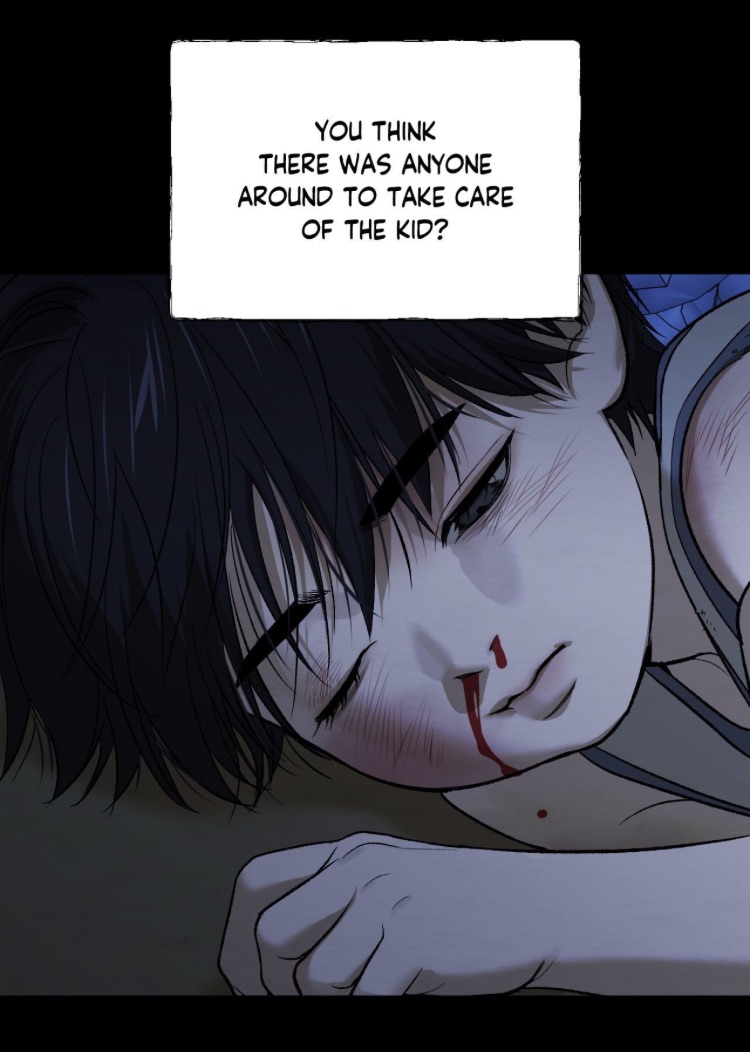
 (chapter 72) The body he trained into steel was built upon a nervous system shaped by violence. Let’s not forget that before his father died, the latter hit his head with a bottle once again.
  (chapter 73) Finally, he started fighting at such a young age,
  (chapter 72), actually boxing at such a young age is limited to non-contact activities like footwork drills, shadowboxing, jump rope, basic strength & coordination, bag work with very light gloves. So there is no sparring, no head contact.
 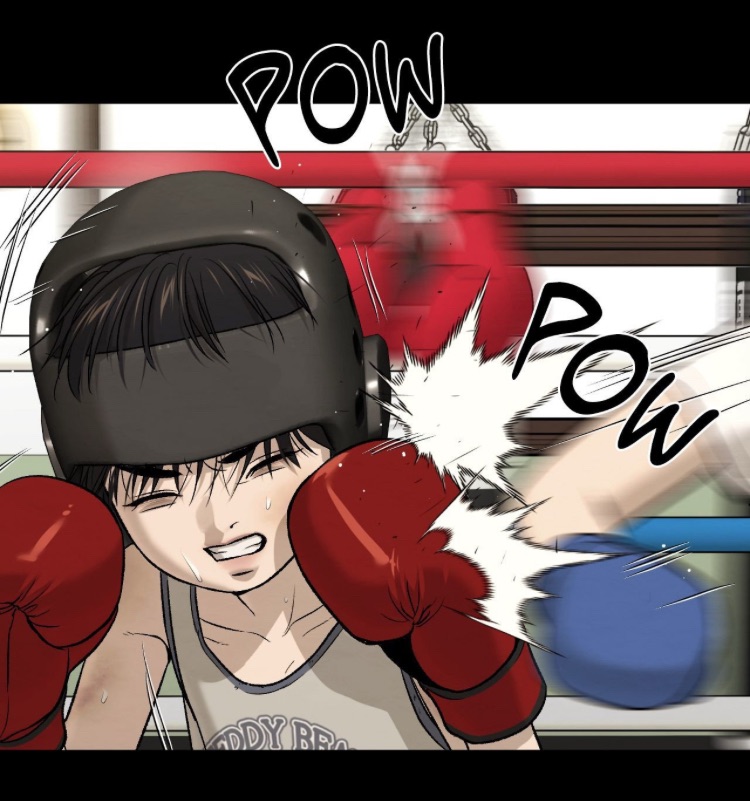 (chapter 72)
 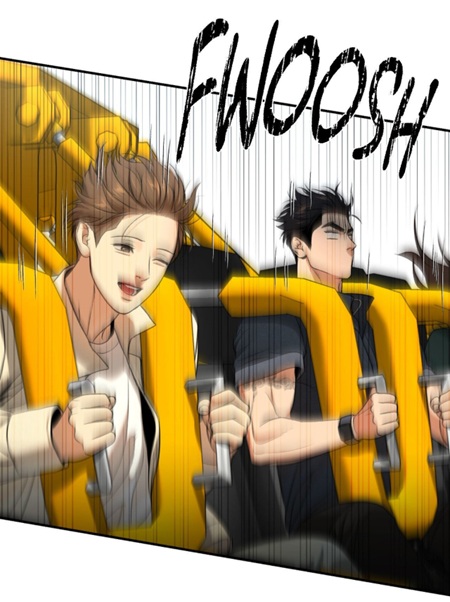 (chapter 83), thus they try other rides. It is important, because it implies that Joo Jaekyung is gradually leaving the water! This explicates why later something extraordinary happens.
  (chapter 83) Instead of retreat, there is reaching — a quiet but unmistakable reaching toward the man beside him. The problem is that he is still too scared to voice his thoughts in front of the physical therapist.
 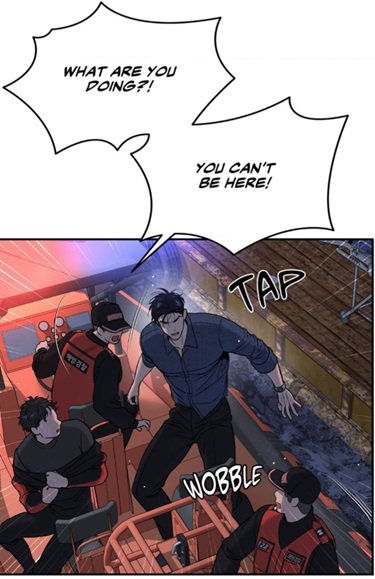 (chapter 69), then at the amusement park, the boat was in the air
  (chapter 83), he rises into air — the first air he has breathed without fear.
 (chapter 44) followed by a false dawn. Chapter 44 unfolds in artificial night — neon
  (chapter 44) and night lamp
 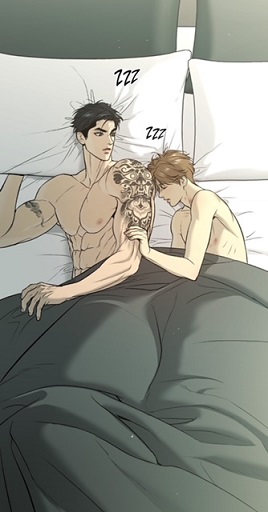 (chapter 45) Morning light becomes a scalpel. There is no magic left, no gentleness, no room for misunderstanding. Jaekyung’s bluntness
 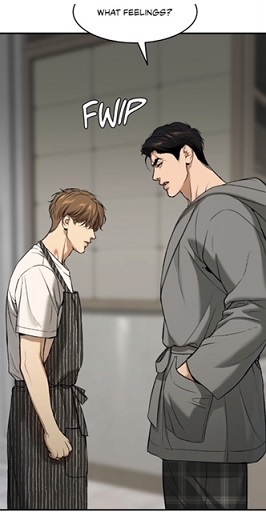 (chapter 45) annihilates the illusion Dan had constructed the night before. This is not heartbreak; it is disenchantment, the almost physical pain of realizing a moment meant nothing to the other person involved. Chapter 44 was the dream, and Chapter 45 was its punishment. Together they show a relationship out of sync, two people whose desires never touch at the same time. One wishes for home and attention, while the other has no idea that he is loved. So far, he has never heard this: “I love you”. One tries to reach out emotionally, while the other remains absent. However, when they are both lucid, none of them are totally honest, as they are self confused. Thus they are in two different worlds.
 (chapter 83) This scene confirmed my previous interpretation about the symbolism of the blue/golden hour.
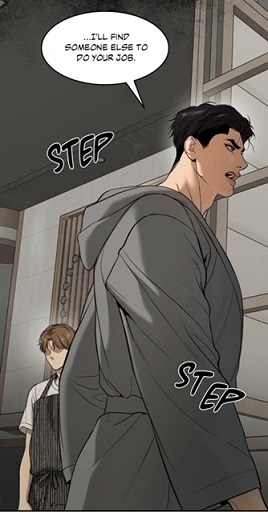 (chapter 45) Neither can pretend not to feel. Neither can avoid the other’s gaze. They must see each other as they are, in that moment. And miraculously, neither flinches. There is no denial, no deflection, no cruelty. Only two men who finally dare to look. Whereas Chapter 44 let them hide behind darkness and drunkenness, and Chapter 45 forced them into cold exposure, Chapter 83 holds them in a gentle, suspended in-between: the space where dream and reality finally meet.
 (chapter 84) and holding the bear’s hand.
  (chapter 84)
 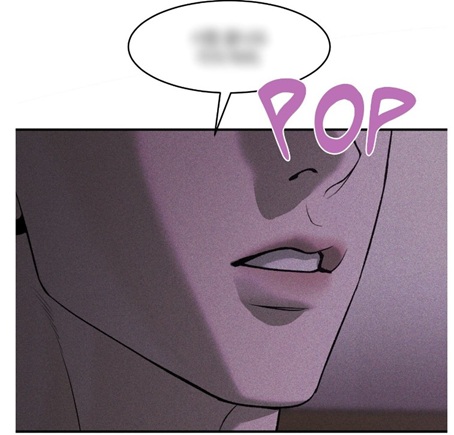 (chapter 84), but wise enough to regret immediately.
  (chapter 45)
  (chapter 46)
  (chapter 46) The champion also played “dumb”. Thus the pillow got punched later.

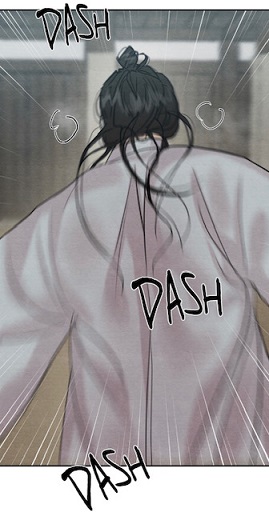 (chapter 126) to another
 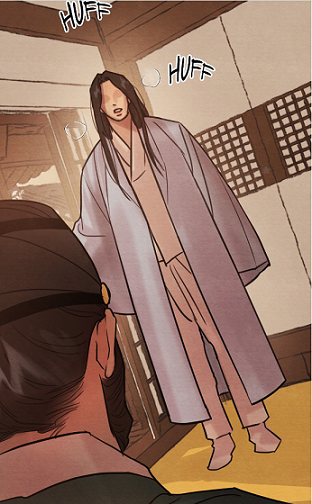 (chapter 126). He allowed his father to humiliate and abuse him
  (Chapter 126) once again. It was, as if the story was back to square one and the protagonist had learned nothing at all. Under this perception, my avid readers can comprehend why I selected such a title. However, instead of thinking that the author was a bad writer, I decided to ponder on the following question. Why did the author choose such an evolution?
 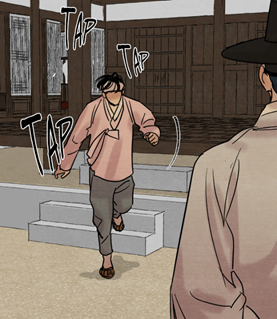 (chapter 7) Like Baek Na-Kyum, he rushed to his loved one’s side. However, he was first stopped
  (chapter 126), because it was not the right time. How so? Notice that his brother had fetched him at the port
 (chapter 125), but he never followed him to the bureau of investigation. And the same happened later. Why didn’t he go to his shed, when he was trapped there? Where was he, when the eldest son visited the father?
  (chapter 126) His absence exposed his passivity and betrayal. However, at no moment, Yoon Seungho noticed this. To conclude, Yoon Seungho was so worried for the painter that he didn’t pay attention to his surroundings, just like the painter didn’t see the learned sir’s disdain expressed through the cold gaze.
  (chapter 07) Therefore Yoon Seungho didn’t notice the presence of a civilian next to the governor.
  (chapter 126). Striking is that the governor knew about Yoon Seungho’s whereabouts before his arrival: the coast. As you can see, I am detecting a link between the governor and the younger master Seungwon. Yet, it was disguised as a rumor behind the expression “I had heard”. My assumption is that Seungwon came from the bureau of investigation in order to inform his brother. Therefore it is not surprising that Seungho was invited by his brother to visit the prison during the night.
  (chapter 126) And the moment I perceived the protagonist as a fool in love, I realized that chapter 126 is a reflection of episode 7, 29
  (chapter 29) and 40
  (chapter 40). Here, the painter was trying his best to protect Jung In-Hun’s interests (life, high position). Moreover, in episode 40, the painter had a dream, when he saw the announcement for the civil service examination. He smiled, for he was looking forward for the future.
  (chapter 40) And what have these episodes more in common? A betrayal, abandonment from a loved one and a paper (painting, poem). Hence I am more than ever convinced that the petition will resurface very soon and play a huge role in the downfall of the schemers and haters. Besides, chapter 40 represents the negative reflection of the conversation in the prison.
  (chapter 126) Though they are in a tough situation, Yoon Seungho is not leaving his side contrary to episode 40.
  (chapter 40) There is neither disdain nor mockery. The mentioned scenes are similar, for the present resembles the past. And this brings me to the second reason for the Webtoonist’s decision.
 (chapter 123), Yoon Chang-Hyeon considered Yoon Seungho as a human, for he employed the personal pronoun “he”. He was still his son. Then in episode 77, he judged him as a slave
  (chapter 77), hence he was submitted to the straw mat beating and was held captive. He even refused to send for a physician.
  (chapter 83) Here, the father is denying his humanity, he is just an animal. In their next confrontation, he describes him as a monster, hence he wished that he had never been born.
 (chapter 86) However, his words exposed that he was still viewing him as a living being. Therefore it is not surprising that he accepted lord Song’s request to order the murder of his son! In the gibang, he decided to no longer acknowledge Yoon Seungho as his son.
  (chapter 107) The tragedy is that the protagonist still viewed the Yoons as his family because of Yoon Seungwon, who keeps calling him “brother”. This explicates why Yoon Seungho sponsored his brother to have an official position.
  (chapter 115) Therefore it is not surprising that he followed Yoon Seungwon’s advice again.
  (chapter 120). He would bring the petition to his own father. This means that he is acting like the painter who listened to his noona Heena so well.
 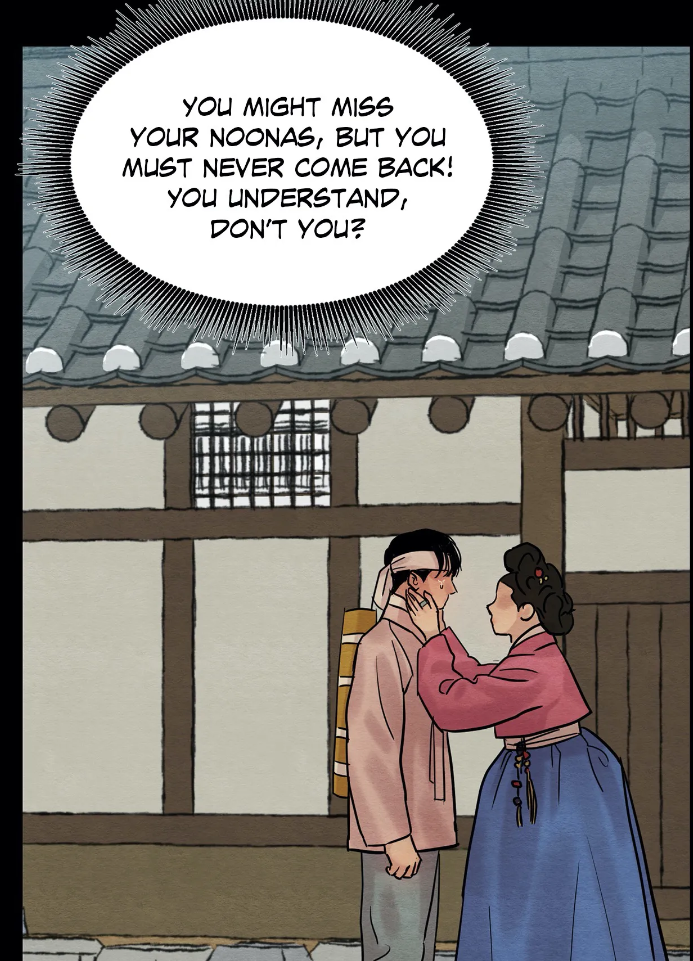 (chapter 46) But now, Yoon Chang-Hyeon believes to have the petition.
  (chapter 125) This explicates why the patriarch is now calling the main lead “nothing”.
 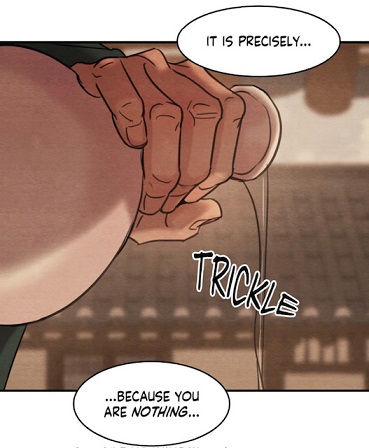 (chapter 126) He is not even a thing. This means that he is actually discarding him. This explicates why he sent him to the shed.
  (chapter 126) It was, as if he had become a merchandise. Or we could say that the elder master had been using him as a tool, which he can now abandon.
  (chapter 126) Interesting is that the idiom “plaything” has for antonyms tool, implement, instrument and utensil. And this brings me to the following remark. The father’s words are reflecting the last scheme. Yoon Seungho was used as the sword to get rid of an enemy, lord Song. It was, as if someone had decided to get rid of lord Song, for he represented a danger or threat. It also mirrors the trick in the shrine. Min and the others got killed, because Lee Jihwa went to his childhood friend. And who had seen the main lead using this sword, when he was enraged? Father Lee!
  (chapter 67) But let’s return our attention to the patriarch and his son. Yoon Seungho is no longer recognized as a Yoon member. Therefore I come to the conclusion that Yoon Seungho will make the following decision: to become an orphan. And this is symbolized by the loss of hair. I am expecting him to cut off his hair, something the painter has been doing for a long time. That’s why Byeonduck showed us the lord without a topknot.
  (chapter 126) This would coincide with my previous statement. The lord is going through the same experience than his loved one. However, people will come to the conclusion that this was done by the father. How so? Remember how each rumor became a reality.
  (chapter 1) I had already demonstrated that Yoon Seungho was not a fiend for sodomy with no regard for time and place, until he met Baek Na-Kyum. But once a deed is done, it can never be repeated.
  (chapter 101) So should Father Lee claim that he has long disowned Jihwa by cutting off his topknot, no one will believe him, for the young master was still seen with a topknot after confessing his feelings in public.
 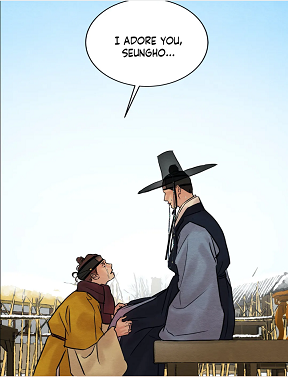 (chapter 57) In other words, the topknot incident at the kisaeng would be brought up. It is impossible for 2 fathers to act the same way. Besides, the loss of the topknot has another signification: Yoon Seungho would cut off ties with valet Kim, for the latter was the one who gave him the topknot. And episode 126 reflected one more time his position:
  (chapter 126) He is the one dressing him. It was, as if he was the pope.
 (chapter 116) It is because someone had reported to him the conversation between lord Song and the painter.
 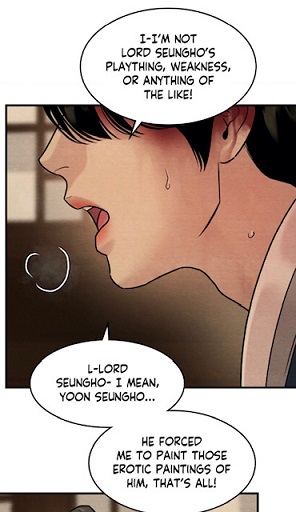 (chapter 122) There was a spy listening to their conversation. Since all the guards died
  (chapter 124)
  (chapter 125: I am assuming that the survivor got executed), I am suspecting the scholar. Moreover, why would Yoon Chang-Hyeon accuse his son to have abandoned Baek Na-Kyum? It is related to this departure of the staff and Yoon Seungho.
  (chapter 120) And who was present there? Jung In-Hun! But there is more to it. Since leaving Baek Na-Kyum behind is considered as an abandonment, it means that the patriarch abandoned his son too.
  (chapter 27) By speaking to Yoon Seungho, the elder master Yoon didn’t realize that he was admitting his own wrongdoings. Actually, he had abandoned him many times… like here for example
  (chapter 87) Therefore his words will come back to bite him. But these words are also exposing the valet’s betrayal and abandonment towards Yoon Seungho!! How so?
 (chapter 122), then he should have been at the patriarch’s house. The absence of the valet is the evidence of his treason. For me, he is now working for Jung In-Hun which explains why he never mentioned his presence in the mansion, only lord Song. Besides, keep in mind that once deed done can not be repeated. In episode 27, the lord was too angry and busy to notice the learned sir’s spying activities.
  (Chapter 27) Moreover, Kim didn’t report the interrogation to his master. This means that the butler covered up for the teacher’s wrongdoing. But here is the deal:
 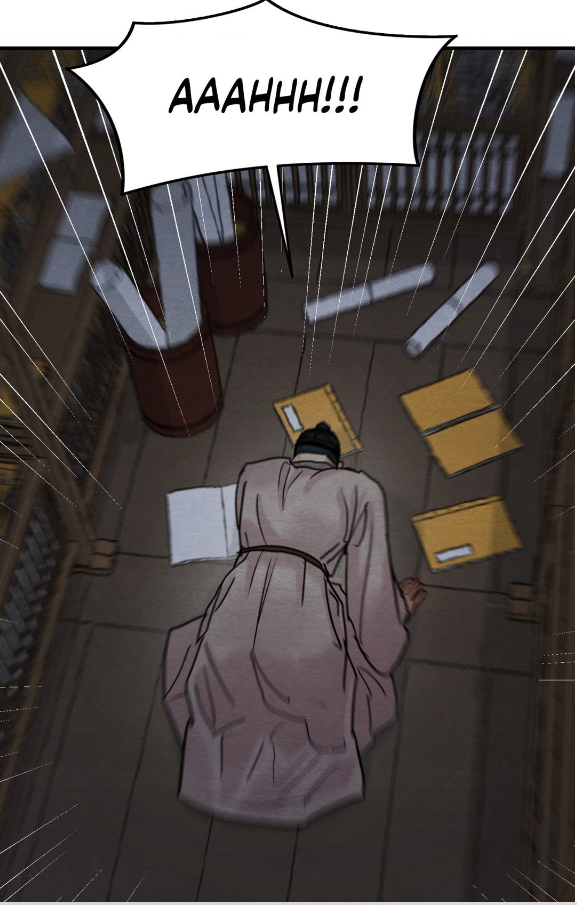 (chapter 120) The library was ransacked, hence this crime is bound to be discovered. Finally, his intervention in the shed is exposing his deception.
  (chapter 83) That’s why I am convinced that these words
 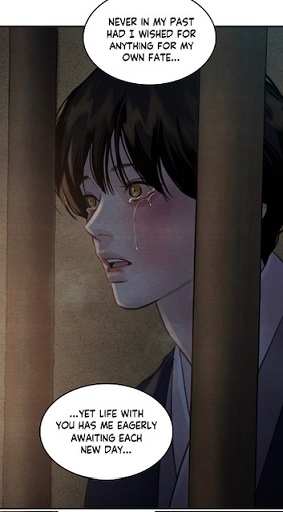 (chapter 126) He is no longer suicidal, in fact he is full of hope! Though he was sent back to hell for a short moment, he came out of this as a winner. My evidence is that the lord has now become a believer.
 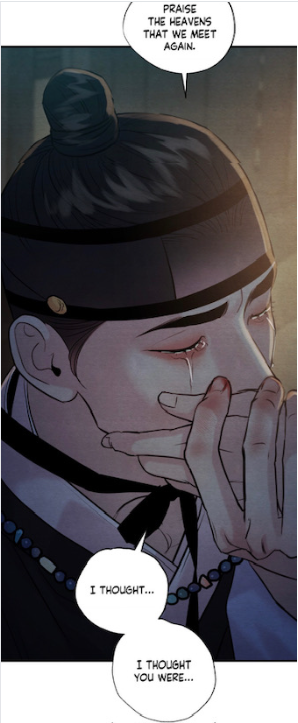 (chapter 126) Yes, episode 126 exposes the return of his faith! And where could we see the atheism of Yoon Seungho in the story? In chapter 92!
  (chapter 92) He didn’t believe in the spring poetry to ward off bad luck! That’s why he was sent back to the past. He needed to lose everything in order to find hope! In his darkest moment, he expressed a wish: to meet his loved one! And where did he pray to the gods? In the shed!
  (chapter 126) Observe how he is kneeling in direction of the bars. He is hoping to meet Baek Na-Kyum again. As you can see, though this scene
  (chapter 126) He was showing resistance and anger towards his father. Moreover, he was no longer shaking in front of the patriarch or the guards.
  (chapter 86) Thus I deduce that though he was mistreated and insulted like in the past, he was no longer suffering from his traumas. He is healed. His will is now really strong, supported by his new found faith.
  (chapter 62) Even if they were hugging, they were not close emotionally and mentally. This stands in opposition to the scene in the jail. They might be separated by the bars, but they are touching each other tenderly.
  (chapter 126) They are able to see each other.
  (chapter 126) Try Meditation
 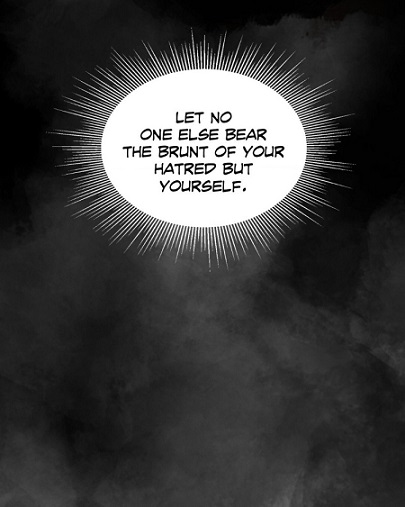 (chapter 126) or Prayer
  (chapter 126)
 (chapter 126) Quoted from
  (chapter 126) It is relevant, because light represents knowledge and truth. He is now the bearer of the truth. And he got his blessing from Baek Na-Kyum, when he touched his hands.
  (chapter 120) Yes, chapter 126 mirrors 92! This somehow confirms my theory that the butler was the one hiding under the purple hanbok.
  (chapter 92) Moreover, we have another reference to this episode, the pouring of alcohol!
  (chapter 92)
  (chapter 126) It was, as if someone wanted the lord to pay for Min’s insult! That’s the reason why I come to the following conclusion: Yoon Seungho is now opening up to Baek Na-Kyum. He is confessing to the painter about his wishes.
  (chapter 85) The manhwaphiles should keep in mind that the request from the artist in the study was strongly connected to forgiveness. And Baek Na-Kyum could also confess what happened in the past: his guilt and regret asking for the lord’s forgiveness. Right now, both are blaming themselves for the incidents, although they got fooled by many schemers. Because the lord proved his loyalty and blinded trust in the painter, I see the scene in the jail as a new version of this confession:
  (chapter 75) Thus I consider the prison cell as a sacred place, where both characters are about to be freed from their guilt!
  (chapter 11) thus he could escape justice!
  (Chapter 11) Simultaneously, the first definition of life lie corresponds to Yoon Chang-Hyeon. The latter blames his eldest son for the downfall of the Yoons.
  ! (Chapter 86) Secondly, he still thinks that he is powerful. But it is just an illusion.
  (chapter 125). They fail their duty, for they allowed the main lead to barge in the room.
  (Chapter 126) Finally, observe how they keep apologizing without giving any explication.
  (Chapter 125) Their apology is fake. As you can see, the patriarch is living in an allusion. He is powerless, and the best evidence is that he doesn’t have the petition.
  (Chapter 126) He is actually encouraging his son to hate himself and indirectly his own father! However, the son made the exact opposite decision: love!! Hence I am more than certain that the elder master is about to experience a harsh awakening.
  (chapter 101) Thus they got punished. And now, the two main leads are about to face human justice.
  (chapter 65) But strangely, the painter is showing no fear at all.
  (chapter 126) He is ready to sacrifice himself. So why was Yoon Seungho dressed up in the end? One might say that with the topknot and the hanbok, the abuse from the patriarch got covered up. That way, Baek Na-Kyum wouldn’t detect Yoon Chang-Hyeon’s lies and abandonment!
 (chapter 125) The latter brainwashed him to take the fall for everything, implying that way, his loved one would be protected! However, I am suspecting that if the lord were to leave the prison, he could meet someone in the office. That way, this person is not confronted with the reality: the main lead was “abused”. According to the butler, he was supposed to meet his brother at the office.
  (Chapter 92) In episode 92, we have a mysterious man in the background dressed in black, but he is not wearing his gat. Besides, I would like my avid readers to remember this image from the trailer:
  which reminds us of the office:
  (chapter 98) This place symbolizes power and strength. And because episode 126 is a reflection of chapter 7, 11, 29 and 40, I think, Yoon Seungho is about to receive a deal, for these episodes are focusing on the deal between the painter and the protagonist: protection from the father and punishment in exchange for entertainment. He would appear as a fake savior in the end. Remember what in episode 11 the artist said in front of his fated partner:
 (chapter 11) He would do anything except painting!! He was not willing to give up on this principle, which reminds us of faith. So when Yoon Seungho faced his father, he experienced powerlessness for one reason.
  (Chapter 105) Then in episode 122,
  we discover that lord Song employed the pipe to beat the painter. Moreover, I detected a progression. In season 2, Yoon Seungho was still smoking.
  (Chapter 74) But once the painter showed that he didn’t like smoking, Yoon Seungho stopped taking the drug. This explicates why in season 3, he was no longer seen with the item in his hand. Even under stress, he chose to hunt instead of smoking in front of the window. We have two scenes where the pipe is present. One is when the lord is throwing it out of anger,:
 (chapter 86) which reminded me of the incident with the music box.
 (Chapter 85) This shows that this item had no value to the protagonist. Then the pipe appeared in the gibang on the table.
  (Chapter 96) However, here the lord had only eyes for the painter or Heena. Hence I have the impression that the pipe could resurface and serve as an tool to identify the perpetrator, just like the glasses were used to recognize the scholar.
  (Chapter 102) Finally, since the pipe appeared in the gibang twice, it indicates that this hobby is linked to the kisaeng house!! And this brings me to my final observation: the pipe is connected to paper
 (Chapter 1)
  (chapter 1) However, there exists two books!! And one has no PIPE! This coincides with the decision of the painter to stop drawing erotic pictures! Yes… dropped amusement! At the same time, Yoon Seungho has long lost his interest for erotic publications. He also dropped this hobby. On the other hand, the books were dropped in front of the painter.
  (Chapter 1) Finally, the petition was dropped in front of lord Song
  (chapter 123) which announced his death sentence. To conclude, the papers have a strong connection to punishment and death.
  (Chapter 126) Yoon Seungho went to the father’s mansion, and it didn’t take him that long! As you can see, I consider this trip with Yoon Seungwon as a diversion.
  (Chapter 121) So why didn’t the elder master return to his old home? It is to drive the Yoons out of their propriety. In other words, the lies from the past are becoming a reality exposing the liars in the end. Their life lies will be ruined.

 (chapter 109) He discovers that Baek Na-Kyum has already prepared himself, as he is longing for him.
  (chapter 109) He never expected such a reaction. The reason why the evolution of Painter Of The Night is flowing at a snail’s pace is that season 4 is now focusing more on the past. First, Byeonduck needs to divulge the lord’s suffering and its causes. And this can only happen, if memories are brought up. Hence in episode 109, the painter’s memories stood in the center. Why? It is because he is trying to understand why his loved one is now avoiding him. Thus he is remembering what happened just before. The readers are actually put in the same situation than the artist. On the one hand, the focus on recollection is a method to unveil how the young master was turned into a “sodomite and pariah”, for the painter is going through the same experience than his partner. In episode 109, he is isolated from his “lover” and as such from his family, for he has now maids by his side. The latter are supposed to be his new “family”. On the other hand it helps the manhwaphiles to anticipate the future main events,. as the progression is in slow motion. This means, the Webtoonist left all the elements in the previous seasons in order to decode the past, the present and the future. That way, the manhwalovers are capable to unveil the mystery. Besides, the author has to answer all the questions the beholders had while reading the previous seasons, like this one:
  (chapter 27) What book was the scholar looking for? Up to now, we have no clue, though I had developed the following theory: Jung In-Hun was a Christian and had a bible.
  (chapter 109) How did this happen? One might reply that the book fell from the shelf, when the painter kissed his lover.
  (chapter 109) This interpretation can be easily refuted, for the noble stood next to the shelf and not in front of it. Besides, the counter stands on the noble’s left, while the ledger was on his right. However, one detail caught my notice, the beholder can not see Yoon Seungho’s hands!! That’s how I realized that the book came from the protagonist! He had carried it hidden in his right sleeve. This explicates why the book stands on the right side.
  (chapter 109) Besides, contrary to the previous panel, now the lord’s hand is visible! This is no coincidence. But if he was hiding the copy from Baek Na-Kyum, I deduce that it is related to the painter. But there is another person associated to manuscripts in this story, Jung In-Hun!! But what have the low-born and the scholar in common then? The erotic publications!
  (chapter 34) Note that in the background, there’s a book open on the desk, and it has the exact opposite position than in episode 109! And now, you comprehend why Yoon Seungho rejected the painter’s company next to his table. He didn’t want him to see the publication, for he feared that the painter would be reminded of Jung In-Hun. In the lord’s mind, the young artist still treasures his former teacher. He heard his confession on the bridge next to the pavilion.
  (chapter 94) However, Yoon Seungho is suspecting that the learned sir was behind the trick in the shaman’s house due to the glasses Min had in his hand before dying.
  However, there exist two reasons why I came to this deduction. I detected similarities with the first encounter between Yoon Seungho and his nemesis in the scholar’s home and the painter’s kisses.
  (chapter 6) Both were standing in front of the cupboard, while the learned sir suddenly took away the copy and closed it to put it back on the cupboard. This made the protagonist smirk. Due to the characters’ reaction,
  (chapter 6), I had assumed that the protagonist was making fun of Jung In-Hun. He had played a prank on the host, especially after asking about his occupation. I have always wondered about the content of the volume. Therefore I had developed the idea that this could be the bible. However, it was clear that the book was not for children which is visible due to the writing.
  (chapter 6) In fact, the learned sir should have the manual Thousand Character Classic (Chinese: 千字文; pinyin: Qiānzì Wén), also known as the Thousand Character Text.
 (chapter 6) In reality, he wasn’t teaching them reading and writing at all. But Yoon Seungho had feigned ignorance with this discovery. With his indifference and praises, the false teacher had the impression that he was supporting his attitude. This scene is relevant, because the learned sir had lied to the protagonist about the painter’s education.
  (chapter 6) This means that the book represents the evidence of learned sir’s betrayal and abandonment. He is responsible for his illiteracy. To conclude, this scene contains the following elements: a prank, a lie, a confession which was triggered by a book that Yoon Seungho had picked up by chance. But wait… it could be the book from the scholar’s home!
  (chapter 06) But this image can be used to refute this theory. How so? It is because this book has a title, hence there is a white rectangle!! However, take a closer look at the copy on the floor.
  (chapter 50) Finally, I would like the readers to keep in mind that they could only see the content of the books
  (chapter 6) He proposed him to sit and have a cup of tea to divert his attention from the books on the cupboard. Besides, I would like to outline the huge contrast between these two scenes. The scholar needed the assistance of the prestigious family Yoon, while the protagonist replied this to his loved one:
  (chapter 109) Needed versus not necessary!
  (chapter 6) He was here very vague (“bizarre and vulgar”), he spoke of a scolding, but never of rejection and abandonment!! This is important, because Yoon Seungho also experienced something similar in the shed:
  (chapter 77) Back then, the butler’s words must have wounded him terribly, he must have felt dirty either. Under this new perspective, it becomes comprehensible why I came to this conclusion that the book is related to the learned sir and to the erotic publication. But this doesn’t end here. In my eyes, episode 109 clearly outlined the importance of the library in the protagonists’ life. This is the place where both main leads got betrayed and abandoned.
  (chapter 40) When the scholar wounded the artist with his words, he implied that the artist was responsible for his lack of education. With the idiom “I thought, you could be educated”, he gave the impression that he had put some effort, but due to the artist’s disposition, he had failed. We had another scene where the learned sir was blaming Baek Na-Kyum.
  (chapter 70) He would fall asleep instead of studying. And who knows about the learned sir’s hypocrisy? Yoon Seungho!! That’s the reason why the goddess Byeonduck let them meet in the library. It is to heal their wounds. In this room, Yoon Seungho’s suffering started and later, the painter got betrayed by his former teacher, someone whom he viewed as his “family and mentor”.
  When Yoon Seungho got kissed by the painter
  (chapter 109), he got surprised, and he had the same gaze and facial expression than the one during the First wedding night
  , in the gibang
  and in the study
  (chapter 42), though here the artist kissed his companion twice!
  (chapter 49) And what had these scenes in common? Paintings and the artist’s confession. And now, you comprehend how I made the connection between the book and painting.
  (chapter 19) This scene could only break the artist’s heart, because he was reminded of the learned sir’s reaction: his rejection. The latter got angry and jealous that the low-born would be treated as someone special. Furthermore, Jung In-Hun had only got the noble’s sponsorship thanks to Baek Na-Kyum and not thanks to his own talent! In verity, the learned sir had been the tool to submit Baek Na-Kyum. Shortly after the exposition, the protagonist went to the study. There he got confused for Jung In-Hun, hence he received a wonderful confession
  (chapter 19) before getting kissed and embraced!
  (chapter 42) Yet, the artist was unable to explain the situation, for he had internalized Jung In-Hun’s criticism.
  (chapter 42) So we could say that the yangban tried to get a confession from the painter, but he failed. Hence they had just sex. The artist’s heartbreak was the reason why he never got to confess the truth! And what had happened in the study after the painter kissed the main lead? The lord saw the inauguration illustration and got jealous of Jung In-Hun
  (chapter 48), and the painting had exposed the main lead’s uneasiness and pain. The drawing was not refined, barely finished.
  (chapter 47) The behavior from the painter and the new painting had not only wounded the main lead, but also pushed the lord to discover why the artist was behaving this way. After the rough sex session, the artist had made a confession: he was dropping the rules he had been raised.
  (chapter 49) He was admitting his sexual orientation and his own pleasure, but he still kept his distance from Yoon Seungho. Why? It is because he was reminded of the learned sir’s fake embrace and betrayal.
  (chapter 49)
  (chapter 94) which incited the artist to recall his childhood. That’s how he came to unveil his past and confess his love to the noble!
  (chapter 94) And what do have all these kissing scenes in common?
  (chapter 19), the parties after the separation
  (chapter 51), his visit in the gibang and his tricks
  (chapter 96). In episode 109, the painter confused Yoon Seungho’s shadow with Black Heart’s. In his nightmare, he was brought back to the shaman’s house and the lord’s smile was similar to Min’s.
 (chapter 109)
  (chapter 99) Besides, let’s not forget that during that terrible night, Black Heart never touched the artist himself, as if he didn’t want to touch a trinket sullied by another man”. On Twitter, the author revealed that Min would help Yoon Seungho. Through this comparison, the beholder can confirm this. Thanks to Black Heart, the couple got closer in the end.
  (chapter 19), the spying on the painter – though here it appears like a good thing –
  (chapter 41), the stones in the rice
  (chapter 47) and the words from the maid who repeated the noona’s principle
  (chapter 109). Here, the maid was triggering the painter’s memory and as such fears. That’s the reason why the readers can see the laugh of someone outside the building
  (chapter 109). She was acting, as if Baek Na-Kyum was not present, but in reality she knew that he could listen to her. How do I know this? The evidence are the sweets on the windowsill.
  (chapter 109) They never encouraged the tormented boy to eat the sweets!! Besides, this episode confirmed my interpretation about the complicity of the maids. As their role is to comfort Baek Na-Kyum, the readers should question themselves about their absence.
  (chapter 108) Why is the room dark? Where are the maids during that night, as they are supposed to sleep next to the painter?
  (chapter 109) The absence of the light is truly noticeable, an indicator that they are not in the bedchamber. Moreover, I had detected that the brown bed cover symbolizes the meddling of Kim. [For more read the essay
  (chapter 87) Sincerity versus fake concern; own choice versus manipulation, happiness versus sadness. Under this perspective, you comprehend why I view the maids as traitors. But since season 1, the women were never punished. Hence they felt free to badmouth Yoon Seungho or Baek Na-Kyum. So while he was preparing himself, where were the ladies-in-waiting? I doubt, the painter would give them orders. The painter was left alone on purpose. Finally, the manhwalovers should question why there is a bottle of oil in the bedchamber. So far, Yoon Seungho utilized it once
  (chapter 20) and it was during the first Wedding Night. And oil comes from the kitchen, the lord had fetched it from that room!! Naturally, there is an exception, and it is the kiss in the gibang. Yet, here the kisaengs had just replaced the maids. In other words, they had played a role in the confession. And this explains why the noona’s words are superposed with the maids.
 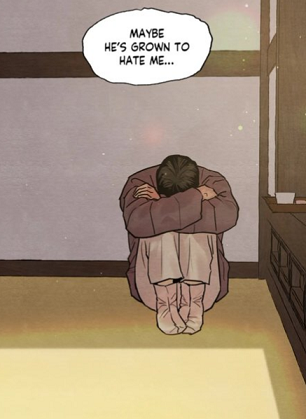 (chapter 109) That’s the reason why I am convinced that the book is strongly connected to the learned sir. In my eyes, it can only be the erotic publication of sodomy!! Why? It is because it represents the painter’s biggest wound. It explains his low self-esteem. Consequently, I am expecting the appearance of this panel:
 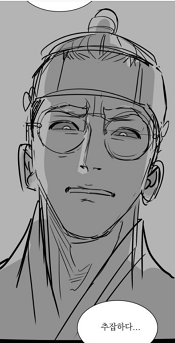 (tweet) The teacher told him “It’s dirty”, and wounded him the most with his gaze full of hatred, the symbol of rejection! Note that in episode 109, the painter always focused on the mouth and not the gaze,
 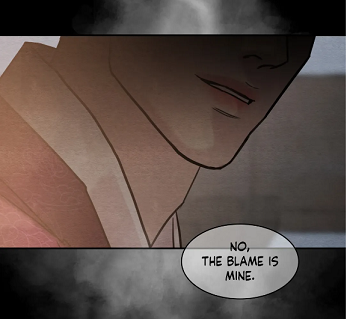 (chapter 109)
 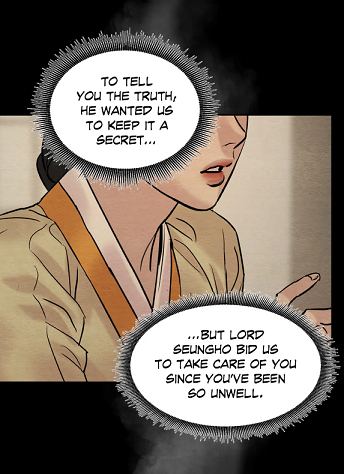 (chapter 109)
  (chapter 25) Moreover, during that night, we have the same elements: a painting, a confession, sex, a book that the scholar was looking for. From my point of view, in chapter 34, Baek Na-Kyum only recalled the beating from Jung In-Hun.
  (chapter 34) But like I wrote above, this place is also where Yoon Seungho got betrayed and in my opinion, the schemers are planning to use this place to ruin the protagonist!!
 (chapter 106)
  (chapter 106) And if Yoon Seungho gets caught having sex with the painter and he has an erotic publication of sodomy, he can be framed for the murder of lord Shin and the other nobles. He will be guilty by association. Thus I deduce that the schemers needed the father to report him to the authorities.
  (chapter 86) And if they are not caught having sex, the schemers are hoping for an argument between the two main leads because of the separation. This was planned to incite Baek Na-Kyum to resent his lover, to accuse him of „abandonment and betrayal“, a new version of this scene.
  (Chapter 105) As you can see, the staff had encouraged the lord to keep his distance from his companion on purpose, to create a misunderstanding… they used the painter’s anxieties. Why? That way, the artist would be more inclined to betray his lover, if the latter was in difficulty. He could put the blame on him. In my opinion, the book was planted there on purpose. Remember how the artist denied that he was the author of the erotic publications.
  (Chapter 1) Besides, there is no doubt that the father refuses to take any responsibility in his son’s suffering. And now, you comprehend why this copy was put on the lord’s desk. He was supposed to be the owner of the erotic book and even the author! I am suspecting that he was accused of the „same crime“ in the past. Then this observation raises the following question. Which erotic publication is it? The original
  (chapter 1) This would stand in opposition to the scholar’s rejection (dirty), as the artist was just the helping hand. Besides, there is no ambiguity that Yoon Seungho blames himself due to the erotic book. If he had not brought the painter to his mansion, none of this would have happened. But the painter’s confession would make him realize that his misery started long before he met Yoon Seungho. And how did the puppetmaster come up with such an idea? From my point of view, this plan was inspired by the learned sir.
  (chapter 37) Back then, he imagined that the man hidden under the green hanbok was the learned sir, but he was mistaken. Both father and son believes to have seen the relative’s sodomy. Besides, the brother mentioned letters and these usually are written on a desk and as such in the library. Yes, this night should trigger the lord’s memory… his brother’s betrayal and abandonment.
  I am still waiting for this picture. Yoon Seungwon had definitely tattled on his brother out of jealousy in the past. Don’t forget this flashbulb.
  (chapter 55) Finally, Heena could serve as a witness, for she did hear their conversation in the annex and saw their intercourse:
  (chapter 96) She would tell the truth… yet it wouldn’t serve her, because she reported it too late. She could be perceived as pathological liar. Besides, she was not supposed to be in the kisaeng house. Moreover, note that all the erotic paintings the painter created vanished. There is no evidence that the artist is the author of the erotic publications of sodomy, as his notebook contains images of nature.
  (chapter 84) Finally, the childhood paintings could be used as an evidence. But what about the book in the library? Both could decide to burn it…
 the burned letter
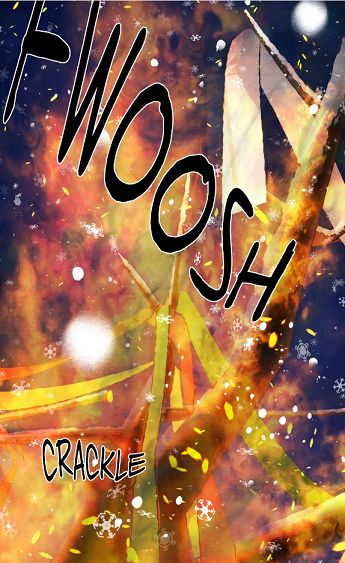 the shrine
 (chapter 109) Note that there is no rejection from the lord, just surprise and shock. Besides, in the kisaeng house, the artist’s confession had led the main lead to confess as well.
 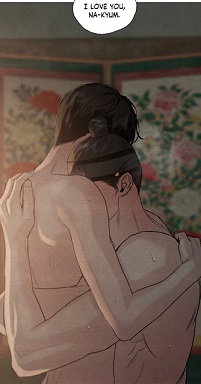 (chapter 96) Striking is that he had hidden his gaze from the artist first. As if love was a sin…Hence I am expecting a confession from Yoon Seungho in that very room too, something he has never done before! Why? It is because he was not the owner of his own past. Kim acted, as if he possessed his memories. Finally, the moment the painter divulges this incident to his companion,
 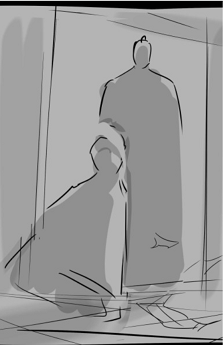 (tweet), the latter can only come to the conclusion that the scholar would have no problem to hurt Baek Na-Kyum and even get revenge on the artist, for he received the favors from the protagonist. Yoon Seungho would no longer feel obliged to respect Heena’s wish, for her words wouldn’t reflect reality.
  (chapter 105) And it was Yoon Seungho’s luck, when the book fell from his sleeve!
  (chapter 27) The goddess Byeonduck is on their side. But the problem is that the readers have the impression that both are followed by misfortune due to their misery. The reality is that they are both victims of manipulations and tricks. That’s their tragedy. But by repeating that the two figures are “birds of misfortune”, the accomplices are trying to deny their own involvement and as such responsibility. The maids are the perfect example. They blame Baek Na-Kyum for his own illness. He eats like a bird and he would hide his illness.
  (chapter 108) To sum up, he was responsible for his own suffering, for he was in denial and the maids could do nothing to help. But the lord can see the truth, when he touches his lover’s butt.
 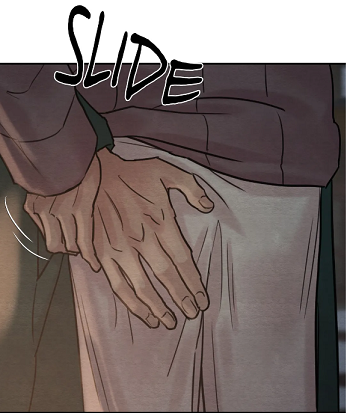 (chapter 109) He lost weight in such a short time. And their presence by Baek Na-Kyum’s side was supposed to help him. They were responsible for his well-being, but the women never realized it.
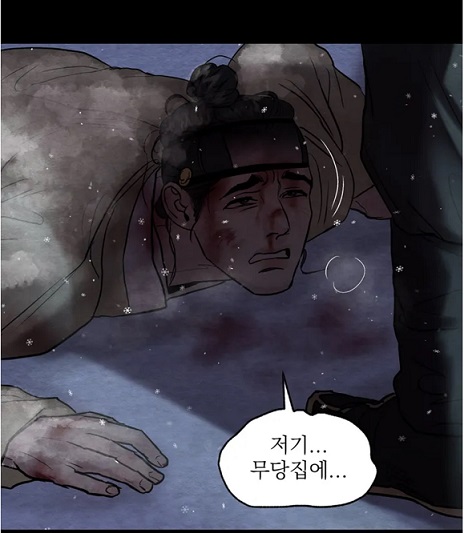 He is on the ground, his face bruised and bloody, while he is asking an anonymous man for help. He is mentioning the shrine. As he is wearing the same hanbok, we can definitely assume that this scene takes place during the same night. The irony is that each time Byeonduck offers a new piece of a puzzle, she also creates a new riddle or mystery. How did the young master get wounded in the first place? And who is the person facing lord Shin?
  (Chapter 59)
 (chapter 66) The size and length of the protections and the cords around the pants were different. Besides, the masks were also different due to the form of the mouth..
  (Chapter 61)
  (chapter 61) Finally, I had also detected his presence next to the barn because of a time jump. First, the manhwaphiles saw Lee Jihwa sitting on the floor,
  (Chapter 60), then shortly after he was standing at the entrance of the storage room holding a fireplace poker!
  (chapter 60) His position indicated that the young master had shortly left the building. However, the readers had not witnessed his move, for the author had diverted their attention by exposing the character‘s inner thoughts. He was recollecting the past, while talking to himself.
  (chapter 60) However, how did the fire poker end up in his own hand? The last time this tool was seen, it was in the kitchen.
  (chapter 60) As you can see, each image has its importance! However, I doubt that the upset aristocrat had this sudden idea and returned to the kitchen and take the fire iron. His mind and heart were definitely elsewhere, while such an action exposes the intention of hurting someone. Jihwa was acting, as if he was in trance, the moment he saw the hickey and heard the painter’s scream. His long lasting stupor was visible in this image.
 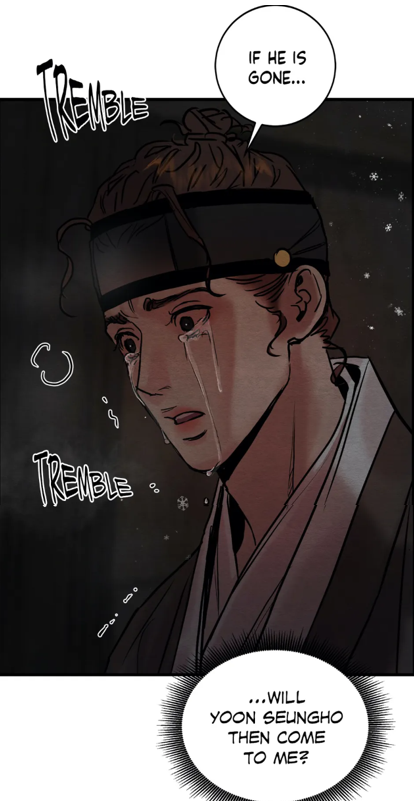 (chapter 60) That’s the reason why I had developed the theory that someone was hiding in the shadow, next to the barn and observing the evolution of the event. [For more read the essay “
 (chapter 57) It is because they serve as a clue for unveiling the truth.
  (chapter 62) It is the same furnace! 😨We all assume that the lord prepared the fireplace, because he put his clothes on his lover. But is it true? We were all jumping to this conclusion, but actually we never saw it. Our brain was led to fill the blanks.
  (chapter 61) Finally, the readers were all assuming that the butler had never entered the storage room due to this image and his action before.
 (chapter 61) But is it true? He could have opened the door before, and go to the lord in order to explain his intervention. Faking his concerns for the painter. Why would he place the fireplace there? He wished that the warmth from the fire would wake up the painter. Hence he remained close to the gate of the storage room. That way, he had a reason to visit his master. Moreover, the author exposed that the valet had been keeping an eye on his master for a while too.
  (chapter 62) Because the valet went to his master, we got the impression that the valet had followed his master’s instructions.
  (chapter 61) In fact, this request could be perceived differently. The lord had seen the butler’s intervention, hence he expressed this wish. From my point of view, the butler must have brought the fireplace to the barn, and he left the poker there on purpose. I am quite certain that some people will think that I am again exaggerating. But why did the butler put a fireplace with a fire iron in the lord’s room, when the coal was not properly lit?
 (chapter 86) Compare the fire to this one:
  (chapter 88) Consequently, I am suspecting that Kim had expected an outburst from Yoon Seungho. The latter could hurt his father with the fire iron. But none of this happened, for the lord preferred playing a comedy.
  (chapter 65) He had expected that the lord would hurt the main lead. But how was he supposed to harm Baek Na-Kyum in the end? With the fire iron… This signifies that he had been present in the barn during the abduction, and even knew the place of the sequestration. Thus he took the furnace and the fire iron to the shed.
  Compare his face to the painter’s who got wounded by wooden sticks.
  (chapter 99) The painter’s head was bleeding, but his face and nose remained intact.
  (chapter 99) Besides, this theory also explains why the shrine is set on fire.
  (chapter 99) So when the lord said this to his lover
 (chapter 88), we could interpret it the following way. It was once again a vision from the future, he was seeing from lord Shin’s perspective the betrayal.
  (chapter 60)
  (chapter 60) At no moment, he was told that his childhood friend had been brought to the physician’s. He just heard him leaving. Moreover, the joker never mentioned the place where the couple was fooling around.
  (chapter 60) He didn’t even admit that he had seen them himself. These were memories from someone else! One might assume that these could represent the criminal’s recollection, but I don’t think so. He arrived much later to the physician’s house. If he had been present right from the start, he could have kidnapped Baek Na-Kyum on his way to the restroom.
  (chapter 59) To conclude, the person with such memories
  (chapter 43) Here, he had visited the place, hence he could imagine what had happened, though he never saw their encounter according to me. [For more read the essay “
 (chapter 58) He had left the bucket of water in the patio! But note that when the painter left the room, the item had simply vanished.
  (chapter 59) The painter was not supposed to detect his presence.
 (chapter 100) The manhwaworms can grasp the similarities. Back then, the lord had refused to help Baek Na-Kyum, thus he was even encouraging Lee Jihwa to return to the shrine. Hence he had acted as a willing accomplice and perpetrator. Thus his karma is to be denied any assistance, he is punished the same way than his friends, Min and the other nobles. Finally, observe that the red-haired master
  (chapter 100) was lowering himself in front of No-Name which reminds me a lot to lord Shin’s situation.
  (chapter 66)
 (chapter 99)
  (chapter 88) Abandonment and rejection versus embrace and acceptance. And what had Yoon Seungho said during that fateful night?
  (chapter 88)
  (chapter 88) But while the painter was exposed to sexual abuse, lord Shin had indeed left his friend’s side. In my eyes, lord Shin embodies treason. As you can see, I conclude that lord Shin is about to get assassinated and from the person he expected the least. Why? It is because no one has to realize that lord Shin ran away from the shaman’s shrine.
  (chapter 102) He was a survivor. The opposite from this scene. They faked the painter’s desertion,
  (chapter 60) hence in episode 102 they had to mask his escape, for this would have exposed the involvement of other people, like Lee Jihwa, the doctor with the drugs and Heena. And now, you have the explanation why the shadow hidden behind the tree had put mattresses on the soil. The desertion and survival from lord Shin should not be detected. But who is this person facing the weak lord?
  (chapter 7),
  (chapter 65) or boots
  (chapter 13)
  (chapter 77) As you can see, the wooden stocks were present during the first straw mat beating.
  (chapter 101), but here Min thought that he was capable to frame the Lees. The other evidence for this interpretation is the presence of two servants during the main lead’s hunt, while he was wearing the suspicious boots.
  (chapter 83) As you can detect, I see a strong connection between the new panel and the hunt from chapter 83. And here we have 3 people again.
  (chapter 68) She was again a witness, when her brother was tied up in the bedchamber.
  (chapter 66) Finally, when her brother was on the verge of getting abducted, she saw him lying unconscious with a bloody face. However, she never considered it as an abduction, for his hands and feet were not tied up.
  (chapter 99) That’s the reason why she blamed him with her questions. She implied that he shouldn’t have fought back. As you can see, I detect a common thread between Heena and her presence in different scenes: sequestration and a bloody face. But this doesn’t end here. When the young painter got beaten in the gibang, there was a furnace on the left side.
  (chapter 94) For me, this incident was to push the painter to leave the gibang and as such to listen to Heena’s suggestion. Furthermore, the man on the left side was wearing a white headband, though he was dressed like a noble in a hunting outfit! The hair dress and his moustache [for more read the analysis “Painful departures”] led me to the following assumption: He was just a commoner in the end, impersonating a noble.
 (chapter 102) This is the evidence that someone had manipulated the crime scene. The clothes from the painter could serve as evidence of her brother’s curtains. Heena could come to the conclusion that Min had gone back on his words, and her fake death, which had definitely shocked
  (chapter 99) and bothered her, could only be perceived as real at the end. But this means that while Yoon Seungho had murdered the nobles, there was someone hiding in the shadow
  (chapter 61) And according to me
  (chapter 61) the second Joker (Kim) had tried to murder the painter, but he had failed, for he had covered the painter’s head.
 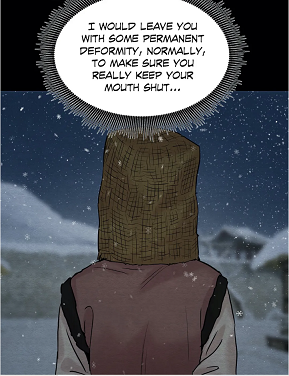 (chapter 66) However, his new attempt to have the painter vanished failed again.
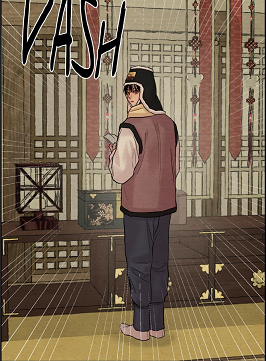 (chapter 97) It could be the same, though I have my doubts. Secondly, I suddenly got aware that the painter had 3 different grey pants at least.
 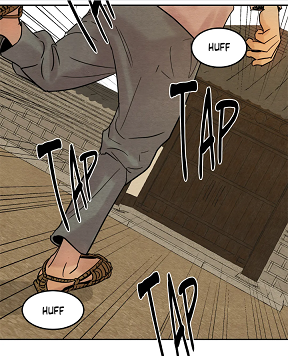 (chapter 4) This one had a cut just below the knees, though the color is much brighter.
  (chapter 85) And because his pants are very similar to the painter’s, I deduce that he must be close to Baek Na-Kyum or at least he has a spy informing him about the artist’s clothes. Compare his pants
  (chapter 97)
 (chapter 61)
 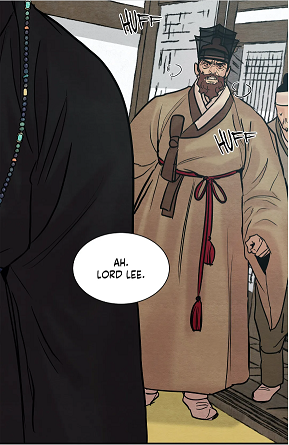 (chapter 67)
  (chapter 67) Their pants have either a different pigment (white, black, khaki, or light grey) or the shape is different. That’s the reason why I am assuming that the person was wearing these trousers on purpose. A new version of this scene:
  (chapter 98) The only difference is that the disguised person is alive contrary to the corpses in the wells. But the problem is that the shoes are betraying him.
  (chapter 83) What did the lord see back then? Three shadows, two men wearing a gat and one caught in the middle with a topknot. Since I consider Yoon Seungho as a shaman, I believe that this vision was not only referring to the past and the incident in the shrine. It exposes the immutable truth, the involvement of three people, either. This is no coincidence. Thus imagine one moment that this illusion was referring to lord Shin’s murder. He is about to get murdered because of a new conspiracy. From my point of view, the man is disguising himself. However, I doubt that he is wearing the lord’s boots. The latter could be “couple boots”, just like the lord and the painter had couple hats.
  (chapter 91) And note during that day, Baek Na-Kyum was called sir due to his hat and clothes.
  (chapter 91) However, if the woman had paid attention to his shoes (mituri), she would have realized that our beloved painter is just a low-born. One might think that I view Kim as the one facing lord Shin.
  Why is Kim wearing a gat with a headband for nobles, when he is dressed like a servant? But there is another detail what caught my attention. He is wearing a bag. It was, as if he had packed his belongings before leaving the mansion. This means, he is taking his brown hanbok, but he is not wearing it. He reminded me of Deok-Jae.
  (chapter 44)
  (chapter 54) But the readers should question themselves this: why did Kim dress like this in the first place? From my point of view, the schemers have already planned to frame Baek Na-Kyum for the murder of the nobles and even of Jung In-Hun. Kim is trying to separate the couple so that the artist can be arrested easily and sentenced immediately. By burning the place, the evidence that Baek Na-Kyum was a victim vanished. That’s how they can manage to turn a victim into a perpetrator. They wanted to erase every trace of the crimes, but then the return of the painter will force them to change their plan. The fire can help them to turn Baek Na-Kyum into a scapegoat. That’s the reason why the anonymous shadow is wearing clothes similar to the painter’s. No one should recognize him. Later, Baek Na-Kyum can be “identified” as the culprit. And any blood trace on his clothes could serve to incriminate the painter. They could use the resemblance of the clothes as a proof for his crime. That’s the reason why lord Shin had to die in the end. And if lord Shin never doubted this person, I am suspecting that the latter is working with the authorities. Kim is not the only suspect, for according to me, there always exist a conspiracy of 3 and even 5 people. This observation leads me to create a list of suspects. First of all, Yoon Seungho’s confession to the learned sir should help us to determine the schemers and culprits.
  (chapter 44). A synonym for old bearded men is “elders”. The latter are supposed to serve as role models. That’s the reason why the young man didn’t suspect the man. With his beard, he must have oozed “responsibility” and even “selflessness”. But who are the suspects?
 from the bureau investigation is definitely involved. Thus he misled Yoon Seungho. Besides, observe that the officers are connected to fire!
  (chapter 94) Secondly, his explanation implied the involvement of a physician.
  (chapter 98) Though he had been found in a well, the lord’s comment insinuates that “Deok-Jae” had been stabbed. Striking is that the lord didn’t show any interest in the violation of clothes and the servant’s death. This reaction surprised the yangban which left him speechless. It is important, because this shows that the schemers were trying to direct the lord’s attention to a certain person: Lee Jihwa. They were trying to instill the thought that Lee Jihwa had planted a professional spy in his household. And after his betrayal, Deok-Jae had run away with the money earned from his work.
 (chapter 57) Finally, the painter met the Joker again on the same day he visited the physician.
 (chapter 75) Finally, why was the doctor never brought to the mansion again after his last visit in chapter 57? And it looks like he was not there to treat Baek Na-Kyum.
  The latter is suffering from PTSD. Thus the painter had a nightmare. Hence I have the impression that the butler’s intervention and suggestion to Yoon Seungho will fail. The lord won’t be able to leave his side. Moreover, I would like the readers to recall that when Baek Na-Kyum got sick, a different physician was fetched.
  (chapter 33) Different clothes displays a different identity. From my point of view, the doctor doesn‘t want to be connected to Yoon Seungho. Finally, don‘t you find it weird that he was not by his side in chapter 57? He literally abandoned the young master in the room with the painter
 (chapter 57), though the latter was a patient too. He had a wounded wrist. The physician should have controlled Yoon Seungho’s fever, brought him water and even an infusion. His absence and passivity caught my attention. So what was he doing in the kitchen? Finally, the doctor is also connected to the shaman. Not only he mentioned him, but also there is the symbol of shamanism in his kitchen. Why did the gods want our couple to have their first “true” love session at the physician’s office? Somehow, it was to confront him with the truth. Finally, don’t you find it weird how Kim reacted
 (chapter 82), when the new version of Deok-Jae made the following suggestion to Kim:
  (chapter 82) Hence the doctor is not off the hook, quite the opposite.
 (chapter 67), and discovered Lee Jihwa’s sodomy which was supposed to be a secret. The father is well aware that the main lead’s suffering is linked to the young master’s sexual orientation, which the father had always denied. His involvement could be detected, when he allowed one of his servants to be dragged to the gibang.
  (chapter 99) Finally, The Joker also heard father Lee’s humiliation and powerlessness.
  (chapter 101) Thus the fire could be seen as a desperate measure to cover the Lees’ culpability.
  (chapter 64) He can play a huge role by making a false testimony, as he can recognize the clothes ordered by the clients.
  (chapter 37) The latter had already disguised himself in season 1, and due to his age, no one would suspect his real nature or power. Then we have this faceless man from chapter 83:
  (chapter 83) I am not including Yoon Chang-Hyeon in this list, for he is not intelligent and cunning enough to develop such a plan. For me, he is just a pawn. Thus he never intervened on his own. He was always pushed by others’ suggestions. Yet, there is no ambiguity that the elder Yoon will be involved in a new plot.
 of season 4 for this essay, though my focus is the past, and more precisely Yoon Seungho’s suffering. It is because the darkness surrounding the protagonist not only refers to his tragic youth, but also it reflects the situation of the manhwalovers. The latter are still in the dark concerning his torment. His terrible secrets have not been totally unveiled. So far, the author allowed the readers to see glimpses of his past, like f. ex. the gangrape or the suicide of his mother. But these were just small pieces of the puzzle, thus it is still impossible to have a complete picture of his martyrdom. There are many reasons for this. The main victim never testified about his suffering, he refused to open up to Baek Na-Kyum.
  (chapter 84) Then many witnesses vanished
  (chapter 86) or the ones alive preferred telling lies in order to hide their own wrongdoings or are simply in denial about their own culpability. Finally, the victim, the perpetrators and accomplices had no idea about the whole truth. They only know or knew certain facts, because many of them were deceived as well. What exactly happened to Yoon Seungho? How could this take place, though he belonged to one of the most powerful noble families? Now, you are probably expecting that I will give you answers to all these questions, and recreate the past. But I have to admit that it is not possible, for I don’t know the whole chronology. Consequently, I added “shadowy” in the title. To conclude, my real intention is more to offer new pieces from the riddle than create a whole new “story”. The main source for this new insight is the painter’s fate which is a reflection from the noble’s past and torment. This means that Byeonduck left traces in season 1, 2 and 3! That’s how I discovered that he had been abandoned and betrayed by everyone, kidnapped, treated as a male kisaeng, robbed, abused, raped and even gangraped at least twice, tortured and finally drugged! But like mentioned above, it is difficult to give the proper order and the persons truly involved in the crimes. On the other hand, what I can guarantee is that Yoon Seungho’s nightmare is linked to conspiracies. I came to this conclusion, because if you compare all the seasons, you will detect the presence of plots. There exists at least 3 main plots in each season, though there definitely exist more. The conspiracies are all connected to incidents.
  (chapter 9), so that the latter visited Lee Jihwa to arouse his jealousy. It was to push him to commit a crime so that Baek Na-Kyum would be removed from the main lead’s side. As you can see, there were 3 people involved, though the readers only saw the result.
  (chapter 12) They had the impression that the red-haired master had acted on his own. However, he had been manipulated, incited to commit a crime. But my point is not to diminish his wrongdoing, rather to expose the involvement of the schemers. Hence at the end of season 1, the author unveiled their true role and as such their identities.
  (chapter 43) However, observe that when Lee Jihwa went to the pavilion, the noble with the mole had other guests. 2 nobles left the place, as they refused to participate in a murder.
  (chapter 43) Funny is that they are now witnesses of Min’s crime. This can have repercussions in season 4. Black Heart had been the one who had suggested the assassination to Lee Jihwa. And the aristocrats were still there, when he had made this proposition.
  (chapter 91) and the servants
  (chapter 8) Thus in season 2, he came to this resolution:
  (chapter 56) He had planned to rape him before having him eliminated. This shows his inner conflict. From my point of view, the painter’s death is connected to the incident in the gibang.
  (chapter 16) This doesn’t look like a crime. However, it is one! It was done on purpose, to separate the couple. Someone had intervened in order to interrupt this session, and as such someone had been spying on them. Deok-Jae only revealed his spying activity from chapter 16 in season 2:
  (chapter 53) Yet, the one opening the door had been Kim. This gesture can be considered as trespassing and invasion of privacy, the new version of this scene.
  (chapter 16) But instead of revealing the truth, the butler sided with Lee Jihwa, and allowed him to trespass the propriety again. In my eyes, the butler thought
  (chapter 17) that Yoon Seungho would come to perceive the painter as a man consumed by lust. He imagined that he would caught them fooling around. As you can see, this ruckus was also a plot, though it doesn’t look like one. Why would the maids gossip in the courtyard?
  (chapter 18) From my point of view, the valet expected that the lord would fear people’s gaze and a scandal. Thus he would send away the painter to protect his “reputation”, but the opposite happened. Under this perspective, the manhwalovers can grasp why it is difficult to calculate accurately the number of plots and accomplices. Besides, some were naïve pawns, others not. And since I examined the first season more closely, it is necessary to analyze the vanishing of Jung In-Hun. His disappearance is strongly intertwined with Yoon Seungho’s secret. How so? The learned sir was determined to find the lord’s vulnerability and as such secret.
  (chapter 29) Thus many concluded that he had participated in the prank, faking his death. On the other hand, the manhwalovers believed to have seen Heena’s death!
 (chapter 86) However, in reality, he was relying on the king’s help and intervention. And this confession to the “fake shaman” represents the learned sir’s karma. He had asked the painter to act like a spy
  (chapter 24), not realizing that he could be spied himself! He didn’t grasp that he exposed his weakness to the commoner: the civil service examination. Thus the man had constantly drops of sweat
 on his face and interrogated Jung In-Hun.
 (chapter 29) The girl was there to create a certain closeness. He was acting like Kim, asking why! But the stupid and arrogant learned sir thought that because the man was a commoner, he was ignorant and could be manipulated like the painter!
  (chapter 29) He thought that the low-born would buy his lie here… but in my eyes, it was the opposite. He had already perceived the learned sir’s true nature. But he acted, as if he was agreeing. In other words, the scholar fell into his own trap. He envisioned that the man was “powerless”, but he overlooked his connections. The manhwalovers can see the contradiction, for he had approached the man due to his connections! .As you can see, I am more than ever convinced that the scholar has long been murdered. He was betrayed, exactly like he had planned to abandon Yoon Seungho! The pedophile must have heard from the servant about Jung’s plan, as he had confided it to the worker!!
  (chapter 37) But this doesn’t end here.
  (chapter 37) Yoon Chang-Hyeon was portrayed as a traitor! The “fake servant” implied with his statement that there was a conspiracy, and the patriarch was involved. But in exchange to save his own skin, he had tattled on the others! He was trying to insinuate that if Jung In-Hun interacted more with the Yoons, his reputation could get tainted. He could get suspected of “treason” too, or he could get betrayed too. While the man met the learned sir during the day, the brother went to the villa in a hurry during the night.
  (chapter 36) Hence he chose a different approach: filial duty. And the brother’s observation could only corroborate the pedophile’s perception. The scholar was Yoon Seungho’s lover, but he was also a backstabber. But let’s return our attention to the “mysterious lord Song”‘s statement: Yoon Chang-Hyeon is a denunciator, not a man of honor.
  (Chapter 67) Lee Jihwa had not only been denunciated, but he had been confronted by his friend! And the traitor was right by his side. As you can see, chapter 67 was a reflection from episode 37!! These two episodes have another common denominator: the betrayer had made the following suggestion.
  (chapter 67) In exchange for his “survival”, he should help Black Heart and allow him to act on his behalf. This was the new plan. That’s how he started impersonating Lee Jihwa. That’s the reason why I come to the conclusion that in the past, the impersonation must have happened, but it took place in the beginning. Secondly, I am assuming that a traitor must have suggested to Yoon Chang-Hyeon to leave the mansion and abandon his son behind!
  (chapter 27) Someone had tattled on the Yoons in the past, but the patriarch was turned into the traitor himself which the young main lead came to believe. Thus Yoon Seungho could say this to his father:
  (chapter 86) However, I am suspecting that this is not true, someone else tattled on the powerful family and made a false accusation! As you can imagine, I am inclined to think that father Lee must have been behind this! Why? It is because he can no longer do it! Thus in season 3, he approached the patriarch Yoon.
  (chapter 82) If the lord Seungho had truly committed a crime, he should have reported it to the authorities. The stupid Yoon Chang-Hyeon never wondered why the elder Lee visited him during the night and asked for his assistance. Furthermore, the elder Lee had been allowed to enter the bedchamber and see the huge drawing which could have been perceived as a sign of treason. He was eyeing at the throne.
  (chapter 82) Note that the aristocrat mentioned “punishment” in this context. So maybe, he denunciated the patriarch so that the whole family would get punished. Father Lee was definitely played in this scene, hence I believe that someone had already anticipated his reactions. He would seek revenge. But this doesn’t end here. I had connected “rash departure” to “treason and spying”. And now, observe what Yoon Seungho said to his butler
  (chapter 50) He had sent Jung In-Hun away in order to get rid of him! However, because of the expression “I thought”, I am quite certain that this idea had been suggested to him by the valet! I would like to underline that in this episode, the valet was acting as a tattler!
  (chapter 50) But in order to hide his own crime, he portrayed it as a rumor (It may not be accurate”). This truly underlines the butler’s MO. He used information and turned it as gossips to hide his spying activities. The shadow… Simultaneously, he turned gossips into a verity!! This is no coincidence that in season 3, the same method was employed. Yoon Seungho was supposed to have murdered the scholar and Deok-Jae! My avid readers can sense the leitmotiv in all these episodes. RUMORS are turned into a reality, and as such a CRIME! Even here…
  (chapter 37)
 (chapter 86) But since our beloved man started living in the bedchamber, this became a reality. That’s the other reason why Yoon Seungho was encouraged to live in debauchery and not to take the civil service examination. But this only occurred, the moment the lord returned living in the mansion and not before!! Secondly, I realized that this statement about Yoon Chang-Hyeon will become a reality for the “fake servant” himself.
 (chapter 87) The white bearded man’s words became a reality. However, since the fake servant, the mysterious lord Song, judges the elder master Yoon as a troublemaker and hypocrite, there is no ambiguity that the elder master Yoon will get into trouble. Since he did it in the past, he can only get suspected in the present.
  (chapter 86) But the worst would be that the painter is blamed for his assassination. He did it out of resent! But this would expose the true thoughts of the schemers, the pedophile and Kim. That’s how they act, when they feel offended and bothered.
  (chapter 44) He had given the ruined painting to his father, putting the blame on his brother, well aware that the latter would get angry. He was observing his father’s reaction.
  (chapter 44) Yet, there is a difference to the past. Here, he had been fooled! He truly believed that this was his brother’s doing, whereas in truth the butler had been the one who had fooled him.
  (chapter 38) And this is important, because when the letter was given to the brother, Jung In-Hun witnessed the wrongdoing from the butler!!
  (chapter 38) And now, you know why the learned sir had to die!! He had caught the valet in the act. He had betrayed Yoon Seungho, though he didn’t realize it. The learned sir tried to discover the content of the letter, and as such was prying on his sponsor’s weakness.
 (chapter 38) Hence I come to the conclusion that KIM played a huge role in the learned sir’s death as well. I would even say that he was the one who pushed the others to have the scholar and the painter killed. Both knew about the butler’s tricks without realizing his significance.
  (chapter 37) Hence I deduce that as the story progressed, the role of the butler started changing. Now, I see him as a the main plotter, while all the others are now his pawns. We could say that the valet has gradually followed the pedophile’s path. However, there is no ambiguity that it was not the same in the past!
 (chapter 37) An idiom that Yoon Seungho constantly utilized: chapter 16, chapter 21
 , chapter 50, chapter 71
  (chapter 71). This means that he couldn’t understand, for he has a different way of thinking. This outlines his narrow-mindedness and his tendency to plan everything. He doesn’t like surprises.
 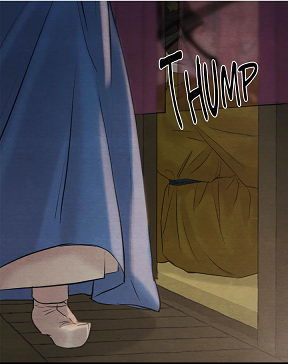 (chapter 69) Hence I started wondering if the mysterious man with the beard was not impersonating someone, for example “lord Song” and in reality he was just a merchant. Why merchant? It is related to the shungas and the hanboks. The king can not be involved in trading directly. However, this is what Yoon Seungho told to the learned sir:
  (chapter 22) Nevertheless, the main lead could have never been involved in commerce, for he lived as a prisoner for many years. And this is what was said about the ruler:
  (chapter 76) He is not so wealthy. How come? Yoon Seungho’s fortune must have a different origin.
 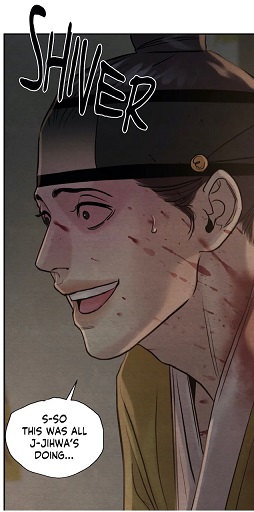 (chapter 102) Min had never predicted that the young master would run to his friend and denunciate him to Yoon Seungho. However, since Black Heart had employed the assistance of servants
 (chapter 95)
  (chapter 71)
  chapter 87) and
  (chapter 82)
 (chapter 36) Here, the painter was forced to take an aphrodisiac under the pretense of his health. This action was repeated in season 2
 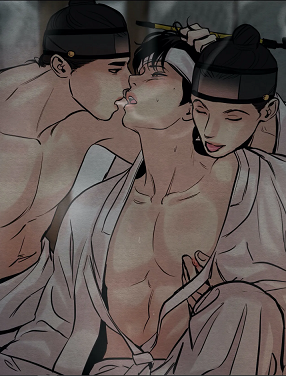 (chapter 54) and 3.
  (chapter 100) The nobles made him smoke opium or drink the aphrodisiac. The purpose of such drugs is to obtain the painter’s submission and control his mind and reactions. Striking is that each time, the perpetrators were “punished”. Kim was insulted and his plan didn’t work out.
  (chapter 37) As for the young lords, they were evicted like commoners and later the others were even killed. As you can see, each time the poison was employed, there was a retaliation.
  (chapter 47)
 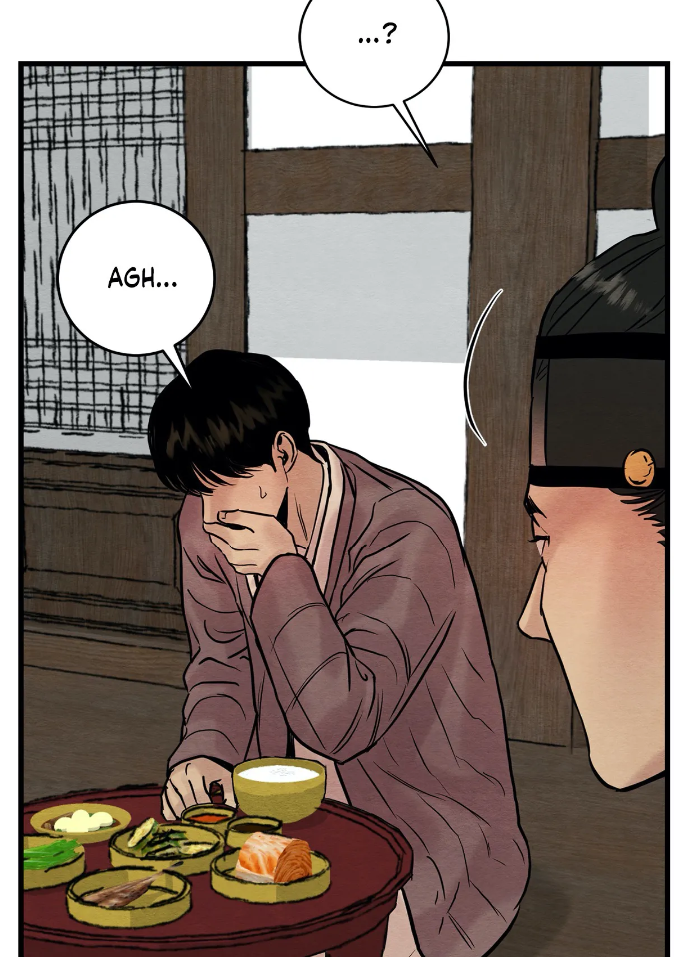 (chapter 47) If the painter had not eaten with the lord, the latter would have never noticed the incident. However, he believed the maids’ words.
  (chapter 47) Hence he never investigated the matter. But this prank represented a serious issue. This could have been judged as an attempt against the owner of the mansion.
  (chapter 47) And now look at this panel:
  (chapter 83) Yoon Seungho had refused to take the drug! The bowl reminded me of the one from chapter 47! Finally, the butler had tried to give his master the drug in season 3
  (chapter 77), but the latter had again rejected it and this twice.
 (chapter 77) Kim calls the drug “medicinal tea”, truly an euphemism. It is also possible that the real target of the poisoning was Yoon Seungho, but since he was protected by the gods, someone ended up taking the “drug”. Because he was wearing a purple hanbok, the investigator mistook his identity, a royal member. Hence the Yoons were suspected of treason. Don’t forget that during this party, there was a kisaeng by their side.
  (chapter 56), he came to adopt this title in order to hide his identity and actions. Byeonduck explained in her notes that Baek Na-Kyum had no idea about Min’s name. And this is the same for Yoon Seungho. The pedophile could continue hiding behind “lord Song”, as the latter was blamed for everything. The pedophile could divert attention from his own tricks. That’s the reason why he would never write any letter to Yoon Seungho under this name. This means that at the end, the main culprit, the king, will be perceived as the main responsible for Yoon Seungho’s torment, similar to Min’s situation, just before got killed. Though many other people were involved, Yoon Seungho was able to judge the joker’s actions correctly, he was the main mastermind behind the plots. This explicates why the gods made Yoon Seungho forget the old bearded men’s face.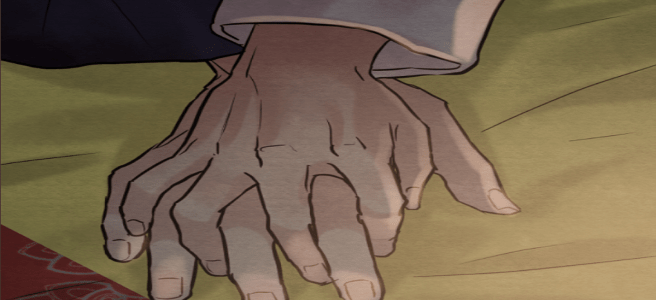
 Yes, when people read juicy deeds, they were already imagining that I would describe a love session like this one
  (chapter 96), because of the expression „to do the deed“:
  (chapter 87) However, the deed is not just related to intercourse, like the manhwaphiles could discover it in chapter 51.
  With „deed“, Deok-Jae was referring to murder and assassination. As you can see, deed has other meanings than sex. Thus it has for synonyms action, accomplishment and reality!! So when I selected this name for the essay, I was thinking of the relationship between action and word. And this connection came to my mind, when Byeonduck released the last picture, because the painter’s action symbolizes a conversation and as such words.
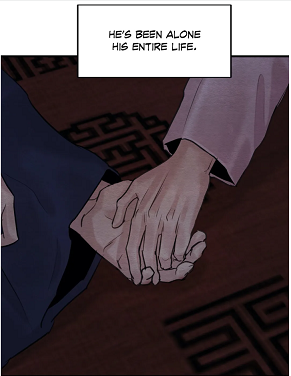 (Chapter 88) By reaching his hand, the painter was letting him know that he was no longer alone in this world. He was not only joining his side, but he was willing to try to understand the main lead.
 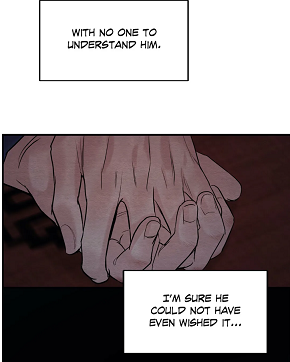 (Chapter 88) This gesture stands in opposition to the situation with Yoon Chang-Hyeon.
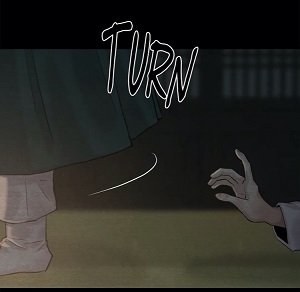 (Chapter 86) During that fateful night, the father neither talked to his son nor looked at him. He even turned his back to him, when the young master attempted to grab his father‘s hanbok. Both scenes from chapter 88 and 86 have two common denominators: an action accompanied with silence!! Yet, what distinguishes them from each other is the nature of the deed, the action. Alliance and empathy versus abandonment and estrangement! This is no coincidence that after reaching his hand, Baek Na-Kyum started confessing his thoughts and emotions to his lover:
 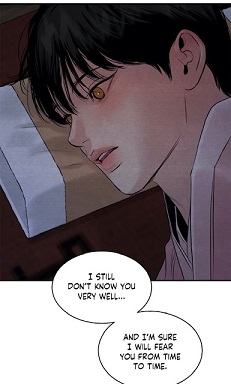 (Chapter 88) As you can sense, the hand gesture delivered a message, but the painter still felt the need to clarify the meaning of his hand. He was willing to remain by his side, but he was still afraid of him. He didn’t want to create a misunderstanding, like for example that he wouldn’t argue with him or that his loyalty was now unconditional or total. That way, Yoon Seungho wouldn’t come to view him as a hypocrite or as dishonest, if an argument would appear. Thus he needed words to explain his position. He would remain by his side and attempt to sympathize with him, but he still felt insecure and had doubts. In other words, his action (his hand gesture) was not truly reflecting his mind and heart.
  (Chapter 88) Later he even asked his lover not to leave his side no matter what.
  (Chapter 88) To conclude, the hand gesture in episode 88 was connected to insecurities and as such fear, yet the painter had shown no hesitation to take his hand. The anxiety was not visible.
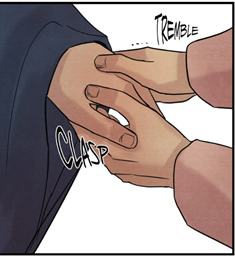 (Chapter 30) His fingers barely grabbed his hand, so when he made the following vow, he was not entirely sincere or better said, truly determined to keep his promise.
 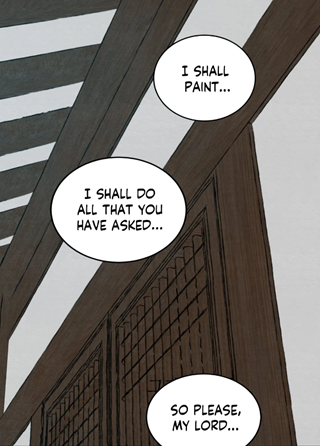 (Chapter 30) The words were not truly in unison with the gesture either. Therefore he once tried to leave the mansion in season 2. When he pledged loyalty, his intention was to protect his teacher. To conclude, fear has always been present, when the painter took Yoon Seungho’s hand. Even in chapter 88, but contrary to the scene in the courtyard, his hand was not shaking.
  (Chapter 82) This explicates why the artist chose to remain by his side, though the lord had broken his promise.
 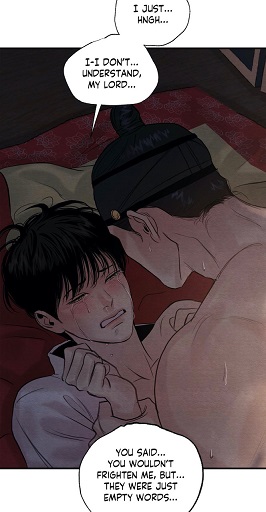 (Chapter 82) On the other hand, in this scene
  (chapter 82), the lord was grabbing his lover’s hand out of fear. He was recognizing his mistake and was trying to beg for his forgiveness, though he couldn’t express it directly. Striking is that during the lord’s flashback, his hand was trembling as well, grabbing onto his partner’s body.
 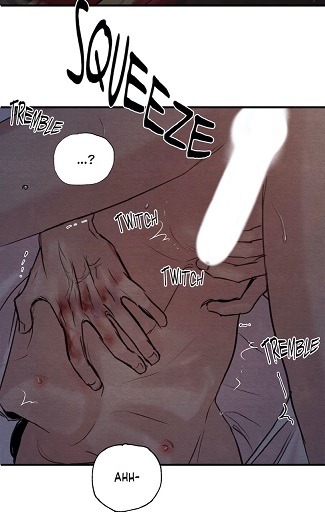 (Chapter 81) It was, as if Baek Na-Kyum was his rescue buoy, helping him not to be swallowed by the darkness. Thus I came to the conclusion that the protagonists’ hand gestures are all connected to anxiety and pain. 😲 Hence I am deducing that in this scene, Baek Na-Kyum is holding his lover’s hand,
 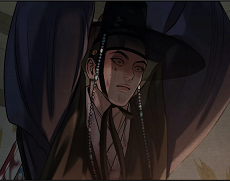 (Chapter 102). This would have definitely scared Baek Na-Kyum, especially Yoon Seungho’s haunted gaze. On the other hand, since the painter had been himself the victim of physical and sexual abuse, the artist can only grasp why the noble reacted that way: fear, anger, despair and heartache. The artist had also been desperate, in pain and scared in the shrine, though this time, he had not screamed for his help. Since the lord had not returned to the mansion, how could he expect him to come to his rescue?
 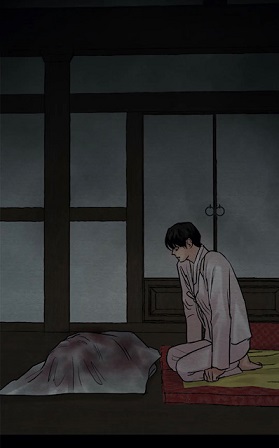 (Chapter 98) Back then, he had been waiting for his lover‘s return and explanations. He wanted to hear him and get his reassurance and comfort. .
 (Chapter 98) The latter couldn’t reassure the painter with his hand contrary to the previous night.
  (chapter 97) Exactly like mentioned above, the painter’s hand gesture is connected to fear and conversation.
  (chapter 97) Striking is that in the gibang, the lord confessed his biggest fear to his future “spouse”. He feared to lose him, though one of his biggest desires had been finally fulfilled. This means that Yoon Seungho felt even more insecure and frightened than before after receiving the artist’s love confession. That’s the reason why I believe that the new picture is standing in opposition to the scene in the gibang. The lord will feel relief after his admission. As a conclusion, the image is announcing
  (Chapter 89) While the painter was sitting on his partner’s lap
 (chapter 89), he was massaging the wounded fingers. It was, as if he was treating his companion’s wound. Note that after his terrible flashback, the painter had avoided to grab his hand out of fear that he might hurt Yoon Seungho even more.
  (Chapter 84) Therefore I conclude that the new panel is an allusion to treatment. While in episode 89, the painter was acting as a doctor, in the new image, the young man is working more like a counselor or psychologist. The aristocrat’s hand might not be wounded in that scene, but this is not the case for his heart and mind. So for me, this scene is connected to mental treatment.
  (Chapter 84) However, the lord had refused to open up. This is no coincidence that the author had not created such a picture during that chapter. As the manhwalovers can detect, I believe that in that scene,
  (chapter 75) And because I detected a discrepancy between words and gestures, I recognized the presence of another trick from Byeonduck.✨
 (chapter 91), the latter denied this with the following statement.
 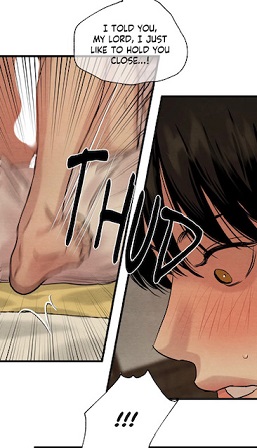 (chapter 91) But when did the painter admit that he liked embracing him? In this panel!
  (chapter 88) That’s the reason why the lord got surprised and moved. As you can see, the author never revealed this whispering to the manhwalovers! The latter had the impression that the lord’s reaction was related to the loving embrace, but it was only partially correct.
  (chapter 62), when the lord had confessed to adore him.
  (chapter 62) This explicates why Yoon Seungho was so pained in season 2. He got embraced, but there were no words. Consequently, when the painter vanished during that night, the lord could only perceive the embrace as hypocrisy and fakeness. That’s how I realized that the story is developed on the contradiction between words and actions. But not only that, there exists a strong link between silence and passivity. Thus after the abduction in season 2, Baek Na-Kyum remained more or less silent
 (chapter 62), and as such he was totally passive. He never stood up and begged the lord for his leniency. He stayed there on the bed giving the impression that he was indifferent. That’s the reason why Yoon Seungho got more enraged, for he felt fooled. This means that the absence of words represent inaction… This explains why Yoon Seungho had to corner the main lead in chapter 48
  (chapter 48) to say something, as he had sensed his passivity behind his „submissive attitude“. This is no coincidence that during this night, the painter felt extreme pleasure to the point that he peed. Therefore he could voice his wish to Yoon Seungho during the love session from season 2.
  (chapter 73) That’s how the lord concluded that the painter liked riding him, while in reality such a climax had appeared for the first time, when both were facing each other!
  (chapter 49)
  (chapter 86) Yoon Seungho had acted the opposite, he had tried to speak up, but he had been muted. I am also thinking that the young master must have attempted to converse to his father
  (chapter 77) Silence was considered as an admission. This is no hazard that the butler didn’t take care of his young master. This scene symbolizes the quote “Actions speak louder than words”
  (chapter 77) The butler had betrayed the young master’s trust, for he had not intervened. He should have defended Yoon Seungho, but no in fact he had sided with the elder master Yoon once again. Not only he had not reminded Yoon Chang-Hyeon of his promise, but also he had assisted the ruthless father by giving himself the straw mat beating!
  (chapter 77), but backstabbed him in the shadow. Besides, we shouldn’t forget that a narcissist’s words don’t match their action, because they are pathological liars. And so far, I had portrayed father Yoon (overt), Kim (covert) and even Jung In-Hun (overt) as people suffering from NPD. And I am assuming that the mysterious lord Song is not different from them, though I am suspecting that he must be a covert type.
  (chapter 102) He is no longer following social norms. This could only happen, because the lord had just committed a huge crime. What is the point to respect laws and tradition, when he became a murderer? Any other transgression can only appear as harmless. That’s the reason why I am expecting that Yoon Seungho decides to disregard social norms from that moment on and play a prank on the “villains” of this story.
  (chapter 76)
  (chapter 53)
  (chapter 87), while the same extremity symbolizes the opposite with the villains and antagonists: violence, silence, submission
  (chapter 83), hatred and resent
  (chapter 97) Here, Heena was hurting her brother, because she wanted him to face “reality”. What caught my attention is that we never saw the father’s hand in chapter 86!
  (chapter 86) Why? It is because it reveals his powerlessness. And this leads me to the following conclusion: the deed stands for reality and honesty, while the words symbolize emptiness, illusion and deception. And now, you comprehend why this work is composed by the dichotomies: dream, words and mouth versus reality., action and the hand. This means that in season 4, the manhwaphiles should try to analyze the thoughts and emotions of the characters behind the hand gestures. At the same time, they can also verify if my interpretation is correct. Is the zoom of the protagonists’ hand connected to fear, confession, empathy and assistance?
 (chapter 57) So in this short essay, I would like to present my new observations and interpretation concerning this intriguing man.
 (chapter 57), as it resembles a lot to the ones from the yangbans.
  (chapter 67)
  (chapter 45) This is important, because it reveals that the doctor belongs to a different social class: Chungin, the upper-middle class.
  (chapter 92) The lords and chungin can look down on the commoners, sangmin and cheonmin, as the latter are not considered as educated, since they never had to pass an exam. Striking is that the physician voiced his ignorance in front of the painter which stands in opposition to his social status.
 (chapter 57) Note that solution has two meanings, thus it has for synonyms answer and elixir/extract!! He did give him a solution, the drug!! This truly shows that the physician was lying to the painter. 😮 But this doesn’t end here.
 (chapter 57) He is the only one who portrayed the protagonist in a positive light. Why? In my eyes, it was to gain the painter’s trust. That way, the doctor would appear as impartial and neutral. Thus he said the truth first in order to divert attention from his own actions. He had been the one supplying the drug to the butler.
  (chapter 57) I had already criticized the doctor in the past, for he kept giving the medicine to the valet, and never made the connection to his “hot-headed” temper. He appeared as quite stupid. In my eyes, he already appeared as a passive accomplice, but mainly due to his lack of discernment. He would trust the butler too much. Thus in the composition „the purge“, I had predicted his involvement in a plot which would bring to light his complicity.
  (“he would say strange things”), he was brutal with his son
  (chapter 57). This shows that right from the start, he was already putting the whole blame on the elder master Yoon. That way, the physician was avoiding to become responsible. He had been giving the drug to the butler for a long time, while claiming that he had not been able to diagnose the illness. Besides, we shouldn’t overlook that in this chapter, we only have the physician’s version!! We never heard the testimony from the father. Just because we saw the bruises and the hand on the main character’s neck, this is no real guarantee that the father said this to the doctor.
  (chapter 57) That’s how I realized that the doctor had been deceiving the painter all along. He lied by commission, but also when he talked about the visitation, he was actually delivering the truth in delay, paltering!! He used the same MO than Kim. He feigned ignorance, and mixed a truth with a lie!! This is no coincidence. This leads me to the following question: why did he talk about the past to Baek Na-Kyum?
 (Chapter 57) Yes, it was to protect himself!! He was diverting the painter‘s attention. From that moment on, I could no longer judge him the same way. He was now an active and smart accomplice, who would utilize innocence, truth and knowledge to his advantage.
  (chapter 12) According to my interpretation, here the butler wished the painter to desert the mansion. Thus I conclude that at the physician’s office, the doctor had the opposite task: he should ensure that Baek Na-Kyum doesn’t run away. It was important that the artist was by the lord’s side the moment he gets kidnapped. That way, Yoon Seungho would only blame himself and the painter. Yet, I don’t think that he knew everything about the future abduction. Secondly, why did the doctor bring up Yoon Seungho’s health and his medicine to the painter? He was actually a stranger, even a „servant“.
  (chapter 57) However, the office is actually far away from the mansion. (For more read the essay
 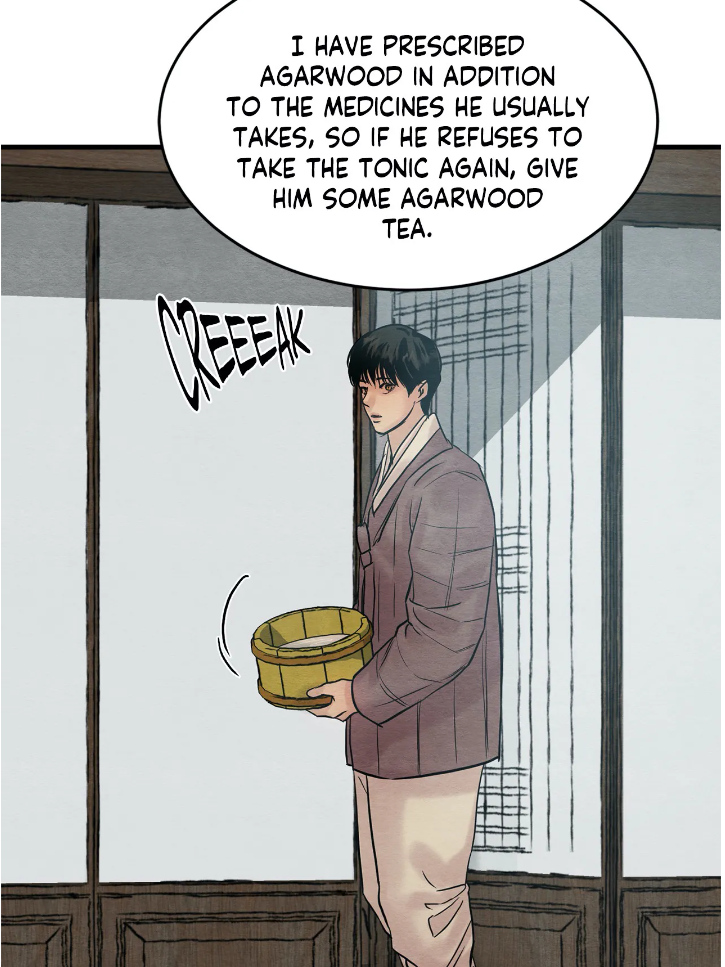 (chapter 55) But like I have always pointed out, Yoon Seungho had no idea about the drugs and medicine. He was totally left in the dark, for the valet would call the drug ” medicinal tea”.
  (chapter 35) He employed an euphemism. This truly shows that the doctor and the valet were partners in crime, both accomplices due to their passivity, knowledge and silence. Nevertheless, I don’t think that the physician was directly involved with the kidnapping and assassination plot. The conversation between the valet and the physician displays the lack of honesty coming from Kim.
  (chapter 63) He felt bound by secrecy to the bearded man. On the other hand, this incident must have worried him, as it had taken place at his own mansion. Thus he could get into trouble. Kim realized that he needed to reassure the doctor. If the latter started speaking, he could get into trouble, for he had left the propriety during that night. He had no real alibi. Hence the valet visited the doctor during that night, but he never threatened him.
  (chapter 65) The doctor believed that the moment someone talked, someone could take the fall. Observe that in the yard, the butler followed the physician’s advice: he should say nothing.
  (chapter 57), this doesn’t mean that he was not involved in the main lead’s suffering. He could have affected Yoon Seungho’s life differently. We have the perfect example in season 3: he treated the butler
 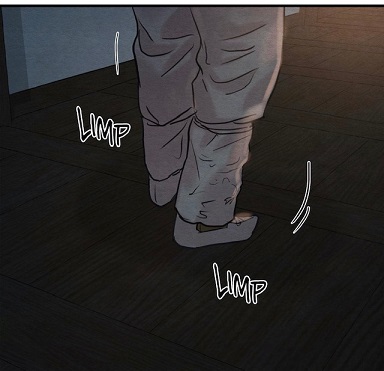 (chapter 77), while he neglected the lord’s hand
  (chapter 57) But since my theory is that Kim was a shaman, this signifies that he should have recognized Kim as the shaman!! In that case, I deduced that the physician had been lying to the elder master Yoon by omission. Naturally, it is also possible that the father had hired the shaman, but out of fear for his reputation, he acted, as if he had no idea about the butler’s true identity. In other words, all three men acted, as if they knew nothing. This would explain why all the characters had no eye in the last picture. Anyway, because of my latest theory, I reexamined the physician‘s statement and found more incongruences
  (chapter 57) Here he doubted the elder master Yoon’s words, for he stated as a fact that the young master Lee Jihwa was not mentally sick. Keep in mind that according to the doctor, the protagonist was described as someone suffering from a mental illness. And this detail caught my attention: the physician took the Lees’ side. Furthermore, the patriarch Lee was thinking similarly than the doctor: the shaman and the mental illness.
 (chapter 82) Finally, I would like to point out that in that chapter, the physician was mentioned too, and this next to the patriarch Lee.
  (Chapter 57) Finally, the manhwaphiles should detect that the doctor never mentioned the presence of the servants in the bedchamber. Both were restraining the wounded lord.
  (Chapter 57) This is also no coincidence that he didn‘t point out the absence of the elder master Yoon during the second visit. He couldn‘t, because his tactic to put the whole blame on the patriarch would have totally failed. And this leads me to the following observation:
  (chapter 74) The doctor was not honest here either. Exactly like in episode 57, he was faking his worries towards Baek NA-Kyum. First, we have the presence of the drop of sweat on his cheek, a sign of dishonesty, but more importantly, his question was just theoretical, he was influencing the painter. The latter just needed to agree. He hoped that the artist would never bring up the incident in his mansion, and as such would wonder about his whereabouts and his responsibility concerning the kidnapping. At the same time, he could have asked this with the hope that the painter would blame the protagonist for his misery. He would use the painter‘s suffering (the unfair judgement leading to his imprisonment) in order to divert attention from his own wrongdoing: his silence, his passivity and his lack of commitment. He never tried to look for Baek Na-Kyum‘s vanishing. He never felt responsible. But he had to give up, because the artist was truly ignorant.
 (chapter 74) He never made any reproach towards the main lead.