

Please support the authors by reading Manhwas on the official websites. This is where you can read the Manhwa: Jinx But be aware that the Manhwa is a mature Yaoi, which means, it is about homosexuality with explicit scenes. Here is the link of the table of contents about Jinx. Here is the link where you can find the table of contents of analyzed Manhwas. Here are the links, if you are interested in the first work from Mingwa, BJ Alex, and the 2 previous essays about Jinx Steady Passionate Devotion and Why Sleeping Beauty Had to Bleed (part 1)
It would be great if you could make some donations/sponsoring: Ko-fi.com/bebebisous33 That way, you can support me with “coffee” so that I have the energy to keep examining Manhwas. Besides, I need to cover up the expenses for this blog.

The Web That Holds
If, in the first part of this essay, we have followed the blade back to its origin—tracing Kim Dan’s wound not to a single act, but to a structure that precedes it—then we must now ask a different question. Not where violence comes from. But how it is allowed to persist.
Because, as many of us have begun to notice—my attentive readers, my fellow Jinx-lovers—the tragedy does not lie in invisibility. The signs are there. The cracks are visible. The pattern repeats. And yet, it holds. Why?
The answer requires a shift in perspective. What appears as a sequence of isolated failures—misjudgment, delay, inaction—reveals itself instead as a layered system of perception. A structure not only of force, but of interpretation; not only of violence, but of its containment.
In the language of Sleeping Beauty, we might say this: the spindle has already done its work. The wound has appeared. But the deeper danger lies elsewhere—in the forest of thorns that surrounds it. 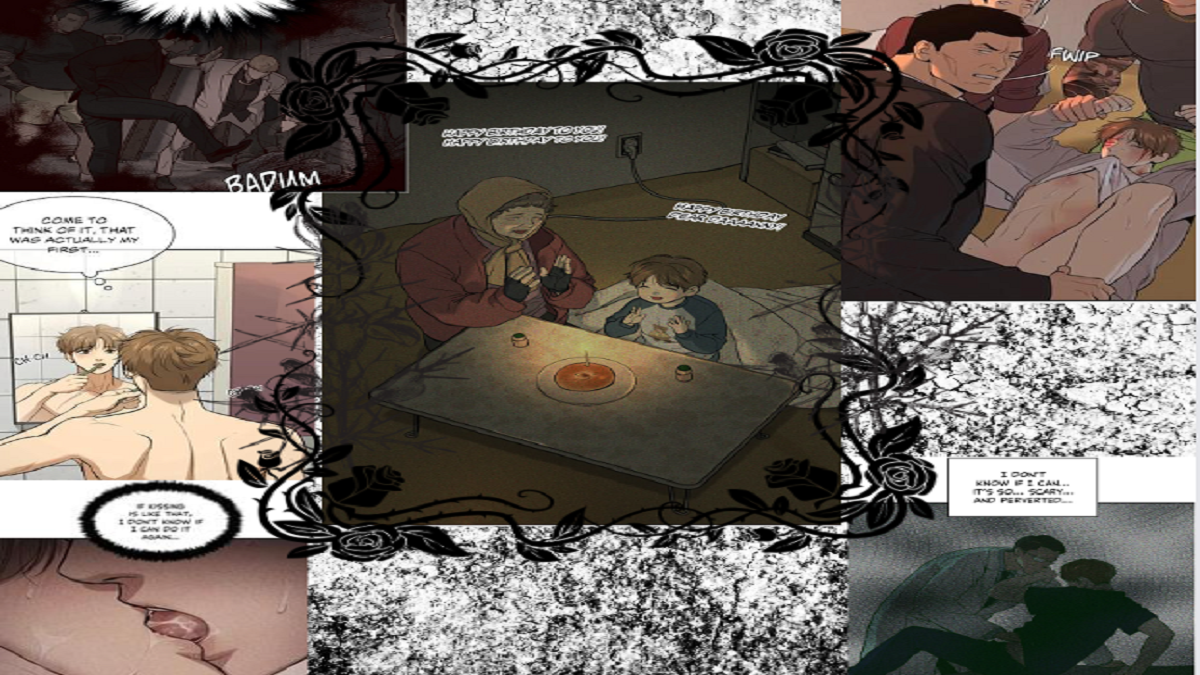
A forest that does not merely block escape, but obscures recognition. Or, to borrow another image: a web—fine, nearly invisible, yet resilient—through which each character moves, believing themselves free, while every motion remains guided.
If Kim Dan has come to embody the sleeping figure at the center of this structure 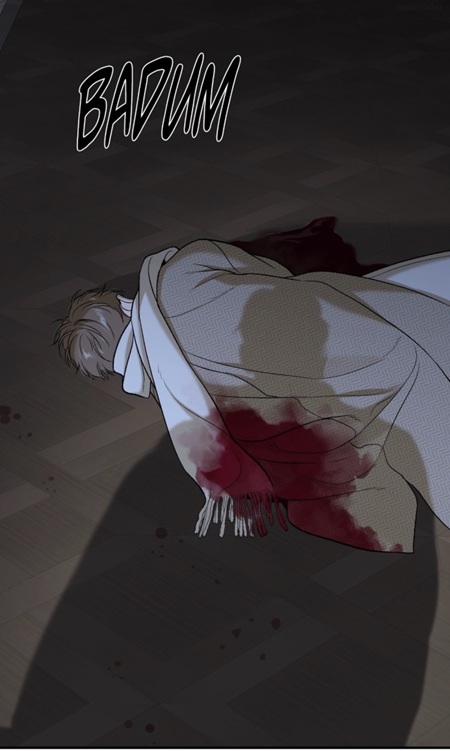 (chapter 98), then awakening cannot mean simply opening one’s eyes. It requires something more difficult: the ability to perceive the web itself.
 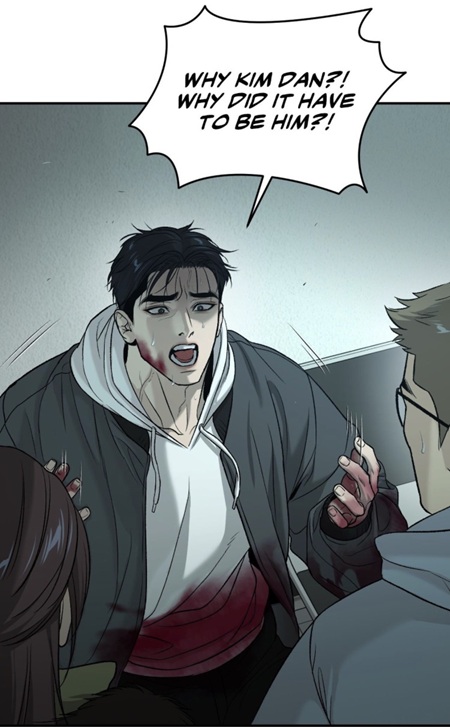 (chapter 98)
And this, perhaps, is where the narrative becomes most unsettling. Because the web is not maintained by villains alone. It is sustained by those who care. 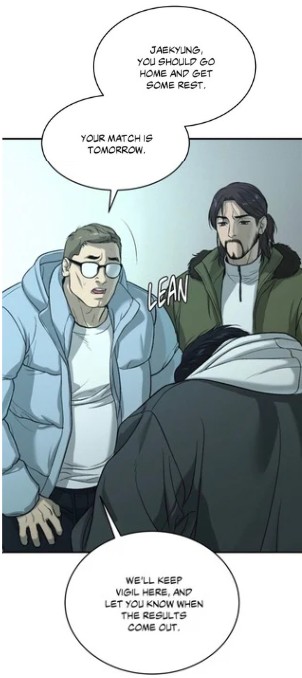 (chapter 98)
The tragedy is not that the characters are caught in a trap, but that they have been persuaded it is a form of protection. The web is not spun from malice alone, but from the threads of good intentions and necessary silences. It offers the appearance of care, even as it constrains. 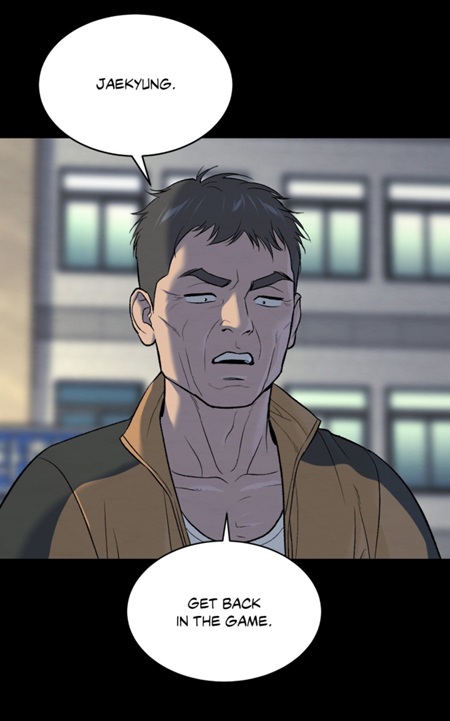 (chapter 74)
This is precisely why it resists rupture. To tear it apart does not feel like liberation, but like betrayal—as though one were destroying the last remaining structure that promises safety.
The knife does not tear down the web; it exposes its tension. 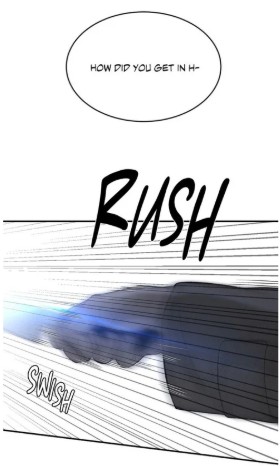 (chapter 98) It marks the moment when threads—long invisible—can no longer absorb the force placed upon them. What could once be deferred, explained, or reinterpreted now demands recognition.
We begin, therefore, not with distortion, but with its most intimate form: the promise of protection.
Shin Okja: The Architecture of Misrecognition
The Logic of Substitution: The Map of Stability
Shin Okja’s worldview is not born of cynicism, but of a profound, protective care. 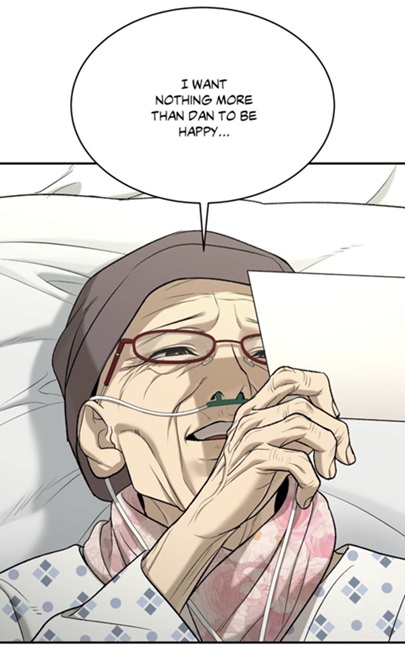 (chapter 94) She operates through a series of metonymic substitutions, formulas designed to translate the chaos of precarity into the language of stability. In her system, “Doctor” is synonymous with “Safety”,
 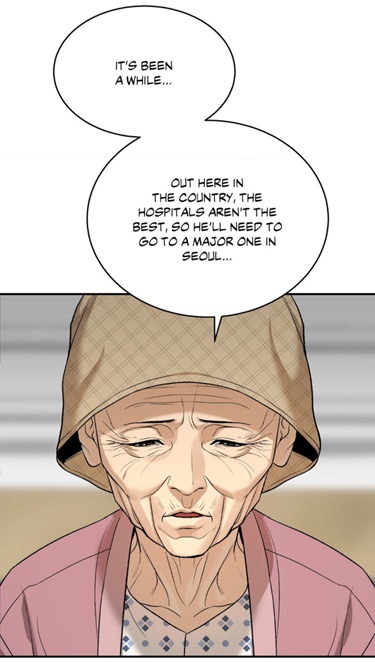 (chapter 65) and “Seoul” is equated with “Opportunity.”
  (chapter 65) This is the pragmatic logic of a survivor who has learned that in a world of scarcity, respectability is the only available armor. She seeks to build a fortress for Kim Dan out of credentials and institutional legitimacy,
 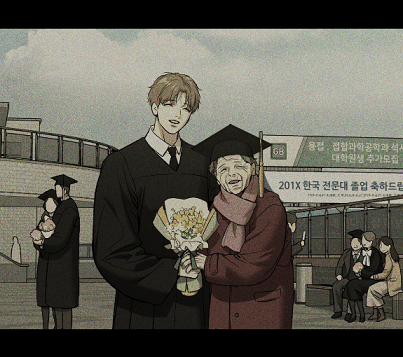 (chapter 47) believing that if the external conditions are sufficiently aligned, the internal suffering can be permanently contained.
This logic does not remain theoretical. It becomes actionable in her request to Joo Jaekyung. By entrusting her grandson to him  (chapter 65), she extends her system of protection beyond herself. Unable to guarantee Kim Dan’s safety directly, she delegates it to another figure she perceives as stable, capable, and situated within a controlled environment. Protection, here, becomes transferable—something that can be secured through the right association.
 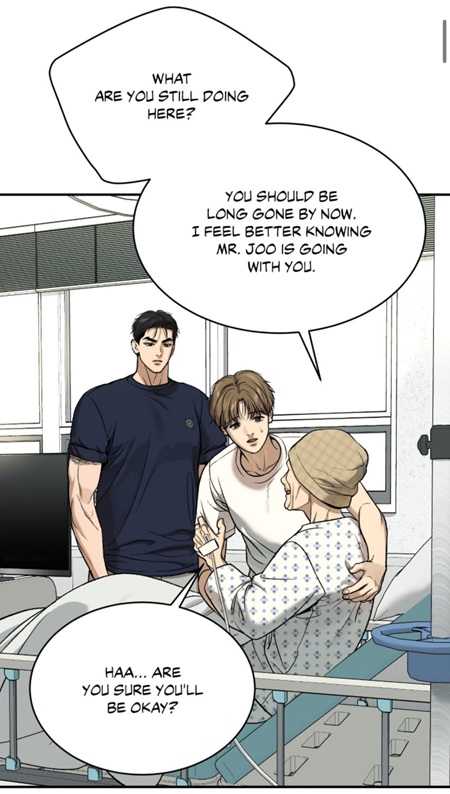 (chapter 78)
This logic extends beyond institutions to individuals. Shin Okja does not only trust systems; she transfers that trust onto figures she perceives as capable of embodying them. In this sense, Joo Jaekyung becomes an extension of her protective framework—selected for his strength 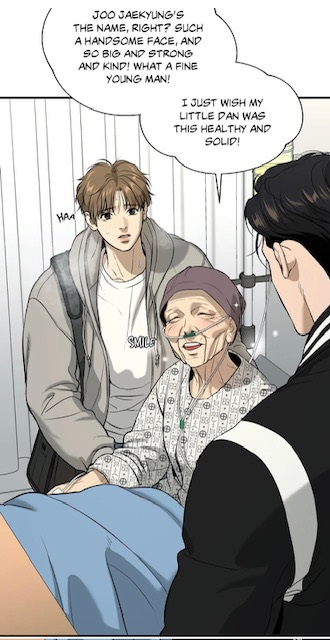 (chapter 21), his status, and his apparent control over his environment.
Yet this projection is fragile. The image of the undefeated champion cannot sustain itself when confronted with his visible exhaustion. 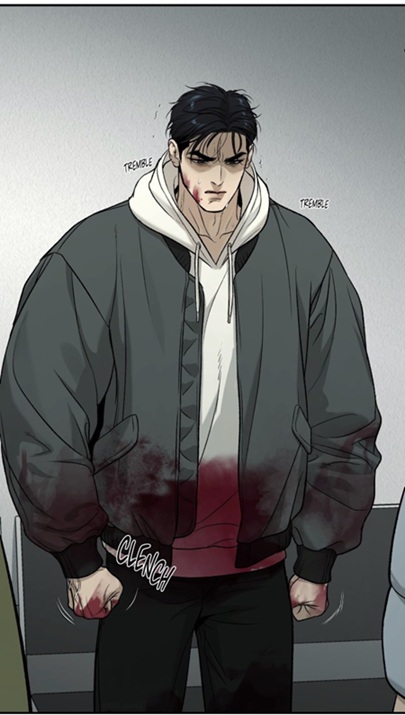 (chapter 98) Having spent the night at the hospital, deprived of rest and confronted with a situation he cannot resolve, he no longer appears as an agent of control, but as someone equally constrained by circumstance.
This moment introduces a critical dissonance. What had been imagined as delegated protection begins to reveal its limits. Strength does not equate to safety. Proximity to power and fame does not guarantee control and safety. The figure entrusted with safeguarding Kim Dan is himself exposed.
In this sense, the illusion does not collapse through abstract realization, but through perception. The body—pale, fatigued, unable to intervene beyond a certain point—contradicts the role that had been assigned to it.
Debt as the Silent Engine
At the core of this system lies a deliberate, structural silence. Debt is the hidden engine of her reasoning, yet it is the one element she refuses to name. (chapter 65) On the beach, Shin Okja frames Kim Dan’s presence as being “for her sake.” This formulation functions as a linguistic screen. By invoking the language of devotion, she replaces a financial obligation with a moral one. 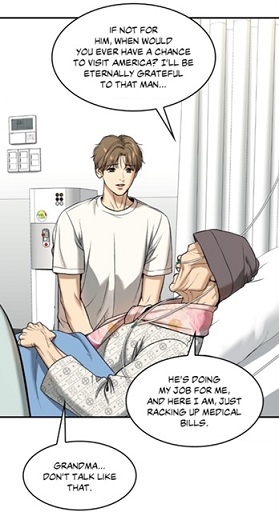 (chapter 41) The loan—the invisible force structuring their lives—is not addressed directly; it is translated into filial piety.
This shift is decisive. To acknowledge that Kim Dan remains because of a predatory debt would be to recognize their entrapment within a system that cannot be escaped through effort alone. By contrast, to say that he stays “for her sake” transforms necessity into choice, and coercion into care. The burden is not removed, but reinterpreted. It becomes dignified, even meaningful, while the structure that produces it remains unspoken.
This displacement extends into her projection of the future. When she urges him to go to Seoul and live his “best life”, she once again performs a temporal translation. The obstacles that constrain him in the present are not treated as active forces, but as temporary delays. (chapter 78) Seoul becomes a mythologized elsewhere—a space where the debt is imagined to dissolve, not because it has been resolved, but because it is no longer named.
In her philosophy, debt is not a crisis to be confronted or negotiated; it is a weight to be outrun. Her strategy relies on temporal displacement: she defers the reality of their economic entrapment into a future where it is expected to dissolve under the prestige of Kim Dan’s success. That’s why the champion confronted Kim Dan with reality in front of the hospital:  (chapter 18)
 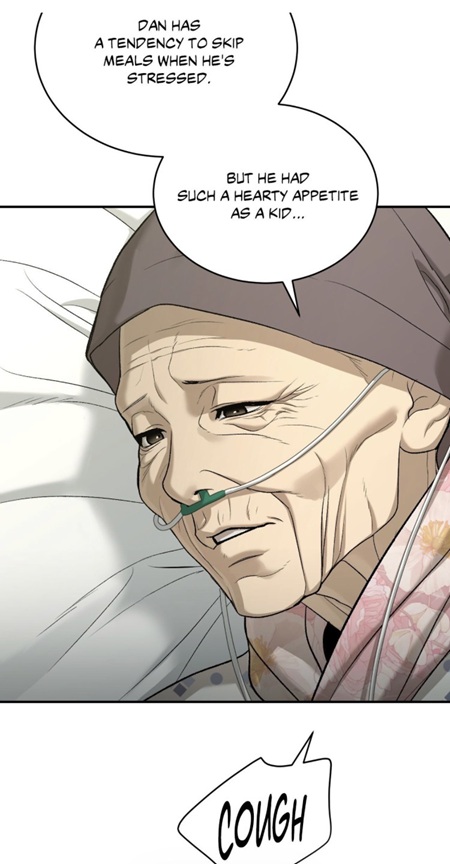 (chapter 94) This silence is not only strategic; it is protective. To name the debt would be to acknowledge its persistence and the origins of Kim Dan’s stress, and therefore the possibility that it cannot be escaped.
Within this framework, Kim Dan ceases to be merely a grandson and becomes the vessel of redemption. His career path—sacrifice, study, and integration into a large hospital—is the mechanism through which the family’s past is meant to be erased.
The Collapse of the Formula: Institutional Exposure
The tragedy of Okja’s position emerges when reality exceeds her formulas. She operates under the belief that safety can be produced through external alignment alone — that the “right” environment will naturally neutralize structural harm. (chapter 47) However, the narrative reveals that authority does not eliminate abuse; it provides a more sophisticated veil for it.
Kim Dan is not exploited in spite of the system, but precisely within its reach. The figure of the Doctor 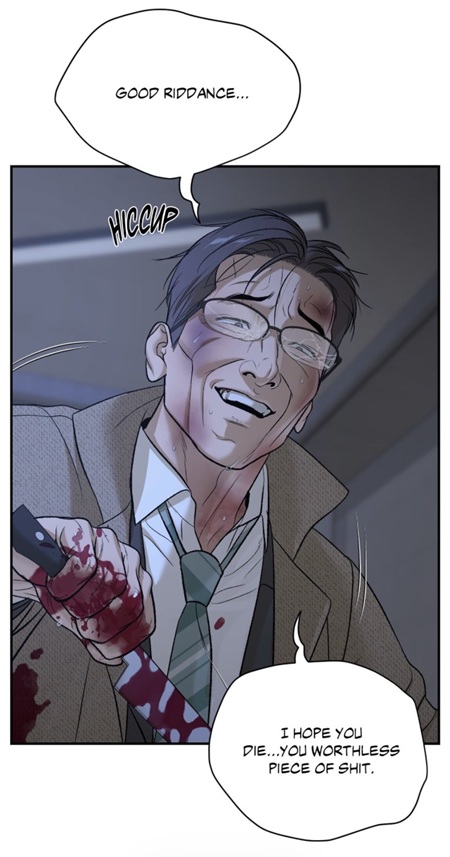 (chapter 98), who once embodied Okja’s promise of protection, becomes the primary agent of harm.
 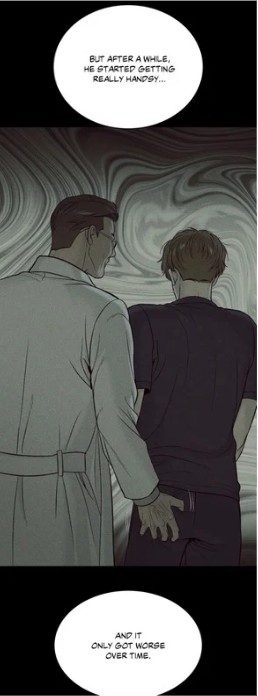 (chapter 90) Here, the logic of debt is not interrupted; it is reframed as asymmetrical power, dependency, and coercion.
Her insistence that Kim Dan return to Seoul  (chapter 57) acquires a different meaning in light of the events that follow. What was imagined as a movement toward safety reveals itself as a movement toward exposure. (chapter 78) The space she identified as protective—the large hospital, the urban center, the site of opportunity (chapter 65) — places him within reach of the very forces she sought to avoid.
This is the structural contradiction at the heart of her logic. Protection is pursued through integration into systems that do not eliminate vulnerability, but reorganize it. The path meant to secure his future does not lead away from danger—it leads him into a domain where danger operates under the guise of legitimacy.
The Blindness of Care: A Constitutive Role
Crucially, Shin Okja remains blind to this failure. Her faith in professional authority and institutional prestige remains intact because the underlying structure of exploitation remains outside her field of perception. She does not see the sexual harassment or the blacklisting because her framework has no language for them.
This blindness does not emerge in the present; it is learned. In an earlier scene, Kim Dan is shown as a child, isolated and surrounded by accusation 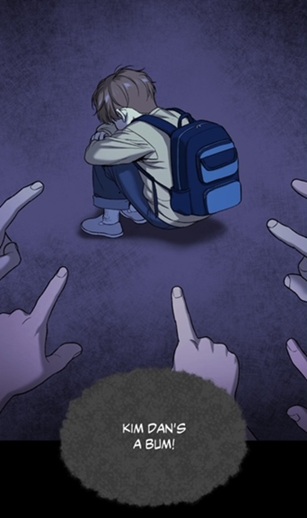 (chapter 57) —his identity reduced to a single word: “bum.” The violence here is not physical, but symbolic. It is immediate, collective, and humiliating. Faced with this, Shin Okja intervenes, not by confronting the accusation, but by reframing it.
 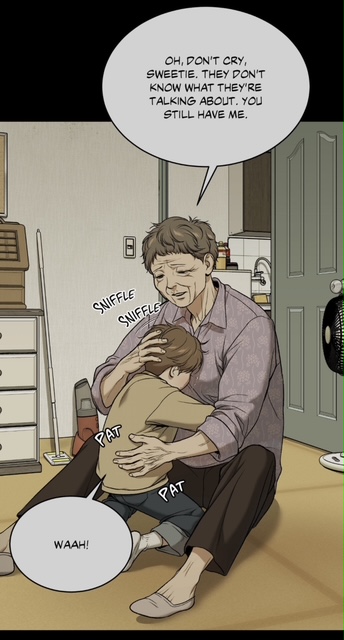 (chapter 57) This response establishes a decisive pattern. The external threat is not analyzed or challenged; it is neutralized through emotional substitution. The problem is not located in a social structure—poverty, stigma, exclusion—but dissolved within the private space of care. What cannot be changed is not named. Instead, it is softened.
This moment becomes foundational. From that point onward, protection is no longer understood as the transformation of conditions, but as the management of perception. 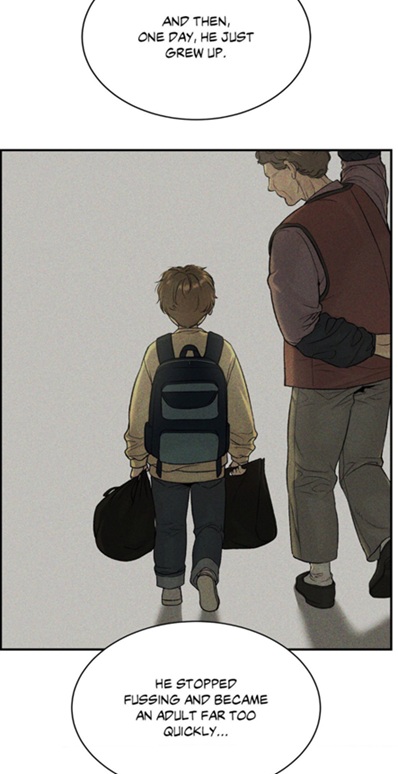 (chapter 65) Harm is not eliminated; it is reinterpreted. The world remains hostile, but its hostility is rendered bearable through the assurance of relational security. Under this light, it becomes comprehensible why Kim Dan started having eating disorder. (chapter 94)
It is precisely this logic that persists into the present. When Shin Okja later displaces debt into devotion, or imagines institutions as inherently protective, she is not ignoring reality; she is applying a learned strategy. (chapter 65). The same mechanism that once shielded a child from humiliation now prevents her from recognizing structural violence. Care continues to function—but as a filter.
This blindness is reinforced by distance. Shin Okja encounters much of the world indirectly—through television  (chapter 30), through representation
 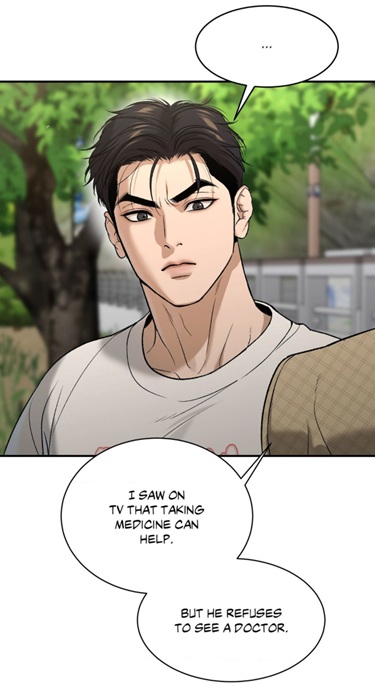 (chapter 65), through narratives that render events coherent and contained. Within these frames, suffering appears structured, bounded, and ultimately resolvable.
This mediation shapes not only what she sees, but how she assigns meaning. When she tells Joo Jaekyung that his matches give her strength 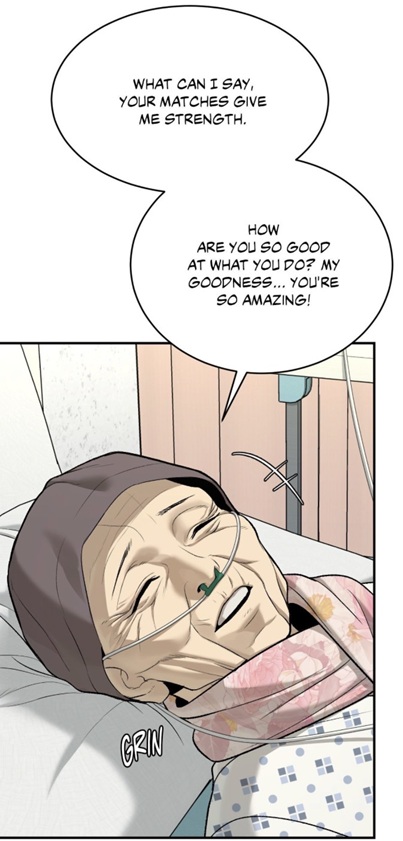 (chapter 94), the statement appears benign, even affectionate. Yet it introduces a subtle displacement. What is presented as admiration becomes a form of reliance.
 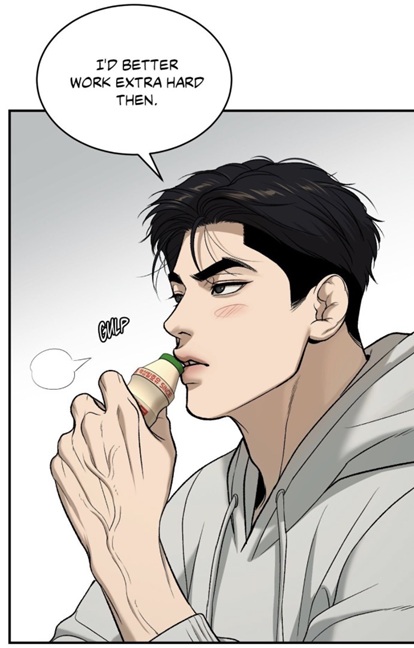 (chapter 94) His performance is no longer his alone; it acquires a function beyond itself.
This logic reaches its critical point in the hospital. (chapter 98) Unaware of the circumstances surrounding her grandson, Shin Okja’s words persist as an implicit demand. Joo Jaekyung is positioned not simply as a fighter, but as someone who must endure— for Kim Dan’s sake and as such for her sake.
The parallel is striking. What Kim Dan once embodied—living under the weight of another’s need—is now reproduced in Joo Jaekyung. The structure does not disappear; it shifts its bearer. When Kim Dan, moments before losing consciousness, asks him to win the match 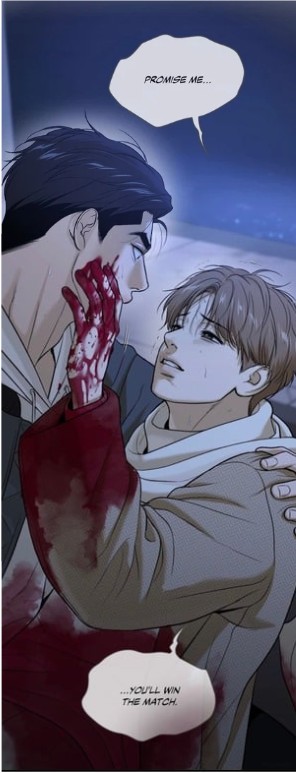 (chapter 98), the transfer becomes explicit. Care transforms into obligation. Affection becomes pressure. That’s why his gesture resembles to her at the hospice:
 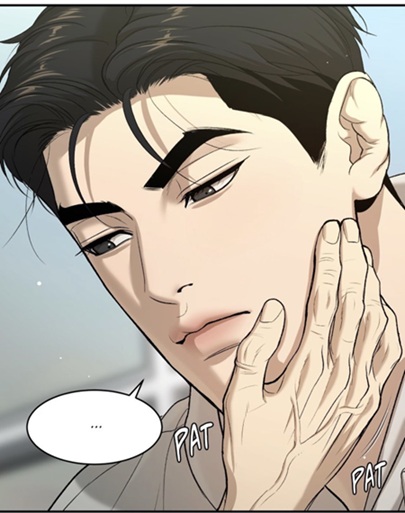 (chapter 94)
In this sense, the issue is not deception, but mediation. Because Shin Okja perceives the world through framed and partial representations, she cannot register the full reality of what she imposes. Her words do not intend harm—but they participate in a structure where devotion is translated into demand, and where the burden of survival is passed from one body to another. 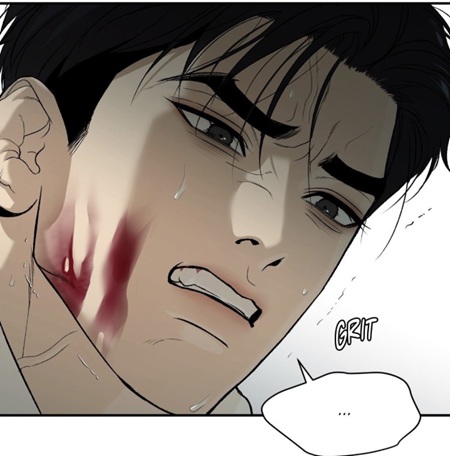 (chapter 98) Suffering becomes something structured and resolved within a frame. This mediated perception sustains her belief that reality is ultimately manageable, that danger can be contained within visible boundaries.
Consequently, her role within the “web” is not passive; it is constitutive. By maintaining a silence around the debt and insisting on the sanctity of the institution, she sustains the conditions under which the harm remains invisible. Her care does not prevent the violence; it renders the possibility of violence unthinkable until it has already occurred.
What remains implicit in this structure becomes explicit in the hospital sequence. The failure of Shin Okja’s logic does not simply manifest as the displacement of harm, but as the collapse of the very conditions that make such displacement possible. 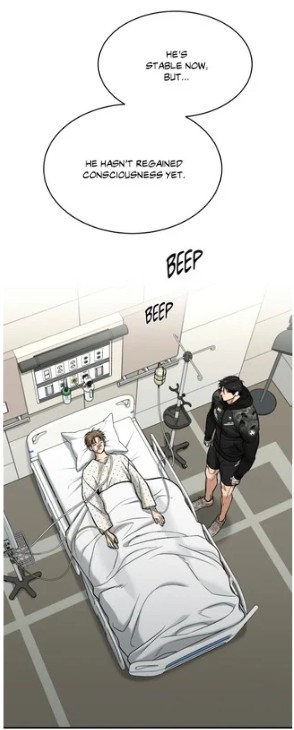 (chapter 99) Her framework depends on mediation—on the ability to translate reality into stable equivalences, to interpret suffering through distance, abstraction, and belief. In the hospital, these conditions disappear. Faced with the immediacy of the body, with breath, loss, and the possibility of death, no substitution can be maintained.
Joo Jaekyung initially follows the script— 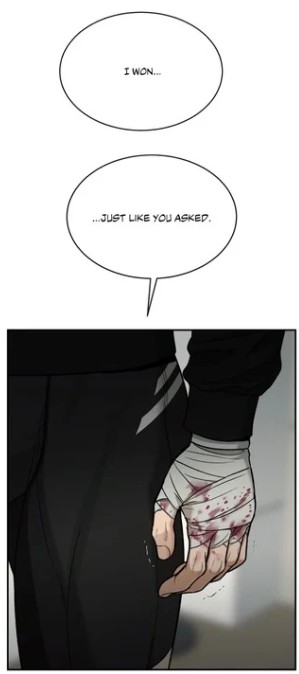 (chapter 99) —but the statement appears mechanical, detached from meaning. What follows marks a rupture:
 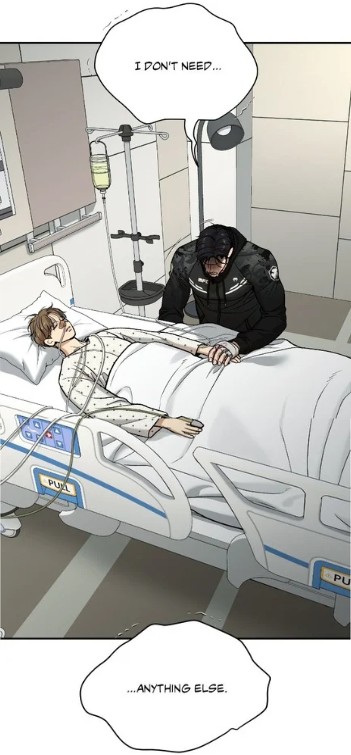 (chapter 99)
 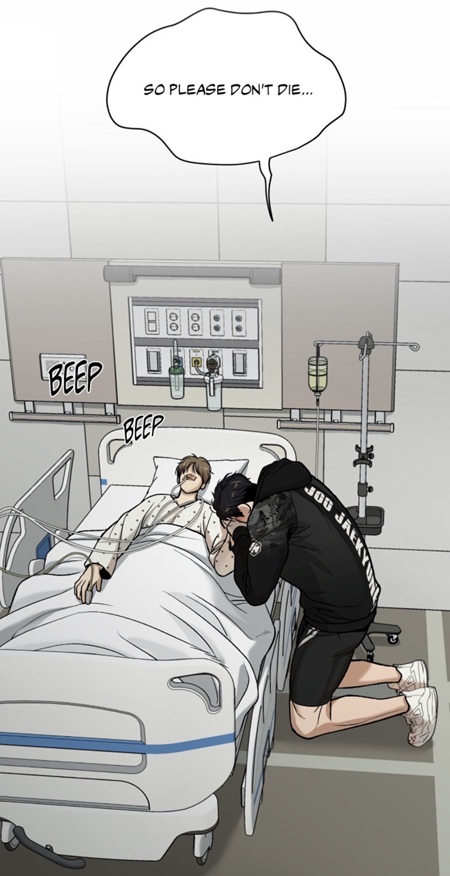 (chapter 99) Here, translation collapses. Winning no longer signifies protection; strength no longer guarantees safety; endurance no longer equates to care. The logic of substitution becomes inoperable. What remains is not a new interpretation, but the absence of one.
In this sense, the hospital does not simply reveal the limits of Shin Okja’s system—it suspends it. Without distance, without abstraction, without the possibility of reframing, her logic cannot function. The burden is no longer redistributed or absorbed; it is encountered directly, in a form that cannot be mediated. For the first time, the structure does not conceal or displace reality—it is rendered irrelevant in the face of it.
The Stabbing as Narrative Exposure
In this context, the stabbing of Kim Dan is not a random escalation, but a narrative necessity. It functions as a violent exposure of the gap between Okja’s map and the actual territory. 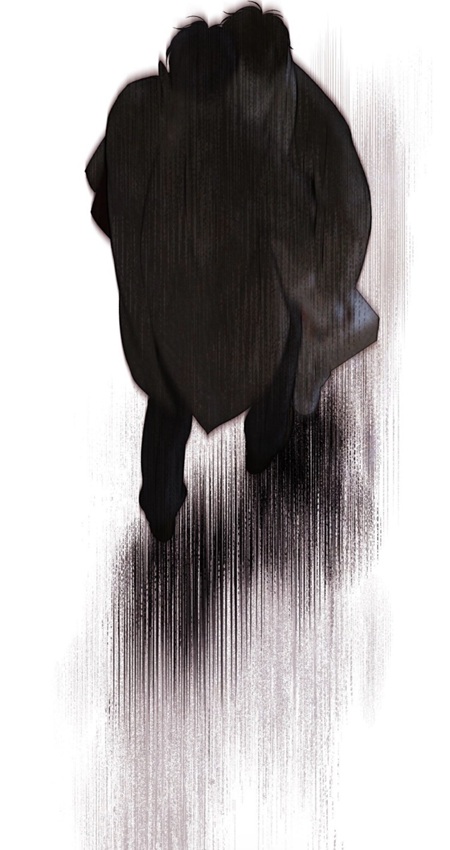 (chapter 98) The violence does not introduce a new reality; it forces the recognition of a structural condition that had been deferred for years.
And yet, this exposure remains incomplete. The act takes place in a dark hallway—removed from institutional space, from public visibility, and from the frameworks that produce legitimacy. The perpetrator, no longer an active representative of the hospital  (chapter 91), appears as an isolated figure. In this configuration, the crime can still be contained. It risks being interpreted as the action of a single individual rather than the manifestation of a broader system.
In this sense, the doctor functions as the negative reflection of Shin Okja’s logic. (chapter 98) Where she translates structural constraint into devotion—rendering debt bearable by internalizing it—he performs the inverse operation. Faced with the consequences of his actions, he externalizes responsibility, transforming his own failure into accusation. 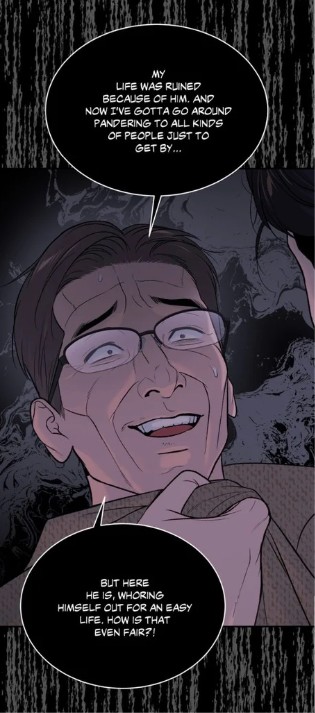 (chapter 90) The structure remains identical; only its direction is reversed. What appears as care in one case becomes blame in the other. Both displace the origin of harm, ensuring that it is never confronted at its source.
This containment is reinforced by the persistence of representation. While violence unfolds in obscurity, the public sphere continues to operate uninterrupted. 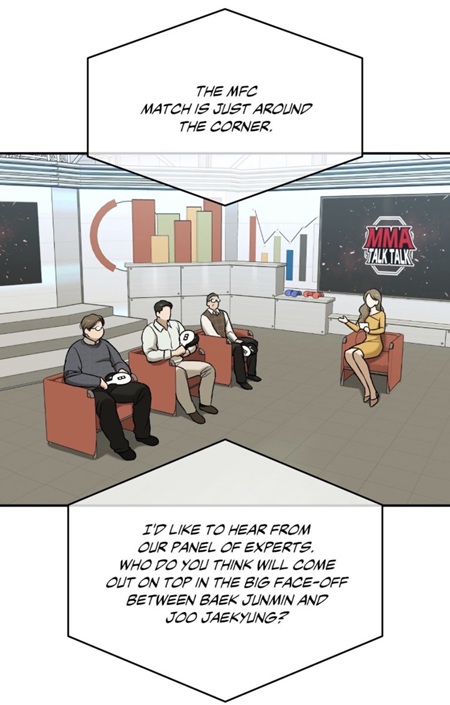 (chapter 95) The match is discussed on television, framed by expert panels, transformed into spectacle. Within this mediated space, events are reorganized into narratives that preserve coherence. The system remains visible—but only in a form that neutralizes its contradictions.
This disjunction is decisive. The stabbing reveals the structure, but only at the level of immediate experience. It does not yet disrupt the mechanisms that sustain belief in institutional integrity. The hospital’s reputation remains intact, the media continues to frame events as isolated, and the connection between domains—medical, criminal, and entertainment—remains unarticulated.
For this reason, the narrative cannot end here. If the web is to be fully exposed, it must not only produce violence—it must lose its capacity to contain it. The gap between event and interpretation must collapse. What occurs in the hallway must enter the field of visibility, where it can no longer be reassigned, softened, or displaced.
In this sense, the stabbing marks not the culmination of exposure, but its threshold. The threads of the web—once invisible—have become tangible through blood, but they have not yet been seen in their entirety. Until the structures that frame reality—hospital authority, media representation, institutional credibility—are themselves destabilized, the system retains its power.
The injury is not ignored; it is neutralized. What should function as a limit is absorbed into the system as something to endure.
The violence has occurred. Recognition, however, is still pending.
The Unsettling Conclusion: Immunity vs. Path
Ultimately, Shin Okja is not “wrong” in what she values—poverty is real, and status does offer certain protections. However, she is fatally incomplete in what she sees. The path she offers Kim Dan is not meaningless, but she has mistaken a path for immunity.
Underlying this entire structure is a more fundamental fear: not merely that Kim Dan might suffer, but that she might not be there to protect him.  (chapter 65) Her philosophy is therefore not only a strategy for survival, but a defense against loss. By constructing a system that promises stability, she attempts to secure his future in her absence.
By persuading him that the hospital was his sanctuary, she inadvertently ensured he would be caught within its walls without the defenses necessary to survive its shadows.
She is the most tragic figure in the web: the one who weaves the trap out of the purest threads of love. This logic extends even to the moral qualities she values. When Shin Okja tells Joo Jaekyung 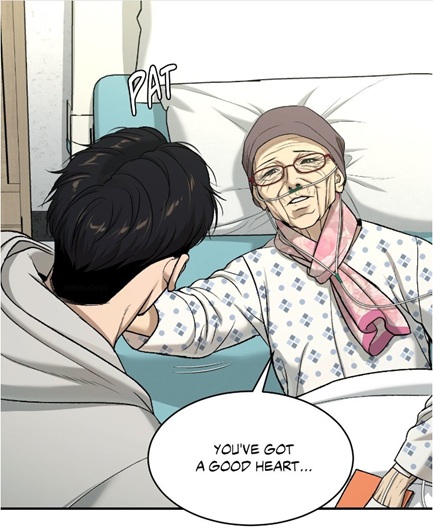 (chapter 94), she is not offering a casual compliment, but reaffirming a belief that character itself can function as protection. Just as institutions are expected to secure safety externally, moral integrity is imagined to guarantee it internally.
Yet this belief encounters the same limit as the others. She does not simply misrecognize; she inhabits a filtered world—of distance, status, and representation—where violence can be deferred, softened, and explained, until it finally returns in the only form that cannot be ignored: blood. The presence of care, of sincerity, of a “good heart” does not prevent violence.  (chapter 11) It does not interrupt the structure that produces it. What the stabbing reveals is not the absence of goodness, but its insufficiency. Moral character does not shield against a system that exceeds it.
Park Namwook and the Stabilization of Meaning
Park Namwook is not blind to violence. On the contrary, he recognizes it immediately.  (chapter 11) When he sees Kim Dan’s injuries, he does not accept the explanation of an accidental fall.
  (chapter 11) The signs are too clear: the blood, the instability, the surrounding context. The truth is not hidden from him—it is fully accessible. And yet, this recognition produces no transformation.
This is the decisive point: Park Namwook does not misrecognize violence; he reclassifies it. Instead of allowing the event to disrupt his framework, he absorbs it into it. 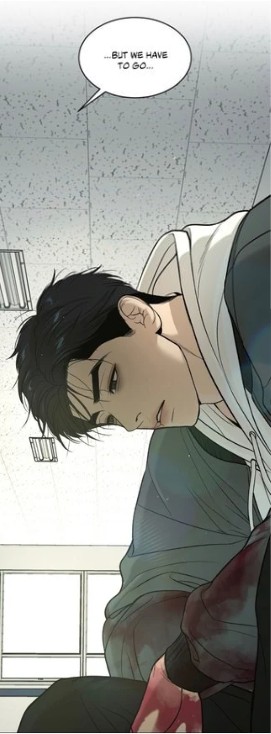 (chapter 98) The match must continue. The title must be defended. The schedule must be maintained. What should function as a rupture—an event that interrupts the spectacle—is translated into a professional condition. Injury becomes endurance, trauma or pain
  (chapter 52) becomes discipline
  (chapter 52), and even external aggression is reintegrated as part of the fighter’s burden.
 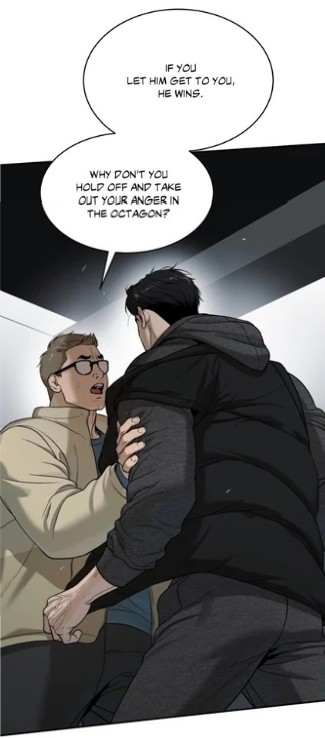 (chapter 96) Violence loses its capacity to expose the system; it becomes one of its operating principles.
The Ideology of Endurance
Yet Park Namwook’s role extends beyond stabilization. He does not merely interpret events—he produces the framework through which others interpret them. His injunction to Joo Jaekyung (chapter 96)—does not resolve conflict; it installs a logic. Emotion must be converted into performance, crisis into productivity, disturbance into focus. What cannot be solved must be endured, and what is endured must be made useful.
This logic is not merely practical—it is ideological. For the manager, value is inseparable from the capacity to endure. Suffering is not a flaw in the system; it is the proof that the system is functioning. To withdraw is not to protect life, but to fail its test. 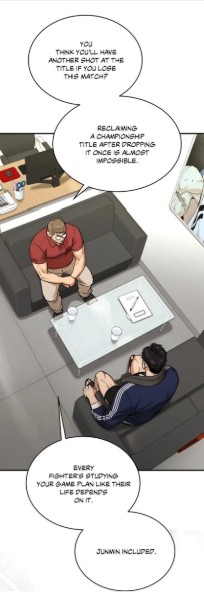 (chapter 95) His insistence that the match must proceed is therefore not simply a matter of scheduling or revenue. It is a defense of the very framework through which he understands worth. If the event were to stop because of blood, then the distinction between strength and failure would collapse.
The Internalization of Systemic Discipline
Within this perspective, relational bonds become unintelligible. The emergence of attachment—Joo Jaekyung’s concern for Kim Dan—does not appear as development (chapter 98), but as deviation. The fighter, in Namwook’s view, must remain a closed unit, defined entirely by performance. Any connection that interferes with that function is treated not as meaningful, but as a malfunction. Jaekyung’s hesitation is thus interpreted not as a moment of recognition, but as a breakdown in execution. 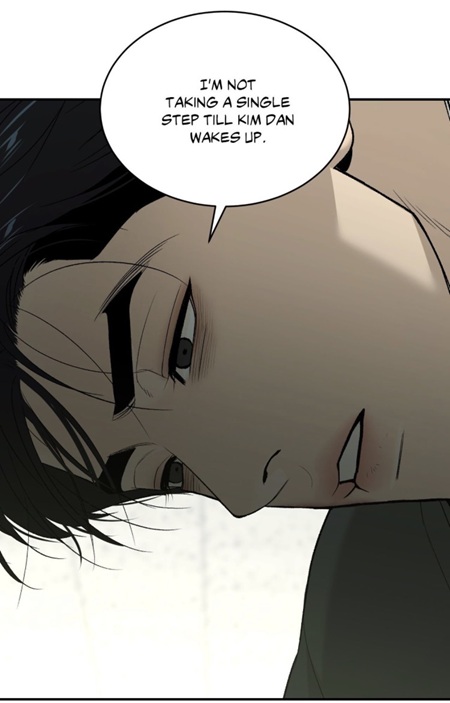 (chapter 98)
Kim Dan’s request (chapter 98) does not emerge directly from a spontaneous emotional impulse, but rather from the grim resolution of a structured psychological conflict. This conflict is initiated when the manager installs a normative framework that demands emotion be converted into performance, effectively defining the fighter as a figure of pure, clinical focus. (chapter 95) This institutional lens does not remain an external suggestion; it becomes the dominant interpretive tool through which Kim Dan reads Joo Jaekyung’s behavior. 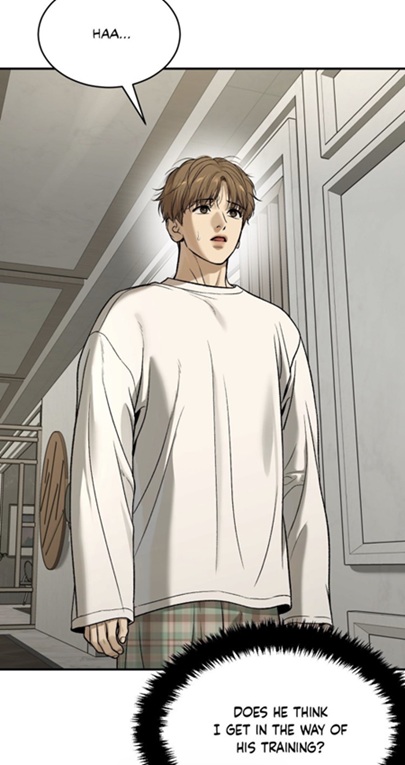 (chapter 96) Simultaneously, Dan operates under a prior logic of care inherited from Shin Okja, which characterizes love as a practice of self-effacement and the vigilant avoidance of becoming a “burden.”
When Dan observes Jaekyung’s withdrawal, these two distinct logics come into tension: he must decide whether the distance between them signifies relational distress or systemic discipline. Selecting the latter, Dan interprets Jaekyung’s silence as a necessary concentration required to become a champion. 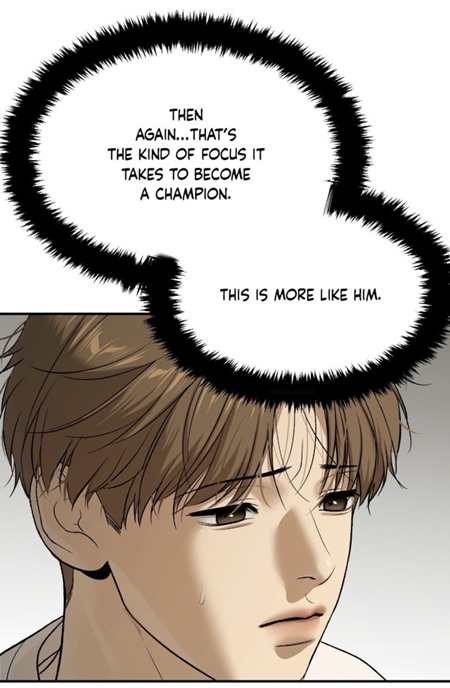 (chapter 96) This selection is far from neutral; it activates a reflexive inversion in which Dan begins to view his own emotional presence as interference—an element that disrupts the conditions of performance. He ceases to position himself as a partner and instead redefines himself as an obstacle that must be removed.
 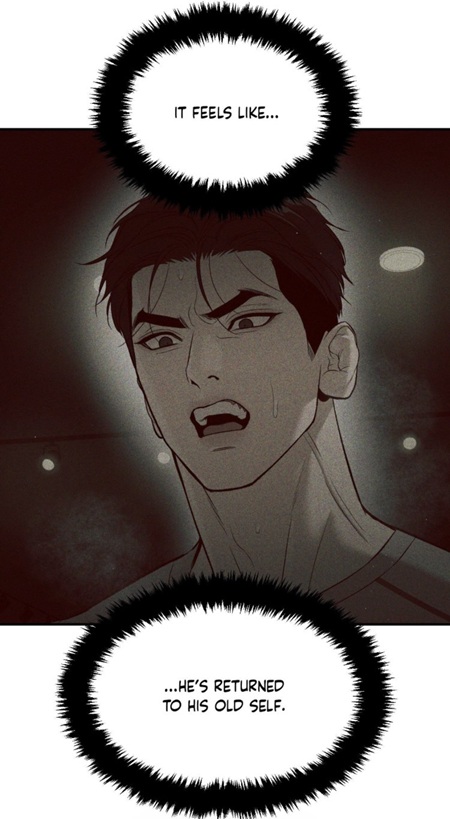 (chapter 96)
The Tragic Resolution of Care
Consequently, the request to (chapter 98) is the tragic resolution of this conflict. Care is not abandoned, but reformulated into compliance: 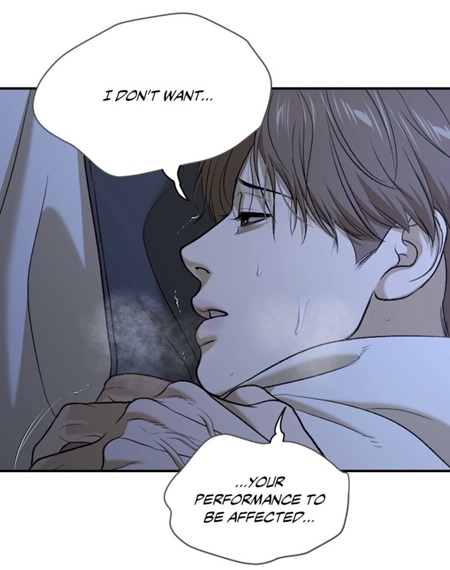 (chapter 98) Dan aligns himself with the very system that isolates him. By explicitly stating that he does not want Jaekyung’s performance to be affected, he performs an act of self-erasure, translating his devotion into a demand that reinforces the system’s logic. In doing so, he does not transfer the inherited burden, but reproduces its structure: love becomes obligation, attachment becomes pressure, and care becomes indistinguishable from the demand to endure. Suffering is thus rendered manageable only by being structured into obligation—even at the moment where it should interrupt the system entirely.
The Collapse of the Spectacle
Chapter 99 exposes the limit of this mechanism.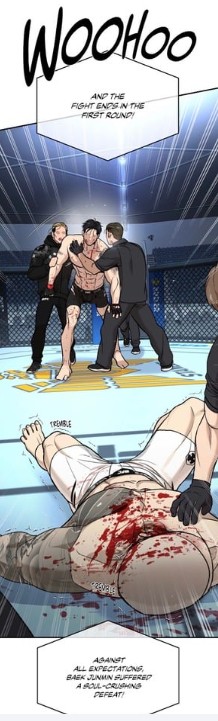 (chapter 99) Joo Jaekyung fulfills the demand—he wins—but the act reveals its emptiness. His victory produces no recognition, only dissonance. He ignores Park Namwook’s praise
 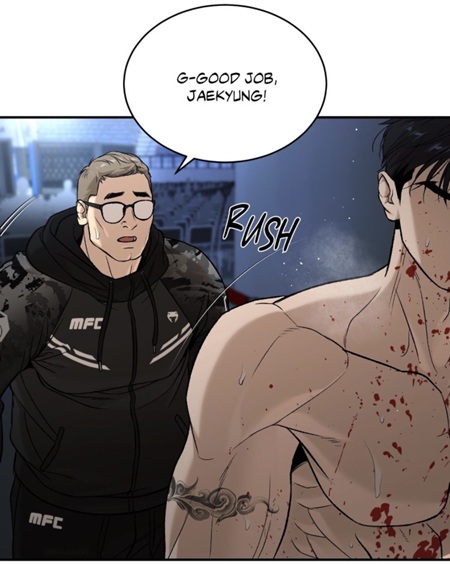 (chapter 99), treats the CEO and the belt as if they had no substance
 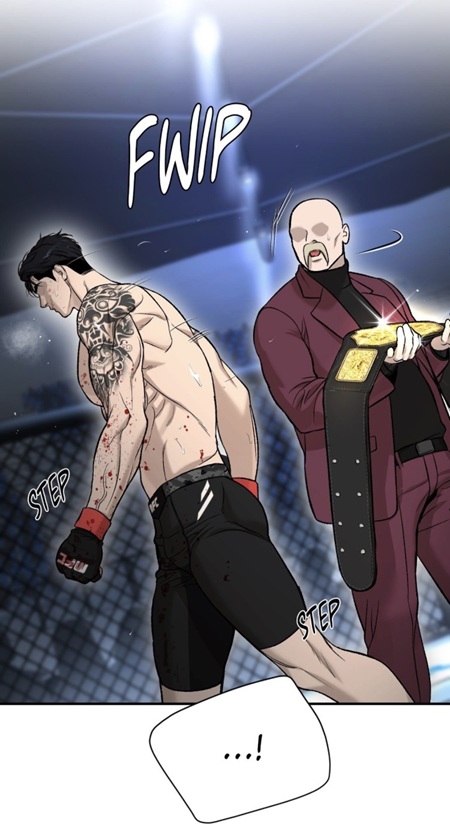 (chapter 99), and leaves the octagon under the sound of booing.
 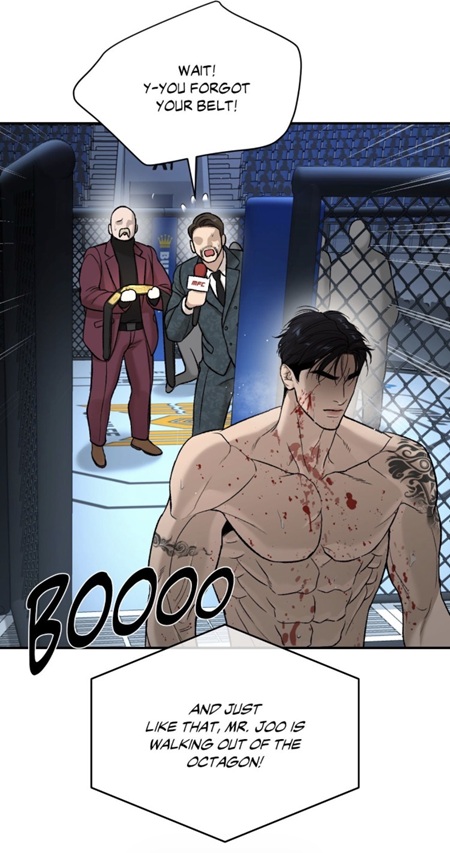 (chapter 99) The spectacle continues, but he no longer inhabits it. In this sense, he appears as a ghost within the very space that once defined him: present, functional, but detached from meaning.
This detachment becomes visible in his relation to Park Namwook. The manager’s words no longer stabilize reality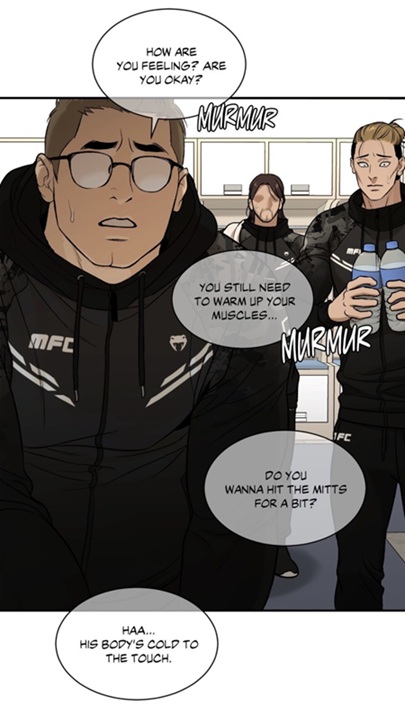 (chapter 99); they fail to register.
  (chapter 99) His compliment carries no weight. (chapter 99) His authority is not actively rejected—it is rendered irrelevant. Only one statement interrupts this indifference: the mention of Kim Dan
 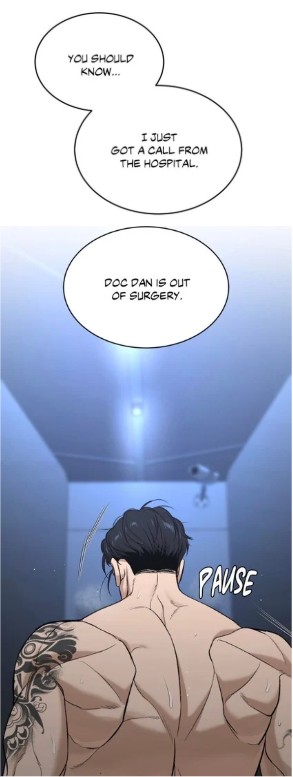 (chapter 99). Here, and only here, Joo Jaekyung pauses. The contrast is decisive. Where the system’s language dissolves, the reference to an unmediated relationship produces an immediate response.
Structural Limits and Hollow Compliance
Park Namwook’s function thus reaches its structural limit. He can still organize the event, maintain the schedule 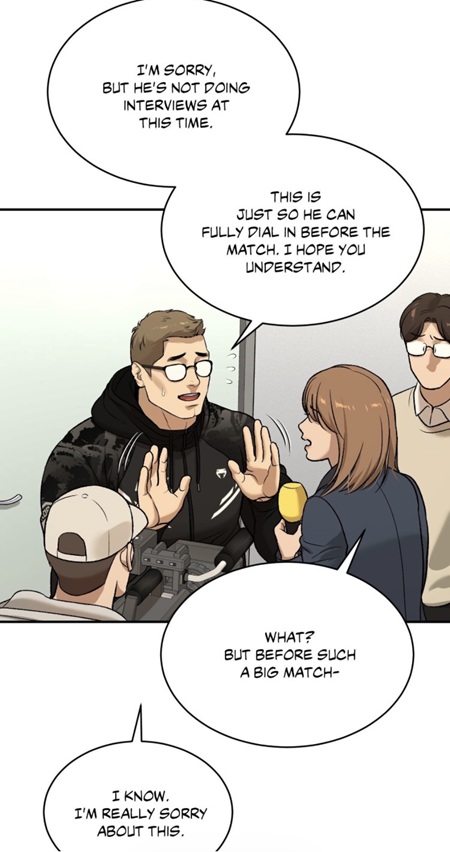 (chapter 99), and reproduce the framework—but he can no longer guarantee its internal acceptance. Joo Jaekyung continues to act within the system, but no longer according to its logic. He becomes capable of fulfilling its demands without believing in them. The result is a hollow compliance: performance without adherence, victory without value.
This shift also clarifies the origin of Kim Dan’s earlier misunderstanding. His request did not emerge from misreading alone, but from a framework imposed upon him. By internalizing Park Namwook’s logic, he translated Joo Jaekyung into the figure of the champion and care into a demand for performance. (chapter 99) Chapter 99 reveals the inadequacy of this translation. Winning does not protect, endurance does not resolve, and the fulfillment of the request exposes its own misalignment.
The Execution of Absolute Logic
Namwook’s role within the system is therefore not to produce violence, but to stabilize its meaning, only under the assumption that violence remains mediated. Chapter 99 introduces a critical deviation: Joo Jaekyung does not reject Park Namwook’s instruction (chapter 96) —he fulfills it without mediation. By converting emotion into immediate and total aggression, he follows the directive to its limit. 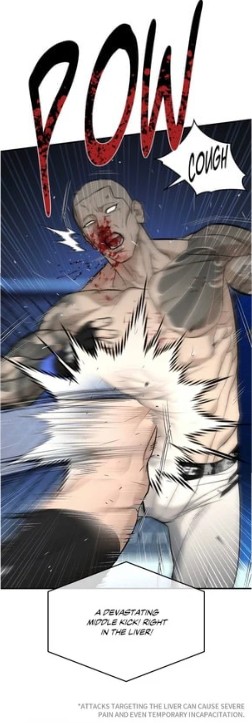 (chapter 99) The result is not a reinforcement of the system, but its disruption. The fight collapses into a single, decisive sequence, eliminating the duration and structure that sustain the spectacle. In this sense, Jaekyung does not oppose the framework; he exposes it by executing it absolutely. (chapter 99) As you can see, Park Namwook ensures that what could be recognized as structural failure is instead experienced as necessity. Where others might see a crime, he sees a complication.
  (chapter 69) Where there is rupture, he restores continuity. In doing so, he prevents the emergence of the question that could destabilize the entire structure: why?
 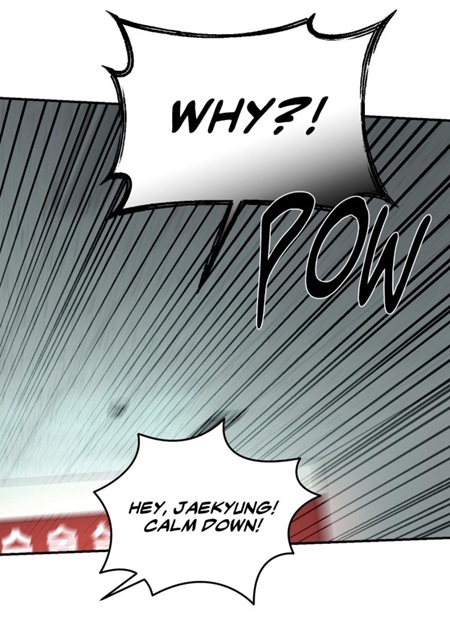 (chapter 98)
Neutralization of the Real
This makes him a crucial figure in the maintenance of the system. Violence alone does not sustain the spectacle; it must be interpreted in a way that neutralizes its implications. While others draw blood, Namwook ensures that the blood does not lead to recognition. He embodies a form of internalized control that presents itself as common sense. And it is precisely against this stabilization—this refusal to allow violence to signify anything beyond necessity—that rupture becomes possible. When Joo Jaekyung ultimately breaks with this logic, he will not simply be interrupting a match; he will be challenging the very definition of value that sustains it.
This is why Kim Dan’s assault becomes so important. (chapter 98) It confronts this ideology with the one thing it cannot easily absorb: real death. Until now, Park Namwook’s framework has revolved around the “fall” of an athlete (chapter 95) —the fake death of reputation, title, and career. A loss in the cage is treated as annihilation, as if nothing existed beyond the hierarchy of the sport. But Kim Dan’s bleeding body introduces another scale of reality. Here, the danger is not symbolic. It is not a fallen ranking, a lost belt, or a damaged public image. It is life itself. 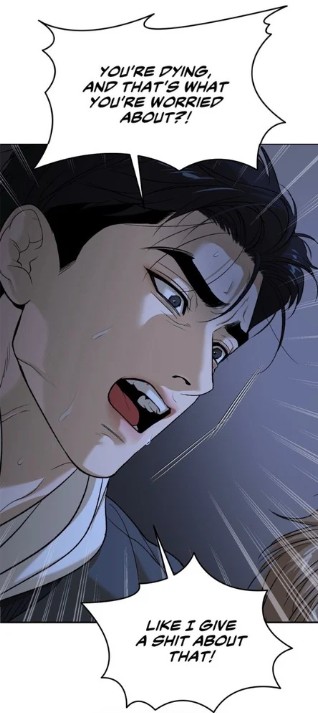 (chapter 98)
The Cruelty of Repurposed Voices
And yet even this real danger is pulled back into the logic of the match. Kim Dan’s own words (chapter 98) —his plea that Jaekyung win—are used to reinforce the system that has placed them both in crisis. His injury, even his possible death, is made to serve the same imperative: the champion must fight. This is where the cruelty becomes most visible.
The victim’s desire is transformed into an argument for continuing the spectacle, as if the proper response to his blood were not protection, investigation, or refusal, but victory. 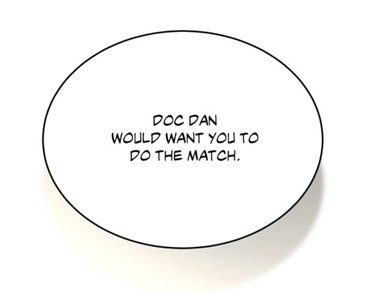 (chapter 98) Yosep’s statement intensifies this discomfort. When he tells Jaekyung that Doc Dan would want him to go to the match, he speaks with a certainty that feels almost intrusive. It is as though Kim Dan’s private words have already been absorbed into the group’s logic, detached from their intimate context and repurposed as pressure. Whether Yosep is merely guessing, repeating what he believes Kim Dan would say, or somehow knows more than he should, the effect is the same: Kim Dan’s voice is no longer used to protect his life, but to discipline Jaekyung back into the arena.
The Failure of Care in the Group
This alignment is not incidental. 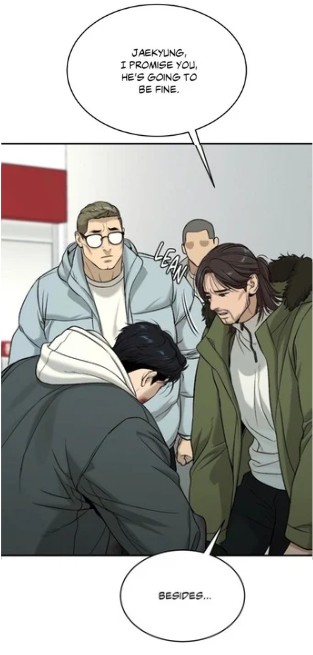 (chapter 98) Yosep does not merely reproduce Park Namwook’s logic; he embodies its long-term internalization. Having lived under the same principle—that emotion and relationships must be subordinated to performance—he has come to perceive this translation as self-evident. His statement does not register as an imposition to him, but as a natural extension of care. Yet the consequences of this logic are already visible in his own trajectory. The prioritization of endurance over relational presence has not only shaped his professional conduct, but also his personal life, culminating in the dissolution of his marriage. What appears, in the moment, as pragmatic guidance thus reveals itself as a learned incapacity to recognize when performance has displaced care.
 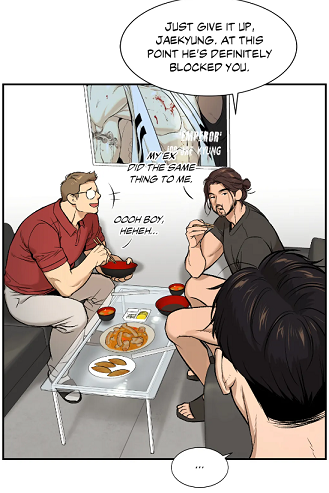 (chapter 5) It shows that the “endurance over care” logic doesn’t just affect the fighters; it is a virus that destroys every personal relationship it touches.
When Park Namwook insists, (chapter 98) the statement does more than impose a schedule—it redraws the field of obligation. The collective is reactivated, and with it, the logic of the system. Yet this “we” produces an immediate absence. If they go, who remains? The question is not logistical, but structural. The system can coordinate presence where spectacle is required, but it fails to assign presence where care is needed. In this gap, its priorities become visible.
Chapter 99 brings this structure to its limit. Joo Jaekyung fulfills the demand, but no longer recognizes its authority. (chapter 99) Park Namwook’s logic remains operative at the level of organization, but it loses its capacity to define meaning. His words no longer orient action; they become external to it. In this sense, his status as “hyung” does not collapse through confrontation, but through irrelevance. Authority persists formally, but it no longer binds. 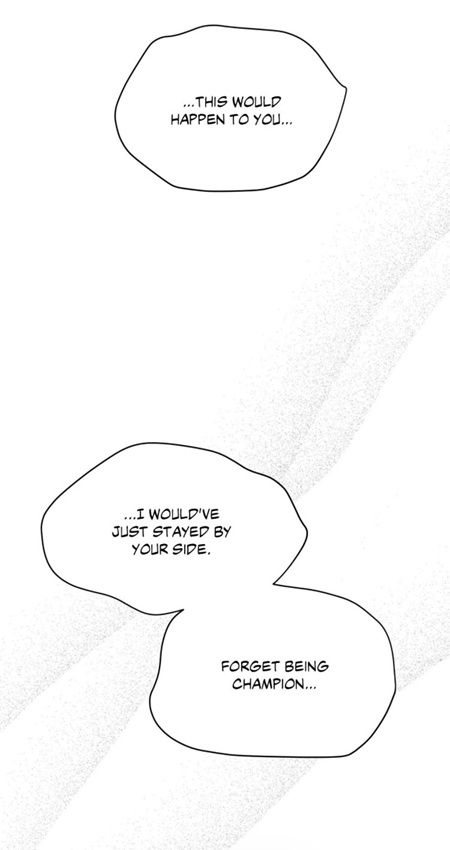 (chapter 99)
Feel free to comment. If you have any suggestion for topics or Manhwa, feel free to ask. If you enjoyed reading it, retweet it or push the button like. My Reddit-Instagram-Twitter-Tumblr account is: @bebebisous33. Thanks for reading and for the support, particularly, I would like to thank all the new followers and people recommending my blog.

 Bebebisous33s' analyses in K-Dramaland and Manhwas
Merci pour ce nouvel article !
LikeLiked by 1 person
Merci pour le compliment et le soutien! 😍
LikeLike