
This is where you can read the manhwa. https://www.lezhinus.com/en/comic/painter But be aware that this manhwa is a mature Yaoi, which means, it is about homosexuality with explicit scenes. If you want to read more essays, here is the link to the table of contents: https://bebebisous33analyses.wordpress.com/2020/07/04/table-of-contents-painter-of-the-night/
Thanks to the chapter 54, I was able to realize the main topic of the second season. While in the first season, Baek Na-Kyum’s mind, corrupted by Jung In-Hun’s coercive persuasion, was in the center of the story, in the second season Byeonduck chose to focus on Yoon Seungho’s heart which has been gravely damaged due to a very traumatic experience. This explains why in the first season, the author picked this image as illustration. 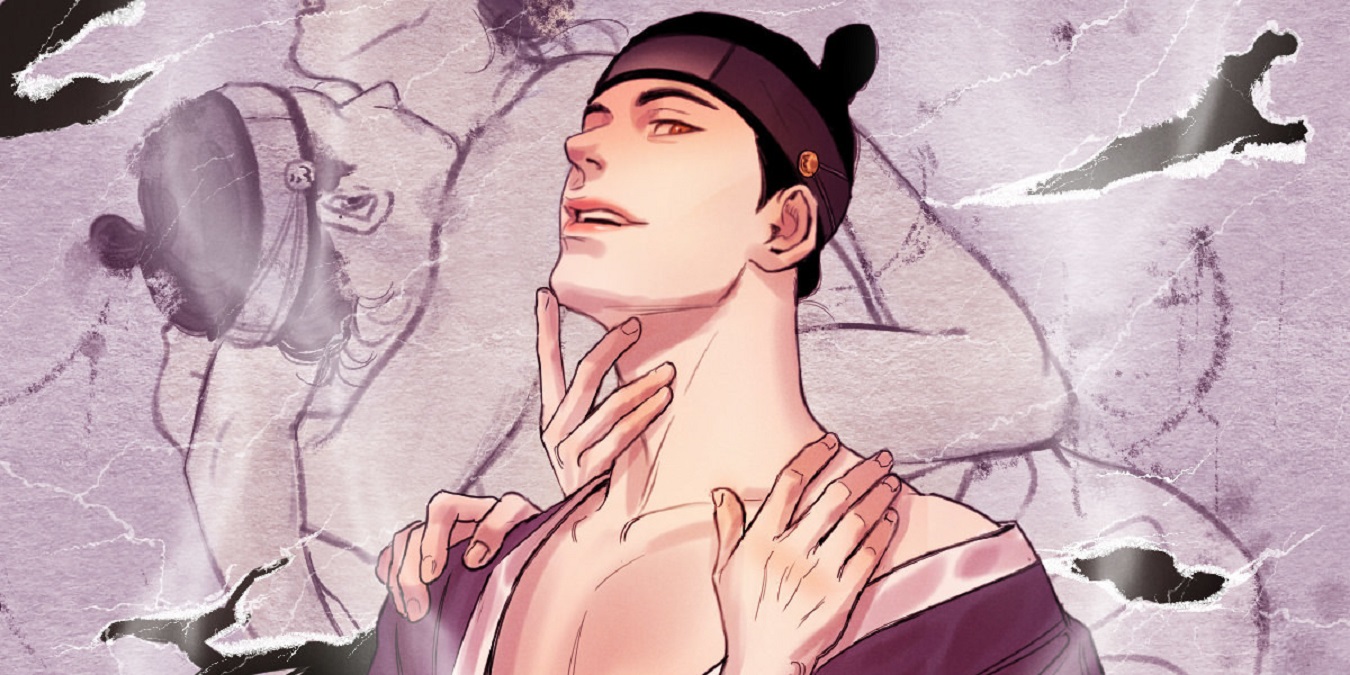 The lord was the one who helped the painter to liberate his mind and body from the doctrine imposed by Jung In-Hun. He represents the White Mind. Thus Jung In-Hun became his enemy. Strangely, the lord has the impression that he didn’t win against the scholar, because he has not been able to get the painter’s heart. But he is wrong in the sense that Baek Na-Kyum has already realized the learned sir’s fakeness. The scholar never liked him, hence all his words and actions were fake. His mind is no longer poisoned, and became white again. On the other hand, this doesn’t mean that he has really perceived the scholar’s true personality, like the painter’s confession displayed in chapter 75:
 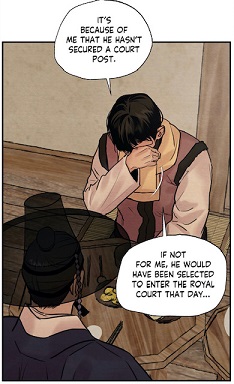 He has no idea that he has been manipulated.
Nevertheless, for the painter’s mind is free again, he can think on his own. That’s the reason why Baek Na-Kyum keeps introspecting himself 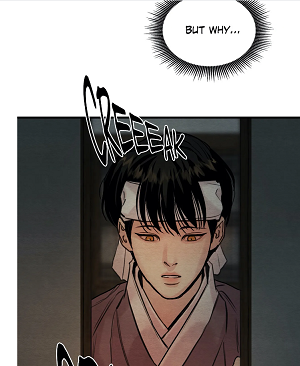 and asking questions.
  . As you can observe, the noble with his intelligence and purity of the mind became the “hero”, although the emancipation was a very painful process. Hence the artist could only resent White Mind.
Now, we have this picture as illustration for the second season:  . Because of my first observation, I came to the following conclusion. This image shows that Baek Na-Kyum will be the one assisting the lord to free his heart from the past and trauma. His heart has been poisoned, therefore he can’t love the artist properly. This interpretation explicates why in the past and in this season the lord’s actions were and are terribly wrong (rape, the forced fellatio, etc…). The corruption of his heart is the cause for all the artist’s suffering, but at the same time, the painter symbolizes his cure. And due to the kidnapping and its consequences, the lord was forced to face his own fears and traumas. That’s why I consider the night of the revelation (chapter 62-63-64) the lord’s medicine. Let’s not forget that despite all the noble’s words
  (chapter 62), he wasn’t able to follow his own doctrine. The next morning, Baek Na-Kyum was lying in Yoon Seungho’s bed.
 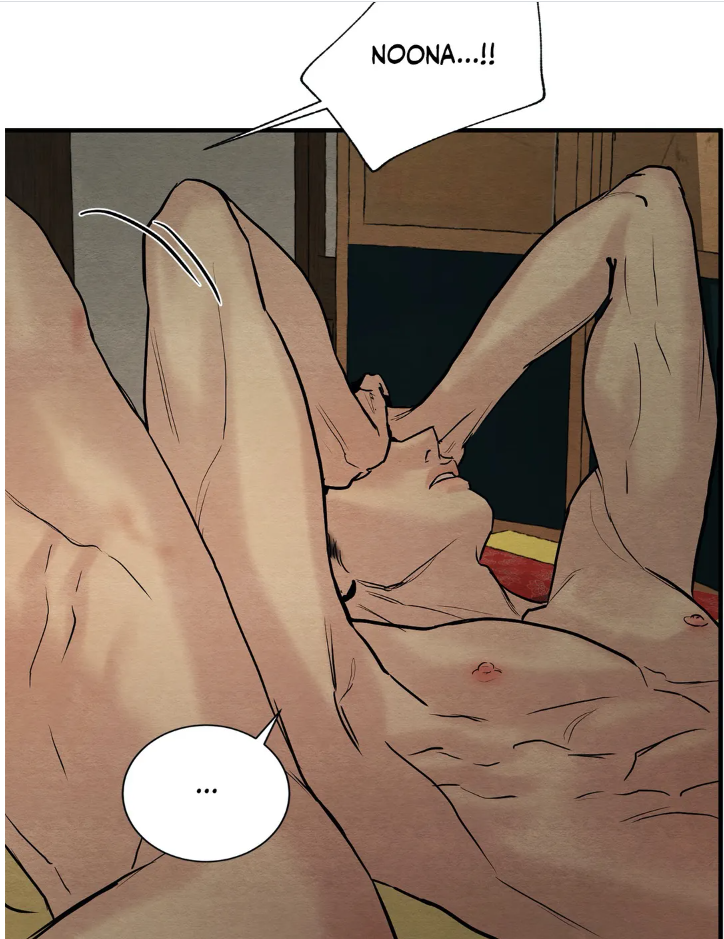 This scene exposes that the painter was definitely more than just a sex toy. Therefore the manhwaphiles can grasp why I associate the painter to a white heart. The commoner embodies purity, love, generosity and kindness, whereas Min as Black Heart represents corruption, hatred, greed and jealousy. Note that the more Yoon Seungho secluded himself from the nobility, the more he became tender and nice to Baek Na-Kyum. Notice that he was even considered as a reformed man by the folks in the chapter 45, as he was no longer meddling with the other aristocrats. This confirms my interpretation that nobility embodies corruption.
Now, you can comprehend why Seungho gave in to Min’s suggestion in the chapter 52 and 54.  With his poisonous words and tricks
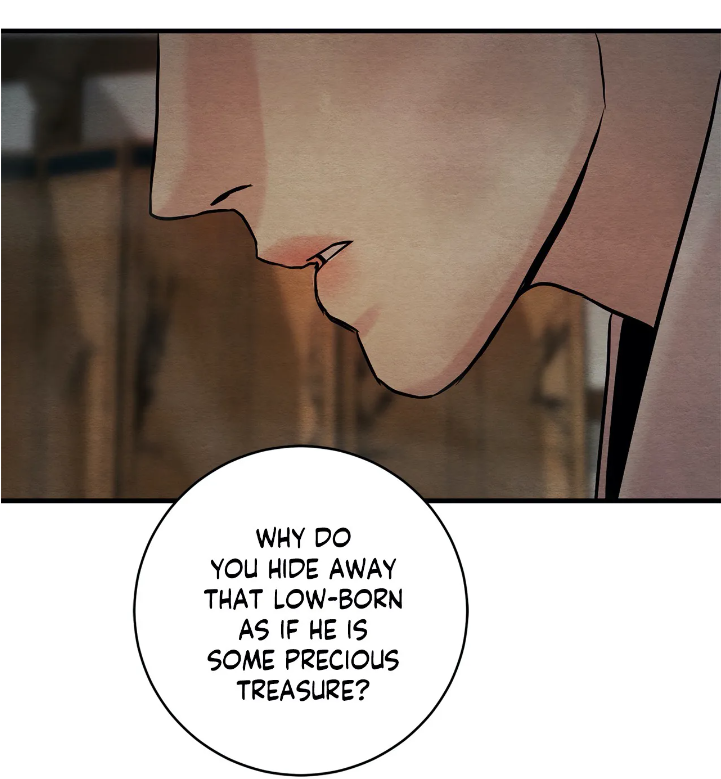 , Seungho’s heart got manipulated and brought the painter to the other nobles for a sex orgy. Because of these two significations, I came to realize why Min claimed that the main lead was so easy to understand. From my point of view, Min discovered the reason for the protagonist’s extravagant behavior, when Jihwa insinuated the existence of a secret concerning Yoon Seungho’s past.
 (chapter 36) Min didn’t need to know what kind of trauma the lord suffered, for him it was enough to know that the lord’s heart had been terribly wounded. Because of this revelation, Min got aware of Seungho’s weakness. Back then, I was relieved that Jihwa didn’t say much but now, I perceive it differently. Min with his black heart understood the signification behind these words.
Since I call Baek Na-Kyum White Heart, the low-born has Min as his opponent, although he is not aware of this. This explicates why Min was using the painter to hurt his opponent Yoon Seungho. On the other hand, it also elucidates The Joker’s obsession and fascination for Baek Na-Kyum, as there’s the saying: opposite attracts. Therefore it becomes comprehensible why Min desired to have the low-born eliminated.  (chapter 53) Black Heart had many reasons to wish his death. He sensed that he was getting obsessed with the painter. With his death, he would remove the cause of his own suffering. In other words, he recognized that Baek Na-Kyum was dangerous to him. Besides, I believe that Min had a similar perception of the painter than Jihwa’s portray of Baek Na-Kyum
  in chapter 43. The manhwaphiles will certainly recall his words about the artist:
–  (chapter 43): A witch had seduced a noble and could fool the noble.
–  (chapter 52): Baek Na-Kyum was consumed by lust. From my point of view, The Joker had already detected that he had not the upper hand in his relationship with Baek Na-Kyum. And when he described Jihwa in chapter 66
  , this portrait was actually mirroring his own personality. He had not the courage to kill the painter himself, he needed Jihwa’s hands to do so. That’s why he convinced the second lead to hire a killer. That way, he wouldn’t become responsible for Baek Na-Kyum’s death, he wouldn’t be plagued with remorse. But his plot failed, because Nameless didn’t act in the rush. Notice that in the chapter 54, the vicious noble used the painter again in order to wound his enemy. When Black Heart started laughing and declared this,

he was mocking and humiliating Yoon Seungho out of jealousy. He wanted him to deny his love for the painter, so that the artist would see that the lord was a coward. He might have protected him in front of a servant, but among aristocrats Yoon Seungho would behave differently. However, what happened is that Baek Na-Kyum was the one who rejected the protagonist. 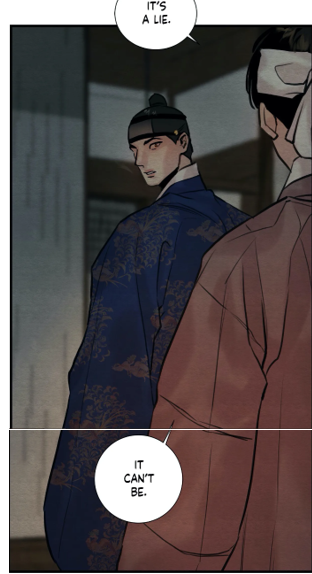 As you can sense, this scene in chapter 54 represented the battle between two hearts: Black Heart versus White Heart. Here, the main lead was almost defeated, as the aristocrat dragged him to his bedchamber for a sex orgy. With his white heart, he was actually defending his master’s reputation, unaware that he was actually playing into his opponent’s hands, as the main character had the impression, he didn’t want to be associated to him. On the other hand, before rejecting this idea, the commoner asked the noble

Why would he beat Min like that? Why did he react like that? Notice that he was now the one asking for the motivation behind the lord’s reaction. Their role had been switched. He was now confronting the lord with his behavior, while during the sex marathon, the lord used the mirror to confront the painter with his denial. Another difference is that in chapter 54, he was pressuring the lord to question his heart and not his mind. This was the second time that he interrogated the main lead directly. The first time happened in chapter 47: , that However, in chapter 54 the noble got paralyzed. 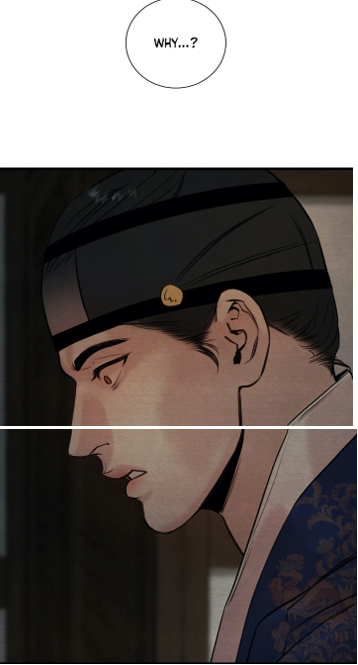 He was even left speechless. Unlike the main lead, the painter was physically and socially much weaker, hence he could never use force against his master. Because of Baek Na-Kyum’s firm denial, Yoon Seungho’s heart get wounded leading him to make a bad decision. In his eyes, he had been rejected one more time, hence he could only offer the boy to his guests. The wounds in his heart (
 the straw mat beating, the seclusion
  , the gangrape
  ) explained why he kept hurting the painter over and over again. This was the result of corruption, thus I come to the conclusion that he is very similar to Jihwa. Yet the difference between them is that Jihwa kept his innocence and naivety, while the main lead turned into an adult because of this traumatic experiences (gangrape, betrayal and abandonment). Since we have two corrupted hearts (Seungho and Jihwa), it is now understandable why both have similar hallucinations.
  (cr. to @PrincessJihwa) They represent their fears. The red-haired aristocrat has the impression that his friend became a victim of a seducer, while the other envisions, the painter has become a prostitute and is enjoying sex with others. And my assumption that the protagonist’s illusion was mirroring his own past and trauma was finally confirmed in chapter 74. In this picture
 , I saw another evidence that Yoon Seungho got gangraped by older officials. This is not surprising that in that moment, he threw the bottle. It was, as if he wanted to destroy that image.
  And this gesture reminded me of the painter’s reaction with the mirror. In the chapter 28, he saw a vision in the mirror
  which he despised thereby he destroyed this image by damaging the mirror.
 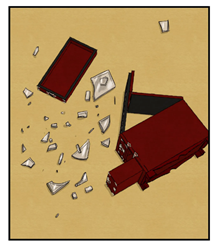 This represented the painter’s fear.
So if we look carefully at the noble’s hallucination and judge it as a reflection of the past (which contrasts to the painter’s vision as it did represent the future), then I detect passivity and pleasure. Notice that the painter’s face is blushing indicating joy, yet this excitement is in reality induced by drug and alcohol, at the same time he is surrounded by two men. So for me, it looks like Yoon Seungho was gangraped by white-beared officials but in order to make it easier, they used opium and wine for that which explains why he didn’t resist that much. In other words, he became a victim of drug-facilitated sexual assaults (like KO-drug). After realizing what happened, the lord felt shame and guilt, as he sensed “pleasure” and showed no resistance. That’s the typical behavior of such victims. No wonder if Yoon Seungho got shocked, when he had this hallucination.  It was, as though he was seeing himself again, an image he abhorred and repressed. The vision of sex connected with pleasure and drug represented his biggest fear. This is not surprising that Yoon Seungho wanted the painter to feel and see his pleasure with the mirror so that he doesn’t develop the same feelings and thoughts (shame, guilt etc).
This would explain why Yoon Seungho decided to become a spirit and even hated his own body and image, until he saw the reflection of his own gaze in the painter’s drawing. For the first time, he perceived a different image about himself. He saw attraction and beauty in it. That’s how he could free his body at the pavilion and enjoy sex for the first time without guilt and shame. I have already stipulated that the gangrape was part of the deal made by Yoon father, thereby Yoon Seungho resents prostitution and nobility so much. In exchange for his career or survival, he sold his son to white-bearded officials.
In the first version of this essay, I had predicted that during the second season, the manhwaphiles would become the witness of another emancipation accompanied with pain and resent. And this prediction came true: the night in the shed. The first emancipation in chapter 54 corresponded to the scene in chapter 2, when the lord was confronted with his own reflection , the night in the shed made him relive the night of the first rape and the betrayal.
 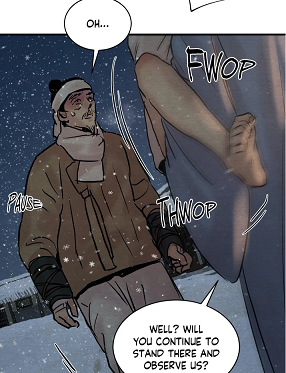 (chapter 64), which the “loyal” butler witnessed but never revealed.
 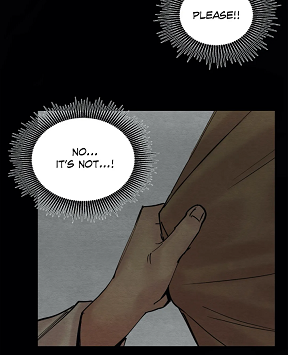 (chapter 65)
And exactly like I had foreseen, the lord was the one suffering the most during the season 2, just like Baek Na-Kyum was hurting very much in the first season. However, let’s not forget that due to the painter’s resistance, the noble had to suffer as well. In other words, this was not surprising the painter got wounded as well, which we could already witness in the chapter 48-49 and 54.
Furthermore we shouldn’t forget while Seungho knew the identity of his opponent, he was still clueless about the cause of the painter’s behavior. He thought, he had to remove the scholar from the painter’s heart, while in reality the real hindrance was the influence of Jung In-Hun on the painter’s mind. Thanks to the lord’s actions, Baek Na-Kyum was no longer under the scholar’s influence, but the former has not realized yet that his heart has already been conquered. His actual situation reflects a lot Seungho’s position in the first season. Back then, the noble had no idea himself that he desired Baek Na-Kyum as his companion and “wife”. The latter acted on his instincts all the time, he thought, his mind was the trigger for all his actions, while in reality his heart had been leading him all this time. Unconsciously, he wanted to be loved by the painter, and since he has never felt loved, he had no idea how to convince the commoner. At the same time, he racked his brain to convince the painter to remain by his side. He had noticed the painter’s denial about his homosexuality, hence he used the mirror to change the commoner’s perception about himself. With his actions, the painter started seeing his learned sir in a different light, and got more and more disappointed.
Due to the association Black Heart (Min) and Black Mind (Jung In-Hun), I came to the following conclusions. We have a fight between white and black. Black Heart corrupted Jihwa’s heart, whereas the scholar poisoned the painter’s mind. This explains why the scholar’s enemy is White Mind (Yoon Seungho), while Black Heart’s enemy will be Nameless (Black Mind). From my perspective, Nameless became like that because of his traumatic past  (condemned for theft twice) as well, but unlike the main protagonist, he has kept his heart pure. That’s why he was moved by the second lead’s torments. He will be the one helping Jihwa getting rid of the corruption. The purification has already started: he convinced Jihwa not to kill the painter by confronting him with reality. He made him face the brutality of a murder:
 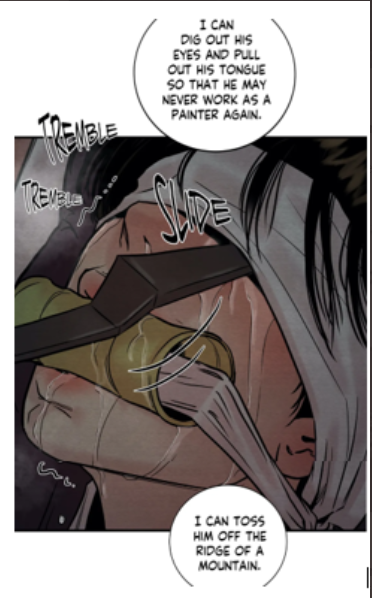 (chapter 60) Yoon Seungho was able to defeat the teacher in reality and I believe, Nameless will be the one who can defeat Min too. And this prediction was confirmed with the final episode from the second season:
 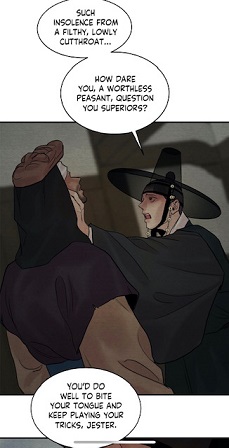 (chapter 76). The Joker got upset, because he witnessed how Jihwa was indeed to Nameless’ words. Black Heart had to close the commoner’s mouth. As you can see, the strong link between black/white and mind/heart made me think of the yin and yang
 . We could say that this image represents the main characters in the manhwa: Seungho/Jihwa (black heart, white mind) and the painter/Nameless (black mind, white heart). Put together, they complete each other, they help each other to heal their wounds. At the same time, it is a fight because they need to remove from each other that poison: a process full of heartache and tears. This explains why Painter Of The Night is not a manhwa for entertainment. The manhwalovers can feel the pain of the characters. What made me smile is the following:
  (chapter 74) When I saw this picture, I instantly connected it to Ying and Yang. As the manhwaphiles can witness it, many of my interpretations got verified later. And if you contextualize this panel, you’ll realize the meaning of Yoon Seungho’s position. Just before, he had woken up from a nightmare, a sign that the poison from his past was coming to the surface and as such was slowly leaving his mind and heart. So by facing the painter’s face, the noble is actually taking his cure: the painter’s face is helping to find peace and get purified. From my point of view, although the main lead has ready transformed into a phoenix, the noble’s purification is not truly finished, as he hasn’t dealt with his traumatic past. None of the culprits from his past got punished… none of them met their karma!
But there is one person that I haven’t mentioned yet: Father Yoon. From my perspective, the latter is one the ultimate villains, as he is Black Heart and Black Mind simultaneously. He used his son for his own career and ambition. It is also possible that he even plotted against the king (black mind). There’s no doubt for me that he sold his son to nobles (black heart), as he knew the opponents’ weaknesses (sex with men). From my point of view, when he heard that the king was interested in his own son, Father Yoon chose to train his son as the king’s courtesan. However, the relationship between the king and the main lead didn’t go smoothly, like father Yoon had anticipated. At some point, the monarch got so enraged that he ordered a purge, which Yoon Seungho had to witness.  (chapter 74). It is possible that the king heard from someone that Yoon Seungho had been asked to spy on him. Due to the purge, the main lead lost his mind, hence he was sent to the mansion. However, for the father, this incident meant that Yoon Seungho had revealed the truth. That’s why he humiliated him as a sodomite. At the same time, it helped him to maintain his good notoriety. By cutting ties with his son, he could keep his dignity (black heart). Besides, this would also explicate why Seung-Won is acting like that.
 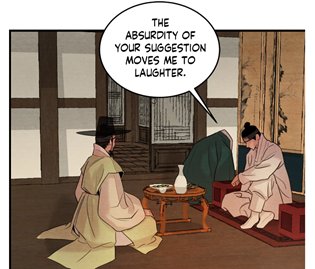 (chapter 37) The latter wanted to use Yoon Seungho’s connection to get a position in the government. His heart and mind have been exposed to corruption, since he decided to live with his father. Sure, this is an interpretation based on my theories, but this would explain why father Yoon has been barely introduced, but his shadow is omnipresent. The other ultimate villain is naturally the king, since he is like a ghost in the second season. Let’s not forget my latest theory: Lord Song is in reality the king, but Yoon Seungho has not realized it yet. Since Yoon Seungho and Nameless resemble so much, I am expecting a fight between father Yoon/King and Yoon Seungho/Nameless. However, this ultimate battle won’t occur in the season 3. In my eyes, the two protagonists need to defeat Black Heart and Jung In-Hun first. Besides, both main leads have still issues with their surrogate father and mother: Kim and Noona. On the other hand, we should still expect suffering, as the main and second characters (Jihwa, Nameless) haven’t healed all their wounds.
Since Yoon Seungho could succeed and defeat Jung In-Hun in the second season, I am expecting that Nameless will also defeat Min in the sense that he will make sure that Jihwa is no longer in contact with him. Let’s not forget that Min is looking down on commoners, hence he doesn’t expect any danger coming from Nameless. He initially believed that threatening him with a death sentence would scare the commoner: 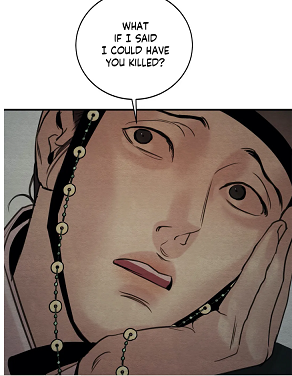 (chapter 76). The reality was The Joker got more furious and glared at Black Heart.
  From my point of view, Min’s weakness will be the painter. I have always said that Min could understand the powerful protagonist so well, as he had the impression that they were similar. However, he is wrong, it is just that he envied the alpha so much that he started copying him: the clothes, the sex orgies, the erotic publications, the opium etc. He mixed up cause and consequence. And in chapter 76, the readers can already sense Min’s downfall: he vomits due to the abuse of opium.
  In order to appear calm and normal, he gives a fake explanation about his nausea. For me, there’s no doubt that Black Heart got so upset and jealous, when he witnessed this embrace:
 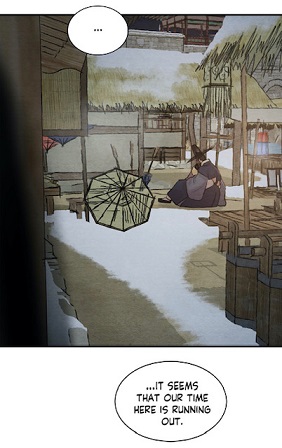 The lord proved to Min that he was brave. He felt no discomfort and shame, when he hugged the commoner in front of people. Black Heart’s mockery from chapter 54 has become now inefficient. And Min’s words clearly proves to me that during the night of the gangrape (52-53-54), The Joker was determined to ruin the relationship between Yoon Seungho and Baek Na-Kyum, so that the latter would live the mansion. But he failed, just like he didn’t succeed in chapter 66 as well.
The manhwaphiles should remember that Black Heart is getting more and more interested in Baek Na-Kyum, because he is slowly recognizing that the painter is different. In chapter 52, he still had the impression that the painter was just like any other commoner: they would sell their body in exchange for clothes or better life conditions. Yet, I suspect that the painter’s words in the chapter 53/54 made the vicious noble realize that the low-born was different. First, he hugged the main lead, although the latter was acting like a beast (chapter 53). Furthermore, he questioned his master. Besides, he denied the lord’s love. Imagine, as a low-born, he dared to speak to his master like that. Baek Na-Kyum was brave and bold in that scene which couldn’t escape Min’s notice. Finally, I also believe that his first kiss with the painter must have haunted him as well.
The fight between Black Hearts and White Hearts and Black Mind and White Minds is not finished, as the battle between darkness and light will is still ongoing. The Black-Hearts and Black Minds have not met their karma yet. Since all Black Heart’s plots failed and Jihwa has now become more and more useless, The Joker will have to find new pawns: Heena and Jung In-Hun. Striking is that Min helped the protagonist to free himself from his past. He forced him to question his own heart. At the same time, due to the different events, the vicious noble could witness how different and strong the low-born was. Even after the lord had treated him harshly,  (chapter 66) Baek Na-Kyum refused to leave his side. He anticipated that the painter would follow his sister, therefore he waited for him at the kisaeng house.
 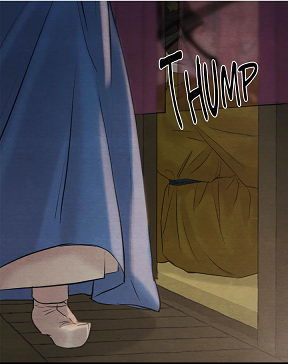 (chapter 69) But nothing happened like expected. The painter chose to stay at the mansion. Hence I believe that Min will envy the noble even more than before, so that he has a new plan: taking away the painter from Yoon Seungho, which would have the same effect: destroying Yoon Seungho. While The Joker imagined that would help them in a second abduction
 , he never anticipated a rejection from the so-called ruthless and greedy criminal. In the shed, he even discovered that Jihwa had sex with the commoner, a sign that the second lead was moving on from his first love. Since a second abduction is no longer possible, Black Heart will have to find a new method to get the painter. What caught my attention is that all the attempts from Min have something in common: he is refusing to take any responsibility for Baek Na-Kyum (for the murder, the gangrape, the rape and the abduction). If the painter had returned to the kisaeng house, the aristocrat would have asked to taste the artist, because this place is similar to a brothel. In other words, he would asked the commoner to treat him as a client. This explicates why he is Nameless’ enemy who stands for responsibility. As for the latter, his meeting with Min made him realize that there was in reality a conspiracy.
  (chapter 76) and Jihwa had been manipulated by his acquaintance. There’s no ambiguity that Nameless hates plots… that’s why I am expecting that the criminal approaches Yoon Seungho in the 3rd season. Besides, Baek Na-Kyum has already revealed his involvement:
  That’s why I have the impression that the commoner will even confess on his own that he played a role in the abduction. As a conclusion, we should see white as a symbol for courage and responsibility, while Black for cowardice. If this comes true, then the painter will forgive Nameless, as Baek Na-Kyum’s strength is forgiveness. At the same time, the manhwaphiles should remember that such a gesture could help the artist to overcome his trauma: he won’t get scared,
 if he sees another jester. That’s why I view this manhwa as a good example to show a huge trauma can be overcome: the past should never be buried, and the victims should face their traumas. Simultaneously, the culprits should admit their responsibility and be punished for their wrongdoings.
Feel free to comment. If you have any suggestion for topics or manhwas, feel free to ask. If you enjoyed reading it, retweet it or push the button like. My instagram-tumblr-twitter account is: @bebebisous33. Thanks for reading and for the support, particularly, I would like to thank all the new followers and people recommending my blog.

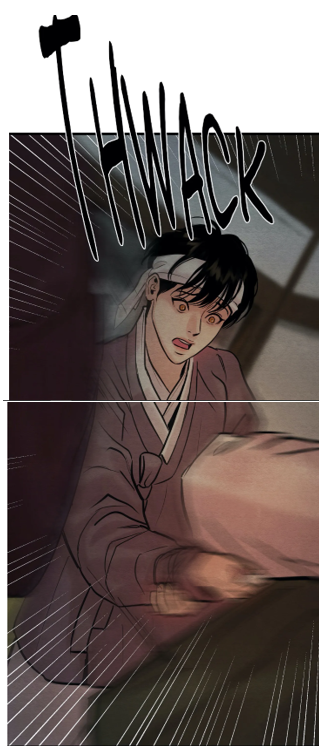 He intervened the moment the painter had to hear verbal insults and we all know that the painter is much more sensitive to such oral attacks than to physical abuse. Yoon Seungho saved the damsel in distress with his action. However, this is just an illusion as the real prince charming is none other than Baek Na-Kyum himself.
 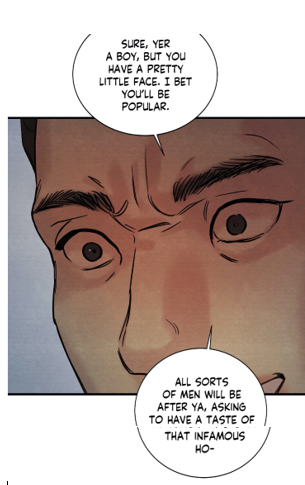 With this picture alone, the noble could only go insane. He was already jealous of the tailor for touching his lover and making him blush. From the chapter 39, it became clear that Yoon Seungho desired to be the only one to provoke such reactions in the painter. No wonder that the lord became so brutal and turned into a fury.
 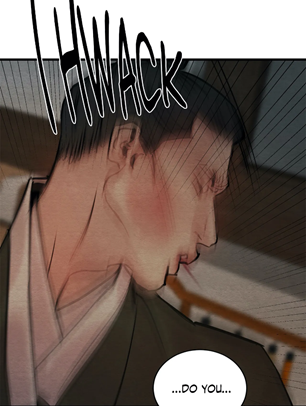 This is no coincidence that I am choosing such an expression as furies are powerful divine creatures representing wrath and punishment.
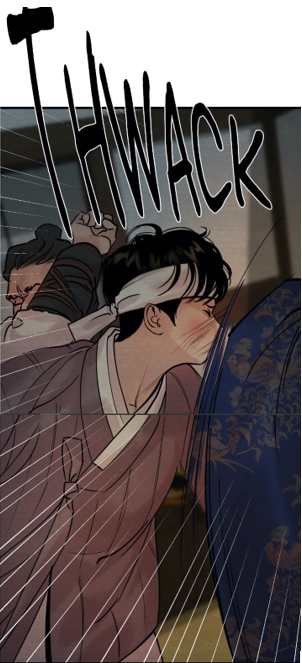 He, a human, shows no fear in front of a powerful and divine creature. How can a human being have such power? I could say that his strengths are purity and selflessness. However, this is not enough. In fact, this action makes the noble realize that he is a man made of flesh and blood. The shock makes his heart race.
 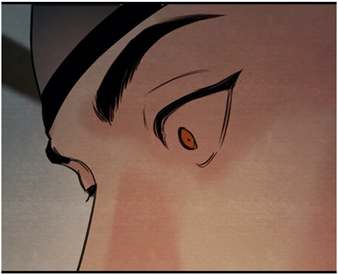 Then, he sees the artist’s bruised cheek. He hurt his loved one, he is reminded of his love but the pain and shock are brief because Yoon Seungho is embraced by the painter immediately. With the tender hug, not only the latter can calm down the upset protagonist, but also he can make him feel the warmth in his body. Finally, the aristocrat is able to hear the artist’s gentle voice.
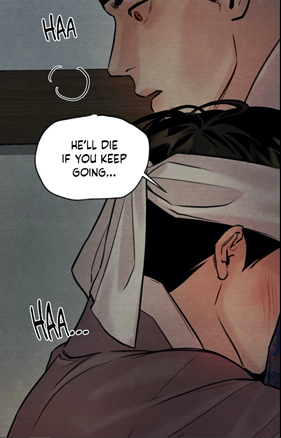 As you can detect, due to the low-born’s actions, the lord’s senses were all reactivated: the sight, the touch and finally the hearing. Therefore the noble is no longer a Fury but a man of flesh and blood again. That’s the reason why I believe that the real prince charming is Baek Na-Kyum and not the other way around. I believe that there is a reason why the painter buries his face in the noble’s embrace. He doesn’t want to make him feel guilty. He knows that the rage was caused by the servant’s crime so he shouldn’t be blamed. Baek Na-Kyum is truly the hero of this story and thanks to him, the readers witness the lord’s rebirth. Remember that I said that on the lord’s robe, there are phoenixes, the symbol for a rebirth and transformation. From its ashes, it comes back to life. That’s the painter’s power. He can affect the lord so much that he is able to bring him back to life.
  Thanks to this person, I made a huge discovery. Note that Yoon Seungho is not seen at the window this time. All this made me realize the progression from the chapter 44
  to the chapter 52.
  First, we have the lord smoking at the window. Then in the chapter 51, he is sitting so far away from the window that the painter can barely see him. Finally in the chapter 52, he has completely disappeared. Then I told my follower that it looks like the aristocrat was waiting for his Prince charming at the window but since the latter never came, it seems that he has already given up on waiting. That’s why he decided to no longer stay at his window. Since I associated our main lead to a heroine waiting for her Prince charming in her tower, I came to the association of Rapunzel and @user4792569 added that he had indeed hair like Rapunzel!!
  As a conclusion, Rapunzel is Yoon Seungho. The latter, trapped in a tower, is waiting for his prince charming at the window isolated from the world. The weirdest thing is that the original fairy tale Rapunzel contains many similarities with our story.
  he just paused for a short moment looking at his Rapunzel and then went to his study. In the second drawing, the artist is still not ambling in direction of the lord’s room but his body and face are turned towards the window.
 And in the last image, we see the painter going to Yoon Seungho’s chamber. This symbolizes the huge change in the artist’s thoughts. Little by little, the home is taking Yoon Seungho’s form, although the man has vanished from the window.
 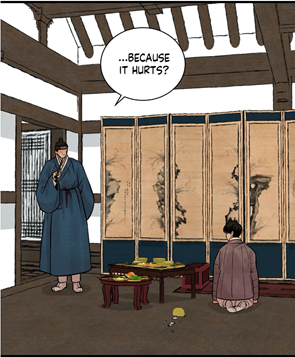 That’s the reason why now I consider the lord’s words here as a love confession. However, he couldn’t use the words “I love you” as he has never experienced it before. I doubt that his father ever said this to him. And now, you understand why I kept saying that we should never jump too quickly to conclusions and judge the main lead as someone stupid or crazy. He is just a traumatized boy who stopped growing up since he decided to stop living as a human and chose to become a spirit.
  Consequently the lord has not realized the true nature of his relationship with the butler. He trusts him, yet simultaneously he is oblivious to the loyal servant’s feelings. He doesn’t see that he has been respected and loved by him for a long time. The social gap hinders him to judge his valet correctly. Striking is that the butler stands in opposition to the sorceress because of his selflessness. He does feel fear like her but his scare is different.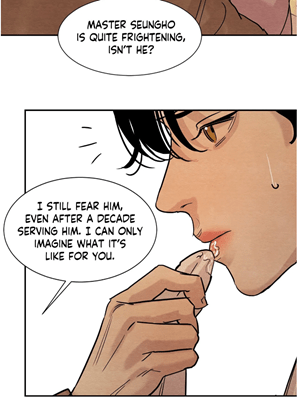
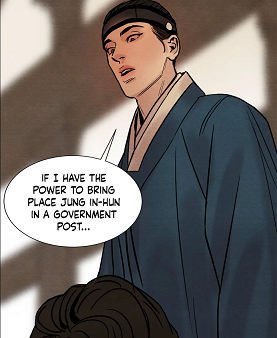 He might be trapped in a prison, but his cage is just virtual. He has definitely connection to the outside word, we shouldn’t forget that he also has shadow guards. He chose to remain in that tower in order to avoid wound and betrayal. And this shows how similar the fairy tale and the manhwa are. The “chamber with the open window” is the tower but here the main lead made this choice willingly, whereas the young woman was a victim of her mother’s abusive attitude. She wanted to be the only one loved by her adoptive daughter. In my opinion, the witch is too obsessed with Rapunzel.
 He is very understanding and supportive, tries to explicate his son’s harsh behavior without embellishing his wrongdoings. However, the servant’s decisions might be sometimes wrong too, just like any parent’s. Let’s not forget that perfect parents don’t exist. It is normal to make mistake as parents, since the latter are humans: “error is human”. That’s why the parents in the fairy tales are often portrayed with flaws as well.
  This symbolizes abuse and in the manhwa, I would even add, it symbolizes a castration. Now, the manhwaphiles detect the parallels between the Grimm’s story and the Korean story. Yoon father resembles the sorceress too. He punished his son for a so-called sin and betrayal. The truth diverges: the parents were in reality betraying the children. Whereas the witch was too obsessed with her daughter’s exclusive love, the other did this in order to survive. Yet, they are also very similar in their behavior: selfish and cruel. The adoptive mother doesn’t even listen to Rapunzel’s explanations, she immediately reacts on her feelings. She has the impression that she has been betrayed.
  However, in both stories the tears are a symbol of purity and honesty therefore they have an important finction. From my point of view, we will see Yoon Seungho’s tears later, just like it is only mentioned at the end of the fairy tale. Why do we need to see the lord’s tears? I believe that the lord never cried before, never during the betrayal and the gangrape (my theory), yet he needs to let out the tears in order to overcome the trauma. The confrontation between the prince charming and the sorceress could be perceived as a future encounter between Baek Na-Kyum and Yoon father.
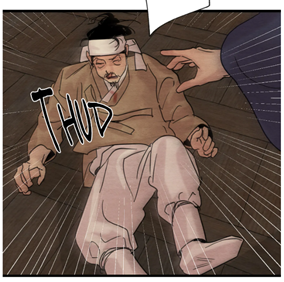 The former is pushed away, the moment the protagonist witnesses the painter’s return. Among the victim of the physical abuse, there is Deok-Jae. The manhwaphiles discover his face for the first time in the chapter 30. The domestic’s face is covered with blood and bruises, when he opens the door to Jung In-Hun and the painter.
 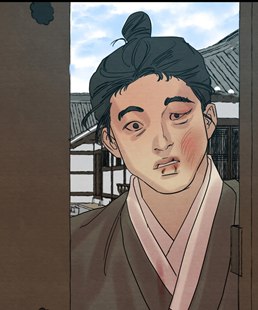 However, the author introduced him for the first time in the chapter 29
  which didn’t catch my attention as I was too focused on the lord’s behavior and reaction. [I want to thank taeminiebaby for her tip, this shows that everyone is welcome to contribute to my analysis] This gradual introduction is quite important for two reasons. First, his face gets more and more features. While the man has no visage in the first drawing, Byeonduck gave him eyebrows and a mouth in the second drawing. And the climax of his presentation is in the chapter 30, when Deok Jae opens the door. Striking is that in the two scenes, he always stands close to a door. These two observations are quite important because I’ll refer to it later.
 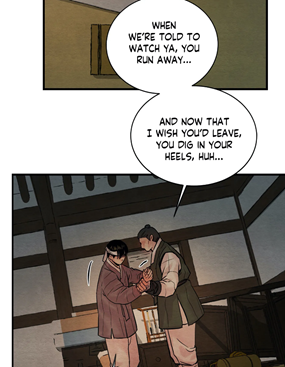 The explication is quite simple. Baek Na-Kyum was a low-born hence he couldn’t be a guest. On the other hand, his job was so different from the servants’ as he painted erotic pictures of sodomy. Due to all this, the staff could only disapprove the artist. In other words, due to his undefined position, the servants couldn’t view him as a part of the staff but just as an outsider. That’s why the low-born could escape. On the other hand, they never witnessed how the noble started having a relationship with the artist (chapter 20/21; chapter 25/26/27) therefore they just thought, he was only important because of the paintings.
 What caught my attention in this drawing is the first comment. His words reveal that the domestic must have stood by the door of the bedchamber, when he heard the artist’s moans. Therefore we should ask ourselves when and why he was spying on his master and the painter. Striking is that he mentions the lord’s chamber and the moan sounded similar to pain. Thanks to this info, we can already reduce the number of probabilities and almost figure out when he was observing the painter. Naturally, I can only mention the sex sessions that we could witness.
  . We have two possibilities. The first one would be that he heard the moan during the sex marathon, yet valet Kim seemed to pay attention to the lord’s bedroom. Since the domestic notices the resemblance of the sound between the pain and the moan, he could be thinking about the sex session in the chapter 45. Yet, the problem with this proposition is that the painter never complained here so that the moans can’t be similar to pain. As you can conclude, the mention “master’s room” is an important clue.
  Remember that during that night the door of the lord’s chamber got open and no one could see the perpetrator of this wrongdoing. Every reader speculated that a servant must have opened it but we wondered about the reason for this action. Many manhwaphiles complained about the lord’s leniency. Furthermore since we didn’t see any face, we were clueless about the motivation behind this action. From my point of view, during that night Deok-Jae could have been the one observing the door. Since no one talked about the event happening, then it is clear that Kim must have been the one opening the door and he left it open in order to force the painter to leave Seungho’s side. However, I am quite sure that the loyal butler wasn’t the only one who paid attention to what was happening in the lord’s chamber. Why? It is because of Jihwa’s words in chapter 17.
  With his statement, it is clear that someone was observing the door and the painter’s move. Jihwa is using the expression “servants” in order to hide the identity of the informant. There is no doubt that the domestics had no idea how Seungho felt attracted to the painter, since he kept organizing sex sessions (8,12-15). Besides, observe how the noble implies that the spy must have observed the low-born, until he returned to the study, while I doubt that Kim would have kept observing the artist till the end. The heard footsteps indicate that the valet was running away. From my perspective, Deok-Jae must have witnessed how Jihwa left Yoon Seungho’s chamber but he didn’t see or hear the painter leaving the master’s room and worried that Seungho would make a move on the commoner. Annoyed, he could have misled the butler so that the latter would interrupt them. He knew that if Kim intervened, the master would never scold him. Besides, he had no right to open the door. We shouldn’t forget that during that night, the lord hugged the painter before the latter tried to leave the bedchamber.
 Imagine that their shadows were visible from the outside due to the candles light hence Deok-Jae could have seen how the master had got close to Baek Na-Kyum. The other reason for this supposition is that the painter cried during the masturbation… which is also related to pain. We shouldn’t forget that the low-born felt embarrassed to have an erection. He was still in denial about his homosexuality. This could explain why the moans were so similar to pain.
 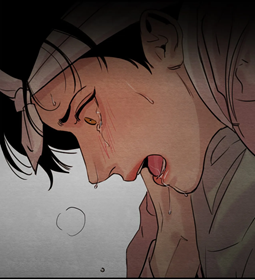 From my point of view, Deok Jae was spying on his lord for an important reason and used valet Kim to stop this event. Now, you are wondering why as well.
 Even valet Kim wears one. He thought if he had no white headband, this would reduce the distance between him and his master. Furthermore he might catch the lord’s attention that way. The second observation is that he is often seen next to doors. We can see him standing next to the door of Jung In-Hun’s chamber in the chapter 29,
 in the chapter 45, then in the chapter 47
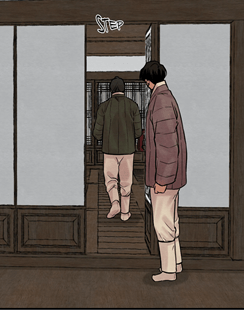
 in the chapter 52 and finally in the chapter 53.
 Sodomy with a commoner is considered as degrading and filthy. I have to admit that I was totally wrong concerning Deok-Jae’s resent.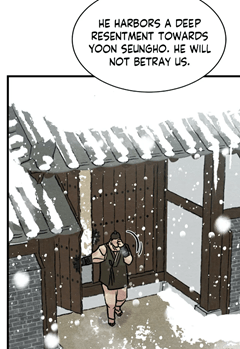

 The painter mentions that he has been tipped off by a servant. He says no name but if you contrast this to the following picture.
 He acted as a jealous concubine we can see in Chinese or Korean historical dramas. Killing the rival is another typical trope too hence this is not surprising that he is determined to have the painter killed so quickly. This discloses Deok-Jae’s urgency, he needs to act now as the painter is no longer favored. His action to ransack the painter’s room reminds me of the concubine’s plot trying to ruin clothes. Now, I understand better his jealousy and resent for both protagonists.
  (chapter 38), he is now determined to remain in this mansion as a servant. This outlines how much the mansion means to him. It has indeed become his home. If he’s a servant, then he can’t be called a prostitute. For Deok-Jae, it is really important to perceive him as a prostitute because he has no other explanation for the lord’s behavior. How could he fall for someone like him, when he on the other hand had worked at his place for a long time and paid attention to his appearance? That’s why he can only insult the painter
 Observe his look. He is not disgusted by the drawing as such, he is not rejecting sodomy. He resents the artist, he wished, they would have switched places.
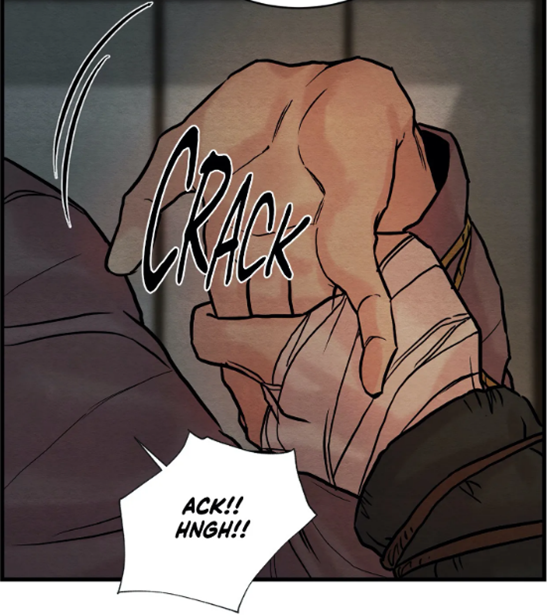 By breaking the low-born’s hand, Deok-Jae is determined to change the painter’s status and image. If he loses his hand, he will lose his job and become a prostitute. His wish is to turn the painter into a gigolo so that he can get rid of a rival and his prejudice about Baek Na-Kyum will come true. Let’s not forget that’s how exactly the domestic is perceiving him. This pejorative perception he has about the artist is also confirmed with the following drawing.
 The domestic must have witnessed it but due to his jealousy, he resented the artist too much to accept this truth. The painter wasn’t willing to become the lord’s partner but he was forced to. The servant is using the image of a prostitute in order to wound the artist. He claims that everyone is saying this, yet we are all aware that the head-maid of the kitchen declared the opposite. From my point of view, the servant is using every possible mean to make the painter leave the mansion. First, he creates a mess in his chamber out of revenge and enviousness. When the boy appears so suddenly, he has to change his plan, he needs to make him leave the place so that his wrongdoing won’t be revealed. He uses violence to pressure the artist to depart from the domain. But this doesn’t stop here, he needs to become more vicious so that the artist will give in. That’s the reason why he mentions the rumor about the painter in front of him. Notice that Baek Na-Kyum is more hurt by his words than by his brutal gesture of his hand. But the servant doesn’t stop there, he keeps envisioning the painter’s future: he will become a whore. He definitely wants this to happen.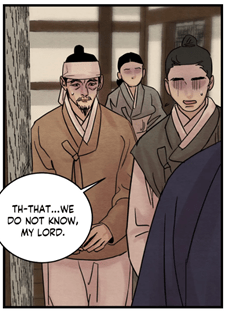
 The readers only hear the sound of the slaps and the crashing displaying the domestic’s physical powerlessness and the huge amount of strength Yoon Seungho uses with his hands. It was as if little by little the domestic was disappearing due to the violence used by Yoon Seungho. First, the servant is reduced to a lost tooth.
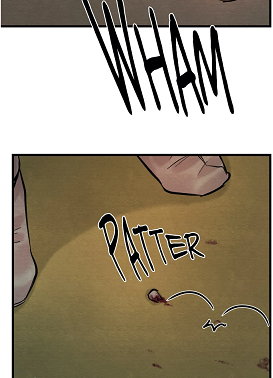 , then the manhwaphiles only hear the sound of the thrashing. The vengeful shadow is slowly killing Deok-Jae, almost turning him into another shadow too. The irony is that while he is getting beaten, he has to hear from Yoon Seungho: “Who do you think you are to put hands on him?” Now, I believe, I can answer his question. Deok-Jae viewed himself as a future concubine, waiting for the lord’s favors but at the end, he is so hurt that he can’t even walk straight. He crawls out of the room.
 While some readers think that his death is unsure because we only see a black veil next to blood, I believe to see another evidence for Deok-Jae’s death in the presence of the door!
 We shouldn’t forget that secret and door are strongly connected to each other that’s why in many languages there are expressions linking a secret to the door: coming out, behind closed doors, sortir du placard (French), à huit-clos (French), hinter verschlossenen Türen (German), detrás de puertas cerradas (Spanish), a porte chiuse (Italian) etc. Furthermore, since I have already explained that Nameless mirrors Yoon Seungho and the second season is inspired by the events in the first season, we should see Deok-Jae’s death as a new version of the lord’s killing in the chapter 1. Unlike Yoon Seungho, Nameless has to hide the servant’s body as he is just a commoner, while the noble had used his right to dispose of the low-born. Besides, let’s not forget that Baek Na-Kyum was responsible for the domestic’s death in the chapter 1 due to his lie. As I have already declared that Jihwa is the noble version of Baek Na-Kyum, then his order to have the painter killed is the reason why Deok-Jae ends up dead.
 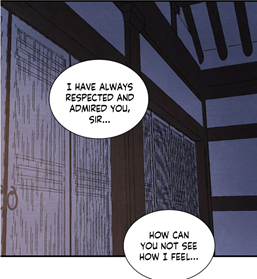 Back then, the love declaration revolved around respect and admiration indicating that the artist loved the scholar spiritually. Since the lord considered himself as a spirit until the chapter 49, no wonder these words must have moved his heart. The irony is that the painter was in reality longing for sensuality. He desired a physical love as the admiration was not fulfilling enough. Moreover, Jung In-Hun kept pushing him away. In other words, the low-born confessed because he longed for warmth and love and felt the need for sensuality. The spiritual love he continued clinging on till the chapter 20 kept hurting him as it was actually one-sided. Besides this spiritual admiration couldn’t satisfy the low-born entirely as his repressed sexual desires hadn’t been removed completely. Due to Jung In-Hun’s rejection in the chapter 19, the painter chose to look for sensuality in order to ease the pain. Yet, the spiritual love was still present.
 but couldn’t notice the difference right away. He was still under the impression that he was just a spirit. He imagined that this would be like another “sex session” hence he became impatient and rough towards the painter..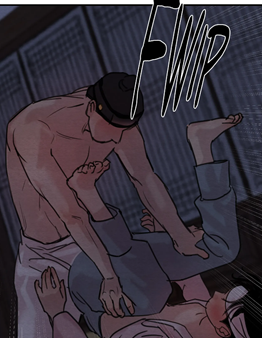
 . For the readers, it becomes more comprehensible why he told his friend he knew nothing about him. Yet for the first time, he met someone different… the painter was honest and so easy to understand, yet so difficult to control. All this time, he was sexually attracted by the painter but since in his eyes, he was just a spirit, he imagined that he felt the same way with Baek Na-Kyum. In his mind, the painter was just like the other men he had met.
  He could never do it before as he was just a spirit. In other words, the spirituality got replaced with sensuality. While the lord thought, he was still a spirit, he didn’t notice the transformation. Furthermore he didn’t forget that the painter was spiritually attracted by a man. This could only reinforce the lord’s confusion. At the same time, the sex was no longer a fight but a sign of love and warmth. Therefore the lord had no idea how to differentiate love, sex, spirituality and sensuality, since he couldn’t distinguish spirit and body. This explains why he is as confused as the painter until the chapter 53. He only saw himself as a spirit until the chapter 49 and hoped to be loved for his mind and not his body. On the other hand, he had experienced sensuality thinking that this was spirituality.
  he wanted to kill Jung In-Hun as he knew how fake the low noble was. Because the protagonist still viewed himself as a spirit and intellectual, he couldn’t understand the painter’s adoration for the scholar. The powerful noble knew that he had more knowledge and could even perceive people’s nature very well, yet he was unable to get the painter’s admiration. Imagine the humiliation. The young man fell for Jung In-Hun’s deceptions all the time.
 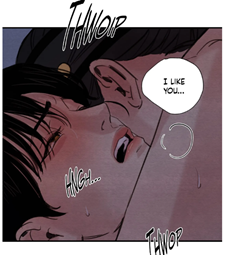 and since the painter had spoken about adoration and respect, the noble thought, the painter was still speaking about the mind and not the heart. As you can observe, it makes sense why it took the noble so long to discover that his heart was the reason behind all his actions and not his mind. He had been misled by the painter’s confession as well. Finally, this also explicates why the aristocrat decided in the chapter 49 to drop his perception as a spirit as he felt, he would never get anything from the painter, except the physical relationship. At least, the painter had accepted him as his partner, it was better than anything else.
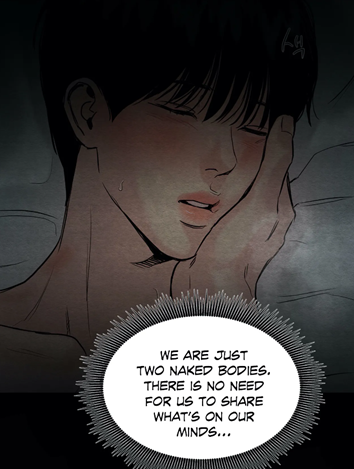
 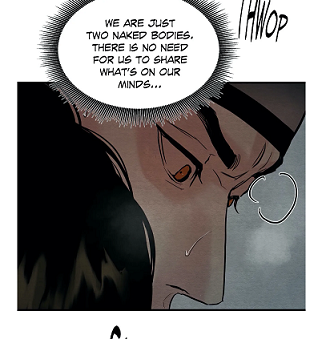 Thereby he decided to lower his expectations. Since he couldn’t get the same respect or admiration, then he should be satisfied to get the physical affection. In this picture, it becomes obvious that sharing what is on their mind is an allusion of their first night together.
  This picture really reveals the lord’s illusion. He still believes that his mind is ruling his life and that his decision to just accept the painter as his sex partner will satisfy his need and longing. However, the reality is different. The hanbok he wears the next morning
  reveals that his heart is already bleeding and deep down he is hurting again. What he imagined, his mind was still ruling his life was no longer true. He had become a man a long time ago and his last decision could only hurt him even more. On the other hand, with his confrontation, he helped the painter to abandon the scholar’s doctrine for good so that he could finally liberate himself and become a free spirit.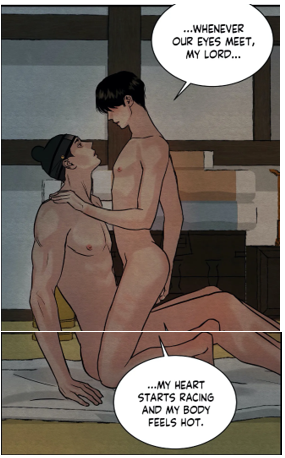
 From that moment, he made his own choice, accepted his homosexuality and his relationship with Yoon Seungho. But in that moment, he also decided to ignore his heart due to the bad experience made with Jung In-Hun. He got scared that the warmth he felt with Yoon Seungho was fake so he made up his mind that he should keep his distance from the lord. He could only have a physical relationship with the protagonist. The painter made the mistake to still mistrust his body and indirectly his heart.
 Because of this decision, he wounded Yoon Seungho again.
  Yoon Seungho’s “obsession” for spiritual love could never become concrete because their encounters were revolving around sex. On the other hand, we shouldn’t forget that right from the start the painter was longing unconsciously for more than just spirituality. Deep down, he hoped for sensuality too. In reality, both protagonists were longing for the same thing, love… but since the noble viewed himself as a spirit and the other was forced to only admit spiritual adoration, they could never say what they were both looking and expecting. However, the more Baek Na-Kyum experienced sensuality with the main lead, the more the artist felt the lord’s love. Hence he had these memories where the lord expressed his love.
 Consequently he started expecting something else from the lord. That’s the reason why he asked the lord why he treated him so well.
 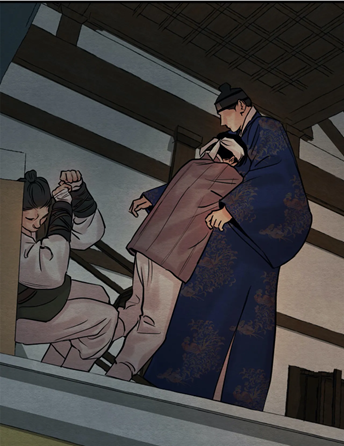 In my other analysis, I even described that the hug helped him to transform from a shadow into a man. But there is more to it. Unlike in the past, the painter remained by the lord’s side. He keeps hugging the man, although the servant has already walked away from them.
 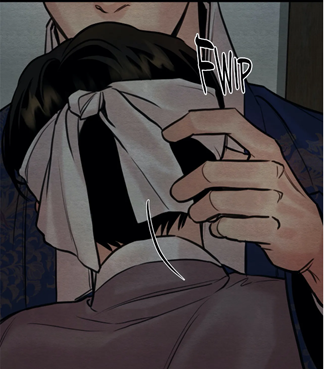 There is no need for the painter to keep embracing the lord like that. Yet, he does it because he wants to comfort the man. He has sensed the pain in the gestures. So for the first time, the embrace is linked to affection but it is also disconnected to sex. There is only warmth and love without sex. And this is important as it helps them to see that they mean more to each other. This explains why the noble is tender again and wants to remove carefully the white band. Their love has finally come true.
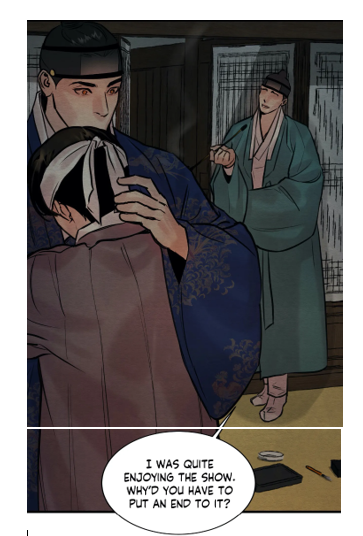 They hug each other without feeling the need to express sexual desires. This was also another source for their misunderstanding. The lord had never received an embrace outside their intercourses. The only hug he received in the past occurred in the chapter 26 and it was to save Jung In-Hun. Baek Na-Kyum didn’t hug the noble for solace and comfort but it was for someone else.
  And this is the second person telling him that the lord cares for him a lot. He saw that the lord took his side the moment he entered that room and started beating Deok Jae. Finally, I’ve always said that the painter was the bravest one which was confirmed in the latest chapter 53 again. He showed no fear to step between the servant and the lord, was willing to get a slap and didn’t even resent Yoon Seungho for his violent gesture.
 (Chapter 5) That’s why in this scene he couldn’t get erected in Lee Jihwa’s presence, chapter 5] Remember what I said about him: he was like a zombie and this was indeed correct. He lived through his mind therefore he read so many books and owns a huge library. From this observation, the manhwalovers can now better grasp why he never cared about his bad reputation as hell-raiser. The image he had about himself was so different from what the beholders saw. He considered himself as a free spirit. Besides, this interpretation confirms my statement in the analysis “The heart and the mind” as well where I explained that he confused his heart with his mind. Since he never considered himself as a man but as a spirit, he couldn’t recognize the existence of his heart. This explains why he makes such a mistake in chapter 53. Moreover, I feel that my association of the eagle was so point on either, as the latter flies high in the sky. That’s the reason why this bird symbolizes free spirit.
  (chapter 50) His mind was no longer controlling his body, he acted on his impulses. He let his heart do what it wanted. He no longer ponders like in the past. This explicates why he confuses the mind with the heart. We could say that he was deceived because of all the time he spent thinking. Imagine his reaction when he realized after making that decision that the painter was no longer reacting. He got scared that the painter had fallen sick again, he imagined for one moment that this was a repetition of the incident after the sex marathon. Now, you might be wondering why I bring up this scene again. I would like to point out that in chapter 32, when he said
 (chapter 32) he was already living under the illusion that he was just following his mind. He made the decision consciously that he would have more rounds with the painter, whereas in reality, he already was under the influence of his heart. He felt unsatisfied with the first round as he had just forced the painter to acknowledge his sexuality. Deep down, he wanted Baek Na-Kyum to accept him as his “husband” but despite the painter’s facial expressions and his climax, the noble sensed that there was something missing. So he kept having sex with him until the painter felt sick. In chapter 49, it was different, as he had already learnt to pay attention to his lover. Nevertheless, this indicates that the lord’s learning process was not complete. During that night he finally accepted the existence of his body. On the other hand, this also illustrates that he was slowly giving up on the idea that the painter could ever open up to him. Striking is that both made a similar decision during that night. While the painter chose to accept the lord only physically, the lord made the same decision. That’s the reason why in the end, I believe that when I confused the noble’s thoughts with Baek Na-Kyum’s, it doesn’t change much, as the thoughts are quite similar. Both acknowledge the existence and influence of the body. We could say that their expectations were aligned. This outlines how similar the two characters are. Both were living under the influence of their minds. One was brainwashed, while the other chose to live as a spirit in order to avoid any pain. Nonetheless, I believe that he was also brainwashed.
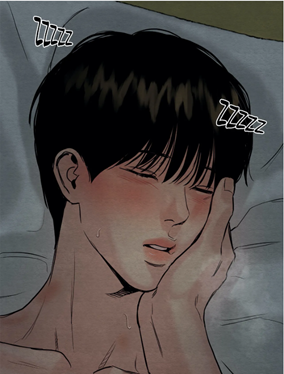
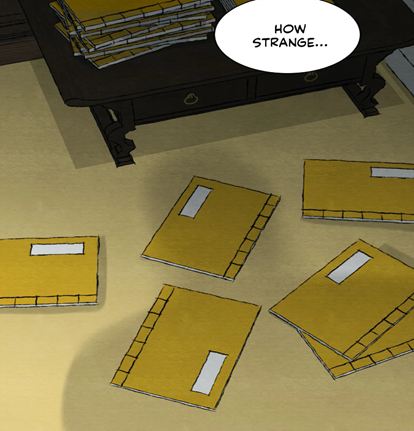 (Chapter 50) How strange that the moment he comes back to life, he has to die a second time, he can’t let his body take the lead. That’s why he remembers the painter’s sleeping face. His mind is telling to distance himself from Baek Na-Kyum, yet his heart is showing him something else: the painter.
 (Chapter 50) The man gets torn due to the conflict. Therefore I have a different interpretation of the last panel. One might say that he becomes a ghost again. It was as if he was vanishing again… disappearing in the books.
  (chapter 52) when he got a fellatio. His heart was telling him that he could only get attracted to the painter, therefore he doesn’t feel the need to have sex with his guests. Striking was his passivity as a host. He said nothing and did nothing except smoking. He was not taking the lead literally speaking contrary to episode 8. Since he was only a shadow of himself, there was no real desire. At the same time, it also explains why he remained passive to Min’s attacks. The latter was acting like the guest of honor, and as such taking the lead. There was no fire in Yoon Seungho to fight back and this illustrates why he gave in in the end.
 (Chapter 52) That was his heart pressuring him to kiss Black Heart. He wanted to protect the artist. He simply let his body take the lead. To conclude, the lord‘s resolution in the study became a reality.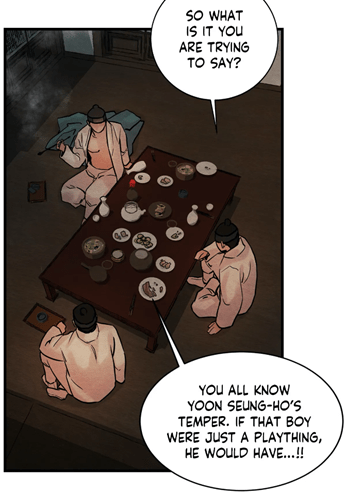
 (Chapter 51) Baek Na-Kyum from far away had the impression that this was his lover’s laugh. The lord was masking his wounded heart with these fake parties. Either he laughed so loudly in chapter 51 or ignored his guest’s remarks in chapter 52.
  (chapter 52) In the last picture, he still wondered why the painter came to his side, he must have heard about the rumors. But since Black Heart understood the lord’s actions perfectly, he kept rubbing salt into the wound so that the host finally gave in.
  (Chapter 52) Nonetheless, there was a certain rage and brutality in his gaze. Thereby he might have been defeated in that moment, yet.he had not lost the war. Why? It is because he was boiling internally. He was furious. His mind chose to give in to prove Min’s words wrong. But why? It is related to his brainwashing and past trauma. He shouldn‘t take it to heart.
  (Chapter 50) If he does, it will bring him only misery. And in the bedchamber, it looked like Kim‘s words were correct. Black Heart had bothered him so much that the only solution he had was to give in. That way, he would no longer be bothered. He would be left alone and find his „peace“. However, deep down, he was so annoyed and angry. Notice that his rage changed him. He became proactive allowing his body to take the lead.
  just like his steps were guiding him to a different room. Strangely, he was indeed following his body and not his mind. The mind made the decision to bring the painter back, the body chose not. That’s why he stopped the moment he heard the scream from the painter’s room.
 That’s how the readers discovered the contradiction. That’s also the reason why this manhwa is not easy to understand after first reading.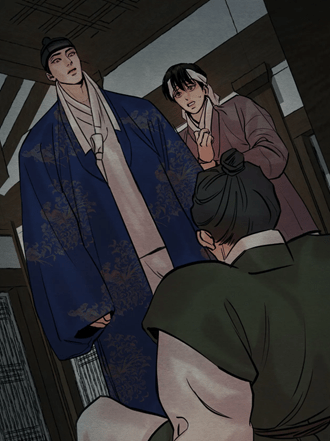


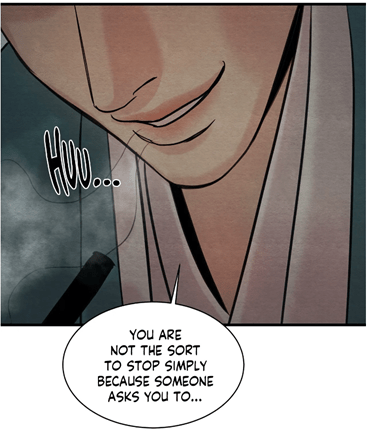
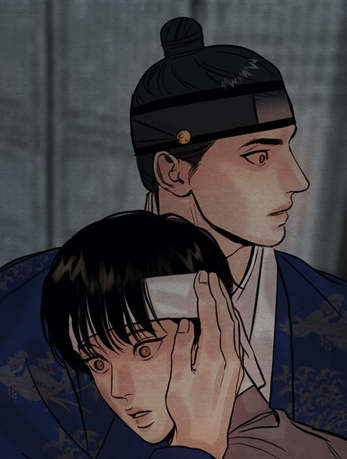
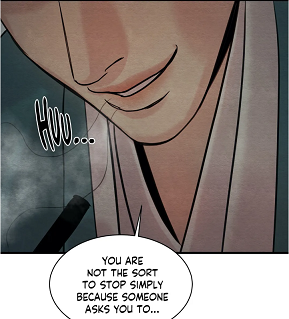 (Chapter 53) Thus in the shaman‘s house, the lord fulfilled his wish. He wouldn‘t stop because someone had asked him to.
 (Chapter 102) As you can see, Min was put in a similar situation, the only difference is that he was now the target of the protagonist’s fury. The gods decided to reveal to Black Heart how wrong his thinking was. A life of a commoner is not different than the noble’s. Yoon Seungho‘s heart got broken, the moment he saw the painter‘s bloody face.
  (Chapter 102) Therefore he transformed into a shadow with a bleeding heart.
 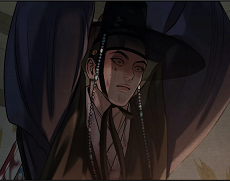 (Chapter 102) This is no coincidence that Min couldn‘t stop the main lead. How can a human influence a shadow? It is impossible. As you can see, Min‘s joke in front of his friends came to bite him in the end.
  (Chapter 101) In the shaman‘s house, he was not beaten to death, but stabbed to death. This was the usual punishment for a noble. The irony is that because the painter was unconscious, he couldn’t stop Yoon Seungho. The latter let his body take the lead and committed murder. He couldn’t act differently, as he had lost his reason to live. The main lead had once again confused the mind and the heart. This explicates why he couldn’t detect that the painter was just unconscious. And that‘s how Min became a spirit.
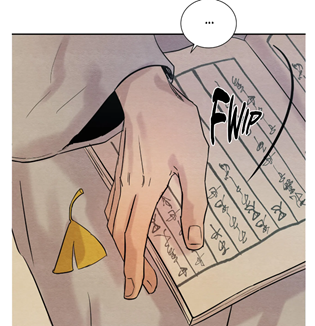
  Back then, he felt the need to share what was on his heart, mistaking that his kiss and caress were motivated by his mind. What he really wants to share is not his mind but his heart but his eyes are not able to distinguish the difference. Because of the link between the heart, the mind and the blindness, I had a sudden revelation:

 The children can indeed enjoy the beauty in simple things, while the scholar’s mind is only focus on his books and his hunger for power and admiration.
  Therefore he can’t really enjoy life as he is left unsatisfied with his situation. As you can observe, the manhwa offers a similar philosophy. Jung In-Hun is just an adult who lost his inner child a long time ago.
 In fact, his inner child died at the moment he got betrayed by his own father so that he stopped living for real. He was like a zombie, the mind was the only proof that he wasn’t truly dead. His thoughts were the remains of his existence and this explains why he detests the idea that he is a man consumed by lust. For him, the body was just a tool thereby he never paid attention to his own body. His sex sessions were just a tool to deceive people, to hurt his father and ensure that he wouldn’t get wounded again. This explicates why he is no big eater, why he was even willing to give his whole lunch to the artist.
 He only existed through the mind and his eyes. That’s why he can’t see and recognize his own heart even after meeting the painter.
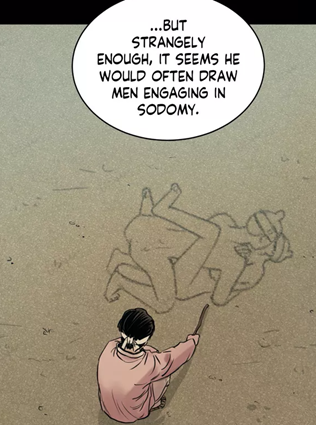 They were the expressions of his innocence and purity in the end, which the aristocrat felt. We could say that through the publications, the noble rediscovered the forgotten childhood and innocence. And this coincidences with the narrator’s life. The latter used to love painting but was forced to renounce his passion, painting. So by meeting Baek Na-Kyum, the lord is encouraged to paint again.
  (chapter 8)
  (chapter 23)
  (chapter 36)
  Remember when he even grabs the painter’s hands, he is treasuring them. There is indeed a certain candidness in his gestures and comments.
 The erotic paintings were the fire to ignite the main lead’s heart. The inner child was awaken. Therefore he is again happy like a little child, when the artist appears at his chamber in the chapter 8.
  Thanks to the painter, the lord’s heart started beating again. He was able to reconnect with emotions that were buried by his huge trauma. However, since he had to use strategies to force the painter to paint, he explained everything with his eyes and mind. Although the low-born rejected him in the chapter 49, the aristocrat overlooked an important aspect:
  and it is the same for the painter. The latter is the one who offers comfort and warmth to the lord, only him can soothe the noble’s extreme emotions.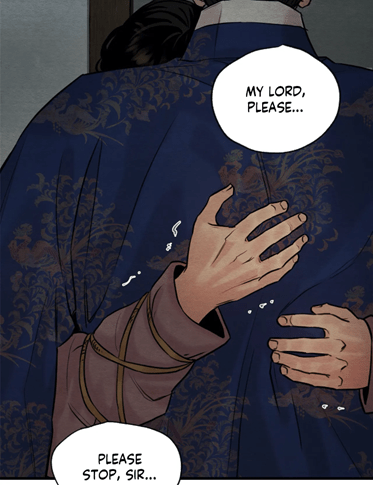

 Observe the painting is what brings them back together. This is no coincidence, since imagination and creativity are important for children. Then if I had to compare all the other adults, I would say that Jung In-Hun is a combination of the geographer and the conceited man. The former lives in his books and makes no experience, he doesn’t visit the places he reads in his books. He has no idea about real life and the conceited man lives in order to get admired. The scholar is often seen in company of books
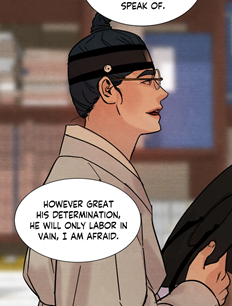 and has no idea about the real world, therefore the lord warned him before his departure to the city. As for the conceited man, since he is alone on his planet, he is left unsatisfied. And we all know how arrogant and conceited the low noble is. The two adults represent each of them a negative feature which people should avoid in their life. Knowledge is good but without experience, it is reduced to nothing.
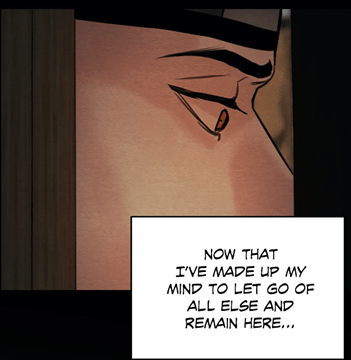
 He shouldn’t feel wounded. On the other hand, he kept asking why. As you can see, the painter’s mind is controlling his heart. I had the impression that he would be the first one to recognize his emotions, because he is the only one who talks about his heart.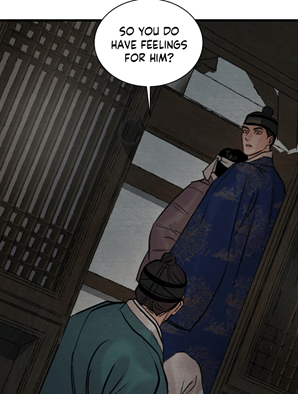
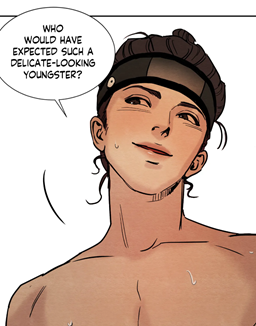 And this assumption was proven correct: The Joker is determined to taste Baek Na-Kyum. However, he is not wise like the fox in The Little Prince. In truth, he embodies the negative version, because he is not reflecting on his own behavior and emotions. He has no idea why he is so obsessed with the painter: for me, there’s no doubt that he is confusing lust with love. He definitely got upset, when he saw the couple hugging
  That’s why he felt the urge to vomit. Min is too focused on looking at Yoon Seungho and Baek Na-Kyum that he is not recognizing his true motivations behind his actions. That’s why he said this:
  In my opinion, The Joker needs the presence of others in order to feel his own existence. In other words, while the fox in the original story asked the prince to tame him, the fox in Painter Of The Night is acting the opposite. He is trying to tame the others, but he keeps failing all the time.
 (chapter 70)
 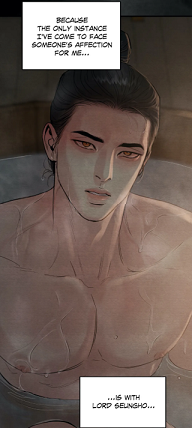 , he starts acting like a child again: he plays pranks
 (chapter 70)
  (chapter 74) or he is teasing his lover.
 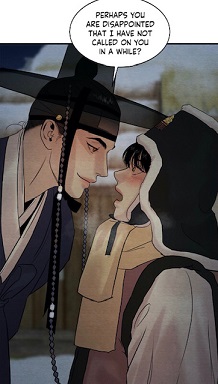 , These are signs of the return of his innocence. The readers can feel the inner child in Yoon Seungho.
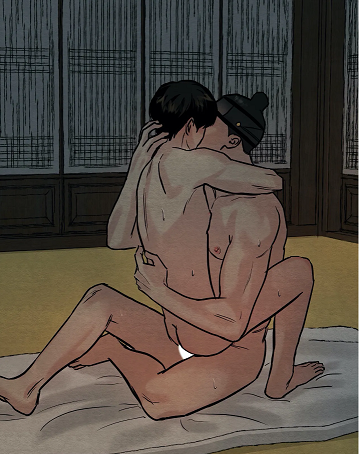


 we have to envisage other possibilities. The protagonist has to be seen elsewhere. In order to divert attention, he needs to create a huge scandal. Therefore if a sword is used, then Nameless could be involved and they will frame the guest who is high with the excuse that he acted under delirium.
  . So from strangulation, I came to suffocation, the impossibility to breathe. I couldn’t restrain myself from associating asphyxiation to the first picture of the chapter 52, when the evil aristocrat is smoking with his mouth wide open and his head is looking up.
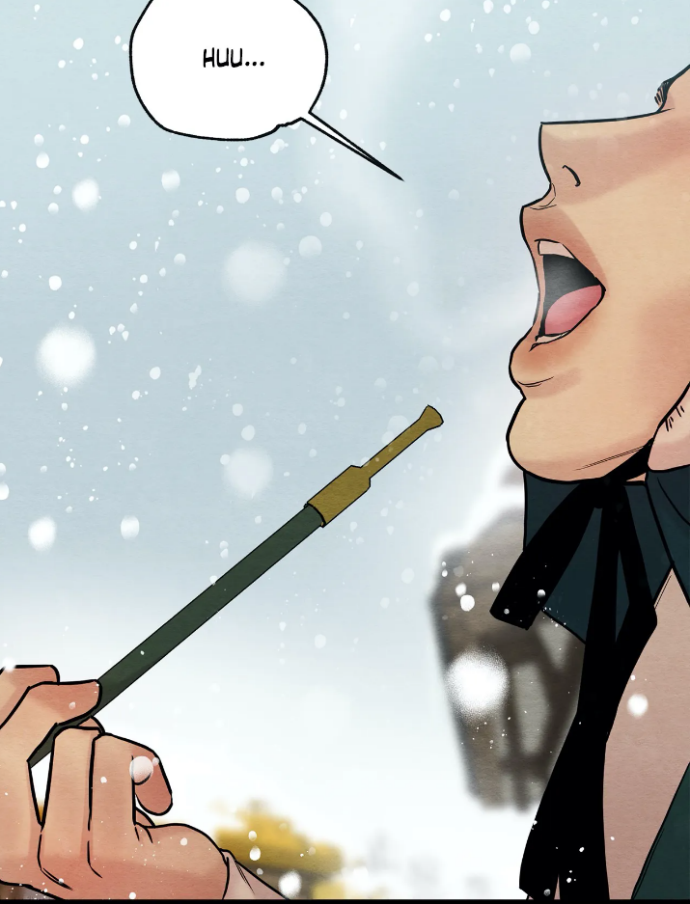
 His reaction was terrible: he was so enraged that he started beating all his servants since they hadn’t noticed the commoner’s escape. The staff should have kept an eye on him. And note how many parallels exist between the chapter 29/30 and 52:
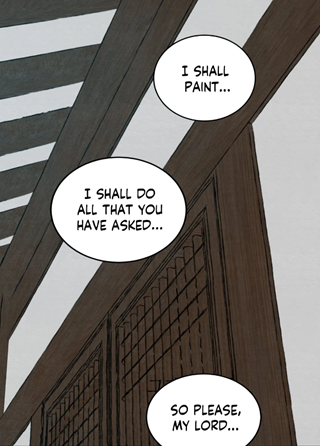 before getting dragged to the lord’s room for a sex marathon, I have the impression, the manhwalovers could witness a new version of the sex marathon, especially if my theory is correct that the author might have developed her chapter 53 as a reflection of the chapter 30. However, there will be a huge variation: the chronology. We have a change of clothes, then the visit to the lord’s chamber. Finally the low-born discovers his ransacked room, while the lord is angry due to Min’s words and behavior. This divergence will lead to a different outcome.
 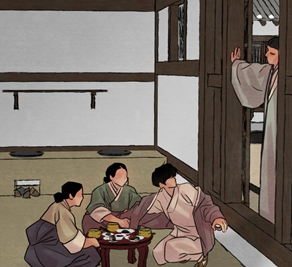 He only intervened, when he saw that the maids were still looking down on the commoner. Back then, the aristocrat had to warn them. I envision that the lord will intervene the moment Deok-Jae starts getting violent. Because of that, Yoon Seungho could decide to drag the servant and punish him for his behavior. We would still have a dragging, like in the chapter 30 but this time, the person is different and the lord has a reason. Deok-Jae committed a crime. Yoon Seungho could grab the domestic by the topknot and punish him, like he did with Jihwa.
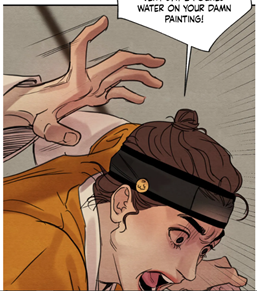 Yet, I have the impression that Baek Na-Kyum could act differently and no longer remains passive, like in the chapter 18. This time, he pleads for leniency.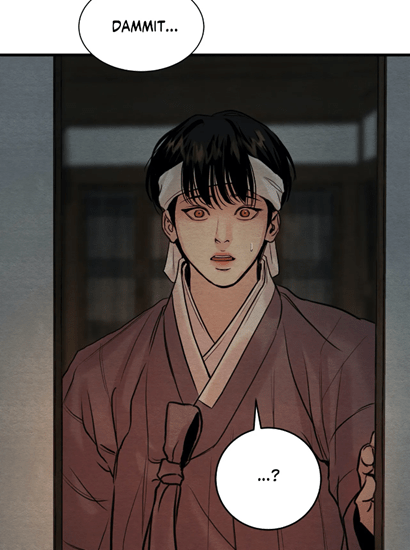
 He never replied and criticized him for his attitude. From my point of view, the low-born has really changed, has already rediscovered his identity and found a certain confidence. He is now part of the mansion hence he needs to be proactive. He hasn’t forgotten the valet’s words: he is not a spoiled princess and as such, he can’t expect rescue from anyone. He needs to fight for his own place. My prediction is that he will question Deok-Jae about the reason for his action. As we experienced in the chapter 52 how the commoner would even question the lord’s actions and behavior.
 This could be the new version of the painter’s plea.
 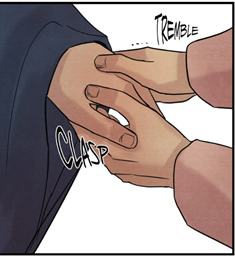 and will confront his husband and ask him for the reason behind his change of behavior and what is his position at the mansion. The former could even interrogate his “husband” if he has to leave the mansion, since he has no interest in the painting. While we had the artist submitting himself to the lord in the chapter 30, I envision a renewal of this alliance, yet under a different form. The painter could confess to the noble for real. Another possibility is that since Yoon Seungho is questioned, the aristocrat decides to be more open about his feelings and we have a mini-confession from the lord. He could use Wang Bang Yeon’s poem… if this theory is correct. Back then, the aristocrat wanted the painter to draw new images of their intercourse and he requested from him to pay attention to his own facial expressions, since they were lacking. Remember that was the reason why the protagonist sent the mirror to the painter’s room. From my point of view, the new work reflects the painter’s emancipation.
  His face is drawn properly, you can identify him on the drawing. Furthermore the visage is not expressing pain or fear but pleasure, which is quite strange because if you look carefully at the new picture, Baek Na-Kyum chose the position where he expressed fear and pain.
 That’s what the readers got to witness. However, I believe that the painter wasn’t feeling real pain in fact. He was more scared of his own reactions, feeling pleasure. We shouldn’t underestimate the power of the brainwashing and the criticisms expressed by Jung In-Hun. I interpret that the painter must have felt pleasure but refused to admit it. He chose to act like a whore following the teacher’s words so that he could still deny that he was a homosexual per se. As a prostitute, he had been forced to sex, hence he shouldn’t feel any ecstasy. It was an excuse, a subterfuge for his own conscious. Deep down, a part of him wanted to keep following the scholar’s words. Due to the lord’s action, the painter had a breakthrough and finally dropped the teacher’s doctrine for good. And in my opinion, the painting is reflecting this.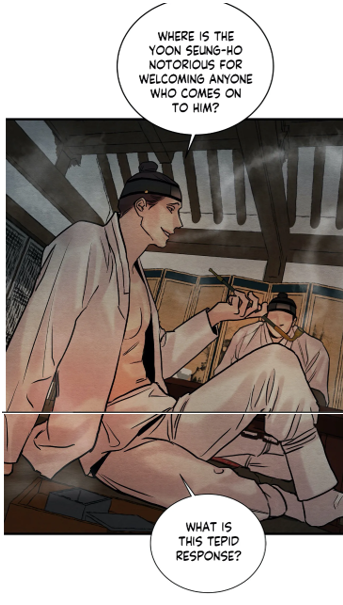
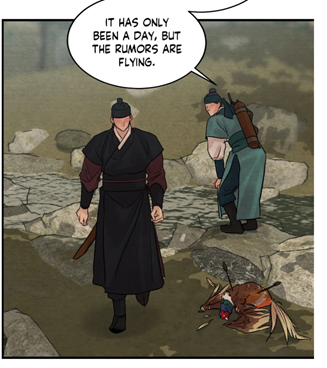 He had to use many arrows in order to really hurt the pheasant. However the protagonist was the one ending the suffering of the wild bird, by killing him with his own hands. That’s why I conclude that Min’s mouth is full of poison, just like the opium, and his words are like arrowheads. Consequently he keeps stabbing from a certain distance, thinking himself safe.
  Because of the connection with the chapter 41, I have the feeling that Min considers the main lead as an easy target, for he views him as a pheasant. In an earlier analysis, I had imagined, the pheasant was Jihwa. And this interpretation was confirmed with the chapter 43
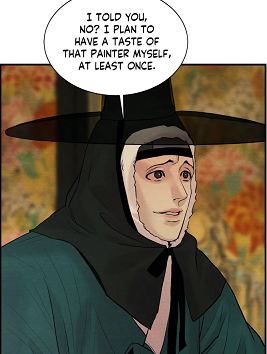 In both episodes, he used his words to poison the second lead’s heart and mind, so that the latter would suffer so much. Remember after each suggestion, the noble felt so tormented: chapter 51
  and chapter 76
  . He is so plagued by his existential fear and remorse that he feels like dying. But as you can imagine, due to my previous analyses and the evolution of the story, I would like to add another signification. From my perspective, we should consider Baek Na-Kyum as the pheasant too, for both ukes are mirroring each other. By living next to Yoon Seungho, the painter was slowly metamorphosing. Therefore I come to the conclusion that Baek Na-Kyum was indeed the deer in the first hunt. The scholar’s words were represented by the arrowheads and the lord’s sword symbolized his phallus.
  In other words, the first hunt announced the rape and the painter’s loss of innocence in episode 25 and the lord’s abandonment in chapter 40.
 As you can observe, the chronology of the hunt was not respected. But this interpretation allows us to be able to predict the future season and Black Heart’s personality. Since the two main leads are going through a metamorphosis, it signifies that this phenomenon will occur to Jihwa and Min as well. Since Min believes that the main lead is an easy prey, this signifies that he considers the host as a pheasant too. Moreover, I think that the vicious noble has the impression that he is similar to Yoon Seungho, that’s why he can understand him so well. Therefore he views himself as a pheasant, but in this battle for the painter, he attacks his rival with his beak, similar to the arrow points, unaware of the main lead’s true nature. The latter is a phoenix, based on different essays. This mystical bird embodies fire and passion – the flames of true inspiration. Moreover, it brings good luck, harmony, peace, balance, and prosperity. This signifies that by defying the phoenix, Min’s fate is doomed. His fight against him will bring only misfortune and destruction. Hence Heena’s words
 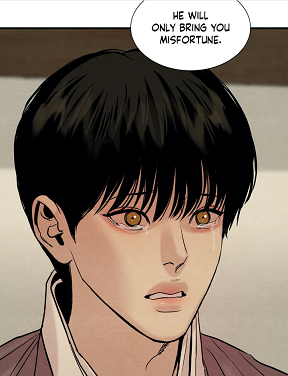 (chapter 68) seem to be true: Yoon Seungho will ruin misery to his adversaries. But in chapter 52, the noble had not gone through his spiritual death. That’s why the Joker had the upper hand in episode 52 and could hurt the main lead’s heart. As you can observe, I felt this chapter was announcing Min’s chronicle of a death foretold. And this perception was confirmed with chapter 76. His addiction to opium is already destroying The Joker, therefore he vomits and he loses his temper in front of Nameless.
  (chapter 56), he wasn’t able to copy him entirely. This was a poor imitation. In other words, the Joker is short-sighted. He was able to defeat the protagonist in chapter 52, yet the one who definitely put the final blow to Yoon Seungho was not Black Heart, but the painter. His words in chapter 54 definitely wounded Yoon Seungho’s heart:
 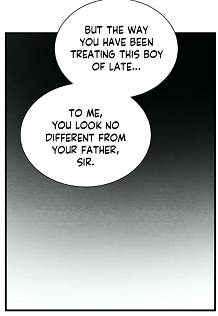 with his words in order to undermine his judgement and as such destroy him.
 . And the criminal behaved exactly like in chapter 54. He killed Deok-Jae and no one dared to suspect him.
 (chapter 54) That’s why I am expecting a new version of this scene in the third season, and in my opinion The Joker will be the victim… let’s not forget that in Yoon Seungho’s words (chapter 11), the scholar’s life was threatened. This means, a noble will be targeted in the future. As a conclusion, I am predicting Black Heart’s slow destruction and final death. But he doesn’t turn into a beautiful bird like Yoon Seungho (phoenix) or Baek Na-Kyum (from a deer, he metamorphosed into a pheasant before becoming a crane!). Min has already transformed into a crow, consequently he wears a black hanbok in the final chapter 76!
 This is important, as it contrasts to Min’s gesture. The lord decided to look up, because he was wounded. He acted, as if he chose to ignore Min’s attacks. This stare at the ceiling was not connected to fun, rather to faked indifference and pain. His heart was wounded and he was trying to hide his vulnerability. At the same time, I also believe that he was also pondering, wondering why the artist came to visit him, although he had never asked for him. From my point of view, Black Heart’s poisonous words created a certain insecurity in him. Let’s not forget that in that scene, Min was describing the artist as a man consumed by lust. Besides, his butler had revealed to him that Baek Na-Kyum had become so easy, as he was now viewing himself as a prostitute. In other words, Yoon Seungho felt insecure and doubted the artist’s innocence. The position of his head symbolized the opposite, deep thinking, while it represented Black Heart’s carelessness and confidence, contrasting to Yoon Seungho’s doubts and mistrust. Min was not noticing his surrounding, as he was too focused on his own pleasure, while Yoon Seungho was looking up on purpose. The host was actually attempting to avoid Min’s arrows hurting him. Min was criticizing the main lead, insinuating that he was a killjoy. If he hadn’t sent away the boy, they could have fun.
 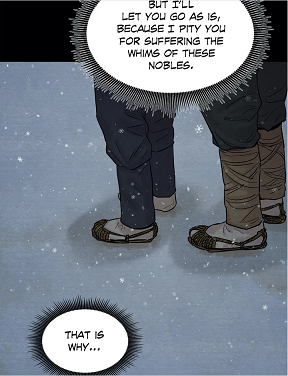 (chapter 66). the nobles would always fight against each other. This explicates why Black Heart had the upper hand in chapter 52 and why the main lead remained passive and silent for a while. He was applying what he had been taught: hide any weakness…. yet in this scene, the lord was definitely in pain. Then the author zoomed on the lord’s mouth, like she often does.
  In other words, the protagonist had the impression that he got the upper hand in the end. Black Heart had revealed his own “desire” and as such “exposure”. By giving in, Yoon Seungho was deceiving himself. His mind was telling him that he had found the perfect tool to control Min, while in reality he was playing into Black Heart’s hands. And now, you can understand why Yoon Seungho was infuriated, although he was smiling.
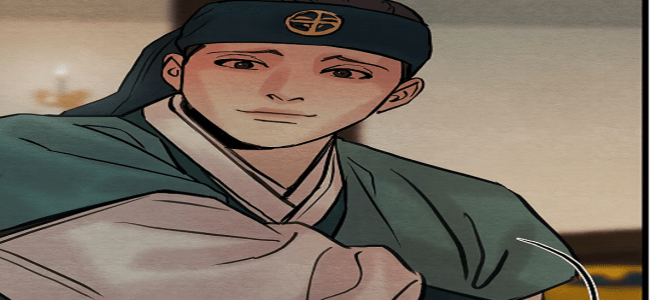
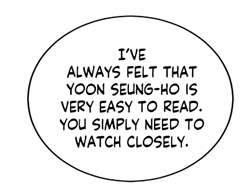
 (Chapter 52) In my opinion, he must be mocking the other noble. He feels that his fellow is just too stupid and naive. Yet Min is actually overlooking an important aspect. There is an explanation why the other aristocrats are calling the protagonist a lunatic. Yoon Seungho is indeed revolutionary as he rejects social hierarchy and as such criticizes nobility with its privileges. During the 18th Century, libertines were fighting for liberty and equity and this is not surprising that the French revolution began 1789. Remember what I told about libertines, sex was just one aspect in their life, they advocate reforms and changes in the tripartite society, in the rigid social hierarchy. That’s what Black Heart is overlooking, whereas the nobles sensed this aspect but were not able to define it.
  His retreat was not a defeat, he was just ignoring their opinion. Yoon Seungho just saw them as nobodies hence he had no reason to fight back for his reputation, since he never valued his notoriety. What Min perceived as a first victory was nothing in Yoon Seungho’s eyes.
 (Chapter 33) Here, he was challenging the lord for the first time. Furthermore like I had already underlined before, the lord created this image of hell-raiser as a shield. Thanks to his bad notoriety, he could deceive people and protect himself. Ecstasy was never his goal unlike Min, since Yoon Seungho desired to divert people’s attention. And based on my theory he never took pleasure in sodomy, he rather forced himself to live up to his bad reputation.
 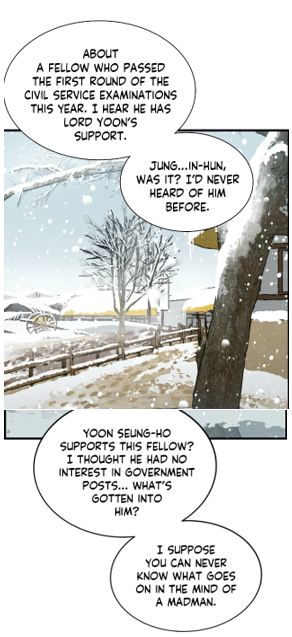 (Chapter 52) No noble imagined that the main lead had an interest in government posts. Admittedly, only the readers know the reason why he is sponsoring Jung In-Hun. It happened because of the painter. However, I detect another manipulation here because of the following picture:
  (chapter 52) But this doesn’t stop here. He even confesses Jihwa’s involvement.
 (Chapter 52) How can I not judge him stupid? I guess, opium has already confused his mind and reduced his vigilance. He is indeed careless and thoughtless. Besides, in the picture above, I noticed another important detail. He started insulting Jihwa as sodomite. This word “sodomite” reflects his opinion about sodomy as such. He is no homosexual per se, he just uses sodomy to submit the other masters. He is indeed similar to Yoon Seungho in that aspect. Both perceive sex as war, however the powerful noble did it out of resent towards nobility, whereas the other wanted to establish himself as the new ruler among the local aristocracy. Black Heart desired to prove his superiority over the other lords. the main lead had a different goal, it was to tarnish and ruin the image of the nobility. One might argue that the outcome is the same… which is correct, yet due to this, Min jumped to the false conclusion. Min assumed that Yoon Seungho had the same intention.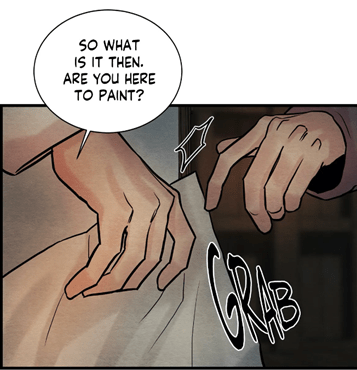


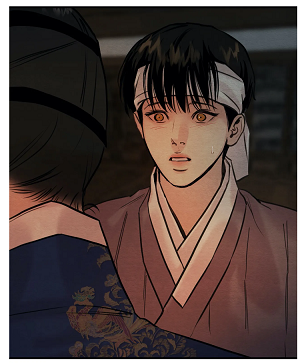 (Chapter 52) The painter gets upset with the kiss but instead of letting his emotions take control of his thoughts, he ponders about the cause of these negative feelings. Why is he upset?
  Observe the lord’s hand is still grabbing the chin and his mouth is literally devouring Black Heart’s mouth. It was as if he was covering up Min’s mouth. He made sure that he would stop talking. Note Min’s expression. He never expected such a gesture, he thought that the lord wouldn’t retaliate like that, he would retreat. On the other hand, the main lead is not happy, he is actually furious.
 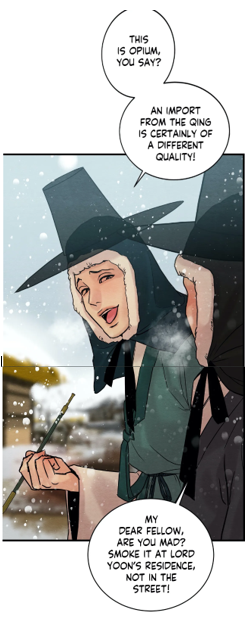 (Chapter 52)
  (chapter 43) but this signification is reinforced with this chapter. To summarize, Min treats everyone as pawns, including nobles. This outlines his arrogance. He considers himself as a puppet master, a great mastermind hence he is superior to everyone, including Yoon Seungho.

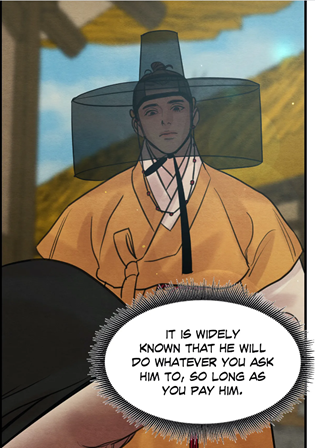 (Chapter 43) Therefore I believe Min defends the values perpetuated among the aristocracy: titles give lords the right to consider themselves superior to commoners and to treat the latter as bugs. Min is the representative of this mentality, for him low-born have no value and no right. They can be killed or be mistreated, this is the normality for him. And this mentality is faulty as Min is neglecting an important factor: commoners. They represent the majority and play a greater role in the masters’ life. The result is that he made a huge mistake because of this source of info. He just relied on his fellows, however I have always said that Yoon Seungho used rumors and has always acted in front of other nobles. In other words, Min has a false image about the main lead and there is no doubt about it.
 (chapter 8) Furthermore, after having sex one time, he remained by the painter’s side observing his expressions and reactions. He understood what the painter meant to the protagonist.
 (Chapter 9) However, his judgement is only partially correct as his perception is also influenced by the reports he received through his connections, like I wrote above. After the two challenges, Min could no longer approach the main lead hence he had to rely on other sources.
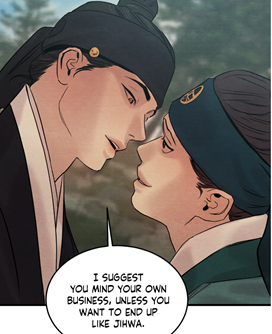 (Chapter 41) Min never took it seriously. He only saw it as an empty menace. The problem is that Min’s perception is mostly influenced by the rumors existing about Yoon Seungho. I doubt, he is aware that the main lead has shadow guards. I even suspect that he never heard Yoon Seungho’s thread made in front of the painter.
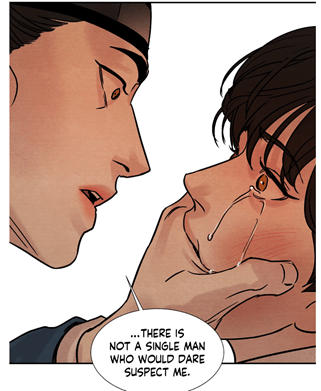

 The scholar has become a high official in the drawing. He sits above all the people surrounding him, as if he was different and superior. His inauguration reminds me of a religious ceremony. Let’s not forget that this event is indeed linked to religion, as the new official has to thank the king and the gods in order to get good fortune. In other words, this picture is indeed linked to religion. The usual form of idolatry in the Bible is the worship of images or statues that are thought to embody the various pagan deities, like for example the golden calf. [For more explanations about the golden calf
  This scene is really important, as the strong seme demonstrates his power over the low noble. He shows him his powerlessness, he confronts him with the reality. He is not a god. He has no real authority, hence he can’t change the world like he would like. In this scene, the scholar has to recognize that Yoon Seungho stands above him. Moreover, the former makes him realize that the protagonist was never a new member of his cult. He never fell for his deceptions, he perceived his true abilities (the plagiarism and his poor poetry). That’s why Jung In-Hun got upset. For the first time, he met someone who was superior to him in all aspects (financially, physically and mentally) and couldn’t be manipulated, as he had wished. As a conclusion, the creation of the new cult was born out of the scholar’s arrogance and blindness. He thought, he was like a god due to the painter’s admiration. By the way, this explains why the intellectual asked the powerful main lead to follow him to the capital, he imagined that if Yoon Seungho accompanied him to Hanyang, then he would receive people’s attention due to the presence of the “famous” noble next to him. He wanted to use the main character’s reputation and attraction. He desired to create a situation where he could get the impression that he was also admired. Despite the scene at the hunt, the low noble hasn’t given up on his “dream”. He still wants to be regarded as a new god, receiving respect and admiration.
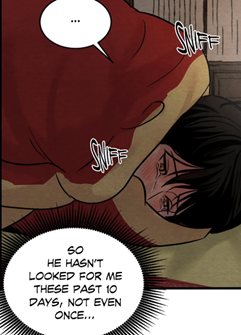 As a conclusion, the painter was more a fanatic than a man in love. It was the painter’s mind which was focused on the scholar and not the heart. From my perspective, the low noble had achieved to transform the painter’s love for him into an idolization or better said to fanaticism. That’s why in the artist’s first confession, the low-born voices yearning, aching and not just respect and admiration. The “I pine for you” reveals a certain pain. It can’t be simply explained by the coercive persuasion, since the latter had repressed it. The low-born had sensed that a distance had been created. Since Jung In-Hun was like a god, the painter could only watch him from far away, since he was just a commoner. There is another reason why I associate the first confession to fanaticism, it is the significance of the mind compared to the heart.
  hence the low-born could only recall the low aristocrat’s voice and mouth. Baek Na-Kyum was indeed indoctrinated, influenced by the learned sir’s speeches, therefore he used the same words. He also looked down on others (sodomite here). This explains why he became a victim at the end, since he was confronted with internal and external fights. Yoon Seungho wanted to get erotic paintings and later to have him as his true partner. In order to keep following the 7 rules, the low-born always used his brainwashed mind, cold reasoning, like f. ex. “I am painting it for the teacher’s sake” or “Seungho is just a man consumed by lust” and struggled against his sexual desires, his own heart. The painter’s mind was full of rules and “despise” hence he couldn’t judge Yoon Seungho differently. By connecting the doctrine or the new religion to rules and disdain, the scholar wanted to kill the painter’s empathy and as such his heart. Consequently Baek Na-Kyum always repressed his sexual desires as they are connected to the heart.
 He, as a low-born, was asking his “idol” to take his responsibility. The low noble should take care of him, especially after the latter had supported him. Yet the scholar refused for many reasons. First, a god is not supposed to take care of their believers personally. The latter can just pray but never request it from their “god” directly and make them responsible. Then Jung In-Hun was under pressure, for he wasn’t sure if he would be able to succeed. Besides, he was jealous and resentful as the painter was treated better than him, a noble. Moreover, the artist had disobeyed him as he had lied to him. But like I mentioned it above, he had detected that his influence over the painter had seriously decreased. He was distancing from him, he no longer worshiped him like in the past. His questioning and his lies pushed the noble to hurt the low-born in order to remind him of his social status. As a person raised at the brothel, he was filthy, in particular as he had violated the 7 rules. The artist had succumbed to sodomy, the greatest sin in the scholar’s eyes. He needed to punish him. He was a nobody, whereas he stood far above him. His words and gaze were vicious and cruel for that reason: he is a god and Baek Na-Kyum committed blasphemy. He needed to destroy the man.
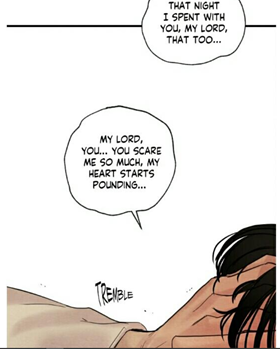 His sentences are broken, he voices fear because it feels so different from before, where he only used his eyes and brainwashed mind for the learned sir. Observe that in this picture he is covering his eyes, he fears the noble’s gaze. Let’s not forget that Jung In-Hun’s gaze was the weapon that killed the painter’s identity.
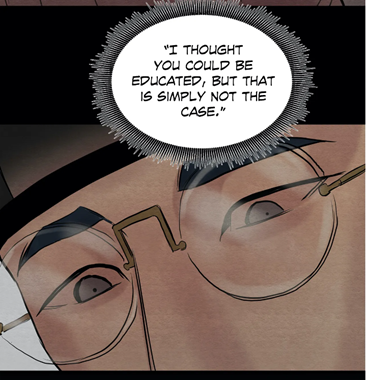 In the scholar’s gaze, he saw his own reflection: he was filthy, he was just a whore. Hence he is afraid of Yoon Seungho’s gaze. How does he perceive me, that’s why he is thinking. During that night, he becomes blind and deaf due to the injury caused by the teacher’s reproaches and abandonment. This is no surprise that his ears and eyes were destroyed. Like I had pointed out before, these organs are essential for indoctrination and for idolization [Remember the comparison to the Nazi event]. So during that night, the sex didn’t succeed to comfort the painter, because the latter was not looking for sex but for comfort and love. We shouldn’t forget that he asked for embrace. He wished to be hold. The problem was that the painter was confused, he didn’t know what he wanted. Besides, the noble had no idea how to show love.
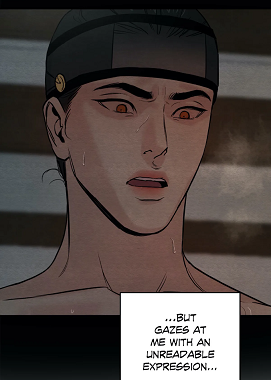 That’s why we should perceive a positive development in the painter. He is no longer fearing the gaze of others. He is thinking on his own, hence he can no longer become a victim due to fanaticism again. I perceive that Baek Na-Kyum has reached a turning point in his life. He could definitely confront Yoon Seungho, like he did in the past. Remember when he yelled at him this:


 Even Kim had such bandages. So the bandages can’t served as evidence for this theory.
  which is much smaller than a wall? He could identify the persons painted in the drawing. So his sight was good enough back then. I distrust that within a week, the servant’s eyes could become so bad without any cause. The first beating occurred months ago, at the end of the summer. Now, we have winter. If so, his sight would have deteriorated more progressively.
 Even the valet Kim didn’t get spared, his battered eye was on the left side. However, the latter is not suffering from a loss of sight.
  Then he pushed him hard with his shoulder.
 His intentions were to insult and hurt the painter. If he had such a poor sight, then he could have used this as an excuse in order to hide his true objectives. He never did it.
 Thrashed is a synonym for flogged. In other words, the domestic wished that the painter had been flogged hence he is definitely referring to the straw mat beating. Back then, the painter escaped the punishment because the lord intervened personally.
 That’s why Deok Jae says that Baek Na-Kyum should have received the punishment. Imagine, the artist never really suffered from the straw mat beating,
 yet it took a few days for him to recover.
 In the chapter 12, Baek Na-Kyum leaves his room for the first time before meeting Yoon Seungho indicating that he was indeed wounded, although he didn’t get really flogged. Jihwa even expected Baek Na-Kyum to be more injured after hearing the news that he had received the straw mat beating.
  This outlines the severity of that kind of punishment. This sentence can definitely cause disability or even death. Loss of sight is a disability.
  Deok Jae hates him so much for two reasons. While the artist was spared by Yoon Seungho, Deok Jae never received the same care. The lord never went personally there to stop the punishment. The opposite happened, my assumption is that the master was present, when he ordered the flogging. This would explain why Deok Jae expressed it that way: “If that bastard Yoon Seungho hadn’t beat me”. Since he was present during the punishment, it was as if he had beat him personally. This would stand in opposition to the painter’s fate. The latter was saved by Yoon Seungho personally.
  (Chapter 51)
  (Chapter 51) And now, if we look back at his first appearance, he was indeed recommended by hearsay. Min was the first one mentioning him to Jihwa. So in the following panel, the speech bubble represents Min’s voice. He is the one describing Nameless to Jihwa.

 (chapter 51) The minions must be the musicians and the dancer. As you can observe, the man is not just some criminal driven by greed and brutality, he has abilities for he was able to impose himself as the leader of this band. I detect that he is methodical and quite decisive. Remember that he gave instructions to Jihwa in the chapter 50.
  (chapter 50) Strictly speaking, he is a strategist which is visible when he tells Jihwa that he has other channels.
 (Chapter 51) If you regard her clothes, you’ll note that her appearance resembles the one belonging to maids.
 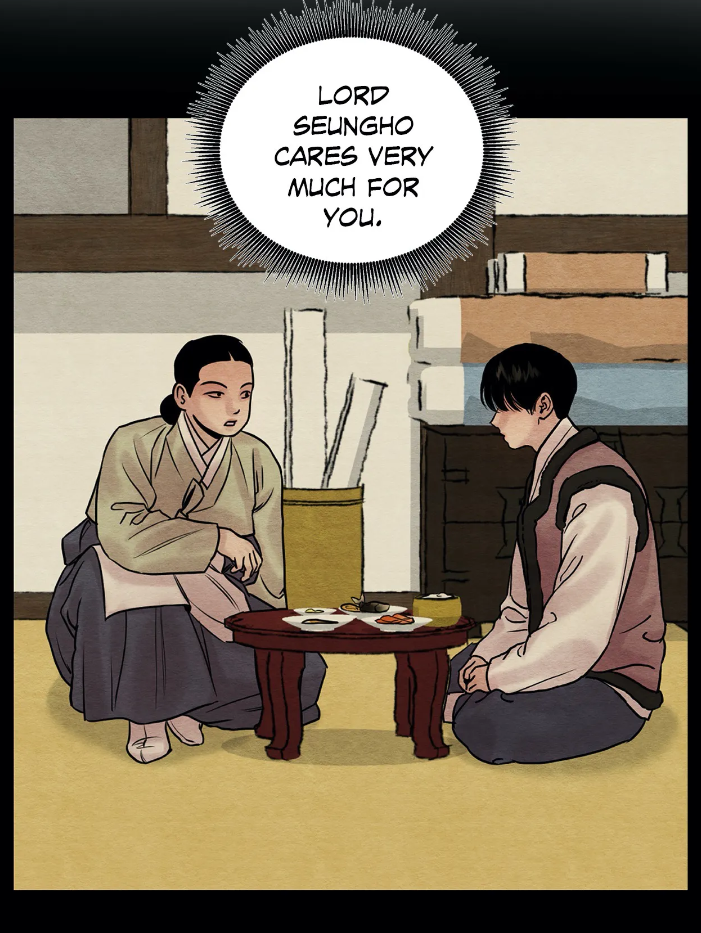 (Chapter 47) The colors of the jacket and skirt are quite similar. However, there is a huge difference between the two maids. Although the servant in the picture above is the head-maid at the kitchen, she doesn’t own any expensive hair pin or ring, while it is different with the woman sleeping with Nameless. She possesses two jade rings and a golden hair pin. This is not something a maid would own. We have 2 possibilities. Either the woman disguised herself as maid by wearing such clothes and hid her real identity or she is a maid close to a lord and the latter gave her jewels for her sexual services. The third possibility is that she works as a gisaeng which would explain the contrast between the jewels and the clothes. She belongs to the lowest social class, yet she has to distinguish herself through her hair dress and jewels. This idea was proposed by one of my readers Anyway, in my opinion, Nameless approached her for a reason. He is digging for information. We have two possibilities: either he is spying on nobles (the clients of the gisaeng house) or he wants to know more about the painter. Let’s not forget that the latter was raised in a brothel. While Jihwa believes that Nameless is doing it for money, I think that he is using his body for information. Why do I come to this conclusion? It is quite simple. Since I sensed so many parallels between Yoon Seungho and Nameless, I am using the protagonist as role model. Because the noble used his body in order to defeat nobles and to hide his own self from others, I believe that the commoner is acting the same way. Both have a negative reputation through gossips and hearsay.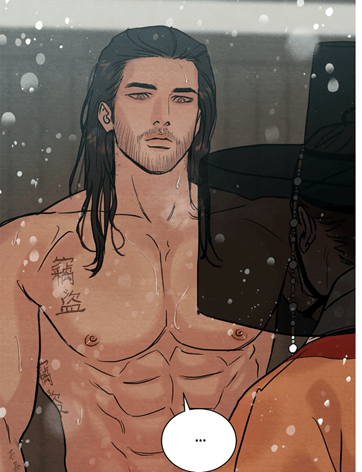
 (Chapter 51)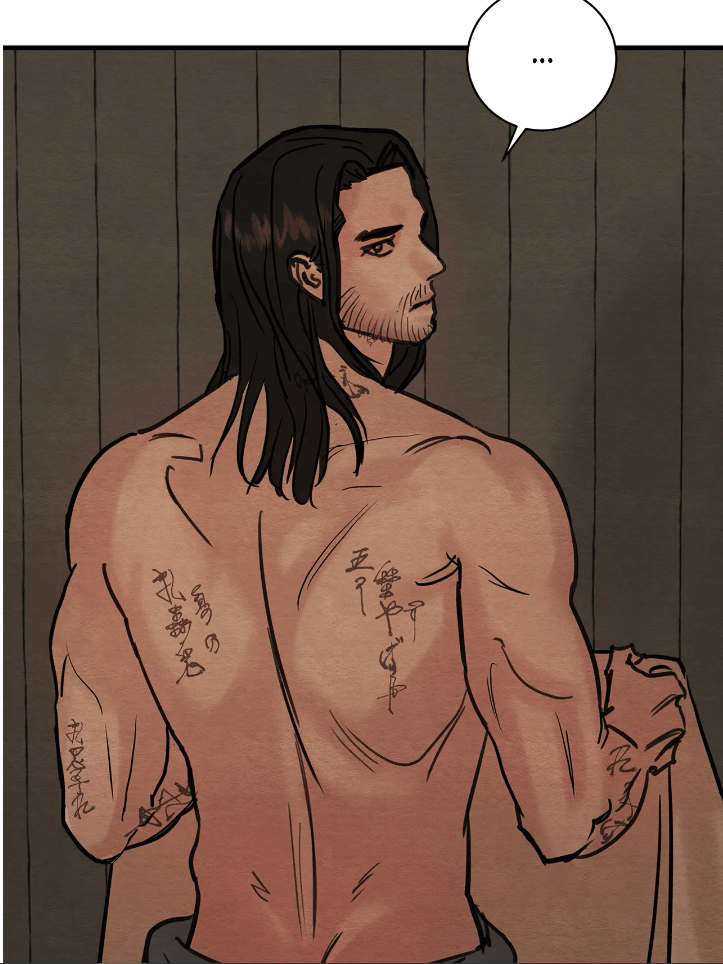
 (chapter 50) that’s why he ordered him to stay home in the chapter 50 and here asks if he has been drinking. He can perceive people’s personality very well. I would even add that Nameless’ heart must have been touched, when he noticed Jihwa’s bad habit: biting his finger nails. He must have sensed that this noble had still an innocent soul. Striking is that although the red-haired noble is just a wreck and even insults the “criminal”,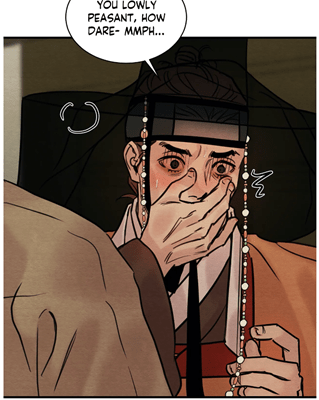
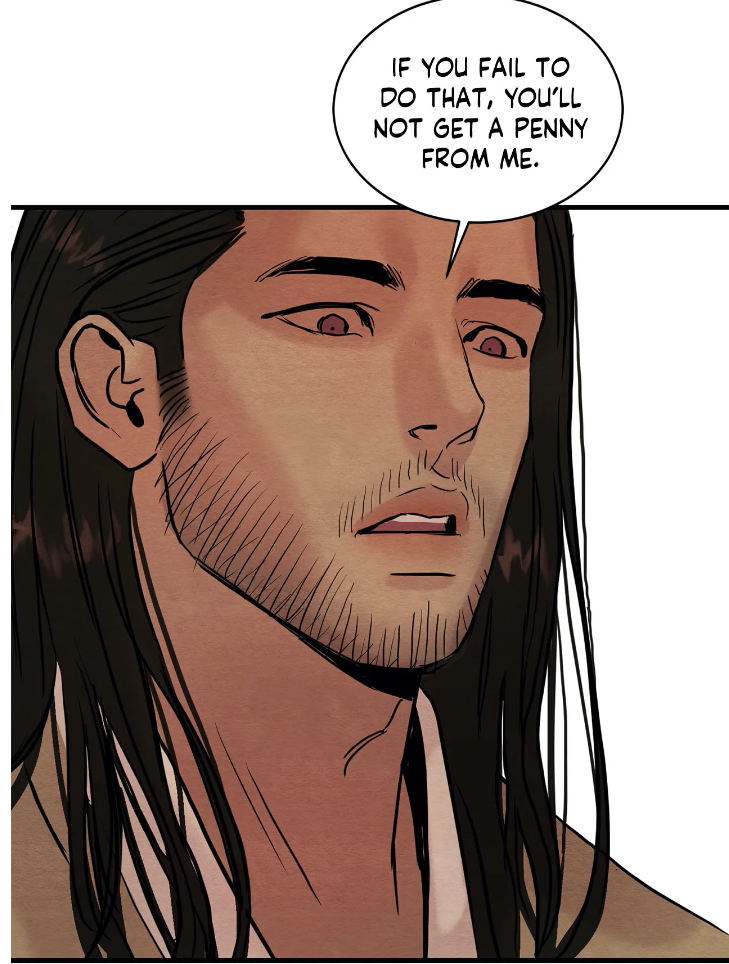 (Chapter 51) Even the evil domestic got scared, when he experienced this gaze.
 (Chapter 51) That’s the reason why this zoom on his chin covered with tears was preceded with the drawing of Nameless’ face.
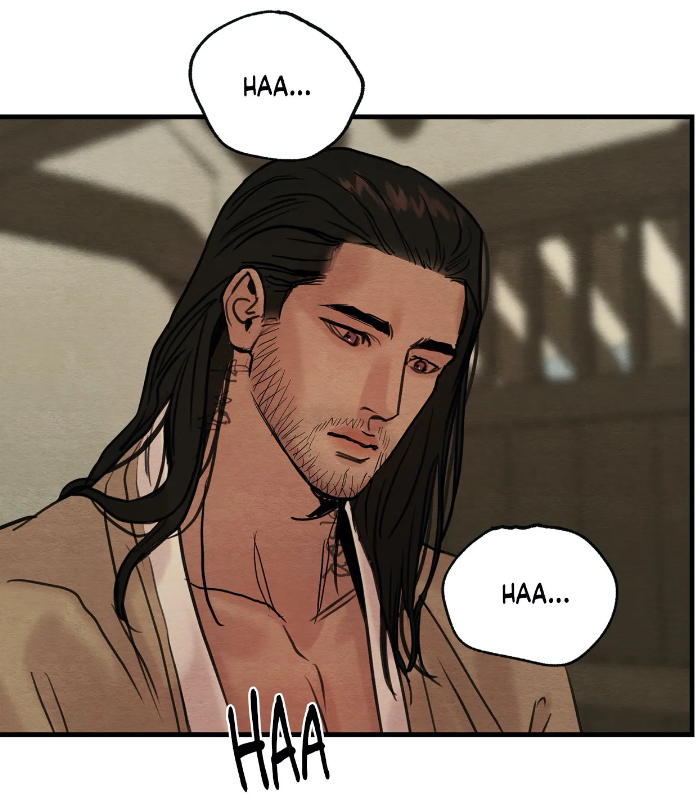 The latter looked at Jihwa’s mouth and tears, while the commoner allowed the noble to voice his worries and anxiety. His eyes don’t express any disdain or arrogance in the last painting. Here, we could say that Nameless is not cold-hearted, quite the opposite, he is sensitive. Sure, he doesn’t allow the red-haired aristocrat to mistreat him, yet he shows a certain curiosity and concern towards his client. In fact, this reflects the purity of his heart. He senses the noble’s sinlessness which stands so much in opposition to the criminal’s reputation. In this scene, the manhwaphiles can detect another similarity with Yoon Seungho again. The gaze and action reveal more than any word. And here is the next question: why would No-Name be quite nice to Jihwa?

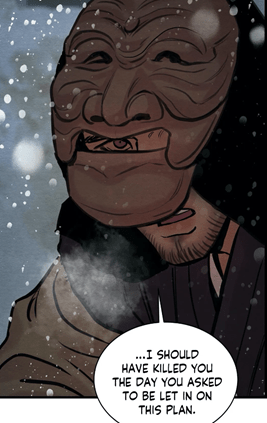
 (Chapter 54) reminded me of Jung In-Hun’s behavior in the first season. He used commoners in order to dig up some secret so that he could blackmail Yoon Seungho.
 (Chapter 29) Therefore I have the impression that the commoner is behaving like him, yet this time it is in order to unveil the identity of the mastermind. That way, he could protect Jihwa and at the same time, he would be able to get rid of a heinous person. On the other hand, since Min has become aware that his plot failed because the assassination didn’t take place, Black Heart can only condemn the red-haired aristocrat and Nameless. It is definitely possible that Min chooses to hurt Jihwa as retaliation which can only push the criminal to become very hostile to Min. From my point of view, Nameless will become a great helping hand for Yoon Seungho in the future. With his Black mind, he can even predict what villains will do. The protagonist’s mind is too pure to recognize the viciousness in the scholar. He might have perceived his hypocrisy and stupidity, nonetheless he still doesn’t know what Jung In-Hun afflicted to the painter. From my point of view, this explains why Yoon Seungho couldn’t defeat the scholar so quickly. He was too naive in this aspect. However, the main character needs to have someone with a black mind so that they can anticipate the scholar and father Yoon’s moves.
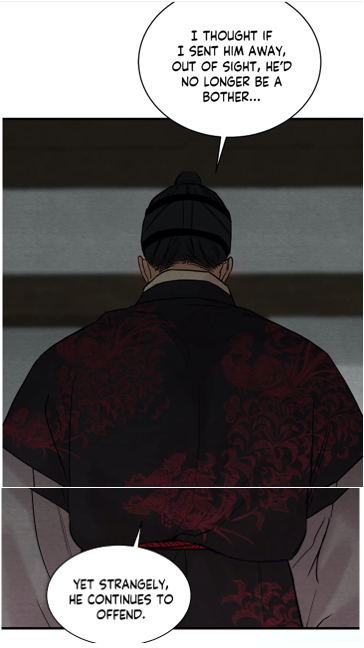 What caught my attention is the following expression: “sent him away”. Here, he imagined that putting some distance between the painter and the teacher would help him. His relationship with Baek Na-Kyum would improve, as you know the saying “out of sight, out of mind”. Nonetheless it didn’t happen like he had anticipated. Because Jung In-Hun had hurt the painter so deeply, the latter couldn’t forget his learned sir due to the agony. In other words, although the lord was physically closer to the low-born, the latter couldn’t perceive him at all, for his mind and heart were elsewhere. They were too focused on his own heartache and negative image. As you can observe, distance and closeness were in the center of the noble’s thoughts. He realized that the saying “out of sight, out of mind” is not true.
 The latter felt comfortable and trusting enough to relax and fall asleep confirming what he had sensed before, when Baek Na-Kyum kissed and hugged him.

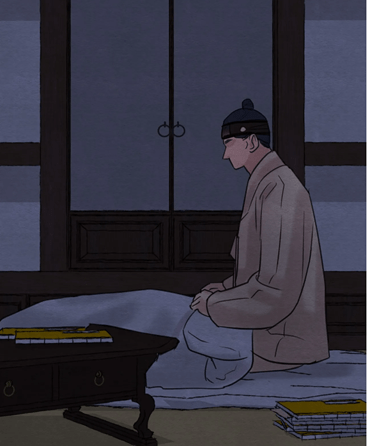
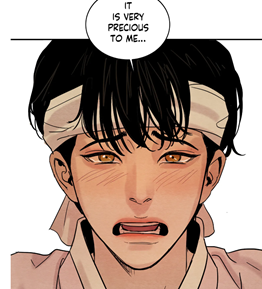 So he needs to distance himself from the painter, creating a separation. Only then, the painter’s mind and heart will sense the emptiness left by the noble’s absence. On the other hand, Yoon Seungho will suffer for a while, he will be the one who can’t sleep and cry, hiding his pain in front of his servants, his acquaintances and the painter himself. We shouldn’t forget that we never saw the lord crying, it is something he has never been able to do, but he needs to in my opinion in order to overcome his traumatic past. Yoon Seungho will recreate the same situation, he will become the lover forced to be separated but who longs to return to his love. The noble is really a romantic one in the end. He is willing to be in agony, until Baek Na-Kyum gets aware of his own feelings but also of the protagonist’s affection.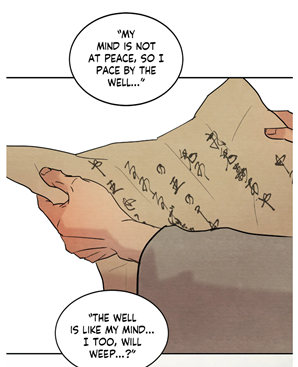
 The master wanted the artist to discover the fraud and at the same time, he wished to correct the painter’s opinion about him. He was determined to prove to the low-born that he wasn’t a “man consumed by lust” but also a learned sir. This negative image had truly bothered him in the chapter 5
 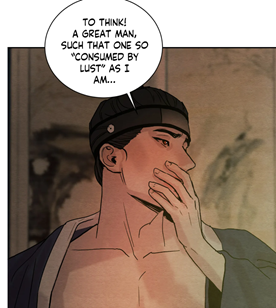 to the point that he couldn’t have sex with Jihwa. However, the low-born didn’t realize the switch, too happy that his learned sir had come to the mansion (chapter 7). The poem had lost his purpose, since Jung In-Hun was close to him. He had his learned sir by his side, there was no separation any longer so that the artist didn’t feel the need to read it. This explicates why Baek Na-Kyum never changed the negative perception he had about Yoon Seungho, as he never looked at the poem again. On the other hand, that’s how the noble discovered that the painter couldn’t read. The sex sessions with different sex partners contributed to this negative reputation, the stigma “man consumed by lust” got reinforced. The painter saw it with his own eyes and even seemed to experience it.
 Both are very similar because of the weather and the situation. Nonetheless the changes are quite telling. In the second drawing, the commoner is walking on his own underlining his loneliness. He has not been accepted by the servants at the mansion, while in the chapter 51 it is clear that now the staff recognizes him as a member of the mansion. Pay attention that in the chapter 51 Baek Na-Kyum is following the head-maid from the kitchen and later the valet Kim. He is no longer isolated and rejected. Secondly, in the picture above Baek Na-Kyum is just walking to the mansion but he is not paying attention to the lord smoking by the window. Only on his way to his room, he spots Yoon Seungho sitting at the window, therefore he stops walking for a brief moment.
  The commoner is following the head-maid, yet his body and head are turned to the lord. In this episode, he doesn’t make a pause to look at him, he keeps starring at the opened window, where he can observe his “lover” laugh. The other huge divergence is the wealthy protagonist’s attitude. He is no longer passive, sitting alone while smoking. He is drinking with another aristocrat, making jokes and laughing.


 becomes a disaster. His dream turns into a nightmare. Therefore I will come back to this confession in this essay, although my main focus is a comparison of the painter’s confessions in the presence of Yoon Seungho.
 So there was a mixture of concern and lust. The reason why I adjoin care is that we have the same motivation in the chapter 41 and in the chapter 48/49. In both scenes, he is troubled by the painter’s behavior. In the chapter 41, he heard from the servants that the low-born had been working non-stop to the point that he was even skipping his meals.

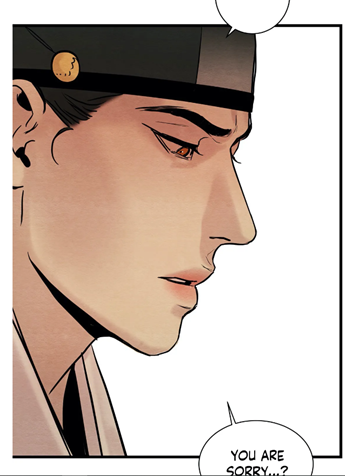 As you can see, care was always the trigger for his visit to the painter’s study. In the chapter 48, he wasn’t just angry. If fury had been his only motivation in the chapter 48, then he wouldn’t have contained his anger. Yet during the chapter 48, the master remained quite calm.
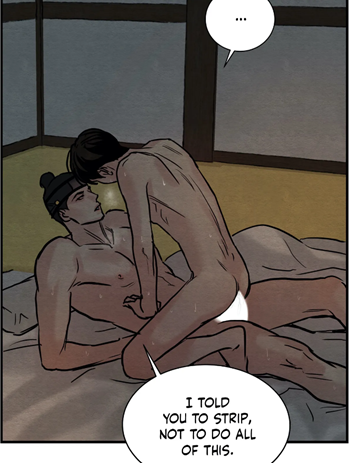 He acted like a master or a client at a gisaeng house, yet he kept talking to the artist, pointing out the weirdness of his attitude. He kept asking why, just like in the chapter 41/42. Therefore I come to the conclusion that care and concern were the biggest motivations for the lord to visit the painter’s chamber. In other words, Seungho has never been cold-hearted, like some readers are still judging him.
 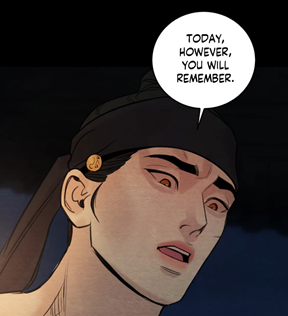 As you can see, the more the lord spent time at the pavilion, the more he became troubled. His despair and worry pushed him to make the wrong decision: force the painter to remember their wedding night so that he could claim Baek Na-Kyum as his “wife” and partner.

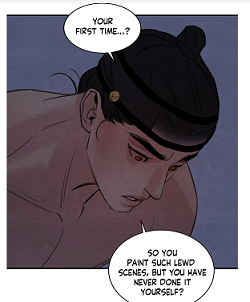


 Let’s not forget that the master did follow all the painter’s requests in that scene. That’s why he kissed and hugged his lover so passionately, he wanted to comfort him so much but he failed to stop the painter’s heart from freezing. That’s why Baek Na-Kyum still judged himself as a whore after that night. And in the chapter 48/49, this time the manhwaphiles behold the lord acting like a real client at a brothel.
 He wants to provoke a physical and emotional reaction in the painter so that the latter finally leaves his state of shock. By playing this role, he wanted to make the commoner realize the harsh reality of a brothel and the real fate of prostitutes. He frightened the painter so much that the latter begged the lord to stop, to listen to his requests.
 However, this time he did succeed but still didn’t achieve his original goal: winning the painter’s heart. I am well aware that some readers are still thinking that Baek Na-Kyum hasn’t changed his view about himself. I have a different opinion because he is now the master of his own fate. For me, he has become a libertine, sure his negative opinion about himself is not entirely removed, yet he is now able to differentiate between his own interests and the ones from his partner, which he never did in the past. He imagined that Jung In-Hun’s interests were the same than his own hence he was willing to do anything for the scholar. He has finally realized his own existence so he is no longer the same person, a whore with no identity and desire. He is now creating his new life, making new rules.

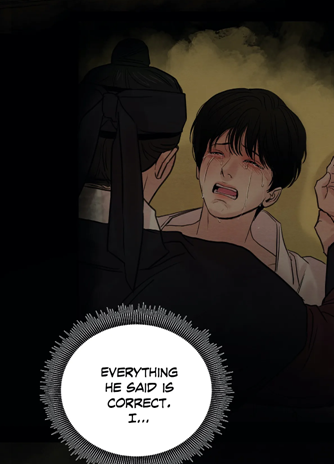 (chapter 48) All this led me to the following observation. We had the artist’s many confessions. Hence I am listing the common denominators that are always present during the three different scenes.
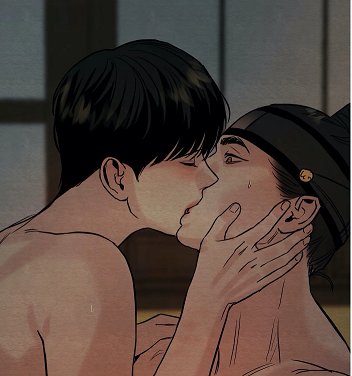 The opposition of the two gestures illustrates the diminution of the social and emotional gap between the two main characters. Note that despite standing on tiptoe, the artist’s head was still below the aristocrat’s head.
 (chapter 19), whereas his head in the episode 49 exceeds that of Yoon Seungho. During their first real kiss, the difference reflected the huge social divergence, however what changed later more was the emotional state of the noble. Now, he is the one looking up at
  (chapter 49) the painter. The former is literally admiring his lover, pining on him but he doesn’t express it.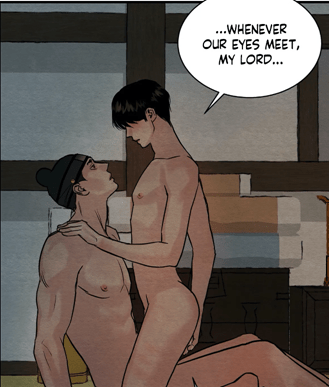
 (chapter 49) Now, they have switched the position, the aristocrat is the worshiper and Baek Na-Kyum is his object of affection. So in this scene, I would even say that we have the first lord’s confession but he is not voicing it. But because the artist has been deaf and blind for so long, he can’t witness this with his own eyes and ears. That’s why he doesn’t catch the true meaning of the noble’s saying. That’s why he could only doubt the protagonist’s genuineness in the hug and warmth and pushed the man away. Strictly speaking, the aristocrat is once again rejected, although he has finally truly behaved like a man in love.
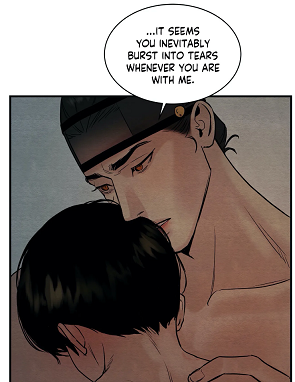 (chapter 49) he is apologizing to the artist. He might not use the word “apology”, unlike in the chapter 20, nonetheless his wording unveils regret and heartache. During their wedding night, the aristocrat did apologize for taking the painter’s virginity, nevertheless his excuse didn’t sound genuine.
  In the chapter 49, Seungho acts the opposite. He doesn’t mention the word “apology”, yet he feels regret. He is sorry for making his lover cry. He admits that he is responsible for this, as each time they had such an encounter, he cried.
  (chapter 21) In chapter 41/42, he cried due to the scholar too. So why would he mention “whenever”? Which occasions was he referring to? And now be ready for the next revelation. From my point of view, Yoon Seungho must be including the scene at the pavilion and the rape. I am positive that the lord wasn’t just remembering the scene, when he slapped the low-born or threatened him. Imagine, the lord is actually apologizing for all the pain he caused to his lover, he is expressing his atonement. And now, if the manhwaphiles recall the scene with the forced sex, they will also notice that there is a repeat of chapter 20/21. Besides, the readers witness a confession there too.
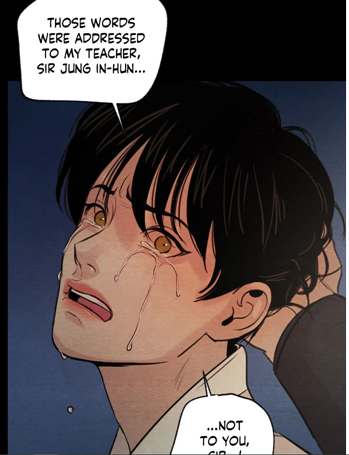 (chapter 25) The painter admitted for the first time that he loved a man and his confession was addressed to the teacher, his “learned sir”. We have a long kiss
 (chapter 25), the attempt of a hug
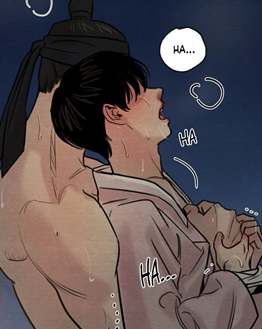 , the tears, the rough actions,
 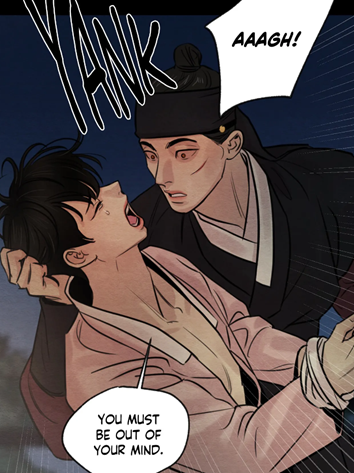 , the painter lying on the ground
 (chapter 25), the lord’s comments
 (chapter 49) The man had just humbled himself, yet this was totally ignored. I would even add that the artist’s words even devalued the noble’s words and actions even more. Like I mentioned it before, the low-born somehow treats the aristocrat as a tool for his own pleasure. We have an indirect rejection as the artist refuses to give him his heart.
 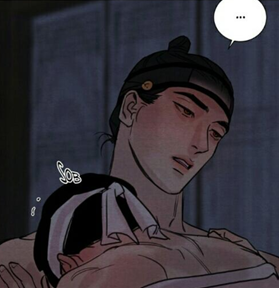 (chapter 20) The low-born’s head is much lower, and there is a certain distance between both bodies due to the way the low-born’s hands and head are placed. Here, the lord is even complaining about the painter’s lack of experience and reaction. Now, if you look at the hug in chapter 42
 , you’ll note here that the low-born’s head is higher and they are physically much closer but there still exists some distance. Even the lord’s behavior is different. His gestures oozes warmth, love and despair. His affection has truly gone deeper and with this huge hug, the manhwalovers can detect that the painter is indeed his first priority, while it was not the case before. His own selfish desires mattered more (20-21/25) back then. And now, we should look at the hug in the chapter 49.
  (chapter 41)

 Another example is when the butler asked for an aphrodisiac from the physician so that the painter would get an erection. He used Yoon Seungho’s trick in order to improve the relationship between Baek Na-Kyum and his master.
 He wasn’t just infuriated, he was totally eaten by jealousy. Imagine, he belongs to the high nobility and the painter chose a low aristocrat with no huge income and connection over him. He, used to be surrounded by many nobles due to his wealth and power, kept experiencing rejections. Not only he was turned down multiple times but the person even preferred running away from him. The aristocrat made terrible experiences for the first time: not only jealousy but also he started feeling insecure. His reaction towards his servants (the beating) demonstrates that he was not just mad but also panicking, trying to vent all his negative emotions onto the staff. The one he chose because of his feelings for him had no consideration for him, a high noble. Neither wealth nor power nor force could make the painter submit to him. Only the butler could read his master’s expressions and behavior as an open book.

 He thought that if he kept putting new brushes and an ink stone next to Baek Na-Kyum, the latter would realize that he was a painter in reality and no prostitute. However, his actions didn’t help neither his master nor the painter. Remember the saying: “The road to hell is paved with good intentions”. And this is exactly what is happening. The valet caused more agony to both protagonists with his actions. First, he asked the tailor to hide the true identity of his master’s lover to the folks, then he never confirmed the real status of Baek Na-Kyum to Deok Jae (he is just favored) so that he kept the painter in a very ambiguous status, which his lord didn’t catch. The painter had been literally destroyed by these poisonous words and the butler didn’t even comfort the man because he couldn’t. Due to Kim’s neutrality/passivity, the lord’s behavior could only reinforce the negative reflection the painter had about himself and his sex partner. We shouldn’t forget that Yoon Seungho was described in the first chapter of the second season as someone obsessed with his new lover.
 The lord initially imagined that he had finally won and enjoyed his time with the painter, only to slowly realize that he was still missing something: the lack of passion and warmth. But the valet Kim kept this important detail from him. That’s why the master is so angry with his loyal domestic and with the low noble. The former acted on his own accord, although he is just a servant and Jung In-Hun, despise his absence, was still able to cause trouble in his relationship with the painter. Therefore Yoon Seungho feels the urge to kill the scholar symbolically, once he discovers the truth. He comprehends the painter much better, why he behaved like a prostitute, why he had lost his strength and strong will.


 Here, in this drawing, the noble is definitely pushing the artist to interrogate the true nature of his relationship with his learned sir, while at the same time he shows that he’ll assume the responsibility for him. But in this scene, the manhwalovers could never see Kim as he had been left behind at the tailor shop, taking care of the order for the new clothes. If the lord had known about the existence of this conversation, he would have been happy and not hurt, since he would have noticed that his words and actions had affected the artist. Yoon Seungho is well aware of the true meaning of this exchange, while the valet Kim wasn’t.

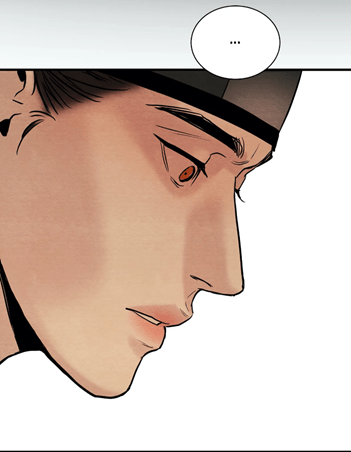


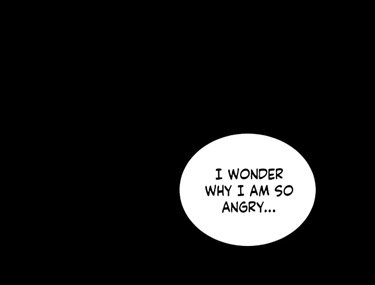
 Now, you understand why it is important to know this manhwa very well. The previous chapters help me a lot to perceive the thoughts and emotions of the main characters. Byeonduck uses the episodes from the first season to enlighten the development of her characters, underlining their transformation. In the beginning of the chapter 50, the manhwaphiles witness how much the main lead has changed. He has become very gentle, selfless and making sure that his lover is feeling well. But he is still ignorant of his own feelings. For him, reasoning is the cause of his behavior. Let’s not forget that during the first season, the main lead had to ponder a lot and even suffer due to remorse. So the painter did occupy a big place in his thoughts that’s why the lord is still making the mistake. On the other hand, he is now capable of expressing his love much better, although the artist couldn’t see it with his own eyes. However, his body has already sensed it.
