

Please support the authors by reading Manhwas on the official websites. This is where you can read the Manhwa: Jinx But be aware that the Manhwa is a mature Yaoi, which means, it is about homosexuality with explicit scenes. Here is the link of the table of contents about Jinx. Here is the link where you can find the table of contents of analyzed Manhwas. Here are the links, if you are interested in the first work from Mingwa, BJ Alex, and the 2 previous essays about Jinx The Birth of The Shotgun – part 1 and The Night-Cursed Emperor
It would be great if you could make some donations/sponsoring: Ko-fi.com/bebebisous33 That way, you can support me with “coffee” so that I have the energy to keep examining Manhwas. Besides, I need to cover up the expenses for this blog.

My avid readers might have been wondering why I haven’t released any new analysis yet. The reason is simple. I am back at school, and preparing lessons for my students had to come first. But when episode 74 was released, one detail immediately caught my attention. It was small, almost easy to overlook, yet the more I thought about it, the more it seemed to hold the key to understanding not only this chapter, but Joo Jaekyung’s entire story. 😮
So let me turn the question over to you. What is the common denominator between these three panels?
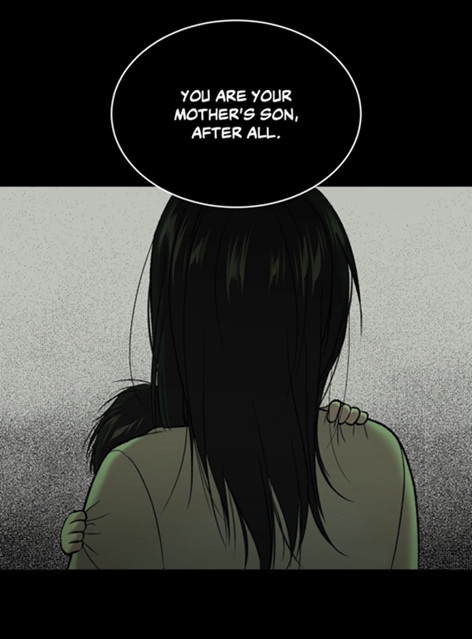 (chapter 73)
 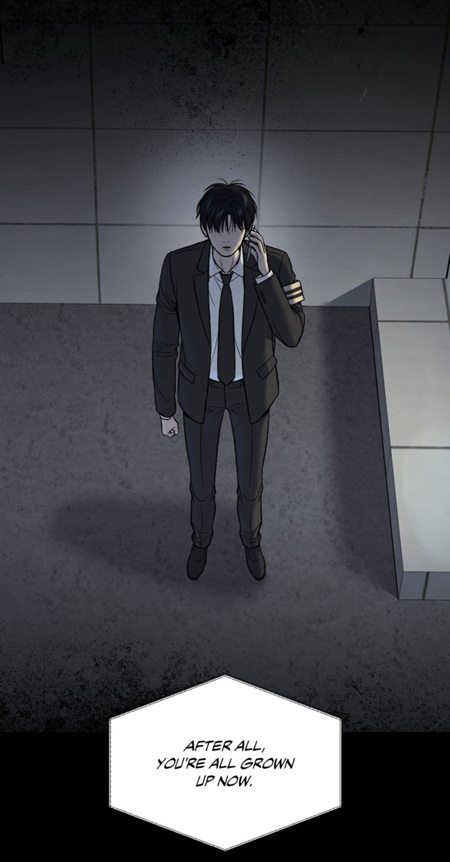 (chapter 74)
 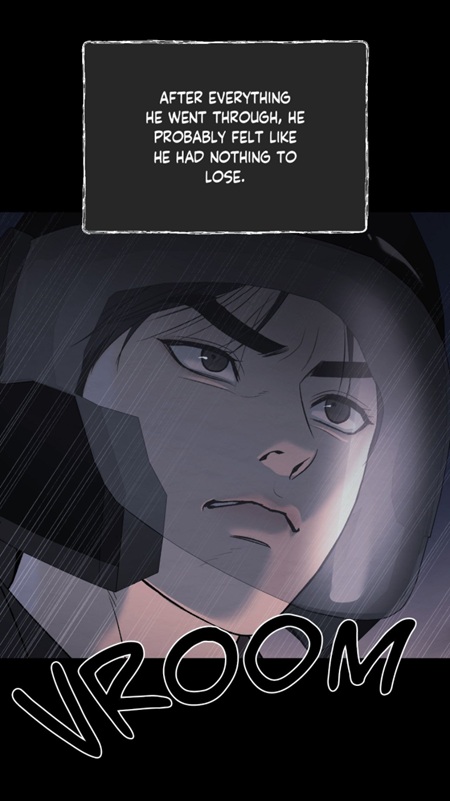 (chapter 74) What do they share? You might already have noticed it. At first glance, the answer seems obvious: each sentence turns around the word after. But if we pay closer attention, it is not just after that repeats, but after all. And here, the “all” quietly carries the weight of everything. A slight shift, but one that feels significant. But why this expression, and why here? Why does it resurface precisely in the context of Jaekyung’s family and past?
At first glance, after is nothing more than a temporal marker, a word of sequence. But in these sentences it feels heavier, almost final. It does not look forward — it looks backward. In other words, it doesn’t open a path; it shuts a door. And in episode 74 especially, it echoes like a refrain that has been defining the champion’s life. His world has always been framed in terms of after all. And this immediately raises another question: why did these people, so different in role and attitude, all use this idiom when addressing or describing the young champion?
But then—observe the contrast. When Joo Jaekyung embraced his fated partner, the words that rose within him were not about “after” but about “before.” 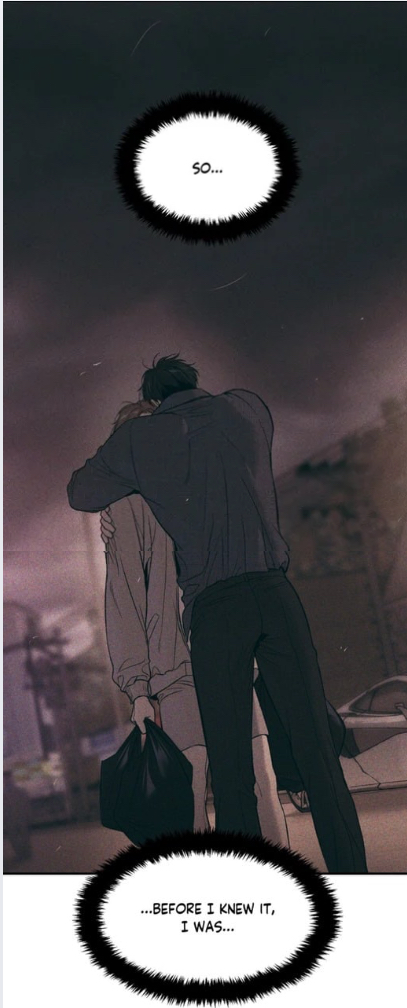 (chapter 70) For the first time, the flow of time shifted. Besides, no explanation, no certainty—just an admission that something happened beyond his planning or reasoning. Where the earlier lines spoke with closure, this one arrived without a verdict. But what does this “confession” signify for the athlete now?
This is the mystery I want to unravel. What does “after all” truly embody in his life? Why has it shaped him so deeply, and why is the “before” so revolutionary when it finally appears? To answer these questions, I will proceed step by step: first examining the parents’ words, and finally the director’s cold repetition in episode 74. From there, I will turn to the symbolic role of the phone and its destruction, before concluding with the comparison between the manager and the grandmother—two figures who, each in their own way, perpetuate or challenge the cycle of “after.” And at the very end, I will return to the sentence that changes everything: (chapter 70)
The Parents’ After All
Joo Jaewoong’s Verdict
The first “after all” comes from the father: (ch. 73) At first glance, this might sound like a simple insult, a way to degrade the boy by comparing him to the woman who abandoned him. Yes, I wrote “him” and not them on purpose. Joo Jaewoong brought her up in direct response to his son, because the teenager had voiced his first wish in front of his “legal guardian”:  (chapter 73) He was announcing his desire to leave this place, as if he wanted to abandon his father. Nevertheless, he just said it out of anger and frustration. Yet, those words pierced Joo Jaewoong, for they reminded him of his wife’s betrayal. Unable to face his own failures, he retaliated by thrusting her image back onto the boy. (chapter 73)
The staging is crucial. Father and son stand facing each other, 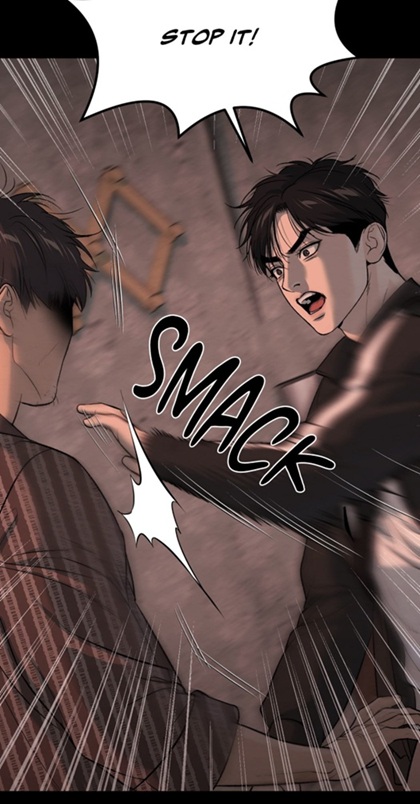 (chapter 73) locked in confrontation, while in the past, the woman had already shown her back — a gesture of refusal that foreshadowed her desertion. She had withdrawn in silence; the man, however, lashed out in noise. Both abandon, but in different registers: hers in silence and absence, his in noise and abuse. But the father’s gaze was selective. (chapter 73) While he saw a mother holding a boy, he overlooked that the protagonist was actually clinching onto his own mother, who had already distanced herself from the child. In other words, he mistook rejection for embrace. What he perceived as proof of her influence was in fact the trace of her withdrawal.
Thus the father’s “after all” is more than a mere insult. It is an erasure. By shifting all blame to the absent mother, he buried his own wrongdoings. The bruises, the insults, the nights of terror 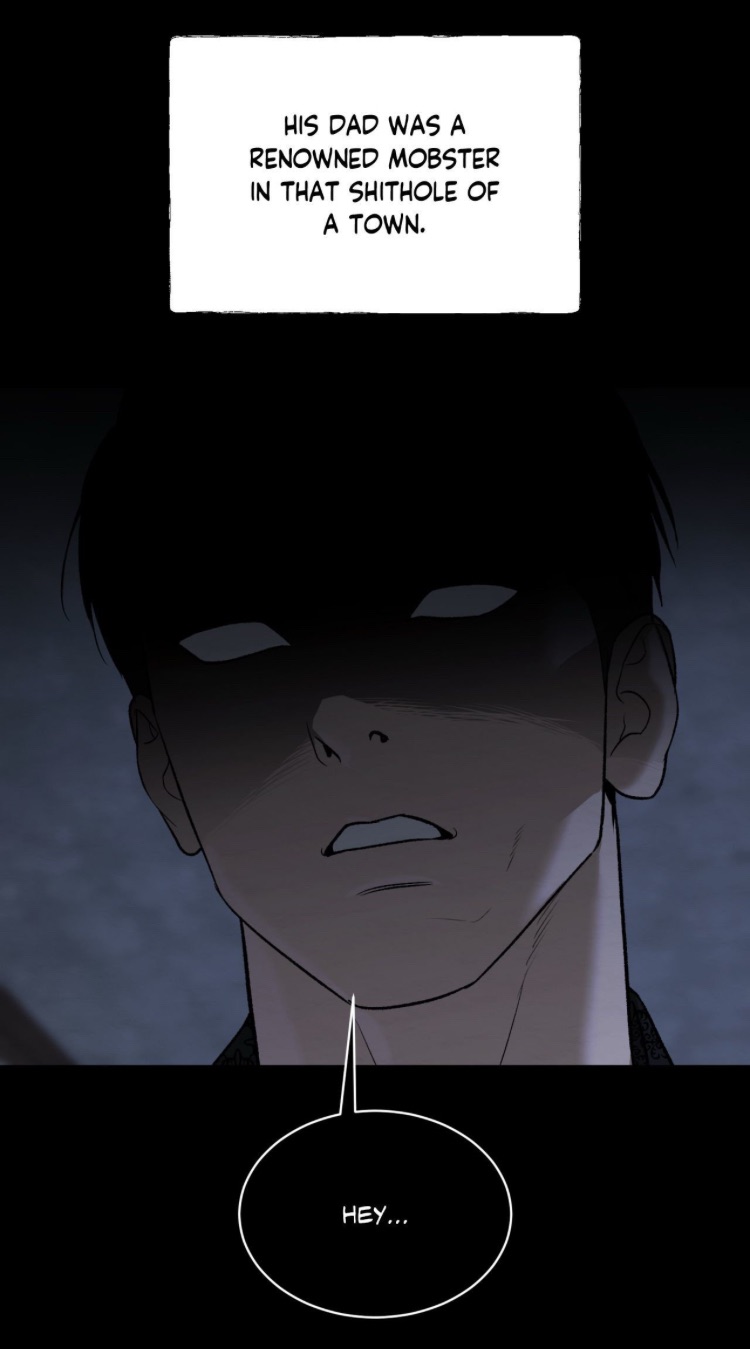 (chapter 73) — all were rewritten into a story where the woman was the sole traitor, and the child nothing more than her extension. In this way, the boy was denied recognition as a victim in his own right. He had been abandoned too. He had been abused either. He became instead a mirror in which his father projects the wound of being left behind.
The tragedy is that this was Jaekyung’s first attempt at self-assertion in front of his father, his first voiced wish as a child. (chapter 73) And yet it was met not with listening and understanding, but with condemnation and mockery! 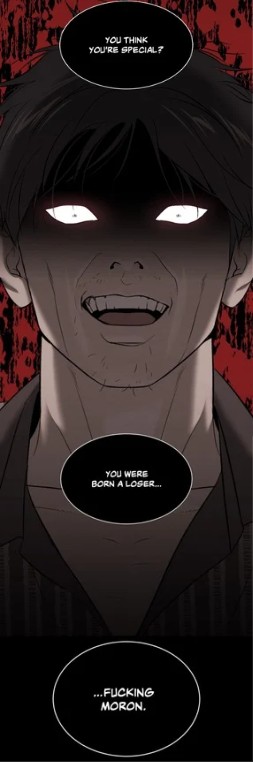 (chapter 73) Why? It is because the father didn’t trust him, as he didn’t trust himself either! Because the father attacked him verbally, the boy replied in kind — escalating words he would later regret.
  (chapter 73) The cycle of reproach was sealed. From that moment on, he understood the danger and the destructive weight of words.
 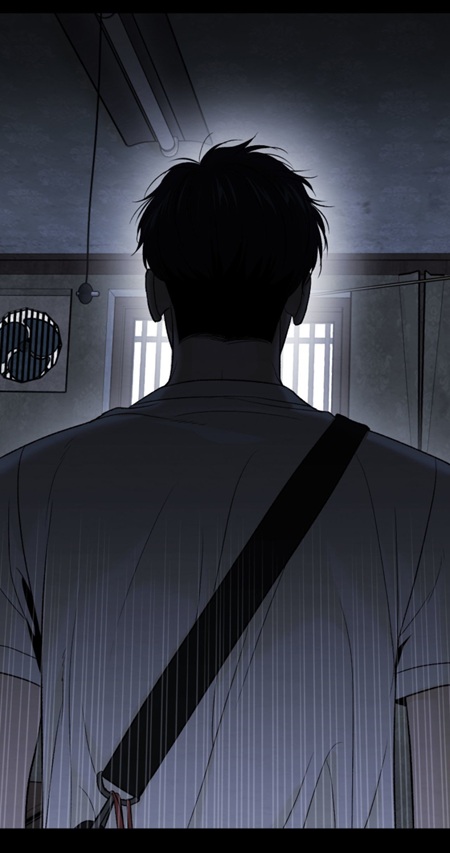 (chapter 73) To speak was to wound, to be wounded in return. Besides, the boy could never speak of this truth. He carried the memory of that last conversation in silence, crushed by the belief that he bore guilt for his father’s death. Shame and responsibility bound his tongue. That is how words, once used against him as weapons, became impossible for him to wield in his own defense. However, this was only the beginning of his withdrawal into silence. His fists would become his language, his body the only safe instrument of reply.
In the end, the father was betrayed — not only by his wife, but by himself. (chapter 73) For in his world, there was no place for we, no place for a family. By reducing every bond to reproach and violence, he erased the very possibility of belonging. His after all thus becomes the verdict on his own life: a man left alone, responsible for his own misery. He complained the absence of gratitude from his son, while he had done nothing for him. 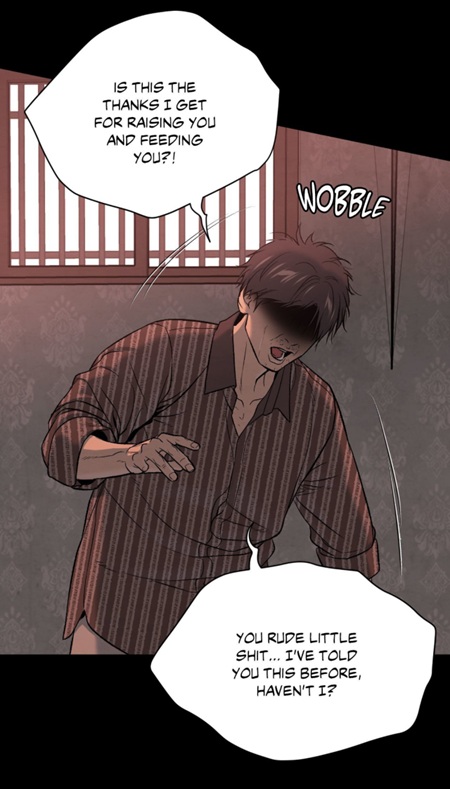 (chapter 73) The betrayal he lamented was nothing more than the logical outcome of his own principle. There had never been a we — only a man clinging to his pride, a woman turning her back, and a child caught in between. His after all (chapter 73) exposes this rupture: instead of binding father and son, it isolates them, placing Jaekyung outside of any shared identity. By calling him “your mother’s son”, he does not recognize the boy as his own. The word becomes a substitute for “we,” a marker of distance rather than union. He also denies the very identity of his son: the boy is reduced to a reflection of the mother, and nothing more. In this moment, the child is stripped of individuality, framed only as an echo of the parent who had already left. For years afterward, this wound silenced him — until much later, when a reversal finally emerged. When Jaekyung embraced his fated partner, the words that rose within him began not with after all but with before I (chapter 70). Only then did he speak again as a person in his own right, expressing a wish unshaped by the verdicts of adults or the weight of guardianship. Thus he expressed his thoughts and emotions through the body.
The Mother’s Excuse
And it is precisely here that the mother enters the stage. If the father used after all to erase his own guilt and deny the possibility of togetherness, the mother confirms that distance with a final gesture (chapter 74) — not by facing her son, but by cutting him off, hiding behind a phone call and a single merciless click. 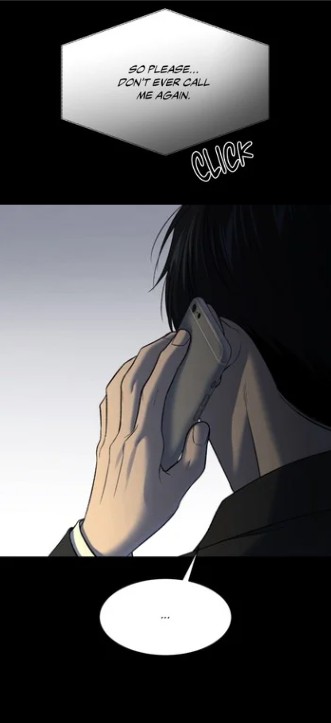 (chapter 74)
The scene is loaded with irony.  (chapter 74) In the past, the boy had dialed her number from the same public booth
 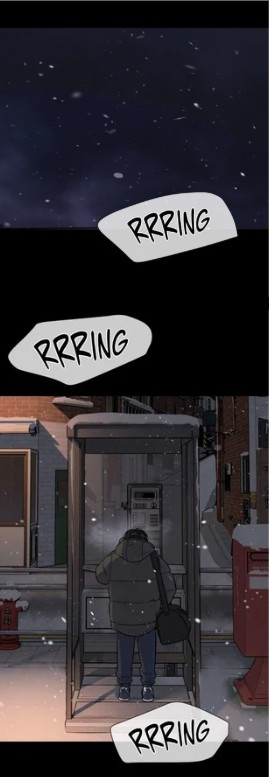 (chapter 72), clinging to the hope that she might answer one day. Eventually, those attempts ceased — but not the attachment. What remained was the number itself, saved under “Mom” on his phone
  (chapter 74) Here, he was old and rich enough to buy his own cellphone. The phone number was no longer a channel of communication, only a relic: a fragile thread he could not sever, because the fact that she never changed her number sustained the illusion that reunion was still possible. That dormant hope was shattered only when she finally picked up — not out of recognition, but by mistake, assuming the unfamiliar call must be important.
 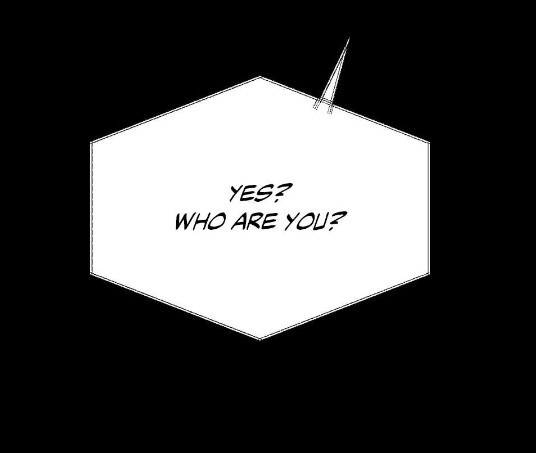 (chapter 74) And so, after years of silence, his voice reached her at last.
What followed crushed him. She did not yell like the father; instead, she cloaked her rejection in polite detachment: “ (chapter 74) repeating “please” twice — not out of kindness, but because he had become a source of threat to her new life. (chapter 74) Her words, “please never call me again,” sealed the door he had long believed ajar.
What once seemed like a lifeline is revealed as evidence of her selfishness and cowardice (something I had already outlined before in The Loser’s Mother: Fragments of a Mother), and the unchanged number, which kept him hoping, now exposes her duplicity. This is why remembering his past will not only free the champion, but also help him to move on. At the same time, it also set in motions a quiet karmic reckoning for the “mother,” whose very act of leaving the number unchanged betrays her. Interesting is that Joo Jaekyung is exactly like his mother: he has not changed his damaged cellphone and number either!!  (chapter 66)
Her words presented abandonment as if it were a mutual choice (chapter 74), an agreement between equals. Yet, nothing could be further from the truth: the child had no choice, no power. Worse still, she used his own earlier words against him — the part-time jobs, the savings he had scraped together in order to welcome her back. Since he had money, he could keep living on his own. What for him had been a desperate declaration of love, for her became justification to let go: he was, in her eyes, already independent, already “grown-up.” (chapter 74) Only then comes her final blow: “After all, you’re all grown up now.” The position of after all here is crucial. (chapter 73) Unlike the father, who spat it at the end of his sentence as a weapon, the mother puts it first, as if it were the very foundation of her reasoning. Placed at the front, it functions like a gatekeeper — a barrier the son cannot pass through, because everything that matters has already happened before him.
In other words, she uses time itself as her excuse. (chapter 74) By saying after all, she makes his age and the passing years the justification for her betrayal. She turns maturity — the result of neglect and abandonment — into a pretext to abandon him further. In her mouth, time is not a healer but an alibi. For him, however, time is the enemy. Every night of waiting, every unanswered call accumulates into a debt that cannot be repaid. This is why, years later, Joo Jaekyung has been racing against time — as if by moving fast enough, by piling victory upon victory, he could undo the stillness of those years when nothing came back to him. His obsession with routine, with never stopping, mirrors the silent cruelty of her after all: if she made time the reason to let go, he would make time the proof that he never let go.
Here, the phrase does not simply refer to his age. All encompasses the totality of what she has built without him: her remarriage, her new family (her second child whom she calls “dear”), her wealth, (chapter 74) her present comfort. He stands after all of this — chronologically, emotionally, socially. In her reordered life, the child who once clung to her is relegated to the back of the line, behind every new bond she has chosen to recognize.
And yet, before uttering after all, she cloaks her rejection in seemingly gentle words: “Please understand… let’s just go our separate ways.” (chapter 74) At first glance, the sentence suggests civility, as if both parties had been walking the same road until now. But this is the deception. In truth, she had abandoned him long ago. This “family” (“our”) only existed in the boy’s mind, a dream born from her lies. For the mother, this “family” was already dismantled and replaced; for him, it was the one thing keeping hope alive. By phrasing it this way, she rewrites history, disguising her betrayal as a fresh, mutual decision rather than an old wound that never healed. The implication is that nothing was broken before — that only now, as adults, they might choose to part.
In doing so, she not only denies the rupture of the past, she also erases the promise that once tethered him to her. Why else would he plead,  (chapter 74) unless she had once suggested that possibility? His words reveal that he had been clinging to a seed she planted long ago, a future she quietly abandoned while building a new life elsewhere. And what was that seed? Not just her vague suggestion that “once they have money”, or
 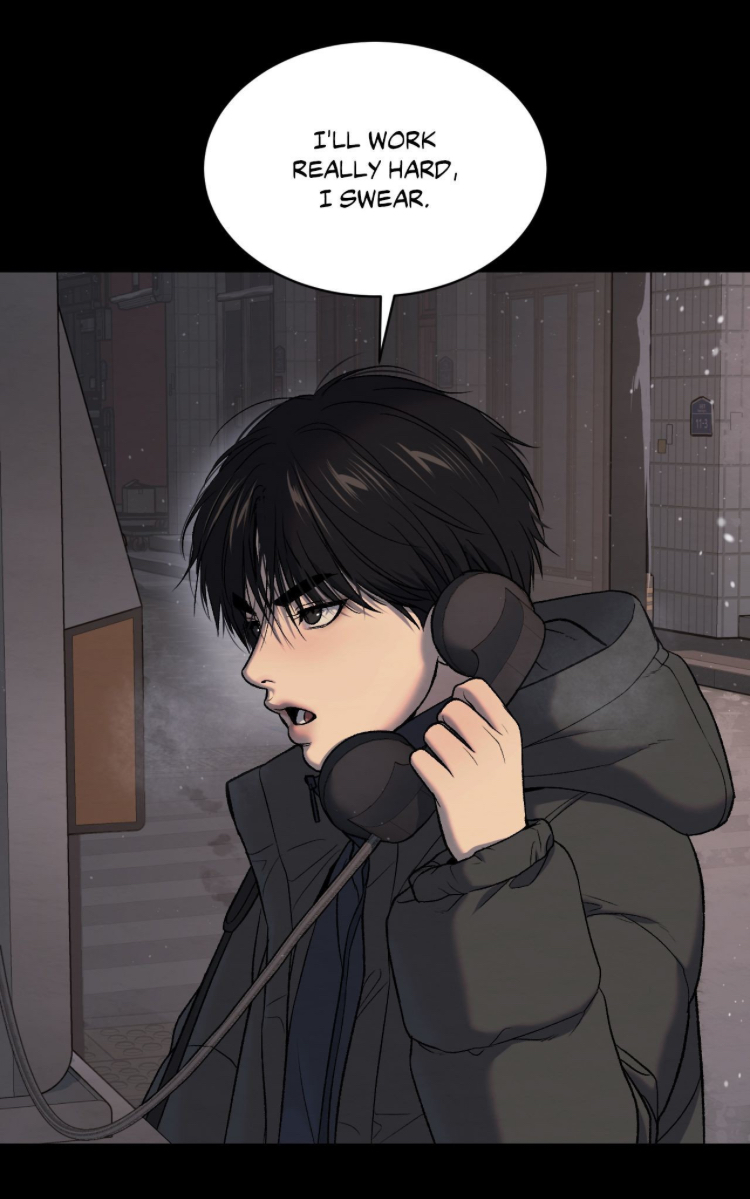 (chapter 72) “the father no longer represents a menace to her” but the very fact that she gave him her phone number. To a child, that number was more than digits on a page — it was proof of connection, a lifeline, an assurance that she could be reached, that she might one day answer.
But in reality, the number was a cruel illusion. She never changed it, which prolonged the fantasy that she still cared, that reunion was only a call away. Yet when the call was finally answered, it revealed not hope but finality. The “click” of her rejection was as violent as any blow from his father — the sound of a door closing forever.
Thus, her rejection is doubly violent: it crushes his final hope, that’s why the boy cried for the last time. 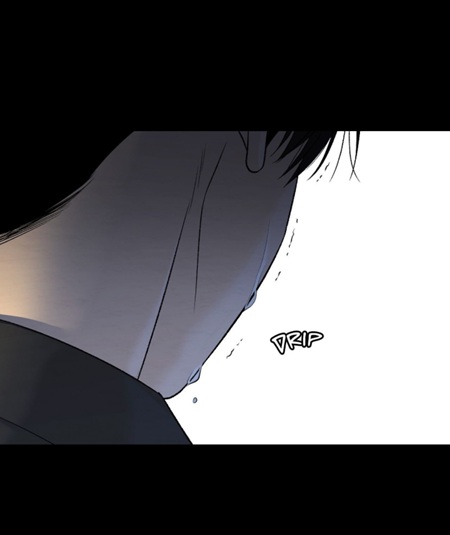 (chapter 74) Furthermore, it gaslights him into believing that the abandonment never occurred — that the break is only beginning now. (chapter 74) The repeated please underlines her fear: he is not a son to welcome back, but a threat to the fragile world she has constructed without him. She has a lot to lose!
The irony (chapter 73) (chapter 74) is merciless: in just three letters, all hides the immensity of his suffering —  (chapter 72) neglect, starvation, abuse, loneliness, betrayal — and yet the parents invoke it not to acknowledge his pain, but to hide their wrongdoings (justify their betrayal) and as such their failure! By placing after all at the front of her sentence, (chapter 74) the mother tries to turn the page unilaterally, as though this single phrase could close the chapter for good. It is not dialogue but dismissal, a way of shutting down the past before her son can reopen it. In other words, it’s a verdict too disguised as an excuse!
Placed at the end of the father’s sentence (chapter 73), after all erupted in the heat of reproach — spontaneous, yes, but no less destructive. It was triggered by his wounds, by the memory of betrayal he could not bear. Yet even in its impulsiveness, it carried no apology, no trace of self-reflection. Like the mother, he used the phrase as a verdict, not an opening — a way to wound, not to reconcile.
By contrast, the mother’s after all sits at the beginning of her sentence, cloaked in calm reasoning, stripped of any trace of spontaneity. Where the father lashed out, she closes off. Joo Jaekyung is now trapped between these two “after all”: one erupting in rage, the other draped in reason. Together they form a prison of words where apology has no place and the child’s voice is nowhere to be found. No wonder why the celebrity has never apologized to doc Dan in the end. At the same time, it explains why after this phone call, Joo Jaekyung had nothing to “lose”. The adults had destroyed the child’s soul and heart.
For Joo Jaekyung, there is no way back from this sentence. With ‘after all, you’re all grown-up now,’ his mother denies him the right to still be a child in need of care. ”After all”, he can also not deny his ties to her. His origins and even time itself become his enemies — he can never rewind, never reclaim the place of the baby who once clung to her. Her words brand him as someone beyond help, beyond nurture, beyond belonging. What she frames as maturity is, in fact, abandonment dressed as inevitability. The problem is that she is still alive. Unlike the father (dead) or the director (dying), she cannot escape judgment — not from her son, nor from others. By keeping the same phone number for years, she left behind proof of her continued existence. She could have fetched the boy at any moment, but she never did. Her responsibility doesn’t end simply because she decided to draw a line. (Chapter 74) Motherhood is not dissolved by a polite “please” or by a remarriage. She cannot erase this fact, however much she hides behind a new family or a change of circumstances. In this sense, the father’s words return as a curse for her: the truth of origin cannot be undone. The author is already implying this notion through narrative details.
The story itself shows us how enduring such responsibility is. 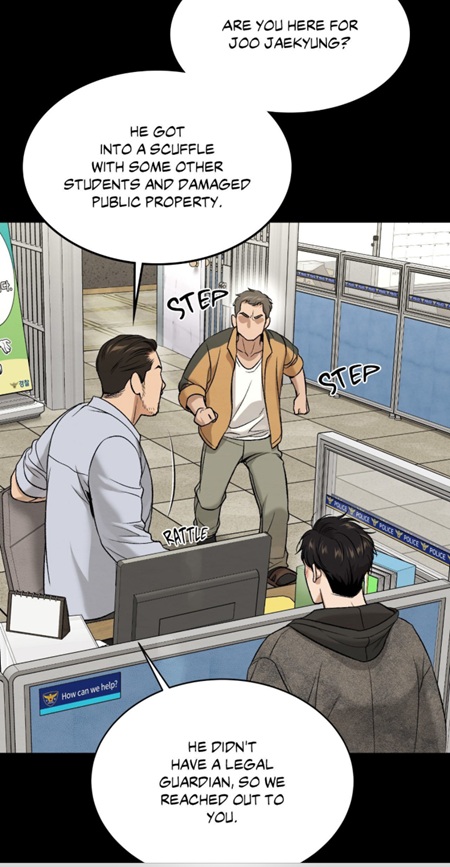 (chapter 74) When the boy once caused trouble, the police looked for Joo Jaekyung’s guardian. In the cutthroat town, they reached out to Hwang Byungchul — not because he was legally responsible, but because everyone knew the boy was close to him (“we”). Guardianship, then, is never erased by silence. Even if you abandon the child, others will still hold you accountable.
And here lies the deeper irony: once Joo Jaekyung left for Seoul, he knew no one there.  (chapter 74) In a city of anonymity, hearsay cannot replace documents. She left a paper trail — a legal identity that binds them together. Should the champion cause trouble in Seoul, or even become the victim of a crime, the police would have to turn to his legal guardian. And that can only be her.
The narrative already dramatizes this irony through the arcade incident  (chapter 26). Oh Daehyun mentions that the young fighter broke the punching machine so many times he was blacklisted. Such destruction could easily have brought police intervention — and if it had, they would have been forced to search for his legal guardian. That guardian is none other than the mother who abandoned him and her new family. In other words, her erasure was never complete: every act of the boy risked pulling her shadow back into the open. Furthermore, this is what Kim Changmin revealed to his friend and colleague:
  (chapter 26) But Joo Jaekyung had long discovered sports and MMA, when he arrived in Seoul and met Park Namwook for the first time.
  (chapter 74) He had left his hometown because of the director’s suggestion.
Chapter 74 exposes the cracks in the narrative first built in episode 26. Back then, Kim Changmin and Oh Daehyun repeated what they had heard: that Joo Jaekyung had once been a troublemaker, a rich, spoiled brat who smashed arcade machines and got into fights — but that in the end, he was “saved” by sports, and especially by MMA and MFC. That’s why he didn’t recognize himself in the introduction: (chapter 26) This story clearly originates with Park Namwook, the manager, who positioned himself and the sport as Jaekyung’s saviors.
But episode 74 reveals the reality behind the myth. The boy wasn’t saved by MFC, nor by Namwook. It was the director, Hwang Byungchul, who intervened, who sent him to Seoul,  (chapter 74) who redirected him before he was swallowed by the wrong path. The discrepancy between these accounts exposes more than just the manager’s manipulation: it points to the shadow of another intervention. How could he afford to destroy machine after machine without consequence? The only plausible answer is the “mother” and her new family, whose money and silence allowed him to pass as the “self-made” Emperor while erasing their own responsibility from the tale. And now, you comprehend why The Emperor was made voiceless. [For more read The Night-Cursed Emperor] Both MFC and the mother had a vested interest in silencing his true origins. For MFC, the myth of the “self-made champion” polished their image, free from any stain of thuggery — no whispers of money laundering, drugs, illegal gambling, or rigged games. For the mother, erasing the child meant erasing her own betrayal. The champion’s past was not only a personal wound but also a liability for others — a truth that had to be buried so that the façade of the Emperor could stand unchallenged. His silence, then, was never a choice; it was imposed, enforced by all those who profited from keeping his story untold. Should he ever speak up, he would expose not only the mother, but also MFC!
Because of episode 74, I came to resent the mother even more than before. She not only abandoned him twice, but toyed with his feelings. By answering once, she allowed his hope to flare up — only to extinguish it immediately. The phone that symbolized connection became the very tool of execution, its click as violent as the father’s punch. And just like her husband, she deceives herself. She imagines she can cut off ties completely with a single sentence, but until her death she remains legally and symbolically his mother.
The two after alls function like iron bars: one forged in the father’s rage, the other in the mother’s reason. Together, they create what you called a prison of words — a place where the boy cannot speak, cannot be heard, cannot be recognized. From that moment, he is not only abandoned but linguistically erased. His origins are denied, his childhood revoked, his future disowned.
And so, after the phone call, it is no wonder that Joo Jaekyung believed he had nothing left to lose. The boy’s heart had already been gutted; the rest of his path was merely survival. If he “went the wrong way,” it was because the adults had already led him there, sealing off every other route. They had destroyed the child before the teenager even had a chance to build himself.
This prepares the ground for the transition to the director: if his parents’ after alls built the prison, then Hwang Byungchul is the figure who becomes the witness of that imprisonment. Unlike them, he doesn’t openly wound with words — but his silence, his blindness, and his refusal to protect the boy make him complicit. He becomes the guard outside the prison walls.
The Director’s After Everything
When Hwang Byungchul says (chapter 74), the breadth of everything seems, on the surface, to acknowledge the sheer weight of Joo Jaekyung’s suffering. The word is heavy, expansive, suggesting years of accumulated pain, betrayal, and neglect. Yet, paradoxically, this very expansiveness is also a way of avoiding precision. By collapsing starvation, countless humiliations, abandonments, and traumas into a vague everything, the director sidesteps naming the concrete betrayals he himself witnessed. His silence here is telling: he cannot bring himself to articulate the parents’ cruelty, nor his own passivity in letting it happen. In front of the doctor, he had admitted himself that he had not raised him: 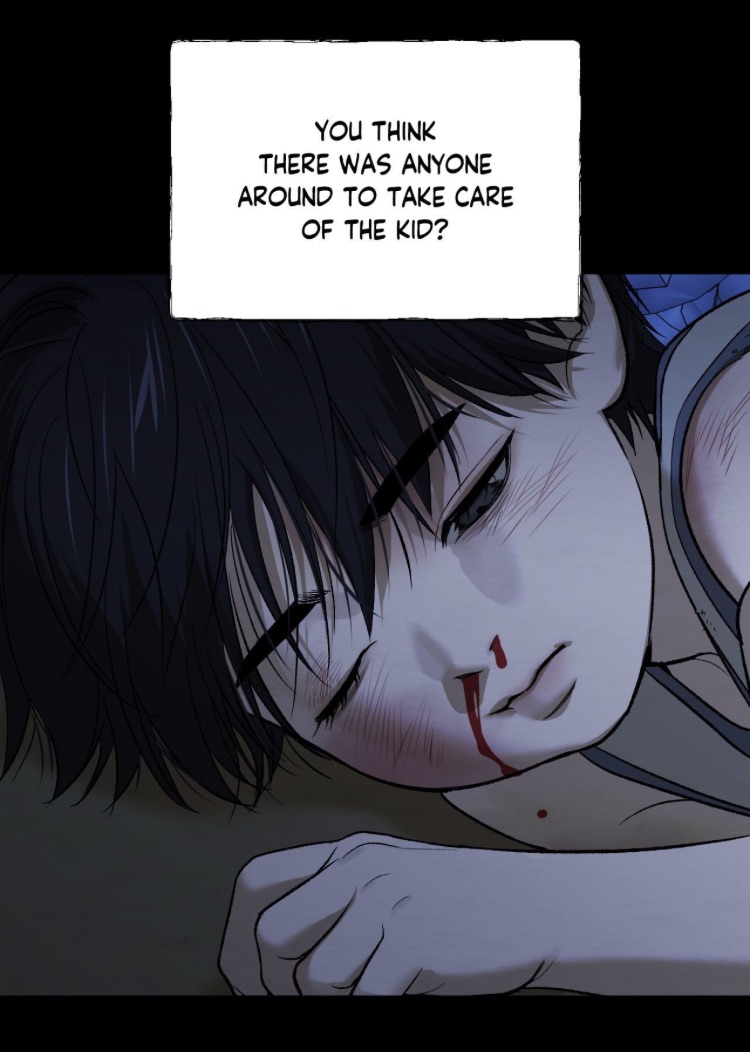 (chapter 74) For doc Dan who embodies the present, such a statement can only become the ultimate truth: the star had been an orphan like him.
Moreover, his next word — probably — betrays another form of distance. If he truly knew how the boy felt, if he had ever asked or listened, there would be no need for such hedging. Probably admits that he never entered the boy’s inner world, never gave him the space to voice his despair. It is the language of a bystander, not of a guardian. In fact, this hesitation exposes his complicity: Joo Jaekyung “went down the wrong path” not only because of the parents’ abandonment, but also because the one adult who remained nearby chose observation over intervention. 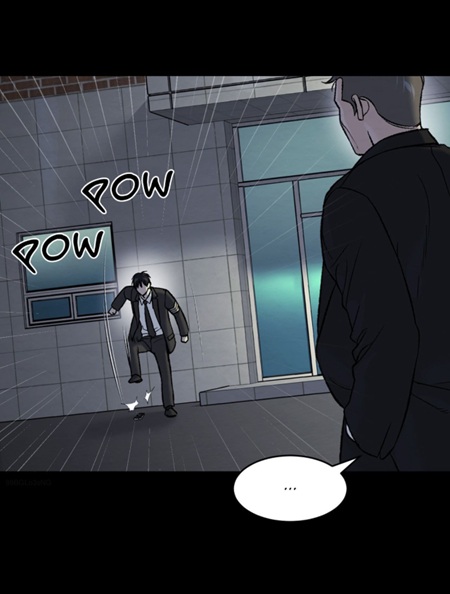 (chapter 74) At the moment when Joo Jaekyung shattered the cellphone, Hwang Byungchul was not by his side but standing at a distance, directly in front of him. This means he must have seen the boy’s face — the tears, (chapter 74) the trembling hands, the rage that barely concealed heartbreak. He did not need to overhear the mother’s words; the child’s body language told the story with brutal clarity. (chapter 74) In that instant, the director could have stepped closer, offered consolation, or simply acknowledged the wound he was witnessing. Instead, he kept his distance, both physically and emotionally. He refused to assume a role as legal guardian.
The same pattern repeats at the father’s funeral. 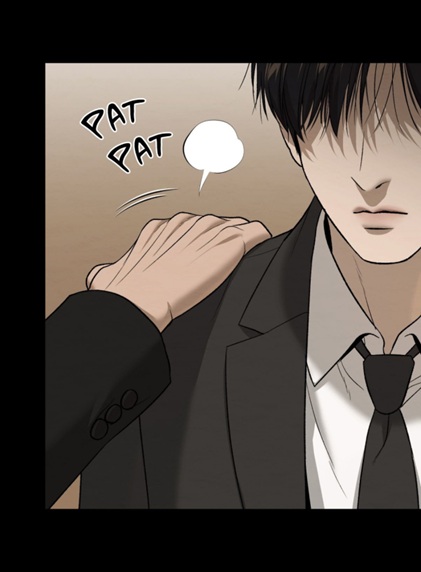 (chapter 74) Once again, the director was there — but his presence was mute. He placed a hand on the boy’s shoulder, yet he never lent him an ear. He never invited the boy to speak, never created a space where grief, anger, or longing could be put into words. In other words, he was present in body but absent in voice and heart. Thus the director’s pat was a gesture of pity. It was a substitute for words, a way of saying “poor boy” while protecting himself from deeper involvement. But precisely because he withheld speech and listening, it denied Jaekyung the chance to articulate his own grief. It comforted without connecting.
This silence is not neutral. By withholding words, he deprived Jaekyung of language at the very moment he most needed it. A child learns to process suffering by speaking it into existence and having someone else respond. Denied this, Jaekyung internalized the pain wordlessly — forced to embody it through his fists, through destruction (chapter 74), through fighting. Thus the director’s quietness, his refusal to engage, became a formative wound in itself. He chose the safety of distance over the risk of involvement, and in doing so, left the boy’s cries unanswered.
Thus, the director’s after everything is double-edged: it gestures at recognition, but functions as concealment. He names the boy’s burden while sidestepping his own. What sounds like empathy is, in truth, pity — a way of acknowledging suffering without engaging it. It allows him to speak about Jaekyung’s pain while avoiding both the betrayal he witnessed and the silence he himself maintained. In this sense, after everything is less an opening than a shield: a phrase that distances him from responsibility under the guise of compassion.
And because the boy had no one by his side that night, he concluded he had nothing to lose. Stripped of home, voice, and care, he stood in a void where even those who should have protected him kept their distance. The director’s silence, his refusal to step in or give the boy an ear, reinforced the sense of abandonment. Far from steering him away, this absence of guidance nudged him toward the wrong path. In this way, the man who might have been a safeguard became instead a silent accomplice to the boy’s fall. Hence he put the blame on the main lead.  (chapter 74)
Hwang Byungchul was called to the police station in order to correct his past wrongdoing.  (chapter 74) He was given a chance to step in, to finally become the guardian he had failed to be on the night of the boy’s deepest collapse. Therefore it is no coincidence that he claims to have raised him, while the readers are well aware of the truth.
  (chapter 74) Yet the way he handled the moment revealed the full extent of his contradictions.
The director was never one to turn his back on Joo Jaekyung. (chapter 74) He always faced him, 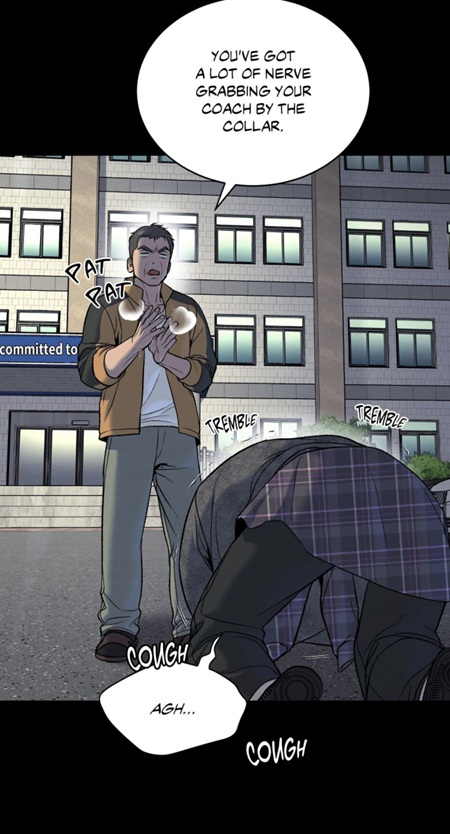 (chapter 74) or sometimes stood beside him, kept him in sight. On the surface, this could seem like loyalty, but in truth it was another form of failure. Facing him head-on meant constant confrontation, constant judgment. His presence was physical, but never protective; it was discipline, surveillance, not refuge. He never had his back!!
Instead of offering himself as support, he wielded the parents as weapons.  (chapter 74) The father was dragged into memory as a warning: “Do you want to end up like him?” The mother, already gone, was turned into a conditional model: “Would she even want to live with you if she could see you now?” In both cases, the boy was denied his right to grieve. His parents were not mourned, but transformed into instruments of discipline. He was forced to run from one shadow and to chase another, leaving him no space to simply exist. The director maintained the future champion trapped in the chains of the past.
This strategy erased the present. Jaekyung’s worth was always defined against the dead or the vanished, never in who he was here and now. It was never about him!! Happiness, stillness, or pride in the moment were impossible; only punishment and striving remained.
When the director invoked the mother again that night, it exposed his blindness.  (chapter 74) For him, she was a symbol — fuel for perseverance, as he was projecting his own mother onto the boy’s! For the teenager, the mother was the deepest wound. By naming her, the director imagined he was motivating; in reality, he was tearing it open once more. But how could Jaekyung reveal the truth — that his own mother had rejected him, not just once, but twice? To admit this would have been to confess that the hope she dangled before him, the dream of reunion, had been nothing but a cruel game. His silence was not pride but a shield, for voicing it would mean exposing that even his mother’s love had been counterfeit.
 (chapter 74) Thus his silence was not indifference but defense: he was protecting her name, even when it burned him to do so. In shielding her, he also buried himself.
And the director used this hesitation to his own advantage. This shows that Hwang Byungchuld had no intention to listen. He answered with his fist right away. The punch to the chest crystallized his stance: discipline over empathy, control over dialogue. What he offered was not guidance but force, unwittingly echoing the very violence of the father he condemned.  (chapter 74) That is how another pattern emerges: every exchange the boy endured was never true conversation, but always structured as an argument or a challenge. Even here:
 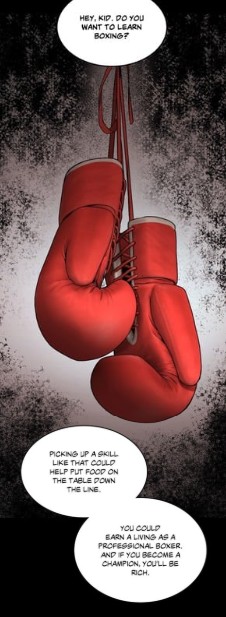 (chapter 72) At home, his father turned dialogue into a bet — a contest of strength where affection was absent and only victory mattered. Later, in front of the police station, the director reproduced the same pattern: invoking the mother not to console, but to provoke, to test, to challenge. In both cases, words became weapons. They did not open space for Jaekyung to speak; they cornered him, forcing him either to resist or to submit. This explains why in season 1, the two protagonists had similar interactions.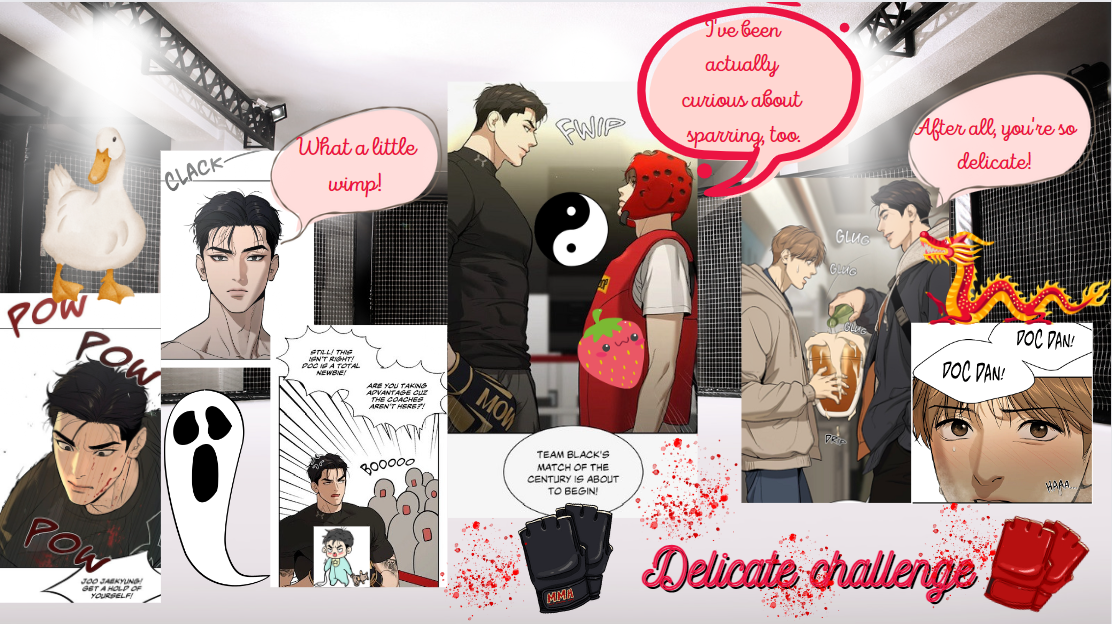
Thus when the boy lashed out and the director struck him, the failure was complete. He had been given a chance to correct the past — to be a guardian rather than a spectator — but instead he repeated the cycle. His discipline came without empathy, his presence without listening. In the end, he did not save the boy from the wrong path; he helped push him further along it, for MFC is strongly intertwined with crimes.
However, the argument followed by the punch seems to have functioned as a wake-up call for the director as well.  (chapter 74) For the first time, he shifted ground and no longer invoked Jaekyung’s parents as warnings; instead, he summoned the memory of his own mother. After everything she had done for him, he insisted, the boy should repay her sacrifice by leading a better life. Yet here again the same logic returns: time weaponized, gratitude demanded, obligation imposed. What might have been a tender remembrance of maternal care was turned into a debt-ledger pressed onto Jaekyung’s shoulders.
  (chapter 74) For him, discipline was always bound to her presence, her food, her care, her silent labor that sustained the gym. By invoking “the mother” as a motivator, he was, in truth, repeating the only model of loyalty and endurance he had ever known. But this was borrowed authority, not Jaekyung’s. What may have given the boy a flicker of purpose in the moment — to endure, to fight “for her sake” —
  (chapter 74) could not last. It was never his voice, never his wound being acknowledged. It was an external script imposed upon him. And so, over time, that imposed motivation faded, eclipsed by the title and the money.
  (chapter 54) The director’s form of guidance could not sustain him; it was external, borrowed, conditional. Therefore, it is not surprising that he was never contacted after the main lead’s departure for Seoul. By then, the director had already become like his own mother — reduced to a memory
  (chapter 70) and nothing more. He neither possessed the boy’s number nor showed the desire to stay connected; worse, he had told him explicitly never to return.
  (chapter 74) Through both words and attitude, he conveyed that their paths were to diverge for good. Yet, this was never truly his intentions. In cutting him off so decisively, he enacted the very separation he condemned later. The boy had taken his words too seriously.
Park Namwook’s Lately
If Hwang Byungchul cloaked his failure under the phrase after everything, Park Namwook disguises his own negligence in the word lately.  (chapter 56)
  (chapter 66) His care always comes after, never before. The word itself reveals his stance: he notices change, but belatedly, when damage is already done. The main lead is now escaping his control. And now, you comprehend why PArk Namwook blamed Joo Jaekyung and slapped him at the hospital.
 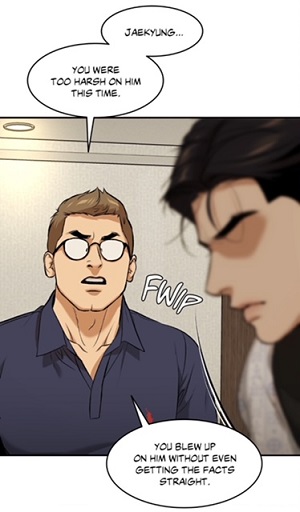 (chapter 52) That way, he could divert attention from the “before and circumstances”. And in season 2, the man hasn’t changed at all. Instead of asking what caused Jaekyung’s crisis, he chides him for straying from the routine — for not showing up at the gym, for being absent.
This exposes the essence of Namwook’s guardianship: reactive, not proactive. He does not anticipate storms; he waits until they break and then demands the champion hold himself together. In this way, his “lately” becomes the twin of “after everything.” Both phrases externalize responsibility. Both erase the speaker’s complicity in the boy’s suffering and downfall. Both subtly suggest that the fault lies with Jaekyung himself  (chapter 52), either for not rising above (after everything) or for drifting from his prescribed path (lately).
But the crucial difference is that the boy no longer remains silent. With Namwook, for the first time, Jaekyung voiced his emotions.  (chapter 52) The slap at the hospital was more than a physical outburst; it was the eruption of long-repressed truth. Where he once swallowed pain in silence for his mother, and later endured fists in silence for his coach, here he answers back. Lately thus marks not only Namwook’s delay but also Jaekyung’s refusal to bear the weight alone anymore.
 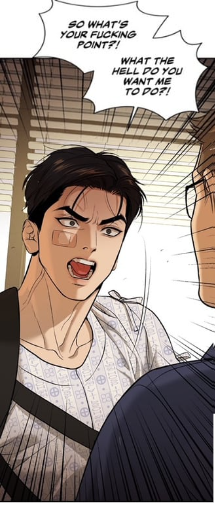 (chapter 52)
The paradox is sharp: Namwook embodies all three guardians at once — the father’s abuse  (chapter 73), the mother’s silence through the cellphone (chapter 74), the director’s passivity. He is their synthesis, a distorted heir to their failures. Like the mother, he has his own family on the side,
 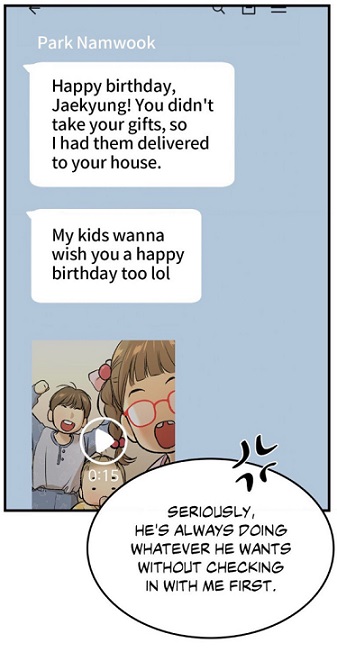 (chapter 45) his true life hidden elsewhere. Like her, he conceals his absence behind a phone call, creating the illusion of presence without truly standing by the boy.
  (chapter 45)
Hwang Byungchul and Park Namwook echo the same blind pattern: they fault the fighter for straying (chapter 52) 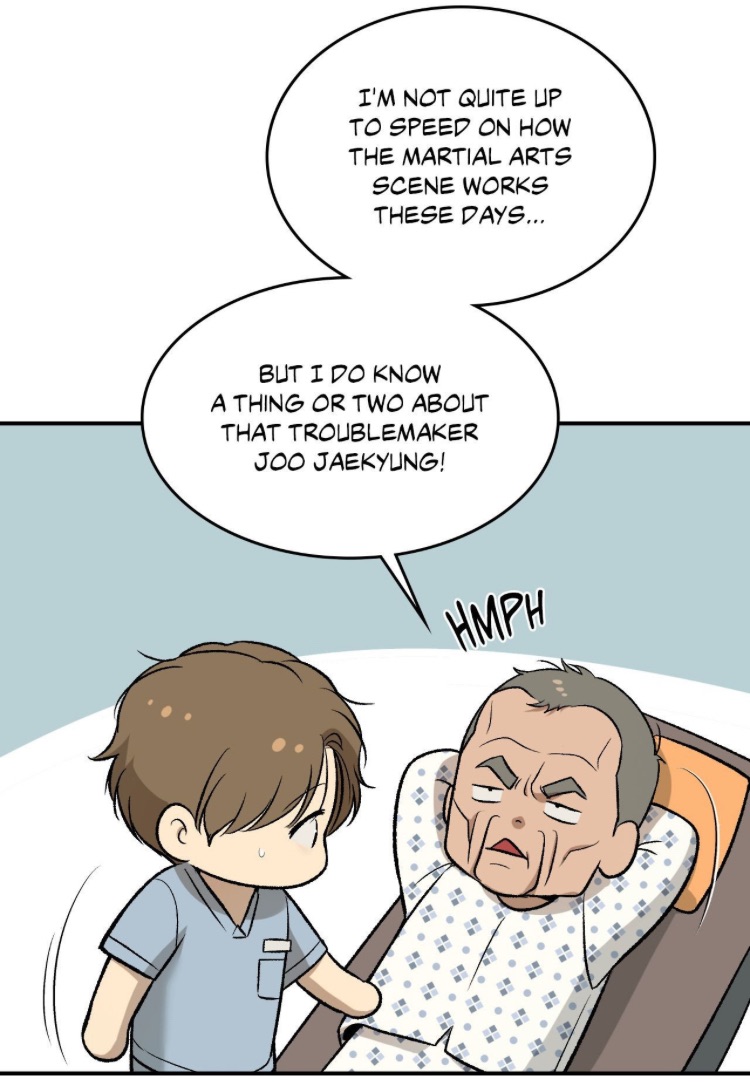 , (chapter 70), while remaining oblivious to the rot within their own world and the medical world. The director accused Joo Jaewoong of “choosing the wrong path,”
  (chapter 74) never admitting that boxing itself was already entangled with the underworld. Likewise, Park Namwook reproached Joo Jaekyung for the mess, while in reality he had been a victim. The incident with the switched spray was reduced to two people: doc Dan and Joo Jaekyung. Funny is that by invoking lately and after all , they have the impression that delayed blame could substitute for real support. Both stand as authorities who issue reprimands only once the harm is irreversible—always too late, always at a remove. In doing so, they preserve the illusion of responsibility while avoiding the real corruption at the core of their institutions. They deny the existence of “victims”. By doing so, both Hwang Byungchul and Park Namwook sustain the illusion that the system itself is clean, and that all fault lies with the individual fighter. In their eyes, there is no exploitation, only bad choices. This explains why the CEO’s fabricated apology disturbed Namwook
  (chapter 69): for the first time, a figure of authority assumed responsibility, however insincerely. What to others looked like shallow PR, to Namwook appeared as a dangerous break with the rule of denial. It highlighted the emptiness of his own guardianship, where reproach replaces protection and victims are erased from the narrative.
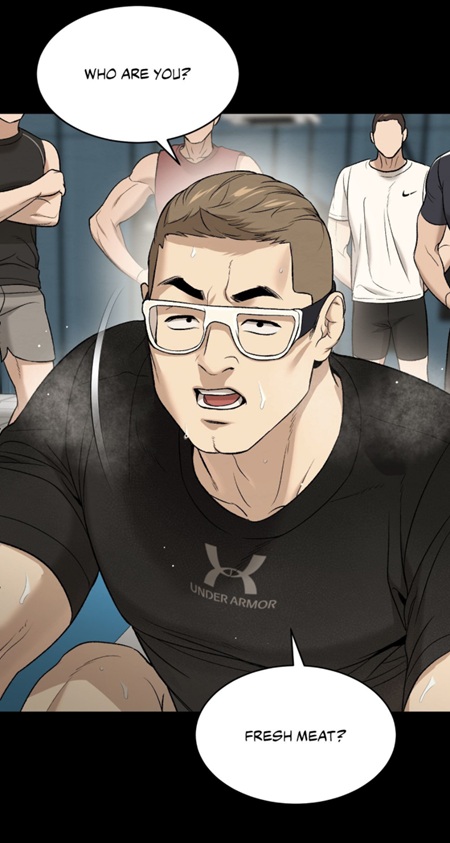
This is why the expression lately becomes so important. With it, the manager pretends to care but really reveals distance. He notices changes but reacts belatedly, hoping the boy will revert to the old champion who endured everything. “Lately” is less concern than crisis delayed, a signal of his failure to respond in time. Instead of seeing the broader corruption of MFC, the scheming of rivals, or the weight of past trauma, Namwook shifts the blame onto the champion himself. The reproach he delivered in the hospital — his version of a slap — confirms this change. For the first time, Joo Jaekyung answered back, voicing emotions rather than swallowing them.Yet unlike them, he faces a Jaekyung who has begun to change. The boy he could once manipulate through reproach and delay now resists, signaling that the cycle of belated guardianship may finally fracture. This means that the very first meeting between Joo Jaekyung and Park Namwook in episode 74 is already announcing the end of their “collaboration.” 8chapter 74) His first words expose his true nature: ruthless and blindness. For him, Joo Jaekyung was just a fresh meat. The latter is not recognized as an individual and human. And if he remained by the manager’s side for many years, by recollecting their past, the main lead should recognize how the “wrestler” started distancing himself from the “boy”. At some point, he got married and got three kids…
Moreover, from the beginning, the manager could never be more than a placeholder, because Jaekyung would not remain his “boy” forever. By recalling their past interaction, the champion can now recognize that Namwook was never truly part of his life. Why? Because after all — the language of the “guardians/adults”— is tied to the night, the moment of deepest loneliness and loss. (chapter 73) (chapter 74) (chapter 74) The night represents what Jaekyung has always been missing: not training, not discipline, but a home where warmth endures after dark. A place where he can expose his vulnerability and be himself! 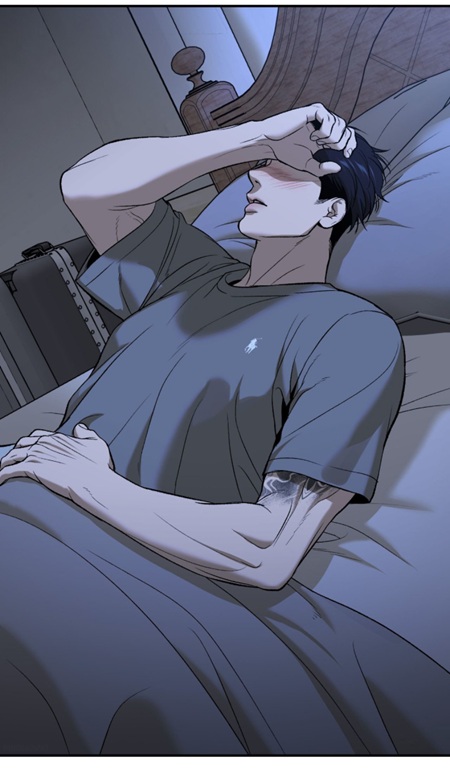 (chapter 74) Honestly, it would be funny, if the champion used the same words than his own mother against the manager (chapter 74) and this would take place because of a cold!! Another possibility is blocking his number. It would close the circle of abandonment, but this time he would be the one in control. The irony is sharp: what once marked him as powerless and discarded becomes a tool of emancipation. Instead of being silenced, Jaekyung would be the one drawing the boundary, declaring that the “family” Namwook pretended to provide was nothing but an illusion.
And if this scene were triggered by something as simple as a cold, the irony deepens. A cold is usually dismissed as trivial, but for Jaekyung it would symbolize care denied. Nobody in his childhood noticed his fevers or his wounds — and Namwook, too, is too far away to notice that he is sick. He has always treated sickness as weakness to be hidden or endured, not as a moment to express love and care.  (chapter 70) Thus the manager is confident that the star can return to the ring. By cutting the manager off in such a moment, Jaekyung would be affirming that he no longer accepts neglect disguised as toughness. Both “directors” are trapping the champion in the chains of the past and the future. For them, there’s no present and as such no happiness or fulfillment. Hence Hwang Byungchul is even bored, when he watched the MFC match.
 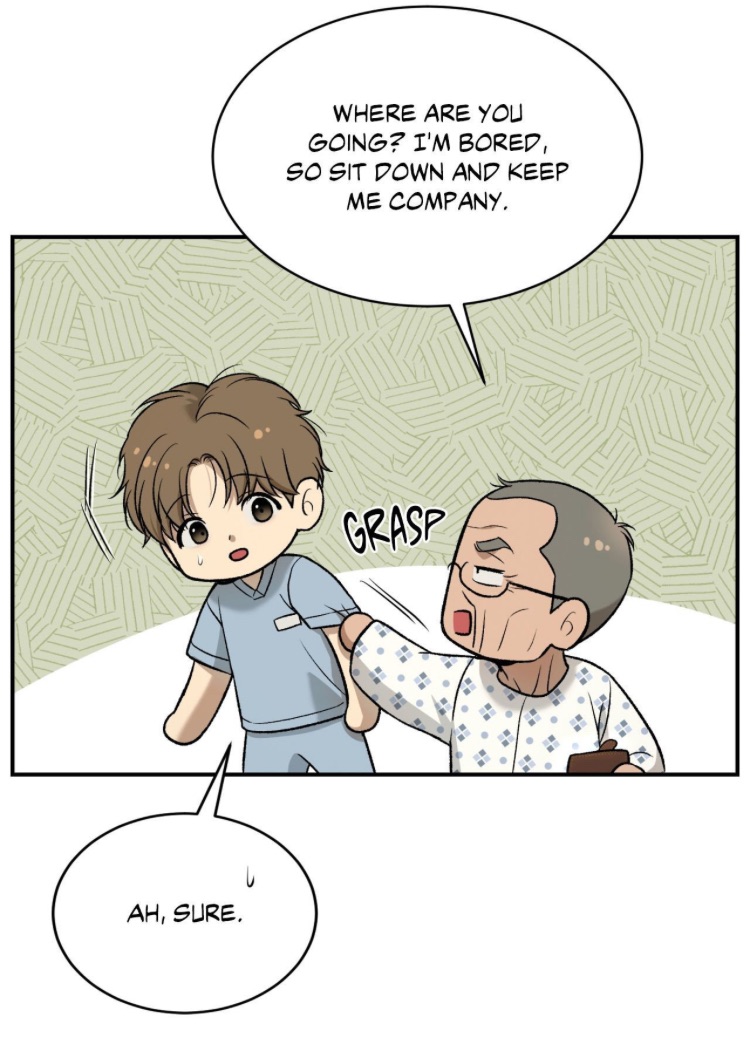 (chapter 71) Deep down, he has been longing for company too. Now, he is finally talking….
 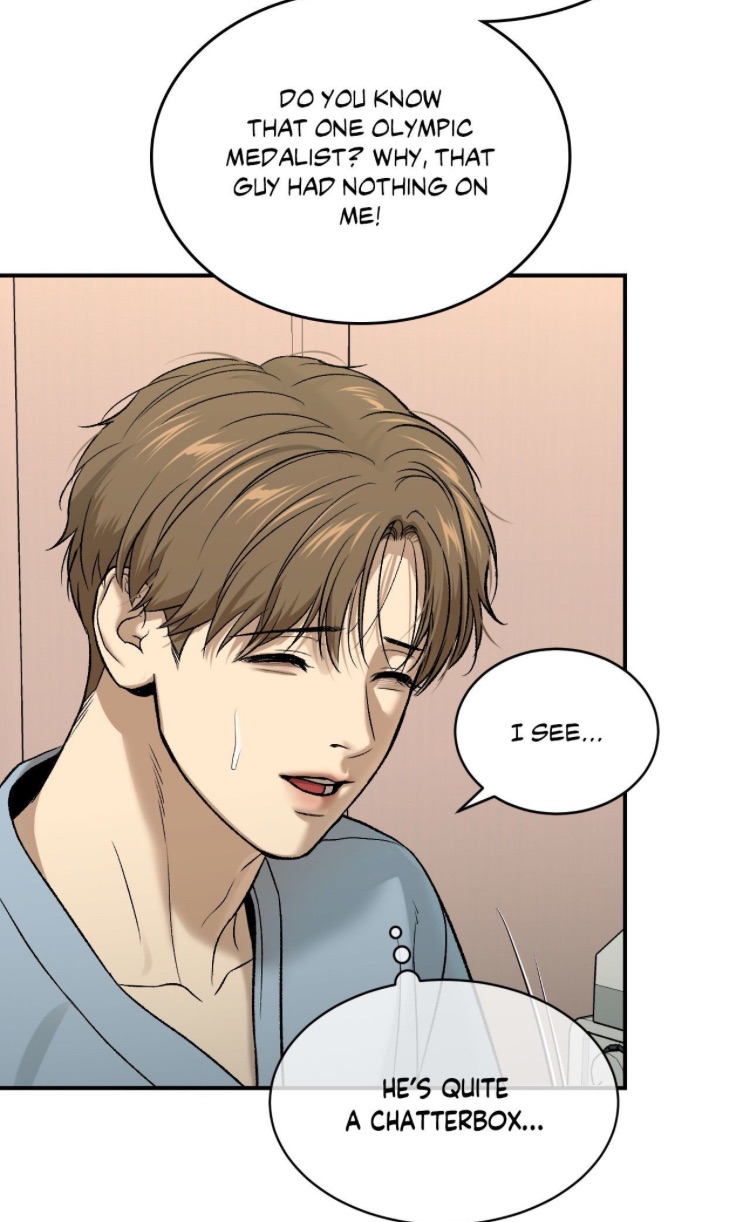 (chapter 70) As you can see, it is never too late… Thus we saw this on the roof of the hospital: a real and intimate conversation between the “guardian” and his pupil:
  (chapter 71) The director has changed!
Shin Okja’s before
And now, you are wondering how the halmoni has been affecting the champion’s life, for the former met the celebrity rather late in her life. If the director’s vocabulary circled around “after everything” and the manager’s around “lately”, the halmoni’s word is “before.” It is the most deceptive of the three, because it does not point to a rupture or a change, but instead dissolves them. Keep in mind what she confided to the main lead on the beach: She presented her grandson as an orphan, right from the start.  (chapter 65) So for someone like Joo JAekyung who suffered from constant betrayals and abandonment, his lover’s childhood must have sounded like a “blessing”. She tells the story of Dan’s life as if he had simply always been without parents. When she recalls, “He grew up without a mom and dad… my heart just breaks for him,” the formulation makes it sound as though nothing was ever lost, nothing was ever taken away — it was simply his condition from the start. Doc Dan didn’t get hurt by his parents through their words or actions.
This is the function of her “before”: to erase abandonment itself. Instead of admitting there was a moment after which Dan was alone, she rewrites the narrative so that he never had parents at all. By doing so, she transforms tragedy into fate. The parents vanish not as agents of betrayal, but as if they never existed. This absolves not only them but also herself: there is no wound to confront, no injustice to name.
This is why her “before” is so insidious. In her version of events, Kim Dan was never abandoned — he was “lucky” to always have her. She erased the loss of his parents by rewriting the story: no trauma, no wound, no victim. Just a boy who had someone by his side. And contrary to Joo JAewoong, the champion’s mother and Hwang Byungchul, she had been gentle and attentive. She had seen him drinking, smoking… she had nagged, but the physical therapist had never listened to her.  (chapter 65) She can appear as the perfect role model in the athlete’s eyes. No wonder why he listened to her and brought doc Dan to a huge hospital in Seoul. But here is the thing….
 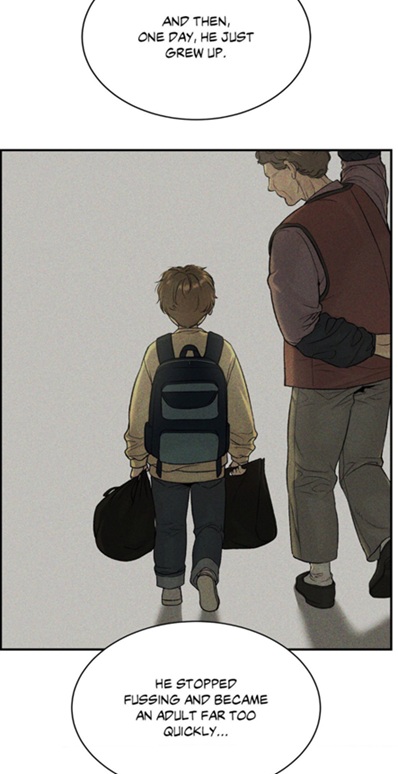 (chapter 65) The grandmother’s narrative culminates in a deceptively simple phrase: “And then, one day, he just grew up.” Unlike after all, which implies endurance, patience, and a long lapse of time, her then one day compresses everything into a brief, almost casual instant. In her telling, there is no slow accumulation of wounds, no process of wear, no history of pain to be endured. The transformation is presented as sudden and natural, as if nothing of significance had preceded it.
This brevity is precisely what makes her before so insidious. She denies the child the depth of his suffering by reducing the entire loss of his parents, his struggles (bullying)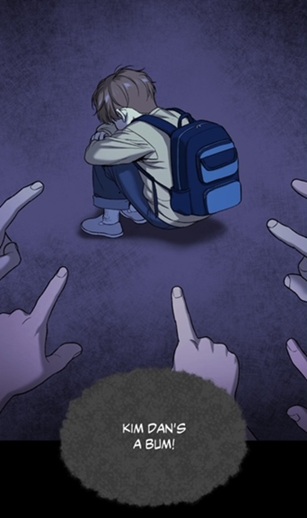 (chapter 57), and his forced maturity to a single, fleeting day. No trauma, no endurance — just inevitability. By collapsing years of hardship into a harmless “day,” she erases both the past and the victim. And now, you can understand why doc Dan is trapped in the present! By erasing the “before” (abandonment, trauma) and trivializing the process of “becoming an adult,” she collapses time into a single, static present. Kim Dan is not allowed a past that hurts (because she erased it), nor a future that could unfold differently (because “he just grew up” is presented as inevitable).
All that remains for him is the present moment of survival — working, enduring, fulfilling duties, without a sense of continuity. He cannot look back with clarity (since the story of his childhood has been rewritten), nor forward with hope (since his adulthood was framed as an instant fait accompli).
That’s why, compared to Joo Jaekyung — who is bound to the past (after all, memory, endurance) — Kim Dan is bound to the present: caught in an eternal now, where nothing really changes. Under this new light, my avid readers can grasp why doc Dan has not confided to his halmoni about the incident with the switched spray. First, the grandmother would remain passive and secondly, this would be erased and even diminished to a single and insignificant moment.
Before I knew it, I was…
With this simple phrase, (chapter 70) Joo Jaekyung crosses the invisible threshold that has defined his entire life. For years, he had existed only under others’ names and authorities: the son of a failed boxer, the mother’s son, the pupil of a coach, the protégé of a manager, the champion of a league. His identity was always tethered to someone else’s frame of reference, never to his own. But this line signals the birth of the I—a voice no longer spoken for, but speaking.
What makes this moment decisive is its anchoring in the present. In the past, the present was unbearable: nights of insomnia, rooms filled with silence, the sense of living only for the next fight or the next insult. The after all had become a synonym for “painful nights”. The guardians around him distorted time itself—“after all” became an endless call for endurance, “then one day” reduced years of suffering into nothing but a passing moment. In reclaiming the present, Jaekyung finally escapes those distortions. The present no longer equals absence, fear, or punishment; it becomes the ground of tenderness, heartbeat, and authentic feeling.
Yet feelings, as Kim Dan reminded him before (ch. 62)— (chapter 62) cannot, by themselves, sustain love. Emotions flare and fade, tied to the immediacy of the present. Thus the mother could break her promise and even lie to him later. What endures is not emotion alone, but the principles that Fromm identified as the essence of love: care, responsibility, knowledge, and respect. These qualities stabilize the fleeting nature of feeling and transform the present into something continuous, something that can grow. In this sense, the teddy bear bridges the gap between “present” and “future”:
 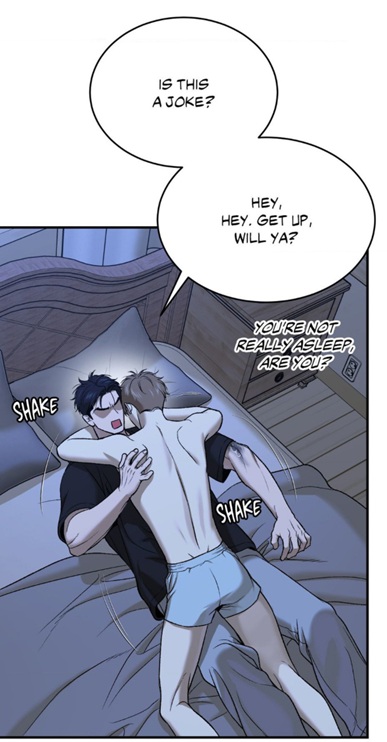 (chapter 65) it transforms the fleeting moment of emotion into a promise of constancy. After all, before it’s too late, what both men longed for was never glory or escape, but a home where they could rest — not alone, but in each other’s arms. By discovering emotions and learning to live in the present, the champion also rediscovers his inner child. His line — “Is this a joke?” — marks that shift, since jokes, like emotions, only exist in the immediacy of the moment. It is only a matter of time, until he laughs because of a joke. By embracing doc Dan like a teddy bear, he allows himself to cling and regress, no longer the wolf or the Emperor but simply a boy seeking warmth. Even his cold becomes symbolic:
 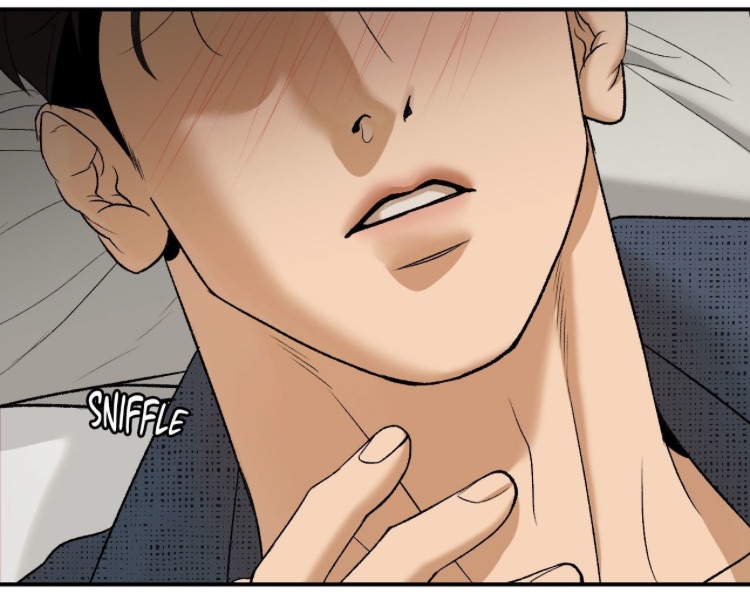 (chapter 70) illness forces him to slow down, to be vulnerable, and to receive care — something denied to him in childhood. In this way, love turns the regression into healing, transforming weakness into the possibility of renewal.
Thus Jaekyung’s story closes the circle: once trapped in the timelines of others, he now inhabits his own time. The “I” he has found is not just the voice of desire, but of choice. Love is no longer an illusion or a prison—no longer tied to debt, silence, or obligation—but a deliberate act that carries him into the future.
PS: I am suspecting that the mother is hiding behind this name: Seo Gichan,  (chapter 5) and if it’s true, then this person would be the second husband.
Feel free to comment. If you have any suggestion for topics or Manhwa, feel free to ask. If you enjoyed reading it, retweet it or push the button like. My Reddit-Instagram-Twitter-Tumblr account is: @bebebisous33. Thanks for reading and for the support, particularly, I would like to thank all the new followers and people recommending my blog.

 Bebebisous33s' analyses in K-Dramaland and Manhwas