

Please support the authors by reading the manhwas on the official websites. I am also using doctor Frost as reference again. This is where you can read the manhwas: Jinx and Doctor Frost. But be aware that the first Manhwa is a mature Yaoi, which means, it is about homosexuality with explicit scenes. Here is the link of the table of contents about Jinx. Here is the link where you can find the table of contents of analyzed manhwas. Here are the links, if you are interested in the first work from Mingwa, BJ Alex, and the previous essay about Jinx “Angels of Death: Shadows versus Serenity (second version)“
It would be great if you could make some donations/sponsoring: Ko-fi.com/bebebisous33 That way, you can support me with “coffee” so that I have the energy to keep examining manhwas. Besides, I need to cover up the expenses for this blog.

1. The prince S and his negative reflection
In the first part, I examined Kim Dan’s mentality more closely. There, I portrayed the physical therapist as someone suffering from Dependent Personality Disorder. Moreover, I underlined that so far, Kim Dan had been raised under the influence of toxic positivity. Therefore he was constantly denying his own pain and struggles. Because of these two characteristics, I came to the following interpretation: the physical therapist was raised like a princess, and by meeting Joo Jaekyung, he got confronted with reality. Hence the argument with his fated partner incited him to change his mind-set. First, he was pushed to acknowledge the existence of his broken heart. Then from that moment on, he would no longer rely on the champion.  (chapter 46) On the other hand, chapter 47 exposes that the doctor didn’t lose his interest and attention towards his boss.
  (chapter 47) This exposes that Kim Dan didn’t choose resent or indifference towards Joo Jaekyung despite the inflicted pain. On the other hand, why did I write that the celebrity is Kim Dan’s reflection? Why is the athlete the doctor’s mirror of truth? It is because Joo Jaekyung embodies his negative reflection: independency and toxic negativity. But what is the latter exactly?
Interesting is that I connected the physical therapist to Dependent Personality Disorder thanks to the case of “Tears of Princess Pyeonggang” from the Manhwa Doctor Frost. When the patient Sihyun met Doctor Frost, the latter explained to her why her last relationship was doomed to failure. How so?  (chapter 31) It is because when the psychologist met the patient with her boyfriend for the first time, he paid attention to his micro-expressions, and more particularly to his mouth. He saw his smirk. Here, I feel the need to give an explanation how these micro-expressions were discovered.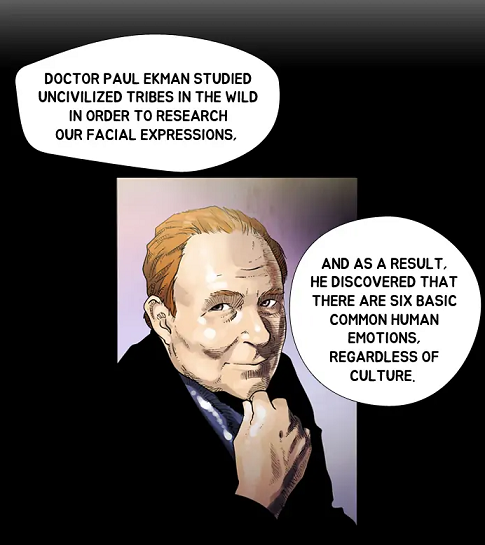
 (chapter 30) As my avid readers can detect, the expression from the boyfriend’s mouth displeased the white-haired psychologist. He could recognize his emotion, though such facial expressions are very short-lived
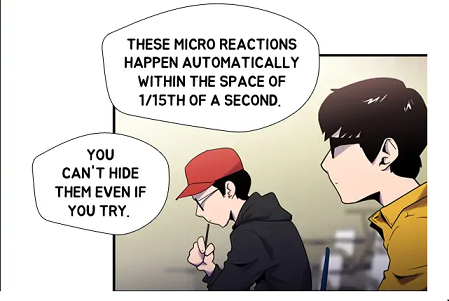 .(chapter 30) So what was the “jerk” feeling, when he was conversing with Sihyun? Cynicism.
 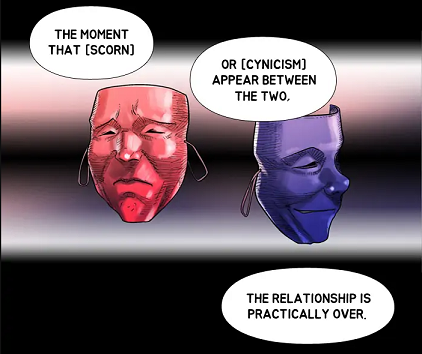 (chapter 31) And the reason why he stated that as soon as cynicism or scorn was present in a relationship, the couple would end up breaking up is because of John Gottham’s observations and conclusions.
 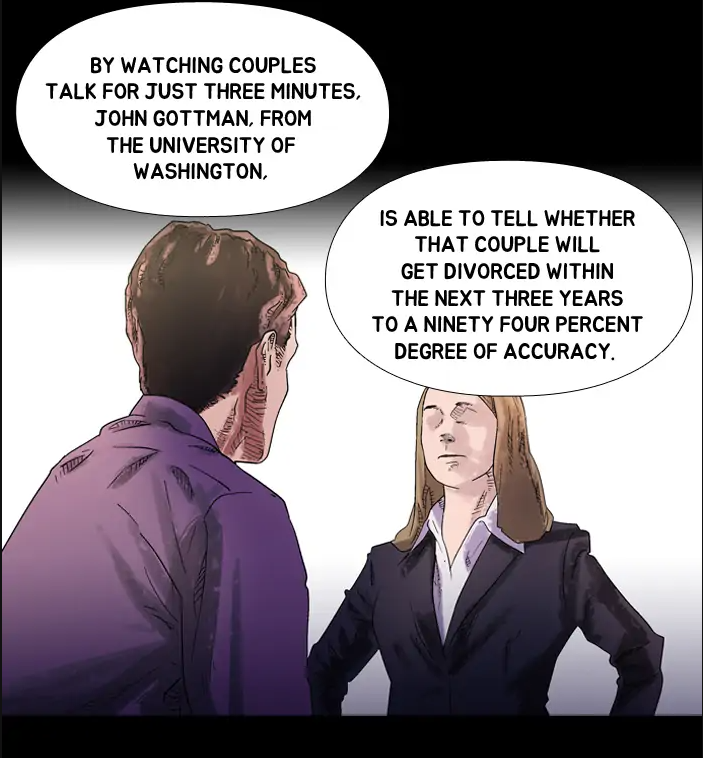 (chapter 31) And now, you are wondering how this is related to Joo Jaekyung. It is because the famous sportsman is full of cynicism
  (chapter 45) We could sense it in different scenes, though I would say that his cynicism was slowly vanishing:
  (chapter 3)
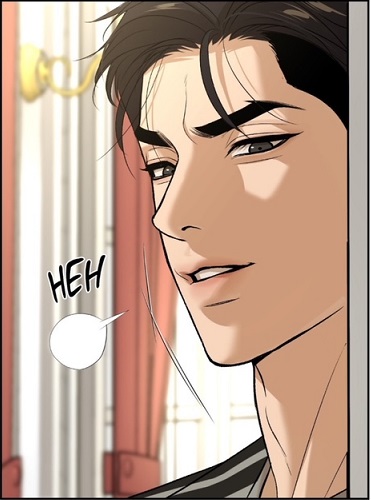 (chapter 40) This is the so-called toxic negativity. Therefore it was to expect that the champion would reject the doctor’s present. He could only doubt the sincerity behind his gesture. How so? Remember how the team desired to celebrate his birthday: a surprise party. They bought a cake…
  (chapter 43) but what happened afterwards? Yosep spoke in the name of the gym’s owner: the latter would pay for the dinner (beef restaurant)
  (chapter 43) So technically, they offered a cheap cake and got in exchange a super expensive dinner. One might say that this was just a joke. But cynical people are taking things very seriously. This is what the champion learned from this experience, the cake in exchange for a super expensive meal … and now imagine that the next morning, he received an „expensive“ present from Kim Dan which was similar to the gifts from fans (exchange of favors). It is normal that he doubted the genuineness from his doctor, not only because of his past experiences, but also because of the parties before. But there exists another reason why he had to refuse the gift: Cynicism… the end of relationship. Thus dating for the athlete was impossible.
  (chapter 45) He is not ready yet. But was it Cynicism exactly and how does it represent a hindrance for a healthy relationship?
2. The cynic dog-wolf
First, I would like to present the philosophy of Cynicism in order to outline certain positive aspects of such a mind-set. The latter, originating in ancient Greece, is often associated with the notion of living a life of simplicity, virtue, and independence. The term “Cynic” comes from the Greek words “kynikos,” meaning “dog-like,” and “kyôn,” meaning “dog.” While the origins of this name are not entirely clear, there are two popular beliefs regarding its origin:
Firstly, it is believed that the Cynics were called dogs because the first Cynic, Antisthenes, began teaching in the Cynosarges gymnasium in Athens. “Cynosarges” translates to “the place of the white dog,” hence the association with canines. Another possible origin for the term “dog” in Cynicism is attributed to Diogenes of Sinope, one of the most famous Cynic philosophers. Diogenes famously lived in a large ceramic jar (known as a “pithos”) and embraced a lifestyle of extreme simplicity and disregard for social conventions. He would reportedly wander the streets of Athens with a lantern in broad daylight, searching for an honest man.
Cynic ethics revolve around the principles of freedom, parrhesia (frank speech or fearless expression), living according to nature, and rejection of societal norms and conventions. Cynics believed that true happiness and virtue could only be attained by living in accordance with nature and rejecting the desires and comforts of society. They often practiced asceticism, eschewing material possessions and living a life of self-sufficiency.
The Cynics emphasized the importance of living in accordance with one’s true nature, rather than conforming to societal expectations or pursuing external desires. They criticized authorities and traditions, they valued self-reliance, resilience, and inner strength, believing that true freedom could only be achieved by freeing oneself from the constraints of society and material wealth. In addition to their rejection of societal norms and conventions, Cynics also challenged the traditional notion of family and social hierarchies. They believed that attachments to family and social status were sources of unnecessary suffering and constraint on individual freedom.
Cynics advocated for a radical form of individualism, promoting self-sufficiency and independence from familial ties and obligations. They viewed the traditional family structure as a hindrance to living a virtuous and authentic life, arguing that it often led to conflicts of interest, attachment to material possessions, and moral compromise. Instead of relying on familial relationships for support and identity, Cynics encouraged individuals to cultivate relationships based on mutual respect and philosophical kinship. They believed that true friendship and community could only be found among those who shared their commitment to living a life of simplicity, virtue, and freedom from societal constraints.
By rejecting the traditional notion of family, Cynics sought to liberate themselves from the expectations and obligations imposed by social norms and hierarchies. They embraced a lifestyle of radical individualism and self-sufficiency, prioritizing personal autonomy and philosophical integrity above all else.
Central to Cynic philosophy was the concept of parrhesia, or fearless expression of truth. Cynics advocated for speaking openly and honestly, even if it meant challenging social norms or offending others. They believed that by speaking truth to power and living authentically, individuals could cultivate inner freedom and achieve true happiness.
In summary, Cynicism is a philosophical school that advocates for living a simple, virtuous life in accordance with nature, free from societal constraints and material desires. It emphasizes the importance of parrhesia, self-sufficiency, and fearless expression of truth as essential elements of living a truly fulfilling and authentic life.
After reading this short presentation, Jinx-philes can sense some similarities between the athlete and this philosophical movement. First, he rejects norms and conventions. He is behaving like an animal, compared to a wolf.  (chapter 7) This approach also gives us an explanation how Joo Jaekyung came to develop such an exhibitionistic sexual behavior: sex in the shower room
 (chapter 8), in the office, in the car, in front of a mirror, in front of Heesung in the living room… Don’t forget that Diogenes would even masturbate in public.
Additionally, he doesn’t see Team Black as “family”, but as a place to learn toughness and endurance. That’s where he could experience “freedom”. Thus his honesty is brutal.  (chapter 46)
 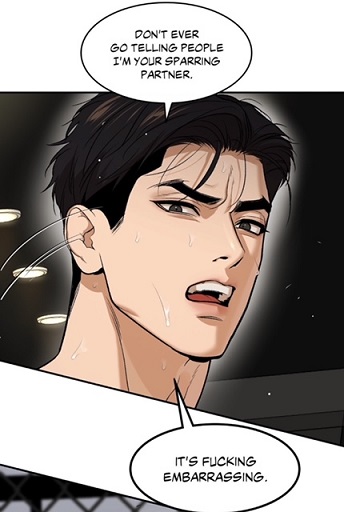 (chapter 46) Consequently, he never tried to get close to his members either. In fact, he is expecting from the staff to follow his lead. Potato could only get rejected with such a request.
  (chapter 23) The latter had to act like a true disciple and follow the champion’s recommendation.
 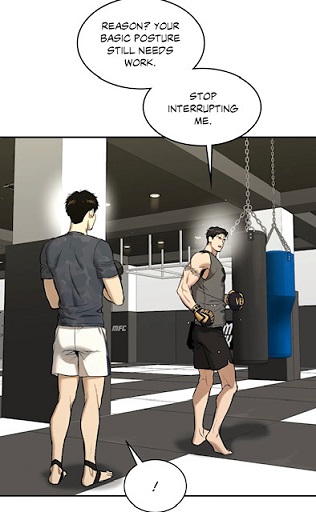 (chapter 23) The gym is like his sacred temple. Yet, the gym is just a simulacre of “nature”, as it is in the middle of Seoul. Therefore I realized why after their argument, Joo Jaekyung avoided the penthouse and Kim Dan in the end.
 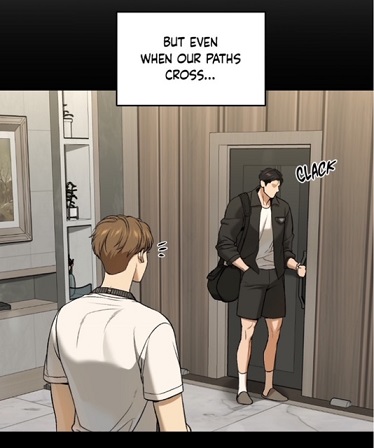 (chapter 47) It is because deep down, the champion sensed that his flat had become a home. He wanted to ensure that the penthouse was still a workplace or a hotel room. Thus he refused to eat the breakfasts prepared from his PT. In his eyes, these meals must have appeared as a violation of his self-imposed discipline. It was more than self-sufficiency. Under this new light, Jinx-philes can grasp why he rejects presents and prefers donating money.
 (chapter 41) He is looking for freedom and self-sufficiency, detached from any material need. This explains why the golden keychain from Kim Dan could only offend him.
  (chapter 45) It symbolized everything he hates: a reminder of wealth, superficiality, attachment, secrecy and silence. It also exposed the huge difference in their mind-set. Kim Dan is not his disciple! He imagined that he had found a kindred spirit, especially after that night:
  (chapter 39) The reason is simple. The champion had finally found someone who accepted his roughness in bed and could match his stamina.
As you can imagine, Joo Jaekyung is naturally a fake Cynic, for he is not giving up on his comfort.  (chapter 10) He is not resigning on designer clothes.
  (chapter 42) His dress room is the evidence of his hypocrisy. He might have encouraged Kim Dan to have sex in “public places”, yet he is still hiding his sexual orientation. Furthermore, his jinx is the evidence of his dishonesty.
 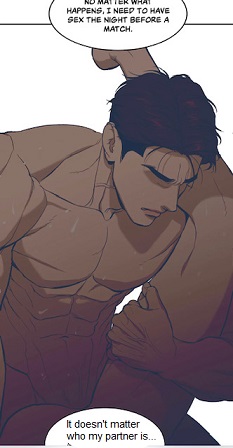 (chapter 2) He needs someone to have sex. This stands in opposition to Diogenes’ masturbation. Besides, he had to pay the goblin and Kim Dan in order to have a sex partner. Hence he needs to be confronted with truth as well. Manhwaworms can grasp the rage from the athlete, when he heard the doctor’s justification:
  (chapter 45) He might advocate autonomy and self-sufficiency, the reality is that he likes luxury. Hence he is unable to live in harmony with nature. This shows that the fighter is in denial and is living in an illusion. Thus he can not find true happiness, for his freedom is not real. He is attached to the gym which is also strongly connected to his career as the Emperor.
  (chapter 46) With his brutal attitude, he is doing himself a disservice. Exactly like Kim Dan, he is even ruining his career and own reputation. Not only he lost 4 athletes (I am including Seonho), but also his loyal admirers are calling him a thug now:
 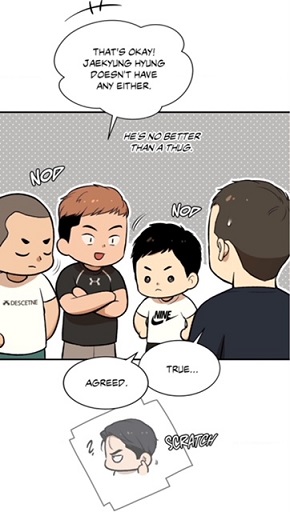 (chapter 47) Even Potato announcing the gradual Coming-Of-Age from his admirer. However, like Dr. Frost mentioned it, humans are social beings.
 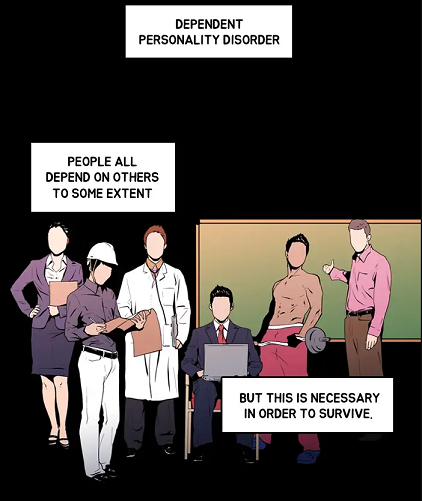 No one can survive on his own. This explicates why Cynics had disciples in the end. And now, you comprehend the role of Kim Dan in Joo Jaekyung’s life. It is to remind him of his true nature. He is a human and not a dog-wolf. Thus the champion recommended his PT to live elsewhere, a sign that he was indeed a human.
  (chapter 10)
Yet, pure cynicism is not the way to find happiness. We have the perfect example with Diogenes:
He was so devoted to living a Cynic way of life that, upon seeing a child drinking water with his hands, he threw away his cup, stating that a child had beaten him to living a simple life. Quoted from https://www.orionphilosophy.com/stoic-blog/the-philosophy-of-cynicism
He had the impression that it was never enough, and the pure action from the child caught him by surprise. He seems to have been obsessed with his theory.
3. The cynic emperor
However, in the first part, I mentioned Cynicism from a psychological perspective. So now, it is time to examine what Cynicism means for psychologists.
Cynicism is a philosophical and psychological attitude characterized by skepticism and a general distrust of the motives and sincerity of others. Cynics tend to view human behavior as selfish and driven by self-interest, often dismissing conventional social norms and values as hypocritical or insincere.
This worldview is rooted in the belief that people act primarily to fulfill their own desires, without genuine concern for others or higher principles. Cynics may adopt a critical and sarcastic demeanor as a defense mechanism against perceived deception and disingenuousness in the world. Read more here: https://mind.help/topic/cynicism/

In other words, they have no trust in human beings. Hence Cynicism is undermining relationships. They judge people as selfish hypocrites. Therefore they use Cynicism as a way to keep people at a certain distance.  (chapter 2) This explicates why the champion was crossing his arms while confronting the goblin. He was on the defensive. That’s how it dawned on me why the celebrity fell in love with Kim Dan at first sight, and why he enjoyed their first night together. The “hamster’s fear” was genuine. His desertion displayed respect towards the celebrity. He was recognizing his strength and power.
 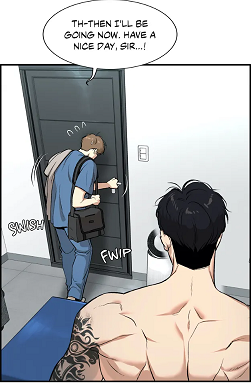 (chapter 1) Then the micro-expressions from Kim Dan exposed his lie
 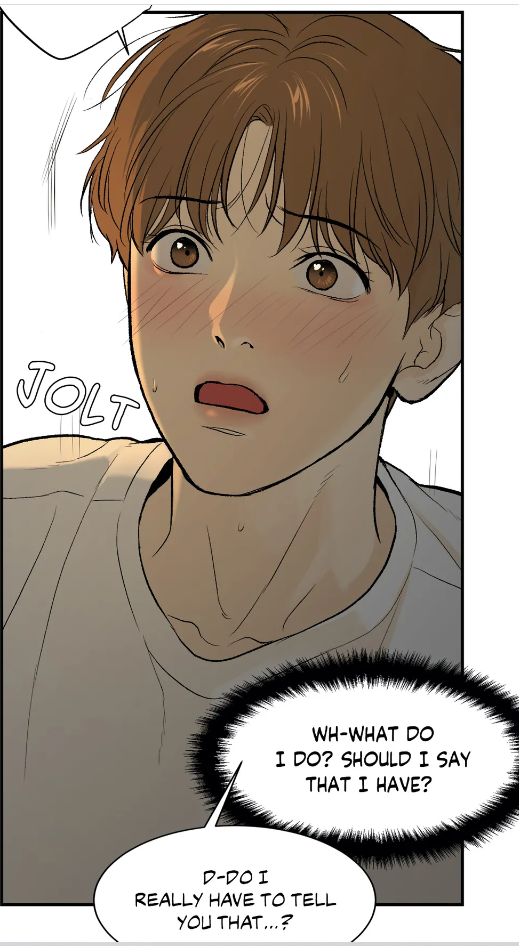 (chapter 3) On the one hand, the champion’s worldview about humans got reinforced, on the other hand the doctor’s deception symbolized his purity. He was a virgin, which was contradicting his “theory” too.
But wait… the title of this essay is Prince S and Emperor and not wolf or dog. Interesting is that the notion of an emperor or ruler could indeed symbolize cynicism, especially in the context of power and authority. Here’s why:
Skepticism and Distrust: Cynicism often involves skepticism and a general distrust of motives and intentions. An emperor or ruler, representing authority, may be associated with a cynical outlook on the motives of others, assuming that actions are driven by self-interest. This explicates why the champion assumed another intention behind the doctor’s present. (chapter 45) He imagined that the doctor had ulterior motives. This explicates why he felt no empathy, when Kim Dan asked for an advance.  (chapter 11) He even looked like a ruler abusing his authority.
 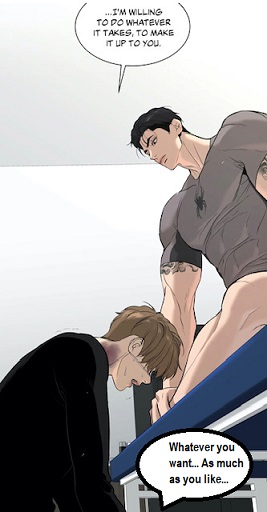 (chapter 11)
Negative Interpretation of Intentions: Cynicism often leads to a negative interpretation of others’ actions. An emperor or ruler, when used symbolically, can represent someone who interprets the actions of others with suspicion, assuming that individuals are motivated primarily by personal gain.
Lack of Idealism: It tends to reject idealism and a positive view of human nature.  (chapter 11) Here, the champion thought that Kim Dan had been gambling. An emperor or ruler, especially one characterized by a lack of idealism, may embody the cynical belief that individuals are primarily driven by self-interest and that altruistic motives are rare. Therefore the celebrity rejects the notion of soulmate
  (chapter 33) or even the idea of friendship
 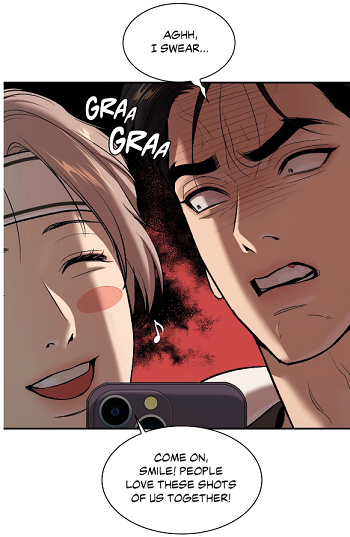 (chapter 30) Heesung was not just taking advantage of his reputation, he was also teasing the sportsman. Joo Jaekyung has such a negative perception of humans.
 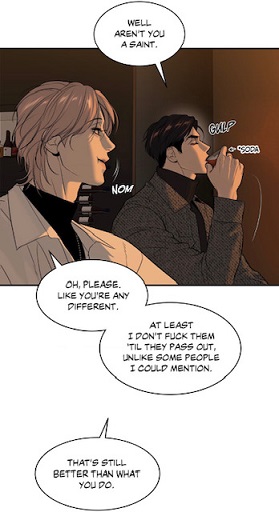 (chapter 33) Hence he looks down on poor people.
  (chapter 10): Gamblers, laziness, no sense of hygiene etc. Consequently, he is not capable to understand the worries from Kim Dan
 (chapter 42), Park Namwook
  (chapter 46) and Jeon Yosep. He feels like they are questioning his success. It was, as if they had other motives. He only relies on himself, he is not “truly” listening to others… though it is not correct. He is getting manipulated by his “counselors”.
 (chapter 36)
Use of Power: An emperor or ruler traditionally holds significant power, and cynicism may be associated with the idea that those in power are inherently self-serving. This aligns with the cynical perspective that individuals act in their own interest, particularly when they hold positions of authority. Thus the protagonist is selfish and abused his position during their first night together: 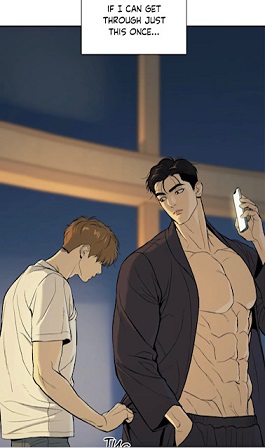 (chapter 2)
On a personal level, cynicism can have several impacts. While it may provide a form of self-protection against exploitation or disappointment, chronic cynicism can also contribute to stress, alienation, chronic pessimism, hopelessness, depression and anxiety. It may inhibit personal relationships and lead to a reduced sense of life satisfaction or happiness. Though the champion is rich and even famous, he is far from being happy, as his negative perception of humans represents a hindrance to his inner freedom and peace of mind. He rejects society, yet he needs people to fight and spare with. And now, you comprehend the origins of his inner passivity and emptiness.  (chapter 26) He is standing in front of a dilemma. Fighting is the expression of nature and self-reliance, yet his fights serve as entertainment for MMA lovers. MMA is strongly intertwined with business and money.

That’s the reason why he was condemned to loneliness, until he met the physical therapist. As time passed on, he had the impression that he had found a kindred spirit, his real new disciple. But the present which was bought in secret ruined everything. What Joo Jaekyung failed to realize is that the golden keychain  (chapter 45) was showing the doctor’s golden heart. He was just judging his lover based on his past experiences and his negative worldview. And this brings me to list the cause for Cynicism:
Experts researching into what causes cynicism point to the following developmental factors:
Negative past experiences or betrayals
Observing dishonesty or hypocrisy in others
Feeling disconnected or disillusioned with society
Perceiving pervasive corruption or unethical behavior
Exposure to cynicism from influential figures or media
Psychological defense mechanism against vulnerability
Lack of trust-building experiences or positive relationships
Personal feelings of powerlessness or lack of control
Cultivation of critical thinking without balance in perspective Read more here: https://mind.help/topic/cynicism/
Manhwaworms can grasp why the athlete is a control-freak, why he hates to expose his vulnerability 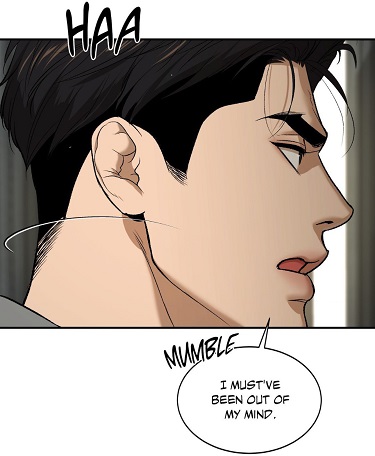 (chapter 45) He fears to be taken advantage. There is no ambiguity that his negative mind-set is definitely influenced by his childhood and family. I would even say that he must have been exposed to emotional blackmail. I came to this hypothesis, because I detected that the champion had been using “blackmail” as MO in order to control Kim Dan.
 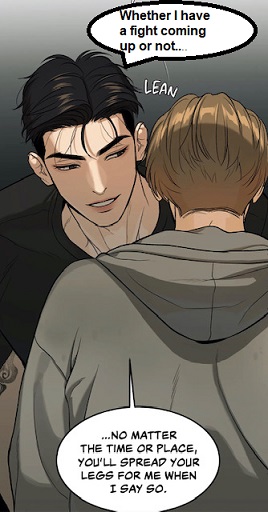 (chapter 6)
Emotional blackmail within parent-child relationships can have particularly damaging effects on the child’s emotional development and well-being. Here’s how emotional blackmail may manifest in the context of a parent raising a child:
- Threats of abandonment or punishment: A parent may use threats of abandonment, punishment, or withdrawal of love to manipulate their child into compliance. For example, a parent might threaten to stop loving their child or to send them away if they do not behave according to the parent’s expectations. This can instill fear and insecurity in the child, leading them to comply with the parent’s demands out of fear of losing their love or approval.
- Guilt-tripping: A parent may use guilt-tripping tactics to make their child feel responsible for the parent’s emotions or actions. For instance, a parent might say things like, “You’re making me so unhappy by not doing what I want,” or “If you really loved me, you would do as I say.” This can create feelings of guilt and shame in the child, causing them to prioritize the parent’s needs and desires over their own.
- Victim-blaming: In some cases, parents may engage in victim-blaming by attributing their negative emotions or behavior to their child’s actions. For example, a parent might blame their child for causing them stress, frustration, or disappointment, even when the child is not at fault. This can lead the child to internalize feelings of guilt and self-blame, eroding their self-esteem and sense of worth.
- Withholding affection or approval: Parents may withhold affection, attention, or approval as a form of punishment or manipulation. For instance, a parent might give their child the silent treatment or withdraw affection when the child fails to meet their expectations or challenges their authority. This can leave the child feeling unloved, unworthy, and desperate for the parent’s validation and approval.
- Emotional manipulation: Emotional blackmail often involves subtle forms of manipulation aimed at undermining the child’s autonomy, self-esteem, and emotional well-being. For example, a parent might use gaslighting techniques to distort the child’s perception of reality or invalidate their feelings and experiences. This can lead the child to doubt themselves and their own emotions, making them more susceptible to the parent’s control and manipulation.
This would explain why Joo Jaekyung fears and even rejects any affection and relationships. This is the lesson he learned through his bad experiences. No attachment and no love is freedom, as love is synonym for vulnerability, That’s why he chose independency, rejection of norms and brutal honesty. He sees relationships as a source of danger and vulnerability. I am quite certain that no one would suspect the emotional abuse from his family. Hence he came to view people as selfish hypocrites. The absence of his “family” for his birthday is the proof of their bad education and “abuse”.
That’s how I realized why Joo Jaekyung chose MMA fighting as career too. It was not just a mere coincidence.  (chapter 26)
Cynical depression may be the most common form of the many-faceted disorder.
It’s usually masked by energizing or sedating coping habits.
Sufferers don’t feel depressed; they use adrenaline to raise their mood or illusions to numb it.
The adrenaline mask takes the form of risky behavior, chronic resentment, anger, chronic envy, dogmatic zealotry, or abuse of loved ones. Sufferers don’t look or feel depressed; the adrenaline militates out of depressed mood. It gives a surge of temporary energy and confidence, manifested in facial expressions and body language. https://www.psychologytoday.com/intl/blog/anger-in-the-age-entitlement/202205/your-partner-may-be-suffering-cynical-depression
The adrenaline from the training and fighting is diverting his attention from his misery. He can mask his depression behind his anger and his fighting. It was to numb his negative thoughts and emotions. Hence he can not “meditate”. But he knows that Kim Dan is fragile, he can not treat him like the others.  (chapter 2) He learned through Cheolmin that he could kill him. This shows his good nature in verity. Hence he resorted to such gestures, when his cynical depression resurfaced:
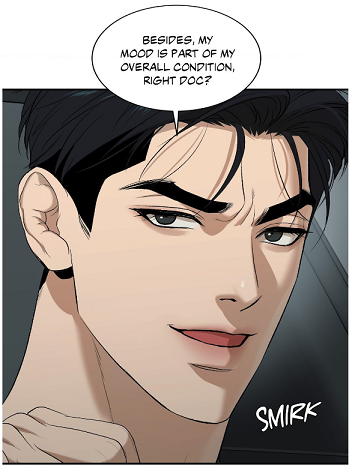 (chapter 32)
  (chapter 36)
  (chapter 37)
  (chapter 45) As you can see, little by little, the champion is learning to control his rage and “cynicism”. During the last argument, he didn’t touch the physical therapist at all. He still allows him to stay at his place and he is shown as caring later.
 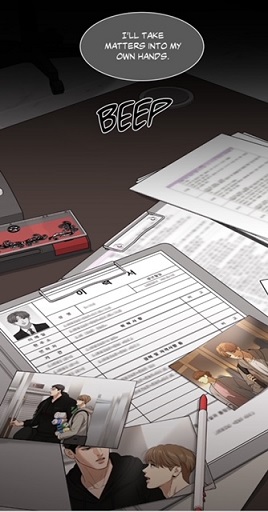 (chapter 46) The irony is that Joo Jaekyung is not recognizing his own transformation. The most obvious evidence for his metamorphosis is the absence of his jealousy towards the doctor.
 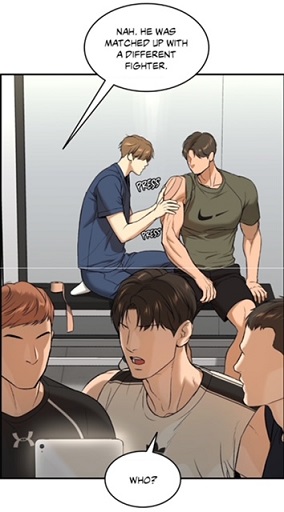 (chapter 47) It shows a certain trust. One might argue about this interpretation. This could be seen as indifference. However, I believe that his altercation with Seonho must have been quite an eye-opening for the champion.
 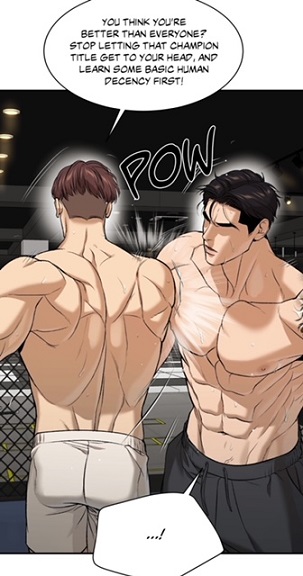 (chapter 46) It is because Kim Dan had not talked back to Joo Jaekyung during their argument. He had accepted his criticism silently contrary to Seonho. Right now, he has the impression that he still has the upper hand, but he couldn’t be more wrong.
Since the champion has such a long mistrust in people, Jinx-philes can grasp why the champion believes in the power of money.  (chapter 26) He has the impression that he can control people, since he is wealthy. Yet, he is not realizing that he can get stabbed because of money as well. We have two perfect examples. Because of the drug incident, the MFC security guys betrayed him, as they protected the organization
 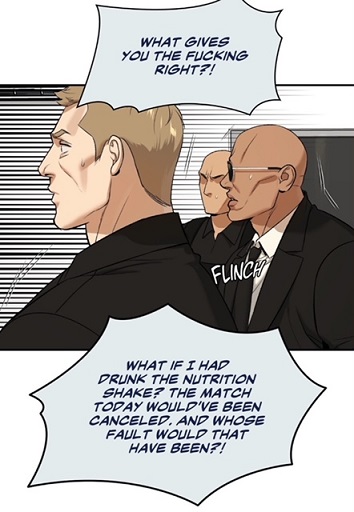 (chapter 40) Then in episode 47, the emperor got manipulated by his so-called loyal advisors.
 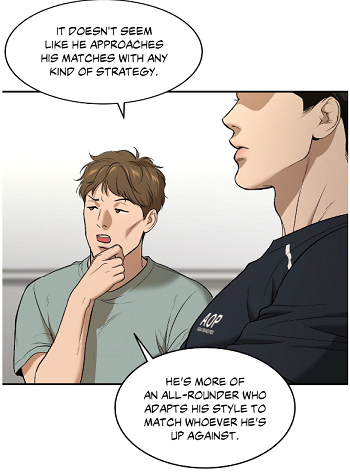 (chapter 47) First, I would like to outline that neither the manager from the Entertainment agency nor his acolyte brought up the underground fighting ring and Baek Junmin’s dubious success.
 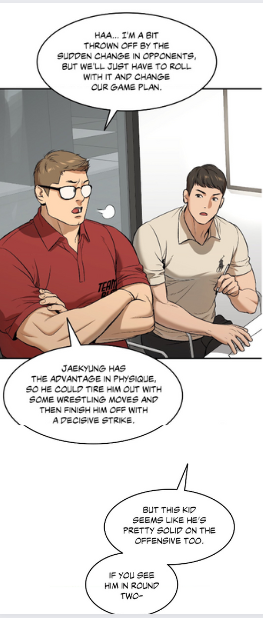 (chapter 47) With their video, they presented him as an average and reliable fighter.
  (chapter 47) Observe the divergence between the advisors’ words and the members’ from Team Black.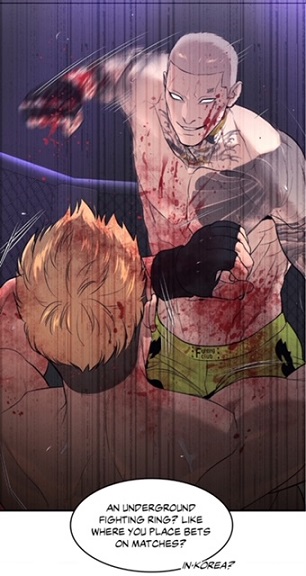
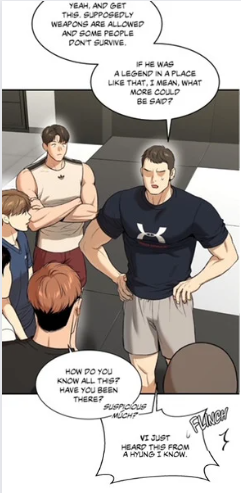 (chapter 47) The latter portrayed Baek Junmin as dangerous, for he would use any mean to win the fight. He doesn’t stand for fairness and responsibility. The champion didn’t get to hear anything about these rumors.
And how can the champion change his cynical view of life? Naturally, through pain… as he needs to be confronted by his fears. Nonetheless, I believe that the halmoni next to Kim Dan has a huge role in his healing as well. Since the latter is so weak and gentle, he doesn’t fear danger from her. 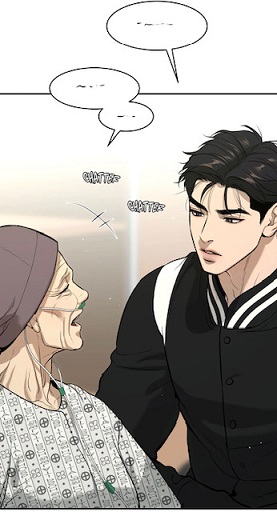 (chapter 21) Moreover, the grandmother’s mortality could serve as a reminder for the champion that he is also a human… just like the others he condemns. Besides, she embodies true selflessness and gratitude. Hence she took the champion’s hand to thank him
 (chapter 22) This is what psychologists recommend to overcome Cynicism:
Practice self-awareness and recognize cynical thoughts and attitudes.
Challenge negative assumptions and beliefs about others’ motives.
Seek support from friends, family, or a therapist to discuss and process emotions.
Engage in activities that foster positive emotions and a sense of well-being.
Cultivate empathy and understanding by considering others’ perspectives.
Focus on building positive and genuine relationships with trustworthy individuals.
Limit exposure to excessively negative media or influences.
Practice gratitude and focus on the positive aspects of life.
Adopt a more balanced and realistic perspective on human behavior.
Set realistic expectations for others while acknowledging imperfections. Read more here: https://mind.help/topic/cynicism/
As you can see, COMPASSION, GRATITUDE, MEDITATION and CONVERSATION play a huge role in changing the mind-set. So far, the couple never shared their fears and own thoughts. They still kept secrets from each other and they didn’t converse a lot. Moreover, the problem was that Kim Dan had acted in secrecy for the gift, which could only reinforce the fighter’s negative disposition. That’s the reason why I believe that Joo Jaekyung needs to learn through a positive experience that not all people are selfish and have ill intentions. He has to discover his own bias through the doctor’s reflection. He needs to receive unconditional love and respect: 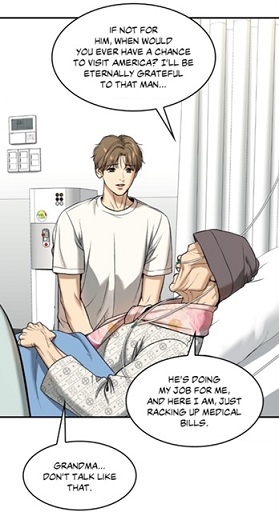 (chapter 41) He never heard her recognition. In addition, until now, Kim Dan spoke in the name of others or didn’t defend his own point. Team Black’s loyalty would be the evidence that it is dangerous to judge people based on prejudices and past experiences. He needs to reflect on his own actions as well. If the Emperor heard “his members”, he would realize that MFC as an organization is corrupted and is even involved with criminality. He is already sensing something, but he can not identify the problem.
 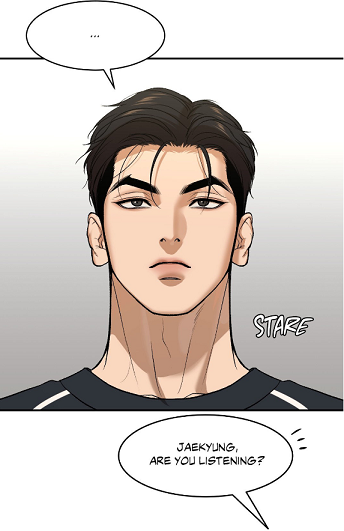 (chapter 47) Should Kim Dan divulge Baek Junmin’s connections to the underground fighting ring or simply show him the message,
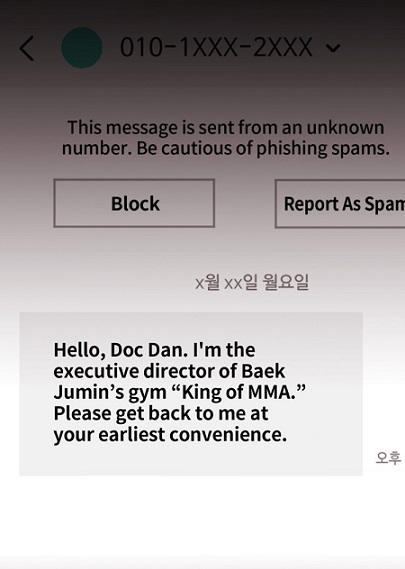 (chapter 47), he would prove his faithfulness and sincerity to the fighter. And the vicious circle would be broken. Though he is broke, he would give up on an opportunity to earn some money easily. To conclude, as long as the champion is still a cynical character, he can not enter a relationship with Kim Dan. For that, he needs to open up his heart and third eye so that he can recognize his partner’s selflessness and honesty. Finally, he will realize that he needs the assistance of others in order to be able to keep his reputation intact (witnesses, supporters). There is no doubt that the Emperor will be badmouthed again.
Feel free to comment. If you have any suggestion for topics or manhwas, feel free to ask. If you enjoyed reading it, retweet it or push the button like. My Reddit-Instagram-Twitter-Tumblr account is: @bebebisous33. Thanks for reading and for the support, particularly, I would like to thank all the new followers and people recommending my blog.

 Bebebisous33s' analyses in K-Dramaland and Manhwas
I definitely agree with the main point of the essay too. Its very evident that Jaekyung is a cynical person who assumes the worst of everyone’s actions in absence of positive evidence to speak for anyone. That is what it looked like to me when he was with Dan in early days- it looked like to me he judged him as an alcoholic and a gambler and the way he called him a bum reinforced this idea for me( the fact he doesn’t know about his blacklisting probably made him think there is something wrong with his professional capacity and that is why he was eking out money to pay off his debts by doing minimum wage work despite being qualified medical professional. However since he is not hiring him primarily for his expertise he didn’t care back then but now he has evidence that Dan is not a bum he is just very debt ridden. The blacklisting knowledge would come later)
Although in some cases being cynical is good since it will help him see the MFC as the negative force in his life that he should have seen coming years ago but the belief in Jinx side-tracked him badly. In a way I don’t think he is a hypocrite for not being completely in with Cynical school of thought since its a speculation but in some way he is hypocrite about cynical nature since even a belief in Jinx is still a belief. It exposes he believes there are forces out there which will grant him luck if he does some rituals to combat the Jinx like force in his life. Usually Cynics are known to not believe anything much especially in higher power of God or luck.
In this essay we can guess that its possible Jaekyung was taken advantage of by people for money and got hurt in the past and hence he doesn’t trust romantic or platonic relationships either. Even though the Gym members are nice to him and even their way to wish him birthday is another ploy to get good food, its still a harmless “exploitation” of the richest member of the Gym who can afford it. Jaekyung doesn’t learn that all their appreciation and admiration is genuine and they wish him well anyway. His past damage must have been deep. I think he was part of the Underground fighting rings as well like Junmin was but he was taken advantage of for money and left to nearly die because of unfair injuries in unfair fights. This is when the people who made him believe in his Jinx came in and “saved” him which I imagine are from the Entertainment/MFC connections , taking advantage of a vulnerable young person ( I imagine he was similar age to Potato) . This gaslighting also made sure Jaekyung might never suspect the people who have hurt him might be connected to him as well for all he knows. Its a wild idea I know but so far that is what is making a “story” so to speak based on what makes Jaekyung feel insecure and triggered
Therefore I also agree that this is a great chance for Kim Dan to show him he cares about him and would be loyal to him despite getting nothing from him that he seems to want ( and it will also help Dan learn he could and should love people without expecting them to stay and free himself from the fear of being alone and lonely) . Unlike what fandom believes its proven fact that you cannot make a person who is already suffering and lashing out but deep down wants comfort and be good a nicer person if the narrative insists on making him suffer further by people abandoning him when he lashes out. It only proves to them what they always feared anyway reinforcing their mentality and further cementing their issues.
LikeLiked by 1 person
Naturally, I don’t think, Mingwa is conveying the message that the champion should give up on his luxury, rather he should share it with others. Notice that he is not inviting people on his own, the only exception were in chapter 18 with Kim Dan and chapter 34. In the second case, it was to show Choi Heesung that he doesn’t desire to share the doctor with others. Kim Dan represents the exception.
LikeLiked by 2 people