
Please support the authors by reading Manhwas on the official websites. This is where you can read the Manhwa: Jinx But be aware that the Manhwa is a mature Yaoi, which means, it is about homosexuality with explicit scenes. Here is the link of the table of contents about Jinx. Here is the link where you can find the table of contents of analyzed Manhwas. Here are the links, if you are interested in the first work from Mingwa, BJ Alex, and the 2 previous essays about Jinx The Red Flags Behind The Flowers and The Painful Mermaid’s Aspiration. This is where you can read the original version The Little Mermaid from Hans Christian Andersen
It would be great if you could make some donations/sponsoring: Ko-fi.com/bebebisous33 That way, you can support me with “coffee” so that I have the energy to keep examining Manhwas. Besides, I need to cover up the expenses for this blog.

Hans Christian Andersen’s The Little Mermaid offers a nuanced exploration of love, conditional relationships, and the struggle for independence. In a previous essay, The Painful Mermaid’s Aspiration, I explored parallels between Andersen’s tale and Jinx, focusing on themes of sacrifice and transformation. However, deeper analysis has revealed additional layers to these parallels, particularly in the dynamics of conditional love, independence, and the pursuit of dreams, which merit further exploration here. The little mermaid’s yearning is expressed poignantly in her dialogue with her grandmother:
“So I shall die,” said the little mermaid, “and as the foam of the sea I shall be driven about never again to hear the music of the waves, or to see the pretty flowers nor the red sun. Is there anything I can do to win an immortal soul?” Quoted from http://hca.gilead.org.il/li_merma.html
This statement reflects the mermaid’s desperation and her willingness to sacrifice everything for her dream. The old woman’s response highlights the impossibility of her aspiration without absolute devotion from the prince:
“No, unless a man were to love you so much that you were more to him than his father or mother; and if all his thoughts and all his love were fixed upon you, and the priest placed his right hand in yours, and he promised to be true to you here and hereafter, then his soul would glide into your body and you would obtain a share in the future happiness of mankind. He would give a soul to you and retain his own as well; but this can never happen.” Quoted from http://hca.gilead.org.il/li_merma.html
The unattainable condition imposed by the old woman underscores the imbalance in the mermaid’s love. The grandmother’s description of the prince’s hypothetical love suggests it would transcend familial bonds, symbolizing a selflessness so profound that he would give a part of himself to his partner. However, this ideal of love contrasts sharply with the mermaid’s sacrifices, as in verity her yearning for the prince is intertwined with her desire for an immortal soul. Her physical attributes, cherished in her own world, are deemed unattractive on land, symbolizing the rejection of her true self. Her conditional love requires her to give up her voice, her identity, and even endure physical pain. This duality—a love that demands selflessness yet is rooted in conditional aspiration—reveals the inherent imbalance in her quest for acceptance and fulfillment. The matriarch’s final remark—“Let us be happy and dart and spring about during the three hundred years that we have to live, which is really quite long enough; after that we can rest ourselves all the better”—urges the mermaid to embrace her current existence rather than chase an impossible dream. However, if she had followed her grandmother’s advice, she wouldn’t have truly lived at all, for she has always been feeling miserable deep inside.
This tension between illusion, aspiration and self-acceptance mirrors the emotional struggles in Jinx, particularly the relationships between Heesung, Potato, and Kim Dan. Moreover, as I delved deeper into the story, I realized that Andersen’s fairy tale carries an even more poignant message: dreams, while often a source of aspiration, can also be illusions that shatter upon collision with harsh realities, like for example the broken promise (“The prince said she should remain with him always“) from the prince who denied the existence of death in their life. This essay builds on these reflections, delving deeper into the overlooked dimensions of dependency and conditional love, revealing how these dynamics shape the characters’ paths toward independence and self-realization. The little mermaid’s yearning, intertwined with her desire for an immortal soul and as such for her own identity, mirrors the characters’ pursuit of validation and dreams, often at the cost of their individuality. Like the mermaid, these characters grapple with the conflict between their dreams and the realities of conditional relationships. While Andersen’s tale portrays the little mermaid’s yearning for the prince and the human world as both a source of aspiration and tragedy, Jinx reinterprets these themes through the lens of modern relationships, showing how dependency and idealization can hinder self-discovery and fulfillment. The parallels extend further, as each character’s journey reveals deeper truths about love, independence, and personal growth.
The Illusion of the Prince: Joo Jaekyung and Potato
In The Little Mermaid, the prince represents the little mermaid’s idealized dream of the human world. However, her love for him is deeply intertwined with her desire for an immortal soul. This duality—a mix of genuine affection and conditional aspiration—renders her relationship with the prince inherently unbalanced.
As the days passed, she loved the prince more fondly, and he loved her as he would love a little child, but it never came into his head to make her his wife; yet, unless he married her, she could not receive an immortal soul; and, on the morning after his marriage with another, she would dissolve into the foam of the sea. Quoted from
Similarly, Joo Jaekyung serves as an illusion in Potato’s life.  (chapter 23) Potato initially admires the champion, aspiring to be like him
 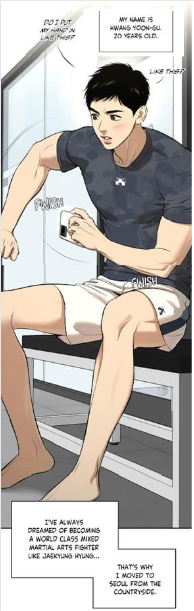 (chapter 23) and dreaming of recognition as his sparring partner.
 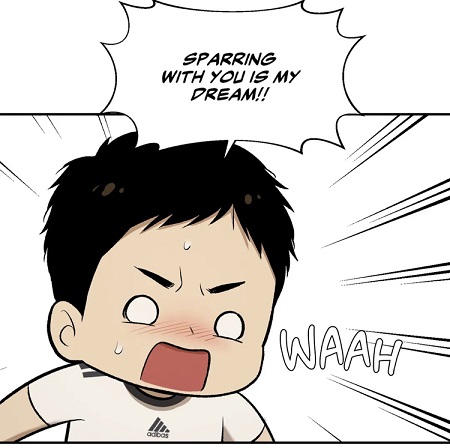 (chapter 23) Joo Jaekyung, much like the prince in Andersen’s story, projects an image that masks the reality of his life. His success, while celebrated, represents years of hard work and immense personal sacrifices. At the gym, Park Namwook undermines these efforts by slapping the athlete
  (chapter 7) and calling him “my boy,”
 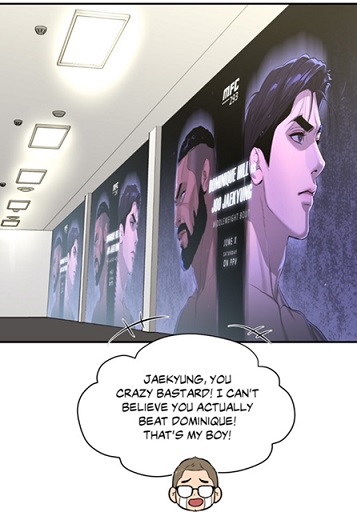 (chapter 40) effectively denying Joo Jaekyung the acknowledgment he deserves for his achievements. Potato is misled by this fabricated image (chapter 23), drawn to the champion’s public persona rather than understanding the struggles beneath it. Moreover, Joo Jaekyung can also be viewed as a mixture of both the prince and the mermaid, embodying the illusion of grandeur while simultaneously bearing the silent pain of sacrifice and transformation. This duality deepens the parallels between Andersen’s tale and Jinx, highlighting the complexities of admiration, dependency, and self-realization. To conclude, this admiration is rooted in superficial qualities: Joo Jaekyung’s public persona, his success, and the light he projects to the world. Furthermore, Potato’s physical differences—his smaller frame and lighter weight category—highlight the impossibility of truly becoming like Joo Jaekyung. (chapter 23) This realization mirrors the little mermaid’s struggle to reconcile her nature as a seductress of the sea with her dream of becoming human.
Potato, drawn to this carefully curated public persona, aspires to emulate the champion 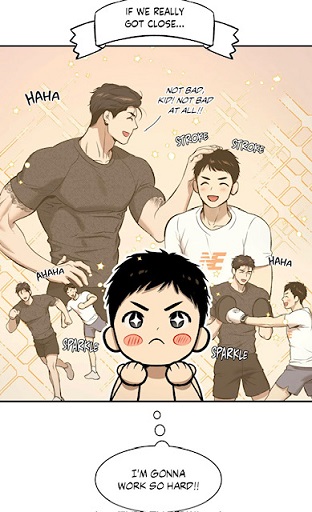 (chapter 23) without understanding the profound struggles beneath his image, failing to perceive Joo Jaekyung’s unhappiness, struggles, and loneliness. Like the image is exposing it, Potato views the athlete as a companion as well whose efforts should serve to keep him company. This dynamic mirrors the little mermaid’s conditional love for the prince, as Potato’s idealization is rooted in his own aspirations rather than genuine understanding. Just as the prince remains oblivious to the mermaid’s sacrifices, Potato overlooks the reality of Joo Jaekyung’s burdens, emphasizing a dependency that hinders true recognition and connection. Once his reputation as a champion is tarnished
 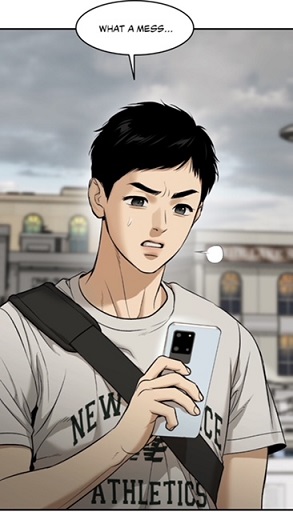 (chapter 52), the amateur starts distancing himself from his former idol. This exposes the fragility of Potato’s dream. Therefore it is not surprising that he starts taking a different path: acting, though I still think, it is temporary. However, behind the glamorous facade of the show business, there exists a dark side as well.
  (chapter 59) Heesung’s fate is similar to the champion’s. Despite his popularity, the actor is deeply unhappy. He feels lonely, for people only know the actor and not the man behind the mask. That’s the reason why he is looking for his soulmate.
  (chapter 33) That’s how I realized why Potato and Heesung are destined to be together. They are both self-centered, dishonest and blind, but more importantly they are chasing after an illusion which is strongly intertwined with immortality. In addition, my avid readers should keep in mind what Potato truly expressed, when Mingwa introduced this “chow chow”.
  (chapter 23). In reality, he wanted to use the athlete as his servant. The closeness
  (chapter 23) he was seeking was self-serving. While the amateur and the actor are searching for the “perfect companion”, the other couple has no expectation from others. They both have no longer any dream or hope. That’s the reason why Kim Dan was putting this vision of Joo Jaekyung behind a veil:
  (chapter 58) He was giving up on his dream expressed in the birthday card,
 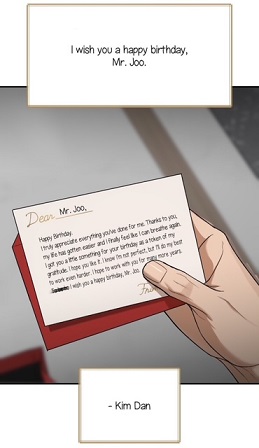 (chapter 55) though I believed that he had another bigger wish, but due to his low self-esteem, he didn’t dare to express it:
 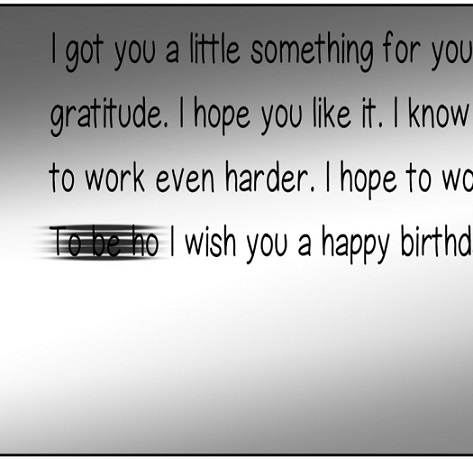 (chapter 55) My newest theory is that he wanted Joo Jaekyung to teach him fighting, but not for himself, but in order to help the fighters and in particular to protect the champion’s body:
 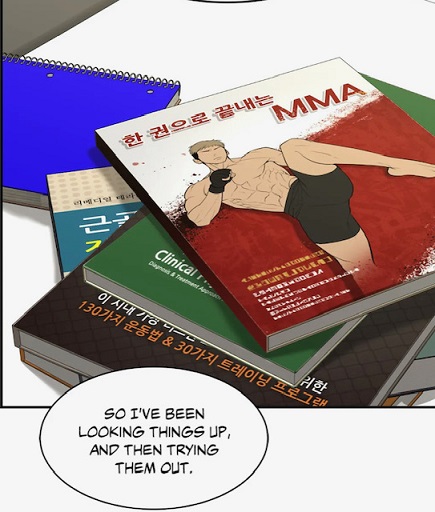 (chapter 25)
 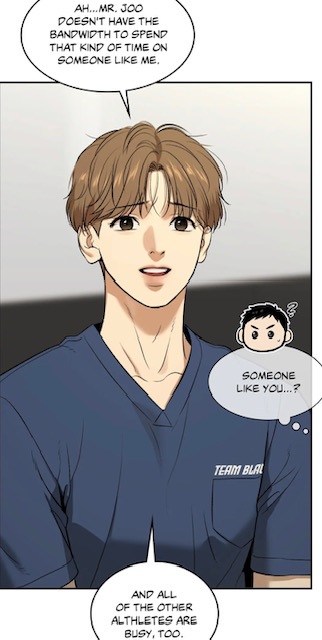 (chapter 25) To develop a training where injuries are minimized. In season 2, it is clear that Joo Jaekyung and Kim Dan have reached the bottom. Both feel empty and exhausted. They were crushed by harsh reality, and they had no one by their side to listen to their pain. Therefore it is not astonishing why the doctor could not confide to the actor and the amateur fighter. They arrived too late.
 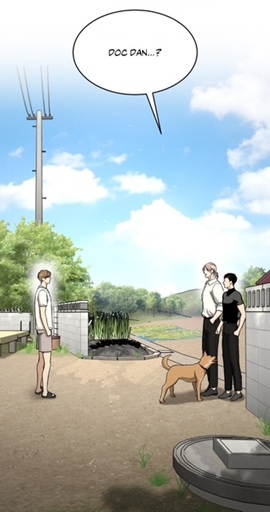 (chapter 58) Their presence definitely diverted the doctor’s attention, lessening his pain.
Initially, Potato views the champion as an infallible figure, a symbol of success and strength. However, his perception begins to shift as he confronts the realities of the MMA world and his own identity. Potato’s loss of innocence is closely tied to the discovery of secrets. In Episode 25,  (chapter 25) he learns the true nature of the relationship between Kim Dan and Joo Jaekyung. This revelation forces him to confront his own repressed feelings, as he unconsciously realizes his attraction to the fighter.
 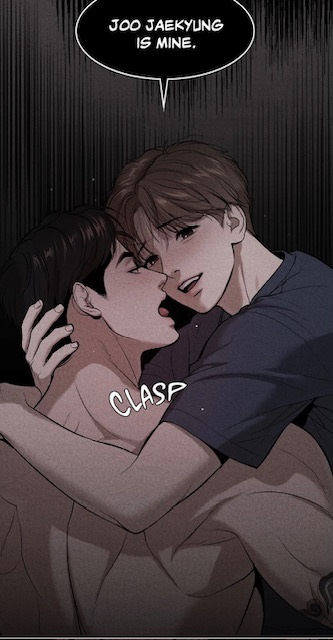 (Chapter 25) Heesung’s involvement further complicates matters, as Potato confesses his love for Joo Jaekyung
  (chapter 35) while simultaneously vowing to sacrifice his feelings for the sake of the couple’s happiness. This act demonstrates Potato’s pure and selfless definition of love,
  (chapter 35) contrasting with the conditional love depicted in Andersen’s tale.
However, Potato’s understanding of love remains naive. He fails to grasp the distinction between love and physical relationships, unaware of the darker realities of one-night stands and transactional connections. (Special episode 1) His discovery of sports gambling 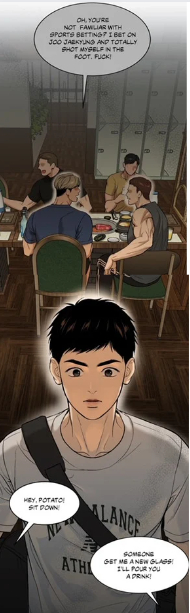 (chapter 52) and the switched spray the
 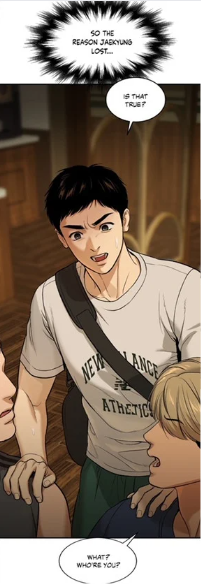 (chapter 52) which is strongly intertwined with the departure of disloyal members from Team Black marks another step in his journey toward disillusionment. While Potato initially views this as an isolated incident, it exposes the broader corruption within the MMA world, including the betrayal, greed, and lack of loyalty that undermine its integrity. While he views himself as loyal to doc Dan and Team Black, for he remained at the gym, his heart was not. He is becoming like his hyungs, Park Namwook and Heesung. In Andersen’s tale, the mermaid’s journey to the sea witch represents a pivotal moment of transformation. By sacrificing her voice and enduring physical pain, she gains entry into the human world, but at the cost of her identity. Similarly, Potato’s journey is marked by painful discoveries that force him to confront uncomfortable truths. Through Kim Dan, he will begin to see his own flaws before he is able to recognize them in those he once trusted.
Heesung and Conditional Love
In the fairy tale, the prince represents the mermaid’s idealized dream—a vision of love and immortality. However, the prince’s love is conditional and superficial. While he admires the mermaid’s devotion and affection, he remains blind to her true identity and sacrifices. This dynamic is epitomized in his words:
“Yes, you are dear to me, for you have the best heart, and you are the most devoted to me; you are like a young maiden whom I once saw, but whom I shall never meet again.”
The prince’s affection is rooted in comparison and memory, not in genuine understanding. And that’s exactly how the actor is thinking. He compared his sex partners to his ideal.
Heesung embodies the concept of conditional love in Jinx. (chapter 33) He can only love his soulmate, and the latter has to be perfect. By seeking perfection in his “soulmate”, he doesn’t realize that he is exposing his darkness and inhumanity. How so? It is because imperfection defines humans. He is denying the existence, error is human. Funny is that his fated partner embodies mistake and imperfection!  (chapter 23)
  (chapter 25)
 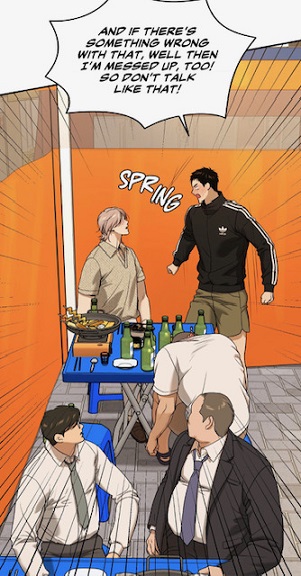 (chapter 35) The latter doesn’t mind breaking social norms by yelling or causing a fight at a restaurant. But let’s return to the actor’s confession at a bar. It’s not surprising that Heesung appears indifferent to the affection of those who cared for him. The last partner was described as too clingy. This means that Heesung places himself as the judge. In addition, it was, as if he was a god destined to live forever. He is forgetting his human condition, just like his partner’s. And that’s exactly how the prince in The Little Mermaid views life.
“The prince said she should remain with him always, […] I must see this beautiful princess; my parents desire it; but they will not oblige me to bring her home as my bride. I cannot love her; she is not like the beautiful maiden in the temple, whom you resemble.” Quoted from http://hca.gilead.org.il/li_merma.html
For him, it looks like death or change don’t exist, though he doesn’t realize that his fate got changed through the intervention of the mermaid. Had she not rescued him, he wouldn’t have been able to have a companion and a wife. His perfect happiness is paid by the efforts and sacrifices of others. He is surrounded by beautiful slaves who have no voice and as such no freedom:
Beautiful female slaves, dressed in silk and gold, stepped forward and sang before the prince and his royal parents: […] The slaves next performed some pretty fairy-like dances, to the sound of beautiful music. Then the little mermaid raised her lovely white arms, stood on the tips of her toes, and glided over the floor, and danced as no one yet had been able to dance. […] The prince said she should remain with him always, and she received permission to sleep at his door, on a velvet cushion. Quoted from http://hca.gilead.org.il/li_merma.html
Through this quote, readers can grasp why the prince didn’t see the mermaid as a possible love interest. She was not his equal socially. Therefore it is not surprising that he chose to have an arranged marriage. I would even add that her voicelessness is viewed as a sign of stupidity, because she can not express her opinion. She is forced to follow the prince’s requests. The prince’s failure to recognize the mermaid’s true nature and the depth of her sacrifices underscores the fragility of dreams built on illusions. His promises, though well-meaning, are symbolic of fleeting ideals that crumble under societal and familial pressures. We could say that in the end, he refuses to become responsible for the mermaid.
And this remark brings me back to Heesung and his relationship with Potato:  (special episode 1) With this request, he implies that he will never become responsible for the amateur fighter. Therefore he can hide his homosexuality behind the young fighter. He used Potato’s mistake to his advantage.
  (special episode 1) By asking Potato to take care of all his needs and desires, Heesung placed himself in a position where he had power and could control Potato. That’s how the young fighter made a dangerous deal with the gumiho. No wonder why his sex role play was a prince interacting with a guard.
 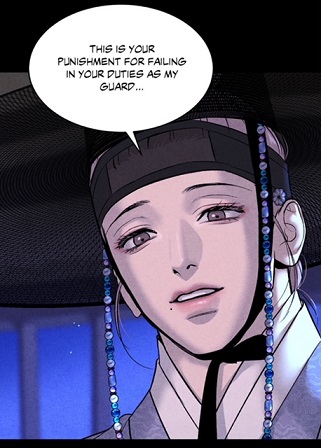 (special episode 2) Hwang Yoon-Gu didn’t realize that by taking responsibility for the actor, he lost his freedom and as such his voice. Is it a coincidence that Mingwa portrayed the young maknae as someone who would raise his voice due to his emotions in the past? (chapter 25) (chapter 35) No, and it becomes obvious that when he is reunited with Kim Dan,
 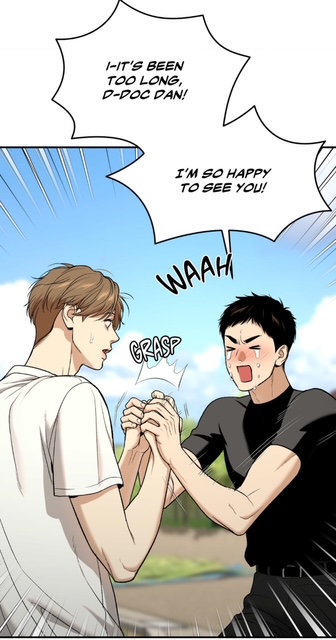 (chapter 58) his behavior is totally different than with the actor:
  (chapter 58) Tears, touch, raising his voice with Kim Dan, but not with the comedian. With the actor, he looks more calm, distant and mature. Heesung’s selfishness is evident in his treatment of Potato, whom he manipulates into becoming an extension of his own image. Hence he is no longer wearing shorts and tee-shirts.
  (chapter 59) One might say that he is gradually elevating Potato’s status through his suggestions.
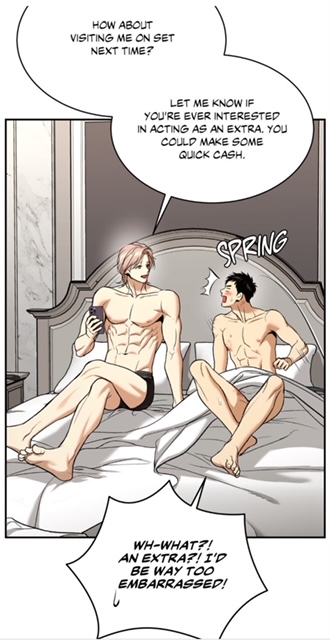 (special episode 2) By encouraging Potato to work as an actor and shaping him into a version of himself, Heesung prioritizes his own desires over Potato’s individuality. He is not asking what Potato’s true dream is. But this was his dream originally: (chapter 23) The problem is that in the past, he was too passive, waiting for the right opportunity.
  (chapter 23) Why? It was due to his low self-esteem.
  (chapter 23) He was not confident enough, for he was the only one with such a weight-category.
And why did the prince suggest Potato to become an extra? On the one hand, it was an easy way to make money, on the other hand, Heesung didn’t want to reveal his true thoughts. He desired a companion by his side too. However, giving him the opportunity to be an extra, Potato could get criticized that he got this acting job through connections. And this reminds me of the little mermaid, who received people’s admiration and the prince’s superficial admiration, yet in reality, the latter had no one by her side to talk about her pain. She was never given a name or a status, her position was defined by her relationship with the prince.
Potato’s growing dependency on Heesung reflects the little mermaid’s surrender of her voice and identity for the prince. In both cases, the individual sacrifices their true self for a love that is neither reciprocal nor nurturing. The prince might have developed an affection for the mermaid, but he never recognized her as worthy to be his bride. I believe that this gesture 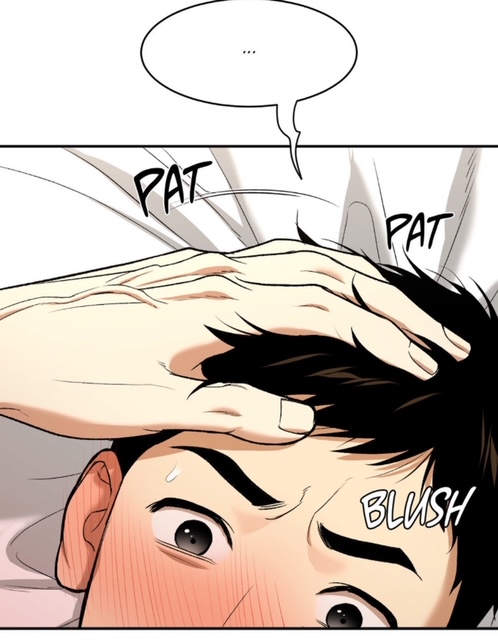 (special episode 2) played a huge influence in Potato’s decision to take the offer as an extra. It was, as if one of his dreams had come true. But is this what he truly wanted?
Heesung’s refusal to wait for Potato after leaving Kim Dan  (chapter 58) underscores his indifference, symbolizing the unbalanced dynamic in their relationship. Like the prince, Heesung offers no genuine commitment, leaving Potato to grapple with the consequences of his dependency. Thus I perceive Potato’s tears
  (chapter 59) as a signal that he is not truly happy.
  (chapter 58) However, this is about to change. Heesung who likes novelty and change is not realizing that his wish is becoming true. The picture with his last work announces the end of his “friendship” with Potato. How so? (chapter 58) The actor chose to become responsible for hiding information from Joo Jaekyung. And he used the mermaid Kim Dan for his decision. He created the impression that he truly cared for the main lead. And how did the prince react to the vanishing of the mermaid? He got caught by surprise and definitely hurt.
“On the ship, in which she had left the prince, there were life and noise; she saw him and his beautiful bride searching for her; sorrowfully they gazed at the pearly foam, as if they knew she had thrown herself into the waves. “ quoted from Quoted from http://hca.gilead.org.il/li_merma.html
He realized too late that his marriage could have consequences with his relationship with the voiceless mermaid. Through her vanishing, she actually revealed her independence and expressed her thoughts. She was not the prince’s eternal companion. She was an independent human being.
Kim Dan: A Mirror to the Little Mermaid
Kim Dan’s experiences parallel the little mermaid’s journey in profound ways. Raised in an environment defined by conditional love, 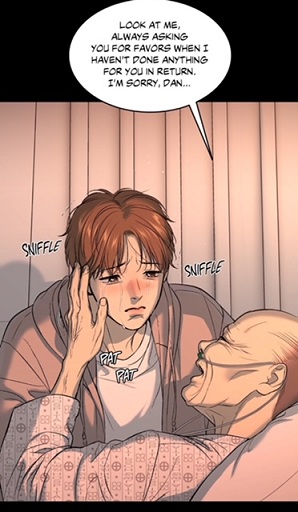 (chapter 53) Kim Dan learned to prioritize the needs of others over his own. His grandmother’s reliance on him mirrored the traditions and expectations imposed on the mermaid by her underwater world. Just as the little mermaid longed for the human world’s light and freedom, Kim Dan yearned for an escape from his oppressive circumstances.
The death of a puppy in Jinx adds another symbolic layer to these parallels. 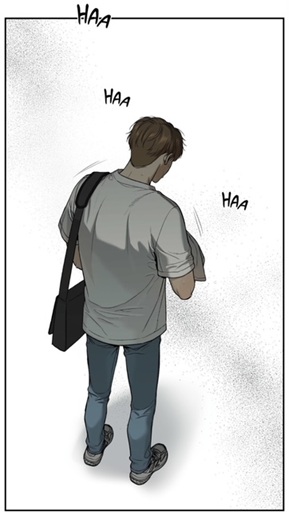 (chapter 59) Kim Dan once referred to Potato as a puppy
  (chapter 29), drawing a connection between the character’s innocence and loyalty.
 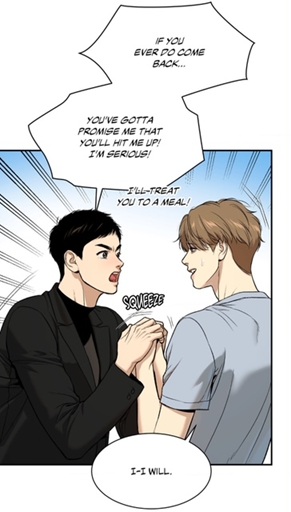 (chapter 59) However, Potato’s departure reveals an underlying superficiality and disloyalty—he merely asks Kim Dan to call him when he visits Seoul, failing to acknowledge the depth of their bond. This reminded me of the prince’s fake promise:
I must travel,” he had said to her; “I must see this beautiful princess; my parents desire it; but they will not oblige me to bring her home as my bride. I cannot love her; she is not like the beautiful maiden in the temple, whom you resemble. If I were forced to choose a bride, I would rather choose you, my dumb foundling, with those expressive eyes.” And then he kissed her rosy mouth, … Quoted from http://hca.gilead.org.il/li_merma.html
He is here actually mimicking Heesung’s behavior who had made a similar offer to the physical therapist:  (chapter 35) This shows that Heesung has long internalized this pattern: assistance will be only given, if he is called. That’s why he has no true friend in the end. He shows no interest in others. But by doing so, he is putting the whole responsibility on his counterpart. Through the actor and the manager’s behavior, the former errand boy has long adopted this pattern. Hence he didn’t call Kim Dan in the end. He waited for a signal from his part. This behavior mirrors the little mermaid’s sisters, who only realize her absence when it is almost too late to act. Similarly, Potato’s casual farewell highlights a betrayal of Kim Dan’s friendship, further emphasizing Potato’s struggle with emotional awareness. That’s why I mentioned above that Potato is about to discover his true nature: he is also a sinner. This growth parallels the biblical narrative of Adam and Eve, where the acquisition of knowledge leads to the loss of innocence. Heesung, like Eve, introduces Potato to a new world of experiences, including his sexual orientation. However, this newfound knowledge comes with its own burdens, as Potato must reconcile his identity with the harsh realities of the world around him.
This raises the following question: what if Potato blocks Heesung’s phone number after their break up or argument?  (chapter 5) Heesung could no longer express his needs and desires.
The death of the puppy, occurring shortly after Potato’s departure, symbolizes a loss of innocence and marks his transition into adulthood. Yoon-Gu is slowly becoming a new version of Joo Jaekyung, he hides things from Oh Daehyun and the other hyungs. He is blinded by the smiles and gentle gestures of the gumiho. Naturally, there’s no doubt that Heesung is falling in love with the maknae. The latter has become the perfect lover, but his dream is about to get crashed by reality.  (chapter 58) Just because one is happy, this doesn’t mean that the other is. For that to happen, communication and honesty are necessary.
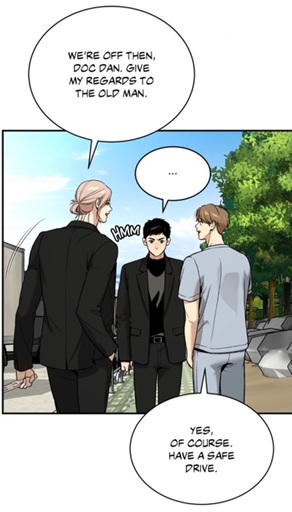 (chapter 59) This event underscores the contrasting paths of Joo Jaekyung and Potato. While Joo Jaekyung is forced to give up his principle of “self-reliance,”
 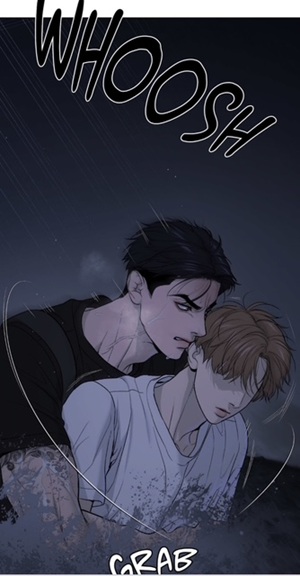 (chapter 59) Potato’s journey is to discover and embrace the principle of “self-reliance” and autonomy. Only when Potato becomes independent in his thoughts and decisions, can he truly help the main couple.
So far, Potato has relied heavily on the guidance and judgment of others: his hyungs, Park Namwook, Yosep, and Heesung. This dependency is evident when contrasting his behavior in episodes 47 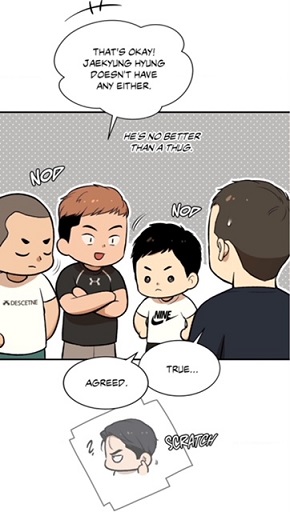 (chapter 47) and 52. Initially, he believed in his hyungs’ description of Joo Jaekyung as a thug, but later he criticized the same fighters for abandoning the athlete
 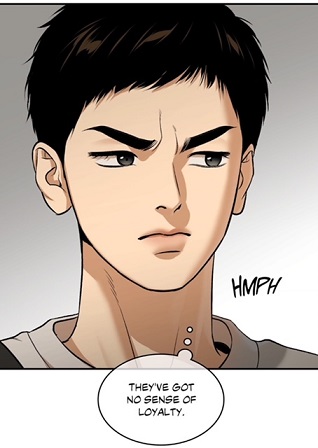 (chapter 52), accusing them of lacking loyalty and dismissing their claim that they had nothing to learn from him. Yet, in episode 52, Potato does not reproach Park Namwook or Yosep for their passivity and naivety,
 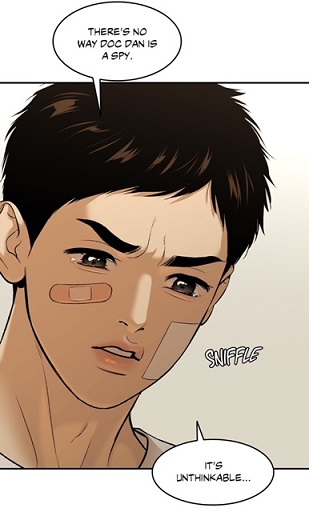 (chapter 52) instead solely blaming Joo Jaekyung for not trusting Kim Dan and causing his departure. This selective criticism reveals that Potato still views the older men as inherently good and fails to recognize his own shortcomings. In this way, he mirrors Park Namwook’s superficial loyalty, further emphasizing his dependence on external validation.
Another significant detail is Potato’s absence during the birthday party, where Park Namwook expressed gratitude toward Kim Dan. 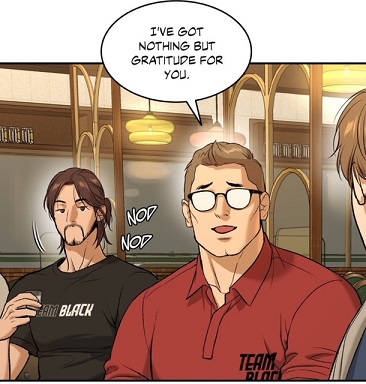 (chapter 43) This absence highlights how Potato has missed key moments of reflection and acknowledgment, which are essential for his growth. It suggests that Potato is destined to detect the flaws in his hyungs—Park Namwook, Yosep and Heesung’s superficiality, passivity, hypocrisy and selfishness—before he can achieve true independence and contribute meaningfully to the lives of Joo Jaekyung and Kim Dan.
Kim Dan’s attentiveness to Potato’s emotions 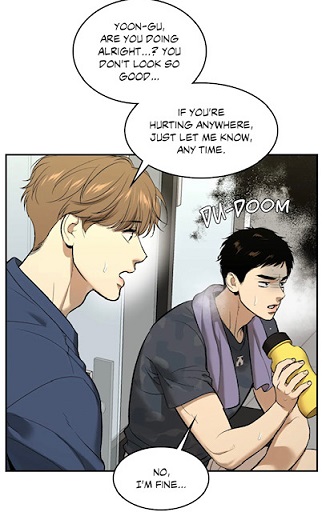 (chapter 23) —taking over his tasks and noticing his unhappiness
 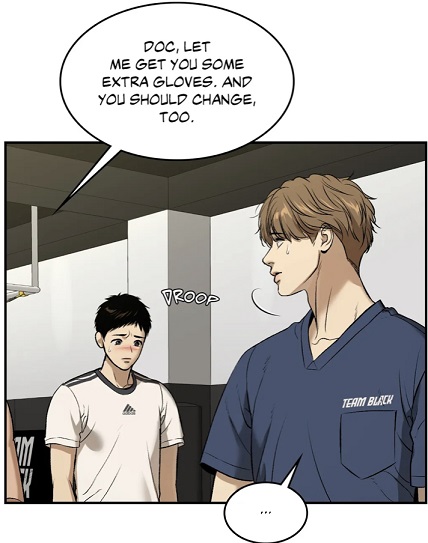 (chapter 25) —demonstrates his capacity for genuine care. This contrasts sharply with Heesung’s selfishness and serves as a reminder of the value of mutual support in relationships. Potato’s potential return to the place where he met Kim Dan could symbolize a rediscovery of authentic connections, marking the beginning of his path toward independence and self-realization.
Independence and Rediscovery of Dreams
The little mermaid’s transformation into a daughter of the air signifies her liberation from heartbreak and physical pain. While she loses the prince, she gains something far more significant: a purpose independent of him. Her ascension represents the realization that true fulfillment comes from within, not from external validation. (chapter 58) Notice that Potato is embarrassed here, a sign that he is not happy. And he has a reason for that. Neither Heesung nor Yoon-Gu are coming out, they are still following social norms which reminds us of the prince’s marriage. Furthermore, when the actor is complimenting on Potato’s acting, the latter doesn’t acknowledge it, because deep down he knows that he got this gig through Heesung and their relationship 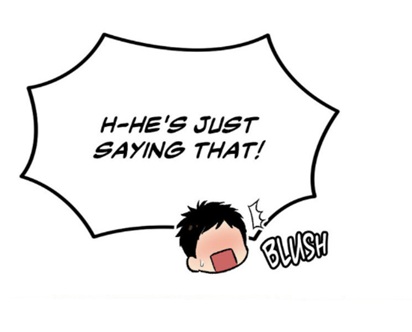 (chapter 58) And like mentioned above, this could become a serious problem for Yoon-Gu. He could be perceived as someone selling himself for a gig. And Heesung is not even realizing the consequences of his intervention and meddling. That’s why it is important for Yoon-Gu to become independent. This lesson resonates with Potato’s journey in Jinx. By recognizing Heesung’s selfishness and breaking free from his influence, Potato has the potential to rediscover his own dreams and individuality. Like Erich Fromm mentioned it, true love is respect, care, knowledge and responsibility. However, Heesung has no idea about the importance of these notions, as everything is evolving around his own needs and dreams.
Besides, if Potato’s dream is still to seek wealth and fame like in the past (chapter 23), he should be aware of the danger in the MMA world, like for example death and bad injuries. Moreover, if we take into consideration that he wanted to be like his role model, it signifies that Yoon-Gu associates fortune and celebrity with happiness which is a real illusion, like Heesung and Joo Jaekyung’s hidden misery and loneliness expose it. But I doubt that the actor ever talked about Yoon-Gu about it.
Finally, Yoon-Gu hasn’t met his former idol yet, so he was not able to see his suffering:  (chapter 58) That’s how it dawned on me that little by little Yoon-Gu had been losing his senses:
  (chapter 31), his smell, then his ears
 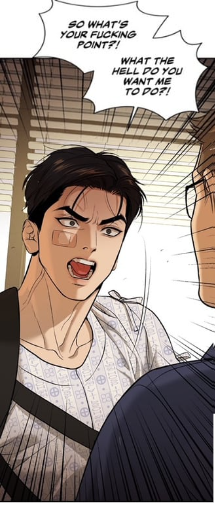 (chapter 52) and finally his eyes:
 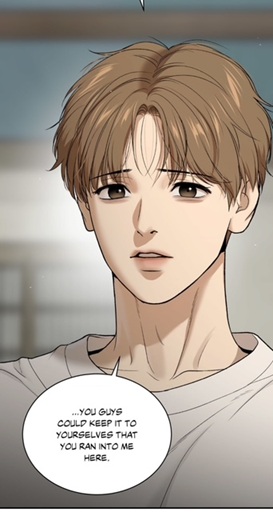 (chapter 58) He forgot the danger coming from Heesung’s words, he could not hear the suffering from the champion due to his bias, and finally he couldn’t see Kim Dan’s distress due to his own feelings and prejudices. We could say that because of the influence from others, he was no longer able to see reality. However, like mentioned before, I sense the return of Potato’s senses in the following panel: (chapter 59) His silence and hesitation shows that he detected something was wrong, but he couldn’t determine that this was related to the actor’s cold and distant goodbye.
In my opinion, Kim Dan has always helped Yoon-Gu to mature and voice his own thoughts and desires. If Potato were to return to the place where he met Kim Dan or learn about Kim Dan’s struggles, it could serve as a pivotal moment in his transformation. Reconnecting with Kim Dan, who genuinely cared for him, might inspire Potato to forge a new path. This could parallel the little mermaid’s ultimate realization that her dreams and identity are separate from the prince.
The Role of the Number Six and Maternal Symbolism
Another significant layer in Andersen’s fairy tale is the little mermaid’s identity as the sixth child. The number six, often associated with motherhood and the heart, highlights her nurturing qualities and selflessness. Her distinctiveness among her siblings is reflected in her unique garden, designed in the shape of the sun, symbolizing her longing for light and individuality. Despite these efforts, no one paid attention to her garden, mirroring how her inner world and emotions were overlooked. And this coincides with my observation about the numbers in Jinx. 6 announces the beginning of a new relationship.
This parallels Kim Dan’s experience in Jinx, where his well-being and emotions are ignored by those around him. He, too, acts as a maternal figure, selflessly caring for others while receiving little in return. This maternal role further emphasizes the weight of his sacrifices and his struggle to be seen as an individual.
The death of the puppy 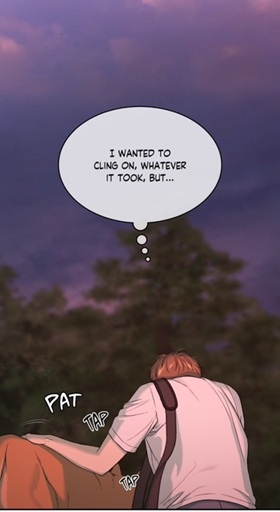 (chapter 59), coinciding with Potato’s departure, underscores this theme of overlooked emotions and unreciprocated care. As Joo Jaekyung reflects on Kim Dan’s comparison of Potato to a puppy, it may catalyze a pivotal shift, prompting him (chapter 29) to adopt a puppy for the doctor’s sake and bring him to their new home.
Conclusion: Love, Dependency, and the Pursuit of Dreams
The Little Mermaid and Jinx both explore the complexities of love, conditional relationships, and the search for independence. Andersen’s tale warns against losing oneself in the pursuit of another’s love, emphasizing the importance of self-discovery and personal growth. In Jinx, these themes are echoed through the dynamics between Heesung, Potato, and Kim Dan. Joo Jaekyung, as an illusionary prince, represents the dangers of idolization, while Heesung’s selfishness highlights the pitfalls of conditional love. Ultimately, the journeys of these characters underscore the importance of finding one’s own voice, embracing individuality, and pursuing dreams on one’s own terms.
Feel free to comment. If you have any suggestion for topics or manhwas, feel free to ask. If you enjoyed reading it, retweet it or push the button like. My Reddit-Instagram-Tumblr-Twitter account is: @bebebisous33. Thanks for reading and for the support, particularly, I would like to thank all the new followers and people recommending my blog.

 Bebebisous33s' analyses in K-Dramaland and Manhwas
This essay made me realize that , Jinx made me realize its about balance. The balance between complete dependency and hyper-independence. Kim Dan and Potato are examples of how complete dependence on others can ruin people’s lives too and always waiting for others to acknowledge their needs while they chose actions over verbal communication can bring them just as much suffering as , people who are hyper-independent like Heesung and Jaekyung( although Heesung is not fearful of communicating his needs, I fear what he thinks are his needs are false and he has a terrible and grandiose self image of himself which makes his chase for the eternal fated partner a difficult task).
It is indeed correct that Potato is too young, hence like a puppy he molds himself into the “image” of his “masters- First his Hyungs in the Gym, then the coaches and the Heesung himself. Dogs become independent from their mothers and are encouraged to explore the world and learn how to hunt or bite after 8 weeks. Before that most handlers consider it ideal for puppies to be adopted for it will be easier to “mold” them into companions their family desires and train them accordingly. Potato is in his proverbial pre-“8 week” age where he has been through so many “masters” and yet no one sticks around and listens to his needs. Potato himself , in hindsight I realized was not an ideal fan of Jaekyung either thanks to the essay. He only cheers for him, like Namwook when he wins or he thinks will win. Beyond that he never defends him as a person or wants to even know about him as a person.
He observes his fighting moves through a phone rather than sit around when Jaekyung practices to learn from him( and there is plenty to lean since Jaekyung, harshly, but fairly metes out criticism , which he also got but he chose to look it as a personal glum affront rather than an opportunity to do better) It shows a dehumanizing aspect of idolizing someone aka their humanity looks like repulsive flaws and ego blinds the admirer from admitting that they dehumanized someone. I cannot help but think its kind of karmic Potato got entangled with someone like Heesung who also in turn dehumanizes by using him like a sex toy, exploiting his genuine and confused emotions for his own needs without guilt. He is also now looking at Kim Dan and asking for help in his own way- this is the only way I can interpret why is he having emotional breakdowns in front of him whenever he is away from Heesung. ( In fact even emulating Kim Dan by trying to cheer him up by giving him a drinks and chicken party, thinking he has guessed his needs. But in reality it was superficial need for distraction. What Dan needed was an intervention and he is not capable of that for he doesn’t know Dan deeply as a friend and Dan doesn’t either- in fact in the latest update he is repelling any effort to foster deeper connection, whispering Potato should visit him in Town instead, or refusing to divulge his inner thoughts, explain himself or even introduce his Grandmother. Potato might as well be a passing stranger in Dan’s life, he is sabotaging even this connection with his own hands)
However, Dan cannot help him, for as the “spoon” theory says, he is out of all the spoons himself and he is using the little left over to chase after the illusion of his Grandmother giving him emotional succor despite years of her having not done that ( once again the unreliable-narrator comes in that is Kim Dan, In his mind Halmoni only looks at him and smiles but in reality we have seen her smiling and looking at others not him especially since she came to Hospice. She is worried enough about him to not smile at him anymore but she can only tell him to become more independent from her move back to city and be among “friends” perhaps. Which Dan in his anxiety coldly rejects , which ironically shows that he has all the internal tools to cut himself from her if he wants to but he is in this toxic, one sided dependent relationship for too long and too deep to stop) . In this way he is very much like the mermaid, chasing after an illusion and hoping his actions would communicate in place of words when in reality that can never happen. We can say Heesung is cold for placing onus on Dan ( and Potato having learned that and also in stress himself) to communicate his needs to Heesung , but it is true that strangers and bare acquaintances cannot be expected to know invisible grievances like passive suicidal-idealization and depression. The fact Jaekyung only by coincidence and sheer need to see to his well being was able to save him only reinforces the need to communicate to people honestly rather than hide inner turmoil for sake of peace.
When the little Mermaid gets the chance to become daughter of the wind, she gets to earn her soul by acts of kindness and help to children, which shows that people can get what they want without expecting feeling from others with silence and unrealistic expectations clouding their relationship. This way Potato and Kim Dan can also gain emotional freedom when they let go of unrealistic illusions about the people they want emotional succor from like how Potato is doing with Heesung( he sees him as his victim and a sincere lovelorn man) and Kim Dan with his Halmoni( he sees her as kind and loving woman who sacrificed her everything when in reality she did what she could and had to do to survive , she very well cannot throw him away , and family bonds shouldn’t exist as monetary obligations. In reality he doesn’t know her as a person and neither does she. This is not what family means and he should stop learning how to be a friend /family/lover by trying to be her pseudo-husband)
LikeLiked by 1 person
Incidentally the essay made me realize that despite what it comes across in the story, perhaps this unmet emotional support is what was killing Kim Dan from the inside all this time. Since he was a child he had used his Halmoni as a replacement friend, aspiration, life companion when he suffered trauma of being abandoned by his parents and rejected by his peers. He never chose to check if he can try again and find other points of life dependency other than his Halmoni for his unmet emotional needs for even Halmoni is not meeting them( and some of them she cannot aka being his life companion, she didn’t ask for that, she is old she cannot live forever and its not healthy). It was only after he was forced to live apart from her due to her hospitalization and then live with Jaekyung that his mind felt better, he felt less depressed and was able to find aspirations for himself aka being a good Physical therapist for Jaekyung.
Its again when his job got terminated and he is then forcing himself to isolate from his Halmoni. The fact she still has some more months to live but Dan has already given up in part of his heart coincides with his excessively , dangerous drinking and his first accidental suicide . Just when Halmoni told him to his face that he should move away from her back to city, she doesn’t need him to attend on her everyday. This is why this essay makes sense to me, that Dan is chasing after an illusion of a person who can magically be his be all and all of all heartache when she cannot be and is not. The plot has to force him to make different choice since he is incapable of it himself( just like the mermaid who saw the reality of it too late and dissolves into foam)
LikeLiked by 2 people