
Please support the authors by reading Manhwas on the official websites. This is where you can read the Manhwa: Jinx But be aware that the Manhwa is a mature Yaoi, which means, it is about homosexuality with explicit scenes. Here is the link of the table of contents about Jinx. Here is the link where you can find the table of contents of analyzed Manhwas. Here are the links, if you are interested in the first work from Mingwa, BJ Alex, and the 2 previous essays about Jinx The Night-Cursed Emperor and After All, Before It’s Too Late
It would be great if you could make some donations/sponsoring: Ko-fi.com/bebebisous33 That way, you can support me with “coffee” so that I have the energy to keep examining Manhwas. Besides, I need to cover up the expenses for this blog.
Introduction The First “I Love You” He Sees
Why isn’t the first champion’s “I love you” spoken, but seen?  (chapter 75) – similar to doc Dan’s reaction in the States:
  (chapter 40)
  (chapter 53)
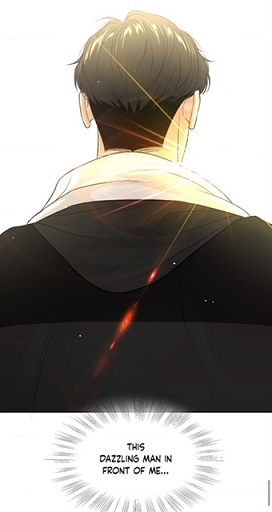
At dawn in ch. 75, Jaekyung first sees a vision: Kim Dan bathed in sunlight, turning back as if to wait for him. The image radiates warmth, inclusion, and patience. (chapter 75) It stands not only for Dan, but for something Jaekyung has never allowed himself: a dream, a future. This makes it the direct opposite of his nightmares. 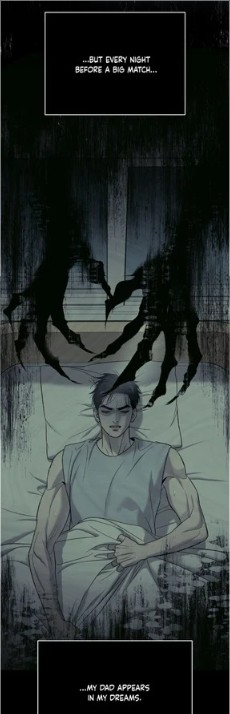 (chapter 75) Where his father’s curses bound him to guilt and the past, Dan’s glow opens the possibility of release (chapter 75), a life that points forward rather than backward.
Then he jolts awake.  (chapter 75) His eyes open after the dream, and they open to the same light. It’s the opposite of every earlier awakening
  (chapter 54) —no gasp for air, no clutching his throat
  (chapter 75), no father’s voice strangling him. This sudden awakening embodies enlightenment. (chapter 75) This is the first time he escapes his inner prison: no strangling, no mockery, no gasping for breath. The sequence is everything: the vision symbolizes true awakening. First comes the dream of the future, then the breath of life.
And what does that light reveal? Not a tidy word, but a re‑ordered world: Dan matters more than winning. (chapter 75) Why? It is because the physical therapist embodies warmth and the present, while the shining championship belt is in reality cold. The Emperor who once fought to silence curses realizes, before he can name it, that the man in that sunlight outranks every belt and roar.  (chapter 75)
And here the director’s advice echoes: “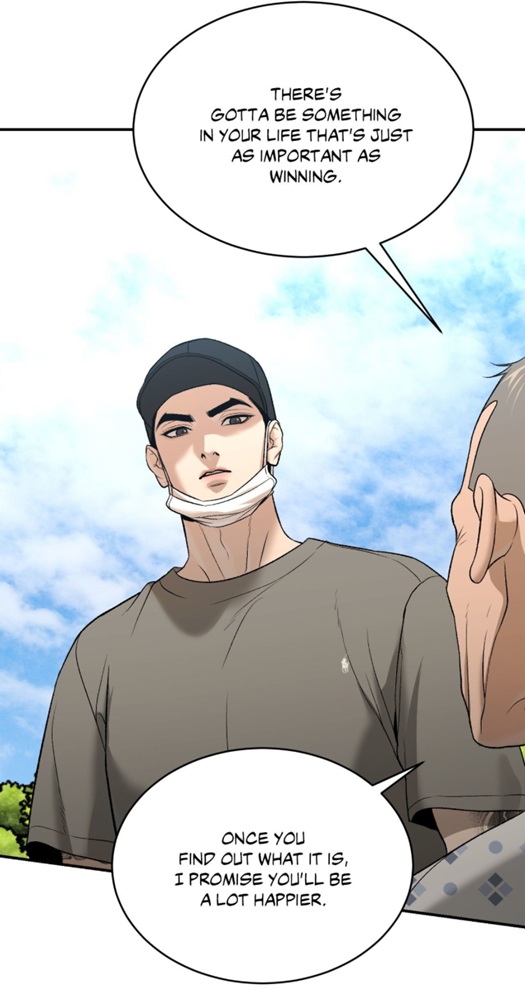 (chapter 75) On the surface, it sounds like a call for balance. In truth, it is a suggestion to find another meaning for his life. And look at the director’s facial expression, when he is talking to his former student: “
 (chapter 75) He is smiling, a sign that the director is enjoying this moment with the “wolf”. He becomes the first person to speak to Jaekyung not about titles, not about survival, but about happiness.
Yet one might wonder: why does Hwang Byungchul not mention Dan directly? It is clear that he has already sensed that both have a deeper relationship than one between a physical therapist and a VIP client.  (chapter 70) He knows the athlete from the past. The latter was attached to people and not to places. Why does he speak of “something” rather than “someone”, if he knows? The lesson is not about fixing a new goal or object to chase, but about discovering how to live differently — how to live happily. (chapter 75) The word something points beyond possession. True fulfillment is not about having a purpose but about sharing a path. Secondly, by remaining vague, he respects his former pupil’s privacy. A parent would never try to pry into the relationship of their child.
  (chapter 65)
This is why the dream immediately answers the advice: (chapter 75) in it, Dan stands not beside the champion but in front of him, waiting. The director spoke of something, but Jaekyung sees someone. Dan becomes the embodiment of a life that could be lived otherwise: a future not chained to victory or guilt, but grounded in companionship, in love.
Yet Jaekyung cannot name it. His reaction trails into ellipses 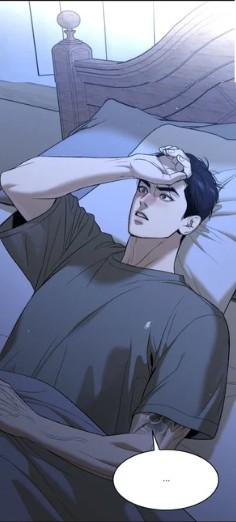 (chapter 75). Even before, he could only mutter to himself this:
 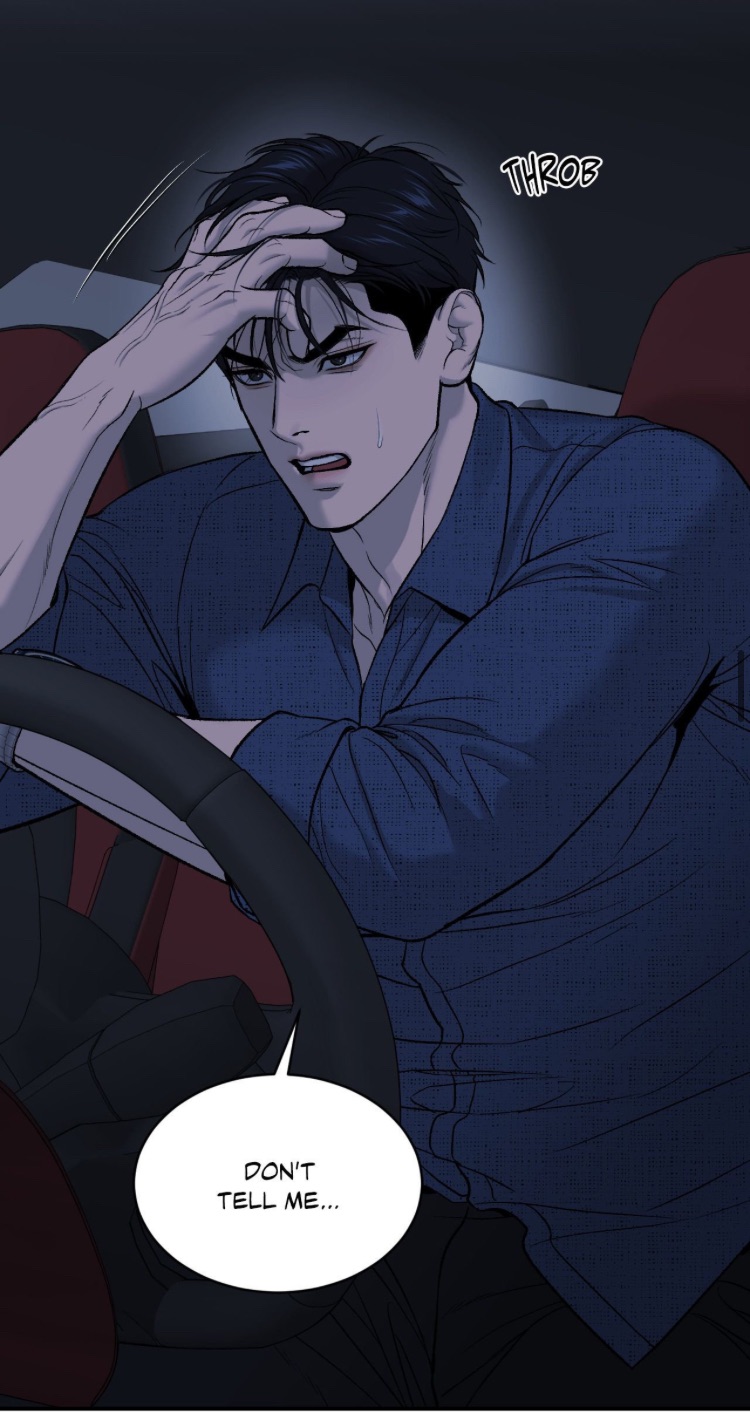 (chapter 70) The negation indicates denial, but observe that he couldn’t even use a noun. He cannot yet translate this vision into words, because he has never heard “I love you” himself
 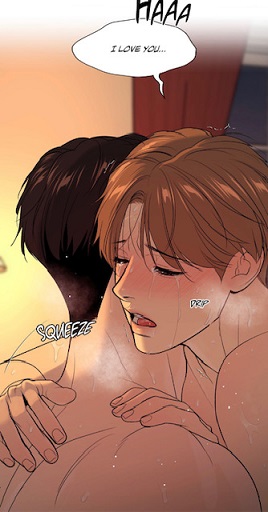 (chapter 39). The only one he heard was diminished to a mistake
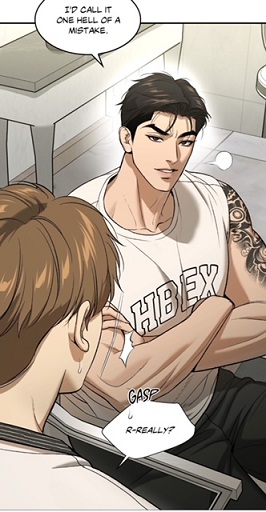 (chapter 41), and doc Dan claims to have no recollection of it. His father left him with mockery, his mother with resignation, his coach in the past with discipline, the grandmother-figures with burdens (honor, debt, favor).
  (chapter 74) No one ever taught him how to say I love you. And so, when Dan appears in his dream, it is not the words that free him but the gaze. (chapter 75) Dan’s expression is neutral, non-judgmental, steady — the exact opposite of the father’s disdain
  (chapter 75) or the mother’s withdrawal.
 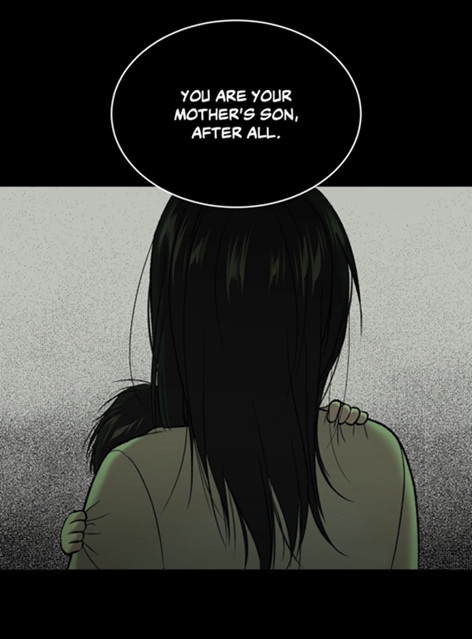 (chapter 73) It does not condemn, it does not demand; it simply waits. The gaze says this: I see you and accept you.
That neutrality is powerful because it creates hope. (chapter 75) For the first time, Jaekyung can imagine stepping toward someone without ridicule or rejection. The dream shows him the path: he doesn’t have to keep running, fighting, or proving — he only has to take a step toward the figure already turned back to include him.
And this is precisely where the director’s wisdom lies. His line (chapter 75) is not prescriptive. He doesn’t dictate what Jaekyung should do, or who he should live for. He gives no ready-made solution, no “perfect answer.” Instead, he hands the responsibility back to him, urging him to search within himself. 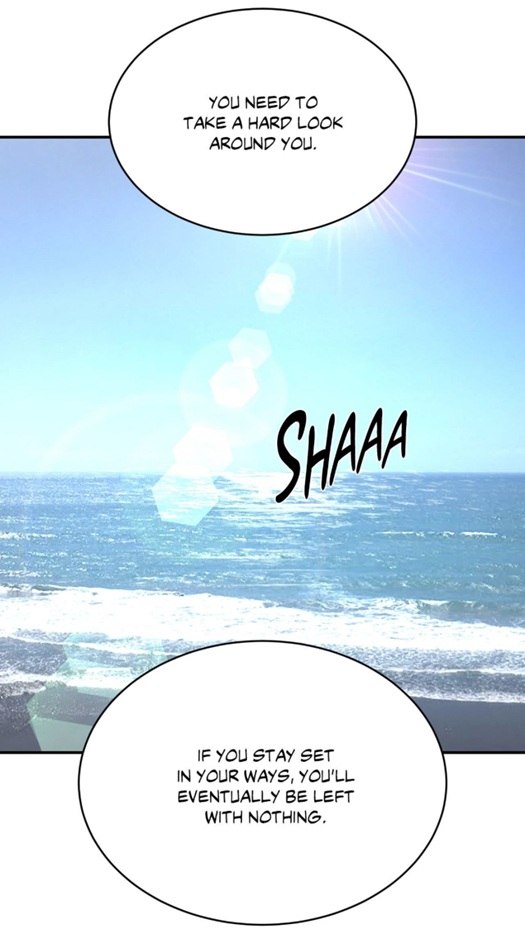 (chapter 75) The openness is what makes it love — it is respect.
This stands in direct opposition to the grandmother’s stance, who knew exactly how to “treat” doc Dan. 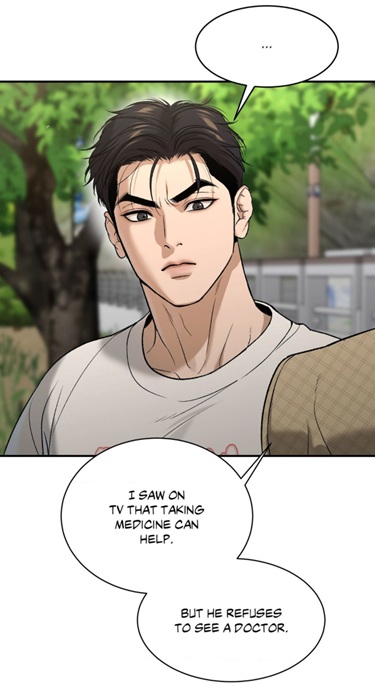 (chapter 65)
 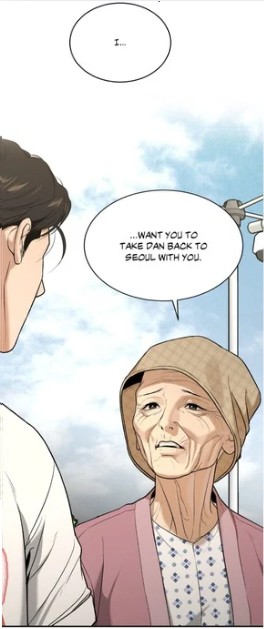 (chapter 65) Halmoni believed she already knew the solution to Dan’s suffering: sacrifice yourself, work hard, pay the debts or make money, endure. She closed off alternatives by imposing her narrative on him. Her love was distorted into certainty. The director, by contrast, recognizes the limit of his role. He has learned (belatedly) that he cannot dictate meaning for someone else. Instead, he tells Jaekyung:
  (chapter 75) His love is expressed through humility — through not knowing. At the same time, his words and facial expression ooze trust and confidence. (chapter 75) In other words, the director becomes not just a critic of Jaekyung’s path, but his first true encourager. He acknowledges that the boy he once failed to guide has grown into a man capable of guiding himself.
The vision is striking for another reason: it is silent. Dan does not speak in the dream; his gaze offers no command, no reassurance, no demand. It simply waits. The silence is not emptiness but invitation — a space Jaekyung must learn to fill. Yet how can he do so? How can a man who has only ever known curses, discipline, or burdens step closer to someone whose presence asks for words he has never spoken?
This is the paradox that chapter 75 exposes. (chapter 75) The dream reveals that Dan matters more than winning, but it also confronts Jaekyung with his greatest weakness: he does not know how to name what he feels, nor how to reach across that silence. To understand why, we must look back — to the voices that shaped him, and to the words that were withheld.
The Language He Never Learned
The vision of Kim Dan in chapter 75 is powerful not only for what it shows, but for what it withholds: it is silent. Dan does not speak, and yet the silence does not feel empty. His gaze is calm, patient, steady — waiting for Jaekyung to make a move. But this is precisely what paralyzes him. (chapter 75) The silence of the dream is an invitation, a space Jaekyung must fill. Yet what words can he offer? How can he step closer, when his whole life has taught him that love is something either cursed, withdrawn, or conditional?
The truth is that Jaekyung never learned the language of love. He never heard the words “I love you” — not from father, not from mother, not from any adult in his orbit. What he inherited instead were fragments of distorted speech: mockery, resignation, silence, punches or fake admiration. Each left him with a gap where affirmation should have been, forcing him to seek recognition through victories, money, and survival.
The Father’s Curse: Mockery Instead of Affirmation
From his father he learned scorn. The drunken insults — 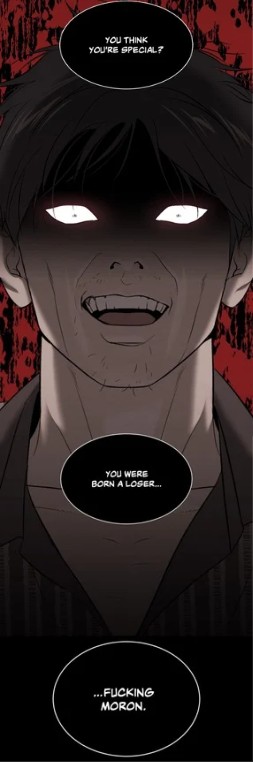 (chapter 73) “You’re a loser”, You’re your mother’s son after all” — (chapter 73) did not simply belittle him; they reshaped his very self-image into a curse. To resemble his mother meant weakness, failure, abandonment. He was nothing except “trash” or a “moron”. Each word struck like a blow, leaving Jaekyung gasping in his nightmares, hearing the taunts repeat like an incantation. His father’s language was not the speech of love but of annihilation, convincing him that he was destined to lose, destined to suffocate, destined to be nothing.
This is why victory became his obsession. 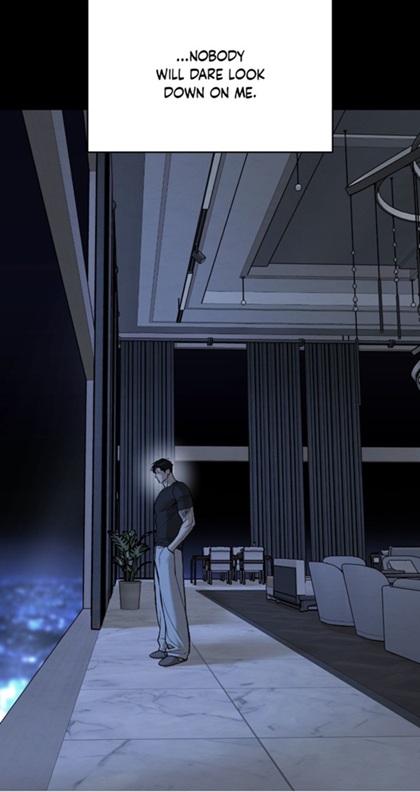 (chapter 75) Each title, each belt, each triumph was a rebuttal to his father’s words. He was not worthless, not doomed. Yet the irony is cruel: in fighting to silence those curses
  (chapter 75), he bound himself ever more tightly to them. Winning never brought peace; it only bought him momentary quiet from the voices in his head. This confession from the main lead confirmed my previous interpretations. First, the main lead had been constantly hearing voices in his head. Secondly, the hamster embodies “sound”, but a different kind: true communication linked to honesty and affection. This explicates why after the couch confession
 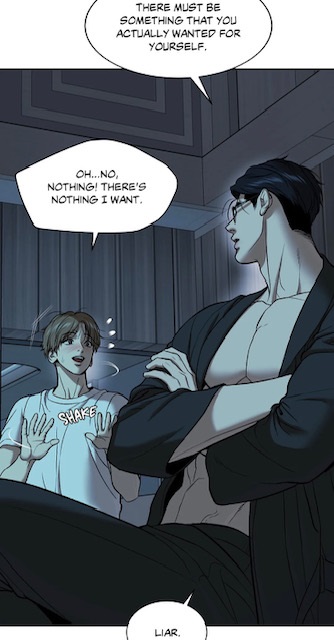 (chapter 29), Joo Jaekyung opened up a little to doc Dan! Thus the next morning, he visited the bathroom where doc Dan was!
 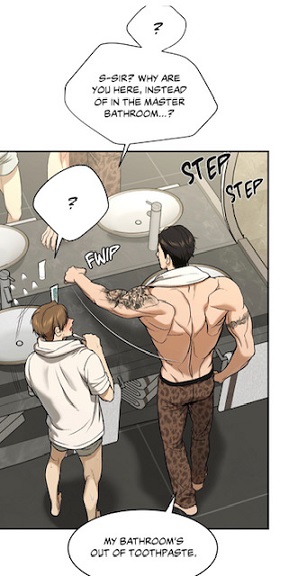 (chapter 30) It was just an excuse to spend more time with his fated partner.
The Mother’s Silence: Love as Need, Not Being
If the father wounded with curses, the mother wounded with silence. (chapter 73) In the father’s recollection, she is shown turned away, holding the child not in tenderness but as a shield against her husband. She does not speak. There is no tap  (chapter 74), no “dear,” no “I love you.” In the father’s memory, she used the child as an excuse to distance herself from her spouse. In that moment, Jaekyung is not a son to be cherished but a barrier in an adult quarrel.
Her last words to him before abandoning him 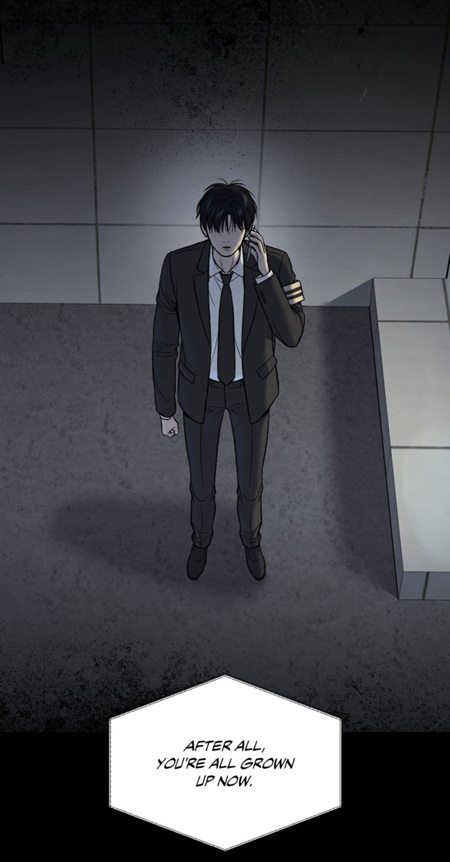 (chapter 75) carry the same cold logic. On the surface, they sound like recognition, even encouragement. But their true meaning is dismissal: you no longer need me. For her, love equaled dependency. Once her role as provider was no longer necessary, she withdrew.
Later, with her remarriage, we see her repeat the same pattern. (chapter 74) With her new child, she suddenly has gentle taps, toys, and the affectionate “dear.” But these are not signs of transformation — they are repetitions. Her “love” remains bound to function. This child is valuable because he secures her place, her role, her new family. He is an anchor of stability, not a being affirmed in his own right. According to me, she lives through others.
Here Erich Fromm’s distinction between having and being illuminates her behavior. [For more read the essay “The Art Of Loving”– locked] She cannot love by being present with another; she can only love by having something to hold onto — a husband, a child, a household. For Jaekyung, this meant that his very existence was never affirmed. When he outgrew dependency, he ceased to “count.” He embodied a failure in her life, something she wanted to erase. Under this light, it becomes comprehensible why Kim Dan challenged the champion in the hotel room: 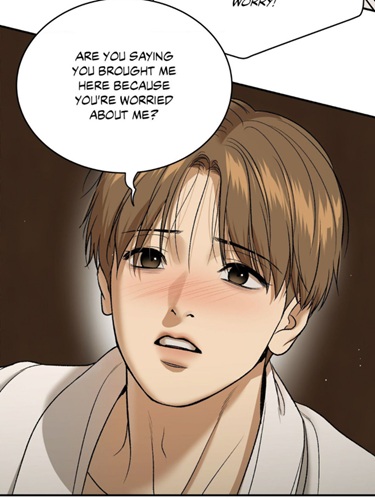 (chapter 67) His question is really an appeal for recognition. If Jaekyung answered yes, Dan could interpret it as proof of love, because in his own distorted framework being worried about equals being cared for. But Jaekyung answered with silence.
 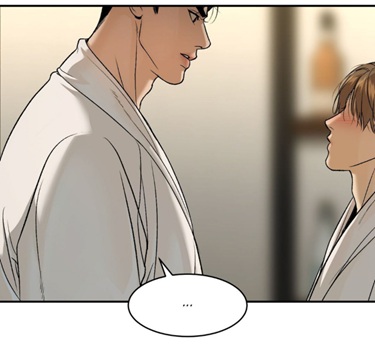 (chapter 67) Not because he felt nothing, but because he lacked the language to connect worry with love. In his conscious mind, conception of care was still bound to usefulness — Dan mattered because he was needed for training, not because he was loved as himself, while deep down, he had already moved beyond this aspect. He was just in denial in this scene,
This silence is therefore not just personal, but inherited. Just as his mother’s withdrawal taught him that once a child stops needing, they stop being loved, Jaekyung reenacts the same absence with Dan. He cannot yet affirm him as more than useful, even though his presence unsettles him precisely because it is more than that. Dan’s question names the void: he asks Jaekyung to translate provision into affection, and Jaekyung cannot. That ellipsis is the echo of a life raised without “I love you”.
The Phone Call: “Who Are You?”
Nothing illustrates this more starkly than the phone call. When Jaekyung reaches out as a teenager, his mother responds:  (chapter 74) On one level, she does not recognize his voice. But on a deeper level, her words ring as truth: she does not know her son. She has no idea who he has become, what defines him, what characterizes him beyond money and survival.
And tragically, Jaekyung falls into the same trap. He offers her money 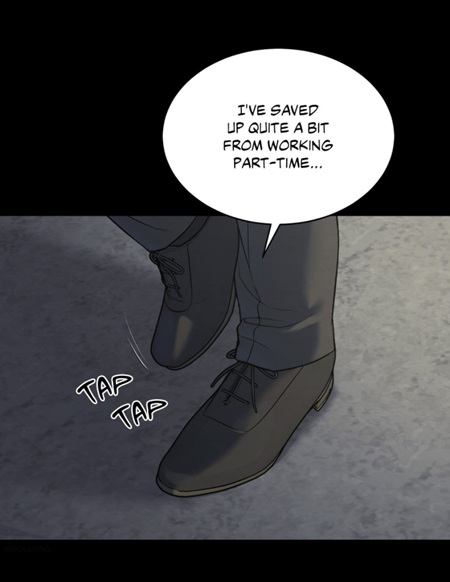 (chapter 74), promising to provide for her if she returns home. He unconsciously appeals to the only logic he has ever known: that love equals provision, that affection is secured by usefulness.
But beneath this maternal echo lies another inheritance: the patriarchal mindset of his father.  (chapter 73) From him, Jaekyung absorbed the conviction that a man must be the provider, the protector, the one who works and sacrifices while the partner silently follows. This explains why, in his relationship with his mother
 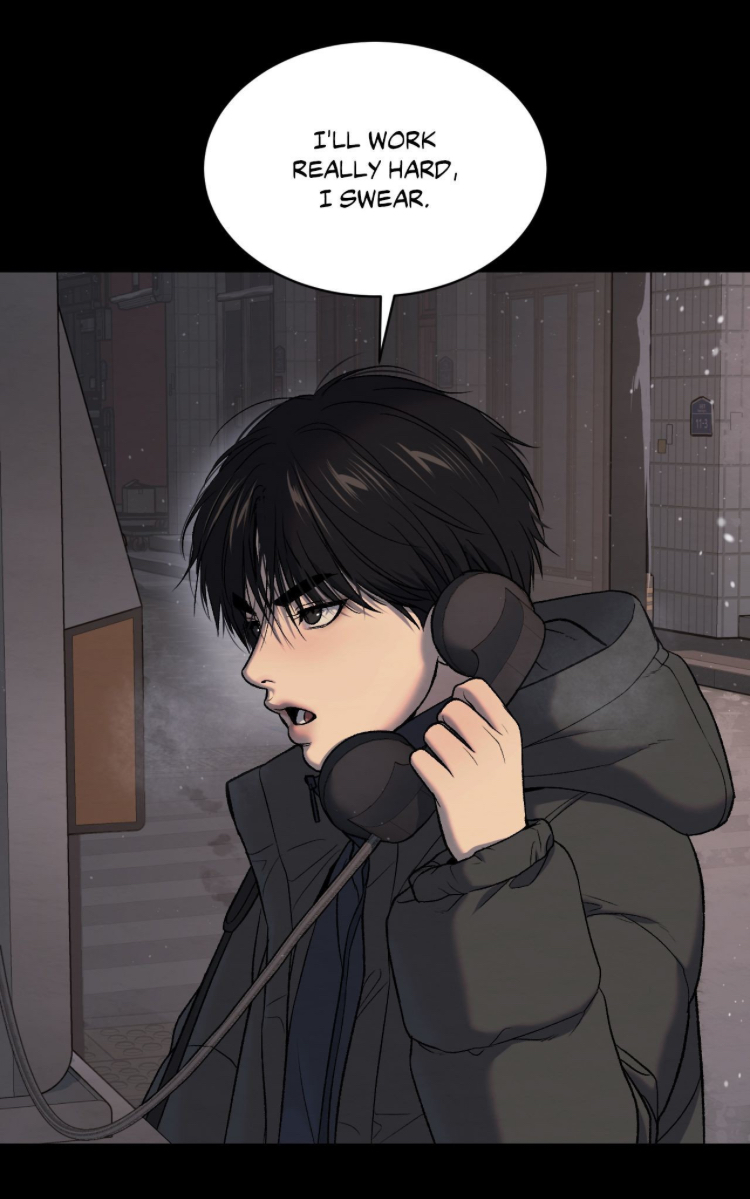 (chapter 72) and Kim Dan, he instinctively assumed he had to “do it all”: earn, fight, shield, control.
 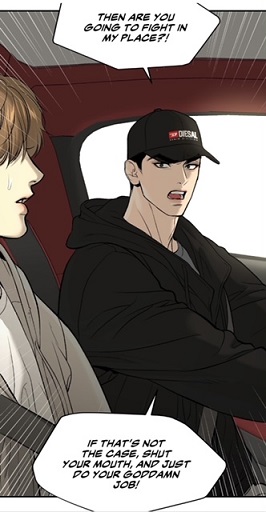 (chapter 42) His father’s voice was violent and scornful, but its framework remained lodged in him.
This dynamic also recalls the director’s mother, who devoted herself unconditionally to her son. (chapter 74) She has no name, because she is simply reduced to a role: mother. She offered food and care, but never voiced her own wishes. She silently bore the weight of her choice, just as Jaekyung’s mother once shielded herself with her child instead of speaking. Both figures embody the same pattern: women reduced to roles, never permitted desire. However, there is a huge difference between these two mother figures; the champion’s mother chose to leave, the moment her husband did not meet her expectation. And Jaekyung, internalizing this pattern, grew into a man who could only imagine love as one-sided duty — he provides, the other depends. But now, doc Dan is no longer willing to be treated that way. That’s why he chose to adopt the role of a prostitute after their reunion. 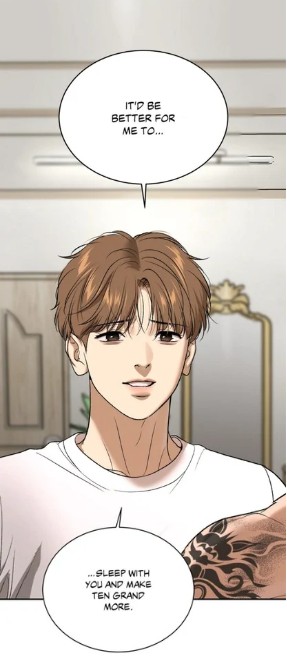 (chapter 62) That way, he can still be “free”.
But this exchange also marks a threshold. (chapter 74) The moment Jaekyung begins to discover being with Dan — joy, play, presence, companionship — (chapter 75) the mother’s entire system collapses. He cannot live in both worlds. To live in being means to abandon her for good, because her form of love will never change. Besides, they have long gone separate ways. Thus I see the vision of doc Dan as a future partner, where both characters will walk side by side! This announces the arrival of equity and real communication.
Trash as Metaphor: The Child Discarded
Her abandoned home, strewn with garbage, 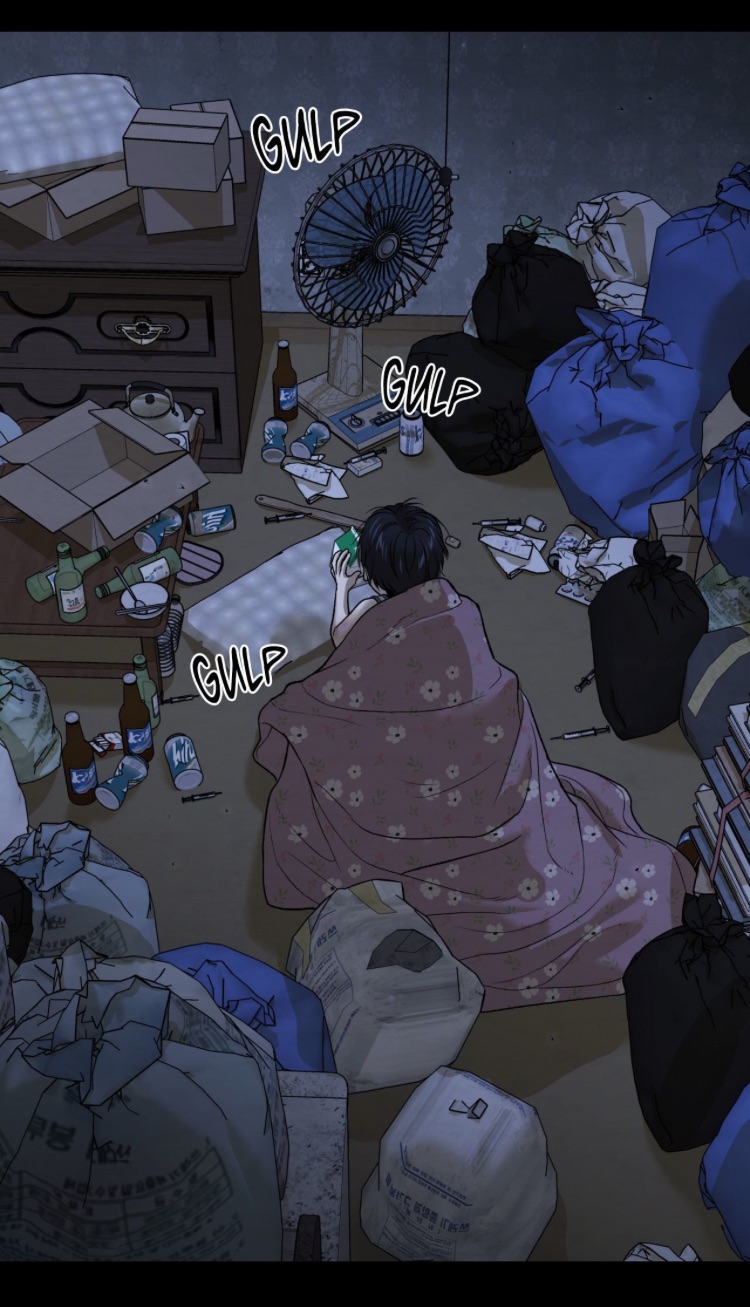 (chapter 72) becomes the perfect metaphor for her treatment of him. Once she no longer needed him, he was discarded like refuse. Just as trash cannot be reclaimed by sentimental value, she will not be able to reclaim him later through appeals to blood ties or belated need. It is impossible because he has learned — painfully — that true love is not about what you have, but about who you are.
Her tragedy is repetition. The remarriage, the second child, the affectionate taps and “dears” — all of it looks like growth on the surface (chapter 74), but in truth it reveals her imprisonment in the same mindset. She has not changed. She still defines herself by being needed, by having. She lives through others. And Jaekyung, by recognizing this, gains his first real emancipation. That’s why he destroyed the cellphone. 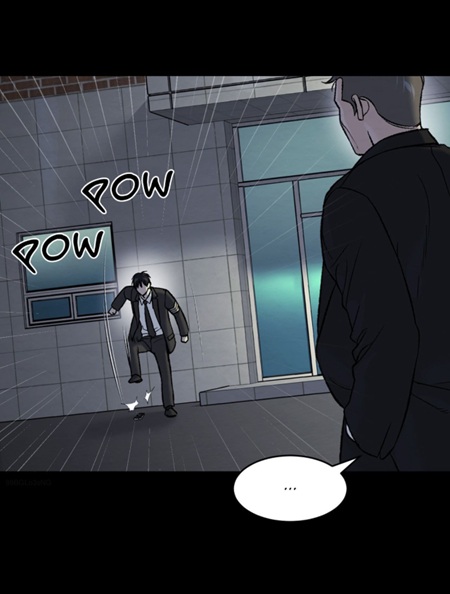 (chapter 74) He understood that the words he longed for as a child were never simply withheld — they never existed. Since we saw her back and heard her voice, I don’t think, she truly cut off ties with Joo Jaekyung. Why? It is because she had no intention to change her phone number again.
 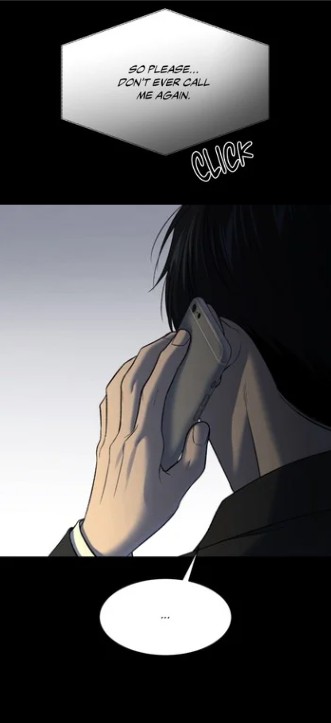 (chapter 74) She expected him to follow her request. I can definitely imagine her trying to reconnect with Joo Jaekyung, the moment he became a celebrity.
 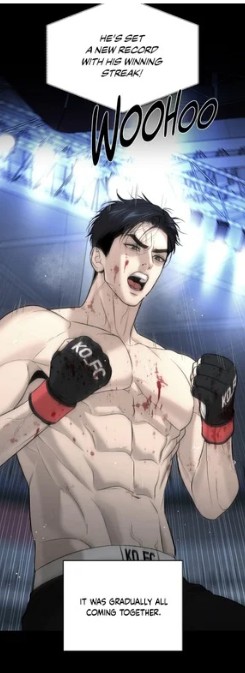 (chapter 75) Keep in mind that we have these mysterious phone calls:
  (chapter 37)
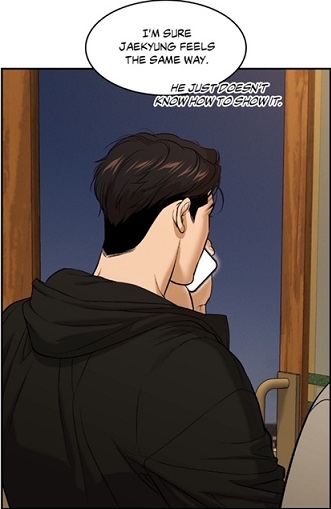 (chapter 43)
  (chapter 49)
Park Namwook: I’ll help you
Into this pattern steps Park Namwook, who initially cloaked his ambition in the language of encouragement.  (chapter 75)
 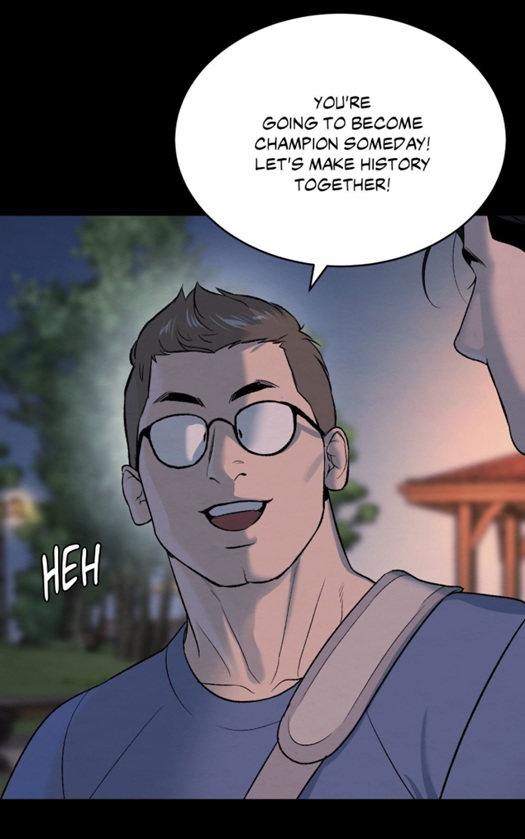 (chapter 75) On the surface, these sound like support. He smiles, his tone is warm, his words echo the vocabulary of friendship. Yet this false promise had lasting consequences: it reinforced a pattern already planted by the champion’s mother. Since childhood, Jaekyung had equated helping with caring
  (chapter 72), because silence at home had taught him that the only way to hold on to love was to provide, protect, and prove his usefulness. Under Namwook, this belief hardened into a rule: in his world, attachment became synonymous with utility.
This distortion explains much of Jaekyung’s later behavior. If someone claims to love, they must prove it through tangible action. Affection that doesn’t translate into help feels like a lie. Because Heesung mentioned “loving” Dan  (chapter 34), Jaekyung assumed later that the actor would have helped doc Dan to hide.
  (chapter 58) His violent intrusion into the actor’s home was the natural outgrowth of Namwook’s teaching: if love is real, it must show itself as service.
The tragedy is double. First, Namwook’s corrupted version of “help” left Jaekyung vulnerable to exploitation. Second, it blinded him to other languages of love — words, presence, patience — so that when Dan tries to love him differently 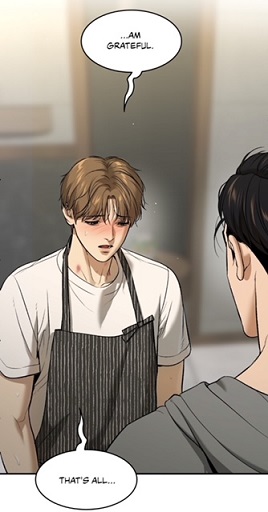 (chapter 45), Jaekyung struggled to even recognize it. Giving him a gift and expressing gratitude was not “helping the fighter”.
But beneath the illusion lies self-interest. Namwook’s “help” was contingent upon Jaekyung’s usefulness — his talent, his earning power, his ability to bring fame. Just as the mother’s affection was tied to need, and the father’s recognition bound to victory, Namwook’s loyalty was tethered to what Jaekyung could provide. He did not love the man; he loved the champion’s potential, the profit and prestige attached to his fists.
This makes Namwook part of the same lineage of distorted caregivers:
- Father: curses that turned into chains.
- Mother: silence disguised as maturity (“you’re grown-up now”).
- Halmoni (Dan’s): burdens disguised as devotion (debts, sacrifice, favor).
- Namwook: exploitation disguised as encouragement (“I’ll help you”).
All promised some version of care, but none delivered unconditional love. All instrumentalized him — whether as proof, shield, provider, or weapon.
And here the contrast with the director becomes stark. The director does not say I’ll help you” or “let’s make history together.” He does not tie Jaekyung’s value to his strength and his own ambition. Instead, he says: “ “ (chapter 75) There’s a life outside the ring and the spotlight. (chapter 75) He does not attach himself to Jaekyung’s victories but releases him into freedom. His love, belated as it is, is non-possessive. It is because he has learned his “lessons”. He realized that his dream
 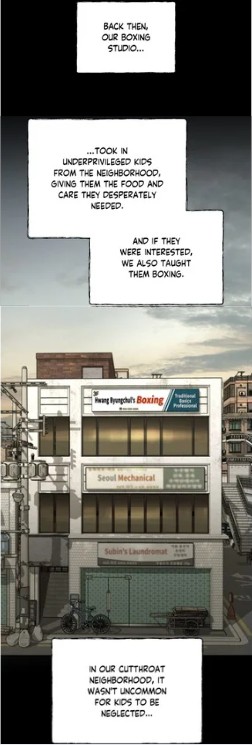 (chapter 72) was quite futile, for at the end, he ended up alone and felt lonely.
At this point, one must ask: why didn’t the director, Hwang Byungchul, say those words either? The answer is not that he feels nothing, but first he fears exposing his vulnerability and emotions. Therefore he yelled and challenged the champion. 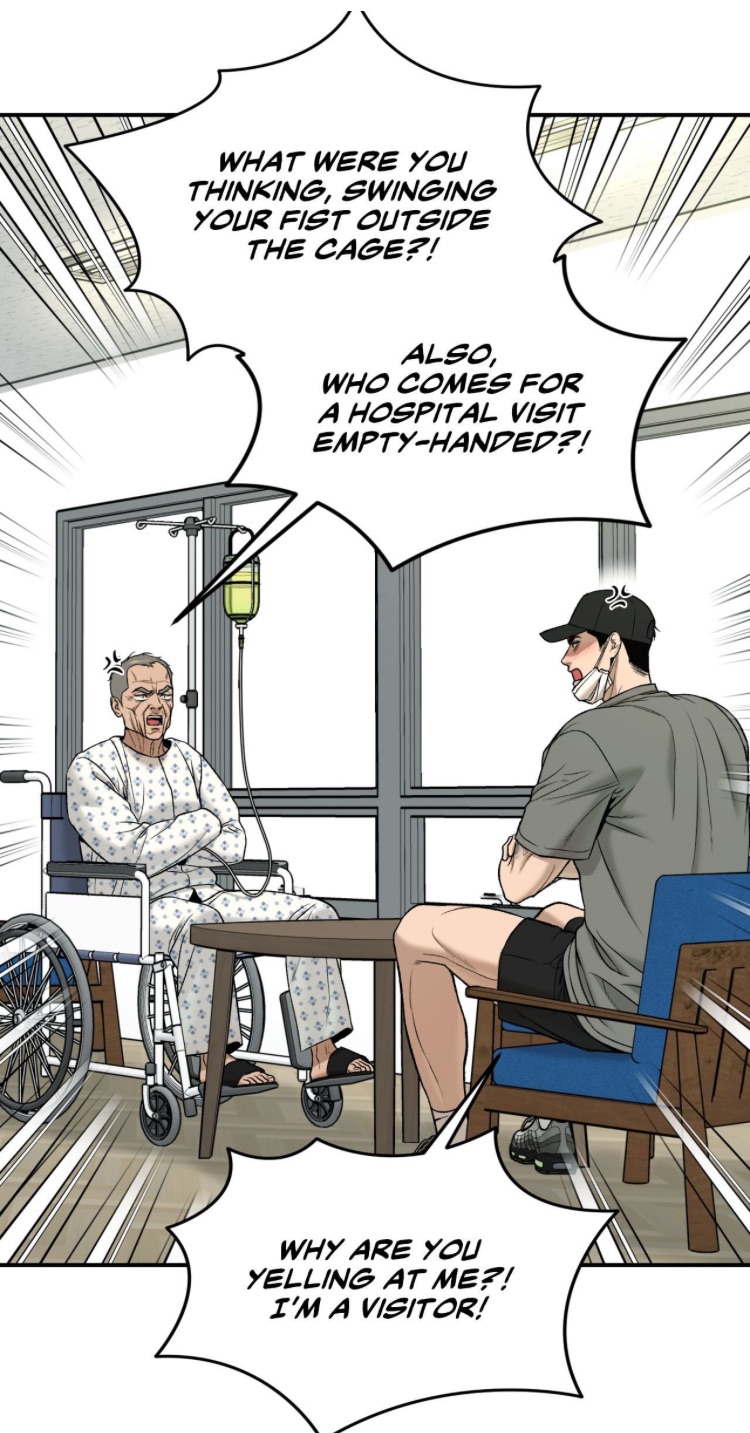 (chapter 71) Yet, deep down, he was happy that Joo Jaekyung had visited him and even spent the whole day with him. Secondly, for him, too, love has always been expressed through responsibility, advice, and correction rather than direct declaration. When he tells Jaekyung to “look around” and “think hard,” or warns Dan to “
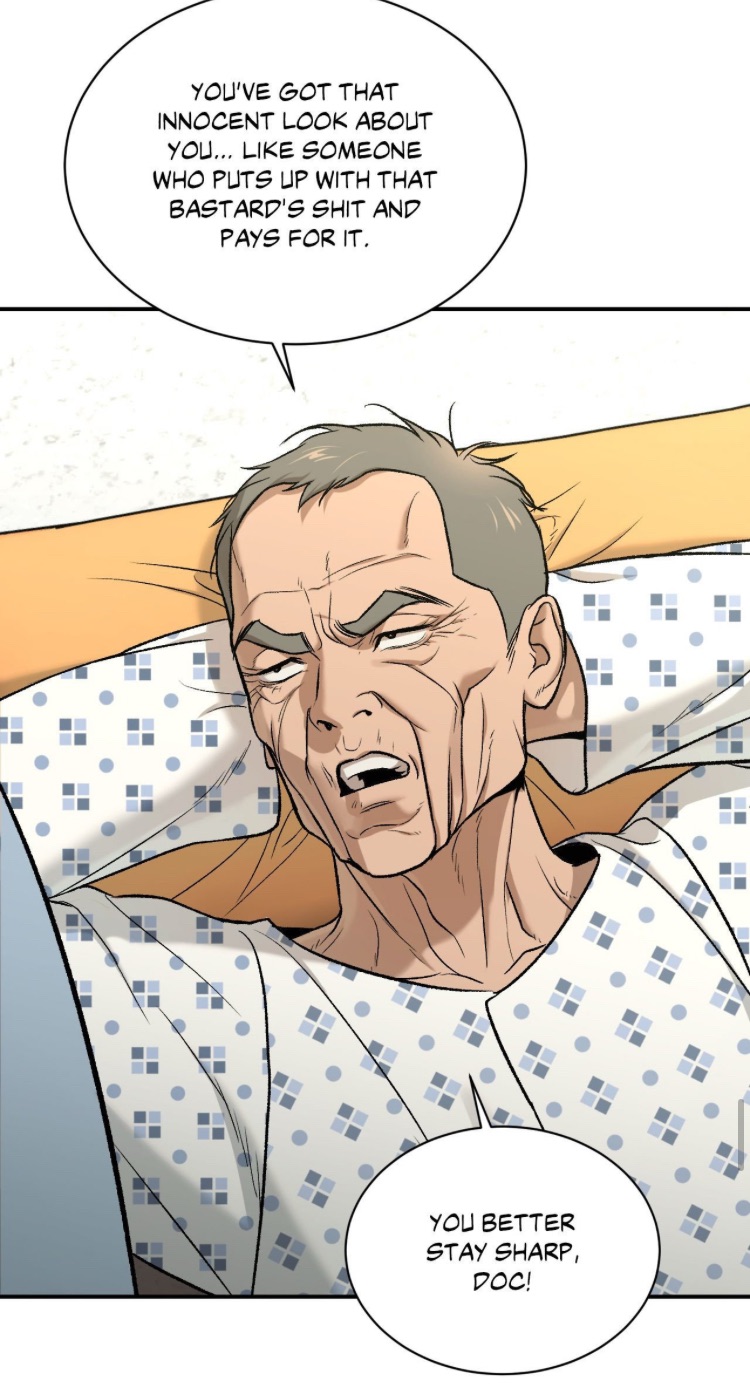 (chapter 70) “stay sharp,” he is not being cold — he is speaking from the only framework of love he knows: respect, knowledge, care, and responsibility, the very dimensions Erich Fromm outlines. He realized too late that he missed Joo Jaekyung very much. His love is embedded in actions and words of guidance, not in sentimental speech. To suddenly say “I love you” would, in his own register, feel shallow and false. He actually embodies the “real parent” IMO, because contrary to all the others adults, he learned from his mistakes. No parent is perfect, but they need to reflect on their words and actions. Learning through experiences is lifelong learning. It stops with death. The director did his best according to the circumstances and tried to correct his wrongdoings. And we can see his influence in the champion’s life. When it comes to doc Dan, he also makes mistakes:
 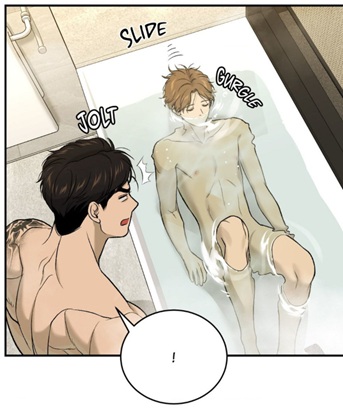 (chapter 68)
 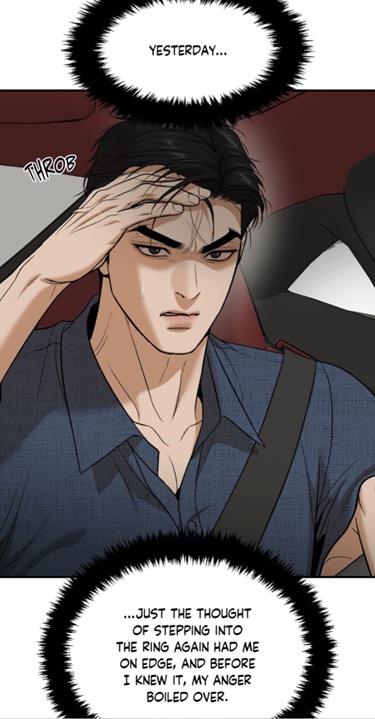 (chapter 69)
  (chapter 69) And that’s what makes him so human.
In this sense, the director and Jaekyung are alike: both have never learned the language of love as affirmation. They can only circle it through substitution — advice, provision, worry, discipline, help. 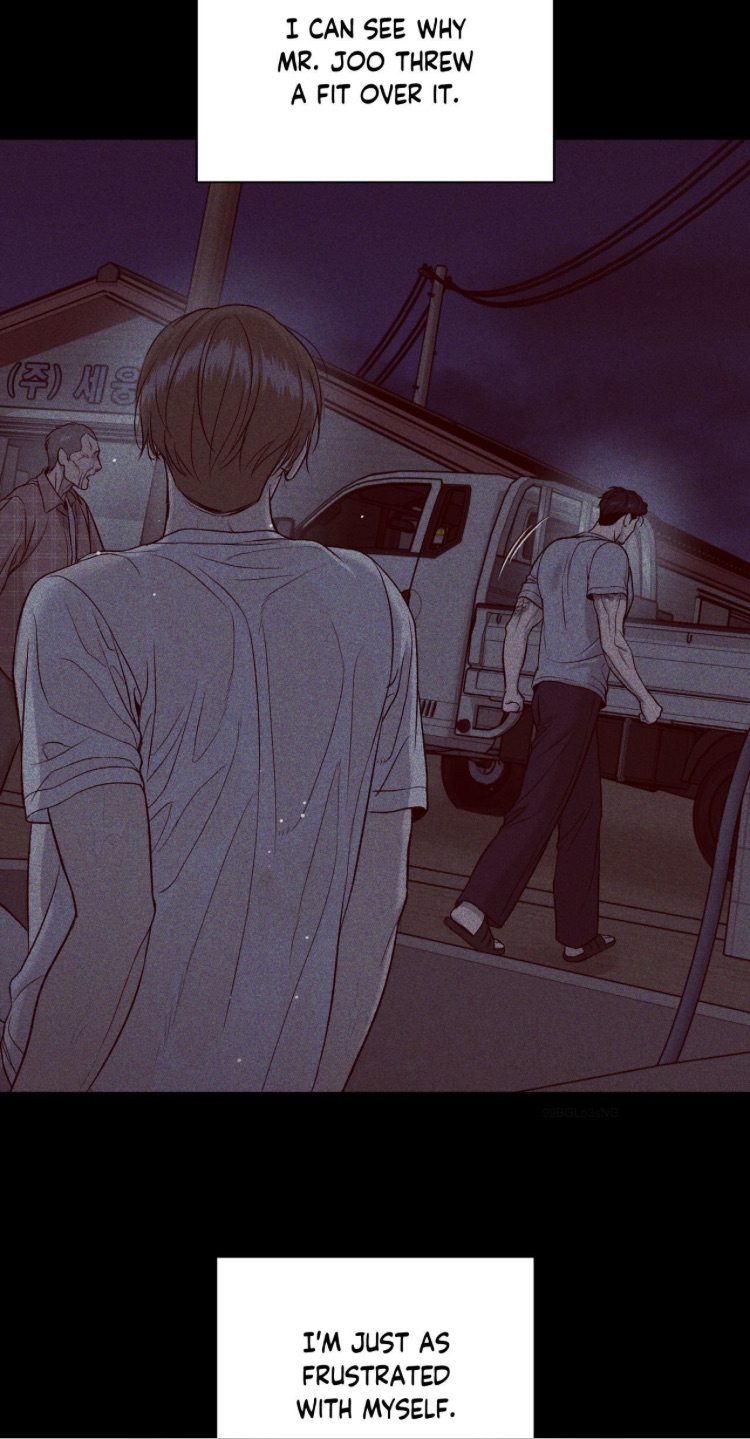 (chapter 71) Hence doc Dan didn’t resent the champion for his harsh treatment. But unlike the mother, who equated love with possession, Hwang Byungchul has begun to correct himself. He respects Jaekyung’s privacy, he encourages instead of dictating, he models a love that is belated but still real. This opens the possibility that Jaekyung, too, may learn to fill his silences differently — not with dominance or provision, but with genuine presence. He truly embodies the philosophy from Erich Fromm: it is never too late to become happy! Hence he smiled on the rooftop! (chapter 75) No wonder why he asked for doc Dan’s company.
 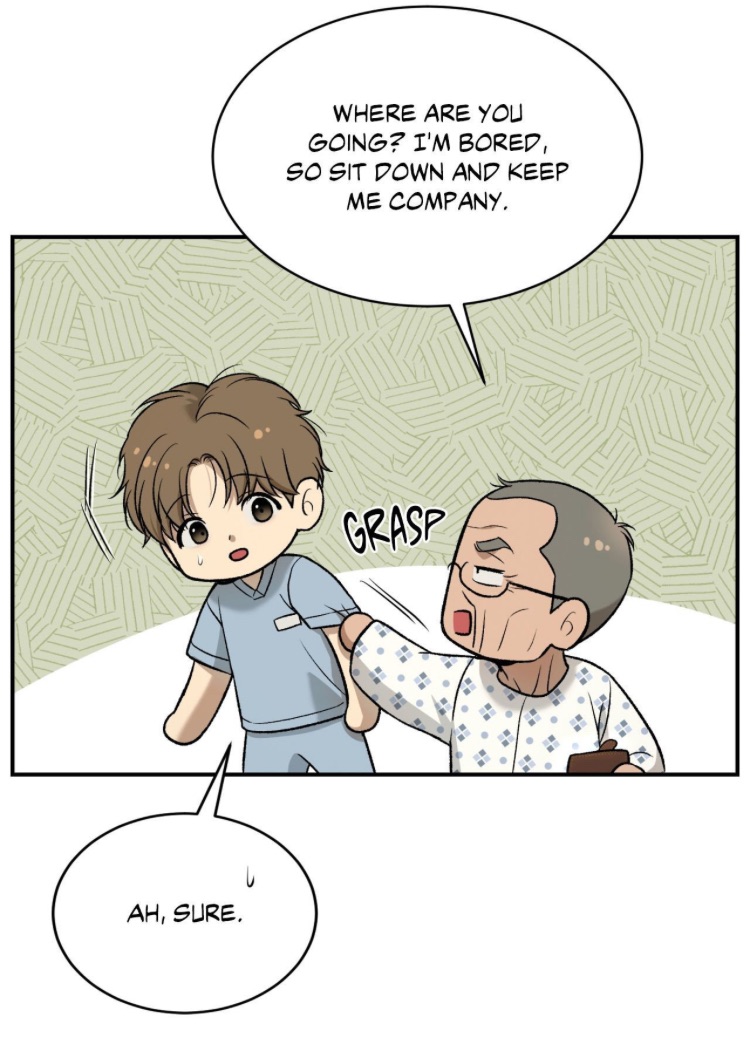 (chapter 71) This means that he lives now in the present. It looks like the “old coot” has been tamed by the “gentle hamster or duck”.
The Silence He Must Fill
This is why the vision of Dan is so striking. (chapter 75) Dan does not speak, but his gaze does not condemn or demand. It simply waits. It offers inclusion without conditions, presence without burden. The silence is not a void but an invitation. For the first time, Jaekyung is faced not with curses, not with resignation, not with demands, but with the possibility of acceptance. He just needs to be himself.
And yet, this makes the challenge greater: he must now learn to fill that silence. He cannot rely on victory, or money, or survival. He must discover a language that has never been spoken to him: the language of I love you.
The Language Kim Dan Cannot Speak
If Jaekyung’s tragedy is that he never learned to say I love you, he also needs to love himself first. He can not imagine how someone could ever say to him: “I love you”. This explicates why the athlete asked the doctor if he remembered that night in the States.  (chapter 41) He didn’t know how to judge such a confession. Hence these words were reduced to a mistake! (chapter 41) To conclude, he couldn’t accept the confession, because he doesn’t love himself. He has never heard I love you in his childhood. Thus I believe that Dan’s tragedy is the mirror opposite: he did hear it once
  (chapter 19), and has been unable to say it since.
Dan already whispered the words — (chapter 39) — but it was under the haze of the drug. His instincts and body spoke first, bypassing the rational mind that usually silences him. In that moment, the words were pure, perhaps the most honest thing he has ever said. And yet, their context corrupted them. Spoken in a fog, they became easy to erase. Later, when Jaekyung pressed him about that night (chapter 41), Dan claimed he didn’t remember. But is it true? In doing so, he turned his own confession into what Jaekyung dismissed as “a mistake.” The first I love you in Jinx was thus swallowed twice: once by chemicals, and once by shame and fear. The physical therapist associates “I love you” with abandonment and rejection.
Why such negative emotions? My hypothesis is that for Dan, I love you does not mean reassurance or joy, rather it is strongly linked to the destruction of a world. It carries the echo of absence, of people who once said those words but then vanished. It is bound to guilt, because the boy left behind always wonders if he could have noticed the signs, if he could have done something. To confess love, for him, is to summon catastrophe, to risk repeating the ultimate loss. Better to stay silent than to relive that moment.
My reading is that Dan’s parents died suddenly, perhaps by suicide, and with them he lost not only family but also home.  (chapter 65) We know he once had toys (teddy bear,car)
 (chapter 21) , little signs of comfort that suggest he grew up in relative security, even if his parents were often absent for work. For me, his childhood was not defined only by poverty but by rupture: love was present, then violently cut short. To a child, such a disappearance feels like betrayal, even if it was no one’s fault. Dan would have been left with a terrible contradiction — that “I love you” was true, and yet those who said it abandoned him forever.
He never had the chance to answer back. (chapter 19) His silence froze into permanence, leaving him with the haunting sense that love was unfinished, that his part of the dialogue was missing. This explains his adult paralysis. To say “I love you” now is not just about risking loss; it is about confronting the memory of the reply he never gave. In this way, the words carry a double weight — love as death, and love as guilt.
Chapter 66 dramatizes this curse in full force. In his sleep, Dan clings to Jaekyung’s shirt 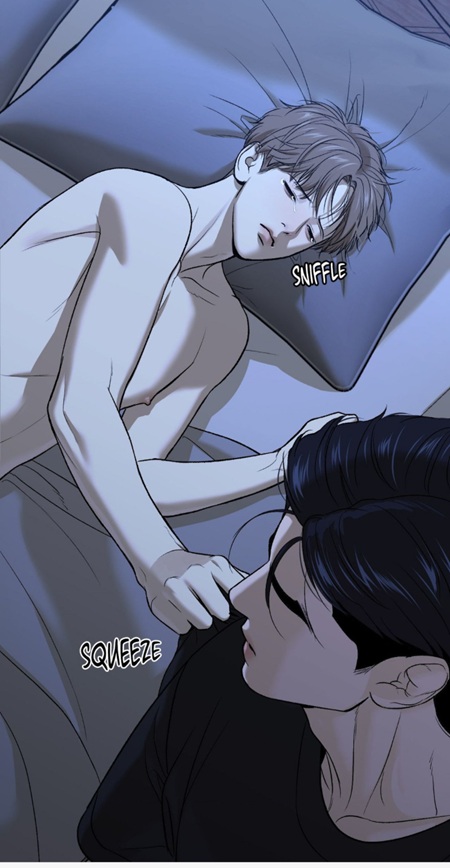 (chapter 66), whispers through tears
 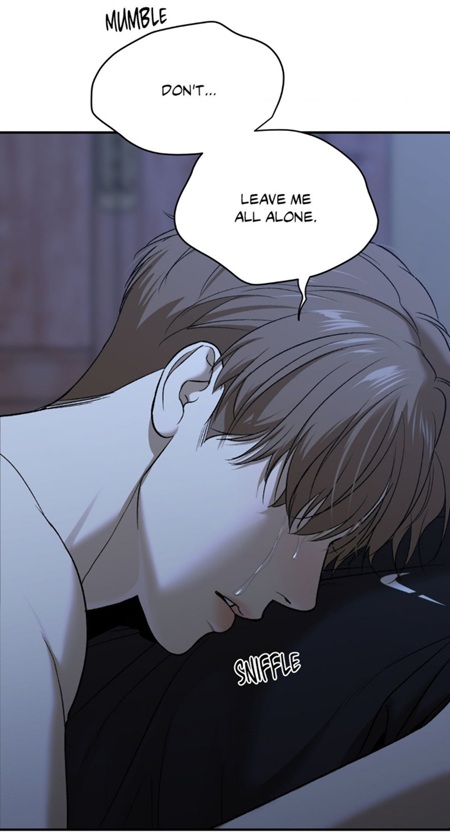 (chapter 66) and then breaks down with “
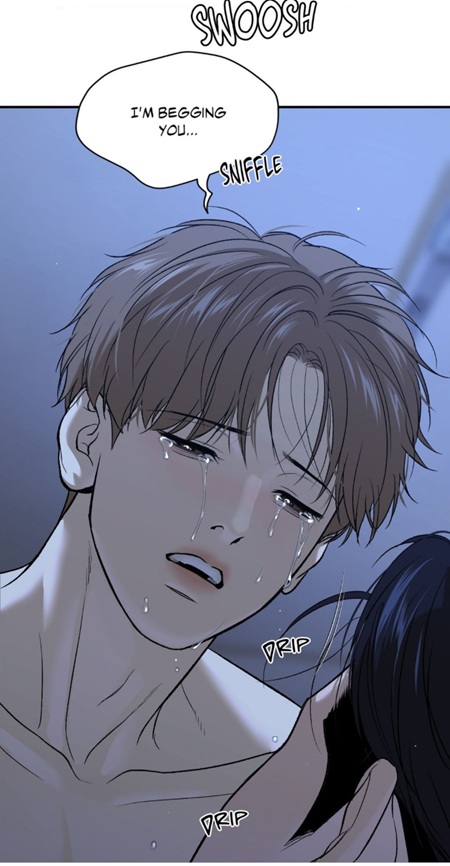 (chapter 66) These are not declarations of love, but desperate substitutes — fragments of the words he could never utter in childhood. They expose the precise gap: he never managed to say back what had once been said to him. He had lost his parents too soon. Instead of “I love you too,” what emerges is fear of abandonment. Instead of reciprocity, there is only pleading. His grip on Jaekyung’s shirt is the physical translation of what he could not verbalize: the child’s attempt to hold onto someone who is already vanishing. (chapter 66) He regrets his passivity and silence. He has not been able to mourn them.
This is why he associates love with death. The words became for him not a gift, but a curse: a death sentence, a debt he could never repay. To say I love you would be to invite catastrophe, to repeat the moment of unbearable loss, as loving means missing. His survival mechanism was silence. He chose to endure, to repay debts, to serve others, to substitute actions for words.
Here another distinction is crucial: the difference between quantity of time and quality of time. In Germany, working mothers were long stigmatized as “Rabenmutter” (raven mothers), accused of selfishly neglecting their children if they pursued careers. Yet modern research has shown that a fulfilled, working mother often gives more genuine love than a depressed housewife who sacrifices everything. What matters is not constant presence but authentic connection.
Dan’s grandmother never understood this. She assumed that because she spent all her time with him  (chapter 65), the boy had not developed such a deep attachment to his parents. Thus she imagined, she could erase their absence. She conflated sacrifice with love, debt with affection. Yet what he received from her was not the warmth of a parent, but the burden of endurance. She patted
 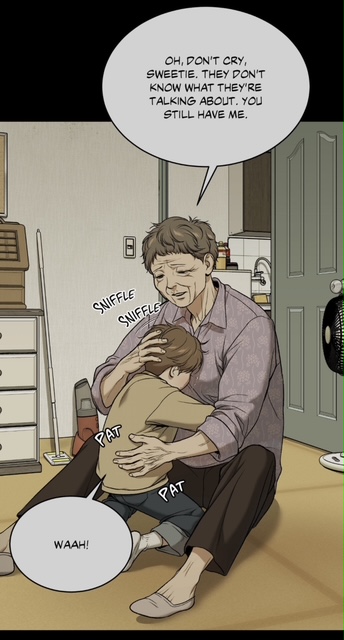 (chapter 57) and caressed him with her hand, but the kiss in chapter 44 reveals something different:
  (chapter 44) Dan once received love of a different kind — playful and tender. A kiss cannot have come from the grandmother, who expressed affection only in gestures of care, never of intimacy. That kiss belongs to his mother.
That’s why my theory is that Dan’s suffering is not rooted in never having been loved, but in being too much loved — and then losing it. He tasted true love as a child, only to have it ripped away. The grandmother, in her endless presence, could not replace it. Quantity could not make up for quality. The boy grew up knowing exactly what love felt like — and therefore knowing exactly what he had lost.
This is why Mingwa draws both boys with phones as children. (chapter 74) Each is tied to a parent’s voice. For Jaekyung, the mother’s words amounted to rejection and withdrawal: “You’re grown up, I don’t need you.” For Dan, the unseen parent almost certainly said the opposite: (chapter 19) “I love you.” But because death or disappearance followed, those words became unbearable. One parent wounds by refusing to speak, the other by speaking for the last time. This explicates his hesitation in the penthouse: (chapter 45) Both strands converge in the present: Jaekyung cannot hear love, Dan cannot voice it. Both are cursed.
If his mother’s last words were “I love you” tied to death and guilt, then money, gifts, and even friendship all became tainted for Dan:
- Never saved money. Because deep down, money symbolized the burden that crushed his parents. To him, money is linked with guilt and loss, not freedom. Why save what only brings ruin? Every coin tucked away echoes the debts that swallowed his family.
- Not interested in friends. Friendships mean attachment, and attachment means risk of loss. If “I love you” from his mother ended in abandonment, then investing emotionally in others would feel too dangerous. Better to stay isolated, to keep the pain at bay. Besides, he experienced bullying, reinforcing his isolation.
- Accepted grandmother’s passivity. Her silence mirrored his own coping strategy: if you don’t hope, you can’t be hurt. He didn’t rebel because her inertia fit his trauma — a life stripped of dreams is safer than a dream that can collapse. At the same time, it explains why he attached himself to her, did everything for her… it is because he knows what love is.
 (chapter 65)
 - Couldn’t accept presents. Because gifts symbolize care and generosity
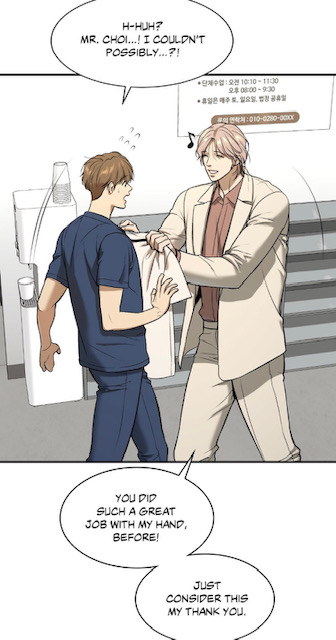 (chapter 31)— which he associates with unbearable debt. His mother’s final “gift” of love was one he could never repay. Any present risks reopening that wound: “What if I can’t repay this? What if I lose them too?”
Even his hesitation in love reflects this same scar. To confess is to risk repeating the curse: to say I love you is to say I miss you, to pre-empt the loss he believes must inevitably follow attachment. That is why his every gesture translates into repayment rather than confession: paying debts, working endless jobs, offering loyalty. For Dan, love must always be balanced, or else it feels like a dangerous imbalance that the universe will punish.
This is why his whispered confession was both utterly true and utterly tragic. (chapter 39) It broke free of his usual silence, but only in a context that allowed it to be denied, laughed off, reduced to error. The boy who once heard I love you as the final word of life has never dared to speak it again with full consciousness. For him, the words are not magical yet. They are still poisoned.
The End Of The Curse
But after hearing Jaekyung’s tragic story, he must have realized that they share the same fate: both grew up without parents, both were robbed of a proper childhood. One was abandoned, the other bereaved. Both learned to survive through silence.
This is why the dream in chapter 75 matters so deeply. (chapter 75) In the dream, Dan does not speak. He simply turns back, bathed in sunlight, as if to wait. That single gesture contains everything Jaekyung has been starved of: inclusion, patience, recognition. It stands in absolute contrast to the voice of his father, who at dawn once spat the cruelest curse a child can hear: (chapter 73) You are not special wounded Jaekyung more deeply than fists ever could. It condemned him to a life of proof, to an endless treadmill of victories meant to silence that voice. But here, in this vision, the curse is answered without words. For Dan to wait for him, to turn his face toward him, is to say what no one else ever did: you matter. You are precious. You are worth waiting for. In fairy-tale terms, the jinx is not lifted by triumph in battle, but by recognition — by being seen. (chapter 75) He doesn’t need to prove his worth or his strength. He doesn’t need to do anything, he just needs to look at doc Dan! Through the gaze, they both express that they are valuable.
The physical therapist’s vision with Shin Okja 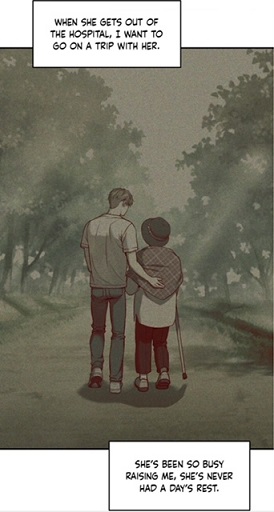 (ch. 47) throws this into sharper relief. There, Dan imagined taking her on a trip after the hospital, walking side by side, giving her what she never had: rest, companionship. The problem is that this image was still mixed with repayment, nevertheless doc Dan was gradually realizing that spending time together was important. This vision displays the importance of walking together. When Jaekyung dreams of Dan waiting in the sunlight, (chapter 75) it is the same metaphor renewed. Dan has replaced the grandmother in this vision — he has become the one who walks ahead yet turns back, including him in the journey. The implication is clear: Jaekyung no longer has to march forward alone. The future he never dared to imagine now opens as a shared path.
The structure itself echoes the fairy-tale pattern. I have already made connection between the Korean Manhwa and Sleeping Beauty , Belle and The Beast, and finally The Little Mermaid. In Sleeping Beauty, the kingdom lies trapped in silence until a kiss awakens not only the girl but the world. In The Little Mermaid, dawn means death because her love remains unspoken. In Beauty and the Beast, the curse is shattered only when the words “I love you” are spoken — not as possession but as recognition. Mingwa draws from this reservoir of cultural memory. Jaekyung’s dream is a kind of spell: silence redefined, from abandonment into hope. Where once silence meant rejection — the mother who turned her back, the father whose silence was mockery, the empty nights of waiting — now it becomes a promise: Dan will not walk away. He waits, silently, until Jaekyung steps forward. (chapter 75)
Notice the timing. When Jaekyung jolts awake, (chapter 75) the room is still dark. Yet in a previous chapter, we heard birds singing at dawn 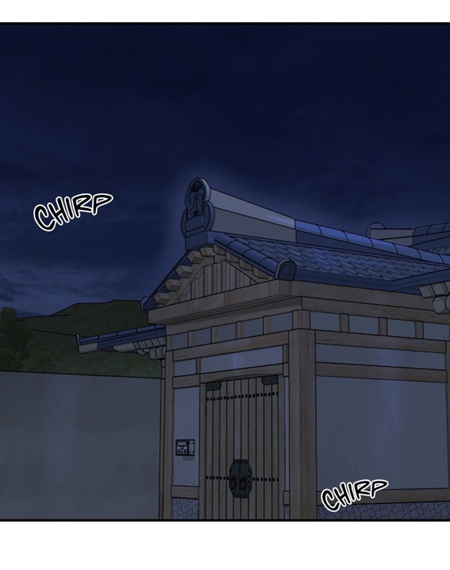 (chapter 74) — the quiet sign that the sun is about to rise. Dawn is not just a natural detail in Jinx; it is a symbolic hinge. It is the moment when night meets day, when moon and sun overlap, when endings bleed into beginnings. In myth and fairy tale, dawn often marks metamorphosis: the Little Mermaid turns to foam, the enchanted sleepers awaken, the beast becomes a prince. For Jaekyung, too, dawn is the threshold. His father cursed him at dawn
  (chapter 73), stripping him of worth, tying the rising sun to shame. But in this new dawn, another voice will have to intervene. Only Dan can replace the curse with a blessing. Only “I love you” can undo “you are not special.” And if it is not “I love You”, then it could be a kiss, the symbol of “affection”.
Thus both men stand before a silence heavy with history. For Jaekyung, silence meant abandonment; for Dan, silence meant survival. And yet in the dream, silence shifts its meaning. It becomes the waiting space in which words can finally emerge. (chapter 75) Dan’s figure in the sunlight does not reproach, does not demand. It simply invites. The silence of the dream is not the silence of loss but the silence that precedes a confession.
This is why the fairy-tale logic is so essential. In every story, the curse holds until someone dares to speak or act from love. In Jaekyung’s case, brute force has failed. No title, no victory, no belt has lifted the weight of his father’s curse. In Dan’s case, endurance has failed. No debt repaid, no day survived, no burden carried has erased the wound of his parents’ disappearance. The spell will not break by repetition of the old methods. It will break only when Dan speaks the words he most fears: I love you.
When that happens, the dawn scene will finally be complete. The birds already sing. The light already glimmers. The dream has already shown the way. What remains is for Dan’s voice to enter the silence, to transform waiting into presence, vision into reality. When those words are spoken — not poisoned by guilt, not dismissed as a mistake, but confessed freely — Jaekyung will no longer be his father’s son. He will be someone else’s beloved. The jinx will shatter (chapter 75), not with noise but with a whisper while looking at each other.
And if the curse is broken, the athlete no longer needs to fight and accept the “invitation” from the CEO and the manager. This is where Mingwa’s subtle use of sound and silence becomes crucial.
Think back to the restaurant in chapter 69,  (chapter 69) when Park Namwook leaned across the table and whispered to the champion about his slipping rank, his lost title, his third place. The setting is dim, the words hushed, the tone heavy with shadow. That whisper was not meant to soothe — it was meant to undermine. Namwook’s closeness is false intimacy: a confidentiality designed to manipulate, to remind Jaekyung of his dependence, to keep him chained to the cycle of fighting. The whisper here is the voice of fear, lack, and scarcity.
Now contrast this with the whisper we anticipate from Dan. His silence in the dream (chapter 75) is not oppressive like Namwook’s — it is open, steady, waiting to be filled. When Dan eventually breaks it with an “I love you,” the whisper will not chain Jaekyung to debt or failure, but free him from the curse. Both Namwook and Dan occupy positions of proximity, both bend close to him in moments of vulnerability — but one weaponizes the whisper, the other redeems it.
This brings us back to my point about quantity versus quality. Namwook has been by Jaekyung’s side for years.  (chapter 75) He was always there — arranging his matches, covering his problems, whispering about his “future.” Yet the quality of his presence was hollow. He never once guided Jaekyung beyond his father’s curse, never helped him imagine a life beyond titles. Thus he never discovered that the “monster” was suffering from insomnia.
 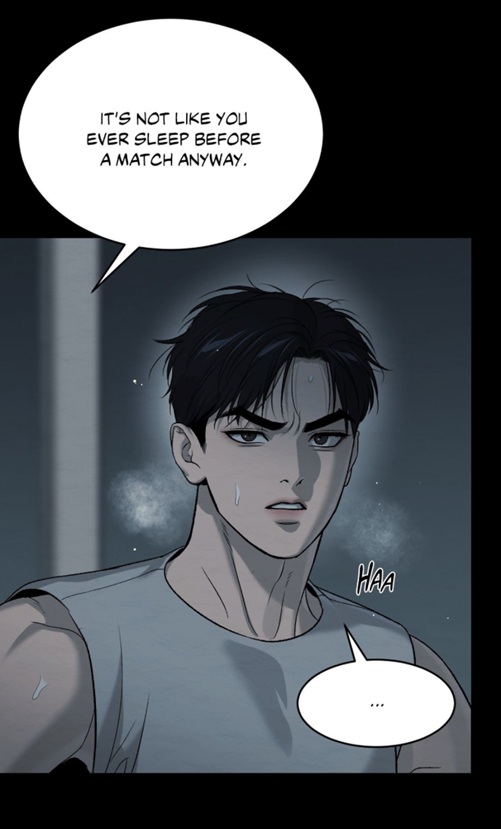 (chapter 75) His companionship was measured in duration, not depth.
By contrast, Dan has been present for only a fraction of that time (4 months). Yet in those brief encounters, he has done what Namwook never could: he has listened, waited, cared. He has offered no manipulation, no bargain, no shadowed whisper — only a quiet inclusion (chapter 41), an invitation to walk together. Namwook’s long presence embodies the trap of quantity without substance. Dan’s brief but luminous presence reveals the power of quality: the kind of attention that transforms.
In fairy tales, this contrast is often dramatized as the distinction between the false helper and the true helper. The false helper stays close, makes promises (The prince in The Little Mermaid), whispers encouragement, but secretly feeds on the hero’s struggle. The true helper might appear suddenly, even briefly, but offers the one thing that matters: the key to breaking the spell.
And that is exactly what chapter 75 foreshadows. The false whispers of Namwook will fade into irrelevance, while the true whisper — Dan’s future confession of love — will carry the power to break Jaekyung’s curse once and for all.
The breaking of the curse will not only free Jaekyung from his father’s voice — it will also free him from the tyranny of time.  (chapter 29) Under the curse, his whole life has been a frantic race: prove himself, fight again, silence the noise in his head.
  (chapter 75) Namwook’s whispers, too, keep him chained to that rhythm of urgency — rankings, titles, deadlines. But once Dan’s whisper replaces Namwook’s, time itself shifts. The future is no longer a debt to repay but a horizon to approach slowly, hand in hand.
That change means he can finally rest. And when one rests, the present opens up. The little things, so long ignored, become sources of joy. This is exactly what we glimpsed in chapter 27: the rare day off. For once, Jaekyung did not fight, did not perform. He smiled 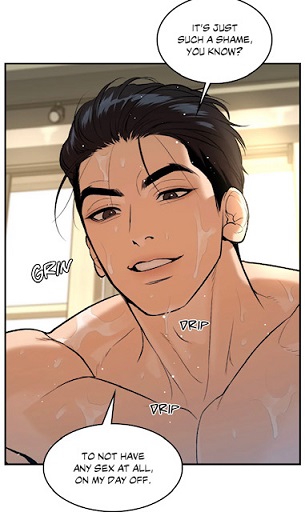 (chapter 27), joked
 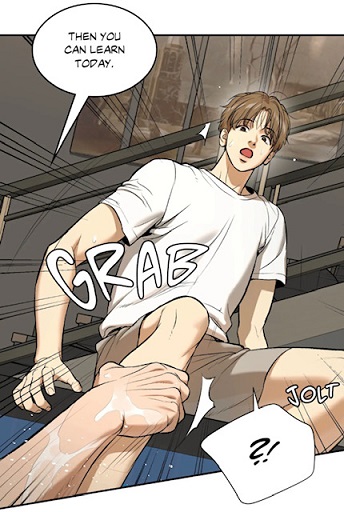 (chapter 27), even rediscovered his love for swimming. Water, his true element, was reclaimed as play rather than punishment.
  (chapter 27) That single day was a seed — a foreshadowing of what life might look like once the curse is broken for good.
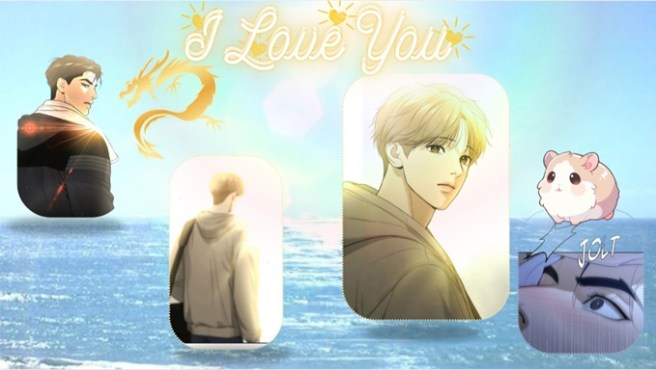
In this sense, the breaking of the jinx is not just about escaping the past; it is about re-entering the present. True happiness will not come from another belt or victory, but from the ability to enjoy simple, shared moments: jokes by the pool, laughter, warmth, rest. (chapter 75) But there’s a difference to the past. The vision of Kim Dan is strongly intertwined with nature, we are here seeing sunlight and not the light from cameras! (chapter 53) What did the director tell the star? The latter should look at his surroundings: the ocean, the sky, the trees… (chapter 75) This means that Joo Jaekyung is on his way to discover nature and as such animals! So far, he hasn’t paid too much attention to Boksoon and her puppies. And now, you comprehend my illustration for the essay. The champion is on his way to discover a whole new world. Doc Dan embodies nature: the sun, the trees, the sky. (chapter 75) Nature is the symbol of life. I LOVE YOU, LIFE!
Feel free to comment. If you have any suggestion for topics or Manhwa, feel free to ask. If you enjoyed reading it, retweet it or push the button like. My Reddit-Instagram-Twitter-Tumblr account is: @bebebisous33. Thanks for reading and for the support, particularly, I would like to thank all the new followers and people recommending my blog.

 Bebebisous33s' analyses in K-Dramaland and Manhwas